MIREOT Minimal information to reference external ontology terms Mélanie Courtot, Frank Gibson, Allyson L. Lister, James Malone, Daniel Schober, Ryan R. Brinkman and Alan Ruttenberg ICBO: International Conference on Biomedical Ontology University at Buffalo, NY ▪ July 24-26, 2009 Session 4: Creating ontologies that work together
Background –  the OBI project The Ontology for Biomedical Investigations (OBI) project is developing an ontology for the description of biological and clinical investigations The domain of OBI includes materials made and produced for investigations research objectives experimental protocols roles of people in investigations processing and publication of data gathered in investigations
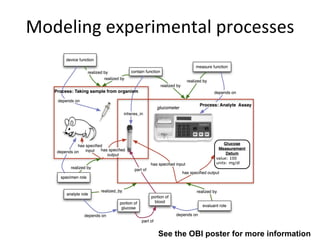
Modeling experimental processes See the OBI poster for more information
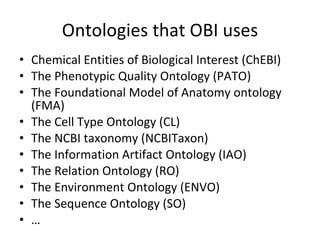
Some material entities in OBI anatomical entity (FMA, CARO) protein complex (Gene Ontology) molecular entity (ChEBI) organism  (NCBI taxonomy) processed material material entity chemical entities in solution device cell culture organization cell (Cell Ontology) PCR product
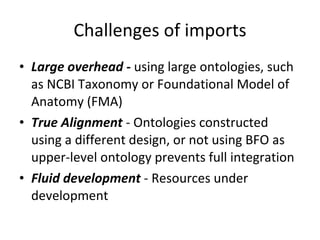
Ontologies that OBI uses Chemical Entities of Biological Interest (ChEBI) The Phenotypic Quality Ontology (PATO) The Foundational Model of Anatomy ontology (FMA) The Cell Type Ontology (CL) The NCBI taxonomy (NCBITaxon) The Information Artifact Ontology (IAO) The Relation Ontology (RO) The Environment Ontology (ENVO) The Sequence Ontology (SO) …
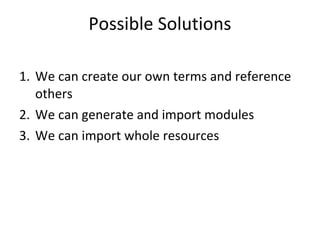
Large overhead -  using large ontologies, such as NCBI Taxonomy or Foundational Model of Anatomy (FMA) True Alignment  - Ontologies constructed using a different design, or not using BFO as upper-level ontology prevents full integration Fluid development  - Resources under development Challenges of imports
Possible Solutions We can create our own terms and reference others We can generate and import modules We can import whole resources
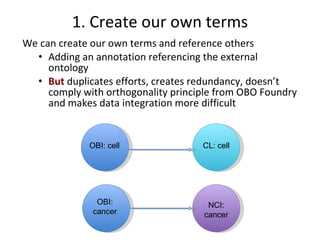
1. Create our own terms We can create our own terms and reference others Adding an annotation referencing the external ontology But   duplicates efforts, creates redundancy, doesn’t comply with orthogonality principle from OBO Foundry and makes data integration more difficult OBI: cell OBI: cancer CL: cell NCI: cancer
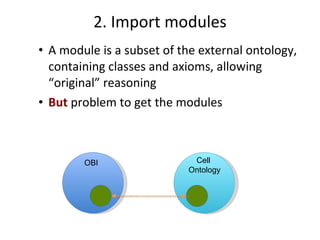
2. Import modules A module is a subset of the external ontology, containing classes and axioms, allowing “original” reasoning But  problem to get the modules OBI Cell  Ontology
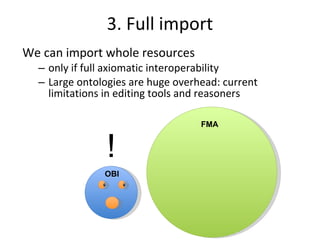
3. Full import We can import whole resources only if full axiomatic interoperability Large ontologies are huge overhead: current limitations in editing tools and reasoners ! OBI FMA
Observation Terms in OBO Foundry ontologies stand on their own If their meaning changes, they are deprecated =>  denotation  of individual terms remain stable => they can be seen as  individual units  of meaning
Our Proposal: Import only classes that are needed  Pro: We get around the problems with the other methods Con: Lose complete inference But  because the imported ontology might not be commensurate with OBI, we are not sure the inference would be correct
Implementation Strategy: Figure out how to automate as much as possible How to make it as easy as possible to enter, and maintain.
Define the minimal information we need URI of the class  URI of the source ontology Position in the target ontology => this  minimal set  allows to unambiguously identify a term
Additional information We may want to capture: Label, Definition, Other annotations: adding “human-readable” information Superclasses: for example, NCBI taxonomy …
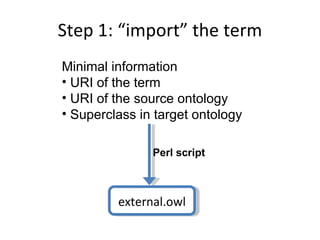
Step 1: “import” the term external.owl Minimal information URI of the term URI of the source ontology Superclass in target ontology Perl script
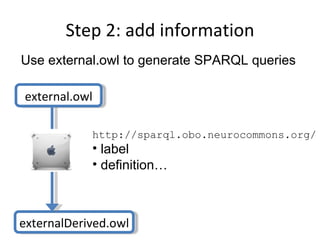
Step 2: add information http://sparql.obo.neurocommons.org/ label definition… Use external.owl to generate SPARQL queries external.owl externalDerived.owl
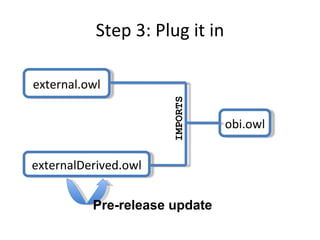
Step 3: Plug it in external.owl externalDerived.owl Pre-release update obi.owl IMPORTS
Summary This process works very well for us, we have 1223 external classes currently imported Other groups have expressed interest in using the same approach OntoFox has been developed to make the process easier.
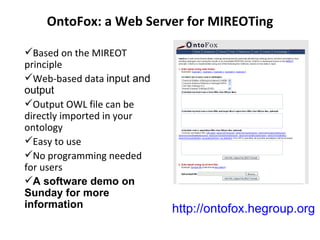
OntoFox: a Web Server for MIREOTing Based on the MIREOT principle Web-based data  input and output Output OWL file can be directly imported in your ontology  Easy to use No programming needed for users A software demo on Sunday for more information http://ontofox.hegroup.org
Some links http://obi-ontology.org/page/MIREOT Scripts are available under our SVN repository: http://purl.obolibrary.org/obo/obi/repository/trunk/src/tools/ add-to-external.pl http://purl.obolibrary.org/obo/obi/repository/trunk/src/tools/build create-external-derived.lisp
Thank you Frank Gibson Allyson L. Lister James Malone  Daniel Schober Ryan R. Brinkman Alan Ruttenberg NIH (R01EB005034), the EC EMERALD project (LSHG-CT-2006-037686), the BBSRC (BB/C008200/1, BB/D524283/1, BB/E025080/1),  the EU FP7 DebugIT project (ICT-2007.5.2-217139),  and the Michael Smith Foundation for Health Research.   PHAC/CIHR Influenza Research Network The OBI Consortium

MIREOT

  • 1.
    MIREOT Minimal informationto reference external ontology terms Mélanie Courtot, Frank Gibson, Allyson L. Lister, James Malone, Daniel Schober, Ryan R. Brinkman and Alan Ruttenberg ICBO: International Conference on Biomedical Ontology University at Buffalo, NY ▪ July 24-26, 2009 Session 4: Creating ontologies that work together
  • 2.
    Background – the OBI project The Ontology for Biomedical Investigations (OBI) project is developing an ontology for the description of biological and clinical investigations The domain of OBI includes materials made and produced for investigations research objectives experimental protocols roles of people in investigations processing and publication of data gathered in investigations
  • 3.
    Modeling experimental processesSee the OBI poster for more information
  • 4.
    Some material entitiesin OBI anatomical entity (FMA, CARO) protein complex (Gene Ontology) molecular entity (ChEBI) organism (NCBI taxonomy) processed material material entity chemical entities in solution device cell culture organization cell (Cell Ontology) PCR product
  • 5.
    Ontologies that OBIuses Chemical Entities of Biological Interest (ChEBI) The Phenotypic Quality Ontology (PATO) The Foundational Model of Anatomy ontology (FMA) The Cell Type Ontology (CL) The NCBI taxonomy (NCBITaxon) The Information Artifact Ontology (IAO) The Relation Ontology (RO) The Environment Ontology (ENVO) The Sequence Ontology (SO) …
  • 6.
    Large overhead - using large ontologies, such as NCBI Taxonomy or Foundational Model of Anatomy (FMA) True Alignment - Ontologies constructed using a different design, or not using BFO as upper-level ontology prevents full integration Fluid development - Resources under development Challenges of imports
  • 7.
    Possible Solutions Wecan create our own terms and reference others We can generate and import modules We can import whole resources
  • 8.
    1. Create ourown terms We can create our own terms and reference others Adding an annotation referencing the external ontology But duplicates efforts, creates redundancy, doesn’t comply with orthogonality principle from OBO Foundry and makes data integration more difficult OBI: cell OBI: cancer CL: cell NCI: cancer
  • 9.
    2. Import modulesA module is a subset of the external ontology, containing classes and axioms, allowing “original” reasoning But problem to get the modules OBI Cell Ontology
  • 10.
    3. Full importWe can import whole resources only if full axiomatic interoperability Large ontologies are huge overhead: current limitations in editing tools and reasoners ! OBI FMA
  • 11.
    Observation Terms inOBO Foundry ontologies stand on their own If their meaning changes, they are deprecated => denotation of individual terms remain stable => they can be seen as individual units of meaning
  • 12.
    Our Proposal: Importonly classes that are needed Pro: We get around the problems with the other methods Con: Lose complete inference But because the imported ontology might not be commensurate with OBI, we are not sure the inference would be correct
  • 13.
    Implementation Strategy: Figureout how to automate as much as possible How to make it as easy as possible to enter, and maintain.
  • 14.
    Define the minimalinformation we need URI of the class URI of the source ontology Position in the target ontology => this minimal set allows to unambiguously identify a term
  • 15.
    Additional information Wemay want to capture: Label, Definition, Other annotations: adding “human-readable” information Superclasses: for example, NCBI taxonomy …
  • 16.
    Step 1: “import”the term external.owl Minimal information URI of the term URI of the source ontology Superclass in target ontology Perl script
  • 17.
    Step 2: addinformation http://sparql.obo.neurocommons.org/ label definition… Use external.owl to generate SPARQL queries external.owl externalDerived.owl
  • 18.
    Step 3: Plugit in external.owl externalDerived.owl Pre-release update obi.owl IMPORTS
  • 19.
    Summary This processworks very well for us, we have 1223 external classes currently imported Other groups have expressed interest in using the same approach OntoFox has been developed to make the process easier.
  • 20.
    OntoFox: a WebServer for MIREOTing Based on the MIREOT principle Web-based data input and output Output OWL file can be directly imported in your ontology Easy to use No programming needed for users A software demo on Sunday for more information http://ontofox.hegroup.org
  • 21.
    Some links http://obi-ontology.org/page/MIREOTScripts are available under our SVN repository: http://purl.obolibrary.org/obo/obi/repository/trunk/src/tools/ add-to-external.pl http://purl.obolibrary.org/obo/obi/repository/trunk/src/tools/build create-external-derived.lisp
  • 22.
    Thank you FrankGibson Allyson L. Lister James Malone Daniel Schober Ryan R. Brinkman Alan Ruttenberg NIH (R01EB005034), the EC EMERALD project (LSHG-CT-2006-037686), the BBSRC (BB/C008200/1, BB/D524283/1, BB/E025080/1), the EU FP7 DebugIT project (ICT-2007.5.2-217139), and the Michael Smith Foundation for Health Research. PHAC/CIHR Influenza Research Network The OBI Consortium

Editor's Notes

  • #4 Terms necessary for describing biomedical investigations as well as defining necessary cross-product terms are already available in a number of OBO ontologies.
  • #5 For example, OBI's scope include materials made and produced for investigations, many of which are derived from natural entities described in the GO cellular component Ontology, Cell Ontology, and ChEBI, qualities of which can be described by terms in PATO OBI is committed to using existing terms from other ontologies - OBI follows OBO Foundry principles
  • #6 ChEBI encompasses molecular entities, with focus on 'small" chemical coumpounds, PATO is an ontology of phenotypic qualities, intended for use in a number of applications, primarily defining composite phenotypes and phenotype annotation. the FMA is a domain ontology that represents a coherent body of explicit declarative knowledge about human anatomy. The Cell Ontology is designed as a structured controlled vocabulary for cell types. The NCBI Taxonomy database is a curated set of names and classifications for all of the organisms that are represented in GenBank
  • #7 First, some OWL tools ( e.g., Protégé, SWOOP) can neither load or reason over very large ontologies, such as the NCBI Taxonomy 2 or the Foundational Model of Anatomy 3 , making direct OWL imports of such ontologies impractical. Second, different resources may have been constructed using different design principles, which may not align. Importing such ontologies as a whole could lead to inconsistencies or unintended inferences.
  • #18 Script uses external.owl to create sparql queries based on templates for each resource.
  • #19 Keeping files separated from the “main” ontology allows us to destroy externalDerived.owl, containing the additional information more prone to change, before each release, and we can easily regenerate it in order to distribute up to date information. Also we hope that in the future we would be able to import whole ontologies, and the replacement would then be easy.