COMMUNISM
By : Zaheer Ahmed
Roll No: IR-0121-056
Class: BS-III
Department: International Relations
COMMUNISM
Definition.
 Communism word is derived from the Latin word communis, means “shared” or
“common”
 Communism is a form of government most closely associated with the ideas of Karl
Marx, which he outlined in The Communist Manifesto.
 Communism is based on the goal of eliminating socioeconomic class struggles by
creating a classless society,where there is no difference between the rich and the poor in
which everyone shares the benefits of labor and the state controls all property and wealth.
Ideology of Karl Marx
 The father of communism is Karl Marx.
He was a German Philosopher
He wrote Communist manifesto in 1848.
 He grew up in an era when industrial revolution just begun
 The labours in the industry worked in very bad conditions
 The labours were paid very low amount in return and all the
profit would given to the factory owners.
 Karl marx imagined such a theory where there are no
differences between the rich and the poor.
 He imagined Utopia which is perfect society that doesnot exist
in reality
 He named this Utopia COMMUNISM
Communist manifesto
Karl Marx said workers together can overthrow the monarchy
He wrote such a society will be built where the means of
production (factories ,farms) shall not be owned by a single
owner but rather the entire public .
According to this communist manifesto there will not be any
class or discrimination between the rich and the poor on the
basis of race,religion.
Free education & healthcare would be provided
No inherited wealth
No private ownership
Practical implementation of communismof Communism
 Karl Marx only GAVE THE THEORY OF COMMUNISM
 Practicaly communism was implemented after Russian revolution of 1917.
 In Russia communist workers overthrew the russian monarch ,czar
 The follower of karl marx lenin took revolutionary steps as a communist leader
 Human rights were recognized for labours
 The working hours were reduced from 14 hours to 8 hours per day and only 5
days in a week.
 Women were introduced to education
 The land was taken away from rich landowners and distributed among the
farmers
 The factories were nationalised, means they were taken under control of the
government
Lenin Reforms
 Lenin banned all the political parties
 Established one-party state
 Such state where it was not allowed to criticise
the Communism
 A secret police used to spy on the people
 If anyone criticised the government ,he was put
In jail.
 It was called soviet communism
 In 1924 Lenin passed away
Joseph Stalin’s Reforms
Joseph Stalin implemented his own ideas
Stalin’s ideologies were the farther from
Marxist ideology
He increased output of factories
He increased the labour working hours
Again labours started working in bad
conditions and were paid same amount.
Origin of Communism
Like most writers of the 19th century, Marx tended to use the terms communism and socialism interchangeably. In his
Critique of the Gotha Programme (1875), however, Marx identified two phases of communism that would follow the
predicted overthrow of capitalism: the first would be a transitional system in which the working class would control the
government and economy yet still find it necessary to pay people according to how long, hard, or well they worked, and
the second would be fully realized communism—a society without class divisions or government, in which the
production and distribution of goods would be based upon the principle “From each according to his ability, to each
according to his needs.” Marx’s followers, especially the Russian revolutionary Vladimir Ilich Lenin, took up this
distinction.
Plato's Theory of Communism
what is Communism ?
Communism is Rejection of Private ownership and Support for common ownership
• Communism proposed by Plato
1.Communism of Property
2.Communism of wives, family
1.Plato's Communism of Property
• Plato said that there should be no private property for Guardian class. They will keep
minimum goods for their day-to-day use and whatever goods they keep, would be shared
by all. They will live together and eat from a common Kitchen.
2.Plato's Communism of wives & family
Guardian class will not have any private families. This class will be isolated from
ordinary population & enter into group marriage and become each other's common
husband and wives.
Beliefs of Communism
The rich ,get richer
The poor, get poorer
They wanted to bring about equality
They wanted all the people to access wealth, equality, basic needs and
that it would also bring about security for all
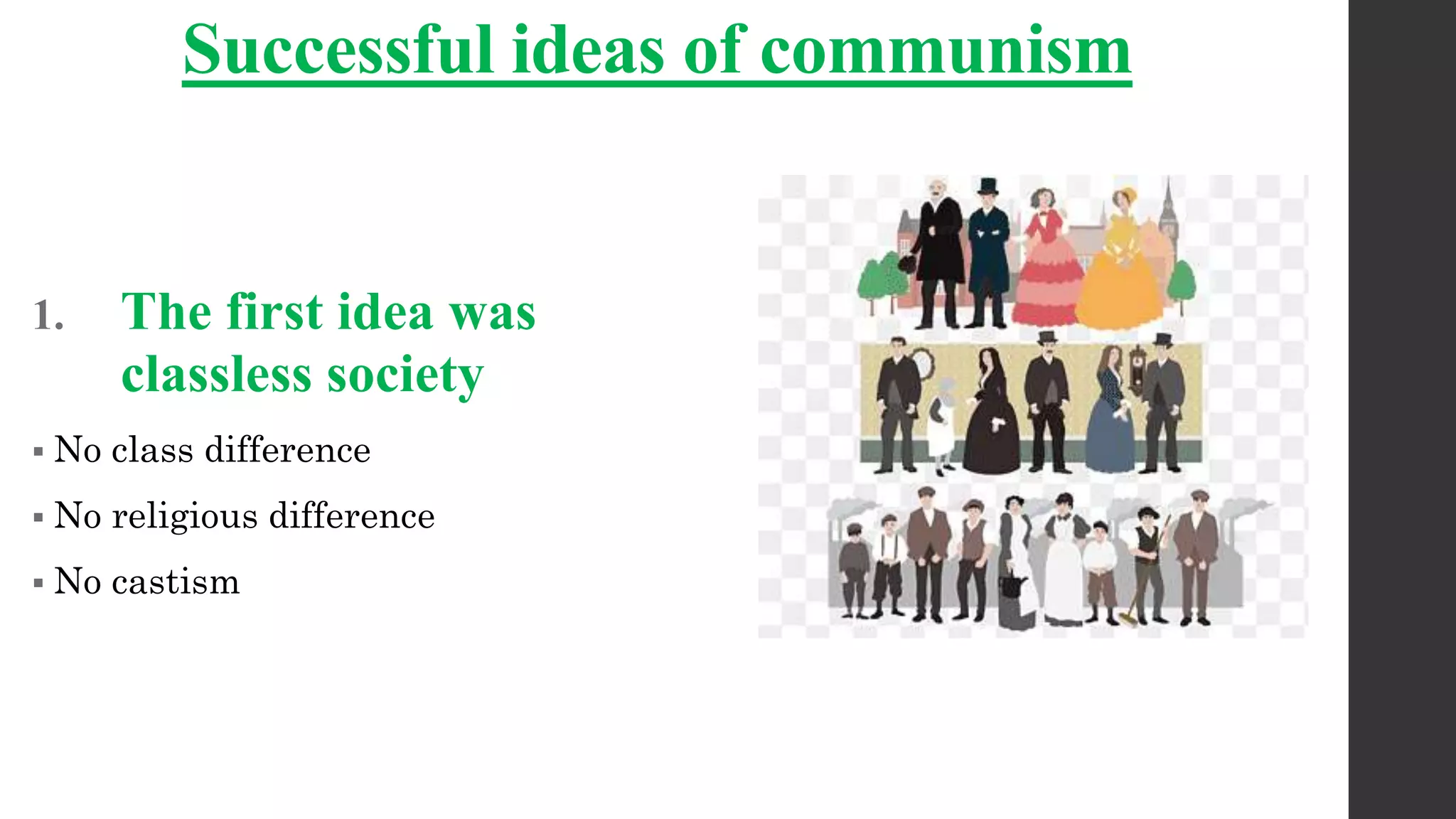
Successful ideas of communism
1. The first idea was
classless society
 No class difference
 No religious difference
 No castism
2. Second idea was
No inheritance
 ( NO private property or inherited
wealth, karl marx.)
3. Third idea was
worker rights
Failures of Communism
• Gorbachev’s decision to allow election with a multi party
system
• Force everyone to be equal
• Equal salary to everyone and work on ability
• No competative thinkings as an individual don’t have to
work for himself to be upper than others
THANKS
The End

MIR assignment of communism...pptx

  • 1.
    COMMUNISM By : ZaheerAhmed Roll No: IR-0121-056 Class: BS-III Department: International Relations
  • 2.
    COMMUNISM Definition.  Communism wordis derived from the Latin word communis, means “shared” or “common”  Communism is a form of government most closely associated with the ideas of Karl Marx, which he outlined in The Communist Manifesto.  Communism is based on the goal of eliminating socioeconomic class struggles by creating a classless society,where there is no difference between the rich and the poor in which everyone shares the benefits of labor and the state controls all property and wealth.
  • 3.
    Ideology of KarlMarx  The father of communism is Karl Marx. He was a German Philosopher He wrote Communist manifesto in 1848.  He grew up in an era when industrial revolution just begun  The labours in the industry worked in very bad conditions  The labours were paid very low amount in return and all the profit would given to the factory owners.  Karl marx imagined such a theory where there are no differences between the rich and the poor.  He imagined Utopia which is perfect society that doesnot exist in reality  He named this Utopia COMMUNISM
  • 4.
    Communist manifesto Karl Marxsaid workers together can overthrow the monarchy He wrote such a society will be built where the means of production (factories ,farms) shall not be owned by a single owner but rather the entire public . According to this communist manifesto there will not be any class or discrimination between the rich and the poor on the basis of race,religion. Free education & healthcare would be provided No inherited wealth No private ownership
  • 5.
    Practical implementation ofcommunismof Communism  Karl Marx only GAVE THE THEORY OF COMMUNISM  Practicaly communism was implemented after Russian revolution of 1917.  In Russia communist workers overthrew the russian monarch ,czar  The follower of karl marx lenin took revolutionary steps as a communist leader  Human rights were recognized for labours  The working hours were reduced from 14 hours to 8 hours per day and only 5 days in a week.  Women were introduced to education  The land was taken away from rich landowners and distributed among the farmers  The factories were nationalised, means they were taken under control of the government
  • 6.
    Lenin Reforms  Leninbanned all the political parties  Established one-party state  Such state where it was not allowed to criticise the Communism  A secret police used to spy on the people  If anyone criticised the government ,he was put In jail.  It was called soviet communism  In 1924 Lenin passed away
  • 7.
    Joseph Stalin’s Reforms JosephStalin implemented his own ideas Stalin’s ideologies were the farther from Marxist ideology He increased output of factories He increased the labour working hours Again labours started working in bad conditions and were paid same amount.
  • 8.
    Origin of Communism Likemost writers of the 19th century, Marx tended to use the terms communism and socialism interchangeably. In his Critique of the Gotha Programme (1875), however, Marx identified two phases of communism that would follow the predicted overthrow of capitalism: the first would be a transitional system in which the working class would control the government and economy yet still find it necessary to pay people according to how long, hard, or well they worked, and the second would be fully realized communism—a society without class divisions or government, in which the production and distribution of goods would be based upon the principle “From each according to his ability, to each according to his needs.” Marx’s followers, especially the Russian revolutionary Vladimir Ilich Lenin, took up this distinction.
  • 9.
    Plato's Theory ofCommunism what is Communism ? Communism is Rejection of Private ownership and Support for common ownership • Communism proposed by Plato 1.Communism of Property 2.Communism of wives, family 1.Plato's Communism of Property • Plato said that there should be no private property for Guardian class. They will keep minimum goods for their day-to-day use and whatever goods they keep, would be shared by all. They will live together and eat from a common Kitchen. 2.Plato's Communism of wives & family Guardian class will not have any private families. This class will be isolated from ordinary population & enter into group marriage and become each other's common husband and wives.
  • 10.
    Beliefs of Communism Therich ,get richer The poor, get poorer They wanted to bring about equality They wanted all the people to access wealth, equality, basic needs and that it would also bring about security for all
  • 11.
    Successful ideas ofcommunism 1. The first idea was classless society  No class difference  No religious difference  No castism
  • 12.
    2. Second ideawas No inheritance  ( NO private property or inherited wealth, karl marx.)
  • 13.
    3. Third ideawas worker rights
  • 14.
    Failures of Communism •Gorbachev’s decision to allow election with a multi party system • Force everyone to be equal • Equal salary to everyone and work on ability • No competative thinkings as an individual don’t have to work for himself to be upper than others
  • 15.