6/10/20| Page 0
MIPI RFFE v2.0 Webinar:
An Overview of New Features and
Implementation Benefits
Jim Ross, Skyworks Solutions - Chair RFFE WG
John Oakley, Intel – Vice-chair RFFE WG
2/17/2015
Copyright © 2015 MIPI Alliance. All rights reserved.
February 17, 2015
6/10/20| Page 1
Peter B. Lefkin
Managing Director
MIPI Alliance:
A Brief Introduction
2/17/2015
6/10/20| Page 2
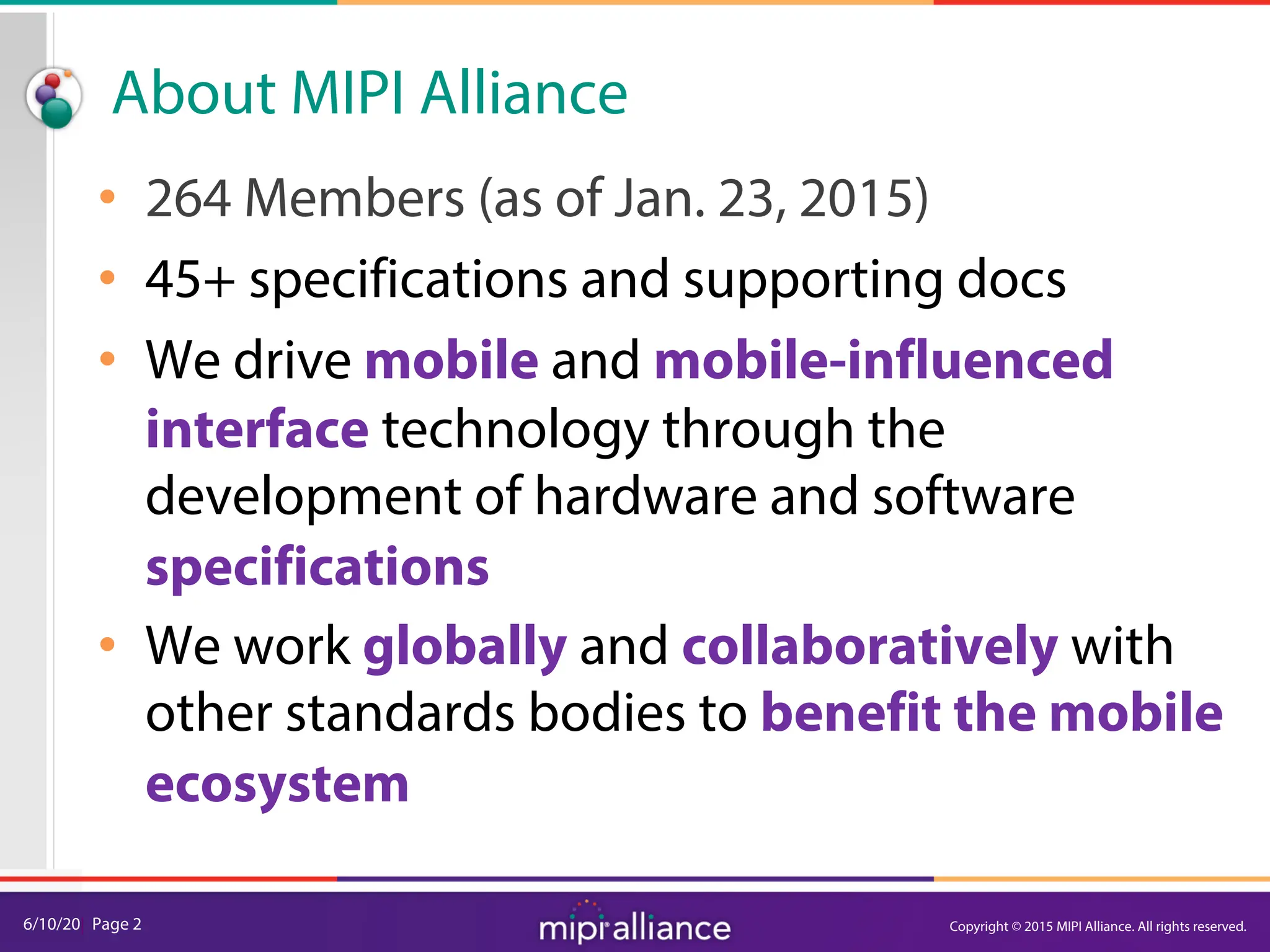
About MIPI Alliance
• 264 Members (as of Jan. 23, 2015)
• 45+ specifications and supporting docs
• We drive mobile and mobile-influenced
interface technology through the
development of hardware and software
specifications
• We work globally and collaboratively with
other standards bodies to benefit the mobile
ecosystem
Copyright © 2015 MIPI Alliance. All rights reserved.
6/10/20| Page 3
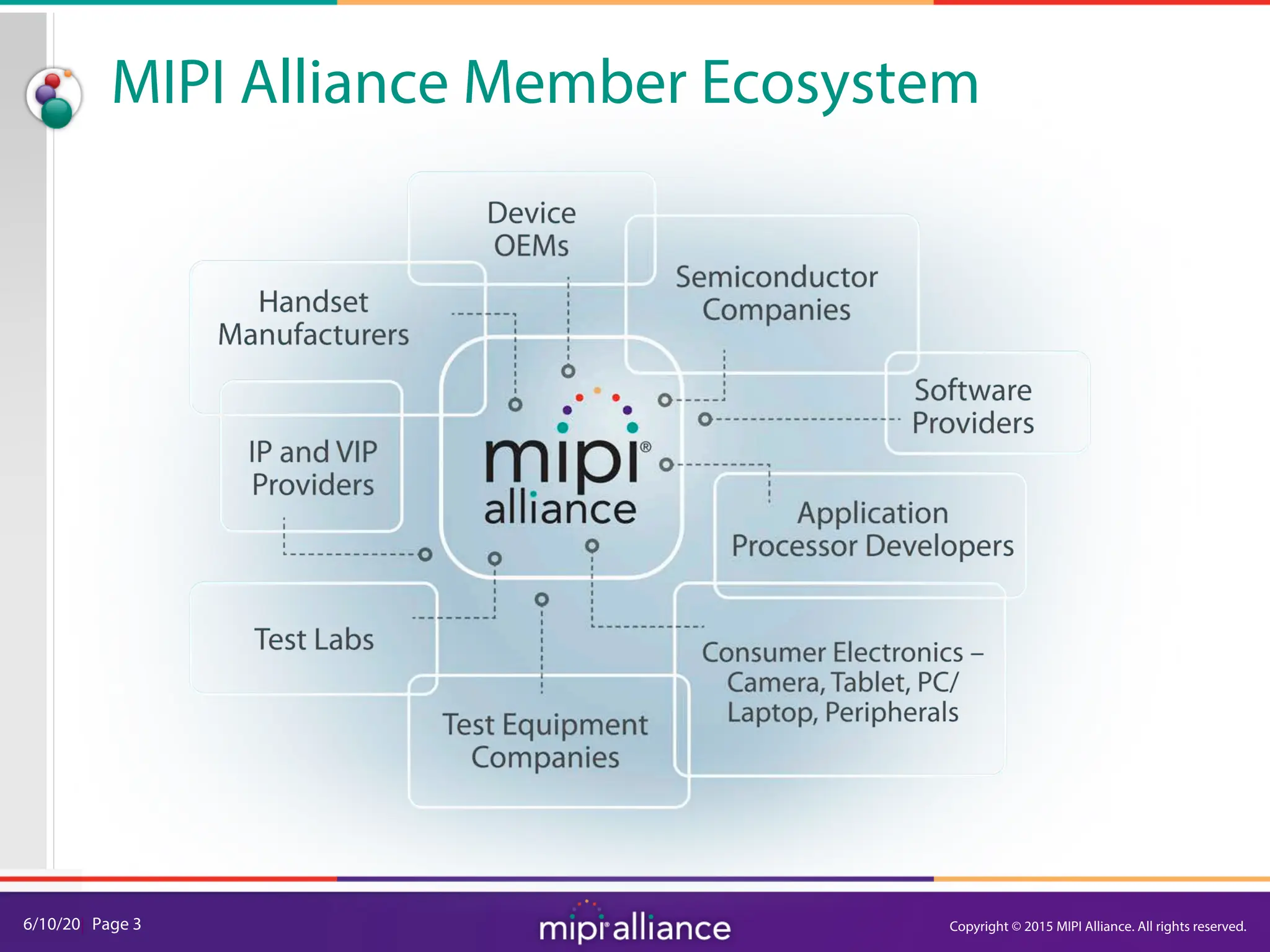
MIPI Alliance Member Ecosystem
Copyright © 2015 MIPI Alliance. All rights reserved.
6/10/20| Page 4
Active MIPI Alliance Working Groups
• Analog Control Interface
• Battery Interface
• Camera
• Debug
• Display High Speed
Synchronous Interface
• Low Latency Interface
• Low Speed Multipoint Link
(New - SoundWireSM)
• Marketing
• PHY (C / D / M)
• Reduced Input Output
(RIO) (New)
• RF Front-End (RFFESM)
• Sensor / I3CSM (New)
• Software (New)
• Technical Steering Group
• Test
• UniProSM
Copyright © 2015 MIPI Alliance. All rights reserved.
6/10/20| Page 5 Copyright © 2015 MIPI Alliance. All rights reserved.
6/10/20| Page 6
Recent Announcements
• 05 Nov 2014 - MIPI Alliance Introduces Sensor
Interface Specification for Mobile, Mobile-
Influenced and Embedded-Systems
Applications
• 09 Oct 2014 - MIPI Alliance Introduces MIPI
SoundWire℠, a Comprehensive Audio
Interface for Mobile and Mobile-Influenced
Devices
Copyright © 2015 MIPI Alliance. All rights reserved.
6/10/20| Page 7
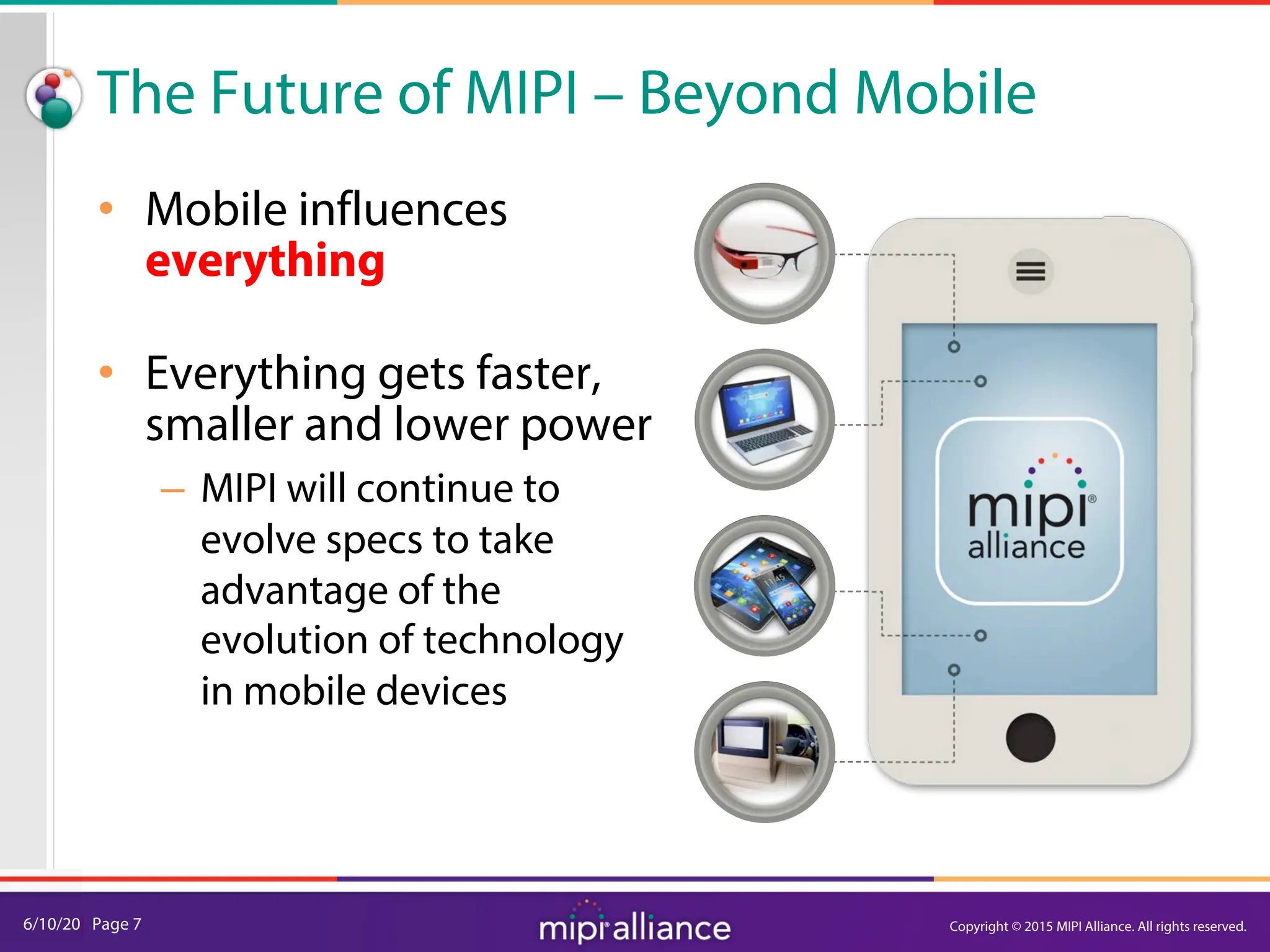
The Future of MIPI – Beyond Mobile
• Mobile influences
everything
• Everything gets faster,
smaller and lower power
– MIPI will continue to
evolve specs to take
advantage of the
evolution of technology
in mobile devices
Copyright © 2015 MIPI Alliance. All rights reserved.
6/10/20| Page 8
MIPI RFFE v2.0 Webinar:
An Overview of New Features and
Implementation Benefits
Jim Ross, Skyworks Solutions - Chair RFFE WG
John Oakley, Intel – Vice-chair RFFE WG
2/17/2015
Copyright © 2015 MIPI Alliance. All rights reserved.
February 17, 2015
6/10/20| Page 9
MIPI RFFE Overview Agenda
• MIPI RFFE v1.x (v1.00.00 & v1.10)
– What is RFFE?
– Key Features
• Why RFFE v2.0?
– Key New Features
• Multiple devices can control the bus (Multi-Master)
• Additional bus operating frequencies (Extended Frequencies)
• Additional read-back methods (Synchronous Read)
• Support for interrupts (Interrupt-Capable Slave functionality)
• Additional Registers for unified control (New Reserved Registers and functions)
• MIPI RFFE Roadmap v2.1?
– Items up for consideration?
Copyright © 2015 MIPI Alliance. All rights reserved.
6/10/20| Page 10
MIPI RFFE v1.x
2/17/2015
6/10/20| Page 11
What is RFFE?
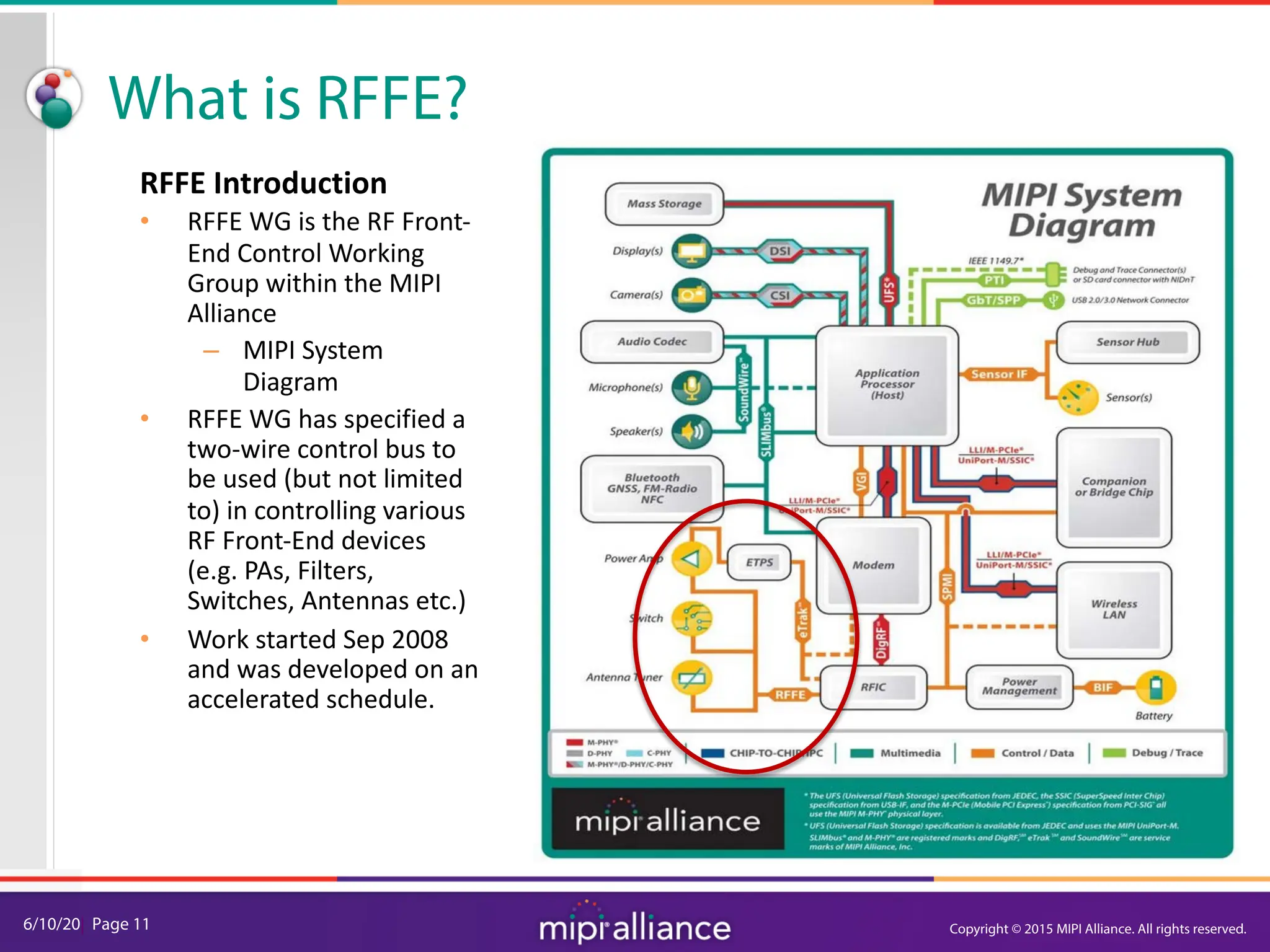
RFFE Introduction
• RFFE WG is the RF Front-
End Control Working
Group within the MIPI
Alliance
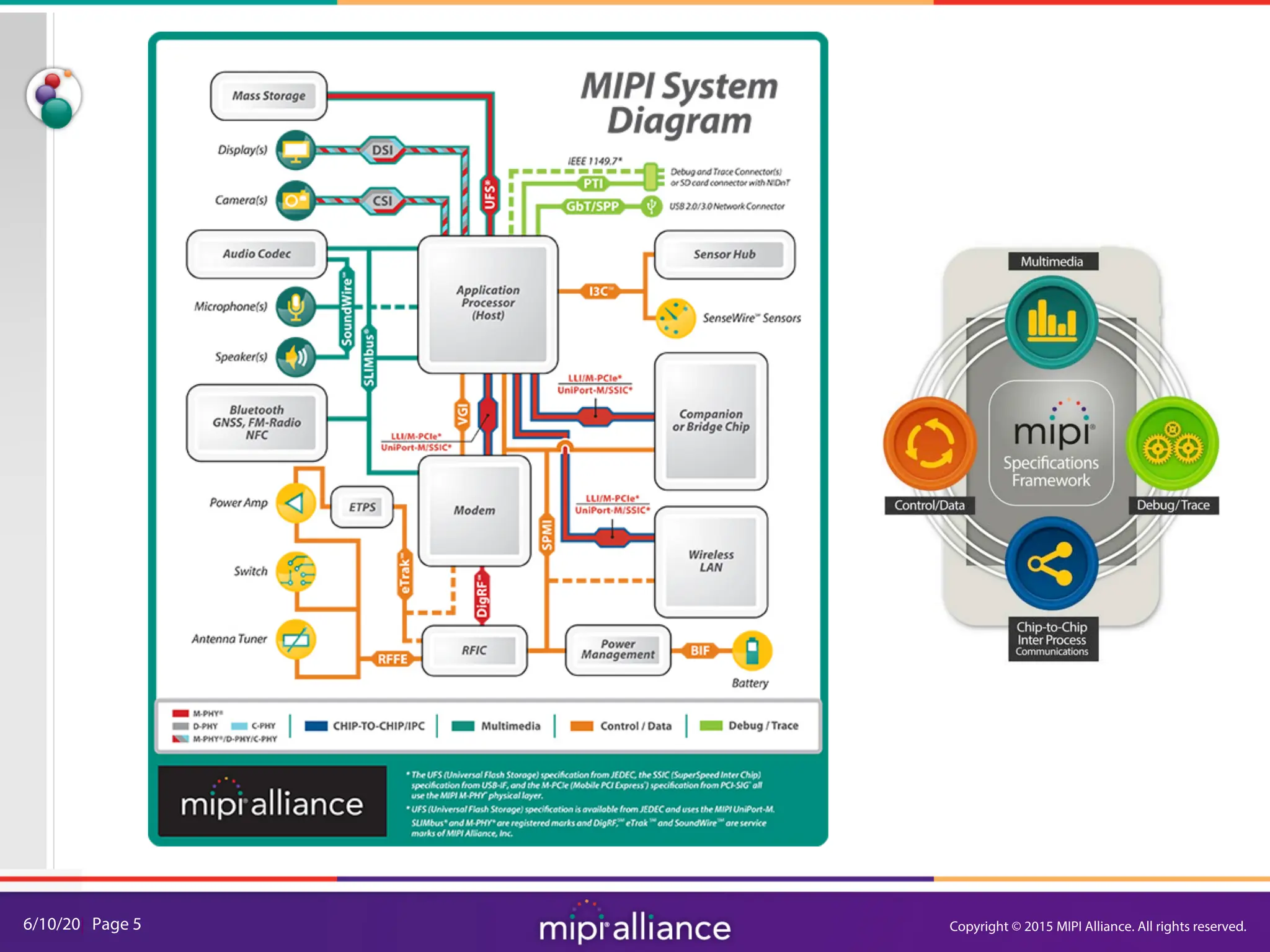
– MIPI System
Diagram
• RFFE WG has specified a
two-wire control bus to
be used (but not limited
to) in controlling various
RF Front-End devices
(e.g. PAs, Filters,
Switches, Antennas etc.)
• Work started Sep 2008
and was developed on an
accelerated schedule.
Copyright © 2015 MIPI Alliance. All rights reserved.
6/10/20| Page 12
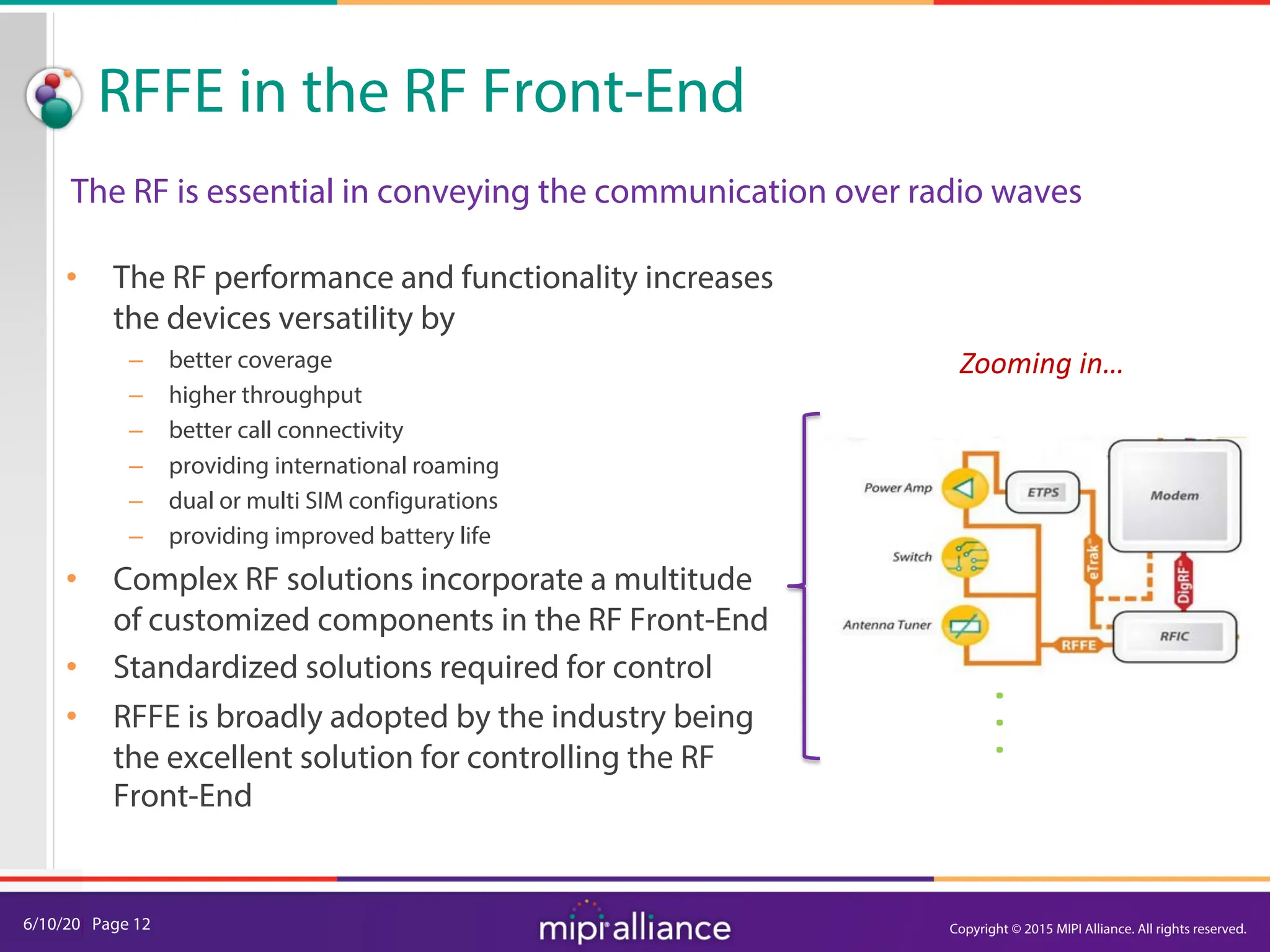
RFFE in the RF Front-End
• The RF performance and functionality increases
the devices versatility by
– better coverage
– higher throughput
– better call connectivity
– providing international roaming
– dual or multi SIM configurations
– providing improved battery life
• Complex RF solutions incorporate a multitude
of customized components in the RF Front-End
• Standardized solutions required for control
• RFFE is broadly adopted by the industry being
the excellent solution for controlling the RF
Front-End
Zooming in…
.
.
.
The RF is essential in conveying the communication over radio waves
Copyright © 2015 MIPI Alliance. All rights reserved.
6/10/20| Page 13
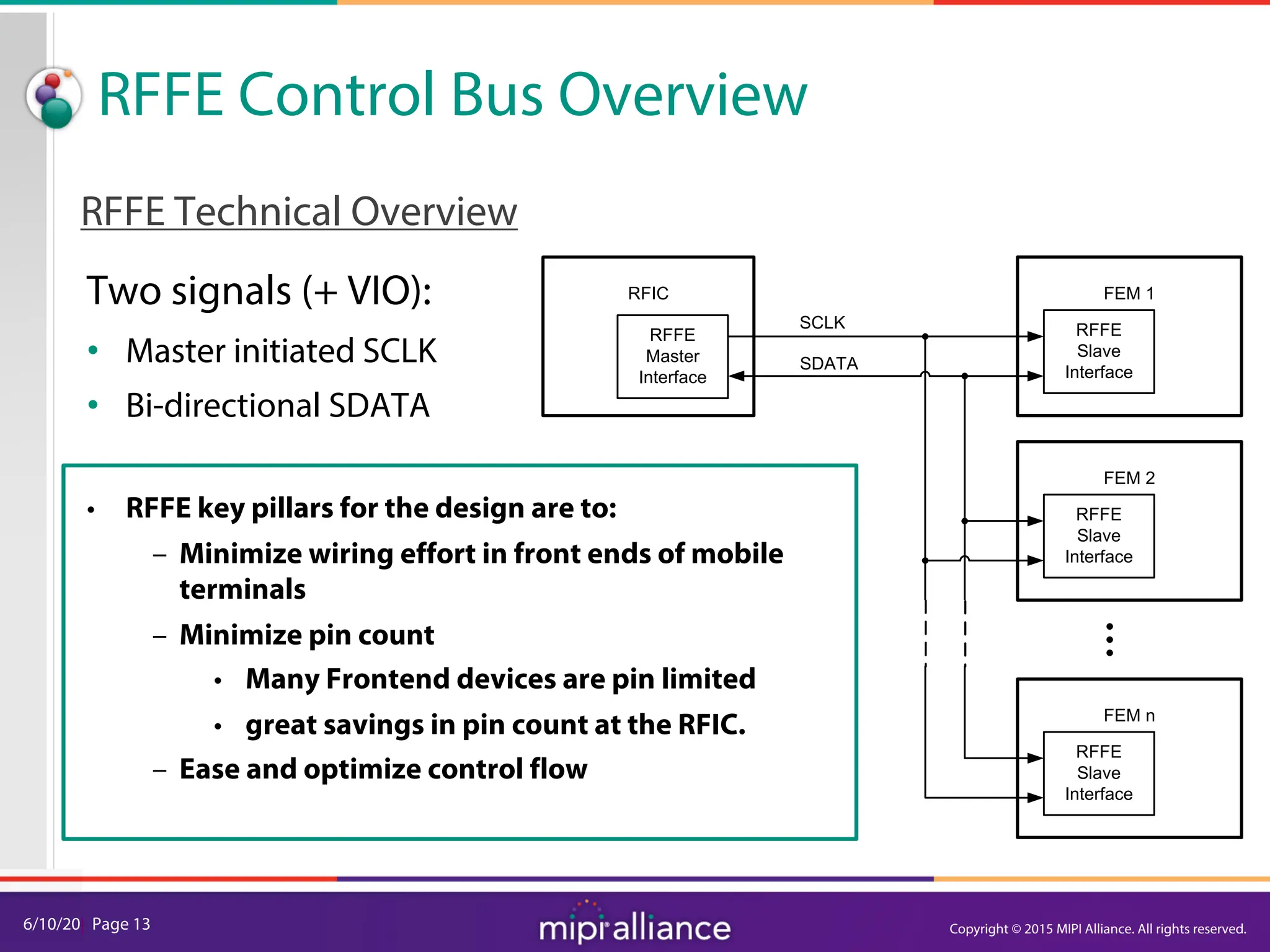
RFFE Control Bus Overview
RFFE Technical Overview
• RFFE key pillars for the design are to:
– Minimize wiring effort in front ends of mobile
terminals
– Minimize pin count
• Many Frontend devices are pin limited
• great savings in pin count at the RFIC.
– Ease and optimize control flow
RFIC
RFFE
Master
Interface
FEM 1
RFFE
Slave
Interface
SCLK
SDATA
FEM 2
RFFE
Slave
Interface
FEM n
RFFE
Slave
Interface
Two signals (+ VIO):
• Master initiated SCLK
• Bi-directional SDATA
Copyright © 2015 MIPI Alliance. All rights reserved.
6/10/20| Page 14
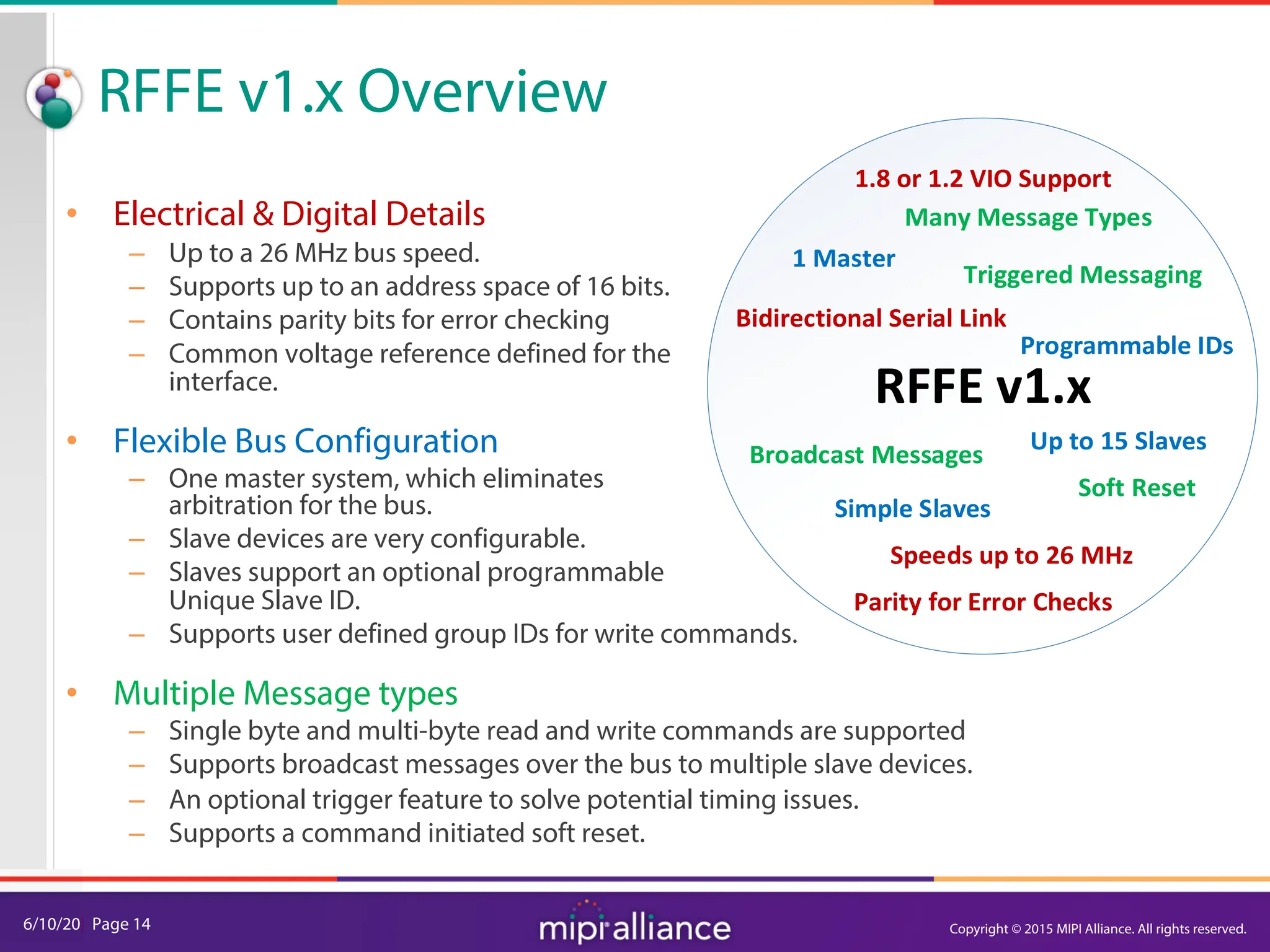
RFFE v1.x Overview
• Electrical & Digital Details
– Up to a 26 MHz bus speed.
– Supports up to an address space of 16 bits.
– Contains parity bits for error checking
– Common voltage reference defined for the
interface.
• Flexible Bus Configuration
– One master system, which eliminates
arbitration for the bus.
– Slave devices are very configurable.
– Slaves support an optional programmable
Unique Slave ID.
– Supports user defined group IDs for write commands.
• Multiple Message types
– Single byte and multi-byte read and write commands are supported
– Supports broadcast messages over the bus to multiple slave devices.
– An optional trigger feature to solve potential timing issues.
– Supports a command initiated soft reset.
RFFE v1.x
Simple Slaves
Up to 15 Slaves
1 Master
Speeds up to 26 MHz
Programmable IDs
Broadcast Messages
Many Message Types
Parity for Error Checks
Triggered Messaging
Soft Reset
1.8 or 1.2 VIO Support
Bidirectional Serial Link
Copyright © 2015 MIPI Alliance. All rights reserved.
6/10/20| Page 15
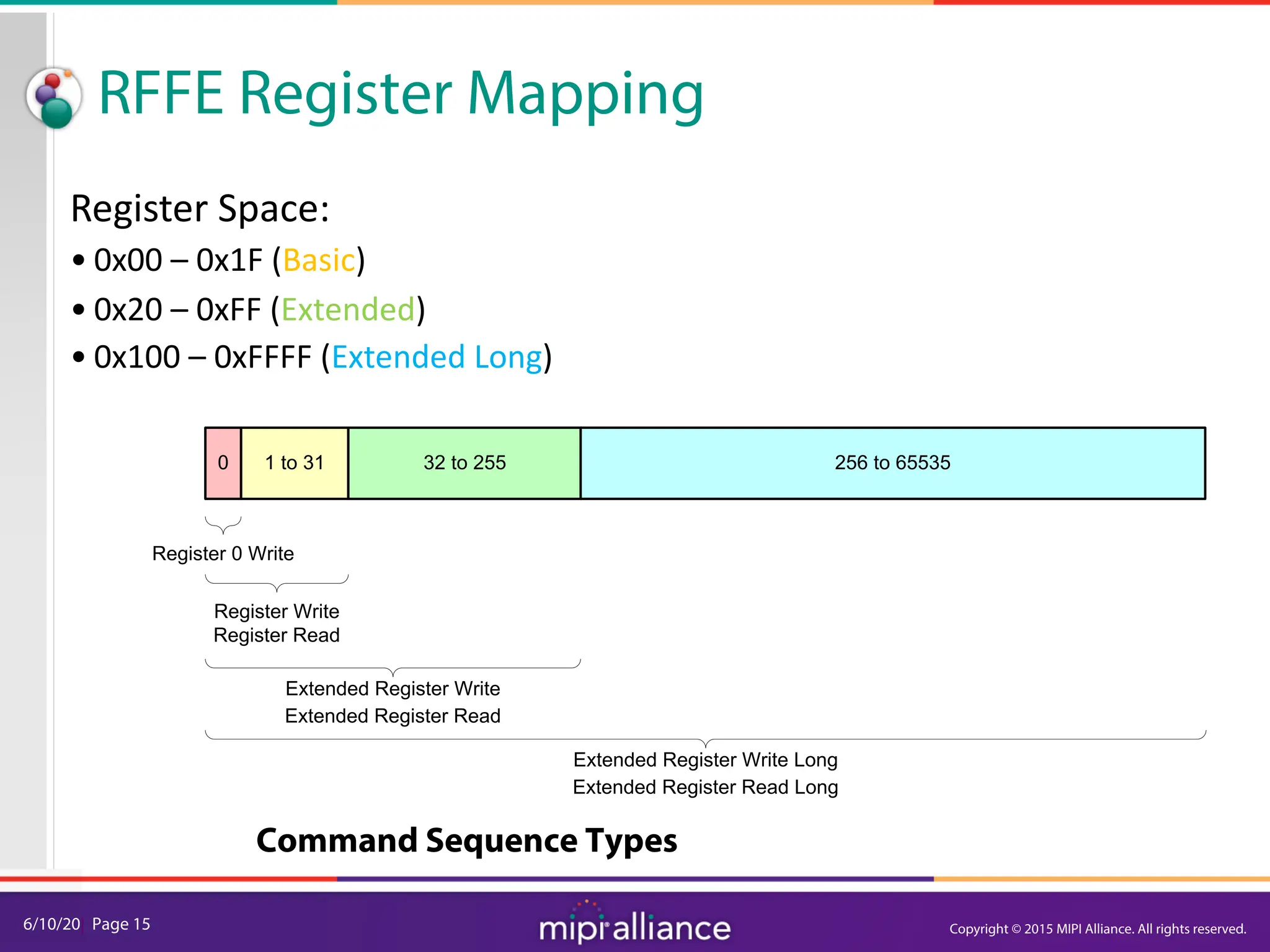
RFFE Register Mapping
Register Space:
• 0x00 – 0x1F (Basic)
• 0x20 – 0xFF (Extended)
• 0x100 – 0xFFFF (Extended Long)
0 1 to 31 32 to 255 256 to 65535
Register 0 Write
Register Write
Register Read
Extended Register Write
Extended Register Read
Extended Register Write Long
Extended Register Read Long
Command Sequence Types
Copyright © 2015 MIPI Alliance. All rights reserved.
6/10/20| Page 16
RFFE Control Bus Overview
The components of a RFFE message.
• SSC : Start Sequence Condition
• Command Frame
– SA[3:0] = Slave Address addressing 15 slaves, SA=0 will broadcast to ALL slaves
• Parity calculated & inserted for each Frame in a Command Sequence
• Data or Address Frame
• Bus Park Cycle
Basic Register Write and Read Commands
Description SSC Command Frame Data Frame
Register Write
1 0
SA[3:0] 0 1 0
0 0 0 0 0
P Data[7:0] P BP
Address[4:0]
1 1 1 1 1
Register Read SA[3:0] 0 1 1
0 0 0 0 0
P BP Data[7:0] P BP
Address[4:0]
1 1 1 1 1
6/10/20| Page 17
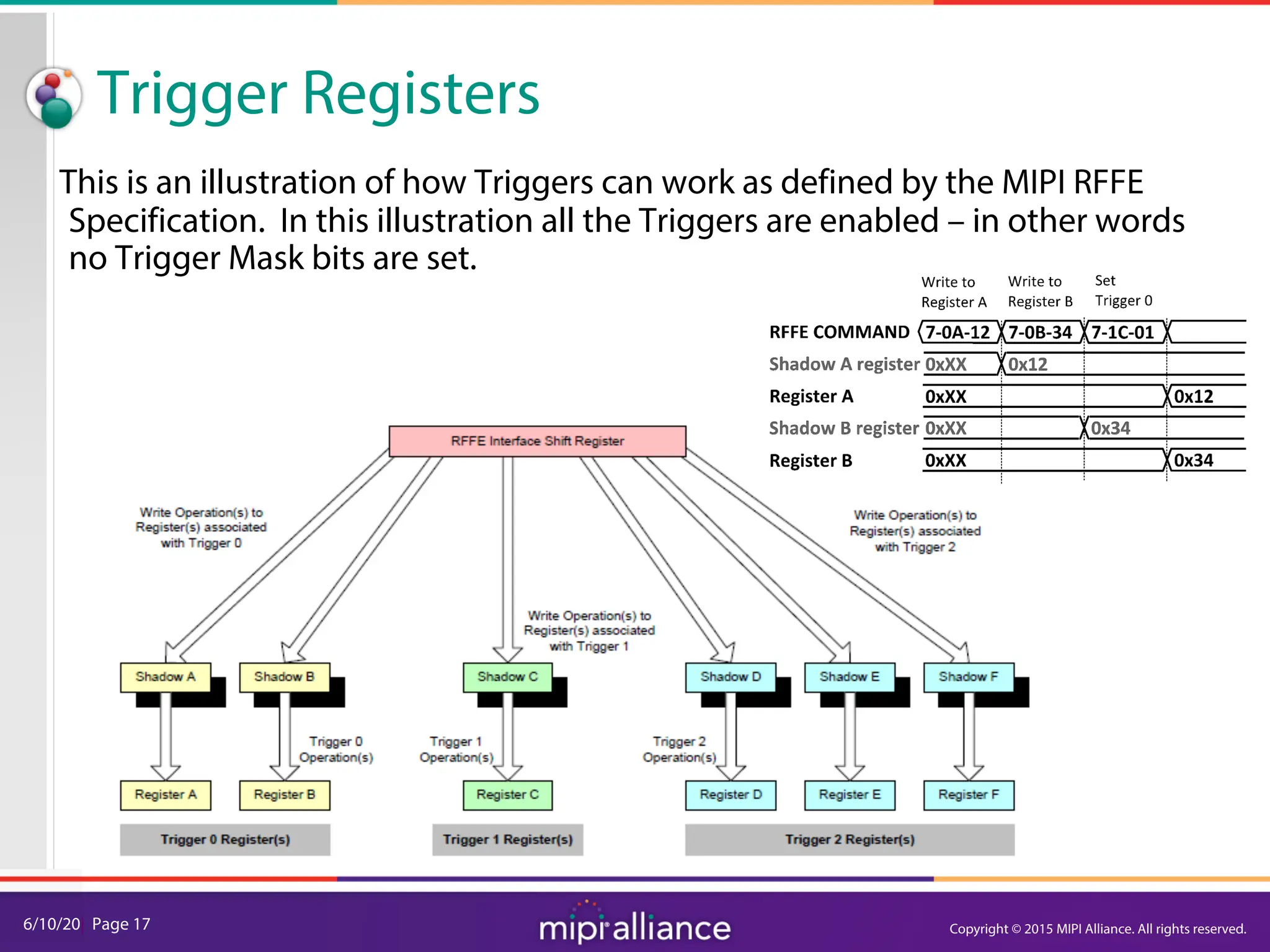
Trigger Registers
This is an illustration of how Triggers can work as defined by the MIPI RFFE
Specification. In this illustration all the Triggers are enabled – in other words
no Trigger Mask bits are set.
Copyright © 2015 MIPI Alliance. All rights reserved.
6/10/20| Page 18
Trigger Registers
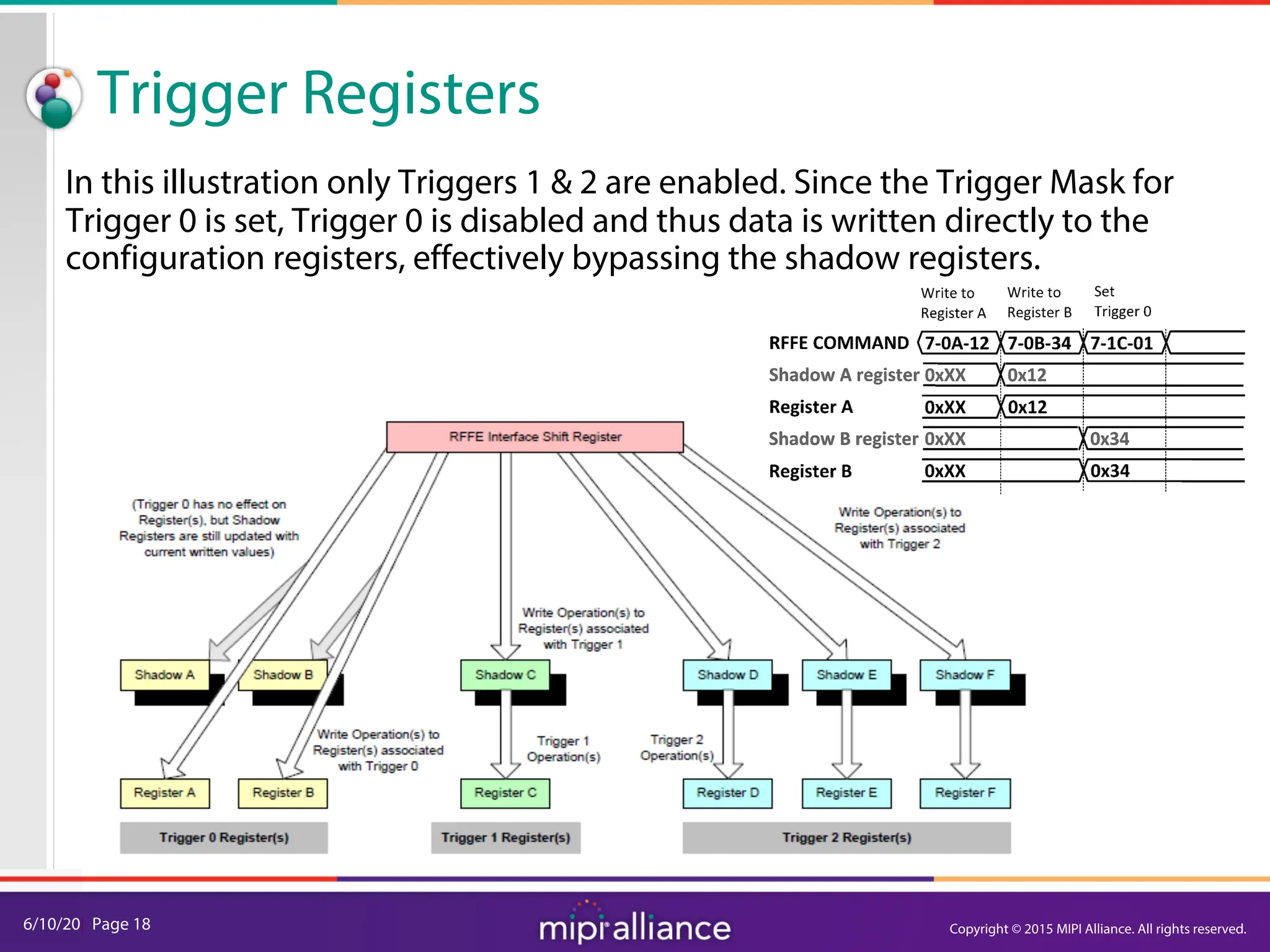
In this illustration only Triggers 1 & 2 are enabled. Since the Trigger Mask for
Trigger 0 is set, Trigger 0 is disabled and thus data is written directly to the
configuration registers, effectively bypassing the shadow registers.
Copyright © 2015 MIPI Alliance. All rights reserved.
6/10/20| Page 19
MIPI RFFE v2.0
2/17/2015
6/10/20| Page 20
Why was RFFE v2.0 developed?
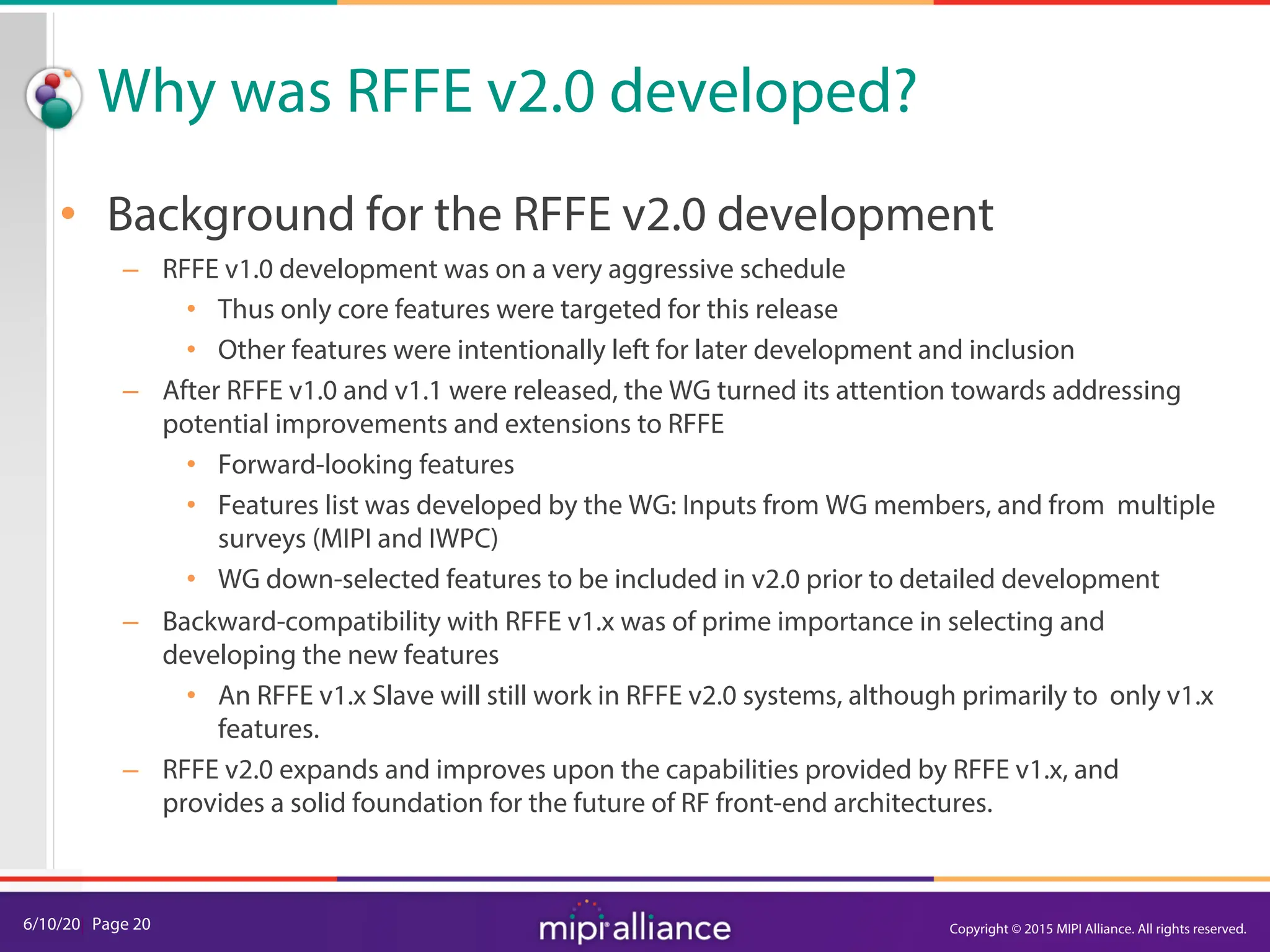
• Background for the RFFE v2.0 development
– RFFE v1.0 development was on a very aggressive schedule
• Thus only core features were targeted for this release
• Other features were intentionally left for later development and inclusion
– After RFFE v1.0 and v1.1 were released, the WG turned its attention towards addressing
potential improvements and extensions to RFFE
• Forward-looking features
• Features list was developed by the WG: Inputs from WG members, and from multiple
surveys (MIPI and IWPC)
• WG down-selected features to be included in v2.0 prior to detailed development
– Backward-compatibility with RFFE v1.x was of prime importance in selecting and
developing the new features
• An RFFE v1.x Slave will still work in RFFE v2.0 systems, although primarily to only v1.x
features.
– RFFE v2.0 expands and improves upon the capabilities provided by RFFE v1.x, and
provides a solid foundation for the future of RF front-end architectures.
Copyright © 2015 MIPI Alliance. All rights reserved.
6/10/20| Page 21
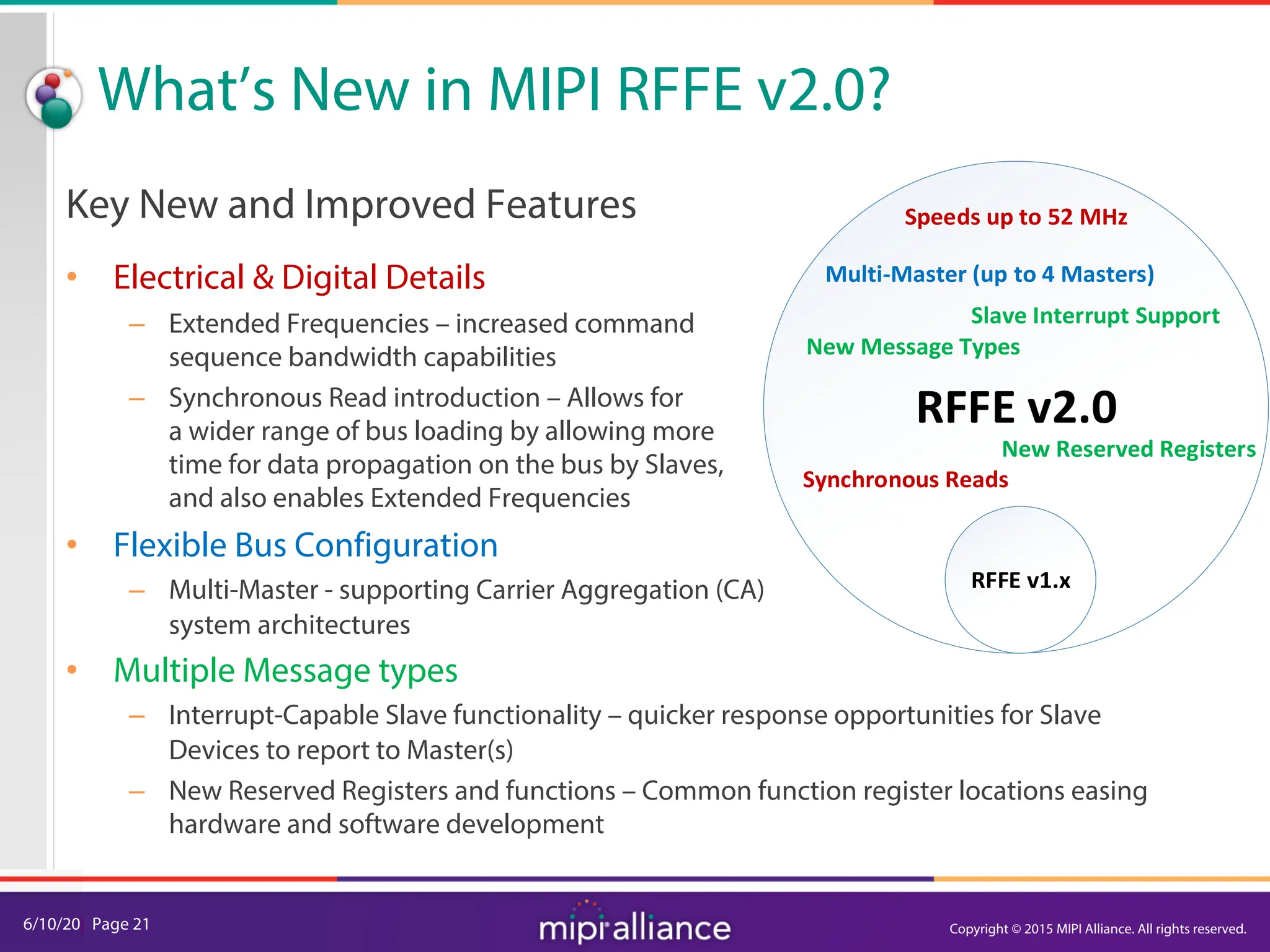
What’s New in MIPI RFFE v2.0?
Key New and Improved Features
• Electrical & Digital Details
– Extended Frequencies – increased command
sequence bandwidth capabilities
– Synchronous Read introduction – Allows for
a wider range of bus loading by allowing more
time for data propagation on the bus by Slaves,
and also enables Extended Frequencies
• Flexible Bus Configuration
– Multi-Master - supporting Carrier Aggregation (CA)
system architectures
• Multiple Message types
– Interrupt-Capable Slave functionality – quicker response opportunities for Slave
Devices to report to Master(s)
– New Reserved Registers and functions – Common function register locations easing
hardware and software development
RFFE v2.0
Slave Interrupt Support
Multi-Master (up to 4 Masters)
Speeds up to 52 MHz
New Message Types
New Reserved Registers
RFFE v1.x
Synchronous Reads
Copyright © 2015 MIPI Alliance. All rights reserved.
6/10/20| Page 22
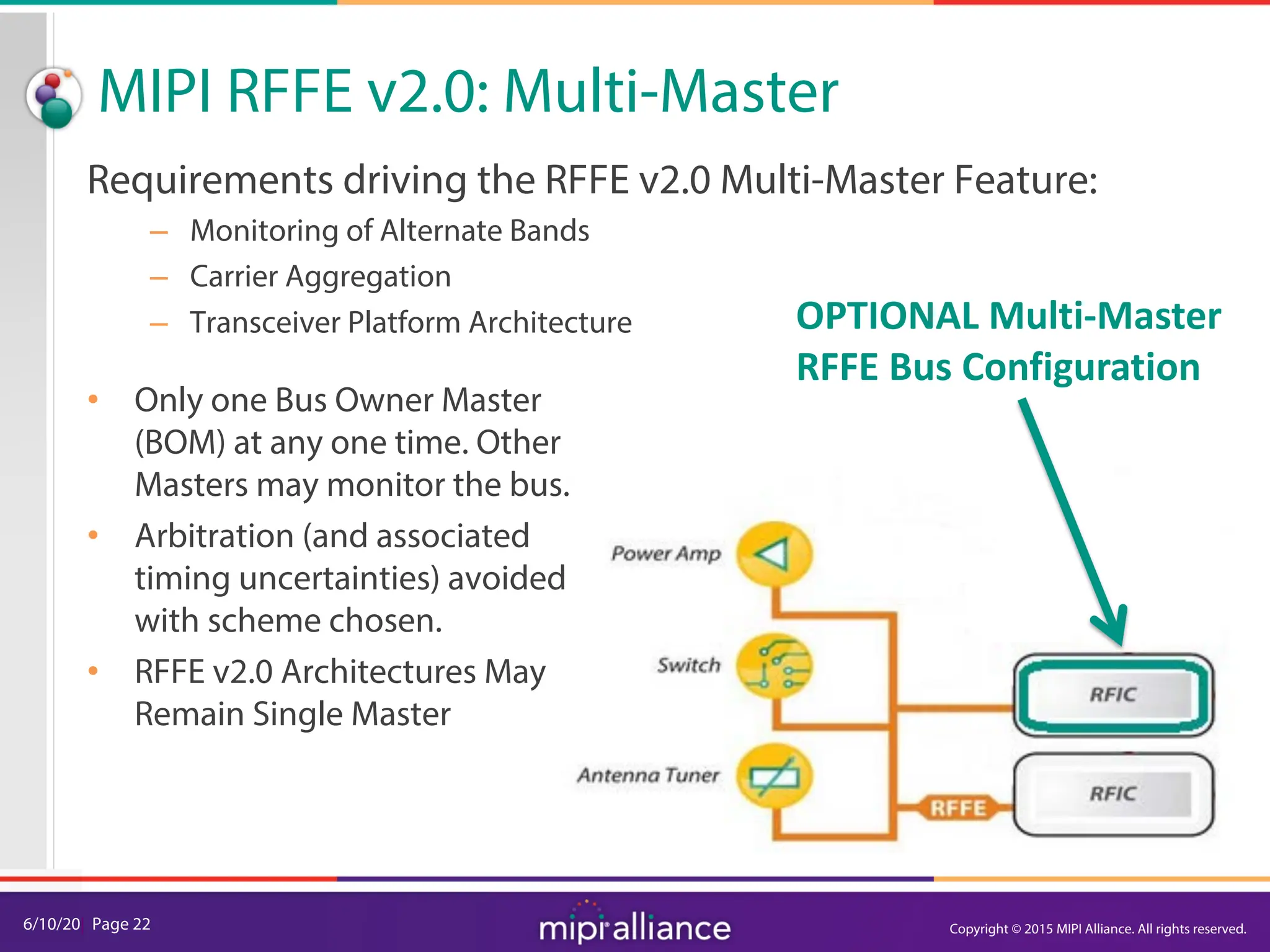
MIPI RFFE v2.0: Multi-Master
Requirements driving the RFFE v2.0 Multi-Master Feature:
– Monitoring of Alternate Bands
– Carrier Aggregation
– Transceiver Platform Architecture
• Only one Bus Owner Master
(BOM) at any one time. Other
Masters may monitor the bus.
• Arbitration (and associated
timing uncertainties) avoided
with scheme chosen.
• RFFE v2.0 Architectures May
Remain Single Master
OPTIONAL Multi-Master
RFFE Bus Configuration
Copyright © 2015 MIPI Alliance. All rights reserved.
6/10/20| Page 23
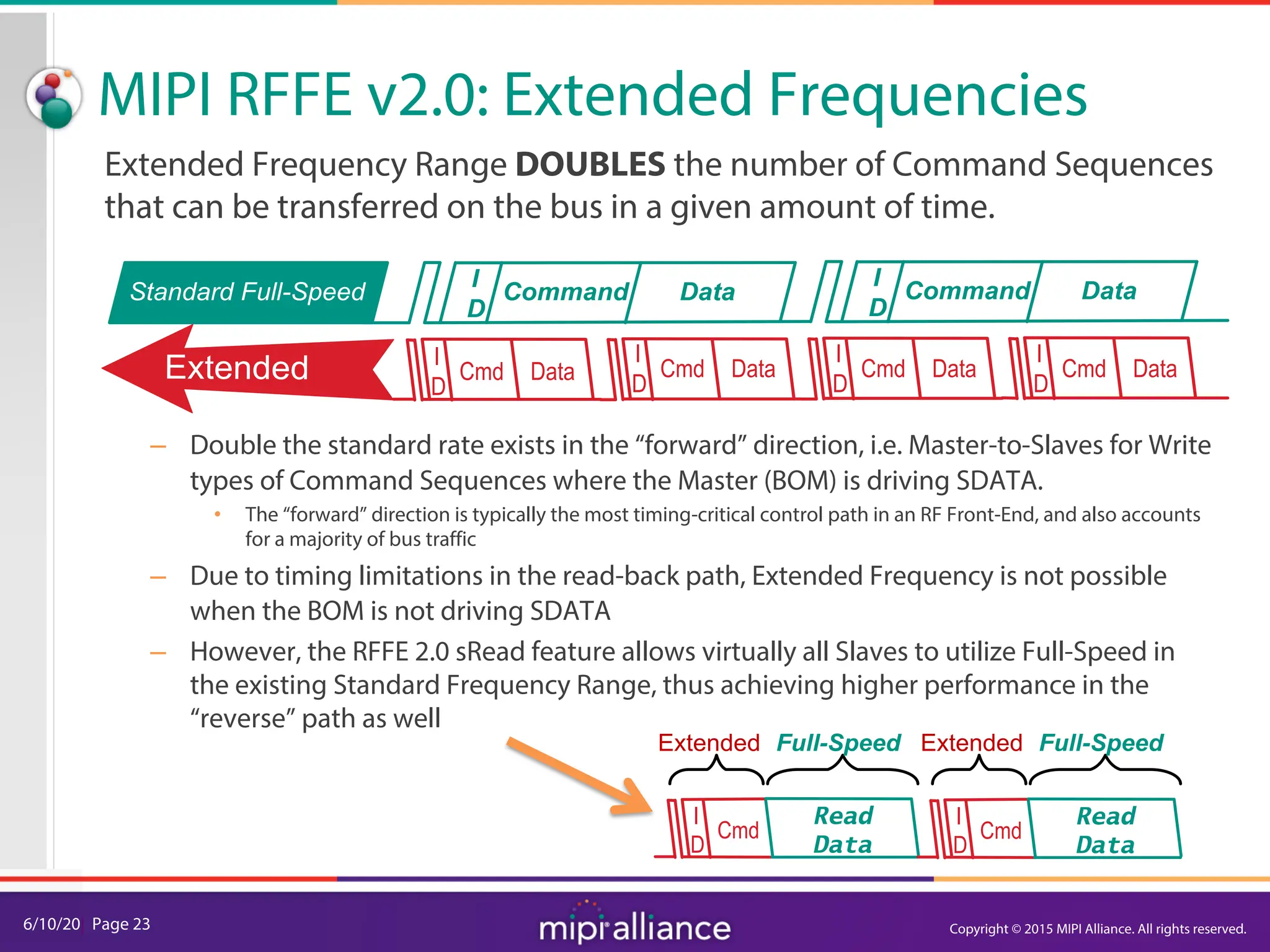
MIPI RFFE v2.0: Extended Frequencies
– Double the standard rate exists in the “forward” direction, i.e. Master-to-Slaves for Write
types of Command Sequences where the Master (BOM) is driving SDATA.
• The “forward” direction is typically the most timing-critical control path in an RF Front-End, and also accounts
for a majority of bus traffic
– Due to timing limitations in the read-back path, Extended Frequency is not possible
when the BOM is not driving SDATA
– However, the RFFE 2.0 sRead feature allows virtually all Slaves to utilize Full-Speed in
the existing Standard Frequency Range, thus achieving higher performance in the
“reverse” path as well
Extended Frequency Range DOUBLES the number of Command Sequences
that can be transferred on the bus in a given amount of time.
Standard Full-Speed
I
D
Command Data
I
D
Command Data
I
D
Cmd Data
I
D
Cmd Data
I
D
Cmd Data
I
D
Cmd Data
Extended
Extended
I
D
Cmd
Read
Data
I
D
Cmd
Read
Data
Extended Full-Speed Full-Speed
Extended
Copyright © 2015 MIPI Alliance. All rights reserved.
6/10/20| Page 24
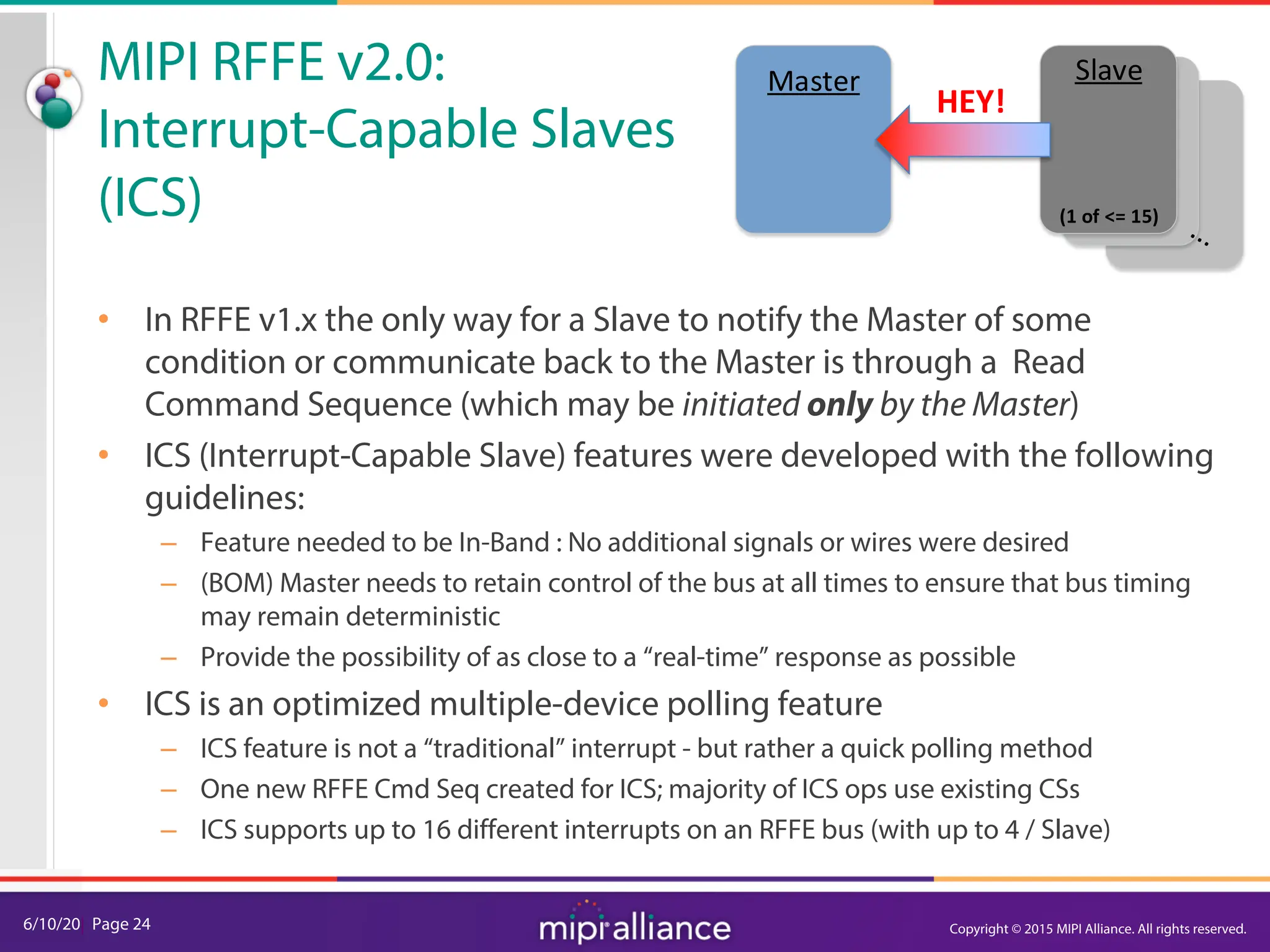
MIPI RFFE v2.0:
Interrupt-Capable Slaves
(ICS)
• In RFFE v1.x the only way for a Slave to notify the Master of some
condition or communicate back to the Master is through a Read
Command Sequence (which may be initiated only by the Master)
• ICS (Interrupt-Capable Slave) features were developed with the following
guidelines:
– Feature needed to be In-Band : No additional signals or wires were desired
– (BOM) Master needs to retain control of the bus at all times to ensure that bus timing
may remain deterministic
– Provide the possibility of as close to a “real-time” response as possible
• ICS is an optimized multiple-device polling feature
– ICS feature is not a “traditional” interrupt - but rather a quick polling method
– One new RFFE Cmd Seq created for ICS; majority of ICS ops use existing CSs
– ICS supports up to 16 different interrupts on an RFFE bus (with up to 4 / Slave)
Slave
Master
(1 of <= 15)
HEY!
Copyright © 2015 MIPI Alliance. All rights reserved.
6/10/20| Page 25
Interrupt
Mapping
Configure
More Slaves?
Interrupt
Enable
Interrupt
Summary
Indication
Any active
Interrupt?
Interrupt
Identification
Interrupt
Clear
Master determines
Time available to scan
ICS Start
Need to
Identify?
Y
Y
Y
N
N
N
Extended / Ext Long
Command Sequence
Interrupt
Summary
&
Identification
Command
Sequence
Interrupt
Servicing
Extended / Ext Long
Command Sequence
Extended / Ext Long
Command Sequence
KEY
Action in
Master
Portion of
ICS Cmd
Sequence
ICS
Decision in
Master
ICS
Command
Sequence
ICS-Related
Function/
Action
Extended
Command
Sequence
MIPI RFFE v2.0: Interrupt-Capable Slaves (ICS)
Configuration Phase
[Only needed at ICS set up
or configuration changes]
Quick Interrupt Scan
(Of All ICS Enabled Slaves)
[Optimized for Time-Minimized
Polling of Any/All Interrupt
Requests]
Identification / Servicing /
Clearing Phase
[Used only when Interrupts must be
Identified, Serviced, and/or Cleared]
ICS Flow Chart
(from RFFE v2.0 Spec)
Copyright © 2015 MIPI Alliance. All rights reserved.
6/10/20| Page 26
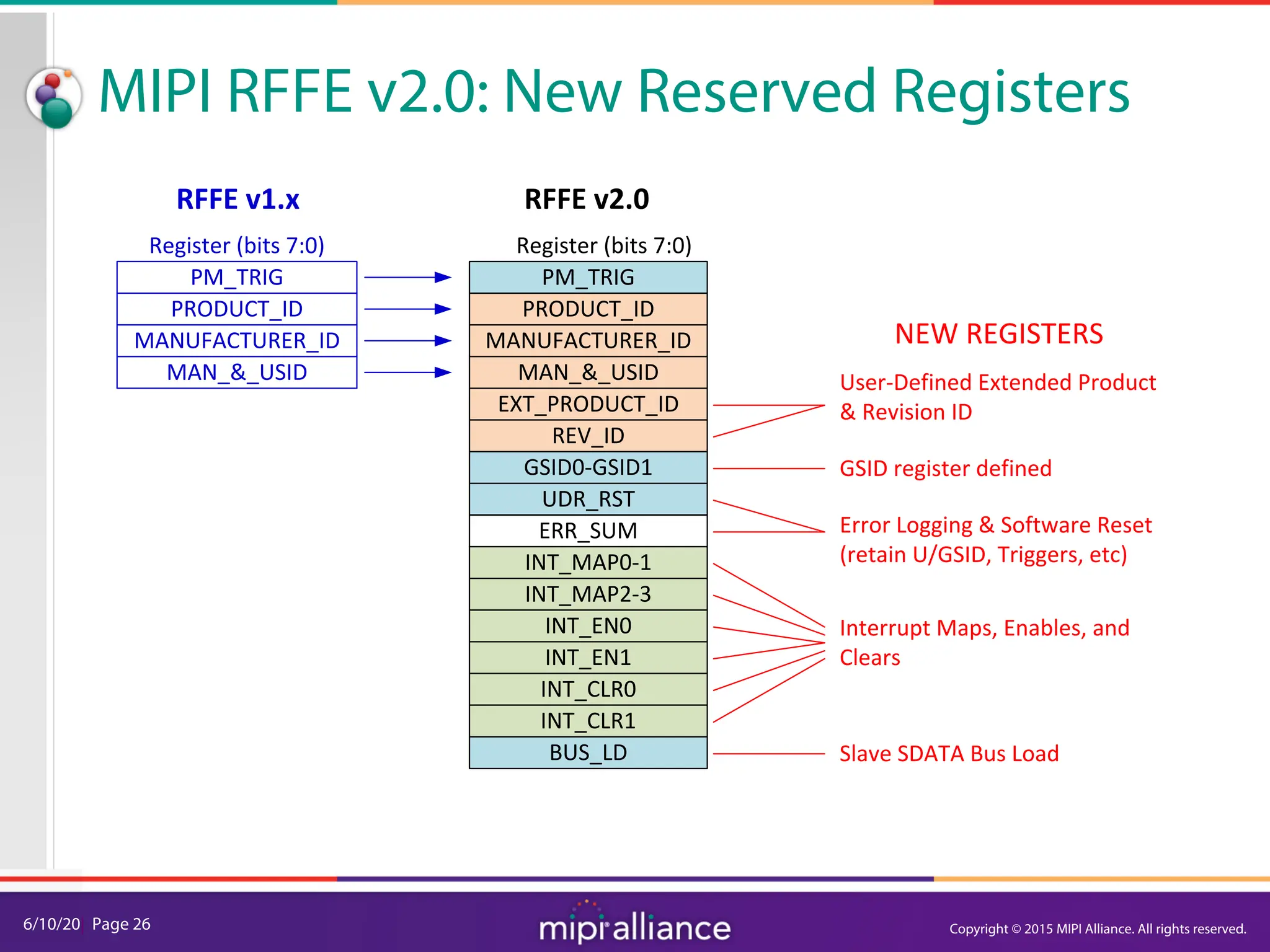
MIPI RFFE v2.0: New Reserved Registers
EXT_PRODUCT_ID
REV_ID
GSID0-GSID1
UDR_RST
ERR_SUM
INT_MAP0-1
INT_MAP2-3
INT_EN0
INT_EN1
INT_CLR0
INT_CLR1
BUS_LD
Register (bits 7:0)
PM_TRIG
PRODUCT_ID
MANUFACTURER_ID
MAN_&_USID
Register (bits 7:0)
PM_TRIG
PRODUCT_ID
MANUFACTURER_ID
MAN_&_USID
RFFE v2.0
RFFE v1.x
Interrupt Maps, Enables, and
Clears
Slave SDATA Bus Load
Error Logging & Software Reset
(retain U/GSID, Triggers, etc)
User-Defined Extended Product
& Revision ID
GSID register defined
NEW REGISTERS
Copyright © 2015 MIPI Alliance. All rights reserved.
6/10/20| Page 27
MIPI RFFE Roadmap
v2.1?
2/17/2015
6/10/20| Page 28
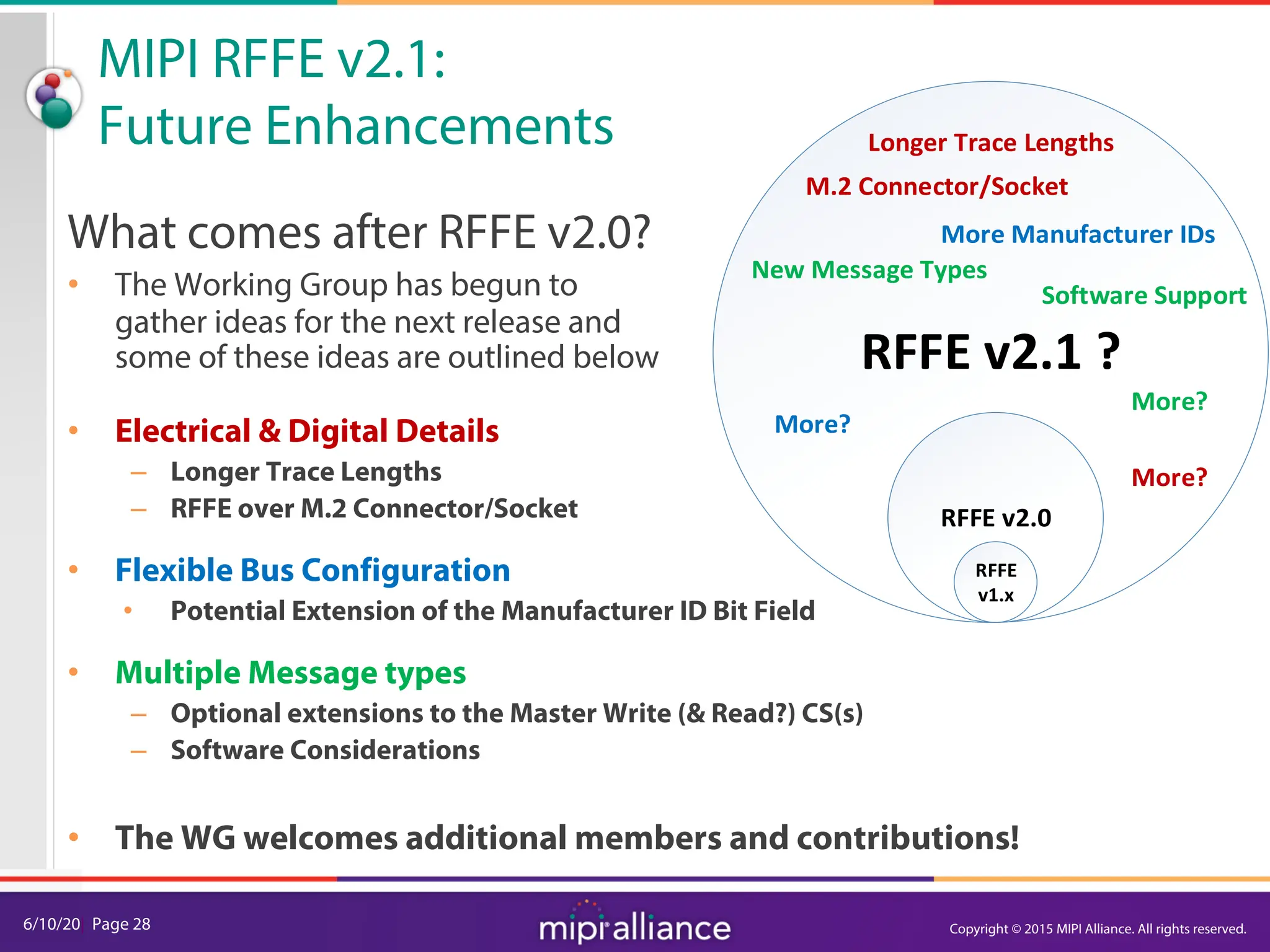
MIPI RFFE v2.1:
Future Enhancements
What comes after RFFE v2.0?
• The Working Group has begun to
gather ideas for the next release and
some of these ideas are outlined below
• Electrical & Digital Details
– Longer Trace Lengths
– RFFE over M.2 Connector/Socket
• Flexible Bus Configuration
• Potential Extension of the Manufacturer ID Bit Field
• Multiple Message types
– Optional extensions to the Master Write (& Read?) CS(s)
– Software Considerations
• The WG welcomes additional members and contributions!
RFFE v2.1 ?
More Manufacturer IDs
M.2 Connector/Socket
Longer Trace Lengths
New Message Types
Software Support
RFFE v2.0
RFFE
v1.x
More?
More?
More?
Copyright © 2015 MIPI Alliance. All rights reserved.
6/10/20| Page 29
MIPI RFFE Documents
and Website
2/17/2015
6/10/20| Page 30
MIPI RFFE: Documents
RFFE Specification and Supporting Documents (available to all MIPI Members)
– https://members.mipi.org/wg/All-Members/home/approved-specs#RFFE
MIPI® Specification for RF Front-End Control Interface (RFFE℠) v1.10:
– Specification: Version 1.10 – November 2011
– Application Note: Version 1.10 – November 2011
• Usage examples (Triggers, Group Slave IDs, Resolving USID Conflicts, etc.)
• FAQs
– PICS: Version 1.10 – October 2011
• Protocol Implementation Conformance Statement, Checklist for vendors
MIPI® Specification for RF Front-End Control Interface (RFFE℠) v2.0:
– Specification: Version 2.0 – December 2014
– Application Note: Version 2.0 – February 2015
– FAQ: Version 2.0 – February 2015
– Conformance Test Specification (CTS): Version 2.0 – (estimated release: 3Q15)
Copyright © 2015 MIPI Alliance. All rights reserved.
6/10/20| Page 31
MIPI/RFFE Website
• Questions to the WG? Contact PM: rob.anhofer@mipi.org
• Questions from Press/other? Contact Marketing: jennifer.mcaleer@mipi.org
• Public website – RFFE WG: http://mipi.org/working-groups/rf-front-end
• MIPI Contributor and Board Members are welcome to join the WG:
– Member website (request a member login): https://members.mipi.org/site/login
• Access to WG mail reflector and discussions, file repository, calendar, meeting
agendas and minutes, schedules and access to Bugzilla change request system
– Weekly WG meetings: Wednesday’s @ 8:30am PST / 11:30am EST / 17:30 CET (2hr)
• Next RFFE WG conference call is February 25, 2015 (no call Feb-18)
– RFFE WG calendar: https://members.mipi.org/wg/RF-FE/calendar
– RFFE WG dashboard: https://members.mipi.org/wg/RF-FE/workgroup
• Next RFFE WG F2F Meeting:
– Seattle, USA: Tuesday March 10 to Thursday March 13, 2015
– Includes MIPI Open Day session with RFFE presentation and Q&A session
Copyright © 2015 MIPI Alliance. All rights reserved.

MIPI-Webinar-An-Overview of RFFEv2.0.pdf

  • 1.
    6/10/20| Page 0 MIPIRFFE v2.0 Webinar: An Overview of New Features and Implementation Benefits Jim Ross, Skyworks Solutions - Chair RFFE WG John Oakley, Intel – Vice-chair RFFE WG 2/17/2015 Copyright © 2015 MIPI Alliance. All rights reserved. February 17, 2015
  • 2.
    6/10/20| Page 1 PeterB. Lefkin Managing Director MIPI Alliance: A Brief Introduction 2/17/2015
  • 3.
    6/10/20| Page 2 AboutMIPI Alliance • 264 Members (as of Jan. 23, 2015) • 45+ specifications and supporting docs • We drive mobile and mobile-influenced interface technology through the development of hardware and software specifications • We work globally and collaboratively with other standards bodies to benefit the mobile ecosystem Copyright © 2015 MIPI Alliance. All rights reserved.
  • 4.
    6/10/20| Page 3 MIPIAlliance Member Ecosystem Copyright © 2015 MIPI Alliance. All rights reserved.
  • 5.
    6/10/20| Page 4 ActiveMIPI Alliance Working Groups • Analog Control Interface • Battery Interface • Camera • Debug • Display High Speed Synchronous Interface • Low Latency Interface • Low Speed Multipoint Link (New - SoundWireSM) • Marketing • PHY (C / D / M) • Reduced Input Output (RIO) (New) • RF Front-End (RFFESM) • Sensor / I3CSM (New) • Software (New) • Technical Steering Group • Test • UniProSM Copyright © 2015 MIPI Alliance. All rights reserved.
  • 6.
    6/10/20| Page 5Copyright © 2015 MIPI Alliance. All rights reserved.
  • 7.
    6/10/20| Page 6 RecentAnnouncements • 05 Nov 2014 - MIPI Alliance Introduces Sensor Interface Specification for Mobile, Mobile- Influenced and Embedded-Systems Applications • 09 Oct 2014 - MIPI Alliance Introduces MIPI SoundWire℠, a Comprehensive Audio Interface for Mobile and Mobile-Influenced Devices Copyright © 2015 MIPI Alliance. All rights reserved.
  • 8.
    6/10/20| Page 7 TheFuture of MIPI – Beyond Mobile • Mobile influences everything • Everything gets faster, smaller and lower power – MIPI will continue to evolve specs to take advantage of the evolution of technology in mobile devices Copyright © 2015 MIPI Alliance. All rights reserved.
  • 9.
    6/10/20| Page 8 MIPIRFFE v2.0 Webinar: An Overview of New Features and Implementation Benefits Jim Ross, Skyworks Solutions - Chair RFFE WG John Oakley, Intel – Vice-chair RFFE WG 2/17/2015 Copyright © 2015 MIPI Alliance. All rights reserved. February 17, 2015
  • 10.
    6/10/20| Page 9 MIPIRFFE Overview Agenda • MIPI RFFE v1.x (v1.00.00 & v1.10) – What is RFFE? – Key Features • Why RFFE v2.0? – Key New Features • Multiple devices can control the bus (Multi-Master) • Additional bus operating frequencies (Extended Frequencies) • Additional read-back methods (Synchronous Read) • Support for interrupts (Interrupt-Capable Slave functionality) • Additional Registers for unified control (New Reserved Registers and functions) • MIPI RFFE Roadmap v2.1? – Items up for consideration? Copyright © 2015 MIPI Alliance. All rights reserved.
  • 11.
    6/10/20| Page 10 MIPIRFFE v1.x 2/17/2015
  • 12.
    6/10/20| Page 11 Whatis RFFE? RFFE Introduction • RFFE WG is the RF Front- End Control Working Group within the MIPI Alliance – MIPI System Diagram • RFFE WG has specified a two-wire control bus to be used (but not limited to) in controlling various RF Front-End devices (e.g. PAs, Filters, Switches, Antennas etc.) • Work started Sep 2008 and was developed on an accelerated schedule. Copyright © 2015 MIPI Alliance. All rights reserved.
  • 13.
    6/10/20| Page 12 RFFEin the RF Front-End • The RF performance and functionality increases the devices versatility by – better coverage – higher throughput – better call connectivity – providing international roaming – dual or multi SIM configurations – providing improved battery life • Complex RF solutions incorporate a multitude of customized components in the RF Front-End • Standardized solutions required for control • RFFE is broadly adopted by the industry being the excellent solution for controlling the RF Front-End Zooming in… . . . The RF is essential in conveying the communication over radio waves Copyright © 2015 MIPI Alliance. All rights reserved.
  • 14.
    6/10/20| Page 13 RFFEControl Bus Overview RFFE Technical Overview • RFFE key pillars for the design are to: – Minimize wiring effort in front ends of mobile terminals – Minimize pin count • Many Frontend devices are pin limited • great savings in pin count at the RFIC. – Ease and optimize control flow RFIC RFFE Master Interface FEM 1 RFFE Slave Interface SCLK SDATA FEM 2 RFFE Slave Interface FEM n RFFE Slave Interface Two signals (+ VIO): • Master initiated SCLK • Bi-directional SDATA Copyright © 2015 MIPI Alliance. All rights reserved.
  • 15.
    6/10/20| Page 14 RFFEv1.x Overview • Electrical & Digital Details – Up to a 26 MHz bus speed. – Supports up to an address space of 16 bits. – Contains parity bits for error checking – Common voltage reference defined for the interface. • Flexible Bus Configuration – One master system, which eliminates arbitration for the bus. – Slave devices are very configurable. – Slaves support an optional programmable Unique Slave ID. – Supports user defined group IDs for write commands. • Multiple Message types – Single byte and multi-byte read and write commands are supported – Supports broadcast messages over the bus to multiple slave devices. – An optional trigger feature to solve potential timing issues. – Supports a command initiated soft reset. RFFE v1.x Simple Slaves Up to 15 Slaves 1 Master Speeds up to 26 MHz Programmable IDs Broadcast Messages Many Message Types Parity for Error Checks Triggered Messaging Soft Reset 1.8 or 1.2 VIO Support Bidirectional Serial Link Copyright © 2015 MIPI Alliance. All rights reserved.
  • 16.
    6/10/20| Page 15 RFFERegister Mapping Register Space: • 0x00 – 0x1F (Basic) • 0x20 – 0xFF (Extended) • 0x100 – 0xFFFF (Extended Long) 0 1 to 31 32 to 255 256 to 65535 Register 0 Write Register Write Register Read Extended Register Write Extended Register Read Extended Register Write Long Extended Register Read Long Command Sequence Types Copyright © 2015 MIPI Alliance. All rights reserved.
  • 17.
    6/10/20| Page 16 RFFEControl Bus Overview The components of a RFFE message. • SSC : Start Sequence Condition • Command Frame – SA[3:0] = Slave Address addressing 15 slaves, SA=0 will broadcast to ALL slaves • Parity calculated & inserted for each Frame in a Command Sequence • Data or Address Frame • Bus Park Cycle Basic Register Write and Read Commands Description SSC Command Frame Data Frame Register Write 1 0 SA[3:0] 0 1 0 0 0 0 0 0 P Data[7:0] P BP Address[4:0] 1 1 1 1 1 Register Read SA[3:0] 0 1 1 0 0 0 0 0 P BP Data[7:0] P BP Address[4:0] 1 1 1 1 1
  • 18.
    6/10/20| Page 17 TriggerRegisters This is an illustration of how Triggers can work as defined by the MIPI RFFE Specification. In this illustration all the Triggers are enabled – in other words no Trigger Mask bits are set. Copyright © 2015 MIPI Alliance. All rights reserved.
  • 19.
    6/10/20| Page 18 TriggerRegisters In this illustration only Triggers 1 & 2 are enabled. Since the Trigger Mask for Trigger 0 is set, Trigger 0 is disabled and thus data is written directly to the configuration registers, effectively bypassing the shadow registers. Copyright © 2015 MIPI Alliance. All rights reserved.
  • 20.
    6/10/20| Page 19 MIPIRFFE v2.0 2/17/2015
  • 21.
    6/10/20| Page 20 Whywas RFFE v2.0 developed? • Background for the RFFE v2.0 development – RFFE v1.0 development was on a very aggressive schedule • Thus only core features were targeted for this release • Other features were intentionally left for later development and inclusion – After RFFE v1.0 and v1.1 were released, the WG turned its attention towards addressing potential improvements and extensions to RFFE • Forward-looking features • Features list was developed by the WG: Inputs from WG members, and from multiple surveys (MIPI and IWPC) • WG down-selected features to be included in v2.0 prior to detailed development – Backward-compatibility with RFFE v1.x was of prime importance in selecting and developing the new features • An RFFE v1.x Slave will still work in RFFE v2.0 systems, although primarily to only v1.x features. – RFFE v2.0 expands and improves upon the capabilities provided by RFFE v1.x, and provides a solid foundation for the future of RF front-end architectures. Copyright © 2015 MIPI Alliance. All rights reserved.
  • 22.
    6/10/20| Page 21 What’sNew in MIPI RFFE v2.0? Key New and Improved Features • Electrical & Digital Details – Extended Frequencies – increased command sequence bandwidth capabilities – Synchronous Read introduction – Allows for a wider range of bus loading by allowing more time for data propagation on the bus by Slaves, and also enables Extended Frequencies • Flexible Bus Configuration – Multi-Master - supporting Carrier Aggregation (CA) system architectures • Multiple Message types – Interrupt-Capable Slave functionality – quicker response opportunities for Slave Devices to report to Master(s) – New Reserved Registers and functions – Common function register locations easing hardware and software development RFFE v2.0 Slave Interrupt Support Multi-Master (up to 4 Masters) Speeds up to 52 MHz New Message Types New Reserved Registers RFFE v1.x Synchronous Reads Copyright © 2015 MIPI Alliance. All rights reserved.
  • 23.
    6/10/20| Page 22 MIPIRFFE v2.0: Multi-Master Requirements driving the RFFE v2.0 Multi-Master Feature: – Monitoring of Alternate Bands – Carrier Aggregation – Transceiver Platform Architecture • Only one Bus Owner Master (BOM) at any one time. Other Masters may monitor the bus. • Arbitration (and associated timing uncertainties) avoided with scheme chosen. • RFFE v2.0 Architectures May Remain Single Master OPTIONAL Multi-Master RFFE Bus Configuration Copyright © 2015 MIPI Alliance. All rights reserved.
  • 24.
    6/10/20| Page 23 MIPIRFFE v2.0: Extended Frequencies – Double the standard rate exists in the “forward” direction, i.e. Master-to-Slaves for Write types of Command Sequences where the Master (BOM) is driving SDATA. • The “forward” direction is typically the most timing-critical control path in an RF Front-End, and also accounts for a majority of bus traffic – Due to timing limitations in the read-back path, Extended Frequency is not possible when the BOM is not driving SDATA – However, the RFFE 2.0 sRead feature allows virtually all Slaves to utilize Full-Speed in the existing Standard Frequency Range, thus achieving higher performance in the “reverse” path as well Extended Frequency Range DOUBLES the number of Command Sequences that can be transferred on the bus in a given amount of time. Standard Full-Speed I D Command Data I D Command Data I D Cmd Data I D Cmd Data I D Cmd Data I D Cmd Data Extended Extended I D Cmd Read Data I D Cmd Read Data Extended Full-Speed Full-Speed Extended Copyright © 2015 MIPI Alliance. All rights reserved.
  • 25.
    6/10/20| Page 24 MIPIRFFE v2.0: Interrupt-Capable Slaves (ICS) • In RFFE v1.x the only way for a Slave to notify the Master of some condition or communicate back to the Master is through a Read Command Sequence (which may be initiated only by the Master) • ICS (Interrupt-Capable Slave) features were developed with the following guidelines: – Feature needed to be In-Band : No additional signals or wires were desired – (BOM) Master needs to retain control of the bus at all times to ensure that bus timing may remain deterministic – Provide the possibility of as close to a “real-time” response as possible • ICS is an optimized multiple-device polling feature – ICS feature is not a “traditional” interrupt - but rather a quick polling method – One new RFFE Cmd Seq created for ICS; majority of ICS ops use existing CSs – ICS supports up to 16 different interrupts on an RFFE bus (with up to 4 / Slave) Slave Master (1 of <= 15) HEY! Copyright © 2015 MIPI Alliance. All rights reserved.
  • 26.
    6/10/20| Page 25 Interrupt Mapping Configure MoreSlaves? Interrupt Enable Interrupt Summary Indication Any active Interrupt? Interrupt Identification Interrupt Clear Master determines Time available to scan ICS Start Need to Identify? Y Y Y N N N Extended / Ext Long Command Sequence Interrupt Summary & Identification Command Sequence Interrupt Servicing Extended / Ext Long Command Sequence Extended / Ext Long Command Sequence KEY Action in Master Portion of ICS Cmd Sequence ICS Decision in Master ICS Command Sequence ICS-Related Function/ Action Extended Command Sequence MIPI RFFE v2.0: Interrupt-Capable Slaves (ICS) Configuration Phase [Only needed at ICS set up or configuration changes] Quick Interrupt Scan (Of All ICS Enabled Slaves) [Optimized for Time-Minimized Polling of Any/All Interrupt Requests] Identification / Servicing / Clearing Phase [Used only when Interrupts must be Identified, Serviced, and/or Cleared] ICS Flow Chart (from RFFE v2.0 Spec) Copyright © 2015 MIPI Alliance. All rights reserved.
  • 27.
    6/10/20| Page 26 MIPIRFFE v2.0: New Reserved Registers EXT_PRODUCT_ID REV_ID GSID0-GSID1 UDR_RST ERR_SUM INT_MAP0-1 INT_MAP2-3 INT_EN0 INT_EN1 INT_CLR0 INT_CLR1 BUS_LD Register (bits 7:0) PM_TRIG PRODUCT_ID MANUFACTURER_ID MAN_&_USID Register (bits 7:0) PM_TRIG PRODUCT_ID MANUFACTURER_ID MAN_&_USID RFFE v2.0 RFFE v1.x Interrupt Maps, Enables, and Clears Slave SDATA Bus Load Error Logging & Software Reset (retain U/GSID, Triggers, etc) User-Defined Extended Product & Revision ID GSID register defined NEW REGISTERS Copyright © 2015 MIPI Alliance. All rights reserved.
  • 28.
    6/10/20| Page 27 MIPIRFFE Roadmap v2.1? 2/17/2015
  • 29.
    6/10/20| Page 28 MIPIRFFE v2.1: Future Enhancements What comes after RFFE v2.0? • The Working Group has begun to gather ideas for the next release and some of these ideas are outlined below • Electrical & Digital Details – Longer Trace Lengths – RFFE over M.2 Connector/Socket • Flexible Bus Configuration • Potential Extension of the Manufacturer ID Bit Field • Multiple Message types – Optional extensions to the Master Write (& Read?) CS(s) – Software Considerations • The WG welcomes additional members and contributions! RFFE v2.1 ? More Manufacturer IDs M.2 Connector/Socket Longer Trace Lengths New Message Types Software Support RFFE v2.0 RFFE v1.x More? More? More? Copyright © 2015 MIPI Alliance. All rights reserved.
  • 30.
    6/10/20| Page 29 MIPIRFFE Documents and Website 2/17/2015
  • 31.
    6/10/20| Page 30 MIPIRFFE: Documents RFFE Specification and Supporting Documents (available to all MIPI Members) – https://members.mipi.org/wg/All-Members/home/approved-specs#RFFE MIPI® Specification for RF Front-End Control Interface (RFFE℠) v1.10: – Specification: Version 1.10 – November 2011 – Application Note: Version 1.10 – November 2011 • Usage examples (Triggers, Group Slave IDs, Resolving USID Conflicts, etc.) • FAQs – PICS: Version 1.10 – October 2011 • Protocol Implementation Conformance Statement, Checklist for vendors MIPI® Specification for RF Front-End Control Interface (RFFE℠) v2.0: – Specification: Version 2.0 – December 2014 – Application Note: Version 2.0 – February 2015 – FAQ: Version 2.0 – February 2015 – Conformance Test Specification (CTS): Version 2.0 – (estimated release: 3Q15) Copyright © 2015 MIPI Alliance. All rights reserved.
  • 32.
    6/10/20| Page 31 MIPI/RFFEWebsite • Questions to the WG? Contact PM: rob.anhofer@mipi.org • Questions from Press/other? Contact Marketing: jennifer.mcaleer@mipi.org • Public website – RFFE WG: http://mipi.org/working-groups/rf-front-end • MIPI Contributor and Board Members are welcome to join the WG: – Member website (request a member login): https://members.mipi.org/site/login • Access to WG mail reflector and discussions, file repository, calendar, meeting agendas and minutes, schedules and access to Bugzilla change request system – Weekly WG meetings: Wednesday’s @ 8:30am PST / 11:30am EST / 17:30 CET (2hr) • Next RFFE WG conference call is February 25, 2015 (no call Feb-18) – RFFE WG calendar: https://members.mipi.org/wg/RF-FE/calendar – RFFE WG dashboard: https://members.mipi.org/wg/RF-FE/workgroup • Next RFFE WG F2F Meeting: – Seattle, USA: Tuesday March 10 to Thursday March 13, 2015 – Includes MIPI Open Day session with RFFE presentation and Q&A session Copyright © 2015 MIPI Alliance. All rights reserved.