CHAPTER THREE
REPORT TYPES AND ITS APPLICATIONS
 Reports vary in their purpose, and in the type of information they present. However, all of
them share similar features, a formal structure and careful planning, presenting the material
in a logical manner using clear and concise language.
1) List the types of reports
There are three types of reports
 a) Informal Report
 b) Formal Reports
 c) Proposals
2) State types of informal reports.
 a) Memo
 b) Agendas of committee meetings
 c) Minutes of meetings or Meeting Minutes
What do you understand by the term Memo?
A memo (short form of memorandum) is a very short document, usually up to a page
long. In effect, it's an adaptation of a business letter, and is less formal than a letter.
How to write a memo?
• The memo heading: it is quite different from those of a letter. A memo is headed by
the word MEMORANDUM and followed by the side headings:
MEMORANDUM
• To: (Name and title of the person to whom you are writing)
• C: (Names and titles of other people to be sent copies of your memo (if required))
• From: (Your name)
• Date: (In the style 21 March 2016, not 21/03/16)
• Subject: A clear, informative title, containing the main message of your memo. It is
often side-heading in short memo, short memo (about half a page) or a centered
title in a longer memo.
• In separate paragraphs (body of the memo) write:
What do you understand by Agendas for Committee Meetings?
An agenda is a list of items to be discussed during a meeting. It must
be drawn up in advance. An agenda may take various forms,
according to the requirements and, in some cases, the kind of
meeting to which it refers. Be sure you know precisely what is
expected of you
Here are two common forms of committee agenda:
A. The standard agenda
B. The discursive agenda
The standard agenda simply lists the subjects to be discussed, and
the order in which they will be taken. The discursive agenda is
designed to stimulate thought before and comment at the meeting. It
is often used for ‘one- off’ meetings.
•In deciding what to include on an agenda, bear these points in mind:
a) Talk to the chairperson and other committee members who may have business
to include.
b)Refer to the minutes of previous meetings for any business or discussions
which were then deferred, and for reminders of routine annual, half-yearly,
quarterly or monthly recurring items.
c) Keep a special file of documents which are likely to be required at the next
meeting. Sort and arrange them before drafting the agenda.
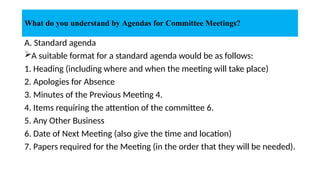
What do you understand by Agendas for Committee Meetings?
A. Standard agenda
A suitable format for a standard agenda would be as follows:
1. Heading (including where and when the meeting will take place)
2. Apologies for Absence
3. Minutes of the Previous Meeting 4.
4. Items requiring the attention of the committee 6.
5. Any Other Business
6. Date of Next Meeting (also give the time and location)
7. Papers required for the Meeting (in the order that they will be needed).
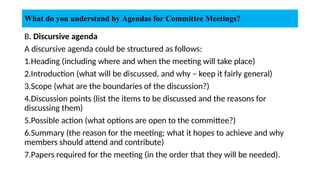
What do you understand by Agendas for Committee Meetings?
B. Discursive agenda
A discursive agenda could be structured as follows:
1.Heading (including where and when the meeting will take place)
2.Introduction (what will be discussed, and why – keep it fairly general)
3.Scope (what are the boundaries of the discussion?)
4.Discussion points (list the items to be discussed and the reasons for
discussing them)
5.Possible action (what options are open to the committee?)
6.Summary (the reason for the meeting; what it hopes to achieve and why
members should attend and contribute)
7.Papers required for the meeting (in the order that they will be needed).
What do you understand by Agendas for Committee Meetings?
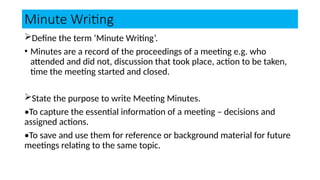
Minute Writing
Define the term ‘Minute Writing’.
• Minutes are a record of the proceedings of a meeting e.g. who
attended and did not, discussion that took place, action to be taken,
time the meeting started and closed.
State the purpose to write Meeting Minutes.
•To capture the essential information of a meeting – decisions and
assigned actions.
•To save and use them for reference or background material for future
meetings relating to the same topic.
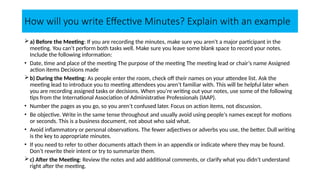
How will you write Effective Minutes? Explain with an example
a) Before the Meeting: If you are recording the minutes, make sure you aren‘t a major participant in the
meeting. You can‘t perform both tasks well. Make sure you leave some blank space to record your notes.
Include the following information:
• Date, time and place of the meeting The purpose of the meeting The meeting lead or chair‘s name Assigned
action items Decisions made
b) During the Meeting: As people enter the room, check off their names on your attendee list. Ask the
meeting lead to introduce you to meeting attendees you aren‘t familiar with. This will be helpful later when
you are recording assigned tasks or decisions. When you‘re writing out your notes, use some of the following
tips from the International Association of Administrative Professionals (IAAP).
• Number the pages as you go, so you aren’t confused later. Focus on action items, not discussion.
• Be objective. Write in the same tense throughout and usually avoid using people‘s names except for motions
or seconds. This is a business document, not about who said what.
• Avoid inflammatory or personal observations. The fewer adjectives or adverbs you use, the better. Dull writing
is the key to appropriate minutes.
• If you need to refer to other documents attach them in an appendix or indicate where they may be found.
Don‘t rewrite their intent or try to summarize them.
c) After the Meeting: Review the notes and add additional comments, or clarify what you didn‘t understand
right after the meeting.
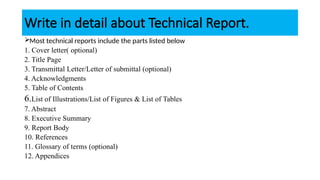
Write in detail about Technical Report.
Most technical reports include the parts listed below
1. Cover letter( optional)
2. Title Page
3. Transmittal Letter/Letter of submittal (optional)
4. Acknowledgments
5. Table of Contents
6.List of Illustrations/List of Figures & List of Tables
7. Abstract
8. Executive Summary
9. Report Body
10. References
11. Glossary of terms (optional)
12. Appendices
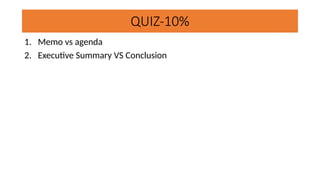
QUIZ-10%
1. Memo vs agenda
2. Executive Summary VS Conclusion

CHAPTER THREE component of research.pptx

  • 1.
    CHAPTER THREE REPORT TYPESAND ITS APPLICATIONS  Reports vary in their purpose, and in the type of information they present. However, all of them share similar features, a formal structure and careful planning, presenting the material in a logical manner using clear and concise language. 1) List the types of reports There are three types of reports  a) Informal Report  b) Formal Reports  c) Proposals 2) State types of informal reports.  a) Memo  b) Agendas of committee meetings  c) Minutes of meetings or Meeting Minutes
  • 2.
    What do youunderstand by the term Memo? A memo (short form of memorandum) is a very short document, usually up to a page long. In effect, it's an adaptation of a business letter, and is less formal than a letter. How to write a memo? • The memo heading: it is quite different from those of a letter. A memo is headed by the word MEMORANDUM and followed by the side headings: MEMORANDUM • To: (Name and title of the person to whom you are writing) • C: (Names and titles of other people to be sent copies of your memo (if required)) • From: (Your name) • Date: (In the style 21 March 2016, not 21/03/16) • Subject: A clear, informative title, containing the main message of your memo. It is often side-heading in short memo, short memo (about half a page) or a centered title in a longer memo. • In separate paragraphs (body of the memo) write:
  • 3.
    What do youunderstand by Agendas for Committee Meetings? An agenda is a list of items to be discussed during a meeting. It must be drawn up in advance. An agenda may take various forms, according to the requirements and, in some cases, the kind of meeting to which it refers. Be sure you know precisely what is expected of you Here are two common forms of committee agenda: A. The standard agenda B. The discursive agenda The standard agenda simply lists the subjects to be discussed, and the order in which they will be taken. The discursive agenda is designed to stimulate thought before and comment at the meeting. It is often used for ‘one- off’ meetings.
  • 4.
    •In deciding whatto include on an agenda, bear these points in mind: a) Talk to the chairperson and other committee members who may have business to include. b)Refer to the minutes of previous meetings for any business or discussions which were then deferred, and for reminders of routine annual, half-yearly, quarterly or monthly recurring items. c) Keep a special file of documents which are likely to be required at the next meeting. Sort and arrange them before drafting the agenda. What do you understand by Agendas for Committee Meetings?
  • 5.
    A. Standard agenda Asuitable format for a standard agenda would be as follows: 1. Heading (including where and when the meeting will take place) 2. Apologies for Absence 3. Minutes of the Previous Meeting 4. 4. Items requiring the attention of the committee 6. 5. Any Other Business 6. Date of Next Meeting (also give the time and location) 7. Papers required for the Meeting (in the order that they will be needed). What do you understand by Agendas for Committee Meetings?
  • 6.
    B. Discursive agenda Adiscursive agenda could be structured as follows: 1.Heading (including where and when the meeting will take place) 2.Introduction (what will be discussed, and why – keep it fairly general) 3.Scope (what are the boundaries of the discussion?) 4.Discussion points (list the items to be discussed and the reasons for discussing them) 5.Possible action (what options are open to the committee?) 6.Summary (the reason for the meeting; what it hopes to achieve and why members should attend and contribute) 7.Papers required for the meeting (in the order that they will be needed). What do you understand by Agendas for Committee Meetings?
  • 7.
    Minute Writing Define theterm ‘Minute Writing’. • Minutes are a record of the proceedings of a meeting e.g. who attended and did not, discussion that took place, action to be taken, time the meeting started and closed. State the purpose to write Meeting Minutes. •To capture the essential information of a meeting – decisions and assigned actions. •To save and use them for reference or background material for future meetings relating to the same topic.
  • 8.
    How will youwrite Effective Minutes? Explain with an example a) Before the Meeting: If you are recording the minutes, make sure you aren‘t a major participant in the meeting. You can‘t perform both tasks well. Make sure you leave some blank space to record your notes. Include the following information: • Date, time and place of the meeting The purpose of the meeting The meeting lead or chair‘s name Assigned action items Decisions made b) During the Meeting: As people enter the room, check off their names on your attendee list. Ask the meeting lead to introduce you to meeting attendees you aren‘t familiar with. This will be helpful later when you are recording assigned tasks or decisions. When you‘re writing out your notes, use some of the following tips from the International Association of Administrative Professionals (IAAP). • Number the pages as you go, so you aren’t confused later. Focus on action items, not discussion. • Be objective. Write in the same tense throughout and usually avoid using people‘s names except for motions or seconds. This is a business document, not about who said what. • Avoid inflammatory or personal observations. The fewer adjectives or adverbs you use, the better. Dull writing is the key to appropriate minutes. • If you need to refer to other documents attach them in an appendix or indicate where they may be found. Don‘t rewrite their intent or try to summarize them. c) After the Meeting: Review the notes and add additional comments, or clarify what you didn‘t understand right after the meeting.
  • 9.
    Write in detailabout Technical Report. Most technical reports include the parts listed below 1. Cover letter( optional) 2. Title Page 3. Transmittal Letter/Letter of submittal (optional) 4. Acknowledgments 5. Table of Contents 6.List of Illustrations/List of Figures & List of Tables 7. Abstract 8. Executive Summary 9. Report Body 10. References 11. Glossary of terms (optional) 12. Appendices
  • 10.
    QUIZ-10% 1. Memo vsagenda 2. Executive Summary VS Conclusion