THE RESEARH PROCESS
3/9/2023 Research Proposal Development 2
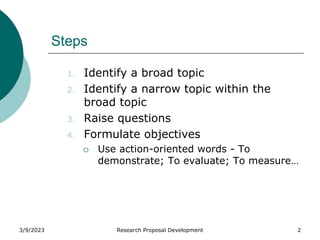
Steps
1. Identify a broad topic
2. Identify a narrow topic within the
broad topic
3. Raise questions
4. Formulate objectives
 Use action-oriented words - To
demonstrate; To evaluate; To measure…
3/9/2023 Research Proposal Development 3
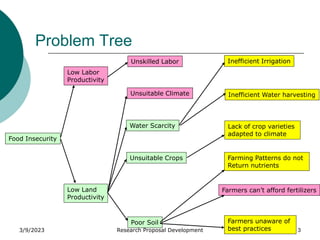
Problem Tree
Food Insecurity
Low Labor
Productivity
Low Land
Productivity
Unskilled Labor
Water Scarcity
Unsuitable Crops
Poor Soil
Inefficient Irrigation
Lack of crop varieties
adapted to climate
Inefficient Water harvesting
Unsuitable Climate
Farming Patterns do not
Return nutrients
Farmers can’t afford fertilizers
Farmers unaware of
best practices
Proposal Writing
Research Proposal Development 5
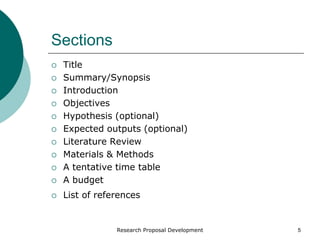
Sections
 Title
 Summary/Synopsis
 Introduction
 Objectives
 Hypothesis (optional)
 Expected outputs (optional)
 Literature Review
 Materials & Methods
 A tentative time table
 A budget
 List of references
Research Proposal Development 6
Title
 Specific & Short
 This forms the first impression
about your research
 If vague – Reader will be cynical
Research Proposal Development 7
Introduction
 Convince the reader that you have identified a
research problem, worthy of investigating.
 Start very general – Broad Topic
 Highlight
 the concept
 Practical significance
 Reduce it to a narrow topic by
 Raising questions, and
 Stating answers from literature for most.
 Establish Rationale:
 Raise necessary questions for which there is no
answer yet.
Research Proposal Development 8
Objectives
 Provide a clear statement of the
overall question- General objective
 Follow it with action oriented tasks -
Specific objectives.
 If more than one specific objective
state them sequentially
Research Proposal Development 9
 Hypothesis (optional):
 Expected outputs (optional):
 Expected project achievements
 beneficiaries and how they will access
the outputs
Research Proposal Development 10
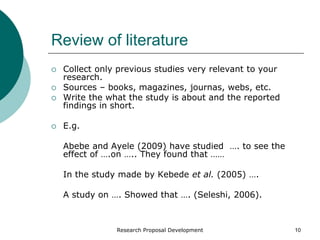
Review of literature
 Collect only previous studies very relevant to your
research.
 Sources – books, magazines, journas, webs, etc.
 Write the what the study is about and the reported
findings in short.
 E.g.
Abebe and Ayele (2009) have studied …. to see the
effect of ….on ….. They found that ……
In the study made by Kebede et al. (2005) ….
A study on …. Showed that …. (Seleshi, 2006).
Research Proposal Development 11
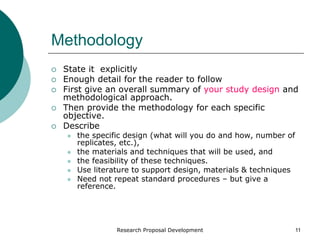
Methodology
 State it explicitly
 Enough detail for the reader to follow
 First give an overall summary of your study design and
methodological approach.
 Then provide the methodology for each specific
objective.
 Describe
 the specific design (what will you do and how, number of
replicates, etc.),
 the materials and techniques that will be used, and
 the feasibility of these techniques.
 Use literature to support design, materials & techniques
 Need not repeat standard procedures – but give a
reference.
Research Proposal Development 12
References
 List all references (never list what is not cited inside the
document)
 In alphabetical order
Eg.
Abebe T. 2009 . [Title]. [name of journal]. [Vol. no.].pp. 154-159.
Abebe T. and B. Bogale. 2008. [Title]. [name of journal]. [Vol.
no.].pp. 54-60.
_______________.2009. [Title]. [name of journal]. [Vol.
no.].pp. 25-30.
Bekele S., T. Debebe and R.S. Reddy. 2000. Title]. [name of
journal]. [Vol. no.].pp. 25-30.
Chow V.T. 1980. Open Channel Hydraulics. MacGraw Hill publishers
Ltd. 2nd ed. Newyork.
Research Proposal Development 13
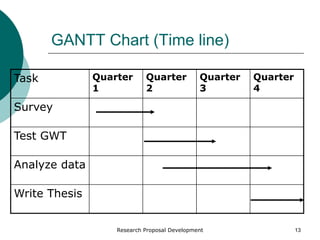
GANTT Chart (Time line)
Task Quarter
1
Quarter
2
Quarter
3
Quarter
4
Survey
Test GWT
Analyze data
Write Thesis
Research Proposal Development 14
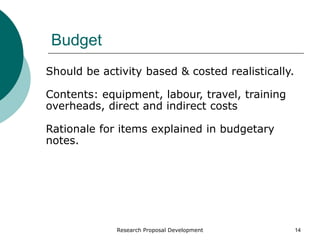
Budget
Should be activity based & costed realistically.
Contents: equipment, labour, travel, training
overheads, direct and indirect costs
Rationale for items explained in budgetary
notes.
Research Proposal Development 15
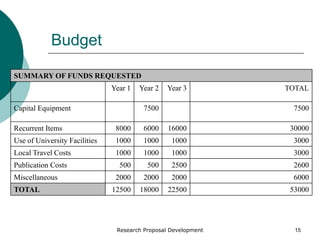
Budget
SUMMARY OF FUNDS REQUESTED
Year 1 Year 2 Year 3 TOTAL
Capital Equipment 7500 7500
Recurrent Items 8000 6000 16000 30000
Use of University Facilities 1000 1000 1000 3000
Local Travel Costs 1000 1000 1000 3000
Publication Costs 500 500 2500 2600
Miscellaneous 2000 2000 2000 6000
TOTAL 12500 18000 22500 53000

Mini proposal.ppt

  • 1.
  • 2.
    3/9/2023 Research ProposalDevelopment 2 Steps 1. Identify a broad topic 2. Identify a narrow topic within the broad topic 3. Raise questions 4. Formulate objectives  Use action-oriented words - To demonstrate; To evaluate; To measure…
  • 3.
    3/9/2023 Research ProposalDevelopment 3 Problem Tree Food Insecurity Low Labor Productivity Low Land Productivity Unskilled Labor Water Scarcity Unsuitable Crops Poor Soil Inefficient Irrigation Lack of crop varieties adapted to climate Inefficient Water harvesting Unsuitable Climate Farming Patterns do not Return nutrients Farmers can’t afford fertilizers Farmers unaware of best practices
  • 4.
  • 5.
    Research Proposal Development5 Sections  Title  Summary/Synopsis  Introduction  Objectives  Hypothesis (optional)  Expected outputs (optional)  Literature Review  Materials & Methods  A tentative time table  A budget  List of references
  • 6.
    Research Proposal Development6 Title  Specific & Short  This forms the first impression about your research  If vague – Reader will be cynical
  • 7.
    Research Proposal Development7 Introduction  Convince the reader that you have identified a research problem, worthy of investigating.  Start very general – Broad Topic  Highlight  the concept  Practical significance  Reduce it to a narrow topic by  Raising questions, and  Stating answers from literature for most.  Establish Rationale:  Raise necessary questions for which there is no answer yet.
  • 8.
    Research Proposal Development8 Objectives  Provide a clear statement of the overall question- General objective  Follow it with action oriented tasks - Specific objectives.  If more than one specific objective state them sequentially
  • 9.
    Research Proposal Development9  Hypothesis (optional):  Expected outputs (optional):  Expected project achievements  beneficiaries and how they will access the outputs
  • 10.
    Research Proposal Development10 Review of literature  Collect only previous studies very relevant to your research.  Sources – books, magazines, journas, webs, etc.  Write the what the study is about and the reported findings in short.  E.g. Abebe and Ayele (2009) have studied …. to see the effect of ….on ….. They found that …… In the study made by Kebede et al. (2005) …. A study on …. Showed that …. (Seleshi, 2006).
  • 11.
    Research Proposal Development11 Methodology  State it explicitly  Enough detail for the reader to follow  First give an overall summary of your study design and methodological approach.  Then provide the methodology for each specific objective.  Describe  the specific design (what will you do and how, number of replicates, etc.),  the materials and techniques that will be used, and  the feasibility of these techniques.  Use literature to support design, materials & techniques  Need not repeat standard procedures – but give a reference.
  • 12.
    Research Proposal Development12 References  List all references (never list what is not cited inside the document)  In alphabetical order Eg. Abebe T. 2009 . [Title]. [name of journal]. [Vol. no.].pp. 154-159. Abebe T. and B. Bogale. 2008. [Title]. [name of journal]. [Vol. no.].pp. 54-60. _______________.2009. [Title]. [name of journal]. [Vol. no.].pp. 25-30. Bekele S., T. Debebe and R.S. Reddy. 2000. Title]. [name of journal]. [Vol. no.].pp. 25-30. Chow V.T. 1980. Open Channel Hydraulics. MacGraw Hill publishers Ltd. 2nd ed. Newyork.
  • 13.
    Research Proposal Development13 GANTT Chart (Time line) Task Quarter 1 Quarter 2 Quarter 3 Quarter 4 Survey Test GWT Analyze data Write Thesis
  • 14.
    Research Proposal Development14 Budget Should be activity based & costed realistically. Contents: equipment, labour, travel, training overheads, direct and indirect costs Rationale for items explained in budgetary notes.
  • 15.
    Research Proposal Development15 Budget SUMMARY OF FUNDS REQUESTED Year 1 Year 2 Year 3 TOTAL Capital Equipment 7500 7500 Recurrent Items 8000 6000 16000 30000 Use of University Facilities 1000 1000 1000 3000 Local Travel Costs 1000 1000 1000 3000 Publication Costs 500 500 2500 2600 Miscellaneous 2000 2000 2000 6000 TOTAL 12500 18000 22500 53000