Mineral Economics for Geologists 
CET Short Course 
2 December 2014 
Presented by Professor Allan Trench & Mr John Sykes
This course is ideal for technical professionals across 
the mineral exploration, mining and mineral processing 
industries as a foundation in economic concepts and 
strategic decision-making in the minerals industries and 
as a primer for the transition between purely technical 
roles in companies and management roles. The course 
also has appeal to professionals in technical roles in the 
minerals sector and in the minerals exploration industry in 
strengthening their economic and strategic knowledge of 
the drivers of industry advantage that accrue from market-related 
factors. 
This one-day intensive course focuses on the principles and fundamentals of mineral 
markets, covering both the major exchange-traded metal markets (gold, silver, PGM’s, 
base metals), bulk commodities (iron ore & coal seaborne trade), intermediate markets 
(metal concentrates) and other markets (alloying metals, uranium, rare earth elements). 
In particular, the course places specific emphasis upon understanding the strategic 
behaviours, the economic rationale and the value drivers and market impact of supply-side 
decision-making by companies across different mineral markets. The concepts of 
attractive industry structures prone to strong returns and competitive markets where 
returns are more difficult to achieve will be introduced and discussed. 
Providing a basic understanding of the fundamental principles of mineral markets, 
adopting both microeconomic and macroeconomic lenses to both explore and 
explain market dynamics, the course will: 
——Progress beyond a simple economic textbook view of the supply and demand for 
minerals towards a practical, pragmatic perspective of how mineral markets actually 
work in practice, based on real-world examples of minerals-company (supply-side) and 
metal consumer (demand-side) behaviours over time; 
——Give participants grounding across over 20 mineral markets to identify and assess how 
the different drivers of economic value vary between mineral markets; 
——Assess the demand-side, supply-side, competitive and regulatory forces that shape 
minerals markets, including the economic impact and consequences of market 
interventions by governments where they occur; and 
——Use examples of the following mineral markets at high-level to illustrate key concepts: 
Aluminium, Antimony, Chromium, Cobalt, Coking Coal, Copper, Diamonds,Gold, 
Iron Ore, Lead, Lithium, Manganese, Mineral Sands, Molybdenum, Nickel, Niobium, 
Phosphate, Platinum Group Metals, Potash, Rare Earth Metals, Silver, Tantalum, Thermal 
Coal, Tin, Tungsten, Uranium, Vanadium, Zinc, and other traded commodities.
Markets factors that will be assessed include: 
——Demand drivers and end-use sectors; 
——Commodity supply structures classified by main product, co-product 
and by-products; 
——The geography of mineral supply; 
——Intermediate markets; 
——Geological and mine characteristics of mineral supply as they impact 
upon costs, 
——Market mechanisms; and 
——Common management methods to assess structural attractiveness of 
mineral markets. 
Presenters 
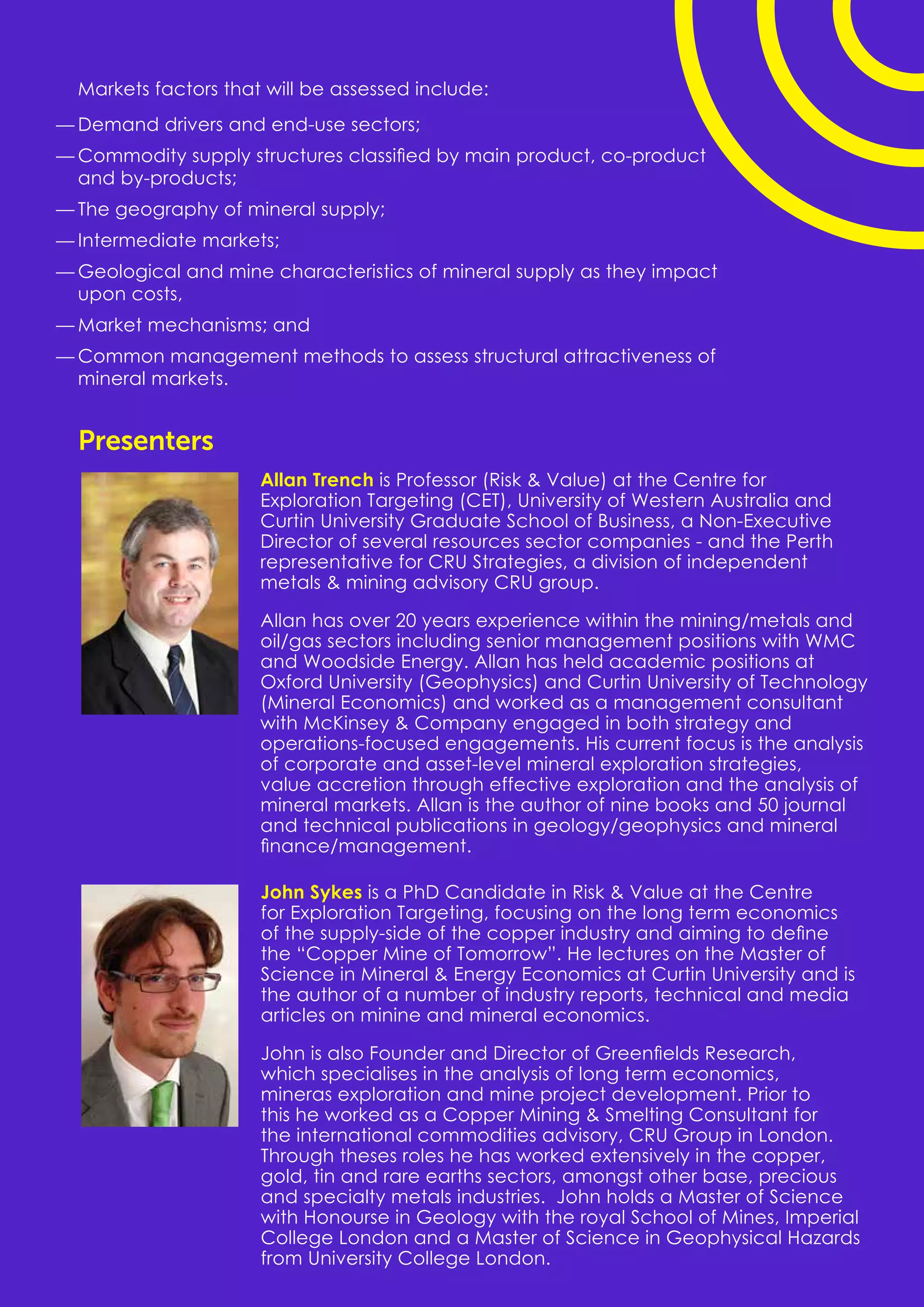
Allan Trench is Professor (Risk & Value) at the Centre for 
Exploration Targeting (CET), University of Western Australia and 
Curtin University Graduate School of Business, a Non-Executive 
Director of several resources sector companies - and the Perth 
representative for CRU Strategies, a division of independent 
metals & mining advisory CRU group. 
Allan has over 20 years experience within the mining/metals and 
oil/gas sectors including senior management positions with WMC 
and Woodside Energy. Allan has held academic positions at 
Oxford University (Geophysics) and Curtin University of Technology 
(Mineral Economics) and worked as a management consultant 
with McKinsey & Company engaged in both strategy and 
operations-focused engagements. His current focus is the analysis 
of corporate and asset-level mineral exploration strategies, 
value accretion through effective exploration and the analysis of 
mineral markets. Allan is the author of nine books and 50 journal 
and technical publications in geology/geophysics and mineral 
finance/management. 
John Sykes is a PhD Candidate in Risk & Value at the Centre 
for Exploration Targeting, focusing on the long term economics 
of the supply-side of the copper industry and aiming to define 
the “Copper Mine of Tomorrow”. He lectures on the Master of 
Science in Mineral & Energy Economics at Curtin University and is 
the author of a number of industry reports, technical and media 
articles on minine and mineral economics. 
John is also Founder and Director of Greenfields Research, 
which specialises in the analysis of long term economics, 
mineras exploration and mine project development. Prior to 
this he worked as a Copper Mining & Smelting Consultant for 
the international commodities advisory, CRU Group in London. 
Through theses roles he has worked extensively in the copper, 
gold, tin and rare earths sectors, amongst other base, precious 
and specialty metals industries. John holds a Master of Science 
with Honourse in Geology with the royal School of Mines, Imperial 
College London and a Master of Science in Geophysical Hazards 
from University College London.
Key Benefits 
At the end of the course participants will: 
——Appreciate that static analysis of supply-demand does not capture the whole 
context of a mineral market. 
——Have greater familiarity with how different market factors should influence corporate 
decisions and market entry strategies 
——Discover that a favourable industry cost position is not the sole driver of value creation 
in a mineral market 
——Have acquired the skills to identify and evaluate new mineral markets beyond simple 
price-related attractiveness 
——Have a solid springboard to expand their skills in this exciting field, where there are 
rewards for companies able to move quickly in their assessment of the potential of 
mineral projects in different mineral markets. 
Computer & Textbook requirements 
No specific software is required – however it is recommended that participants bring 
with them their own laptop computers as a group exercise will be undertaken during 
the day that will require preparation of a Powerpoint presentation. 
Registration 
Please see attached registration form or go online to: 
http://www.cet.edu.au/education-and-training/short-courses/ and click on Mineral 
Economics for Geologists. Payment can be made online. 
For additional information on this, or any of our other CET Short Courses, contact Ms 
Cindi Dunjey at cet-training@uwa.edu.au or phone +61 8 6488 2640. 
For more information on all of the training opportunities offered at the CET please see 
our website www.cet.edu.au/education-and-training/short-courses 
See the CET website for more information 
www.cet.edu.au
CONTACT DETAILS 
Title: Mr Ms 
First Name: 
Surname: 
Course Attending: Mineral Economics for Geologists 2014 
Non Member Corporate Member 
$720 inc gst $504 inc gst 
Company Name: 
Position Title: 
Email Address: 
Address: 
Postcode: Telephone: Fax: 
Heard about course via: Word-of-Mouth Conference Website Print 
Please tick if you DO NOT wish your details to be used to distribute CET training information ONLY. 
Please specify dietary requirements 
PAYMENT OPTIONS 
Cheque: please enclose a cheque payable to: The Centre for Exploration 
Targeting, UWA 
Pay online via: 
http://payments.weboffice.uwa.edu.au/cet/shopping_cart_Mineral_Economics_for_Geologists 
Visa Card Master Card 
Card No.: / / Security No.: 
Cardholder’s Name: 
Expiry Date: Signature: 
**Please ensure adequate credit limit for corporate cards. 
PLEASE NOTE 
No refunds for cancellations made within 2 weeks of the course or for ‘no shows’. Participants can be 
substituted. If the minimum number of participants is not achieved participants will be notified 2 weeks 
prior to course start date and fees will be refunded. 
CONTACT 
M006, 35 Stirling Highway 
Crawley WA 6009 
t (08) 6488 6794 
f (08) 6488 1178 www.cet.uwa.edu.au 
e cet-training@uwa.edu.au CRICOS Provider Code: 
00126G

Mineral Economics for Geologists Short Course - Centre for Exploration Targeting - 2 Dec 2014 - BROCHURE

  • 1.
    Mineral Economics forGeologists CET Short Course 2 December 2014 Presented by Professor Allan Trench & Mr John Sykes
  • 2.
    This course isideal for technical professionals across the mineral exploration, mining and mineral processing industries as a foundation in economic concepts and strategic decision-making in the minerals industries and as a primer for the transition between purely technical roles in companies and management roles. The course also has appeal to professionals in technical roles in the minerals sector and in the minerals exploration industry in strengthening their economic and strategic knowledge of the drivers of industry advantage that accrue from market-related factors. This one-day intensive course focuses on the principles and fundamentals of mineral markets, covering both the major exchange-traded metal markets (gold, silver, PGM’s, base metals), bulk commodities (iron ore & coal seaborne trade), intermediate markets (metal concentrates) and other markets (alloying metals, uranium, rare earth elements). In particular, the course places specific emphasis upon understanding the strategic behaviours, the economic rationale and the value drivers and market impact of supply-side decision-making by companies across different mineral markets. The concepts of attractive industry structures prone to strong returns and competitive markets where returns are more difficult to achieve will be introduced and discussed. Providing a basic understanding of the fundamental principles of mineral markets, adopting both microeconomic and macroeconomic lenses to both explore and explain market dynamics, the course will: ——Progress beyond a simple economic textbook view of the supply and demand for minerals towards a practical, pragmatic perspective of how mineral markets actually work in practice, based on real-world examples of minerals-company (supply-side) and metal consumer (demand-side) behaviours over time; ——Give participants grounding across over 20 mineral markets to identify and assess how the different drivers of economic value vary between mineral markets; ——Assess the demand-side, supply-side, competitive and regulatory forces that shape minerals markets, including the economic impact and consequences of market interventions by governments where they occur; and ——Use examples of the following mineral markets at high-level to illustrate key concepts: Aluminium, Antimony, Chromium, Cobalt, Coking Coal, Copper, Diamonds,Gold, Iron Ore, Lead, Lithium, Manganese, Mineral Sands, Molybdenum, Nickel, Niobium, Phosphate, Platinum Group Metals, Potash, Rare Earth Metals, Silver, Tantalum, Thermal Coal, Tin, Tungsten, Uranium, Vanadium, Zinc, and other traded commodities.
  • 3.
    Markets factors thatwill be assessed include: ——Demand drivers and end-use sectors; ——Commodity supply structures classified by main product, co-product and by-products; ——The geography of mineral supply; ——Intermediate markets; ——Geological and mine characteristics of mineral supply as they impact upon costs, ——Market mechanisms; and ——Common management methods to assess structural attractiveness of mineral markets. Presenters Allan Trench is Professor (Risk & Value) at the Centre for Exploration Targeting (CET), University of Western Australia and Curtin University Graduate School of Business, a Non-Executive Director of several resources sector companies - and the Perth representative for CRU Strategies, a division of independent metals & mining advisory CRU group. Allan has over 20 years experience within the mining/metals and oil/gas sectors including senior management positions with WMC and Woodside Energy. Allan has held academic positions at Oxford University (Geophysics) and Curtin University of Technology (Mineral Economics) and worked as a management consultant with McKinsey & Company engaged in both strategy and operations-focused engagements. His current focus is the analysis of corporate and asset-level mineral exploration strategies, value accretion through effective exploration and the analysis of mineral markets. Allan is the author of nine books and 50 journal and technical publications in geology/geophysics and mineral finance/management. John Sykes is a PhD Candidate in Risk & Value at the Centre for Exploration Targeting, focusing on the long term economics of the supply-side of the copper industry and aiming to define the “Copper Mine of Tomorrow”. He lectures on the Master of Science in Mineral & Energy Economics at Curtin University and is the author of a number of industry reports, technical and media articles on minine and mineral economics. John is also Founder and Director of Greenfields Research, which specialises in the analysis of long term economics, mineras exploration and mine project development. Prior to this he worked as a Copper Mining & Smelting Consultant for the international commodities advisory, CRU Group in London. Through theses roles he has worked extensively in the copper, gold, tin and rare earths sectors, amongst other base, precious and specialty metals industries. John holds a Master of Science with Honourse in Geology with the royal School of Mines, Imperial College London and a Master of Science in Geophysical Hazards from University College London.
  • 4.
    Key Benefits Atthe end of the course participants will: ——Appreciate that static analysis of supply-demand does not capture the whole context of a mineral market. ——Have greater familiarity with how different market factors should influence corporate decisions and market entry strategies ——Discover that a favourable industry cost position is not the sole driver of value creation in a mineral market ——Have acquired the skills to identify and evaluate new mineral markets beyond simple price-related attractiveness ——Have a solid springboard to expand their skills in this exciting field, where there are rewards for companies able to move quickly in their assessment of the potential of mineral projects in different mineral markets. Computer & Textbook requirements No specific software is required – however it is recommended that participants bring with them their own laptop computers as a group exercise will be undertaken during the day that will require preparation of a Powerpoint presentation. Registration Please see attached registration form or go online to: http://www.cet.edu.au/education-and-training/short-courses/ and click on Mineral Economics for Geologists. Payment can be made online. For additional information on this, or any of our other CET Short Courses, contact Ms Cindi Dunjey at cet-training@uwa.edu.au or phone +61 8 6488 2640. For more information on all of the training opportunities offered at the CET please see our website www.cet.edu.au/education-and-training/short-courses See the CET website for more information www.cet.edu.au
  • 5.
    CONTACT DETAILS Title:Mr Ms First Name: Surname: Course Attending: Mineral Economics for Geologists 2014 Non Member Corporate Member $720 inc gst $504 inc gst Company Name: Position Title: Email Address: Address: Postcode: Telephone: Fax: Heard about course via: Word-of-Mouth Conference Website Print Please tick if you DO NOT wish your details to be used to distribute CET training information ONLY. Please specify dietary requirements PAYMENT OPTIONS Cheque: please enclose a cheque payable to: The Centre for Exploration Targeting, UWA Pay online via: http://payments.weboffice.uwa.edu.au/cet/shopping_cart_Mineral_Economics_for_Geologists Visa Card Master Card Card No.: / / Security No.: Cardholder’s Name: Expiry Date: Signature: **Please ensure adequate credit limit for corporate cards. PLEASE NOTE No refunds for cancellations made within 2 weeks of the course or for ‘no shows’. Participants can be substituted. If the minimum number of participants is not achieved participants will be notified 2 weeks prior to course start date and fees will be refunded. CONTACT M006, 35 Stirling Highway Crawley WA 6009 t (08) 6488 6794 f (08) 6488 1178 www.cet.uwa.edu.au e cet-training@uwa.edu.au CRICOS Provider Code: 00126G