
MIND POWER
1
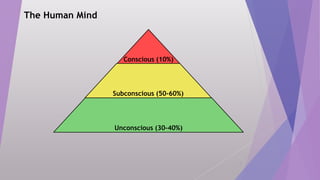
The Human Mind
Conscious (10%)
Subconscious (50-60%)
Unconscious (30-40%)
2
The Conscious Mind
Conscious mind communicates to the outside world and the inner self
through speech, pictures, writing, physical movement and thought.
Conscious mind is where you do all your thinking and logical reasoning. It
decides what we read, what we learn, even how we learn and then uses
that information as it sees fit.
Conscious mind can be distinguished from subconscious and unconscious
mind because it consists of awareness.
The 2 main functions of a fully developed conscious mind are:
1. Ability to direct your focus
2. Ability to imagine which is not real.
3
The Subconscious Mind
Subconscious mind is in charge of our recent memories, and is in
continuous contact with the resources of the unconscious mind.
It works hard at ensuring you have everything you need for quick recall and
access to when you need it. Things like :-
1. Memories – such as what your telephone number is or how to drive a
car without having to consciously think about it.
2. Current programs you run daily, such as behaviors, mood and
attitude.
3. Filters (such as beliefs and values) to run information through to test
their validity according to your perception of the world.
4. Sensations taken in via your 5 senses and what it means to you.
4
The Unconscious Mind
Unconscious is the storage place for all our memories that have been
repressed or which we don’t wish to recall.
In many aspects, unconscious deals with all the same tasks as the
subconscious. They include memory, habits, feelings and emotions.
The unconscious is the source of all these programs that subconscious
uses.
5
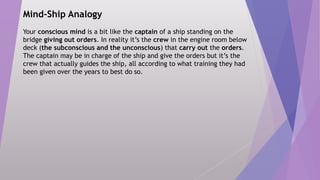
Mind-Ship Analogy
Your conscious mind is a bit like the captain of a ship standing on the
bridge giving out orders. In reality it’s the crew in the engine room below
deck (the subconscious and the unconscious) that carry out the orders.
The captain may be in charge of the ship and give the orders but it’s the
crew that actually guides the ship, all according to what training they had
been given over the years to best do so.
6
7
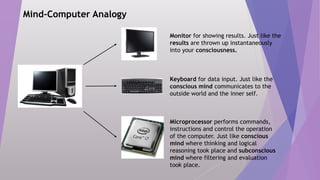
Mind-Computer Analogy
Keyboard for data input. Just like the
conscious mind communicates to the
outside world and the inner self.
Monitor for showing results. Just like the
results are thrown up instantaneously
into your consciousness.
Microprocessor performs commands,
instructions and control the operation
of the computer. Just like conscious
mind where thinking and logical
reasoning took place and subconscious
mind where filtering and evaluation
took place.
8
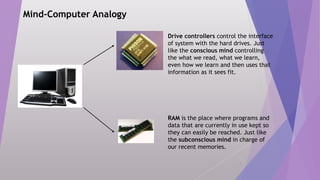
Mind-Computer Analogy
RAM is the place where programs and
data that are currently in use kept so
they can easily be reached. Just like
the subconscious mind in charge of
our recent memories.
Drive controllers control the interface
of system with the hard drives. Just
like the conscious mind controlling
the what we read, what we learn,
even how we learn and then uses that
information as it sees fit.
9
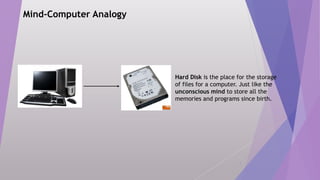
Mind-Computer Analogy
Hard Disk is the place for the storage
of files for a computer. Just like the
unconscious mind to store all the
memories and programs since birth.
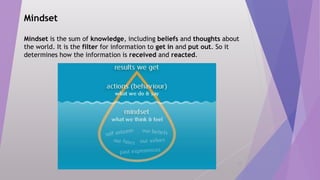
Mindset
Mindset is the sum of knowledge, including beliefs and thoughts about
the world. It is the filter for information to get in and put out. So it
determines how the information is received and reacted.
10
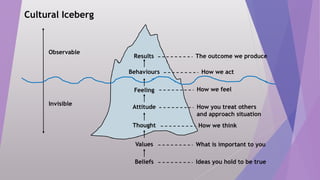
Cultural Iceberg
Behaviours
Invisible
Beliefs
Values
Thought
Attitude
Feeling
Results
Observable
The outcome we produce
How we act
How we feel
How we think
How you treat others
and approach situation
What is important to you
Ideas you hold to be true11
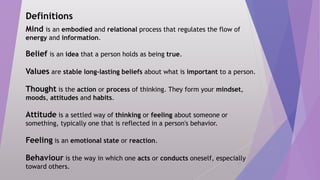
Mind is an embodied and relational process that regulates the flow of
energy and information.
Belief is an idea that a person holds as being true.
Values are stable long-lasting beliefs about what is important to a person.
Thought is the action or process of thinking. They form your mindset,
moods, attitudes and habits.
Attitude is a settled way of thinking or feeling about someone or
something, typically one that is reflected in a person's behavior.
Feeling is an emotional state or reaction.
Behaviour is the way in which one acts or conducts oneself, especially
toward others.
Definitions
12
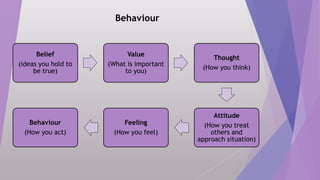
Behaviour
Belief
(ideas you hold to
be true)
Value
(What is important
to you)
Thought
(How you think)
Attitude
(How you treat
others and
approach situation)
Feeling
(How you feel)
Behaviour
(How you act)
13
14

Mind power

  • 1.
  • 2.
    The Human Mind Conscious(10%) Subconscious (50-60%) Unconscious (30-40%) 2
  • 3.
    The Conscious Mind Consciousmind communicates to the outside world and the inner self through speech, pictures, writing, physical movement and thought. Conscious mind is where you do all your thinking and logical reasoning. It decides what we read, what we learn, even how we learn and then uses that information as it sees fit. Conscious mind can be distinguished from subconscious and unconscious mind because it consists of awareness. The 2 main functions of a fully developed conscious mind are: 1. Ability to direct your focus 2. Ability to imagine which is not real. 3
  • 4.
    The Subconscious Mind Subconsciousmind is in charge of our recent memories, and is in continuous contact with the resources of the unconscious mind. It works hard at ensuring you have everything you need for quick recall and access to when you need it. Things like :- 1. Memories – such as what your telephone number is or how to drive a car without having to consciously think about it. 2. Current programs you run daily, such as behaviors, mood and attitude. 3. Filters (such as beliefs and values) to run information through to test their validity according to your perception of the world. 4. Sensations taken in via your 5 senses and what it means to you. 4
  • 5.
    The Unconscious Mind Unconsciousis the storage place for all our memories that have been repressed or which we don’t wish to recall. In many aspects, unconscious deals with all the same tasks as the subconscious. They include memory, habits, feelings and emotions. The unconscious is the source of all these programs that subconscious uses. 5
  • 6.
    Mind-Ship Analogy Your consciousmind is a bit like the captain of a ship standing on the bridge giving out orders. In reality it’s the crew in the engine room below deck (the subconscious and the unconscious) that carry out the orders. The captain may be in charge of the ship and give the orders but it’s the crew that actually guides the ship, all according to what training they had been given over the years to best do so. 6
  • 7.
    7 Mind-Computer Analogy Keyboard fordata input. Just like the conscious mind communicates to the outside world and the inner self. Monitor for showing results. Just like the results are thrown up instantaneously into your consciousness. Microprocessor performs commands, instructions and control the operation of the computer. Just like conscious mind where thinking and logical reasoning took place and subconscious mind where filtering and evaluation took place.
  • 8.
    8 Mind-Computer Analogy RAM isthe place where programs and data that are currently in use kept so they can easily be reached. Just like the subconscious mind in charge of our recent memories. Drive controllers control the interface of system with the hard drives. Just like the conscious mind controlling the what we read, what we learn, even how we learn and then uses that information as it sees fit.
  • 9.
    9 Mind-Computer Analogy Hard Diskis the place for the storage of files for a computer. Just like the unconscious mind to store all the memories and programs since birth.
  • 10.
    Mindset Mindset is thesum of knowledge, including beliefs and thoughts about the world. It is the filter for information to get in and put out. So it determines how the information is received and reacted. 10
  • 11.
    Cultural Iceberg Behaviours Invisible Beliefs Values Thought Attitude Feeling Results Observable The outcomewe produce How we act How we feel How we think How you treat others and approach situation What is important to you Ideas you hold to be true11
  • 12.
    Mind is anembodied and relational process that regulates the flow of energy and information. Belief is an idea that a person holds as being true. Values are stable long-lasting beliefs about what is important to a person. Thought is the action or process of thinking. They form your mindset, moods, attitudes and habits. Attitude is a settled way of thinking or feeling about someone or something, typically one that is reflected in a person's behavior. Feeling is an emotional state or reaction. Behaviour is the way in which one acts or conducts oneself, especially toward others. Definitions 12
  • 13.
    Behaviour Belief (ideas you holdto be true) Value (What is important to you) Thought (How you think) Attitude (How you treat others and approach situation) Feeling (How you feel) Behaviour (How you act) 13
  • 14.