TikTok is asocial media platform for
creating, sharing and discovering short
videos. The app is used by young
people as an outlet to express
themselves through singing, dancing,
comedy, and lip-syncing, and allows
users to create videos and share them
across a community.
Source: webwise.ie
9.
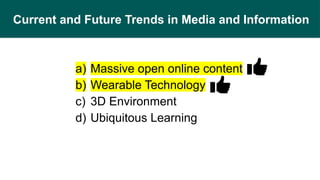
Current and FutureTrends in Media and Information
a) Massive open online content
b) Wearable Technology
c) 3D Environment
d) Ubiquitous Learning
10.
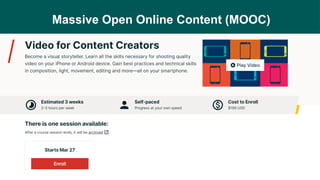
Massive Open OnlineContent (MOOC)
MOOCs are online courses available for anyone to
enroll. It provides an affordable and flexible way to
learn new skills, advance your career and deliver
quality educational experiences at scale.
Source: mooc.org
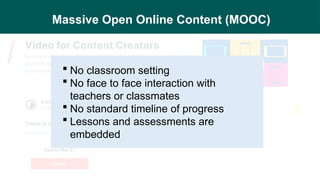
Massive Open OnlineContent (MOOC)
No classroom setting
No face to face interaction with
teachers or classmates
No standard timeline of progress
Lessons and assessments are
embedded
13.
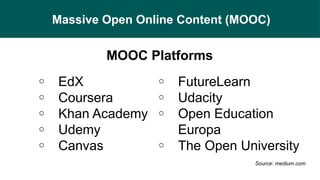
Massive Open OnlineContent (MOOC)
o EdX
o Coursera
o Khan Academy
o Udemy
o Canvas
o FutureLearn
o Udacity
o Open Education
Europa
o The Open University
Source: medium.com
MOOC Platforms
14.
Wearable Technology
Wearable Technologyrefers to mobile electronic
devices that are comfortably worn on the user’s body
or attached to their clothes. These devices are often
called “wearables” for short.
Source: sciencedirect.com
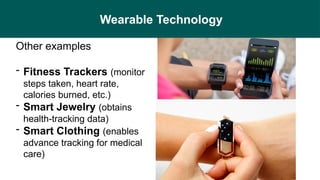
Wearable Technology
Other examples
-Fitness Trackers (monitor
steps taken, heart rate,
calories burned, etc.)
- Smart Jewelry (obtains
health-tracking data)
- Smart Clothing (enables
advance tracking for medical
care)
21.
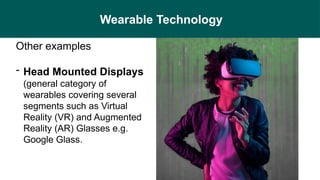
Wearable Technology
Other examples
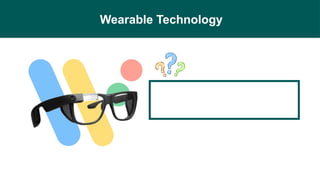
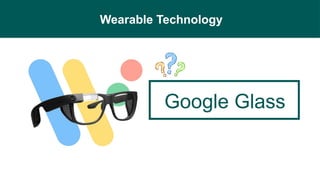
-Head Mounted Displays
(general category of
wearables covering several
segments such as Virtual
Reality (VR) and Augmented
Reality (AR) Glasses e.g.
Google Glass.
22.
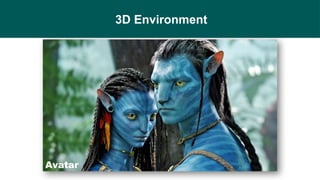
3D Environment
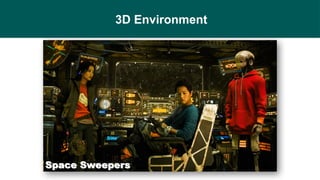
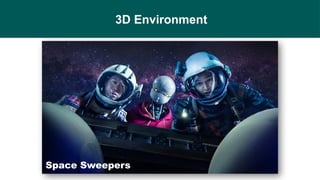
3D Environment– a computer-controlled digital
setting. The concept of 3D environment is explored to
mimic the physical world in media. Films are among
the most common media offerings that incorporate
3D.
Source: E-Learning Guide
3D Environment
3D Visualizationsare the best way of representing
creative ideas from various fields and industries. The
latest tools and gadgets for visualization enabled an
even better user experience.
Source: easyrender.com
27.
3D Environment
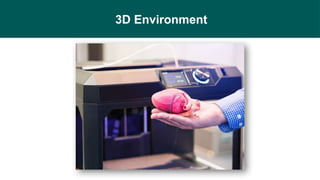
At first,3D printers were reserved for some branches
of architecture, design and 3D art, but the fastest-
growing discovery spread over all verticals of society.
Visualized textures can now be touched and felt.
Source: easyrender.com
28.
3D Environment
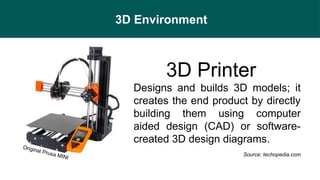
3D Printer
-Designs and builds 3D models; it
creates the end product by directly
building them using computer
aided design (CAD) or software-
created 3D design diagrams.
Source: techopedia.com
Original Prusa MINI
3D Environment
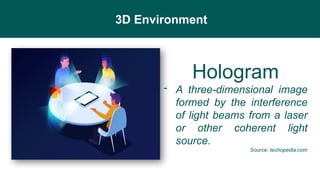
Hologram
- Athree-dimensional image
formed by the interference
of light beams from a laser
or other coherent light
source.
Source: techopedia.com
31.
3D Environment
The latestmedium for displaying 3D visualizations
using holographic imagery is helpful in various
industries including military, retail, medicine, and other
commercial efforts. Hologram might become our
primary tool for visualization.
Source: easyrender.com
Ubiquitous Learning
Ubiquitous learning,labeled as u–learning, takes
advantage of digital content, physical surroundings,
mobile devices, pervasive components, and wireless
communication to deliver teaching–learning
experiences to users at anytime, anywhere, and
anyway.
Source: sciencedirect.com
Ubiquitous Learning
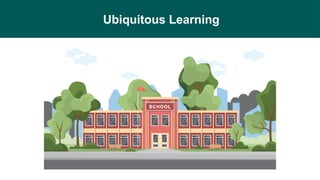
Ubiquitous Learningtranscends the old pedagogical
separations of space (the walls of the classrooms)
and time (scheduling, timetable).
Source: Education at Illinois
What do youthink
will be the future
media innovation?
39.
Current and FutureTrends in Media and Information
a) Massive open online content
b) Wearable Technology
c) 3D Environment
d) Ubiquitous Learning
40.
Thank you!
Marylie Noran,LPT
marylienoran@gmail.com
Media and Information
Literacy
Senior High School
Editor's Notes
#1 Hello everybody! This is a new video after a very long time. I have finally decided to make another recorded lesson for Media and Information Literacy.
#2 Today, we are going to learn the current and future trends. What are the recent changes? Are there any development in communication and technology? Should we anticipate more changes and development in the future?
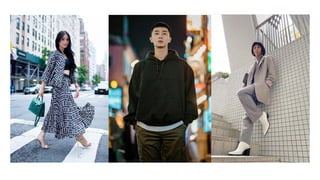
#4 As you can see here in the picture, these are celebrities who were trending at some point - Heart Evangelista for her fashion ; Korean actor Park Seo Joon as an actor; Mimiyuuuh as Youtube influencer. That being said, trend can be about certain style in fashion, entertainment, or whatsoever that is gaining popularity at a certain point of time.
Usually, people follow anything that is trending.
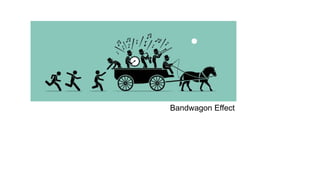
#5 The psychology behind it is that people tend to follow the crowd. It is called the Bandwagon effect where people act in a certain way because others are doing the same.
#6 To set an example: As of the first quarter of the year 2022, the people are going crazy with Tiktok. Many people are using it.
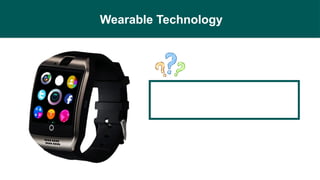
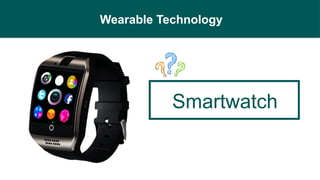
#17 Smartwatches are likely the most commonly-known and commonly-used wearables. Using this, you can connect to your smartphone and it has some other useful features as well.
#19 It is a smart-glass device with a 5Megapixel camera able to record video.
#38 Today, we are going to learn the current and future trends. What are the recent changes? Are there any development in communication and technology? Should we anticipate more changes and development in the future?








![Paris · SlidesCarnival [Autosaved].pptx](https://cdn.slidesharecdn.com/ss_thumbnails/parisslidescarnivalautosaved-221122234419-273ffdae-thumbnail.jpg?width=640&height=640&fit=bounds)


