STARTUP DNA
AT CORPORATE SCALE
MIKE SIGAL
Mike Sigal
 General Partner, 500 Fintech
 Co-Founder, Upside Partners
 6x Entrepreneur (3 exits, 1 IPO)
 Corporate Innovation Advisor
http://bit.ly/UPatSIWF2018
mike@upside.partners
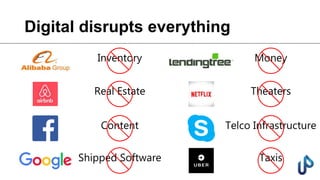
Digital disrupts everything
Taxis
Real Estate
Money
Theaters
Telco Infrastructure
Shipped Software
Inventory
Content
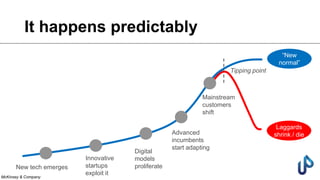
It happens predictably
Tipping point
Laggards
shrink / die
“New
normal”
New tech emerges
Innovative
startups
exploit it
Digital
models
proliferate
Advanced
incumbents
start adapting
Mainstream
customers
shift
McKinsey & Company
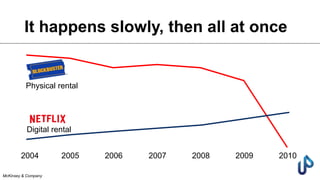
It happens slowly, then all at once
2004 2005 2006 2007 2008 2009 2010
Physical rental
Digital rental
McKinsey & Company
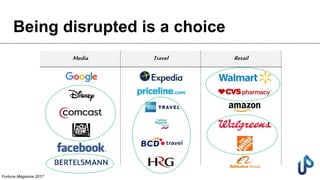
Being disrupted is a choice
Media Travel Retail
Fortune Magazine 2017
Move to the Cloud
“Banks will be doomed if they resist changing legacy
systems, especially those at the core.
The more legacy, the more cost, the less flexibility, the
harder to change.
Adding digital to legacy means paying to run both the
old and the new.”
- Chris Skinner, The Finanser
Get Control of your Data
“You cannot refresh core systems unless you separate your
content (the data) from your processing (the servers)
You cannot protect yourself against a cyberattack if data is
fragmented and offline; and
You cannot serve the customer well in the digital age if you
do not have a single view of them.”
- Chris Skinner, The Finanser
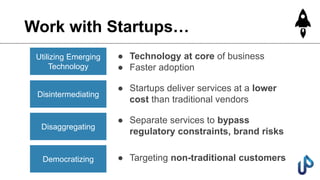
Work with Startups…
Utilizing Emerging
Technology
Disintermediating
Disaggregating
Democratizing
● Technology at core of business
● Faster adoption
● Startups deliver services at a lower
cost than traditional vendors
● Separate services to bypass
regulatory constraints, brand risks
● Targeting non-traditional customers
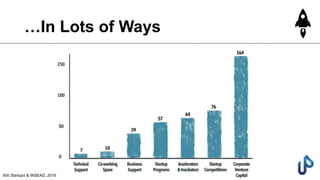
…In Lots of Ways
500 Startups & INSEAD, 2016
Transform your Talent
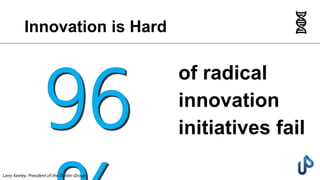
13
of radical
innovation
initiatives fail
Larry Keeley, President of the Doblin Group
Innovation is Hard
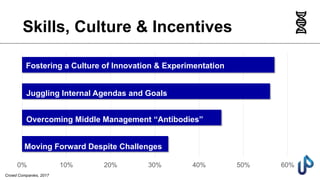
Skills, Culture & Incentives
0% 10% 20% 30% 40% 50% 60%
Crowd Companies, 2017
Fostering a Culture of Innovation & Experimentation
Juggling Internal Agendas and Goals
Overcoming Middle Management “Antibodies”
Moving Forward Despite Challenges
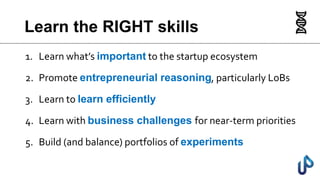
Learn the RIGHT skills
1. Learn what’s important to the startup ecosystem
2. Promote entrepreneurial reasoning, particularly LoBs
3. Learn to learn efficiently
4. Learn with business challenges for near-term priorities
5. Build (and balance) portfolios of experiments
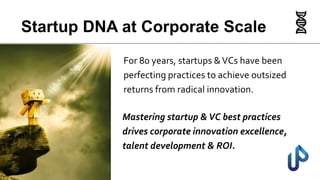
For 80 years, startups &VCs have been
perfecting practices to achieve outsized
returns from radical innovation.
Mastering startup &VC best practices
drives corporate innovation excellence,
talent development & ROI.
Startup DNA at Corporate Scale
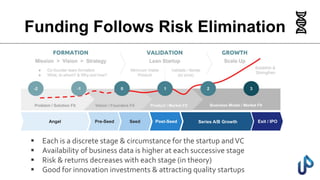
Funding Follows Risk Elimination
Angel Pre-Seed Seed Post-Seed Series A/B Growth Exit / IPO
 Each is a discrete stage & circumstance for the startup andVC
 Availability of business data is higher at each successive stage
 Risk & returns decreases with each stage (in theory)
 Good for innovation investments & attracting quality startups
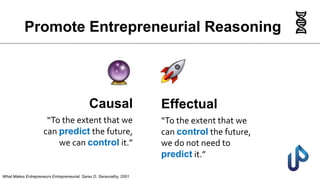
Effectual
“To the extent that we
can control the future,
we do not need to
predict it.”
Promote Entrepreneurial Reasoning
🔮
Causal
“To the extent that we
can predict the future,
we can control it.”
What Makes Entrepreneurs Entrepreneurial, Saras D. Sarasvathy, 2001
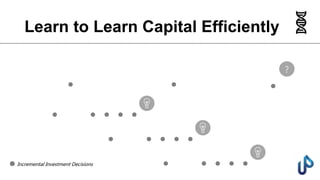
Learn to Learn Capital Efficiently
Incremental Investment Decisions
?
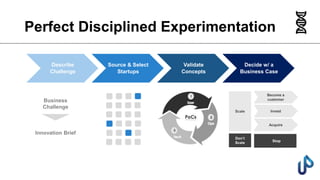
Become a
customer
Invest
Acquire
Stop
Perfect Disciplined Experimentation
Business
Challenge
Innovation Brief
Describe
Challenge
Source & Select
Startups
Validate
Concepts
Decide w/ a
Business Case
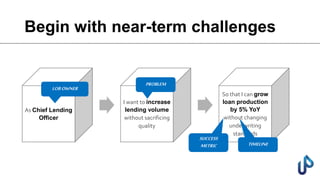
As Chief Lending
Officer
I want to increase
lending volume
without sacrificing
quality
So that I can grow
loan production
by 5% YoY
without changing
underwriting
standards
Begin with near-term challenges
LOBOWNER
PROBLEM
SUCCESS
METRIC TIMELINE
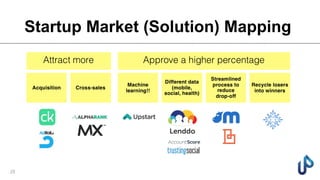
Startup Market (Solution) Mapping
23
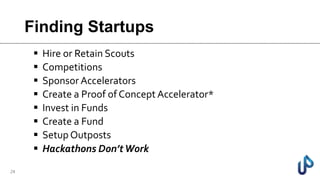
Finding Startups
 Hire or Retain Scouts
 Competitions
 Sponsor Accelerators
 Create a Proof of Concept Accelerator*
 Invest in Funds
 Create a Fund
 Setup Outposts
 Hackathons Don’tWork
24
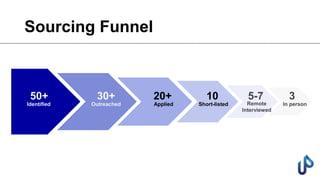
Sourcing Funnel
50+
Identified
30+
Outreached
20+
Applied
10
Short-listed
5-7
Remote
Interviewed
3
In person
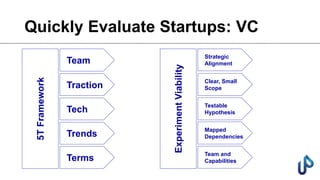
Quickly Evaluate Startups: VC
Team
Traction
Tech
Trends
Terms
5TFramework
Strategic
Alignment
Clear, Small
Scope
Testable
Hypothesis
Mapped
Dependencies
Team and
Capabilities
ExperimentViability
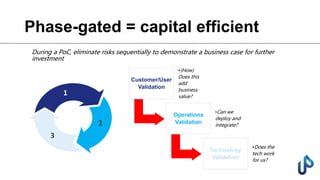
Phase-gated = capital efficient
During a PoC, eliminate risks sequentially to demonstrate a business case for further
investment
Customer/User
Validation
•(How)
Does this
add
business
value?
Operations
Validation
•Can we
deploy and
integrate?
Technology
Validation
•Does the
tech work
for us?
1
2
3
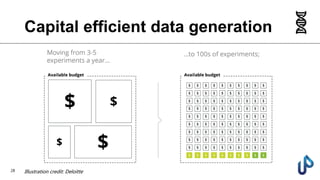
Capital efficient data generation
28 Illustration credit: Deloitte
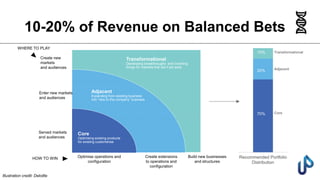
Transformational
Developing breakthroughs and inventing
things for markets that don’t yet exist
Adjacent
Expanding from existing business
into “new to the company” business
Core
Optimising existing products
for existing customerise
Create new
markets
and audiences
Enter new markets
and audiences
Served markets
and audiences
Optimise operations and
configuration
Create extensions
to operations and
configuration
Build new businesses
and structures
HOW TO WIN
WHERE TO PLAY
70%
20%
10% Transformational
Adjacent
Core
10-20% of Revenue on Balanced Bets
Illustration credit: Deloitte
On the plains of
hesitation lie the
blackened bones of
countless millions who
on the dawn of victory
lay down to rest, and in
resting died.
- Adlai Stevenson30 http://bit.ly/UPatSIWF2018

Mike Sigal, Co-Founder, Upside Partners

  • 1.
    STARTUP DNA AT CORPORATESCALE MIKE SIGAL
  • 2.
    Mike Sigal  GeneralPartner, 500 Fintech  Co-Founder, Upside Partners  6x Entrepreneur (3 exits, 1 IPO)  Corporate Innovation Advisor http://bit.ly/UPatSIWF2018 mike@upside.partners
  • 3.
    Digital disrupts everything Taxis RealEstate Money Theaters Telco Infrastructure Shipped Software Inventory Content
  • 4.
    It happens predictably Tippingpoint Laggards shrink / die “New normal” New tech emerges Innovative startups exploit it Digital models proliferate Advanced incumbents start adapting Mainstream customers shift McKinsey & Company
  • 5.
    It happens slowly,then all at once 2004 2005 2006 2007 2008 2009 2010 Physical rental Digital rental McKinsey & Company
  • 6.
    Being disrupted isa choice Media Travel Retail Fortune Magazine 2017
  • 9.
    Move to theCloud “Banks will be doomed if they resist changing legacy systems, especially those at the core. The more legacy, the more cost, the less flexibility, the harder to change. Adding digital to legacy means paying to run both the old and the new.” - Chris Skinner, The Finanser
  • 10.
    Get Control ofyour Data “You cannot refresh core systems unless you separate your content (the data) from your processing (the servers) You cannot protect yourself against a cyberattack if data is fragmented and offline; and You cannot serve the customer well in the digital age if you do not have a single view of them.” - Chris Skinner, The Finanser
  • 11.
    Work with Startups… UtilizingEmerging Technology Disintermediating Disaggregating Democratizing ● Technology at core of business ● Faster adoption ● Startups deliver services at a lower cost than traditional vendors ● Separate services to bypass regulatory constraints, brand risks ● Targeting non-traditional customers
  • 12.
    …In Lots ofWays 500 Startups & INSEAD, 2016
  • 13.
  • 14.
    of radical innovation initiatives fail LarryKeeley, President of the Doblin Group Innovation is Hard
  • 15.
    Skills, Culture &Incentives 0% 10% 20% 30% 40% 50% 60% Crowd Companies, 2017 Fostering a Culture of Innovation & Experimentation Juggling Internal Agendas and Goals Overcoming Middle Management “Antibodies” Moving Forward Despite Challenges
  • 16.
    Learn the RIGHTskills 1. Learn what’s important to the startup ecosystem 2. Promote entrepreneurial reasoning, particularly LoBs 3. Learn to learn efficiently 4. Learn with business challenges for near-term priorities 5. Build (and balance) portfolios of experiments
  • 17.
    For 80 years,startups &VCs have been perfecting practices to achieve outsized returns from radical innovation. Mastering startup &VC best practices drives corporate innovation excellence, talent development & ROI. Startup DNA at Corporate Scale
  • 18.
    Funding Follows RiskElimination Angel Pre-Seed Seed Post-Seed Series A/B Growth Exit / IPO  Each is a discrete stage & circumstance for the startup andVC  Availability of business data is higher at each successive stage  Risk & returns decreases with each stage (in theory)  Good for innovation investments & attracting quality startups
  • 19.
    Effectual “To the extentthat we can control the future, we do not need to predict it.” Promote Entrepreneurial Reasoning 🔮 Causal “To the extent that we can predict the future, we can control it.” What Makes Entrepreneurs Entrepreneurial, Saras D. Sarasvathy, 2001
  • 20.
    Learn to LearnCapital Efficiently Incremental Investment Decisions ?
  • 21.
    Become a customer Invest Acquire Stop Perfect DisciplinedExperimentation Business Challenge Innovation Brief Describe Challenge Source & Select Startups Validate Concepts Decide w/ a Business Case
  • 22.
    As Chief Lending Officer Iwant to increase lending volume without sacrificing quality So that I can grow loan production by 5% YoY without changing underwriting standards Begin with near-term challenges LOBOWNER PROBLEM SUCCESS METRIC TIMELINE
  • 23.
  • 24.
    Finding Startups  Hireor Retain Scouts  Competitions  Sponsor Accelerators  Create a Proof of Concept Accelerator*  Invest in Funds  Create a Fund  Setup Outposts  Hackathons Don’tWork 24
  • 25.
  • 26.
    Quickly Evaluate Startups:VC Team Traction Tech Trends Terms 5TFramework Strategic Alignment Clear, Small Scope Testable Hypothesis Mapped Dependencies Team and Capabilities ExperimentViability
  • 27.
    Phase-gated = capitalefficient During a PoC, eliminate risks sequentially to demonstrate a business case for further investment Customer/User Validation •(How) Does this add business value? Operations Validation •Can we deploy and integrate? Technology Validation •Does the tech work for us? 1 2 3
  • 28.
    Capital efficient datageneration 28 Illustration credit: Deloitte
  • 29.
    Transformational Developing breakthroughs andinventing things for markets that don’t yet exist Adjacent Expanding from existing business into “new to the company” business Core Optimising existing products for existing customerise Create new markets and audiences Enter new markets and audiences Served markets and audiences Optimise operations and configuration Create extensions to operations and configuration Build new businesses and structures HOW TO WIN WHERE TO PLAY 70% 20% 10% Transformational Adjacent Core 10-20% of Revenue on Balanced Bets Illustration credit: Deloitte
  • 30.
    On the plainsof hesitation lie the blackened bones of countless millions who on the dawn of victory lay down to rest, and in resting died. - Adlai Stevenson30 http://bit.ly/UPatSIWF2018

Editor's Notes

  • #2 Hi everyone, I’m Mike Sigal, and I’m going to share a perspective with you on corporate innovation. And by the way, at the end of the talk there will be a link where you can down load my slides.
  • #3 Hopefully I don’t need to convince anyone in this audience that digital technology reshapes industries.
  • #4 Hopefully I don’t need to convince anyone in this audience that digital technology reshapes industries.
  • #5 But some of you may not be aware that over the last 20-30 years, digital has proven to disrupt industries in a pretty predictable fashion…
  • #6 What’s really challenging for corporates is that for a few years after startups start working in an industry, nothing much happens, then almost overnight…new tech disrupts. As another example, it took skype 6 years to demolish 40% of all international telephone revenue.
  • #7 Opportunity vs. disruption Digital has been redefining industry leaders since the 90s. Its only just begun in Financial Services.
  • #9 Investment Partnering Acquisition 5-10% of Market Cap / Year Become a learning organization
  • #10 Well, there’s possibly a good reason for setting every bank CIO this challenge, as most bank investment is in keeping the lights on.  It’s keeping the old systems going whilst investing in new systems.  McKinsey calculate that the average bank is spending 10% of its expense on just operational costs, and this is higher for banks that haven’t rationalised their technology.  These costs only get higher for banks that are layering new technologies on top of old. This harks back to my continual call to change old core systems, as many banks’ investments in digital are just layering legacy upon legacy.      
  • #13 And they’ve been aggressively trying out lots of different ways of engaging startups and the startup ecosystem. To show you how aggressive some have been, let’s take a quick dive into corporate venture capital.
  • #15 I think that the think that keeps corporates from investing more is that they don’t like failure. Innovation fails a lot. And failing is no way to keep your corporate job.
  • #16 When you dig into why corporates fail to innovation effectively, you find that the key challenges aren’t about technology or customer demands…they are about culture, management techniques and incentives.
  • #17 So I’m going to share with you just a bit of training we delivery corporate teams to become more effective at innovation we call it startup empathy. And it’s simple in concept, but like any skill set, it takes focus and work and coaching to master.
  • #18 Can you imagine what would happen if instead of building processes around ideas from business schools and management consultants, corporations leveraged their ability to perfect processes that have been proven to generate value from disruptive innovation. That’d be pretty great for corporate innovation. Well, those processes exist.
  • #19 Inside most corporates you put together a plan, you get it funded, then you go implement…and in a year or two’s time, after millions of investment, you know whether it works. But the digital world moves to fast for that approach to be effective. Startups and VCs know that no plan for an innovation solution is right the first time, or the hundredth time, so they have created a capital efficient funding model that provides more resource as incremental risks are taken off the table.
  • #20 That model supports turning innovative thinking about the future into reality. If you’re an MBA or manager, you’re taught…
  • #22 We teach our corporate clients called the POC Pathway, which is easy to learn, and through practice and focus, because a highly efficient process that can be used throughout large companies. I want to tell you about two key features of the Pathway.
  • #23 Instead, if they frame business challenges like this…with a line of business owner, a problem, a success metric and a timeline….then they have something that they can find and test solutions for. And if they start with challenges that are relevant for the current business, then you avoid the problems where line of business managers are typically not paid to innovate.
  • #26 Think of this as your proverbial post-it notes. Temporarily suspend judgement while you generate ideas (solution categories). Try to stay MECE (“mee-see”) if possible (Mutually Exclusive, Collectively Exhaustive) Maybe ask the audience for solutions or strategies and then reveal these?
  • #27 How VCs do it
  • #28 For those of you who know lean startup, this is an adaptation of lean startup for corporates. And what’s most important here, is that when you run experiments, you do it in a specific order that both economizes the use of resources and takes risks off the table in a specific sequence.
  • #29 Thanks for the slide, Taha!
  • #30 Finally, by then distributing capital, **using the same methodology** against projects that will generate value in the near term, the medium term and the long, your board and shareholders will be able to experience the returns from innovation continuously. So that was your rapid fire introduction to how corporates can use the best practices from the startup and venture ecosystem to become operationally excellent at innovation.
  • #31 And the net result during the digital age has been that lots of big companies, even those with dozens of years of history, move too slowly and die.