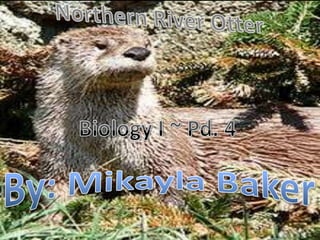
Northern River OtterBiology I ~ Pd. 4By: Mikayla Baker
Otter’s NicheNorthern river otters are semi-aquatic mammals with long, sleek, dark brown bodies, thick tails, rounded heads, whiskers, and stubby legs with webbed feet. Their soft, thick fur causes them to generate their own heat in water. Their length ranges from 46.81-71.14in., and their weight ranges from 11-30.81 lbs. Males are usually larger than females.
Live in freshwater and coastal habitats where there is an abundant supply of food and easy access to water. They build dens consisting of leaves, grass, moss, and bark in the boroughs of other mammals.
They can withstand a variety of environments, such as warm and cold climates and high elevations.
Highly intolerant to polluted water.
Mate in late winter and early spring. The gestation period may last from two months to a year. One to six offspring are usually reproduced per litter. For six months, the offspring are nursed and cared for until they leave their natal range.          Lontra Canadensis
paws, playing tag, and wrestling.             paws, playing tag, and wrestling.             Food Chain of OtterMostly like to eat aquatic invertebrates, small terrestrial organisms (on occasion), and aquatic plants.
Otters hunt on water and land. They use their whiskers to detect prey in dark waters. Prey is usually taken back immediately to the water to eat, but larger prey is eaten on land.
Preyed upon by coyotes, bobcats, alligators, and other large predators. Most of the time, they escape predation with their agility in the water and their vigilance on land.Macroalgae(Producer)(Autotroph)Crab(Primary Consumer)(Omnivore)Northern River Otter (Secondary Consumer)(Omnivore)Bobcat(Tertiary Consumer)(Carnivore)Bacteria(Decomposer)
Food Web of OtterMacro invertebrate(Herbivore)Bird(Omnivore)Northern River Otter(Omnivore)Macroalgae(Producer)Alligator(Carnivore)Bacteria(Decomposer)Coyote(Carnivore)Bobcat(Carnivore)Crab(Omnivore)
Stream Quality EffectsThe graph shows there is a great number of Class I organisms in the stream, which indicates that it’s not polluted.
A great number of organisms in Class I= An unpolluted, clean stream

Mikayla Baker Pd.4 Otter

  • 1.
    Northern River OtterBiologyI ~ Pd. 4By: Mikayla Baker
  • 2.
    Otter’s NicheNorthern riverotters are semi-aquatic mammals with long, sleek, dark brown bodies, thick tails, rounded heads, whiskers, and stubby legs with webbed feet. Their soft, thick fur causes them to generate their own heat in water. Their length ranges from 46.81-71.14in., and their weight ranges from 11-30.81 lbs. Males are usually larger than females.
  • 3.
    Live in freshwaterand coastal habitats where there is an abundant supply of food and easy access to water. They build dens consisting of leaves, grass, moss, and bark in the boroughs of other mammals.
  • 4.
    They can withstanda variety of environments, such as warm and cold climates and high elevations.
  • 5.
    Highly intolerant topolluted water.
  • 6.
    Mate in latewinter and early spring. The gestation period may last from two months to a year. One to six offspring are usually reproduced per litter. For six months, the offspring are nursed and cared for until they leave their natal range. Lontra Canadensis
  • 7.
    paws, playing tag,and wrestling.             paws, playing tag, and wrestling.             Food Chain of OtterMostly like to eat aquatic invertebrates, small terrestrial organisms (on occasion), and aquatic plants.
  • 8.
    Otters hunt onwater and land. They use their whiskers to detect prey in dark waters. Prey is usually taken back immediately to the water to eat, but larger prey is eaten on land.
  • 9.
    Preyed upon bycoyotes, bobcats, alligators, and other large predators. Most of the time, they escape predation with their agility in the water and their vigilance on land.Macroalgae(Producer)(Autotroph)Crab(Primary Consumer)(Omnivore)Northern River Otter (Secondary Consumer)(Omnivore)Bobcat(Tertiary Consumer)(Carnivore)Bacteria(Decomposer)
  • 10.
    Food Web ofOtterMacro invertebrate(Herbivore)Bird(Omnivore)Northern River Otter(Omnivore)Macroalgae(Producer)Alligator(Carnivore)Bacteria(Decomposer)Coyote(Carnivore)Bobcat(Carnivore)Crab(Omnivore)
  • 11.
    Stream Quality EffectsThegraph shows there is a great number of Class I organisms in the stream, which indicates that it’s not polluted.
  • 12.
    A great numberof organisms in Class I= An unpolluted, clean stream