Key Issue #1
              Why do People Migrate
                          Continued


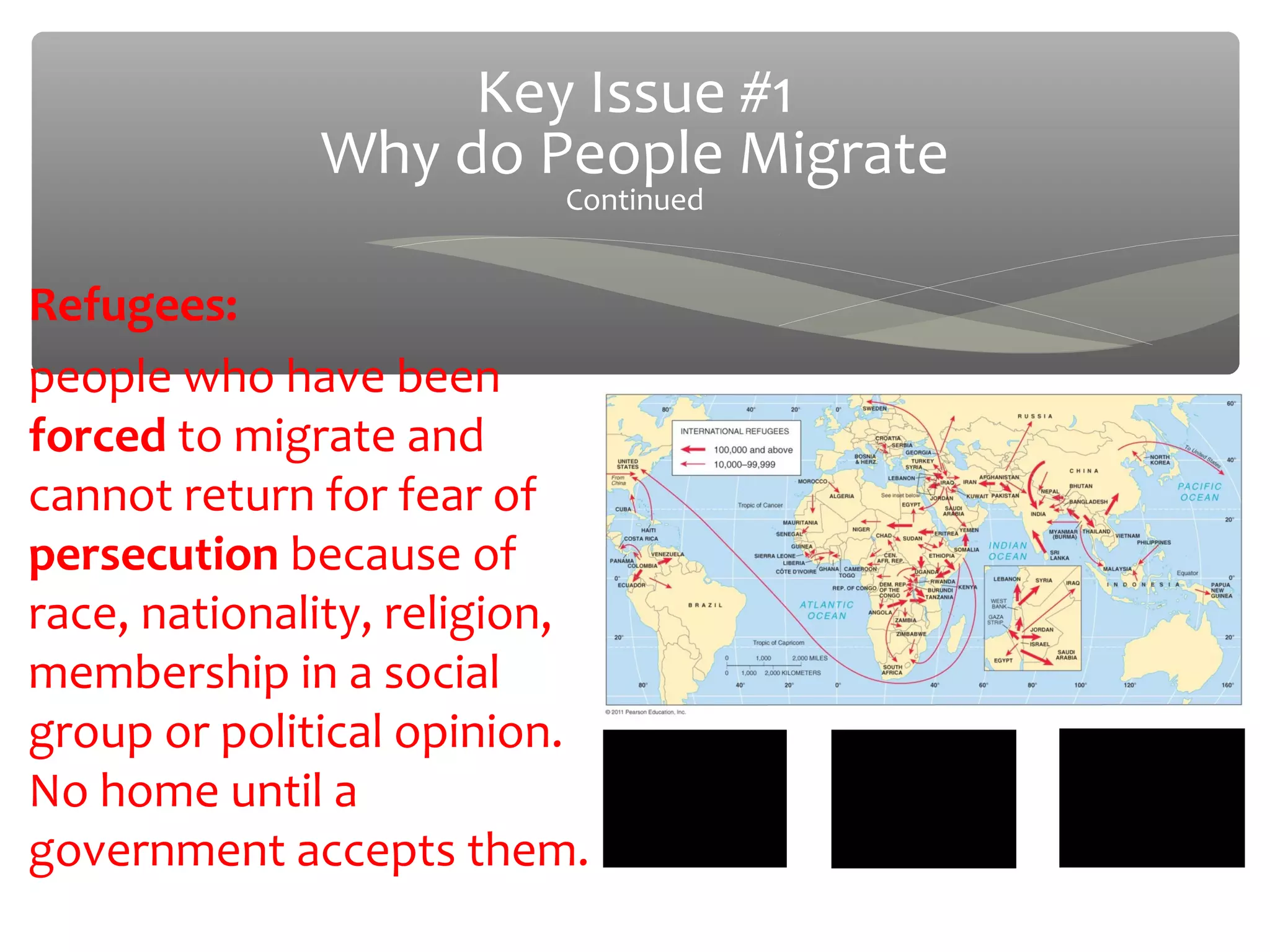
Refugees:
people who have been
forced to migrate and
cannot return for fear of
persecution because of
race, nationality, religion,
membership in a social
group or political opinion.
No home until a
government accepts them.
Refugees Today


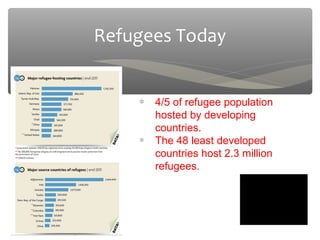
    ∗   4/5 of refugee population
        hosted by developing
        countries.
    ∗   The 48 least developed
        countries host 2.3 million
        refugees.
Key Issue #1
          Why do People Migrate
                     Continued


Distance of Migration
∗Most migrants relocate a short distance and
remain within the same country.

∗Long-distance migrants to other countries
head for major centers of economic activity.
Distance of Migration
Internal migration = permanent
 movement within the same country
 Two types:
∗ Interregional migration = permanent
  movement from one region to another
 -Minnesota to Florida
∗ Intraregional migration = permanent
  movement within a region
     -Winona to Rochester
Distance of Migration

International migration - permanent
  movement from one country to another.
 Two types:
∗ Voluntary migration implies that migrant has
  chosen to move, largely due to economic
  factors
∗ Forced migration means that migrant is
  compelled to move, usually due to cultural
  factors (persecution, politics)
Kinds of Voluntary Migration

∗ Step Migration – When a migrant follows a
  path of a series of stages, or steps toward a
  final destination.
       * intervening opportunity – at one of the steps
      along the path, pull factors encourage the
 migrant to settle there.

∗ Chain Migration – When a migrant
  communicates to family and friends at home,
  encouraging further migration along the same
  path, along kinship links.
Characteristics of Migrants

∗ Most long-distance migrants are male.
∗ Most long-distance migrants are adult individuals
  rather than families with children.
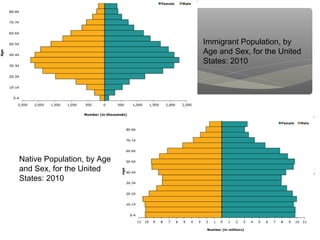
Immigrant Population, by
                            Age and Sex, for the United
                            States: 2010


Native Population, by Age
and Sex, for the United
States: 2010
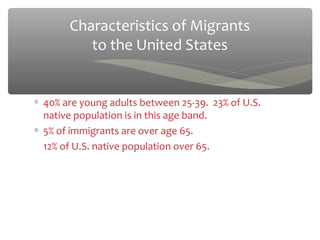
Characteristics of Migrants
          to the United States


∗ 40% are young adults between 25-39. 23% of U.S.
  native population is in this age band.
∗ 5% of immigrants are over age 65.
  12% of U.S. native population over 65.

Migration day 2

  • 1.
    Key Issue #1 Why do People Migrate Continued Refugees: people who have been forced to migrate and cannot return for fear of persecution because of race, nationality, religion, membership in a social group or political opinion. No home until a government accepts them.
  • 2.
    Refugees Today ∗ 4/5 of refugee population hosted by developing countries. ∗ The 48 least developed countries host 2.3 million refugees.
  • 3.
    Key Issue #1 Why do People Migrate Continued Distance of Migration ∗Most migrants relocate a short distance and remain within the same country. ∗Long-distance migrants to other countries head for major centers of economic activity.
  • 4.
    Distance of Migration Internalmigration = permanent movement within the same country Two types: ∗ Interregional migration = permanent movement from one region to another -Minnesota to Florida ∗ Intraregional migration = permanent movement within a region -Winona to Rochester
  • 6.
    Distance of Migration Internationalmigration - permanent movement from one country to another. Two types: ∗ Voluntary migration implies that migrant has chosen to move, largely due to economic factors ∗ Forced migration means that migrant is compelled to move, usually due to cultural factors (persecution, politics)
  • 8.
    Kinds of VoluntaryMigration ∗ Step Migration – When a migrant follows a path of a series of stages, or steps toward a final destination. * intervening opportunity – at one of the steps along the path, pull factors encourage the migrant to settle there. ∗ Chain Migration – When a migrant communicates to family and friends at home, encouraging further migration along the same path, along kinship links.
  • 10.
    Characteristics of Migrants ∗Most long-distance migrants are male. ∗ Most long-distance migrants are adult individuals rather than families with children.
  • 11.
    Immigrant Population, by Age and Sex, for the United States: 2010 Native Population, by Age and Sex, for the United States: 2010
  • 12.
    Characteristics of Migrants to the United States ∗ 40% are young adults between 25-39. 23% of U.S. native population is in this age band. ∗ 5% of immigrants are over age 65. 12% of U.S. native population over 65.