Key Messages
• Loremipsum dolor sit amet, consectetuer
adipiscing elit,
• Lorem ipsum dolor sit amet, consectetuer
adipiscing elit, sed diam nonummy nibh
euismod tincidunt ut laoreet dolore magna
aliquam erat volutpat.
• Ut wisi enim ad minim veniam, quis
nostrud exerci tation ullamcorper suscipit
lobortis nisl ut aliquip ex ea commodo
consequat. Duis autem vel eum iriure dolor
• Lorem ipsum dolor sit amet, consectetuer
adipiscing elit,
• Lorem ipsum dolor sit amet, consectetuer
adipiscing elit, sed diam nonummy nibh
euismod tincidunt ut laoreet dolore magna
aliquam erat volutpat.
• Ut wisi enim ad minim veniam, quis nostrud
exerci tation ullamcorper suscipit lobortis nisl ut
aliquip ex ea commodo consequat. Duis autem
vel eum iriure dolor
• Note:
Prevalence data for girls aged 0 to 14 reflect
their current, but not final, FGM/C status since
some girls who have not been cut may still be at
risk of experiencing the practice once they reach
the customary age for cutting. Therefore, the
data on prevalence for girls under age 15 is
actually an underestimation of the true extent of
the practice. Since age at cutting varies among
settings, the amount of underestimation also
varies and this should be kept in mind when
interpreting all FGM/C prevalence data for this
age group.
Female genital mutilation (FGM) refers to “all
procedures involving partial or total removal of the
female external genitalia or other injury to the female
genital organs for non-medical reasons.”1
FGM is a
violation of girls’ and women’s human rights and is
condemned by many international treaties and
conventions, as well as by national legislation in many
countries. Yet, where it is practised FGM is performed
in line with tradition and social norms to ensure that
girls are socially accepted and marriageable, and to
uphold their status and honour and that of the entire
family. UNICEF works with government and civil society
partners towards the elimination of FGM in countries
where it is still practiced.
1
World Health Organization, Eliminating Female Genital Mutilation: An interagency
statement, WHO, UNFPA, UNICEF, UNIFEM, OHCHR, UNHCR, UNECA, UNESCO,
UNDP, UNAIDS, WHO, Geneva, 2008, p. 4.
Total Rural Urban Richest Poorest
0
20
40
60
80
100
87 87 86
92
88
Percent
Total Rural Urban No education Primary complete Secondary or
higher
Richest Poorest
0
20
40
60
80
100
32 33
28
34 33
25
30 30
Percent
Country
year(s)
Female Genital Mutilation (FGM)
Female Genital Mutilation
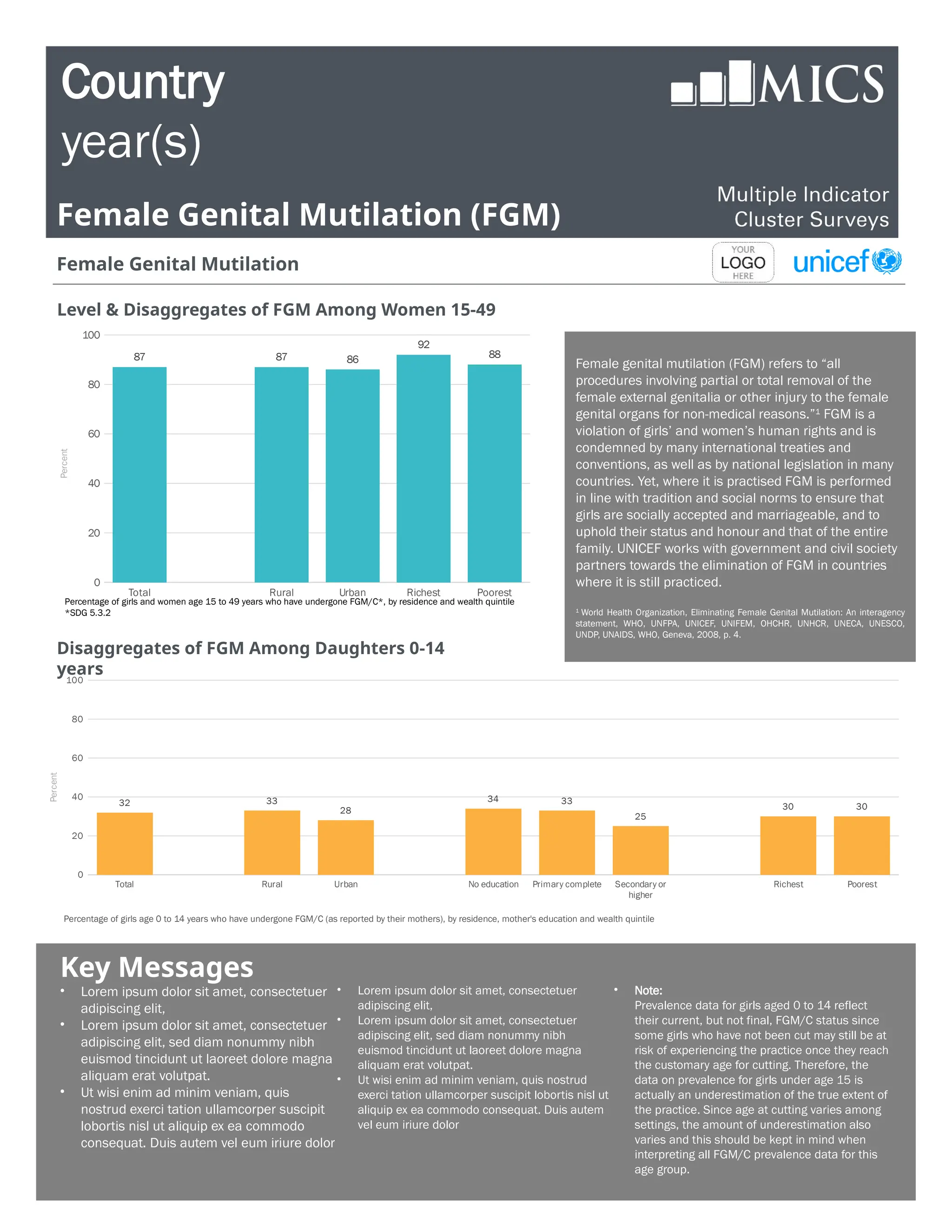
Percentage of girls and women age 15 to 49 years who have undergone FGM/C*, by residence and wealth quintile
*SDG 5.3.2
Percentage of girls age 0 to 14 years who have undergone FGM/C (as reported by their mothers), by residence, mother's education and wealth quintile
Level & Disaggregates of FGM Among Women 15-49
Disaggregates of FGM Among Daughters 0-14
years
2.
Female Genital Mutilation
TheCountry Multiple Indicator Cluster
Survey (MICS) was carried out in 2014 by
the National Bureau of Statistics as part of
the global MICS programme. Technical
support was provided by the United Nations
Children’s Fund (UNICEF). UNICEF and Name
of other organizations providing financial
support provided financial support.
The objective of this snapshot is to
disseminate selected findings from the
Country MICS 2014 related to Female
Genital Mutilation (FGM). Data from this
snapshot can be found in tables PR.5.1,
PR.5.2 and PR.5.3 in the Survey Findings
Report.
Further statistical snapshots and the Survey
Findings Report for this and other surveys
are available on mics.unicef.org/surveys.
45-49
years
40-44
years
35-39
years
30-34
years
25-29
years
20-24
years
15-19
years
0
20
40
60
80
100
92 91
87 88 88
86
82
Percent
Trends in FGM
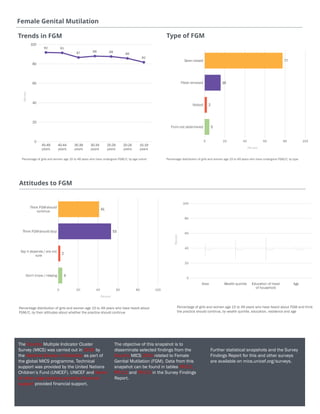
Percentage of girls and women age 15 to 49 years who have undergone FGM/C, by age cohort
Type of FGM
Percentage distribution of girls and women age 15 to 49 years who have undergone FGM/C, by type
Attitudes to FGM
Form not determined
Nicked
Flesh removed
Sewn closed
0 20 40 60 80 100
5
2
16
77
Percent
Percentage distribution of girls and women age 15 to 49 years who have heard about
FGM/C, by their attitudes about whether the practice should continue
Don't know / missing
Say it depends / are not
sure
Think FGMshould stop
Think FGMshould
continue
0 20 40 60 80 100
4
2
53
41
Percent
Percentage of girls and women age 15 to 49 years who have heard about FGM and think
the practice should continue, by wealth quintile, education, residence and age
Area Wealth quintile Education of head
of household
Age
0
20
40
60
80
100
Percent