…is the wordprocessing component of
the Microsoft Office Suite.
It is used primarily to enter, edit, format,
save, retrieve and print documents.
Microsoft
Word…
3.
• Identify themain components of the
user interface.
• Identify the purpose of the
commands on the menu bar.
• Explain the difference between
copy and cut.
Objectives
4.
• Copy, cutand paste text.
• Work with the buttons on the toolbar.
• Work with the pointer in a program.
• Work with text and characters in
a program.
Objectives
5.
• Explain theuse of primary keyboard
shortcuts and key combinations.
• Perform basic tasks by using a word
processor.
• Edit and format text.
Objectives
6.
• Work withpictures.
• Work with language tools (spell
check, dictionary, thesaurus).
• Identify the various benefits of
using word processing software.
Objectives
7.
Screen Components
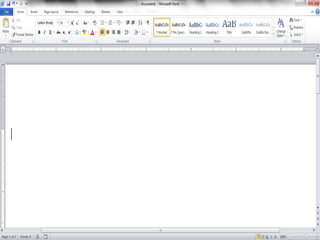
The openingscreen for
Microsoft Word 2010 looks like this…
Click here when you are ready to continue…
8.
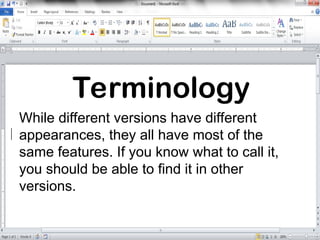
While different versionshave different
appearances, they all have most of the
same features. If you know what to call it,
you should be able to find it in other
versions.
Terminology
9.
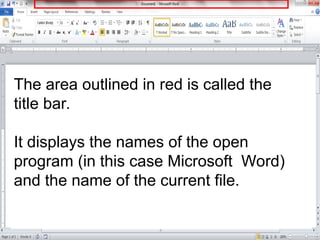
The area outlinedin red is called the
title bar.
It displays the names of the open
program (in this case Microsoft Word)
and the name of the current file.
10.
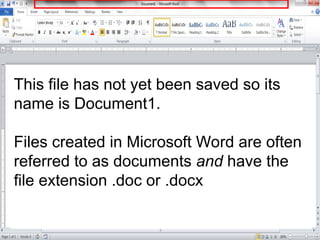
This file hasnot yet been saved so its
name is Document1.
Files created in Microsoft Word are often
referred to as documents and have the
file extension .doc or .docx
11.
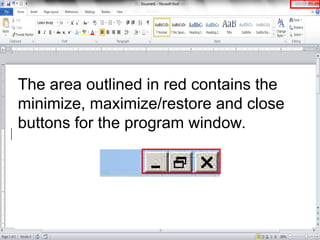
The area outlinedin red contains the
minimize, maximize/restore and close
buttons for the program window.
12.
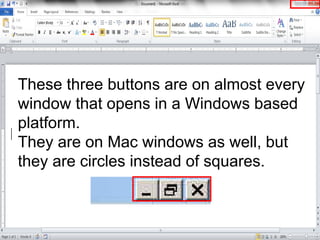
These three buttonsare on almost every
window that opens in a Windows based
platform.
They are on Mac windows as well, but
they are circles instead of squares.
13.
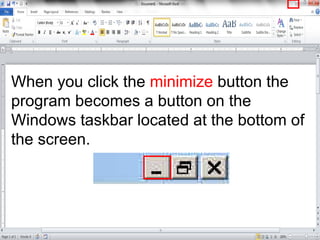
When you clickthe minimize button the
program becomes a button on the
Windows taskbar located at the bottom of
the screen.
14.
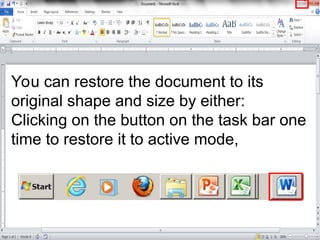
You can restorethe document to its
original shape and size by either:
Clicking on the button on the task bar one
time to restore it to active mode,
15.
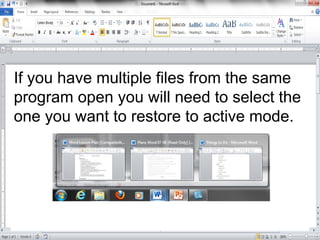
If you havemultiple files from the same
program open you will need to select the
one you want to restore to active mode.
16.
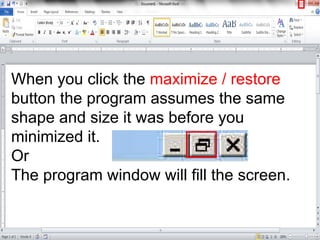
When you clickthe maximize / restore
button the program assumes the same
shape and size it was before you
minimized it.
Or
The program window will fill the screen.
17.
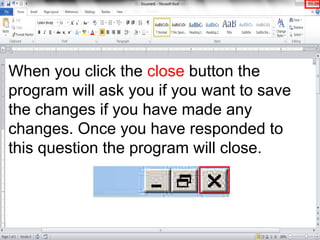
When you clickthe close button the
program will ask you if you want to save
the changes if you have made any
changes. Once you have responded to
this question the program will close.
18.
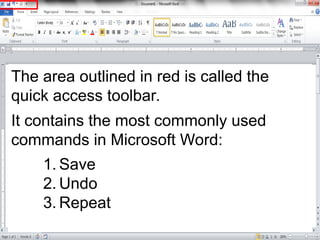
The area outlinedin red is called the
quick access toolbar.
It contains the most commonly used
commands in Microsoft Word:
1. Save
2. Undo
3. Repeat
19.
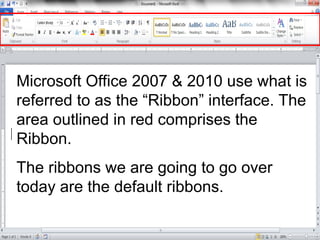
Microsoft Office 2007& 2010 use what is
referred to as the “Ribbon” interface. The
area outlined in red comprises the
Ribbon.
The ribbons we are going to go over
today are the default ribbons.
20.
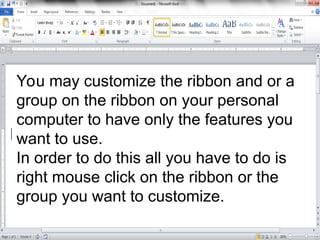
You may customizethe ribbon and or a
group on the ribbon on your personal
computer to have only the features you
want to use.
In order to do this all you have to do is
right mouse click on the ribbon or the
group you want to customize.
21.
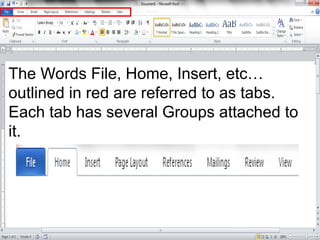
The Words File,Home, Insert, etc…
outlined in red are referred to as tabs.
Each tab has several Groups attached to
it.
22.
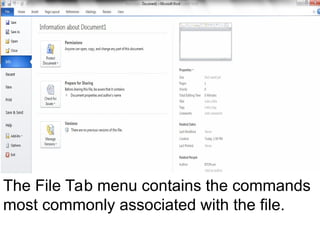
The File Tabmenu contains the commands
most commonly associated with the file.
23.
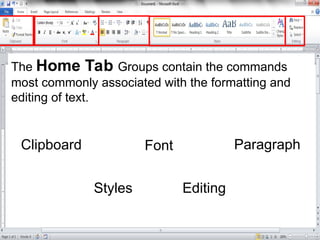
The Home TabGroups contain the commands
most commonly associated with the formatting and
editing of text.
Clipboard Font Paragraph
Styles Editing
24.
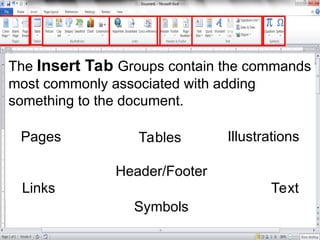
The Insert TabGroups contain the commands
most commonly associated with adding
something to the document.
Pages Tables Illustrations
Links
Header/Footer
Text
Symbols
25.
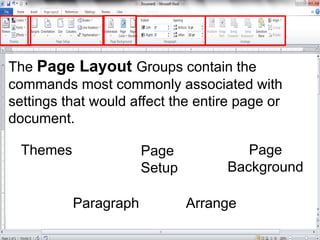
The Page LayoutGroups contain the
commands most commonly associated with
settings that would affect the entire page or
document.
Themes Page
Setup
Page
Background
Paragraph Arrange
26.
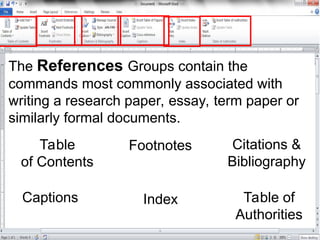
The References Groupscontain the
commands most commonly associated with
writing a research paper, essay, term paper or
similarly formal documents.
Table
of Contents
Footnotes Citations &
Bibliography
Captions Index Table of
Authorities
27.
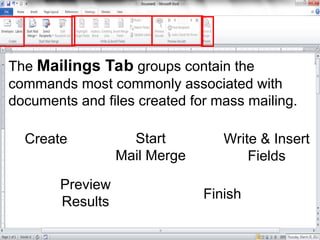
The Mailings Tabgroups contain the
commands most commonly associated with
documents and files created for mass mailing.
Create Start
Mail Merge
Write & Insert
Fields
Preview
Results
Finish
28.
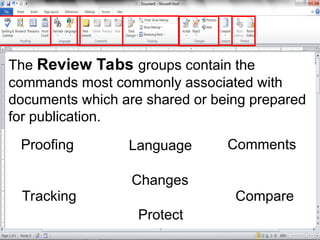
The Review Tabsgroups contain the
commands most commonly associated with
documents which are shared or being prepared
for publication.
Proofing Language Comments
Tracking
Changes
Compare
Protect
29.
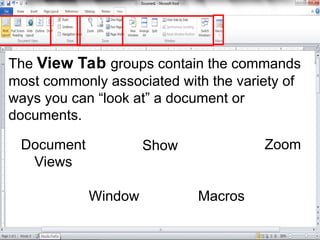
The View Tabgroups contain the commands
most commonly associated with the variety of
ways you can “look at” a document or
documents.
Document
Views
Show Zoom
Window Macros