September 14, 2024
Microfinance Regulation
Arnaud Ventura
Co-founder, Vice President PlaNet Finance
Founder, President & CEO MicroCred
2
Content
I. An Introduction to PlaNet Finance
II. An Introduction to MicroCred
III. A few concrete cases: Regulation & microfinance investments
1. Mexico
2. Madagascar
3. China
4. Senegal
5. Algeria
3
Introduction to
PlaNet Finance
4
PlaNet Finance is an International Non Profit Organization that
contributes to the improvement of human condition by ensuring each
person’s dignity through the development of microfinance worldwide.
PlaNet Finance focuses on
– Strengthening the capacity of the microfinance sector (Microfinance
Institutions, Governments, Banks & Financial Institutions, etc.)
– Increasing the transparency of the microfinance sector
– Increasing the funding available to Microfinance Institutions
I. Introduction to PlaNet Finance Group
5
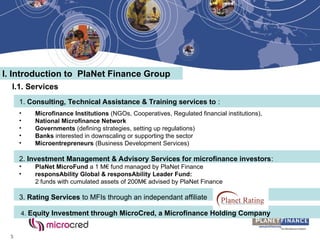
I.1. Services
1. Consulting, Technical Assistance & Training services to :
• Microfinance Institutions (NGOs, Cooperatives, Regulated financial institutions),
• National Microfinance Network
• Governments (defining strategies, setting up regulations)
• Banks interested in downscaling or supporting the sector
• Microentrepreneurs (Business Development Services)
2. Investment Management & Advisory Services for microfinance investors:
• PlaNet MicroFund a 1 M€ fund managed by PlaNet Finance
• responsAbility Global & responsAbility Leader Fund:
2 funds with cumulated assets of 200M€ advised by PlaNet Finance
3. Rating Services to MFIs through an independant affiliate
4. Equity Investment through MicroCred, a Microfinance Holding Company
I. Introduction to PlaNet Finance Group
6
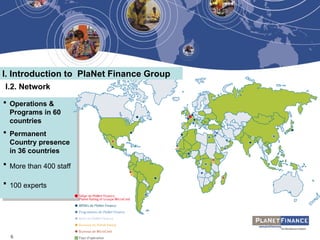
 Operations &
Programs in 60
countries
 Permanent
Country presence
in 36 countries
 More than 400 staff
 100 experts
I.2. Network
I. Introduction to PlaNet Finance Group
7
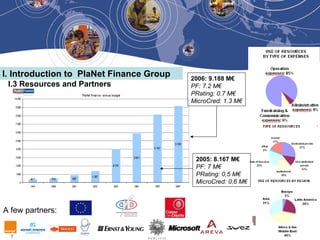
2006: 9.188 M€
PF: 7.2 M€
PRating: 0.7 M€
MicroCred: 1.3 M€
2005: 8.167 M€
PF: 7 M€
PRating: 0,5 M€
MicroCred: 0,6 M€
A few partners:
I.3 Resources and Partners
I. Introduction to PlaNet Finance Group
8
Introduction to
MicroCred
9
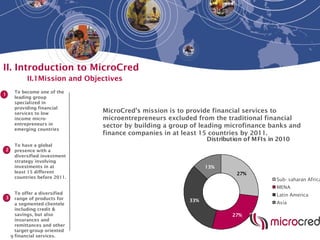
Distribution of MFIs in 2010
27%
27%
13%
33%
Sub- saharan Africa
MENA
Latin America
Asia
II. Introduction to MicroCred
II.1Mission and Objectives
MicroCred’s mission is to provide financial services to
microentrepreneurs excluded from the traditional financial
sector by building a group of leading microfinance banks and
finance companies in at least 15 countries by 2011.
To become one of the
leading group
specialized in
providing financial
services to low
income micro-
entrepreneurs in
emerging countries
To have a global
presence with a
diversified investment
strategy involving
investments in at
least 15 different
countries before 2011.
To offer a diversified
range of products for
a segmented clientele
including credit &
savings, but also
insurances and
remittances and other
target-group oriented
financial services.
1
2
3
10
II. Introduction to MicroCred
B. A unique Business Model
MicroCred will adapt a unique business model by leveraging
worldwide common tools, procedures & methodologies :
• A strong brand and marketing strategy;
• A common Management Information System (MIS);
• A consistent product offering within the Group;
• A comprehensive methodology of staff training;
• Strict governance and internal control policies;
• Human Resources Management in order to create a strong “corporate culture”;
C. The support of PlaNet Finance
MicroCred will use PlaNet Finance’s network to increase its
development
To have a Diversified
investment strategy
mitigating country /
currency risks by a
diversified exposure
To focus on markets
where access to
financial services is
still underdeveloped.
To take advantage of
the global presence
and the local
expertise of PlaNet
Finance, the technical
partner of MicroCred
to access more easily
to these markets.
Use a standardized
model to leverage
economies of scale
and accelerate the
development of each
new institution
1
2
3
4
A. A diversified International Strategy:
Existing Investments 2006: Mexico,
Madagascar
Planned Investments 2007-2008 : Argentina,
Brazil, China, Senegal, Algeria, Nigeria etc.
II.2. Competitive Advantages
11
II. Introduction to MicroCred
II.3. Shareholders
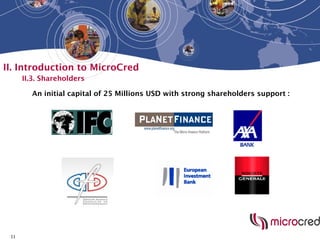
An initial capital of 25 Millions USD with strong shareholders support :
12
A few Concrete
Cases:
Mexico
Madagascar
China
Sénégal
Algeria
13
MEXICO
14
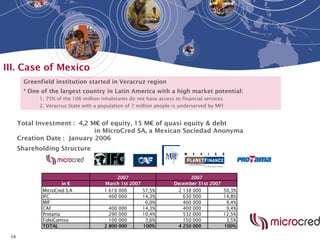
III. Case of Mexico
Greenfield institution started in Veracruz region
• One of the largest country in Latin America with a high market potential:
1. 75% of the 106 million inhabitants do not have access to financial services
2. Veracruz State with a population of 7 million people is underserved by MFI
Shareholding Structure
in €
MicroCred S.A 1 610 000 57,5% 2 138 000 50,3% 2 138 000 50,3%
IFC 400 000 14,3% 630 000 14,8% 630 000 14,8%
MIF 0,0% 400 000 9,4% 400 000 9,4%
CAF 400 000 14,3% 400 000 9,4% 400 000 9,4%
Protama 290 000 10,4% 532 000 12,5% 532 000 12,5%
FideiComiso 100 000 3,6% 150 000 3,5% 150 000 3,5%
TOTAL 2 800 000 100% 4 250 000 100% 4 250 000 100%
2008
December 31st 2008
2007
March 1st 2007
2007
December 31st 2007
Total Investment : 4,2 M€ of equity, 15 M€ of quasi equity & debt
in MicroCred SA, a Mexican Sociedad Anonyma
Creation Date : January 2006
15
III. Case of Mexico
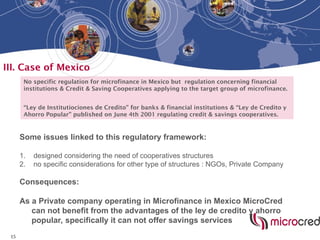
No specific regulation for microfinance in Mexico but regulation concerning financial
institutions & Credit & Saving Cooperatives applying to the target group of microfinance.
“Ley de Institutiociones de Credito” for banks & financial institutions & “Ley de Credito y
Ahorro Popular” published on June 4th 2001 regulating credit & savings cooperatives.
Some issues linked to this regulatory framework:
1. designed considering the need of cooperatives structures
2. no specific considerations for other type of structures : NGOs, Private Company
Consequences:
As a Private company operating in Microfinance in Mexico MicroCred
can not benefit from the advantages of the ley de credito y ahorro
popular, specifically it can not offer savings services
16
MADAGASCAR
17
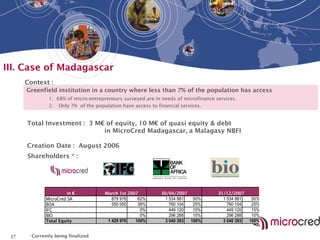
III. Case of Madagascar
Greenfield institution in a country where less than 7% of the population has access
1. 68% of micro-entrepreneurs surveyed are in needs of microfinance services.
2. Only 7% of the population have access to financial services.
Shareholders * :
Context :
*
Currently being finalized
in €
MicroCred SA 879 976 62% 1 534 881 50% 1 534 881 50% 1 534 881 5
BOA 550 000 38% 760 104 25% 760 104 25% 760 104 2
IFC 0% 449 120 15% 449 120 15% 449 120 1
BIO 0% 296 288 10% 296 288 10% 296 288 1
Total Equity 1 429 976 100% 3 040 393 100% 3 040 393 100% 10
March 1st 2007 31/12/2007
30/04/2007
Total Investment : 3 M€ of equity, 10 M€ of quasi equity & debt
in MicroCred Madagascar, a Malagasy NBFI
Creation Date : August 2006
18
III. Case of Madagascar
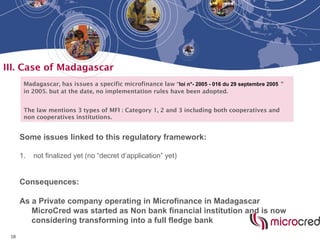
Madagascar, has issues a specific microfinance law “loi n°- 2005 - 016 du 29 septembre 2005 “
in 2005. but at the date, no implementation rules have been adopted.
The law mentions 3 types of MFI : Category 1, 2 and 3 including both cooperatives and
non cooperatives institutions.
Some issues linked to this regulatory framework:
1. not finalized yet (no “decret d’application” yet)
Consequences:
As a Private company operating in Microfinance in Madagascar
MicroCred was started as Non bank financial institution and is now
considering transforming into a full fledge bank
19
CHINA
20
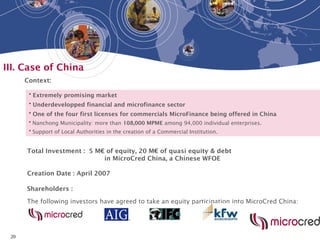
III. Case of China
• Extremely promising market
• Underdevelopped financial and microfinance sector
• One of the four first licenses for commercials MicroFinance being offered in China
• Nanchong Municipality: more than 108,000 MPME among 94,000 individual enterprises.
• Support of Local Authorities in the creation of a Commercial Institution.
The following investors have agreed to take an equity participation into MicroCred China:
Context:
Shareholders :
Total Investment : 5 M€ of equity, 20 M€ of quasi equity & debt
in MicroCred China, a Chinese WFOE
Creation Date : April 2007
21
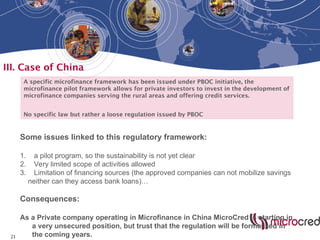
III. Case of China
A specific microfinance framework has been issued under PBOC initiative, the
microfinance pilot framework allows for private investors to invest in the development of
microfinance companies serving the rural areas and offering credit services.
No specific law but rather a loose regulation issued by PBOC
Some issues linked to this regulatory framework:
1. a pilot program, so the sustainability is not yet clear
2. Very limited scope of activities allowed
3. Limitation of financing sources (the approved companies can not mobilize savings
neither can they access bank loans)…
Consequences:
As a Private company operating in Microfinance in China MicroCred is starting in
a very unsecured position, but trust that the regulation will be formalized in
the coming years.
22
SENEGAL
23
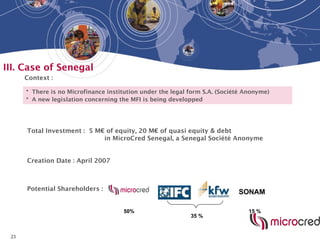
III. Case of Senegal
• There is no Microfinance institution under the legal form S.A. (Société Anonyme)
• A new legislation concerning the MFI is being developped
Potential Shareholders :
Context :
50%
35 %
SONAM
15 %
Total Investment : 5 M€ of equity, 20 M€ of quasi equity & debt
in MicroCred Senegal, a Senegal Société Anonyme
Creation Date : April 2007
24
III. Case of Senegal
A specific regulation for microfinance exist in West Africa under the CBWAS (Central Bank
of West African States) Senegal “ Loi PARMEC”. The regulation has been designed for
Cooperatives rather than for microfinance institutions.
The regulation is currently being revised.
Some issues linked to this regulatory framework:
1. Designed for Cooperatives structures, does not facilitate NGOs, nor private
company
2. Different fiscal treatment for each legal form
3. Specific approval with 5 years license for Private Companies
Consequences:
As a Private company operating in Microfinance in Sénégal MicroCred is starting
in a very unsecured position, but trust that the regulation will be formalized in
the coming months.
25
ALGERIA
26
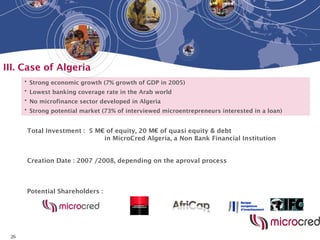
III. Case of Algeria
• Strong economic growth (7% growth of GDP in 2005)
• Lowest banking coverage rate in the Arab world
• No microfinance sector developed in Algeria
• Strong potential market (73% of interviewed microentrepreneurs interested in a loan)
Potential Shareholders :
Total Investment : 5 M€ of equity, 20 M€ of quasi equity & debt
in MicroCred Algeria, a Non Bank Financial Institution
Creation Date : 2007 /2008, depending on the aproval process
27
III. Case of Algeria
No specific regulation for microfinance exist in Algeria.
Only a very strict banking regulation allowing for Banks & NBFI (minimum equity for NBFI
6 M€)
Some issues linked to this regulatory framework:
1. Minimum equity to create a Microfinance Company very high 6 M€ as NBFI
2. Limited scope of services (credit only)
3. Long and very difficult approval process
4. Approval to be sought for each branch opening.
Consequences:
As a Private company operating in Microfinance in Algeria MicroCred is making a
huge investment only to fill the un-adpated conditions of the “Banque
d’Algérie”.
MicroCred is treated as a bank and not as a Microfinance Institution.
28
CONCLUSIONS
29
Conclusions
Bad Regulatory Framework can limit Microfinance development.
Main obstacles are :
1. No regulation for Microfinance (Algeria, China)
2. Regulation targeting a limited legal form of MFIs (Mexico, West Africa)
3. Regulations not allowing deposit taking MFI (China, Mexico)
4. Bureaucratic Obstacles : long approval process, etc.. (Algeria)
Solution :
In the same way the financial & banking sector is adopting international
regulations (Basle I, Basle II) to improve efficiency, Microfinance
development could be foster with international regulations or at least
international guidelines helping local regulatory body facilitate the
development of microfinance.

Microfinance UN IMF definition and a.ppt

  • 1.
    September 14, 2024 MicrofinanceRegulation Arnaud Ventura Co-founder, Vice President PlaNet Finance Founder, President & CEO MicroCred
  • 2.
    2 Content I. An Introductionto PlaNet Finance II. An Introduction to MicroCred III. A few concrete cases: Regulation & microfinance investments 1. Mexico 2. Madagascar 3. China 4. Senegal 5. Algeria
  • 3.
  • 4.
    4 PlaNet Finance isan International Non Profit Organization that contributes to the improvement of human condition by ensuring each person’s dignity through the development of microfinance worldwide. PlaNet Finance focuses on – Strengthening the capacity of the microfinance sector (Microfinance Institutions, Governments, Banks & Financial Institutions, etc.) – Increasing the transparency of the microfinance sector – Increasing the funding available to Microfinance Institutions I. Introduction to PlaNet Finance Group
  • 5.
    5 I.1. Services 1. Consulting,Technical Assistance & Training services to : • Microfinance Institutions (NGOs, Cooperatives, Regulated financial institutions), • National Microfinance Network • Governments (defining strategies, setting up regulations) • Banks interested in downscaling or supporting the sector • Microentrepreneurs (Business Development Services) 2. Investment Management & Advisory Services for microfinance investors: • PlaNet MicroFund a 1 M€ fund managed by PlaNet Finance • responsAbility Global & responsAbility Leader Fund: 2 funds with cumulated assets of 200M€ advised by PlaNet Finance 3. Rating Services to MFIs through an independant affiliate 4. Equity Investment through MicroCred, a Microfinance Holding Company I. Introduction to PlaNet Finance Group
  • 6.
    6  Operations & Programsin 60 countries  Permanent Country presence in 36 countries  More than 400 staff  100 experts I.2. Network I. Introduction to PlaNet Finance Group
  • 7.
    7 2006: 9.188 M€ PF:7.2 M€ PRating: 0.7 M€ MicroCred: 1.3 M€ 2005: 8.167 M€ PF: 7 M€ PRating: 0,5 M€ MicroCred: 0,6 M€ A few partners: I.3 Resources and Partners I. Introduction to PlaNet Finance Group
  • 8.
  • 9.
    9 Distribution of MFIsin 2010 27% 27% 13% 33% Sub- saharan Africa MENA Latin America Asia II. Introduction to MicroCred II.1Mission and Objectives MicroCred’s mission is to provide financial services to microentrepreneurs excluded from the traditional financial sector by building a group of leading microfinance banks and finance companies in at least 15 countries by 2011. To become one of the leading group specialized in providing financial services to low income micro- entrepreneurs in emerging countries To have a global presence with a diversified investment strategy involving investments in at least 15 different countries before 2011. To offer a diversified range of products for a segmented clientele including credit & savings, but also insurances and remittances and other target-group oriented financial services. 1 2 3
  • 10.
    10 II. Introduction toMicroCred B. A unique Business Model MicroCred will adapt a unique business model by leveraging worldwide common tools, procedures & methodologies : • A strong brand and marketing strategy; • A common Management Information System (MIS); • A consistent product offering within the Group; • A comprehensive methodology of staff training; • Strict governance and internal control policies; • Human Resources Management in order to create a strong “corporate culture”; C. The support of PlaNet Finance MicroCred will use PlaNet Finance’s network to increase its development To have a Diversified investment strategy mitigating country / currency risks by a diversified exposure To focus on markets where access to financial services is still underdeveloped. To take advantage of the global presence and the local expertise of PlaNet Finance, the technical partner of MicroCred to access more easily to these markets. Use a standardized model to leverage economies of scale and accelerate the development of each new institution 1 2 3 4 A. A diversified International Strategy: Existing Investments 2006: Mexico, Madagascar Planned Investments 2007-2008 : Argentina, Brazil, China, Senegal, Algeria, Nigeria etc. II.2. Competitive Advantages
  • 11.
    11 II. Introduction toMicroCred II.3. Shareholders An initial capital of 25 Millions USD with strong shareholders support :
  • 12.
  • 13.
  • 14.
    14 III. Case ofMexico Greenfield institution started in Veracruz region • One of the largest country in Latin America with a high market potential: 1. 75% of the 106 million inhabitants do not have access to financial services 2. Veracruz State with a population of 7 million people is underserved by MFI Shareholding Structure in € MicroCred S.A 1 610 000 57,5% 2 138 000 50,3% 2 138 000 50,3% IFC 400 000 14,3% 630 000 14,8% 630 000 14,8% MIF 0,0% 400 000 9,4% 400 000 9,4% CAF 400 000 14,3% 400 000 9,4% 400 000 9,4% Protama 290 000 10,4% 532 000 12,5% 532 000 12,5% FideiComiso 100 000 3,6% 150 000 3,5% 150 000 3,5% TOTAL 2 800 000 100% 4 250 000 100% 4 250 000 100% 2008 December 31st 2008 2007 March 1st 2007 2007 December 31st 2007 Total Investment : 4,2 M€ of equity, 15 M€ of quasi equity & debt in MicroCred SA, a Mexican Sociedad Anonyma Creation Date : January 2006
  • 15.
    15 III. Case ofMexico No specific regulation for microfinance in Mexico but regulation concerning financial institutions & Credit & Saving Cooperatives applying to the target group of microfinance. “Ley de Institutiociones de Credito” for banks & financial institutions & “Ley de Credito y Ahorro Popular” published on June 4th 2001 regulating credit & savings cooperatives. Some issues linked to this regulatory framework: 1. designed considering the need of cooperatives structures 2. no specific considerations for other type of structures : NGOs, Private Company Consequences: As a Private company operating in Microfinance in Mexico MicroCred can not benefit from the advantages of the ley de credito y ahorro popular, specifically it can not offer savings services
  • 16.
  • 17.
    17 III. Case ofMadagascar Greenfield institution in a country where less than 7% of the population has access 1. 68% of micro-entrepreneurs surveyed are in needs of microfinance services. 2. Only 7% of the population have access to financial services. Shareholders * : Context : * Currently being finalized in € MicroCred SA 879 976 62% 1 534 881 50% 1 534 881 50% 1 534 881 5 BOA 550 000 38% 760 104 25% 760 104 25% 760 104 2 IFC 0% 449 120 15% 449 120 15% 449 120 1 BIO 0% 296 288 10% 296 288 10% 296 288 1 Total Equity 1 429 976 100% 3 040 393 100% 3 040 393 100% 10 March 1st 2007 31/12/2007 30/04/2007 Total Investment : 3 M€ of equity, 10 M€ of quasi equity & debt in MicroCred Madagascar, a Malagasy NBFI Creation Date : August 2006
  • 18.
    18 III. Case ofMadagascar Madagascar, has issues a specific microfinance law “loi n°- 2005 - 016 du 29 septembre 2005 “ in 2005. but at the date, no implementation rules have been adopted. The law mentions 3 types of MFI : Category 1, 2 and 3 including both cooperatives and non cooperatives institutions. Some issues linked to this regulatory framework: 1. not finalized yet (no “decret d’application” yet) Consequences: As a Private company operating in Microfinance in Madagascar MicroCred was started as Non bank financial institution and is now considering transforming into a full fledge bank
  • 19.
  • 20.
    20 III. Case ofChina • Extremely promising market • Underdevelopped financial and microfinance sector • One of the four first licenses for commercials MicroFinance being offered in China • Nanchong Municipality: more than 108,000 MPME among 94,000 individual enterprises. • Support of Local Authorities in the creation of a Commercial Institution. The following investors have agreed to take an equity participation into MicroCred China: Context: Shareholders : Total Investment : 5 M€ of equity, 20 M€ of quasi equity & debt in MicroCred China, a Chinese WFOE Creation Date : April 2007
  • 21.
    21 III. Case ofChina A specific microfinance framework has been issued under PBOC initiative, the microfinance pilot framework allows for private investors to invest in the development of microfinance companies serving the rural areas and offering credit services. No specific law but rather a loose regulation issued by PBOC Some issues linked to this regulatory framework: 1. a pilot program, so the sustainability is not yet clear 2. Very limited scope of activities allowed 3. Limitation of financing sources (the approved companies can not mobilize savings neither can they access bank loans)… Consequences: As a Private company operating in Microfinance in China MicroCred is starting in a very unsecured position, but trust that the regulation will be formalized in the coming years.
  • 22.
  • 23.
    23 III. Case ofSenegal • There is no Microfinance institution under the legal form S.A. (Société Anonyme) • A new legislation concerning the MFI is being developped Potential Shareholders : Context : 50% 35 % SONAM 15 % Total Investment : 5 M€ of equity, 20 M€ of quasi equity & debt in MicroCred Senegal, a Senegal Société Anonyme Creation Date : April 2007
  • 24.
    24 III. Case ofSenegal A specific regulation for microfinance exist in West Africa under the CBWAS (Central Bank of West African States) Senegal “ Loi PARMEC”. The regulation has been designed for Cooperatives rather than for microfinance institutions. The regulation is currently being revised. Some issues linked to this regulatory framework: 1. Designed for Cooperatives structures, does not facilitate NGOs, nor private company 2. Different fiscal treatment for each legal form 3. Specific approval with 5 years license for Private Companies Consequences: As a Private company operating in Microfinance in Sénégal MicroCred is starting in a very unsecured position, but trust that the regulation will be formalized in the coming months.
  • 25.
  • 26.
    26 III. Case ofAlgeria • Strong economic growth (7% growth of GDP in 2005) • Lowest banking coverage rate in the Arab world • No microfinance sector developed in Algeria • Strong potential market (73% of interviewed microentrepreneurs interested in a loan) Potential Shareholders : Total Investment : 5 M€ of equity, 20 M€ of quasi equity & debt in MicroCred Algeria, a Non Bank Financial Institution Creation Date : 2007 /2008, depending on the aproval process
  • 27.
    27 III. Case ofAlgeria No specific regulation for microfinance exist in Algeria. Only a very strict banking regulation allowing for Banks & NBFI (minimum equity for NBFI 6 M€) Some issues linked to this regulatory framework: 1. Minimum equity to create a Microfinance Company very high 6 M€ as NBFI 2. Limited scope of services (credit only) 3. Long and very difficult approval process 4. Approval to be sought for each branch opening. Consequences: As a Private company operating in Microfinance in Algeria MicroCred is making a huge investment only to fill the un-adpated conditions of the “Banque d’Algérie”. MicroCred is treated as a bank and not as a Microfinance Institution.
  • 28.
  • 29.
    29 Conclusions Bad Regulatory Frameworkcan limit Microfinance development. Main obstacles are : 1. No regulation for Microfinance (Algeria, China) 2. Regulation targeting a limited legal form of MFIs (Mexico, West Africa) 3. Regulations not allowing deposit taking MFI (China, Mexico) 4. Bureaucratic Obstacles : long approval process, etc.. (Algeria) Solution : In the same way the financial & banking sector is adopting international regulations (Basle I, Basle II) to improve efficiency, Microfinance development could be foster with international regulations or at least international guidelines helping local regulatory body facilitate the development of microfinance.