CRICOS Provider No: 00300K (NT/VIC) 03286A (NSW) RTO Provider No: 0373 TEQSA Provider ID PRV12069
Microcredentials: A state-of-play in April 2022
Professor Michael Sankey
Director, Learning Futures and Lead Education Architect
Education Strategy
President, Australasian Council on Open Distance and eLearning (ACODE)
michael_sankey
Charles Darwin University acknowledges all
First Nations people across the lands on
which we live and work, and we pay our
respects to Elders both past and present.
2
3
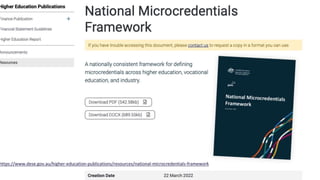
https://www.dese.gov.au/higher-education-publications/resources/national-microcredentials-framework
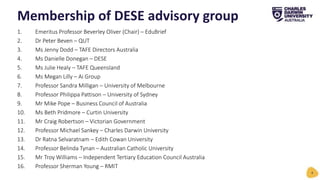
1. Emeritus Professor Beverley Oliver (Chair) – EduBrief
2. Dr Peter Beven – QUT
3. Ms Jenny Dodd – TAFE Directors Australia
4. Ms Danielle Donegan – DESE
5. Ms Julie Healy – TAFE Queensland
6. Ms Megan Lilly – Ai Group
7. Professor Sandra Milligan – University of Melbourne
8. Professor Philippa Pattison – University of Sydney
9. Mr Mike Pope – Business Council of Australia
10. Ms Beth Pridmore – Curtin University
11. Mr Craig Robertson – Victorian Government
12. Professor Michael Sankey – Charles Darwin University
13. Dr Ratna Selvaratnam – Edith Cowan University
14. Professor Belinda Tynan – Australian Catholic University
15. Mr Troy Williams – Independent Tertiary Education Council Australia
16. Professor Sherman Young – RMIT
Membership of DESE advisory group
4
• The framework defines microcredentials as a certification
of assessed learning or competency, with a minimum
volume of learning of one hour and less than an AQF
award qualification, that is additional, alternate,
complementary to or a component part of an AQF award
qualification.
Definition
5
This definition is supported by a number of unifying principles;
that microcredentials should be:
• Outcome-based.
• Responsive to industry-need.
• Tailored to support lifelong learning.
• Transparent and accessible.
Unifying principles
6
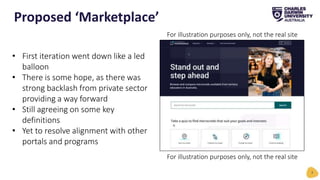
Proposed ‘Marketplace’
7
For illustration purposes only, not the real site
• First iteration went down like a led
balloon
• There is some hope, as there was
strong backlash from private sector
providing a way forward
• Still agreeing on some key
definitions
• Yet to resolve alignment with other
portals and programs
For illustration purposes only, not the real site
8
https://bryanmmathers.com
9
https://bryanmmathers.com
• The recommended standards necessarily consider portability
primarily amongst Australian institutions, for the benefit of
Australian learners. Relationships with international
qualification schema and/or industry credentials may be able to
be articulated in the future. While use of the guidance in this
document is voluntary and recognition of prior learning or
credit will remain a decision for individual universities, it is the
aim that microcredentials consistent with standards of
portability will be able to be quickly and simply assessed for
recognition by universities and other providers.
Need for portability
10
https://www.universitiesaustralia.edu.au/wp-content/uploads/2021/09/210929-Guidance-for-portability-of-Australian-microcredentials-UA.pdf
Principles (precis)
• Portability of microcredentials requires a set of minimum or baseline standards to enable easy
evaluation of a credential by parties other than the issuer.
• Aligned with AQF as governed by the Higher Education Standards (HES) defined the TEQSA Act
2011.
• Institutions decide if standards apply to non-award courses including microcredentials.
• The standards are principles-based.
Recommended Standards
1. Microcredentials have clear evidence of achievement or learning outcome;
2. Microcredentials have an understandable unit of exchange; and
3. Microcredentials are quality assured and verifiable, with sufficient, relevant metadata.
Recommended standards for
Microcredentials
11
https://www.universitiesaustralia.edu.au/wp-content/uploads/2021/09/210929-Guidance-for-portability-of-Australian-microcredentials-UA.pdf
As of October last year*
• 54% do not have a specific micro-credentialing policy
• 46% had a standard for issuance of micro-credentials and a standard
for sizing
• Only 11% have a well-developed strategy
• Only 14% having mature pricing tactics
• Only 18% have a specified credit or RPL into institutional credentials
• Only 25% have well-developed mechanisms for quality assurance
What problems could there possible be 
12
*ACODE Whitepaper: Survey of micro-credentialing practice in Australasian universities 2021
https://www.acode.edu.au/pluginfile.php/11280/mod_resource/content/1/ACODE%20White%20paper%20Micro%20credentialing%202021.pdf
https://www.acode.edu.au/pluginfile.php/8411/mod_resource/content/1/ACODE_MicroCreds_Whitepaper_2020.pdf
What are institutions planning for
13
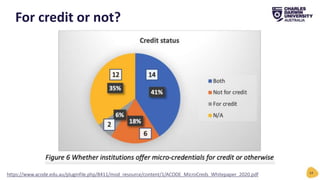
For credit or not?
14
https://www.acode.edu.au/pluginfile.php/8411/mod_resource/content/1/ACODE_MicroCreds_Whitepaper_2020.pdf
• Institutional Student Management Systems (SMS) and Course
Management Systems (CMS) have not caught-up
• Alignment in these systems is key to sustainability
• We see a number of tools enter the market to help, but still
quite piecemeal at present
• Our ‘Traditional’ LMSs are not ideal for MCs (some have a short
course frontend)
• So, we have a bit of catch-up to play
Alignment with existing programs
15
16
• Selvaratnam, R., & Sankey, M. (2021). The State of Micro- Credentials Implementation and Practice in Australasian Higher Education.
Open Praxis, 13(2), pp. 228–238. DOI: https://doi.org/10.5944/openpraxis.13.2.130
• Selvaratnam, R.M., & Sankey, M.D. (2021). An integrative literature review of the implementation of micro-credentials in higher education:
Implications for practice in Australasia. Journal of Teaching and Learning for Gradate Employability, 12(1), p. 1–
17. https://doi.org/10.21153/jtlge2021vol12no1art942
• Oliver, B., & Sankey, M. (2021). ITECA Microcredentials Interest Group Meeting. Independent Tertiary Education Council Australia. Canberra, 5
October.
• Sankey, M. & Selvaratnam, R. (2021). Micro-credentialing in Australasian HE. The Reading & Research Group. Kaplan Australia, Kaplan Professional,
Kaplan Business School, Kaplan Singapore and Dublin Business School 25 January.
• Sankey, M. (2020). Online Education Quality Assurance. Institutions and Implementation Webinar. Department of Education, Skills and Employment,
Australian Government and Ministry of Education, Government of India. 20 November.
• Selvaranam, R., & Sankey, M. (2020). ACODE – Micro Credentialing Survey and White Paper Presentation. ACODE 82: Not Wasting a Crisis. Curtin
University, Online. 5th November.
• Oliver, B., Nelson, K., Giollamhichil, M., Sankey, M. & Brown, M. 2020. Unboxing Micro-credentials: Certifying Your Future. The Open and Distance
Learning Association of Australia (ODLAA). Australasian Online and Distance Learning Week. 3 November.
• Sankey, M. & Selvaratnam, R. (2020). The revised state of play for micro-credentials in Australasia Council of Australasian University Leaders of
Learning and Teaching (CAULLT) Micro-credentials Webinar. Online, Australasia. 22 October.
• Sankey, M. & Selvaratnam, R. (2020). Micro-credentialing in Australasian HE. Presentation to staff of the Queensland Tertiary Admissions Centre
(QTAC). Brisbane, Australia. 23 September.
• Sankey, M. (2020). Micro-credentialing: talking isn’t implementing: The stats show most unis don’t have plans in place. Campus Morning Mail. 26
August.
• Selvaratnam, R., & Sankey, M. (2020). Survey of micro-credentialing practice in Australasian universities 2020. ACODE White Paper. Australasian
Council on Open, Distance and eLearning. Canberra, ACT. 25 August.
• Sankey, M., & Selvaratnam, R. (2020). Micro-credentialing – a point in time glimpse of the Australasian Sector. The ASCILITE TELall Blog. 7 February.
• Selvaratnam, R., & Sankey, M. (2019) Micro-credentialing as a sustainable way forward for universities in Australia: Perceptions of the landscape.
White paper for ACODE 80, Change and evolution of learning systems. Wellington, New Zealand. 15 November.
Coming to you from a relativly informed space
• You’ve heard from me; now how do you see this playing
out…
What is your view of it?
17
michael_sankey

Microcredentials: A state-of-play in April 2022

  • 1.
    CRICOS Provider No:00300K (NT/VIC) 03286A (NSW) RTO Provider No: 0373 TEQSA Provider ID PRV12069 Microcredentials: A state-of-play in April 2022 Professor Michael Sankey Director, Learning Futures and Lead Education Architect Education Strategy President, Australasian Council on Open Distance and eLearning (ACODE) michael_sankey
  • 2.
    Charles Darwin Universityacknowledges all First Nations people across the lands on which we live and work, and we pay our respects to Elders both past and present. 2
  • 3.
  • 4.
    1. Emeritus ProfessorBeverley Oliver (Chair) – EduBrief 2. Dr Peter Beven – QUT 3. Ms Jenny Dodd – TAFE Directors Australia 4. Ms Danielle Donegan – DESE 5. Ms Julie Healy – TAFE Queensland 6. Ms Megan Lilly – Ai Group 7. Professor Sandra Milligan – University of Melbourne 8. Professor Philippa Pattison – University of Sydney 9. Mr Mike Pope – Business Council of Australia 10. Ms Beth Pridmore – Curtin University 11. Mr Craig Robertson – Victorian Government 12. Professor Michael Sankey – Charles Darwin University 13. Dr Ratna Selvaratnam – Edith Cowan University 14. Professor Belinda Tynan – Australian Catholic University 15. Mr Troy Williams – Independent Tertiary Education Council Australia 16. Professor Sherman Young – RMIT Membership of DESE advisory group 4
  • 5.
    • The frameworkdefines microcredentials as a certification of assessed learning or competency, with a minimum volume of learning of one hour and less than an AQF award qualification, that is additional, alternate, complementary to or a component part of an AQF award qualification. Definition 5
  • 6.
    This definition issupported by a number of unifying principles; that microcredentials should be: • Outcome-based. • Responsive to industry-need. • Tailored to support lifelong learning. • Transparent and accessible. Unifying principles 6
  • 7.
    Proposed ‘Marketplace’ 7 For illustrationpurposes only, not the real site • First iteration went down like a led balloon • There is some hope, as there was strong backlash from private sector providing a way forward • Still agreeing on some key definitions • Yet to resolve alignment with other portals and programs For illustration purposes only, not the real site
  • 8.
  • 9.
  • 10.
    • The recommendedstandards necessarily consider portability primarily amongst Australian institutions, for the benefit of Australian learners. Relationships with international qualification schema and/or industry credentials may be able to be articulated in the future. While use of the guidance in this document is voluntary and recognition of prior learning or credit will remain a decision for individual universities, it is the aim that microcredentials consistent with standards of portability will be able to be quickly and simply assessed for recognition by universities and other providers. Need for portability 10 https://www.universitiesaustralia.edu.au/wp-content/uploads/2021/09/210929-Guidance-for-portability-of-Australian-microcredentials-UA.pdf
  • 11.
    Principles (precis) • Portabilityof microcredentials requires a set of minimum or baseline standards to enable easy evaluation of a credential by parties other than the issuer. • Aligned with AQF as governed by the Higher Education Standards (HES) defined the TEQSA Act 2011. • Institutions decide if standards apply to non-award courses including microcredentials. • The standards are principles-based. Recommended Standards 1. Microcredentials have clear evidence of achievement or learning outcome; 2. Microcredentials have an understandable unit of exchange; and 3. Microcredentials are quality assured and verifiable, with sufficient, relevant metadata. Recommended standards for Microcredentials 11 https://www.universitiesaustralia.edu.au/wp-content/uploads/2021/09/210929-Guidance-for-portability-of-Australian-microcredentials-UA.pdf
  • 12.
    As of Octoberlast year* • 54% do not have a specific micro-credentialing policy • 46% had a standard for issuance of micro-credentials and a standard for sizing • Only 11% have a well-developed strategy • Only 14% having mature pricing tactics • Only 18% have a specified credit or RPL into institutional credentials • Only 25% have well-developed mechanisms for quality assurance What problems could there possible be  12 *ACODE Whitepaper: Survey of micro-credentialing practice in Australasian universities 2021 https://www.acode.edu.au/pluginfile.php/11280/mod_resource/content/1/ACODE%20White%20paper%20Micro%20credentialing%202021.pdf
  • 13.
  • 14.
    For credit ornot? 14 https://www.acode.edu.au/pluginfile.php/8411/mod_resource/content/1/ACODE_MicroCreds_Whitepaper_2020.pdf
  • 15.
    • Institutional StudentManagement Systems (SMS) and Course Management Systems (CMS) have not caught-up • Alignment in these systems is key to sustainability • We see a number of tools enter the market to help, but still quite piecemeal at present • Our ‘Traditional’ LMSs are not ideal for MCs (some have a short course frontend) • So, we have a bit of catch-up to play Alignment with existing programs 15
  • 16.
    16 • Selvaratnam, R.,& Sankey, M. (2021). The State of Micro- Credentials Implementation and Practice in Australasian Higher Education. Open Praxis, 13(2), pp. 228–238. DOI: https://doi.org/10.5944/openpraxis.13.2.130 • Selvaratnam, R.M., & Sankey, M.D. (2021). An integrative literature review of the implementation of micro-credentials in higher education: Implications for practice in Australasia. Journal of Teaching and Learning for Gradate Employability, 12(1), p. 1– 17. https://doi.org/10.21153/jtlge2021vol12no1art942 • Oliver, B., & Sankey, M. (2021). ITECA Microcredentials Interest Group Meeting. Independent Tertiary Education Council Australia. Canberra, 5 October. • Sankey, M. & Selvaratnam, R. (2021). Micro-credentialing in Australasian HE. The Reading & Research Group. Kaplan Australia, Kaplan Professional, Kaplan Business School, Kaplan Singapore and Dublin Business School 25 January. • Sankey, M. (2020). Online Education Quality Assurance. Institutions and Implementation Webinar. Department of Education, Skills and Employment, Australian Government and Ministry of Education, Government of India. 20 November. • Selvaranam, R., & Sankey, M. (2020). ACODE – Micro Credentialing Survey and White Paper Presentation. ACODE 82: Not Wasting a Crisis. Curtin University, Online. 5th November. • Oliver, B., Nelson, K., Giollamhichil, M., Sankey, M. & Brown, M. 2020. Unboxing Micro-credentials: Certifying Your Future. The Open and Distance Learning Association of Australia (ODLAA). Australasian Online and Distance Learning Week. 3 November. • Sankey, M. & Selvaratnam, R. (2020). The revised state of play for micro-credentials in Australasia Council of Australasian University Leaders of Learning and Teaching (CAULLT) Micro-credentials Webinar. Online, Australasia. 22 October. • Sankey, M. & Selvaratnam, R. (2020). Micro-credentialing in Australasian HE. Presentation to staff of the Queensland Tertiary Admissions Centre (QTAC). Brisbane, Australia. 23 September. • Sankey, M. (2020). Micro-credentialing: talking isn’t implementing: The stats show most unis don’t have plans in place. Campus Morning Mail. 26 August. • Selvaratnam, R., & Sankey, M. (2020). Survey of micro-credentialing practice in Australasian universities 2020. ACODE White Paper. Australasian Council on Open, Distance and eLearning. Canberra, ACT. 25 August. • Sankey, M., & Selvaratnam, R. (2020). Micro-credentialing – a point in time glimpse of the Australasian Sector. The ASCILITE TELall Blog. 7 February. • Selvaratnam, R., & Sankey, M. (2019) Micro-credentialing as a sustainable way forward for universities in Australia: Perceptions of the landscape. White paper for ACODE 80, Change and evolution of learning systems. Wellington, New Zealand. 15 November. Coming to you from a relativly informed space
  • 17.
    • You’ve heardfrom me; now how do you see this playing out… What is your view of it? 17 michael_sankey