Section four
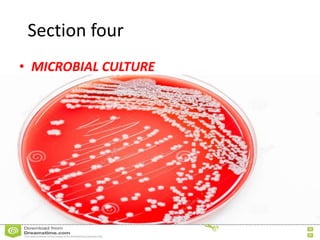
• MICROBIAL CULTURE
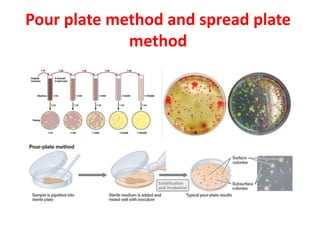
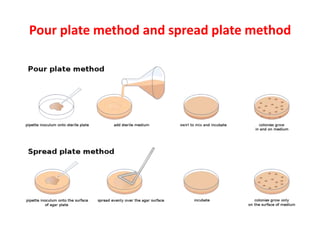
Pour plate method and spread plate
method
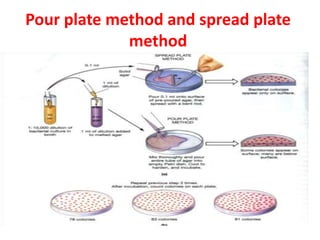
Pour plate method and spread plate
method
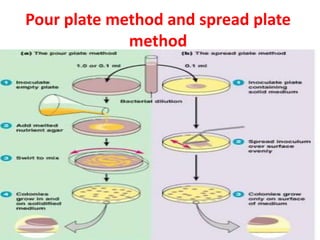
Pour plate method and spread plate method
Pour plate method and spread plate
method
Pour plate method and spread plate method
MICROBIAL CULTURE
Nutrients for Microbial Culture
Like any other living system, microorganisms also
require a source of energy, carbon, nitrogen,oxygen,
iron and other minerals, micronutrients, and water for
growth,and multiplication.
All these nutrients that are essential for the
growth and multiplication of microbial organisms
are supplied in the form of nutrient media.
Culture media
• Any nutrient substance or a mixture of
nutrient substances used for the artificial
culture of microorganisms in the laboratory is
termed as culture media.
Types of culture media:
• According to the nature of their constituents culture
media may be divided into two major groups:
• 1-Natural media
• Media which contains infusion of natural substances,
the chemical composition of which varies from time to
time.
• 2-Synthetic or defined media
•
Media which contains ingredients of known chemical
composition. These media usually comprise solution of
mineral salts to which the substrate to be tested is
added
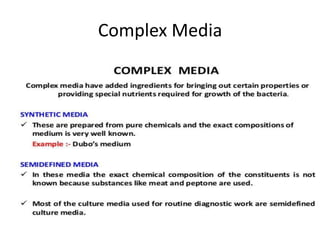
Complex Media
Types of culture media:
• On the basis of nutrition and purpose media may be
of several types:
• 1-Ordinary media:
• This media contains minimum amount
of nutrient substances for the growth
and propagation of microorganisms,
for example, nutrient agar and nutrient
broth.
Types of culture media:
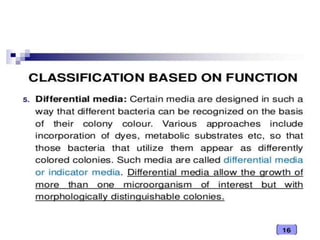
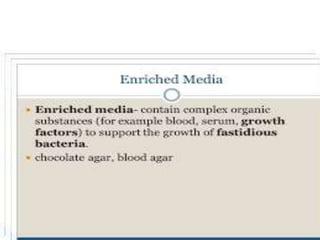
• 2-Enriched or isolation media
• These may be sample nutrient media containing
sufficient amount of essential constituents for the
growth of bacteria, such as blood agar medium
and serum agar medium Selective or inhibitory
media
• These media contain such substance or
substances which help the growth of only one
type of bacteria and suppress the growth of
others
Types of culture media :
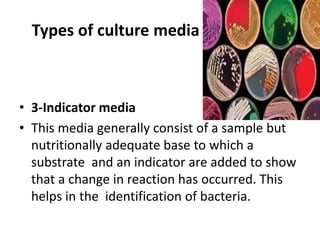
• 3-Indicator media
• This media generally consist of a sample but
nutritionally adequate base to which a
substrate and an indicator are added to show
that a change in reaction has occurred. This
helps in the identification of bacteria.
Besides these four groups of media there are many special
purpose media like
• 1-isolation media
• 2-media for maintenance of culture
• 3-media for bacteriological characterization
• 4-media for determining nutritional
requirement
• 5-screening media
• 6-media for microbiological assay of vitamins
and amino acids etc
On the basis of consistency media can be classified into three
groups
• 1-Solid media
• These media are widely used in the laboratory
due to the advantage of their use. One can see
the bacterial colony on the agar medium and
colony characteristics help in the determination
and identification of many bacteria
• 2-Liquid Media
• This media called broth. Bacterial colony can not
be observed in this media but this media is used
for the study of many biochemical characteristics
of bacteria. Besides that samples of pathogens
can be directly placed in this media.
On the basis of consistency media can
be classified into three groups
• 3-Semi-liquid media
• This type of media is not frequently used in
the laboratory. But bacterial samples can be
transported from one place to another by
pacing in it. This media is also used for the
preservation of bacterial isolates
• 1-Agar
• This can be obtained as shreds, flakes,
granules or powder and is made from certain
types of seaweed. Its gelling properties is
used for the preparation solid and semi-solid
culture media.
• It is insoluble in cold water but soluble when
heated at about 90C. It becomes solidified at
or below 45 C.
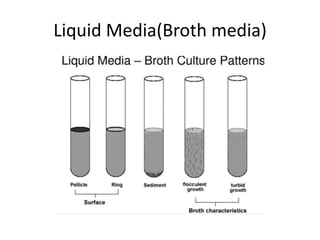
Liquid Media(Broth media)
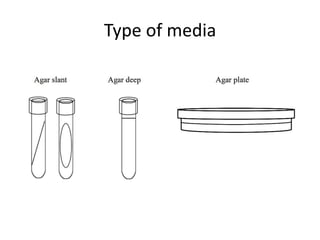
Type of media
Media constituents
• 2-Peptone
• It is a product of varying composition made by
acid or enzymatic hydrolysis of animal or
vegetable protein, from material such as
muscle, liver, blood, milk, casein,
lactalbumin,gelatin and soybean. The exact
composition depends on the raw material and
the method of manufacture.
Media constituents
• 3-Meat Extract
• Commercial meat extracts contain soluble
organic bases, protein degradation products,
• vitamins and minerals. Beef, beef heart, liver,
brain, spleen fish muscle etc are used to
prepare meat extract. These extracts are
readily available and easy to use
Media constituents
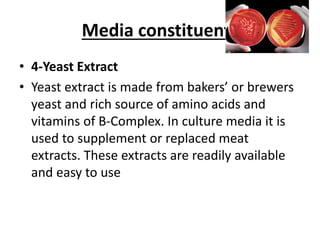
• 4-Yeast Extract
• Yeast extract is made from bakers’ or brewers
yeast and rich source of amino acids and
vitamins of B-Complex. In culture media it is
used to supplement or replaced meat
extracts. These extracts are readily available
and easy to use
Media constituents
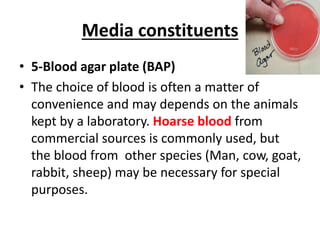
• 5-Blood agar plate (BAP)
• The choice of blood is often a matter of
convenience and may depends on the animals
kept by a laboratory. Hoarse blood from
commercial sources is commonly used, but
the blood from other species (Man, cow, goat,
rabbit, sheep) may be necessary for special
purposes.
Media constituents
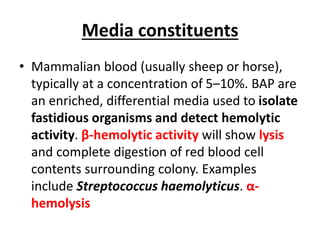
• Mammalian blood (usually sheep or horse),
typically at a concentration of 5–10%. BAP are
an enriched, differential media used to isolate
fastidious organisms and detect hemolytic
activity. β-hemolytic activity will show lysis
and complete digestion of red blood cell
contents surrounding colony. Examples
include Streptococcus haemolyticus. α-
hemolysis
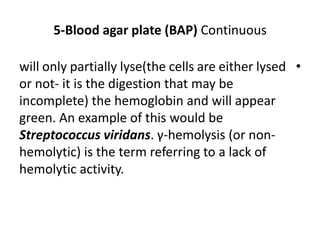
5-Blood agar plate (BAP) Continuous
•
will only partially lyse(the cells are either lysed
or not- it is the digestion that may be
incomplete) the hemoglobin and will appear
green. An example of this would be
Streptococcus viridans. γ-hemolysis (or non-
hemolytic) is the term referring to a lack of
hemolytic activity.
Media constituents
• 6-Plasma
• Plasma is used for determining coagulate
activity. In medical bacteriology
laboratories,human plasma is usually
preferred but rabbit plasma is also used.
Media constituents
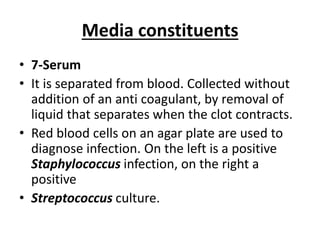
• 7-Serum
• It is separated from blood. Collected without
addition of an anti coagulant, by removal of
liquid that separates when the clot contracts.
• Red blood cells on an agar plate are used to
diagnose infection. On the left is a positive
Staphylococcus infection, on the right a
positive
• Streptococcus culture.
Media constituents
• 8-Bile salts
• Commercial bile salt are prepared by
extracting dried ox or gig bile with ethanol,
decolorizing the extract with charcoal and
precipitating the bile salts with ether to form a
water soluble yellowish-brown hygroscopic
powder. It is used in some selective media.
Media constituents
• 9-Gelatin
• It is the protein obtained by extraction on
collagenous material from animal tissues and
is available as sheets, shreds, granules or
powder. Gelatin dissolves in water at above 25
C and the solution gels on cooling to below
25C. Gelatin has little nutritive value but is
used in culture media as a substrate for
detecting gelatinase activity.
Media constituents
• 10-Carbohydrates
• Carbohydrates, collectively called sugars are
usually used to enrich media to promote
growth of pigmentation, and to determine
whether organisms can produce acid or acid
and gas from them. Concentration of
carbohydrate in oxidation and fermentation
studies is usually .5 to 1%.
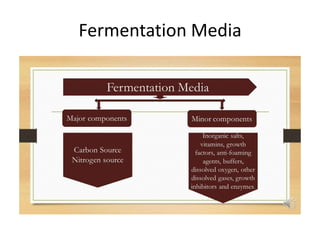
Fermentation Media
Performance tests on culture media
• Culture media may be prepared from the
individual ingredients or may be prepared from
dehydrated powders available commercially. The
important points in QC of media are listed here:
• 1-Do not over-stock the media. Store the
required quantities only which can be used in 6-
12 months.
• 2-Store the media away from moisture by
securing the caps of all the containers tightly.
• 3-Store in a dark, cool and well-ventilated place.
Performance tests on culture media
• 4-Keep a record of the receipt, and opening of
the media container.
• 5-Discard all dehydrated media that are either
darkened or caked. Rotate the stock of
media,following the principle of "first in, first
out".
• 6-For preparation of media adhere strictly to the
manufacturer’s instructions.
• 7-Prepared media should be protected from
sunlight and heat.
Nutrient agar
• Nutrient agar is usually used for growth of
non-fastidious organisms and observation of
pigment production. It is safe to use in school
science laboratories because it does not
selectively grow pathogenic bacteria.
• Aspergillus niger--------- growing in potato
dextrose agar
Indicators
• Indicators are incorporated in some culture
media to give visual evidence of pH or other
changes occurring during the growth of
bacteria.
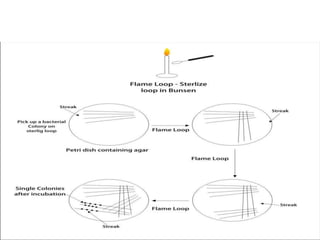
• Culture of Bacteria In An Agar Plate By Streak
Plate Method

Microbiology lab 1 part 3.pptx

  • 1.
  • 2.
    Pour plate methodand spread plate method
  • 3.
    Pour plate methodand spread plate method
  • 4.
    Pour plate methodand spread plate method
  • 5.
    Pour plate methodand spread plate method
  • 6.
    Pour plate methodand spread plate method
  • 7.
    MICROBIAL CULTURE Nutrients forMicrobial Culture Like any other living system, microorganisms also require a source of energy, carbon, nitrogen,oxygen, iron and other minerals, micronutrients, and water for growth,and multiplication. All these nutrients that are essential for the growth and multiplication of microbial organisms are supplied in the form of nutrient media.
  • 8.
    Culture media • Anynutrient substance or a mixture of nutrient substances used for the artificial culture of microorganisms in the laboratory is termed as culture media.
  • 10.
    Types of culturemedia: • According to the nature of their constituents culture media may be divided into two major groups: • 1-Natural media • Media which contains infusion of natural substances, the chemical composition of which varies from time to time. • 2-Synthetic or defined media • Media which contains ingredients of known chemical composition. These media usually comprise solution of mineral salts to which the substrate to be tested is added
  • 11.
  • 12.
    Types of culturemedia: • On the basis of nutrition and purpose media may be of several types: • 1-Ordinary media: • This media contains minimum amount of nutrient substances for the growth and propagation of microorganisms, for example, nutrient agar and nutrient broth.
  • 13.
    Types of culturemedia: • 2-Enriched or isolation media • These may be sample nutrient media containing sufficient amount of essential constituents for the growth of bacteria, such as blood agar medium and serum agar medium Selective or inhibitory media • These media contain such substance or substances which help the growth of only one type of bacteria and suppress the growth of others
  • 16.
    Types of culturemedia : • 3-Indicator media • This media generally consist of a sample but nutritionally adequate base to which a substrate and an indicator are added to show that a change in reaction has occurred. This helps in the identification of bacteria.
  • 17.
    Besides these fourgroups of media there are many special purpose media like • 1-isolation media • 2-media for maintenance of culture • 3-media for bacteriological characterization • 4-media for determining nutritional requirement • 5-screening media • 6-media for microbiological assay of vitamins and amino acids etc
  • 18.
    On the basisof consistency media can be classified into three groups • 1-Solid media • These media are widely used in the laboratory due to the advantage of their use. One can see the bacterial colony on the agar medium and colony characteristics help in the determination and identification of many bacteria • 2-Liquid Media • This media called broth. Bacterial colony can not be observed in this media but this media is used for the study of many biochemical characteristics of bacteria. Besides that samples of pathogens can be directly placed in this media.
  • 19.
    On the basisof consistency media can be classified into three groups • 3-Semi-liquid media • This type of media is not frequently used in the laboratory. But bacterial samples can be transported from one place to another by pacing in it. This media is also used for the preservation of bacterial isolates
  • 20.
    • 1-Agar • Thiscan be obtained as shreds, flakes, granules or powder and is made from certain types of seaweed. Its gelling properties is used for the preparation solid and semi-solid culture media. • It is insoluble in cold water but soluble when heated at about 90C. It becomes solidified at or below 45 C.
  • 22.
  • 23.
  • 24.
    Media constituents • 2-Peptone •It is a product of varying composition made by acid or enzymatic hydrolysis of animal or vegetable protein, from material such as muscle, liver, blood, milk, casein, lactalbumin,gelatin and soybean. The exact composition depends on the raw material and the method of manufacture.
  • 25.
    Media constituents • 3-MeatExtract • Commercial meat extracts contain soluble organic bases, protein degradation products, • vitamins and minerals. Beef, beef heart, liver, brain, spleen fish muscle etc are used to prepare meat extract. These extracts are readily available and easy to use
  • 26.
    Media constituents • 4-YeastExtract • Yeast extract is made from bakers’ or brewers yeast and rich source of amino acids and vitamins of B-Complex. In culture media it is used to supplement or replaced meat extracts. These extracts are readily available and easy to use
  • 27.
    Media constituents • 5-Bloodagar plate (BAP) • The choice of blood is often a matter of convenience and may depends on the animals kept by a laboratory. Hoarse blood from commercial sources is commonly used, but the blood from other species (Man, cow, goat, rabbit, sheep) may be necessary for special purposes.
  • 28.
    Media constituents • Mammalianblood (usually sheep or horse), typically at a concentration of 5–10%. BAP are an enriched, differential media used to isolate fastidious organisms and detect hemolytic activity. β-hemolytic activity will show lysis and complete digestion of red blood cell contents surrounding colony. Examples include Streptococcus haemolyticus. α- hemolysis
  • 29.
    5-Blood agar plate(BAP) Continuous • will only partially lyse(the cells are either lysed or not- it is the digestion that may be incomplete) the hemoglobin and will appear green. An example of this would be Streptococcus viridans. γ-hemolysis (or non- hemolytic) is the term referring to a lack of hemolytic activity.
  • 30.
    Media constituents • 6-Plasma •Plasma is used for determining coagulate activity. In medical bacteriology laboratories,human plasma is usually preferred but rabbit plasma is also used.
  • 31.
    Media constituents • 7-Serum •It is separated from blood. Collected without addition of an anti coagulant, by removal of liquid that separates when the clot contracts. • Red blood cells on an agar plate are used to diagnose infection. On the left is a positive Staphylococcus infection, on the right a positive • Streptococcus culture.
  • 32.
    Media constituents • 8-Bilesalts • Commercial bile salt are prepared by extracting dried ox or gig bile with ethanol, decolorizing the extract with charcoal and precipitating the bile salts with ether to form a water soluble yellowish-brown hygroscopic powder. It is used in some selective media.
  • 33.
    Media constituents • 9-Gelatin •It is the protein obtained by extraction on collagenous material from animal tissues and is available as sheets, shreds, granules or powder. Gelatin dissolves in water at above 25 C and the solution gels on cooling to below 25C. Gelatin has little nutritive value but is used in culture media as a substrate for detecting gelatinase activity.
  • 34.
    Media constituents • 10-Carbohydrates •Carbohydrates, collectively called sugars are usually used to enrich media to promote growth of pigmentation, and to determine whether organisms can produce acid or acid and gas from them. Concentration of carbohydrate in oxidation and fermentation studies is usually .5 to 1%.
  • 35.
  • 36.
    Performance tests onculture media • Culture media may be prepared from the individual ingredients or may be prepared from dehydrated powders available commercially. The important points in QC of media are listed here: • 1-Do not over-stock the media. Store the required quantities only which can be used in 6- 12 months. • 2-Store the media away from moisture by securing the caps of all the containers tightly. • 3-Store in a dark, cool and well-ventilated place.
  • 37.
    Performance tests onculture media • 4-Keep a record of the receipt, and opening of the media container. • 5-Discard all dehydrated media that are either darkened or caked. Rotate the stock of media,following the principle of "first in, first out". • 6-For preparation of media adhere strictly to the manufacturer’s instructions. • 7-Prepared media should be protected from sunlight and heat.
  • 38.
    Nutrient agar • Nutrientagar is usually used for growth of non-fastidious organisms and observation of pigment production. It is safe to use in school science laboratories because it does not selectively grow pathogenic bacteria. • Aspergillus niger--------- growing in potato dextrose agar
  • 39.
    Indicators • Indicators areincorporated in some culture media to give visual evidence of pH or other changes occurring during the growth of bacteria. • Culture of Bacteria In An Agar Plate By Streak Plate Method