Adi Sasson
METHODEN DER MOLEKULAREN MIKROBIOLOGIE
Microbiological Techniques
STERILE TECHNIQUES
 All pipettes, spatulas, and test tube should be
sterilized.
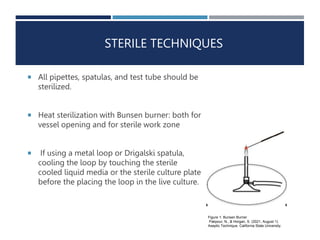
 Heat sterilization with Bunsen burner: both for
vessel opening and for sterile work zone
 If using a metal loop or Drigalski spatula,
cooling the loop by touching the sterile
cooled liquid media or the sterile culture plate
before the placing the loop in the live culture.
Figure 1: Bunsen Burner
Pakpour, N., & Horgan, S. (2021, August 1).
Aseptic Technique. California State University.
CULTURE MEDIA USED IN MICROBIOLOGY
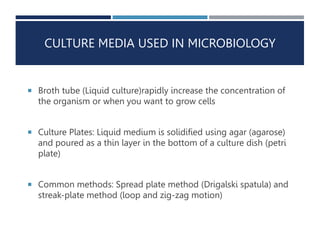
 Broth tube (Liquid culture)rapidly increase the concentration of
the organism or when you want to grow cells
 Culture Plates: Liquid medium is solidified using agar (agarose)
and poured as a thin layer in the bottom of a culture dish (petri
plate)
 Common methods: Spread plate method (Drigalski spatula) and
streak-plate method (loop and zig-zag motion)
HYPOTHESIS
 My hypothesis for the sterile microbiological techniques experiment
was that the cultures inoculated under sterile conditions will result in
a pure culture of microbes.
 The sterile control of the liquid culture will stay sterile.
 The serial dilution technique will result in a proportional estimation
of the microbial population.
1. STREAK PLATE METHOD OF ISOLATION
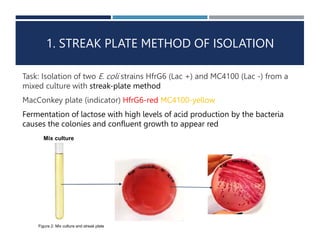
Task: Isolation of two E. coli strains HfrG6 (Lac +) and MC4100 (Lac -) from a
mixed culture with streak-plate method
MacConkey plate (indicator) HfrG6-red MC4100-yellow
Fermentation of lactose with high levels of acid production by the bacteria
causes the colonies and confluent growth to appear red
Mix culture
Figure 2: Mix culture and streak plate
STREAK PLATE METHOD OF ISOLATION
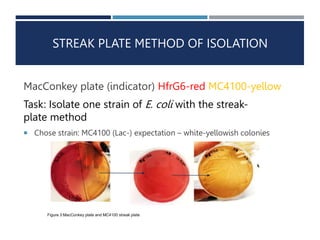
MacConkey plate (indicator) HfrG6-red MC4100-yellow
Task: Isolate one strain of E. coli with the streak-
plate method
 Chose strain: MC4100 (Lac-) expectation – white-yellowish colonies
Figure 3:MacConkey plate and MC4100 streak plate
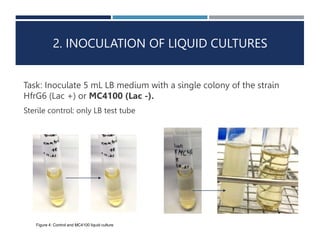
2. INOCULATION OF LIQUID CULTURES
Task: Inoculate 5 mL LB medium with a single colony of the strain
HfrG6 (Lac +) or MC4100 (Lac -).
Sterile control: only LB test tube
Figure 4: Control and MC4100 liquid culture
3. ESTIMATING MICROBIAL POPULATION SIZE
 Serial dilution techniques should be used in the estimation of microbial
population sizes.
 A one in ten dilution is made in a new liquid culture tube, and this process
is usually repeated several times. The resulting cultures are dilutions of
10−1
10−2
10−3
10−4
10−5
10−6
10−7
of the original sample.
 Plated the suspension (100 µL) with Drigalski spatula and incubated at 37°
C overnight
Figure 5: Script „Methoden der Molekularen Mikrobiologie WS 2021/22“
ESTIMATING MICROBIAL POPULATION SIZE
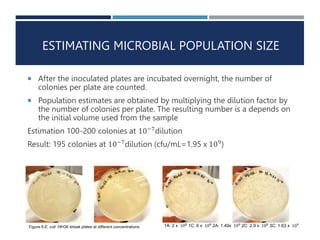
 After the inoculated plates are incubated overnight, the number of
colonies per plate are counted.
 Population estimates are obtained by multiplying the dilution factor by
the number of colonies per plate. The resulting number is a depends on
the initial volume used from the sample
Estimation 100-200 colonies at 10−7dilution
Result: 195 colonies at 10−7dilution (cfu/mL=1.95 x 109)
Figure 6:E. coli HfrG6 streak plates at different concentrations 1A: 2 x 10⁸ 1C: 6 x 10⁸ 2A: 1.49x 10⁹ 2C: 2.9 x 10⁸ 3C: 1.63 x 10⁹
DISCUSSION AND CONCLUSIONS
Mix culture streak-plate: working under sterile conditions was as
expected- both red and yellow colonies were formed, as expected.
Streak-plate isolation of MC4100 resulted in a pure culture of microbes as
expected.
The sterile control of the liquid culture stayed sterile, as expected.
The serial dilution resulted in the higher values of the estimation of the
microbial population. The end value 195 colonies was within the estimation
100-200 colonies.
Sterile techniques are used in attempt to eliminate as much contamination
as possible from all laboratory settings.
 Lab materials should be sterilized before use ,as the sterilization affects
the results of the experiment. Control samples must be a part of every
experiment.
 Serial dilution and plate count techniques are basic methods to estimate
microbial populations of cultures.
SOURCES
Figures:
Figure 1: Bunsen Burner
Pakpour, N., & Horgan, S. (2021, August 1). Aseptic Technique. California State
University
Figure 5: Dilution diagram
Script „Methoden der Molekularen Mikrobiologie WS 2021/22” Lehrstuhl
Mikrobiologie, Prof. Dr. Regine Hengge, Humboldt-Universität zu Berlin
Background information: Script „Methoden der Molekularen Mikrobiologie
WS 2021/22“ Lehrstuhl Mikrobiologie, Prof. Dr. Regine Hengge, Humboldt-
Universität zu Berlin
11

Microbiological techniques Experiment Presentation.pptx

  • 1.
    Adi Sasson METHODEN DERMOLEKULAREN MIKROBIOLOGIE Microbiological Techniques
  • 2.
    STERILE TECHNIQUES  Allpipettes, spatulas, and test tube should be sterilized.  Heat sterilization with Bunsen burner: both for vessel opening and for sterile work zone  If using a metal loop or Drigalski spatula, cooling the loop by touching the sterile cooled liquid media or the sterile culture plate before the placing the loop in the live culture. Figure 1: Bunsen Burner Pakpour, N., & Horgan, S. (2021, August 1). Aseptic Technique. California State University.
  • 3.
    CULTURE MEDIA USEDIN MICROBIOLOGY  Broth tube (Liquid culture)rapidly increase the concentration of the organism or when you want to grow cells  Culture Plates: Liquid medium is solidified using agar (agarose) and poured as a thin layer in the bottom of a culture dish (petri plate)  Common methods: Spread plate method (Drigalski spatula) and streak-plate method (loop and zig-zag motion)
  • 4.
    HYPOTHESIS  My hypothesisfor the sterile microbiological techniques experiment was that the cultures inoculated under sterile conditions will result in a pure culture of microbes.  The sterile control of the liquid culture will stay sterile.  The serial dilution technique will result in a proportional estimation of the microbial population.
  • 5.
    1. STREAK PLATEMETHOD OF ISOLATION Task: Isolation of two E. coli strains HfrG6 (Lac +) and MC4100 (Lac -) from a mixed culture with streak-plate method MacConkey plate (indicator) HfrG6-red MC4100-yellow Fermentation of lactose with high levels of acid production by the bacteria causes the colonies and confluent growth to appear red Mix culture Figure 2: Mix culture and streak plate
  • 6.
    STREAK PLATE METHODOF ISOLATION MacConkey plate (indicator) HfrG6-red MC4100-yellow Task: Isolate one strain of E. coli with the streak- plate method  Chose strain: MC4100 (Lac-) expectation – white-yellowish colonies Figure 3:MacConkey plate and MC4100 streak plate
  • 7.
    2. INOCULATION OFLIQUID CULTURES Task: Inoculate 5 mL LB medium with a single colony of the strain HfrG6 (Lac +) or MC4100 (Lac -). Sterile control: only LB test tube Figure 4: Control and MC4100 liquid culture
  • 8.
    3. ESTIMATING MICROBIALPOPULATION SIZE  Serial dilution techniques should be used in the estimation of microbial population sizes.  A one in ten dilution is made in a new liquid culture tube, and this process is usually repeated several times. The resulting cultures are dilutions of 10−1 10−2 10−3 10−4 10−5 10−6 10−7 of the original sample.  Plated the suspension (100 µL) with Drigalski spatula and incubated at 37° C overnight Figure 5: Script „Methoden der Molekularen Mikrobiologie WS 2021/22“
  • 9.
    ESTIMATING MICROBIAL POPULATIONSIZE  After the inoculated plates are incubated overnight, the number of colonies per plate are counted.  Population estimates are obtained by multiplying the dilution factor by the number of colonies per plate. The resulting number is a depends on the initial volume used from the sample Estimation 100-200 colonies at 10−7dilution Result: 195 colonies at 10−7dilution (cfu/mL=1.95 x 109) Figure 6:E. coli HfrG6 streak plates at different concentrations 1A: 2 x 10⁸ 1C: 6 x 10⁸ 2A: 1.49x 10⁹ 2C: 2.9 x 10⁸ 3C: 1.63 x 10⁹
  • 10.
    DISCUSSION AND CONCLUSIONS Mixculture streak-plate: working under sterile conditions was as expected- both red and yellow colonies were formed, as expected. Streak-plate isolation of MC4100 resulted in a pure culture of microbes as expected. The sterile control of the liquid culture stayed sterile, as expected. The serial dilution resulted in the higher values of the estimation of the microbial population. The end value 195 colonies was within the estimation 100-200 colonies. Sterile techniques are used in attempt to eliminate as much contamination as possible from all laboratory settings.  Lab materials should be sterilized before use ,as the sterilization affects the results of the experiment. Control samples must be a part of every experiment.  Serial dilution and plate count techniques are basic methods to estimate microbial populations of cultures.
  • 11.
    SOURCES Figures: Figure 1: BunsenBurner Pakpour, N., & Horgan, S. (2021, August 1). Aseptic Technique. California State University Figure 5: Dilution diagram Script „Methoden der Molekularen Mikrobiologie WS 2021/22” Lehrstuhl Mikrobiologie, Prof. Dr. Regine Hengge, Humboldt-Universität zu Berlin Background information: Script „Methoden der Molekularen Mikrobiologie WS 2021/22“ Lehrstuhl Mikrobiologie, Prof. Dr. Regine Hengge, Humboldt- Universität zu Berlin 11