SAMPLE PROCESSING
BY:
SYEDA TABEENA ALI
SWABS PROCESSING
All swabs including aural, eye, pus and wound swab
except high vaginal swab process in the same way.
GRAM STAINING
 Not recommanded.
MEDIA
 Choclate agar
 Sheep blood agar/colistin nalidix agar
 MacConkey agar
METHOD OF INOCULATION
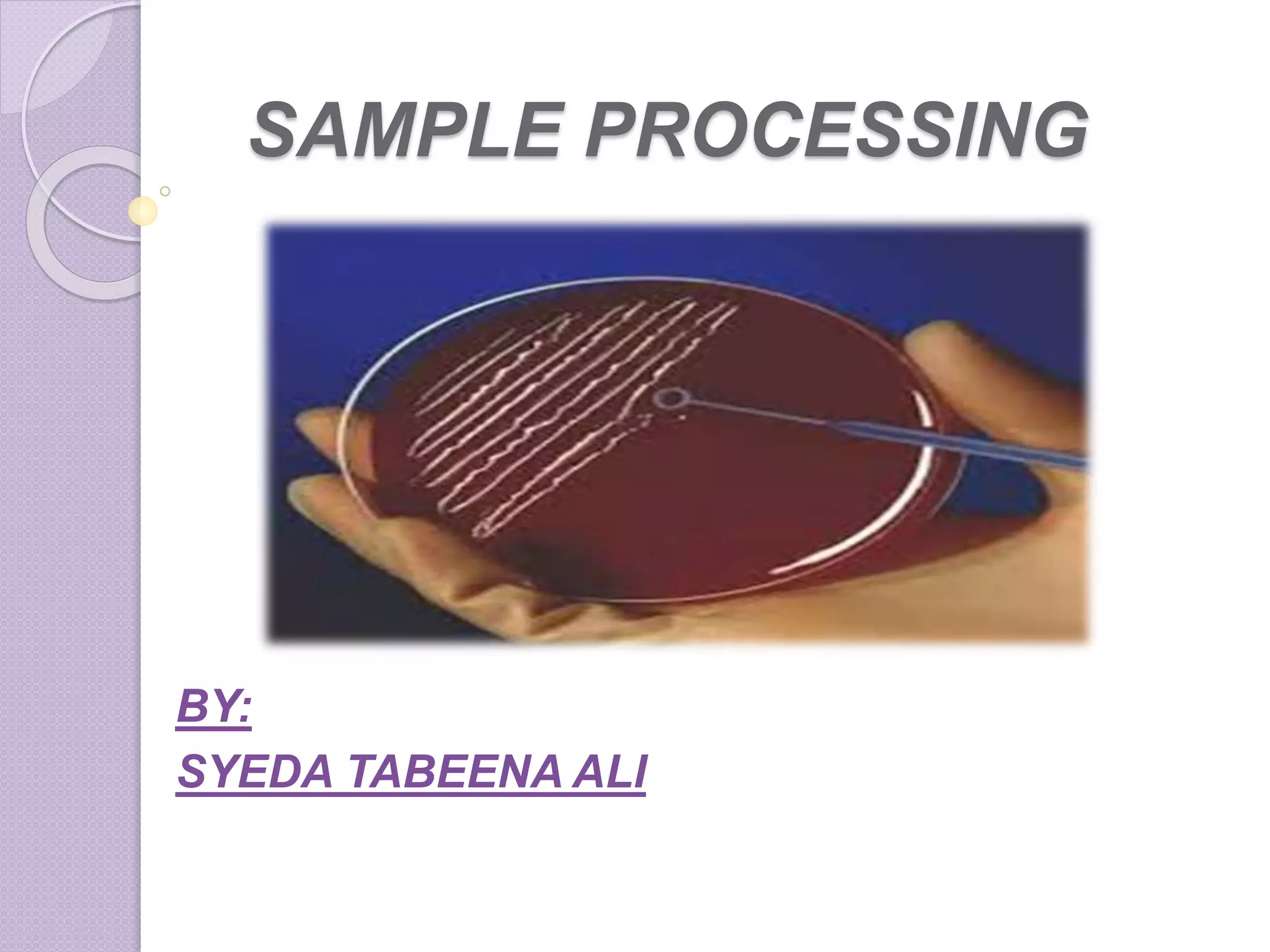
 Isolation method
INCUBATON CONDITION
 Choclate agar and SBA/CNA at 35-37°C with 5-10% CO₂
for 18-24 hours
 MacConkey agar at 35-37°C ambient air for 18-24 hours
SUB-CULTURE
• Inoculated the sample during processing in Brain
heart infusion (BHI) and incubated at 35-37°C
ambient air for 18-24 hours
• On next day subculture it on Choclate agar and
MacConkey agar.
RECOMMANDATON FOR EYE SWAB
Conjunctiva
• Sample each eye with separate swabs
(premoistened with sterile saline) by rolling over
conjunctiva. When only one eye is infected,
sampling both can help distinguish indigenous
microflora from true pathogens.
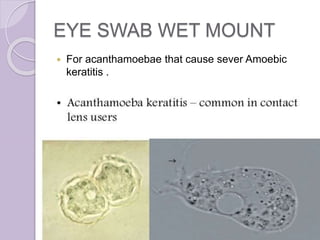
EYE SWAB WET MOUNT
 For acanthamoebae that cause sever Amoebic
keratitis .
HIGH VAGINAL SWAB(HVS)/ URETHRAL SWAB
GRAM STAINING
 Pus cells
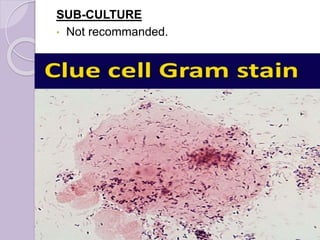
 Clue cells
 Yeast cells
 Bacteria
MEDIA
 Gonococcus agar
 Sheep blood agar
 Sabrouds Dextose agar
METHOD OF INOCULATION
 Isolation method
INCUBATON CONDITION
 Gonoccous agar and SBA at 35-37°C with 5-10% CO₂ for 18-24
hours
 Sabrouds Dextose agar at 35-37°C ambient air for 18-24 hours
SUB-CULTURE
• Not recommanded.
THROAT SWAB
GRAM STAINING
• Not recommanded.
MEDIA
 Sheep blood agar
METHOD OF INOCULATION
 Isolation method
INCUBATON CONDITION
 Sheep blood agar at 35-37°C with 5-10% CO₂ for 18-24 hours
SUB-CULTURE
• Not recommanded
CENTRAL LINE TIP
CENTRAL VENOUS CATHETR TIP(CVP)
GRAM STAINING
• Not recommanded.
MEDIA
 Sheep blood agar
 Manitol Salt Agar
METHOD OF INOCULATION
• semiquantitative roll- plate method (Maki's technique)
• performed by rolling the external surface of a catheter tip
back and forth on the surface of agar plate at least three
times.
• INCUBATON CONDITION
 Sheep blood agar at 35-37°C with 5-10% CO₂ for 18-24 hours
 Manitol Salt agar at 35-37°C ambient air for 18-24 hours
 SUB-CULTURE
• Not recommanded
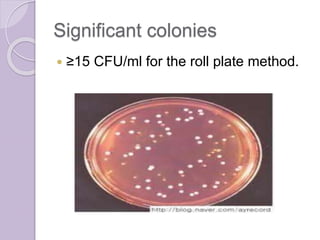
Significant colonies
 ≥15 CFU/ml for the roll plate method.
PUS IN CONTAINERSYRINGE, TISSUE AND ALL
TYPE OF FLUIDS EXCEPT CSF
GRAM STAINING
 Pus cells
 Yeast cells
 Bacteria
 Epithelial cells
MEDIA
 Choclate agar
 Sheep blood agar/colistin nalidix agar
 MacConkey agar
METHOD OF INOCULATION
 Isolation method
INCUBATON CONDITION
 Choclate agar and SBA/CNA at 35-37°C with 5-10% CO₂ for 18-
24 hours
 MacConkey agar at 35-37°C ambient air for 18-24 hours
SUB-CULTURE
• Inoculated the sample during processing in
cooked meat broth and incubated at 35-
37°C ambient air for 18-24 hours
• On next day subculture it on Choclate agar,
Sheep blood agar and MacConkey agar.
• WET MOUNT
• For Synovial fluid crystal wet mount is
prepared.
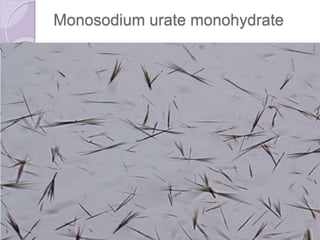
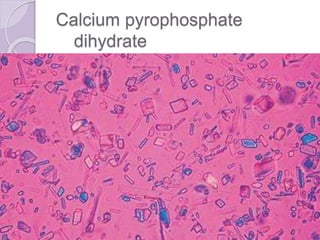
 Significant crystals of synovial fluids are.
1. Monosodium urate monohydrate
2. Calcium pyrophosphate dihydrate
Monosodium urate monohydrate
Calcium pyrophosphate
dihydrate
LIVER ABSCESS PUS
Processing same as fluids except one
additional step.
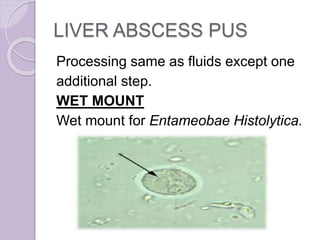
WET MOUNT
Wet mount for Entameobae Histolytica.
PROCESSING OF BONE
• Processing same as fluids except one
additional step.
• Before processing specimen should
be kept in Brain Heart Infusion (BHI)
for 3-6 hours to soften bone.
STOOL CULTURE PROCESSING
GRAM STAINING
 Not recommanded.
MEDIA
 Xylose Lysine Deoxycholate (XLD) Agar
 Thiosulfate-Citrate-Bile Salts-Sucrose (TCBS) Agar
 MacConkey agar
 Campy agar
METHOD OF INOCULATION
 Isolation method
INCUBATON CONDITION
 campy agar at 42°C with 10% CO₂ for 48-72 hours
 MacConkey ,XLD and TCBS agar at 35-37°C ambient air for
18-24 hours
SUB-CULTURE
• Inoculated the sample during processing in
selenite F broth, if the consistency of stool
is liquid also inoculated the sample in
Alkaline peptone water (APW) and
incubated at 35-37°C ambient air for 18-24
hours.
• On next day subculture it on of XLD agar, if
the consistency of stool is liquid also
subculture it on TCBS agar.
PROCESSING OF SPUTUM
 Pour the specimen into dry empty petri dish.
 Fill 3 petri dishes with sterile saline.
 Wash carefully in the first purulent of the specimen
with a sterile loop.
 Transfer the respective part of washed specimen to
the second dish and wash carefully.
 Repeat the step in third dish with the same loop
without heating and transport the specimen in the
lid,
 Make a smear on a glass slide with washed
sample, evaluate the washing with 10x objective.
 If pus cells are present and epithelial cells are
absent then inoculate the sample into media and
make gram stain.
 If moderate or numerous amount of epithelial cells
PROCESSING OF TRACHEAL ASPIRATE
 Add an equal volume of sputasol to the
specimen and digest the sputum by
mixing on votex mixer for 20-30 sec and
incubate at 37°C for 15minutes.
 When digestion is completed dilute 100ul
(0.1ml) of digested sputum into 9.9ml of
ringer solution and mix properly.
 Transfer 10ul of the diluted well mixed
sputum into the agar plates.
SPUTUM,TRACHEAL ASPIRATE AND
BRONCHOALVEOLAR LAVAGE(BAL)
GRAM STAINING
 Pus cells
 Epithelial cells
 Yeast cells
 Bacteria
MEDIA
 Choclate agar
 Sheep blood agar/colistin nalidix agar
 MacConkey agar
METHOD OF INOCULATION
 Isolation method(SPUTUM)
 Coloney Count method(TRACHEAL ASPIRATE & BAL)
INCUBATON CONDITION
 Choclate agar and SBA/CNA at 35-37°C with 5-10% CO₂
for 18-24 hours
 MacConkey agar at 35-37°C ambient air for 18-24 hours
SUB-CULTURE
• Not recommanded
Significant colonies of Tracheal Aspirate
• Any count of ≥ 105 is consider as significant .
Therefore growth of 5 or more than 5 colonies is
identified and reported.
Each colony on a plate is equal to 20,000 CFU/ml
Significant colonies of Bronchoalveolar
lavage (BAL)
• Any count of ≥ 104 is consider as significant .
Therefore growth of 10 or more than 10 colonies is
identified and reported.
Each colony on a plate is equal to 1000 CFU/ml.
PROCESSING OF CEREBROPSPINAL
FUID(CSF)
SAMPLE COLLECTION
CSF is routinely collected by lumbar
puncture between the third, fourth, or
fifth lumbar vertebra.
Specimens are collected in three
sterile tubes, which are labeled 1, 2,
and 3 in the order in which they are
withdrawn
 Tube#1 for chemistry and serology
analysis(because the chemical analyst
are not effected by skin contamination
and rupture morphology of cells)
 Tube#2 for microbiological
analysis(because there is no skin
contamination)
 Tube#3 for hematological analysis(
the morphology of the cell not
effected)
SAMPLE QUANTITY
Sample volume must be more then 1 ml
CENTRIFUGATION
Sample must be centrifuge for 15mint for 1500 rpm
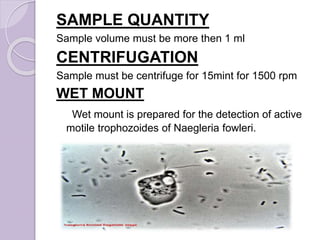
WET MOUNT
Wet mount is prepared for the detection of active
motile trophozoides of Naegleria fowleri.
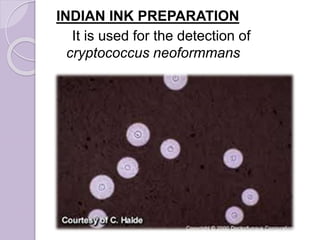
INDIAN INK PREPARATION
It is used for the detection of
cryptococcus neoformmans
SEROLOGY OF THE BACTERIAL ANTIGEN
Latex particles agglutination test is used
for the detection of following bacteria.
1. Streptococcus group B
2. Hemophillus influenza B
3. Streptococcus pneumonia
4. Neisseria meningitidis serotype
A,B,C,Y and W135
5. Escherichia coli serotype K1
PROCESSING OF CEREBROPSPINAL
FUID(CSF)
GRAM STAINING
 Pus cells
 Yeast cells
 Bacteria
 Epithelial cells
MEDIA
 Choclate agar
 Sheep blood agar/colistin nalidix agar
 MacConkey agar
METHOD OF INOCULATION
 Isolation method
INCUBATON CONDITION
 Choclate agar and SBA/CNA at 35-37°C with 5-10% CO₂ for 18-24
hours
 MacConkey agar at 35-37°C ambient air for 18-24 hours
SUB-CULTURE
• Inoculated the sample during
processing in Brain heart infusion (BHI)
with empty control of BHI and
incubated at 35-37°C ambient air for
18-24 hours
• On next day subculture it on Choclate
agar and MacConkey agar.
PROCESSING OF BILEGRAM STAINING
 Pus cells
 Epithelial cells
 Yeast cells
 Bacteria
MEDIA
 Choclate agar
 Sheep blood agar/colistin nalidix agar
 MacConkey agar
 Xylose Lysine Deoxycholate (XLD) Agar
METHOD OF INOCULATION
 Isolation method
INCUBATON CONDITION
 Choclate agar and SBA/CNA at 35-37°C with 5-10% CO₂ for 18-24
hours
 MacConkey and XLD agar at 35-37°C ambient air for 18-24 hours
SUB-CULTURE
• Inoculated the sample during
processing in cooked meat broth and
selenite F broth and incubated at 35-
37°C ambient air for 18-24 hours
• On next day subculture it on Choclate
agar, Sheep blood agar, XLD and
MacConkey agar.
 Why we used XLD and Selenite F
broth?
 For the detection of Salmonella spp.
 Why Salmonella spp are suspected in
bile aspirate?
 Because the salmonella spp is present
as a carrier state in the gallbladder
and the bile is secreted from the
gallbladder.
PROCESSING OF ANAROBIC
CULTURE
All the specimen that are sub-culture
in cooked meat broth are also culture
anarobically
 PROCESSING
• When performing subculture the SBA
plate is kept in anaerobic jar.
• As a control streak pseudomonas
aeroginosa on Muller Hinton(MH) agar
• Kept the Gas Pack in the anarobic jar
with in 10 sec and closed the jar
PROCESSING OF ANAROBIC
CULTURE
• Incubated the jar at 37ºc ambient
atmosphere for 48 hours.
• For more specificity a disk of
Metronidazole is place on the streak
• If there is a zone of inhibition around
the disk so the bacterial growth is
confirmed anaerobic
• After 48 hours if there is any growth
present gram stain is done.
PROCESSING OF ANAROBIC
CULTURE
• For the confirmation “Aero tolerance
Test” is done.
• If there is a growth in Aero tolerance
Test so the growth on anaerobic
culture is considered as facultative
anarobe or contamination.
• If there is no growth in Aero tolerance
Test so the gram satin result of
anaerobic culture media is reported as
• GRAM POSITIVE ANAROBE
• GRAM NEGATIVE ANAROBE
Microbiologica Samples processing

Microbiologica Samples processing

  • 1.
  • 2.
    SWABS PROCESSING All swabsincluding aural, eye, pus and wound swab except high vaginal swab process in the same way. GRAM STAINING  Not recommanded. MEDIA  Choclate agar  Sheep blood agar/colistin nalidix agar  MacConkey agar METHOD OF INOCULATION  Isolation method INCUBATON CONDITION  Choclate agar and SBA/CNA at 35-37°C with 5-10% CO₂ for 18-24 hours  MacConkey agar at 35-37°C ambient air for 18-24 hours
  • 3.
    SUB-CULTURE • Inoculated thesample during processing in Brain heart infusion (BHI) and incubated at 35-37°C ambient air for 18-24 hours • On next day subculture it on Choclate agar and MacConkey agar. RECOMMANDATON FOR EYE SWAB Conjunctiva • Sample each eye with separate swabs (premoistened with sterile saline) by rolling over conjunctiva. When only one eye is infected, sampling both can help distinguish indigenous microflora from true pathogens.
  • 4.
    EYE SWAB WETMOUNT  For acanthamoebae that cause sever Amoebic keratitis .
  • 5.
    HIGH VAGINAL SWAB(HVS)/URETHRAL SWAB GRAM STAINING  Pus cells  Clue cells  Yeast cells  Bacteria MEDIA  Gonococcus agar  Sheep blood agar  Sabrouds Dextose agar METHOD OF INOCULATION  Isolation method INCUBATON CONDITION  Gonoccous agar and SBA at 35-37°C with 5-10% CO₂ for 18-24 hours  Sabrouds Dextose agar at 35-37°C ambient air for 18-24 hours
  • 6.
  • 7.
    THROAT SWAB GRAM STAINING •Not recommanded. MEDIA  Sheep blood agar METHOD OF INOCULATION  Isolation method INCUBATON CONDITION  Sheep blood agar at 35-37°C with 5-10% CO₂ for 18-24 hours SUB-CULTURE • Not recommanded
  • 8.
    CENTRAL LINE TIP CENTRALVENOUS CATHETR TIP(CVP) GRAM STAINING • Not recommanded. MEDIA  Sheep blood agar  Manitol Salt Agar METHOD OF INOCULATION • semiquantitative roll- plate method (Maki's technique) • performed by rolling the external surface of a catheter tip back and forth on the surface of agar plate at least three times. • INCUBATON CONDITION  Sheep blood agar at 35-37°C with 5-10% CO₂ for 18-24 hours  Manitol Salt agar at 35-37°C ambient air for 18-24 hours  SUB-CULTURE • Not recommanded
  • 9.
    Significant colonies  ≥15CFU/ml for the roll plate method.
  • 10.
    PUS IN CONTAINERSYRINGE,TISSUE AND ALL TYPE OF FLUIDS EXCEPT CSF GRAM STAINING  Pus cells  Yeast cells  Bacteria  Epithelial cells MEDIA  Choclate agar  Sheep blood agar/colistin nalidix agar  MacConkey agar METHOD OF INOCULATION  Isolation method INCUBATON CONDITION  Choclate agar and SBA/CNA at 35-37°C with 5-10% CO₂ for 18- 24 hours  MacConkey agar at 35-37°C ambient air for 18-24 hours
  • 11.
    SUB-CULTURE • Inoculated thesample during processing in cooked meat broth and incubated at 35- 37°C ambient air for 18-24 hours • On next day subculture it on Choclate agar, Sheep blood agar and MacConkey agar. • WET MOUNT • For Synovial fluid crystal wet mount is prepared.  Significant crystals of synovial fluids are. 1. Monosodium urate monohydrate 2. Calcium pyrophosphate dihydrate
  • 12.
  • 13.
  • 14.
    LIVER ABSCESS PUS Processingsame as fluids except one additional step. WET MOUNT Wet mount for Entameobae Histolytica.
  • 15.
    PROCESSING OF BONE •Processing same as fluids except one additional step. • Before processing specimen should be kept in Brain Heart Infusion (BHI) for 3-6 hours to soften bone.
  • 16.
    STOOL CULTURE PROCESSING GRAMSTAINING  Not recommanded. MEDIA  Xylose Lysine Deoxycholate (XLD) Agar  Thiosulfate-Citrate-Bile Salts-Sucrose (TCBS) Agar  MacConkey agar  Campy agar METHOD OF INOCULATION  Isolation method INCUBATON CONDITION  campy agar at 42°C with 10% CO₂ for 48-72 hours  MacConkey ,XLD and TCBS agar at 35-37°C ambient air for 18-24 hours
  • 17.
    SUB-CULTURE • Inoculated thesample during processing in selenite F broth, if the consistency of stool is liquid also inoculated the sample in Alkaline peptone water (APW) and incubated at 35-37°C ambient air for 18-24 hours. • On next day subculture it on of XLD agar, if the consistency of stool is liquid also subculture it on TCBS agar.
  • 18.
    PROCESSING OF SPUTUM Pour the specimen into dry empty petri dish.  Fill 3 petri dishes with sterile saline.  Wash carefully in the first purulent of the specimen with a sterile loop.  Transfer the respective part of washed specimen to the second dish and wash carefully.  Repeat the step in third dish with the same loop without heating and transport the specimen in the lid,  Make a smear on a glass slide with washed sample, evaluate the washing with 10x objective.  If pus cells are present and epithelial cells are absent then inoculate the sample into media and make gram stain.  If moderate or numerous amount of epithelial cells
  • 19.
    PROCESSING OF TRACHEALASPIRATE  Add an equal volume of sputasol to the specimen and digest the sputum by mixing on votex mixer for 20-30 sec and incubate at 37°C for 15minutes.  When digestion is completed dilute 100ul (0.1ml) of digested sputum into 9.9ml of ringer solution and mix properly.  Transfer 10ul of the diluted well mixed sputum into the agar plates.
  • 20.
    SPUTUM,TRACHEAL ASPIRATE AND BRONCHOALVEOLARLAVAGE(BAL) GRAM STAINING  Pus cells  Epithelial cells  Yeast cells  Bacteria MEDIA  Choclate agar  Sheep blood agar/colistin nalidix agar  MacConkey agar METHOD OF INOCULATION  Isolation method(SPUTUM)  Coloney Count method(TRACHEAL ASPIRATE & BAL) INCUBATON CONDITION  Choclate agar and SBA/CNA at 35-37°C with 5-10% CO₂ for 18-24 hours  MacConkey agar at 35-37°C ambient air for 18-24 hours
  • 21.
    SUB-CULTURE • Not recommanded Significantcolonies of Tracheal Aspirate • Any count of ≥ 105 is consider as significant . Therefore growth of 5 or more than 5 colonies is identified and reported. Each colony on a plate is equal to 20,000 CFU/ml Significant colonies of Bronchoalveolar lavage (BAL) • Any count of ≥ 104 is consider as significant . Therefore growth of 10 or more than 10 colonies is identified and reported. Each colony on a plate is equal to 1000 CFU/ml.
  • 22.
    PROCESSING OF CEREBROPSPINAL FUID(CSF) SAMPLECOLLECTION CSF is routinely collected by lumbar puncture between the third, fourth, or fifth lumbar vertebra. Specimens are collected in three sterile tubes, which are labeled 1, 2, and 3 in the order in which they are withdrawn
  • 23.
     Tube#1 forchemistry and serology analysis(because the chemical analyst are not effected by skin contamination and rupture morphology of cells)  Tube#2 for microbiological analysis(because there is no skin contamination)  Tube#3 for hematological analysis( the morphology of the cell not effected)
  • 24.
    SAMPLE QUANTITY Sample volumemust be more then 1 ml CENTRIFUGATION Sample must be centrifuge for 15mint for 1500 rpm WET MOUNT Wet mount is prepared for the detection of active motile trophozoides of Naegleria fowleri.
  • 25.
    INDIAN INK PREPARATION Itis used for the detection of cryptococcus neoformmans
  • 26.
    SEROLOGY OF THEBACTERIAL ANTIGEN Latex particles agglutination test is used for the detection of following bacteria. 1. Streptococcus group B 2. Hemophillus influenza B 3. Streptococcus pneumonia 4. Neisseria meningitidis serotype A,B,C,Y and W135 5. Escherichia coli serotype K1
  • 27.
    PROCESSING OF CEREBROPSPINAL FUID(CSF) GRAMSTAINING  Pus cells  Yeast cells  Bacteria  Epithelial cells MEDIA  Choclate agar  Sheep blood agar/colistin nalidix agar  MacConkey agar METHOD OF INOCULATION  Isolation method INCUBATON CONDITION  Choclate agar and SBA/CNA at 35-37°C with 5-10% CO₂ for 18-24 hours  MacConkey agar at 35-37°C ambient air for 18-24 hours
  • 28.
    SUB-CULTURE • Inoculated thesample during processing in Brain heart infusion (BHI) with empty control of BHI and incubated at 35-37°C ambient air for 18-24 hours • On next day subculture it on Choclate agar and MacConkey agar.
  • 29.
    PROCESSING OF BILEGRAMSTAINING  Pus cells  Epithelial cells  Yeast cells  Bacteria MEDIA  Choclate agar  Sheep blood agar/colistin nalidix agar  MacConkey agar  Xylose Lysine Deoxycholate (XLD) Agar METHOD OF INOCULATION  Isolation method INCUBATON CONDITION  Choclate agar and SBA/CNA at 35-37°C with 5-10% CO₂ for 18-24 hours  MacConkey and XLD agar at 35-37°C ambient air for 18-24 hours
  • 30.
    SUB-CULTURE • Inoculated thesample during processing in cooked meat broth and selenite F broth and incubated at 35- 37°C ambient air for 18-24 hours • On next day subculture it on Choclate agar, Sheep blood agar, XLD and MacConkey agar.
  • 31.
     Why weused XLD and Selenite F broth?  For the detection of Salmonella spp.  Why Salmonella spp are suspected in bile aspirate?  Because the salmonella spp is present as a carrier state in the gallbladder and the bile is secreted from the gallbladder.
  • 32.
    PROCESSING OF ANAROBIC CULTURE Allthe specimen that are sub-culture in cooked meat broth are also culture anarobically  PROCESSING • When performing subculture the SBA plate is kept in anaerobic jar. • As a control streak pseudomonas aeroginosa on Muller Hinton(MH) agar • Kept the Gas Pack in the anarobic jar with in 10 sec and closed the jar
  • 33.
    PROCESSING OF ANAROBIC CULTURE •Incubated the jar at 37ºc ambient atmosphere for 48 hours. • For more specificity a disk of Metronidazole is place on the streak • If there is a zone of inhibition around the disk so the bacterial growth is confirmed anaerobic • After 48 hours if there is any growth present gram stain is done.
  • 34.
    PROCESSING OF ANAROBIC CULTURE •For the confirmation “Aero tolerance Test” is done. • If there is a growth in Aero tolerance Test so the growth on anaerobic culture is considered as facultative anarobe or contamination. • If there is no growth in Aero tolerance Test so the gram satin result of anaerobic culture media is reported as • GRAM POSITIVE ANAROBE • GRAM NEGATIVE ANAROBE