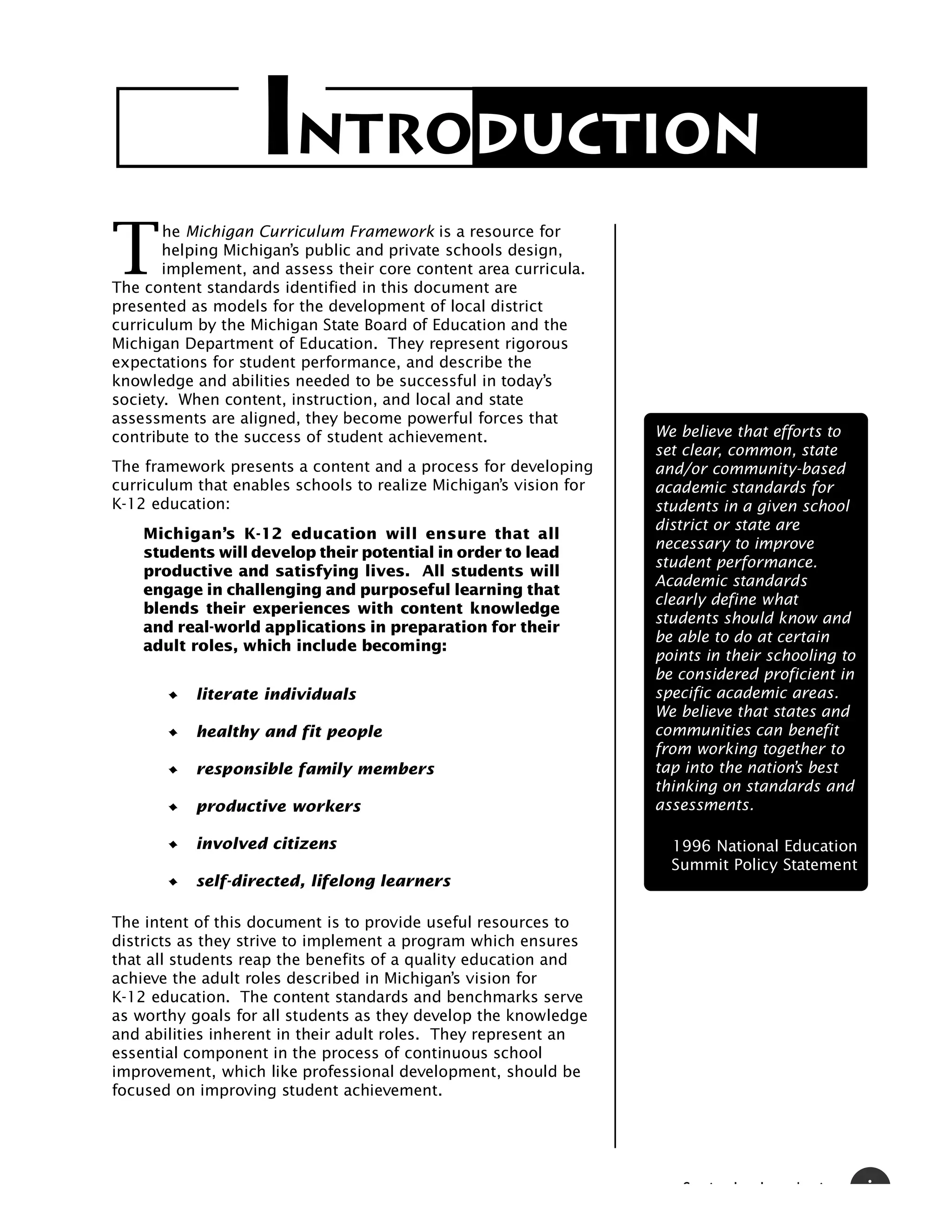
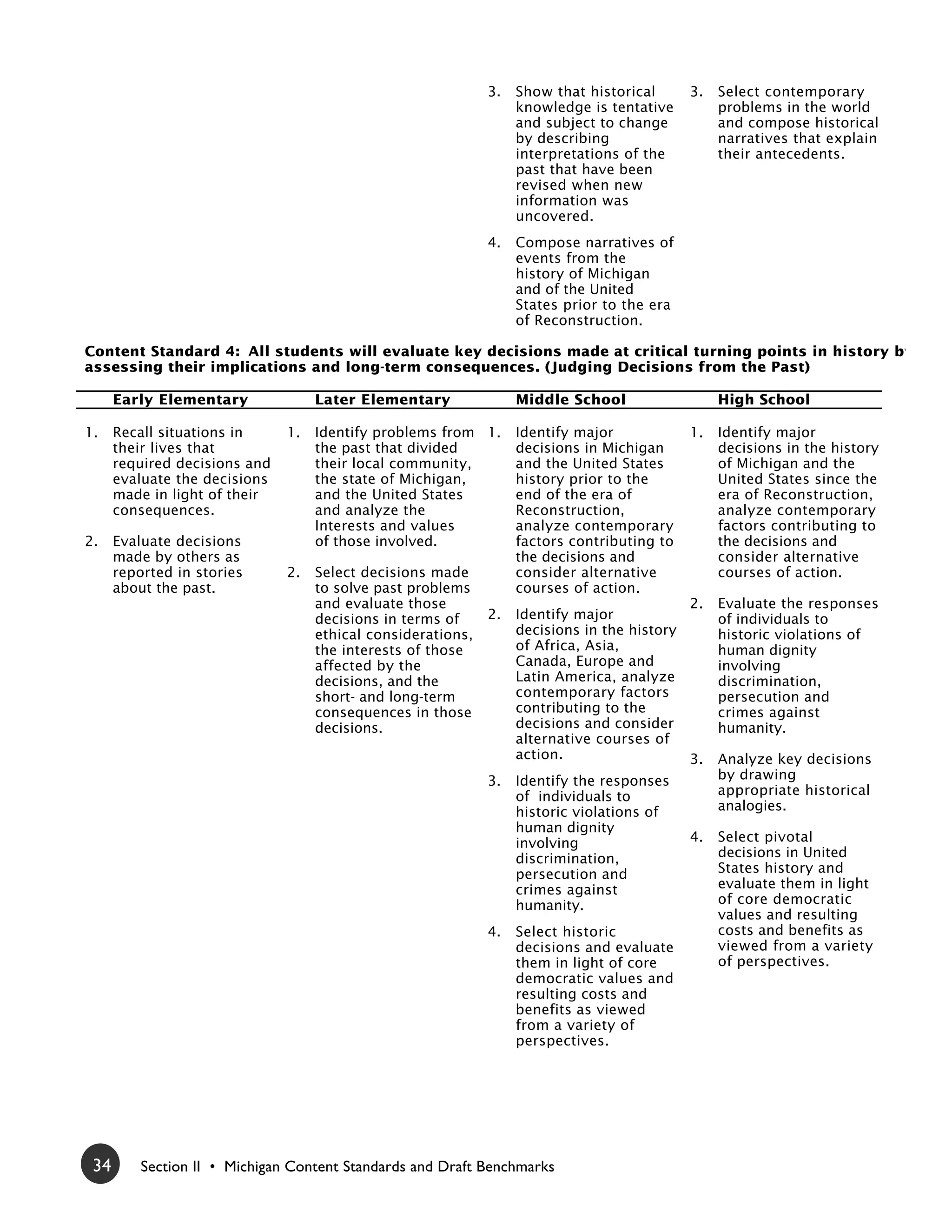
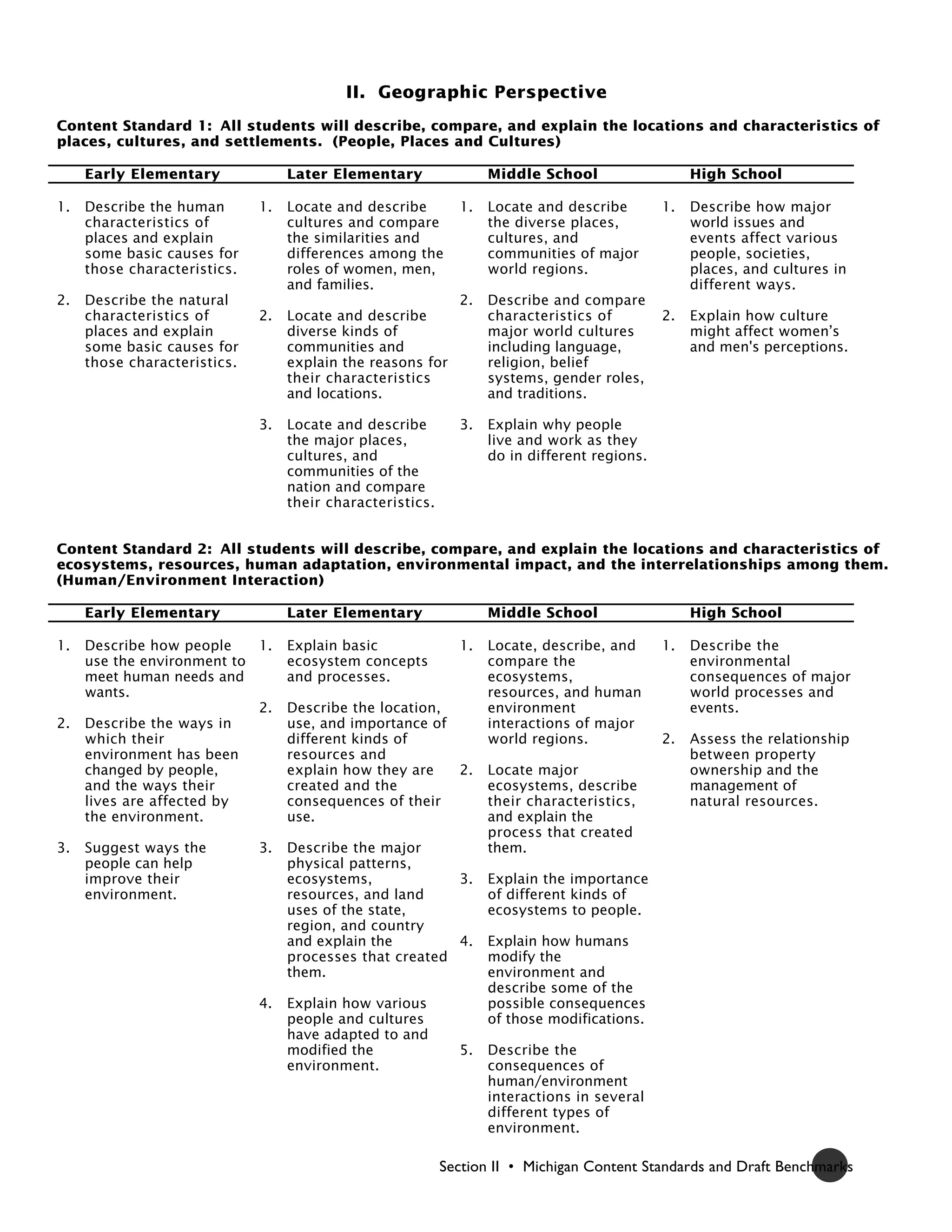
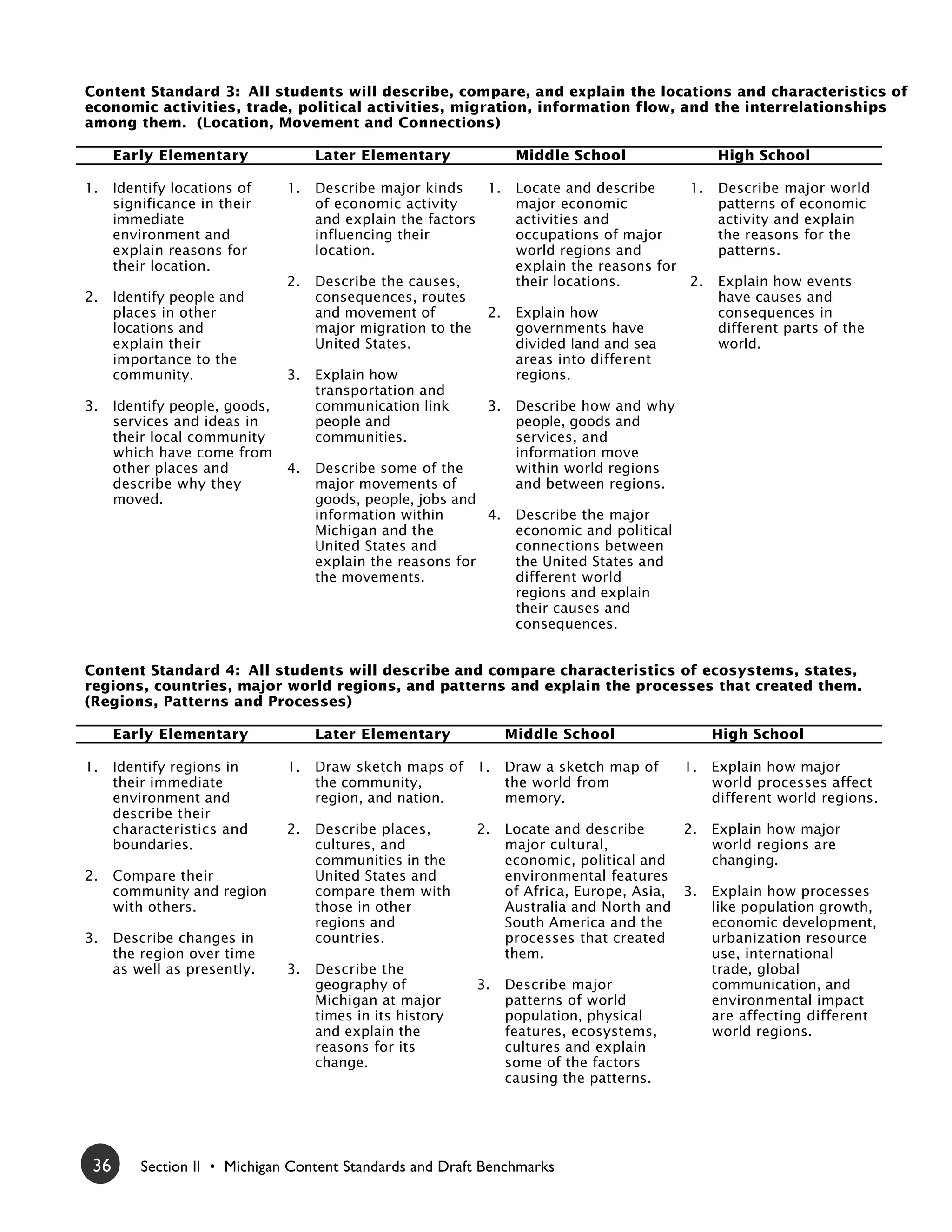
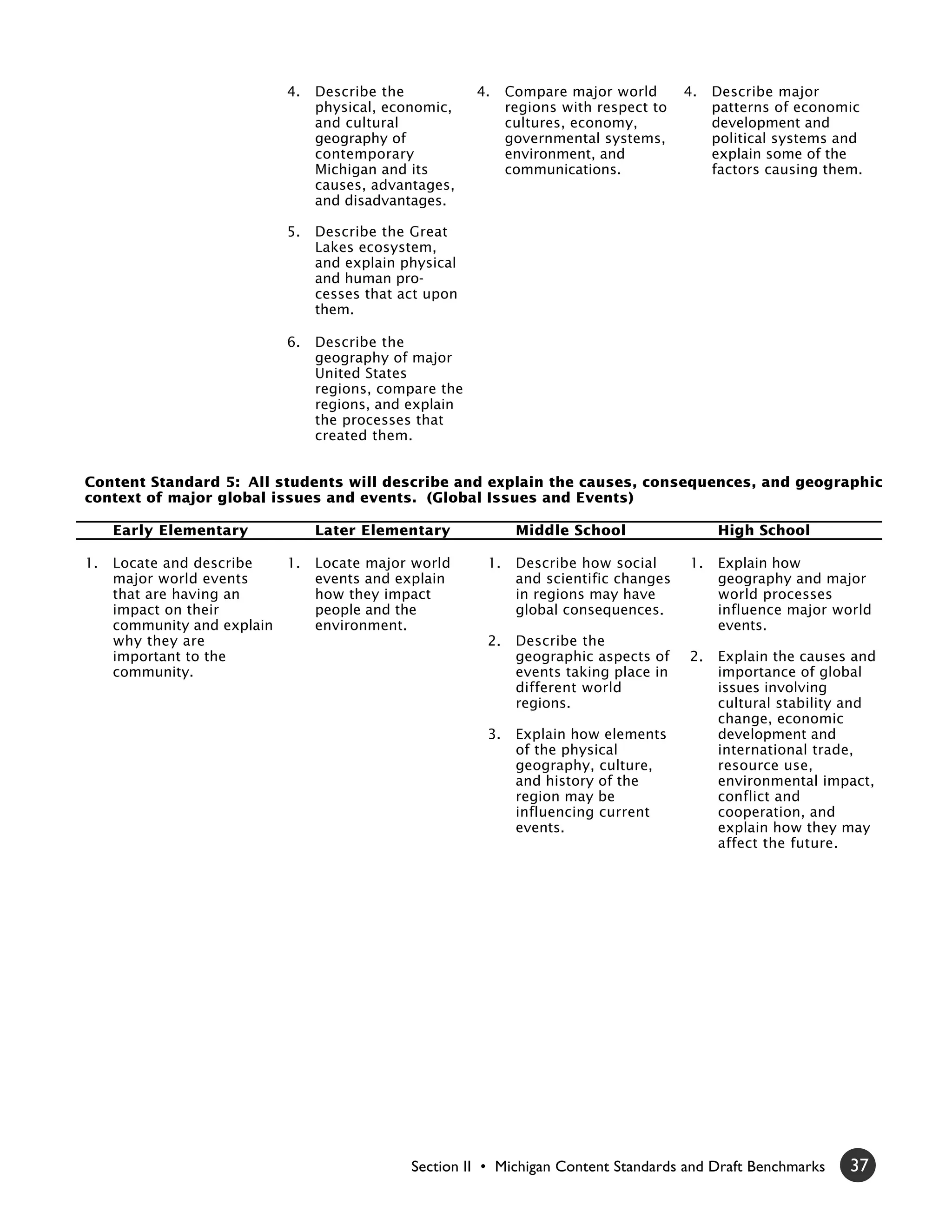
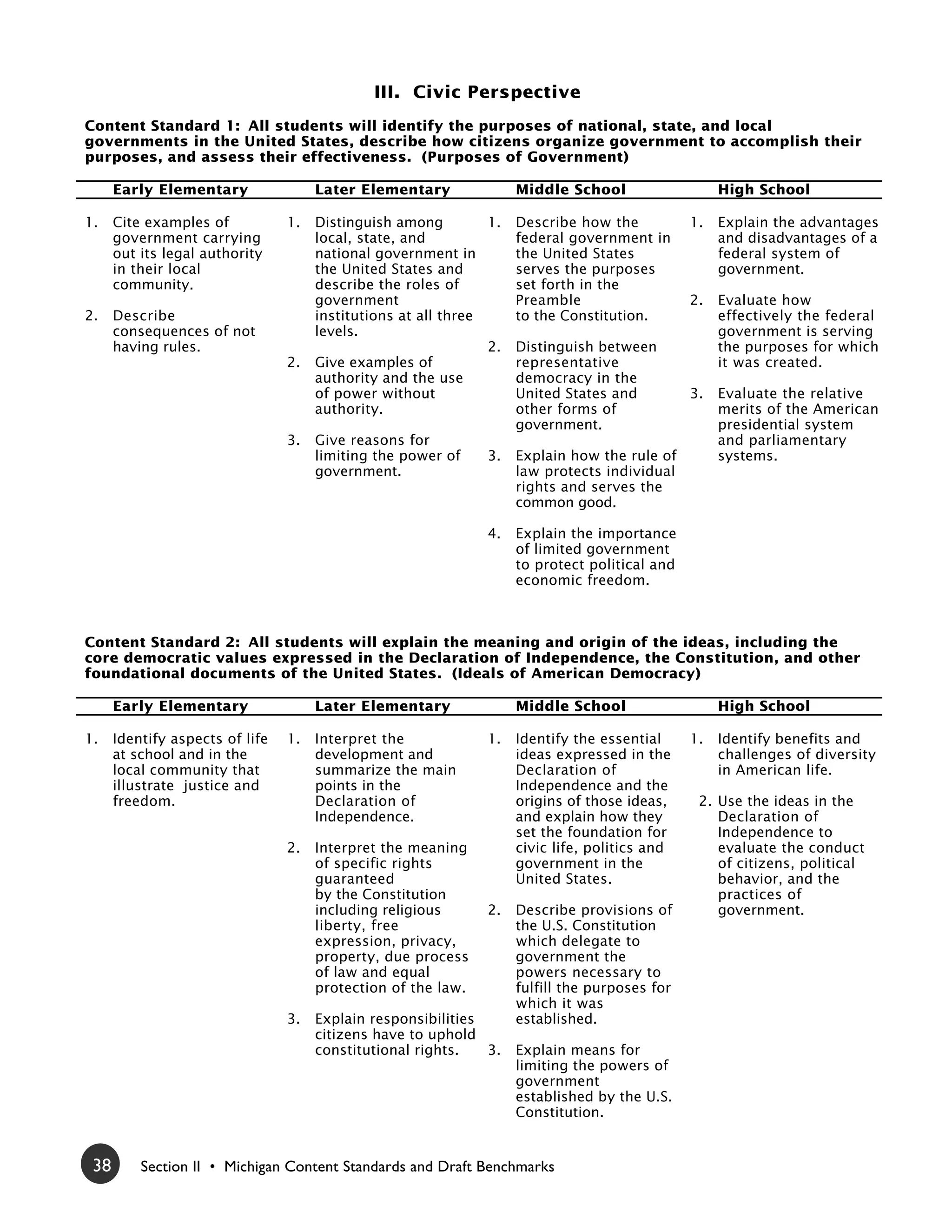
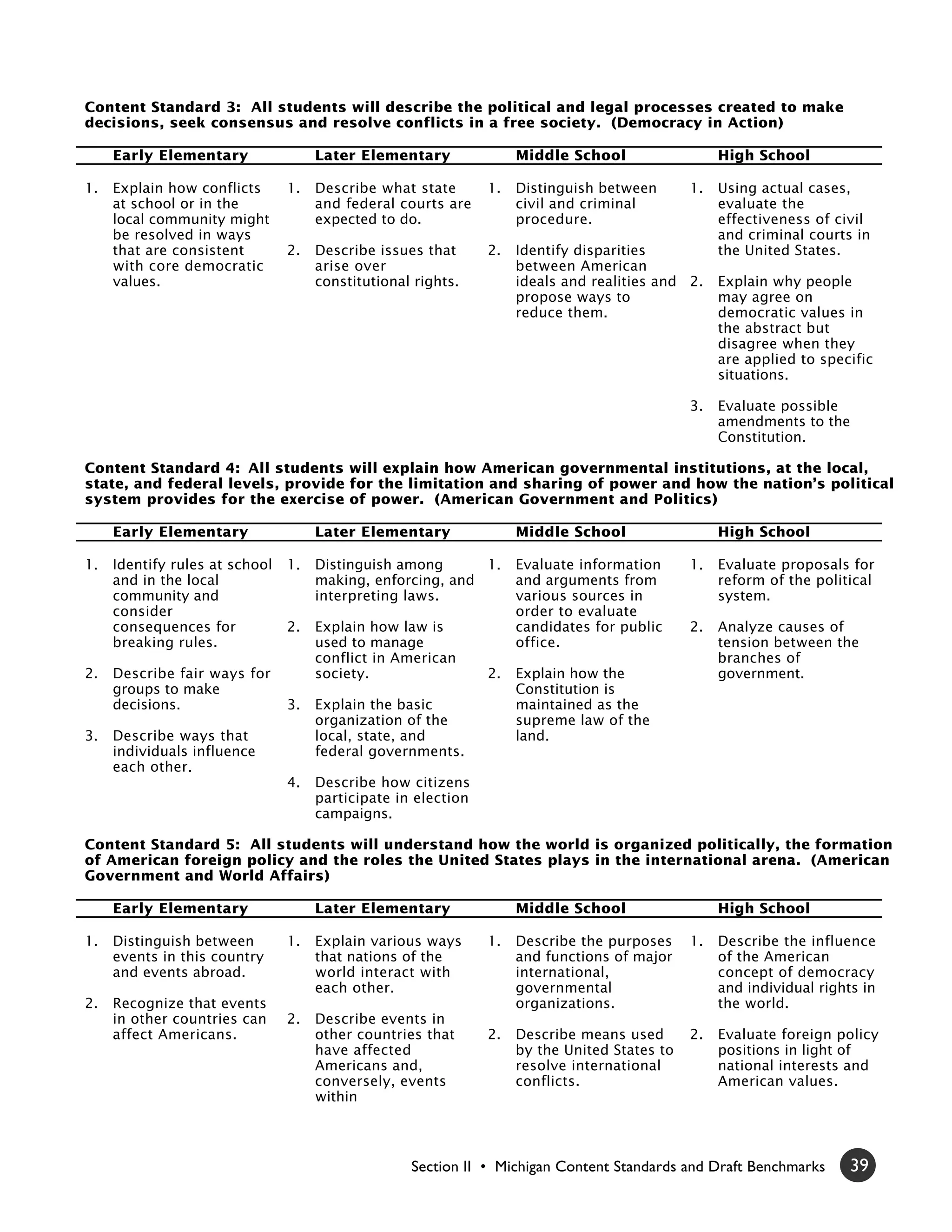
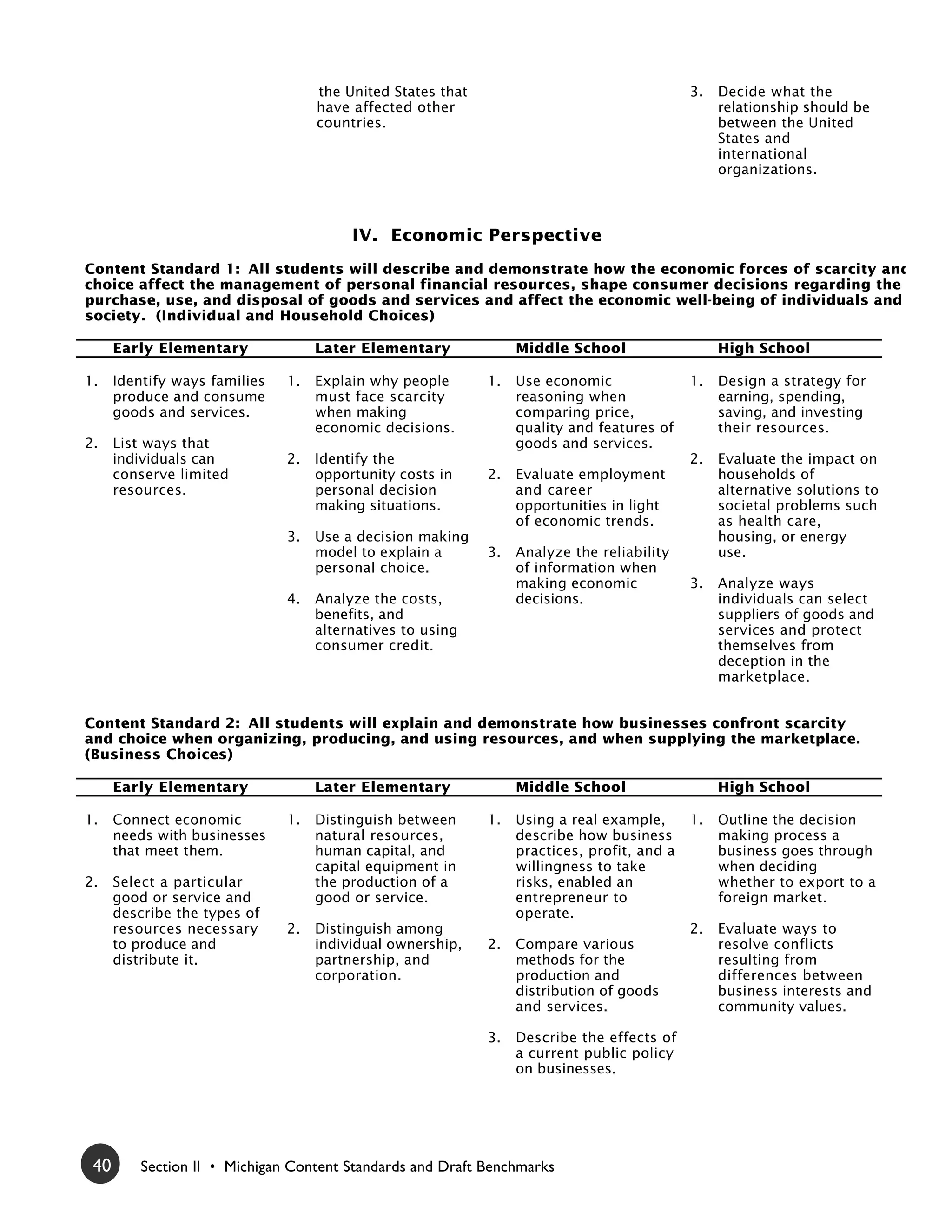
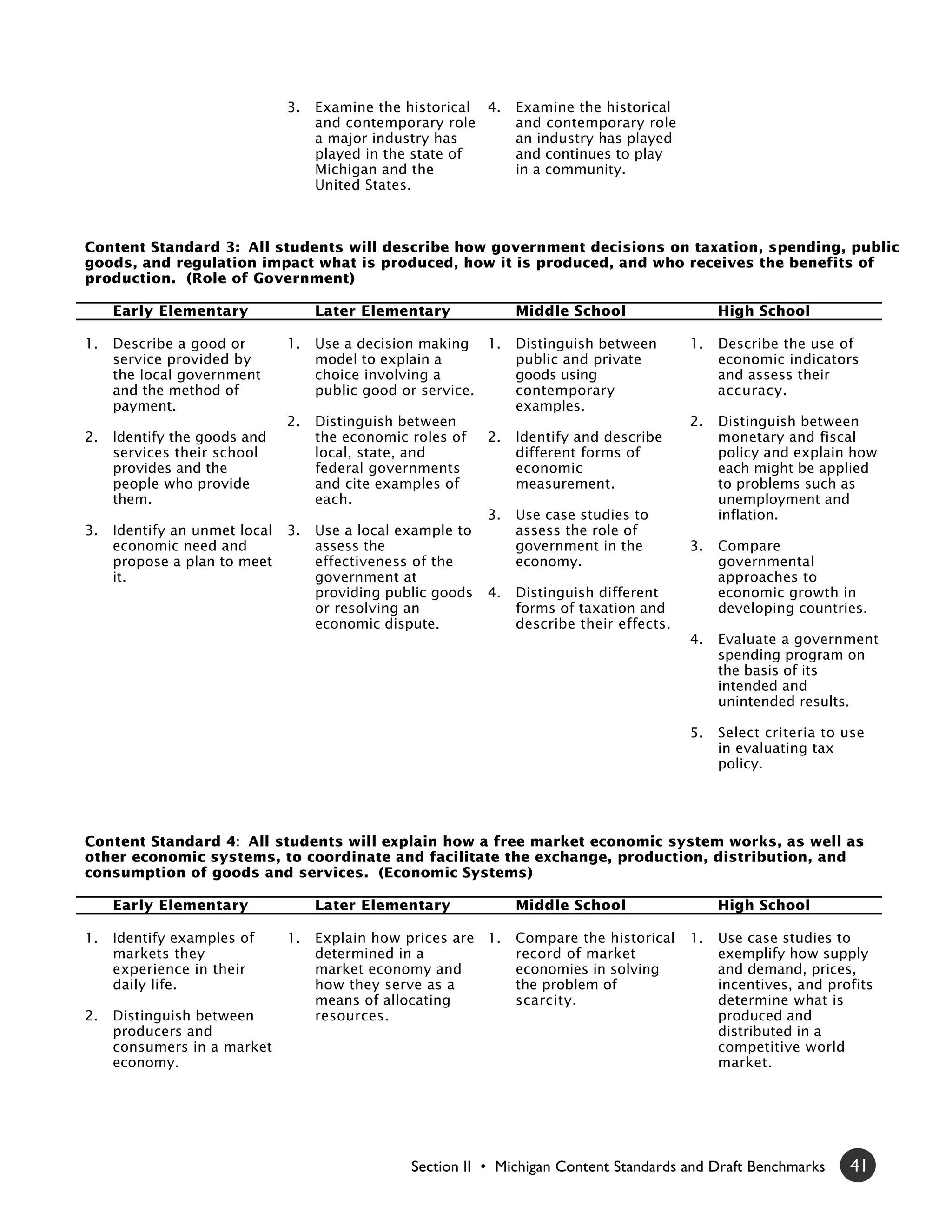
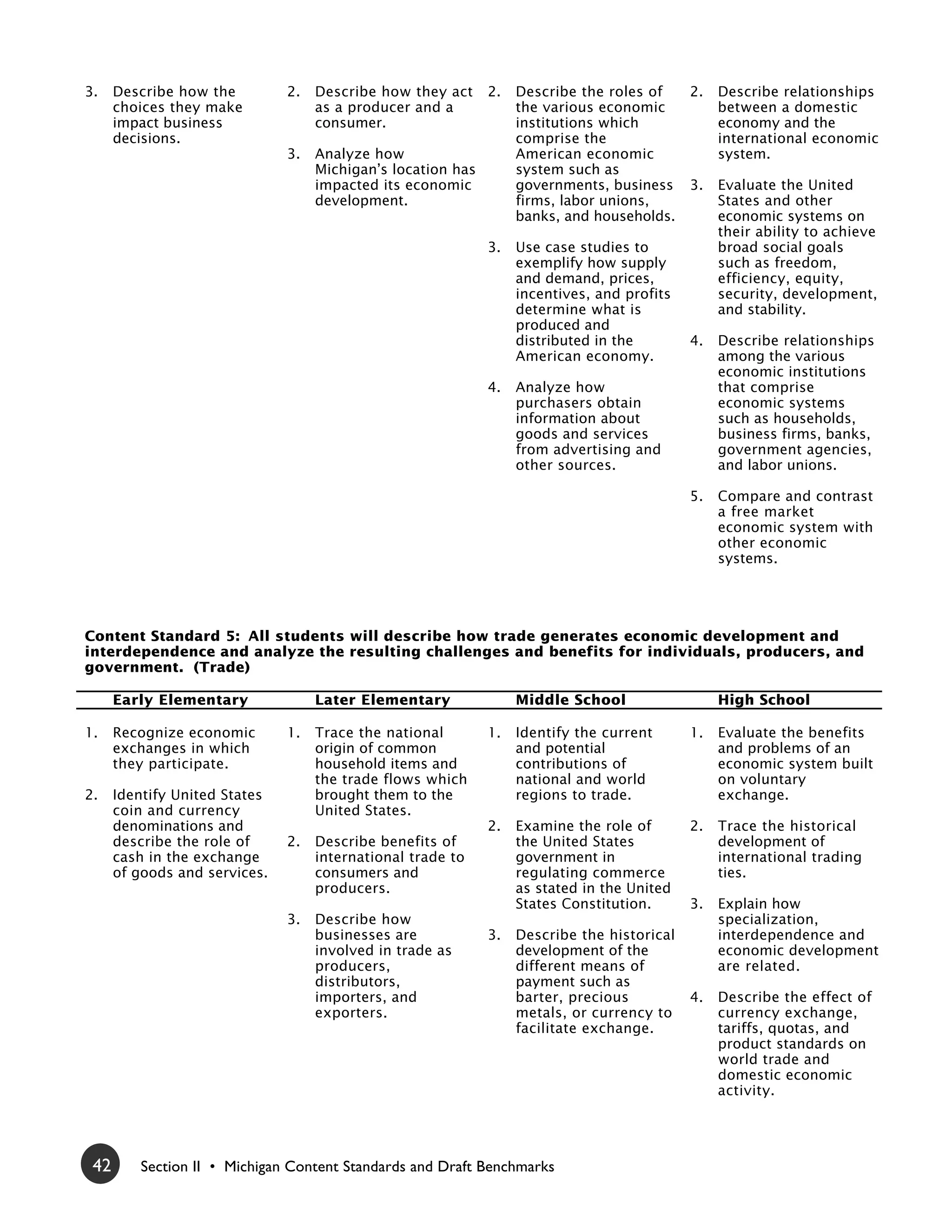
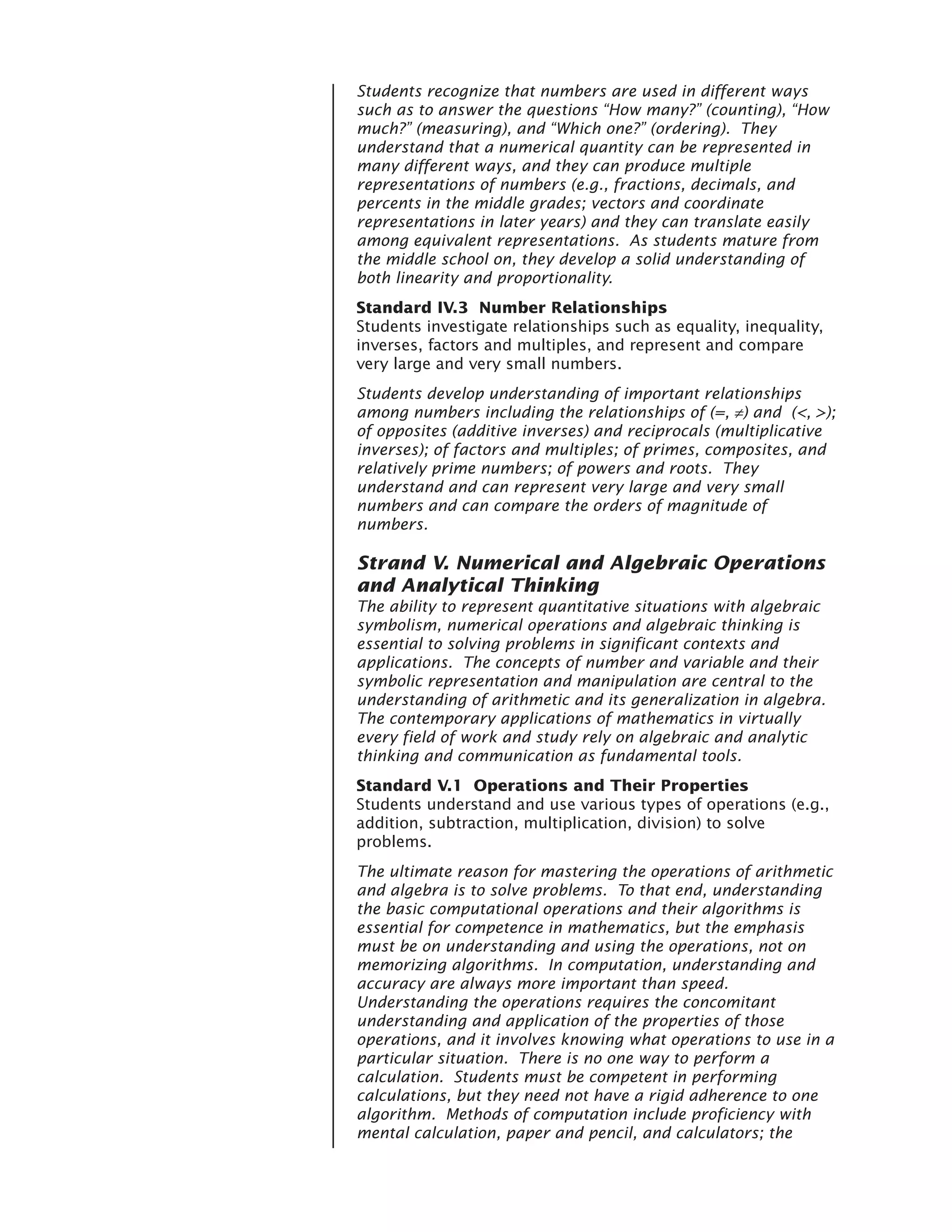
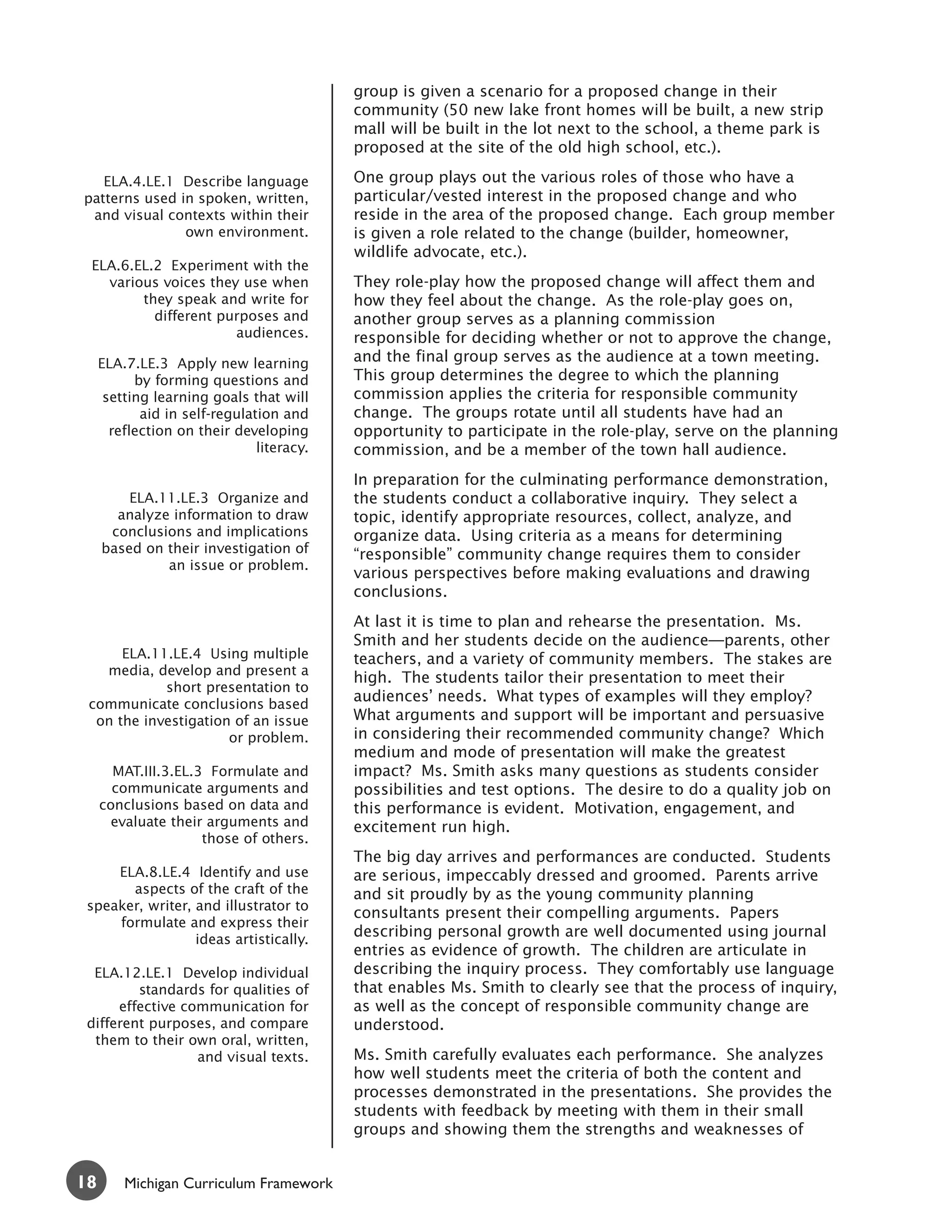
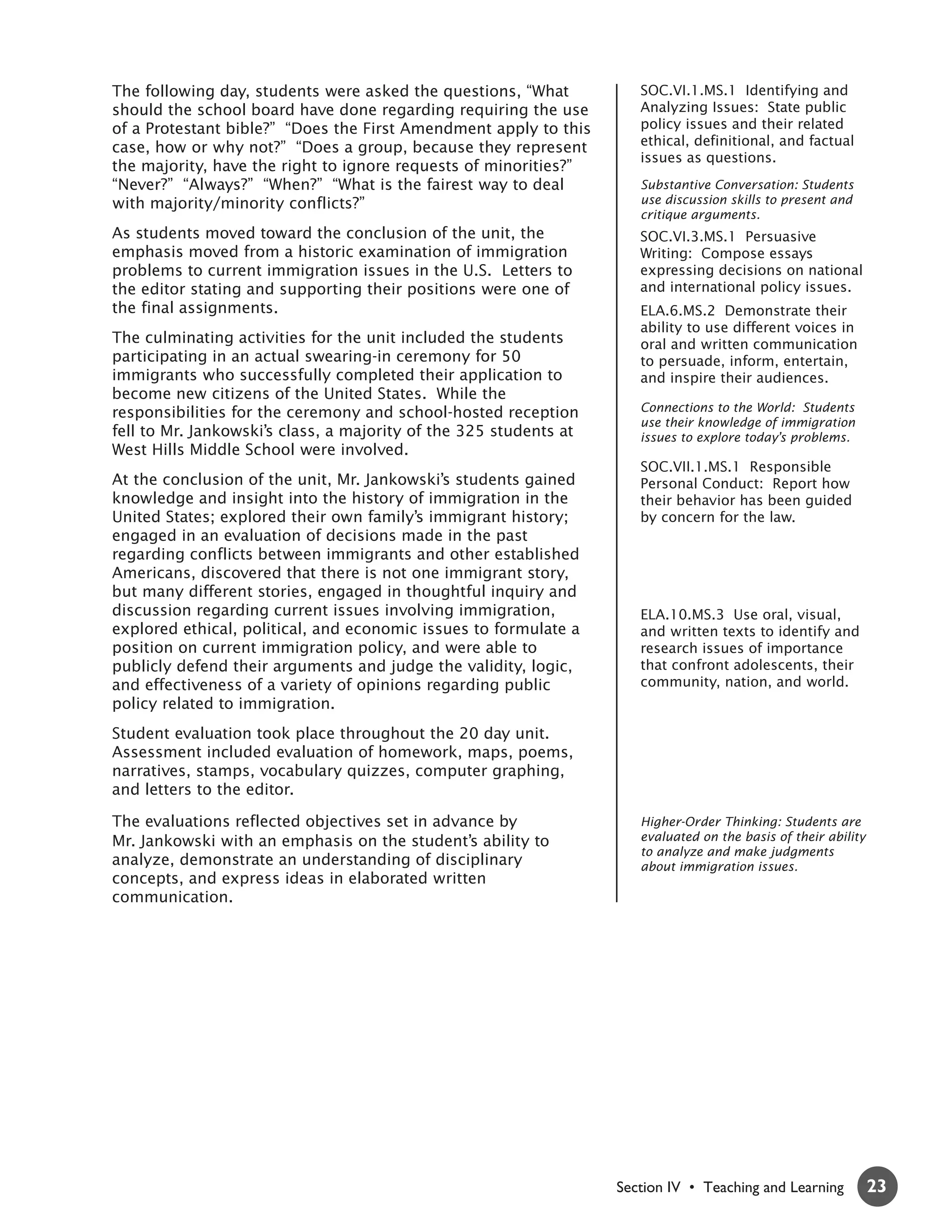
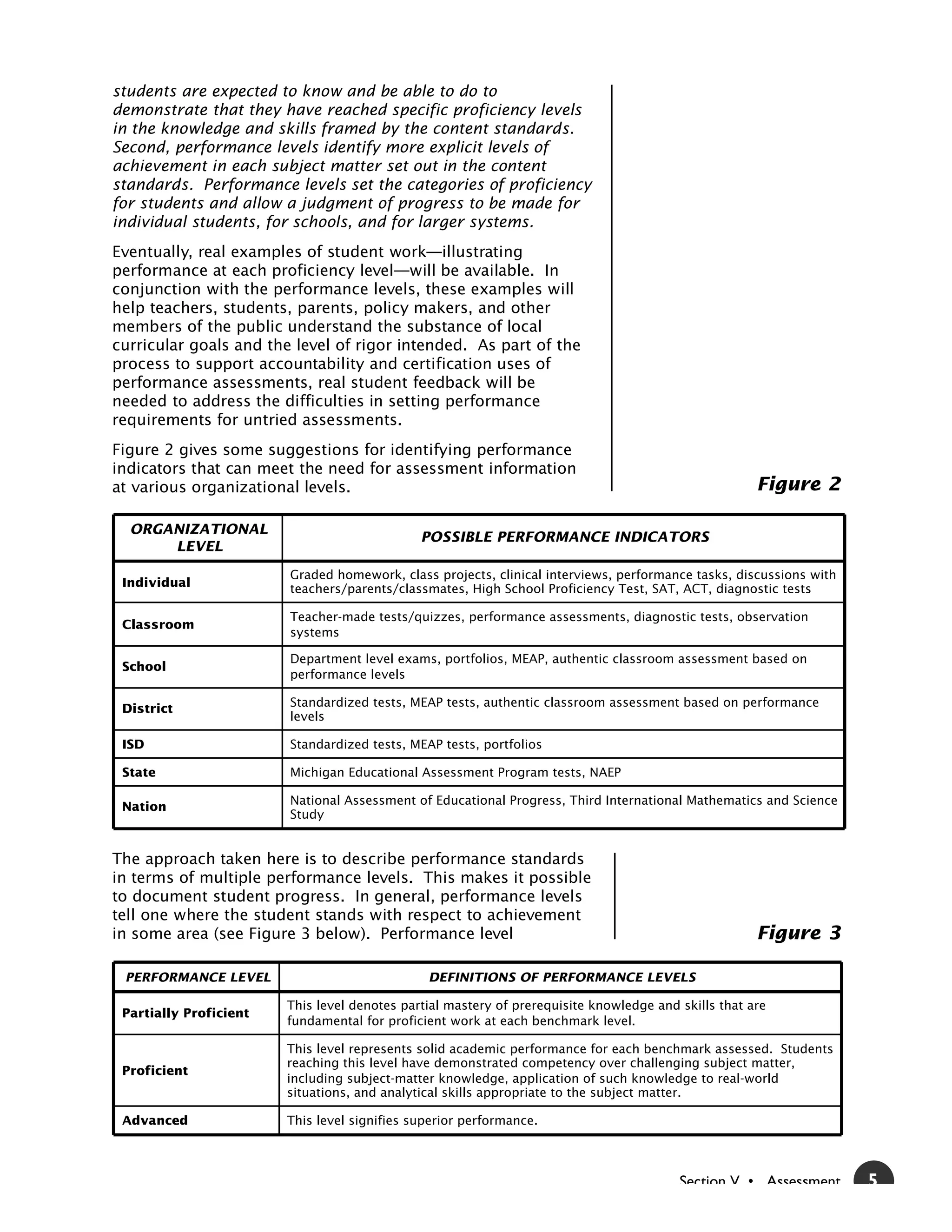
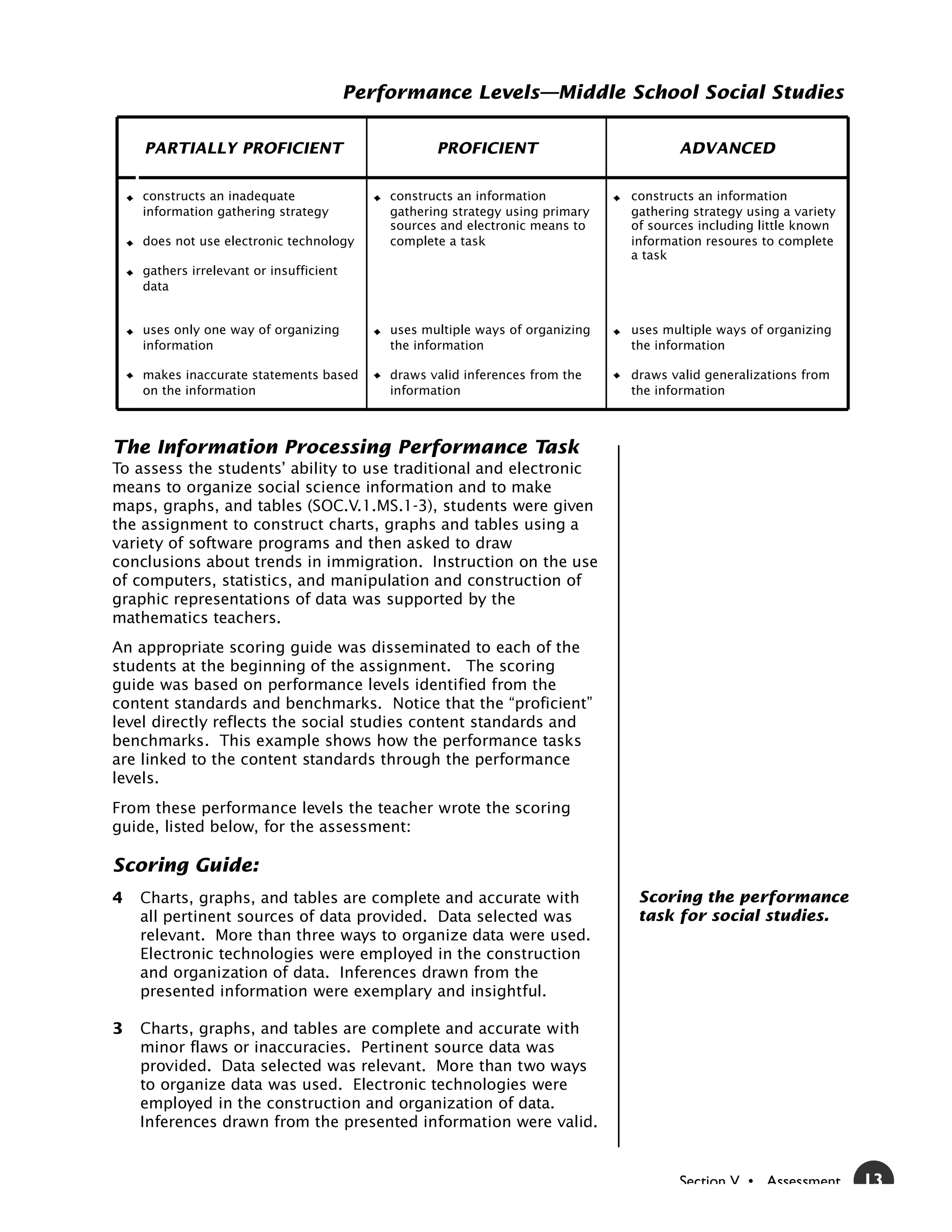
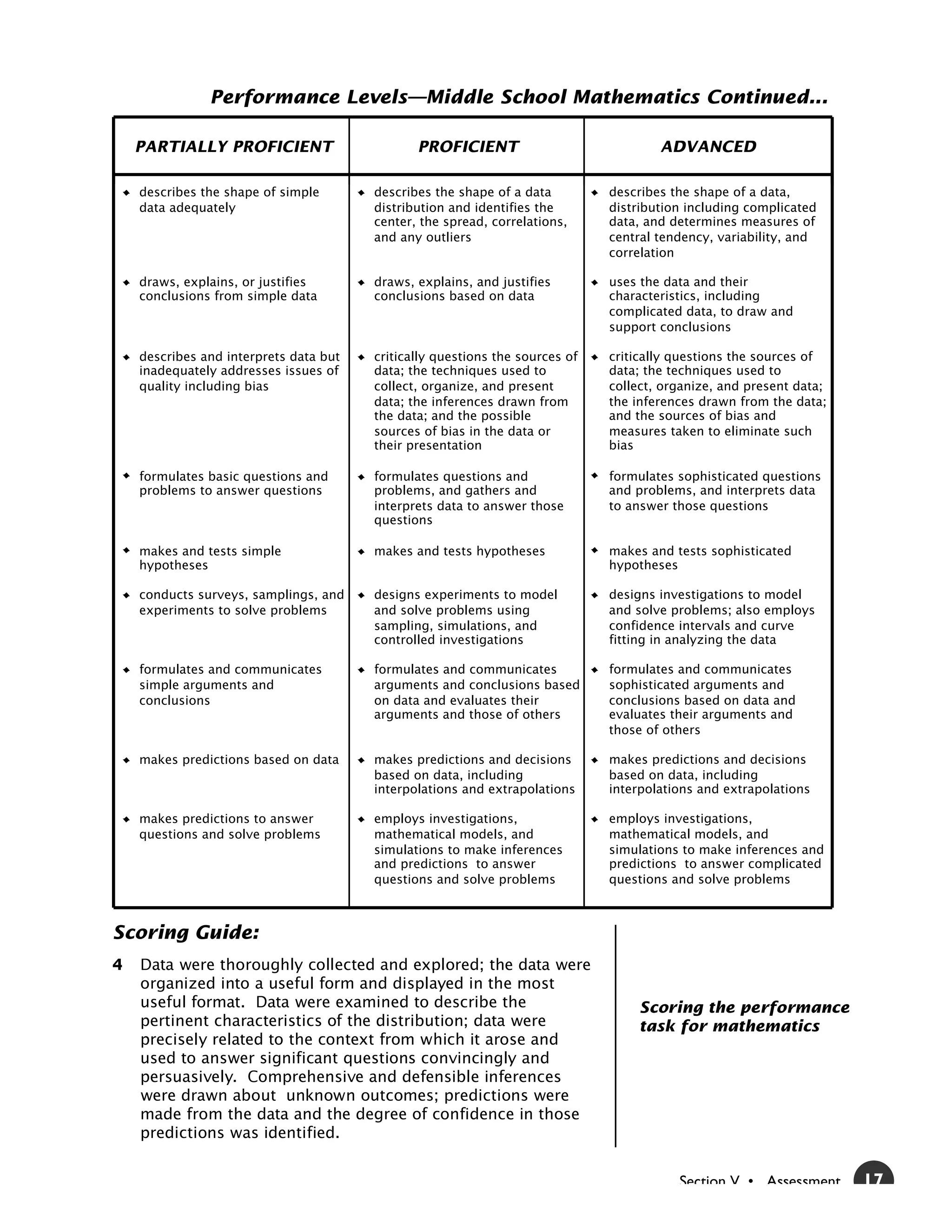
60   Y = 10 * sin (x) + x
                                50
                                40
                                30
                                20
                                10
                                0


                                    10
                                    15
                                    20
                                    25
                                    30
                                    35
                                    40
                                    45
                                    0
                                    5
                                             x


          MICHIGAN
          CURRICULUM
          FRAMEWORK
          Michigan Department of Education
     12
    11
10
9
MICHIGAN
                                      STATE BOARD OF EDUCATION

Clark W. Durant, President .................................................................................................................... Detroit

Marilyn F. Lundy,Vice President.............................................................................................................. Detroit

Dorothy Beardmore, Secretary ........................................................................................................Rochester

Barbara Roberts Mason,Treasurer ....................................................................................................... Lansing

Kathleen N. Straus, NASBE Delegate .................................................................................................. Detroit

Louis E. Legg, III ............................................................................................................................. Battle Creek

Sharon A.Wise ...................................................................................................................................... Owosso

Gary L.Wolfram .................................................................................................................................... Hillsdale

          The opinions expressed herein do not necessarily reflect the position or policy of the Michigan State Board of
             Education, and no official endorsement by the Michigan State Board of Education should be inferred.


                                                             EX OFFICIO MEMBERS

                                                                      John M. Engler

                                                                         Governor

                                                                      Arthur E. Ellis

                                                     Superintendent of Public Instruction


                                                     Number of copies printed: 10,000
                                                        Costs per copy: $3.33


                 The publication of this document is authorized by section 1278 of the School Code of 1976, as
                 revised. The development of this document has been supported by federal funding through
                 the U.S. Department of Education under the Secretary’s Fund for Innovation in Education and
                 the Eisenhower National Program for Mathematics and Science Education.


                                        A publication of the Michigan Department of Education
Michigan
Curriculum Framework

             Michigan Department of Education
                     Lansing, Michigan
                           1996


Copyright © 1996, by The State of Michigan. All Rights Reserved. Local and Intermediate School Districts are
encouraged to create copies for their own educational purposes. No part of this publication may be reproduced,
stored in a retrieval system, or transmitted, in any form or by any means, electronic, mechanical, photocopying,
recording or otherwise for commercial purposes without the prior written permission of the Michigan State Board
of Education.
Table of Contents

                  Section I: Introduction


Section II: Michigan Content Standards and Draft Benchmarks


                   Section III: Planning

             Section IV: Teaching and Learning


                  Section V: Assessment


           Section VI: Professional Development


               Appendix A: Tier II – Toolkits


              Appendix B: Tier III – Resources


                   Appendix C: Glossary


                 Appendix D: Contributors
Section I:


      Introduction
INTRODUCTION
T
       he Michigan Curriculum Framework is a resource for
       helping Michigan’s public and private schools design,
       implement, and assess their core content area curricula.
The content standards identified in this document are
presented as models for the development of local district
curriculum by the Michigan State Board of Education and the
Michigan Department of Education. They represent rigorous
expectations for student performance, and describe the
knowledge and abilities needed to be successful in today’s
society. When content, instruction, and local and state
assessments are aligned, they become powerful forces that
contribute to the success of student achievement.                  We believe that efforts to
                                                                   set clear, common, state
The framework presents a content and a process for developing      and/or community-based
curriculum that enables schools to realize Michigan’s vision for   academic standards for
K-12 education:                                                    students in a given school
                                                                   district or state are
    Michigan’s K-12 education will ensure that all
                                                                   necessary to improve
    students will develop their potential in order to lead
                                                                   student performance.
    productive and satisfying lives. All students will
                                                                   Academic standards
    engage in challenging and purposeful learning that
                                                                   clearly define what
    blends their experiences with content knowledge
                                                                   students should know and
    and real-world applications in preparation for their
                                                                   be able to do at certain
    adult roles, which include becoming:
                                                                   points in their schooling to
                                                                   be considered proficient in
           literate individuals                                    specific academic areas.
                                                                   We believe that states and
           healthy and fit people                                  communities can benefit
                                                                   from working together to
           responsible family members                              tap into the nation’s best
                                                                   thinking on standards and
           productive workers                                      assessments.

           involved citizens                                         1996 National Education
                                                                     Summit Policy Statement
           self-directed, lifelong learners

The intent of this document is to provide useful resources to
districts as they strive to implement a program which ensures
that all students reap the benefits of a quality education and
achieve the adult roles described in Michigan’s vision for
K-12 education. The content standards and benchmarks serve
as worthy goals for all students as they develop the knowledge
and abilities inherent in their adult roles. They represent an
essential component in the process of continuous school
improvement, which like professional development, should be
focused on improving student achievement.


                                                                      S   i   I   I   d   i       i
The framework emphasizes the importance of:
                                          using continuous school improvement to align all
                                          district initiatives for the purpose of increasing
                                          student achievement;
                                          building a curriculum based on rigorous content
                                          standards and benchmarks;
                                          using student achievement data to make decisions
                                          about continuous school improvement, curriculum,
                                          instruction, and professional development; and,
                                          incorporating research-supported teaching and
                                          learning standards into daily instructional practice.

                                   BACKGROUND
                                   In 1993, the Michigan Department of Education, in
                                   collaboration with representatives from five state universities,
                                   was awarded federal funding from the U.S. Department of
                                   Education to develop curriculum framework components for
                                   English language arts, mathematics, science, and geography.
ÒSetting high standards for        In addition, the Michigan Council for the Social Studies offered,
our children. It’s the sine        and was supported by the State Board of Education, to develop
qua non for any other              a curriculum framework component for social studies which
reforms anyone might want          would include history, economics, and American government,
to implement. We can’t             and would be complementary to the geography framework.
judge the efficacy of ideas
because we have no                 The Michigan Curriculum Framework brings together the work
yardsticks by which to             of individual content area projects to present a unified view of
measure success or failure.”       curriculum, one which addresses the educational needs of the
                                   whole learner. The goal of the curriculum framework is to
           Louis V. Gerstner       improve student achievement by aligning classroom instruction
     Chairman and CEO, IBM         with core curriculum content standards and national content
                                   standards. It is designed to be used as a process for the
                                   decision-making that guides continuous school improvement.
                                   It describes curriculum, instruction, and assessment and
                                   focuses on improving program quality by aligning all the
                                   processes that affect a student’s achievement of rigorous
                                   content standards.
                                   Framework project co-directors, university representatives, and
                                   the Michigan Department of Education content area consultants
                                   met regularly with members of their content area professional
                                   organizations to design the components of the curriculum
                                   framework. Committees of teachers and university personnel
                                   worked together to draft the content standards, benchmarks,
                                   and performance standards for their specific content areas.
                                   Co-directors met on a monthly basis to coordinate the efforts of
                                   the various content area committees in developing K-12
                                   standards and benchmarks for their subject areas. Their
                                   purpose was to ensure that the framework represents a
                                   consistent view of curriculum across content areas. They
                                   wanted to facilitate continuous school improvement by
                                   emphasizing commonalities among the content areas with
                                   regard to professional development, assessment, and
                                   instruction.


ii   Mi hi   C   i l   F       k
The co-directors were guided by a Joint Steering Committee
comprised of representatives from the content areas, parents,
business leaders, labor leaders, house and senate staff, and
educators. Joint Steering Committee members reviewed the
framework projects at each phase of their development and
made recommendations for improving their quality. Their
insight helped the co-directors incorporate the views of all of
Michigan’s interested parties into the final framework
document.

WHAT IS IN THE FRAMEWORK?
The framework includes the resources needed to develop a
standards-based curriculum. Standards and benchmarks for
English language arts, mathematics, science, and social studies
are included in this edition of the framework. Standards and
benchmarks for arts education, career and employability skills,
health education, life management education, physical
education, technology education, and world languages will be
added to the next edition of the framework. The process
described in the framework will be expanded to incorporate the
additional core content areas when they are completed. The
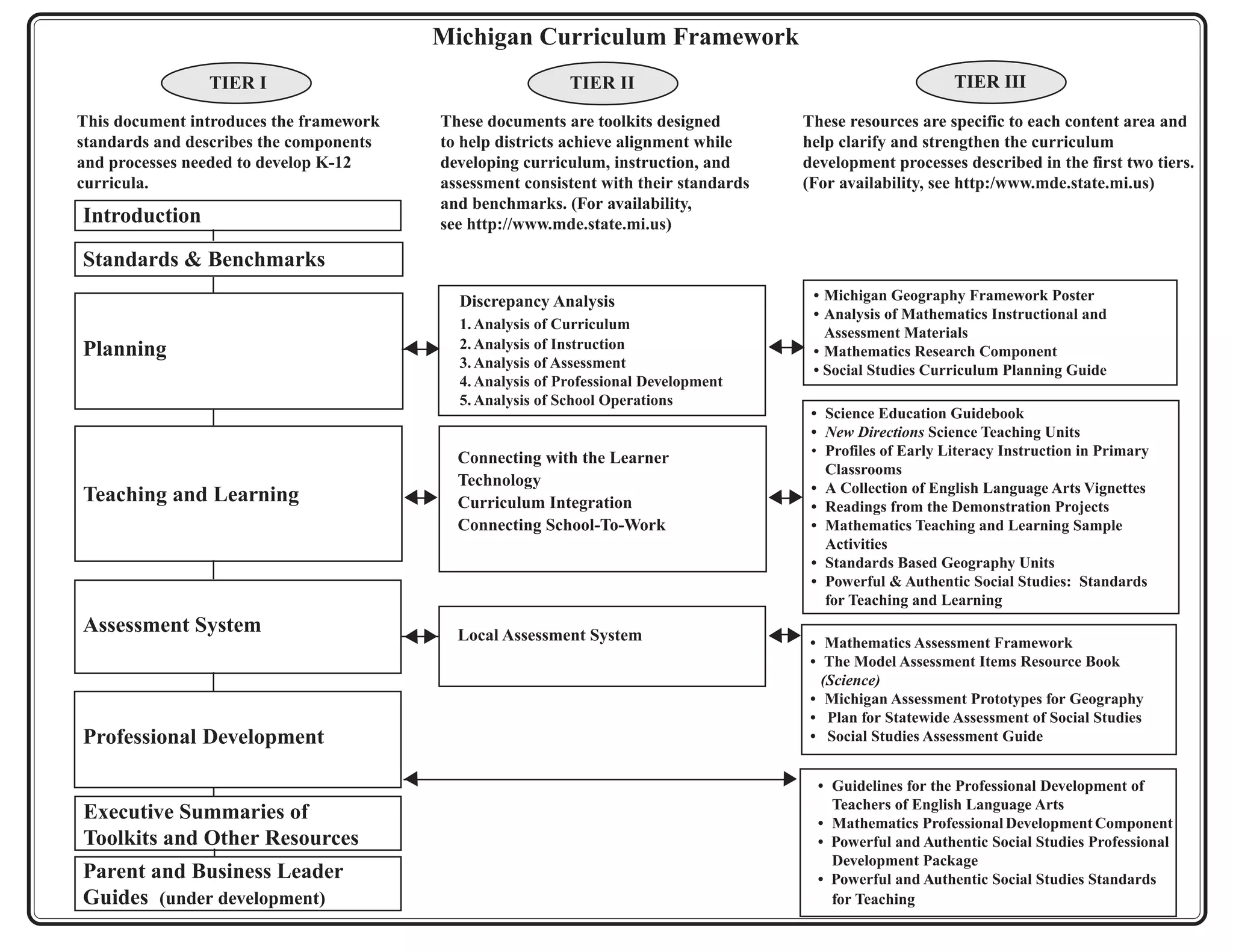
chart on page vi provides a list of the materials that eventually
will be included in the framework document.

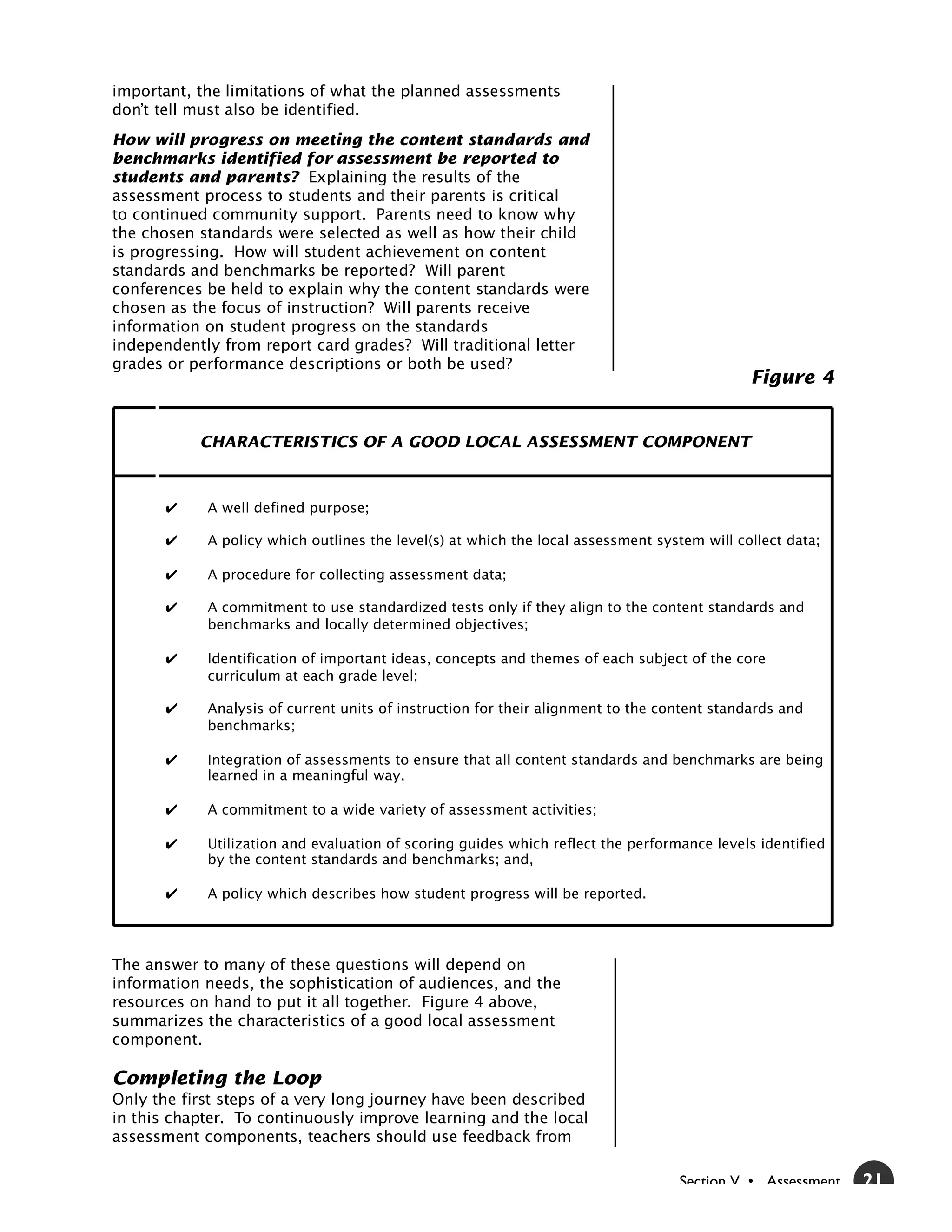
Tier I
Content Standards and Benchmarks
Tier I begins with a complete list of core curriculum content
standards and benchmarks for grades K-12 in the areas of
English language arts, mathematics, science and social science.
The standards describe what all students should know and be
able to do in each of the subject areas. The benchmarks
indicate what students should know and be able to do at
various developmental levels (i.e., early elementary school,
later elementary school, middle school, and high school).

Planning
The framework includes a planning section. It provides a
model for using the standards and benchmarks to create a local
district curriculum as part of continuous school improvement.
It discusses the importance of involving representatives from
all stakeholders in the curriculum development process. In
addition, it emphasizes the need for alignment among all of
the processes that comprise continuous school improvement
and focuses attention on placing student achievement at the
center of all decision-making. It emphasizes the need for
continuity in a K-12 curriculum. Continuity is developed by
clearly defining benchmarks that establish increasingly
complex demonstrations of rigorous standards.

Teaching and Learning
The section on teaching and learning describes standards that
are the foundation to successful learning in all content areas.
The standards include deep knowledge, higher-order thinking,
substantive conversation, and connections to the world beyond
the classroom. It illustrates the standards through sample


                                                                    S   i   I   I   d   i   iii
teaching vignettes in each of the content areas. It discusses
                                     the importance of incorporating strategies for technology,
                                     connecting with the learner, interdisciplinary learning, and
                                     making school-to-work connections into the curriculum.

                                     Assessment System
                                     The framework contains a section on assessment which
                                     describes the need for developing a local assessment system
                                     to monitor student growth and program effectiveness. This
                                     section of the framework is divided into three parts. The first
                                     part provides a rationale for why an assessment system is
                                     needed. The second part describes how teachers can develop
                                     performance assessments based on the content standards and
                                     benchmarks. The third part discusses important issues related
                                     to building an assessment system that aligns local assessment
                                     practices with state assessment.

                                     Professional Development
                                     The section on professional development lists standards for
                                     the context, content, and process of professional development
                                     experiences. It includes a process for designing professional
                                     development which aligns with school improvement,
                                     curriculum content, student learning, and assessment needs.
                                     A vignette of one teacher’s personal, professional development
                                     experiences is provided to illustrate Michigan’s Standards for
                                     Professional Development.

                                     Executive Summaries and Glossary
                                     The appendices of the framework contain executive
                                     summaries of important resources that will aid a district as it
                                     develops, implements, and monitors its local curriculum. A
                                     glossary of framework terms is also provided.

                                     Tier II
                                     Toolkits
                                     Tier II contains a collection of toolkits designed to help
                                     districts with specific tasks such as conducting discrepancy
                                     analyses. There are additional toolkits to guide districts in
                                     incorporating principles associated with connecting with the
                                     learner, technology, curriculum integration, and making
                                     school-to-work connections. There are toolkits on planning
                                     subject area instructional units, designing classroom
                                     assessments, and planning a district assessment system.
                                     (Some of the above mentioned toolkits are still under
                                     development.)

                                     Tier III
                                     Resources
                                     Tier III contains content-area specific resources that help
                                     clarify the curriculum development process described in the
                                     framework. These include resources such as the Science
                                     Education Guidebook, the Mathematics Teaching and Learning
                                     Sample Activities, Guidelines for the Professional Development
                                     of Teachers of English Language Arts, and Powerful &
                                     Authentic Social Studies Standards for Teaching. It also


iv   Michigan Curriculum Framework
contains a guidebook written specifically for parents and the
business community explaining the elements of the framework.

HOW TO USE THE FRAMEWORK
District school improvement committees and curriculum
development committees will find the framework and its
toolkits very useful as they begin the process of creating a
standards-based curriculum. Reading and discussing the
contents of the framework will help school improvement
committee members gain a clearer understanding of the
curriculum development process. The toolkits will help
subcommittees develop techniques for creating and aligning
curriculum, assessment, and instruction. They will also help
districts make decisions about the professional development
strategies which will most effectively help their students reach
targeted achievement goals.
The first step in using the framework is to make sure that all
interested parties are familiar with its content. Then an
analysis to determine what needs to be done should be
completed. Once the district identifies the tasks that need to
be completed, a plan for structuring committees and a time-line
for completing the tasks should be designed.
The framework is intended for use by all districts. While the
writers used the structure of a middle-sized district as a frame
of reference, the content and processes it describes are equally
important for large and small districts. Although private
schools are not bound by the core curriculum requirements of
the Michigan School Code, they may find the framework useful
as a tool for curriculum development. Large districts, small
districts, private schools, and public school academies may
choose to modify the process to reflect their organizational
structures. The number and size of committees needed to
implement the framework will vary from district to district, but
the task will remain the same: to align curriculum, instruction,
assessment, and professional development for the purpose of
increasing student achievement of rigorous content standards.


                                                                   Section I • Introduction   v
Michigan Curriculum Framework
                TIER I                                             TIER II                                                 TIER III

This document introduces the framework           These documents are toolkits designed            These resources are specific to each content area and
standards and describes the components           to help districts achieve alignment while        help clarify and strengthen the curriculum
and processes needed to develop K-12             developing curriculum, instruction, and          development processes described in the first two tiers.
curricula.                                       assessment consistent with their standards       (For availability, see http:/www.mde.state.mi.us)
                                                 and benchmarks. (For availability,
Introduction                                     see http://www.mde.state.mi.us)

Standards & Benchmarks
                                                   Discrepancy Analysis                               • Michigan Geography Framework Poster
                                                                                                      • Analysis of Mathematics Instructional and
                                                   1. Analysis of Curriculum
                                                                                                        Assessment Materials


                                                                                              v
                                                   2. Analysis of Instruction


                                                                                                  v
                                         v   v
Planning                                                                                              • Mathematics Research Component
                                                   3. Analysis of Assessment                          • Social Studies Curriculum Planning Guide
                                                   4. Analysis of Professional Development
                                                   5. Analysis of School Operations
                                                                                                      • Science Education Guidebook
                                                                                                      • New Directions Science Teaching Units
                                                   Connecting with the Learner                        • Profiles of Early Literacy Instruction in Primary
                                                                                                        Classrooms
                                                   Technology                                         • A Collection of English Language Arts Vignettes
Teaching and Learning


                                                                                                  v
                                         v


                                                                                              v
                                             v


                                                   Curriculum Integration                             • Readings from the Demonstration Projects
                                                   Connecting School-To-Work                          • Mathematics Teaching and Learning Sample
                                                                                                        Activities
                                                                                                      • Standards Based Geography Units
                                                                                                      • Powerful & Authentic Social Studies: Standards
                                                                                                        for Teaching and Learning
Assessment System


                                                                                              v   v
                                         v   v


                                                   Local Assessment System                            • Mathematics Assessment Framework
                                                                                                      • The Model Assessment Items Resource Book
                                                                                                        (Science)
                                                                                                      • Michigan Assessment Prototypes for Geography
                                                                                                      • Plan for Statewide Assessment of Social Studies
Professional Development                                                                              • Social Studies Assessment Guide

                                                                                              v
                                         v


                                                                                                       • Guidelines for the Professional Development of
                                                                                                         Teachers of English Language Arts
Executive Summaries of                                                                                 • Mathematics Professional Development Component
Toolkits and Other Resources                                                                           • Powerful and Authentic Social Studies Professional
                                                                                                         Development Package
Parent and Business Leader                                                                             • Powerful and Authentic Social Studies Standards
Guides (under development)                                                                               for Teaching
Section II:


  Content Standards
 & Draft Benchmarks
C ONTENT STANDARDS &
                                       DRAFT BENCHMARKS

A
        t its July 19, 1995, meeting, the Michigan State Board of
        Education unanimously adopted the model content
        standards for curriculum. The content standards provide
descriptions of what students should know and be able to do in
the subject areas of English language arts, social studies,
mathematics and science. In addition, benchmarks in each of
the content areas were drafted to further clarify the content
standards. The standards and benchmarks are not a state
curriculum, but are specifically designed to be used by local
districts as they develop their curricula.
The model content standards for curriculum and accompanying
draft benchmarks will assist in the development of quality
comprehensive local curricula, foster local diversity in
establishing high quality learning expectations, and give
parents, as customers within an education marketplace, an
accountability tool. In addition, they will serve as a basis for
revisions and new test development for the MEAP and High
School Proficiency Tests. They will provide a common
denominator to determine how well students are performing
and will assure that all students are measured on the same
knowledge and skills using the same method of assessment.

Model Content Standards for Curriculum
The model content standards for curriculum were revised, based
upon public input, by writing teams in each of the
content areas. The Curriculum Framework Joint Steering
Committee which includes representatives from business,
education, government, professional organizations, and labor
was extensively consulted in the development and revision of
the standards. The State Board also made revisions to the
standards during its July 19, 1995, meeting.

Benchmarks
The draft benchmarks provide indicators of student
expectations at various developmental levels including
elementary, middle school, and high school. The working draft
benchmarks are the most current versions and represent the
efforts made by teams of subject area specialists with input
from over 2,000 Michigan citizens.
Field reviews on the benchmarks were held to gather comments
from teachers, parents, administrators, and community
members. Additionally, the benchmarks have been reviewed for
consistency with the model content standards for curriculum.
The department continues the process of field testing the
benchmarks at the Curriculum Framework projects’ school
demonstration sites.
Because the benchmarks are continuously being revised to
                               further clarify the standards and reflect the learning needs of
                               Michigan’s students, districts should consult electronic versions
                               in order to ensure that they are working with the most current
                               revisions. The model content standards for curriculum and the
                               working draft benchmarks are available through the Internet on
                               the Department of Education’s gopher server (gopher://
                               gopher.mde.state.mi.us), and through the World Wide Web
                               (http://cdp.mde.state.mi.us).
                               Please note: The standards and benchmarks have been coded
                               so that districts can more easily refer to them in their
SOC.II.1.LE.1
                               curriculum, instruction, assessment, and professional
SOC. Social Studies            development activities. The numbering system will be useful
(Subject Area)                 as districts conduct discrepancy analyses as part of the
                               continuous school improvement decision-making process. One
II. Geographic Perspective     system for numbering has been applied to all of the content
(Content Strand)               standards and benchmarks in an attempt to provide
1. All students will           consistency and facilitate curriculum alignment.
describe, compare, and         The numbering system begins with the subject area. English
explain the locations and      language arts is assigned the code of ELA; Mathematics, MAT;
characteristics of places,     Social Studies, SOC; and Science, SCI. The first numeral in the
cultures, and settlements.     code is a Roman numeral; it identifies the content area strand.
(People, Places and            The second numeral is an Arabic numeral; it identifies a
Cultures) (Content             content standard. The letters that follow the content standard
Standard)                      signify cluster levels such as: E (elementary), EE (early
LE. Later Elementary           elementary), LE (later elementary), MS (middle school), and HS
                               (high school). The third numeral is another Arabic
1. Locate and describe         numeral; it identifies a benchmark.
cultures and compare the
similarities and differences   The coding system has been used to identify standards and
among the roles of women,      benchmarks in the sections on assessment and teaching and
men and families. (Later       learning. Please note that although one coding system is used,
Elementary Benchmark)          each set of content areas and benchmarks has some unique
                               characteristics. For instance, the English language arts
                               standards and benchmarks do not identify strands. It is very
                               important to study the standards and benchmarks carefully so
                               they can be used to their full advantage.
English Language Arts

The English language arts are the vehicles of communication by
which we live, work, share, and build ideas and understandings
                                                                    Vision
of the present, reflect on the past, and imagine the future.
Through the English language arts, we learn to appreciate,
                                                                    Statement
integrate, and apply what is learned for real purposes in our
homes, schools, communities, and workplaces.

The English language arts encompass process and content—
how people communicate as well as what they communicate.
Process includes skills and strategies used in listening,
speaking, reading, writing, and viewing. Content includes the
ideas, themes, issues, problems, and conflicts found in classical
and contemporary literature and other texts, such as technical
manuals, periodicals, speeches, and videos. Ideas, experiences,
and cultural perspectives we discover in texts help us shape our
vision of the world. The insights we gain enable us to
understand our cultural, linguistic, and literary heritages.

The ultimate goal for all English language arts learners
is personal, social, occupational, and civic literacy.


A literate individual:

       communicates skillfully and effectively through printed,
       visual, auditory, and technological media in the home,
       school, community, and workplace;
       thinks analytically and creatively about important
       themes, concepts, and ideas;
       uses the English language arts to identify and solve
       problems;
       uses the English language arts to understand and
       appreciate the commonalities and differences within
       social, cultural, and linguistic communities;
       understands and appreciates the aesthetic elements of
       oral, visual, and written texts;
       uses the English language arts to develop insights about
       human experiences;
       uses the English language arts to develop the
       characteristics of lifelong learners and workers, such as
       curiosity, persistence, flexibility, and reflection; and,
       connects knowledge from all curriculum areas to
       enhance understanding of the world.
OVERVIEW OF ENGLISH LANGUAGE ARTS
CONTENT STANDARDS

English language arts education in Michigan incorporates the
teaching and learning of reading, writing, speaking, listening,
and viewing. Integration of the English language arts occurs in
multiple ways. First, English language arts curriculum,
instruction, and assessment reflect the integration of listening,
speaking, viewing, reading, and writing. The English language
arts are not perceived as individual content areas, but as one
unified subject in which each of the five areas supports the
others and enhances thinking and learning. Secondly, there is
integration of the teaching and learning of content and
process within the English language arts. The common human
experiences and the ideas, conflicts, and themes embodied in
literature and all oral, written, and visual texts provide a
context for the teaching of the processes, skills, and strategies
of listening, speaking, viewing, reading, and writing. Finally,
literacy educators believe that the knowledge, skills, and
strategies of the English language arts are integrated
throughout the curriculum, enabling students to solve
problems and think critically and creatively in all subject areas.
In grades K-12, a locally developed English language arts
curriculum, embodying these state content standards, will
ensure that all students are literate and can engage
successfully in reading, discovering, creating, and analyzing
spoken, written, electronic, and visual texts which reflect
multiple perspectives and diverse communities and make
connections within English language arts and between English
language arts and other fields.

Standard 1, 2, 3 Meaning and Communication
All students will read and comprehend general and technical
material.
All students will demonstrate the ability to write clear and
grammatically correct sentences, paragraphs, and
compositions.
All students will focus on meaning and communication as they
listen, speak, view, read, and write in personal, social,
occupational, and civic contexts.
The essence of the English language arts is communication—
exchanging and exploring information and insights. We are
meaning-makers who strive to make sense of our world. We
use the English language arts in every area of our lives, not
just the classroom. They help us deal with other people in the
world around us. Listening, speaking, viewing, reading, and
writing are naturally integrated in our attempts to
communicate. We continually improve our understanding by
using our past experiences, the circumstances in which we find
ourselves, and what we are hearing, reading, or viewing. Only
when we understand or when we are understood are we
communicating—only then are we using the English language
arts.
Standard 4. Language
All students will use the English language effectively.
When we use the English language, we use it in many different
ways and forms. The forms of language that we use depend
upon the audience and the type of message we want to
communicate. Our language is different when we use it in a
formal setting, such as speaking to an assembly or writing to
apply for a job, as opposed to talking with friends about a
recent event or writing a personal diary. As we grow in our
ability to use language, we learn what forms and types of
language are best suited for different situations. Instruction,
as well as experiencing language in many different settings,
helps us learn to understand and use the forms and types of
language which are best suited for our purposes.
Standard 5. Literature
All students will read and analyze a wide variety of classic and
contemporary literature and other texts to seek information,
ideas, enjoyment, and understanding of their individuality, our
common heritage and common humanity, and the rich
diversity of our society.
One of the important ways we learn to use language effectively
is through our close reading of a wide range of well-
constructed texts used for a variety of purposes. The reading
of both fiction and non-fiction high-quality literature allows us
to experience and learn things that we might not experience in
our daily lives; reading helps us to understand the actions,
thoughts, and feelings of others who may or may not be like
us. Exploring texts that our ancestors felt important, as well
as texts that represent other cultures and other times, helps to
increase our understanding of ourselves, our communities, and
our world.
Standard 6. Voice
All students will learn to communicate information accurately
and effectively and demonstrate their expressive abilities by
creating oral, written, and visual texts that enlighten and
engage an audience.
Our ability to create oral, written, and visual texts that engage
audiences is enhanced when we view ourselves as effective
users of the English language arts. We develop our own voices
by listening, reading, viewing, speaking, and writing about
issues that are of great importance to us. Exploring how
authors work provides us with opportunities to examine a
variety of writing models from which we can learn the tools of
language such as style, word choice, persuasiveness, and
sentence structure.
Standard 7. Skills and Processes
All students will demonstrate, analyze, and reflect upon the
skills and processes used to communicate through listening,
speaking, viewing, reading, and writing.
Effective communication depends upon our ability to recognize,
when attempts to construct and convey meaning, work well
and when they have broken down. We must monitor, reflect,
and adjust our communication processes for clarity,
correctness, purpose, and audience. We need to learn multiple
strategies for constructing and conveying meaning in written,
spoken, and visual texts. Our literacy development depends
upon on-going, personal, self-regulated assessment.

Standard 8. Genre and Craft of Language
All students will explore and use the characteristics of different
types of texts, aesthetic elements, and mechanics—including
text structure, figurative and descriptive language, spelling,
punctuation, and grammar—to construct and convey meaning.
Reading a variety of texts helps us develop an understanding
and appreciation of the writer’s craft. We learn that there are
many different and effective ways to convey meaning.
Exploring how artists, writers, and speakers communicate
successfully helps us employ effective techniques in our own
efforts to communicate meaning based on our purpose,
content, and audience. We increase our ability to use the
mechanics of writing to achieve correctness and clarity when
we reflect upon and create a variety of genre.
Standard 9. Depth of Understanding
All students will demonstrate understanding of the complexity
of enduring issues and recurring problems by making
connections and generating themes within and across texts.
We can explore complex human issues by learning to identify
key concepts and themes in literature, by examining and
reflecting upon diverse viewpoints, by summarizing arguments,
and by presenting our own positions. We learn to use themes
and topics from texts to make connections, see patterns, and
demonstrate a deep and rich understanding of the enduring
issues and recurring problems that characterize human
experience.
Standard 10. Ideas in Action
All students will apply knowledge, ideas, and issues drawn
from texts to their lives and the lives of others.
Themes and issues explored in texts provide us with many ideas
about the world, our communities, and our own place within
them. Continued research and analysis of these themes enable
us to enhance the skills needed to respond to the issues in our
lives that concern and inspire us. It is critical that we use these
skills to choose appropriate responses in areas that are
important to us now in order to prepare for the future.
Standard 11. Inquiry and Research
All students will define and investigate important issues and
problems using a variety of resources, including technology, to
explore and create texts.
An important use of the English language arts is to understand
concepts and to create new knowledge. As we continue to
improve our ability to collect, analyze, and evaluate
information, we will increase our ability to contribute to the
businesses that employ us and the communities in which we
choose to live. In order to best accomplish this, we need to be
able to find information in a variety of forms and to organize it
in a way that allows better understanding and new insights.
Many tried-and-true methods work well, such as library
searches, interviews, card files, and outlines. Today, we have
new technologies that can facilitate this process, such as
electronic library catalogs, e-mail, and fax machines. Use of
technology gives us more time to concentrate on the most
important component of research, the thinking skills of inquiry,
which we use when we formulate questions and hypotheses,
analyze and synthesize information, and draw reasonable
conclusions.
Standard 12. Critical Standards
All students will develop and apply personal, shared, and
academic criteria for the employment, appreciation, and
evaluation of their own and others’ oral, written, and visual
texts.
Experiences in the English language arts help us to recognize
and develop standards of quality for evaluating and
appreciating literature and other oral, written, and visual
texts. We develop indicators of quality by analyzing those that
are recognized as time-honored standards. As we assimilate
and modify these indicators, we generate our own personal
standards which continue to evolve as we grow in our
experience and gain knowledge in the English language arts.
ENGLISH LANGUAGE ARTS
                         CONTENT STANDARDS AND WORKING DRAFT BENCHMARKS


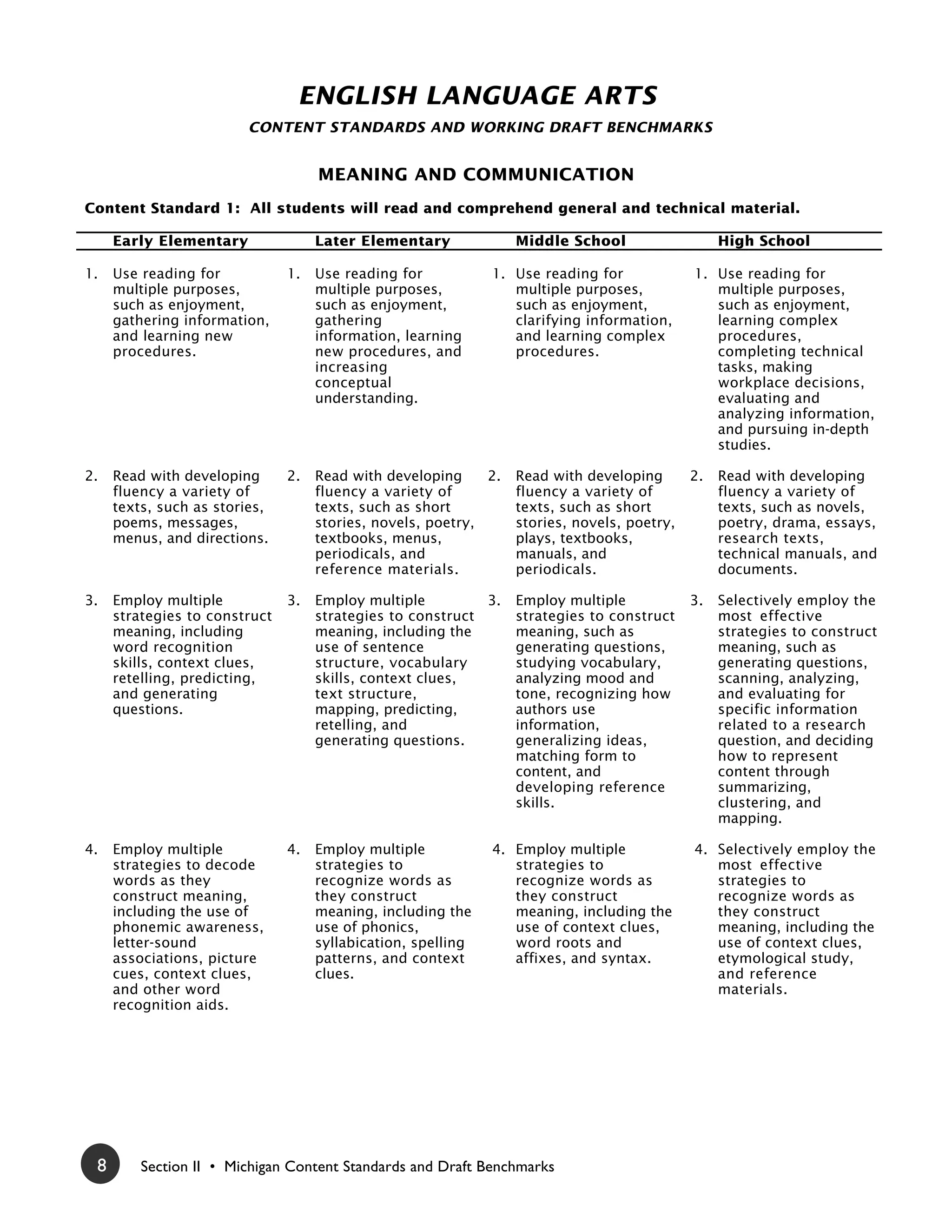
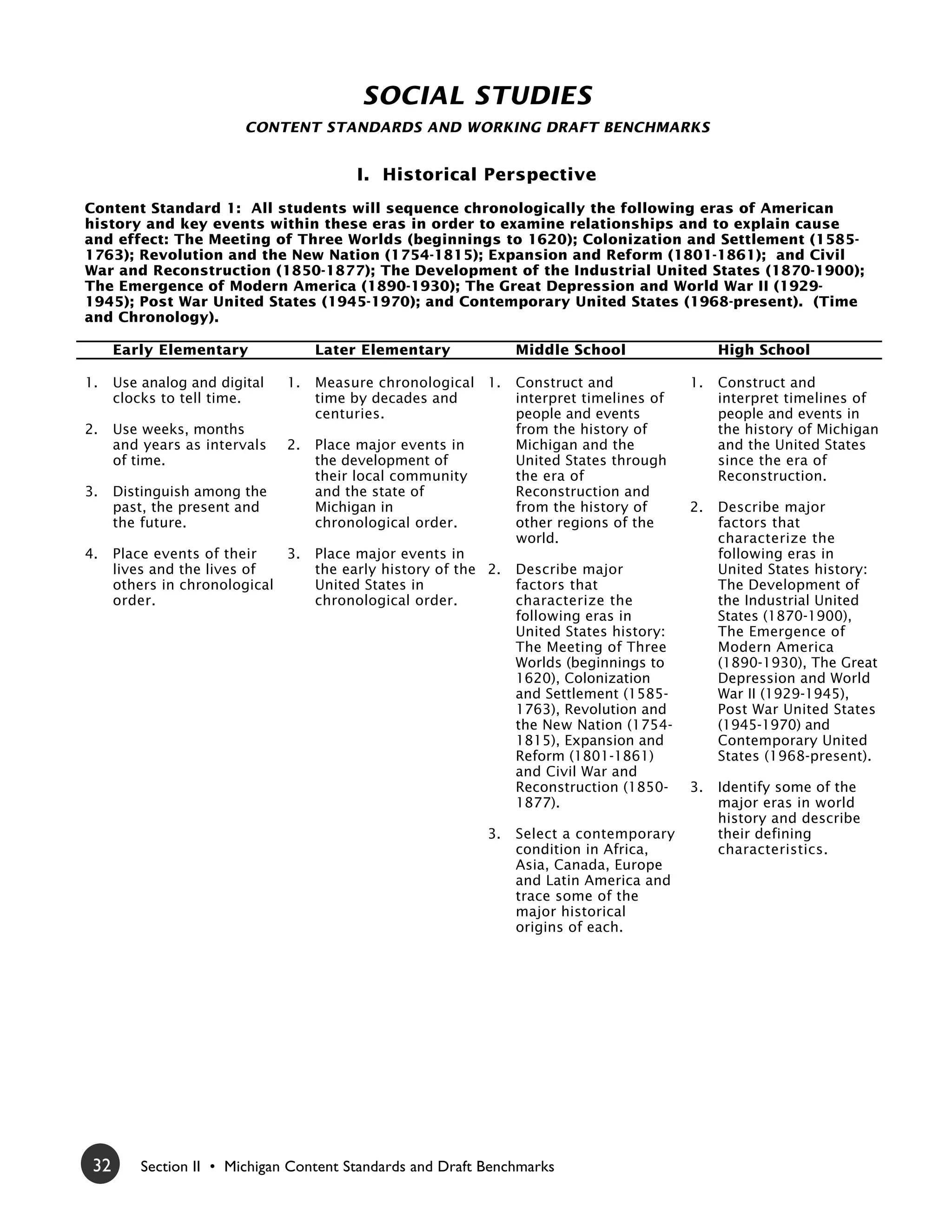
                                    MEANING AND COMMUNICATION
Content Standard 1: All students will read and comprehend general and technical material.

     Early Elementary               Later Elementary              Middle School                   High School

1.   Use reading for           1.   Use reading for           1. Use reading for             1. Use reading for
     multiple purposes,             multiple purposes,           multiple purposes,             multiple purposes,
     such as enjoyment,             such as enjoyment,           such as enjoyment,             such as enjoyment,
     gathering information,         gathering                    clarifying information,        learning complex
     and learning new               information, learning        and learning complex           procedures,
     procedures.                    new procedures, and          procedures.                    completing technical
                                    increasing                                                  tasks, making
                                    conceptual                                                  workplace decisions,
                                    understanding.                                              evaluating and
                                                                                                analyzing information,
                                                                                                and pursuing in-depth
                                                                                                studies.

2.   Read with developing      2.   Read with developing     2.   Read with developing       2.   Read with developing
     fluency a variety of           fluency a variety of          fluency a variety of            fluency a variety of
     texts, such as stories,        texts, such as short          texts, such as short            texts, such as novels,
     poems, messages,               stories, novels, poetry,      stories, novels, poetry,        poetry, drama, essays,
     menus, and directions.         textbooks, menus,             plays, textbooks,               research texts,
                                    periodicals, and              manuals, and                    technical manuals, and
                                    reference materials.          periodicals.                    documents.

3.   Employ multiple           3.   Employ multiple         3.    Employ multiple            3.   Selectively employ the
     strategies to construct        strategies to construct       strategies to construct         most effective
     meaning, including             meaning, including the        meaning, such as                strategies to construct
     word recognition               use of sentence               generating questions,           meaning, such as
     skills, context clues,         structure, vocabulary         studying vocabulary,            generating questions,
     retelling, predicting,         skills, context clues,        analyzing mood and              scanning, analyzing,
     and generating                 text structure,               tone, recognizing how           and evaluating for
     questions.                     mapping, predicting,          authors use                     specific information
                                    retelling, and                information,                    related to a research
                                    generating questions.         generalizing ideas,             question, and deciding
                                                                  matching form to                how to represent
                                                                  content, and                    content through
                                                                  developing reference            summarizing,
                                                                  skills.                         clustering, and
                                                                                                  mapping.

4.   Employ multiple           4.   Employ multiple           4. Employ multiple             4. Selectively employ the
     strategies to decode           strategies to                strategies to                  most effective
     words as they                  recognize words as           recognize words as             strategies to
     construct meaning,             they construct               they construct                 recognize words as
     including the use of           meaning, including the       meaning, including the         they construct
     phonemic awareness,            use of phonics,              use of context clues,          meaning, including the
     letter-sound                   syllabication, spelling      word roots and                 use of context clues,
     associations, picture          patterns, and context        affixes, and syntax.           etymological study,
     cues, context clues,           clues.                                                      and reference
     and other word                                                                             materials.
     recognition aids.


 8       Section II • Michigan Content Standards and Draft Benchmarks
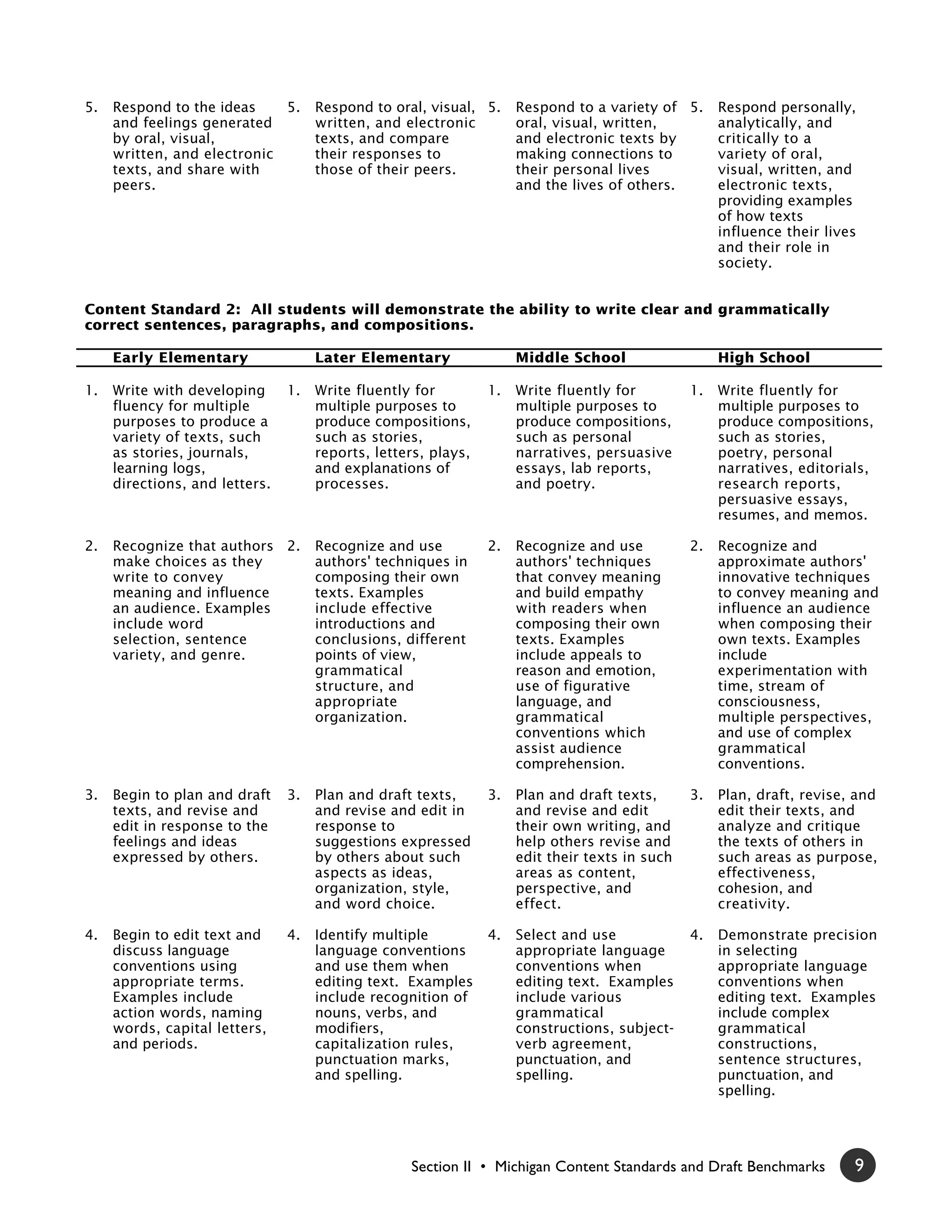
5.   Respond to the ideas    5.      Respond to oral, visual, 5.     Respond to a variety of 5.      Respond personally,
     and feelings generated          written, and electronic         oral, visual, written,          analytically, and
     by oral, visual,                texts, and compare              and electronic texts by         critically to a
     written, and electronic         their responses to              making connections to           variety of oral,
     texts, and share with           those of their peers.           their personal lives            visual, written, and
     peers.                                                          and the lives of others.        electronic texts,
                                                                                                     providing examples
                                                                                                     of how texts
                                                                                                     influence their lives
                                                                                                     and their role in
                                                                                                     society.


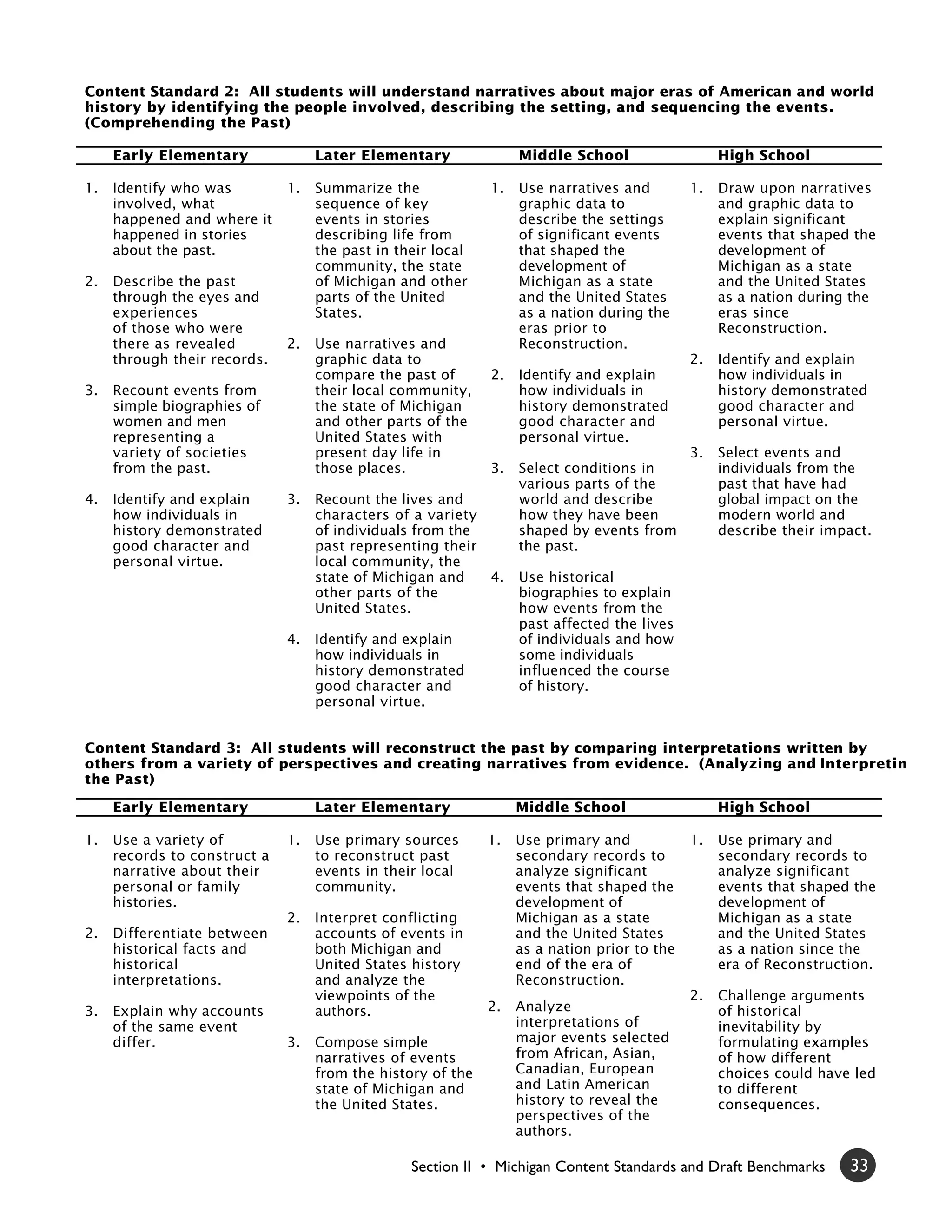
Content Standard 2: All students will demonstrate the ability to write clear and grammatically
correct sentences, paragraphs, and compositions.

     Early Elementary                Later Elementary                Middle School                   High School

1.   Write with developing      1.   Write fluently for         1.   Write fluently for         1.   Write fluently for
     fluency for multiple            multiple purposes to            multiple purposes to            multiple purposes to
     purposes to produce a           produce compositions,           produce compositions,           produce compositions,
     variety of texts, such          such as stories,                such as personal                such as stories,
     as stories, journals,           reports, letters, plays,        narratives, persuasive          poetry, personal
     learning logs,                  and explanations of             essays, lab reports,            narratives, editorials,
     directions, and letters.        processes.                      and poetry.                     research reports,
                                                                                                     persuasive essays,
                                                                                                     resumes, and memos.

2.   Recognize that authors 2.       Recognize and use          2.   Recognize and use          2.   Recognize and
     make choices as they            authors' techniques in          authors' techniques             approximate authors'
     write to convey                 composing their own             that convey meaning             innovative techniques
     meaning and influence           texts. Examples                 and build empathy               to convey meaning and
     an audience. Examples           include effective               with readers when               influence an audience
     include word                    introductions and               composing their own             when composing their
     selection, sentence             conclusions, different          texts. Examples                 own texts. Examples
     variety, and genre.             points of view,                 include appeals to              include
                                     grammatical                     reason and emotion,             experimentation with
                                     structure, and                  use of figurative               time, stream of
                                     appropriate                     language, and                   consciousness,
                                     organization.                   grammatical                     multiple perspectives,
                                                                     conventions which               and use of complex
                                                                     assist audience                 grammatical
                                                                     comprehension.                  conventions.

3.   Begin to plan and draft    3.   Plan and draft texts,      3.   Plan and draft texts,      3.   Plan, draft, revise, and
     texts, and revise and           and revise and edit in          and revise and edit             edit their texts, and
     edit in response to the         response to                     their own writing, and          analyze and critique
     feelings and ideas              suggestions expressed           help others revise and          the texts of others in
     expressed by others.            by others about such            edit their texts in such        such areas as purpose,
                                     aspects as ideas,               areas as content,               effectiveness,
                                     organization, style,            perspective, and                cohesion, and
                                     and word choice.                effect.                         creativity.

4.   Begin to edit text and     4.   Identify multiple          4.   Select and use             4.   Demonstrate precision
     discuss language                language conventions            appropriate language            in selecting
     conventions using               and use them when               conventions when                appropriate language
     appropriate terms.              editing text. Examples          editing text. Examples          conventions when
     Examples include                include recognition of          include various                 editing text. Examples
     action words, naming            nouns, verbs, and               grammatical                     include complex
     words, capital letters,         modifiers,                      constructions, subject-         grammatical
     and periods.                    capitalization rules,           verb agreement,                 constructions,
                                     punctuation marks,              punctuation, and                sentence structures,
                                     and spelling.                   spelling.                       punctuation, and
                                                                                                     spelling.


                                                   Section II • Michigan Content Standards and Draft Benchmarks          9
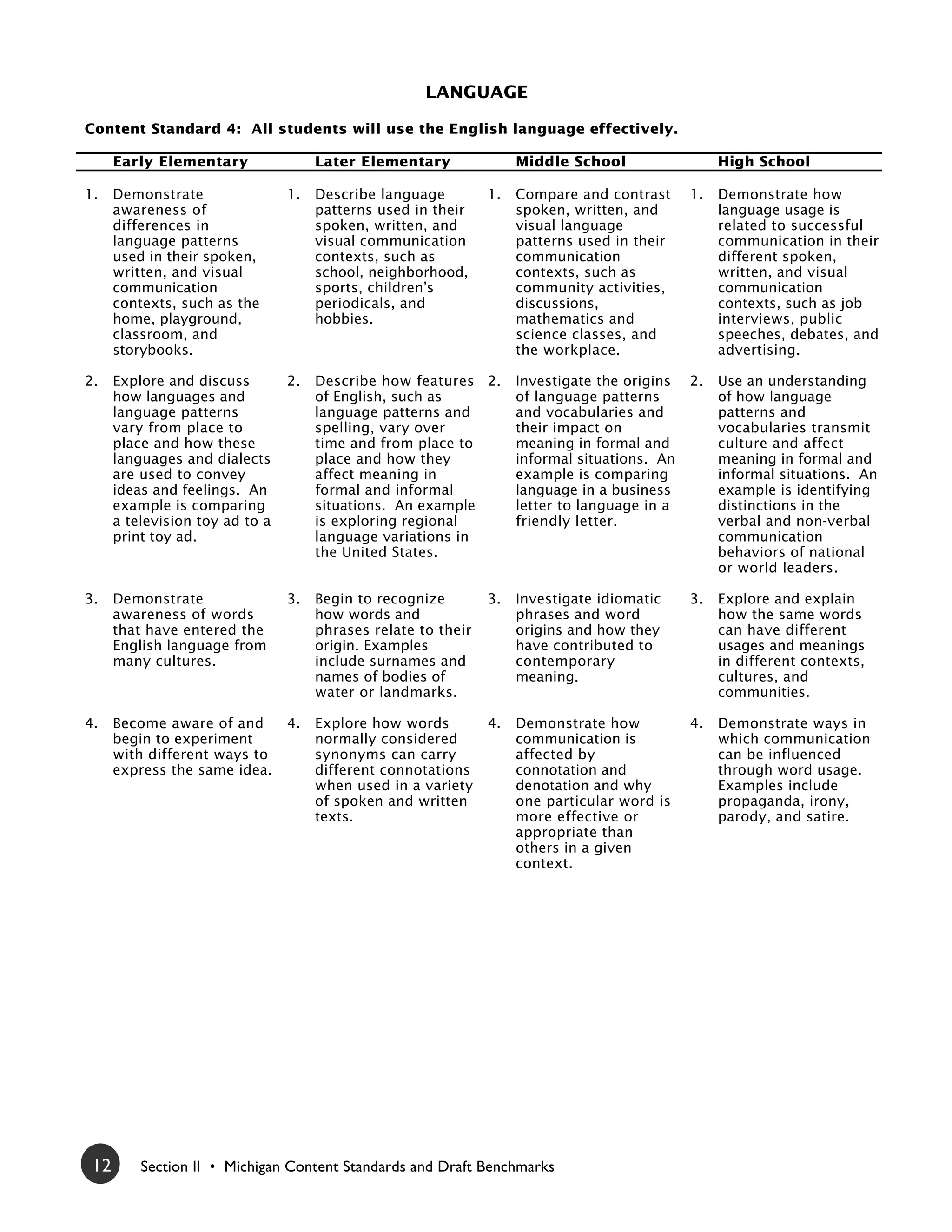
Content Standard 3: All students will focus on meaning and communication as they listen, speak,
view, read, and write in personal, social, occupational, and civic contexts.

      Early Elementary               Later Elementary               Middle School                  High School

1.    Integrate listening,      1.   Integrate listening,      1.   Integrate listening,      1.   Integrate listening,
      speaking, viewing,             speaking, viewing,             viewing, speaking,             viewing, speaking,
      reading, and writing           reading, and writing           reading, and writing           reading, and writing
      skills for multiple            skills for multiple            skills for multiple            skills for multiple
      purposes and in varied         purposes and in varied         purposes and in varied         purposes and in varied
      contexts. Examples             contexts. An example           contexts. An example           contexts. An example
      include using more             is using all the               is using all the               is using all the
      than one of the                language arts to               language arts to               language arts to
      language arts to               prepare and present a          prepare and present a          complete and present
      create a story, write a        unit project on a              unit project on career         a multi-media project
      poem or letter, or to          selected state or              exploration.                   on a national or
      prepare and present a          country.                                                      international issue.
      unit project on their
      community.

2.    Explore the               2.   Analyze the impact of    2.    Begin to implement        2.   Consistently use
      relationships among            variables on                   strategies to regulate         strategies to regulate
      various components of          components of the              effects of variables of        the effects of
      the communication              communication                  the communication              variables on the
      process such as                process. Examples              process. An example            communication
      sender, message, and           include the impact of          is selecting a format          process. An example
      receiver. An example           background noise on            for the message to             is designing a
      is understanding how           an oral message and            influence the                  communication
      the source of the              the effect of text             receiver’s response.           environment for
      message affects the            errors, such as spelling                                      maximum impact on
      receiver’s response.           or grammar, on the                                            the receiver.
                                     receiver.

3.    Read and write with       3.   Read and write            3.   Read and write          3.     Read and write
      developing fluency,            fluently, speak                fluently, speak                fluently, speak
      speak confidently,             confidently, listen            confidently, listen and        confidently, listen
      listen and interact            and interact                   interact appropriately,        and interact
      appropriately, view            appropriately, view            view critically, and           appropriately, view
      strategically, and             knowledgeably, and             represent creatively.          critically, and
      represent creatively.          represent creatively.          Examples include               represent creatively.
      Examples include               Examples include               reporting formally to          Examples include
      sharing texts in groups        exploring ideas in a           an audience, debating          speaking publicly,
      and using an                   group, interviewing            issues, and                    demonstrating
      author’s/reader’s              family and friends, and        interviewing members           teamwork skills,
      chair.                         explaining ideas               of the public.                 debating formally,
                                     represented in                                                performing literature,
                                     pictures.                                                     and interviewing for
                                                                                                   employment.

4.    Describe and use        4.     Distinguish between     4.     Practice verbal and       4.   Consistently use
      effective listening and        verbal and nonverbal           nonverbal strategies           effective listening
      speaking behaviors             communication, and             that enhance                   strategies (e.g.,
      that enhance verbal            identify and practice          understanding of               discriminating,
      communication and              elements of effective          spoken messages and            assigning meaning,
      facilitate the                 listening and speaking.        promote effective              evaluating, and
      construction of                Examples include               listening behaviors.           remembering) and
      meaning. Examples              recognizing the impact         Examples include               elements of effective
      include use of gestures        of variations of facial        altering inflection,           speaking (e.g.,
      and appropriate group          expression, posture,           volume, and rate,              message content,
      behavior.                      and volume on oral             using evidence, and            language choices, and
                                     communication.                 reasoning.                     audience analysis).


 10       Section II • Michigan Content Standards and Draft Benchmarks
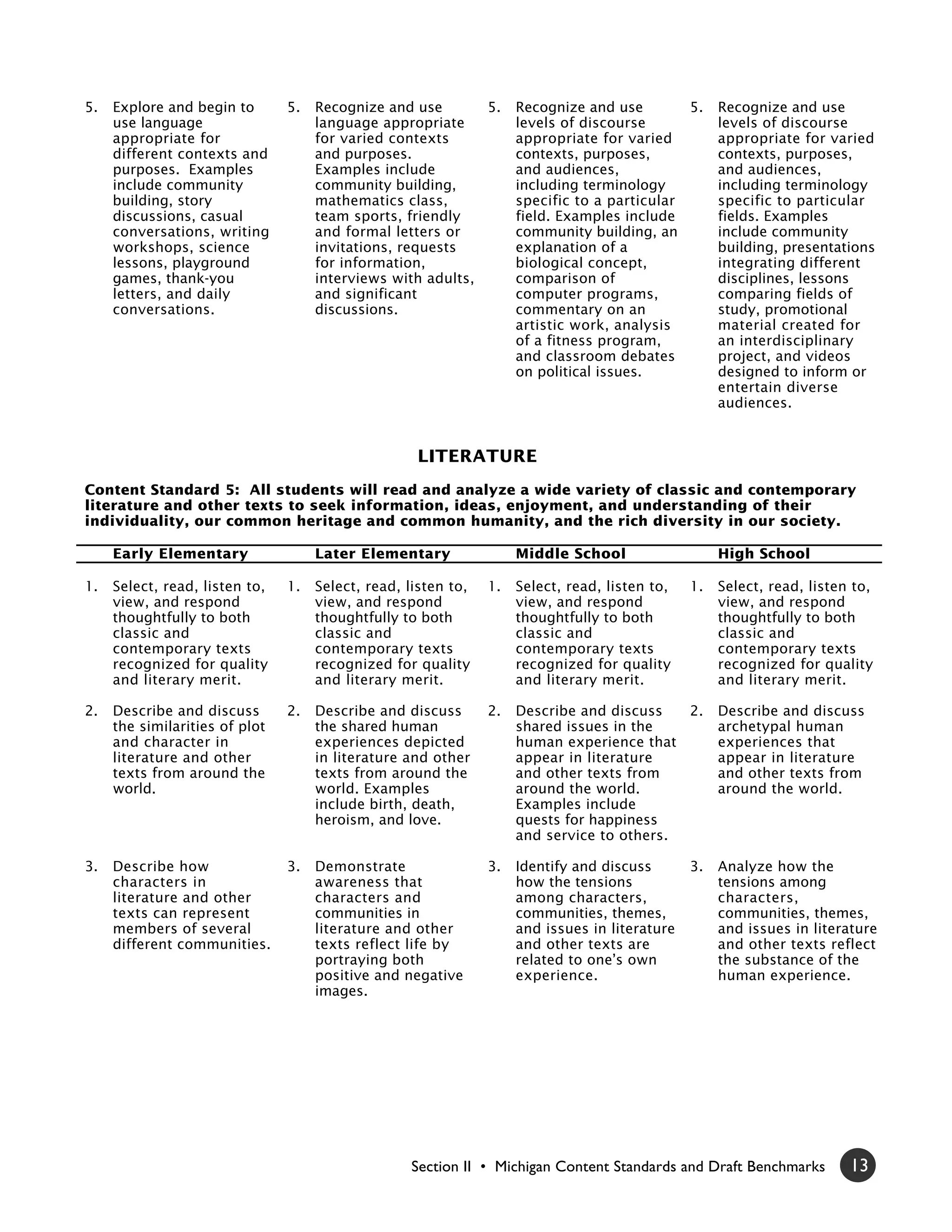
5.   Employ strategies to      5.   Employ multiple         5.    Select appropriate        5.   Employ the most
     construct meaning              strategies to construct       strategies to construct        effective strategies to
     while reading,                 meaning while                 meaning while                  construct meaning
     listening to, viewing,         reading, listening to,        reading, listening to,         while reading,
     or creating texts.             viewing, or creating          viewing, or creating           listening to, viewing,
     Examples include               texts. Examples               texts. Examples                or creating texts.
     retelling, predicting,         include summarizing,          include generating             Examples include
     generating questions,          predicting, generating        relevant questions,            generating focus
     examining picture              questions, mapping,           studying vocabulary,           questions; deciding
     cues, discussing with          examining picture             analyzing mood and             how to represent
     peers, using context           cues, analyzing word          tone, recognizing how          content through
     clues, and creating            structure and                 authors and speakers           analyzing, clustering,
     mental pictures.               sentence structure,           use information, and           and mapping; and
                                    discussing with peers,        matching form to               withholding personal
                                    and using context and         content.                       bias while listening.
                                    text structure.

6.   Determine the             6.   Determine the           6.    Determine the             6.   Determine the
     meaning of unfamiliar          meaning of unfamiliar         meaning of unfamiliar          meaning of specialized
     words and concepts in          words and concepts in         words and concepts in          vocabulary and
     oral, visual, and              oral, visual, and             oral, visual, and              concepts in oral,
     written texts by using         written texts by using        written texts by using         visual, and written
     a variety of resources,        a variety of resources,       a variety of resources,        texts by using a
     such as prior                  such as prior                 such as semantic and           variety of resources,
     knowledge, context,            knowledge, context,           structural features,           such as context,
     other people,                  glossaries, and               prior knowledge,               research, reference
     dictionaries, pictures,        electronic sources.           reference materials,           materials, and
     and electronic                                               and electronic                 electronic sources.
     sources.                                                     sources.

7.   Recognize that         7.      Recognize and use        7.   Recognize and use         7.   Recognize and use
     creators of texts make         texts as models and           varied techniques to           varied innovative
     choices when                   employ varied                 construct text, convey         techniques to
     constructing text to           techniques to                 meaning, and express           construct text, convey
     convey meaning,                construct text, convey        feelings to influence          meaning, and express
     express feelings, and          meaning, and express          an audience. Examples          feelings to influence
     influence an audience.         feelings to influence         include identification         an audience. Examples
     Examples include word          an audience. Examples         with characters and            include
     selection, sentence            include effective             multiple points of             experimentation with
     length, and use of             introductions and             view.                          time, order, stream of
     illustrations.                 conclusions, different                                       consciousness, and
                                    points of view, and                                          multiple points of
                                    rich descriptions.                                           view.

8.   Respond to the ideas      8.   Express their            8.   Express their             8.   Analyze their
     or feelings generated          responses to oral,            responses and make             responses to oral,
     by texts and listen to         visual, written, and          connections between            visual, written, and
     the responses of               electronic texts, and         oral, visual, written,         electronic texts,
     others.                        compare their                 and electronic texts           providing examples of
                                    responses to those of         and their own lives.           how texts affect their
                                    others.                                                      lives, connect them
                                                                                                 with the contemporary
                                                                                                 world, and transmit
                                                                                                 issues across time.


                                                 Section II • Michigan Content Standards and Draft Benchmarks       11
LANGUAGE

Content Standard 4: All students will use the English language effectively.

      Early Elementary                Later Elementary               Middle School                  High School

1.    Demonstrate                1.   Describe language         1.   Compare and contrast      1.   Demonstrate how
      awareness of                    patterns used in their         spoken, written, and           language usage is
      differences in                  spoken, written, and           visual language                related to successful
      language patterns               visual communication           patterns used in their         communication in their
      used in their spoken,           contexts, such as              communication                  different spoken,
      written, and visual             school, neighborhood,          contexts, such as              written, and visual
      communication                   sports, children’s             community activities,          communication
      contexts, such as the           periodicals, and               discussions,                   contexts, such as job
      home, playground,               hobbies.                       mathematics and                interviews, public
      classroom, and                                                 science classes, and           speeches, debates, and
      storybooks.                                                    the workplace.                 advertising.

2.    Explore and discuss        2.   Describe how features 2.       Investigate the origins   2.   Use an understanding
      how languages and               of English, such as            of language patterns           of how language
      language patterns               language patterns and          and vocabularies and           patterns and
      vary from place to              spelling, vary over            their impact on                vocabularies transmit
      place and how these             time and from place to         meaning in formal and          culture and affect
      languages and dialects          place and how they             informal situations. An        meaning in formal and
      are used to convey              affect meaning in              example is comparing           informal situations. An
      ideas and feelings. An          formal and informal            language in a business         example is identifying
      example is comparing            situations. An example         letter to language in a        distinctions in the
      a television toy ad to a        is exploring regional          friendly letter.               verbal and non-verbal
      print toy ad.                   language variations in                                        communication
                                      the United States.                                            behaviors of national
                                                                                                    or world leaders.

3.    Demonstrate                3.   Begin to recognize        3.   Investigate idiomatic     3.   Explore and explain
      awareness of words              how words and                  phrases and word               how the same words
      that have entered the           phrases relate to their        origins and how they           can have different
      English language from           origin. Examples               have contributed to            usages and meanings
      many cultures.                  include surnames and           contemporary                   in different contexts,
                                      names of bodies of             meaning.                       cultures, and
                                      water or landmarks.                                           communities.

4.    Become aware of and        4.   Explore how words         4.   Demonstrate how           4.   Demonstrate ways in
      begin to experiment             normally considered            communication is               which communication
      with different ways to          synonyms can carry             affected by                    can be influenced
      express the same idea.          different connotations         connotation and                through word usage.
                                      when used in a variety         denotation and why             Examples include
                                      of spoken and written          one particular word is         propaganda, irony,
                                      texts.                         more effective or              parody, and satire.
                                                                     appropriate than
                                                                     others in a given
                                                                     context.


 12       Section II • Michigan Content Standards and Draft Benchmarks
5.   Explore and begin to       5.   Recognize and use       5.      Recognize and use        5.     Recognize and use
     use language                    language appropriate            levels of discourse             levels of discourse
     appropriate for                 for varied contexts             appropriate for varied          appropriate for varied
     different contexts and          and purposes.                   contexts, purposes,             contexts, purposes,
     purposes. Examples              Examples include                and audiences,                  and audiences,
     include community               community building,             including terminology           including terminology
     building, story                 mathematics class,              specific to a particular        specific to particular
     discussions, casual             team sports, friendly           field. Examples include         fields. Examples
     conversations, writing          and formal letters or           community building, an          include community
     workshops, science              invitations, requests           explanation of a                building, presentations
     lessons, playground             for information,                biological concept,             integrating different
     games, thank-you                interviews with adults,         comparison of                   disciplines, lessons
     letters, and daily              and significant                 computer programs,              comparing fields of
     conversations.                  discussions.                    commentary on an                study, promotional
                                                                     artistic work, analysis         material created for
                                                                     of a fitness program,           an interdisciplinary
                                                                     and classroom debates           project, and videos
                                                                     on political issues.            designed to inform or
                                                                                                     entertain diverse
                                                                                                     audiences.


                                                    LITERATURE
Content Standard 5: All students will read and analyze a wide variety of classic and contemporary
literature and other texts to seek information, ideas, enjoyment, and understanding of their
individuality, our common heritage and common humanity, and the rich diversity in our society.

     Early Elementary                Later Elementary                Middle School                   High School

1.   Select, read, listen to,   1.   Select, read, listen to,   1.   Select, read, listen to,   1.   Select, read, listen to,
     view, and respond               view, and respond               view, and respond               view, and respond
     thoughtfully to both            thoughtfully to both            thoughtfully to both            thoughtfully to both
     classic and                     classic and                     classic and                     classic and
     contemporary texts              contemporary texts              contemporary texts              contemporary texts
     recognized for quality          recognized for quality          recognized for quality          recognized for quality
     and literary merit.             and literary merit.             and literary merit.             and literary merit.

2.   Describe and discuss       2.   Describe and discuss       2.   Describe and discuss   2.       Describe and discuss
     the similarities of plot        the shared human                shared issues in the            archetypal human
     and character in                experiences depicted            human experience that           experiences that
     literature and other            in literature and other         appear in literature            appear in literature
     texts from around the           texts from around the           and other texts from            and other texts from
     world.                          world. Examples                 around the world.               around the world.
                                     include birth, death,           Examples include
                                     heroism, and love.              quests for happiness
                                                                     and service to others.

3.   Describe how               3.   Demonstrate                3.   Identify and discuss       3.   Analyze how the
     characters in                   awareness that                  how the tensions                tensions among
     literature and other            characters and                  among characters,               characters,
     texts can represent             communities in                  communities, themes,            communities, themes,
     members of several              literature and other            and issues in literature        and issues in literature
     different communities.          texts reflect life by           and other texts are             and other texts reflect
                                     portraying both                 related to one’s own            the substance of the
                                     positive and negative           experience.                     human experience.
                                     images.


                                                   Section II • Michigan Content Standards and Draft Benchmarks          13
4.    Recognize the             4.   Describe how various     4.   Investigate and            4.   Analyze how cultures
      representation of              cultures and our              demonstrate                     interact with one
      various cultures as            common heritage are           understanding of the            another in literature
      well as our common             represented in                cultural and historical         and other texts, and
      heritage in literature         literature and other          contexts of the                 describe the
      and other texts.               texts.                        themes, issues, and             consequences of the
                                                                   our common heritage             interaction as it
                                                                   as depicted in                  relates to our common
                                                                   literature and other            heritage.
                                                                   texts.

5.    Explain how               5.   Describe how             5.   Investigate through    5.       Analyze and evaluate
      characters in                  characters in                 literature and other            the authenticity of the
      literature and other           literature and other          texts various examples          portrayal of various
      texts express attitudes        texts form opinions           of distortion and               societies and cultures
      about one another.             about one another in          stereotypes. Examples           in literature and other
                                     ways that can be fair         include those                   texts. An example is
                                     and unfair.                   associated with                 critiquing print and
                                                                   gender, race, culture,          non-print accounts of
                                                                   age, class, religion,           historical and
                                                                   and handicapping                contemporary social
                                                                   conditions.                     issues.


                                                        VOICE
Content Standard 6: All students will learn to communicate information accurately and effectively
and demonstrate their expressive abilities by creating oral, written, and visual texts that enlighten
and engage an audience.

      Early Elementary               Later Elementary              Middle School                   High School

1.    Identify elements of     1.    Practice using           1.   Analyze their use of       1.   Assess their use of
      effective                      elements of effective         elements of effective           elements of effective
      communication that             communication to              communication that              communication in
      influence the quality of       enhance their                 impact their                    personal, social,
      their interactions with        relationships                 relationships in their          occupational, and civic
      others. Examples               in their school and           schools, families, and          contexts. Examples
      include use of facial          communities.                  communities.                    include use of pacing,
      expression, word               Examples include              Examples include use            repetition, and
      choice, and                    enunciation of terms,         of pauses, suspense,            emotion.
      articulation.                  use of humor, and use         and elaboration.
                                     of emphasis.

2.    Experiment with the       2.   Explain the importance 2.     Demonstrate their          2.   Evaluate the power of
      various voices they            of developing                 ability to use different        using multiple voices
      use when they speak            confidence and a              voices in oral and              in their oral and
      and write for different        unique presence or            written                         written
      purposes and                   voice in their own oral       communication to                communication to
      audiences.                     and written                   persuade, inform,               persuade, inform,
                                     communication.                entertain, and inspire          entertain, and inspire
                                                                   their audiences.                their audiences.

3.    Explore works of          3.   Identify the style and   3.   Compare and contrast       3.   Analyze the style and
      different authors,             characteristics of            the style and                   characteristics of
      speakers, and                  individual authors,           characteristics of              authors, actors, and
      illustrators to                speakers, and                 individual authors,             artists of classics and
      determine how they             illustrators and how          speakers, and                   masterpieces to
      present ideas and              they shape text and           illustrators and how            determine why these
      feelings to evoke              influence their               they shape text and             voices endure.
      different responses.           audiences’                    influence their
                                     expectations.                 audiences’
                                                                   expectations.


 14       Section II • Michigan Content Standards and Draft Benchmarks
4.   Develop a sense of        4.   Reveal personal voice 4.       Document and              4.   Document and
     personal voice by              by explaining growth           enhance a developing           enhance a developing
     explaining their               in learning and                voice through multiple         voice with authentic
     selection of materials         accomplishment                 media. Examples                writings for different
     for different purposes         through their selection        include reflections for        audiences and
     and audiences.                 of materials for               their portfolios, audio        purposes. Examples
     Examples include               different purposes and         and video tapes, and           include portfolios,
     portfolios, displays,          audiences. Examples            submissions for                video productions,
     and literacy                   include portfolios,            publications.                  submissions for
     interviews.                    displays, literacy                                            competitions or
                                    interviews, and                                               publications, individual
                                    submissions for                                               introspections, and
                                    publications.                                                 applications for
                                                                                                  employment and
                                                                                                  higher education.


                                           SKILLS AND PROCESSES
Content Standard 7: All students will demonstrate, analyze, and reflect upon the skills and
processes used to communicate through listening, speaking, viewing, reading, and writing.

     Early Elementary               Later Elementary               Middle School                  High School

1.   Use a combination of      1.   Use a combination of      1.   Use a combination of      1.   Use a combination of
     strategies when                strategies when                strategies when                strategies when
     encountering                   encountering                   encountering                   encountering
     unfamiliar texts while         unfamiliar texts while         unfamiliar texts while         unfamiliar texts while
     constructing meaning.          constructing meaning.          constructing meaning.          constructing meaning.
     Examples include               Examples include               Examples include               Examples include
     retelling, predicting,         retelling, predicting,         generating questions,          generating questions;
     generating questions,          generating questions,          studying vocabulary,           scanning for specific
     examining picture              mapping, examining             analyzing mood and             information related to
     cues, analyzing                picture cues,                  tone, recognizing how          research questions;
     phonetically,                  analyzing word                 creators of text use           analyzing tone and
     discussing with peers,         structure, discussing          and represent                  voice; and
     and using text cues.           with peers, analyzing          information, and               representing content
                                    phonetically, and using        matching form to               through summarizing,
                                    context and text               content.                       clustering, and
                                    structure.                                                    mapping.

2.   Monitor their progress    2.   Monitor their progress    2.   Monitor their progress    2.   Monitor their progress
     while beginning to use         while using a variety          while using a variety          while using a variety
     a variety of strategies        of strategies to               of strategies to               of strategies to
     to overcome                    overcome difficulties          overcome difficulties          overcome difficulties
     difficulties when              when constructing and          when constructing and          when constructing and
     constructing and               conveying meaning.             conveying meaning,             conveying meaning,
     conveying meaning.                                            and develop strategies         and demonstrate
                                                                   to deal with new               flexible use of
                                                                   communication needs.           strategies across a
                                                                                                  wide range of
                                                                                                  situations.

3.   Reflect on their          3.   Apply new learning by     3.   Reflect on their own      3.   Reflect on their
     emerging literacy, set         forming questions and          developing literacy,           understanding of
     goals, and make                setting learning goals         set learning goals, and        literacy, assess their
     appropriate choices            that will aid in self-         evaluate their                 developing ability, set
     throughout the                 regulation and                 progress.                      personal learning
     learning process as            reflection on their                                           goals, create
     they develop the               developing literacy.                                          strategies for attaining
     ability to regulate                                                                          those goals, and take
     their learning.                                                                              responsibility for their
                                                                                                  literacy development.


                                                  Section II • Michigan Content Standards and Draft Benchmarks       15
4.   Begin to develop and       4.   Develop and use a        4.   Demonstrate a variety    4.   Demonstrate flexibility
     use strategies for              variety of strategies         of strategies for             in using strategies for
     planning, drafting,             for planning, drafting,       planning, drafting,           planning, drafting,
     revising, and editing a         revising, and editing         revising, and editing         revising, and editing
     variety of text forms.          different forms of            several different             complex texts in a
     Examples include                texts for specific            forms of texts for            variety of genre, and
     identifying                     purposes. Examples            specific purposes.            describe the
     characteristics of              include brainstorming,        Examples include              relationship between
     their audience,                 revising with peers,          persuading a                  form and meaning.
     mapping, and                    sensitivity to audience,      particular audience to        Examples include
     proofreading.                   and strategies                take action and               preparing text for
                                     appropriate for               capturing feelings            publication and
                                     purposes, such as             through poetry.               presentation and using
                                     informing, persuading,                                      strategies appropriate
                                     entertaining, and                                           for purposes, such as
                                     inspiring.                                                  editorializing an
                                                                                                 opinion, and
                                                                                                 developing and
                                                                                                 justifying a personal
                                                                                                 perspective on a
                                                                                                 controversial issue.


                                     GENRE AND CRAFT OF LANGUAGE
Content Standard 8: All students will explore and use the characteristics of different types of
texts, aesthetic elements, and mechanics—including text structure, figurative and descriptive
language, spelling, punctuation, and grammar—to construct and convey meaning.

      Early Elementary               Later Elementary              Middle School                 High School

1.    Identify and use        1.     Identify and use         1.   Select and use           1.   Identify and use
      mechanics that                 mechanics that                mechanics that                selectively mechanics
      enhance and clarify            enhance and clarify           enhance and clarify           that facilitate
      understanding.                 understanding.                understanding.                understanding.
      Examples include using         Examples include              Examples include              Examples include
      conventional                   sentence structure,           paragraphing,                 organizational
      punctuation,                   paragraphing,                 organizational                patterns,
      capitalization, and            appropriate                   patterns, variety in          documentation of
      spelling, as well as           punctuation,                  sentence structure,           sources, appropriate
      approximations of              grammatical                   appropriate                   punctuation,
      conventional spelling,         constructions,                punctuation,                  grammatical
      and restating key              conventional spelling,        grammatical                   constructions,
      ideas in oral messages.        and relating in               constructions,                conventional spelling,
                                     sequence an account           conventional spelling,        and the use of
                                     of an oral or visual          and the use of                connective devices,
                                     experience.                   connective devices,           such as transitions and
                                                                   such as previews and          paraphrasing an oral
                                                                   reviews.                      message completely
                                                                                                 and accurately.

2.    Explore how the           2.   Identify and use        2.    Describe and use         2.   Describe and use
      characteristics of             elements of various           characteristics of            characteristics of
      various narrative              narrative genre and           various narrative             various narrative
      genre and story                story elements to             genre and elements of         genre and complex
      elements can be used           convey ideas and              narrative technique to        elements of narrative
      to convey ideas and            perspectives.                 convey ideas and              technique to convey
      perspectives.                  Examples include              perspectives.                 ideas and perspectives.
      Examples include               theme, plot, conflict,        Examples include              Examples include use
      character, setting, and        and characterization          foreshadowing and             of symbol, motifs, and
      problem in poetry,             in poetry, drama, story       flashback in poetry,          function of minor
      drama, and folktales.          telling, historical           science fiction, short        characters in epics,
                                     fiction, mystery, and         stories, and novels.          satire, and drama.
                                     fantasy.


 16       Section II • Michigan Content Standards and Draft Benchmarks
3.   Explore how the             3.   Identify and use        3.       Describe and use          3.   Describe and use
     characteristics of               characteristics of               characteristics of             characteristics of
     various informational            various informational            various informational          informational genre
     genre (e.g., show-and-           genre (e.g.,                     genre (e.g.,                   (e.g., manuals,
     tell, trade books,               periodicals, public              biographies,                   briefings,
     textbooks, and                   television programs,             newspapers,                    documentaries, and
     dictionaries) and                textbooks, and                   brochures, and                 research
     elements of expository           encyclopedias) and               persuasive arguments           presentations) and
     text structure (e.g.,            elements of expository           and essays) and                complex elements of
     organizational                   text structure (e.g.,            elements of                    expository texts (e.g.,
     patterns, major ideas,           organizational                   expository text                thesis statement,
     and details) can be              patterns, supporting             structure (e.g.,               supporting ideas, and
     used to convey ideas.            details, and major               multiple patterns of           authoritative and/or
                                      ideas) to convey ideas.          organization,                  statistical evidence) to
                                                                       relational links, and          convey ideas.
                                                                       central purposes) to
                                                                       convey ideas.

4.   Identify and use            4.   Identify and use            4.   Identify and use          4.   Identify and use
     aspects of the craft of          aspects of the craft of          aspects of the craft of        aspects of the craft of
     the speaker, writer,             the speaker, writer,             the speaker, writer,           the speaker, writer,
     and illustrator to               and illustrator to               and illustrator to             and illustrator to
     formulate and express            formulate and express            formulate and express          formulate and express
     their ideas artistically.        their ideas artistically.        their ideas                    their ideas artistically.
     Examples include                 Examples include                 artistically. Examples         Examples include
     dialogue,                        intonation, hues,                include color and              imagery, irony,
     characterization,                design, perspective,             composition,                   multiple points of view,
     conflict, organization,          dialogue,                        flashback, multi-              complex dialogue,
     diction, color, and              characterization,                dimensional                    aesthetics, and
     shape.                           metaphor, simile, and            characters, pacing,            persuasive techniques.
                                      points of view.                  appropriate use of
                                                                       details, strong verbs,
                                                                       language that
                                                                       inspires, and effective
                                                                       leads.

5.   Explore how the             5.   Describe and use the     5.      Explain how the           5.   Describe and use the
     characteristics of               characteristics of               characteristics of             characteristics of
     various oral, visual,            various oral, visual,            various oral, visual,          various oral, visual,
     and written texts (e.g.,         and written texts (e.g.,         and written texts              and written texts (e.g.,
     videos, CD-ROM                   films, library                   (e.g., videos,                 debate, drama,
     stories, books on tape,          databases, atlases, and          hypertext, glossaries,         primary documents,
     and trade books) and             speeches) and the                textbooks, and                 and documentaries)
     the textual aids they            textual aids they                speeches) and the              and the textual aids
     employ (e.g.,                    employ (e.g.,                    textual aids they              they employ (e.g.,
     illustrations, tables of         footnotes, menus,                employ (e.g.,                  prefaces, appendices,
     contents, and                    addresses, graphs, and           subheadings/titles,            lighting effects, and
     headings/titles) are             figures) to convey               charts, and indexes)           microfiche headings)
     used to convey                   meaning.                         are used to convey             to convey meaning and
     meaning.                                                          meaning.                       inspire audiences.


                                                     Section II • Michigan Content Standards and Draft Benchmarks         17
DEPTH OF UNDERSTANDING
Content Standard 9: All students will demonstrate understanding of the complexity of enduring
issues and recurring problems by making connections and generating themes within and across
texts.

      Early Elementary               Later Elementary               Middle School                  High School

1.    Explore and reflect on    1.   Explore and reflect on 1.      Explore and reflect on    1.   Analyze and reflect on
      universal themes and           universal themes and           universal themes and           universal themes and
      substantive issues             substantive issues             substantive issues             substantive issues
      from oral, visual, and         from oral, visual, and         from oral, visual, and         from oral, visual, and
      written texts.                 written texts.                 written texts.                 written texts.
      Examples include new           Examples include               Examples include               Examples include
      friendships and life in        exploration, discovery,        coming of age, rights          human interaction
      the neighborhood.              and formation of               and responsibilities,          with the environment,
                                     personal relationships.        group and individual           conflict and change,
                                                                    roles, conflict and            relationships with
                                                                    cooperation,                   others, and self-
                                                                    creativity, and                discovery.
                                                                    resourcefulness.

2.    Identify and              2.   Draw parallels and       2.    Synthesize content        2.   Synthesize from
      categorize key ideas,          contrasts among key            from multiple texts            multiple texts
      concepts, and                  ideas, concepts, and           representing varied            representing varied
      perspectives found in          varied perspectives            perspectives in order          perspectives, and
      texts.                         found in multiple texts.       to formulate principles        apply the principles
                                                                    and generalizations.           and generalizations
                                                                                                   needed to investigate
                                                                                                   and confront complex
                                                                                                   issues and problems.

3.    Draw conclusions          3.   Use conclusions based     3.   Develop a thesis using    3.   Develop and extend a
      based on their                 on their understanding         key concepts,                  thesis by analyzing
      understanding of               of differing views             supporting evidence,           differing perspectives
      differing views                presented in text to           and logical argument.          and resolving
      presented in text.             support a position.                                           inconsistencies in logic
                                                                                                   in order to support a
                                                                                                   position.


                                                IDEAS IN ACTION
Content Standard 10: All students will apply knowledge, ideas, and issues drawn from texts to
their lives and the lives of others.

      Early Elementary               Later Elementary               Middle School                  High School

1.    Make connections          1.   Identify how their own    1.   Analyze themes and        1.   Use themes and
      between key ideas in           experiences influence          central ideas in               central ideas in
      literature and other           their understanding of         literature and other           literature and other
      texts and their own            key ideas in literature        texts in relation to           texts to generate
      lives.                         and other texts.               issues in their own            solutions to problems
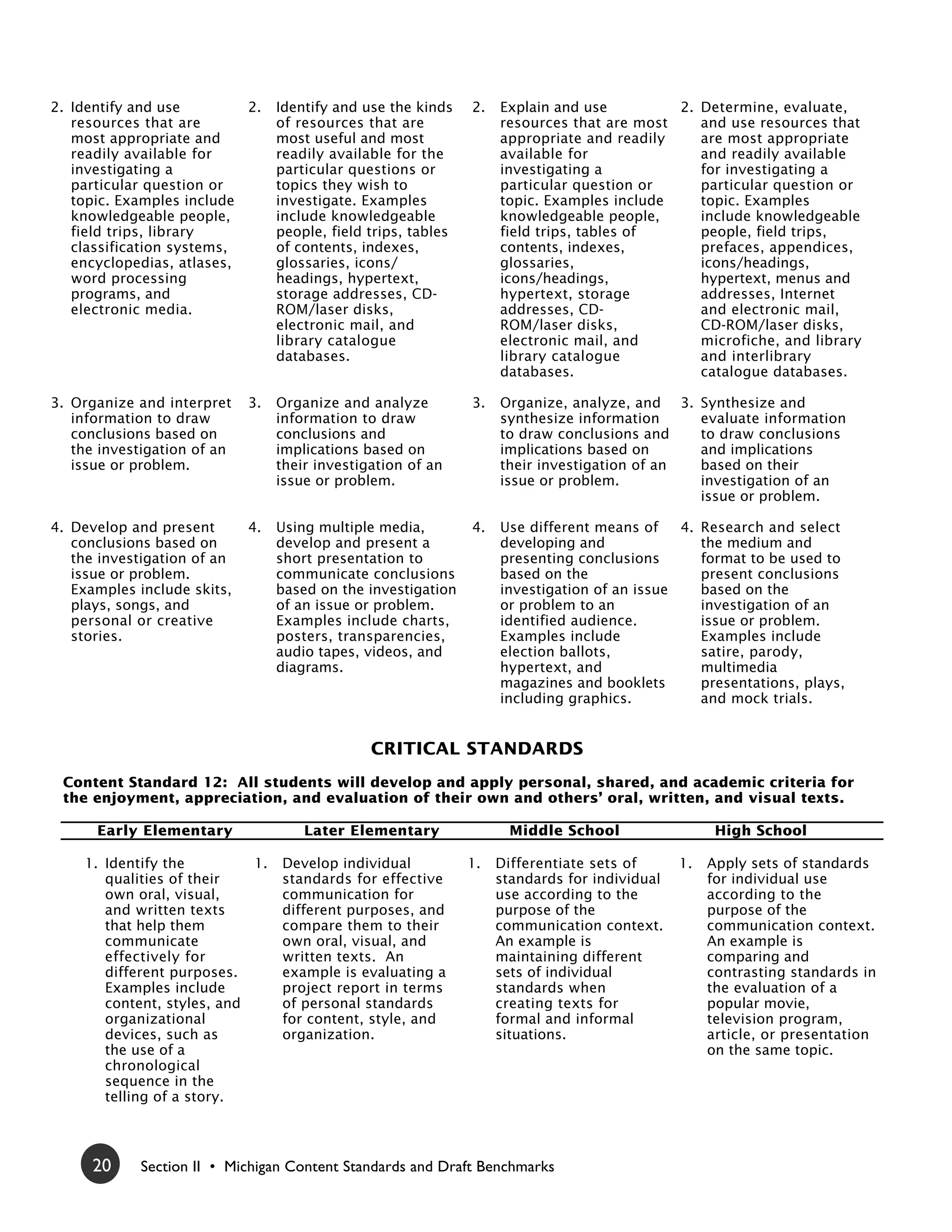
                                                                    lives.                         and formulate
                                                                                                   perspectives on issues
                                                                                                   in their own lives.


 18       Section II • Michigan Content Standards and Draft Benchmarks
2.   Demonstrate their         2.   Combine skills to        2.        Perform the daily         2.   Function as literate
        developing literacy by         reveal their                       functions of a literate        individuals in varied
        using text to enhance          strengthening literacy.            individual. Examples           contexts within their
        their daily lives.             Examples include                   include acquiring              lives in and beyond the
        Examples include               writing and illustrating           information from               classroom. Examples
        reading with a parent,         a text, reading and                multiple sources and           include using text
        discussing a favorite          then orally analyzing a            then evaluating,               resources while
        text, writing to a             text, and listening to             organizing, and                thinking creatively,
        friend or relative             and then summarizing               communicating it in            making decisions,
        about an experience,           a presentation.                    various contexts.              solving problems, and
        and creating a visual                                                                            reasoning in complex
        representation of an                                                                             situations.
        important idea.

   3.   Use oral, written, and   3.    Use oral, written, and        3.   Use oral, written, and   3.    Utilize the persuasive
        visual texts to identify       visual texts to                    visual texts to identify       power of text as an
        and explore school and         research how                       and research issues of         instrument of change
        community issues and           individuals have had               importance that                in their community,
        problems, and discuss          an impact on people in             confront adolescents,          their nation, and the
        how one individual or          their community and                their community, their         world. Examples
        group can make a               their nation. Examples             nation, and the world.         include identifying a
        difference. Examples           include creating texts             Examples include using         community issue and
        include responding             to inform others about             research findings to           designing an authentic
        orally, artistically, or       school or community                organize and create            project using oral,
        in writing about an            issues and problems.               texts to persuade              written, and visual
        issue or problem they                                             others to take a               texts to promote social
        have studied and/or                                               particular position or         action.
        experienced.                                                      to alter their course of
                                                                          action with regard to a
                                                                          particular school/
                                                                          community issue or
                                                                          problem.


                                             INQUIRY AND RESEARCH
   Content Standard 11: All students will define and investigate important issues and problems using
   a variety of resources, including technology, to explore and create texts.

Early Elementary                 Later Elementary                     Middle School                      High School

Generate questions         1.    Generate questions about       1.    Generate questions            1.   Generate
about important issues           important issues that                about important issues             questions about
that affect them or              affect them or topics                that affect them or                important
topics about which they          about which they are                 topics about which they            issues that
are curious, and use             curious, and use                     are curious; narrow the            affect them or
discussion to narrow             discussion to narrow                 questions to a clear               society, or
questions for further            questions for research.              focus; and create a                topics about
exploration.                                                          thesis or a hypothesis.            which they are
                                                                                                         curious;
                                                                                                         narrow the
                                                                                                         questions to a
                                                                                                         clear focus;
                                                                                                         and create a
                                                                                                         thesis or a
                                                                                                         hypothesis.


                                                     Section II • Michigan Content Standards and Draft Benchmarks           19
2. Identify and use        2.     Identify and use the kinds    2.   Explain and use         2. Determine, evaluate,
   resources that are             of resources that are              resources that are most    and use resources that
   most appropriate and           most useful and most               appropriate and readily    are most appropriate
   readily available for          readily available for the          available for              and readily available
   investigating a                particular questions or            investigating a            for investigating a
   particular question or         topics they wish to                particular question or     particular question or
   topic. Examples include        investigate. Examples              topic. Examples include    topic. Examples
   knowledgeable people,          include knowledgeable              knowledgeable people,      include knowledgeable
   field trips, library           people, field trips, tables        field trips, tables of     people, field trips,
   classification systems,        of contents, indexes,              contents, indexes,         prefaces, appendices,
   encyclopedias, atlases,        glossaries, icons/                 glossaries,                icons/headings,
   word processing                headings, hypertext,               icons/headings,            hypertext, menus and
   programs, and                  storage addresses, CD-             hypertext, storage         addresses, Internet
   electronic media.              ROM/laser disks,                   addresses, CD-             and electronic mail,
                                  electronic mail, and               ROM/laser disks,           CD-ROM/laser disks,
                                  library catalogue                  electronic mail, and       microfiche, and library
                                  databases.                         library catalogue          and interlibrary
                                                                     databases.                 catalogue databases.

3. Organize and interpret    3.   Organize and analyze          3.   Organize, analyze, and 3. Synthesize and
   information to draw            information to draw                synthesize information    evaluate information
   conclusions based on           conclusions and                    to draw conclusions and   to draw conclusions
   the investigation of an        implications based on              implications based on     and implications
   issue or problem.              their investigation of an          their investigation of an based on their
                                  issue or problem.                  issue or problem.         investigation of an
                                                                                               issue or problem.

4. Develop and present       4.   Using multiple media,         4.   Use different means of    4. Research and select
   conclusions based on           develop and present a              developing and               the medium and
   the investigation of an        short presentation to              presenting conclusions       format to be used to
   issue or problem.              communicate conclusions            based on the                 present conclusions
   Examples include skits,        based on the investigation         investigation of an issue    based on the
   plays, songs, and              of an issue or problem.            or problem to an             investigation of an
   personal or creative           Examples include charts,           identified audience.         issue or problem.
   stories.                       posters, transparencies,           Examples include             Examples include
                                  audio tapes, videos, and           election ballots,            satire, parody,
                                  diagrams.                          hypertext, and               multimedia
                                                                     magazines and booklets       presentations, plays,
                                                                     including graphics.          and mock trials.


                                                CRITICAL STANDARDS
 Content Standard 12: All students will develop and apply personal, shared, and academic criteria for
 the enjoyment, appreciation, and evaluation of their own and others’ oral, written, and visual texts.

      Early Elementary                Later Elementary                 Middle School                  High School

    1. Identify the         1.    Develop individual            1.   Differentiate sets of      1.   Apply sets of standards
       qualities of their         standards for effective            standards for individual        for individual use
       own oral, visual,          communication for                  use according to the            according to the
       and written texts          different purposes, and            purpose of the                  purpose of the
       that help them             compare them to their              communication context.          communication context.
       communicate                own oral, visual, and              An example is                   An example is
       effectively for            written texts. An                  maintaining different           comparing and
       different purposes.        example is evaluating a            sets of individual              contrasting standards in
       Examples include           project report in terms            standards when                  the evaluation of a
       content, styles, and       of personal standards              creating texts for              popular movie,
       organizational             for content, style, and            formal and informal             television program,
       devices, such as           organization.                      situations.                     article, or presentation
       the use of a                                                                                  on the same topic.
       chronological
       sequence in the
       telling of a story.


      20    Section II • Michigan Content Standards and Draft Benchmarks
2.   Discuss individual and     2.   Develop and apply both    2.   Demonstrate                2.   Analyze and apply
     shared standards used           individual and shared          understanding of                individual, shared, and
     for different purposes.         standards based on             individual, shared, and         academic standards in
                                     exemplary works                academic standards              various contexts.
                                     created for varied             used for different
                                     purposes and contexts.         purposes and contexts.


3.   Discuss choices in         3.   Demonstrate              3.    Develop critical           3.   Use literary history,
     reading, writing,               preferences in reading,        standards based on              tradition, theory,
     speaking, listening,            writing, speaking,             aesthetic qualities, and        terminology, and other
     viewing, and                    listening, viewing, and        use them to explain             critical standards to
     representing that               representing based on          choices in reading,             develop and justify
     reflect aesthetic               aesthetic qualities, and       writing, speaking,              judgments about the
     qualities, such as              explain their choices.         listening, viewing, and         craft and significance
     rhyme, rhythm of the                                           representing.                   of oral, visual, and
     language, or repetition.                                                                       written texts.

4.   Create a collection of     4.   Create a collection of 4.      Create a collection of     4.   Create a collection of
     personal work selected          personal work selected         personal work based             personal work based
     according to both               according to both              on individual, shared,          on individual, shared,
     individual and shared           individual and shared          and academic                    and academic
     criteria, reflecting on         criteria, judging the          standards, reflecting           standards, justifying
     the merit of each               merit of each                  on the merit of each            judgments about the
     selection.                      selection.                     selection.                      craft and significance
                                                                                                    of each selection.

5.   Recognize that the         5.   Develop standards to      5.   Refine their own           5.   Apply diverse
     style and substance of          analyze how the style          standards to evaluate           standards (e.g.
     a message reflect the           and substance of               personal and public             rhetorical and societal)
     values of a                     personal messages              communications within           to evaluate whether a
     communicator.                   reflect the values of a        a responsible and               communication is
                                     communicator.                  ethical system for the          truthful, responsible,
                                                                    expression of ideas.            and ethical for a
                                                                                                    specific context.


                                                     Section II • Michigan Content Standards and Draft Benchmarks      21
Social Studies
              Social studies is the integrated study of the social sciences to
    Vision    prepare young people to become responsible citizens.
Statement     Responsible citizens display social understanding and civic
              efficacy. Social understanding is knowledge of social aspects of
              the human condition, how they have evolved over time, the
              variations that occur in differing physical environments and
              cultural settings, and the emerging trends that appear likely to
              shape the future. Civic efficacy is the readiness and
              willingness to assume citizenship responsibilities and to make
              informed and reasoned decisions for the public good as citizens
              of a pluralistic, democratic society in an interdependent world.

              A responsible citizen:
                     uses knowledge of the past to construct meaningful
                     understanding of our diverse cultural heritage and
                     inform her civic judgments (Historical Perspective);
                     uses knowledge of spatial patterns on earth to
                     understand processes that shape human environment
                     to make decisions about society (Geographic
                     Perspective);
                     uses knowledge of American government and politics
                     to make decisions about governing his community
                     (Civic Perspective);
                     use knowledge of the production, distribution and
                     consumption of goods and services to make personal,
                     career and societal decisions about the use of scarce
                     resources (Economic Perspective);
                     uses methods of social science investigation to answer
                     questions about society (Inquiry);
                     constructs and expresses thoughtful positions on
                     public issues (Public Discourse and Decision Making);
                     and,
                     acts constructively to further the public good (Citizen
                     Involvement).

              The Purpose of Social Studies
              To develop social understanding and civic efficacy, the social
              studies curriculum builds four capacities in young people:
              disciplinary knowledge, thinking skills, commitment to
              democratic values, and citizen participation. Each capacity
              contributes uniquely to responsible citizenship.
              Disciplinary knowledge is used by students to construct
              meaning through understanding of powerful ideas drawn
              primarily from the disciplines of history, geography, American
              government, and economics. The meaning students construct
              shapes their perspective for understanding society and informs
              their judgments as citizens.
Thinking skills necessary for effective involvement in public life
are practiced and improved within the social studies curriculum.
Students use the methods of social science, aided by
appropriate technologies, to gather, interpret, and analyze
information. Their ability to engage in civic discourse is
improved by using the skills of oral and written expression.
They also learn to evaluate alternative views when making
decisions, both individually and collectively, about matters of
public concern.
Respect for the underlying values of a democratic society is
developed through effective social studies education. As a
result, students comprehend the ideals of democracy, cherish
them, and strive to live their lives in accordance with them. A
reasoned commitment to democratic values motivates citizens
to safeguard their rights, to fulfill their responsibilities as
citizens, and to honor the dignity of all people.
Citizen participation experiences stimulate interest in public
affairs and strengthen competencies for self-government.
Students are encouraged to inform themselves about public
affairs and to become active participants in civic life rather than
passive bystanders. They are urged to uphold the rule of law in
their personal and social lives and to challenge wrongdoing.
Efforts to advance their views about local, national, and
international policy through political action are supported by
the curriculum. Through service learning, the social studies
curriculum equips students to improve their communities and
to realize the civic virtue of serving.
Social studies education for responsible citizenship is a
compelling priority if we expect to sustain our constitutional
democracy. Young people must be educated to understand the
complexities of human society and to govern themselves
competently. It is upon these pillars that responsible
citizenship rests.

Overview of the Social Studies Content Strands
The social studies curriculum should be designed so that
students meet 25 standards that are indicators of responsible
citizenship. These standards, expressed as attributes we
envision for our graduates, are the intended results of students’
experience with the curriculum. Students make continuous
progress toward meeting the standards at each level of
schooling. All of the standards are pursued at every grade level
of the curriculum from kindergarten to graduation. Although
the standards refer to areas of knowledge and skill that no one
ever masters completely in a total sense, benchmarks are
established for each to designate clearly what students are
expected to know and be able to do by the end of the primary
grades, the upper elementary grades, middle school, and high
school. This part of the framework introduces the standards.
The social studies standards are grouped into seven broad
categories called strands.

Strand I. Historical Perspective
Students use knowledge of the past to construct meaningful
understanding of our diverse cultural heritage and to inform
their civic judgments.
A rich historical perspective begins with knowledge of
significant events, ideas, and actors from the past. That
knowledge encompasses both our commonalities and our
diversity exemplified by race, ethnicity, social and economic
status, gender, region, politics, and religion. Meaningful
understanding of the past involves the integration of historical
knowledge and thinking skills. Neither historical knowledge
nor thinking develops independently of the other. If our
decisions in contemporary life are to be guided by knowledge
of the past, we must learn to engage in historical reasoning, to
think through cause-effect relationships, to reach sound
historical interpretations, and to conduct historical inquiries.
Over time and in varying contexts, students develop an
increasingly sophisticated historical perspective by drawing
upon the following fields of historical thinking:
Standard I.I Time and Chronology
All students will sequence chronologically the following eras of
American History and key events within these eras in order to
examine relationships and to explain cause and effect: The
Meeting of Three Worlds (beginnings to 1620); Colonization
and Settlement (1585-1763); Revolution and the New Nation
(1754-1815); Expansion and Reform (1801-1861); and Civil
War and Reconstruction (1850-1877); The Development of the
Industrial United States (1870-1900); The Emergence of
Modern America (1890-1930); The Great Depression and World
War II (1929-1945); Post War United States (1945-1970); and
Contemporary United States (1968-present).
Chronological thinking is at the very heart of historical
reasoning. Without a clear sense of historical time we are
bound to see events as one great tangled mess. Events must
be sequenced in time in order to examine relationships among
them or to explain cause and effect.
Standard I.2 Comprehending the Past
All students will understand narratives about major eras of
American and world history by identifying the people involved,
describing the setting, and sequencing the events.
Reading accounts of human events with understanding
requires recognition of chronological sequence—the beginning,
middle, and end of a story. Comprehension also requires
identification of the characters involved, the situation or
setting in which the narrative takes place, and the sequence of
events through which the story unfolds, including the initiating
event(s) and the results.
Standard I.3 Analyzing and Interpreting the Past
All students will reconstruct the past by comparing
interpretations written by others from a variety of perspectives
and creating narratives from evidence.
History is not a succession of facts marching to a settled
conclusion. Written history is a human construction and
conclusions about the past are tentative and arguable.
Documents, eyewitness accounts, letters, diaries, artifacts,
photos, historical sites, and other fragments of the past are
subject to analysis and interpretation. Credible reconstruction
of the past draws upon a variety of records and compares
interpretations that reveal more than one perspective on
events. One can engage in “doing history” by assessing
historical narratives written by others or by creating a
narrative from evidence that has been compiled, analyzed, and
interpreted.
Standard I.4 Judging Decisions from the Past
All students will evaluate key decisions made at critical turning
points in history by assessing their implications and long-term
consequences.
At critical turning points in history, we sometimes encounter
key decisions that were made at the time. By entering
personally into such moments, we can confront important
issues of an era. When revisiting these issues, we can analyze
the interests and values held by those caught up in the
situation, consider alternative choices and their consequences,
assess the ethical implications of possible decisions, and
evaluate the decision made in light of its long-term
consequences revealed in the historical record.

Strand II. Geographic Perspective
Students will use knowledge of spatial patterns on earth to
understand processes that shape human environments and to
make decisions about society.
Knowledge of geography enables us to analyze both the
physical features and the cultural aspects of our world. By
helping us understand relationships within and between places,
a geographic perspective brings an understanding of
interdependence within local, national, and global
communities. Over time and in varying contexts, students
construct an increasingly sophisticated geographic perspective
organized by the following themes:
Standard II.I Diversity of People, Places, and Cultures
All students will describe, compare, and explain the locations
and characteristics of places, cultures, and settlements.
The mosaic of people, places, and cultures expresses the rich
variety of the earth. Natural and human characteristics meld
to form expressions of cultural uniqueness, as well as
similarities among peoples. Culture is the way of life of a
group of people including language, religion, traditions, family
structure, institutions, and economic activities.
Standard II.2 Human/Environment Interaction
All students will describe, compare, and explain the locations
and characteristics of ecosystems, resources, human
adaptation, environmental impact, and the interrelationships
among them.
Understanding human/environment interaction enables one to
consider how people rely on the environment, how they alter it,
how it may limit what they are able to do, and the
consequences of actions for both people and the natural
environment.
Standard II.3 Location, Movement, and Connections
All students will describe, compare, and explain the locations
and characteristics of economic activities, trade, political
activities, migration, information flow, and the
interrelationships among them.
Locations are connected by different transportation and
communication networks that channel the movement of people,
goods, and information. Location of places along the networks
is important in analyzing why some places are different in size
and complexity from other places, what connections have
developed, why movement occurs, and the consequences of
different types of movement.
Standard II.4 Regions, Patterns, and Processes
All students will describe and compare characteristics of
ecosystems, states, regions, countries, major world regions,
and patterns and explain the processes that created them.
The world can be viewed systematically or regionally. Climatic,
economic, political, and cultural patterns are created by
processes such as climatic systems, communication networks,
international trade, political systems, and population changes.
A region is an area with unifying characteristics. By defining
regions, we are able to divide the world into parts in order to
study their uniqueness and relationships.
Standard II.5 Global Issues and Events
All students will describe and explain the causes,
consequences, and geographic context of major global issues
and events.
Places are interconnected by global processes. Throughout the
world, people are increasingly linked by physical and human
systems. Interdependence can be understood through the
study of events that have significance beyond regional or
national boundaries.

Strand III. Civic Perspective
Students will use knowledge of American government and
politics to make informed decisions about governing their
communities.
Knowledge of government enables individuals to define the
roles of citizens within a constitutional democracy and to
compare the American system of government with other
systems. Civic knowledge builds understanding about the
exercise of power. With knowledge of government and politics,
citizens are equipped to evaluate domestic and international
policy and to exert influence in public affairs. Over time and in
varying contexts, students construct an increasingly
sophisticated civic perspective organized by the following
themes:
Standard III.I Purposes of Government
All students will identify the purposes of national, state, and
local governments in the United States, describe how citizens
organize government to accomplish their purposes and assess
their effectiveness.
All societies establish governments to serve intended purposes.
The purposes served by a government and the priorities set
have significant consequences for the individual and society. In
order to accomplish their purposes, governments organize
themselves in different ways.
Standard III.2 Ideals of American Democracy
All students will explain the meaning and origin of the ideas,
including the core democratic values expressed in the
Declaration of Independence, the Constitution, and other
foundational documents of the United States.
American constitutional democracy is founded on a core set of
values expressed in the nation’s foundational documents. A
shared commitment to these values bonds Americans with a
common identity and provides social cohesion. Political and
legal processes are created to clarify the meaning of values in
the American creed and to resolve conflicts among those
values.
Standard III.3 Democracy in Action
All students will describe the political and legal processes
created to make decisions, seek consensus, and resolve
conflicts in a free society.
In a free society, there are inevitable conflicts that arise from
the clash of various interests, perceptions, and beliefs.
Responsible citizens learn to confront these conflicts and to
work toward resolving them within the boundaries of
democratic procedures.
Standard III.4 American Government and Politics
All students will explain how American governmental
institutions at the local, state, and federal levels provide for the
limitation and sharing of power and how the nation’s political
system provides for the exercise of power.
The American system of government is based on shared power.
Citizens who operate effectively within the federal system
understand its institutions and how to work within them.
Standard III.5 American Government and World Affairs
All students will understand how the world is organized
politically, the formation of American foreign policy, and the
roles the United States plays in the international arena.
The United States is part of an interconnected world which
requires citizens to understand how the world is organized
politically, the process by which foreign policy is formulated,
and the roles that our nation plays in the international arena.

Strand IV. Economic Perspective
Students will use knowledge of the production, distribution,
and consumption of goods and services to make personal and
societal decisions about the use of scarce resources.
Knowledge of economics enables us to understand and consider
potential implications of the basic scarcity problem faced by all
societies: unlimited wants in pursuit of limited resources. This
problem requires economic decisions on matters ranging from
personal finance to international trade. Each decision involves
both short- and long-term benefits as well as costs. When we
act upon our choice, the loss of the next best alternative is our
opportunity cost. Individuals, households, businesses, and
governments all face choices in attempting to satisfy unlimited
wants from scarce resources. Successful economic decisions
require a thorough examination of alternative choices and the
anticipation of both intended and unintended consequences.
Standard IV.I Individual and Household Choices
All students will describe and demonstrate how the economic
forces of scarcity and choice affect the management of personal
financial resources, shape consumer decisions regarding the
purchase, use, and disposal of goods and services, and affect
the economic well-being of individuals and society.
The quality of individual decision-making is crucial to the
effective operation of the economic system and to the personal
well-being of its members. Consumer decisions regarding the
purchase, use, and disposal of goods and services are shaped by
economic forces. As workers, consumers, savers, and investors,
individuals confront scarcity and the opportunity costs (loss of
the next best alternative) of their choices.
Standard IV.2 Business Choices
All students will explain and demonstrate how businesses
confront scarcity and choice when organizing, producing, and
using resources, and when supplying the marketplace.
Businesses confront both scarcity and opportunity costs. They
make decisions in organizing production, using resources, and
supplying the marketplace that have individual and societal
consequences. Their choices are affected by the incentives they
face and the conditions in which they operate.
Standard IV.3 Role of Government
All students will describe how government decisions on
taxation, spending, public goods, and regulation impact what is
produced, how it is produced, and who receives the benefits of
production.
Government decisions on taxation, spending, public goods, and
regulation all impact what is produced, how it is produced, and
who receives the benefits of production. Governments also
make efforts to resolve economic disputes and problems.
Standard IV.4 Economic systems
All students will explain how a free market economic system
works, as well as other economic systems, to coordinate and
facilitate the exchange, production, distribution, and
consumption of goods and services.
Individuals, businesses, and governments construct systems for
producing, distributing, and consuming goods and services.
These systems coordinate economic decisions, facilitate
exchange, and encourage specialization in the marketplace.
They are constantly evolving as we continue to confront scarcity.
Standard IV.5 Trade
All students will describe how trade generates economic
development and interdependence and analyze the resulting
challenges and benefits for individuals, producers, and
government.
The voluntary exchange of goods, services, and payments
between individuals, regions, and nations is the basis for
economic development. The resulting interdependence creates
both benefits and challenges for individuals, producers, and
governments.

Strand V. Inquiry
Students will use methods of social science investigation to
answer questions about society.
Inquiry, an essential component of effective decision-making,
is the process of investigating problems of significance to
society. Some problems can be sufficiently examined through
the lens of a single discipline. Other problems, by their very
nature, encompass more than one discipline. If citizens are to
make sound decisions in efforts to solve social problems, they
must learn how to pursue data, think critically, and
communicate their findings effectively. Over time and in
varying contexts, students will improve their ability to use the
following procedures:
Standard V.I Information Processing
All students will acquire information from books, maps,
newspapers, data sets, and other sources, organize and
present the information in maps, graphs, charts, and time
lines, interpret the meaning and significance of information,
and use a variety of electronic technologies to assist in
accessing and managing information.
The ability to acquire information from books, maps,
newspapers, data sets, and other sources, skill in organizing
and presenting information in maps, graphs, charts, time
lines, and the ability to interpret the meaning and significance
of data all continue to be vital skills. In addition, technology
has become a critical part of the information age. Students
must have experiences in using computers, media, and
telecommunication technology to access and process
information.
Standard V.2 Conducting Investigations
All students will conduct investigations by formulating a clear
statement of a question, gathering and organizing information
from a variety of sources, analyzing and interpreting
information, formulating and testing hypotheses, reporting
results both orally and in writing, and making use of
appropriate technology.
Social science investigations usually begin with the clear
statement of a question meaningful to the investigator.
Gathering and organizing information from a variety of
sources, interpreting and analyzing information, formulating
and testing of hypotheses, and reporting of results are
subsequent steps of the inquiry process. Computers and other
electronic technology may be used to access and manage
information during an investigation and to report results.
Investigations can be carried out by individuals or groups.
Strand VI. Public Discourse and Decision Making
Students will analyze public issues and construct and express
thoughtful positions on these issues.
Public issues are unresolved questions of policy that require
resolution if people are to govern themselves coherently. They
arise in all communities where members make decisions
collectively. In order to foster informed consent of the
governed, the social studies curriculum engages students in
efforts to deliberate local, national, and international public
policy issues of enduring importance. Over time and in
varying contexts, students improve their ability to produce the
following kinds of discourse:
Standard VI.I Identifying and Analyzing Issues
All students will state an issue clearly as a question of public
policy, trace the origins of the issue, analyze various
perspectives people bring to the issue, and evaluate possible
ways to resolve the issue.
Whether a public issue is local or global in scope, the process
of resolution begins by stating the issue clearly as a question
of policy. The origins of the issue are then traced: How did it
become a matter of disagreement or dispute? In tracing the
origins of the issue, various perspectives that people bring to it
are acknowledged. Analysis then moves to identifying
subordinate ethical, factual, and definitional issues that must
be settled in order to resolve the policy issue.
Standard VI.2 Group Discussion
All students will engage their peers in constructive
conversation about matters of public concern by clarifying
issues, considering opposing views, applying democratic
values, anticipating consequences, and working toward making
decisions.
In a democratic society, citizens engage one another in face-to-
face conversation about matters of public concern stemming
from significant past and current events. Through such public
talk they clarify issues and work to resolve them by carefully
considering opposing views, applying democratic values, and
anticipating consequences.
Standard VI.3 Persuasive Writing
All students will compose coherent written essays that express
a position on a public issue and justify the position with
reasoned arguments.
Coherently composing thoughts about civic issues requires
clarification and refinement of thinking. To be persuasive,
writing must reflect consideration of alternative perspectives
on an issue and express a decision justified with reasoned
arguments.

Strand VII. Citizen Involvement
Students will act constructively to further the public good.
To sustain a democratic society, we must produce citizens who
are actively involved in public affairs and who regulate their
own conduct virtuously. The social studies curriculum
prepares students to participate in political activities, to serve
their communities, and to regulate themselves responsibly.
Over time and in varying contexts, students will demonstrate
the following:
Standard VII.I Responsible Personal Conduct
All students will consider the effects of an individual’s actions
on other people, how one acts in accordance with the rule of
law, and how one acts in a virtuous and ethically responsible
way as a member of society.

Responsible citizens address social problems by participating
constructively in their communities. They also consider the
effects of their actions on other people and they act in
accordance with the rule of law to meet their ethical
obligations.
SOCIAL STUDIES
                         CONTENT STANDARDS AND WORKING DRAFT BENCHMARKS


                                          I. Historical Perspective
Content Standard 1: All students will sequence chronologically the following eras of American
history and key events within these eras in order to examine relationships and to explain cause
and effect: The Meeting of Three Worlds (beginnings to 1620); Colonization and Settlement (1585-
1763); Revolution and the New Nation (1754-1815); Expansion and Reform (1801-1861); and Civil
War and Reconstruction (1850-1877); The Development of the Industrial United States (1870-1900);
The Emergence of Modern America (1890-1930); The Great Depression and World War II (1929-
1945); Post War United States (1945-1970); and Contemporary United States (1968-present). (Time
and Chronology).

      Early Elementary              Later Elementary              Middle School                 High School

1.    Use analog and digital   1.   Measure chronological 1.      Construct and            1.   Construct and
      clocks to tell time.          time by decades and           interpret timelines of        interpret timelines of
                                    centuries.                    people and events             people and events in
2.    Use weeks, months                                           from the history of           the history of Michigan
      and years as intervals   2.   Place major events in         Michigan and the              and the United States
      of time.                      the development of            United States through         since the era of
                                    their local community         the era of                    Reconstruction.
3.    Distinguish among the         and the state of              Reconstruction and
      past, the present and         Michigan in                   from the history of      2.   Describe major
      the future.                   chronological order.          other regions of the          factors that
                                                                  world.                        characterize the
4.    Place events of their   3.    Place major events in                                       following eras in
      lives and the lives of        the early history of the 2.   Describe major                United States history:
      others in chronological       United States in              factors that                  The Development of
      order.                        chronological order.          characterize the              the Industrial United
                                                                  following eras in             States (1870-1900),
                                                                  United States history:        The Emergence of
                                                                  The Meeting of Three          Modern America
                                                                  Worlds (beginnings to         (1890-1930), The Great
                                                                  1620), Colonization           Depression and World
                                                                  and Settlement (1585-         War II (1929-1945),
                                                                  1763), Revolution and         Post War United States
                                                                  the New Nation (1754-         (1945-1970) and
                                                                  1815), Expansion and          Contemporary United
                                                                  Reform (1801-1861)            States (1968-present).
                                                                  and Civil War and
                                                                  Reconstruction (1850-    3.   Identify some of the
                                                                  1877).                        major eras in world
                                                                                                history and describe
                                                             3.   Select a contemporary         their defining
                                                                  condition in Africa,          characteristics.
                                                                  Asia, Canada, Europe
                                                                  and Latin America and
                                                                  trace some of the
                                                                  major historical
                                                                  origins of each.


 32       Section II • Michigan Content Standards and Draft Benchmarks
Content Standard 2: All students will understand narratives about major eras of American and world
history by identifying the people involved, describing the setting, and sequencing the events.
(Comprehending the Past)

     Early Elementary              Later Elementary               Middle School                   High School

1.   Identify who was         1.   Summarize the             1.   Use narratives and         1.   Draw upon narratives
     involved, what                sequence of key                graphic data to                 and graphic data to
     happened and where it         events in stories              describe the settings           explain significant
     happened in stories           describing life from           of significant events           events that shaped the
     about the past.               the past in their local        that shaped the                 development of
                                   community, the state           development of                  Michigan as a state
2.   Describe the past             of Michigan and other          Michigan as a state             and the United States
     through the eyes and          parts of the United            and the United States           as a nation during the
     experiences                   States.                        as a nation during the          eras since
     of those who were                                            eras prior to                   Reconstruction.
     there as revealed        2.   Use narratives and             Reconstruction.
     through their records.        graphic data to                                           2.   Identify and explain
                                   compare the past of       2.   Identify and explain            how individuals in
3.   Recount events from           their local community,         how individuals in              history demonstrated
     simple biographies of         the state of Michigan          history demonstrated            good character and
     women and men                 and other parts of the         good character and              personal virtue.
     representing a                United States with             personal virtue.
     variety of societies          present day life in                                       3.   Select events and
     from the past.                those places.             3.   Select conditions in            individuals from the
                                                                  various parts of the            past that have had
4.   Identify and explain     3.   Recount the lives and          world and describe              global impact on the
     how individuals in            characters of a variety        how they have been              modern world and
     history demonstrated          of individuals from the        shaped by events from           describe their impact.
     good character and            past representing their        the past.
     personal virtue.              local community, the
                                   state of Michigan and   4.     Use historical
                                   other parts of the             biographies to explain
                                   United States.                 how events from the
                                                                  past affected the lives
                              4.   Identify and explain           of individuals and how
                                   how individuals in             some individuals
                                   history demonstrated           influenced the course
                                   good character and             of history.
                                   personal virtue.


Content Standard 3: All students will reconstruct the past by comparing interpretations written by
others from a variety of perspectives and creating narratives from evidence. (Analyzing and Interpreting
the Past)

     Early Elementary              Later Elementary               Middle School                   High School

1.   Use a variety of         1.   Use primary sources       1.   Use primary and            1.   Use primary and
     records to construct a        to reconstruct past            secondary records to            secondary records to
     narrative about their         events in their local          analyze significant             analyze significant
     personal or family            community.                     events that shaped the          events that shaped the
     histories.                                                   development of                  development of
                              2.   Interpret conflicting          Michigan as a state             Michigan as a state
2.   Differentiate between         accounts of events in          and the United States           and the United States
     historical facts and          both Michigan and              as a nation prior to the        as a nation since the
     historical                    United States history          end of the era of               era of Reconstruction.
     interpretations.              and analyze the                Reconstruction.
                                   viewpoints of the                                         2.   Challenge arguments
3.   Explain why accounts          authors.                  2.   Analyze                         of historical
     of the same event                                            interpretations of              inevitability by
     differ.                  3.   Compose simple                 major events selected           formulating examples
                                   narratives of events           from African, Asian,            of how different
                                   from the history of the        Canadian, European              choices could have led
                                   state of Michigan and          and Latin American              to different
                                   the United States.             history to reveal the           consequences.
                                                                  perspectives of the
                                                                  authors.

                                                 Section II • Michigan Content Standards and Draft Benchmarks       33
3.   Show that historical      3.   Select contemporary
                                                                   knowledge is tentative         problems in the world
                                                                   and subject to change          and compose historical
                                                                   by describing                  narratives that explain
                                                                   interpretations of the         their antecedents.
                                                                   past that have been
                                                                   revised when new
                                                                   information was
                                                                   uncovered.
                                                              4.   Compose narratives of
                                                                   events from the
                                                                   history of Michigan
                                                                   and of the United
                                                                   States prior to the era
                                                                   of Reconstruction.

Content Standard 4: All students will evaluate key decisions made at critical turning points in history by
assessing their implications and long-term consequences. (Judging Decisions from the Past)

      Early Elementary              Later Elementary               Middle School                  High School

1.    Recall situations in     1.   Identify problems from 1.      Identify major            1.   Identify major
      their lives that              the past that divided          decisions in Michigan          decisions in the history
      required decisions and        their local community,         and the United States          of Michigan and the
      evaluate the decisions        the state of Michigan,         history prior to the           United States since the
      made in light of their        and the United States          end of the era of              era of Reconstruction,
      consequences.                 and analyze the                Reconstruction,                analyze contemporary
                                    Interests and values           analyze contemporary           factors contributing to
2.    Evaluate decisions            of those involved.             factors contributing to        the decisions and
      made by others as                                            the decisions and              consider alternative
      reported in stories      2.   Select decisions made          consider alternative           courses of action.
      about the past.               to solve past problems         courses of action.
                                    and evaluate those                                      2.    Evaluate the responses
                                    decisions in terms of     2.   Identify major                 of individuals to
                                    ethical considerations,        decisions in the history       historic violations of
                                    the interests of those         of Africa, Asia,               human dignity
                                    affected by the                Canada, Europe and             involving
                                    decisions, and the             Latin America, analyze         discrimination,
                                    short- and long-term           contemporary factors           persecution and
                                    consequences in those          contributing to the            crimes against
                                    decisions.                     decisions and consider         humanity.
                                                                   alternative courses of
                                                                   action.                  3.    Analyze key decisions
                                                              3.   Identify the responses         by drawing
                                                                   of individuals to              appropriate historical
                                                                   historic violations of         analogies.
                                                                   human dignity
                                                                   involving                 4.   Select pivotal
                                                                   discrimination,                decisions in United
                                                                   persecution and                States history and
                                                                   crimes against                 evaluate them in light
                                                                   humanity.                      of core democratic
                                                                                                  values and resulting
                                                              4.   Select historic                costs and benefits as
                                                                   decisions and evaluate         viewed from a variety
                                                                   them in light of core          of perspectives.
                                                                   democratic values and
                                                                   resulting costs and
                                                                   benefits as viewed
                                                                   from a variety of
                                                                   perspectives.


 34       Section II • Michigan Content Standards and Draft Benchmarks
II. Geographic Perspective
Content Standard 1: All students will describe, compare, and explain the locations and characteristics of
places, cultures, and settlements. (People, Places and Cultures)
     Early Elementary              Later Elementary                Middle School                   High School

1.   Describe the human       1.   Locate and describe        1.   Locate and describe        1.   Describe how major
     characteristics of            cultures and compare            the diverse places,             world issues and
     places and explain            the similarities and            cultures, and                   events affect various
     some basic causes for         differences among the           communities of major            people, societies,
     those characteristics.        roles of women, men,            world regions.                  places, and cultures in
                                   and families.                                                   different ways.
2.   Describe the natural                                     2.   Describe and compare
     characteristics of       2.   Locate and describe             characteristics of         2.   Explain how culture
     places and explain            diverse kinds of                major world cultures            might affect women’s
     some basic causes for         communities and                 including language,             and men's perceptions.
     those characteristics.        explain the reasons for         religion, belief
                                   their characteristics           systems, gender roles,
                                   and locations.                  and traditions.

                              3.   Locate and describe        3.   Explain why people
                                   the major places,               live and work as they
                                   cultures, and                   do in different regions.
                                   communities of the
                                   nation and compare
                                   their characteristics.


Content Standard 2: All students will describe, compare, and explain the locations and characteristics of
ecosystems, resources, human adaptation, environmental impact, and the interrelationships among them.
(Human/Environment Interaction)

     Early Elementary              Later Elementary                Middle School                   High School

1.   Describe how people    1.     Explain basic              1.   Locate, describe, and      1.   Describe the
     use the environment to        ecosystem concepts              compare the                     environmental
     meet human needs and          and processes.                  ecosystems,                     consequences of major
     wants.                                                        resources, and human            world processes and
                            2.     Describe the location,          environment                     events.
2.   Describe the ways in          use, and importance of          interactions of major
     which their                   different kinds of              world regions.             2.   Assess the relationship
     environment has been          resources and                                                   between property
     changed by people,            explain how they are   2.       Locate major                    ownership and the
     and the ways their            created and the                 ecosystems, describe            management of
     lives are affected by         consequences of their           their characteristics,          natural resources.
     the environment.              use.                            and explain the
                                                                   process that created
3.   Suggest ways the         3.   Describe the major              them.
     people can help               physical patterns,
     improve their                 ecosystems,            3.       Explain the importance
     environment.                  resources, and land             of different kinds of
                                   uses of the state,              ecosystems to people.
                                   region, and country
                                   and explain the        4.       Explain how humans
                                   processes that created          modify the
                                   them.                           environment and
                                                                   describe some of the
                              4.   Explain how various             possible consequences
                                   people and cultures             of those modifications.
                                   have adapted to and
                                   modified the               5.   Describe the
                                   environment.                    consequences of
                                                                   human/environment
                                                                   interactions in several
                                                                   different types of
                                                                   environment.

                                                            Section II • Michigan Content Standards and Draft Benchmarks     35
Content Standard 3: All students will describe, compare, and explain the locations and characteristics of
economic activities, trade, political activities, migration, information flow, and the interrelationships
among them. (Location, Movement and Connections)

      Early Elementary               Later Elementary                Middle School                 High School

1.    Identify locations of     1.   Describe major kinds    1.      Locate and describe     1.    Describe major world
      significance in their          of economic activity            major economic                patterns of economic
      immediate                      and explain the factors         activities and                activity and explain
      environment and                influencing their               occupations of major          the reasons for the
      explain reasons for            location.                       world regions and             patterns.
      their location.                                                explain the reasons for
                                2.   Describe the causes,            their locations.        2.    Explain how events
2.    Identify people and            consequences, routes                                          have causes and
      places in other                and movement of           2.    Explain how                   consequences in
      locations and                  major migration to the          governments have              different parts of the
      explain their                  United States.                  divided land and sea          world.
      importance to the                                              areas into different
      community.                3.   Explain how                     regions.
                                     transportation and
3.    Identify people, goods,        communication link        3.    Describe how and why
      services and ideas in          people and                      people, goods and
      their local community          communities.                    services, and
      which have come from                                           information move
      other places and          4.   Describe some of the            within world regions
      describe why they              major movements of              and between regions.
      moved.                         goods, people, jobs and
                                     information within      4.      Describe the major
                                     Michigan and the                economic and political
                                     United States and               connections between
                                     explain the reasons for         the United States and
                                     the movements.                  different world
                                                                     regions and explain
                                                                     their causes and
                                                                     consequences.


Content Standard 4: All students will describe and compare characteristics of ecosystems, states,
regions, countries, major world regions, and patterns and explain the processes that created them.
(Regions, Patterns and Processes)

      Early Elementary               Later Elementary               Middle School                  High School

1.    Identify regions in       1.   Draw sketch maps of 1.         Draw a sketch map of      1.   Explain how major
      their immediate                the community,                 the world from                 world processes affect
      environment and                region, and nation.            memory.                        different world regions.
      describe their
      characteristics and       2.   Describe places,         2.    Locate and describe      2.    Explain how major
      boundaries.                    cultures, and                  major cultural,                world regions are
                                     communities in the             economic, political and        changing.
2.    Compare their                  United States and              environmental features
      community and region           compare them with              of Africa, Europe, Asia, 3.    Explain how processes
      with others.                   those in other                 Australia and North and        like population growth,
                                     regions and                    South America and the          economic development,
3.    Describe changes in            countries.                     processes that created         urbanization resource
      the region over time                                          them.                          use, international
      as well as presently.     3.   Describe the                                                  trade, global
                                     geography of             3.    Describe major                 communication, and
                                     Michigan at major              patterns of world              environmental impact
                                     times in its history           population, physical           are affecting different
                                     and explain the                features, ecosystems,          world regions.
                                     reasons for its                cultures and explain
                                     change.                        some of the factors
                                                                    causing the patterns.


 36       Section II • Michigan Content Standards and Draft Benchmarks
4.   Describe the           4.    Compare major world       4.   Describe major
                                physical, economic,          regions with respect to        patterns of economic
                                and cultural                 cultures, economy,             development and
                                geography of                 governmental systems,          political systems and
                                contemporary                 environment, and               explain some of the
                                Michigan and its             communications.                factors causing them.
                                causes, advantages,
                                and disadvantages.

                           5.   Describe the Great
                                Lakes ecosystem,
                                and explain physical
                                and human pro-
                                cesses that act upon
                                them.

                           6.   Describe the
                                geography of major
                                United States
                                regions, compare the
                                regions, and explain
                                the processes that
                                created them.


Content Standard 5: All students will describe and explain the causes, consequences, and geographic
context of major global issues and events. (Global Issues and Events)

     Early Elementary           Later Elementary              Middle School                 High School

1.   Locate and describe   1.   Locate major world      1.    Describe how social      1.   Explain how
     major world events         events and explain            and scientific changes        geography and major
     that are having an         how they impact               in regions may have           world processes
     impact on their            people and the                global consequences.          influence major world
     community and explain      environment.                                                events.
     why they are                                       2.    Describe the
     important to the                                         geographic aspects of    2.   Explain the causes and
     community.                                               events taking place in        importance of global
                                                              different world               issues involving
                                                              regions.                      cultural stability and
                                                                                            change, economic
                                                        3.    Explain how elements          development and
                                                              of the physical               international trade,
                                                              geography, culture,           resource use,
                                                              and history of the            environmental impact,
                                                              region may be                 conflict and
                                                              influencing current           cooperation, and
                                                              events.                       explain how they may
                                                                                            affect the future.


                                             Section II • Michigan Content Standards and Draft Benchmarks      37
III. Civic Perspective
Content Standard 1: All students will identify the purposes of national, state, and local
governments in the United States, describe how citizens organize government to accomplish their
purposes, and assess their effectiveness. (Purposes of Government)

      Early Elementary                Later Elementary               Middle School                   High School

1.    Cite examples of           1.   Distinguish among         1.   Describe how the           1.   Explain the advantages
      government carrying             local, state, and              federal government in           and disadvantages of a
      out its legal authority         national government in         the United States               federal system of
      in their local                  the United States and          serves the purposes             government.
      community.                      describe the roles of          set forth in the
                                      government                     Preamble                   2.   Evaluate how
2.    Describe                        institutions at all three      to the Constitution.            effectively the federal
      consequences of not             levels.                                                        government is serving
      having rules.                                             2.   Distinguish between             the purposes for which
                                 2.   Give examples of               representative                  it was created.
                                      authority and the use          democracy in the
                                      of power without               United States and          3.   Evaluate the relative
                                      authority.                     other forms of                  merits of the American
                                                                     government.                     presidential system
                                 3.   Give reasons for                                               and parliamentary
                                      limiting the power of    3.    Explain how the rule of         systems.
                                      government.                    law protects individual
                                                                     rights and serves the
                                                                     common good.

                                                               4.    Explain the importance
                                                                     of limited government
                                                                     to protect political and
                                                                     economic freedom.


Content Standard 2: All students will explain the meaning and origin of the ideas, including the
core democratic values expressed in the Declaration of Independence, the Constitution, and other
foundational documents of the United States. (Ideals of American Democracy)

      Early Elementary                Later Elementary               Middle School                   High School

1.    Identify aspects of life   1.   Interpret the            1.    Identify the essential     1.   Identify benefits and
      at school and in the            development and                ideas expressed in the          challenges of diversity
      local community that            summarize the main             Declaration of                  in American life.
      illustrate justice and          points in the                  Independence and the
      freedom.                        Declaration of                 origins of those ideas,     2. Use the ideas in the
                                      Independence.                  and explain how they           Declaration of
                                                                     set the foundation for         Independence to
                                 2.   Interpret the meaning          civic life, politics and       evaluate the conduct
                                      of specific rights             government in the              of citizens, political
                                      guaranteed                     United States.                 behavior, and the
                                      by the Constitution                                           practices of
                                      including religious      2.    Describe provisions of         government.
                                      liberty, free                  the U.S. Constitution
                                      expression, privacy,           which delegate to
                                      property, due process          government the
                                      of law and equal               powers necessary to
                                      protection of the law.         fulfill the purposes for
                                                                     which it was
                                 3.   Explain responsibilities       established.
                                      citizens have to uphold
                                      constitutional rights.   3.    Explain means for
                                                                     limiting the powers of
                                                                     government
                                                                     established by the U.S.
                                                                     Constitution.


 38       Section II • Michigan Content Standards and Draft Benchmarks
Content Standard 3: All students will describe the political and legal processes created to make
decisions, seek consensus and resolve conflicts in a free society. (Democracy in Action)

     Early Elementary                Later Elementary               Middle School                  High School

1.   Explain how conflicts      1.   Describe what state       1.   Distinguish between       1.   Using actual cases,
     at school or in the             and federal courts are         civil and criminal             evaluate the
     local community might           expected to do.                procedure.                     effectiveness of civil
     be resolved in ways                                                                           and criminal courts in
     that are consistent        2.   Describe issues that      2.   Identify disparities           the United States.
     with core democratic            arise over                     between American
     values.                         constitutional rights.         ideals and realities and 2.    Explain why people
                                                                    propose ways to                may agree on
                                                                    reduce them.                   democratic values in
                                                                                                   the abstract but
                                                                                                   disagree when they
                                                                                                   are applied to specific
                                                                                                   situations.

                                                                                              3.   Evaluate possible
                                                                                                   amendments to the
                                                                                                   Constitution.

Content Standard 4: All students will explain how American governmental institutions, at the local,
state, and federal levels, provide for the limitation and sharing of power and how the nation’s political
system provides for the exercise of power. (American Government and Politics)

     Early Elementary                Later Elementary               Middle School                  High School

1.   Identify rules at school   1.   Distinguish among      1.      Evaluate information      1.   Evaluate proposals for
     and in the local                making, enforcing, and         and arguments from             reform of the political
     community and                   interpreting laws.             various sources in             system.
     consider                                                       order to evaluate
     consequences for           2.   Explain how law is             candidates for public     2.   Analyze causes of
     breaking rules.                 used to manage                 office.                        tension between the
                                     conflict in American                                          branches of
2.   Describe fair ways for          society.                  2.   Explain how the                government.
     groups to make                                                 Constitution is
     decisions.                 3.   Explain the basic              maintained as the
                                     organization of the            supreme law of the
3.   Describe ways that              local, state, and              land.
     individuals influence           federal governments.
     each other.
                                4.   Describe how citizens
                                     participate in election
                                     campaigns.

Content Standard 5: All students will understand how the world is organized politically, the formation
of American foreign policy and the roles the United States plays in the international arena. (American
Government and World Affairs)

     Early Elementary                Later Elementary               Middle School                  High School

1.   Distinguish between        1.   Explain various ways      1.   Describe the purposes     1.   Describe the influence
     events in this country          that nations of the            and functions of major         of the American
     and events abroad.              world interact with            international,                 concept of democracy
                                     each other.                    governmental                   and individual rights in
2.   Recognize that events                                          organizations.                 the world.
     in other countries can     2.   Describe events in
     affect Americans.               other countries that      2.   Describe means used       2.   Evaluate foreign policy
                                     have affected                  by the United States to        positions in light of
                                     Americans and,                 resolve international          national interests and
                                     conversely, events             conflicts.                     American values.
                                     within


                                                   Section II • Michigan Content Standards and Draft Benchmarks        39
the United States that                                   3.   Decide what the
                                    have affected other                                           relationship should be
                                    countries.                                                    between the United
                                                                                                  States and
                                                                                                  international
                                                                                                  organizations.


                                         IV. Economic Perspective
Content Standard 1: All students will describe and demonstrate how the economic forces of scarcity and
choice affect the management of personal financial resources, shape consumer decisions regarding the
purchase, use, and disposal of goods and services and affect the economic well-being of individuals and
society. (Individual and Household Choices)

      Early Elementary              Later Elementary              Middle School                   High School

1.    Identify ways families   1.   Explain why people       1.   Use economic               1.   Design a strategy for
      produce and consume           must face scarcity            reasoning when                  earning, spending,
      goods and services.           when making                   comparing price,                saving, and investing
                                    economic decisions.           quality and features of         their resources.
2.    List ways that                                              goods and services.
      individuals can          2.   Identify the                                             2.   Evaluate the impact on
      conserve limited              opportunity costs in     2.   Evaluate employment             households of
      resources.                    personal decision             and career                      alternative solutions to
                                    making situations.            opportunities in light          societal problems such
                                                                  of economic trends.             as health care,
                               3.   Use a decision making                                         housing, or energy
                                    model to explain a       3.   Analyze the reliability         use.
                                    personal choice.              of information when
                                                                  making economic            3.   Analyze ways
                               4.   Analyze the costs,            decisions.                      individuals can select
                                    benefits, and                                                 suppliers of goods and
                                    alternatives to using                                         services and protect
                                    consumer credit.                                              themselves from
                                                                                                  deception in the
                                                                                                  marketplace.


Content Standard 2: All students will explain and demonstrate how businesses confront scarcity
and choice when organizing, producing, and using resources, and when supplying the marketplace.
(Business Choices)

      Early Elementary              Later Elementary              Middle School                   High School

1.    Connect economic         1.   Distinguish between      1.   Using a real example,      1.   Outline the decision
      needs with businesses         natural resources,            describe how business           making process a
      that meet them.               human capital, and            practices, profit, and a        business goes through
                                    capital equipment in          willingness to take             when deciding
2.    Select a particular           the production of a           risks, enabled an               whether to export to a
      good or service and           good or service.              entrepreneur to                 foreign market.
      describe the types of                                       operate.
      resources necessary      2.   Distinguish among                                        2.   Evaluate ways to
      to produce and                individual ownership,    2.   Compare various                 resolve conflicts
      distribute it.                partnership, and              methods for the                 resulting from
                                    corporation.                  production and                  differences between
                                                                  distribution of goods           business interests and
                                                                  and services.                   community values.

                                                             3.   Describe the effects of
                                                                  a current public policy
                                                                  on businesses.


 40       Section II • Michigan Content Standards and Draft Benchmarks
3.   Examine the historical 4.     Examine the historical
                                    and contemporary role         and contemporary role
                                    a major industry has          an industry has played
                                    played in the state of        and continues to play
                                    Michigan and the              in a community.
                                    United States.


Content Standard 3: All students will describe how government decisions on taxation, spending, public
goods, and regulation impact what is produced, how it is produced, and who receives the benefits of
production. (Role of Government)

     Early Elementary               Later Elementary              Middle School                  High School

1.   Describe a good or        1.   Use a decision making 1.      Distinguish between       1.   Describe the use of
     service provided by            model to explain a            public and private             economic indicators
     the local government           choice involving a            goods using                    and assess their
     and the method of              public good or service.       contemporary                   accuracy.
     payment.                                                     examples.
                               2.   Distinguish between                                     2.   Distinguish between
2.   Identify the goods and         the economic roles of    2.   Identify and describe          monetary and fiscal
     services their school          local, state, and             different forms of             policy and explain how
     provides and the               federal governments           economic                       each might be applied
     people who provide             and cite examples of          measurement.                   to problems such as
     them.                          each.                                                        unemployment and
                                                             3.   Use case studies to            inflation.
3.   Identify an unmet local   3.   Use a local example to        assess the role of
     economic need and              assess the                    government in the         3.   Compare
     propose a plan to meet         effectiveness of the          economy.                       governmental
     it.                            government at                                                approaches to
                                    providing public goods   4.   Distinguish different          economic growth in
                                    or resolving an               forms of taxation and          developing countries.
                                    economic dispute.             describe their effects.
                                                                                            4.   Evaluate a government
                                                                                                 spending program on
                                                                                                 the basis of its
                                                                                                 intended and
                                                                                                 unintended results.

                                                                                            5.   Select criteria to use
                                                                                                 in evaluating tax
                                                                                                 policy.


Content Standard 4: All students will explain how a free market economic system works, as well as
other economic systems, to coordinate and facilitate the exchange, production, distribution, and
consumption of goods and services. (Economic Systems)

     Early Elementary               Later Elementary              Middle School                  High School

1.   Identify examples of      1.   Explain how prices are 1.     Compare the historical    1.   Use case studies to
     markets they                   determined in a               record of market               exemplify how supply
     experience in their            market economy and            economies in solving           and demand, prices,
     daily life.                    how they serve as a           the problem of                 incentives, and profits
                                    means of allocating           scarcity.                      determine what is
2.   Distinguish between            resources.                                                   produced and
     producers and                                                                               distributed in a
     consumers in a market                                                                       competitive world
     economy.                                                                                    market.


                                                 Section II • Michigan Content Standards and Draft Benchmarks       41
3.    Describe how the         2.   Describe how they act     2.   Describe the roles of     2.   Describe relationships
      choices they make             as a producer and a            the various economic           between a domestic
      impact business               consumer.                      institutions which             economy and the
      decisions.                                                   comprise the                   international economic
                               3.   Analyze how                    American economic              system.
                                    Michigan’s location has        system such as
                                    impacted its economic          governments, business     3.   Evaluate the United
                                    development.                   firms, labor unions,           States and other
                                                                   banks, and households.         economic systems on
                                                                                                  their ability to achieve
                                                              3.   Use case studies to            broad social goals
                                                                   exemplify how supply           such as freedom,
                                                                   and demand, prices,            efficiency, equity,
                                                                   incentives, and profits        security, development,
                                                                   determine what is              and stability.
                                                                   produced and
                                                                   distributed in the        4.   Describe relationships
                                                                   American economy.              among the various
                                                                                                  economic institutions
                                                              4.   Analyze how                    that comprise
                                                                   purchasers obtain              economic systems
                                                                   information about              such as households,
                                                                   goods and services             business firms, banks,
                                                                   from advertising and           government agencies,
                                                                   other sources.                 and labor unions.

                                                                                             5.   Compare and contrast
                                                                                                  a free market
                                                                                                  economic system with
                                                                                                  other economic
                                                                                                  systems.


Content Standard 5: All students will describe how trade generates economic development and
interdependence and analyze the resulting challenges and benefits for individuals, producers, and
government. (Trade)

      Early Elementary              Later Elementary               Middle School                  High School

1.    Recognize economic       1.   Trace the national        1.   Identify the current      1.   Evaluate the benefits
      exchanges in which            origin of common               and potential                  and problems of an
      they participate.             household items and            contributions of               economic system built
                                    the trade flows which          national and world             on voluntary
2.    Identify United States        brought them to the            regions to trade.              exchange.
      coin and currency             United States.
      denominations and                                       2.   Examine the role of       2.   Trace the historical
      describe the role of     2.   Describe benefits of           the United States              development of
      cash in the exchange          international trade to         government in                  international trading
      of goods and services.        consumers and                  regulating commerce            ties.
                                    producers.                     as stated in the United
                                                                   States Constitution.      3.   Explain how
                               3.   Describe how                                                  specialization,
                                    businesses are            3.   Describe the historical        interdependence and
                                    involved in trade as           development of the             economic development
                                    producers,                     different means of             are related.
                                    distributors,                  payment such as
                                    importers, and                 barter, precious          4.   Describe the effect of
                                    exporters.                     metals, or currency to         currency exchange,
                                                                   facilitate exchange.           tariffs, quotas, and
                                                                                                  product standards on
                                                                                                  world trade and
                                                                                                  domestic economic
                                                                                                  activity.


 42      Section II • Michigan Content Standards and Draft Benchmarks
V. Inquiry
Content Standard 1: All students will acquire information from books, maps, newspapers, data sets
and other sources, organize and present the information in maps, graphs, charts and timelines,
interpret the meaning and significance of information, and use a variety of electronic technologies
to assist in accessing and managing information. (Information Processing)

     Early Elementary               Later Elementary               Middle School                 High School

1.   Locate information        1.   Locate information        1.   Locate and interpret    1.    Locate information
     using people, books,           about local, state and         information about the         pertaining to a specific
     audio/video                    national communities           natural environments          social science topic
     recordings, photos,            using a variety of             and cultures of               in-depth using a
     simple maps, graphs            traditional sources,           countries using a             variety of sources and
     and tables.                    electronic                     variety of primary and        electronic
                                    technologies, and              secondary sources and         technologies.
2.   Acquire information            direct observations.           electronic
     from observation of                                           technologies, including 2.    Use traditional and
     the local                 2.   Organize social                computers and                 electronic means to
     environment.                   science information to         telecommunications            organize and interpret
                                    make maps, graphs              where appropriate.            information pertaining
3.   Organize information           and tables.                                                  to a specific social
     to make and interpret                                    2.   Use traditional and           science topic and
     simple maps of their      3.   Interpret social               electronic means to           prepare it for in-depth
     local surroundings and         science information            organize social               presentation.
     simple graphs and              about local, state, and        science information
     tables of social data          national communities           and to make maps,        3.   Develop
     drawn from their               from maps, graphs,             graphs, and tables.           generalizations
     experience.                    and charts.                                                  pertaining to a specific
                                                              3.   Interpret social              social science topic by
                                                                   science information           interpreting
                                                                   about the natural             information from a
                                                                   environment and               variety of sources.
                                                                   cultures of countries
                                                                   from a variety of
                                                                   primary and
                                                                   secondary sources.


Content Standard 2: All students will conduct investigations by formulating a clear statement of a
question, gathering and organizing information from a variety of sources, analyzing and
interpreting information, formulating and testing hypotheses, reporting results both orally and in
writing, and making use of appropriate technology. (Conducting Investigations)

     Early Elementary               Later Elementary               Middle School                 High School

1.   Pose a question about     1.   Pose a social science     1.   Pose a social science    1.   Conduct an
     life in their school or        question about                 question about a              investigation prompted
     local community.               Michigan or the United         culture, world region,        by a social science
                                    States.                        or international              question and compare
2.   Gather and analyze                                            problem.                      alternative
     information in order to   2.   Gather and analyze                                           interpretations of their
     answer the question            information using         2.   Gather and analyze            findings.
     posed.                         appropriate                    information using
                                    information                    appropriate              2.   Report the results of
3.   Construct an answer            technologies to                information                   their investigation
     to the question posed          answer the question            technologies to               including procedures
     and support their              posed.                         answer the question           followed and a
     answer with evidence.                                         posed.                        rationale for their
                               3.   Construct an answer                                          conclusions.
4.   Report the results of          to the question posed     3.   Construct an answer
     their investigation.           and support their              to the question posed
                                    answer with evidence.          and support their
                                                                   answer with evidence.


                                                  Section II • Michigan Content Standards and Draft Benchmarks      43
4.   Report the result of      4.   Report the results of
                                     their investigation            their investigation
                                     including the                  including procedures
                                     procedures followed.           followed and possible
                                                                    alternative
                                                                    conclusions.


                               VI. Public Discourse and Decision Making
Content Standard 1: All students will state an issue clearly as a question of public policy, trace the
origins of the issue, analyze various perspectives people bring to the issue and evaluate possible
ways to resolve the issue. (Identifying and Analyzing Issues)

      Early Elementary               Later Elementary               Middle School                 High School

1.    Pose a question about     1.   Pose local, state, and    1.   State public policy      1.   Generate possible
      matters of public              national policy issues         issues and their              alternative resolutions
      concern that they              as questions.                  related ethical,              to public issues and
      have encountered in                                           definitional, and             evaluate them using
      school or in the local    2.   Explain how a                  factual issues as             criteria that have been
      community.                     particular public issue        questions.                    identified.
                                     became a problem and
2.    Compare their own              why people disagree       2.   Trace the origins of a
      viewpoint about the            about it.                      public issue.
      matter raised with
      that of another           3.   Evaluate possible         3.   Explain how culture
      individual.                    resolutions of a public        and experiences shape
                                     issue.                         positions that people
                                                                    take on an issue.


Content Standard 2: All students will engage their peers in constructive conversation about
matters of public concern by clarifying issues, considering opposing views, applying democratic
values, anticipating consequences, and working toward making decisions. (Group Discussion)

      Early Elementary               Later Elementary               Middle School                 High School

1.    Engage each other in    1.     Engage each other in      1.   Engage each other in     1.   Engage each other in
      conversations about            conversations which            conversations which           elaborated
      issues pertaining to           attempt to clarify and         attempt to clarify and        conversations that
      governing their school.        resolve issues                 resolve national and          deeply examine public
                                     pertaining to local,           international policy          policy issues and help
                                     state, and national            issues.                       make reasoned and
                                     policy.                                                      informed decisions.


Content Standard 3: All students will compose coherent written essays that express a position on
a public issue and justify the position with reasoned arguments. (Persuasive Writing)

      Early Elementary               Later Elementary               Middle School                 High School

1.    Compose brief             1.   Compose a short essay 1.       Compose essays           1.   Compose extensively
      statements expressing          expressing a decision          expressing decisions          elaborated essays
      a decision on an issue         on a local, state, or          on national and               expressing and
      in the school or local         national policy issue.         international policy          justifying decisions on
      community.                                                    issues.                       public policy issues.


 44       Section II • Michigan Content Standards and Draft Benchmarks
VII. Citizen Involvement
Content Standard 1: All students will consider the effects of an individual’s actions on other
people, how one acts in accordance with the rule of law, and how one acts in a virtuous and
ethically responsible way as a member of society. (Responsible Personal Conduct)

     Early Elementary               Later Elementary             Middle School                   High School

1.   Help to determine,        1.   Report how their        1.   Use laws and other         1.   Act out of respect for
     interpret and enforce          behavior has been            ethical rules to                the rule of law and
     school rules.                  guided by concern for        evaluate their own              hold others
                                    the law.                     conduct and the                 accountable to the
2.   Participate in projects                                     conduct of others.              same standard.
     designed to help          2.   Engage in activities
     others in their local          intended to contribute 2.    Engage in activities       2.   Plan and conduct
     community.                     to solving a local, state    intended to contribute          activities intended to
                                    or national problem          to solving a national or        advance their views
                                    they have studied.           international problem           on matters of public
                                                                 they have studied.              policy, report the
                                                                                                 results of their efforts
                                                                                                 and evaluate their
                                                                                                 effectiveness.


                                                 Section II • Michigan Content Standards and Draft Benchmarks        45
Mathematics

              Mathematics is the science of patterns and relationships. It is
    Vision    the language and logic of our technological world.
Statement     Mathematical power is the ability to explore, to conjecture, to
              reason logically and to use a variety of mathematical methods
              effectively to solve problems. The ultimate goal of mathematics
              education is for all students to develop mathematical power to
              participate fully as a citizen and worker in our contemporary
              world.

              A mathematically powerful individual should
              be able to:
                     reason mathematically;
                     communicate mathematically;
                     problem solve using mathematics; and,
                     make connections within mathematics and between
                     mathematics and other fields.

              The fifteen content standards have been
              categorized into the following six strands:
                  I. Patterns, Relationships, and Functions

                  II. Geometry and Measurement

                 III. Data Analysis and Statistics

                 IV. Number Sense and Numeration

                  V. Numerical and Algebraic Operations and
                     Analytical Thinking

                 VI. Probability and Discrete Mathematics


              OVERVIEW OF THE MATHEMATICS CONTENT
              STRANDS

              Strand I. Patterns, Relationships, and Functions
              Patterns, relationships and functions comprise one of the most
              important themes in the study of mathematics. Mathematical
              thinking begins with the recognition of similarities among
              objects or events, proceeds to generalization and abstraction,
              and culminates in the ability to understand, explain and make
              predictions. Contexts that exhibit structure and regularity
              provide rich opportunities for describing the physical world,
              studying mathematics and solving problems.
Standard I.1 Patterns
Students recognize similarities and generalize patterns, use
patterns to create models and make predictions, describe the
nature of patterns and relationships, and construct
representations of mathematical relationships.
Wherever there is mathematics there are patterns, and
wherever there are patterns there is mathematics. Patterns
are regularities or similarities that characterize sets of
numbers, shapes, graphs, tables or other mathematical
objects. Mathematicians look for patterns in everything they
do; thus, mathematics is frequently defined as the science of
patterns. In studying mathematics, students learn to
recognize, describe, analyze and create patterns, to extend and
generalize patterns, to create mathematical models based on
observed patterns, and to predict the behavior of real-world
phenomena based on such observed patterns. They learn to
communicate the nature of mathematical patterns and
relationships in various ways including words, physical models,
diagrams, tables, charts, graphs, and equations. Since each
representation highlights different aspects of the patterns and
relationships, students must be able to construct multiple
representations of mathematical relationships and to translate
among them.
Standard I.2 Variability and Change
Students describe the relationships among variables, predict
what will happen to one variable as another variable is
changed, analyze natural variation and sources of variability,
and compare patterns of change.
Variability and change are as fundamental to mathematics as
they are to the physical world, and an understanding of the
concept of a variable is essential to mathematical thinking.
Students must be able to describe the relationships among
variables, to predict what will happen to one variable as
another variable is changed, and to compare different patterns
of change. The study of variability and change provides a basis
for making sense of the world and of mathematical ideas.

Strand II. Geometry and Measurement
We live in a three-dimensional world. In order to interpret and
make sense of that world, students need both analytical and
spatial abilities. Geometry and measurement, which involve
notions of shape, size, position, and dimension, are used
extensively to describe and understand the world around us.
Standard II.1 Shape and Shape Relationships
Students develop spatial sense, use shape as an analytic and
descriptive tool, identify characteristics and define shapes,
identify properties and describe relationships among shapes.
Spatial sense is developed when students recognize, draw,
construct, visualize, compare, classify and transform geometric
shapes in both two and three dimensions. They learn to
identify those characteristics that are necessary to define a
given shape, and they can differentiate one shape from
another. Students also develop an awareness of the properties
of a shape and of the relationships among shapes. This
includes hierarchical classifications of shapes (e.g., all squares
are rhombuses), relationships among components of a shape
(e.g., opposite sides of a rectangle are parallel), symmetries of
a shape, congruence and similarity.
Standard II.2 Position
Students identify locations of objects, identify location relative
to other objects, and describe the effects of transformations
(e.g., sliding, flipping, turning, enlarging, reducing) on an
object.
Position refers to the location of physical objects or points in
space as well as to the relative locations and positions of
objects, points, lines, planes and other geometric elements. It
includes such notions as betweenness, collinearity and
coordinates in two and three dimensions, as well as the locus of
a point as it moves through space and the location of special
points.
Standard II.3 Measurement
Students compare attributes of two objects or of one object
with a standard (unit), and analyze situations to determine
what measurement(s) should be made and to what level of
precision.
Measurement reflects the usefulness and practicality of
mathematics and puts students in touch with the world around
them. Measurement requires the comparison of an attribute
(distance, surface, capacity, mass, time, temperature) between
two objects or to a known standard, the assignment of a
number to represent the comparison, and the interpretation of
the results. Measurement also introduces students to the
important concepts of precision, approximation, tolerance,
error and dimension.

Strand III. Data Analysis and Statistics
We live in a sea of information. In order not to drown in the
data that inundate our lives every day, we must be able to
process and transform data into useful knowledge. The ability
to interpret data and to make predictions and decisions based
on data is an essential basic skill for every individual.
Standard III.1 Collection, Organization and Presentation
of Data
Students collect and explore data, organize data into a useful
form, and develop skill in representing and reading data
displayed in different formats.
Knowing what data to collect and where and how to collect
them is the starting point of quantitative literacy. The
mathematics curriculum should capitalize on students’ natural
curiosity about themselves and their surroundings to motivate
them to collect and explore interesting statistics and
measurements derived from both real and simulated situations.
Once the data are gathered, they must be organized into a
useful form, including tables, graphs, charts and pictorial
representations. Since different representations highlight
different patterns within the data, students should develop skill
in representing and reading data displayed in different
formats, and they should discern when one particular
representation is more desirable than another.
Standard III.2 Description and Interpretation
Students examine data and describe characteristics of a
distribution, relate data to the situation from which they arose,
and use data to answer questions convincingly and
persuasively.
Students must be able to examine data and describe salient
characteristics of the distribution. They also must be able to
relate the data to the physical situation from which they arose.
Students should use the data to answer key questions and to
convince and persuade.
Standard III.3 Inference and Prediction
Students draw defensible inferences about unknown outcomes,
make predictions, and identify the degree of confidence they
have in their predictions.
Based on known data, students should be able to draw
defensible inferences about unknown outcomes. They should
be able to make predictions and to identify the degree of
confidence that they place in their predictions.

Strand IV. Number Sense and Numeration
Number sense is to mathematics what vocabulary is to
language. Students must learn to quantify and measure,
concretely at first and increasingly more abstractly as they
mature. They also must develop an understanding of
numeration systems and of the structure of such systems.
They must learn to estimate mathematical quantities and to
represent and communicate mathematical ideas in the
language of mathematics.
Standard IV.1 Concepts and Properties of Numbers
Students experience counting and measuring activities to
develop intuitive sense about numbers, develop understanding
about properties of numbers, understand the need for and
existence of different sets of numbers, and investigate
properties of special numbers.
Fundamental questions like “What is a number?” or “What is
three?” can be deceptively difficult to answer. Students require
extensive involvement with concrete experiences of counting
and measuring in order to develop an intuitive sense about
number. Through both informal and formal means, students
develop understanding about important properties of numbers
such as even vs. odd, whole number vs. fraction, positive vs.
negative. They understand the existence of different sets of
numbers (whole numbers, integers, rationals, reals, …) and the
properties of special numbers such as 0, 1, π, or the inverse of
a number.
Standard IV.2 Representation and Uses of Numbers
Students recognize that numbers are used in different ways
such as counting, measuring, ordering and estimating,
understand and produce multiple representations of a number,
and translate among equivalent representations.
Students recognize that numbers are used in different ways
such as to answer the questions “How many?” (counting), “How
much?” (measuring), and “Which one?” (ordering). They
understand that a numerical quantity can be represented in
many different ways, and they can produce multiple
representations of numbers (e.g., fractions, decimals, and
percents in the middle grades; vectors and coordinate
representations in later years) and they can translate easily
among equivalent representations. As students mature from
the middle school on, they develop a solid understanding of
both linearity and proportionality.
Standard IV.3 Number Relationships
Students investigate relationships such as equality, inequality,
inverses, factors and multiples, and represent and compare
very large and very small numbers.
Students develop understanding of important relationships
among numbers including the relationships of (=, ≠) and (<, >);
of opposites (additive inverses) and reciprocals (multiplicative
inverses); of factors and multiples; of primes, composites, and
relatively prime numbers; of powers and roots. They
understand and can represent very large and very small
numbers and can compare the orders of magnitude of
numbers.

Strand V. Numerical and Algebraic Operations
and Analytical Thinking
The ability to represent quantitative situations with algebraic
symbolism, numerical operations and algebraic thinking is
essential to solving problems in significant contexts and
applications. The concepts of number and variable and their
symbolic representation and manipulation are central to the
understanding of arithmetic and its generalization in algebra.
The contemporary applications of mathematics in virtually
every field of work and study rely on algebraic and analytic
thinking and communication as fundamental tools.
Standard V.1 Operations and Their Properties
Students understand and use various types of operations (e.g.,
addition, subtraction, multiplication, division) to solve
problems.
The ultimate reason for mastering the operations of arithmetic
and algebra is to solve problems. To that end, understanding
the basic computational operations and their algorithms is
essential for competence in mathematics, but the emphasis
must be on understanding and using the operations, not on
memorizing algorithms. In computation, understanding and
accuracy are always more important than speed.
Understanding the operations requires the concomitant
understanding and application of the properties of those
operations, and it involves knowing what operations to use in a
particular situation. There is no one way to perform a
calculation. Students must be competent in performing
calculations, but they need not have a rigid adherence to one
algorithm. Methods of computation include proficiency with
mental calculation, paper and pencil, and calculators; the
ability to represent computations with manipulatives and
geometric models; and the discernment of which computational
method to use in a given situation. Computational methods
also involve estimating and assessing the reasonableness of the
results of a computation.
Standard V.2 Algebraic and Analytic Thinking
Students analyze problems to determine an appropriate process
for solution, and use algebraic notations to model or represent
problems.
Mathematical representations allow us to visualize and
understand problems. These representations may be
numerical, literal, symbolic, graphical, pictorial or physical.
Facility with multiple representations of numerical and
algebraic concepts and relationships is essential to
mathematical competence. This includes the development of
“symbol sense” as well as “number sense” and the
understanding that the notion of solution involves a process as
well as a product. Thus, the solution of a mathematical
problem requires both an understanding of the question for
which an answer is sought and the development of a strategy
to obtain that answer. The context of the problem determines
the nature and the degree of precision of the required solution.
The increasing use of quantitative methods in all disciplines has
made algebra the fundamental tool for mathematical
applications. Algebraic thinking is learned most effectively
when it is studied in the context of applications, both
mathematical and real-world, that reveal the power of algebra
to model real problems and to generalize to new situations.
Students should use algebraic techniques to analyze and
describe relationships, to model problem situations, and to
examine the structure of mathematical relationships. The
algebra curriculum should employ contemporary technology,
including spreadsheets and graphical analysis, to emphasize
conceptual understanding of algebra and analytic thinking as
sophisticated means of representation and as powerful
problem-solving tools.

Strand VI. Probability and Discrete
Mathematics
Contemporary uses of mathematics demand that students
learn to deal with uncertainty, to make informed decisions
based on evidence and expectations, to exercise critical
judgment about conclusions drawn from data, and to apply
mathematical models to real-world phenomena. The
technological world in which we live also depends upon
information and the communication of information and upon
applications of systems with separate (discrete) entities. Topics
of discrete mathematics such as counting and permutation
problems, matrix operations, vertex-edge networks, and
relationships among finite sets have significant real-world
applications that students will encounter in diverse fields of
work and study.
Standard VI.1 Probability
Students develop an understanding of the notion of certainty
and of probability as a measure of the degree of likelihood that
can be assigned to a given event based on the knowledge
available, and make critical judgments about claims that are
made in probabilistic situations.
Dealing with uncertainty and making predictions and decisions
in the face of uncertainty are essential skills for coping with the
modern world. Students must develop an understanding of the
notion of uncertainty and of probability as a measure of the
degree of likelihood that can be assigned to a given event based
on the knowledge available. They also must be able to make
critical judgments about claims that are made in probabilistic
situations.
Standard VI.2 Discrete Mathematics
Students investigate practical situations such as scheduling,
routing, sequencing, networking, organizing and classifying,
and analyze ideas like recurrence relations, induction, iteration,
and algorithm design.
Discrete (discontinuous) mathematics has grown in significance
in recent years and today has applications in many important
practical situations such as scheduling, routing, sequencing,
networking, organizing and classifying. Important ideas like
recurrence relations, induction and algorithm design also have
practical applications in a variety of fields. Computers, which
are finite, discrete machines, require an understanding of
discrete mathematics for the solution of problems using
computer methods.
MATHEMATICS
                        CONTENT STANDARDS AND WORKING DRAFT BENCHMARKS

                             I. Patterns, Relationships and Functions
Content Standard 1: Students recognize similarities and generalize patterns, use patterns to
create models and make predictions, describe the nature of patterns and relationships, and
construct representations of mathematical relationships. (Patterns)

     Elementary                               Middle School                              High School

1.   Recognize, describe and extend      1.   Describe, analyze and                 1.   Analyze and generalize
     numerical and geometric                  generalize patterns arising in a           mathematical patterns including
     patterns.                                variety of contexts and express            sequences, series and recursive
                                              them in general terms.                     patterns.

2.   Represent and record patterns       2.   Represent and record patterns         2.   Analyze, interpret and translate
     and relationships in a variety of        in a variety of ways including             among representations of
     ways including tables, charts            tables, charts and graphs, and             patterns including tables,
     and pictures.                            translate between various                  charts, graphs, matrices and
                                              representations.                           vectors.

3.   Use patterns to describe real-      3.   Use patterns and their                3.   Study and employ mathematical
     world phenomena.                         generalizations to make and                models of patterns to make
                                              justify inferences and                     inferences, predictions and
                                              predictions.                               decisions.

4.   Explore various types of            4.   Explore and describe visual and       4.   Explore patterns (graphic,
     numeric and geometric patterns           numeric patterns, including                numeric, etc.) characteristic of
     (repeating, growing, shrinking).         linear expressions, near-linear            families of functions; explore
                                              patterns and symmetric and                 structural patterns within
                                              spatial patterns.                          systems of objects, operations
                                                                                         or relations.

5.   Apply their experiences with        5.   Use patterns and                      5.   Use patterns and reasoning to
     patterns to help solve problems          generalizations to solve                   solve problems and explore new
     and explore new content.                 problems and explore new                   content.
                                              content.


Content Standard 2: Students describe the relationships among variables, predict what will happen
to one variable as another variable is changed, analyze natural variation and sources of variability,
and compare patterns of change. (Variability and Change)

     Elementary                               Middle School                              High School

1.   Recognize change and                1.   Identify and describe the nature      1.   Identify and describe the nature
     variability when it occurs in a          of change; recognize change in             of change and begin to use the
     variety of settings.                     more abstract and complex                  more formal language such as
                                              situations and explore different           rate of change, continuity, limit,
                                              kinds of change and patterns of            distribution and deviation.
                                              variation.

2.   Recognize that change is often      2.   Connect an initial state to a final   2.   Develop a mathematical
     predictable, but variable, and           state and generalize a rule that           concept of function and
     that patterns emerge that help           describes a pattern of change.             recognize that functions display
     to describe the change.                                                             characteristic patterns of
                                                                                         change (e.g., linear, quadratic,
                                                                                         exponential).


                                                  Section II • Michigan Content Standards and Draft Benchmarks         53
3.    Explore change, and realize that   3.   Begin to investigate applications   3.   Expand their understanding of
      changes are frequently                  in bivariate data and linear             function to include non-linear
      interdependent.                         relationships and explore                functions, composition of
                                              questions of what will happen to         functions, inverses of functions,
                                              one quantity if another variable         and piecewise- and recursively-
                                              is changed.                              defined functions.

4.    Use tables, charts, open           4.   Represent variability or change     4.   Represent functions using
      sentences and hands-on models           by ordered pairs, tables, graphs         symbolism such as matrices,
      to represent change and                 and equations.                           vectors and functional
      variability.                                                                     representation (f(x)).

5.    Begin to describe and              5.   Differentiate between functions     5.   Differentiate and analyze
      differentiate between types of          and relationships such as linear         classes of functions including
      relationships, especially               vs. not linear or continuous vs.         linear, power, quadratic,
      repeating, growing and                  non-continuous.                          exponential, circular and
      shrinking patterns.                                                              trigonometric functions, and
                                                                                       realize that many different
                                                                                       situations can be modeled by a
                                                                                       particular type of function.

6.    Explore variability and change     6.   Continue to explore                 6.   Increase their use of functions
      in a variety of contexts,               relationships arising from               and mathematical models to
      investigations and problems.            interesting contexts and use             solve problems in context.
                                              variables and relationships to
                                              solve mathematical problems.


                                    II. Geometry and Measurement
Content Standard 1: Students develop spatial sense, use shape as an analytic and descriptive tool,
identify characteristics and define shapes, identify properties and describe relationships among
shapes. (Shape and Shape Relationships)

      Elementary                              Middle School                            High School

1.    Recognize and name familiar       1.    Distinguish among shapes and        1.   Use shape to identify plane and
      shapes in one, two and three            differentiate between examples           solid figures, graphs, loci,
      dimensions such as lines,               and non-examples of shapes               functions and data distributions.
      rectangles and spheres and              based on their properties;
      informally discuss the shape of a       generalize about shapes of
      graph.                                  graphs and data distributions.

2.    Describe the attributes of         2.   Generalize the characteristics      2.   Determine necessary and
      familiar shapes.                        of shapes and apply their                sufficient conditions for the
                                              generalizations to classes of            existence of a particular shape
                                              shapes.                                  and apply those conditions to
                                                                                       analyze shapes.

3.    Compare, sort and classify         3.   Derive generalizations about        3.   Use transformational,
      familiar shapes.                        shapes and apply those                   coordinate or synthetic methods
                                              generalizations to develop               to verify (prove) the
                                              classifications of familiar              generalizations they have made
                                              shapes.                                  about properties of classes of
                                                                                       shapes.

4.    Draw and build familiar shapes.    4.   Construct familiar shapes using     4.   Draw and construct shapes in
                                              coordinates, appropriate tools           two and three dimensions and
                                              (including technology),                  analyze and justify the steps of
                                              sketching and drawing two- and           their constructions.
                                              three-dimensional shapes.


 54       Section II • Michigan Content Standards and Draft Benchmarks
5.   Explore ways to combine,             5.   Combine, dissect and transform       5.   Study transformations of shapes
     dissect and transform shapes.             shapes.                                   using isometries, size
                                                                                         transformations and coordinate
                                                                                         mappings.

6.   Recognize parallel and               6.   Generalize about the common          6.   Compare and analyze shapes
     perpendicular line segments and           properties of similar, congruent,         and formally establish the
     figures that have similarity              parallel and perpendicular                relationships among them,
     and/or congruence.                        shapes and verify their                   including congruence, similarity,
                                               generalizations informally.               parallelism, perpendicularity
                                                                                         and incidence.

7.   Use shape, shape properties and      7.   Use shape, shape properties and      7.   Use shape, shape properties and
     shape relationships to describe           shape relationships to describe           shape relationships to describe
     the physical world and to solve           the physical world and to solve           the physical world and to solve
     problems.                                 problems.                                 problems.


Content Standard 2: Students identify locations of objects, identify location relative to other
objects, and describe the effects of transformations (e.g., sliding, flipping, turning, enlarging,
reducing) on an object. (Position)

     Elementary                                Middle School                             High School

1.   Locate and describe objects in       1.   Locate and describe objects in       1.   Locate and describe objects in
     terms of their position, including        terms of their position, including        terms of their position, including
     front, back, inside, outside,             compass directions, Cartesian             polar coordinates, three-
     right, left, over, under, next to,        coordinates, latitude and                 dimensional Cartesian
     between and locations on the              longitude and midpoints.                  coordinates, vectors and limits.
     number line, on a coordinate
     graph and on a map.

2.   Locate and describe objects in       2.   Locate and describe objects in       2.   Locate and describe objects in
     terms of their orientation,               terms of their orientation and            terms of their orientation and
     direction and relative position,          relative position, including              relative position, including
     including up, down, front, back,          coincident, collinear, parallel,          displacement (vectors), phase
     N- S- E- W, flipped, turned,              perpendicular; differentiate              shift, maxima, minima and
     translated; recognize                     between fixed (e.g., N- S- E- W)          inflection points; give precise
     symmetrical objects and                   and relative (e.g., right-left)           mathematical descriptions of
     identify their lines of symmetry.         orientations; recognize and               symmetries.
                                               describe examples of bilateral
                                               and rotational symmetry.

3.   Explore what happens to the        3.     Describe translations,               3.   Give precise mathematical
     size, shape and position of an            reflections, rotations and                descriptions of transformations
     object after sliding, flipping,           dilations using the language of           and describe the effects of
     turning, enlarging or reducing it.        transformations and employ                transformations on size, shape,
                                               transformations to verify                 position and orientation.
                                               congruence of figures.

                                          4.   Locate the position of points or     4.   Describe the locus of a point by
                                               objects described by two or               a rule or mathematical
                                               more conditions; locate all the           expression; trace the locus of a
                                               points (locus) that satisfy a             moving point.
                                               given condition.

5.   Use concepts of position,            5.   Use concepts of position,            5.   Use concepts of position,
     direction and orientation to              direction and orientation to              direction and orientation to
     describe the physical world and           describe the physical world and           describe the physical world and
     to solve problems.                        to solve problems.                        to solve problems.


                                                   Section II • Michigan Content Standards and Draft Benchmarks       55
Content Standard 3: Students compare attributes of two objects, or of one object with a standard
(unit), and analyze situations to determine what measurement(s) should be made and to what level
of precision. (Measurement)

      Elementary                                 Middle School                             High School

1.    Compare attributes of objects;        1.   Select and use appropriate        1.      Select and use appropriate
      develop standard units of                  tools; measure objects using              tools; make accurate
      measurement; and select and                standard units in both the metric         measurements using both metric
      use standard tools for                     and common systems and                    and common units, and measure
      measurement.                               measure angles in degrees.                angles in degrees and radians.

2.    Identify the attribute to be          2.   Identify the attribute to be         2.   Continue to make and apply
      measured and select the                    measured and select the                   measurements of length, mass
      appropriate unit of                        appropriate unit of                       (weight), time, temperature,
      measurement for length, mass               measurement for length, mass              area, volume, angle; classify
      (weight), area, perimeter,                 (weight), time, temperature,              objects according to their
      capacity, time, temperature and            perimeter, area, volume and               dimensions.
      money.                                     angle.

3.    Develop strategies for                3.   Estimate measures with a             3.   Estimate measures with a
      estimating measures and                    specified degree of accuracy              specified degree of accuracy
      compare the estimates to the               and decide if an estimate or a            and evaluate measurements for
      results of the measurement;                measurement is “close enough.”            accuracy, precision and
      decide if an estimate is “a good                                                     tolerance.
      estimate.”

4.    Explain the meaning of                4.   Interpret measurements and           4.   Interpret measurements and
      measurements and recognize                 recognize that two objects may            explain how changes in one
      that the number of units it takes          have the same measurement on              measure may affect other
      to measure an object is related            one attribute (e.g., area) but not        measures.
      to the size of the unit.                   necessarily on another (e.g.,
                                                 perimeter).

5.    Explore scale drawings, models        5.   Use proportional reasoning and       5.   Use proportional reasoning and
      and maps and relate them to                indirect measurements to draw             indirect measurements,
      measurements of real objects.              inferences.                               including applications of
                                                                                           trigonometric ratios, to measure
                                                                                           inaccessible distances and to
                                                                                           determine derived measures
                                                                                           such as density.

6. Apply measurement to describe            6.   Apply measurement to describe        6.   Apply measurement to describe
   the real world and to solve                   the real world and to solve               the real world and to solve
   problems.                                     problems.                                 problems.


                                      III. Data Analysis and Statistics
Content Standard 1: Students collect and explore data, organize data into a useful form, and
develop skill in representing and reading data displayed in different formats. (Collection,
Organization and Presentation of Data)

      Elementary                                 Middle School                             High School

1.    Collect and explore data              1.   Collect and explore data       1.         Collect and explore data
      through counting, measuring                through observation,                      through observation,
      and conducting surveys and                 measurement, surveys, sampling            measurement, surveys, sampling
      experiments.                               techniques and simulations.               techniques and simulations.

2.    Organize data using concrete          2.   Organize data using tables,          2    Organize data using tables,
      objects, pictures, tallies, tables,        charts, graphs, spreadsheets              charts, graphs, spreadsheets
      charts, diagrams and graphs.               and data bases.                           and data bases.


 56       Section II • Michigan Content Standards and Draft Benchmarks
3.   Present data using a variety of    3.   Present data using a variety of     3.   Present data using the most
     appropriate representations and         appropriate representations and          appropriate representation and
     explain the meaning of the data.        explain why one representation           give a rationale for their choice;
                                             is preferred over another or             show how certain
                                             how a particular representation          representations may skew the
                                             may bias the presentation.               data or bias the presentation.

4.   Identify what data are needed to 4.     Identify what data are needed to 4.      Identify what data are needed to
     answer a particular question or         answer a particular question or          answer a particular question or
     solve a given problem, and              solve a given problem, and               solve a given problem and
     design and implement strategies         design and implement strategies          design and implement strategies
     to obtain, organize and present         to obtain, organize and present          to obtain, organize and present
     those data.                             those data.                              those data.


Content Standard 2: Students examine data and describe characteristics of a distribution, relate
data to the situation from which they arose, and use data to answer questions convincingly and
persuasively. (Description and Interpretation)

     Elementary                              Middle School                            High School

1.   Read and explain data they have    1.   Critically read data from tables,   1.   Critically read data from tables,
     collected and organized                 charts or graphs and explain the         charts or graphs and explain the
     themselves and progress to              source of the data and what the          source of the data and what the
     reading data from other                 data represent.                          data represent.
     sources.

2.   Describe the shape of the data     2.   Describe the shape of a data        2.   Describe the shape of a data
     using informal language.                distribution and identify the            distribution and determine
                                             center, the spread, correlations         measures of central tendency,
                                             and any outliers.                        variability and correlation.

3.   Draw, explain and justify          3.   Draw, explain and justify           3.   Use the data and their
     conclusions, such as trends             conclusions based on data.               characteristics to draw and
     based on data.                                                                   support conclusions.

4.   Raise and answer questions       4.     Critically question the sources     4.   Critically question the sources
     about the source, collection,           of data; the techniques used to          of data; the techniques used to
     organization and presentation of        collect, organize and present            collect, organize and present
     data, as well as the conclusions        data; the inferences drawn from          data; the inferences drawn from
     drawn from the data; explore            the data; and the possible               the data; and the sources of bias
     biases in the data.                     sources of bias in the data or           and measures taken to eliminate
                                             their presentation.                      such bias.

5.   Formulate questions and            5.   Formulate questions and             5.   Formulate questions and
     problems and gather and                 problems and gather and                  problems and gather and
     interpret data to answer those          interpret data to answer those           interpret data to answer those
     questions.                              questions.                               questions.


Content Standard 3: Students draw defensible inferences about unknown outcomes, make
predictions, and identify the degree of confidence they have in their predictions. (Inference and
Prediction)

     Elementary                              Middle School                            High School

1.   Make and test hypotheses.          1.   Make and test hypotheses.           1.   Make and test hypotheses.

2.   Conduct surveys, samplings and 2.       Design experiments to model         2.   Design investigations to model
     experiments to solve problems           and solve problems using                 and solve problems; also employ
     and answer questions of interest        sampling, simulations and                confidence intervals and curve
     to them.                                controlled investigations.               fitting in analyzing the data.


                                                 Section II • Michigan Content Standards and Draft Benchmarks       57
3.    Formulate and communicate        3.     Formulate and communicate        3.    Formulate and communicate
      arguments and conclusions               arguments and conclusions              arguments and conclusions
      based on data and evaluate their        based on data and evaluate their       based on data and evaluate their
      arguments and those of others.          arguments and those of others.         arguments and those of others.

4.    Make and explain predictions       4.   Make predictions and decisions    4.   Make predictions and decisions
      based on data.                          based on data, including               based on data, including
                                              interpolations and                     interpolations and
                                              extrapolations.                        extrapolations.

5.    Make predictions to answer         5.   Employ investigations,            5.   Employ investigations,
      questions and solve problems.           mathematical models and                mathematical models, and
                                              simulations to make inferences         simulations to make
                                              and predictions to answer              inferences and predictions to
                                              questions and solve problems.          answer questions and solve
                                                                                     problems.

                                 IV. Number Sense and Numeration
Content Standard 1: Students experience counting and measuring activities to develop intuitive
sense about numbers, develop understanding about properties of numbers, understand the need
for and existence of different sets of numbers, and investigate properties of special numbers.
(Concepts and Properties of Numbers)

      Elementary                              Middle School                          High School

1.    Develop an understanding of        1.   Develop an understanding of       1.   Develop an understanding of
      whole numbers and read, write           integers and rational numbers          irrational, real and complex
      and count using whole numbers;          and represent rational numbers         numbers.
      investigate basic concepts of           in both fraction and decimal
      fractions and decimals.                 form.

2.    Investigate and develop an         2.   Extend their understanding of     2.   Use the (a+bi) and polar forms
      understanding of the base-10            numeration systems to include          of complex numbers.
      place-value system.                     decimal numeration, scientific
                                              numeration and non-decimal
                                              numeration systems.

3.    Develop an understanding of the    3.   Develop an understanding of the   3.   Develop an understanding of the
      properties of numbers (e.g.,            properties of the integer and          properties of the real and
      order) and of the properties of         rational number systems (e.g.,         complex number systems and of
      the special numbers 0 and 1.            order, density) and of the             the properties of special
                                              properties of special numbers          numbers including π, i, e, and
                                              including 0, 1 and π, and the          conjugates.
                                              additive and multiplicative
                                              inverses.

4.    Apply their understanding of       4.   Apply their understanding of      4.   Apply their understanding of
      number systems to model and             number systems to model and            number systems to model, and
      solve problems.                         solve mathematical and applied         solve mathematical and applied
                                              problems.                              problems.


Content Standard 2: Students recognize that numbers are used in different ways such as counting,
measuring, ordering and estimating, understand and produce multiple representations of a number, and
translate among equivalent representations. (Representation and Uses of Numbers)

      Elementary                              Middle School                          High School

1.    Represent whole numbers,           1.   Give geometric representations    1.   Give decimal representations of
      fractions and decimals using            of fractions, prime and                rational and irrational numbers
      concrete, pictorial and symbolic        composite numbers, triangular          and coordinate and vector
      representations.                        and square numbers, and other          representations of complex
                                              number concepts; represent             numbers.
                                              rational numbers and integers
                                              on the number line.


 58      Section II • Michigan Content Standards and Draft Benchmarks
2.   Explore and recognize different   2.   Recognize equivalent               2.   Develop an understanding of
     representations for the same           representations of a number,            more complex representations
     number and explain why they            especially fractions, decimals          of numbers, including
     are the same.                          and percents, and translate             exponential and logarithmic
                                            freely among representations.           expressions, and select an
                                                                                    appropriate representation to
                                                                                    facilitate problem solving.

3.   Investigate ways numbers are      3.   Distinguish between numbers        3.   Determine when to use rational
     used (e.g., counting, ordering,        that are used for counting,             approximations and the exact
     naming, locating, measuring).          numbers that are used for               values of numbers such as e, π
                                            ordering, numbers that are used         and the irrational.
                                            for measuring and numbers that
                                            are used for naming.

4.   Develop strategies for           4.    Develop and refine strategies    4.     Apply estimation in increasingly
     estimating quantity and evaluate       for estimating quantities,              complex situations.
     the reasonableness of their            including fractional quantities,
     estimates.                             and evaluate the reasonableness
                                            and appropriateness of their
                                            estimates.

5.   Select appropriate numbers and    5.   Select appropriate                 5.   Select appropriate
     representations in order to            representations for numbers,            representations for numbers,
     solve problems.                        including integers and rational         including representations of
                                            numbers, in order to simplify           rational and irrational numbers
                                            and solve problems.                     and coordinate and vector
                                                                                    representations of complex
                                                                                    numbers, in order to simplify
                                                                                    and solve problems.


Content Standard 3: Students investigate relationships such as equality, inequality, inverses,
factors and multiples, and represent and compare very large and very small numbers. (Number
Relationships)

     Elementary                             Middle School                           High School

1.   Compare and order numbers         1.   Compare and order integers and     1.   Compare and order real
     using “equal,” “less than” or          rational numbers using relations        numbers and compare rational
     “greater than.”                        of equality and inequality.             approximations to exact values.

2.   Use part-whole relationships to   2.   Express numerical comparisons      2.   Express numerical comparisons
     explore numbers, develop               as ratios and rates.                    as ratios and rates.
     number concepts and
     understand computation.

3.   Classify numbers as even or odd   3.   Distinguish between prime and      3.   Extend the relationships of
     and explore concepts of factors        composite numbers; identify             primes, factors, multiples and
     and multiples.                         factors, multiples, common              divisibility in an algebraic
                                            factors and multiples, and              setting.
                                            relatively prime numbers; and
                                            apply divisibility tests to
                                            numbers.

                                       4.   Explain the meaning of powers      4.   Express number relationships
                                            and roots of numbers and use            using positive and negative
                                            calculators to compute powers           rational exponents, logarithms
                                            and square roots.                       and radicals.

5.   Apply their understanding of      5.   Apply their understanding of       5.   Apply their understanding of
     number relationships in solving        number relationships in solving         number relationships in solving
     problems.                              problems.                               problems.


                                                Section II • Michigan Content Standards and Draft Benchmarks    59
V. Numerical and Algebraic Operations and Analytical Thinking
Content Standard 1: Students understand and use various types of operations
(e.g., addition, subtraction, multiplication, division) to solve problems. (Operations and their
Properties).

      Elementary                               Middle School                            High School

1.    Use manipulatives to model          1.   Use manipulatives and diagrams      1.   Present and explain geometric
      operations with numbers;                 to model operations and their            and symbolic models for
      develop their own methods of             inverses with integers and               operations with real and
      recording operations; and relate         rational numbers and relate the          complex numbers and algebraic
      their models and recordings to           models to their symbolic                 expressions.
      standard symbolic expressions            expressions.
      and algorithms.

2.    Develop and apply the               2.   Compute with integers, rational     2.   Compute with real numbers,
      appropriate method of                    numbers and simple algebraic             complex numbers, algebraic
      computation from among mental            expressions using mental                 expressions, matrices and
      computation, estimation,                 computation, estimation,                 vectors using technology and,
      paper-and-pencil or calculators;         calculators and paper-and-               for simple instances, with paper-
      explain why they are choosing a          pencil; explain what they are            and-pencil algorithms.
      method and how they know                 doing and how they know which
      which operations to perform in           operations to perform in a given
      a given situation.                       situation.

3.    Explore properties of operations    3.   Describe the properties of          3.   Describe the properties of
      (e.g., commutative and                   operations with rationals and            operations with numbers,
      distributive properties) and give        integers (e.g., closure;                 algebraic expressions, vectors
      examples of how they use those           associative, commutative and             and matrices, and make
      properties.                              distributive properties) and give        generalizations about the
                                               examples of how they use those           properties of given
                                               properties.                              mathematical systems.

4.    Apply operations efficiently and    4.   Efficiently and accurately apply    4.   Efficiently and accurately apply
      accurately in solving problems.          operations with integers,                operations with real numbers,
                                               rational numbers and simple              complex numbers, algebraic
                                               algebraic expressions in solving         expressions, matrices and
                                               problems.                                vectors in solving problems.


Content Standard 2: Students analyze problems to determine an appropriate process for solution,
and use algebraic notations to model or represent problems. (Algebraic and Analytic Thinking)

      Elementary                               Middle School                            High School

1.    Write and solve open sentences      1.   Read and write algebraic            1.   Identify important variables in a
      (e.g., ◊ + ∆ = 5) and write              expressions; develop original            context, symbolize them and
      stories to fit the open sentence.        examples expressed verbally              express their relationships
                                               and algebraically; simplify              algebraically.
                                               expressions and translate
                                               between verbal and algebraic
                                               expressions; and solve linear
                                               equations and inequalities.

2.    Explore algebraic concepts with     2.   Represent algebraic concepts        2.   Represent algebraic concepts
      manipulatives such as balance            with geometric models (e.g.,             and relationships with matrices,
      scales, tables of input and              algebra tiles), physical models          spreadsheets, diagrams, graphs,
      output, and pictorial                    (e.g., balance beam), tables and         tables, physical models, vectors,
      representations of problems.             graphs; and write algebraic              equations and inequalities; and
                                               expressions to correspond to             translate among the various
                                               the multiple representations.            representations.


 60       Section II • Michigan Content Standards and Draft Benchmarks
3.   Find replacements for the          3.   Solve linear equalities and         3.   Solve linear equations and
     variable(s) in open sentences.          inequalities using algebraic and         inequalities algebraically and
                                             geometric methods, and use the           non-linear equations using
                                             context of the problem to                graphing, symbol-manipulating
                                             interpret and explain their              or spreadsheet technology; and
                                             solutions.                               solve linear and non-linear
                                                                                      systems using appropriate
                                                                                      methods.

4.   Use analytic thinking to describe 4.    Analyze problems modeled by         4.   Analyze problems that can be
     situations and solve problems.          linear functions, determine              modeled by functions, determine
                                             strategies for solving the               strategies for solving the
                                             problems and evaluate the                problems and evaluate the
                                             adequacy of the solutions in the         adequacy of the solutions in the
                                             context of the problems.                 context of the problems.

                                        5.   Explore problems that reflect       5.   Explore problems that reflect
                                             the contemporary uses of                 the contemporary uses of
                                             mathematics in significant               mathematics in significant
                                             contexts and use the power of            contexts and use the power of
                                             technology and algebraic and             technology and algebraic and
                                             analytic reasoning to                    analytic reasoning to
                                             experience the ways                      experience the ways
                                             mathematics is used in society.          mathematics is used in society.


                            VI. Probability and Discrete Mathematics
Content Standard 1: Students develop an understanding of the notion of certainty and of
probability as a measure of the degree of likelihood that can be assigned to a given event based on
the knowledge available, and make critical judgments about claims that are made in probabilistic
situations. (Probability)

     Elementary                              Middle School                            High School

1.   Explain the difference between     1.   Describe events as likely or        1.   Develop an understanding of
     chance and certainty and give           unlikely and give qualitative and        randomness and chance
     examples to illustrate their            quantitative descriptions of the         variation and describe chance
     understanding.                          degree of likelihood.                    and certainty in the language of
                                                                                      probability.

2.   Compare events and describe        2.   Describe probability as a           2.   Give a mathematical definition
     them as “more likely” or “less          measure of certainty ranging             of probability and determine the
     likely” and use the language of         from 0 to 1 and conduct                  probabilities of more complex
     fractions to describe simple            activities that allow them to            events, and generate and
     probabilities.                          express probabilities of simple          interpret probability
                                             events in mathematical terms.            distributions.

3.   Conduct experiments with           3.   Conduct experiments and give        3.   Analyze events to determine
     concrete objects to explore             examples to illustrate the               their dependence or
     concepts and develop an                 difference between dependent             independence and calculate
     intuitive understanding of how          and independent events.                  probabilities of compound
     the conditions of the experiment                                                 events.
     can affect the outcome.

4.   Conduct experiments, record        4.   Explain the difference between      4.   Use sampling and simulations to
     the outcomes, examine those             probabilities determined from            determine empirical
     outcomes to determine if they           experiments or chance events             probabilities and, when
     make sense and search for               (empirical) and probabilities            appropriate, compare them to
     explanations of the outcomes.           derived mathematically                   the corresponding theoretical
                                             (theoretical), and explain how           probabilities; understand and
                                             the empirical probability                apply the law of large numbers.
                                             changes for a large number of
                                             trials.


                                                 Section II • Michigan Content Standards and Draft Benchmarks     61
5.    Conduct probability experiments 5.      Conduct probability experiments 5.       Conduct probability experiments
      and simulations to model and            and simulations to model and             and simulations, to model and
      solve problems.                         solve problems.                          solve problems, including
                                                                                       compound events.


Content Standard 2: Students investigate practical situations such as scheduling, routing,
sequencing, networking, organizing and classifying, and analyze ideas like recurrence relations,
induction, iteration, and algorithm design. (Discrete Mathematics)

      Elementary                              Middle School                            High School

1.    Use manipulatives and diagrams     1.   Use manipulatives, diagrams and 1.       Derive and use formulas for
      to explore problems involving           the fundamental theorem of               calculating permutations and
      counting and arranging objects.         counting to count permutations           combinations.
                                              and combinations.

2.    Explore sets and set               2.   Use sets and set relationships to   2.   Use sets and set relationships to
      relationships by sorting and            explore and solve simple                 represent algebraic and
      classifying objects.                    algebraic and geometric                  geometric concepts.
                                              problems.

3.    Explore situations in which they   3.   Solve problems involving            3.   Use vertex-edge graphs to solve
      model and trace paths using             networks, for example planning           network problems such as
      figures consisting of vertices          delivery routes or counting              finding circuits, critical paths,
      connected by edges.                     paths between points.                    minimum spanning trees and
                                                                                       adjacency matrices.

4.    Explore now-next patterns.         4.   Explore recurrence relations        4.   Analyze and use discrete ideas,
                                              and iterations.                          such as induction, iteration and
                                                                                       recurrence relations.

5.    Explore, develop and invent        5.   Continue to use manipulatives   5.       Describe and analyze efficient
      their own algorithms to                 and drawings to model the                algorithms to accomplish a task
      accomplish a task or to solve           concepts and procedures for the          or solve a problem in a variety
      numerical problems.                     standard arithmetic algorithms,          of contexts, including practical,
                                              and develop and analyze their            mathematical and computer-
                                              own and other students’                  related situations.
                                              algorithms to accomplish a task
                                              or solve a mathematical
                                              problem.

6.    Use discrete mathematics           6.   Use discrete mathematics            6.   Use discrete mathematics
      concepts as described above to          concepts as described above to           concepts as described above to
      model situations and solve              model situations and solve               model situations and solve
      problems; and look for whether          problems; and look for whether           problems; and look for whether
      or not there is a solution              or not there is a solution               or not there is a solution
      (existence problems), determine         (existence problems), determine          (existence problems), determine
      how many solutions there are            how many solutions there are             how many solutions there are
      (counting problems) and decide          (counting problems) and decide           (counting problems) and decide
      upon a best solution                    upon a best solution                     upon a best solution
      (optimization problems).                (optimization problems).                 (optimization problems).


 62       Section II • Michigan Content Standards and Draft Benchmarks
Science

Science is a way of making sense of the natural world.
Scientists seek to describe its complexity, to explain its systems
                                                                     Vision
and events, and to find the patterns that allow for predictions.
Science is the basis for the design of technologies that solve
                                                                     Statement
real-world problems.
Not all students will become scientists or engineers. But
science and technology occupy ever-expanding places in our
everyday lives. As citizens, we are asked to make decisions
about social issues that involve science and technology. As
workers, we have occupations that increasingly involve science
and technology. In the 21st century, adults will need to be
comfortable and competent in a complex, scientific and
technological world. Schools have the responsibility of
preparing students for the future. Schools must prepare all
students — regardless of their future aspirations — to be
scientifically literate.

Therefore, all graduates of our schools should be:
       knowledgable about the important concepts and
       theories of the three major branches of scientific study:
       earth, life, and physical sciences;
       able to think scientifically and use scientific knowledge
       to make decisions about real–world problems;
       able to construct new knowledge for themselves
       through research, reading, and discussion;
       familiar with the natural world, and respectful of its
       unity, diversity, and fragility;
       able to make informed judgments on statements and
       debates claiming to have a scientific basis; and,
       able to reflect in an informed way on the role of science
       in human affairs.

To make this happen, education needs to:
    1. emphasize understanding, not content coverage;
    2. promote learning that is useful and relevant;
    3. emphasize scientific literacy for ALL students; and,
    4. promote interdisciplinary learning.

The “Michigan Content Standards and Benchmarks” describe
three broad categories of activities that are common in
scientifically literate individuals: using scientific knowledge;
constructing new scientific knowledge, and reflecting on
scientific knowledge. The content strands are directly related
to these types of activities.
Overview of the Science Content Strands

Strand I. Constructing New Scientific
Knowledge
Scientifically literate students are learners as well as users of
knowledge. With scientific literacy comes the ability to ask
questions about the world that can be answered by using
scientific knowledge and techniques. Scientifically literate
students can also develop solutions to problems that they
encounter or questions they ask. In developing solutions,
scientifically literate students may use their own knowledge
and reasoning abilities, seek out additional knowledge from
other sources, and engage in empirical investigations of the
real world. They can learn by interpreting text, graphs,
tables, pictures, or other representations of scientific
knowledge. Finally, scientifically literate students can
remember key points and use sources of information to
reconstruct previously learned knowledge, rather than try to
remember every detail of what they study.
Standard I.1 Constructing New Scientific Knowledge
All students will ask questions that help them learn about the
world; design and conduct investigations using appropriate
methodology and technology; learn from books and other
sources of information; communicate their findings using
appropriate technology; and reconstruct previously learned
knowledge.
There is one standard under Constructing New Scientific
Knowledge. This standard incorporates the ways that
scientists and individuals investigate and learn about the
world.

Strand II. Reflecting on Scientific Knowledge
Scientifically literate students can also “step back” and analyze
or reflect on their own knowledge. One important type of
analysis is the justification of personal knowledge or beliefs
using either theoretically or empirically based arguments.
Scientifically literate students can also show an appreciation
for scientific knowledge and the patterns that it reveals in the
world; this often involves seeing connections among different
areas of knowledge. They may be able to take a historical
and cultural perspective on concepts and theories or to
discuss institutional relationships among science,
technology, and society. Finally, scientifically literate
students can describe the limitations of their own
knowledge and scientific knowledge in general.
Standard II.1 Reflecting on Scientific Knowledge
All students will analyze claims for their scientific merit and
explain how scientists decide what constitutes scientific
knowledge; how science is related to other ways of knowing;
how science and technology affect our society; and how
people of diverse cultures have contributed to and influenced
developments in science.
There is one standard under Reflecting on Scientific
Knowledge. This standard incorporates the nature of the
scientific enterprise, its strengths, limitations, and connections
to other ways of knowing.

Strand III. Using Scientific Knowledge in Life
Science
Scientifically literate students and adults can use their
knowledge to understand the world around them and to guide
their actions. Important types of activities that use scientific
knowledge include description and explanation of real-world
objects, systems, or events; prediction of future events or
observations; and the design of systems or courses of action
that enable people to adapt to and modify the world around
them. In the life sciences, real-world contexts in which
scientifically literate people use knowledge are often described
in terms of systems and subsystems, such as cells,
organisms, and ecosystems.
There are five standards under Using Scientific Knowledge in
Life Science:
Standard III.1 Cells
All students will apply an understanding of cells to the
functioning of multicellular organisms; and explain how cells
grow, develop and reproduce.
Cells are the basic living unit of which all organisms are
composed.
Standard III.2 The Organization of Living Things
All students will use classification systems to describe groups
of living things; compare and contrast differences in the life
cycles of living things; investigate and explain how living
things obtain and use energy; and analyze how parts of living
things are adapted to carry out specific functions.
Organization of living things occurs both across species (as in
taxonomic organizations) and within organisms (their
structures and processes).
Standard III.3 Heredity
All students will investigate and explain how characteristics of
living things are passed on through generations; explain why
organisms within a species are different from one another; and
explain how new traits can be established by changing or
manipulating genes.
Heredity is the means by which traits are transmitted from one
generation to the next.
Standard III.4 Evolution
All students will explain how scientists construct and
scientifically test theories concerning the origin of life and
evolution of species; compare ways that living organisms are
adapted (suited) to survive and reproduce in their
environments; and analyze how species change through time.
Evolution explains the diversity of living things and the changes
seen in them over time.
Standard III.5 Ecosystems
All students will explain how parts of an ecosystem are related
and how they interact; explain how energy is distributed to
living things in an ecosystem; investigate and explain how
communities of living things change over a period of time;
describe how materials cycle through an ecosystem and get
reused in the environment; and analyze how humans and the
environment interact.
It is within ecosystems that communities of living things
interact.

Strand IV. Using Scientific Knowledge in
Physical Science
In the physical sciences, the specification of real-world
contexts often focuses on phenomena, such as motion,
electromagnetic interactions, or physical, chemical, and
nuclear changes in matter.
Four standards are under the broad heading of Using
Scientific Knowledge in Physical Science:
Standard IV.1 Matter and Energy
All students will measure and describe the things around us;
explain what the world around us is made of; identify and
describe forms of energy; and explain how electricity and
magnetism interact with matter.
Matter and energy are the fundamental entities of the physical
universe.
Standard IV.2 Changes in Matter
All students will investigate, describe and analyze ways in
which matter changes; describe how living things and human
technology change matter and transform energy; explain how
visible changes in matter are related to atoms and molecules;
and how changes in matter are related to changes in energy.
Physical, chemical, and nuclear interactions of matter and
energy bring about all of the changes we observe in the
physical world.
Standard IV.3 Motion of Objects
All students will describe how things around us move and
explain why things move as they do; demonstrate and explain
how we control the motions of objects; and relate motion to
energy and energy conversions.
Motion of objects is accounted for by gravitational,
electromagnetic, and nuclear forces.
Standard IV.4 Waves and Vibrations
All students will describe sounds and sound waves; explain
shadows, color, and other light phenomena; measure and
describe vibrations and waves; and explain how waves and
vibrations transfer energy.
Sound, light, and electromagnetic waves are the means by
which energy and information are propagated.
Strand V. Using Scientific Knowledge in Earth
Science
In the earth sciences, real-world contexts are often described in
terms of systems and subsystems, such as atmospheric
systems, crustal systems, solar systems, or galaxies, which are
useful in explaining phenomena, including volcanic eruptions,
earthquakes, thunderstorms, and eclipses.
Four standards are under the broad heading of Using Scientific
Knowledge in Earth Science:
Standard V.1 The Geosphere
All students will describe the earth’s surface; describe and
explain how the earth’s features change over time; and analyze
effects of technology on the earth’s surface and resources.
The geosphere includes earth’s surface and geological
processes.
Standard V.2 The Hydrosphere
All students will demonstrate where water is found on earth;
describe the characteristics of water and how water moves; and
analyze the interaction of human activities with the
hydrosphere.
The Hydrosphere includes all forms of water. Of particular
interest in Michigan is the water environment in the Great
Lakes region.
Standard V.3 The Atmosphere and Weather
All students will investigate and describe what makes up
weather and how it changes from day to day, from season to
season and over long periods of time; explain what causes
different kinds of weather; and analyze the relationships
between human activities and the atmosphere.
Weather is composed of patterns of moisture, temperature and
pressure which move through the atmosphere.
Standard V.4 The Solar System, Galaxy and Universe
All students will compare and contrast our planet and sun to
other planets and star systems; describe and explain how
objects in the solar system move; explain scientific theories as
to the origin of the solar system; and explain how we learn
about the universe.
We learn about neighboring and remote celestial bodies
through our observations and exploration of space.

Note: Essays associated with each of these standards can be
found in the 1991 publication Michigan Essential Goals and
Objectives for Science Education, available from The Center for
Career and Technical Education at Michigan State University,
(800) 292-1606. Each essay describes how learners encounter
the standard in real-world contexts, key characteristics of
scientifically literate performance of the standard, and how,
with successful teaching, learners’ performance of the standard
becomes more sophisticated over time.
Michigan Curriculum Framework Science Benchmarks
                                                                        Approved Summer, 2000


Note: Newly written narratives for the Benchmarks are found in the MI BIG            Table of Contents
document at www.misd.net/mibig
                                                                                     I. Constructing New Scientific Knowledge (C) ------------------------ 2
MI BIG Science is a series of 15 narratives and articulated strand maps (with
submaps) written to the 15 strands of the Michigan Curriculum Framework,             II. Reflecting on Scientific Knowledge (R)----------------------------- 5
Science Standards and Benchmarks (June 2000 version). MI BIG Science is a
new way of looking at the entire content strand.                                     III. Using Life Science Knowledge
                                                                                          1. Cells (LC) --------------------------------------------------------- 8
For more information, or to report errors with this version, contact:                     2. Organization of Living Things (LO)--------------------------- 9
Michigan Department of Education
Kevin E. Richard, Science Consultant                                                      3. Heredity (LH) ----------------------------------------------------- 12
P.O. Box 30008
Lansing, MI 48909                                                                         4. Evolution (LE) ---------------------------------------------------- 14
W517-373-4223 F517-335-2473 email:richardke@michigan.gov
                                                                                          5. Ecosystems (LEC)------------------------------------------------ 15
                                                                                     IV. Using Physical Science Knowledge
                                                                                          1. Matter and Energy (PME)--------------------------------------- 18
                                                                                          2. Changes in Matter (PCM) --------------------------------------- 22
                                                                                          3. Motion of Objects (PMO) --------------------------------------- 25
                                                                                          4. Waves and Vibrations (PWV) ---------------------------------- 28
                                                                                     V. Using Earth Science Knowledge
                                                                                          1. Geosphere (EG)--------------------------------------------------- 32
                                                                                          2. Hydrosphere (EH) ------------------------------------------------ 36
                                                                                          3. Atmosphere and Weather (EAW) ------------------------------ 38
                                                                                          4. Solar System, Galaxy and Universe (ES) --------------------- 41


Section II • Michigan Content Standards and Draft Benchmarks
Michigan Curriculum Framework Science Content Benchmarks Summer, 2000


Constructing New Scientific Knowledge (C) I.1

     Elementary                                                     Middle School                                               High School

All students will ask questions that help them learn about the world:

1.   Generate questions about the world based on               1.   Generate scientific questions about the world based    1.   Ask questions that can be investigated empirically.
     observation.                                                   on observation.
                                                                                                                                Key concepts: Questions often build on existing
     Key concepts: Questions lead to action, including              Key concepts: Scientific questions can be answered          knowledge.
     careful observation and testing; questions often begin         by gathering and analyzing evidence about the world.
     with “What happens if…?” or “How do these two                                                                              Real-world contexts: Any in the sections on Using
     things differ?”                                                Real-world contexts: Any in the sections on Using           Scientific Knowledge.
                                                                    Scientific Knowledge.
     Real-world contexts: Any in the sections on Using
     Scientific Knowledge.


All students will design and conduct investigations using appropriate methodology and technology:

2.   Develop solutions to problems through reasoning,          2.   Design and conduct scientific investigations.          2.   Design and conduct scientific investigations.
     observation, and investigations.
                                                                    Key concepts: The process of scientific                     Key concepts: Types of scientific knowledge—
     Key concepts:(K-2) gather information, ask                     investigations—test, fair test, hypothesis, theory,         hypothesis, theory, observation, conclusion, law,
     questions, think; (3-5) observe, predict, collect data,        evidence, observations, measurements, data,                 data, generalization. Aspects of field research—
     draw conclusions, conduct fair tests; prior                    conclusion. Forms for recording and reporting data—         hypothesis, design, observations, samples, analysis,
     knowledge.                                                     tables, graphs, journals. See C-I.1 m.3 (tools).            conclusion. Aspects of experimental research—
                                                                                                                                hypothesis, design, variable, experimental group,
     Real-world contexts: Any in the sections on Using              Real-world contexts: Any in the sections on Using           control group, prediction, analysis, conclusion.
     Scientific Knowledge.                                          Scientific Knowledge; also, recognizing differences         Investigations are based on questions about the world
                                                                    between observations and inferences; recording              (see C-I.1 h.1).
                                                                    observations and measurements of everyday
                                                                    phenomena.                                                  Real-world contexts: Any suggested in Using
                                                                                                                                Scientific Knowledge benchmarks for which students
                                                                                                                                would design and/or conduct investigations.


 Section II • Michigan Content Standards and Draft Benchmarks
                                                                                            2
Michigan Curriculum Framework Science Content Benchmarks Summer, 2000

3.   Manipulate simple devices that aid observation and       3.   Use tools and equipment appropriate to scientific
     data collection.                                              investigations.

     Tools: Various data collection tools suitable for this        Tools: various data collection tools suitable for this
     level, such as hand lenses, wind direction indicators,        level, including computers.
     grids for sampling areas of the sky or landscape.
                                                                   Real-world contexts: Any suggested in Using
     Real-world contexts: Any suggested in Using                   Scientific Knowledge benchmarks for which students
     Scientific Knowledge benchmarks for which students            would design and/or conduct investigations.
     would design and/or conduct investigations.


4.   Use simple measurement devices to make                   4.   Use metric measurement devices to provide                3.   Recognize and explain the limitations of measuring
     measurements in scientific investigations.                    consistency in an investigation.                              devices.

     Key concepts: Measurement units—milliliters, liters,          Key concepts: Documentation—laboratory                        Key concepts: Uncertainty, error, range, tolerances,
     teaspoon, tablespoon, ounce, cup, millimeter,                 instructions. Measurement units—milliliters, liters,          accuracy, precision.
     centimeter, meter, gram.                                      millimeter, centimeter, meter, gram.
                                                                                                                                 Tools: Balance, thermometer, measuring tape, ruler,
     Measurement tools: Measuring cups and spoons,                 Measurement tools: Balancing devices, measuring               graduated cylinder, electronic measuring devices.
     measuring tape, scale, thermometer, rulers, graduated         tape, thermometer, graduated cylinder.
     cylinders.                                                                                                                  Real-world contexts: Experiments that use
                                                                   Real-world contexts: Conducting investigations,               quantitative data; manufacturing systems where
     Real-world contexts: Making simple mixtures, such             following or altering laboratory instructions for             measurements are critical.
     as food, play dough, papier mache; measuring height           mixing chemicals.
     of a person, weight of a ball.


 Section II • Michigan Content Standards and Draft Benchmarks
                                                                                            3
Michigan Curriculum Framework Science Content Benchmarks Summer, 2000


All students will learn from books and other sources of information:

5.   Develop strategies and skills for information           5.   Use sources of information in support of scientific        4.   Gather and synthesize information from books and
     gathering and problem solving.                               investigations.                                                 other sources of information.

     Tools: Sources of information, such as reference             Tools: Periodicals, reference books, trade books, web           Key concepts: Scientific journals, text- and computer-
     books, trade books, magazines, web sites, other              sites, computer software; forms for presenting                  based reference materials.
     people’s knowledge.                                          scientific information, such as figures, tables, graphs.
                                                                  See R-II.1 m.1 (evaluate strengths/weaknesses of                Real-world contexts: Libraries, technical reference
     Real-world contexts: Seeking help from or                    claims).                                                        books, Internet, computer software.
     interviewing peers, adults, experts; using libraries,
     World Wide Web, CD-ROMs and other computer                   Real-world contexts: Libraries, projects where
     software, other resources.                                   research is needed.


All students will communicate findings of investigations, using appropriate technology.

6.   Construct charts and graphs and prepare summaries       6.   Write and follow procedures in the form of step-by-        5.   Discuss topics in groups by making clear
     of observations.                                             step instructions, formulas, flow diagrams, and                 presentations, restating or summarizing what others
                                                                  sketches.                                                       have said, asking for clarification or elaboration,
     Key concepts: Increase, decrease, no change, bar                                                                             taking alternative perspectives, and defending a
     graph, data table.                                           Key concepts: Purpose, procedure, observation,                  position.
                                                                  conclusion, data.
     Tools: Graph paper, rulers, crayons.                                                                                         Key concepts: Logical argument, summary,
                                                                  Real-world contexts: Listing or creating the                    clarification, elaboration, alternative perspectives.
     Real-world contexts: Examples of bar charts like             directions for completing a task, reporting on
     those found in a newspaper.                                  investigations.                                                 Real-world contexts: Newspaper or magazine articles
                                                                                                                                  discussing a topic of social concern.


 Section II • Michigan Content Standards and Draft Benchmarks
                                                                                           4
Michigan Curriculum Framework Science Content Benchmarks Summer, 2000
Reflecting on Scientific Knowledge (R) II.1
     Elementary                                                 Middle School                                                High School

All students will analyze claims for their scientific merit and explain how scientists decide what constitutes scientific knowledge:

1.   Develop an awareness of the need for evidence in      1.   Evaluate the strengths and weaknesses of claims,        1.   Justify plans or explanations on a theoretical or
     making decisions scientifically.                           arguments, or data.                                          empirical basis.

     Key concepts: (K-2) observations; (3-5) data,              Key concepts: Aspects of arguments such as data,             Key concepts: Aspects of logical argument, including
     evidence, sample, fact, opinion.                           evidence, sampling, alternate explanation,                   evidence, fact, opinion, assumptions, claims,
                                                                conclusion; inference, observation.                          conclusions, observations.
     Real-world contexts: Deciding whether an
     explanation is supported by evidence in simple             Real-world contexts: Deciding between alternate              Real-world contexts: Any in the sections on Using
     experiments, or relies on personal opinion.                explanations or plans for solving problems;                  Scientific Knowledge.
                                                                evaluating advertising claims or cases made by
                                                                interest groups; evaluating sources of references.      2.   Describe some general limitations of scientific
                                                                                                                             knowledge.
                                                           2.   Describe limitations in personal knowledge.
                                                                                                                             Key concepts: Understanding of the general limits of
                                                                Key concepts: Recognizing degrees of confidence in           science and scientific knowledge as constantly
                                                                ideas or knowledge from different sources, evaluating        developing human enterprises; recognizing that
                                                                dates and sources of references.                             arguments can have emotive, economic, and political
                                                                                                                             dimensions as well as scientific.
                                                                Real-world contexts: Any in the sections on Using
                                                                Scientific Knowledge.                                        Real-world contexts: Any in the sections on Using
                                                                                                                             Scientific Knowledge.


All students will show how science is related to other ways of knowing:

2.   Show how science concepts can be illustrated          3.   Show how common themes of science, mathematics,         3.   Show how common themes of science, mathematics,
     through creative expression such as language arts and      and technology apply in real-world contexts.                 and technology apply in real-world contexts.
     fine arts.
                                                                Thematic ideas: Systems-subsystems, feedback                 Thematic ideas: Systems-subsystems, feedback
     Key concepts: Poetry, expository work, painting,           models, mathematical constancy, scale, conservation,         models, mathematical constancy, scale, conservation,
     drawing, music, diagrams, graphs, charts.                  structure, function, adaptation.                             structure, function, adaptation.

     Real-world contexts: Explaining simple experiments         Real-world contexts: Any in the sections on Using            Real-world contexts: Any in the sections on Using
     using paintings and drawings; describing natural           Scientific Knowledge.                                        Scientific Knowledge.
     phenomena scientifically and poetically.


 Section II • Michigan Content Standards and Draft Benchmarks
                                                                                        5
Michigan Curriculum Framework Science Content Benchmarks Summer, 2000


                                                                                                                        4.   Discuss the historical development of key scientific
                                                                                                                             concepts and principles.

                                                                                                                             Key concepts: Historical, political, social, and
                                                                                                                             economic factors influencing the development of
                                                                                                                             science. See Benchmarks for Science Literacy,
                                                                                                                             AAAS, Chapter 10.

                                                                                                                             Real-world contexts: Historical development of key
                                                                                                                             scientific theories.


All students will show how science and technology affect our society:

3.   Describe ways in which technology is used in           4.   Describe the advantages and risks of new               5.   Explain the social and economic advantages and risks
     everyday life.                                              technologies.                                               of new technology.

     Key concepts: Provide faster and farther                    Key concepts: Risk, benefit, side effect, advantage,        Key concepts: Cost-benefit analysis; See LO h.5
     transportation and communication, organize                  disadvantage.                                               (health technology), PME-IV.1 h.1 (household and
     information and solves problems, save time.                                                                             agricultural materials, EG-V.1 h.4 (resource use),
                                                                 Real-world contexts: Technological systems for              LEC-III.5 h.6 (effects of urban development and
     Real-world contexts: Cars, other machines, radios,          manufacturing, transportation, energy distribution,         agriculture on ecosystems), EAW-V.3 h.4 (air
     telephones, computer games, calculators, appliances,        housing, medicine (such as cloning, genetic                 pollution), EH-V.2 h.2 (water pollution.)
     e-mail, the World Wide Web.                                 engineering).
                                                                                                                             Real-world contexts: Issues related to new
                                                                                                                             technologies, including ones in health-care,
                                                                                                                             transportation, communications, manufacturing,
                                                                                                                             information and media.

4.   Develop an awareness of and sensitivity to the         5.   Develop an awareness of and sensitivity to the         6.   Develop an awareness of and sensitivity to the
     natural world.                                              natural world.                                              natural world.

     Key concepts: Appreciation of the balance of nature         Key concepts: Appreciation of the balance of nature         Key concepts: Appreciation of the balance of nature
     and the effects organisms have on each other,               and the effects organisms have on each other,               and the effects organisms have on each other,
     including the effects humans have on the natural            including the effects humans have on the natural            including the effects humans have on the natural
     world.                                                      world.                                                      world.

     Real-world contexts: Any in the sections on Using           Real-world contexts: Any in the sections on Using           Real-world contexts: Any in the sections on Using
     Scientific Knowledge appropriate to elementary              Scientific Knowledge appropriate to middle school.          Scientific Knowledge appropriate to high school.
     school.


 Section II • Michigan Content Standards and Draft Benchmarks
                                                                                         6
Michigan Curriculum Framework Science Content Benchmarks Summer, 2000


All students will show how people of diverse cultures have contributed to and influenced developments in science:

5.   Develop an awareness of contributions made to         6.   Recognize the contributions made in science by              7.   Describe the historical, political, and social factors
     science by people of diverse backgrounds and               cultures and individuals of diverse backgrounds.                 affecting developments in science.
     cultures.
                                                                Key concepts: Cultural contributions to science,                 Key concepts: Historical, political, social, and
     Key concepts: Scientific contributions made by             contributions made by people of diverse                          economic factors influencing the development of
     people of diverse cultures and backgrounds.                backgrounds.                                                     science.

     Real-world contexts: Any in the sections on Using          Real-world contexts: Biographies of minority and                 Real-world contexts: The development of the sun-
     Scientific Knowledge appropriate to this benchmark.        female scientists; histories of cultural contributions to        centered model of the solar system and political
                                                                science.                                                         pressures on Galileo; the development of Darwin’s
                                                                                                                                 theory of evolution by natural selection.


 Section II • Michigan Content Standards and Draft Benchmarks
                                                                                         7
Michigan Curriculum Framework Science Content Benchmarks Summer, 2000
Cells (LC) III.1
   Elementary                                               Middle School                                                  High School

All students will apply an understanding of cells to the functioning of multicellular organisms, including how cells grow, develop and reproduce:

  (No benchmark about cells at the elementary level)   1.   Demonstrate evidence that all parts of living things      1.   Explain how multicellular organisms grow, based on
                                                            are made of cells.                                             how cells grow and reproduce.

                                                            Key concepts: Types of living things: plants,                  Key concepts: Specialized functions of cells—
                                                            animals; parts of organisms: tissues, organs, organ            respiration (see LO h.3), protein synthesis, mitosis,
                                                            systems; all functions of organisms are carried out by         meiosis (see LH-III.3 h.2). Basic molecules for cell
                                                            cells. See LC-III.1 m.2 for specific functions.                growth—simple sugars, amino acids, fatty acids.
                                                                                                                           Basic chemicals, molecules and atoms—water,
                                                            Tools: Hand lens, microscope.                                  minerals, carbohydrates, proteins, fats and lipids,
                                                                                                                           nucleic acids; carbon, hydrogen, oxygen, nitrogen.
                                                            Real-world contexts: Common plant or animal cells:             Cells come only from other cells. See LO m.4
                                                            Elodea leaf cells, onion skin cells, human cheek cells.        (digestion).
                                                            Single-celled organisms: Paramecium.
                                                                                                                           Real-world contexts: The growth of plants and
                                                                                                                           animals.

                                                       2.   Explain why and how selected specialized cells are        2.   Compare and contrast ways in which selected cells
                                                            needed by plants and animals.                                  are specialized to carry out particular life functions.

                                                            Key concepts: Specialized functions of cells—                  Key concepts: Classifications of organisms by cell
                                                            reproduction, photosynthesis, transport, movement,             type—plant, animal, bacteria; selected specialized
                                                            disease-fighting. See LO m.4 (systems and processes            plant and animal cells—red blood cells, white blood
                                                            functioning to provide/remove materials to/from                cells, muscle cells, nerve cells, root cells, leaf cells,
                                                            cells).                                                        stem cells; cell parts used for classification —
                                                                                                                           organelle, nucleus, cell wall, cell membrane;
                                                            Real-world contexts: Specialized animal cells: red             specialized functions — reproduction (see LC-III.1
                                                            blood cells, white blood cells, muscle cells, bone             h.1, LH-III.3 h.2), photosynthesis (see LO m.3),
                                                            cells, nerve cells, egg/sperm cells; specialized plant         transport; cell shape.
                                                            cells—root cells, leaf cells, stem cells.
                                                                                                                           Tools: microscopes

                                                                                                                           Real-world contexts: Reproduction, growth,
                                                                                                                           response, movement, etc. of animals and plants.
                                                                                                                           Functions of bacteria.


Section II • Michigan Content Standards and Draft Benchmarks
                                                                                     8
Michigan Curriculum Framework Science Content Benchmarks Summer, 2000
Organization of Living Things (LO) III.2
     Elementary                                                    Middle School                                              High School

All students will use classification systems to describe groups of living things:

1.   Explain characteristics and functions of observable
     body parts in a variety of animals.

     Key concepts: Observable characteristics—fur,
     scales, feathers, horns, claws, eyes, quills, beaks,
     teeth, skeleton, muscles, exoskeleton; functions—
     insulation, support, movement, food-getting,
     protection.

     Real-world contexts: Vertebrate and invertebrate
     animals, such as humans, cows, sparrows, goldfish,
     spiders, crayfish, insects.

2.   Compare and contrast (K-2) or classify (3-5) familiar    1.   Compare and classify organisms into major groups      1.   Classify major groups of organisms to the kingdom
     organisms on the basis of observable physical                 on the basis of their structure.                           level.
     characteristics.
                                                                   Key concepts: Characteristics used for                     Key concepts: Kingdom categories—protist, fungi,
     Key concepts: Plant and animal parts—backbone,                classification—vertebrates/ invertebrates, cold-           moneran, animal, plant. Characteristics for
     skin, shell, limbs, roots, leaves, stems, flowers,            blooded/warm-blooded, single-cell/multicellular,           classification—cell wall, cell membrane, organelle,
     feathers, scales.                                             flowering/nonflowering; groups of vertebrates—             single-celled, multicellular.
                                                                   mammals, birds, fish, reptiles, amphibians.
     Real-world contexts: Animals that look similar—                                                                          Real-world contexts: Common local representatives
     snakes, worms, millipedes; flowering and                      Observation tools: Hand lens, microscope.                  of each of the five major kingdoms—Paramecium,
     nonflowering plants; pine tree, oak tree, rose, algae.                                                                   yeast, mushroom, bacteria, frog, geranium.
                                                                   Real-world contexts: Representative organisms, such
                                                                   as dog, worm, snake, Amoeba, geranium, bacterium,
                                                                   insect, mold.


 Section II • Michigan Content Standards and Draft Benchmarks
                                                                                          9
Michigan Curriculum Framework Science Content Benchmarks Summer, 2000


All students will compare and contrast differences in the life cycles of living things:

3.   Describe life cycles of familiar organisms.              2.   Describe the life cycle of a flowering plant.            2.   Describe the life cycle of an organism associated with
                                                                                                                                 human disease.
     Key concepts: Life cycle stages—egg, young, adult;            Key concepts: Flowering plant parts and processes—
     seed, plant, flower, fruit; larva, pupa.                      roots, stems, leaves, flowers, fruits, seeds, embryo,         Key concepts: Infection process—disease, parasite,
                                                                   pollen, ovary, egg cell, germination, fertilization.          carrier, host, infection.
     Real-world contexts: Common plants and animals
     such as bean plants, apple trees, butterflies,                Tools: Microscope, hand lens.                                 Tools: Microscope, hand lens.
     grasshoppers frogs, birds.
                                                                   Real-world contexts: Common flowering plants, such            Real-world contexts: Life cycle of organism(s)
                                                                   as bean, tulip.                                               associated with human disease(s), such as Lyme
                                                                                                                                 disease—tick, malaria—mosquito, parasites.


All students will investigate and explain how living things obtain and use energy:

4.   Compare and contrast food, energy, and                   3.   Describe evidence that plants make and store food.       3.   Explain the process of food storage and food use in
     environmental needs of selected organisms.                                                                                  organisms.
                                                                   Key concepts: Process and products of food
     Key concepts: Life requirements—food, air, water,             production and transport—photosynthesis, starch,              Key concepts: Cellular respiration, photosynthesis
     minerals, sunlight, space, habitat. See LEC-III.5 e.2.        sugar, oxygen, carbon dioxide, water. See LO m.4              (see LO m.3), oxygen, sunlight, carbon dioxide,
                                                                   (use of food for energy.)                                     carbohydrate, fat, protein, minerals, water. See
     Real-world contexts: Germinating seeds, such as                                                                             LC-III.1 h.1 (how organisms grow), LO-III.2 m.3
     beans, corn; aquarium or terrarium life, such as              Real-world contexts: Plant food storage organs, such          (how plants store food) LO-III.2 m.4 (how food and
     guppy, goldfish, snail.                                       as potato, onion; starch storage in plants grown under        oxygen are distributed to cells), LEC-III.5 m.2 (the
                                                                   different conditions.                                         sun as the ultimate source of energy for organisms)
                                                                                                                                 and PCM-IV.2 m.3 (energy transformations).

                                                                                                                                 Real-world contexts: Food storage, such as maple
                                                                                                                                 tree—maple sap, potato—starch, honey bee—honey,
                                                                                                                                 cow—beef, milk. Weight gain and weight loss.
                                                                                                                                 Change in respiration rates with exercise.


 Section II • Michigan Content Standards and Draft Benchmarks
                                                                                           10
Michigan Curriculum Framework Science Content Benchmarks Summer, 2000


All students will analyze how parts of living things are adapted to carry out specific functions:

5.   Explain functions of selected seed plant parts.        4.   Explain how selected systems and processes work         4.   Explain how living things maintain a stable internal
                                                                 together in animals.                                         environment.
     Key concepts: Plant parts—roots, stems, leaves,
     flowers, fruits, seeds.                                     Key concepts: Systems/Processes—digestion,                   Key concepts: Related systems/cells/ chemicals—
                                                                 circulation, respiration, endocrine, reproduction,           excretory system, endocrine system, circulatory
     Real-world contexts: Common edible plant parts,             skeletal, muscular, nervous, excretion, transport,           system, hormones, immune response, white blood
     such as bean, cauliflower, carrot, apple, tomato,           growth, repair.                                              cell, bacteria, virus. Factors/ mechanisms under
     spinach.                                                                                                                 control—temperature, disease/infection, homeostasis.
                                                                 Real-world contexts: Interrelations of body systems
     (See LE-III.4 e.2 about functions of selected animal        during selected activities, such as among skeletal,          Real-world contexts: Mechanisms for maintaining
     body parts.)                                                muscular, circulatory, and respiratory systems during        internal stability, such as body temperature, disease
                                                                 physical exercise.                                           control.

                                                                                                                         5.   Describe technology used in the prevention,
                                                                                                                              diagnosis, and treatment of diseases and explain its
                                                                                                                              function in terms of human body processes.

                                                                                                                              Key concepts: Available technologies—sanitation,
                                                                                                                              adequate food and water supplies, inoculation,
                                                                                                                              antibodies, biochemistry, medicines, organ
                                                                                                                              transplants. (See PWV-IV.4 h.4, ultrasound/x-ray.)

                                                                                                                              Real-world contexts: Common contexts for these
                                                                                                                              technologies—health maintenance and disease
                                                                                                                              prevention activities, such as exercise and controlled
                                                                                                                              diets; health monitoring activities, such as cholesterol
                                                                                                                              and blood pressure checks and various tests for
                                                                                                                              cancer.


 Section II • Michigan Content Standards and Draft Benchmarks
                                                                                         11
Michigan Curriculum Framework Science Content Benchmarks Summer, 2000
Heredity (LH) III.3
     Elementary                                                  Middle School                                                 High School

All students will investigate and explain how characteristics of living things are passed on through generations:

1.   Give evidence that characteristics are passed from     1.   Describe how the characteristics of living things are    1.   Explain how characteristics of living things are
     parents to young.                                           passed on through generations.                                passed on from generation to generation.

     Key concepts: Characteristics—hair and feather              Key concepts: Reproductive cells—egg, sperm.                  Key concepts: Traits—dominant, recessive. Genetic
     color, eye color, leaf shape, flower structure.             Chromosome, gene, hereditary information.                     material—gene pair, gene combination, gene sorting.

     Real-world contexts: Example of mature and                  Real-world contexts: Common traits controlled by a            Real-world contexts: Common contexts—inheritance
     immature organisms, such as dogs/puppies,                   single gene pair, such as wrinkled or smooth seeds in         of a human genetic disease/disorder, such as sickle
     cats/kittens, maple trees/saplings, beans/seedlings.        a pea plant, color of horse hair; human traits such as        cell anemia; a family tree focused on certain traits;
                                                                 tongue rolling.                                               examining animal or plant pedigrees.


All students will explain why organisms within a species are different from one another:

     (No corresponding benchmark at this level.)            2.   Describe how heredity and environment may                2.   Describe how genetic material is passed from parent
                                                                 influence/determine characteristics of an organism.           to young during sexual and asexual reproduction.

                                                                 Key concepts: Traits—inherited, acquired.                     Key concepts: Types of cell division—mitosis,
                                                                                                                               meiosis. DNA replication, chromosome. Types of
                                                                 Real-world contexts: Data on heredity, such as                reproduction—sexual, asexual. Genetic variation.
                                                                 identical twin studies, effects of introduced toxins,
                                                                 effects of natural selection, effects of controlled           Tools: A-V media, diagrams showing DNA
                                                                 selection and breeding.                                       replication during cell division.

                                                                                                                               Real-world contexts: Fruit flies, yeast, reproduction
                                                                                                                               by spores, cloning.


 Section II • Michigan Content Standards and Draft Benchmarks
                                                                                         12
Michigan Curriculum Framework Science Content Benchmarks Summer, 2000


All students will explain how new traits can be established by changing or manipulating genes:

   (No corresponding benchmark at this level.)        (No corresponding benchmark at this level.)        3.   Explain how new traits may arise in individuals
                                                                                                              through changes in genetic material (DNA).

                                                                                                              Key concepts: Genetic changes—variation, new gene
                                                                                                              combinations, mutation. Natural and human-
                                                                                                              produced sources of mutation—radiation, chemicals.
                                                                                                              See LE-III.4 m.2 (how new traits become established
                                                                                                              in populations.)

                                                                                                              Real-world contexts: Products of genetic engineering,
                                                                                                              such as medical advances—insulin, cancer drugs;
                                                                                                              agricultural related products, such as navel oranges,
                                                                                                              new flower colors, higher-yield grains; effects of
                                                                                                              natural and man-made contamination; examples of
                                                                                                              variations due to new gene combinations, such as
                                                                                                              hybrid organisms or new plant varieties resulting
                                                                                                              from multiple sets of genes.


Section II • Michigan Content Standards and Draft Benchmarks
                                                                            13
Michigan Curriculum Framework Science Content Benchmarks Summer, 2000
Evolution (LE) III.4
     Elementary                                                    Middle School                                               High School

All students will explain how scientists construct and scientifically test theories concerning the origin of life and evolution of species:

1.   Explain how fossils provide evidence about the           1.   Describe how scientific theory traces possible         1.   Describe what biologists consider to be evidence for
     nature of ancient life.                                       evolutionary relationships among present and past           human evolutionary relationships to selected animal
                                                                   life forms.                                                 groups.
     Key concepts: Types of evidence—fossil, extinct,
     ancient, modern life forms. See EG-V.1 e.4 (rocks             Key concepts: Selected evidence of common                   Key concepts: Common types of evidence used—
     and fossils provide evidence of history of the earth).        ancestry—geologic time, fossil, bone, embryo, limb.         hominid fossils, vestigial structures, DNA, protein
                                                                                                                               structure.
     Real-world contexts: Common contexts—plant and                Real-world contexts: Fossils that show evidence of
     animal fossils, museum dioramas and                           common ancestry, such as similarity of vertebrate           Real-world contexts: Skeletal comparisons, such as
     paintings/drawings of ancient life and/or habitats.           limb bones, similarity of early vertebrate embryos,         modern human to hominid fossils; anatomical and
                                                                   similarity of fossil bones to those of contemporary         biochemical similarities of humans and other higher
                                                                   animals i.e., horse legs.                                   primates, such as blood proteins; similarity of early
                                                                                                                               human embryo stages to those of other vertebrates;
                                                                                                                               vestigial structures, such as appendix, tail bone.


All students will compare ways that living organisms are adapted (suited) to survive and reproduce in their environments and explain how species
change through time:

2.   Explain how physical and behavioral characteristics      2.   Explain how new traits might become established in a 2.     Explain how a new species or variety may originate
     of animals help them to survive in their                      population and how species become extinct.                  through the evolutionary process of natural selection.
     environments.
                                                                   Key concepts: Environmental change, variation in            Key concepts: Concept of species; how new species
     Key concepts: Characteristics—adaptation, instinct,           populations, reproductive success.                          or varieties are established—natural selection,
     learning, habit. Traits and their adaptive values—                                                                        inheritable, non-inheritable characteristics, species
     sharp teeth or claws for catching and killing prey,           Real-world contexts: Examples of inheritable and            variation.
     color for camouflage, behaviors.                              non-inheritable variations, such as white-eyed fruit
                                                                   fly or scars; examples of variations due to new gene        Real-world contexts: Contemporary examples of
     Real-world contexts: Common vertebrate                        combinations, such as hybrid organisms.                     natural selection, such as bacteria resistance to
     adaptations, such as white polar bears, sharp claws                                                                       antibiotics, insect resistance to pesticides; examples
     and sharp canines for predators, changing colors of                                                                       of artificial selection, such as agricultural selection to
     chameleon; behaviors, such as migration,                                                                                  increase production, selecting desired traits for pets;
     communication of danger.                                                                                                  historical examples of naïve explanations of
                                                                                                                               evolution, such as the Lamarkian explanation of the
                                                                                                                               evolution of the giraffe’s long neck.


 Section II • Michigan Content Standards and Draft Benchmarks
                                                                                          14
Michigan Curriculum Framework Science Content Benchmarks Summer, 2000
Ecosystems (LEC) III.5
     Elementary                                                    Middle School                                                High School

All students will explain how parts of an ecosystem are related and how they interact:

1.   Identify familiar organisms as part of a food chain or   1.   Describe common patterns of relationships among         1.   Describe common ecological relationships between
     food web and describe their feeding relationships             populations.                                                 and among species and their environments.
     within the web.
                                                                   Key concepts: Participants and relationships—                Key concepts: Competition, territory, carrying
     Key concepts: Producer, consumer, predator, prey,             predator, prey, parasite, competition, mutually              capacity, natural balance, population, dependence,
     decomposer, habitat, community.                               beneficial.                                                  survival; biotic, abiotic factors.

     Real-world contexts: Food chains and food webs                Real-world contexts: Relationships among plants and          Real-world contexts: Animals that live in packs or
     involving organisms, such as rabbits, birds, snakes,          animals in an ecosystem—mutually helpful                     herds and plant colonies, such as—wolves, bison,
     grasshoppers, plants.                                         relationships, such as insects and flowering plants,         lilies and other bulb plants, various forms of algae.
                                                                   birds eating fruit and spreading seeds; parasitic
                                                                   (harmful) relationships, such as humans and
                                                                   mosquitoes, trees and mistletoe; competitive
                                                                   relationships, including squirrels and seed-eating
                                                                   birds, weeds and garden plants.


All students will explain how energy is distributed to living things in an ecosystem:

2.   Describe the basic requirements for all living things    2.   Describe how organisms acquire energy directly or       2.   Explain how energy flows through familiar
     to maintain their existence.                                  indirectly from sunlight.                                    ecosystems.

     Key concepts: Needs of life—food, habitat, water,             Key concepts: Sunlight, plants, food, photosynthesis,        Key concepts: Participants and relationships—food
     shelter, air, light, minerals. See LO-III.2 e.4.              producers, consumers, food webs. See LO-III.2 m.3            chain, food web, energy pyramid, energy flow,
                                                                   (photosynthesis and food use).                               producers, consumers, decomposers. See LO-III.2
     Real-world contexts: Selected ecosystems, such as an                                                                       m.3 (producers), PCM-IV.2 h.4 (conservation of
     aquarium, rotting log, terrarium, backyard, local pond        Real-world contexts: Selected food webs, including           energy).
     or wetland, wood lot.                                         humans.
                                                                                                                                Real-world contexts: Energy pyramids for food webs
                                                                                                                                in various ecosystems.


 Section II • Michigan Content Standards and Draft Benchmarks
                                                                                          15
Michigan Curriculum Framework Science Content Benchmarks Summer, 2000


All students will investigate and explain how communities of living things change over a period of time:

3.   Design systems that encourage growing of particular   3.   Predict the effects of changes in one population in a    3.   Describe general factors regulating population size in
     plants or animals.                                         food web on other populations.                                ecosystems.

     Key concepts: Needs of life—food, habitat, water,          Key concepts: Natural balance, population,                    Key concepts: Carrying capacity, competition,
     shelter, air, light, minerals.                             dependence, survival, community, biodiversity,                parasitism, predation, loss of habitat.
                                                                introduction of non-native species.
     Real-world contexts: Ecosystems managed by                                                                               Real-world contexts: Common factors that influence
     humans, including farms, ranches, gardens, lawns,          Real-world contexts: Plants and animals in an                 relationships, such as weather, disease, predation,
     potted plants.                                             ecosystem dependent upon each other for survival in           migration.
                                                                selected ecosystems—see LEC-III.5 e.2; comparison
                                                                of animals and plants found in polluted vs.              4.   Describe responses of an ecosystem to events that
                                                                nonpolluted water, urban vs. rural settings, rural vs.        cause it to change.
                                                                forest settings; zebra mussels introduced into the
                                                                Great Lakes, gypsy moths defoliating trees.                   Key concepts: Succession, pioneer, climate/physical
                                                                                                                              conditions, introduction of new/different species,
                                                           4.   Describe the likely succession of a given ecosystem           elimination of existing species, biodiversity;
                                                                over time.                                                    cataclysmic changes.

                                                                Key concepts: Succession, stages, climax community,           Real-world contexts: Climax forests comprised of
                                                                pioneer.                                                      maple, beech, or conifers; effects of urban sprawl or
                                                                                                                              clear cutting forests; effects of cataclysmic changes
                                                                Real-world contexts: Process of gradual change in             such as the eruption of Mt. St. Helens.
                                                                ecological systems, such as in ponds or abandoned
                                                                farm fields.


 Section II • Michigan Content Standards and Draft Benchmarks
                                                                                        16
Michigan Curriculum Framework Science Content Benchmarks Summer, 2000


All students will describe how materials cycle through an ecosystem and get reused in the environment:

   (No corresponding benchmark at this level)        (No corresponding benchmark at this level)         5.   Describe how carbon and soil nutrients cycle through
                                                                                                             selected ecosystems.

                                                                                                             Key concepts: Common nutrients/elements —
                                                                                                             nitrogen, sulfur, carbon, phosphorous. Inorganic
                                                                                                             compounds containing nutrients—soil minerals,
                                                                                                             carbon dioxide. Organic compounds in living
                                                                                                             communities—proteins, fats, carbohydrates. See LO-
                                                                                                             III.2 h.3 (cell respiration) and LO-III.2 m.3
                                                                                                             (photosynthesis).

                                                                                                             Real-world contexts: Movement of food materials
                                                                                                             through various foodwebs, including decomposition.


All students will analyze how humans and the environment interact:


Section II • Michigan Content Standards and Draft Benchmarks
                                                                           17
Michigan Curriculum Framework Science Content Benchmarks Summer, 2000

4.   Describe positive and negative effects of humans on      5.   Explain how humans use and benefit from plant and        6.   Explain the effects of agriculture and urban
     the environment.                                              animal materials.                                             development on selected ecosystems.

     Key concepts: Human effects on the environment—               Key concepts: Materials from plants, including—               Key concepts: Common factors that influence
     garbage, habitat destruction, land management,                wood, paper, cotton, linen, starch, rubber, wax, and          ecosystems, such as pollution of ecosystems from
     renewable and non-renewable resources.                        oils. Materials from animals, including leather, wool,        fertilizer, insecticide, and other chemicals. Land
                                                                   fur, oils, wax.                                               management, biodiversity, sustainability. Loss of
     Real-world contexts: Household wastes, school                                                                               habitat. See PME-IV.1 h.1 (risk/benefit analysis),
     wastes, waste water treatment, habitat destruction due        Real-world contexts: Human-made objects that                  EH-V.2 h.2 (water pollution).
     to community growth, reforestation projects,                  incorporate plant and animal materials, including
     establishing parks or other green spaces, recycling.          clothing, building materials, machines, and                   Real-world contexts: Common factors that influence
                                                                   medicines.                                                    ecosystems, such as pollution of ecosystems from
                                                                                                                                 fertilizer, insecticide, and other chemicals.
                                                              6.   Describe ways in which humans alter the
                                                                   environment.

                                                                   Key concepts: Agriculture, land use, renewable and
                                                                   non-renewable resource development, resource use,
                                                                   solid waste, toxic waste. Biodiversity. See EG-V.1
                                                                   m.5, EH-V.2 m.3, EAW-V.3 m.4.

                                                                   Real-world contexts: Human activities, such as
                                                                   farming, pollution from manufacturing and other
                                                                   sources, hunting, habitat destruction, land
                                                                   development, reforestation, species reintroduction.
Matter and Energy (PME) IV.1
                       Elementary                                                   Middle School                                                  High School

All students will measure and describe the things around us:


 Section II • Michigan Content Standards and Draft Benchmarks
                                                                                           18
Michigan Curriculum Framework Science Content Benchmarks Summer, 2000
1.   Classify common objects and substances according         1.   Describe and compare objects in terms of mass,          1.   Analyze properties of common household and
     to observable attributes/properties.                          volume, and density.                                         agricultural materials in terms of risk/benefit balance.

     Key concepts: Texture—rough, smooth. Flexibility—             Key concepts: Units of density—grams per cubic               Key concepts: Risk/benefit analysis.
     rigid, stiff, firm, flexible, strong. Hardness. Smell—        centimeter or grams per milliliter.
     pleasant, unpleasant. States of matter—solid, liquid,                                                                      Real-world contexts: Herbicides, refrigerants,
     gas. Magnetic properties—attract, repel, push, pull.          Measurement tools: Balance, measuring cup or                 fertilizers, detergents.
     Size—larger, smaller (K-2); length, width, height (3-         graduated cylinder, metric ruler. See C-I.1 m.4
     5). Sink, float. Color—common color words.                    (making measurements).                                  2.   Identify properties of common families of elements.
     Shape—circle, square, triangle, rectangle, oval.
     Weight—heavy, light, heavier, lighter. See PWV-               Real-world contexts: Common objects and                      Key concepts: Properties—state, reactivity,
     IV.4 e.4 (shadows: objects that let light pass through        substances.                                                  metal/non-metal, conductivity.
     or block light); PME-IV.1 e.2 (materials that conduct
     electricity); C-I.1 e.4 (use measuring devices).       2.     Explain when length, mass, weight, density, area,            Tools: Various element samples.
                                                                   volume or temperature are appropriate to describe the
     Real-world contexts: Common objects, such as                  properties of an object or substance.                        Real-world contexts: Highly reactive metals (such as
     desks, coins, pencils, buildings, snowflakes; common                                                                       potassium, sodium), less-reactive metals (such as
     substances, including—solids, such as copper, iron,           Key concepts: Appropriate metric (s.i.) units. See           calcium), highly reactive nonmetals (such as chlorine,
     wood, plastic, Styrofoam; liquids, such as water,             C-I.1 m.4 (use measuring devices).                           fluorine, and oxygen), almost completely nonreactive
     alcohol, milk, juice; gases such as air, helium, water                                                                     gases (such as helium and neon); relationships on the
     vapor.                                                        Measurement tools: Balances, spring scales,                  Periodic Table of Elements.
                                                                   measuring cups or graduated cylinders,
2.   Identify properties of materials which make them              thermometers, metric ruler.
     useful.
                                                                   Real-world contexts: Common substances such as
     Key concepts: Useful properties—unbreakable,                  those listed in PME-IV.1 e.1; hot and cold
     water-proof, light-weight, conducts electricity (see          substances, such as ice, snow, cold water, hot water,
     PME-IV.1 e.4, electric circuits), conducts heat,              steam, cold air, hot air.
     attracted to a magnet, clear. See EG-V.1 e.4 (uses of
     earth materials).

     Real-world contexts: Appropriate selection of
     materials for a particular use, such as waterproof
     raincoat, cotton or wool for clothing, glass for
     windows, metal pan to conduct heat, copper wire to
     conduct electricity.


 Section II • Michigan Content Standards and Draft Benchmarks
                                                                                          19
Michigan Curriculum Framework Science Content Benchmarks Summer, 2000


All students will explain what the world around us is made of:

   (No elementary benchmark about molecules or     3.   Classify substances as elements, compounds, or           3.   Explain how elements differ, in terms of the
   atoms)                                               mixtures and justify classifications in terms of atoms        structural parts and electrical charges of atoms.
                                                        and molecules.
                                                                                                                      Key concepts: Parts of atoms—nucleus, electron
                                                        Key concepts: Element, compound, mixture,                     cloud. Subatomic particles—proton, neutron,
                                                        molecule, atom. See PME-IV.1 m.4 (molecular                   electron. Electrical charges—positive, negative,
                                                        structure of solids, liquids and gases).                      neutral. Each element has a unique number of
                                                                                                                      protons. See PMO-IV.3 m.3 (electric force).
                                                        Real-world contexts: Common substances such as
                                                        those listed above, including—elements, such as               Real-world contexts: All elements.
                                                        copper, aluminum, sulfur, helium, iron; compounds,
                                                        such as water, salt, sugar, carbon dioxide; mixtures,
                                                        such as soil, salt and pepper, salt water, air.

                                                   4.   Describe the arrangement and motion of molecules in
                                                        solids, liquids, and gases.

                                                        Key concepts: Arrangement—regular pattern,
                                                        random. Distance between molecules—closely
                                                        packed, separated. Molecular motion—vibrating,
                                                        bumping together, moving freely. (PCM-IV.2 m.4
                                                        addresses the molecular explanations of changes of
                                                        state.)

                                                        Real-world contexts: Common solids, liquids, and
                                                        gases, such as those listed above.


Section II • Michigan Content Standards and Draft Benchmarks
                                                                                20
Michigan Curriculum Framework Science Content Benchmarks Summer, 2000


All students will identify and describe forms of energy:

3.   Identify forms of energy associated with common            (Benchmarks about energy are in other strands at the    (Benchmarks about energy are in other strands at the
     phenomena.                                                 middle school level.)                                   high school level.)

     Key concepts: Heat, light, sound, food energy, energy
     of motion, electricity (see PCM-IV.2 e.1 about heat,
     PWV-IV.4 e.1-4 about light and sound, PME-IV.1
     e.4 about electricity, LEC-III.5 e.2 about energy from
     food).

     Real-world contexts: Appropriate selection of energy
     and phenomena, such as appliances like a toaster or
     iron that use electricity, sun’s heat to melt chocolate,
     water wheels, wind-up toys, warmth of sun on skin,
     windmills, music from guitar, simple electrical
     circuits with batteries, bulbs and bells.


 Section II • Michigan Content Standards and Draft Benchmarks
                                                                                       21
Michigan Curriculum Framework Science Content Benchmarks Summer, 2000


All students will explain how electricity (and magnetism; see PMO) interact with matter:

4.   Construct simple, useful electrical circuits. (3-5)      5.   Construct simple circuits and explain how they work       4.   Explain how current is controlled in simple series and
                                                                   in terms of the flow of current.                               parallel circuits.
     Key concepts and tools: Complete loop; batteries,
     bulbs, bells, motors, wires, electrical switches (see         Key concepts and tools: Complete circuit, incomplete           Key concepts: Single path, multiple paths, switches,
     PME-IV.1 e.2, materials that conduct electricity).            circuit, short circuit, current, conductors, non-              fuses, circuit breakers, power supply, batteries,
                                                                   conductors, batteries, household current, bulbs, bells,        household current, motors, bulbs, circuit diagrams.
     Real-world contexts: Flashlights, battery-powered             motors, electrical switches.
     toys.                                                                                                                        Real-world contexts: Basic household wiring,
                                                                   Real-world contexts: Household wiring, electrical              automobile wiring, flashlights, tree lights, power
                                                                   conductivity testing, electric appliances.                     lines; electrical conductivity testing.

5.   Describe possible electrical hazards to be avoided at    6.   Investigate electrical devices and explain how they       5.   Describe how electric currents can be produced by
     home and at school. (K-2)                                     work, using instructions and appropriate safety                interacting wires and magnets, and explain
                                                                   precautions.                                                   applications of this principle.
     Key concepts: Shock, wall outlet, hazards; see PME-
     IV.1 e.3 (electrical energy).                                 Key concepts: Flow of electricity for energy or                Key concepts: Current flow and direction, magnetic
                                                                   information transfer. Safety precautions for using             fields. See PMO-IV.3 m.4 (magnetism from
     Real-world contexts: Electric outlets, power lines,           electrical appliances; grounding. Documentation for            electricity).
     frayed electric cords, electric appliances, lightning,        toys and appliances—wiring diagrams, written
     hair dryers in sinks and tubs.                                instructions. (See PCM-IV.2 m.3, transformations of            Real-world contexts: Generators, alternating current,
                                                                   energy.)                                                       direct current.

                                                                   Real-world contexts: Situations requiring assembly,
                                                                   use, or repair of electrical toys, radios, or simple
                                                                   appliances, such as replacing batteries and bulbs;
                                                                   connecting electrical appliances, such as stereo
                                                                   systems, TV’s and videocassette recorders,
                                                                   computers and computer components.


 Section II • Michigan Content Standards and Draft Benchmarks
                                                                                           22
Michigan Curriculum Framework Science Content Benchmarks Summer, 2000
Changes in Matter (PCM) IV.2
                       Elementary                                                    Middle School                                            High School

All students will investigate, describe and analyze ways in which matter changes:

1.   Describe common physical changes in matter—size,          1.   Describe common physical changes in matter:              (High school benchmarks related to changes in matter
     shape; melting, freezing (K-2); dissolving,                    evaporation, condensation, sublimation, thermal          are in the next strand.)
     evaporating (3-5).                                             expansion and contraction.

     Key concepts: States of matter—solid, liquid, gas.             Key concepts: States of matter—solid, liquid, gas.
     Changes in size and shape—bending, tearing,                    Processes that cause changes of state or thermal
     breaking. Processes that cause changes of state:               effects: heating, cooling. Boiling. Mass/weight
     heating, cooling. See EH-V.2 e.1 (water in three               remains constant during physical changes in closed
     states).                                                       systems.

     Real-world contexts: Changes in size or shape of               Real-world contexts: States of matter—solid, liquid,
     familiar objects, such as making snowballs, breaking           gas. Changes in state, such as water evaporating as
     glass, crumbling cookies, making clay models,                  clothes dry, condensation on cold window panes,
     carving wood, breaking bones; changes in state of              disappearance of snow or dry ice without melting;
     water or other substances, such as freezing of ice             expansion of bridges in hot weather, expansion and
     cream, or ponds, melting wax or steel, puddles drying          contraction of balloons with heating and cooling;
     up.                                                            solid air fresheners.

2.   Prepare mixtures and separate them into their             2.   Describe common chemical changes in terms of
     component parts.                                               properties of reactants and products.

     Key concepts: Mixture, solution. Separation                    Key concepts: Common chemical changes—burning,
     techniques—(K-2) filtration, using sieves, using               rusting iron, formation of sugars during
     magnets, floating vs. sinking; (3-5) dissolving soluble        photosynthesis, acid reacting with metal and other
     substances, evaporating.                                       substances. Mass/weight remains constant in closed
                                                                    systems.
     Tools: Filter paper, funnels, magnets, sieves, beakers,
     solar stills.                                                  Real-world contexts: Chemical changes—burning,
                                                                    photosynthesis, digestion, corrosion, acid reactions,
     Real-world contexts: Mixtures of various kinds—salt            common household chemical reactions such as with
     and pepper, iron filings and sand, sand and sugar,             alkaline drain cleaners.
     rocks and wood chips, sand and gravel, sugar or salt
     solutions.


 Section II • Michigan Content Standards and Draft Benchmarks
                                                                                            23
Michigan Curriculum Framework Science Content Benchmarks Summer, 2000


All students will explain how visible changes in matter are related to atoms and molecules:

   (There are no elementary benchmarks about atoms or   3.   Explain physical changes in terms of the arrangement 1.     Explain chemical changes in terms of the breaking of
   molecules.)                                               and motion of atoms and molecules.                          bonds and the rearrangement of atoms to form new
                                                                                                                         substances.
                                                             Key concepts: Molecular descriptions of states of
                                                             matter—see PME-IV.1 m.4. Changes in state of                Key concepts: atom, molecule, ion, bond, reactant,
                                                             matter—melting, freezing, evaporation,                      product; conservation of mass; rate of reaction—
                                                             condensation; thermal expansion and contraction (see        temperature, surface area, concentration; specific
                                                             PCM-IV.2 m.1). Speed of molecular motion—                   chemical reactions—burning paper or wood, rusting
                                                             moving faster, slower, vibrate, rotate, unrestricted        iron, formation of sugars during photosynthesis. See
                                                             motion; change in speed of molecular motion with            PME-IV.1 h.3 (structure of the atom).
                                                             change in temperature.
                                                                                                                         Real-world contexts: Examples of chemical
                                                             Real-world contexts: See examples of physical               changes—See PCM-IV.2 m.2.
                                                             changes of matter, PCM-IV.2 e.1 and m.1.
                                                                                                                    2.   Explain why mass is conserved in physical and
                                                                                                                         chemical changes.

                                                                                                                         Key concepts: atom, molecule, mass.

                                                                                                                         Real-world contexts: Common physical and chemical
                                                                                                                         changes, including matter cycles in ecosystems.

                                                                                                                    3.   Contrast nuclear fission, nuclear fusion, and natural
                                                                                                                         radioactivity.

                                                                                                                         Key concepts: Nucleus, nuclear change, force that
                                                                                                                         hold nucleus together, nuclear energy. Stable and
                                                                                                                         unstable isotopes. Properties—mass, element,
                                                                                                                         radioactivity. See PME-IV.1 h.3 (structure of the
                                                                                                                         atom).

                                                                                                                         Real-world contexts: Nuclear power plants, nuclear
                                                                                                                         energy from sun, natural radioactive decay, use of
                                                                                                                         radiation and radioactive isotopes in medicine.


Section II • Michigan Content Standards and Draft Benchmarks
                                                                                   24
Michigan Curriculum Framework Science Content Benchmarks Summer, 2000


All students will explain how changes in matter are related to changes in energy and how living things and human technology change matter and transform energy.

    (For a related elementary benchmark, see PCM-IV.2       4.   Describe common energy transformations in               4.   Describe energy transformations involved in
    e.1, heating and cooling cause melting and freezing.)        everyday situations.                                         physical, chemical and nuclear changes, and contrast
                                                                                                                              their relative magnitudes.
                                                                 Key concepts: Forms of energy, including
                                                                 mechanical, heat, sound, light, electrical, magnetic,        Key concepts: Potential energy, kinetic energy, heat,
                                                                 chemical, food energy. See PME-IV.1 m.5                      light, electrical energy, chemical energy, sound;
                                                                 (electricity in circuits), PCM-IV.2 m.1 (energy in           temperature changes. Original sources of energy:
                                                                 changes of state). Total amount of energy remains            sun, radioactivity. Conservation of energy,
                                                                 constant in all transformations.                             conservation of mass/energy; E=mc2. See PCM-IV.2
                                                                                                                              m.4 (common energy transformations), PCM-IV.2
                                                                 Real-world contexts: Motors, generators, power               h.3 (nuclear changes).
                                                                 plants, light bulbs, appliances, cars, radios, TV’s,
                                                                 walking, playing a musical instrument, cooking food,         Real-world contexts: Common physical, chemical
                                                                 batteries, body heat, photosynthesis (see LO-III.2           and nuclear changes, including changes of state,
                                                                 m.3, LEC-III.5 m.2).                                         burning, electrical decomposition of water,
                                                                                                                              photosynthesis, cellular respiration, fireworks and
                                                                                                                              dynamite, nuclear power, stars.

                                                                                                                         5.   Explain changes in matter and energy involving heat
                                                                                                                              transfer.

                                                                                                                              Key concepts: Mechanisms of heat transfer —
                                                                                                                              convection, conduction, radiation. Conservation of
                                                                                                                              energy, efficiency. Changes in matter related to heat
                                                                                                                              transfer—changes in temperature, volume, pressure.
                                                                                                                              See PCM-IV.2 m.1 (thermal expansion), EAW-V.3
                                                                                                                              h.3 (convection).

                                                                                                                              Real-world contexts: Convection currents, lake
                                                                                                                              turnover, wind, hot frying pans, heating and cooling
                                                                                                                              buildings, heat lamps, sunlight heating the earth,
                                                                                                                              greenhouse effect, fires for warming.


Section II • Michigan Content Standards and Draft Benchmarks
                                                                                         25
Michigan Curriculum Framework Science Content Benchmarks Summer, 2000
Motion of Objects (PMO) IV.3
                        Elementary                                                     Middle School                                            High School

All students will describe how things around us move, explain why things move as they do, and demonstrate and explain how we control the motions
of objects:

1.   Describe or compare motions of common objects in           1.   Qualitatively describe and compare motion in two
     terms of speed and direction.                                   dimensions.

     Key concepts: Words—east, west, north, south, right,            Key concepts: Two-dimensional motion—up, down,
     left, up, down. Speed words—fast, slow, faster,                 curved path. Speed, direction, change in speed,
     slower.                                                         change in direction.

     Real-world contexts: Motions of familiar objects in             Real-world contexts: Objects in motion, such as
     two dimensions, including rolling or thrown balls,              thrown balls, roller coasters, cars on hills, airplanes.
     wheeled vehicles, sliding objects.
                                                                2.   Relate motion of objects to unbalanced forces in two
2.   Explain how forces (pushes or pulls) are needed to              dimensions.
     speed up, slow down, stop, or change the direction of
     a moving object.                                                Key concepts: Changes in motion and common
                                                                     forces—speeding up, slowing down, turning, push,
     Key concepts: Changes in motion—speeding up,                    pull, friction, gravity, magnets. Constant motion and
     slowing down, turning. Common forces—push, pull,                balanced forces. Additional forces—attraction,
     friction, gravity. Size of change is related to strength        repulsion, action/reaction pair (interaction force),
     of push or pull.                                                buoyant force. Size of change is related to strength of
                                                                     unbalanced force and mass of object.
     Real-world contexts: Playing ball, moving chairs,
     sliding objects.                                                Real-world contexts: Changing the direction—
                                                                     changing the direction of a billiard ball, bus turning a
                                                                     corner; changing the speed—car speeding up, a
                                                                     rolling ball slowing down, magnets changing the
                                                                     motion of objects, walking, swimming, jumping,
                                                                     rocket motion, objects resting on a table, tug-of-war.


 Section II • Michigan Content Standards and Draft Benchmarks
                                                                                              26
Michigan Curriculum Framework Science Content Benchmarks Summer, 2000

3.   Describe patterns of interaction of magnetic materials 3.   Describe the non-contact forces exerted by magnets,
     with other magnetic and non-magnetic materials.             electrically charged objects, and gravity.

     Key concepts: Magnetic poles, magnetic attraction           Key concepts: Electrical charges and magnetic
     and repulsion.                                              poles—north pole, south pole, positive charge,
                                                                 negative charge; mass, weight, gravitational pull.
     Tools: Magnets, variety of magnetic and non-                Charging by rubbing or touching, electric attraction
     magnetic materials (K-2), magnetic compass (3-5).           and repulsion. Force depends on size of charges or
                                                                 masses, and decreases quickly with distance. See
     Real-world contexts: Common magnets, using a                PMO-IV.3 m.2 (forces and motion), PME-IV.1 m.2
     magnetic compass to find direction.                         (weight and mass).

                                                                 Real-world contexts: Electrically charged or
                                                                 polarized objects, such as balloons rubbed on
                                                                 clothing, bits of paper, salt grains, static cling,
                                                                 magnets, magnetic materials, earth’s gravitational
                                                                 pull on objects near its surface, sun’s gravitation pull
                                                                 on solar system objects (see ES-V.4 m.2).

                                                            4.   Use electric currents to create magnetic fields, and       (A related benchmark about creating electrical
                                                                 explain applications of this principle.                    currents from magnets is PME-IV.1 h.5.)

                                                                 Key concepts: Electric current, magnetic poles,
                                                                 magnetic fields. (See PME-IV.1 m.5, electric
                                                                 circuits.)

                                                                 Tools: Magnetic compass, battery, wire.

                                                                 Real-world contexts: Electromagnets, bells, speakers,
                                                                 motors, magnetic switches, Earth’s magnetic field.


 Section II • Michigan Content Standards and Draft Benchmarks
                                                                                         27
Michigan Curriculum Framework Science Content Benchmarks Summer, 2000


4.   Identify and use simple machines and describe how     5.   Design strategies for moving objects by application     1.   Analyze patterns of force and motion in the operation
     they change effort.                                        of forces, including the use of simple machines.             of complex machines.

     Key concepts: Inclined planes, levers, pulleys,            Key concepts: Types of simple machines—lever,                Key concepts: Electrical and/or mechanical
     wedges, wheel and axle; force, distance.                   pulley, screw, inclined plane, wedge, wheel and axle,        components of complex machines.
                                                                gear; direction change, force advantage, speed and
     Real-world contexts: Block and tackles, ramps,             distance advantage.                                          Real-world contexts: Machines, such as bicycles,
     screwdrivers and screws, can openers, see-saws.                                                                         automobiles, pumps, electrical motors.
                                                                Real-world contexts: Objects being moved by using
5.   Manipulate simple mechanical devices and explain           simple machines, such as wagons on inclined planes,
     how their parts work together.                             heavy objects moved by levers, seesaw, cutting with
                                                                knives or axes.
     Key concepts: Names and uses for parts of machines,
     such as levers, wheel and axles, pulleys, inclined
     planes, gears, screws, wedges.

     Real-world contexts: Simple mechanical devices,
     such as bicycles, bicycle pumps, pulleys, faucets,
     clothespins, can openers.


All students will relate motion to energy and energy conversions:

     (No corresponding benchmark at this level.)                (No corresponding benchmark at this level.)             2.   Explain energy conversions in moving objects and
                                                                                                                             machines.

                                                                                                                             Key concepts: Types of energy—electrical energy,
                                                                                                                             kinetic energy, gravitational potential energy,
                                                                                                                             potential energy in springs, chemical potential
                                                                                                                             energy, heat energy, radiation. Energy
                                                                                                                             transformations—see PCM-IV.2 m.4. Efficiency. See
                                                                                                                             PME-IV.1 h.4 (conservation of energy) and PCM-
                                                                                                                             IV.2 h.4 (energy in physical and chemical changes).

                                                                                                                             Real-world contexts: Simple and complex machines,
                                                                                                                             roller coasters, swings, pendulums, elevators,
                                                                                                                             automobiles, fans, motors.


 Section II • Michigan Content Standards and Draft Benchmarks
                                                                                       28
Michigan Curriculum Framework Science Content Benchmarks Summer, 2000
Waves and Vibrations (PWV) IV.4
                       Elementary                                                  Middle School                                                  High School

All students will describe sounds and sound waves:

1.   Describe sounds in terms of their properties.            1.   Explain how sound travels through different media.      1.   Relate characteristics of sounds that we hear to
                                                                                                                                properties of sound waves.
     Key concepts: Properties: pitch—high, low.                    Key concepts: Media—solids, liquids, gases.
     Loudness—loud, soft.                                          Vacuum.                                                      Key concepts: Properties of sounds—pitch, volume.
                                                                                                                                Characteristics of sound waves—frequency,
     Real-world contexts: Sound from common sources,               Real-world contexts: Sounds traveling through solids,        amplitude, velocity.
     such as musical instruments, radio, television, animal        such as glass windows, strings, the earth; sound
     sounds, thunder, human voices.                                traveling through liquids, such as dolphin and whale         Real-world contexts: Common sounds that vary in
                                                                   communication; sound traveling through gases, such           pitch and volume—see PWV-IV.4 e.1.
2.   Explain how sounds are made.                                  as human hearing, sonic booms.

     Key concepts: Vibrations—fast, slow, large, small.       2.   Explain how echoes occur and how they are used.

     Real-world contexts: Sounds from common sources,              Key concepts: Echo, sonar, reflection.
     such as musical instruments, radio, television, animal
     sounds, thunder, human voices.                                Real-world contexts: Echoes in rooms—acoustics—
                                                                   and outdoors; practical uses of echoes, such as
                                                                   navigation by bats and dolphins, ultrasound imaging,
                                                                   sonar.


 Section II • Michigan Content Standards and Draft Benchmarks
                                                                                          29
Michigan Curriculum Framework Science Content Benchmarks Summer, 2000


All students will explain shadows, color, and other light phenomena:

3.   Use prisms and filters with light sources to produce       3.   Explain how light is required to see objects.              2.   Explain how we see colors of objects.
     various colors of light.
                                                                     Key concepts: Light source, object, eye as a detector,          Key concepts: Characteristics of light—brightness,
     Key Concepts: White light is composed of different              illumination, path of light, reflection, absorption. See        amplitude, colors of spectrum (red, orange, yellow,
     colors.                                                         PWV-IV.4 m.2 (echo location).                                   green, blue, indigo, violet) wavelength, frequency
                                                                                                                                     (see PWV-IV.4 h.3). Ways that objects interact with
     Tools: Prisms, color filters, colored lights.                   Real-world contexts: Seeing common objects in our               light—emission, reflection, absorption, transmission,
                                                                     environment; seeing “through” transparent media,                scattering (see PWV-IV.4 m.4).
     Real-world contexts: Light from common sources,                 such as windows, water; using flashlights to see in
     such as sun, stars, light bulb, colored lights, firefly,        the dark.                                                       Real-world contexts: Colored light-reflecting objects,
     candle, flashlight, various prisms.                                                                                             such as books, clothes, color photographs; colored
                                                                4.   Describe ways in which light interacts with matter.             light-transmitting objects, such as stained glass,
4.   Explain how shadows are made.                                                                                                   cellophane; colored light-emitting objects, such as
                                                                     Key concepts: Reflection, refraction, absorption,               television, neon lights. Scattering of light by the
     Key concepts: Shadow, blocked path, surface, object,            transmission, scattering, medium, lens. Transmission            atmosphere.
     light moves outward from source in straight lines.              of light—transparent, translucent, opaque.

     Real-world contexts: Shadows made on surfaces by                Real-world contexts: Objects that reflect or absorb
     putting objects in the path of light from common                light, including mirrors; media that transmit light
     sources, including sunlight, light bulbs, projectors.           such as clear and frosted glass, clear and cloudy
     Changes in size of shadows due to distance from                 water, clear and smoky air; objects that refract light,
     object.                                                         including lenses, prisms, and fiber optics; uses of
                                                                     lenses, such as eye, cameras, telescope, microscope,
                                                                     magnifying lens, for magnification and light-
                                                                     gathering.


 Section II • Michigan Content Standards and Draft Benchmarks
                                                                                             30
Michigan Curriculum Framework Science Content Benchmarks Summer, 2000


All students will measure and describe vibrations and waves:

                                                  5.   Describe the motion of vibrating objects.                3.   Describe waves in terms of their properties.

                                                       Key concepts: Period, frequency, amplitude.                   Key concepts: Mechanical waves, electromagnetic
                                                                                                                     waves—see PWV-IV.4 h.4. Colors of light.
                                                       Real-world contexts: Vibrating or oscillating objects,        Properties of waves—frequency, amplitude,
                                                       such as weights on springs, vocal cords, tuning forks,        wavelength, wave velocity, energy. Units of
                                                       guitar strings.                                               measurement—hertz or cycles per second,
                                                                                                                     micrometers, meters, meters per second.

                                                                                                                     Tools for making spectra: Prism, diffraction grating.

                                                                                                                     Real-world contexts: Examples of mechanical and
                                                                                                                     electromagnetic waves—see PWV-IV.4 h.4. Colors
                                                                                                                     of light, frequencies of radio and TV transmission.

                                                                                                                4.   Describe different types of waves and their
                                                                                                                     technological applications.

                                                                                                                     Key concepts: Types of waves—mechanical: sound,
                                                                                                                     ultrasound, water waves, shock wave;
                                                                                                                     electromagnetic: radio waves, microwaves, radiant
                                                                                                                     heat, infrared radiation, visible light, ultraviolet
                                                                                                                     radiation, x-rays. Properties of waves—see PWV-
                                                                                                                     IV.4 h.3. See PCM-IV.2 m.4 (energy
                                                                                                                     transformations).

                                                                                                                     Real-world contexts: Examples of mechanical
                                                                                                                     waves—sound, ultrasound, ocean waves, wave tanks,
                                                                                                                     earthquakes, seismic waves; examples of
                                                                                                                     electromagnetic waves, such as light—see above,
                                                                                                                     radio and television signals, heat lamps, microwave
                                                                                                                     transmitters, radar, ultraviolet radiation in sunlight,
                                                                                                                     X-ray machines, CAT-scans, gamma rays from
                                                                                                                     radioactive decay.


Section II • Michigan Content Standards and Draft Benchmarks
                                                                              31
Michigan Curriculum Framework Science Content Benchmarks Summer, 2000


All students will explain how waves and vibrations transfer energy:

   (No elementary benchmark for this strand.)     6.   Explain how mechanical waves transfer energy.            (No high school benchmark for this strand.)

                                                       Key concepts: Sound energy, absorption,
                                                       transmission, reflection; media—air, solids, water.
                                                       (See PME-IV.1 m.6, electrical circuits transfer
                                                       electrical energy.)

                                                       Real-world contexts: Waves in slinkies and long
                                                       springs, sound waves, water waves, earthquakes.


Section II • Michigan Content Standards and Draft Benchmarks
                                                                              32
Michigan Curriculum Framework Science Content Benchmarks Summer, 2000
Geosphere (EG) V.1
     Elementary                                                    Middle School                                            High School

All students will describe the earth’s surface:

1.   Describe major features of the earth’s surface.          1.   Describe and identify surface features using maps.       (No high school benchmark for this strand.)

     Key concepts: Types of landforms—mountains,                   Key concepts: Landforms—plains, deserts, plateaus,
     plains, valleys; bodies of water—rivers, oceans, lakes        basin, Great Lakes, rivers, continental divide,
     (see EH-V.2 e.2); deserts.                                    mountains, mountain range, or mountain chain.

     Real-world contexts: Examples of Michigan surface             Tools: Maps—relief, topographic, elevation.
     features, such as hills, valleys, rivers, waterfalls,
     Great Lakes; pictures of global land features,                Real-world contexts: Maps showing continental and
     including mountains, deserts.                                 regional surface features, such as the Great Lakes or
                                                                   local topography.
2.   Recognize and describe different types of earth
     materials.

     Key concepts: Materials—mineral, rock, boulder,
     gravel, sand, clay, soil.

     Tools: Hand lens.

     Real-world contexts: Samples of natural earth
     materials, such as rocks, sand, soil, ores.


 Section II • Michigan Content Standards and Draft Benchmarks

                                                                                          33
Michigan Curriculum Framework Science Content Benchmarks Summer, 2000


All students will describe and explain how the earth’s features change over time:

3.   Describe natural changes in the earth’s surface.         2.   Explain how rocks are formed.                            1.   Explain the surface features of the Great Lakes
                                                                                                                                 region using Ice Age theory.
     Key concepts: Causes of changes—volcanoes,                    Key concepts: Rock cycle processes—melting and
     earthquakes, erosion (water, wind, gravity, glaciers).        cooling (igneous rocks); heat and pressure                    Key concepts: Glacial processes—climate change,
     Results of change—valleys, hills, lakes, widened              (metamorphic rocks); cementing and crystallization            snow changing to ice, pressure, moving (advance,
     rivers, mountains, cracks, movement of earth                  of sediments (sedimentary rocks). Minerals. Heat              retreat), melting; deposits; features—hills, lakes,
     materials (boulders, gravel, sand, clay).                     source is interior of earth. Materials—silt, clay,            Great Lakes. See EAW-V.3 h.1 (long-term climate
                                                                   gravel, sand, rock, lava, magma, remains of living            change.)
     Real-world contexts: Places around the school where           things (bones, shells, plants).
     erosion has occurred, such as gullies formed in                                                                             Tools: Relief map, topographic map, elevation map.
     down-hill gravel areas, cracks in asphalt. Places             Real-world contexts: Physical environments where
     beyond the school where changes have occurred,                rocks are being formed: volcanoes; depositional               Real-world contexts: Examples in Michigan of
     such as volcanic mountains, shorelines, landslides,           environments, such as ocean floor, deltas, beaches,           glacial formations, such as moraines, kettles,
     sand dunes, slopes, river valleys.                            swamps; metamorphic environments deep within the              drumlins.
                                                                   earth’s crust.
                                                                                                                            2.   Use the plate tectonics theory to explain features of
                                                              3.   Explain how rocks are broken down, how soil is                the earth’s surface and geological phenomena and
                                                                   formed and how surface features change.                       describe evidence for the plate tectonics theory.

                                                                   Key concepts: Chemical and mechanical weathering;             Key concepts: Earth composition—crust, mantle:
                                                                   erosion by glaciers, water, wind and downslope                upper part is able to flow very slowly; core: interior
                                                                   movement; decomposition, humus.                               at high temperature and pressure (see ES-V.4 h.3.)
                                                                                                                                 Forces—tension, compression shearing. Plates—
                                                                   Real-world contexts: Regions in Michigan where                continental crust, oceanic crust. Features—faults,
                                                                   erosion by wind, water, or glaciers may have                  trenches, mid-ocean ridges, folded mountains, hot
                                                                   occurred, such as river valleys, gullies, shoreline of        spots, volcanoes. Related actions—earthquakes (see
                                                                   Great Lakes; chemical weathering from acid rain,              PWV-IV.4 m.6), volcanic activity, seafloor
                                                                   formation of caves, caverns and sink holes; physical          spreading, mountain building, convection in mantle.
                                                                   weathering, frost action such as potholes and cracks          Evidence of “continental drift”—physical fit of
                                                                   in sidewalks; plant roots by bacteria, fungi, worms,          continents, fossil evidence, measurements of
                                                                   rodents, other animals.                                       movement, rock layer sequences, glacial evidence.
                                                                                                                                 See Reflecting on Scientific Knowledge benchmarks
                                                                                                                                 related to evidence and theory.

                                                                                                                                 Real-world contexts: Recent patterns of earthquake
                                                                                                                                 and volcanic activities; maps showing the direction of
                                                                                                                                 movement of major plates and associated earthquake
                                                                                                                                 and volcanic activity; compressional boundaries:
                                                                                                                                 folded mountains, thrust faults, trenches, lines of
                                                                                                                                 volcanoes (e.g. Pacific “ring of fire”); tensional
                                                                                                                                 boundaries: mid-ocean ridges, rift valleys; shearing
                                                                                                                                 boundaries: lateral movement producing faults (e.g.
 Section II • Michigan Content Standards and Draft Benchmarks                                                                    San Andreas Fault).

                                                                                           34
Michigan Curriculum Framework Science Content Benchmarks Summer, 2000

4.   Explain how rocks and fossils are used to understand      4.   Explain how rocks and fossils are used to understand
     the history of the earth.                                      the age and geological history of the earth.

     Key concepts: Fossils, extinct plants and animals,             Key concepts: Fossils, extinct plants and animals,
     ages of fossils, rock layers. See LE-III.4 e.1 (ancient        ages of fossils, rock layers, timelines, relative dating.
     life.)
                                                                    Real-world contexts: Fossils found in gravel, mines
     Real-world contexts: Fossils found in gravel, mines,           and quarries, museum displays; places where rock
     quarries, beaches (Petosky stones), museum displays;           layers are visible, such as Pictured Rocks, quarries,
     Michigan examples of layered rocks; specific                   Grand Canyon, road cuts; Michigan fossils, such as
     examples of extinct plants and animals, such as                trilobites, brachiopods, Petosky stones; specific
     dinosaurs.                                                     examples of extinct plants and animals, such as
                                                                    dinosaurs.


Section II • Michigan Content Standards and Draft Benchmarks

                                                                                             35
Michigan Curriculum Framework Science Content Benchmarks Summer, 2000


All students will analyze effects of technology on the earth’s surface and resources:

5.   Describe uses of materials taken from the earth.           5.   Explain how technology changes the surface of the      3.   Explain how common objects are made from earth
                                                                     earth.                                                      materials and why earth materials are conserved and
     Key concepts: Transportation, building materials,                                                                           recycled.
     energy, water (see EH-V.2 e.3.)                                 Key concepts: Types of human activities—surface
                                                                     mining, construction and urban development,                 Key concepts: Valuable materials—minerals,
     Real-world contexts: Examples of uses of earth                  farming, dams, landfills, restoring natural areas.          metallic ores, iron, copper, aluminum, fuels. Types
     materials, such as gravel into concrete for walls,                                                                          of resources—renewable, nonrenewable.
     gypsum into drywall, sand into glass for windows,               Real-world contexts: Local example of surface               Conservation, limits, recycling, costs for developing
     road salt, ores into metal for chairs, oil into gasoline        changes due to human activities listed in the Key           more remote supplies. Manufacturing, refining,
     for cars, coal burned to produce electricity, water for         concepts above; local examples of negative                  mining. Recycling processes—melting, shredding,
     hydroelectric power. Samples of manufactured                    consequences of these changes, such as groundwater          dissolving.
     materials, such as concrete, drywall, asphalt, iron and         pollution, destruction of habitat and scenic land,
     steel.                                                          reduction of arable land; local examples of positive        Real-world contexts: Manufacturing processes—
                                                                     consequences, such as soil conservation,                    steel mills, auto assembly lines, paper making; local
6.   Demonstrate ways to conserve natural resources and              reforestation, restoring wetlands.                          recycling center for materials, such as glass, plastic,
     reduce pollution through reduction, reuse, and                                                                              aluminum, steel cans, motor oil; examples of
     recycling of manufactured materials.                                                                                        technical and social means for slowing the depletion
                                                                                                                                 of earth’s resources, such as developing more fuel-
     Key concepts: Materials that can be recycled—paper,                                                                         efficient cars and mandating their use; disposal in
     metal, glass, plastic. Conservation and anti-pollution                                                                      landfills and incinerators.
     activities—reduce, reuse, recycle.
                                                                                                                            4.   Evaluate alternative long range plans for resource use
     Real-world contexts: Collections of recyclable                                                                              and by-product disposal in terms of environmental
     materials, plans for recycling at home and school,                                                                          and economic impact.
     composting, ways of reusing or reducing the use of
     paper.                                                                                                                      Key concepts: Understanding of limitations of
                                                                                                                                 knowledge and technology (see R-II.1 h.2), side
                                                                                                                                 effects of resource use (see PME-IV.1 h.1,
                                                                                                                                 risk/benefit analysis). Also see R-II.1 h.5 (new
                                                                                                                                 technologies), EAW-V.3 h.4 (air pollution),

                                                                                                                                 Real-world contexts: Industries for mining, energy
                                                                                                                                 production, manufacturing, transportation, housing.
                                                                                                                                 Resources including fossil fuels, metals, wood, water.
                                                                                                                                 Pollution prevention and events, such as catalytic
                                                                                                                                 converters, Love Canal, Superfund waste sites.


 Section II • Michigan Content Standards and Draft Benchmarks

                                                                                            36
Michigan Curriculum Framework Science Content Benchmarks Summer, 2000
Hydrosphere (EH) V.2
     Elementary                                                    Middle School                                                 High School

All students will describe the characteristics of water and demonstrate where water is found on earth:

1.   Describe how water exists on earth in three states.      1.   Use maps of the earth to locate water in its various          (No high school benchmark for this strand.)
                                                                   forms and describe conditions under which they
     Key concepts: Liquid (K-2)—visible, flowing,                  exist.
     melting, dew. Solid (K-2)—hard, visible, freezing,
     ice. Gas (3-5)—invisible, water vapor, moisture,              Key concepts: Liquid water forms—lakes, rivers,
     evaporating. See PCM-IV.2 e.1.                                oceans, springs. Frozen water forms—continental
                                                                   glacier, valley glacier, snow on mountains, polar cap.
     Real-world contexts: Examples of water in each state,         Gaseous water in atmosphere.
     including dew, rain, snow, ice, evidence of moisture
     in the air, such as “fog” on cold bathroom mirrors;           Tools: Relief and elevation maps; satellite images
     examples of melting, freezing, and evaporating.
                                                                   Real-world contexts: Local lakes, rivers, streams,
                                                                   ponds, springs; examples of frozen water, including
                                                                   snow, glaciers, icebergs, polar regions, frozen Great
                                                                   Lakes shorelines.


All students will describe how water moves:

2.   Trace the path that rain water follows after it falls.   2.   Describe how surface water in Michigan reaches the       1.   Identify and describe regional watersheds.
                                                                   ocean and returns.
     Key concepts: Precipitation—see EAW-V.3 e.1.                                                                                Key concepts: drainage basins, divides, reservoirs,
     Flow—downhill, to rivers, into the ground. Bodies of          Key concepts: Water path—run-off, creeks, streams,            tributaries, run-off.
     water—streams, rivers, lakes, oceans. See EG-V.1              wetlands, rivers, Great Lakes. Sources—snow melt,
     e.1 (earth features).                                         rain fall. Gravity. Water cycle—see EAW-V.3 m.3.              Tools: maps
                                                                   (See EH-V.2 m.3 about groundwater.)
     Real-world contexts: Examples of water flowing                                                                              Real-world contexts: Local and regional watersheds,
     locally, including gutters, drains, streams, wetlands.        Real-world contexts: Maps showing streams, lakes,             Great Lakes Basin, Continental Divide; planning
                                                                   rivers, oceans; examples of motions of rivers and             water management, evaluating potential disposal
                                                                   lakes; investigations of rivers and lake temperatures;        sites, analyzing pollution events which concern both
                                                                   saltiness of ocean.                                           surface and ground water.


 Section II • Michigan Content Standards and Draft Benchmarks

                                                                                           37
Michigan Curriculum Framework Science Content Benchmarks Summer, 2000


All students will analyze the interaction of human activities with the hydrosphere:

3.   Identify sources of water and its uses.                3.   Explain how water exists below the earth’s surface       2.   Describe how human activities affect the quality of
                                                                 and how it is replenished.                                    water in the hydrosphere.
     Key concepts: Water sources—wells, springs, Great
     Lakes, rivers. Household uses—drinking, cleaning,           Key concepts: Ground water—water table, spring,               Key concepts: Human activities—agriculture, fishing,
     food preparation. Public uses—generate electricity,         porous, saturate, filtration. Sources—snow melt, rain         manufacturing, energy production. Quantity of
     recreation, irrigation, transportation, industry.           fall.                                                         water—rate of use, urbanization. Oceans—oil spills,
                                                                                                                               garbage, global warming, marine life. Fresh water
     Real-world contexts: Examples of local sources of           Real-world contexts: Examples of groundwater,                 pollution—industrial waste disposal, agricultural run-
     drinking water, including wells, rivers, lakes.             including springs, wells, water soaking into the              off, herbicides, pesticides, sewage, acid rain, nutrient
     Examples of local occasions when water is used,             ground.                                                       levels. Ground water—landfills, leaching, disposal of
     including car wash, swimming, fire hydrants,                                                                              toxic wastes. Purification technology—filtering,
     drinking, food preparation, cleaning, watering lawn,   4.   Describe the origins of pollution in the hydrosphere.         chlorination. Limits to natural resources.
     bathing, fishing, boating, shipping on the Great
     Lakes.                                                      Key concepts: Sources of pollution—sewage, house-             Real-world contexts: Examples of local and regional
                                                                 hold dumping, industrial wastes, agricultural run-off.        human activities that have measurable effects on
                                                                 See EG-V.1 m.5, LEC-III.5 m.6.                                water, including farming, industry, sewage disposal,
                                                                                                                               toxic waste disposal.
                                                                 Real-world contexts: Examples of polluted water;
                                                                 examples of occasions when water supply is
                                                                 restricted, such as during droughts.


 Section II • Michigan Content Standards and Draft Benchmarks

                                                                                         38
Michigan Curriculum Framework Science Content Benchmarks Summer, 2000
Atmosphere and Weather (EAW) V.3
                      Elementary                                                Middle School                                              High School

All students will investigate and describe what makes up weather and how it changes from day to day, from season to season and over long periods of time:

1.   Describe weather conditions.                          1.   Explain patterns of changing weather and how they   1.   Explain how interactions of the atmosphere,
                                                                are measured.                                            hydrosphere and geosphere create climates and how
     Key concepts: Atmosphere is a blanket of air around                                                                 climates change over time.
     the earth, air is a substance; see PME-IV.1 e.1            Key concepts: Weather patterns—cold front, warm
     (attributes of substances). Air has temperature—           front, stationary front, air mass, humidity.             Key concepts: Average yearly temperatures; ice ages,
     cold, hot, warm, cool. Cloud cover—cloudy, partly                                                                   volcanic dust in atmosphere, greenhouse effect,
     cloudy; foggy. Precipitation—rain, snow, hail,             Tools: Thermometer, rain gauge, wind direction           global air circulation, effects of latitude, effects of
     freezing rain. Wind—breezy, windy, calm. Severe            indicator, anemometer, weather maps, satellite           landforms, ocean currents.
     weather— thunderstorms, lightning, tornadoes, high         weather images.
     winds, blizzards.                                                                                                   Real-world contexts: Causes of short-term climate
                                                                Real-world contexts: Sudden temperature and cloud        changes, such as catastrophic volcanic eruptions and
     Tools: Thermometer, wind sock, rain gauge.                 formation changes; records, charts, and graphs of        impact of solar system objects; evidence of long-term
                                                                weather changes over periods of days; lake effect        climate changes, such as ice ages, global warming.
     Real-world contexts: Daily changes in weather;             snow.                                                    El Nino, La Nina.
     examples of severe weather.

2.   Describe seasonal changes in Michigan’s weather.

     Key concepts: Seasons and types of weather—fall,
     cool nights and warm days; winter—snowy and
     constantly cold, getting dark early in the evening;
     spring—warmer days, often rainy with
     thunderstorms; summer—hot days and warm nights,
     daylight lasting until late in the evening.

     Real-world contexts: Examples of visible seasonal
     changes in nature.


 Section II • Michigan Content Standards and Draft Benchmarks

                                                                                      39
Michigan Curriculum Framework Science Content Benchmarks Summer, 2000


All students will explain what causes different kinds of weather:

   (No elementary benchmark for this strand.)      2.   Describe the composition and characteristics of the     2.   Describe patterns of air movement in the atmosphere
                                                        atmosphere.                                                  and how they affect weather conditions.

                                                        Key concepts: Composition—air, molecules, gas,               Key concepts: Air movement—air masses, fronts,
                                                        water vapor, dust particles, ozone. Characteristics—         pressure systems, prevailing winds, jet stream.
                                                        air pressure and temperature changes with altitude,
                                                        humidity.                                                    Real-world contexts: Reports of local weather
                                                                                                                     patterns influenced by the jet stream and prevailing
                                                        Real-world contexts: Examples of characteristics of          winds.
                                                        the atmosphere, including pressurized cabins in
                                                        airplanes, demonstrations of air pressure; examples of 3.    Explain and predict general weather patterns and
                                                        air-borne particulates, such as smoke, dust, pollen,         storms.
                                                        bacteria; effects of humidity, such as condensation,
                                                        dew on surfaces, comfort level of humans.                    Key concepts: Weather patterns—cold front, warm
                                                                                                                     front, stationary front, air mass, high and low
                                                   3.   Explain the behavior of water in the atmosphere.             pressure systems. Storms—thunderstorms, lightning
                                                                                                                     and thunder, tornadoes, hurricanes, winds, blizzards.
                                                        Key concepts: Water cycle—evaporation, water                 Buoyancy, thermal expansion, convection. See
                                                        vapor, warm air rises, cooling, condensation, clouds.        PCM-IV.2 m.1 (thermal expansion) and PME-IV.1
                                                        Precipitation—rain, snow, hail, sleet, freezing rain.        m.1 (density).
                                                        Relative humidity, dew point, fog. See PCM-IV.2
                                                        m.1 (changes of state), EH-V.2 m.2 (water on the             Tools: Weather maps, thermometer, hygrometer,
                                                        earth’s surface).                                            barometer, anemometer, wind vane, rain gauge,
                                                                                                                     satellite and radar monitoring (see PWV-IV.4 h.4).
                                                        Real-world contexts: Aspects of the water cycle in
                                                        weather, including clouds, fog, precipitation,               Real-world contexts: Observable daily weather
                                                        evaporating puddles, flooding, droughts.                     patterns; examples of weather reports from TV,
                                                                                                                     radio, newspapers, including representations on
                                                                                                                     weather maps. Reports of local weather patterns
                                                                                                                     influenced by the jet stream and prevailing winds.


Section II • Michigan Content Standards and Draft Benchmarks

                                                                               40
Michigan Curriculum Framework Science Content Benchmarks Summer, 2000


All students will analyze the relationships between human activities and the atmosphere:

3.   Explain appropriate safety precautions during severe   4.   Describe health effects of polluted air.              4.   Explain the impact of human activities on the
     weather.                                                                                                               atmosphere and explain ways that individuals and
                                                                 Key concepts: Effects—breathing difficulties,              society can reduce pollution.
     Key concepts: Safety precautions—safe locations,            irritated eyes. Sources—car exhaust, industrial
     sirens, radio broadcasts, severe weather watch and          emissions. Acid rain.                                      Key concepts: Air pollution—car exhaust, industrial
     warning.                                                                                                               emissions, smog. Related effects—breathing
                                                                 Real-world contexts: Locations and times where air         problems, acid rain, global warming, deforestation,
     Real-world contexts: Examples of local severe               quality is poor; local sources of potential air            ozone depletion. See EG-V.1 h.4 (resource use).
     weather, including thunderstorms, tornadoes and             pollution; ozone warnings.
     blizzards, examples of local community safety                                                                          Real-world contexts: Examples of human activities
     precautions, including weather bulletins and tornado                                                                   that affect the atmosphere, including use of aerosol
     sirens.                                                                                                                spray cans, discharge from smoke stacks, car
                                                                                                                            exhaust, burning leaves and wood in stoves and
                                                                                                                            fireplaces, climate change, global warming; actions,
                                                                                                                            including turning off lights, turning down heat,
                                                                                                                            tuning-up cars, filling tires, driving at a consistent
                                                                                                                            speed, mandating higher fuel efficiencies, energy
                                                                                                                            savings from recycling.


 Section II • Michigan Content Standards and Draft Benchmarks

                                                                                         41
Michigan Curriculum Framework Science Content Benchmarks Summer, 2000
Solar System, Galaxy and Universe (ES) V.4
                        Elementary                                                Middle School                                                  High School

All students will compare and contrast our planet and sun to other planets and star systems.

1.   Compare and contrast characteristics of the sun,       1.   Compare the earth to other planets and moons in           1.   Compare our sun to other stars.
     moon and earth.                                             terms of supporting life.
                                                                                                                                Key concepts: Temperatures, colors, sizes, apparent
     Key concepts: Planet, star, sphere, space, solar            Key concepts: Surface conditions—gravity,                      and absolute brightness; double stars.
     system, larger/smaller, closer/farther, heat, light.        atmospheres, temperature. Relative distances, relative
                                                                 sizes. Sun produces the light and heat for each planet.        Real-world contexts: Observing color and brightness
     Real-world contexts: Observations of the moon,              Molecules necessary to support life—water, oxygen,             of stars, observing double stars.
     earth, and safe observations of the sun.                    nitrogen, carbon; see LC-III.1 m.2 (cell processes),
                                                                 LO-III.2 m.3 (photosynthesis), LEC-III.5 m.2 (light
                                                                 needed for energy).

                                                                 Real-world contexts: Examples of local and extreme
                                                                 conditions on earth vs. conditions on other planets;
                                                                 exploration of planets and their satellites.


 Section II • Michigan Content Standards and Draft Benchmarks

                                                                                         42
Michigan Curriculum Framework Science Content Benchmarks Summer, 2000


All students will describe and explain how objects in the solar system move.

2.   Describe the motion of the earth around the sun and    2.   Describe, compare, and explain the motions of solar       2.   Describe the position and motion of our solar system
     the moon around the earth.                                  system objects.                                                in our galaxy and the overall scale, structure and age
                                                                                                                                of the universe.
     Key concepts: Spin, orbit, length of day, nighttime,        Key concepts: Orbit, rotation (spin), axis, gravity,
     month, year, observed movement of the sun and               planets, moons, comets, asteroids, seasons. Tilt of the        Key concepts: Stars, galaxies, Milky Way, spiral
     stars across the sky, observed movement of the              earth on its axis, direct/indirect rays. See PMO-IV.3          structure, speed of light, light year, travel times, big
     moon from day to day, calendar.                             m.2 (force and change in motion) and                           bang, red shift.
                                                                 PMO-IV.3 m.3 (gravity).
     Real-world contexts: Outdoor observing of the sun’s                                                                        Tools: Telescopes, binoculars, spectroscopes
     and star’s motions during the night and moon’s              Real-world contexts: Observations of comet motion
     motions over several days.                                  over days and weeks, length of day and year on                 Real-world contexts: Observations of other stars, star
                                                                 planets, changes in length of daylight and height of           clusters, nebulas, and galaxies, observations of other
                                                                 sun in sky; changes in daily temperature patterns;             potential planetary systems, accounts of possible
                                                                 summer and winter solstices, spring and fall                   travel to other star systems.
                                                                 equinoxes.

                                                            3.   Describe and explain common observations of the
                                                                 night skies.

                                                                 Key concepts: Perceived and actual movement of the
                                                                 moon and planets across the sky, moon phases,
                                                                 eclipses, stars and constellations, planets, Milky Way,
                                                                 comets, comet tails, meteors. Sun is light source for
                                                                 all solar system objects (except meteors; friction with
                                                                 atmosphere), emitted light, reflected light (see PWV-
                                                                 IV.4 m.3 and m.4.)

                                                                 Real-world contexts: Outdoor observing of the skies,
                                                                 using telescopes and binoculars when available, as
                                                                 well as “naked-eye” viewing; viewing with robotic
                                                                 telescopes via the World Wide Web; telescopic and
                                                                 spacecraft-based photos of planets, moons, and
                                                                 comets; news reports of planetary and lunar
                                                                 exploration.


 Section II • Michigan Content Standards and Draft Benchmarks

                                                                                          43
Michigan Curriculum Framework Science Content Benchmarks Summer, 2000


All students will explain scientific theories as to the origin of the solar system

   (No elementary benchmark for this strand.)           (No middle school benchmark for this strand.)       3.   Explain how stars and planetary systems form and
                                                                                                                 how stars produce energy.

                                                                                                                 Key concepts: Processes of formation—coalescence
                                                                                                                 from clouds of dust and gases by gravity; explosions
                                                                                                                 of stars producing heavy elements; hydrogen, helium.
                                                                                                                 Production of energy—fusion, radiation. Planetary
                                                                                                                 systems may form during this process—heavy and
                                                                                                                 light elements, hot interiors of earth-like planets. Age
                                                                                                                 of the solar system.

                                                                                                                 Real-world contexts: Nebulas considered to be star-
                                                                                                                 forming regions, supernovas, nuclear fusion research.


All students will explain how we learn about the universe.

   (No elementary benchmark for this strand.)           (No middle school benchmark for this strand.)       4.   Explain how technology and scientific inquiry have
                                                                                                                 helped us learn about the universe.

                                                                                                                 Key concepts: Information—radiant energy, radio
                                                                                                                 waves, light, spectra, color of stars, moon and meteor
                                                                                                                 samples. Devices—radio, optical and other types of
                                                                                                                 telescopes, space probes, satellites, computer
                                                                                                                 imaging/modeling (see PWV-IV.4 h.4.) Problems
                                                                                                                 for investigation—geology and weather of planets
                                                                                                                 and moons, origins, extraterrestrial life.

                                                                                                                 Real-world contexts: Histories of discoveries, stories
                                                                                                                 of exploration, visits to observatories and
                                                                                                                 planetariums; videos showing space exploration;
                                                                                                                 samples of space materials, including moon rocks and
                                                                                                                 meteorites; remote sensing data; SETI—Search for
                                                                                                                 Extraterrestrial Life.


Section II • Michigan Content Standards and Draft Benchmarks

                                                                                44
Section III:


        Planning
PLANNING GUIDE
T
       he improvement process is ongoing and unique for each
       school district in Michigan. It is essential that districts
       design their continuous school improvement planning
process and curriculum around their own particular size, needs,
organizational structure, and resources. The following planning
model can be used as a guide by districts that want to develop
their own customized continuous school improvement process. It
focuses on the goal of providing all students with learning
opportunities which help them demonstrate rigorous core content
standards. The process described in this section is intended to
help districts combine the processes they are using for programs
such as accreditation and Title I into one continuous school
improvement process. The process described in this section is
appropriate for aligning instruction and assessment with all
content areas. Currently, this section focuses on English
language arts, mathematics, science, and social studies.
Additional content standards and benchmarks for other core
curriculum areas will be incorporated when they are made
available.

Continuous School Improvement
Achieving high student performance through excellence in


                                    UOUS SC
                                 IN                              H                    Figure 1
                             T
                      N


                                                                     O
                  CO


                                                                         O


                                        PROFESSIONAL
                                                                         L


                                        DEVELOPMENT


                                         STUDENT
                                       ACHIEVEMENT
                                       OF CONTENT
                             ALIGNMENT  STANDARDS
                                  OF:
                               CONTENT/
                              INSTRUCTION/        ACCREDITATION
                                ASSESSMENT


                          IM
                                                                     T
                                 PR
                                    OVEM EN
      Figure 1 illustrates how the various processes of continuous school improvement interact in order
      to promote high student performances.

                                                                                   Section III • Planning   1
educational programs requires the informed decision-making
                                    upon which continuous school improvement is based. Quality
                                    school improvement is driven by vision and requires the
                                    integration of several ongoing processes: curriculum
                                    development, professional development, and accreditation.
                                    These processes operate simultaneously as part of the larger
                                    system of continuous school improvement and focus on
                                    improving student achievement of rigorous core curriculum
                                    content standards.
                                    Continuous school improvement is a unifying process that
                                    keeps a district focused on its vision of high expectations for all
    EVALUATE      PLAN              students. It allows a district to coordinate the direction of other
                                    important processes and ensures continuity among instructional
                                    programs in all the district’s buildings. Target goals and
                                    strategies that emerge from the school improvement process
     ASSESS     IMPLEMENT           guide the district’s efforts to achieve educational excellence for
                                    all students. Target cognitive goals are set by districts as they
                                    evaluate the results of student achievement of core curriculum
                                    content standards and benchmarks. Strategies are then
                                    developed to improve student performance in targeted areas.

                                    Content Standards
                                    A clear identification of K-12 core curriculum content standards
                                    and benchmarks is essential to the school improvement
                                    process. In collaboration with hundreds of educators from
                                    across the state and nation, the Michigan Department of
                                    Education has developed curriculum projects for English
                                    language arts, mathematics, science, and social studies. The
                                    projects provide models of rigorous core curriculum content
                                    standards and benchmarks that aid districts as they design
                                    curriculum. The standards establish high performance
                                    expectations for all students, and the benchmarks further clarify
                                    the expectations by explaining what all students must know and
                                    be able to do at grade-level clusters. The knowledge and
                                    abilities identified in them coupled with student performance
                                    data provide direction for establishing clear school improvement
                                    target goals.
                                    Although adoption of the standards and benchmarks is
                                    voluntary, aligning the district’s curriculum with the core
                                    curriculum content standards and benchmarks recommended in
                                    the framework helps create a curriculum that provides learning
                                    opportunities congruent with the knowledge and abilities
                                    measured by state assessments.

                                    Instruction
                                    The framework also describes instructional units and programs
                                    that illustrate how districts might successfully implement a
                                    curriculum based on the content standards and benchmarks.
                                    The illustrations take the form of classroom vignettes written by
                                    teachers who have been instrumental in the development of the
                                    content standards and benchmarks. In the vignettes, teachers
                                    describe learning experiences and classroom assessments
                                    designed to prepare their students to demonstrate the
                                    knowledge and abilities described in the state framework.
                                    Aligning instruction with the standards and benchmarks is
                                    essential if all students are to achieve high levels of


2   Michigan Curriculum Framework
performance. It is extremely important that content be more
than simply covered; it must be learned and applied at the
highest levels of thinking.

Assessment
In addition to content standards and instruction, the framework
emphasizes the importance of assessment. Assessment should
provide ongoing data about learning growth and breadth of
content coverage. Districts should design an assessment
system that incorporates a variety of assessment tools.
Although state assessments are a valuable component of an
assessment system, they provide only a small piece of student
performance data; therefore, extensive local assessment data is
needed to measure student achievement of the core content
standards and benchmarks at classroom, building, and district
levels. Data should be reviewed regularly to ensure that all
students attain high performance expectations, and that no
segment of the student population lags behind in achievement.

Alignment                                                                    Content
One way to align the district’s curriculum with the standards
and benchmarks identified in the framework is to conduct a
discrepancy analysis. (See toolkit.) Discrepancy analyses help
the district align curriculum, instruction, and assessment for
the purpose of improving student performance. First the
district school improvement team determines the extent to                  Alignment
which its current curriculum incorporates the knowledge and
abilities identified in the framework’s standards and
benchmarks. If it does, the district will be assured that its      Assessment          Instruction
curriculum is aligned with the state-model core curriculum
content. Then the district school improvement team analyzes
instructional programs to determine if they provide experiences
that help all students learn the content identified in their
curriculum. This process helps the district achieve alignment
between curriculum and instruction. Finally, the district school
improvement team analyzes assessment data to ensure that
evidence is being collected to determine how well all students
demonstrate the knowledge and abilities identified in its
curriculum. Analysis of the data helps the district achieve
alignment between curriculum and assessment. Aligning
curriculum, instruction, and assessment is a major step toward
increasing student achievement of core content standards.

Professional Development
Professional development is another key component of school
improvement. It is an ongoing process and must be directed
toward increased student performance for all students. In
order to prepare teachers to participate in the process of
aligning curriculum, instruction, and assessment, they must be
provided with continuous professional development
opportunities which help them learn and apply necessary
content and pedagogical knowledge. The framework
references state professional development standards and
provides subject area examples which serve as guidelines for
planning district professional development programs.
Implementing the guidelines helps prepare teachers to make
informed decisions while aligning curriculum, instruction, and
assessment. Implementing the guidelines also helps teachers

                                                                         Section III • Planning      3
provide rich learning opportunities for all students and address
                                      multiple intelligences and varied learning styles in their
                                      instructional planning.

                                      Accreditation
                                      The final process depicted in Figure 1 is the accreditation
                                      process. The state legislature mandates that the accreditation
                                      process be a vehicle for evaluating how well districts use the
                                      school improvement process and professional development to
                                      align curriculum, instruction, and assessment for the goal of
                                      increasing student achievement of core curriculum content
                                      standards (The Revised School Code, Section 1280).
                                      Coordinating these processes allows a district to continually
                                      move forward in its attempt to provide educational excellence
                                      based on high expectations for all students.

                                      Guiding the Curriculum Development Process
                                      Improving curriculum, teaching, learning, and school structure
                                      is ultimately the responsibility of the entire education
                                      community — teachers, administrators, parents, school board
                                      members, students, and interested community members. The
                                      goal of this collaboration is to implement quality core content
                                      area programs based on rigorous standards and a concern for
                                      equity for all learners.


                    Figure 2
                                                             Identify District
                                                                    and
                                                           Building Committees


      Sample Planning                                         Develop and/or
     Model to Establish                                   AlignVisions of District,
    District Curriculum                                         Buildings,
              Alignment                                        Departments


                                                 Conduct A Discrepancy Analysis With
                                                  the K-12 Michigan Core Curriculum
                                                 Content Standards and Benchmarks
                                                  (Identify gaps in current program in order to
                                                               align with the state.)


                                                         Establish District/Building
                                                        Standards and Benchmarks


                          Figure 2 depicts the steps in designing a curriculum based on the core
                          curriculum content standards.

4    Michigan Curriculum Framework
ORGANIZING FOR CURRICULUM DEVELOPMENT
AT THE DISTRICT LEVEL

District School Improvement Committee
One of the first steps in coordinating the processes of
continuous school improvement is to create a district school
improvement committee. Committee members might include
representatives from core content area committees,                 The District School
administrators, parents, and interested community members.         Improvement Team
                                                                   should answer the
The first task of the school improvement committee is to review
                                                                   following questions . . .
the district’s vision statement, mission statement, and goals
before beginning the task of coordinating curriculum
                                                                     What should students
development efforts. The committee will want to make sure
                                                                     know and be able to do?
that the vision statement and goals address the adult roles or
competencies for which students are being prepared. The              Are assessments
vision statement and goals should also incorporate the teaching      measuring what students
and learning principles discussed in this framework. Higher-         are expected to know?
order thinking skills, deep knowledge, substantive
conversation, and connections to the world beyond the                What training is needed
classroom are key issues in the development and                      to provide alignment
implementation of a curriculum based on rigorous standards.          among content,
                                                                     instruction, and
Important Curriculum Considerations                                  assessment?
In addition, the vision should include language which ensures
that interdisciplinary connections, connecting with the learner,     Are parents and students
instructional technology, and workplace connections become           included on the
essential considerations in the district’s core content area         committees?
curriculum development. (See toolkits.) Creating an effective        Do the content area
context for learning necessitates considering these four             visions align with the
additional areas of instruction. These areas are related to the      district vision?
Teaching and Learning Standards and are crucial to the context
of authentic learning (see section IV, “Teaching and Learning”).     Has the district
They are integrated throughout the content standards and             conducted discrepancy
benchmarks presented in the Michigan Curriculum Framework.           analyses?
                                                                     (See toolkit.)
Interdisciplinary Connections: Real problems often require
knowledge from more than one discipline to generate effective        Do learning experiences
solutions. Within the subject areas as within the content            align with what the
standards and benchmarks, there are many natural overlaps.           curriculum says students
As teachers design courses of study and standards-based units        need to know and do?
of instruction, they will begin to dissolve the artificial
                                                                     What are the district’s
boundaries that sometimes separate content areas.
                                                                     school improvement
Connecting with the Learner: Instruction based on high               goals?
expectations for all students is needed to result in improved
learning for all students. Teachers can connect with the learner
by providing examples of instructional approaches which show
an understanding of learning styles in diverse classrooms.
Another way is to integrate assessment and instructional
activities which give students a chance to show what they
know, rather than what they don’t know. Building confidence
and interest through examples and role models showing the
contributions of diverse groups also helps connect the learner
to what is being taught. Finally, teachers can connect with the
learner by involving parents as active partners and participants
in the educational process of their children.


                                                                         Section III • Planning   5
Instructional Technology: Learning with and about
    School Improvement                             technology prepares learners to live responsibly in a
    components required by Section                 democratic, technologically driven society. Students
    1277 of Revised School Code:                   can use technology for knowledge acquisition,
      Mission statement                            communication and information management,
                                                   problem solving, creative expression, research, and
      Goals based on student academic
      objectives for all students                  design. Learners become technologically capable
                                                   when they apply technology across discipline areas
      Curriculum alignment corresponding
      with goals                                   and when technology is used across the content areas.
      Evaluation processes                         School-to-work Connections: One of the adult life
      Staff development                            roles for which students prepare is that of a productive
      Development and use of community             worker. Education prepares students for successful
      resources and volunteers                     entry into the world of work and/or continuing
      Role of adult and community                  education in order to pursue their career goals.
      education, libraries, and community          Educators in the core curriculum areas in collaboration
      colleges in the learning community           with counselors, career and technical educators, post
      Building level decision making               secondary educators, and other specialists may
      Identification of adult roles for which      contribute to this process by offering instruction in
      graduates need to be prepared                career exploration, employability skills, applied
      Identification of the education and          learning, and integrated academic and career
      skills that are needed to allow              curriculum, and by coordinating with secondary and
      graduates to fulfill the adult roles         post secondary occupational preparation programs.
      A determination of whether or not the
      existing school curriculum is
      providing pupils with the education       Another important responsibility of the school improvement
      and skills needed to fulfill the adult    committee is to establish a consistent format for core content
      roles
                                                area standards and benchmarks. The committee can help
      Identification of changes that must be    ensure that the standards and benchmarks are written at the
      made in order to provide graduates
                                                same level of generality so that teachers can more easily see
      with the necessary education and
      skills and specific recommendations       similarities among the various content areas. The committee
      for implementing those changes            will also want to review the standards, benchmarks,
      Development of alternative measures       instructional programs, and assessment plans presented by the
      of assessment that will provide           core curriculum content committees to ensure that they are
      authentic assessment of pupils’           aligned and provide the curricular foundation needed to
      achievement, skills, and
                                                increase student performance.
      competencies
      Methods for effective use of              Finally, the district school improvement steering committee will
      technology as a way of improving          want to create a plan for monitoring the effectiveness of the
      learning and delivery of services and
                                                district’s content area programs. The plan should formulate an
      for integration of evolving technology
      in the curriculum                         assessment system which includes evidence of performance at
                                                several levels: state, district, building, classroom, and
      Ways to make available in as many
      fields as practicable opportunities for   individual students. The assessment system should include
      structured on-the-job learning, such      the results of state assessments as well as other appropriate
      as apprenticeships and internships,       local criterion-referenced assessments. It should also
      combined with classroom instruction
                                                incorporate data from performance tasks designed by content
    These additional components                 area committees and individual classroom teachers.
    are required for Title I
    compliance:                                 Core Curriculum Content Area Committees
      Goals reflect achievement by all          Once the district school improvement committee is in place
      students of model content standards       and has completed its initial tasks, core content area
      for curriculum in English language        committees should be established in English language arts,
      arts, social studies, mathematics, and
      science                                   mathematics, science, and social studies, in addition to other
                                                content areas for which standards and benchmarks are
      Achievement measures for Title I,
      parts A, C, and D must identify           available. These committees should include participants who
      students who are failing or at risk of    represent every school and grade level. Administrators,
      failing to achieve model content          parents, and community members may also be represented.
      standards for curriculum                  The role of the committees is to design plans for developing,


6       Michigan Curriculum Framework
aligning, implementing, assessing, and monitoring the
effectiveness of content area curricula. Members of the
committees will use their specialized content area expertise to
make sure that the district develops and implements quality
programs.

Creating Content Area Visions
A shared vision must align district, building, and classroom
efforts to develop and implement comprehensive content area
curricula. Each content area has key issues that need to be
considered as curricula are developed. Some of the issues relate
to content and some reflect important pedagogical concerns.
For example, traditionally, language arts programs have been
divided into separate curriculum components based on reading,
writing, speaking, and listening objectives. The English
language arts standards and benchmarks are created from
research that demonstrates that literacy is developed through
the integration of the language arts processes and content. The
mathematics standards and benchmarks describe content
relevant to a technology and information based society.
Mathematical literacy is a product of understanding content,
procedural proficiency, and problem solving ability. Michigan’s
vision is that all students be mathematically literate. Science
education standards and benchmarks are based on a vision of
useful and relevant scientific understanding. Science literacy
means that students can use their understanding of science in
real-world contexts; their understanding does not remain simply
theoretical and abstract. The social studies standards and
benchmarks are based on the premise that to develop social
understanding and civic efficacy, the social studies curriculum
builds four capacities in young people: disciplinary knowledge,
thinking skills, commitment to democratic values, and citizen
participation. Each capacity contributes uniquely to responsible
citizenship.
The core content area committees will want to begin their task
by creating district English language arts, mathematics, science,
and social studies vision statements and literacy goals. The core
content area projects provide extensive reading lists to help
committee members review literature describing the best
practice and research in the field of English language arts,
mathematics, science, and social studies. Committee members
might read and discuss several articles with the purpose of
identifying and forming consensus on the learnings and
experiences that students need to possess in order to progress
continuously toward higher levels of literacy in the core content
areas. The committees can use this information to generate
vision statements that capture the district’s principles and beliefs
about what constitutes core curriculum content area literacy.
Visions should focus on student learning and emphasize quality
achievement. They should be reviewed by the district steering
committee to ensure that they are aligned with the district’s
vision statement and goals for educational excellence.

Creating Content Area Curricula
District core content area committees might begin by
synthesizing resources that will help them develop or revise core
content area curricula and facilitate achievement of the district’s

                                                                       Section III • Planning   7
core content area vision statements and goals. Identifying core
                                    content standards is essential, and the process should begin
                                    with an in-depth study of the Michigan Curriculum Framework.
                                    Although some districts may choose to adopt the “Michigan
                                    Content Standards and Benchmarks” as they are presented in
                                    this document, others may choose to adapt them to further
                                    reflect the needs of their student population and community.
                                    Some districts may investigate and explore other resources that
                                    discuss important issues related to the teaching and learning
                                    of English language arts, mathematics, science, and social
                                    studies. They may consider other resources such as exemplary
                                    national curriculum projects, research on teaching and learning
                                    in the core curriculum content areas, research on child and
                                    adolescent development, and input from key groups in the
                                    community before identifying standards for their English
                                    language arts, mathematics, science, and social studies
                                    curricula.
                                    Benchmarks must be identified to describe the knowledge and
                                    behavior needed to demonstrate each standard. The
                                    benchmarks should be inclusive of what students need to
                                    know and be able to do in order to achieve the standards at
                                    cluster levels, such as early elementary, later elementary,
                                    middle school, and high school. The model benchmarks
                                    provided in this guidebook will be helpful in completing this
                                    task. The committee should analyze the benchmarks to
                                    ascertain if they are developmentally appropriate for cluster
                                    levels and to ensure that they establish higher levels of content
                                    knowledge demonstration as they progress across cluster
                                    levels. The committee will want to revise the benchmarks to
                                    reflect the needs of their students and their community.
                                    The committee will want to also analyze the district’s
                                    instructional program to determine how well learning
                                    experiences align with the standards and benchmarks. In
                                    mathematics and science, programs can be evaluated and
                                    selected on the basis of how effectively they provide
                                    instruction that prepares students to demonstrate the
                                    standards and benchmarks identified in the framework. In
                                    English language arts and social studies plans will need to be
                                    developed for helping teachers design their own units of
                                    instruction. These plans should clearly identify the standards
                                    and benchmarks which are being addressed. The plans should
                                    also identify instructional resources and how they should be
                                    used.

                                    Monitoring Core Curriculum Content Programs
                                    District core content area committees should design plans for
                                    monitoring the effectiveness of the district’s English language
    EVALUATE      PLAN              arts, mathematics, science, and social studies programs. The
                                    plans should formulate an assessment system which includes
                                    evidence of performance at the district, building, and
                                    individual student level. In addition to using data from state
                IMPLEMENT
    ASSESS                          assessments, the core content area committees select or
                                    design performance tasks (assessment activities) which
                                    measure demonstration of standards and benchmarks not
                                    easily measured on large-scale assessments. These tasks can


8   Michigan Curriculum Framework
be analyzed at grade-cluster levels to assess student growth
and curriculum coverage. By sampling evidence obtained in
performance tasks, districts can evaluate building progress in
school improvement efforts related to the English language arts,
mathematics, science, and social studies curricula.

AT THE BUILDING LEVEL
Strengthening The Vision
A building level commitment must be made to the visions of
English language arts, mathematics, science, and social studies
curricula described in the district’s core content standards and
benchmarks. A similar process to the one followed for the
district level might be followed at the building level. Teachers
may want to read articles and books which reflect best practice
and research in the fields of English language arts,
mathematics, science, and social studies. This review will help
create a foundation upon which to build the curriculum and
instruction needed to achieve district standards and
benchmarks. It is essential that teachers share the beliefs on
which their standards and benchmarks are based.
Teachers will want to use their reading to clarify and support
the key issues inherent in the district’s English language arts,
mathematics, science, and social studies vision statements.
They will want to review the vision statements in terms of their
buildings’ student population and parental concerns. If
necessary, the vision statements might be revised to reflect the
unique characteristics of the building’s educational community.

Refining The Curriculum
Building level staff will want to review the district’s core content
standards and benchmarks. Grade level teams should analyze
the benchmarks to determine learning experiences which are
needed for students in a particular grade level to develop the
enabling skills and knowledge required to demonstrate
acceptable performance levels of the standards.
Grade level teams or course instructors will want to analyze
resources available for instruction in relationship to the learning
experiences they have identified for each grade level or course.
A plan should be developed for obtaining resources that are not
available. A summary of learning experiences and content
knowledge topics will need to be prepared and shared with the
rest of the staff.
The staff will want to discuss the depth and breadth of
coverage for each benchmark. It must be clear that experiences
are being provided that guide students’ acquisition of
progressively more complex knowledge and skill. As they
proceed from one grade level to the next, an analysis should be
completed to show that each benchmark is addressed within
the grade level span identified for each cluster level. Some
schools may choose to use a matrix to trace which benchmarks
are addressed at each grade level or course. (See mathematics
example on page 11 of “Planning.”)
The summary of experiences, learnings, and resources chosen
for each grade level or course should be analyzed in relation to

                                                                       Section III • Planning   9
how well they prepare students to perform the tasks identified
                                      as evidence for achievement of cluster-level benchmarks. The
                                      summaries should be revised to reflect the processes and
                                      content measured by the performance tasks. The summaries
                                      of experiences, learnings, and resources included in each
                                      grade level or course should be reviewed regularly to
                                      incorporate changing trends in student needs and assessment
                                      results.

                                      Evaluating The Building Program
                                      A building assessment plan will need to be developed to gather
                                      information about learning results. From assessment data
                                      buildings can evaluate the effectiveness of the English
     EVALUATE       PLAN              language arts, mathematics, science, and social studies
                                      programs. An analysis should be completed on how well
                                      students perform on state assessments. When the data is
                                      analyzed, it can be used to set building school improvement
      ASSESS     IMPLEMENT            goals in English language arts, mathematics, science, and
                                      social studies. Where appropriate, strategies will need to be
                                      developed to increase student achievement levels.
                                      In addition to state assessment data, a local assessment plan
                                      may consider data gathered from performance tasks designed
                                      to assess how well students demonstrate the knowledge and
                                      abilities in the standards and benchmarks. Performance tasks
                                      for each grade level or course can be identified or developed
                                      using the district’s assessment system guidelines and
                                      performance descriptions presented in the Michigan
                                      Curriculum Framework. Where appropriate, scoring guides
                                      can be created evaluating student performance on tasks, and a
                                      system for recording and reporting results can be designed.
                                      Data should be analyzed to ascertain how well students are
                                      achieving the standards and benchmarks and how thoroughly
                                      the standards and benchmarks are being taught by building
                                      teachers.
                                      Some performance tasks should map onto state assessments
                                      and serve as interim evaluations of student growth in areas
                                      measured by the Michigan Educational Assessment Program
                                      (MEAP) and High School Proficiency Test (HSPT). Other tasks
                                      should reflect demonstrations of important core content
                                      benchmarks which cannot be easily measured by large-scale
                                      assessments. They should be part of an assessment system
                                      which includes opportunities for students to maintain
                                      portfolios or logs describing their work, participate in public
                                      exhibitions of their learning, demonstrate comprehensive
                                      knowledge of English language arts, mathematics, science, and
                                      social studies processes and content, and set learning goals
                                      and reflect upon their growth.
                                      The evidence gathered in the building assessment system
                                      should be reviewed and evaluated by building staff and used to
                                      refine school improvement goals. The evidence should be
                                      weighed against clearly established performance standards.
                                      District core content area committees also will want to review
                                      representative samples of student achievement to determine if
                                      students are demonstrating literacy levels described in the
                                      district’s performance standards.


10    Michigan Curriculum Framework
Sample Mathematics
Standards/Benchmark Matrix


     I. Patterns, Relationships, and Functions
       1     Patterns                                               1           2           3           4           5

       2     Variability & Change                                   1       2           3       4           5       6


     II. Geometry and Measurement
       1     Shape & Shape Relationships                            1       2       3       4       5       6       7

       2    Position                                                1           2           3           4           5

       3     Measurement                                            1       2           3       4           5       6


     III. Data Analysis and Statistics
       1     Collect, Organize, & Present Data                       1                  2           3           4

       2     Description & Interpretation                            1          2           3           4       5

       3     Inference & Prediction                                  1          2           3           4       5


     IV. Number Sense and Numeration
       1    Concepts & properties of Numbers                            1           2               3           4

       2    Representation & Uses of Numbers                         1          2           3           4       5

       3    Number Relationships                                     1          2           3           4       5


     V. Numerical and Algebraic Operations and Analytic Thinking
        1   Operations & Their Properties                               1               2           3           4

       2    Algebraic & Analytic Thinking                            1          2           3           4       5


     VI. Probability and Discrete Mathematics
       1    Probability                                              1          2           3           4           5

       2    Discrete Mathematics                                    1       2        3          4           5       6


This type of matrix can be used by teachers or groups of teachers as they analyze the content
standards and benchmarks addressed in instructional units or chapters.


                                                                                    Section III • Planning              11
AT THE CLASSROOM LEVEL
                                     Creating A Personal Vision
                                     Each classroom teacher will want to explore articles and books
                                     which describe best practice and research for the purpose of
                                     creating or refining a personal vision of the core academic
                                     content areas. Using state, district, and building vision
                                     statements and goals as resources, teachers should reflect
                                     upon the key issues and principles which guide their
                                     instructional decision-making. They should write their own
                                     personal vision statements and establish goals for their
                                     teaching. These should be placed where they can be easily
                                     retrieved to reflect upon and share with parents and staff
                                     members at appropriate times.

                                     Implementing The Curriculum
                                     Once teachers have gathered and reflected upon evidence of
                                     student demonstration of the core content benchmarks, they
                                     are ready to construct a classroom curriculum. Most teachers
     EVALUATE     PLAN               find it helpful to start with a unit that they are currently using
                                     and have found to be successful. The unit could be one
                                     selected from an existing program or one created by the
                IMPLEMENT            classroom teacher. In either case, it should provide students
     ASSESS                          with multiple experiences that help them gain depth and
                                     breadth of knowledge while applying increasingly complex
                                     levels of the core curriculum content knowledge and
                                     processes.
                                     Teachers should review the unit to analyze how many of the
                                     benchmarks are addressed and to what extent they are
                                     demonstrated. Then teachers can look for ways to extend the
                                     unit to include opportunities for students to learn and
                                     demonstrate the processes and knowledge contained in other
                                     benchmarks. The unit should include a variety of activities
                                     that help students refine processes and deepen their
                                     understanding of core content. The unit should provide ample
                                     scaffolding, but it should also challenge students to explore
                                     complex text and concepts in new contexts. The text and
                                     activities emphasized in the unit should always be designed to
                                     strengthen knowledge and improve abilities.
                                     Successful units can be shared with other grade level or course
                                     teachers. The vignettes included in the core content area
                                     guidebooks provide samples of units constructed by teachers
                                     at various cluster levels. They can be used to guide teachers as
                                     they develop their own units.

                                     Using Assessment To Guide Instruction
                                     Teachers should assemble evidence of student achievement in
                                     their grade level class or course. The evidence should be
                                     analyzed to identify which core content area learnings and
                                     knowledge are being measured. Teachers will want to identify
                                     where these learnings and knowledge are addressed in the
                                     appropriate cluster-level benchmarks. Using a highlighter or
                                     colored marker to identify the learnings and knowledge that
                                     are being assessed will help paint an overview of which English
                                     language arts, mathematics, science, and social studies
                                     processes and knowledge are valued in the teachers’ classroom

12   Michigan Curriculum Framework
instruction. It will also clearly identify what is not being given
sufficient emphasis.
Using this information will help teachers begin to prepare                      See assessment system
thoughtful samples of evidence to support the building’s                        component.
assessment systems. Teachers will want to select performance
tasks which are natural extensions of current instructional
units. The tasks should prompt students to demonstrate
application of knowledge in activities which synthesize core
curriculum content knowledge.
Some performance tasks should be designed to give evidence
of student progress in core content area benchmarks which are
measured on state assessments. Some should be designed to
give evidence of student achievement of benchmarks which
cannot be measured by large-scale assessments. Classroom
performance tasks can include group activities as well as
individual activities. They should represent authentic
application of core curriculum content area knowledge and


                                                                                Figure 3
                       Develop and Organize
                        Units, Lessons and
                        Assessment Around
                           Benchmarks


                                                                                Sample Content Area
                        Develop a Monitoring                                    Planning Model for
                              System                                            Buildings and
                                                                                Departments


                       Implement Curriculum,
                          Instruction, and
                            Assessment


               Use Assessment Data to Evaluate if
               Students are Achieving Benchmarks
               and Instruction is Accomplishing the
                Desired Results; Decide What to
                 Continue and What to Improve


Figure 3 depicts the steps needed to monitor the success of a district’s attempt to align
curriculum, instruction, and assessment.


                                                                                       Section III • Planning   13
processes. The tasks should be varied in format so that they
                                     provide for multiple learning styles.
                                     Performance standards for the core content strands and
                                     benchmarks will need to be consulted as teachers prepare
                                     tasks. Once students have completed a task, scoring guides
                                     are created to measure student attainment of performance
                                     standards at the strand or benchmark level.
                                     Teachers will need to develop a system for recording student
                                     performance and reporting to parents and other teachers.
                                     Their system should be consistent with the reporting system
                                     created by the building and district.

                                     Conclusion
                                     The line between curriculum, instruction, and assessment
                                     becomes very blurred in today’s classrooms because good
                                     instruction is created out of the interactions between
                                     assessment and curriculum. To create an effective program,
                                     districts must provide continuous professional development
                                     opportunities for their staffs, and they must ensure that there
                                     will be an ongoing dialogue between teachers, parents, and
                                     interested community members about what students should
                                     know and do know. Beginning with a strong curriculum and
                                     professional development program, a district can use the
                                     continuous school improvement process to assess needs, set
                                     target goals, design strategies, and evaluate the success of its
                                     core curriculum content area programs.


14   Michigan Curriculum Framework
Section IV:


     Teaching &
        Learning
T       EACHING AND                                    Learning
T
       he purpose of this section is to illustrate what standards-
       based teaching and learning looks like in today’s
       classrooms. Five vignettes representing experiences in
early elementary, later elementary, middle school, and high
school classrooms are featured in this section. They reflect
teaching and learning based on content standards and
benchmarks in social studies, English language arts,
mathematics, science, and interdisciplinary study. The
vignettes provide examples of Michigan teachers who are
making decisions about how to incorporate the content
standards and benchmarks into their instructional planning.
They are designed to help educators begin a discussion about
standards-based teaching and learning. The vignettes do not
advocate a single best practice or method of instruction. They
are not prescriptions of what must be done; they are examples           “In the long-term, education
of what can be done when teachers reflect on how to align               must aim for active use of
curriculum, instruction, and assessment in order to promote             knowledge and skill.
meaningful student understanding of the content standards and           Students gain knowledge and
benchmarks.                                                             skills in schools so they can
                                                                        put them to work in
As an introduction to the vignettes, this section describes four        professional roles—scientist,
standards which form the foundation of authentic teaching and           engineer, designer, doctor,
learning. These standards are: higher-order thinking, deep              business person, writer,
knowledge, substantive conversation, and connections beyond             artist, musician—and in lay
the classroom. Effective implementation of the Standards for            roles—citizen, voter,
Teaching and Learning assumes that the classroom context is             parent—that require
predicated on the belief that all students can and will learn. In       appreciation, understanding,
order to be successful, instruction must not only incorporate           and judgment.”
the standards listed above, but it must also take place within an
environment that provides sufficient social support to permit all                    David Perkins
students to learn no matter what their gender, ethnicity, socio-                     Harvard University
economic status, disability, English language proficiency, or
preferred learning style. An atmosphere of positive social
support occurs when the teacher conveys high expectations for
all students and encourages students to take learning risks and
try hard to master challenging academic work. The type of
social support needed exists when the teacher’s attitude and
actions affirm the belief that all members of the class can learn
important knowledge and skills. Positive social support
requires creating a climate of mutual respect among all
members of the class so that students with less proficiency are
treated in ways that encourage their efforts and value their
contributions. For more information about creating positive
social support for learning and about selecting strategies that
motivate all students to learn see the Connecting with the
Learner Toolkit. (See “Appendix A.”)


                                                                     S ti   IV   T   hi     dL     i      1
Standards of Authentic Instruction
                                       Authentic instruction is meaningful instruction. It helps
                                       learners move beyond memorization by creating learning
                                       experiences which demand sustained, disciplined, and critical
                                       thought on topics that have relevance to life beyond school.
                                       Research shows that when teachers and students engage in
                                       authentic instruction and learning, student achievement
                                       increases. Fred M. Newmann, Walter G. Secada, and Gary G.
                                       Wehlage at the Wisconsin Center for Educational Research have
                                       synthesized much of the research that relates to student
                                       achievement in A Guide to Authentic Instruction and
                                       Assessment: Vision, Standards, and Scoring. They tell us that
                                       students are most successful when they use and apply the
                                       knowledge they are learning and the abilities they are
    For more information about         developing to solve real-world problems and conduct relevant
    how to analyze instructional       investigations. The four standards of authentic instruction
       needs and use authentic         described by Newmann, Secada, and Wehlage are integral to
      standards for instruction,       the content standards and benchmarks. Each helps form a
        see Tier II, Discrepancy       foundation from which increased learning and understanding
     Analysis of Instruction and       stems. They provide a structure for instructional design in
           Tier III, Powerful and      English language arts, mathematics, science, and social
       Authentic Social Studies.       studies. These standards are:
                                              Higher-Order Thinking: Instruction involves
                                              students in manipulating information and ideas by
                                              synthesizing, generalizing, explaining or arriving at
                                              conclusions that produce new meaning and
                                              understandings for them.
                                              Deep Knowledge: Instruction addresses central
                                              ideas of a topic or discipline with enough
                                              thoroughness to explore connections and
                                              relationships and to produce relatively complex
                                              understanding.
                                              Substantive Conversation: Students engage in
                                              extended conversational exchanges with the teacher
                                              and/or peers about subject matter in a way that
                                              builds an improved and shared understanding of
                                              ideas or topics.
                                              Connections to the World Beyond the Classroom:
                                              Students make connections between substantive
                                              knowledge and either public problems or personal
                                              experiences.
                                       Considering these standards helps individual teachers and
     The vignettes on pages 6          instructional teams ensure that they are providing students
    through 36, illustrate how         with authentic learning opportunities. Incorporating the
         the standards can be          standards into instructional decisions helps create effective
            incorporated into          experiences for learning the knowledge and abilities described
                   instruction.        in the content standards and benchmarks. The standards of
                                       authentic instruction are embedded in the content standards
                                       and benchmarks. They help teachers enhance student learning
                                       by providing them with instructional opportunities that move
                                       them past a superficial understanding to an in-depth
                                       application of the knowledge and skills they are learning.


2      Michigan Curriculum Framework
Making Instructional Decisions
The “Michigan Content Standards and Benchmarks” form a
sound basis from which to build a strong curriculum. However,
a strong curriculum is only one step. After districts answer the
question, “What must our students know and be able to do?”
they must ask themselves, “What kind of instruction will enable
students to demonstrate the knowledge and abilities defined in
their curriculum?”
The standards of authentic instruction and the topics listed as
important considerations are important guidelines for
developing sound instructional programs. (See Section III,
pages 5-6 for further explanation.) The vignettes presented in
this section are useful tools for beginning a discussion about
authentic teaching and learning. One way that the vignettes
can be used is to have a group of teachers read them and then
reflect on how the teachers and programs described in the
vignettes address the standards of authentic instruction, as well
as the important considerations for effective instruction. As
teachers study the vignettes they will form learning
communities that will support those who are seeking to align
their instructional programs with the knowledge and abilities
defined in their district’s standards and benchmarks.
The first vignette is written for an early elementary classroom
studying social studies. The second is written for a later
elementary focusing on English language arts. The third is
written for a middle school classroom engaged in
interdisciplinary study. The fourth is written for a high school
mathematics class, and the fifth is written for a high school
science class.
The vignettes can be used to facilitate professional
development. In one instance teachers might be asked to read
and reflect on one of the vignettes. In another instance
teachers might be divided into five groups and asked to read
and reflect on one of the vignettes. The vignettes could be
distributed among the groups so that each group reads a
different vignette. Then the various groups could be asked to
share responses with the whole group.
After teachers have finished discussing one or all of the
vignettes, they might be asked to reflect upon their own
practice. They should think about an important unit taught in
their course, and then consider the questions listed on page 4.
Teachers should be given enough time to discuss their units in
relation to how they address the standards and benchmarks
and how they address the principles of authentic instruction.
They might be asked to discuss ways they incorporate
technology and interdisciplinary instruction into their teaching.
They might be asked to discuss how they make connections
with the learner and how they make school-to-work
connections. The questions presented on page 4 provide an
example of the types of questions that might be discussed.
These questions should be modified to reflect the curriculum
goals of the district.


                                                                    Section IV • Teaching and Learning   3
The following questions may facilitate group discussion:

    I.   How do the teachers create opportunities for students to learn and demonstrate
         the knowledge and abilities identified in the content standards and benchmarks?
             How does the teacher organize instruction so as to help students learn the knowledge
             and abilities described in the content standards and benchmarks?
             Are there any content standards and benchmarks addressed in the vignette that have
             not been identified?
             Which areas of the vignette might be expanded to incorporate content standards and
             benchmarks from other disciplines?

    II. How do the teachers integrate the standards for teaching and learning into
        instructional activities?
             How does the teacher or program create opportunities for students to engage in higher-
             order thinking about the standards and benchmarks?
             What strategies does the teacher or program employ so as to ensure that students are
             processing knowledge and skills at a deep level of understanding?
             How does the teacher or program engage students in conversations that require them to
             discuss topics at a conceptual level?
             How does the teacher or program help students connect the knowledge and skills they
             are learning to the world beyond the classroom?
             How does the teacher or program use an understanding of learning styles to create
             diverse instructional approaches?

    III. How does the teacher incorporate standards-based assessment into instruction?
             How does the teacher or program integrate assessment with instructional activities?
             How does the teacher align assessment with the standards and benchmarks?
             How does the teacher focus performance tasks on high expectations for student
             performance.

    IV. How does the teacher integrate into instruction important instructional
        considerations such as interdisciplinary connections, technology, and school-to-
        work connections with the learner?
             Where and how does the teacher or program create opportunities for students to make
             interdisciplinary connections?
             How does the teacher or program ensure that students are making connections to
             important knowledge and skills incorporated within a content area?
             How does the teacher or program incorporate opportunities for students to acquire,
             organize, analyze, and present information using technology?
             Where and how does the teacher or program help students develop skill in the use of
             technology?
             How does the teacher or program help students recognize and refine skills and
             knowledge used in the workplace?
             How does the teacher help students explore career connections or implications for the
             knowledge and abilities learned during the unit?


4        Michigan Curriculum Framework
Purpose of Vignettes
The vignettes included in this section are designed to illustrate
how teachers might incorporate the Standards for Teaching and
Learning (higher-order thinking, deep knowledge, substantive
conversation, and connections to the world beyond the classroom)
into their teaching units. The vignettes also illustrate how teachers
might design instructional experiences which help students
develop the knowledge and abilities identified in the standards and
benchmarks. The Standards for Teaching and Learning and content
standards and benchmarks being addressed in the unit are
identified in the side-bar.


                                                Section IV • Teaching and Learning   5
Social Studies
                            Early Elementary Vignette


                                    Marcia Harris teaches kindergarten at the Brookside School in
                                    Bloomfield Hills, Michigan. Brookside is a private school and
                                    part of the Cranbrook Schools. Cranbrook Schools service
                                    approximately 1,550 students in 6 programs: 1 early
                                    childhood, 1 elementary, 2 middle schools, and 1 high school.
                                    There are 223 faculty members on the Cranbrook staff.
                                    Kindergarten at Brookside is a half-day program. Time spent
                                    on social studies instruction each day ranges from 30 to 40
                                    minutes. Ms. Harris shares the responsibilities for teaching 20
                                    four- and five-year olds with teachers, Virginia Walden and
                                    Katie Fiebig.
                                    The unit, Where Do I Live?, was designed by Ms. Harris and
                                    Ms. Walden. The unit is 31 lessons which integrate geography
                                    with language arts, social studies, mathematics, reading, and
                                    art. Where Do I Live? includes activities that develop map
                                    reading skills related to finding locations, interpreting symbols,
                                    and determining direction. The geography skills are developed
                                    within the context of the geographic themes of location, place,
                                    movement, and region. Each objective taught is developmentally
                                    appropriate and follows the model of involving students first in
                                    an enactive experience, then an iconic one and finally a
                                    symbolic activity.
                                    The unit focuses on seven key objectives which include:
                                           understanding that an address includes a number and
                                           street name;
                                           understanding that a map is drawn from an aerial
                                           perspective;
                                           understanding that a symbol is a representation of a real
                                           object;
                                           understanding that a city includes places where people
                                           work, live, and shop;
                                           developing the ability to calculate distance;
                                           developing the ability to formulate a constructive response
                                           to a social problem in their neighborhood; and,
                                           recognizing that money is used to buy groceries and
                                           services.
                                    The culminating social studies activity revolved around
                                    formulating constructive responses to a series of social
                                    problems in their neighborhood. Ms. Harris believes that this
                                    added an important social studies dimension to the unit.

                                    Developing Perspective
                                    Where Do I Live? begins with the enactive experience of
                                    observing a familiar piece of climbing equipment on the
                                    playground—the climbing dome. On the playground the
                                    students talk about the shape of the dome with Ms. Harris, offer
                                    descriptions, and draw the shape of the dome in the air using
                                    their arms. The students are developing the concept of a profile
                                    perspective.

6   Michigan Curriculum Framework
Social Studies
                            Early Elementary Vignette


                                    Marcia Harris teaches kindergarten at the Brookside School in
                                    Bloomfield Hills, Michigan. Brookside is a private school and
                                    part of the Cranbrook Schools. Cranbrook Schools service
                                    approximately 1,550 students in 6 programs: 1 early
                                    childhood, 1 elementary, 2 middle schools, and 1 high school.
                                    There are 223 faculty members on the Cranbrook staff.
                                    Kindergarten at Brookside is a half-day program. Time spent
                                    on social studies instruction each day ranges from 30 to 40
                                    minutes. Ms. Harris shares the responsibilities for teaching 20
                                    four- and five-year olds with teachers, Virginia Walden and
                                    Katie Fiebig.
                                    The unit, Where Do I Live?, was designed by Ms. Harris and
                                    Ms. Walden. The unit is 31 lessons which integrate geography
                                    with language arts, social studies, mathematics, reading, and
                                    art. Where Do I Live? includes activities that develop map
                                    reading skills related to finding locations, interpreting symbols,
                                    and determining direction. The geography skills are developed
                                    within the context of the geographic themes of location, place,
                                    movement, and region. Each objective taught is developmentally
                                    appropriate and follows the model of involving students first in
                                    an enactive experience, then an iconic one and finally a
                                    symbolic activity.
                                    The unit focuses on seven key objectives which include:
                                           understanding that an address includes a number and
                                           street name;
                                           understanding that a map is drawn from an aerial
                                           perspective;
                                           understanding that a symbol is a representation of a real
                                           object;
                                           understanding that a city includes places where people
                                           work, live, and shop;
                                           developing the ability to calculate distance;
                                           developing the ability to formulate a constructive response
                                           to a social problem in their neighborhood; and,
                                           recognizing that money is used to buy groceries and
                                           services.
                                    The culminating social studies activity revolved around
                                    formulating constructive responses to a series of social
                                    problems in their neighborhood. Ms. Harris believes that this
                                    added an important social studies dimension to the unit.

                                    Developing Perspective
                                    Where Do I Live? begins with the enactive experience of
                                    observing a familiar piece of climbing equipment on the
                                    playground—the climbing dome. On the playground the
                                    students talk about the shape of the dome with Ms. Harris, offer
                                    descriptions, and draw the shape of the dome in the air using
                                    their arms. The students are developing the concept of a profile
                                    perspective.

6   Michigan Curriculum Framework
Back in the classroom students have the opportunity to view a
photograph of the dome and talk about the dome’s shape in
much the same way they did on the playground. Several
students volunteer to draw the dome on large sheets of paper.
Each student then draws the dome from a profile perspective
on smaller sheets of paper. Drawing the profile of the climbing
dome translates the enactive experience into an iconic one.
The unit continues on day three as Ms. Harris changes the
perspective from which the students see the climbing dome.
The students climb to the top of the school tower. From this
point, they can see the playground and the climbing dome.
Ms. Harris describes this perspective to the students as a bird’s-       Higher-Order Thinking:
eye view. In the classroom, using a photograph of what the               Students produced new meaning and
students saw from the tower, the students describe the aerial            understanding after arriving at
                                                                         conclusions.
perspective. Similarities and differences between the two
perspectives are noted. The students draw the climbing dome
again, this time from an aerial perspective. Drawing the dome
from an aerial perspective is difficult for students initially. The      Connection to the World Beyond the
students’ drawings are displayed on a bulletin board. Each               Classroom: Students make
aerial perspective is matched with the profile perspective from          connections between substantive
the previous day.                                                        knowledge and personal experience.

To further develop the concept of aerial perspective, students
observed a variety of objects in the classroom from both a
profile and aerial perspective. In a variety of activities over the
next few days, the students have the opportunity to view
objects from both a profile perspective and an aerial                    Deep Knowledge:
perspective. The aerial perspective is possible by using                 Students have gained and
climbing equipment in the classroom. Photographs of familiar             demonstrated connections and
objects are taken using both perspectives. The photographs               relationships to a complex
                                                                         understanding.
become the basis of a sorting activity in which students
separate the photographs into stacks. One stack of
photographs contains objects shown in profile; the other stack
containing the photographs of the same objects shown from an
aerial perspective.

Making Maps
Having firmly established the concept of aerial perspective,
Ms. Harris moves to the making of maps. Maps, of course, use
an aerial perspective. The focus question is “What is a map?”
Students begin by sharing what they know about maps. The
                                                                         SOC.II.3.EL.1 Identify locations of
most common knowledge held by the students is that road
                                                                         significance in their immediate
maps are used to help drivers get to different locations.                environment.
Students begin with making a map of their discussion circle. A
large laminated paper oval is placed on the floor to represent
the circle. Fisher Price Play People are used to represent each
of the students. The teachers prepare the Play People by
affixing a photocopied picture of each student’s face to a Play
People figure. The students then make a map of the discussion
circle, placing their classmates on the paper oval in the correct
location. Ms. Harris then moves the students and the students
adjust the map accordingly.
In groups of five, the students recreate the map activity using
photocopied pictures of each of their group members and
pasting them onto paper circles. After finishing their maps, the
group recreates the map for the entire class by forming their


                                                                      Section IV • Teaching and Learning      7
Higher-Order Thinking:    group in the same manner indicated on the map. This activity
        Students move from concrete to
                                          links the enactive, concrete experience to the iconic experience
              abstract synthesizing the
                information presented.    of making a picture map. The next day the students use
                                          symbols to represent classroom objects to make a map of the
                                          classroom.

                                          What Is An Address?
                                          The focus of the lessons changes from the school to actual
                                          neighborhoods and cities in the next group of lessons. The
                                          first focus question is, “What does an address tell us?” The
                                          concept of an address containing two pieces of information is a
                                          complex one for four- and five-year olds. Students are given an
                                          address on either Cardinal or Bluebird Street in a pretend
Connections to the World Beyond the
     Classroom: Pizza deliveries and      neighborhood created in the classroom. The floor is marked
others coming to their home are real      with colored tape to represent the two streets. Chairs are lined
   experiences. The connection from       up to represent the houses. Each student moves into their
 abstract numbers and words to real
                                          house one at a time. Students have an opportunity to visit
                places is made here.
                                          each other using their addresses to locate the person they will
                                          visit. Pizza and flower deliveries are made to the students with
                                          the teachers acting as the delivery persons utilizing addresses.

                                          The next lessons require the students to use milk carton
                                          houses to recreate the neighborhood using the colored tape on
             Higher-Order Thinking:
Students generalize from concrete to      the classroom floor as the streets. The “chair houses” are
                  abstract symbolic.      removed and students place their milk carton house on their
                                          assigned street at the right address. The next lesson transfers
                                          the floor map to paper. The students make a map of their
                                          classroom neighborhood.

                                          The students are given envelopes with a milk carton house
     SOC.II.3.EL.1 Identify locations     address on it. They are then asked to use the map of the
              of significance in their    school neighborhood to deliver mail to the correct student.
            immediate environment.
                                          Using Taxes For The Neighborhood
                                          What happens in a neighborhood? How do we use money?
                                          What can the government do? These were the focus questions
                                          of the enactive experience that followed the neighborhood
    SOC.IV.4.EL.1 Identify examples       map. Stores were set up and each student was given $5 to
      of markets they experience in       spend. Before the students could spend their “play money,”
                     their daily life.    however, they had to give $1 to the government as a tax. Ms.
                                          Harris reflects that the students really did not know what this
        SOC.IV.1.EL.1 Identify ways       meant. The students had a chance to use their remaining
     families produce and consume         money to buy goods and services.
                goods and services.
                                          One child was selected to have a “fire” at home. The answer to
     SOC.IV.3.EL.1 Describe a good
                                          the dilemma of “What should we do?” was discussed by the
    or service provided by the local
    government and the method of
                                          students briefly and it was agreed that calling the fire
                          payment.        department made the most sense. “Who will pay the
                                          firefighters?” was raised by several students. The unanimous
                                          conclusion was that the government should pay them using the
                                          money collected as taxes. The concept of some people
                                          working for everyone and being paid by the government
                                          through the use of taxes was explored and reinforced.

                                          Symbolic Experiences
                                          Utilizing lists of addresses, students matched their classroom
                                          addresses with photocopied pictures of the members of the


8       Michigan Curriculum Framework
class. In their journals they recorded the addresses of
students they remembered and their own address. Students
were given cards with their real addresses on them. Ms.
Harris lead the students in a discussion of the meaning of
the numbers and letters. The students were given the
assignment of drawing their real homes and putting the
appropriate address on the picture with number stickers.

Working With Maps And Distance
Ms. Harris showed aerial photographs and a road map of the
same area to the students. The students discussed the
similarities and differences. Tracing paper was placed over
the aerial photograph and the students traced over the
roads and streets to create a road map from the photograph.

On the school grounds using the school as a base point, Ms.
Harris led the students in a comparison of distances of
various objects. The concept of near and far was explored.
Ms. Harris led the students on a walk to experience the
distance of one mile. The students walked 1/2 mile away
from the school and then returned. Upon their return Ms.
Harris led them in a discussion of the experience.

Using symbols for people and the school, the students
estimated and then measured the distance between the
school and some Play People. To further integrate
mathematics into the unit, parents were asked to record the
mileage between home and school. To prepare for the
social studies activity, Ms. Harris placed pieces of tape with
the student’s name and photocopied picture on the rug.
These pieces of tape designated the child’s approximate
distance from the school. Each student took a turn putting
his/her Play Person on the name tape. A lively discussion
followed during which the students were able to identify            SOC.II.3.EL.1 Identify locations
who lived near them, why it made sense that several of              of significance in their
them were in a car pool together, and who lived the farthest        immediate environment.
from the school.

At the next circle time the students were given pieces of
paper with their mileage from school recorded. Using
linking cubes to symbolize the miles, the students made
stacks to represent how many miles it was from their home
to school. A distance graph was made using the
photocopied pictures of the students and the linking cubes
laid horizontally next to their picture. The graph was
transferred to paper the next day. The unit of measure was
one mile equals one linking cube.

Social Problems
The students have two opportunities in this unit to solve a
community problem. In the first case Ms. Harris plays a             Substantive Conversation:
messy neighbor, Sloppy Sally. It is explained to the students       Students engage in extended
that Sloppy Sally has old cars and junk all over her yard.          conversational exchanges.
The mess is an eyesore and all the neighbors are unhappy.
What will the community do? Students are divided into
groups of five to discuss their ideas. The solutions are
brought to Sloppy Sally one by one in an effort to solve the
problem.

                                                                 Section IV • Teaching and Learning    9
SOC.VI.3.EL.1 Compose brief       The second problem deals with the location of a new park.
          statements expressing a      The park is something that all the people in the community
       decision on an issue in the     would like to have located in their neighborhood. Each group
       school or local community.      gets a chance to make a proposal. The proposals are then
                                       debated and a decision is made by the class.

                                       What’s In A City?
                                       Students brainstorm a list of places they would expect to find
     Connections to the World Beyond
                      the Classroom.   in a city. Ms. Harris records the places for the class. The
                                       students visit a nearby city. On the bus tour Ms. Harris had
        SOC.II.1.EL.1 Describe the     the students identify the things they actually saw in the city.
          human characteristics of     A new list was generated to later compare to their
          places and explain some      brainstormed list. Visits were made to the bank, post office
             basic cause for those     and police station. Upon their return the students used unit
                    characteristics.
                                       blocks to recreate the city they visited.
             SOC.II.3.EL.1 Identify
                                       The culminating activity involved each child drawing a picture
       locations of significance in
     their immediate environment
                                       and sending it through the mail to themselves. This activity
     and explain reasons for their     was both enactive and symbolic. Envelopes were addressed
                          location.    by the students, their pictures were enclosed, and the class
                                       then walked to the mailbox to mail their letters, definitively
                                       answering the question Where Do I Live?

                                       Student evaluation took place throughout the 31 day unit.
                                       Assessment included evaluation of drawings, maps, sorting
                                       activities, and group work.

                                       The evaluations reflected objectives set in advance by
                                       Ms. Harris with an emphasis on the student’s ability to
                                       analyze, apply, and demonstrate an understanding of
                                       disciplinary concepts.

                                       Resources
                                       The following trade books were read to the students
                                       throughout the unit. Each of the books reinforces one or
                                       more of the objectives.

                                       Brown, Laurence and Marc, Visiting the Art Museum
                                       Burton, Virginia Lee, Katie and the Big Storm, The Little
                                       House, Mike Mulligan and the Steam Shovel
                                       Douglas, Florian, The City
                                       Gag, Wanda, Nothing At All
                                       Gibbons, Gail, The Post Office Book, Mail and How it Moves
                                       Keats, Ezra Jack, A Letter to Amy
                                       McMillan, Bruce, Mouse Views
                                       Provensen, Alice, Farm and Country
                                       Pryor, Bonnie, The House On Maple Street
                                       Rockwell, Anne, Gypsy Girl’s Best Shoes
                                       Stevens, Janet, The Farm Mouse and the Country Mouse
                                       Wildsmith, Brian, What the Moon Saw
                                       Wood, Audrey, The Napping House


10     Michigan Curriculum Framework
ENGLISH LANGUAGE ARTS
                                LATER ELEMENTARY VIGNETTE


Elizabeth Smith teaches third grade at Grayson Elementary
School in Waterford. The Waterford School District is located in
a northern suburb of Oakland County. The school district
serves over 11,000 students in 21 schools: 15 elementary, 3
middle schools, 2 high schools, and an early education center.
Approximately 1,500 students qualify for free or reduced
lunch, and more than 640 receive special education services.
Over 620 teachers are employed, and their average seniority is
almost 20 years.

Third graders in Ms. Smith’s class learn first-hand about the
responsibilities of good citizenship during a two-month-long
thematic unit. They examine and apply criteria for responsible
change in their own Waterford community through the study of
a variety of class and contemporary texts, oral history,
interviews, and field trips. A thematic statement and focus
questions guide the study of community change.
The unit focuses on:
       generating and investigating important questions
       regarding community change;
       drawing key ideas from text to formulate
       generalizations and principles;
       applying key ideas and principles derived from multiple
       texts to establish a criteria for evaluating community
       change;
       selecting, recording, and organizing relevant
       information obtained during investigation for the
       purpose of drawing conclusions and presenting
       findings; and,
       using writing and speaking skills to effectively present
                                                                      Connections to the World Beyond the
       conclusions.                                                   Classroom: The teacher considers
                                                                      what she knows about her students
The unit culminates in a presentation in which students               and what is likely to interest them.
describe and evaluate the benefits of the community change            She selects a topic for study that is
they have investigated and make recommendations for future            rooted in their experiences.
change. They present their findings in front of an audience of
their peers, district staff members, community members, and
parents.
                                                                      ELA.3.LE.1 Integrate listening,
Ms. Smith, a veteran teacher, has been teaching a unit on             speaking, viewing, reading, and
Waterford for many years and decides to “remodel” it by               writing skills for multiple
broadening the topic to include the broader concept of                purposes and in varied contexts.
community change. She also wants to experiment with
incorporating the English language arts content standards and
benchmarks into her curriculum design. What began as an
experiment in remodeling has turned into a powerful learning
experience for both Ms. Smith and her students.


                                                                   Section IV • Teaching and Learning         11
ELA.10.LE.1 Identify how their           Eight year olds’ lives are centered around nearby
   own experiences influence their           communities—homes, schools, and neighborhoods. Ms. Smith
     understanding of key ideas in           uses these familiar contexts as places to conduct initial data
         literature and other texts.         collections about change. The students take a neighborhood
                                             walk where they identify and record changes observed. They
   SOC.II.4.LE.1 Draw sketch maps            record or sketch the changes on a map provided and describe
     of the community, region, and           changes based on data they gather from parents and
                           nation.           neighbors. They notice such things as new homes, tree
                                             removal, streets that have been paved, and new neighbors.

       ELA.3.LE.5 Employ multiple            Back in the classroom, Ms. Smith facilitates as students, first in
   strategies to construct meaning           small groups and later in the total group, share their collected
while reading, listening to, viewing         data and list the changes (on an organizer). She asks them to
                    or creating text.        consider who might see the changes as positive and why, and
                                             who might see the changes as negative and why. After all
ELA.3.LE.8 Express their responses           observations and ideas have been shared, Ms. Smith asks her
   to visual, written, and electronic        students to write in their journals conclusions they can draw
texts, and compare their responses
                                             about community changes and the effects they have on people
                  to those of others.
                                             who live and work there. After individually writing their
 Substantive Conversation: The teacher       responses, a classroom discussion provides students with an
engages students in a discussion which       opportunity to hear each others’ ideas.
  builds a shared understanding about
                             the topic.      To further develop the concept of community change over time,
                                             Ms. Smith has her students carefully review the book Window
                                             by Jeannie Baker and describe the changes they observe. Then
     ELA.10.LE.2 Combine skills to           they draw a window scene of their own depicting what their
         reveal their strengthening          community might have looked like 100 years ago. Students
       communication arts literacy.          use the writing process to develop a narrative text elaborating
                                             on their predictions. Classroom walls become a museum
        ELA.8.LE.2 Identify and use          where students exhibit their drawings. They read their
       elements of various narrative         predictive narratives to one another as well.
        genre and story elements to
     convey ideas and perspectives.          Next, the president of the Waterford Historical Society is invited
                                             to visit the class. She brings along slides, photographs, maps,
         ELA.3.LE.3 Read and write           and other artifacts which pictorially show the Waterford
  fluently, speak confidently, listen        community as it was 100 years ago. She posts them around
       and interact appropriately in         the room, and students compare the real photos and artifacts
   situations, view knowledge, and           to their predictions as shown in their drawings and writings.
                represent creatively.
                                             Once again they return to their journals and write their
                                             conclusions drawn about community changes and the effects
                                             they have had on people who live and work there.
    SOC.I.1.LE.2 Place major events
   in the development of their local         Students now insert push pins on a map of Waterford to
        community and the State of           determine the locations of the 100-year-old places depicted in
   Michigan in chronological order.          the photographs, and a field trip is planned to return to the
                                             original sites and collect data about how they look today.
     ELA.11.LE.2 Identify the kinds          Armed with video cameras, sketch pads, journals, and
  of resources that are most useful          cameras, the students set out for the investigation. When they
      and most readily available for
                                             return to the classroom, evidence of the sites as they look
         the particular questions or
    topics they wish to investigate.
                                             today is displayed alongside the 100-year-old photos and
                                             artifacts. Students are asked to identify what has changed and
          Deep Knowledge: The teacher        who might perceive the changes as positive and why, and who
           encourages students to write      might perceive the changes as negative and why. Finally,
   frequently in their journals as a way
              of reflecting on their prior
                                             students speculate in their journals about what determines if a
         knowledge, contemplating new        change is positive or negative and share their speculations with
       ideas, formulating opinions, and      one another in a whole class discussion.
           constructing new knowledge.
                                             By now the students are “hooked” on the theme and are ready
                                             to move into a more formal study. Ms. Smith reads A River Ran

12      Michigan Curriculum Framework
Wild by Lynne Cherry and does a think-aloud in response to the
 focus questions:
                                                                         Higher-Order Thinking: The teacher
         What determines if a community change is                        provides rigorous focus questions for
         positive or negative?                                           the thematic study. She models
                                                                         strategies for recording, organizing,
         Does the environment exist to be used by                        and analyzing information about the
         humans?                                                         community.

         Do people have a responsibility to care for
         and protect the natural environment?
         Can special interests be reconciled for the
         common good?

 She also uses a matrix and invites the class to join in a shared
 writing completing the matrix and using information from the
 text.

Change       Fast/     Reversible/     Natural/       Beneficial/
             Slow      Irreversible   Man-made     Harmful and Why?


                                                                         MAT.I.1.EL.2 Represent and
                                                                         record patterns and relationships
                                                                         in a variety of ways including
                                                                         tables, charts, and pictures.


                                                                         ELA.3.LE.6 Determine the
                                                                         meaning of unfamiliar words and
                                                                         concepts in oral, written, and
                                                                         visual texts by using a variety of
 When it appears that students have gained a degree of comfort           resources, such as prior
 with the process, Ms. Smith does a book talk on a variety of            knowledge, context, glossaries,
 other trade books depicting community change from a range of            and electronic sources.
 perspectives, cultures, time periods, and genre (e.g., My Place
                                                                         ELA.7.LE.1 Use a combination of
 by Nadie Wheatley and Donna Rawlins, The Great Kapok Tree               strategies when encountering
 by Lynne Cherry, Just A Dream by Chris Van Allsburg, Rain               unfamiliar texts while
 Forest by Helen Cowcher, Brother Eagle, Sister Sky by Susan             constructing meaning.
 Jeffers). Children select several books and work in small
 groups to read the literature and respond to the focus                  ELA.5.LE.4 Describe how various
 questions, first in their individual journals and then together in      cultures and our common heritage
                                                                         are represented in literature and
 a shared discussion. The small groups work together to add
                                                                         other texts.
 additional information to the matrix.
                                                                         ELA.9.LE.1 Explore and reflect on
 In order to complete the activity, the total class comes together       universal themes and substantive
 to debrief the changes identified in various pieces of literature.      issues from oral, visual, and
 They begin a discussion of the responsibilities people have to          written texts.
 the community and to the natural environment.
                                                                         ELA.8.LE.3 Identify and use
                                                                         characteristics of various
                                                                         informational genre and elements
                                                                         of expository text structure to
                                                                         convey ideas.
 Individually, students read a district social studies text, Water       Deep Knowledge: The teacher
 Wonderland; A History of Waterford. Periodically they pause in          enables students to achieve complex
                                                                         understanding by assigning
 order to discuss examples of significant changes and record             readings that provide multiple
 them on the ever-expanding matrix. They appear to be easily             perspectives on the issue.


                                                                      Section IV • Teaching and Learning         13
able to think about the community in terms of changes,
                                            instead of (as in the past) specifically about facts related to
                                            Waterford. It is exciting for Ms. Smith to see that she had
                                            been able to create experiences and enable her students to
                                            develop their understanding of broader connections.
           SOC.I.3.LE.1 Use primary         Ms. Smith continues to push for depth of understanding and
         sources to reconstruct past        pairs her students with senior citizens who share their
     events in their local community.       personal knowledge of changes in Waterford. The oral
                                            histories provide the young students access to primary
    ELA.10.LE.3 Use oral, written,          resources and allow them to practice interviewing as a method
  and visual texts to research how
                                            for collecting data. Again they return to their journals to
   individuals have had an impact
     on people in their community           reflect on the focus questions and use the matrix to record
                  and their nation.         additional changes.

                                            Teacher and students identify and invite experts from the
          ELA.11.LE.3 Organize and          community (e.g., DNR, Township Planning Commission, a land
        analyze information to draw         developer, a builder, a member of the Oakland County Road
       conclusions and implications         Commission) who might serve as resources on Waterford
      based on their investigation of
                                            change. The children determine who might be the most
               an issue or problem.
                                            authoritative sources and write letters inviting them to
     ELA.3.LE.4 Distinguish between         become panel members.
                  verbal and nonverbal
         communication, and identify        When the panel is formed, students interview them to get their
             and practice elements of       responses to the focus questions and their thoughts about
     effective listening and speaking.      criteria for responsible community change, as well as
         Deep Knowledge: The teacher        descriptions of past and projected future changes in
  encourages students to continuously       Waterford. The students do a mature job of interacting with
         uncover new information and        the experts. After the interview, students do a journal write,
 evaluate it in light of their developing
                                            and add data to their matrix and add to their criteria for
                              hypotheses.
                                            responsible community change. Thank-you letters are written
    ELA.7.LE.4 Develop and use a            and sent to both the panel and senior citizens.
           variety of strategies for
                                            As a check for understanding the students construct a Venn
  planning, drafting, revising, and
 editing several different forms of         diagram comparing changes in the Waterford community with
       texts for specific purposes.         those in one of the trade books they read. They then develop
                                            a compare/contrast paper using the writing process. Their
         ELA.8.LE.1 Identify and use        piece may take on the form of any of the genre they have been
     writing mechanics that enhance         studying: poetry, picture book, essay, song, etc. Once again
           and clarify understanding.
                                            they refine their growing list of criteria for responsible
      ELA.9.LE.2 Draw parallels and         community change.
         contrasts among key ideas,
               concepts, and varied         Now Ms. Smith reviews the following requirements for the
      perspectives found in multiple        final performance demonstration and explains that the criteria
                              texts.        they have been developing for responsible change will be an
                                            important component.

       ELA.9.LE.3 Use conclusions
                                            Performance Demonstration
  based on their understanding of           As a group of community planning consultants, you will:
  differing views presented in text         collaboratively design a presentation that demonstrates your
              to support a position.        ability to access, process, organize, and interpret information
                                            regarding changes that have occurred in the Waterford
      MAT.III.1.EL.2 Organize data          community. Further, you will make recommendations for the
  using concrete objects, pictures,         future of your selected topic and describe how your
   tallies, tables, charts, diagrams,       recommendations fit the criteria for responsible community
                         and graphs.
                                            change. You will take a position on the thematic statement:
                                            People have a responsibility to consider the rights of
                                            others when making community changes. Your audience
                                            will be adults interested in your work (parents, member of

14       Michigan Curriculum Framework
planning committee, etc.). Your work must be focused on one
of the following choices:
        Business/Industry
        Transportation/Roadways
        Public Service—fire, police,
        library, sanitation, medical emergency, etc.                   ELA.6.LE.4 Reveal personal
        Buildings/Homes                                                voice by explaining growth in
        Schools                                                        learning and accomplishment
        Teacher-Approved Choice                                        through their selection of
                                                                       materials for different purposes
Include the following:                                                 and audiences.

        A description of the change                                    ELA.7.LE.2 Monitor their
        Cause(s) of the change                                         progress while using a variety of
                                                                       strategies to overcome
        Effect(s) of the change and those impacted
                                                                       difficulties when constructing
        Who would see the changes as positive and why?                 and conveying meaning.
        Who would see the changes as negative and why?
        A plan you would recommend that would be good
        for most of the members of the Waterford Community
        using the criteria for responsible community change.

Individually, do a one-page reflection which describes your
growth in understanding of issues relating to community
change. Be ready to discuss your growth using your journal as
evidence.
                                                                       ELA.8.LE.5 Describe and use the
Specifically: Your presentation should be no longer than 10            characteristics of various oral,
minutes. All members of your group must take part. You must            visual, and written texts, and
select at least one of the following ways to show what you have        the textual aids they employ to
learned:                                                               convey meaning.

                                                                       SOC.I.2.LE.2 Use narratives and
       video                              photographs                  graphic data to compare the
       game                               charts/graph                 past of their local community,
       skit                               drawings                     the state of Michigan and other
       overhead                           music/dance                  parts of the U.S. with present-
                                                                       day life in those places.
       teacher-approved choice

You must be prepared to share the data you have collected and
show the process you have used to get to the final
presentation.

Ms. Smith wants to let students know how the presentations
will be evaluated so she designs the scoring guide that will be
used to evaluate their presentations. First, Ms. Smith identifies
the standards that can be most directly assessed during the
presentations. She identifies the following standards:
Depth of Understanding (Standard 9) — All students will
demonstrate understanding of the complexity of enduring
issues and recurring problems by making connections and
generating themes within and across texts.
Ideas in Action (Standard 10) — All students will apply
knowledge, ideas, and issues drawn from texts to their lives
and the lives of others.
Inquiry and Research (Standard 11) — All students will define
and investigate important issues and problems using a variety
of resources, including technology, to explore and create texts.

                                                                    Section IV • Teaching and Learning     15
Then Ms. Smith reviews the benchmarks identified under each
                                     standard for later elementary students. She uses this
                                     information to review the unit to make sure that it includes
                                     learning opportunities that will help students successfully
                                     demonstrate the standards assessed in the culminating task.
                                     She consults the performance description charts for reading,
                                     writing, speaking, listening, and viewing to select criteria upon
                                     which to base her scoring guide. The performance description
                                     charts synthesize the knowledge and abilities included in the
                                     benchmarks for each English language arts communication
                                     mode. They help teachers identify proficient demonstration of
                                     the standards for their student-appropriate grade level cluster.
                                     Ms. Smith selects the following descriptions of proficiency
                                     because they directly relate to knowledge and ability she wants
                                     to assess at the end of her unit.
                                     All students will:
                                            apply key ideas and themes derived from multiple texts
                                            that represent a balance of perspectives to formulate
                                            personal views on persisting issues and problems;
                                            use speaking and writing as tools for taking responsible
                                            action related to important issues, ideas, and problems
                                            in their school and community;
                                            use an increasingly wide variety of text forms,
                                            conventions, and elements of the writer’s craft, and both
                                            verbal and nonverbal elements of the speaker’s craft to
                                            achieve a purpose for a specified audience;
                                            investigate important questions, problems, or issues and
                                            use the most appropriate resources to generate
                                            supported answers and/or conclusions; and,
                                            select, record, and organize relevant information from a
                                            variety of resources to determine answers and draw
                                            conclusions in response to important questions,
                                            problems, and issues.
                                     Ms. Smith uses the information in the performance descriptions
                                     to design her unit’s culminating demonstration task. She wants
                                     the task to be an integrated assessment of her students’
                                     achievement of the English language arts standards so she
                                     combines some of the performance indicators such as those for
                                     reading, viewing, and listening and those for speaking and
                                     writing. Once Ms. Smith identifies what a proficient
                                     demonstration of the standards and benchmarks will look like,
                                     by using the performance descriptions, she is ready to design a
                                     tentative scoring guide.
                                     First, she creates a description of what she expects students to
                                     do if they reach the goals of the performance demonstration
                                     described in the performance descriptions for the later
                                     elementary grade level cluster; she labels this a 3. Then she
                                     refines that description to identify what it might look like if
                                     students exceed grade level cluster expectations. She consults
                                     the middle school performance descriptions as she writes a
                                     description for another level of performance which she labels 4.
                                     She consults the lower elementary performance descriptions as


16   Michigan Curriculum Framework
she writes what the demonstration for the later elementary
grade level cluster will look like, and she also writes one for
students whose presentation does not demonstrate the criteria
identified for the performance task.

Scoring Guide:
4   Presents an accurate, compelling rationale for community
    change which includes an analysis of past, present, and
    future change. Communicates information and insights in
    a manner which engages the audience. Creatively uses
    visual and other supporting materials which enhance the
    key ideas or issues. Collects, analyzes, evaluates, and
    organizes data to produce polished written and oral text.
3   Presents a clear description of community change,
    supported by factual information which demonstrates the
    student’s understanding of the reasons for change and their
    consequences and their recommendations for the future.
    Presents information clearly and effectively for their
    audience. Uses visual and other supporting materials
    which clarify key ideas or issues. Collects, analyzes,
    synthesizes, and organizes data to produce written and
    oral text.
2   Presents a description of community change, supported by
    some factual information which demonstrates the student’s
    understanding of change and some recommendations for
    the future. Loosely organizes information with little
    attention to audience. Uses visuals without connections to
    key ideas or issues. Collects and attempts to organize data
    to produce written and/or oral text.
1   Presents a description of community change with little or
    no support that demonstrates the student’s understanding
    of change or recommendation for the future. Shows little
    or no evidence of organization or consideration for
    audience. Uses none or few visuals. The visuals fail to
    make connections to key ideas or issues. Collection of
    evidence is scant or nonexistent.

She shares the scoring guide with her students so that they
will know what is expected for quality performance. She
knows that she will need to revise the scoring guide after
assessing the presentations. Once she compares what
students are expected to do with what they actually
accomplish, she will be able to refine the scoring guide so that
it more clearly identifies the characteristics of a quality
performance.
At this point a great deal of information has been collected,          Connections to the World Beyond The
analyzed, and processed, and students are mindful of the               Classroom: The teacher helps
                                                                       students to understand various
culminating performance required at the end of the unit. Ms.           perspectives on the issue through
Smith decides it is time for students to do a more formal              the role play in which they act as
response to the focus question, giving specific reasons for            local individuals, members of a
their answers. In order to practice the skill of applying criteria     planning commission, and citizens
                                                                       attending a town meeting.
for responsible change in new contexts, the students engage in
a role play. They are divided into three groups, and each


                                                                     Section IV • Teaching and Learning      17
group is given a scenario for a proposed change in their
                                           community (50 new lake front homes will be built, a new strip
                                           mall will be built in the lot next to the school, a theme park is
                                           proposed at the site of the old high school, etc.).

   ELA.4.LE.1 Describe language            One group plays out the various roles of those who have a
patterns used in spoken, written,          particular/vested interest in the proposed change and who
 and visual contexts within their          reside in the area of the proposed change. Each group member
               own environment.            is given a role related to the change (builder, homeowner,
                                           wildlife advocate, etc.).
 ELA.6.EL.2 Experiment with the
   various voices they use when            They role-play how the proposed change will affect them and
        they speak and write for           how they feel about the change. As the role-play goes on,
          different purposes and           another group serves as a planning commission
                      audiences.           responsible for deciding whether or not to approve the change,
     ELA.7.LE.3 Apply new learning         and the final group serves as the audience at a town meeting.
           by forming questions and        This group determines the degree to which the planning
      setting learning goals that will     commission applies the criteria for responsible community
            aid in self-regulation and     change. The groups rotate until all students have had an
       reflection on their developing      opportunity to participate in the role-play, serve on the planning
                               literacy.   commission, and be a member of the town hall audience.
                                           In preparation for the culminating performance demonstration,
         ELA.11.LE.3 Organize and          the students conduct a collaborative inquiry. They select a
       analyze information to draw         topic, identify appropriate resources, collect, analyze, and
      conclusions and implications         organize data. Using criteria as a means for determining
     based on their investigation of       “responsible” community change requires them to consider
              an issue or problem.
                                           various perspectives before making evaluations and drawing
                                           conclusions.
                                           At last it is time to plan and rehearse the presentation. Ms.
                                           Smith and her students decide on the audience—parents, other
      ELA.11.LE.4 Using multiple           teachers, and a variety of community members. The stakes are
   media, develop and present a
                                           high. The students tailor their presentation to meet their
            short presentation to
 communicate conclusions based
                                           audiences’ needs. What types of examples will they employ?
  on the investigation of an issue         What arguments and support will be important and persuasive
                      or problem.          in considering their recommended community change? Which
                                           medium and mode of presentation will make the greatest
       MAT.III.3.EL.3 Formulate and        impact? Ms. Smith asks many questions as students consider
       communicate arguments and           possibilities and test options. The desire to do a quality job on
     conclusions based on data and         this performance is evident. Motivation, engagement, and
       evaluate their arguments and        excitement run high.
                     those of others.
                                           The big day arrives and performances are conducted. Students
     ELA.8.LE.4 Identify and use           are serious, impeccably dressed and groomed. Parents arrive
       aspects of the craft of the         and sit proudly by as the young community planning
 speaker, writer, and illustrator to
                                           consultants present their compelling arguments. Papers
     formulate and express their
                  ideas artistically.
                                           describing personal growth are well documented using journal
                                           entries as evidence of growth. The children are articulate in
  ELA.12.LE.1 Develop individual           describing the inquiry process. They comfortably use language
         standards for qualities of        that enables Ms. Smith to clearly see that the process of inquiry,
      effective communication for          as well as the concept of responsible community change are
 different purposes, and compare           understood.
  them to their own oral, written,
                  and visual texts.        Ms. Smith carefully evaluates each performance. She analyzes
                                           how well students meet the criteria of both the content and
                                           processes demonstrated in the presentations. She provides the
                                           students with feedback by meeting with them in their small
                                           groups and showing them the strengths and weaknesses of


18       Michigan Curriculum Framework
their presentations. She uses elements of their presentation            ELA.4.LE.5 Recognize and use
and journals to illustrate her comments. Students discuss their         language appropriate for varied
presentations and set future learning goals, both individually          contexts and purposes.
and as a group.
“This is more, much better than I ever anticipated,” says Ms.
Smith. “I have just raised my expectations for third graders!”
Ms. Smith decides that one of the most important aspects of             Connections to the World Beyond the
this unit is the culminating project. It provides her with a clear      Classroom: The authentic project
picture of what students know and are able to do. She’s                 requires multiple activities that are
                                                                        intellectually engaging; a
pleased that the process she used allows her to integrate both          performance that has a real audience
content and process in English language arts. She recognizes            of parents and community members;
the potential this performance task has for engaging students           and the application of learning to the
in authentic inquiry that allows them to explore their own              real world.
world.


                                                                     Section IV • Teaching and Learning      19
SCIENCE
                                    HIGH    SCHOOL VIGNETTE


This vignette is a composite of real experiences in several
classrooms. Names are fictitious, but the classroom is
representative of those found in middle-sized high schools that
have diverse populations.
In this unit, students are working with a unit developed by
Michigan teachers based on content standards and
benchmarks and designed to illustrate the goals for scientific
literacy (see Section II, "Michigan Content Standards and
Benchmarks," science vision statement). The unit is part of the
New Directions series and is used by teachers across the state
in classes that range from general science to high school
biology to adult education. Many regional Mathematics and
Science Centers provide workshops on this and other New
Directions units.
The unit focuses on:
       explaining how selected systems and processes work
       together in plants and animals;
       explaining how cells use food as a source of energy;
       explaining the process of food storage and food use in
       organisms; and,
       explaining how multicellular organisms grow based on
       how cells grow and produce.
Ninth graders in Ms. Lapham’s general science class are                SCI.I.1.HS.3 Students investigate
studying a unit called Food, Energy and Growth. Last week              the natural world as an integral
they collected data on various foods by testing them in the            part of science learning.
chemistry lab to identify carbohydrates, proteins, and fats.           Investigations give them
The unit began with these chemical tests and would end                 opportunities to use their powers
several weeks later by having students design nutritious meals         of observation, their abilities to
                                                                       reason and solve problems, and to
based on what they knew about the components of various
                                                                       use tools that are appropriate to
foods.                                                                 the inquiry.
   Early in the unit, the students read in their text, “The three
major components in food are carbohydrates (which include
sugar and starch), fats and proteins.” Then Ms. Lapham asked
the class, “Where have you heard of these before?”
   “I’ve seen those on cereal boxes,” offered Katrina.
   “We talked about fats in health class,” said Arnold. “The
book said that too much fat is bad for you.”
   Ms. Lapham asked, “Does anyone know why fat is not good             Deep Knowledge: The teacher checks
in large amounts?”                                                     students’ prior knowledge, to design
   “I think it has something to do with your heart,” suggested         instruction based on what students
                                                                       know and that addresses their naive
Marie.                                                                 understandings.
   “Naw,” Reggie countered. “They just tell you that about
anything that tastes good.”
   Ms. Lapham found that her students didn’t know that


                                                                    Section IV • Teaching and Learning        29
carbohydrates, proteins, and fats are what actually make up
                                           food (along with fiber); they didn’t know what carbohydrates
                                           and proteins are used for in our bodies. This information
                                           about her students’ prior knowledge agreed with the results of
     SCI.I.1.HS.1 Students freely ask
                                           research conducted by the unit developers and helped to
             questions as they pursue      guide her as she planned her lessons and interacted with
                      understanding.       students in class.

                                              When they first began their food tests, they did not have a
                                           strong sense of how to conduct these types of experiments.
                                           Ms. Lapham modelled the procedure and discussed with
                                           students the rationale behind it. She guided them in group
                                           interaction, making suggestions to facilitate group success.

                                              Craig was ready with a question when Ms. Lapham got to
                                           table 4. “Why do we have to test water? It doesn’t have any
                                           food in it.”
                                              “Craig, that’s a good question. Let’s see if anyone else was
                                           puzzled by that part of the procedure.” Ms. Lapham walked to
                                           the front of the room and wrote “Time Out” on the chalkboard.
                                           After about 20 seconds, the room quieted and the students
                                           turned toward Ms. Lapham.
                                              “Craig asked an important question about the food tests. I
      Substantive Conversation: Whole      wonder if anyone else has the same question.” She looked at
       class discussion and debate is as
 typical as small group work; students     Craig. “Please say your question again, Craig.”
   listen to and respond to each other.       Craig repeated his question and the room erupted with
                                           assenting comments. “That’s really stupid, Ms. Lapham,”
                                           agreed Teresa. “Why should we test something that’s not even
                                           food?”
                                              Ms. Lapham turned to the whole class. “Did anyone notice
                                           a change in the indicator when it was mixed with water?”
                                              “I did,” volunteered Freya.
                                              “What did you see?” asked Ms. Lapham.
                                              “The iodine solution changed from dark orange to light
                                           yellow.”
                                              “So what did we learn by testing water with iodine?”
                                              Joel raised his hand. “We learned that the iodine will get
                                           lighter when you add water, but that’s not the change you’re
                                           looking for.”
                                              “That’s right, Joel,” agreed Ms. Lapham. “When you tested
                                           other foods did you see any tubes that showed the same color
                                           change as the water?”
                                              Tomas raised his hand.
                                              “Yes, Tomas?” encouraged Ms. Lapham.
                                              “Test tube #5, with the cooking oil in it changed to light
                                           yellow, too,” he described.
                                              “What does that mean?” queried Ms. Lapham.
                                              Mark’s hand shot up. “I’ve got it!” he cried. “There isn’t any
                                           of the nutrient we’re testing for in the cooking oil.”
                                              “You’re right,” smiled Ms. Lapham. “The test tube with
                                           water in it shows us what the solution looks like when there is
                                           no reaction. Does anyone know what scientists call that part
                                           of the setup?”


30      Michigan Curriculum Framework
“That’s the ‘control,’ isn’t it?” offered Bonnie.
   “Yes,” replied Ms. Lapham. “It’s an important part of
experiment design.”
   “I get it, now,” exclaimed Craig. “Without the water to
compare to, we wouldn’t know that the cooking oil change
didn’t really mean anything.”
   “Right, Craig,” agreed Ms. Lapham. “Who can tell me which
nutrient iodine tests for?”
   “Is it starch?” queried Kayli.
   “Well,” coached Ms. Lapham. “What makes you say starch?”
   Kayli said. “Test tube #2, the one with the corn starch
solution, was the only one that changed to a different color.
So, I think iodine reacts with starch.”
   “Which groups got the same result?” asked Ms. Lapham of
the class. Several students raised their hands.
   Ms. Lapham called on Al, who did not have his hand raised.
“What result did you get?”
   “I don’t know,” Al replied. Then he complained, “All the
tubes changed color. I don’t know how to tell which is the one
to look at.”
   Ms. Lapham explained about the “control” in test tube #1,
and how to use that as a comparison.
   “Oh, okay,” said Al. “I see now. Test tube #2 is definitely
different.”
   “Continue your tests, now,” directed Ms. Lapham. “You have
about ten more minutes until clean up time. I’ll give you the
signal.”

   Later, as Ms. Lapham passed table 7, she spoke to Al. “Why            Deep Knowledge: The teacher checks
do you think we’re testing foods that are light colored?”                students’ developing understanding
                                                                         often, keeping notes of students’
   “I don’t know,” intoned Al. Then he thought for a moment.             progress both for coaching and for
“The iodine is pretty dark, so I guess it might be hard to see           conferences with parents.
the color change in a Coke.”
   "Exactly,” laughed Ms. Lapham.

  During the second food test, Ms. Lapham answered
questions about the procedure and corrected problems as they
occurred. She gave the students additional suggestions about
group interactions.

     Initially, students were resistant to working in small groups.      Substantive Conversation: Group work
The third day of the unit, the whole class ground to a halt.             is the norm. Students of both genders
                                                                         and all ethnicities share key roles in
     Ms. Lapham got the class' attention. "I think we're having a        groups.
problem functioning effectively in groups. These are real
problems. These food tests are a lot easier to complete when
everyone does part of the work. Let’s make sure each person
has a role and knows what to do. If you don’t remember what
the roles are, check the overhead. If your group can’t figure
out how to do the tasks from your book, raise your hands and
I’ll come help you.”

  Several hands went up at table 2. Ms. Lapham sat down
with the students.
  “Ms. Lapham, these results are confusing,” said Carla.


                                                                      Section IV • Teaching and Learning      31
                                                                      materials are essential questions
“Yeah,” agreed Marie. “We’re getting all different colors.”
                                        “Let’s look at your ‘control’ test tube results,” directed Ms.
                                     Lapham. “What color change did you see there?”
                                        “It changed from dark blue to light blue,” stated Tomas.
                                        “What does that tell us?” prompted Ms. Lapham.
                                        “That the Benedict’s solution will change to lighter blue
                                     when you add something it doesn’t react with,” explained
                                     Tomas. “We know that from what we learned in the first food
                                     test.”
                                        “But I still don’t get it,” Carla said. “Some of the other tubes
                                     turned light blue, but then we got all different colors.”
                                        Patiently, Ms. Lapham helped the students focus their
                                     attention. “Let’s look at your observation chart. Which of the
                                     basic test substances caused the Benedict’s solution to turn
                                     light blue?”
                                        Marie read from the chart. “Corn starch solution, gelatin
                                     solution, and cooking oil all changed to light blue.”
                                        “And what color did you see in the remaining tube?” Ms.
                                     Lapham prompted.
                                        “It turned orangey-red,” reported Carla.
                                        “And what substance were you testing?” Ms. Lapham asked.
                                        “Glucose solution,” Marie stated.
                                        “What is glucose?” probed Ms. Lapham.
                                        “It’s a kind of sugar, isn’t it?” suggested Marie.
                                        “Right,” confirmed Ms. Lapham. “So, what nutrient does
                                     Benedict’s solution react with?”
                                        “Sugar!” responded Arnold enthusiastically.
                                        “Does this make sense so far?” Ms. Lapham checked all
                                     faces for assent. “Now, which other substances you tested
                                     showed light blue?”
                                        “Only the cooked egg white,” answered Tomas.
                                        “What does that tell you?”
                                        “That egg white has no sugar in it.”
                                        A light seemed to go on inside Freya. “Does that mean that
                                     any other color indicated sugar?”
                                        “Exactly, Freya,” Ms. Lapham turned to Marie and Carla.
                                     “Does that make your results easier to understand?” They both
                                     nodded.
                                        “Awesome,” marvelled Arnold. “Everything else had sugar
                                     in it!”
                                        “So, all the other colors mean sugar?” surmised Carla.
                                        “Yeah, red, brown and even green?” asked Marie.
                                        “You’ve got it,” Ms. Lapham smiled.

                                        As the students’ familiarity with the nutrient testing
                                     procedures increased, the problems subsided. After the
                                     students tested the foods Ms. Lapham brought in, including
                                     peanut butter, cold cereal, milk, crackers, and hamburger,
                                     Josiah asked, “What about cookies? What would happen if we
                                     tested them?”
                                        Rudy spoke up, “How about macaroni and cheese?”
                                        “Or hot dogs?” offered Alicia. The room buzzed with
                                     suggestions.


32   Michigan Curriculum Framework
Ms. Lapham raised her hand. “May I speak?”
   “Sure, Ms. Lapham,” laughed Reggie.
   Everyone laughed, including Ms. Lapham. “If you have a
food you’d like to test, bring it in tomorrow. We’ll add that
data to what we have collected so far,” suggested Ms. Lapham.
   “Awesome. I’m bringin’ in bologna. My mom says it’s
loaded with fat, but I don’t believe her,” Arnold told Freya.

   During the third food test, Ms. Lapham allowed her students
to develop their own procedure. She listened to their
discussions, focusing her attention on crucial aspects such as
use of a control. She assisted each group of students in their
efforts to cooperate with each other.                                   Higher-Order Thinking: Responsibility
   Working this way was new to many of her students. Some               for performance of key skills and
                                                                        habits of mind is gradually released to
didn’t like it at first—it seemed too hard and they didn’t know         students.
exactly what to expect. They were used to “the bargain”—the
tacit agreement between some students and some teachers
that says “I’ll behave myself if you don’t push me too hard.”
Making these kinds of changes in her teaching required some
new approaches to classroom management, some “heart-to-
heart” talks with students about why this new way of learning
was important, and some additional modeling and structuring
of class activities.

   Ms. Lapham slowly cruised the room, listening to the
students’ conversations, watching their faces. Her presence
was noticed by the students and helped some of them stay on
task. Most of them, however, simply ignored her unless they
had a problem their group could not solve. Ms. Lapham stood
next to table 6, listening to the conversation at table 7.
   “We’re supposed to work this out as a group," said Janine.
   “I don't think it will be too hard,” suggested Josiah. "We just
use the same basic procedure as in the second food test.”
   “Except we don’t have to heat it,” Kayli reminded them.
   “Right,” agreed Ken.
   Ms. Lapham stepped up to table 7. “Josiah, how about if
you write out the first step of the procedure. Then you can
pass the sheet around the table, with each of you writing one
step.”
   “Good idea,” encouraged Al. They went to work. Ms.
Lapham relaxed and moved on.

    At table 4, Craig and Mark were discussing the setup.
    “There are four test substances, so we need four test tubes,”
Mark stated.
    “I think we need five,” suggested Craig.
    “Why?” Mark challenged.
    “ Remember, we need one for the water — you know, the
‘control,’” explained Craig calmly.
    “Oh, yeah,” recalled Mark, relaxing. “We have to know what
it looks like when no reaction takes place.”

  Ms. Lapham continued around the room and overheard this


                                                                     Section IV • Teaching and Learning       33
discussion at table 2.
                                              “This one is pink and this one is violet,” said Carla in a
                                           surprised voice.
                                              “I think we should compare the foods to the control, not to
                                           each other,” Tomas reminded her.
                                              “Oh, yeah, okay,” agreed Carla. “But why are there so many
                                           different colors in these reactions?”
                                              “Maybe there are different kinds of proteins,” suggested
                                           Freya.
                                              “Awesome,” exclaimed Arnold. “Look, these two are pink,
                                           and this one is violet. Do you think that means that egg white
                                           and cottage cheese are more alike than peanuts and egg
                                           white?”
                                              “Ms. Lapham, is that true?” asked Marie.
                                              “I think we would need to run a few more tests to be sure of
                                           the relationship. But that would be a good hypothesis to test.
                                           Would you like to try it?” encouraged Ms. Lapham.
                                              “Nah, we’ll just stick to these tests for now,” decided Arnold.
                                              “So, wait a minute, are these all positive tests for protein —
                                           the pink, purple and violet?” asked Carla.
                                              “They’re all different than the control, aren’t they?” coached
                                           Tomas.
                                              “Yeah,” admitted Carla. “So, I guess all of them contain
                                           protein.”
                                              “Hooray,” cheered Ms. Lapham silently and continued
                                           cruising.

                                               As the experiments progressed, each group recorded its
                                           results on large posters around the room, making long lists of
                                           foods that contained fats, proteins, sugars and starches. The
                                           lists would be used throughout the unit, as a way of bringing
                                           students’ attention back to specific foods.
                                               While they were spending their class time conducting these
                                           experiments, students had the assignment of bringing in food
                                           labels and magazine advertisements containing information
                                           and claims about health products, vitamins, diet programs,
    SCI.II.1.HS.1 Students evaluate        and foods. They used the labels to analyze more complex
  the strengths and weaknesses of          foods and construct healthy menus, and they discussed and
        claims, arguments, or data.
                                           critiqued the claims made in the ads.

                                              As the unit continued, the class explored what happens to
                                           food after it enters their bodies. The questions for this part of
                                           the unit were: "Where does food go after you swallow it?" and
                                           "How is food used by your body for energy and growth?" They
                                           started by drawing pictures of the path they thought food
 Higher-Order Thinking: The questions      follows as it goes through their bodies, and writing
       posed by the teacher and by the
    curriculum materials are essential     explanations of what happens to it along the way.
       questions for understanding the        Most of their initial pictures showed parts of the digestive
          importance and depth of the      system: the throat and the stomach, and in a few cases the
           discipline, and allow for the
 development of higher-order thinking.     intestines. Several showed where waste exits the body.
    Real-world examples, applications,     Almost none showed any parts of the circulatory system—the
and career contexts are used often—in      blood vessels that carry digested food away from the intestine
          this case, ones that relate to
                         biotechnology.    to every cell of the body.


34     Michigan Curriculum Framework
Ms. Lapham realized this was normal. The annotated
teacher’s guide for the unit contained notes about students'
                                                                        Deep Knowledge: Students
thinking, which prepared her for typical responses. She read            communicate their findings and
in the guide that while most students know from everyday                express their ideas in a variety of
learning that food gets digested, they do not know that                 ways, including drawing, writing, and
                                                                        speaking. Alternatives to spoken and
digested food has to go to every cell in the body to be used            written descriptions are often used,
for energy and growth. Based on the research the unit                   including maps, diagrams, flow
developers cited, she was not surprised when her students did           charts, cutaway views, computer
                                                                        models, etc.
not include the circulatory system in this initial drawing, but
she knew that her task was to get them to understand that
food does not just go to the stomach, get digested and
somehow “used,” and then exit the body as waste. She knew
that she had to get them to connect the processes of the
digestive system with the processes of the circulatory system,
and perhaps even more difficult, to help them understand the
biochemical processes that take place in each cell.
   To accomplish this, she would use a combination of
computer models, video footage of actual digestive system
                                                                        SCI.I.1.HS.7 Students learn from a
components, lab activities, simulations and library research to         variety of materials, not just the
help students piece together a complete picture of how food is          textbook.
used in the body. In one of the lab activities, students
investigated how our body’s need for oxygen and food relates
to our levels of exercising, by collecting data on the body’s
production of carbon dioxide during exercise. They used the
data collected from this investigation to piece together an
understanding of the chemical processes going on in our cells
when food is used for energy.

   Towards the end of the unit, students would use their new
understanding to explain what happens when people gain and
lose weight. They would actually calculate the weight gained
and lost when people eat a meal, use the bathroom, exercise,
and simply breathe. This extension activity would help them             Connections to the World Beyond the
connect the diets they analyzed earlier with the actual effects         Classroom: Students use mathematics
                                                                        appropriate to understanding the
of food in their bodies.                                                content.
   At the end of the unit, Ms. Lapham had students construct
“healthy eating” posters to be displayed in the middle school.          Deep Knowledge: The teacher
On the posters they were to draw again the path they think              challenges each student to think
                                                                        deeply about content, to practice the
food travels after it is eaten, and write about what happens to
                                                                        skills they are learning, and to apply
food in their bodies. She would check their explanations for            what they know to new problems.
several key elements:
   1) A complete understanding of the flow of food material
through the digestive system (mouth, throat, stomach, small
intestine) and circulatory system (blood vessels) to the cells (in
every part of one’s body), including an explanation of
digestion. (Each food component is broken into smaller and
less complex molecules—proteins into amino acids, fats into
fatty acids, and carbohydrates into glucose, which can then
pass from the digestive system into the circulatory system; see
benchmark/objective SCI.III.2.MS.4, Using Life Science
Knowledge about the Organization of Living Things: Explain
how selected systems and processes work together in plants
and animals.)


                                                                     Section IV • Teaching and Learning          35
2) A chemical description of how digested food is used by
                                       cells for energy, including an explanation of the role of
                                       breathing in this process. (Cellular respiration is the chemical
                                       reaction of glucose [from food] with oxygen [from breathing]—
                                       both delivered to cells by the circulatory system; energy is
                                       released in this reaction, to power all cell functions, and the
                                       by-product of carbon dioxide is carried away from the cells by
                                       the circulatory system to be released through breathing; see
                                       benchmark/objective SCI.III.1.MS.3, Using Life Science
                                       Knowledge about Cells: Explain how cells use food as a source
                                       of energy.)
                                          3) A description of how we grow by using the food we eat,
                                       and why it is important to eat certain foods. (Amino acids
                                       from protein-rich foods, along with vitamins and minerals
                                       from fruits and vegetables, are delivered to our cells by the
                                       circulatory system, then used as building blocks to make
                                       hundreds of different proteins, which are used to make the
                                       new cells that are added to our existing muscle, bone, and
                                       other tissue cells, resulting in growth and weight gain; see
                                       benchmarks/objectives SCI.III.2.HS.3 and SCI.III.1.HS.2, Using
                                       Life Science Knowledge about the Organization of Living
                                       Things: Explain the process of food storage and food use in
                                       organisms; and Using Life Science Knowledge about Cells:
                                       Explain how multi-cellular organisms grow, based on how cells
                                       grow and reproduce.)
 Deep Knowledge: Teachers remediate
                       as necessary.     If their posters still contained naive ideas about digestion
                                       and food movement, or about oxygen use and carbon dioxide
                                       production, or how weight is gained or lost, she would find
                                       additional ways to help individual students come to
                                       understand these important ideas.


36    Michigan Curriculum Framework
SOCIAL STUDIES INTERDISCIPLINARY UNIT
                                    MIDDLE SCHOOL VIGNETTE


                                        Richard Jankowski teaches eighth grade Issues in U.S. History—
                                        American Studies at the West Hills Middle School in the district
                                        of Bloomfield Hills. The goal of the class is to introduce
                                        students to the history of the United States as a nation from the
                                        age of European colonization through Reconstruction.
                                        Emphasis is placed on the study of persisting questions of
                                        public policy faced by American citizens. These public issues
                                        pertain to themes such as religious liberty, free expression,
                                        property rights, privacy, due process of law, equality,
                                        immigration, organized labor, foreign policy, and the exercise
                                        of power by government.
                                        The course is divided chronologically into eras. Students
                                        construct a general understanding of each era and then focus
                                        on a public issue characteristic of the era. They pursue the
                                        issue by examining its historical origins and its context within
                                        the era. Through reading and discussion, they explore their
                                        own thinking about the issue and consider opposing points of
                                        view. To enhance their ability to make informed decisions as
                                        citizens, they compose persuasive essays which express a
                                        position on each issue and justify the position with reasoned
                                        argument, class discussions, and oral discourse.

SOC.I.2.MS.4 Comprehending the          In January, Mr. Jankowski’s students began a one-month
   Past: Use historical biographies     interdisciplinary unit he named Immigration. The unit centered
    to explain how events from the      on a series of focus questions, “Does diversity make America
           past affected the lives of   stronger?” “What are the advantages and disadvantages of living
         individuals and how some
                                        in a multicultural society?” “Can a nation of diverse ethnic
 individuals influenced the course
                                        groups balance the wishes of the majority with the rights of
                          of history.
                                        minorities?” To explore these questions, the students acquired
                                        a strong foundation in the history of the reform era. Students
                                        used a variety of resources, employed computers, and
                                        conducted personal interviews. The integrated immigration
                                        unit included English language arts, mathematics, art, and
                                        social studies.
                                        The intent of the unit on immigration and the reform era was to
           SOC.I.1.MS.1 Time and        provide students with a historical perspective on immigration,
      Chronology: Construct and         and then to update the topic by relating it to present-day
interpret time lines of people and
                                        immigration issues and the public policy concerns they raise.
        events from the history of
   Michigan and the United States       Culminating activities focused on the question, “What should
through the era of Reconstruction       the U.S. public policy be regarding immigration?”
     and from the history of other
                                        The unit was comprised of approximately 15 different
             regions of the world.
                                        activities. They included:
                                               viewing a film and a CNN special on immigration;
                                               writing narratives, poetry, a speech, a letter to the editor,
                                               and a fictional profile;
                                               designing, producing and displaying a stamp;


20    Michigan Curriculum Framework
conducting interviews with a family member and four
       recent immigrants;
       using a computer to graph data;
       presenting orally their interviews, poetry, and speeches
       to the class;
       discussing their understandings and opinions in class
       regarding immigration, and public policy, the rights of
       minority groups, and the fairness of current immigra-
       tion tests; and,
       participating at the swearing-in ceremony of 50 new
       Americans.
Mr. Jankowski identified 10 benchmarks from five strands of
the Michigan Social Studies Framework Content Standards to
build this unit on immigration. The strands incorporated
historic and geographic perspectives, inquiry, public discourse
and decision making, and citizen involvement.
Mr. Jankowski has worked to build a classroom environment             SOC.VI.2.MS.1 Group discussion:
where students freely express their ideas in lively class             Engage each other in
discussions. They are encouraged to explore the implications          conversations which attempt to
of their ideas in elaborated responses. During class                  clarify and resolve national and
discussions, Mr. Jankowski acts as a moderator and facilitator.       international policy issues.
He probes students for deeper consideration of their ideas
while maintaining the discussion's primary focus—interaction
between the students.                                                 SOC.VI.1.MS.1 Identifying and
                                                                      Analyzing Issues: State public
To prepare students for discussion of public policy issues
                                                                      policy issues and their related
regarding immigration in the present day U.S., students viewed        ethical, definitional, and factual
a video on the similarities and differences between historic          issues as questions.
waves of immigration and present day immigration. They also
watched a CNN special which focused on present immigrants
to the U.S.
                                                                      Substantive Conversation: Students gather
West Hills is fortunate to provide community adult education in       in-depth information through
English for foreign language speakers during regular school           conversations with the people they
                                                                      interview.
hours. These very recent immigrants became a rich resource
for the students. Each student was responsible for conducting
four interviews. The interviews included questions about              ELA.8.MS.3 Describe and use
reasons why the person came to the U.S., the problems they            characteristics of various
have encountered while in America, and their plans and                informational genre to convey
aspirations.                                                          ideas.

Students also discussed with their own families the history of        Connections to the World: Using their
their family’s immigration to the U.S. and explored the               own experiences, students explore
                                                                      concepts and ideas related to
challenges and successes of that event. Students in Mr.
                                                                      immigration in today’s society.
Jankowski’s class are no more than third generation Americans,
so their family’s experiences were readily available to them.         ELA.9.MS.1 Explore and
The interviewing, discussing, and writing about immigrants,           reflect on universal themes
real and imagined, was an important focus of initial activities.      and substantive issues from
Discussion with their families revolved around why members            oral, visual, and written texts.
of the family came to the U.S., who were the first in the family
to immigrate, and how did it feel to be a newcomer.                   SOC.V.2.MS.4 Conducting
                                                                      Investigation: Report the results
Students were given data on past and current immigration and          of their investigation including
were asked to construct charts, graphs, and tables using a            procedures followed and
variety of software programs. They drew conclusions from the          possible alternative conclusions.


                                                                   Section IV • Teaching and Learning         21
SOC.V.1.MS.2 Information           graphs and charts about trends in immigration. Eileen
  Processing: Use traditional and          McDonald and Nancy Reuter, math teachers, led the activity
     electronic means to organize          which incorporated the use of computers, instruction on
 social science information and to         statistics, and the manipulation and construction of graphic
  make maps, graphs, and tables.
                                           representations of data.
     Deep Knowledge: Students gain a
 deeper understanding of immigration       Immigration of the past was explored through readings in
         issues by exploring texts and     English language arts with teacher Sam Washington and in
     considering current event issues.
                                           social studies assignments from American Is (Merrill 1987),
  MAT.III.1.MS.1, 2, and 3 Collect,        Immigration (Public Issues Series, Social Studies Education
      Organize, and Present Data.          Consortium), and Reasoning with Democratic Values (College
      Students used computers to           Press 1985). To update the issue, a list of current immigration
         organize and present data         restrictions under consideration by the Federal Government was
                  provided to them.
                                           given to the students. Through class discussion of the
     MAT.III.2.MS.1 Describe and           proposed immigration restrictions and a technique known as
           Interpret Data. Students
                                           “four corner discussion,” students debated what the current U.S.
   developed interpretations from
                the organized data.        position on immigration should be.
                                           Fourteen days into the unit, the students were assigned a
                                           reading entitled “The City of Brotherly Love.” This reading
                                           detailed a controversy faced by Irish Catholic immigrants in the
                                           mid-1800’s in Philadelphia.
         SOC.I.3.MS.4 Analyzing and
     Interpreting the Past: Compose        The students had seven questions to answer for homework to
        narratives of events from the      help them focus on the factual information presented. The
       history of Michigan and of the      story focused on the confrontation between largely Protestant
     United States prior to the era of
                                           nativists and Irish Catholic immigrants over the use of
                      Reconstruction.
                                           Protestant bibles in public schools. As tempers flared, Catholic
                                           churches were threatened by mobs and one was burned. The
                                           question presented for class discussion was, “Should Bishop
                                           Kendric have allowed guns to defend Catholic churches?” After a
                                           full review of the facts of the case using the homework,
                                           students were asked to vote on the question presented. The
                                           vote took place without discussion and represented the starting
                                           point for discussion. Students could choose one of three
                                           positions—yes, no, unsure. The majority of the class voted
   ELA.9.MS.2 Synthesize content           unsure. Students were then encouraged to analyze the ethical
  from multiple texts representing
                                           issues involved. The teacher led the discussion encouraging
    varied perspectives in order to
          formulate principles and         students to elaborate on their opinions and clarify their
                  generalizations.         responses. A lively debate took place. All points of view were
                                           heard and explored. The ramifications of certain proposed
                                           actions or inactions were explored.
      SOC.VI.1.MS.1 Identifying and
      Analyzing Issues: State public       Students supported their positions with factual information and
       policy issues and their related     the use of analogy. The students evaluated the arguments of
     ethical, definitional, and factual    other students assessing their persuasiveness. They critiqued
                  issues as questions.     arguments which were weak and pointed out flaws in logic.
                                           The ethics of defending a place of worship by violent means
 ELA.12.MS.1 Differentiate sets of         was hotly debated. Students demonstrated their understanding
      standards for individual use         of the historical era by using it as a context for their arguments.
  according to the purpose of the          Many students tried to predict the consequences of a particular
          communication context.           course of action. Mr. Jankowski encouraged students to present
                                           their point of view, while making sure that students were able
       Higher-Order Thinking: Students
       apply reasoning skills to analyze   to add support to their arguments by returning to them for
        arguments and take a position.     additional comments.
                                           At the conclusion of the spirited debate, in which every student
                                           was engaged, a second vote was taken. Almost every student
                                           polled now had an opinion which they felt they could strongly
                                           defend. The unsure voters dropped to four students.
22       Michigan Curriculum Framework
The following day, students were asked the questions, “What           SOC.VI.1.MS.1 Identifying and
should the school board have done regarding requiring the use         Analyzing Issues: State public
of a Protestant bible?” “Does the First Amendment apply to this       policy issues and their related
case, how or why not?” “Does a group, because they represent          ethical, definitional, and factual
                                                                      issues as questions.
the majority, have the right to ignore requests of minorities?”
“Never?” “Always?” “When?” “What is the fairest way to deal           Substantive Conversation: Students
with majority/minority conflicts?”                                    use discussion skills to present and
                                                                      critique arguments.
As students moved toward the conclusion of the unit, the              SOC.VI.3.MS.1 Persuasive
emphasis moved from a historic examination of immigration             Writing: Compose essays
problems to current immigration issues in the U.S. Letters to         expressing decisions on national
the editor stating and supporting their positions were one of         and international policy issues.
the final assignments.                                                ELA.6.MS.2 Demonstrate their
                                                                      ability to use different voices in
The culminating activities for the unit included the students         oral and written communication
participating in an actual swearing-in ceremony for 50                to persuade, inform, entertain,
immigrants who successfully completed their application to            and inspire their audiences.
become new citizens of the United States. While the
responsibilities for the ceremony and school-hosted reception         Connections to the World: Students
                                                                      use their knowledge of immigration
fell to Mr. Jankowski’s class, a majority of the 325 students at      issues to explore today’s problems.
West Hills Middle School were involved.
                                                                      SOC.VII.1.MS.1 Responsible
At the conclusion of the unit, Mr. Jankowski’s students gained        Personal Conduct: Report how
knowledge and insight into the history of immigration in the          their behavior has been guided
United States; explored their own family’s immigrant history;         by concern for the law.
engaged in an evaluation of decisions made in the past
regarding conflicts between immigrants and other established
Americans, discovered that there is not one immigrant story,
but many different stories, engaged in thoughtful inquiry and
discussion regarding current issues involving immigration,            ELA.10.MS.3 Use oral, visual,
explored ethical, political, and economic issues to formulate a       and written texts to identify and
position on current immigration policy, and were able to              research issues of importance
publicly defend their arguments and judge the validity, logic,        that confront adolescents, their
and effectiveness of a variety of opinions regarding public           community, nation, and world.
policy related to immigration.
Student evaluation took place throughout the 20 day unit.
Assessment included evaluation of homework, maps, poems,
narratives, stamps, vocabulary quizzes, computer graphing,
and letters to the editor.

The evaluations reflected objectives set in advance by                Higher-Order Thinking: Students are
Mr. Jankowski with an emphasis on the student’s ability to            evaluated on the basis of their ability
                                                                      to analyze and make judgments
analyze, demonstrate an understanding of disciplinary                 about immigration issues.
concepts, and express ideas in elaborated written
communication.


                                                                   Section IV • Teaching and Learning           23
MATHEMATICS
                                           HIGH SCHOOL VIGNETTE


                                            This vignette is a composite of real experiences in a typical
                                            mathematics classroom. Names are fictitious, but the lesson
                                            and interactions among the teacher and students are
                                            representative of those found in middle-sized high schools that
                                            have diverse populations.


                                            Ninth grade students in Ms. Bennett’s class explore and
        Deep Knowledge: Students are        investigate mathematical topics where they have the
           engaged in developing clear
 distinctions about content knowledge.      opportunity to develop arguments, solve problems, construct
                                            explanations, and work with relatively complex
                                            understandings. The students are currently studying a unit
                                            about graph models in the Core-Plus mathematics program.
                                            The Core-Plus instructional materials are built upon the theme
                                            of mathematics as sense-making. Each year the program
 Higher-Order Thinking: Students are
                                            features multiple strands of algebra—functions, geometry—
      engaged in a lesson where they
 manipulate information and ideas in        trigonometry, statistics—probability, and discrete mathematics
   ways that transform their meaning        connected by themes of data, representation, shape, change,
                    and implications.       and chance. Students combine facts and ideas in order to
                                            synthesize, generalize, explain, hypothesize, and arrive at
                                            conclusions or interpretations.
                                            Instruction and assessment practices are designed to promote
                                            mathematical thinking through engaging problem situations
                                            that involve students, both in groups and individually, in
                                            investigating, conjecturing, verifying, applying, evaluating, and
                                            communicating mathematical ideas.
                                            The unit focuses on:

  Connections to the World Beyond the              using vertex-edge graphs to represent and analyze real-
     Classroom: Topics are related to              world situations involving relationships among a finite
 important mathematics that students               number of elements, including scheduling, managing
                 encounter in real life.
                                                   conflicts, and finding efficient routes;
                                                   working in groups to communicate complex
                                                   mathematical concepts; and,
                                                   solving problems and making connections within
                                                   mathematics and other content areas.

      MAT.VI.2.HS.3 Students use            Topics within the unit include vertex-edge graph models,
      vertex-edge graphs to solve           optimization, algorithmic problem solving, Euler circuits and
 network problems to find circuits.         paths, matrix representation of graphs, graph coloring,
                                            chromatic number, digraphs, and critical path analysis.
                                            The culminating activity for the unit is an investigation of
                                            practical applications of the mathematics studied. Various
                                            fields are examined with distribution systems and construction
                                            scheduling drawing the most attention.
                                            The unit has three lessons entitled Careful Planning, Managing


24    Michigan Curriculum Framework
Conflicts, and Scheduling Large Projects. The lessons have
from two to four investigations each.
By the end of Investigation 1 in Careful Planning, students have
agreed that an efficient route should minimize the total
distance. This investigation explores the most efficient route
for painting school lockers. It includes getting the equipment         Deep Knowledge: The realistic context
                                                                       of the problem provides an
from and returning it to the storage room so it will not waste
                                                                       opportunity for students to analyze
effort on towing equipment past repeated sections, or if it does,      content relationships within the
this repeated section should be the shortest distance possible.        investigation.
This is written in students’ own words in their summary, and
then the class proceeds to the next Investigation, 1.2 Making
the Circuit. The goal of the investigation is to have students
find that there are some graphs which can be traced, along
each edge once, returning to the beginning, and some which
cannot. They are expected to develop their own tests for the
existence of a circuit, and algorithms for finding a circuit. The
following is a composite picture of several classes struggling
with these ideas. Students are working in groups of four.
“Oh, good, I like puzzles,” says Sybill, responding to an activity
which asks students to try to trace some graphs. “This one is
possible, and this, and ...,” she continues.
“Are you all tracing these the same way,” asks Ms. Bennett,
joining the group.
Sybill says, “Yes, there is only one way to do them.”
                                                                       Substantive Conversation: Students
“Oh, really,” says the teacher, in a curious voice that students       become engaged in thoughtful
have come to realize probably means there may be more to this          discussions early in the lesson.
than meets the eye.
“Well, I went like this,” offers Carshonda, demonstrating with
her finger.
“Could you say that out loud?” asks Ms. Bennett.
Carshonda starts, “A-C-D-A-,” and almost immediately two other
students in the group say they have started at different
locations.
“Are all of these methods correct?” asks Ms. Bennett, and
watches for a moment as individual students try different
starting points. After a couple of silent minutes the group
agrees that different starting points are possible for this graph.
“Let’s look at another graph that Sybill said was traceable,” says
Ms. Bennett. Three of the students in the group do this, but the
fourth person is looking thoughtful. “Do you know what we are
doing?” asks Ms. Bennett.
Miguel observes, “If it works, it should work no matter where
you start.” The others look up. “Well,” says Miguel, “the job is
just to go along each edge once. It’s not like the paint problem
where you have to start and stop at the equipment room. Once           Higher-Order Thinking: Students have
                                                                       begun to manipulate information and
you know a way that works you could start anywhere in the              ideas by exploring, explaining, and
sequence. Look!” and he writes his method A-C-D-A-F-B-E-G-B-A,         hypothesizing with circuits.
in a loop. Others watch and seem to understand. Miguel picks
another starting point and continues with the sequence, “C-D-A-
F-D-E-F-...” The others are interested but want to get back to
finding out which graphs are traceable. Miguel seems pleased


                                                                     Section IV • Teaching and Learning        25
C       D
                                                  A             C           A                          A
                                                                                       G
                                                       F          D        B                           F
                                                                                        EE
                                                 B                  E          B                   D
                                                           G                       F       E
                                           with his insight. Ms. Bennett mentions to Miguel that she
                                           would like him to explain this to the class later and moves on
                                           to another group.
                                           The next group has already decided which graphs are circuits
                                           and which are not. They are now at the stage of drawing some
                                           that are circuits and some that are not, sorting them into two
                                           piles as directed in the activity. This results in ten examples in
                                           the “yes” pile and six in the “no” pile. Students are now asked
                                           to think about the differences between the graphs in the two
                                           piles.
                                           “There must be a reason why these don’t work,” says Ms.
                                           Bennett, “but it’s surely not obvious,” and lets the silence
                                           continue. “What matters in this type of graph? Is it the lengths
                                           of the edges, or the shape of the graph or...?” prompts Ms.
                                           Bennett.
                                           The graphs are just vertices and edges joined in a certain way,”
                                           answers Jerry.
                                           “So it must be something to do with vertices or edges, maybe
                                           the number,” suggests Nancy. The others listen to this and
                                           start to count.
      Substantive Conversation: Students   Then Jerry says, “well these have six vertices and don’t work,
                are engaged in extended    and these have six vertices and do. And this has seven vertices
     conversational exchanges that build
                an improved and shared     and works, and this has seven and doesn’t.”
             understanding of the topic.
                                           “So, it’s not the number of vertices,” says Nancy.
                                           Clearly some students follow up on this interchange by
                                           counting vertices of different graphs to check the logic of this
                                           interchange, but Nancy and Jerry have started to count edges.
                                           “There’s always an even number of edges,” Jerry announces,
                                           “whether it works or not.”
                                           “You mean, you can’t have a graph with an odd number of
                                           edges?” asks Ms. Bennett. She starts to draw a graph, with
                                           students suggesting ways to create an odd number of edges.
                                           They come up with a graph:


                                           “Oh, I see, this one with an odd number of edges goes into the
                                           “no” pile. But how does that help us decide what goes in the

26      Michigan Curriculum Framework
“yes” pile?” Tyrone wonders.                                            Deep Knowledge: The activity allows
                                                                        students to explore connections and
“Why did that last example not work?” asks Ms. Bennett.                 produce complex understandings.

“Obvious,” says Jerry, “If you start at the vertex with only one
edge than you can’t possibly get back there. If you don’t start
there, you have to visit it sometime before the end of the
circuit, and when you visit there you can’t leave again.”
“So your conjecture is that this graph doesn’t work because you
can’t visit and leave this point?” responds Ms. Bennett, using
Jerry’s language.
Four heads bend very intently over the “yes” pile. “I think I
have it,” exclaims Tyrone. “Each vertex has to have visit and
leave edges.”
“Sounds like you are onto something,” nods Ms. Bennett. “Why            MAT.I.1.HS.5 Use patterns and
don’t you check out that conjecture for both piles, and when            reasoning to solve problems and
you are convinced, could you each help another group, by                explore new content.
giving them a hint about what to look for?”
Ms. Bennett quickly checks all the groups at this point, and
finds that all groups have two piles of graphs. Two of these
groups have some roughly formulated ideas about what
characteristics a circuit must have. She calls these groups
together and asks a spokesperson from each group to
summarize their rules. As each group offers a rule, the other
group pushes them for a clearer statement and comes up with
counter examples, so, obviously, the rules still need work. As
Ms. Bennett listens to the discussion, she notes that the group
that came up with a visit and leave rule is now circulating
around the other groups, offering broad hints about what to
look for.
Ms. Bennett draws the class together. She asks, “Who can tell
us what characteristics the circuits have that the others don’t?”
Several students offer variations, some of which are questioned
by other students because they are not clear, and some of
which are discarded because students can give a counter
example. Eventually, Nancy finds a good definition the other
students seem to agree with, and Ms. Bennett asks them each
to write their own version of this in their notes, with examples
of a circuit and non-circuit to illustrate it.                          Higher-Order Thinking: Students
                                                                        develop meaning as they analyze,
With only five minutes to go, the teacher asks Miguel and his           synthesize, and evaluate ideas.
group to come to the front of the room, and explain what they
had found out about where to start. Each person was told to
make a short statement.
Sybill says, “You always start at the vertex with the most
edges.”
But Miguel, who has been waiting for this chance, follows up
with, “You can start anywhere, if the graph is a circuit.”
The third student agrees with Miguel and the fourth draws a             Substantive Conversation: Students
                                                                        present a summary of their
simple graph to illustrate starting at different vertices.              hypothesis.
Ms. Bennett asks Miguel to give the explanation she’d heard
him give earlier.


                                                                    Section IV • Teaching and Learning        27
Miguel shares his insights with the rest of the class. His peers
                                        listen to him very intently and have a few questions for him.
                                        Nancy comments that this fits with the visit and leave rule. “It
                                        doesn’t matter which vertex you start at, as long as you don’t
                                        use up your last visit too soon.”
                                        Seeing that time is up, Ms. Bennett reminds the class of the
                                        homework, and adds that an extra part of the homework is to
                                        think of two examples where making a circuit would be useful.
                                        As students leave, Ms. Bennett looks over the notes she has
                                        made about Miguel, Nancy, Sybill, Jerry, Carshonda and Tyrone.
                                        Who is asking questions independently? Who needs to listen to
                                        others more carefully? Who needs encouragement to share
                                        ideas? Who communicates ideas clearly? What evidence was
                                        there of reasoning? Looking over the class list, Ms. Bennett
                                        tries to remember if everyone had a chance to participate and
                                        makes a mark beside some students who may have been
                                        overlooked.
                                        The next day students bring examples into class. They
 Connections to the World Beyond the    included school bus routes, freight train routes, airplane routes,
 Classroom: The activity has value in   making computer chips and even lawn mowing routes. Every
       many real world applications.    student who had an example was asked to demonstrate with a
                                        simple graph and explain what the vertices and edges would
                                        model.
                                        Lessons such as the one in this vignette often run for two to
                                        three class periods. The students’ oral and written summaries
                                        validate the time spent on these lessons because it allows
                                        students to share ideas and reflect on and internalize new
                                        knowledge.
                                        The lessons are connected so at the end of this lesson Ms.
                                        Bennett asks the students, “So you know whether a graph is a
                                        circuit or not, but how do you actually find a circuit? How do
                                        you write the instructions for the pilot of an airplane or a school
                                        bus driver?”

                                        Note: The teacher in this vignette has selected the Core-Plus
                                        program for her ninth grade classrooms after a careful analysis
                                        of its content.
                                        There are several excellent mathematics programs available to
                                        educators. Selecting a program should be based on a
                                        systematic analysis of how well the content addresses the
                                        mathematics standards and benchmarks and how well the
                                        instruction provides opportunities for students to engage in
                                        quality learning experiences that enhance their ability to
                                        problem-solve and apply mathematics knowledge to the world
                                        beyond the classroom.


28    Michigan Curriculum Framework
USING THE VIGNETTES

Studying the vignettes is an effective way to begin a
discussion among teachers about the importance of
integrating rigorous content standards and benchmarks with
effective standards for teaching and learning. The vignettes
point out the importance of teaching for understanding. They
serve as an example of the way teachers focus their students'
attention on the important content of the curriculum, the
content that helps students make connections to the world
beyond their classroom and that helps students generate new
understandings of the knowledge deemed important by
society. They provide examples of how teachers align learning
opportunities that engage students in exploring content at
high levels of thinking and help them apply knowledge in
complex, problem-solving situations that have relevance to
their own lives. They illustrate how teachers incorporate
higher-order thinking, deep knowledge, substantive
conversation, and connections to the world beyond the
classroom into the learning experiences they provide their
students. They also provide a context for discussing how
teachers can integrate into their daily instruction other aspects
of curriculum such as strategies that help the classroom:
       connect with the learner so that all students can learn,
       utilize technology in meaningful ways,
       make interdisciplinary connections within and across
       content areas, and
       make school-to-work connections within the core
       content areas which help students understand how
       school knowledge has relevance to the workplace.
The goal of the vignettes is to show educators how teachers
can align curriculum, instruction, and assessment for the
purpose of preparing students for further learning and more
effective functioning in their lives.
The vignettes offer one way of presenting a clear picture of
how instructional practice influences quality learning. They
help teachers discover strategies for incorporating the
standards and benchmarks into instruction. There are a
variety of best practices and methods of instruction, and the
ones included in these vignettes illustrate only a sample of the
instructional methods that can be used to successfully create
an environment in which all students achieve high content
standards.
The vignettes are meant to begin a discussion of what best
practices might look like. In order to increase their
effectiveness, the vignettes should be supplemented with
examples from successful teachers in the district who are
willing to share how they go about planning instructional
opportunities. They should also be supplemented with
discussion on research that addresses the characteristics of
good instruction. When educators have frequent opportunities
to discuss best practice, they develop and refine their teaching
skills and learn how to align instruction with curriculum and
assessment.


                                                                    Section IV • Teaching and Learning   37
Section V:


     Assessment
A SSESS MENT
C
       ontent Standards-Based Assessment:
       A Learning-Focused System: The preceding
        sections have presented the new content standards and
benchmarks as what students should know and be able to do.
The Teaching and Learning section explains the importance of
following research-based teaching principles when covering the
content standards in classrooms. This chapter is divided into
three parts. The first part discusses the broader issues which
should be considered by a district as they develop a local
assessment system. The second helps teachers assess when
their students have reached a level of proficiency relative to the
content standards. And the third is a guide for developing the
local components of a total assessment system.

                  Part 1: Why Do We Need an Assessment System?

Robert Marzano (1996) states that at least three factors have
contributed to a growing recognition of the need for significant
changes in educational assessment practices. The first is the
changing nature of educational goals. A quick reading of the
English language arts, mathematics, science, or social studies       Educational goals are
content standards reveals that Michigan has gone beyond the          changing.
“back to basics” movement and is setting high academic
standards for students. The assessments that align with these
content standards must also reflect more sophisticated
educational goals.
The second factor contributing to the demand for assessment          The relationship between
reform involves the changing notion of the relationship              assessment and the
between assessment and the processes of teaching and                 process of teaching and
learning. Marzano presents the following quote from Lori             learning is changing.
Shepard to make his point:
  “The notion that learning comes about by accretion of
  little bits is outmoded learning theory. Current models of
  learning based on cognitive psychology contend that
  learners gain understanding when they construct their
  own knowledge and develop their own cognitive maps of
  the interconnections among facts and concepts . . . . Real
  learning cannot be spoon-fed one skill at a time (Shepard
  1989, pp. 5-6).”
This implies that learning occurs in a holistic fashion. An
assessment system should, therefore, contain components that
provide information about a student’s performance at the
strand level.
A third factor driving assessment reform is reflected in the         The type of evidence
following quote from Marzano: “. . .all too many educators can       needed to demonstrate
cite specific examples of students who receive credit for a          proficiency is changing.


                                                                         Section V • Assessment   1
course primarily because they showed up every day, not
                                      because they acquired any new knowledge or skills.” A
                                      number of advocates for assessment reform are calling for a
                                      modification of this certification procedure to emphasize the
                                      role of demonstrated proficiency judged against established
                                      performance standards (Wiggins 1991).
                                      The approach promoted here supports the use of performance
                                      standards as the basis of the assessment system. The vision
    Many information needs            of an assessment system presented in this chapter focuses on
           are served by an           the contribution such a system can make toward improving
        assessment system.            learning for all students. To make this vision a reality, specific
                                      questions must be answered about the information needs of
                                      various education decision-makers. An assessment system
                                      must provide for a variety of information needs such as the
                                      following:

                                          accountability                    curriculum planning

                                          curriculum review                 educational policy

                                          funding                           instruction

                                          placement                         certification

                                          program planning                  professional development

                                          grading                           self reflection

                                          public relations                  strategic planning

                                          educational effectiveness


                                      While this is not an exhaustive list of how assessment
                                      information can be used, it should give the reader a sense of
                                      the scope and complexity of a comprehensive assessment
                                      system.
                                      It is also important for curriculum coordinators to recognize
                                      how an assessment system can be organized according to
                                      decision-making levels. The information needs of various data
                                      users differ and are often a function of the primary level of
                                      organization for which they are responsible. In this chapter,
                                      some possible audiences for assessment information are
                                      considered. Their information needs are also identified.
                                      Additionally, some suggestions are made regarding the
                                      collection of evidence to address these information needs.

                                      Audiences
                                      A wide range of individuals and groups use assessment
                                      information for a variety of reasons. Figure 1 shows some of
     Who needs assessment
                                      the key audiences and the questions they may be using
             information?
                                      assessment data to answer. Notice the questions here are
                                      restricted to a focus on learning.
                                      Given the numerous audiences and variety of information
                                      needs, it should be clear that multiple assessment approaches
                                      are required to provide for all of these needs. For this reason


2     Michigan Curriculum Framework
Figure 1
      AUDIENCE                                            INFORMATION NEED(S)

                         How close am I coming to my potential ability?
                         How am I doing in school (relative to some content)?
 Student                 Will I meet graduation requirements?
                         Am I prepared to obtain my career goals?

                         How well is my child doing in school?
 Parent
                         Are there areas where I can help her learn more of the key content standards?

                         How are my students doing?
                         What adjustments do I need to make in my units of instruction to insure that my students
 Teacher
                         learn the content standards?
                         Are all of the content standards and benchmarks in my subject area being learned?

                         What support must I provide to the teachers in this department to help them enhance
 Department Chair        learning in their students?
                         Are all of the content standards and benchmarks in my subject area being learned?

                         How are students in my building meeting the content standards as a group?
 Principal               Where have we shown improvements in learning?
                         Where should I focus resources to improve learning in this school?

                         What gaps remain in our district’s curriculum?
 Curriculum
                         Which instructional programs are most effective?
 Coordinator
                         What professional development needs will district staff face?

                         How well are the schools in my district meeting the educational needs of our students?
 Local District
                         Which programs need to be reviewed?
 Superintendent
                         What resources are needed to improve learning across the district?

 Taxpayer                How well are the schools I support preparing students to function as responsible adults?

                         How well are students being prepared for the world of work?
 Business Community
                         Will our work force be able to continue to compete in a global economy?

 Colleges &
                         How well prepared are students to continue their formal education?
 Universities

                         Are districts using their funds to increase student learning?
 Local School Board
                         What improvements are needed in our schools?

 Superintendent of       What programs can the Michigan Department of Education provide to support learning in our
 Public Instruction      schools?

 State Board of          Is the state making the best use of its resources to support student learning?
 Education

 Michigan                Which schools in the state will benefit most from state level support initiatives?
 Accreditation Program

 Educational             What factors influence learning in our schools? What programs are needed to improve
 Researchers             learning?

 Legislators             What evidence is available to show the effectiveness of statewide educational policy?

 Governor                What do state level indicators tell us about Michigan’s educational policies?

                         How do states compare to each other and the nation as a whole?
 National Leaders        How do our students compare to those in other countries?
                         What nationwide educational programs are needed to strengthen learning in our students?

 Society                 ALL OF THE ABOVE


educators are encouraged to direct more attention to
developing local assessment components that complement the
existing statewide assessment programs.
In addition, relying on one form of assessment can have
negative consequences for curriculum and instruction. For

                                                                                           Section V • Assessment    3
More than one form of            example, relying on only one source of assessment data can
     assessment is needed.            narrow the curriculum if that source focuses on only one piece
                                      of the curriculum. The use of multiple assessment approaches
                                      in an assessment system helps avoid this problem by increasing
                                      the range of standards assessed.

                                      Connecting Assessment to Content Standards
                                      For the purpose of this chapter, an assessment system is viewed
                                      as an integrated assessment process based on the content
    An assessment system is           standards and benchmarks. It is intended to provide a complete
    an ongoing coordinated            picture of student learning at all levels of the educational
       process of collecting          organization. It is important to understand that an assessment
        information for the           system is distinguished from individual tests or performance
    purpose of continuously           tasks. An assessment system is an ongoing coordinated
          improving student           process of collecting information for the purpose of
                   learning.          continuously improving student learning.
                                      An assessment system also documents what students know and
                                      are able to do in terms of the breadth and depth of their
                                      understanding of knowledge and concepts reflected in the
                                      content standards. No single assessment instrument exists that
                                      can measure the total scope of factual information an individual
                                      may possess (and their ability to apply that information and
                                      construct new understanding from it) given the constraints of
                                      most formal assessment situations. A variety of performance
                                      indicators must be repeated and integrated within the context of
                                      the learning system. Therefore, the system must be structured
                                      so that in total the assessment components describe a complete
                                      picture of what students know and are able to do in a holistic way.
                                      The primary purpose of this assessment system is to inform
                                      educational decisions made by the individual student and
                                      parents, teachers, principals, and superintendents, and thereby,
                                      improve learning for all students. The assessment system can
                                      only accomplish this by aligning the most appropriate
                                      performance indicators (i.e., standards-based achievement
                                      measures) with each educational objective using the
     How do standards and             performance levels as a guide. The performance standards thus
        assessment relate?            form a link between the content standards and benchmarks and
                                      the assessment system.
                                      When parents, teachers, and other educators ask the question,
                                      “How do I know what students know and are able to do?” the
                                      typical response is, “Ask them.” This asking or assessment can
                                      take many forms ranging from an oral exchange to class
                                      projects or comprehensive written examinations. The
                                      framework projects use performance levels as the basis of an
                                      assessment system.
                                      The use of performance levels is critical to the integrity of the
                                      assessment system. Building an assessment system without
                                      performance standards as a guide would be similar to putting
                                      together a picture puzzle without a picture of the completed
                                      puzzle. As districts examine their current assessment systems,
                                      or pieces thereof, they must keep the total picture in mind.
                                      Performance levels are concrete extensions of content
                                      standards. They flesh out content standards in two ways. First,
                                      they provide descriptions (and sometimes examples) of what


4     Michigan Curriculum Framework
students are expected to know and be able to do to
demonstrate that they have reached specific proficiency levels
in the knowledge and skills framed by the content standards.
Second, performance levels identify more explicit levels of
achievement in each subject matter set out in the content
standards. Performance levels set the categories of proficiency
for students and allow a judgment of progress to be made for
individual students, for schools, and for larger systems.
Eventually, real examples of student work—illustrating
performance at each proficiency level—will be available. In
conjunction with the performance levels, these examples will
help teachers, students, parents, policy makers, and other
members of the public understand the substance of local
curricular goals and the level of rigor intended. As part of the
process to support accountability and certification uses of
performance assessments, real student feedback will be
needed to address the difficulties in setting performance
requirements for untried assessments.
Figure 2 gives some suggestions for identifying performance
indicators that can meet the need for assessment information
at various organizational levels.                                                                     Figure 2

  ORGANIZATIONAL
                                              POSSIBLE PERFORMANCE INDICATORS
      LEVEL

                        Graded homework, class projects, clinical interviews, performance tasks, discussions with
 Individual             teachers/parents/classmates, High School Proficiency Test, SAT, ACT, diagnostic tests

                        Teacher-made tests/quizzes, performance assessments, diagnostic tests, observation
 Classroom
                        systems

                        Department level exams, portfolios, MEAP, authentic classroom assessment based on
 School
                        performance levels

                        Standardized tests, MEAP tests, authentic classroom assessment based on performance
 District
                        levels

 ISD                    Standardized tests, MEAP tests, portfolios

 State                  Michigan Educational Assessment Program tests, NAEP

                        National Assessment of Educational Progress, Third International Mathematics and Science
 Nation
                        Study


The approach taken here is to describe performance standards
in terms of multiple performance levels. This makes it possible
to document student progress. In general, performance levels
tell one where the student stands with respect to achievement
in some area (see Figure 3 below). Performance level                                                  Figure 3

 PERFORMANCE LEVEL                             DEFINITIONS OF PERFORMANCE LEVELS

                        This level denotes partial mastery of prerequisite knowledge and skills that are
 Partially Proficient
                        fundamental for proficient work at each benchmark level.

                        This level represents solid academic performance for each benchmark assessed. Students
                        reaching this level have demonstrated competency over challenging subject matter,
 Proficient
                        including subject-matter knowledge, application of such knowledge to real-world
                        situations, and analytical skills appropriate to the subject matter.

 Advanced               This level signifies superior performance.


                                                                                         Section V • Assessment     5
descriptions should be developed substantively and empirically
                                     in the same way that a single high performance standard
                                     should be developed, then they can serve an important
                                     pedagogical function by describing how students are
                                     progressing along a developmental continuum. That will allow
                                     the assessment system to show progress toward proficiency,
                                     even for students who are not yet proficient.

                                     Going Beyond MEAP Results
                                     The following example describes a situation where using an
                                     assessment system can improve learning from a district
    MEAP can not do it all.          perspective. As a local district superintendent, Ms. Jones can
                                     get a rough indication of how well schools in her district are
                                     meeting the educational needs of students from MEAP results
                                     reported each year. MEAP results alone, however, will not tell
                                     Ms. Jones how to improve specific educational programs in her
                                     district, what professional development programs are needed
                                     by instructional staff, or what resources are needed to improve
                                     learning across her district. To address these issues a variety
                                     of evidence directly related to student learning should be
                                     collected using appropriate assessment tools.
                                     In much the same way that teachers may reflect on why their
                                     students had trouble with an end of chapter quiz, Ms. Jones
                                     could use the MEAP results to pose questions like, Why are
                                     students in high school “A” scoring so much higher year after
                                     year in mathematics than students in school “B”? The answer to
                                     this question can only be found by investigating other
                                     questions such as:
                                         Are teachers in school “B” following district curriculum
                                         guidelines?
                                         Do these teachers follow effective teaching and learning
                                         principles in their classes?
                                         Are all students in school “B” given the opportunity to learn
                                         all content reflected on MEAP tests as intended?
                                     There are many other possible questions. However, it should
                                     be clear by now that Ms. Jones will need to rely on a wide
                                     range of data collected over time at the school, classroom, and
                                     individual student level to make sound decisions that address
                                     this situation.


6    Michigan Curriculum Framework
Part 2: Using Standards to Develop the Local Assessment Components

The intent of the content standards and benchmarks must be
clearly understood by the classroom teacher before planning
any unit. Teachers need to develop units of instruction which
incorporate the appropriate content standards and benchmarks
as well as locally identified objectives. The units should reflect
issues involving connecting with the learner and the use of
technology when appropriate, and should incorporate principles
which reflect the best research on current teaching practice.
Classroom units should employ strategies which encourage
students to use higher-order thinking, engage in repeated
opportunities for substantive conversation, explore content in
depth, and be connected to the world outside the classroom.
The focus of these units should be important ideas and
concepts. Time should be spent on examining the true
alignment of established programs and texts to the content
standards and benchmarks.

Standards for Assessment Tasks
The content standards represent what an individual should
know and be able to do to carry out the role of a responsible
citizen. As such, they are demanding and rigorous because
democracy by its nature demands a great deal of its citizens. A
curriculum based on the content standards would have students
doing in the classroom what adults must do as good citizens.
They would be utilizing disciplinary knowledge to critically
analyze information, solve problems, make judgments, enter
into discourse with their fellow citizens about civic issues, and
act on what they believe to benefit their communities. Students
experiencing a curriculum based on these content standards will
not be passive recipients of information. The content standards
assume that learning is not the simple memorization of
collected bodies of knowledge. Rather, learning is the constant
search to construct meaning and to make sense of experiences.
The teaching standards link clearly to the content standards in
this regard. The teaching standards assume that the curriculum
as enacted must allow students the opportunity to practice the
kinds of things they will be asked to do as citizens. Teachers
must ask students to demonstrate higher-order thinking, they
must allow students to pursue ideas in-depth and to discuss
them with each other, and they must help students make
connections among ideas and between academic ideas and real
world experiences. Finally, and most critically, they must
confront students with civic questions that involve ethics and
values.
What we propose is a set of standards for assessment that is
consistent with the vision of good curriculum and instruction
that is captured in the content and teaching standards. This
vision has students engaged in tasks which are powerful in that
they have a potential for cultivating in students the capacities
and dispositions necessary for responsible citizenship. They
are authentic in that the tasks ask students to construct
knowledge which has value, or meaning beyond schooling.

                                                                     Section V • Assessment   7
Seven Standards for           Below are seven standards for assessment tasks developed by
              Assessment            the Center on Organization and Restructuring of Schools at the
                                    University of Wisconsin. These standards can be used to judge
                                    the degree to which an assessment task is both powerful and
                                    authentic.
                                        1. Organization of Information —The task asks
                                           students to organize, synthesize, interpret, explain, or
                                           evaluate complex information in addressing a concept,
                                           problem or issue.
                                        2. Consideration of Alternatives —The task asks
                                           students to consider alternative solutions, strategies,
                                           perspectives, or points of view in addressing a concept,
                                           problem or issue.
                                        3. Disciplinary Content —The task asks students to
                                           show understanding and/or use ideas, theories, or
                                           perspectives considered central to an academic or
                                           professional discipline.
                                        4. Disciplinary Process —The task asks students to use
                                           methods of inquiry, research, or communication
                                           characteristic of an academic or professional discipline.
                                        5. Elaborated Written Communication —The task asks
                                           students to elaborate on their understanding,
                                           explanations, or conclusions through extended writing.
                                        6. Problem Connected to the World Beyond the
                                           Classroom —The task asks students to address a
                                           concept, problem or issue that is similar to the one that
                                           they have encountered or are likely to encounter in life
                                           beyond the classroom.
                                        7. Audience Beyond the School —The task asks
                                           students to communicate their knowledge, present a
                                           product or performance, or take some action for an
                                           audience beyond the teacher, classroom, and school
                                           building.
                                    The relationship between the assessment standards, the
                                    content standards, and the teaching standards emphasize a
                                    point heard over and over in education recently—Good
                                    assessment is an integral part of good instruction.
                                    The most effective teaching aligns the content standards with
                                    instruction and assessment. At the classroom level, teachers
                                    should use the seven standards for the development of
                                    assessment tasks to design assessment activities. The
                                    assessment tasks can function as part of ongoing assessment
                                    conducted throughout a unit or can serve as an end of unit
                                    evaluation of progress towards meeting the content standards.
                                    The design and implementation of good assessment tasks
                                    require reflection and can be time-consuming. Therefore, it
                                    will be wise for teachers first engaging in the design of
                                    assessment activities to carefully plan when they will be used
                                    and how the information received will help improve student
                                    learning.
                                    A teacher designing an assessment begins with the standards.
                                    A thorough review of the standards and accompanying


8   Michigan Curriculum Framework
benchmarks will focus instruction, and the activities the teacher    The result of
chooses, on student progress towards meeting the standards.          emphasizing these
Activities should emphasize connections to the world outside         principles of authentic
the classroom, acquisition of a depth of knowledge on the topic      instruction is improved
or concept being explored in the unit, and utilizing higher-order    intellectual quality in
thinking and substantive conversation. The result of                 students’ work.
emphasizing these principles of authentic instruction is
improved intellectual quality in students’ work.
Teachers will have to decide first how to assess student learning
authentically and, second, how the results of the assessment
activity will be scored. Referring to the standards, a decision
must be made regarding what the student will be asked to do
that will show progress toward achievement of the standards.
Independent student inquiry, group discussion, portfolios, a
performance, written journals, videos, and visual displays are
only a few examples of an extensive list of possible activities.
The next step is to utilize performance levels to score the
student’s work. Performance levels are concrete extensions of
the content standards. They identify explicit levels of
achievement and set categories of proficiency. Teachers
designing assessment tasks will use performance standards to
create specific scoring guides or rubrics for the assessment
task. The link between scoring guides and performance                Creating Scoring Guides
standards is critical. Correlating the performance standards
and scoring guides allows a judgment of progress towards
meeting a content standard to be made for individual students,
for schools, and for larger systems.
The example that follows is taken from the social studies strand
V: Inquiry. The standard is number 2 and the focus is
conducting investigations.
   Inquiry Standard 2: students will conduct investigations
   by formulating a clear statement of a question, gathering
   and organizing information from a variety of sources,
   analyzing and interpreting information, formulating and
   testing hypotheses, reporting results both orally and in
   writing, and making use of appropriate technology.
To create a scoring guide from performance standards, teachers
would begin by carefully reading the performance standards.
Next, they would make a matrix of the specific elements at four
score points using the key words from the benchmarks as the
column headings.


                         Gathers and      Constructs Answers
                                                                    Reports
  Poses a Question         Analyzes         Supported with
                                                                    Results
                         Information           Evidence


The row headings could be score points 4 to 1. To fill in the
scoring guide, the teacher would utilize performance standards
to describe what is expected for each element for each score
point. Score point 3 should be written so that it holistically
describes the student who has met the standard. A score point
of 4 is a clearly exemplary performance.


                                                                         Section V • Assessment   9
Conducting Investigations: Early Elementary

                                                  Gathers and             Constructs Answers
                                                                                                             Reports
                    Poses a Question                Analyzes                Supported with
                                                                                                             Results
                                                  Information                  Evidence

 Score Point 4    Poses a question about      Information is              Cites a significant         In a clear and
                  life in their school or     significant, and the        amount of supportive        organized way states
                  community.                  amount collected is in      evidence for each           the question posed, the
                                              depth and complete;         answer and elaborates       answer, and discusses
                                              analysis is logical and     on how the evidence         gathering evidence
                                              relevant.                   supports the answer.        elaborating on relevant
                                                                                                      evidence.

 Score Point 3    Poses a question about      Information is              Cites supportive            States the question
                  life in their school or     significant, analysis is    evidence for each           posed, the answer, and
                  community.                  logical and relevant.       answer and explains         discusses gathering
                                                                          how the evidence            evidence citing relevant
                                                                          supports the answer.        evidence.
 Score Point 2    Identifies an issue but     Only some of the            Constructs an answer        Marginal presentation
                  does not pose it as a       information is              only after a question is    of their investigation
                  question.                   significant; analysis has   provided; only marginal     with some
                                              some errors in logic.       evidence is offered to      inaccuracies.
                                                                          support, answer, and
                                                                          explain how evidence
                                                                          supports the answer.
                                                                          Answer is superficial.
 Score Point 1    Cannot identify an          Information is              Constructs an answer        Reports the results of
                  issue about life in their   irrelevant or               only after a question is    their investigation in
                  school or community.        insignificant.              provided; provides little   disorganized, unclear
                                                                          supportive evidence;        ways.
                                                                          cannot explain how the
                                                                          evidence offered
                                                                          supports the answer.


                                              When creating the descriptions in the matrix, the teacher will
                                              want to quantify and qualify where appropriate so that
                                              students have a clear picture of what is expected. For example:
                                              How will the characteristics of a clear and organized report be
     Benchmarks from                          identified? Will some “process” elements as well as the
     using Life Science:                      “content” elements be identified for a score point of 4? These
                                              additional elements would be included in the matrix. The
     SCI.III.2.MS.4 Organiza-                 descriptions should be as easy to understand as possible,
     tion of Living Things:
     Students will explain how
                                              because they will be shared with the students.
     selected systems and
     processes work together in
                                              The science vignette found in the Teaching and Learning
     plants and animals.                      chapter is one of many possible examples of how a local
                                              assessment component aligns classroom instruction and
     SCI.III.2.HS.3 Organiza-                 assessment with a total assessment system. This unit
     tion of Living Things:                   incorporates benchmarks from four content standards.
     Students will explain the
     process of food storage and
     food use in organisms.
                                              A SCIENCE EXAMPLE (see Science Vignette, Section IV)
                                              This vignette describes a life science unit Food, Energy, and
     SCI.III.1.MS.3 Cells:                    Growth. A major goal of the unit is to have students connect
     Students will explain how                the processes of the digestive system with the processes of the
     cells use food as a source of
     energy.                                  circulatory system, and to help them understand the
                                              biochemical processes that take place in each cell.
     SCI.III.1.HS.2 Cells:
     Students will explain how                To accomplish this the teacher uses a combination of computer
     multicellular organisms grow,            models, video footage of actual digestive system components,
     based on how cells grow and              lab activities, simulations and library research to help students
     reproduce.
                                              piece together a complete picture of food use in the body. In

10    Michigan Curriculum Framework
one of the lab activities, students investigate how our body’s
need for oxygen and food relates to our levels of exercising,
and collect data on the body’s production of carbon dioxide
with increasing exercise. The students use the data collected
from this investigation to piece together an understanding of
the chemical processes going on in the cells when food is used
for energy.
To determine how well the students’ progress toward meeting
the standards emphasized in this unit, the teacher referred to
the following performance levels:

                                          Performance Levels—High School Life Sciences


      PARTIALLY PROFICIENT                          PROFICIENT                             ADVANCED


      explains the role of nutrients in      explains and demonstrates how         explains and demonstrates how
      the body without making a              selected systems work in the body     selected body systems work
      connection of how systems work         to use nutrients for cellular         together to use nutrients in the
      together                               functioning                           cells for energy, growth, repair
                                                                                   and maintenance

      needs more exploration and             conducts investigations to verify     conducts investigative studies in a
      opportunity to conduct                 how nutrients are used by cells,      group to verify how nutrients are
      investigations and test how            including controlled experiments,     used by cells, including the use of
      nutrients are used by cells            data collection and organization      controlled experiments and
                                                                                   previous research data collection

      has difficulty applying or             communicates experimental             presents explanation about
      communicating ideas and                results successfully, conveying the   research aspects of the cells' use
      explanations about the role of         importance of nutrients and their     of nutrients, effectively
      nutrients on cellular growth           function in the body                  communicating the importance of
      function and the processing of                                               nutrients and how they function in
      nutrients in the body systems                                                cellular reproduction and growth


The Performance Task
The task assigned to the students at the end of the unit has
them construct “healthy eating” posters to be displayed in the
middle school. On the poster the students are instructed to
draw the path food travels after it is eaten, and write about
what happens to food in their bodies. The key elements used
for evaluating the poster and the writing are contained in the
scoring guide that the teacher wrote utilizing the performance
levels for the standards being assessed in the task.

Scoring Guide:
4   Scientific concepts and ideas are thoroughly and precisely
    explained through examples, descriptions and illustrations
    of how food material flows through the digestive system
    and the circulatory system to the cells. Written expressions
    are used to include accurate diagrams, charts, tables,
    computer graphics or other media to enhance the
    understanding of specific ideas. These expressions
    demonstrate how the body grows using food delivered to
    the cells as building blocks to make protein which makes
    new cells, resulting in growth and weight gain (application/
    communication).
                                                                                        Section V • Assessment           11
3   Key factors, concepts and ideas are explained to show
                                            understanding of how food material flows through the
                                            digestive system and the circulatory system to the cells.
                                            Written expressions convey significant conclusions and
                                            include accurate diagrams to enhance understanding of the
                                            body’s use of food, delivery to the cells and use of building
                                            blocks for growth and tissue development.
                                        2   Suggested or implied explanations are given, describing
                                            food material flow through the digestive system and the
                                            circulatory system to the cells. Little justification is used to
                                            evaluate or support claims of how the body uses food and
                                            nutrients to support cellular growth and development.
                                            Charts, graphs and drawings are incomplete and
                                            inadequately convey scientific knowledge about cellular use
                                            of nutrients for growth and development (application/
                                            communication).
                                        1   Scientific concepts and ideas about food material flow
                                            through the body systems need further exploration.
                                            Models to explain the use of nutrients as building blocks by
                                            the cells are absent as well as proposed strategies to
                                            demonstrate how the body uses food and nutrients to
                                            support cellular growth and development. Failure to
                                            validate assumptions about cellular use of nutrients is
                                            evident in limited communication about conclusions and
                                            explanations (application/communication).

                                        INTERDISCIPLINARY EXAMPLE
                                        The following example goes through the same process
                                        demonstrated in the previous science unit, utilizing an
                                        interdisciplinary approach.
                                        The middle school interdisciplinary vignette found in Teaching
                                        and Learning, Section IV, is another example of how a local
                                        assessment component aligns classroom instruction and
                                        assessment to a total assessment system. The teacher
                                        constructed this unit around an important idea and a series of
                                        focus questions—Can a nation of diverse ethnic groups balance
                                        the wishes of the majority with the rights of minorities?
                                        This unit incorporates standards and benchmarks for social
                                        studies, mathematics, and English language arts. The
                                        imperative to align the course content to the content standards
                                        and benchmarks was met. The design of previous and future
     Content Standard for
                                        units include the remainder of the middle school benchmarks
     Social Studies:
                                        for the content standards with many of them being covered
     SOC.V.1.MS Information             several times in a variety of contexts. In this way pieces of the
     processing: Students will          assessment puzzle are locked together into a complete picture.
     acquire information from books,
     maps, newspapers, data sets,       This vignette shows a commitment on the part of a teacher to
     and other sources, organize and    use a variety of assessment activities to test students’
     present the information in maps,
                                        knowledge of the identified benchmarks. These assessment
     graphs, charts, and time lines,
     interpret the meaning and          activities were both informal, as in the case of class
     significance of information, and   discussions and substantive conversation about the concepts,
     use a variety of electronic        and formal in the case of written work, computer graphing, and
     technologies to assist in
                                        summary tests. Assessment information is used here both to
     accessing and managing
     information.                       inform instruction and assign grades, i.e., preliminary,
                                        formative, and summative information is used.

12      Michigan Curriculum Framework
Performance Levels—Middle School Social Studies

    PARTIALLY PROFICIENT                            PROFICIENT                          ADVANCED


    constructs an inadequate                 constructs an information          constructs an information
    information gathering strategy           gathering strategy using primary   gathering strategy using a variety
                                             sources and electronic means to    of sources including little known
    does not use electronic technology       complete a task                    information resoures to complete
                                                                                a task
    gathers irrelevant or insufficient
    data


    uses only one way of organizing          uses multiple ways of organizing   uses multiple ways of organizing
    information                              the information                    the information

    makes inaccurate statements based        draws valid inferences from the    draws valid generalizations from
    on the information                       information                        the information


The Information Processing Performance Task
To assess the students’ ability to use traditional and electronic
means to organize social science information and to make
maps, graphs, and tables (SOC.V.1.MS.1-3), students were given
the assignment to construct charts, graphs and tables using a
variety of software programs and then asked to draw
conclusions about trends in immigration. Instruction on the use
of computers, statistics, and manipulation and construction of
graphic representations of data was supported by the
mathematics teachers.
An appropriate scoring guide was disseminated to each of the
students at the beginning of the assignment. The scoring
guide was based on performance levels identified from the
content standards and benchmarks. Notice that the “proficient”
level directly reflects the social studies content standards and
benchmarks. This example shows how the performance tasks
are linked to the content standards through the performance
levels.
From these performance levels the teacher wrote the scoring
guide, listed below, for the assessment:

Scoring Guide:
4   Charts, graphs, and tables are complete and accurate with                    Scoring the performance
    all pertinent sources of data provided. Data selected was                    task for social studies.
    relevant. More than three ways to organize data were used.
    Electronic technologies were employed in the construction
    and organization of data. Inferences drawn from the
    presented information were exemplary and insightful.

3   Charts, graphs, and tables are complete and accurate with
    minor flaws or inaccuracies. Pertinent source data was
    provided. Data selected was relevant. More than two ways
    to organize data was used. Electronic technologies were
    employed in the construction and organization of data.
    Inferences drawn from the presented information were valid.


                                                                                        Section V • Assessment       13
2   Charts, graphs, and tables are minimally complete and
                                             accurate with minor flaws or inaccuracies. Pertinent source
                                             data was provided. Data selected was only minimally
                                             relevant. More than one way to organize data was used.
                                             Electronic technologies were employed either in the
                                             construction or organization of data. Inferences drawn
                                             from the presented information were valid but superficial.

                                         1   Charts, graphs, and tables are incomplete, inaccurate, or
                                             the information gathered was irrelevant. Pertinent source
                                             data is missing. One way to organize data was used.
                                             Electronic technologies were not employed either in the
                                             construction or organization of data. Inferences drawn
                                             from the presented information were invalid.

                                         Remember that this scoring guide was developed without
                                         benefit of student results. Before using this scoring guide the
                                         teacher may want to discuss what it means with students so
                                         that assessment criteria are clear to everyone. The scoring
                                         guide differs from the performance levels in at least three
                                         significant ways. First, the scoring guide further specifies the
                                         meaning of the performance levels by providing observable/
                                         objective elements that allow the teacher to make inferences
                                         about what students know and are able to do. Second, the
                                         scoring guide may have different numbers of levels depending
                                         on the characteristics being assessed, the purpose, and the
                                         number of elements that comprise the scales used.
                                         Finally, the scoring guide represents only a subset of the
                                         proficiencies described in the performance levels. This is
                                         because the performance levels describe expectations without
                                         the limitations imposed when teachers try to measure or
                                         provide evidence that those expectations are being met. The
                                         scoring guide can’t possibly contain all elements present in the
                                         performance levels, but it should contain the key elements.
     Content Standards for
     English Language Arts:              ENGLISH LANGUAGE ARTS PERFORMANCE TASK
                                         This performance task also gave students the opportunity to
     Standard 6:                         demonstrate their skills relative to three English language arts
     All students will learn to
     communicate information             content standards. Students were asked to participate in a
     accurately and effectively and      class discussion. The teacher used this discussion to assess
     demonstrate their expressive        the students’ ability to use social science knowledge about
     abilities by creating oral,         immigration patterns to state and support a position
     written, and visual texts that
     enlighten and engage an             concerning a controversial, historical event. Students were
     audience.                           given a text to read and analyze, and then asked to take a yes,
     Standard 7:                         no, or a “not sure” position on a discussion question. Students
     All students will demonstrate,      were asked to use rhetorical analysis to justify their positions
     analyze, and reflect upon the       and critique those of others.
     skills and processes used to
     communicate through listening,      The teacher identified the three content standards listed in the
     speaking, viewing, reading, and     margin as being addressed in the performance task.
     writing.
     Standard 10:                        Then the teacher selected appropriate performance level
     All students will apply             descriptors from the speaking strand. These describe the
     knowledge, ideas, and issues        knowledge and abilities needed to demonstrate expectations
     drawn from texts to their lives
                                         for student performance identified in the content standards as
     and the lives of others.
                                         related to the use of spoken communication skills.


14       Michigan Curriculum Framework
Performance Levels—Middle School English Language Arts Strand: Speaking

       PARTIALLY PROFICIENT                          PROFICIENT                               ADVANCED


    creates spoken responses to             uses rhetorical analysis to evaluate    uses elements of rhetorical analysis
    express points of view about key        key ideas and universal themes          to respond to and critique key
    ideas and universal themes derived      derived from oral texts which           ideas and universal themes derived
    from a variety of texts which           express multiple perspectives           from complex oral texts which
    express multiple perspectives                                                   express multiple perspectives

    uses oral communication as a tool       uses a balance of perspectives to       uses the persuasive power of oral
    for taking responsible action related   produce oral texts related to           communication as an instrument of
    to important issues, ideas, and         important issues, ideas, and            responsible change in their
    problems in their school and            problems that impact their              community, nation, and world
    community                               community, nation, and world

    selects strategies and reflects on      selects strategies and analyzes         reflects on and critiques the
    their effectiveness in composing        their effectiveness in composing        effectiveness of strategies to
    oral messages for a variety of          oral messages for a variety of          compose complex oral texts for a
    audiences and purposes                  audiences and purposes                  variety of audiences and purposes

    uses an increasingly wide variety of    uses more complex verbal and            applies vocal, physical, and
    verbal and nonverbal elements of        nonverbal elements of the               sophisticated language skills to
    the speakers's craft to achieve a       speaker’s craft for a wide variety of   enhance the meaning of diverse
    purpose for a specified audience        purposes and audiences                  oral texts for various audiences of
                                                                                    the message

    analyzes and applies different types    discerns the effect of structure on     produces meaningful, structured
    of proofs and organizational            comprehension and manipulates           oral messages on sophisticated
    patterns to support ideas in an oral    the development of a cognitive          topics, using appropriate reasoning
    message                                 position in an oral communication       patterns that emphasize adequate
                                            by using several alternative            substantiation for the ideas of the
                                            organizational patterns and             message
                                            methods of proof


Once again, a scoring guide was developed to connect key
elements expressed in the performance levels to the actual
performance task conducted in the classroom.

Scoring Guide:
4   Comments articulate a thoughtful position, supported by                              Scoring the
    factual information and a well-developed analogy.                                    performance task for
    Thoughtful references reflecting on the quality and strength                         English Language Arts
    of argumentation are made to positions taken by other
    discussion participants. A variety of perspectives are
    identified and analyzed in relationship to the
    appropriateness of the position taken by the student.
    Language is succinct and persuasive.
3   Comments articulate a clear position, supported by factual
    information which shows the student’s understanding of
    historical context. References are made to the quality of
    logic and evidence presented by other discussion
    participants. At least two perspectives are analyzed in
    relationship to the student’s position. Language is clear
    and relevant.
2   Comments support a position posed by another student.
    Support is based primarily on factual information.
    References are made to the clarity of other participants’
    arguments. At least one other perspective is identified.
    Language is generally clear, but sometimes redundant.

                                                                                            Section V • Assessment         15
Content Standards for                   1    Comments confirm a position posed by another student.
     Mathematics:                                 Support is based only upon factual information without
     The task involved a broad                    regard to historical relevancy. Logic is focused more on
     spectrum of mathematics but was              preference than strength of evidence. References are made
     primarily focused on the                     to the student’s agreement or disagreement with other
     mathematics of Strand Three:
                                                  students’ positions. Only the speaker’s perspective is
     Data Analysis and Statistics. The
     standards of Strand Three are:               identified. Language is insufficiently developed to clearly
     Standard 1                                   express the student’s point of view.
     Students collect and explore data,
                                             The teacher observed individual student performance during
     organize data into a useful form,
     and develop skill in representing       the discussion and then assigned each student a number which
     and reading data displayed in           reflected his/her level of performance.
     different formats.
 Standard 2                                  THE MATHEMATICS PERFORMANCE TASK
 Students examine data and                   The performance task is designed to assess students’ ability to
 describe characteristics of the
 distribution, relate data to the            collect, organize, present, describe, interpret, draw inferences,
 situation from which they arose,            and make predictions using data. The sample task is from an
 and use data to answer questions            interdisciplinary unit where students are to collect and use
 convincingly and persuasively.              social science data. The mathematics that students might use
 Standard 3                                  in this task is described in the left margin. Although not
 Students draw defensible                    explicitly stated, the use of technology is implied.
 inferences about unknown
 outcomes, make predictions, and
 identify the degree of confidence
 they have in their predictions.


 Performance Levels—Middle School Mathematics

      PARTIALLY PROFICIENT                        PROFICIENT                            ADVANCED


      collects and explores simple data    collects and explores data           collects and explores data,
                                           through observation,                 including complicated data,
                                           measurement, surveys, sampling       through observation,
                                           techniques, and simulations          measurement, surveys, sampling
                                                                                techniques, and simulations

      organizes simple data using basic    organizes data using tables,         organizes data, including
      tables, charts, and graphs           charts, graphs, spreadsheets, and    complicated data, using tables,
                                           data bases                           charts, graphs, spreadsheets, and
                                                                                data bases

      presents simple data using           presents data using a variety of     presents data, including
      limited representations              appropriate representations, and     complicated data, using the most
                                           explains why one representation      appropriate representation and
                                           is preferred over another or how     gives a rationale for their choice;
                                           a particular representation may      shows how certain representations
                                           bias the presentation                may skew the data or bias the
                                                                                presentation

      identifies what data are needed      identifies what data are needed      identifies what data, including
      to answer a particular question or   to answer a particular question or   complicated data, are needed to
      solve a given problem                solve a given problem, and           answer a particular question or
                                           designs and implements               solve a given problem, and designs
                                           strategies to obtain, organize,      and implements strategies to
                                           and present those data               obtain, organize, and present those
                                                                                data

      reads and explains simple data       critically reads data from tables,   critically reads data, including
                                           charts, or graphs and explains       complicated data, from tables,
                                           the source of the data and what      charts, or graphs and explains the
                                           the data represent.                  source of the data and what the
                                                                                data represent


16       Michigan Curriculum Framework
Performance Levels—Middle School Mathematics Continued...

    PARTIALLY PROFICIENT                       PROFICIENT                             ADVANCED

    describes the shape of simple       describes the shape of a data         describes the shape of a data,
    data adequately                     distribution and identifies the       distribution including complicated
                                        center, the spread, correlations,     data, and determines measures of
                                        and any outliers                      central tendency, variability, and
                                                                              correlation

    draws, explains, or justifies       draws, explains, and justifies        uses the data and their
    conclusions from simple data        conclusions based on data             characteristics, including
                                                                              complicated data, to draw and
                                                                              support conclusions

    describes and interprets data but   critically questions the sources of   critically questions the sources of
    inadequately addresses issues of    data; the techniques used to          data; the techniques used to
    quality including bias              collect, organize, and present        collect, organize, and present data;
                                        data; the inferences drawn from       the inferences drawn from the data;
                                        the data; and the possible            and the sources of bias and
                                        sources of bias in the data or        measures taken to eliminate such
                                        their presentation                    bias

    formulates basic questions and      formulates questions and              formulates sophisticated questions
    problems to answer questions        problems, and gathers and             and problems, and interprets data
                                        interprets data to answer those       to answer those questions
                                        questions

    makes and tests simple              makes and tests hypotheses            makes and tests sophisticated
    hypotheses                                                                hypotheses

    conducts surveys, samplings, and    designs experiments to model          designs investigations to model
    experiments to solve problems       and solve problems using              and solve problems; also employs
                                        sampling, simulations, and            confidence intervals and curve
                                        controlled investigations             fitting in analyzing the data

    formulates and communicates         formulates and communicates           formulates and communicates
    simple arguments and                arguments and conclusions based       sophisticated arguments and
    conclusions                         on data and evaluates their           conclusions based on data and
                                        arguments and those of others         evaluates their arguments and
                                                                              those of others

    makes predictions based on data     makes predictions and decisions       makes predictions and decisions
                                        based on data, including              based on data, including
                                        interpolations and extrapolations     interpolations and extrapolations

    makes predictions to answer         employs investigations,               employs investigations,
    questions and solve problems        mathematical models, and              mathematical models, and
                                        simulations to make inferences        simulations to make inferences and
                                        and predictions to answer             predictions to answer complicated
                                        questions and solve problems          questions and solve problems


Scoring Guide:
4   Data were thoroughly collected and explored; the data were
    organized into a useful form and displayed in the most
    useful format. Data were examined to describe the                             Scoring the performance
    pertinent characteristics of the distribution; data were                      task for mathematics
    precisely related to the context from which it arose and
    used to answer significant questions convincingly and
    persuasively. Comprehensive and defensible inferences
    were drawn about unknown outcomes; predictions were
    made from the data and the degree of confidence in those
    predictions was identified.


                                                                                         Section V • Assessment      17
3   Data were thoroughly collected and explored; the data were
                                         organized into a useful form and displayed in a useful
                                         format. Data were examined to describe the appropriate
                                         characteristics of the distribution; data were suitably related
                                         to the context from which it arose and used to answer
                                         questions convincingly and persuasively. Defensible
                                         inferences were drawn about unknown outcomes;
                                         predictions were made from the data and the degree of
                                         confidence in those predictions was identified.
                                     2   Data were adequately collected and explored; the data were
                                         organized into a useful form and displayed in a useful
                                         format. Data were examined to describe characteristics of
                                         the distribution; data were related to the context from
                                         which it arose and used to answer questions convincingly
                                         and persuasively. Defensible inferences were drawn about
                                         unknown outcomes; acceptable predictions were made.
                                     1   Limited data were collected, organized, or displayed in a
                                         useful format. Data were not explored or examined to
                                         describe characteristics of the distributions. Context from
                                         which the data arose was not discussed or used to answer
                                         questions. Weak inferences were drawn about unknown
                                         outcomes and questionable predictions were made.


                                     Summary
                                     Each of these examples demonstrate how teachers used
                                     performance levels to build scoring guides (rubrics) for
                                     assessment tasks. Using performance levels as the basis for
                                     the scoring guides which evaluated a student’s performance,
                                     allowed the teachers in each case to judge the progress
                                     towards proficiency of individual students and compare that
                                     progress to students in other classrooms in a school or with
                                     other students in a district. It is not necessary for each teacher
                                     to use the same assessment task. Tasks can vary from
                                     classroom to classroom, as long as each teacher evaluates their
                                     students using the same performance levels.


18   Michigan Curriculum Framework
Part 3: Developing the Local Components of a Total Assessment System


What follows is a series of questions to be considered when
creating local assessment components. A total assessment
system includes assessment done at the state, district, building,
classroom, and individual level. Components designed for the
local level must include all assessments that are not part of the
Michigan Educational Assessment Program (MEAP). They should
also include elements that will help students demonstrate their
proficiency on statewide tests.
These questions are not intended to be a linear description of
how a system is developed. In the development process, many
of these issues will be handled simultaneously, and different
staff members will lead the process as areas affecting them
most directly come under discussion.
What purpose(s) will the local assessment system serve?
When designing the local component of a complete assessment
system, the role of classroom assessment must be understood in
the context of many broader questions. For example, What
purpose will the local assessment system serve? Given that the
system will be designed to show the progress of the district
towards meeting content standards and benchmarks in the core
academic subjects—English language arts, mathematics,
science, and social studies—the assessment system should
show individual and district progress in achievement of the
content standards and benchmarks. One purpose is to diagnose
individual strengths and provide information to plan enrichment
for individual students. Another is to use the information to
make decisions on the purchase of instructional materials,
additional technology, and teacher inservice. The purpose of
the local assessment system then will incorporate a number of
goals.
On what level will the local assessment system be
developed? Once the purpose of the local assessment system
is identified, a variety of approaches to local assessment can be
devised. Local assessment systems should be developed to
support individual, classroom, building, or district level
decisions. A hybrid system that identifies the administration of
some assessment activities at the classroom level with others
administered on a building or district level may be required.
How the results of the assessments are recorded and
accumulated is an important corollary question that must be
answered. Who will be responsible for the collection of
assessment information? Are letter or percentage grades kept
by the classroom teacher to be used? Will papers, tests,
projects, performances, and evaluations become part of an
assessment portfolio? Where will the portfolio be housed? Will
a summary of results be created at the end of the semester or
school year? Who will have access to the assessment portfolio?
Students? Parents?
Does the use of additional standardized tests fill a need?
The use of standardized tests, other than the mandatory


                                                                    Section V • Assessment   19
statewide assessments, should be examined. Do these tests
                                     align to the content standards and benchmarks? What
                                     additional information is provided about student achievement?
                                     Are local objectives being assessed on these standardized
                                     measures? What role will the results of these assessments play
                                     in the local assessment component?
                                     What classroom assessment activities should be
                                     planned? Teachers should plan assessment activities that
                                     support instruction and assess progress on identified content
                                     standards and benchmarks, as well as locally determined
                                     objectives. These activities can be identified as formal or
                                     informal and should reflect a variety of learning styles. The
                                     assessment activities should be an example of student
                                     performance that represents construction of knowledge
                                     through the use of disciplined inquiry that has some value or
                                     meaning beyond success in school.
                                     How should scoring guides reflect the performance
                                     levels identified by the content standards and
                                     benchmarks? Performance levels should be used to help
                                     identify the key elements for a unit of instruction. Teachers
                                     should then use the suggested performance levels to develop
                                     and set the scoring guides for the activities they will use to
                                     assess student achievement. Scoring guides should be shared
                                     with students before the assessment is given, so they have a
                                     clear understanding of the criteria against which they will be
                                     assessed.
                                     After administering and scoring assessments, teachers should
                                     have opportunities to examine the performance levels and
                                     scoring guides in light of student work. Discussions
                                     might center on how well students performed, the instructional
                                     implications of the performances, and how scoring guides may
                                     need to be changed, strengthened or elaborated. An
                                     examination of the level of agreement between teachers on
                                     student scores would also be helpful. Finally, do the
                                     assessments and the scores emphasize the standards and
                                     improve learning?
                                     Reference to the performance levels will assist teachers in
                                     focusing their assessments on the mastery of key elements of
                                     the benchmarks and standards. Utilizing performance levels
                                     will also standardize the critical elements upon which teachers
                                     within a building or a district base their assessments of student
                                     progress. By standardizing critical elements, teachers will be
                                     working toward common goals.
                                     How will progress on meeting the content standards and
                                     benchmarks be identified? The question of how assessment
                                     results will be used to help students improve learning must be
                                     decided. Who needs remediation and how it will be provided is
                                     a key consideration here. If a student is routinely performing
                                     at the advanced level, how will further instruction on a
                                     particular standard be modified?
                                     The results could also be used to evaluate the effectiveness of
                                     the curriculum. How should assessment results be used to
                                     inform long-term instructional objectives? Equally as


20   Michigan Curriculum Framework
important, the limitations of what the planned assessments
don’t tell must also be identified.
How will progress on meeting the content standards and
benchmarks identified for assessment be reported to
students and parents? Explaining the results of the
assessment process to students and their parents is critical
to continued community support. Parents need to know why
the chosen standards were selected as well as how their child
is progressing. How will student achievement on content
standards and benchmarks be reported? Will parent
conferences be held to explain why the content standards were
chosen as the focus of instruction? Will parents receive
information on student progress on the standards
independently from report card grades? Will traditional letter
grades or performance descriptions or both be used?
                                                                                             Figure 4


           CHARACTERISTICS OF A GOOD LOCAL ASSESSMENT COMPONENT


            A well defined purpose;

            A policy which outlines the level(s) at which the local assessment system will collect data;

            A procedure for collecting assessment data;

            A commitment to use standardized tests only if they align to the content standards and
            benchmarks and locally determined objectives;

            Identification of important ideas, concepts and themes of each subject of the core
            curriculum at each grade level;

            Analysis of current units of instruction for their alignment to the content standards and
            benchmarks;

            Integration of assessments to ensure that all content standards and benchmarks are being
            learned in a meaningful way.

            A commitment to a wide variety of assessment activities;

            Utilization and evaluation of scoring guides which reflect the performance levels identified
            by the content standards and benchmarks; and,

            A policy which describes how student progress will be reported.


The answer to many of these questions will depend on
information needs, the sophistication of audiences, and the
resources on hand to put it all together. Figure 4 above,
summarizes the characteristics of a good local assessment
component.

Completing the Loop
Only the first steps of a very long journey have been described
in this chapter. To continuously improve learning and the local
assessment components, teachers should use feedback from

                                                                                  Section V • Assessment   21
students and adjust their instructional plans accordingly. This
                                     additional information tells teachers what students know or
                                     don’t know in the context of the assignments provided in their
                                     lessons. Further, real student responses help validate the
                                     connections between the tasks required and the performance
                                     levels that serve as the basis of the local assessment
                                     components.
                                     This process will take time to reach its full potential as a
                                     system that improves learning for all students. Considering the
                                     magnitude of the task of building an assessment system,
                                     districts should expect to take several years to complete the
                                     first loop. If it’s done right, the system will become self
                                     correcting at that point. If educators find that the data
                                     collected are not as useful as they could be, further
                                     refinements will be required. The more valid and reliable
                                     assessment information a district has, the faster it will reach a
                                     point where decisions based on those data can be made
                                     efficiently and effectively. In either case, most districts will
                                     need to do a lot of work to put all of the components of the
                                     assessment system into operation.

                                     Making It Happen
                                     Curriculum coordinators across the state have varying levels of
                                     resources and expertise they can draw on to build the
                                     assessment system begun to be described here. An important
                                     place to start is with the district testing and evaluation office.
                                     Standards-based reform requires more coordination between
                                     teachers, curriculum coordinators, and assessment specialists
                                     than ever before. The approach used here emphasizes
                                     performance assessment. Content standards and performance
                                     tasks are two interdependent and necessary components of a
                                     comprehensive assessment system. Assessment results from
                                     more traditional sources are also important and should be
                                     integrated.
                                     One resource that will be available to assist curriculum
                                     coordinators create the local components of a total assessment
                                     system is the Assessment Toolkit. The Toolkit will be available
                                     in December 1997 and will detail the ideas presented in this
                                     chapter as well as providing a vignette of a Michigan school
                                     district where the creation of a local assessment system is
                                     underway. Finally it is suggested that intermediate school
                                     districts and local districts explore ways that might combine
                                     their resources to provide the time and training needed to
                                     develop their assessment systems.

                                     Resource
                                     Marzano, R. J., D. Pickering and J. McTighe (1993). Assessing
                                           Student Outcomes: Performance Assessment Using the
                                           Dimensions of Learning Model. Alexandra, VA:
                                           Association for Supervision and Curriculum
                                           Development.


22   Michigan Curriculum Framework
Section VI:


  Professional
      Development
P        ROFESSIONAL                                 Development
E
      lizabeth Smith is the third grade teacher and creator of
      the instructional unit on Community Change featured as
      the Later Elementary Vignette in the Teaching and
Learning section of the Michigan Curriculum Framework. She
is a veteran educator who continues to grow professionally
because she systematically and intentionally examines her
craft and works to improve her practice. She attributes her
powerful teaching to her passion for reading professional and
nonprofessional texts, listening attentively to colleagues and
others, observing how children learn, and to her willingness to
take some risks in the classroom — based on her varied life
experiences within and beyond the classroom walls at Grayson
Elementary School in Waterford.
Personal goals are important to Liz. She regularly sets and
refines goals for her own learning, and membership in several
state and national professional associations has advanced her
growth. She reads and discusses with colleagues the ideas in                “Professional
professional journals and other publications, including those of            development forms a
the National Council of Teachers of English and the National                framework for analyzing
Science Teachers Association.                                               current practice; it builds
                                                                            the culture for honoring
Throughout the past school year, Liz focused on improvement
                                                                            and motivating educators
of her mathematics teaching and parent communication skills.
                                                                            and expanding the
She compiled a portfolio in which she collected and analyzed
                                                                            learning community; and it
evidence of personal growth related to her two goal areas. In
                                                                            forms the foundation for
response to the district’s continuing teacher evaluation system,
                                                                            the future.”
Liz requested that her principal observe her in teaching a
mathematics lesson. Feedback was extremely positive as Liz
                                                                              Dr. Glenda Lappan, Chair
explained the artifacts in her portfolio and how each
                                                                                Curriculum Framework
contributed to her growth as a professional.
                                                                              Joint Steering Committee
As a member of her building school improvement team, Liz                                        (1996)
believes her learning has been enhanced by collaborating with
others on the achievement of building goals, for example,
quality writing, which was a specific target area during the
past year. Liz contends that in Waterford there is strong
alignment of district and building school improvement goal
areas, instructional and assessment strategies, and
professional development of teachers, with state, district, and
building curriculum content standards.
In an attempt to characterize Elizabeth Smith’s learning
philosophy, the words of nationally known author and teacher-
researcher Regie Routman (1996) express it succinctly, “If we
want our students to be thinkers, researchers, collaborators,
readers, writers, and evaluators, then they need to see us
thinking, researching, collaborating, reading, writing, and
evaluating. We need, literally, to live the life we’re asking them
to lead.”


                                                                  Section VI • Professional Development   1
Elizabeth Smith’s efforts to improve her craft exemplify the
                                     Standards for Teaching and Learning described below as they
                                     are applied to the work of the classroom teacher: higher-
                                     order thinking, deep knowledge, substantive
                                     conversation, and connections to the world beyond the
                                     classroom. Liz has the same expectations for herself as she
                                     has for the students enrolled at Grayson Elementary School.
                                     The Michigan Curriculum Framework communicates a vision of
                                     teaching and learning that reflects high expectations for the
                                     intellectual quality of students and educator performance. If
                                     educators are to intellectually engage their students in depth of
                                     understanding and breadth of content coverage, they too must
                                     be intellectually engaged. Educators must, as a matter of
                                     personal responsibility, engage in continuous professional
                                     growth and the quest for knowledge as a lifelong pursuit.
                                     Quality professional/staff development opportunities provided
                                     by the school district and sought as a matter of professional
                                     integrity by each educator are essential to ensuring success for
    “...you can’t have a
                                     all students.
    learning society without
    learning students, and
    you can’t have learning          Standards for Teaching and Learning
    students without                 The expectations for all students set forth through the
    learning teachers.”              Michigan Curriculum Framework vigorously emphasize
                                     intellectual discipline. High expectations for the achievement
                   Fullan            of intellectually rigorous curriculum content standards
                   (1993)            presuppose a different approach to teaching and learning for
                                     all students. This approach:
                                            emphasizes the connections between subject areas;
                                            places paramount importance on the ability to reason,
                                            solve problems, apply knowledge, and communicate
                                            effectively;
                                            requires that instructional practices encourage students
                                            to learn from active, independent inquiry into life
                                            situations; and,
                                            assumes that all educators become catalysts for
                                            students to pursue lifelong quests for learning and
                                            continuous growth.
                                     In short, this approach to teaching and learning demands that
                                     all educators understand and apply the Standards for Teaching
                                     and Learning to the educational environment they create in
                                     schools and classrooms throughout our state.
                                     The Standards for Teaching and Learning are higher-order
                                     thinking, deep knowledge, substantive conversation, and
                                     connections to the world. They were researched and
                                     formulated by Fred Newmann, Walter Secada, and Gary Wehlage
                                     of the Wisconsin Center for Education Research, and published
                                     in A Guide to Authentic Instruction and Assessment: Vision,
                                     Standards, and Scoring. These four standards form the
                                     foundation of learning and intellectual development.
                                     Consequently, it is imperative to consider them when planning
                                     an educational environment, whether the environment is being
                                     planned for young learners or adult learners. When the
                                     standards are applied in a classroom setting, they ensure that
                                     students will become actively engaged in their learning. When
                                     applied in the professional development of educators within

2    Michigan Curriculum Framework
the context of ongoing, systemic educational reform, the four
standards promote the same active engagement in learning.
These standards, and some examples of the standards as
applied to professional learning, are as follow:
Higher-Order Thinking: When educators are involved in
manipulating information and ideas by synthesizing,
generalizing, explaining, hypothesizing, or arriving at
conclusions that produce new meaning and understandings,
they are applying the principles of the higher-order thinking
standard. An example of this application occurs when
educators are involved in discussions about a new teaching
strategy; explanations are made, hypotheses formed, and
conclusions drawn relative to the success of the strategy.
Different educators derive meaning from the discussion as they
apply and adapt the strategies to their classroom settings,
share the results, and draw conclusions and/or generalizations
about the strategy.
Deep Knowledge: When educators are involved in addressing
the central ideas of a topic or discipline with enough
thoroughness to explore connections and relationships, and to
produce complex understanding, they are applying the
principles of the deep knowledge standard. An example of this
application occurs when educators participate in curriculum
development work and study the possible cross disciplinary
connections which can occur between and among such
seemingly diverse and separate disciplines as English language
arts, mathematics, and social studies. As methods and
strategies to teach various units across those three curricular
areas evolve, new understanding of each discipline emerges
and strengthens teaching across the disciplines, as well as
within each separate disciplinary area.
Substantive Conversation: When educators are involved in
collegial dialogue and extended conversational exchange with
experts and with their peers about subject matter and the
educational climate of the school and district in order to build
shared understandings, they are applying the principles of the
substantive conversation standard. Examples of this
application occur when educators work together to identify
                                                                            “The degree of change
problems and to design strategies to improve learning within
                                                                            is strongly related to
their school. They offer their unique perspectives from
                                                                            the extent to which
classroom experience, challenge commonly held curricular
                                                                            teachers interact with
assumptions, participate in peer review, and learn from others’
                                                                            each other and provide
experiences in the classroom, as well as through professional
                                                                            technical help to one
institutes and conferences.
                                                                            another.”
Connections: When educators are involved in making
connections between knowledge gained through participation                                      Sparks
in a community of learners and larger educational or                                            (1990)
community issues, they are applying the principles of the
connections standard. Examples of this application occur as
educators explore service learning opportunities and
partnerships, share what they have learned with colleagues,
structure opportunities for their students to participate in the
larger community, and provide structured feedback sessions
such that their students and colleagues evolve into a
community of learners.

                                                                   Section VI • Professional Development   3
In summary, the Standards for Teaching and Learning can be
                                    used as lenses through which we observe and judge the
                                    effectiveness of professional practice. As we shape educational
                                    environments for all learners, we must consider learner
                                    achievement; our expectations for what learners will know and
                                    be able to do as a result of an educational experience; and
                                    what skills and knowledge will be required of leaders of the
                                    educational experience in order to ensure learning for all.

                                    Paradigm Shifts in Professional Learning
                                    Incorporating the Standards for Teaching and Learning into the
                                    professional development of educators implies a significant
                                    shift in our thinking about professional learning. Often
                                    traditional professional learning has been limited to brief,
                                    isolated inservice presentations which have explored topics of
               Changes in
                                    interest to most members of a school staff. Topics are
       assumptions about
                                    frequently selected for their general applicability, rather than
     professional learning
                                    their relationship to district curricula being developed, to
                                    instructional and assessment strategies related to
                                    implementation of the curricula, or to the targeted problem
                                    areas identified through the school improvement process. In
                                    this traditional paradigm, staff members are seldom provided
                                    with opportunities to operationalize and adapt new learnings,
                                    and rarely are they supported with guidance and feedback from
                                    coaches and colleagues.
                                    Professional/staff development is effective when it is embedded
                                    in the school improvement process and aligned with curricular,
                                    instructional, and assessment decisions that result in the
                                    improved achievement of all students. Professional learning
                                    experiences must be planned within the context of school
                                    improvement, a collaborative process at the district, building,
                                    and classroom levels. Through the school improvement
                                    process, educators identify strengths and weaknesses of the
                                    organization and use that information as a basis for making
                                    positive changes in their district, buildings, and classrooms.
                                    Professional development plans are directly related to the
                                    identified needs and the knowledge, skills, and abilities that all
                                    educators within the learning community must possess in
                                    order to strengthen the organization and meet the needs of all
                                    students.
                                    The figure on page 5 portrays professional development that is
                                    systemic, contextual, and intellectually rigorous, an important
                                    shift away from traditional event-centered approaches to
                                    professional learning. The nested boxes illustrate that
       Operationalizing the         classroom improvement initiatives are derived from the school
     learning demanded by           improvement plan and that building improvements grow from
systemic reform cannot be           the district plan. At all three levels of the organization —
      accomplished through          district, building, and classroom — professional learning is
  traditional professional/         shown to be aligned with school improvement, curriculum,
         staff development.         instruction, and assessment. The Standards for Teaching and
                                    Learning are featured on the graphic because they are
                                    pervasive to the organization as they are applied in each of the
                                    educational environments.
                                    It is through ongoing and sustained professional development,
                                    offered as intellectually stimulating and meaningful learning


4   Michigan Curriculum Framework
PARADIGM SHIFTS IN PROFESSIONAL LEARNING

                                     Higher-Order Thinking

                                     District Improvement Plan
                                     ¥   School Improvement
                                     ¥   Curriculum Development
                                     ¥   Instruction/Interventions for All
                                     ¥   Assessment
                                     ¥   Professional Learning

                                 Building Improvement Plan
                                     ¥   School Improvement
                                     ¥   Curriculum Implementation
                                     ¥   Instruction/Interventions for All
                                     ¥   Assessment
                                     ¥   Professional Learning

                               Classroom Improvement Plan
                                 ¥   Curriculum Implementation
                                 ¥   Instruction/Interventions for All
                                 ¥   Assessment
                                 ¥   Professional Learning


                                Substantive Conversation

                    Professional learning involves the application of deep knowledge
                    to produce complex understanding;
                    Professional learning involves the application of higher-order
                    thinking skills to produce new meaning and understanding;
                    Professional learning involves collegial dialogue and engaging in
                    substantive conversation with peers in order to build shared
                    understanding; and,
                    Professional learning involves making connections between
                    knowledge gained through participation in a community of
                    learners and larger educational and community issues.


experiences, that educators are encouraged to explore,
question, and debate in order to integrate new ideas and
strategies into their work with students and colleagues. Little
will be accomplished in the new educational reform era without
provision for renewal of the teaching and learning process.                    Professional development
                                                                               is standards-driven. It
To that end, the Michigan State Board of Education approved a                  changes practice and leads
definition of quality professional development and developed                   to increases in student
standards to guide school districts in making decisions about                  achievement.
the quality of their professional development activities and
strategies. The definition and standards make explicit the
relationship which must exist between adult learning and
student achievement.


                                                                       Section VI • Professional Development   5
Professional Development Definition and Standards
                                     The Michigan State Board of Education promotes professional
                                     development, focusing on educators as central to school reform,
                                     yet including all members of the learning community, e.g.,
                                     parents, community members, and all interested stakeholders.
                                     The Board defines professional development as “a continuous
                                     process of improvement to promote high standards of academic
                                     achievement and responsible citizenship for all students.
                                     Professional development increases the capacity of all members
                                     of the learning community to pursue life-long learning.”
                                     The Standards for Professional Development are organized into
                                     three categories: context, which addresses the organization or
                                     culture in which the new learning will be implemented; content,
                                     which refers to the skills and knowledge, both pedagogical and
                                     disciplinary, that effective educators need to possess or acquire
                                     through participation in professional development activities; and
                                     process, which describes the means for the acquisition of new
                                     knowledge and skills.
                                     Standards for the Context of Professional Development
                                     Quality professional development, structured and provided
                                     within a context of ongoing school improvement planning and a
                                     culture of collaboration, improves and sustains the capacity of
                                     the adult learner to:
Organization or culture in                  understand and apply the elements of a market driven
which new learning will be                  education system;
             implemented                    understand and apply systemic change principles and
                                            anticipate change as a dynamic process;
                                            contribute to the plan and design of their own
                                            intellectually rigorous professional development;
                                            increase personal level of involvement in implementing a
                                            continuously improving learning community; and,
                                            use data on student academic achievement as the
                                            foundation for selecting professional growth
                                            alternatives.
                                     Standards for the Content of Professional Development
                                     Quality professional development, structured and provided
                                     within a context of ongoing school improvement planning and a
                                     culture of collaboration, improves and sustains the capacity of
                                     the adult learner to:
          Disciplinary and                  demonstrate high learning expectations for all students;
    pedagogical knowledge                   demonstrate continuous improvement as a facilitator of
                 and skills                 student learning;
                                            demonstrate continuous progress in developing current
                                            content knowledge and its application and the skill-
                                            based and instructional strategies required to facilitate
                                            effective learning for all students; and,
                                            demonstrate knowledge and use of cross-disciplinary
                                            instruction and cross-disciplinary teams to facilitate
                                            student learning.

                                     Standards for the Process of Professional Development
                                     Quality professional development, structured and provided


6    Michigan Curriculum Framework
within a context of ongoing school improvement planning and
a culture of collaboration, improves and sustains the capacity
of the adult learner to:
       use inquiry and reflective practice within the learning
       community;                                                       Methods of acquiring
       learn from recognized resources within both the public           knowledge and skills
       and private sectors, from successful models, and from
       colleagues and others in the learning community;
       identify personal and adult learning needs and styles,
       and select appropriate modes of participation;
       implement research-based leadership strategies to
       support and sustain ongoing developmental activities;
       integrate technologies as tools to assist with the
       curriculum development, instructional management,
       and assessment practices; and,
       invest time in an ongoing process of collegial dialogue,
       collaborative learning, and exploration of new and/or
       proven instructional strategies.
Based on the Definition and Standards for Professional
Development, approved by the State Board of Education in
December 1995, staff of the Michigan Department of Education
will work to support a statewide infrastructure to place
professional development opportunities within the context of
school improvement and to provide access to such
opportunities for all school communities. Further, the State
Board of Education will establish funding criteria and
application procedures, and award resources for professional
development activities that incorporate the approved definition
and standards.

Professional Development Models
The Standards for Professional Development serve as a guide
for the selection of professional development experiences to
enhance educator knowledge of curriculum, instruction, and
assessment. Professional development experiences should be
selected for their relevance in assisting educators to enable all
students to master a rigorous core academic curriculum and to
meet or exceed the cognitive school improvement goals set
forth in the district and building school improvement plans.
The Standards for Professional Development illustrate that
professional development can take a variety of shapes and can
be delivered in a variety of methods. While professional
development can mean participation in workshops and
conferences, it is frequently job embedded; that is,
professional learning may take the form of curriculum
development work, designing instructional interventions with
subject area specialists, journaling and sharing experiences
with colleagues, reading professional publications, collegial
discussions at staff meetings, and a variety of other activities
related to the ongoing work of the school.
Dr. Dennis Sparks, Executive Director of the National Staff
Development Council, identifies five professional development
models: (1) individually guided; (2) observation/assessment;
(3) involvement in a curriculum development/school
improvement process; (4) training; and (5) inquiry alone and in

                                                                Section VI • Professional Development   7
learning communities. These five models demonstrate the
                                       evolving nature of professional development and suggest that
                                       professional development must occur within the context of the
                                       ongoing work of school improvement at the local building, in
                                       order to maximize the success of participants. This is not to
                                       suggest that professional development should occur
                                       exclusively at school, with local school personnel only, but
                                       rather that a rich array of experiences should be planned for
                                       educators within the context of the daily work of the school
                                       and the district.

        Sparks identifies five         Dr. Sparks’ Five Models of Staff Development are briefly defined
    professional development           as follows:
                      models.
                                           1. Individually guided professional development
                                              occurs when teachers plan and participate in activities
                                              they believe will promote their own learning. They
                                              determine their professional development goals and
                                              design activities to meet them — experiences which
                                              employ their preferred modes of learning.
                                           2. Observation/assessment is a model that depends on
          “Feedback is the                    objective observation, followed by analysis and
          breakfast of                        feedback on what was observed. It can take many
          champions.”                         forms, including peer coaching, clinical supervision,
                                              and teacher evaluation.
             Blanchard and                 3. Involvement in a development/improvement
                   Johnson                    process focuses on participation in the design of
                     (1982)                   curriculum and/or the achievement of school
                                              improvement goals — often as a member of a building
                                              or district curriculum or school improvement
                                              committee. Participation in such processes may cause
                                              changes in attitudes, as well as the acquisition of
                                              important knowledge and skills.
                                           4. Training, the most common form of staff
                                              development, has the power to alter teachers’
                                              knowledge, attitudes, and instructional skills, as well as
                                              student achievement, if all training components are
                                              present (exploration/presentation of theory,
                                              demonstration and modeling, opportunities for
                                              practice, feedback on performance, and ongoing
                                              coaching).
                                           5. Inquiry begins with the identification of a problem,
                                              and teachers, individually or collaboratively, explore
                                              methods of gathering data. They analyze and interpret
                                              the data and make changes in their practice. Finally,
                                              new data are collected and analyzed to determine the
                                              effects of the change in their classrooms or building.

                                       Certainly, Dr. Sparks enlarges our traditional notion of
                                       professional/staff development as only inservice training and
                                       workshops. While the five models might be combined in any
                                       number of ways, each demonstrates that professional learning
                                       is not a series of unrelated episodes, but that it includes
                                       follow-up and coaching built into the experience.


8      Michigan Curriculum Framework
Elizabeth Smith, the teacher featured in the introduction to this
section, attributes much of her professional growth to
collaboration with colleagues. While she engages in all five
models of professional development, she is a member of a
learning community of educators who work together as they
translate what they have learned and experienced into
classroom practice in order to increase the achievement of all
students. Successful professional learning communities:
        are committed to shared learning goals;
        maintain a climate of trust and openness;
        foster honest communication;
        believe that diversity is advantageous;
        encourage risk taking;
        nurture self-reflection and correction; and,
        promote shared leadership.
If authentic professional growth is to be sustained, a permanent
infrastructure of ongoing support for adult learners through
learning communities and study groups must be created at the
building and district levels.

Steps for Designing a Comprehensive
Professional Development Plan
The “Planning” section of the Michigan Curriculum Framework
describes a method of combining the processes of curriculum
development, professional development, and accreditation
within the larger system of continuous school improvement.                 Develop core academic
(Please refer to Section III: “Planning” for a detailed discussion.)       curriculum.

The district school improvement committee is working toward
the merger of several different district level plans: the school
improvement plan; the Title I plan; the curriculum plan; and the
district strategic plan. The required components of a local
district school improvement plan are shown on pages 6 in
Section III: “Planning.” The elements of the plan focus mainly
on identifying what all students will know and be able to do
upon graduation from the district (adult roles), the cognitive
goals for all students which lead to the acquisition of the adult
roles, and curriculum work to ensure that all students are able
to meet or exceed those goals.
District curriculum committees, composed of representatives
from the district school improvement committee, work to
develop a core academic curriculum in the areas of English
language arts, mathematics, science, and social studies. The
district curriculum content standards reflect the state content
standards and are aligned with the vision, mission, and
cognitive goals of the district’s school improvement plan.
Curriculum benchmarks are articulated K - 12, and benchmark
indicators, instructional strategies, and programs are identified.
Specific intervention strategies are created for special
populations of students, in order to ensure that all students
achieve the challenging standards. Simultaneous with the
curriculum development work, the rudiments of an assessment
plan for monitoring student achievement of the content
standards and the basics of a district-wide professional
development plan are formulated.


                                                                   Section VI • Professional Development   9
The following outline of steps may be useful as the district
                                     committees consider professional development related to the
                                     core academic curriculum and cognitive goal expectations for
                                     all students.

                                     Step One:
                                     The district school improvement committee identifies
                                     professional development needs at the district, building, and
                                     classroom level in order to implement the district core
                                     academic curriculum. Need can be determined by one or more
                                     of the following:
       Assess professional
       development needs.                   educator knowledge of the content area standards and
                                            benchmarks;
                                            student performance on MEAP, HSPT, and other
                                            assessments;
                                            educator self-assessment of pedagogical knowledge,
                                            including the Standards for Teaching and Learning;
                                            educator understanding of techniques for incorporating
                                            interdisciplinary learning, technology, and workplace
                                            connections into instruction; and,
                                            strategies that are customized to meet the needs of all
                                            learners in the classroom.
                                     The professional development planning chart (Figure 2) on
                                     page 15, may be helpful in analyzing needs. Refer to the
                                     center column which describes the “content” of professional
                                     development.

                                     Step Two:
                                     (a) The district school improvement committee develops the
                                     district professional development plan, using the district
                                     identified needs assessment results, the Definition of and
                                     Standards for Professional Development, and the planning
 Develop district, building,         chart (Figure 2) to consider context, content, and process for
 and personal professional           delivery. The plan includes the following elements:
       development plans.                   goals for adult learning;
                                            strategies for meeting goals;
                                            a timeline;
                                            resources, including professional development
                                            providers;
                                            a budget; and,
                                            an evaluation plan.
                                     (b) The building level school improvement team develops the
                                     building professional development plan, using the building and
                                     classroom level identified needs assessment results, the
                                     Definition of and Standards for Professional Development, and
                                     the planning chart. It is closely aligned with the cognitive
                                     goals of the district school improvement plan and with the
                                     results of student achievement assessments. The building plan
                                     contains the same elements as the district level plan.
                                     (c) Each educator develops a personal professional
                                     development plan using the building and classroom level


10   Michigan Curriculum Framework
identified needs assessment results, the Definition of and
Standards for Professional Development, the planning chart,
and a personal assessment of need for content area knowledge
and pedagogical skills. Personal plans are aligned with the
cognitive goals of the district school improvement plan, and
coordinated with the professional development initiatives
provided through the building level planning.

Step Three:
The district and building school improvement committees
initiate implementation of the professional development plans,
using the Definition of and Standards for Professional                   Implement plans.
Development and the questions on the planning chart (Figure
2) to help guide selection of professional development leaders
and trainers, as well as the various methods for delivery.

Step Four:
At both the district and building levels, time, resources, and
opportunities for follow-up, collegial dialogue, and coaching
are provided. Time is a critical element, and substantial blocks         Provide time, resources
of time are necessary for forming study groups, planning,                and follow-up.
sharing, collaborating, and reflecting. Districts across
Michigan, such as Battle Creek-Lakeview (616/979-1136),
Freemont (616/924-2350), Grand Rapids (616/771-2000),
Hillsdale (517/437-4401), Holt (517/694-0401), Ionia (616/
527-9280), Negaunee (906/475-4157), Southgate (313/246-
4600), Vanderbilt (517/983-4121), Walled Lake (810/960-
8300), and Yale (810/387-4274), are discovering innovative
methods of creating time for professional learning. Information
can be obtained by contacting the school improvement
facilitator in each of the districts. Castle and Watts in their Phi
Delta Kappan article, entitled, The Time Dilemma in School
Restructuring, outline six approaches to creating time:
    1. Using substitutes or releasing students. Some schools
       are effectively using one morning or afternoon a week
       for professional development and other related school
       improvement activities.
    2. Purchasing time by using permanent substitutes,
       retirees, or giving compensation for weekend or
       summer work.
    3. Scheduling time on a regular basis by providing
       common planning time for teachers working with the
       same students or teaching the same grade. This is
       often done in schools using instructional teams, but it
       can be done in other schools if assistance is provided
       through block scheduling.
    4. Restructuring time by permanently altering teaching
       responsibilities, the teaching schedule, school day, or
       calendar year.
    5. Making better use of available time and staff by starting
       meetings promptly, re-prioritizing agenda items, using
       older students or adult volunteers to provide coverage
       at recesses, and expediting communication through
       e-mail and written messages.

                                                                 Section VI • Professional Development   11
6. Using occasional large classes for special topics, for
                                            exposure to arts, or presentations of outside “experts”
                                            in order to free up teachers to meet.

                                     Step Five:
                                     The professional development plans are evaluated yearly on
                   Evaluate
                                     their attainment of the organization’s vision and goals; changes
                                     in the practice of teachers and administrators; and on increases
                                     in student achievement, as demonstrated on the MEAP/HSPT, as
                                     well as district, building, and classroom assessments.

                                     Step Six:
                                     Based on the evaluation, the district and building professional
      Refine and reinvent            development plans are reviewed yearly and refined and
                                     reinvented as needed. All educators in the district are
                                     encouraged to evaluate their own professional growth and
                                     make yearly revisions in their individual professional
                                     development plans as well. These revisions should be based
                                     on student achievement data and on changes in district and
                                     building organizational goals.

                                     Professional Development Resources
                                     English Language Arts
                                     A manual entitled Guidelines for the Professional Development
                                     of Teachers of English Language Arts was developed by the
                                     Michigan English Language Arts Framework (MELAF) Project
                                     Teacher Education Task Force. It is intended for university-
                                     based teacher educators, teachers of English language arts,
                                     school administrators, and leaders of professional
                                     development. Because an integrated view of English language
                                     arts requires a re-conceptualization of the discipline, this
                                     resource is designed to address the needs of both preservice
                                     and inservice English language arts educators at the K-12 levels
                                     who must engage in continuous learning and study of their
                                     practice. The document includes assumptions about English
                                     language arts professional development and six guidelines
                                     accompanied by: elaboration of the guideline; vignettes that
                                     show guideline principles in action and reflect the state’s
                                     Standards for Professional Development; focus questions that
                                     suggest ways of responding to the vignettes; and action
                                     implications that suggest strategies for implementation.
                                     Additional professional development resources, including
                                     yearly calendars of events, annual conference news, regional
                                     and state workshop schedules, newsletters, and publications
                                     are available from the many literacy-related organizations and
                                     initiatives in Michigan. The three major professional
                                     associations are the Michigan Association of Speech
                                     Communications (MASC), the Michigan Council of Teachers of
                                     English (MCTE), and the Michigan Reading Association (MRA).
                                     Mathematics
                                     There is a myriad of professional development opportunities in
                                     mathematics education. Major statewide initiatives, including
                                     Making Mathematics Accessible to All (MMAA) and the Michigan
                                     Mathematics Inservice Project (MMIP), along with hundreds of


12   Michigan Curriculum Framework
local district efforts have been developed and implemented to
assist teachers studying issues about content, instruction, and
assessment. State and national professional organizations have
provided both leadership and resources for professional
development.
The National Council of Teachers of Mathematics has developed
standards for content, assessment, and professional
development. The Professional Standards for Teaching
Mathematics (NCTM, 1991) document includes four major
sections: Standards for Teaching Mathematics; Standards for
the Evaluation of the Teaching of Mathematics; Standards for
the Professional Development of Teachers of Mathematics; and
the Standards for the Support and Development of Mathematics
Teachers and Teaching. The document provides elaborations,
vignettes, and summaries for each standard. It is an essential
tool for those involved in mathematics education.
The Michigan Council of Teachers of Mathematics, the Detroit
Area Council of Teachers of Mathematics, and the regional
mathematics and science centers have collaborated to provide
materials and conferences suitable for the continuing
professional development of educators throughout the state.
With technology, meaningful professional development that             “Organizations that build
extends to resources beyond conventional activities has               in continuous learning
become an attractive alternative for many educators. Access to        and continuous teaching
and quality of professional development opportunities will            in jobs at all levels will
continue to evolve to serve and support educators.                    dominate the twenty-first
                                                                      century...”
Science
Regional Mathematics and Science Centers provide many                                     Drucker
services in support of local professional development. Along                               (1992)
with workshops and other learning experiences for teachers,
they act as resource clearinghouses and disseminate
information about statewide programs. Centers are listed in
the Science Education Guidebook, a resource and planning
guide available from the Michigan Center for Career and
Technical Education, Michigan State University. The guidebook
also contains detailed suggestions for improving professional
development related to science teaching, as well as models of
curricula for science literacy and approaches to teaching and
assessment. Both the Michigan Science Teachers Association
and the Metropolitan Detroit Science Teachers Association hold
annual conferences with many sessions on science teaching
and curricula, as well as exhibits of commercial and nonprofit
instructional materials (call your regional mathematics and
science center for more information). Colleges, universities,
science museums, and nature centers also provide professional
development opportunities for teachers.
Social Studies
As part of the Social Studies Frameworks, the Michigan Social
Studies Education Project has developed a set of teaching
standards to describe the kind of classroom instruction needed
to enable students to meet the new curriculum content
standards. Four school districts were selected as professional
development sites and participated in intensive instruction on
the teaching standards called PASS: Powerful and Authentic
Social Studies. PASS Project teachers developed units that

                                                             Section VI • Professional Development   13
incorporated the six standards. Additionally, each professional
                                     development site teacher was videotaped. Materials,
                                     videotapes, and inservice education on PASS teaching
                                     standards will be available in the fall of 1997 for schools and
                                     districts interested in using the latest scholarship on effective
                                     social studies instruction. Information on PASS can be obtained
                                     from PASS Project Manager Dr. David Harris at Oakland Schools.
                                     The telephone number is (810) 858-2005.

                                     Bibliography
                                     Blanchard, K., and S. Johnson. (1982). The One Minute
                                            Manager. New York: William Morrow.
                                     Canady, R. L., and M. Rettig. (1993). “Unlocking the Lockstep
                                           High School Schedule,” Phi Delta Kappan 74, 10: 310-
                                           314.
                                     Castle, S., and G. D. Watts. (1993). “The Time Dilemma in
                                             School Restructuring,” Phi Delta 74, 10: 306-310.
                                     Corcoran, T. (1995). “Helping Teachers Teach Well:
                                            Transforming Professional Development.” Consortium
                                            for Policy Research in Education Policy Briefs. New
                                            Jersey: Rutgers University.
                                     Darling-Hammond, L. (1993). “Reframing the School Reform
                                            Agenda: Developing Capacity for School
                                            Transformation.” Phi Delta Kappan 74, 10: 753-761.
                                     Darling-Hammond, L., and M. W. McLaughlin. (1995). “Policies
                                            That Support Professional Development In an Era of
                                            Reform.” Phi Delta Kappan 76, 8: 597-604.
                                     Donahoe, T. (1993). “Finding the Way: Structure, Time and
                                           Culture in School Improvement.” Phi Delta Kappan 74,
                                           10: 298-305.
                                     Drucker, P. (1992). Managing the Future. New York: Dutton.
                                     Fullan, M. (1993). Change Forces: Probing the Depths of
                                             Educational Reform. Bristol, PA: The Falmer Press.
                                     Little, J. W. (1989). “District Policy Choices and Teachers’
                                               Professional Development Opportunities.” Educational
                                               Evaluation and Policy Analysis 15, 2: 129-151.
                                     McKay, J. A. (1992). “Professional Development Through Action
                                            Research.” Journal of Staff Development 13, 1: 18-21.
                                     Newmann, F. M., W. G. Secada, and G. G. Wehlage. (1995). A
                                          Guide to Authentic Instruction and Assessment: Vision,
                                          Standards and Scoring. Madison, WI: Wisconsin Center
                                          for Education Research.
                                     Routman, R. (1996). Literacy At the Crossroads. Portsmouth,
                                           NH: Heinemann.
                                     Sparks, D. (1994) “A Paradigm Shift in Staff Development.” The
                                            ERIC Review 3, 3: 2-4.
                                     Sparks, D., and S. Loucks-Horsley. (1990). Five Models of Staff
                                            Development for Teachers. Oxford, OH: The National
                                            Staff Development Council.


14   Michigan Curriculum Framework
PLANNING EFFECTIVE PROFESSIONAL DEVELOPMENT
How might we ensure that the new curriculum doesn't end up on a shelf, that it is more than a paper or written curriculum, and that it becomes
the taught and learned curriculum? As educators in local and intermediate school districts use the Michigan Curriculum Framework to design
K-12 district curricula, they might begin by assessing the professional development needs of their staffs. Building and district-level educators are
encouraged to use this chart to reflect on and evaluate their current professional development programs in light of the Michigan Standards for
Professional Development.
 CONTEXT — the organization or culture in                     CONTENT — the knowledge and skills, both                       PROCESS — the means for the delivery and
which the new learning will be implemented                    disciplinary and pedagogical, that effective                   acquisition of new knowledge and skills
                                                              educators need to possess or acquire — the
                                                              actual content of professional development

   Are professional development plans aligned with the        What is it that educators need to know and be able to          What processes or professional development delivery
   goals of the building and district school improvement      do to help all students achieve challenging content            systems are used to help adults acquire the professional
   plans?                                                     standards?                                                     knowledge and skills needed to facilitate student
                                                                                                                             learning?
   Are all educators in the district encouraged to            How do sustained professional development plans at
   construct yearly individual professional development       the individual, building, and district levels facilitate and   Is professional development delivered in a variety of
   plans which reflect building and district plans?           enhance educators' understanding about the following?          methods? Are educators given opportunities to partici-
                                                                                                                             pate in the five models of professional development as
   Are disaggregated student achievement data (includ-          The knowledge, skills, and processes embodied in the
                                                                                                                             identified by Dennis Sparks? How is each of the following
   ing state MEAP/HSPT scores and district, building, and       content standards and benchmarks of the various
                                                                                                                             models used?
   classroom assessment) used in designing and                  disciplines within the Michigan Curriculum
   evaluating individual, building, and district profes-        Framework                                                      Individually guided professional development
   sional development plans?                                    The process of curriculum development based on
                                                                content standards                                              Observation/assessment
   Are individual, building, and district professional          Alignment of instructional and assessment practices
   development plans related to ongoing curriculum              to standards-based curriculum                                  Involvement in curriculum development and school
   development planning and elements of the Michigan            The design of standards-based units of instruction             improvement
   Curriculum Framework?                                        District, building, and classroom implications of
                                                                                                                               Training by recognized resource people within the
                                                                MEAP/HSPT
   Are educators at the classroom, building, and district                                                                      learning community
                                                                The creation of a system designed to assess achieve-
   levels familiar with current research on change and          ment of content standards at the classroom, building,          Inquiry and reflective practice
   how it applies to professional development planning          and district levels
   and the implementation of the Michigan Curriculum            Instructional and assessment strategies which                Are adult learning conditions, needs, and styles consid-
   Framework?                                                   incorporate the Standards for Teaching and Learning          ered in planning professional development?
                                                                (higher order thinking, deep knowledge, substantive
   Are staff development and inservice activities part of a     conversation, and connections to the world beyond            Do professional development experiences incorporate the
   continuum of interrelated experiences rather than            the classroom)                                               Standards for Teaching and Learning (higher order
   separate events?                                             Connecting with the learner — strategies which               thinking, deep knowledge, substantive conversation, and
                                                                ensure that all learners have opportunities to achieve       connections) and nurture the development of an active
   Are building and district professional development                                                                        learning community?
   plans promoting a culture of collaboration and               at high levels
   collegiality?                                                Techniques for connecting content standards within,
                                                                                                                             Are sufficient time and opportunity provided for collegial
                                                                between, and among subject areas and designing
                                                                                                                             dialogue, as well as study groups, mentoring, peer
                                                                interdisciplinary units of instruction
                                                                                                                             coaching, and other research-based strategies designed
                                                                Use of technology for knowledge acquisition,
                                                                                                                             to support and sustain professional growth?
                                                                communication and information management,
Figure 2


                                                                problem solving, creative expression, research, and
                                                                design
                                                                Workplace connections, including career exploration,
                                                                employability skills, applied learning and,
                                                                coordination with occupational preparation programs
Appendices
Appendix A
    Tier II
y Appendix A


Tier II
Toolkits . . .
Assessment Toolkit – The Assessment Toolkit discusses strategies for creating classroom
performance tasks that measure student achievement of the knowledge and abilities identified in
the standards and benchmarks. It provides examples of how teachers assess the standards and
benchmarks, and it explains how teachers use performance standards and performance descriptors
to design scoring guides. It also discusses strategies for creating a local assessment system which
provides useful information for assessing content programs and progress on building and district
school improvement plans.
Connecting With the Learner Toolkit – In response to the continuous push for reform in
mathematics and science education, numerous efforts prevail to address the critical and persistent
issues of equity. In an increasingly diverse, complex and technological world, our priority must be
that of a scientifically and mathematically literate society. Science and mathematics are culturally
valuable components of knowledge that should be accessible to all students. The Connecting with
the Learner Toolkit provides suggestions for helping all students achieve high literacy levels. It is
consistent with the National Science Standards and other science reform efforts in moving toward
interdisciplinary integration. Throughout the document, there is an initial attempt to eliminate a
traditional content-bound approach. The toolkit contains several activities that integrate science,
mathematics and other content disciplines. Future developments and revisions of the toolkit will
include more integrated examples of strategies such as story telling, (English language arts) and
opportunities for social and political action (social studies).
Discrepancy Analysis Toolkits – A series of toolkits are needed to help school district staff
examine their instructional programs. After conducting these discrepancy analyses, staff will
provide data that will help them systematically go about changing programs. Analysis toolkits may
be needed in five different areas: curriculum, instruction, assessment, professional development,
and operations. Toolkits will be designed so that a district can start analysis from whatever point
seems most appropriate. The analyses do not have to be conducted in any particular order.
    1. Analysis of Curriculum – A discrepancy analysis of the district curriculum will
       involve the process of analyzing the district curriculum in order to determine if the
       local curriculum is aligned with the state framework. This will determine if the district
       K-12 program is covering the standards and benchmarks and will provide data where
       gaps exist in the district curriculum. Should the district desire to align its program, the
       kit will provide a process to close those gaps.
    2. Analysis of Instruction – The instruction toolkit will provide a process for analyzing the
       instructional strategies in teacher lessons in order to determine alignment. Data from this
       analysis will show if instructional strategies are designed to help students learn what they
       are to know and be able to do. For example, if instruction focuses on memory, but the
       benchmark calls for analysis, alignment is needed. It will help districts analyze alignment
       between the content of instruction and the standards for teaching and learning.
    3. Analysis of Assessment – This toolkit will provide a process for analyzing assessment to
       determine if assessment is indeed measuring the intended outcome of the benchmarks and
       standards. It will provide data on alignment and coverage. It will help districts analyze local
       assessment for alignment with curriculum. It will also provide assistance for utilizing both
       local and state assessment data in the planning process of continuous school improvement.


                                                                         Appendix A • Tier II Toolkits   1
4. Analysis of Professional Development – Analysis of the district professional
       development program will center on examining how the planning of professional
       development emerges and whether it addresses the needs of aligned district continuous
       school improvement. The kit would provide a process for identifying professional
       development needs and developing a program.
    5. Analysis of School Operations – A toolkit is needed to analyze whether the combined
       processes of all of the above are systemic. Are they working together in the school
       improvement process and planning for improved student achievement? Is the district
       conducting these processes systemically so that the energies of the organization are
       operating together and maximizing their human resources? Is district planning driven by
       local and state assessment data?
Curriculum Integration Toolkit – This resource describes in detail three models of integrating
the curriculum content standards - multi-disciplinary, interdisciplinary and integrated. Elementary
and secondary examples of these models, as well as a process for designing standards-based units
of instruction, are provided. Issues related to curriculum integration, including the use of time and
space, team teaching, and the educational implications of brain research, are addressed. A
comprehensive bibliography and appendices complete with names of contact people in Michigan
schools are also included in the toolkit.
School-To-Work Connections Toolkit – The purpose of this toolkit will be to provide educators
with a conceptual overview of important strategies and organization in schools so that students are
provided with significant exposure to career relevant information. It will discuss the importance of
application of academic knowledge and skills to real-life situations important to adult life roles. It
will also provide guidance in creating sufficient interaction with workplace expectations on which
to base 1) initial career cluster decisions, 2) determine meaningful career and educational pathways,
and 3) to obtain the necessary competencies to successfully enter a chosen area of employment.
Instructional Technology Toolkit – Schools provide the opportunity for students to develop
technology knowledge and skills in relevant and meaningful contexts where use and application of
the technology is assimilated across all areas of the school curriculum. The instructional
technology toolkit is being designed to identify technology uses and applications in each content
area and at each grade range. The technology applications will be tied to the content standards
and benchmarks and will be built on the teaching and learning principles. Research and
multimedia sections will provide bridges across the content areas. A suggested implementation
plan including a professional development needs analysis will be included.


Note: The toolkits in Tier II are currently under development. For an update on availability please
contact http://www.mde.state.mi.us.

On completion, toolkits will be distributed by:
       The Michigan Center for Career and Technical Education
       230 Erickson Hall
       Michigan State University
       East Lansing, MI 48824-1034
       (800) 292-1606 or (517) 353-4397


2    Michigan Curriculum Framework
Appendix B
    Tier III
y Appendix B


Tier III
Resources . . .

English Language Arts:
A Collection of English Language Arts Vignettes – Detailed descriptions of teaching units
which are categorized by grade level cluster and designed to reflect the four principles for Teaching
and Learning, the English language arts content standards and benchmarks, and interdisciplinary
connections. Created, written, and implemented by Michigan teachers, these units illustrate best
practices in English language arts.
Guidelines for the Professional Development of Teachers of English Language Arts –
This document presents six guidelines, along with resources and discussion topics for the
professional development of the teachers of English language arts, and suggests ways of
implementing them. It is intended for those who are involved in planning, implementing, and
engaging in professional development.
Profiles of Primary Classrooms – This collection of stories from early elementary
classrooms was written by K-2 teachers who repeatedly achieve high results through their early
literacy instruction. The profiles feature close-ups of reading instructions, including teaching
strategies, monitoring techniques, examples of successful activities, and personal insights.
Readings from the Demonstration Projects – This document is a compilation of text written by
K-12 teachers describing their experiences as they created curriculum, instruction, and assessments
which reflect the English language arts content standards and benchmarks.

Mathematics:
Mathematics Assessment Framework – The assessment framework is being developed in
conjunction with the Michigan Educational Assessment Program’s plan for new elementary, middle
school, and high school mathematics assessments. The framework will address student
assessment in general and will also address how the state assessment program can be used to
analyze and improve mathematics programs.
Analysis of Mathematics Instructional and Assessment Materials – A format has been
developed and piloted that correlates instructional materials and test instruments to the state
mathematics standards and benchmarks. This component examines instructional and assessment
activities to identify their focus (i.e., conceptual development, procedural skill, problem solving, or
review) and the extent to which the lessons show evidence of higher-order thinking, deep
knowledge, substantive conversation, and connections to the world beyond the classroom. The
analysis will be done by teachers and will be used to assist in making       decisions about
instructional and assessment materials.
Mathematics Professional Development Component – The mathematics professional
development resource is an extension of the State Board of Education approved professional
development standards with the addition of indicators relevant to mathematics programs. The
Michigan Council of Teachers of Mathematics position paper on professional development will be
used to describe individual and system responsibilities for modern professional development.


                                                                       Appendix B • Tier III Resources    1
Mathematics Research Component – This resource identifies research relevant to content,
instruction, assessment, professional development, and school improvement issues. The research
will be linked to the content standards and benchmarks. The purpose of this resource is to
provide research information for those who are analyzing and making recommendations for the
improvement of mathematics programs.
Mathematics Teaching and Learning Sample Activities – The teaching and learning resource
addresses key pedagogical issues and provides sample instruction activities to enhance the content
standards and benchmarks. The purpose of this resource is to provide instructional descriptions to
the content standards and benchmarks. This resource will be further expanded by electronic
connections (e.g., Internet) to include additional examples of instruction aligned to the standards
and benchmarks.

Science:
The Model Assessment Items Resource Book – This resource contains more than 540 pages of
assessment examples addressing three areas of the MEAP and the High School Proficiency Tests.
These include clusters, text critique, and investigations. The tasks were written by teachers and
contain student tested and first draft items as well. The model assessment items are aligned with
the Michigan Essential Goals and Objectives for Science Education K-12 which is now known as the
Science Standards and Benchmarks.
New Directions Science Teaching Units – These units were written by Michigan classroom
teachers to show what teaching based on this Framework would be like. Each unit is six-to eight-
week in length, self-contained, based on the content standards and benchmarks, with sequenced
activity-based lessons. Life science units include Running on Plants (3rd or 4th grade), The Lives of
Plants (5th, 6th, or 7th grade), and Food,    Energy and Growth (8th, 9th or 10th grade). Physical
science units include Constructing Toys and Concepts (K, 1st or 2nd grade), Hard As Ice and
Steamed Up! 5th, 6th or 7th grade), and Chemistry That Applies (8th, 9th or 10th grade).
Additional information, including how to order, is available in the Science Education Guidebook.
The Science Education Guidebook – This resource provides ideas, tools, and resources for
developing and implementing curricula for science literacy. The guidebook is a companion to the
content standards and benchmarks, showing how the spirit and vision of the standards and
benchmarks can be carried forward into the curriculum and teaching practices. The guidebook also
provides suggestions for planning professional development, as well as lists of resources and
alternative instructional materials.

Social Studies:
Plan for Statewide Assessment of Social Studies – Describes the social studies MEAP-5,
MEAP-8 and the High School Proficiency Test.
Powerful and Authentic Social Studies Professional Development Package – A manual and
a set of videotapes of classroom instruction which provide the basis for a long-term professional
development program based on the content standards, teaching standards, and assessment
standards in the Michigan Framework for Social Studies Education.
Social Studies Curriculum Planning Guide – This guide will assist educators in using the social
studies content standards to develop district level curriculum or classroom units of study.

Social Studies (Geography):
Michigan Assessment Prototypes For Geography – Michigan Assessment Prototypes includes
sample test questions and assessment activities for elementary, middle school, and high school
teachers. The sample assessment materials and scoring guides are consistent with the Michigan
Geography Framework and State Social Studies Assessment Plans.


2    Michigan Curriculum Framework
Michigan Geography Framework Poster – The Geography Framework Poster is a two-sided
graphic representation of the Michigan content standards in geography and how they can be used
to develop local curricula. The front of the poster presents geography content standards, the kinds
of activities students should experience repeatedly, and suggestions for assessment. The back of
the poster includes the Michigan Assessment Overview, how geography fits into the Michigan Social
Studies Framework, and guidelines for using the poster to develop curricula.
Standards Based Geography Units – Standards based geography units are sample units
developed by teacher consultants with the Michigan Geographic Alliance. One to two weeks are
spent on each unit helping students achieve both the content benchmarks identified in the
geography standards and benchmarks associated with at least one of the cross-cutting themes of
information processing, conducting investigations, and analyzing issues.

Framework Guides:
Michigan Curriculum Framework: A Guide for Business – This document summarizes the
elements of the framework and discusses how members of the business community can collaborate
with districts as they design local curriculum. The guide will be useful to school improvement
teams as they develop business and community partnerships.
Michigan Curriculum Framework: A Guide for Parents – This document summarizes the
elements of the framework and discusses how parents can collaborate with districts as they design
local curriculum. The document is written in parent-friendly language and will be useful to school
improvement teams as they develop parent involvement programs.


                                                                    Appendix B • Tier III Resources   3
Appendix C
    Glossary
❖ Appendix C


Glossary of
Terms . . .
Accountability: Reporting a data-based summary of student learning to the public, including
identification of system-wide strengths and weaknesses; and specific plans for using the
information to improve learning.
Accreditation: An ongoing and collaborative process which confirms that a school has met a set
of standards deemed essential for quality education for all students. This accreditation process
fosters school improvement, and ensures identifiable progress toward attainment of student
outcomes, through requirements for institutional self-evaluation as a stimulus for growth and
improvement.
Accredited: Certified by the State Board as having met or exceeded the standards established in
the following areas: Administration and organization, curricula, staff, school plant and facilities,
school and community relations, and school improvement plans and student outcomes.
Alternative Assessment: Any type of assessment in which students create a response to a
question, as opposed to assessments in which students choose a response from a given list, such
as multiple-choice, true/false, or matching. Alternative assessments can include short answer
questions, essays, performance assessments, oral presentations, demonstrations, exhibitions, and
portfolios.
Applied Learning: Learning academic content in the context of work-related and other real-life
situations by participating in projects that require students to apply knowledge and skills; activities
are frequently experiential, hands-on, and/or laboratory-based.
Assessment: The systematic gathering of evidence to judge a student's demonstration of
learning. Assessment aids educational decision making by securing valid and reliable information
to indicate whether students have learned what is expected. Assessment is built around multiple
indicators and sources of evidence (combinations of performances, products, exhibitions,
discourse, tests, etc.).
Assessment Standards: Principles for the assessment and analysis of student achievement and
the opportunity afforded students to learn; the methods for achieving appropriate correspondence
between the assessment information collected and the purposes that information will serve; the
characteristics of valid and reliable assessment information; a variety of methods for collecting it;
and appropriate concerns for reporting and interpreting the information.
Assessment System: An ongoing coordinated process for collecting objective information for the
purpose of continuously improving student learning.
Authentic Assessment: Assessment tasks that elicit demonstrations of knowledge and skills in
ways that resemble "real life" as closely as possible, engage students in activity, and reflect sound
instructional practice.
Benchmarks: Statements which indicate what students should know and be able to do at various
developmental levels (i.e., early/later elementary school, middle school, and high school).
Career Exploration: Learning about a variety of career options through awareness activities,
interviews, and on-the-job experiences.
Content: Subject matter from the disciplines of English language arts, mathematics, science, and
social studies.
                                                                              Appendix C • Glossary       1
Content Standards: What students should know and be able to do. Content standards are broad
descriptions of the knowledge and skills students should acquire in the core academic subjects.
The knowledge includes the important and enduring ideas, concepts, issues, and information. The
skills include the ways of thinking, working, communication, reasoning, and investigating that
characterize each subject area. Content standards may emphasize interdisciplinary themes as well
as concepts in the core academic subjects.
Core Curriculum: A plan for learning that defines the essential learnings for all students and the
instructional system that will be used to deliver these learnings.
Curriculum: A coherent plan for instruction and learning. Curriculum serves as the basis for
teachers' and students' active involvement in the construction and application of knowledge.
Curriculum Alignment: The process of integrating and sequencing what is to be taught
between, among, and within the elementary, middle, and high school levels. Curriculum alignment
occurs when the standards for all learners are agreed upon and written (curriculum), the standards
are reflected in the instructional delivery program (instruction), and the learner is assessed to
determine if the standards have been achieved (assessment).
Curriculum Framework: A document (usually developed at the state level) that suggests the
best thinking about the knowledge, skills, and processes students should know and understand
about a particular discipline, and that provides a structure within which to organize the other
important curricular components of the instructional system, including standards, professional
preparation of teachers, strategies for instruction, materials selection, suggestions for teaching
diverse populations, technology, and assessment.
Employability Skills: General skills needed in the workplace as identified by employers and
community representatives including personal management, teamwork, developing and presenting
information, problem solving, organizational skills, negotiation skills, understanding systems, using
technology, career planning, and securing employment and/or pursuing continuing education.
Evaluation: Judgments made about student performance and program efficacy based on quality
information gathered systematically over time.
Holistic Scoring: Scoring based on an overall impression of a work rather than on an
accumulation of points.
Instruction: The decisions and actions of teachers before, during, and after teaching to increase
the probability of student learning.
Integrated Academic and Career Curriculum (Thematic Instruction): Designed activities or
projects that align to a number of curriculum content standards linked by a broad theme of high
interest based in real life and frequently relevant to various workplace and community problems.
Local Curriculum: A plan for learning which is developed and supported by the local school
district; it includes the content of what is to be learned and a process to deliver the content to all
students.
Michigan Model Core Curriculum: A K-12 plan for learning developed by the Michigan
Department of Education, that includes seven broad student outcomes and other specific student
outcomes in nine curricular areas; its purpose is to guide districts in the development of a local
curriculum.
Performance Assessment: Assessment that is based on observation and judgment of student
created products and/or performances; intended to provide a rich portrait of student learning.
Performance Standards: Indicators which establish the degree or quality of a student's
performance. Sometimes levels of performance are used, such as: partially proficient, proficient,
and advanced.
Performance Tasks: Short- or long-term activities or demonstrations that include rich
opportunities to learn and systematic opportunities to assess the quality of student work.


2     Michigan Curriculum Framework
Professional Development: A continuous process of improvement to promote high standards of
academic achievement and responsible citizenship for all students. Professional development
increases the capacity of all members of the learning community to pursue life long learning.
Proficiency: Description of what a person who possesses the qualities articulated in a standard
understands or can do; identifies quality criteria with which to evaluate products and performances
and develops products and performances that meet those criteria.
Reliability: An indication of the consistency of scores across evaluators, over time, or across
different versions of the test. An assessment is considered reliable when the same answers receive
the same score no matter when the assessment occurs or how or who does the scoring, or when
students receive the same scores no matter which version of the test they took.
Rubric: An established and written-down set of criteria for scoring or rating students'
performance on test, portfolios, writing samples, or other performance tasks. Also known as
Scoring Guides.
School Improvement: School improvement is a collaborative process through which staff
identifies strengths and weaknesses of the school program and uses that information as a basis for
making positive changes in observable and measurable student outcomes.
Scoring Guide: A scoring guide is a tool for evaluating student performance on an assessment
task. It includes a set of criteria used to compute a score that represents the caliber of a student's
performance. These criteria are sometimes called a rubric.
Standard: An agreed upon level of performance that demonstrates proficiency or achievement.
Standardized Tests: Assessments that are administered and scored in exactly the same way for
all students. Traditional standardized tests are typically mass-produced and machine-scored and
are designed to measure skills and knowledge that are thought to be taught to all students in a
fairly standardized way. Performance assessments can also be standardized if they are
administered and scored in the same way for all students. Standardization is an important
consideration if comparisons are to be made between scores of different individuals or groups.
Strands: Clusters of related content standards often representing disciplines (geometry, physical
science, or history) or a cross-cutting theme (inquiry).
Validity: An indication of how well an assessment actually measures what it is supposed to
measure rather than extraneous features. For example, a valid assessment of mathematics problem
solving would measure the student's ability to solve mathematics problems and not the ability to
read the problems.
Vignette: A narrative or story describing how the content standards, teaching and learning
standards, assessment standards, and professional development standards are put into practice.
A key characteristic of vignettes is that they chronicle real life examples of educators who are
experiencing the challenge of translating theory into practice.

Vision: A description of the philosophy and ideals upon which curriculum, instruction, and
assessment are based.


 3


                                                                              Appendix C • Glossary      3
Appendix D
    Contributors
CONTRIBUTORS . . .
MICHIGAN CURRICULUM                        Ms. DiAnne Pellerin                      Ms. Margaret Soffin
                                           Michigan Elementary and Middle School    Senate Democratic Office
FRAMEWORK JOINT                            Principals Association
STEERING COMMITTEE                                                                  Ms. Nancy Stanley
                                           Mr.William Peterson                      Educational Analyst
Dr. Glenda Lappan, Chairperson             United Auto Workers                      House Republican Research
MCFJSC
Michigan State University                  Dr. Robert H. Poel
                                           Western Michigan University
Dr. Janet Alleman                                                                   OTHER VOLUNTEERS
Michigan State University                  Ms. Grace Preston
                                           Michigan ParentTeachers Association      Mr. Ken Snow
Ms.Valerie Becker                                                                   Legislative Analyst
Chrysler Corporation                       Mr. Lou Price
                                           Michigan Association of Speech           Dr. Karen Urbschat
Dr. Elizabeth Berman                       Communications                           Wayne RESA
Michigan Association for
Administration of Special Education        Dr. Cheryl Rosaen                        Mr. Dave Gross
                                           Michigan State University                Michigan ParentTeachers Association
Dr. Barbara Campbell
Michigan Association of                    Ms. Amy Shaw
Secondary School Principals                Y.W.C.A
                                                                                    MICHIGAN DEPARTMENT
Ms. Dorothy Carver                         Ms. Joy Stack
                                           Michigan Education Association           OF EDUCATION
Michigan Association for Supervision and
Curriculum Development                                                              Dr.Teressa Staten
                                           Mr.A. Robert Stevenson
                                           Bloomfield Hills                         Chief Deputy Superintendent
Dr. Stuart Choate
Michigan Council of Teachers                                                        Dr.Anne Hansen, Director,
of Mathematics                             Dr. Gary L. Sullenger
                                           Congressman Dale E. Kildee’s Office      School Program Services
Ms. Mary Cox                                                                        Dr. Barbara Atkins, Supervisor,
Michigan Council of Teachers               Dr. Karen Swift
                                           Central Michigan University              Curriculum Framework Project
of English
                                                                                    Mr. Paul Bielawski, Coordinator,
Ms.Adrian Davis, Past President                                                     Mathematics and Science,
Michigan Council of Social Studies                                                  Curriculum Development Program Unit
                                           FORMER JOINT STEERING
Ms. Kim Fischer                            COMMITTEE MEMBERS
Career Curriculum Development
Association of Michigan                    Dr. Linda Alford                         CO-DIRECTORS
                                           Michigan Partnership for New Education
Ms. Nancy Green
                                                                                    Mr. Charles Allan, Mathematics
Senate Democratic Office                   Dr. Elba Santiago Berlin                 Consultant, Curriculum Development
                                           Jackson Public Schools                   Program Unit
Mr. Charles Hadden
Michigan Manufacturers Association         Ms. Kathryn Bryant                       Dr.Theron Blakeslee, Science Consultant,
                                           Comericia Bank                           Curriculum Development Program Unit
Mr. Cary M. Junior
Walbridge Aldinger Company                 Ms. Maryjane Cipcic                      Dr. Michael Libbee,
                                           Michigan ParentTeachers Association      Central Michigan University
Ms. Marian Littman,
Past President                             Mr. Bradley Dyer                         Ms. Sheila Potter, English Language Arts
Michigan Reading Association               Michigan State AFL/CIO                   Consultant, Curriculum Development
Mr.Vincent Lumetta                                                                  Program Unit
                                           Ms. Jan Harper
Warren DeLaSalle Collegiate                Michigan Education Association           Ms. Karen R.Todorov, Social Studies
Ms. Doris Miller                                                                    Consultant, Curriculum Development
                                           Mr. John C. Morris
                                                                                    Program Unit
Michigan Federation of Teachers            United Auto Workers

Ms. Stacey Owen                                                                     Dr. Karen Wixson
                                           Ms. Bertha Poe
Legislative Analyst                                                                 University of Michigan
                                           Michigan Federation of Teachers


                                                                                    Appendix D • Contributors                  1
Dr. Michael Yocum, Social Studies               BIAS REVIEW TEAM                       Dr. Jon Fitzgerald
Consultant, Oakland Schools                                                            University of Michigan
                                                Dr. Naomi Bryson
                                                Career and Technical Education         Ms. Sharon Floyd
OTHER CONTRIBUTORS                                                                     Saginaw City School District
                                                Ms. Mozell Lang
Ms. Deanna Birdyshaw, English Language          Science Consultant, Curriculum         Ms. Sharon Galley
Arts Consultant, Curriculum                     Development Program Unit               Waterford School District
Development Program Unit
                                                Ms. Pat Nichols                        Dr.Anne Gere
Dr. Bruce Brousseau, Social Studies             Health and Early Childhood Education   University of Michigan
Consultant, Michigan Educational
Assessment Program Unit                         Ms. Lynn Ann Snellman                  Ms. Kathy Hart
                                                Career and Technical Education         University of Michigan
Ms. Kathy Crooks, Consultant,
Curriculum Development Program Unit             Mr. Jesus Solis                        Ms. Joyce Hier
                                                Office of Equity and Bilingual         Alpena Public Schools
Ms. Linda Forward, Supervisor
School Development Unit                                                                Mr. Ken Horn
                                                                                       Muskegon Area ISD
Ms. Loretta Jones                               FRAMEWORK WRITING
                                                                                       Ms. Sheila Jenkins
Wayne State University                          COMMITTEES
                                                                                       Detroit Public Schools
Ms. Mozell Lang, Science Consultant,
Curriculum Development Program Unit                                                    Ms.Terri Junger
                                                ENGLISH LANGUAGE ARTS                  Durand Area Schools
Dr. Gary Lovett, Consultant,
                                                Dr. Karen Wixson                       Mr. John Klemme
Reading Schools
                                                University of Michigan                 Birmingham School District
Ms. Kathleen Mayhew, Coordinator,
                                                Ms. Sheila Potter                      Mr. Greg Kurek
School Improvement and Professional
                                                Michigan Department of Education       Bridgman School District
Development, School Development Unit
                                                Dr. Linda J.Ayres                      Dr. Carlos Lopez
Dr. Charles Peters, English Language Arts
                                                Walled Lake Consolidated Schools       Detroit Public Schools
Consultant, Oakland Schools
                                                Dr.Arnetha Ball                        Ms. Cynthia Lott
Dr. Catherine Smith, Employability Skills
                                                University of Michigan                 Wayne State University
Coordinator, Michigan Educational
Assessment Program Unit                         Ms. Melissa Barnes                     Ms. Estherline Mack
                                                University of Michigan                 Detroit Public Schools
Dr. Diane Smolen, Supervisor
Michigan Education Assessment Program           Dr. Kathleen Beauvais                  Ms. Evelyn J. McDuffie
Unit                                            Eastern Michigan University            Detroit Public Schools
Ms. Elma Tuomisalo Thiele                       Ms. Deanna Birdyshaw
Jonesville
                                                                                       Ms. Dolores McFadden
                                                Michigan Department of Education       Flint Community Schools

ADMINISTRATIVE SUPPORT                          Dr. Sue Carter                         Dr.Vera Milz
                                                Lapeer Community Schools               Bloomfield Hills Public Schools
Ms. Denise Ari, Page Layout
                                                Ms. Julie Casteel                      Dr. Diana Mitchell
Curriculum Development Program Unit
                                                Waterford School District              Lansing School District
Ms.Vonda Combs
                                                Dr. James Cipielewski                  Ms. Cynthia Morningstar
Curriculum Development Program Unit
                                                Western Michigan University            Plymouth-Canton Community Schools
Ms. Susan Dies
                                                Dr. Phillip Cusick                     Ms. Jeanette Nassif
Curriculum Development Program Unit
                                                Michigan State University              Flint Community Schools
Ms. Susie Koenigsknecht
                                                Ms. Barbara Ebeling                    Ms. Geraldine Newnum
Curriculum Development Program Unit
                                                Eastern Michigan University            Harper Creek School District
Ms. Sherry Kramer
                                                Ms. Derryl Evans                       Mr. James Newnum
Curriculum Development Program Unit
                                                Flint Community Schools                Michigan Department of Education
Ms. Linda Vermeersch
Curriculum Development Program Unit


2        Mi hi     C     i l        F       k
Ms. Judy O’Brien                     Dr. Jill Van Antwerp                        Dr. Julian Brandou
Dowagiac Union Schools               Lowell Area Schools                         Michigan State University

Ms. Gwen (O’Donnell) Graham          Dr.Toni Walters                             Mr. Dick Braun
Walled Lake Schools                  Oakland University                          Michigan Association of Science
                                                                                 Education Specialists
Mr. John Parsons                     Ms. Joan Webkamigad
Calumet Public Schools               Michigan Department of Education            Dr. Edward Carlson
                                                                                 Michigan State University
Dr. Charles Peters                   Dr. Marilynn Wendt
Oakland Schools                      Waterford School District                   Ms. Juanita Clay Chambers
                                                                                 Michigan Detroit Science Teachers
Dr. Klotylda Phillippi               Mr.Willie Wilson                            Association
Plymouth-Carlton Community Schools   Detroit Public Schools
                                                                                 Mr. Henry Cole
Ms. Michelle Ann Powell              Ms. Sharon Yuille                           Detroit Public Schools
Suttons Bay Public Schools           Flint Community Schools
                                                                                 Mr. Marty Couretas
Ms. Barb Rebbeck                                                                 Waverly Public Schools
Oakland Schools
                                     MATHEMATICS                                 Dr.Tim Falls
Ms. Barbara Reed                                                                 Novi Public Schools
Genesee ISD                          Mr. Charles Allan
                                     Michigan Department of Education            Mr. Larry Fegel
Mrs. Linda Riepma                                                                Grand Rapids Public Schools
Muskegon Public Schools              Ms.Ann Beyer
                                     Ann Arbor Public Schools                    Mr. Sterling Gatling
Ms. Judith Rohm                                                                  Dow Chemical Company
Mason Public Schools                 Dr.Arthur Coxford
                                     University of Michigan                      Dr. Marty Hetherington
Ms. Laura Roop                                                                   Michigan State University
Partnership for New Education        Dr. Elsa Geskus
                                     Western Michigan University                 Dr. David Housel
Dr. Cheryl Rosaen                                                                Oakland Schools
Michigan State University            Dr. Peggy House
                                     Northern Michigan University                Dr. Caroline Kirby
Mrs. Linda Rulison                                                               Michigan Department of Education
Hancock Public Schools               Dr. Nancy Vaner
                                     Detroit Public Schools                      Mr. David Larwa
Mr. Krag Sanford                                                                 Silver Burdette Publishing
Saranac Public Schools               Ms. Nancy Watson
                                     Jonesville Community Schools                Mr. Kenneth Lentz
Ms. Laura Schiller                                                               South Redford Schools
Southfield Public Schools
                                                                                 Ms. Marlenn Maicki
Ms. Jodi (Roy) Sepkowski             SCIENCE                                     Detroit Country Day School
Sault Ste. Marie Area Schools
                                     Michigan K-12 Science Objectives Steering   Ms.Ardis Maciolek
Mr. David Solis                      Committee                                   Michigan Earth Science Teachers
Flint Community Schools                                                          Association
                                     Dr.Theron Blakeslee
Ms. Margaret Solomon                 Michigan Department of Education            Ms. Nancy Mincemoyer
Grand Rapids Public Schools                                                      Michigan Department of Education
                                     Ms. Mozell Lang
Dr. N. Suzanne Standerford           Michigan Department of Education            Ms. Judy Morlan
Northern Michigan University                                                     Grosse Pointe Public Schools
                                     Dr. Charles Anderson
Dr. Patricia Stock                   Michigan State University                   Dr. Dick Moyer
Michigan State University                                                        University of Michigan
                                     Ms. Pat Arens
Ms. Sue Szczepanski                  School Health Consultant                    Ms. Jo Ann Pelkki
Marquette Area Public Schools                                                    Saginaw Public Schools
                                     Ms. Barbara Berthelsen
Dr. Janet Swenson                    Michigan Science Teachers Association       Mr. Hugo Pinti
Michigan State University                                                        Flint Community Schools
                                     Mr. Joseph Blanding
                                     Detroit Public Schools


                                                                                 Appendix D • Contributors           3
Dr. Robert Poel                                Ms. Julianne Chadwick              Mr.Art Weinle
Western Michigan University                    Berrien County ISD                 North High School

Dr. Joseph W. Riley                            Ms. Martha Couretas                Mr. Earl Wilson
Ann Arbor Public Schools                       Waverly Community Schools          Detroit Public Schools

Dr. Ed Roeber                                  Ms. Sally DeRoo
Michigan Department of Education               Plymouth Public Schools
                                                                                  SOCIAL STUDIES
Ms. Patricia Rupert                            Ms. Marcia Fetters
Plymouth-Canton Community Schools              Michigan State University          Dr. MichaelYocum
                                                                                  Oakland Schools
Mr. Raymond Rustem                             Mr.Antoine Gosioco
Department of Natural Resources                Detroit Public Schools             Michigan Council for the Social Studies
Dr. Joseph Sales                               Ms. Jackie Hamick                  Ms.Adrian Davis
Wayne State University                         Owosso Public Schools              Detroit Public Schools
Dr. Sharif Shakrani                            Dr. Mark Jenness                   Ms. Norma Rio Deogham
U.S. Department of Education                   Western Michigan University        Lansing Public Schools
Washington D.C.
                                               Ms. Mozell Lang                    Ms.Worsie Gregory
Ms. Sharon Snyder                              Michigan Department of Education   Lansing Public Schools
American Association of Physics Teachers
                                               Ms. Jean LaLonde                   Mr. Ken Mareski
Dr. Howard Stein                               Big Rapids Public Schools          East China Schools
Grand Valley State University
                                               Dr. Nancy Larsen                   Mr. Leo Radakovich
Ms. Betty Stevens                              Grand Haven Public Schools         East Grand Rapids Schools
Michigan Department of Education
                                               Ms. Regina Mulligan                Ms. Cleorah Scruggs
Dr. Dennis Travis                              South Middle School                Flint Public Schools
Michigan Association of Biology Teachers
                                               Ms. Nancy Mincemoyer               Michigan Association of Economic
Dr.William Yarroch                             Michigan Department of Education   Educators
MichiganTechnological University
                                               Ms.Yvonne Peek                     Mr.Ted Garneau
K-12 Science Objectives Writing Team           Carstens Elementary School         Kalamazoo Schools
Ms. Sally Adkin                                Ms. Deborah Peek-Brown             Mr. Bert Okma
Berrien Intermediate School District           Detroit Public Schools             Bloomfield Hills Schools
Dr. Charles Anderson                           Ms. Jo Ann Pelkki                  Michigan Center for Civic Education
Michigan State University                      Saginaw City Public Schools        Through Law
Ms. Pat Arens                                  Dr. Dawn Pickard                   Ms. Deb Snow
Orchard Lake Schools                           Oakland University                 Kentwood Public Schools
Ms. Lenora Ashford                             Mr. Raymond Rustem                 Ms. Linda J. Start
Detroit Public Schools                         Department of Natural Resources    Oakland Schools
Mr. Alex Azima                                 Ms. Kathleen Scullen               Michigan Geographic Alliance
Lansing Community College                      Novi Middle School
                                                                                  Dr. Joseph Stoltman
Ms. Barbara Berthelsen                         Mr.Wayne Shooks                    Western Michigan University
Troy School District                           DeWitt Public Schools
                                                                                  Ms.Virginia Wazny
Dr.Theron Blakeslee                            Mr. Randy Showerman                Central Michigan University
Michigan Department of Education               Michigan State University
                                                                                  National Council for History Education
Dr. Edward Carlson                             Ms. Gail Snoddy
Michigan State University                      Detroit Public Schools             Mr. Jim Cameron
                                                                                  Saline Public Schools
Mr. Stephen P. Carlson                         Ms. Carol Stacey
Michigan State University                      Michigan Department of Education   Dr. Jim McConnell
                                                                                  Dearborn Public Schools


4      Mi hi      C      i l    F          k
Dr. Maris Vinovskis                          Ms. Rebecca A. Powell
University of Michigan                       Midland Public Schools

National Social Studies Supervisors          Dr. Elizabeth Raker
Association                                  Summerfield Middle School

Mr. Mel Miller                               Ms. Linda (Stajich) Prieskorn
Macomb Intermediate School District          Ann Arbor Public Schools

Mr. Ron Sartor                               Dr. Joseph Stoltman
Warren Consolidated Schools                  Western Michigan University

Social Science Education Consortium          Dr. Morris Thomas
                                             Lansing Community College
Dr. David Harris
Oakland Schools                              Ms.Virginia Wazny
                                             Central Michigan University
National Institute for Consumer Education
                                             Ms. Cecilia Yeager
Dr. Rosella Bannister                        Cranbrook/Kingswood Academy
Eastern Michigan University

Ms. Jan L.Tolley
Saginaw Public Schools

Local District Social Studies Coordinators

Ms. Dahia Ibo Shabaka
Detroit Public Schools

Ms. Kelli Sweet
Kalamazoo Public Schools

University Representatives

Dr. Janet Alleman
Michigan State University

Dr. Jere Brophy
Michigan State University

Dr. Mike Marich
University of Michigan


GEOGRAPHY
Dr. Michael Libbee
Michigan Geographic Alliance
Central Michigan University

Ms. Clare Friend
Holland Public Schools

Ms. Shirley Herrick
Mason Consolidated Schools

Ms. Kristi Karis
Muskegon Public Schools

Mr. Kenneth Mareski
St. Clair Public Schools

Ms. Marty L. Mater
Owosso Public Schools


                                                                             Appendix D • Contributors   5
To order, contact:
    Michigan Center for Career andTechnical Education
                      Mail request to:
  The Michigan Center for Career and Technical Education
                     230 Erickson Hall
                Michigan State University
               East Lansing, MI 48824-1034
         Telephone (800)292-1606 or (517)353-4397


         To ensure educational equity, this document has been
            reviewed with regard for bias and stereotyping.


MICHIGAN STATE BOARD OF EDUCATION STATEMENT OF ASSURANCE OF
                COMPLIANCEWITH FEDERAL LAW
The Michigan State Board of Education complies with all Federal laws and regulations prohibiting
discrimination and with all requirements and regulations of the U.S. Department of Education. It
is the policy of the Michigan State Board of Education that no person on the basis of race, color,
religion, national origin or ancestry, age, sex, marital status or disability shall be discriminated
against, excluded from participation in, denied the benefits of or otherwise be subjected to
discrimination in any program or activity for which it is responsible or for which it receives
financial assistance from the U.S. Department of Education.
Michigan Department of Education

Michigan curriculumframework

  • 1.
    60 Y = 10 * sin (x) + x 50 40 30 20 10 0 10 15 20 25 30 35 40 45 0 5 x MICHIGAN CURRICULUM FRAMEWORK Michigan Department of Education 12 11 10 9
  • 2.
    MICHIGAN STATE BOARD OF EDUCATION Clark W. Durant, President .................................................................................................................... Detroit Marilyn F. Lundy,Vice President.............................................................................................................. Detroit Dorothy Beardmore, Secretary ........................................................................................................Rochester Barbara Roberts Mason,Treasurer ....................................................................................................... Lansing Kathleen N. Straus, NASBE Delegate .................................................................................................. Detroit Louis E. Legg, III ............................................................................................................................. Battle Creek Sharon A.Wise ...................................................................................................................................... Owosso Gary L.Wolfram .................................................................................................................................... Hillsdale The opinions expressed herein do not necessarily reflect the position or policy of the Michigan State Board of Education, and no official endorsement by the Michigan State Board of Education should be inferred. EX OFFICIO MEMBERS John M. Engler Governor Arthur E. Ellis Superintendent of Public Instruction Number of copies printed: 10,000 Costs per copy: $3.33 The publication of this document is authorized by section 1278 of the School Code of 1976, as revised. The development of this document has been supported by federal funding through the U.S. Department of Education under the Secretary’s Fund for Innovation in Education and the Eisenhower National Program for Mathematics and Science Education. A publication of the Michigan Department of Education
  • 3.
    Michigan Curriculum Framework Michigan Department of Education Lansing, Michigan 1996 Copyright © 1996, by The State of Michigan. All Rights Reserved. Local and Intermediate School Districts are encouraged to create copies for their own educational purposes. No part of this publication may be reproduced, stored in a retrieval system, or transmitted, in any form or by any means, electronic, mechanical, photocopying, recording or otherwise for commercial purposes without the prior written permission of the Michigan State Board of Education.
  • 4.
    Table of Contents Section I: Introduction Section II: Michigan Content Standards and Draft Benchmarks Section III: Planning Section IV: Teaching and Learning Section V: Assessment Section VI: Professional Development Appendix A: Tier II – Toolkits Appendix B: Tier III – Resources Appendix C: Glossary Appendix D: Contributors
  • 5.
    Section I: Introduction
  • 6.
    INTRODUCTION T he Michigan Curriculum Framework is a resource for helping Michigan’s public and private schools design, implement, and assess their core content area curricula. The content standards identified in this document are presented as models for the development of local district curriculum by the Michigan State Board of Education and the Michigan Department of Education. They represent rigorous expectations for student performance, and describe the knowledge and abilities needed to be successful in today’s society. When content, instruction, and local and state assessments are aligned, they become powerful forces that contribute to the success of student achievement. We believe that efforts to set clear, common, state The framework presents a content and a process for developing and/or community-based curriculum that enables schools to realize Michigan’s vision for academic standards for K-12 education: students in a given school district or state are Michigan’s K-12 education will ensure that all necessary to improve students will develop their potential in order to lead student performance. productive and satisfying lives. All students will Academic standards engage in challenging and purposeful learning that clearly define what blends their experiences with content knowledge students should know and and real-world applications in preparation for their be able to do at certain adult roles, which include becoming: points in their schooling to be considered proficient in literate individuals specific academic areas. We believe that states and healthy and fit people communities can benefit from working together to responsible family members tap into the nation’s best thinking on standards and productive workers assessments. involved citizens 1996 National Education Summit Policy Statement self-directed, lifelong learners The intent of this document is to provide useful resources to districts as they strive to implement a program which ensures that all students reap the benefits of a quality education and achieve the adult roles described in Michigan’s vision for K-12 education. The content standards and benchmarks serve as worthy goals for all students as they develop the knowledge and abilities inherent in their adult roles. They represent an essential component in the process of continuous school improvement, which like professional development, should be focused on improving student achievement. S i I I d i i
  • 7.
    The framework emphasizesthe importance of: using continuous school improvement to align all district initiatives for the purpose of increasing student achievement; building a curriculum based on rigorous content standards and benchmarks; using student achievement data to make decisions about continuous school improvement, curriculum, instruction, and professional development; and, incorporating research-supported teaching and learning standards into daily instructional practice. BACKGROUND In 1993, the Michigan Department of Education, in collaboration with representatives from five state universities, was awarded federal funding from the U.S. Department of Education to develop curriculum framework components for English language arts, mathematics, science, and geography. ÒSetting high standards for In addition, the Michigan Council for the Social Studies offered, our children. It’s the sine and was supported by the State Board of Education, to develop qua non for any other a curriculum framework component for social studies which reforms anyone might want would include history, economics, and American government, to implement. We can’t and would be complementary to the geography framework. judge the efficacy of ideas because we have no The Michigan Curriculum Framework brings together the work yardsticks by which to of individual content area projects to present a unified view of measure success or failure.” curriculum, one which addresses the educational needs of the whole learner. The goal of the curriculum framework is to Louis V. Gerstner improve student achievement by aligning classroom instruction Chairman and CEO, IBM with core curriculum content standards and national content standards. It is designed to be used as a process for the decision-making that guides continuous school improvement. It describes curriculum, instruction, and assessment and focuses on improving program quality by aligning all the processes that affect a student’s achievement of rigorous content standards. Framework project co-directors, university representatives, and the Michigan Department of Education content area consultants met regularly with members of their content area professional organizations to design the components of the curriculum framework. Committees of teachers and university personnel worked together to draft the content standards, benchmarks, and performance standards for their specific content areas. Co-directors met on a monthly basis to coordinate the efforts of the various content area committees in developing K-12 standards and benchmarks for their subject areas. Their purpose was to ensure that the framework represents a consistent view of curriculum across content areas. They wanted to facilitate continuous school improvement by emphasizing commonalities among the content areas with regard to professional development, assessment, and instruction. ii Mi hi C i l F k
  • 8.
    The co-directors wereguided by a Joint Steering Committee comprised of representatives from the content areas, parents, business leaders, labor leaders, house and senate staff, and educators. Joint Steering Committee members reviewed the framework projects at each phase of their development and made recommendations for improving their quality. Their insight helped the co-directors incorporate the views of all of Michigan’s interested parties into the final framework document. WHAT IS IN THE FRAMEWORK? The framework includes the resources needed to develop a standards-based curriculum. Standards and benchmarks for English language arts, mathematics, science, and social studies are included in this edition of the framework. Standards and benchmarks for arts education, career and employability skills, health education, life management education, physical education, technology education, and world languages will be added to the next edition of the framework. The process described in the framework will be expanded to incorporate the additional core content areas when they are completed. The chart on page vi provides a list of the materials that eventually will be included in the framework document. Tier I Content Standards and Benchmarks Tier I begins with a complete list of core curriculum content standards and benchmarks for grades K-12 in the areas of English language arts, mathematics, science and social science. The standards describe what all students should know and be able to do in each of the subject areas. The benchmarks indicate what students should know and be able to do at various developmental levels (i.e., early elementary school, later elementary school, middle school, and high school). Planning The framework includes a planning section. It provides a model for using the standards and benchmarks to create a local district curriculum as part of continuous school improvement. It discusses the importance of involving representatives from all stakeholders in the curriculum development process. In addition, it emphasizes the need for alignment among all of the processes that comprise continuous school improvement and focuses attention on placing student achievement at the center of all decision-making. It emphasizes the need for continuity in a K-12 curriculum. Continuity is developed by clearly defining benchmarks that establish increasingly complex demonstrations of rigorous standards. Teaching and Learning The section on teaching and learning describes standards that are the foundation to successful learning in all content areas. The standards include deep knowledge, higher-order thinking, substantive conversation, and connections to the world beyond the classroom. It illustrates the standards through sample S i I I d i iii
  • 9.
    teaching vignettes ineach of the content areas. It discusses the importance of incorporating strategies for technology, connecting with the learner, interdisciplinary learning, and making school-to-work connections into the curriculum. Assessment System The framework contains a section on assessment which describes the need for developing a local assessment system to monitor student growth and program effectiveness. This section of the framework is divided into three parts. The first part provides a rationale for why an assessment system is needed. The second part describes how teachers can develop performance assessments based on the content standards and benchmarks. The third part discusses important issues related to building an assessment system that aligns local assessment practices with state assessment. Professional Development The section on professional development lists standards for the context, content, and process of professional development experiences. It includes a process for designing professional development which aligns with school improvement, curriculum content, student learning, and assessment needs. A vignette of one teacher’s personal, professional development experiences is provided to illustrate Michigan’s Standards for Professional Development. Executive Summaries and Glossary The appendices of the framework contain executive summaries of important resources that will aid a district as it develops, implements, and monitors its local curriculum. A glossary of framework terms is also provided. Tier II Toolkits Tier II contains a collection of toolkits designed to help districts with specific tasks such as conducting discrepancy analyses. There are additional toolkits to guide districts in incorporating principles associated with connecting with the learner, technology, curriculum integration, and making school-to-work connections. There are toolkits on planning subject area instructional units, designing classroom assessments, and planning a district assessment system. (Some of the above mentioned toolkits are still under development.) Tier III Resources Tier III contains content-area specific resources that help clarify the curriculum development process described in the framework. These include resources such as the Science Education Guidebook, the Mathematics Teaching and Learning Sample Activities, Guidelines for the Professional Development of Teachers of English Language Arts, and Powerful & Authentic Social Studies Standards for Teaching. It also iv Michigan Curriculum Framework
  • 10.
    contains a guidebookwritten specifically for parents and the business community explaining the elements of the framework. HOW TO USE THE FRAMEWORK District school improvement committees and curriculum development committees will find the framework and its toolkits very useful as they begin the process of creating a standards-based curriculum. Reading and discussing the contents of the framework will help school improvement committee members gain a clearer understanding of the curriculum development process. The toolkits will help subcommittees develop techniques for creating and aligning curriculum, assessment, and instruction. They will also help districts make decisions about the professional development strategies which will most effectively help their students reach targeted achievement goals. The first step in using the framework is to make sure that all interested parties are familiar with its content. Then an analysis to determine what needs to be done should be completed. Once the district identifies the tasks that need to be completed, a plan for structuring committees and a time-line for completing the tasks should be designed. The framework is intended for use by all districts. While the writers used the structure of a middle-sized district as a frame of reference, the content and processes it describes are equally important for large and small districts. Although private schools are not bound by the core curriculum requirements of the Michigan School Code, they may find the framework useful as a tool for curriculum development. Large districts, small districts, private schools, and public school academies may choose to modify the process to reflect their organizational structures. The number and size of committees needed to implement the framework will vary from district to district, but the task will remain the same: to align curriculum, instruction, assessment, and professional development for the purpose of increasing student achievement of rigorous content standards. Section I • Introduction v
  • 11.
    Michigan Curriculum Framework TIER I TIER II TIER III This document introduces the framework These documents are toolkits designed These resources are specific to each content area and standards and describes the components to help districts achieve alignment while help clarify and strengthen the curriculum and processes needed to develop K-12 developing curriculum, instruction, and development processes described in the first two tiers. curricula. assessment consistent with their standards (For availability, see http:/www.mde.state.mi.us) and benchmarks. (For availability, Introduction see http://www.mde.state.mi.us) Standards & Benchmarks Discrepancy Analysis • Michigan Geography Framework Poster • Analysis of Mathematics Instructional and 1. Analysis of Curriculum Assessment Materials v 2. Analysis of Instruction v v v Planning • Mathematics Research Component 3. Analysis of Assessment • Social Studies Curriculum Planning Guide 4. Analysis of Professional Development 5. Analysis of School Operations • Science Education Guidebook • New Directions Science Teaching Units Connecting with the Learner • Profiles of Early Literacy Instruction in Primary Classrooms Technology • A Collection of English Language Arts Vignettes Teaching and Learning v v v v Curriculum Integration • Readings from the Demonstration Projects Connecting School-To-Work • Mathematics Teaching and Learning Sample Activities • Standards Based Geography Units • Powerful & Authentic Social Studies: Standards for Teaching and Learning Assessment System v v v v Local Assessment System • Mathematics Assessment Framework • The Model Assessment Items Resource Book (Science) • Michigan Assessment Prototypes for Geography • Plan for Statewide Assessment of Social Studies Professional Development • Social Studies Assessment Guide v v • Guidelines for the Professional Development of Teachers of English Language Arts Executive Summaries of • Mathematics Professional Development Component Toolkits and Other Resources • Powerful and Authentic Social Studies Professional Development Package Parent and Business Leader • Powerful and Authentic Social Studies Standards Guides (under development) for Teaching
  • 12.
    Section II: Content Standards & Draft Benchmarks
  • 13.
    C ONTENT STANDARDS& DRAFT BENCHMARKS A t its July 19, 1995, meeting, the Michigan State Board of Education unanimously adopted the model content standards for curriculum. The content standards provide descriptions of what students should know and be able to do in the subject areas of English language arts, social studies, mathematics and science. In addition, benchmarks in each of the content areas were drafted to further clarify the content standards. The standards and benchmarks are not a state curriculum, but are specifically designed to be used by local districts as they develop their curricula. The model content standards for curriculum and accompanying draft benchmarks will assist in the development of quality comprehensive local curricula, foster local diversity in establishing high quality learning expectations, and give parents, as customers within an education marketplace, an accountability tool. In addition, they will serve as a basis for revisions and new test development for the MEAP and High School Proficiency Tests. They will provide a common denominator to determine how well students are performing and will assure that all students are measured on the same knowledge and skills using the same method of assessment. Model Content Standards for Curriculum The model content standards for curriculum were revised, based upon public input, by writing teams in each of the content areas. The Curriculum Framework Joint Steering Committee which includes representatives from business, education, government, professional organizations, and labor was extensively consulted in the development and revision of the standards. The State Board also made revisions to the standards during its July 19, 1995, meeting. Benchmarks The draft benchmarks provide indicators of student expectations at various developmental levels including elementary, middle school, and high school. The working draft benchmarks are the most current versions and represent the efforts made by teams of subject area specialists with input from over 2,000 Michigan citizens. Field reviews on the benchmarks were held to gather comments from teachers, parents, administrators, and community members. Additionally, the benchmarks have been reviewed for consistency with the model content standards for curriculum. The department continues the process of field testing the benchmarks at the Curriculum Framework projects’ school demonstration sites.
  • 14.
    Because the benchmarksare continuously being revised to further clarify the standards and reflect the learning needs of Michigan’s students, districts should consult electronic versions in order to ensure that they are working with the most current revisions. The model content standards for curriculum and the working draft benchmarks are available through the Internet on the Department of Education’s gopher server (gopher:// gopher.mde.state.mi.us), and through the World Wide Web (http://cdp.mde.state.mi.us). Please note: The standards and benchmarks have been coded so that districts can more easily refer to them in their SOC.II.1.LE.1 curriculum, instruction, assessment, and professional SOC. Social Studies development activities. The numbering system will be useful (Subject Area) as districts conduct discrepancy analyses as part of the continuous school improvement decision-making process. One II. Geographic Perspective system for numbering has been applied to all of the content (Content Strand) standards and benchmarks in an attempt to provide 1. All students will consistency and facilitate curriculum alignment. describe, compare, and The numbering system begins with the subject area. English explain the locations and language arts is assigned the code of ELA; Mathematics, MAT; characteristics of places, Social Studies, SOC; and Science, SCI. The first numeral in the cultures, and settlements. code is a Roman numeral; it identifies the content area strand. (People, Places and The second numeral is an Arabic numeral; it identifies a Cultures) (Content content standard. The letters that follow the content standard Standard) signify cluster levels such as: E (elementary), EE (early LE. Later Elementary elementary), LE (later elementary), MS (middle school), and HS (high school). The third numeral is another Arabic 1. Locate and describe numeral; it identifies a benchmark. cultures and compare the similarities and differences The coding system has been used to identify standards and among the roles of women, benchmarks in the sections on assessment and teaching and men and families. (Later learning. Please note that although one coding system is used, Elementary Benchmark) each set of content areas and benchmarks has some unique characteristics. For instance, the English language arts standards and benchmarks do not identify strands. It is very important to study the standards and benchmarks carefully so they can be used to their full advantage.
  • 15.
    English Language Arts TheEnglish language arts are the vehicles of communication by which we live, work, share, and build ideas and understandings Vision of the present, reflect on the past, and imagine the future. Through the English language arts, we learn to appreciate, Statement integrate, and apply what is learned for real purposes in our homes, schools, communities, and workplaces. The English language arts encompass process and content— how people communicate as well as what they communicate. Process includes skills and strategies used in listening, speaking, reading, writing, and viewing. Content includes the ideas, themes, issues, problems, and conflicts found in classical and contemporary literature and other texts, such as technical manuals, periodicals, speeches, and videos. Ideas, experiences, and cultural perspectives we discover in texts help us shape our vision of the world. The insights we gain enable us to understand our cultural, linguistic, and literary heritages. The ultimate goal for all English language arts learners is personal, social, occupational, and civic literacy. A literate individual: communicates skillfully and effectively through printed, visual, auditory, and technological media in the home, school, community, and workplace; thinks analytically and creatively about important themes, concepts, and ideas; uses the English language arts to identify and solve problems; uses the English language arts to understand and appreciate the commonalities and differences within social, cultural, and linguistic communities; understands and appreciates the aesthetic elements of oral, visual, and written texts; uses the English language arts to develop insights about human experiences; uses the English language arts to develop the characteristics of lifelong learners and workers, such as curiosity, persistence, flexibility, and reflection; and, connects knowledge from all curriculum areas to enhance understanding of the world.
  • 16.
    OVERVIEW OF ENGLISHLANGUAGE ARTS CONTENT STANDARDS English language arts education in Michigan incorporates the teaching and learning of reading, writing, speaking, listening, and viewing. Integration of the English language arts occurs in multiple ways. First, English language arts curriculum, instruction, and assessment reflect the integration of listening, speaking, viewing, reading, and writing. The English language arts are not perceived as individual content areas, but as one unified subject in which each of the five areas supports the others and enhances thinking and learning. Secondly, there is integration of the teaching and learning of content and process within the English language arts. The common human experiences and the ideas, conflicts, and themes embodied in literature and all oral, written, and visual texts provide a context for the teaching of the processes, skills, and strategies of listening, speaking, viewing, reading, and writing. Finally, literacy educators believe that the knowledge, skills, and strategies of the English language arts are integrated throughout the curriculum, enabling students to solve problems and think critically and creatively in all subject areas. In grades K-12, a locally developed English language arts curriculum, embodying these state content standards, will ensure that all students are literate and can engage successfully in reading, discovering, creating, and analyzing spoken, written, electronic, and visual texts which reflect multiple perspectives and diverse communities and make connections within English language arts and between English language arts and other fields. Standard 1, 2, 3 Meaning and Communication All students will read and comprehend general and technical material. All students will demonstrate the ability to write clear and grammatically correct sentences, paragraphs, and compositions. All students will focus on meaning and communication as they listen, speak, view, read, and write in personal, social, occupational, and civic contexts. The essence of the English language arts is communication— exchanging and exploring information and insights. We are meaning-makers who strive to make sense of our world. We use the English language arts in every area of our lives, not just the classroom. They help us deal with other people in the world around us. Listening, speaking, viewing, reading, and writing are naturally integrated in our attempts to communicate. We continually improve our understanding by using our past experiences, the circumstances in which we find ourselves, and what we are hearing, reading, or viewing. Only when we understand or when we are understood are we communicating—only then are we using the English language arts.
  • 17.
    Standard 4. Language Allstudents will use the English language effectively. When we use the English language, we use it in many different ways and forms. The forms of language that we use depend upon the audience and the type of message we want to communicate. Our language is different when we use it in a formal setting, such as speaking to an assembly or writing to apply for a job, as opposed to talking with friends about a recent event or writing a personal diary. As we grow in our ability to use language, we learn what forms and types of language are best suited for different situations. Instruction, as well as experiencing language in many different settings, helps us learn to understand and use the forms and types of language which are best suited for our purposes. Standard 5. Literature All students will read and analyze a wide variety of classic and contemporary literature and other texts to seek information, ideas, enjoyment, and understanding of their individuality, our common heritage and common humanity, and the rich diversity of our society. One of the important ways we learn to use language effectively is through our close reading of a wide range of well- constructed texts used for a variety of purposes. The reading of both fiction and non-fiction high-quality literature allows us to experience and learn things that we might not experience in our daily lives; reading helps us to understand the actions, thoughts, and feelings of others who may or may not be like us. Exploring texts that our ancestors felt important, as well as texts that represent other cultures and other times, helps to increase our understanding of ourselves, our communities, and our world. Standard 6. Voice All students will learn to communicate information accurately and effectively and demonstrate their expressive abilities by creating oral, written, and visual texts that enlighten and engage an audience. Our ability to create oral, written, and visual texts that engage audiences is enhanced when we view ourselves as effective users of the English language arts. We develop our own voices by listening, reading, viewing, speaking, and writing about issues that are of great importance to us. Exploring how authors work provides us with opportunities to examine a variety of writing models from which we can learn the tools of language such as style, word choice, persuasiveness, and sentence structure. Standard 7. Skills and Processes All students will demonstrate, analyze, and reflect upon the skills and processes used to communicate through listening, speaking, viewing, reading, and writing. Effective communication depends upon our ability to recognize, when attempts to construct and convey meaning, work well and when they have broken down. We must monitor, reflect, and adjust our communication processes for clarity,
  • 18.
    correctness, purpose, andaudience. We need to learn multiple strategies for constructing and conveying meaning in written, spoken, and visual texts. Our literacy development depends upon on-going, personal, self-regulated assessment. Standard 8. Genre and Craft of Language All students will explore and use the characteristics of different types of texts, aesthetic elements, and mechanics—including text structure, figurative and descriptive language, spelling, punctuation, and grammar—to construct and convey meaning. Reading a variety of texts helps us develop an understanding and appreciation of the writer’s craft. We learn that there are many different and effective ways to convey meaning. Exploring how artists, writers, and speakers communicate successfully helps us employ effective techniques in our own efforts to communicate meaning based on our purpose, content, and audience. We increase our ability to use the mechanics of writing to achieve correctness and clarity when we reflect upon and create a variety of genre. Standard 9. Depth of Understanding All students will demonstrate understanding of the complexity of enduring issues and recurring problems by making connections and generating themes within and across texts. We can explore complex human issues by learning to identify key concepts and themes in literature, by examining and reflecting upon diverse viewpoints, by summarizing arguments, and by presenting our own positions. We learn to use themes and topics from texts to make connections, see patterns, and demonstrate a deep and rich understanding of the enduring issues and recurring problems that characterize human experience. Standard 10. Ideas in Action All students will apply knowledge, ideas, and issues drawn from texts to their lives and the lives of others. Themes and issues explored in texts provide us with many ideas about the world, our communities, and our own place within them. Continued research and analysis of these themes enable us to enhance the skills needed to respond to the issues in our lives that concern and inspire us. It is critical that we use these skills to choose appropriate responses in areas that are important to us now in order to prepare for the future. Standard 11. Inquiry and Research All students will define and investigate important issues and problems using a variety of resources, including technology, to explore and create texts. An important use of the English language arts is to understand concepts and to create new knowledge. As we continue to improve our ability to collect, analyze, and evaluate information, we will increase our ability to contribute to the businesses that employ us and the communities in which we choose to live. In order to best accomplish this, we need to be able to find information in a variety of forms and to organize it
  • 19.
    in a waythat allows better understanding and new insights. Many tried-and-true methods work well, such as library searches, interviews, card files, and outlines. Today, we have new technologies that can facilitate this process, such as electronic library catalogs, e-mail, and fax machines. Use of technology gives us more time to concentrate on the most important component of research, the thinking skills of inquiry, which we use when we formulate questions and hypotheses, analyze and synthesize information, and draw reasonable conclusions. Standard 12. Critical Standards All students will develop and apply personal, shared, and academic criteria for the employment, appreciation, and evaluation of their own and others’ oral, written, and visual texts. Experiences in the English language arts help us to recognize and develop standards of quality for evaluating and appreciating literature and other oral, written, and visual texts. We develop indicators of quality by analyzing those that are recognized as time-honored standards. As we assimilate and modify these indicators, we generate our own personal standards which continue to evolve as we grow in our experience and gain knowledge in the English language arts.
  • 20.
    ENGLISH LANGUAGE ARTS CONTENT STANDARDS AND WORKING DRAFT BENCHMARKS MEANING AND COMMUNICATION Content Standard 1: All students will read and comprehend general and technical material. Early Elementary Later Elementary Middle School High School 1. Use reading for 1. Use reading for 1. Use reading for 1. Use reading for multiple purposes, multiple purposes, multiple purposes, multiple purposes, such as enjoyment, such as enjoyment, such as enjoyment, such as enjoyment, gathering information, gathering clarifying information, learning complex and learning new information, learning and learning complex procedures, procedures. new procedures, and procedures. completing technical increasing tasks, making conceptual workplace decisions, understanding. evaluating and analyzing information, and pursuing in-depth studies. 2. Read with developing 2. Read with developing 2. Read with developing 2. Read with developing fluency a variety of fluency a variety of fluency a variety of fluency a variety of texts, such as stories, texts, such as short texts, such as short texts, such as novels, poems, messages, stories, novels, poetry, stories, novels, poetry, poetry, drama, essays, menus, and directions. textbooks, menus, plays, textbooks, research texts, periodicals, and manuals, and technical manuals, and reference materials. periodicals. documents. 3. Employ multiple 3. Employ multiple 3. Employ multiple 3. Selectively employ the strategies to construct strategies to construct strategies to construct most effective meaning, including meaning, including the meaning, such as strategies to construct word recognition use of sentence generating questions, meaning, such as skills, context clues, structure, vocabulary studying vocabulary, generating questions, retelling, predicting, skills, context clues, analyzing mood and scanning, analyzing, and generating text structure, tone, recognizing how and evaluating for questions. mapping, predicting, authors use specific information retelling, and information, related to a research generating questions. generalizing ideas, question, and deciding matching form to how to represent content, and content through developing reference summarizing, skills. clustering, and mapping. 4. Employ multiple 4. Employ multiple 4. Employ multiple 4. Selectively employ the strategies to decode strategies to strategies to most effective words as they recognize words as recognize words as strategies to construct meaning, they construct they construct recognize words as including the use of meaning, including the meaning, including the they construct phonemic awareness, use of phonics, use of context clues, meaning, including the letter-sound syllabication, spelling word roots and use of context clues, associations, picture patterns, and context affixes, and syntax. etymological study, cues, context clues, clues. and reference and other word materials. recognition aids. 8 Section II • Michigan Content Standards and Draft Benchmarks
  • 21.
    5. Respond to the ideas 5. Respond to oral, visual, 5. Respond to a variety of 5. Respond personally, and feelings generated written, and electronic oral, visual, written, analytically, and by oral, visual, texts, and compare and electronic texts by critically to a written, and electronic their responses to making connections to variety of oral, texts, and share with those of their peers. their personal lives visual, written, and peers. and the lives of others. electronic texts, providing examples of how texts influence their lives and their role in society. Content Standard 2: All students will demonstrate the ability to write clear and grammatically correct sentences, paragraphs, and compositions. Early Elementary Later Elementary Middle School High School 1. Write with developing 1. Write fluently for 1. Write fluently for 1. Write fluently for fluency for multiple multiple purposes to multiple purposes to multiple purposes to purposes to produce a produce compositions, produce compositions, produce compositions, variety of texts, such such as stories, such as personal such as stories, as stories, journals, reports, letters, plays, narratives, persuasive poetry, personal learning logs, and explanations of essays, lab reports, narratives, editorials, directions, and letters. processes. and poetry. research reports, persuasive essays, resumes, and memos. 2. Recognize that authors 2. Recognize and use 2. Recognize and use 2. Recognize and make choices as they authors' techniques in authors' techniques approximate authors' write to convey composing their own that convey meaning innovative techniques meaning and influence texts. Examples and build empathy to convey meaning and an audience. Examples include effective with readers when influence an audience include word introductions and composing their own when composing their selection, sentence conclusions, different texts. Examples own texts. Examples variety, and genre. points of view, include appeals to include grammatical reason and emotion, experimentation with structure, and use of figurative time, stream of appropriate language, and consciousness, organization. grammatical multiple perspectives, conventions which and use of complex assist audience grammatical comprehension. conventions. 3. Begin to plan and draft 3. Plan and draft texts, 3. Plan and draft texts, 3. Plan, draft, revise, and texts, and revise and and revise and edit in and revise and edit edit their texts, and edit in response to the response to their own writing, and analyze and critique feelings and ideas suggestions expressed help others revise and the texts of others in expressed by others. by others about such edit their texts in such such areas as purpose, aspects as ideas, areas as content, effectiveness, organization, style, perspective, and cohesion, and and word choice. effect. creativity. 4. Begin to edit text and 4. Identify multiple 4. Select and use 4. Demonstrate precision discuss language language conventions appropriate language in selecting conventions using and use them when conventions when appropriate language appropriate terms. editing text. Examples editing text. Examples conventions when Examples include include recognition of include various editing text. Examples action words, naming nouns, verbs, and grammatical include complex words, capital letters, modifiers, constructions, subject- grammatical and periods. capitalization rules, verb agreement, constructions, punctuation marks, punctuation, and sentence structures, and spelling. spelling. punctuation, and spelling. Section II • Michigan Content Standards and Draft Benchmarks 9
  • 22.
    Content Standard 3:All students will focus on meaning and communication as they listen, speak, view, read, and write in personal, social, occupational, and civic contexts. Early Elementary Later Elementary Middle School High School 1. Integrate listening, 1. Integrate listening, 1. Integrate listening, 1. Integrate listening, speaking, viewing, speaking, viewing, viewing, speaking, viewing, speaking, reading, and writing reading, and writing reading, and writing reading, and writing skills for multiple skills for multiple skills for multiple skills for multiple purposes and in varied purposes and in varied purposes and in varied purposes and in varied contexts. Examples contexts. An example contexts. An example contexts. An example include using more is using all the is using all the is using all the than one of the language arts to language arts to language arts to language arts to prepare and present a prepare and present a complete and present create a story, write a unit project on a unit project on career a multi-media project poem or letter, or to selected state or exploration. on a national or prepare and present a country. international issue. unit project on their community. 2. Explore the 2. Analyze the impact of 2. Begin to implement 2. Consistently use relationships among variables on strategies to regulate strategies to regulate various components of components of the effects of variables of the effects of the communication communication the communication variables on the process such as process. Examples process. An example communication sender, message, and include the impact of is selecting a format process. An example receiver. An example background noise on for the message to is designing a is understanding how an oral message and influence the communication the source of the the effect of text receiver’s response. environment for message affects the errors, such as spelling maximum impact on receiver’s response. or grammar, on the the receiver. receiver. 3. Read and write with 3. Read and write 3. Read and write 3. Read and write developing fluency, fluently, speak fluently, speak fluently, speak speak confidently, confidently, listen confidently, listen and confidently, listen listen and interact and interact interact appropriately, and interact appropriately, view appropriately, view view critically, and appropriately, view strategically, and knowledgeably, and represent creatively. critically, and represent creatively. represent creatively. Examples include represent creatively. Examples include Examples include reporting formally to Examples include sharing texts in groups exploring ideas in a an audience, debating speaking publicly, and using an group, interviewing issues, and demonstrating author’s/reader’s family and friends, and interviewing members teamwork skills, chair. explaining ideas of the public. debating formally, represented in performing literature, pictures. and interviewing for employment. 4. Describe and use 4. Distinguish between 4. Practice verbal and 4. Consistently use effective listening and verbal and nonverbal nonverbal strategies effective listening speaking behaviors communication, and that enhance strategies (e.g., that enhance verbal identify and practice understanding of discriminating, communication and elements of effective spoken messages and assigning meaning, facilitate the listening and speaking. promote effective evaluating, and construction of Examples include listening behaviors. remembering) and meaning. Examples recognizing the impact Examples include elements of effective include use of gestures of variations of facial altering inflection, speaking (e.g., and appropriate group expression, posture, volume, and rate, message content, behavior. and volume on oral using evidence, and language choices, and communication. reasoning. audience analysis). 10 Section II • Michigan Content Standards and Draft Benchmarks
  • 23.
    5. Employ strategies to 5. Employ multiple 5. Select appropriate 5. Employ the most construct meaning strategies to construct strategies to construct effective strategies to while reading, meaning while meaning while construct meaning listening to, viewing, reading, listening to, reading, listening to, while reading, or creating texts. viewing, or creating viewing, or creating listening to, viewing, Examples include texts. Examples texts. Examples or creating texts. retelling, predicting, include summarizing, include generating Examples include generating questions, predicting, generating relevant questions, generating focus examining picture questions, mapping, studying vocabulary, questions; deciding cues, discussing with examining picture analyzing mood and how to represent peers, using context cues, analyzing word tone, recognizing how content through clues, and creating structure and authors and speakers analyzing, clustering, mental pictures. sentence structure, use information, and and mapping; and discussing with peers, matching form to withholding personal and using context and content. bias while listening. text structure. 6. Determine the 6. Determine the 6. Determine the 6. Determine the meaning of unfamiliar meaning of unfamiliar meaning of unfamiliar meaning of specialized words and concepts in words and concepts in words and concepts in vocabulary and oral, visual, and oral, visual, and oral, visual, and concepts in oral, written texts by using written texts by using written texts by using visual, and written a variety of resources, a variety of resources, a variety of resources, texts by using a such as prior such as prior such as semantic and variety of resources, knowledge, context, knowledge, context, structural features, such as context, other people, glossaries, and prior knowledge, research, reference dictionaries, pictures, electronic sources. reference materials, materials, and and electronic and electronic electronic sources. sources. sources. 7. Recognize that 7. Recognize and use 7. Recognize and use 7. Recognize and use creators of texts make texts as models and varied techniques to varied innovative choices when employ varied construct text, convey techniques to constructing text to techniques to meaning, and express construct text, convey convey meaning, construct text, convey feelings to influence meaning, and express express feelings, and meaning, and express an audience. Examples feelings to influence influence an audience. feelings to influence include identification an audience. Examples Examples include word an audience. Examples with characters and include selection, sentence include effective multiple points of experimentation with length, and use of introductions and view. time, order, stream of illustrations. conclusions, different consciousness, and points of view, and multiple points of rich descriptions. view. 8. Respond to the ideas 8. Express their 8. Express their 8. Analyze their or feelings generated responses to oral, responses and make responses to oral, by texts and listen to visual, written, and connections between visual, written, and the responses of electronic texts, and oral, visual, written, electronic texts, others. compare their and electronic texts providing examples of responses to those of and their own lives. how texts affect their others. lives, connect them with the contemporary world, and transmit issues across time. Section II • Michigan Content Standards and Draft Benchmarks 11
  • 24.
    LANGUAGE Content Standard 4:All students will use the English language effectively. Early Elementary Later Elementary Middle School High School 1. Demonstrate 1. Describe language 1. Compare and contrast 1. Demonstrate how awareness of patterns used in their spoken, written, and language usage is differences in spoken, written, and visual language related to successful language patterns visual communication patterns used in their communication in their used in their spoken, contexts, such as communication different spoken, written, and visual school, neighborhood, contexts, such as written, and visual communication sports, children’s community activities, communication contexts, such as the periodicals, and discussions, contexts, such as job home, playground, hobbies. mathematics and interviews, public classroom, and science classes, and speeches, debates, and storybooks. the workplace. advertising. 2. Explore and discuss 2. Describe how features 2. Investigate the origins 2. Use an understanding how languages and of English, such as of language patterns of how language language patterns language patterns and and vocabularies and patterns and vary from place to spelling, vary over their impact on vocabularies transmit place and how these time and from place to meaning in formal and culture and affect languages and dialects place and how they informal situations. An meaning in formal and are used to convey affect meaning in example is comparing informal situations. An ideas and feelings. An formal and informal language in a business example is identifying example is comparing situations. An example letter to language in a distinctions in the a television toy ad to a is exploring regional friendly letter. verbal and non-verbal print toy ad. language variations in communication the United States. behaviors of national or world leaders. 3. Demonstrate 3. Begin to recognize 3. Investigate idiomatic 3. Explore and explain awareness of words how words and phrases and word how the same words that have entered the phrases relate to their origins and how they can have different English language from origin. Examples have contributed to usages and meanings many cultures. include surnames and contemporary in different contexts, names of bodies of meaning. cultures, and water or landmarks. communities. 4. Become aware of and 4. Explore how words 4. Demonstrate how 4. Demonstrate ways in begin to experiment normally considered communication is which communication with different ways to synonyms can carry affected by can be influenced express the same idea. different connotations connotation and through word usage. when used in a variety denotation and why Examples include of spoken and written one particular word is propaganda, irony, texts. more effective or parody, and satire. appropriate than others in a given context. 12 Section II • Michigan Content Standards and Draft Benchmarks
  • 25.
    5. Explore and begin to 5. Recognize and use 5. Recognize and use 5. Recognize and use use language language appropriate levels of discourse levels of discourse appropriate for for varied contexts appropriate for varied appropriate for varied different contexts and and purposes. contexts, purposes, contexts, purposes, purposes. Examples Examples include and audiences, and audiences, include community community building, including terminology including terminology building, story mathematics class, specific to a particular specific to particular discussions, casual team sports, friendly field. Examples include fields. Examples conversations, writing and formal letters or community building, an include community workshops, science invitations, requests explanation of a building, presentations lessons, playground for information, biological concept, integrating different games, thank-you interviews with adults, comparison of disciplines, lessons letters, and daily and significant computer programs, comparing fields of conversations. discussions. commentary on an study, promotional artistic work, analysis material created for of a fitness program, an interdisciplinary and classroom debates project, and videos on political issues. designed to inform or entertain diverse audiences. LITERATURE Content Standard 5: All students will read and analyze a wide variety of classic and contemporary literature and other texts to seek information, ideas, enjoyment, and understanding of their individuality, our common heritage and common humanity, and the rich diversity in our society. Early Elementary Later Elementary Middle School High School 1. Select, read, listen to, 1. Select, read, listen to, 1. Select, read, listen to, 1. Select, read, listen to, view, and respond view, and respond view, and respond view, and respond thoughtfully to both thoughtfully to both thoughtfully to both thoughtfully to both classic and classic and classic and classic and contemporary texts contemporary texts contemporary texts contemporary texts recognized for quality recognized for quality recognized for quality recognized for quality and literary merit. and literary merit. and literary merit. and literary merit. 2. Describe and discuss 2. Describe and discuss 2. Describe and discuss 2. Describe and discuss the similarities of plot the shared human shared issues in the archetypal human and character in experiences depicted human experience that experiences that literature and other in literature and other appear in literature appear in literature texts from around the texts from around the and other texts from and other texts from world. world. Examples around the world. around the world. include birth, death, Examples include heroism, and love. quests for happiness and service to others. 3. Describe how 3. Demonstrate 3. Identify and discuss 3. Analyze how the characters in awareness that how the tensions tensions among literature and other characters and among characters, characters, texts can represent communities in communities, themes, communities, themes, members of several literature and other and issues in literature and issues in literature different communities. texts reflect life by and other texts are and other texts reflect portraying both related to one’s own the substance of the positive and negative experience. human experience. images. Section II • Michigan Content Standards and Draft Benchmarks 13
  • 26.
    4. Recognize the 4. Describe how various 4. Investigate and 4. Analyze how cultures representation of cultures and our demonstrate interact with one various cultures as common heritage are understanding of the another in literature well as our common represented in cultural and historical and other texts, and heritage in literature literature and other contexts of the describe the and other texts. texts. themes, issues, and consequences of the our common heritage interaction as it as depicted in relates to our common literature and other heritage. texts. 5. Explain how 5. Describe how 5. Investigate through 5. Analyze and evaluate characters in characters in literature and other the authenticity of the literature and other literature and other texts various examples portrayal of various texts express attitudes texts form opinions of distortion and societies and cultures about one another. about one another in stereotypes. Examples in literature and other ways that can be fair include those texts. An example is and unfair. associated with critiquing print and gender, race, culture, non-print accounts of age, class, religion, historical and and handicapping contemporary social conditions. issues. VOICE Content Standard 6: All students will learn to communicate information accurately and effectively and demonstrate their expressive abilities by creating oral, written, and visual texts that enlighten and engage an audience. Early Elementary Later Elementary Middle School High School 1. Identify elements of 1. Practice using 1. Analyze their use of 1. Assess their use of effective elements of effective elements of effective elements of effective communication that communication to communication that communication in influence the quality of enhance their impact their personal, social, their interactions with relationships relationships in their occupational, and civic others. Examples in their school and schools, families, and contexts. Examples include use of facial communities. communities. include use of pacing, expression, word Examples include Examples include use repetition, and choice, and enunciation of terms, of pauses, suspense, emotion. articulation. use of humor, and use and elaboration. of emphasis. 2. Experiment with the 2. Explain the importance 2. Demonstrate their 2. Evaluate the power of various voices they of developing ability to use different using multiple voices use when they speak confidence and a voices in oral and in their oral and and write for different unique presence or written written purposes and voice in their own oral communication to communication to audiences. and written persuade, inform, persuade, inform, communication. entertain, and inspire entertain, and inspire their audiences. their audiences. 3. Explore works of 3. Identify the style and 3. Compare and contrast 3. Analyze the style and different authors, characteristics of the style and characteristics of speakers, and individual authors, characteristics of authors, actors, and illustrators to speakers, and individual authors, artists of classics and determine how they illustrators and how speakers, and masterpieces to present ideas and they shape text and illustrators and how determine why these feelings to evoke influence their they shape text and voices endure. different responses. audiences’ influence their expectations. audiences’ expectations. 14 Section II • Michigan Content Standards and Draft Benchmarks
  • 27.
    4. Develop a sense of 4. Reveal personal voice 4. Document and 4. Document and personal voice by by explaining growth enhance a developing enhance a developing explaining their in learning and voice through multiple voice with authentic selection of materials accomplishment media. Examples writings for different for different purposes through their selection include reflections for audiences and and audiences. of materials for their portfolios, audio purposes. Examples Examples include different purposes and and video tapes, and include portfolios, portfolios, displays, audiences. Examples submissions for video productions, and literacy include portfolios, publications. submissions for interviews. displays, literacy competitions or interviews, and publications, individual submissions for introspections, and publications. applications for employment and higher education. SKILLS AND PROCESSES Content Standard 7: All students will demonstrate, analyze, and reflect upon the skills and processes used to communicate through listening, speaking, viewing, reading, and writing. Early Elementary Later Elementary Middle School High School 1. Use a combination of 1. Use a combination of 1. Use a combination of 1. Use a combination of strategies when strategies when strategies when strategies when encountering encountering encountering encountering unfamiliar texts while unfamiliar texts while unfamiliar texts while unfamiliar texts while constructing meaning. constructing meaning. constructing meaning. constructing meaning. Examples include Examples include Examples include Examples include retelling, predicting, retelling, predicting, generating questions, generating questions; generating questions, generating questions, studying vocabulary, scanning for specific examining picture mapping, examining analyzing mood and information related to cues, analyzing picture cues, tone, recognizing how research questions; phonetically, analyzing word creators of text use analyzing tone and discussing with peers, structure, discussing and represent voice; and and using text cues. with peers, analyzing information, and representing content phonetically, and using matching form to through summarizing, context and text content. clustering, and structure. mapping. 2. Monitor their progress 2. Monitor their progress 2. Monitor their progress 2. Monitor their progress while beginning to use while using a variety while using a variety while using a variety a variety of strategies of strategies to of strategies to of strategies to to overcome overcome difficulties overcome difficulties overcome difficulties difficulties when when constructing and when constructing and when constructing and constructing and conveying meaning. conveying meaning, conveying meaning, conveying meaning. and develop strategies and demonstrate to deal with new flexible use of communication needs. strategies across a wide range of situations. 3. Reflect on their 3. Apply new learning by 3. Reflect on their own 3. Reflect on their emerging literacy, set forming questions and developing literacy, understanding of goals, and make setting learning goals set learning goals, and literacy, assess their appropriate choices that will aid in self- evaluate their developing ability, set throughout the regulation and progress. personal learning learning process as reflection on their goals, create they develop the developing literacy. strategies for attaining ability to regulate those goals, and take their learning. responsibility for their literacy development. Section II • Michigan Content Standards and Draft Benchmarks 15
  • 28.
    4. Begin to develop and 4. Develop and use a 4. Demonstrate a variety 4. Demonstrate flexibility use strategies for variety of strategies of strategies for in using strategies for planning, drafting, for planning, drafting, planning, drafting, planning, drafting, revising, and editing a revising, and editing revising, and editing revising, and editing variety of text forms. different forms of several different complex texts in a Examples include texts for specific forms of texts for variety of genre, and identifying purposes. Examples specific purposes. describe the characteristics of include brainstorming, Examples include relationship between their audience, revising with peers, persuading a form and meaning. mapping, and sensitivity to audience, particular audience to Examples include proofreading. and strategies take action and preparing text for appropriate for capturing feelings publication and purposes, such as through poetry. presentation and using informing, persuading, strategies appropriate entertaining, and for purposes, such as inspiring. editorializing an opinion, and developing and justifying a personal perspective on a controversial issue. GENRE AND CRAFT OF LANGUAGE Content Standard 8: All students will explore and use the characteristics of different types of texts, aesthetic elements, and mechanics—including text structure, figurative and descriptive language, spelling, punctuation, and grammar—to construct and convey meaning. Early Elementary Later Elementary Middle School High School 1. Identify and use 1. Identify and use 1. Select and use 1. Identify and use mechanics that mechanics that mechanics that selectively mechanics enhance and clarify enhance and clarify enhance and clarify that facilitate understanding. understanding. understanding. understanding. Examples include using Examples include Examples include Examples include conventional sentence structure, paragraphing, organizational punctuation, paragraphing, organizational patterns, capitalization, and appropriate patterns, variety in documentation of spelling, as well as punctuation, sentence structure, sources, appropriate approximations of grammatical appropriate punctuation, conventional spelling, constructions, punctuation, grammatical and restating key conventional spelling, grammatical constructions, ideas in oral messages. and relating in constructions, conventional spelling, sequence an account conventional spelling, and the use of of an oral or visual and the use of connective devices, experience. connective devices, such as transitions and such as previews and paraphrasing an oral reviews. message completely and accurately. 2. Explore how the 2. Identify and use 2. Describe and use 2. Describe and use characteristics of elements of various characteristics of characteristics of various narrative narrative genre and various narrative various narrative genre and story story elements to genre and elements of genre and complex elements can be used convey ideas and narrative technique to elements of narrative to convey ideas and perspectives. convey ideas and technique to convey perspectives. Examples include perspectives. ideas and perspectives. Examples include theme, plot, conflict, Examples include Examples include use character, setting, and and characterization foreshadowing and of symbol, motifs, and problem in poetry, in poetry, drama, story flashback in poetry, function of minor drama, and folktales. telling, historical science fiction, short characters in epics, fiction, mystery, and stories, and novels. satire, and drama. fantasy. 16 Section II • Michigan Content Standards and Draft Benchmarks
  • 29.
    3. Explore how the 3. Identify and use 3. Describe and use 3. Describe and use characteristics of characteristics of characteristics of characteristics of various informational various informational various informational informational genre genre (e.g., show-and- genre (e.g., genre (e.g., (e.g., manuals, tell, trade books, periodicals, public biographies, briefings, textbooks, and television programs, newspapers, documentaries, and dictionaries) and textbooks, and brochures, and research elements of expository encyclopedias) and persuasive arguments presentations) and text structure (e.g., elements of expository and essays) and complex elements of organizational text structure (e.g., elements of expository texts (e.g., patterns, major ideas, organizational expository text thesis statement, and details) can be patterns, supporting structure (e.g., supporting ideas, and used to convey ideas. details, and major multiple patterns of authoritative and/or ideas) to convey ideas. organization, statistical evidence) to relational links, and convey ideas. central purposes) to convey ideas. 4. Identify and use 4. Identify and use 4. Identify and use 4. Identify and use aspects of the craft of aspects of the craft of aspects of the craft of aspects of the craft of the speaker, writer, the speaker, writer, the speaker, writer, the speaker, writer, and illustrator to and illustrator to and illustrator to and illustrator to formulate and express formulate and express formulate and express formulate and express their ideas artistically. their ideas artistically. their ideas their ideas artistically. Examples include Examples include artistically. Examples Examples include dialogue, intonation, hues, include color and imagery, irony, characterization, design, perspective, composition, multiple points of view, conflict, organization, dialogue, flashback, multi- complex dialogue, diction, color, and characterization, dimensional aesthetics, and shape. metaphor, simile, and characters, pacing, persuasive techniques. points of view. appropriate use of details, strong verbs, language that inspires, and effective leads. 5. Explore how the 5. Describe and use the 5. Explain how the 5. Describe and use the characteristics of characteristics of characteristics of characteristics of various oral, visual, various oral, visual, various oral, visual, various oral, visual, and written texts (e.g., and written texts (e.g., and written texts and written texts (e.g., videos, CD-ROM films, library (e.g., videos, debate, drama, stories, books on tape, databases, atlases, and hypertext, glossaries, primary documents, and trade books) and speeches) and the textbooks, and and documentaries) the textual aids they textual aids they speeches) and the and the textual aids employ (e.g., employ (e.g., textual aids they they employ (e.g., illustrations, tables of footnotes, menus, employ (e.g., prefaces, appendices, contents, and addresses, graphs, and subheadings/titles, lighting effects, and headings/titles) are figures) to convey charts, and indexes) microfiche headings) used to convey meaning. are used to convey to convey meaning and meaning. meaning. inspire audiences. Section II • Michigan Content Standards and Draft Benchmarks 17
  • 30.
    DEPTH OF UNDERSTANDING ContentStandard 9: All students will demonstrate understanding of the complexity of enduring issues and recurring problems by making connections and generating themes within and across texts. Early Elementary Later Elementary Middle School High School 1. Explore and reflect on 1. Explore and reflect on 1. Explore and reflect on 1. Analyze and reflect on universal themes and universal themes and universal themes and universal themes and substantive issues substantive issues substantive issues substantive issues from oral, visual, and from oral, visual, and from oral, visual, and from oral, visual, and written texts. written texts. written texts. written texts. Examples include new Examples include Examples include Examples include friendships and life in exploration, discovery, coming of age, rights human interaction the neighborhood. and formation of and responsibilities, with the environment, personal relationships. group and individual conflict and change, roles, conflict and relationships with cooperation, others, and self- creativity, and discovery. resourcefulness. 2. Identify and 2. Draw parallels and 2. Synthesize content 2. Synthesize from categorize key ideas, contrasts among key from multiple texts multiple texts concepts, and ideas, concepts, and representing varied representing varied perspectives found in varied perspectives perspectives in order perspectives, and texts. found in multiple texts. to formulate principles apply the principles and generalizations. and generalizations needed to investigate and confront complex issues and problems. 3. Draw conclusions 3. Use conclusions based 3. Develop a thesis using 3. Develop and extend a based on their on their understanding key concepts, thesis by analyzing understanding of of differing views supporting evidence, differing perspectives differing views presented in text to and logical argument. and resolving presented in text. support a position. inconsistencies in logic in order to support a position. IDEAS IN ACTION Content Standard 10: All students will apply knowledge, ideas, and issues drawn from texts to their lives and the lives of others. Early Elementary Later Elementary Middle School High School 1. Make connections 1. Identify how their own 1. Analyze themes and 1. Use themes and between key ideas in experiences influence central ideas in central ideas in literature and other their understanding of literature and other literature and other texts and their own key ideas in literature texts in relation to texts to generate lives. and other texts. issues in their own solutions to problems lives. and formulate perspectives on issues in their own lives. 18 Section II • Michigan Content Standards and Draft Benchmarks
  • 31.
    2. Demonstrate their 2. Combine skills to 2. Perform the daily 2. Function as literate developing literacy by reveal their functions of a literate individuals in varied using text to enhance strengthening literacy. individual. Examples contexts within their their daily lives. Examples include include acquiring lives in and beyond the Examples include writing and illustrating information from classroom. Examples reading with a parent, a text, reading and multiple sources and include using text discussing a favorite then orally analyzing a then evaluating, resources while text, writing to a text, and listening to organizing, and thinking creatively, friend or relative and then summarizing communicating it in making decisions, about an experience, a presentation. various contexts. solving problems, and and creating a visual reasoning in complex representation of an situations. important idea. 3. Use oral, written, and 3. Use oral, written, and 3. Use oral, written, and 3. Utilize the persuasive visual texts to identify visual texts to visual texts to identify power of text as an and explore school and research how and research issues of instrument of change community issues and individuals have had importance that in their community, problems, and discuss an impact on people in confront adolescents, their nation, and the how one individual or their community and their community, their world. Examples group can make a their nation. Examples nation, and the world. include identifying a difference. Examples include creating texts Examples include using community issue and include responding to inform others about research findings to designing an authentic orally, artistically, or school or community organize and create project using oral, in writing about an issues and problems. texts to persuade written, and visual issue or problem they others to take a texts to promote social have studied and/or particular position or action. experienced. to alter their course of action with regard to a particular school/ community issue or problem. INQUIRY AND RESEARCH Content Standard 11: All students will define and investigate important issues and problems using a variety of resources, including technology, to explore and create texts. Early Elementary Later Elementary Middle School High School Generate questions 1. Generate questions about 1. Generate questions 1. Generate about important issues important issues that about important issues questions about that affect them or affect them or topics that affect them or important topics about which they about which they are topics about which they issues that are curious, and use curious, and use are curious; narrow the affect them or discussion to narrow discussion to narrow questions to a clear society, or questions for further questions for research. focus; and create a topics about exploration. thesis or a hypothesis. which they are curious; narrow the questions to a clear focus; and create a thesis or a hypothesis. Section II • Michigan Content Standards and Draft Benchmarks 19
  • 32.
    2. Identify anduse 2. Identify and use the kinds 2. Explain and use 2. Determine, evaluate, resources that are of resources that are resources that are most and use resources that most appropriate and most useful and most appropriate and readily are most appropriate readily available for readily available for the available for and readily available investigating a particular questions or investigating a for investigating a particular question or topics they wish to particular question or particular question or topic. Examples include investigate. Examples topic. Examples include topic. Examples knowledgeable people, include knowledgeable knowledgeable people, include knowledgeable field trips, library people, field trips, tables field trips, tables of people, field trips, classification systems, of contents, indexes, contents, indexes, prefaces, appendices, encyclopedias, atlases, glossaries, icons/ glossaries, icons/headings, word processing headings, hypertext, icons/headings, hypertext, menus and programs, and storage addresses, CD- hypertext, storage addresses, Internet electronic media. ROM/laser disks, addresses, CD- and electronic mail, electronic mail, and ROM/laser disks, CD-ROM/laser disks, library catalogue electronic mail, and microfiche, and library databases. library catalogue and interlibrary databases. catalogue databases. 3. Organize and interpret 3. Organize and analyze 3. Organize, analyze, and 3. Synthesize and information to draw information to draw synthesize information evaluate information conclusions based on conclusions and to draw conclusions and to draw conclusions the investigation of an implications based on implications based on and implications issue or problem. their investigation of an their investigation of an based on their issue or problem. issue or problem. investigation of an issue or problem. 4. Develop and present 4. Using multiple media, 4. Use different means of 4. Research and select conclusions based on develop and present a developing and the medium and the investigation of an short presentation to presenting conclusions format to be used to issue or problem. communicate conclusions based on the present conclusions Examples include skits, based on the investigation investigation of an issue based on the plays, songs, and of an issue or problem. or problem to an investigation of an personal or creative Examples include charts, identified audience. issue or problem. stories. posters, transparencies, Examples include Examples include audio tapes, videos, and election ballots, satire, parody, diagrams. hypertext, and multimedia magazines and booklets presentations, plays, including graphics. and mock trials. CRITICAL STANDARDS Content Standard 12: All students will develop and apply personal, shared, and academic criteria for the enjoyment, appreciation, and evaluation of their own and others’ oral, written, and visual texts. Early Elementary Later Elementary Middle School High School 1. Identify the 1. Develop individual 1. Differentiate sets of 1. Apply sets of standards qualities of their standards for effective standards for individual for individual use own oral, visual, communication for use according to the according to the and written texts different purposes, and purpose of the purpose of the that help them compare them to their communication context. communication context. communicate own oral, visual, and An example is An example is effectively for written texts. An maintaining different comparing and different purposes. example is evaluating a sets of individual contrasting standards in Examples include project report in terms standards when the evaluation of a content, styles, and of personal standards creating texts for popular movie, organizational for content, style, and formal and informal television program, devices, such as organization. situations. article, or presentation the use of a on the same topic. chronological sequence in the telling of a story. 20 Section II • Michigan Content Standards and Draft Benchmarks
  • 33.
    2. Discuss individual and 2. Develop and apply both 2. Demonstrate 2. Analyze and apply shared standards used individual and shared understanding of individual, shared, and for different purposes. standards based on individual, shared, and academic standards in exemplary works academic standards various contexts. created for varied used for different purposes and contexts. purposes and contexts. 3. Discuss choices in 3. Demonstrate 3. Develop critical 3. Use literary history, reading, writing, preferences in reading, standards based on tradition, theory, speaking, listening, writing, speaking, aesthetic qualities, and terminology, and other viewing, and listening, viewing, and use them to explain critical standards to representing that representing based on choices in reading, develop and justify reflect aesthetic aesthetic qualities, and writing, speaking, judgments about the qualities, such as explain their choices. listening, viewing, and craft and significance rhyme, rhythm of the representing. of oral, visual, and language, or repetition. written texts. 4. Create a collection of 4. Create a collection of 4. Create a collection of 4. Create a collection of personal work selected personal work selected personal work based personal work based according to both according to both on individual, shared, on individual, shared, individual and shared individual and shared and academic and academic criteria, reflecting on criteria, judging the standards, reflecting standards, justifying the merit of each merit of each on the merit of each judgments about the selection. selection. selection. craft and significance of each selection. 5. Recognize that the 5. Develop standards to 5. Refine their own 5. Apply diverse style and substance of analyze how the style standards to evaluate standards (e.g. a message reflect the and substance of personal and public rhetorical and societal) values of a personal messages communications within to evaluate whether a communicator. reflect the values of a a responsible and communication is communicator. ethical system for the truthful, responsible, expression of ideas. and ethical for a specific context. Section II • Michigan Content Standards and Draft Benchmarks 21
  • 34.
    Social Studies Social studies is the integrated study of the social sciences to Vision prepare young people to become responsible citizens. Statement Responsible citizens display social understanding and civic efficacy. Social understanding is knowledge of social aspects of the human condition, how they have evolved over time, the variations that occur in differing physical environments and cultural settings, and the emerging trends that appear likely to shape the future. Civic efficacy is the readiness and willingness to assume citizenship responsibilities and to make informed and reasoned decisions for the public good as citizens of a pluralistic, democratic society in an interdependent world. A responsible citizen: uses knowledge of the past to construct meaningful understanding of our diverse cultural heritage and inform her civic judgments (Historical Perspective); uses knowledge of spatial patterns on earth to understand processes that shape human environment to make decisions about society (Geographic Perspective); uses knowledge of American government and politics to make decisions about governing his community (Civic Perspective); use knowledge of the production, distribution and consumption of goods and services to make personal, career and societal decisions about the use of scarce resources (Economic Perspective); uses methods of social science investigation to answer questions about society (Inquiry); constructs and expresses thoughtful positions on public issues (Public Discourse and Decision Making); and, acts constructively to further the public good (Citizen Involvement). The Purpose of Social Studies To develop social understanding and civic efficacy, the social studies curriculum builds four capacities in young people: disciplinary knowledge, thinking skills, commitment to democratic values, and citizen participation. Each capacity contributes uniquely to responsible citizenship. Disciplinary knowledge is used by students to construct meaning through understanding of powerful ideas drawn primarily from the disciplines of history, geography, American government, and economics. The meaning students construct shapes their perspective for understanding society and informs their judgments as citizens.
  • 35.
    Thinking skills necessaryfor effective involvement in public life are practiced and improved within the social studies curriculum. Students use the methods of social science, aided by appropriate technologies, to gather, interpret, and analyze information. Their ability to engage in civic discourse is improved by using the skills of oral and written expression. They also learn to evaluate alternative views when making decisions, both individually and collectively, about matters of public concern. Respect for the underlying values of a democratic society is developed through effective social studies education. As a result, students comprehend the ideals of democracy, cherish them, and strive to live their lives in accordance with them. A reasoned commitment to democratic values motivates citizens to safeguard their rights, to fulfill their responsibilities as citizens, and to honor the dignity of all people. Citizen participation experiences stimulate interest in public affairs and strengthen competencies for self-government. Students are encouraged to inform themselves about public affairs and to become active participants in civic life rather than passive bystanders. They are urged to uphold the rule of law in their personal and social lives and to challenge wrongdoing. Efforts to advance their views about local, national, and international policy through political action are supported by the curriculum. Through service learning, the social studies curriculum equips students to improve their communities and to realize the civic virtue of serving. Social studies education for responsible citizenship is a compelling priority if we expect to sustain our constitutional democracy. Young people must be educated to understand the complexities of human society and to govern themselves competently. It is upon these pillars that responsible citizenship rests. Overview of the Social Studies Content Strands The social studies curriculum should be designed so that students meet 25 standards that are indicators of responsible citizenship. These standards, expressed as attributes we envision for our graduates, are the intended results of students’ experience with the curriculum. Students make continuous progress toward meeting the standards at each level of schooling. All of the standards are pursued at every grade level of the curriculum from kindergarten to graduation. Although the standards refer to areas of knowledge and skill that no one ever masters completely in a total sense, benchmarks are established for each to designate clearly what students are expected to know and be able to do by the end of the primary grades, the upper elementary grades, middle school, and high school. This part of the framework introduces the standards. The social studies standards are grouped into seven broad categories called strands. Strand I. Historical Perspective Students use knowledge of the past to construct meaningful understanding of our diverse cultural heritage and to inform their civic judgments.
  • 36.
    A rich historicalperspective begins with knowledge of significant events, ideas, and actors from the past. That knowledge encompasses both our commonalities and our diversity exemplified by race, ethnicity, social and economic status, gender, region, politics, and religion. Meaningful understanding of the past involves the integration of historical knowledge and thinking skills. Neither historical knowledge nor thinking develops independently of the other. If our decisions in contemporary life are to be guided by knowledge of the past, we must learn to engage in historical reasoning, to think through cause-effect relationships, to reach sound historical interpretations, and to conduct historical inquiries. Over time and in varying contexts, students develop an increasingly sophisticated historical perspective by drawing upon the following fields of historical thinking: Standard I.I Time and Chronology All students will sequence chronologically the following eras of American History and key events within these eras in order to examine relationships and to explain cause and effect: The Meeting of Three Worlds (beginnings to 1620); Colonization and Settlement (1585-1763); Revolution and the New Nation (1754-1815); Expansion and Reform (1801-1861); and Civil War and Reconstruction (1850-1877); The Development of the Industrial United States (1870-1900); The Emergence of Modern America (1890-1930); The Great Depression and World War II (1929-1945); Post War United States (1945-1970); and Contemporary United States (1968-present). Chronological thinking is at the very heart of historical reasoning. Without a clear sense of historical time we are bound to see events as one great tangled mess. Events must be sequenced in time in order to examine relationships among them or to explain cause and effect. Standard I.2 Comprehending the Past All students will understand narratives about major eras of American and world history by identifying the people involved, describing the setting, and sequencing the events. Reading accounts of human events with understanding requires recognition of chronological sequence—the beginning, middle, and end of a story. Comprehension also requires identification of the characters involved, the situation or setting in which the narrative takes place, and the sequence of events through which the story unfolds, including the initiating event(s) and the results. Standard I.3 Analyzing and Interpreting the Past All students will reconstruct the past by comparing interpretations written by others from a variety of perspectives and creating narratives from evidence. History is not a succession of facts marching to a settled conclusion. Written history is a human construction and conclusions about the past are tentative and arguable. Documents, eyewitness accounts, letters, diaries, artifacts, photos, historical sites, and other fragments of the past are subject to analysis and interpretation. Credible reconstruction
  • 37.
    of the pastdraws upon a variety of records and compares interpretations that reveal more than one perspective on events. One can engage in “doing history” by assessing historical narratives written by others or by creating a narrative from evidence that has been compiled, analyzed, and interpreted. Standard I.4 Judging Decisions from the Past All students will evaluate key decisions made at critical turning points in history by assessing their implications and long-term consequences. At critical turning points in history, we sometimes encounter key decisions that were made at the time. By entering personally into such moments, we can confront important issues of an era. When revisiting these issues, we can analyze the interests and values held by those caught up in the situation, consider alternative choices and their consequences, assess the ethical implications of possible decisions, and evaluate the decision made in light of its long-term consequences revealed in the historical record. Strand II. Geographic Perspective Students will use knowledge of spatial patterns on earth to understand processes that shape human environments and to make decisions about society. Knowledge of geography enables us to analyze both the physical features and the cultural aspects of our world. By helping us understand relationships within and between places, a geographic perspective brings an understanding of interdependence within local, national, and global communities. Over time and in varying contexts, students construct an increasingly sophisticated geographic perspective organized by the following themes: Standard II.I Diversity of People, Places, and Cultures All students will describe, compare, and explain the locations and characteristics of places, cultures, and settlements. The mosaic of people, places, and cultures expresses the rich variety of the earth. Natural and human characteristics meld to form expressions of cultural uniqueness, as well as similarities among peoples. Culture is the way of life of a group of people including language, religion, traditions, family structure, institutions, and economic activities. Standard II.2 Human/Environment Interaction All students will describe, compare, and explain the locations and characteristics of ecosystems, resources, human adaptation, environmental impact, and the interrelationships among them. Understanding human/environment interaction enables one to consider how people rely on the environment, how they alter it, how it may limit what they are able to do, and the consequences of actions for both people and the natural environment.
  • 38.
    Standard II.3 Location,Movement, and Connections All students will describe, compare, and explain the locations and characteristics of economic activities, trade, political activities, migration, information flow, and the interrelationships among them. Locations are connected by different transportation and communication networks that channel the movement of people, goods, and information. Location of places along the networks is important in analyzing why some places are different in size and complexity from other places, what connections have developed, why movement occurs, and the consequences of different types of movement. Standard II.4 Regions, Patterns, and Processes All students will describe and compare characteristics of ecosystems, states, regions, countries, major world regions, and patterns and explain the processes that created them. The world can be viewed systematically or regionally. Climatic, economic, political, and cultural patterns are created by processes such as climatic systems, communication networks, international trade, political systems, and population changes. A region is an area with unifying characteristics. By defining regions, we are able to divide the world into parts in order to study their uniqueness and relationships. Standard II.5 Global Issues and Events All students will describe and explain the causes, consequences, and geographic context of major global issues and events. Places are interconnected by global processes. Throughout the world, people are increasingly linked by physical and human systems. Interdependence can be understood through the study of events that have significance beyond regional or national boundaries. Strand III. Civic Perspective Students will use knowledge of American government and politics to make informed decisions about governing their communities. Knowledge of government enables individuals to define the roles of citizens within a constitutional democracy and to compare the American system of government with other systems. Civic knowledge builds understanding about the exercise of power. With knowledge of government and politics, citizens are equipped to evaluate domestic and international policy and to exert influence in public affairs. Over time and in varying contexts, students construct an increasingly sophisticated civic perspective organized by the following themes: Standard III.I Purposes of Government All students will identify the purposes of national, state, and local governments in the United States, describe how citizens organize government to accomplish their purposes and assess their effectiveness.
  • 39.
    All societies establishgovernments to serve intended purposes. The purposes served by a government and the priorities set have significant consequences for the individual and society. In order to accomplish their purposes, governments organize themselves in different ways. Standard III.2 Ideals of American Democracy All students will explain the meaning and origin of the ideas, including the core democratic values expressed in the Declaration of Independence, the Constitution, and other foundational documents of the United States. American constitutional democracy is founded on a core set of values expressed in the nation’s foundational documents. A shared commitment to these values bonds Americans with a common identity and provides social cohesion. Political and legal processes are created to clarify the meaning of values in the American creed and to resolve conflicts among those values. Standard III.3 Democracy in Action All students will describe the political and legal processes created to make decisions, seek consensus, and resolve conflicts in a free society. In a free society, there are inevitable conflicts that arise from the clash of various interests, perceptions, and beliefs. Responsible citizens learn to confront these conflicts and to work toward resolving them within the boundaries of democratic procedures. Standard III.4 American Government and Politics All students will explain how American governmental institutions at the local, state, and federal levels provide for the limitation and sharing of power and how the nation’s political system provides for the exercise of power. The American system of government is based on shared power. Citizens who operate effectively within the federal system understand its institutions and how to work within them. Standard III.5 American Government and World Affairs All students will understand how the world is organized politically, the formation of American foreign policy, and the roles the United States plays in the international arena. The United States is part of an interconnected world which requires citizens to understand how the world is organized politically, the process by which foreign policy is formulated, and the roles that our nation plays in the international arena. Strand IV. Economic Perspective Students will use knowledge of the production, distribution, and consumption of goods and services to make personal and societal decisions about the use of scarce resources. Knowledge of economics enables us to understand and consider potential implications of the basic scarcity problem faced by all societies: unlimited wants in pursuit of limited resources. This problem requires economic decisions on matters ranging from
  • 40.
    personal finance tointernational trade. Each decision involves both short- and long-term benefits as well as costs. When we act upon our choice, the loss of the next best alternative is our opportunity cost. Individuals, households, businesses, and governments all face choices in attempting to satisfy unlimited wants from scarce resources. Successful economic decisions require a thorough examination of alternative choices and the anticipation of both intended and unintended consequences. Standard IV.I Individual and Household Choices All students will describe and demonstrate how the economic forces of scarcity and choice affect the management of personal financial resources, shape consumer decisions regarding the purchase, use, and disposal of goods and services, and affect the economic well-being of individuals and society. The quality of individual decision-making is crucial to the effective operation of the economic system and to the personal well-being of its members. Consumer decisions regarding the purchase, use, and disposal of goods and services are shaped by economic forces. As workers, consumers, savers, and investors, individuals confront scarcity and the opportunity costs (loss of the next best alternative) of their choices. Standard IV.2 Business Choices All students will explain and demonstrate how businesses confront scarcity and choice when organizing, producing, and using resources, and when supplying the marketplace. Businesses confront both scarcity and opportunity costs. They make decisions in organizing production, using resources, and supplying the marketplace that have individual and societal consequences. Their choices are affected by the incentives they face and the conditions in which they operate. Standard IV.3 Role of Government All students will describe how government decisions on taxation, spending, public goods, and regulation impact what is produced, how it is produced, and who receives the benefits of production. Government decisions on taxation, spending, public goods, and regulation all impact what is produced, how it is produced, and who receives the benefits of production. Governments also make efforts to resolve economic disputes and problems. Standard IV.4 Economic systems All students will explain how a free market economic system works, as well as other economic systems, to coordinate and facilitate the exchange, production, distribution, and consumption of goods and services. Individuals, businesses, and governments construct systems for producing, distributing, and consuming goods and services. These systems coordinate economic decisions, facilitate exchange, and encourage specialization in the marketplace. They are constantly evolving as we continue to confront scarcity. Standard IV.5 Trade All students will describe how trade generates economic development and interdependence and analyze the resulting
  • 41.
    challenges and benefitsfor individuals, producers, and government. The voluntary exchange of goods, services, and payments between individuals, regions, and nations is the basis for economic development. The resulting interdependence creates both benefits and challenges for individuals, producers, and governments. Strand V. Inquiry Students will use methods of social science investigation to answer questions about society. Inquiry, an essential component of effective decision-making, is the process of investigating problems of significance to society. Some problems can be sufficiently examined through the lens of a single discipline. Other problems, by their very nature, encompass more than one discipline. If citizens are to make sound decisions in efforts to solve social problems, they must learn how to pursue data, think critically, and communicate their findings effectively. Over time and in varying contexts, students will improve their ability to use the following procedures: Standard V.I Information Processing All students will acquire information from books, maps, newspapers, data sets, and other sources, organize and present the information in maps, graphs, charts, and time lines, interpret the meaning and significance of information, and use a variety of electronic technologies to assist in accessing and managing information. The ability to acquire information from books, maps, newspapers, data sets, and other sources, skill in organizing and presenting information in maps, graphs, charts, time lines, and the ability to interpret the meaning and significance of data all continue to be vital skills. In addition, technology has become a critical part of the information age. Students must have experiences in using computers, media, and telecommunication technology to access and process information. Standard V.2 Conducting Investigations All students will conduct investigations by formulating a clear statement of a question, gathering and organizing information from a variety of sources, analyzing and interpreting information, formulating and testing hypotheses, reporting results both orally and in writing, and making use of appropriate technology. Social science investigations usually begin with the clear statement of a question meaningful to the investigator. Gathering and organizing information from a variety of sources, interpreting and analyzing information, formulating and testing of hypotheses, and reporting of results are subsequent steps of the inquiry process. Computers and other electronic technology may be used to access and manage information during an investigation and to report results. Investigations can be carried out by individuals or groups.
  • 42.
    Strand VI. PublicDiscourse and Decision Making Students will analyze public issues and construct and express thoughtful positions on these issues. Public issues are unresolved questions of policy that require resolution if people are to govern themselves coherently. They arise in all communities where members make decisions collectively. In order to foster informed consent of the governed, the social studies curriculum engages students in efforts to deliberate local, national, and international public policy issues of enduring importance. Over time and in varying contexts, students improve their ability to produce the following kinds of discourse: Standard VI.I Identifying and Analyzing Issues All students will state an issue clearly as a question of public policy, trace the origins of the issue, analyze various perspectives people bring to the issue, and evaluate possible ways to resolve the issue. Whether a public issue is local or global in scope, the process of resolution begins by stating the issue clearly as a question of policy. The origins of the issue are then traced: How did it become a matter of disagreement or dispute? In tracing the origins of the issue, various perspectives that people bring to it are acknowledged. Analysis then moves to identifying subordinate ethical, factual, and definitional issues that must be settled in order to resolve the policy issue. Standard VI.2 Group Discussion All students will engage their peers in constructive conversation about matters of public concern by clarifying issues, considering opposing views, applying democratic values, anticipating consequences, and working toward making decisions. In a democratic society, citizens engage one another in face-to- face conversation about matters of public concern stemming from significant past and current events. Through such public talk they clarify issues and work to resolve them by carefully considering opposing views, applying democratic values, and anticipating consequences. Standard VI.3 Persuasive Writing All students will compose coherent written essays that express a position on a public issue and justify the position with reasoned arguments. Coherently composing thoughts about civic issues requires clarification and refinement of thinking. To be persuasive, writing must reflect consideration of alternative perspectives on an issue and express a decision justified with reasoned arguments. Strand VII. Citizen Involvement Students will act constructively to further the public good. To sustain a democratic society, we must produce citizens who are actively involved in public affairs and who regulate their own conduct virtuously. The social studies curriculum
  • 43.
    prepares students toparticipate in political activities, to serve their communities, and to regulate themselves responsibly. Over time and in varying contexts, students will demonstrate the following: Standard VII.I Responsible Personal Conduct All students will consider the effects of an individual’s actions on other people, how one acts in accordance with the rule of law, and how one acts in a virtuous and ethically responsible way as a member of society. Responsible citizens address social problems by participating constructively in their communities. They also consider the effects of their actions on other people and they act in accordance with the rule of law to meet their ethical obligations.
  • 44.
    SOCIAL STUDIES CONTENT STANDARDS AND WORKING DRAFT BENCHMARKS I. Historical Perspective Content Standard 1: All students will sequence chronologically the following eras of American history and key events within these eras in order to examine relationships and to explain cause and effect: The Meeting of Three Worlds (beginnings to 1620); Colonization and Settlement (1585- 1763); Revolution and the New Nation (1754-1815); Expansion and Reform (1801-1861); and Civil War and Reconstruction (1850-1877); The Development of the Industrial United States (1870-1900); The Emergence of Modern America (1890-1930); The Great Depression and World War II (1929- 1945); Post War United States (1945-1970); and Contemporary United States (1968-present). (Time and Chronology). Early Elementary Later Elementary Middle School High School 1. Use analog and digital 1. Measure chronological 1. Construct and 1. Construct and clocks to tell time. time by decades and interpret timelines of interpret timelines of centuries. people and events people and events in 2. Use weeks, months from the history of the history of Michigan and years as intervals 2. Place major events in Michigan and the and the United States of time. the development of United States through since the era of their local community the era of Reconstruction. 3. Distinguish among the and the state of Reconstruction and past, the present and Michigan in from the history of 2. Describe major the future. chronological order. other regions of the factors that world. characterize the 4. Place events of their 3. Place major events in following eras in lives and the lives of the early history of the 2. Describe major United States history: others in chronological United States in factors that The Development of order. chronological order. characterize the the Industrial United following eras in States (1870-1900), United States history: The Emergence of The Meeting of Three Modern America Worlds (beginnings to (1890-1930), The Great 1620), Colonization Depression and World and Settlement (1585- War II (1929-1945), 1763), Revolution and Post War United States the New Nation (1754- (1945-1970) and 1815), Expansion and Contemporary United Reform (1801-1861) States (1968-present). and Civil War and Reconstruction (1850- 3. Identify some of the 1877). major eras in world history and describe 3. Select a contemporary their defining condition in Africa, characteristics. Asia, Canada, Europe and Latin America and trace some of the major historical origins of each. 32 Section II • Michigan Content Standards and Draft Benchmarks
  • 45.
    Content Standard 2:All students will understand narratives about major eras of American and world history by identifying the people involved, describing the setting, and sequencing the events. (Comprehending the Past) Early Elementary Later Elementary Middle School High School 1. Identify who was 1. Summarize the 1. Use narratives and 1. Draw upon narratives involved, what sequence of key graphic data to and graphic data to happened and where it events in stories describe the settings explain significant happened in stories describing life from of significant events events that shaped the about the past. the past in their local that shaped the development of community, the state development of Michigan as a state 2. Describe the past of Michigan and other Michigan as a state and the United States through the eyes and parts of the United and the United States as a nation during the experiences States. as a nation during the eras since of those who were eras prior to Reconstruction. there as revealed 2. Use narratives and Reconstruction. through their records. graphic data to 2. Identify and explain compare the past of 2. Identify and explain how individuals in 3. Recount events from their local community, how individuals in history demonstrated simple biographies of the state of Michigan history demonstrated good character and women and men and other parts of the good character and personal virtue. representing a United States with personal virtue. variety of societies present day life in 3. Select events and from the past. those places. 3. Select conditions in individuals from the various parts of the past that have had 4. Identify and explain 3. Recount the lives and world and describe global impact on the how individuals in characters of a variety how they have been modern world and history demonstrated of individuals from the shaped by events from describe their impact. good character and past representing their the past. personal virtue. local community, the state of Michigan and 4. Use historical other parts of the biographies to explain United States. how events from the past affected the lives 4. Identify and explain of individuals and how how individuals in some individuals history demonstrated influenced the course good character and of history. personal virtue. Content Standard 3: All students will reconstruct the past by comparing interpretations written by others from a variety of perspectives and creating narratives from evidence. (Analyzing and Interpreting the Past) Early Elementary Later Elementary Middle School High School 1. Use a variety of 1. Use primary sources 1. Use primary and 1. Use primary and records to construct a to reconstruct past secondary records to secondary records to narrative about their events in their local analyze significant analyze significant personal or family community. events that shaped the events that shaped the histories. development of development of 2. Interpret conflicting Michigan as a state Michigan as a state 2. Differentiate between accounts of events in and the United States and the United States historical facts and both Michigan and as a nation prior to the as a nation since the historical United States history end of the era of era of Reconstruction. interpretations. and analyze the Reconstruction. viewpoints of the 2. Challenge arguments 3. Explain why accounts authors. 2. Analyze of historical of the same event interpretations of inevitability by differ. 3. Compose simple major events selected formulating examples narratives of events from African, Asian, of how different from the history of the Canadian, European choices could have led state of Michigan and and Latin American to different the United States. history to reveal the consequences. perspectives of the authors. Section II • Michigan Content Standards and Draft Benchmarks 33
  • 46.
    3. Show that historical 3. Select contemporary knowledge is tentative problems in the world and subject to change and compose historical by describing narratives that explain interpretations of the their antecedents. past that have been revised when new information was uncovered. 4. Compose narratives of events from the history of Michigan and of the United States prior to the era of Reconstruction. Content Standard 4: All students will evaluate key decisions made at critical turning points in history by assessing their implications and long-term consequences. (Judging Decisions from the Past) Early Elementary Later Elementary Middle School High School 1. Recall situations in 1. Identify problems from 1. Identify major 1. Identify major their lives that the past that divided decisions in Michigan decisions in the history required decisions and their local community, and the United States of Michigan and the evaluate the decisions the state of Michigan, history prior to the United States since the made in light of their and the United States end of the era of era of Reconstruction, consequences. and analyze the Reconstruction, analyze contemporary Interests and values analyze contemporary factors contributing to 2. Evaluate decisions of those involved. factors contributing to the decisions and made by others as the decisions and consider alternative reported in stories 2. Select decisions made consider alternative courses of action. about the past. to solve past problems courses of action. and evaluate those 2. Evaluate the responses decisions in terms of 2. Identify major of individuals to ethical considerations, decisions in the history historic violations of the interests of those of Africa, Asia, human dignity affected by the Canada, Europe and involving decisions, and the Latin America, analyze discrimination, short- and long-term contemporary factors persecution and consequences in those contributing to the crimes against decisions. decisions and consider humanity. alternative courses of action. 3. Analyze key decisions 3. Identify the responses by drawing of individuals to appropriate historical historic violations of analogies. human dignity involving 4. Select pivotal discrimination, decisions in United persecution and States history and crimes against evaluate them in light humanity. of core democratic values and resulting 4. Select historic costs and benefits as decisions and evaluate viewed from a variety them in light of core of perspectives. democratic values and resulting costs and benefits as viewed from a variety of perspectives. 34 Section II • Michigan Content Standards and Draft Benchmarks
  • 47.
    II. Geographic Perspective ContentStandard 1: All students will describe, compare, and explain the locations and characteristics of places, cultures, and settlements. (People, Places and Cultures) Early Elementary Later Elementary Middle School High School 1. Describe the human 1. Locate and describe 1. Locate and describe 1. Describe how major characteristics of cultures and compare the diverse places, world issues and places and explain the similarities and cultures, and events affect various some basic causes for differences among the communities of major people, societies, those characteristics. roles of women, men, world regions. places, and cultures in and families. different ways. 2. Describe the natural 2. Describe and compare characteristics of 2. Locate and describe characteristics of 2. Explain how culture places and explain diverse kinds of major world cultures might affect women’s some basic causes for communities and including language, and men's perceptions. those characteristics. explain the reasons for religion, belief their characteristics systems, gender roles, and locations. and traditions. 3. Locate and describe 3. Explain why people the major places, live and work as they cultures, and do in different regions. communities of the nation and compare their characteristics. Content Standard 2: All students will describe, compare, and explain the locations and characteristics of ecosystems, resources, human adaptation, environmental impact, and the interrelationships among them. (Human/Environment Interaction) Early Elementary Later Elementary Middle School High School 1. Describe how people 1. Explain basic 1. Locate, describe, and 1. Describe the use the environment to ecosystem concepts compare the environmental meet human needs and and processes. ecosystems, consequences of major wants. resources, and human world processes and 2. Describe the location, environment events. 2. Describe the ways in use, and importance of interactions of major which their different kinds of world regions. 2. Assess the relationship environment has been resources and between property changed by people, explain how they are 2. Locate major ownership and the and the ways their created and the ecosystems, describe management of lives are affected by consequences of their their characteristics, natural resources. the environment. use. and explain the process that created 3. Suggest ways the 3. Describe the major them. people can help physical patterns, improve their ecosystems, 3. Explain the importance environment. resources, and land of different kinds of uses of the state, ecosystems to people. region, and country and explain the 4. Explain how humans processes that created modify the them. environment and describe some of the 4. Explain how various possible consequences people and cultures of those modifications. have adapted to and modified the 5. Describe the environment. consequences of human/environment interactions in several different types of environment. Section II • Michigan Content Standards and Draft Benchmarks 35
  • 48.
    Content Standard 3:All students will describe, compare, and explain the locations and characteristics of economic activities, trade, political activities, migration, information flow, and the interrelationships among them. (Location, Movement and Connections) Early Elementary Later Elementary Middle School High School 1. Identify locations of 1. Describe major kinds 1. Locate and describe 1. Describe major world significance in their of economic activity major economic patterns of economic immediate and explain the factors activities and activity and explain environment and influencing their occupations of major the reasons for the explain reasons for location. world regions and patterns. their location. explain the reasons for 2. Describe the causes, their locations. 2. Explain how events 2. Identify people and consequences, routes have causes and places in other and movement of 2. Explain how consequences in locations and major migration to the governments have different parts of the explain their United States. divided land and sea world. importance to the areas into different community. 3. Explain how regions. transportation and 3. Identify people, goods, communication link 3. Describe how and why services and ideas in people and people, goods and their local community communities. services, and which have come from information move other places and 4. Describe some of the within world regions describe why they major movements of and between regions. moved. goods, people, jobs and information within 4. Describe the major Michigan and the economic and political United States and connections between explain the reasons for the United States and the movements. different world regions and explain their causes and consequences. Content Standard 4: All students will describe and compare characteristics of ecosystems, states, regions, countries, major world regions, and patterns and explain the processes that created them. (Regions, Patterns and Processes) Early Elementary Later Elementary Middle School High School 1. Identify regions in 1. Draw sketch maps of 1. Draw a sketch map of 1. Explain how major their immediate the community, the world from world processes affect environment and region, and nation. memory. different world regions. describe their characteristics and 2. Describe places, 2. Locate and describe 2. Explain how major boundaries. cultures, and major cultural, world regions are communities in the economic, political and changing. 2. Compare their United States and environmental features community and region compare them with of Africa, Europe, Asia, 3. Explain how processes with others. those in other Australia and North and like population growth, regions and South America and the economic development, 3. Describe changes in countries. processes that created urbanization resource the region over time them. use, international as well as presently. 3. Describe the trade, global geography of 3. Describe major communication, and Michigan at major patterns of world environmental impact times in its history population, physical are affecting different and explain the features, ecosystems, world regions. reasons for its cultures and explain change. some of the factors causing the patterns. 36 Section II • Michigan Content Standards and Draft Benchmarks
  • 49.
    4. Describe the 4. Compare major world 4. Describe major physical, economic, regions with respect to patterns of economic and cultural cultures, economy, development and geography of governmental systems, political systems and contemporary environment, and explain some of the Michigan and its communications. factors causing them. causes, advantages, and disadvantages. 5. Describe the Great Lakes ecosystem, and explain physical and human pro- cesses that act upon them. 6. Describe the geography of major United States regions, compare the regions, and explain the processes that created them. Content Standard 5: All students will describe and explain the causes, consequences, and geographic context of major global issues and events. (Global Issues and Events) Early Elementary Later Elementary Middle School High School 1. Locate and describe 1. Locate major world 1. Describe how social 1. Explain how major world events events and explain and scientific changes geography and major that are having an how they impact in regions may have world processes impact on their people and the global consequences. influence major world community and explain environment. events. why they are 2. Describe the important to the geographic aspects of 2. Explain the causes and community. events taking place in importance of global different world issues involving regions. cultural stability and change, economic 3. Explain how elements development and of the physical international trade, geography, culture, resource use, and history of the environmental impact, region may be conflict and influencing current cooperation, and events. explain how they may affect the future. Section II • Michigan Content Standards and Draft Benchmarks 37
  • 50.
    III. Civic Perspective ContentStandard 1: All students will identify the purposes of national, state, and local governments in the United States, describe how citizens organize government to accomplish their purposes, and assess their effectiveness. (Purposes of Government) Early Elementary Later Elementary Middle School High School 1. Cite examples of 1. Distinguish among 1. Describe how the 1. Explain the advantages government carrying local, state, and federal government in and disadvantages of a out its legal authority national government in the United States federal system of in their local the United States and serves the purposes government. community. describe the roles of set forth in the government Preamble 2. Evaluate how 2. Describe institutions at all three to the Constitution. effectively the federal consequences of not levels. government is serving having rules. 2. Distinguish between the purposes for which 2. Give examples of representative it was created. authority and the use democracy in the of power without United States and 3. Evaluate the relative authority. other forms of merits of the American government. presidential system 3. Give reasons for and parliamentary limiting the power of 3. Explain how the rule of systems. government. law protects individual rights and serves the common good. 4. Explain the importance of limited government to protect political and economic freedom. Content Standard 2: All students will explain the meaning and origin of the ideas, including the core democratic values expressed in the Declaration of Independence, the Constitution, and other foundational documents of the United States. (Ideals of American Democracy) Early Elementary Later Elementary Middle School High School 1. Identify aspects of life 1. Interpret the 1. Identify the essential 1. Identify benefits and at school and in the development and ideas expressed in the challenges of diversity local community that summarize the main Declaration of in American life. illustrate justice and points in the Independence and the freedom. Declaration of origins of those ideas, 2. Use the ideas in the Independence. and explain how they Declaration of set the foundation for Independence to 2. Interpret the meaning civic life, politics and evaluate the conduct of specific rights government in the of citizens, political guaranteed United States. behavior, and the by the Constitution practices of including religious 2. Describe provisions of government. liberty, free the U.S. Constitution expression, privacy, which delegate to property, due process government the of law and equal powers necessary to protection of the law. fulfill the purposes for which it was 3. Explain responsibilities established. citizens have to uphold constitutional rights. 3. Explain means for limiting the powers of government established by the U.S. Constitution. 38 Section II • Michigan Content Standards and Draft Benchmarks
  • 51.
    Content Standard 3:All students will describe the political and legal processes created to make decisions, seek consensus and resolve conflicts in a free society. (Democracy in Action) Early Elementary Later Elementary Middle School High School 1. Explain how conflicts 1. Describe what state 1. Distinguish between 1. Using actual cases, at school or in the and federal courts are civil and criminal evaluate the local community might expected to do. procedure. effectiveness of civil be resolved in ways and criminal courts in that are consistent 2. Describe issues that 2. Identify disparities the United States. with core democratic arise over between American values. constitutional rights. ideals and realities and 2. Explain why people propose ways to may agree on reduce them. democratic values in the abstract but disagree when they are applied to specific situations. 3. Evaluate possible amendments to the Constitution. Content Standard 4: All students will explain how American governmental institutions, at the local, state, and federal levels, provide for the limitation and sharing of power and how the nation’s political system provides for the exercise of power. (American Government and Politics) Early Elementary Later Elementary Middle School High School 1. Identify rules at school 1. Distinguish among 1. Evaluate information 1. Evaluate proposals for and in the local making, enforcing, and and arguments from reform of the political community and interpreting laws. various sources in system. consider order to evaluate consequences for 2. Explain how law is candidates for public 2. Analyze causes of breaking rules. used to manage office. tension between the conflict in American branches of 2. Describe fair ways for society. 2. Explain how the government. groups to make Constitution is decisions. 3. Explain the basic maintained as the organization of the supreme law of the 3. Describe ways that local, state, and land. individuals influence federal governments. each other. 4. Describe how citizens participate in election campaigns. Content Standard 5: All students will understand how the world is organized politically, the formation of American foreign policy and the roles the United States plays in the international arena. (American Government and World Affairs) Early Elementary Later Elementary Middle School High School 1. Distinguish between 1. Explain various ways 1. Describe the purposes 1. Describe the influence events in this country that nations of the and functions of major of the American and events abroad. world interact with international, concept of democracy each other. governmental and individual rights in 2. Recognize that events organizations. the world. in other countries can 2. Describe events in affect Americans. other countries that 2. Describe means used 2. Evaluate foreign policy have affected by the United States to positions in light of Americans and, resolve international national interests and conversely, events conflicts. American values. within Section II • Michigan Content Standards and Draft Benchmarks 39
  • 52.
    the United Statesthat 3. Decide what the have affected other relationship should be countries. between the United States and international organizations. IV. Economic Perspective Content Standard 1: All students will describe and demonstrate how the economic forces of scarcity and choice affect the management of personal financial resources, shape consumer decisions regarding the purchase, use, and disposal of goods and services and affect the economic well-being of individuals and society. (Individual and Household Choices) Early Elementary Later Elementary Middle School High School 1. Identify ways families 1. Explain why people 1. Use economic 1. Design a strategy for produce and consume must face scarcity reasoning when earning, spending, goods and services. when making comparing price, saving, and investing economic decisions. quality and features of their resources. 2. List ways that goods and services. individuals can 2. Identify the 2. Evaluate the impact on conserve limited opportunity costs in 2. Evaluate employment households of resources. personal decision and career alternative solutions to making situations. opportunities in light societal problems such of economic trends. as health care, 3. Use a decision making housing, or energy model to explain a 3. Analyze the reliability use. personal choice. of information when making economic 3. Analyze ways 4. Analyze the costs, decisions. individuals can select benefits, and suppliers of goods and alternatives to using services and protect consumer credit. themselves from deception in the marketplace. Content Standard 2: All students will explain and demonstrate how businesses confront scarcity and choice when organizing, producing, and using resources, and when supplying the marketplace. (Business Choices) Early Elementary Later Elementary Middle School High School 1. Connect economic 1. Distinguish between 1. Using a real example, 1. Outline the decision needs with businesses natural resources, describe how business making process a that meet them. human capital, and practices, profit, and a business goes through capital equipment in willingness to take when deciding 2. Select a particular the production of a risks, enabled an whether to export to a good or service and good or service. entrepreneur to foreign market. describe the types of operate. resources necessary 2. Distinguish among 2. Evaluate ways to to produce and individual ownership, 2. Compare various resolve conflicts distribute it. partnership, and methods for the resulting from corporation. production and differences between distribution of goods business interests and and services. community values. 3. Describe the effects of a current public policy on businesses. 40 Section II • Michigan Content Standards and Draft Benchmarks
  • 53.
    3. Examine the historical 4. Examine the historical and contemporary role and contemporary role a major industry has an industry has played played in the state of and continues to play Michigan and the in a community. United States. Content Standard 3: All students will describe how government decisions on taxation, spending, public goods, and regulation impact what is produced, how it is produced, and who receives the benefits of production. (Role of Government) Early Elementary Later Elementary Middle School High School 1. Describe a good or 1. Use a decision making 1. Distinguish between 1. Describe the use of service provided by model to explain a public and private economic indicators the local government choice involving a goods using and assess their and the method of public good or service. contemporary accuracy. payment. examples. 2. Distinguish between 2. Distinguish between 2. Identify the goods and the economic roles of 2. Identify and describe monetary and fiscal services their school local, state, and different forms of policy and explain how provides and the federal governments economic each might be applied people who provide and cite examples of measurement. to problems such as them. each. unemployment and 3. Use case studies to inflation. 3. Identify an unmet local 3. Use a local example to assess the role of economic need and assess the government in the 3. Compare propose a plan to meet effectiveness of the economy. governmental it. government at approaches to providing public goods 4. Distinguish different economic growth in or resolving an forms of taxation and developing countries. economic dispute. describe their effects. 4. Evaluate a government spending program on the basis of its intended and unintended results. 5. Select criteria to use in evaluating tax policy. Content Standard 4: All students will explain how a free market economic system works, as well as other economic systems, to coordinate and facilitate the exchange, production, distribution, and consumption of goods and services. (Economic Systems) Early Elementary Later Elementary Middle School High School 1. Identify examples of 1. Explain how prices are 1. Compare the historical 1. Use case studies to markets they determined in a record of market exemplify how supply experience in their market economy and economies in solving and demand, prices, daily life. how they serve as a the problem of incentives, and profits means of allocating scarcity. determine what is 2. Distinguish between resources. produced and producers and distributed in a consumers in a market competitive world economy. market. Section II • Michigan Content Standards and Draft Benchmarks 41
  • 54.
    3. Describe how the 2. Describe how they act 2. Describe the roles of 2. Describe relationships choices they make as a producer and a the various economic between a domestic impact business consumer. institutions which economy and the decisions. comprise the international economic 3. Analyze how American economic system. Michigan’s location has system such as impacted its economic governments, business 3. Evaluate the United development. firms, labor unions, States and other banks, and households. economic systems on their ability to achieve 3. Use case studies to broad social goals exemplify how supply such as freedom, and demand, prices, efficiency, equity, incentives, and profits security, development, determine what is and stability. produced and distributed in the 4. Describe relationships American economy. among the various economic institutions 4. Analyze how that comprise purchasers obtain economic systems information about such as households, goods and services business firms, banks, from advertising and government agencies, other sources. and labor unions. 5. Compare and contrast a free market economic system with other economic systems. Content Standard 5: All students will describe how trade generates economic development and interdependence and analyze the resulting challenges and benefits for individuals, producers, and government. (Trade) Early Elementary Later Elementary Middle School High School 1. Recognize economic 1. Trace the national 1. Identify the current 1. Evaluate the benefits exchanges in which origin of common and potential and problems of an they participate. household items and contributions of economic system built the trade flows which national and world on voluntary 2. Identify United States brought them to the regions to trade. exchange. coin and currency United States. denominations and 2. Examine the role of 2. Trace the historical describe the role of 2. Describe benefits of the United States development of cash in the exchange international trade to government in international trading of goods and services. consumers and regulating commerce ties. producers. as stated in the United States Constitution. 3. Explain how 3. Describe how specialization, businesses are 3. Describe the historical interdependence and involved in trade as development of the economic development producers, different means of are related. distributors, payment such as importers, and barter, precious 4. Describe the effect of exporters. metals, or currency to currency exchange, facilitate exchange. tariffs, quotas, and product standards on world trade and domestic economic activity. 42 Section II • Michigan Content Standards and Draft Benchmarks
  • 55.
    V. Inquiry Content Standard1: All students will acquire information from books, maps, newspapers, data sets and other sources, organize and present the information in maps, graphs, charts and timelines, interpret the meaning and significance of information, and use a variety of electronic technologies to assist in accessing and managing information. (Information Processing) Early Elementary Later Elementary Middle School High School 1. Locate information 1. Locate information 1. Locate and interpret 1. Locate information using people, books, about local, state and information about the pertaining to a specific audio/video national communities natural environments social science topic recordings, photos, using a variety of and cultures of in-depth using a simple maps, graphs traditional sources, countries using a variety of sources and and tables. electronic variety of primary and electronic technologies, and secondary sources and technologies. 2. Acquire information direct observations. electronic from observation of technologies, including 2. Use traditional and the local 2. Organize social computers and electronic means to environment. science information to telecommunications organize and interpret make maps, graphs where appropriate. information pertaining 3. Organize information and tables. to a specific social to make and interpret 2. Use traditional and science topic and simple maps of their 3. Interpret social electronic means to prepare it for in-depth local surroundings and science information organize social presentation. simple graphs and about local, state, and science information tables of social data national communities and to make maps, 3. Develop drawn from their from maps, graphs, graphs, and tables. generalizations experience. and charts. pertaining to a specific 3. Interpret social social science topic by science information interpreting about the natural information from a environment and variety of sources. cultures of countries from a variety of primary and secondary sources. Content Standard 2: All students will conduct investigations by formulating a clear statement of a question, gathering and organizing information from a variety of sources, analyzing and interpreting information, formulating and testing hypotheses, reporting results both orally and in writing, and making use of appropriate technology. (Conducting Investigations) Early Elementary Later Elementary Middle School High School 1. Pose a question about 1. Pose a social science 1. Pose a social science 1. Conduct an life in their school or question about question about a investigation prompted local community. Michigan or the United culture, world region, by a social science States. or international question and compare 2. Gather and analyze problem. alternative information in order to 2. Gather and analyze interpretations of their answer the question information using 2. Gather and analyze findings. posed. appropriate information using information appropriate 2. Report the results of 3. Construct an answer technologies to information their investigation to the question posed answer the question technologies to including procedures and support their posed. answer the question followed and a answer with evidence. posed. rationale for their 3. Construct an answer conclusions. 4. Report the results of to the question posed 3. Construct an answer their investigation. and support their to the question posed answer with evidence. and support their answer with evidence. Section II • Michigan Content Standards and Draft Benchmarks 43
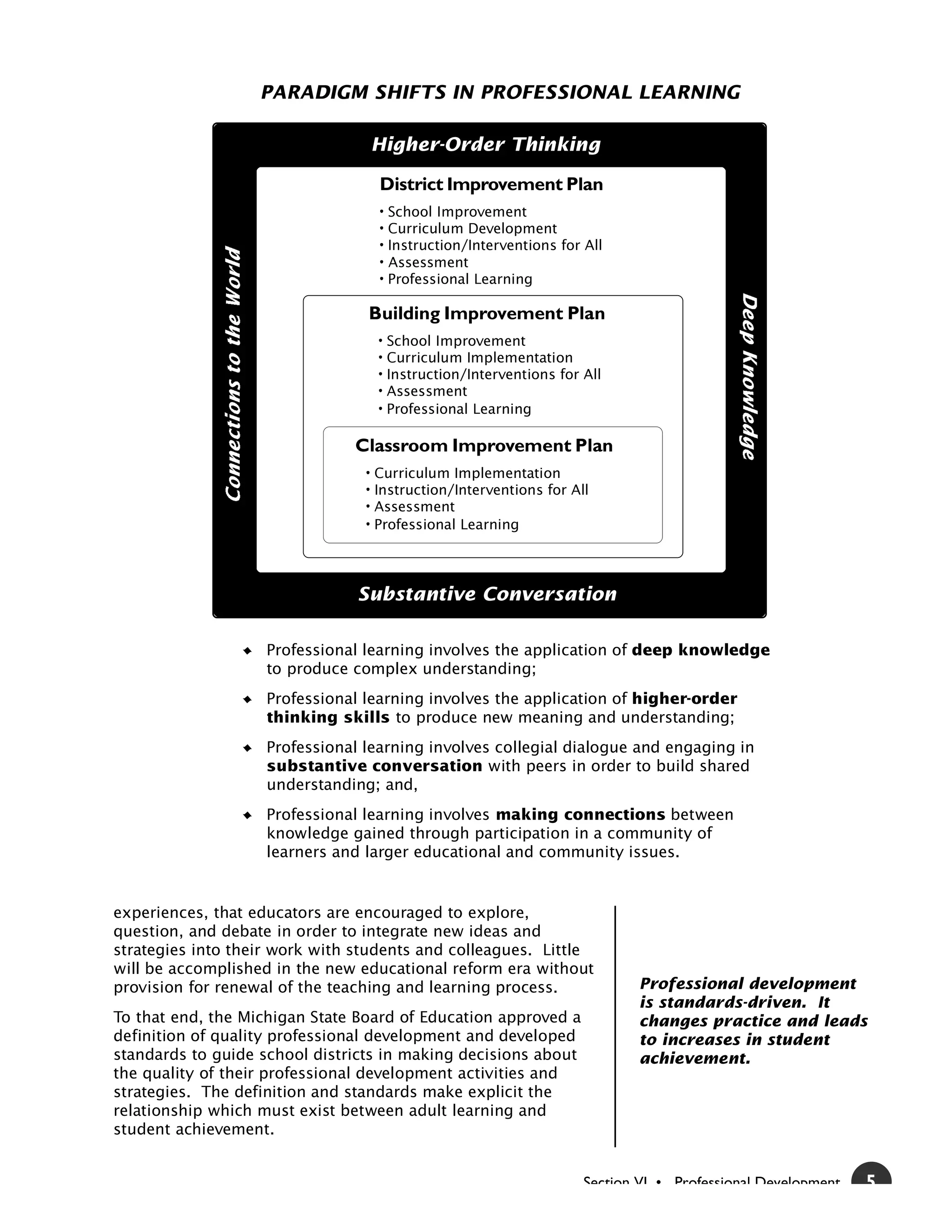
  • 56.
    4. Report the result of 4. Report the results of their investigation their investigation including the including procedures procedures followed. followed and possible alternative conclusions. VI. Public Discourse and Decision Making Content Standard 1: All students will state an issue clearly as a question of public policy, trace the origins of the issue, analyze various perspectives people bring to the issue and evaluate possible ways to resolve the issue. (Identifying and Analyzing Issues) Early Elementary Later Elementary Middle School High School 1. Pose a question about 1. Pose local, state, and 1. State public policy 1. Generate possible matters of public national policy issues issues and their alternative resolutions concern that they as questions. related ethical, to public issues and have encountered in definitional, and evaluate them using school or in the local 2. Explain how a factual issues as criteria that have been community. particular public issue questions. identified. became a problem and 2. Compare their own why people disagree 2. Trace the origins of a viewpoint about the about it. public issue. matter raised with that of another 3. Evaluate possible 3. Explain how culture individual. resolutions of a public and experiences shape issue. positions that people take on an issue. Content Standard 2: All students will engage their peers in constructive conversation about matters of public concern by clarifying issues, considering opposing views, applying democratic values, anticipating consequences, and working toward making decisions. (Group Discussion) Early Elementary Later Elementary Middle School High School 1. Engage each other in 1. Engage each other in 1. Engage each other in 1. Engage each other in conversations about conversations which conversations which elaborated issues pertaining to attempt to clarify and attempt to clarify and conversations that governing their school. resolve issues resolve national and deeply examine public pertaining to local, international policy policy issues and help state, and national issues. make reasoned and policy. informed decisions. Content Standard 3: All students will compose coherent written essays that express a position on a public issue and justify the position with reasoned arguments. (Persuasive Writing) Early Elementary Later Elementary Middle School High School 1. Compose brief 1. Compose a short essay 1. Compose essays 1. Compose extensively statements expressing expressing a decision expressing decisions elaborated essays a decision on an issue on a local, state, or on national and expressing and in the school or local national policy issue. international policy justifying decisions on community. issues. public policy issues. 44 Section II • Michigan Content Standards and Draft Benchmarks
  • 57.
    VII. Citizen Involvement ContentStandard 1: All students will consider the effects of an individual’s actions on other people, how one acts in accordance with the rule of law, and how one acts in a virtuous and ethically responsible way as a member of society. (Responsible Personal Conduct) Early Elementary Later Elementary Middle School High School 1. Help to determine, 1. Report how their 1. Use laws and other 1. Act out of respect for interpret and enforce behavior has been ethical rules to the rule of law and school rules. guided by concern for evaluate their own hold others the law. conduct and the accountable to the 2. Participate in projects conduct of others. same standard. designed to help 2. Engage in activities others in their local intended to contribute 2. Engage in activities 2. Plan and conduct community. to solving a local, state intended to contribute activities intended to or national problem to solving a national or advance their views they have studied. international problem on matters of public they have studied. policy, report the results of their efforts and evaluate their effectiveness. Section II • Michigan Content Standards and Draft Benchmarks 45
  • 58.
    Mathematics Mathematics is the science of patterns and relationships. It is Vision the language and logic of our technological world. Statement Mathematical power is the ability to explore, to conjecture, to reason logically and to use a variety of mathematical methods effectively to solve problems. The ultimate goal of mathematics education is for all students to develop mathematical power to participate fully as a citizen and worker in our contemporary world. A mathematically powerful individual should be able to: reason mathematically; communicate mathematically; problem solve using mathematics; and, make connections within mathematics and between mathematics and other fields. The fifteen content standards have been categorized into the following six strands: I. Patterns, Relationships, and Functions II. Geometry and Measurement III. Data Analysis and Statistics IV. Number Sense and Numeration V. Numerical and Algebraic Operations and Analytical Thinking VI. Probability and Discrete Mathematics OVERVIEW OF THE MATHEMATICS CONTENT STRANDS Strand I. Patterns, Relationships, and Functions Patterns, relationships and functions comprise one of the most important themes in the study of mathematics. Mathematical thinking begins with the recognition of similarities among objects or events, proceeds to generalization and abstraction, and culminates in the ability to understand, explain and make predictions. Contexts that exhibit structure and regularity provide rich opportunities for describing the physical world, studying mathematics and solving problems.
  • 59.
    Standard I.1 Patterns Studentsrecognize similarities and generalize patterns, use patterns to create models and make predictions, describe the nature of patterns and relationships, and construct representations of mathematical relationships. Wherever there is mathematics there are patterns, and wherever there are patterns there is mathematics. Patterns are regularities or similarities that characterize sets of numbers, shapes, graphs, tables or other mathematical objects. Mathematicians look for patterns in everything they do; thus, mathematics is frequently defined as the science of patterns. In studying mathematics, students learn to recognize, describe, analyze and create patterns, to extend and generalize patterns, to create mathematical models based on observed patterns, and to predict the behavior of real-world phenomena based on such observed patterns. They learn to communicate the nature of mathematical patterns and relationships in various ways including words, physical models, diagrams, tables, charts, graphs, and equations. Since each representation highlights different aspects of the patterns and relationships, students must be able to construct multiple representations of mathematical relationships and to translate among them. Standard I.2 Variability and Change Students describe the relationships among variables, predict what will happen to one variable as another variable is changed, analyze natural variation and sources of variability, and compare patterns of change. Variability and change are as fundamental to mathematics as they are to the physical world, and an understanding of the concept of a variable is essential to mathematical thinking. Students must be able to describe the relationships among variables, to predict what will happen to one variable as another variable is changed, and to compare different patterns of change. The study of variability and change provides a basis for making sense of the world and of mathematical ideas. Strand II. Geometry and Measurement We live in a three-dimensional world. In order to interpret and make sense of that world, students need both analytical and spatial abilities. Geometry and measurement, which involve notions of shape, size, position, and dimension, are used extensively to describe and understand the world around us. Standard II.1 Shape and Shape Relationships Students develop spatial sense, use shape as an analytic and descriptive tool, identify characteristics and define shapes, identify properties and describe relationships among shapes. Spatial sense is developed when students recognize, draw, construct, visualize, compare, classify and transform geometric shapes in both two and three dimensions. They learn to identify those characteristics that are necessary to define a given shape, and they can differentiate one shape from another. Students also develop an awareness of the properties of a shape and of the relationships among shapes. This
  • 60.
    includes hierarchical classificationsof shapes (e.g., all squares are rhombuses), relationships among components of a shape (e.g., opposite sides of a rectangle are parallel), symmetries of a shape, congruence and similarity. Standard II.2 Position Students identify locations of objects, identify location relative to other objects, and describe the effects of transformations (e.g., sliding, flipping, turning, enlarging, reducing) on an object. Position refers to the location of physical objects or points in space as well as to the relative locations and positions of objects, points, lines, planes and other geometric elements. It includes such notions as betweenness, collinearity and coordinates in two and three dimensions, as well as the locus of a point as it moves through space and the location of special points. Standard II.3 Measurement Students compare attributes of two objects or of one object with a standard (unit), and analyze situations to determine what measurement(s) should be made and to what level of precision. Measurement reflects the usefulness and practicality of mathematics and puts students in touch with the world around them. Measurement requires the comparison of an attribute (distance, surface, capacity, mass, time, temperature) between two objects or to a known standard, the assignment of a number to represent the comparison, and the interpretation of the results. Measurement also introduces students to the important concepts of precision, approximation, tolerance, error and dimension. Strand III. Data Analysis and Statistics We live in a sea of information. In order not to drown in the data that inundate our lives every day, we must be able to process and transform data into useful knowledge. The ability to interpret data and to make predictions and decisions based on data is an essential basic skill for every individual. Standard III.1 Collection, Organization and Presentation of Data Students collect and explore data, organize data into a useful form, and develop skill in representing and reading data displayed in different formats. Knowing what data to collect and where and how to collect them is the starting point of quantitative literacy. The mathematics curriculum should capitalize on students’ natural curiosity about themselves and their surroundings to motivate them to collect and explore interesting statistics and measurements derived from both real and simulated situations. Once the data are gathered, they must be organized into a useful form, including tables, graphs, charts and pictorial representations. Since different representations highlight different patterns within the data, students should develop skill in representing and reading data displayed in different
  • 61.
    formats, and theyshould discern when one particular representation is more desirable than another. Standard III.2 Description and Interpretation Students examine data and describe characteristics of a distribution, relate data to the situation from which they arose, and use data to answer questions convincingly and persuasively. Students must be able to examine data and describe salient characteristics of the distribution. They also must be able to relate the data to the physical situation from which they arose. Students should use the data to answer key questions and to convince and persuade. Standard III.3 Inference and Prediction Students draw defensible inferences about unknown outcomes, make predictions, and identify the degree of confidence they have in their predictions. Based on known data, students should be able to draw defensible inferences about unknown outcomes. They should be able to make predictions and to identify the degree of confidence that they place in their predictions. Strand IV. Number Sense and Numeration Number sense is to mathematics what vocabulary is to language. Students must learn to quantify and measure, concretely at first and increasingly more abstractly as they mature. They also must develop an understanding of numeration systems and of the structure of such systems. They must learn to estimate mathematical quantities and to represent and communicate mathematical ideas in the language of mathematics. Standard IV.1 Concepts and Properties of Numbers Students experience counting and measuring activities to develop intuitive sense about numbers, develop understanding about properties of numbers, understand the need for and existence of different sets of numbers, and investigate properties of special numbers. Fundamental questions like “What is a number?” or “What is three?” can be deceptively difficult to answer. Students require extensive involvement with concrete experiences of counting and measuring in order to develop an intuitive sense about number. Through both informal and formal means, students develop understanding about important properties of numbers such as even vs. odd, whole number vs. fraction, positive vs. negative. They understand the existence of different sets of numbers (whole numbers, integers, rationals, reals, …) and the properties of special numbers such as 0, 1, π, or the inverse of a number. Standard IV.2 Representation and Uses of Numbers Students recognize that numbers are used in different ways such as counting, measuring, ordering and estimating, understand and produce multiple representations of a number, and translate among equivalent representations.
  • 62.
    Students recognize thatnumbers are used in different ways such as to answer the questions “How many?” (counting), “How much?” (measuring), and “Which one?” (ordering). They understand that a numerical quantity can be represented in many different ways, and they can produce multiple representations of numbers (e.g., fractions, decimals, and percents in the middle grades; vectors and coordinate representations in later years) and they can translate easily among equivalent representations. As students mature from the middle school on, they develop a solid understanding of both linearity and proportionality. Standard IV.3 Number Relationships Students investigate relationships such as equality, inequality, inverses, factors and multiples, and represent and compare very large and very small numbers. Students develop understanding of important relationships among numbers including the relationships of (=, ≠) and (<, >); of opposites (additive inverses) and reciprocals (multiplicative inverses); of factors and multiples; of primes, composites, and relatively prime numbers; of powers and roots. They understand and can represent very large and very small numbers and can compare the orders of magnitude of numbers. Strand V. Numerical and Algebraic Operations and Analytical Thinking The ability to represent quantitative situations with algebraic symbolism, numerical operations and algebraic thinking is essential to solving problems in significant contexts and applications. The concepts of number and variable and their symbolic representation and manipulation are central to the understanding of arithmetic and its generalization in algebra. The contemporary applications of mathematics in virtually every field of work and study rely on algebraic and analytic thinking and communication as fundamental tools. Standard V.1 Operations and Their Properties Students understand and use various types of operations (e.g., addition, subtraction, multiplication, division) to solve problems. The ultimate reason for mastering the operations of arithmetic and algebra is to solve problems. To that end, understanding the basic computational operations and their algorithms is essential for competence in mathematics, but the emphasis must be on understanding and using the operations, not on memorizing algorithms. In computation, understanding and accuracy are always more important than speed. Understanding the operations requires the concomitant understanding and application of the properties of those operations, and it involves knowing what operations to use in a particular situation. There is no one way to perform a calculation. Students must be competent in performing calculations, but they need not have a rigid adherence to one algorithm. Methods of computation include proficiency with mental calculation, paper and pencil, and calculators; the
  • 63.
    ability to representcomputations with manipulatives and geometric models; and the discernment of which computational method to use in a given situation. Computational methods also involve estimating and assessing the reasonableness of the results of a computation. Standard V.2 Algebraic and Analytic Thinking Students analyze problems to determine an appropriate process for solution, and use algebraic notations to model or represent problems. Mathematical representations allow us to visualize and understand problems. These representations may be numerical, literal, symbolic, graphical, pictorial or physical. Facility with multiple representations of numerical and algebraic concepts and relationships is essential to mathematical competence. This includes the development of “symbol sense” as well as “number sense” and the understanding that the notion of solution involves a process as well as a product. Thus, the solution of a mathematical problem requires both an understanding of the question for which an answer is sought and the development of a strategy to obtain that answer. The context of the problem determines the nature and the degree of precision of the required solution. The increasing use of quantitative methods in all disciplines has made algebra the fundamental tool for mathematical applications. Algebraic thinking is learned most effectively when it is studied in the context of applications, both mathematical and real-world, that reveal the power of algebra to model real problems and to generalize to new situations. Students should use algebraic techniques to analyze and describe relationships, to model problem situations, and to examine the structure of mathematical relationships. The algebra curriculum should employ contemporary technology, including spreadsheets and graphical analysis, to emphasize conceptual understanding of algebra and analytic thinking as sophisticated means of representation and as powerful problem-solving tools. Strand VI. Probability and Discrete Mathematics Contemporary uses of mathematics demand that students learn to deal with uncertainty, to make informed decisions based on evidence and expectations, to exercise critical judgment about conclusions drawn from data, and to apply mathematical models to real-world phenomena. The technological world in which we live also depends upon information and the communication of information and upon applications of systems with separate (discrete) entities. Topics of discrete mathematics such as counting and permutation problems, matrix operations, vertex-edge networks, and relationships among finite sets have significant real-world applications that students will encounter in diverse fields of work and study. Standard VI.1 Probability Students develop an understanding of the notion of certainty and of probability as a measure of the degree of likelihood that
  • 64.
    can be assignedto a given event based on the knowledge available, and make critical judgments about claims that are made in probabilistic situations. Dealing with uncertainty and making predictions and decisions in the face of uncertainty are essential skills for coping with the modern world. Students must develop an understanding of the notion of uncertainty and of probability as a measure of the degree of likelihood that can be assigned to a given event based on the knowledge available. They also must be able to make critical judgments about claims that are made in probabilistic situations. Standard VI.2 Discrete Mathematics Students investigate practical situations such as scheduling, routing, sequencing, networking, organizing and classifying, and analyze ideas like recurrence relations, induction, iteration, and algorithm design. Discrete (discontinuous) mathematics has grown in significance in recent years and today has applications in many important practical situations such as scheduling, routing, sequencing, networking, organizing and classifying. Important ideas like recurrence relations, induction and algorithm design also have practical applications in a variety of fields. Computers, which are finite, discrete machines, require an understanding of discrete mathematics for the solution of problems using computer methods.
  • 65.
    MATHEMATICS CONTENT STANDARDS AND WORKING DRAFT BENCHMARKS I. Patterns, Relationships and Functions Content Standard 1: Students recognize similarities and generalize patterns, use patterns to create models and make predictions, describe the nature of patterns and relationships, and construct representations of mathematical relationships. (Patterns) Elementary Middle School High School 1. Recognize, describe and extend 1. Describe, analyze and 1. Analyze and generalize numerical and geometric generalize patterns arising in a mathematical patterns including patterns. variety of contexts and express sequences, series and recursive them in general terms. patterns. 2. Represent and record patterns 2. Represent and record patterns 2. Analyze, interpret and translate and relationships in a variety of in a variety of ways including among representations of ways including tables, charts tables, charts and graphs, and patterns including tables, and pictures. translate between various charts, graphs, matrices and representations. vectors. 3. Use patterns to describe real- 3. Use patterns and their 3. Study and employ mathematical world phenomena. generalizations to make and models of patterns to make justify inferences and inferences, predictions and predictions. decisions. 4. Explore various types of 4. Explore and describe visual and 4. Explore patterns (graphic, numeric and geometric patterns numeric patterns, including numeric, etc.) characteristic of (repeating, growing, shrinking). linear expressions, near-linear families of functions; explore patterns and symmetric and structural patterns within spatial patterns. systems of objects, operations or relations. 5. Apply their experiences with 5. Use patterns and 5. Use patterns and reasoning to patterns to help solve problems generalizations to solve solve problems and explore new and explore new content. problems and explore new content. content. Content Standard 2: Students describe the relationships among variables, predict what will happen to one variable as another variable is changed, analyze natural variation and sources of variability, and compare patterns of change. (Variability and Change) Elementary Middle School High School 1. Recognize change and 1. Identify and describe the nature 1. Identify and describe the nature variability when it occurs in a of change; recognize change in of change and begin to use the variety of settings. more abstract and complex more formal language such as situations and explore different rate of change, continuity, limit, kinds of change and patterns of distribution and deviation. variation. 2. Recognize that change is often 2. Connect an initial state to a final 2. Develop a mathematical predictable, but variable, and state and generalize a rule that concept of function and that patterns emerge that help describes a pattern of change. recognize that functions display to describe the change. characteristic patterns of change (e.g., linear, quadratic, exponential). Section II • Michigan Content Standards and Draft Benchmarks 53
  • 66.
    3. Explore change, and realize that 3. Begin to investigate applications 3. Expand their understanding of changes are frequently in bivariate data and linear function to include non-linear interdependent. relationships and explore functions, composition of questions of what will happen to functions, inverses of functions, one quantity if another variable and piecewise- and recursively- is changed. defined functions. 4. Use tables, charts, open 4. Represent variability or change 4. Represent functions using sentences and hands-on models by ordered pairs, tables, graphs symbolism such as matrices, to represent change and and equations. vectors and functional variability. representation (f(x)). 5. Begin to describe and 5. Differentiate between functions 5. Differentiate and analyze differentiate between types of and relationships such as linear classes of functions including relationships, especially vs. not linear or continuous vs. linear, power, quadratic, repeating, growing and non-continuous. exponential, circular and shrinking patterns. trigonometric functions, and realize that many different situations can be modeled by a particular type of function. 6. Explore variability and change 6. Continue to explore 6. Increase their use of functions in a variety of contexts, relationships arising from and mathematical models to investigations and problems. interesting contexts and use solve problems in context. variables and relationships to solve mathematical problems. II. Geometry and Measurement Content Standard 1: Students develop spatial sense, use shape as an analytic and descriptive tool, identify characteristics and define shapes, identify properties and describe relationships among shapes. (Shape and Shape Relationships) Elementary Middle School High School 1. Recognize and name familiar 1. Distinguish among shapes and 1. Use shape to identify plane and shapes in one, two and three differentiate between examples solid figures, graphs, loci, dimensions such as lines, and non-examples of shapes functions and data distributions. rectangles and spheres and based on their properties; informally discuss the shape of a generalize about shapes of graph. graphs and data distributions. 2. Describe the attributes of 2. Generalize the characteristics 2. Determine necessary and familiar shapes. of shapes and apply their sufficient conditions for the generalizations to classes of existence of a particular shape shapes. and apply those conditions to analyze shapes. 3. Compare, sort and classify 3. Derive generalizations about 3. Use transformational, familiar shapes. shapes and apply those coordinate or synthetic methods generalizations to develop to verify (prove) the classifications of familiar generalizations they have made shapes. about properties of classes of shapes. 4. Draw and build familiar shapes. 4. Construct familiar shapes using 4. Draw and construct shapes in coordinates, appropriate tools two and three dimensions and (including technology), analyze and justify the steps of sketching and drawing two- and their constructions. three-dimensional shapes. 54 Section II • Michigan Content Standards and Draft Benchmarks
  • 67.
    5. Explore ways to combine, 5. Combine, dissect and transform 5. Study transformations of shapes dissect and transform shapes. shapes. using isometries, size transformations and coordinate mappings. 6. Recognize parallel and 6. Generalize about the common 6. Compare and analyze shapes perpendicular line segments and properties of similar, congruent, and formally establish the figures that have similarity parallel and perpendicular relationships among them, and/or congruence. shapes and verify their including congruence, similarity, generalizations informally. parallelism, perpendicularity and incidence. 7. Use shape, shape properties and 7. Use shape, shape properties and 7. Use shape, shape properties and shape relationships to describe shape relationships to describe shape relationships to describe the physical world and to solve the physical world and to solve the physical world and to solve problems. problems. problems. Content Standard 2: Students identify locations of objects, identify location relative to other objects, and describe the effects of transformations (e.g., sliding, flipping, turning, enlarging, reducing) on an object. (Position) Elementary Middle School High School 1. Locate and describe objects in 1. Locate and describe objects in 1. Locate and describe objects in terms of their position, including terms of their position, including terms of their position, including front, back, inside, outside, compass directions, Cartesian polar coordinates, three- right, left, over, under, next to, coordinates, latitude and dimensional Cartesian between and locations on the longitude and midpoints. coordinates, vectors and limits. number line, on a coordinate graph and on a map. 2. Locate and describe objects in 2. Locate and describe objects in 2. Locate and describe objects in terms of their orientation, terms of their orientation and terms of their orientation and direction and relative position, relative position, including relative position, including including up, down, front, back, coincident, collinear, parallel, displacement (vectors), phase N- S- E- W, flipped, turned, perpendicular; differentiate shift, maxima, minima and translated; recognize between fixed (e.g., N- S- E- W) inflection points; give precise symmetrical objects and and relative (e.g., right-left) mathematical descriptions of identify their lines of symmetry. orientations; recognize and symmetries. describe examples of bilateral and rotational symmetry. 3. Explore what happens to the 3. Describe translations, 3. Give precise mathematical size, shape and position of an reflections, rotations and descriptions of transformations object after sliding, flipping, dilations using the language of and describe the effects of turning, enlarging or reducing it. transformations and employ transformations on size, shape, transformations to verify position and orientation. congruence of figures. 4. Locate the position of points or 4. Describe the locus of a point by objects described by two or a rule or mathematical more conditions; locate all the expression; trace the locus of a points (locus) that satisfy a moving point. given condition. 5. Use concepts of position, 5. Use concepts of position, 5. Use concepts of position, direction and orientation to direction and orientation to direction and orientation to describe the physical world and describe the physical world and describe the physical world and to solve problems. to solve problems. to solve problems. Section II • Michigan Content Standards and Draft Benchmarks 55
  • 68.
    Content Standard 3:Students compare attributes of two objects, or of one object with a standard (unit), and analyze situations to determine what measurement(s) should be made and to what level of precision. (Measurement) Elementary Middle School High School 1. Compare attributes of objects; 1. Select and use appropriate 1. Select and use appropriate develop standard units of tools; measure objects using tools; make accurate measurement; and select and standard units in both the metric measurements using both metric use standard tools for and common systems and and common units, and measure measurement. measure angles in degrees. angles in degrees and radians. 2. Identify the attribute to be 2. Identify the attribute to be 2. Continue to make and apply measured and select the measured and select the measurements of length, mass appropriate unit of appropriate unit of (weight), time, temperature, measurement for length, mass measurement for length, mass area, volume, angle; classify (weight), area, perimeter, (weight), time, temperature, objects according to their capacity, time, temperature and perimeter, area, volume and dimensions. money. angle. 3. Develop strategies for 3. Estimate measures with a 3. Estimate measures with a estimating measures and specified degree of accuracy specified degree of accuracy compare the estimates to the and decide if an estimate or a and evaluate measurements for results of the measurement; measurement is “close enough.” accuracy, precision and decide if an estimate is “a good tolerance. estimate.” 4. Explain the meaning of 4. Interpret measurements and 4. Interpret measurements and measurements and recognize recognize that two objects may explain how changes in one that the number of units it takes have the same measurement on measure may affect other to measure an object is related one attribute (e.g., area) but not measures. to the size of the unit. necessarily on another (e.g., perimeter). 5. Explore scale drawings, models 5. Use proportional reasoning and 5. Use proportional reasoning and and maps and relate them to indirect measurements to draw indirect measurements, measurements of real objects. inferences. including applications of trigonometric ratios, to measure inaccessible distances and to determine derived measures such as density. 6. Apply measurement to describe 6. Apply measurement to describe 6. Apply measurement to describe the real world and to solve the real world and to solve the real world and to solve problems. problems. problems. III. Data Analysis and Statistics Content Standard 1: Students collect and explore data, organize data into a useful form, and develop skill in representing and reading data displayed in different formats. (Collection, Organization and Presentation of Data) Elementary Middle School High School 1. Collect and explore data 1. Collect and explore data 1. Collect and explore data through counting, measuring through observation, through observation, and conducting surveys and measurement, surveys, sampling measurement, surveys, sampling experiments. techniques and simulations. techniques and simulations. 2. Organize data using concrete 2. Organize data using tables, 2 Organize data using tables, objects, pictures, tallies, tables, charts, graphs, spreadsheets charts, graphs, spreadsheets charts, diagrams and graphs. and data bases. and data bases. 56 Section II • Michigan Content Standards and Draft Benchmarks
  • 69.
    3. Present data using a variety of 3. Present data using a variety of 3. Present data using the most appropriate representations and appropriate representations and appropriate representation and explain the meaning of the data. explain why one representation give a rationale for their choice; is preferred over another or show how certain how a particular representation representations may skew the may bias the presentation. data or bias the presentation. 4. Identify what data are needed to 4. Identify what data are needed to 4. Identify what data are needed to answer a particular question or answer a particular question or answer a particular question or solve a given problem, and solve a given problem, and solve a given problem and design and implement strategies design and implement strategies design and implement strategies to obtain, organize and present to obtain, organize and present to obtain, organize and present those data. those data. those data. Content Standard 2: Students examine data and describe characteristics of a distribution, relate data to the situation from which they arose, and use data to answer questions convincingly and persuasively. (Description and Interpretation) Elementary Middle School High School 1. Read and explain data they have 1. Critically read data from tables, 1. Critically read data from tables, collected and organized charts or graphs and explain the charts or graphs and explain the themselves and progress to source of the data and what the source of the data and what the reading data from other data represent. data represent. sources. 2. Describe the shape of the data 2. Describe the shape of a data 2. Describe the shape of a data using informal language. distribution and identify the distribution and determine center, the spread, correlations measures of central tendency, and any outliers. variability and correlation. 3. Draw, explain and justify 3. Draw, explain and justify 3. Use the data and their conclusions, such as trends conclusions based on data. characteristics to draw and based on data. support conclusions. 4. Raise and answer questions 4. Critically question the sources 4. Critically question the sources about the source, collection, of data; the techniques used to of data; the techniques used to organization and presentation of collect, organize and present collect, organize and present data, as well as the conclusions data; the inferences drawn from data; the inferences drawn from drawn from the data; explore the data; and the possible the data; and the sources of bias biases in the data. sources of bias in the data or and measures taken to eliminate their presentation. such bias. 5. Formulate questions and 5. Formulate questions and 5. Formulate questions and problems and gather and problems and gather and problems and gather and interpret data to answer those interpret data to answer those interpret data to answer those questions. questions. questions. Content Standard 3: Students draw defensible inferences about unknown outcomes, make predictions, and identify the degree of confidence they have in their predictions. (Inference and Prediction) Elementary Middle School High School 1. Make and test hypotheses. 1. Make and test hypotheses. 1. Make and test hypotheses. 2. Conduct surveys, samplings and 2. Design experiments to model 2. Design investigations to model experiments to solve problems and solve problems using and solve problems; also employ and answer questions of interest sampling, simulations and confidence intervals and curve to them. controlled investigations. fitting in analyzing the data. Section II • Michigan Content Standards and Draft Benchmarks 57
  • 70.
    3. Formulate and communicate 3. Formulate and communicate 3. Formulate and communicate arguments and conclusions arguments and conclusions arguments and conclusions based on data and evaluate their based on data and evaluate their based on data and evaluate their arguments and those of others. arguments and those of others. arguments and those of others. 4. Make and explain predictions 4. Make predictions and decisions 4. Make predictions and decisions based on data. based on data, including based on data, including interpolations and interpolations and extrapolations. extrapolations. 5. Make predictions to answer 5. Employ investigations, 5. Employ investigations, questions and solve problems. mathematical models and mathematical models, and simulations to make inferences simulations to make and predictions to answer inferences and predictions to questions and solve problems. answer questions and solve problems. IV. Number Sense and Numeration Content Standard 1: Students experience counting and measuring activities to develop intuitive sense about numbers, develop understanding about properties of numbers, understand the need for and existence of different sets of numbers, and investigate properties of special numbers. (Concepts and Properties of Numbers) Elementary Middle School High School 1. Develop an understanding of 1. Develop an understanding of 1. Develop an understanding of whole numbers and read, write integers and rational numbers irrational, real and complex and count using whole numbers; and represent rational numbers numbers. investigate basic concepts of in both fraction and decimal fractions and decimals. form. 2. Investigate and develop an 2. Extend their understanding of 2. Use the (a+bi) and polar forms understanding of the base-10 numeration systems to include of complex numbers. place-value system. decimal numeration, scientific numeration and non-decimal numeration systems. 3. Develop an understanding of the 3. Develop an understanding of the 3. Develop an understanding of the properties of numbers (e.g., properties of the integer and properties of the real and order) and of the properties of rational number systems (e.g., complex number systems and of the special numbers 0 and 1. order, density) and of the the properties of special properties of special numbers numbers including π, i, e, and including 0, 1 and π, and the conjugates. additive and multiplicative inverses. 4. Apply their understanding of 4. Apply their understanding of 4. Apply their understanding of number systems to model and number systems to model and number systems to model, and solve problems. solve mathematical and applied solve mathematical and applied problems. problems. Content Standard 2: Students recognize that numbers are used in different ways such as counting, measuring, ordering and estimating, understand and produce multiple representations of a number, and translate among equivalent representations. (Representation and Uses of Numbers) Elementary Middle School High School 1. Represent whole numbers, 1. Give geometric representations 1. Give decimal representations of fractions and decimals using of fractions, prime and rational and irrational numbers concrete, pictorial and symbolic composite numbers, triangular and coordinate and vector representations. and square numbers, and other representations of complex number concepts; represent numbers. rational numbers and integers on the number line. 58 Section II • Michigan Content Standards and Draft Benchmarks
  • 71.
    2. Explore and recognize different 2. Recognize equivalent 2. Develop an understanding of representations for the same representations of a number, more complex representations number and explain why they especially fractions, decimals of numbers, including are the same. and percents, and translate exponential and logarithmic freely among representations. expressions, and select an appropriate representation to facilitate problem solving. 3. Investigate ways numbers are 3. Distinguish between numbers 3. Determine when to use rational used (e.g., counting, ordering, that are used for counting, approximations and the exact naming, locating, measuring). numbers that are used for values of numbers such as e, π ordering, numbers that are used and the irrational. for measuring and numbers that are used for naming. 4. Develop strategies for 4. Develop and refine strategies 4. Apply estimation in increasingly estimating quantity and evaluate for estimating quantities, complex situations. the reasonableness of their including fractional quantities, estimates. and evaluate the reasonableness and appropriateness of their estimates. 5. Select appropriate numbers and 5. Select appropriate 5. Select appropriate representations in order to representations for numbers, representations for numbers, solve problems. including integers and rational including representations of numbers, in order to simplify rational and irrational numbers and solve problems. and coordinate and vector representations of complex numbers, in order to simplify and solve problems. Content Standard 3: Students investigate relationships such as equality, inequality, inverses, factors and multiples, and represent and compare very large and very small numbers. (Number Relationships) Elementary Middle School High School 1. Compare and order numbers 1. Compare and order integers and 1. Compare and order real using “equal,” “less than” or rational numbers using relations numbers and compare rational “greater than.” of equality and inequality. approximations to exact values. 2. Use part-whole relationships to 2. Express numerical comparisons 2. Express numerical comparisons explore numbers, develop as ratios and rates. as ratios and rates. number concepts and understand computation. 3. Classify numbers as even or odd 3. Distinguish between prime and 3. Extend the relationships of and explore concepts of factors composite numbers; identify primes, factors, multiples and and multiples. factors, multiples, common divisibility in an algebraic factors and multiples, and setting. relatively prime numbers; and apply divisibility tests to numbers. 4. Explain the meaning of powers 4. Express number relationships and roots of numbers and use using positive and negative calculators to compute powers rational exponents, logarithms and square roots. and radicals. 5. Apply their understanding of 5. Apply their understanding of 5. Apply their understanding of number relationships in solving number relationships in solving number relationships in solving problems. problems. problems. Section II • Michigan Content Standards and Draft Benchmarks 59
  • 72.
    V. Numerical andAlgebraic Operations and Analytical Thinking Content Standard 1: Students understand and use various types of operations (e.g., addition, subtraction, multiplication, division) to solve problems. (Operations and their Properties). Elementary Middle School High School 1. Use manipulatives to model 1. Use manipulatives and diagrams 1. Present and explain geometric operations with numbers; to model operations and their and symbolic models for develop their own methods of inverses with integers and operations with real and recording operations; and relate rational numbers and relate the complex numbers and algebraic their models and recordings to models to their symbolic expressions. standard symbolic expressions expressions. and algorithms. 2. Develop and apply the 2. Compute with integers, rational 2. Compute with real numbers, appropriate method of numbers and simple algebraic complex numbers, algebraic computation from among mental expressions using mental expressions, matrices and computation, estimation, computation, estimation, vectors using technology and, paper-and-pencil or calculators; calculators and paper-and- for simple instances, with paper- explain why they are choosing a pencil; explain what they are and-pencil algorithms. method and how they know doing and how they know which which operations to perform in operations to perform in a given a given situation. situation. 3. Explore properties of operations 3. Describe the properties of 3. Describe the properties of (e.g., commutative and operations with rationals and operations with numbers, distributive properties) and give integers (e.g., closure; algebraic expressions, vectors examples of how they use those associative, commutative and and matrices, and make properties. distributive properties) and give generalizations about the examples of how they use those properties of given properties. mathematical systems. 4. Apply operations efficiently and 4. Efficiently and accurately apply 4. Efficiently and accurately apply accurately in solving problems. operations with integers, operations with real numbers, rational numbers and simple complex numbers, algebraic algebraic expressions in solving expressions, matrices and problems. vectors in solving problems. Content Standard 2: Students analyze problems to determine an appropriate process for solution, and use algebraic notations to model or represent problems. (Algebraic and Analytic Thinking) Elementary Middle School High School 1. Write and solve open sentences 1. Read and write algebraic 1. Identify important variables in a (e.g., ◊ + ∆ = 5) and write expressions; develop original context, symbolize them and stories to fit the open sentence. examples expressed verbally express their relationships and algebraically; simplify algebraically. expressions and translate between verbal and algebraic expressions; and solve linear equations and inequalities. 2. Explore algebraic concepts with 2. Represent algebraic concepts 2. Represent algebraic concepts manipulatives such as balance with geometric models (e.g., and relationships with matrices, scales, tables of input and algebra tiles), physical models spreadsheets, diagrams, graphs, output, and pictorial (e.g., balance beam), tables and tables, physical models, vectors, representations of problems. graphs; and write algebraic equations and inequalities; and expressions to correspond to translate among the various the multiple representations. representations. 60 Section II • Michigan Content Standards and Draft Benchmarks
  • 73.
    3. Find replacements for the 3. Solve linear equalities and 3. Solve linear equations and variable(s) in open sentences. inequalities using algebraic and inequalities algebraically and geometric methods, and use the non-linear equations using context of the problem to graphing, symbol-manipulating interpret and explain their or spreadsheet technology; and solutions. solve linear and non-linear systems using appropriate methods. 4. Use analytic thinking to describe 4. Analyze problems modeled by 4. Analyze problems that can be situations and solve problems. linear functions, determine modeled by functions, determine strategies for solving the strategies for solving the problems and evaluate the problems and evaluate the adequacy of the solutions in the adequacy of the solutions in the context of the problems. context of the problems. 5. Explore problems that reflect 5. Explore problems that reflect the contemporary uses of the contemporary uses of mathematics in significant mathematics in significant contexts and use the power of contexts and use the power of technology and algebraic and technology and algebraic and analytic reasoning to analytic reasoning to experience the ways experience the ways mathematics is used in society. mathematics is used in society. VI. Probability and Discrete Mathematics Content Standard 1: Students develop an understanding of the notion of certainty and of probability as a measure of the degree of likelihood that can be assigned to a given event based on the knowledge available, and make critical judgments about claims that are made in probabilistic situations. (Probability) Elementary Middle School High School 1. Explain the difference between 1. Describe events as likely or 1. Develop an understanding of chance and certainty and give unlikely and give qualitative and randomness and chance examples to illustrate their quantitative descriptions of the variation and describe chance understanding. degree of likelihood. and certainty in the language of probability. 2. Compare events and describe 2. Describe probability as a 2. Give a mathematical definition them as “more likely” or “less measure of certainty ranging of probability and determine the likely” and use the language of from 0 to 1 and conduct probabilities of more complex fractions to describe simple activities that allow them to events, and generate and probabilities. express probabilities of simple interpret probability events in mathematical terms. distributions. 3. Conduct experiments with 3. Conduct experiments and give 3. Analyze events to determine concrete objects to explore examples to illustrate the their dependence or concepts and develop an difference between dependent independence and calculate intuitive understanding of how and independent events. probabilities of compound the conditions of the experiment events. can affect the outcome. 4. Conduct experiments, record 4. Explain the difference between 4. Use sampling and simulations to the outcomes, examine those probabilities determined from determine empirical outcomes to determine if they experiments or chance events probabilities and, when make sense and search for (empirical) and probabilities appropriate, compare them to explanations of the outcomes. derived mathematically the corresponding theoretical (theoretical), and explain how probabilities; understand and the empirical probability apply the law of large numbers. changes for a large number of trials. Section II • Michigan Content Standards and Draft Benchmarks 61
  • 74.
    5. Conduct probability experiments 5. Conduct probability experiments 5. Conduct probability experiments and simulations to model and and simulations to model and and simulations, to model and solve problems. solve problems. solve problems, including compound events. Content Standard 2: Students investigate practical situations such as scheduling, routing, sequencing, networking, organizing and classifying, and analyze ideas like recurrence relations, induction, iteration, and algorithm design. (Discrete Mathematics) Elementary Middle School High School 1. Use manipulatives and diagrams 1. Use manipulatives, diagrams and 1. Derive and use formulas for to explore problems involving the fundamental theorem of calculating permutations and counting and arranging objects. counting to count permutations combinations. and combinations. 2. Explore sets and set 2. Use sets and set relationships to 2. Use sets and set relationships to relationships by sorting and explore and solve simple represent algebraic and classifying objects. algebraic and geometric geometric concepts. problems. 3. Explore situations in which they 3. Solve problems involving 3. Use vertex-edge graphs to solve model and trace paths using networks, for example planning network problems such as figures consisting of vertices delivery routes or counting finding circuits, critical paths, connected by edges. paths between points. minimum spanning trees and adjacency matrices. 4. Explore now-next patterns. 4. Explore recurrence relations 4. Analyze and use discrete ideas, and iterations. such as induction, iteration and recurrence relations. 5. Explore, develop and invent 5. Continue to use manipulatives 5. Describe and analyze efficient their own algorithms to and drawings to model the algorithms to accomplish a task accomplish a task or to solve concepts and procedures for the or solve a problem in a variety numerical problems. standard arithmetic algorithms, of contexts, including practical, and develop and analyze their mathematical and computer- own and other students’ related situations. algorithms to accomplish a task or solve a mathematical problem. 6. Use discrete mathematics 6. Use discrete mathematics 6. Use discrete mathematics concepts as described above to concepts as described above to concepts as described above to model situations and solve model situations and solve model situations and solve problems; and look for whether problems; and look for whether problems; and look for whether or not there is a solution or not there is a solution or not there is a solution (existence problems), determine (existence problems), determine (existence problems), determine how many solutions there are how many solutions there are how many solutions there are (counting problems) and decide (counting problems) and decide (counting problems) and decide upon a best solution upon a best solution upon a best solution (optimization problems). (optimization problems). (optimization problems). 62 Section II • Michigan Content Standards and Draft Benchmarks
  • 75.
    Science Science is away of making sense of the natural world. Scientists seek to describe its complexity, to explain its systems Vision and events, and to find the patterns that allow for predictions. Science is the basis for the design of technologies that solve Statement real-world problems. Not all students will become scientists or engineers. But science and technology occupy ever-expanding places in our everyday lives. As citizens, we are asked to make decisions about social issues that involve science and technology. As workers, we have occupations that increasingly involve science and technology. In the 21st century, adults will need to be comfortable and competent in a complex, scientific and technological world. Schools have the responsibility of preparing students for the future. Schools must prepare all students — regardless of their future aspirations — to be scientifically literate. Therefore, all graduates of our schools should be: knowledgable about the important concepts and theories of the three major branches of scientific study: earth, life, and physical sciences; able to think scientifically and use scientific knowledge to make decisions about real–world problems; able to construct new knowledge for themselves through research, reading, and discussion; familiar with the natural world, and respectful of its unity, diversity, and fragility; able to make informed judgments on statements and debates claiming to have a scientific basis; and, able to reflect in an informed way on the role of science in human affairs. To make this happen, education needs to: 1. emphasize understanding, not content coverage; 2. promote learning that is useful and relevant; 3. emphasize scientific literacy for ALL students; and, 4. promote interdisciplinary learning. The “Michigan Content Standards and Benchmarks” describe three broad categories of activities that are common in scientifically literate individuals: using scientific knowledge; constructing new scientific knowledge, and reflecting on scientific knowledge. The content strands are directly related to these types of activities.
  • 76.
    Overview of theScience Content Strands Strand I. Constructing New Scientific Knowledge Scientifically literate students are learners as well as users of knowledge. With scientific literacy comes the ability to ask questions about the world that can be answered by using scientific knowledge and techniques. Scientifically literate students can also develop solutions to problems that they encounter or questions they ask. In developing solutions, scientifically literate students may use their own knowledge and reasoning abilities, seek out additional knowledge from other sources, and engage in empirical investigations of the real world. They can learn by interpreting text, graphs, tables, pictures, or other representations of scientific knowledge. Finally, scientifically literate students can remember key points and use sources of information to reconstruct previously learned knowledge, rather than try to remember every detail of what they study. Standard I.1 Constructing New Scientific Knowledge All students will ask questions that help them learn about the world; design and conduct investigations using appropriate methodology and technology; learn from books and other sources of information; communicate their findings using appropriate technology; and reconstruct previously learned knowledge. There is one standard under Constructing New Scientific Knowledge. This standard incorporates the ways that scientists and individuals investigate and learn about the world. Strand II. Reflecting on Scientific Knowledge Scientifically literate students can also “step back” and analyze or reflect on their own knowledge. One important type of analysis is the justification of personal knowledge or beliefs using either theoretically or empirically based arguments. Scientifically literate students can also show an appreciation for scientific knowledge and the patterns that it reveals in the world; this often involves seeing connections among different areas of knowledge. They may be able to take a historical and cultural perspective on concepts and theories or to discuss institutional relationships among science, technology, and society. Finally, scientifically literate students can describe the limitations of their own knowledge and scientific knowledge in general. Standard II.1 Reflecting on Scientific Knowledge All students will analyze claims for their scientific merit and explain how scientists decide what constitutes scientific knowledge; how science is related to other ways of knowing; how science and technology affect our society; and how people of diverse cultures have contributed to and influenced developments in science. There is one standard under Reflecting on Scientific Knowledge. This standard incorporates the nature of the
  • 77.
    scientific enterprise, itsstrengths, limitations, and connections to other ways of knowing. Strand III. Using Scientific Knowledge in Life Science Scientifically literate students and adults can use their knowledge to understand the world around them and to guide their actions. Important types of activities that use scientific knowledge include description and explanation of real-world objects, systems, or events; prediction of future events or observations; and the design of systems or courses of action that enable people to adapt to and modify the world around them. In the life sciences, real-world contexts in which scientifically literate people use knowledge are often described in terms of systems and subsystems, such as cells, organisms, and ecosystems. There are five standards under Using Scientific Knowledge in Life Science: Standard III.1 Cells All students will apply an understanding of cells to the functioning of multicellular organisms; and explain how cells grow, develop and reproduce. Cells are the basic living unit of which all organisms are composed. Standard III.2 The Organization of Living Things All students will use classification systems to describe groups of living things; compare and contrast differences in the life cycles of living things; investigate and explain how living things obtain and use energy; and analyze how parts of living things are adapted to carry out specific functions. Organization of living things occurs both across species (as in taxonomic organizations) and within organisms (their structures and processes). Standard III.3 Heredity All students will investigate and explain how characteristics of living things are passed on through generations; explain why organisms within a species are different from one another; and explain how new traits can be established by changing or manipulating genes. Heredity is the means by which traits are transmitted from one generation to the next. Standard III.4 Evolution All students will explain how scientists construct and scientifically test theories concerning the origin of life and evolution of species; compare ways that living organisms are adapted (suited) to survive and reproduce in their environments; and analyze how species change through time. Evolution explains the diversity of living things and the changes seen in them over time.
  • 78.
    Standard III.5 Ecosystems Allstudents will explain how parts of an ecosystem are related and how they interact; explain how energy is distributed to living things in an ecosystem; investigate and explain how communities of living things change over a period of time; describe how materials cycle through an ecosystem and get reused in the environment; and analyze how humans and the environment interact. It is within ecosystems that communities of living things interact. Strand IV. Using Scientific Knowledge in Physical Science In the physical sciences, the specification of real-world contexts often focuses on phenomena, such as motion, electromagnetic interactions, or physical, chemical, and nuclear changes in matter. Four standards are under the broad heading of Using Scientific Knowledge in Physical Science: Standard IV.1 Matter and Energy All students will measure and describe the things around us; explain what the world around us is made of; identify and describe forms of energy; and explain how electricity and magnetism interact with matter. Matter and energy are the fundamental entities of the physical universe. Standard IV.2 Changes in Matter All students will investigate, describe and analyze ways in which matter changes; describe how living things and human technology change matter and transform energy; explain how visible changes in matter are related to atoms and molecules; and how changes in matter are related to changes in energy. Physical, chemical, and nuclear interactions of matter and energy bring about all of the changes we observe in the physical world. Standard IV.3 Motion of Objects All students will describe how things around us move and explain why things move as they do; demonstrate and explain how we control the motions of objects; and relate motion to energy and energy conversions. Motion of objects is accounted for by gravitational, electromagnetic, and nuclear forces. Standard IV.4 Waves and Vibrations All students will describe sounds and sound waves; explain shadows, color, and other light phenomena; measure and describe vibrations and waves; and explain how waves and vibrations transfer energy. Sound, light, and electromagnetic waves are the means by which energy and information are propagated.
  • 79.
    Strand V. UsingScientific Knowledge in Earth Science In the earth sciences, real-world contexts are often described in terms of systems and subsystems, such as atmospheric systems, crustal systems, solar systems, or galaxies, which are useful in explaining phenomena, including volcanic eruptions, earthquakes, thunderstorms, and eclipses. Four standards are under the broad heading of Using Scientific Knowledge in Earth Science: Standard V.1 The Geosphere All students will describe the earth’s surface; describe and explain how the earth’s features change over time; and analyze effects of technology on the earth’s surface and resources. The geosphere includes earth’s surface and geological processes. Standard V.2 The Hydrosphere All students will demonstrate where water is found on earth; describe the characteristics of water and how water moves; and analyze the interaction of human activities with the hydrosphere. The Hydrosphere includes all forms of water. Of particular interest in Michigan is the water environment in the Great Lakes region. Standard V.3 The Atmosphere and Weather All students will investigate and describe what makes up weather and how it changes from day to day, from season to season and over long periods of time; explain what causes different kinds of weather; and analyze the relationships between human activities and the atmosphere. Weather is composed of patterns of moisture, temperature and pressure which move through the atmosphere. Standard V.4 The Solar System, Galaxy and Universe All students will compare and contrast our planet and sun to other planets and star systems; describe and explain how objects in the solar system move; explain scientific theories as to the origin of the solar system; and explain how we learn about the universe. We learn about neighboring and remote celestial bodies through our observations and exploration of space. Note: Essays associated with each of these standards can be found in the 1991 publication Michigan Essential Goals and Objectives for Science Education, available from The Center for Career and Technical Education at Michigan State University, (800) 292-1606. Each essay describes how learners encounter the standard in real-world contexts, key characteristics of scientifically literate performance of the standard, and how, with successful teaching, learners’ performance of the standard becomes more sophisticated over time.
  • 80.
    Michigan Curriculum FrameworkScience Benchmarks Approved Summer, 2000 Note: Newly written narratives for the Benchmarks are found in the MI BIG Table of Contents document at www.misd.net/mibig I. Constructing New Scientific Knowledge (C) ------------------------ 2 MI BIG Science is a series of 15 narratives and articulated strand maps (with submaps) written to the 15 strands of the Michigan Curriculum Framework, II. Reflecting on Scientific Knowledge (R)----------------------------- 5 Science Standards and Benchmarks (June 2000 version). MI BIG Science is a new way of looking at the entire content strand. III. Using Life Science Knowledge 1. Cells (LC) --------------------------------------------------------- 8 For more information, or to report errors with this version, contact: 2. Organization of Living Things (LO)--------------------------- 9 Michigan Department of Education Kevin E. Richard, Science Consultant 3. Heredity (LH) ----------------------------------------------------- 12 P.O. Box 30008 Lansing, MI 48909 4. Evolution (LE) ---------------------------------------------------- 14 W517-373-4223 F517-335-2473 email:richardke@michigan.gov 5. Ecosystems (LEC)------------------------------------------------ 15 IV. Using Physical Science Knowledge 1. Matter and Energy (PME)--------------------------------------- 18 2. Changes in Matter (PCM) --------------------------------------- 22 3. Motion of Objects (PMO) --------------------------------------- 25 4. Waves and Vibrations (PWV) ---------------------------------- 28 V. Using Earth Science Knowledge 1. Geosphere (EG)--------------------------------------------------- 32 2. Hydrosphere (EH) ------------------------------------------------ 36 3. Atmosphere and Weather (EAW) ------------------------------ 38 4. Solar System, Galaxy and Universe (ES) --------------------- 41 Section II • Michigan Content Standards and Draft Benchmarks
  • 81.
    Michigan Curriculum FrameworkScience Content Benchmarks Summer, 2000 Constructing New Scientific Knowledge (C) I.1 Elementary Middle School High School All students will ask questions that help them learn about the world: 1. Generate questions about the world based on 1. Generate scientific questions about the world based 1. Ask questions that can be investigated empirically. observation. on observation. Key concepts: Questions often build on existing Key concepts: Questions lead to action, including Key concepts: Scientific questions can be answered knowledge. careful observation and testing; questions often begin by gathering and analyzing evidence about the world. with “What happens if…?” or “How do these two Real-world contexts: Any in the sections on Using things differ?” Real-world contexts: Any in the sections on Using Scientific Knowledge. Scientific Knowledge. Real-world contexts: Any in the sections on Using Scientific Knowledge. All students will design and conduct investigations using appropriate methodology and technology: 2. Develop solutions to problems through reasoning, 2. Design and conduct scientific investigations. 2. Design and conduct scientific investigations. observation, and investigations. Key concepts: The process of scientific Key concepts: Types of scientific knowledge— Key concepts:(K-2) gather information, ask investigations—test, fair test, hypothesis, theory, hypothesis, theory, observation, conclusion, law, questions, think; (3-5) observe, predict, collect data, evidence, observations, measurements, data, data, generalization. Aspects of field research— draw conclusions, conduct fair tests; prior conclusion. Forms for recording and reporting data— hypothesis, design, observations, samples, analysis, knowledge. tables, graphs, journals. See C-I.1 m.3 (tools). conclusion. Aspects of experimental research— hypothesis, design, variable, experimental group, Real-world contexts: Any in the sections on Using Real-world contexts: Any in the sections on Using control group, prediction, analysis, conclusion. Scientific Knowledge. Scientific Knowledge; also, recognizing differences Investigations are based on questions about the world between observations and inferences; recording (see C-I.1 h.1). observations and measurements of everyday phenomena. Real-world contexts: Any suggested in Using Scientific Knowledge benchmarks for which students would design and/or conduct investigations. Section II • Michigan Content Standards and Draft Benchmarks 2
  • 82.
    Michigan Curriculum FrameworkScience Content Benchmarks Summer, 2000 3. Manipulate simple devices that aid observation and 3. Use tools and equipment appropriate to scientific data collection. investigations. Tools: Various data collection tools suitable for this Tools: various data collection tools suitable for this level, such as hand lenses, wind direction indicators, level, including computers. grids for sampling areas of the sky or landscape. Real-world contexts: Any suggested in Using Real-world contexts: Any suggested in Using Scientific Knowledge benchmarks for which students Scientific Knowledge benchmarks for which students would design and/or conduct investigations. would design and/or conduct investigations. 4. Use simple measurement devices to make 4. Use metric measurement devices to provide 3. Recognize and explain the limitations of measuring measurements in scientific investigations. consistency in an investigation. devices. Key concepts: Measurement units—milliliters, liters, Key concepts: Documentation—laboratory Key concepts: Uncertainty, error, range, tolerances, teaspoon, tablespoon, ounce, cup, millimeter, instructions. Measurement units—milliliters, liters, accuracy, precision. centimeter, meter, gram. millimeter, centimeter, meter, gram. Tools: Balance, thermometer, measuring tape, ruler, Measurement tools: Measuring cups and spoons, Measurement tools: Balancing devices, measuring graduated cylinder, electronic measuring devices. measuring tape, scale, thermometer, rulers, graduated tape, thermometer, graduated cylinder. cylinders. Real-world contexts: Experiments that use Real-world contexts: Conducting investigations, quantitative data; manufacturing systems where Real-world contexts: Making simple mixtures, such following or altering laboratory instructions for measurements are critical. as food, play dough, papier mache; measuring height mixing chemicals. of a person, weight of a ball. Section II • Michigan Content Standards and Draft Benchmarks 3
  • 83.
    Michigan Curriculum FrameworkScience Content Benchmarks Summer, 2000 All students will learn from books and other sources of information: 5. Develop strategies and skills for information 5. Use sources of information in support of scientific 4. Gather and synthesize information from books and gathering and problem solving. investigations. other sources of information. Tools: Sources of information, such as reference Tools: Periodicals, reference books, trade books, web Key concepts: Scientific journals, text- and computer- books, trade books, magazines, web sites, other sites, computer software; forms for presenting based reference materials. people’s knowledge. scientific information, such as figures, tables, graphs. See R-II.1 m.1 (evaluate strengths/weaknesses of Real-world contexts: Libraries, technical reference Real-world contexts: Seeking help from or claims). books, Internet, computer software. interviewing peers, adults, experts; using libraries, World Wide Web, CD-ROMs and other computer Real-world contexts: Libraries, projects where software, other resources. research is needed. All students will communicate findings of investigations, using appropriate technology. 6. Construct charts and graphs and prepare summaries 6. Write and follow procedures in the form of step-by- 5. Discuss topics in groups by making clear of observations. step instructions, formulas, flow diagrams, and presentations, restating or summarizing what others sketches. have said, asking for clarification or elaboration, Key concepts: Increase, decrease, no change, bar taking alternative perspectives, and defending a graph, data table. Key concepts: Purpose, procedure, observation, position. conclusion, data. Tools: Graph paper, rulers, crayons. Key concepts: Logical argument, summary, Real-world contexts: Listing or creating the clarification, elaboration, alternative perspectives. Real-world contexts: Examples of bar charts like directions for completing a task, reporting on those found in a newspaper. investigations. Real-world contexts: Newspaper or magazine articles discussing a topic of social concern. Section II • Michigan Content Standards and Draft Benchmarks 4
  • 84.
    Michigan Curriculum FrameworkScience Content Benchmarks Summer, 2000 Reflecting on Scientific Knowledge (R) II.1 Elementary Middle School High School All students will analyze claims for their scientific merit and explain how scientists decide what constitutes scientific knowledge: 1. Develop an awareness of the need for evidence in 1. Evaluate the strengths and weaknesses of claims, 1. Justify plans or explanations on a theoretical or making decisions scientifically. arguments, or data. empirical basis. Key concepts: (K-2) observations; (3-5) data, Key concepts: Aspects of arguments such as data, Key concepts: Aspects of logical argument, including evidence, sample, fact, opinion. evidence, sampling, alternate explanation, evidence, fact, opinion, assumptions, claims, conclusion; inference, observation. conclusions, observations. Real-world contexts: Deciding whether an explanation is supported by evidence in simple Real-world contexts: Deciding between alternate Real-world contexts: Any in the sections on Using experiments, or relies on personal opinion. explanations or plans for solving problems; Scientific Knowledge. evaluating advertising claims or cases made by interest groups; evaluating sources of references. 2. Describe some general limitations of scientific knowledge. 2. Describe limitations in personal knowledge. Key concepts: Understanding of the general limits of Key concepts: Recognizing degrees of confidence in science and scientific knowledge as constantly ideas or knowledge from different sources, evaluating developing human enterprises; recognizing that dates and sources of references. arguments can have emotive, economic, and political dimensions as well as scientific. Real-world contexts: Any in the sections on Using Scientific Knowledge. Real-world contexts: Any in the sections on Using Scientific Knowledge. All students will show how science is related to other ways of knowing: 2. Show how science concepts can be illustrated 3. Show how common themes of science, mathematics, 3. Show how common themes of science, mathematics, through creative expression such as language arts and and technology apply in real-world contexts. and technology apply in real-world contexts. fine arts. Thematic ideas: Systems-subsystems, feedback Thematic ideas: Systems-subsystems, feedback Key concepts: Poetry, expository work, painting, models, mathematical constancy, scale, conservation, models, mathematical constancy, scale, conservation, drawing, music, diagrams, graphs, charts. structure, function, adaptation. structure, function, adaptation. Real-world contexts: Explaining simple experiments Real-world contexts: Any in the sections on Using Real-world contexts: Any in the sections on Using using paintings and drawings; describing natural Scientific Knowledge. Scientific Knowledge. phenomena scientifically and poetically. Section II • Michigan Content Standards and Draft Benchmarks 5
  • 85.
    Michigan Curriculum FrameworkScience Content Benchmarks Summer, 2000 4. Discuss the historical development of key scientific concepts and principles. Key concepts: Historical, political, social, and economic factors influencing the development of science. See Benchmarks for Science Literacy, AAAS, Chapter 10. Real-world contexts: Historical development of key scientific theories. All students will show how science and technology affect our society: 3. Describe ways in which technology is used in 4. Describe the advantages and risks of new 5. Explain the social and economic advantages and risks everyday life. technologies. of new technology. Key concepts: Provide faster and farther Key concepts: Risk, benefit, side effect, advantage, Key concepts: Cost-benefit analysis; See LO h.5 transportation and communication, organize disadvantage. (health technology), PME-IV.1 h.1 (household and information and solves problems, save time. agricultural materials, EG-V.1 h.4 (resource use), Real-world contexts: Technological systems for LEC-III.5 h.6 (effects of urban development and Real-world contexts: Cars, other machines, radios, manufacturing, transportation, energy distribution, agriculture on ecosystems), EAW-V.3 h.4 (air telephones, computer games, calculators, appliances, housing, medicine (such as cloning, genetic pollution), EH-V.2 h.2 (water pollution.) e-mail, the World Wide Web. engineering). Real-world contexts: Issues related to new technologies, including ones in health-care, transportation, communications, manufacturing, information and media. 4. Develop an awareness of and sensitivity to the 5. Develop an awareness of and sensitivity to the 6. Develop an awareness of and sensitivity to the natural world. natural world. natural world. Key concepts: Appreciation of the balance of nature Key concepts: Appreciation of the balance of nature Key concepts: Appreciation of the balance of nature and the effects organisms have on each other, and the effects organisms have on each other, and the effects organisms have on each other, including the effects humans have on the natural including the effects humans have on the natural including the effects humans have on the natural world. world. world. Real-world contexts: Any in the sections on Using Real-world contexts: Any in the sections on Using Real-world contexts: Any in the sections on Using Scientific Knowledge appropriate to elementary Scientific Knowledge appropriate to middle school. Scientific Knowledge appropriate to high school. school. Section II • Michigan Content Standards and Draft Benchmarks 6
  • 86.
    Michigan Curriculum FrameworkScience Content Benchmarks Summer, 2000 All students will show how people of diverse cultures have contributed to and influenced developments in science: 5. Develop an awareness of contributions made to 6. Recognize the contributions made in science by 7. Describe the historical, political, and social factors science by people of diverse backgrounds and cultures and individuals of diverse backgrounds. affecting developments in science. cultures. Key concepts: Cultural contributions to science, Key concepts: Historical, political, social, and Key concepts: Scientific contributions made by contributions made by people of diverse economic factors influencing the development of people of diverse cultures and backgrounds. backgrounds. science. Real-world contexts: Any in the sections on Using Real-world contexts: Biographies of minority and Real-world contexts: The development of the sun- Scientific Knowledge appropriate to this benchmark. female scientists; histories of cultural contributions to centered model of the solar system and political science. pressures on Galileo; the development of Darwin’s theory of evolution by natural selection. Section II • Michigan Content Standards and Draft Benchmarks 7
  • 87.
    Michigan Curriculum FrameworkScience Content Benchmarks Summer, 2000 Cells (LC) III.1 Elementary Middle School High School All students will apply an understanding of cells to the functioning of multicellular organisms, including how cells grow, develop and reproduce: (No benchmark about cells at the elementary level) 1. Demonstrate evidence that all parts of living things 1. Explain how multicellular organisms grow, based on are made of cells. how cells grow and reproduce. Key concepts: Types of living things: plants, Key concepts: Specialized functions of cells— animals; parts of organisms: tissues, organs, organ respiration (see LO h.3), protein synthesis, mitosis, systems; all functions of organisms are carried out by meiosis (see LH-III.3 h.2). Basic molecules for cell cells. See LC-III.1 m.2 for specific functions. growth—simple sugars, amino acids, fatty acids. Basic chemicals, molecules and atoms—water, Tools: Hand lens, microscope. minerals, carbohydrates, proteins, fats and lipids, nucleic acids; carbon, hydrogen, oxygen, nitrogen. Real-world contexts: Common plant or animal cells: Cells come only from other cells. See LO m.4 Elodea leaf cells, onion skin cells, human cheek cells. (digestion). Single-celled organisms: Paramecium. Real-world contexts: The growth of plants and animals. 2. Explain why and how selected specialized cells are 2. Compare and contrast ways in which selected cells needed by plants and animals. are specialized to carry out particular life functions. Key concepts: Specialized functions of cells— Key concepts: Classifications of organisms by cell reproduction, photosynthesis, transport, movement, type—plant, animal, bacteria; selected specialized disease-fighting. See LO m.4 (systems and processes plant and animal cells—red blood cells, white blood functioning to provide/remove materials to/from cells, muscle cells, nerve cells, root cells, leaf cells, cells). stem cells; cell parts used for classification — organelle, nucleus, cell wall, cell membrane; Real-world contexts: Specialized animal cells: red specialized functions — reproduction (see LC-III.1 blood cells, white blood cells, muscle cells, bone h.1, LH-III.3 h.2), photosynthesis (see LO m.3), cells, nerve cells, egg/sperm cells; specialized plant transport; cell shape. cells—root cells, leaf cells, stem cells. Tools: microscopes Real-world contexts: Reproduction, growth, response, movement, etc. of animals and plants. Functions of bacteria. Section II • Michigan Content Standards and Draft Benchmarks 8
  • 88.
    Michigan Curriculum FrameworkScience Content Benchmarks Summer, 2000 Organization of Living Things (LO) III.2 Elementary Middle School High School All students will use classification systems to describe groups of living things: 1. Explain characteristics and functions of observable body parts in a variety of animals. Key concepts: Observable characteristics—fur, scales, feathers, horns, claws, eyes, quills, beaks, teeth, skeleton, muscles, exoskeleton; functions— insulation, support, movement, food-getting, protection. Real-world contexts: Vertebrate and invertebrate animals, such as humans, cows, sparrows, goldfish, spiders, crayfish, insects. 2. Compare and contrast (K-2) or classify (3-5) familiar 1. Compare and classify organisms into major groups 1. Classify major groups of organisms to the kingdom organisms on the basis of observable physical on the basis of their structure. level. characteristics. Key concepts: Characteristics used for Key concepts: Kingdom categories—protist, fungi, Key concepts: Plant and animal parts—backbone, classification—vertebrates/ invertebrates, cold- moneran, animal, plant. Characteristics for skin, shell, limbs, roots, leaves, stems, flowers, blooded/warm-blooded, single-cell/multicellular, classification—cell wall, cell membrane, organelle, feathers, scales. flowering/nonflowering; groups of vertebrates— single-celled, multicellular. mammals, birds, fish, reptiles, amphibians. Real-world contexts: Animals that look similar— Real-world contexts: Common local representatives snakes, worms, millipedes; flowering and Observation tools: Hand lens, microscope. of each of the five major kingdoms—Paramecium, nonflowering plants; pine tree, oak tree, rose, algae. yeast, mushroom, bacteria, frog, geranium. Real-world contexts: Representative organisms, such as dog, worm, snake, Amoeba, geranium, bacterium, insect, mold. Section II • Michigan Content Standards and Draft Benchmarks 9
  • 89.
    Michigan Curriculum FrameworkScience Content Benchmarks Summer, 2000 All students will compare and contrast differences in the life cycles of living things: 3. Describe life cycles of familiar organisms. 2. Describe the life cycle of a flowering plant. 2. Describe the life cycle of an organism associated with human disease. Key concepts: Life cycle stages—egg, young, adult; Key concepts: Flowering plant parts and processes— seed, plant, flower, fruit; larva, pupa. roots, stems, leaves, flowers, fruits, seeds, embryo, Key concepts: Infection process—disease, parasite, pollen, ovary, egg cell, germination, fertilization. carrier, host, infection. Real-world contexts: Common plants and animals such as bean plants, apple trees, butterflies, Tools: Microscope, hand lens. Tools: Microscope, hand lens. grasshoppers frogs, birds. Real-world contexts: Common flowering plants, such Real-world contexts: Life cycle of organism(s) as bean, tulip. associated with human disease(s), such as Lyme disease—tick, malaria—mosquito, parasites. All students will investigate and explain how living things obtain and use energy: 4. Compare and contrast food, energy, and 3. Describe evidence that plants make and store food. 3. Explain the process of food storage and food use in environmental needs of selected organisms. organisms. Key concepts: Process and products of food Key concepts: Life requirements—food, air, water, production and transport—photosynthesis, starch, Key concepts: Cellular respiration, photosynthesis minerals, sunlight, space, habitat. See LEC-III.5 e.2. sugar, oxygen, carbon dioxide, water. See LO m.4 (see LO m.3), oxygen, sunlight, carbon dioxide, (use of food for energy.) carbohydrate, fat, protein, minerals, water. See Real-world contexts: Germinating seeds, such as LC-III.1 h.1 (how organisms grow), LO-III.2 m.3 beans, corn; aquarium or terrarium life, such as Real-world contexts: Plant food storage organs, such (how plants store food) LO-III.2 m.4 (how food and guppy, goldfish, snail. as potato, onion; starch storage in plants grown under oxygen are distributed to cells), LEC-III.5 m.2 (the different conditions. sun as the ultimate source of energy for organisms) and PCM-IV.2 m.3 (energy transformations). Real-world contexts: Food storage, such as maple tree—maple sap, potato—starch, honey bee—honey, cow—beef, milk. Weight gain and weight loss. Change in respiration rates with exercise. Section II • Michigan Content Standards and Draft Benchmarks 10
  • 90.
    Michigan Curriculum FrameworkScience Content Benchmarks Summer, 2000 All students will analyze how parts of living things are adapted to carry out specific functions: 5. Explain functions of selected seed plant parts. 4. Explain how selected systems and processes work 4. Explain how living things maintain a stable internal together in animals. environment. Key concepts: Plant parts—roots, stems, leaves, flowers, fruits, seeds. Key concepts: Systems/Processes—digestion, Key concepts: Related systems/cells/ chemicals— circulation, respiration, endocrine, reproduction, excretory system, endocrine system, circulatory Real-world contexts: Common edible plant parts, skeletal, muscular, nervous, excretion, transport, system, hormones, immune response, white blood such as bean, cauliflower, carrot, apple, tomato, growth, repair. cell, bacteria, virus. Factors/ mechanisms under spinach. control—temperature, disease/infection, homeostasis. Real-world contexts: Interrelations of body systems (See LE-III.4 e.2 about functions of selected animal during selected activities, such as among skeletal, Real-world contexts: Mechanisms for maintaining body parts.) muscular, circulatory, and respiratory systems during internal stability, such as body temperature, disease physical exercise. control. 5. Describe technology used in the prevention, diagnosis, and treatment of diseases and explain its function in terms of human body processes. Key concepts: Available technologies—sanitation, adequate food and water supplies, inoculation, antibodies, biochemistry, medicines, organ transplants. (See PWV-IV.4 h.4, ultrasound/x-ray.) Real-world contexts: Common contexts for these technologies—health maintenance and disease prevention activities, such as exercise and controlled diets; health monitoring activities, such as cholesterol and blood pressure checks and various tests for cancer. Section II • Michigan Content Standards and Draft Benchmarks 11
  • 91.
    Michigan Curriculum FrameworkScience Content Benchmarks Summer, 2000 Heredity (LH) III.3 Elementary Middle School High School All students will investigate and explain how characteristics of living things are passed on through generations: 1. Give evidence that characteristics are passed from 1. Describe how the characteristics of living things are 1. Explain how characteristics of living things are parents to young. passed on through generations. passed on from generation to generation. Key concepts: Characteristics—hair and feather Key concepts: Reproductive cells—egg, sperm. Key concepts: Traits—dominant, recessive. Genetic color, eye color, leaf shape, flower structure. Chromosome, gene, hereditary information. material—gene pair, gene combination, gene sorting. Real-world contexts: Example of mature and Real-world contexts: Common traits controlled by a Real-world contexts: Common contexts—inheritance immature organisms, such as dogs/puppies, single gene pair, such as wrinkled or smooth seeds in of a human genetic disease/disorder, such as sickle cats/kittens, maple trees/saplings, beans/seedlings. a pea plant, color of horse hair; human traits such as cell anemia; a family tree focused on certain traits; tongue rolling. examining animal or plant pedigrees. All students will explain why organisms within a species are different from one another: (No corresponding benchmark at this level.) 2. Describe how heredity and environment may 2. Describe how genetic material is passed from parent influence/determine characteristics of an organism. to young during sexual and asexual reproduction. Key concepts: Traits—inherited, acquired. Key concepts: Types of cell division—mitosis, meiosis. DNA replication, chromosome. Types of Real-world contexts: Data on heredity, such as reproduction—sexual, asexual. Genetic variation. identical twin studies, effects of introduced toxins, effects of natural selection, effects of controlled Tools: A-V media, diagrams showing DNA selection and breeding. replication during cell division. Real-world contexts: Fruit flies, yeast, reproduction by spores, cloning. Section II • Michigan Content Standards and Draft Benchmarks 12
  • 92.
    Michigan Curriculum FrameworkScience Content Benchmarks Summer, 2000 All students will explain how new traits can be established by changing or manipulating genes: (No corresponding benchmark at this level.) (No corresponding benchmark at this level.) 3. Explain how new traits may arise in individuals through changes in genetic material (DNA). Key concepts: Genetic changes—variation, new gene combinations, mutation. Natural and human- produced sources of mutation—radiation, chemicals. See LE-III.4 m.2 (how new traits become established in populations.) Real-world contexts: Products of genetic engineering, such as medical advances—insulin, cancer drugs; agricultural related products, such as navel oranges, new flower colors, higher-yield grains; effects of natural and man-made contamination; examples of variations due to new gene combinations, such as hybrid organisms or new plant varieties resulting from multiple sets of genes. Section II • Michigan Content Standards and Draft Benchmarks 13
  • 93.
    Michigan Curriculum FrameworkScience Content Benchmarks Summer, 2000 Evolution (LE) III.4 Elementary Middle School High School All students will explain how scientists construct and scientifically test theories concerning the origin of life and evolution of species: 1. Explain how fossils provide evidence about the 1. Describe how scientific theory traces possible 1. Describe what biologists consider to be evidence for nature of ancient life. evolutionary relationships among present and past human evolutionary relationships to selected animal life forms. groups. Key concepts: Types of evidence—fossil, extinct, ancient, modern life forms. See EG-V.1 e.4 (rocks Key concepts: Selected evidence of common Key concepts: Common types of evidence used— and fossils provide evidence of history of the earth). ancestry—geologic time, fossil, bone, embryo, limb. hominid fossils, vestigial structures, DNA, protein structure. Real-world contexts: Common contexts—plant and Real-world contexts: Fossils that show evidence of animal fossils, museum dioramas and common ancestry, such as similarity of vertebrate Real-world contexts: Skeletal comparisons, such as paintings/drawings of ancient life and/or habitats. limb bones, similarity of early vertebrate embryos, modern human to hominid fossils; anatomical and similarity of fossil bones to those of contemporary biochemical similarities of humans and other higher animals i.e., horse legs. primates, such as blood proteins; similarity of early human embryo stages to those of other vertebrates; vestigial structures, such as appendix, tail bone. All students will compare ways that living organisms are adapted (suited) to survive and reproduce in their environments and explain how species change through time: 2. Explain how physical and behavioral characteristics 2. Explain how new traits might become established in a 2. Explain how a new species or variety may originate of animals help them to survive in their population and how species become extinct. through the evolutionary process of natural selection. environments. Key concepts: Environmental change, variation in Key concepts: Concept of species; how new species Key concepts: Characteristics—adaptation, instinct, populations, reproductive success. or varieties are established—natural selection, learning, habit. Traits and their adaptive values— inheritable, non-inheritable characteristics, species sharp teeth or claws for catching and killing prey, Real-world contexts: Examples of inheritable and variation. color for camouflage, behaviors. non-inheritable variations, such as white-eyed fruit fly or scars; examples of variations due to new gene Real-world contexts: Contemporary examples of Real-world contexts: Common vertebrate combinations, such as hybrid organisms. natural selection, such as bacteria resistance to adaptations, such as white polar bears, sharp claws antibiotics, insect resistance to pesticides; examples and sharp canines for predators, changing colors of of artificial selection, such as agricultural selection to chameleon; behaviors, such as migration, increase production, selecting desired traits for pets; communication of danger. historical examples of naïve explanations of evolution, such as the Lamarkian explanation of the evolution of the giraffe’s long neck. Section II • Michigan Content Standards and Draft Benchmarks 14
  • 94.
    Michigan Curriculum FrameworkScience Content Benchmarks Summer, 2000 Ecosystems (LEC) III.5 Elementary Middle School High School All students will explain how parts of an ecosystem are related and how they interact: 1. Identify familiar organisms as part of a food chain or 1. Describe common patterns of relationships among 1. Describe common ecological relationships between food web and describe their feeding relationships populations. and among species and their environments. within the web. Key concepts: Participants and relationships— Key concepts: Competition, territory, carrying Key concepts: Producer, consumer, predator, prey, predator, prey, parasite, competition, mutually capacity, natural balance, population, dependence, decomposer, habitat, community. beneficial. survival; biotic, abiotic factors. Real-world contexts: Food chains and food webs Real-world contexts: Relationships among plants and Real-world contexts: Animals that live in packs or involving organisms, such as rabbits, birds, snakes, animals in an ecosystem—mutually helpful herds and plant colonies, such as—wolves, bison, grasshoppers, plants. relationships, such as insects and flowering plants, lilies and other bulb plants, various forms of algae. birds eating fruit and spreading seeds; parasitic (harmful) relationships, such as humans and mosquitoes, trees and mistletoe; competitive relationships, including squirrels and seed-eating birds, weeds and garden plants. All students will explain how energy is distributed to living things in an ecosystem: 2. Describe the basic requirements for all living things 2. Describe how organisms acquire energy directly or 2. Explain how energy flows through familiar to maintain their existence. indirectly from sunlight. ecosystems. Key concepts: Needs of life—food, habitat, water, Key concepts: Sunlight, plants, food, photosynthesis, Key concepts: Participants and relationships—food shelter, air, light, minerals. See LO-III.2 e.4. producers, consumers, food webs. See LO-III.2 m.3 chain, food web, energy pyramid, energy flow, (photosynthesis and food use). producers, consumers, decomposers. See LO-III.2 Real-world contexts: Selected ecosystems, such as an m.3 (producers), PCM-IV.2 h.4 (conservation of aquarium, rotting log, terrarium, backyard, local pond Real-world contexts: Selected food webs, including energy). or wetland, wood lot. humans. Real-world contexts: Energy pyramids for food webs in various ecosystems. Section II • Michigan Content Standards and Draft Benchmarks 15
  • 95.
    Michigan Curriculum FrameworkScience Content Benchmarks Summer, 2000 All students will investigate and explain how communities of living things change over a period of time: 3. Design systems that encourage growing of particular 3. Predict the effects of changes in one population in a 3. Describe general factors regulating population size in plants or animals. food web on other populations. ecosystems. Key concepts: Needs of life—food, habitat, water, Key concepts: Natural balance, population, Key concepts: Carrying capacity, competition, shelter, air, light, minerals. dependence, survival, community, biodiversity, parasitism, predation, loss of habitat. introduction of non-native species. Real-world contexts: Ecosystems managed by Real-world contexts: Common factors that influence humans, including farms, ranches, gardens, lawns, Real-world contexts: Plants and animals in an relationships, such as weather, disease, predation, potted plants. ecosystem dependent upon each other for survival in migration. selected ecosystems—see LEC-III.5 e.2; comparison of animals and plants found in polluted vs. 4. Describe responses of an ecosystem to events that nonpolluted water, urban vs. rural settings, rural vs. cause it to change. forest settings; zebra mussels introduced into the Great Lakes, gypsy moths defoliating trees. Key concepts: Succession, pioneer, climate/physical conditions, introduction of new/different species, 4. Describe the likely succession of a given ecosystem elimination of existing species, biodiversity; over time. cataclysmic changes. Key concepts: Succession, stages, climax community, Real-world contexts: Climax forests comprised of pioneer. maple, beech, or conifers; effects of urban sprawl or clear cutting forests; effects of cataclysmic changes Real-world contexts: Process of gradual change in such as the eruption of Mt. St. Helens. ecological systems, such as in ponds or abandoned farm fields. Section II • Michigan Content Standards and Draft Benchmarks 16
  • 96.
    Michigan Curriculum FrameworkScience Content Benchmarks Summer, 2000 All students will describe how materials cycle through an ecosystem and get reused in the environment: (No corresponding benchmark at this level) (No corresponding benchmark at this level) 5. Describe how carbon and soil nutrients cycle through selected ecosystems. Key concepts: Common nutrients/elements — nitrogen, sulfur, carbon, phosphorous. Inorganic compounds containing nutrients—soil minerals, carbon dioxide. Organic compounds in living communities—proteins, fats, carbohydrates. See LO- III.2 h.3 (cell respiration) and LO-III.2 m.3 (photosynthesis). Real-world contexts: Movement of food materials through various foodwebs, including decomposition. All students will analyze how humans and the environment interact: Section II • Michigan Content Standards and Draft Benchmarks 17
  • 97.
    Michigan Curriculum FrameworkScience Content Benchmarks Summer, 2000 4. Describe positive and negative effects of humans on 5. Explain how humans use and benefit from plant and 6. Explain the effects of agriculture and urban the environment. animal materials. development on selected ecosystems. Key concepts: Human effects on the environment— Key concepts: Materials from plants, including— Key concepts: Common factors that influence garbage, habitat destruction, land management, wood, paper, cotton, linen, starch, rubber, wax, and ecosystems, such as pollution of ecosystems from renewable and non-renewable resources. oils. Materials from animals, including leather, wool, fertilizer, insecticide, and other chemicals. Land fur, oils, wax. management, biodiversity, sustainability. Loss of Real-world contexts: Household wastes, school habitat. See PME-IV.1 h.1 (risk/benefit analysis), wastes, waste water treatment, habitat destruction due Real-world contexts: Human-made objects that EH-V.2 h.2 (water pollution). to community growth, reforestation projects, incorporate plant and animal materials, including establishing parks or other green spaces, recycling. clothing, building materials, machines, and Real-world contexts: Common factors that influence medicines. ecosystems, such as pollution of ecosystems from fertilizer, insecticide, and other chemicals. 6. Describe ways in which humans alter the environment. Key concepts: Agriculture, land use, renewable and non-renewable resource development, resource use, solid waste, toxic waste. Biodiversity. See EG-V.1 m.5, EH-V.2 m.3, EAW-V.3 m.4. Real-world contexts: Human activities, such as farming, pollution from manufacturing and other sources, hunting, habitat destruction, land development, reforestation, species reintroduction. Matter and Energy (PME) IV.1 Elementary Middle School High School All students will measure and describe the things around us: Section II • Michigan Content Standards and Draft Benchmarks 18
  • 98.
    Michigan Curriculum FrameworkScience Content Benchmarks Summer, 2000 1. Classify common objects and substances according 1. Describe and compare objects in terms of mass, 1. Analyze properties of common household and to observable attributes/properties. volume, and density. agricultural materials in terms of risk/benefit balance. Key concepts: Texture—rough, smooth. Flexibility— Key concepts: Units of density—grams per cubic Key concepts: Risk/benefit analysis. rigid, stiff, firm, flexible, strong. Hardness. Smell— centimeter or grams per milliliter. pleasant, unpleasant. States of matter—solid, liquid, Real-world contexts: Herbicides, refrigerants, gas. Magnetic properties—attract, repel, push, pull. Measurement tools: Balance, measuring cup or fertilizers, detergents. Size—larger, smaller (K-2); length, width, height (3- graduated cylinder, metric ruler. See C-I.1 m.4 5). Sink, float. Color—common color words. (making measurements). 2. Identify properties of common families of elements. Shape—circle, square, triangle, rectangle, oval. Weight—heavy, light, heavier, lighter. See PWV- Real-world contexts: Common objects and Key concepts: Properties—state, reactivity, IV.4 e.4 (shadows: objects that let light pass through substances. metal/non-metal, conductivity. or block light); PME-IV.1 e.2 (materials that conduct electricity); C-I.1 e.4 (use measuring devices). 2. Explain when length, mass, weight, density, area, Tools: Various element samples. volume or temperature are appropriate to describe the Real-world contexts: Common objects, such as properties of an object or substance. Real-world contexts: Highly reactive metals (such as desks, coins, pencils, buildings, snowflakes; common potassium, sodium), less-reactive metals (such as substances, including—solids, such as copper, iron, Key concepts: Appropriate metric (s.i.) units. See calcium), highly reactive nonmetals (such as chlorine, wood, plastic, Styrofoam; liquids, such as water, C-I.1 m.4 (use measuring devices). fluorine, and oxygen), almost completely nonreactive alcohol, milk, juice; gases such as air, helium, water gases (such as helium and neon); relationships on the vapor. Measurement tools: Balances, spring scales, Periodic Table of Elements. measuring cups or graduated cylinders, 2. Identify properties of materials which make them thermometers, metric ruler. useful. Real-world contexts: Common substances such as Key concepts: Useful properties—unbreakable, those listed in PME-IV.1 e.1; hot and cold water-proof, light-weight, conducts electricity (see substances, such as ice, snow, cold water, hot water, PME-IV.1 e.4, electric circuits), conducts heat, steam, cold air, hot air. attracted to a magnet, clear. See EG-V.1 e.4 (uses of earth materials). Real-world contexts: Appropriate selection of materials for a particular use, such as waterproof raincoat, cotton or wool for clothing, glass for windows, metal pan to conduct heat, copper wire to conduct electricity. Section II • Michigan Content Standards and Draft Benchmarks 19
  • 99.
    Michigan Curriculum FrameworkScience Content Benchmarks Summer, 2000 All students will explain what the world around us is made of: (No elementary benchmark about molecules or 3. Classify substances as elements, compounds, or 3. Explain how elements differ, in terms of the atoms) mixtures and justify classifications in terms of atoms structural parts and electrical charges of atoms. and molecules. Key concepts: Parts of atoms—nucleus, electron Key concepts: Element, compound, mixture, cloud. Subatomic particles—proton, neutron, molecule, atom. See PME-IV.1 m.4 (molecular electron. Electrical charges—positive, negative, structure of solids, liquids and gases). neutral. Each element has a unique number of protons. See PMO-IV.3 m.3 (electric force). Real-world contexts: Common substances such as those listed above, including—elements, such as Real-world contexts: All elements. copper, aluminum, sulfur, helium, iron; compounds, such as water, salt, sugar, carbon dioxide; mixtures, such as soil, salt and pepper, salt water, air. 4. Describe the arrangement and motion of molecules in solids, liquids, and gases. Key concepts: Arrangement—regular pattern, random. Distance between molecules—closely packed, separated. Molecular motion—vibrating, bumping together, moving freely. (PCM-IV.2 m.4 addresses the molecular explanations of changes of state.) Real-world contexts: Common solids, liquids, and gases, such as those listed above. Section II • Michigan Content Standards and Draft Benchmarks 20
  • 100.
    Michigan Curriculum FrameworkScience Content Benchmarks Summer, 2000 All students will identify and describe forms of energy: 3. Identify forms of energy associated with common (Benchmarks about energy are in other strands at the (Benchmarks about energy are in other strands at the phenomena. middle school level.) high school level.) Key concepts: Heat, light, sound, food energy, energy of motion, electricity (see PCM-IV.2 e.1 about heat, PWV-IV.4 e.1-4 about light and sound, PME-IV.1 e.4 about electricity, LEC-III.5 e.2 about energy from food). Real-world contexts: Appropriate selection of energy and phenomena, such as appliances like a toaster or iron that use electricity, sun’s heat to melt chocolate, water wheels, wind-up toys, warmth of sun on skin, windmills, music from guitar, simple electrical circuits with batteries, bulbs and bells. Section II • Michigan Content Standards and Draft Benchmarks 21
  • 101.
    Michigan Curriculum FrameworkScience Content Benchmarks Summer, 2000 All students will explain how electricity (and magnetism; see PMO) interact with matter: 4. Construct simple, useful electrical circuits. (3-5) 5. Construct simple circuits and explain how they work 4. Explain how current is controlled in simple series and in terms of the flow of current. parallel circuits. Key concepts and tools: Complete loop; batteries, bulbs, bells, motors, wires, electrical switches (see Key concepts and tools: Complete circuit, incomplete Key concepts: Single path, multiple paths, switches, PME-IV.1 e.2, materials that conduct electricity). circuit, short circuit, current, conductors, non- fuses, circuit breakers, power supply, batteries, conductors, batteries, household current, bulbs, bells, household current, motors, bulbs, circuit diagrams. Real-world contexts: Flashlights, battery-powered motors, electrical switches. toys. Real-world contexts: Basic household wiring, Real-world contexts: Household wiring, electrical automobile wiring, flashlights, tree lights, power conductivity testing, electric appliances. lines; electrical conductivity testing. 5. Describe possible electrical hazards to be avoided at 6. Investigate electrical devices and explain how they 5. Describe how electric currents can be produced by home and at school. (K-2) work, using instructions and appropriate safety interacting wires and magnets, and explain precautions. applications of this principle. Key concepts: Shock, wall outlet, hazards; see PME- IV.1 e.3 (electrical energy). Key concepts: Flow of electricity for energy or Key concepts: Current flow and direction, magnetic information transfer. Safety precautions for using fields. See PMO-IV.3 m.4 (magnetism from Real-world contexts: Electric outlets, power lines, electrical appliances; grounding. Documentation for electricity). frayed electric cords, electric appliances, lightning, toys and appliances—wiring diagrams, written hair dryers in sinks and tubs. instructions. (See PCM-IV.2 m.3, transformations of Real-world contexts: Generators, alternating current, energy.) direct current. Real-world contexts: Situations requiring assembly, use, or repair of electrical toys, radios, or simple appliances, such as replacing batteries and bulbs; connecting electrical appliances, such as stereo systems, TV’s and videocassette recorders, computers and computer components. Section II • Michigan Content Standards and Draft Benchmarks 22
  • 102.
    Michigan Curriculum FrameworkScience Content Benchmarks Summer, 2000 Changes in Matter (PCM) IV.2 Elementary Middle School High School All students will investigate, describe and analyze ways in which matter changes: 1. Describe common physical changes in matter—size, 1. Describe common physical changes in matter: (High school benchmarks related to changes in matter shape; melting, freezing (K-2); dissolving, evaporation, condensation, sublimation, thermal are in the next strand.) evaporating (3-5). expansion and contraction. Key concepts: States of matter—solid, liquid, gas. Key concepts: States of matter—solid, liquid, gas. Changes in size and shape—bending, tearing, Processes that cause changes of state or thermal breaking. Processes that cause changes of state: effects: heating, cooling. Boiling. Mass/weight heating, cooling. See EH-V.2 e.1 (water in three remains constant during physical changes in closed states). systems. Real-world contexts: Changes in size or shape of Real-world contexts: States of matter—solid, liquid, familiar objects, such as making snowballs, breaking gas. Changes in state, such as water evaporating as glass, crumbling cookies, making clay models, clothes dry, condensation on cold window panes, carving wood, breaking bones; changes in state of disappearance of snow or dry ice without melting; water or other substances, such as freezing of ice expansion of bridges in hot weather, expansion and cream, or ponds, melting wax or steel, puddles drying contraction of balloons with heating and cooling; up. solid air fresheners. 2. Prepare mixtures and separate them into their 2. Describe common chemical changes in terms of component parts. properties of reactants and products. Key concepts: Mixture, solution. Separation Key concepts: Common chemical changes—burning, techniques—(K-2) filtration, using sieves, using rusting iron, formation of sugars during magnets, floating vs. sinking; (3-5) dissolving soluble photosynthesis, acid reacting with metal and other substances, evaporating. substances. Mass/weight remains constant in closed systems. Tools: Filter paper, funnels, magnets, sieves, beakers, solar stills. Real-world contexts: Chemical changes—burning, photosynthesis, digestion, corrosion, acid reactions, Real-world contexts: Mixtures of various kinds—salt common household chemical reactions such as with and pepper, iron filings and sand, sand and sugar, alkaline drain cleaners. rocks and wood chips, sand and gravel, sugar or salt solutions. Section II • Michigan Content Standards and Draft Benchmarks 23
  • 103.
    Michigan Curriculum FrameworkScience Content Benchmarks Summer, 2000 All students will explain how visible changes in matter are related to atoms and molecules: (There are no elementary benchmarks about atoms or 3. Explain physical changes in terms of the arrangement 1. Explain chemical changes in terms of the breaking of molecules.) and motion of atoms and molecules. bonds and the rearrangement of atoms to form new substances. Key concepts: Molecular descriptions of states of matter—see PME-IV.1 m.4. Changes in state of Key concepts: atom, molecule, ion, bond, reactant, matter—melting, freezing, evaporation, product; conservation of mass; rate of reaction— condensation; thermal expansion and contraction (see temperature, surface area, concentration; specific PCM-IV.2 m.1). Speed of molecular motion— chemical reactions—burning paper or wood, rusting moving faster, slower, vibrate, rotate, unrestricted iron, formation of sugars during photosynthesis. See motion; change in speed of molecular motion with PME-IV.1 h.3 (structure of the atom). change in temperature. Real-world contexts: Examples of chemical Real-world contexts: See examples of physical changes—See PCM-IV.2 m.2. changes of matter, PCM-IV.2 e.1 and m.1. 2. Explain why mass is conserved in physical and chemical changes. Key concepts: atom, molecule, mass. Real-world contexts: Common physical and chemical changes, including matter cycles in ecosystems. 3. Contrast nuclear fission, nuclear fusion, and natural radioactivity. Key concepts: Nucleus, nuclear change, force that hold nucleus together, nuclear energy. Stable and unstable isotopes. Properties—mass, element, radioactivity. See PME-IV.1 h.3 (structure of the atom). Real-world contexts: Nuclear power plants, nuclear energy from sun, natural radioactive decay, use of radiation and radioactive isotopes in medicine. Section II • Michigan Content Standards and Draft Benchmarks 24
  • 104.
    Michigan Curriculum FrameworkScience Content Benchmarks Summer, 2000 All students will explain how changes in matter are related to changes in energy and how living things and human technology change matter and transform energy. (For a related elementary benchmark, see PCM-IV.2 4. Describe common energy transformations in 4. Describe energy transformations involved in e.1, heating and cooling cause melting and freezing.) everyday situations. physical, chemical and nuclear changes, and contrast their relative magnitudes. Key concepts: Forms of energy, including mechanical, heat, sound, light, electrical, magnetic, Key concepts: Potential energy, kinetic energy, heat, chemical, food energy. See PME-IV.1 m.5 light, electrical energy, chemical energy, sound; (electricity in circuits), PCM-IV.2 m.1 (energy in temperature changes. Original sources of energy: changes of state). Total amount of energy remains sun, radioactivity. Conservation of energy, constant in all transformations. conservation of mass/energy; E=mc2. See PCM-IV.2 m.4 (common energy transformations), PCM-IV.2 Real-world contexts: Motors, generators, power h.3 (nuclear changes). plants, light bulbs, appliances, cars, radios, TV’s, walking, playing a musical instrument, cooking food, Real-world contexts: Common physical, chemical batteries, body heat, photosynthesis (see LO-III.2 and nuclear changes, including changes of state, m.3, LEC-III.5 m.2). burning, electrical decomposition of water, photosynthesis, cellular respiration, fireworks and dynamite, nuclear power, stars. 5. Explain changes in matter and energy involving heat transfer. Key concepts: Mechanisms of heat transfer — convection, conduction, radiation. Conservation of energy, efficiency. Changes in matter related to heat transfer—changes in temperature, volume, pressure. See PCM-IV.2 m.1 (thermal expansion), EAW-V.3 h.3 (convection). Real-world contexts: Convection currents, lake turnover, wind, hot frying pans, heating and cooling buildings, heat lamps, sunlight heating the earth, greenhouse effect, fires for warming. Section II • Michigan Content Standards and Draft Benchmarks 25
  • 105.
    Michigan Curriculum FrameworkScience Content Benchmarks Summer, 2000 Motion of Objects (PMO) IV.3 Elementary Middle School High School All students will describe how things around us move, explain why things move as they do, and demonstrate and explain how we control the motions of objects: 1. Describe or compare motions of common objects in 1. Qualitatively describe and compare motion in two terms of speed and direction. dimensions. Key concepts: Words—east, west, north, south, right, Key concepts: Two-dimensional motion—up, down, left, up, down. Speed words—fast, slow, faster, curved path. Speed, direction, change in speed, slower. change in direction. Real-world contexts: Motions of familiar objects in Real-world contexts: Objects in motion, such as two dimensions, including rolling or thrown balls, thrown balls, roller coasters, cars on hills, airplanes. wheeled vehicles, sliding objects. 2. Relate motion of objects to unbalanced forces in two 2. Explain how forces (pushes or pulls) are needed to dimensions. speed up, slow down, stop, or change the direction of a moving object. Key concepts: Changes in motion and common forces—speeding up, slowing down, turning, push, Key concepts: Changes in motion—speeding up, pull, friction, gravity, magnets. Constant motion and slowing down, turning. Common forces—push, pull, balanced forces. Additional forces—attraction, friction, gravity. Size of change is related to strength repulsion, action/reaction pair (interaction force), of push or pull. buoyant force. Size of change is related to strength of unbalanced force and mass of object. Real-world contexts: Playing ball, moving chairs, sliding objects. Real-world contexts: Changing the direction— changing the direction of a billiard ball, bus turning a corner; changing the speed—car speeding up, a rolling ball slowing down, magnets changing the motion of objects, walking, swimming, jumping, rocket motion, objects resting on a table, tug-of-war. Section II • Michigan Content Standards and Draft Benchmarks 26
  • 106.
    Michigan Curriculum FrameworkScience Content Benchmarks Summer, 2000 3. Describe patterns of interaction of magnetic materials 3. Describe the non-contact forces exerted by magnets, with other magnetic and non-magnetic materials. electrically charged objects, and gravity. Key concepts: Magnetic poles, magnetic attraction Key concepts: Electrical charges and magnetic and repulsion. poles—north pole, south pole, positive charge, negative charge; mass, weight, gravitational pull. Tools: Magnets, variety of magnetic and non- Charging by rubbing or touching, electric attraction magnetic materials (K-2), magnetic compass (3-5). and repulsion. Force depends on size of charges or masses, and decreases quickly with distance. See Real-world contexts: Common magnets, using a PMO-IV.3 m.2 (forces and motion), PME-IV.1 m.2 magnetic compass to find direction. (weight and mass). Real-world contexts: Electrically charged or polarized objects, such as balloons rubbed on clothing, bits of paper, salt grains, static cling, magnets, magnetic materials, earth’s gravitational pull on objects near its surface, sun’s gravitation pull on solar system objects (see ES-V.4 m.2). 4. Use electric currents to create magnetic fields, and (A related benchmark about creating electrical explain applications of this principle. currents from magnets is PME-IV.1 h.5.) Key concepts: Electric current, magnetic poles, magnetic fields. (See PME-IV.1 m.5, electric circuits.) Tools: Magnetic compass, battery, wire. Real-world contexts: Electromagnets, bells, speakers, motors, magnetic switches, Earth’s magnetic field. Section II • Michigan Content Standards and Draft Benchmarks 27
  • 107.
    Michigan Curriculum FrameworkScience Content Benchmarks Summer, 2000 4. Identify and use simple machines and describe how 5. Design strategies for moving objects by application 1. Analyze patterns of force and motion in the operation they change effort. of forces, including the use of simple machines. of complex machines. Key concepts: Inclined planes, levers, pulleys, Key concepts: Types of simple machines—lever, Key concepts: Electrical and/or mechanical wedges, wheel and axle; force, distance. pulley, screw, inclined plane, wedge, wheel and axle, components of complex machines. gear; direction change, force advantage, speed and Real-world contexts: Block and tackles, ramps, distance advantage. Real-world contexts: Machines, such as bicycles, screwdrivers and screws, can openers, see-saws. automobiles, pumps, electrical motors. Real-world contexts: Objects being moved by using 5. Manipulate simple mechanical devices and explain simple machines, such as wagons on inclined planes, how their parts work together. heavy objects moved by levers, seesaw, cutting with knives or axes. Key concepts: Names and uses for parts of machines, such as levers, wheel and axles, pulleys, inclined planes, gears, screws, wedges. Real-world contexts: Simple mechanical devices, such as bicycles, bicycle pumps, pulleys, faucets, clothespins, can openers. All students will relate motion to energy and energy conversions: (No corresponding benchmark at this level.) (No corresponding benchmark at this level.) 2. Explain energy conversions in moving objects and machines. Key concepts: Types of energy—electrical energy, kinetic energy, gravitational potential energy, potential energy in springs, chemical potential energy, heat energy, radiation. Energy transformations—see PCM-IV.2 m.4. Efficiency. See PME-IV.1 h.4 (conservation of energy) and PCM- IV.2 h.4 (energy in physical and chemical changes). Real-world contexts: Simple and complex machines, roller coasters, swings, pendulums, elevators, automobiles, fans, motors. Section II • Michigan Content Standards and Draft Benchmarks 28
  • 108.
    Michigan Curriculum FrameworkScience Content Benchmarks Summer, 2000 Waves and Vibrations (PWV) IV.4 Elementary Middle School High School All students will describe sounds and sound waves: 1. Describe sounds in terms of their properties. 1. Explain how sound travels through different media. 1. Relate characteristics of sounds that we hear to properties of sound waves. Key concepts: Properties: pitch—high, low. Key concepts: Media—solids, liquids, gases. Loudness—loud, soft. Vacuum. Key concepts: Properties of sounds—pitch, volume. Characteristics of sound waves—frequency, Real-world contexts: Sound from common sources, Real-world contexts: Sounds traveling through solids, amplitude, velocity. such as musical instruments, radio, television, animal such as glass windows, strings, the earth; sound sounds, thunder, human voices. traveling through liquids, such as dolphin and whale Real-world contexts: Common sounds that vary in communication; sound traveling through gases, such pitch and volume—see PWV-IV.4 e.1. 2. Explain how sounds are made. as human hearing, sonic booms. Key concepts: Vibrations—fast, slow, large, small. 2. Explain how echoes occur and how they are used. Real-world contexts: Sounds from common sources, Key concepts: Echo, sonar, reflection. such as musical instruments, radio, television, animal sounds, thunder, human voices. Real-world contexts: Echoes in rooms—acoustics— and outdoors; practical uses of echoes, such as navigation by bats and dolphins, ultrasound imaging, sonar. Section II • Michigan Content Standards and Draft Benchmarks 29
  • 109.
    Michigan Curriculum FrameworkScience Content Benchmarks Summer, 2000 All students will explain shadows, color, and other light phenomena: 3. Use prisms and filters with light sources to produce 3. Explain how light is required to see objects. 2. Explain how we see colors of objects. various colors of light. Key concepts: Light source, object, eye as a detector, Key concepts: Characteristics of light—brightness, Key Concepts: White light is composed of different illumination, path of light, reflection, absorption. See amplitude, colors of spectrum (red, orange, yellow, colors. PWV-IV.4 m.2 (echo location). green, blue, indigo, violet) wavelength, frequency (see PWV-IV.4 h.3). Ways that objects interact with Tools: Prisms, color filters, colored lights. Real-world contexts: Seeing common objects in our light—emission, reflection, absorption, transmission, environment; seeing “through” transparent media, scattering (see PWV-IV.4 m.4). Real-world contexts: Light from common sources, such as windows, water; using flashlights to see in such as sun, stars, light bulb, colored lights, firefly, the dark. Real-world contexts: Colored light-reflecting objects, candle, flashlight, various prisms. such as books, clothes, color photographs; colored 4. Describe ways in which light interacts with matter. light-transmitting objects, such as stained glass, 4. Explain how shadows are made. cellophane; colored light-emitting objects, such as Key concepts: Reflection, refraction, absorption, television, neon lights. Scattering of light by the Key concepts: Shadow, blocked path, surface, object, transmission, scattering, medium, lens. Transmission atmosphere. light moves outward from source in straight lines. of light—transparent, translucent, opaque. Real-world contexts: Shadows made on surfaces by Real-world contexts: Objects that reflect or absorb putting objects in the path of light from common light, including mirrors; media that transmit light sources, including sunlight, light bulbs, projectors. such as clear and frosted glass, clear and cloudy Changes in size of shadows due to distance from water, clear and smoky air; objects that refract light, object. including lenses, prisms, and fiber optics; uses of lenses, such as eye, cameras, telescope, microscope, magnifying lens, for magnification and light- gathering. Section II • Michigan Content Standards and Draft Benchmarks 30
  • 110.
    Michigan Curriculum FrameworkScience Content Benchmarks Summer, 2000 All students will measure and describe vibrations and waves: 5. Describe the motion of vibrating objects. 3. Describe waves in terms of their properties. Key concepts: Period, frequency, amplitude. Key concepts: Mechanical waves, electromagnetic waves—see PWV-IV.4 h.4. Colors of light. Real-world contexts: Vibrating or oscillating objects, Properties of waves—frequency, amplitude, such as weights on springs, vocal cords, tuning forks, wavelength, wave velocity, energy. Units of guitar strings. measurement—hertz or cycles per second, micrometers, meters, meters per second. Tools for making spectra: Prism, diffraction grating. Real-world contexts: Examples of mechanical and electromagnetic waves—see PWV-IV.4 h.4. Colors of light, frequencies of radio and TV transmission. 4. Describe different types of waves and their technological applications. Key concepts: Types of waves—mechanical: sound, ultrasound, water waves, shock wave; electromagnetic: radio waves, microwaves, radiant heat, infrared radiation, visible light, ultraviolet radiation, x-rays. Properties of waves—see PWV- IV.4 h.3. See PCM-IV.2 m.4 (energy transformations). Real-world contexts: Examples of mechanical waves—sound, ultrasound, ocean waves, wave tanks, earthquakes, seismic waves; examples of electromagnetic waves, such as light—see above, radio and television signals, heat lamps, microwave transmitters, radar, ultraviolet radiation in sunlight, X-ray machines, CAT-scans, gamma rays from radioactive decay. Section II • Michigan Content Standards and Draft Benchmarks 31
  • 111.
    Michigan Curriculum FrameworkScience Content Benchmarks Summer, 2000 All students will explain how waves and vibrations transfer energy: (No elementary benchmark for this strand.) 6. Explain how mechanical waves transfer energy. (No high school benchmark for this strand.) Key concepts: Sound energy, absorption, transmission, reflection; media—air, solids, water. (See PME-IV.1 m.6, electrical circuits transfer electrical energy.) Real-world contexts: Waves in slinkies and long springs, sound waves, water waves, earthquakes. Section II • Michigan Content Standards and Draft Benchmarks 32
  • 112.
    Michigan Curriculum FrameworkScience Content Benchmarks Summer, 2000 Geosphere (EG) V.1 Elementary Middle School High School All students will describe the earth’s surface: 1. Describe major features of the earth’s surface. 1. Describe and identify surface features using maps. (No high school benchmark for this strand.) Key concepts: Types of landforms—mountains, Key concepts: Landforms—plains, deserts, plateaus, plains, valleys; bodies of water—rivers, oceans, lakes basin, Great Lakes, rivers, continental divide, (see EH-V.2 e.2); deserts. mountains, mountain range, or mountain chain. Real-world contexts: Examples of Michigan surface Tools: Maps—relief, topographic, elevation. features, such as hills, valleys, rivers, waterfalls, Great Lakes; pictures of global land features, Real-world contexts: Maps showing continental and including mountains, deserts. regional surface features, such as the Great Lakes or local topography. 2. Recognize and describe different types of earth materials. Key concepts: Materials—mineral, rock, boulder, gravel, sand, clay, soil. Tools: Hand lens. Real-world contexts: Samples of natural earth materials, such as rocks, sand, soil, ores. Section II • Michigan Content Standards and Draft Benchmarks 33
  • 113.
    Michigan Curriculum FrameworkScience Content Benchmarks Summer, 2000 All students will describe and explain how the earth’s features change over time: 3. Describe natural changes in the earth’s surface. 2. Explain how rocks are formed. 1. Explain the surface features of the Great Lakes region using Ice Age theory. Key concepts: Causes of changes—volcanoes, Key concepts: Rock cycle processes—melting and earthquakes, erosion (water, wind, gravity, glaciers). cooling (igneous rocks); heat and pressure Key concepts: Glacial processes—climate change, Results of change—valleys, hills, lakes, widened (metamorphic rocks); cementing and crystallization snow changing to ice, pressure, moving (advance, rivers, mountains, cracks, movement of earth of sediments (sedimentary rocks). Minerals. Heat retreat), melting; deposits; features—hills, lakes, materials (boulders, gravel, sand, clay). source is interior of earth. Materials—silt, clay, Great Lakes. See EAW-V.3 h.1 (long-term climate gravel, sand, rock, lava, magma, remains of living change.) Real-world contexts: Places around the school where things (bones, shells, plants). erosion has occurred, such as gullies formed in Tools: Relief map, topographic map, elevation map. down-hill gravel areas, cracks in asphalt. Places Real-world contexts: Physical environments where beyond the school where changes have occurred, rocks are being formed: volcanoes; depositional Real-world contexts: Examples in Michigan of such as volcanic mountains, shorelines, landslides, environments, such as ocean floor, deltas, beaches, glacial formations, such as moraines, kettles, sand dunes, slopes, river valleys. swamps; metamorphic environments deep within the drumlins. earth’s crust. 2. Use the plate tectonics theory to explain features of 3. Explain how rocks are broken down, how soil is the earth’s surface and geological phenomena and formed and how surface features change. describe evidence for the plate tectonics theory. Key concepts: Chemical and mechanical weathering; Key concepts: Earth composition—crust, mantle: erosion by glaciers, water, wind and downslope upper part is able to flow very slowly; core: interior movement; decomposition, humus. at high temperature and pressure (see ES-V.4 h.3.) Forces—tension, compression shearing. Plates— Real-world contexts: Regions in Michigan where continental crust, oceanic crust. Features—faults, erosion by wind, water, or glaciers may have trenches, mid-ocean ridges, folded mountains, hot occurred, such as river valleys, gullies, shoreline of spots, volcanoes. Related actions—earthquakes (see Great Lakes; chemical weathering from acid rain, PWV-IV.4 m.6), volcanic activity, seafloor formation of caves, caverns and sink holes; physical spreading, mountain building, convection in mantle. weathering, frost action such as potholes and cracks Evidence of “continental drift”—physical fit of in sidewalks; plant roots by bacteria, fungi, worms, continents, fossil evidence, measurements of rodents, other animals. movement, rock layer sequences, glacial evidence. See Reflecting on Scientific Knowledge benchmarks related to evidence and theory. Real-world contexts: Recent patterns of earthquake and volcanic activities; maps showing the direction of movement of major plates and associated earthquake and volcanic activity; compressional boundaries: folded mountains, thrust faults, trenches, lines of volcanoes (e.g. Pacific “ring of fire”); tensional boundaries: mid-ocean ridges, rift valleys; shearing boundaries: lateral movement producing faults (e.g. Section II • Michigan Content Standards and Draft Benchmarks San Andreas Fault). 34
  • 114.
    Michigan Curriculum FrameworkScience Content Benchmarks Summer, 2000 4. Explain how rocks and fossils are used to understand 4. Explain how rocks and fossils are used to understand the history of the earth. the age and geological history of the earth. Key concepts: Fossils, extinct plants and animals, Key concepts: Fossils, extinct plants and animals, ages of fossils, rock layers. See LE-III.4 e.1 (ancient ages of fossils, rock layers, timelines, relative dating. life.) Real-world contexts: Fossils found in gravel, mines Real-world contexts: Fossils found in gravel, mines, and quarries, museum displays; places where rock quarries, beaches (Petosky stones), museum displays; layers are visible, such as Pictured Rocks, quarries, Michigan examples of layered rocks; specific Grand Canyon, road cuts; Michigan fossils, such as examples of extinct plants and animals, such as trilobites, brachiopods, Petosky stones; specific dinosaurs. examples of extinct plants and animals, such as dinosaurs. Section II • Michigan Content Standards and Draft Benchmarks 35
  • 115.
    Michigan Curriculum FrameworkScience Content Benchmarks Summer, 2000 All students will analyze effects of technology on the earth’s surface and resources: 5. Describe uses of materials taken from the earth. 5. Explain how technology changes the surface of the 3. Explain how common objects are made from earth earth. materials and why earth materials are conserved and Key concepts: Transportation, building materials, recycled. energy, water (see EH-V.2 e.3.) Key concepts: Types of human activities—surface mining, construction and urban development, Key concepts: Valuable materials—minerals, Real-world contexts: Examples of uses of earth farming, dams, landfills, restoring natural areas. metallic ores, iron, copper, aluminum, fuels. Types materials, such as gravel into concrete for walls, of resources—renewable, nonrenewable. gypsum into drywall, sand into glass for windows, Real-world contexts: Local example of surface Conservation, limits, recycling, costs for developing road salt, ores into metal for chairs, oil into gasoline changes due to human activities listed in the Key more remote supplies. Manufacturing, refining, for cars, coal burned to produce electricity, water for concepts above; local examples of negative mining. Recycling processes—melting, shredding, hydroelectric power. Samples of manufactured consequences of these changes, such as groundwater dissolving. materials, such as concrete, drywall, asphalt, iron and pollution, destruction of habitat and scenic land, steel. reduction of arable land; local examples of positive Real-world contexts: Manufacturing processes— consequences, such as soil conservation, steel mills, auto assembly lines, paper making; local 6. Demonstrate ways to conserve natural resources and reforestation, restoring wetlands. recycling center for materials, such as glass, plastic, reduce pollution through reduction, reuse, and aluminum, steel cans, motor oil; examples of recycling of manufactured materials. technical and social means for slowing the depletion of earth’s resources, such as developing more fuel- Key concepts: Materials that can be recycled—paper, efficient cars and mandating their use; disposal in metal, glass, plastic. Conservation and anti-pollution landfills and incinerators. activities—reduce, reuse, recycle. 4. Evaluate alternative long range plans for resource use Real-world contexts: Collections of recyclable and by-product disposal in terms of environmental materials, plans for recycling at home and school, and economic impact. composting, ways of reusing or reducing the use of paper. Key concepts: Understanding of limitations of knowledge and technology (see R-II.1 h.2), side effects of resource use (see PME-IV.1 h.1, risk/benefit analysis). Also see R-II.1 h.5 (new technologies), EAW-V.3 h.4 (air pollution), Real-world contexts: Industries for mining, energy production, manufacturing, transportation, housing. Resources including fossil fuels, metals, wood, water. Pollution prevention and events, such as catalytic converters, Love Canal, Superfund waste sites. Section II • Michigan Content Standards and Draft Benchmarks 36
  • 116.
    Michigan Curriculum FrameworkScience Content Benchmarks Summer, 2000 Hydrosphere (EH) V.2 Elementary Middle School High School All students will describe the characteristics of water and demonstrate where water is found on earth: 1. Describe how water exists on earth in three states. 1. Use maps of the earth to locate water in its various (No high school benchmark for this strand.) forms and describe conditions under which they Key concepts: Liquid (K-2)—visible, flowing, exist. melting, dew. Solid (K-2)—hard, visible, freezing, ice. Gas (3-5)—invisible, water vapor, moisture, Key concepts: Liquid water forms—lakes, rivers, evaporating. See PCM-IV.2 e.1. oceans, springs. Frozen water forms—continental glacier, valley glacier, snow on mountains, polar cap. Real-world contexts: Examples of water in each state, Gaseous water in atmosphere. including dew, rain, snow, ice, evidence of moisture in the air, such as “fog” on cold bathroom mirrors; Tools: Relief and elevation maps; satellite images examples of melting, freezing, and evaporating. Real-world contexts: Local lakes, rivers, streams, ponds, springs; examples of frozen water, including snow, glaciers, icebergs, polar regions, frozen Great Lakes shorelines. All students will describe how water moves: 2. Trace the path that rain water follows after it falls. 2. Describe how surface water in Michigan reaches the 1. Identify and describe regional watersheds. ocean and returns. Key concepts: Precipitation—see EAW-V.3 e.1. Key concepts: drainage basins, divides, reservoirs, Flow—downhill, to rivers, into the ground. Bodies of Key concepts: Water path—run-off, creeks, streams, tributaries, run-off. water—streams, rivers, lakes, oceans. See EG-V.1 wetlands, rivers, Great Lakes. Sources—snow melt, e.1 (earth features). rain fall. Gravity. Water cycle—see EAW-V.3 m.3. Tools: maps (See EH-V.2 m.3 about groundwater.) Real-world contexts: Examples of water flowing Real-world contexts: Local and regional watersheds, locally, including gutters, drains, streams, wetlands. Real-world contexts: Maps showing streams, lakes, Great Lakes Basin, Continental Divide; planning rivers, oceans; examples of motions of rivers and water management, evaluating potential disposal lakes; investigations of rivers and lake temperatures; sites, analyzing pollution events which concern both saltiness of ocean. surface and ground water. Section II • Michigan Content Standards and Draft Benchmarks 37
  • 117.
    Michigan Curriculum FrameworkScience Content Benchmarks Summer, 2000 All students will analyze the interaction of human activities with the hydrosphere: 3. Identify sources of water and its uses. 3. Explain how water exists below the earth’s surface 2. Describe how human activities affect the quality of and how it is replenished. water in the hydrosphere. Key concepts: Water sources—wells, springs, Great Lakes, rivers. Household uses—drinking, cleaning, Key concepts: Ground water—water table, spring, Key concepts: Human activities—agriculture, fishing, food preparation. Public uses—generate electricity, porous, saturate, filtration. Sources—snow melt, rain manufacturing, energy production. Quantity of recreation, irrigation, transportation, industry. fall. water—rate of use, urbanization. Oceans—oil spills, garbage, global warming, marine life. Fresh water Real-world contexts: Examples of local sources of Real-world contexts: Examples of groundwater, pollution—industrial waste disposal, agricultural run- drinking water, including wells, rivers, lakes. including springs, wells, water soaking into the off, herbicides, pesticides, sewage, acid rain, nutrient Examples of local occasions when water is used, ground. levels. Ground water—landfills, leaching, disposal of including car wash, swimming, fire hydrants, toxic wastes. Purification technology—filtering, drinking, food preparation, cleaning, watering lawn, 4. Describe the origins of pollution in the hydrosphere. chlorination. Limits to natural resources. bathing, fishing, boating, shipping on the Great Lakes. Key concepts: Sources of pollution—sewage, house- Real-world contexts: Examples of local and regional hold dumping, industrial wastes, agricultural run-off. human activities that have measurable effects on See EG-V.1 m.5, LEC-III.5 m.6. water, including farming, industry, sewage disposal, toxic waste disposal. Real-world contexts: Examples of polluted water; examples of occasions when water supply is restricted, such as during droughts. Section II • Michigan Content Standards and Draft Benchmarks 38
  • 118.
    Michigan Curriculum FrameworkScience Content Benchmarks Summer, 2000 Atmosphere and Weather (EAW) V.3 Elementary Middle School High School All students will investigate and describe what makes up weather and how it changes from day to day, from season to season and over long periods of time: 1. Describe weather conditions. 1. Explain patterns of changing weather and how they 1. Explain how interactions of the atmosphere, are measured. hydrosphere and geosphere create climates and how Key concepts: Atmosphere is a blanket of air around climates change over time. the earth, air is a substance; see PME-IV.1 e.1 Key concepts: Weather patterns—cold front, warm (attributes of substances). Air has temperature— front, stationary front, air mass, humidity. Key concepts: Average yearly temperatures; ice ages, cold, hot, warm, cool. Cloud cover—cloudy, partly volcanic dust in atmosphere, greenhouse effect, cloudy; foggy. Precipitation—rain, snow, hail, Tools: Thermometer, rain gauge, wind direction global air circulation, effects of latitude, effects of freezing rain. Wind—breezy, windy, calm. Severe indicator, anemometer, weather maps, satellite landforms, ocean currents. weather— thunderstorms, lightning, tornadoes, high weather images. winds, blizzards. Real-world contexts: Causes of short-term climate Real-world contexts: Sudden temperature and cloud changes, such as catastrophic volcanic eruptions and Tools: Thermometer, wind sock, rain gauge. formation changes; records, charts, and graphs of impact of solar system objects; evidence of long-term weather changes over periods of days; lake effect climate changes, such as ice ages, global warming. Real-world contexts: Daily changes in weather; snow. El Nino, La Nina. examples of severe weather. 2. Describe seasonal changes in Michigan’s weather. Key concepts: Seasons and types of weather—fall, cool nights and warm days; winter—snowy and constantly cold, getting dark early in the evening; spring—warmer days, often rainy with thunderstorms; summer—hot days and warm nights, daylight lasting until late in the evening. Real-world contexts: Examples of visible seasonal changes in nature. Section II • Michigan Content Standards and Draft Benchmarks 39
  • 119.
    Michigan Curriculum FrameworkScience Content Benchmarks Summer, 2000 All students will explain what causes different kinds of weather: (No elementary benchmark for this strand.) 2. Describe the composition and characteristics of the 2. Describe patterns of air movement in the atmosphere atmosphere. and how they affect weather conditions. Key concepts: Composition—air, molecules, gas, Key concepts: Air movement—air masses, fronts, water vapor, dust particles, ozone. Characteristics— pressure systems, prevailing winds, jet stream. air pressure and temperature changes with altitude, humidity. Real-world contexts: Reports of local weather patterns influenced by the jet stream and prevailing Real-world contexts: Examples of characteristics of winds. the atmosphere, including pressurized cabins in airplanes, demonstrations of air pressure; examples of 3. Explain and predict general weather patterns and air-borne particulates, such as smoke, dust, pollen, storms. bacteria; effects of humidity, such as condensation, dew on surfaces, comfort level of humans. Key concepts: Weather patterns—cold front, warm front, stationary front, air mass, high and low 3. Explain the behavior of water in the atmosphere. pressure systems. Storms—thunderstorms, lightning and thunder, tornadoes, hurricanes, winds, blizzards. Key concepts: Water cycle—evaporation, water Buoyancy, thermal expansion, convection. See vapor, warm air rises, cooling, condensation, clouds. PCM-IV.2 m.1 (thermal expansion) and PME-IV.1 Precipitation—rain, snow, hail, sleet, freezing rain. m.1 (density). Relative humidity, dew point, fog. See PCM-IV.2 m.1 (changes of state), EH-V.2 m.2 (water on the Tools: Weather maps, thermometer, hygrometer, earth’s surface). barometer, anemometer, wind vane, rain gauge, satellite and radar monitoring (see PWV-IV.4 h.4). Real-world contexts: Aspects of the water cycle in weather, including clouds, fog, precipitation, Real-world contexts: Observable daily weather evaporating puddles, flooding, droughts. patterns; examples of weather reports from TV, radio, newspapers, including representations on weather maps. Reports of local weather patterns influenced by the jet stream and prevailing winds. Section II • Michigan Content Standards and Draft Benchmarks 40
  • 120.
    Michigan Curriculum FrameworkScience Content Benchmarks Summer, 2000 All students will analyze the relationships between human activities and the atmosphere: 3. Explain appropriate safety precautions during severe 4. Describe health effects of polluted air. 4. Explain the impact of human activities on the weather. atmosphere and explain ways that individuals and Key concepts: Effects—breathing difficulties, society can reduce pollution. Key concepts: Safety precautions—safe locations, irritated eyes. Sources—car exhaust, industrial sirens, radio broadcasts, severe weather watch and emissions. Acid rain. Key concepts: Air pollution—car exhaust, industrial warning. emissions, smog. Related effects—breathing Real-world contexts: Locations and times where air problems, acid rain, global warming, deforestation, Real-world contexts: Examples of local severe quality is poor; local sources of potential air ozone depletion. See EG-V.1 h.4 (resource use). weather, including thunderstorms, tornadoes and pollution; ozone warnings. blizzards, examples of local community safety Real-world contexts: Examples of human activities precautions, including weather bulletins and tornado that affect the atmosphere, including use of aerosol sirens. spray cans, discharge from smoke stacks, car exhaust, burning leaves and wood in stoves and fireplaces, climate change, global warming; actions, including turning off lights, turning down heat, tuning-up cars, filling tires, driving at a consistent speed, mandating higher fuel efficiencies, energy savings from recycling. Section II • Michigan Content Standards and Draft Benchmarks 41
  • 121.
    Michigan Curriculum FrameworkScience Content Benchmarks Summer, 2000 Solar System, Galaxy and Universe (ES) V.4 Elementary Middle School High School All students will compare and contrast our planet and sun to other planets and star systems. 1. Compare and contrast characteristics of the sun, 1. Compare the earth to other planets and moons in 1. Compare our sun to other stars. moon and earth. terms of supporting life. Key concepts: Temperatures, colors, sizes, apparent Key concepts: Planet, star, sphere, space, solar Key concepts: Surface conditions—gravity, and absolute brightness; double stars. system, larger/smaller, closer/farther, heat, light. atmospheres, temperature. Relative distances, relative sizes. Sun produces the light and heat for each planet. Real-world contexts: Observing color and brightness Real-world contexts: Observations of the moon, Molecules necessary to support life—water, oxygen, of stars, observing double stars. earth, and safe observations of the sun. nitrogen, carbon; see LC-III.1 m.2 (cell processes), LO-III.2 m.3 (photosynthesis), LEC-III.5 m.2 (light needed for energy). Real-world contexts: Examples of local and extreme conditions on earth vs. conditions on other planets; exploration of planets and their satellites. Section II • Michigan Content Standards and Draft Benchmarks 42
  • 122.
    Michigan Curriculum FrameworkScience Content Benchmarks Summer, 2000 All students will describe and explain how objects in the solar system move. 2. Describe the motion of the earth around the sun and 2. Describe, compare, and explain the motions of solar 2. Describe the position and motion of our solar system the moon around the earth. system objects. in our galaxy and the overall scale, structure and age of the universe. Key concepts: Spin, orbit, length of day, nighttime, Key concepts: Orbit, rotation (spin), axis, gravity, month, year, observed movement of the sun and planets, moons, comets, asteroids, seasons. Tilt of the Key concepts: Stars, galaxies, Milky Way, spiral stars across the sky, observed movement of the earth on its axis, direct/indirect rays. See PMO-IV.3 structure, speed of light, light year, travel times, big moon from day to day, calendar. m.2 (force and change in motion) and bang, red shift. PMO-IV.3 m.3 (gravity). Real-world contexts: Outdoor observing of the sun’s Tools: Telescopes, binoculars, spectroscopes and star’s motions during the night and moon’s Real-world contexts: Observations of comet motion motions over several days. over days and weeks, length of day and year on Real-world contexts: Observations of other stars, star planets, changes in length of daylight and height of clusters, nebulas, and galaxies, observations of other sun in sky; changes in daily temperature patterns; potential planetary systems, accounts of possible summer and winter solstices, spring and fall travel to other star systems. equinoxes. 3. Describe and explain common observations of the night skies. Key concepts: Perceived and actual movement of the moon and planets across the sky, moon phases, eclipses, stars and constellations, planets, Milky Way, comets, comet tails, meteors. Sun is light source for all solar system objects (except meteors; friction with atmosphere), emitted light, reflected light (see PWV- IV.4 m.3 and m.4.) Real-world contexts: Outdoor observing of the skies, using telescopes and binoculars when available, as well as “naked-eye” viewing; viewing with robotic telescopes via the World Wide Web; telescopic and spacecraft-based photos of planets, moons, and comets; news reports of planetary and lunar exploration. Section II • Michigan Content Standards and Draft Benchmarks 43
  • 123.
    Michigan Curriculum FrameworkScience Content Benchmarks Summer, 2000 All students will explain scientific theories as to the origin of the solar system (No elementary benchmark for this strand.) (No middle school benchmark for this strand.) 3. Explain how stars and planetary systems form and how stars produce energy. Key concepts: Processes of formation—coalescence from clouds of dust and gases by gravity; explosions of stars producing heavy elements; hydrogen, helium. Production of energy—fusion, radiation. Planetary systems may form during this process—heavy and light elements, hot interiors of earth-like planets. Age of the solar system. Real-world contexts: Nebulas considered to be star- forming regions, supernovas, nuclear fusion research. All students will explain how we learn about the universe. (No elementary benchmark for this strand.) (No middle school benchmark for this strand.) 4. Explain how technology and scientific inquiry have helped us learn about the universe. Key concepts: Information—radiant energy, radio waves, light, spectra, color of stars, moon and meteor samples. Devices—radio, optical and other types of telescopes, space probes, satellites, computer imaging/modeling (see PWV-IV.4 h.4.) Problems for investigation—geology and weather of planets and moons, origins, extraterrestrial life. Real-world contexts: Histories of discoveries, stories of exploration, visits to observatories and planetariums; videos showing space exploration; samples of space materials, including moon rocks and meteorites; remote sensing data; SETI—Search for Extraterrestrial Life. Section II • Michigan Content Standards and Draft Benchmarks 44
  • 124.
    Section III: Planning
  • 125.
    PLANNING GUIDE T he improvement process is ongoing and unique for each school district in Michigan. It is essential that districts design their continuous school improvement planning process and curriculum around their own particular size, needs, organizational structure, and resources. The following planning model can be used as a guide by districts that want to develop their own customized continuous school improvement process. It focuses on the goal of providing all students with learning opportunities which help them demonstrate rigorous core content standards. The process described in this section is intended to help districts combine the processes they are using for programs such as accreditation and Title I into one continuous school improvement process. The process described in this section is appropriate for aligning instruction and assessment with all content areas. Currently, this section focuses on English language arts, mathematics, science, and social studies. Additional content standards and benchmarks for other core curriculum areas will be incorporated when they are made available. Continuous School Improvement Achieving high student performance through excellence in UOUS SC IN H Figure 1 T N O CO O PROFESSIONAL L DEVELOPMENT STUDENT ACHIEVEMENT OF CONTENT ALIGNMENT STANDARDS OF: CONTENT/ INSTRUCTION/ ACCREDITATION ASSESSMENT IM T PR OVEM EN Figure 1 illustrates how the various processes of continuous school improvement interact in order to promote high student performances. Section III • Planning 1
  • 126.
    educational programs requiresthe informed decision-making upon which continuous school improvement is based. Quality school improvement is driven by vision and requires the integration of several ongoing processes: curriculum development, professional development, and accreditation. These processes operate simultaneously as part of the larger system of continuous school improvement and focus on improving student achievement of rigorous core curriculum content standards. Continuous school improvement is a unifying process that keeps a district focused on its vision of high expectations for all EVALUATE PLAN students. It allows a district to coordinate the direction of other important processes and ensures continuity among instructional programs in all the district’s buildings. Target goals and strategies that emerge from the school improvement process ASSESS IMPLEMENT guide the district’s efforts to achieve educational excellence for all students. Target cognitive goals are set by districts as they evaluate the results of student achievement of core curriculum content standards and benchmarks. Strategies are then developed to improve student performance in targeted areas. Content Standards A clear identification of K-12 core curriculum content standards and benchmarks is essential to the school improvement process. In collaboration with hundreds of educators from across the state and nation, the Michigan Department of Education has developed curriculum projects for English language arts, mathematics, science, and social studies. The projects provide models of rigorous core curriculum content standards and benchmarks that aid districts as they design curriculum. The standards establish high performance expectations for all students, and the benchmarks further clarify the expectations by explaining what all students must know and be able to do at grade-level clusters. The knowledge and abilities identified in them coupled with student performance data provide direction for establishing clear school improvement target goals. Although adoption of the standards and benchmarks is voluntary, aligning the district’s curriculum with the core curriculum content standards and benchmarks recommended in the framework helps create a curriculum that provides learning opportunities congruent with the knowledge and abilities measured by state assessments. Instruction The framework also describes instructional units and programs that illustrate how districts might successfully implement a curriculum based on the content standards and benchmarks. The illustrations take the form of classroom vignettes written by teachers who have been instrumental in the development of the content standards and benchmarks. In the vignettes, teachers describe learning experiences and classroom assessments designed to prepare their students to demonstrate the knowledge and abilities described in the state framework. Aligning instruction with the standards and benchmarks is essential if all students are to achieve high levels of 2 Michigan Curriculum Framework
  • 127.
    performance. It isextremely important that content be more than simply covered; it must be learned and applied at the highest levels of thinking. Assessment In addition to content standards and instruction, the framework emphasizes the importance of assessment. Assessment should provide ongoing data about learning growth and breadth of content coverage. Districts should design an assessment system that incorporates a variety of assessment tools. Although state assessments are a valuable component of an assessment system, they provide only a small piece of student performance data; therefore, extensive local assessment data is needed to measure student achievement of the core content standards and benchmarks at classroom, building, and district levels. Data should be reviewed regularly to ensure that all students attain high performance expectations, and that no segment of the student population lags behind in achievement. Alignment Content One way to align the district’s curriculum with the standards and benchmarks identified in the framework is to conduct a discrepancy analysis. (See toolkit.) Discrepancy analyses help the district align curriculum, instruction, and assessment for the purpose of improving student performance. First the district school improvement team determines the extent to Alignment which its current curriculum incorporates the knowledge and abilities identified in the framework’s standards and benchmarks. If it does, the district will be assured that its Assessment Instruction curriculum is aligned with the state-model core curriculum content. Then the district school improvement team analyzes instructional programs to determine if they provide experiences that help all students learn the content identified in their curriculum. This process helps the district achieve alignment between curriculum and instruction. Finally, the district school improvement team analyzes assessment data to ensure that evidence is being collected to determine how well all students demonstrate the knowledge and abilities identified in its curriculum. Analysis of the data helps the district achieve alignment between curriculum and assessment. Aligning curriculum, instruction, and assessment is a major step toward increasing student achievement of core content standards. Professional Development Professional development is another key component of school improvement. It is an ongoing process and must be directed toward increased student performance for all students. In order to prepare teachers to participate in the process of aligning curriculum, instruction, and assessment, they must be provided with continuous professional development opportunities which help them learn and apply necessary content and pedagogical knowledge. The framework references state professional development standards and provides subject area examples which serve as guidelines for planning district professional development programs. Implementing the guidelines helps prepare teachers to make informed decisions while aligning curriculum, instruction, and assessment. Implementing the guidelines also helps teachers Section III • Planning 3
  • 128.
    provide rich learningopportunities for all students and address multiple intelligences and varied learning styles in their instructional planning. Accreditation The final process depicted in Figure 1 is the accreditation process. The state legislature mandates that the accreditation process be a vehicle for evaluating how well districts use the school improvement process and professional development to align curriculum, instruction, and assessment for the goal of increasing student achievement of core curriculum content standards (The Revised School Code, Section 1280). Coordinating these processes allows a district to continually move forward in its attempt to provide educational excellence based on high expectations for all students. Guiding the Curriculum Development Process Improving curriculum, teaching, learning, and school structure is ultimately the responsibility of the entire education community — teachers, administrators, parents, school board members, students, and interested community members. The goal of this collaboration is to implement quality core content area programs based on rigorous standards and a concern for equity for all learners. Figure 2 Identify District and Building Committees Sample Planning Develop and/or Model to Establish AlignVisions of District, District Curriculum Buildings, Alignment Departments Conduct A Discrepancy Analysis With the K-12 Michigan Core Curriculum Content Standards and Benchmarks (Identify gaps in current program in order to align with the state.) Establish District/Building Standards and Benchmarks Figure 2 depicts the steps in designing a curriculum based on the core curriculum content standards. 4 Michigan Curriculum Framework
  • 129.
    ORGANIZING FOR CURRICULUMDEVELOPMENT AT THE DISTRICT LEVEL District School Improvement Committee One of the first steps in coordinating the processes of continuous school improvement is to create a district school improvement committee. Committee members might include representatives from core content area committees, The District School administrators, parents, and interested community members. Improvement Team should answer the The first task of the school improvement committee is to review following questions . . . the district’s vision statement, mission statement, and goals before beginning the task of coordinating curriculum What should students development efforts. The committee will want to make sure know and be able to do? that the vision statement and goals address the adult roles or competencies for which students are being prepared. The Are assessments vision statement and goals should also incorporate the teaching measuring what students and learning principles discussed in this framework. Higher- are expected to know? order thinking skills, deep knowledge, substantive conversation, and connections to the world beyond the What training is needed classroom are key issues in the development and to provide alignment implementation of a curriculum based on rigorous standards. among content, instruction, and Important Curriculum Considerations assessment? In addition, the vision should include language which ensures that interdisciplinary connections, connecting with the learner, Are parents and students instructional technology, and workplace connections become included on the essential considerations in the district’s core content area committees? curriculum development. (See toolkits.) Creating an effective Do the content area context for learning necessitates considering these four visions align with the additional areas of instruction. These areas are related to the district vision? Teaching and Learning Standards and are crucial to the context of authentic learning (see section IV, “Teaching and Learning”). Has the district They are integrated throughout the content standards and conducted discrepancy benchmarks presented in the Michigan Curriculum Framework. analyses? (See toolkit.) Interdisciplinary Connections: Real problems often require knowledge from more than one discipline to generate effective Do learning experiences solutions. Within the subject areas as within the content align with what the standards and benchmarks, there are many natural overlaps. curriculum says students As teachers design courses of study and standards-based units need to know and do? of instruction, they will begin to dissolve the artificial What are the district’s boundaries that sometimes separate content areas. school improvement Connecting with the Learner: Instruction based on high goals? expectations for all students is needed to result in improved learning for all students. Teachers can connect with the learner by providing examples of instructional approaches which show an understanding of learning styles in diverse classrooms. Another way is to integrate assessment and instructional activities which give students a chance to show what they know, rather than what they don’t know. Building confidence and interest through examples and role models showing the contributions of diverse groups also helps connect the learner to what is being taught. Finally, teachers can connect with the learner by involving parents as active partners and participants in the educational process of their children. Section III • Planning 5
  • 130.
    Instructional Technology: Learningwith and about School Improvement technology prepares learners to live responsibly in a components required by Section democratic, technologically driven society. Students 1277 of Revised School Code: can use technology for knowledge acquisition, Mission statement communication and information management, problem solving, creative expression, research, and Goals based on student academic objectives for all students design. Learners become technologically capable when they apply technology across discipline areas Curriculum alignment corresponding with goals and when technology is used across the content areas. Evaluation processes School-to-work Connections: One of the adult life Staff development roles for which students prepare is that of a productive Development and use of community worker. Education prepares students for successful resources and volunteers entry into the world of work and/or continuing Role of adult and community education in order to pursue their career goals. education, libraries, and community Educators in the core curriculum areas in collaboration colleges in the learning community with counselors, career and technical educators, post Building level decision making secondary educators, and other specialists may Identification of adult roles for which contribute to this process by offering instruction in graduates need to be prepared career exploration, employability skills, applied Identification of the education and learning, and integrated academic and career skills that are needed to allow curriculum, and by coordinating with secondary and graduates to fulfill the adult roles post secondary occupational preparation programs. A determination of whether or not the existing school curriculum is providing pupils with the education Another important responsibility of the school improvement and skills needed to fulfill the adult committee is to establish a consistent format for core content roles area standards and benchmarks. The committee can help Identification of changes that must be ensure that the standards and benchmarks are written at the made in order to provide graduates same level of generality so that teachers can more easily see with the necessary education and skills and specific recommendations similarities among the various content areas. The committee for implementing those changes will also want to review the standards, benchmarks, Development of alternative measures instructional programs, and assessment plans presented by the of assessment that will provide core curriculum content committees to ensure that they are authentic assessment of pupils’ aligned and provide the curricular foundation needed to achievement, skills, and increase student performance. competencies Methods for effective use of Finally, the district school improvement steering committee will technology as a way of improving want to create a plan for monitoring the effectiveness of the learning and delivery of services and district’s content area programs. The plan should formulate an for integration of evolving technology in the curriculum assessment system which includes evidence of performance at several levels: state, district, building, classroom, and Ways to make available in as many fields as practicable opportunities for individual students. The assessment system should include structured on-the-job learning, such the results of state assessments as well as other appropriate as apprenticeships and internships, local criterion-referenced assessments. It should also combined with classroom instruction incorporate data from performance tasks designed by content These additional components area committees and individual classroom teachers. are required for Title I compliance: Core Curriculum Content Area Committees Goals reflect achievement by all Once the district school improvement committee is in place students of model content standards and has completed its initial tasks, core content area for curriculum in English language committees should be established in English language arts, arts, social studies, mathematics, and science mathematics, science, and social studies, in addition to other content areas for which standards and benchmarks are Achievement measures for Title I, parts A, C, and D must identify available. These committees should include participants who students who are failing or at risk of represent every school and grade level. Administrators, failing to achieve model content parents, and community members may also be represented. standards for curriculum The role of the committees is to design plans for developing, 6 Michigan Curriculum Framework
  • 131.
    aligning, implementing, assessing,and monitoring the effectiveness of content area curricula. Members of the committees will use their specialized content area expertise to make sure that the district develops and implements quality programs. Creating Content Area Visions A shared vision must align district, building, and classroom efforts to develop and implement comprehensive content area curricula. Each content area has key issues that need to be considered as curricula are developed. Some of the issues relate to content and some reflect important pedagogical concerns. For example, traditionally, language arts programs have been divided into separate curriculum components based on reading, writing, speaking, and listening objectives. The English language arts standards and benchmarks are created from research that demonstrates that literacy is developed through the integration of the language arts processes and content. The mathematics standards and benchmarks describe content relevant to a technology and information based society. Mathematical literacy is a product of understanding content, procedural proficiency, and problem solving ability. Michigan’s vision is that all students be mathematically literate. Science education standards and benchmarks are based on a vision of useful and relevant scientific understanding. Science literacy means that students can use their understanding of science in real-world contexts; their understanding does not remain simply theoretical and abstract. The social studies standards and benchmarks are based on the premise that to develop social understanding and civic efficacy, the social studies curriculum builds four capacities in young people: disciplinary knowledge, thinking skills, commitment to democratic values, and citizen participation. Each capacity contributes uniquely to responsible citizenship. The core content area committees will want to begin their task by creating district English language arts, mathematics, science, and social studies vision statements and literacy goals. The core content area projects provide extensive reading lists to help committee members review literature describing the best practice and research in the field of English language arts, mathematics, science, and social studies. Committee members might read and discuss several articles with the purpose of identifying and forming consensus on the learnings and experiences that students need to possess in order to progress continuously toward higher levels of literacy in the core content areas. The committees can use this information to generate vision statements that capture the district’s principles and beliefs about what constitutes core curriculum content area literacy. Visions should focus on student learning and emphasize quality achievement. They should be reviewed by the district steering committee to ensure that they are aligned with the district’s vision statement and goals for educational excellence. Creating Content Area Curricula District core content area committees might begin by synthesizing resources that will help them develop or revise core content area curricula and facilitate achievement of the district’s Section III • Planning 7
  • 132.
    core content areavision statements and goals. Identifying core content standards is essential, and the process should begin with an in-depth study of the Michigan Curriculum Framework. Although some districts may choose to adopt the “Michigan Content Standards and Benchmarks” as they are presented in this document, others may choose to adapt them to further reflect the needs of their student population and community. Some districts may investigate and explore other resources that discuss important issues related to the teaching and learning of English language arts, mathematics, science, and social studies. They may consider other resources such as exemplary national curriculum projects, research on teaching and learning in the core curriculum content areas, research on child and adolescent development, and input from key groups in the community before identifying standards for their English language arts, mathematics, science, and social studies curricula. Benchmarks must be identified to describe the knowledge and behavior needed to demonstrate each standard. The benchmarks should be inclusive of what students need to know and be able to do in order to achieve the standards at cluster levels, such as early elementary, later elementary, middle school, and high school. The model benchmarks provided in this guidebook will be helpful in completing this task. The committee should analyze the benchmarks to ascertain if they are developmentally appropriate for cluster levels and to ensure that they establish higher levels of content knowledge demonstration as they progress across cluster levels. The committee will want to revise the benchmarks to reflect the needs of their students and their community. The committee will want to also analyze the district’s instructional program to determine how well learning experiences align with the standards and benchmarks. In mathematics and science, programs can be evaluated and selected on the basis of how effectively they provide instruction that prepares students to demonstrate the standards and benchmarks identified in the framework. In English language arts and social studies plans will need to be developed for helping teachers design their own units of instruction. These plans should clearly identify the standards and benchmarks which are being addressed. The plans should also identify instructional resources and how they should be used. Monitoring Core Curriculum Content Programs District core content area committees should design plans for monitoring the effectiveness of the district’s English language EVALUATE PLAN arts, mathematics, science, and social studies programs. The plans should formulate an assessment system which includes evidence of performance at the district, building, and individual student level. In addition to using data from state IMPLEMENT ASSESS assessments, the core content area committees select or design performance tasks (assessment activities) which measure demonstration of standards and benchmarks not easily measured on large-scale assessments. These tasks can 8 Michigan Curriculum Framework
  • 133.
    be analyzed atgrade-cluster levels to assess student growth and curriculum coverage. By sampling evidence obtained in performance tasks, districts can evaluate building progress in school improvement efforts related to the English language arts, mathematics, science, and social studies curricula. AT THE BUILDING LEVEL Strengthening The Vision A building level commitment must be made to the visions of English language arts, mathematics, science, and social studies curricula described in the district’s core content standards and benchmarks. A similar process to the one followed for the district level might be followed at the building level. Teachers may want to read articles and books which reflect best practice and research in the fields of English language arts, mathematics, science, and social studies. This review will help create a foundation upon which to build the curriculum and instruction needed to achieve district standards and benchmarks. It is essential that teachers share the beliefs on which their standards and benchmarks are based. Teachers will want to use their reading to clarify and support the key issues inherent in the district’s English language arts, mathematics, science, and social studies vision statements. They will want to review the vision statements in terms of their buildings’ student population and parental concerns. If necessary, the vision statements might be revised to reflect the unique characteristics of the building’s educational community. Refining The Curriculum Building level staff will want to review the district’s core content standards and benchmarks. Grade level teams should analyze the benchmarks to determine learning experiences which are needed for students in a particular grade level to develop the enabling skills and knowledge required to demonstrate acceptable performance levels of the standards. Grade level teams or course instructors will want to analyze resources available for instruction in relationship to the learning experiences they have identified for each grade level or course. A plan should be developed for obtaining resources that are not available. A summary of learning experiences and content knowledge topics will need to be prepared and shared with the rest of the staff. The staff will want to discuss the depth and breadth of coverage for each benchmark. It must be clear that experiences are being provided that guide students’ acquisition of progressively more complex knowledge and skill. As they proceed from one grade level to the next, an analysis should be completed to show that each benchmark is addressed within the grade level span identified for each cluster level. Some schools may choose to use a matrix to trace which benchmarks are addressed at each grade level or course. (See mathematics example on page 11 of “Planning.”) The summary of experiences, learnings, and resources chosen for each grade level or course should be analyzed in relation to Section III • Planning 9
  • 134.
    how well theyprepare students to perform the tasks identified as evidence for achievement of cluster-level benchmarks. The summaries should be revised to reflect the processes and content measured by the performance tasks. The summaries of experiences, learnings, and resources included in each grade level or course should be reviewed regularly to incorporate changing trends in student needs and assessment results. Evaluating The Building Program A building assessment plan will need to be developed to gather information about learning results. From assessment data buildings can evaluate the effectiveness of the English EVALUATE PLAN language arts, mathematics, science, and social studies programs. An analysis should be completed on how well students perform on state assessments. When the data is analyzed, it can be used to set building school improvement ASSESS IMPLEMENT goals in English language arts, mathematics, science, and social studies. Where appropriate, strategies will need to be developed to increase student achievement levels. In addition to state assessment data, a local assessment plan may consider data gathered from performance tasks designed to assess how well students demonstrate the knowledge and abilities in the standards and benchmarks. Performance tasks for each grade level or course can be identified or developed using the district’s assessment system guidelines and performance descriptions presented in the Michigan Curriculum Framework. Where appropriate, scoring guides can be created evaluating student performance on tasks, and a system for recording and reporting results can be designed. Data should be analyzed to ascertain how well students are achieving the standards and benchmarks and how thoroughly the standards and benchmarks are being taught by building teachers. Some performance tasks should map onto state assessments and serve as interim evaluations of student growth in areas measured by the Michigan Educational Assessment Program (MEAP) and High School Proficiency Test (HSPT). Other tasks should reflect demonstrations of important core content benchmarks which cannot be easily measured by large-scale assessments. They should be part of an assessment system which includes opportunities for students to maintain portfolios or logs describing their work, participate in public exhibitions of their learning, demonstrate comprehensive knowledge of English language arts, mathematics, science, and social studies processes and content, and set learning goals and reflect upon their growth. The evidence gathered in the building assessment system should be reviewed and evaluated by building staff and used to refine school improvement goals. The evidence should be weighed against clearly established performance standards. District core content area committees also will want to review representative samples of student achievement to determine if students are demonstrating literacy levels described in the district’s performance standards. 10 Michigan Curriculum Framework
  • 135.
    Sample Mathematics Standards/Benchmark Matrix I. Patterns, Relationships, and Functions 1 Patterns 1 2 3 4 5 2 Variability & Change 1 2 3 4 5 6 II. Geometry and Measurement 1 Shape & Shape Relationships 1 2 3 4 5 6 7 2 Position 1 2 3 4 5 3 Measurement 1 2 3 4 5 6 III. Data Analysis and Statistics 1 Collect, Organize, & Present Data 1 2 3 4 2 Description & Interpretation 1 2 3 4 5 3 Inference & Prediction 1 2 3 4 5 IV. Number Sense and Numeration 1 Concepts & properties of Numbers 1 2 3 4 2 Representation & Uses of Numbers 1 2 3 4 5 3 Number Relationships 1 2 3 4 5 V. Numerical and Algebraic Operations and Analytic Thinking 1 Operations & Their Properties 1 2 3 4 2 Algebraic & Analytic Thinking 1 2 3 4 5 VI. Probability and Discrete Mathematics 1 Probability 1 2 3 4 5 2 Discrete Mathematics 1 2 3 4 5 6 This type of matrix can be used by teachers or groups of teachers as they analyze the content standards and benchmarks addressed in instructional units or chapters. Section III • Planning 11
  • 136.
    AT THE CLASSROOMLEVEL Creating A Personal Vision Each classroom teacher will want to explore articles and books which describe best practice and research for the purpose of creating or refining a personal vision of the core academic content areas. Using state, district, and building vision statements and goals as resources, teachers should reflect upon the key issues and principles which guide their instructional decision-making. They should write their own personal vision statements and establish goals for their teaching. These should be placed where they can be easily retrieved to reflect upon and share with parents and staff members at appropriate times. Implementing The Curriculum Once teachers have gathered and reflected upon evidence of student demonstration of the core content benchmarks, they are ready to construct a classroom curriculum. Most teachers EVALUATE PLAN find it helpful to start with a unit that they are currently using and have found to be successful. The unit could be one selected from an existing program or one created by the IMPLEMENT classroom teacher. In either case, it should provide students ASSESS with multiple experiences that help them gain depth and breadth of knowledge while applying increasingly complex levels of the core curriculum content knowledge and processes. Teachers should review the unit to analyze how many of the benchmarks are addressed and to what extent they are demonstrated. Then teachers can look for ways to extend the unit to include opportunities for students to learn and demonstrate the processes and knowledge contained in other benchmarks. The unit should include a variety of activities that help students refine processes and deepen their understanding of core content. The unit should provide ample scaffolding, but it should also challenge students to explore complex text and concepts in new contexts. The text and activities emphasized in the unit should always be designed to strengthen knowledge and improve abilities. Successful units can be shared with other grade level or course teachers. The vignettes included in the core content area guidebooks provide samples of units constructed by teachers at various cluster levels. They can be used to guide teachers as they develop their own units. Using Assessment To Guide Instruction Teachers should assemble evidence of student achievement in their grade level class or course. The evidence should be analyzed to identify which core content area learnings and knowledge are being measured. Teachers will want to identify where these learnings and knowledge are addressed in the appropriate cluster-level benchmarks. Using a highlighter or colored marker to identify the learnings and knowledge that are being assessed will help paint an overview of which English language arts, mathematics, science, and social studies processes and knowledge are valued in the teachers’ classroom 12 Michigan Curriculum Framework
  • 137.
    instruction. It willalso clearly identify what is not being given sufficient emphasis. Using this information will help teachers begin to prepare See assessment system thoughtful samples of evidence to support the building’s component. assessment systems. Teachers will want to select performance tasks which are natural extensions of current instructional units. The tasks should prompt students to demonstrate application of knowledge in activities which synthesize core curriculum content knowledge. Some performance tasks should be designed to give evidence of student progress in core content area benchmarks which are measured on state assessments. Some should be designed to give evidence of student achievement of benchmarks which cannot be measured by large-scale assessments. Classroom performance tasks can include group activities as well as individual activities. They should represent authentic application of core curriculum content area knowledge and Figure 3 Develop and Organize Units, Lessons and Assessment Around Benchmarks Sample Content Area Develop a Monitoring Planning Model for System Buildings and Departments Implement Curriculum, Instruction, and Assessment Use Assessment Data to Evaluate if Students are Achieving Benchmarks and Instruction is Accomplishing the Desired Results; Decide What to Continue and What to Improve Figure 3 depicts the steps needed to monitor the success of a district’s attempt to align curriculum, instruction, and assessment. Section III • Planning 13
  • 138.
    processes. The tasksshould be varied in format so that they provide for multiple learning styles. Performance standards for the core content strands and benchmarks will need to be consulted as teachers prepare tasks. Once students have completed a task, scoring guides are created to measure student attainment of performance standards at the strand or benchmark level. Teachers will need to develop a system for recording student performance and reporting to parents and other teachers. Their system should be consistent with the reporting system created by the building and district. Conclusion The line between curriculum, instruction, and assessment becomes very blurred in today’s classrooms because good instruction is created out of the interactions between assessment and curriculum. To create an effective program, districts must provide continuous professional development opportunities for their staffs, and they must ensure that there will be an ongoing dialogue between teachers, parents, and interested community members about what students should know and do know. Beginning with a strong curriculum and professional development program, a district can use the continuous school improvement process to assess needs, set target goals, design strategies, and evaluate the success of its core curriculum content area programs. 14 Michigan Curriculum Framework
  • 139.
    Section IV: Teaching & Learning
  • 140.
    T EACHING AND Learning T he purpose of this section is to illustrate what standards- based teaching and learning looks like in today’s classrooms. Five vignettes representing experiences in early elementary, later elementary, middle school, and high school classrooms are featured in this section. They reflect teaching and learning based on content standards and benchmarks in social studies, English language arts, mathematics, science, and interdisciplinary study. The vignettes provide examples of Michigan teachers who are making decisions about how to incorporate the content standards and benchmarks into their instructional planning. They are designed to help educators begin a discussion about standards-based teaching and learning. The vignettes do not advocate a single best practice or method of instruction. They are not prescriptions of what must be done; they are examples “In the long-term, education of what can be done when teachers reflect on how to align must aim for active use of curriculum, instruction, and assessment in order to promote knowledge and skill. meaningful student understanding of the content standards and Students gain knowledge and benchmarks. skills in schools so they can put them to work in As an introduction to the vignettes, this section describes four professional roles—scientist, standards which form the foundation of authentic teaching and engineer, designer, doctor, learning. These standards are: higher-order thinking, deep business person, writer, knowledge, substantive conversation, and connections beyond artist, musician—and in lay the classroom. Effective implementation of the Standards for roles—citizen, voter, Teaching and Learning assumes that the classroom context is parent—that require predicated on the belief that all students can and will learn. In appreciation, understanding, order to be successful, instruction must not only incorporate and judgment.” the standards listed above, but it must also take place within an environment that provides sufficient social support to permit all David Perkins students to learn no matter what their gender, ethnicity, socio- Harvard University economic status, disability, English language proficiency, or preferred learning style. An atmosphere of positive social support occurs when the teacher conveys high expectations for all students and encourages students to take learning risks and try hard to master challenging academic work. The type of social support needed exists when the teacher’s attitude and actions affirm the belief that all members of the class can learn important knowledge and skills. Positive social support requires creating a climate of mutual respect among all members of the class so that students with less proficiency are treated in ways that encourage their efforts and value their contributions. For more information about creating positive social support for learning and about selecting strategies that motivate all students to learn see the Connecting with the Learner Toolkit. (See “Appendix A.”) S ti IV T hi dL i 1
  • 141.
    Standards of AuthenticInstruction Authentic instruction is meaningful instruction. It helps learners move beyond memorization by creating learning experiences which demand sustained, disciplined, and critical thought on topics that have relevance to life beyond school. Research shows that when teachers and students engage in authentic instruction and learning, student achievement increases. Fred M. Newmann, Walter G. Secada, and Gary G. Wehlage at the Wisconsin Center for Educational Research have synthesized much of the research that relates to student achievement in A Guide to Authentic Instruction and Assessment: Vision, Standards, and Scoring. They tell us that students are most successful when they use and apply the knowledge they are learning and the abilities they are For more information about developing to solve real-world problems and conduct relevant how to analyze instructional investigations. The four standards of authentic instruction needs and use authentic described by Newmann, Secada, and Wehlage are integral to standards for instruction, the content standards and benchmarks. Each helps form a see Tier II, Discrepancy foundation from which increased learning and understanding Analysis of Instruction and stems. They provide a structure for instructional design in Tier III, Powerful and English language arts, mathematics, science, and social Authentic Social Studies. studies. These standards are: Higher-Order Thinking: Instruction involves students in manipulating information and ideas by synthesizing, generalizing, explaining or arriving at conclusions that produce new meaning and understandings for them. Deep Knowledge: Instruction addresses central ideas of a topic or discipline with enough thoroughness to explore connections and relationships and to produce relatively complex understanding. Substantive Conversation: Students engage in extended conversational exchanges with the teacher and/or peers about subject matter in a way that builds an improved and shared understanding of ideas or topics. Connections to the World Beyond the Classroom: Students make connections between substantive knowledge and either public problems or personal experiences. Considering these standards helps individual teachers and The vignettes on pages 6 instructional teams ensure that they are providing students through 36, illustrate how with authentic learning opportunities. Incorporating the the standards can be standards into instructional decisions helps create effective incorporated into experiences for learning the knowledge and abilities described instruction. in the content standards and benchmarks. The standards of authentic instruction are embedded in the content standards and benchmarks. They help teachers enhance student learning by providing them with instructional opportunities that move them past a superficial understanding to an in-depth application of the knowledge and skills they are learning. 2 Michigan Curriculum Framework
  • 142.
    Making Instructional Decisions The“Michigan Content Standards and Benchmarks” form a sound basis from which to build a strong curriculum. However, a strong curriculum is only one step. After districts answer the question, “What must our students know and be able to do?” they must ask themselves, “What kind of instruction will enable students to demonstrate the knowledge and abilities defined in their curriculum?” The standards of authentic instruction and the topics listed as important considerations are important guidelines for developing sound instructional programs. (See Section III, pages 5-6 for further explanation.) The vignettes presented in this section are useful tools for beginning a discussion about authentic teaching and learning. One way that the vignettes can be used is to have a group of teachers read them and then reflect on how the teachers and programs described in the vignettes address the standards of authentic instruction, as well as the important considerations for effective instruction. As teachers study the vignettes they will form learning communities that will support those who are seeking to align their instructional programs with the knowledge and abilities defined in their district’s standards and benchmarks. The first vignette is written for an early elementary classroom studying social studies. The second is written for a later elementary focusing on English language arts. The third is written for a middle school classroom engaged in interdisciplinary study. The fourth is written for a high school mathematics class, and the fifth is written for a high school science class. The vignettes can be used to facilitate professional development. In one instance teachers might be asked to read and reflect on one of the vignettes. In another instance teachers might be divided into five groups and asked to read and reflect on one of the vignettes. The vignettes could be distributed among the groups so that each group reads a different vignette. Then the various groups could be asked to share responses with the whole group. After teachers have finished discussing one or all of the vignettes, they might be asked to reflect upon their own practice. They should think about an important unit taught in their course, and then consider the questions listed on page 4. Teachers should be given enough time to discuss their units in relation to how they address the standards and benchmarks and how they address the principles of authentic instruction. They might be asked to discuss ways they incorporate technology and interdisciplinary instruction into their teaching. They might be asked to discuss how they make connections with the learner and how they make school-to-work connections. The questions presented on page 4 provide an example of the types of questions that might be discussed. These questions should be modified to reflect the curriculum goals of the district. Section IV • Teaching and Learning 3
  • 143.
    The following questionsmay facilitate group discussion: I. How do the teachers create opportunities for students to learn and demonstrate the knowledge and abilities identified in the content standards and benchmarks? How does the teacher organize instruction so as to help students learn the knowledge and abilities described in the content standards and benchmarks? Are there any content standards and benchmarks addressed in the vignette that have not been identified? Which areas of the vignette might be expanded to incorporate content standards and benchmarks from other disciplines? II. How do the teachers integrate the standards for teaching and learning into instructional activities? How does the teacher or program create opportunities for students to engage in higher- order thinking about the standards and benchmarks? What strategies does the teacher or program employ so as to ensure that students are processing knowledge and skills at a deep level of understanding? How does the teacher or program engage students in conversations that require them to discuss topics at a conceptual level? How does the teacher or program help students connect the knowledge and skills they are learning to the world beyond the classroom? How does the teacher or program use an understanding of learning styles to create diverse instructional approaches? III. How does the teacher incorporate standards-based assessment into instruction? How does the teacher or program integrate assessment with instructional activities? How does the teacher align assessment with the standards and benchmarks? How does the teacher focus performance tasks on high expectations for student performance. IV. How does the teacher integrate into instruction important instructional considerations such as interdisciplinary connections, technology, and school-to- work connections with the learner? Where and how does the teacher or program create opportunities for students to make interdisciplinary connections? How does the teacher or program ensure that students are making connections to important knowledge and skills incorporated within a content area? How does the teacher or program incorporate opportunities for students to acquire, organize, analyze, and present information using technology? Where and how does the teacher or program help students develop skill in the use of technology? How does the teacher or program help students recognize and refine skills and knowledge used in the workplace? How does the teacher help students explore career connections or implications for the knowledge and abilities learned during the unit? 4 Michigan Curriculum Framework
  • 144.
    Purpose of Vignettes Thevignettes included in this section are designed to illustrate how teachers might incorporate the Standards for Teaching and Learning (higher-order thinking, deep knowledge, substantive conversation, and connections to the world beyond the classroom) into their teaching units. The vignettes also illustrate how teachers might design instructional experiences which help students develop the knowledge and abilities identified in the standards and benchmarks. The Standards for Teaching and Learning and content standards and benchmarks being addressed in the unit are identified in the side-bar. Section IV • Teaching and Learning 5
  • 145.
    Social Studies Early Elementary Vignette Marcia Harris teaches kindergarten at the Brookside School in Bloomfield Hills, Michigan. Brookside is a private school and part of the Cranbrook Schools. Cranbrook Schools service approximately 1,550 students in 6 programs: 1 early childhood, 1 elementary, 2 middle schools, and 1 high school. There are 223 faculty members on the Cranbrook staff. Kindergarten at Brookside is a half-day program. Time spent on social studies instruction each day ranges from 30 to 40 minutes. Ms. Harris shares the responsibilities for teaching 20 four- and five-year olds with teachers, Virginia Walden and Katie Fiebig. The unit, Where Do I Live?, was designed by Ms. Harris and Ms. Walden. The unit is 31 lessons which integrate geography with language arts, social studies, mathematics, reading, and art. Where Do I Live? includes activities that develop map reading skills related to finding locations, interpreting symbols, and determining direction. The geography skills are developed within the context of the geographic themes of location, place, movement, and region. Each objective taught is developmentally appropriate and follows the model of involving students first in an enactive experience, then an iconic one and finally a symbolic activity. The unit focuses on seven key objectives which include: understanding that an address includes a number and street name; understanding that a map is drawn from an aerial perspective; understanding that a symbol is a representation of a real object; understanding that a city includes places where people work, live, and shop; developing the ability to calculate distance; developing the ability to formulate a constructive response to a social problem in their neighborhood; and, recognizing that money is used to buy groceries and services. The culminating social studies activity revolved around formulating constructive responses to a series of social problems in their neighborhood. Ms. Harris believes that this added an important social studies dimension to the unit. Developing Perspective Where Do I Live? begins with the enactive experience of observing a familiar piece of climbing equipment on the playground—the climbing dome. On the playground the students talk about the shape of the dome with Ms. Harris, offer descriptions, and draw the shape of the dome in the air using their arms. The students are developing the concept of a profile perspective. 6 Michigan Curriculum Framework
  • 146.
    Social Studies Early Elementary Vignette Marcia Harris teaches kindergarten at the Brookside School in Bloomfield Hills, Michigan. Brookside is a private school and part of the Cranbrook Schools. Cranbrook Schools service approximately 1,550 students in 6 programs: 1 early childhood, 1 elementary, 2 middle schools, and 1 high school. There are 223 faculty members on the Cranbrook staff. Kindergarten at Brookside is a half-day program. Time spent on social studies instruction each day ranges from 30 to 40 minutes. Ms. Harris shares the responsibilities for teaching 20 four- and five-year olds with teachers, Virginia Walden and Katie Fiebig. The unit, Where Do I Live?, was designed by Ms. Harris and Ms. Walden. The unit is 31 lessons which integrate geography with language arts, social studies, mathematics, reading, and art. Where Do I Live? includes activities that develop map reading skills related to finding locations, interpreting symbols, and determining direction. The geography skills are developed within the context of the geographic themes of location, place, movement, and region. Each objective taught is developmentally appropriate and follows the model of involving students first in an enactive experience, then an iconic one and finally a symbolic activity. The unit focuses on seven key objectives which include: understanding that an address includes a number and street name; understanding that a map is drawn from an aerial perspective; understanding that a symbol is a representation of a real object; understanding that a city includes places where people work, live, and shop; developing the ability to calculate distance; developing the ability to formulate a constructive response to a social problem in their neighborhood; and, recognizing that money is used to buy groceries and services. The culminating social studies activity revolved around formulating constructive responses to a series of social problems in their neighborhood. Ms. Harris believes that this added an important social studies dimension to the unit. Developing Perspective Where Do I Live? begins with the enactive experience of observing a familiar piece of climbing equipment on the playground—the climbing dome. On the playground the students talk about the shape of the dome with Ms. Harris, offer descriptions, and draw the shape of the dome in the air using their arms. The students are developing the concept of a profile perspective. 6 Michigan Curriculum Framework
  • 147.
    Back in theclassroom students have the opportunity to view a photograph of the dome and talk about the dome’s shape in much the same way they did on the playground. Several students volunteer to draw the dome on large sheets of paper. Each student then draws the dome from a profile perspective on smaller sheets of paper. Drawing the profile of the climbing dome translates the enactive experience into an iconic one. The unit continues on day three as Ms. Harris changes the perspective from which the students see the climbing dome. The students climb to the top of the school tower. From this point, they can see the playground and the climbing dome. Ms. Harris describes this perspective to the students as a bird’s- Higher-Order Thinking: eye view. In the classroom, using a photograph of what the Students produced new meaning and students saw from the tower, the students describe the aerial understanding after arriving at conclusions. perspective. Similarities and differences between the two perspectives are noted. The students draw the climbing dome again, this time from an aerial perspective. Drawing the dome from an aerial perspective is difficult for students initially. The Connection to the World Beyond the students’ drawings are displayed on a bulletin board. Each Classroom: Students make aerial perspective is matched with the profile perspective from connections between substantive the previous day. knowledge and personal experience. To further develop the concept of aerial perspective, students observed a variety of objects in the classroom from both a profile and aerial perspective. In a variety of activities over the next few days, the students have the opportunity to view objects from both a profile perspective and an aerial Deep Knowledge: perspective. The aerial perspective is possible by using Students have gained and climbing equipment in the classroom. Photographs of familiar demonstrated connections and objects are taken using both perspectives. The photographs relationships to a complex understanding. become the basis of a sorting activity in which students separate the photographs into stacks. One stack of photographs contains objects shown in profile; the other stack containing the photographs of the same objects shown from an aerial perspective. Making Maps Having firmly established the concept of aerial perspective, Ms. Harris moves to the making of maps. Maps, of course, use an aerial perspective. The focus question is “What is a map?” Students begin by sharing what they know about maps. The SOC.II.3.EL.1 Identify locations of most common knowledge held by the students is that road significance in their immediate maps are used to help drivers get to different locations. environment. Students begin with making a map of their discussion circle. A large laminated paper oval is placed on the floor to represent the circle. Fisher Price Play People are used to represent each of the students. The teachers prepare the Play People by affixing a photocopied picture of each student’s face to a Play People figure. The students then make a map of the discussion circle, placing their classmates on the paper oval in the correct location. Ms. Harris then moves the students and the students adjust the map accordingly. In groups of five, the students recreate the map activity using photocopied pictures of each of their group members and pasting them onto paper circles. After finishing their maps, the group recreates the map for the entire class by forming their Section IV • Teaching and Learning 7
  • 148.
    Higher-Order Thinking: group in the same manner indicated on the map. This activity Students move from concrete to links the enactive, concrete experience to the iconic experience abstract synthesizing the information presented. of making a picture map. The next day the students use symbols to represent classroom objects to make a map of the classroom. What Is An Address? The focus of the lessons changes from the school to actual neighborhoods and cities in the next group of lessons. The first focus question is, “What does an address tell us?” The concept of an address containing two pieces of information is a complex one for four- and five-year olds. Students are given an address on either Cardinal or Bluebird Street in a pretend Connections to the World Beyond the Classroom: Pizza deliveries and neighborhood created in the classroom. The floor is marked others coming to their home are real with colored tape to represent the two streets. Chairs are lined experiences. The connection from up to represent the houses. Each student moves into their abstract numbers and words to real house one at a time. Students have an opportunity to visit places is made here. each other using their addresses to locate the person they will visit. Pizza and flower deliveries are made to the students with the teachers acting as the delivery persons utilizing addresses. The next lessons require the students to use milk carton houses to recreate the neighborhood using the colored tape on Higher-Order Thinking: Students generalize from concrete to the classroom floor as the streets. The “chair houses” are abstract symbolic. removed and students place their milk carton house on their assigned street at the right address. The next lesson transfers the floor map to paper. The students make a map of their classroom neighborhood. The students are given envelopes with a milk carton house SOC.II.3.EL.1 Identify locations address on it. They are then asked to use the map of the of significance in their school neighborhood to deliver mail to the correct student. immediate environment. Using Taxes For The Neighborhood What happens in a neighborhood? How do we use money? What can the government do? These were the focus questions of the enactive experience that followed the neighborhood SOC.IV.4.EL.1 Identify examples map. Stores were set up and each student was given $5 to of markets they experience in spend. Before the students could spend their “play money,” their daily life. however, they had to give $1 to the government as a tax. Ms. Harris reflects that the students really did not know what this SOC.IV.1.EL.1 Identify ways meant. The students had a chance to use their remaining families produce and consume money to buy goods and services. goods and services. One child was selected to have a “fire” at home. The answer to SOC.IV.3.EL.1 Describe a good the dilemma of “What should we do?” was discussed by the or service provided by the local government and the method of students briefly and it was agreed that calling the fire payment. department made the most sense. “Who will pay the firefighters?” was raised by several students. The unanimous conclusion was that the government should pay them using the money collected as taxes. The concept of some people working for everyone and being paid by the government through the use of taxes was explored and reinforced. Symbolic Experiences Utilizing lists of addresses, students matched their classroom addresses with photocopied pictures of the members of the 8 Michigan Curriculum Framework
  • 149.
    class. In theirjournals they recorded the addresses of students they remembered and their own address. Students were given cards with their real addresses on them. Ms. Harris lead the students in a discussion of the meaning of the numbers and letters. The students were given the assignment of drawing their real homes and putting the appropriate address on the picture with number stickers. Working With Maps And Distance Ms. Harris showed aerial photographs and a road map of the same area to the students. The students discussed the similarities and differences. Tracing paper was placed over the aerial photograph and the students traced over the roads and streets to create a road map from the photograph. On the school grounds using the school as a base point, Ms. Harris led the students in a comparison of distances of various objects. The concept of near and far was explored. Ms. Harris led the students on a walk to experience the distance of one mile. The students walked 1/2 mile away from the school and then returned. Upon their return Ms. Harris led them in a discussion of the experience. Using symbols for people and the school, the students estimated and then measured the distance between the school and some Play People. To further integrate mathematics into the unit, parents were asked to record the mileage between home and school. To prepare for the social studies activity, Ms. Harris placed pieces of tape with the student’s name and photocopied picture on the rug. These pieces of tape designated the child’s approximate distance from the school. Each student took a turn putting his/her Play Person on the name tape. A lively discussion followed during which the students were able to identify SOC.II.3.EL.1 Identify locations who lived near them, why it made sense that several of of significance in their them were in a car pool together, and who lived the farthest immediate environment. from the school. At the next circle time the students were given pieces of paper with their mileage from school recorded. Using linking cubes to symbolize the miles, the students made stacks to represent how many miles it was from their home to school. A distance graph was made using the photocopied pictures of the students and the linking cubes laid horizontally next to their picture. The graph was transferred to paper the next day. The unit of measure was one mile equals one linking cube. Social Problems The students have two opportunities in this unit to solve a community problem. In the first case Ms. Harris plays a Substantive Conversation: messy neighbor, Sloppy Sally. It is explained to the students Students engage in extended that Sloppy Sally has old cars and junk all over her yard. conversational exchanges. The mess is an eyesore and all the neighbors are unhappy. What will the community do? Students are divided into groups of five to discuss their ideas. The solutions are brought to Sloppy Sally one by one in an effort to solve the problem. Section IV • Teaching and Learning 9
  • 150.
    SOC.VI.3.EL.1 Compose brief The second problem deals with the location of a new park. statements expressing a The park is something that all the people in the community decision on an issue in the would like to have located in their neighborhood. Each group school or local community. gets a chance to make a proposal. The proposals are then debated and a decision is made by the class. What’s In A City? Students brainstorm a list of places they would expect to find Connections to the World Beyond the Classroom. in a city. Ms. Harris records the places for the class. The students visit a nearby city. On the bus tour Ms. Harris had SOC.II.1.EL.1 Describe the the students identify the things they actually saw in the city. human characteristics of A new list was generated to later compare to their places and explain some brainstormed list. Visits were made to the bank, post office basic cause for those and police station. Upon their return the students used unit characteristics. blocks to recreate the city they visited. SOC.II.3.EL.1 Identify The culminating activity involved each child drawing a picture locations of significance in their immediate environment and sending it through the mail to themselves. This activity and explain reasons for their was both enactive and symbolic. Envelopes were addressed location. by the students, their pictures were enclosed, and the class then walked to the mailbox to mail their letters, definitively answering the question Where Do I Live? Student evaluation took place throughout the 31 day unit. Assessment included evaluation of drawings, maps, sorting activities, and group work. The evaluations reflected objectives set in advance by Ms. Harris with an emphasis on the student’s ability to analyze, apply, and demonstrate an understanding of disciplinary concepts. Resources The following trade books were read to the students throughout the unit. Each of the books reinforces one or more of the objectives. Brown, Laurence and Marc, Visiting the Art Museum Burton, Virginia Lee, Katie and the Big Storm, The Little House, Mike Mulligan and the Steam Shovel Douglas, Florian, The City Gag, Wanda, Nothing At All Gibbons, Gail, The Post Office Book, Mail and How it Moves Keats, Ezra Jack, A Letter to Amy McMillan, Bruce, Mouse Views Provensen, Alice, Farm and Country Pryor, Bonnie, The House On Maple Street Rockwell, Anne, Gypsy Girl’s Best Shoes Stevens, Janet, The Farm Mouse and the Country Mouse Wildsmith, Brian, What the Moon Saw Wood, Audrey, The Napping House 10 Michigan Curriculum Framework
  • 151.
    ENGLISH LANGUAGE ARTS LATER ELEMENTARY VIGNETTE Elizabeth Smith teaches third grade at Grayson Elementary School in Waterford. The Waterford School District is located in a northern suburb of Oakland County. The school district serves over 11,000 students in 21 schools: 15 elementary, 3 middle schools, 2 high schools, and an early education center. Approximately 1,500 students qualify for free or reduced lunch, and more than 640 receive special education services. Over 620 teachers are employed, and their average seniority is almost 20 years. Third graders in Ms. Smith’s class learn first-hand about the responsibilities of good citizenship during a two-month-long thematic unit. They examine and apply criteria for responsible change in their own Waterford community through the study of a variety of class and contemporary texts, oral history, interviews, and field trips. A thematic statement and focus questions guide the study of community change. The unit focuses on: generating and investigating important questions regarding community change; drawing key ideas from text to formulate generalizations and principles; applying key ideas and principles derived from multiple texts to establish a criteria for evaluating community change; selecting, recording, and organizing relevant information obtained during investigation for the purpose of drawing conclusions and presenting findings; and, using writing and speaking skills to effectively present Connections to the World Beyond the conclusions. Classroom: The teacher considers what she knows about her students The unit culminates in a presentation in which students and what is likely to interest them. describe and evaluate the benefits of the community change She selects a topic for study that is they have investigated and make recommendations for future rooted in their experiences. change. They present their findings in front of an audience of their peers, district staff members, community members, and parents. ELA.3.LE.1 Integrate listening, Ms. Smith, a veteran teacher, has been teaching a unit on speaking, viewing, reading, and Waterford for many years and decides to “remodel” it by writing skills for multiple broadening the topic to include the broader concept of purposes and in varied contexts. community change. She also wants to experiment with incorporating the English language arts content standards and benchmarks into her curriculum design. What began as an experiment in remodeling has turned into a powerful learning experience for both Ms. Smith and her students. Section IV • Teaching and Learning 11
  • 152.
    ELA.10.LE.1 Identify howtheir Eight year olds’ lives are centered around nearby own experiences influence their communities—homes, schools, and neighborhoods. Ms. Smith understanding of key ideas in uses these familiar contexts as places to conduct initial data literature and other texts. collections about change. The students take a neighborhood walk where they identify and record changes observed. They SOC.II.4.LE.1 Draw sketch maps record or sketch the changes on a map provided and describe of the community, region, and changes based on data they gather from parents and nation. neighbors. They notice such things as new homes, tree removal, streets that have been paved, and new neighbors. ELA.3.LE.5 Employ multiple Back in the classroom, Ms. Smith facilitates as students, first in strategies to construct meaning small groups and later in the total group, share their collected while reading, listening to, viewing data and list the changes (on an organizer). She asks them to or creating text. consider who might see the changes as positive and why, and who might see the changes as negative and why. After all ELA.3.LE.8 Express their responses observations and ideas have been shared, Ms. Smith asks her to visual, written, and electronic students to write in their journals conclusions they can draw texts, and compare their responses about community changes and the effects they have on people to those of others. who live and work there. After individually writing their Substantive Conversation: The teacher responses, a classroom discussion provides students with an engages students in a discussion which opportunity to hear each others’ ideas. builds a shared understanding about the topic. To further develop the concept of community change over time, Ms. Smith has her students carefully review the book Window by Jeannie Baker and describe the changes they observe. Then ELA.10.LE.2 Combine skills to they draw a window scene of their own depicting what their reveal their strengthening community might have looked like 100 years ago. Students communication arts literacy. use the writing process to develop a narrative text elaborating on their predictions. Classroom walls become a museum ELA.8.LE.2 Identify and use where students exhibit their drawings. They read their elements of various narrative predictive narratives to one another as well. genre and story elements to convey ideas and perspectives. Next, the president of the Waterford Historical Society is invited to visit the class. She brings along slides, photographs, maps, ELA.3.LE.3 Read and write and other artifacts which pictorially show the Waterford fluently, speak confidently, listen community as it was 100 years ago. She posts them around and interact appropriately in the room, and students compare the real photos and artifacts situations, view knowledge, and to their predictions as shown in their drawings and writings. represent creatively. Once again they return to their journals and write their conclusions drawn about community changes and the effects they have had on people who live and work there. SOC.I.1.LE.2 Place major events in the development of their local Students now insert push pins on a map of Waterford to community and the State of determine the locations of the 100-year-old places depicted in Michigan in chronological order. the photographs, and a field trip is planned to return to the original sites and collect data about how they look today. ELA.11.LE.2 Identify the kinds Armed with video cameras, sketch pads, journals, and of resources that are most useful cameras, the students set out for the investigation. When they and most readily available for return to the classroom, evidence of the sites as they look the particular questions or topics they wish to investigate. today is displayed alongside the 100-year-old photos and artifacts. Students are asked to identify what has changed and Deep Knowledge: The teacher who might perceive the changes as positive and why, and who encourages students to write might perceive the changes as negative and why. Finally, frequently in their journals as a way of reflecting on their prior students speculate in their journals about what determines if a knowledge, contemplating new change is positive or negative and share their speculations with ideas, formulating opinions, and one another in a whole class discussion. constructing new knowledge. By now the students are “hooked” on the theme and are ready to move into a more formal study. Ms. Smith reads A River Ran 12 Michigan Curriculum Framework
  • 153.
    Wild by LynneCherry and does a think-aloud in response to the focus questions: Higher-Order Thinking: The teacher What determines if a community change is provides rigorous focus questions for positive or negative? the thematic study. She models strategies for recording, organizing, Does the environment exist to be used by and analyzing information about the humans? community. Do people have a responsibility to care for and protect the natural environment? Can special interests be reconciled for the common good? She also uses a matrix and invites the class to join in a shared writing completing the matrix and using information from the text. Change Fast/ Reversible/ Natural/ Beneficial/ Slow Irreversible Man-made Harmful and Why? MAT.I.1.EL.2 Represent and record patterns and relationships in a variety of ways including tables, charts, and pictures. ELA.3.LE.6 Determine the meaning of unfamiliar words and concepts in oral, written, and visual texts by using a variety of When it appears that students have gained a degree of comfort resources, such as prior with the process, Ms. Smith does a book talk on a variety of knowledge, context, glossaries, other trade books depicting community change from a range of and electronic sources. perspectives, cultures, time periods, and genre (e.g., My Place ELA.7.LE.1 Use a combination of by Nadie Wheatley and Donna Rawlins, The Great Kapok Tree strategies when encountering by Lynne Cherry, Just A Dream by Chris Van Allsburg, Rain unfamiliar texts while Forest by Helen Cowcher, Brother Eagle, Sister Sky by Susan constructing meaning. Jeffers). Children select several books and work in small groups to read the literature and respond to the focus ELA.5.LE.4 Describe how various questions, first in their individual journals and then together in cultures and our common heritage are represented in literature and a shared discussion. The small groups work together to add other texts. additional information to the matrix. ELA.9.LE.1 Explore and reflect on In order to complete the activity, the total class comes together universal themes and substantive to debrief the changes identified in various pieces of literature. issues from oral, visual, and They begin a discussion of the responsibilities people have to written texts. the community and to the natural environment. ELA.8.LE.3 Identify and use characteristics of various informational genre and elements of expository text structure to convey ideas. Individually, students read a district social studies text, Water Deep Knowledge: The teacher Wonderland; A History of Waterford. Periodically they pause in enables students to achieve complex understanding by assigning order to discuss examples of significant changes and record readings that provide multiple them on the ever-expanding matrix. They appear to be easily perspectives on the issue. Section IV • Teaching and Learning 13
  • 154.
    able to thinkabout the community in terms of changes, instead of (as in the past) specifically about facts related to Waterford. It is exciting for Ms. Smith to see that she had been able to create experiences and enable her students to develop their understanding of broader connections. SOC.I.3.LE.1 Use primary Ms. Smith continues to push for depth of understanding and sources to reconstruct past pairs her students with senior citizens who share their events in their local community. personal knowledge of changes in Waterford. The oral histories provide the young students access to primary ELA.10.LE.3 Use oral, written, resources and allow them to practice interviewing as a method and visual texts to research how for collecting data. Again they return to their journals to individuals have had an impact on people in their community reflect on the focus questions and use the matrix to record and their nation. additional changes. Teacher and students identify and invite experts from the ELA.11.LE.3 Organize and community (e.g., DNR, Township Planning Commission, a land analyze information to draw developer, a builder, a member of the Oakland County Road conclusions and implications Commission) who might serve as resources on Waterford based on their investigation of change. The children determine who might be the most an issue or problem. authoritative sources and write letters inviting them to ELA.3.LE.4 Distinguish between become panel members. verbal and nonverbal communication, and identify When the panel is formed, students interview them to get their and practice elements of responses to the focus questions and their thoughts about effective listening and speaking. criteria for responsible community change, as well as Deep Knowledge: The teacher descriptions of past and projected future changes in encourages students to continuously Waterford. The students do a mature job of interacting with uncover new information and the experts. After the interview, students do a journal write, evaluate it in light of their developing and add data to their matrix and add to their criteria for hypotheses. responsible community change. Thank-you letters are written ELA.7.LE.4 Develop and use a and sent to both the panel and senior citizens. variety of strategies for As a check for understanding the students construct a Venn planning, drafting, revising, and editing several different forms of diagram comparing changes in the Waterford community with texts for specific purposes. those in one of the trade books they read. They then develop a compare/contrast paper using the writing process. Their ELA.8.LE.1 Identify and use piece may take on the form of any of the genre they have been writing mechanics that enhance studying: poetry, picture book, essay, song, etc. Once again and clarify understanding. they refine their growing list of criteria for responsible ELA.9.LE.2 Draw parallels and community change. contrasts among key ideas, concepts, and varied Now Ms. Smith reviews the following requirements for the perspectives found in multiple final performance demonstration and explains that the criteria texts. they have been developing for responsible change will be an important component. ELA.9.LE.3 Use conclusions Performance Demonstration based on their understanding of As a group of community planning consultants, you will: differing views presented in text collaboratively design a presentation that demonstrates your to support a position. ability to access, process, organize, and interpret information regarding changes that have occurred in the Waterford MAT.III.1.EL.2 Organize data community. Further, you will make recommendations for the using concrete objects, pictures, future of your selected topic and describe how your tallies, tables, charts, diagrams, recommendations fit the criteria for responsible community and graphs. change. You will take a position on the thematic statement: People have a responsibility to consider the rights of others when making community changes. Your audience will be adults interested in your work (parents, member of 14 Michigan Curriculum Framework
  • 155.
    planning committee, etc.).Your work must be focused on one of the following choices: Business/Industry Transportation/Roadways Public Service—fire, police, library, sanitation, medical emergency, etc. ELA.6.LE.4 Reveal personal Buildings/Homes voice by explaining growth in Schools learning and accomplishment Teacher-Approved Choice through their selection of materials for different purposes Include the following: and audiences. A description of the change ELA.7.LE.2 Monitor their Cause(s) of the change progress while using a variety of strategies to overcome Effect(s) of the change and those impacted difficulties when constructing Who would see the changes as positive and why? and conveying meaning. Who would see the changes as negative and why? A plan you would recommend that would be good for most of the members of the Waterford Community using the criteria for responsible community change. Individually, do a one-page reflection which describes your growth in understanding of issues relating to community change. Be ready to discuss your growth using your journal as evidence. ELA.8.LE.5 Describe and use the Specifically: Your presentation should be no longer than 10 characteristics of various oral, minutes. All members of your group must take part. You must visual, and written texts, and select at least one of the following ways to show what you have the textual aids they employ to learned: convey meaning. SOC.I.2.LE.2 Use narratives and video photographs graphic data to compare the game charts/graph past of their local community, skit drawings the state of Michigan and other overhead music/dance parts of the U.S. with present- day life in those places. teacher-approved choice You must be prepared to share the data you have collected and show the process you have used to get to the final presentation. Ms. Smith wants to let students know how the presentations will be evaluated so she designs the scoring guide that will be used to evaluate their presentations. First, Ms. Smith identifies the standards that can be most directly assessed during the presentations. She identifies the following standards: Depth of Understanding (Standard 9) — All students will demonstrate understanding of the complexity of enduring issues and recurring problems by making connections and generating themes within and across texts. Ideas in Action (Standard 10) — All students will apply knowledge, ideas, and issues drawn from texts to their lives and the lives of others. Inquiry and Research (Standard 11) — All students will define and investigate important issues and problems using a variety of resources, including technology, to explore and create texts. Section IV • Teaching and Learning 15
  • 156.
    Then Ms. Smithreviews the benchmarks identified under each standard for later elementary students. She uses this information to review the unit to make sure that it includes learning opportunities that will help students successfully demonstrate the standards assessed in the culminating task. She consults the performance description charts for reading, writing, speaking, listening, and viewing to select criteria upon which to base her scoring guide. The performance description charts synthesize the knowledge and abilities included in the benchmarks for each English language arts communication mode. They help teachers identify proficient demonstration of the standards for their student-appropriate grade level cluster. Ms. Smith selects the following descriptions of proficiency because they directly relate to knowledge and ability she wants to assess at the end of her unit. All students will: apply key ideas and themes derived from multiple texts that represent a balance of perspectives to formulate personal views on persisting issues and problems; use speaking and writing as tools for taking responsible action related to important issues, ideas, and problems in their school and community; use an increasingly wide variety of text forms, conventions, and elements of the writer’s craft, and both verbal and nonverbal elements of the speaker’s craft to achieve a purpose for a specified audience; investigate important questions, problems, or issues and use the most appropriate resources to generate supported answers and/or conclusions; and, select, record, and organize relevant information from a variety of resources to determine answers and draw conclusions in response to important questions, problems, and issues. Ms. Smith uses the information in the performance descriptions to design her unit’s culminating demonstration task. She wants the task to be an integrated assessment of her students’ achievement of the English language arts standards so she combines some of the performance indicators such as those for reading, viewing, and listening and those for speaking and writing. Once Ms. Smith identifies what a proficient demonstration of the standards and benchmarks will look like, by using the performance descriptions, she is ready to design a tentative scoring guide. First, she creates a description of what she expects students to do if they reach the goals of the performance demonstration described in the performance descriptions for the later elementary grade level cluster; she labels this a 3. Then she refines that description to identify what it might look like if students exceed grade level cluster expectations. She consults the middle school performance descriptions as she writes a description for another level of performance which she labels 4. She consults the lower elementary performance descriptions as 16 Michigan Curriculum Framework
  • 157.
    she writes whatthe demonstration for the later elementary grade level cluster will look like, and she also writes one for students whose presentation does not demonstrate the criteria identified for the performance task. Scoring Guide: 4 Presents an accurate, compelling rationale for community change which includes an analysis of past, present, and future change. Communicates information and insights in a manner which engages the audience. Creatively uses visual and other supporting materials which enhance the key ideas or issues. Collects, analyzes, evaluates, and organizes data to produce polished written and oral text. 3 Presents a clear description of community change, supported by factual information which demonstrates the student’s understanding of the reasons for change and their consequences and their recommendations for the future. Presents information clearly and effectively for their audience. Uses visual and other supporting materials which clarify key ideas or issues. Collects, analyzes, synthesizes, and organizes data to produce written and oral text. 2 Presents a description of community change, supported by some factual information which demonstrates the student’s understanding of change and some recommendations for the future. Loosely organizes information with little attention to audience. Uses visuals without connections to key ideas or issues. Collects and attempts to organize data to produce written and/or oral text. 1 Presents a description of community change with little or no support that demonstrates the student’s understanding of change or recommendation for the future. Shows little or no evidence of organization or consideration for audience. Uses none or few visuals. The visuals fail to make connections to key ideas or issues. Collection of evidence is scant or nonexistent. She shares the scoring guide with her students so that they will know what is expected for quality performance. She knows that she will need to revise the scoring guide after assessing the presentations. Once she compares what students are expected to do with what they actually accomplish, she will be able to refine the scoring guide so that it more clearly identifies the characteristics of a quality performance. At this point a great deal of information has been collected, Connections to the World Beyond The analyzed, and processed, and students are mindful of the Classroom: The teacher helps students to understand various culminating performance required at the end of the unit. Ms. perspectives on the issue through Smith decides it is time for students to do a more formal the role play in which they act as response to the focus question, giving specific reasons for local individuals, members of a their answers. In order to practice the skill of applying criteria planning commission, and citizens attending a town meeting. for responsible change in new contexts, the students engage in a role play. They are divided into three groups, and each Section IV • Teaching and Learning 17
  • 158.
    group is givena scenario for a proposed change in their community (50 new lake front homes will be built, a new strip mall will be built in the lot next to the school, a theme park is proposed at the site of the old high school, etc.). ELA.4.LE.1 Describe language One group plays out the various roles of those who have a patterns used in spoken, written, particular/vested interest in the proposed change and who and visual contexts within their reside in the area of the proposed change. Each group member own environment. is given a role related to the change (builder, homeowner, wildlife advocate, etc.). ELA.6.EL.2 Experiment with the various voices they use when They role-play how the proposed change will affect them and they speak and write for how they feel about the change. As the role-play goes on, different purposes and another group serves as a planning commission audiences. responsible for deciding whether or not to approve the change, ELA.7.LE.3 Apply new learning and the final group serves as the audience at a town meeting. by forming questions and This group determines the degree to which the planning setting learning goals that will commission applies the criteria for responsible community aid in self-regulation and change. The groups rotate until all students have had an reflection on their developing opportunity to participate in the role-play, serve on the planning literacy. commission, and be a member of the town hall audience. In preparation for the culminating performance demonstration, ELA.11.LE.3 Organize and the students conduct a collaborative inquiry. They select a analyze information to draw topic, identify appropriate resources, collect, analyze, and conclusions and implications organize data. Using criteria as a means for determining based on their investigation of “responsible” community change requires them to consider an issue or problem. various perspectives before making evaluations and drawing conclusions. At last it is time to plan and rehearse the presentation. Ms. Smith and her students decide on the audience—parents, other ELA.11.LE.4 Using multiple teachers, and a variety of community members. The stakes are media, develop and present a high. The students tailor their presentation to meet their short presentation to communicate conclusions based audiences’ needs. What types of examples will they employ? on the investigation of an issue What arguments and support will be important and persuasive or problem. in considering their recommended community change? Which medium and mode of presentation will make the greatest MAT.III.3.EL.3 Formulate and impact? Ms. Smith asks many questions as students consider communicate arguments and possibilities and test options. The desire to do a quality job on conclusions based on data and this performance is evident. Motivation, engagement, and evaluate their arguments and excitement run high. those of others. The big day arrives and performances are conducted. Students ELA.8.LE.4 Identify and use are serious, impeccably dressed and groomed. Parents arrive aspects of the craft of the and sit proudly by as the young community planning speaker, writer, and illustrator to consultants present their compelling arguments. Papers formulate and express their ideas artistically. describing personal growth are well documented using journal entries as evidence of growth. The children are articulate in ELA.12.LE.1 Develop individual describing the inquiry process. They comfortably use language standards for qualities of that enables Ms. Smith to clearly see that the process of inquiry, effective communication for as well as the concept of responsible community change are different purposes, and compare understood. them to their own oral, written, and visual texts. Ms. Smith carefully evaluates each performance. She analyzes how well students meet the criteria of both the content and processes demonstrated in the presentations. She provides the students with feedback by meeting with them in their small groups and showing them the strengths and weaknesses of 18 Michigan Curriculum Framework
  • 159.
    their presentations. Sheuses elements of their presentation ELA.4.LE.5 Recognize and use and journals to illustrate her comments. Students discuss their language appropriate for varied presentations and set future learning goals, both individually contexts and purposes. and as a group. “This is more, much better than I ever anticipated,” says Ms. Smith. “I have just raised my expectations for third graders!” Ms. Smith decides that one of the most important aspects of Connections to the World Beyond the this unit is the culminating project. It provides her with a clear Classroom: The authentic project picture of what students know and are able to do. She’s requires multiple activities that are intellectually engaging; a pleased that the process she used allows her to integrate both performance that has a real audience content and process in English language arts. She recognizes of parents and community members; the potential this performance task has for engaging students and the application of learning to the in authentic inquiry that allows them to explore their own real world. world. Section IV • Teaching and Learning 19
  • 160.
    SCIENCE HIGH SCHOOL VIGNETTE This vignette is a composite of real experiences in several classrooms. Names are fictitious, but the classroom is representative of those found in middle-sized high schools that have diverse populations. In this unit, students are working with a unit developed by Michigan teachers based on content standards and benchmarks and designed to illustrate the goals for scientific literacy (see Section II, "Michigan Content Standards and Benchmarks," science vision statement). The unit is part of the New Directions series and is used by teachers across the state in classes that range from general science to high school biology to adult education. Many regional Mathematics and Science Centers provide workshops on this and other New Directions units. The unit focuses on: explaining how selected systems and processes work together in plants and animals; explaining how cells use food as a source of energy; explaining the process of food storage and food use in organisms; and, explaining how multicellular organisms grow based on how cells grow and produce. Ninth graders in Ms. Lapham’s general science class are SCI.I.1.HS.3 Students investigate studying a unit called Food, Energy and Growth. Last week the natural world as an integral they collected data on various foods by testing them in the part of science learning. chemistry lab to identify carbohydrates, proteins, and fats. Investigations give them The unit began with these chemical tests and would end opportunities to use their powers several weeks later by having students design nutritious meals of observation, their abilities to reason and solve problems, and to based on what they knew about the components of various use tools that are appropriate to foods. the inquiry. Early in the unit, the students read in their text, “The three major components in food are carbohydrates (which include sugar and starch), fats and proteins.” Then Ms. Lapham asked the class, “Where have you heard of these before?” “I’ve seen those on cereal boxes,” offered Katrina. “We talked about fats in health class,” said Arnold. “The book said that too much fat is bad for you.” Ms. Lapham asked, “Does anyone know why fat is not good Deep Knowledge: The teacher checks in large amounts?” students’ prior knowledge, to design “I think it has something to do with your heart,” suggested instruction based on what students know and that addresses their naive Marie. understandings. “Naw,” Reggie countered. “They just tell you that about anything that tastes good.” Ms. Lapham found that her students didn’t know that Section IV • Teaching and Learning 29
  • 161.
    carbohydrates, proteins, andfats are what actually make up food (along with fiber); they didn’t know what carbohydrates and proteins are used for in our bodies. This information about her students’ prior knowledge agreed with the results of SCI.I.1.HS.1 Students freely ask research conducted by the unit developers and helped to questions as they pursue guide her as she planned her lessons and interacted with understanding. students in class. When they first began their food tests, they did not have a strong sense of how to conduct these types of experiments. Ms. Lapham modelled the procedure and discussed with students the rationale behind it. She guided them in group interaction, making suggestions to facilitate group success. Craig was ready with a question when Ms. Lapham got to table 4. “Why do we have to test water? It doesn’t have any food in it.” “Craig, that’s a good question. Let’s see if anyone else was puzzled by that part of the procedure.” Ms. Lapham walked to the front of the room and wrote “Time Out” on the chalkboard. After about 20 seconds, the room quieted and the students turned toward Ms. Lapham. “Craig asked an important question about the food tests. I Substantive Conversation: Whole wonder if anyone else has the same question.” She looked at class discussion and debate is as typical as small group work; students Craig. “Please say your question again, Craig.” listen to and respond to each other. Craig repeated his question and the room erupted with assenting comments. “That’s really stupid, Ms. Lapham,” agreed Teresa. “Why should we test something that’s not even food?” Ms. Lapham turned to the whole class. “Did anyone notice a change in the indicator when it was mixed with water?” “I did,” volunteered Freya. “What did you see?” asked Ms. Lapham. “The iodine solution changed from dark orange to light yellow.” “So what did we learn by testing water with iodine?” Joel raised his hand. “We learned that the iodine will get lighter when you add water, but that’s not the change you’re looking for.” “That’s right, Joel,” agreed Ms. Lapham. “When you tested other foods did you see any tubes that showed the same color change as the water?” Tomas raised his hand. “Yes, Tomas?” encouraged Ms. Lapham. “Test tube #5, with the cooking oil in it changed to light yellow, too,” he described. “What does that mean?” queried Ms. Lapham. Mark’s hand shot up. “I’ve got it!” he cried. “There isn’t any of the nutrient we’re testing for in the cooking oil.” “You’re right,” smiled Ms. Lapham. “The test tube with water in it shows us what the solution looks like when there is no reaction. Does anyone know what scientists call that part of the setup?” 30 Michigan Curriculum Framework
  • 162.
    “That’s the ‘control,’isn’t it?” offered Bonnie. “Yes,” replied Ms. Lapham. “It’s an important part of experiment design.” “I get it, now,” exclaimed Craig. “Without the water to compare to, we wouldn’t know that the cooking oil change didn’t really mean anything.” “Right, Craig,” agreed Ms. Lapham. “Who can tell me which nutrient iodine tests for?” “Is it starch?” queried Kayli. “Well,” coached Ms. Lapham. “What makes you say starch?” Kayli said. “Test tube #2, the one with the corn starch solution, was the only one that changed to a different color. So, I think iodine reacts with starch.” “Which groups got the same result?” asked Ms. Lapham of the class. Several students raised their hands. Ms. Lapham called on Al, who did not have his hand raised. “What result did you get?” “I don’t know,” Al replied. Then he complained, “All the tubes changed color. I don’t know how to tell which is the one to look at.” Ms. Lapham explained about the “control” in test tube #1, and how to use that as a comparison. “Oh, okay,” said Al. “I see now. Test tube #2 is definitely different.” “Continue your tests, now,” directed Ms. Lapham. “You have about ten more minutes until clean up time. I’ll give you the signal.” Later, as Ms. Lapham passed table 7, she spoke to Al. “Why Deep Knowledge: The teacher checks do you think we’re testing foods that are light colored?” students’ developing understanding often, keeping notes of students’ “I don’t know,” intoned Al. Then he thought for a moment. progress both for coaching and for “The iodine is pretty dark, so I guess it might be hard to see conferences with parents. the color change in a Coke.” "Exactly,” laughed Ms. Lapham. During the second food test, Ms. Lapham answered questions about the procedure and corrected problems as they occurred. She gave the students additional suggestions about group interactions. Initially, students were resistant to working in small groups. Substantive Conversation: Group work The third day of the unit, the whole class ground to a halt. is the norm. Students of both genders and all ethnicities share key roles in Ms. Lapham got the class' attention. "I think we're having a groups. problem functioning effectively in groups. These are real problems. These food tests are a lot easier to complete when everyone does part of the work. Let’s make sure each person has a role and knows what to do. If you don’t remember what the roles are, check the overhead. If your group can’t figure out how to do the tasks from your book, raise your hands and I’ll come help you.” Several hands went up at table 2. Ms. Lapham sat down with the students. “Ms. Lapham, these results are confusing,” said Carla. Section IV • Teaching and Learning 31 materials are essential questions
  • 163.
    “Yeah,” agreed Marie.“We’re getting all different colors.” “Let’s look at your ‘control’ test tube results,” directed Ms. Lapham. “What color change did you see there?” “It changed from dark blue to light blue,” stated Tomas. “What does that tell us?” prompted Ms. Lapham. “That the Benedict’s solution will change to lighter blue when you add something it doesn’t react with,” explained Tomas. “We know that from what we learned in the first food test.” “But I still don’t get it,” Carla said. “Some of the other tubes turned light blue, but then we got all different colors.” Patiently, Ms. Lapham helped the students focus their attention. “Let’s look at your observation chart. Which of the basic test substances caused the Benedict’s solution to turn light blue?” Marie read from the chart. “Corn starch solution, gelatin solution, and cooking oil all changed to light blue.” “And what color did you see in the remaining tube?” Ms. Lapham prompted. “It turned orangey-red,” reported Carla. “And what substance were you testing?” Ms. Lapham asked. “Glucose solution,” Marie stated. “What is glucose?” probed Ms. Lapham. “It’s a kind of sugar, isn’t it?” suggested Marie. “Right,” confirmed Ms. Lapham. “So, what nutrient does Benedict’s solution react with?” “Sugar!” responded Arnold enthusiastically. “Does this make sense so far?” Ms. Lapham checked all faces for assent. “Now, which other substances you tested showed light blue?” “Only the cooked egg white,” answered Tomas. “What does that tell you?” “That egg white has no sugar in it.” A light seemed to go on inside Freya. “Does that mean that any other color indicated sugar?” “Exactly, Freya,” Ms. Lapham turned to Marie and Carla. “Does that make your results easier to understand?” They both nodded. “Awesome,” marvelled Arnold. “Everything else had sugar in it!” “So, all the other colors mean sugar?” surmised Carla. “Yeah, red, brown and even green?” asked Marie. “You’ve got it,” Ms. Lapham smiled. As the students’ familiarity with the nutrient testing procedures increased, the problems subsided. After the students tested the foods Ms. Lapham brought in, including peanut butter, cold cereal, milk, crackers, and hamburger, Josiah asked, “What about cookies? What would happen if we tested them?” Rudy spoke up, “How about macaroni and cheese?” “Or hot dogs?” offered Alicia. The room buzzed with suggestions. 32 Michigan Curriculum Framework
  • 164.
    Ms. Lapham raisedher hand. “May I speak?” “Sure, Ms. Lapham,” laughed Reggie. Everyone laughed, including Ms. Lapham. “If you have a food you’d like to test, bring it in tomorrow. We’ll add that data to what we have collected so far,” suggested Ms. Lapham. “Awesome. I’m bringin’ in bologna. My mom says it’s loaded with fat, but I don’t believe her,” Arnold told Freya. During the third food test, Ms. Lapham allowed her students to develop their own procedure. She listened to their discussions, focusing her attention on crucial aspects such as use of a control. She assisted each group of students in their efforts to cooperate with each other. Higher-Order Thinking: Responsibility Working this way was new to many of her students. Some for performance of key skills and habits of mind is gradually released to didn’t like it at first—it seemed too hard and they didn’t know students. exactly what to expect. They were used to “the bargain”—the tacit agreement between some students and some teachers that says “I’ll behave myself if you don’t push me too hard.” Making these kinds of changes in her teaching required some new approaches to classroom management, some “heart-to- heart” talks with students about why this new way of learning was important, and some additional modeling and structuring of class activities. Ms. Lapham slowly cruised the room, listening to the students’ conversations, watching their faces. Her presence was noticed by the students and helped some of them stay on task. Most of them, however, simply ignored her unless they had a problem their group could not solve. Ms. Lapham stood next to table 6, listening to the conversation at table 7. “We’re supposed to work this out as a group," said Janine. “I don't think it will be too hard,” suggested Josiah. "We just use the same basic procedure as in the second food test.” “Except we don’t have to heat it,” Kayli reminded them. “Right,” agreed Ken. Ms. Lapham stepped up to table 7. “Josiah, how about if you write out the first step of the procedure. Then you can pass the sheet around the table, with each of you writing one step.” “Good idea,” encouraged Al. They went to work. Ms. Lapham relaxed and moved on. At table 4, Craig and Mark were discussing the setup. “There are four test substances, so we need four test tubes,” Mark stated. “I think we need five,” suggested Craig. “Why?” Mark challenged. “ Remember, we need one for the water — you know, the ‘control,’” explained Craig calmly. “Oh, yeah,” recalled Mark, relaxing. “We have to know what it looks like when no reaction takes place.” Ms. Lapham continued around the room and overheard this Section IV • Teaching and Learning 33
  • 165.
    discussion at table2. “This one is pink and this one is violet,” said Carla in a surprised voice. “I think we should compare the foods to the control, not to each other,” Tomas reminded her. “Oh, yeah, okay,” agreed Carla. “But why are there so many different colors in these reactions?” “Maybe there are different kinds of proteins,” suggested Freya. “Awesome,” exclaimed Arnold. “Look, these two are pink, and this one is violet. Do you think that means that egg white and cottage cheese are more alike than peanuts and egg white?” “Ms. Lapham, is that true?” asked Marie. “I think we would need to run a few more tests to be sure of the relationship. But that would be a good hypothesis to test. Would you like to try it?” encouraged Ms. Lapham. “Nah, we’ll just stick to these tests for now,” decided Arnold. “So, wait a minute, are these all positive tests for protein — the pink, purple and violet?” asked Carla. “They’re all different than the control, aren’t they?” coached Tomas. “Yeah,” admitted Carla. “So, I guess all of them contain protein.” “Hooray,” cheered Ms. Lapham silently and continued cruising. As the experiments progressed, each group recorded its results on large posters around the room, making long lists of foods that contained fats, proteins, sugars and starches. The lists would be used throughout the unit, as a way of bringing students’ attention back to specific foods. While they were spending their class time conducting these experiments, students had the assignment of bringing in food labels and magazine advertisements containing information and claims about health products, vitamins, diet programs, SCI.II.1.HS.1 Students evaluate and foods. They used the labels to analyze more complex the strengths and weaknesses of foods and construct healthy menus, and they discussed and claims, arguments, or data. critiqued the claims made in the ads. As the unit continued, the class explored what happens to food after it enters their bodies. The questions for this part of the unit were: "Where does food go after you swallow it?" and "How is food used by your body for energy and growth?" They started by drawing pictures of the path they thought food Higher-Order Thinking: The questions follows as it goes through their bodies, and writing posed by the teacher and by the curriculum materials are essential explanations of what happens to it along the way. questions for understanding the Most of their initial pictures showed parts of the digestive importance and depth of the system: the throat and the stomach, and in a few cases the discipline, and allow for the development of higher-order thinking. intestines. Several showed where waste exits the body. Real-world examples, applications, Almost none showed any parts of the circulatory system—the and career contexts are used often—in blood vessels that carry digested food away from the intestine this case, ones that relate to biotechnology. to every cell of the body. 34 Michigan Curriculum Framework
  • 166.
    Ms. Lapham realizedthis was normal. The annotated teacher’s guide for the unit contained notes about students' Deep Knowledge: Students thinking, which prepared her for typical responses. She read communicate their findings and in the guide that while most students know from everyday express their ideas in a variety of learning that food gets digested, they do not know that ways, including drawing, writing, and speaking. Alternatives to spoken and digested food has to go to every cell in the body to be used written descriptions are often used, for energy and growth. Based on the research the unit including maps, diagrams, flow developers cited, she was not surprised when her students did charts, cutaway views, computer models, etc. not include the circulatory system in this initial drawing, but she knew that her task was to get them to understand that food does not just go to the stomach, get digested and somehow “used,” and then exit the body as waste. She knew that she had to get them to connect the processes of the digestive system with the processes of the circulatory system, and perhaps even more difficult, to help them understand the biochemical processes that take place in each cell. To accomplish this, she would use a combination of computer models, video footage of actual digestive system SCI.I.1.HS.7 Students learn from a components, lab activities, simulations and library research to variety of materials, not just the help students piece together a complete picture of how food is textbook. used in the body. In one of the lab activities, students investigated how our body’s need for oxygen and food relates to our levels of exercising, by collecting data on the body’s production of carbon dioxide during exercise. They used the data collected from this investigation to piece together an understanding of the chemical processes going on in our cells when food is used for energy. Towards the end of the unit, students would use their new understanding to explain what happens when people gain and lose weight. They would actually calculate the weight gained and lost when people eat a meal, use the bathroom, exercise, and simply breathe. This extension activity would help them Connections to the World Beyond the connect the diets they analyzed earlier with the actual effects Classroom: Students use mathematics appropriate to understanding the of food in their bodies. content. At the end of the unit, Ms. Lapham had students construct “healthy eating” posters to be displayed in the middle school. Deep Knowledge: The teacher On the posters they were to draw again the path they think challenges each student to think deeply about content, to practice the food travels after it is eaten, and write about what happens to skills they are learning, and to apply food in their bodies. She would check their explanations for what they know to new problems. several key elements: 1) A complete understanding of the flow of food material through the digestive system (mouth, throat, stomach, small intestine) and circulatory system (blood vessels) to the cells (in every part of one’s body), including an explanation of digestion. (Each food component is broken into smaller and less complex molecules—proteins into amino acids, fats into fatty acids, and carbohydrates into glucose, which can then pass from the digestive system into the circulatory system; see benchmark/objective SCI.III.2.MS.4, Using Life Science Knowledge about the Organization of Living Things: Explain how selected systems and processes work together in plants and animals.) Section IV • Teaching and Learning 35
  • 167.
    2) A chemicaldescription of how digested food is used by cells for energy, including an explanation of the role of breathing in this process. (Cellular respiration is the chemical reaction of glucose [from food] with oxygen [from breathing]— both delivered to cells by the circulatory system; energy is released in this reaction, to power all cell functions, and the by-product of carbon dioxide is carried away from the cells by the circulatory system to be released through breathing; see benchmark/objective SCI.III.1.MS.3, Using Life Science Knowledge about Cells: Explain how cells use food as a source of energy.) 3) A description of how we grow by using the food we eat, and why it is important to eat certain foods. (Amino acids from protein-rich foods, along with vitamins and minerals from fruits and vegetables, are delivered to our cells by the circulatory system, then used as building blocks to make hundreds of different proteins, which are used to make the new cells that are added to our existing muscle, bone, and other tissue cells, resulting in growth and weight gain; see benchmarks/objectives SCI.III.2.HS.3 and SCI.III.1.HS.2, Using Life Science Knowledge about the Organization of Living Things: Explain the process of food storage and food use in organisms; and Using Life Science Knowledge about Cells: Explain how multi-cellular organisms grow, based on how cells grow and reproduce.) Deep Knowledge: Teachers remediate as necessary. If their posters still contained naive ideas about digestion and food movement, or about oxygen use and carbon dioxide production, or how weight is gained or lost, she would find additional ways to help individual students come to understand these important ideas. 36 Michigan Curriculum Framework
  • 168.
    SOCIAL STUDIES INTERDISCIPLINARYUNIT MIDDLE SCHOOL VIGNETTE Richard Jankowski teaches eighth grade Issues in U.S. History— American Studies at the West Hills Middle School in the district of Bloomfield Hills. The goal of the class is to introduce students to the history of the United States as a nation from the age of European colonization through Reconstruction. Emphasis is placed on the study of persisting questions of public policy faced by American citizens. These public issues pertain to themes such as religious liberty, free expression, property rights, privacy, due process of law, equality, immigration, organized labor, foreign policy, and the exercise of power by government. The course is divided chronologically into eras. Students construct a general understanding of each era and then focus on a public issue characteristic of the era. They pursue the issue by examining its historical origins and its context within the era. Through reading and discussion, they explore their own thinking about the issue and consider opposing points of view. To enhance their ability to make informed decisions as citizens, they compose persuasive essays which express a position on each issue and justify the position with reasoned argument, class discussions, and oral discourse. SOC.I.2.MS.4 Comprehending the In January, Mr. Jankowski’s students began a one-month Past: Use historical biographies interdisciplinary unit he named Immigration. The unit centered to explain how events from the on a series of focus questions, “Does diversity make America past affected the lives of stronger?” “What are the advantages and disadvantages of living individuals and how some in a multicultural society?” “Can a nation of diverse ethnic individuals influenced the course groups balance the wishes of the majority with the rights of of history. minorities?” To explore these questions, the students acquired a strong foundation in the history of the reform era. Students used a variety of resources, employed computers, and conducted personal interviews. The integrated immigration unit included English language arts, mathematics, art, and social studies. The intent of the unit on immigration and the reform era was to SOC.I.1.MS.1 Time and provide students with a historical perspective on immigration, Chronology: Construct and and then to update the topic by relating it to present-day interpret time lines of people and immigration issues and the public policy concerns they raise. events from the history of Michigan and the United States Culminating activities focused on the question, “What should through the era of Reconstruction the U.S. public policy be regarding immigration?” and from the history of other The unit was comprised of approximately 15 different regions of the world. activities. They included: viewing a film and a CNN special on immigration; writing narratives, poetry, a speech, a letter to the editor, and a fictional profile; designing, producing and displaying a stamp; 20 Michigan Curriculum Framework
  • 169.
    conducting interviews witha family member and four recent immigrants; using a computer to graph data; presenting orally their interviews, poetry, and speeches to the class; discussing their understandings and opinions in class regarding immigration, and public policy, the rights of minority groups, and the fairness of current immigra- tion tests; and, participating at the swearing-in ceremony of 50 new Americans. Mr. Jankowski identified 10 benchmarks from five strands of the Michigan Social Studies Framework Content Standards to build this unit on immigration. The strands incorporated historic and geographic perspectives, inquiry, public discourse and decision making, and citizen involvement. Mr. Jankowski has worked to build a classroom environment SOC.VI.2.MS.1 Group discussion: where students freely express their ideas in lively class Engage each other in discussions. They are encouraged to explore the implications conversations which attempt to of their ideas in elaborated responses. During class clarify and resolve national and discussions, Mr. Jankowski acts as a moderator and facilitator. international policy issues. He probes students for deeper consideration of their ideas while maintaining the discussion's primary focus—interaction between the students. SOC.VI.1.MS.1 Identifying and Analyzing Issues: State public To prepare students for discussion of public policy issues policy issues and their related regarding immigration in the present day U.S., students viewed ethical, definitional, and factual a video on the similarities and differences between historic issues as questions. waves of immigration and present day immigration. They also watched a CNN special which focused on present immigrants to the U.S. Substantive Conversation: Students gather West Hills is fortunate to provide community adult education in in-depth information through English for foreign language speakers during regular school conversations with the people they interview. hours. These very recent immigrants became a rich resource for the students. Each student was responsible for conducting four interviews. The interviews included questions about ELA.8.MS.3 Describe and use reasons why the person came to the U.S., the problems they characteristics of various have encountered while in America, and their plans and informational genre to convey aspirations. ideas. Students also discussed with their own families the history of Connections to the World: Using their their family’s immigration to the U.S. and explored the own experiences, students explore concepts and ideas related to challenges and successes of that event. Students in Mr. immigration in today’s society. Jankowski’s class are no more than third generation Americans, so their family’s experiences were readily available to them. ELA.9.MS.1 Explore and The interviewing, discussing, and writing about immigrants, reflect on universal themes real and imagined, was an important focus of initial activities. and substantive issues from Discussion with their families revolved around why members oral, visual, and written texts. of the family came to the U.S., who were the first in the family to immigrate, and how did it feel to be a newcomer. SOC.V.2.MS.4 Conducting Investigation: Report the results Students were given data on past and current immigration and of their investigation including were asked to construct charts, graphs, and tables using a procedures followed and variety of software programs. They drew conclusions from the possible alternative conclusions. Section IV • Teaching and Learning 21
  • 170.
    SOC.V.1.MS.2 Information graphs and charts about trends in immigration. Eileen Processing: Use traditional and McDonald and Nancy Reuter, math teachers, led the activity electronic means to organize which incorporated the use of computers, instruction on social science information and to statistics, and the manipulation and construction of graphic make maps, graphs, and tables. representations of data. Deep Knowledge: Students gain a deeper understanding of immigration Immigration of the past was explored through readings in issues by exploring texts and English language arts with teacher Sam Washington and in considering current event issues. social studies assignments from American Is (Merrill 1987), MAT.III.1.MS.1, 2, and 3 Collect, Immigration (Public Issues Series, Social Studies Education Organize, and Present Data. Consortium), and Reasoning with Democratic Values (College Students used computers to Press 1985). To update the issue, a list of current immigration organize and present data restrictions under consideration by the Federal Government was provided to them. given to the students. Through class discussion of the MAT.III.2.MS.1 Describe and proposed immigration restrictions and a technique known as Interpret Data. Students “four corner discussion,” students debated what the current U.S. developed interpretations from the organized data. position on immigration should be. Fourteen days into the unit, the students were assigned a reading entitled “The City of Brotherly Love.” This reading detailed a controversy faced by Irish Catholic immigrants in the mid-1800’s in Philadelphia. SOC.I.3.MS.4 Analyzing and Interpreting the Past: Compose The students had seven questions to answer for homework to narratives of events from the help them focus on the factual information presented. The history of Michigan and of the story focused on the confrontation between largely Protestant United States prior to the era of nativists and Irish Catholic immigrants over the use of Reconstruction. Protestant bibles in public schools. As tempers flared, Catholic churches were threatened by mobs and one was burned. The question presented for class discussion was, “Should Bishop Kendric have allowed guns to defend Catholic churches?” After a full review of the facts of the case using the homework, students were asked to vote on the question presented. The vote took place without discussion and represented the starting point for discussion. Students could choose one of three positions—yes, no, unsure. The majority of the class voted ELA.9.MS.2 Synthesize content unsure. Students were then encouraged to analyze the ethical from multiple texts representing issues involved. The teacher led the discussion encouraging varied perspectives in order to formulate principles and students to elaborate on their opinions and clarify their generalizations. responses. A lively debate took place. All points of view were heard and explored. The ramifications of certain proposed actions or inactions were explored. SOC.VI.1.MS.1 Identifying and Analyzing Issues: State public Students supported their positions with factual information and policy issues and their related the use of analogy. The students evaluated the arguments of ethical, definitional, and factual other students assessing their persuasiveness. They critiqued issues as questions. arguments which were weak and pointed out flaws in logic. The ethics of defending a place of worship by violent means ELA.12.MS.1 Differentiate sets of was hotly debated. Students demonstrated their understanding standards for individual use of the historical era by using it as a context for their arguments. according to the purpose of the Many students tried to predict the consequences of a particular communication context. course of action. Mr. Jankowski encouraged students to present their point of view, while making sure that students were able Higher-Order Thinking: Students apply reasoning skills to analyze to add support to their arguments by returning to them for arguments and take a position. additional comments. At the conclusion of the spirited debate, in which every student was engaged, a second vote was taken. Almost every student polled now had an opinion which they felt they could strongly defend. The unsure voters dropped to four students. 22 Michigan Curriculum Framework
  • 171.
    The following day,students were asked the questions, “What SOC.VI.1.MS.1 Identifying and should the school board have done regarding requiring the use Analyzing Issues: State public of a Protestant bible?” “Does the First Amendment apply to this policy issues and their related case, how or why not?” “Does a group, because they represent ethical, definitional, and factual issues as questions. the majority, have the right to ignore requests of minorities?” “Never?” “Always?” “When?” “What is the fairest way to deal Substantive Conversation: Students with majority/minority conflicts?” use discussion skills to present and critique arguments. As students moved toward the conclusion of the unit, the SOC.VI.3.MS.1 Persuasive emphasis moved from a historic examination of immigration Writing: Compose essays problems to current immigration issues in the U.S. Letters to expressing decisions on national the editor stating and supporting their positions were one of and international policy issues. the final assignments. ELA.6.MS.2 Demonstrate their ability to use different voices in The culminating activities for the unit included the students oral and written communication participating in an actual swearing-in ceremony for 50 to persuade, inform, entertain, immigrants who successfully completed their application to and inspire their audiences. become new citizens of the United States. While the responsibilities for the ceremony and school-hosted reception Connections to the World: Students use their knowledge of immigration fell to Mr. Jankowski’s class, a majority of the 325 students at issues to explore today’s problems. West Hills Middle School were involved. SOC.VII.1.MS.1 Responsible At the conclusion of the unit, Mr. Jankowski’s students gained Personal Conduct: Report how knowledge and insight into the history of immigration in the their behavior has been guided United States; explored their own family’s immigrant history; by concern for the law. engaged in an evaluation of decisions made in the past regarding conflicts between immigrants and other established Americans, discovered that there is not one immigrant story, but many different stories, engaged in thoughtful inquiry and discussion regarding current issues involving immigration, ELA.10.MS.3 Use oral, visual, explored ethical, political, and economic issues to formulate a and written texts to identify and position on current immigration policy, and were able to research issues of importance publicly defend their arguments and judge the validity, logic, that confront adolescents, their and effectiveness of a variety of opinions regarding public community, nation, and world. policy related to immigration. Student evaluation took place throughout the 20 day unit. Assessment included evaluation of homework, maps, poems, narratives, stamps, vocabulary quizzes, computer graphing, and letters to the editor. The evaluations reflected objectives set in advance by Higher-Order Thinking: Students are Mr. Jankowski with an emphasis on the student’s ability to evaluated on the basis of their ability to analyze and make judgments analyze, demonstrate an understanding of disciplinary about immigration issues. concepts, and express ideas in elaborated written communication. Section IV • Teaching and Learning 23
  • 172.
    MATHEMATICS HIGH SCHOOL VIGNETTE This vignette is a composite of real experiences in a typical mathematics classroom. Names are fictitious, but the lesson and interactions among the teacher and students are representative of those found in middle-sized high schools that have diverse populations. Ninth grade students in Ms. Bennett’s class explore and Deep Knowledge: Students are investigate mathematical topics where they have the engaged in developing clear distinctions about content knowledge. opportunity to develop arguments, solve problems, construct explanations, and work with relatively complex understandings. The students are currently studying a unit about graph models in the Core-Plus mathematics program. The Core-Plus instructional materials are built upon the theme of mathematics as sense-making. Each year the program Higher-Order Thinking: Students are features multiple strands of algebra—functions, geometry— engaged in a lesson where they manipulate information and ideas in trigonometry, statistics—probability, and discrete mathematics ways that transform their meaning connected by themes of data, representation, shape, change, and implications. and chance. Students combine facts and ideas in order to synthesize, generalize, explain, hypothesize, and arrive at conclusions or interpretations. Instruction and assessment practices are designed to promote mathematical thinking through engaging problem situations that involve students, both in groups and individually, in investigating, conjecturing, verifying, applying, evaluating, and communicating mathematical ideas. The unit focuses on: Connections to the World Beyond the using vertex-edge graphs to represent and analyze real- Classroom: Topics are related to world situations involving relationships among a finite important mathematics that students number of elements, including scheduling, managing encounter in real life. conflicts, and finding efficient routes; working in groups to communicate complex mathematical concepts; and, solving problems and making connections within mathematics and other content areas. MAT.VI.2.HS.3 Students use Topics within the unit include vertex-edge graph models, vertex-edge graphs to solve optimization, algorithmic problem solving, Euler circuits and network problems to find circuits. paths, matrix representation of graphs, graph coloring, chromatic number, digraphs, and critical path analysis. The culminating activity for the unit is an investigation of practical applications of the mathematics studied. Various fields are examined with distribution systems and construction scheduling drawing the most attention. The unit has three lessons entitled Careful Planning, Managing 24 Michigan Curriculum Framework
  • 173.
    Conflicts, and SchedulingLarge Projects. The lessons have from two to four investigations each. By the end of Investigation 1 in Careful Planning, students have agreed that an efficient route should minimize the total distance. This investigation explores the most efficient route for painting school lockers. It includes getting the equipment Deep Knowledge: The realistic context of the problem provides an from and returning it to the storage room so it will not waste opportunity for students to analyze effort on towing equipment past repeated sections, or if it does, content relationships within the this repeated section should be the shortest distance possible. investigation. This is written in students’ own words in their summary, and then the class proceeds to the next Investigation, 1.2 Making the Circuit. The goal of the investigation is to have students find that there are some graphs which can be traced, along each edge once, returning to the beginning, and some which cannot. They are expected to develop their own tests for the existence of a circuit, and algorithms for finding a circuit. The following is a composite picture of several classes struggling with these ideas. Students are working in groups of four. “Oh, good, I like puzzles,” says Sybill, responding to an activity which asks students to try to trace some graphs. “This one is possible, and this, and ...,” she continues. “Are you all tracing these the same way,” asks Ms. Bennett, joining the group. Sybill says, “Yes, there is only one way to do them.” Substantive Conversation: Students “Oh, really,” says the teacher, in a curious voice that students become engaged in thoughtful have come to realize probably means there may be more to this discussions early in the lesson. than meets the eye. “Well, I went like this,” offers Carshonda, demonstrating with her finger. “Could you say that out loud?” asks Ms. Bennett. Carshonda starts, “A-C-D-A-,” and almost immediately two other students in the group say they have started at different locations. “Are all of these methods correct?” asks Ms. Bennett, and watches for a moment as individual students try different starting points. After a couple of silent minutes the group agrees that different starting points are possible for this graph. “Let’s look at another graph that Sybill said was traceable,” says Ms. Bennett. Three of the students in the group do this, but the fourth person is looking thoughtful. “Do you know what we are doing?” asks Ms. Bennett. Miguel observes, “If it works, it should work no matter where you start.” The others look up. “Well,” says Miguel, “the job is just to go along each edge once. It’s not like the paint problem where you have to start and stop at the equipment room. Once Higher-Order Thinking: Students have begun to manipulate information and you know a way that works you could start anywhere in the ideas by exploring, explaining, and sequence. Look!” and he writes his method A-C-D-A-F-B-E-G-B-A, hypothesizing with circuits. in a loop. Others watch and seem to understand. Miguel picks another starting point and continues with the sequence, “C-D-A- F-D-E-F-...” The others are interested but want to get back to finding out which graphs are traceable. Miguel seems pleased Section IV • Teaching and Learning 25
  • 174.
    C D A C A A G F D B F EE B E B D G F E with his insight. Ms. Bennett mentions to Miguel that she would like him to explain this to the class later and moves on to another group. The next group has already decided which graphs are circuits and which are not. They are now at the stage of drawing some that are circuits and some that are not, sorting them into two piles as directed in the activity. This results in ten examples in the “yes” pile and six in the “no” pile. Students are now asked to think about the differences between the graphs in the two piles. “There must be a reason why these don’t work,” says Ms. Bennett, “but it’s surely not obvious,” and lets the silence continue. “What matters in this type of graph? Is it the lengths of the edges, or the shape of the graph or...?” prompts Ms. Bennett. The graphs are just vertices and edges joined in a certain way,” answers Jerry. “So it must be something to do with vertices or edges, maybe the number,” suggests Nancy. The others listen to this and start to count. Substantive Conversation: Students Then Jerry says, “well these have six vertices and don’t work, are engaged in extended and these have six vertices and do. And this has seven vertices conversational exchanges that build an improved and shared and works, and this has seven and doesn’t.” understanding of the topic. “So, it’s not the number of vertices,” says Nancy. Clearly some students follow up on this interchange by counting vertices of different graphs to check the logic of this interchange, but Nancy and Jerry have started to count edges. “There’s always an even number of edges,” Jerry announces, “whether it works or not.” “You mean, you can’t have a graph with an odd number of edges?” asks Ms. Bennett. She starts to draw a graph, with students suggesting ways to create an odd number of edges. They come up with a graph: “Oh, I see, this one with an odd number of edges goes into the “no” pile. But how does that help us decide what goes in the 26 Michigan Curriculum Framework
  • 175.
    “yes” pile?” Tyronewonders. Deep Knowledge: The activity allows students to explore connections and “Why did that last example not work?” asks Ms. Bennett. produce complex understandings. “Obvious,” says Jerry, “If you start at the vertex with only one edge than you can’t possibly get back there. If you don’t start there, you have to visit it sometime before the end of the circuit, and when you visit there you can’t leave again.” “So your conjecture is that this graph doesn’t work because you can’t visit and leave this point?” responds Ms. Bennett, using Jerry’s language. Four heads bend very intently over the “yes” pile. “I think I have it,” exclaims Tyrone. “Each vertex has to have visit and leave edges.” “Sounds like you are onto something,” nods Ms. Bennett. “Why MAT.I.1.HS.5 Use patterns and don’t you check out that conjecture for both piles, and when reasoning to solve problems and you are convinced, could you each help another group, by explore new content. giving them a hint about what to look for?” Ms. Bennett quickly checks all the groups at this point, and finds that all groups have two piles of graphs. Two of these groups have some roughly formulated ideas about what characteristics a circuit must have. She calls these groups together and asks a spokesperson from each group to summarize their rules. As each group offers a rule, the other group pushes them for a clearer statement and comes up with counter examples, so, obviously, the rules still need work. As Ms. Bennett listens to the discussion, she notes that the group that came up with a visit and leave rule is now circulating around the other groups, offering broad hints about what to look for. Ms. Bennett draws the class together. She asks, “Who can tell us what characteristics the circuits have that the others don’t?” Several students offer variations, some of which are questioned by other students because they are not clear, and some of which are discarded because students can give a counter example. Eventually, Nancy finds a good definition the other students seem to agree with, and Ms. Bennett asks them each to write their own version of this in their notes, with examples of a circuit and non-circuit to illustrate it. Higher-Order Thinking: Students develop meaning as they analyze, With only five minutes to go, the teacher asks Miguel and his synthesize, and evaluate ideas. group to come to the front of the room, and explain what they had found out about where to start. Each person was told to make a short statement. Sybill says, “You always start at the vertex with the most edges.” But Miguel, who has been waiting for this chance, follows up with, “You can start anywhere, if the graph is a circuit.” The third student agrees with Miguel and the fourth draws a Substantive Conversation: Students present a summary of their simple graph to illustrate starting at different vertices. hypothesis. Ms. Bennett asks Miguel to give the explanation she’d heard him give earlier. Section IV • Teaching and Learning 27
  • 176.
    Miguel shares hisinsights with the rest of the class. His peers listen to him very intently and have a few questions for him. Nancy comments that this fits with the visit and leave rule. “It doesn’t matter which vertex you start at, as long as you don’t use up your last visit too soon.” Seeing that time is up, Ms. Bennett reminds the class of the homework, and adds that an extra part of the homework is to think of two examples where making a circuit would be useful. As students leave, Ms. Bennett looks over the notes she has made about Miguel, Nancy, Sybill, Jerry, Carshonda and Tyrone. Who is asking questions independently? Who needs to listen to others more carefully? Who needs encouragement to share ideas? Who communicates ideas clearly? What evidence was there of reasoning? Looking over the class list, Ms. Bennett tries to remember if everyone had a chance to participate and makes a mark beside some students who may have been overlooked. The next day students bring examples into class. They Connections to the World Beyond the included school bus routes, freight train routes, airplane routes, Classroom: The activity has value in making computer chips and even lawn mowing routes. Every many real world applications. student who had an example was asked to demonstrate with a simple graph and explain what the vertices and edges would model. Lessons such as the one in this vignette often run for two to three class periods. The students’ oral and written summaries validate the time spent on these lessons because it allows students to share ideas and reflect on and internalize new knowledge. The lessons are connected so at the end of this lesson Ms. Bennett asks the students, “So you know whether a graph is a circuit or not, but how do you actually find a circuit? How do you write the instructions for the pilot of an airplane or a school bus driver?” Note: The teacher in this vignette has selected the Core-Plus program for her ninth grade classrooms after a careful analysis of its content. There are several excellent mathematics programs available to educators. Selecting a program should be based on a systematic analysis of how well the content addresses the mathematics standards and benchmarks and how well the instruction provides opportunities for students to engage in quality learning experiences that enhance their ability to problem-solve and apply mathematics knowledge to the world beyond the classroom. 28 Michigan Curriculum Framework
  • 177.
    USING THE VIGNETTES Studyingthe vignettes is an effective way to begin a discussion among teachers about the importance of integrating rigorous content standards and benchmarks with effective standards for teaching and learning. The vignettes point out the importance of teaching for understanding. They serve as an example of the way teachers focus their students' attention on the important content of the curriculum, the content that helps students make connections to the world beyond their classroom and that helps students generate new understandings of the knowledge deemed important by society. They provide examples of how teachers align learning opportunities that engage students in exploring content at high levels of thinking and help them apply knowledge in complex, problem-solving situations that have relevance to their own lives. They illustrate how teachers incorporate higher-order thinking, deep knowledge, substantive conversation, and connections to the world beyond the classroom into the learning experiences they provide their students. They also provide a context for discussing how teachers can integrate into their daily instruction other aspects of curriculum such as strategies that help the classroom: connect with the learner so that all students can learn, utilize technology in meaningful ways, make interdisciplinary connections within and across content areas, and make school-to-work connections within the core content areas which help students understand how school knowledge has relevance to the workplace. The goal of the vignettes is to show educators how teachers can align curriculum, instruction, and assessment for the purpose of preparing students for further learning and more effective functioning in their lives. The vignettes offer one way of presenting a clear picture of how instructional practice influences quality learning. They help teachers discover strategies for incorporating the standards and benchmarks into instruction. There are a variety of best practices and methods of instruction, and the ones included in these vignettes illustrate only a sample of the instructional methods that can be used to successfully create an environment in which all students achieve high content standards. The vignettes are meant to begin a discussion of what best practices might look like. In order to increase their effectiveness, the vignettes should be supplemented with examples from successful teachers in the district who are willing to share how they go about planning instructional opportunities. They should also be supplemented with discussion on research that addresses the characteristics of good instruction. When educators have frequent opportunities to discuss best practice, they develop and refine their teaching skills and learn how to align instruction with curriculum and assessment. Section IV • Teaching and Learning 37
  • 178.
    Section V: Assessment
  • 179.
    A SSESS MENT C ontent Standards-Based Assessment: A Learning-Focused System: The preceding sections have presented the new content standards and benchmarks as what students should know and be able to do. The Teaching and Learning section explains the importance of following research-based teaching principles when covering the content standards in classrooms. This chapter is divided into three parts. The first part discusses the broader issues which should be considered by a district as they develop a local assessment system. The second helps teachers assess when their students have reached a level of proficiency relative to the content standards. And the third is a guide for developing the local components of a total assessment system. Part 1: Why Do We Need an Assessment System? Robert Marzano (1996) states that at least three factors have contributed to a growing recognition of the need for significant changes in educational assessment practices. The first is the changing nature of educational goals. A quick reading of the English language arts, mathematics, science, or social studies Educational goals are content standards reveals that Michigan has gone beyond the changing. “back to basics” movement and is setting high academic standards for students. The assessments that align with these content standards must also reflect more sophisticated educational goals. The second factor contributing to the demand for assessment The relationship between reform involves the changing notion of the relationship assessment and the between assessment and the processes of teaching and process of teaching and learning. Marzano presents the following quote from Lori learning is changing. Shepard to make his point: “The notion that learning comes about by accretion of little bits is outmoded learning theory. Current models of learning based on cognitive psychology contend that learners gain understanding when they construct their own knowledge and develop their own cognitive maps of the interconnections among facts and concepts . . . . Real learning cannot be spoon-fed one skill at a time (Shepard 1989, pp. 5-6).” This implies that learning occurs in a holistic fashion. An assessment system should, therefore, contain components that provide information about a student’s performance at the strand level. A third factor driving assessment reform is reflected in the The type of evidence following quote from Marzano: “. . .all too many educators can needed to demonstrate cite specific examples of students who receive credit for a proficiency is changing. Section V • Assessment 1
  • 180.
    course primarily becausethey showed up every day, not because they acquired any new knowledge or skills.” A number of advocates for assessment reform are calling for a modification of this certification procedure to emphasize the role of demonstrated proficiency judged against established performance standards (Wiggins 1991). The approach promoted here supports the use of performance standards as the basis of the assessment system. The vision Many information needs of an assessment system presented in this chapter focuses on are served by an the contribution such a system can make toward improving assessment system. learning for all students. To make this vision a reality, specific questions must be answered about the information needs of various education decision-makers. An assessment system must provide for a variety of information needs such as the following: accountability curriculum planning curriculum review educational policy funding instruction placement certification program planning professional development grading self reflection public relations strategic planning educational effectiveness While this is not an exhaustive list of how assessment information can be used, it should give the reader a sense of the scope and complexity of a comprehensive assessment system. It is also important for curriculum coordinators to recognize how an assessment system can be organized according to decision-making levels. The information needs of various data users differ and are often a function of the primary level of organization for which they are responsible. In this chapter, some possible audiences for assessment information are considered. Their information needs are also identified. Additionally, some suggestions are made regarding the collection of evidence to address these information needs. Audiences A wide range of individuals and groups use assessment information for a variety of reasons. Figure 1 shows some of Who needs assessment the key audiences and the questions they may be using information? assessment data to answer. Notice the questions here are restricted to a focus on learning. Given the numerous audiences and variety of information needs, it should be clear that multiple assessment approaches are required to provide for all of these needs. For this reason 2 Michigan Curriculum Framework
  • 181.
    Figure 1 AUDIENCE INFORMATION NEED(S) How close am I coming to my potential ability? How am I doing in school (relative to some content)? Student Will I meet graduation requirements? Am I prepared to obtain my career goals? How well is my child doing in school? Parent Are there areas where I can help her learn more of the key content standards? How are my students doing? What adjustments do I need to make in my units of instruction to insure that my students Teacher learn the content standards? Are all of the content standards and benchmarks in my subject area being learned? What support must I provide to the teachers in this department to help them enhance Department Chair learning in their students? Are all of the content standards and benchmarks in my subject area being learned? How are students in my building meeting the content standards as a group? Principal Where have we shown improvements in learning? Where should I focus resources to improve learning in this school? What gaps remain in our district’s curriculum? Curriculum Which instructional programs are most effective? Coordinator What professional development needs will district staff face? How well are the schools in my district meeting the educational needs of our students? Local District Which programs need to be reviewed? Superintendent What resources are needed to improve learning across the district? Taxpayer How well are the schools I support preparing students to function as responsible adults? How well are students being prepared for the world of work? Business Community Will our work force be able to continue to compete in a global economy? Colleges & How well prepared are students to continue their formal education? Universities Are districts using their funds to increase student learning? Local School Board What improvements are needed in our schools? Superintendent of What programs can the Michigan Department of Education provide to support learning in our Public Instruction schools? State Board of Is the state making the best use of its resources to support student learning? Education Michigan Which schools in the state will benefit most from state level support initiatives? Accreditation Program Educational What factors influence learning in our schools? What programs are needed to improve Researchers learning? Legislators What evidence is available to show the effectiveness of statewide educational policy? Governor What do state level indicators tell us about Michigan’s educational policies? How do states compare to each other and the nation as a whole? National Leaders How do our students compare to those in other countries? What nationwide educational programs are needed to strengthen learning in our students? Society ALL OF THE ABOVE educators are encouraged to direct more attention to developing local assessment components that complement the existing statewide assessment programs. In addition, relying on one form of assessment can have negative consequences for curriculum and instruction. For Section V • Assessment 3
  • 182.
    More than oneform of example, relying on only one source of assessment data can assessment is needed. narrow the curriculum if that source focuses on only one piece of the curriculum. The use of multiple assessment approaches in an assessment system helps avoid this problem by increasing the range of standards assessed. Connecting Assessment to Content Standards For the purpose of this chapter, an assessment system is viewed as an integrated assessment process based on the content An assessment system is standards and benchmarks. It is intended to provide a complete an ongoing coordinated picture of student learning at all levels of the educational process of collecting organization. It is important to understand that an assessment information for the system is distinguished from individual tests or performance purpose of continuously tasks. An assessment system is an ongoing coordinated improving student process of collecting information for the purpose of learning. continuously improving student learning. An assessment system also documents what students know and are able to do in terms of the breadth and depth of their understanding of knowledge and concepts reflected in the content standards. No single assessment instrument exists that can measure the total scope of factual information an individual may possess (and their ability to apply that information and construct new understanding from it) given the constraints of most formal assessment situations. A variety of performance indicators must be repeated and integrated within the context of the learning system. Therefore, the system must be structured so that in total the assessment components describe a complete picture of what students know and are able to do in a holistic way. The primary purpose of this assessment system is to inform educational decisions made by the individual student and parents, teachers, principals, and superintendents, and thereby, improve learning for all students. The assessment system can only accomplish this by aligning the most appropriate performance indicators (i.e., standards-based achievement measures) with each educational objective using the How do standards and performance levels as a guide. The performance standards thus assessment relate? form a link between the content standards and benchmarks and the assessment system. When parents, teachers, and other educators ask the question, “How do I know what students know and are able to do?” the typical response is, “Ask them.” This asking or assessment can take many forms ranging from an oral exchange to class projects or comprehensive written examinations. The framework projects use performance levels as the basis of an assessment system. The use of performance levels is critical to the integrity of the assessment system. Building an assessment system without performance standards as a guide would be similar to putting together a picture puzzle without a picture of the completed puzzle. As districts examine their current assessment systems, or pieces thereof, they must keep the total picture in mind. Performance levels are concrete extensions of content standards. They flesh out content standards in two ways. First, they provide descriptions (and sometimes examples) of what 4 Michigan Curriculum Framework
  • 183.
    students are expectedto know and be able to do to demonstrate that they have reached specific proficiency levels in the knowledge and skills framed by the content standards. Second, performance levels identify more explicit levels of achievement in each subject matter set out in the content standards. Performance levels set the categories of proficiency for students and allow a judgment of progress to be made for individual students, for schools, and for larger systems. Eventually, real examples of student work—illustrating performance at each proficiency level—will be available. In conjunction with the performance levels, these examples will help teachers, students, parents, policy makers, and other members of the public understand the substance of local curricular goals and the level of rigor intended. As part of the process to support accountability and certification uses of performance assessments, real student feedback will be needed to address the difficulties in setting performance requirements for untried assessments. Figure 2 gives some suggestions for identifying performance indicators that can meet the need for assessment information at various organizational levels. Figure 2 ORGANIZATIONAL POSSIBLE PERFORMANCE INDICATORS LEVEL Graded homework, class projects, clinical interviews, performance tasks, discussions with Individual teachers/parents/classmates, High School Proficiency Test, SAT, ACT, diagnostic tests Teacher-made tests/quizzes, performance assessments, diagnostic tests, observation Classroom systems Department level exams, portfolios, MEAP, authentic classroom assessment based on School performance levels Standardized tests, MEAP tests, authentic classroom assessment based on performance District levels ISD Standardized tests, MEAP tests, portfolios State Michigan Educational Assessment Program tests, NAEP National Assessment of Educational Progress, Third International Mathematics and Science Nation Study The approach taken here is to describe performance standards in terms of multiple performance levels. This makes it possible to document student progress. In general, performance levels tell one where the student stands with respect to achievement in some area (see Figure 3 below). Performance level Figure 3 PERFORMANCE LEVEL DEFINITIONS OF PERFORMANCE LEVELS This level denotes partial mastery of prerequisite knowledge and skills that are Partially Proficient fundamental for proficient work at each benchmark level. This level represents solid academic performance for each benchmark assessed. Students reaching this level have demonstrated competency over challenging subject matter, Proficient including subject-matter knowledge, application of such knowledge to real-world situations, and analytical skills appropriate to the subject matter. Advanced This level signifies superior performance. Section V • Assessment 5
  • 184.
    descriptions should bedeveloped substantively and empirically in the same way that a single high performance standard should be developed, then they can serve an important pedagogical function by describing how students are progressing along a developmental continuum. That will allow the assessment system to show progress toward proficiency, even for students who are not yet proficient. Going Beyond MEAP Results The following example describes a situation where using an assessment system can improve learning from a district MEAP can not do it all. perspective. As a local district superintendent, Ms. Jones can get a rough indication of how well schools in her district are meeting the educational needs of students from MEAP results reported each year. MEAP results alone, however, will not tell Ms. Jones how to improve specific educational programs in her district, what professional development programs are needed by instructional staff, or what resources are needed to improve learning across her district. To address these issues a variety of evidence directly related to student learning should be collected using appropriate assessment tools. In much the same way that teachers may reflect on why their students had trouble with an end of chapter quiz, Ms. Jones could use the MEAP results to pose questions like, Why are students in high school “A” scoring so much higher year after year in mathematics than students in school “B”? The answer to this question can only be found by investigating other questions such as: Are teachers in school “B” following district curriculum guidelines? Do these teachers follow effective teaching and learning principles in their classes? Are all students in school “B” given the opportunity to learn all content reflected on MEAP tests as intended? There are many other possible questions. However, it should be clear by now that Ms. Jones will need to rely on a wide range of data collected over time at the school, classroom, and individual student level to make sound decisions that address this situation. 6 Michigan Curriculum Framework
  • 185.
    Part 2: UsingStandards to Develop the Local Assessment Components The intent of the content standards and benchmarks must be clearly understood by the classroom teacher before planning any unit. Teachers need to develop units of instruction which incorporate the appropriate content standards and benchmarks as well as locally identified objectives. The units should reflect issues involving connecting with the learner and the use of technology when appropriate, and should incorporate principles which reflect the best research on current teaching practice. Classroom units should employ strategies which encourage students to use higher-order thinking, engage in repeated opportunities for substantive conversation, explore content in depth, and be connected to the world outside the classroom. The focus of these units should be important ideas and concepts. Time should be spent on examining the true alignment of established programs and texts to the content standards and benchmarks. Standards for Assessment Tasks The content standards represent what an individual should know and be able to do to carry out the role of a responsible citizen. As such, they are demanding and rigorous because democracy by its nature demands a great deal of its citizens. A curriculum based on the content standards would have students doing in the classroom what adults must do as good citizens. They would be utilizing disciplinary knowledge to critically analyze information, solve problems, make judgments, enter into discourse with their fellow citizens about civic issues, and act on what they believe to benefit their communities. Students experiencing a curriculum based on these content standards will not be passive recipients of information. The content standards assume that learning is not the simple memorization of collected bodies of knowledge. Rather, learning is the constant search to construct meaning and to make sense of experiences. The teaching standards link clearly to the content standards in this regard. The teaching standards assume that the curriculum as enacted must allow students the opportunity to practice the kinds of things they will be asked to do as citizens. Teachers must ask students to demonstrate higher-order thinking, they must allow students to pursue ideas in-depth and to discuss them with each other, and they must help students make connections among ideas and between academic ideas and real world experiences. Finally, and most critically, they must confront students with civic questions that involve ethics and values. What we propose is a set of standards for assessment that is consistent with the vision of good curriculum and instruction that is captured in the content and teaching standards. This vision has students engaged in tasks which are powerful in that they have a potential for cultivating in students the capacities and dispositions necessary for responsible citizenship. They are authentic in that the tasks ask students to construct knowledge which has value, or meaning beyond schooling. Section V • Assessment 7
  • 186.
    Seven Standards for Below are seven standards for assessment tasks developed by Assessment the Center on Organization and Restructuring of Schools at the University of Wisconsin. These standards can be used to judge the degree to which an assessment task is both powerful and authentic. 1. Organization of Information —The task asks students to organize, synthesize, interpret, explain, or evaluate complex information in addressing a concept, problem or issue. 2. Consideration of Alternatives —The task asks students to consider alternative solutions, strategies, perspectives, or points of view in addressing a concept, problem or issue. 3. Disciplinary Content —The task asks students to show understanding and/or use ideas, theories, or perspectives considered central to an academic or professional discipline. 4. Disciplinary Process —The task asks students to use methods of inquiry, research, or communication characteristic of an academic or professional discipline. 5. Elaborated Written Communication —The task asks students to elaborate on their understanding, explanations, or conclusions through extended writing. 6. Problem Connected to the World Beyond the Classroom —The task asks students to address a concept, problem or issue that is similar to the one that they have encountered or are likely to encounter in life beyond the classroom. 7. Audience Beyond the School —The task asks students to communicate their knowledge, present a product or performance, or take some action for an audience beyond the teacher, classroom, and school building. The relationship between the assessment standards, the content standards, and the teaching standards emphasize a point heard over and over in education recently—Good assessment is an integral part of good instruction. The most effective teaching aligns the content standards with instruction and assessment. At the classroom level, teachers should use the seven standards for the development of assessment tasks to design assessment activities. The assessment tasks can function as part of ongoing assessment conducted throughout a unit or can serve as an end of unit evaluation of progress towards meeting the content standards. The design and implementation of good assessment tasks require reflection and can be time-consuming. Therefore, it will be wise for teachers first engaging in the design of assessment activities to carefully plan when they will be used and how the information received will help improve student learning. A teacher designing an assessment begins with the standards. A thorough review of the standards and accompanying 8 Michigan Curriculum Framework
  • 187.
    benchmarks will focusinstruction, and the activities the teacher The result of chooses, on student progress towards meeting the standards. emphasizing these Activities should emphasize connections to the world outside principles of authentic the classroom, acquisition of a depth of knowledge on the topic instruction is improved or concept being explored in the unit, and utilizing higher-order intellectual quality in thinking and substantive conversation. The result of students’ work. emphasizing these principles of authentic instruction is improved intellectual quality in students’ work. Teachers will have to decide first how to assess student learning authentically and, second, how the results of the assessment activity will be scored. Referring to the standards, a decision must be made regarding what the student will be asked to do that will show progress toward achievement of the standards. Independent student inquiry, group discussion, portfolios, a performance, written journals, videos, and visual displays are only a few examples of an extensive list of possible activities. The next step is to utilize performance levels to score the student’s work. Performance levels are concrete extensions of the content standards. They identify explicit levels of achievement and set categories of proficiency. Teachers designing assessment tasks will use performance standards to create specific scoring guides or rubrics for the assessment task. The link between scoring guides and performance Creating Scoring Guides standards is critical. Correlating the performance standards and scoring guides allows a judgment of progress towards meeting a content standard to be made for individual students, for schools, and for larger systems. The example that follows is taken from the social studies strand V: Inquiry. The standard is number 2 and the focus is conducting investigations. Inquiry Standard 2: students will conduct investigations by formulating a clear statement of a question, gathering and organizing information from a variety of sources, analyzing and interpreting information, formulating and testing hypotheses, reporting results both orally and in writing, and making use of appropriate technology. To create a scoring guide from performance standards, teachers would begin by carefully reading the performance standards. Next, they would make a matrix of the specific elements at four score points using the key words from the benchmarks as the column headings. Gathers and Constructs Answers Reports Poses a Question Analyzes Supported with Results Information Evidence The row headings could be score points 4 to 1. To fill in the scoring guide, the teacher would utilize performance standards to describe what is expected for each element for each score point. Score point 3 should be written so that it holistically describes the student who has met the standard. A score point of 4 is a clearly exemplary performance. Section V • Assessment 9
  • 188.
    Conducting Investigations: EarlyElementary Gathers and Constructs Answers Reports Poses a Question Analyzes Supported with Results Information Evidence Score Point 4 Poses a question about Information is Cites a significant In a clear and life in their school or significant, and the amount of supportive organized way states community. amount collected is in evidence for each the question posed, the depth and complete; answer and elaborates answer, and discusses analysis is logical and on how the evidence gathering evidence relevant. supports the answer. elaborating on relevant evidence. Score Point 3 Poses a question about Information is Cites supportive States the question life in their school or significant, analysis is evidence for each posed, the answer, and community. logical and relevant. answer and explains discusses gathering how the evidence evidence citing relevant supports the answer. evidence. Score Point 2 Identifies an issue but Only some of the Constructs an answer Marginal presentation does not pose it as a information is only after a question is of their investigation question. significant; analysis has provided; only marginal with some some errors in logic. evidence is offered to inaccuracies. support, answer, and explain how evidence supports the answer. Answer is superficial. Score Point 1 Cannot identify an Information is Constructs an answer Reports the results of issue about life in their irrelevant or only after a question is their investigation in school or community. insignificant. provided; provides little disorganized, unclear supportive evidence; ways. cannot explain how the evidence offered supports the answer. When creating the descriptions in the matrix, the teacher will want to quantify and qualify where appropriate so that students have a clear picture of what is expected. For example: How will the characteristics of a clear and organized report be Benchmarks from identified? Will some “process” elements as well as the using Life Science: “content” elements be identified for a score point of 4? These additional elements would be included in the matrix. The SCI.III.2.MS.4 Organiza- descriptions should be as easy to understand as possible, tion of Living Things: Students will explain how because they will be shared with the students. selected systems and processes work together in The science vignette found in the Teaching and Learning plants and animals. chapter is one of many possible examples of how a local assessment component aligns classroom instruction and SCI.III.2.HS.3 Organiza- assessment with a total assessment system. This unit tion of Living Things: incorporates benchmarks from four content standards. Students will explain the process of food storage and food use in organisms. A SCIENCE EXAMPLE (see Science Vignette, Section IV) This vignette describes a life science unit Food, Energy, and SCI.III.1.MS.3 Cells: Growth. A major goal of the unit is to have students connect Students will explain how the processes of the digestive system with the processes of the cells use food as a source of energy. circulatory system, and to help them understand the biochemical processes that take place in each cell. SCI.III.1.HS.2 Cells: Students will explain how To accomplish this the teacher uses a combination of computer multicellular organisms grow, models, video footage of actual digestive system components, based on how cells grow and lab activities, simulations and library research to help students reproduce. piece together a complete picture of food use in the body. In 10 Michigan Curriculum Framework
  • 189.
    one of thelab activities, students investigate how our body’s need for oxygen and food relates to our levels of exercising, and collect data on the body’s production of carbon dioxide with increasing exercise. The students use the data collected from this investigation to piece together an understanding of the chemical processes going on in the cells when food is used for energy. To determine how well the students’ progress toward meeting the standards emphasized in this unit, the teacher referred to the following performance levels: Performance Levels—High School Life Sciences PARTIALLY PROFICIENT PROFICIENT ADVANCED explains the role of nutrients in explains and demonstrates how explains and demonstrates how the body without making a selected systems work in the body selected body systems work connection of how systems work to use nutrients for cellular together to use nutrients in the together functioning cells for energy, growth, repair and maintenance needs more exploration and conducts investigations to verify conducts investigative studies in a opportunity to conduct how nutrients are used by cells, group to verify how nutrients are investigations and test how including controlled experiments, used by cells, including the use of nutrients are used by cells data collection and organization controlled experiments and previous research data collection has difficulty applying or communicates experimental presents explanation about communicating ideas and results successfully, conveying the research aspects of the cells' use explanations about the role of importance of nutrients and their of nutrients, effectively nutrients on cellular growth function in the body communicating the importance of function and the processing of nutrients and how they function in nutrients in the body systems cellular reproduction and growth The Performance Task The task assigned to the students at the end of the unit has them construct “healthy eating” posters to be displayed in the middle school. On the poster the students are instructed to draw the path food travels after it is eaten, and write about what happens to food in their bodies. The key elements used for evaluating the poster and the writing are contained in the scoring guide that the teacher wrote utilizing the performance levels for the standards being assessed in the task. Scoring Guide: 4 Scientific concepts and ideas are thoroughly and precisely explained through examples, descriptions and illustrations of how food material flows through the digestive system and the circulatory system to the cells. Written expressions are used to include accurate diagrams, charts, tables, computer graphics or other media to enhance the understanding of specific ideas. These expressions demonstrate how the body grows using food delivered to the cells as building blocks to make protein which makes new cells, resulting in growth and weight gain (application/ communication). Section V • Assessment 11
  • 190.
    3 Key factors, concepts and ideas are explained to show understanding of how food material flows through the digestive system and the circulatory system to the cells. Written expressions convey significant conclusions and include accurate diagrams to enhance understanding of the body’s use of food, delivery to the cells and use of building blocks for growth and tissue development. 2 Suggested or implied explanations are given, describing food material flow through the digestive system and the circulatory system to the cells. Little justification is used to evaluate or support claims of how the body uses food and nutrients to support cellular growth and development. Charts, graphs and drawings are incomplete and inadequately convey scientific knowledge about cellular use of nutrients for growth and development (application/ communication). 1 Scientific concepts and ideas about food material flow through the body systems need further exploration. Models to explain the use of nutrients as building blocks by the cells are absent as well as proposed strategies to demonstrate how the body uses food and nutrients to support cellular growth and development. Failure to validate assumptions about cellular use of nutrients is evident in limited communication about conclusions and explanations (application/communication). INTERDISCIPLINARY EXAMPLE The following example goes through the same process demonstrated in the previous science unit, utilizing an interdisciplinary approach. The middle school interdisciplinary vignette found in Teaching and Learning, Section IV, is another example of how a local assessment component aligns classroom instruction and assessment to a total assessment system. The teacher constructed this unit around an important idea and a series of focus questions—Can a nation of diverse ethnic groups balance the wishes of the majority with the rights of minorities? This unit incorporates standards and benchmarks for social studies, mathematics, and English language arts. The imperative to align the course content to the content standards and benchmarks was met. The design of previous and future Content Standard for units include the remainder of the middle school benchmarks Social Studies: for the content standards with many of them being covered SOC.V.1.MS Information several times in a variety of contexts. In this way pieces of the processing: Students will assessment puzzle are locked together into a complete picture. acquire information from books, maps, newspapers, data sets, This vignette shows a commitment on the part of a teacher to and other sources, organize and use a variety of assessment activities to test students’ present the information in maps, knowledge of the identified benchmarks. These assessment graphs, charts, and time lines, interpret the meaning and activities were both informal, as in the case of class significance of information, and discussions and substantive conversation about the concepts, use a variety of electronic and formal in the case of written work, computer graphing, and technologies to assist in summary tests. Assessment information is used here both to accessing and managing information. inform instruction and assign grades, i.e., preliminary, formative, and summative information is used. 12 Michigan Curriculum Framework
  • 191.
    Performance Levels—Middle SchoolSocial Studies PARTIALLY PROFICIENT PROFICIENT ADVANCED constructs an inadequate constructs an information constructs an information information gathering strategy gathering strategy using primary gathering strategy using a variety sources and electronic means to of sources including little known does not use electronic technology complete a task information resoures to complete a task gathers irrelevant or insufficient data uses only one way of organizing uses multiple ways of organizing uses multiple ways of organizing information the information the information makes inaccurate statements based draws valid inferences from the draws valid generalizations from on the information information the information The Information Processing Performance Task To assess the students’ ability to use traditional and electronic means to organize social science information and to make maps, graphs, and tables (SOC.V.1.MS.1-3), students were given the assignment to construct charts, graphs and tables using a variety of software programs and then asked to draw conclusions about trends in immigration. Instruction on the use of computers, statistics, and manipulation and construction of graphic representations of data was supported by the mathematics teachers. An appropriate scoring guide was disseminated to each of the students at the beginning of the assignment. The scoring guide was based on performance levels identified from the content standards and benchmarks. Notice that the “proficient” level directly reflects the social studies content standards and benchmarks. This example shows how the performance tasks are linked to the content standards through the performance levels. From these performance levels the teacher wrote the scoring guide, listed below, for the assessment: Scoring Guide: 4 Charts, graphs, and tables are complete and accurate with Scoring the performance all pertinent sources of data provided. Data selected was task for social studies. relevant. More than three ways to organize data were used. Electronic technologies were employed in the construction and organization of data. Inferences drawn from the presented information were exemplary and insightful. 3 Charts, graphs, and tables are complete and accurate with minor flaws or inaccuracies. Pertinent source data was provided. Data selected was relevant. More than two ways to organize data was used. Electronic technologies were employed in the construction and organization of data. Inferences drawn from the presented information were valid. Section V • Assessment 13
  • 192.
    2 Charts, graphs, and tables are minimally complete and accurate with minor flaws or inaccuracies. Pertinent source data was provided. Data selected was only minimally relevant. More than one way to organize data was used. Electronic technologies were employed either in the construction or organization of data. Inferences drawn from the presented information were valid but superficial. 1 Charts, graphs, and tables are incomplete, inaccurate, or the information gathered was irrelevant. Pertinent source data is missing. One way to organize data was used. Electronic technologies were not employed either in the construction or organization of data. Inferences drawn from the presented information were invalid. Remember that this scoring guide was developed without benefit of student results. Before using this scoring guide the teacher may want to discuss what it means with students so that assessment criteria are clear to everyone. The scoring guide differs from the performance levels in at least three significant ways. First, the scoring guide further specifies the meaning of the performance levels by providing observable/ objective elements that allow the teacher to make inferences about what students know and are able to do. Second, the scoring guide may have different numbers of levels depending on the characteristics being assessed, the purpose, and the number of elements that comprise the scales used. Finally, the scoring guide represents only a subset of the proficiencies described in the performance levels. This is because the performance levels describe expectations without the limitations imposed when teachers try to measure or provide evidence that those expectations are being met. The scoring guide can’t possibly contain all elements present in the performance levels, but it should contain the key elements. Content Standards for English Language Arts: ENGLISH LANGUAGE ARTS PERFORMANCE TASK This performance task also gave students the opportunity to Standard 6: demonstrate their skills relative to three English language arts All students will learn to communicate information content standards. Students were asked to participate in a accurately and effectively and class discussion. The teacher used this discussion to assess demonstrate their expressive the students’ ability to use social science knowledge about abilities by creating oral, immigration patterns to state and support a position written, and visual texts that enlighten and engage an concerning a controversial, historical event. Students were audience. given a text to read and analyze, and then asked to take a yes, Standard 7: no, or a “not sure” position on a discussion question. Students All students will demonstrate, were asked to use rhetorical analysis to justify their positions analyze, and reflect upon the and critique those of others. skills and processes used to communicate through listening, The teacher identified the three content standards listed in the speaking, viewing, reading, and margin as being addressed in the performance task. writing. Standard 10: Then the teacher selected appropriate performance level All students will apply descriptors from the speaking strand. These describe the knowledge, ideas, and issues knowledge and abilities needed to demonstrate expectations drawn from texts to their lives for student performance identified in the content standards as and the lives of others. related to the use of spoken communication skills. 14 Michigan Curriculum Framework
  • 193.
    Performance Levels—Middle SchoolEnglish Language Arts Strand: Speaking PARTIALLY PROFICIENT PROFICIENT ADVANCED creates spoken responses to uses rhetorical analysis to evaluate uses elements of rhetorical analysis express points of view about key key ideas and universal themes to respond to and critique key ideas and universal themes derived derived from oral texts which ideas and universal themes derived from a variety of texts which express multiple perspectives from complex oral texts which express multiple perspectives express multiple perspectives uses oral communication as a tool uses a balance of perspectives to uses the persuasive power of oral for taking responsible action related produce oral texts related to communication as an instrument of to important issues, ideas, and important issues, ideas, and responsible change in their problems in their school and problems that impact their community, nation, and world community community, nation, and world selects strategies and reflects on selects strategies and analyzes reflects on and critiques the their effectiveness in composing their effectiveness in composing effectiveness of strategies to oral messages for a variety of oral messages for a variety of compose complex oral texts for a audiences and purposes audiences and purposes variety of audiences and purposes uses an increasingly wide variety of uses more complex verbal and applies vocal, physical, and verbal and nonverbal elements of nonverbal elements of the sophisticated language skills to the speakers's craft to achieve a speaker’s craft for a wide variety of enhance the meaning of diverse purpose for a specified audience purposes and audiences oral texts for various audiences of the message analyzes and applies different types discerns the effect of structure on produces meaningful, structured of proofs and organizational comprehension and manipulates oral messages on sophisticated patterns to support ideas in an oral the development of a cognitive topics, using appropriate reasoning message position in an oral communication patterns that emphasize adequate by using several alternative substantiation for the ideas of the organizational patterns and message methods of proof Once again, a scoring guide was developed to connect key elements expressed in the performance levels to the actual performance task conducted in the classroom. Scoring Guide: 4 Comments articulate a thoughtful position, supported by Scoring the factual information and a well-developed analogy. performance task for Thoughtful references reflecting on the quality and strength English Language Arts of argumentation are made to positions taken by other discussion participants. A variety of perspectives are identified and analyzed in relationship to the appropriateness of the position taken by the student. Language is succinct and persuasive. 3 Comments articulate a clear position, supported by factual information which shows the student’s understanding of historical context. References are made to the quality of logic and evidence presented by other discussion participants. At least two perspectives are analyzed in relationship to the student’s position. Language is clear and relevant. 2 Comments support a position posed by another student. Support is based primarily on factual information. References are made to the clarity of other participants’ arguments. At least one other perspective is identified. Language is generally clear, but sometimes redundant. Section V • Assessment 15
  • 194.
    Content Standards for 1 Comments confirm a position posed by another student. Mathematics: Support is based only upon factual information without The task involved a broad regard to historical relevancy. Logic is focused more on spectrum of mathematics but was preference than strength of evidence. References are made primarily focused on the to the student’s agreement or disagreement with other mathematics of Strand Three: students’ positions. Only the speaker’s perspective is Data Analysis and Statistics. The standards of Strand Three are: identified. Language is insufficiently developed to clearly Standard 1 express the student’s point of view. Students collect and explore data, The teacher observed individual student performance during organize data into a useful form, and develop skill in representing the discussion and then assigned each student a number which and reading data displayed in reflected his/her level of performance. different formats. Standard 2 THE MATHEMATICS PERFORMANCE TASK Students examine data and The performance task is designed to assess students’ ability to describe characteristics of the distribution, relate data to the collect, organize, present, describe, interpret, draw inferences, situation from which they arose, and make predictions using data. The sample task is from an and use data to answer questions interdisciplinary unit where students are to collect and use convincingly and persuasively. social science data. The mathematics that students might use Standard 3 in this task is described in the left margin. Although not Students draw defensible explicitly stated, the use of technology is implied. inferences about unknown outcomes, make predictions, and identify the degree of confidence they have in their predictions. Performance Levels—Middle School Mathematics PARTIALLY PROFICIENT PROFICIENT ADVANCED collects and explores simple data collects and explores data collects and explores data, through observation, including complicated data, measurement, surveys, sampling through observation, techniques, and simulations measurement, surveys, sampling techniques, and simulations organizes simple data using basic organizes data using tables, organizes data, including tables, charts, and graphs charts, graphs, spreadsheets, and complicated data, using tables, data bases charts, graphs, spreadsheets, and data bases presents simple data using presents data using a variety of presents data, including limited representations appropriate representations, and complicated data, using the most explains why one representation appropriate representation and is preferred over another or how gives a rationale for their choice; a particular representation may shows how certain representations bias the presentation may skew the data or bias the presentation identifies what data are needed identifies what data are needed identifies what data, including to answer a particular question or to answer a particular question or complicated data, are needed to solve a given problem solve a given problem, and answer a particular question or designs and implements solve a given problem, and designs strategies to obtain, organize, and implements strategies to and present those data obtain, organize, and present those data reads and explains simple data critically reads data from tables, critically reads data, including charts, or graphs and explains complicated data, from tables, the source of the data and what charts, or graphs and explains the the data represent. source of the data and what the data represent 16 Michigan Curriculum Framework
  • 195.
    Performance Levels—Middle SchoolMathematics Continued... PARTIALLY PROFICIENT PROFICIENT ADVANCED describes the shape of simple describes the shape of a data describes the shape of a data, data adequately distribution and identifies the distribution including complicated center, the spread, correlations, data, and determines measures of and any outliers central tendency, variability, and correlation draws, explains, or justifies draws, explains, and justifies uses the data and their conclusions from simple data conclusions based on data characteristics, including complicated data, to draw and support conclusions describes and interprets data but critically questions the sources of critically questions the sources of inadequately addresses issues of data; the techniques used to data; the techniques used to quality including bias collect, organize, and present collect, organize, and present data; data; the inferences drawn from the inferences drawn from the data; the data; and the possible and the sources of bias and sources of bias in the data or measures taken to eliminate such their presentation bias formulates basic questions and formulates questions and formulates sophisticated questions problems to answer questions problems, and gathers and and problems, and interprets data interprets data to answer those to answer those questions questions makes and tests simple makes and tests hypotheses makes and tests sophisticated hypotheses hypotheses conducts surveys, samplings, and designs experiments to model designs investigations to model experiments to solve problems and solve problems using and solve problems; also employs sampling, simulations, and confidence intervals and curve controlled investigations fitting in analyzing the data formulates and communicates formulates and communicates formulates and communicates simple arguments and arguments and conclusions based sophisticated arguments and conclusions on data and evaluates their conclusions based on data and arguments and those of others evaluates their arguments and those of others makes predictions based on data makes predictions and decisions makes predictions and decisions based on data, including based on data, including interpolations and extrapolations interpolations and extrapolations makes predictions to answer employs investigations, employs investigations, questions and solve problems mathematical models, and mathematical models, and simulations to make inferences simulations to make inferences and and predictions to answer predictions to answer complicated questions and solve problems questions and solve problems Scoring Guide: 4 Data were thoroughly collected and explored; the data were organized into a useful form and displayed in the most useful format. Data were examined to describe the Scoring the performance pertinent characteristics of the distribution; data were task for mathematics precisely related to the context from which it arose and used to answer significant questions convincingly and persuasively. Comprehensive and defensible inferences were drawn about unknown outcomes; predictions were made from the data and the degree of confidence in those predictions was identified. Section V • Assessment 17
  • 196.
    3 Data were thoroughly collected and explored; the data were organized into a useful form and displayed in a useful format. Data were examined to describe the appropriate characteristics of the distribution; data were suitably related to the context from which it arose and used to answer questions convincingly and persuasively. Defensible inferences were drawn about unknown outcomes; predictions were made from the data and the degree of confidence in those predictions was identified. 2 Data were adequately collected and explored; the data were organized into a useful form and displayed in a useful format. Data were examined to describe characteristics of the distribution; data were related to the context from which it arose and used to answer questions convincingly and persuasively. Defensible inferences were drawn about unknown outcomes; acceptable predictions were made. 1 Limited data were collected, organized, or displayed in a useful format. Data were not explored or examined to describe characteristics of the distributions. Context from which the data arose was not discussed or used to answer questions. Weak inferences were drawn about unknown outcomes and questionable predictions were made. Summary Each of these examples demonstrate how teachers used performance levels to build scoring guides (rubrics) for assessment tasks. Using performance levels as the basis for the scoring guides which evaluated a student’s performance, allowed the teachers in each case to judge the progress towards proficiency of individual students and compare that progress to students in other classrooms in a school or with other students in a district. It is not necessary for each teacher to use the same assessment task. Tasks can vary from classroom to classroom, as long as each teacher evaluates their students using the same performance levels. 18 Michigan Curriculum Framework
  • 197.
    Part 3: Developingthe Local Components of a Total Assessment System What follows is a series of questions to be considered when creating local assessment components. A total assessment system includes assessment done at the state, district, building, classroom, and individual level. Components designed for the local level must include all assessments that are not part of the Michigan Educational Assessment Program (MEAP). They should also include elements that will help students demonstrate their proficiency on statewide tests. These questions are not intended to be a linear description of how a system is developed. In the development process, many of these issues will be handled simultaneously, and different staff members will lead the process as areas affecting them most directly come under discussion. What purpose(s) will the local assessment system serve? When designing the local component of a complete assessment system, the role of classroom assessment must be understood in the context of many broader questions. For example, What purpose will the local assessment system serve? Given that the system will be designed to show the progress of the district towards meeting content standards and benchmarks in the core academic subjects—English language arts, mathematics, science, and social studies—the assessment system should show individual and district progress in achievement of the content standards and benchmarks. One purpose is to diagnose individual strengths and provide information to plan enrichment for individual students. Another is to use the information to make decisions on the purchase of instructional materials, additional technology, and teacher inservice. The purpose of the local assessment system then will incorporate a number of goals. On what level will the local assessment system be developed? Once the purpose of the local assessment system is identified, a variety of approaches to local assessment can be devised. Local assessment systems should be developed to support individual, classroom, building, or district level decisions. A hybrid system that identifies the administration of some assessment activities at the classroom level with others administered on a building or district level may be required. How the results of the assessments are recorded and accumulated is an important corollary question that must be answered. Who will be responsible for the collection of assessment information? Are letter or percentage grades kept by the classroom teacher to be used? Will papers, tests, projects, performances, and evaluations become part of an assessment portfolio? Where will the portfolio be housed? Will a summary of results be created at the end of the semester or school year? Who will have access to the assessment portfolio? Students? Parents? Does the use of additional standardized tests fill a need? The use of standardized tests, other than the mandatory Section V • Assessment 19
  • 198.
    statewide assessments, shouldbe examined. Do these tests align to the content standards and benchmarks? What additional information is provided about student achievement? Are local objectives being assessed on these standardized measures? What role will the results of these assessments play in the local assessment component? What classroom assessment activities should be planned? Teachers should plan assessment activities that support instruction and assess progress on identified content standards and benchmarks, as well as locally determined objectives. These activities can be identified as formal or informal and should reflect a variety of learning styles. The assessment activities should be an example of student performance that represents construction of knowledge through the use of disciplined inquiry that has some value or meaning beyond success in school. How should scoring guides reflect the performance levels identified by the content standards and benchmarks? Performance levels should be used to help identify the key elements for a unit of instruction. Teachers should then use the suggested performance levels to develop and set the scoring guides for the activities they will use to assess student achievement. Scoring guides should be shared with students before the assessment is given, so they have a clear understanding of the criteria against which they will be assessed. After administering and scoring assessments, teachers should have opportunities to examine the performance levels and scoring guides in light of student work. Discussions might center on how well students performed, the instructional implications of the performances, and how scoring guides may need to be changed, strengthened or elaborated. An examination of the level of agreement between teachers on student scores would also be helpful. Finally, do the assessments and the scores emphasize the standards and improve learning? Reference to the performance levels will assist teachers in focusing their assessments on the mastery of key elements of the benchmarks and standards. Utilizing performance levels will also standardize the critical elements upon which teachers within a building or a district base their assessments of student progress. By standardizing critical elements, teachers will be working toward common goals. How will progress on meeting the content standards and benchmarks be identified? The question of how assessment results will be used to help students improve learning must be decided. Who needs remediation and how it will be provided is a key consideration here. If a student is routinely performing at the advanced level, how will further instruction on a particular standard be modified? The results could also be used to evaluate the effectiveness of the curriculum. How should assessment results be used to inform long-term instructional objectives? Equally as 20 Michigan Curriculum Framework
  • 199.
    important, the limitationsof what the planned assessments don’t tell must also be identified. How will progress on meeting the content standards and benchmarks identified for assessment be reported to students and parents? Explaining the results of the assessment process to students and their parents is critical to continued community support. Parents need to know why the chosen standards were selected as well as how their child is progressing. How will student achievement on content standards and benchmarks be reported? Will parent conferences be held to explain why the content standards were chosen as the focus of instruction? Will parents receive information on student progress on the standards independently from report card grades? Will traditional letter grades or performance descriptions or both be used? Figure 4 CHARACTERISTICS OF A GOOD LOCAL ASSESSMENT COMPONENT A well defined purpose; A policy which outlines the level(s) at which the local assessment system will collect data; A procedure for collecting assessment data; A commitment to use standardized tests only if they align to the content standards and benchmarks and locally determined objectives; Identification of important ideas, concepts and themes of each subject of the core curriculum at each grade level; Analysis of current units of instruction for their alignment to the content standards and benchmarks; Integration of assessments to ensure that all content standards and benchmarks are being learned in a meaningful way. A commitment to a wide variety of assessment activities; Utilization and evaluation of scoring guides which reflect the performance levels identified by the content standards and benchmarks; and, A policy which describes how student progress will be reported. The answer to many of these questions will depend on information needs, the sophistication of audiences, and the resources on hand to put it all together. Figure 4 above, summarizes the characteristics of a good local assessment component. Completing the Loop Only the first steps of a very long journey have been described in this chapter. To continuously improve learning and the local assessment components, teachers should use feedback from Section V • Assessment 21
  • 200.
    students and adjusttheir instructional plans accordingly. This additional information tells teachers what students know or don’t know in the context of the assignments provided in their lessons. Further, real student responses help validate the connections between the tasks required and the performance levels that serve as the basis of the local assessment components. This process will take time to reach its full potential as a system that improves learning for all students. Considering the magnitude of the task of building an assessment system, districts should expect to take several years to complete the first loop. If it’s done right, the system will become self correcting at that point. If educators find that the data collected are not as useful as they could be, further refinements will be required. The more valid and reliable assessment information a district has, the faster it will reach a point where decisions based on those data can be made efficiently and effectively. In either case, most districts will need to do a lot of work to put all of the components of the assessment system into operation. Making It Happen Curriculum coordinators across the state have varying levels of resources and expertise they can draw on to build the assessment system begun to be described here. An important place to start is with the district testing and evaluation office. Standards-based reform requires more coordination between teachers, curriculum coordinators, and assessment specialists than ever before. The approach used here emphasizes performance assessment. Content standards and performance tasks are two interdependent and necessary components of a comprehensive assessment system. Assessment results from more traditional sources are also important and should be integrated. One resource that will be available to assist curriculum coordinators create the local components of a total assessment system is the Assessment Toolkit. The Toolkit will be available in December 1997 and will detail the ideas presented in this chapter as well as providing a vignette of a Michigan school district where the creation of a local assessment system is underway. Finally it is suggested that intermediate school districts and local districts explore ways that might combine their resources to provide the time and training needed to develop their assessment systems. Resource Marzano, R. J., D. Pickering and J. McTighe (1993). Assessing Student Outcomes: Performance Assessment Using the Dimensions of Learning Model. Alexandra, VA: Association for Supervision and Curriculum Development. 22 Michigan Curriculum Framework
  • 201.
    Section VI: Professional Development
  • 202.
    P ROFESSIONAL Development E lizabeth Smith is the third grade teacher and creator of the instructional unit on Community Change featured as the Later Elementary Vignette in the Teaching and Learning section of the Michigan Curriculum Framework. She is a veteran educator who continues to grow professionally because she systematically and intentionally examines her craft and works to improve her practice. She attributes her powerful teaching to her passion for reading professional and nonprofessional texts, listening attentively to colleagues and others, observing how children learn, and to her willingness to take some risks in the classroom — based on her varied life experiences within and beyond the classroom walls at Grayson Elementary School in Waterford. Personal goals are important to Liz. She regularly sets and refines goals for her own learning, and membership in several state and national professional associations has advanced her growth. She reads and discusses with colleagues the ideas in “Professional professional journals and other publications, including those of development forms a the National Council of Teachers of English and the National framework for analyzing Science Teachers Association. current practice; it builds the culture for honoring Throughout the past school year, Liz focused on improvement and motivating educators of her mathematics teaching and parent communication skills. and expanding the She compiled a portfolio in which she collected and analyzed learning community; and it evidence of personal growth related to her two goal areas. In forms the foundation for response to the district’s continuing teacher evaluation system, the future.” Liz requested that her principal observe her in teaching a mathematics lesson. Feedback was extremely positive as Liz Dr. Glenda Lappan, Chair explained the artifacts in her portfolio and how each Curriculum Framework contributed to her growth as a professional. Joint Steering Committee As a member of her building school improvement team, Liz (1996) believes her learning has been enhanced by collaborating with others on the achievement of building goals, for example, quality writing, which was a specific target area during the past year. Liz contends that in Waterford there is strong alignment of district and building school improvement goal areas, instructional and assessment strategies, and professional development of teachers, with state, district, and building curriculum content standards. In an attempt to characterize Elizabeth Smith’s learning philosophy, the words of nationally known author and teacher- researcher Regie Routman (1996) express it succinctly, “If we want our students to be thinkers, researchers, collaborators, readers, writers, and evaluators, then they need to see us thinking, researching, collaborating, reading, writing, and evaluating. We need, literally, to live the life we’re asking them to lead.” Section VI • Professional Development 1
  • 203.
    Elizabeth Smith’s effortsto improve her craft exemplify the Standards for Teaching and Learning described below as they are applied to the work of the classroom teacher: higher- order thinking, deep knowledge, substantive conversation, and connections to the world beyond the classroom. Liz has the same expectations for herself as she has for the students enrolled at Grayson Elementary School. The Michigan Curriculum Framework communicates a vision of teaching and learning that reflects high expectations for the intellectual quality of students and educator performance. If educators are to intellectually engage their students in depth of understanding and breadth of content coverage, they too must be intellectually engaged. Educators must, as a matter of personal responsibility, engage in continuous professional growth and the quest for knowledge as a lifelong pursuit. Quality professional/staff development opportunities provided by the school district and sought as a matter of professional integrity by each educator are essential to ensuring success for “...you can’t have a all students. learning society without learning students, and you can’t have learning Standards for Teaching and Learning students without The expectations for all students set forth through the learning teachers.” Michigan Curriculum Framework vigorously emphasize intellectual discipline. High expectations for the achievement Fullan of intellectually rigorous curriculum content standards (1993) presuppose a different approach to teaching and learning for all students. This approach: emphasizes the connections between subject areas; places paramount importance on the ability to reason, solve problems, apply knowledge, and communicate effectively; requires that instructional practices encourage students to learn from active, independent inquiry into life situations; and, assumes that all educators become catalysts for students to pursue lifelong quests for learning and continuous growth. In short, this approach to teaching and learning demands that all educators understand and apply the Standards for Teaching and Learning to the educational environment they create in schools and classrooms throughout our state. The Standards for Teaching and Learning are higher-order thinking, deep knowledge, substantive conversation, and connections to the world. They were researched and formulated by Fred Newmann, Walter Secada, and Gary Wehlage of the Wisconsin Center for Education Research, and published in A Guide to Authentic Instruction and Assessment: Vision, Standards, and Scoring. These four standards form the foundation of learning and intellectual development. Consequently, it is imperative to consider them when planning an educational environment, whether the environment is being planned for young learners or adult learners. When the standards are applied in a classroom setting, they ensure that students will become actively engaged in their learning. When applied in the professional development of educators within 2 Michigan Curriculum Framework
  • 204.
    the context ofongoing, systemic educational reform, the four standards promote the same active engagement in learning. These standards, and some examples of the standards as applied to professional learning, are as follow: Higher-Order Thinking: When educators are involved in manipulating information and ideas by synthesizing, generalizing, explaining, hypothesizing, or arriving at conclusions that produce new meaning and understandings, they are applying the principles of the higher-order thinking standard. An example of this application occurs when educators are involved in discussions about a new teaching strategy; explanations are made, hypotheses formed, and conclusions drawn relative to the success of the strategy. Different educators derive meaning from the discussion as they apply and adapt the strategies to their classroom settings, share the results, and draw conclusions and/or generalizations about the strategy. Deep Knowledge: When educators are involved in addressing the central ideas of a topic or discipline with enough thoroughness to explore connections and relationships, and to produce complex understanding, they are applying the principles of the deep knowledge standard. An example of this application occurs when educators participate in curriculum development work and study the possible cross disciplinary connections which can occur between and among such seemingly diverse and separate disciplines as English language arts, mathematics, and social studies. As methods and strategies to teach various units across those three curricular areas evolve, new understanding of each discipline emerges and strengthens teaching across the disciplines, as well as within each separate disciplinary area. Substantive Conversation: When educators are involved in collegial dialogue and extended conversational exchange with experts and with their peers about subject matter and the educational climate of the school and district in order to build shared understandings, they are applying the principles of the substantive conversation standard. Examples of this application occur when educators work together to identify “The degree of change problems and to design strategies to improve learning within is strongly related to their school. They offer their unique perspectives from the extent to which classroom experience, challenge commonly held curricular teachers interact with assumptions, participate in peer review, and learn from others’ each other and provide experiences in the classroom, as well as through professional technical help to one institutes and conferences. another.” Connections: When educators are involved in making connections between knowledge gained through participation Sparks in a community of learners and larger educational or (1990) community issues, they are applying the principles of the connections standard. Examples of this application occur as educators explore service learning opportunities and partnerships, share what they have learned with colleagues, structure opportunities for their students to participate in the larger community, and provide structured feedback sessions such that their students and colleagues evolve into a community of learners. Section VI • Professional Development 3
  • 205.
    In summary, theStandards for Teaching and Learning can be used as lenses through which we observe and judge the effectiveness of professional practice. As we shape educational environments for all learners, we must consider learner achievement; our expectations for what learners will know and be able to do as a result of an educational experience; and what skills and knowledge will be required of leaders of the educational experience in order to ensure learning for all. Paradigm Shifts in Professional Learning Incorporating the Standards for Teaching and Learning into the professional development of educators implies a significant shift in our thinking about professional learning. Often traditional professional learning has been limited to brief, isolated inservice presentations which have explored topics of Changes in interest to most members of a school staff. Topics are assumptions about frequently selected for their general applicability, rather than professional learning their relationship to district curricula being developed, to instructional and assessment strategies related to implementation of the curricula, or to the targeted problem areas identified through the school improvement process. In this traditional paradigm, staff members are seldom provided with opportunities to operationalize and adapt new learnings, and rarely are they supported with guidance and feedback from coaches and colleagues. Professional/staff development is effective when it is embedded in the school improvement process and aligned with curricular, instructional, and assessment decisions that result in the improved achievement of all students. Professional learning experiences must be planned within the context of school improvement, a collaborative process at the district, building, and classroom levels. Through the school improvement process, educators identify strengths and weaknesses of the organization and use that information as a basis for making positive changes in their district, buildings, and classrooms. Professional development plans are directly related to the identified needs and the knowledge, skills, and abilities that all educators within the learning community must possess in order to strengthen the organization and meet the needs of all students. The figure on page 5 portrays professional development that is systemic, contextual, and intellectually rigorous, an important shift away from traditional event-centered approaches to professional learning. The nested boxes illustrate that Operationalizing the classroom improvement initiatives are derived from the school learning demanded by improvement plan and that building improvements grow from systemic reform cannot be the district plan. At all three levels of the organization — accomplished through district, building, and classroom — professional learning is traditional professional/ shown to be aligned with school improvement, curriculum, staff development. instruction, and assessment. The Standards for Teaching and Learning are featured on the graphic because they are pervasive to the organization as they are applied in each of the educational environments. It is through ongoing and sustained professional development, offered as intellectually stimulating and meaningful learning 4 Michigan Curriculum Framework
  • 206.
    PARADIGM SHIFTS INPROFESSIONAL LEARNING Higher-Order Thinking District Improvement Plan ¥ School Improvement ¥ Curriculum Development ¥ Instruction/Interventions for All ¥ Assessment ¥ Professional Learning Building Improvement Plan ¥ School Improvement ¥ Curriculum Implementation ¥ Instruction/Interventions for All ¥ Assessment ¥ Professional Learning Classroom Improvement Plan ¥ Curriculum Implementation ¥ Instruction/Interventions for All ¥ Assessment ¥ Professional Learning Substantive Conversation Professional learning involves the application of deep knowledge to produce complex understanding; Professional learning involves the application of higher-order thinking skills to produce new meaning and understanding; Professional learning involves collegial dialogue and engaging in substantive conversation with peers in order to build shared understanding; and, Professional learning involves making connections between knowledge gained through participation in a community of learners and larger educational and community issues. experiences, that educators are encouraged to explore, question, and debate in order to integrate new ideas and strategies into their work with students and colleagues. Little will be accomplished in the new educational reform era without provision for renewal of the teaching and learning process. Professional development is standards-driven. It To that end, the Michigan State Board of Education approved a changes practice and leads definition of quality professional development and developed to increases in student standards to guide school districts in making decisions about achievement. the quality of their professional development activities and strategies. The definition and standards make explicit the relationship which must exist between adult learning and student achievement. Section VI • Professional Development 5
  • 207.
    Professional Development Definitionand Standards The Michigan State Board of Education promotes professional development, focusing on educators as central to school reform, yet including all members of the learning community, e.g., parents, community members, and all interested stakeholders. The Board defines professional development as “a continuous process of improvement to promote high standards of academic achievement and responsible citizenship for all students. Professional development increases the capacity of all members of the learning community to pursue life-long learning.” The Standards for Professional Development are organized into three categories: context, which addresses the organization or culture in which the new learning will be implemented; content, which refers to the skills and knowledge, both pedagogical and disciplinary, that effective educators need to possess or acquire through participation in professional development activities; and process, which describes the means for the acquisition of new knowledge and skills. Standards for the Context of Professional Development Quality professional development, structured and provided within a context of ongoing school improvement planning and a culture of collaboration, improves and sustains the capacity of the adult learner to: Organization or culture in understand and apply the elements of a market driven which new learning will be education system; implemented understand and apply systemic change principles and anticipate change as a dynamic process; contribute to the plan and design of their own intellectually rigorous professional development; increase personal level of involvement in implementing a continuously improving learning community; and, use data on student academic achievement as the foundation for selecting professional growth alternatives. Standards for the Content of Professional Development Quality professional development, structured and provided within a context of ongoing school improvement planning and a culture of collaboration, improves and sustains the capacity of the adult learner to: Disciplinary and demonstrate high learning expectations for all students; pedagogical knowledge demonstrate continuous improvement as a facilitator of and skills student learning; demonstrate continuous progress in developing current content knowledge and its application and the skill- based and instructional strategies required to facilitate effective learning for all students; and, demonstrate knowledge and use of cross-disciplinary instruction and cross-disciplinary teams to facilitate student learning. Standards for the Process of Professional Development Quality professional development, structured and provided 6 Michigan Curriculum Framework
  • 208.
    within a contextof ongoing school improvement planning and a culture of collaboration, improves and sustains the capacity of the adult learner to: use inquiry and reflective practice within the learning community; Methods of acquiring learn from recognized resources within both the public knowledge and skills and private sectors, from successful models, and from colleagues and others in the learning community; identify personal and adult learning needs and styles, and select appropriate modes of participation; implement research-based leadership strategies to support and sustain ongoing developmental activities; integrate technologies as tools to assist with the curriculum development, instructional management, and assessment practices; and, invest time in an ongoing process of collegial dialogue, collaborative learning, and exploration of new and/or proven instructional strategies. Based on the Definition and Standards for Professional Development, approved by the State Board of Education in December 1995, staff of the Michigan Department of Education will work to support a statewide infrastructure to place professional development opportunities within the context of school improvement and to provide access to such opportunities for all school communities. Further, the State Board of Education will establish funding criteria and application procedures, and award resources for professional development activities that incorporate the approved definition and standards. Professional Development Models The Standards for Professional Development serve as a guide for the selection of professional development experiences to enhance educator knowledge of curriculum, instruction, and assessment. Professional development experiences should be selected for their relevance in assisting educators to enable all students to master a rigorous core academic curriculum and to meet or exceed the cognitive school improvement goals set forth in the district and building school improvement plans. The Standards for Professional Development illustrate that professional development can take a variety of shapes and can be delivered in a variety of methods. While professional development can mean participation in workshops and conferences, it is frequently job embedded; that is, professional learning may take the form of curriculum development work, designing instructional interventions with subject area specialists, journaling and sharing experiences with colleagues, reading professional publications, collegial discussions at staff meetings, and a variety of other activities related to the ongoing work of the school. Dr. Dennis Sparks, Executive Director of the National Staff Development Council, identifies five professional development models: (1) individually guided; (2) observation/assessment; (3) involvement in a curriculum development/school improvement process; (4) training; and (5) inquiry alone and in Section VI • Professional Development 7
  • 209.
    learning communities. Thesefive models demonstrate the evolving nature of professional development and suggest that professional development must occur within the context of the ongoing work of school improvement at the local building, in order to maximize the success of participants. This is not to suggest that professional development should occur exclusively at school, with local school personnel only, but rather that a rich array of experiences should be planned for educators within the context of the daily work of the school and the district. Sparks identifies five Dr. Sparks’ Five Models of Staff Development are briefly defined professional development as follows: models. 1. Individually guided professional development occurs when teachers plan and participate in activities they believe will promote their own learning. They determine their professional development goals and design activities to meet them — experiences which employ their preferred modes of learning. 2. Observation/assessment is a model that depends on “Feedback is the objective observation, followed by analysis and breakfast of feedback on what was observed. It can take many champions.” forms, including peer coaching, clinical supervision, and teacher evaluation. Blanchard and 3. Involvement in a development/improvement Johnson process focuses on participation in the design of (1982) curriculum and/or the achievement of school improvement goals — often as a member of a building or district curriculum or school improvement committee. Participation in such processes may cause changes in attitudes, as well as the acquisition of important knowledge and skills. 4. Training, the most common form of staff development, has the power to alter teachers’ knowledge, attitudes, and instructional skills, as well as student achievement, if all training components are present (exploration/presentation of theory, demonstration and modeling, opportunities for practice, feedback on performance, and ongoing coaching). 5. Inquiry begins with the identification of a problem, and teachers, individually or collaboratively, explore methods of gathering data. They analyze and interpret the data and make changes in their practice. Finally, new data are collected and analyzed to determine the effects of the change in their classrooms or building. Certainly, Dr. Sparks enlarges our traditional notion of professional/staff development as only inservice training and workshops. While the five models might be combined in any number of ways, each demonstrates that professional learning is not a series of unrelated episodes, but that it includes follow-up and coaching built into the experience. 8 Michigan Curriculum Framework
  • 210.
    Elizabeth Smith, theteacher featured in the introduction to this section, attributes much of her professional growth to collaboration with colleagues. While she engages in all five models of professional development, she is a member of a learning community of educators who work together as they translate what they have learned and experienced into classroom practice in order to increase the achievement of all students. Successful professional learning communities: are committed to shared learning goals; maintain a climate of trust and openness; foster honest communication; believe that diversity is advantageous; encourage risk taking; nurture self-reflection and correction; and, promote shared leadership. If authentic professional growth is to be sustained, a permanent infrastructure of ongoing support for adult learners through learning communities and study groups must be created at the building and district levels. Steps for Designing a Comprehensive Professional Development Plan The “Planning” section of the Michigan Curriculum Framework describes a method of combining the processes of curriculum development, professional development, and accreditation within the larger system of continuous school improvement. Develop core academic (Please refer to Section III: “Planning” for a detailed discussion.) curriculum. The district school improvement committee is working toward the merger of several different district level plans: the school improvement plan; the Title I plan; the curriculum plan; and the district strategic plan. The required components of a local district school improvement plan are shown on pages 6 in Section III: “Planning.” The elements of the plan focus mainly on identifying what all students will know and be able to do upon graduation from the district (adult roles), the cognitive goals for all students which lead to the acquisition of the adult roles, and curriculum work to ensure that all students are able to meet or exceed those goals. District curriculum committees, composed of representatives from the district school improvement committee, work to develop a core academic curriculum in the areas of English language arts, mathematics, science, and social studies. The district curriculum content standards reflect the state content standards and are aligned with the vision, mission, and cognitive goals of the district’s school improvement plan. Curriculum benchmarks are articulated K - 12, and benchmark indicators, instructional strategies, and programs are identified. Specific intervention strategies are created for special populations of students, in order to ensure that all students achieve the challenging standards. Simultaneous with the curriculum development work, the rudiments of an assessment plan for monitoring student achievement of the content standards and the basics of a district-wide professional development plan are formulated. Section VI • Professional Development 9
  • 211.
    The following outlineof steps may be useful as the district committees consider professional development related to the core academic curriculum and cognitive goal expectations for all students. Step One: The district school improvement committee identifies professional development needs at the district, building, and classroom level in order to implement the district core academic curriculum. Need can be determined by one or more of the following: Assess professional development needs. educator knowledge of the content area standards and benchmarks; student performance on MEAP, HSPT, and other assessments; educator self-assessment of pedagogical knowledge, including the Standards for Teaching and Learning; educator understanding of techniques for incorporating interdisciplinary learning, technology, and workplace connections into instruction; and, strategies that are customized to meet the needs of all learners in the classroom. The professional development planning chart (Figure 2) on page 15, may be helpful in analyzing needs. Refer to the center column which describes the “content” of professional development. Step Two: (a) The district school improvement committee develops the district professional development plan, using the district identified needs assessment results, the Definition of and Standards for Professional Development, and the planning Develop district, building, chart (Figure 2) to consider context, content, and process for and personal professional delivery. The plan includes the following elements: development plans. goals for adult learning; strategies for meeting goals; a timeline; resources, including professional development providers; a budget; and, an evaluation plan. (b) The building level school improvement team develops the building professional development plan, using the building and classroom level identified needs assessment results, the Definition of and Standards for Professional Development, and the planning chart. It is closely aligned with the cognitive goals of the district school improvement plan and with the results of student achievement assessments. The building plan contains the same elements as the district level plan. (c) Each educator develops a personal professional development plan using the building and classroom level 10 Michigan Curriculum Framework
  • 212.
    identified needs assessmentresults, the Definition of and Standards for Professional Development, the planning chart, and a personal assessment of need for content area knowledge and pedagogical skills. Personal plans are aligned with the cognitive goals of the district school improvement plan, and coordinated with the professional development initiatives provided through the building level planning. Step Three: The district and building school improvement committees initiate implementation of the professional development plans, using the Definition of and Standards for Professional Implement plans. Development and the questions on the planning chart (Figure 2) to help guide selection of professional development leaders and trainers, as well as the various methods for delivery. Step Four: At both the district and building levels, time, resources, and opportunities for follow-up, collegial dialogue, and coaching are provided. Time is a critical element, and substantial blocks Provide time, resources of time are necessary for forming study groups, planning, and follow-up. sharing, collaborating, and reflecting. Districts across Michigan, such as Battle Creek-Lakeview (616/979-1136), Freemont (616/924-2350), Grand Rapids (616/771-2000), Hillsdale (517/437-4401), Holt (517/694-0401), Ionia (616/ 527-9280), Negaunee (906/475-4157), Southgate (313/246- 4600), Vanderbilt (517/983-4121), Walled Lake (810/960- 8300), and Yale (810/387-4274), are discovering innovative methods of creating time for professional learning. Information can be obtained by contacting the school improvement facilitator in each of the districts. Castle and Watts in their Phi Delta Kappan article, entitled, The Time Dilemma in School Restructuring, outline six approaches to creating time: 1. Using substitutes or releasing students. Some schools are effectively using one morning or afternoon a week for professional development and other related school improvement activities. 2. Purchasing time by using permanent substitutes, retirees, or giving compensation for weekend or summer work. 3. Scheduling time on a regular basis by providing common planning time for teachers working with the same students or teaching the same grade. This is often done in schools using instructional teams, but it can be done in other schools if assistance is provided through block scheduling. 4. Restructuring time by permanently altering teaching responsibilities, the teaching schedule, school day, or calendar year. 5. Making better use of available time and staff by starting meetings promptly, re-prioritizing agenda items, using older students or adult volunteers to provide coverage at recesses, and expediting communication through e-mail and written messages. Section VI • Professional Development 11
  • 213.
    6. Using occasionallarge classes for special topics, for exposure to arts, or presentations of outside “experts” in order to free up teachers to meet. Step Five: The professional development plans are evaluated yearly on Evaluate their attainment of the organization’s vision and goals; changes in the practice of teachers and administrators; and on increases in student achievement, as demonstrated on the MEAP/HSPT, as well as district, building, and classroom assessments. Step Six: Based on the evaluation, the district and building professional Refine and reinvent development plans are reviewed yearly and refined and reinvented as needed. All educators in the district are encouraged to evaluate their own professional growth and make yearly revisions in their individual professional development plans as well. These revisions should be based on student achievement data and on changes in district and building organizational goals. Professional Development Resources English Language Arts A manual entitled Guidelines for the Professional Development of Teachers of English Language Arts was developed by the Michigan English Language Arts Framework (MELAF) Project Teacher Education Task Force. It is intended for university- based teacher educators, teachers of English language arts, school administrators, and leaders of professional development. Because an integrated view of English language arts requires a re-conceptualization of the discipline, this resource is designed to address the needs of both preservice and inservice English language arts educators at the K-12 levels who must engage in continuous learning and study of their practice. The document includes assumptions about English language arts professional development and six guidelines accompanied by: elaboration of the guideline; vignettes that show guideline principles in action and reflect the state’s Standards for Professional Development; focus questions that suggest ways of responding to the vignettes; and action implications that suggest strategies for implementation. Additional professional development resources, including yearly calendars of events, annual conference news, regional and state workshop schedules, newsletters, and publications are available from the many literacy-related organizations and initiatives in Michigan. The three major professional associations are the Michigan Association of Speech Communications (MASC), the Michigan Council of Teachers of English (MCTE), and the Michigan Reading Association (MRA). Mathematics There is a myriad of professional development opportunities in mathematics education. Major statewide initiatives, including Making Mathematics Accessible to All (MMAA) and the Michigan Mathematics Inservice Project (MMIP), along with hundreds of 12 Michigan Curriculum Framework
  • 214.
    local district effortshave been developed and implemented to assist teachers studying issues about content, instruction, and assessment. State and national professional organizations have provided both leadership and resources for professional development. The National Council of Teachers of Mathematics has developed standards for content, assessment, and professional development. The Professional Standards for Teaching Mathematics (NCTM, 1991) document includes four major sections: Standards for Teaching Mathematics; Standards for the Evaluation of the Teaching of Mathematics; Standards for the Professional Development of Teachers of Mathematics; and the Standards for the Support and Development of Mathematics Teachers and Teaching. The document provides elaborations, vignettes, and summaries for each standard. It is an essential tool for those involved in mathematics education. The Michigan Council of Teachers of Mathematics, the Detroit Area Council of Teachers of Mathematics, and the regional mathematics and science centers have collaborated to provide materials and conferences suitable for the continuing professional development of educators throughout the state. With technology, meaningful professional development that “Organizations that build extends to resources beyond conventional activities has in continuous learning become an attractive alternative for many educators. Access to and continuous teaching and quality of professional development opportunities will in jobs at all levels will continue to evolve to serve and support educators. dominate the twenty-first century...” Science Regional Mathematics and Science Centers provide many Drucker services in support of local professional development. Along (1992) with workshops and other learning experiences for teachers, they act as resource clearinghouses and disseminate information about statewide programs. Centers are listed in the Science Education Guidebook, a resource and planning guide available from the Michigan Center for Career and Technical Education, Michigan State University. The guidebook also contains detailed suggestions for improving professional development related to science teaching, as well as models of curricula for science literacy and approaches to teaching and assessment. Both the Michigan Science Teachers Association and the Metropolitan Detroit Science Teachers Association hold annual conferences with many sessions on science teaching and curricula, as well as exhibits of commercial and nonprofit instructional materials (call your regional mathematics and science center for more information). Colleges, universities, science museums, and nature centers also provide professional development opportunities for teachers. Social Studies As part of the Social Studies Frameworks, the Michigan Social Studies Education Project has developed a set of teaching standards to describe the kind of classroom instruction needed to enable students to meet the new curriculum content standards. Four school districts were selected as professional development sites and participated in intensive instruction on the teaching standards called PASS: Powerful and Authentic Social Studies. PASS Project teachers developed units that Section VI • Professional Development 13
  • 215.
    incorporated the sixstandards. Additionally, each professional development site teacher was videotaped. Materials, videotapes, and inservice education on PASS teaching standards will be available in the fall of 1997 for schools and districts interested in using the latest scholarship on effective social studies instruction. Information on PASS can be obtained from PASS Project Manager Dr. David Harris at Oakland Schools. The telephone number is (810) 858-2005. Bibliography Blanchard, K., and S. Johnson. (1982). The One Minute Manager. New York: William Morrow. Canady, R. L., and M. Rettig. (1993). “Unlocking the Lockstep High School Schedule,” Phi Delta Kappan 74, 10: 310- 314. Castle, S., and G. D. Watts. (1993). “The Time Dilemma in School Restructuring,” Phi Delta 74, 10: 306-310. Corcoran, T. (1995). “Helping Teachers Teach Well: Transforming Professional Development.” Consortium for Policy Research in Education Policy Briefs. New Jersey: Rutgers University. Darling-Hammond, L. (1993). “Reframing the School Reform Agenda: Developing Capacity for School Transformation.” Phi Delta Kappan 74, 10: 753-761. Darling-Hammond, L., and M. W. McLaughlin. (1995). “Policies That Support Professional Development In an Era of Reform.” Phi Delta Kappan 76, 8: 597-604. Donahoe, T. (1993). “Finding the Way: Structure, Time and Culture in School Improvement.” Phi Delta Kappan 74, 10: 298-305. Drucker, P. (1992). Managing the Future. New York: Dutton. Fullan, M. (1993). Change Forces: Probing the Depths of Educational Reform. Bristol, PA: The Falmer Press. Little, J. W. (1989). “District Policy Choices and Teachers’ Professional Development Opportunities.” Educational Evaluation and Policy Analysis 15, 2: 129-151. McKay, J. A. (1992). “Professional Development Through Action Research.” Journal of Staff Development 13, 1: 18-21. Newmann, F. M., W. G. Secada, and G. G. Wehlage. (1995). A Guide to Authentic Instruction and Assessment: Vision, Standards and Scoring. Madison, WI: Wisconsin Center for Education Research. Routman, R. (1996). Literacy At the Crossroads. Portsmouth, NH: Heinemann. Sparks, D. (1994) “A Paradigm Shift in Staff Development.” The ERIC Review 3, 3: 2-4. Sparks, D., and S. Loucks-Horsley. (1990). Five Models of Staff Development for Teachers. Oxford, OH: The National Staff Development Council. 14 Michigan Curriculum Framework
  • 216.
    PLANNING EFFECTIVE PROFESSIONALDEVELOPMENT How might we ensure that the new curriculum doesn't end up on a shelf, that it is more than a paper or written curriculum, and that it becomes the taught and learned curriculum? As educators in local and intermediate school districts use the Michigan Curriculum Framework to design K-12 district curricula, they might begin by assessing the professional development needs of their staffs. Building and district-level educators are encouraged to use this chart to reflect on and evaluate their current professional development programs in light of the Michigan Standards for Professional Development. CONTEXT — the organization or culture in CONTENT — the knowledge and skills, both PROCESS — the means for the delivery and which the new learning will be implemented disciplinary and pedagogical, that effective acquisition of new knowledge and skills educators need to possess or acquire — the actual content of professional development Are professional development plans aligned with the What is it that educators need to know and be able to What processes or professional development delivery goals of the building and district school improvement do to help all students achieve challenging content systems are used to help adults acquire the professional plans? standards? knowledge and skills needed to facilitate student learning? Are all educators in the district encouraged to How do sustained professional development plans at construct yearly individual professional development the individual, building, and district levels facilitate and Is professional development delivered in a variety of plans which reflect building and district plans? enhance educators' understanding about the following? methods? Are educators given opportunities to partici- pate in the five models of professional development as Are disaggregated student achievement data (includ- The knowledge, skills, and processes embodied in the identified by Dennis Sparks? How is each of the following ing state MEAP/HSPT scores and district, building, and content standards and benchmarks of the various models used? classroom assessment) used in designing and disciplines within the Michigan Curriculum evaluating individual, building, and district profes- Framework Individually guided professional development sional development plans? The process of curriculum development based on content standards Observation/assessment Are individual, building, and district professional Alignment of instructional and assessment practices development plans related to ongoing curriculum to standards-based curriculum Involvement in curriculum development and school development planning and elements of the Michigan The design of standards-based units of instruction improvement Curriculum Framework? District, building, and classroom implications of Training by recognized resource people within the MEAP/HSPT Are educators at the classroom, building, and district learning community The creation of a system designed to assess achieve- levels familiar with current research on change and ment of content standards at the classroom, building, Inquiry and reflective practice how it applies to professional development planning and district levels and the implementation of the Michigan Curriculum Instructional and assessment strategies which Are adult learning conditions, needs, and styles consid- Framework? incorporate the Standards for Teaching and Learning ered in planning professional development? (higher order thinking, deep knowledge, substantive Are staff development and inservice activities part of a conversation, and connections to the world beyond Do professional development experiences incorporate the continuum of interrelated experiences rather than the classroom) Standards for Teaching and Learning (higher order separate events? Connecting with the learner — strategies which thinking, deep knowledge, substantive conversation, and ensure that all learners have opportunities to achieve connections) and nurture the development of an active Are building and district professional development learning community? plans promoting a culture of collaboration and at high levels collegiality? Techniques for connecting content standards within, Are sufficient time and opportunity provided for collegial between, and among subject areas and designing dialogue, as well as study groups, mentoring, peer interdisciplinary units of instruction coaching, and other research-based strategies designed Use of technology for knowledge acquisition, to support and sustain professional growth? communication and information management, Figure 2 problem solving, creative expression, research, and design Workplace connections, including career exploration, employability skills, applied learning and, coordination with occupational preparation programs
  • 217.
  • 218.
    Appendix A Tier II
  • 219.
    y Appendix A TierII Toolkits . . . Assessment Toolkit – The Assessment Toolkit discusses strategies for creating classroom performance tasks that measure student achievement of the knowledge and abilities identified in the standards and benchmarks. It provides examples of how teachers assess the standards and benchmarks, and it explains how teachers use performance standards and performance descriptors to design scoring guides. It also discusses strategies for creating a local assessment system which provides useful information for assessing content programs and progress on building and district school improvement plans. Connecting With the Learner Toolkit – In response to the continuous push for reform in mathematics and science education, numerous efforts prevail to address the critical and persistent issues of equity. In an increasingly diverse, complex and technological world, our priority must be that of a scientifically and mathematically literate society. Science and mathematics are culturally valuable components of knowledge that should be accessible to all students. The Connecting with the Learner Toolkit provides suggestions for helping all students achieve high literacy levels. It is consistent with the National Science Standards and other science reform efforts in moving toward interdisciplinary integration. Throughout the document, there is an initial attempt to eliminate a traditional content-bound approach. The toolkit contains several activities that integrate science, mathematics and other content disciplines. Future developments and revisions of the toolkit will include more integrated examples of strategies such as story telling, (English language arts) and opportunities for social and political action (social studies). Discrepancy Analysis Toolkits – A series of toolkits are needed to help school district staff examine their instructional programs. After conducting these discrepancy analyses, staff will provide data that will help them systematically go about changing programs. Analysis toolkits may be needed in five different areas: curriculum, instruction, assessment, professional development, and operations. Toolkits will be designed so that a district can start analysis from whatever point seems most appropriate. The analyses do not have to be conducted in any particular order. 1. Analysis of Curriculum – A discrepancy analysis of the district curriculum will involve the process of analyzing the district curriculum in order to determine if the local curriculum is aligned with the state framework. This will determine if the district K-12 program is covering the standards and benchmarks and will provide data where gaps exist in the district curriculum. Should the district desire to align its program, the kit will provide a process to close those gaps. 2. Analysis of Instruction – The instruction toolkit will provide a process for analyzing the instructional strategies in teacher lessons in order to determine alignment. Data from this analysis will show if instructional strategies are designed to help students learn what they are to know and be able to do. For example, if instruction focuses on memory, but the benchmark calls for analysis, alignment is needed. It will help districts analyze alignment between the content of instruction and the standards for teaching and learning. 3. Analysis of Assessment – This toolkit will provide a process for analyzing assessment to determine if assessment is indeed measuring the intended outcome of the benchmarks and standards. It will provide data on alignment and coverage. It will help districts analyze local assessment for alignment with curriculum. It will also provide assistance for utilizing both local and state assessment data in the planning process of continuous school improvement. Appendix A • Tier II Toolkits 1
  • 220.
    4. Analysis ofProfessional Development – Analysis of the district professional development program will center on examining how the planning of professional development emerges and whether it addresses the needs of aligned district continuous school improvement. The kit would provide a process for identifying professional development needs and developing a program. 5. Analysis of School Operations – A toolkit is needed to analyze whether the combined processes of all of the above are systemic. Are they working together in the school improvement process and planning for improved student achievement? Is the district conducting these processes systemically so that the energies of the organization are operating together and maximizing their human resources? Is district planning driven by local and state assessment data? Curriculum Integration Toolkit – This resource describes in detail three models of integrating the curriculum content standards - multi-disciplinary, interdisciplinary and integrated. Elementary and secondary examples of these models, as well as a process for designing standards-based units of instruction, are provided. Issues related to curriculum integration, including the use of time and space, team teaching, and the educational implications of brain research, are addressed. A comprehensive bibliography and appendices complete with names of contact people in Michigan schools are also included in the toolkit. School-To-Work Connections Toolkit – The purpose of this toolkit will be to provide educators with a conceptual overview of important strategies and organization in schools so that students are provided with significant exposure to career relevant information. It will discuss the importance of application of academic knowledge and skills to real-life situations important to adult life roles. It will also provide guidance in creating sufficient interaction with workplace expectations on which to base 1) initial career cluster decisions, 2) determine meaningful career and educational pathways, and 3) to obtain the necessary competencies to successfully enter a chosen area of employment. Instructional Technology Toolkit – Schools provide the opportunity for students to develop technology knowledge and skills in relevant and meaningful contexts where use and application of the technology is assimilated across all areas of the school curriculum. The instructional technology toolkit is being designed to identify technology uses and applications in each content area and at each grade range. The technology applications will be tied to the content standards and benchmarks and will be built on the teaching and learning principles. Research and multimedia sections will provide bridges across the content areas. A suggested implementation plan including a professional development needs analysis will be included. Note: The toolkits in Tier II are currently under development. For an update on availability please contact http://www.mde.state.mi.us. On completion, toolkits will be distributed by: The Michigan Center for Career and Technical Education 230 Erickson Hall Michigan State University East Lansing, MI 48824-1034 (800) 292-1606 or (517) 353-4397 2 Michigan Curriculum Framework
  • 221.
    Appendix B Tier III
  • 222.
    y Appendix B TierIII Resources . . . English Language Arts: A Collection of English Language Arts Vignettes – Detailed descriptions of teaching units which are categorized by grade level cluster and designed to reflect the four principles for Teaching and Learning, the English language arts content standards and benchmarks, and interdisciplinary connections. Created, written, and implemented by Michigan teachers, these units illustrate best practices in English language arts. Guidelines for the Professional Development of Teachers of English Language Arts – This document presents six guidelines, along with resources and discussion topics for the professional development of the teachers of English language arts, and suggests ways of implementing them. It is intended for those who are involved in planning, implementing, and engaging in professional development. Profiles of Primary Classrooms – This collection of stories from early elementary classrooms was written by K-2 teachers who repeatedly achieve high results through their early literacy instruction. The profiles feature close-ups of reading instructions, including teaching strategies, monitoring techniques, examples of successful activities, and personal insights. Readings from the Demonstration Projects – This document is a compilation of text written by K-12 teachers describing their experiences as they created curriculum, instruction, and assessments which reflect the English language arts content standards and benchmarks. Mathematics: Mathematics Assessment Framework – The assessment framework is being developed in conjunction with the Michigan Educational Assessment Program’s plan for new elementary, middle school, and high school mathematics assessments. The framework will address student assessment in general and will also address how the state assessment program can be used to analyze and improve mathematics programs. Analysis of Mathematics Instructional and Assessment Materials – A format has been developed and piloted that correlates instructional materials and test instruments to the state mathematics standards and benchmarks. This component examines instructional and assessment activities to identify their focus (i.e., conceptual development, procedural skill, problem solving, or review) and the extent to which the lessons show evidence of higher-order thinking, deep knowledge, substantive conversation, and connections to the world beyond the classroom. The analysis will be done by teachers and will be used to assist in making decisions about instructional and assessment materials. Mathematics Professional Development Component – The mathematics professional development resource is an extension of the State Board of Education approved professional development standards with the addition of indicators relevant to mathematics programs. The Michigan Council of Teachers of Mathematics position paper on professional development will be used to describe individual and system responsibilities for modern professional development. Appendix B • Tier III Resources 1
  • 223.
    Mathematics Research Component– This resource identifies research relevant to content, instruction, assessment, professional development, and school improvement issues. The research will be linked to the content standards and benchmarks. The purpose of this resource is to provide research information for those who are analyzing and making recommendations for the improvement of mathematics programs. Mathematics Teaching and Learning Sample Activities – The teaching and learning resource addresses key pedagogical issues and provides sample instruction activities to enhance the content standards and benchmarks. The purpose of this resource is to provide instructional descriptions to the content standards and benchmarks. This resource will be further expanded by electronic connections (e.g., Internet) to include additional examples of instruction aligned to the standards and benchmarks. Science: The Model Assessment Items Resource Book – This resource contains more than 540 pages of assessment examples addressing three areas of the MEAP and the High School Proficiency Tests. These include clusters, text critique, and investigations. The tasks were written by teachers and contain student tested and first draft items as well. The model assessment items are aligned with the Michigan Essential Goals and Objectives for Science Education K-12 which is now known as the Science Standards and Benchmarks. New Directions Science Teaching Units – These units were written by Michigan classroom teachers to show what teaching based on this Framework would be like. Each unit is six-to eight- week in length, self-contained, based on the content standards and benchmarks, with sequenced activity-based lessons. Life science units include Running on Plants (3rd or 4th grade), The Lives of Plants (5th, 6th, or 7th grade), and Food, Energy and Growth (8th, 9th or 10th grade). Physical science units include Constructing Toys and Concepts (K, 1st or 2nd grade), Hard As Ice and Steamed Up! 5th, 6th or 7th grade), and Chemistry That Applies (8th, 9th or 10th grade). Additional information, including how to order, is available in the Science Education Guidebook. The Science Education Guidebook – This resource provides ideas, tools, and resources for developing and implementing curricula for science literacy. The guidebook is a companion to the content standards and benchmarks, showing how the spirit and vision of the standards and benchmarks can be carried forward into the curriculum and teaching practices. The guidebook also provides suggestions for planning professional development, as well as lists of resources and alternative instructional materials. Social Studies: Plan for Statewide Assessment of Social Studies – Describes the social studies MEAP-5, MEAP-8 and the High School Proficiency Test. Powerful and Authentic Social Studies Professional Development Package – A manual and a set of videotapes of classroom instruction which provide the basis for a long-term professional development program based on the content standards, teaching standards, and assessment standards in the Michigan Framework for Social Studies Education. Social Studies Curriculum Planning Guide – This guide will assist educators in using the social studies content standards to develop district level curriculum or classroom units of study. Social Studies (Geography): Michigan Assessment Prototypes For Geography – Michigan Assessment Prototypes includes sample test questions and assessment activities for elementary, middle school, and high school teachers. The sample assessment materials and scoring guides are consistent with the Michigan Geography Framework and State Social Studies Assessment Plans. 2 Michigan Curriculum Framework
  • 224.
    Michigan Geography FrameworkPoster – The Geography Framework Poster is a two-sided graphic representation of the Michigan content standards in geography and how they can be used to develop local curricula. The front of the poster presents geography content standards, the kinds of activities students should experience repeatedly, and suggestions for assessment. The back of the poster includes the Michigan Assessment Overview, how geography fits into the Michigan Social Studies Framework, and guidelines for using the poster to develop curricula. Standards Based Geography Units – Standards based geography units are sample units developed by teacher consultants with the Michigan Geographic Alliance. One to two weeks are spent on each unit helping students achieve both the content benchmarks identified in the geography standards and benchmarks associated with at least one of the cross-cutting themes of information processing, conducting investigations, and analyzing issues. Framework Guides: Michigan Curriculum Framework: A Guide for Business – This document summarizes the elements of the framework and discusses how members of the business community can collaborate with districts as they design local curriculum. The guide will be useful to school improvement teams as they develop business and community partnerships. Michigan Curriculum Framework: A Guide for Parents – This document summarizes the elements of the framework and discusses how parents can collaborate with districts as they design local curriculum. The document is written in parent-friendly language and will be useful to school improvement teams as they develop parent involvement programs. Appendix B • Tier III Resources 3
  • 225.
    Appendix C Glossary
  • 226.
    ❖ Appendix C Glossaryof Terms . . . Accountability: Reporting a data-based summary of student learning to the public, including identification of system-wide strengths and weaknesses; and specific plans for using the information to improve learning. Accreditation: An ongoing and collaborative process which confirms that a school has met a set of standards deemed essential for quality education for all students. This accreditation process fosters school improvement, and ensures identifiable progress toward attainment of student outcomes, through requirements for institutional self-evaluation as a stimulus for growth and improvement. Accredited: Certified by the State Board as having met or exceeded the standards established in the following areas: Administration and organization, curricula, staff, school plant and facilities, school and community relations, and school improvement plans and student outcomes. Alternative Assessment: Any type of assessment in which students create a response to a question, as opposed to assessments in which students choose a response from a given list, such as multiple-choice, true/false, or matching. Alternative assessments can include short answer questions, essays, performance assessments, oral presentations, demonstrations, exhibitions, and portfolios. Applied Learning: Learning academic content in the context of work-related and other real-life situations by participating in projects that require students to apply knowledge and skills; activities are frequently experiential, hands-on, and/or laboratory-based. Assessment: The systematic gathering of evidence to judge a student's demonstration of learning. Assessment aids educational decision making by securing valid and reliable information to indicate whether students have learned what is expected. Assessment is built around multiple indicators and sources of evidence (combinations of performances, products, exhibitions, discourse, tests, etc.). Assessment Standards: Principles for the assessment and analysis of student achievement and the opportunity afforded students to learn; the methods for achieving appropriate correspondence between the assessment information collected and the purposes that information will serve; the characteristics of valid and reliable assessment information; a variety of methods for collecting it; and appropriate concerns for reporting and interpreting the information. Assessment System: An ongoing coordinated process for collecting objective information for the purpose of continuously improving student learning. Authentic Assessment: Assessment tasks that elicit demonstrations of knowledge and skills in ways that resemble "real life" as closely as possible, engage students in activity, and reflect sound instructional practice. Benchmarks: Statements which indicate what students should know and be able to do at various developmental levels (i.e., early/later elementary school, middle school, and high school). Career Exploration: Learning about a variety of career options through awareness activities, interviews, and on-the-job experiences. Content: Subject matter from the disciplines of English language arts, mathematics, science, and social studies. Appendix C • Glossary 1
  • 227.
    Content Standards: Whatstudents should know and be able to do. Content standards are broad descriptions of the knowledge and skills students should acquire in the core academic subjects. The knowledge includes the important and enduring ideas, concepts, issues, and information. The skills include the ways of thinking, working, communication, reasoning, and investigating that characterize each subject area. Content standards may emphasize interdisciplinary themes as well as concepts in the core academic subjects. Core Curriculum: A plan for learning that defines the essential learnings for all students and the instructional system that will be used to deliver these learnings. Curriculum: A coherent plan for instruction and learning. Curriculum serves as the basis for teachers' and students' active involvement in the construction and application of knowledge. Curriculum Alignment: The process of integrating and sequencing what is to be taught between, among, and within the elementary, middle, and high school levels. Curriculum alignment occurs when the standards for all learners are agreed upon and written (curriculum), the standards are reflected in the instructional delivery program (instruction), and the learner is assessed to determine if the standards have been achieved (assessment). Curriculum Framework: A document (usually developed at the state level) that suggests the best thinking about the knowledge, skills, and processes students should know and understand about a particular discipline, and that provides a structure within which to organize the other important curricular components of the instructional system, including standards, professional preparation of teachers, strategies for instruction, materials selection, suggestions for teaching diverse populations, technology, and assessment. Employability Skills: General skills needed in the workplace as identified by employers and community representatives including personal management, teamwork, developing and presenting information, problem solving, organizational skills, negotiation skills, understanding systems, using technology, career planning, and securing employment and/or pursuing continuing education. Evaluation: Judgments made about student performance and program efficacy based on quality information gathered systematically over time. Holistic Scoring: Scoring based on an overall impression of a work rather than on an accumulation of points. Instruction: The decisions and actions of teachers before, during, and after teaching to increase the probability of student learning. Integrated Academic and Career Curriculum (Thematic Instruction): Designed activities or projects that align to a number of curriculum content standards linked by a broad theme of high interest based in real life and frequently relevant to various workplace and community problems. Local Curriculum: A plan for learning which is developed and supported by the local school district; it includes the content of what is to be learned and a process to deliver the content to all students. Michigan Model Core Curriculum: A K-12 plan for learning developed by the Michigan Department of Education, that includes seven broad student outcomes and other specific student outcomes in nine curricular areas; its purpose is to guide districts in the development of a local curriculum. Performance Assessment: Assessment that is based on observation and judgment of student created products and/or performances; intended to provide a rich portrait of student learning. Performance Standards: Indicators which establish the degree or quality of a student's performance. Sometimes levels of performance are used, such as: partially proficient, proficient, and advanced. Performance Tasks: Short- or long-term activities or demonstrations that include rich opportunities to learn and systematic opportunities to assess the quality of student work. 2 Michigan Curriculum Framework
  • 228.
    Professional Development: Acontinuous process of improvement to promote high standards of academic achievement and responsible citizenship for all students. Professional development increases the capacity of all members of the learning community to pursue life long learning. Proficiency: Description of what a person who possesses the qualities articulated in a standard understands or can do; identifies quality criteria with which to evaluate products and performances and develops products and performances that meet those criteria. Reliability: An indication of the consistency of scores across evaluators, over time, or across different versions of the test. An assessment is considered reliable when the same answers receive the same score no matter when the assessment occurs or how or who does the scoring, or when students receive the same scores no matter which version of the test they took. Rubric: An established and written-down set of criteria for scoring or rating students' performance on test, portfolios, writing samples, or other performance tasks. Also known as Scoring Guides. School Improvement: School improvement is a collaborative process through which staff identifies strengths and weaknesses of the school program and uses that information as a basis for making positive changes in observable and measurable student outcomes. Scoring Guide: A scoring guide is a tool for evaluating student performance on an assessment task. It includes a set of criteria used to compute a score that represents the caliber of a student's performance. These criteria are sometimes called a rubric. Standard: An agreed upon level of performance that demonstrates proficiency or achievement. Standardized Tests: Assessments that are administered and scored in exactly the same way for all students. Traditional standardized tests are typically mass-produced and machine-scored and are designed to measure skills and knowledge that are thought to be taught to all students in a fairly standardized way. Performance assessments can also be standardized if they are administered and scored in the same way for all students. Standardization is an important consideration if comparisons are to be made between scores of different individuals or groups. Strands: Clusters of related content standards often representing disciplines (geometry, physical science, or history) or a cross-cutting theme (inquiry). Validity: An indication of how well an assessment actually measures what it is supposed to measure rather than extraneous features. For example, a valid assessment of mathematics problem solving would measure the student's ability to solve mathematics problems and not the ability to read the problems. Vignette: A narrative or story describing how the content standards, teaching and learning standards, assessment standards, and professional development standards are put into practice. A key characteristic of vignettes is that they chronicle real life examples of educators who are experiencing the challenge of translating theory into practice. Vision: A description of the philosophy and ideals upon which curriculum, instruction, and assessment are based. 3 Appendix C • Glossary 3
  • 229.
    Appendix D Contributors
  • 230.
    CONTRIBUTORS . .. MICHIGAN CURRICULUM Ms. DiAnne Pellerin Ms. Margaret Soffin Michigan Elementary and Middle School Senate Democratic Office FRAMEWORK JOINT Principals Association STEERING COMMITTEE Ms. Nancy Stanley Mr.William Peterson Educational Analyst Dr. Glenda Lappan, Chairperson United Auto Workers House Republican Research MCFJSC Michigan State University Dr. Robert H. Poel Western Michigan University Dr. Janet Alleman OTHER VOLUNTEERS Michigan State University Ms. Grace Preston Michigan ParentTeachers Association Mr. Ken Snow Ms.Valerie Becker Legislative Analyst Chrysler Corporation Mr. Lou Price Michigan Association of Speech Dr. Karen Urbschat Dr. Elizabeth Berman Communications Wayne RESA Michigan Association for Administration of Special Education Dr. Cheryl Rosaen Mr. Dave Gross Michigan State University Michigan ParentTeachers Association Dr. Barbara Campbell Michigan Association of Ms. Amy Shaw Secondary School Principals Y.W.C.A MICHIGAN DEPARTMENT Ms. Dorothy Carver Ms. Joy Stack Michigan Education Association OF EDUCATION Michigan Association for Supervision and Curriculum Development Dr.Teressa Staten Mr.A. Robert Stevenson Bloomfield Hills Chief Deputy Superintendent Dr. Stuart Choate Michigan Council of Teachers Dr.Anne Hansen, Director, of Mathematics Dr. Gary L. Sullenger Congressman Dale E. Kildee’s Office School Program Services Ms. Mary Cox Dr. Barbara Atkins, Supervisor, Michigan Council of Teachers Dr. Karen Swift Central Michigan University Curriculum Framework Project of English Mr. Paul Bielawski, Coordinator, Ms.Adrian Davis, Past President Mathematics and Science, Michigan Council of Social Studies Curriculum Development Program Unit FORMER JOINT STEERING Ms. Kim Fischer COMMITTEE MEMBERS Career Curriculum Development Association of Michigan Dr. Linda Alford CO-DIRECTORS Michigan Partnership for New Education Ms. Nancy Green Mr. Charles Allan, Mathematics Senate Democratic Office Dr. Elba Santiago Berlin Consultant, Curriculum Development Jackson Public Schools Program Unit Mr. Charles Hadden Michigan Manufacturers Association Ms. Kathryn Bryant Dr.Theron Blakeslee, Science Consultant, Comericia Bank Curriculum Development Program Unit Mr. Cary M. Junior Walbridge Aldinger Company Ms. Maryjane Cipcic Dr. Michael Libbee, Michigan ParentTeachers Association Central Michigan University Ms. Marian Littman, Past President Mr. Bradley Dyer Ms. Sheila Potter, English Language Arts Michigan Reading Association Michigan State AFL/CIO Consultant, Curriculum Development Mr.Vincent Lumetta Program Unit Ms. Jan Harper Warren DeLaSalle Collegiate Michigan Education Association Ms. Karen R.Todorov, Social Studies Ms. Doris Miller Consultant, Curriculum Development Mr. John C. Morris Program Unit Michigan Federation of Teachers United Auto Workers Ms. Stacey Owen Dr. Karen Wixson Ms. Bertha Poe Legislative Analyst University of Michigan Michigan Federation of Teachers Appendix D • Contributors 1
  • 231.
    Dr. Michael Yocum,Social Studies BIAS REVIEW TEAM Dr. Jon Fitzgerald Consultant, Oakland Schools University of Michigan Dr. Naomi Bryson Career and Technical Education Ms. Sharon Floyd OTHER CONTRIBUTORS Saginaw City School District Ms. Mozell Lang Ms. Deanna Birdyshaw, English Language Science Consultant, Curriculum Ms. Sharon Galley Arts Consultant, Curriculum Development Program Unit Waterford School District Development Program Unit Ms. Pat Nichols Dr.Anne Gere Dr. Bruce Brousseau, Social Studies Health and Early Childhood Education University of Michigan Consultant, Michigan Educational Assessment Program Unit Ms. Lynn Ann Snellman Ms. Kathy Hart Career and Technical Education University of Michigan Ms. Kathy Crooks, Consultant, Curriculum Development Program Unit Mr. Jesus Solis Ms. Joyce Hier Office of Equity and Bilingual Alpena Public Schools Ms. Linda Forward, Supervisor School Development Unit Mr. Ken Horn Muskegon Area ISD Ms. Loretta Jones FRAMEWORK WRITING Ms. Sheila Jenkins Wayne State University COMMITTEES Detroit Public Schools Ms. Mozell Lang, Science Consultant, Curriculum Development Program Unit Ms.Terri Junger ENGLISH LANGUAGE ARTS Durand Area Schools Dr. Gary Lovett, Consultant, Dr. Karen Wixson Mr. John Klemme Reading Schools University of Michigan Birmingham School District Ms. Kathleen Mayhew, Coordinator, Ms. Sheila Potter Mr. Greg Kurek School Improvement and Professional Michigan Department of Education Bridgman School District Development, School Development Unit Dr. Linda J.Ayres Dr. Carlos Lopez Dr. Charles Peters, English Language Arts Walled Lake Consolidated Schools Detroit Public Schools Consultant, Oakland Schools Dr.Arnetha Ball Ms. Cynthia Lott Dr. Catherine Smith, Employability Skills University of Michigan Wayne State University Coordinator, Michigan Educational Assessment Program Unit Ms. Melissa Barnes Ms. Estherline Mack University of Michigan Detroit Public Schools Dr. Diane Smolen, Supervisor Michigan Education Assessment Program Dr. Kathleen Beauvais Ms. Evelyn J. McDuffie Unit Eastern Michigan University Detroit Public Schools Ms. Elma Tuomisalo Thiele Ms. Deanna Birdyshaw Jonesville Ms. Dolores McFadden Michigan Department of Education Flint Community Schools ADMINISTRATIVE SUPPORT Dr. Sue Carter Dr.Vera Milz Lapeer Community Schools Bloomfield Hills Public Schools Ms. Denise Ari, Page Layout Ms. Julie Casteel Dr. Diana Mitchell Curriculum Development Program Unit Waterford School District Lansing School District Ms.Vonda Combs Dr. James Cipielewski Ms. Cynthia Morningstar Curriculum Development Program Unit Western Michigan University Plymouth-Canton Community Schools Ms. Susan Dies Dr. Phillip Cusick Ms. Jeanette Nassif Curriculum Development Program Unit Michigan State University Flint Community Schools Ms. Susie Koenigsknecht Ms. Barbara Ebeling Ms. Geraldine Newnum Curriculum Development Program Unit Eastern Michigan University Harper Creek School District Ms. Sherry Kramer Ms. Derryl Evans Mr. James Newnum Curriculum Development Program Unit Flint Community Schools Michigan Department of Education Ms. Linda Vermeersch Curriculum Development Program Unit 2 Mi hi C i l F k
  • 232.
    Ms. Judy O’Brien Dr. Jill Van Antwerp Dr. Julian Brandou Dowagiac Union Schools Lowell Area Schools Michigan State University Ms. Gwen (O’Donnell) Graham Dr.Toni Walters Mr. Dick Braun Walled Lake Schools Oakland University Michigan Association of Science Education Specialists Mr. John Parsons Ms. Joan Webkamigad Calumet Public Schools Michigan Department of Education Dr. Edward Carlson Michigan State University Dr. Charles Peters Dr. Marilynn Wendt Oakland Schools Waterford School District Ms. Juanita Clay Chambers Michigan Detroit Science Teachers Dr. Klotylda Phillippi Mr.Willie Wilson Association Plymouth-Carlton Community Schools Detroit Public Schools Mr. Henry Cole Ms. Michelle Ann Powell Ms. Sharon Yuille Detroit Public Schools Suttons Bay Public Schools Flint Community Schools Mr. Marty Couretas Ms. Barb Rebbeck Waverly Public Schools Oakland Schools MATHEMATICS Dr.Tim Falls Ms. Barbara Reed Novi Public Schools Genesee ISD Mr. Charles Allan Michigan Department of Education Mr. Larry Fegel Mrs. Linda Riepma Grand Rapids Public Schools Muskegon Public Schools Ms.Ann Beyer Ann Arbor Public Schools Mr. Sterling Gatling Ms. Judith Rohm Dow Chemical Company Mason Public Schools Dr.Arthur Coxford University of Michigan Dr. Marty Hetherington Ms. Laura Roop Michigan State University Partnership for New Education Dr. Elsa Geskus Western Michigan University Dr. David Housel Dr. Cheryl Rosaen Oakland Schools Michigan State University Dr. Peggy House Northern Michigan University Dr. Caroline Kirby Mrs. Linda Rulison Michigan Department of Education Hancock Public Schools Dr. Nancy Vaner Detroit Public Schools Mr. David Larwa Mr. Krag Sanford Silver Burdette Publishing Saranac Public Schools Ms. Nancy Watson Jonesville Community Schools Mr. Kenneth Lentz Ms. Laura Schiller South Redford Schools Southfield Public Schools Ms. Marlenn Maicki Ms. Jodi (Roy) Sepkowski SCIENCE Detroit Country Day School Sault Ste. Marie Area Schools Michigan K-12 Science Objectives Steering Ms.Ardis Maciolek Mr. David Solis Committee Michigan Earth Science Teachers Flint Community Schools Association Dr.Theron Blakeslee Ms. Margaret Solomon Michigan Department of Education Ms. Nancy Mincemoyer Grand Rapids Public Schools Michigan Department of Education Ms. Mozell Lang Dr. N. Suzanne Standerford Michigan Department of Education Ms. Judy Morlan Northern Michigan University Grosse Pointe Public Schools Dr. Charles Anderson Dr. Patricia Stock Michigan State University Dr. Dick Moyer Michigan State University University of Michigan Ms. Pat Arens Ms. Sue Szczepanski School Health Consultant Ms. Jo Ann Pelkki Marquette Area Public Schools Saginaw Public Schools Ms. Barbara Berthelsen Dr. Janet Swenson Michigan Science Teachers Association Mr. Hugo Pinti Michigan State University Flint Community Schools Mr. Joseph Blanding Detroit Public Schools Appendix D • Contributors 3
  • 233.
    Dr. Robert Poel Ms. Julianne Chadwick Mr.Art Weinle Western Michigan University Berrien County ISD North High School Dr. Joseph W. Riley Ms. Martha Couretas Mr. Earl Wilson Ann Arbor Public Schools Waverly Community Schools Detroit Public Schools Dr. Ed Roeber Ms. Sally DeRoo Michigan Department of Education Plymouth Public Schools SOCIAL STUDIES Ms. Patricia Rupert Ms. Marcia Fetters Plymouth-Canton Community Schools Michigan State University Dr. MichaelYocum Oakland Schools Mr. Raymond Rustem Mr.Antoine Gosioco Department of Natural Resources Detroit Public Schools Michigan Council for the Social Studies Dr. Joseph Sales Ms. Jackie Hamick Ms.Adrian Davis Wayne State University Owosso Public Schools Detroit Public Schools Dr. Sharif Shakrani Dr. Mark Jenness Ms. Norma Rio Deogham U.S. Department of Education Western Michigan University Lansing Public Schools Washington D.C. Ms. Mozell Lang Ms.Worsie Gregory Ms. Sharon Snyder Michigan Department of Education Lansing Public Schools American Association of Physics Teachers Ms. Jean LaLonde Mr. Ken Mareski Dr. Howard Stein Big Rapids Public Schools East China Schools Grand Valley State University Dr. Nancy Larsen Mr. Leo Radakovich Ms. Betty Stevens Grand Haven Public Schools East Grand Rapids Schools Michigan Department of Education Ms. Regina Mulligan Ms. Cleorah Scruggs Dr. Dennis Travis South Middle School Flint Public Schools Michigan Association of Biology Teachers Ms. Nancy Mincemoyer Michigan Association of Economic Dr.William Yarroch Michigan Department of Education Educators MichiganTechnological University Ms.Yvonne Peek Mr.Ted Garneau K-12 Science Objectives Writing Team Carstens Elementary School Kalamazoo Schools Ms. Sally Adkin Ms. Deborah Peek-Brown Mr. Bert Okma Berrien Intermediate School District Detroit Public Schools Bloomfield Hills Schools Dr. Charles Anderson Ms. Jo Ann Pelkki Michigan Center for Civic Education Michigan State University Saginaw City Public Schools Through Law Ms. Pat Arens Dr. Dawn Pickard Ms. Deb Snow Orchard Lake Schools Oakland University Kentwood Public Schools Ms. Lenora Ashford Mr. Raymond Rustem Ms. Linda J. Start Detroit Public Schools Department of Natural Resources Oakland Schools Mr. Alex Azima Ms. Kathleen Scullen Michigan Geographic Alliance Lansing Community College Novi Middle School Dr. Joseph Stoltman Ms. Barbara Berthelsen Mr.Wayne Shooks Western Michigan University Troy School District DeWitt Public Schools Ms.Virginia Wazny Dr.Theron Blakeslee Mr. Randy Showerman Central Michigan University Michigan Department of Education Michigan State University National Council for History Education Dr. Edward Carlson Ms. Gail Snoddy Michigan State University Detroit Public Schools Mr. Jim Cameron Saline Public Schools Mr. Stephen P. Carlson Ms. Carol Stacey Michigan State University Michigan Department of Education Dr. Jim McConnell Dearborn Public Schools 4 Mi hi C i l F k
  • 234.
    Dr. Maris Vinovskis Ms. Rebecca A. Powell University of Michigan Midland Public Schools National Social Studies Supervisors Dr. Elizabeth Raker Association Summerfield Middle School Mr. Mel Miller Ms. Linda (Stajich) Prieskorn Macomb Intermediate School District Ann Arbor Public Schools Mr. Ron Sartor Dr. Joseph Stoltman Warren Consolidated Schools Western Michigan University Social Science Education Consortium Dr. Morris Thomas Lansing Community College Dr. David Harris Oakland Schools Ms.Virginia Wazny Central Michigan University National Institute for Consumer Education Ms. Cecilia Yeager Dr. Rosella Bannister Cranbrook/Kingswood Academy Eastern Michigan University Ms. Jan L.Tolley Saginaw Public Schools Local District Social Studies Coordinators Ms. Dahia Ibo Shabaka Detroit Public Schools Ms. Kelli Sweet Kalamazoo Public Schools University Representatives Dr. Janet Alleman Michigan State University Dr. Jere Brophy Michigan State University Dr. Mike Marich University of Michigan GEOGRAPHY Dr. Michael Libbee Michigan Geographic Alliance Central Michigan University Ms. Clare Friend Holland Public Schools Ms. Shirley Herrick Mason Consolidated Schools Ms. Kristi Karis Muskegon Public Schools Mr. Kenneth Mareski St. Clair Public Schools Ms. Marty L. Mater Owosso Public Schools Appendix D • Contributors 5
  • 235.
    To order, contact: Michigan Center for Career andTechnical Education Mail request to: The Michigan Center for Career and Technical Education 230 Erickson Hall Michigan State University East Lansing, MI 48824-1034 Telephone (800)292-1606 or (517)353-4397 To ensure educational equity, this document has been reviewed with regard for bias and stereotyping. MICHIGAN STATE BOARD OF EDUCATION STATEMENT OF ASSURANCE OF COMPLIANCEWITH FEDERAL LAW The Michigan State Board of Education complies with all Federal laws and regulations prohibiting discrimination and with all requirements and regulations of the U.S. Department of Education. It is the policy of the Michigan State Board of Education that no person on the basis of race, color, religion, national origin or ancestry, age, sex, marital status or disability shall be discriminated against, excluded from participation in, denied the benefits of or otherwise be subjected to discrimination in any program or activity for which it is responsible or for which it receives financial assistance from the U.S. Department of Education.
  • 236.