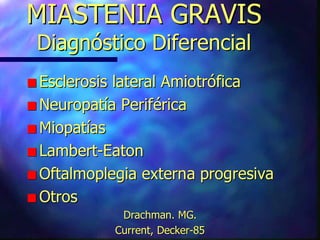
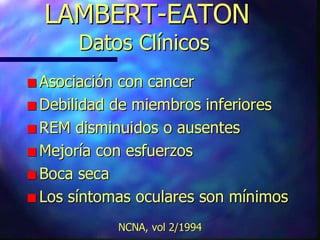
Miastenia Gravis actualización Dr. Juan Lozano
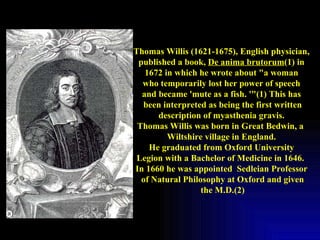
Thomas Willis (1621-1675), English physician, published a book,  De anima brutorum (1) in  1672 in which he wrote about "a woman who temporarily lost her power of speech  and became 'mute as a fish. '"(1) This has been interpreted as being the first written description of myasthenia gravis.  Thomas Willis was born in Great Bedwin, a  Wiltshire village in England. He graduated from Oxford University  Legion with a Bachelor of Medicine in 1646.  In 1660 he was appointed  Sedleian Professor of Natural Philosophy at Oxford and given the M.D.(2)
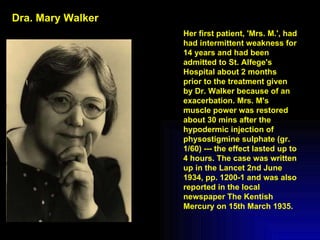
Her first patient, 'Mrs. M.', had had intermittent weakness for 14 years and had been admitted to St. Alfege's Hospital about 2 months prior to the treatment given by Dr. Walker because of an exacerbation. Mrs. M's muscle power was restored about 30 mins after the hypodermic injection of physostigmine sulphate (gr. 1/60) --- the effect lasted up to 4 hours. The case was written up in the Lancet 2nd June 1934, pp. 1200-1 and was also reported in the local newspaper The Kentish Mercury on 15th March 1935. Dra. Mary Walker
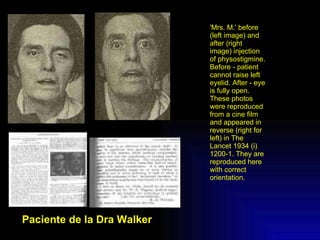
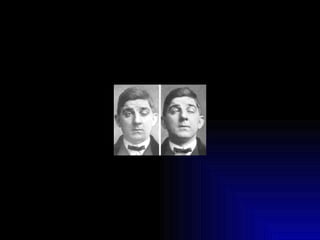
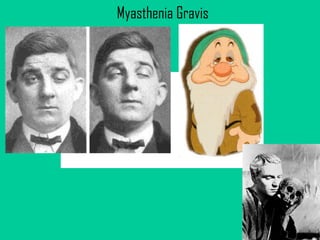
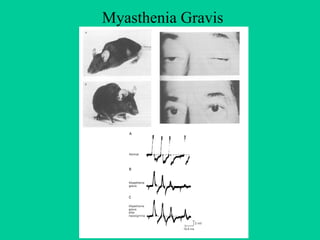
Paciente de la Dra Walker 'Mrs. M.' before (left image) and after (right image) injection of physostigmine.  Before - patient cannot raise left eyelid. After - eye is fully open. These photos were reproduced from a cine film and appeared in reverse (right for left) in The Lancet 1934 (i) 1200-1. They are reproduced here with correct orientation.
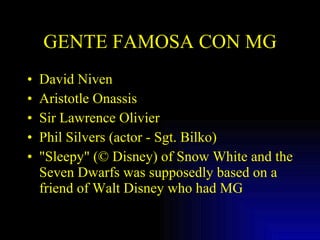
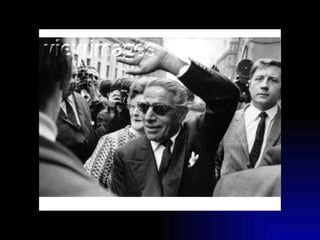
GENTE FAMOSA CON MG David Niven Aristotle Onassis Sir Lawrence Olivier Phil Silvers (actor - Sgt. Bilko) "Sleepy" (© Disney) of Snow White and the Seven Dwarfs was supposedly based on a friend of Walt Disney who had MG
 
Julie Long artista Jerry lewis
Epidemiología Incidencia: 10 x millón x año Prevalencia: 14 x 100,000 habitantes Se estima que en los Estados Unidos hay  70,000 personas con Miastenia Gravis.
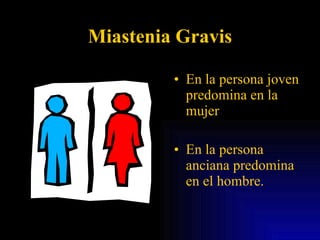
Miastenia Gravis En la persona joven predomina en la mujer En la persona anciana predomina en el hombre.
Miastenia Gravis Es universal. No es Hereditaria. No es contagiosa. No tiene preferencias estacionales. Afecta todas las edades.
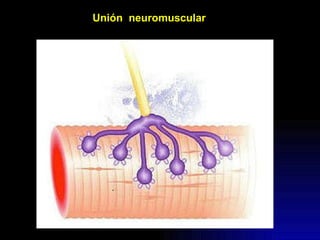
Unión  neuromuscular
Edad de inicio 2a. y 3a. década en la mujer. 7a. y 8a. década en el hombre Los hombres son mas afectados que las mujeres.
Miastenia Gravis Datos Clínicos Debilidad. B) Fatigabilidad.
Miastenia Gravis La debilidad es el síntoma cardinal de la Miastenia Gravis
 
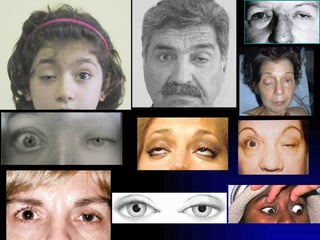
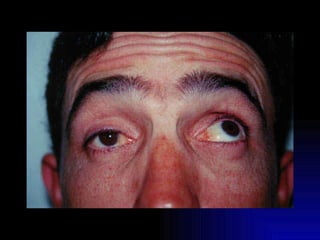
Síntomas Iniciales Ptosis o diplopía en 2/3 de los pacientes Dificultad para la masticación, deglución o para hablar en 1/6 de los pacientes. En un 10% hay debilidad localizada
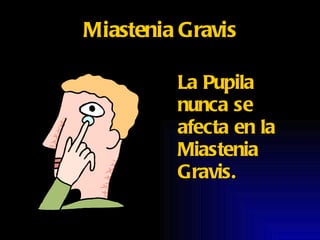
Miastenia Gravis La Pupila nunca se afecta en la Miastenia Gravis.


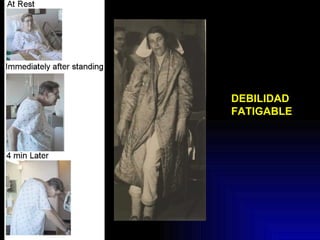
DEBILIDAD FATIGABLE
 
Crisis Miasténica La crisis ocurre cuando un paciente experimenta debilidad muscular que compromete la función respiratoria Puede ser miasténica o colinérgica Es una urgencia neurológica
 
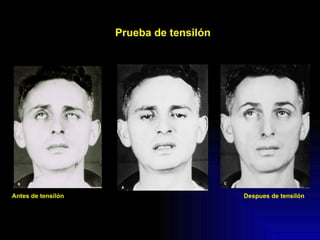
Procedimientos Diagnósticos Prueba del Tensilón Es positiva en mas del 90% de los pacientes Puede ser positiva en otras enfermedades Precaución. Paciente hospitalizado. Prueba de Neostigmina
 
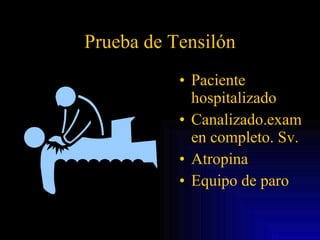
Prueba de Tensilón Paciente hospitalizado Canalizado.examen completo. Sv. Atropina Equipo de paro
Despues de tensilón Prueba de tensilón Antes de tensilón
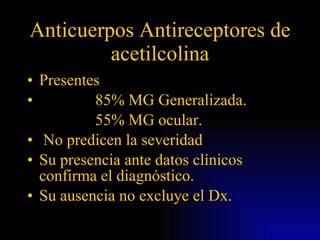
Anticuerpos Antireceptores de acetilcolina Presentes  85% MG Generalizada. 55% MG ocular. No predicen la severidad Su presencia ante datos clínicos confirma el diagnóstico. Su ausencia no excluye el Dx.
Procedimientos Diagnósticos Electromiografía. Estimulación repetitiva EMG de fibra Única
Clasificación Clínica Generalizada Neonatal Congénita Juvenil Adulto  leve, mod. y severa Ocular  -  Juvenil y del Adulto
 
 
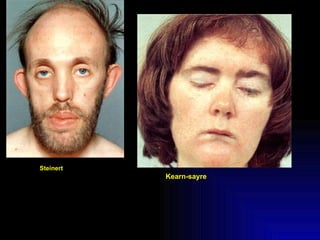
Steinert Kearn-sayre
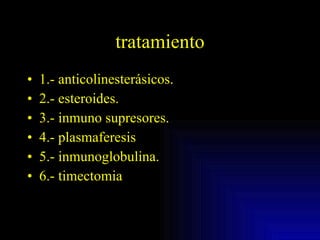
tratamiento 1.- anticolinesterásicos. 2.- esteroides. 3.- inmuno supresores. 4.- plasmaferesis 5.- inmunoglobulina. 6.- timectomia
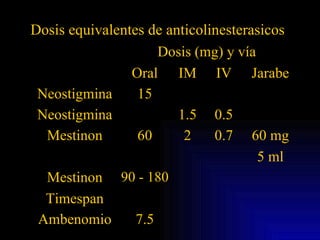
Dosis equivalentes de anticolinesterasicos   Dosis (mg) y vía Oral IM IV Jarabe Neostigmina 15 Neostigmina 1.5 0.5 Mestinon 60 2 0.7 60 mg 5 ml Mestinon Timespan 90 - 180 Ambenomio 7.5
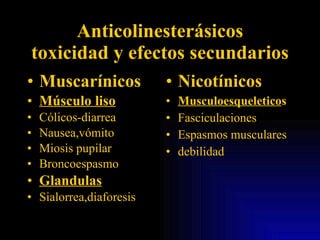
Anticolinesterásicos toxicidad y efectos secundarios Muscarínicos Músculo liso Cólicos-diarrea Nausea,vómito Miosis pupilar Broncoespasmo Glandulas Sialorrea,diaforesis Nicotínicos Musculoesqueletico s Fasciculaciones Espasmos musculares debilidad
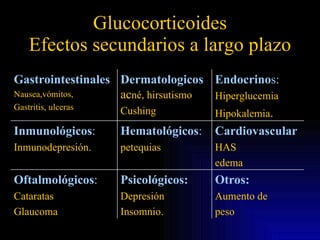
Glucocorticoides Efectos secundarios a largo plazo Gastrointestinales Nausea,vómitos,  Gastritis, ulceras Dermatologicos ac né, hirsutismo Cushing Endocrino s: Hiperglucemia Hipokalemia . Inmunológicos : Inmunodepresión. Hematológicos : petequias Cardiovascular HAS edema Oftalmológicos : Cataratas Glaucoma Psicológicos: Depresión Insomnio. Otros: Aumento de peso
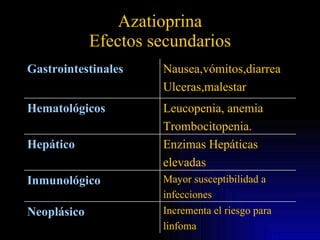
Azatioprina Efectos secundarios Gastrointestinales Nausea,vómitos,diarrea Ulceras,malestar Hematológicos Leucopenia, anemia Trombocitopenia. Hepático Enzimas Hepáticas elevadas Inmunológico Mayor susceptibilidad a infecciones Neoplásico Incrementa el riesgo para linfoma
Timectomia No se practica en la MG ocular. No se realiza después de los 60 años (a menos que haya timoma). Requiere preparación. Mejores resultados en mujeres jóvenes. Se prefiere abordaje transesternal.
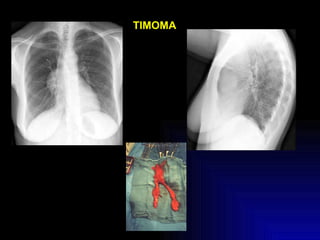
TIMOMA
Terapias emergentes Micofenolato de mofedetilo tacrolimus
 
El que alguien toque mi vida es un privilegio,  Tocar la vida de alguien es un honor, Pero el ayudar a que otros toquen sus propias vidas Es un placer indescriptible!   Rubén Darío


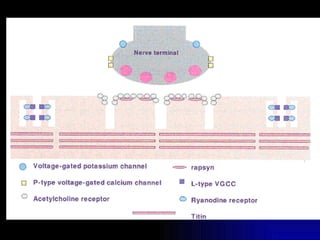
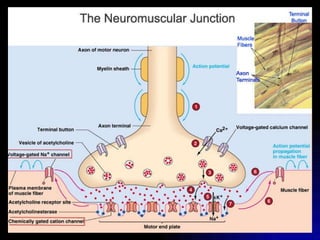
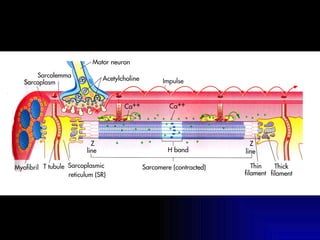
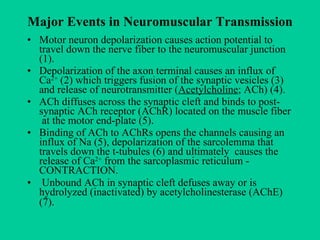
Major Events in Neuromuscular Transmission Motor neuron depolarization causes action potential to travel down the nerve fiber to the neuromuscular junction (1). Depolarization of the axon terminal causes an influx of Ca 2+  (2) which triggers fusion of the synaptic vesicles (3) and release of neurotransmitter ( Acetylcholine ; ACh) (4). ACh diffuses across the synaptic cleft and binds to post-synaptic ACh receptor (AChR) located on the muscle fiber  at the motor end-plate (5). Binding of ACh to AChRs opens the channels causing an influx of Na (5), depolarization of the sarcolemma that travels down the t-tubules (6) and ultimately  causes the release of Ca 2+  from the sarcoplasmic reticulum - CONTRACTION. Unbound ACh in synaptic cleft defuses away or is hydrolyzed (inactivated) by acetylcholinesterase (AChE) (7).
Two main Types of Neuromuscular Blocking Drugs Nondepolarizing (competitive) Depolarizing
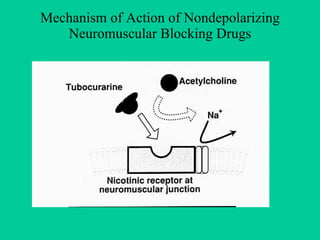
Mechanism of Action of Nondepolarizing Neuromuscular Blocking Drugs
Non-depolarizing  (competitive). Prototype of  Non-depolarizing  is tubo curarine  (new generation: pancuronium and gallamine). Mechanism of Action : In small clinical doses they act the predominantly at the nicotinic receptor site to block ACh. At higher does they can block prejunctional Na channels thereby decreasing ACh release. Because of the competitive nature of the postsynaptic blockade, transient relief of the block can be achieved by  increasing ACh levels at the synaptic cleft (i.e. use cholinesterase inhibitors).
Nondepolarizing Agents Therapeutic Use: Adjuvant drugs in surgical anesthesia Pharmacology: Must be given by injection because they are poorly absorbed orally.  Do not cross the BBB. Generally excreted unchanged (i.e. not metabolized). Adverse Effects:   Tubocurarine causes release of histamine from mast cells – decrease in blood pressure, bronchospasms, skin wheals.  Newer generation don’t.
Drug Interactions:   Cholinesterase Inhibitors decrease the effectiveness of nondepolarizing agents  Aminoglycoside antibiotics (e.g. streptomycin) decrease ACh release by competing with Ca 2+  – increase action of nondepolarizing drugs Calcium channel blockers increase the actions of nondepolarizing drugs by decreasing the amount of ACh released (i.e. increase action of nondepolarizing drugs) Halogenated carbon anesthetics (e.g. Isoflurane) enhance neuromuscular blockade by 1) decreasing excitability of motoneurons, 2) increasing muscle blood flow, and 3) decreased kinetics of AChRs (increase action of nondepolarizing drugs)
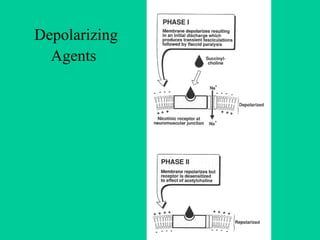
Depolarizing Agents
Depolarizing Agents Prototype of d epolarizing  agent is succinylcholine (only depolarizing drug in clinical use). Mechanism of Action : Similar action to ACh, but longer acting.  Phase 1 :  Membrane is depolarized by opening AChR channels causing brief period of muscle fasciculation. Phase II :  End-plate eventually repolarizes, but because succinycholine is not metabolized like ACh it continues to occupy the AChRs to “desensitize” the end-plate.  Because of the mechanism of action of depolazing drugs is similar to ACh, their blocking effects are augmented by AChE inhibitors.
Depolarizing Agents Therapeutic Use: Adjuvant drugs in surgical anesthesia Pharmacology: Duration of action is short (several minutes) because it is rapidly broken down by plasma cholinesterases (must be administered by continuous infusion)  Adverse Effects: When administered with halothane some genetically susceptible people (inherited autosomal dominant condition) experience malignant hyperthermia.  Treatment: rapid cooling of the body and dantrolene
Cholinesterase Inhibitors
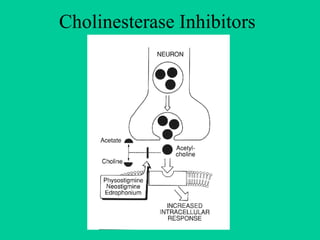
Cholinesterase Inhibitors Examples:  Neostigmine, edrophonium. Mechanism of Action : Inhibit acetylcholinesterase Therapeutic Use:   Antidote for nondepolarizing  blockers Treatment of myasthenia gravis (neostigmine) Diagnosis of myasthenia gravis (edrophonium)
Myasthenia Gravis                                                
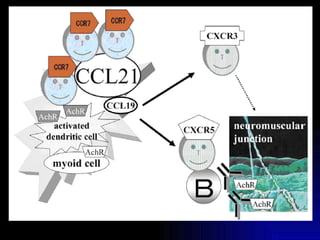
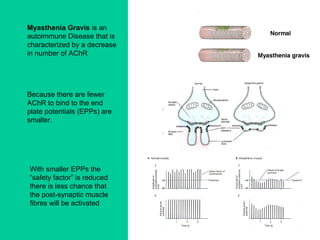
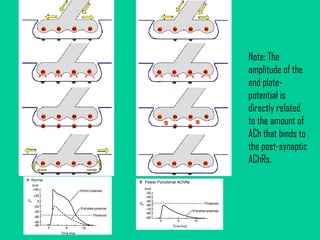
Myasthenia Gravis  is an autoimmune Disease that is characterized by a decrease in number of AChR Because there are fewer AChR to bind to the end plate potentials (EPPs) are smaller. With smaller EPPs the “ safety factor” is reduced there is less chance that the post-synaptic muscle fibres will be activated
Note: The amplitude of the end plate-potential is directly related to the amount of ACh that binds to the post-synaptic AChRs.
Myasthenia Gravis
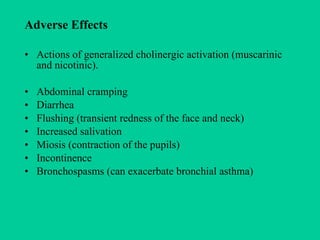
Adverse Effects Actions of generalized cholinergic activation (muscarinic and nicotinic). Abdominal cramping Diarrhea Flushing (transient redness of the face and neck) Increased salivation Miosis (contraction of the pupils) Incontinence Bronchospasms (can exacerbate bronchial asthma)
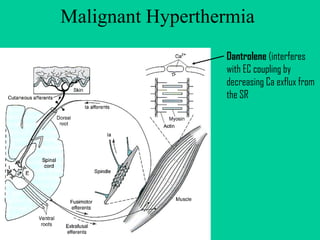
Malignant Hyperthermia  Dantrolene  (interferes with EC coupling by decreasing Ca exflux from the SR
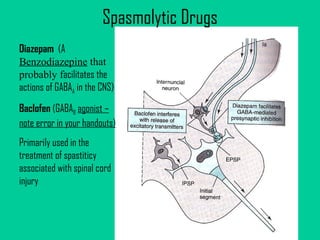
Diazepam  (A  Benzodiazepine  that probably f acilitates the actions of GABA A  in the CNS) Baclofen  (GABA B   agonist – note error in your handouts) Primarily used in the treatment of spastiticy associated with spinal cord injury  Spasmolytic Drugs

Miastenia gravis

  • 1.
  • 2.
    Thomas Willis (1621-1675),English physician, published a book, De anima brutorum (1) in 1672 in which he wrote about "a woman who temporarily lost her power of speech and became 'mute as a fish. '"(1) This has been interpreted as being the first written description of myasthenia gravis. Thomas Willis was born in Great Bedwin, a Wiltshire village in England. He graduated from Oxford University Legion with a Bachelor of Medicine in 1646. In 1660 he was appointed Sedleian Professor of Natural Philosophy at Oxford and given the M.D.(2)
  • 3.
    Her first patient,'Mrs. M.', had had intermittent weakness for 14 years and had been admitted to St. Alfege's Hospital about 2 months prior to the treatment given by Dr. Walker because of an exacerbation. Mrs. M's muscle power was restored about 30 mins after the hypodermic injection of physostigmine sulphate (gr. 1/60) --- the effect lasted up to 4 hours. The case was written up in the Lancet 2nd June 1934, pp. 1200-1 and was also reported in the local newspaper The Kentish Mercury on 15th March 1935. Dra. Mary Walker
  • 4.
    Paciente de laDra Walker 'Mrs. M.' before (left image) and after (right image) injection of physostigmine. Before - patient cannot raise left eyelid. After - eye is fully open. These photos were reproduced from a cine film and appeared in reverse (right for left) in The Lancet 1934 (i) 1200-1. They are reproduced here with correct orientation.
  • 5.
    GENTE FAMOSA CONMG David Niven Aristotle Onassis Sir Lawrence Olivier Phil Silvers (actor - Sgt. Bilko) "Sleepy" (© Disney) of Snow White and the Seven Dwarfs was supposedly based on a friend of Walt Disney who had MG
  • 6.
  • 7.
    Julie Long artistaJerry lewis
  • 8.
    Epidemiología Incidencia: 10x millón x año Prevalencia: 14 x 100,000 habitantes Se estima que en los Estados Unidos hay 70,000 personas con Miastenia Gravis.
  • 9.
    Miastenia Gravis Enla persona joven predomina en la mujer En la persona anciana predomina en el hombre.
  • 10.
    Miastenia Gravis Esuniversal. No es Hereditaria. No es contagiosa. No tiene preferencias estacionales. Afecta todas las edades.
  • 11.
  • 12.
    Edad de inicio2a. y 3a. década en la mujer. 7a. y 8a. década en el hombre Los hombres son mas afectados que las mujeres.
  • 13.
    Miastenia Gravis DatosClínicos Debilidad. B) Fatigabilidad.
  • 14.
    Miastenia Gravis Ladebilidad es el síntoma cardinal de la Miastenia Gravis
  • 15.
  • 16.
    Síntomas Iniciales Ptosiso diplopía en 2/3 de los pacientes Dificultad para la masticación, deglución o para hablar en 1/6 de los pacientes. En un 10% hay debilidad localizada
  • 17.
    Miastenia Gravis LaPupila nunca se afecta en la Miastenia Gravis.
  • 18.
  • 19.
  • 20.
  • 21.
  • 22.
  • 23.
  • 24.
    Crisis Miasténica Lacrisis ocurre cuando un paciente experimenta debilidad muscular que compromete la función respiratoria Puede ser miasténica o colinérgica Es una urgencia neurológica
  • 25.
  • 26.
    Procedimientos Diagnósticos Pruebadel Tensilón Es positiva en mas del 90% de los pacientes Puede ser positiva en otras enfermedades Precaución. Paciente hospitalizado. Prueba de Neostigmina
  • 27.
  • 28.
    Prueba de TensilónPaciente hospitalizado Canalizado.examen completo. Sv. Atropina Equipo de paro
  • 29.
    Despues de tensilónPrueba de tensilón Antes de tensilón
  • 30.
    Anticuerpos Antireceptores deacetilcolina Presentes 85% MG Generalizada. 55% MG ocular. No predicen la severidad Su presencia ante datos clínicos confirma el diagnóstico. Su ausencia no excluye el Dx.
  • 31.
    Procedimientos Diagnósticos Electromiografía.Estimulación repetitiva EMG de fibra Única
  • 32.
    Clasificación Clínica GeneralizadaNeonatal Congénita Juvenil Adulto leve, mod. y severa Ocular - Juvenil y del Adulto
  • 33.
  • 34.
  • 35.
  • 36.
    tratamiento 1.- anticolinesterásicos.2.- esteroides. 3.- inmuno supresores. 4.- plasmaferesis 5.- inmunoglobulina. 6.- timectomia
  • 37.
    Dosis equivalentes deanticolinesterasicos Dosis (mg) y vía Oral IM IV Jarabe Neostigmina 15 Neostigmina 1.5 0.5 Mestinon 60 2 0.7 60 mg 5 ml Mestinon Timespan 90 - 180 Ambenomio 7.5
  • 38.
    Anticolinesterásicos toxicidad yefectos secundarios Muscarínicos Músculo liso Cólicos-diarrea Nausea,vómito Miosis pupilar Broncoespasmo Glandulas Sialorrea,diaforesis Nicotínicos Musculoesqueletico s Fasciculaciones Espasmos musculares debilidad
  • 39.
    Glucocorticoides Efectos secundariosa largo plazo Gastrointestinales Nausea,vómitos, Gastritis, ulceras Dermatologicos ac né, hirsutismo Cushing Endocrino s: Hiperglucemia Hipokalemia . Inmunológicos : Inmunodepresión. Hematológicos : petequias Cardiovascular HAS edema Oftalmológicos : Cataratas Glaucoma Psicológicos: Depresión Insomnio. Otros: Aumento de peso
  • 40.
    Azatioprina Efectos secundariosGastrointestinales Nausea,vómitos,diarrea Ulceras,malestar Hematológicos Leucopenia, anemia Trombocitopenia. Hepático Enzimas Hepáticas elevadas Inmunológico Mayor susceptibilidad a infecciones Neoplásico Incrementa el riesgo para linfoma
  • 41.
    Timectomia No sepractica en la MG ocular. No se realiza después de los 60 años (a menos que haya timoma). Requiere preparación. Mejores resultados en mujeres jóvenes. Se prefiere abordaje transesternal.
  • 42.
  • 43.
    Terapias emergentes Micofenolatode mofedetilo tacrolimus
  • 44.
  • 45.
    El que alguientoque mi vida es un privilegio, Tocar la vida de alguien es un honor, Pero el ayudar a que otros toquen sus propias vidas Es un placer indescriptible!   Rubén Darío
  • 46.
  • 47.
  • 48.
  • 49.
  • 50.
  • 51.
    Major Events inNeuromuscular Transmission Motor neuron depolarization causes action potential to travel down the nerve fiber to the neuromuscular junction (1). Depolarization of the axon terminal causes an influx of Ca 2+ (2) which triggers fusion of the synaptic vesicles (3) and release of neurotransmitter ( Acetylcholine ; ACh) (4). ACh diffuses across the synaptic cleft and binds to post-synaptic ACh receptor (AChR) located on the muscle fiber at the motor end-plate (5). Binding of ACh to AChRs opens the channels causing an influx of Na (5), depolarization of the sarcolemma that travels down the t-tubules (6) and ultimately causes the release of Ca 2+ from the sarcoplasmic reticulum - CONTRACTION. Unbound ACh in synaptic cleft defuses away or is hydrolyzed (inactivated) by acetylcholinesterase (AChE) (7).
  • 52.
    Two main Typesof Neuromuscular Blocking Drugs Nondepolarizing (competitive) Depolarizing
  • 53.
    Mechanism of Actionof Nondepolarizing Neuromuscular Blocking Drugs
  • 54.
    Non-depolarizing (competitive).Prototype of Non-depolarizing is tubo curarine (new generation: pancuronium and gallamine). Mechanism of Action : In small clinical doses they act the predominantly at the nicotinic receptor site to block ACh. At higher does they can block prejunctional Na channels thereby decreasing ACh release. Because of the competitive nature of the postsynaptic blockade, transient relief of the block can be achieved by increasing ACh levels at the synaptic cleft (i.e. use cholinesterase inhibitors).
  • 55.
    Nondepolarizing Agents TherapeuticUse: Adjuvant drugs in surgical anesthesia Pharmacology: Must be given by injection because they are poorly absorbed orally. Do not cross the BBB. Generally excreted unchanged (i.e. not metabolized). Adverse Effects: Tubocurarine causes release of histamine from mast cells – decrease in blood pressure, bronchospasms, skin wheals. Newer generation don’t.
  • 56.
    Drug Interactions: Cholinesterase Inhibitors decrease the effectiveness of nondepolarizing agents Aminoglycoside antibiotics (e.g. streptomycin) decrease ACh release by competing with Ca 2+ – increase action of nondepolarizing drugs Calcium channel blockers increase the actions of nondepolarizing drugs by decreasing the amount of ACh released (i.e. increase action of nondepolarizing drugs) Halogenated carbon anesthetics (e.g. Isoflurane) enhance neuromuscular blockade by 1) decreasing excitability of motoneurons, 2) increasing muscle blood flow, and 3) decreased kinetics of AChRs (increase action of nondepolarizing drugs)
  • 57.
  • 58.
    Depolarizing Agents Prototypeof d epolarizing agent is succinylcholine (only depolarizing drug in clinical use). Mechanism of Action : Similar action to ACh, but longer acting. Phase 1 : Membrane is depolarized by opening AChR channels causing brief period of muscle fasciculation. Phase II : End-plate eventually repolarizes, but because succinycholine is not metabolized like ACh it continues to occupy the AChRs to “desensitize” the end-plate. Because of the mechanism of action of depolazing drugs is similar to ACh, their blocking effects are augmented by AChE inhibitors.
  • 59.
    Depolarizing Agents TherapeuticUse: Adjuvant drugs in surgical anesthesia Pharmacology: Duration of action is short (several minutes) because it is rapidly broken down by plasma cholinesterases (must be administered by continuous infusion) Adverse Effects: When administered with halothane some genetically susceptible people (inherited autosomal dominant condition) experience malignant hyperthermia. Treatment: rapid cooling of the body and dantrolene
  • 60.
  • 61.
    Cholinesterase Inhibitors Examples: Neostigmine, edrophonium. Mechanism of Action : Inhibit acetylcholinesterase Therapeutic Use: Antidote for nondepolarizing blockers Treatment of myasthenia gravis (neostigmine) Diagnosis of myasthenia gravis (edrophonium)
  • 62.
    Myasthenia Gravis                                               
  • 63.
    Myasthenia Gravis is an autoimmune Disease that is characterized by a decrease in number of AChR Because there are fewer AChR to bind to the end plate potentials (EPPs) are smaller. With smaller EPPs the “ safety factor” is reduced there is less chance that the post-synaptic muscle fibres will be activated
  • 64.
    Note: The amplitudeof the end plate-potential is directly related to the amount of ACh that binds to the post-synaptic AChRs.
  • 65.
  • 66.
    Adverse Effects Actionsof generalized cholinergic activation (muscarinic and nicotinic). Abdominal cramping Diarrhea Flushing (transient redness of the face and neck) Increased salivation Miosis (contraction of the pupils) Incontinence Bronchospasms (can exacerbate bronchial asthma)
  • 67.
    Malignant Hyperthermia Dantrolene (interferes with EC coupling by decreasing Ca exflux from the SR
  • 68.
    Diazepam (A Benzodiazepine that probably f acilitates the actions of GABA A in the CNS) Baclofen (GABA B agonist – note error in your handouts) Primarily used in the treatment of spastiticy associated with spinal cord injury Spasmolytic Drugs