Playing it Real Again:
A Repeated Evaluation of Magic Lens and Static
Peephole Interfaces in Public Space
Jens Grubert, Dieter Schmalstieg
Institute for Computer Graphics and Vision, Graz University of Technology
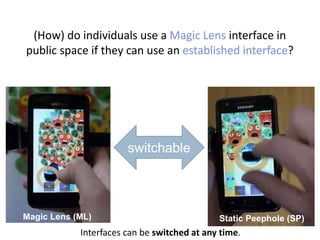
(How) do individuals use a Magic Lens interface in
public space if they can use an established interface?
switchable
Interfaces can be switched at any time.
Magic Lens (ML) Static Peephole (SP)
Research Questions
 Confirmatory
 Which interface would be used longer?
 Which interface participants would prefer?
 Exploratory
 (How) does the setting influence the usage?
Design of Experiment
 Between-subjects design
 Factor: location
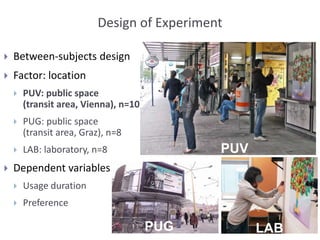
 PUV: public space
(transit area, Vienna), n=10
 PUG: public space
(transit area, Graz), n=8
 LAB: laboratory, n=8
 Dependent variables
 Usage duration
 Preference
PUV
PUG LAB
Findings
 Confirmatory
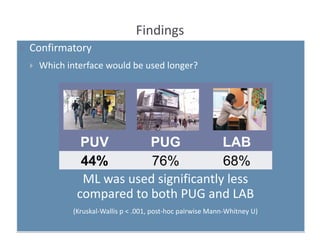
 Which interface would be used longer?
ML was used significantly less
compared to both PUG and LAB
(Kruskal-Wallis p < .001, post-hoc pairwise Mann-Whitney U)
PUV PUG LAB
44% 76% 68%
Findings
 Confirmatory
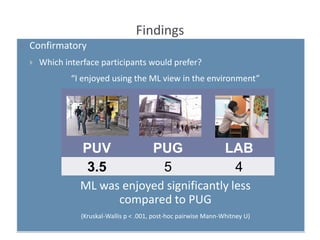
 Which interface participants would prefer?
“I enjoyed using the ML view in the environment”
ML was enjoyed significantly less
compared to PUG
(Kruskal-Wallis p < .001, post-hoc pairwise Mann-Whitney U)
PUV PUG LAB
3.5 5 4
Why those differences?
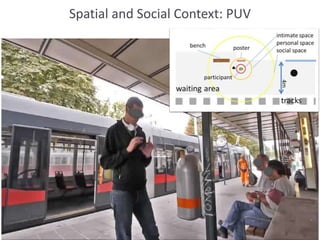
Spatial and Social Context: PUV
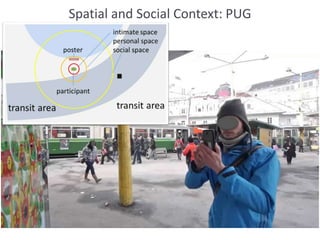
Spatial and Social Context: PUG
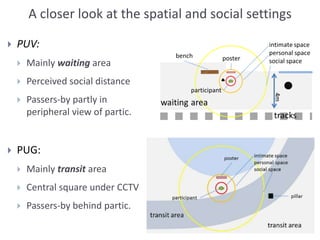
A closer look at the spatial and social settings
 PUV:
 Mainly waiting area
 Perceived social distance
 Passers-by partly in
peripheral view of partic.
 PUG:
 Mainly transit area
 Central square under CCTV
 Passers-by behind partic.
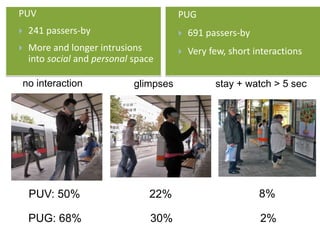
PUV
 241 passers-by
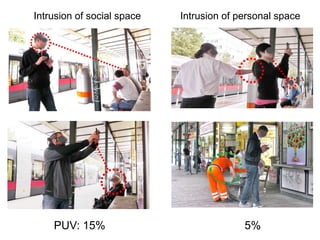
 More and longer intrusions
into social and personal space
PUV: 50%
PUG
 691 passers-by
 Very few, short interactions
no interaction glimpses stay + watch > 5 sec
22% 8%
PUG: 68% 30% 2%
PUV: 15%
Intrusion of social space Intrusion of personal space
5%
Summary
 Repeated study on usage of ML and SP in public spaces
 Sign. differences in usage time and preference
 Potential causes: spatial and social setting
 However, many potential confounding factors:
personality, demand characteristics, intrinsic motivation
Future Work
 Increase ecological validity of results by
 Promoting intrinsic motivation to use the interfaces
(real users with real needs)
 Decreasing awareness of study setting
 Remote evaluations
 Body-worn sensors
 Increase external validity of results by
 Re-running study
 Narrow down potential confounding factors
 More measurements: personality tests (BFI), demand
characteristics (PARH)

ACM MobileHCI 2013 - Playing it Real Again: A Repeated Evaluation of Magic Lens and Static Peephole Interfaces in Public Space

  • 1.
    Playing it RealAgain: A Repeated Evaluation of Magic Lens and Static Peephole Interfaces in Public Space Jens Grubert, Dieter Schmalstieg Institute for Computer Graphics and Vision, Graz University of Technology
  • 2.
    (How) do individualsuse a Magic Lens interface in public space if they can use an established interface? switchable Interfaces can be switched at any time. Magic Lens (ML) Static Peephole (SP)
  • 3.
    Research Questions  Confirmatory Which interface would be used longer?  Which interface participants would prefer?  Exploratory  (How) does the setting influence the usage?
  • 4.
    Design of Experiment Between-subjects design  Factor: location  PUV: public space (transit area, Vienna), n=10  PUG: public space (transit area, Graz), n=8  LAB: laboratory, n=8  Dependent variables  Usage duration  Preference PUV PUG LAB
  • 5.
    Findings  Confirmatory  Whichinterface would be used longer? ML was used significantly less compared to both PUG and LAB (Kruskal-Wallis p < .001, post-hoc pairwise Mann-Whitney U) PUV PUG LAB 44% 76% 68%
  • 6.
    Findings  Confirmatory  Whichinterface participants would prefer? “I enjoyed using the ML view in the environment” ML was enjoyed significantly less compared to PUG (Kruskal-Wallis p < .001, post-hoc pairwise Mann-Whitney U) PUV PUG LAB 3.5 5 4
  • 7.
  • 8.
    Spatial and SocialContext: PUV
  • 9.
    Spatial and SocialContext: PUG
  • 10.
    A closer lookat the spatial and social settings  PUV:  Mainly waiting area  Perceived social distance  Passers-by partly in peripheral view of partic.  PUG:  Mainly transit area  Central square under CCTV  Passers-by behind partic.
  • 11.
    PUV  241 passers-by More and longer intrusions into social and personal space PUV: 50% PUG  691 passers-by  Very few, short interactions no interaction glimpses stay + watch > 5 sec 22% 8% PUG: 68% 30% 2%
  • 12.
    PUV: 15% Intrusion ofsocial space Intrusion of personal space 5%
  • 13.
    Summary  Repeated studyon usage of ML and SP in public spaces  Sign. differences in usage time and preference  Potential causes: spatial and social setting  However, many potential confounding factors: personality, demand characteristics, intrinsic motivation
  • 14.
    Future Work  Increaseecological validity of results by  Promoting intrinsic motivation to use the interfaces (real users with real needs)  Decreasing awareness of study setting  Remote evaluations  Body-worn sensors  Increase external validity of results by  Re-running study  Narrow down potential confounding factors  More measurements: personality tests (BFI), demand characteristics (PARH)

Editor's Notes

  • #3 At last years MobileHCI we presented a study about the usage of ML and SP interaction with a poster game in a public space. The driving question was … Goals: Formative: inform design of combined interfaces through observation in potential usage scenario ML: physical interaction, visually exposes both display and user more to the surrounding SP: allows for more private interaction, established way of navigating and interacting with content Which interface would be used longer?
  • #4 TODO: Bring in comparative part lab-public H1: ML will be used less often in the public setting than in the laboratory
  • #5 Hooray! Participants overwhelmingly used the ML interface and preferred it Not many significant differences lab – public space Lab sufficient? BUT 50% would not use it in public settings similar to the one they were in?
  • #6 Wilcoxon signed rank test with continuity correction for rank data (ordinal) # I felt comfortable using the Augmented Reality view in the environment  check original question. # I did not pay attention to the environment when using the Augmented Reality view # I enjoyed using the Augmented Reality view in the environment  but then for vienna # 6 3 I would rather do the task with the Augmented Reality view only cor(likert_q_jakomini$p9.6, levelTimes_perPartic_rel_jakomini$relTimesAR, method = "spearman") # 0.5773503 cor(likert_q_lab$p9.6, levelTimes_perPartic_rel_lab$relTimesAR, method = "spearman") # 0.8510645 cor(likert_q_wiensr$p3, levelTimes_perPartic_rel_wiensr$relTimesAR, method = "spearman") # 0.519512 # 7 4 I would rather do the task with the map view only cor(likert_q_jakomini$p9.7, levelTimes_perPartic_rel_jakomini$relTimesAR, method = "spearman") # -0.4076871 cor(likert_q_lab$p9.7, levelTimes_perPartic_rel_lab$relTimesAR, method = "spearman") # -0.6849175 cor(likert_q_wiensr$p4, levelTimes_perPartic_rel_wiensr$relTimesAR, method = "spearman") # -0.5036856 # 4 1 I enjoyed using the Augmented Reality view in the environment cor(likert_q_jakomini$p9.4, levelTimes_perPartic_rel_jakomini$relTimesAR, method = "spearman") # -0.2886751 cor(likert_q_lab$p9.4, levelTimes_perPartic_rel_lab$relTimesAR, method = "spearman") # 0.3504383 cor(likert_q_wiensr$p1, levelTimes_perPartic_rel_wiensr$relTimesAR, method = "spearman") # -0.6467555 # 5 2 I enjoyed using the map view in the environment cor(likert_q_jakomini$p9.5, levelTimes_perPartic_rel_jakomini$relTimesAR, method = "spearman") # -0.8647909 cor(likert_q_lab$p9.5, levelTimes_perPartic_rel_lab$relTimesAR, method = "spearman") # -0.7433301 cor(likert_q_wiensr$p2, levelTimes_perPartic_rel_wiensr$relTimesAR, method = "spearman") # -0.6343888856
  • #7 Wilcoxon signed rank test with continuity correction for rank data (ordinal) # I felt comfortable using the Augmented Reality view in the environment  check original question. # I did not pay attention to the environment when using the Augmented Reality view # I enjoyed using the Augmented Reality view in the environment  but then for vienna # 6 3 I would rather do the task with the Augmented Reality view only cor(likert_q_jakomini$p9.6, levelTimes_perPartic_rel_jakomini$relTimesAR, method = "spearman") # 0.5773503 cor(likert_q_lab$p9.6, levelTimes_perPartic_rel_lab$relTimesAR, method = "spearman") # 0.8510645 cor(likert_q_wiensr$p3, levelTimes_perPartic_rel_wiensr$relTimesAR, method = "spearman") # 0.519512 # 7 4 I would rather do the task with the map view only cor(likert_q_jakomini$p9.7, levelTimes_perPartic_rel_jakomini$relTimesAR, method = "spearman") # -0.4076871 cor(likert_q_lab$p9.7, levelTimes_perPartic_rel_lab$relTimesAR, method = "spearman") # -0.6849175 cor(likert_q_wiensr$p4, levelTimes_perPartic_rel_wiensr$relTimesAR, method = "spearman") # -0.5036856 # 4 1 I enjoyed using the Augmented Reality view in the environment cor(likert_q_jakomini$p9.4, levelTimes_perPartic_rel_jakomini$relTimesAR, method = "spearman") # -0.2886751 cor(likert_q_lab$p9.4, levelTimes_perPartic_rel_lab$relTimesAR, method = "spearman") # 0.3504383 cor(likert_q_wiensr$p1, levelTimes_perPartic_rel_wiensr$relTimesAR, method = "spearman") # -0.6467555 # 5 2 I enjoyed using the map view in the environment cor(likert_q_jakomini$p9.5, levelTimes_perPartic_rel_jakomini$relTimesAR, method = "spearman") # -0.8647909 cor(likert_q_lab$p9.5, levelTimes_perPartic_rel_lab$relTimesAR, method = "spearman") # -0.7433301 cor(likert_q_wiensr$p2, levelTimes_perPartic_rel_wiensr$relTimesAR, method = "spearman") # -0.6343888856
  • #8 the potentially large number of confounding factors which can influence the evaluation outcomes. fatigue, the perceived severity of tracking errors, the role of personality (e.g., intro- and extraversion), intrinsic motivation to use the interfaces, the novelty of the ML metaphor and demand characteristics.
  • #9 PUV: mainly waiting area Disadvantaged area Passers-by partly in peripheral view of partic. PUG: mainly transit area Central square under CCTV Passers-by behind partic.
  • #10 PUV: mainly waiting area Disadvantaged area Passers-by partly in peripheral view of partic. PUG: mainly transit area Central square under CCTV Passers-by behind partic.
  • #11 The PUG condition was carried out a location primarily used as transit area for changing tram lines with the major waiting areas being more than 20m away (see Figure 5). It was located in a wide open space in the city center. People from all social contexts are using this place for changing trams. The general area is under video surveillance and the building at which the study took place was actively operated by the local tram company. It was a place with a high frequency of passers-by coming from several directions but only a few people were standing in the social space of the participants (rather walking behind the participants, see Figure 5). In contrast the location in the PUV condition was primarily used as waiting area for people coming from the exit of a near-by metro line (see Figure 6). It was located in a disadvantaged area (Vienna Leopoldstadt). Comments of participants about the “shabby” area and experimenter’s observations indicate that there might have been a larger social distance between participants (mostly middleclass, students) and people with lower socioeconomic status present at the tram stop compared to PUG. Those differences between the locations could indicate that the social context in PUV could have inhibited the use of expressive, socially not common spatial gestures used in the ML interface, which is supported by the observations in Akpan et al. [1].
  • #12 50%
  • #13 50%
  • #14 Compare with EXAMINING MOBILE PHONE USE IN THE WILD WITH QUASI-EXPERIMENTATION https://www.hiit.fi/files/admin/publications/Technical_Reports/hiit2004-1.pdf
  • #15 Compare with EXAMINING MOBILE PHONE USE IN THE WILD WITH QUASI-EXPERIMENTATION https://www.hiit.fi/files/admin/publications/Technical_Reports/hiit2004-1.pdf