McKinsey Global Institute


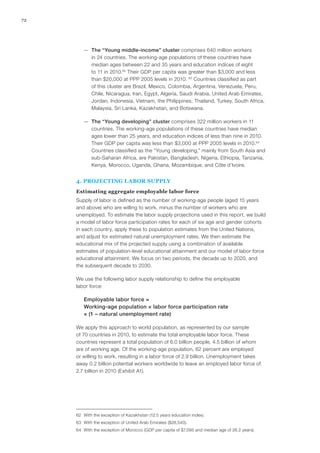
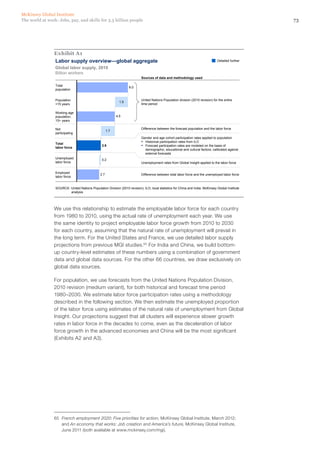
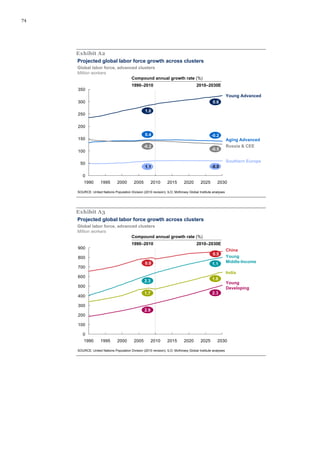
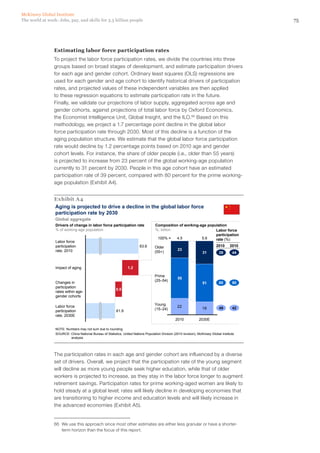
June 2012


The world at work:
Jobs, pay, and skills
for 3.5 billion people
The McKinsey Global Institute
  The McKinsey Global Institute (MGI), the business and economics research
  arm of McKinsey & Company, was established in 1990 to develop a deeper
  understanding of the evolving global economy. Our goal is to provide leaders
  in the commercial, public, and social sectors with the facts and insights on
  which to base management and policy decisions.

  MGI research combines the disciplines of economics and management,
  employing the analytical tools of economics with the insights of business
  leaders. Our “micro-to-macro” methodology examines microeconomic
  industry trends to better understand the broad macroeconomic forces
  affecting business strategy and public policy. MGI’s in-depth reports have
  covered more than 20 countries and 30 industries. Current research focuses
  on six themes: productivity and growth; global financial markets; technology
  and innovation; urbanization; the future of work; and natural resources.
  Recent reports have assessed job creation, resource productivity, cities of
  the future, and the economic impact of the Internet.

  MGI is led by three McKinsey & Company directors: Richard Dobbs,
  James Manyika, and Charles Roxburgh. Susan Lund serves as director of
  research. Project teams are led by a group of senior fellows and include
  consultants from McKinsey’s offices around the world. These teams draw
  on McKinsey’s global network of partners and industry and management
  experts. In addition, leading economists, including Nobel laureates, act as
  research advisers.

  The partners of McKinsey & Company fund MGI’s research; it is not
  commissioned by any business, government, or other institution.
  For further information about MGI and to download reports, please visit
  www.mckinsey.com/mgi.


Copyright © McKinsey & Company 2012
McKinsey Global Institute


June 2012


The world at work:
Jobs, pay, and skills
for 3.5 billion people


Richard Dobbs
Anu Madgavkar
Dominic Barton
Eric Labaye
James Manyika
Charles Roxburgh
Susan Lund
Siddarth Madhav
McKinsey Global Institute
The world at work: Jobs, pay, and skills for 3.5 billion people


                 Preface


                 Over the past 30 years, economies and markets have become more integrated
                 and inter-dependent, as trade volumes have grown and developing economies
                 have industrialized. Labor markets have evolved along with the global economy,
                 bringing nearly one billion people in the developing world into the global labor
                 pool and helping both advanced and developing economies raise productivity and
                 GDP. Recently, however, strains caused by the rise of a global labor force have
                 also become more apparent. These strains—heightened by the “Great Recession”
                 —include rising joblessness and income inequality, and distressingly high rates of
                 youth unemployment.

                 How demand and supply of labor develop over the coming decades will have
                 even greater impact on the global economy. The research in this report was
                 conducted to provide a picture of the evolving global labor market. We find
                 that, based on current trends, there are potentially serious gaps in the supply of
                 workers with the skills that will be needed to drive 21st-century economies, and a
                 growing surplus of workers with more limited skills. Avoiding these imbalances (in
                 both advanced and developing economies) and their consequences will require
                 an unprecedented commitment to education and training.

                 The research was led by Anu Madgavkar, an MGI senior fellow, MGI Director
                 Richard Dobbs, and Susan Lund, director of research at MGI. We thank McKinsey
                 Managing Director Dominic Barton and MGI Chairman Eric Labaye for their
                 thoughtful guidance. MGI Directors James Manyika and Charles Roxburgh
                 provided support and insight. Siddarth Madhav managed the project team, which
                 included Abhishek Agrawal, Arun Devadas, Y. Arvind Eashwar, Shishir Gupta,
                 Jonathan Humphrey, Kuntala Karkun, Akhil Kulkarni, Resham Mansharamani,
                 Ujjyaini Mitra, Aishwarya Singh, and Paayal Vora. McKinsey engagement
                 managers Sudipto Paul and Neha Sureka provided project management support.
                 MGI Senior Editor Geoffrey Lewis provided editorial support. We thank the MGI
                 communications and operations organization—Tim Beacom, John Cheetham,
                 Deadra Henderson, Julie Philpot, and Rebeca Robboy—for their contributions.
                 Marisa Carder provided graphic design support.

                 We are indebted to McKinsey Directors Noshir Kaka, Gordon Orr, and Adil
                 Zainulbhai for sharing their insights about China and India. We also thank MGI
                 senior fellows Michael Chui, Jan Mischke, and Jaana Remes for their input to this
                 project. Alan FitzGerald, Akshat Harbola, Karen P. Jones, and Vivien Singer of
                 MGI Economics provided analytical insight and data. Paul Cook, Alan Parte, Sree
                 Ramaswamy, Lize Roelofse, and Samantha Test helped us integrate other MGI
                 labor research.
We are grateful to many other McKinsey colleagues who contributed their time
and expertise to the project: Björn Annwall, Byron Auguste, Kito de Boer, Francois
Bouvard, Pedro Carvalho, Yougang Chen, Rajat Dhawan, Claudia Süssmuth
Dyckerhoff, Karel Eloot, Diana Farrell, Andrew Grant, Rajat N. Gupta, Bryan
Hancock, Martin Hjerpe, Kai Holleben, Jaafar Kabbaj, Martha Laboissiere, Miguel
Lucas, Ramesh Mangaleswaran, Lenny Mendonca, Mona Mourshed, Laxman
Narasimhan, Alexander Ng, Vivek Pandit, Vivian Riefberg, Corrado Ruffini, Shirish
Sankhe, Doug Scott, Robert Stemmler, Katrin Suder, Lynn Taliento, Mourad
Taoufiki, Amine Tazi-Riffi, Carlos Trascasa, Ashish Tuteja, Ramya Venkataraman,
Arend Van Wamelen, and Hirokazu Yamanashi.

This report reflects the wisdom and insights of our distinguished academic
experts. We thank Martin N. Baily, the Bernard L. Schwartz Chair in Economic
Policy Development at the Brookings Institution; Richard N. Cooper, the Maurits
C. Boas Professor of International Economics, Harvard University; Rakesh
Mohan, professor in the Practice of International Economics of Finance, School
of Management, Yale University; and Nobel laureates Christopher A. Pissarides,
Norman Sosnow Chair in Economics at the London School of Economics, and
Michael Spence, the William R. Berkley Professor in Economics and Business at
New York University.

We also thank the policy makers, government officials, and experts who gave
generously of their time. For his insights on India, we thank C. Rangarajan,
chairman of the Prime Minister’s Economic Advisory Council. We also thank Dilip
Chenoy, CEO of the National Skill Development Corporation; Sonalde Desai,
professor of sociology, University of Maryland; Ashok Sahu, principal adviser to
the Planning Commission, Government of India; Rajesh Shukla, former director of
the National Council of Applied Economic Research-Center for Macro Consumer
Research; and K. Sundaram, from the Delhi School of Economics, University
of Delhi.

Our distinguished China experts included Chong-en Bai, deputy dean, School of
Economics and Management, Tsinghua University; Kam Wing Chan, professor,
Department of Geography, University of Washington, Seattle; Hongbin Li, C.V.
Starr Chair and Professor of Economics, School of Economics and Management,
Tsinghua University; Xiaowen Lu, former deputy director, China Institute of
Sociology, Shanghai Academy of Social Sciences; Rong Mo, deputy director
general, Institute of Labor Research, China Ministry of Human Resources and
Social Security; and Juwei Zhang, deputy director, Institute of Population and
Labor Economics, Chinese Academy of Social Sciences.
McKinsey Global Institute
The world at work: Jobs, pay, and skills for 3.5 billion people


                Steven Kapsos, labor economist with the International Labour Organization, and
                Samir K.C., research scholar at the World Population Program of the International
                Institute for Applied Systems Analysis, provided valuable guidance on sources of
                data and projections.

                Finally, we offer thanks to the 20 human resources executives we interviewed
                on the understanding that we would not identify them or their companies. All
                references to specific companies in this report are from public sources.

                This is the fourth MGI report on labor markets published since 2010. Previous
                works were: French employment 2020: Five priorities for action; Help wanted:
                The future of work in the advanced economies; and An economy that works: Job
                creation and America’s future.


                Richard Dobbs
                Director, McKinsey Global Institute
                Seoul

                James Manyika
                Director, McKinsey Global Institute
                San Francisco

                Charles Roxburgh
                Director, McKinsey Global Institute
                London

                Susan Lund
                Director of Research, McKinsey Global Institute
                Washington, DC


                June 2012
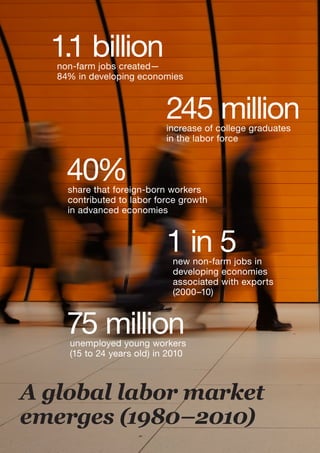
1.1 billion
   non‑farm jobs created—
   84% in developing economies


                            245 million
                            increase of college graduates
                            in the labor force


     40%
     share that foreign-born workers
     contributed to labor force growth
     in advanced economies


                            1 in 5
                             new non‑farm jobs in
                             developing economies
                             associated with exports
                             (2000–10)


     75 million
     unemployed young workers
     (15 to 24 years old) in 2010


A global labor market
emerges (1980–2010)
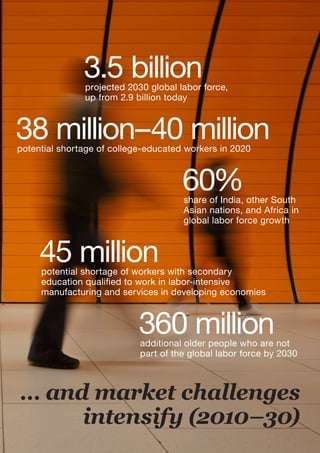
3.5 billion
               projected 2030 global labor force,
               up from 2.9 billion today


38 million–40 million
potential shortage of college-educated workers in 2020


                                      60%
                                      share of India, other South
                                      Asian nations, and Africa in
                                      global labor force growth


     45 million
     potential shortage of workers with secondary
     education qualified to work in labor-intensive
     manufacturing and services in developing economies


                            360 million
                            additional older people who are not
                            part of the global labor force by 2030


… and market challenges
     intensify (2010–30)
McKinsey Global Institute
The world at work: Jobs, pay, and skills for 3.5 billion people


                 Contents


                 Executive summary	                                1


                 1. A global labor market emerges	                13


                 2. Labor supply and demand, 2010–30	             31


                 3. Where the gaps are	                           45


                 4. A global agenda for skills and jobs 	         57


                 Appendix: Technical notes	                       69


                 Bibliography	85
McKinsey Global Institute
The world at work: Jobs, pay, and skills for 3.5 billion people                                                       1


                 Executive summary


                 In the past three decades, technology and globalization have reshaped
                 economies around the world, unleashing sweeping changes in markets and
                 sectors. In the process, a global labor market began to take shape, bringing
                 tremendous benefits—as well as dislocations and challenges. The most striking
                 benefit has been the creation of 900 million non‑farm jobs in developing
                 countries, helping lift hundreds of millions of people out of poverty. During
                 this time, advanced economies were able to raise productivity by investing
                 in technology and tapping new sources of low-cost labor, while creating new
                 high‑wage jobs for high‑skill workers.

                 Strains in this global labor market are becoming increasingly apparent—especially
                 in the aftermath of the “Great Recession.” Joblessness remains high, and there
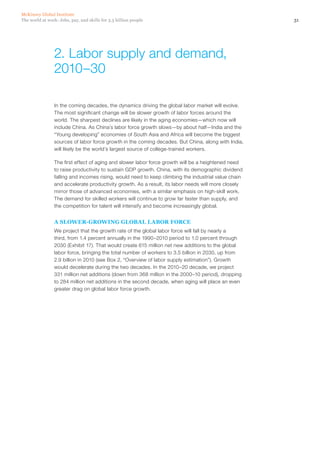
                 are expanding pools of the long-term unemployed and other workers with
                 very poor employment prospects; youth unemployment is approaching crisis
                 proportions. And, even as less‑skilled workers struggle with unemployment and
                 stagnating wages, employers face growing shortages of the types of high‑skill
                 workers who are needed to raise productivity and drive GDP growth. Jobs and
                 income inequality have become grave political and economic concerns.

                 In this report by the McKinsey Global Institute, we identify forces of demand and
                 supply that are shaping a global labor force that will grow to 3.5 billion by 2030.
                 We document these shifts and analyze the implications for workers, national
                 economies, and businesses. We conclude that the forces that have caused
                 imbalances in advanced economies in recent years will grow stronger and that
                 similar mismatches between the skills that workers can offer and what employers
                 need will appear in developing economies, too.

                 If these trends persist—and absent a massive global effort to improve worker
                 skills, they are likely to do so—there will be far too few workers with the
                 advanced skills needed to drive a high‑productivity economy and far too few job
                 opportunities for low‑skill workers. Developing economies could have too few
                 medium‑skill workers to fuel further growth of labor-intensive sectors and far too
                 many workers who lack the education and training to escape low-productivity,
                 low-income work.

                 These potential imbalances are based on our “momentum” case, which
                 uses current patterns in demographics and in the demand and supply of
                 labor to project likely outcomes in the next two decades. In this analysis,
                 we use educational attainment as a proxy for skills because education data
                 are available across most nations, but we acknowledge that this is a rough
                 measure—the quality of formal education varies across countries, and training
                 through apprenticeship can be more important than formal education in
                 many occupations.1 We also note that the market can at least partially correct


                 1	 The Organisation for Economic Co-operation and Development (OECD) is developing a survey
                    method to determine skill levels of populations more precisely. See Better skills, better jobs,
                    better lives: A strategic approach to skills policies, OECD Publishing, May 2012.
2


    imbalances through changes in supply, demand, and wages, which would reduce
    potential gaps.

    However, analyzing these nominal gaps indicates where potential problems
    may arise (e.g., where it may be extremely difficult to hire graduate engineers
    to staff an R&D facility) and provides a framework that policy makers, business
    leaders, and workers can use to guide their decisions. Moreover, the magnitude
    of the gaps suggests that “business as usual” market responses will be
    insufficient to prevent adverse outcomes for millions of workers in advanced and
    developing economies. A concerted public and private effort will be required on
    multiple fronts.

    The most significant imbalances that would arise in the momentum case include:

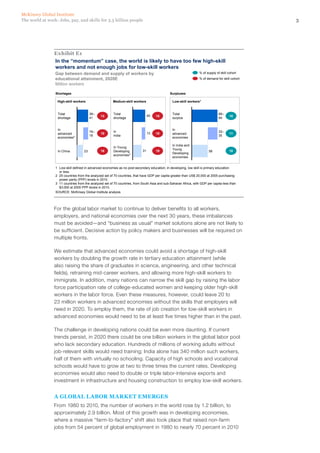
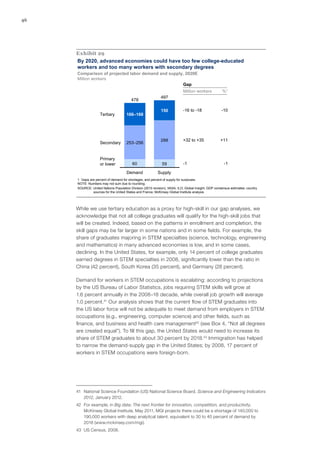
    ƒƒ A potential shortage of about 38 million to 40 million high‑skill workers,
       or 13 percent of demand for such workers. Based on current patterns
       of educational attainment and demand growth, employers in advanced
       economies could face a shortage of 16 million to 18 million college-educated
       workers in 2020, despite rising college-completion rates. The remaining gap—
       around 23 million college-educated workers—would appear in China, despite
       a dramatic rise in educational attainment by 2020 (Exhibit E1).

    ƒƒ A potential surplus of 90 million to 95 million low‑skill workers around the
       world, or around 10 percent of the supply of such workers. Labor forces
       of advanced economies could have as many as 32 to 35 million more workers
       without college education than employers will need. In India and younger
       developing countries, there could be as many as 58 million surplus low‑skill
       workers in 2020.

    ƒƒ A potential shortage of nearly 45 million medium-skill workers in
       developing economies, or about 15 percent of the demand for such
       workers. Industrialization will raise demand for workers with secondary
       education and vocational training in India and the developing economies of
       South Asia and Africa. But because of low rates of high school enrollment
       and completion, India could have 13 million too few such workers; younger
       developing economies could have 31 million too few.

    For advanced economies, such imbalances would likely lead to more long-
    term and permanent joblessness. More young people without post-secondary
    training would fail to get a start in the job market and older workers would drop
    out because they don’t qualify for jobs that are being created. The polarization
    of incomes between high‑ and low‑skill workers could become even more
    pronounced, slowing the advance in national living standards, and increasing
    public-sector burdens and social tensions. In some advanced economies,
    less‑skilled workers could very well grow up poorer than their parents, in
    real terms.

    In China, India, and other developing economies, the impact of potential
    imbalances would be felt in different ways. An inadequate supply of highly
    educated workers could slow China’s climb into higher value-added industries
    and hinder the productivity gains that are increasingly important to its growth.
    India’s problems will be different—the projected surplus of low‑skill workers would
    imply millions trapped in subsistence agriculture or in urban poverty. This picture
    could be mirrored in other South Asian economies and in sub-Saharan Africa.
McKinsey Global Institute
The world at work: Jobs, pay, and skills for 3.5 billion people                                                                                   3


                Exhibit E1
                In the “momentum” case, the world is likely to have too few high-skill
                workers and not enough jobs for low-skill workers
                 Gap between demand and supply of workers by                                                       % of supply of skill cohort
                 educational attainment, 2020E                                                                     % of demand for skill cohort
                 Million workers

                 Shortages                                                                     Surpluses

                  High-skill workers                    Medium-skill workers                    Low-skill workers1


                  Total                  38–            Total                                   Total                            89–
                                               13                                45   15                                                 10
                  shortage               41             shortage                                surplus                          94


                  In                                                                            In
                                         16–            In                                                                       32–
                  advanced                     10                                13   10        advanced                                 11
                                         18             India                                                                    35
                  economies2                                                                    economies

                                                                                                In India and
                                                        In Young
                                                                            31                  Young
                  In China          23         16       Developing                    19                                 58              10
                                                                                                Developing
                                                        economies3
                                                                                                economies


                 1 Low-skill defined in advanced economies as no post-secondary education; in developing, low skill is primary education
                   or less.
                 2 25 countries from the analyzed set of 70 countries, that have GDP per capita greater than US$ 20,000 at 2005 purchasing
                   power parity (PPP) levels in 2010.
                 3 11 countries from the analyzed set of 70 countries, from South Asia and sub-Saharan Africa, with GDP per capita less than
                   $3,000 at 2005 PPP levels in 2010.
                 SOURCE: McKinsey Global Institute analysis


                For the global labor market to continue to deliver benefits to all workers,
                employers, and national economies over the next 30 years, these imbalances
                must be avoided—and “business as usual” market solutions alone are not likely to
                be sufficient. Decisive action by policy makers and businesses will be required on
                multiple fronts.

                We estimate that advanced economies could avoid a shortage of high‑skill
                workers by doubling the growth rate in tertiary education attainment (while
                also raising the share of graduates in science, engineering, and other technical
                fields), retraining mid-career workers, and allowing more high‑skill workers to
                immigrate. In addition, many nations can narrow the skill gap by raising the labor
                force participation rate of college-educated women and keeping older high‑skill
                workers in the labor force. Even these measures, however, could leave 20 to
                23 million workers in advanced economies without the skills that employers will
                need in 2020. To employ them, the rate of job creation for low‑skill workers in
                advanced economies would need to be at least five times higher than in the past.

                The challenge in developing nations could be even more daunting. If current
                trends persist, in 2020 there could be one billion workers in the global labor pool
                who lack secondary education. Hundreds of millions of working adults without
                job-relevant skills would need training; India alone has 340 million such workers,
                half of them with virtually no schooling. Capacity of high schools and vocational
                schools would have to grow at two to three times the current rates. Developing
                economies would also need to double or triple labor-intensive exports and
                investment in infrastructure and housing construction to employ low‑skill workers.


                A GLOBAL LABOR MARKET EMERGES
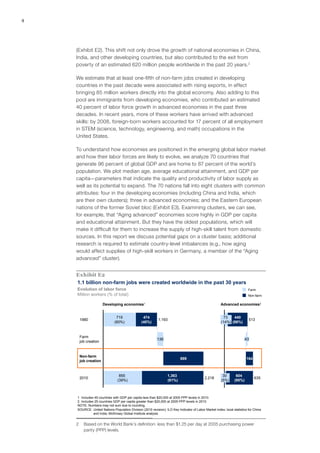
                From 1980 to 2010, the number of workers in the world rose by 1.2 billion, to
                approximately 2.9 billion. Most of this growth was in developing economies,
                where a massive “farm-to-factory” shift also took place that raised non‑farm
                jobs from 54 percent of global employment in 1980 to nearly 70 percent in 2010
4


    (Exhibit E2). This shift not only drove the growth of national economies in China,
    India, and other developing countries, but also contributed to the exit from
    poverty of an estimated 620 million people worldwide in the past 20 years.2

    We estimate that at least one-fifth of non‑farm jobs created in developing
    countries in the past decade were associated with rising exports, in effect
    bringing 85 million workers directly into the global economy. Also adding to this
    pool are immigrants from developing economies, who contributed an estimated
    40 percent of labor force growth in advanced economies in the past three
    decades. In recent years, more of these workers have arrived with advanced
    skills: by 2008, foreign-born workers accounted for 17 percent of all employment
    in STEM (science, technology, engineering, and math) occupations in the
    United States.

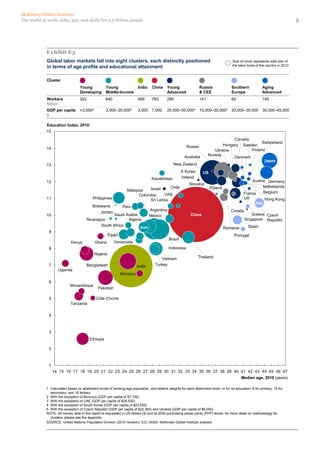
    To understand how economies are positioned in the emerging global labor market
    and how their labor forces are likely to evolve, we analyze 70 countries that
    generate 96 percent of global GDP and are home to 87 percent of the world’s
    population. We plot median age, average educational attainment, and GDP per
    capita—parameters that indicate the quality and productivity of labor supply as
    well as its potential to expand. The 70 nations fall into eight clusters with common
    attributes: four in the developing economies (including China and India, which
    are their own clusters); three in advanced economies; and the Eastern European
    nations of the former Soviet bloc (Exhibit E3). Examining clusters, we can see,
    for example, that “Aging advanced” economies score highly in GDP per capita
    and educational attainment. But they have the oldest populations, which will
    make it difficult for them to increase the supply of high‑skill talent from domestic
    sources. In this report we discuss potential gaps on a cluster basis; additional
    research is required to estimate country-level imbalances (e.g., how aging
    would affect supplies of high-skill workers in Germany, a member of the “Aging
    advanced” cluster).


    Exhibit E2
    1.1 billion non-farm jobs were created worldwide in the past 30 years
    Evolution of labor force                                                                                              Farm
    Million workers (% of total)                                                                                          Non-farm

                     Developing economies1                                                             Advanced economies2


                              719                474                                                     73   440
     1980                                                  1,193                                                          513
                             (60%)              (40%)                                                  (14%) (86%)


     Farm
                                                           136                                                          43
     job creation


     Non-farm
                                                                           889                                          164
     job creation


                                855                               1,363                                 30       604
     2010                                                                                  2,218                              635
                               (39%)                              (61%)                                (5%)     (95%)


    1 Includes 45 countries with GDP per capita less than $20,000 at 2005 PPP levels in 2010.
    2 Includes 25 countries GDP per capita greater than $20,000 at 2005 PPP levels in 2010.
    NOTE: Numbers may not sum due to rounding.
    SOURCE: United Nations Population Division (2010 revision); ILO Key Indicator of Labor Market index; local statistics for China
              and India; McKinsey Global Institute analysis


    2	 Based on the World Bank’s definition: less than $1.25 per day at 2005 purchasing power
       parity (PPP) levels.
McKinsey Global Institute
The world at work: Jobs, pay, and skills for 3.5 billion people                                                                                                                  5


             Exhibit E3
             Global labor markets fall into eight clusters, each distinctly positioned                                                 Size of circle represents total size of
             in terms of age profile and educational attainment                                                                        the labor force of the country in 2010


             Cluster
                                  Young             Young         India           China Young                     Russia              Southern             Aging
                                  Developing        Middle-Income                       Advanced                  & CEE               Europe               Advanced
             Workers              322               640                 469       783       290                   141                 60                   145
             Million
             GDP per capita       <3,0002           3,000–20,0003       3,000 7,000         25,000–50,0004        10,000–20,0005 20,000–30,000             30,000–45,000
             $

             Education Index, 20101
             15
                                                                                                                                    Canada
                                                                                                                                                  Switzerland
                                                                                                         Russia                Hungary Sweden
             14                                                                                                            Ukraine          Finland
                                                                                                       Australia        Norway
                                                                                                                                    Denmark
                                                                                                                                                   Japan
             13                                                                                 New Zealand
                                                                                                      S Korea      US
                                                                                  Kazakhstan          Ireland
             12                                                                                                                                   Austria Germany
                                                                                                          Slovakia
                                                                                              Chile                     Poland                           Netherlands
                                                                 Malaysia   Israel
                                                                                                                                              France     Belgium
                                                                       Colombia     UAE
             11                            Philippines                      Sri Lanka                                                         UK          Hong Kong
                                                                                                                                                    Italy
                                           Botswana            Peru
                                                                         Argentina                                                    Croatia
                                                Jordan
             10                                       Saudi Arabia       Mexico                            China                                    Greece Czech
                                        Nicaragua            Algeria                                                                            Singapore Republic
                                               South Africa                                                                                      Spain
                                                                    Iran                                                         Romania
              9
                                                      Egypt                                                                             Portugal
                                                                                             Brazil
                             Kenya          Ghana         Venezuela
              8                                                                              Indonesia
                                            Nigeria
                                                                                       Vietnam                  Thailand

              7                        Bangladesh                       India       Turkey
                    Uganda
                                                              Morocco

              6
                            Mozambique
                                              Pakistan

              5                              Côte d’Ivoire
                            Tanzania

              4


              3
                                         Ethiopia

              2


              1
                  14 15 16 17 18 19 20 21 22 23 24 25 26 27 28 29 30 31 32 33 34 35 36 37 38 39 40 41 42 43 44 45 46 47
                                                                                                                                             Median age, 2010 (years)

             1 Calculated based on attainment levels of working-age population, and relative weights for each attainment level—4 for no education, 6 for primary, 12 for
               secondary, and 16 tertiary.
             2 With the exception of Morocco (GDP per capita of $7,100).
             3 With the exception of UAE (GDP per capita of $28,500).
             4 With the exception of South Korea (GDP per capita of $23,500).
             5 With the exception of Czech Republic (GDP per capita of $22,300) and Ukraine (GDP per capita of $6,000).
             NOTE: All money data in this report is expressed in US dollars ($) and at 2005 purchasing power parity (PPP) levels; for more detail on methodology for
               clusters, please see the appendix.
             SOURCE: United Nations Population Division (2010 revision); ILO; IIASA; McKinsey Global Institute analysis
6


    Developing economies: riding a rising demographic tide
    With large and rapidly growing populations and increasing access to global
    markets, developing economies became the world’s largest suppliers of low‑skill
    labor. These workers filled rising domestic needs as their countries industrialized
    and helped meet demand from the global economy, too.

    China added 121 million non‑farm jobs in its expanding manufacturing and
    service sectors in the past decade; more than 80 million of these were filled by
    workers shifting out of low-productivity agriculture, helping accelerate productivity
    gains. About 33 million jobs were created in manufacturing, and about a third of
    all new non‑farm jobs were associated with exporting industries. China’s focus,
    since the 1950s and 1960s, on educating both rural and urban workers across
    the nation, was reflected in the secondary education attainment rate of 60 percent
    in 2010. The result has been a dramatic increase in per capita GDP, which rose to
    20 percent of advanced economy levels in 2010, from 3 percent in 1980.

    India followed a similar path, but at a slower pace. In the 2000–10 decade, for
    example, India created just 67 million non‑farm jobs, which was enough to keep
    pace with labor force growth, but not sufficient for more workers to move out
    of agriculture into more productive jobs. Indeed, while the share of farm jobs
    fell from 62 percent in 2000 to 53 percent in 2010, the number of farm workers
    remained steady at about 240 million. Also, India lags behind China in creation of
    higher value-added manufacturing and export-oriented jobs: 41 percent of India’s
    job creation in the past decade was in low‑skill construction, compared with
    16 percent in China. And, while India rivals China in tertiary education attainment,
    the share of people with secondary school education is only about one-third
    the ratio in China, which could lead to a shortage of medium‑skill workers for
    expanding labor-intensive industries.

    The farm-to-factory transition also has played out in places such as Vietnam, a
    member of the “Young middle-income” cluster, which created 12 million non‑farm
    jobs and reduced agricultural employment from two-thirds of all jobs in 2000 to
    half in 2010. The Philippines, another member of the cluster, created 3.5 million
    service sector jobs between 2000 and 2010, many of them in IT and IT-enabled
    services, thanks to its relatively high level of educational attainment. Countries in
    the Middle East and North Africa region (MENA), on the other hand, also rapidly
    increased tertiary attainment rates, but did not create enough high-quality service
    jobs. In Egypt, for example, five million students graduated from colleges between
    1995 and 2006, but the economy created only 1.8 million jobs in skill-intensive
    service sectors.

    The “Young developing” countries of South Asia and sub-Saharan Africa
    continue to benefit from a demographic dividend: their labor forces expanded by
    2.9 percent annually from 1990 to 2010, reaching 322 million in 2010, and they
    have raised educational attainment. Countries like Bangladesh and Nigeria could
    be well positioned to take on more of the world’s labor-intensive work as costs
    rise in China and India.
McKinsey Global Institute
The world at work: Jobs, pay, and skills for 3.5 billion people                                       7


                Advanced economies: High skills and high productivity to
                sustain growth
                In response to slowing labor force growth and rising global competition,
                advanced economies have focused on raising productivity, often by adopting
                labor-saving technologies. From 1977 to 2007, manufacturing employment in
                advanced economies declined by 20 million, with the greatest losses in labor-
                intensive sectors such as textiles, leather, footwear, and wood products. Even
                economies like Germany that have remained major exporters of manufactured
                goods, saw total manufacturing employment shrink by more than 25 percent,
                despite their growing strength in knowledge-intensive manufacturing, which
                includes sectors such as chemicals, transport equipment, and advanced
                manufacturing (requiring a relatively small number of high‑skill workers to program
                and run factory machines).

                Across advanced economies, hiring has been strongest in services, particularly
                knowledge-intensive sectors such as finance and business services. Jobs also
                grew in labor-intensive sectors such as construction, retail trade and hospitality,
                and public services. Hiring rose rapidly in so-called interaction work, which
                requires face-to-face contact and includes the professions and business
                management. About half of interaction jobs require college degrees. Hiring was
                weakest in low‑skill production and transaction occupations (assembly workers or
                customer service representatives), where tasks could be automated or transferred
                to low-cost locations.

                Growing strains
                In the wake of the “Great Recession,” the deteriorating position of low- and
                medium‑skill workers has raised concerns about income inequality across
                advanced economies. However, the growing polarization of income that is so
                apparent today reflects a long decline in the role of low- and medium‑skill labor
                (workers with just high school education or some post-secondary schooling
                at most). Such workers were once essential to the growth of advanced
                economies. But since the late 1970s, companies have come to rely increasingly
                on investments in labor-saving machinery and information technology to raise
                productivity. They have also invested in R&D and knowledge workers to help drive
                innovation. As a result, demand for the kinds of workers who make up three-
                quarters of the labor force has fallen—and, along with it, the share of national
                income that goes to workers. After rising steadily from 1950 to 1975, labor’s share
                of income in advanced economies fell from the 1980s onward, and now stands
                below the 1950 level.

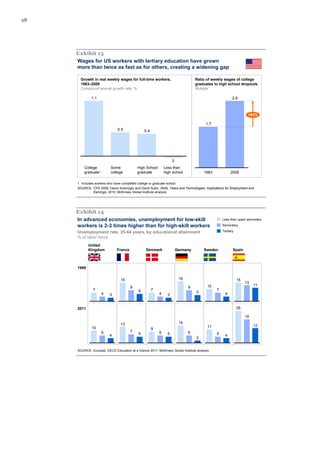
                High‑skill workers (those with college degrees) remained in high demand and saw
                their wages rise—by about 1.1 percent a year in real terms in the United States,
                while wages declined slightly in real terms for workers who did not complete
                high school. Over 30 years, this has led to a widening gap between incomes
                of college-educated workers and workers with lower skills: the average college
                graduate earned 2.8 times the wage of an average high school dropout in
                2008, up from a premium of 1.7 times in 1980. Even within college graduates,
                higher demand for certain specializations has driven wage concentration. For
                example, in the United States, the average STEM major earns $500,000 more (in
                discounted lifetime earnings) than the average non‑STEM major.
8


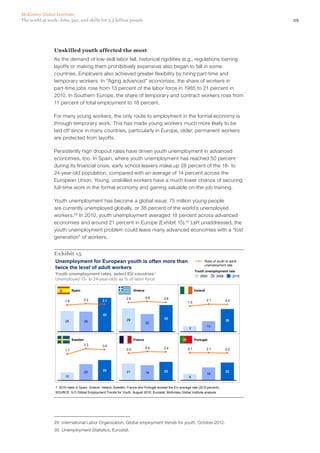
    The weakened position of low‑skill labor is reflected in employment figures: in
    most advanced economies, unemployment rates for the least‑skilled are two to
    four times those of the most highly skilled workers, whether the economy is in
    recession or recovery. The effects of falling demand for low‑skill labor have been
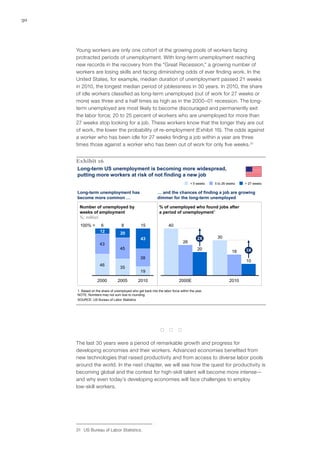
    especially harsh for younger workers. Today, 75 million young people (aged 15 to
    24) who are not in school or college are unemployed, accounting for 38 percent
    of the world’s unemployed.3 Youth unemployment has been high in developing
    economies as well. Across the MENA nations, youth unemployment consistently
    averaged 25 percent from the early 1990s through 2010. Left unaddressed, the
    youth unemployment problem could leave many advanced economies with a “lost
    generation” of workers.


    POTENTIAL GAPS: TOO FEW HIGH‑SKILL WORKERS AND NOT
    ENOUGH JOBS FOR MEDIUM- AND LOW‑SKILL WORKERS
    The most important trend shaping the global labor supply in the next two
    decades will be slower growth. New workers will enter at a slower rate, and
    older workers will leave in higher numbers. The overall effect will be to reduce
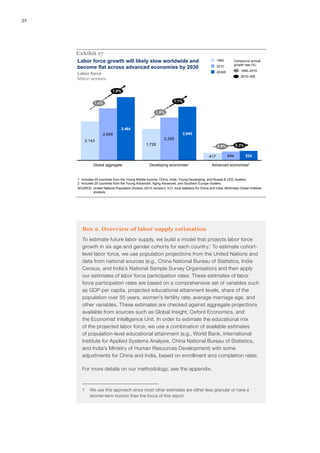
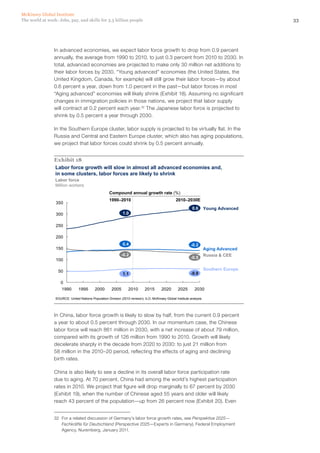
    the annual growth rate of the global labor force from about 1.4 percent annually
    between 1990 and 2010 to about 1 percent to 2030. China’s labor force growth
    will likely drop by almost half, to just 0.5 percent annually—in “Aging advanced”
    economies, labor forces will shrink and will likely be flat in Southern Europe.
    Among the advanced economy clusters, only the “Young advanced” will grow its
    labor force, but only at about 0.6 percent annually to 2030.

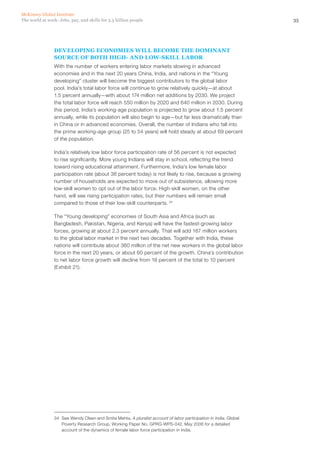
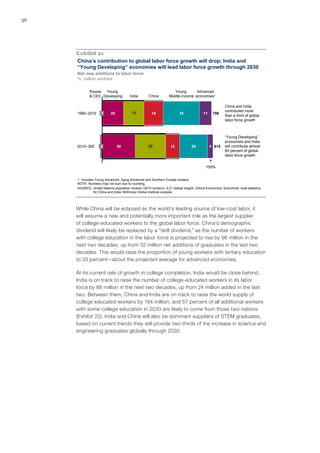
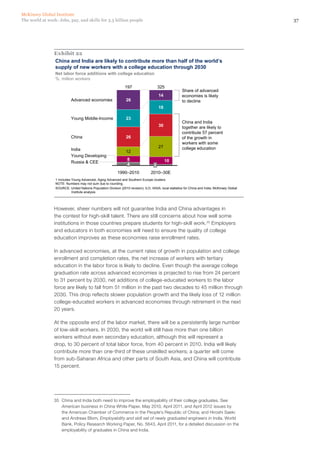
    Over the next two decades, China will be replaced by India and the “Young
    developing” economies of South Asia and Africa as the leading source of new
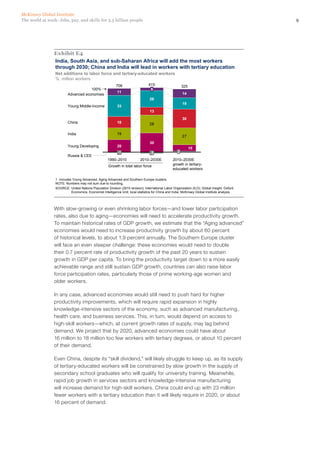
    workers in the global market. These nations will supply 60 percent of the more
    than 600 million net new workers that we project will be added to the global labor
    supply, bringing the total global labor force to 3.5 billion in 2030 (Exhibit E4). While
    China will be eclipsed as the world’s major source of low-cost labor, it will assume
    a new and potentially more important role as the largest supplier of college-
    educated workers to the global labor force. Between them, China and India will
    contribute 57 percent of the world’s new workers with some college education
    through 2030.

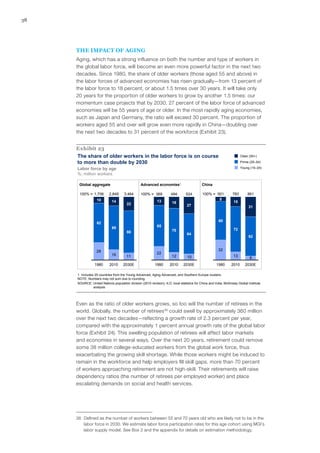
    Over the same period we project that the total population of people over 55 who
    are not in the labor force (including a surge of retirees) could reach 360 million.
    Some 40 percent of the expected retirees would be in the advanced economies
    and China, complicating the challenge of filling skill gaps in those nations. Of
    these retirees, approximately 38 million would be college-educated workers, who
    will take with them valuable skills. Raising the labor participation rate of workers
    over 55 and finding ways to keep retirement-age workers employed are obvious
    ways to narrow potential skill gaps.


    3	 Unemployment Statistics, Eurostat.
McKinsey Global Institute
The world at work: Jobs, pay, and skills for 3.5 billion people                                                                               9


                Exhibit E4
                India, South Asia, and sub-Saharan Africa will add the most workers
                through 2030; China and India will lead in workers with tertiary education
                 Net additions to labor force and tertiary-educated workers
                 %; million workers
                                                          706                   615                     325
                                     100%                                        5
                                                           11                                           14
                         Advanced economies
                                                                                 26
                                                                                                        18
                         Young Middle-Income               33
                                                                                 13
                                                                                                        30
                         China                             18                    28

                         India                             19
                                                                                                        27
                                                                                 30
                         Young Developing                  20
                                                                                                              10
                                                           -1                    -2                 2
                         Russia & CEE
                                                    1990–2010              2010–2030E            2010–2030E
                                                     Growth in total labor force                 growth in tertiary-
                                                                                                 educated workers

                 1 Includes Young Advanced, Aging Advanced and Southern Europe clusters.
                 NOTE: Numbers may not sum due to rounding.
                 SOURCE: United Nations Population Division (2010 revision); International Labor Organization (ILO); Global Insight; Oxford
                           Economics; Economist Intelligence Unit; local statistics for China and India; McKinsey Global Institute analysis


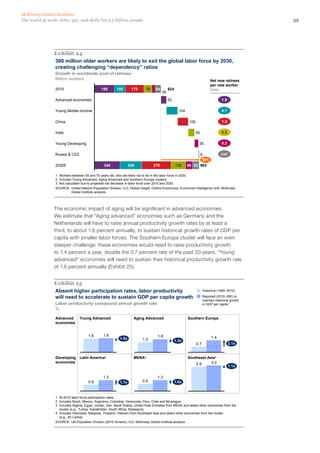
                With slow-growing or even shrinking labor forces—and lower labor participation
                rates, also due to aging—economies will need to accelerate productivity growth.
                To maintain historical rates of GDP growth, we estimate that the “Aging advanced”
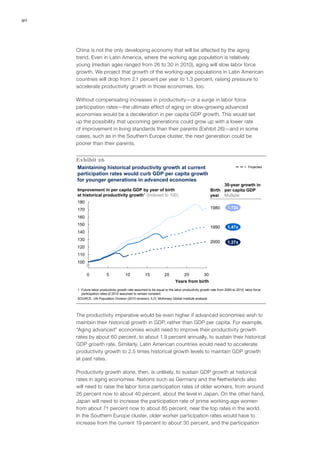
                economies would need to increase productivity growth by about 60 percent
                of historical levels, to about 1.9 percent annually. The Southern Europe cluster
                will face an even steeper challenge: these economies would need to double
                their 0.7 percent rate of productivity growth of the past 20 years to sustain
                growth in GDP per capita. To bring the productivity target down to a more easily
                achievable range and still sustain GDP growth, countries can also raise labor
                force participation rates, particularly those of prime working-age women and
                older workers.

                In any case, advanced economies would still need to push hard for higher
                productivity improvements, which will require rapid expansion in highly
                knowledge-intensive sectors of the economy, such as advanced manufacturing,
                health care, and business services. This, in turn, would depend on access to
                high‑skill workers—which, at current growth rates of supply, may lag behind
                demand. We project that by 2020, advanced economies could have about
                16 million to 18 million too few workers with tertiary degrees, or about 10 percent
                of their demand.

                Even China, despite its “skill dividend,” will likely struggle to keep up, as its supply
                of tertiary-educated workers will be constrained by slow growth in the supply of
                secondary school graduates who will qualify for university training. Meanwhile,
                rapid job growth in services sectors and knowledge-intensive manufacturing
                will increase demand for high‑skill workers. China could end up with 23 million
                fewer workers with a tertiary education than it will likely require in 2020, or about
                16 percent of demand.
10


     At the same time, advanced economies would also experience rising
     surpluses of workers with less education and increasingly limited employment
     opportunities At current rates of educational attainment and labor force growth,
     we project that there could be 32 million to 35 million more workers with only
     secondary education than employers will demand in 2020, equivalent to an
     11 percent oversupply.

     In developing countries, if patterns of educational attainment and job creation
     do not change, the demographic advantages (young and rapidly growing
     populations) that have helped many of these nations prosper could become
     an economic and political burden. Based on current population and education
     trends, India could have 27 million too many low‑skill workers, who would likely
     be trapped in low-productivity, low-income work. “Young developing” economies
     could have 31 million similarly positioned low‑skill workers. Meanwhile, India
     and “Young developing” economies could have 45 million too few workers with
     secondary school education.


     A GLOBAL AGENDA FOR JOBS AND SKILLS
     The imbalances we project in our momentum case would have undesirable
     implications for the global economy. Unemployment of low‑skill workers would
     continue to rise and global growth rates would fall if high‑skill jobs were to go
     unfilled. Wages could respond to imbalances in demand and supply by polarizing
     further, leading to greater income inequality. Patterns of migration and trade flows
     could adjust to address labor shortages and surpluses across regions. But given
     the volumes of low- and medium‑skill workers that would need to be employed,
     and rising resistance to immigration in some nations, these adjustments could
     have limited impact.

     To create better outcomes for workers and economies, policy makers and
     business leaders across the globe will need to find ways to vastly improve the
     capacity to provide job-relevant education and training. And, in both developing
     and advanced economies, new approaches to job creation for low- and
     middle‑skill workers will be required.

     We estimate that advanced economies will need to raise the number of young
     people completing tertiary education 2.5 times as quickly as they are currently
     doing. They will also need to guide more students to job-relevant training (in the
     United States, for example, only 14 percent of college degrees awarded are in
     STEM fields). India and the “Young developing” economies will need to catch
     up in secondary and vocational education and find ways to retrain hundreds
     of millions of adults who have little or no formal education and job skills. To meet
     government targets of secondary school graduation rates, India would need to
     add 34 million secondary school seats, to reach 82 million school seats by 2016,
     and hire twice the number of secondary school teachers every year.

     Such goals cannot be met by conventional methods alone. Recasting the global
     labor force to align with future demand will require deep and wide innovations to
     improve the capacity, reach, and delivery of educational and company training
     systems. This will require new ways of teaching, collaboration with industry
     to craft curricula to employer needs, and new ways of building schools and
     training teachers.
McKinsey Global Institute
The world at work: Jobs, pay, and skills for 3.5 billion people                                         11


                From rural schools in India to the top universities in advanced countries,
                technology can be used to extend the capacity of schools and teachers. Even
                now, teachers in parts of India are reaching low-income students through
                DVD-based lessons, and top US professors are giving classes to hundreds
                of thousands of students per semester, rather than hundreds, through online
                systems. The need for innovation is high and will require more resources than
                governments alone can provide: private industry, private investors, and the social
                sector also will need to help.

                Even with these steps, the shortages we project would not disappear entirely.
                Both advanced and developing economies will also need to consider steps
                to raise demand for less‑skilled workers. In advanced economies there are
                opportunities to create new jobs for low- and middle‑skill workers in service
                sectors, including in the fast-growing health care industry and through
                “marketization” of home services such as child care and elder care (turning a
                segment of the informal economy into an industry, with full-time employment,
                training, benefits, even career advancement). In some places, regulatory reform
                may help enable job creation for less-skilled workers, for example, by relaxing
                restrictions on retail trade. Additional responses to long- and short-term
                unemployment may also be required, including measures like Germany’s job-
                sharing program, which provides a subsidy that allows employers to avoid mass
                layoffs by keeping workers on at reduced hours.

                Developing economies can create demand for less educated workers by
                encouraging the expansion of labor-intensive sectors. By moving up the value
                chain—from supplying raw food or raw materials and intermediates to processed
                food and finished goods—economies create more jobs. By scaling up its
                garment manufacturing sector, Bangladesh, for example, created employment
                opportunities  for millions of low‑skill women, many of whom had never worked
                in the formal economy before. Government can also help create jobs in the
                manufacturing and construction sectors by reducing the regulatory barriers that
                inhibit new enterprises and infrastructure development.

                For businesses operating in a global knowledge economy, an immediate priority
                is to develop a deeper understanding of how labor markets and skill pools
                are evolving in different countries to inform global recruiting and supply chain
                strategies. Businesses should also consider how to play an active role in public
                education and training. For example, IT companies in India actively shape college
                curricula and delivery, to ensure better access to skills. Some businesses could
                choose to participate directly in the booming education sector, as providers of
                vocational training for example. Longer term, businesses in a skill-scarce world
                would need to optimize demand for skilled workers, by investing in skill-saving
                technologies such as knowledge codification systems and smart devices that
                raise productivity even of low‑skill workers. Finally, given the urgency of resolving
                unemployment and inequality problems, businesses should consider aligning their
                corporate social responsibility efforts to labor priorities in their communities.
12


                                          *   *   *

     Throughout the 20th century, industrialization, innovation, and advances in
     technology resulted in record wealth creation and improving living standards—a
     rising tide that globalization shared with the developing world. Work itself evolved:
     it took less human effort to raise food and build things. But it now takes greater
     knowledge to innovate and continue to raise productivity. As the 21st century
     unfolds, the supply of high‑skill workers is not keeping up with growing demand,
     while too many workers are left with inadequate or outdated skills. Slower growth,
     rising income polarization, growing pools of unemployed or under-employed
     workers, and soaring social costs are real possibilities. To keep those possibilities
     from becoming realities, policy makers, business leaders, and workers
     themselves must find ways to bring education, training, and job creation into the
     21st century.
McKinsey Global Institute
The world at work: Jobs, pay, and skills for 3.5 billion people                                                         13


                 1. A global labor market
                 emerges

                 Over the past three decades, the industrialization of developing economies,
                 rising trade, and immigration, have all helped to bring about a more integrated
                 global labor market. More than one billion non‑farm jobs were created worldwide.
                 Around 900 million of these were created in developing economies and played
                 a role in lifting 620 million people out of poverty between 1990 and 2008.4 In
                 advanced economies, as growth shifted to services and companies adopted
                 technology to improve productivity, millions of new high‑paying jobs were created
                 for high‑skill workers.5

                 But recently, strains have become apparent, particularly during the slow recovery
                 from the “Great Recession” of 2008–09. In advanced economies, the fortunes
                 of high‑ and low‑skill workers have diverged sharply. While demand for high‑skill
                 workers remains strong—and shortages of such workers are becoming more
                 common—there are large and growing pools of low‑skill workers for whom
                 job opportunities are shrinking. Long-term unemployment is becoming more
                 common, and across advanced economies youth unemployment has risen to
                 18 percent, or more than twice the overall rate.

                 While part of the problem is cyclical—a natural result of the global financial crisis
                 and a severe recession—it is increasingly clear that long-term structural changes
                 in global demand and supply of labor play a major role. As a result, in advanced
                 economies, polarization of incomes is growing. And, with slow wage growth for
                 low- and middle‑skill workers, labor’s share of national incomes (the sum of all
                 employee compensation) has fallen to its lowest level in 60 years.

                 Today, the effects of changes in labor demand and supply are most apparent
                 in advanced economies, but they are also beginning to be felt in developing
                 ones. Across the global labor market there are growing mismatches between
                 worker skills and employer needs (in France there are too few college graduates;
                 in India, there aren’t enough workers with secondary education). In this
                 chapter we examine the evolution of the global labor market and the roots of
                 potential imbalances.


                 4	 This is based on the World Bank’s definition of poverty: income of less than $1.25 per day
                    based on 2005 purchasing power parity (PPP) levels. It compares the number of people who
                    lived in poverty in 2008 with those in 1990. This estimate includes children and others who are
                    not in the labor force.
                 5	 We use educational attainment as a rough proxy for skill level. High‑skill refers to workers with
                    a tertiary education or more, medium‑skill refers to workers with only a secondary education,
                    and low‑skill refers to workers with no more than a primary education.
14


     GROWTH OF A GLOBAL LABOR MARKET
     From 1980 to 2010, the world’s labor force grew by 1.2 billion, to approximately
     2.9 billion. Almost 90 percent of the growth occurred in developing economies,
     including 500 million new workers in China and India. This growth, driven
     by demographics (i.e., fast-growing populations) and rising labor market
     participation, also reflects a critically important “farm-to-factory” shift in
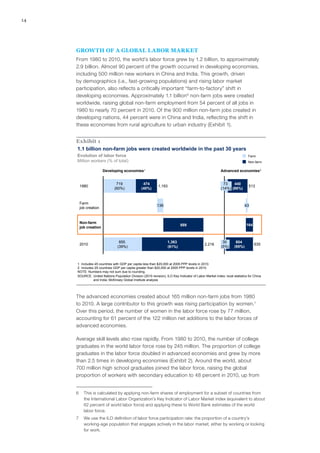
     developing economies. Approximately 1.1 billion 6 non‑farm jobs were created
     worldwide, raising global non‑farm employment from 54 percent of all jobs in
     1980 to nearly 70 percent in 2010. Of the 900 million non‑farm jobs created in
     developing nations, 44 percent were in China and India, reflecting the shift in
     these economies from rural agriculture to urban industry (Exhibit 1).


     Exhibit 1
     1.1 billion non-farm jobs were created worldwide in the past 30 years
     Evolution of labor force                                                                                              Farm
     Million workers (% of total)                                                                                          Non-farm

                      Developing economies1                                                             Advanced economies2


                               719                474                                                     73   440
      1980                                                  1,193                                                          513
                              (60%)              (40%)                                                  (14%) (86%)


      Farm
                                                            136                                                          43
      job creation


      Non-farm
                                                                            889                                          164
      job creation


                                 855                               1,363                                 30       604
      2010                                                                                  2,218                              635
                                (39%)                              (61%)                                (5%)     (95%)


     1 Includes 45 countries with GDP per capita less than $20,000 at 2005 PPP levels in 2010.
     2 Includes 25 countries GDP per capita greater than $20,000 at 2005 PPP levels in 2010.
     NOTE: Numbers may not sum due to rounding.
     SOURCE: United Nations Population Division (2010 revision); ILO Key Indicator of Labor Market index; local statistics for China
               and India; McKinsey Global Institute analysis


     The advanced economies created about 165 million non‑farm jobs from 1980
     to 2010. A large contributor to this growth was rising participation by women.7
     Over this period, the number of women in the labor force rose by 77 million,
     accounting for 61 percent of the 122 million net additions to the labor forces of
     advanced economies.

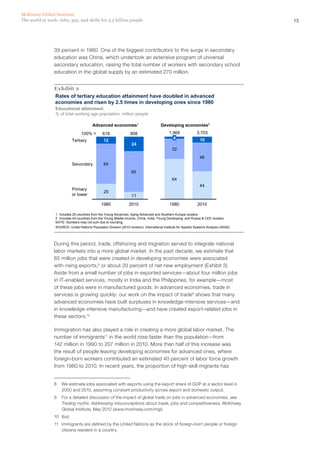
     Average skill levels also rose rapidly. From 1980 to 2010, the number of college
     graduates in the world labor force rose by 245 million. The proportion of college
     graduates in the labor force doubled in advanced economies and grew by more
     than 2.5 times in developing economies (Exhibit 2). Around the world, about
     700 million high school graduates joined the labor force, raising the global
     proportion of workers with secondary education to 48 percent in 2010, up from


     6	 This is calculated by applying non‑farm shares of employment for a subset of countries from
        the International Labor Organization’s Key Indicator of Labor Market index (equivalent to about
        62 percent of world labor force) and applying these to World Bank estimates of the world
        labor force.
     7	 We use the ILO definition of labor force participation rate: the proportion of a country’s
        working-age population that engages actively in the labor market, either by working or looking
        for work.
McKinsey Global Institute
The world at work: Jobs, pay, and skills for 3.5 billion people                                                                             15


                39 percent in 1980. One of the biggest contributors to this surge in secondary
                education was China, which undertook an extensive program of universal
                secondary education, raising the total number of workers with secondary school
                education in the global supply by an estimated 270 million.


                Exhibit 2
                Rates of tertiary education attainment have doubled in advanced
                economies and risen by 2.5 times in developing ones since 1980
                 Educational attainment
                 % of total working age population; million people

                                          Advanced economies1                            Developing economies2
                                  100% =         618                808                        1,968              3,703
                                                                                                 4                  10
                            Tertiary              12
                                                                     24
                                                                                                 32
                                                                                                                    46
                            Secondary             64
                                                                     65
                                                                                                 64
                                                                                                                    44
                            Primary
                                                  25
                            or lower                                 11
                                                1980               2010                        1980               2010

                 1 Includes 25 countries from the Young Advanced, Aging Advanced and Southern Europe clusters.
                 2 Includes 45 countries from the Young Middle-Income, China, India, Young Developing, and Russia & CEE clusters.
                 NOTE: Numbers may not sum due to rounding.
                 SOURCE: United Nations Population Division (2010 revision); International Institute for Applied Systems Analysis (IIASA)


                During this period, trade, offshoring and migration served to integrate national
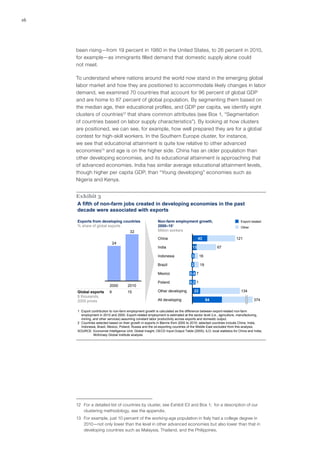
                labor markets into a more global market. In the past decade, we estimate that
                85 million jobs that were created in developing economies were associated
                with rising exports,8 or about 20 percent of net new employment (Exhibit 3).
                Aside from a small number of jobs in exported services—about four million jobs
                in IT-enabled services, mostly in India and the Philippines, for example—most
                of these jobs were in manufactured goods. In advanced economies, trade in
                services is growing quickly: our work on the impact of trade 9 shows that many
                advanced economies have built surpluses in knowledge-intensive services—and
                in knowledge-intensive manufacturing—and have created export-related jobs in
                these sectors.10

                Immigration has also played a role in creating a more global labor market. The
                number of immigrants11 in the world rose faster than the population—from
                142 million in 1990 to 207 million in 2010. More than half of this increase was
                the result of people leaving developing economies for advanced ones, where
                foreign-born workers contributed an estimated 40 percent of labor force growth
                from 1980 to 2010. In recent years, the proportion of high‑skill migrants has


                8	 We estimate jobs associated with exports using the export share of GDP at a sector level in
                   2000 and 2010, assuming constant productivity across export and domestic output.
                9	 For a detailed discussion of the impact of global trade on jobs in advanced economies, see
                   Trading myths: Addressing misconceptions about trade, jobs and competitiveness, McKinsey
                   Global Institute, May 2012 (www.mckinsey.com/mgi).
                10	Ibid.
                11	 Immigrants are defined by the United Nations as the stock of foreign-born people or foreign
                    citizens resident in a country.
16


     been rising—from 19 percent in 1980 in the United States, to 26 percent in 2010,
     for example—as immigrants filled demand that domestic supply alone could
     not meet.

     To understand where nations around the world now stand in the emerging global
     labor market and how they are positioned to accommodate likely changes in labor
     demand, we examined 70 countries that account for 96 percent of global GDP
     and are home to 87 percent of global population. By segmenting them based on
     the median age, their educational profiles, and GDP per capita, we identify eight
     clusters of countries12 that share common attributes (see Box 1, “Segmentation
     of countries based on labor supply characteristics”). By looking at how clusters
     are positioned, we can see, for example, how well prepared they are for a global
     contest for high‑skill workers. In the Southern Europe cluster, for instance,
     we see that educational attainment is quite low relative to other advanced
     economies13 and age is on the higher side. China has an older population than
     other developing economies, and its educational attainment is approaching that
     of advanced economies. India has similar average educational attainment levels,
     though higher per capita GDP, than “Young developing” economies such as
     Nigeria and Kenya.


     Exhibit 3
     A fifth of non-farm jobs created in developing economies in the past
     decade were associated with exports

     Exports from developing countries                      Non-farm employment growth,                              Export-related
     % share of global exports                              2000–101                                                 Other
                                         32                 Million workers

                                                            China                        43                       121
                               24
                                                            India                   13                67

                                                            Indonesia              3        16

                                                            Brazil                 2        19

                                                            Mexico                0.4 7

                                                            Poland                0.2 1
                           2000        2010
     Global exports        9           15                   Other developing           22                            134
     $ thousands,
     2005 prices                                            All developing                       84                           374

     1 Export contribution to non-farm employment growth is calculated as the difference between export-related non-farm
       employment in 2010 and 2000. Export-related employment is estimated at the sector level (i.e., agriculture, manufacturing,
       mining, and other services) assuming constant labor productivity across exports and domestic output.
     2 Countries selected based on their growth in exports in $terms from 2000 to 2010; selected countries include China, India,
       Indonesia, Brazil, Mexico, Poland; Russia and the oil-exporting countries of the Middle East excluded from this analysis.
     SOURCE: Economist Intelligence Unit; Global Insight; OECD Input-Output Table (2005); ILO; local statistics for China and India;
               McKinsey Global Institute analysis


     12	 For a detailed list of countries by cluster, see Exhibit E3 and Box 1; for a description of our
         clustering methodology, see the appendix.
     13	 For example, just 10 percent of the working-age population in Italy had a college degree in
         2010—not only lower than the level in other advanced economies but also lower than that in
         developing countries such as Malaysia, Thailand, and the Philippines.
McKinsey Global Institute
The world at work: Jobs, pay, and skills for 3.5 billion people                                                                                        17


                    Box 1. Segmentation of countries based on labor supply
                    characteristics
                    We segment economies according to three labor market characteristics: median age,
                    average educational attainment of the working-age population, and GDP per capita
                    in 2010. These parameters are proxies for a country’s potential to grow labor supply,
                    quality of supply, and productivity of supply. This segmentation yields six groups of
                    nations, plus India and China, which have unique characteristics. Three clusters with
                    relatively high median age and educational attainment are the “advanced economies”
                    (their per capita GDP is greater than $20,0001) while countries in the Russia and Central
                    & Eastern Europe cluster have similarities on educational attainment and median age,
                    but lower levels of GDP per capita and are not included in the “advanced economies.”
                    The remaining four clusters are developing economies with lower median age and
                    educational attainment, and per capita GDP of less than $20,000. In some cases,
                    the cluster name is geographic—as in the case of Southern Europe—but geographic
                    classifications were not used to define the segmentation. The cluster-level gaps we
                    quantify are broad, directional estimates (e.g., we estimate skill gaps at the country
                    cluster level, rather than at the individual country level). More detailed, work would be
                    required to estimate potential imbalances at a country level (e.g., identifying skill gaps
                    would require projecting which industries will develop fastest, the pace of technology
                    change, even the pattern of a country’s trade balance).

                    Exhibit 4 shows the clusters as circles, whose sizes and positions on the grid are
                    scaled based on the labor forces of countries within each cluster. Exhibit E3 plots each
                    country on two of the dimensions used.

                    Exhibit 4
                     70 countries fall into eight labor-market clusters,                                               Size of circle represents
                                                                                                                       total size of the labor force
                     distinctly positioned by age and education                                                        of the cluster in 2010

                     Education Index, 2010 (weighted by working-age population)
                     Education attainment levels weighted by years of schooling
                     15
                     14                                                                            Young Advanced         Aging Advanced
                     13
                     12
                     11                                Young Middle-Income
                                                                                                          Russia                  Southern
                     10                                                                       China                               Europe
                                                                                                          & CEE
                      9
                      8
                      7                                       India
                      6
                      5               Young Developing
                      4
                      3
                      2
                      1
                          14 15 16 17 18 19 20 21 22 23 24 25 26 27 28 29 30 31 32 33 34 35 36 37 38 39 40 41 42 43 44 45 46 47
                                                                                         Median age, 2010 (weighted by total population)
                                                                                                                                  Years

                     SOURCE: United Nations Population Division (2010 revision); IIASA; ILO; McKinsey Global Institute analysis


                    1	 We use the term “Advanced economies” to refer to the 25 countries in our three clusters of Aging
                       advanced, Young Advanced, and Southern Europe, all of which had 2010 GDP per capita greater
                       than $20,000, at 2005 purchasing power parity (PPP) levels. Nations from these three clusters are
                       all Organisation for Economic Co-operation and Development (OECD) members, except Singapore
                       and Hong Kong. Some of our Russia and Central & Eastern Europe cluster (e.g., the Czech Republic,
                       Hungary, Poland, and Slovakia) are also OECD members, as are Chile, Mexico, and Turkey (classified
                       as part of the ”Young middle-income” cluster), but we do not refer to them as “advanced economies.”
18


     DEVELOPING ECONOMIES: RIDING A RISING
     DEMOGRAPHIC TIDE
     Developing economies have benefited from favorable demographic forces:
     large, and rapidly growing populations that can fill global demand for labor. This
     supply of workers helped meet domestic needs, as nations industrialized and job
     creation shifted from low-productivity agricultural to manufacturing, construction,
     and services in growing urban centers. These expanding labor forces also helped
     fill a global need for low-cost labor.

     China. The rapid rise of China in the past three decades was made possible by
     the development of a modern industrial workforce. From 1980 to 2010, China’s
     non‑farm labor force grew by 315 million to around 475 million, and now accounts
     for 60 percent of the total labor force. The result of labor force expansion and the
     shift to non‑farm work was a rapid rise in productivity and per capita GDP. From
     1990 to 2010, China’s productivity growth averaged 9.8 percent per year, about
     one-fifth of which was driven by workers moving into non‑farm employment—a
     powerful driver of productivity because non‑farm workers were seven times as
     productive as farm workers.14 In 1980, China’s GDP per capita was less than
     3 percent of the average for advanced economies; by 2010, it had risen to
     20 percent.

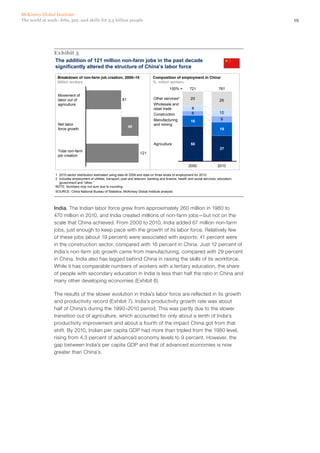
     In the 2000–10 decade, China accelerated the shift from agriculture,
     creating approximately 121 million new non‑farm jobs, including 33 million in
     manufacturing, bringing about 81 million workers from agriculture to non‑farm
     employment (Exhibit 5). A third of China’s new non‑farm jobs were associated
     with exporting industries.

     Rapid improvements in skill levels of Chinese workers during those decades also
     helped drive productivity improvements and enable the farm-to-factory shift.
     The proportion of Chinese workers with a secondary school diploma rose from
     approximately 50 percent in 1990 to around 60 percent in 2010; the proportion of
     those with tertiary degrees rose from about 2 percent to about 8 percent.


     14	 This productivity differential is estimated based on productivity levels in 2010. Average
         labor productivity of agricultural workers tends to be low and marginal productivity can be
         negligible (i.e., a large proportion of these workers can take non‑farm jobs without losing
         agricultural output). Thus a nation’s productivity jumps when workers are moved from farm to
         non‑farm sectors.
McKinsey Global Institute
The world at work: Jobs, pay, and skills for 3.5 billion people                                                                                 19


                Exhibit 5
                The addition of 121 million non-farm jobs in the past decade
                significantly altered the structure of China’s labor force

                  Breakdown of non-farm job creation, 2000–10                        Composition of employment in China1
                  Million workers                                                    %; million workers
                                                                                                 100% =        721                 761
                   Movement of
                   labor out of                                81                    Other services2           20                   26
                   agriculture                                                       Wholesale and
                                                                                     retail trade               8
                                                                                     Construction               6                   10
                                                                                     Manufacturing                                  9
                                                                                                               16
                   Net labor                                                         and mining
                                                                    40
                   force growth                                                                                                     19


                                                                                     Agriculture               50
                                                                                                                                    37
                   Total non-farm
                                                                            121
                   job creation

                                                                                                              2000                2010

                 1 2010 sector distribution estimated using data till 2009 and data on three strata of employment for 2010.
                 2 Includes employment of utilities; transport; post and telecom; banking and finance; health and social services; education,
                   government and “other.”
                 NOTE: Numbers may not sum due to rounding.
                 SOURCE: China National Bureau of Statistics; McKinsey Global Institute analysis


                India. The Indian labor force grew from approximately 260 million in 1980 to
                470 million in 2010, and India created millions of non‑farm jobs—but not on the
                scale that China achieved. From 2000 to 2010, India added 67 million non‑farm
                jobs, just enough to keep pace with the growth of its labor force. Relatively few
                of these jobs (about 19 percent) were associated with exports: 41 percent were
                in the construction sector, compared with 16 percent in China. Just 12 percent of
                India’s non‑farm job growth came from manufacturing, compared with 29 percent
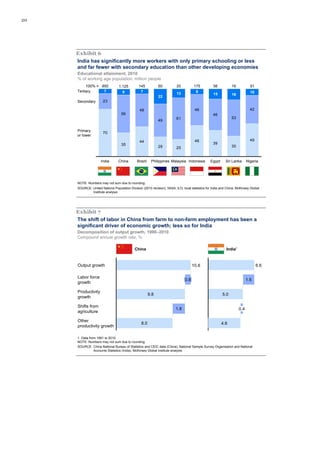
                in China. India also has lagged behind China in raising the skills of its workforce.
                While it has comparable numbers of workers with a tertiary education, the share
                of people with secondary education in India is less than half the ratio in China and
                many other developing economies (Exhibit 6).

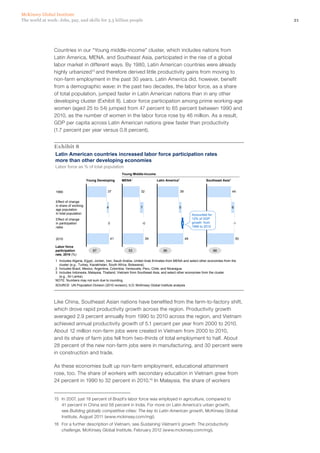
                The results of the slower evolution in India’s labor force are reflected in its growth
                and productivity record (Exhibit 7). India’s productivity growth rate was about
                half of China’s during the 1990–2010 period. This was partly due to the slower
                transition out of agriculture, which accounted for only about a tenth of India’s
                productivity improvement and about a fourth of the impact China got from that
                shift. By 2010, Indian per capita GDP had more than tripled from the 1980 level,
                rising from 4.3 percent of advanced economy levels to 9 percent. However, the
                gap between India’s per capita GDP and that of advanced economies is now
                greater than China’s.
20


     Exhibit 6
     India has significantly more workers with only primary schooling or less
     and far fewer with secondary education than other developing economies
     Educational attainment, 2010
     % of working age population; million people
          100% = 850             1,125         145          60           20          175          56           16           91
     Tertiary     7                9            7                                     8                                     10
                                                                         13                       15           16
                                                            22
     Secondary        23

                                               48                                    46                                     42
                                   56                                                             46
                                                                         61                                    53
                                                            49

     Primary
                      70
     or lower
                                               44                                    46                                     49
                                   35                                                             39
                                                            29           25                                    30


                     India       China       Brazil    Philippines Malaysia Indonesia           Egypt     Sri Lanka       Nigeria


     NOTE: Numbers may not sum due to rounding.
     SOURCE: United Nations Population Division (2010 revision); IIASA; ILO; local statistics for India and China; McKinsey Global
             Institute analysis


     Exhibit 7
     The shift of labor in China from farm to non-farm employment has been a
     significant driver of economic growth; less so for India
     Decomposition of output growth, 1990–2010
     Compound annual growth rate, %

                                            China                                                          India1


     Output growth                                                                  10.6                                         6.6

     Labor force
                                                                              0.8                                         1.6
     growth

     Productivity
                                                      9.8                                               5.0
     growth

     Shifts from
                                                                        1.8                                         0.4
     agriculture

     Other
                                                8.0                                                     4.6
     productivity growth

     1 Data from 1991 to 2010.
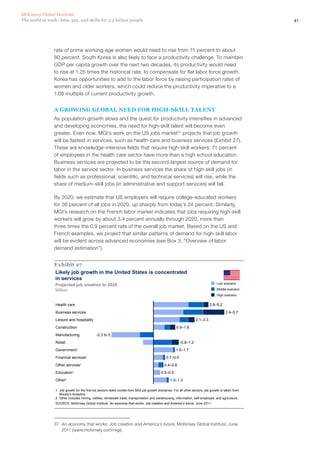
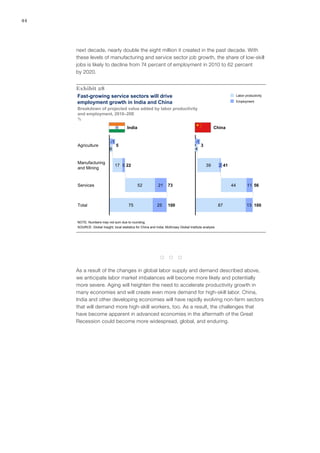
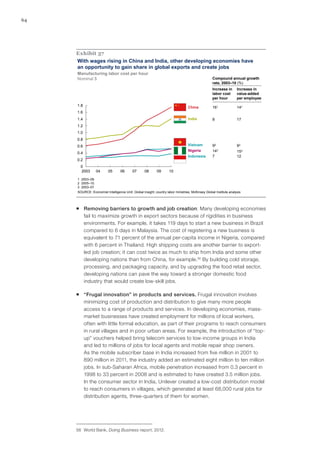
     NOTE: Numbers may not sum due to rounding.
     SOURCE: China National Bureau of Statistics and CEIC data (China); National Sample Survey Organisation and National
               Accounts Statistics (India); McKinsey Global Institute analysis
McKinsey Global Institute
The world at work: Jobs, pay, and skills for 3.5 billion people                                                                                      21


                Countries in our “Young middle-income” cluster, which includes nations from
                Latin America, MENA, and Southeast Asia, participated in the rise of a global
                labor market in different ways. By 1980, Latin American countries were already
                highly urbanized15 and therefore derived little productivity gains from moving to
                non‑farm employment in the past 30 years. Latin America did, however, benefit
                from a demographic wave: in the past two decades, the labor force, as a share
                of total population, jumped faster in Latin American nations than in any other
                developing cluster (Exhibit 8). Labor force participation among prime working-age
                women (aged 25 to 54) jumped from 47 percent to 65 percent between 1990 and
                2010, as the number of women in the labor force rose by 46 million. As a result,
                GDP per capita across Latin American nations grew faster than productivity
                (1.7 percent per year versus 0.8 percent).


                Exhibit 8
                Latin American countries increased labor force participation rates
                more than other developing economies
                 Labor force as % of total population
                                                             Young Middle-Income
                                        Young Developing     MENA1                   Latin America2                       Southeast Asia3


                 1990                               37                    32                          39                                    44


                 Effect of change
                 in share of working-
                                                   4                      7                         5                                       6
                 age population
                 In total population                                                                             Accounted for
                 Effect of change                                                                                12% of GDP
                 in participation                   0                      -0                           3        growth from                -1
                 rates                                                                                           1990 to 2010


                 2010                                   41                     39                           48                                  50

                 Labor force
                 participation             67                     53                     66                                      68
                 rate, 2010 (%)
                 1 Includes Algeria, Egypt, Jordan, Iran, Saudi Arabia, United Arab Emirates from MENA and select other economies from the
                   cluster (e.g., Turkey, Kazakhstan, South Africa, Botswana).
                 2 Includes Brazil, Mexico, Argentina, Colombia, Venezuela, Peru, Chile, and Nicaragua.
                 3 Includes Indonesia, Malaysia, Thailand, Vietnam from Southeast Asia, and select other economies from the cluster
                   (e.g., Sri Lanka).
                 NOTE: Numbers may not sum due to rounding.
                 SOURCE: UN Population Division (2010 revision); ILO; McKinsey Global Institute analysis


                Like China, Southeast Asian nations have benefited from the farm-to-factory shift,
                which drove rapid productivity growth across the region. Productivity growth
                averaged 2.9 percent annually from 1990 to 2010 across the region, and Vietnam
                achieved annual productivity growth of 5.1 percent per year from 2000 to 2010.
                About 12 million non‑farm jobs were created in Vietnam from 2000 to 2010,
                and its share of farm jobs fell from two-thirds of total employment to half. About
                28 percent of the new non‑farm jobs were in manufacturing, and 30 percent were
                in construction and trade.

                As these economies built up non‑farm employment, educational attainment
                rose, too. The share of workers with secondary education in Vietnam grew from
                24 percent in 1990 to 32 percent in 2010.16 In Malaysia, the share of workers


                15	 In 2007, just 18 percent of Brazil’s labor force was employed in agriculture, compared to
                    41 percent in China and 58 percent in India. For more on Latin America’s urban growth,
                    see Building globally competitive cities: The key to Latin American growth, McKinsey Global
                    Institute, August 2011 (www.mckinsey.com/mgi).
                16	 For a further description of Vietnam, see Sustaining Vietnam’s growth: The productivity
                    challenge, McKinsey Global Institute, February 2012 (www.mckinsey.com/mgi).
22


     with a college degree rose from 2 percent in 1980 to 13 percent in 2010. In
     the Philippines, tertiary educational attainment rose from 9 percent in 1980 to
     22 percent in 2010. This helped the Philippines create 3.5 million service sector
     jobs from 2000 to 2010, many of them in IT-enabled services.

     In the MENA nations—also part of the “Young middle-income” cluster—
     educational attainment is rising faster than employment opportunities. For
     example, in Egypt, five million students graduated from college between 1995
     and 2006, but the economy created just 1.8 million jobs in skill-intensive
     service sectors (excluding construction and wholesale and retail trade). Youth
     unemployment has been persistently high—25 percent from the early 1990s
     through 2010—despite low participation rates (just 38 percent of young people
     in the MENA region are in the labor force, compared with about 50 percent in
     advanced economies). In surveys, only a third of young people say that they
     believe their education prepares them adequately for the job market.17

     In the South Asian and African economies of the “Young developing” cluster, the
     demographic wave that is beginning to recede in China is still going strong. Their
     combined labor forces expanded by 2.9 percent annually from 1990 to 2010,
     reaching 322 million in 2010. These nations are also experiencing a rapid rise in
     educational attainment, creating attractive labor pools that are well positioned to
     benefit as wages rise in coastal China’s booming cities and in India’s outsourcing
     services centers and companies look for alternative sources of labor. Bangladesh
     and parts of sub-Saharan Africa (as well as Vietnam and Indonesia) are among
     the nations that have an opportunity to take their turns providing low-cost labor to
     the global economy in the coming decades.


     ADVANCED ECONOMIES: MOVING TO HIGH‑SKILL/
     HIGH‑PRODUCTIVITY WORK
     In the past 20 years, the drive for global competitiveness has shaped job creation
     across advanced economies. Companies based in wealthy nations adopted
     technology, streamlined business processes, and took advantage of new sources
     of low-cost labor—often as they expanded their global footprints. As a result,
     productivity growth in advanced economies averaged 1 to 2 percent annually.
     During this time, employment in services (both low- and high‑skill) grew rapidly,
     while employment in manufacturing, mining, and agriculture sectors fell (even in
     countries that are strong exporters of manufactured goods).

     Increasing use of technology and the drive for productivity have all raised demand
     for high‑skill workers, while depressing job growth for workers with lower skills.18
     Production and simple transaction jobs (e.g., assembly line work or answering
     a customer service call) have been automated or, in some cases, shipped to
     lower-cost locations. At the same time, jobs have grown quickly in “interaction”
     work, which requires face-to-face contact. These jobs include many low‑skill jobs
     (e.g., home health aides), as well as professions, such as law and medicine. In
     the United States, the number of interaction jobs grew by 8.9 million from 2002 to
     2010; about half of those jobs required tertiary education. In the same period, the


     17	 The International Finance Corporation (IFC)-Islamic Development Bank Group, Education for
         employment: Realizing Arab youth potential, 2011.
     18	 See E. Brynjolfsson and A. McAfee, A., Race against the machine: How the digital revolution
         is accelerating innovation, driving productivity, and irreversibly transforming employment
         and the economy, 2011 for a detailed discussion of the impact of technology on demand for
         skilled workers.
McKinsey Global Institute
The world at work: Jobs, pay, and skills for 3.5 billion people                                                                                   23


                number of production jobs declined by 2.2 million and the number of transaction
                jobs fell by 3.5 million.19

                From the 1970s to 2007, employment in agriculture, manufacturing and mining in
                advanced economies shrank from 33 percent of total employment to 17 percent.
                This included the loss of approximately 20 million jobs in manufacturing
                (Exhibit 9). Even economies such as Germany and Japan, which retain strong
                manufacturing exports, have experienced falling employment in manufacturing.
                They remain globally competitive by focusing on advanced manufacturing and
                by investing in technology. So, even though Germany lost the same share of
                manufacturing jobs as the United States, its knowledge-intensive manufacturing
                jobs did not fall as steeply—including workers who design and run advanced
                manufacturing machinery (Exhibit 10).


                Exhibit 9
                 In advanced economies, labor-intensive manufacturing lost the most jobs;
                 hiring was fastest in knowledge-intensive services, and in public services
                 Employment in advanced economies1
                 Million workers (% of total)

                  Manufacturing

                    Labor-intensive manufacturing
                                                                                                      Manufacturing share
                    Capital-intensive manufacturing
                                                                                                      of non-farm jobs
                    Knowledge-intensive manufacturing                                                 %

                                                               17      31              26
                                  1977                                                           75     27
                                                             (23%)   (42%)           (35%)

                                  Labor-intensive
                                                                                             9
                                  manufacturing
                 Change in
                                  Capital-intensive
                 employment                                                              5
                                  manufacturing
                 by category

                                  Knowledge-intensive
                                                                                     5
                                  manufacturing

                                                            8     26           21
                                  2007                                               56                 14
                                                          (15%) (47%)        (38%)
                                                                                          -19

                  Services

                    Labor-intensive services
                    Knowledge and capital-intensive services
                    Health, education, and public services

                                                                      114                  33           59
                                1977                                                                             206
                                                                     (55%)               (16%)        (29%)

                                Labor-intensive
                                                                                                                       52
                                services
                 Change in
                                Knowledge- and capital-
                 employment                                                                                                   46
                                intensive services
                 by category

                                Health, education,
                                                                                                                                       39
                                and public services

                                                                              166                               79               98
                                2007                                                                                                        343
                                                                             (48%)                            (23%)            (29%)

                                                                                                                            +138

                 1 Does not include agriculture and mining sectors. Advanced economies are the United States, France, the United Kingdom,
                   Canada, Ireland, Portugal, Italy, Spain, Greece, Germany, Japan, Austria, Belgium, Denmark, Finland, the Netherlands, and
                   Sweden.
                 NOTE: Not to scale.
                 SOURCE: EU KLEMS (2009 release); McKinsey Global Institute analysis


                19	 An economy that works: Job creation and America’s future, McKinsey Global Institute,
                    June 2011 (www.mckinsey.com/mgi) describes the impact of the recession on jobs in
                    these categories.
24


     Exhibit 10
     US and German manufacturing employment fell equally,                                                           Labor-intensive

     but Germany retains more knowledge-intensive jobs                                                              Capital-intensive

     Manufacturing sector employment                                                                                Knowledge-intensive
     Million workers (% of total)
                                             United States                                                       Germany


                                        4.2                8.5                   7.4                      1.7   4.1          3.7
                      1977                                                                        20.1                                   9.5
                                       (21%)              (42%)                 (37%)                    (18%) (43%)        (39%)

                      Labor-
                                                                                            2.0                                    1.1
                      intensive

     Manufacturing
                      Capital-
     jobs lost by                                                                     1.4                                     0.7
                      intensive
     category

                      Knowledge-
                                                                                1.7                                          0.6
                      intensive

                                     2.2           7.1               5.8                                     3.3       3.1
                      2007                                                      15.0                                        7.1
                                    (15%)         (47%)             (38%)                                   (47%)     (44%)
                                                                                                          0.6
                                                                                      -25%               (9%)                 -26%
     1 Includes textiles, leather footwear, wood, wood products, cork, and recycling.
     2 Includes food, beverages, tobacco, pulp, paper, printing, publishing, coke, refined petroleum, nuclear fuel, rubber, plastics,
       other non-metallic minerals, basic metals, and fabricated metals.
     3 Includes chemicals, chemical products, machinery, electrical, optical equipment, and transport equipment.
     NOTE: Numbers may not sum due to rounding.
     SOURCE: EU KLEMS (2009 release); McKinsey Global Institute analysis


     Job creation in advanced economies has been strongest in services such as
     food preparation, health care, and government, as well as in the professions and
     business management—roles that cannot be automated or easily moved. Within
     service sectors, however, the share of labor-intensive jobs has fallen significantly,
     while that of knowledge-intensive services has grown.

     Technology, the quest for productivity, and the pressure of global competition all
     raised demand for skilled knowledge workers and reduced demand for low‑skill
     workers, such as assemblers or machine operators. As a consequence, despite
     doubling tertiary educational attainment in the past 20 years, the supply of
     high‑skill workers in advanced economies has not kept up with demand. Business
     leaders surveyed in Europe and the United States in the past two years have said
     they have been unable to fill open positions due to a lack of qualified candidates,
     and cite skill shortages among their main concerns.20 While demand for workers
     without post-secondary training was essentially flat in the United States during
     the 2000–10 decade (a period of very weak job growth), demand for college
     graduates, continued to grow by about 1 percent annually. Today, unemployment
     rates for workers with only secondary school education are nearly twice those of
     college graduates, and hiring in skill-intensive sectors has recovered faster since
     the recession than in other sectors.


     20	ManpowerGroup, Talent Shortage Survey, 2011.
McKinsey Global Institute
The world at work: Jobs, pay, and skills for 3.5 billion people                                                                        25


                RISING INEQUALITY
                Not surprisingly, shifting demand has had an effect on compensation. Wages
                among less‑skilled workers have stagnated or fallen in real terms. In all but a
                handful of advanced economies, the incomes of households in the top income
                decile have risen faster than incomes in bottom-decile households for 25 years
                (Exhibit 11). The growing polarization of household income is driven by many
                factors, including patterns in household formation; the rise of single-headed
                households, for example, is more concentrated in middle- and low-income
                earners. Not only are marriage rates higher among more highly educated, higher-
                income cohorts, but these people now marry more often within their income
                groups.21 Nonetheless, changing patterns in demand and supply in the labor
                market that determine long-term wage trajectories are the most powerful drivers
                of income polarization.


                Exhibit 11
                Incomes increased faster for rich households than for poor ones
                in many advanced economies over the past 25 years
                 Average annual change in real household income, mid-1980s to late 2000s
                 %
                  Top decile of households
                  4.5
                             Countries with faster income                                      Australia
                  4.0        growth in top income decile

                  3.5

                  3.0
                                                    New Zealand
                                                                  Norway
                  2.5
                                                      UK                                                        Spain Ireland
                                          Sweden        Finland
                  2.0
                                               US Canada                                                     Greece
                  1.5        Germany
                                        Netherlands Denmark             France
                                           Italy   Austria                Belgium                                  Portugal
                  1.0

                  0.5
                         Japan
                    0                                                                           Countries with faster income
                                                                                                growth in bottom income decile
                  -0.5
                      -0.5          0         0.5       1.0       1.5        2.0       2.5        3.0        3.5        4.0      4.5
                                                                                                        Bottom decile of households
                 SOURCE: Organisation for Economic Co-Operation and Development (OECD); McKinsey Global Institute analysis


                Declining position of labor and rising role of capital and knowledge
                Today’s concerns over income inequality need to be viewed in the context of a
                lengthy decline in labor’s share of income (measured as the share of national
                income that goes to wages and compensation)22 across advanced economies.
                Labor’s share of income had risen steadily through the 1950s and 1960s and
                peaked in 1975; since then labor’s share of income in advanced economies has
                fallen below the 1950 level, declining 7 points from its peak of 65 percent in 1975


                21	 For a more detailed discussion of these phenomena, see Growing income inequality in OECD
                    countries: What drives it and how can policy tackle it?” Organisation for Economic Co-
                    operation and Development, May 2011.
                22	 We calculate labor’s share using real 2000 US dollars and excluding government transfers and
                    capital receipts. Other transfers—contributions to social security and employer-paid benefits—
                    are also not counted. These payments rose from 11.6 percent of US worker pay in 1980 to
                    22.5 percent in 2010. For more, see Alan B. Kreuger, Measuring labor’s share, NBER Working
                    Paper No. 7006, 1999 and Paul Gomme and Peter Rupert, Measuring labor’s share of income,
                    Policy Research Papers, Federal Reserve Bank of Cleveland, 2004 for a detailed discussion
                    on methodological issues and implications in calculating labor’s share of income.
26


     (Exhibit 12). In “Young advanced” economies, including the United States, the
     United Kingdom, and France, labor’s share of income fell to about 50 percent
     while in “Aging advanced” economies, where labor once received more than
     70 percent of national income, labor’s share fell to around 60 percent. In the
     Southern Europe cluster, labor’s share of income declined from nearly 80 percent
     to about 65 percent.


     Exhibit 12
     Labor’s share of income across advanced economies has fallen steadily
     since its peak in 1975
     Labor share of income in advanced economies1
     % of total
     65
     64
                                                             -3.5
     63                                                      p.p.
     62
                                                                                                                         -7.1
     61                                                                                                                  p.p.
     60                                                                                                        -3.5
                                                                                                               p.p.
     59
     58

       0
       1970         1975          1980         1985         1990         1995          2000         2005         2010


     1 Employee compensation as a share of gross national income calculated using real 2000 US dollars and excluding
       government transfers and capital receipts; advanced economies include the United States, the United Kingdom, France,
       Australia, the Netherlands, Japan, Sweden, Germany, Portugal, Italy, Greece, and Spain.
     SOURCE: OECD; World Bank Development Indicators; EU KLEMS; Haver Analytics; McKinsey Global Institute analysis


     This long decline reflects the shift from the days when low- and medium‑skill
     labor were the critical drivers of economic growth in advanced economies to the
     more recent period in which capital goods and knowledge have taken on a much
     more important role. As companies adopted more automation and technology,
     production became more dependent on capital, and labor’s share of income fell.23
     The stock of capital relative to GDP rose from 2.1 times GDP in 1980 to 2.7 times
     in 2010 in the United States, the United Kingdom, Italy, Japan, and Germany.
     Corporate gross savings24 of advanced economies rose from 10 percent of GDP
     in 1980 to 13.3 percent in 2008, and property’s share of national income (a proxy
     for earnings from capital) also rose.25


     23	 See Florence Jaumotte and Irina Tytell, How has the globalization of labor affected the labor
         income share in advanced countries? International Monetary Fund Working Paper, WP/07/298,
         2007 for an assessment of how globalization and technological progress have influenced
         labor’s share of income in 18 advanced economies.
     24	 Defined as retained earnings (or undistributed profits) and the depreciation. See Farewell to
         cheap capital? The implications of long-term shifts in global investment and saving, McKinsey
         Global Institute, December 2010 (www.mckinsey.com/mgi) for a detailed discussion on
         savings and investments by firms in advanced economies.
     25	 Income received on financial or tangible assets, including interest, profits, and rent. Property
         income’s share of national income rose from 23 percent in 1975 to 38 percent in 2008 in the
         United States, Canada, and France.
McKinsey Global Institute
The world at work: Jobs, pay, and skills for 3.5 billion people                                                       27


                Countries in the “Aging advanced” and “Young advanced” economies raised
                productivity by 1.2 to 1.6 percent annually from 1990 to 2010, by inventing new
                products, adopting more efficient business processes, and investing in machinery
                and technology. We estimate that tangible capital (as measured by levels of
                investment) made up 70 percent of productivity gains, and intellectual capital
                (as measured by higher education and spending on research and development)
                accounted for the remainder.26 In the Southern Europe cluster, 80 percent of
                productivity improvement was attributable to investment in tangible capital. In
                the United States, investment in intangible assets, such as R&D and training, are
                estimated to account for more than 90 percent of labor productivity growth.27

                Stagnating wages and higher unemployment for low‑skill labor
                The corollary of rising dependence on knowledge and capital to drive growth
                in advanced economies has been the declining importance—and power—of
                low‑skill labor. As a result, low‑skill workers have seen a reversal of fortune in
                advanced economies over the past three decades. Rather than riding the tide of
                a growing global economy, they have suffered stagnating wages, job losses, and
                long periods of unemployment—while more highly educated citizens have seen
                rising incomes.

                The role of capital grew the most—and productivity gains were the greatest—in
                labor-intensive manufacturing. As demand for production workers has fallen,
                their wage growth has trailed that of workers in both transaction and interaction
                jobs, despite lower productivity gains in these sectors. For example, in the
                United States, wage growth in production jobs, at 2.1 percent per year from
                2000 to 2010, was slower than productivity growth in these jobs, which was
                3.2 percent. In interaction occupations, which include public services such as
                education and government, measurable productivity gains have been much
                slower, yet wage growth has been the fastest. Interaction jobs grew 3.2 percent
                annually from 2000 to 2010, despite a decline in productivity at 0.1 percent per
                year for these jobs. From the 1960s to 2008, in the United States, real incomes
                rose at about 1.1 percent every year for workers with a college degree, while they
                declined marginally for workers who had not completed high school, and the
                multiple of wages of a worker with a college degree to wages of a worker without
                a high school degree rose from about 1.7 to 2.8.28 (Exhibit 13). In most advanced
                economies, unemployment rates for the least‑skilled workers are consistently two
                to four times those of the most highly skilled workers, whether the economy is in
                recession or recovery (Exhibit 14).


                26	 We estimate this using OLS regression of output per worker against growth in capital
                    formation per worker, research and development expenditure per worker and tertiary
                    educational attainment, for a sample of advanced economies from 1990 to 2010. We exclude
                    product and process innovation from this analysis, which are important drivers of productivity,
                    but are difficult to quantify at an aggregate level.
                27	 See Carol Corrado, Charles Hulten, and Daniel Sichel, “Intangible capital and US economic
                    growth,” Review of Income and Wealth, series 55, No. 3, September 2009 for an estimate of
                    the impact of intangible capital on growth.
                28	 See D. Acemoglu and D. Autor, Skills, tasks and technologies: Implications for employment
                    and earnings, National Bureau of Economic Research (NBER) Working Paper No. 16082,
                    June 2010. For additional discussion of how rising demand for high‑skill workers has affected
                    wage growth, see Changing the fortunes of America’s workforce: A human-capital challenge,
                    McKinsey Global Institute and McKinsey Social Sector Office, June 2009 (www.mckinsey.
                    com/mgi).
28


     Exhibit 13
     Wages for US workers with tertiary education have grown
     more than twice as fast as for others, creating a widening gap

       Growth in real weekly wages for full-time workers,                         Ratio of weekly wages of college
       1963–2008                                                                  graduates to high school dropouts
       Compound annual growth rate, %                                             Multiple

             1.1                                                                                         2.8


                                                                                                                   +63%

                                                                                        1.7
                              0.5               0.4


                                                                    0
         College          Some             High School        Less than
         graduate1        college          graduate           high school             1963              2008

     1 Includes workers who have completed college or graduate school.
     SOURCE: CPS 2008; Daron Acemoglu and David Autor, Skills, Tasks and Technologies: Implications for Employment and
               Earnings, 2010; McKinsey Global Institute analysis


     Exhibit 14
     In advanced economies, unemployment for low-skill                                            Less than upper secondary

     workers is 2-3 times higher than for high-skill workers                                      Secondary

     Unemployment rate, 25-64 years, by educational attainment                                    Tertiary

     % of labor force
            United
            Kingdom           France             Denmark                Germany       Sweden             Spain


     1999


                                15                                       16                                  15
                                                                                                                  13
                                                                                         10                            11
                                       9                                      9
               7                            6         7                                       7
                     4                                    4                       5                 4
                         3                                      3


     2011                                                                                                    26

                                                                                                                  19
                                13                                       14
                                                                                         11                            12
              10                                      9
                     6                 7                  6                   6
                         4                  5                   5                             5     4
                                                                                  2


     SOURCE: Eurostat; OECD Education at a Glance 2011; McKinsey Global Institute analysis
McKinsey Global Institute
The world at work: Jobs, pay, and skills for 3.5 billion people                                                                                    29


                Unskilled youth affected the most
                As the demand of low‑skill labor fell, historical rigidities (e.g., regulations barring
                layoffs or making them prohibitively expensive) also began to fall in some
                countries. Employers also achieved greater flexibility by hiring part-time and
                temporary workers. In “Aging advanced” economies, the share of workers in
                part-time jobs rose from 13 percent of the labor force in 1985 to 21 percent in
                2010. In Southern Europe, the share of temporary and contract workers rose from
                11 percent of total employment to 18 percent.

                For many young workers, the only route to employment in the formal economy is
                through temporary work. This has made young workers much more likely to be
                laid off since in many countries, particularly in Europe, older, permanent workers
                are protected from layoffs.

                Persistently high dropout rates have driven youth unemployment in advanced
                economies, too. In Spain, where youth unemployment has reached 50 percent
                during its financial crisis, early school leavers make up 28 percent of the 18- to
                24-year-old population, compared with an average of 14 percent across the
                European Union. Young, unskilled workers have a much lower chance of securing
                full-time work in the formal economy and gaining valuable on-the-job training.

                Youth unemployment has become a global issue: 75 million young people
                are currently unemployed globally, or 38 percent of the world’s unemployed
                workers.29 In 2010, youth unemployment averaged 18 percent across advanced
                economies and around 21 percent in Europe (Exhibit 15).30 Left unaddressed, the
                youth unemployment problem could leave many advanced economies with a “lost
                generation” of workers.


                Exhibit 15
                Unemployment for European youth is often more than                                                   Ratio of youth to adult
                                                                                                                     unemployment rate
                twice the level of adult workers
                                                                                                               Youth unemployment rate
                 Youth unemployment rates, select EU countries1                                                   2000         2008         2010
                 Unemployed 15- to 24-year-olds as % of labor force

                             Spain                                    Greece                                   Ireland

                                                                2.6            2.9       2.6
                       1.8            2.2       2.1                                                                      2.1          2.0
                                                                                                         1.5


                                                42
                                                                29                       33
                       25             25                                                                                              28
                                                                               22
                                                                                                                         13
                                                                                                          7


                             Sweden                                   France                                   Portugal
                                      3.3       3.0
                                                                               2.5       2.4             2.1             2.1          2.0
                       1.7                                      2.0


                                                25              21                       23                                           22
                                      20                                       19                                        16
                       10                                                                                 8


                 1 2010 rates in Spain, Greece, Ireland, Sweden, France and Portugal exceed the EU average rate (20.8 percent).
                 SOURCE: ILO Global Employment Trends for Youth, August 2010; Eurostat; McKinsey Global Institute analysis


                29	 International Labor Organization, Global employment trends for youth, October 2012.
                30	 Unemployment Statistics, Eurostat.
30


     Young workers are only one cohort of the growing pools of workers facing
     protracted periods of unemployment. With long-term unemployment reaching
     new records in the recovery from the “Great Recession,” a growing number of
     workers are losing skills and facing diminishing odds of ever finding work. In the
     United States, for example, median duration of unemployment passed 21 weeks
     in 2010, the longest median period of joblessness in 30 years. In 2010, the share
     of idle workers classified as long-term unemployed (out of work for 27 weeks or
     more) was three and a half times as high as in the 2000–01 recession. The long-
     term unemployed are most likely to become discouraged and permanently exit
     the labor force; 20 to 25 percent of workers who are unemployed for more than
     27 weeks stop looking for a job. These workers know that the longer they are out
     of work, the lower the probability of re-employment (Exhibit 16). The odds against
     a worker who has been idle for 27 weeks finding a job within a year are three
     times those against a worker who has been out of work for only five weeks.31


     Exhibit 16
     Long-term US unemployment is becoming more widespread,
     putting more workers at risk of not finding a new job
                                                                                  < 5 weeks   5 to 26 weeks   > 27 weeks

     Long-term unemployment has                            … and the chances of finding a job are growing
     become more common …                                  dimmer for the long-term unemployed

      Number of unemployed by                               % of unemployed who found jobs after
      weeks of employment                                   a period of unemployment1
      %; million
       100% =        6            8            15                 40
                    12            20
                                               43                                     2X       30
                    43                                                       26
                                 45                                                   20                      3X
                                                                                                        18
                                               38
                                                                                                              10
                    46
                                 35
                                               19

                  2000          2005          2010                        2000E                        2010

     1 Based on the share of unemployed who get back into the labor force within the year.
     NOTE: Numbers may not sum due to rounding.
     SOURCE: US Bureau of Labor Statistics


                                                             *     *     *

     The last 30 years were a period of remarkable growth and progress for
     developing economies and their workers. Advanced economies benefited from
     new technologies that raised productivity and from access to diverse labor pools
     around the world. In the next chapter, we will see how the quest for productivity is
     becoming global and the contest for high‑skill talent will become more intense—
     and why even today’s developing economies will face challenges to employ
     low‑skill workers.


     31	 US Bureau of Labor Statistics.
McKinsey Global Institute
The world at work: Jobs, pay, and skills for 3.5 billion people                                       31


                 2. Labor supply and demand,
                 2010–30

                 In the coming decades, the dynamics driving the global labor market will evolve.
                 The most significant change will be slower growth of labor forces around the
                 world. The sharpest declines are likely in the aging economies—which now will
                 include China. As China’s labor force growth slows—by about half—India and the
                 “Young developing” economies of South Asia and Africa will become the biggest
                 sources of labor force growth in the coming decades. But China, along with India,
                 will likely be the world’s largest source of college-trained workers.

                 The first effect of aging and slower labor force growth will be a heightened need
                 to raise productivity to sustain GDP growth. China, with its demographic dividend
                 falling and incomes rising, would need to keep climbing the industrial value chain
                 and accelerate productivity growth. As a result, its labor needs will more closely
                 mirror those of advanced economies, with a similar emphasis on high‑skill work.
                 The demand for skilled workers will continue to grow far faster than supply, and
                 the competition for talent will intensify and become increasingly global.


                 A SLOWER-GROWING GLOBAL LABOR FORCE
                 We project that the growth rate of the global labor force will fall by nearly a
                 third, from 1.4 percent annually in the 1990–2010 period to 1.0 percent through
                 2030 (Exhibit 17). That would create 615 million net new additions to the global
                 labor force, bringing the total number of workers to 3.5 billion in 2030, up from
                 2.9 billion in 2010 (see Box 2, “Overview of labor supply estimation”). Growth
                 would decelerate during the two decades. In the 2010–20 decade, we project
                 331 million net additions (down from 368 million in the 2000–10 period), dropping
                 to 284 million net additions in the second decade, when aging will place an even
                 greater drag on global labor force growth.
32


     Exhibit 17
     Labor force growth will likely slow worldwide and                                                1990          Compound annual
                                                                                                                    growth rate (%)
     become flat across advanced economies by 2030                                                    2010
                                                                                                      2030E            1990–2010
     Labor force
                                                                                                                       2010–30E
     Million workers

                             1.0%

                                                                        1.1%
                1.4%

                                                           1.6%


                                   3,464
                      2,849                                                   2,940
                                                                 2,355
          2,143
                                                    1,726                                             0.9%          0.3%

                                                                                                417           494          524

               Global aggregate                        Developing economies1                      Advanced economies2


     1 Includes 45 countries from the Young Middle-Income, China, India, Young Developing, and Russia & CEE clusters.
     2 Includes 25 countries from the Young Advanced, Aging Advanced, and Southern Europe clusters.
     SOURCE: United Nations Population Division (2010 revision); ILO; local statistics for China and India; McKinsey Global Institute
               analysis


        Box 2. Overview of labor supply estimation
        To estimate future labor supply, we build a model that projects labor force
        growth in six age and gender cohorts for each country.1 To estimate cohort-
        level labor force, we use population projections from the United Nations and
        data from national sources (e.g., China National Bureau of Statistics, India
        Census, and India’s National Sample Survey Organisation) and then apply
        our estimates of labor force participation rates. These estimates of labor
        force participation rates are based on a comprehensive set of variables such
        as GDP per capita, projected educational attainment levels, share of the
        population over 55 years, women’s fertility rate, average marriage age, and
        other variables. These estimates are checked against aggregate projections
        available from sources such as Global Insight, Oxford Economics, and
        the Economist Intelligence Unit. In order to estimate the educational mix
        of the projected labor force, we use a combination of available estimates
        of population-level educational attainment (e.g., World Bank, International
        Institute for Applied Systems Analysis, China National Bureau of Statistics,
        and India’s Ministry of Human Resources Development) with some
        adjustments for China and India, based on enrollment and completion rates.

        For more details on our methodology, see the appendix.


        1	 We use this approach since most other estimates are either less granular or have a
           shorter-term horizon than the focus of this report.
McKinsey Global Institute
The world at work: Jobs, pay, and skills for 3.5 billion people                                                                          33


                In advanced economies, we expect labor force growth to drop from 0.9 percent
                annually, the average from 1990 to 2010, to just 0.3 percent from 2010 to 2030. In
                total, advanced economies are projected to make only 30 million net additions to
                their labor forces by 2030. “Young advanced” economies (the United States, the
                United Kingdom, Canada, for example) will still grow their labor forces—by about
                0.6 percent a year, down from 1.0 percent in the past—but labor forces in most
                “Aging advanced” economies will likely shrink (Exhibit 18). Assuming no significant
                changes in immigration policies in those nations, we project that labor supply
                will contract at 0.2 percent each year.32 The Japanese labor force is projected to
                shrink by 0.5 percent a year through 2030.

                In the Southern Europe cluster, labor supply is projected to be virtually flat. In the
                Russia and Central and Eastern Europe cluster, which also has aging populations,
                we project that labor forces could shrink by 0.5 percent annually.


                Exhibit 18
                Labor force growth will slow in almost all advanced economies and,
                in some clusters, labor forces are likely to shrink
                 Labor force
                 Million workers
                                                     Compound annual growth rate (%)
                                                     1990–2010                                    2010–2030E
                 350
                                                                                                             0.6       Young Advanced
                 300                                          1.0

                 250

                 200
                                                              0.4                                           -0.2
                 150                                                                                                   Aging Advanced
                                                              -0.2                                                     Russia & CEE
                                                                                                            -0.5
                 100

                   50                                                                                                  Southern Europe
                                                              1.1                                           -0.0

                    0
                     1990       1995       2000        2005       2010       2015       2020       2025        2030

                 SOURCE: United Nations Population Division (2010 revision); ILO; McKinsey Global Institute analysis


                In China, labor force growth is likely to slow by half, from the current 0.9 percent
                a year to about 0.5 percent through 2030. In our momentum case, the Chinese
                labor force will reach 861 million in 2030, with a net increase of about 79 million,
                compared with its growth of 126 million from 1990 to 2010. Growth will likely
                decelerate sharply in the decade from 2020 to 2030: to just 21 million from
                58 million in the 2010–20 period, reflecting the effects of aging and declining
                birth rates.

                China is also likely to see a decline in its overall labor force participation rate
                due to aging. At 70 percent, China had among the world’s highest participation
                rates in 2010. We project that figure will drop marginally to 67 percent by 2030
                (Exhibit 19), when the number of Chinese aged 55 years and older will likely
                reach 43 percent of the population—up from 26 percent now (Exhibit 20). Even


                32	 For a related discussion of Germany’s labor force growth rates, see Perspektive 2025—
                    Fachkräfte für Deutschland (Perspective 2025—Experts in Germany), Federal Employment
                    Agency, Nuremberg, January 2011.
34


     though we project that participation rates among older workers will rise—from
     41 percent to 50 percent—it will not be sufficient to maintain labor force growth
     at historical levels beyond 2020.33 And unlike some advanced economies, China
     has limited opportunity to raise female labor participation: at 82 percent, the labor
     participation rate of prime working-age Chinese women is not far from the highest
     in the world (85 to 87 percent in Nordic countries).


     Exhibit 19
     Labor force growth in China will likely decelerate
     due to slower growth in working-age population
     Decomposition of labor force growth by drivers, 2010–30E
     Compound annual growth rate, %
                                                      Estimated
                                                      growth,
                                                      1990–2010

                                                                                             Working-age population is
     Working-age                                                                             projected to reach
                                                                   0.7      1.6
     population growth                                                                       1.28 billion by 2030 (from
                                                                                             1.1 billion in 2010)
                                                                                             “Blended” labor force
     Effect of change
                                                                                             participation rate1 is
     in labor force                                                0.2      -0.7             projected to decline to 67%
     participation rate
                                                                                             by 2030 (from 70% in 2010)

                                                                                             Labor force is projected to
     Labor force growth                                   0.5               0.9              reach 861 million by 2030
                                                                                             (from 783 million in 2010)


     1 Weighted average of cohort-level participation rates for male and female young, prime working-age, and older workers.
     SOURCE: China National Bureau of Statistics; United Nations Population Division (2010 revision); McKinsey Global Institute
              analysis


     Exhibit 20
     Aging will be the major driver of a projected decline in China’s
     labor force participation rate in the next two decades

     Drivers of change in labor force participation rate                 Composition of working-age population
     % of working-age population                                         %; million
                                                                                                                  Labor force
                                                                           100% =     1,124            1,284
     Labor force                                                                                                  participation
     participation                                              69.6                                              rate, 2010
                                                                         Older                                    %
     rate, 2010                                                                         26
                                                                         (55+)
                                                                                                         43         41

     Impact of aging                                3.1

                                                                         Prime
     Changes in                                                                         56
                                                                         (25–54)
     participation
                                             0.6                                                         47         89
     rates within age-
     gender cohorts

     Labor force                                                         Young
                                                                                        17
     participation                                 67.1                  (15–24)                         11         51
     rate, 2030E
                                                                                      2010             2030E

     NOTE: Numbers may not sum due to rounding.
     SOURCE: China National Bureau of Statistics; United Nations Population Division (2010 revision); McKinsey Global Institute
             analysis


     33	 See John Giles, Dewen Wang, and Wei Cai, The labor supply and retirement behavior of
         China’s older workers and elderly in comparative perspective, World Bank, Policy Research
         Working Paper No. 5853, October 2011.
McKinsey Global Institute
The world at work: Jobs, pay, and skills for 3.5 billion people                                                    35


                DEVELOPING ECONOMIES WILL BECOME THE DOMINANT
                SOURCE OF BOTH HIGH‑ AND LOW‑SKILL LABOR
                With the number of workers entering labor markets slowing in advanced
                economies and in the next 20 years China, India, and nations in the “Young
                developing” cluster will become the biggest contributors to the global labor
                pool. India’s total labor force will continue to grow relatively quickly—at about
                1.5 percent annually—with about 174 million net additions by 2030. We project
                the total labor force will reach 550 million by 2020 and 640 million in 2030. During
                this period, India’s working-age population is projected to grow about 1.5 percent
                annually, while its population will also begin to age—but far less dramatically than
                in China or in advanced economies. Overall, the number of Indians who fall into
                the prime working-age group (25 to 54 years) will hold steady at about 69 percent
                of the population.

                India’s relatively low labor force participation rate of 56 percent is not expected
                to rise significantly. More young Indians will stay in school, reflecting the trend
                toward rising educational attainment. Furthermore, India’s low female labor
                participation rate (about 38 percent today) is not likely to rise, because a growing
                number of households are expected to move out of subsistence, allowing more
                low‑skill women to opt out of the labor force. High‑skill women, on the other
                hand, will see rising participation rates, but their numbers will remain small
                compared to those of their low‑skill counterparts. 34

                The “Young developing” economies of South Asia and Africa (such as
                Bangladesh, Pakistan, Nigeria, and Kenya) will have the fastest-growing labor
                forces, growing at about 2.3 percent annually. That will add 187 million workers
                to the global labor market in the next two decades. Together with India, these
                nations will contribute about 360 million of the net new workers in the global labor
                force in the next 20 years, or about 60 percent of the growth. China’s contribution
                to net labor force growth will decline from 18 percent of the total to 10 percent
                (Exhibit 21).


                34	 See Wendy Olsen and Smita Mehta, A pluralist account of labor participation in India, Global
                    Poverty Research Group, Working Paper No. GPRG-WPS-042, May 2006 for a detailed
                    account of the dynamics of female labor force participation in India.
36


     Exhibit 21
     China’s contribution to global labor force growth will drop; India and
     “Young Developing” economies will lead labor force growth through 2030
     Net new additions to labor force
     %; million workers

             Russia Young                                             Young       Advanced
             & CEE Developing           India        China         Middle-Income economies1

                                                                                                          China and India
                                                                                                          contributed more
     1990–2010 -1          20             19           18                  33              11    706
                                                                                                          than a third of global
                                                                                                          labor force growth


                                                                                                          “Young Developing”
                                                                                                          economies and India
     2010–30E       -2          30                   28              13            26           5 615     will contribute almost
                                                                                                          60 percent of global
                                                                                                          labor force growth


                                                                                             100%


     1 Includes Young Advanced, Aging Advanced and Southern Europe clusters.
     NOTE: Numbers may not sum due to rounding.
     SOURCE: United Nations population division (2010 revision); ILO; Global Insight; Oxford Economics; Economist; local statistics
               for China and India; McKinsey Global Institute analysis


     While China will be eclipsed as the world’s leading source of low-cost labor, it
     will assume a new and potentially more important role as the largest supplier
     of college-educated workers to the global labor force. China’s demographic
     dividend will likely be replaced by a “skill dividend,” as the number of workers
     with college education in the labor force is projected to rise by 96 million in the
     next two decades, up from 52 million net additions of graduates in the last two
     decades. This would raise the proportion of young workers with tertiary education
     to 33 percent—about the projected average for advanced economies.

     At its current rate of growth in college completion, India would be close behind.
     India is on track to raise the number of college-educated workers in its labor
     force by 88 million in the next two decades, up from 24 million added in the last
     two. Between them, China and India are on track to raise the world supply of
     college educated workers by 184 million, and 57 percent of all additional workers
     with some college education in 2030 are likely to come from those two nations
     (Exhibit 22). India and China will also be dominant suppliers of STEM graduates;
     based on current trends they will provide two-thirds of the increase in science and
     engineering graduates globally through 2030.
McKinsey Global Institute
The world at work: Jobs, pay, and skills for 3.5 billion people                                                                                  37


                Exhibit 22
                China and India are likely to contribute more than half of the world’s
                supply of new workers with a college education through 2030
                 Net labor force additions with college education
                 %; million workers
                                                                197                     325
                                                                                                        Share of advanced
                                                                                        14              economies is likely
                           Advanced economies                    26                                     to decline
                                                                                        18

                           Young Middle-Income                   23
                                                                                                        China and India
                                                                                        30              together are likely to
                                                                                                        contribute 57 percent
                           China                                 26                                     of the growth in
                                                                                                        workers with some
                                                                                        27              college education
                           India                                 12
                           Young Developing
                                                                  8                          10
                           Russia & CEE                           4                 2
                                                           1990–2010              2010–30E
                 1 Includes Young Advanced, Aging Advanced and Southern Europe clusters.
                 NOTE: Numbers may not sum due to rounding.
                 SOURCE: United Nations Population Division (2010 revision); ILO; IIASA; local statistics for China and India; McKinsey Global
                            Institute analysis


                However, sheer numbers will not guarantee India and China advantages in
                the contest for high‑skill talent. There are still concerns about how well some
                institutions in those countries prepare students for high‑skill work.35 Employers
                and educators in both economies will need to ensure the quality of college
                education improves as these economies raise enrollment rates.

                In advanced economies, at the current rates of growth in population and college
                enrollment and completion rates, the net increase of workers with tertiary
                education in the labor force is likely to decline. Even though the average college
                graduation rate across advanced economies is projected to rise from 24 percent
                to 31 percent by 2030, net additions of college-educated workers to the labor
                force are likely to fall from 51 million in the past two decades to 45 million through
                2030. This drop reflects slower population growth and the likely loss of 12 million
                college-educated workers in advanced economies through retirement in the next
                20 years.

                At the opposite end of the labor market, there will be a persistently large number
                of low‑skill workers. In 2030, the world will still have more than one billion
                workers without even secondary education, although this will represent a
                drop, to 30 percent of total labor force, from 40 percent in 2010. India will likely
                contribute more than one-third of these unskilled workers; a quarter will come
                from sub-Saharan Africa and other parts of South Asia, and China will contribute
                15 percent.


                35	 China and India both need to improve the employability of their college graduates. See
                    American business in China White Paper, May 2010, April 2011, and April 2012 issues by
                    the American Chamber of Commerce in the People’s Republic of China; and Hiroshi Saeki
                    and Andreas Blom, Employability and skill set of newly graduated engineers in India, World
                    Bank, Policy Research Working Paper, No. 5643, April 2011, for a detailed discussion on the
                    employability of graduates in China and India.
38


     THE IMPACT OF AGING
     Aging, which has a strong influence on both the number and type of workers in
     the global labor force, will become an even more powerful factor in the next two
     decades. Since 1980, the share of older workers (those aged 55 and above) in
     the labor forces of advanced economies has risen gradually—from 13 percent of
     the labor force to 18 percent, or about 1.5 times over 30 years. It will take only
     20 years for the proportion of older workers to grow by another 1.5 times: our
     momentum case projects that by 2030, 27 percent of the labor force of advanced
     economies will be 55 years of age or older. In the most rapidly aging economies,
     such as Japan and Germany, the ratio will exceed 30 percent. The proportion of
     workers aged 55 and over will grow even more rapidly in China—doubling over
     the next two decades to 31 percent of the workforce (Exhibit 23).


     Exhibit 23
     The share of older workers in the labor force is on course                                                        Older (55+)

     to more than double by 2030                                                                                       Prime (25–54)

     Labor force by age                                                                                                Young (15–24)
     %; million workers

      Global aggregate                           Advanced economies1                        China

      100% = 1,706         2,849     3,464       100% = 369           494       524         100% = 501           783        861
                  10                                                                                8
                            14                              13         18                                         15
                                       22                                        27                                         31


                                                                                                       60
                  62
                            69                              65
                                                                       70                                         72
                                       66
                                                                                 64
                                                                                                                            62


                  28                                                                                   32
                            16                              22
                                       11                              12        10                               13         6
                1980       2010     2030E                  1980      2010      2030E                  1980      2010      2030E

     1 Includes 25 countries from the Young Advanced, Aging Advanced, and Southern Europe clusters.
     NOTE: Numbers may not sum due to rounding.
     SOURCE: United Nations population division (2010 revision); ILO; local statistics for China and India; McKinsey Global Institute
               analysis


     Even as the ratio of older workers grows, so too will the number of retirees in the
     world. Globally, the number of retirees 36 could swell by approximately 360 million
     over the next two decades—reflecting a growth rate of 2.3 percent per year,
     compared with the approximately 1 percent annual growth rate of the global labor
     force (Exhibit 24). This swelling population of retirees will affect labor markets
     and economies in several ways. Over the next 20 years, retirement could remove
     some 38 million college-educated workers from the global work force, thus
     exacerbating the growing skill shortage. While those workers might be induced to
     remain in the workforce and help employers fill skill gaps, more than 70 percent
     of workers approaching retirement are not high‑skill. Their retirements will raise
     dependency ratios (the number of retirees per employed worker) and place
     escalating demands on social and health services.


     36	 Defined as the number of workers between 55 and 70 years old who are likely not to be in the
         labor force in 2030. We estimate labor force participation rates for this age cohort using MGI’s
         labor supply model. See Box 2 and the appendix for details on estimation methodology.
McKinsey Global Institute
The world at work: Jobs, pay, and skills for 3.5 billion people                                                                                       39


                Exhibit 24
                360 million older workers are likely to exit the global labor force by 2030,
                creating challenging “dependency” ratios
                 Growth in worldwide pool of retirees1
                 Million workers                                                                                              Net new retirees
                                                                                                                              per new worker
                 2010                          188        100       175      76     54        624                             Ratio
                                                                                         30

                 Advanced economies                                                           52                                      1.8

                 Young Middle-Income                                                                  104                             0.7

                 China                                                                                       100                      1.3

                 India                                                                                          59                    0.3

                 Young Developing                                                                                   35                0.2

                 Russia & CEE                                                                                     9                   n/a3
                                                                                                                   58%
                 2030E                           240               205            276               135     66 62 983

                 1 Workers between 55 and 70 years old, who are likely not to be in the labor force in 2030.
                 2 Includes Young Advanced, Aging Advanced and Southern Europe clusters.
                 3 Not calculable due to projected net decrease in labor force over 2010 and 2030.
                 SOURCE: United Nations Population Division; ILO; Global Insight; Oxford Economics; Economist Intelligence Unit; McKinsey
                           Global Institute analysis


                The economic impact of aging will be significant in advanced economies.
                We estimate that “Aging advanced” economies such as Germany and the
                Netherlands will have to raise annual productivity growth rates by at least a
                third, to about 1.6 percent annually, to sustain historical growth rates of GDP per
                capita with smaller labor forces. The Southern Europe cluster will face an even
                steeper challenge: these economies would need to raise productivity growth
                to 1.4 percent a year, double the 0.7 percent rate of the past 20 years. “Young
                advanced” economies will need to sustain their historical productivity growth rate
                of 1.6 percent annually (Exhibit 25).


                Exhibit 25
                Absent higher participation rates, labor productivity                                                    Historical (1990–2010)

                will need to accelerate to sustain GDP per capita growth                                                 Required (2010–30E) to
                                                                                                                         maintain historical growth
                 Labor productivity compound annual growth rate                                                          in GDP per capita1
                 %

                 Advanced        Young Advanced                      Aging Advanced                         Southern Europe
                 economies


                                       1.6       1.6                                 1.6
                                                            1.0x           1.2                                                 1.4
                                                                                                    1.3x
                                                                                                                   0.7                       2.1x


                 Developing Latin America2                           MENA3                                  Southeast Asia4
                 economies                                                                                      2.9     3.0
                                                                                                                                             1.1x

                                                 1.3                                 1.3
                                       0.8                  1.7x           0.9                      1.5x


                 1 At 2010 labor force participation rates.
                 2 Includes Brazil, Mexico, Argentina, Colombia, Venezuela, Peru, Chile and Nicaragua.
                 3 Includes Algeria, Egypt, Jordan, Iran, Saudi Arabia, United Arab Emirates from MENA and select other economies from the
                   cluster (e.g., Turkey, Kazakhstan, South Africa, Botswana).
                 4 Includes Indonesia, Malaysia, Thailand, Vietnam from Southeast Asia and select other economies from the cluster
                   (e.g., Sri Lanka).
                 SOURCE: UN Population Division (2010 revision); ILO; McKinsey Global Institute analysis
40


     China is not the only developing economy that will be affected by the aging
     trend. Even in Latin America, where the working age population is relatively
     young (median ages ranged from 26 to 30 in 2010), aging will slow labor force
     growth. We project that growth of the working-age populations in Latin American
     countries will drop from 2.1 percent per year to 1.3 percent, raising pressure to
     accelerate productivity growth in those economies, too.

     Without compensating increases in productivity—or a surge in labor force
     participation rates—the ultimate effect of aging on slow-growing advanced
     economies would be a deceleration in per capita GDP growth. This would set
     up the possibility that upcoming generations could grow up with a lower rate
     of improvement in living standards than their parents (Exhibit 26)—and in some
     cases, such as in the Southern Europe cluster, the next generation could be
     poorer than their parents.


     Exhibit 26
     Maintaining historical productivity growth at current                                                                  Projected

     participation rates would curb GDP per capita growth
     for younger generations in advanced economies
                                                                                                        30-year growth in
     Improvement in per capita GDP by year of birth                                               Birth per capita GDP
     at historical productivity growth1 (Indexed to 100)                                          year Multiple
     180
     170                                                                                          1980       1.72x

     160
     150
                                                                                                  1990       1.47x
     140
     130
                                                                                                  2000       1.27x
     120
     110
     100

           0             5            10            15           20            25            30
                                                                         Years from birth
     1 Future labor productivity growth rate assumed to be equal to the labor productivity growth rate from 2000 to 2010; labor force
       participation rates of 2010 assumed to remain constant.
     SOURCE: UN Population Division (2010 revision); ILO; McKinsey Global Institute analysis


     The productivity imperative would be even higher if advanced economies wish to
     maintain their historical growth in GDP, rather than GDP per capita. For example,
     “Aging advanced” economies would need to improve their productivity growth
     rates by about 60 percent, to about 1.9 percent annually, to sustain their historical
     GDP growth rate. Similarly, Latin American countries would need to accelerate
     productivity growth to 2.5 times historical growth levels to maintain GDP growth
     at past rates.

     Productivity growth alone, then, is unlikely, to sustain GDP growth at historical
     rates in aging economies. Nations such as Germany and the Netherlands also
     will need to raise the labor force participation rates of older workers, from around
     26 percent now to about 40 percent, about the level in Japan. On the other hand,
     Japan will need to increase the participation rate of prime working-age women
     from about 71 percent now to about 85 percent, near the top rates in the world.
     In the Southern Europe cluster, older worker participation rates would have to
     increase from the current 19 percent to about 30 percent, and the participation
McKinsey Global Institute
The world at work: Jobs, pay, and skills for 3.5 billion people                                                                                       41


                rate of prime working-age women would need to rise from 71 percent to about
                80 percent. South Korea is also likely to face a productivity challenge. To maintain
                GDP per capita growth over the next two decades, its productivity would need
                to rise at 1.25 times the historical rate, to compensate for flat labor force growth.
                Korea has opportunities to add to the labor force by raising participation rates of
                women and older workers, which could reduce the productivity imperative to a
                1.08 multiple of current productivity growth.


                A GROWING GLOBAL NEED FOR HIGH‑SKILL TALENT
                As population growth slows and the quest for productivity intensifies in advanced
                and developing economies, the need for high‑skill talent will become even
                greater. Even now, MGI’s work on the US jobs market37 projects that job growth
                will be fastest in services, such as health care and business services (Exhibit 27).
                These are knowledge-intensive fields that require high‑skill workers: 71 percent
                of employees in the health care sector have more than a high school education.
                Business services are projected to be the second-largest source of demand for
                labor in the service sector. In business services the share of high‑skill jobs (in
                fields such as professional, scientific, and technical services) will rise, while the
                share of medium‑skill jobs (in administrative and support services) will fall.

                By 2020, we estimate that US employers will require college-educated workers
                for 36 percent of all jobs in 2020, up sharply from today’s 24 percent. Similarly,
                MGI’s research on the French labor market indicates that jobs requiring high‑skill
                workers will grow by about 3.4 percent annually through 2020, more than
                three times the 0.9 percent rate of the overall job market. Based on the US and
                French examples, we project that similar patterns of demand for high‑skill labor
                will be evident across advanced economies (see Box 3, “Overview of labor
                demand estimation”).


                Exhibit 27
                Likely job growth in the United States is concentrated
                in services
                 Projected job creation to 2020                                                                                    Low scenario

                 Million                                                                                                           Middle scenario
                                                                                                                                   High scenario


                 Health care                                                                                                  2.8–5.2
                 Business services                                                                                                       2.4–5.7
                 Leisure and hospitality                                                                            2.1–3.3
                 Construction                                                                         0.9–1.8
                 Manufacturing               -2.3 to 0
                 Retail                                                                                  -0.8–1.2
                 Government1                                                                          1.6–1.7
                 Financial services1                                                           0.7–0.9
                 Other services1                                                              0.4–0.8
                 Education1                                                                0.5–0.5
                 Other2                                                                           1.0–1.3

                 1 Job growth for the first six sectors listed comes from MGI job growth scenarios. For all other sectors, job growth is taken from
                   Moody’s Analytics.
                 2 Other includes mining, utilities, wholesale trade, transportation and warehousing, information, self-employed, and agriculture.
                 SOURCE: McKinsey Global Institute, An economy that works: Job creation and America’s future, June 2011


                37	 An economy that works: Job creation and America’s future, McKinsey Global Institute, June
                    2011 (www.mckinsey.com/mgi).
42


     Box 3. Overview of labor demand estimation
     To estimate the labor demand projections used in this report, we use a
     combination of bottom-up and top-down methods. For the United States,
     France, China, and India, we develop bottom-up sector-level perspectives
     of aggregate employment demand and skill composition. For all other
     economies, we estimate aggregate labor demand and skill composition
     based on a top-down methodology. For the United States and France, our
     bottom-up estimates come from other MGI work, where future demand
     for labor was estimated in each sector based on projected growth rates of
     GDP and productivity.1 Current skill mixes were applied to these demand
     estimates, along with an adjustment based on historical rates of increase in
     skill requirement.

     For China and India, we build sector-level perspectives on output growth,
     derived from national GDP forecasts from various economic forecasters.2
     We estimate productivity growth for three sectors in both China and
     India that represent more than 60 percent of aggregate employment (i.e.,
     agriculture, manufacturing, and construction), based on historical drivers of
     productivity in each sector, such as the capital intensity of each sector, the
     share of organized enterprises in manufacturing, and the share of residential
     construction in total construction spending. For other sectors, productivity’s
     share of GDP is assumed to evolve similarly to historical patterns for
     comparable countries. We estimate the educational composition of labor
     demand for these sectors using the relationship between the skill content of
     labor demand and productivity drivers, such as capital per worker, and by
     comparing estimated skill content for China and India in 2020 with that of
     comparable countries at different points in time.

     We then use the bottom-up work for these four countries to estimate labor
     demand and skill composition for other countries in two steps. First, we
     estimate aggregate demand levels. In advanced economies (other than
     the United States and France), we use GDP growth estimates from Global
     Insight, the Economist Intelligence Unit, and Oxford Economics, and a range
     of +/- 5 percent of historical productivity for each country. For the “Young
     developing” economies, we do not project labor demand, but rather use
     “target” levels of non‑farm job growth based on expected labor supply.
     Second, we estimate the future skill composition of jobs in advanced
     economies based on the estimated trend in the United States and France,
     and in the “Young developing” economies based on India’s current skill
     content of farm and non‑farm jobs.

     For a more detailed description of our methodology, see the appendix.

     1	 For a more detailed discussion of the methodology used for the United States and
        France, see McKinsey Global Institute, An economy that works: Job creation and
        America’s future, June 2011, and McKinsey Global Institute, French employment 2020:
        Five priorities for action, May 2012 (www.mckinsey.com/mgi).
     2	 See the appendix for a more detailed discussion of this methodology.
McKinsey Global Institute
The world at work: Jobs, pay, and skills for 3.5 billion people                                                       43


                Demand for high‑skill workers is likely to rise rapidly in both China and India,
                but these economies will diverge in their needs for medium‑skill workers (with
                secondary education). India will need many more such workers as its labor-
                intensive industries expand, while Chinese industry will no longer need to add so
                many workers of this skill level, reflecting a shift to higher value-added activities.

                We project China’s labor demand using a GDP growth rate estimate of
                6.9 percent annually, based on consensus forecasts through 2030 (down from the
                10.6 percent annually in the past two decades) and a productivity growth rate of
                6.5 percent annually. This productivity growth rate is 1.3 points higher than can
                be expected from historical sources (e.g., transitions from agriculture, investments
                in capital, and expansion of higher education). To achieve the extra productivity
                growth, China’s businesses will be compelled to accelerate their drive up the
                manufacturing value chain, through greater use of automation and technology,
                process efficiencies, organizational improvements, and investment in research
                and development.

                As it climbs the value chain, China’s manufacturing sector would likely replace
                low-wage, labor-intensive jobs with machines and increase the share of high‑skill
                workers the sector employs.38 We project that the share of college-educated
                workers in the manufacturing sector would double from 10 percent in 2010
                to more than 20 percent in 2030. Overall, we project that as China moves
                toward wealthy nation status, it will experience a sharp drop in the growth of
                manufacturing employment—adding just 18 million to 20 million jobs in the next
                two decades, down from 33 million jobs added in the past decade alone.

                As hiring slows in Chinese factories and employment shrinks in Chinese farms,
                job creation in services will accelerate (Exhibit 28).39 Service sectors are projected
                to grow from 49 percent of GDP currently to 54 percent by 2030, contributing
                56 percent of the incremental value added by 2030. Service sectors that are
                moderately and highly skill intensive (i.e., excluding construction) are projected to
                add 64 million jobs in the next decade, accounting for two-thirds of total non‑farm
                job growth. As a result of all these trends, China will create more knowledge-
                intensive jobs, both in tradable sectors such as biotech, high‑tech manufacturing,
                and R&D services, and in domestic services such as health, education, finance,
                and business services.

                India’s evolving economic model will also shape its labor demand. Based on
                consensus forecasts, we use a GDP growth rate of 7.4 percent per year to
                2030 (compared with 6.6 from 1990 to 2010), and annual productivity growth of
                5.9 percent, up from 5.0 percent in the past two decades. This implies that India
                will move workers out of agriculture at a faster rate and will create 160 million
                new jobs in manufacturing and services. Services are projected to contribute
                73 percent of the incremental value in the Indian economy and 79 percent of the
                net new non‑farm jobs in the next decade. Retail and wholesale trade, and skill-
                intensive service sectors such as finance, real estate, health, and social services,
                are projected to generate 28 million jobs in the next decade, up from 20 million in
                the past decade. India is also likely to add 15 million jobs in manufacturing in the


                38	 Trading myths: Addressing misconceptions about trade, jobs, and competitiveness, McKinsey
                    Global Institute, May 2012 (www.mckinsey.com/mgi) finds that a majority of jobs created in the
                    manufacturing sectors of advanced economies will be high‑skill services roles themselves.
                39	 Services sectors include construction; transport; post and telecom; wholesale and retail trade;
                    banking, finance, and real estate; health and social services; education and government.
44


     next decade, nearly double the eight million it created in the past decade. With
     these levels of manufacturing and service sector job growth, the share of low‑skill
     jobs is likely to decline from 74 percent of employment in 2010 to 62 percent
     by 2020.


     Exhibit 28
     Fast-growing service sectors will drive                                                                        Labor productivity

     employment growth in India and China                                                                           Employment

     Breakdown of projected value added by labor productivity
     and employment, 2010–20E
     %
                                       India                                                         China


                            -1                                                         -1
     Agriculture                 5                                                          3
                           6                                                           4


     Manufacturing
                                 17 5 22                                                        39      2 41
     and Mining


     Services                                  52            21     73                                         44          11 56


     Total                              75                  25      100                                 87                 13 100


     NOTE: Numbers may not sum due to rounding.
     SOURCE: Global Insight; local statistics for China and India; McKinsey Global Institute analysis


                                                               *     *     *

     As a result of the changes in global labor supply and demand described above,
     we anticipate labor market imbalances will become more likely and potentially
     more severe. Aging will heighten the need to accelerate productivity growth in
     many economies and will create even more demand for high‑skill labor. China,
     India and other developing economies will have rapidly evolving non‑farm sectors
     that will demand more high-skill workers, too. As a result, the challenges that
     have become apparent in advanced economies in the aftermath of the Great
     Recession could become more widespread, global, and enduring.
McKinsey Global Institute
The world at work: Jobs, pay, and skills for 3.5 billion people                                              45


                 3. Where the gaps are


                 If present trends persist, many nations—particularly advanced economies—could
                 face more severe and widespread skill shortages in the coming decades, as
                 well as the prospect of swelling ranks of unemployed low‑skill workers. Short
                 of an unprecedented, large-scale effort to raise worker skills, we project that
                 in 2020 the global labor supply could have 40 million too few workers with
                 tertiary education and 90 million to 95 million too many medium- and low‑skill
                 workers.40 Market forces will adjust labor markets in response these imbalances,
                 but with potentially serious consequences: higher levels of unemployment,
                 falling participation rates, widening income polarization between high‑ and
                 low‑skill workers, millions of workers trapped in low-income, marginal jobs, rising
                 demands for public services, and heightened social tensions.

                 To avoid these imbalances, advanced and developing economies alike will need
                 to accelerate the growth in completion rates in tertiary and secondary education
                 by 2 to 2.5 times and raise the pace of job creation for low‑skill workers by a
                 factor of two to five times over the next decades.


                 ADVANCED ECONOMIES: SHORTAGES OF HIGH‑SKILL TALENT,
                 SURPLUSES OF MEDIUM‑SKILL WORKERS
                 Based on current trends in GDP and productivity growth, we project that
                 employers in advanced economies will likely demand 16 million to 18 million
                 more workers with tertiary education by 2020 than their labor markets are likely
                 to have (Exhibit 29). This gap of 11 percent between supply and demand in the
                 momentum case is based on current rates of growth in educational attainment,
                 which would not raise college completion rates to the level required to meet
                 demand. The gap will likely be widest in the Southern Europe cluster, where
                 educational attainment is the lowest and populations are relatively old. These
                 countries could have as many as 3.5 million too few college graduates by 2020.
                 Despite high college completion rates, “Aging advanced” economies such as
                 Germany could also face a shortage of workers with tertiary degrees, equivalent
                 to 10 to 11 percent of demand. In “Young advanced” economies, the gaps will
                 likely be less severe, or about 6 to 8 percent. We project that the United States
                 will have a lower gap of 3 percent, or 1.5 million too few workers with college or
                 graduate degrees in 2020.


                 40	 In advanced economies, surpluses would be of workers with secondary education; in
                     developing economies, the surplus would be in workers with primary education of less.
46


     Exhibit 29
     By 2020, advanced economies could have too few college-educated
     workers and too many workers with secondary degrees
     Comparison of projected labor demand and supply, 2020E
     Million workers
                                                    Gap
                                                                           Million workers           %1
                                                            497
                                        478

                                                            150            -16 to -18                -10
                   Tertiary          166–168


                                                            288            +32 to +35               +11
                   Secondary         253–256


                   Primary
                   or lower              60                  59            -1                         -1

                                     Demand               Supply
     1 Gaps are percent of demand for shortages, and percent of supply for surpluses.
     NOTE: Numbers may not sum due to rounding.
     SOURCE: United Nations Population Division (2010 revision); IIASA; ILO; Global Insight; GDP consensus estimates; country
              sources for the United States and France; McKinsey Global Institute analysis


     While we use tertiary education as a proxy for high‑skill in our gap analyses, we
     acknowledge that not all college graduates will qualify for the high‑skill jobs that
     will be created. Indeed, based on the patterns in enrollment and completion, the
     skill gaps may be far larger in some nations and in some fields. For example, the
     share of graduates majoring in STEM specialties (science, technology, engineering
     and mathematics) in many advanced economies is low, and in some cases,
     declining. In the United States, for example, only 14 percent of college graduates
     earned degrees in STEM specialties in 2008, significantly lower than the ratio in
     China (42 percent), South Korea (35 percent), and Germany (28 percent).

     Demand for workers in STEM occupations is escalating: according to projections
     by the US Bureau of Labor Statistics, jobs requiring STEM skills will grow at
     1.6 percent annually in the 2008–18 decade, while overall job growth will average
     1.0 percent.41 Our analysis shows that the current flow of STEM graduates into
     the US labor force will not be adequate to meet demand from employers in STEM
     occupations (e.g., engineering, computer science) and other fields, such as
     finance, and business and health care management42 (see Box 4, “Not all degrees
     are created equal”). To fill this gap, the United States would need to increase its
     share of STEM graduates to about 30 percent by 2018.43 Immigration has helped
     to narrow the demand-supply gap in the United States; by 2008, 17 percent of
     workers in STEM occupations were foreign-born.


     41	 National Science Foundation (US) National Science Board, Science and Engineering Indicators
         2012, January 2012.
     42	 For example, in Big data: The next frontier for innovation, competition, and productivity,
         McKinsey Global Institute, May 2011, MGI projects there could be a shortage of 140,000 to
         190,000 workers with deep analytical talent, equivalent to 30 to 40 percent of demand by
         2018 (www.mckinsey.com/mgi).
     43	 US Census, 2008.
McKinsey Global Institute
The world at work: Jobs, pay, and skills for 3.5 billion people                                         47


                Surpluses of medium- and low‑skill workers
                The flip side of excess demand for workers with tertiary education in advanced
                economies is an excess supply of low- and medium‑skill workers compared
                to expected demand. Based on our analysis of demand patterns in the
                United States and France, we can project that across advanced economies there
                could be 32 million to 35 million more workers without post-secondary education
                than employers will demand in 2020, a surplus that would be equivalent to
                10 percent of supply in that year. The surplus could imply a range of adverse
                social and economic outcomes—higher unemployment rates (even during
                economic expansions); rising numbers of discouraged workers who opt out of
                the labor force permanently; and more workers forced to accept marginal jobs,
                resulting in downward pressure on wages.

                Not surprisingly, the oversupply of low‑skill labor will be most acute where
                educational attainment is lowest. Based on current demand trends, we project
                that as many as 16 percent of the roughly 50 million workers without a post-
                secondary education in the Southern Europe cluster could struggle to find
                employment in 2020.

                Addressing the skill gap: a multi-pronged effort will be required
                Improving the supply of workers with the skills that employers will demand
                in the next two decades will require efforts on many fronts: sharply raising
                college completion rates (both among young people and mid-career workers
                who need retraining); increasing participation of high‑skill workers in the labor
                force; and bringing qualified workers off the sidelines and into the labor force.
                In the past, advanced economies might have filled the gap with immigration
                alone, which currently accounts for about 13 percent of the college-educated
                workers in their labor forces. But avoiding the projected 2020 shortfall will require
                additional strategies.

                To understand how various strategies can work together to fill the notional skill
                gap of 2020, we look at each advanced-economy cluster and estimate the
                “headroom” available to raise the supply of high‑skill talent. This headroom is
                defined as the gap between where nations stand today in terms of raising tertiary
                attainment and participation rates of high‑skill workers and where their best peers
                are. If all advanced economies were best-performing, we estimate that they could
                raise the number of college-educated workers in their labor forces by 14.5 million
                by 2020. This would involve accelerating growth in college completion rates
                among young adults 2.5 times faster than in the past and increasing labor force
                participation rates of high‑skill prime working-age women and older workers twice
                as fast as in the past (Exhibit 30).

                Efforts to educate the young and encourage higher participation of older workers
                and high-skill women are not the only steps available to increase the supply of
                high-skill workers. Retraining medium-skill workers and attracting more high-skill
                immigrants also can help. Some countries already have implemented strategies
                to help their companies compete for high-skill immigrants; many have not. In
                New Zealand, for example, employers that are certified under the Accredited
                Employers program can offer a skilled immigrant a job and a visa that can lead
                to citizenship.
48


     Exhibit 30
     To increase the number of high-skill workers in the labor force,
     advanced economies would need to act on several fronts by 2020
     Levers to address the high-skill worker shortage
     Million workers, 2020E
              18.0

                                       8.6
                                                                3.2
                                                                                         2.8               3.5


        Shortage of            Improvement              Prime working-           Older               Other levers
        tertiary-educated      in educational           age women
        workers 2020E          attainment
                                                        Increase in participation rates
              Required          ▪   Improvement in      ▪   Prime working-age women’s
              level of              tertiary educa-         participation rate grows at 2 times
              improvement           tional attainment       the historical rate of increase—to
                                    rates among 25-         reach 85% in 2020
                                    to 34-year-olds1    ▪   Older worker participation rate
                                    at 2.5 times the        rises at 2.3 times the historical rate
                                    historical pace—        of increase—to reach 38% in 2020
                                    to reach ~45%
                                    attainment by
                                    2020
     1 Those who are 15 to 24 years old in 2010.
     NOTE: Numbers may not sum due to rounding.
     SOURCE: McKinsey Global Institute analysis


        Box 4. Not all degrees are created equal
        In itself, a college degree will not prepare workers for the high-skill jobs that
        will be created. In advanced economies, students need to be aware of sharp
        differences in demand for specific skills,the earning potential in various
        fields, and the likelihood of finding employment.

        Consider the example of France (Exhibit 31). Unemployment rates for
        holders of degrees in the humanities are five times as high as for graduates
        in engineering or health care. In the United States the average STEM major
        earns $500,000 more (in discounted lifetime earnings) than the average
        non‑STEM major.1 This premium holds even when the STEM graduate is
        employed in non‑STEM occupations.

        Similarly, it will not be enough to ensure higher rates of secondary school
        graduation in developing economies. It is equally critical to raise both the
        quality of graduates and their job readiness. In the Indian construction
        sector, for example, the wages of workers with formal vocational education
        rose at 1.5 times of the rate of wages for workers without such training
        (Exhibit 32).

        1	 2009 US dollars; Anthony P. Carnevale, Nicole Smith, and Michaelle Melton, STEM,
           Georgetown University Center on Education and the Workforce, 2011.
McKinsey Global Institute
The world at work: Jobs, pay, and skills for 3.5 billion people                                                                                      49


                    Box 4. Not all degrees are created equal (continued)

                    Exhibit 31
                     In France, unemployment varies by education and by discipline—
                     science, engineering, and health care have lowest rates
                     Members of the workforce who have graduated in the past ten years
                     Unemployment rate
                     %
                     28
                     26                  Textiles
                     24
                     22
                     20                                              Secretarial
                     18
                     16
                                                                                                   Humanities                Communications
                     14
                     12                  Agriculture
                                                                                                                             Sociology /
                     10                                                                                                      psychology
                      8                                                                                                      Literature
                      6                                                                                                      Science
                                                                     Civil engineering
                      4                                                                                                      Engineering
                      2                                                                            Health care               Health care
                      0
                                  CAP/BEP1                 Baccalaureate               Baccalaureate               Baccalaureate
                                                                                         + 2 years                  + >2 years

                     1 CAP is “Certificat d’Aptitude Professionnelle;” BEP is “Brevet d’Etudes Professionnelles.”
                     SOURCE: French National Institute of Statistics and Economic Studies; labor surveys from 2003 to 2009; McKinsey Global
                               Institute analysis


                    Exhibit 32
                     Wages for workers with vocational training grew faster than they
                     did for other workers in many moderately skill-intensive sectors
                     Growth rate in wage rates, 2005–10                                                                       Without formal
                     Compound annual growth rate, %                                                                           vocational training1
                                                                                                                              With formal
                                           Sector                                                                             vocational training2

                                                                                          12
                                           Manufacturing
                                                                                                14

                                                                                                        16
                                           Construction
                                                                                                                        26


                                           Trade, transport,                                       15
                                           and storage                                   11

                                                                               6
                                           Mining
                                                                                              13


                     1 Broad level of education classified as secondary/higher secondary.
                     2 Broad level of education classified as diploma/certificate holders.
                     SOURCE: National Sample Survey Organisation Employment and Unemployment situation in India (2005-06 and 2009-10
                               reports); McKinsey Global Institute analysis
50


     Addressing the surplus of less‑skilled workers
     The most desirable approach for heading off a surplus of low- and medium‑skill
     workers in the next decade would be to convert some of them to high‑skill
     workers, thus addressing two labor force imbalances simultaneously. To avoid
     what could be a surplus of 32 million to 35 million medium- and low‑skill workers
     in 2020, however, advanced economies will need concerted efforts in both
     education and job creation:

     ƒƒ Convert more future workers into college graduates. By raising tertiary
        attainment rates among 25- to 34-year-olds44 at 2.5 times the historical rate of
        increase, advanced economies could shift 8.5 million future workers from the
        ranks of the low- and middle‑skill to the high‑skill supply.

     ƒƒ Significantly increase the pace of job creation for medium- and low‑skill
        workers. To employ workers who will not complete college educations,
        advanced economies would need to create more than three million jobs
        annually for medium- and low‑skill workers, compared to historical growth in
        such jobs of just half a million per year (Exhibit 33).

     ƒƒ Improve the skills of adult workers. In addition to these measures, advanced
        economies will need to continually upgrade the skills of prime working-age
        and older workers. This will be critical to ensure that they have the levels of
        educational and vocational training that will be demanded by their jobs in the
        next two decades and will enable older workers to postpone retirement. This
        could take the form of on-the-job training, part-time educational arrangements,
        or delivery models, such as online training.


     Exhibit 33
     Jobs for medium-skill workers in advanced economies would need to
     grow at 5 to 7 times the historical rate to avoid a surplus
     Job creation rate for medium-skill workers1 in advanced economies
     Million workers, per year
                                                           3.5
                                                                           Portion of job creation that can
                                                          0.9              be reduced by raising tertiary
                                                                           educational attainment4


                                   ~7.0X                                    Total rate of job creation
                                                                            required to avoid the
                                           ~5.2X                            surplus of less-skilled
                                                           2.6              workers


                                    0.5


                              Historical             Future required
                              (2000–10)2             (2010–20E)3
     1   Includes all employed workers who have less than tertiary attainment.
     2   Calculated as net additions of workers with less than tertiary attainment to the labor force.
     3   Calculated as net growth in demand for workers with less than tertiary education in 2020.
     4   Calculated based on improvement in tertiary attainment rates among 15- to 24-year-olds (in 2010) at 2.5 times historical pace.
     SOURCE: United Nations Population Division (2010 revision); IIASA; ILO; Global Insight; GDP consensus estimates; country
             sources for the United States and France; McKinsey Global Institute analysis


     44	 The 15- to 24-year-old cohort in 2010.
McKinsey Global Institute
The world at work: Jobs, pay, and skills for 3.5 billion people                                         51


                DEVELOPING COUNTRIES FACE DAUNTING CHALLENGES
                TO EDUCATE WORKERS AND CREATE JOBS IN
                SUFFICIENT NUMBERS
                To accommodate new entrants into their labor forces, we estimate that
                developing economies will need to create at least 380 million additional non‑farm
                jobs over the next decade. For India, this would mean creating 1.4 times as many
                non‑farm jobs in the next decade as it did in the past ten years. Young developing
                economies would need to create 1.3 times as many non‑farm jobs as in the past,
                just to keep pace with growth in their labor forces.

                To equip new workers for the jobs that will be created, developing economies will
                need to continue raising educational and training capacity. At the current rate of
                growth in supply, China could have too few high‑skill workers to meet its needs as
                it moves up the value chain. India will face multiple challenges: a potential surplus
                of college-educated workers, a shortage of workers with a high school education,
                and not enough jobs for its large cohort of very low‑skill workers. “Young
                developing” economies will face twin challenges: to prepare their young people
                for jobs, they will need to raise the rate of increase in the secondary school
                graduation rate by a factor of 2.5 times, and they will need to create an estimated
                90 million non‑farm jobs.

                China
                China has had strong growth in college education over the past decade. Its
                annual output of college graduates grew more than five times, from 1 million in
                2000 to 5.3 million in 2009. In fact, this growth has exceeded the pace of rising
                demand, resulting in high unemployment rates for college graduates—nearly
                25 percent at present. As China’s service sectors grow and its manufacturing
                sector moves up the value chain, however, demand for high‑skill workers will rise
                at a faster rate. Meanwhile, with slower population growth, the flow of students
                into its colleges will decline marginally over the next decade. As a result, we
                expect shortages of college-educated workers to appear by 2020.

                We project that Chinese employers will demand 140 million college-educated
                workers by 2020—or about 23 million more than it will likely be able to supply,
                despite the addition of about 50 million graduates in the coming decade
                (Exhibit 34). In the momentum case, China is projected to maintain tertiary
                graduation rates of eligible senior secondary students at around 50 percent.
                China could fill a part of its estimated gap of 23 million college-educated workers
                by raising enrollment and completion rates among recent secondary school
                graduates and offering more access to adult education.

                ƒƒ Raising the college attainment rate to 85 percent of eligible secondary-
                   school graduates by 2016. This would increase the supply of college-
                   educated youth by about 23 million by 2020, achieving the high rates of
                   college enrollment seen in South Korea.

                ƒƒ Increasing female participation rates would be challenging and yield only
                   small benefits. Some 82 percent of prime working-age women are already
                   in the workforce, giving China one of the highest female labor participation
                   rates in the world. Raising participation to 86 percent (the rate in the Nordic
                   countries) could add 2.2 million more college-educated women to the
                   labor force.
52


     Unlike advanced economies, China is not likely to have an oversupply of workers
     with secondary education in the coming decade. Its supply—about 520 million in
     2020—is projected to be roughly in line with demand, which will continue to rise
     despite the emphasis on higher value-added manufacturing and services.


     Exhibit 34
     Demand for high-skill labor will likely grow faster than supply
     in China over the next decade
     Comparison of projected labor demand and supply, 2020E
     Million workers
                                                    Gap
                                                                            Million workers   %1
                                         821                 823

                    Tertiary             140                 117            -23               -16


                    Secondary            509                 514             +5               +1


                    Primary                                  192            +20               +10
                                         172
                    or lower

                                      Demand               Supply

     1 Gaps are percent of demand for shortages, and percent of supply for surpluses.
     NOTE: Numbers may not sum due to rounding.
     SOURCE: China National Bureau of Statistics; McKinsey Global Institute analysis


     Brazil
     Brazil, which has experienced strong GDP growth aided by a demographic
     dividend, could also face gaps as its population growth slows. With a tertiary
     education attainment rate of just over 7 percent of working-age population, Brazil
     lags behind almost all economies within its peer group in creating a supply of
     high‑skill workers. Indeed, highly educated workers are already in such short
     supply that workers with tertiary degrees command a large wage premium of
     340 percent of the wage of primary educated workers. We estimate that due to
     a projected slowdown in the growth of its labor force, from 2.5 percent a year in
     the past decade to less than 1 percent in the next two decades, Brazil will face a
     severe productivity growth imperative. In order to meet this imperative, Brazil will
     have to substantially improve its tertiary attainment rate (Exhibit 35).
McKinsey Global Institute
The world at work: Jobs, pay, and skills for 3.5 billion people                                                                               53


                Exhibit 35
                Brazil has a significant need to improve its tertiary education
                attainment rates
                 To reach tertiary attainment levels of its                             … Brazil needs to significantly raise tertiary
                 peer countries …                                                       completion rates among young workers

                 Tertiary attainment rate, 2010                                         Increase in tertiary attainment (age 25–34)
                 % of 15+ population                                                    Percentage points
                                                                                                                 24.2
                  Chile                                                24
                  Russia                                              23
                  Kazakhstan                                    18
                  Malaysia                                 13
                                                                                                       10.5x
                  Mexico                                   13
                  Venezuela                           11
                  Iran                                11
                  Romania                            10                                          2.3
                  South Africa                   9
                  Turkey                         9                                         Historical           Required
                                                                                           (2000-2010)          growth to raise
                  Brazil                     7
                                                                                                                attainment to
                                                                                                                13% in 2020
                                         Peer set average 13.5

                 1 Peers defined as countries with GDP per capita 25% higher or lower than Brazil’s projected GDP per capita in 2020
                   (assuming historical growth rate in GDP per capita continues); from this group we exclude Botswana due to its small size
                 SOURCE: UN Population Database (2010 revision); IIASA; ILO; McKinsey Global Institute analysis


                India
                India’s shift out of agriculture and its move up the value curve is proceeding
                more slowly than China’s. As a result, it could face a unique set of labor market
                imbalances. First, because its industry is not expanding as quickly as the capacity
                of its higher education system, India could be among the few countries in the
                world with a surplus of high‑skill workers. We project that India could raise the
                number of college graduates in its labor force by 36 million in the coming decade,
                about six million more than its domestic industries can employ, if current growth
                rates continue. (The demand outlook in India, it should be noted, is complicated
                by employer concerns about how well its universities prepare their students for
                high‑skill work.)45

                Another serious labor market imbalance could arise from India’s relatively low
                secondary school graduation rate. We project that India’s secondary schools
                will produce 13 million fewer graduates in 2020 than employers will need—or
                10 percent less than the number of medium‑skill jobs that will be created by
                India’s growing manufacturing, trade, and service sectors. This is despite a
                projected increase of secondary school enrollment rates to 70 percent from the
                current 52 percent by 2020 in our momentum case. As noted earlier, India already
                has a shortage of medium‑skill workers, which is reflected in relatively rapid
                wage growth for vocationally trained workers in sectors such as construction
                and mining.


                45	 According to a survey by the World Bank, 64 percent of employers are “only somewhat
                    satisfied or worse” with the quality of new hires. See Hiroshi Saeki and Andreas Blom,
                    Employability and skill set of newly graduated engineers in India, World Bank, Policy Research
                    Working Paper, No. 5643, April 2011. Also see The emerging global labor market, McKinsey
                    Global Institute, June 2005 (www.mckinsey.com/mgi).
54


     Finally, by 2020, if current population and education trends persist, India could
     wind up with 27 million too many low‑skill workers (Exhibit 36), or 7 percent of
     all such workers. This growing surplus of low‑skill workers would imply adverse
     social outcomes, including millions more people employed in low-productivity,
     low-income occupations.


     Exhibit 36
     India is likely to have too few workers with secondary education
     and not enough job opportunities for low-skill workers
     Comparison of projected labor demand and supply, 2020E
     Million workers
                                                    Gap
                                                                       Million workers       %1
                                                         540
                                      520
                                                          74            +6                   +8
                   Tertiary            68

                                                         120            -13                 -10
                   Secondary          133


                   Primary                               346           +27                   +7
                                      319
                   or lower


                                   Demand              Supply
     1 Gaps are percent of demand for shortages, and percent of supply for surpluses.
     NOTE: Numbers may not sum due to rounding.
     SOURCE: National Sample Survey Organisation; India Census; Ministry of Human Resources and Development; McKinsey
              Global Institute analysis


     India would need an unprecedented increase in both education and job creation
     to address these labor market challenges. It would need to:

     ƒƒ Achieve 100 percent secondary school enrollment by 2020. This would
        mean boosting school construction rates by a factor of 1.5 to 2 times the
        current rate and doubling the rate of teacher hiring to add 1.5 million teachers
        by 2020. Vocational skills would need to be imparted to a substantial
        proportion of these secondary school graduates.

     ƒƒ Retrain 285 million working Indians. Beyond the challenge of educating
        the young, India has 285 million adult workers who have no secondary
        education.46 Of these, 150 million have not even completed primary education.
        Providing job-relevant vocational skills to these workers is a unique challenge
        that India faces.

     ƒƒ Improve the performance of job-creating sectors. To create sufficient
        numbers of jobs for its low‑skill workers, India would need to achieve a step-
        change in growth of labor-intensive sectors. We estimate that India would
        need to quadruple its share of Asian exports of labor-intensive products such
        as apparel; double its rate of infrastructure construction and urbanization; and
        triple the output of domestic food processing industries in the next ten years.


     46	 Workers between the ages of 15 and 54 years.
McKinsey Global Institute
The world at work: Jobs, pay, and skills for 3.5 billion people                                      55


                “Young developing” economies of South Asia (beyond India) and
                sub-Saharan Africa
                By 2020, even these economies may face skill gaps. The economies of
                South Asia (other than India) and sub-Saharan Africa are projected to have
                a shortage of about 31 million workers with secondary education by 2020.
                These economies are on track to raise their labor forces by around 85 million
                to 90 million in the next decade. If all these workers were to find jobs in
                manufacturing and services, we project there would be need for 31 million more
                secondary educated, job-ready workers than schools are likely to be able to
                create. This amounts to some 19 percent of the total demand for high school-
                educated labor in 2020.

                “Young developing” economies will also be challenged to find work for about
                31 million low‑skill workers, who have no education or just primary schooling.
                This implies a 14 percent oversupply of such workers. We base these estimates
                on the pattern of skill attainment among workers in India, which has a similar
                share of workers in agriculture and similar educational attainment as many “Young
                developing” economies. However, we do not apply the future increase in skill
                requirements that we project for India to the “Young developing” economies; thus
                our estimates of skill gaps for these nations are conservative.

                To address these labor market imbalances, the “Young developing” economies
                will need to more than double the rate of growth in educational attainment,
                raising secondary enrollment and completion rates. We estimate that these
                nations would need to raise secondary education attainment to 46 percent of
                the population in 2020 from 31 percent in 2010, implying 2.5 times the current
                growth rate in attainment by 2020. At the current growth rate of secondary school
                graduation, these nations would only reach a 43 percent graduation rate in 2030.

                Some of the “Young developing” economies may find that, like India, they have
                more college-educated workers than their industries are ready to employ. In many
                parts of Africa, unemployment among highly educated workers is 17 percent,
                better than the 20 percent rate among workers with secondary education, but far
                worse than the 10 percent rate for workers with only primary education. In North
                Africa, the unemployment rate for workers with a tertiary education is 20 percent,
                compared with 16 percent for workers with secondary educations and 8 percent
                for those with a primary education.47 One measure of how far African nations have
                to go on their path from poverty: even now, only 28 percent of the African labor
                force is in stable wage-paying jobs.


                ECONOMIC AND SOCIAL COSTS OF LABOR
                MARKET IMBALANCES
                If the severe labor market imbalances that could arise in our momentum case
                materialize, advanced economies risk ever-larger economic and social challenges.
                The economic costs could be substantial. High rates of unemployment could
                put greater strain on social security programs, while depressing tax receipts.
                People who are not working or who are seeing their wages stagnate are unlikely
                to increase consumption, resulting in slower economic growth. At the same time,
                shortages of high-skill workers could also limit growth.


                47	 Key indicators of the labor market, International Labor Organization, 2012.
56


     Moreover, social costs are steep. The long-term unemployed have been shown
     to have more health problems and shorter life spans than workers who are
     employed consistently.48 And the growing gulf between the fortunes of the well-
     educated and well-employed, and a rising cohort of citizens with no expectation
     of improving their standards of living, points to social and political instability.

     In developing economies, behind the rising per capita GDP averages, there will
     likely be fast-growing income disparity. This pattern will likely be repeated in other
     nations as incomes rise and they become more dependent on high‑skill labor to
     drive productivity improvement. Even now, income inequality is rising in urban
     areas. In Indian cities, the ratio of incomes of the top quintile of earners to that of
     the bottom quintile grew from six times in 2000 to nine times in 2010. In China,
     the ratio moved from less than 3 times to 4.3 times.

                                               *    *   *

     The magnitude of potential imbalances is too great to be ignored. In some
     nations, the consequences would be far slower economic growth, exacerbating
     employment challenges and, most likely, sharpening the divide between highly
     skilled workers and other members of the labor force. For some developing
     economies, the impact could be far more severe—slowing down or even halting
     the ability of the global economy to raise people out of poverty.


     48	 See Louis S. Jacobson, Robert J. LaLonde, and Daniel G. Sullivan, The costs of worker
         dislocation (Kalamazoo, MI; W.E. Upjohn Institute for Employment Research, 1993).
McKinsey Global Institute
The world at work: Jobs, pay, and skills for 3.5 billion people                                        57


                 4. A global agenda for skills
                 and jobs

                 The global economy faces two significant labor-market challenges: heading off
                 a potential shortage of high‑skill workers needed to maintain high growth and
                 productivity and finding ways to create employment opportunities for a rising
                 number of low‑skill workers. These are daunting challenges for business leaders
                 and policy makers. National governments will need to formulate long-range plans
                 to address both supply and demand issues; they will need to raise the output
                 of educational systems and eliminate barriers to job creation. In developing
                 economies, governments will need to encourage expansion of sectors that
                 employ low- and middle‑skill workers.

                 Businesses operating in this skills-scarce world will need to dramatically step up
                 their role in public education and training, invest in their own training programs,
                 and develop innovative strategies to hire, train, and retain workers from under-
                 leveraged labor pools, such as older workers and women. It will also be
                 incumbent upon business to take a stronger role in shaping strategies that will
                 improve their ability to compete in the global war for talent.


                 A GLOBAL “EDUCATION REVOLUTION”
                 To respond to the skills challenge in global labor markets, the traditional model
                 for providing secondary and tertiary education will need to be transformed in both
                 advanced and developing economies. Developing economies will be challenged
                 to raise the capacity of secondary education systems and find ways to provide
                 vocational training to new workers entering the labor market as well as to mid-
                 career workers who lack the skills for 21st-century employment. The availability of
                 teachers will be a constraint almost everywhere in the world and the capacity of
                 governments to finance higher investments in education will be a limiting factor in
                 many countries.

                 Conventional methods of building educational and training capacity will likely
                 not be sufficient. Innovation in the delivery of education and training will be
                 required to raise the productivity of the education sector and maximize scarce
                 resources. Private investment will need to play a more important role, especially
                 in developing countries, and active collaboration will be required among
                 stakeholders—businesses, governments, college and school systems, corporate
                 social responsibility (CSR) donors, and employee associations—to ensure that
                 scarce resources are deployed in line with the needs of job markets. Key areas
                 that will need new solutions include:

                 Raising secondary school capacity and attainment in
                 developing countries
                 Many developing countries in South Asia and Africa have succeeded in achieving
                 near universal primary education in the past decade. The challenge now is to
                 raise the number of students who continue on to secondary schools and to
                 improve secondary school graduation rates, while not compromising quality (see
                 Box 5, “South Korea’s achievements in education”). This will require significant
58


     investments in infrastructure. For example, to meet official targets for secondary
     school graduation rates, MGI estimates that India would need 82 million school
     seats by 2016, up from 48 million in 2009–10, or a growth rate of 8 percent each
     year, up from a historical rate of 5 percent. This may require new approaches to
     school construction using “design-to-cost” principles and private participation to
     supplement government resources.

     To meet the enrollment targets at current levels of productivity in education, India
     will also need to hire 1.2 million more secondary school teachers, almost doubling
     the current 1.5 million (as of 2009). That will require expanding the teaching corps
     by 9 percent each year, compared with 5 percent annually in the past.

     A radically different model will be required to produce the number of secondary
     school graduates with the skills that employers will need. The traditional academic
     curriculum would need to be redesigned to add more practical, job-oriented
     training. Schools could offer an optional vocational track that would also leave
     paths to higher education open. To meet the need for teachers, schools may
     need non‑traditional recruits, perhaps candidates with specialized knowledge of
     relevant skills, but with lower formal teaching qualifications. Private enterprise can
     play a role in this transformation—as investors in public-private partnerships, as
     service providers to help with curriculum development and teacher training, and
     as donors through corporate social responsibility initiatives.


       Box 5. South Korea’s achievements in education
       Between 1950 and 1990, Korea undertook a carefully planned expansion of
       its educational system, which was part of a broader economic development
       program. Through the 1950s, the nation expanded access to primary
       education and achieved universal primary education in the 1960s. Middle
       school education followed in the 1970s, and universal access to high
       school education in the subsequent decade. In the 1990s, Korea focused
       on expanding tertiary education, to support knowledge- and R&D-
       intensive manufacturing.

       Education was made job-relevant through the extensive promotion of
       vocational training and STEM disciplines. Vocational schools account for
       25 percent of total secondary school enrollments, and nearly 75 percent
       of students completing vocational secondary education go on to tertiary
       education. Some 35 percent of college degrees awarded in 2008 were in
       STEM disciplines, a much higher ratio than many advanced economies.

       After raising the numbers of graduates at the secondary and tertiary levels,
       Korea turned to quality improvements. Korea continued to recruit more
       teachers, reducing class sizes to levels seen in advanced economies. Pay
       was improved and standard were raised. Today, new teachers typically
       come from the top third of their classes. In recent years, Korea has also
       introduced specialized high schools, increased investments in technology,
       and allowed schools greater autonomy in designing curricula and selecting
       teachers. As a result, Korea educational outcomes have placed it among the
       top five countries globally on various parameters, although the system can
       be criticized for not teaching creative thinking.
McKinsey Global Institute
The world at work: Jobs, pay, and skills for 3.5 billion people                                                   59


                Align education with employment demand
                Employers will need not just more workers with college degrees, they will need
                graduates with training in specific specialties, particularly in scientific and
                technical fields. In the past, advanced economies could count on immigrants to
                fill this gap. Immigrant workers were eager to train at universities in places like
                the United States and stay on to take high‑paying jobs. Now, ambitious young
                workers from developing economies can complete their technical training at
                home and find job opportunities, too. This will heighten the need for advanced
                economies to build home-grown supplies of high‑skill talent.

                Not only do the United States and other advanced economies need to increase
                the number of students who enroll in the more challenging disciplines in
                science, math, and engineering, but graduation rates must also improve. In the
                United States, for example, one-third of STEM majors drop out or switch to other
                majors. A weak grounding in mathematics in secondary school contributes to
                this.49 Targeted “booster” training can help students improve completion rates.

                For students who will not go on to college or who will go directly from high school
                to the workforce, job-specific training is essential. Programs can be designed to
                provide training and credentials for a specific occupation—welder or machinist,
                for example—through intensive, short-duration classes. This way, in three or six
                months, a young person could be ready for a first job and then continue his or her
                education part-time, rather than deferring work for two to four years while earning
                a degree.

                Vocational training can be focused on specific occupations, such as nursing
                aides, dental assistants, and medical technicians—jobs that require only
                certification or associate degrees. In the United States, demand for such workers
                is projected to grow at 1.8 to 2.9 percent per year to 2018, far higher than the 0.6
                to 1.6 percent annual growth rate of jobs that are typically open to high school
                diploma holders. Making information available about what types of jobs are in
                demand is a critical step in helping young workers select the most useful training
                and raise their chances of employment.

                Comprehensive thrust on vocational education
                This applies both to skilled trades, such as welding or auto repair, and to fast-
                growing service sectors. Collaboration between hiring industries and training
                institutions is essential for making instruction job-relevant and creating a smooth
                school-to-work path.

                Secondary schools can offer full-credit, vocational tracks on an integrated basis
                with general education tracks to provide students the flexibility to switch at any
                stage. For instance, Australia’s VETiS (Vocational Education and Training in
                Schools) program is offered in more than 90 percent of higher secondary schools,
                enrolling about 40 percent of eligible students, or 230,000 students in 2010. The
                VETiS program allows senior secondary students in Australian schools to earn
                a nationally recognized vocational certification, while keeping all paths open to
                higher education.


                49	 Nearly half of high school seniors who are interested in STEM majors in college do not have
                    STEM proficiency. See BHEF, Increasing the number of STEM graduates: Insights from the US
                    STEM Education and Modeling Project, 2010.
60


     Germany has an employer-led dual system of vocational training, catering to
     students leaving school after completing nine years of mandatory full-time
     schooling. 50 Under the dual system, vocational schools and companies jointly
     deliver vocational education and training. Students spend one or two days
     per week in vocational school and the remainder working for an employer.
     They also continue to earn credits that will keep them on a path to higher
     education—20 percent of students return to higher education after having
     completed training in dual system. Companies benefit by seeding the labor
     market with properly trained workers. About 70 percent of firms with more than
     50 employees participate in this program. The program has helped Germany limit
     youth unemployment to half the OECD average.

     Post-secondary youth can also be trained by industry‑skill councils or by private
     training companies in collaboration with industry. In the United States, Bluegrass
     Commercial and Technical College, a community college in Kentucky, worked
     with Toyota to create a replica of an auto factory, where Toyota workers, students
     and workers from other manufacturing companies can attend classes before
     or after their shifts to participate in training and hands-on problem solving that
     prepares them for multi-skilled auto maintenance and production jobs. The
     National Skills Development Corporation (NSDC) in India is a public-private
     partnership company that focuses on funding and catalyzing skill building
     initiatives through industry skill-councils. Zhongzhi Beifang Automobile Vocational
     Training School is a private for-profit company in China that provides automotive
     vocational training to 100,000 students a year in partnership with major
     auto manufacturers.

     Mid-career workers who are most in need of retraining can gain access to skill-
     building programs by linking them to unemployment programs, as in Germany.
     Austria offers “intensive apprenticeship” programs to teach adult workers
     vocational skills in specific trades in modules that last one year, instead of three.

     Reaching the millions of unskilled adult workers in poorer countries (i.e., those
     with elementary education or less) will require innovative training models and
     focus on teaching the basics that employers demand: punctuality, communication
     with supervisors, teamwork, time-management, etc. In South Korea, adult
     “paraschools” are operated by social and non‑governmental agencies to offer
     short-duration literacy courses to low-skill adult workers.51 The Adult Basic
     Education and Training Institute at Unisa (a leading distance learning institution
     in South Africa) has trained more than 60,000 teachers to teach literacy,
     numeracy, English, trades, health, environmental science, and water and
     sanitation management.

     A “new technology” of education
     By adopting innovative technologies, educational institutions can reach millions
     of students at low cost. With more remote delivery of content, the role of the
     classroom can be transformed from a place where lectures are delivered to one
     where teachers interact with students face-to-face to guide them individually.
     Traditional bricks-and-mortar educational institutions already are adopting digital
     delivery methods to supplement their core classroom models (see Box 6, “Open

     50	 Federal Ministry of Education and Research, Germany’s vocational education at a
         glance, 2003.
     51	 See Better skills, better jobs, better lives: A strategic approach to skills policies, OECD
         Publishing, May 2012.
McKinsey Global Institute
The world at work: Jobs, pay, and skills for 3.5 billion people                                       61


                access to education through digital platforms”). Online learning now gives millions
                of students access to the world’s best teachers and teaching systems, and can
                be customized to suit individual objectives. More complex aspects of learning,
                which require human interaction, can be provided remotely through interactive
                online features and occasional face-to-face interaction. Emerging models could
                be funded through a combination of corporate social responsibility grants,
                government grants, research grants, and at a later stage by private investors.


                    Box 6. Open access to education through digital platforms
                    Digital teaching models are evolving and world leaders in higher education
                    and technology are coming together with entrepreneurs and educators to
                    create learning and training systems that are tuition-free, online, and open-
                    access. A range of innovations in education technology is in evidence from
                    primary schooling to higher education.

                    In primary and secondary education, not-for-profit Khan Academy offers
                    over 3,200 videos on arithmetic, algebra, physics, finance, and a variety of
                    other subjects to students, teachers, parents, home-schoolers, and adults
                    returning to education. Its library of videos, interactive challenges, and
                    assessments is offered free to millions of subscribers.

                    Digital StudyHall (DSH), with support from Microsoft Research’s India Lab
                    and India’s Digital Inclusion program, runs a program to improve education
                    for poor children. In 2011, DSH ran pilot programs in which lessons in
                    English, math, and science from the best grassroots teachers in India,
                    Pakistan, and Nepal were recorded and distributed on DVDs to schools in
                    poor rural areas and urban slums. Local teachers lead these video lessons
                    in the classroom.

                    Harvard University and the Massachusetts Institute of Technology (MIT)
                    recently launched edX, a $60 million online learning venture for higher
                    education. The not-for-profit joint venture builds upon MIT’s existing online
                    learning platform, MITx, which runs courses for around 120,000 students
                    worldwide. MIT founded its open education platform in 2002 through the
                    OpenCourseWare project that put all educational materials from MIT’s
                    undergraduate- and graduate-level courses online, partly free and openly
                    available to anyone, anywhere. The OpenCourseWare project has more than
                    2,000 courses online, some of them with streaming video lecture content
                    and interactive web demonstrations. The edX platform will offer a variety
                    of learning methods: video tutorials, discussions, labs, online quizzes, and
                    interactive learning. Other universities can use edX’s open-source platform
                    to deliver high‑quality teaching remotely, and let their own professors
                    concentrate on working face-to-face with students.

                    The online, tuition-free University of the People (UoPeople), offers
                    college degree programs in business administration and computer
                    science. UoPeople, a nonprofit, has partnered with New York University
                    and with Hewlett-Packard to open up virtual research internships for
                    UoPeople students.
62


     CREATING MORE JOBS FOR LOW- AND
     MEDIUM‑SKILL WORKERS
     Even the most successful efforts to raise educational attainment, make curricula
     job-relevant, and retrain older workers will likely not eliminate the potential surplus
     of low- and middle‑skill workers. Advanced economies are projected to have
     inadequate job openings for about 38 million medium-skill workers by 2020. By
     raising educational attainment and providing targeted vocational training and
     retraining, perhaps 12 million of that notional surplus can be addressed. That
     would leave 25 million workers who would likely join the ranks of the unemployed
     or be consigned to subsistencies work. However, this surplus can be further
     reduced by raising demand in labor-intensive sectors. Creating demand for
     less‑skilled labor will also be critically important to developing economies.

     Advanced economies
     ƒƒ Reforms to promote job growth in non‑tradable sectors. Even in advanced
        economies, many sectors of the economy have jobs that cannot be automated
        or relocated: food preparation and serving, retail sales, construction,
        cleaning, and material moving. Demand for many of these occupations is
        projected to grow at a slower rate in coming years.52 Regulatory reform (for
        example, reviewing rules in health care that restrict the kind of work that can
        be performed by less skilled workers), and policies to promote demand for
        workers in labor-intensive industries such as hospitality (by simplifying visa
        processes for tourists) can help create jobs in these sectors. Retail is another
        sector that uses low- and middle-skill labor, but many countries still restrict
        retail store formats and hours, which limits the number of jobs that are created
        in the sector.

     ƒƒ “Marketization” of home production and elder care. According to US
        Bureau of Labor Statistics estimates, household chores and providing care
        for household members (i.e., “home production”) account for approximately
        580 million labor hours per year of work in the United States. If 10 percent of
        this home production were turned over to full-time workers, it could generate
        six million to seven million low‑skill jobs by 2020, while freeing up time of high-
        skill workers. And as populations in the advanced economies age, there will
        be more demand for home-production services as well as for in-home health
        care services.

        “Marketization” is the process of transferring to the market the home
        production work that is now done by family members. Some form of tax
        incentive can accelerate the shift of home production work from family
        members.53 Germany, for example, encouraged marketization of household
        work with tax reforms in 2003, including tax deductions for employing
        legal domestic workers under its “mini-jobs” program for unemployed and
        marginally employed workers. 54


     52	 US Bureau of Labor Statistics, Occupational Outlook Handbook, 2008–18.
     53	 For an analysis of such incentives, see Liwa Rachel Ngai, and Christopher Pissarides, Taxes,
         social subsidies and the allocation of work time, Center for Economic Policy and Research
         (CEPR) Discussion Paper No. 8328, April 2011.
     54	 Mini jobs are part-time jobs paying up to €400 per month.
McKinsey Global Institute
The world at work: Jobs, pay, and skills for 3.5 billion people                                             63


                    In 2006, the Swedish government introduced a 50 percent tax deduction for
                    wages paid for household services such as cleaning, washing, and child care.
                    The tax break was later extended to include payments made to workers who
                    cared for elderly relatives who lived in a different household. Separately, as
                    part of a program to reduce the cost of running old age homes, municipalities
                    have hired low-skill workers (often through private contractors) to help with
                    household chores and provide in-home care, enabling the elderly to remain in
                    their own homes.

                    Additional incentives would be required in the United States and other
                    advanced economies to transfer jobs in housekeeping, child care, and
                    gardening from the “off-the-books” economy to the formal economy. This
                    transfer would also create a market opportunity for professional services
                    companies that could place, train, and supervise household workers. Sweden
                    and Denmark used targeted child care supports to help convince women to
                    remain in the labor force after childbirth. In addition to fulfilling the primary
                    goal of raising female participation rates,55 the incentives helped create a large
                    number of low‑skill jobs in child care.

                ƒƒ Subsidies for job preservation and creation. Government incentives
                   can facilitate job creation for low-skill workers and reduce job losses in
                   economic downturns. Germany, for example, has made the explicit decision
                   to subsidize employment, rather than simply pay unemployment benefits
                   to avoid the economic and social costs of high joblessness. This includes
                   the mini-job program as well as the ‘Kurzarbeit’ job-sharing system. Job
                   sharing encourages companies to reduce working hours to adjust for falling
                   demand during economic downturns, rather than laying off workers. For up
                   to 24 months, the government pays up to two-thirds of the lost income per
                   worker and 100 percent of social security payments. This system has reduced
                   mass layoffs, permitted employers to retain skilled workers, and avoided
                   the prolonged unemployment that leads to loss of skills and decreases
                   employment prospects.

                Developing economies
                ƒƒ Increasing employment in labor-intensive manufacturing. As labor markets
                   evolve over the coming decades, opportunities will arise for countries to
                   capture larger shares of the global economy’s labor-intensive jobs (Exhibit 37).
                   Already, Vietnam, Indonesia, Bangladesh, and Cambodia are experiencing
                   growth in labor-intensive industries, because of the cost advantages these
                   nations now offer. Countries also create more jobs when they move up the
                   value chain—exporting finished goods, rather than raw material or intermediate
                   products. For example, China’s finished textile exports generate 2.5 times
                   as many jobs per dollar of output as raw material exports. Similarly, 90 to
                   95 percent of Chinese rubber exports are now in the form of finished goods
                   (e.g., tires) compared with only 15 to 20 percent of Indonesian rubber exports.
                   Côte d’Ivoire and Ghana cut export taxes on processed foods, helping to raise
                   the proportion of processed cocoa to 40 to 50 percent of exports in 2010, up
                   from less than 10 percent in 2000.


                55	 At 87 percent, Sweden and Denmark have the highest labor participation rate for prime
                    working-age women in advanced economies.
64


     Exhibit 37
     With wages rising in China and India, other developing economies have
     an opportunity to gain share in global exports and create jobs
     Manufacturing labor cost per hour
     Nominal $                                                                                    Compound annual growth
                                                                                                  rate, 2003–10 (%)
                                                                                                  Increase in      Increase in
                                                                                                  labor cost       value-added
                                                                                                  per hour         per employee
     1.8                                                                         China            161              141
     1.6
     1.4                                                                         India            8                17
     1.2
     1.0
     0.8
     0.6                                                                         Vietnam          92               92
                                                                                 Nigeria          143              153
     0.4
                                                                                 Indonesia        7                12
     0.2
       0
       2003       04      05      06       07      08      09       10

     1 2003–09.
     2 2005–10.
     3 2003–07.
     SOURCE: Economist Intelligence Unit; Global Insight; country labor ministries; McKinsey Global Institute analysis


     ƒƒ Removing barriers to growth and job creation: Many developing economies
        fail to maximize growth in export sectors because of rigidities in business
        environments. For example, it takes 119 days to start a new business in Brazil
        compared to 6 days in Malaysia. The cost of registering a new business is
        equivalent to 71 percent of the annual per-capita income in Nigeria, compared
        with 6 percent in Thailand. High shipping costs are another barrier to export-
        led job creation; it can cost twice as much to ship from India and some other
        developing nations than from China, for example.56 By building cold storage,
        processing, and packaging capacity, and by upgrading the food retail sector,
        developing nations can pave the way toward a stronger domestic food
        industry that would create low-skill jobs.

     ƒƒ “Frugal innovation” in products and services. Frugal innovation involves
        minimizing cost of production and distribution to give many more people
        access to a range of products and services. In developing economies, mass-
        market businesses have created employment for millions of local workers,
        often with little formal education, as part of their programs to reach consumers
        in rural villages and in poor urban areas. For example, the introduction of “top-
        up” vouchers helped bring telecom services to low-income groups in India
        and led to millions of jobs for local agents and mobile repair shop owners.
        As the mobile subscriber base in India increased from five million in 2001 to
        890 million in 2011, the industry added an estimated eight million to ten million
        jobs. In sub-Saharan Africa, mobile penetration increased from 0.3 percent in
        1998 to 33 percent in 2008 and is estimated to have created 3.5 million jobs.
        In the consumer sector in India, Unilever created a low-cost distribution model
        to reach consumers in villages, which generated at least 68,000 rural jobs for
        distribution agents, three-quarters of them for women.


     56	 World Bank, Doing Business report, 2012.
McKinsey Global Institute
The world at work: Jobs, pay, and skills for 3.5 billion people                                                    65


                ƒƒ Lowering barriers to housing and infrastructure projects. Urbanization is
                   a powerful engine of job growth in developing economies. India and China’s
                   construction sector generated 24 percent of job growth from construction in
                   the past decade (see Box 7, “Potential to create jobs in India’s construction
                   sector”). With forward and backward linkages to industries such as cement
                   and steel production, every job in construction has a multiplier effect. Many
                   developing economies can unlock the potential of the construction sector to
                   create jobs by removing barriers along the value chain of creating projects,
                   awarding contracts, securing funding, and obtaining regulatory clearances,
                   and implementation.


                    Box 7. Potential to create jobs in India’s construction sector
                    We estimate that India’s infrastructure and housing sectors can create
                    3.6 million more jobs for workers each year (than would be created under
                    current projections) if the country accelerates investments in infrastructure
                    and affordable housing beyond historical rates—and focuses on getting
                    planned projects completed. From 2009 to 2011, just 27 percent of planned
                    national highway contracts were actually awarded.

                    India’s urbanization (including the modernization of existing cities) has been
                    held back by a slow rate of construction of low-cost housing. In previous
                    work,1 MGI found that the housing shortage would grow from seven million
                    units in 2007 to 38 million in 2030, with India fulfilling just 25 percent of
                    demand for affordable housing. Various factors impose barriers to the
                    progress of infrastructure and housing construction projects. Slow and
                    centralized approval processes, inflexible bidding mechanisms, frequent
                    policy changes leading to redrafting and reworking of RFQ documents, and
                    lack of development of raw material linkages limit award of projects. Delays
                    due to slow land acquisition processes and weak dispute resolution affect
                    the execution of awarded projects.

                    Resolving these issues can create a significant number of construction jobs
                    in infrastructure and housing construction. We estimate that an additional
                    1.3 million workers would find work directly in the construction sector each
                    year if India increased its planned rate of expansion in power and roads by
                    50 percent. Similarly, achieving half of India’s demand for affordable housing
                    by 2030 would create jobs for 0.7 million more construction workers each
                    year. With a multiplier of 1.8 jobs in forward- and backward-linked sectors
                    (e.g., cement and steel production) for every one job in construction, India
                    could create 3.6 million more jobs by removing barriers to growth in the
                    infrastructure and urban housing sectors.

                    1	 McKinsey Global Institute, India’s Urban Awakening: Building inclusive cities, sustaining
                       economic growth, 2010.
66


     WHAT BUSINESS CAN DO
     Our projection of a deficit of high‑skill workers implies an intensifying global war
     for talent. Businesses that hone their abilities to source and develop talent will
     gain strategic advantage in their industries; companies that fail to attract and
     retain the strongest talent will be at risk. Beyond meeting their own skill needs,
     businesses can play a more active role in mitigating the economic and social
     consequences of surpluses of low- and medium‑skill workers. Finally, the likely
     explosion of demand for education and training all over the world will open
     investment and business development opportunities.

     ƒƒ Understand individual labor markets to craft a competitive global labor
        footprint. In a global labor market, companies will need to anticipate trends
        in education, aging, and wages in order to fine-tune foreign direct investment
        (FDI), recruitment, and offshoring strategies. In addition to sizing pools of
        appropriately skilled workers, companies will need to assess the quality of
        national educational systems and the market dynamics that determine wage
        differentials. This analysis will become increasingly granular, down to knowing
        the number of college graduates and workers with specific training in cities
        around the world. Firms can gain advantage by using this data to create their
        own maps of global skills supply, which will inform decisions about where
        to invest.

     ƒƒ Take an active role in public education and training systems. India’s IT
        industry learned early on that it needed to shape the curricula at engineering
        colleges and provide on-campus training to ensure that students got the skills
        they needed. Companies can play a larger role in shaping educational content
        in colleges. For example, they can help develop specific requirements tied to
        real-world job requirement in STEM education, or design medical technology
        and health care certification courses in community colleges that fit their needs.
        The “Great Minds in STEM” initiative, funded in part by Boeing, is committed
        to increasing STEM education attainment among Hispanic students in the
        United States through an extensive community and school outreach program.

     ƒƒ Participate directly in the education sector. The education and training
        industry is large and has strong growth potential. With total educational spend
        of about $2.7 trillion, it accounted for about 4.25 percent of the world’s GDP
        in 2010. Private-sector players will have opportunities from rising demand
        in segments not well covered by the public education system (e.g., adult
        education and vocational training). For example, Anhanguera, Brazil’s leading
        for-profit professional education company, has become the largest post-
        secondary education institution in the country. Its 73 campuses handle more
        than 400,000 students per year in vocational and training programs. It also
        has 500 distance-learning centers.

     ƒƒ Shift investments in technology and innovation from labor-saving
        strategies to skill-saving ones. Technology innovators have been very
        successful in developing solutions to optimize labor costs. In a skills-scarce
        world, the focus will need to shift to making the most of the skills that workers
        have. Technologies that substitute skills make workers more productive. For
        instance, companies in retail trade that invested in bar-coding devices made
        their staff at check-out counters more efficient. In other cases, technology
        can help reduce the level of education or skill required to perform a job.
        Smart technology devices used by low‑skill workers can equip them to
McKinsey Global Institute
The world at work: Jobs, pay, and skills for 3.5 billion people                                                       67


                    perform more high‑skill jobs. For example, 20,000 less-skilled workers are
                    now working as rural banking agents in Southern India, as part of a financial
                    inclusion program, disbursing payments via smart cards, cell phones and
                    kiosks. Crowd-sourcing, meanwhile, is emerging as a viable work model for
                    finding workers to perform routine “micro-tasks.” For example, Amazon’s
                    Mechanical Turk, an Internet marketplace, enables businesses to hire workers
                    to perform simple tasks such as writing product descriptions or identifying
                    people in photographs. Such a platform could also be deployed for high‑skill
                    work. Open innovation platforms like InnoCentive’s challenge platform and
                    TopCoder, an online competitive community for software development
                    and digital asset creation, represent another model, geared more toward
                    high‑skill workers.

                ƒƒ Offer flexible work and compensation structures for older workers.
                   Companies can take steps to retain the skills and institutional knowledge
                   of their older employees, while accommodating their lifestyle preferences.
                   Instead of losing experienced workers overnight to full retirement, companies
                   can give older workers the option to cut back to part-time and work remotely.
                   In Japan, Toyota has a re-employment program under which about half of all
                   retiring employees are rehired, in new half-time roles at Toyota or in affiliate
                   companies, with compensations reset to reflect their part-time roles.

                ƒƒ Improve productivity of knowledge workers. Companies also have
                   an opportunity to address potential skill gaps by rethinking how their
                   organizations work so they can do more with fewer knowledge workers.
                   Compared with other occupations, professional and managerial work has not
                   received as much attention in corporate productivity efforts as more labor-
                   intensive occupations. According to MGI research that is under way,57 by
                   using social platforms as a primary way to communicate and collaborate, large
                   organizations could realize improvements in knowledge-worker productivity
                   in the region of 20 percent. This would come from vastly reducing the time
                   it takes to write and answer emails, eliminating lengthy searches for internal
                   knowledge and expertise, and other tasks that consume the equivalent of a
                   day’s work per week. So far, few corporations have been willing to commit
                   fully to social technologies, which require a level of open communication and
                   information sharing that challenges existing norms.

                ƒƒ Shape corporate social responsibility initiatives around employment
                   priorities. Companies can focus CSR efforts on the issues of youth
                   unemployment and the challenge of bringing the long-term unemployed
                   back into the workforce, The beverage company Diageo, for example, set up
                   Tomorrow’s People, a UK-based charity that has helped more than 400,000
                   long-term unemployed find jobs, education, or training. Three-quarters of the
                   people it helps place remain employed after a year. Diageo supported the
                   charity, now an independent entity, with investments of nearly $40 million, jobs
                   in Diageo-owned businesses, and operational help.


                57	 This research is due to be published in an MGI report on the impact of social technology in the
                    summer of 2012 (www.mckinsey.com/mgi).
68


                                          *   *   *

     Throughout the 20th century, industrialization, innovation, and advances in
     technology resulted in record wealth creation and rising living standards across
     advanced economies, which globalization has shared with developing economies
     in the past 30 years. Work itself evolved. It takes less human labor to grow
     food and build products, but it takes more human knowledge and ingenuity to
     innovate, raise productivity, and manage complex systems. As the 21st century
     unfolds, we see that too many of the world’s workers are not properly prepared
     for the evolving global labor market. We also see that the resulting skill gaps
     could create large imbalances that may lead to undesirable outcomes. Rising
     income polarization, growing pools of unemployed or under-employed workers,
     and soaring social costs are real possibilities—and could place a permanent drag
     on growth and retard progress in living standards. To keep such possibilities from
     becoming realities, policy makers, business leaders, and workers themselves
     must find ways to bring education, training, and job creation into the 21st century.
McKinsey Global Institute
The world at work: Jobs, pay, and skills for 3.5 billion people                                         69


                 Appendix: Technical notes


                 These technical notes provide more detail of definitions, data, and methodologies
                 used in this report. We address the following points:

                 1.	 Rationale for building independent perspectives on labor supply and demand

                 2.	 Data sources

                 3.	 Classification of countries

                 4.	 Projecting labor supply

                 5.	 Projecting labor demand


                 1. RATIONALE FOR BUILDING INDEPENDENT PERSPECTIVES
                 ON LABOR SUPPLY AND DEMAND
                 We build independent perspectives on the future evolution of demand and supply
                 of labor by skill levels of labor force participants. Supply of labor is defined as
                 the number of working-age people (aged 15 years and older) who are willing to
                 work, adjusted for the rate of unemployment. Demand for labor is defined as the
                 number of jobs required to deliver a certain output level, assuming a certain level
                 of labor productivity. Supply and demand for labor always match in history. When
                 we project supply and demand over a ten- or 20-year time frame, we use the
                 natural rate of unemployment to project supply. In the long run the natural rate
                 of unemployment is assumed to be the rate of unemployment at which supply is
                 equal to demand.

                 Imbalances that we project at a skill level are thus notional—they will never really
                 materialize. Market forces and changes in behavior are likely to rebalance supply
                 and demand in the long term. A surplus of labor in a certain skill category can
                 be corrected by workers in that category opting out of the labor force. Wages
                 can fall to the point where employers can get a desired quantity of output for
                 a desired cost. Or output can be reduced to reflect a tight or too costly labor
                 supply. Skill shortages can be corrected through higher wages, which will attract
                 more workers with the needed skills; eventually, as supply rises, wage growth will
                 slow. Notional imbalances can also be addressed through trade and offshoring.
                 Modeling “imbalances” is a useful methodology to frame a discussion about the
                 implications of current demand and supply trajectories for labor markets a decade
                 or more in the future.
70


     2. DATA SOURCES
     We use data on population from the United Nations Population Division, 2010
     revision, for the period of 1980 to 2030. For labor force participation rates, we
     use ILO LaborSta. Our data on national and sector GDP come from McKinsey’s
     Global Economic Growth database and three external sources: Global Insight,
     Oxford Economics, and the Economist Intelligence Unit. For educational
     attainment, we use estimates from the International Institute for Applied Systems
     Analysis (IIASA) of the share of working-age population in four education buckets
     (no schooling, primary, secondary, and tertiary) for the 1980 to 2030 period.

     Additional data sources extensively used include the World Bank for various
     socioeconomic indicators (e.g., GINI index), the United Nations for several
     demographic variables (e.g., median age, average marriage age, average
     maternal age, total fertility count), OECD for metrics on advanced economies (e.g.
     retirement ages), and EU KLEMS for detailed sector-wise breakdown of output,
     employment, and labor compensation for the OECD countries. For China’s labor
     model, we use the China census data, China National Bureau of Statistics,
     other government sources such as the Ministry of Education, and MGI’s China
     Urbanization database. For India’s labor model, we use India census data,
     National Sample Survey Organization’s Employment and Unemployment Survey
     (1993, 2000, 2005, 2008, and 2010), Ministry of Human Resources Development,
     and other sources such as IndiaStat and Barro-Lee. Our work on the US labor
     model uses data from the US Bureau of Labor Statistics, while that for France
     makes extensive use of data from France’s INSEE (National Institute of Statistics
     and Economic Studies).


     3. CLASSIFICATION OF COUNTRIES
     Our global labor supply and demand model covers 70 countries, accounting
     for 87 percent of world population and 96 percent of world GDP. To develop
     a meaningful way of analyzing these diverse countries, we classify them into
     eight clusters based on three key labor market characteristics: GDP per capita,
     median age, and an education index based on estimates of the average years of
     schooling of the working-age population in 2010. Our data on GDP per capita are
     based on consensus estimates from Global Insight, the Economist Intelligence
     Unit, and Oxford Economics, and on median ages from the United Nations. We
     calculate the education index using the shares of working-age population at each
     educational attainment level, and provide weights reflecting years of schooling
     each level implies. These are approximations of years of schooling and therefore
     should be interpreted as relative measures of aggregate educational attainment
     rather than absolute levels of schooling. Using these parameters, we classify
     countries into eight distinct clusters:
McKinsey Global Institute
The world at work: Jobs, pay, and skills for 3.5 billion people                                        71


                ƒƒ 636 million workers in the four advanced economy clusters. Of these, three
                   clusters, comprised of countries with GDP per capita greater than $20,000,
                   are described as “advanced economies” throughout this report. The fourth
                   cluster, “Russia and Central and Eastern Europe,” shares many characteristics
                   with the more advanced economies, but average per capita GDP is not greater
                   than $20,000.

                    —— The “Aging advanced” cluster comprises 145 million workers in ten
                       countries. The working-age populations of these countries have median
                       ages of 41 years or higher and education indices of greater than 11. Their
                       GDP per capita was between $30,000 and $45,000 at PPP 2005 levels
                       in 2010. Countries classified as “Aging advanced” are Japan, Germany,
                       the Netherlands, Belgium, Sweden, Austria, Switzerland, Hong Kong,
                       Denmark, and Finland.

                    —— The “Young advanced” cluster comprises 290 million workers in 11
                       countries. The working-age populations of these countries have median
                       ages lower than 40 years and education indices of greater than 11. Their
                       GDP per capita was between $25,000 and $50,000 at PPP 2005 levels in
                       2010.58 Countries classified as “Young advanced” are the United States,
                       France, the United Kingdom, South Korea, Canada, Australia, Israel,
                       Singapore, Norway, Ireland, and New Zealand.

                    —— The “Southern Europe” cluster comprises 60 million workers in four
                       countries. The working-age populations of these countries have median
                       ages of 41 years or higher59 and education indices of nine to 11 years. GDP
                       per capita in 2010 was between than $20,000 and $30,000 at PPP 2005
                       levels. Countries classified as the Southern Europe cluster are Italy, Spain,
                       Greece, and Portugal.

                    —— The “Russia and Central and Eastern Europe” cluster comprises
                       141 million workers in eight countries. The working-age populations of
                       these countries have median ages over 35 years and education indices of
                       greater than 10. Their GDP per capita was between $10,000 and $20,000
                       in 2010.60 Countries classified as the “Russia and Central and Eastern
                       Europe” cluster are Russia, Ukraine, Poland, Romania, Czech Republic,
                       Hungary, Slovakia, and Croatia.

                ƒƒ 2.2 billion workers in four developing economy clusters, each with GDP per
                   capita less than $20,000 61 at a 2005 PPP level.

                    —— China comprises 783 million workers. Its working-age population has a
                       median age of 35 years and its education index is ten in 2010. Its GDP per
                       capita was around $6,700 at 2005 PPP levels in 2010.

                    —— India comprises 469 million workers. Its working-age population has a
                       median age of 25, and its education index is seven in 2010. Its GDP per
                       capita was around $3,100 at 2005 PPP levels in 2010.


                58	 With the exception of South Korea ($22,297).
                59	 With the exception of Spain (40.2 years).
                60	 With the exception of the Czech Republic ($23,485) and Ukraine ($6,000).
                61	 With the exception of United Arab Emirates ($28,540).
72


        —— The “Young middle-income” cluster comprises 640 million workers
           in 24 countries. The working-age populations of these countries have
           median ages between 22 and 35 years and education indices of eight
           to 11 in 2010.62 Their GDP per capita was greater than $3,000 and less
           than $20,000 at PPP 2005 levels in 2010. 63 Countries classified as part
           of this cluster are Brazil, Mexico, Colombia, Argentina, Venezuela, Peru,
           Chile, Nicaragua, Iran, Egypt, Algeria, Saudi Arabia, United Arab Emirates,
           Jordan, Indonesia, Vietnam, the Philippines, Thailand, Turkey, South Africa,
           Malaysia, Sri Lanka, Kazakhstan, and Botswana.

        —— The “Young developing” cluster comprises 322 million workers in 11
           countries. The working-age populations of these countries have median
           ages lower than 25 years, and education indices of less than nine in 2010.
           Their GDP per capita was less than $3,000 at PPP 2005 levels in 2010.64
           Countries classified as the “Young developing,” mainly from South Asia and
           sub-Saharan Africa, are Pakistan, Bangladesh, Nigeria, Ethiopia, Tanzania,
           Kenya, Morocco, Uganda, Ghana, Mozambique, and Côte d’Ivoire.


     4. PROJECTING LABOR SUPPLY
     Estimating aggregate employable labor force
     Supply of labor is defined as the number of working-age people (aged 15 years
     and above) who are willing to work, minus the number of workers who are
     unemployed. To estimate the labor supply projections used in this report, we build
     a model of labor force participation rates for each of six age and gender cohorts
     in each country, apply these to population estimates from the United Nations,
     and adjust for estimated natural unemployment rates. We then estimate the
     educational mix of the projected supply using a combination of available
     estimates of population-level educational attainment and our model of labor force
     educational attainment. We focus on two periods, the decade up to 2020, and
     the subsequent decade to 2030.

     We use the following labor supply relationship to define the employable
     labor force:

        Employable labor force =
        Working-age population × labor force participation rate
        × (1 – natural unemployment rate)

     We apply this approach to world population, as represented by our sample
     of 70 countries in 2010, to estimate the total employable labor force. These
     countries represent a total population of 6.0 billion people, 4.5 billion of whom
     are of working age. Of the working-age population, 62 percent are employed
     or willing to work, resulting in a labor force of 2.9 billion. Unemployment takes
     away 0.2 billion potential workers worldwide to leave an employed labor force of
     2.7 billion in 2010 (Exhibit A1).


     62	 With the exception of Kazakhstan (12.5 years education index).
     63	 With the exception of United Arab Emirates ($28,540).
     64	 With the exception of Morocco (GDP per capita of $7,095 and median age of 26.2 years).
McKinsey Global Institute
The world at work: Jobs, pay, and skills for 3.5 billion people                                                                                      73


                Exhibit A1
                Labor supply overview—global aggregate                                                                            Detailed further

                 Global labor supply, 2010
                 Billion workers
                                                                            Sources of data and methodology used

                 Total
                                                                    6.0
                 population


                 Population                                                 United Nations Population division (2010 revision) for the entire
                                                              1.5
                 <15 years                                                  time period

                 Working age
                 population,                                4.5
                 15+ years

                 Not                                                        Difference between the forecast population and the labor force
                                                      1.7
                 participating
                                                                            Gender and age cohort participation rates applied to population
                 Total
                                                                            ▪ Historical participation rates from ILO
                 labor force
                                                 2.9                        ▪ Forecast participation rates are modeled on the basis of
                                                                              demographic, educational and cultural factors; calibrated against
                                                                              external forecasts
                 Unemployed                      0.2
                 labor force                                                Unemployment rates from Global Insight applied to the labor force


                 Employed
                                                2.7                         Difference between total labor force and the unemployed labor force
                 labor force


                 SOURCE: United Nations Population Division (2010 revision); ILO; local statistics for China and India; McKinsey Global Institute
                         analysis


                We use this relationship to estimate the employable labor force for each country
                from 1980 to 2010, using the actual rate of unemployment each year. We use
                the same identity to project employable labor force growth from 2010 to 2030
                for each country, assuming that the natural rate of unemployment will prevail in
                the long term. For the United States and France, we use detailed labor supply
                projections from previous MGI studies.65 For India and China, we build bottom-
                up country-level estimates of these numbers using a combination of government
                data and global data sources. For the other 66 countries, we draw exclusively on
                global data sources.

                For population, we use forecasts from the United Nations Population Division,
                2010 revision (medium variant), for both historical and forecast time period
                1980–2030. We estimate labor force participation rates using a methodology
                described in the following section. We then estimate the unemployed proportion
                of the labor force using estimates of the natural rate of unemployment from Global
                Insight. Our projections suggest that all clusters will experience slower growth
                rates in labor force in the decades to come, even as the deceleration of labor
                force growth in the advanced economies and China will be the most significant
                (Exhibits A2 and A3).


                65	 French employment 2020: Five priorities for action, McKinsey Global Institute, March 2012;
                    and An economy that works: Job creation and America’s future, McKinsey Global Institute,
                    June 2011 (both available at www.mckinsey.com/mgi).
74


     Exhibit A2
     Projected global labor force growth across clusters
     Global labor force, advanced clusters
     Million workers
                               Compound annual growth rate (%)
                                         1990–2010                                  2010–2030E
     350
                                                                                                           Young Advanced
     300                                                                                       0.6

                                                  1.0
     250

     200
                                                  0.4                                          -0.2
     150                                                                                                   Aging Advanced
                                                 -0.2                                                      Russia & CEE
     100                                                                                       -0.5

                                                                                                           Southern Europe
      50
                                                  1.1                                          -0.0

        0
         1990       1995       2000       2005         2010      2015       2020       2025       2030

     SOURCE: United Nations Population Division (2010 revision); ILO; McKinsey Global Institute analyses


     Exhibit A3
     Projected global labor force growth across clusters
     Global labor force, advanced clusters
     Million workers
                               Compound annual growth rate (%)
                                         1990–2010                                  2010–2030E
     900                                                                                                   China
                                                                                               0.5
     800                                                                                                   Young
                                                  0.9                                                      Middle-Income
                                                                                               1.1
     700
                                                                                                           India
     600                                                                                       1.6
                                                 2.3                                                       Young
     500                                                                                                   Developing
                                                 1.7                                           2.3
     400

     300
                                                 2.9
     200

     100

        0
         1990       1995       2000       2005         2010      2015       2020       2025       2030

     SOURCE: United Nations Population Division (2010 revision); ILO; McKinsey Global Institute analyses
McKinsey Global Institute
The world at work: Jobs, pay, and skills for 3.5 billion people                                                                                75


                Estimating labor force participation rates
                To project the labor force participation rates, we divide the countries into three
                groups based on broad stages of development, and estimate participation drivers
                for each age and gender cohort. Ordinary least squares (OLS) regressions are
                used for each gender and age cohort to identify historical drivers of participation
                rates, and projected values of these independent variables are then applied
                to these regression equations to estimate participation rate in the future.
                Finally, we validate our projections of labor supply, aggregated across age and
                gender cohorts, against projections of total labor force by Oxford Economics,
                the Economist Intelligence Unit, Global Insight, and the ILO.66 Based on this
                methodology, we project a 1.7 percentage point decline in the global labor
                force participation rate through 2030. Most of this decline is a function of the
                aging population structure. We estimate that the global labor force participation
                rate would decline by 1.2 percentage points based on 2010 age and gender
                cohort levels. For instance, the share of older people (i.e., older than 55 years)
                is projected to increase from 23 percent of the global working-age population
                currently to 31 percent by 2030. People in this age cohort have an estimated
                participation rate of 39 percent, compared with 80 percent for the prime working-
                age population (Exhibit A4).


                Exhibit A4
                Aging is projected to drive a decline in the global labor force
                participation rate by 2030
                 Global aggregate
                 Drivers of change in labor force participation rate                 Composition of working-age population
                 % of working-age population                                         %; billion                     Labor force
                                                                                                                    participation
                                                                                      100% =    4.5          5.6    rate (%)
                 Labor force
                 participation                                            63.6      Older                                     2010      2010
                 rate, 2010                                                                         23
                                                                                    (55+)                            31         39       44


                 Impact of aging                                  1.2

                                                                                    Prime
                                                                                                    55
                                                                                    (25–54)
                 Changes in                                                                                          51         80       80
                 participation
                                                          0.5
                 rates within age-
                 gender cohorts

                                                                                    Young
                 Labor force                                                                        22               18         49       42
                                                                                    (15–24)
                 participation                            61.9
                 rate, 2030E
                                                                                                  2010             2030E

                 NOTE: Numbers may not sum due to rounding.
                 SOURCE: China National Bureau of Statistics, United Nations Population Division (2010 revision), McKinsey Global Institute
                         analysis


                The participation rates in each age and gender cohort are influenced by a diverse
                set of drivers. Overall, we project that the participation rate of the young segment
                will decline as more young people seek higher education, while that of older
                workers is projected to increase, as they stay in the labor force longer to augment
                retirement savings. Participation rates for prime working-aged women are likely to
                hold steady at a global level; rates will likely decline in developing economies that
                are transitioning to higher income and education levels and will likely increase in
                the advanced economies (Exhibit A5).


                66	 We use this approach since most other estimates are either less granular or have a shorter-
                    term horizon than the focus of this report.
76


     Exhibit A5
     Projected trends in global participation rates by age and gender                                                      Modeled

     Labor force participation rate, global
     % of 15+ population
            Young men                          Young women                   15–24
                                                                                                          Period change
            Prime working-age men              Prime working-age women       25–54                        Percentage point s
            Older men                          Older women                   55+                          1990–2010       2010–30
     100
                                                                                                            4.5             0.0
      90

      80

      70
                                                                                                            -0.7            -0.4
      60
                                                                                                            -2.3            5.1
      50
                                                                                                            -11.4           -8.1
      40
                                                                                                            -15.1           -5.4
      30
                                                                                                            4.2             3.8
      20
       1990         1995       2000        2005        2010       2015        2020       2025        2030

     SOURCE: United Nations Population Division (2010 revision); ILO; local statistics for India and China; McKinsey Global Institute
             analysis


     ƒƒ Young workers, aged 15 to 24 years: Higher educational attainment and
        rising income are the key factors that drive labor participation rates across
        countries. Rising national levels of secondary and tertiary education result in
        a lower participation rate during these years, because young people remain
        in school longer rather than entering the workforce. Also, as incomes rise,
        families can afford for their children to pursue higher education, rather than
        contribute to family income. In addition, favorable social norms (e.g., rise in
        marriage age), improves participation among young women in developing
        countries.67

     ƒƒ Prime working-age workers, aged 25 to 54 years: Across countries, higher
        education and rising income levels are the main drivers of rising participation
        for male workers in this age cohort. More education imparts more skills and
        enhances job opportunities. As incomes and overall economic activities in
        a nation rise, employment opportunities also increase. Additionally, a rising
        share of trade in overall national output (e.g., in nations such as China, Latin
        America, and the Middle East) generates employment opportunities and drives
        up participation. In poorer countries, growth in the share of labor-intensive
        agriculture and service sectors boosts participation rates. Like men, prime
        working-age females increase their participation with higher educational
        attainment. However, cultural norms also affect participation decisions of
        prime working-age female workers. In advanced economies, higher ages
        of child bearing and the rising availability of part-time work options boost
        participation. In developing countries, higher marriage ages and lower fertility


     67	 Alessandra Fogli and Laura Veldkamp, Nature or nurture? Learning and the geography of
         female labor force participation, Econometrica Vol. 79, No. 4, July 2011.
McKinsey Global Institute
The world at work: Jobs, pay, and skills for 3.5 billion people                                                    77


                    rates (i.e., number of children born per woman) drive an increase in the
                    participation rate.68

                ƒƒ Older workers, aged 55 years and more: The most critical driver of
                   participation among senior people is the economy’s rate of aging, measured
                   as the share of working-age population aged 55 years and over. A greater
                   share of older people in the population leads to higher economic need for
                   seniors to work. Particularly in advanced economies, the rate of aging, along
                   with higher life expectancy and rising retirement ages, tends to increase
                   the participation rates of older workers. In developing countries, as income
                   levels rise out of subsistence, older workers have improved opportunities for
                   retirement and leisure, and thus senior participation rates tend to drop with
                   higher income levels.69

                Estimating the educational attainment of labor supply
                Having projected employable labor force, we then project the educational
                attainment rates of our estimated labor force. Again, for the United States,
                France, China, and India, we build detailed educational attainment models for
                secondary and tertiary attainment of the working-age population, based on past
                and estimated future gross enrollment ratios and completion rates for key age
                and gender cohorts, as well as official government estimates and targets. For the
                other countries in our sample, we use IIASA estimates of educational attainment
                for the entire 1980–2030 period. This method assumes constant participation
                rates across different education levels.

                For China and India, we conduct a bottom-up estimation of the educational
                attainment. First we compute the number of people currently enrolled by
                multiplying gross enrollment ratios with population in the corresponding age
                bucket. Next, we divide the people enrolled by average number of course years
                and adjust for dropouts to estimate yearly flows. Finally, we add this to the
                previous year’s stock and adjust for mortality to calculate next year’s stock.

                These projections suggest that the share of the working-age population with
                tertiary education in the advanced economies will rise to 31 percent by 2030,
                from 24 percent in 2010 (Exhibit A6). China is likely to have 2.5 times as many
                college graduates in 2030 as it did in 2010, despite only a 14 percent rise in
                the working-age population over this period (Exhibit A7). India, aided by both
                expanding cohorts of young people as well as increasing attainment, is projected
                to triple the number of citizens with tertiary education and almost double the
                number of people with a secondary education by 2030. However, the share of
                people with primary education or less will stay high, at 55 percent (Exhibit A8).
                All other economies70 in aggregate are likely to see a 60 percent increase in their
                share of population with secondary or higher educational attainment, but with
                a continued large share (37 percent) with primary schooling or less education
                (Exhibit A9).


                68	 Saul D. Hoffman, “The changing impact of marriage and children on women’s labor force
                    participation,” Monthly Labor Review, Vol. 132, No. 2, 2009 and Julie L. Hotchkiss, “Changes
                    in the aggregate labor force participation rate,” Federal Reserve Bank of Atlanta Economic
                    Review, Vol. 94, No. 4, 2009.
                69	 Martin O’Brien, “Older male labour force participation in OECD countries: Pension reform and
                    ‘The Reserve Army of Labour,’” International Labour Review, Vol. 149, No. 3, 2011.
                70	 Includes Young developing, Young middle-income, and Russia and Central & Eastern
                    Europe clusters.
78


     Exhibit A6
     By 2030, the number of workers with tertiary education in advanced
     economies is projected to rise to 31 percent
     Composition of labor force1
     %; million workers
                              100% =                      491                      520

                        Tertiary                          24
                                                                                    31


                        Secondary                         65
                                                                                    62


                        Primary or lower                  11                         7
                                                         2010                    2030E
     1 Includes Young Advanced, Aging Advanced and Southern Europe clusters.
     NOTE: Numbers may not sum due to rounding.
     SOURCE: United Nations Population Division (2010 revision); ILO; IIASA; local statistics for India and China; McKinsey Global
               Institute analysis


     Exhibit A7
     China is projected to have about 2.5 times as many workers with
     tertiary education in 2030 as it had in 2010
     Composition of labor force
     %; million workers
                              100% =                      783                      861
                        Tertiary                           8
                                                                                    19


                        Secondary                         61

                                                                                    63


                        Primary or lower                  31
                                                                                    18

                                                         2010                    2030E

     NOTE: Numbers may not sum due to rounding.
     SOURCE: United Nations Population Division (2010 revision); ILO; IIASA; local statistics for India and China; McKinsey Global
             Institute analysis
McKinsey Global Institute
The world at work: Jobs, pay, and skills for 3.5 billion people                                                                                  79


                Exhibit A8
                India is projected to triple the college graduates in its labor force
                by 2030 and nearly double secondary school graduates
                 Composition of labor force
                 %; million workers
                                          100% =                      469                      643
                                Tertiary                               8
                                                                                                20
                                    Secondary                         19

                                                                                                26


                                    Primary or lower                  72
                                                                                                55


                                                                     2010                    2030E

                 NOTE: Numbers may not sum due to rounding.
                 SOURCE: United Nations Population Division (2010 revision); ILO; IIASA; local statistics for India and China; McKinsey Global
                         Institute analysis


                Exhibit A9
                In developing economy clusters the number of workers with secondary or
                higher education is projected to grow by 60 percent
                 Composition of labor force1
                 %; million workers
                                          100% =                      928                     1,263
                                    Tertiary                          10                        14


                                    Secondary                         39
                                                                                                49


                                    Primary or lower                  51
                                                                                                37


                                                                     2010                    2030E
                 1 Includes Young Middle-Income and Young Developing clusters
                 NOTE: Numbers may not sum due to rounding.
                 SOURCE: United Nations Population Division (2010 revision); ILO; IIASA; local statistics for India and China; McKinsey Global
                           Institute analysis
80


     5. PROJECTING LABOR DEMAND
     Estimating aggregate labor demand
     Demand for labor is defined as the number of jobs required to deliver a certain
     GDP level, assuming a certain level of productivity (output per worker). We
     assume that countries need to reach a targeted level of GDP growth, which they
     achieve through a combination of productivity and job growth.

     We use the following labor demand relationship to project future
     employment demand:

        Labor demand = (Output ÷ Labor force productivity)

     While we project labor supply for all 70 countries in our sample, we project labor
     demand for a smaller set of countries. For our four deep-dive countries, we use
     this labor demand formula to estimate aggregate labor demand on a sector-by-
     sector basis, and for other advanced economies, we build a top-down broad
     estimate of aggregate labor demand. For the United States and France, we use
     detailed sector-level labor demand projections from previous MGI studies. For
     China and India, we build a model to project labor demand at a sector level,
     described below. For other advanced economies, we project aggregate demand
     using top-down GDP growth forecasts from Global Insight, Oxford Economics,
     and the Economist Intelligence Unit, along with a range of productivity growth
     rates that are +/- 5 percent of historical growth rates. Finally, we estimate labor
     demand for non‑farm sectors broadly for the “Young developing” nations, by
     assuming this is equivalent to their growth in labor supply.

     For China and India, we build detailed bottom-up projections of labor demand
     at a sector level. First we project total output using a range of GDP forecasts,
     including forecasts from Global Insight, Oxford Economics, the Economist
     Intelligence Unit, and McKinsey’s Global Growth Model. We then translate these
     output assumptions into sector-level output growth forecasts within each country,
     by aligning sector output forecasts obtained from Global Insight to match with
     aggregate economy growth rates (obtained from consensus of above sources).
     For each sector, we develop an estimate of likely productivity growth.

     For key sectors such as agriculture, manufacturing, and construction, which
     account for almost two-thirds of global employment, we build sector productivity
     estimates using independent variables such as capital intensity, and sector-
     specific variables such as the size of agricultural landholding for agriculture, the
     share of manufacturing in the organized manufacturing sector, and the share of
     construction in residential housing for the construction sector. For other sectors,
     we project productivity by examining the historical trend in the relationship
     between output growth and productivity growth, which we check using cross-
     country benchmarks. Based on these projections, we derive labor demand for
     each sector as an outcome of output growth, less productivity growth. These
     projections suggest that productivity gains are likely to drive some 60 percent of
     global GDP to 2030 (Exhibit A10). For China and India, the share of productivity is
     likely to be even higher.
McKinsey Global Institute
The world at work: Jobs, pay, and skills for 3.5 billion people                                                                               81


                Exhibit A10
                Productivity gains are projected to drive 60 percent of the future output
                growth in advanced economies
                 Growth of labor demand, advanced economies, 2010–30E1
                 Compound annual growth rate, %

                                                                      Sources of data and methodology used


                 GDP                                           2.2    ▪   Consensus of estimates from Oxford Economics, Global Insight, and
                                                                          Economist Intelligence Unit, as of July 2011


                                                                      ▪   History: Calculated as GDP per employed person
                 Labor                                                ▪   Forecast: Range of scenarios modeled using 0.95-1.05 times
                                                   1.3
                 productivity                                             historical productivity CAGRs for the 1990–10 period


                                                                      ▪   History: From ILO
                 Employment                 0.9                       ▪   Forecast: Calculated as the difference between growth rate of GDP
                 demand
                                                                          and labor productivity2


                 1 Includes Young Advanced, Aging Advanced and Southern Europe clusters.
                 2 All estimates at a sector-level for the United States, France, China, and India.
                 SOURCE: United Nations Population Division (2010 revision); ILO; Global Insight; Oxford Economics; Economist Intelligence
                            Unit; local statistics for China and India; McKinsey Global Institute analysis


                For China, we estimate an aggregate productivity growth of 6.5 percent annually
                to 2030 that will account for more than 90 percent of forecast GDP growth of
                6.9 percent per year. Of this productivity growth, about 5.2 percent can be
                obtained through historical drivers, such as rising tertiary education and rising
                investments in capital. The balance, about 1.3 percentage points per year, would
                have to come from additional measures to raise productivity, such as higher
                investments in R&D. We estimate that higher R&D expenditure per worker can
                get China 0.9 points per year of productivity. This assumes R&D will rise to the
                levels of European countries such as Spain, Portugal, and Belgium by 2030 and
                will deliver the same level of output increase per unit of R&D for China as such
                investment has done in those economies. R&D expenditure covers a range of
                productivity-enhancing initiatives (such as organizational restructuring, process
                streamlining, and complete redesign of assembly plants using new technologies)
                that China’s manufacturing and services sectors are likely to implement in the
                coming decades in response to tighter supply dynamics in the labor market
                (Exhibit A11). As in the advanced economies in the past three decades, job
                growth in China will likely to be concentrated in services sectors in the next
                two decades, with virtually all the output growth in agriculture, mining, and
                manufacturing arising from productivity gains rather than employment growth
                (Exhibit A12).
82


     Exhibit A11
     Based on experience of Belgium and Spain, China could boost
     productivity growth by up to ~0.9 percent through higher R&D spending

                               Sensitivity of productivity                             R&D expen-
                               to historical R&D growth                                diture, 2010            Productivity      R&D
                               Change in productivity per                              R&D spend               level, 2010       boost3
                               1 percent change in R&D (%)                             per worker ($)          $ per worker      %


                   France1                                   0.17                      1,585                   75,448               1.41


                   Spain2                       0.09                                        n/a                64,163               0.76


                   Belgium1               0.07                                         1,586                   81,230               0.59


                   Portugal2          0.04                                                  n/a                42,863               0.34


                   China                                                                    199                11,959             0.6–0.9

     1 Estimated using ordinary least squares (OLS) regression of productivity against R&D spending per worker, gross fixed capital
       formation per capita, and higher education rate.
     2 Estimated using OLS regression of productivity against the share of older population, R&D spending per worker, gross fixed
       capital formation per capita, and secondary education rate.
     3 Assuming the R&D growth rate of 8.39% per annum.
     SOURCE: China National Bureau of Statistics; Global Insight; McKinsey Global Institute analysis


     Exhibit A12
     70 to 75 percent of the growth in China’s non-farm sectors
     through 2020 is projected to come from productivity gains
     Sector productivity and employment growth, 2010–20                                                                          Productivity
     Compound annual growth rate, %                                                                                              Employment
                                                                                                               Employment
                                                                                                               Million workers
                                                                                                               2010      2020E
     Agriculture                         -1.3                5.6                 4.3                           279       245
     Mining                                            3.9                2.0     5.8                            9        12
     Manufacturing                                                  7.7                       0.5 8.2          138       145
     Energy/Utilities                                        5.6                      1.8    7.4                 5         6
     Construction                                       4.5                     2.7         7.2                 66        86
     Transport, Post and Telco                                 6.6                          2.1       8.7       31        38
     Wholesale and Retail trades                               6.7                           2.1      8.8       73        90
     Banking, Finance and Insurance                            6.5                          2.1    8.6           7         8
     Health and Social Services                                6.7                           2.0      8.7       23        28
     Education                                                 6.7                           2.0      8.8       23        28
     Government1                                               6.5                          1.9    8.5          16        19
     Others2                                                  6.4                            2.8         9.2    92       117
     TOTAL                                                         7.2                      0.8 8.0            761       821

     1 Government agencies, party agencies, and social services.
     2 “Others” included in the tertiary sector by China National Bureau of Statistics.
     SOURCE: China National Bureau of Statistics; Global Insight; Oxford Economics; Economist Intelligence Unit; McKinsey Global
             Growth Model; McKinsey Global Institute analysis
McKinsey Global Institute
The world at work: Jobs, pay, and skills for 3.5 billion people                                                                                         83


                For India, we project productivity growth of 5.9 percent annually to 2030, which
                will account for about 80 percent of forecast GDP growth of 7.4 percent per year.
                Of this productivity growth, about 5.6 points are likely to come from historical
                drivers such as rising tertiary education rates and rising investments in capital. In
                India, we anticipate that over the period from 2010 to 2020, non‑farm sectors will
                start to generate sufficient job growth to reduce farm employment on a net basis,
                providing additional productivity improvements for the economy. Our projections
                suggest that India’s manufacturing sector will add 36 million jobs in the next two
                decades, compared with just 8 million from 2000 to 2010. This scenario assumes
                that India will capture a larger share of global manufacturing jobs. At the same
                time, India’s service sector is likely to continue to grow jobs in line with the historic
                trend (Exhibit A13).


                Exhibit A13
                Productivity gains will contribute more to growth than new
                employment across most Indian economic sectors
                 Sector productivity and employment growth, 2010–20                                                                      Productivity
                 Compound annual growth rate, %                                                                                          Employment
                                                                                                                       Employment
                                                                                                                       Million workers
                                                                                                                       2010      2020E
                 Agriculture                            -0.6     3.9               3.3                                 242       228
                 Mining                                              5.0                   2.6          7.6              3         4
                 Manufacturing                                             6.5                         2.7       9.2    50        65
                 Energy/Utilities                                            7.1                       1.1 8.2         1.3       1.4
                 Construction                                        4.9                   2.8           7.8            45        59
                 Transport, Post and Telco                             5.4                       3.1           8.5      27        36
                 Wholesale and Retail trade                            5.5                       3.3           8.7      44        61
                 Finance, Insurance and Real Estate            2.7                       6.1                    8.8     10        18
                 Health and Social Services                          4.7                   3.0           7.8            28        37
                 Government1                                                 6.8                   1.3 8.2              10        11
                 TOTAL                                                       6.7                  1.3 8.0              459       521


                 1 Public administration and defense.
                 SOURCE: National Sample Survey Organisation; Global Insight; Oxford Economics; Economist Intelligence Unit; McKinsey
                         Global Growth Model; McKinsey Global Institute analysis


                Estimating skill content or educational mix of labor demand
                For the United States and France, we use detailed sector-level labor demand
                projections by skill level from previous MGI studies. For China and India, we build
                a perspective on the skill content of employment in major sectors. For three key
                sectors—manufacturing, trade, and construction—we estimate skill content by
                correlating the skill content of these sectors in a range of economies, including
                the United States, Germany, South Korea, and Brazil, against their capital
                intensity levels. We use the resulting relationship to project skill content for China
                and India, based on the expected level of capital intensity we project to 2020.
                For the higher‑skill services sectors (i.e., other than trade and construction), we
                assume an estimated skill content of labor demand based on the historical trend
                within these countries and the experience of advanced economies (Exhibits
                A14 and A15). We then use the skill content of the United States and France
                to develop projected ranges of educational mix of labor demand for all other
                advanced economies. We use the current skill content of India to project the
                educational mix of labor demand in the “Young developing” economies.
84


     Exhibit A14
     In terms of skills required for key sectors, by 2020, China’s labor
     profile is projected to resemble South Korea’s in 1990
     Demand for secondary- and tertiary-educated workers                                                                  Tertiary
     % of workers demanded by sector                                                                                      Secondary

      Wholesale and retail trade                Manufacturing                              Construction
               93                                         93
                                 86                                         88
                                                          17                                        83
               19                                                                                                      76
                                                                            17                       7
                                 22                                                                                     8


               74                                         76                71                      76
                                 64                                                                                    68


          China,            Korea,                   China,            Korea,                  China,             Germany,
          2020              1995                     2020              1990                    2020               2000

     NOTE: Numbers may not sum due to rounding.
     SOURCE: China National Bureau of Statistics; Korea’s National Statistical Office; Germany’s Federal Statistics Office;
             McKinsey Global Institute analysis


     Exhibit A15
     India would have less demand for workers with secondary and
     tertiary degrees in 2020 than South Korea or China at similar stages
     Demand for secondary- and tertiary-educated workers                                                                  Tertiary
     % of workers demanded by sector                                                                                      Secondary

      Wholesale and retail trade                Manufacturing                              Construction
                                 86                                         88                                         78
                                                                                                                        5
                                 22                                         17

               56
                                                          51
               20                                         13
                                                                                                                       73
                                                                            71                      29
                                 64                                                                  5
               36                                         38
                                                                                                    24


          India,            Korea,                   India,            Korea,                  India,             China,
          2020              1995                     2020              1990                    2020               2000

     NOTE: Numbers may not sum due to rounding.
     SOURCE: National Sample Survey Organisation; Korea’s National Statistical Office; China National Bureau of Statistics;
             McKinsey Global Institute analysis
McKinsey Global Institute
The world at work: Jobs, pay, and skills for 3.5 billion people                                        85


                 Bibliography


                 Acemoglu, D., and Autor, D., Skills, tasks and technologies: Implications for
                 employment and earnings, National Bureau of Economic Research (NBER)
                 Working Paper No. 16082, June 2010.

                 Akbulut, Rahsan, “Sectoral changes and the increase in women’s labor force
                 participation,” Macroeconomic Dynamics, Vol. 15, No. 2, April 2011.

                 Andreas, Joel, “Leveling the little pagoda: The impact of college examinations and
                 their elimination, on rural education in China,” Comparative Education Review, Vol.
                 48, No. 1, February 2004.

                 Autor, David H., Frank Levy, and Richard J. Murnane, “The skill content of recent
                 technological change: An empirical exploration,” Quarterly Journal of Economics,
                 Vol. 118, No. 4, November 2003.

                 Banister, Judith, and George Cook, “China’s employment and compensation
                 costs through 2008,” Monthly Labor Review, March 2011.

                 Bar, Michael; Leukhina, Oksana, “To work or not to work: Did tax reforms affect
                 labor force participation of married couples?,” B.E. Journal of Macroeconomics,
                 Vol. 9, No. 1, July 2009.

                 Bertoli, Simone, et al., The battle for brains: How to attract talent, Fondazione
                 Rodolfo De Benedetti, Milan, 2009.

                 Bruni, Michele, China’s new demographic challenge: From unlimited supply
                 of labor to structural lack of labor supply. Labor market and demographic
                 scenarios: 2008–2048, Center for the Analysis of Public Policies, Paper No. 82,
                 February 2011.

                 Brynjolfsson, E., and McAfee, A., Race against the machine: How the digital
                 revolution is accelerating innovation, driving productivity, and irreversibly
                 transforming employment and the economy (Lexington, MA: Digital Frontier
                 Press, 2011).

                 Business Higher Education Forum, Increasing the number of STEM graduates:
                 Insights from the US STEM Education and Modeling Project, 2010.

                 Carnevale, Anthony P., Nicole Smith, and Michelle Melton, STEM, Georgetown
                 University Center on Education and the Workforce, 2011.

                 Chan, Kam Wing, “A China paradox: Migrant labor shortage amidst rural labor
                 supply abundance,” Eurasian Geography and Economics, Vol. 51, No. 4, 2010.
86


     Collino, Ambra, Returns to education and institutional barriers in China: A
     comparative analysis of rural-urban residents, University of Florence, 2011.

     Corrado, Carol, Charles Hulten, and Daniel Sichel, “Intangible capital and
     US economic growth,” Review of Income and Wealth, Series 55, No. 3,
     September 2009.

     Docquier, Frédéric, and Abdeslam Marfouk, “International migration by
     educational attainment (1990–2000) Release 1.1,” World Bank Economic Review,
     Vol. 22, 2005.

     Ducanes, Geoffrey, and Manolo Abella, Labor shortage responses in Japan,
     Korea, Singapore, Hong Kong and Malaysia: A review and evaluation, International
     Publications, Paper No. 50, 2008.

     Economist Intelligence Unit, Estimating potential labor shortage and supply in the
     European Economic Area, Economist Intelligence Unit Country and Economic
     Research, November 2009.

     Farrell, Diana, and Andrew J. Grant, “China’s looming talent shortage,” The
     McKinsey Quarterly, No. 4, November 2005.

     Federal Employment Agency, Perspektive 2025—Fachkräfte für Deutschland
     (Perspective 2025—Experts in Germany), Nuremberg, 2010.

     Federal Ministry of Education and Research, Germany’s vocational education at a
     glance, 2003.

     Feldmann, Horst, “Business regulation, labor force participation and employment
     in industrial countries,” Journal of Economics and Business, Vol. 61, No. 3, 2009.

     Fogli, Alessandra, and Laura Veldkamp, “Nature or nurture? Learning and the
     geography of female labor force participation,” Econometrica, Vol. 79, No. 4,
     July 2011.

     Freeman, Richard, “The new global labor market,” University of Wisconsin-
     Madison, Institute for Research on Poverty, Focus, Vol. 26, No. 1, Summer-
     Fall 2008.

     Freeman, Richard, The great doubling: The challenge of the new global
     labor market, Department of Economics, University of California, Berkeley,
     August 2006.

     Fu, Xiaolan, and V. N. Balasubramanyam, “Exports, foreign direct investment and
     employment: The case of China,” The World Economy, Vol. 28, No. 4, April 2005.
     Georgetown University Center on Education and the Workforce, STEM, 2011.

     Giles, John, Dewen Wang, and Wei Cai, The labor supply and retirement behavior
     of China’s older workers and elderly in comparative perspective, World Bank,
     Policy Research Working Paper No. 5853, October 2011.

     Glyn, Andrew, Explaining labor’s declining share of national income,
     Intergovernmental Group of Twenty-Four, G-24 Policy Brief No. 4, 2007.
McKinsey Global Institute
The world at work: Jobs, pay, and skills for 3.5 billion people                                     87


                Goldin, Claudia, and L. F. Katz, Long-run changes in the US wage
                structure: Narrowing, widening, polarizing, NBER Working Paper No. 13568,
                November 2007.

                Goldin, Claudia, The U-shaped female labor force function in economic
                development and economic history, NBER Working Paper No. 4707, April 1994.

                Goldman, C. A., K. B. Kumar, and Y. Liu, Education and the Asian surge: A
                comparison of the Education Systems in India and China, RAND Center for Asia
                Pacific Policy, Occasional Paper No. OP-218-CAPP, 2008.

                Gomme, Paul, and Peter Rupert, Measuring labor’s share of income, Federal
                Reserve Bank of Cleveland, Policy Discussion Paper No. 7, November 2004.

                Hicks, John, Parikshit K. Basu, and Richard B. Sappey, “Aging, labor force
                participation and education: Comparing the implications for economic growth in
                China and India,” Economic Papers, Vol. 29, No. 3, 2010.

                Hoffman, Saul D., “The changing impact of marriage and children on women’s
                labor force participation,” Monthly Labor Review, Vol. 132, No. 2, February 2009.

                Hossain, Anwar, and Md. Nahid Aktar, “Women workers of ready-made
                garments sector in Bangladesh: A comparative study on their working condition
                and grievances,” AIUB Journal of Business and Economics, Vol. 9, No. 1,
                January 2010.

                Hotchkiss, Julie L., “Changes in the aggregate labor force participation rate,”
                Federal Reserve Bank of Atlanta Economic Review, Vol. 94, No. 4, 2009.

                IFC-Islamic Development Bank Group, Education for employment: Realizing Arab
                youth potential, 2011.

                International Labor Organization, Global employment trends 2011: The challenge
                of a jobs recovery, January 2011.

                International Labor Organization, Global employment trends for youth, 2012.

                International Labor Organization, Women in labor markets: Measuring progress
                and identifying challenges, March 2010.

                International Bank for Reconstruction and Development, World Bank, The Growth
                Report: Strategies for sustained growth and inclusive development, Commission
                on Growth and Development, 2008.

                Jacobson, Louis S., Robert J. LaLonde, and Daniel G. Sullivan, The Costs of
                Worker Dislocation (Kalamazoo, MI: W. E. Upjohn Institute for Employment
                Research, 1993).

                Jaumotte, Florence, and Irina Tytell, How has the globalization of labor affected
                the labor income share in advanced countries? International Monetary Fund
                Working Paper, WP/07/298, December 2007.
88


     Jenkins, Beth, and Eriko Ishikawa, Scaling up inclusive business: Advancing the
     knowledge and action agenda, International Finance Corporation and the CSR
     initiative at the Harvard Kennedy School, April 2010.

     Jha, Brajesh, Employment, wages and productivity in Indian agriculture, Institute
     of Economic Growth, Working Paper Series No. E/266/2006, 2006

     Kittur, Aniket, “Crowdsourcing, collaboration and creativity,” Crossroads, Vol. 17,
     No. 2, 2010.

     Knight, John, Deng Quheng and Li Shi, The puzzle of migrant labor shortage
     and rural labor surplus in China, University of Oxford, Department of Economics,
     Discussion Paper Series No. 494, July 2010

     Krueger, Alan, Measuring labor’s share, NBER Working Paper No. 7006,
     March 1999

     Longman, Phillip, “Think again: Global aging,” Foreign Policy, November 2010.

     Lübker, Malte, Labor shares, International Labor Organization, Policy Integration
     Department, Technical Brief No. 01, 2007

     Luci, Angela, “Female labor market participation and economic growth,”
     International Journal of Innovation and Sustainable Development, Vol. 4, No.
     2–3, 2009.

     ManpowerGroup, Talent Shortage Survey, 2011.

     McKinsey & Company, Closing the talent gap: Attracting and retaining top-third
     graduates to a career in teaching, September 2010.

     McKinsey & Company, Winning by degrees: The strategies of highly productive
     higher-education institutions, November 2010.

     McKinsey Global Institute, Trading myths: Addressing misconceptions about
     trade, jobs, and competitiveness, May 2012.

     McKinsey Global Institute, French employment 2020: Five priorities for action,
     March 2012.

     McKinsey Global Institute, Help wanted: The future of work in advanced
     economies, March 2012.

     McKinsey Global Institute, Sustaining Vietnam’s growth: The productivity
     challenge, February 2012.

     McKinsey Global Institute, Building globally competitive cities: The key to Latin
     American growth, August 2011.

     McKinsey Global Institute, An economy that works: Job creation and America’s
     future, June 2011.

     McKinsey Global Institute, Farewell to cheap capital? The implications of long-
     term shifts in global development and saving, December 2010.
McKinsey Global Institute
The world at work: Jobs, pay, and skills for 3.5 billion people                                       89


                McKinsey Global Institute, India’s urban awakening: Building inclusive cities,
                sustaining economic growth, April 2010.

                McKinsey Global Institute and McKinsey Social Sector Office, Changing the
                fortunes of America’s workforce: A human-capital challenge, June 2009.

                McKinsey Global Institute, The emerging global labor market: The demand for
                offshore talent in services, June 2005.

                Ministry of Food Processing Industries, Government of India, Annual report,
                2010–11.

                Ministry of Rural Development, Government of India, Report to the people, 2012.

                Mitra, A., and M. Murayama, Rural to urban migration: A district level analysis for
                India, Institute of Developing Economies, Discussion Paper No. 137, 2008.

                National Governors Association Center for Best Practices, A sharper focus on
                technical workers: How to educate and train for the global economy, June 2010.

                National Sample Survey Organization, Employment and unemployment situation
                in India, 66th round, 2009–10.

                National Sample Survey Office, The IT-BPO sector in India: Strategic review 2012,
                February 2012.

                The National Association of Software and Service Companies (NASSCOM),
                Perspective 2020: Transform business, transform India, May 2009.

                National Science Foundation (US), Science and Engineering Indicators
                2012, 2012.

                Ngai, Liwa Rachel, and Christopher Pissarides, Taxes, social subsidies and
                the allocation of work time, Center for Economic Policy and Research (CEPR)
                Discussion Paper No. 8328, April 2011.

                O’Brien, Martin, “Older male labor force participation across OECD countries:
                Pension reform and ‘the reserve army of labor,’” International Labor Review, Vol.
                149, No. 3, 2010.

                Olsen, Wendy, and Smita Mehta, A pluralistic account of labor participation in
                India, Global Poverty Research Group, Working Paper No. GPRG-WPS-042,
                May 2006.

                Oorschot, W. Van, “Narrowing pathways to early retirement in the Netherlands,”
                Benefits: The Journal of Poverty and Social Justice, Vol. 15, No. 3, 2007.

                Organisation for Economic Co-operation and Development, Better skills, better
                jobs, better lives: A strategic approach to skills policies, OECD Publishing,
                May 2012.

                Organisation for Economic Co-operation and Development, Counting immigrants
                and expatriates in OECD countries: A new perspective, Trends in International
                Migration, 2005.
90


     Organisation for Economic Co-operation and Development, Divided we stand:
     Why inequality keeps rising, 2011.

     Organisation for Economic Co-operation and Development, Early childhood
     education and care policy in Denmark, 2000.

     Organisation for Economic Co-operation and Development, Education at a
     glance, 2010.

     Organisation for Economic Co-operation and Development, Growing income
     inequality in OECD countries: What drives it and how can policy tackle it?
     May 2011.

     Organisation for Economic Co-operation and Development, Pensions at a
     glance, 2011.

     Palmer, Edward, The Swedish pension reform model: Framework and issues,
     World Bank’s pension reform primer social protection Discussion Paper No.
     0012, 2000.

     Pratham, Annual Status of Education Report (Rural) 2010, January 2011.

     Programme for International Student Assessment, The high cost of low
     educational performance: The long-run impact of improving PISA outcomes,
     Organisation for Economic Co-operation and Development, 2010.

     Ramaswamy, K. V., and T. Agrawal, Services-led growth, employment and job
     quality: A study of manufacturing and service sector in urban India, Indira Gandhi
     Institute of Development Research, Working Paper No. 2012–007, 2012.

     Sakong, Il, and Koh, Y., eds., The Korean Economy: Six Decades of Growth and
     Development (Seoul: Korea Development Institute, 2010).

     Sanghvi, Sunil, Rupert Simons, and Roberto Uchoa, “Four lessons for
     transforming African agriculture,” The McKinsey Quarterly, April 2011.

     Shachar, Ayelet, The race for talent: Highly skilled migrants and competitive
     immigration regimes, University of Toronto Legal Studies Series, Research Paper
     No. 883739, 2006.

     Sincavage, Jessica R., Carl Haub, and O. P. Sharma, “Labor costs in India’s
     organized manufacturing sector,” Monthly Labor Review, Vol. 133, No. 5,
     May 2010.

     Trivedi, P., et al., Productivity, efficiency and competitiveness of the Indian
     manufacturing sector, Development Research Group, Reserve Bank of India,
     Study No. 37, 2010.

     UNESCO, Engineering: Issues, challenges, opportunities for development, 2010.

     US Bureau of Labor Statistics, American Time Use Survey, 2009.

     US Bureau of Labor Statistics, Occupational Outlook Handbook, 2010–11.
McKinsey Global Institute
The world at work: Jobs, pay, and skills for 3.5 billion people                                     91


                United States Census Bureau, Census report, 2008.

                US Department of Homeland Security, Yearbook of Immigration Statistics, 2010.

                United States General Accounting Office, Older workers: Policies of other nations
                to increase labor force participation, Report to the Ranking Minority Member,
                Special Committee on Aging, US Senate, February 2003.

                University of Maryland and National Council of Applied Economic Research, India
                Human Development Survey, 2004–05.

                Walsh, Margaret, Womanpower: The transformation of the labor force in the UK
                and the USA since 1945, ReFRESH (Recent Findings of Research in Economic
                and Social History), Vol. 30, Summer 2001.

                Wang, Yan, and Yudong Yao, Sources of China’s economic growth 1952-99:
                Incorporating human capital accumulation, World Bank, July 2001.

                World Bank, Doing business report, 2012.

                Xu, B., and Lu, J., “Foreign direct investment, Processing trade and the
                sophistication of China’s exports,” China Economic Review, Vol. 20, No. 3,
                September 2009.
Related McKinsey Global Institute publications


                                                                                       French employment 2020: Five priorities for action (March 2012)
McKinsey Global Institute


                                                          McKinsey Global Institute
                                                                                       France’s labor market has been relatively resilient in the face of the global
French employment 2020: Five priorities for action


                                                                                       financial crisis of 2008 and 2009 and of the sovereign-debt crisis, which
                                                                                       gathered full force in 2011. But unemployment has begun to rise again. To
                                                          March 2012


                                                          French employment 2020:
                                                          Five priorities for action
                                                                                       reverse this decline in work, the report finds that to meet even moderate
                                                                                       ambitions for employment and prosperity, France must create more than
                                                                                       twice as many net new jobs annually as it did during the past 20 years.


                                                                                       Help wanted: The future of work in advanced economies (January 2012)
McKinsey Global Institute


                                                          McKinsey Global Institute
                                                                                       Some 40 million workers across advanced economies are unemployed.
Help wanted: The future of work in advanced economies


                                                                                       With many nations still facing weak demand, hiring has been restrained. To
                                                                                       help develop appropriate new responses, MGI examines five trends that
                                                          March 2012


                                                          Help wanted:
                                                          The future of work in
                                                          advanced economies           are influencing employment levels and shaping how work is done and jobs
                                                          Discussion paper             are created: technology and the changing nature of work; skill mismatches;
                                                                                       geographic mismatches; untapped talent; and disparity in income growth.


                                                                                       An economy that works: Job creation and America’s future (June 2011)
                                                          McKinsey Global Institute
                                                                                       For the United States to return to the employment level before the 2008
                                                                                       recession – finding work for the currently unemployed and accommodating
                                                                                       new entrants into the labor force this decade – the US economy will need
                                                          June 2011


                                                          An economy that works:
                                                          Job creation and
                                                          America’s future             to create 21 million jobs by 2020, according to MGI’s analysis. The report
                                                                                       analyzes the causes of slow job creation in the period before the recession
                                                                                       and during the recovery, and the implications of these forces for job growth.


                                                                                       Growth and renewal in the United States: Retooling America’s
                                                          McKinsey Global Institute
                                                                                       economic engine (February 2011)
                                                                                       As baby boomers retire and the female labor participation rate plateaus,
                                                                                       increases in the workforce will no longer provide the lift to US growth that
                                                          February 2011


                                                          Growth and renewal in the
                                                          United States: Retooling
                                                          America’s economic engine    they once did. To match the GDP growth of the past 20 years, US labor
                                                                                       productivity growth needs to grow from 1.7 percent a year to 2.3 percent.
                                                                                       That’s an acceleration of 34 percent to a rate not seen since the 1960s.


                                                                                       Beyond austerity: A path to economic growth and renewal in Europe
                                                          McKinsey Global Institute
                                                                                       (October 2010)
                                                                                       Europe faces pressures on GDP growth at a time when scope to stimulate
                                                                                       growth from public funds is limited by high debt and deficit levels. The threat
                                                          October 2010


                                                          Beyond austerity:
                                                          A path to economic
                                                          growth and renewal
                                                          in Europe
                                                                                       to growth is unlikely to dissipate soon, and significant imbalances in labor
                                                                                       costs and current account positions between European economies intensify
                                                                                       the strain. This report sets out a detailed agenda for European structural
                                                                                       reform based on analysis of existing best practice within the region.


                                                        www.mckinsey.com/mgi
                                                        eBook versions of selected MGI reports are available at MGI’s
                                                        Web site, Amazon’s Kindle bookstore, and Apple’s iBookstore.
                                                        Download and listen to MGI podcasts on iTunes or at
                                                        www.mckinsey.com/mgi/publications/multimedia/
McKinsey Global Institute
June 2012
Copyright © McKinsey & Company
www.mckinsey.com/mgi
   @McKinsey_MGI
   McKinseyGlobalInstitute

The world at work: Jobs, pay and skills for 3,5 billion people. From McKinsey Global Institute. June 2012.

  • 1.
    McKinsey Global Institute June2012 The world at work: Jobs, pay, and skills for 3.5 billion people
  • 2.
    The McKinsey GlobalInstitute The McKinsey Global Institute (MGI), the business and economics research arm of McKinsey & Company, was established in 1990 to develop a deeper understanding of the evolving global economy. Our goal is to provide leaders in the commercial, public, and social sectors with the facts and insights on which to base management and policy decisions. MGI research combines the disciplines of economics and management, employing the analytical tools of economics with the insights of business leaders. Our “micro-to-macro” methodology examines microeconomic industry trends to better understand the broad macroeconomic forces affecting business strategy and public policy. MGI’s in-depth reports have covered more than 20 countries and 30 industries. Current research focuses on six themes: productivity and growth; global financial markets; technology and innovation; urbanization; the future of work; and natural resources. Recent reports have assessed job creation, resource productivity, cities of the future, and the economic impact of the Internet. MGI is led by three McKinsey & Company directors: Richard Dobbs, James Manyika, and Charles Roxburgh. Susan Lund serves as director of research. Project teams are led by a group of senior fellows and include consultants from McKinsey’s offices around the world. These teams draw on McKinsey’s global network of partners and industry and management experts. In addition, leading economists, including Nobel laureates, act as research advisers. The partners of McKinsey & Company fund MGI’s research; it is not commissioned by any business, government, or other institution. For further information about MGI and to download reports, please visit www.mckinsey.com/mgi. Copyright © McKinsey & Company 2012
  • 3.
    McKinsey Global Institute June2012 The world at work: Jobs, pay, and skills for 3.5 billion people Richard Dobbs Anu Madgavkar Dominic Barton Eric Labaye James Manyika Charles Roxburgh Susan Lund Siddarth Madhav
  • 5.
    McKinsey Global Institute Theworld at work: Jobs, pay, and skills for 3.5 billion people Preface Over the past 30 years, economies and markets have become more integrated and inter-dependent, as trade volumes have grown and developing economies have industrialized. Labor markets have evolved along with the global economy, bringing nearly one billion people in the developing world into the global labor pool and helping both advanced and developing economies raise productivity and GDP. Recently, however, strains caused by the rise of a global labor force have also become more apparent. These strains—heightened by the “Great Recession” —include rising joblessness and income inequality, and distressingly high rates of youth unemployment. How demand and supply of labor develop over the coming decades will have even greater impact on the global economy. The research in this report was conducted to provide a picture of the evolving global labor market. We find that, based on current trends, there are potentially serious gaps in the supply of workers with the skills that will be needed to drive 21st-century economies, and a growing surplus of workers with more limited skills. Avoiding these imbalances (in both advanced and developing economies) and their consequences will require an unprecedented commitment to education and training. The research was led by Anu Madgavkar, an MGI senior fellow, MGI Director Richard Dobbs, and Susan Lund, director of research at MGI. We thank McKinsey Managing Director Dominic Barton and MGI Chairman Eric Labaye for their thoughtful guidance. MGI Directors James Manyika and Charles Roxburgh provided support and insight. Siddarth Madhav managed the project team, which included Abhishek Agrawal, Arun Devadas, Y. Arvind Eashwar, Shishir Gupta, Jonathan Humphrey, Kuntala Karkun, Akhil Kulkarni, Resham Mansharamani, Ujjyaini Mitra, Aishwarya Singh, and Paayal Vora. McKinsey engagement managers Sudipto Paul and Neha Sureka provided project management support. MGI Senior Editor Geoffrey Lewis provided editorial support. We thank the MGI communications and operations organization—Tim Beacom, John Cheetham, Deadra Henderson, Julie Philpot, and Rebeca Robboy—for their contributions. Marisa Carder provided graphic design support. We are indebted to McKinsey Directors Noshir Kaka, Gordon Orr, and Adil Zainulbhai for sharing their insights about China and India. We also thank MGI senior fellows Michael Chui, Jan Mischke, and Jaana Remes for their input to this project. Alan FitzGerald, Akshat Harbola, Karen P. Jones, and Vivien Singer of MGI Economics provided analytical insight and data. Paul Cook, Alan Parte, Sree Ramaswamy, Lize Roelofse, and Samantha Test helped us integrate other MGI labor research.
  • 6.
    We are gratefulto many other McKinsey colleagues who contributed their time and expertise to the project: Björn Annwall, Byron Auguste, Kito de Boer, Francois Bouvard, Pedro Carvalho, Yougang Chen, Rajat Dhawan, Claudia Süssmuth Dyckerhoff, Karel Eloot, Diana Farrell, Andrew Grant, Rajat N. Gupta, Bryan Hancock, Martin Hjerpe, Kai Holleben, Jaafar Kabbaj, Martha Laboissiere, Miguel Lucas, Ramesh Mangaleswaran, Lenny Mendonca, Mona Mourshed, Laxman Narasimhan, Alexander Ng, Vivek Pandit, Vivian Riefberg, Corrado Ruffini, Shirish Sankhe, Doug Scott, Robert Stemmler, Katrin Suder, Lynn Taliento, Mourad Taoufiki, Amine Tazi-Riffi, Carlos Trascasa, Ashish Tuteja, Ramya Venkataraman, Arend Van Wamelen, and Hirokazu Yamanashi. This report reflects the wisdom and insights of our distinguished academic experts. We thank Martin N. Baily, the Bernard L. Schwartz Chair in Economic Policy Development at the Brookings Institution; Richard N. Cooper, the Maurits C. Boas Professor of International Economics, Harvard University; Rakesh Mohan, professor in the Practice of International Economics of Finance, School of Management, Yale University; and Nobel laureates Christopher A. Pissarides, Norman Sosnow Chair in Economics at the London School of Economics, and Michael Spence, the William R. Berkley Professor in Economics and Business at New York University. We also thank the policy makers, government officials, and experts who gave generously of their time. For his insights on India, we thank C. Rangarajan, chairman of the Prime Minister’s Economic Advisory Council. We also thank Dilip Chenoy, CEO of the National Skill Development Corporation; Sonalde Desai, professor of sociology, University of Maryland; Ashok Sahu, principal adviser to the Planning Commission, Government of India; Rajesh Shukla, former director of the National Council of Applied Economic Research-Center for Macro Consumer Research; and K. Sundaram, from the Delhi School of Economics, University of Delhi. Our distinguished China experts included Chong-en Bai, deputy dean, School of Economics and Management, Tsinghua University; Kam Wing Chan, professor, Department of Geography, University of Washington, Seattle; Hongbin Li, C.V. Starr Chair and Professor of Economics, School of Economics and Management, Tsinghua University; Xiaowen Lu, former deputy director, China Institute of Sociology, Shanghai Academy of Social Sciences; Rong Mo, deputy director general, Institute of Labor Research, China Ministry of Human Resources and Social Security; and Juwei Zhang, deputy director, Institute of Population and Labor Economics, Chinese Academy of Social Sciences.
  • 7.
    McKinsey Global Institute Theworld at work: Jobs, pay, and skills for 3.5 billion people Steven Kapsos, labor economist with the International Labour Organization, and Samir K.C., research scholar at the World Population Program of the International Institute for Applied Systems Analysis, provided valuable guidance on sources of data and projections. Finally, we offer thanks to the 20 human resources executives we interviewed on the understanding that we would not identify them or their companies. All references to specific companies in this report are from public sources. This is the fourth MGI report on labor markets published since 2010. Previous works were: French employment 2020: Five priorities for action; Help wanted: The future of work in the advanced economies; and An economy that works: Job creation and America’s future. Richard Dobbs Director, McKinsey Global Institute Seoul James Manyika Director, McKinsey Global Institute San Francisco Charles Roxburgh Director, McKinsey Global Institute London Susan Lund Director of Research, McKinsey Global Institute Washington, DC June 2012
  • 8.
    1.1 billion non‑farm jobs created— 84% in developing economies 245 million increase of college graduates in the labor force 40% share that foreign-born workers contributed to labor force growth in advanced economies 1 in 5 new non‑farm jobs in developing economies associated with exports (2000–10) 75 million unemployed young workers (15 to 24 years old) in 2010 A global labor market emerges (1980–2010)
  • 9.
    3.5 billion projected 2030 global labor force, up from 2.9 billion today 38 million–40 million potential shortage of college-educated workers in 2020 60% share of India, other South Asian nations, and Africa in global labor force growth 45 million potential shortage of workers with secondary education qualified to work in labor-intensive manufacturing and services in developing economies 360 million additional older people who are not part of the global labor force by 2030 … and market challenges intensify (2010–30)
  • 11.
    McKinsey Global Institute Theworld at work: Jobs, pay, and skills for 3.5 billion people Contents Executive summary 1 1. A global labor market emerges 13 2. Labor supply and demand, 2010–30 31 3. Where the gaps are 45 4. A global agenda for skills and jobs 57 Appendix: Technical notes 69 Bibliography 85
  • 13.
    McKinsey Global Institute Theworld at work: Jobs, pay, and skills for 3.5 billion people 1 Executive summary In the past three decades, technology and globalization have reshaped economies around the world, unleashing sweeping changes in markets and sectors. In the process, a global labor market began to take shape, bringing tremendous benefits—as well as dislocations and challenges. The most striking benefit has been the creation of 900 million non‑farm jobs in developing countries, helping lift hundreds of millions of people out of poverty. During this time, advanced economies were able to raise productivity by investing in technology and tapping new sources of low-cost labor, while creating new high‑wage jobs for high‑skill workers. Strains in this global labor market are becoming increasingly apparent—especially in the aftermath of the “Great Recession.” Joblessness remains high, and there are expanding pools of the long-term unemployed and other workers with very poor employment prospects; youth unemployment is approaching crisis proportions. And, even as less‑skilled workers struggle with unemployment and stagnating wages, employers face growing shortages of the types of high‑skill workers who are needed to raise productivity and drive GDP growth. Jobs and income inequality have become grave political and economic concerns. In this report by the McKinsey Global Institute, we identify forces of demand and supply that are shaping a global labor force that will grow to 3.5 billion by 2030. We document these shifts and analyze the implications for workers, national economies, and businesses. We conclude that the forces that have caused imbalances in advanced economies in recent years will grow stronger and that similar mismatches between the skills that workers can offer and what employers need will appear in developing economies, too. If these trends persist—and absent a massive global effort to improve worker skills, they are likely to do so—there will be far too few workers with the advanced skills needed to drive a high‑productivity economy and far too few job opportunities for low‑skill workers. Developing economies could have too few medium‑skill workers to fuel further growth of labor-intensive sectors and far too many workers who lack the education and training to escape low-productivity, low-income work. These potential imbalances are based on our “momentum” case, which uses current patterns in demographics and in the demand and supply of labor to project likely outcomes in the next two decades. In this analysis, we use educational attainment as a proxy for skills because education data are available across most nations, but we acknowledge that this is a rough measure—the quality of formal education varies across countries, and training through apprenticeship can be more important than formal education in many occupations.1 We also note that the market can at least partially correct 1 The Organisation for Economic Co-operation and Development (OECD) is developing a survey method to determine skill levels of populations more precisely. See Better skills, better jobs, better lives: A strategic approach to skills policies, OECD Publishing, May 2012.
  • 14.
    2 imbalances through changes in supply, demand, and wages, which would reduce potential gaps. However, analyzing these nominal gaps indicates where potential problems may arise (e.g., where it may be extremely difficult to hire graduate engineers to staff an R&D facility) and provides a framework that policy makers, business leaders, and workers can use to guide their decisions. Moreover, the magnitude of the gaps suggests that “business as usual” market responses will be insufficient to prevent adverse outcomes for millions of workers in advanced and developing economies. A concerted public and private effort will be required on multiple fronts. The most significant imbalances that would arise in the momentum case include: ƒƒ A potential shortage of about 38 million to 40 million high‑skill workers, or 13 percent of demand for such workers. Based on current patterns of educational attainment and demand growth, employers in advanced economies could face a shortage of 16 million to 18 million college-educated workers in 2020, despite rising college-completion rates. The remaining gap— around 23 million college-educated workers—would appear in China, despite a dramatic rise in educational attainment by 2020 (Exhibit E1). ƒƒ A potential surplus of 90 million to 95 million low‑skill workers around the world, or around 10 percent of the supply of such workers. Labor forces of advanced economies could have as many as 32 to 35 million more workers without college education than employers will need. In India and younger developing countries, there could be as many as 58 million surplus low‑skill workers in 2020. ƒƒ A potential shortage of nearly 45 million medium-skill workers in developing economies, or about 15 percent of the demand for such workers. Industrialization will raise demand for workers with secondary education and vocational training in India and the developing economies of South Asia and Africa. But because of low rates of high school enrollment and completion, India could have 13 million too few such workers; younger developing economies could have 31 million too few. For advanced economies, such imbalances would likely lead to more long- term and permanent joblessness. More young people without post-secondary training would fail to get a start in the job market and older workers would drop out because they don’t qualify for jobs that are being created. The polarization of incomes between high‑ and low‑skill workers could become even more pronounced, slowing the advance in national living standards, and increasing public-sector burdens and social tensions. In some advanced economies, less‑skilled workers could very well grow up poorer than their parents, in real terms. In China, India, and other developing economies, the impact of potential imbalances would be felt in different ways. An inadequate supply of highly educated workers could slow China’s climb into higher value-added industries and hinder the productivity gains that are increasingly important to its growth. India’s problems will be different—the projected surplus of low‑skill workers would imply millions trapped in subsistence agriculture or in urban poverty. This picture could be mirrored in other South Asian economies and in sub-Saharan Africa.
  • 15.
    McKinsey Global Institute Theworld at work: Jobs, pay, and skills for 3.5 billion people 3 Exhibit E1 In the “momentum” case, the world is likely to have too few high-skill workers and not enough jobs for low-skill workers Gap between demand and supply of workers by % of supply of skill cohort educational attainment, 2020E % of demand for skill cohort Million workers Shortages Surpluses High-skill workers Medium-skill workers Low-skill workers1 Total 38– Total Total 89– 13 45 15 10 shortage 41 shortage surplus 94 In In 16– In 32– advanced 10 13 10 advanced 11 18 India 35 economies2 economies In India and In Young 31 Young In China 23 16 Developing 19 58 10 Developing economies3 economies 1 Low-skill defined in advanced economies as no post-secondary education; in developing, low skill is primary education or less. 2 25 countries from the analyzed set of 70 countries, that have GDP per capita greater than US$ 20,000 at 2005 purchasing power parity (PPP) levels in 2010. 3 11 countries from the analyzed set of 70 countries, from South Asia and sub-Saharan Africa, with GDP per capita less than $3,000 at 2005 PPP levels in 2010. SOURCE: McKinsey Global Institute analysis For the global labor market to continue to deliver benefits to all workers, employers, and national economies over the next 30 years, these imbalances must be avoided—and “business as usual” market solutions alone are not likely to be sufficient. Decisive action by policy makers and businesses will be required on multiple fronts. We estimate that advanced economies could avoid a shortage of high‑skill workers by doubling the growth rate in tertiary education attainment (while also raising the share of graduates in science, engineering, and other technical fields), retraining mid-career workers, and allowing more high‑skill workers to immigrate. In addition, many nations can narrow the skill gap by raising the labor force participation rate of college-educated women and keeping older high‑skill workers in the labor force. Even these measures, however, could leave 20 to 23 million workers in advanced economies without the skills that employers will need in 2020. To employ them, the rate of job creation for low‑skill workers in advanced economies would need to be at least five times higher than in the past. The challenge in developing nations could be even more daunting. If current trends persist, in 2020 there could be one billion workers in the global labor pool who lack secondary education. Hundreds of millions of working adults without job-relevant skills would need training; India alone has 340 million such workers, half of them with virtually no schooling. Capacity of high schools and vocational schools would have to grow at two to three times the current rates. Developing economies would also need to double or triple labor-intensive exports and investment in infrastructure and housing construction to employ low‑skill workers. A GLOBAL LABOR MARKET EMERGES From 1980 to 2010, the number of workers in the world rose by 1.2 billion, to approximately 2.9 billion. Most of this growth was in developing economies, where a massive “farm-to-factory” shift also took place that raised non‑farm jobs from 54 percent of global employment in 1980 to nearly 70 percent in 2010
  • 16.
    4 (Exhibit E2). This shift not only drove the growth of national economies in China, India, and other developing countries, but also contributed to the exit from poverty of an estimated 620 million people worldwide in the past 20 years.2 We estimate that at least one-fifth of non‑farm jobs created in developing countries in the past decade were associated with rising exports, in effect bringing 85 million workers directly into the global economy. Also adding to this pool are immigrants from developing economies, who contributed an estimated 40 percent of labor force growth in advanced economies in the past three decades. In recent years, more of these workers have arrived with advanced skills: by 2008, foreign-born workers accounted for 17 percent of all employment in STEM (science, technology, engineering, and math) occupations in the United States. To understand how economies are positioned in the emerging global labor market and how their labor forces are likely to evolve, we analyze 70 countries that generate 96 percent of global GDP and are home to 87 percent of the world’s population. We plot median age, average educational attainment, and GDP per capita—parameters that indicate the quality and productivity of labor supply as well as its potential to expand. The 70 nations fall into eight clusters with common attributes: four in the developing economies (including China and India, which are their own clusters); three in advanced economies; and the Eastern European nations of the former Soviet bloc (Exhibit E3). Examining clusters, we can see, for example, that “Aging advanced” economies score highly in GDP per capita and educational attainment. But they have the oldest populations, which will make it difficult for them to increase the supply of high‑skill talent from domestic sources. In this report we discuss potential gaps on a cluster basis; additional research is required to estimate country-level imbalances (e.g., how aging would affect supplies of high-skill workers in Germany, a member of the “Aging advanced” cluster). Exhibit E2 1.1 billion non-farm jobs were created worldwide in the past 30 years Evolution of labor force Farm Million workers (% of total) Non-farm Developing economies1 Advanced economies2 719 474 73 440 1980 1,193 513 (60%) (40%) (14%) (86%) Farm 136 43 job creation Non-farm 889 164 job creation 855 1,363 30 604 2010 2,218 635 (39%) (61%) (5%) (95%) 1 Includes 45 countries with GDP per capita less than $20,000 at 2005 PPP levels in 2010. 2 Includes 25 countries GDP per capita greater than $20,000 at 2005 PPP levels in 2010. NOTE: Numbers may not sum due to rounding. SOURCE: United Nations Population Division (2010 revision); ILO Key Indicator of Labor Market index; local statistics for China and India; McKinsey Global Institute analysis 2 Based on the World Bank’s definition: less than $1.25 per day at 2005 purchasing power parity (PPP) levels.
  • 17.
    McKinsey Global Institute Theworld at work: Jobs, pay, and skills for 3.5 billion people 5 Exhibit E3 Global labor markets fall into eight clusters, each distinctly positioned Size of circle represents total size of in terms of age profile and educational attainment the labor force of the country in 2010 Cluster Young Young India China Young Russia Southern Aging Developing Middle-Income Advanced & CEE Europe Advanced Workers 322 640 469 783 290 141 60 145 Million GDP per capita <3,0002 3,000–20,0003 3,000 7,000 25,000–50,0004 10,000–20,0005 20,000–30,000 30,000–45,000 $ Education Index, 20101 15 Canada Switzerland Russia Hungary Sweden 14 Ukraine Finland Australia Norway Denmark Japan 13 New Zealand S Korea US Kazakhstan Ireland 12 Austria Germany Slovakia Chile Poland Netherlands Malaysia Israel France Belgium Colombia UAE 11 Philippines Sri Lanka UK Hong Kong Italy Botswana Peru Argentina Croatia Jordan 10 Saudi Arabia Mexico China Greece Czech Nicaragua Algeria Singapore Republic South Africa Spain Iran Romania 9 Egypt Portugal Brazil Kenya Ghana Venezuela 8 Indonesia Nigeria Vietnam Thailand 7 Bangladesh India Turkey Uganda Morocco 6 Mozambique Pakistan 5 Côte d’Ivoire Tanzania 4 3 Ethiopia 2 1 14 15 16 17 18 19 20 21 22 23 24 25 26 27 28 29 30 31 32 33 34 35 36 37 38 39 40 41 42 43 44 45 46 47 Median age, 2010 (years) 1 Calculated based on attainment levels of working-age population, and relative weights for each attainment level—4 for no education, 6 for primary, 12 for secondary, and 16 tertiary. 2 With the exception of Morocco (GDP per capita of $7,100). 3 With the exception of UAE (GDP per capita of $28,500). 4 With the exception of South Korea (GDP per capita of $23,500). 5 With the exception of Czech Republic (GDP per capita of $22,300) and Ukraine (GDP per capita of $6,000). NOTE: All money data in this report is expressed in US dollars ($) and at 2005 purchasing power parity (PPP) levels; for more detail on methodology for clusters, please see the appendix. SOURCE: United Nations Population Division (2010 revision); ILO; IIASA; McKinsey Global Institute analysis
  • 18.
    6 Developing economies: riding a rising demographic tide With large and rapidly growing populations and increasing access to global markets, developing economies became the world’s largest suppliers of low‑skill labor. These workers filled rising domestic needs as their countries industrialized and helped meet demand from the global economy, too. China added 121 million non‑farm jobs in its expanding manufacturing and service sectors in the past decade; more than 80 million of these were filled by workers shifting out of low-productivity agriculture, helping accelerate productivity gains. About 33 million jobs were created in manufacturing, and about a third of all new non‑farm jobs were associated with exporting industries. China’s focus, since the 1950s and 1960s, on educating both rural and urban workers across the nation, was reflected in the secondary education attainment rate of 60 percent in 2010. The result has been a dramatic increase in per capita GDP, which rose to 20 percent of advanced economy levels in 2010, from 3 percent in 1980. India followed a similar path, but at a slower pace. In the 2000–10 decade, for example, India created just 67 million non‑farm jobs, which was enough to keep pace with labor force growth, but not sufficient for more workers to move out of agriculture into more productive jobs. Indeed, while the share of farm jobs fell from 62 percent in 2000 to 53 percent in 2010, the number of farm workers remained steady at about 240 million. Also, India lags behind China in creation of higher value-added manufacturing and export-oriented jobs: 41 percent of India’s job creation in the past decade was in low‑skill construction, compared with 16 percent in China. And, while India rivals China in tertiary education attainment, the share of people with secondary school education is only about one-third the ratio in China, which could lead to a shortage of medium‑skill workers for expanding labor-intensive industries. The farm-to-factory transition also has played out in places such as Vietnam, a member of the “Young middle-income” cluster, which created 12 million non‑farm jobs and reduced agricultural employment from two-thirds of all jobs in 2000 to half in 2010. The Philippines, another member of the cluster, created 3.5 million service sector jobs between 2000 and 2010, many of them in IT and IT-enabled services, thanks to its relatively high level of educational attainment. Countries in the Middle East and North Africa region (MENA), on the other hand, also rapidly increased tertiary attainment rates, but did not create enough high-quality service jobs. In Egypt, for example, five million students graduated from colleges between 1995 and 2006, but the economy created only 1.8 million jobs in skill-intensive service sectors. The “Young developing” countries of South Asia and sub-Saharan Africa continue to benefit from a demographic dividend: their labor forces expanded by 2.9 percent annually from 1990 to 2010, reaching 322 million in 2010, and they have raised educational attainment. Countries like Bangladesh and Nigeria could be well positioned to take on more of the world’s labor-intensive work as costs rise in China and India.
  • 19.
    McKinsey Global Institute Theworld at work: Jobs, pay, and skills for 3.5 billion people 7 Advanced economies: High skills and high productivity to sustain growth In response to slowing labor force growth and rising global competition, advanced economies have focused on raising productivity, often by adopting labor-saving technologies. From 1977 to 2007, manufacturing employment in advanced economies declined by 20 million, with the greatest losses in labor- intensive sectors such as textiles, leather, footwear, and wood products. Even economies like Germany that have remained major exporters of manufactured goods, saw total manufacturing employment shrink by more than 25 percent, despite their growing strength in knowledge-intensive manufacturing, which includes sectors such as chemicals, transport equipment, and advanced manufacturing (requiring a relatively small number of high‑skill workers to program and run factory machines). Across advanced economies, hiring has been strongest in services, particularly knowledge-intensive sectors such as finance and business services. Jobs also grew in labor-intensive sectors such as construction, retail trade and hospitality, and public services. Hiring rose rapidly in so-called interaction work, which requires face-to-face contact and includes the professions and business management. About half of interaction jobs require college degrees. Hiring was weakest in low‑skill production and transaction occupations (assembly workers or customer service representatives), where tasks could be automated or transferred to low-cost locations. Growing strains In the wake of the “Great Recession,” the deteriorating position of low- and medium‑skill workers has raised concerns about income inequality across advanced economies. However, the growing polarization of income that is so apparent today reflects a long decline in the role of low- and medium‑skill labor (workers with just high school education or some post-secondary schooling at most). Such workers were once essential to the growth of advanced economies. But since the late 1970s, companies have come to rely increasingly on investments in labor-saving machinery and information technology to raise productivity. They have also invested in R&D and knowledge workers to help drive innovation. As a result, demand for the kinds of workers who make up three- quarters of the labor force has fallen—and, along with it, the share of national income that goes to workers. After rising steadily from 1950 to 1975, labor’s share of income in advanced economies fell from the 1980s onward, and now stands below the 1950 level. High‑skill workers (those with college degrees) remained in high demand and saw their wages rise—by about 1.1 percent a year in real terms in the United States, while wages declined slightly in real terms for workers who did not complete high school. Over 30 years, this has led to a widening gap between incomes of college-educated workers and workers with lower skills: the average college graduate earned 2.8 times the wage of an average high school dropout in 2008, up from a premium of 1.7 times in 1980. Even within college graduates, higher demand for certain specializations has driven wage concentration. For example, in the United States, the average STEM major earns $500,000 more (in discounted lifetime earnings) than the average non‑STEM major.
  • 20.
    8 The weakened position of low‑skill labor is reflected in employment figures: in most advanced economies, unemployment rates for the least‑skilled are two to four times those of the most highly skilled workers, whether the economy is in recession or recovery. The effects of falling demand for low‑skill labor have been especially harsh for younger workers. Today, 75 million young people (aged 15 to 24) who are not in school or college are unemployed, accounting for 38 percent of the world’s unemployed.3 Youth unemployment has been high in developing economies as well. Across the MENA nations, youth unemployment consistently averaged 25 percent from the early 1990s through 2010. Left unaddressed, the youth unemployment problem could leave many advanced economies with a “lost generation” of workers. POTENTIAL GAPS: TOO FEW HIGH‑SKILL WORKERS AND NOT ENOUGH JOBS FOR MEDIUM- AND LOW‑SKILL WORKERS The most important trend shaping the global labor supply in the next two decades will be slower growth. New workers will enter at a slower rate, and older workers will leave in higher numbers. The overall effect will be to reduce the annual growth rate of the global labor force from about 1.4 percent annually between 1990 and 2010 to about 1 percent to 2030. China’s labor force growth will likely drop by almost half, to just 0.5 percent annually—in “Aging advanced” economies, labor forces will shrink and will likely be flat in Southern Europe. Among the advanced economy clusters, only the “Young advanced” will grow its labor force, but only at about 0.6 percent annually to 2030. Over the next two decades, China will be replaced by India and the “Young developing” economies of South Asia and Africa as the leading source of new workers in the global market. These nations will supply 60 percent of the more than 600 million net new workers that we project will be added to the global labor supply, bringing the total global labor force to 3.5 billion in 2030 (Exhibit E4). While China will be eclipsed as the world’s major source of low-cost labor, it will assume a new and potentially more important role as the largest supplier of college- educated workers to the global labor force. Between them, China and India will contribute 57 percent of the world’s new workers with some college education through 2030. Over the same period we project that the total population of people over 55 who are not in the labor force (including a surge of retirees) could reach 360 million. Some 40 percent of the expected retirees would be in the advanced economies and China, complicating the challenge of filling skill gaps in those nations. Of these retirees, approximately 38 million would be college-educated workers, who will take with them valuable skills. Raising the labor participation rate of workers over 55 and finding ways to keep retirement-age workers employed are obvious ways to narrow potential skill gaps. 3 Unemployment Statistics, Eurostat.
  • 21.
    McKinsey Global Institute Theworld at work: Jobs, pay, and skills for 3.5 billion people 9 Exhibit E4 India, South Asia, and sub-Saharan Africa will add the most workers through 2030; China and India will lead in workers with tertiary education Net additions to labor force and tertiary-educated workers %; million workers 706 615 325 100% 5 11 14 Advanced economies 26 18 Young Middle-Income 33 13 30 China 18 28 India 19 27 30 Young Developing 20 10 -1 -2 2 Russia & CEE 1990–2010 2010–2030E 2010–2030E Growth in total labor force growth in tertiary- educated workers 1 Includes Young Advanced, Aging Advanced and Southern Europe clusters. NOTE: Numbers may not sum due to rounding. SOURCE: United Nations Population Division (2010 revision); International Labor Organization (ILO); Global Insight; Oxford Economics; Economist Intelligence Unit; local statistics for China and India; McKinsey Global Institute analysis With slow-growing or even shrinking labor forces—and lower labor participation rates, also due to aging—economies will need to accelerate productivity growth. To maintain historical rates of GDP growth, we estimate that the “Aging advanced” economies would need to increase productivity growth by about 60 percent of historical levels, to about 1.9 percent annually. The Southern Europe cluster will face an even steeper challenge: these economies would need to double their 0.7 percent rate of productivity growth of the past 20 years to sustain growth in GDP per capita. To bring the productivity target down to a more easily achievable range and still sustain GDP growth, countries can also raise labor force participation rates, particularly those of prime working-age women and older workers. In any case, advanced economies would still need to push hard for higher productivity improvements, which will require rapid expansion in highly knowledge-intensive sectors of the economy, such as advanced manufacturing, health care, and business services. This, in turn, would depend on access to high‑skill workers—which, at current growth rates of supply, may lag behind demand. We project that by 2020, advanced economies could have about 16 million to 18 million too few workers with tertiary degrees, or about 10 percent of their demand. Even China, despite its “skill dividend,” will likely struggle to keep up, as its supply of tertiary-educated workers will be constrained by slow growth in the supply of secondary school graduates who will qualify for university training. Meanwhile, rapid job growth in services sectors and knowledge-intensive manufacturing will increase demand for high‑skill workers. China could end up with 23 million fewer workers with a tertiary education than it will likely require in 2020, or about 16 percent of demand.
  • 22.
    10 At the same time, advanced economies would also experience rising surpluses of workers with less education and increasingly limited employment opportunities At current rates of educational attainment and labor force growth, we project that there could be 32 million to 35 million more workers with only secondary education than employers will demand in 2020, equivalent to an 11 percent oversupply. In developing countries, if patterns of educational attainment and job creation do not change, the demographic advantages (young and rapidly growing populations) that have helped many of these nations prosper could become an economic and political burden. Based on current population and education trends, India could have 27 million too many low‑skill workers, who would likely be trapped in low-productivity, low-income work. “Young developing” economies could have 31 million similarly positioned low‑skill workers. Meanwhile, India and “Young developing” economies could have 45 million too few workers with secondary school education. A GLOBAL AGENDA FOR JOBS AND SKILLS The imbalances we project in our momentum case would have undesirable implications for the global economy. Unemployment of low‑skill workers would continue to rise and global growth rates would fall if high‑skill jobs were to go unfilled. Wages could respond to imbalances in demand and supply by polarizing further, leading to greater income inequality. Patterns of migration and trade flows could adjust to address labor shortages and surpluses across regions. But given the volumes of low- and medium‑skill workers that would need to be employed, and rising resistance to immigration in some nations, these adjustments could have limited impact. To create better outcomes for workers and economies, policy makers and business leaders across the globe will need to find ways to vastly improve the capacity to provide job-relevant education and training. And, in both developing and advanced economies, new approaches to job creation for low- and middle‑skill workers will be required. We estimate that advanced economies will need to raise the number of young people completing tertiary education 2.5 times as quickly as they are currently doing. They will also need to guide more students to job-relevant training (in the United States, for example, only 14 percent of college degrees awarded are in STEM fields). India and the “Young developing” economies will need to catch up in secondary and vocational education and find ways to retrain hundreds of millions of adults who have little or no formal education and job skills. To meet government targets of secondary school graduation rates, India would need to add 34 million secondary school seats, to reach 82 million school seats by 2016, and hire twice the number of secondary school teachers every year. Such goals cannot be met by conventional methods alone. Recasting the global labor force to align with future demand will require deep and wide innovations to improve the capacity, reach, and delivery of educational and company training systems. This will require new ways of teaching, collaboration with industry to craft curricula to employer needs, and new ways of building schools and training teachers.
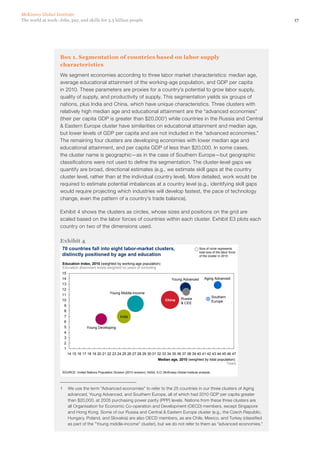
  • 23.
    McKinsey Global Institute Theworld at work: Jobs, pay, and skills for 3.5 billion people 11 From rural schools in India to the top universities in advanced countries, technology can be used to extend the capacity of schools and teachers. Even now, teachers in parts of India are reaching low-income students through DVD-based lessons, and top US professors are giving classes to hundreds of thousands of students per semester, rather than hundreds, through online systems. The need for innovation is high and will require more resources than governments alone can provide: private industry, private investors, and the social sector also will need to help. Even with these steps, the shortages we project would not disappear entirely. Both advanced and developing economies will also need to consider steps to raise demand for less‑skilled workers. In advanced economies there are opportunities to create new jobs for low- and middle‑skill workers in service sectors, including in the fast-growing health care industry and through “marketization” of home services such as child care and elder care (turning a segment of the informal economy into an industry, with full-time employment, training, benefits, even career advancement). In some places, regulatory reform may help enable job creation for less-skilled workers, for example, by relaxing restrictions on retail trade. Additional responses to long- and short-term unemployment may also be required, including measures like Germany’s job- sharing program, which provides a subsidy that allows employers to avoid mass layoffs by keeping workers on at reduced hours. Developing economies can create demand for less educated workers by encouraging the expansion of labor-intensive sectors. By moving up the value chain—from supplying raw food or raw materials and intermediates to processed food and finished goods—economies create more jobs. By scaling up its garment manufacturing sector, Bangladesh, for example, created employment opportunities  for millions of low‑skill women, many of whom had never worked in the formal economy before. Government can also help create jobs in the manufacturing and construction sectors by reducing the regulatory barriers that inhibit new enterprises and infrastructure development. For businesses operating in a global knowledge economy, an immediate priority is to develop a deeper understanding of how labor markets and skill pools are evolving in different countries to inform global recruiting and supply chain strategies. Businesses should also consider how to play an active role in public education and training. For example, IT companies in India actively shape college curricula and delivery, to ensure better access to skills. Some businesses could choose to participate directly in the booming education sector, as providers of vocational training for example. Longer term, businesses in a skill-scarce world would need to optimize demand for skilled workers, by investing in skill-saving technologies such as knowledge codification systems and smart devices that raise productivity even of low‑skill workers. Finally, given the urgency of resolving unemployment and inequality problems, businesses should consider aligning their corporate social responsibility efforts to labor priorities in their communities.
  • 24.
    12 * * * Throughout the 20th century, industrialization, innovation, and advances in technology resulted in record wealth creation and improving living standards—a rising tide that globalization shared with the developing world. Work itself evolved: it took less human effort to raise food and build things. But it now takes greater knowledge to innovate and continue to raise productivity. As the 21st century unfolds, the supply of high‑skill workers is not keeping up with growing demand, while too many workers are left with inadequate or outdated skills. Slower growth, rising income polarization, growing pools of unemployed or under-employed workers, and soaring social costs are real possibilities. To keep those possibilities from becoming realities, policy makers, business leaders, and workers themselves must find ways to bring education, training, and job creation into the 21st century.
  • 25.
    McKinsey Global Institute Theworld at work: Jobs, pay, and skills for 3.5 billion people 13 1. A global labor market emerges Over the past three decades, the industrialization of developing economies, rising trade, and immigration, have all helped to bring about a more integrated global labor market. More than one billion non‑farm jobs were created worldwide. Around 900 million of these were created in developing economies and played a role in lifting 620 million people out of poverty between 1990 and 2008.4 In advanced economies, as growth shifted to services and companies adopted technology to improve productivity, millions of new high‑paying jobs were created for high‑skill workers.5 But recently, strains have become apparent, particularly during the slow recovery from the “Great Recession” of 2008–09. In advanced economies, the fortunes of high‑ and low‑skill workers have diverged sharply. While demand for high‑skill workers remains strong—and shortages of such workers are becoming more common—there are large and growing pools of low‑skill workers for whom job opportunities are shrinking. Long-term unemployment is becoming more common, and across advanced economies youth unemployment has risen to 18 percent, or more than twice the overall rate. While part of the problem is cyclical—a natural result of the global financial crisis and a severe recession—it is increasingly clear that long-term structural changes in global demand and supply of labor play a major role. As a result, in advanced economies, polarization of incomes is growing. And, with slow wage growth for low- and middle‑skill workers, labor’s share of national incomes (the sum of all employee compensation) has fallen to its lowest level in 60 years. Today, the effects of changes in labor demand and supply are most apparent in advanced economies, but they are also beginning to be felt in developing ones. Across the global labor market there are growing mismatches between worker skills and employer needs (in France there are too few college graduates; in India, there aren’t enough workers with secondary education). In this chapter we examine the evolution of the global labor market and the roots of potential imbalances. 4 This is based on the World Bank’s definition of poverty: income of less than $1.25 per day based on 2005 purchasing power parity (PPP) levels. It compares the number of people who lived in poverty in 2008 with those in 1990. This estimate includes children and others who are not in the labor force. 5 We use educational attainment as a rough proxy for skill level. High‑skill refers to workers with a tertiary education or more, medium‑skill refers to workers with only a secondary education, and low‑skill refers to workers with no more than a primary education.
  • 26.
    14 GROWTH OF A GLOBAL LABOR MARKET From 1980 to 2010, the world’s labor force grew by 1.2 billion, to approximately 2.9 billion. Almost 90 percent of the growth occurred in developing economies, including 500 million new workers in China and India. This growth, driven by demographics (i.e., fast-growing populations) and rising labor market participation, also reflects a critically important “farm-to-factory” shift in developing economies. Approximately 1.1 billion 6 non‑farm jobs were created worldwide, raising global non‑farm employment from 54 percent of all jobs in 1980 to nearly 70 percent in 2010. Of the 900 million non‑farm jobs created in developing nations, 44 percent were in China and India, reflecting the shift in these economies from rural agriculture to urban industry (Exhibit 1). Exhibit 1 1.1 billion non-farm jobs were created worldwide in the past 30 years Evolution of labor force Farm Million workers (% of total) Non-farm Developing economies1 Advanced economies2 719 474 73 440 1980 1,193 513 (60%) (40%) (14%) (86%) Farm 136 43 job creation Non-farm 889 164 job creation 855 1,363 30 604 2010 2,218 635 (39%) (61%) (5%) (95%) 1 Includes 45 countries with GDP per capita less than $20,000 at 2005 PPP levels in 2010. 2 Includes 25 countries GDP per capita greater than $20,000 at 2005 PPP levels in 2010. NOTE: Numbers may not sum due to rounding. SOURCE: United Nations Population Division (2010 revision); ILO Key Indicator of Labor Market index; local statistics for China and India; McKinsey Global Institute analysis The advanced economies created about 165 million non‑farm jobs from 1980 to 2010. A large contributor to this growth was rising participation by women.7 Over this period, the number of women in the labor force rose by 77 million, accounting for 61 percent of the 122 million net additions to the labor forces of advanced economies. Average skill levels also rose rapidly. From 1980 to 2010, the number of college graduates in the world labor force rose by 245 million. The proportion of college graduates in the labor force doubled in advanced economies and grew by more than 2.5 times in developing economies (Exhibit 2). Around the world, about 700 million high school graduates joined the labor force, raising the global proportion of workers with secondary education to 48 percent in 2010, up from 6 This is calculated by applying non‑farm shares of employment for a subset of countries from the International Labor Organization’s Key Indicator of Labor Market index (equivalent to about 62 percent of world labor force) and applying these to World Bank estimates of the world labor force. 7 We use the ILO definition of labor force participation rate: the proportion of a country’s working-age population that engages actively in the labor market, either by working or looking for work.
  • 27.
    McKinsey Global Institute Theworld at work: Jobs, pay, and skills for 3.5 billion people 15 39 percent in 1980. One of the biggest contributors to this surge in secondary education was China, which undertook an extensive program of universal secondary education, raising the total number of workers with secondary school education in the global supply by an estimated 270 million. Exhibit 2 Rates of tertiary education attainment have doubled in advanced economies and risen by 2.5 times in developing ones since 1980 Educational attainment % of total working age population; million people Advanced economies1 Developing economies2 100% = 618 808 1,968 3,703 4 10 Tertiary 12 24 32 46 Secondary 64 65 64 44 Primary 25 or lower 11 1980 2010 1980 2010 1 Includes 25 countries from the Young Advanced, Aging Advanced and Southern Europe clusters. 2 Includes 45 countries from the Young Middle-Income, China, India, Young Developing, and Russia & CEE clusters. NOTE: Numbers may not sum due to rounding. SOURCE: United Nations Population Division (2010 revision); International Institute for Applied Systems Analysis (IIASA) During this period, trade, offshoring and migration served to integrate national labor markets into a more global market. In the past decade, we estimate that 85 million jobs that were created in developing economies were associated with rising exports,8 or about 20 percent of net new employment (Exhibit 3). Aside from a small number of jobs in exported services—about four million jobs in IT-enabled services, mostly in India and the Philippines, for example—most of these jobs were in manufactured goods. In advanced economies, trade in services is growing quickly: our work on the impact of trade 9 shows that many advanced economies have built surpluses in knowledge-intensive services—and in knowledge-intensive manufacturing—and have created export-related jobs in these sectors.10 Immigration has also played a role in creating a more global labor market. The number of immigrants11 in the world rose faster than the population—from 142 million in 1990 to 207 million in 2010. More than half of this increase was the result of people leaving developing economies for advanced ones, where foreign-born workers contributed an estimated 40 percent of labor force growth from 1980 to 2010. In recent years, the proportion of high‑skill migrants has 8 We estimate jobs associated with exports using the export share of GDP at a sector level in 2000 and 2010, assuming constant productivity across export and domestic output. 9 For a detailed discussion of the impact of global trade on jobs in advanced economies, see Trading myths: Addressing misconceptions about trade, jobs and competitiveness, McKinsey Global Institute, May 2012 (www.mckinsey.com/mgi). 10 Ibid. 11 Immigrants are defined by the United Nations as the stock of foreign-born people or foreign citizens resident in a country.
  • 28.
    16 been rising—from 19 percent in 1980 in the United States, to 26 percent in 2010, for example—as immigrants filled demand that domestic supply alone could not meet. To understand where nations around the world now stand in the emerging global labor market and how they are positioned to accommodate likely changes in labor demand, we examined 70 countries that account for 96 percent of global GDP and are home to 87 percent of global population. By segmenting them based on the median age, their educational profiles, and GDP per capita, we identify eight clusters of countries12 that share common attributes (see Box 1, “Segmentation of countries based on labor supply characteristics”). By looking at how clusters are positioned, we can see, for example, how well prepared they are for a global contest for high‑skill workers. In the Southern Europe cluster, for instance, we see that educational attainment is quite low relative to other advanced economies13 and age is on the higher side. China has an older population than other developing economies, and its educational attainment is approaching that of advanced economies. India has similar average educational attainment levels, though higher per capita GDP, than “Young developing” economies such as Nigeria and Kenya. Exhibit 3 A fifth of non-farm jobs created in developing economies in the past decade were associated with exports Exports from developing countries Non-farm employment growth, Export-related % share of global exports 2000–101 Other 32 Million workers China 43 121 24 India 13 67 Indonesia 3 16 Brazil 2 19 Mexico 0.4 7 Poland 0.2 1 2000 2010 Global exports 9 15 Other developing 22 134 $ thousands, 2005 prices All developing 84 374 1 Export contribution to non-farm employment growth is calculated as the difference between export-related non-farm employment in 2010 and 2000. Export-related employment is estimated at the sector level (i.e., agriculture, manufacturing, mining, and other services) assuming constant labor productivity across exports and domestic output. 2 Countries selected based on their growth in exports in $terms from 2000 to 2010; selected countries include China, India, Indonesia, Brazil, Mexico, Poland; Russia and the oil-exporting countries of the Middle East excluded from this analysis. SOURCE: Economist Intelligence Unit; Global Insight; OECD Input-Output Table (2005); ILO; local statistics for China and India; McKinsey Global Institute analysis 12 For a detailed list of countries by cluster, see Exhibit E3 and Box 1; for a description of our clustering methodology, see the appendix. 13 For example, just 10 percent of the working-age population in Italy had a college degree in 2010—not only lower than the level in other advanced economies but also lower than that in developing countries such as Malaysia, Thailand, and the Philippines.
  • 29.
    McKinsey Global Institute Theworld at work: Jobs, pay, and skills for 3.5 billion people 17 Box 1. Segmentation of countries based on labor supply characteristics We segment economies according to three labor market characteristics: median age, average educational attainment of the working-age population, and GDP per capita in 2010. These parameters are proxies for a country’s potential to grow labor supply, quality of supply, and productivity of supply. This segmentation yields six groups of nations, plus India and China, which have unique characteristics. Three clusters with relatively high median age and educational attainment are the “advanced economies” (their per capita GDP is greater than $20,0001) while countries in the Russia and Central & Eastern Europe cluster have similarities on educational attainment and median age, but lower levels of GDP per capita and are not included in the “advanced economies.” The remaining four clusters are developing economies with lower median age and educational attainment, and per capita GDP of less than $20,000. In some cases, the cluster name is geographic—as in the case of Southern Europe—but geographic classifications were not used to define the segmentation. The cluster-level gaps we quantify are broad, directional estimates (e.g., we estimate skill gaps at the country cluster level, rather than at the individual country level). More detailed, work would be required to estimate potential imbalances at a country level (e.g., identifying skill gaps would require projecting which industries will develop fastest, the pace of technology change, even the pattern of a country’s trade balance). Exhibit 4 shows the clusters as circles, whose sizes and positions on the grid are scaled based on the labor forces of countries within each cluster. Exhibit E3 plots each country on two of the dimensions used. Exhibit 4 70 countries fall into eight labor-market clusters, Size of circle represents total size of the labor force distinctly positioned by age and education of the cluster in 2010 Education Index, 2010 (weighted by working-age population) Education attainment levels weighted by years of schooling 15 14 Young Advanced Aging Advanced 13 12 11 Young Middle-Income Russia Southern 10 China Europe & CEE 9 8 7 India 6 5 Young Developing 4 3 2 1 14 15 16 17 18 19 20 21 22 23 24 25 26 27 28 29 30 31 32 33 34 35 36 37 38 39 40 41 42 43 44 45 46 47 Median age, 2010 (weighted by total population) Years SOURCE: United Nations Population Division (2010 revision); IIASA; ILO; McKinsey Global Institute analysis 1 We use the term “Advanced economies” to refer to the 25 countries in our three clusters of Aging advanced, Young Advanced, and Southern Europe, all of which had 2010 GDP per capita greater than $20,000, at 2005 purchasing power parity (PPP) levels. Nations from these three clusters are all Organisation for Economic Co-operation and Development (OECD) members, except Singapore and Hong Kong. Some of our Russia and Central & Eastern Europe cluster (e.g., the Czech Republic, Hungary, Poland, and Slovakia) are also OECD members, as are Chile, Mexico, and Turkey (classified as part of the ”Young middle-income” cluster), but we do not refer to them as “advanced economies.”
  • 30.
    18 DEVELOPING ECONOMIES: RIDING A RISING DEMOGRAPHIC TIDE Developing economies have benefited from favorable demographic forces: large, and rapidly growing populations that can fill global demand for labor. This supply of workers helped meet domestic needs, as nations industrialized and job creation shifted from low-productivity agricultural to manufacturing, construction, and services in growing urban centers. These expanding labor forces also helped fill a global need for low-cost labor. China. The rapid rise of China in the past three decades was made possible by the development of a modern industrial workforce. From 1980 to 2010, China’s non‑farm labor force grew by 315 million to around 475 million, and now accounts for 60 percent of the total labor force. The result of labor force expansion and the shift to non‑farm work was a rapid rise in productivity and per capita GDP. From 1990 to 2010, China’s productivity growth averaged 9.8 percent per year, about one-fifth of which was driven by workers moving into non‑farm employment—a powerful driver of productivity because non‑farm workers were seven times as productive as farm workers.14 In 1980, China’s GDP per capita was less than 3 percent of the average for advanced economies; by 2010, it had risen to 20 percent. In the 2000–10 decade, China accelerated the shift from agriculture, creating approximately 121 million new non‑farm jobs, including 33 million in manufacturing, bringing about 81 million workers from agriculture to non‑farm employment (Exhibit 5). A third of China’s new non‑farm jobs were associated with exporting industries. Rapid improvements in skill levels of Chinese workers during those decades also helped drive productivity improvements and enable the farm-to-factory shift. The proportion of Chinese workers with a secondary school diploma rose from approximately 50 percent in 1990 to around 60 percent in 2010; the proportion of those with tertiary degrees rose from about 2 percent to about 8 percent. 14 This productivity differential is estimated based on productivity levels in 2010. Average labor productivity of agricultural workers tends to be low and marginal productivity can be negligible (i.e., a large proportion of these workers can take non‑farm jobs without losing agricultural output). Thus a nation’s productivity jumps when workers are moved from farm to non‑farm sectors.
  • 31.
    McKinsey Global Institute Theworld at work: Jobs, pay, and skills for 3.5 billion people 19 Exhibit 5 The addition of 121 million non-farm jobs in the past decade significantly altered the structure of China’s labor force Breakdown of non-farm job creation, 2000–10 Composition of employment in China1 Million workers %; million workers 100% = 721 761 Movement of labor out of 81 Other services2 20 26 agriculture Wholesale and retail trade 8 Construction 6 10 Manufacturing 9 16 Net labor and mining 40 force growth 19 Agriculture 50 37 Total non-farm 121 job creation 2000 2010 1 2010 sector distribution estimated using data till 2009 and data on three strata of employment for 2010. 2 Includes employment of utilities; transport; post and telecom; banking and finance; health and social services; education, government and “other.” NOTE: Numbers may not sum due to rounding. SOURCE: China National Bureau of Statistics; McKinsey Global Institute analysis India. The Indian labor force grew from approximately 260 million in 1980 to 470 million in 2010, and India created millions of non‑farm jobs—but not on the scale that China achieved. From 2000 to 2010, India added 67 million non‑farm jobs, just enough to keep pace with the growth of its labor force. Relatively few of these jobs (about 19 percent) were associated with exports: 41 percent were in the construction sector, compared with 16 percent in China. Just 12 percent of India’s non‑farm job growth came from manufacturing, compared with 29 percent in China. India also has lagged behind China in raising the skills of its workforce. While it has comparable numbers of workers with a tertiary education, the share of people with secondary education in India is less than half the ratio in China and many other developing economies (Exhibit 6). The results of the slower evolution in India’s labor force are reflected in its growth and productivity record (Exhibit 7). India’s productivity growth rate was about half of China’s during the 1990–2010 period. This was partly due to the slower transition out of agriculture, which accounted for only about a tenth of India’s productivity improvement and about a fourth of the impact China got from that shift. By 2010, Indian per capita GDP had more than tripled from the 1980 level, rising from 4.3 percent of advanced economy levels to 9 percent. However, the gap between India’s per capita GDP and that of advanced economies is now greater than China’s.
  • 32.
    20 Exhibit 6 India has significantly more workers with only primary schooling or less and far fewer with secondary education than other developing economies Educational attainment, 2010 % of working age population; million people 100% = 850 1,125 145 60 20 175 56 16 91 Tertiary 7 9 7 8 10 13 15 16 22 Secondary 23 48 46 42 56 46 61 53 49 Primary 70 or lower 44 46 49 35 39 29 25 30 India China Brazil Philippines Malaysia Indonesia Egypt Sri Lanka Nigeria NOTE: Numbers may not sum due to rounding. SOURCE: United Nations Population Division (2010 revision); IIASA; ILO; local statistics for India and China; McKinsey Global Institute analysis Exhibit 7 The shift of labor in China from farm to non-farm employment has been a significant driver of economic growth; less so for India Decomposition of output growth, 1990–2010 Compound annual growth rate, % China India1 Output growth 10.6 6.6 Labor force 0.8 1.6 growth Productivity 9.8 5.0 growth Shifts from 1.8 0.4 agriculture Other 8.0 4.6 productivity growth 1 Data from 1991 to 2010. NOTE: Numbers may not sum due to rounding. SOURCE: China National Bureau of Statistics and CEIC data (China); National Sample Survey Organisation and National Accounts Statistics (India); McKinsey Global Institute analysis
  • 33.
    McKinsey Global Institute Theworld at work: Jobs, pay, and skills for 3.5 billion people 21 Countries in our “Young middle-income” cluster, which includes nations from Latin America, MENA, and Southeast Asia, participated in the rise of a global labor market in different ways. By 1980, Latin American countries were already highly urbanized15 and therefore derived little productivity gains from moving to non‑farm employment in the past 30 years. Latin America did, however, benefit from a demographic wave: in the past two decades, the labor force, as a share of total population, jumped faster in Latin American nations than in any other developing cluster (Exhibit 8). Labor force participation among prime working-age women (aged 25 to 54) jumped from 47 percent to 65 percent between 1990 and 2010, as the number of women in the labor force rose by 46 million. As a result, GDP per capita across Latin American nations grew faster than productivity (1.7 percent per year versus 0.8 percent). Exhibit 8 Latin American countries increased labor force participation rates more than other developing economies Labor force as % of total population Young Middle-Income Young Developing MENA1 Latin America2 Southeast Asia3 1990 37 32 39 44 Effect of change in share of working- 4 7 5 6 age population In total population Accounted for Effect of change 12% of GDP in participation 0 -0 3 growth from -1 rates 1990 to 2010 2010 41 39 48 50 Labor force participation 67 53 66 68 rate, 2010 (%) 1 Includes Algeria, Egypt, Jordan, Iran, Saudi Arabia, United Arab Emirates from MENA and select other economies from the cluster (e.g., Turkey, Kazakhstan, South Africa, Botswana). 2 Includes Brazil, Mexico, Argentina, Colombia, Venezuela, Peru, Chile, and Nicaragua. 3 Includes Indonesia, Malaysia, Thailand, Vietnam from Southeast Asia, and select other economies from the cluster (e.g., Sri Lanka). NOTE: Numbers may not sum due to rounding. SOURCE: UN Population Division (2010 revision); ILO; McKinsey Global Institute analysis Like China, Southeast Asian nations have benefited from the farm-to-factory shift, which drove rapid productivity growth across the region. Productivity growth averaged 2.9 percent annually from 1990 to 2010 across the region, and Vietnam achieved annual productivity growth of 5.1 percent per year from 2000 to 2010. About 12 million non‑farm jobs were created in Vietnam from 2000 to 2010, and its share of farm jobs fell from two-thirds of total employment to half. About 28 percent of the new non‑farm jobs were in manufacturing, and 30 percent were in construction and trade. As these economies built up non‑farm employment, educational attainment rose, too. The share of workers with secondary education in Vietnam grew from 24 percent in 1990 to 32 percent in 2010.16 In Malaysia, the share of workers 15 In 2007, just 18 percent of Brazil’s labor force was employed in agriculture, compared to 41 percent in China and 58 percent in India. For more on Latin America’s urban growth, see Building globally competitive cities: The key to Latin American growth, McKinsey Global Institute, August 2011 (www.mckinsey.com/mgi). 16 For a further description of Vietnam, see Sustaining Vietnam’s growth: The productivity challenge, McKinsey Global Institute, February 2012 (www.mckinsey.com/mgi).
  • 34.
    22 with a college degree rose from 2 percent in 1980 to 13 percent in 2010. In the Philippines, tertiary educational attainment rose from 9 percent in 1980 to 22 percent in 2010. This helped the Philippines create 3.5 million service sector jobs from 2000 to 2010, many of them in IT-enabled services. In the MENA nations—also part of the “Young middle-income” cluster— educational attainment is rising faster than employment opportunities. For example, in Egypt, five million students graduated from college between 1995 and 2006, but the economy created just 1.8 million jobs in skill-intensive service sectors (excluding construction and wholesale and retail trade). Youth unemployment has been persistently high—25 percent from the early 1990s through 2010—despite low participation rates (just 38 percent of young people in the MENA region are in the labor force, compared with about 50 percent in advanced economies). In surveys, only a third of young people say that they believe their education prepares them adequately for the job market.17 In the South Asian and African economies of the “Young developing” cluster, the demographic wave that is beginning to recede in China is still going strong. Their combined labor forces expanded by 2.9 percent annually from 1990 to 2010, reaching 322 million in 2010. These nations are also experiencing a rapid rise in educational attainment, creating attractive labor pools that are well positioned to benefit as wages rise in coastal China’s booming cities and in India’s outsourcing services centers and companies look for alternative sources of labor. Bangladesh and parts of sub-Saharan Africa (as well as Vietnam and Indonesia) are among the nations that have an opportunity to take their turns providing low-cost labor to the global economy in the coming decades. ADVANCED ECONOMIES: MOVING TO HIGH‑SKILL/ HIGH‑PRODUCTIVITY WORK In the past 20 years, the drive for global competitiveness has shaped job creation across advanced economies. Companies based in wealthy nations adopted technology, streamlined business processes, and took advantage of new sources of low-cost labor—often as they expanded their global footprints. As a result, productivity growth in advanced economies averaged 1 to 2 percent annually. During this time, employment in services (both low- and high‑skill) grew rapidly, while employment in manufacturing, mining, and agriculture sectors fell (even in countries that are strong exporters of manufactured goods). Increasing use of technology and the drive for productivity have all raised demand for high‑skill workers, while depressing job growth for workers with lower skills.18 Production and simple transaction jobs (e.g., assembly line work or answering a customer service call) have been automated or, in some cases, shipped to lower-cost locations. At the same time, jobs have grown quickly in “interaction” work, which requires face-to-face contact. These jobs include many low‑skill jobs (e.g., home health aides), as well as professions, such as law and medicine. In the United States, the number of interaction jobs grew by 8.9 million from 2002 to 2010; about half of those jobs required tertiary education. In the same period, the 17 The International Finance Corporation (IFC)-Islamic Development Bank Group, Education for employment: Realizing Arab youth potential, 2011. 18 See E. Brynjolfsson and A. McAfee, A., Race against the machine: How the digital revolution is accelerating innovation, driving productivity, and irreversibly transforming employment and the economy, 2011 for a detailed discussion of the impact of technology on demand for skilled workers.
  • 35.
    McKinsey Global Institute Theworld at work: Jobs, pay, and skills for 3.5 billion people 23 number of production jobs declined by 2.2 million and the number of transaction jobs fell by 3.5 million.19 From the 1970s to 2007, employment in agriculture, manufacturing and mining in advanced economies shrank from 33 percent of total employment to 17 percent. This included the loss of approximately 20 million jobs in manufacturing (Exhibit 9). Even economies such as Germany and Japan, which retain strong manufacturing exports, have experienced falling employment in manufacturing. They remain globally competitive by focusing on advanced manufacturing and by investing in technology. So, even though Germany lost the same share of manufacturing jobs as the United States, its knowledge-intensive manufacturing jobs did not fall as steeply—including workers who design and run advanced manufacturing machinery (Exhibit 10). Exhibit 9 In advanced economies, labor-intensive manufacturing lost the most jobs; hiring was fastest in knowledge-intensive services, and in public services Employment in advanced economies1 Million workers (% of total) Manufacturing Labor-intensive manufacturing Manufacturing share Capital-intensive manufacturing of non-farm jobs Knowledge-intensive manufacturing % 17 31 26 1977 75 27 (23%) (42%) (35%) Labor-intensive 9 manufacturing Change in Capital-intensive employment 5 manufacturing by category Knowledge-intensive 5 manufacturing 8 26 21 2007 56 14 (15%) (47%) (38%) -19 Services Labor-intensive services Knowledge and capital-intensive services Health, education, and public services 114 33 59 1977 206 (55%) (16%) (29%) Labor-intensive 52 services Change in Knowledge- and capital- employment 46 intensive services by category Health, education, 39 and public services 166 79 98 2007 343 (48%) (23%) (29%) +138 1 Does not include agriculture and mining sectors. Advanced economies are the United States, France, the United Kingdom, Canada, Ireland, Portugal, Italy, Spain, Greece, Germany, Japan, Austria, Belgium, Denmark, Finland, the Netherlands, and Sweden. NOTE: Not to scale. SOURCE: EU KLEMS (2009 release); McKinsey Global Institute analysis 19 An economy that works: Job creation and America’s future, McKinsey Global Institute, June 2011 (www.mckinsey.com/mgi) describes the impact of the recession on jobs in these categories.
  • 36.
    24 Exhibit 10 US and German manufacturing employment fell equally, Labor-intensive but Germany retains more knowledge-intensive jobs Capital-intensive Manufacturing sector employment Knowledge-intensive Million workers (% of total) United States Germany 4.2 8.5 7.4 1.7 4.1 3.7 1977 20.1 9.5 (21%) (42%) (37%) (18%) (43%) (39%) Labor- 2.0 1.1 intensive Manufacturing Capital- jobs lost by 1.4 0.7 intensive category Knowledge- 1.7 0.6 intensive 2.2 7.1 5.8 3.3 3.1 2007 15.0 7.1 (15%) (47%) (38%) (47%) (44%) 0.6 -25% (9%) -26% 1 Includes textiles, leather footwear, wood, wood products, cork, and recycling. 2 Includes food, beverages, tobacco, pulp, paper, printing, publishing, coke, refined petroleum, nuclear fuel, rubber, plastics, other non-metallic minerals, basic metals, and fabricated metals. 3 Includes chemicals, chemical products, machinery, electrical, optical equipment, and transport equipment. NOTE: Numbers may not sum due to rounding. SOURCE: EU KLEMS (2009 release); McKinsey Global Institute analysis Job creation in advanced economies has been strongest in services such as food preparation, health care, and government, as well as in the professions and business management—roles that cannot be automated or easily moved. Within service sectors, however, the share of labor-intensive jobs has fallen significantly, while that of knowledge-intensive services has grown. Technology, the quest for productivity, and the pressure of global competition all raised demand for skilled knowledge workers and reduced demand for low‑skill workers, such as assemblers or machine operators. As a consequence, despite doubling tertiary educational attainment in the past 20 years, the supply of high‑skill workers in advanced economies has not kept up with demand. Business leaders surveyed in Europe and the United States in the past two years have said they have been unable to fill open positions due to a lack of qualified candidates, and cite skill shortages among their main concerns.20 While demand for workers without post-secondary training was essentially flat in the United States during the 2000–10 decade (a period of very weak job growth), demand for college graduates, continued to grow by about 1 percent annually. Today, unemployment rates for workers with only secondary school education are nearly twice those of college graduates, and hiring in skill-intensive sectors has recovered faster since the recession than in other sectors. 20 ManpowerGroup, Talent Shortage Survey, 2011.
  • 37.
    McKinsey Global Institute Theworld at work: Jobs, pay, and skills for 3.5 billion people 25 RISING INEQUALITY Not surprisingly, shifting demand has had an effect on compensation. Wages among less‑skilled workers have stagnated or fallen in real terms. In all but a handful of advanced economies, the incomes of households in the top income decile have risen faster than incomes in bottom-decile households for 25 years (Exhibit 11). The growing polarization of household income is driven by many factors, including patterns in household formation; the rise of single-headed households, for example, is more concentrated in middle- and low-income earners. Not only are marriage rates higher among more highly educated, higher- income cohorts, but these people now marry more often within their income groups.21 Nonetheless, changing patterns in demand and supply in the labor market that determine long-term wage trajectories are the most powerful drivers of income polarization. Exhibit 11 Incomes increased faster for rich households than for poor ones in many advanced economies over the past 25 years Average annual change in real household income, mid-1980s to late 2000s % Top decile of households 4.5 Countries with faster income Australia 4.0 growth in top income decile 3.5 3.0 New Zealand Norway 2.5 UK Spain Ireland Sweden Finland 2.0 US Canada Greece 1.5 Germany Netherlands Denmark France Italy Austria Belgium Portugal 1.0 0.5 Japan 0 Countries with faster income growth in bottom income decile -0.5 -0.5 0 0.5 1.0 1.5 2.0 2.5 3.0 3.5 4.0 4.5 Bottom decile of households SOURCE: Organisation for Economic Co-Operation and Development (OECD); McKinsey Global Institute analysis Declining position of labor and rising role of capital and knowledge Today’s concerns over income inequality need to be viewed in the context of a lengthy decline in labor’s share of income (measured as the share of national income that goes to wages and compensation)22 across advanced economies. Labor’s share of income had risen steadily through the 1950s and 1960s and peaked in 1975; since then labor’s share of income in advanced economies has fallen below the 1950 level, declining 7 points from its peak of 65 percent in 1975 21 For a more detailed discussion of these phenomena, see Growing income inequality in OECD countries: What drives it and how can policy tackle it?” Organisation for Economic Co- operation and Development, May 2011. 22 We calculate labor’s share using real 2000 US dollars and excluding government transfers and capital receipts. Other transfers—contributions to social security and employer-paid benefits— are also not counted. These payments rose from 11.6 percent of US worker pay in 1980 to 22.5 percent in 2010. For more, see Alan B. Kreuger, Measuring labor’s share, NBER Working Paper No. 7006, 1999 and Paul Gomme and Peter Rupert, Measuring labor’s share of income, Policy Research Papers, Federal Reserve Bank of Cleveland, 2004 for a detailed discussion on methodological issues and implications in calculating labor’s share of income.
  • 38.
    26 (Exhibit 12). In “Young advanced” economies, including the United States, the United Kingdom, and France, labor’s share of income fell to about 50 percent while in “Aging advanced” economies, where labor once received more than 70 percent of national income, labor’s share fell to around 60 percent. In the Southern Europe cluster, labor’s share of income declined from nearly 80 percent to about 65 percent. Exhibit 12 Labor’s share of income across advanced economies has fallen steadily since its peak in 1975 Labor share of income in advanced economies1 % of total 65 64 -3.5 63 p.p. 62 -7.1 61 p.p. 60 -3.5 p.p. 59 58 0 1970 1975 1980 1985 1990 1995 2000 2005 2010 1 Employee compensation as a share of gross national income calculated using real 2000 US dollars and excluding government transfers and capital receipts; advanced economies include the United States, the United Kingdom, France, Australia, the Netherlands, Japan, Sweden, Germany, Portugal, Italy, Greece, and Spain. SOURCE: OECD; World Bank Development Indicators; EU KLEMS; Haver Analytics; McKinsey Global Institute analysis This long decline reflects the shift from the days when low- and medium‑skill labor were the critical drivers of economic growth in advanced economies to the more recent period in which capital goods and knowledge have taken on a much more important role. As companies adopted more automation and technology, production became more dependent on capital, and labor’s share of income fell.23 The stock of capital relative to GDP rose from 2.1 times GDP in 1980 to 2.7 times in 2010 in the United States, the United Kingdom, Italy, Japan, and Germany. Corporate gross savings24 of advanced economies rose from 10 percent of GDP in 1980 to 13.3 percent in 2008, and property’s share of national income (a proxy for earnings from capital) also rose.25 23 See Florence Jaumotte and Irina Tytell, How has the globalization of labor affected the labor income share in advanced countries? International Monetary Fund Working Paper, WP/07/298, 2007 for an assessment of how globalization and technological progress have influenced labor’s share of income in 18 advanced economies. 24 Defined as retained earnings (or undistributed profits) and the depreciation. See Farewell to cheap capital? The implications of long-term shifts in global investment and saving, McKinsey Global Institute, December 2010 (www.mckinsey.com/mgi) for a detailed discussion on savings and investments by firms in advanced economies. 25 Income received on financial or tangible assets, including interest, profits, and rent. Property income’s share of national income rose from 23 percent in 1975 to 38 percent in 2008 in the United States, Canada, and France.
  • 39.
    McKinsey Global Institute Theworld at work: Jobs, pay, and skills for 3.5 billion people 27 Countries in the “Aging advanced” and “Young advanced” economies raised productivity by 1.2 to 1.6 percent annually from 1990 to 2010, by inventing new products, adopting more efficient business processes, and investing in machinery and technology. We estimate that tangible capital (as measured by levels of investment) made up 70 percent of productivity gains, and intellectual capital (as measured by higher education and spending on research and development) accounted for the remainder.26 In the Southern Europe cluster, 80 percent of productivity improvement was attributable to investment in tangible capital. In the United States, investment in intangible assets, such as R&D and training, are estimated to account for more than 90 percent of labor productivity growth.27 Stagnating wages and higher unemployment for low‑skill labor The corollary of rising dependence on knowledge and capital to drive growth in advanced economies has been the declining importance—and power—of low‑skill labor. As a result, low‑skill workers have seen a reversal of fortune in advanced economies over the past three decades. Rather than riding the tide of a growing global economy, they have suffered stagnating wages, job losses, and long periods of unemployment—while more highly educated citizens have seen rising incomes. The role of capital grew the most—and productivity gains were the greatest—in labor-intensive manufacturing. As demand for production workers has fallen, their wage growth has trailed that of workers in both transaction and interaction jobs, despite lower productivity gains in these sectors. For example, in the United States, wage growth in production jobs, at 2.1 percent per year from 2000 to 2010, was slower than productivity growth in these jobs, which was 3.2 percent. In interaction occupations, which include public services such as education and government, measurable productivity gains have been much slower, yet wage growth has been the fastest. Interaction jobs grew 3.2 percent annually from 2000 to 2010, despite a decline in productivity at 0.1 percent per year for these jobs. From the 1960s to 2008, in the United States, real incomes rose at about 1.1 percent every year for workers with a college degree, while they declined marginally for workers who had not completed high school, and the multiple of wages of a worker with a college degree to wages of a worker without a high school degree rose from about 1.7 to 2.8.28 (Exhibit 13). In most advanced economies, unemployment rates for the least‑skilled workers are consistently two to four times those of the most highly skilled workers, whether the economy is in recession or recovery (Exhibit 14). 26 We estimate this using OLS regression of output per worker against growth in capital formation per worker, research and development expenditure per worker and tertiary educational attainment, for a sample of advanced economies from 1990 to 2010. We exclude product and process innovation from this analysis, which are important drivers of productivity, but are difficult to quantify at an aggregate level. 27 See Carol Corrado, Charles Hulten, and Daniel Sichel, “Intangible capital and US economic growth,” Review of Income and Wealth, series 55, No. 3, September 2009 for an estimate of the impact of intangible capital on growth. 28 See D. Acemoglu and D. Autor, Skills, tasks and technologies: Implications for employment and earnings, National Bureau of Economic Research (NBER) Working Paper No. 16082, June 2010. For additional discussion of how rising demand for high‑skill workers has affected wage growth, see Changing the fortunes of America’s workforce: A human-capital challenge, McKinsey Global Institute and McKinsey Social Sector Office, June 2009 (www.mckinsey. com/mgi).
  • 40.
    28 Exhibit 13 Wages for US workers with tertiary education have grown more than twice as fast as for others, creating a widening gap Growth in real weekly wages for full-time workers, Ratio of weekly wages of college 1963–2008 graduates to high school dropouts Compound annual growth rate, % Multiple 1.1 2.8 +63% 1.7 0.5 0.4 0 College Some High School Less than graduate1 college graduate high school 1963 2008 1 Includes workers who have completed college or graduate school. SOURCE: CPS 2008; Daron Acemoglu and David Autor, Skills, Tasks and Technologies: Implications for Employment and Earnings, 2010; McKinsey Global Institute analysis Exhibit 14 In advanced economies, unemployment for low-skill Less than upper secondary workers is 2-3 times higher than for high-skill workers Secondary Unemployment rate, 25-64 years, by educational attainment Tertiary % of labor force United Kingdom France Denmark Germany Sweden Spain 1999 15 16 15 13 10 11 9 9 7 6 7 7 4 4 5 4 3 3 2011 26 19 13 14 11 12 10 9 6 7 6 6 4 5 5 5 4 2 SOURCE: Eurostat; OECD Education at a Glance 2011; McKinsey Global Institute analysis
  • 41.
    McKinsey Global Institute Theworld at work: Jobs, pay, and skills for 3.5 billion people 29 Unskilled youth affected the most As the demand of low‑skill labor fell, historical rigidities (e.g., regulations barring layoffs or making them prohibitively expensive) also began to fall in some countries. Employers also achieved greater flexibility by hiring part-time and temporary workers. In “Aging advanced” economies, the share of workers in part-time jobs rose from 13 percent of the labor force in 1985 to 21 percent in 2010. In Southern Europe, the share of temporary and contract workers rose from 11 percent of total employment to 18 percent. For many young workers, the only route to employment in the formal economy is through temporary work. This has made young workers much more likely to be laid off since in many countries, particularly in Europe, older, permanent workers are protected from layoffs. Persistently high dropout rates have driven youth unemployment in advanced economies, too. In Spain, where youth unemployment has reached 50 percent during its financial crisis, early school leavers make up 28 percent of the 18- to 24-year-old population, compared with an average of 14 percent across the European Union. Young, unskilled workers have a much lower chance of securing full-time work in the formal economy and gaining valuable on-the-job training. Youth unemployment has become a global issue: 75 million young people are currently unemployed globally, or 38 percent of the world’s unemployed workers.29 In 2010, youth unemployment averaged 18 percent across advanced economies and around 21 percent in Europe (Exhibit 15).30 Left unaddressed, the youth unemployment problem could leave many advanced economies with a “lost generation” of workers. Exhibit 15 Unemployment for European youth is often more than Ratio of youth to adult unemployment rate twice the level of adult workers Youth unemployment rate Youth unemployment rates, select EU countries1 2000 2008 2010 Unemployed 15- to 24-year-olds as % of labor force Spain Greece Ireland 2.6 2.9 2.6 1.8 2.2 2.1 2.1 2.0 1.5 42 29 33 25 25 28 22 13 7 Sweden France Portugal 3.3 3.0 2.5 2.4 2.1 2.1 2.0 1.7 2.0 25 21 23 22 20 19 16 10 8 1 2010 rates in Spain, Greece, Ireland, Sweden, France and Portugal exceed the EU average rate (20.8 percent). SOURCE: ILO Global Employment Trends for Youth, August 2010; Eurostat; McKinsey Global Institute analysis 29 International Labor Organization, Global employment trends for youth, October 2012. 30 Unemployment Statistics, Eurostat.
  • 42.
    30 Young workers are only one cohort of the growing pools of workers facing protracted periods of unemployment. With long-term unemployment reaching new records in the recovery from the “Great Recession,” a growing number of workers are losing skills and facing diminishing odds of ever finding work. In the United States, for example, median duration of unemployment passed 21 weeks in 2010, the longest median period of joblessness in 30 years. In 2010, the share of idle workers classified as long-term unemployed (out of work for 27 weeks or more) was three and a half times as high as in the 2000–01 recession. The long- term unemployed are most likely to become discouraged and permanently exit the labor force; 20 to 25 percent of workers who are unemployed for more than 27 weeks stop looking for a job. These workers know that the longer they are out of work, the lower the probability of re-employment (Exhibit 16). The odds against a worker who has been idle for 27 weeks finding a job within a year are three times those against a worker who has been out of work for only five weeks.31 Exhibit 16 Long-term US unemployment is becoming more widespread, putting more workers at risk of not finding a new job < 5 weeks 5 to 26 weeks > 27 weeks Long-term unemployment has … and the chances of finding a job are growing become more common … dimmer for the long-term unemployed Number of unemployed by % of unemployed who found jobs after weeks of employment a period of unemployment1 %; million 100% = 6 8 15 40 12 20 43 2X 30 43 26 45 20 3X 18 38 10 46 35 19 2000 2005 2010 2000E 2010 1 Based on the share of unemployed who get back into the labor force within the year. NOTE: Numbers may not sum due to rounding. SOURCE: US Bureau of Labor Statistics * * * The last 30 years were a period of remarkable growth and progress for developing economies and their workers. Advanced economies benefited from new technologies that raised productivity and from access to diverse labor pools around the world. In the next chapter, we will see how the quest for productivity is becoming global and the contest for high‑skill talent will become more intense— and why even today’s developing economies will face challenges to employ low‑skill workers. 31 US Bureau of Labor Statistics.
  • 43.
    McKinsey Global Institute Theworld at work: Jobs, pay, and skills for 3.5 billion people 31 2. Labor supply and demand, 2010–30 In the coming decades, the dynamics driving the global labor market will evolve. The most significant change will be slower growth of labor forces around the world. The sharpest declines are likely in the aging economies—which now will include China. As China’s labor force growth slows—by about half—India and the “Young developing” economies of South Asia and Africa will become the biggest sources of labor force growth in the coming decades. But China, along with India, will likely be the world’s largest source of college-trained workers. The first effect of aging and slower labor force growth will be a heightened need to raise productivity to sustain GDP growth. China, with its demographic dividend falling and incomes rising, would need to keep climbing the industrial value chain and accelerate productivity growth. As a result, its labor needs will more closely mirror those of advanced economies, with a similar emphasis on high‑skill work. The demand for skilled workers will continue to grow far faster than supply, and the competition for talent will intensify and become increasingly global. A SLOWER-GROWING GLOBAL LABOR FORCE We project that the growth rate of the global labor force will fall by nearly a third, from 1.4 percent annually in the 1990–2010 period to 1.0 percent through 2030 (Exhibit 17). That would create 615 million net new additions to the global labor force, bringing the total number of workers to 3.5 billion in 2030, up from 2.9 billion in 2010 (see Box 2, “Overview of labor supply estimation”). Growth would decelerate during the two decades. In the 2010–20 decade, we project 331 million net additions (down from 368 million in the 2000–10 period), dropping to 284 million net additions in the second decade, when aging will place an even greater drag on global labor force growth.
  • 44.
    32 Exhibit 17 Labor force growth will likely slow worldwide and 1990 Compound annual growth rate (%) become flat across advanced economies by 2030 2010 2030E 1990–2010 Labor force 2010–30E Million workers 1.0% 1.1% 1.4% 1.6% 3,464 2,849 2,940 2,355 2,143 1,726 0.9% 0.3% 417 494 524 Global aggregate Developing economies1 Advanced economies2 1 Includes 45 countries from the Young Middle-Income, China, India, Young Developing, and Russia & CEE clusters. 2 Includes 25 countries from the Young Advanced, Aging Advanced, and Southern Europe clusters. SOURCE: United Nations Population Division (2010 revision); ILO; local statistics for China and India; McKinsey Global Institute analysis Box 2. Overview of labor supply estimation To estimate future labor supply, we build a model that projects labor force growth in six age and gender cohorts for each country.1 To estimate cohort- level labor force, we use population projections from the United Nations and data from national sources (e.g., China National Bureau of Statistics, India Census, and India’s National Sample Survey Organisation) and then apply our estimates of labor force participation rates. These estimates of labor force participation rates are based on a comprehensive set of variables such as GDP per capita, projected educational attainment levels, share of the population over 55 years, women’s fertility rate, average marriage age, and other variables. These estimates are checked against aggregate projections available from sources such as Global Insight, Oxford Economics, and the Economist Intelligence Unit. In order to estimate the educational mix of the projected labor force, we use a combination of available estimates of population-level educational attainment (e.g., World Bank, International Institute for Applied Systems Analysis, China National Bureau of Statistics, and India’s Ministry of Human Resources Development) with some adjustments for China and India, based on enrollment and completion rates. For more details on our methodology, see the appendix. 1 We use this approach since most other estimates are either less granular or have a shorter-term horizon than the focus of this report.
  • 45.
    McKinsey Global Institute Theworld at work: Jobs, pay, and skills for 3.5 billion people 33 In advanced economies, we expect labor force growth to drop from 0.9 percent annually, the average from 1990 to 2010, to just 0.3 percent from 2010 to 2030. In total, advanced economies are projected to make only 30 million net additions to their labor forces by 2030. “Young advanced” economies (the United States, the United Kingdom, Canada, for example) will still grow their labor forces—by about 0.6 percent a year, down from 1.0 percent in the past—but labor forces in most “Aging advanced” economies will likely shrink (Exhibit 18). Assuming no significant changes in immigration policies in those nations, we project that labor supply will contract at 0.2 percent each year.32 The Japanese labor force is projected to shrink by 0.5 percent a year through 2030. In the Southern Europe cluster, labor supply is projected to be virtually flat. In the Russia and Central and Eastern Europe cluster, which also has aging populations, we project that labor forces could shrink by 0.5 percent annually. Exhibit 18 Labor force growth will slow in almost all advanced economies and, in some clusters, labor forces are likely to shrink Labor force Million workers Compound annual growth rate (%) 1990–2010 2010–2030E 350 0.6 Young Advanced 300 1.0 250 200 0.4 -0.2 150 Aging Advanced -0.2 Russia & CEE -0.5 100 50 Southern Europe 1.1 -0.0 0 1990 1995 2000 2005 2010 2015 2020 2025 2030 SOURCE: United Nations Population Division (2010 revision); ILO; McKinsey Global Institute analysis In China, labor force growth is likely to slow by half, from the current 0.9 percent a year to about 0.5 percent through 2030. In our momentum case, the Chinese labor force will reach 861 million in 2030, with a net increase of about 79 million, compared with its growth of 126 million from 1990 to 2010. Growth will likely decelerate sharply in the decade from 2020 to 2030: to just 21 million from 58 million in the 2010–20 period, reflecting the effects of aging and declining birth rates. China is also likely to see a decline in its overall labor force participation rate due to aging. At 70 percent, China had among the world’s highest participation rates in 2010. We project that figure will drop marginally to 67 percent by 2030 (Exhibit 19), when the number of Chinese aged 55 years and older will likely reach 43 percent of the population—up from 26 percent now (Exhibit 20). Even 32 For a related discussion of Germany’s labor force growth rates, see Perspektive 2025— Fachkräfte für Deutschland (Perspective 2025—Experts in Germany), Federal Employment Agency, Nuremberg, January 2011.
  • 46.
    34 though we project that participation rates among older workers will rise—from 41 percent to 50 percent—it will not be sufficient to maintain labor force growth at historical levels beyond 2020.33 And unlike some advanced economies, China has limited opportunity to raise female labor participation: at 82 percent, the labor participation rate of prime working-age Chinese women is not far from the highest in the world (85 to 87 percent in Nordic countries). Exhibit 19 Labor force growth in China will likely decelerate due to slower growth in working-age population Decomposition of labor force growth by drivers, 2010–30E Compound annual growth rate, % Estimated growth, 1990–2010 Working-age population is Working-age projected to reach 0.7 1.6 population growth 1.28 billion by 2030 (from 1.1 billion in 2010) “Blended” labor force Effect of change participation rate1 is in labor force 0.2 -0.7 projected to decline to 67% participation rate by 2030 (from 70% in 2010) Labor force is projected to Labor force growth 0.5 0.9 reach 861 million by 2030 (from 783 million in 2010) 1 Weighted average of cohort-level participation rates for male and female young, prime working-age, and older workers. SOURCE: China National Bureau of Statistics; United Nations Population Division (2010 revision); McKinsey Global Institute analysis Exhibit 20 Aging will be the major driver of a projected decline in China’s labor force participation rate in the next two decades Drivers of change in labor force participation rate Composition of working-age population % of working-age population %; million Labor force 100% = 1,124 1,284 Labor force participation participation 69.6 rate, 2010 Older % rate, 2010 26 (55+) 43 41 Impact of aging 3.1 Prime Changes in 56 (25–54) participation 0.6 47 89 rates within age- gender cohorts Labor force Young 17 participation 67.1 (15–24) 11 51 rate, 2030E 2010 2030E NOTE: Numbers may not sum due to rounding. SOURCE: China National Bureau of Statistics; United Nations Population Division (2010 revision); McKinsey Global Institute analysis 33 See John Giles, Dewen Wang, and Wei Cai, The labor supply and retirement behavior of China’s older workers and elderly in comparative perspective, World Bank, Policy Research Working Paper No. 5853, October 2011.
  • 47.
    McKinsey Global Institute Theworld at work: Jobs, pay, and skills for 3.5 billion people 35 DEVELOPING ECONOMIES WILL BECOME THE DOMINANT SOURCE OF BOTH HIGH‑ AND LOW‑SKILL LABOR With the number of workers entering labor markets slowing in advanced economies and in the next 20 years China, India, and nations in the “Young developing” cluster will become the biggest contributors to the global labor pool. India’s total labor force will continue to grow relatively quickly—at about 1.5 percent annually—with about 174 million net additions by 2030. We project the total labor force will reach 550 million by 2020 and 640 million in 2030. During this period, India’s working-age population is projected to grow about 1.5 percent annually, while its population will also begin to age—but far less dramatically than in China or in advanced economies. Overall, the number of Indians who fall into the prime working-age group (25 to 54 years) will hold steady at about 69 percent of the population. India’s relatively low labor force participation rate of 56 percent is not expected to rise significantly. More young Indians will stay in school, reflecting the trend toward rising educational attainment. Furthermore, India’s low female labor participation rate (about 38 percent today) is not likely to rise, because a growing number of households are expected to move out of subsistence, allowing more low‑skill women to opt out of the labor force. High‑skill women, on the other hand, will see rising participation rates, but their numbers will remain small compared to those of their low‑skill counterparts. 34 The “Young developing” economies of South Asia and Africa (such as Bangladesh, Pakistan, Nigeria, and Kenya) will have the fastest-growing labor forces, growing at about 2.3 percent annually. That will add 187 million workers to the global labor market in the next two decades. Together with India, these nations will contribute about 360 million of the net new workers in the global labor force in the next 20 years, or about 60 percent of the growth. China’s contribution to net labor force growth will decline from 18 percent of the total to 10 percent (Exhibit 21). 34 See Wendy Olsen and Smita Mehta, A pluralist account of labor participation in India, Global Poverty Research Group, Working Paper No. GPRG-WPS-042, May 2006 for a detailed account of the dynamics of female labor force participation in India.
  • 48.
    36 Exhibit 21 China’s contribution to global labor force growth will drop; India and “Young Developing” economies will lead labor force growth through 2030 Net new additions to labor force %; million workers Russia Young Young Advanced & CEE Developing India China Middle-Income economies1 China and India contributed more 1990–2010 -1 20 19 18 33 11 706 than a third of global labor force growth “Young Developing” economies and India 2010–30E -2 30 28 13 26 5 615 will contribute almost 60 percent of global labor force growth 100% 1 Includes Young Advanced, Aging Advanced and Southern Europe clusters. NOTE: Numbers may not sum due to rounding. SOURCE: United Nations population division (2010 revision); ILO; Global Insight; Oxford Economics; Economist; local statistics for China and India; McKinsey Global Institute analysis While China will be eclipsed as the world’s leading source of low-cost labor, it will assume a new and potentially more important role as the largest supplier of college-educated workers to the global labor force. China’s demographic dividend will likely be replaced by a “skill dividend,” as the number of workers with college education in the labor force is projected to rise by 96 million in the next two decades, up from 52 million net additions of graduates in the last two decades. This would raise the proportion of young workers with tertiary education to 33 percent—about the projected average for advanced economies. At its current rate of growth in college completion, India would be close behind. India is on track to raise the number of college-educated workers in its labor force by 88 million in the next two decades, up from 24 million added in the last two. Between them, China and India are on track to raise the world supply of college educated workers by 184 million, and 57 percent of all additional workers with some college education in 2030 are likely to come from those two nations (Exhibit 22). India and China will also be dominant suppliers of STEM graduates; based on current trends they will provide two-thirds of the increase in science and engineering graduates globally through 2030.
  • 49.
    McKinsey Global Institute Theworld at work: Jobs, pay, and skills for 3.5 billion people 37 Exhibit 22 China and India are likely to contribute more than half of the world’s supply of new workers with a college education through 2030 Net labor force additions with college education %; million workers 197 325 Share of advanced 14 economies is likely Advanced economies 26 to decline 18 Young Middle-Income 23 China and India 30 together are likely to contribute 57 percent China 26 of the growth in workers with some 27 college education India 12 Young Developing 8 10 Russia & CEE 4 2 1990–2010 2010–30E 1 Includes Young Advanced, Aging Advanced and Southern Europe clusters. NOTE: Numbers may not sum due to rounding. SOURCE: United Nations Population Division (2010 revision); ILO; IIASA; local statistics for China and India; McKinsey Global Institute analysis However, sheer numbers will not guarantee India and China advantages in the contest for high‑skill talent. There are still concerns about how well some institutions in those countries prepare students for high‑skill work.35 Employers and educators in both economies will need to ensure the quality of college education improves as these economies raise enrollment rates. In advanced economies, at the current rates of growth in population and college enrollment and completion rates, the net increase of workers with tertiary education in the labor force is likely to decline. Even though the average college graduation rate across advanced economies is projected to rise from 24 percent to 31 percent by 2030, net additions of college-educated workers to the labor force are likely to fall from 51 million in the past two decades to 45 million through 2030. This drop reflects slower population growth and the likely loss of 12 million college-educated workers in advanced economies through retirement in the next 20 years. At the opposite end of the labor market, there will be a persistently large number of low‑skill workers. In 2030, the world will still have more than one billion workers without even secondary education, although this will represent a drop, to 30 percent of total labor force, from 40 percent in 2010. India will likely contribute more than one-third of these unskilled workers; a quarter will come from sub-Saharan Africa and other parts of South Asia, and China will contribute 15 percent. 35 China and India both need to improve the employability of their college graduates. See American business in China White Paper, May 2010, April 2011, and April 2012 issues by the American Chamber of Commerce in the People’s Republic of China; and Hiroshi Saeki and Andreas Blom, Employability and skill set of newly graduated engineers in India, World Bank, Policy Research Working Paper, No. 5643, April 2011, for a detailed discussion on the employability of graduates in China and India.
  • 50.
    38 THE IMPACT OF AGING Aging, which has a strong influence on both the number and type of workers in the global labor force, will become an even more powerful factor in the next two decades. Since 1980, the share of older workers (those aged 55 and above) in the labor forces of advanced economies has risen gradually—from 13 percent of the labor force to 18 percent, or about 1.5 times over 30 years. It will take only 20 years for the proportion of older workers to grow by another 1.5 times: our momentum case projects that by 2030, 27 percent of the labor force of advanced economies will be 55 years of age or older. In the most rapidly aging economies, such as Japan and Germany, the ratio will exceed 30 percent. The proportion of workers aged 55 and over will grow even more rapidly in China—doubling over the next two decades to 31 percent of the workforce (Exhibit 23). Exhibit 23 The share of older workers in the labor force is on course Older (55+) to more than double by 2030 Prime (25–54) Labor force by age Young (15–24) %; million workers Global aggregate Advanced economies1 China 100% = 1,706 2,849 3,464 100% = 369 494 524 100% = 501 783 861 10 8 14 13 18 15 22 27 31 60 62 69 65 70 72 66 64 62 28 32 16 22 11 12 10 13 6 1980 2010 2030E 1980 2010 2030E 1980 2010 2030E 1 Includes 25 countries from the Young Advanced, Aging Advanced, and Southern Europe clusters. NOTE: Numbers may not sum due to rounding. SOURCE: United Nations population division (2010 revision); ILO; local statistics for China and India; McKinsey Global Institute analysis Even as the ratio of older workers grows, so too will the number of retirees in the world. Globally, the number of retirees 36 could swell by approximately 360 million over the next two decades—reflecting a growth rate of 2.3 percent per year, compared with the approximately 1 percent annual growth rate of the global labor force (Exhibit 24). This swelling population of retirees will affect labor markets and economies in several ways. Over the next 20 years, retirement could remove some 38 million college-educated workers from the global work force, thus exacerbating the growing skill shortage. While those workers might be induced to remain in the workforce and help employers fill skill gaps, more than 70 percent of workers approaching retirement are not high‑skill. Their retirements will raise dependency ratios (the number of retirees per employed worker) and place escalating demands on social and health services. 36 Defined as the number of workers between 55 and 70 years old who are likely not to be in the labor force in 2030. We estimate labor force participation rates for this age cohort using MGI’s labor supply model. See Box 2 and the appendix for details on estimation methodology.
  • 51.
    McKinsey Global Institute Theworld at work: Jobs, pay, and skills for 3.5 billion people 39 Exhibit 24 360 million older workers are likely to exit the global labor force by 2030, creating challenging “dependency” ratios Growth in worldwide pool of retirees1 Million workers Net new retirees per new worker 2010 188 100 175 76 54 624 Ratio 30 Advanced economies 52 1.8 Young Middle-Income 104 0.7 China 100 1.3 India 59 0.3 Young Developing 35 0.2 Russia & CEE 9 n/a3 58% 2030E 240 205 276 135 66 62 983 1 Workers between 55 and 70 years old, who are likely not to be in the labor force in 2030. 2 Includes Young Advanced, Aging Advanced and Southern Europe clusters. 3 Not calculable due to projected net decrease in labor force over 2010 and 2030. SOURCE: United Nations Population Division; ILO; Global Insight; Oxford Economics; Economist Intelligence Unit; McKinsey Global Institute analysis The economic impact of aging will be significant in advanced economies. We estimate that “Aging advanced” economies such as Germany and the Netherlands will have to raise annual productivity growth rates by at least a third, to about 1.6 percent annually, to sustain historical growth rates of GDP per capita with smaller labor forces. The Southern Europe cluster will face an even steeper challenge: these economies would need to raise productivity growth to 1.4 percent a year, double the 0.7 percent rate of the past 20 years. “Young advanced” economies will need to sustain their historical productivity growth rate of 1.6 percent annually (Exhibit 25). Exhibit 25 Absent higher participation rates, labor productivity Historical (1990–2010) will need to accelerate to sustain GDP per capita growth Required (2010–30E) to maintain historical growth Labor productivity compound annual growth rate in GDP per capita1 % Advanced Young Advanced Aging Advanced Southern Europe economies 1.6 1.6 1.6 1.0x 1.2 1.4 1.3x 0.7 2.1x Developing Latin America2 MENA3 Southeast Asia4 economies 2.9 3.0 1.1x 1.3 1.3 0.8 1.7x 0.9 1.5x 1 At 2010 labor force participation rates. 2 Includes Brazil, Mexico, Argentina, Colombia, Venezuela, Peru, Chile and Nicaragua. 3 Includes Algeria, Egypt, Jordan, Iran, Saudi Arabia, United Arab Emirates from MENA and select other economies from the cluster (e.g., Turkey, Kazakhstan, South Africa, Botswana). 4 Includes Indonesia, Malaysia, Thailand, Vietnam from Southeast Asia and select other economies from the cluster (e.g., Sri Lanka). SOURCE: UN Population Division (2010 revision); ILO; McKinsey Global Institute analysis
  • 52.
    40 China is not the only developing economy that will be affected by the aging trend. Even in Latin America, where the working age population is relatively young (median ages ranged from 26 to 30 in 2010), aging will slow labor force growth. We project that growth of the working-age populations in Latin American countries will drop from 2.1 percent per year to 1.3 percent, raising pressure to accelerate productivity growth in those economies, too. Without compensating increases in productivity—or a surge in labor force participation rates—the ultimate effect of aging on slow-growing advanced economies would be a deceleration in per capita GDP growth. This would set up the possibility that upcoming generations could grow up with a lower rate of improvement in living standards than their parents (Exhibit 26)—and in some cases, such as in the Southern Europe cluster, the next generation could be poorer than their parents. Exhibit 26 Maintaining historical productivity growth at current Projected participation rates would curb GDP per capita growth for younger generations in advanced economies 30-year growth in Improvement in per capita GDP by year of birth Birth per capita GDP at historical productivity growth1 (Indexed to 100) year Multiple 180 170 1980 1.72x 160 150 1990 1.47x 140 130 2000 1.27x 120 110 100 0 5 10 15 20 25 30 Years from birth 1 Future labor productivity growth rate assumed to be equal to the labor productivity growth rate from 2000 to 2010; labor force participation rates of 2010 assumed to remain constant. SOURCE: UN Population Division (2010 revision); ILO; McKinsey Global Institute analysis The productivity imperative would be even higher if advanced economies wish to maintain their historical growth in GDP, rather than GDP per capita. For example, “Aging advanced” economies would need to improve their productivity growth rates by about 60 percent, to about 1.9 percent annually, to sustain their historical GDP growth rate. Similarly, Latin American countries would need to accelerate productivity growth to 2.5 times historical growth levels to maintain GDP growth at past rates. Productivity growth alone, then, is unlikely, to sustain GDP growth at historical rates in aging economies. Nations such as Germany and the Netherlands also will need to raise the labor force participation rates of older workers, from around 26 percent now to about 40 percent, about the level in Japan. On the other hand, Japan will need to increase the participation rate of prime working-age women from about 71 percent now to about 85 percent, near the top rates in the world. In the Southern Europe cluster, older worker participation rates would have to increase from the current 19 percent to about 30 percent, and the participation
  • 53.
    McKinsey Global Institute Theworld at work: Jobs, pay, and skills for 3.5 billion people 41 rate of prime working-age women would need to rise from 71 percent to about 80 percent. South Korea is also likely to face a productivity challenge. To maintain GDP per capita growth over the next two decades, its productivity would need to rise at 1.25 times the historical rate, to compensate for flat labor force growth. Korea has opportunities to add to the labor force by raising participation rates of women and older workers, which could reduce the productivity imperative to a 1.08 multiple of current productivity growth. A GROWING GLOBAL NEED FOR HIGH‑SKILL TALENT As population growth slows and the quest for productivity intensifies in advanced and developing economies, the need for high‑skill talent will become even greater. Even now, MGI’s work on the US jobs market37 projects that job growth will be fastest in services, such as health care and business services (Exhibit 27). These are knowledge-intensive fields that require high‑skill workers: 71 percent of employees in the health care sector have more than a high school education. Business services are projected to be the second-largest source of demand for labor in the service sector. In business services the share of high‑skill jobs (in fields such as professional, scientific, and technical services) will rise, while the share of medium‑skill jobs (in administrative and support services) will fall. By 2020, we estimate that US employers will require college-educated workers for 36 percent of all jobs in 2020, up sharply from today’s 24 percent. Similarly, MGI’s research on the French labor market indicates that jobs requiring high‑skill workers will grow by about 3.4 percent annually through 2020, more than three times the 0.9 percent rate of the overall job market. Based on the US and French examples, we project that similar patterns of demand for high‑skill labor will be evident across advanced economies (see Box 3, “Overview of labor demand estimation”). Exhibit 27 Likely job growth in the United States is concentrated in services Projected job creation to 2020 Low scenario Million Middle scenario High scenario Health care 2.8–5.2 Business services 2.4–5.7 Leisure and hospitality 2.1–3.3 Construction 0.9–1.8 Manufacturing -2.3 to 0 Retail -0.8–1.2 Government1 1.6–1.7 Financial services1 0.7–0.9 Other services1 0.4–0.8 Education1 0.5–0.5 Other2 1.0–1.3 1 Job growth for the first six sectors listed comes from MGI job growth scenarios. For all other sectors, job growth is taken from Moody’s Analytics. 2 Other includes mining, utilities, wholesale trade, transportation and warehousing, information, self-employed, and agriculture. SOURCE: McKinsey Global Institute, An economy that works: Job creation and America’s future, June 2011 37 An economy that works: Job creation and America’s future, McKinsey Global Institute, June 2011 (www.mckinsey.com/mgi).
  • 54.
    42 Box 3. Overview of labor demand estimation To estimate the labor demand projections used in this report, we use a combination of bottom-up and top-down methods. For the United States, France, China, and India, we develop bottom-up sector-level perspectives of aggregate employment demand and skill composition. For all other economies, we estimate aggregate labor demand and skill composition based on a top-down methodology. For the United States and France, our bottom-up estimates come from other MGI work, where future demand for labor was estimated in each sector based on projected growth rates of GDP and productivity.1 Current skill mixes were applied to these demand estimates, along with an adjustment based on historical rates of increase in skill requirement. For China and India, we build sector-level perspectives on output growth, derived from national GDP forecasts from various economic forecasters.2 We estimate productivity growth for three sectors in both China and India that represent more than 60 percent of aggregate employment (i.e., agriculture, manufacturing, and construction), based on historical drivers of productivity in each sector, such as the capital intensity of each sector, the share of organized enterprises in manufacturing, and the share of residential construction in total construction spending. For other sectors, productivity’s share of GDP is assumed to evolve similarly to historical patterns for comparable countries. We estimate the educational composition of labor demand for these sectors using the relationship between the skill content of labor demand and productivity drivers, such as capital per worker, and by comparing estimated skill content for China and India in 2020 with that of comparable countries at different points in time. We then use the bottom-up work for these four countries to estimate labor demand and skill composition for other countries in two steps. First, we estimate aggregate demand levels. In advanced economies (other than the United States and France), we use GDP growth estimates from Global Insight, the Economist Intelligence Unit, and Oxford Economics, and a range of +/- 5 percent of historical productivity for each country. For the “Young developing” economies, we do not project labor demand, but rather use “target” levels of non‑farm job growth based on expected labor supply. Second, we estimate the future skill composition of jobs in advanced economies based on the estimated trend in the United States and France, and in the “Young developing” economies based on India’s current skill content of farm and non‑farm jobs. For a more detailed description of our methodology, see the appendix. 1 For a more detailed discussion of the methodology used for the United States and France, see McKinsey Global Institute, An economy that works: Job creation and America’s future, June 2011, and McKinsey Global Institute, French employment 2020: Five priorities for action, May 2012 (www.mckinsey.com/mgi). 2 See the appendix for a more detailed discussion of this methodology.
  • 55.
    McKinsey Global Institute Theworld at work: Jobs, pay, and skills for 3.5 billion people 43 Demand for high‑skill workers is likely to rise rapidly in both China and India, but these economies will diverge in their needs for medium‑skill workers (with secondary education). India will need many more such workers as its labor- intensive industries expand, while Chinese industry will no longer need to add so many workers of this skill level, reflecting a shift to higher value-added activities. We project China’s labor demand using a GDP growth rate estimate of 6.9 percent annually, based on consensus forecasts through 2030 (down from the 10.6 percent annually in the past two decades) and a productivity growth rate of 6.5 percent annually. This productivity growth rate is 1.3 points higher than can be expected from historical sources (e.g., transitions from agriculture, investments in capital, and expansion of higher education). To achieve the extra productivity growth, China’s businesses will be compelled to accelerate their drive up the manufacturing value chain, through greater use of automation and technology, process efficiencies, organizational improvements, and investment in research and development. As it climbs the value chain, China’s manufacturing sector would likely replace low-wage, labor-intensive jobs with machines and increase the share of high‑skill workers the sector employs.38 We project that the share of college-educated workers in the manufacturing sector would double from 10 percent in 2010 to more than 20 percent in 2030. Overall, we project that as China moves toward wealthy nation status, it will experience a sharp drop in the growth of manufacturing employment—adding just 18 million to 20 million jobs in the next two decades, down from 33 million jobs added in the past decade alone. As hiring slows in Chinese factories and employment shrinks in Chinese farms, job creation in services will accelerate (Exhibit 28).39 Service sectors are projected to grow from 49 percent of GDP currently to 54 percent by 2030, contributing 56 percent of the incremental value added by 2030. Service sectors that are moderately and highly skill intensive (i.e., excluding construction) are projected to add 64 million jobs in the next decade, accounting for two-thirds of total non‑farm job growth. As a result of all these trends, China will create more knowledge- intensive jobs, both in tradable sectors such as biotech, high‑tech manufacturing, and R&D services, and in domestic services such as health, education, finance, and business services. India’s evolving economic model will also shape its labor demand. Based on consensus forecasts, we use a GDP growth rate of 7.4 percent per year to 2030 (compared with 6.6 from 1990 to 2010), and annual productivity growth of 5.9 percent, up from 5.0 percent in the past two decades. This implies that India will move workers out of agriculture at a faster rate and will create 160 million new jobs in manufacturing and services. Services are projected to contribute 73 percent of the incremental value in the Indian economy and 79 percent of the net new non‑farm jobs in the next decade. Retail and wholesale trade, and skill- intensive service sectors such as finance, real estate, health, and social services, are projected to generate 28 million jobs in the next decade, up from 20 million in the past decade. India is also likely to add 15 million jobs in manufacturing in the 38 Trading myths: Addressing misconceptions about trade, jobs, and competitiveness, McKinsey Global Institute, May 2012 (www.mckinsey.com/mgi) finds that a majority of jobs created in the manufacturing sectors of advanced economies will be high‑skill services roles themselves. 39 Services sectors include construction; transport; post and telecom; wholesale and retail trade; banking, finance, and real estate; health and social services; education and government.
  • 56.
    44 next decade, nearly double the eight million it created in the past decade. With these levels of manufacturing and service sector job growth, the share of low‑skill jobs is likely to decline from 74 percent of employment in 2010 to 62 percent by 2020. Exhibit 28 Fast-growing service sectors will drive Labor productivity employment growth in India and China Employment Breakdown of projected value added by labor productivity and employment, 2010–20E % India China -1 -1 Agriculture 5 3 6 4 Manufacturing 17 5 22 39 2 41 and Mining Services 52 21 73 44 11 56 Total 75 25 100 87 13 100 NOTE: Numbers may not sum due to rounding. SOURCE: Global Insight; local statistics for China and India; McKinsey Global Institute analysis * * * As a result of the changes in global labor supply and demand described above, we anticipate labor market imbalances will become more likely and potentially more severe. Aging will heighten the need to accelerate productivity growth in many economies and will create even more demand for high‑skill labor. China, India and other developing economies will have rapidly evolving non‑farm sectors that will demand more high-skill workers, too. As a result, the challenges that have become apparent in advanced economies in the aftermath of the Great Recession could become more widespread, global, and enduring.
  • 57.
    McKinsey Global Institute Theworld at work: Jobs, pay, and skills for 3.5 billion people 45 3. Where the gaps are If present trends persist, many nations—particularly advanced economies—could face more severe and widespread skill shortages in the coming decades, as well as the prospect of swelling ranks of unemployed low‑skill workers. Short of an unprecedented, large-scale effort to raise worker skills, we project that in 2020 the global labor supply could have 40 million too few workers with tertiary education and 90 million to 95 million too many medium- and low‑skill workers.40 Market forces will adjust labor markets in response these imbalances, but with potentially serious consequences: higher levels of unemployment, falling participation rates, widening income polarization between high‑ and low‑skill workers, millions of workers trapped in low-income, marginal jobs, rising demands for public services, and heightened social tensions. To avoid these imbalances, advanced and developing economies alike will need to accelerate the growth in completion rates in tertiary and secondary education by 2 to 2.5 times and raise the pace of job creation for low‑skill workers by a factor of two to five times over the next decades. ADVANCED ECONOMIES: SHORTAGES OF HIGH‑SKILL TALENT, SURPLUSES OF MEDIUM‑SKILL WORKERS Based on current trends in GDP and productivity growth, we project that employers in advanced economies will likely demand 16 million to 18 million more workers with tertiary education by 2020 than their labor markets are likely to have (Exhibit 29). This gap of 11 percent between supply and demand in the momentum case is based on current rates of growth in educational attainment, which would not raise college completion rates to the level required to meet demand. The gap will likely be widest in the Southern Europe cluster, where educational attainment is the lowest and populations are relatively old. These countries could have as many as 3.5 million too few college graduates by 2020. Despite high college completion rates, “Aging advanced” economies such as Germany could also face a shortage of workers with tertiary degrees, equivalent to 10 to 11 percent of demand. In “Young advanced” economies, the gaps will likely be less severe, or about 6 to 8 percent. We project that the United States will have a lower gap of 3 percent, or 1.5 million too few workers with college or graduate degrees in 2020. 40 In advanced economies, surpluses would be of workers with secondary education; in developing economies, the surplus would be in workers with primary education of less.
  • 58.
    46 Exhibit 29 By 2020, advanced economies could have too few college-educated workers and too many workers with secondary degrees Comparison of projected labor demand and supply, 2020E Million workers Gap Million workers %1 497 478 150 -16 to -18 -10 Tertiary 166–168 288 +32 to +35 +11 Secondary 253–256 Primary or lower 60 59 -1 -1 Demand Supply 1 Gaps are percent of demand for shortages, and percent of supply for surpluses. NOTE: Numbers may not sum due to rounding. SOURCE: United Nations Population Division (2010 revision); IIASA; ILO; Global Insight; GDP consensus estimates; country sources for the United States and France; McKinsey Global Institute analysis While we use tertiary education as a proxy for high‑skill in our gap analyses, we acknowledge that not all college graduates will qualify for the high‑skill jobs that will be created. Indeed, based on the patterns in enrollment and completion, the skill gaps may be far larger in some nations and in some fields. For example, the share of graduates majoring in STEM specialties (science, technology, engineering and mathematics) in many advanced economies is low, and in some cases, declining. In the United States, for example, only 14 percent of college graduates earned degrees in STEM specialties in 2008, significantly lower than the ratio in China (42 percent), South Korea (35 percent), and Germany (28 percent). Demand for workers in STEM occupations is escalating: according to projections by the US Bureau of Labor Statistics, jobs requiring STEM skills will grow at 1.6 percent annually in the 2008–18 decade, while overall job growth will average 1.0 percent.41 Our analysis shows that the current flow of STEM graduates into the US labor force will not be adequate to meet demand from employers in STEM occupations (e.g., engineering, computer science) and other fields, such as finance, and business and health care management42 (see Box 4, “Not all degrees are created equal”). To fill this gap, the United States would need to increase its share of STEM graduates to about 30 percent by 2018.43 Immigration has helped to narrow the demand-supply gap in the United States; by 2008, 17 percent of workers in STEM occupations were foreign-born. 41 National Science Foundation (US) National Science Board, Science and Engineering Indicators 2012, January 2012. 42 For example, in Big data: The next frontier for innovation, competition, and productivity, McKinsey Global Institute, May 2011, MGI projects there could be a shortage of 140,000 to 190,000 workers with deep analytical talent, equivalent to 30 to 40 percent of demand by 2018 (www.mckinsey.com/mgi). 43 US Census, 2008.
  • 59.
    McKinsey Global Institute Theworld at work: Jobs, pay, and skills for 3.5 billion people 47 Surpluses of medium- and low‑skill workers The flip side of excess demand for workers with tertiary education in advanced economies is an excess supply of low- and medium‑skill workers compared to expected demand. Based on our analysis of demand patterns in the United States and France, we can project that across advanced economies there could be 32 million to 35 million more workers without post-secondary education than employers will demand in 2020, a surplus that would be equivalent to 10 percent of supply in that year. The surplus could imply a range of adverse social and economic outcomes—higher unemployment rates (even during economic expansions); rising numbers of discouraged workers who opt out of the labor force permanently; and more workers forced to accept marginal jobs, resulting in downward pressure on wages. Not surprisingly, the oversupply of low‑skill labor will be most acute where educational attainment is lowest. Based on current demand trends, we project that as many as 16 percent of the roughly 50 million workers without a post- secondary education in the Southern Europe cluster could struggle to find employment in 2020. Addressing the skill gap: a multi-pronged effort will be required Improving the supply of workers with the skills that employers will demand in the next two decades will require efforts on many fronts: sharply raising college completion rates (both among young people and mid-career workers who need retraining); increasing participation of high‑skill workers in the labor force; and bringing qualified workers off the sidelines and into the labor force. In the past, advanced economies might have filled the gap with immigration alone, which currently accounts for about 13 percent of the college-educated workers in their labor forces. But avoiding the projected 2020 shortfall will require additional strategies. To understand how various strategies can work together to fill the notional skill gap of 2020, we look at each advanced-economy cluster and estimate the “headroom” available to raise the supply of high‑skill talent. This headroom is defined as the gap between where nations stand today in terms of raising tertiary attainment and participation rates of high‑skill workers and where their best peers are. If all advanced economies were best-performing, we estimate that they could raise the number of college-educated workers in their labor forces by 14.5 million by 2020. This would involve accelerating growth in college completion rates among young adults 2.5 times faster than in the past and increasing labor force participation rates of high‑skill prime working-age women and older workers twice as fast as in the past (Exhibit 30). Efforts to educate the young and encourage higher participation of older workers and high-skill women are not the only steps available to increase the supply of high-skill workers. Retraining medium-skill workers and attracting more high-skill immigrants also can help. Some countries already have implemented strategies to help their companies compete for high-skill immigrants; many have not. In New Zealand, for example, employers that are certified under the Accredited Employers program can offer a skilled immigrant a job and a visa that can lead to citizenship.
  • 60.
    48 Exhibit 30 To increase the number of high-skill workers in the labor force, advanced economies would need to act on several fronts by 2020 Levers to address the high-skill worker shortage Million workers, 2020E 18.0 8.6 3.2 2.8 3.5 Shortage of Improvement Prime working- Older Other levers tertiary-educated in educational age women workers 2020E attainment Increase in participation rates Required ▪ Improvement in ▪ Prime working-age women’s level of tertiary educa- participation rate grows at 2 times improvement tional attainment the historical rate of increase—to rates among 25- reach 85% in 2020 to 34-year-olds1 ▪ Older worker participation rate at 2.5 times the rises at 2.3 times the historical rate historical pace— of increase—to reach 38% in 2020 to reach ~45% attainment by 2020 1 Those who are 15 to 24 years old in 2010. NOTE: Numbers may not sum due to rounding. SOURCE: McKinsey Global Institute analysis Box 4. Not all degrees are created equal In itself, a college degree will not prepare workers for the high-skill jobs that will be created. In advanced economies, students need to be aware of sharp differences in demand for specific skills,the earning potential in various fields, and the likelihood of finding employment. Consider the example of France (Exhibit 31). Unemployment rates for holders of degrees in the humanities are five times as high as for graduates in engineering or health care. In the United States the average STEM major earns $500,000 more (in discounted lifetime earnings) than the average non‑STEM major.1 This premium holds even when the STEM graduate is employed in non‑STEM occupations. Similarly, it will not be enough to ensure higher rates of secondary school graduation in developing economies. It is equally critical to raise both the quality of graduates and their job readiness. In the Indian construction sector, for example, the wages of workers with formal vocational education rose at 1.5 times of the rate of wages for workers without such training (Exhibit 32). 1 2009 US dollars; Anthony P. Carnevale, Nicole Smith, and Michaelle Melton, STEM, Georgetown University Center on Education and the Workforce, 2011.
  • 61.
    McKinsey Global Institute Theworld at work: Jobs, pay, and skills for 3.5 billion people 49 Box 4. Not all degrees are created equal (continued) Exhibit 31 In France, unemployment varies by education and by discipline— science, engineering, and health care have lowest rates Members of the workforce who have graduated in the past ten years Unemployment rate % 28 26 Textiles 24 22 20 Secretarial 18 16 Humanities Communications 14 12 Agriculture Sociology / 10 psychology 8 Literature 6 Science Civil engineering 4 Engineering 2 Health care Health care 0 CAP/BEP1 Baccalaureate Baccalaureate Baccalaureate + 2 years + >2 years 1 CAP is “Certificat d’Aptitude Professionnelle;” BEP is “Brevet d’Etudes Professionnelles.” SOURCE: French National Institute of Statistics and Economic Studies; labor surveys from 2003 to 2009; McKinsey Global Institute analysis Exhibit 32 Wages for workers with vocational training grew faster than they did for other workers in many moderately skill-intensive sectors Growth rate in wage rates, 2005–10 Without formal Compound annual growth rate, % vocational training1 With formal Sector vocational training2 12 Manufacturing 14 16 Construction 26 Trade, transport, 15 and storage 11 6 Mining 13 1 Broad level of education classified as secondary/higher secondary. 2 Broad level of education classified as diploma/certificate holders. SOURCE: National Sample Survey Organisation Employment and Unemployment situation in India (2005-06 and 2009-10 reports); McKinsey Global Institute analysis
  • 62.
    50 Addressing the surplus of less‑skilled workers The most desirable approach for heading off a surplus of low- and medium‑skill workers in the next decade would be to convert some of them to high‑skill workers, thus addressing two labor force imbalances simultaneously. To avoid what could be a surplus of 32 million to 35 million medium- and low‑skill workers in 2020, however, advanced economies will need concerted efforts in both education and job creation: ƒƒ Convert more future workers into college graduates. By raising tertiary attainment rates among 25- to 34-year-olds44 at 2.5 times the historical rate of increase, advanced economies could shift 8.5 million future workers from the ranks of the low- and middle‑skill to the high‑skill supply. ƒƒ Significantly increase the pace of job creation for medium- and low‑skill workers. To employ workers who will not complete college educations, advanced economies would need to create more than three million jobs annually for medium- and low‑skill workers, compared to historical growth in such jobs of just half a million per year (Exhibit 33). ƒƒ Improve the skills of adult workers. In addition to these measures, advanced economies will need to continually upgrade the skills of prime working-age and older workers. This will be critical to ensure that they have the levels of educational and vocational training that will be demanded by their jobs in the next two decades and will enable older workers to postpone retirement. This could take the form of on-the-job training, part-time educational arrangements, or delivery models, such as online training. Exhibit 33 Jobs for medium-skill workers in advanced economies would need to grow at 5 to 7 times the historical rate to avoid a surplus Job creation rate for medium-skill workers1 in advanced economies Million workers, per year 3.5 Portion of job creation that can 0.9 be reduced by raising tertiary educational attainment4 ~7.0X Total rate of job creation required to avoid the ~5.2X surplus of less-skilled 2.6 workers 0.5 Historical Future required (2000–10)2 (2010–20E)3 1 Includes all employed workers who have less than tertiary attainment. 2 Calculated as net additions of workers with less than tertiary attainment to the labor force. 3 Calculated as net growth in demand for workers with less than tertiary education in 2020. 4 Calculated based on improvement in tertiary attainment rates among 15- to 24-year-olds (in 2010) at 2.5 times historical pace. SOURCE: United Nations Population Division (2010 revision); IIASA; ILO; Global Insight; GDP consensus estimates; country sources for the United States and France; McKinsey Global Institute analysis 44 The 15- to 24-year-old cohort in 2010.
  • 63.
    McKinsey Global Institute Theworld at work: Jobs, pay, and skills for 3.5 billion people 51 DEVELOPING COUNTRIES FACE DAUNTING CHALLENGES TO EDUCATE WORKERS AND CREATE JOBS IN SUFFICIENT NUMBERS To accommodate new entrants into their labor forces, we estimate that developing economies will need to create at least 380 million additional non‑farm jobs over the next decade. For India, this would mean creating 1.4 times as many non‑farm jobs in the next decade as it did in the past ten years. Young developing economies would need to create 1.3 times as many non‑farm jobs as in the past, just to keep pace with growth in their labor forces. To equip new workers for the jobs that will be created, developing economies will need to continue raising educational and training capacity. At the current rate of growth in supply, China could have too few high‑skill workers to meet its needs as it moves up the value chain. India will face multiple challenges: a potential surplus of college-educated workers, a shortage of workers with a high school education, and not enough jobs for its large cohort of very low‑skill workers. “Young developing” economies will face twin challenges: to prepare their young people for jobs, they will need to raise the rate of increase in the secondary school graduation rate by a factor of 2.5 times, and they will need to create an estimated 90 million non‑farm jobs. China China has had strong growth in college education over the past decade. Its annual output of college graduates grew more than five times, from 1 million in 2000 to 5.3 million in 2009. In fact, this growth has exceeded the pace of rising demand, resulting in high unemployment rates for college graduates—nearly 25 percent at present. As China’s service sectors grow and its manufacturing sector moves up the value chain, however, demand for high‑skill workers will rise at a faster rate. Meanwhile, with slower population growth, the flow of students into its colleges will decline marginally over the next decade. As a result, we expect shortages of college-educated workers to appear by 2020. We project that Chinese employers will demand 140 million college-educated workers by 2020—or about 23 million more than it will likely be able to supply, despite the addition of about 50 million graduates in the coming decade (Exhibit 34). In the momentum case, China is projected to maintain tertiary graduation rates of eligible senior secondary students at around 50 percent. China could fill a part of its estimated gap of 23 million college-educated workers by raising enrollment and completion rates among recent secondary school graduates and offering more access to adult education. ƒƒ Raising the college attainment rate to 85 percent of eligible secondary- school graduates by 2016. This would increase the supply of college- educated youth by about 23 million by 2020, achieving the high rates of college enrollment seen in South Korea. ƒƒ Increasing female participation rates would be challenging and yield only small benefits. Some 82 percent of prime working-age women are already in the workforce, giving China one of the highest female labor participation rates in the world. Raising participation to 86 percent (the rate in the Nordic countries) could add 2.2 million more college-educated women to the labor force.
  • 64.
    52 Unlike advanced economies, China is not likely to have an oversupply of workers with secondary education in the coming decade. Its supply—about 520 million in 2020—is projected to be roughly in line with demand, which will continue to rise despite the emphasis on higher value-added manufacturing and services. Exhibit 34 Demand for high-skill labor will likely grow faster than supply in China over the next decade Comparison of projected labor demand and supply, 2020E Million workers Gap Million workers %1 821 823 Tertiary 140 117 -23 -16 Secondary 509 514 +5 +1 Primary 192 +20 +10 172 or lower Demand Supply 1 Gaps are percent of demand for shortages, and percent of supply for surpluses. NOTE: Numbers may not sum due to rounding. SOURCE: China National Bureau of Statistics; McKinsey Global Institute analysis Brazil Brazil, which has experienced strong GDP growth aided by a demographic dividend, could also face gaps as its population growth slows. With a tertiary education attainment rate of just over 7 percent of working-age population, Brazil lags behind almost all economies within its peer group in creating a supply of high‑skill workers. Indeed, highly educated workers are already in such short supply that workers with tertiary degrees command a large wage premium of 340 percent of the wage of primary educated workers. We estimate that due to a projected slowdown in the growth of its labor force, from 2.5 percent a year in the past decade to less than 1 percent in the next two decades, Brazil will face a severe productivity growth imperative. In order to meet this imperative, Brazil will have to substantially improve its tertiary attainment rate (Exhibit 35).
  • 65.
    McKinsey Global Institute Theworld at work: Jobs, pay, and skills for 3.5 billion people 53 Exhibit 35 Brazil has a significant need to improve its tertiary education attainment rates To reach tertiary attainment levels of its … Brazil needs to significantly raise tertiary peer countries … completion rates among young workers Tertiary attainment rate, 2010 Increase in tertiary attainment (age 25–34) % of 15+ population Percentage points 24.2 Chile 24 Russia 23 Kazakhstan 18 Malaysia 13 10.5x Mexico 13 Venezuela 11 Iran 11 Romania 10 2.3 South Africa 9 Turkey 9 Historical Required (2000-2010) growth to raise Brazil 7 attainment to 13% in 2020 Peer set average 13.5 1 Peers defined as countries with GDP per capita 25% higher or lower than Brazil’s projected GDP per capita in 2020 (assuming historical growth rate in GDP per capita continues); from this group we exclude Botswana due to its small size SOURCE: UN Population Database (2010 revision); IIASA; ILO; McKinsey Global Institute analysis India India’s shift out of agriculture and its move up the value curve is proceeding more slowly than China’s. As a result, it could face a unique set of labor market imbalances. First, because its industry is not expanding as quickly as the capacity of its higher education system, India could be among the few countries in the world with a surplus of high‑skill workers. We project that India could raise the number of college graduates in its labor force by 36 million in the coming decade, about six million more than its domestic industries can employ, if current growth rates continue. (The demand outlook in India, it should be noted, is complicated by employer concerns about how well its universities prepare their students for high‑skill work.)45 Another serious labor market imbalance could arise from India’s relatively low secondary school graduation rate. We project that India’s secondary schools will produce 13 million fewer graduates in 2020 than employers will need—or 10 percent less than the number of medium‑skill jobs that will be created by India’s growing manufacturing, trade, and service sectors. This is despite a projected increase of secondary school enrollment rates to 70 percent from the current 52 percent by 2020 in our momentum case. As noted earlier, India already has a shortage of medium‑skill workers, which is reflected in relatively rapid wage growth for vocationally trained workers in sectors such as construction and mining. 45 According to a survey by the World Bank, 64 percent of employers are “only somewhat satisfied or worse” with the quality of new hires. See Hiroshi Saeki and Andreas Blom, Employability and skill set of newly graduated engineers in India, World Bank, Policy Research Working Paper, No. 5643, April 2011. Also see The emerging global labor market, McKinsey Global Institute, June 2005 (www.mckinsey.com/mgi).
  • 66.
    54 Finally, by 2020, if current population and education trends persist, India could wind up with 27 million too many low‑skill workers (Exhibit 36), or 7 percent of all such workers. This growing surplus of low‑skill workers would imply adverse social outcomes, including millions more people employed in low-productivity, low-income occupations. Exhibit 36 India is likely to have too few workers with secondary education and not enough job opportunities for low-skill workers Comparison of projected labor demand and supply, 2020E Million workers Gap Million workers %1 540 520 74 +6 +8 Tertiary 68 120 -13 -10 Secondary 133 Primary 346 +27 +7 319 or lower Demand Supply 1 Gaps are percent of demand for shortages, and percent of supply for surpluses. NOTE: Numbers may not sum due to rounding. SOURCE: National Sample Survey Organisation; India Census; Ministry of Human Resources and Development; McKinsey Global Institute analysis India would need an unprecedented increase in both education and job creation to address these labor market challenges. It would need to: ƒƒ Achieve 100 percent secondary school enrollment by 2020. This would mean boosting school construction rates by a factor of 1.5 to 2 times the current rate and doubling the rate of teacher hiring to add 1.5 million teachers by 2020. Vocational skills would need to be imparted to a substantial proportion of these secondary school graduates. ƒƒ Retrain 285 million working Indians. Beyond the challenge of educating the young, India has 285 million adult workers who have no secondary education.46 Of these, 150 million have not even completed primary education. Providing job-relevant vocational skills to these workers is a unique challenge that India faces. ƒƒ Improve the performance of job-creating sectors. To create sufficient numbers of jobs for its low‑skill workers, India would need to achieve a step- change in growth of labor-intensive sectors. We estimate that India would need to quadruple its share of Asian exports of labor-intensive products such as apparel; double its rate of infrastructure construction and urbanization; and triple the output of domestic food processing industries in the next ten years. 46 Workers between the ages of 15 and 54 years.
  • 67.
    McKinsey Global Institute Theworld at work: Jobs, pay, and skills for 3.5 billion people 55 “Young developing” economies of South Asia (beyond India) and sub-Saharan Africa By 2020, even these economies may face skill gaps. The economies of South Asia (other than India) and sub-Saharan Africa are projected to have a shortage of about 31 million workers with secondary education by 2020. These economies are on track to raise their labor forces by around 85 million to 90 million in the next decade. If all these workers were to find jobs in manufacturing and services, we project there would be need for 31 million more secondary educated, job-ready workers than schools are likely to be able to create. This amounts to some 19 percent of the total demand for high school- educated labor in 2020. “Young developing” economies will also be challenged to find work for about 31 million low‑skill workers, who have no education or just primary schooling. This implies a 14 percent oversupply of such workers. We base these estimates on the pattern of skill attainment among workers in India, which has a similar share of workers in agriculture and similar educational attainment as many “Young developing” economies. However, we do not apply the future increase in skill requirements that we project for India to the “Young developing” economies; thus our estimates of skill gaps for these nations are conservative. To address these labor market imbalances, the “Young developing” economies will need to more than double the rate of growth in educational attainment, raising secondary enrollment and completion rates. We estimate that these nations would need to raise secondary education attainment to 46 percent of the population in 2020 from 31 percent in 2010, implying 2.5 times the current growth rate in attainment by 2020. At the current growth rate of secondary school graduation, these nations would only reach a 43 percent graduation rate in 2030. Some of the “Young developing” economies may find that, like India, they have more college-educated workers than their industries are ready to employ. In many parts of Africa, unemployment among highly educated workers is 17 percent, better than the 20 percent rate among workers with secondary education, but far worse than the 10 percent rate for workers with only primary education. In North Africa, the unemployment rate for workers with a tertiary education is 20 percent, compared with 16 percent for workers with secondary educations and 8 percent for those with a primary education.47 One measure of how far African nations have to go on their path from poverty: even now, only 28 percent of the African labor force is in stable wage-paying jobs. ECONOMIC AND SOCIAL COSTS OF LABOR MARKET IMBALANCES If the severe labor market imbalances that could arise in our momentum case materialize, advanced economies risk ever-larger economic and social challenges. The economic costs could be substantial. High rates of unemployment could put greater strain on social security programs, while depressing tax receipts. People who are not working or who are seeing their wages stagnate are unlikely to increase consumption, resulting in slower economic growth. At the same time, shortages of high-skill workers could also limit growth. 47 Key indicators of the labor market, International Labor Organization, 2012.
  • 68.
    56 Moreover, social costs are steep. The long-term unemployed have been shown to have more health problems and shorter life spans than workers who are employed consistently.48 And the growing gulf between the fortunes of the well- educated and well-employed, and a rising cohort of citizens with no expectation of improving their standards of living, points to social and political instability. In developing economies, behind the rising per capita GDP averages, there will likely be fast-growing income disparity. This pattern will likely be repeated in other nations as incomes rise and they become more dependent on high‑skill labor to drive productivity improvement. Even now, income inequality is rising in urban areas. In Indian cities, the ratio of incomes of the top quintile of earners to that of the bottom quintile grew from six times in 2000 to nine times in 2010. In China, the ratio moved from less than 3 times to 4.3 times. * * * The magnitude of potential imbalances is too great to be ignored. In some nations, the consequences would be far slower economic growth, exacerbating employment challenges and, most likely, sharpening the divide between highly skilled workers and other members of the labor force. For some developing economies, the impact could be far more severe—slowing down or even halting the ability of the global economy to raise people out of poverty. 48 See Louis S. Jacobson, Robert J. LaLonde, and Daniel G. Sullivan, The costs of worker dislocation (Kalamazoo, MI; W.E. Upjohn Institute for Employment Research, 1993).
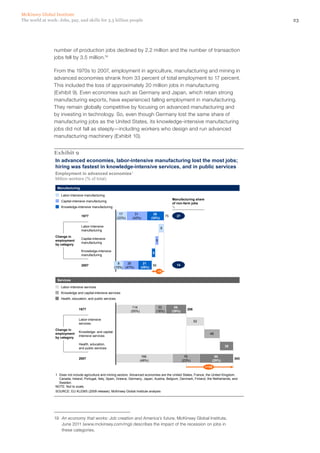
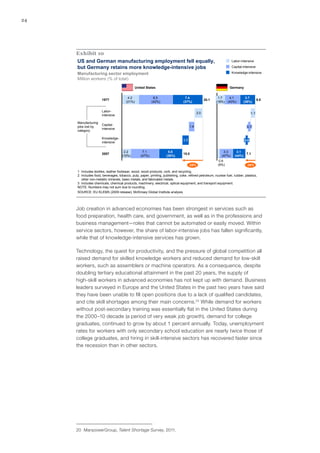
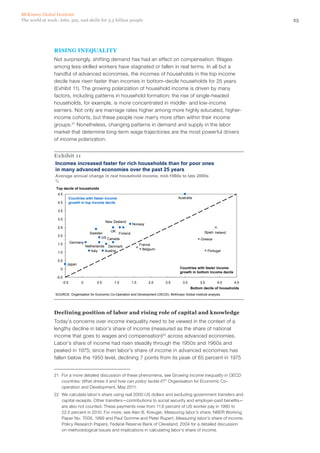
  • 69.
    McKinsey Global Institute Theworld at work: Jobs, pay, and skills for 3.5 billion people 57 4. A global agenda for skills and jobs The global economy faces two significant labor-market challenges: heading off a potential shortage of high‑skill workers needed to maintain high growth and productivity and finding ways to create employment opportunities for a rising number of low‑skill workers. These are daunting challenges for business leaders and policy makers. National governments will need to formulate long-range plans to address both supply and demand issues; they will need to raise the output of educational systems and eliminate barriers to job creation. In developing economies, governments will need to encourage expansion of sectors that employ low- and middle‑skill workers. Businesses operating in this skills-scarce world will need to dramatically step up their role in public education and training, invest in their own training programs, and develop innovative strategies to hire, train, and retain workers from under- leveraged labor pools, such as older workers and women. It will also be incumbent upon business to take a stronger role in shaping strategies that will improve their ability to compete in the global war for talent. A GLOBAL “EDUCATION REVOLUTION” To respond to the skills challenge in global labor markets, the traditional model for providing secondary and tertiary education will need to be transformed in both advanced and developing economies. Developing economies will be challenged to raise the capacity of secondary education systems and find ways to provide vocational training to new workers entering the labor market as well as to mid- career workers who lack the skills for 21st-century employment. The availability of teachers will be a constraint almost everywhere in the world and the capacity of governments to finance higher investments in education will be a limiting factor in many countries. Conventional methods of building educational and training capacity will likely not be sufficient. Innovation in the delivery of education and training will be required to raise the productivity of the education sector and maximize scarce resources. Private investment will need to play a more important role, especially in developing countries, and active collaboration will be required among stakeholders—businesses, governments, college and school systems, corporate social responsibility (CSR) donors, and employee associations—to ensure that scarce resources are deployed in line with the needs of job markets. Key areas that will need new solutions include: Raising secondary school capacity and attainment in developing countries Many developing countries in South Asia and Africa have succeeded in achieving near universal primary education in the past decade. The challenge now is to raise the number of students who continue on to secondary schools and to improve secondary school graduation rates, while not compromising quality (see Box 5, “South Korea’s achievements in education”). This will require significant
  • 70.
    58 investments in infrastructure. For example, to meet official targets for secondary school graduation rates, MGI estimates that India would need 82 million school seats by 2016, up from 48 million in 2009–10, or a growth rate of 8 percent each year, up from a historical rate of 5 percent. This may require new approaches to school construction using “design-to-cost” principles and private participation to supplement government resources. To meet the enrollment targets at current levels of productivity in education, India will also need to hire 1.2 million more secondary school teachers, almost doubling the current 1.5 million (as of 2009). That will require expanding the teaching corps by 9 percent each year, compared with 5 percent annually in the past. A radically different model will be required to produce the number of secondary school graduates with the skills that employers will need. The traditional academic curriculum would need to be redesigned to add more practical, job-oriented training. Schools could offer an optional vocational track that would also leave paths to higher education open. To meet the need for teachers, schools may need non‑traditional recruits, perhaps candidates with specialized knowledge of relevant skills, but with lower formal teaching qualifications. Private enterprise can play a role in this transformation—as investors in public-private partnerships, as service providers to help with curriculum development and teacher training, and as donors through corporate social responsibility initiatives. Box 5. South Korea’s achievements in education Between 1950 and 1990, Korea undertook a carefully planned expansion of its educational system, which was part of a broader economic development program. Through the 1950s, the nation expanded access to primary education and achieved universal primary education in the 1960s. Middle school education followed in the 1970s, and universal access to high school education in the subsequent decade. In the 1990s, Korea focused on expanding tertiary education, to support knowledge- and R&D- intensive manufacturing. Education was made job-relevant through the extensive promotion of vocational training and STEM disciplines. Vocational schools account for 25 percent of total secondary school enrollments, and nearly 75 percent of students completing vocational secondary education go on to tertiary education. Some 35 percent of college degrees awarded in 2008 were in STEM disciplines, a much higher ratio than many advanced economies. After raising the numbers of graduates at the secondary and tertiary levels, Korea turned to quality improvements. Korea continued to recruit more teachers, reducing class sizes to levels seen in advanced economies. Pay was improved and standard were raised. Today, new teachers typically come from the top third of their classes. In recent years, Korea has also introduced specialized high schools, increased investments in technology, and allowed schools greater autonomy in designing curricula and selecting teachers. As a result, Korea educational outcomes have placed it among the top five countries globally on various parameters, although the system can be criticized for not teaching creative thinking.
  • 71.
    McKinsey Global Institute Theworld at work: Jobs, pay, and skills for 3.5 billion people 59 Align education with employment demand Employers will need not just more workers with college degrees, they will need graduates with training in specific specialties, particularly in scientific and technical fields. In the past, advanced economies could count on immigrants to fill this gap. Immigrant workers were eager to train at universities in places like the United States and stay on to take high‑paying jobs. Now, ambitious young workers from developing economies can complete their technical training at home and find job opportunities, too. This will heighten the need for advanced economies to build home-grown supplies of high‑skill talent. Not only do the United States and other advanced economies need to increase the number of students who enroll in the more challenging disciplines in science, math, and engineering, but graduation rates must also improve. In the United States, for example, one-third of STEM majors drop out or switch to other majors. A weak grounding in mathematics in secondary school contributes to this.49 Targeted “booster” training can help students improve completion rates. For students who will not go on to college or who will go directly from high school to the workforce, job-specific training is essential. Programs can be designed to provide training and credentials for a specific occupation—welder or machinist, for example—through intensive, short-duration classes. This way, in three or six months, a young person could be ready for a first job and then continue his or her education part-time, rather than deferring work for two to four years while earning a degree. Vocational training can be focused on specific occupations, such as nursing aides, dental assistants, and medical technicians—jobs that require only certification or associate degrees. In the United States, demand for such workers is projected to grow at 1.8 to 2.9 percent per year to 2018, far higher than the 0.6 to 1.6 percent annual growth rate of jobs that are typically open to high school diploma holders. Making information available about what types of jobs are in demand is a critical step in helping young workers select the most useful training and raise their chances of employment. Comprehensive thrust on vocational education This applies both to skilled trades, such as welding or auto repair, and to fast- growing service sectors. Collaboration between hiring industries and training institutions is essential for making instruction job-relevant and creating a smooth school-to-work path. Secondary schools can offer full-credit, vocational tracks on an integrated basis with general education tracks to provide students the flexibility to switch at any stage. For instance, Australia’s VETiS (Vocational Education and Training in Schools) program is offered in more than 90 percent of higher secondary schools, enrolling about 40 percent of eligible students, or 230,000 students in 2010. The VETiS program allows senior secondary students in Australian schools to earn a nationally recognized vocational certification, while keeping all paths open to higher education. 49 Nearly half of high school seniors who are interested in STEM majors in college do not have STEM proficiency. See BHEF, Increasing the number of STEM graduates: Insights from the US STEM Education and Modeling Project, 2010.
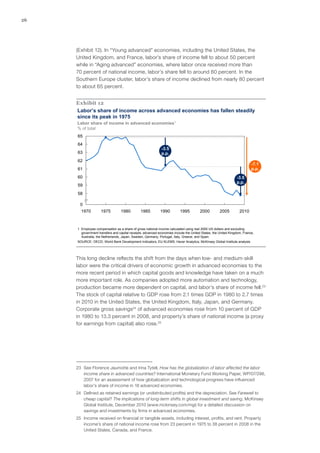
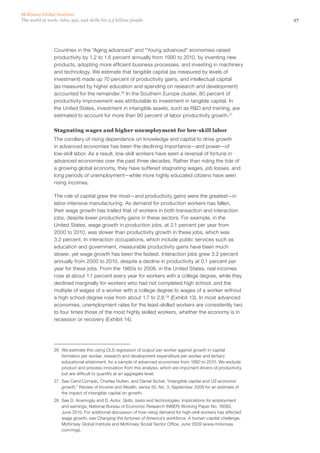
  • 72.
    60 Germany has an employer-led dual system of vocational training, catering to students leaving school after completing nine years of mandatory full-time schooling. 50 Under the dual system, vocational schools and companies jointly deliver vocational education and training. Students spend one or two days per week in vocational school and the remainder working for an employer. They also continue to earn credits that will keep them on a path to higher education—20 percent of students return to higher education after having completed training in dual system. Companies benefit by seeding the labor market with properly trained workers. About 70 percent of firms with more than 50 employees participate in this program. The program has helped Germany limit youth unemployment to half the OECD average. Post-secondary youth can also be trained by industry‑skill councils or by private training companies in collaboration with industry. In the United States, Bluegrass Commercial and Technical College, a community college in Kentucky, worked with Toyota to create a replica of an auto factory, where Toyota workers, students and workers from other manufacturing companies can attend classes before or after their shifts to participate in training and hands-on problem solving that prepares them for multi-skilled auto maintenance and production jobs. The National Skills Development Corporation (NSDC) in India is a public-private partnership company that focuses on funding and catalyzing skill building initiatives through industry skill-councils. Zhongzhi Beifang Automobile Vocational Training School is a private for-profit company in China that provides automotive vocational training to 100,000 students a year in partnership with major auto manufacturers. Mid-career workers who are most in need of retraining can gain access to skill- building programs by linking them to unemployment programs, as in Germany. Austria offers “intensive apprenticeship” programs to teach adult workers vocational skills in specific trades in modules that last one year, instead of three. Reaching the millions of unskilled adult workers in poorer countries (i.e., those with elementary education or less) will require innovative training models and focus on teaching the basics that employers demand: punctuality, communication with supervisors, teamwork, time-management, etc. In South Korea, adult “paraschools” are operated by social and non‑governmental agencies to offer short-duration literacy courses to low-skill adult workers.51 The Adult Basic Education and Training Institute at Unisa (a leading distance learning institution in South Africa) has trained more than 60,000 teachers to teach literacy, numeracy, English, trades, health, environmental science, and water and sanitation management. A “new technology” of education By adopting innovative technologies, educational institutions can reach millions of students at low cost. With more remote delivery of content, the role of the classroom can be transformed from a place where lectures are delivered to one where teachers interact with students face-to-face to guide them individually. Traditional bricks-and-mortar educational institutions already are adopting digital delivery methods to supplement their core classroom models (see Box 6, “Open 50 Federal Ministry of Education and Research, Germany’s vocational education at a glance, 2003. 51 See Better skills, better jobs, better lives: A strategic approach to skills policies, OECD Publishing, May 2012.
  • 73.
    McKinsey Global Institute Theworld at work: Jobs, pay, and skills for 3.5 billion people 61 access to education through digital platforms”). Online learning now gives millions of students access to the world’s best teachers and teaching systems, and can be customized to suit individual objectives. More complex aspects of learning, which require human interaction, can be provided remotely through interactive online features and occasional face-to-face interaction. Emerging models could be funded through a combination of corporate social responsibility grants, government grants, research grants, and at a later stage by private investors. Box 6. Open access to education through digital platforms Digital teaching models are evolving and world leaders in higher education and technology are coming together with entrepreneurs and educators to create learning and training systems that are tuition-free, online, and open- access. A range of innovations in education technology is in evidence from primary schooling to higher education. In primary and secondary education, not-for-profit Khan Academy offers over 3,200 videos on arithmetic, algebra, physics, finance, and a variety of other subjects to students, teachers, parents, home-schoolers, and adults returning to education. Its library of videos, interactive challenges, and assessments is offered free to millions of subscribers. Digital StudyHall (DSH), with support from Microsoft Research’s India Lab and India’s Digital Inclusion program, runs a program to improve education for poor children. In 2011, DSH ran pilot programs in which lessons in English, math, and science from the best grassroots teachers in India, Pakistan, and Nepal were recorded and distributed on DVDs to schools in poor rural areas and urban slums. Local teachers lead these video lessons in the classroom. Harvard University and the Massachusetts Institute of Technology (MIT) recently launched edX, a $60 million online learning venture for higher education. The not-for-profit joint venture builds upon MIT’s existing online learning platform, MITx, which runs courses for around 120,000 students worldwide. MIT founded its open education platform in 2002 through the OpenCourseWare project that put all educational materials from MIT’s undergraduate- and graduate-level courses online, partly free and openly available to anyone, anywhere. The OpenCourseWare project has more than 2,000 courses online, some of them with streaming video lecture content and interactive web demonstrations. The edX platform will offer a variety of learning methods: video tutorials, discussions, labs, online quizzes, and interactive learning. Other universities can use edX’s open-source platform to deliver high‑quality teaching remotely, and let their own professors concentrate on working face-to-face with students. The online, tuition-free University of the People (UoPeople), offers college degree programs in business administration and computer science. UoPeople, a nonprofit, has partnered with New York University and with Hewlett-Packard to open up virtual research internships for UoPeople students.
  • 74.
    62 CREATING MORE JOBS FOR LOW- AND MEDIUM‑SKILL WORKERS Even the most successful efforts to raise educational attainment, make curricula job-relevant, and retrain older workers will likely not eliminate the potential surplus of low- and middle‑skill workers. Advanced economies are projected to have inadequate job openings for about 38 million medium-skill workers by 2020. By raising educational attainment and providing targeted vocational training and retraining, perhaps 12 million of that notional surplus can be addressed. That would leave 25 million workers who would likely join the ranks of the unemployed or be consigned to subsistencies work. However, this surplus can be further reduced by raising demand in labor-intensive sectors. Creating demand for less‑skilled labor will also be critically important to developing economies. Advanced economies ƒƒ Reforms to promote job growth in non‑tradable sectors. Even in advanced economies, many sectors of the economy have jobs that cannot be automated or relocated: food preparation and serving, retail sales, construction, cleaning, and material moving. Demand for many of these occupations is projected to grow at a slower rate in coming years.52 Regulatory reform (for example, reviewing rules in health care that restrict the kind of work that can be performed by less skilled workers), and policies to promote demand for workers in labor-intensive industries such as hospitality (by simplifying visa processes for tourists) can help create jobs in these sectors. Retail is another sector that uses low- and middle-skill labor, but many countries still restrict retail store formats and hours, which limits the number of jobs that are created in the sector. ƒƒ “Marketization” of home production and elder care. According to US Bureau of Labor Statistics estimates, household chores and providing care for household members (i.e., “home production”) account for approximately 580 million labor hours per year of work in the United States. If 10 percent of this home production were turned over to full-time workers, it could generate six million to seven million low‑skill jobs by 2020, while freeing up time of high- skill workers. And as populations in the advanced economies age, there will be more demand for home-production services as well as for in-home health care services. “Marketization” is the process of transferring to the market the home production work that is now done by family members. Some form of tax incentive can accelerate the shift of home production work from family members.53 Germany, for example, encouraged marketization of household work with tax reforms in 2003, including tax deductions for employing legal domestic workers under its “mini-jobs” program for unemployed and marginally employed workers. 54 52 US Bureau of Labor Statistics, Occupational Outlook Handbook, 2008–18. 53 For an analysis of such incentives, see Liwa Rachel Ngai, and Christopher Pissarides, Taxes, social subsidies and the allocation of work time, Center for Economic Policy and Research (CEPR) Discussion Paper No. 8328, April 2011. 54 Mini jobs are part-time jobs paying up to €400 per month.
  • 75.
    McKinsey Global Institute Theworld at work: Jobs, pay, and skills for 3.5 billion people 63 In 2006, the Swedish government introduced a 50 percent tax deduction for wages paid for household services such as cleaning, washing, and child care. The tax break was later extended to include payments made to workers who cared for elderly relatives who lived in a different household. Separately, as part of a program to reduce the cost of running old age homes, municipalities have hired low-skill workers (often through private contractors) to help with household chores and provide in-home care, enabling the elderly to remain in their own homes. Additional incentives would be required in the United States and other advanced economies to transfer jobs in housekeeping, child care, and gardening from the “off-the-books” economy to the formal economy. This transfer would also create a market opportunity for professional services companies that could place, train, and supervise household workers. Sweden and Denmark used targeted child care supports to help convince women to remain in the labor force after childbirth. In addition to fulfilling the primary goal of raising female participation rates,55 the incentives helped create a large number of low‑skill jobs in child care. ƒƒ Subsidies for job preservation and creation. Government incentives can facilitate job creation for low-skill workers and reduce job losses in economic downturns. Germany, for example, has made the explicit decision to subsidize employment, rather than simply pay unemployment benefits to avoid the economic and social costs of high joblessness. This includes the mini-job program as well as the ‘Kurzarbeit’ job-sharing system. Job sharing encourages companies to reduce working hours to adjust for falling demand during economic downturns, rather than laying off workers. For up to 24 months, the government pays up to two-thirds of the lost income per worker and 100 percent of social security payments. This system has reduced mass layoffs, permitted employers to retain skilled workers, and avoided the prolonged unemployment that leads to loss of skills and decreases employment prospects. Developing economies ƒƒ Increasing employment in labor-intensive manufacturing. As labor markets evolve over the coming decades, opportunities will arise for countries to capture larger shares of the global economy’s labor-intensive jobs (Exhibit 37). Already, Vietnam, Indonesia, Bangladesh, and Cambodia are experiencing growth in labor-intensive industries, because of the cost advantages these nations now offer. Countries also create more jobs when they move up the value chain—exporting finished goods, rather than raw material or intermediate products. For example, China’s finished textile exports generate 2.5 times as many jobs per dollar of output as raw material exports. Similarly, 90 to 95 percent of Chinese rubber exports are now in the form of finished goods (e.g., tires) compared with only 15 to 20 percent of Indonesian rubber exports. Côte d’Ivoire and Ghana cut export taxes on processed foods, helping to raise the proportion of processed cocoa to 40 to 50 percent of exports in 2010, up from less than 10 percent in 2000. 55 At 87 percent, Sweden and Denmark have the highest labor participation rate for prime working-age women in advanced economies.
  • 76.
    64 Exhibit 37 With wages rising in China and India, other developing economies have an opportunity to gain share in global exports and create jobs Manufacturing labor cost per hour Nominal $ Compound annual growth rate, 2003–10 (%) Increase in Increase in labor cost value-added per hour per employee 1.8 China 161 141 1.6 1.4 India 8 17 1.2 1.0 0.8 0.6 Vietnam 92 92 Nigeria 143 153 0.4 Indonesia 7 12 0.2 0 2003 04 05 06 07 08 09 10 1 2003–09. 2 2005–10. 3 2003–07. SOURCE: Economist Intelligence Unit; Global Insight; country labor ministries; McKinsey Global Institute analysis ƒƒ Removing barriers to growth and job creation: Many developing economies fail to maximize growth in export sectors because of rigidities in business environments. For example, it takes 119 days to start a new business in Brazil compared to 6 days in Malaysia. The cost of registering a new business is equivalent to 71 percent of the annual per-capita income in Nigeria, compared with 6 percent in Thailand. High shipping costs are another barrier to export- led job creation; it can cost twice as much to ship from India and some other developing nations than from China, for example.56 By building cold storage, processing, and packaging capacity, and by upgrading the food retail sector, developing nations can pave the way toward a stronger domestic food industry that would create low-skill jobs. ƒƒ “Frugal innovation” in products and services. Frugal innovation involves minimizing cost of production and distribution to give many more people access to a range of products and services. In developing economies, mass- market businesses have created employment for millions of local workers, often with little formal education, as part of their programs to reach consumers in rural villages and in poor urban areas. For example, the introduction of “top- up” vouchers helped bring telecom services to low-income groups in India and led to millions of jobs for local agents and mobile repair shop owners. As the mobile subscriber base in India increased from five million in 2001 to 890 million in 2011, the industry added an estimated eight million to ten million jobs. In sub-Saharan Africa, mobile penetration increased from 0.3 percent in 1998 to 33 percent in 2008 and is estimated to have created 3.5 million jobs. In the consumer sector in India, Unilever created a low-cost distribution model to reach consumers in villages, which generated at least 68,000 rural jobs for distribution agents, three-quarters of them for women. 56 World Bank, Doing Business report, 2012.
  • 77.
    McKinsey Global Institute Theworld at work: Jobs, pay, and skills for 3.5 billion people 65 ƒƒ Lowering barriers to housing and infrastructure projects. Urbanization is a powerful engine of job growth in developing economies. India and China’s construction sector generated 24 percent of job growth from construction in the past decade (see Box 7, “Potential to create jobs in India’s construction sector”). With forward and backward linkages to industries such as cement and steel production, every job in construction has a multiplier effect. Many developing economies can unlock the potential of the construction sector to create jobs by removing barriers along the value chain of creating projects, awarding contracts, securing funding, and obtaining regulatory clearances, and implementation. Box 7. Potential to create jobs in India’s construction sector We estimate that India’s infrastructure and housing sectors can create 3.6 million more jobs for workers each year (than would be created under current projections) if the country accelerates investments in infrastructure and affordable housing beyond historical rates—and focuses on getting planned projects completed. From 2009 to 2011, just 27 percent of planned national highway contracts were actually awarded. India’s urbanization (including the modernization of existing cities) has been held back by a slow rate of construction of low-cost housing. In previous work,1 MGI found that the housing shortage would grow from seven million units in 2007 to 38 million in 2030, with India fulfilling just 25 percent of demand for affordable housing. Various factors impose barriers to the progress of infrastructure and housing construction projects. Slow and centralized approval processes, inflexible bidding mechanisms, frequent policy changes leading to redrafting and reworking of RFQ documents, and lack of development of raw material linkages limit award of projects. Delays due to slow land acquisition processes and weak dispute resolution affect the execution of awarded projects. Resolving these issues can create a significant number of construction jobs in infrastructure and housing construction. We estimate that an additional 1.3 million workers would find work directly in the construction sector each year if India increased its planned rate of expansion in power and roads by 50 percent. Similarly, achieving half of India’s demand for affordable housing by 2030 would create jobs for 0.7 million more construction workers each year. With a multiplier of 1.8 jobs in forward- and backward-linked sectors (e.g., cement and steel production) for every one job in construction, India could create 3.6 million more jobs by removing barriers to growth in the infrastructure and urban housing sectors. 1 McKinsey Global Institute, India’s Urban Awakening: Building inclusive cities, sustaining economic growth, 2010.
  • 78.
    66 WHAT BUSINESS CAN DO Our projection of a deficit of high‑skill workers implies an intensifying global war for talent. Businesses that hone their abilities to source and develop talent will gain strategic advantage in their industries; companies that fail to attract and retain the strongest talent will be at risk. Beyond meeting their own skill needs, businesses can play a more active role in mitigating the economic and social consequences of surpluses of low- and medium‑skill workers. Finally, the likely explosion of demand for education and training all over the world will open investment and business development opportunities. ƒƒ Understand individual labor markets to craft a competitive global labor footprint. In a global labor market, companies will need to anticipate trends in education, aging, and wages in order to fine-tune foreign direct investment (FDI), recruitment, and offshoring strategies. In addition to sizing pools of appropriately skilled workers, companies will need to assess the quality of national educational systems and the market dynamics that determine wage differentials. This analysis will become increasingly granular, down to knowing the number of college graduates and workers with specific training in cities around the world. Firms can gain advantage by using this data to create their own maps of global skills supply, which will inform decisions about where to invest. ƒƒ Take an active role in public education and training systems. India’s IT industry learned early on that it needed to shape the curricula at engineering colleges and provide on-campus training to ensure that students got the skills they needed. Companies can play a larger role in shaping educational content in colleges. For example, they can help develop specific requirements tied to real-world job requirement in STEM education, or design medical technology and health care certification courses in community colleges that fit their needs. The “Great Minds in STEM” initiative, funded in part by Boeing, is committed to increasing STEM education attainment among Hispanic students in the United States through an extensive community and school outreach program. ƒƒ Participate directly in the education sector. The education and training industry is large and has strong growth potential. With total educational spend of about $2.7 trillion, it accounted for about 4.25 percent of the world’s GDP in 2010. Private-sector players will have opportunities from rising demand in segments not well covered by the public education system (e.g., adult education and vocational training). For example, Anhanguera, Brazil’s leading for-profit professional education company, has become the largest post- secondary education institution in the country. Its 73 campuses handle more than 400,000 students per year in vocational and training programs. It also has 500 distance-learning centers. ƒƒ Shift investments in technology and innovation from labor-saving strategies to skill-saving ones. Technology innovators have been very successful in developing solutions to optimize labor costs. In a skills-scarce world, the focus will need to shift to making the most of the skills that workers have. Technologies that substitute skills make workers more productive. For instance, companies in retail trade that invested in bar-coding devices made their staff at check-out counters more efficient. In other cases, technology can help reduce the level of education or skill required to perform a job. Smart technology devices used by low‑skill workers can equip them to
  • 79.
    McKinsey Global Institute Theworld at work: Jobs, pay, and skills for 3.5 billion people 67 perform more high‑skill jobs. For example, 20,000 less-skilled workers are now working as rural banking agents in Southern India, as part of a financial inclusion program, disbursing payments via smart cards, cell phones and kiosks. Crowd-sourcing, meanwhile, is emerging as a viable work model for finding workers to perform routine “micro-tasks.” For example, Amazon’s Mechanical Turk, an Internet marketplace, enables businesses to hire workers to perform simple tasks such as writing product descriptions or identifying people in photographs. Such a platform could also be deployed for high‑skill work. Open innovation platforms like InnoCentive’s challenge platform and TopCoder, an online competitive community for software development and digital asset creation, represent another model, geared more toward high‑skill workers. ƒƒ Offer flexible work and compensation structures for older workers. Companies can take steps to retain the skills and institutional knowledge of their older employees, while accommodating their lifestyle preferences. Instead of losing experienced workers overnight to full retirement, companies can give older workers the option to cut back to part-time and work remotely. In Japan, Toyota has a re-employment program under which about half of all retiring employees are rehired, in new half-time roles at Toyota or in affiliate companies, with compensations reset to reflect their part-time roles. ƒƒ Improve productivity of knowledge workers. Companies also have an opportunity to address potential skill gaps by rethinking how their organizations work so they can do more with fewer knowledge workers. Compared with other occupations, professional and managerial work has not received as much attention in corporate productivity efforts as more labor- intensive occupations. According to MGI research that is under way,57 by using social platforms as a primary way to communicate and collaborate, large organizations could realize improvements in knowledge-worker productivity in the region of 20 percent. This would come from vastly reducing the time it takes to write and answer emails, eliminating lengthy searches for internal knowledge and expertise, and other tasks that consume the equivalent of a day’s work per week. So far, few corporations have been willing to commit fully to social technologies, which require a level of open communication and information sharing that challenges existing norms. ƒƒ Shape corporate social responsibility initiatives around employment priorities. Companies can focus CSR efforts on the issues of youth unemployment and the challenge of bringing the long-term unemployed back into the workforce, The beverage company Diageo, for example, set up Tomorrow’s People, a UK-based charity that has helped more than 400,000 long-term unemployed find jobs, education, or training. Three-quarters of the people it helps place remain employed after a year. Diageo supported the charity, now an independent entity, with investments of nearly $40 million, jobs in Diageo-owned businesses, and operational help. 57 This research is due to be published in an MGI report on the impact of social technology in the summer of 2012 (www.mckinsey.com/mgi).
  • 80.
    68 * * * Throughout the 20th century, industrialization, innovation, and advances in technology resulted in record wealth creation and rising living standards across advanced economies, which globalization has shared with developing economies in the past 30 years. Work itself evolved. It takes less human labor to grow food and build products, but it takes more human knowledge and ingenuity to innovate, raise productivity, and manage complex systems. As the 21st century unfolds, we see that too many of the world’s workers are not properly prepared for the evolving global labor market. We also see that the resulting skill gaps could create large imbalances that may lead to undesirable outcomes. Rising income polarization, growing pools of unemployed or under-employed workers, and soaring social costs are real possibilities—and could place a permanent drag on growth and retard progress in living standards. To keep such possibilities from becoming realities, policy makers, business leaders, and workers themselves must find ways to bring education, training, and job creation into the 21st century.
  • 81.
    McKinsey Global Institute Theworld at work: Jobs, pay, and skills for 3.5 billion people 69 Appendix: Technical notes These technical notes provide more detail of definitions, data, and methodologies used in this report. We address the following points: 1. Rationale for building independent perspectives on labor supply and demand 2. Data sources 3. Classification of countries 4. Projecting labor supply 5. Projecting labor demand 1. RATIONALE FOR BUILDING INDEPENDENT PERSPECTIVES ON LABOR SUPPLY AND DEMAND We build independent perspectives on the future evolution of demand and supply of labor by skill levels of labor force participants. Supply of labor is defined as the number of working-age people (aged 15 years and older) who are willing to work, adjusted for the rate of unemployment. Demand for labor is defined as the number of jobs required to deliver a certain output level, assuming a certain level of labor productivity. Supply and demand for labor always match in history. When we project supply and demand over a ten- or 20-year time frame, we use the natural rate of unemployment to project supply. In the long run the natural rate of unemployment is assumed to be the rate of unemployment at which supply is equal to demand. Imbalances that we project at a skill level are thus notional—they will never really materialize. Market forces and changes in behavior are likely to rebalance supply and demand in the long term. A surplus of labor in a certain skill category can be corrected by workers in that category opting out of the labor force. Wages can fall to the point where employers can get a desired quantity of output for a desired cost. Or output can be reduced to reflect a tight or too costly labor supply. Skill shortages can be corrected through higher wages, which will attract more workers with the needed skills; eventually, as supply rises, wage growth will slow. Notional imbalances can also be addressed through trade and offshoring. Modeling “imbalances” is a useful methodology to frame a discussion about the implications of current demand and supply trajectories for labor markets a decade or more in the future.
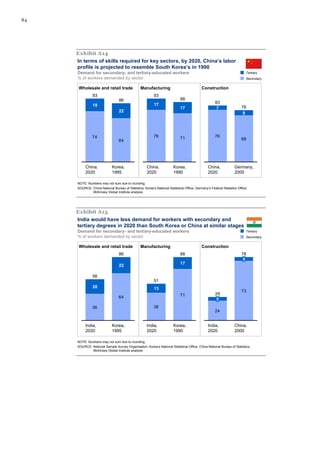
  • 82.
    70 2. DATA SOURCES We use data on population from the United Nations Population Division, 2010 revision, for the period of 1980 to 2030. For labor force participation rates, we use ILO LaborSta. Our data on national and sector GDP come from McKinsey’s Global Economic Growth database and three external sources: Global Insight, Oxford Economics, and the Economist Intelligence Unit. For educational attainment, we use estimates from the International Institute for Applied Systems Analysis (IIASA) of the share of working-age population in four education buckets (no schooling, primary, secondary, and tertiary) for the 1980 to 2030 period. Additional data sources extensively used include the World Bank for various socioeconomic indicators (e.g., GINI index), the United Nations for several demographic variables (e.g., median age, average marriage age, average maternal age, total fertility count), OECD for metrics on advanced economies (e.g. retirement ages), and EU KLEMS for detailed sector-wise breakdown of output, employment, and labor compensation for the OECD countries. For China’s labor model, we use the China census data, China National Bureau of Statistics, other government sources such as the Ministry of Education, and MGI’s China Urbanization database. For India’s labor model, we use India census data, National Sample Survey Organization’s Employment and Unemployment Survey (1993, 2000, 2005, 2008, and 2010), Ministry of Human Resources Development, and other sources such as IndiaStat and Barro-Lee. Our work on the US labor model uses data from the US Bureau of Labor Statistics, while that for France makes extensive use of data from France’s INSEE (National Institute of Statistics and Economic Studies). 3. CLASSIFICATION OF COUNTRIES Our global labor supply and demand model covers 70 countries, accounting for 87 percent of world population and 96 percent of world GDP. To develop a meaningful way of analyzing these diverse countries, we classify them into eight clusters based on three key labor market characteristics: GDP per capita, median age, and an education index based on estimates of the average years of schooling of the working-age population in 2010. Our data on GDP per capita are based on consensus estimates from Global Insight, the Economist Intelligence Unit, and Oxford Economics, and on median ages from the United Nations. We calculate the education index using the shares of working-age population at each educational attainment level, and provide weights reflecting years of schooling each level implies. These are approximations of years of schooling and therefore should be interpreted as relative measures of aggregate educational attainment rather than absolute levels of schooling. Using these parameters, we classify countries into eight distinct clusters:
  • 83.
    McKinsey Global Institute Theworld at work: Jobs, pay, and skills for 3.5 billion people 71 ƒƒ 636 million workers in the four advanced economy clusters. Of these, three clusters, comprised of countries with GDP per capita greater than $20,000, are described as “advanced economies” throughout this report. The fourth cluster, “Russia and Central and Eastern Europe,” shares many characteristics with the more advanced economies, but average per capita GDP is not greater than $20,000. —— The “Aging advanced” cluster comprises 145 million workers in ten countries. The working-age populations of these countries have median ages of 41 years or higher and education indices of greater than 11. Their GDP per capita was between $30,000 and $45,000 at PPP 2005 levels in 2010. Countries classified as “Aging advanced” are Japan, Germany, the Netherlands, Belgium, Sweden, Austria, Switzerland, Hong Kong, Denmark, and Finland. —— The “Young advanced” cluster comprises 290 million workers in 11 countries. The working-age populations of these countries have median ages lower than 40 years and education indices of greater than 11. Their GDP per capita was between $25,000 and $50,000 at PPP 2005 levels in 2010.58 Countries classified as “Young advanced” are the United States, France, the United Kingdom, South Korea, Canada, Australia, Israel, Singapore, Norway, Ireland, and New Zealand. —— The “Southern Europe” cluster comprises 60 million workers in four countries. The working-age populations of these countries have median ages of 41 years or higher59 and education indices of nine to 11 years. GDP per capita in 2010 was between than $20,000 and $30,000 at PPP 2005 levels. Countries classified as the Southern Europe cluster are Italy, Spain, Greece, and Portugal. —— The “Russia and Central and Eastern Europe” cluster comprises 141 million workers in eight countries. The working-age populations of these countries have median ages over 35 years and education indices of greater than 10. Their GDP per capita was between $10,000 and $20,000 in 2010.60 Countries classified as the “Russia and Central and Eastern Europe” cluster are Russia, Ukraine, Poland, Romania, Czech Republic, Hungary, Slovakia, and Croatia. ƒƒ 2.2 billion workers in four developing economy clusters, each with GDP per capita less than $20,000 61 at a 2005 PPP level. —— China comprises 783 million workers. Its working-age population has a median age of 35 years and its education index is ten in 2010. Its GDP per capita was around $6,700 at 2005 PPP levels in 2010. —— India comprises 469 million workers. Its working-age population has a median age of 25, and its education index is seven in 2010. Its GDP per capita was around $3,100 at 2005 PPP levels in 2010. 58 With the exception of South Korea ($22,297). 59 With the exception of Spain (40.2 years). 60 With the exception of the Czech Republic ($23,485) and Ukraine ($6,000). 61 With the exception of United Arab Emirates ($28,540).
  • 84.
    72 —— The “Young middle-income” cluster comprises 640 million workers in 24 countries. The working-age populations of these countries have median ages between 22 and 35 years and education indices of eight to 11 in 2010.62 Their GDP per capita was greater than $3,000 and less than $20,000 at PPP 2005 levels in 2010. 63 Countries classified as part of this cluster are Brazil, Mexico, Colombia, Argentina, Venezuela, Peru, Chile, Nicaragua, Iran, Egypt, Algeria, Saudi Arabia, United Arab Emirates, Jordan, Indonesia, Vietnam, the Philippines, Thailand, Turkey, South Africa, Malaysia, Sri Lanka, Kazakhstan, and Botswana. —— The “Young developing” cluster comprises 322 million workers in 11 countries. The working-age populations of these countries have median ages lower than 25 years, and education indices of less than nine in 2010. Their GDP per capita was less than $3,000 at PPP 2005 levels in 2010.64 Countries classified as the “Young developing,” mainly from South Asia and sub-Saharan Africa, are Pakistan, Bangladesh, Nigeria, Ethiopia, Tanzania, Kenya, Morocco, Uganda, Ghana, Mozambique, and Côte d’Ivoire. 4. PROJECTING LABOR SUPPLY Estimating aggregate employable labor force Supply of labor is defined as the number of working-age people (aged 15 years and above) who are willing to work, minus the number of workers who are unemployed. To estimate the labor supply projections used in this report, we build a model of labor force participation rates for each of six age and gender cohorts in each country, apply these to population estimates from the United Nations, and adjust for estimated natural unemployment rates. We then estimate the educational mix of the projected supply using a combination of available estimates of population-level educational attainment and our model of labor force educational attainment. We focus on two periods, the decade up to 2020, and the subsequent decade to 2030. We use the following labor supply relationship to define the employable labor force: Employable labor force = Working-age population × labor force participation rate × (1 – natural unemployment rate) We apply this approach to world population, as represented by our sample of 70 countries in 2010, to estimate the total employable labor force. These countries represent a total population of 6.0 billion people, 4.5 billion of whom are of working age. Of the working-age population, 62 percent are employed or willing to work, resulting in a labor force of 2.9 billion. Unemployment takes away 0.2 billion potential workers worldwide to leave an employed labor force of 2.7 billion in 2010 (Exhibit A1). 62 With the exception of Kazakhstan (12.5 years education index). 63 With the exception of United Arab Emirates ($28,540). 64 With the exception of Morocco (GDP per capita of $7,095 and median age of 26.2 years).
  • 85.
    McKinsey Global Institute Theworld at work: Jobs, pay, and skills for 3.5 billion people 73 Exhibit A1 Labor supply overview—global aggregate Detailed further Global labor supply, 2010 Billion workers Sources of data and methodology used Total 6.0 population Population United Nations Population division (2010 revision) for the entire 1.5 <15 years time period Working age population, 4.5 15+ years Not Difference between the forecast population and the labor force 1.7 participating Gender and age cohort participation rates applied to population Total ▪ Historical participation rates from ILO labor force 2.9 ▪ Forecast participation rates are modeled on the basis of demographic, educational and cultural factors; calibrated against external forecasts Unemployed 0.2 labor force Unemployment rates from Global Insight applied to the labor force Employed 2.7 Difference between total labor force and the unemployed labor force labor force SOURCE: United Nations Population Division (2010 revision); ILO; local statistics for China and India; McKinsey Global Institute analysis We use this relationship to estimate the employable labor force for each country from 1980 to 2010, using the actual rate of unemployment each year. We use the same identity to project employable labor force growth from 2010 to 2030 for each country, assuming that the natural rate of unemployment will prevail in the long term. For the United States and France, we use detailed labor supply projections from previous MGI studies.65 For India and China, we build bottom- up country-level estimates of these numbers using a combination of government data and global data sources. For the other 66 countries, we draw exclusively on global data sources. For population, we use forecasts from the United Nations Population Division, 2010 revision (medium variant), for both historical and forecast time period 1980–2030. We estimate labor force participation rates using a methodology described in the following section. We then estimate the unemployed proportion of the labor force using estimates of the natural rate of unemployment from Global Insight. Our projections suggest that all clusters will experience slower growth rates in labor force in the decades to come, even as the deceleration of labor force growth in the advanced economies and China will be the most significant (Exhibits A2 and A3). 65 French employment 2020: Five priorities for action, McKinsey Global Institute, March 2012; and An economy that works: Job creation and America’s future, McKinsey Global Institute, June 2011 (both available at www.mckinsey.com/mgi).
  • 86.
    74 Exhibit A2 Projected global labor force growth across clusters Global labor force, advanced clusters Million workers Compound annual growth rate (%) 1990–2010 2010–2030E 350 Young Advanced 300 0.6 1.0 250 200 0.4 -0.2 150 Aging Advanced -0.2 Russia & CEE 100 -0.5 Southern Europe 50 1.1 -0.0 0 1990 1995 2000 2005 2010 2015 2020 2025 2030 SOURCE: United Nations Population Division (2010 revision); ILO; McKinsey Global Institute analyses Exhibit A3 Projected global labor force growth across clusters Global labor force, advanced clusters Million workers Compound annual growth rate (%) 1990–2010 2010–2030E 900 China 0.5 800 Young 0.9 Middle-Income 1.1 700 India 600 1.6 2.3 Young 500 Developing 1.7 2.3 400 300 2.9 200 100 0 1990 1995 2000 2005 2010 2015 2020 2025 2030 SOURCE: United Nations Population Division (2010 revision); ILO; McKinsey Global Institute analyses
  • 87.
    McKinsey Global Institute Theworld at work: Jobs, pay, and skills for 3.5 billion people 75 Estimating labor force participation rates To project the labor force participation rates, we divide the countries into three groups based on broad stages of development, and estimate participation drivers for each age and gender cohort. Ordinary least squares (OLS) regressions are used for each gender and age cohort to identify historical drivers of participation rates, and projected values of these independent variables are then applied to these regression equations to estimate participation rate in the future. Finally, we validate our projections of labor supply, aggregated across age and gender cohorts, against projections of total labor force by Oxford Economics, the Economist Intelligence Unit, Global Insight, and the ILO.66 Based on this methodology, we project a 1.7 percentage point decline in the global labor force participation rate through 2030. Most of this decline is a function of the aging population structure. We estimate that the global labor force participation rate would decline by 1.2 percentage points based on 2010 age and gender cohort levels. For instance, the share of older people (i.e., older than 55 years) is projected to increase from 23 percent of the global working-age population currently to 31 percent by 2030. People in this age cohort have an estimated participation rate of 39 percent, compared with 80 percent for the prime working- age population (Exhibit A4). Exhibit A4 Aging is projected to drive a decline in the global labor force participation rate by 2030 Global aggregate Drivers of change in labor force participation rate Composition of working-age population % of working-age population %; billion Labor force participation 100% = 4.5 5.6 rate (%) Labor force participation 63.6 Older 2010 2010 rate, 2010 23 (55+) 31 39 44 Impact of aging 1.2 Prime 55 (25–54) Changes in 51 80 80 participation 0.5 rates within age- gender cohorts Young Labor force 22 18 49 42 (15–24) participation 61.9 rate, 2030E 2010 2030E NOTE: Numbers may not sum due to rounding. SOURCE: China National Bureau of Statistics, United Nations Population Division (2010 revision), McKinsey Global Institute analysis The participation rates in each age and gender cohort are influenced by a diverse set of drivers. Overall, we project that the participation rate of the young segment will decline as more young people seek higher education, while that of older workers is projected to increase, as they stay in the labor force longer to augment retirement savings. Participation rates for prime working-aged women are likely to hold steady at a global level; rates will likely decline in developing economies that are transitioning to higher income and education levels and will likely increase in the advanced economies (Exhibit A5). 66 We use this approach since most other estimates are either less granular or have a shorter- term horizon than the focus of this report.
  • 88.
    76 Exhibit A5 Projected trends in global participation rates by age and gender Modeled Labor force participation rate, global % of 15+ population Young men Young women 15–24 Period change Prime working-age men Prime working-age women 25–54 Percentage point s Older men Older women 55+ 1990–2010 2010–30 100 4.5 0.0 90 80 70 -0.7 -0.4 60 -2.3 5.1 50 -11.4 -8.1 40 -15.1 -5.4 30 4.2 3.8 20 1990 1995 2000 2005 2010 2015 2020 2025 2030 SOURCE: United Nations Population Division (2010 revision); ILO; local statistics for India and China; McKinsey Global Institute analysis ƒƒ Young workers, aged 15 to 24 years: Higher educational attainment and rising income are the key factors that drive labor participation rates across countries. Rising national levels of secondary and tertiary education result in a lower participation rate during these years, because young people remain in school longer rather than entering the workforce. Also, as incomes rise, families can afford for their children to pursue higher education, rather than contribute to family income. In addition, favorable social norms (e.g., rise in marriage age), improves participation among young women in developing countries.67 ƒƒ Prime working-age workers, aged 25 to 54 years: Across countries, higher education and rising income levels are the main drivers of rising participation for male workers in this age cohort. More education imparts more skills and enhances job opportunities. As incomes and overall economic activities in a nation rise, employment opportunities also increase. Additionally, a rising share of trade in overall national output (e.g., in nations such as China, Latin America, and the Middle East) generates employment opportunities and drives up participation. In poorer countries, growth in the share of labor-intensive agriculture and service sectors boosts participation rates. Like men, prime working-age females increase their participation with higher educational attainment. However, cultural norms also affect participation decisions of prime working-age female workers. In advanced economies, higher ages of child bearing and the rising availability of part-time work options boost participation. In developing countries, higher marriage ages and lower fertility 67 Alessandra Fogli and Laura Veldkamp, Nature or nurture? Learning and the geography of female labor force participation, Econometrica Vol. 79, No. 4, July 2011.
  • 89.
    McKinsey Global Institute Theworld at work: Jobs, pay, and skills for 3.5 billion people 77 rates (i.e., number of children born per woman) drive an increase in the participation rate.68 ƒƒ Older workers, aged 55 years and more: The most critical driver of participation among senior people is the economy’s rate of aging, measured as the share of working-age population aged 55 years and over. A greater share of older people in the population leads to higher economic need for seniors to work. Particularly in advanced economies, the rate of aging, along with higher life expectancy and rising retirement ages, tends to increase the participation rates of older workers. In developing countries, as income levels rise out of subsistence, older workers have improved opportunities for retirement and leisure, and thus senior participation rates tend to drop with higher income levels.69 Estimating the educational attainment of labor supply Having projected employable labor force, we then project the educational attainment rates of our estimated labor force. Again, for the United States, France, China, and India, we build detailed educational attainment models for secondary and tertiary attainment of the working-age population, based on past and estimated future gross enrollment ratios and completion rates for key age and gender cohorts, as well as official government estimates and targets. For the other countries in our sample, we use IIASA estimates of educational attainment for the entire 1980–2030 period. This method assumes constant participation rates across different education levels. For China and India, we conduct a bottom-up estimation of the educational attainment. First we compute the number of people currently enrolled by multiplying gross enrollment ratios with population in the corresponding age bucket. Next, we divide the people enrolled by average number of course years and adjust for dropouts to estimate yearly flows. Finally, we add this to the previous year’s stock and adjust for mortality to calculate next year’s stock. These projections suggest that the share of the working-age population with tertiary education in the advanced economies will rise to 31 percent by 2030, from 24 percent in 2010 (Exhibit A6). China is likely to have 2.5 times as many college graduates in 2030 as it did in 2010, despite only a 14 percent rise in the working-age population over this period (Exhibit A7). India, aided by both expanding cohorts of young people as well as increasing attainment, is projected to triple the number of citizens with tertiary education and almost double the number of people with a secondary education by 2030. However, the share of people with primary education or less will stay high, at 55 percent (Exhibit A8). All other economies70 in aggregate are likely to see a 60 percent increase in their share of population with secondary or higher educational attainment, but with a continued large share (37 percent) with primary schooling or less education (Exhibit A9). 68 Saul D. Hoffman, “The changing impact of marriage and children on women’s labor force participation,” Monthly Labor Review, Vol. 132, No. 2, 2009 and Julie L. Hotchkiss, “Changes in the aggregate labor force participation rate,” Federal Reserve Bank of Atlanta Economic Review, Vol. 94, No. 4, 2009. 69 Martin O’Brien, “Older male labour force participation in OECD countries: Pension reform and ‘The Reserve Army of Labour,’” International Labour Review, Vol. 149, No. 3, 2011. 70 Includes Young developing, Young middle-income, and Russia and Central & Eastern Europe clusters.
  • 90.
    78 Exhibit A6 By 2030, the number of workers with tertiary education in advanced economies is projected to rise to 31 percent Composition of labor force1 %; million workers 100% = 491 520 Tertiary 24 31 Secondary 65 62 Primary or lower 11 7 2010 2030E 1 Includes Young Advanced, Aging Advanced and Southern Europe clusters. NOTE: Numbers may not sum due to rounding. SOURCE: United Nations Population Division (2010 revision); ILO; IIASA; local statistics for India and China; McKinsey Global Institute analysis Exhibit A7 China is projected to have about 2.5 times as many workers with tertiary education in 2030 as it had in 2010 Composition of labor force %; million workers 100% = 783 861 Tertiary 8 19 Secondary 61 63 Primary or lower 31 18 2010 2030E NOTE: Numbers may not sum due to rounding. SOURCE: United Nations Population Division (2010 revision); ILO; IIASA; local statistics for India and China; McKinsey Global Institute analysis
  • 91.
    McKinsey Global Institute Theworld at work: Jobs, pay, and skills for 3.5 billion people 79 Exhibit A8 India is projected to triple the college graduates in its labor force by 2030 and nearly double secondary school graduates Composition of labor force %; million workers 100% = 469 643 Tertiary 8 20 Secondary 19 26 Primary or lower 72 55 2010 2030E NOTE: Numbers may not sum due to rounding. SOURCE: United Nations Population Division (2010 revision); ILO; IIASA; local statistics for India and China; McKinsey Global Institute analysis Exhibit A9 In developing economy clusters the number of workers with secondary or higher education is projected to grow by 60 percent Composition of labor force1 %; million workers 100% = 928 1,263 Tertiary 10 14 Secondary 39 49 Primary or lower 51 37 2010 2030E 1 Includes Young Middle-Income and Young Developing clusters NOTE: Numbers may not sum due to rounding. SOURCE: United Nations Population Division (2010 revision); ILO; IIASA; local statistics for India and China; McKinsey Global Institute analysis
  • 92.
    80 5. PROJECTING LABOR DEMAND Estimating aggregate labor demand Demand for labor is defined as the number of jobs required to deliver a certain GDP level, assuming a certain level of productivity (output per worker). We assume that countries need to reach a targeted level of GDP growth, which they achieve through a combination of productivity and job growth. We use the following labor demand relationship to project future employment demand: Labor demand = (Output ÷ Labor force productivity) While we project labor supply for all 70 countries in our sample, we project labor demand for a smaller set of countries. For our four deep-dive countries, we use this labor demand formula to estimate aggregate labor demand on a sector-by- sector basis, and for other advanced economies, we build a top-down broad estimate of aggregate labor demand. For the United States and France, we use detailed sector-level labor demand projections from previous MGI studies. For China and India, we build a model to project labor demand at a sector level, described below. For other advanced economies, we project aggregate demand using top-down GDP growth forecasts from Global Insight, Oxford Economics, and the Economist Intelligence Unit, along with a range of productivity growth rates that are +/- 5 percent of historical growth rates. Finally, we estimate labor demand for non‑farm sectors broadly for the “Young developing” nations, by assuming this is equivalent to their growth in labor supply. For China and India, we build detailed bottom-up projections of labor demand at a sector level. First we project total output using a range of GDP forecasts, including forecasts from Global Insight, Oxford Economics, the Economist Intelligence Unit, and McKinsey’s Global Growth Model. We then translate these output assumptions into sector-level output growth forecasts within each country, by aligning sector output forecasts obtained from Global Insight to match with aggregate economy growth rates (obtained from consensus of above sources). For each sector, we develop an estimate of likely productivity growth. For key sectors such as agriculture, manufacturing, and construction, which account for almost two-thirds of global employment, we build sector productivity estimates using independent variables such as capital intensity, and sector- specific variables such as the size of agricultural landholding for agriculture, the share of manufacturing in the organized manufacturing sector, and the share of construction in residential housing for the construction sector. For other sectors, we project productivity by examining the historical trend in the relationship between output growth and productivity growth, which we check using cross- country benchmarks. Based on these projections, we derive labor demand for each sector as an outcome of output growth, less productivity growth. These projections suggest that productivity gains are likely to drive some 60 percent of global GDP to 2030 (Exhibit A10). For China and India, the share of productivity is likely to be even higher.
  • 93.
    McKinsey Global Institute Theworld at work: Jobs, pay, and skills for 3.5 billion people 81 Exhibit A10 Productivity gains are projected to drive 60 percent of the future output growth in advanced economies Growth of labor demand, advanced economies, 2010–30E1 Compound annual growth rate, % Sources of data and methodology used GDP 2.2 ▪ Consensus of estimates from Oxford Economics, Global Insight, and Economist Intelligence Unit, as of July 2011 ▪ History: Calculated as GDP per employed person Labor ▪ Forecast: Range of scenarios modeled using 0.95-1.05 times 1.3 productivity historical productivity CAGRs for the 1990–10 period ▪ History: From ILO Employment 0.9 ▪ Forecast: Calculated as the difference between growth rate of GDP demand and labor productivity2 1 Includes Young Advanced, Aging Advanced and Southern Europe clusters. 2 All estimates at a sector-level for the United States, France, China, and India. SOURCE: United Nations Population Division (2010 revision); ILO; Global Insight; Oxford Economics; Economist Intelligence Unit; local statistics for China and India; McKinsey Global Institute analysis For China, we estimate an aggregate productivity growth of 6.5 percent annually to 2030 that will account for more than 90 percent of forecast GDP growth of 6.9 percent per year. Of this productivity growth, about 5.2 percent can be obtained through historical drivers, such as rising tertiary education and rising investments in capital. The balance, about 1.3 percentage points per year, would have to come from additional measures to raise productivity, such as higher investments in R&D. We estimate that higher R&D expenditure per worker can get China 0.9 points per year of productivity. This assumes R&D will rise to the levels of European countries such as Spain, Portugal, and Belgium by 2030 and will deliver the same level of output increase per unit of R&D for China as such investment has done in those economies. R&D expenditure covers a range of productivity-enhancing initiatives (such as organizational restructuring, process streamlining, and complete redesign of assembly plants using new technologies) that China’s manufacturing and services sectors are likely to implement in the coming decades in response to tighter supply dynamics in the labor market (Exhibit A11). As in the advanced economies in the past three decades, job growth in China will likely to be concentrated in services sectors in the next two decades, with virtually all the output growth in agriculture, mining, and manufacturing arising from productivity gains rather than employment growth (Exhibit A12).

  • 94.
    82 Exhibit A11 Based on experience of Belgium and Spain, China could boost productivity growth by up to ~0.9 percent through higher R&D spending Sensitivity of productivity R&D expen- to historical R&D growth diture, 2010 Productivity R&D Change in productivity per R&D spend level, 2010 boost3 1 percent change in R&D (%) per worker ($) $ per worker % France1 0.17 1,585 75,448 1.41 Spain2 0.09 n/a 64,163 0.76 Belgium1 0.07 1,586 81,230 0.59 Portugal2 0.04 n/a 42,863 0.34 China 199 11,959 0.6–0.9 1 Estimated using ordinary least squares (OLS) regression of productivity against R&D spending per worker, gross fixed capital formation per capita, and higher education rate. 2 Estimated using OLS regression of productivity against the share of older population, R&D spending per worker, gross fixed capital formation per capita, and secondary education rate. 3 Assuming the R&D growth rate of 8.39% per annum. SOURCE: China National Bureau of Statistics; Global Insight; McKinsey Global Institute analysis Exhibit A12 70 to 75 percent of the growth in China’s non-farm sectors through 2020 is projected to come from productivity gains Sector productivity and employment growth, 2010–20 Productivity Compound annual growth rate, % Employment Employment Million workers 2010 2020E Agriculture -1.3 5.6 4.3 279 245 Mining 3.9 2.0 5.8 9 12 Manufacturing 7.7 0.5 8.2 138 145 Energy/Utilities 5.6 1.8 7.4 5 6 Construction 4.5 2.7 7.2 66 86 Transport, Post and Telco 6.6 2.1 8.7 31 38 Wholesale and Retail trades 6.7 2.1 8.8 73 90 Banking, Finance and Insurance 6.5 2.1 8.6 7 8 Health and Social Services 6.7 2.0 8.7 23 28 Education 6.7 2.0 8.8 23 28 Government1 6.5 1.9 8.5 16 19 Others2 6.4 2.8 9.2 92 117 TOTAL 7.2 0.8 8.0 761 821 1 Government agencies, party agencies, and social services. 2 “Others” included in the tertiary sector by China National Bureau of Statistics. SOURCE: China National Bureau of Statistics; Global Insight; Oxford Economics; Economist Intelligence Unit; McKinsey Global Growth Model; McKinsey Global Institute analysis
  • 95.
    McKinsey Global Institute Theworld at work: Jobs, pay, and skills for 3.5 billion people 83 For India, we project productivity growth of 5.9 percent annually to 2030, which will account for about 80 percent of forecast GDP growth of 7.4 percent per year. Of this productivity growth, about 5.6 points are likely to come from historical drivers such as rising tertiary education rates and rising investments in capital. In India, we anticipate that over the period from 2010 to 2020, non‑farm sectors will start to generate sufficient job growth to reduce farm employment on a net basis, providing additional productivity improvements for the economy. Our projections suggest that India’s manufacturing sector will add 36 million jobs in the next two decades, compared with just 8 million from 2000 to 2010. This scenario assumes that India will capture a larger share of global manufacturing jobs. At the same time, India’s service sector is likely to continue to grow jobs in line with the historic trend (Exhibit A13). Exhibit A13 Productivity gains will contribute more to growth than new employment across most Indian economic sectors Sector productivity and employment growth, 2010–20 Productivity Compound annual growth rate, % Employment Employment Million workers 2010 2020E Agriculture -0.6 3.9 3.3 242 228 Mining 5.0 2.6 7.6 3 4 Manufacturing 6.5 2.7 9.2 50 65 Energy/Utilities 7.1 1.1 8.2 1.3 1.4 Construction 4.9 2.8 7.8 45 59 Transport, Post and Telco 5.4 3.1 8.5 27 36 Wholesale and Retail trade 5.5 3.3 8.7 44 61 Finance, Insurance and Real Estate 2.7 6.1 8.8 10 18 Health and Social Services 4.7 3.0 7.8 28 37 Government1 6.8 1.3 8.2 10 11 TOTAL 6.7 1.3 8.0 459 521 1 Public administration and defense. SOURCE: National Sample Survey Organisation; Global Insight; Oxford Economics; Economist Intelligence Unit; McKinsey Global Growth Model; McKinsey Global Institute analysis Estimating skill content or educational mix of labor demand For the United States and France, we use detailed sector-level labor demand projections by skill level from previous MGI studies. For China and India, we build a perspective on the skill content of employment in major sectors. For three key sectors—manufacturing, trade, and construction—we estimate skill content by correlating the skill content of these sectors in a range of economies, including the United States, Germany, South Korea, and Brazil, against their capital intensity levels. We use the resulting relationship to project skill content for China and India, based on the expected level of capital intensity we project to 2020. For the higher‑skill services sectors (i.e., other than trade and construction), we assume an estimated skill content of labor demand based on the historical trend within these countries and the experience of advanced economies (Exhibits A14 and A15). We then use the skill content of the United States and France to develop projected ranges of educational mix of labor demand for all other advanced economies. We use the current skill content of India to project the educational mix of labor demand in the “Young developing” economies.
  • 96.
    84 Exhibit A14 In terms of skills required for key sectors, by 2020, China’s labor profile is projected to resemble South Korea’s in 1990 Demand for secondary- and tertiary-educated workers Tertiary % of workers demanded by sector Secondary Wholesale and retail trade Manufacturing Construction 93 93 86 88 17 83 19 76 17 7 22 8 74 76 71 76 64 68 China, Korea, China, Korea, China, Germany, 2020 1995 2020 1990 2020 2000 NOTE: Numbers may not sum due to rounding. SOURCE: China National Bureau of Statistics; Korea’s National Statistical Office; Germany’s Federal Statistics Office; McKinsey Global Institute analysis Exhibit A15 India would have less demand for workers with secondary and tertiary degrees in 2020 than South Korea or China at similar stages Demand for secondary- and tertiary-educated workers Tertiary % of workers demanded by sector Secondary Wholesale and retail trade Manufacturing Construction 86 88 78 5 22 17 56 51 20 13 73 71 29 64 5 36 38 24 India, Korea, India, Korea, India, China, 2020 1995 2020 1990 2020 2000 NOTE: Numbers may not sum due to rounding. SOURCE: National Sample Survey Organisation; Korea’s National Statistical Office; China National Bureau of Statistics; McKinsey Global Institute analysis
  • 97.
    McKinsey Global Institute Theworld at work: Jobs, pay, and skills for 3.5 billion people 85 Bibliography Acemoglu, D., and Autor, D., Skills, tasks and technologies: Implications for employment and earnings, National Bureau of Economic Research (NBER) Working Paper No. 16082, June 2010. Akbulut, Rahsan, “Sectoral changes and the increase in women’s labor force participation,” Macroeconomic Dynamics, Vol. 15, No. 2, April 2011. Andreas, Joel, “Leveling the little pagoda: The impact of college examinations and their elimination, on rural education in China,” Comparative Education Review, Vol. 48, No. 1, February 2004. Autor, David H., Frank Levy, and Richard J. Murnane, “The skill content of recent technological change: An empirical exploration,” Quarterly Journal of Economics, Vol. 118, No. 4, November 2003. Banister, Judith, and George Cook, “China’s employment and compensation costs through 2008,” Monthly Labor Review, March 2011. Bar, Michael; Leukhina, Oksana, “To work or not to work: Did tax reforms affect labor force participation of married couples?,” B.E. Journal of Macroeconomics, Vol. 9, No. 1, July 2009. Bertoli, Simone, et al., The battle for brains: How to attract talent, Fondazione Rodolfo De Benedetti, Milan, 2009. Bruni, Michele, China’s new demographic challenge: From unlimited supply of labor to structural lack of labor supply. Labor market and demographic scenarios: 2008–2048, Center for the Analysis of Public Policies, Paper No. 82, February 2011. Brynjolfsson, E., and McAfee, A., Race against the machine: How the digital revolution is accelerating innovation, driving productivity, and irreversibly transforming employment and the economy (Lexington, MA: Digital Frontier Press, 2011). Business Higher Education Forum, Increasing the number of STEM graduates: Insights from the US STEM Education and Modeling Project, 2010. Carnevale, Anthony P., Nicole Smith, and Michelle Melton, STEM, Georgetown University Center on Education and the Workforce, 2011. Chan, Kam Wing, “A China paradox: Migrant labor shortage amidst rural labor supply abundance,” Eurasian Geography and Economics, Vol. 51, No. 4, 2010.
  • 98.
    86 Collino, Ambra, Returns to education and institutional barriers in China: A comparative analysis of rural-urban residents, University of Florence, 2011. Corrado, Carol, Charles Hulten, and Daniel Sichel, “Intangible capital and US economic growth,” Review of Income and Wealth, Series 55, No. 3, September 2009. Docquier, Frédéric, and Abdeslam Marfouk, “International migration by educational attainment (1990–2000) Release 1.1,” World Bank Economic Review, Vol. 22, 2005. Ducanes, Geoffrey, and Manolo Abella, Labor shortage responses in Japan, Korea, Singapore, Hong Kong and Malaysia: A review and evaluation, International Publications, Paper No. 50, 2008. Economist Intelligence Unit, Estimating potential labor shortage and supply in the European Economic Area, Economist Intelligence Unit Country and Economic Research, November 2009. Farrell, Diana, and Andrew J. Grant, “China’s looming talent shortage,” The McKinsey Quarterly, No. 4, November 2005. Federal Employment Agency, Perspektive 2025—Fachkräfte für Deutschland (Perspective 2025—Experts in Germany), Nuremberg, 2010. Federal Ministry of Education and Research, Germany’s vocational education at a glance, 2003. Feldmann, Horst, “Business regulation, labor force participation and employment in industrial countries,” Journal of Economics and Business, Vol. 61, No. 3, 2009. Fogli, Alessandra, and Laura Veldkamp, “Nature or nurture? Learning and the geography of female labor force participation,” Econometrica, Vol. 79, No. 4, July 2011. Freeman, Richard, “The new global labor market,” University of Wisconsin- Madison, Institute for Research on Poverty, Focus, Vol. 26, No. 1, Summer- Fall 2008. Freeman, Richard, The great doubling: The challenge of the new global labor market, Department of Economics, University of California, Berkeley, August 2006. Fu, Xiaolan, and V. N. Balasubramanyam, “Exports, foreign direct investment and employment: The case of China,” The World Economy, Vol. 28, No. 4, April 2005. Georgetown University Center on Education and the Workforce, STEM, 2011. Giles, John, Dewen Wang, and Wei Cai, The labor supply and retirement behavior of China’s older workers and elderly in comparative perspective, World Bank, Policy Research Working Paper No. 5853, October 2011. Glyn, Andrew, Explaining labor’s declining share of national income, Intergovernmental Group of Twenty-Four, G-24 Policy Brief No. 4, 2007.
  • 99.
    McKinsey Global Institute Theworld at work: Jobs, pay, and skills for 3.5 billion people 87 Goldin, Claudia, and L. F. Katz, Long-run changes in the US wage structure: Narrowing, widening, polarizing, NBER Working Paper No. 13568, November 2007. Goldin, Claudia, The U-shaped female labor force function in economic development and economic history, NBER Working Paper No. 4707, April 1994. Goldman, C. A., K. B. Kumar, and Y. Liu, Education and the Asian surge: A comparison of the Education Systems in India and China, RAND Center for Asia Pacific Policy, Occasional Paper No. OP-218-CAPP, 2008. Gomme, Paul, and Peter Rupert, Measuring labor’s share of income, Federal Reserve Bank of Cleveland, Policy Discussion Paper No. 7, November 2004. Hicks, John, Parikshit K. Basu, and Richard B. Sappey, “Aging, labor force participation and education: Comparing the implications for economic growth in China and India,” Economic Papers, Vol. 29, No. 3, 2010. Hoffman, Saul D., “The changing impact of marriage and children on women’s labor force participation,” Monthly Labor Review, Vol. 132, No. 2, February 2009. Hossain, Anwar, and Md. Nahid Aktar, “Women workers of ready-made garments sector in Bangladesh: A comparative study on their working condition and grievances,” AIUB Journal of Business and Economics, Vol. 9, No. 1, January 2010. Hotchkiss, Julie L., “Changes in the aggregate labor force participation rate,” Federal Reserve Bank of Atlanta Economic Review, Vol. 94, No. 4, 2009. IFC-Islamic Development Bank Group, Education for employment: Realizing Arab youth potential, 2011. International Labor Organization, Global employment trends 2011: The challenge of a jobs recovery, January 2011. International Labor Organization, Global employment trends for youth, 2012. International Labor Organization, Women in labor markets: Measuring progress and identifying challenges, March 2010. International Bank for Reconstruction and Development, World Bank, The Growth Report: Strategies for sustained growth and inclusive development, Commission on Growth and Development, 2008. Jacobson, Louis S., Robert J. LaLonde, and Daniel G. Sullivan, The Costs of Worker Dislocation (Kalamazoo, MI: W. E. Upjohn Institute for Employment Research, 1993). Jaumotte, Florence, and Irina Tytell, How has the globalization of labor affected the labor income share in advanced countries? International Monetary Fund Working Paper, WP/07/298, December 2007.
  • 100.
    88 Jenkins, Beth, and Eriko Ishikawa, Scaling up inclusive business: Advancing the knowledge and action agenda, International Finance Corporation and the CSR initiative at the Harvard Kennedy School, April 2010. Jha, Brajesh, Employment, wages and productivity in Indian agriculture, Institute of Economic Growth, Working Paper Series No. E/266/2006, 2006 Kittur, Aniket, “Crowdsourcing, collaboration and creativity,” Crossroads, Vol. 17, No. 2, 2010. Knight, John, Deng Quheng and Li Shi, The puzzle of migrant labor shortage and rural labor surplus in China, University of Oxford, Department of Economics, Discussion Paper Series No. 494, July 2010 Krueger, Alan, Measuring labor’s share, NBER Working Paper No. 7006, March 1999 Longman, Phillip, “Think again: Global aging,” Foreign Policy, November 2010. Lübker, Malte, Labor shares, International Labor Organization, Policy Integration Department, Technical Brief No. 01, 2007 Luci, Angela, “Female labor market participation and economic growth,” International Journal of Innovation and Sustainable Development, Vol. 4, No. 2–3, 2009. ManpowerGroup, Talent Shortage Survey, 2011. McKinsey & Company, Closing the talent gap: Attracting and retaining top-third graduates to a career in teaching, September 2010. McKinsey & Company, Winning by degrees: The strategies of highly productive higher-education institutions, November 2010. McKinsey Global Institute, Trading myths: Addressing misconceptions about trade, jobs, and competitiveness, May 2012. McKinsey Global Institute, French employment 2020: Five priorities for action, March 2012. McKinsey Global Institute, Help wanted: The future of work in advanced economies, March 2012. McKinsey Global Institute, Sustaining Vietnam’s growth: The productivity challenge, February 2012. McKinsey Global Institute, Building globally competitive cities: The key to Latin American growth, August 2011. McKinsey Global Institute, An economy that works: Job creation and America’s future, June 2011. McKinsey Global Institute, Farewell to cheap capital? The implications of long- term shifts in global development and saving, December 2010.
  • 101.
    McKinsey Global Institute Theworld at work: Jobs, pay, and skills for 3.5 billion people 89 McKinsey Global Institute, India’s urban awakening: Building inclusive cities, sustaining economic growth, April 2010. McKinsey Global Institute and McKinsey Social Sector Office, Changing the fortunes of America’s workforce: A human-capital challenge, June 2009. McKinsey Global Institute, The emerging global labor market: The demand for offshore talent in services, June 2005. Ministry of Food Processing Industries, Government of India, Annual report, 2010–11. Ministry of Rural Development, Government of India, Report to the people, 2012. Mitra, A., and M. Murayama, Rural to urban migration: A district level analysis for India, Institute of Developing Economies, Discussion Paper No. 137, 2008. National Governors Association Center for Best Practices, A sharper focus on technical workers: How to educate and train for the global economy, June 2010. National Sample Survey Organization, Employment and unemployment situation in India, 66th round, 2009–10. National Sample Survey Office, The IT-BPO sector in India: Strategic review 2012, February 2012. The National Association of Software and Service Companies (NASSCOM), Perspective 2020: Transform business, transform India, May 2009. National Science Foundation (US), Science and Engineering Indicators 2012, 2012. Ngai, Liwa Rachel, and Christopher Pissarides, Taxes, social subsidies and the allocation of work time, Center for Economic Policy and Research (CEPR) Discussion Paper No. 8328, April 2011. O’Brien, Martin, “Older male labor force participation across OECD countries: Pension reform and ‘the reserve army of labor,’” International Labor Review, Vol. 149, No. 3, 2010. Olsen, Wendy, and Smita Mehta, A pluralistic account of labor participation in India, Global Poverty Research Group, Working Paper No. GPRG-WPS-042, May 2006. Oorschot, W. Van, “Narrowing pathways to early retirement in the Netherlands,” Benefits: The Journal of Poverty and Social Justice, Vol. 15, No. 3, 2007. Organisation for Economic Co-operation and Development, Better skills, better jobs, better lives: A strategic approach to skills policies, OECD Publishing, May 2012. Organisation for Economic Co-operation and Development, Counting immigrants and expatriates in OECD countries: A new perspective, Trends in International Migration, 2005.
  • 102.
    90 Organisation for Economic Co-operation and Development, Divided we stand: Why inequality keeps rising, 2011. Organisation for Economic Co-operation and Development, Early childhood education and care policy in Denmark, 2000. Organisation for Economic Co-operation and Development, Education at a glance, 2010. Organisation for Economic Co-operation and Development, Growing income inequality in OECD countries: What drives it and how can policy tackle it? May 2011. Organisation for Economic Co-operation and Development, Pensions at a glance, 2011. Palmer, Edward, The Swedish pension reform model: Framework and issues, World Bank’s pension reform primer social protection Discussion Paper No. 0012, 2000. Pratham, Annual Status of Education Report (Rural) 2010, January 2011. Programme for International Student Assessment, The high cost of low educational performance: The long-run impact of improving PISA outcomes, Organisation for Economic Co-operation and Development, 2010. Ramaswamy, K. V., and T. Agrawal, Services-led growth, employment and job quality: A study of manufacturing and service sector in urban India, Indira Gandhi Institute of Development Research, Working Paper No. 2012–007, 2012. Sakong, Il, and Koh, Y., eds., The Korean Economy: Six Decades of Growth and Development (Seoul: Korea Development Institute, 2010). Sanghvi, Sunil, Rupert Simons, and Roberto Uchoa, “Four lessons for transforming African agriculture,” The McKinsey Quarterly, April 2011. Shachar, Ayelet, The race for talent: Highly skilled migrants and competitive immigration regimes, University of Toronto Legal Studies Series, Research Paper No. 883739, 2006. Sincavage, Jessica R., Carl Haub, and O. P. Sharma, “Labor costs in India’s organized manufacturing sector,” Monthly Labor Review, Vol. 133, No. 5, May 2010. Trivedi, P., et al., Productivity, efficiency and competitiveness of the Indian manufacturing sector, Development Research Group, Reserve Bank of India, Study No. 37, 2010. UNESCO, Engineering: Issues, challenges, opportunities for development, 2010. US Bureau of Labor Statistics, American Time Use Survey, 2009. US Bureau of Labor Statistics, Occupational Outlook Handbook, 2010–11.
  • 103.
    McKinsey Global Institute Theworld at work: Jobs, pay, and skills for 3.5 billion people 91 United States Census Bureau, Census report, 2008. US Department of Homeland Security, Yearbook of Immigration Statistics, 2010. United States General Accounting Office, Older workers: Policies of other nations to increase labor force participation, Report to the Ranking Minority Member, Special Committee on Aging, US Senate, February 2003. University of Maryland and National Council of Applied Economic Research, India Human Development Survey, 2004–05. Walsh, Margaret, Womanpower: The transformation of the labor force in the UK and the USA since 1945, ReFRESH (Recent Findings of Research in Economic and Social History), Vol. 30, Summer 2001. Wang, Yan, and Yudong Yao, Sources of China’s economic growth 1952-99: Incorporating human capital accumulation, World Bank, July 2001. World Bank, Doing business report, 2012. Xu, B., and Lu, J., “Foreign direct investment, Processing trade and the sophistication of China’s exports,” China Economic Review, Vol. 20, No. 3, September 2009.
  • 107.
    Related McKinsey GlobalInstitute publications French employment 2020: Five priorities for action (March 2012) McKinsey Global Institute McKinsey Global Institute France’s labor market has been relatively resilient in the face of the global French employment 2020: Five priorities for action financial crisis of 2008 and 2009 and of the sovereign-debt crisis, which gathered full force in 2011. But unemployment has begun to rise again. To March 2012 French employment 2020: Five priorities for action reverse this decline in work, the report finds that to meet even moderate ambitions for employment and prosperity, France must create more than twice as many net new jobs annually as it did during the past 20 years. Help wanted: The future of work in advanced economies (January 2012) McKinsey Global Institute McKinsey Global Institute Some 40 million workers across advanced economies are unemployed. Help wanted: The future of work in advanced economies With many nations still facing weak demand, hiring has been restrained. To help develop appropriate new responses, MGI examines five trends that March 2012 Help wanted: The future of work in advanced economies are influencing employment levels and shaping how work is done and jobs Discussion paper are created: technology and the changing nature of work; skill mismatches; geographic mismatches; untapped talent; and disparity in income growth. An economy that works: Job creation and America’s future (June 2011) McKinsey Global Institute For the United States to return to the employment level before the 2008 recession – finding work for the currently unemployed and accommodating new entrants into the labor force this decade – the US economy will need June 2011 An economy that works: Job creation and America’s future to create 21 million jobs by 2020, according to MGI’s analysis. The report analyzes the causes of slow job creation in the period before the recession and during the recovery, and the implications of these forces for job growth. Growth and renewal in the United States: Retooling America’s McKinsey Global Institute economic engine (February 2011) As baby boomers retire and the female labor participation rate plateaus, increases in the workforce will no longer provide the lift to US growth that February 2011 Growth and renewal in the United States: Retooling America’s economic engine they once did. To match the GDP growth of the past 20 years, US labor productivity growth needs to grow from 1.7 percent a year to 2.3 percent. That’s an acceleration of 34 percent to a rate not seen since the 1960s. Beyond austerity: A path to economic growth and renewal in Europe McKinsey Global Institute (October 2010) Europe faces pressures on GDP growth at a time when scope to stimulate growth from public funds is limited by high debt and deficit levels. The threat October 2010 Beyond austerity: A path to economic growth and renewal in Europe to growth is unlikely to dissipate soon, and significant imbalances in labor costs and current account positions between European economies intensify the strain. This report sets out a detailed agenda for European structural reform based on analysis of existing best practice within the region. www.mckinsey.com/mgi eBook versions of selected MGI reports are available at MGI’s Web site, Amazon’s Kindle bookstore, and Apple’s iBookstore. Download and listen to MGI podcasts on iTunes or at www.mckinsey.com/mgi/publications/multimedia/
  • 108.
    McKinsey Global Institute June2012 Copyright © McKinsey & Company www.mckinsey.com/mgi @McKinsey_MGI McKinseyGlobalInstitute