McKinsey Global Institute


June 2011


Big data: The next frontier
for innovation, competition,
and productivity
The McKinsey Global Institute
  The McKinsey Global Institute (MGI), established in 1990, is McKinsey &
  Company’s business and economics research arm.

  MGI’s mission is to help leaders in the commercial, public, and social sectors
  develop a deeper understanding of the evolution of the global economy and to
  provide a fact base that contributes to decision making on critical management
  and policy issues.

  MGI research combines two disciplines: economics and management.
  Economists often have limited access to the practical problems facing
  senior managers, while senior managers often lack the time and incentive
  to look beyond their own industry to the larger issues of the global economy.
  By integrating these perspectives, MGI is able to gain insights into the
  microeconomic underpinnings of the long-term macroeconomic trends
  affecting business strategy and policy making. For nearly two decades, MGI
  has utilized this “micro-to-macro” approach in research covering more than 20
  countries and 30 industry sectors.

  MGI’s current research agenda focuses on three broad areas: productivity,
  competitiveness, and growth; the evolution of global financial markets; and the
  economic impact of technology. Recent research has examined a program
  of reform to bolster growth and renewal in Europe and the United States
  through accelerated productivity growth; Africa’s economic potential; debt
  and deleveraging and the end of cheap capital; the impact of multinational
  companies on the US economy; technology-enabled business trends;
  urbanization in India and China; and the competitiveness of sectors and
  industrial policy.

  MGI is led by three McKinsey & Company directors: Richard Dobbs, James
  Manyika, and Charles Roxburgh. Susan Lund serves as MGI’s director of
  research. MGI project teams are led by a group of senior fellows and include
  consultants from McKinsey’s offices around the world. These teams draw on
  McKinsey’s global network of industry and management experts and partners.
  In addition, MGI works with leading economists, including Nobel laureates, who
  act as advisers to MGI projects.

  The partners of McKinsey & Company fund MGI’s research, which is not
  commissioned by any business, government, or other institution.

  Further information about MGI and copies of MGI’s published reports can be
  found at www.mckinsey.com/mgi.


Copyright © McKinsey & Company 2011
McKinsey Global Institute


May 2011


Big data: The next frontier
for innovation, competition,
and productivity

James Manyika
Michael Chui
Brad Brown
Jacques Bughin
Richard Dobbs
Charles Roxburgh
Angela Hung Byers
Preface


The amount of data in our world has been exploding. Companies capture trillions of
bytes of information about their customers, suppliers, and operations, and millions
of networked sensors are being embedded in the physical world in devices such
as mobile phones and automobiles, sensing, creating, and communicating data.
Multimedia and individuals with smartphones and on social network sites will
continue to fuel exponential growth. Big data—large pools of data that can be
captured, communicated, aggregated, stored, and analyzed—is now part of every
sector and function of the global economy. Like other essential factors of production
such as hard assets and human capital, it is increasingly the case that much of
modern economic activity, innovation, and growth simply couldn’t take place without
data.

The question is what this phenomenon means. Is the proliferation of data simply
evidence of an increasingly intrusive world? Or can big data play a useful economic
role? While most research into big data thus far has focused on the question of its
volume, our study makes the case that the business and economic possibilities of big
data and its wider implications are important issues that business leaders and policy
makers must tackle. To inform the debate, this study examines the potential value
that big data can create for organizations and sectors of the economy and seeks to
illustrate and quantify that value. We also explore what leaders of organizations and
policy makers need to do to capture it.

James Manyika and Michael Chui led this project, working closely with Brad Brown,
Jacques Bughin, and Richard Dobbs. Charles Roxburgh also made a valuable
contribution. Angela Hung Byers managed the project team, which comprised
Markus Allesch, Alex Ince-Cushman, Hans Henrik Knudsen, Soyoko Umeno, and
JiaJing Wang. Martin N. Baily, a senior adviser to McKinsey and a senior fellow at
the Brookings Institution, and Hal R. Varian, emeritus professor in the School of
Information, the Haas School of Business and the Department of Economics at
the University of California at Berkeley, and chief economist at Google, served as
academic advisers to this work. We are also grateful for the input provided by Erik
Brynjolfsson, Schussel Family Professor at the MIT Sloan School of Management
and director of the MIT Center for Digital Business, and Andrew McAfee, principal
research scientist at the MIT Center for Digital Business.

The team also appreciates the contribution made by our academic research
collaboration with the Global Information Industry Center (GIIC) at the University
of California, San Diego, which aimed to reach a better understanding of data
generation in health care and the public sector, as well as in the area of personal
location data. We are grateful to Roger E. Bohn, professor of management and
director at the GIIC, and James E. Short, the Center’s research director, the principal
investigators, as well as to graduate students Coralie Bordes, Kylie Canaday, and
John Petrequin.
McKinsey Global Institute
Big data: The next frontier for innovation, competition, and productivity


                 We are grateful for the vital input and support of numerous MGI and McKinsey
                 colleagues including senior expert Thomas Herbig; Simon London, McKinsey
                 director of digital communications; MGI senior fellow Jaana Remes; and expert
                 principals William Forrest and Roger Roberts. From McKinsey’s health care practice,
                 we would like to thank Stefan Biesdorf, Basel Kayyali, Bob Kocher, Paul Mango, Sam
                 Marwaha, Brian Milch, David Nuzum, Vivian Riefberg, Saum Sutaria, Steve Savas,
                 and Steve Van Kuiken. From the public sector practice, we would like to acknowledge
                 the input of Kalle Bengtsson, David Chinn, MGI fellow Karen Croxson, Thomas
                 Dohrmann, Tim Kelsey, Alastair Levy, Lenny Mendonca, Sebastian Muschter,
                 and Gary Pinshaw. From the retail practice, we are grateful to MGI Economics
                 Research knowledge specialists Imran Ahmed, David Court, Karel Dörner, and
                 John Livingston. From the manufacturing practice, we would like to thank André
                 Andonian, Markus Löffler, Daniel Pacthod, Asutosh Padhi, Matt Rogers, and Gernot
                 Strube. On the topic of personal location data, we would like to acknowledge the help
                 we received from Kalle Greven, Marc de Jong, Rebecca Millman, Julian Mills, and
                 Stephan Zimmermann. We would like to thank Martha Laboissiere for her help on
                 our analysis of talent and Anoop Sinha and Siddhartha S for their help on mapping
                 big data. The team also drew on previous MGI research, as well as other McKinsey
                 research including global iConsumer surveys, McKinsey Quarterly Web 2.0 surveys,
                 health care system and hospital performance benchmarking, multicountry tax
                 benchmarking, public sector productivity, and research for the Internet Advertising
                 Board of Europe. The team appreciates the contributions of Janet Bush, MGI
                 senior editor, who provided editorial support; Rebeca Robboy, MGI external
                 communications manager; Charles Barthold, external communications manager
                 in McKinsey’s Business Technology Office; Julie Philpot, MGI editorial production
                 manager; and graphic design specialists Therese Khoury, Marisa Carder, and Bill
                 Carlson.

                 This report contributes to MGI’s mission to help global leaders understand the
                 forces transforming the global economy, improve company performance, and work
                 for better national and international policies. As with all MGI research, we would
                 like to emphasize that this work is independent and has not been commissioned or
                 sponsored in any way by any business, government, or other institution.


                 Richard Dobbs
                 Director, McKinsey Global Institute
                 Seoul

                 James Manyika
                 Director, McKinsey Global Institute
                 San Francisco

                 Charles Roxburgh
                 Director, McKinsey Global Institute
                 London

                 Susan Lund
                 Director of Research, McKinsey Global Institute
                 Washington, DC

                 June 2011
vi


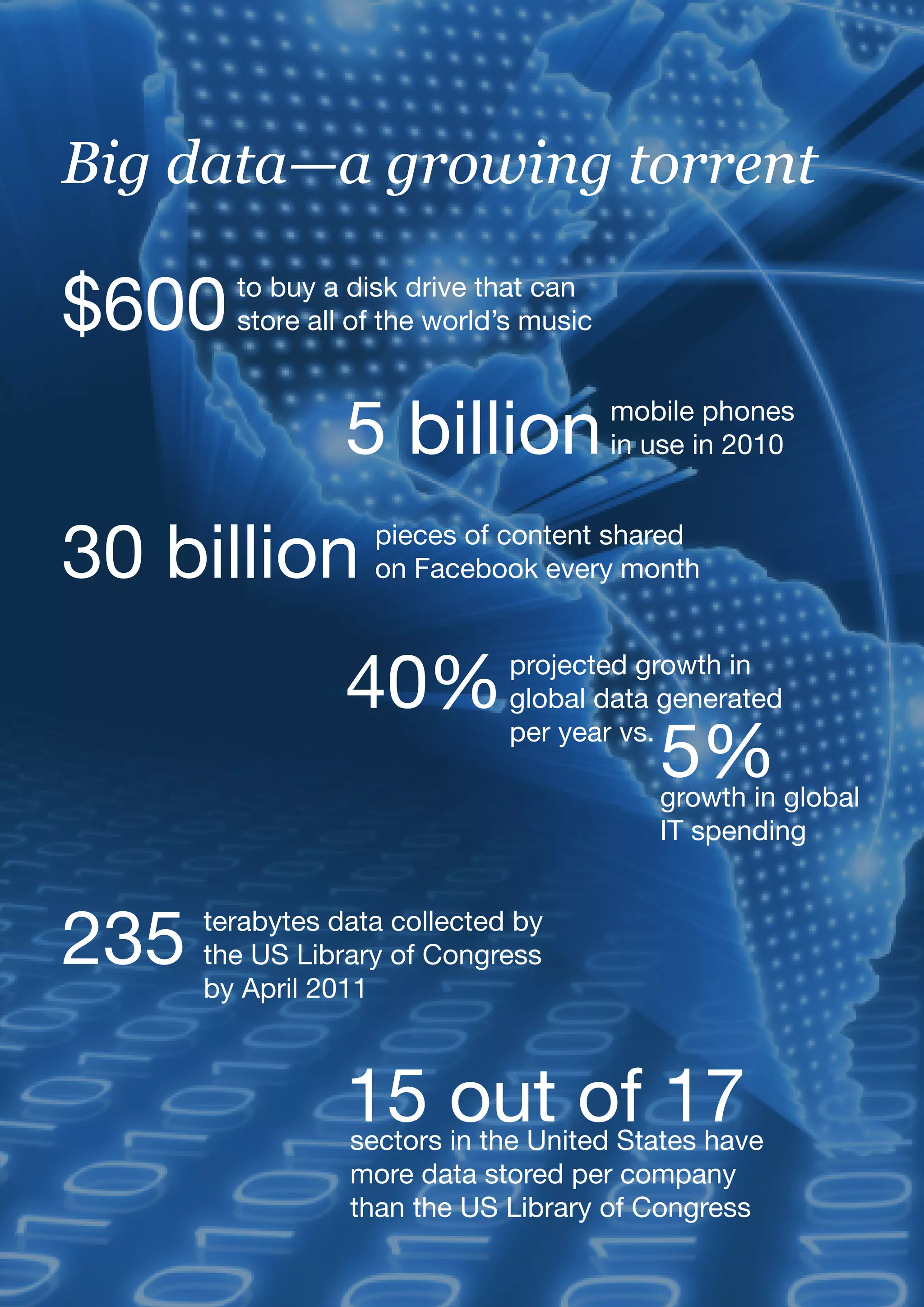
Big data—a growing torrent

$600    to buy a disk drive that can
        store all of the world’s music


                 5 billion               mobile phones
                                         in use in 2010


30 billion         pieces of content shared
                   on Facebook every month


                 40%           projected growth in
                               global data generated
                               per year vs.
                                            5%
                                            growth in global
                                            IT spending


235   terabytes data collected by
      the US Library of Congress
      by April 2011


                 15 out of 17
                 sectors in the United States have
                 more data stored per company
                 than the US Library of Congress
McKinsey Global Institute
Big data: The next frontier for innovation, competition, and productivity                                  vii


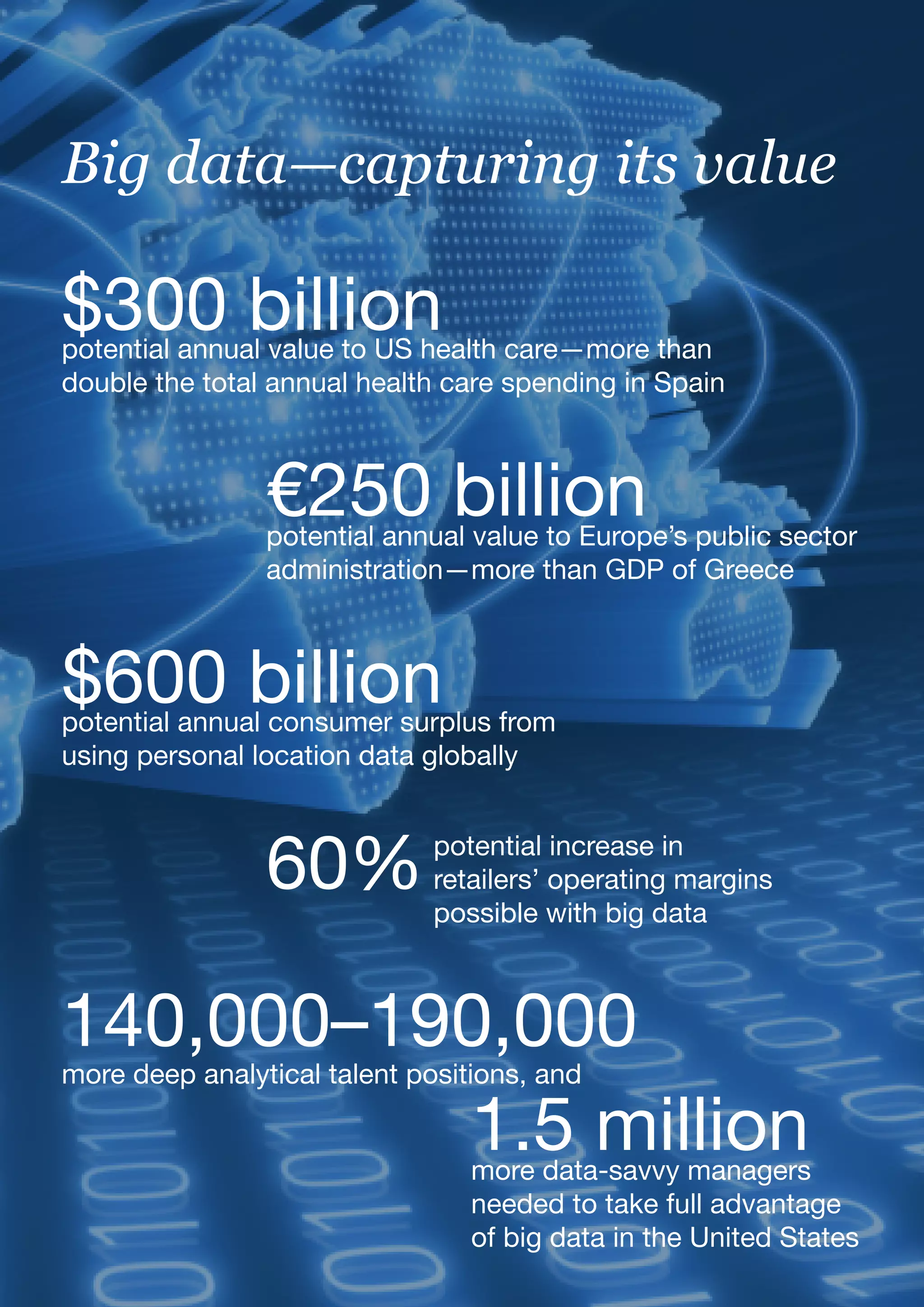
Big data—capturing its value

$300 billion
potential annual value to US health care—more than
double the total annual health care spending in Spain


                                     €250 billion
                                     potential annual value to Europe’s public sector
                                     administration—more than GDP of Greece


$600 billion
potential annual consumer surplus from
using personal location data globally


                                     60%                            potential increase in
                                                                    retailers’ operating margins
                                                                    possible with big data


140,000–190,000
more deep analytical talent positions, and

          1.5 million                                                       more data-savvy managers
                                                                            needed to take full advantage
                                                                            of big data in the United States
McKinsey Global Institute
Big data: The next frontier for innovation, competition, and productivity


                 Contents


                 Executive summary                                                                    1

                 1.  Mapping global data: Growth and value creation                                  15

                 2.  Big data techniques and technologies                                           27

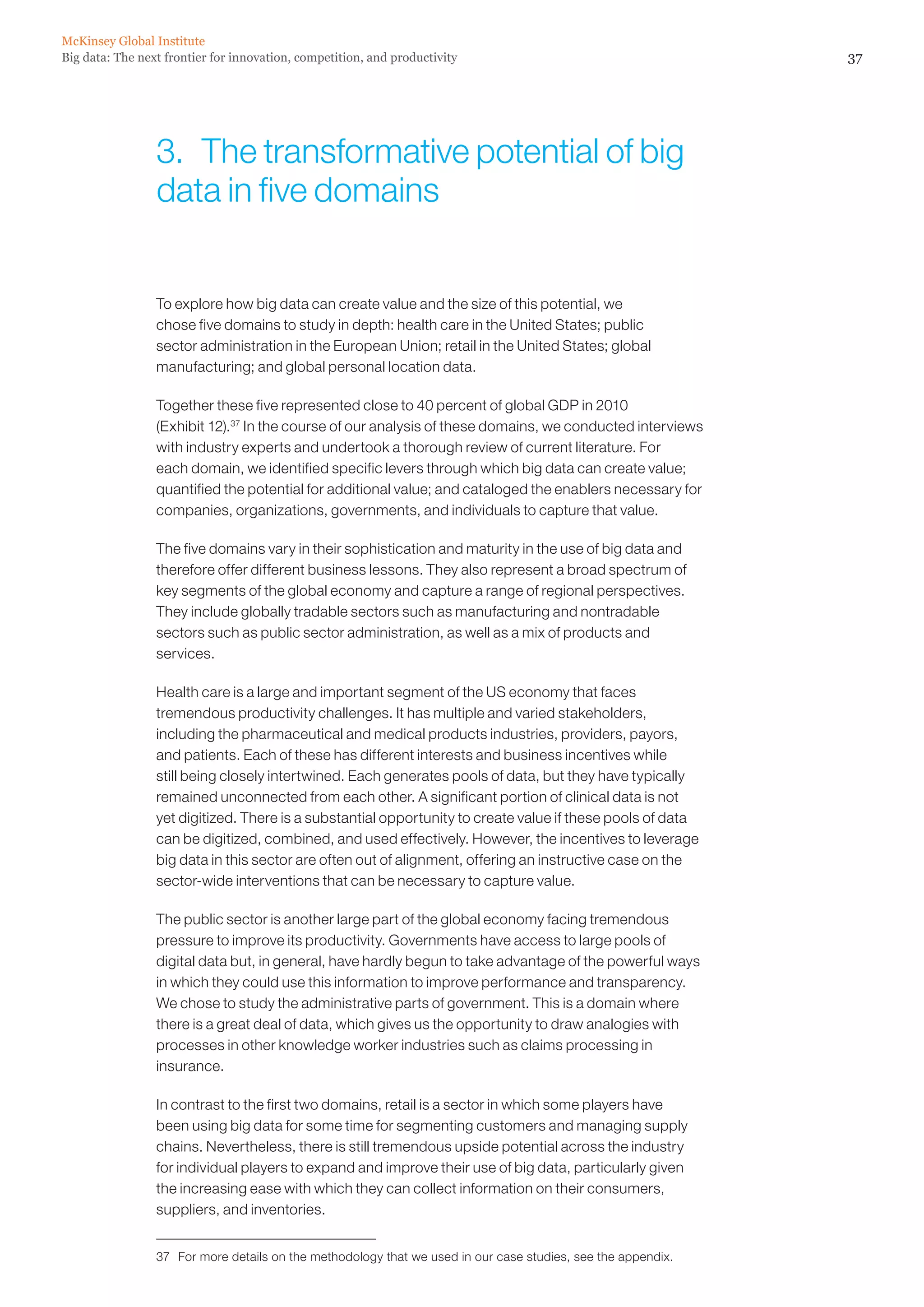
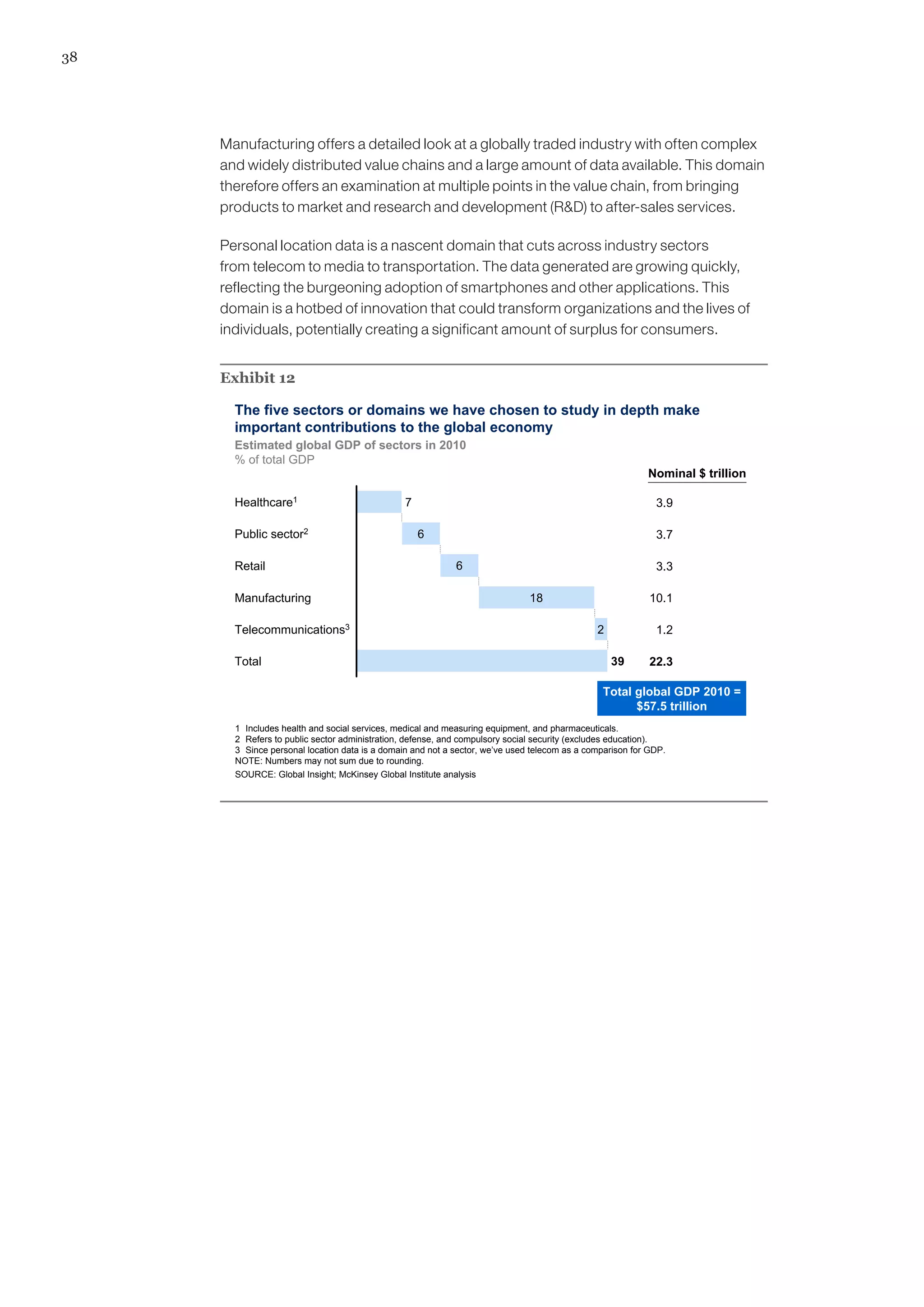
                 3.  The transformative potential of big data in five domains                       37

                      3a.	 Health care (United States)                                              39

                      3b.	 Public sector administration (European Union)                            54

                      3c.	 Retail (United States)                                                   64

                      3d.	 Manufacturing (global)                                                    76

                      3e.	 Personal location data (global)                                          85

                 4.  Key findings that apply across sectors                                          97

                 5.  Implications for organization leaders                                          111

                 6.  Implications for policy makers                                                 117

                 Appendix                                                                           123

                      Construction of indices on value potential
                      and ease of capture                                                           123

                      Data map methodology	                                                         126

                      Estimating value potential in health care (United States)                     127

                      Estimating value potential in public sector administration (European Union)   129

                      Estimating value potential in retail (United States)                          130

                      Estimating value potential in personal location data (global)                 133

                      Methodology for analyzing the supply and demand of analytical talent          134

                 Bibliography                                                                       137
McKinsey Global Institute
Big data: The next frontier for innovation, competition, and productivity                                          1


                 Executive summary


                 Data have become a torrent flowing into every area of the global economy.1
                 Companies churn out a burgeoning volume of transactional data, capturing trillions
                 of bytes of information about their customers, suppliers, and operations. millions of
                 networked sensors are being embedded in the physical world in devices such as
                 mobile phones, smart energy meters, automobiles, and industrial machines that
                 sense, create, and communicate data in the age of the Internet of Things.2 Indeed, as
                 companies and organizations go about their business and interact with individuals,
                 they are generating a tremendous amount of digital “exhaust data,” i.e., data that
                 are created as a by-product of other activities. Social media sites, smartphones,
                 and other consumer devices including PCs and laptops have allowed billions of
                 individuals around the world to contribute to the amount of big data available. And
                 the growing volume of multimedia content has played a major role in the exponential
                 growth in the amount of big data (see Box 1, “What do we mean by ‘big data’?”). Each
                 second of high-definition video, for example, generates more than 2,000 times as
                 many bytes as required to store a single page of text. In a digitized world, consumers
                 going about their day—communicating, browsing, buying, sharing, searching—
                 create their own enormous trails of data.


                    Box 1. What do we mean by big data?
                    “Big data” refers to datasets whose size is beyond the ability of typical database
                    software tools to capture, store, manage, and analyze. This definition is
                    intentionally subjective and incorporates a moving definition of how big a
                    dataset needs to be in order to be considered big data—i.e., we don’t define
                    big data in terms of being larger than a certain number of terabytes (thousands
                    of gigabytes). We assume that, as technology advances over time, the size of
                    datasets that qualify as big data will also increase. Also note that the definition
                    can vary by sector, depending on what kinds of software tools are commonly
                    available and what sizes of datasets are common in a particular industry.
                    With those caveats, big data in many sectors today will range from a few
                    dozen terabytes to multiple petabytes (thousands of terabytes).


                 In itself, the sheer volume of data is a global phenomenon—but what does it mean?
                 Many citizens around the world regard this collection of information with deep
                 suspicion, seeing the data flood as nothing more than an intrusion of their privacy.
                 But there is strong evidence that big data can play a significant economic role to
                 the benefit not only of private commerce but also of national economies and their
                 citizens. Our research finds that data can create significant value for the world
                 economy, enhancing the productivity and competitiveness of companies and the


                 1	 See “A special report on managing information: Data, data everywhere,” The Economist,
                    February 25, 2010; and special issue on “Dealing with data,” Science, February 11, 2011.
                 2	 “Internet of Things” refers to sensors and actuators embedded in physical objects, connected
                    by networks to computers. See Michael Chui, Markus Löffler, and Roger Roberts, “The
                    Internet of Things,” McKinsey Quarterly, March 2010.
2


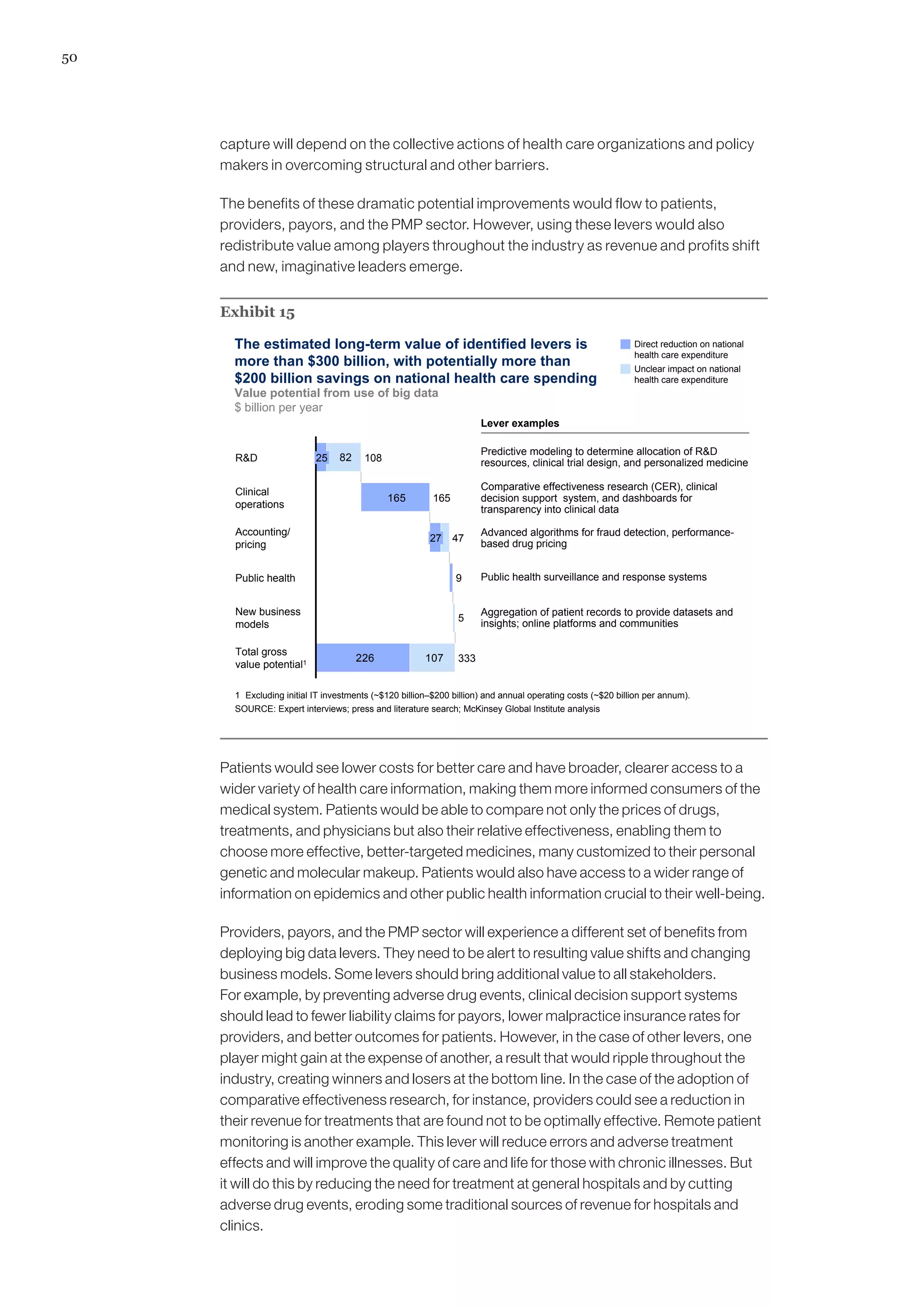
    public sector and creating substantial economic surplus for consumers. For instance,
    if US health care could use big data creatively and effectively to drive efficiency and
    quality, we estimate that the potential value from data in the sector could be more
    than $300 billion in value every year, two-thirds of which would be in the form of
    reducing national health care expenditures by about 8 percent. In the private sector,
    we estimate, for example, that a retailer using big data to the full has the potential to
    increase its operating margin by more than 60 percent. In the developed economies
    of Europe, we estimate that government administration could save more than
    €100 billion ($149 billion) in operational efficiency improvements alone by using big
    data. This estimate does not include big data levers that could reduce fraud, errors,
    and tax gaps (i.e., the gap between potential and actual tax revenue).

    Digital data is now everywhere—in every sector, in every economy, in every
    organization and user of digital technology. While this topic might once have
    concerned only a few data geeks, big data is now relevant for leaders across every
    sector, and consumers of products and services stand to benefit from its application.
    The ability to store, aggregate, and combine data and then use the results to perform
    deep analyses has become ever more accessible as trends such as Moore’s Law
    in computing, its equivalent in digital storage, and cloud computing continue to
    lower costs and other technology barriers.3 For less than $600, an individual can
    purchase a disk drive with the capacity to store all of the world’s music.4 The means
    to extract insight from data are also markedly improving as software available to
    apply increasingly sophisticated techniques combines with growing computing
    horsepower. Further, the ability to generate, communicate, share, and access data
    has been revolutionized by the increasing number of people, devices, and sensors
    that are now connected by digital networks. In 2010, more than 4 billion people,
    or 60 percent of the world’s population, were using mobile phones, and about
    12 percent of those people had smartphones, whose penetration is growing at
    more than 20 percent a year. More than 30 million networked sensor nodes are now
    present in the transportation, automotive, industrial, utilities, and retail sectors. The
    number of these sensors is increasing at a rate of more than 30 percent a year.

    There are many ways that big data can be used to create value across sectors of
    the global economy. Indeed, our research suggests that we are on the cusp of a
    tremendous wave of innovation, productivity, and growth, as well as new modes of
    competition and value capture—all driven by big data as consumers, companies, and
    economic sectors exploit its potential. But why should this be the case now? Haven’t
    data always been part of the impact of information and communication technology?
    Yes, but our research suggests that the scale and scope of changes that big data
    are bringing about are at an inflection point, set to expand greatly, as a series of
    technology trends accelerate and converge. We are already seeing visible changes in
    the economic landscape as a result of this convergence.

    Many pioneering companies are already using big data to create value, and others
    need to explore how they can do the same if they are to compete. Governments,
    too, have a significant opportunity to boost their efficiency and the value for money

    3	 Moore’s Law, first described by Intel cofounder Gordon Moore, states that the number of
       transistors that can be placed on an integrated circuit doubles approximately every two years.
       In other words, the amount of computing power that can be purchased for the same amount of
       money doubles about every two years. Cloud computing refers to the ability to access highly
       scalable computing resources through the Internet, often at lower prices than those required to
       install on one’s own computers because the resources are shared across many users.
    4	 Kevin Kelly, Web 2.0 Expo and Conference, March 29, 2011. Video available at:
       www.web2expo.com/webexsf2011/public/schedule/proceedings.
McKinsey Global Institute
Big data: The next frontier for innovation, competition, and productivity                                                3


                 they offer citizens at a time when public finances are constrained—and are likely to
                 remain so due to aging populations in many countries around the world. Our research
                 suggests that the public sector can boost its productivity significantly through the
                 effective use of big data.

                 However, companies and other organizations and policy makers need to address
                 considerable challenges if they are to capture the full potential of big data. A shortage
                 of the analytical and managerial talent necessary to make the most of big data is
                 a significant and pressing challenge and one that companies and policy makers
                 can begin to address in the near term. The United States alone faces a shortage of
                 140,000 to 190,000 people with deep analytical skills as well as 1.5 million managers
                 and analysts to analyze big data and make decisions based on their findings. The
                 shortage of talent is just the beginning. Other challenges we explore in this report
                 include the need to ensure that the right infrastructure is in place and that incentives
                 and competition are in place to encourage continued innovation; that the economic
                 benefits to users, organizations, and the economy are properly understood; and that
                 safeguards are in place to address public concerns about big data.

                 This report seeks to understand the state of digital data, how different domains
                 can use large datasets to create value, the potential value across stakeholders,
                 and the implications for the leaders of private sector companies and public sector
                 organizations, as well as for policy makers. We have supplemented our analysis of big
                 data as a whole with a detailed examination of five domains (health care in the United
                 States, the public sector in Europe, retail in the United States, and manufacturing and
                 personal location data globally). This research by no means represents the final word
                 on big data; instead, we see it as a beginning. We fully anticipate that this is a story
                 that will continue to evolve as technologies and techniques using big data develop
                 and data, their uses, and their economic benefits grow (alongside associated
                 challenges and risks). For now, however, our research yields seven key insights:


                 1. DATA HAVE SWEPT INTO EVERY INDUSTRY AND BUSINESS
                 FUNCTION AND ARE NOW AN IMPORTANT FACTOR OF
                 PRODUCTION
                 Several research teams have studied the total amount of data generated, stored,
                 and consumed in the world. Although the scope of their estimates and therefore their
                 results vary, all point to exponential growth in the years ahead.5 MGI estimates that
                 enterprises globally stored more than 7 exabytes of new data on disk drives in 2010,
                 while consumers stored more than 6 exabytes of new data on devices such as PCs
                 and notebooks. One exabyte of data is the equivalent of more than 4,000 times the
                 information stored in the US Library of Congress.6 Indeed, we are generating so much


                 5	 See Peter Lyman and Hal Varian, How much information? 2003, School of Information
                    Management and Systems, University of California at Berkeley, 2003; papers from the IDC Digital
                    Universe research project, sponsored by EMC, including The expanding digital universe, March
                    2007; The diverse and exploding digital universe, March 2008; As the economy contracts, the
                    digital universe expands, May 2009, and The digital universe decade—Are you ready?, May 2010
                    (www.emc.com/leadership/programs/digital-universe.htm); two white papers from the University
                    of California, San Diego, Global Information Industry Center: Roger Bohn and James Short, How
                    much information? 2009: Report on American consumers, January 2010, and Roger Bohn, James
                    Short, and Chaitanya Baru, How much information? 2010: Report on enterprise server information,
                    January 2011; and Martin Hilbert and Priscila López, “The world’s technological capacity to store,
                    communicate, and compute information,” Science, February 10, 2011.
                 6	 According to the Library of Congress Web site, the US Library of Congress had 235 terabytes
                    of storage in April 2011.
4


    data today that it is physically impossible to store it all.7 Health care providers, for
    instance, discard 90 percent of the data that they generate (e.g., almost all real-time
    video feeds created during surgery).

    Big data has now reached every sector in the global economy. Like other essential
    factors of production such as hard assets and human capital, much of modern
    economic activity simply couldn’t take place without it. We estimate that by 2009,
    nearly all sectors in the US economy had at least an average of 200 terabytes of
    stored data (twice the size of US retailer Wal-Mart’s data warehouse in 1999) per
    company with more than 1,000 employees. Many sectors had more than 1 petabyte
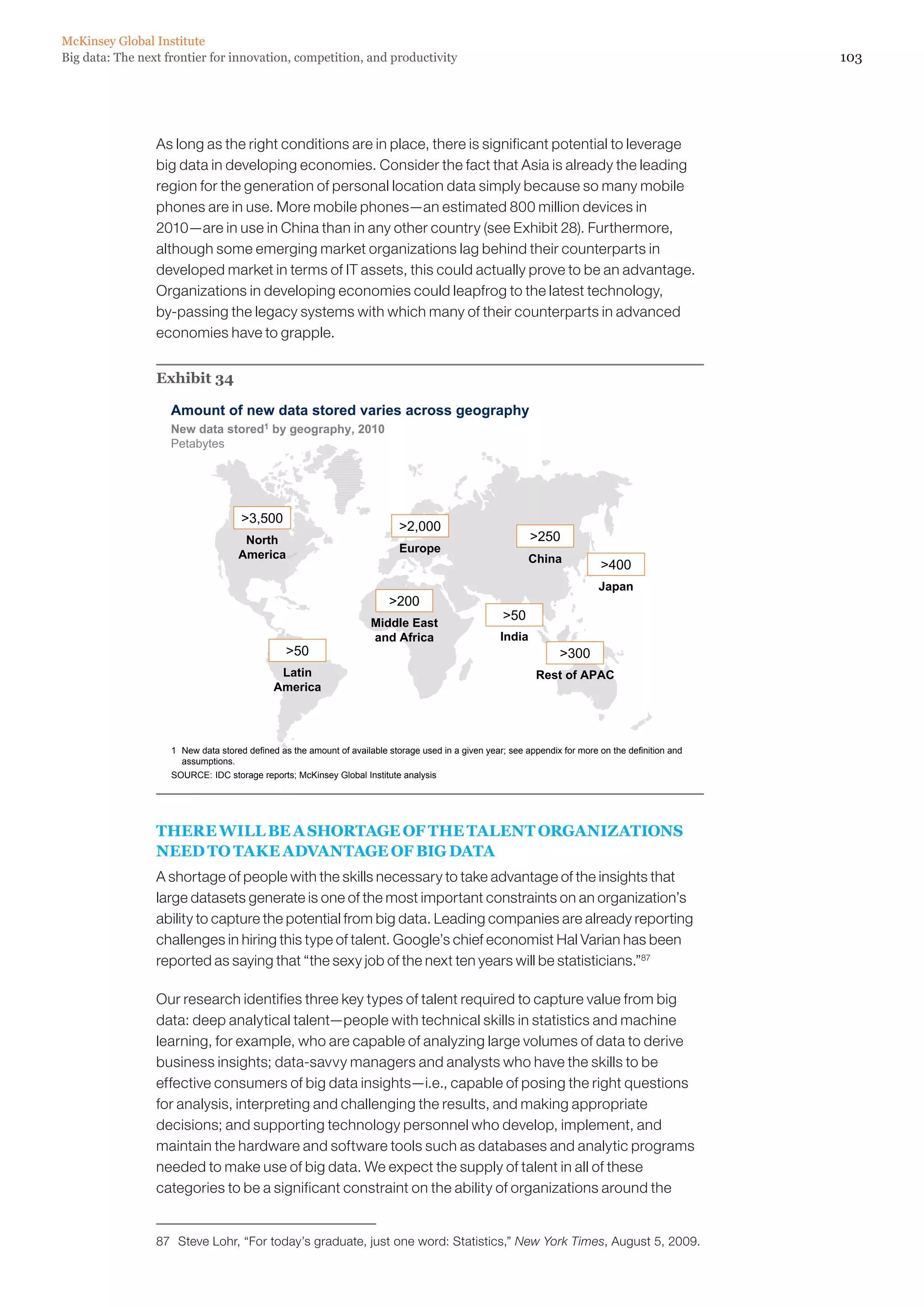
    in mean stored data per company. In total, European organizations have about
    70 percent of the storage capacity of the entire United States at almost 11 exabytes
    compared with more than 16 exabytes in 2010. Given that European economies
    are similar to each other in terms of their stage of development and thus their
    distribution of firms, we believe that the average company in most industries in
    Europe has enough capacity to store and manipulate big data. In contrast, the per
    capita data intensity in other regions is much lower. This suggests that, in the near
    term at least, the most potential to create value through the use of big data will be in
    the most developed economies. Looking ahead, however, there is huge potential
    to leverage big data in developing economies as long as the right conditions are in
    place. Consider, for instance, the fact that Asia is already the leading region for the
    generation of personal location data simply because so many mobile phones are
    in use there. More mobile phones—an estimated 800 million devices in 2010—are
    in use in China than in any other country. Further, some individual companies in
    developing regions could be far more advanced in their use of big data than averages
    might suggest. And some organizations will take advantage of the ability to store and
    process data remotely.

    The possibilities of big data continue to evolve rapidly, driven by innovation in the
    underlying technologies, platforms, and analytic capabilities for handling data, as
    well as the evolution of behavior among its users as more and more individuals live
    digital lives.


    2. BIG DATA CREATES VALUE IN SEVERAL WAYS
    We have identified five broadly applicable ways to leverage big data that offer
    transformational potential to create value and have implications for how organizations
    will have to be designed, organized, and managed. For example, in a world in which
    large-scale experimentation is possible, how will corporate marketing functions
    and activities have to evolve? How will business processes change, and how will
    companies value and leverage their assets (particularly data assets)? Could a
    company’s access to, and ability to analyze, data potentially confer more value than
    a brand? What existing business models are likely to be disrupted? For example,
    what happens to industries predicated on information asymmetry—e.g., various
    types of brokers—in a world of radical data transparency? How will incumbents tied
    to legacy business models and infrastructures compete with agile new attackers that
    are able to quickly process and take advantage of detailed consumer data that is
    rapidly becoming available, e.g., what they say in social media or what sensors report
    they are doing in the world? And what happens when surplus starts shifting from


    7	 For another comparison of data generation versus storage, see John F. Gantz, David Reinsel,
       Christopher Chute, Wolfgang Schlichting, John McArthur, Stephen Minton, Irida Xheneti, Anna
       Toncheva, and Alex Manfrediz, The expanding digital universe, IDC white paper, sponsored
       by EMC, March 2007.
McKinsey Global Institute
Big data: The next frontier for innovation, competition, and productivity                                  5


                 suppliers to customers, as they become empowered by their own access to data,
                 e.g., comparisons of prices and quality across competitors?

                 Creating transparency
                 Simply making big data more easily accessible to relevant stakeholders in a timely
                 manner can create tremendous value. In the public sector, for example, making
                 relevant data more readily accessible across otherwise separated departments can
                 sharply reduce search and processing time. In manufacturing, integrating data from
                 RD, engineering, and manufacturing units to enable concurrent engineering can
                 significantly cut time to market and improve quality.

                 Enabling experimentation to discover needs, expose variability, and
                 improve performance
                 As they create and store more transactional data in digital form, organizations can
                 collect more accurate and detailed performance data (in real or near real time) on
                 everything from product inventories to personnel sick days. IT enables organizations
                 to instrument processes and then set up controlled experiments. Using data to
                 analyze variability in performance—that which either occurs naturally or is generated
                 by controlled experiments—and to understand its root causes can enable leaders to
                 manage performance to higher levels.

                 Segmenting populations to customize actions
                 Big data allows organizations to create highly specific segmentations and to
                 tailor products and services precisely to meet those needs. This approach is well
                 known in marketing and risk management but can be revolutionary elsewhere—for
                 example, in the public sector where an ethos of treating all citizens in the same way
                 is commonplace. Even consumer goods and service companies that have used
                 segmentation for many years are beginning to deploy ever more sophisticated big
                 data techniques such as the real-time microsegmentation of customers to target
                 promotions and advertising.

                 Replacing/supporting human decision making with automated
                 algorithms
                 Sophisticated analytics can substantially improve decision making, minimize risks,
                 and unearth valuable insights that would otherwise remain hidden. Such analytics
                 have applications for organizations from tax agencies that can use automated risk
                 engines to flag candidates for further examination to retailers that can use algorithms
                 to optimize decision processes such as the automatic fine-tuning of inventories and
                 pricing in response to real-time in-store and online sales. In some cases, decisions
                 will not necessarily be automated but augmented by analyzing huge, entire datasets
                 using big data techniques and technologies rather than just smaller samples that
                 individuals with spreadsheets can handle and understand. Decision making may
                 never be the same; some organizations are already making better decisions by
                 analyzing entire datasets from customers, employees, or even sensors embedded in
                 products.

                 Innovating new business models, products, and services
                 Big data enables companies to create new products and services, enhance existing
                 ones, and invent entirely new business models. Manufacturers are using data
                 obtained from the use of actual products to improve the development of the next
                 generation of products and to create innovative after-sales service offerings. The
                 emergence of real-time location data has created an entirely new set of location-
6


    based services from navigation to pricing property and casualty insurance based on
    where, and how, people drive their cars.


    3. USE OF BIG DATA WILL BECOME A KEY BASIS OF COMPETITION
    AND GROWTH FOR INDIVIDUAL FIRMS
    The use of big data is becoming a key way for leading companies to outperform their
    peers. For example, we estimate that a retailer embracing big data has the potential
    to increase its operating margin by more than 60 percent. We have seen leading
    retailers such as the United Kingdom’s Tesco use big data to capture market share
    from its local competitors, and many other examples abound in industries such as
    financial services and insurance. Across sectors, we expect to see value accruing to
    leading users of big data at the expense of laggards, a trend for which the emerging
    evidence is growing stronger.8 Forward-thinking leaders can begin to aggressively
    build their organizations’ big data capabilities. This effort will take time, but the impact
    of developing a superior capacity to take advantage of big data will confer enhanced
    competitive advantage over the long term and is therefore well worth the investment
    to create this capability. But the converse is also true. In a big data world, a competitor
    that fails to sufficiently develop its capabilities will be left behind.

    Big data will also help to create new growth opportunities and entirely new categories
    of companies, such as those that aggregate and analyze industry data. Many of
    these will be companies that sit in the middle of large information flows where data
    about products and services, buyers and suppliers, and consumer preferences and
    intent can be captured and analyzed. Examples are likely to include companies that
    interface with large numbers of consumers buying a wide range of products and
    services, companies enabling global supply chains, companies that process millions of
    transactions, and those that provide platforms for consumer digital experiences. These
    will be the big-data-advantaged businesses. More businesses will find themselves with
    some kind of big data advantage than one might at first think. Many companies have
    access to valuable pools of data generated by their products and services. Networks
    will even connect physical products, enabling those products to report their own serial
    numbers, ship dates, number of times used, and so on.

    Some of these opportunities will generate new sources of value; others will cause
    major shifts in value within industries. For example, medical clinical information
    providers, which aggregate data and perform the analyses necessary to improve
    health care efficiency, could compete in a market worth more than $10 billion by
    2020. Early movers that secure access to the data necessary to create value are
    likely to reap the most benefit (see Box 2, “How do we measure the value of big
    data?”). From the standpoint of competitiveness and the potential capture of value,
    all companies need to take big data seriously. In most industries, established
    competitors and new entrants alike will leverage data-driven strategies to innovate,
    compete, and capture value. Indeed, we found early examples of such use of data in
    every sector we examined.


    8	 Erik Brynjolfsson, Lorin M. Hitt, and Heekyung Hellen Kim, Strength in numbers: How does
       data-driven decisionmaking affect firm performance?, April 22, 2011, available at SSRN (ssrn.
       com/abstract=1819486).
McKinsey Global Institute
Big data: The next frontier for innovation, competition, and productivity                                           7


                    Box 2. How do we measure the value of big data?
                    When we set out to size the potential of big data to create value, we considered
                    only those actions that essentially depend on the use of big data—i.e., actions
                    where the use of big data is necessary (but usually not sufficient) to execute
                    a particular lever. We did not include the value of levers that consist only of
                    automation but do not involve big data (e.g., productivity increases from
                    replacing bank tellers with ATMs). Note also that we include the gross value
                    of levers that require the use of big data. We did not attempt to estimate big
                    data’s relative contribution to the value generated by a particular lever but rather
                    estimated the total value created.


                 4. THE USE OF BIG DATA WILL UNDERPIN NEW WAVES OF
                 PRODUCTIVITY GROWTH AND CONSUMER SURPLUS
                 Across the five domains we studied, we identified many big data levers that will, in our
                 view, underpin substantial productivity growth (Exhibit 1). These opportunities have
                 the potential to improve efficiency and effectiveness, enabling organizations both
                 to do more with less and to produce higher-quality outputs, i.e., increase the value-
                 added content of products and services.9 For example, we found that companies can
                 leverage data to design products that better match customer needs. Data can even
                 be leveraged to improve products as they are used. An example is a mobile phone
                 that has learned its owner’s habits and preferences, that holds applications and
                 data tailored to that particular user’s needs, and that will therefore be more valuable
                 than a new device that is not customized to a user’s needs.10 Capturing this potential
                 requires innovation in operations and processes. Examples include augmenting
                 decision making—from clinical practice to tax audits—with algorithms as well as
                 making innovations in products and services, such as accelerating the development
                 of new drugs by using advanced analytics and creating new, proactive after-sales
                 maintenance service for automobiles through the use of networked sensors. Policy
                 makers who understand that accelerating productivity within sectors is the key lever
                 for increasing the standard of living in their economies as a whole need to ease the
                 way for organizations to take advantage of big data levers that enhance productivity.

                 We also find a general pattern in which customers, consumers, and citizens capture
                 a large amount of the economic surplus that big data enables—they are both direct
                 and indirect beneficiaries of big-data-related innovation.11 For example, the use of big
                 data can enable improved health outcomes, higher-quality civic engagement with
                 government, lower prices due to price transparency, and a better match between
                 products and consumer needs. We expect this trend toward enhanced consumer
                 surplus to continue and accelerate across all sectors as they deploy big data. Take
                 the area of personal location data as illustration. In this area, the use of real-time traffic
                 information to inform navigation will create a quantifiable consumer surplus through

                 9	 Note that the effectiveness improvement is not captured in some of the productivity
                    calculations because of a lack of precision in some metrics such as improved health outcomes
                    or better matching the needs of consumers with goods in retail services. Thus, in many cases,
                    our productivity estimates are likely to be conservative.
                 10	 Hal Varian has described the ability of products to leverage data to improve with use as
                     “product kaizen.” See Hal Varian, Computer mediated transactions, 2010 Ely Lecture at the
                     American Economics Association meeting, Atlanta, Georgia.
                 11	 Professor Erik Brynjolfsson of the Massachusetts Institute of Technology has noted that the
                     creation of large amounts of consumer surplus, not captured in traditional economic metrics
                     such as GDP, is a characteristic of the deployment of IT.
8


    savings on the time spent traveling and on fuel consumption. Mobile location-enabled
    applications will create surplus from consumers, too. In both cases, the surplus these
    innovations create is likely to far exceed the revenue generated by service providers.
    For consumers to benefit, policy makers will often need to push the deployment of big
    data innovations.


    Exhibit 1

      Big data can generate significant financial value across sectors


        US health care                         Europe public sector                   Global personal
        ▪   $300 billion value                 administration                         location data
            per year                           ▪   €250 billion value per year        ▪   $100 billion+ revenue for
        ▪   ~0.7 percent annual                ▪   ~0.5 percent annual                    service providers
            productivity growth                    productivity growth                ▪   Up to $700 billion value to
                                                                                          end users


                            US retail                              Manufacturing
                            ▪   60+% increase in net margin        ▪   Up to 50 percent decrease in
                                possible                               product development,
                            ▪   0.5–1.0 percent annual                 assembly costs
                                productivity growth                ▪   Up to 7 percent reduction in
                                                                       working capital

      SOURCE: McKinsey Global Institute analysis


    5. WHILE THE USE OF BIG DATA WILL MATTER ACROSS SECTORS,
    SOME SECTORS ARE POISED FOR GREATER GAINS
    Illustrating differences among different sectors, if we compare the historical
    productivity of sectors in the United States with the potential of these sectors to
    capture value from big data (using an index that combines several quantitative
    metrics), we observe that patterns vary from sector to sector (Exhibit 2).12


    12	 The index consists of five metrics that are designed as proxies to indicate (1) the amount of
        data available for use and analysis; (2) variability in performance; (3) number of stakeholders
        (customers and suppliers) with which an organization deals on average; (4) transaction
        intensity; and (5) turbulence inherent in a sector. We believe that these are the characteristics
        that make a sector more or less likely to take advantage of the five transformative big data
        opportunities. See the appendix for further details.
McKinsey Global Institute
Big data: The next frontier for innovation, competition, and productivity                                                                                    9


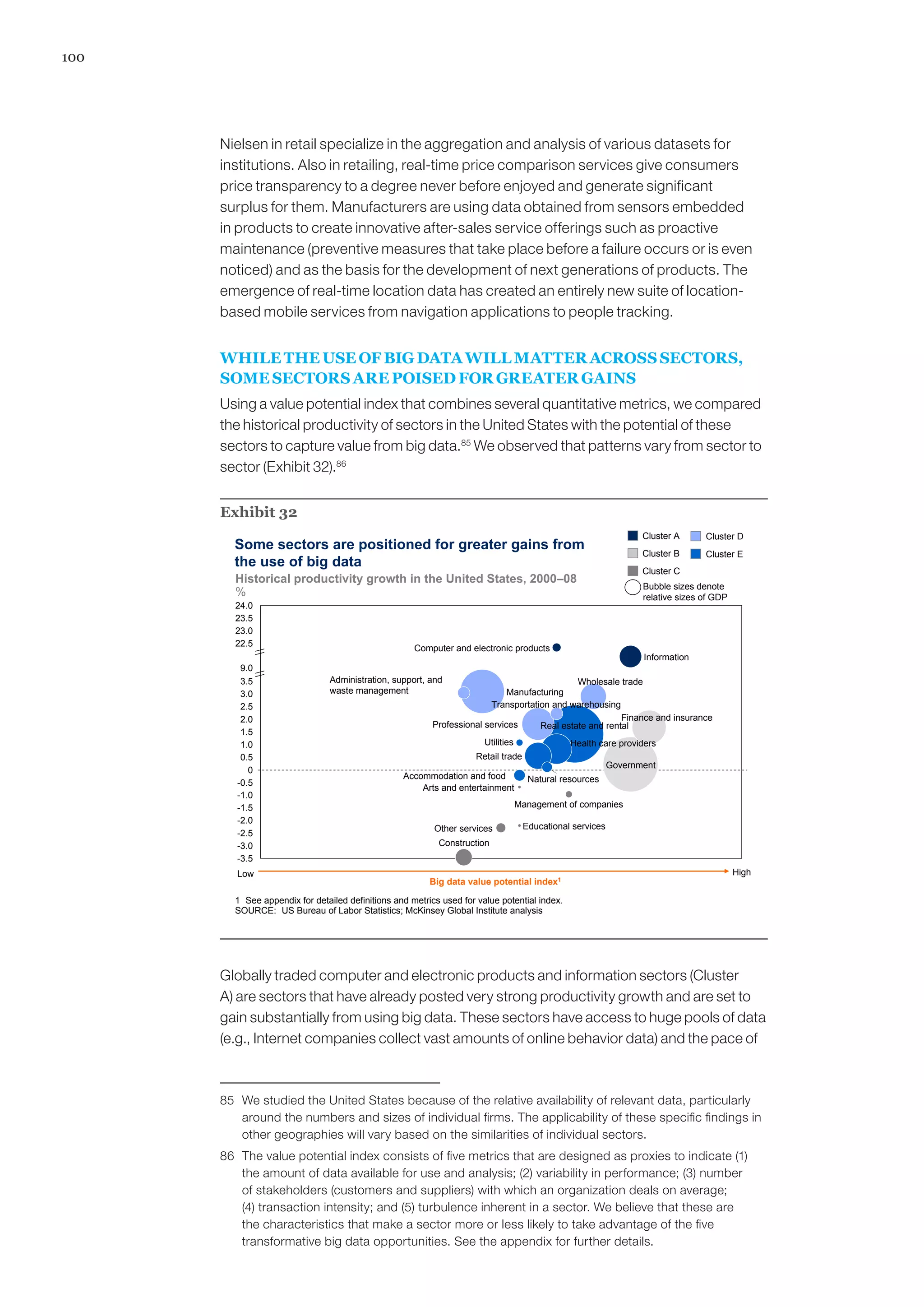
                 Exhibit 2
                                                                                                                              Cluster A      Cluster D
                    Some sectors are positioned for greater gains from
                                                                                                                              Cluster B      Cluster E
                    the use of big data
                                                                                                                              Cluster C
                    Historical productivity growth in the United States, 2000–08
                                                                                                                              Bubble sizes denote
                    %                                                                                                         relative sizes of GDP
                    24.0
                    23.5
                    23.0
                    22.5
                                                                 Computer and electronic products
                                                                                                                              Information
                     9.0
                     3.5                   Administration, support, and                                 Wholesale trade
                     3.0                   waste management                             Manufacturing
                     2.5                                                           Transportation and warehousing
                     2.0                                                                                           Finance and insurance
                                                                     Professional services     Real estate and rental
                     1.5
                     1.0                                                           Utilities               Health care providers
                     0.5                                                        Retail trade
                                                                                                                       Government
                       0
                                                              Accommodation and food             Natural resources
                    -0.5
                                                                  Arts and entertainment
                    -1.0
                    -1.5                                                                       Management of companies
                    -2.0
                                                                      Other services            Educational services
                    -2.5
                    -3.0                                               Construction
                    -3.5
                    Low                                                                                                                               High
                                                                     Big data value potential index1

                    1 See appendix for detailed definitions and metrics used for value potential index.
                    SOURCE: US Bureau of Labor Statistics; McKinsey Global Institute analysis


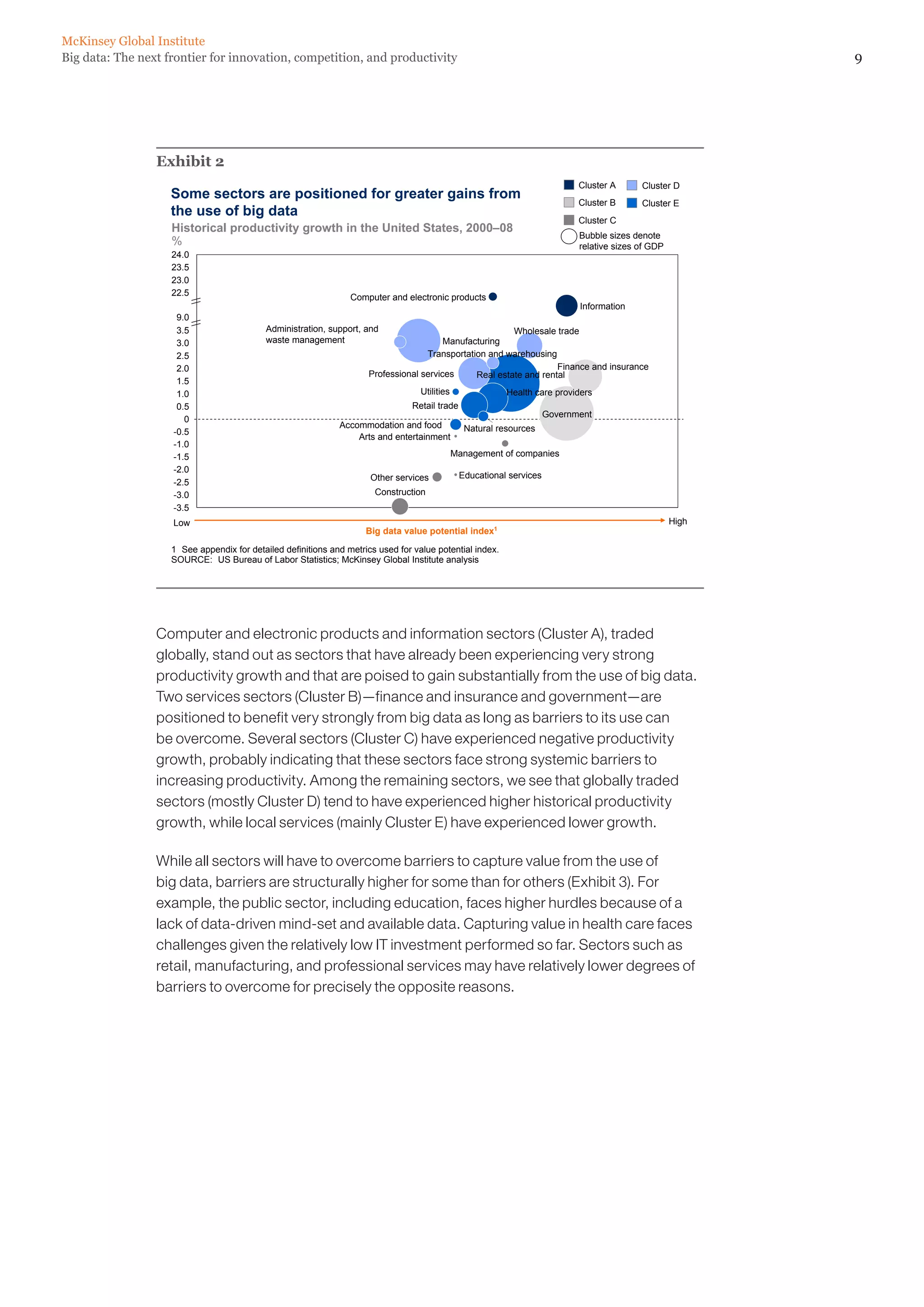
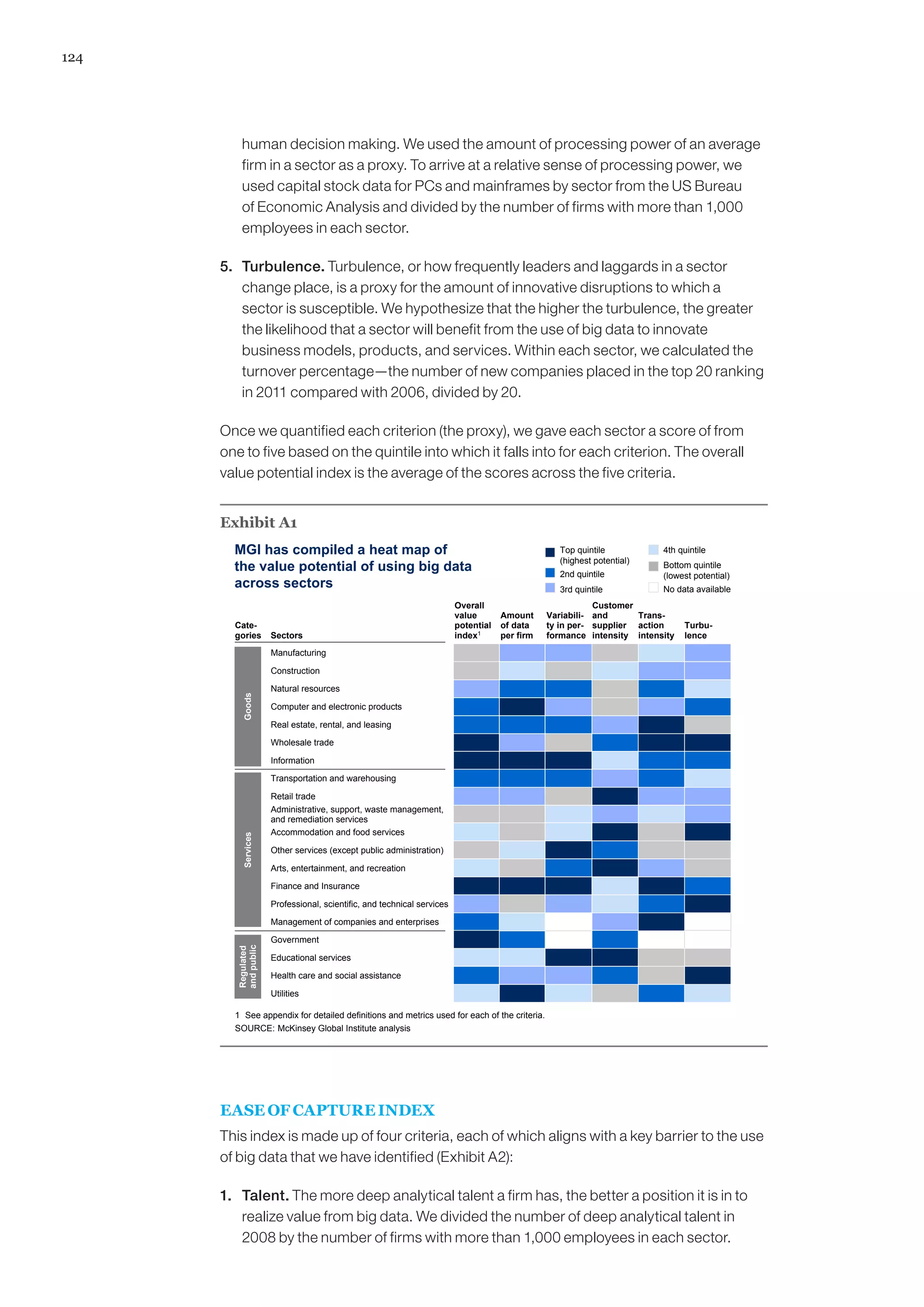
                 Computer and electronic products and information sectors (Cluster A), traded
                 globally, stand out as sectors that have already been experiencing very strong
                 productivity growth and that are poised to gain substantially from the use of big data.
                 Two services sectors (Cluster B)—finance and insurance and government—are
                 positioned to benefit very strongly from big data as long as barriers to its use can
                 be overcome. Several sectors (Cluster C) have experienced negative productivity
                 growth, probably indicating that these sectors face strong systemic barriers to
                 increasing productivity. Among the remaining sectors, we see that globally traded
                 sectors (mostly Cluster D) tend to have experienced higher historical productivity
                 growth, while local services (mainly Cluster E) have experienced lower growth.

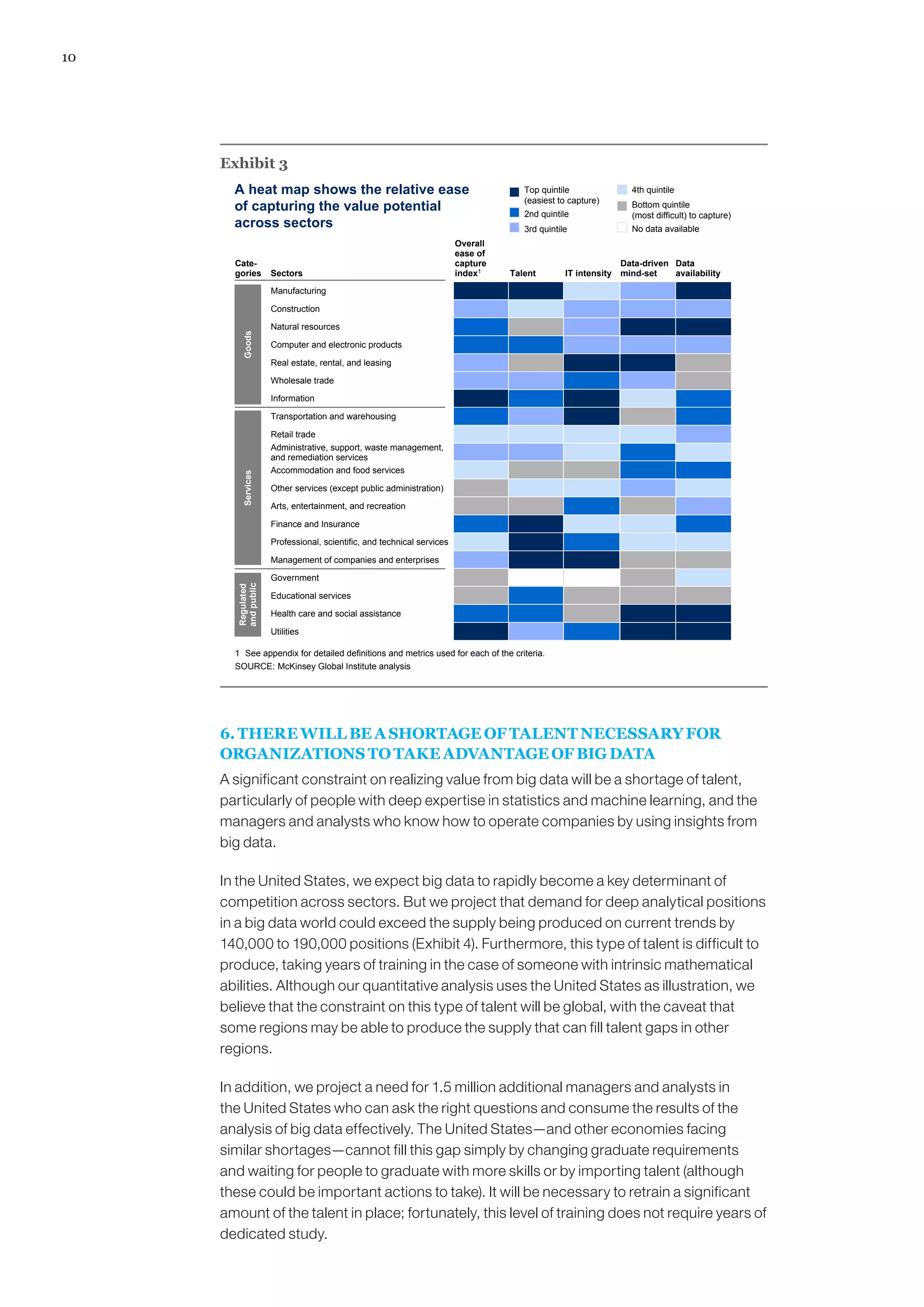
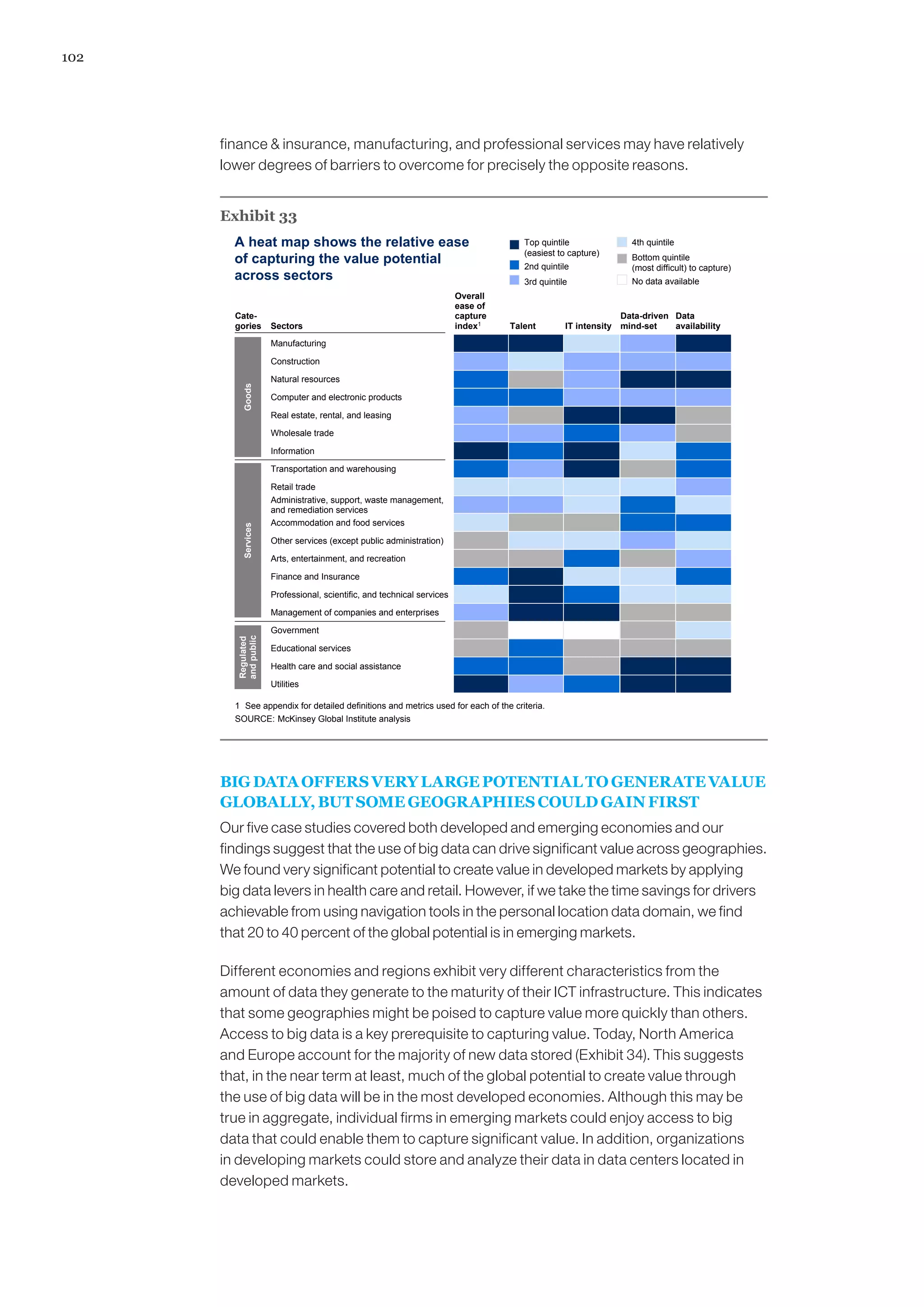
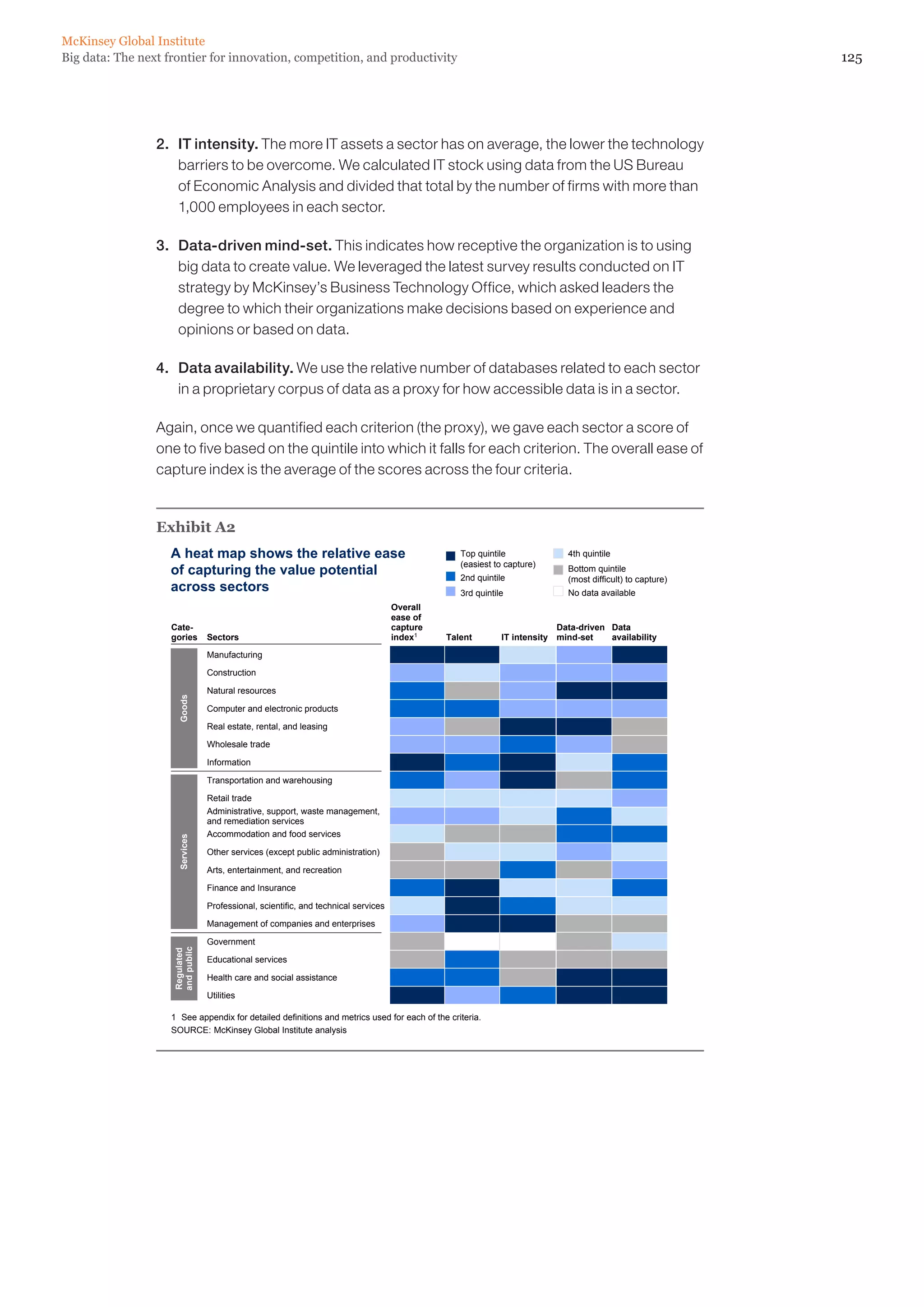
                 While all sectors will have to overcome barriers to capture value from the use of
                 big data, barriers are structurally higher for some than for others (Exhibit 3). For
                 example, the public sector, including education, faces higher hurdles because of a
                 lack of data-driven mind-set and available data. Capturing value in health care faces
                 challenges given the relatively low IT investment performed so far. Sectors such as
                 retail, manufacturing, and professional services may have relatively lower degrees of
                 barriers to overcome for precisely the opposite reasons.
10


     Exhibit 3
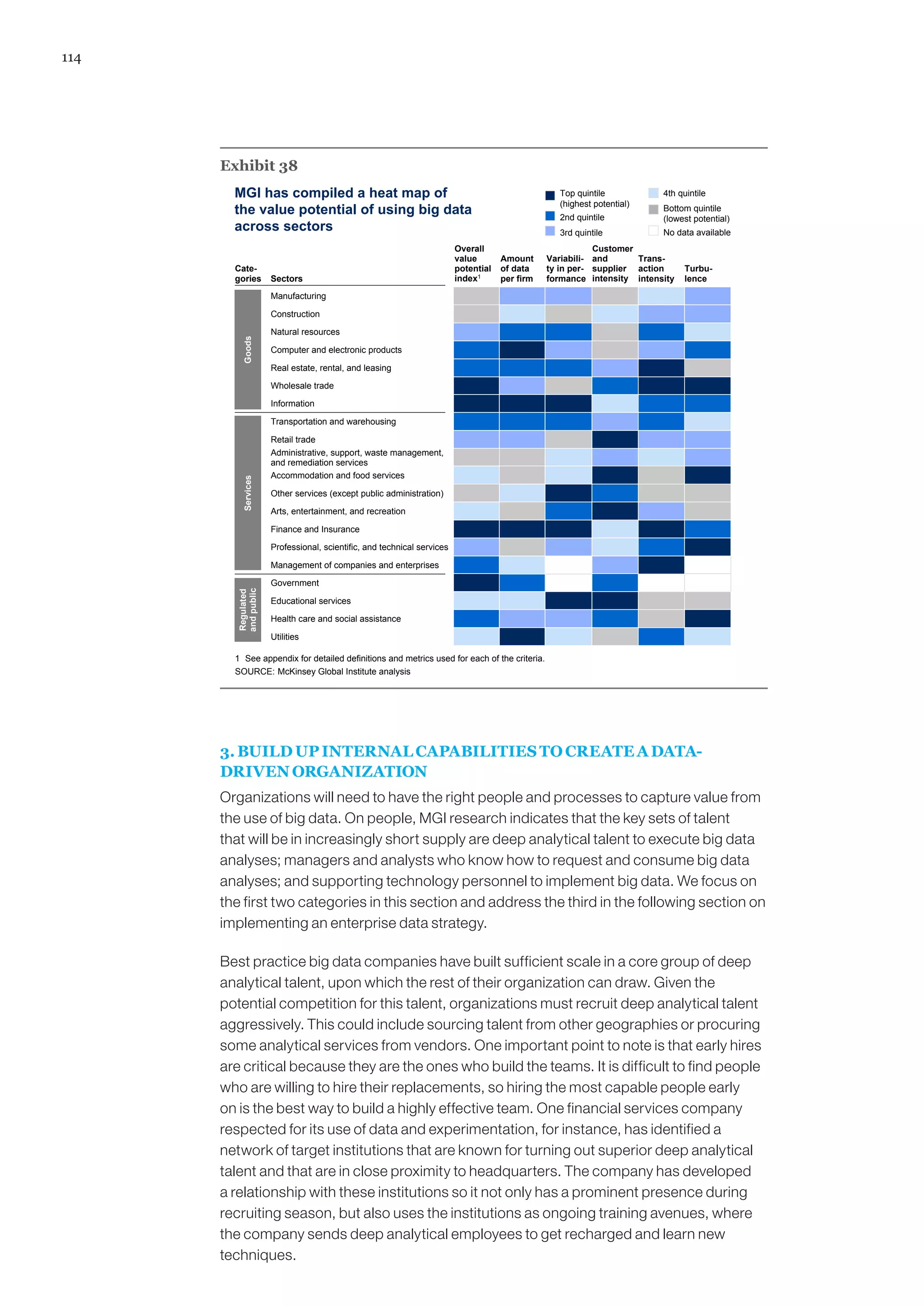
       A heat map shows the relative ease                                           Top quintile                4th quintile
                                                                                    (easiest to capture)
       of capturing the value potential                                             2nd quintile
                                                                                                                Bottom quintile
                                                                                                                (most difficult) to capture)
       across sectors                                                               3rd quintile                No data available
                                                                       Overall
                                                                       ease of
       Cate-                                                           capture                                Data-driven Data
       gories       Sectors                                            index1    Talent        IT intensity   mind-set    availability
                    Manufacturing

                    Construction

                    Natural resources
         Goods


                    Computer and electronic products

                    Real estate, rental, and leasing

                    Wholesale trade

                    Information

                    Transportation and warehousing

                    Retail trade
                    Administrative, support, waste management,
                    and remediation services
                    Accommodation and food services
         Services


                    Other services (except public administration)

                    Arts, entertainment, and recreation

                    Finance and Insurance

                    Professional, scientific, and technical services

                    Management of companies and enterprises

                    Government
       and public
       Regulated


                    Educational services

                    Health care and social assistance

                    Utilities

       1 See appendix for detailed definitions and metrics used for each of the criteria.
       SOURCE: McKinsey Global Institute analysis


     6. THERE WILL BE A SHORTAGE OF TALENT NECESSARY FOR
     ORGANIZATIONS TO TAKE ADVANTAGE OF BIG DATA
     A significant constraint on realizing value from big data will be a shortage of talent,
     particularly of people with deep expertise in statistics and machine learning, and the
     managers and analysts who know how to operate companies by using insights from
     big data.

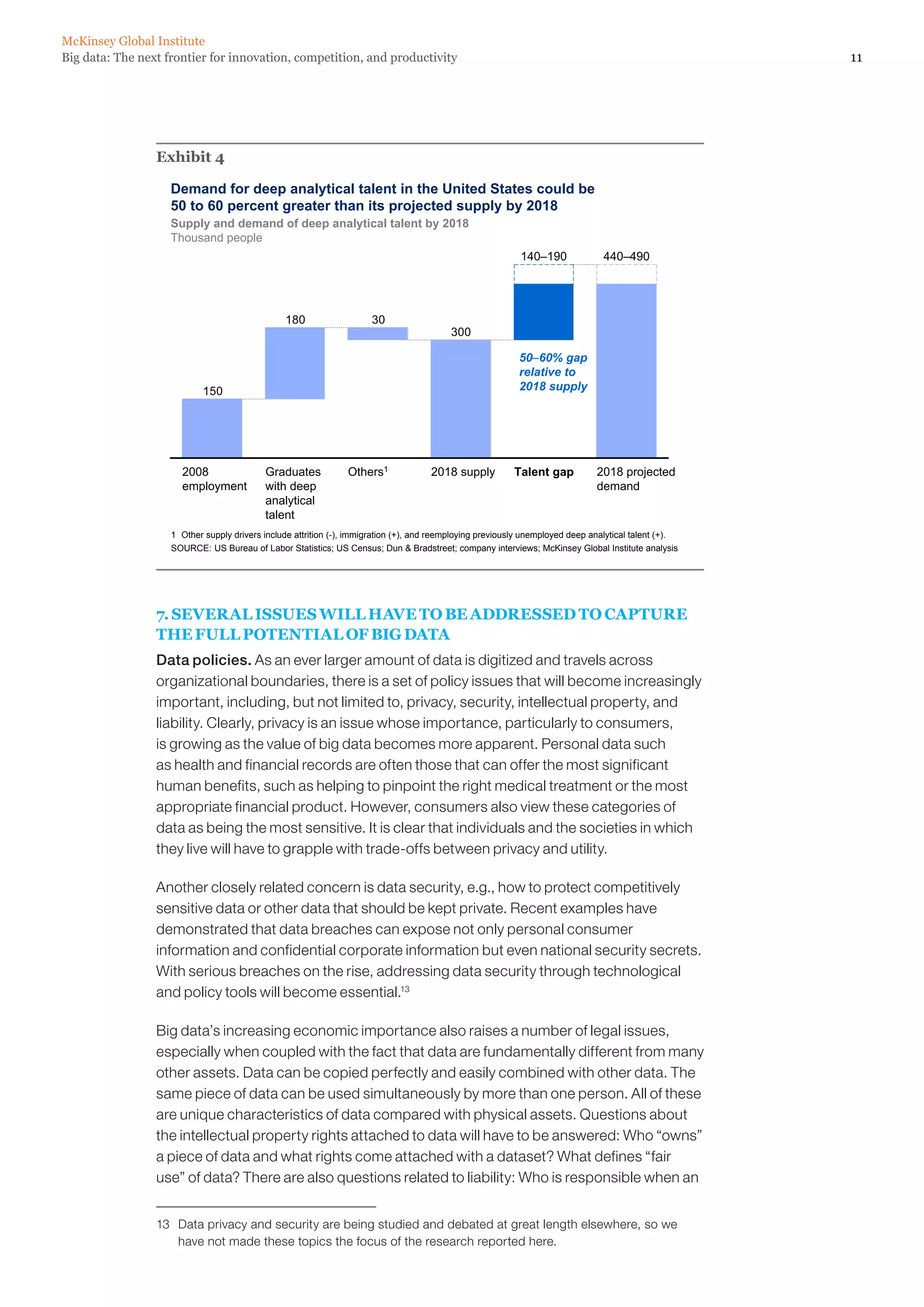
     In the United States, we expect big data to rapidly become a key determinant of
     competition across sectors. But we project that demand for deep analytical positions
     in a big data world could exceed the supply being produced on current trends by
     140,000 to 190,000 positions (Exhibit 4). Furthermore, this type of talent is difficult to
     produce, taking years of training in the case of someone with intrinsic mathematical
     abilities. Although our quantitative analysis uses the United States as illustration, we
     believe that the constraint on this type of talent will be global, with the caveat that
     some regions may be able to produce the supply that can fill talent gaps in other
     regions.

     In addition, we project a need for 1.5 million additional managers and analysts in
     the United States who can ask the right questions and consume the results of the
     analysis of big data effectively. The United States—and other economies facing
     similar shortages—cannot fill this gap simply by changing graduate requirements
     and waiting for people to graduate with more skills or by importing talent (although
     these could be important actions to take). It will be necessary to retrain a significant
     amount of the talent in place; fortunately, this level of training does not require years of
     dedicated study.
McKinsey Global Institute
Big data: The next frontier for innovation, competition, and productivity                                                                              11


                 Exhibit 4

                    Demand for deep analytical talent in the United States could be
                    50 to 60 percent greater than its projected supply by 2018
                    Supply and demand of deep analytical talent by 2018
                    Thousand people
                                                                                                            140–190              440–490


                                                180                   30
                                                                                          300

                                                                                                           50–60% gap
                                                                                                           relative to
                            150                                                                            2018 supply


                      2008                 Graduates            Others1              2018 supply          Talent gap           2018 projected
                      employment           with deep                                                                           demand
                                           analytical
                                           talent
                    1 Other supply drivers include attrition (-), immigration (+), and reemploying previously unemployed deep analytical talent (+).
                    SOURCE: US Bureau of Labor Statistics; US Census; Dun  Bradstreet; company interviews; McKinsey Global Institute analysis


                 7. SEVERAL ISSUES WILL HAVE TO BE ADDRESSED TO CAPTURE
                 THE FULL POTENTIAL OF BIG DATA
                 Data policies. As an ever larger amount of data is digitized and travels across
                 organizational boundaries, there is a set of policy issues that will become increasingly
                 important, including, but not limited to, privacy, security, intellectual property, and
                 liability. Clearly, privacy is an issue whose importance, particularly to consumers,
                 is growing as the value of big data becomes more apparent. Personal data such
                 as health and financial records are often those that can offer the most significant
                 human benefits, such as helping to pinpoint the right medical treatment or the most
                 appropriate financial product. However, consumers also view these categories of
                 data as being the most sensitive. It is clear that individuals and the societies in which
                 they live will have to grapple with trade-offs between privacy and utility.

                 Another closely related concern is data security, e.g., how to protect competitively
                 sensitive data or other data that should be kept private. Recent examples have
                 demonstrated that data breaches can expose not only personal consumer
                 information and confidential corporate information but even national security secrets.
                 With serious breaches on the rise, addressing data security through technological
                 and policy tools will become essential.13

                 Big data’s increasing economic importance also raises a number of legal issues,
                 especially when coupled with the fact that data are fundamentally different from many
                 other assets. Data can be copied perfectly and easily combined with other data. The
                 same piece of data can be used simultaneously by more than one person. All of these
                 are unique characteristics of data compared with physical assets. Questions about
                 the intellectual property rights attached to data will have to be answered: Who “owns”
                 a piece of data and what rights come attached with a dataset? What defines “fair
                 use” of data? There are also questions related to liability: Who is responsible when an


                 13	 Data privacy and security are being studied and debated at great length elsewhere, so we
                     have not made these topics the focus of the research reported here.
12


     inaccurate piece of data leads to negative consequences? Such types of legal issues
     will need clarification, probably over time, to capture the full potential of big data.

     Technology and techniques. To capture value from big data, organizations will
     have to deploy new technologies (e.g., storage, computing, and analytical software)
     and techniques (i.e., new types of analyses). The range of technology challenges
     and the priorities set for tackling them will differ depending on the data maturity
     of the institution. Legacy systems and incompatible standards and formats too
     often prevent the integration of data and the more sophisticated analytics that
     create value from big data. New problems and growing computing power will spur
     the development of new analytical techniques. There is also a need for ongoing
     innovation in technologies and techniques that will help individuals and organizations
     to integrate, analyze, visualize, and consume the growing torrent of big data.

     Organizational change and talent. Organizational leaders often lack the
     understanding of the value in big data as well as how to unlock this value. In
     competitive sectors this may prove to be an Achilles heel for some companies since
     their established competitors as well as new entrants are likely to leverage big data to
     compete against them. And, as we have discussed, many organizations do not have
     the talent in place to derive insights from big data. In addition, many organizations
     today do not structure workflows and incentives in ways that optimize the use of big
     data to make better decisions and take more informed action.

     Access to data. To enable transformative opportunities, companies will increasingly
     need to integrate information from multiple data sources. In some cases,
     organizations will be able to purchase access to the data. In other cases, however,
     gaining access to third-party data is often not straightforward. The sources of third-
     party data might not have considered sharing it. Sometimes, economic incentives
     are not aligned to encourage stakeholders to share data. A stakeholder that holds a
     certain dataset might consider it to be the source of a key competitive advantage and
     thus would be reluctant to share it with other stakeholders. Other stakeholders must
     find ways to offer compelling value propositions to holders of valuable data.

     Industry structure. Sectors with a relative lack of competitive intensity and
     performance transparency, along with industries where profit pools are highly
     concentrated, are likely to be slow to fully leverage the benefits of big data. For
     example, in the public sector, there tends to be a lack of competitive pressure that
     limits efficiency and productivity; as a result, the sector faces more difficult barriers
     than other sectors in the way of capturing the potential value from using big data. US
     health care is another example of how the structure of an industry impacts on how
     easy it will be to extract value from big data. This is a sector that not only has a lack
     of performance transparency into cost and quality but also an industry structure in
     which payors will gain (from fewer payouts for unnecessary treatment) from the use
     of clinical data. However, the gains accruing to payors will be at the expense of the
     providers (fewer medical activities to charge for) from whom the payors would have to
     obtain the clinical data. As these examples suggest, organization leaders and policy
     makers will have to consider how industry structures could evolve in a big data world
     if they are to determine how to optimize value creation at the level of individual firms,
     sectors, and economies as a whole.
McKinsey Global Institute
Big data: The next frontier for innovation, competition, and productivity                                     13


                                                                

                 The effective use of big data has the potential to transform economies, delivering a
                 new wave of productivity growth and consumer surplus. Using big data will become a
                 key basis of competition for existing companies, and will create new competitors who
                 are able to attract employees that have the critical skills for a big data world. Leaders
                 of organizations need to recognize the potential opportunity as well as the strategic
                 threats that big data represent and should assess and then close any gap between
                 their current IT capabilities and their data strategy and what is necessary to capture
                 big data opportunities relevant to their enterprise. They will need to be creative and
                 proactive in determining which pools of data they can combine to create value and
                 how to gain access to those pools, as well as addressing security and privacy issues.
                 On the topic of privacy and security, part of the task could include helping consumers
                 to understand what benefits the use of big data offers, along with the risks. In parallel,
                 companies need to recruit and retain deep analytical talent and retrain their analyst
                 and management ranks to become more data savvy, establishing a culture that
                 values and rewards the use of big data in decision making.

                 Policy makers need to recognize the potential of harnessing big data to unleash
                 the next wave of growth in their economies. They need to provide the institutional
                 framework to allow companies to easily create value out of data while protecting the
                 privacy of citizens and providing data security. They also have a significant role to
                 play in helping to mitigate the shortage of talent through education and immigration
                 policy and putting in place technology enablers including infrastructure such
                 as communication networks; accelerating research in selected areas including
                 advanced analytics; and creating an intellectual property framework that encourages
                 innovation. Creative solutions to align incentives may also be necessary, including, for
                 instance, requirements to share certain data to promote the public welfare.
McKinsey Global Institute
Big data: The next frontier for innovation, competition, and productivity                                              15


                 1.  Mapping global data: Growth and
                 value creation


                 Many of the most powerful inventions throughout human history, from language to
                 the modern computer, were those that enabled people to better generate, capture,
                 and consume data and information.14 We have witnessed explosive growth in the
                 amount of data in our world. Big data has reached critical mass in every sector and
                 function of the typical economy, and the rapid development and diffusion of digital
                 information technologies have intensified its growth.

                 We estimate that new data stored by enterprises exceeded 7 exabytes of data
                 globally in 2010 and that new data stored by consumers around the world that year
                 exceeded an additional 6 exabytes.15 To put these very large numbers in context, the
                 data that companies and individuals are producing and storing is equivalent to filling
                 more than 60,000 US Libraries of Congress. If all words spoken by humans were
                 digitized as text, they would total about 5 exabytes—less than the new data stored
                 by consumers in a year.16 The increasing volume and detail of information captured
                 by enterprises, together with the rise of multimedia, social media, and the Internet of
                 Things will fuel exponential growth in data for the foreseeable future.

                 There is no doubt that the sheer size and rapidly expanding universe of big data are
                 phenomena in themselves and have been the primary focus of research thus far.
                 But the key question is what broader impact this torrent of data might have. Many
                 consumers are suspicious about the amount of data that is collected about every
                 aspect of their lives, from how they shop to how healthy they are. Is big data simply a
                 sign of how intrusive society has become, or can big data, in fact, play a useful role in
                 economic terms that can benefit all societal stakeholders?

                 The emphatic answer is that data can indeed create significant value for the world
                 economy, potentially enhancing the productivity and competitiveness of companies
                 and creating a substantial economic surplus for consumers and their governments.
                 Building on MGI’s deep background in analyzing productivity and competitiveness
                 around the world, this research explores a fresh linkage between data and
                 productivity. Although the relationship between productivity and IT investments
                 is well established, exploring the link between productivity and data breaks new
                 ground. Based on our findings, we believe that the global economy is on the cusp of a
                 new wave of productivity growth enabled by big data.

                 In this chapter, we look at past and current research on sizing big data and its storage
                 capacity. We then explore the likely relationship between big data and productivity,
                 drawing on past analyses of the impact of IT investment and innovation to drive


                 14	 For an interesting perspective on this topic, see James Gleick, The information: A history. A
                     theory. A flood (New York, NY: Pantheon Books, 2011).
                 15	 Our definition of new data stored describes the amount of digital storage newly taken up by
                     data in a year. Note that this differs from Hal Varian and Peter Lyman’s definition of new data
                     stored as our methodology does not take into account data created and stored but then
                     written over in a year. See the appendix for further details
                 16	 Peter Lyman and Hal R. Varian, How much information? 2003, School of Information
                     Management and Systems, University of California at Berkeley, 2003.
16


     productivity that we believe is directly applicable to the current and likely future
     evolution of big data.


     THE VOLUME OF DATA IS GROWING AT AN EXPONENTIAL RATE
     MGI is the latest of several research groups to study the amount of data that enterprises
     and individuals are generating, storing, and consuming throughout the global economy.
     All analyses, each with different methodologies and definitions, agree on one fundamental
     point—the amount of data in the world has been expanding rapidly and will continue to grow
     exponentially for the foreseeable future (see Box 3, “Measuring data”) despite there being a
     question mark over how much data we, as human beings, can absorb (see Box 4, “Human
     beings may have limits in their ability to consume and understand big data” on page 18).


        Box 3. Measuring data
        Measuring volumes of data provokes a number of methodological questions.
        First, how can we distinguish data from information and from insight? Common
        definitions describe data as being raw indicators, information as the meaningful
        interpretation of those signals, and insight as an actionable piece of knowledge.
        For the purposes of sizing big data in this research, we focused primarily on data
        sized in terms of bytes. But a second question then arises. When using bytes,
        what types of encoding should we use? In other words, what is the amount of
        assumed compression in the encoding? We have chosen to assume the most
        common encoding methods used for each type of data.


     Hal Varian and Peter Lyman at the University of California Berkeley were pioneers
     in the research into the amount of data produced, stored, and transmitted. As part
     of their “How much information?” project that ran from 2000 to 2003, the authors
     estimated that 5 exabytes of new data were stored globally in 2002 (92 percent on
     magnetic media) and that more than three times that amount—18 exabytes—of new
     or original data were transmitted, but not necessarily stored, through electronic
     channels such as telephone, radio, television, and the Internet. Most important,
     they estimated that the amount of new data stored doubled from 1999 to 2002, a
     compound annual growth rate of 25 percent.

     Then, starting in 2007, the information-management company EMC sponsored the
     research firm IDC to produce an annual series of reports on the “Digital Universe”
     to size the amount of digital information created and replicated each year.17 This
     analysis showed that in 2007, the amount of digital data created in a year exceeded the
     world’s data storage capacity for the first time. In short, there was no way to actually
     store all of the digital data being created. They also found that the rate at which data
     generation is increasing is much faster than the world’s data storage capacity is
     expanding, pointing strongly to the continued widening of the gap between the two.
     Their analysis estimated that the total amount of data created and replicated in 2009
     was 800 exabytes—enough to fill a stack of DVDs reaching to the moon and back. They
     projected that this volume would grow by 44 times to 2020, an implied annual growth
     rate of 40 percent.18

     17	 IDC has published a series of white papers, sponsored by EMC, including The expanding
         digital universe, March 2007; The diverse and exploding digital universe, March 2008; As
         the economy contracts, the digital universe expands, May 2009; and The digital universe
         decade—Are you ready?, May 2010. All are available at www.emc.com/leadership/programs/
         digital-universe.htm.
     18	 The IDC estimates of the volume of data include copies of data, not just originally generated
         data.
McKinsey Global Institute
Big data: The next frontier for innovation, competition, and productivity                                                                               17


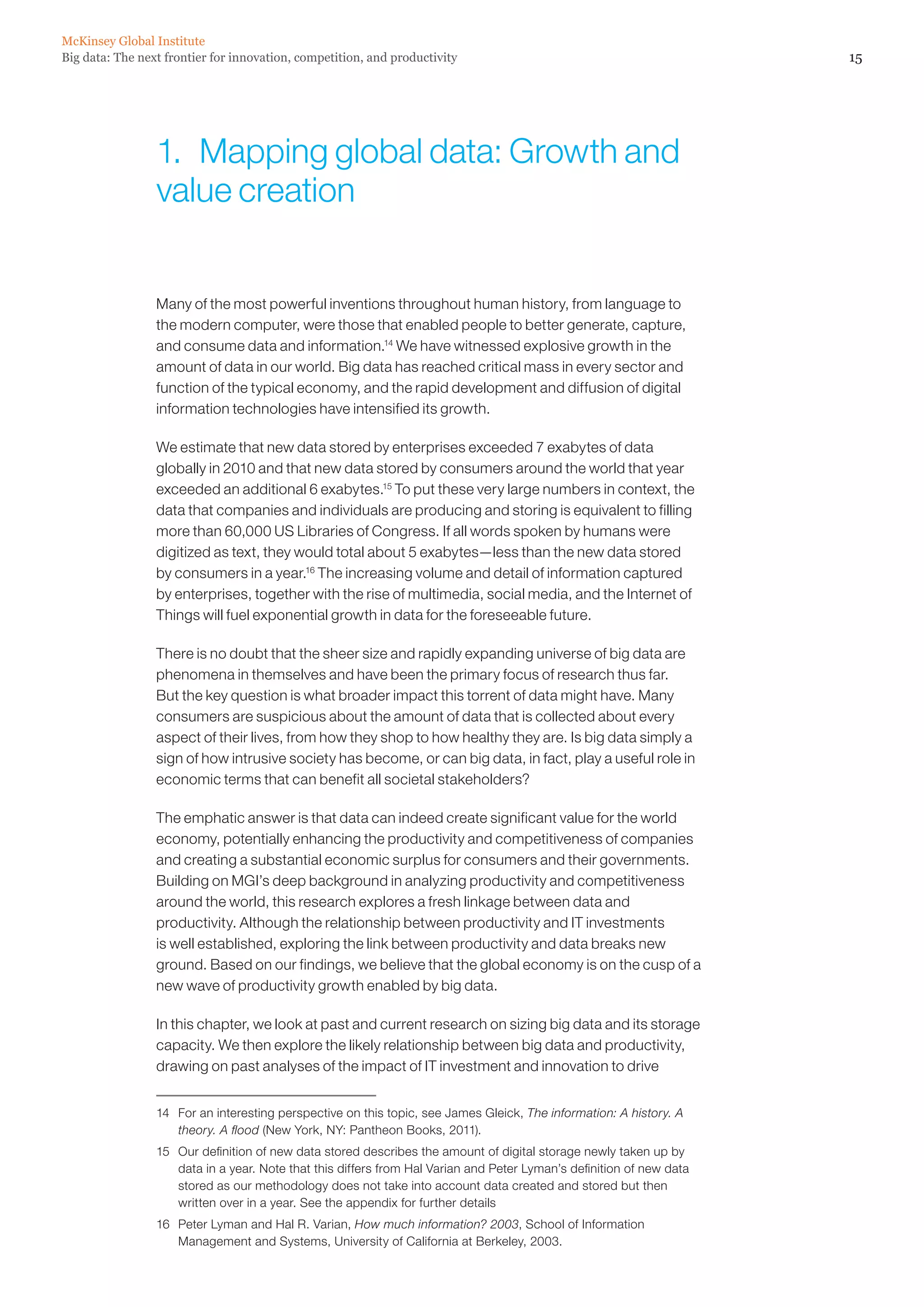
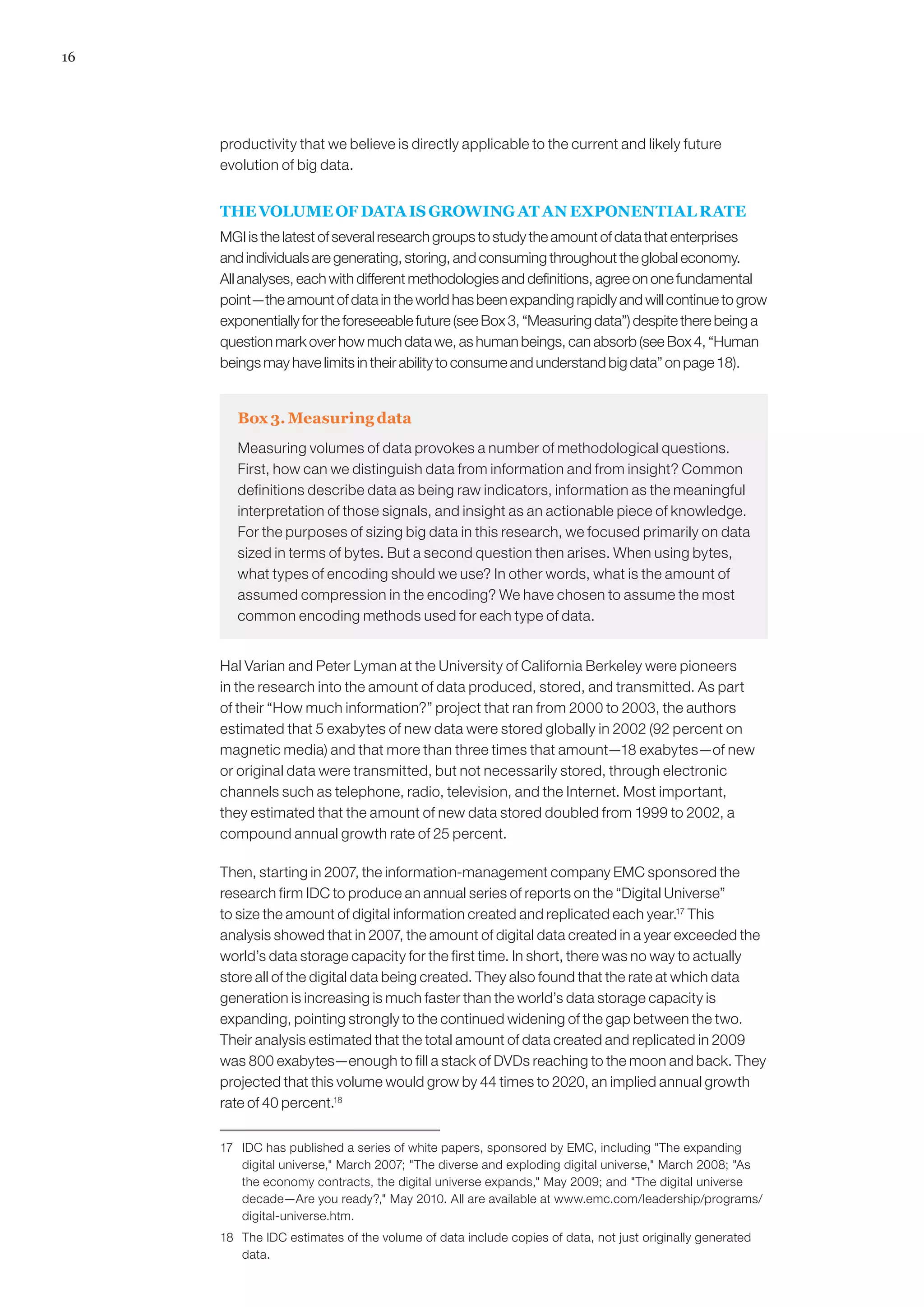
                 Most recently, Martin Hilbert and Priscila López published a paper in Science that analyzed
                 total global storage and computing capacity from 1986 to 2007.19 Their analysis showed
                 that while global storage capacity grew at an annual rate of 23 percent over that period
                 (to more than 290 exabytes in 2007 for all analog and digital media), general-purpose
                 computing capacity, a measure of the ability to generate and process data, grew at a much
                 higher annual rate of 58 percent. Their study also documented the rise of digitization. They
                 estimated that the percentage of data stored in digital form increased from only 25 percent
                 in 2000 (analog forms such as books, photos, and audio/video tapes making up the bulk of
                 data storage capacity at that time) to a dominant 94 percent share in 2007 as media such
                 as hard drives, CDs, and digital tapes grew in importance (Exhibits 5 and 6).

                 Exhibit 5
                    Data storage has grown significantly, shifting markedly from analog to
                    digital after 2000
                    Global installed, optimally compressed, storage

                     Overall                                                 Detail
                     Exabytes                                                %; exabytes
                     300                                                       100% =        3             16                54               295
                                                                                             1             3
                                                                             Digital

                     250                                                                                                     25


                     200


                     150                                                                                                                       94
                                                                             Analog          99            97

                                                                                                                             75
                     100


                      50


                                                                                                                                               6
                        0
                        1986          1993           2000          2007                     1986          1993            2000                2007

                    NOTE: Numbers may not sum due to rounding.
                    SOURCE: Hilbert and López, “The world’s technological capacity to store, communicate, and compute information,” Science,
                            2011


                 Exhibit 6
                    Computation capacity has also risen sharply
                    Global installed computation to handle information

                     Overall                                         Detail                        Pocket calculators             Mobile phones/PDA
                     1012 million instructions per second            %; 1012 million               Supercomputers                 Video game consoles
                                                                     instructions
                      6.5                                                                          Servers and                    Personal computers
                                                                     per second
                      6.0                                                                          mainframes

                      5.5                                                         0.001           0.004             0.289                 6.379
                                                                     100%                                                                       3
                      5.0                                                                            6              6
                                                                                                                          3               6
                      4.5                                                                                           5
                                                                                                     23
                                                                                       41                                                     25
                      4.0
                      3.5                                                                             6

                      3.0
                                                                                       17
                      2.5
                                                                                                                        86
                      2.0                                                              9
                                                                                                     64                                       66
                      1.5
                      1.0
                                                                                       33
                      0.5
                        0
                        1986        1993        2000        2007                   1986             1993                2000               2007

                    NOTE: Numbers may not sum due to rounding.
                    SOURCE: Hilbert and López, “The world’s technological capacity to store, communicate, and compute information,” Science,
                            2011


                 19	 Martin Hilbert and Priscila López, “The world’s technological capacity to store, communicate,
                     and compute information,” Science, February 10, 2011.
18


       Box 4. Human beings may have limits in their ability to consume
       and understand big data
       The generation of big data may be growing exponentially and advancing
       technology may allow the global economy to store and process ever greater
       quantities of data, but there may be limits to our innate human ability—our
       sensory and cognitive faculties—to process this data torrent. It is said that
       the mind can handle about seven pieces of information in its short-term
       memory.1 Roger Bohn and James Short at the University of California at San
       Diego discovered that the rate of growth in data consumed by consumers,
       through various types of media, was a relatively modest 2.8 percent in bytes
       per hour between 1980 and 2008. We should note that one of the reasons for
       this slow growth was the relatively fixed number of bytes delivered through
       television before the widespread adoption of high-definition digital video. 2
       The topic of information overload has been widely studied by academics from
       neuroscientists to economists. Economist Herbert Simon once said, “A wealth
       of information creates a poverty of attention and a need to allocate that attention
       efficiently among the overabundance of information sources that might
       consume it.”3

       Despite these apparent limits, there are ways to help organizations and
       individuals to process, visualize, and synthesize meaning from big data. For
       instance, more sophisticated visualization techniques and algorithms, including
       automated algorithms, can enable people to see patterns in large amounts of
       data and help them to unearth the most pertinent insights (see chapter 2 for
       examples of visualization). Advancing collaboration technology also allows a
       large number of individuals, each of whom may possess understanding of a
       special area of information, to come together in order to create a whole picture
       to tackle interdisciplinary problems. If organizations and individuals deployed
       such techniques more widely, end-user demand for big data could strengthen
       significantly.

       1	 George A. Miller, “The magical number seven, plus or minus two: Some limits on our
          capacity for processing information,” Psychological Review, Volume 63(2), March 1956:
          81–97.
       2	 Roger Bohn and James Short, How much information? 2009: Report on American
          consumers, University of California, San Diego, Global Information Industry Center,
          January 2010.
       3	 Herbert A. Simon, “Designing organizations for an information-rich world,” in Martin
          Greenberger, Computers, Communication, and the Public Interest, Baltimore, MD: The
          Johns Hopkins Press, 1971.


     THE INTENSITY OF BIG DATA VARIES ACROSS SECTORS BUT HAS
     REACHED CRITICAL MASS IN EVERY SECTOR
     There is broad agreement that data generation has been growing exponentially. Has
     that growth been concentrated only in certain segments of the global economy? The
     answer to that question is no. The growth of big data is a phenomenon that we have
     observed in every sector. More important, data intensity—i.e., the average amount
     of data stored per company—across sectors in the global economy is sufficient for
     companies to use techniques enabled by large datasets to drive value (although
     some sectors had significantly higher data intensity than others). Business leaders
     across sectors are now beginning to ask themselves how they can better derive value
McKinsey Global Institute
Big data: The next frontier for innovation, competition, and productivity                                                                                    19


                 from their data assets, but we would argue that leaders in sectors with high data
                 intensity in particular should make examining the potential a high priority.

                 MGI estimates that enterprises around the world used more than 7 exabytes of
                 incremental disk drive data storage capacity in 2010; nearly 80 percent of that total
                 appeared to duplicate data that had been stored elsewhere.20 We also analyzed
                 data generation and storage at the level of sectors and individual firms. We estimate
                 that, by 2009, nearly all sectors in the US economy had at least an average of
                 200 terabytes of stored data per company (for companies with more than 1,000
                 employees) and that many sectors had more than 1 petabyte in mean stored data per
                 company. Some individual companies have far higher stored data than their sector
                 average, potentially giving them more potential to capture value from big data.

                 Some sectors Exhibit far higher levels of data intensity than others, implying that
                 they have more near-term potential to capture value from big data. Financial services
                 sectors, including securities and investment services and banking, have the most
                 digital data stored per firm on average. This probably reflects the fact that firms involved
                 in these sectors tend to be transaction-intensive (the New York Stock Exchange, for
                 instance, boasts about half a trillion trades a month) and that, on average, these types
                 of sectors tend to have a preponderance of large firms. Communications and media
                 firms, utilities, and government also have significant digital data stored per enterprise or
                 organization, which appears to reflect the fact that such entities have a high volume of
                 operations and multimedia data. Discrete and process manufacturing have the highest
                 aggregate data stored in bytes. However, these sectors rank much lower in intensity
                 terms, since they are fragmented into a large number of firms. Because individual firms
                 often do not share data, the value they can obtain from big data could be constrained
                 by the degree to which they can pool data across manufacturing supply chains (see
                 chapter 3d on manufacturing for more detail) (Exhibit 7).


                 Exhibit 7

                    Companies in all sectors have at least 100 terabytes of stored data in the
                    United States; many have more than 1 petabyte
                                                         Stored data in the                                               Stored data per firm
                                                         United States, 20091         Number of firms with                (1,000 employees), 2009
                                                         Petabytes                    1,000 employees2                   Terabytes
                    Discrete manufacturing3                                     966                       1,000                    9672
                    Government                                                 848              647                                     1,312
                    Communications and media                              715                 399                                          1,792
                    Process manufacturing3                                694                        835                          8312
                    Banking                                              619              321                                              1,931
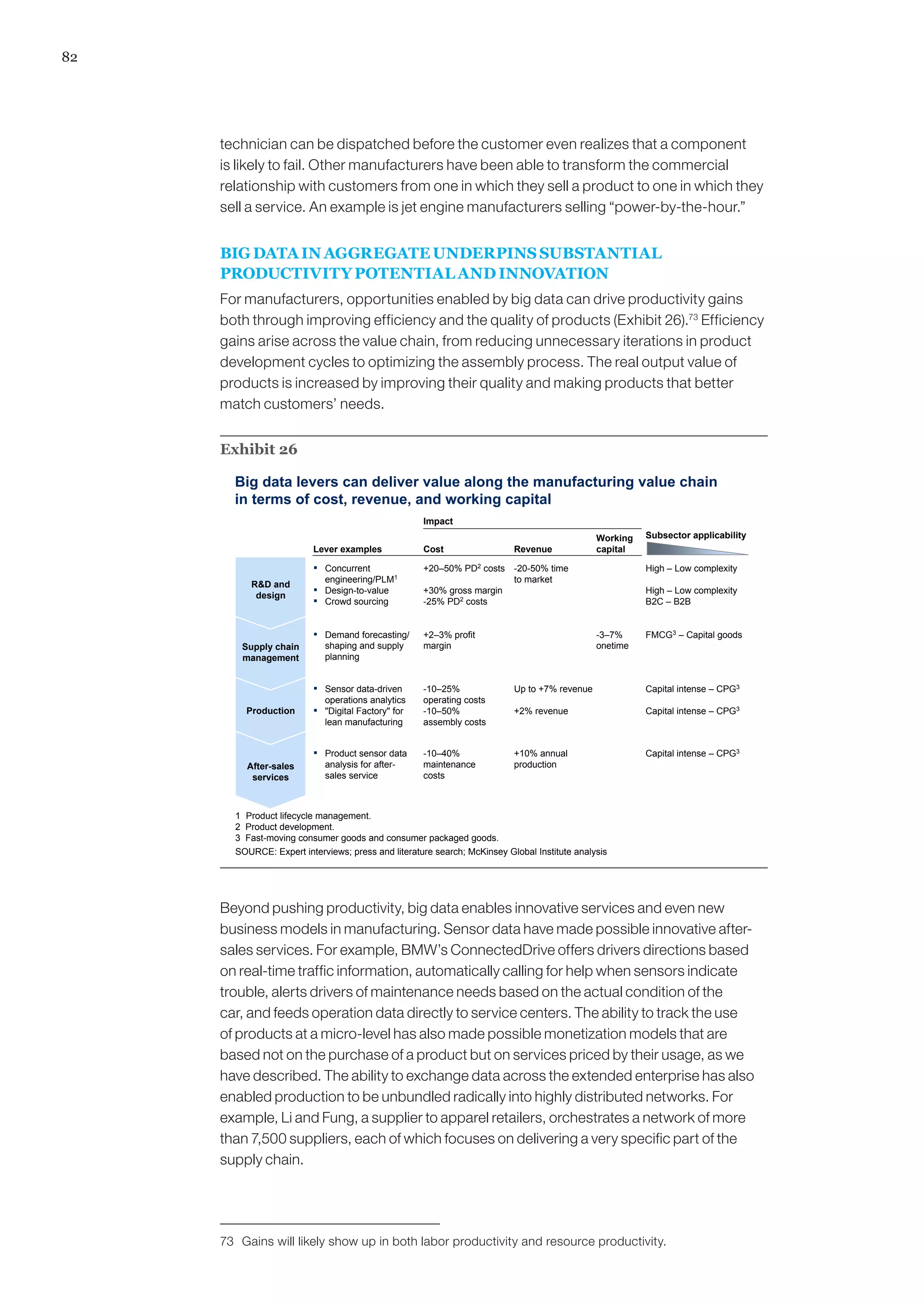
                    Health care providers3                          434                                     1,172            370
                    Securities and investment services             429                  111                                                          3,866
                    Professional services                          411                                            1,478      278
                    Retail                                       364                           522                                697
                    Education                                 269                                    843                     319
                    Insurance                                 243                         280                                      870
                    Transportation                           227                          283                                     801
                    Wholesale                                202                           376                                536
                    Utilities                                194                        129                                              1,507
                    Resource industries                    116                          140                                       825
                    Consumer  recreational services       106                                      708                     150
                    Construction                          51                             222                                231
                    1 Storage data by sector derived from IDC.
                    2 Firm data split into sectors, when needed, using employment
                    3 The particularly large number of firms in manufacturing and health care provider sectors make the available storage per
                      company much smaller.
                    SOURCE: IDC; US Bureau of Labor Statistics; McKinsey Global Institute analysis


                 20	 This is an estimate of the additional capacity utilized during the year. In some cases, this
                     capacity could consist of multiple sets of data overwriting other data, but the capacity usage
                     is incremental over the storage capacity used the previous year.
20


     In addition to variations in the amount of data stored in different sectors, the types
     of data generated and stored—i.e., whether the data encodes video, images,
     audio, or text/numeric information—also differ markedly from industry to industry.
     For instance, financial services, administrative parts of government, and retail and
     wholesale all generate significant amounts of text and numerical data including
     customer data, transaction information, and mathematical modeling and simulations
     (Exhibit 8). Other sectors such as manufacturing, health care, and communications
     and media are responsible for higher percentages of multimedia data. Manufacturing
     generates a great deal of text and numerical data in its production processes, but
     RD and engineering functions in many manufacturing subsectors are heavy users of
     image data used in design.

     Image data in the form of X-rays, CT, and other scans dominate data storage volumes
     in health care. While a single page of records can total a kilobyte, a single image can
     require 20 to 200 megabytes or more to store. In the communications and media
     industries, byte-hungry images and audio dominate storage volumes. Indeed, if we
     were to examine pure data generation (rather than storage), some subsectors such as
     health care and gaming generate even more multimedia data in the form of real-time
     procedure and surveillance video, respectively, but this is rarely stored for long.


     Exhibit 8

       The type of data generated and stored varies by sector1                                                       Penetration

                                                                                                                        High
                                                                                                             Text/
                                                         Video            Image           Audio            numbers      Medium

       Banking                                                                                                          Low

       Insurance
       Securities and investment services
       Discrete manufacturing
       Process manufacturing
       Retail
       Wholesale
       Professional services
       Consumer and recreational services
       Health care
       Transportation
       Communications and media2
       Utilities
       Construction
       Resource industries
       Government
       Education
       1 We compiled this heat map using units of data (in files or minutes of video) rather than bytes.
       2 Video and audio are high in some subsectors.
       SOURCE: McKinsey Global Institute analysis


     Turning to a geographic profile of where big data are stored, North America and
     Europe together lead the pack with a combined 70 percent of the global total
     currently. However, both developed and emerging markets are expected to
     experience strong growth in data storage and, by extension, data generation at rates
     of anywhere between 35 and 45 percent a year. An effort to profile the distribution
     of data around the world needs to take into account that data are not always stored
     in the country where they are generated; data centers in one region can store and
     analyze data generated in another.
McKinsey Global Institute
Big data: The next frontier for innovation, competition, and productivity                                      21


                 MAJOR ESTABLISHED TRENDS WILL CONTINUE TO DRIVE DATA
                 GROWTH
                 Across sectors and regions, several cross-cutting trends have fueled growth in data
                 generation and will continue to propel the rapidly expanding pools of data. These
                 trends include growth in traditional transactional databases, continued expansion
                 of multimedia content, increasing popularity of social media, and proliferation of
                 applications of sensors in the Internet of Things.

                 Enterprises are collecting data with greater granularity and frequency, capturing
                 every customer transaction, attaching more personal information, and also collecting
                 more information about consumer behavior in many different environments. This
                 activity simultaneously increases the need for more storage and analytical capacity.
                 Tesco, for instance, generates more than 1.5 billion new items of data every month.
                 Wal-Mart’s warehouse now includes some 2.5 petabytes of information, the
                 equivalent of roughly half of all the letters delivered by the US Postal Service in 2010.

                 The increasing use of multimedia in sectors including health care and consumer-facing
                 industries has contributed significantly to the growth of big data and will continue to
                 do so. Videos generate a tremendous amount of data. Every minute of the now most
                 commonly used high-resolution video in surgeries generates 25 times the data volume
                 (per minute) of even the highest resolution still images such as CT scans, and each of
                 those still images already requires thousands of times more bytes than a single page
                 of text or numerical data. More than 95 percent of the clinical data generated in health
                 care is now video. Multimedia data already accounts for more than half of Internet
                 backbone traffic (i.e., the traffic carried on the largest connections between major
                 Internet networks), and this share is expected to grow to 70 percent by 2013.21

                 The surge in the use of social media is producing its own stream of new data. While social
                 networks dominate the communications portfolios of younger users, older users are
                 adopting them at an even more rapid pace. McKinsey surveyed users of digital services
                 and found a 7 percent increase in 2009 in use of social networks by people aged 25 to
                 34, an even more impressive 21 to 22 percent increase among those aged 35 to 54, and
                 an eye-opening 52 percent increase in usage among those aged 55 to 64. The rapid
                 adoption of smartphones is also driving up the usage of social networking (Exhibit 9).
                 Facebook’s 600 million active users spend more than 9.3 billion hours a month on
                 the site—if Facebook were a country, it would have the third-largest population in the
                 world. Every month, the average Facebook user creates 90 pieces of content and the
                 network itself shares more than 30 billion items of content including photos, notes, blog
                 posts, Web links, and news stories. YouTube says it has some 490 million unique visitors
                 worldwide who spend more than 2.9 billion hours on the site each month. YouTube
                 claims to upload 24 hours of video every minute, making the site a hugely significant data
                 aggregator. McKinsey has also documented how the use of social media and Web 2.0
                 has been migrating from the consumer realm into the enterprise.22

                 Increasing applications of the Internet of Things, i.e., sensors and devices embedded
                 in the physical world and connected by networks to computing resources, is another
                 trend driving growth in big data.23 McKinsey research projects that the number of


                 21	 IDC Internet consumer traffic analysis, 2010.
                 22	 Michael Chui, Andy Miller, and Roger Roberts. Six ways to make Web 2.0 work,” McKinsey
                     Quarterly, February 2009; Jaques Bughin and Michael Chui, “The rise of the networked
                     enterprise: Web 2.0 finds its payday,” McKinsey Quarterly. December 2010.
                 23	 Michael Chui, Markus Löffler, and Roger Roberts, “The Internet of Things,” McKinsey
                     Quarterly, March 2010.
22


     connected nodes in the Internet of Things—sometimes also referred to as machine-
     to-machine (M2M) devices—deployed in the world will grow at a rate exceeding
     30 percent annually over the next five years (Exhibit 10). Some of the growth sectors
     are expected to be utilities as these operators install more smart meters and smart
     appliances; health care, as the sector deploys remote health monitoring; retail, which
     will eventually increase its use of radio frequency identification (RFID) tags; and the
     automotive industry, which will increasingly install sensors in vehicles.


     Exhibit 9

       The penetration of social networks is increasing online                                                         Frequent user2

       and on smartphones; frequent users are increasing
       as a share of total users1
        Social networking penetration on the PC is                      Social networking penetration of smartphones
        slowing, but frequent users are still increasing                has nearly doubled since 2008
        % of respondents                                                % of smartphone users
                                  +11% p.a.
                                                   67                                            +28% p.a.
                                      63                                                                          57
                         55                        12
                                      14                                                              47          13
                         13                                                                          14
                                                                                         35
                                                                                         12
                                                   55
                                      49                                                                          44
                         41                                                                           33
                                                                                         23


                        2008         2009        2010                                   2008        2009         2010
        %                                                               %
        Frequent         76           78          82                    Frequent         65           70          77
        users                                                           users

       1 Based on penetration of users who browse social network sites. For consistency, we exclude Twitter-specific questions
         (added to survey in 2009) and location-based mobile social networks (e.g., Foursquare, added to survey in 2010).
       2 Frequent users defined as those that use social networking at least once a week.
       SOURCE: McKinsey iConsumer Survey


     Exhibit 10

       Data generated from the Internet of Things will grow exponentially
       as the number of connected nodes increases
                                                                                              Compound annual
       Estimated number of connected nodes                                                    growth rate 2010–15, %
       Million
                                                        72–215                                     35
                                                        5–14         Security                      50+

                                                        10–30        Health care                   50+
                                                                     Energy                         15
                                                   2–6      1–3
                                                                     Industrials                    5
                                                        8–23         Retail                         30
                                                        4–12         Travel and logistics          15


                                                        28–83        Utilities                     45


                            17–50
                          2–5              1–2
                                 2–6
                          2–6
                             5–14                       15–45        Automotive                    20
                              6–18

                              2010                      2015
       NOTE: Numbers may not sum due to rounding.
       SOURCE: Analyst interviews; McKinsey Global Institute analysis
McKinsey Global Institute
Big data: The next frontier for innovation, competition, and productivity                                          23


                 TRADITIONAL USES OF IT HAVE CONTRIBUTED TO
                 PRODUCTIVITY GROWTH— BIG DATA IS THE NEXT FRONTIER
                 The history of IT investment and innovation and its impact on competitiveness and
                 productivity strongly suggest that big data can have similar power to transform our
                 lives. The same preconditions that enabled IT to power productivity are in place for big
                 data. We believe that there is compelling evidence that the use of big data will become
                 a key basis of competition, underpinning new waves of productivity growth, innovation,
                 and consumer surplus—as long as the right policies and enablers are in place.

                 Over a number of years, MGI has researched the link between IT and productivity.24
                 The same causal relationships apply just as much to big data as they do to IT in
                 general. Big data levers offer significant potential for improving productivity at the
                 level of individual companies. Companies including Tesco, Amazon, Wal-Mart,
                 Harrah’s, Progressive Insurance, and Capital One, and Smart, a wireless player in the
                 Philippines, have already wielded the use of big data as a competitive weapon—as have
                 entire economies (see Box 5, “Large companies across the globe have scored early
                 successes in their use of big data”).


                    Box 5. Large companies across the globe have scored early
                    successes in their use of big data
                    There are notable examples of companies around the globe that are well-
                    known for their extensive and effective use of data. For instance, Tesco’s loyalty
                    program generates a tremendous amount of customer data that the company
                    mines to inform decisions from promotions to strategic segmentation of
                    customers. Amazon uses customer data to power its recommendation engine
                    “you may also like …” based on a type of predictive modeling technique called
                    collaborative filtering. By making supply and demand signals visible between
                    retail stores and suppliers, Wal-Mart was an early adopter of vendor-managed
                    inventory to optimize the supply chain. Harrah’s, the US hotels and casinos
                    group, compiles detailed holistic profiles of its customers and uses them to
                    tailor marketing in a way that has increased customer loyalty. Progressive
                    Insurance and Capital One are both known for conducting experiments to
                    segment their customers systematically and effectively and to tailor product
                    offers accordingly. Smart, a leading wireless player in the Philippines, analyzes
                    its penetration, retailer coverage, and average revenue per user at the city or
                    town level in order to focus on the micro markets with the most potential.


                 We can disaggregate the impact of IT on productivity first into productivity growth
                 in IT-producing sectors such as semiconductors, telecoms, and computer
                 manufacturing, and that of IT-using sectors. In general, much of the productivity
                 growth in IT-producing sectors results from improving the quality of IT products as
                 technology develops. In this analysis, we focus largely on the sectors that use IT (and
                 that will increasingly use big data), accounting for a much larger slice of the global
                 economy than the sectors that supply IT.

                 Research shows that there are two essential preconditions for IT to affect labor
                 productivity. The first is capital deepening—in other words, the IT investments that give


                 24	See US productivity growth, 1995–2000, McKinsey Global Institute, October 2001, and How IT
                    enables productivity growth, McKinsey Global Institute, October 2002, both available at www.
                    mckinsey.com/mgi.
24


     workers better and faster tools to do their jobs. The second is investment in human
     capital and organizational change—i.e., managerial innovations that complement IT
     investments in order to drive labor productivity gains. In some cases, a lag between IT
     investments and organizational adjustments has meant that productivity improvements
     have taken awhile to show up. The same preconditions that explain the impact of IT in
     enabling historical productivity growth currently exist for big data.25

     There have been four waves of IT adoption with different degrees of impact on
     productivity growth in the United States (Exhibit 11). The first of these eras—the
     “mainframe” era—ran from 1959 to 1973. During this period, annual US productivity
     growth overall was very high at 2.82 percent. IT’s contribution to productivity was
     rather modest; at that stage, IT’s share of overall capital expenditure was relatively
     low. The second era from 1973 to 1995, which we’ll call the era of “minicomputers and
     PCs,” experienced much lower growth in overall productivity, but we can attribute
     a greater share of that growth to the impact of IT. Significant IT capital deepening
     occurred. Companies began to boost their spending on more distributed types of
     computers, and these computers became more powerful as their quality increased.

     The third era ran from 1995 to 2000—the era of the “Internet and Web 1.0.” In this
     period, US productivity growth returned to high rates, underpinned by significant IT
     capital deepening, an intensification of improvements in quality, and also the diffusion
     of significant managerial innovations that took advantage of previous IT capital
     investment. As we have suggested, there as a lag between IT investment and the
     managerial innovation necessary to accelerate productivity growth. Indeed, although
     we have named this era for the investments in Internet and Web 1.0 made at this time,
     most of the positive impact on productivity in IT-using sectors came from managerial
     and organizational change in response to investments in previous eras in mainframe,
     minicomputers, and PCs—and not from investment in the Internet.

     MGI research found that in this third era, productivity gains were unevenly distributed
     at the macroeconomic, sector, and firm levels. In some cases, a leading firm that had
     invested in sufficient IT was able to deploy managerial innovation to drive productivity
     and outcompete its industry counterparts. Wal-Mart’s implementation of IT-intensive
     business processes allowed the company to outperform competitors in the retail
     industry. Eventually those competitors invested in IT in response, accelerated their
     own productivity growth, and boosted the productivity of the entire sector.

     In fact, MGI found that six sectors accounted for almost all of the productivity gains in
     the US economy, while the rest contributed either very little productivity growth or even,
     in some cases, negative productivity growth. The six sectors that achieved a leap in
     productivity shared three broad characteristics in their approach to IT. First, they tailored
     their IT investment to sector-specific business processes and linked it to key performance
     levers. Second, they deployed IT sequentially, building capabilities over time. Third, IT
     investment evolved simultaneously with managerial and technical innovation.


     25	 We draw both on previous MGI research and an analysis by Dale Jorgenson, Mun Ho, and
         Kevin Stiroh of how IT impacted on US productivity growth between 1959 and 2006. See
         US productivity growth, 1995–2000, October 2001, and How IT enables productivity growth,
         October 2002, both available at www.mckinsey.com/mgi; Dale Jorgenson, Mun Ho, and
         Kevin Stiroh, “A Retrospective Look at the US Productivity Growth Resurgence,” Journal
         of Economic Perspectives, 2008; and Erik Brynjolfsson and Adam Saunders, Wired for
         innovation: How information technology is reshaping the economy (Cambridge, MA: MIT
         Press, 2009).
McKinsey Global Institute
Big data: The next frontier for innovation, competition, and productivity                                                                                 25


                 Exhibit 11

                    IT has made a substantial contribution to labor                                                                  Other contribution

                    productivity growth                                                                                              IT contribution1

                    Annual labor productivity growth
                    %
                                             2.82                                                        2.70
                                                                                                                                      2.50

                                                                                                        1.11
                                                                           1.49                                                       1.54
                                             2.52
                                                                           0.84
                                                                                                        1.59
                                                                                                                                      0.96
                                                                           0.65
                                              0.30
                                           1959–73                      1973–95                     1995–2000                       2000–06

                    Eras of IT         Mainframes
                    adoption2
                                                                     Mini-computers and PCs

                                                                                                   Internet and Web 1.0

                                                                                                                                Mobile devices
                                                                                                                                and Web 2.0

                    1 Includes the productivity of IT-producing sectors.
                    2 Note that there is generally a time lag between the adoption of a type of IT and realizing the resulting productivity impact.
                    SOURCE: Jorgenson, Mun Ho, and Stiroh, “A Retrospective Look at the US Productivity Growth Resurgence,” Journal of
                              Economic Perspectives, 2008; Brynjolfsson and Saunders, Wired for Innovation: How Information Technology is
                              Changing the Economy, MIT Press, 2009


                 The fourth and final era, running from 2000 to 2006, is the period of the “mobile
                 devices and Web 2.0.” During this period, the contribution from IT capital deepening
                 and that from IT-producing sectors dropped. However, the contribution from
                 managerial innovations increased—again, this wave of organizational change looks
                 like a lagged response to the investments in Internet and Web 1.0 from the preceding
                 five years.26

                 What do these patterns tell us about prospects for big data and productivity? Like
                 previous waves of IT-enabled productivity, leveraging big data fundamentally requires
                 both IT investments (in storage and processing power) and managerial innovation.
                 It seems likely that data intensity and capital deepening will fuel the diffusion of the
                 complementary managerial innovation boost productivity growth. As of now, there
                 is no empirical evidence of a link between data intensity or capital deepening in data
                 investments and productivity in specific sectors. The story of IT and productivity suggests
                 that the reason for this is a time lag and that we will, at some point, see investments in big-
                 data-related capital deepening pay off in the form of productivity gains.

                 In the research we conducted into big data in five domains across different
                 geographies, we find strong evidence that big data levers can boost efficiency by
                 reducing the number or size of inputs while retaining the same output level. At the
                 same time, they can be an important means of adding value by producing more real
                 output with no increase in input. In health care, for example, big data levers can boost
                 efficiency by reducing systemwide costs linked to undertreatment and overtreatment
                 and by reducing errors and duplication in treatment. These levers will also improve
                 the quality of care and patient outcomes. Similarly, in public sector administration,
                 big data levers lead to not only efficiency gains, but also gains in effectiveness from
                 enabling governments to collect taxes more efficiently and helping to drive the quality
                 of services from education to unemployment offices. For retailers, big data supply

                 26	 We use multifactor productivity in IT-using industries as our measurement of the impact of
                     managerial innovation.
26


     chain and operations levers can improve the efficiency of the entire sector. Marketing
     and merchandising levers will help consumers find better products to meet their
     needs at more reasonable prices, increasing real value added.

     The combination of deepening investments in big data and managerial innovation
     to create competitive advantage and boost productivity is very similar to the way IT
     developed from the 1970s onward. The experience of IT strongly suggests that we could
     be on the cusp of a new wave of productivity growth enabled by the use of big data.

                                              

     Data have become an important factor of production today—on a par with physical
     assets and human capital—and the increasing intensity with which enterprises
     are gathering information alongside the rise of multimedia, social media, and the
     Internet of Things will continue to fuel exponential growth in data for the foreseeable
     future. Big data have significant potential to create value for both businesses and
     consumers.
McKinsey Global Institute
Big data: The next frontier for innovation, competition, and productivity                                      27


                 2.  Big data techniques and
                 technologies


                 A wide variety of techniques and technologies has been developed and adapted
                 to aggregate, manipulate, analyze, and visualize big data. These techniques and
                 technologies draw from several fields including statistics, computer science, applied
                 mathematics, and economics. This means that an organization that intends to
                 derive value from big data has to adopt a flexible, multidisciplinary approach. Some
                 techniques and technologies were developed in a world with access to far smaller
                 volumes and variety in data, but have been successfully adapted so that they are
                 applicable to very large sets of more diverse data. Others have been developed
                 more recently, specifically to capture value from big data. Some were developed by
                 academics and others by companies, especially those with online business models
                 predicated on analyzing big data.

                 This report concentrates on documenting the potential value that leveraging big
                 data can create. It is not a detailed instruction manual on how to capture value,
                 a task that requires highly specific customization to an organization’s context,
                 strategy, and capabilities. However, we wanted to note some of the main techniques
                 and technologies that can be applied to harness big data to clarify the way some
                 of the levers for the use of big data that we describe might work. These are not
                 comprehensive lists—the story of big data is still being written; new methods and
                 tools continue to be developed to solve new problems. To help interested readers
                 find a particular technique or technology easily, we have arranged these lists
                 alphabetically. Where we have used bold typefaces, we are illustrating the multiple
                 interconnections between techniques and technologies. We also provide a brief
                 selection of illustrative examples of visualization, a key tool for understanding very
                 large-scale data and complex analyses in order to make better decisions.


                 TECHNIQUES FOR ANALYZING BIG DATA
                 There are many techniques that draw on disciplines such as statistics and computer
                 science (particularly machine learning) that can be used to analyze datasets. In this
                 section, we provide a list of some categories of techniques applicable across a range of
                 industries. This list is by no means exhaustive. Indeed, researchers continue to develop
                 new techniques and improve on existing ones, particularly in response to the need
                 to analyze new combinations of data. We note that not all of these techniques strictly
                 require the use of big data—some of them can be applied effectively to smaller datasets
                 (e.g., A/B testing, regression analysis). However, all of the techniques we list here can
                 be applied to big data and, in general, larger and more diverse datasets can be used to
                 generate more numerous and insightful results than smaller, less diverse ones.

                 A/B testing. A technique in which a control group is compared with a variety of test
                 groups in order to determine what treatments (i.e., changes) will improve a given objective
                 variable, e.g., marketing response rate. This technique is also known as split testing or
                 bucket testing. An example application is determining what copy text, layouts, images,
                 or colors will improve conversion rates on an e-commerce Web site. Big data enables
                 huge numbers of tests to be executed and analyzed, ensuring that groups are of sufficient
                 size to detect meaningful (i.e., statistically significant) differences between the control
28


     and treatment groups (see statistics). When more than one variable is simultaneously
     manipulated in the treatment, the multivariate generalization of this technique, which
     applies statistical modeling, is often called “A/B/N” testing.

     Association rule learning. A set of techniques for discovering interesting
     relationships, i.e., “association rules,” among variables in large databases.27 These
     techniques consist of a variety of algorithms to generate and test possible rules.
     One application is market basket analysis, in which a retailer can determine which
     products are frequently bought together and use this information for marketing (a
     commonly cited example is the discovery that many supermarket shoppers who buy
     diapers also tend to buy beer). Used for data mining.

     Classification. A set of techniques to identify the categories in which new data
     points belong, based on a training set containing data points that have already
     been categorized. One application is the prediction of segment-specific customer
     behavior (e.g., buying decisions, churn rate, consumption rate) where there is a
     clear hypothesis or objective outcome. These techniques are often described as
     supervised learning because of the existence of a training set; they stand in contrast
     to cluster analysis, a type of unsupervised learning. Used for data mining.

     Cluster analysis. A statistical method for classifying objects that splits a diverse
     group into smaller groups of similar objects, whose characteristics of similarity are
     not known in advance. An example of cluster analysis is segmenting consumers into
     self-similar groups for targeted marketing. This is a type of unsupervised learning
     because training data are not used. This technique is in contrast to classification, a
     type of supervised learning. Used for data mining.

     Crowdsourcing. A technique for collecting data submitted by a large group
     of people or ommunity (i.e., the “crowd”) through an open call, usually through
     networked media such as the Web.28 This is a type of mass collaboration and an
     instance of using Web 2.0.29

     Data fusion and data integration. A set of techniques that integrate and analyze data
     from multiple sources in order to develop insights in ways that are more efficient and
     potentially more accurate than if they were developed by analyzing a single source of
     data. Signal processing techniques can be used to implement some types of data
     fusion. One example of an application is sensor data from the Internet of Things being
     combined to develop an integrated perspective on the performance of a complex
     distributed system such as an oil refinery. Data from social media, analyzed by natural
     language processing, can be combined with real-time sales data, in order to determine
     what effect a marketing campaign is having on customer sentiment and purchasing
     behavior.

     Data mining. A set of techniques to extract patterns from large datasets by
     combining methods from statistics and machine learning with database
     management. These techniques include association rule learning, cluster
     analysis, classification, and regression. Applications include mining customer
     data to determine segments most likely to respond to an offer, mining human


     27	 R. Agrawal, T. Imielinski, and A. Swami, “Mining association rules between sets of items in
         large databases,” SIGMOD Conference 1993: 207–16; P. Hajek, I. Havel, and M. Chytil, “The
         GUHA method of automatic hypotheses determination,” Computing 1(4), 1966; 293–308.
     28	 Jeff Howe, “The Rise of Crowdsourcing,” Wired, Issue 14.06, June 2006.
     29	 Michael Chui, Andy Miller, and Roger Roberts, “Six ways to make Web 2.0 work,” McKinsey
         Quarterly, February 2009.
McKinsey Global Institute
Big data: The next frontier for innovation, competition, and productivity                                   29


                 resources data to identify characteristics of most successful employees, or market
                 basket analysis to model the purchase behavior of customers.

                 Ensemble learning. Using multiple predictive models (each developed using
                 statistics and/or machine learning) to obtain better predictive performance than could
                 be obtained from any of the constituent models. This is a type of supervised learning.

                 Genetic algorithms. A technique used for optimization that is inspired by the
                 process of natural evolution or “survival of the fittest.” In this technique, potential
                 solutions are encoded as “chromosomes” that can combine and mutate. These
                 individual chromosomes are selected for survival within a modeled “environment”
                 that determines the fitness or performance of each individual in the population. Often
                 described as a type of “evolutionary algorithm,” these algorithms are well-suited for
                 solving nonlinear problems. Examples of applications include improving job scheduling
                 in manufacturing and optimizing the performance of an investment portfolio.

                 Machine learning. A subspecialty of computer science (within a field historically
                 called “artificial intelligence”) concerned with the design and development of
                 algorithms that allow computers to evolve behaviors based on empirical data. A
                 major focus of machine learning research is to automatically learn to recognize
                 complex patterns and make intelligent decisions based on data. Natural language
                 processing is an example of machine learning.

                 Natural language processing (NLP). A set of techniques from a subspecialty
                 of computer science (within a field historically called “artificial intelligence”) and
                 linguistics that uses computer algorithms to analyze human (natural) language.
                 Many NLP techniques are types of machine learning. One application of NLP is using
                 sentiment analysis on social media to determine how prospective customers are
                 reacting to a branding campaign.

                 Neural networks. Computational models, inspired by the structure and workings
                 of biological neural networks (i.e., the cells and connections within a brain), that
                 find patterns in data. Neural networks are well-suited for finding nonlinear patterns.
                 They can be used for pattern recognition and optimization. Some neural network
                 applications involve supervised learning and others involve unsupervised learning.
                 Examples of applications include identifying high-value customers that are at risk of
                 leaving a particular company and identifying fraudulent insurance claims.

                 Network analysis. A set of techniques used to characterize relationships among
                 discrete nodes in a graph or a network. In social network analysis, connections
                 between individuals in a community or organization are analyzed, e.g., how
                 information travels, or who has the most influence over whom. Examples of
                 applications include identifying key opinion leaders to target for marketing, and
                 identifying bottlenecks in enterprise information flows.

                 Optimization. A portfolio of numerical techniques used to redesign complex
                 systems and processes to improve their performance according to one or more
                 objective measures (e.g., cost, speed, or reliability). Examples of applications include
                 improving operational processes such as scheduling, routing, and floor layout,
                 and making strategic decisions such as product range strategy, linked investment
                 analysis, and RD portfolio strategy. Genetic algorithms are an example of an
                 optimization technique.
30


     Pattern recognition. A set of machine learning techniques that assign some sort
     of output value (or label) to a given input value (or instance) according to a specific
     algorithm. Classification techniques are an example.

     Predictive modeling. A set of techniques in which a mathematical model is created
     or chosen to best predict the probability of an outcome. An example of an application
     in customer relationship management is the use of predictive models to estimate the
     likelihood that a customer will “churn” (i.e., change providers) or the likelihood that
     a customer can be cross-sold another product. Regression is one example of the
     many predictive modeling techniques.

     Regression. A set of statistical techniques to determine how the value of the
     dependent variable changes when one or more independent variables is modified.
     Often used for forecasting or prediction. Examples of applications include forecasting
     sales volumes based on various market and economic variables or determining what
     measurable manufacturing parameters most influence customer satisfaction. Used
     for data mining.

     Sentiment analysis. Application of natural language processing and other analytic
     techniques to identify and extract subjective information from source text material.
     Key aspects of these analyses include identifying the feature, aspect, or product
     about which a sentiment is being expressed, and determining the type, “polarity” (i.e.,
     positive, negative, or neutral) and the degree and strength of the sentiment. Examples
     of applications include companies applying sentiment analysis to analyze social media
     (e.g., blogs, microblogs, and social networks) to determine how different customer
     segments and stakeholders are reacting to their products and actions.

     Signal processing. A set of techniques from electrical engineering and applied
     mathematics originally developed to analyze discrete and continuous signals, i.e.,
     representations of analog physical quantities (even if represented digitally) such as
     radio signals, sounds, and images. This category includes techniques from signal
     detection theory, which quantifies the ability to discern between signal and noise.
     Sample applications include modeling for time series analysis or implementing
     data fusion to determine a more precise reading by combining data from a set of less
     precise data sources (i.e., extracting the signal from the noise).

     Spatial analysis. A set of techniques, some applied from statistics, which analyze
     the topological, geometric, or geographic properties encoded in a data set. Often
     the data for spatial analysis come from geographic information systems (GIS) that
     capture data including location information, e.g., addresses or latitude/longitude
     coordinates. Examples of applications include the incorporation of spatial data
     into spatial regressions (e.g., how is consumer willingness to purchase a product
     correlated with location?) or simulations (e.g., how would a manufacturing supply
     chain network perform with sites in different locations?).

     Statistics. The science of the collection, organization, and interpretation of data,
     including the design of surveys and experiments. Statistical techniques are often
     used to make judgments about what relationships between variables could have
     occurred by chance (the “null hypothesis”), and what relationships between variables
     likely result from some kind of underlying causal relationship (i.e., that are “statistically
     significant”). Statistical techniques are also used to reduce the likelihood of Type
     I errors (“false positives”) and Type II errors (“false negatives”). An example of an
     application is A/B testing to determine what types of marketing material will most
     increase revenue.
McKinsey Global Institute
Big data: The next frontier for innovation, competition, and productivity                                     31


                 Supervised learning. The set of machine learning techniques that infer a function or
                 relationship from a set of training data. Examples include classification and support
                 vector machines.30 This is different from unsupervised learning.

                 Simulation. Modeling the behavior of complex systems, often used for forecasting,
                 predicting and scenario planning. Monte Carlo simulations, for example, are a class
                 of algorithms that rely on repeated random sampling, i.e., running thousands of
                 simulations, each based on different assumptions. The result is a histogram that gives
                 a probability distribution of outcomes. One application is assessing the likelihood of
                 meeting financial targets given uncertainties about the success of various initiatives.

                 Time series analysis. Set of techniques from both statistics and signal processing
                 for analyzing sequences of data points, representing values at successive times, to
                 extract meaningful characteristics from the data. Examples of time series analysis
                 include the hourly value of a stock market index or the number of patients diagnosed
                 with a given condition every day. Time series forecasting is the use of a model to
                 predict future values of a time series based on known past values of the same or other
                 series. Some of these techniques, e.g., structural modeling, decompose a series into
                 trend, seasonal, and residual components, which can be useful for identifying cyclical
                 patterns in the data. Examples of applications include forecasting sales figures, or
                 predicting the number of people who will be diagnosed with an infectious disease.

                 Unsupervised learning. A set of machine learning techniques that finds hidden
                 structure in unlabeled data. Cluster analysis is an example of unsupervised learning
                 (in contrast to supervised learning).

                 Visualization. Techniques used for creating images, diagrams, or animations to
                 communicate, understand, and improve the results of big data analyses (see the last
                 section of this chapter).


                 BIG DATA TECHNOLOGIES
                 There is a growing number of technologies used to aggregate, manipulate, manage,
                 and analyze big data. We have detailed some of the more prominent technologies but
                 this list is not exhaustive, especially as more technologies continue to be developed
                 to support big data techniques, some of which we have listed.

                 Big Table. Proprietary distributed database system built on the Google File System.
                 Inspiration for HBase.

                 Business intelligence (BI). A type of application software designed to report,
                 analyze, and present data. BI tools are often used to read data that have been
                 previously stored in a data warehouse or data mart. BI tools can also be used
                 to create standard reports that are generated on a periodic basis, or to display
                 information on real-time management dashboards, i.e., integrated displays of metrics
                 that measure the performance of a system.

                 Cassandra. An open source (free) database management system designed to handle
                 huge amounts of data on a distributed system. This system was originally developed
                 at Facebook and is now managed as a project of the Apache Software foundation.


                 30	 Corinna Cortes and Vladimir Vapnik, “Support-vector networks,” Machine Learning 20(3),
                     September 1995 (www.springerlink.com/content/k238jx04hm87j80g/).
32


     Cloud computing. A computing paradigm in which highly scalable computing
     resources, often configured as a distributed system, are provided as a service
     through a network.

     Data mart. Subset of a data warehouse, used to provide data to users usually
     through business intelligence tools.

     Data warehouse. Specialized database optimized for reporting, often used for
     storing large amounts of structured data. Data is uploaded using ETL (extract,
     transform, and load) tools from operational data stores, and reports are often
     generated using business intelligence tools.

     Distributed system. Multiple computers, communicating through a network, used to
     solve a common computational problem. The problem is divided into multiple tasks,
     each of which is solved by one or more computers working in parallel. Benefits of
     distributed systems include higher performance at a lower cost (i.e., because a cluster
     of lower-end computers can be less expensive than a single higher-end computer),
     higher reliability (i.e., because of a lack of a single point of failure), and more scalability
     (i.e., because increasing the power of a distributed system can be accomplished by
     simply adding more nodes rather than completely replacing a central computer).

     Dynamo. Proprietary distributed data storage system developed by Amazon.

     Extract, transform, and load (ETL). Software tools used to extract data from
     outside sources, transform them to fit operational needs, and load them into a
     database or data warehouse.

     Google File System. Proprietary distributed file system developed by Google; part
     of the inspiration for Hadoop.31

     Hadoop. An open source (free) software framework for processing huge datasets
     on certain kinds of problems on a distributed system. Its development was inspired
     by Google’s MapReduce and Google File System. It was originally developed at
     Yahoo! and is now managed as a project of the Apache Software Foundation.

     HBase. An open source (free), distributed, non-relational database modeled on
     Google’s Big Table. It was originally developed by Powerset and is now managed as
     a project of the Apache Software foundation as part of the Hadoop.

     MapReduce. A software framework introduced by Google for processing huge
     datasets on certain kinds of problems on a distributed system.32 Also implemented in
     Hadoop.

     Mashup. An application that uses and combines data presentation or functionality
     from two or more sources to create new services. These applications are often made
     available on the Web, and frequently use data accessed through open application
     programming interfaces or from open data sources.

     Metadata. Data that describes the content and context of data files, e.g., means of
     creation, purpose, time and date of creation, and author.

     31	 Sanjay Ghemawat, Howard Gobioff, and Shun-Tak Leung, “The Google file system,” 19th ACM
         Symposium on Operating Systems Principles, Lake George, NY, October 2003 (labs.google.
         com/papers/gfs.html).
     32	 Jeffrey Dean and Sanjay Ghemawat, “MapReduce: Simplified data processing on large
         clusters,” Sixth Symposium on Operating System Design and Implementation, San Francisco,
         CA, December 2004 (labs.google.com/papers/mapreduce.html).
McKinsey Global Institute
Big data: The next frontier for innovation, competition, and productivity                                   33


                 Non-relational database. A database that does not store data in tables (rows and
                 columns). (In contrast to relational database).

                 R. An open source (free) programming language and software environment for
                 statistical computing and graphics. The R language has become a de facto standard
                 among statisticians for developing statistical software and is widely used for
                 statistical software development and data analysis. R is part of the GNU Project, a
                 collaboration that supports open source projects.

                 Relational database. A database made up of a collection of tables (relations), i.e.,
                 data are stored in rows and columns. Relational database management systems
                 (RDBMS) store a type of structured data. SQL is the most widely used language for
                 managing relational databases (see item below).

                 Semi-structured data. Data that do not conform to fixed fields but contain tags and
                 other markers to separate data elements. Examples of semi-structured data include
                 XML or HTML-tagged text. Contrast with structured data and unstructured data.

                 SQL. Originally an acronym for structured query language, SQL is a computer
                 language designed for managing data in relational databases. This technique
                 includes the ability to insert, query, update, and delete data, as well as manage data
                 schema (database structures) and control access to data in the database.

                 Stream processing. Technologies designed to process large real-time streams of event
                 data. Stream processing enables applications such as algorithmic trading in financial
                 services, RFID event processing applications, fraud detection, process monitoring, and
                 location-based services in telecommunications. Also known as event stream processing.

                 Structured data. Data that reside in fixed fields. Examples of structured data include
                 relational databases or data in spreadsheets. Contrast with semi-structured data
                 and unstructured data.

                 Unstructured data. Data that do not reside in fixed fields. Examples include free-
                 form text (e.g., books, articles, body of e-mail messages), untagged audio, image and
                 video data. Contrast with structured data and semi-structured data.

                 Visualization. Technologies used for creating images, diagrams, or animations to
                 communicate a message that are often used to synthesize the results of big data
                 analyses (see the next section for examples).


                 VISUALIZATION
                 Presenting information in such a way that people can consume it effectively is a key
                 challenge that needs to be met if analyzing data is to lead to concrete action. As
                 we discussed in box 4, human beings have evolved to become highly effective at
                 perceiving certain types of patterns with their senses but continue to face significant
                 constraints in their ability to process other types of data such as large amounts of
                 numerical or text data. For this reason, there is a currently a tremendous amount of
                 research and innovation in the field of visualization, i.e., techniques and technologies
                 used for creating images, diagrams, or animations to communicate, understand, and
                 improve the results of big data analyses. We present some examples to provide a
                 glimpse into this burgeoning and important field that supports big data.
34


     Tag cloud
     This graphic is a visualization of the text of this report in the form of a tag cloud, i.e., a
     weighted visual list, in which words that appear most frequently are larger and words
     that appear less frequently smaller. This type of visualization helps the reader to
     quickly perceive the most salient concepts in a large body of text.


     Clustergram
     A clustergram is a visualization technique used for cluster analysis displaying how
     individual members of a dataset are assigned to clusters as the number of clusters
     increases.33 The choice of the number of clusters is an important parameter in cluster
     analysis. This technique enables the analyst to reach a better understanding of how
     the results of clustering vary with different numbers of clusters.


     33	 Matthias Schonlau, “The clustergram: a graph for visualizing hierarchical and non-hierarchical
         cluster analyses,” The Stata Journal, 2002; 2 (4): 391-402.
McKinsey Global Institute
Big data: The next frontier for innovation, competition, and productivity                                        35


                 History f low
                 History flow is a visualization technique that charts the evolution of a document as it is
                 edited by multiple contributing authors.34 Time appears on the horizontal axis, while
                 contributions to to the text are on the vertical axis; each author has a different color
                 code and the vertical length of a bar indicates the amount of text written by each author.
                 By visualizing the history of a document in this manner, various insights easily emerge.
                 For instance, the history flow we show here that depicts the Wikipedia entry for the
                 word “Islam” shows that an increasing number of authors have made contributions
                 over the history of this entry.35 One can also see easily that the length of the document
                 has grown over time as more authors have elaborated on the topic, but that, at certain
                 points, there have been significant deletions, too, i.e., when the vertical length has
                 decreased. One can even see instances of “vandalism” in which the document has
                 been removed completely although, interestingly, the document has tended to be
                 repaired and returned to its previous state very quickly.


                 34	 Fernanda B. Viegas, Martin Wattenberg, and Kushal Dave, Studying cooperation and conflict
                     between authors with history flow visualizations, CHI2004 proceedings of the SIGCHI
                     conference on human factors in computing systems, 2004.
                 35	 For more examples of history flows, see the gallery provided by the Collaborative User
                     Experience Research group of IBM (www.research.ibm.com/visual/projects/history_flow/
                     gallery.htm).
36


     Spatial information f low
     Another visualization technique is one that depicts spatial information flows. The
     example we show here is entitled the New York Talk Exchange.36 It shows the amount
     of Internet Protocol (IP) data flowing between New York and cities around the world.
     The size of the glow on a particular city location corresponds to the amount of IP
     traffic flowing between that place and New York City; the greater the glow, the larger
     the flow. This visualization allows us to determine quickly which cities are most closely
     connected to New York in terms of their communications volume.


     36	 The New York Talk Exchange was displayed at New York’s Museum of Modern Art in 2008
         (senseable.mit.edu/nyte/).
McKinsey Global Institute
Big data: The next frontier for innovation, competition, and productivity                                      37


                 3.  The transformative potential of big
                 data in five domains


                 To explore how big data can create value and the size of this potential, we
                 chose five domains to study in depth: health care in the United States; public
                 sector administration in the European Union; retail in the United States; global
                 manufacturing; and global personal location data.

                 Together these five represented close to 40 percent of global GDP in 2010
                 (Exhibit 12).37 In the course of our analysis of these domains, we conducted interviews
                 with industry experts and undertook a thorough review of current literature. For
                 each domain, we identified specific levers through which big data can create value;
                 quantified the potential for additional value; and cataloged the enablers necessary for
                 companies, organizations, governments, and individuals to capture that value.

                 The five domains vary in their sophistication and maturity in the use of big data and
                 therefore offer different business lessons. They also represent a broad spectrum of
                 key segments of the global economy and capture a range of regional perspectives.
                 They include globally tradable sectors such as manufacturing and nontradable
                 sectors such as public sector administration, as well as a mix of products and
                 services.

                 Health care is a large and important segment of the US economy that faces
                 tremendous productivity challenges. It has multiple and varied stakeholders,
                 including the pharmaceutical and medical products industries, providers, payors,
                 and patients. Each of these has different interests and business incentives while
                 still being closely intertwined. Each generates pools of data, but they have typically
                 remained unconnected from each other. A significant portion of clinical data is not
                 yet digitized. There is a substantial opportunity to create value if these pools of data
                 can be digitized, combined, and used effectively. However, the incentives to leverage
                 big data in this sector are often out of alignment, offering an instructive case on the
                 sector-wide interventions that can be necessary to capture value.

                 The public sector is another large part of the global economy facing tremendous
                 pressure to improve its productivity. Governments have access to large pools of
                 digital data but, in general, have hardly begun to take advantage of the powerful ways
                 in which they could use this information to improve performance and transparency.
                 We chose to study the administrative parts of government. This is a domain where
                 there is a great deal of data, which gives us the opportunity to draw analogies with
                 processes in other knowledge worker industries such as claims processing in
                 insurance.

                 In contrast to the first two domains, retail is a sector in which some players have
                 been using big data for some time for segmenting customers and managing supply
                 chains. Nevertheless, there is still tremendous upside potential across the industry
                 for individual players to expand and improve their use of big data, particularly given
                 the increasing ease with which they can collect information on their consumers,
                 suppliers, and inventories.


                 37	 For more details on the methodology that we used in our case studies, see the appendix.
38


     Manufacturing offers a detailed look at a globally traded industry with often complex
     and widely distributed value chains and a large amount of data available. This domain
     therefore offers an examination at multiple points in the value chain, from bringing
     products to market and research and development (RD) to after-sales services.

     Personal location data is a nascent domain that cuts across industry sectors
     from telecom to media to transportation. The data generated are growing quickly,
     reflecting the burgeoning adoption of smartphones and other applications. This
     domain is a hotbed of innovation that could transform organizations and the lives of
     individuals, potentially creating a significant amount of surplus for consumers.


     Exhibit 12

       The five sectors or domains we have chosen to study in depth make
       important contributions to the global economy
       Estimated global GDP of sectors in 2010
       % of total GDP
                                                                                                          Nominal $ trillion

       Healthcare1                              7                                                           3.9

       Public sector2                               6                                                       3.7

       Retail                                               6                                               3.3

       Manufacturing                                                          18                           10.1

       Telecommunications3                                                                    2             1.2

       Total                                                                                      39       22.3

                                                                                               Total global GDP 2010 =
                                                                                                     $57.5 trillion
       1 Includes health and social services, medical and measuring equipment, and pharmaceuticals.
       2 Refers to public sector administration, defense, and compulsory social security (excludes education).
       3 Since personal location data is a domain and not a sector, we’ve used telecom as a comparison for GDP.
       NOTE: Numbers may not sum due to rounding.
       SOURCE: Global Insight; McKinsey Global Institute analysis
McKinsey Global Institute
Big data: The next frontier for innovation, competition, and productivity                                      39


                 3a.	 Health care (United States)
                 Reforming the US health care system to reduce the rate at which costs have been
                 increasing while sustaining its current strengths is critical to the United States
                 both as a society and as an economy. Health care, one of the largest sectors of the
                 US economy, accounts for slightly more than 17 percent of GDP and employs an
                 estimated 11 percent of the country’s workers. It is becoming clear that the historic
                 rate of growth of US health care expenditures, increasing annually by nearly 5 percent
                 in real terms over the last decade, is unsustainable and is a major contributor to the
                 high national debt levels projected to develop over the next two decades. An aging
                 US population and the emergence of new, more expensive treatments will amplify
                 this trend. Thus far, health care has lagged behind other industries in improving
                 operational performance and adopting technology-enabled process improvements.
                 The magnitude of the problem and potentially long timelines for implementing change
                 make it imperative that decisive measures aimed at increasing productivity begin in
                 the near term to ease escalating cost pressures.

                 It is possible to address these challenges by emulating and implementing best
                 practices in health care, pioneered in the United States and in other countries. Doing
                 so will often require the analysis of large datasets. MGI studied the health care sector
                 in the United States, where we took an expansive view to include the provider, payor,
                 and pharmaceutical and medical products (PMP) subsectors to understand how
                 big data can help to improve the effectiveness and efficiency of health care as an
                 entire system. Some of the actions that can help stem the rising costs of US health
                 care while improving its quality don’t necessarily require big data. These include, for
                 example, tackling major underlying issues such as the high incidence and costs of
                 lifestyle and behavior-induced disease, minimizing any economic distortion between
                 consumers and providers, and reducing the administrative complexity in payors.38
                 However, the use of large datasets underlies another set of levers that have the
                 potential to play a major role in more effective and cost-saving care initiatives, the
                 emergence of better products and services, and the creation of new business models
                 in health care and its associated industries. But deploying big data in these areas
                 would need to be accompanied by a range of enablers, some of which would require
                 a substantial rethinking of the way health care is provided and funded.

                 Our estimates of the potential value that big data can create in health care are
                 therefore not predictions of what will happen but our view on the full economic
                 potential, assuming that required IT and dataset investments, analytical capabilities,
                 privacy protections, and appropriate economic incentives are put in place. With
                 this caveat, we estimate that in about ten years, there is an opportunity to capture
                 more than $300 billion annually in new value, with two-thirds of that in the form of
                 reductions to national health care expenditure—about 8 percent of estimated health
                 care spending at 2010 levels.


                 US HEALTH CARE COSTS ARE OUTPACING ECONOMIC GROWTH
                 The United States spends more per person on health care than any other nation in the
                 world—without obvious evidence of better outcomes. Over the next decade, average
                 annual health spending growth is expected to outpace average annual growth in


                 38	 Paul D. Mango and Vivian E. Riefberg, “Three imperatives for improving US health care,”
                     McKinsey Quarterly December 2008.
40


     GDP by almost 2 percentage points.39 Available evidence suggests that a substantial
     share of US spending on health care contributes little to better health outcomes.
     Multiple studies have found that the United States spends about 30 percent more on
     care than the average Organisation for Economic Co-operation and Development
     (OECD) country when adjusted for per capita GDP and relative wealth.40 Yet the
     United States still falls below OECD averages on such health care parameters as
     average life expectancy and infant mortality. The additional spending above OECD
     trends totals an estimated $750 billion a year out of a national health budget in 2007
     of $2.24 trillion—that’s about $2,500 per person per year (Exhibit 13). Age, disease
     burden, and health outcomes cannot account for the significant difference.


     Exhibit 13

       A comparison with OECD countries suggests that the total economic
       potential for efficiency improvements is about $750 billion
       Per capita health expenditure and per capita GDP, OECD countries, 2007
       $ purchasing power parity (PPP)
       Per capita health expenditure
       8,000
                                                                                             United States

       7,000
                                                                                                     ~$2,500
       6,000                                                                                         per capita


       5,000
                                                            Canada Denmark                                        Norway
                                                         Belgium                    Switzerland
       4,000                                      Germany                              Netherlands
                                                  France                           Austria    Ireland
                               New Zealand
       3,000                                  Greece Italy                   Sweden
                                                                           Iceland
                                            South Korea
       2,000
                         Slovak Republic              Israel Japan
                                                Slovenia        Australia United Kingdom
                       Hungary                            Spain      Finland
       1,000   Turkey      Poland      Estonia    Czech Republic
                         Mexico
                   Chile
          0
          10,000     15,000     20,000      25,000     30,000     35,000      40,000       45,000       50,000    55,000   60,000
                                                                                                                   Per capita GDP

       SOURCE: Organisation for Economic Co-operation and Development (OECD)


     The current reimbursement system does not create incentives for doctors, hospitals,
     and other providers of health care—or even their patients—to optimize efficiency or
     control costs. As currently constructed, the system generally pays for procedures
     without regard to their effectiveness and necessity. Significantly slowing the growth
     of health care spending will require fundamental changes in today’s incentives.
     Examples of integrated care models in the United States and beyond demonstrate
     that, when incentives are aligned and the necessary enablers are in place, the impact
     of leveraging big data can be very significant (see Box 6, “Health care systems in the
     United States and beyond have shown early success in their use of big data”).


     39	 Centers for Medicare and Medicaid Services, National Health Expenditure Projections
         2009–2019, September 2010.
     40	 These studies adjust for relative health using purchasing power parity. For more detail,
         see Accounting for the cost of US health care: A new look at why Americans spend more,
         McKinsey Global Institute, December 2008 (www.mckinsey.com/mgi); Chris L. Peterson
         and Rachel Burton, US health care spending: Comparison with other OECD countries,
         Congressional Research Service, September 2007; Mark Pearson, OECD Health Division,
         Written statement to Senate Special Committee on Aging, September 2009.
McKinsey Global Institute
Big data: The next frontier for innovation, competition, and productivity                                            41


                    Box 6. Health care systems in the United States and beyond have
                    shown early success in their use of big data
                    The fiscal pressures imposed by rising health care costs have motivated the
                    creation of a promising range of pilot programs in the United States and beyond
                    that use big data and its analytical and management levers to capture real
                    medium- and long-term value. Examples of such innovations include:

                    ƒƒ The Department of Veterans Affairs (VA) in the United States has
                       successfully demonstrated several health care information technology (HIT)
                       and remote patient monitoring programs. The VA health system generally
                       outperforms the private sector in following recommended processes for
                       patient care, adhering to clinical guidelines, and achieving greater rates of
                       evidence-based drug therapy. These achievements are largely possible
                       because of the VA’s performance-based accountability framework and
                       disease-management practices enabled by electronic medical records
                       (EMR) and HIT.

                    ƒƒ The California-based integrated managed-care consortium Kaiser
                       Permanente connected clinical and cost data early on, thus providing the
                       crucial dataset that led to the discovery of Vioxx’s adverse drug effects and
                       the subsequent withdrawal of the drug from the market.1

                    ƒƒ The National Institute for Health and Clinical Excellence, part of the United
                       Kingdom’s National Health Service, has pioneered the use of large clinical
                       datasets to investigate the clinical and cost effectiveness of new drugs and
                       expensive existing treatments. The agency issues appropriate guidelines on
                       such costs for the National Health Service and often negotiates prices and
                       market-access conditions with PMP industries.

                    ƒƒ The Italian Medicines Agency collects and analyzes clinical data on the
                       experience of expensive new drugs as part of a national cost-effectiveness
                       program. The agency can impose “conditional reimbursement” status on
                       new drugs and can then reevaluate prices and market-access conditions in
                       light of the results of its clinical data studies.

                    1	 Merck was granted FDA approval to market Vioxx (rofecoxib) in May 1999. In the
                       five years that elapsed before Merck withdrew Vioxx from the market, an estimated
                       80 million patients took the drug, making it a “blockbuster” with more than $2 billion per
                       year in sales. Despite statistical evidence in a number of small-scale studies (analyzed
                       later in a metastudy), it took more than five years until the cardiovascular risks of Vioxx
                       were proven. In August 2004, a paper at an International Pharmacoepidemiology
                       meeting in Bordeaux, France, reported the results of a study involving a large Kaiser
                       Permanente database that compared the risk of adverse cardiovascular events for users
                       of Vioxx against the risk for users of Pfizer’s Celebrex. The study concluded that more
                       than 27,000 myocardial infarction (heart attack) and sudden cardiac deaths occurred
                       between 1999 and 2003 that could have been avoided. Taking 25 milligrams per day
                       or more of Vioxx resulted in more than three times the risk of acute heart attacks or
                       sudden cardiac death compared with Celebrex use. On September 30, 2004, in what
                       many observers called the largest drug recall in the history of medicine, Merck pulled
                       Vioxx from pharmacy shelves.
42


     US HEALTH CARE HAS FOUR MAIN POOLS OF DATA
     The US health care system has four major pools of data within health care, each primarily
     held by a different constituency. Data are highly fragmented in this domain. The four
     pools are provider clinical data, payor activity (claims) and cost data, pharmaceutical
     and medical products RD data, and patient behavior and sentiment data (Exhibit 14).
     The amount of data that is available, collected, and analyzed varies widely within the
     sector. For instance, health providers usually have extensively digitized financial and
     administrative data, including accounting and basic patient information. In general,
     however, providers are still at an early stage in digitizing and aggregating clinical data
     covering such areas as the progress and outcomes of treatments. Depending on the
     care setting, we estimate that as much as 30 percent of clinical text/numerical data in the
     United States, including medical records, bills, and laboratory and surgery reports, is still
     not generated electronically. Even when clinical data are in digital form, they are usually
     held by an individual provider and rarely shared. Indeed, the majority of clinical data
     actually generated are in the form of video and monitor feeds, which are used in real time
     and not stored.


     Exhibit 14

       Four distinct big data pools exist in the US health care domain today
       with little overlap in ownership and low integration
       Data pools

                     Pharmaceutical RD data
                     ▪ Owner: Pharmaceutical                                  Clinical data
                       companies, academia                                    ▪ Owners: providers
                     ▪ Example datasets: clinical                             ▪ Example datasets: electronic
                       trials, high throughput                                  medical records, medical images
                       screening (HTS) libraries


                                                         Integration of
                                                    data pools required for
                                                     major opportunities


                                                                          Patient behavior and sentiment data
               Activity (claims) and cost data                            ▪ Owners: various including consumer
               ▪ Owners: payors, providers                                  and stakeholders outside health care
               ▪ Example datasets: utilization                              (e.g., retail, apparel)
                 of care, cost estimates                                  ▪ Example data sets: patient behaviors
                                                                            and preferences, retail purchase
                                                                            history, exercise data captured
                                                                            in running shoes


       SOURCE: McKinsey Global Institute analysis


     There is a strong political push in the United States to deploy electronic health
     records (EHR)—sometimes referred to as electronic medical records (EMR)—more
     widely in provider settings. The American Recovery and Reinvestment Act of 2009
     included $20 billion in stimulus funding over five years to encourage the meaningful
     use of EHR by physicians and hospitals. Outcomes-based reimbursement plans
     could also encourage the deployment of EHR because they would require accurate
     and complete databases and analytical tools to measure outcomes.

     Payors, meanwhile, have been capturing activity (claims) and cost data digitally for
     many years. Nevertheless, the information is not generally in a form that payors can
     use for the kind of advanced analysis necessary to generate real insights because
     it is rarely standardized, often fragmented, or generated in legacy IT systems with
     incompatible formats.
McKinsey Global Institute
Big data: The next frontier for innovation, competition, and productivity                                    43


                 The PMP subsector is arguably the most advanced in the digitization and use of data
                 in the health care sector. PMP captures RD data digitally and already analyzes them
                 extensively. Additional opportunities could come from combining PMP data with
                 other datasets such as genomics or proteomics data for personal medicine, or clinical
                 datasets from providers to identify expanded applications and adverse effects.

                 In addition to clinical, activity (claims) cost data, and pharmaceutical RD datasets,
                 there is an emerging pool of data related to patient behavior (e.g., propensity to
                 change lifestyle behavior) and sentiment (e.g., from social media) that is potentially
                 valuable but is not held by the health care sector. Patient behavior and sentiment data
                 could be used to influence adherence to treatment regimes, affect lifestyle factors,
                 and influence a broad range of wellness activities.

                 Many of the levers we identify in the next section involve the integration of multiple
                 data pools. It will be imperative for organizations, and possibly policy makers, to
                 figure out how to align economic incentives and overcome technology barriers to
                 enable the sharing of data.


                 US HEALTH CARE CAN TAP MULTIPLE BIG DATA LEVERS
                 We have identified a set of 15 levers in five broad categories that have the potential to
                 improve the efficiency and effectiveness of the health care sector by exploiting the
                 tremendous amount of electronic information that is, and could become, available
                 throughout the US health care sector. Where possible, we estimate the financial
                 potential of deploying these levers in the form of cost savings, increased efficiencies,
                 improved treatment effectiveness, and productivity enhancement. We have arrived at
                 these estimates by referring to international and US best practices (see the appendix
                 for more details). Assuming that the US health care system removes structural
                 barriers and puts the right incentives in place for different stakeholders, we estimate
                 that big data can help to unlock more than $300 billion a year in additional value
                 throughout the sector. The amount that the sector will capture in reality will depend on
                 the collective actions of health care organizations and policy makers in overcoming
                 structural and other barriers.

                 We focus on levers that require the analysis of large datasets that relate primarily
                 to the development and provision of care, rather than all HIT levers such as
                 automation in claims processing. Our estimates do not aim to capture the entirety
                 of the value generated by HIT (e.g., we exclude value that does not fundamentally
                 require the analysis of large datasets, such as the time saved by doctors and
                 nurses in transcribing notes through the use of EMR or the efficiency savings and
                 increased access to care through mobile health). To validate our findings, we have
                 compared our estimates with those made by other researchers and found them to be
                 comparable (see the appendix).

                 We divide the levers into five broad categories: clinical operations, payment/pricing,
                 RD, new business models, and public health. We now discuss each in turn:

                 Clinical operations
                 Within clinical operations are five big data levers that mainly affect the way providers,
                 payors, and PMP provide clinical care. We estimate that, if fully employed, these five
                 levers could reduce national health care expenditure by up to $165 billion a year from
                 a base of $2.5 trillion in 2009.
44


     1. 	 Comparative effectiveness research. Outcomes-based research determines
          which treatments will work best for specific patients (“optimal treatment
          pathways”) by analyzing comprehensive patient and outcome data to compare
          the effectiveness of various interventions. This research includes what is known
          as comparative effectiveness research (CER). Many studies have shown that wide
          variations exist in health care practices, outcomes, and costs across different
          providers, geographies, and patients. Critically analyzing large datasets that
          include patient characteristics and the cost and outcomes of treatments can help
          to identify the most clinically effective and cost-effective treatments to apply. If
          the health care system implements CER, there is potential to reduce incidences
          of overtreatment—i.e., interventions that do more harm than good—and
          undertreatment—cases in which a specific therapy should have been prescribed
          but was not. Both overtreatment and undertreatment result in worse patient
          outcomes and higher health care costs in the long run.

     	   Around the world, agencies such as NICE in the United Kingdom, the Institut
         für Qualität und Wirtschaftlichkeit im Gesundheitswesen (Institute for Quality
         and Efficiency in Health Care, or IQWIG) in Germany, the Common Drug Review
         in Canada, and Australia’s Pharmaceutical Benefits Scheme have begun CER
         programs with successful results. The United States took a first step in this
         direction through the American Recovery and Reinvestment Act of 2009. The
         law created the Federal Coordinating Council for Comparative Effectiveness
         Research, which, as its name implies, coordinates comparative effectiveness
         research across the federal government and makes recommendations for the
         $400 million allocated for CER. If this lever is to achieve systemwide scale in the
         United States, it needs to overcome some significant barriers. Comprehensive
         and consistent clinical and claims datasets need to be captured, integrated,
         and made available to researchers, and a number of potential issues need to
         be negotiated. For example, in the current rush to deploy EHR, a potential lack
         of standards and interoperability could make it difficult to combine datasets.
         Another concern is how to ensure patient privacy while still providing sufficiently
         detailed data to allow effective analyses. Having identified optimal treatment
         pathways, payors will need to be allowed to tie reimbursement decisions and
         the design of benefits to the results of this research. However, current US law
         prohibits the Centers for Medicare and Medicaid Services from using the cost/
         benefit ratio for reimbursement decisions. Disseminating knowledge about the
         most effective treatments to medical professionals will require the introduction or
         upgrade of tools, including clinical decision support systems (see the next lever),
         so that physicians can receive recommendations of best practices at the point of
         actual decision making about treatments.

     2. 	 Clinical decision support systems. The second lever is deploying clinical decision
          support systems for enhancing the efficiency and quality of operations. These
          systems include computerized physician order-entry capabilities. The current
          generation of such systems analyzes physician entries and compares them against
          medical guidelines to alert for potential errors such as adverse drug reactions or
          events. By deploying these systems, providers can reduce adverse reactions and
          lower treatment error rates and liability claims, especially those arising from clinical
          mistakes. In one particularly powerful study conducted at a pediatric critical care
          unit in a major US metropolitan area, a clinical decision support system tool cut
          adverse drug reactions and events by 40 percent in just two months.41

     41	 Amy L. Potts, Frederick E. Barr, David F. Gregory, Lorianne Wright, and Neal R. Patel,
         “Computerized physician order entry and medication errors in a pediatric critical care unit,”
         Pediatrics 113(1), 2004: 59–63.
McKinsey Global Institute
Big data: The next frontier for innovation, competition, and productivity                                            45


                 	   In the future, big data systems such as these can become substantially more
                     intelligent by including modules that use image analysis and recognition in
                     databases of medical images (X-ray, CT, MRI) for prediagnosis or that automatically
                     mine medical literature to create a medical expertise database capable of
                     suggesting treatment options to physicians based on patients’ medical records. In
                     addition, clinical decision support systems can enable a larger portion of work to
                     flow to nurse practitioners and physician assistants by automating and facilitating
                     the physician advisory role and thereby improving the efficiency of patient care.

                 3. 	 Transparency about medical data. The third clinical big data lever is analyzing
                      data on medical procedures and creating transparency around those data both
                      to identify performance opportunities for medical professionals, processes, and
                      institutions and to help patients shop for the care that offers the best value.

                 	   Operational and performance datasets from provider settings can be analyzed to
                     create process maps and dashboards enabling information transparency. The goal
                     is to identify and analyze sources of variability and waste in clinical processes and
                     then optimize processes. Mapping processes and physical flows as well as patient
                     journeys within an organization can help to reduce delays in the system. Simply
                     publishing cost, quality, and performance data, even without a tangible financial
                     reward, often creates the competition that drives improvements in performance. The
                     operational streamlining resulting from these analyses can produce reduced costs
                     through lean processes, additional revenue potential from freed-up capacity, more
                     efficient staffing that matches demand, improved quality of care, and better patient
                     experiences. The Centers for Medicare and Medicaid Services is testing dashboards
                     as part of an initiative to implement open government principles of transparency,
                     public participation, and collaboration. In the same spirit, the Centers for Disease
                     Control and Prevention has begun publishing health data in an interactive format and
                     providing advanced features for manipulating its pretabulated data.

                 	   Publishing quality and performance data can also help patients make more
                     informed health care decisions compared with the situation today in which
                     differences in cost and quality are largely opaque to them.42 Transparency about
                     the data on cost and quality, along with appropriate reimbursement schemes
                     (e.g., where patients’ out-of-pocket expenses are tied to the actual costs
                     charged by the providers) will encourage patients to take a more value-conscious
                     approach to consuming health care, which in turn will help make providers more
                     competitive and ultimately improve the overall performance of the sector.

                 4.	 Remote patient monitoring. The fourth clinical big data lever is collecting data
                     from remote patient monitoring for chronically ill patients and analyzing the
                     resulting data to monitor adherence (determining if patients are actually doing
                     what was prescribed) and to improve future drug and treatment options. An
                     estimated 150 million patients in the United States in 2010 were chronically ill with
                     diseases such as diabetes, congestive heart failure, and hypertension, and they
                     accounted for more than 80 percent of health system costs that year. Remote
                     patient monitoring systems can be highly useful for treating such patients. The
                     systems include devices that monitor heart conditions, send information about
                     blood-sugar levels, transmit feedback from caregivers, and even include “chip-
                     on-a-pill” technology—pharmaceuticals that act as instruments to report when
                     they are ingested by a patient—that feeds data in near real time to electronic


                 42	 Cost differences can be quite substantial. For example, the cost of a colonoscopy can vary by
                     a factor of six within the San Francisco area.
46


         medical record databases. Simply alerting a physician that a congestive
         heart failure patient is gaining weight because of water retention can prevent
         an emergency hospitalization. More generally, the use of data from remote
         monitoring systems can reduce patient in-hospital bed days, cut emergency
         department visits, improve the targeting of nursing home care and outpatient
         physician appointments, and reduce long-term health complications.

     5. 	 Advanced analytics applied to patient profiles. A fifth clinical operations big
          data lever is applying advanced analytics to patient profiles (e.g., segmentation and
          predictive modeling) to identify individuals who would benefit from proactive care or
          lifestyle changes. For instance, these approaches can help identify patients who are
          at high risk of developing a specific disease (e.g., diabetes) and would benefit from
          a preventive care program. These approaches can also enable the better selection
          of patients with a preexisting condition for inclusion in a disease-management
          program that best matches their needs. And, of course, patient data can provide an
          enhanced ability to measure the success of these programs, an exercise that poses
          a major challenge for many current preventive care programs.

     Payment/pricing
     The two levers in this category mainly involve improving health care payment and
     pricing, and they focus primarily on payors’ operations. Together, they have the
     potential to create $50 billion in value, half of which would result in cost savings to
     national health care expenditure.

     1. 	 Automated systems. The first lever is implementing automated systems (e.g.,
          machine learning techniques such as neural networks) for fraud detection and
          checking the accuracy and consistency of payors’ claims. The US payor industry
          estimates that 2 to 4 percent of annual claims are fraudulent or unjustified; official
          estimates for Medicare and Medicaid range up to a 10 percent share. Savings
          can be achieved through a comprehensive and consistent claims database (e.g.,
          the proposed all-payors claims database) and trained algorithms to process and
          check claims for accuracy and to detect cases with a high likelihood of fraud,
          defects, or inaccuracy either retroactively or in real time. When used in near real
          time, these automated systems can identify overpayments before payouts are
          made, recouping significant costs.

     2. 	 Health Economics and Outcomes Research and performance-based
          pricing plans. The second lever is utilizing Health Economics and Outcomes
          Research and performance-based pricing plans based on real-world patient
          outcomes data to arrive at fair economic compensation, from drug prices paid to
          pharmaceutical companies to reimbursements paid to providers by payors.

     	   In the case of drug pricing, pharmaceutical companies would share part of the
         therapeutic risk. For payors, a key benefit is that cost- and risk-sharing schemes
         for new drugs enable controls or a cap on a significant part of health care
         spending. At the same time, PMP companies could gain better market access
         in the presence of strong efforts to contain health care costs. PMP companies
         can also secure potentially higher revenue from more efficient drug use through
         innovative pricing schemes. Patients would obtain improved health outcomes
         with a value-based formulary and gain access to innovative drugs at reasonable
         costs. To achieve maximum value for the health care system, the United States
         would need to allow collective bargaining by payors.
McKinsey Global Institute
Big data: The next frontier for innovation, competition, and productivity                                      47


                 	   Several pharmaceutical pricing pilot programs based on Health Economics and
                     Outcomes Research are in place, primarily in Europe. Novartis, for example, agreed
                     with German health insurers to cover costs in excess of €315 million ($468 million)
                     per year for Lucentis, its drug for treating age-related macular degeneration.

                 	   Some payors are also measuring the costs and quality of providers and
                     negotiating reimbursements based on the data. For example, payors may exclude
                     providers whose costs to treat different diseases are out of line after adjusting
                     for comorbidities (the presence of one or more diseases in addition to a primary
                     disease). Alternatively, they may negotiate innovative pricing plans, such as
                     outcome-based payments, if providers achieve specific quality and outcomes
                     benchmarks.

                 RD
                 Five big data levers could improve RD productivity in the PMP subsector. Together,
                 these levers could create more than $100 billion in value, about $25 billion of which
                 could be in the form of lower national health care expenditure.

                 1. 	 Predictive modeling. The first lever is the aggregation of research data so that
                      PMP companies can perform predictive modeling for new drugs and determine
                      the most efficient and cost-effective allocation of RD resources. This “rational
                      drug design” means using simulations and modeling based on preclinical or
                      early clinical datasets along the RD value chain to predict clinical outcomes as
                      promptly as possible. The evaluation factors can include product safety, efficacy,
                      potential side effects, and overall trial outcomes. This predictive modeling can
                      reduce costs by suspending research and expensive clinical trials on suboptimal
                      compounds earlier in the research cycle.

                 	   The benefits of this lever for the PMP sector include lower RD costs and earlier
                     revenue from a leaner, faster, and more targeted RD pipeline. The lever helps to
                     bring drugs to market faster and produce more targeted compounds with a higher
                     potential market and therapeutic success rate. Predictive modeling can shave 3
                     to 5 years off the approximately 13 years it can take to bring a new compound to
                     market.

                 2. 	 Statistical tools and algorithms to improve clinical trial design. Another lever
                      is using statistical tools and algorithms to improve the design of clinical trials and
                      the targeting of patient recruitment in the clinical phases of the RD process. This
                      lever includes mining patient data to expedite clinical trials by assessing patient
                      recruitment feasibility, recommending more effective protocol designs, and
                      suggesting trial sites with large numbers of potentially eligible patients and strong
                      track records. The techniques that can be employed include performing scenario
                      simulations and modeling to optimize label size (the range of indications applicable
                      to a given drug) to increase the probability of trial success rates. Algorithms can
                      combine RD and trial data with commercial modeling and historic regulatory
                      data to find the optimal trade-off between the size and characteristics of a targeted
                      patient population for trials and the chances of regulatory approval of the new
                      compound. Analyses can also improve the process of selecting investigators by
                      targeting those with proven performance records.

                 3. 	 Analyzing clinical trials data. A third RD-related lever is analyzing clinical trials
                      data and patient records to identify additional indications and discover adverse
                      effects. Drug repositioning, or marketing for additional indications, may be
48


         possible after the statistical analysis of large outcome datasets to detect signals
         of additional benefits. Analyzing the (near) real-time collection of adverse case
         reports enables pharmacovigilance, surfacing safety signals too rare to appear in
         a typical clinical trial or, in some cases, identifying events that were hinted at in the
         clinical trials but that did not have sufficient statistical power.

     	   These analytical programs can be particularly important in the current context in
         which annual drug withdrawals hit an all-time high in 2008 and the overall number
         of new drug approvals has been declining. Drug withdrawals are often very
         publicly damaging to a company. The 2004 removal of the painkiller Vioxx from
         the market resulted in around $7 billion in legal and claims costs for Merck and a
         33 percent drop in shareholder value within just a few days.

     4. 	 Personalized medicine. Another promising big data innovation that could
          produce value in the RD arena is the analysis of emerging large datasets (e.g.,
          genome data) to improve RD productivity and develop personalized medicine.
          The objective of this lever is to examine the relationships among genetic variation,
          predisposition for specific diseases, and specific drug responses and then to
          account for the genetic variability of individuals in the drug development process.

     	   Personalized medicine holds the promise of improving health care in three main
         ways: offering early detection and diagnosis before a patient develops disease
         symptoms; more effective therapies because patients with the same diagnosis
         can be segmented according to molecular signature matching (i.e., patients with
         the same disease often don’t respond in the same way to the same therapy, partly
         because of genetic variation); and the adjustment of drug dosages according to a
         patient’s molecular profile to minimize side effects and maximize response.

     	   Personalized medicine is in the early stages of development. Impressive initial
         successes have been reported, particularly in the early detection of breast cancer,
         in prenatal gene testing, and with dosage testing in the treatment of leukemia and
         colorectal cancers. We estimate that the potential for cost savings by reducing the
         prescription of drugs to which individual patients do not respond could be 30 to
         70 percent of total cost in some cases. Likewise, earlier detection and treatment
         could significantly lower the burden of lung cancer on health systems, given that
         early-stage surgery costs are approximately half those of late-stage treatment.

     5. 	 Analyzing disease patterns. The fifth RD-related big data value creation lever is
          analyzing disease patterns and trends to model future demand and costs and make
          strategic RD investment decisions. This analysis can help PMP companies optimize
          the focus of their RD as well as the allocation of resources including equipment and
          staff.

     New business models
     The proliferation of digital health care data, from clinical to claims information, is
     creating business models that can complement, or compete with, existing ones and
     their levers. We highlight two potential new business models:

     1. 	 Aggregating and synthesizing patient clinical records and claims datasets.
          The first type of new business model is one that aggregates and analyzes patient
          records to provide data and services to third parties. Companies could build
          robust clinical datasets that would enable a number of adjacent businesses.
          These might include licensing and analyzing clinical outcomes data for payors
          and regulators to improve clinical decision making, leveraging patient databases
McKinsey Global Institute
Big data: The next frontier for innovation, competition, and productivity                                                49


                     to help PMP companies identify patients meeting certain criteria for inclusion
                     in a clinical trial, or providing access to clinical databases for the discovery of
                     biomarkers that help guide the selection of treatments. An adjacent market that
                     is developing not only provides services based on patient clinical records but
                     also integrates claims datasets to provide services to the PMP sector for RD
                     and commercial modeling. Clinical and claims data and services markets are
                     just beginning to develop and grow—the rate of their expansion will depend on
                     how rapidly the health care industry implements electronic medical records and
                     evidence-based medicine.

                 2. 	 Online platforms and communities. Another potential new business model
                      enabled by big data is that of online platforms and communities, which are already
                      generating valuable data. Examples of this business model in practice include Web
                      sites such as PatientsLikeMe.com, where individuals can share their experience
                      as patients in the system; Sermo.com, a forum for physicians to share their medical
                      insights; and Participatorymedicine.org, a Web site made available by a nonprofit
                      organization that encourages patient activism. These online platforms could
                      become a valuable source of data. For example, Sermo charges the PMP sector for
                      access to its member physicians and information from their interactions on the site.

                 Public health
                 The use of big data can improve public health surveillance and response. By using
                 a nationwide patient and treatment database, public health officials can ensure the
                 rapid, coordinated detection of infectious diseases and a comprehensive outbreak
                 surveillance and response through an Integrated Disease Surveillance and Response
                 program. This lever offers numerous benefits, including a smaller number of claims and
                 payouts, thanks to a timely public health response that would result in a lower incidence
                 of infection. The United States would also be better prepared—in terms of laboratory
                 capacity, for instance—for emerging diseases and outbreaks. There would also be a
                 greater public awareness of the health risks related to infectious diseases, which, in
                 turn, would lower the chance of infections thanks to accurate and timely public health
                 advisories. Taken together, all these components would help to produce a better quality
                 of life.


                 BIG DATA CAN ENABLE MORE THAN $300 BILLION A YEAR IN
                 VALUE CREATION IN US HEALTH CARE
                 All the big-data-enabled levers that we have described can play a substantial
                 part in overhauling the productivity of the US health care system, improving the
                 quality of care and treatment, enhancing patients’ experience, boosting industry
                 competitiveness, and creating a range of fresh business models and services.
                 In total, we estimate that US health care could capture more than $300 billion in
                 value every year, with two-thirds of that in the form of reductions to national health
                 care expenditure of around 8 percent. Holding health care outcomes constant (a
                 conservative assumption considering that many of the levers will improve health
                 care quality, which is difficult to quantify), accounting for annual operating costs and
                 assuming that the value potential of each big data lever grows linearly with health
                 care expenditure, this would mean that the annual productivity of the US health care
                 sector could grow by an additional 0.7 percent. This productivity boost assumes that
                 the industry realizes all of the potential benefits from the use of big data over the next
                 ten years (Exhibit 15).43 As we have said, the actual amount of value that the sector will


                 43	 This calculation factors in the ongoing operating costs of EMR across the nation, estimated
                     at around $20 billion a year, after initial deployment (estimated at up to $200 billion). See the
                     appendix for our productivity calculation.
50


     capture will depend on the collective actions of health care organizations and policy
     makers in overcoming structural and other barriers.

     The benefits of these dramatic potential improvements would flow to patients,
     providers, payors, and the PMP sector. However, using these levers would also
     redistribute value among players throughout the industry as revenue and profits shift
     and new, imaginative leaders emerge.


     Exhibit 15

       The estimated long-term value of identified levers is                                                Direct reduction on national
                                                                                                            health care expenditure
       more than $300 billion, with potentially more than                                                   Unclear impact on national
       $200 billion savings on national health care spending                                                health care expenditure
       Value potential from use of big data
       $ billion per year
                                                                     Lever examples

                                                                     Predictive modeling to determine allocation of RD
       RD                 25    82     108                          resources, clinical trial design, and personalized medicine

       Clinical                                                      Comparative effectiveness research (CER), clinical
                                              165        165         decision support system, and dashboards for
       operations                                                    transparency into clinical data

       Accounting/                                                   Advanced algorithms for fraud detection, performance-
                                                        27     47
       pricing                                                       based drug pricing


       Public health                                           9     Public health surveillance and response systems


       New business                                                  Aggregation of patient records to provide datasets and
                                                               5
       models                                                        insights; online platforms and communities

       Total gross
                                      226              107     333
       value potential1

       1 Excluding initial IT investments (~$120 billion–$200 billion) and annual operating costs (~$20 billion per annum).
       SOURCE: Expert interviews; press and literature search; McKinsey Global Institute analysis


     Patients would see lower costs for better care and have broader, clearer access to a
     wider variety of health care information, making them more informed consumers of the
     medical system. Patients would be able to compare not only the prices of drugs,
     treatments, and physicians but also their relative effectiveness, enabling them to
     choose more effective, better-targeted medicines, many customized to their personal
     genetic and molecular makeup. Patients would also have access to a wider range of
     information on epidemics and other public health information crucial to their well-being.

     Providers, payors, and the PMP sector will experience a different set of benefits from
     deploying big data levers. They need to be alert to resulting value shifts and changing
     business models. Some levers should bring additional value to all stakeholders.
     For example, by preventing adverse drug events, clinical decision support systems
     should lead to fewer liability claims for payors, lower malpractice insurance rates for
     providers, and better outcomes for patients. However, in the case of other levers, one
     player might gain at the expense of another, a result that would ripple throughout the
     industry, creating winners and losers at the bottom line. In the case of the adoption of
     comparative effectiveness research, for instance, providers could see a reduction in
     their revenue for treatments that are found not to be optimally effective. Remote patient
     monitoring is another example. This lever will reduce errors and adverse treatment
     effects and will improve the quality of care and life for those with chronic illnesses. But
     it will do this by reducing the need for treatment at general hospitals and by cutting
     adverse drug events, eroding some traditional sources of revenue for hospitals and
     clinics.
McKinsey Global Institute
Big data: The next frontier for innovation, competition, and productivity                                       51


                 The potential for reduced revenue may prove to be an incentive for hospitals and
                 clinics to look for ways to participate in the wave of new business models and
                 opportunities that big data levers are helping to create. These organizations may, for
                 instance, try to analyze and use patient databases to expand their preventive care
                 offerings. Entirely new business models will, of course, emerge, too. For example,
                 personal health records offered by Google Health and Microsoft Healthvault allow
                 consumers to create personal health profiles and goals, track treatments and
                 prescriptions, and monitor their experiences as patients.


                 BIG DATA HAVE SIGNIFICANT IMPLICATIONS FOR HEALTH CARE
                 EXECUTIVES AND POLICY MAKERS
                 It is widely recognized that the health reimbursement plans used in the United States
                 provide little incentive to identify waste, address known operational inefficiencies,
                 or improve productivity. These plans are based on payments for activities, including
                 diagnostic tests, drug prescriptions, physician visits, and procedures ordered, rather
                 than proven health outcomes. They reward a high volume of activity rather than the
                 quality, efficiency, or even necessity of that activity.

                 Moving toward performance- and outcome-driven reimbursement models will help
                 to align incentives that can help drive the adoption of these levers. Payors and their
                 customers can drive such change, enabled by regulators. The US Department of
                 Veterans Affairs and agencies in the United Kingdom, Italy, and Germany, among
                 others, are working on programs that base payment on effectiveness and patient
                 outcomes. Improving the quality and availability of information on comparisons of
                 treatments, drugs, physicians, and hospitals will help shift this model. Some efforts
                 already exist to rate hospitals and doctors and to create transparency about the cost
                 of different services, and these initiatives are gaining some traction with the public and
                 employers. But all of these results-oriented incentives will have to become embedded
                 and widely accepted in US health care if the big data levers we have discussed are to
                 become an integral part of the system and if their value is to be fully accessed.

                 It is clear that appropriately aligned incentives can push stakeholders to embrace
                 big data levers to improve performance. The pharmaceutical industry is an obvious
                 example. The industry began mining and aggregating sales and prescription data
                 because this lever helped companies improve their bottom line by more effectively
                 targeting sales, managing sales force resources, and selecting prime areas for RD.

                 At the same time, providers will have to invest significantly in deploying electronic
                 medical record systems, which provide a foundation for doing comparative
                 effectiveness research into treatments and drugs. Some estimates put that cost at
                 $80,000 to $100,000 per bed.44 Although providers will benefit considerably from
                 using such systems (e.g., time savings from pulling and maintaining paper charts), the
                 primary savings will accrue to payors and patients from the identification of the most
                 effective treatments and fewer adverse drug effects. Again, financial incentives would
                 have to be realigned—perhaps through government intervention—before nationwide
                 adoption of electronic medical records and health care information technology will
                 happen.

                 In addition to structural issues, health care executives will need to overcome challenges
                 related to technology, data access, talent, and changing mind-sets and behaviors to
                 capture value from big data. Technology requirements will vary widely among subsectors


                 44	 Francois M. Laflamme, Wayne E. Pietraszek, and Nilesh V. Rajadhyax, “Reforming hospitals
                     with IT investment,” McKinsey Quarterly, August 2010.
52


     and organizations. For instance, significant capital investments will frequently be required
     to modernize and standardize IT systems and make them compatible to optimize the value
     creation that can be gleaned from big data. To date, meaningful adoption of electronic
     medical records continues to run at around 20 percent; the availability of federal incentives
     could help to boost that rate.45 For many providers, putting the technology in place to
     generate and capture digital clinical data is the key first step. This will be a formidable
     challenge in itself because large-scale IT projects are notoriously difficult to execute.46 An
     equally important task is to ensure that interoperable standards are in place so that data
     generated at one provider can be accessed in a useful form by another.

     For more sophisticated PMP companies, the big data technology enhancements
     required may involve the provision of sufficient storage or the implementation of advanced
     analytics. For others, the technology challenges will include consolidating fragmented
     internal databases and making them consistent with one another in a format that will allow
     an integrated view of information to be available as needed. In many organizations, the
     internal accessibility and availability of various databases remains severely limited.

     The power of many of the big data levers we’ve described depends on access to
     data—and often at a scale beyond those that an individual organization generates.
     These levers may require combining disparate sets of data such as patient records
     and clinical claims data. Stakeholders in the industry do not often share existing
     datasets, because of legal constraints such as privacy laws, a lack of incentives,
     or incompatible IT systems or formats. The sensitive nature of health information,
     and the potential for discrimination based on it, makes security and privacy rights
     protection critical. Many countries have regulations such as HIPAA and HITECH, the
     US laws designed to protect the security and privacy of health records. As using big
     data becomes more important to the industry, policy makers may have to reevaluate
     these laws or intervene to ensure that access to data is available in a safe and secure
     way that also enables health care outcomes to be optimized.

     Finally, the difficulties in recruiting and retaining the right talent and forging the right
     mind-sets within institutions are among the most stubborn obstacles to capturing
     the value opportunities of big data. Leaders who understand what types of valuable
     insights can come from data and talent that can analyze large volumes of data are
     essential. The willingness of employees to use data-driven insights in their decision
     making is also critical. Capturing the cost savings of comparative effectiveness
     research, for example, will require physicians to prescribe the most cost-effective
     interventions according to guidelines derived from big data. But studies in many
     clinical areas show that physicians often resist, or simply do not comply with, such
     guidelines. Achieving such a shift will be difficult—but necessary.


     45	 National Center for Health Statistics, Centers for Disease Control and Prevention, “Electronic
         medical record/electronic health record use by office-based physicians,” December 2009;
         Ashish K. Jha et al., “Use of electronic health records in US hospitals,” New England Journal of
         Medicine 360(16), April 16, 2009:1628–38.
     46	 For more on the challenges of implementing IT successfully in health care providers and
         payors, see “Debunking the three leading misperceptions about health care IT,” Health
         International 2010, Number 10.
McKinsey Global Institute
Big data: The next frontier for innovation, competition, and productivity                               53


                                                                

                 The US health care sector faces an urgent imperative to achieve a radical
                 improvement in its cost-effectiveness. Our research shows that a range of levers
                 using big data can be a critical enabler in reducing cost while at least maintaining
                 health care quality. However, the US health care industry will not achieve the
                 significant value available from big data without radical changes in regulations and
                 systemwide incentives. Achieving those changes will be difficult—but the potential
                 prize is so great that health care executives and policy makers should not ignore
                 these opportunities.
54


     3b.	 Public sector administration (European Union)
     Governments in many parts of the world are under increasing pressure to boost their
     productivity—in other words, do more with less. Particularly in the aftermath of the recent
     global recession, many governments are faced with having to continue to provide a
     high level of public services at a time of significant budgetary constraint as they seek
     to reduce large budget deficits and national debt levels built up when they spent public
     money heavily to stimulate growth. Beyond the pressures of reducing debt levels, many
     countries face medium- to long-term budgetary constraints caused by aging populations
     that will significantly increase demand for medical and social services.

     As recent MGI research has shown, the way that governments will need to cope
     with such constraints is through achieving a step change in their (often relatively low)
     productivity.47 While productivity in the public sector is not easy to measure, there is
     evidence that public sector productivity growth has fallen behind that of the private
     sector in many (or most) economies. Experimental estimates by the UK Office of
     National Statistics showed declining productivity in the public sector from 1995 to
     2005, while MGI research showed positive productivity growth in the market sector.48
     In large part, the deteriorating productivity performance of the UK public sector was
     the result of the government’s increasing employment.49

     Can big data help the public sector raise its game on productivity? To attempt to
     answer this question, we studied the administrative activities of the public sector, with
     a focus on Europe (see Box 7, “How we studied public sector administration”). We
     found that big data levers, such as increasing transparency and applying advanced
     analytics, offer the public sector a powerful arsenal of strategies and techniques for
     boosting productivity and achieving higher levels of efficiency and effectiveness.
     Our research shows Europe’s public sector could potentially reduce the costs of
     administrative activities by 15 to 20 percent, creating the equivalent of €150 billion to
     €300 billion ($223 billion to $446 billion)—or even higher—in new value. This estimate
     includes both efficiency gains and a reduction in the gap between actual and
     potential collection of tax revenue. These levers could accelerate annual productivity
     growth by up to 0.5 percentage points over the next ten years.

     We believe that big data can play a similar role in other countries and regions, too.
     Other governments around the world face many of the same social and economic
     challenges, and the big data opportunities we discuss in this Europe-focused case
     study will apply elsewhere, particularly in other developed countries and regions.


     47	 See Martin N. Baily, Karen Croxson, Thomas Dohrmann, and Lenny Mendonca, The public
         sector productivity imperative, McKinsey  Company, March 2011 (www.mckinsey.com/en/
         Client_Service/Public_Sector/Latest_thinking/~/media/McKinsey/dotcom/client_service/
         Public%20Sector/PDFS/Public%20Sector%20Productivity%20Imperative_March%202011.
         ashx); and Tony Danker, Thomas Dohrmann, Nancy Killefer, and Lenny Mendonca, “How can
         American government meet its productivity challenge?” McKinsey Quarterly, July 2006 (www.
         mckinseyquarterly.com). Also see MGI reports Beyond austerity: A path to economic growth
         and renewal in Europe, October 2010, and Growth and renewal in the United States: Retooling
         America’s economic engine, February 2011 (www.mckinsey.com/.mgi).
     48	 Note that market sector refers to the private sector plus that part of the public sector that sells
         goods or services for a fee. Also, it should be noted that public sector productivity figures
         are experimental, outcome-based (not adjusted for value), and divided by total inputs, while
         market sector productivity figures are based on value added and labor inputs. Experimental
         estimates are those made using cutting-edge, and therefore not proven, methodologies.
     49	 From austerity to prosperity: Seven priorities for the long term, McKinsey Global Institute,
         November 2010 (www.mckinsey.com/mgi).
McKinsey Global Institute
Big data: The next frontier for innovation, competition, and productivity                                         55


                    Box 7. How we studied public sector administration
                    The public sector offers particular challenges because it is so tremendously
                    diverse in its functions and budgets. We have focused on administration in two
                    common types of government agencies, tax and labor, and then extended
                    our analysis to other relevant parts of the government. Administrative work is
                    arguably the foundation of many public sector functions and agencies, and
                    many aspects of this type of work are common across agencies. Typically,
                    administrative work features many “customer” interactions and generates a
                    high volume of forms and/or payments to process.

                    The work of tax and labor agencies is a classic example. The main activities
                    of tax agencies include submissions processing, examinations, collections,
                    and taxpayer services, all on a large scale. Labor agencies perform a variety
                    of analytical functions, including examining markets, screening customers,
                    and then distributing appropriate benefits and employment services. Other
                    agencies, including transportation and immigration, have similar functions and
                    responsibilities. Private sector activities including the processing of insurance
                    claims also involve similar administrative tasks, and we can draw additional
                    insights from what we know of these activities in the private sector.

                    We began by conducting microanalyses of tax and labor agencies in which we
                    identified and estimated the size of the potential value that big levers can create.
                    We then extrapolated these findings to estimate the value potential of those levers
                    in other similar departments. Some of the levers we discovered were specific
                    to the tax and labor agencies, including levers aimed at reducing the tax gap or
                    reducing fraudulent benefit payments. However, many efficiency levers such
                    as performance dashboards and data integration and mashups are relevant for
                    many other agencies, too (see appendix for more detail on our methodology).


                 THE PUBLIC SECTOR FACES A SIGNIFICANT PERFORMANCE
                 CHALLENGE
                 Europe’s public sector accounts for almost half of GDP, including transfer payments
                 that account for about 20 percent.50 Excluding transfer payments, about 10 to
                 30 percent of this share is attributable to administration.51 This high share of overall
                 economic output puts considerable long-term strain on Europe’s budgetary and debt
                 positions—over and above the impact of the recent global recession. Today, levels
                 of public debt are already high, and previous MGI research demonstrates that the
                 process of reducing debt after recessions is a lengthy one.52

                 Compounding the budgetary pressures faced by Europe’s government is the
                 continent’s aging demographic. By 2025, close to 30 percent of the population in
                 mature economies across the globe will be aged 60 or over, up from 20 percent in
                 2000. Social security, health, and pensions will all face increasing demand (Exhibit 16).


                 50	 OECD statistical database.
                 51	 Transfer payments redistribute income in the market system. Examples include welfare
                     (financial aid), social security, and government subsidies for certain businesses (firms).
                 52	 Debt and deleveraging: The global credit bubble and its economic consequences, McKinsey
                     Global Institute, January 2010 (www.mckinsey.com/mgi).
56


     Exhibit 16

       Aging populations will be a burden on government budgets                                             2007

       Age-related government expenditure                                                                   2035
       % of GDP
                     Western Europe                                                Eastern Europe
                     (EU–15)                                                       (EU–10)

                                                10.2                                                9.2
       Pensions
                                                   12.0                                             9.6

                                         6.9                                                 4.7
       Health care
                                          7.9                                                 5.5

                             1.3                                                    0.3
       Long-term care
                               1.9                                                   0.5

                                                               18.4                                       14.2
       Total
                                                                      21.8                                  15.6


       SOURCE: European Commission, Economic and budgetary for the EU-27 member states (2008–60)


     WHAT KINDS OF DATA DO PUBLIC SECTOR ADMINISTRATION
     GENERATE?
     Data generated in public sector administration are primarily textual or numerical.
     So, in comparison with sectors such as the provision of health care that generates
     substantial amounts of multimedia content (extensive electronic imaging, for
     instance, in addition to text), we find that public sector administration tends to
     generate a lower—but still substantial—volume of unique data as measured in bytes.
     However, in contrast to health care, the vast majority—up to 90 percent—of the data
     generated in public sector administration is created in digital form, partly as a result of
     e-government initiatives undertaken during the past 15 years.

     However, even in countries whose e-government programs are the most advanced,
     public sector agencies often do not make data available in an effective manner
     either across organizational silos or to citizens and businesses. Formatting and
     input protocols are often inconsistent. Instead of moving data electronically, it is not
     uncommon for an employee in one agency to receive a faxed copy or mailed CD of
     data from another agency, even though those data may be stored electronically. And
     there are some policy and/or legal restrictions that prevent data sharing.

     Lack of transparency into government performance data can also be a contributing factor
     to the productivity challenges mentioned previously. It is difficult to improve activities that
     aren’t measured, and the relative lack of transparency into public sector performance and
     productivity metrics is a contributing factor to the productivity gap described earlier.


     THE PUBLIC SECTOR CAN USE BIG DATA LEVERS IN EACH OF THE
     FIVE CATEGORIES WE HAVE IDENTIFIED
     The public sector in Europe and beyond has the opportunity to deploy big data levers
     in each of the five broad categories that emerge from our research across sectors.
     The levers that we discuss apply to tax and labor agencies, but we believe that their
     use can be just as relevant in other parts of the public sector.
McKinsey Global Institute
Big data: The next frontier for innovation, competition, and productivity                                        57


                 1. Creating transparency
                 Both external stakeholders such as citizens and businesses and internal stakeholders
                 such as government employees and agencies can improve their efficiency when data
                 from large public sector databases are made more accessible. For example, government
                 agencies regularly collect a large amount of data on individuals and businesses through
                 various regulatory and other filings. Yet citizens and businesses frequently have to fill out
                 forms for which some of the data have already been collected and stored. If agencies
                 were to pre-fill forms for citizens and businesses from data already stored in government
                 databases, this would save time for the submitters of forms as well as government
                 agencies that would not have to re-input data. Pre-filling would also have the advantage of
                 reducing errors and speeding up processing time. Taking this approach would, however,
                 require policy and statutory barriers to sharing data to be overcome.

                 The Swedish Tax Agency pre-fills forms for its citizens, including income data and
                 the previous year’s taxes paid. The agency allows citizens to confirm or change that
                 information using short message service (SMS) by cell phone or Internet. The potential
                 time savings for taxpayers can be significant. In the United States, for instance, individual
                 taxpayers spend an estimated 5 to 20 hours or more on tax filing activities. Pre-filling
                 can also make substantial time savings for tax authorities. One tax authority was able to
                 redeploy about 15 percent of staff assigned to the processing of submissions.

                 Government employees and their respective agencies can also benefit from making
                 data available across agencies and organizational silos. This can reduce search times
                 between and within agencies, which can make up a significant portion of government
                 employees’ time. One tax agency was able to redeploy 20 percent of its full-time
                 employees by gaining online access to a housing transfer deed databases rather than
                 collecting the data from another government agency on physical media (CDs) and
                 manually searching through the data.

                 Increasingly more governments (at all levels) are beginning to adopt “open data”
                 principles in which they make more raw government databases available to the
                 public. Data.gov.uk in the United Kingdom and the Aporta Web portal in Spain (www.
                 proyectoaporta.es) are central Web sites that are examples of this trend, in which
                 external stakeholders can access more and more large databases. Such efforts have
                 unlocked a tremendous amount of innovation that combines data from multiple sources
                 (e.g., “official” government information from law enforcement and public works with
                 “unofficial” citizen-reported information from social media) to create services such as
                 hyperlocal news that describes events specific to a city block. Other examples, including
                 expectmore.gov and Dr. Foster Intelligence, which provides health care information to
                 UK citizens, are designed to measure program performance directly (see item 5 in this
                 section on new business models for further discussion of these possibilities).

                 2. Enabling experimentation to discover needs, expose variability, and
                 improve performance
                 One highly valuable contribution that big data can make is to uncover tremendous
                 variability in performance within different parts of a government agency that are
                 performing broadly similar functions—a variability that doesn’t show up at the
                 aggregate level. Such information can be a very valuable opportunity for improving
                 the performance of operating units within an agency. For example, performance
                 dashboards that display operational and financial data allow an agency to measure
                 and compare the performance of its different units and develop approaches to
                 improve productivity. Observers tend to cite a lack of external competition as an
                 explanation for the relatively low productivity in public sector administration, and this
58


     certainly plays a part. But even in a context of weak competitive pressure, the ability
     to expose variation in performance among different public sector units can create
     internal competition that drives performance higher. Even in the absence of tangible
     financial rewards for improving performance, managers in subpar units will often
     want to improve on that performance because they feel uncomfortable being shown
     publicly to be toward the bottom of the agency pile (although they may also work
     harder to boost performance because this might enhance their chances of promotion
     and more pay down the line).53

     Best practice tax agencies use integrated monthly scorecards that measure revenue
     collected and that track customer satisfaction scores, staff engagement scores,
     and feedback from the public and agency heads. Elevating the bottom quartile in
     performance terms by one or two quartiles can be a large opportunity to improve
     efficiency. While private sector business units can vary in their performance by
     a factor of two, public sector units can vary by a factor of six.54 Agencies with
     counterparts in other countries can extend their comparisons of performance from
     internal to global benchmarks (Exhibit 17).


     Exhibit 17

       Tax agencies in different countries vary in their performance levels
       Performance scores indexed to 100
                                                                                            Collections               Submissions
       100                                                                                  Taxpayer service          Examinations

        90

        80

        70

        60                                                                                                          Average
                                                                                                                    performance
        50                                                                                                          indexed to
        40                                                                                                          50

        30

        20

        10

         0
             0     1       2       3      4       5      6       7      8       9      10      11     12       13
             Countries

       SOURCE: McKinsey tax benchmarking study (includes analysis of 13 countries: Australia, Belgium, Brazil, Canada, Chile,
               Denmark, France, Ireland, Norway, South Africa, Spain, Sweden, and the United States)


     Comparison engines can allow public sector administrators to measure and rank the
     performance of vendors and service providers. Procurement typically offers a large
     opportunity for cost savings for government as purchasing accounts on average for
     about one-third of public sector spending (excluding transfer payments). McKinsey’s
     experience of working on public sector projects suggests that government can,
     on average, generate savings of up to 30 percent from awarding contracts more
     effectively across a range of services and goods.55


     53	 Some managers in public sector do receive bonuses for strong performance. For more on
         using status rewards to motivate good performance, see Timothy Besley and Maitreesh
         Ghatak, “Status incentives,” American Economic Review 98(2), 2008: 206–11.
     54	 McKinsey conducted an in-depth benchmarking of 13 tax agencies globally in 2008 and 2009.
         For the findings, see Thomas Dohrmann and Gary Pinshaw, The road to improved compliance,
         McKinsey white paper, September 2009.
     55	 Percent as a basis of procurement cost; see Christian Husted and Nicolas Reinecke,
         “Improving public-sector purchasing,” McKinsey on Government, 2009.
McKinsey Global Institute
Big data: The next frontier for innovation, competition, and productivity                                         59


                 Citizens and external stakeholders can also use public sector data that expose
                 variability in performance. In the United Kingdom, the government is making data on
                 health care outcomes available so that citizens can make more informed decisions
                 about providers. In similar fashion, making data available on educational outcomes at
                 primary and secondary schools can allow parents to make more informed decisions
                 about where to live or in which schools to place their children. In addition to arming
                 consumers of such public services with the information they need to make effective
                 choices, making these types of data openly available is likely to incentivize providers
                 of such services to improve their performance.

                 3. Segmenting populations to customize actions
                 Using segmentation to tailor services to individuals has long been an accepted
                 practice in the private sector. However, the ethos of the public sector tends to be
                 that governments should provide exactly the same services to all citizens. Our
                 research shows that segmenting and tailoring government services to individuals and
                 population cohorts can increase effectiveness, efficiency, and citizen satisfaction.
                 For example, Bundesagentur für Arbeit (German Federal Labor Agency, or BA for
                 short) analyzed its huge amount of historical data on its customers, including histories
                 of unemployed workers, the interventions that it took, and outcomes including data
                 on how long it took people to find a job. The idea was to develop a segmentation
                 based on this analysis so that the agency could tailor its interventions for unemployed
                 workers. This process, along with other initiatives applied over three years, allowed
                 the agency to reduce its spending by €10 billion ($14.9 billion) annually at the same
                 time as cutting the amount of time that unemployed workers took to find employment,
                 and increasing the satisfaction among users of its services (see Box 8, “Germany’s
                 federal labor agency has used big data to cut significant cost from its operations”).

                 Similarly, best practice tax agencies are using big data to segment individual and
                 business taxpayers, separating them into categories and classes for examination
                 and collection activities. For example, these agencies can categorize taxpayers by
                 geography, their compliance history, potential risk of default, collection difficulty, and, of
                 course, income level and demographics. Using effective segmentation can help close the
                 gap between actual and potential collections by up to 10 percent. At the same time, more
                 targeted interactions can increase customer satisfaction by as much as 15 percent.

                 4. Replacing/supporting human decision making with automated
                 algorithms
                 Some of the more sophisticated applications of big data use automated algorithms to
                 analyze large datasets in order to help make better decisions. These types of techniques
                 can often be very effectively applied in compliance activities, for example, among public
                 sector agencies that need to find anomalies in payments such as in tax collections or
                 benefit payments from labor or social security departments. Sophisticated tax agencies
                 apply automated algorithms that perform systematic, multilevel checks on tax returns
                 and automatically flag returns that require further examination or auditing. This approach
                 can improve collections considerably, reducing the tax gap by up to 10 percentage
                 points. Similar methods can be used by other agencies to play an effective role in
                 counterterrorism and child protection.

                 Algorithms can crawl through big data from a variety of sources, identifying
                 inconsistencies, errors, and fraud. For instance, rule-based algorithms can flag
                 suspicious correlations such as a person receiving unemployment benefits while filing
                 for a work-related accident. Using more sophisticated and well-tuned algorithmic
                 techniques such as neural networks can reduce the probability of both false positives
60


     (selecting an item for further examination that does not have an issue) and false negatives
     (not selecting an item for further examination where there is an issue). After using
     automated analyses, BA reported a 20 percent reduction in erroneously paid benefits.


       Box 8. Germany’s federal labor agency has used big data to cut
       significant cost from its operations
       The Bundesagentur für Arbeit (German Federal Labor Agency, or BA for
       short), with a €54 billion annual budget and 120,000 full-time employees, has
       sharply improved its customer services and cut around €10 billion of costs
       in recent years by using big data strategies (Exhibit 18). BA finds jobs for the
       unemployed and provides a full range of counseling and support services
       through ten regional centers and 178 employment agencies.

       The agency built capabilities for producing and analyzing data that enabled a
       range of new programs and new approaches to existing programs. BA is now able
       to analyze outcomes data for its placement programs more accurately, spotting
       those programs that are relatively ineffective and improving or eliminating them. The
       agency has greatly refined its ability to define and evaluate the characteristics of
       its unemployed and partially employed customers. As a result, BA has developed
       a segmented approach that helps the agency offer more effective placement
       and counseling to more carefully targeted customer segments. Surveys of their
       customers show that they perceive and highly approve of the changes BA is making.

       Exhibit 18

          Germany has achieved a significant reduction in its spending on active
          labor market policies without an increase in national unemployment
          Disposable budget for active labor market policies, 2003–10
          € billion
                        13.5


                                            10.3


                                                          4.4                                4.5   4.3
                                                                       3.3       3.3   3.6


                               2003           04          05           06        07    08    09    2010

          Persons               4.4          4.4          4.9          4.5       3.8   3.3   3.4   3.2
          unemployed
          Million
          SOURCE: Bundesagentur für Arbeit; McKinsey Global Institute analysis


     5. Innovating new business models, products, and services with big data
     Big data from government can unlock innovation both inside and outside the public sector.
     Providing readily accessible big data tools and analytics can allow commercial, nonprofit,
     and individual third parties to create new value for the public sector in a variety of ways.
     These could include feedback on services, insight into better management practices,
     and suggestions for improving new and existing programs. Big data innovation can
     lead to experiments in public policy and public sector programs to improve government
     performance. In the United Kingdom, for instance, the nonprofit Open Knowledge
McKinsey Global Institute
Big data: The next frontier for innovation, competition, and productivity                                                61


                 Foundation used databases made available through the government’s open data initiative
                 to develop wheredoesmymoneygo.org, a site that makes it easier for citizens to view and
                 understand UK public spending through analysis and visualization of the data.56

                 The startup company BrightScope mined data from the US Department of Labor
                 about 401(k) management fees paid by employers and discovered that small
                 businesses were paying in excess of $4 billion more in management fees than bigger
                 companies. Based on those data, and data from a few public sources such as the
                 Securities and Exchange Commission and the US Census Bureau, BrightScope now
                 provides an online tool to rate 401(k) plans quantitatively.

                 In April 2011, a consortium of European open data organizations announced an
                 “open data challenge,” a contest for designers, developers, researchers, and the
                 general public to come up with ideas, applications, visualizations, and derived
                 datasets based on datasets produced by European public bodies. The consortium
                 made €20,000 in prize money available. This project was partly inspired by the
                 District of Columbia’s Apps for Democracy contest, which attracted more than 40
                 successful applications worth at least $2 million to the DC municipal government at a
                 total cost of $50,000.

                 As in the other industry and business sectors we studied, significant value can be
                 captured merely by making data available and transparent (and applying simple
                 analytics). Potential gains increase sharply as stakeholders move to advanced analytics
                 techniques such as applying complex algorithms and segmentation techniques.


                 THE POTENTIAL BENEFITS OF BIG DATA IN PUBLIC SECTOR
                 ADMINISTRATION
                 Across Europe’s public sector, the big data levers we identified for administration
                 can bring three main categories of quantifiable monetary value as long as the right
                 policies and enablers are in place. These are cost savings from operational efficiency,
                 a reduction in the cost of errors and fraud in benefit administration, and an increase
                 in tax receipts by narrowing the tax gap. We estimate that the efficiency levers we
                 have identified apply to 20 to 25 percent of operating budgets with potential savings
                 of 15 to 20 percent. Reducing error and the cost of benefits received fraudulently is
                 possible in an estimated 1 to 3 percent of transfer payments (note that this accounts
                 for the portion of transfer payments that have nonnegligible amounts of error and
                 fraud and the estimated percentage cost of error and fraud), saving up to 40 percent
                 of the cost incurred from these sources.57 With respect to increasing tax receipts,
                 we estimate the tax gap to be in the range of 5 to 10 percent of total European tax
                 receipts and that up to 20 percent of that can be recouped. Altogether, the public
                 sectors of Europe’s 23 largest governments could potentially create €150 billion
                 to €300 billion—and potentially more—in new value annually over ten years. This
                 implies boosting annual productivity growth rates in the public sector by about
                 0.5 percentage points above those expected, if current trends hold (Exhibit 19).


                 56	 See Jason Baumgarten and Michael Chui, “E-government 2.0,” McKinsey Quarterly, July 2009
                     for a story about the Sunlight Foundation, an organization that created a similar site in the
                     United States.
                 57	 Based on studies done by governments, we estimate that fraud or error can affect approximately
                     55 percent of transfer payments and that this error and fraud can boost costs by up to 3 percent.
62


     Exhibit 19

       Big data has the potential to create €150 billion to €300 billion or more in
       value across the OECD-Europe public sector
                                                Total base1
                                                € billion              Addressable
                                                                        %                      Reduction
                                                                                                %                     Total value
                                                                                                                       € billion

        Operational         Operating           4,000                   20–25                   15–20                    120–200
        efficiency          expenditure
        savings


        Reduction in        Transfer            2,500                      1–32                 30–40                        7–30
        fraud and           payment
        error

                            Tax revenue         5,400                     5–103                 10–20                     25–110
        Increase in
        tax collection
                                                                                                                         150–300+


       1 Base for operational efficiency savings is total government expenditure net of transfer payments; base for reduction in fraud is
         total government transfer payments; base for increase in tax collection is tax revenue.
       2 Takes into account the percentage of transfer payment that can have fraud/error as well as the estimated cost of error and fraud.
       3 In the case of tax collection, the percentage addressable refers to the percentage estimated tax gap.
       NOTE: Numbers may not sum due to rounding.
       SOURCE: International Monetary Fund; OECD; McKinsey Global Institute analysis


     In addition, big data can deliver a range of substantial nonmonetary gains in the public
     sector, including the improved allocation of funding into programs, higher-quality
     services, increased public sector accountability, a better-informed citizenry, and almost
     certainly enhanced public trust in government.58 After one of the EU labor agencies
     began segmenting its services, there was a documented increase in the quality
     of interaction between the agency’s customers and case managers. Citizens and
     business can spend less time and effort in their interactions with government agencies
     and receive services better targeted to their needs. Greater transparency of information
     creates improved accountability in public sector agencies and improved public trust.
     Dashboards and comparative engines offer citizens the means of measuring the
     effectiveness of programs and policies. One of the hidden benefits of making citizens’
     own data available to them is that they are usually the most motivated to ensure
     that those records are accurate. So giving citizens the ability to correct erroneous
     personal information in agency databases electronically can improve the accuracy of
     government databases. All of the levers we have discussed can lead to more informed
     and better decisions by citizens, policy makers, and public sector executives.


     PUBLIC SECTOR LEADERS NEED TO ADDRESS A RANGE OF ISSUES
     TO USE BIG DATA EFFECTIVELY
     Public sector leaders who want to realize the value potential offered by big data need
     to address a number of internal and external issues. These include implementing
     appropriate technology, recruiting and training talented personnel, and managing
     change within their organizations. Just as important, government will need to use policy
     to support the capture of value from big data and the sharing of data across agencies.

     The first task is to establish a culture within the public sector in which decisions aimed
     at improving performance are made on the basis of data. Only when the government
     makes its performance goals and supporting data transparent will government
     agencies and the public engage more meaningfully in those objectives. When the

     58	 These improvements in the quality of government services provided were not included in the
         productivity calculation.
McKinsey Global Institute
Big data: The next frontier for innovation, competition, and productivity                                               63


                 government establishes institutions to review its accountability and productivity,
                 citizens and public sector employees “get the message.”

                 Fortunately, many of the data in the public sector administrative functions of
                 developed countries are already in digital form, but agencies vary significantly in the
                 sophistication with which they handle that digital information.59 Some agencies will
                 still need to deal with issues such as inconsistent data formats and definitions, and
                 problems associated with legacy systems. The ability to integrate different datasets
                 will be critical to, for example, enabling tax agencies to pre-fill taxpayers’ forms
                 and screen them automatically, and labor agencies to accurately integrate data on
                 the unemployed so that they can target services more efficiently. Anecdotally, tax
                 agencies in Europe and in other regions report difficulties in obtaining and using data
                 from other agencies because of incompatible data formats.

                 Recruiting and retaining analytical talent will be a critical issue for public sector
                 agencies, just as it is in the private sector. Arguably the analytical talent gap will be even
                 greater in the public sector, given its lackluster track record of competing for top talent,
                 and it is vital that public sector leaders understand the need to tackle this shortfall.
                 There will also be increasing demand for personnel who can effectively manage and
                 adapt to change, and some governments will need to overcome a culture in which
                 seniority reigns and blunts the impact of incentives for better performance. The public
                 sector needs to change the attitude of employees toward data sharing and use, offering
                 appropriate incentives and systems to ensure that the insights derived from big data
                 actually drive the actions and decisions in organizations. The mind-set of employees
                 can be as great a barrier to realizing value from big data as technological inadequacy.

                 In the area of balancing privacy rights and data access, action across departments is
                 likely to be helpful. New laws or regulations may be necessary to enable government
                 agencies to access data from their counterparts in other parts of the system while
                 protecting the security of that information and privacy of its subjects. Policy makers
                 need to make decisions on privacy in conjunction with public opinion, informing
                 citizens about the trade-offs between the privacy and security risks of sharing data
                 and the benefits of sharing data.

                                                                

                 The public sector in advanced economies is facing unprecedented pressures
                 to improve productivity, and our analysis of public administration in Europe
                 demonstrates that big data levers can make a significant contribution to this effort
                 around the world. Using big data intelligently has the potential to generate significant
                 value for the public sector as long as action is taken to overcome technological
                 barriers, to recruit and retrain people with the appropriate skills, and to manage the
                 changes needed within organizations to embrace and leverage big data.


                 59	 This observation refers to the government administrative functions studied in this deep dive,
                     which did not include education or government-run health care. For much of Europe, online
                     delivery of public services has made steady progress. The most basic 20 eServices (including
                     online tax returns and school enrollments) stood at an average availability of 82 percent across
                     Europe in 2010. For more, see Digitizing public services in Europe: Putting ambition to action,
                     European Commission, December 2010.
64


     3c.	 Retail (United States)
     In the US retail industry, the use of information technology and digital data has been
     instrumental in boosting the profitability of individual players and the productivity
     of the entire sector for decades. In the coming years, the continued adoption and
     development of big data levers have the potential to further increase sector-wide
     productivity by at least 0.5 percent a year through 2020. Among individual firms,
     these levers could increase operating margins by more than 60 percent for those
     pioneers that maximize their use of big data. Such a boost in profitability would be
     especially significant in a sector where margins are notoriously tight. This is also
     a rich domain in which to examine interactions between retailers and consumers.
     This is an area in which digital data are playing an increasing role as consumers
     search, research, compare, buy, and obtain support online, and the products sold by
     retailers increasingly generate their own digital data. Of course, the value that players
     in the retail sector and their customers will actually capture will depend critically
     on the actions of retailers to overcome barriers related to technology, talent, and
     organizational culture.

     This study focuses on the US retail sector, but we also draw on the best practices and
     experiences of companies around the world. The potential positive impact from the
     majority of the big data levers we describe would almost certainly be similar in other
     developed nations. We examined the application of big data in the majority of retail
     subsectors as described by the standard North American Industry Classification
     System (NAICS). Specifically, we include in our analysis those subsectors in which
     customers make small- to moderate-sized average individual purchases and those
     with a moderate to high frequency of interaction (see Box 9, “Which retail subsectors
     did we study?”). We do not include the private-label businesses of retailers. We cover
     suppliers of goods in our case study on manufacturing.


       Box 9. Which retail subsectors did we study?
       We looked at 10 of the 12 NAICS retail subsectors for our analysis: health and
       personal care; general merchandise; building materials and garden equipment;
       nonstore retailers; food and beverage; clothing and accessories; sporting
       goods, hobby, book, and music; electronics and appliances; miscellaneous;
       and furniture and home furnishings.

       We did not include motor vehicle and parts dealers or gas stations. The primary
       reason for excluding motor vehicle dealers was that the frequency of purchases
       of motor vehicles, often the second-most valuable item in a household after a
       home itself, is relatively rare, so the level of interactions with consumers is also at
       a different scale and frequency compared with other retail subsectors. We chose
       not to cover gas stations because the sale of a commodity (gasoline) makes it less
       comparable to other retail subsectors with far more variety in products and whose
       input costs are less dominated by a single volatile factor (oil prices).


     RETAIL IS AN IMPORTANT COMPONENT OF THE US ECONOMY,
     BUT PROFITABILITY IS UNDER INTENSE PRESSURE
     Retail makes up a sizable part of the US economy. In 2009, that share was an
     estimated 6 percent of the economy, down a percentage point from 2000. Industry
     forecasts point to only modest growth over the next five years as the sector steadily,
McKinsey Global Institute
Big data: The next frontier for innovation, competition, and productivity                                             65


                 but slowly, recovers from recession. Historical trends have demonstrated that there is
                 a close relationship between growth in retail and that of developed market economies
                 as a whole. As a matter of reference, the International Monetary Fund (IMF) is
                 predicting annual US GDP growth of 2.7 percent through 2015.

                 Retail’s share of overall consumer spending has been in decline, falling from
                 50 percent in 1990 to 42 percent in 2009. And the sector’s profitability is under
                 intense pressure, squeezed both by suppliers, who have been capturing an
                 increasing amount of surplus, and by customers, who are putting pressure on prices.
                 For every $1.00 of operating profit on consumer goods in 2008, retailers collected
                 approximately $0.31, down from $0.60 in 1999, while suppliers, packagers, and
                 others below retail on the value chain received $0.69 (Exhibit 20).


                 Exhibit 20

                    Downward pricing pressure on retailers from suppliers has squeezed
                    retailers’ portion of the consumer profit pool
                    Operating profit pool for consumer goods
                    %
                    100
                     90                                                                  ▪   For every $1.00 of
                                                                                             operating profit
                     80      Retailer                                                        today, retailers
                                                                                             receive
                     70
                                                                                             approximately $0.31,
                     60                                                                      while consumer
                                                                                             packaged goods
                     50                                                                      (CPG) receive $0.69
                     40                                                                  ▪   Further pricing
                                                                                             pressures will erode
                     30
                                                                                             the $0.31 of
                             CPG
                     20                                                                      operating profit that
                                                                                             the retailer currently
                     10                                                                      controls
                       0
                       1998 99        2000 01        02    03   04   05   06   07 2008
                    SOURCE: Bernstein; McKinsey analysis


                 A number of big data developments will put more downward pricing pressure
                 on retailers. This squeeze will come from a variety of new technologies that give
                 shoppers powerful pricing, promotional, and product information, frequently in real
                 time. Applications such as RedLaser, for instance, let shoppers scan the bar code
                 of an item in-store with their smartphones and obtain immediate price and product
                 comparisons. In addition, the adoption of online and mobile commerce (more than
                 50 percent of retail sales will be online or influenced by online channels by 2014)
                 could provide a huge increase in price transparency that will shift immense value
                 to consumers (Exhibit 21). This trend is likely to erode margins for retailers that are
                 competing solely on price. It is already clear that where shoppers have easy access
                 to cross-retailer price comparisons, prices tend to be materially lower.60


                 60	 There is a long history of academic literature on the relationship between advertising (online
                     and offline) and prices that has covered products from eyeglasses to alcohol and services
                     such as attorneys. See, for example, Lee Benham, “The effect of advertising on the price of
                     eyeglasses,” Journal of Law and Economics 15(2), October 1972: 337–52.
66


     Exhibit 21

       US online and Web-influenced retail sales are forecast to become more
       than half of all sales by 2013
       $ billion
                                                                                                 1,658
                                                                                         1,542
                                                                                 1,423           249
                                                                 1,307                   230
                                                                                  210
                                                 1,194
                                                                  192
                                 1,072            173
       Online retail sales        155


                                                                                         1,312   1,409
                                                                 1,115           1,213
       Web-influenced                            1,021
                                  917
       retail sales


                                  2009             10              11              12     13     2014

       % of total                  42              46              48              50     51      53
       US sales
       SOURCE: Forrester Research Web-influenced retail sales forecast, December 2009


     INFORMATION TECHNOLOGY TRENDS OFFER SIGNIFICANT NEW
     OPPORTUNITIES TO CREATE VALUE IN RETAIL
     While big data linked to new technology does squeeze the industry in some ways, it
     also offers significant new opportunities for creating value. Sector retailers and their
     competitors are in a constant race to identify and implement those big data levers
     that will give them an edge in the market. The volume of data is growing inexorably
     as retailers not only record every customer transaction and operation but also keep
     track of emerging data sources such as radio-frequency identification (RFID) chips
     that track products, and online customer behavior and sentiment.

     In fact, US retail has been leveraging information technology for decades. Point-of-
     sale transactional data, primarily obtained from the use of bar codes, first appeared
     in the 1970s.61 Since the 1990s, many leading retailers have been using store-level
     and supply chain data to optimize distribution and logistics, sharpen merchandise
     planning and management, and upgrade store operations. In previous MGI research
     on the acceleration of productivity in general merchandise retail in the 1990s, we
     found that Wal-Mart directly and indirectly caused the bulk of the productivity
     acceleration through ongoing managerial innovation (e.g., big-box formats, everyday
     low price) that increased competitive intensity and drove the diffusion of managerial
     and technological best practices.62 Wal-Mart pioneered the expansion of an
     electronic data interchange system to connect its supply chain electronically. Wal-
     Mart also developed “Retail Link,” a tool that gives its suppliers a view of demand in its
     stores so that they know when stores should be restocked rather than waiting for an
     order from Wal-Mart. This “vendor-managed inventory” was a revolutionary concept
     when it was introduced in the late 1980s. Both of these initiatives improved the


     61	 A package of Wrigley’s chewing gum was the first grocery item scanned using Universal
         Product Code—in a Marsh Supermarket in Troy, Ohio, in 1974.
     62	 For more on drivers of productivity, in particular technology in the retail sector in the 1990s,
         see How IT enables productivity growth, McKinsey Global Institute, November 2002 (www.
         mckinsey.com/mgi).
McKinsey Global Institute
Big data: The next frontier for innovation, competition, and productivity                                  67


                 retailer’s capital and labor productivity and cost position. When other retailers moved
                 in the 1990s to emulate what Wal-Mart had pioneered in order to remain competitive,
                 productivity surged across the industry.

                 Today, leading players are mining customer data to inform decisions they make about
                 managing their supply chain to merchandising and pricing. Wal-Mart’s detailed
                 and cost-efficient customer tracking gives the retailer the ability to mine petabytes
                 of data on customer preferences and buying behavior, and thereby win important
                 pricing and distribution concessions from consumer product goods companies.
                 Retailers across the industry are becoming more sophisticated in slicing and dicing
                 big data they collect from multiple sales channels, catalogs, stores, and online
                 interactions. The widespread use of increasingly granular customer data can enable
                 retailers to improve the effectiveness of their marketing and merchandising. Big data
                 levers applied to operations and supply chains will continue to reduce costs and
                 increasingly create new competitive advantages and strategies for growing retailers’
                 revenue.


                 MGI HAS IDENTIFIED 16 BIG DATA LEVERS IN RETAIL
                 We have identified 16 big data retail levers that retailers can employ along the value
                 chain. These levers fall into in the five main categories of marketing, merchandising,
                 operations, supply chain, and new business models (Exhibit 22).


                 Exhibit 22

                    Big data retail levers can be grouped by function
                                       Function                  Big data lever
                                       Marketing                 ▪   Cross-selling
                                                                 ▪   Location based marketing
                                                                 ▪   In-store behavior analysis
                                                                 ▪   Customer micro-segmentation
                                                                 ▪   Sentiment analysis
                                                                 ▪   Enhancing the multichannel
                                                                     consumer experience
                                       Merchandising             ▪   Assortment optimization
                                                                 ▪   Pricing optimization
                                                                 ▪   Placement and design
                                                                     optimization
                                       Operations                ▪   Performance transparency
                                                                 ▪   Labor inputs optimization
                                       Supply chain              ▪   Inventory management
                                                                 ▪   Distribution and logistics
                                                                     optimization
                                                                 ▪   Informing supplier negotiations
                                       New business models       ▪   Price comparison services
                                                                 ▪   Web-based markets
                    SOURCE: McKinsey Global Institute analysis


                 Marketing

                 1. 	 Cross-selling. State-of-the-art cross-selling uses all the data that can be known
                      about a customer, including the customer’s demographics, purchase history,
                      preferences, real-time locations, and other facts to increase the average purchase
                      size. For example, Amazon.com employs collaborative filtering to generate
                      “you might also want” prompts for each product bought or visited. At one point,
                      Amazon reported that 30 percent of sales were due to its recommendation
                      engine. Another example of this lever is using big data analyses to optimize
                      in-store promotions that link complementary items and bundled products.
68


     2. 	 Location-based marketing. Location-based marketing relies on the growing
          adoption of smartphones and other personal location data-enabled mobile
          devices. It targets consumers who are close to stores or already in them. For
          instance, as a consumer approaches an apparel store, that store may send a
          special offer on a sweater to the customer’s smartphone. The startup PlaceCast
          claims that more than 50 percent of its users have made a purchase as a result of
          such location-based ads. Nearly 50 percent of smartphone owners use or plan to
          use their phones for mobile shopping.63

     3. 	 In-store behavior analysis. Analyzing data on in-store behavior can help improve
          store layout, product mix, and shelf positioning. Recent innovations have enabled
          retailers to track customers’ shopping patterns (e.g., footpath and time spent
          in different parts of a store), drawing real-time location data from smartphone
          applications (e.g., Shopkick), shopping cart transponders, or passively monitoring
          the location of mobile phones within a retail environment. Some retailers use
          sophisticated image-analysis software connected to their video-surveillance
          cameras to track in-store traffic patterns and consumer behavior.

     4. 	 Customer micro-segmentation. The next marketing-related big data lever is
          customer micro-segmentation. Although this is a familiar idea in retail, big data
          has enabled tremendous innovation in recent years. The amount of data available
          for segmentation has exploded, and the increasing sophistication in analytic
          tools has enabled the division into ever more granular micro-segments—to the
          point at which some retailers can claim to be engaged in personalization, rather
          than simply segmentation. In addition to using traditional market-research data
          and data on historical purchases, retailers can now track and leverage data on
          the behavior of individual customers—including clickstream data from the Web.
          Retailers can now update this increasingly granular data in near real time to adjust
          to customer changes. Neiman Marcus, a high-end retailer, has developed both
          behavioral segmentation and a multi-tier membership reward program, and this
          combination has led to substantially more purchases of higher margin products
          from its most affluent, higher-margin customers.

     5. 	 Sentiment analysis. Sentiment analysis leverages the voluminous streams of data
          generated by consumers in the various forms of social media to help inform a variety
          of business decisions. For example, retailers can use sentiment analysis to gauge
          the real-time response to marketing campaigns and adjust course accordingly. The
          evolving field of social media data analysis plays a key role because consumers are
          relying increasingly on peer sentiment and recommendations to make purchasing
          decisions. A variety of tools has emerged for the real-time monitoring and response
          to Web-based consumer behavior and choices.

     6. 	 Enhancing the multichannel consumer experience. Enhancing the multichannel
          experience for consumers can be a powerful driver of sales, customer satisfaction,
          and loyalty. Retailers can use big data to integrate promotions and pricing for
          shoppers seamlessly, whether those consumers are online, in-store, or perusing a
          catalog. Williams-Sonoma, for example, has integrated customer databases with
          information on some 60 million households, tracking such things as their income,
          housing values, and number of children. Targeted e-mails based on this information
          obtain ten to 18 times the response rate of e-mails that are not targeted, and the
          company is able to create different versions of its catalogs attuned to the behavior
          and preferences of different groups of customers.

     63	 ABI research, Consumer Technology Barometer: Mobile, 2010.
McKinsey Global Institute
Big data: The next frontier for innovation, competition, and productivity                                          69


                 Merchandising
                 1. 	 Assortment optimization. Deciding which products to carry in which stores based
                      on local demographics, buyer perception, and other big data—so-called assortment
                      optimization—can increase sales materially. One leading drug retailer, for example,
                      used consumer research, market and competitive analysis, and detailed economic
                      modeling to identify the causes of its flat and declining growth at the category level. It
                      reduced its overall stock-keeping unit (SKU) count by 17 percent, shifted private-label
                      brands from 10 percent of the product mix to 14 percent, and achieved a 3 percent
                      earnings boost as well as a 2 percent increase in sales.

                 2. 	 Price optimization. Retailers today can take advantage of the increasing
                      granularity of data on pricing and sales and use higher levels of analytical
                      horsepower to take pricing optimization to a new level. A variety of data sources
                      can be used to assess and inform pricing decisions in near real time. Complex
                      demand-elasticity models examine historical sales data to derive insights into
                      pricing at the SKU level, including markdown pricing and scheduling. Retailers
                      can use the resulting data to analyze promotion events and evaluate sources
                      of sales lift and any underlying costs that these might entail. One food retailer
                      examines pricing elasticity among its customers for different categories. Rural
                      food consumers, for instance, see butter and rice as a higher buying priority and
                      therefore these products are perhaps less price elastic than they would be for
                      urban shoppers. Urban consumers, meanwhile, tend to rank cereals and candy
                      higher among their priorities.

                 3. 	 Placement and design optimization. Brick-and-mortar retailers can also gain
                      substantially by optimizing the placement of goods and visual designs (e.g., end
                      caps, shelves) by mining sales data at the SKU level—in essence, a more local
                      version of the kinds of optimization that take advantage of foot-traffic data. Online
                      retailers can adjust Web site placements based on data on page interaction
                      such as scrolling, clicks, and mouse-overs. For instance, eBay has conducted
                      thousands of experiments with different aspects of its Web site to determine
                      optimal layout and other features from navigation to the size of its photos.

                 Operations
                 1. 	 Performance transparency. Retailers can now run daily analyses of
                      performance that they can aggregate and report by store sales, SKU sales, and
                      sales per employee. Today, these systems are moving ever closer to real time.
                      Retailers can look at cashiers for accuracy and transactions per hour and at the
                      quality of customer service based on the percentage of customer issues solved
                      with a single call, customer complaints, and satisfaction surveys. Although the
                      industry already widely uses performance reporting at a basic level, the trend
                      toward much higher frequency, immediacy, and granular reporting allows
                      managers to make concrete adjustments in their operations in a much more timely
                      manner, i.e., there is still headroom to gain value using this lever.

                 2. 	 Labor inputs optimization. Another operational lever that can create value
                      through reducing costs while maintaining service levels is around the optimization
                      of labor inputs, automated time and attendance tracking, and improved labor
                      scheduling. This lever can create more accurate predictions of staffing needs,
                      especially during peak periods, so that overcapacity can be avoided. Because
                      store labor represents approximately 30 percent of the average retailer’s fixed
                      costs, employing this lever is well worthwhile.
70


     Supply chain
     1. 	 Inventory management. With the additional detail offered by advanced analytics
          mining multiple datasets, big data can continue to improve retailers’ inventory
          management, Best-in-class inventory management provides full transparency
          at the SKU level, while bar code systems linked to automated replenishment
          processes reduce the incidents of running out of stock. Leading retailers are
          improving stock forecasting by combining multiple datasets such as sales
          histories, weather predictions, and seasonal sales cycles. Together, improved
          inventory management allows retailers to hold a lower level of stock because
          supplies are coupled much more tightly with demand signals, while reducing the
          number of sales lost because of merchandise stock-outs.

     2. 	 Distribution and logistics optimization. Leading retailers are also optimizing
          transportation by using GPS-enabled big data telematics (i.e., remote reporting
          of position, etc.) and route optimization to improve their fleet and distribution
          management. Transport analytics can improve productivity by optimizing fuel
          efficiency, preventive maintenance, driver behavior, and vehicle routing.

     3. 	 Informing supplier negotiations. In a big data world, leading retailers can
          analyze customer preferences and buying behavior to inform their negotiations
          with suppliers. They can use price and transaction data to focus negotiated
          concessions on key products, for instance. Using big data in this arena is a
          significant opportunity, given that the cost of goods sold makes up the largest
          portion of cost for a retailer. However, we should note that suppliers also
          recognize the importance of understanding customer preferences and are
          actively gaining access to, and analyzing, data on consumer behavior to uncover
          insights that strengthen their hand in negotiations with retailers.

     New business models
     The avalanche of data in the retail industry, coupled with other advances in business,
     is enabling the emergence of innovative business models. These models are the
     most intriguing and innovative—but also the most potentially threatening—to
     traditional retailers. Two new business models with the most traction today are price
     comparison services and Web-based markets.

     1. 	 Price comparison services. It is common today for third parties to offer real
          time or near-real-time pricing and related price transparency on products across
          multiple retailers. Consumers can instantly compare the price of a specific
          product at multiple retail outlets. Where these comparisons are possible,
          prices tend to be lower. Studies show that consumers are saving an average of
          10 percent when they can shop using such services. Retailers need to carefully
          think about how to respond to such price comparison services. Those that
          can compete on price will want to ensure that they are the most visible on such
          services. Retailers that cannot compete on price will need to determine how to
          differentiate themselves from competitors in a price-transparent world, whether
          it is in the quality of the shopping experience, differentiated products, or the
          provision of other value-added services.
McKinsey Global Institute
Big data: The next frontier for innovation, competition, and productivity                                      71


                 2. 	 Web-based markets. Web-based marketplaces, such as those provided by
                      Amazon and eBay, provide searchable product listings from a large number of
                      vendors. In addition to price transparency, they offer access to a vast number
                      of niche retailers that otherwise do not have the marketing or sales horsepower
                      to reach consumers. They also provide a tremendous amount of useful product
                      information, including consumer-generated reviews that deliver further
                      transparency to consumers.

                 Since we have drawn from global best practices, the findings of this case study can
                 be applied to other countries and regions—with some qualifications. Developed
                 economies will find the levers we identified and resulting analyses to be directly
                 applicable. But the potential opportunities could be even larger in geographies that
                 have not yet begun to use big data as a growth engine. In regions such as Europe
                 where labor laws are relatively more rigid, the labor resource optimization levers may
                 yield less dramatic results.


                 BIG DATA CAN DELIVER HIGHER MARGINS AND PRODUCTIVITY
                 We have estimated the potential impact of each of the 16 big data levers we have
                 described, using a combination of our own case studies, academic and industry
                 research, and interviews with experts; for more on our methodology, see the
                 appendix. While we estimate the total potential value that big data can enable, we do
                 not predict what value the sector will actually capture because this largely depends
                 on actions taken by retailers to overcome a number of barriers, including obstacles
                 related to technology, talent, and culture, as well as external factors such as whether
                 consumers are receptive to having their behavior data mined and the ability of
                 suppliers to leverage some of the same levers in negotiations.

                 Marketing levers can affect 10 to 30 percent of operating margin; merchandising
                 levers can affect 10 to 40 percent; and supply chain levers can have a 5 to 35 percent
                 impact (Exhibit 23). In contrast, price transparency levers will tend to cut prices and
                 squeeze margins.

                 The total potential impact of individual big data levers varies significantly across retail
                 subsectors (Exhibit 24). Some subsectors will have already pulled big data levers
                 more than others, partly explaining this variation.
72


     Exhibit 23

      Different levers have varied impacts on the operating margins of firms
      Impact on operating margin
      %
                                             -30       -20           -10        0        10          20         30         40          50


      Marketing


      Merchandising


      Operations


      Supply chain


      Price transparency


      SOURCE: Expert interviews; publicly available data; McKinsey case studies; McKinsey Global Institute analysis


     Exhibit 24
      The big data value potential in retail varies                                                                     Highest relevance

      in different subsectors                                                                                           Lowest relevance

                                                                                                                Elec-
                                                         General    Building          Food   Clothing Sporting, tronics
                                             Health and mer-        material          and    and      hobby,    and     Furniture
                                             personal    chandis    and      Nonstore bev-   acces-   book,     appli- and home
                                             care stores e stores   garden retailers erage   sories   music     ances furnishings Other
                         Improved cross-
                         selling
                         Location-based
                         marketing
                         In-store behavior
                         analysis
         Marketing


                         Customer micro-
                         segmentation
                         Sentiment
                         analysis
                         Enhancing
                         multichannel
                         experience
                         Assortment
         Merchandising


                         optimization
                         Pricing
                         optimization
                         Placement and
                         design
                         optimization
                         Performance
         Operations


                         transparency

                         Labor inputs
                         optimization
                         Improved
                         inventory
                         management
         Supply chain


                         Distribution and
                         logistics
                         optimization
                         Informing
                         supplier
                         negotiations
       business1


                         Price
         New


                         comparison
                         services


      1 Impact of Web-based markets is very difficult to quantify and this has not been included here.
      SOURCE: McKinsey Global Institute analysis
McKinsey Global Institute
Big data: The next frontier for innovation, competition, and productivity                                           73


                 While individual players can use big data levers to grow their top lines and operating
                 margins, these gains will largely shift value within the industry rather than increasing
                 its total size. Firms that are relatively better at deploying big data levers will experience
                 significant gains at the expense of those that do not execute as well. The overall
                 winners should be consumers, who will benefit from receiving goods better suited to
                 their needs.

                 We also estimated potential productivity gains at the industry level, opting to take
                 a conservative approach to such estimates by applying only the effects of levers in
                 operations and supply chains that reduce costs (see the appendix for detail on our
                 methodology). If we look solely at efficiency, we estimate that big data levers have
                 the potential to create an annual 0.5 percent acceleration in productivity through
                 2020. To put that in context, academic research has estimated that IT investments in
                 the entire US economy, including retail, through the high-growth 1990s added 1 to
                 2 percent to the compound annual growth rate of US productivity.64

                 This estimate does not take into account the fact that the use of big data will be
                 a boon to consumers through the economic surplus that they will capture and is
                 therefore conservative. For instance, even if retail consumers do not spend more
                 money overall, many of the marketing and merchandising levers we have described
                 will improve their shopping experience. Consumers will find better products to match
                 their needs (e.g., consumers that choose to opt-in to marketing programs that use big
                 data to better target offers) and spend less time looking for those products at the right
                 price (e.g., because they can obtain information about the availability of inventory
                 before visiting a store, or use price comparison services). This should increase the
                 real value added of the retail sector, even if estimating the value of this consumer
                 surplus is difficult.

                 We believe that the use of large datasets will continue to transform the face of retail. In
                 recent decades, IT and data that was used to optimize supply chains helped create
                 the category of big-box retailers that sell large volumes of a wide range of products
                 at low prices. In recent years, online retailers such as Amazon, eBay, and Groupon
                 are redefining what retail can mean. Instead of receiving information about goods
                 and services from sales teams or advertisements, consumers find the information
                 they need from their fellow shoppers and find what they want to buy via electronic
                 marketplaces.


                 THE INDUSTRY AND POLICY MAKERS NEED TO OVERCOME
                 BARRIERS TO TAP THE FULL OPPORTUNITY OF BIG DATA
                 If the retail industry is to realize the potential value from the use of big data, both the
                 industry and government will have to deal with a number of important barriers. Policy
                 makers will make choices about how to regulate the industry’s use of information
                 about consumers—policy choices that will have profound implications for many other
                 industries that, in common with retail, will draw increasingly pronounced concerns
                 about privacy and security in the era of big data. It is certainly the case that consumer
                 attitudes toward the use of their personal information, especially personal location
                 data and electronic data generated by their use of the Internet, are changing rapidly.
                 But many people remain uninformed about how, where, and to what extent this
                 information is used in targeted advertising and other marketing strategies.


                 64	 Stephen Oliner and Daniel Sichel, “Information technology and productivity: Where we are now
                     and where we are going?”, Federal Reserve Bank of Atlanta Economic Review, 2002.
74


     Across the globe, we observe the emergence of different concepts of electronic
     privacy. Germany, for instance, has limited the use of the Street View function
     of Google maps. Depending on the jurisdiction and purpose, there are different
     definitions of personally identifiable information (PII)—what counts legally as
     information that identifies a person for a variety of purposes. Some definitions are
     more general than others, and large players would benefit from having a single
     country or industry standard.

     For their part, retail executives must manage and overcome multiple barriers to
     realize the full potential of big data. The first is the mind-set of employees and firms;
     many people still view IT as a back-office function and therefore as a large cost
     center rather than as an engine for business growth. In contrast, leading companies
     in their use of big data understand that their IT initiatives will be a crucial source of
     competitive advantage. These companies must make sure that business and IT
     leaders collaborate closely so that the use of big data underpins improvements in
     efficiency improvement and opportunities for creating value. Companies should also
     actively seek out and implement big-data-based innovations that will give them long-
     term competitive advantages.

     Another common obstacle for big data leaders is their legacy IT systems. Many of
     these systems were installed decades ago, well before today’s big data opportunities
     were considered or even possible. These legacy systems usually include multiple
     silos of information generated in incompatible standards and formats so that
     they cannot be readily integrated, accessed, and analyzed. Attempts to upgrade
     and integrate these systems can be so difficult and plagued with the potential for
     introducing new system bugs that one retail expert complained that such an effort
     was “much worse than starting from scratch.”

     Even deploying new IT-enabled systems can present tremendous challenges.
     The gap between the predicted scale of adoption of RFID systems and their actual
     deployment tells a cautionary tale. RFID held the promise of providing a source of
     supply chain data that could be exploited using big data techniques. In the early days,
     RFID reader reliability was far worse than originally expected, necessitating manual
     inputs to correct for reader errors. This destroyed the productivity gains expected
     from deploying this technology. Adoption slowed, RFID tags were in lower demand,
     and per-tag costs did not decline as quickly as anticipated, as economies of scale
     were muted. Higher tag prices hurt the business case for further RFID deployment,
     reinforcing a negative cycle in which the application of big data levers based on this
     technology has been delayed.

     Potentially as daunting for retail executives is the task of finding the talent that can
     execute big data levers. Globally, executives complain about the scarcity of high-
     quality candidates for these jobs, and many retailers do not have sufficient talent
     in-house. Moreover, existing analytical and technical talent tends to be managed
     inefficiently, isolated in particular departments, or scattered in different business
     units. People with the requisite skills are rarely directly involved in strategic decision
     making and have little impact beyond answering highly specific questions. Retailers
     with the foresight and intelligence to hire big data talent in sufficient numbers and
     then involve these hires in strategic decisions and planning will take the fullest
     advantage of value-creation opportunities at the expense of their less nimble
     competitors.
McKinsey Global Institute
Big data: The next frontier for innovation, competition, and productivity                                     75


                                                                

                 In an environment in which retailers face significant pressures from slow GDP growth
                 in conjunction with pricing pressures from suppliers upstream and consumers
                 downstream, retailers need to compete fiercely to ensure their survival and relevance.
                 While information technology and data have already delivered waves of impact, our
                 research finds that there is significant headroom arising out of innovation that retailers
                 can tap. Retailers that develop and exercise their big data muscles will boost their
                 chances of outcompeting and winning at the expense of those who do not grasp this
                 opportunity in the years ahead.
76


     3d.	 Manufacturing (global)
     The manufacturing sector was an early and intensive user of data to drive quality and
     efficiency, adopting information technology and automation to design, build, and
     distribute products since the dawn of the computer era. In the 1990s, manufacturing
     companies racked up impressive annual productivity gains because of both operational
     improvements that increased the efficiency of their manufacturing processes
     and improvements in the quality of products they manufactured. For example,
     advanced manufactured products such as computers became much more powerful.
     Manufacturers also optimized their global footprints by placing sites in, or outsourcing
     production to, low-cost regions. But despite such advances, manufacturing, arguably
     more than most other sectors, faces the challenge of generating significant productivity
     improvement in industries that have already become relatively efficient. We believe that
     big data can underpin another substantial wave of gains.65

     These gains will come from improved efficiency in design and production, further
     improvements in product quality, and better meeting customer needs through more
     precisely targeted products and effective promotion and distribution. For example, big
     data can help manufacturers reduce product development time by 20 to 50 percent
     and eliminate defects prior to production through simulation and testing. Using real-
     time data, companies can also manage demand planning across extended enterprises
     and global supply chains, while reducing defects and rework within production
     plants. Overall, big data provides a means to achieve dramatic improvements in the
     management of the complex, global, extended value chains that are becoming prevalent
     in manufacturing and to meet customers’ needs in innovative and more precise ways,
     such as through collaborative product development based on customer data.

     We base these conclusions on an examination of multiple manufacturing subsectors
     encompassing both discrete and process manufacturing, from basic manufacturing
     subsectors such as consumer goods and food, to advanced manufacturing
     subsectors such as automotive and aerospace. We drew upon global best practice
     examples of the use of big data to identify seven levers of value creation, describe the
     range of potential impact, and the barriers that have to be overcome to capture that
     value.66


     MANUFACTURING HAS HISTORICALLY BEEN A PRODUCTIVITY
     LEADER, AND BIG DATA CAN HELP EXTEND GAINS
     The manufacturing sector has been the backbone of many developed economies
     and remains an important driver of GDP and employment there. However, with
     the rise of production capacity and capability in China and other low-cost nations,
     manufacturing has become an increasingly global activity, featuring extended supply
     chains made possible by advances in information and communications technology.
     While globalization is not a recent phenomenon, the explosion in information and
     communication technology, along with reduced international freight costs and
     lower entry barriers to markets worldwide, has hugely accelerated the industrial


     65	 Manufacturing is a sector with multiple issues that advanced economies need to address,
         many of which do not involve big data. In this research, we focus on the role that big data can
         play.
     66	 Our analysis focuses primarily on the core production processes of a manufacturer—i.e.,
         RD, supply chain, and manufacturing processes—and less on adjacent processes such as
         marketing and sales.
McKinsey Global Institute
Big data: The next frontier for innovation, competition, and productivity                                           77


                 development path and created increasingly complex webs of value chains spanning
                 the world.67

                 Increasingly global and fragmented manufacturing value chains create new
                 challenges that manufacturers must overcome to sustain productivity growth. In
                 many cases, technological change and globalization have allowed countries to
                 specialize in specific stages of the production process. As a result, manufacturers
                 have assembled global production and supply chain networks to achieve cost
                 advantages. For example, a typical global consumer electronics manufacturer
                 has production facilities on almost every continent, weighing logistics costs
                 against manufacturing costs to optimize the footprint of their facilities. Advanced
                 manufacturers also often have a large number of suppliers, specialized in producing
                 specific types of components where they have sustainable advantages both in cost
                 and quality. It is typical for a large automobile original equipment manufacturer (OEM)
                 assembly plant to be supplied by up to 4,000 outside vendors.

                 To continue achieving high levels of productivity growth, manufacturers will need
                 to leverage large datasets to drive efficiency across the extended enterprise and to
                 design and market higher-quality products. The “raw material” is readily available;
                 manufacturers already have a significant amount of digital data with which to work.
                 Manufacturing stores more data than any other sector—close to 2 exabytes of new
                 data stored in 2010. This sector generates data from a multitude of sources, from
                 instrumented production machinery (process control), to supply chain management
                 systems, to systems that monitor the performance of products that have already
                 been sold (e.g., during a single cross-country flight, a Boeing 737 generates
                 240 terabytes of data).

                 And the amount of data generated will continue to grow exponentially. The number
                 of RFID tags sold globally is projected to rise from 12 million in 2011 to 209 billion in
                 2021. IT systems installed along the value chain to monitor the extended enterprise
                 are creating additional stores of increasingly complex data, which currently tends
                 to reside only in the IT system where it is generated. Manufacturers will also begin to
                 combine data from different systems including, for example, computer-aided design,
                 computer-aided engineering, computer-aided manufacturing, collaborative product
                 development management, and digital manufacturing, and across organizational
                 boundaries in, for instance, end-to-end supply chain data.


                 MANUFACTURERS CAN USE BIG DATA ACROSS THE VALUE CHAIN
                 Big data has the potential to enable seven performance improvement levers for
                 manufacturers, affecting the entire value chain (Exhibit 25). In this section, we will
                 discuss each of these in turn.

                 Research and development and product design
                 The use of big data offers further opportunities to accelerate product development,
                 help designers home in on the most important and valuable features based on
                 concrete customer inputs as well as designs that minimize production costs, and
                 harness consumer insights to reduce development costs through approaches
                 including open innovation.


                 67	 While the transition to a post-industrial economy took about 200 years in the United Kingdom
                     and about 130 years in Germany, South Korea took about 60 years. See Eberhard Abele,
                     Tobias Meyer, Ulrich Näher, Gernot Strube, and Richard Sykes, eds., Global production: A
                     handbook for strategy and implementation (Berlin: Springer, 2008).
78


     Exhibit 25

         We have identified the following big data levers across
         the manufacturing value chain
                                                                                   Supply-           Market-   After-
                                                                         RD and             Produc-
                                                                                   chain             ing and   sales
                                                                         design              tion
                                                                                   mgmt              sales     service

         1 Build consistent interoperable, cross-functional RD
           and product design databases along supply chain to
           enable concurrent engineering, rapid experimentation
           and simulation, and co-creation

         2 Aggregate customer data and make them widely
           available to improve service level, capture cross- and
           up-selling opportunities, and enable design-to-value

         3 Source and share data through virtual collaboration sites
           (idea marketplaces to enable crowd sourcing)

         4 Implement advanced demand forecasting and supply
           planning across suppliers and using external variables

         5 Implement lean manufacturing and model production
           virtually (digital factory) to create process transparency,
           develop dashboards, and visualize bottlenecks

         6 Implement sensor data-driven operations analytics to
           improve throughput and enable mass customization

         7 Collect after-sales data from sensors and feed back in
           real time to trigger after-sales services and detect
           manufacturing or design flaws

         SOURCE: McKinsey Global Institute analysis


     1. 	 Product lifecycle management. Over decades, manufacturing companies
          have implemented IT systems to manage the product lifecycle including
          computer aided-design, engineering, manufacturing, and product development
          management tools, and digital manufacturing. However, the large datasets
          generated by these systems have tended to remain trapped within their respective
          systems. Manufacturers could capture a significant big data opportunity to create
          more value by instituting product lifecycle management (PLM) platforms that
          can integrate datasets from multiple systems to enable effective and consistent
          collaboration. For example, PLM could provide a platform for “co-creation,”
          e.g., bringing together internal and external inputs to create new products.
          This is particularly useful in fields such as aerospace where a new product
          might be assembled with hundreds of thousands of components supplied by
          hundreds of suppliers from around the world. In this context, having the OEM
          co-create designs with suppliers can be extraordinarily valuable. PLM platforms
          can also significantly enable experimentation at the design stage. Designers
          and manufacturing engineers can share data and quickly and cheaply create
          simulations to test different designs, the choice of parts and suppliers, and the
          associated manufacturing costs. This is especially useful because decisions
          made in the design stage typically drive 80 percent of manufacturing costs.

     	    Leading players in advanced industries are already embracing the collaborative
          use of data and controlled experimentation. Toyota, Fiat, and Nissan have all
          cut new-model development time by 30 to 50 percent; Toyota claims to have
          eliminated 80 percent of defects prior to building the first physical prototype.68
          However, while the payoff for this opportunity is large, manufacturers will likely
          need to invest significantly upgrade their systems, which in many cases are
          decades old. In addition to the technical work of integrating datasets from


     68	 Note that in addition to reducing development time, manufacturers, as a result of using
         integrated PLM, are able to improve quality and reduce resources in order to develop more
         derivatives or product extensions.
McKinsey Global Institute
Big data: The next frontier for innovation, competition, and productivity                                                 79


                     different IT systems, manufacturers will need to ensure that staff members from
                     different functions (RD, production) and organizations (OEMs, suppliers) use
                     these tools to collaborate. Today, a lack of collaboration across silos is closer to
                     the norm.

                 2. 	 Design to value. While obtaining customer input through market research has
                      traditionally been a part of the product design process, many manufacturers have
                      yet to systematically extract crucial insights from the increasing volume of customer
                      data to refine existing designs and help develop specifications for new models and
                      variants. Best-in-class manufacturers conduct conjoint analyses to determine
                      how much customers are willing to pay for certain features and to understand
                      which features are most important for success in the market.69 These companies
                      supplement such efforts with additional quantitative customer insights mined from
                      sources such as point-of-sales data and customer feedback. New sources of data
                      that manufacturers are starting to mine include customer comments in social
                      media and sensor data that describe actual product usage.

                 	   However, gaining access to comprehensive data about customers in order
                     to achieve holistic insights can be a significant barrier for manufacturers;
                     distributors, retailers, and other players can be unwilling to share such data,
                     considering them to be a competitive asset. Nevertheless, the size of the prize for
                     successfully designing to value can be substantial, especially in subsectors with
                     high product differentiation and changing customer preferences. For example,
                     one manufacturer of telecom equipment used customer insights data to improve
                     gross margin by 30 percent in 24 months, eliminating unnecessary costly
                     features and adding those that had higher value to the customer and for which the
                     customer was willing to pay a higher price.

                 3. 	 Open innovation. To drive innovation and develop products that address
                      emerging customer needs, manufacturers are relying increasingly on outside
                      inputs through innovative channels. With the advent of Web 2.0, some
                      manufacturers are inviting external stakeholders to submit ideas for innovations
                      or even collaborate on product development via Web-based platforms.
                      Consumer goods companies such as Kraft and Procter and Gamble invite ideas
                      from their consumers as well as collaborate with external experts, including
                      academics and industry researchers, to develop new products. In the early
                      2000s, PG faced a problem of rising RD costs but a declining payoff. In
                      response, the company created the Connect and Develop open innovation
                      program, one element of which was leveraging InnoCentive, a Web-based
                      platform that invites experts to solve technical challenges that PG is facing.
                      Today, half of new products have elements that originated outside the company,
                      up from 15 percent in 2000. RD productivity at PG is up 60 percent, and RD
                      as a share of revenue has fallen from 4.8 to 3.4 percent. But as successful as
                      these open innovation initiatives can be, one key problem is how to extract, in an
                      efficient way, the truly valuable ideas from the potentially large number of inputs
                      these programs can generate. This is a task that big data techniques such as
                      automated algorithms can help to solve.

                 	   Open innovation through big data has been extended to advanced industries
                     as well. BMW, for example, has created an “idea management system” to help
                     evaluate ideas submitted through its “virtual innovation agency.” This has cut the


                 69	 Conjoint analysis is a statistical technique that involves providing a controlled set of potential
                     products and services to elicit end users’ preferences through which an implicit valuation of
                     individual elements that make up the product or service can be determined.
80


         time taken to identify high-potential ideas by 50 percent and has also reduced
         the time it takes to make a decision about how feasible an idea is. The result
         has been that the company has incorporated two or three major ideas from its
         open innovation effort into its models every year. An additional benefit of these
         open innovation techniques is that they create more brand engagement from
         participants in these efforts, as well as a positive “halo” effect as these initiatives
         become more widely recognized.

     Supply chain
     Manufacturers, especially those producing fast-moving consumer goods, have
     significant additional opportunities to improve demand forecasting and supply chain
     planning. The volatility of demand has been a critical issue for manufacturers. Their
     retailing customers have pushed hard for increased flexibility and responsiveness
     from suppliers, given the diverging and ever-changing preferences of consumers.
     Other trends, such as the increasing use of promotions and tactical pricing, have only
     magnified volatility issues facing suppliers.

     Manufacturers can improve their demand forecasting and supply planning by the
     improved use of their own data. But as we’ve seen in other domains, far more value
     can be unlocked when companies are able to integrate data from other sources
     including data from retailers, such as promotion data (e.g., items, prices, sales),
     launch data (e.g., specific items to be listed/delisted, ramp-up/ramp-down plans),
     and inventory data (e.g., stock levels per warehouse, sales per store). By taking into
     account data from across the value chain (potentially through collaborative supply
     chain management and planning), manufacturers can smooth spiky order patterns.
     The benefits of doing so will ripple through the value chain, helping manufacturers
     to use cash more effectively and to deliver a higher level of service. Best-in-class
     manufacturers are also accelerating the frequency of planning cycles to synchronize
     them with production cycles. Indeed, some manufacturers are using near-real-time
     data to adjust production. Others are collaborating with retailers to shape demand at
     the store level with time-based discounts.

     Production
     Big data are driving additional efficiency in the production process with the
     application of simulation techniques to the already large volume of data that
     production generates. The increasing deployment of the “Internet of Things” is also
     allowing manufacturers to use real-time data from sensors to track parts, monitor
     machinery, and guide actual operations.70

     1. 	 Digital factory. Taking inputs from product development and historical
          production data (e.g., order data, machine performance), manufacturers can
          apply advanced computational methods to create a digital model of the entire
          manufacturing process. Such a “digital factory”—including all machinery, labor,
          and fixtures—can be used to design and simulate the most efficient production
          system, from layout to sequencing of steps, for a specific product. Leading
          automobile manufacturers have used this technique to optimize the production
          layout of new plants, particularly when there are myriad constraints such as
          space and utility distribution. A steel manufacturer used simulation to model its
          entire portfolio of factories and quickly test improvement levers; this led to an


     70	 “Internet of Things” refers to sensors and actuators within networks of physical objects. For
         more information, see Michael Chui, Markus Löffler, and Roger Roberts, “The Internet of
         Things,” McKinsey Quarterly, March 2010.
McKinsey Global Institute
Big data: The next frontier for innovation, competition, and productivity                                           81


                     improvement in delivery reliability of 20 to 30 percentage points. Case studies in
                     automotive, aerospace and defense, and semiconductors show that these types
                     of advanced simulations can reduce the number of production-drawing changes
                     as well as the cost of tool design and construction.71 Plants designed with these
                     techniques also have realized substantial reductions in assembly hours, cost
                     savings, and even improved delivery reliability.

                 2. 	 Sensor-driven operations. The proliferation of Internet of Things applications
                      allows manufacturers to optimize operations by embedding real-time, highly
                      granular data from networked sensors in the supply chain and production
                      processes. These data allows ubiquitous process control and optimization
                      to reduce waste and maximize yield or throughput. They even allow for
                      innovations in manufacturing that have not been possible thus far, including nano
                      manufacturing.72

                 	   Some of the best examples of using big data from sensor networks come from
                     process manufacturing such as oil refining. For decades, the oil industry has used
                     huge amounts of real-time data to develop ever more hard-to-reach deposits.
                     Now, the industry has extended its use of big data to the production side to the
                     automated, remotely monitored oil field. The benefit of this approach is that it cuts
                     operations and maintenance costs that can account for 60 percent of wasted
                     expenses. In the digital oil field, a single system captures data from well-head
                     flow monitors, seismic sensors, and satellite telemetry systems. The data are
                     transmitted to very large data farms and then relayed to a real-time operations
                     center that monitors and adjusts parameters to optimize production and minimize
                     downtime. Experience suggests that the digital oil field can cut operational costs by
                     10 to 25 percent even while potentially boosting production by 5 percent or more.

                 Marketing and sales/after-sales support
                 As we have described, manufacturing companies are using data from customer
                 interactions not only to improve marketing and sales but also to inform product
                 development decisions. Increasingly, it is economically feasible to embed sensors
                 in products that can “phone home,” generating data about actual product usage
                 and performance. Manufacturers can now obtain real-time input on emerging
                 defects and adjust the production process immediately. RD operations can
                 share these data for redesign and new product development. Many construction
                 equipment manufacturers already embed sensors in their products, and this can
                 provide granular real-time data about utilization and usage patterns, enabling
                 these manufacturers to improve demand forecasts as well as their future product
                 development.

                 There are also many opportunities to leverage large datasets in the marketing, sales,
                 and after-sales service activities. As we can observe in many sectors, opportunities
                 range from the segmentation of customers to applying analytics in order to
                 improve the effectiveness of sales forces. An increasingly important application for
                 manufacturers is using sensor data from products once they are in use to improve
                 service offerings. For example, analyzing the data reported by sensors embedded
                 in complex products enables manufacturers of aircraft, elevators, and data-center
                 servers to create proactive smart preventive maintenance service packages. A repair


                 71	 See for example, U. Bracht and T. Masurat, “The Digital Factory between vision and reality,”
                     Computers in Industry 56(4), May 2005.
                 72	 An example is nano-scale printing in semiconductors.
82


     technician can be dispatched before the customer even realizes that a component
     is likely to fail. Other manufacturers have been able to transform the commercial
     relationship with customers from one in which they sell a product to one in which they
     sell a service. An example is jet engine manufacturers selling “power-by-the-hour.”


     BIG DATA IN AGGREGATE UNDERPINS SUBSTANTIAL
     PRODUCTIVITY POTENTIAL AND INNOVATION
     For manufacturers, opportunities enabled by big data can drive productivity gains
     both through improving efficiency and the quality of products (Exhibit 26).73 Efficiency
     gains arise across the value chain, from reducing unnecessary iterations in product
     development cycles to optimizing the assembly process. The real output value of
     products is increased by improving their quality and making products that better
     match customers’ needs.


     Exhibit 26

       Big data levers can deliver value along the manufacturing value chain
       in terms of cost, revenue, and working capital
                                                     Impact
                                                                                              Working   Subsector applicability
                         Lever examples              Cost                 Revenue             capital

                         ▪ Concurrent                +20–50% PD2 costs -20-50% time                     High – Low complexity
                             engineering/PLM1                          to market
          RD and
           design
                         ▪   Design-to-value         +30% gross margin                                  High – Low complexity
                         ▪   Crowd sourcing          -25% PD costs
                                                            2                                           B2C – B2B


                         ▪ Demand forecasting/       +2–3% profit                             -3–7%     FMCG3 – Capital goods
         Supply chain        shaping and supply      margin                                   onetime
         management          planning


                         ▪ Sensor data-driven        -10–25%              Up to +7% revenue             Capital intense – CPG3
                             operations analytics    operating costs
         Production      ▪   Digital Factory for   -10–50%              +2% revenue                   Capital intense – CPG3
                             lean manufacturing      assembly costs


                         ▪ Product sensor data       -10–40%              +10% annual                   Capital intense – CPG3
          After-sales        analysis for after-     maintenance          production
           services          sales service           costs


       1 Product lifecycle management.
       2 Product development.
       3 Fast-moving consumer goods and consumer packaged goods.
       SOURCE: Expert interviews; press and literature search; McKinsey Global Institute analysis


     Beyond pushing productivity, big data enables innovative services and even new
     business models in manufacturing. Sensor data have made possible innovative after-
     sales services. For example, BMW’s ConnectedDrive offers drivers directions based
     on real-time traffic information, automatically calling for help when sensors indicate
     trouble, alerts drivers of maintenance needs based on the actual condition of the
     car, and feeds operation data directly to service centers. The ability to track the use
     of products at a micro-level has also made possible monetization models that are
     based not on the purchase of a product but on services priced by their usage, as we
     have described. The ability to exchange data across the extended enterprise has also
     enabled production to be unbundled radically into highly distributed networks. For
     example, Li and Fung, a supplier to apparel retailers, orchestrates a network of more
     than 7,500 suppliers, each of which focuses on delivering a very specific part of the
     supply chain.


     73	 Gains will likely show up in both labor productivity and resource productivity.
McKinsey Global Institute
Big data: The next frontier for innovation, competition, and productivity                                  83


                 Some of the most powerful impacts of big data apply across entire manufacturing
                 ecosystems. As we have documented, big data plays a pivotal role in ensuring that
                 these ecosystem webs function well and continue to evolve. Indeed, new data
                 intermediaries or data businesses could begin to emerge. They could, for example,
                 capitalize on the economic value of data that describes the flow of goods around the
                 world.


                 MANUFACTURERS MUST TACKLE ORGANIZATIONAL,
                 CULTURAL, AND TALENT CHALLENGES TO MAXIMIZE THE
                 BENEFITS OF BIG DATA
                 Much of the value that big data can create in manufacturing requires the access
                 and varied use of data from multiple sources across an extended enterprise. So
                 to fulfill the potential for value creation in this sector will require manufacturing
                 companies to invest in IT as well as to make organizational changes. The additional
                 IT investment necessary may not be insignificant. Some of the big data levers that
                 we have discussed, including updating a PLM platform that can link across various
                 IT systems, will be costly. Nevertheless, the long-term payoff should outweigh the
                 cost. Other investments will be required to develop interfaces and protocols to share
                 data effectively across the extended enterprise. The standardization of interfaces
                 will be critical and may require industry-wide partnerships to achieve. Strongly
                 departmentalized companies, with multiple IT systems and overlapping and/or
                 redundant data in different operations and divisions, are clearly at a disadvantage. To
                 obtain the benefits of design-to-value, for instance, a company needs to have a free
                 interchange of data among marketing and sales, RD, and production. So, in many
                 organizations, achieving success will require strong leadership and a cultural shift to
                 establish the mind-sets and behaviors to breech today’s silos. Many organizations
                 will need to undertake organizational change programs to enforce the necessary
                 shift—groups that have never shared their data will not start to do so simply because
                 the IT systems are in place.

                 Many of the levers also require access to data from different players in the value
                 chain. To optimize production planning, data from various tiers of suppliers will be
                 necessary. Demand planning will require customer data from retailers. To access
                 such pools of data, manufacturers will need to be thoughtful about establishing the
                 right value propositions and incentives. Many retailers, for instance, guard customer
                 data as proprietary, but there have been instances of successful data sharing. A
                 notable example is the vendor-managed inventory model between some large
                 retailers and consumer packaged goods companies, pioneered on a significant scale
                 by Wal-Mart, as we discussed in our retail case study.

                 Manufacturing companies will also need to build the capabilities needed to manage
                 big data. Despite the fact that the sector has been dealing with large datasets for
                 two decades, the rising volume of data from new sources along the supply chain and
                 from end markets requires a new level of storage and computing power and deep
                 analytical expertise if manufacturers are to harvest relevant information and insights.
                 There is a shortage of talent with the right experience for managing this level of
                 complexity. Manufacturers will need not only to recruit new talent but also to remove
                 organizational obstacles that today prevent such individuals from making maximum
                 contributions. For example, we know of oil refineries that still rely on a manager with
                 spreadsheets to plan equipment maintenance and upgrades—work that can be
                 accomplished more effectively with algorithms using data collected directly from
                 machinery.
84


     Finally, where big data applications touch consumers and other end users, there
     are privacy issues. One of the most promising ideas is using product sensor data to
     create finely targeted after-sales services or cross-selling. But wielding this lever will
     be possible only if consumers don’t object to suppliers monitoring how they use their
     products. Manufacturers must therefore address privacy concerns proactively, in
     collaboration with policy makers, and communicate with end users about choices
     and data transparency.

                                               

     Manufacturers have tremendous potential to generate value from the use of large
     datasets, integrating data across the extended enterprise and applying advanced
     analytical techniques to raise their productivity both by increasing efficiency and
     improving the quality of their products. In emerging markets, manufacturers can
     begin to build competitive advantage that goes beyond their (thus far) relatively low
     labor costs. In developed markets, manufacturers can use big data to reduce costs
     and deliver greater innovation in products and services.
McKinsey Global Institute
Big data: The next frontier for innovation, competition, and productivity                                     85


                 3e.	 Personal location data (global)
                 We are witnessing an explosion in the amount of information available about where
                 people are in the world. Technologies such as GPS allow us to quickly locate a device as
                 small as a mobile phone within a few dozen meters, and we are seeing personal location
                 data being used to create a wave of new businesses and innovative business models
                 that are touching the lives of people around the globe. This revolution will continue
                 over the next decade and beyond with opportunities unfolding that we cannot even
                 imagine. The quality, accessibility, and volume of personal location data will improve and
                 expand, reaching into many business sectors and creating transformational financial
                 opportunities well beyond those that we are witnessing today.

                 Unlike the other domains that we have examined, new pools of personal location data
                 are not confined to a single sector but rather cut across many industries, including
                 telecom, retail, and media. This domain offers the potential for huge new value
                 creation over the next ten years that we estimate at more than $100 billion in revenue
                 to service providers and as much as $700 billion in value to consumer and business
                 end users. Capturing this value will require the right enablers, including sufficient
                 investment in technology, infrastructure, and personnel as well as appropriate
                 government action.


                 PERSONAL LOCATION DATA VOLUMES HAVE INCREASED
                 RAPIDLY WITH GROWTH IN THE ADOPTION OF MOBILE PHONES
                 In this analysis, we examined personal location data that pinpoint accurately—within
                 a few city blocks—where a person (or a device) is in real time, usually expressed in
                 digital code that maps an individual’s location on a grid stretched across the earth’s
                 surface (see Box 10, “How did we define the scope of personal location data?”).
                 An early source of personal location data was individuals’ credit and debit card
                 payments, linked to personal identification data from cards swiped at point-of-
                 sale (POS) terminals typically in fixed locations. A similar connection was possible
                 using transactions made at automated teller machines. Globally in 2008, there
                 were 90 billion to 100 billion such transactions off line linkable to POS devices. Law
                 enforcement investigations regularly use such data to establish physical location.

                 As the number of people using mobile phones has increased, the use of cell-tower
                 signals to triangulate the location of such devices has become increasingly common.
                 This technology has the potential to identify the location of the owners of almost
                 5 billion globally. The penetration of smartphones is increasing, too. In 2010, about
                 600 million devices were already in use, and their number is projected to grow at
                 about 20 percent per year. Smartphones are enabled with GPS, a technology that
                 triangulates location within about 15 meters using a constellation of orbiting satellites.
                 Many smartphones also have Wi-Fi networking capability, an additional source of
                 data to determine location. Services such as Skyhook have mapped the physical
                 location of various Wi-Fi networks that broadcast their identity (service set identifier,
                 or SSID) and therefore allow a mobile device to correlate the Wi-Fi networks it detects
                 with a physical location. These smartphone technologies are making personal
                 location data more accurate and far more readily available, particularly to developers
                 of mobile device applications.

                 In addition, new technologies are being developed that determine personal location
                 within buildings where GPS signals are notoriously weak. Shopkick is a mobile
                 phone application that allows merchants to track their customers from the moment
                 they walk into a store by picking up inaudible sounds emitted by in-store devices on
86


     the mobile phone’s microphone. Another example of such innovation is UK-based
     company Path Intelligence, which can track foot traffic within malls or amusement
     parks by passively monitoring identification signals sent by individual mobile phones.


        Box 10. How did we define the scope of personal location data?
        For the purposes of this analysis, we include technologies that locate an individual
        within a few intersections (i.e., within a couple of city blocks in an urban setting
        and perhaps beyond those parameters in less densely populated areas) and
        increasingly with even finer precision. Today, there are three primary sources of
        these data: GPS chips in mobile devices such as phones and personal navigation
        systems; cell-tower triangulation data on mobile devices; and in-person card
        payment data linked to a POS terminal. We do not include data derived from
        Internet Protocol addresses because the margin of error varies widely according
        to whether the device to which the IP address is attached is mobile, and to the
        density and topology of the underlying IP network. In addition, our analysis
        leaves out data about the relative distances between locations without absolute
        coordinates, such as data derived from watches that track running distances and
        various motion sensors.

        We have also excluded location data about non-human objects such as
        packages being tracked as inventory,or shipping containers that have been
        tagged with GPS sensors. Tracking the location of objects can enable a
        tremendous amount of economic value. For example, the global location of high-
        value and/or perishable goods while in shipment, e.g., pharmaceuticals or high-
        tech components, is data of great value to both the suppliers and customers of
        these products. Some logistics companies are already offering the capability to
        provide these data to their customers, combining location with other data from
        sensors on-board the packages carrying these goods, e.g., the temperature
        or physical shocks they have endured while in transit. Some of the benefits of
        tracking the location of objects have already been evident in our research on retail
        and manufacturing. For this case study, we studied applications of location data
        about individuals in order to focus on a set of new and emerging applications, and
        to constrain our research to a manageable scope.


     A combination of navigation devices, cell-tower tracking, and smartphones accounts
     for the majority of personal location data today. Navigation devices are a major source
     of data volume because they update their locations so frequently. Cell towers generate
     a high volume of personal location data simply because there are so many cell phone
     users worldwide. And smartphones are a huge and fast-growing source of these data
     because the majority of users use applications that require their locations to be tracked.

     Our research estimates that the global pool of generated personal location data was
     at least 1 petabyte in 2009 and that this pool is growing by about 20 percent a year
     (Exhibit 27).74 (Note that we do not include the potential amount of data from cell-
     tower triangulation.)75 Explosive growth in the use of GPS-enabled smartphones is


     74	 A petabyte is the equivalent of about 20 million four-drawer filing cabinets full of text.
     75	 We did not include location data inferred from cell-tower triangulation because the locations
         are relatively imprecise. Including those data would have increased our estimate of the size of
         personal location data 400-fold, given that the nearest cell-tower signals are determined every
         seven seconds.
McKinsey Global Institute
Big data: The next frontier for innovation, competition, and productivity                                                                     87


                 the major driver of this expansion.76 Compared with other sectors, such as health
                 care, that measure the size of total data in exabytes (1 exabyte is 1,000 times a PB),
                 the total size of pure personal location data is relatively small because the amount of
                 data required to capture a single location fix is only a few bytes while each image or
                 video is sized in megabytes. However, the relatively small amount of data generated
                 by the personal location domain suggests that this type of data potentially offer a
                 much higher value per byte generated, as we will discuss.


                 Exhibit 27

                    Overall personal location data total more than 1 petabyte per year globally
                    Personal location data generated globally, 2009
                    Terabytes
                                                                                                                                     1,000–
                                                                                        400–2,500                                    3,000+
                                                                                                     5–20         0        1–2


                       600                  1– 2        1        1–5        1
                                   20


                     Naviga-    Naviga-   People      Location-   Misc.     Emergency   Smart       Geo-       Shopper    In-person Total
                     tion       tion apps track/      enabled     location- call        phone       targeted   tracking   card
                     devices    on phones locator     search      based     location1   opt-in      ads                   payment
                                                                  services,             tracking
                                                                  e.g., games
                    1 Modern emergency call services, such as North American Enhanced 911, report location when an emergency call is made.
                    SOURCE: Press search; expert interviews; Strategy Analytics; McKinsey Global Institute analysis


                 Asia is the leading region for the generation of personal location data simply because
                 so many mobile phones are in use there. For instance, China has more mobile
                 phones in use than in any other country at an estimated 800 million devices in 2010.
                 India ranks second in this regard with more than 650 million mobile phones in use,
                 dwarfing the North America in third place with its 300 million cell phones in 2010.
                 Growth in the use of mobile telephony is set to grow rapidly in developing markets,
                 particularly the use of advanced devices, is set to grow rapidly in developing
                 markets.77 In China, for instance, we expect the number of basic phones to shrink at a
                 rate of 13 percent per year between 2010 and 2015, but the use of devices with smart
                 features to increase by an estimated 5 percent annually during this period, and that of
                 advanced phones by a stunning 33 percent. We anticipate broadly similar trends to
                 unfold in India (Exhibit 28).


                 76	 Location data generated by smartphones and their applications are growing at double the
                     average rate of growth for all location data (which also includes for example navigation
                     devices) because of the rapid growth of smartphone adoption.
                 77	 Yankee Group divides mobile phones into three categories: basic phones, smart features, and
                     advanced operating system (OS). Advanced operating system (OS) maps most closely to the
                     meaning of smartphones used in the media today. See Global mobile forecast, Yankee Group,
                     December 2010.
88


     Exhibit 28

       There is a significant number of mobile phone                                               Basic

       users in emerging markets, and advanced phones                                              Smart feature

       will drive growth                                                                           Advanced operating system (OS)

       Mobile phone installed base, 2010                                                          Compound annual growth rate
       Millions                                                                                   2010–15, %
                                                                                                  Basic    Smart feature Advanced

       China                  209                  524                 67 800                     -13       5           33


       India                149              481                  48 678                           -3      10           31


       Japan           61 49 110                                                                  -34      -4            7


       Rest of Asia           198                  533                     83 813                 -12       3           17


       Europe            110                       746                              180   1,036   -12      -4           16

       Middle East,
                         76                517                87 680                              -23       3           22
       North Africa

       Latin America   40            465                 40 544                                   -19       1           21


       North America 1         260    45 307                                                      -54      -8           29

       NOTE: Numbers may not sum due to rounding.
       SOURCE: Yankee Group; McKinsey Global Institute analysis


     THERE ARE THREE MAIN CATEGORIES OF APPLICATIONS USING
     PERSONAL LOCATION DATA
     We have identified three major categories of applications of personal location data.
     Location-based applications and services for individuals is a category that includes
     smart routing, automotive telematics, and mobile-phone based location services.
     The second category is the organizational use of individual personal location data
     that includes geo-targeted advertising, electronic toll collection, insurance pricing,
     and emergency response. Third is the macro-level use of aggregate location data that
     includes urban planning and retail business intelligence.

     In this section, we will describe several examples of each type of application.
     However, this is such a dynamic field with such a high degree of change and
     innovation that our examples should not be regarded as exhaustive.

     Location-based applications and services for individuals
     1. 	 Smart routing. Smart routing based on real-time traffic information is one of the
          most heavily used applications of personal location data.78 The more advanced
          navigation systems can receive information about traffic in real time, including
          accidents, scheduled roadwork, and congested areas. These systems are also
          capable of giving users up-to-date information on points of interest and impending
          weather conditions. Some of these devices can not only provide drivers with
          recommendations on which routes to take to avoid congestion but also report back
          information on location and movement to a central server, allowing congestion to be
          measured even more accurately.


     78	 We regard navigation using real-time traffic data as a big data application because it requires
         the analysis of a large pool of data about current traffic congestion. “Traditional” navigation
         systems that do not use real-time traffic data are still quite common and can provide
         considerable benefit. For example, a proprietary NAVTEQ research project conducted in
         Germany has shown that drivers using navigation devices drive shorter distances and spend
         less time driving (including improving fuel efficiency by 12 percent).
McKinsey Global Institute
Big data: The next frontier for innovation, competition, and productivity                                           89


                 	   As the penetration of smartphones increases, and free navigation applications
                     are included in these devices, the use of smart routing is likely to grow. By 2020,
                     more than 70 percent of mobile phones are expected to have GPS capability, up
                     from 20 percent in 2010. In addition, the number of automobiles equipped with
                     dashboard GPS devices will continue to grow.

                 	   All told, we estimate the potential global value of smart routing in the form of time
                     and fuel savings will be about $500 billion by 2020. This is the equivalent of saving
                     drivers 20 billion hours on the road, or 10 to 15 hours every year for each traveler,
                     and about $150 billion on fuel consumption. These savings translate into an
                     estimated reduction in carbon dioxide emissions of 380 million tonnes, or more
                     than 5 percent a year.79 These estimates assume adequate investment in the
                     two main areas of developing digital maps and the availability of real-time traffic
                     information. Digital map data are available today in most developed countries and
                     are becoming increasingly commonplace in developing countries. For smart routing
                     to be effective, these maps will have to be kept up to date, a particular challenge in
                     emerging markets where road networks and infrastructure are constantly changing.
                     Moreover, for the full capture of this potential value, growth in demand will be
                     necessary to spur the required investment in technology infrastructure, including
                     hardware and transmission towers that are necessary to enable access to real-time
                     traffic information.

                 2. 	 Automotive telematics. Over coming years, an increasing number of
                      automobiles will be equipped with GPS and telematics (i.e., the ability to send
                      and receive data) that can enable a range of personal safety and monitoring
                      services. One example already on the market is General Motors’ OnStar service,
                      which transmits real-time vehicle location and diagnostic information to a central
                      monitoring site. Systems such as this—which are analogous to remote health
                      monitoring in the health care system—can alert drivers to when they need repairs
                      or software upgrades, or can locate vehicles during emergencies (e.g., when air
                      bags have been deployed or a vehicle has been reported as stolen).

                 3. 	 Mobile phone location-based services. There is also a fast-developing and
                      broadening range of other location-based services (LBS) provided on mobile
                      phones. These services include safety-related applications for tracking children
                      and other family members, or finding friends. Examples already in place today
                      include Foursquare (more than 8 million users as of April 2011) and Loopt (more
                      than 5 million users in April 2011). Loopt, founded in 2006 in Mountain View,
                      California, is a downloadable application for smartphones that allows users to
                      share real-time location information, status messages, and geo-tagged photos
                      with a community of friends. Detailed maps that are available on all major US
                      networks and from several applications stores show where friends are, what they
                      are doing, and how to meet up with them. Loopt generates revenue primarily
                      through geo-targeted advertisements and promotions.

                 	   There are also location-based mobile services that find points of interest and
                     provide additional information on, for instance, the nearest dry cleaner or Chinese
                     restaurant or the best locations from which to hail a cab in crowded cities. In
                     future years, personal location data will enable mobile gaming such as scavenger
                     hunts or military simulations based on the locations of players (Exhibit 29).


                 79	 We use McKinsey’s proprietary model to arrive at this estimate of projected global emissions
                     from road transportation in 2020.
90


     	    The revenue model for such mobile LBS applications will be a mix of free
          services and applications supported by advertising and other revenue, including
          sponsored links from restaurants, bars, and other points of interest. Some mobile
          applications will feature embedded advertising or require a onetime download
          fee or ongoing subscription. In combination, we estimate that the new value
          generated by such services could be $80 billion or more in 2020. Some of this
          value will accrue as revenue to mobile LBS service providers, but consumers
          using the services will obtain much of the total value generated if research into the
          consumer surplus generated by online services in general is a guide.80


     Exhibit 29

         Mobile location-based services (LBS) and applications have proliferated
                                                                                            Revenue through the
          Mobile LBS applications continue to proliferate1                                  “Freemium” model

           People locating                                                                  Revenue model for these mobile
           (e.g., safety family/                                                            LBS applications will be a mix of
           child tracking,                                                                  ▪   Free services/applications
           friend finder)                                                                       supported by advertising
                                                                                                revenue
           Location check-in/                                                                   – Sponsor links for mobile
           sharing on social                                                                       location-enabled (e.g.,
           community                                                                               nearby point of interest)
           applications                                                                            search
                                                                                                – Advertising embedded in
                                                                                                   mobile applications
           City/regional guide,
           neighborhood
                                                                                            ▪   Mobile apps requiring premiums
                                                                                                for download or subscription
           service search
                                                                                                – Onetime charge to download
                                                                                                    apps from mobile
                                                                                                    marketplaces
           Location-enabled                                                                     – Recurring subscription fees
           entertainment, e.g.,                                                                     for services/content
           mobile gaming, geo-                                           Geo-tagged             – Add-on charges, e.g.,
                                                                         photo                      purchase of virtual items in
           tagged photo/travel
                                                                                                    mobile games

         1 Navigation and other applications for non-individual usage have been assessed separately and are not included here.
         SOURCE: Press search; McKinsey Global Institute analysis


     Organizational use of individual personal location data
     1. 	 Geo-targeted advertising. Geo-targeted mobile advertising is one of the most
          common ways organizations can create value from the use of personal location
          data. For example, consumers who choose to receive geo-targeted ads might
          have a personalized advertisement for a favorite store pop up on their smartphone
          when they are close to that store. Or a smartphone user meeting with friends
          at a bar or restaurant might receive a coupon offer for drinks or food from that
          establishment. This technology could direct users to the nearest ATM, provide
          location and time-based restaurant reviews, and offer a range of special offers
          for stores based on the smartphone user’s location or destination. This type of
          advertising was still in its infancy in 2010. However, new geo-targeted advertising
          businesses such as ShopAlerts report impressive sales and response results (see
          Box 11, “ShopAlerts: Geo-targeted mobile ads”). Compared with more traditional
          forms of advertising such as TV or print, geo-targeted campaigns appear to have
          higher relevance to the consumer at the moment when a purchase decision is
          likely to be made and therefore boost the potential for an actual sale. Advertisers
          certainly seem to believe this to be the case, and they are paying increased rates
          for this service compared with advertising without geo-targeting.

     80	 Consumers driving the digital uptake: The economic value of online advertising-based services
         for consumers, McKinsey  Company for IAB Europe, September 2010.
McKinsey Global Institute
Big data: The next frontier for innovation, competition, and productivity                                       91


                    Box 11. ShopAlerts: Geo-targeted mobile ads
                    ShopAlerts, developed by PlaceCast of San Francisco and New York, is a
                    location-based “push SMS” product that companies including Starbucks, North
                    Face, Sonic, REI, and American Eagle Outfitters are already using to drive traffic
                    into their stores. Advertisers define a geographic boundary in which to send
                    opted-in users a push SMS typically in the form of a promotion or advertisement
                    to visit a particular store; in general, a user would receive no more than three such
                    alerts a week. ShopAlerts claims 1 million users worldwide. In the United States,
                    the company says it can locate more than 90 percent of the mobile phones in
                    use nationwide. The company reports that 79 percent of consumers surveyed
                    say that they are more likely to visit a store when they receive a relevant SMS;
                    65 percent of respondents said they made a purchase because of the message;
                    and 73 percent said they would probably or definitely use the service in the future.


                 2. 	 Electronic toll collection. Current electronic toll collections require specialized
                      technology that incurs significant costs, but increasingly commonplace GPS-enabled
                      mobile phones are likely to spur the development of a toll collection application that
                      could reduce the overall costs of the system. As an illustration, a mobile phone could
                      locate the vehicle and tollbooth, pay the toll, and charge it to the user’s phone bill,
                      eliminating the need for separate transponder devices and additional bill payment
                      accounts.

                 3. 	 Insurance pricing. The combination of personal location data and vehicle
                      telematics has the potential to offer insurers more accurate and detailed data
                      on individual behavior—for example, how individual policyholders drive their
                      automobiles. Such information would allow insurers to price risk based on
                      actual behavior rather than on aggregate demographic factors. Some claim that
                      behavior-based insurance could even reduce claims costs because individuals
                      behave in a less risky way when they know they are being monitored. This effect
                      needs to be proved, but what seems certain is that rapidly improving technologies
                      based on personal location data have the potential to help insurers develop other
                      services to encourage safer driving. For instance, insurers could begin offering
                      real-time alerts on traffic and weather conditions (as we have seen in the case of
                      smart routing), high-risk parking areas, and changing speed limits.

                 4. 	 Emergency response. The increasing availability of personal location data, real-time
                      traffic, and GPS telematics clearly offers scope for faster and more effective response
                      times by law enforcement officers, firefighters, and ambulance personnel. These
                      technologies enable emergency service dispatchers to identify quickly the location
                      of a person reporting an emergency, ensure that personnel can respond as rapidly
                      as possible (through smart routing), and monitor their own safety in often dangerous
                      environments.

                 Macro-level use of aggregate location data
                 Two quite disparate areas of decision making that can benefit from the analysis of
                 personal location data in aggregate are urban planning and retail business intelligence,
                 which we highlight here. However, we are confident that many other applications and
                 business models will emerge as these technologies improve and their use proliferates.

                 1. 	 Urban planning. Urban planners can benefit significantly from the analysis of
                      personal location data. Decisions that can be improved by analyzing such data
92


        include road and mass-transit construction, the mitigation of traffic congestion, and
        planning for high-density development. Urban transit and development planners
        will increasingly have access to a large amount of information about peak and off-
        peak traffic hotspots, volumes and patterns of transit use, and shopping trends,
        for instance—and in the process potentially cut congestion and the emission of
        pollutants. By drilling down into this wealth of data, urban planners will be more
        informed when they make decisions on anything from the placing and sequencing of
        traffic lights to the likely need for parking spaces. Singapore’s public transportation
        department is already using ten-year demand forecasts partly based on personal
        location data to plan transit needs. Traffic agencies in the Netherlands are predicting
        traffic and pedestrian congestion using personal location data from mobile phones.

     2. 	 Retail business intelligence. Retailers can use personal location data to understand
          shopping patterns, aggregating information on foot-traffic density and speed to
          generate detailed insights about where shoppers slow down and speed up in response
          to promotions and advertising, and then linking these patterns with data on product
          purchases, customer demographics, and historical buying patterns. Such granular
          intelligence can help to improve a range of business decisions from in-store layout to
          merchandising (see Box 12, “How does tracking shoppers’ movements work?”).


       Box 12. How does tracking shoppers’ movements work?
       Since GPS signals often do not penetrate indoors, retailers can use other electronic
       technologies to track shoppers as they move about within stores or shopping
       centers (Exhibit 30). These technologies include RFID tags on shopping carts,
       dedicated devices carried by customers, video cameras, and several innovative
       technologies leveraging mobile phones. Each of these techniques provides a
       different level of detail about location. RFID tags are cheap and accurate but often
       don’t reflect shoppers detailed movements. For example, a tag can be attached
       to a cart that is left in an aisle while the consumer moves about. Video recognition
       can be excellent for the management of traffic flow but difficult to use for following
       an individual’s behavior. Several technologies, including Shopkick and Path
       Intelligence (that we have already noted) are already on the market.

       Exhibit 30
          How does location tracking work?
            Input                                       Output


           RFID Tag


           + Mobile phones
                                                Video


                                                        Shopper distribution   Traffic flow
                                    Personal
                                    tracking


          SOURCE: Press and literature search
McKinsey Global Institute
Big data: The next frontier for innovation, competition, and productivity                                          93


                 3. 	 Some new business models. As the availability of personal location data becomes
                      more common and awareness of its value more widespread, other markets will
                      develop for both aggregated and raw data. For example, Sense Networks is
                      commercializing Macrosense, a machine-learning technology model that aggregates
                      historical and real-time mobile phone location data to, for instance, identify the best
                      street corners from which to hail a taxi (see Box 13, “Sense Networks: Analyzing
                      aggregated location information”). As another example, the city of Boston has
                      launched an application called Street Bump that takes advantage of personal location
                      data to detect potholes. Street Bump uses technology already built into smartphones,
                      including GPS and accelerometers, and notes the location of the car and the size of
                      the potholes it crosses. The city has issued a public challenge to users to find the best
                      methodology for mapping street conditions and making Street Bump as useful as
                      possible.


                    Box 13. Sense Networks: Analyzing aggregated location
                    information
                    Sense Networks, headquartered in New York City, was founded in 2003 by a
                    team of computer scientists from the Massachusetts Institute of Technology and
                    Columbia University. The company uses real-time and historical personal location
                    data for predictive analytics. Sense Networks’ first application for consumers was
                    CitySense, a tool designed to answer the question: “Where is everyone going
                    right now?” CitySense shows the overall activity level of the city, hotspots, and
                    places with unexpectedly high activity, all in real time. The tool then links to Yelp
                    and Google to show what venues are operating at those locations. CabSense,
                    another Sense Network application released in early 2010, offers users an
                    aggregated map generated by analyzing tens of millions of data points that ranks
                    street corners by the number of taxicabs picking up passengers every hour or
                    every day of the week.


                 THE VALUE CREATED BY PERSONAL LOCATION DATA IS
                 SUBSTANTIAL AND GROWING
                 Our detailed analysis of the major applications of personal location data today and in
                 the near future finds that, in ten years’ time, these applications have the potential to
                 create value of $100 billion or more for service providers alone. This additional value
                 is likely to come primarily from sales of navigation hardware and revenue from LBS,
                 mobile LBS premiums, and geo-targeted advertising.81 Entrepreneurs will develop
                 many of these services and applications, given the fact that the application store
                 model for mobile devices is already providing ready sales and marketing channels,
                 greatly lowering the barriers to entry for innovative new players.

                 The likely value that will accrue to providers will be dwarfed by the benefits that
                 customers—both individuals and businesses—will enjoy because of proliferating
                 location-based applications. We believe that by 2020, personal location applications
                 will create as much as $700 billion in value for users (Exhibit 31). Of this, more than
                 70 percent will be the consumer surplus obtained from time and fuel saved by using
                 GPS navigation systems (including those with real-time traffic information) and the
                 use of mobile LBS applications (difference between willingness to pay and the cost


                 81	 We have included navigation hardware sales because these devices are used exclusively for
                     personal navigation applications. The number would be much larger if it included smartphone
                     sales, which we exclude because smartphones are used for many purposes that do not
                     require personal location data.
94


     of applications). The remaining 30 percent of the total accruing to customers will be
     additional value obtained by businesses that make use of location data-enabled
     levers such as marketers’ return on geo-targeted mobile advertising.


     Exhibit 31
       The value of the major levers increases to more than $800 billion by 2020
       $ billion per annum
       End                                                                        Revenue accrued to      Quantifiable monetary value
       user Lever                                                                 service providers       to end customers
                        GPS navigation (including smart routing based on
                        real-time traffic)                                            39                          500
                        ▪   People tracking (social networking and safety)
        Individuals


                        ▪   Location sharing on social community applications
                        ▪   City/regional guide, neighborhood service search               27                           44–57
                        ▪   Entertainment such as mobile gaming based on
                            location
                        Remote personal car safety/monitoring                              5–10
                        (e.g., OnStar)

                        Geo-targeted mobile advertising1                                        30–40                           75–100


                        Automatic toll collection based on mobile phone
        Organizations


                        location                                                                2                                4–10


                        Optimized urban transport infrastructure planning                       n/a                              5

                        Retail business intelligence based on location-
                        related customer behavior (e.g., optimizing store                       n/a                              n/a
                        layouts based on a shopper’s movement pattern)2

                                                                          Total                 100–120                          600–700


                                                                                                                            Value shift of
                                                                                                                         $8 billion–15 billion

       1 For sizing the value of geo-targeted mobile advertising, service providers are defined as those that sell advertising inventory,
         e.g., advertising platform providers; customers are defined as the marketers who purchase advertising inventory.
       2 Individual retailer will gain top-line increase, which represents a value shift rather than value creation at macro-level.
       NOTE: Numbers may not sum due to rounding.
       SOURCE: McKinsey Global Institute analysis


     We believe that our estimates of the potential surplus that will accrue to customers
     are conservative because they do not include additional sources of utility such as
     improvements in user convenience, transparency, and entertainment. Personal
     location data-enabled services such as user ranking applications (e.g., Yelp) offer
     users all of these benefits. Unfamiliar travelers, for instance, can quickly find shops
     and eateries they might favor. Familiar residents can locate friends, the evening’s
     most popular nightspots, and the shortest driving route. Furthermore, our estimates
     size the potential impact of only a few applications; we expect innovative new uses
     of personal location data and business models to continue to emerge. Creativity and
     innovation will shift the value potential upward from our present estimates, and a long
     tail of specialized applications will combine to offer substantial total additional value.

     Individuals and organizations around the world will share in the potential value of personal
     location data—nowhere more dramatically than in emerging markets where the already
     very large number of mobile phones generating such data is increasing so rapidly..


     A RANGE OF BARRIERS NEED TO BE OVERCOME TO REALIZE THE
     FULL VALUE OF PERSONAL LOCATION DATA
     The creation of much of the potential value enabled by personal location data
     will depend on resolving a range of technological and other business issues and
     ameliorating institutional and government barriers. Some of these issues and barriers
     are familiar; others less so; some are more intractable than others. The challenges
McKinsey Global Institute
Big data: The next frontier for innovation, competition, and productivity                                      95


                 that business and policy makers face include privacy and security concerns,
                 technology investment and innovation, and managing organizational change.

                 As the volume and accuracy of personal location data increases, so will concerns
                 about privacy and security. Laws are generally unclear on which constituency—
                 from mobile operators, platform owners, application developers, and handset
                 manufacturers, to actual users—owns the right to collect, aggregate, disseminate,
                 and use personal location data for commercial purposes. Many commercial
                 enterprises that state they will protect the privacy of these data have been able to use
                 them relatively freely. But there are calls from citizens who want to know that their
                 privacy and the security of their personal location data are protected and who believe
                 that opt-in/opt-out agreements are unclear. A framework that clearly describes the
                 permissible and prohibited use of these data would be beneficial for all stakeholders.

                 It seems inevitable that the technology related to personal location data will continue to
                 improve as market demand intensifies and mobile devices become ubiquitous around
                 the world. Our projections for the value that these data will create assume continuing
                 technological innovation (e.g., Moore’s Law increasing the capabilities of semiconductors)
                 and infrastructure investment (e.g., in upgraded cell phone base stations for higher
                 bandwidth), and the widespread adoption of GPS-enabled mobile devices. Although
                 current civil GPS accuracy appears to be adequate for many existing applications, other
                 applications will require more fine-grained location data, such as inside buildings.

                 And there will be technological challenges. For instance, operators of developing
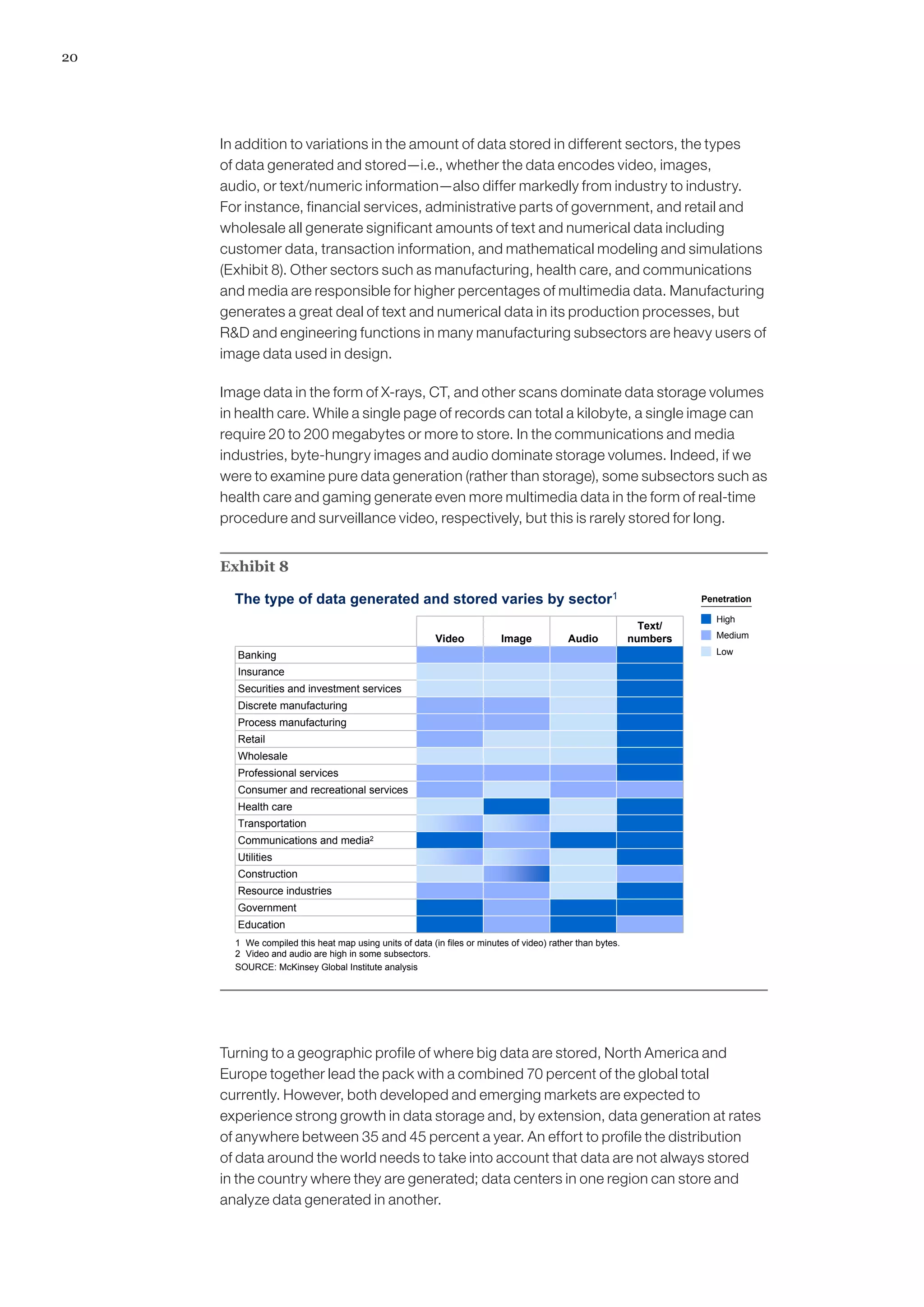
                 applications will have to be alert to the possibility of novel complications and errors.
                 The Dutch government, collecting and analyzing highway congestion data based on
                 the density of mobile phone positions, observed that a particular segment of highway
                 had a curious congestion peak that appeared and disappeared abruptly every hour.
                 It transpired that the highway was close to a commuter rail line with a train passing at
                 peak times on the hour.

                 All of these aspects of the evolving personal location data domain pose significant
                 challenges for executives and policy makers. Business leaders should already be
                 considering the potential benefits of leveraging these data, particularly in the areas
                 of marketing and improving operational efficiencies, and building business cases
                 around today’s perceptible opportunities. But they should also experiment with
                 new business models to derive the maximum value. Executives should work in the
                 common interest with public policy makers to craft effective privacy policies, the
                 means to communicate them clearly to the public, and to enhance the security of
                 information around personal location data. The private and public sectors can also
                 collaborate on accelerating the development and adoption of infrastructure and
                 devices that have the potential to generate additional useful personal location data.

                 For policy makers, the first priority in this rapidly developing domain is to ensure that
                 appropriate incentives for innovation are in place including developing an up-to-date
                 framework for intellectual property rules and rights, funding RD in potential breakthrough
                 areas, and ensuring that the infrastructure, including spectrum policies, is optimal.
96


                                            

     Applying personal location data has the potential to provide more than $800 billion
     in economic value to individual consumers and organizations over the next
     decade, in the process catalyzing the development of a wide range of innovative
     businesses across many sectors. Smart navigation applications alone may offer
     some $500 billion in value to global consumers in time and fuel saved by 2020.
     Geo-targeted advertising is emerging as a highly effective marketing vehicle that
     could represent more than 5 percent of total global advertising spending by 2020.
     Executives and policy makers need to work together to enable the growth of this data
     domain and unleash its full potential.
McKinsey Global Institute
Big data: The next frontier for innovation, competition, and productivity                                   97


                 4.  Key findings that apply across
                 sectors


                 The use of big data offers tremendous untapped potential for creating value.
                 Organizations in many industry sectors and business functions can leverage big data
                 to improve their allocation and coordination of human and physical resources, cut
                 waste, increase transparency and accountability, and facilitate the discovery of new
                 ideas and insights. In addition to the five domains we studied in depth, we also found
                 many other examples in other domains, across geographies, of the tremendous
                 potential to create value from the use of big data. In this chapter, we synthesize
                 what we have learned from the five domains we studied in depth as well as our
                 observations in other domains.


                 BIG DATA CREATES VALUE IN SEVERAL WAYS
                 We have identified five broadly applicable ways to leverage big data that offer
                 transformational potential to create value, and have implications for how individual
                 organizations will have to be designed, organized, and managed. Questions that
                 these findings raise include: How will corporate marketing functions and activities
                 need to evolve if large-scale experimentation is possible and how are business
                 processes likely to change? How will companies value and leverage their assets
                 (particularly data assets) and could their access to, and analysis of, data actually
                 generate more value than, say, a brand? How might big data disrupt established
                 business models? For example, some industry dynamics rest on the fact that there
                 are information asymmetries—how would those dynamics change if transparency
                 around data produced information symmetry instead? How will incumbents with
                 legacy business models and infrastructures compete with newcomers that do not
                 face such constraints? And what will the world look like when surplus starts shifting
                 from suppliers to customers?

                 1. Creating transparency
                 Making big data more easily accessible to relevant stakeholders in a timely way can
                 create tremendous value. Indeed, this aspect of creating value is a prerequisite for
                 all other levers and is the most immediate way for businesses and sectors that are
                 today less advanced in embracing big data and its levers to capture that potential. In
                 many cases, these opportunities exist where there is a misalignment of incentives for
                 creating data transparency, such as lack of a performance imperative. For example, in
                 the public sector, we discovered cases where departmental personnel were spending
                 20 percent of their time searching for information from other government departments
                 using non-digital means (e.g., paper directories and calling people), and then obtaining
                 that information by traveling to other locations and picking up data on physical media
                 such as compact disks. Such wasted effort has been greatly reduced in organizations
                 that have harnessed big data to digitize that information, make it available through
                 networks, and deploy search tools to make relevant information easier to find.

                 However, even in sectors that have embraced IT and big data and where there
                 are considerable incentives for higher performance, we found room for increasing
                 transparency and the sharing of big data. In manufacturing, many companies have used
                 big data to improve performance in RD (e.g., complex simulations) or in the management
98


     of their supply chains. However, these applications often take advantage of only those
     data that are contained within a single functional group in a company. Integrating data from
     RD, engineering, and manufacturing units, potentially across several enterprises, can
     enable concurrent engineering techniques that can greatly reduce the waste caused from
     having to rework designs, and thus accelerate time to market.

     2. Enabling experimentation to discover needs, expose variability, and
     improve performance
     The ability for organizations to instrument—to deploy technology that allows them
     to collect data—and sense the world is continually improving. More and more
     companies are digitizing and storing an increasing amount of highly detailed data
     about transactions. More and more sensors are being embedded in physical
     devices—from assembly-line equipment to automobiles to mobile phones—that
     measure processes, the use of end products, and human behavior. Individual
     consumers, too, are creating and sharing a tremendous amount of data through
     blogging, status updates, and posting photos and videos. Much of these data can
     now be collected in real or near real time.

     Having access to all of these data and in some cases being able to manipulate the
     conditions under which they are generated enable a very different way of making
     decisions that involves bringing more science into management—i.e., applying
     classic scientific methods to the practice of management.82 Specifically, managers
     now can use a scientific process of controlled experimentation that includes the
     formulation of specific hypotheses, designing and conducting experiments (including
     control and treatment groups) to test those hypotheses, and then rigorously
     analyzing the quantitative results before making a decision. Many companies make
     decisions in a highly ad hoc way—as some have put it, through “management by
     HiPPOs, the Highest Paid Person’s Opinions.”83 A data-driven organization makes
     decisions on the basis of the empirical results, and the benefits of such an approach
     toward data have been demonstrated by academic research.84

     Leaders in many sectors are already beginning to use controlled experiments to make
     better decisions. For instance, the health care sector now conducts comparative
     effectiveness studies on population-wide clinical data to identify and understand the
     sources of variability in treatments and outcomes, identify treatment protocols that are
     most effective and efficient, and help decision makers to create guidelines designed to
     ensure that treatment decisions are based on the best science. Retailers, especially those
     that operate online but increasingly also those with physical stores, are adjusting prices
     and promotions in a bid to experiment with which combination best drives traffic and sales.

     It isn’t always possible (perhaps for ethical reasons or feasibility) to set up a controlled
     experiment to manipulate an independent variable. An alternative is seek out “natural
     experiments” to identify existing variability in performance metrics. Understanding
     the drivers of this naturally occurring variability can then be used to guide


     82	 Janaki Akella, Timo Kubach, Markus Löffler, and Uwe Schmid, Data-driven management:
         Bringing more science into management, McKinsey Technology Initiative Perspective, 2008.
     83	 The earliest reference we have to this acronym was by Google analytics evangelist Avinash
         Kaushik. See Seven steps to creating a data driven decision making culture, October 2006
         (www.kaushik.net/avinash/2006/10/seven-steps-to-creating-a-data-driven-decision-making-
         culture.html).
     84	 Erik Brynjolfsson, Lorin M. Hitt, and Heekyung Hellen Kim, Strength in numbers: How does
         data-driven decisionmaking affect firm performance?, April 2011, available at SSRN (ssrn.com/
         abstract=1819486).
McKinsey Global Institute
Big data: The next frontier for innovation, competition, and productivity                                      99


                 management levers to improve that performance. In the public sector, we found large
                 agencies that discovered huge variations in the productivity and accuracy of work
                 at different sites performing nearly identical tasks. Simply making this information
                 available across sites had the effect of spurring locations that were lagging to improve
                 their performance significantly. No changes in compensation were promised; once
                 people knew they were underperforming, their competitive nature kicked in and
                 their observing best practices in the top-performing sites helped to transform their
                 performance without monetary incentives.

                 3. Segmenting populations to customize actions
                 Targeting services or marketing to meet individual needs is already familiar to
                 consumer-facing companies. For them, the idea of segmenting and analyzing their
                 customers through combinations of attributes such as demographics, customer
                 purchase metrics, and shopping attitudes and behavior is firmly established.
                 Companies such as insurance companies and credit card issuers that rely on
                 risk judgments have also long used big data to segment customers. However, as
                 technology improves, many companies have been able to segment and analyze in near
                 real time. Even in the public sector that tends to treat all constituencies the same, using
                 big data to segment is catching on. For instance, some public labor agencies have
                 used big data to tailor job training services for different segments of job seekers, the
                 aim being to ensure that the most efficient and effective interventions are applied to get
                 different people back to work. Another example from the public sector is tax agencies
                 that segment taxpayers by a range of factors including income, past delinquent rate,
                 and credit history to identify returns that are most appropriate for further audits.

                 4. Replacing/supporting human decision making with automated
                 algorithms
                 Sophisticated analytics can substantially improve decision making, minimize risks, and
                 unearth valuable insights that would otherwise remain hidden. Big data either provides
                 the raw material needed to develop algorithms or for those algorithms to operate. Best
                 practice tax agencies, for instance, use automated risk engines that use big data to flag
                 candidates for further examination. Big data algorithms in retail can optimize decision
                 processes, enabling the automatic fine tuning of inventories and pricing in response to
                 real time in-store and online sales. Manufacturing companies can adjust production
                 lines automatically to optimize efficiency, reduce waste, and avoid dangerous
                 conditions. In some cases, companies will not necessarily automate decisions but
                 facilitate them by analyzing datasets that are far larger than those data pools that are
                 manageable for an individual using a spreadsheet. Some organizations are already
                 making more effective decisions by analyzing entire datasets from customers and
                 employees, or even from sensors embedded in products. Big-data-based analytics
                 today include rule-based systems, statistical analyses, and machine-learning
                 techniques such as neural networks. This is a fast-moving area, and new forms of data-
                 based analytics are being developed all the time. (See chapter on “Big data techniques
                 and technologies.”)

                 5. Innovating new business models, products and services
                 Big data enables enterprises of all kinds to create new products and services,
                 enhance existing ones, and invent entirely new business models. In health care,
                 analyzing patient clinical and behavior data has created preventive care programs
                 targeting the most appropriate groups of individuals. Castlight Health is a company
                 that analyzes big data to make available to patients in large health plans data on
                 health care pricing that they don’t normally see. Ingenix in the health care sector and
100


      Nielsen in retail specialize in the aggregation and analysis of various datasets for
      institutions. Also in retailing, real-time price comparison services give consumers
      price transparency to a degree never before enjoyed and generate significant
      surplus for them. Manufacturers are using data obtained from sensors embedded
      in products to create innovative after-sales service offerings such as proactive
      maintenance (preventive measures that take place before a failure occurs or is even
      noticed) and as the basis for the development of next generations of products. The
      emergence of real-time location data has created an entirely new suite of location-
      based mobile services from navigation applications to people tracking.


      WHILE THE USE OF BIG DATA WILL MATTER ACROSS SECTORS,
      SOME SECTORS ARE POISED FOR GREATER GAINS
      Using a value potential index that combines several quantitative metrics, we compared
      the historical productivity of sectors in the United States with the potential of these
      sectors to capture value from big data.85 We observed that patterns vary from sector to
      sector (Exhibit 32).86


      Exhibit 32
                                                                                                                  Cluster A      Cluster D
        Some sectors are positioned for greater gains from
                                                                                                                  Cluster B      Cluster E
        the use of big data
                                                                                                                  Cluster C
        Historical productivity growth in the United States, 2000–08
                                                                                                                  Bubble sizes denote
        %                                                                                                         relative sizes of GDP
        24.0
        23.5
        23.0
        22.5
                                                     Computer and electronic products
                                                                                                                  Information
          9.0
          3.5                  Administration, support, and                                 Wholesale trade
          3.0                  waste management                             Manufacturing
          2.5                                                          Transportation and warehousing
          2.0                                                                                          Finance and insurance
                                                         Professional services     Real estate and rental
          1.5
          1.0                                                          Utilities               Health care providers
          0.5                                                       Retail trade
                                                                                                           Government
            0
                                                  Accommodation and food             Natural resources
         -0.5
                                                      Arts and entertainment
         -1.0
         -1.5                                                                      Management of companies
         -2.0
                                                          Other services            Educational services
         -2.5
         -3.0                                              Construction
         -3.5
         Low                                                                                                                              High
                                                         Big data value potential index1

        1 See appendix for detailed definitions and metrics used for value potential index.
        SOURCE: US Bureau of Labor Statistics; McKinsey Global Institute analysis


      Globally traded computer and electronic products and information sectors (Cluster
      A) are sectors that have already posted very strong productivity growth and are set to
      gain substantially from using big data. These sectors have access to huge pools of data
      (e.g., Internet companies collect vast amounts of online behavior data) and the pace of


      85	 We studied the United States because of the relative availability of relevant data, particularly
          around the numbers and sizes of individual firms. The applicability of these specific findings in
          other geographies will vary based on the similarities of individual sectors.
      86	 The value potential index consists of five metrics that are designed as proxies to indicate (1)
          the amount of data available for use and analysis; (2) variability in performance; (3) number
          of stakeholders (customers and suppliers) with which an organization deals on average;
          (4) transaction intensity; and (5) turbulence inherent in a sector. We believe that these are
          the characteristics that make a sector more or less likely to take advantage of the five
          transformative big data opportunities. See the appendix for further details.
McKinsey Global Institute
Big data: The next frontier for innovation, competition, and productivity                                    101


                 innovation is very high (e.g., rapid product introductions in consumer electronics). Even
                 in the near term, we see significant scope to capture more value from big data.

                 Two services sectors (Cluster B)—finance  insurance and government—are
                 positioned to benefit very strongly from big data as long as barriers to its use can be
                 overcome. These sectors are both transaction- and customer-intensive, suggesting
                 that they can increase their application of levers involving segmentation and automated
                 algorithms. They both also have high degrees of variability in their performance,
                 suggesting that they could use data and experimentation to improve performance.

                 Several sectors (Cluster C) including construction, educational services, and arts
                 and entertainment, have posted negative productivity growth, which probably
                 indicates that these sectors face strong systemic barriers to increasing productivity.
                 Nevertheless, if those barriers can be overcome, we think that big data can enable
                 productivity increases even in these sectors. Examples of where potential exists
                 include measuring variations in the performance of teachers in improving the
                 academic achievement of students—teacher value added—that can be an effective
                 tool for helping to increase productivity in education.

                 Among the remaining sectors, globally traded sectors (mostly Cluster D) (e.g.,
                 manufacturing, wholesale trade) tend to have experienced higher historical
                 productivity growth, while local services (mainly Cluster E) (e.g., retail, health care
                 providers, accommodation and food) have achieved lower growth. Many of these
                 sectors can derive significant value from big data, although doing so will depend on
                 the extent to which barriers are overcome. Sectors that may have more moderate
                 potential from the use of big data, such as construction and administrative services,
                 tend not to have characteristics that could make exploiting big data opportunities
                 more challenging than in other sectors.. They have less data than other sectors and
                 fewer stakeholders, and are also less transaction-intensive.

                 Our index indicates that of the sectors that we studied in detail, two—health care and
                 manufacturing—appear to have only modest potential from the use of big data. This
                 is because the index measures several criteria at the level of the individual firm (e.g.,
                 amount of data per firm as a proxy for number of customers per firm). In the United
                 States, for instance, both of these industries are highly fragmented—they have many
                 more firms or players than other sectors. Given that data are usually fragmented
                 along firm or organizational boundaries, this implies that big data opportunities
                 will be limited across these sectors. Nevertheless, even in these industries, large-
                 scale players have the ability to aggregate enough data to derive significant value
                 (see chapter 3a on health care for examples). Furthermore, it is possible, albeit
                 usually more challenging, for many individual firms to pool, share, or trade data,
                 sometimes through third parties, in order to capture value from big data (see, in
                 particular, chapter 3d on manufacturing, where global distributed supply chains can
                 be optimized by sharing big data). Consolidation in an industry can also bring about
                 beneficial scale effects in the aggregation and analysis of data.

                 While all sectors will have to overcome barriers to capture value from the use of
                 big data, barriers are structurally higher for some than for others (Exhibit 33). For
                 example, government may face higher hurdles because of challenges around data
                 availability and data-driven mind-sets. Education faces similar challenges, along with
                 a relative lack of investment in IT. Moreover, the competitive intensity in these sectors
                 is relatively low compared with those sectors where market forces work more freely.
                 In more market-driven sectors, the imperative to leverage data is strengthened by
                 more direct links to economic value for the firms and users involved. Sectors such as
102


      finance  insurance, manufacturing, and professional services may have relatively
      lower degrees of barriers to overcome for precisely the opposite reasons.


      Exhibit 33
        A heat map shows the relative ease                                           Top quintile                4th quintile
                                                                                     (easiest to capture)
        of capturing the value potential                                             2nd quintile
                                                                                                                 Bottom quintile
                                                                                                                 (most difficult) to capture)
        across sectors                                                               3rd quintile                No data available
                                                                        Overall
                                                                        ease of
        Cate-                                                           capture                                Data-driven Data
        gories       Sectors                                            index1    Talent        IT intensity   mind-set    availability
                     Manufacturing

                     Construction

                     Natural resources
          Goods


                     Computer and electronic products

                     Real estate, rental, and leasing

                     Wholesale trade

                     Information

                     Transportation and warehousing

                     Retail trade
                     Administrative, support, waste management,
                     and remediation services
                     Accommodation and food services
          Services


                     Other services (except public administration)

                     Arts, entertainment, and recreation

                     Finance and Insurance

                     Professional, scientific, and technical services

                     Management of companies and enterprises

                     Government
        and public
        Regulated


                     Educational services

                     Health care and social assistance

                     Utilities

        1 See appendix for detailed definitions and metrics used for each of the criteria.
        SOURCE: McKinsey Global Institute analysis


      BIG DATA OFFERS VERY LARGE POTENTIAL TO GENERATE VALUE
      GLOBALLY, BUT SOME GEOGRAPHIES COULD GAIN FIRST
      Our five case studies covered both developed and emerging economies and our
      findings suggest that the use of big data can drive significant value across geographies.
      We found very significant potential to create value in developed markets by applying
      big data levers in health care and retail. However, if we take the time savings for drivers
      achievable from using navigation tools in the personal location data domain, we find
      that 20 to 40 percent of the global potential is in emerging markets.

      Different economies and regions exhibit very different characteristics from the
      amount of data they generate to the maturity of their ICT infrastructure. This indicates
      that some geographies might be poised to capture value more quickly than others.
      Access to big data is a key prerequisite to capturing value. Today, North America
      and Europe account for the majority of new data stored (Exhibit 34). This suggests
      that, in the near term at least, much of the global potential to create value through
      the use of big data will be in the most developed economies. Although this may be
      true in aggregate, individual firms in emerging markets could enjoy access to big
      data that could enable them to capture significant value. In addition, organizations
      in developing markets could store and analyze their data in data centers located in
      developed markets.
McKinsey Global Institute
Big data: The next frontier for innovation, competition, and productivity                                                                            103


                 As long as the right conditions are in place, there is significant potential to leverage
                 big data in developing economies. Consider the fact that Asia is already the leading
                 region for the generation of personal location data simply because so many mobile
                 phones are in use. More mobile phones—an estimated 800 million devices in
                 2010—are in use in China than in any other country (see Exhibit 28). Furthermore,
                 although some emerging market organizations lag behind their counterparts in
                 developed market in terms of IT assets, this could actually prove to be an advantage.
                 Organizations in developing economies could leapfrog to the latest technology,
                 by-passing the legacy systems with which many of their counterparts in advanced
                 economies have to grapple.


                 Exhibit 34

                    Amount of new data stored varies across geography
                    New data stored1 by geography, 2010
                    Petabytes


                                     3,500
                                                                            2,000
                                     North                                                                   250
                                                                            Europe
                                    America                                                                 China
                                                                                                                             400
                                                                                                                             Japan
                                                                         200
                                                                                                     50
                                                                     Middle East
                                                                     and Africa                      India
                                                50                                                                300
                                              Latin                                                          Rest of APAC
                                             America


                    1 New data stored defined as the amount of available storage used in a given year; see appendix for more on the definition and
                      assumptions.
                    SOURCE: IDC storage reports; McKinsey Global Institute analysis


                 THERE WILL BE A SHORTAGE OF THE TALENT ORGANIZATIONS
                 NEED TO TAKE ADVANTAGE OF BIG DATA
                 A shortage of people with the skills necessary to take advantage of the insights that
                 large datasets generate is one of the most important constraints on an organization’s
                 ability to capture the potential from big data. Leading companies are already reporting
                 challenges in hiring this type of talent. Google’s chief economist Hal Varian has been
                 reported as saying that “the sexy job of the next ten years will be statisticians.”87

                 Our research identifies three key types of talent required to capture value from big
                 data: deep analytical talent—people with technical skills in statistics and machine
                 learning, for example, who are capable of analyzing large volumes of data to derive
                 business insights; data-savvy managers and analysts who have the skills to be
                 effective consumers of big data insights—i.e., capable of posing the right questions
                 for analysis, interpreting and challenging the results, and making appropriate
                 decisions; and supporting technology personnel who develop, implement, and
                 maintain the hardware and software tools such as databases and analytic programs
                 needed to make use of big data. We expect the supply of talent in all of these
                 categories to be a significant constraint on the ability of organizations around the


                 87	 Steve Lohr, “For today’s graduate, just one word: Statistics,” New York Times, August 5, 2009.
104


      world to capture value from big data, with the most acute needs in the first and
      second categories.88 Given the amount of data on talent readily available, we used
      the US labor market to test this hypothesis.89

      The US labor market has historically had a high level of graduates with degrees in
      the so-called STEM fields: science, technology, engineering, and mathematics.
      However, in recent years, the supply of such graduates has been sluggish at a time
      when demand for them has been rising. For example, at the peak of the last US
      economic expansion, employment for mathematics-related occupations increased
      by almost 4 percent and their real wages increased 1 percent; at this time national
      employment increased by only 1.5 percent and real wages rose by only 0.6 percent.90
      During this period, the number of advanced degrees conferred in math, statistics,
      and engineering declined by around 2 percent. In the future, the need for talent able
      to deal with big data will, in fact, be much more specific than simply STEM graduates.
      For this reason, we conducted a detailed analysis comparing potential demand for
      the first two categories of big data talent—deep analytical talent and data-savvy
      managers and analysts—with projected supply on current trends.

      In the case of deep analytical talent, we used US Bureau of Labor Statistics (BLS)
      data on current occupations to analyze the supply of talent in the US workforce. The
      data were from 2008, the latest year for which complete data are available. We used
      existing BLS models to project the supply of deep analytical talent in 2018, assuming
      current trends hold.

      We then used two separate analytical models to triangulate a perspective on the
      potential demand for deep analytical talent, assuming that companies across the
      economy fully adopt big data techniques by 2018. We based the first of these two
      models on an adaptation of the BLS model to account for varying degrees of growth
      in deep analytical talent based on the data intensity of different companies. We
      based the second model on the required numbers of deep analytic talent in different
      industries according to company size.

      We estimate that the supply in the United States of deep analytical talent in 2008 was
      around 150,000 positions. If we take into account current trends in new graduates with
      deep analytical training (e.g., people taking graduate courses in statistics or machine
      learning, a subspecialty of computer science, or students taking such courses
      designed for their last year of undergraduate education) and immigration, this total rises
      to about 300,000. However, in a big data world, we expect demand for deep analytical
      talent could reach 440,000 to 490,000 positions in 2018—that’s a talent gap in this
      category alone of 140,000 to 190,000 positions. In short, the United States will need
      an additional supply of this class of talent of 50 to 60 percent (Exhibit 35). Developing
      deep analytical skills requires an intrinsic aptitude in mathematics for starters, and then
      takes years of training. Addressing the talent shortage will not happen overnight, and
      the search for deep analytical talent that has already begun can only intensify.


      88	 We also did not prioritize the analysis of the supporting IT talent because other researchers
          have researched and debated this issue extensively.
      89	 In general, we found detailed occupational data on categories of knowledge workers to be
          relatively scarce outside the United States. See chapter on “Implications for policy makers” for
          a recommendation that more detailed data on these categories be collected.
      90	 Standard Occupational Classification (SOC) 15: Computer and mathematical occupations as
          defined by the US Bureau of Labor Statistics.
McKinsey Global Institute
Big data: The next frontier for innovation, competition, and productivity                                                                              105


                 Exhibit 35
                    The United States graduates the largest number of people with
                    deep analytical training
                    Number of graduates with deep analytical training in 20081
                                     Total
                                     Thousand                                                     Graduates per 100 people
                    United States                                                  24.73                              8.11
                    China                                               17.41                        1.31
                    India                                       13.27                               1.12
                    Russia                                     12.30                                                   8.66
                    Brazil                                10.09                                                5.32
                    Poland                              8.78                                                                                  23.03
                    United Kingdom                      8.34                                                                       13.58
                    France                             7.77                                                                      12.47
                    Romania                     4.97                                                                                           23.12
                    Italy                       4.90                                                                   8.25
                    Japan                     3.40                                                     2.66
                    Germany                   3.32                                                        4.05
                    Turkey               1.84                                                          2.64
                    Netherlands         1.25                                                                          7.58
                    Spain               1.23                                                            2.71
                    Czech Republic     0.95                                                                             9.12
                    Bulgaria           0.92                                                                                      12.15
                    Switzerland        0.76                                                                                  9.93
                    Portugal           0.75                                                                      7.04
                    Belgium            0.71                                                                      6.66
                    Greece             0.66                                                                     5.97
                    Denmark            0.61                                                                                    11.21
                    Slovakia           0.50                                                                             9.25
                    Norway             0.41                                                                            8.61
                    Lithuania          0.37                                                                                    11.16
                    Austria            0.37                                                               4.47
                    Sweden             0.29                                                             3.16
                    Latvia             0.27                                                                                     12.01
                    Hungary            0.21                                                           2.06
                    Other2             0.55                                                                   4.86

                    1 These data count new graduates, i.e., a flow of deep analytical talent, which we define as people with advanced training in
                      statistics and/or machine learning and who conduct data analysis.
                    2 Other includes Finland, Estonia, Croatia, Slovenia, Iceland, Cyprus, Macedonia, and Malta.
                    SOURCE: Eurostat; Russia Statistics; Japan Ministry of Education; India Sat; NASSCOM Strategic Review 2005; China
                                Statistical Yearbook; China Education News; IMF World Economic Outlook Database


                 Although we conducted this analysis in the United States, we believe that the
                 shortage of deep analytical talent will be a global phenomenon. There are significant
                 variations, however, both in gross and per capita terms, in the number of graduates
                 with these skills that different countries are producing. Countries with a higher per
                 capita production of deep analytical talent could potentially be attractive sources of
                 these skills for other geographies either through immigration or through companies
                 offshoring to meet their needs (Exhibits 36 and 37).

                 In the case of data-savvy managers and analysts in a big data world, the level of training
                 and mathematical aptitude is much lower than that required for deep analytical talent.
                 People in these roles simply need enough conceptual knowledge and quantitative skills
                 to be able to frame and interpret analyses in an effective way. It is possible to develop
                 such skills through a single course in statistics and experimental design. However,
                 managers and analysts will be necessary in every sector. We applied a methodology
                 similar to that used to analyze deep analytical talent to understand the potential gap
                 between projected demand and supply. By 2018, in the United States, we estimate that
                 4 million positions will require these types of skills in a big data world. However, if we
                 add together the number of people with these skills and new graduates who will enter
                 the market (on current trends), we reach a total of only 2.5 million people in the United
                 States in 2018. So there is a potential shortfall of 1.5 million data-savvy managers and
                 analysts. This is not a gap likely to be filled simply by changing graduate requirements
106


      and waiting for people to graduate with enhanced skills or importing talent (although
      these could be important actions to take). Thus, retraining the existing workforce will be
      necessary.


      Exhibit 36

        China could narrow the gap with the United States, today’s leading
        supplier of deep analytical talent
        Top ten in the supply of deep analytical talent                                                                 Compound
                                                                                                                        annual growth
        Thousand people                                                                                                 rate, 2004–08, %
        25                                                                                           United States          3.9


        20

                                                                                                     China                  10.4

        15                                                                                           India1
                                                                                                     Russia                 1.5
                                                                                                     Brazil                 6.2
        10                                                                                           Poland                 12.8
                                                                                                     United Kingdom         2.5
                                                                                                     France2                -14.4
         5                                                                                           Romania                32.9
                                                                                                     Italy                  18.9
                                                                                                     Japan                  -5.3
         0
         2004                    05                  06                   07                   08
        1 India ranked third in 2008 with 13,270 people with deep analytical skills but India does not have a time series for these data.
        2 For France, the compound annual growth rate is for 2005 and 2008 because of data availability.
        SOURCE: Eurostat; national statistical agencies; Japan Ministry of Education; India Sat; NASSCOM; China Statistical
                   Yearbook; China Education News, April 2005; IMF World Economic Outlook; McKinsey Global Institute analysis


      Exhibit 37

        Big data constituencies                                       Individuals/organizations using data1         Providers of technology
        Big data activity/value chain                                 Indirect beneficiaries                        Government regulators


                                                            Government regulators


                                                                                                             Consume data and
         Generate data                     Aggregate data                  Analyze data
                                                                                                             derive value

         Individual data producers/       Individuals who aggregate        Individuals who analyze           Individual data users
         sources                          data                             data

         SME2 data producers/             SMEs2 that aggregate data        SMEs2 that analyze data           SME2 data users
         sources

         Large enterprise data            Large enterprises that           Large enterprises that            Large enterprise data users
         producers/sources                aggregate data                   analyze data

         Providers of technology to       Third-party data                 Third-party analysis/service      Indirect beneficiaries
         generate data (e.g., sensors,    aggregators (e.g., price         providers (e.g., price
         hardware)                        comparisons, Mint, Sense         comparisons, Mint, LBS, ad
                                          Network)                         publishers, and
                                                                           intermediaries)


                                                      Storage providers (including services)

                                           Software/service providers in business intelligence, search

        1 Individuals/organizations generating, aggregating, analyzing, or consuming data.
        2 Small and medium-sized enterprises.
        SOURCE: McKinsey Global Institute analysis
McKinsey Global Institute
Big data: The next frontier for innovation, competition, and productivity                                          107


                 SEVERAL ISSUES WILL HAVE TO BE ADDRESSED TO CAPTURE
                 THE FULL POTENTIAL OF BIG DATA
                 Data policies
                 As an ever larger amount of data is digitized and travels across organizational
                 boundaries, there are a set of policy issues that will become increasingly important,
                 including, but not limited to, privacy, security, intellectual property, and even liability.91

                 More information than ever is known about individuals, including sensitive data such
                 as health and financial records, and many citizens will demand that companies and
                 their governments to protect their privacy. Personal data such as health and financial
                 records are often those that can offer the most significant human benefits, such as
                 helping to pinpoint the right medical treatment, or the most appropriate financial
                 product. However, consumers also view these categories of data as being the most
                 sensitive. Individuals, companies, and governments will need to be thoughtful about
                 the trade-offs between privacy and utility.

                 We are already seeing data security becoming a more pressing issue now that data
                 are a key factor of production and a competitive asset. One study found that the
                 number of compromised records increased by 30 percent each year between 2005
                 and 2009 in the United States.92 Another study found that security compromises
                 cost more than $200 per record in detection, notification, and remediation efforts, as
                 well as customers lost.93 Such security breaches affect a range of sectors including
                 financial institutions, retail, hotels, and even national defense.

                 Big data’s increasing economic importance also raises a number of legal issues,
                 especially when coupled with the fact that data are fundamentally different from
                 many other assets. Data can be copied perfectly and easily combined with other
                 data, and the same piece of data can be used simultaneously by more than one
                 person. So, intellectual property will become an even more important consideration
                 for policy makers, who will set the rules that determine the legal rights associated
                 with the ownership and use of data, and what constitutes “fair use” of data. Liability—
                 such as who is responsible when an inaccurate piece of data leads to negative
                 consequences—is another issue likely to come to the fore.

                 Technology and techniques
                 Today, legacy systems and incompatible standards and formats today often
                 prevent the integration of data and the more sophisticated analytics that create
                 value from big data. Organizations will need to deploy new technologies and
                 techniques as they develop to overcome this barrier. Ultimately, making use of large
                 digital datasets will require the assembly of a technology stack from storage and
                 computing through analytical and visualization software applications. The specific
                 technology requirements and priorities will vary based on the big data levers that are
                 to be implemented and the data maturity of an institution, leading to very different
                 levels of investment costs. Some companies lack the technology to capture data
                 digitally in the first place (e.g., some smaller US health care provider practices) or to
                 extract, transform, and load large datasets from other sources. Other organizations
                 will need to supplement their existing storage or computing resources. Many will


                 91	 Data privacy and security are important and pervasive concerns, which are being studied
                     and debated at great length elsewhere, but have not been the major focus of the research in
                     this report.
                 92	 The leaking vault: Five years of data breaches, Digital Forensics Association, July 2010.
                 93	 Fourth annual US cost of data breach study, Ponemon Institute, January 2009.
108


      need to implement advanced analytical and visualization software tools. In many
      cases, legacy systems and incompatible standards and formats will have to be
      taken into account. Examples include joining different data pools as we might see
      at financial services companies that want to combine online financial transaction
      data, the behavior of customers in branches, data from partners such as insurance
      companies, and retail purchase history. Also, many levers require a tremendous
      scale of data (e.g., merging patient records across multiple providers), which can
      put unique demands upon technology infrastructures. To provide a framework
      under which to develop and manage the many interlocking technology components
      necessary to successfully execute big data levers, each organization will need to craft
      and execute a robust enterprise data strategy.

      Organizational change and talent
      Organizational leaders need to understand that big data can unlock value—and how
      to use it to that effect. It is vital that organizations learn how to leverage big data if they
      don’t know how to already—because many of their rivals will certainly be using big data
      to carve out competitive advantage. As we have noted, many organizations neither
      have the skilled personnel they need to mine big data for insights nor the structures and
      incentives required to use big data to make more informed decisions and act on them.

      Access to data
      Access to data will need to broaden to capture the full potential for value creation.
      Increasingly, companies will need to acquire access to third-party data sources
      and integrate external information with their own, to capture the full potential of big
      data. In many cases, efficient markets are yet to be set up for trading or sharing data.
      For example, there are no efficient markets for the sharing of aggregate movement
      patterns derived from mobile phones—potentially valuable to retailers trying to
      understand consumer behavior. In other cases, incentives are misaligned so that
      stakeholders want to keep the information to themselves. In health care, for instance,
      providers will need to make a large big data investment to create, aggregate and
      analyze digital clinical data from medical records, which may reveal information that
      payors will use to their advantage in contract negotiations (e.g., payors direct patients
      away from providers with high cost but average performance). In order to fully capture
      the value that can be enabled by big data, the barriers to accessing data will have to
      be overcome.

      Industry structure
      The relative ease—of difficulty—of capturing value from big data will sometimes
      depend on the structure of a particular sector or industry. Sectors with a relative lack
      of competitive intensity and performance transparency and industries with highly
      concentrated profit pools are likely to be slow to fully leverage the benefits of big data.
      The public sector, for example, tends to have limited competitive pressure, which
      limits efficiency and productivity and puts a higher barrier up against the capture of
      value from using big data. US health care not only has a lack of transparency in terms
      of the cost and quality of treatment but also an industry structure in which payors
      gain from the use of clinical data (e.g., from fewer payouts for unnecessary treatment)
      but at the expense of the providers (e.g., fewer medical activities to charge for) from
      whom they would have to obtain those clinical data. As these examples suggest,
      organization leaders and policy makers need to consider how industry structures
      could evolve in a big data world if they are to determine how to optimize value creation
      in firms, sectors, and economies as a whole.
McKinsey Global Institute
Big data: The next frontier for innovation, competition, and productivity                                  109


                                                                

                 Our research suggests that there is a range of ways that big data can create value that
                 companies and organizations, including governments, can apply across sectors.
                 But to do so with maximum effectiveness will require all these players to overcome
                 a range of barriers and to address key issues that are of deep concern to the public,
                 notably privacy and security. In the next two chapters, we will discuss what companies,
                 organizations, and policy makers can do to ease the path toward the full capture of the
                 value that big data can create.
McKinsey Global Institute
Big data: The next frontier for innovation, competition, and productivity                                   111


                 5.  Implications for organization leaders


                 As big data and its levers become an increasingly valuable asset, their intelligent
                 exploitation will be critical for enterprises to compete effectively. We already see
                 organizations that understand and embrace the use of big data pulling ahead of their
                 peers in tangible corporate performance measures. The use of big data will become a
                 key basis of competition across sectors, so it is imperative that organizational leaders
                 begin to incorporate big data into their business plans.

                 While the particular opportunities to leverage big data to create value will differ by
                 sectors, as we have demonstrated in our domain case studies, organization leaders
                 can start identifying and assessing the opportunities along the five cross-cutting
                 themes we have identified. In addition, there is a set of common enablers that each
                 executive should address in order to unlock the power of big data. Organizations
                 will not only need to ensure that they have sufficient skills in back-office analytics
                 but also manage a transition toward the right managerial talent on the front line that
                 will be capable of executing strategy based on the insights analysts mine from big
                 data.


                 1. INVENTORY DATA ASSETS: PROPRIETARY, PUBLIC, AND
                 PURCHASED
                 With data becoming a key competitive asset, leaders must understand the assets
                 that they hold or to which they could have access. Organizations should conduct an
                 inventory of their own proprietary data, and also systematically catalog other data
                 to which they could potentially gain access, including publicly available data (e.g.,
                 government data, other data that are released into the public domain), and data that
                 can be purchased (e.g., from data aggregators or other players in a data value chain).

                 Indeed, to enable transformative opportunities, companies will increasingly need to
                 acquire access to third-party data sources, integrating such information with their
                 own. In some cases, organizations will be able to purchase access to the data. In
                 other cases, the sources of third-party data might not have considered sharing it.
                 Organizations will need to thoughtfully consider and present a compelling value
                 proposition for these third parties to share or sell data to them, or determine another
                 set of incentives (e.g., regulatory action) to ensure data access. A set of technology
                 challenges (e.g., standardizing data, implementing data feeds) will often have to be
                 addressed to ensure consistent, reliable, and timely access to external data.

                 For example, many companies have recently discovered the value of data from social
                 media. Telecom companies have found that some information from social networks
                 is useful in predicting customer churn. They discovered that customers who know
                 others who have stopped using a certain telecom are more likely to do so themselves,
                 so these likely-to-churn customers are then targeted for retention programs. Other
                 consumer-facing companies have found that they can learn about customers’
                 attitudes, buying trends, and taste from sentiments expressed online, allowing
                 them to make timely changes in their marketing, and going forward changes in their
                 product planning.
112


      2. IDENTIFY POTENTIAL VALUE CREATION OPPORTUNITIES AND
      THREATS
      We have described five cross-cutting categories of value creation through leveraging
      big data that can be applied across every function. Organizations should begin a
      process of identifying and prioritizing these opportunities; business line and function
      leaders should kick off processes in their respective areas of responsibility. It is
      worthwhile noting that identifying opportunities and potential sources of valuable
      data (see previous section), especially external sources of data, will often be an
      iterative, rather than sequential, process.

      In order to validate these big data opportunities, leading organizations have
      often discovered that adopting a process of purposeful experimentation (a meta-
      application of the big data lever of experimentation) can be the most powerful path
      toward becoming an organization that fully leverages big data, rather that specifying
      a complete plan for the enterprise prior to doing any implementation. Selecting
      a few high-potential areas in which to experiment with big data, e.g., with digital
      marketing, and then rapidly scaling successes can be an effective way to begin the
      transformation.

      In our research, we find that creating substantial new value does not necessarily
      require jumping directly to complex analytical big data levers. In many cases, the
      levers focused primarily on making data available or applying basic analytics can
      create substantial value even before an organization adopts more advanced levers.
      We see this in health care, where creating transparency and applying basic levers can
      generate about 40 percent of the value creation potential alone. Indeed, we find that
      most organizations follow a journey that builds capabilities over time.

      Our research identified four levels of maturity or sophistication to categorize actions
      that can be taken. Most basic is digitizing and structuring the data, which is really
      the step before the use of big data. It consists of the steps that ensure the data are
      generated, structured, and organized in such a way that they can be used either
      directly by end users or for further analysis. These techniques include “scrubbing”
      the data to remove errors and ensure data quality, placing data into standard forms,
      and adding metadata that describe the data being collected. The second level of
      sophistication requires making the data available, e.g., through networks, which
      is aligned with the first of the five categories of big data levers discussed earlier. It
      can be a powerful driver of value in and of itself, and it can also be an important first
      step in integrating datasets to create more meaningful business insight. The third
      level of sophistication is applying basic analytics, which essentially covers a range
      of methodologies, such as basic data comparisons, and relatively standardized
      quantitative analyses, e.g., those that do not require customized analyses to be
      designed by people with deep analytical skills. The fourth and highest level is
      applying advanced analytics, such as the automated algorithms and real-time
      data analysis that often can create radical new business insight and models. They
      allow new levels of experimentation to develop optimal approaches to targeting
      customers and operations, and opening new big data opportunities with third
      parties. Leveraging big data at this level often requires the expertise of deep
      analytical talent.

      In addition to examining the potential based on the level of capabilities within
      an organization, leaders can also examine different opportunities through the
      lens of the types of data identified during the data inventory. There is likely to be
      a set of opportunities related to capturing value from the proprietary datasets
      that an organization already has, particularly through additional analyses. For
McKinsey Global Institute
Big data: The next frontier for innovation, competition, and productivity                                       113


                 example, a health care provider might discover that it can analyze a set of clinical
                 outcomes data to better identify the sources of medical errors. A second category
                 of opportunities comes from adding new sets of data that can be captured or
                 acquired (public and purchased) to these analyses. These datasets will often
                 involve nonstandard data types, because these are data that are not usually used
                 within the organization. For instance, an insurance company might discover that
                 adding remote sensing data (images from satellites) can help it to better assess
                 real-estate property risks. A third set of opportunities comes from considering new
                 business and business models that are built fundamentally on big data, and not
                 necessarily based on the same kinds of analyses that support existing businesses.
                 For example, a payments provider might find that it create a new business by selling
                 consumer insights based on the data streams it generates (so-called exhaust
                 data) while processing payments.

                 Organizations should also watch for the potential disruptions big data can underpin.
                 Within the context of the big data value chain (Exhibit 39), aggregation and analysis
                 are becoming increasingly valuable so data generators are adding those capabilities
                 to more fully realize potential value as well as to defend against new entrants focusing
                 solely on aggregation and analysis. For example, a big data retailer such as Tesco
                 plays along the entire value chain to realize fullest potential. It taps its loyalty program
                 to collect customer purchase data, which it then analyzes to inform a variety of
                 decisions, including the micro-segmentation of its customers to optimize product
                 mix, pricing, and promotions. Another example of forward integration in the data
                 value chain is large health care payors, some of whom are getting into the business
                 of aggregating and analyzing clinical data with claims data, to provide data services
                 to customers such as pharmaceutical companies. Again, moving into aggregation
                 and analysis may be a defensive move to preempt new entrants. In some sectors,
                 third-party data aggregators, which do not generate data themselves, provide
                 value-added service on top of the aggregated data to benefit customers. In financial
                 services, for instance, the online company Mint (acquired by Intuit), aggregates
                 financial information about individuals and provides value-added services (e.g.,
                 financial planning tools), even though it does not generate financial data itself. Mint
                 and others using this business model may pose a threat to traditional financial
                 institutions by owning customer relationships through their more comprehensive
                 view of a consumer’s entire financial position.

                 Organizations should also watch for the emergence of cross-sector domains, such
                 as personal location data, where innovations are happening very quickly. They often
                 have highly fragmented data value chains, with many stakeholders playing different
                 roles, all trying to figure out business models that will maximize their share of the
                 profit pool.

                 Indeed, the need for scale of data and IT infrastructure may become a critical driver
                 toward consolidation, which can be both an opportunity and threat, in sectors where
                 subscale players are abundant. The health care provider space is a good example
                 where many relatively small physician practices remain. As they move into the digital
                 age of electronic medical records and start trying to derive benefit from data, they
                 may find it economical to merge with others to increase scale.

                 Increased data access, facilitated by the cloud, may also disrupt business and
                 operation models. Many examples of distributed co-creation involve collaboration
                 with external partners and customers to perform many corporate functions, from
                 RD (e.g., open source software development) to marketing (e.g., online advertising
                 competition) and customer service (e.g., online customer support communities), that
                 have traditionally been done internally by employees.
114


      Exhibit 38
        MGI has compiled a heat map of                                                           Top quintile           4th quintile
                                                                                                 (highest potential)
        the value potential of using big data                                                    2nd quintile
                                                                                                                        Bottom quintile
                                                                                                                        (lowest potential)
        across sectors                                                                           3rd quintile           No data available
                                                                        Overall                           Customer
                                                                        value       Amount     Variabili- and      Trans-
        Cate-                                                           potential   of data    ty in per- supplier action     Turbu-
        gories       Sectors                                            index1      per firm   formance intensity intensity   lence
                     Manufacturing

                     Construction

                     Natural resources
          Goods


                     Computer and electronic products

                     Real estate, rental, and leasing

                     Wholesale trade

                     Information

                     Transportation and warehousing

                     Retail trade
                     Administrative, support, waste management,
                     and remediation services
                     Accommodation and food services
          Services


                     Other services (except public administration)

                     Arts, entertainment, and recreation

                     Finance and Insurance

                     Professional, scientific, and technical services

                     Management of companies and enterprises

                     Government
        and public
        Regulated


                     Educational services

                     Health care and social assistance

                     Utilities

        1 See appendix for detailed definitions and metrics used for each of the criteria.
        SOURCE: McKinsey Global Institute analysis


      3. BUILD UP INTERNAL CAPABILITIES TO CREATE A DATA-
      DRIVEN ORGANIZATION
      Organizations will need to have the right people and processes to capture value from
      the use of big data. On people, MGI research indicates that the key sets of talent
      that will be in increasingly short supply are deep analytical talent to execute big data
      analyses; managers and analysts who know how to request and consume big data
      analyses; and supporting technology personnel to implement big data. We focus on
      the first two categories in this section and address the third in the following section on
      implementing an enterprise data strategy.

      Best practice big data companies have built sufficient scale in a core group of deep
      analytical talent, upon which the rest of their organization can draw. Given the
      potential competition for this talent, organizations must recruit deep analytical talent
      aggressively. This could include sourcing talent from other geographies or procuring
      some analytical services from vendors. One important point to note is that early hires
      are critical because they are the ones who build the teams. It is difficult to find people
      who are willing to hire their replacements, so hiring the most capable people early
      on is the best way to build a highly effective team. One financial services company
      respected for its use of data and experimentation, for instance, has identified a
      network of target institutions that are known for turning out superior deep analytical
      talent and that are in close proximity to headquarters. The company has developed
      a relationship with these institutions so it not only has a prominent presence during
      recruiting season, but also uses the institutions as ongoing training avenues, where
      the company sends deep analytical employees to get recharged and learn new
      techniques.
McKinsey Global Institute
Big data: The next frontier for innovation, competition, and productivity                                     115


                 Leaders will also need to figure out how to organize this cadre of deep analytical
                 talent so that as they form an internal community or center of excellence, they are
                 effectively connected to the rest of the organization and can collaborate well with
                 business leaders. Furthermore, retaining and motivating this valuable cadre of
                 talent will, in a way similar to the case of other high-level knowledge workers, require
                 monetary and, more importantly, intrinsic incentives such as interesting problems to
                 solve.94

                 But having a core set of deep analytical talent is not enough to transform an
                 organization, especially if the key business leaders and analysts do not know
                 how to take advantage of this big data capability. All of the business leaders in an
                 organization will have to develop a baseline understanding of analytical techniques in
                 order to become effective users of these types of analyses. Organizations can modify
                 their recruiting criteria to take this requirement into account, but more importantly,
                 they will need to develop training programs to increase the capabilities of their current
                 management and analyst ranks. A basic statistics program or a series of classes
                 in data analysis at a local college or university, for instance, could create a team of
                 highly motivated managers and analysts that could begin this transformation. Capital
                 One, the financial services firm, has created an internal training institute, Capital One
                 University, which offers a professional program on testing and experiment design,
                 for instance. With the right capabilities in place, organizations must align incentives,
                 structures, and workflows so that employees at all levels leverage insights derived
                 from big data. The UK retailer Tesco, for example, has developed a strong data-driven
                 mind-set from top leadership to the front line. It has integrated customer intelligence
                 into its operations at all levels from a variety of consumer-targeted big data strategies.
                 At Famous Footwear, the shoe retailer, the executive team meets with the testing
                 head every two weeks to discuss results and plan data gathering and evaluation
                 programs. At Amazon.com, it is said that Jeff Bezos fired a group of Web designers
                 who changed the company Web site without conducting experiments to determine
                 the effects on customer behavior. At all of these companies, big data and its most
                 powerful levers are an integral part of management dialogues and the organization’s
                 culture.


                 4. DEVELOP ENTERPRISE INFORMATION STRATEGY TO
                 IMPLEMENT TECHNOLOGY
                 To prepare for a big data world, organizations should develop an integrated data
                 strategy for the entire enterprise. Data models, architectures, and attributes of
                 solutions need to be considered holistically. Taking customer data as an example,
                 a common problem is for discrete business units, in silos, to develop their own data
                 strategies without planning to share or aggregate data across the organization. As a
                 result, organizations often discover that they do not even have a common definition
                 of their customers and attributes that apply across lines of business. Even within the
                 same business unit, such differences can occur. The lack of a customer-centric view
                 severely limits the organization’s ability to use any of the powerful big data levers to
                 create new value. An effective enterprise data strategy must include interoperable
                 data models, transactional data architecture, integration architecture, analytical
                 architecture, security and compliance, and frontline services.

                 Many organizations will require additional investment in IT hardware, software,
                 and services to capture, store, organize, and analyze large datasets. The level


                 94	 Peter F. Drucker, Management challenges for the 21st century (New York, NY: Harper
                     Business, 1999).
116


      of investment will vary considerably depending on a company’s current state of
      IT capability and maturity. IT leaders will need to assess and identify any gaps
      in the technology their enterprise has available for effectively capturing, storing,
      aggregating, communicating, and analyzing data. They will have to work with the
      organization’s business leaders to develop business cases for new investments and
      then prioritize that spending.

      Despite the need for a comprehensive enterprise data strategy, it can often be helpful
      to begin implementation on very targeted projects in order to learn what works and
      to begin developing capabilities (see our recommendation about experimentation
      in the section “Identify potential value creation opportunities” above). For example,
      Kaiser Permanente in California initially concentrated on one IT project exclusively for
      patients with long-term conditions by creating specific disease registries and panel
      management solutions, rather than an all-encompassing IT solution that addresses a
      range of problems. This led to much faster time to impact.


      5. ADDRESS DATA POLICY ISSUES
      Addressing privacy and security issues will become paramount as more data
      increasingly travel across boundaries for various purposes. Privacy, in particular,
      not only requires attention to compliance with laws and regulations, but also is
      fundamental to an organization’s trust relationships with its customers, business
      partners, employees, and other stakeholders. Certainly, organizations will need
      policies that comply with privacy laws and any government privacy regulations.
      But in developing a privacy policy, organizations will need to thoughtfully consider
      what kind of legal agreements, and, more importantly, trust expectations, it wants
      to establish with its stakeholders. And it will need to communicate its policies clearly
      to its stakeholders, especially customers, as they become increasingly savvy and
      concerned about what is known about them and how that information can potentially
      be used.

      As part of the enterprise data strategy, organizations will need to clearly define and
      implement an enterprise risk strategy that includes all of their IT functions. This
      strategy must include a thorough risk assessment of the enterprise that assesses
      everything, from the likelihood of physical break-in, to the probability of hackers
      penetrating a mainframe, but perhaps most importantly, the risks of people
      with authorized access using that access for purposes that are counter to the
      organization’s goals. There is a range of IT solutions (e.g., VPNs, intranet firewalls,
      threat monitoring) that can help to manage data privacy and security risks.

      Organizational leaders will also have to wrestle with legal issues relating to their
      stance on intellectual property for data, how they will think about liability, etc. These
      are topics that clearly require specialized legal counsel, but with an approach that
      takes into account multiple considerations, including strategy, relationships with
      customers, partners and employees, and technology.

                                                

      Competing and capturing value using big data will require leaders to address specific
      barriers across talent, technology, privacy and security, organizational culture, and
      incentives to access data. It is urgent that organization leaders start identifying or
      refining the role of big data in their business plans and start laying the enablers in
      place to realize value.
McKinsey Global Institute
Big data: The next frontier for innovation, competition, and productivity                                   117


                 6.  Implications for policy makers


                 The value potential underpinned by the use of big data will not be realized unless
                 government and policy makers, in addition to leaders of individual organizations,
                 understand and respond to the range of barriers and enablers we have identified. Our
                 research has demonstrated that big data is not only a powerful engine of competition
                 and growth for individual companies, but that, in aggregate, it also can move the
                 needle on productivity, innovation, and competitiveness for entire sectors and
                 economies in both the developed and developing worlds.

                 Forward-thinking policy makers will keep pace with the development of big data
                 and find timely solutions to the barriers that today stand in the way of capturing
                 its full value. Action may be required at both the national and international levels if
                 policy makers are to help organizations make the most of the big data opportunity.
                 Just as we are seeing early evidence of firms skilled at using big data pulling ahead
                 of their competition, the use of big data could play a substantial role in country
                 competitiveness.

                 Policy makers must consider the choices they should make in order to help
                 individual firms in their economies capture value out of using big data. The major
                 areas where policy can play a role are building human capital (e.g., improving
                 the supply of graduates knowledgeable about big data and easing immigration
                 restrictions); aligning incentives to ensure access to data; addressing privacy and
                 security concerns; establishing intellectual property frameworks; overcoming
                 technological barriers to data; and promoting information and communication
                 technology infrastructure. Government policy makers in many economies are already
                 addressing, or at least discussing, these areas. This is a task that they must start
                 to address with some urgency. Without appropriate rules, laws, guidelines, and
                 incentives, the economies that are less progressive in these areas will risk being at a
                 competitive disadvantage to those that appreciate the dynamics and value potential
                 of big data.


                 1. BUILD HUMAN CAPITAL FOR BIG DATA
                 Governments can act in a variety of ways to help increase the supply of talent
                 necessary to leverage big data. First, governments can put in place education
                 initiatives to increase the pipeline of graduates with the right skills. In the United
                 States, for instance, there is a push at the federal, state, and local levels to support
                 more science, technology, engineering, and mathematics (STEM) education. Most
                 other OECD governments also recognize the need for more STEM graduateswho
                 are historically underrepresented in those fields, including women. However, the
                 needs for deep analytical talent are more specific even than this—more graduates
                 with advanced training in statistics and machine learning (a subdiscipline of computer
                 science) will be necessary. A second way for governments to increase the supply
                 of talent is to reduce barriers to accessing these pools in other regions, i.e., through
                 remote work or the immigration of skilled workers.
118


      The challenge of developing a large number of organizational leaders and analysts
      in business, government, and the social sectors who have basic understanding
      of analytical techniques is on a far larger scale. At a minimum, new knowledge
      workers already in the educational pipeline on their way into the workforce should be
      educated on these topics; a mandatory course in statistics/decision science, with
      a module on experimental design, should become part of the curriculum in fields
      such as business administration and other management disciplines. But waiting for
      a whole new generation of graduates will be insufficient. Government could create
      incentives to train existing managers and analysts in these techniques.

      We also discovered in our research that detailed national workforce data about
      knowledge workers, by occupational category and industry, was difficult to find
      outside of the United States (including roles requiring deep analytical skills, as well
      as management and analyst roles, amongst others). Several countries could provide
      very detailed data about manufacturing-related occupations (e.g., “precious metal
      forging”), but had very broad categories for knowledge workers (e.g., “bankers”).
      Based on the principle that “you can’t manage what you can’t measure,” policy
      makers in these countries could direct their labor statistics agencies to begin
      collecting more detailed data about employment in knowledge worker categories
      (ideally, in standard categories that would allow cross-country comparisons). This
      data would better inform their decisions about how to develop human capital, i.e.,
      knowledge workers more generally, and for big data-related positions specifically.


      2. ALIGN INCENTIVES TO PROMOTE DATA SHARING FOR THE
      GREATER GOOD
      One of the most important enablers of value creation from big data is combining
      data from multiple sources. But in many cases markets for data have not yet
      been developed, or there are market failures for the sharing or trading of data.
      Governments can play an important role in creating the conditions for the functioning
      of effective markets, including setting rules related to intellectual property, the
      arbitration of disputes, and so on. For example, the requirement to create health
      information exchanges in the US health care sector is designed to ensure that
      sanitized clinical data can be shared across providers so that the system can fully
      utilize data on the comparative effectiveness of treatments.

      Where there are market failures, such as a lack of self-interested incentives for a
      particular stakeholder group to make its data available, policy makers might have
      to apply the lever of regulation to ensure that data are shared. For example, there
      is tremendous reluctance to release data that expose errors (e.g., doctor or pilot
      mistakes) because of the reputational risk it poses for providers.95 But government
      has a clear interest in making sure that these data are shared because doing so
      is one of the key enablers for reducing systemwide risks from such mistakes.
      Mandating the collection and release of such data might become necessary. For
      example, governments might require public companies to provide financial data
      in standardized electronic form. In the wake of the recent global financial crisis,
      many governments already take the view that considerable improvement in the
      transparency of financial reporting is necessary to mitigate systemic risks to the
      financial system.


      95	 For example, airline pilots might not necessarily like the fact that cockpit voice and data
          recorders can reveal errors they make while flying, but release of data from these devices to
          safety agencies after an accident is mandatory in order to improve the safety of the overall
          system.
McKinsey Global Institute
Big data: The next frontier for innovation, competition, and productivity                                       119


                 In the public sector, where lack of competitive pressure limits efficiency and
                 productivity, transparency can be a powerful tool. Openness and sharing of big data
                 can be a critical lever and enabler of improved performance. Increasingly, policy
                 makers require government agencies to intensify their measurement of activities and
                 programs and then display that information in ways that are easily accessible to the
                 public. This not only gives agencies tools for better management, but also it gives
                 the public a way to hold the agencies accountable and gauge their performance in a
                 quantifiable way. That public pressure can act as a significant incentive for agencies
                 to improve performance, reduce costs, and boost productivity.


                 3. DEVELOP POLICIES THAT BALANCE THE INTERESTS OF
                 COMPANIES WANTING TO CREATE VALUE FROM DATA AND
                 CITIZENS WANTING TO PROTECT THEIR PRIVACY AND SECURITY
                 Although tremendous value, including consumer surplus, can be unlocked through
                 the use of big data, the fact remains that many citizens are suspicious about the use
                 of highly personal information. Citizens will continue to want their privacy rights clearly
                 articulated, and businesses need to be able to know—and be able to anticipate any
                 changes in—what data they can and cannot use. In some cases, markets for personal
                 information could develop, but in other cases, traditional market mechanisms might
                 not suffice to develop practices that protect privacy and security.

                 In the future, the effective design and enforcement of privacy laws will be critical not
                 only for protecting customers, but also for providing assurance that the value of their
                 consent to share data will far outweigh the potential risks. One challenge for policy
                 makers will be to keep pace with big data developments, such as those involving fast-
                 developing personal location data. Of course, governments, nonprofit organizations,
                 and the private sector will need to develop education programs so the public can fully
                 understand how much personal information is available, where and how it is used,
                 and whether individuals are willing to allow this usage.

                 Most developed countries already have agencies that are responsible for creating
                 and enforcing guidelines and laws concerning commercial and individual data
                 privacy in general. In the United States, the Federal Trade Commission, for instance,
                 uses its Fair Information Practice Principles as a guideline for dealing with security
                 and privacy issues. Along the same lines, the OECD has issued guidelines on the
                 Protection of Privacy and Transborder Flows of Personal Data, while the European
                 Union has its Data Protection Directive. All of these guidelines and laws contain
                 similar elements of reporting and protection. Germany has a federal commissioner
                 who actively monitors industry for data protection compliance. South Korea’s Data
                 Protection Act is enforced by two separate government agencies.

                 In parallel, businesses and governments will almost certainly want strong laws
                 prohibiting hacking and other security invasions to protect their own operations as
                 much as possible, and they will want effective enforcement of those laws. Protecting
                 critical IT infrastructure is important both to ensure that organizations can access
                 and use data securely, and to safeguard national security, as cyber attacks become
                 increasingly sophisticated and bold. For instance, cyber attacks against portions of
                 a country’s financial infrastructure (e.g., credit card processing facilities) can result in
                 the release of sensitive personal information about millions of individuals and loss of
                 trust in electronic markets.
120


      4. ESTABLISH EFFECTIVE INTELLECTUAL PROPERTY
      FRAMEWORKS TO ENSURE INNOVATION
      We will undoubtedly continue to see many innovations emerging along the data value
      chain in the age of big data. Innovative technology to better generate and capture
      data will emerge. Advances in storage and analytics will continue as organizations
      increasingly need to store ever greater amount of data, access and analyze them,
      sometimes in near real time. These innovations require an effective intellectual
      property system, which will both ensure incentives for creating valuable data and
      enable the effective sharing and integration of different pools of data. There will be
      increasing demand for more effective and efficient means of establishing intellectual
      property rights (e.g., copyright and patents) and adjudicating disputes.


      5. ADDRESS TECHNOLOGY BARRIERS AND ACCELERATE RD IN
      TARGETED AREAS
      Policy makers can play a role in helping to overcome technology issues related to
      the use of big data, from facilitating the development of standards and guidelines
      regarding IT tools or data pools, to encouraging RD in critical areas where gaps exist
      today.

      Standards covering IT tools or certain types of data are critical so that data can be
      shared to create the necessary scale to enable the kind of analytics that create value.
      These standards can emerge from industry standard-setting bodies, but government
      can play an enabling role. For example, in the US health care arena, the Standards
      and Certification Criteria for Electronic Health Records (EHR) to be issued by the
      Office of the National Coordinator for Health Information Technology will identify
      the standards necessary for certification of EHR technologies so that medical
      professionals and hospitals are assured that the system they adopt can perform as
      required.

      Policy makers can also accelerate big data research. Government can directly
      sponsor basic research. For example, the U.S. National Science Foundation funds
      programs in both computer science and mathematics, while the EU has put in
      place the Research Framework Programme, designed to be the main instrument
      for coordinating and allocating research funding in science and technology areas in
      Europe.

      Governments can also consider how to deploy incentives, e.g., tax expenditures
      or other financial support, to help overcome technological barriers to leveraging
      big data. Sometimes, there is a mismatch between who must make a technology
      investment and who will receive the benefits of that investment. For instance,
      in US health care, providers are the primary investors in electronic medical
      record technology, but the benefits felt in the form of optimized health care go
      disproportionately to payors and patients. The American Recovery and Reinvestment
      Act of 2009 provided some $20 billion to health providers and their support sectors
      to invest in electronic record systems and health information exchanges to create the
      scale of clinical data needed for many of the health care big data levers to work.
McKinsey Global Institute
Big data: The next frontier for innovation, competition, and productivity                                    121


                 6. ENSURE INVESTMENTS IN UNDERLYING INFORMATION AND
                 COMMUNICATION TECHNOLOGY INFRASTRUCTURE
                 For organizations to leverage large datasets, basic infrastructure needs to be in place
                 from electricity grids that power information technology to communication networks
                 that enable data to travel. Judging from the approaches we observe in different
                 countries, the spectrum of possible policy interventions to encourage infrastructure
                 to be built and maintained can vary significantly.

                 Many countries have created specific incentives and initiatives targeted at expanding
                 infrastructure. For example, the US government has put in place a number of
                 monetary incentives to encourage the build-out of broadband infrastructure (e.g.,
                 rural broadband project) and the implementation of electronic medical records. The
                 US government has also proposed a far-reaching national wireless development
                 program that involves a voluntary incentive auction to free up spectrum as well as
                 wireless spectrum reallocation, with the goal of covering 98 percent of the country
                 with 4G high-speed accessibility. Other governments also are taking action to foster
                 competition in infrastructure markets to drive down costs to end customers and to
                 broaden access. South Korea, for instance, is providing subsidies for broadband
                 subscription by certain groups (e.g., low income) but, like Japan and some European
                 countries, explicitly requires broadband providers that own the network to share the
                 facilities at a fee.

                 In the years ahead, policy makers should make infrastructure an explicit part of their
                 approach to big data.

                                                                

                 Policy makers can play a vital enabling role to ensure that organizations make the
                 most of the potential of big data in the key areas of talent, RD, and infrastructure, as
                 well as to foster innovation in this dynamic arena. Some of the policy action that they
                 can, and should, take will involve practical nuts-and-bolts moves that take effort but
                 are not controversial. The more complex task will be ensuring that legislation strike
                 the right balance between freeing organizations to use data to the significant extent
                 they need in order to capture its full potential, and assuaging fears among the public
                 about compromising privacy and personal security. This is a balance that requires
                 thoughtful consideration and one that policy makers should not shy away from
                 addressing.
McKinsey Global Institute
Big data: The next frontier for innovation, competition, and productivity                                     123


                 Appendix


                 Construction of indices on value potential
                 and ease of capture
                 From our analysis of big data in five domains, we reached a sense of what
                 characteristics indicate higher or lower value potential from the use of big data to
                 capture value from its use, as well as higher or lower barriers in realizing that value in
                 different sectors. Using these insights, we created two indices: (1) an index on value
                 potential, and (2) an index on the ease of capture. Each of these indices comprises
                 multiple criteria which give us a relative sense of which sectors may be poised for
                 greater gains and which sectors would face the toughest barriers. We do not claim
                 that these indices give a full picture, but we believe that they give a good sense of both
                 the potential value available and the ease or otherwise of its capture across sectors.


                 VALUE POTENTIAL INDEX
                 The five criteria we use in this index act as a proxy for how well a sector can benefit
                 from one of the five transformative opportunities we have discussed in this report
                 (Exhibit A1):

                 1. 	 Amount of data per firm. The larger the amount of data per firm, the more it
                      indicates that a firm is likely to be able to benefit from increasing transparency in
                      terms of data. We used the storage available per firm as a proxy. We built upon our
                      data mapping analysis to estimate the available data storage, in bytes, in 2009 in
                      each sector in the United States. We then divided that by the number of firms with
                      more than 1,000 employees (to avoid skewing the numbers by the large number of
                      small businesses and individual proprietors).

                 2. 	 Variability in performance. The higher the variability, the more it indicates a firm
                      can benefit from the use of data and experimentation to expose variability and
                      improve performance. We used the variability in EBITDA (earnings before interest
                      tax depreciation and amortization) as a proxy. Within each sector, we took the
                      EBITDA of major companies (with greater than $500 million in sales) from 2002 to
                      2007 and identified the 10th and 90th percentile EBITDA. The difference between
                      the top and bottom performers became the variability we measured.

                 3. 	 Customer and supplier intensity. The more customers and suppliers a firm
                      has, the greater its potential to apply segmentation to tailor courses of action.
                      We used the number of frontline employees (defined as those who interface with
                      customers or suppliers) per firm as a proxy. We used data from the US Bureau of
                      Labor Statistics to identify the number of frontline employees (major occupations
                      include Standard Occupation Classification codes 41 such as sales clerks and
                      agents, and 43 such as administrative workers) in the latest year available. We
                      then divided by the number of firms with more than 1,000 employees

                 4. 	 Transaction intensity. The higher the transaction intensity, the more likely the
                      sector can benefit from the use of automated algorithms to augment or replace
124


          human decision making. We used the amount of processing power of an average
          firm in a sector as a proxy. To arrive at a relative sense of processing power, we
          used capital stock data for PCs and mainframes by sector from the US Bureau
          of Economic Analysis and divided by the number of firms with more than 1,000
          employees in each sector.

      5. 	 Turbulence. Turbulence, or how frequently leaders and laggards in a sector
           change place, is a proxy for the amount of innovative disruptions to which a
           sector is susceptible. We hypothesize that the higher the turbulence, the greater
           the likelihood that a sector will benefit from the use of big data to innovate
           business models, products, and services. Within each sector, we calculated the
           turnover percentage—the number of new companies placed in the top 20 ranking
           in 2011 compared with 2006, divided by 20.

      Once we quantified each criterion (the proxy), we gave each sector a score of from
      one to five based on the quintile into which it falls into for each criterion. The overall
      value potential index is the average of the scores across the five criteria.


      Exhibit A1
        MGI has compiled a heat map of                                                           Top quintile           4th quintile
                                                                                                 (highest potential)
        the value potential of using big data                                                    2nd quintile
                                                                                                                        Bottom quintile
                                                                                                                        (lowest potential)
        across sectors                                                                           3rd quintile           No data available
                                                                        Overall                           Customer
                                                                        value       Amount     Variabili- and      Trans-
        Cate-                                                           potential   of data    ty in per- supplier action     Turbu-
        gories       Sectors                                            index1      per firm   formance intensity intensity   lence
                     Manufacturing

                     Construction

                     Natural resources
          Goods


                     Computer and electronic products

                     Real estate, rental, and leasing

                     Wholesale trade

                     Information

                     Transportation and warehousing

                     Retail trade
                     Administrative, support, waste management,
                     and remediation services
                     Accommodation and food services
          Services


                     Other services (except public administration)

                     Arts, entertainment, and recreation

                     Finance and Insurance

                     Professional, scientific, and technical services

                     Management of companies and enterprises

                     Government
        and public
        Regulated


                     Educational services

                     Health care and social assistance

                     Utilities

        1 See appendix for detailed definitions and metrics used for each of the criteria.
        SOURCE: McKinsey Global Institute analysis


      EASE OF CAPTURE INDEX
      This index is made up of four criteria, each of which aligns with a key barrier to the use
      of big data that we have identified (Exhibit A2):

      1. 	 Talent. The more deep analytical talent a firm has, the better a position it is in to
           realize value from big data. We divided the number of deep analytical talent in
           2008 by the number of firms with more than 1,000 employees in each sector.
McKinsey Global Institute
Big data: The next frontier for innovation, competition, and productivity                                                                                   125


                 2. 	 IT intensity. The more IT assets a sector has on average, the lower the technology
                      barriers to be overcome. We calculated IT stock using data from the US Bureau
                      of Economic Analysis and divided that total by the number of firms with more than
                      1,000 employees in each sector.

                 3. 	 Data-driven mind-set. This indicates how receptive the organization is to using
                      big data to create value. We leveraged the latest survey results conducted on IT
                      strategy by McKinsey’s Business Technology Office, which asked leaders the
                      degree to which their organizations make decisions based on experience and
                      opinions or based on data.

                 4. 	 Data availability. We use the relative number of databases related to each sector
                      in a proprietary corpus of data as a proxy for how accessible data is in a sector.

                 Again, once we quantified each criterion (the proxy), we gave each sector a score of
                 one to five based on the quintile into which it falls for each criterion. The overall ease of
                 capture index is the average of the scores across the four criteria.


                 Exhibit A2
                    A heat map shows the relative ease                                           Top quintile                4th quintile
                                                                                                 (easiest to capture)
                    of capturing the value potential                                             2nd quintile
                                                                                                                             Bottom quintile
                                                                                                                             (most difficult) to capture)
                    across sectors                                                               3rd quintile                No data available
                                                                                    Overall
                                                                                    ease of
                    Cate-                                                           capture                                Data-driven Data
                    gories       Sectors                                            index1    Talent        IT intensity   mind-set    availability
                                 Manufacturing

                                 Construction

                                 Natural resources
                      Goods


                                 Computer and electronic products

                                 Real estate, rental, and leasing

                                 Wholesale trade

                                 Information

                                 Transportation and warehousing

                                 Retail trade
                                 Administrative, support, waste management,
                                 and remediation services
                                 Accommodation and food services
                      Services


                                 Other services (except public administration)

                                 Arts, entertainment, and recreation

                                 Finance and Insurance

                                 Professional, scientific, and technical services

                                 Management of companies and enterprises

                                 Government
                    and public
                    Regulated


                                 Educational services

                                 Health care and social assistance

                                 Utilities

                    1 See appendix for detailed definitions and metrics used for each of the criteria.
                    SOURCE: McKinsey Global Institute analysis
126


      Data map methodology	
      Several research groups have studied the amount of data that enterprises and
      individuals are generating, storing, and consuming in studies that have used various
      definitions and scopes (Exhibit A3). However, there are no insights available thus far
      about the variations among sectors. For this reason, we undertook a brief modeling
      exercise to estimate the amount of data generated and stored in different sectors,
      both on an aggregate basis and on a per firm basis.

      To estimate the amount of data generated and stored in aggregate, our model relies
      on four key inputs and assumptions:

      1.	 Annual storage capacities shipped by sector. We used industry reports from
          IDC and Gartner that provide the total number of bytes shipped each year in
          external disks, including storage area networks (SAN), network attached storage
          (NAS), and direct attached storage (DAS). These data are available by sector and
          by selected geographies.

      2.	 Average replacement cycle of storage. We used a McKinsey estimate for
          the average replacement cycle of storage. This allowed us to estimate the total
          available (cumulative) storage in a given year.

      3.	 Utilization rate. We used a McKinsey estimate of the average percentage
          of storage utilized at a given point. This allowed us to estimate the amount of
          incremental data capacity used (also referred to as “new data stored” in our
          report) in a given year.

      4.	 Duplication rate. For security and other reasons, every piece of data is often
          stored multiple times (e.g., for backup, recorded in different systems for a variety
          of uses). McKinsey specialists provided us with an average estimate that allowed
          us to estimate the amount of “unique” data generated and stored in a given year.

      We applied a similar approach to estimating the amount of data generated and stored
      by consumers. In this case, we included key devices that store content genuinely
      generated by users, namely solid-state disk and hard disk drives in PCs, notebooks,
      and certain electronics. We did not include consumer devices and storage
      components such as DVDs, CDs, and digital video recorders that predominantly
      contain content that users have not generated (e.g., generated by media companies).

      Our estimates are in line with results from previous research. Our estimate of
      7.4 exabytes of new data stored is most comparable to the 25 exabytes of data
      storage capacity estimated by Hilbert and López for server and mainframe hard
      disks.

      We extended our analysis to a per firm level in the United States, where data on the
      number for firms are most readily available. We took the estimated available storage
      capacities, as well as new data stored, for different sectors in the United States, and
      divided by the number of firms (with more than 1,000 employees) in the corresponding
      sectors. Data on the number of firms came from the US Bureau of Labor Statistics and
      Dun  Bradstreet. We chose to include only firms of at least medium size—i.e., those
      with more than 1,000 employees.
McKinsey Global Institute
Big data: The next frontier for innovation, competition, and productivity                                                                        127


                 Exhibit A3

                    How MGI’s estimate of the size of big data compares with previous
                    external estimates
                                             What was measured                              Amount of data              Year of estimate

                    MGI storage-based        ▪ New data stored in enterprise external       ▪ 7.4 x   1018 bytes        ▪ For 2010
                                                 disk storage in a year                         (includes replicas)
                    approach
                                             ▪ New data stored by consumers in a year       ▪ 6.8 x 1018 bytes

                    IDC/EMC1 Digital         ▪ Annual digital data captured (includes all   ▪ ~800 x 1018 bytes         ▪ For 2009
                    Universe                     generated, stored or not)
                                             ▪   Includes more than 60 types of devices
                                             ▪   Did not include information consumption
                                                 by users through TV, video gaming1

                    UCSD                     ▪ Includes both digital and analog data for    ▪ 3.6 x 1021 bytes (total   ▪ For 2008
                                                 TV, radio, phone, print, computer, comp.       consumption US only)
                                                 games, movies, recorded music, etc.
                                             ▪   Measured data from consumption
                                                 perspective2

                    Hilbert, López           ▪ Capacities for specific technologies                                     ▪ For 2007
                                                 –   Server and mainframe hard disks        ▪   24.5 x 1018 bytes
                                                 –   Other hard disks                       ▪   6.49 x 1018 bytes
                                                 –   Digital tape                           ▪   32.5 x 1018 bytes
                                                 –   PC hard disk                           ▪   123 x 1018 bytes
                                             ▪   Total digital storage capacity             ▪   276 x 1018 bytes

                    1 Includes chip cards, floppy disks, camera, video games, mobiles, memory cards, media players, CDs, DVDs, Blue Ray disks,
                      PC and server hard disks.
                    2 Consumption is defined as the data each time used by the user.
                    SOURCE: IDC white papers on Digital Universe, sponsored by EMC; Bohn and Short, How Much Information? 2009: Report on
                              American Consumers, January 2010; Hilbert and López, “The world’s technological capacity to store, communicate,
                              and compute information,” Science, February 2011; McKinsey Global Institute analysis


                 Estimating value potential in health care (United States)
                 In our analysis of big data in US health care, we focused on levers or initiatives where
                 large datasets are a necessary precondition for creating value—but are often not
                 sufficient by themselves to generate any value. We concede that, in most cases,
                 the realization of value requires significant structural changes including legislative
                 adjustments, new incentives, and reimbursement schemes, as well as overcoming
                 barriers such as privacy concerns.

                 We define long-term potential as value that can be captured in a ten-year period
                 in a scenario that assumes sufficient structural changes are made. Some of the
                 levers may overlap with other health care information technology initiatives and
                 proposed health care reforms although we explicitly excluded value accruing from
                 the pure implementation of IT. For example, we did not include the time doctors and
                 nurses save from using electronic medical records and therefore being able to avoid
                 handwriting charts and storing and retrieving charts on paper. At the same time, we
                 included savings from reducing overtreatment (and undertreatment) in cases where
                 analysis of clinical data contained in electronic medical records was able to determine
                 optimal medical care.

                 To estimate the value potential of each of the big-data-enabled levers that we have
                 identified, we used a tailored approach based on key drivers. These drivers typically
                 include (1) base numbers, such as the number of hospitals, patients, clinical trials,
                 or cost per base number for which we tended to use the latest year figure available;
                 and (2) the breakdown of impact between, for instance, cost reduction, and increase
                 in time to market. In estimating the potential impact of big data, we used US and
                 international case studies with reported impact numbers wherever possible. In the
                 remaining few cases, we relied on expert interviews. We know that several factors
                 need to come together to generate value; nevertheless, we have assigned the full
                 value of the identified levers to big data because it is not possible to break down
128


      impact among contributing factors. We did, however, select case studies or expert
      estimates, on which we base the impact numbers, in a way that minimize any double
      counting of impact across the big data levers.

      We scaled impact numbers from individual case studies appropriately to ascertain
      the impact on a sector or system-wide level and then on national health care
      expenditure. We assumed some fundamental complementary transformations
      such as nationwide adoption rates of enabling technologies (e.g., about 90 percent
      adoption of hospital electronic medical records) and structural changes (e.g.,
      potential provider consolidation or formation of accountable care organizations).
      Although our estimates of the potential value released by big data assume some
      fundamental complementary changes, our estimates remain within the range
      of estimates made by researchers in academia, think tanks, and government
      (Exhibit A4).

      To calculate the impact of big-data-enabled levers on productivity, we assumed that
      the majority of the quantifiable impact would be on reducing inputs. We held outputs
      constant—i.e., assuming the same level of health care quality. We know that this
      assumption will underestimate the impact as many of our big-data-enabled levers are
      likely to improve the quality of health by, for instance, ensuring that new drugs come
      to the market faster and patients receive optimal treatment.

      Focusing on quantifying the productivity impact from efficiency savings, we then
      added the total potential across levers, excluding those where savings may not have
      any impact on overall national health care spending. We then projected those total
      savings forward and divided that total by future projected health care spending. The
      annualized rate is our estimate of the productivity impact of big data in health care.


      Exhibit A4

        CER and CDS were identified as key levers and can be valued based on
        different implementations and timelines
        Estimated annual lever impact, $ billion

               Comparative effectiveness research (CER) to evaluate drugs benefits, define optimal
               treatment pathway, and to use as a basis for reimbursement/coverage decisions
                  CBO: Impact of increasing funding Commonwealth Fund, 2007:         AHIP/PwC, 2009: Walker et al., Health Affairs, 2005:
                  for CER over short term           CER for insurance benefit design long term       Level 4 HIEI implementation
              0                                                                                                                                      80

                  1                                                          37         46                                                      77

                                                  20                                                                                             79
                                                    NICE variability reduction applied to US outpatient, inpatient and drug expenditure, mid-
                      4                 13          to long-term
                      NICE variability
                      reduction applied to drug
                      costs, mid- to long-term


               Clinical decision support (CDS) system based on electronic medical records including computerized
               physician order entry (CPOE) to improve efficiency and quality and reduce duplication
                                                                                    Johnston et al., J. Healthcare Information
                  CBO: reduction of administrative overhead and                     Management, 2004: Reduction of ADEs,
                  adverse events on federal budget, short-term                      better compliance with guidelines
              0                                                                                                                                      80

                  3.4             7.5                                                 44
                                             17                        31
                                                  Benchmarks on reduction in malpractice cases, ADEs, never
                                                  events, reduced duplications of tests and procedures

        SOURCE: Congressional Budget Office; PwC Health Industries; Walker et al., “The value of health care information exchange
                and interoperability,” Health Affairs, 2005; Johnston, Pan, and Walker, “The value of CPOE in ambulatory settings,”
                Journal of Healthcare Information Management, 2004
McKinsey Global Institute
Big data: The next frontier for innovation, competition, and productivity                                     129


                 Estimating value potential in public sector administration
                 (European Union)
                 To size the value potential of big data levers in European public sector administration,
                 we drew on government operational and budget data (at aggregate and at
                 department levels) and McKinsey’s internal public sector expertise and took a micro-
                 to-macro approach in our analysis.

                 First, we identified big data levers and quantified their potential to create value by
                 focusing on two specific agencies—tax and labor—that are prototypical examples
                 of administrative functions. We estimated the potential impact by drawing on
                 best practices found around the world. Next we extrapolated the impact of the
                 identified levers to a country’s entire government by identifying other addressable
                 subdepartments, and applying the potential improvement found in our agency-level
                 analysis to the addressable portion, adjusted by relevance. Finally, we scaled up our
                 estimates at the country level to all OECD economies in Europe.

                 We found three categories of benefits from the use of big data in public sector
                 administration:

                 1.	 Operational efficiency savings. We applied the percentage of potential
                     operational cost savings to estimated addressable European OECD government
                     expenditure (net of transfers).

                 2.	 Reduction of cost of fraud and errors. We applied the percentage of potential
                     fraud reduction to estimated addressable European OECD government
                     transfer payments by multiplying the percentage of transfer payments. The
                     estimated addressable transfer payment took into account the percentage of
                     transfer payment that has a non-negligible amount of fraud and error and the
                     estimated percentage of the cost of fraud and errors.

                 3.	 Increase in tax revenue collection. We applied a percentage potential reduction
                     in the tax gap to the estimated European OECD government tax gap.

                 For the purposes of our analysis, we used the latest year of consistent government
                 spending and taxation revenue data from the OECD.

                 We then translated monetary potential into productivity estimates. We define
                 productivity as the amount of output produced in relation to the level of inputs
                 required to produce that output. Improved productivity comes from both reducing
                 inputs (given a fixed level of output) and increasing the quality or quantity of output
                 (given a fixed level of input).

                 The productivity of the public sector is difficult to measure for two main reasons. First,
                 many sectors don’t have quantifiable output (e.g., national security). Second, even
                 in sectors where outputs are evident, measurement is of limited usefulness without
                 an assessment of whether those outputs add value to citizens and how that value
                 changes over time.

                 From 1969 to 1994, the US Bureau of Labor Statistics experimented with productivity
                 measures for key government functions but discontinued this effort because of
                 budget cutbacks. In the United Kingdom, the Office of National Statistics responded
                 to the Atkinson review in 2003 by establishing a Center for the Measurement of
130


      Government Activity that has begun to produce a productivity index for some parts of
      government.

      In the absence of established methodologies for measuring public sector
      productivity, we approximated quality-adjusted outputs using tax revenue and total
      inputs using total budget/spend. In our model, tax revenue was the only improved
      outcome, and we assumed that other outcomes such as the number of people put
      back to work were not affected.

      In our methodology, annual productivity growth is the sum of annualized percentage
      increase in tax revenue and the annualized percentage decrease in total government
      budget. While this is a rough methodology, we believe that our estimates are
      reasonable as they are within the same range of other comparable estimates
      (Exhibit A5).


      Exhibit A5

        Productivity estimates: Public sector administration

                                         Annual productivity growth
                                         %

                “Micro to                  Tax agency                                      0.7
                macro”
                analyses from
                deep dive                  Labor agency                            0.3


                                           Public sector administration              0.5

                Comparisons                US public sector efficiency
                                                                             0.5                 0.9         1.4
                with other data            potential1
                points
                                           Adoption of IT/online services
                                           at Job Centre Plus2
                                                                                                       1.2

                                           IT contribution in private
                                                                                                                   1.7
                                           sector3


        1 Dohrmann and Mendoca, “Boosting government productivity,” McKinsey Quarterly.
        2 P. Dunleavy, Innovating Out of a Recession, seminar, London School of Economics, London, June 2009.
        3 Oliner and Sichel “Information Technology and Productivity: Where Are We Now and Where Are We Going,” Federal Reserve
          Bank of Atlanta Economic Review, 2002
        SOURCE: McKinsey Global Institute analysis


      Estimating value potential in retail (United States)

      To arrive at estimates of the value created by big data for retail firms, which we
      then extended to estimate a total value estimate for the whole sector, we used a
      combination of client case studies, academic and industry research, and interviews
      with experts.
      Starting with our estimate of the potential value created at the level of individual firms,
      we used a model that depends on four key drivers (Exhibit A6).

      1.	 Subsector cost structure archetypes, which gives us the various cost buckets as
          a percentage of sales. We used US Census Bureau data and McKinsey analysis.

      2.	 Estimates of impact by individual levers, expressed as a percentage reduction
          on a cost bucket or percentage increase in volume or price (Exhibit A7). We used
          extensive interviews with McKinsey experts drawing on their client experience, as
          well as published case studies.
McKinsey Global Institute
Big data: The next frontier for innovation, competition, and productivity                                                                             131


                 Exhibit A6

                    Retail: Diagram of model showing the impact of levers
                     Inputs                              Intermediate calculations                                      Outputs

                     Subsector cost                      Variable sensitivities                                         % Revenue
                     structure archetypes                                                                                         Subsector


                                                                                                                        Lever
                     Max lever % rev                                        Max lever impact on                         % Op. margin
                     impact assumptions                                     output variables                                      Subsector
                                                                     X


                                                                                                                        Lever
                                                                                                           X            % Cost savings
                     Subsector lever
                                                                                                                                  Subsector
                     relevance scores


                                                                                                                        Lever
                                Subsector
                     Lever


                     Subsector sales data                                                                               $ Cost savings
                                                                                                                                  Subsector
                                                                                                           X


                                                                                                                        Lever
                    SOURCE: McKinsey Global Institute analysis


                 Exhibit A7

                    The impact of levers on labor productivity
                      Category        Big data lever                 Productivity impact

                                    Improved cross-selling            ~100% cancellation to first order
                                    Location based marketing          ~100% cancellation to first order
                                    In-store behavior analysis        ~100% cancellation to first order
                     Marketing                                                                                   Sales: Assume all top-line levers
                                    Customer micro-segmentation       ~100% cancellation to first order          cancel out in the long run (e.g.,
                                                                                                                 enhanced marketing will not
                                    Sentiment analysis                ~100% cancellation to first order
                                                                                                                 create significant net sales at an
                                    Enhanced multi-channel exp.       ~100% cancellation to first order          industry level)
                                    Assortment optimization           ~100% cancellation to first order
                     Merchan-
                                    Pricing optimization              ~100% cancellation to first order
                     dising
                                    Placement optimization            ~100% cancellation to first order
                                    Performance transparency          Take employee hours reduction              Employee hours: Some levers
                     Operations
                                                                                                                 will reduce employment hours
                                    Labor resource optimization       Take employee hours reduction
                                    Improved inventory mgmt           Take as cost savings
                     Supply                                                                                      Operating margin: Levers will
                     chain          Distribution optimization         Take as cost savings                       improve margins through lower
                                    Informing supplier negotiation    Take as cost savings                       costs

                     New bus.1      Price comparison services         Price reduction leads to no impact


                                            Consumers may use their savings to purchase additional
                                            retail good/services or spend it in other industries


                    1 Impact of Web-based markets is difficult to quantify and we have excluded this from our calculations.
                    SOURCE: McKinsey Global Institute analysis


                 3.	 Subsector level lever relevance heat map that tells us the relative relevance
                     of a lever in a particular subsector. Levers have different potential for different
                     subsectors either because they have different degrees of relevance or because
                     subsectors will already be operating with varying degrees of big data maturity.
132


      4.	 Subsector sales that allow us to calculate not just the percentage impact on
          margins but in absolute dollars. We used a combination of estimates from the US
          Bureau of Economic Analysis, US Census Bureau, and Moody’s.

      Our firm-level analysis tells us the potential impact of an individual retailer that adopts
      the big data levers, relative to competitors that do not.

      To extend our firm-level analysis to the sector-wide level, we calculated potential
      productivity gains conservatively using those levers specific to operations and
      supply chains, for instance, that reduce costs. This is because we believe that any
      nominal sales increase gained by individual firms are unlikely to accrue to gains in
      total nominal sales across the whole of the retail sector, given that consumers’ total
      retail spending is primarily influenced by overall economic growth. We agree that this
      means that our estimate is likely to be conservative. Nevertheless, our estimates of
      a 1 to 2 percent productivity gain assuming all efficiency levers are pulled and a 0.5
      to 1 percent excluding the impact of the sourcing lever (which assumes no net effect
      when suppliers are also pulling the same lever) are comparable to the range of IT
      impacts on the productivity of nonfarm sectors in general (Exhibit A8).


      Exhibit A8

        Following this approach leads to significant labor productivity compound
        annual growth rates from the implementation of big data levers
        Big data labor productivity improvements in the US retail industry over next 10 years
        Compound annual growth rate, %


        All cost reduction                                                            Assumes all big data cost-reduction
                                                                     1.0–2.0
        levers                                                                        levers become industry standard


                                                                                      Assumes other industries also
        All cost levers                                                               adopt “big data” levers (i.e., the
                                                   0.5–1.0
        except sourcing                                                               “sourcing” lever for retail is offset by
                                                                                      the “pricing” lever for suppliers)

                                                                                      Overall productivity improvement
        IT improvement
                                                                     1.0–2.0          for from IT in the 90s for the whole
        from the 1990s
                                                                                      economy was ~1–2 percent


        SOURCE: Jorgensen, Dale, Ho, and Stiroh, “A retrospective look at the US productivity growth resurgence,” Journal of
                Economic Perspectives, 2008; McKinsey Global Institute analysis
McKinsey Global Institute
Big data: The next frontier for innovation, competition, and productivity                                                                                         133


                 Estimating value potential in personal location data
                 (global)
                 For this case study, we drew on McKinsey’s macroeconomic and industry expertise,
                 external academic research, and market forecasts, as well as extensive findings in
                 the available literature. By looking at the value chain of location-based applications,
                 we examined both the amount of data generation and the potential to create value.

                 We estimated the amount of personal location data generated in each category of
                 application or source device and in different geographic regions using the installed
                 base of devices, usage behavior, and the frequency with which data are generated.
                 To assess the potential value that data can generate, we scrutinized the major
                 applications of personal location data and estimated the economic value of each
                 application to end users—individual consumers, enterprises, and government
                 organizations. While we have sized each of the identified applications or levers,
                 we know that our total value potential estimate will be conservative, given new
                 applications or levers will emerge in the future that we cannot predict today.

                 The underlying model and inputs used to measure economic value varied for
                 each application. Take personal navigation applications as an illustration of our
                 approach. We measured potential economic value through the metrics of time saved
                 and reduced fuel consumption due to the use of classical navigation and “smart”
                 traffic-enabled navigation. Inputs included the outcome of experiments in Western
                 European cities, extrapolated globally based on rates of GPS adoption, driving
                 behavior, and a congestion index calculated using the density of population and
                 vehicles on available road infrastructure across all regions (Exhibit A9).


                 Exhibit A9

                    We have introduced a regional congestion index based on city/area
                    population density and vehicle density
                     Input parameters                                                                                                 Output indicator

                     City/area population                                                                                             Regional congestion index
                     density distribution

                                                                                                                                      Africa

                                                                                                                                      Oceania

                                                                                                                                      Canada
                     Regional vehicle density (vehicle/motorway km)
                                                                                                                                      China
                                                       64
                                48
                        31                                                                                                            Western Europe
                                          25                                             21
                                                                        12                               14              13
                                                                                                                                      Eastern Europe
                      US      Western   Eastern   Japan            China           India             Latin             Rest of
                              Europe    Europe                                                       America           Asia
                                                                                                                                      India

                     Congestion level vs.         45
                                                                                                 San Francisco
                                                                                                                                      Japan
                                                  40
                     population density
                                                                                                                   Los Angeles
                                                                                         Chicago
                                                  35                                                              New York
                                                  30
                                                                                                                                      Latin America
                                                  25       Cincinnati

                                                  20                                 Milwaukee

                                                  15                                                                                  Rest of Asia
                                                  10

                                                   5          Wichita                                                                 United States
                                                   0
                                                       0     100    200      300   400    500      600   700     800    900   1,000


                    SOURCE: Eurostat; US Census; www.world-gazetteer.com; World Bank; McKinsey Global Institute analysis
134


      Methodology for analyzing the supply and demand of
      analytical talent
      We focused primarily on analyzing the supply and demand projections of analytical
      talent in the United States because of the availability of labor and education data at a
      granular level. We did analyze the supply situation globally in selected geographies
      where education data are readily available. In this appendix, we will first explain the
      US analysis and then the global analysis.

      US analysis
      First, we analyzed the supply and demand gap for three types of big data talent in 2018:

      1.	 Deep analytical talent—people with the advanced training in statistics and
          machine learning who can analyze large volumes of data to derive business
          insights.

      2.	 Data-savvy managers and analysts who have the skills to be effective consumers
          of big data insights—i.e., to pose the right questions for analysis, interpret and
          challenge the results, and take appropriate decisions.

      3.	 Supporting technology personnel who develop, implement, and maintain the
          hardware and software tools needed to make use of big data including databases
          and analytic programs (Exhibit A10).


      Exhibit A10

        Big data talent is grouped into deep analytical, big data savvy, and
        supporting technology
                            Deep analytical                    Big data savvy                    Supporting technology

        Definitions         People who have advanced           People who have basic             People who service as
                            training in statistics and/or      knowledge of statistics           database administrators and
                            machine learning and               and/or machine learning           programmers
                            conduct data analysis              and define key questions
                                                               data can answer

        Occupations1
                            ▪   Actuaries                      ▪   Business and functional       ▪   Computer and information
                            ▪   Mathematicians                     managers                          scientists
                            ▪   Operations research            ▪   Budget, credit and            ▪   Computer programmers
                                analysts                           financial analysts            ▪   Computer software
                            ▪   Statisticians                  ▪   Engineers                         engineers for applications
                            ▪   Mathematical technicians       ▪   Life scientists               ▪   Computer software
                            ▪   Mathematical scientists        ▪   Market research analysts          engineers for system
                            ▪   Industrial engineers           ▪   Survey researchers                software
                            ▪   Epidemiologist                 ▪   Industrial-organizational     ▪   Computer system
                            ▪   Economists                         psychologists                     analysts
                                                               ▪   Sociologist                   ▪   Database administrators

         These occupations comprise 61 occupations in the
         SOC across 170 industries as defined by the North
         American Industry Classification System (NAICS)

        1 Occupations are defined by the Standard Occupational Code (SOC) of the US Bureau of Labor Statistics and used as the
          proxy for types of talent in labor force.
        SOURCE: US Bureau of Labor Statistics; McKinsey Global Institute analysis


      In the following, we will describe our methodology to project the supply and demand
      for deep analytical talent, though we also applied a similar methodology to the
      other two categories. We estimated supply and demand for deep analytical talent
      separately. In both estimates, however, employment data from 2008, the latest year
      for which complete data were available for analysis, serve as the base. We assume
      that the labor market cleared in 2008 (i.e., 2008 employment data represent both the
      supply and demand of labor).
McKinsey Global Institute
Big data: The next frontier for innovation, competition, and productivity                                  135


                 We define people who have deep analytical talent as those with advanced training in
                 statistics and/or machine learning. To estimate the 2008 base of this class of talent,
                 we used US Bureau of Labor Statistics 2008 occupational employment data, making
                 the assumption that occupation is an adequate representation of talent. Using the
                 Standard Occupational Classification (SOC) system (SOC code is in parentheses),
                 the occupations that we chose to represent deep analytical talent were actuaries
                 (15-2011), mathematicians (15-2021), operational research analysts (15-2031),
                 statisticians (15-2041), mathematical technicians (15-2091), mathematical scientists
                 all other (15-2099), industrial engineers (17-2112), epidemiologists (19-1041), and
                 economists (19-3011). For each of these occupational categories, we estimated
                 the percentage of people that would have the requisite deep analytical skills.

                 We estimated the supply of deep analytical talent in 2018 using the 2008 base plus
                 university graduates with relevant skills, plus immigration, minus attrition. We define
                 the skills that are relevant to deep analytical talent among graduates to be majors and
                 degrees that are consistent with SOC occupations. Using detailed statistics about
                 US university graduates, we chose estimated ratios of graduates with bachelor’s and
                 master’s degrees and doctorates in the following majors that have the relevant deep
                 analytical skills: computer and information sciences, mathematics and statistics,
                 engineering, physical sciences and science technology, biological and biomedical
                 sciences, social sciences, and business.

                 We used two separate approaches to estimate the demand for deep analytical
                 talent in 2018. The results of these two approaches are consistent. We based our
                 first and more detailed approach on the current model used by the BLS. Demand
                 for deep analytical talent in 2018 is driven by the growth of industries that employ
                 these people and the share of this talent employed by these industries, estimated
                 by the percentage of each occupation within a sector that are serving in a deep
                 analytical capacity.

                 To simplify our model, we define industries using the North American Industry
                 Classification System and group them into low, medium, and high data intensity
                 according to their data storage capital stock per firm with 1,000 or more employees.
                 We take this approach because we assume that industry demand for deep analytical
                 talent will differ significantly according to how much data an industry generates
                 and stores. For example, finance, a high-data-intensity sector, is likely to have more
                 growth in demand for deep analytical talent.

                 In a world in which all big data levers are actively deployed by organizations across
                 the economy, our first model assumes that all sectors will increase their demand
                 for deep analytical talent at the fastest rate projected by BLS through 2018 in their
                 respective group of industries according to data intensity. For example, in the high-
                 data-intensity group, Internet services are projected to have the highest growth of
                 deep analytical talent through 2018; thus we model other sectors in the high-data-
                 intensity group to experience the same rate of growth as that of Internet services.

                 The second model we used is a firm-based demand model, which assumes that
                 demand for deep analytical talent is driven differentially according to three main
                 industry groups: financial and insurance industries (FIG); online (Internet service
                 providers, Web search portals, data processing and housing services); and all
                 other industries. This assumption reflects our interviews with industry leaders
                 that suggested that FIG and online industries will require significantly more deep
                 analytical talent per firm than those in other industries. We estimate the number of
                 people with these skills needed in each industry group based on the number of firms
136


      in each employment size class and the expected number of deep analytical talent
      required per firm (differs by employment size class). The numbers of firms by industry
      are estimated using the Statistics of US Business (SUSB), the US Census, and Dun 
      Bradstreet.

      Global analysis
      We estimated the number of graduates with deep analytical talent in the United
      States internationally training in other countries using Euromonitor data on graduates
      by major by degree as well as data from local statistics offices where Euromonitor
      data are not available. We apply the ratios of US graduates to maintain consistency
      with the US estimate.

      Key data sources

      Data description                            Data sources

      Occupational employment                     US Bureau of Labor Statistics (BLS)

      Occupational employment projection          US Bureau of Labor Statistics (BLS)
      Numbers of public and private firms by      Statistics of US Businesses (SUSB)
      employment size
      Numbers of public firms with 1K+            Dun  Bradstreet (DB)
      employees by industry
      Net capital stock by type                   US Bureau of Economic Analysis (BEA)

      Numbers of university graduates in the      National Center for Education Statistics,
      United States                               IPEDS Data Center
      Numbers of university graduates globally    Euromonitor
McKinsey Global Institute
Big data: The next frontier for innovation, competition, and productivity                               137


                 Bibliography


                 Abele, Eberhard, Tobias Meyer, Ulrich Näher, Gernot Strube, and Richard Sykes,
                 eds., Global production: A handbook for strategy and implementation (Berlin:
                 Springer, 2008).

                 ABI research, Consumer technology barometer: Mobile, 2010.

                 Agrawal, R., T. Imielinski, and A. Swami, “Mining association rules between sets of
                 items in large databases,” SIGMOD Conference 1993: 207–216.

                 Akella, Janaki, Timo Kubach, Markus Löffler, and Uwe Schmid, Data-driven
                 management: Bringing more science into management, McKinsey Technology
                 Initiative Perspective, 2008.

                 America’s Health Insurance Plans, Technical Memo: Estimates of the potential
                 reduction in health care costs from AHIP’s affordability proposals, June 2008.

                 Ayes, Ian, Super crunchers: Why thinking-by-numbers is the new way to be smart
                 (New York: Bantam Books, 2007).

                 Baily, Martin N., Karen Croxson, Thomas Dohrmann, and Lenny Mendonca, The
                 public sector productivity imperative, McKinsey  Company, March 2011.

                 Baker, Stephen, The numerati (New York: Houghton Mifflin, 2008).

                 Barber, Michael, Alastair Levy, and Lenny Mendoca, Global trends affecting the
                 public sector, McKinsey white paper, February 2008.

                 Baumgarten, Jason, and Michael Chui, “E-government 2.0,” McKinsey Quarterly,
                 July 2009.

                 Benham, Lee, “The effect of advertising on the price of eyeglasses,” Journal of Law
                 and Economics 15(2), October 1972: 337–352.

                 Besley, Timothy, and Maitreesh Ghatak, “Status incentives,” American Economic
                 Review 98(2), 2008: 206–211.

                 Bohn, Roger, and James Short, How much information? 2009: Report on American
                 consumers, University of California, San Diego, Global Information Industry Center,
                 January 2010.

                 Bohn, Roger, James Short, and Chaitanya Baru, How much information? 2010:
                 Report on enterprise server information, University of California, San Diego, Global
                 Information Industry Center, January 2011.

                 Bollier, David, The promise and peril of big data, Aspen Institute, 2010.

                 Bracht, U., and T. Masurat, “The Digital Factory between vision and reality,”
                 Computers in Industry 56(4), May 2005.
138


      Briscoe, Bob, Andrew Odlyzko, and Benjamin Tilly, Metcalfe's law is wrong, IEEE
      Spectrum, July 2006.

      Brown, Robert G., and John M. Caddick, The factory is virtual...the savings are real,
      paper presented at RTO AVT symposium, 2003.

      Brynjolfsson, Erik, and Adam Saunders, Wired for innovation: How information
      technology is reshaping the economy (Cambridge, MA: MIT Press, 2009).

      Brynjolfsson, Erik, Lorin M. Hitt, and Heekyung Hellen Kim, Strength in numbers:
      How does data-driven decisionmaking affect firm performance?, April 22, 2011,
      available at SSRN (ssrn.com/abstract=1819486).

      Bughin, Jacques, and Michael Chui. “The rise of the networked enterprise: Web 2.0
      finds its payday,” McKinsey Quarterly, December 2010.

      Bughin, Jacques, Michael Chui, and James Manyika. “Clouds, big data, and smart
      assets: Ten tech-enabled trends to watch,” McKinsey Quarterly, August 2010.

      Centers for Medicare and Medicaid Services, National Health Expenditure
      Projections 2009–2019, September 2010.

      Chui, Michael, Markus Löffler, and Roger Roberts, “The Internet of things,” McKinsey
      Quarterly, March 2010.

      Chui, Michael, Andy Miller, and Roger Roberts, “Six ways to make Web 2.0 work,”
      McKinsey Quarterly, February 2009.

      Congressional Budget Office, Budget Options Volume I: Health Care, December
      2008.

      Cortes, Corinna, and Vladimir Vapnik, “Support-vector networks,” Machine Learning
      20(3), September 1995.

      Danker, Tony, Thomas Dohrmann, Nancy Killefer, and Lenny Mendonca, “How can
      American government meet its productivity challenge?” McKinsey Quarterly, July
      2006.

      Davenport, Thomas H., and Jeanne G. Harris, Analytics at work: Smarter decisions,
      better results (Cambridge, MA: Harvard Business Press, 2010).

      Davenport, Thomas H., and Jeanne G. Harris, Competing on analytics: The new
      science of winning (Cambridge, MA: Harvard Business Press, 2007).

      Davis, Jerel C., Laura Furstenthal, Amar A. Desai, Troy Norris, Saumya Sutaria, Edd
      Fleming, and Philip Ma, “The microeconomics of personalized medicine: Today's
      challenge and tomorrow’s promise,” Nature Reviews Drug Discovery 8, 279–286,
      April 2009.

      Dean, Jeffrey, and Sanjay Ghemawat, MapReduce: Simplified data processing on
      large clusters, Sixth Symposium on Operating System Design and Implementation,
      San Francisco, CA, December 2004.

      “Debunking the three leading misperceptions about health care IT,” Health
      International 2010, Number 10.
McKinsey Global Institute
Big data: The next frontier for innovation, competition, and productivity                               139


                 (UK) Department of Health, Usage of cancer drugs approved by NICE—review by the
                 National Cancer Director, September 2006.

                 (US) Department of Health and Human Services, Health, United States, 2009:
                 Special feature on medical technology, 2009.

                 (US) Department of Health and Human Services, Health, United States, 2010: Special
                 feature on death and dying, 2010.

                 Digital Forensics Association, The leaking vault: Five years of data breaches, July
                 2010.

                 Dohrmann, Thomas, and Lenny Mendonca, “Boosting government productivity,”
                 McKinsey Quarterly, November 2004.

                 Dohrmann, Thomas, and Gary Pinshaw, The road to improved compliance, McKinsey
                 white paper, September 2009.

                 Drucker, Peter F., Management challenges of the 21st century (New York: Harper
                 Business, 1999).

                 Dunleavy, P., Innovating out of a recession, seminar, London School of Economics,
                 London, June 22, 2009.

                 Eager eyes (eagereyes.org/).

                 Eslami, Saied, Nicollette F. De Keizer, and Ameen Abu-Hanna, “The impact of
                 computerized physician medication order entry in hospitalized patients: A systematic
                 review,” International Journal of Medical Informatics, 2008.

                 European Commission, Digitizing public services in Europe: Putting ambition into
                 action, December 2010.

                 European Commission, “The 2009 ageing report: Underlying assumptions and
                 projection methodologies,” European Economy 7, 2008.

                 Farrell, Diana, Martha Laboissiere, and Jaeson Rosenfeld, “Sizing the emerging
                 global labor market,” McKinsey Quarterly, June 2005.

                 Flowing data (flowingdata.com/).

                 Gantz, John F., Christopher Chute, Alex Manfrediz, Stephen Minton, David Reinsel,
                 Wolfgang Schlichting, and Anna Toncheva, “The diverse and expanding digital
                 universe,” IDC white paper, sponsored by EMC, March 2008.

                 Gantz, John F., and David Reinsel, “As the economy contracts, the digital universe
                 expands,” IDC white paper, sponsored by EMC, May 2009.

                 Gantz, John F., and David Reinsel, “The digital universe decade—Are you ready?”
                 IDC iView, sponsored by EMC, May 2010.

                 Gantz, John F., David Reinsel, Christopher Chute, Wolfgang Schlichting, John
                 McArthur, Stephen Minton, Irida Xheneti, Anna Toncheva, and Alex Manfrediz, “The
                 expanding digital universe,” IDC white paper, sponsored by EMC, March 2007.
140


      Ghemawat, Sanjay, Howard Gobioff, and Shun-Tak Leung, The Google file system,
      19th ACM Symposium on Operating Systems Principles, Lake George, NY, October
      2003.

      GigaOM on structure big data (gigaom.com/topic/structure-big-data).

      Gleick, James, The information: A history. A theory. A flood (New York: Pantheon
      Books, 2011).

      Goldfarb, Avi, and Catherine Tucker, Advertising bans and the substitutability
      of online and offline advertising, May 4, 2010, available at SSRN (ssrn.com/
      abstract=1600221).

      Hajek, P., I. Havel, and M. Chytil, “The GUHA method of automatic hypotheses
      determination,” Computing 1(4), 1966; 293–308.

      Harding, J.A., M. Shahbaz, S. Srinivas, and A. Kusiak, “Data mining in manufacturing:
      A review,” Journal of Manufacturing Science and Engineering, 2006.

      Hilbert, Martin, and Priscila López, “The world’s technological capacity to store,
      communicate, and compute information,” Science, February 10, 2011.

      Hillestad, Richard, et al., “Can electronic medical record systems transform health
      care? Potential health benefits, savings, and costs,” Health Affairs, 2005.

      Howe, Jeff, “The rise of crowdsourcing,” Wired, Number 14.06, June 2006.

      Hubbard, Douglas W., How to measure anything: Finding the value of intangibles in
      business (New York: Wiley, 2010).

      Husted, Christian, and Nicolas Reinecke, “Improving public-sector purchasing,”
      McKinsey on Government, 2009.

      IBM, Collaborative User Experience Research group (www.research.ibm.com/visual/
      projects/history_flow/gallery.htm).

      IBM, Many eyes, (www.958.ibm.com/software/data/cognos/manyeyes/).

      Information is beautiful (www.informationisbeautiful.net/).

      Jha Ashish, K., et al., “Use of electronic health records in US hospitals,” New England
      Journal of Medicine 360(16), April 16, 2009:1628–1638.

      Johnston, Douglas, Eric Pan, and Jan Walker, “The value of CPOE in ambulatory
      settings,” Journal of Healthcare Information Management, 2004.

      Jorgensen, Dale, Mun Ho, and Kevin Stiroh, “A retrospective look at the US
      productivity growth resurgence,” Journal of Economic Perspectives, 2008.

      Kaushal, Rainu, et al., “The costs of a national health information network,” Annals of
      Internal Medicine, 2005.

      Kaushik, Avinash, Seven steps to creating a data driven decision making culture,
      October 2006.
McKinsey Global Institute
Big data: The next frontier for innovation, competition, and productivity                                 141


                 Laflamme, Francois M., Wayne E. Pietraszek, and Nilesh V. Rajadhyax, “Reforming
                 hospitals with IT investment,” McKinsey Quarterly, August 2010.

                 Lohr, Steve, “For today’s graduate, just one word: Statistics,” New York Times, August
                 5, 2009.

                 Lonti, Z., and M. Woods, Towards government at a glance: Identification of core
                 data and issues related to public sector efficiency, OECD Working Papers on Public
                 Governance, No. 7, OECD Publishing, doi:10.1787/245570167540.

                 Lyman, Peter, and Hal Varian, How much information? 2003, School of Information
                 Management and Systems, University of California at Berkeley, 2003.

                 Magoulas, Roger, and Ben Lorica, “Big data: Technologies and techniques for large
                 scale data,” Release 2.0, Number 11, February 2009.

                 Mango, Paul D., and Vivian E. Riefberg, “Three imperatives for improving US health
                 care,” McKinsey Quarterly, December 2008.

                 McKinsey  Company for IAB Europe, Consumers driving the digital uptake: The
                 economic value of online advertising-based services for consumers, September
                 2010.

                 McKinsey Global Institute, Accounting for the cost of US health care: A new look at
                 why Americans spend more, December 2008.

                 McKinsey Global Institute, Beyond austerity: A path to economic growth and renewal
                 in Europe, October 2010.

                 McKinsey Global Institute, Changing the fortunes of America's workforce: A human
                 capital challenge, June 2009.

                 McKinsey Global Institute, Debt and deleveraging: The global credit bubble and its
                 economic consequences, January 2010.

                 McKinsey Global Institute, From austerity to prosperity: Seven priorities for the long
                 term, November 2010.

                 McKinsey Global Institute, Growth and competitiveness in the United States: The role
                 of its multinational companies, June 2010.

                 McKinsey Global Institute, Growth and renewal in the United States: Retooling
                 America’s economic engine, February 2011.

                 McKinsey Global Institute, How IT enables productivity growth, October 2002.

                 McKinsey Global Institute, US productivity growth, 1995–2000, October 2001.

                 Mekhjian, Hagop S., et. al., “Immediate benefits realized following implementation
                 of physician order entry at an academic medical center,” Journal of the American
                 Medical Informatics Association, 9:529–539, 2002.

                 Miller, George A., “The magical number seven, plus or minus two: Some limits on our
                 capacity for processing information,” Psychological Review, Volume 63(2), March
                 1956: 81–97.
142


      MIT Senseable City Laboratory (senseable.mit.edu/).

      National Center for Health Statistics, Centers for Disease Control and Prevention,
      Electronic medical record/electronic health record use by office-based physicians,
      December 2009.

      Nature on big data (www.nature.com/news/specials/bigdata/index.html)

      OECD, Monitoring taxpayers’ compliance: A practical guide based on revenue body
      experience, June 2008.

      Oliner, Stephen, and Daniel Sichel, “Information technology and productivity: Where
      we are now and where we are going?”, Federal Reserve Bank of Atlanta Economic
      Review, 2002.

      O’Reilly Radar on data coverage and insight (radar.oreilly.com/data/).

      Pearson, Mark, OECD Health Division, Written statement to Senate Special
      Committee on Aging, September 2009.

      Peterson, Chris L., and Rachel Burton, US health care spending: Comparison with
      other OECD countries, Congressional Research Service, September 2007.

      Ponemon Institute, Fourth annual US cost of data breach study, January 2009.

      Potts, Amy L., Frederick E. Barr, David F. Gregory, Lorianne Wright, and Neal R. Patel,
      “Computerized physician order entry and medication errors in a pediatric critical care
      unit,” Pediatrics 113(1), 2004:59–63.

      PwC Health Industries, The price of excess: Identifying waste in healthcare spending,
      2009.

      Shapiro, Carl, and Hal R. Varian, Information Rules: A strategic guide to the network
      economy (Cambridge, MA: Harvard Business Press, 1998).

      Schonlau, Matthias, “The clustergram: A graph for visualizing hierarchical and non-
      hierarchical cluster analyses,” The Stata Journal, 2002; 2 (4): 391–402.

      Simon, Herbert A., “Designing organizations for an information-rich world,” in Martin
      Greenberger, Computers, communication, and the public interest (Baltimore, MD:
      The Johns Hopkins Press, 1971).

      “A special report: Dealing with data,” Science, February 11, 2011.

      “A special report on managing information: Data, data everywhere,” The Economist,
      February 25, 2010.

      The Technium (www.kk.org/thetechnium/)

      Think Quarterly (thinkquarterly.co.uk/).

      Thomke, Stefan H., Experimentation matters: Unlocking the potential of new
      technologies for innovation (Cambridge, MA: Harvard Business Press, 2003).

      Varian, Hal. Computer mediated transactions, 2010 Ely Lecture at the American
      Economics Association meeting, Atlanta, Georgia.
McKinsey Global Institute
Big data: The next frontier for innovation, competition, and productivity                             143


                 Viegas, Fernanda B., Martin Wattenberg, and Kushal Dave, Studying cooperation
                 and conflict between authors with history flow visualizations, CHI2004 proceedings
                 of the SIGCHI conference on human factors in computing systems, 2004.

                 Walker, Jan, et al., “The value of health care information exchange and
                 interoperability,” Health Affairs, 2005.

                 Wikipedia (http://en.wikipedia.org/).

                 Yankee Group, Global mobile forecast, December 2010.
Relevant McKinsey Global Institute publications


                                                                                                                                                            August 2010
                                                                                                                                                            Clouds, big data, and smart assets:
                                                                                                                                                            Ten tech-enabled business trends to watch
                                                                                                                                              Angus Greig


  Clouds, big data, and
  smart assets: Ten tech-enabled
  business trends to watch
                                   Advancing technologies and their swift adoption are upending traditional business
                                   models. Senior executives need to think strategically about how to prepare their
                                   organizations for the challenging new environment.
                                                                                                                                                            Advancing technologies and their swift adoption are upending traditional
                                                                                                                                                            business models. Senior executives need to think strategically about how to
  Jacques Bughin,                  Two-and-a-half years ago, we described eight         information technologies are deployed are chang-
  Michael Chui, and                technology-enabled business trends that were pro-    ing too, as new developments such as virtualization
  James Manyika
                                   foundly reshaping strategy across a wide swath of    and cloud computing reallocate technology costs
                                   industries.1 We showed how the combined effects      and usage patterns while creating new ways for
                                   of emerging Internet technologies, increased com-    individuals to consume goods and services and for
                                   puting power, and fast, pervasive digital communi-   entrepreneurs and enterprises to dream up viable
 1 James M. Manyika, Roger P.      cations were spawning new ways to manage talent      business models. The dizzying pace of change has


                                                                                                                                                            prepare their organizations for the challenging new environment.
  Roberts, and Kara L. Sprague,    and assets as well as new thinking about organiza-   affected our original eight trends, which have con-
 “Eight business technology
  trends to watch,”
                                   tional structures.                                   tinued to spread (though often at a more rapid pace
  mckinseyquarterly.com,                                                                than we anticipated), morph in unexpected ways,
  December 2007.
 2Two of the original              Since then, the technology landscape has contin-     and grow in number to an even ten.2
  eight trends merged to form a    ued to evolve rapidly. Facebook, in just over two
  megatrend around distributed
  cocreation. We also identified   short years, has quintupled in size to a network     The rapidly shifting technology environment raises
  three additional trends          that touches more than 500 million users. More       serious questions for executives about how to help
  centered on the relationship
  between technology and           than 4 billion people around the world now use       their companies capitalize on the transforma-
  emerging markets,
                                   cell phones, and for 450 million of those people     tion under way. Exploiting these trends typically
  environmental sustainability,
  and public goods.                the Web is a fully mobile experience. The ways       doesn’t fall to any one executive—and as change


                                                                                                                                                            March 2010
                                                                                                                                                            The Internet of Things

                                                                                                                                                            More objects are becoming embedded with sensors and gaining the ability to
                                                                                                                                                            communicate. The resulting new information networks promise to create new
                                                                                                                                                            business models, improve business processes, and reduce costs and risks.


                                                                                                            Artwork by Harry Campbell


                                                                                                     McKinsey Global Institute
                                                                                                                                                            December 2008
                                                                                                                                                            Accounting for the cost of US health care:
                                                                                                                                                            A new look at why Americans spend more
                 Accounting for the cost of US health care:
                 A new look at why Americans spend more                                                                                                     The United States spends $650 billion more on health care than expected, even
                                                                                                                                                            when adjusting for the economy’s relative wealth; MGI examines the underlying
                                                                                        December 2008


                                                                                                                                                            trends and key drivers of these higher costs. MGI finds that outpatient care,
                                                                                                                                                            which includes same-day hospital and physician office visits, is by far the largest
                                                                                                                                                            and fastest-growing part of the US health system. The next largest contributors
                                                                                                                                                            are the cost of drugs, and administration and insurance.

                                                                                                                                                            October 2002
                                                                                                                                                            How IT enables productivity growth

                                                                                                                                                            Looking at three sectors in detail—retail banking, retail trade, and
                                                                                                                                                            semiconductors—MGI finds that while IT enabled productivity gains in each
                                                                                                                                                            sector, its impact was complex and varied. IT applications that had a high impact
                                                                                                                                                            on productivity shared three characteristics: They were tailored to sector-specific
                                                                                                                                                            business processes and linked to performance levers; they were deployed in
                                                                                                                                                            a sequence that allowed companies to leverage their previous IT investments
                                                                                                                                                            effectively; and they evolved in conjunction with managerial innovation.

                                                                                                                                                            October 2001
   US Productivity Growth
   1995-2000                                                                                                                                                US productivity growth 1995–2000: Understanding the contributions of
   Understanding the contribution of
   Information Technology relative to
   other factors                                                                                                                                            information technology relative to other factors
                        McKinsey
                        Global
                        Institute                                                                                                                           MGI’s study of US productivity growth aimed to determine the causes of the
   With assistance from our Advisory Committee
   B. Solow, chairman, B. Bosworth, T. Hall, J. Triplett

   Washington, DC
                                                                                                                                                            sudden increase in the growth rate of labor productivity in the United States
   October 2001

   This report is copyrighted by McKinsey  Company, Inc.; no part of it
   may be circulated, quoted, or reproduced for distribution without prior
   written approval from McKinsey  Company, Inc..
                                                                                                                                                            between 1995 and 2000. This increase was interpreted by key economists and
                                                                                                                                                            policy makers as evidence of a “new economy,” where IT applications would lead
                                                                                                                                                            to faster US economic growth. The report lays out the nature and importance of
                                                                                                                                                            the role played by six key sectors in the acceleration of productivity growth and
                                                                                                                                                            its causes, with a focus on the role of IT.


www.mckinsey.com/mgi

eBook versions of selected MGI reports are available on MGI’s Web site, on
Amazon’s Kindle bookstore, and on Apple’s iBookstore.

Download and listen to MGI podcasts on iTunes or at
www.mckinsey.com/mgi/publications/
McKinsey Global Institute
June 2011
Copyright © McKinsey  Company
www.mckinsey.com/mgi

Mgi Big Data Full Report

  • 1.
    McKinsey Global Institute June2011 Big data: The next frontier for innovation, competition, and productivity
  • 2.
    The McKinsey GlobalInstitute The McKinsey Global Institute (MGI), established in 1990, is McKinsey & Company’s business and economics research arm. MGI’s mission is to help leaders in the commercial, public, and social sectors develop a deeper understanding of the evolution of the global economy and to provide a fact base that contributes to decision making on critical management and policy issues. MGI research combines two disciplines: economics and management. Economists often have limited access to the practical problems facing senior managers, while senior managers often lack the time and incentive to look beyond their own industry to the larger issues of the global economy. By integrating these perspectives, MGI is able to gain insights into the microeconomic underpinnings of the long-term macroeconomic trends affecting business strategy and policy making. For nearly two decades, MGI has utilized this “micro-to-macro” approach in research covering more than 20 countries and 30 industry sectors. MGI’s current research agenda focuses on three broad areas: productivity, competitiveness, and growth; the evolution of global financial markets; and the economic impact of technology. Recent research has examined a program of reform to bolster growth and renewal in Europe and the United States through accelerated productivity growth; Africa’s economic potential; debt and deleveraging and the end of cheap capital; the impact of multinational companies on the US economy; technology-enabled business trends; urbanization in India and China; and the competitiveness of sectors and industrial policy. MGI is led by three McKinsey & Company directors: Richard Dobbs, James Manyika, and Charles Roxburgh. Susan Lund serves as MGI’s director of research. MGI project teams are led by a group of senior fellows and include consultants from McKinsey’s offices around the world. These teams draw on McKinsey’s global network of industry and management experts and partners. In addition, MGI works with leading economists, including Nobel laureates, who act as advisers to MGI projects. The partners of McKinsey & Company fund MGI’s research, which is not commissioned by any business, government, or other institution. Further information about MGI and copies of MGI’s published reports can be found at www.mckinsey.com/mgi. Copyright © McKinsey & Company 2011
  • 3.
    McKinsey Global Institute May2011 Big data: The next frontier for innovation, competition, and productivity James Manyika Michael Chui Brad Brown Jacques Bughin Richard Dobbs Charles Roxburgh Angela Hung Byers
  • 4.
    Preface The amount ofdata in our world has been exploding. Companies capture trillions of bytes of information about their customers, suppliers, and operations, and millions of networked sensors are being embedded in the physical world in devices such as mobile phones and automobiles, sensing, creating, and communicating data. Multimedia and individuals with smartphones and on social network sites will continue to fuel exponential growth. Big data—large pools of data that can be captured, communicated, aggregated, stored, and analyzed—is now part of every sector and function of the global economy. Like other essential factors of production such as hard assets and human capital, it is increasingly the case that much of modern economic activity, innovation, and growth simply couldn’t take place without data. The question is what this phenomenon means. Is the proliferation of data simply evidence of an increasingly intrusive world? Or can big data play a useful economic role? While most research into big data thus far has focused on the question of its volume, our study makes the case that the business and economic possibilities of big data and its wider implications are important issues that business leaders and policy makers must tackle. To inform the debate, this study examines the potential value that big data can create for organizations and sectors of the economy and seeks to illustrate and quantify that value. We also explore what leaders of organizations and policy makers need to do to capture it. James Manyika and Michael Chui led this project, working closely with Brad Brown, Jacques Bughin, and Richard Dobbs. Charles Roxburgh also made a valuable contribution. Angela Hung Byers managed the project team, which comprised Markus Allesch, Alex Ince-Cushman, Hans Henrik Knudsen, Soyoko Umeno, and JiaJing Wang. Martin N. Baily, a senior adviser to McKinsey and a senior fellow at the Brookings Institution, and Hal R. Varian, emeritus professor in the School of Information, the Haas School of Business and the Department of Economics at the University of California at Berkeley, and chief economist at Google, served as academic advisers to this work. We are also grateful for the input provided by Erik Brynjolfsson, Schussel Family Professor at the MIT Sloan School of Management and director of the MIT Center for Digital Business, and Andrew McAfee, principal research scientist at the MIT Center for Digital Business. The team also appreciates the contribution made by our academic research collaboration with the Global Information Industry Center (GIIC) at the University of California, San Diego, which aimed to reach a better understanding of data generation in health care and the public sector, as well as in the area of personal location data. We are grateful to Roger E. Bohn, professor of management and director at the GIIC, and James E. Short, the Center’s research director, the principal investigators, as well as to graduate students Coralie Bordes, Kylie Canaday, and John Petrequin.
  • 5.
    McKinsey Global Institute Bigdata: The next frontier for innovation, competition, and productivity We are grateful for the vital input and support of numerous MGI and McKinsey colleagues including senior expert Thomas Herbig; Simon London, McKinsey director of digital communications; MGI senior fellow Jaana Remes; and expert principals William Forrest and Roger Roberts. From McKinsey’s health care practice, we would like to thank Stefan Biesdorf, Basel Kayyali, Bob Kocher, Paul Mango, Sam Marwaha, Brian Milch, David Nuzum, Vivian Riefberg, Saum Sutaria, Steve Savas, and Steve Van Kuiken. From the public sector practice, we would like to acknowledge the input of Kalle Bengtsson, David Chinn, MGI fellow Karen Croxson, Thomas Dohrmann, Tim Kelsey, Alastair Levy, Lenny Mendonca, Sebastian Muschter, and Gary Pinshaw. From the retail practice, we are grateful to MGI Economics Research knowledge specialists Imran Ahmed, David Court, Karel Dörner, and John Livingston. From the manufacturing practice, we would like to thank André Andonian, Markus Löffler, Daniel Pacthod, Asutosh Padhi, Matt Rogers, and Gernot Strube. On the topic of personal location data, we would like to acknowledge the help we received from Kalle Greven, Marc de Jong, Rebecca Millman, Julian Mills, and Stephan Zimmermann. We would like to thank Martha Laboissiere for her help on our analysis of talent and Anoop Sinha and Siddhartha S for their help on mapping big data. The team also drew on previous MGI research, as well as other McKinsey research including global iConsumer surveys, McKinsey Quarterly Web 2.0 surveys, health care system and hospital performance benchmarking, multicountry tax benchmarking, public sector productivity, and research for the Internet Advertising Board of Europe. The team appreciates the contributions of Janet Bush, MGI senior editor, who provided editorial support; Rebeca Robboy, MGI external communications manager; Charles Barthold, external communications manager in McKinsey’s Business Technology Office; Julie Philpot, MGI editorial production manager; and graphic design specialists Therese Khoury, Marisa Carder, and Bill Carlson. This report contributes to MGI’s mission to help global leaders understand the forces transforming the global economy, improve company performance, and work for better national and international policies. As with all MGI research, we would like to emphasize that this work is independent and has not been commissioned or sponsored in any way by any business, government, or other institution. Richard Dobbs Director, McKinsey Global Institute Seoul James Manyika Director, McKinsey Global Institute San Francisco Charles Roxburgh Director, McKinsey Global Institute London Susan Lund Director of Research, McKinsey Global Institute Washington, DC June 2011
  • 6.
    vi Big data—a growingtorrent $600 to buy a disk drive that can store all of the world’s music 5 billion mobile phones in use in 2010 30 billion pieces of content shared on Facebook every month 40% projected growth in global data generated per year vs. 5% growth in global IT spending 235 terabytes data collected by the US Library of Congress by April 2011 15 out of 17 sectors in the United States have more data stored per company than the US Library of Congress
  • 7.
    McKinsey Global Institute Bigdata: The next frontier for innovation, competition, and productivity vii Big data—capturing its value $300 billion potential annual value to US health care—more than double the total annual health care spending in Spain €250 billion potential annual value to Europe’s public sector administration—more than GDP of Greece $600 billion potential annual consumer surplus from using personal location data globally 60% potential increase in retailers’ operating margins possible with big data 140,000–190,000 more deep analytical talent positions, and 1.5 million more data-savvy managers needed to take full advantage of big data in the United States
  • 9.
    McKinsey Global Institute Bigdata: The next frontier for innovation, competition, and productivity Contents Executive summary 1 1.  Mapping global data: Growth and value creation 15 2.  Big data techniques and technologies 27 3.  The transformative potential of big data in five domains 37 3a. Health care (United States) 39 3b. Public sector administration (European Union) 54 3c. Retail (United States) 64 3d. Manufacturing (global) 76 3e. Personal location data (global) 85 4.  Key findings that apply across sectors 97 5.  Implications for organization leaders 111 6.  Implications for policy makers 117 Appendix 123 Construction of indices on value potential and ease of capture 123 Data map methodology 126 Estimating value potential in health care (United States) 127 Estimating value potential in public sector administration (European Union) 129 Estimating value potential in retail (United States) 130 Estimating value potential in personal location data (global) 133 Methodology for analyzing the supply and demand of analytical talent 134 Bibliography 137
  • 11.
    McKinsey Global Institute Bigdata: The next frontier for innovation, competition, and productivity 1 Executive summary Data have become a torrent flowing into every area of the global economy.1 Companies churn out a burgeoning volume of transactional data, capturing trillions of bytes of information about their customers, suppliers, and operations. millions of networked sensors are being embedded in the physical world in devices such as mobile phones, smart energy meters, automobiles, and industrial machines that sense, create, and communicate data in the age of the Internet of Things.2 Indeed, as companies and organizations go about their business and interact with individuals, they are generating a tremendous amount of digital “exhaust data,” i.e., data that are created as a by-product of other activities. Social media sites, smartphones, and other consumer devices including PCs and laptops have allowed billions of individuals around the world to contribute to the amount of big data available. And the growing volume of multimedia content has played a major role in the exponential growth in the amount of big data (see Box 1, “What do we mean by ‘big data’?”). Each second of high-definition video, for example, generates more than 2,000 times as many bytes as required to store a single page of text. In a digitized world, consumers going about their day—communicating, browsing, buying, sharing, searching— create their own enormous trails of data. Box 1. What do we mean by big data? “Big data” refers to datasets whose size is beyond the ability of typical database software tools to capture, store, manage, and analyze. This definition is intentionally subjective and incorporates a moving definition of how big a dataset needs to be in order to be considered big data—i.e., we don’t define big data in terms of being larger than a certain number of terabytes (thousands of gigabytes). We assume that, as technology advances over time, the size of datasets that qualify as big data will also increase. Also note that the definition can vary by sector, depending on what kinds of software tools are commonly available and what sizes of datasets are common in a particular industry. With those caveats, big data in many sectors today will range from a few dozen terabytes to multiple petabytes (thousands of terabytes). In itself, the sheer volume of data is a global phenomenon—but what does it mean? Many citizens around the world regard this collection of information with deep suspicion, seeing the data flood as nothing more than an intrusion of their privacy. But there is strong evidence that big data can play a significant economic role to the benefit not only of private commerce but also of national economies and their citizens. Our research finds that data can create significant value for the world economy, enhancing the productivity and competitiveness of companies and the 1 See “A special report on managing information: Data, data everywhere,” The Economist, February 25, 2010; and special issue on “Dealing with data,” Science, February 11, 2011. 2 “Internet of Things” refers to sensors and actuators embedded in physical objects, connected by networks to computers. See Michael Chui, Markus Löffler, and Roger Roberts, “The Internet of Things,” McKinsey Quarterly, March 2010.
  • 12.
    2 public sector and creating substantial economic surplus for consumers. For instance, if US health care could use big data creatively and effectively to drive efficiency and quality, we estimate that the potential value from data in the sector could be more than $300 billion in value every year, two-thirds of which would be in the form of reducing national health care expenditures by about 8 percent. In the private sector, we estimate, for example, that a retailer using big data to the full has the potential to increase its operating margin by more than 60 percent. In the developed economies of Europe, we estimate that government administration could save more than €100 billion ($149 billion) in operational efficiency improvements alone by using big data. This estimate does not include big data levers that could reduce fraud, errors, and tax gaps (i.e., the gap between potential and actual tax revenue). Digital data is now everywhere—in every sector, in every economy, in every organization and user of digital technology. While this topic might once have concerned only a few data geeks, big data is now relevant for leaders across every sector, and consumers of products and services stand to benefit from its application. The ability to store, aggregate, and combine data and then use the results to perform deep analyses has become ever more accessible as trends such as Moore’s Law in computing, its equivalent in digital storage, and cloud computing continue to lower costs and other technology barriers.3 For less than $600, an individual can purchase a disk drive with the capacity to store all of the world’s music.4 The means to extract insight from data are also markedly improving as software available to apply increasingly sophisticated techniques combines with growing computing horsepower. Further, the ability to generate, communicate, share, and access data has been revolutionized by the increasing number of people, devices, and sensors that are now connected by digital networks. In 2010, more than 4 billion people, or 60 percent of the world’s population, were using mobile phones, and about 12 percent of those people had smartphones, whose penetration is growing at more than 20 percent a year. More than 30 million networked sensor nodes are now present in the transportation, automotive, industrial, utilities, and retail sectors. The number of these sensors is increasing at a rate of more than 30 percent a year. There are many ways that big data can be used to create value across sectors of the global economy. Indeed, our research suggests that we are on the cusp of a tremendous wave of innovation, productivity, and growth, as well as new modes of competition and value capture—all driven by big data as consumers, companies, and economic sectors exploit its potential. But why should this be the case now? Haven’t data always been part of the impact of information and communication technology? Yes, but our research suggests that the scale and scope of changes that big data are bringing about are at an inflection point, set to expand greatly, as a series of technology trends accelerate and converge. We are already seeing visible changes in the economic landscape as a result of this convergence. Many pioneering companies are already using big data to create value, and others need to explore how they can do the same if they are to compete. Governments, too, have a significant opportunity to boost their efficiency and the value for money 3 Moore’s Law, first described by Intel cofounder Gordon Moore, states that the number of transistors that can be placed on an integrated circuit doubles approximately every two years. In other words, the amount of computing power that can be purchased for the same amount of money doubles about every two years. Cloud computing refers to the ability to access highly scalable computing resources through the Internet, often at lower prices than those required to install on one’s own computers because the resources are shared across many users. 4 Kevin Kelly, Web 2.0 Expo and Conference, March 29, 2011. Video available at: www.web2expo.com/webexsf2011/public/schedule/proceedings.
  • 13.
    McKinsey Global Institute Bigdata: The next frontier for innovation, competition, and productivity 3 they offer citizens at a time when public finances are constrained—and are likely to remain so due to aging populations in many countries around the world. Our research suggests that the public sector can boost its productivity significantly through the effective use of big data. However, companies and other organizations and policy makers need to address considerable challenges if they are to capture the full potential of big data. A shortage of the analytical and managerial talent necessary to make the most of big data is a significant and pressing challenge and one that companies and policy makers can begin to address in the near term. The United States alone faces a shortage of 140,000 to 190,000 people with deep analytical skills as well as 1.5 million managers and analysts to analyze big data and make decisions based on their findings. The shortage of talent is just the beginning. Other challenges we explore in this report include the need to ensure that the right infrastructure is in place and that incentives and competition are in place to encourage continued innovation; that the economic benefits to users, organizations, and the economy are properly understood; and that safeguards are in place to address public concerns about big data. This report seeks to understand the state of digital data, how different domains can use large datasets to create value, the potential value across stakeholders, and the implications for the leaders of private sector companies and public sector organizations, as well as for policy makers. We have supplemented our analysis of big data as a whole with a detailed examination of five domains (health care in the United States, the public sector in Europe, retail in the United States, and manufacturing and personal location data globally). This research by no means represents the final word on big data; instead, we see it as a beginning. We fully anticipate that this is a story that will continue to evolve as technologies and techniques using big data develop and data, their uses, and their economic benefits grow (alongside associated challenges and risks). For now, however, our research yields seven key insights: 1. DATA HAVE SWEPT INTO EVERY INDUSTRY AND BUSINESS FUNCTION AND ARE NOW AN IMPORTANT FACTOR OF PRODUCTION Several research teams have studied the total amount of data generated, stored, and consumed in the world. Although the scope of their estimates and therefore their results vary, all point to exponential growth in the years ahead.5 MGI estimates that enterprises globally stored more than 7 exabytes of new data on disk drives in 2010, while consumers stored more than 6 exabytes of new data on devices such as PCs and notebooks. One exabyte of data is the equivalent of more than 4,000 times the information stored in the US Library of Congress.6 Indeed, we are generating so much 5 See Peter Lyman and Hal Varian, How much information? 2003, School of Information Management and Systems, University of California at Berkeley, 2003; papers from the IDC Digital Universe research project, sponsored by EMC, including The expanding digital universe, March 2007; The diverse and exploding digital universe, March 2008; As the economy contracts, the digital universe expands, May 2009, and The digital universe decade—Are you ready?, May 2010 (www.emc.com/leadership/programs/digital-universe.htm); two white papers from the University of California, San Diego, Global Information Industry Center: Roger Bohn and James Short, How much information? 2009: Report on American consumers, January 2010, and Roger Bohn, James Short, and Chaitanya Baru, How much information? 2010: Report on enterprise server information, January 2011; and Martin Hilbert and Priscila López, “The world’s technological capacity to store, communicate, and compute information,” Science, February 10, 2011. 6 According to the Library of Congress Web site, the US Library of Congress had 235 terabytes of storage in April 2011.
  • 14.
    4 data today that it is physically impossible to store it all.7 Health care providers, for instance, discard 90 percent of the data that they generate (e.g., almost all real-time video feeds created during surgery). Big data has now reached every sector in the global economy. Like other essential factors of production such as hard assets and human capital, much of modern economic activity simply couldn’t take place without it. We estimate that by 2009, nearly all sectors in the US economy had at least an average of 200 terabytes of stored data (twice the size of US retailer Wal-Mart’s data warehouse in 1999) per company with more than 1,000 employees. Many sectors had more than 1 petabyte in mean stored data per company. In total, European organizations have about 70 percent of the storage capacity of the entire United States at almost 11 exabytes compared with more than 16 exabytes in 2010. Given that European economies are similar to each other in terms of their stage of development and thus their distribution of firms, we believe that the average company in most industries in Europe has enough capacity to store and manipulate big data. In contrast, the per capita data intensity in other regions is much lower. This suggests that, in the near term at least, the most potential to create value through the use of big data will be in the most developed economies. Looking ahead, however, there is huge potential to leverage big data in developing economies as long as the right conditions are in place. Consider, for instance, the fact that Asia is already the leading region for the generation of personal location data simply because so many mobile phones are in use there. More mobile phones—an estimated 800 million devices in 2010—are in use in China than in any other country. Further, some individual companies in developing regions could be far more advanced in their use of big data than averages might suggest. And some organizations will take advantage of the ability to store and process data remotely. The possibilities of big data continue to evolve rapidly, driven by innovation in the underlying technologies, platforms, and analytic capabilities for handling data, as well as the evolution of behavior among its users as more and more individuals live digital lives. 2. BIG DATA CREATES VALUE IN SEVERAL WAYS We have identified five broadly applicable ways to leverage big data that offer transformational potential to create value and have implications for how organizations will have to be designed, organized, and managed. For example, in a world in which large-scale experimentation is possible, how will corporate marketing functions and activities have to evolve? How will business processes change, and how will companies value and leverage their assets (particularly data assets)? Could a company’s access to, and ability to analyze, data potentially confer more value than a brand? What existing business models are likely to be disrupted? For example, what happens to industries predicated on information asymmetry—e.g., various types of brokers—in a world of radical data transparency? How will incumbents tied to legacy business models and infrastructures compete with agile new attackers that are able to quickly process and take advantage of detailed consumer data that is rapidly becoming available, e.g., what they say in social media or what sensors report they are doing in the world? And what happens when surplus starts shifting from 7 For another comparison of data generation versus storage, see John F. Gantz, David Reinsel, Christopher Chute, Wolfgang Schlichting, John McArthur, Stephen Minton, Irida Xheneti, Anna Toncheva, and Alex Manfrediz, The expanding digital universe, IDC white paper, sponsored by EMC, March 2007.
  • 15.
    McKinsey Global Institute Bigdata: The next frontier for innovation, competition, and productivity 5 suppliers to customers, as they become empowered by their own access to data, e.g., comparisons of prices and quality across competitors? Creating transparency Simply making big data more easily accessible to relevant stakeholders in a timely manner can create tremendous value. In the public sector, for example, making relevant data more readily accessible across otherwise separated departments can sharply reduce search and processing time. In manufacturing, integrating data from RD, engineering, and manufacturing units to enable concurrent engineering can significantly cut time to market and improve quality. Enabling experimentation to discover needs, expose variability, and improve performance As they create and store more transactional data in digital form, organizations can collect more accurate and detailed performance data (in real or near real time) on everything from product inventories to personnel sick days. IT enables organizations to instrument processes and then set up controlled experiments. Using data to analyze variability in performance—that which either occurs naturally or is generated by controlled experiments—and to understand its root causes can enable leaders to manage performance to higher levels. Segmenting populations to customize actions Big data allows organizations to create highly specific segmentations and to tailor products and services precisely to meet those needs. This approach is well known in marketing and risk management but can be revolutionary elsewhere—for example, in the public sector where an ethos of treating all citizens in the same way is commonplace. Even consumer goods and service companies that have used segmentation for many years are beginning to deploy ever more sophisticated big data techniques such as the real-time microsegmentation of customers to target promotions and advertising. Replacing/supporting human decision making with automated algorithms Sophisticated analytics can substantially improve decision making, minimize risks, and unearth valuable insights that would otherwise remain hidden. Such analytics have applications for organizations from tax agencies that can use automated risk engines to flag candidates for further examination to retailers that can use algorithms to optimize decision processes such as the automatic fine-tuning of inventories and pricing in response to real-time in-store and online sales. In some cases, decisions will not necessarily be automated but augmented by analyzing huge, entire datasets using big data techniques and technologies rather than just smaller samples that individuals with spreadsheets can handle and understand. Decision making may never be the same; some organizations are already making better decisions by analyzing entire datasets from customers, employees, or even sensors embedded in products. Innovating new business models, products, and services Big data enables companies to create new products and services, enhance existing ones, and invent entirely new business models. Manufacturers are using data obtained from the use of actual products to improve the development of the next generation of products and to create innovative after-sales service offerings. The emergence of real-time location data has created an entirely new set of location-
  • 16.
    6 based services from navigation to pricing property and casualty insurance based on where, and how, people drive their cars. 3. USE OF BIG DATA WILL BECOME A KEY BASIS OF COMPETITION AND GROWTH FOR INDIVIDUAL FIRMS The use of big data is becoming a key way for leading companies to outperform their peers. For example, we estimate that a retailer embracing big data has the potential to increase its operating margin by more than 60 percent. We have seen leading retailers such as the United Kingdom’s Tesco use big data to capture market share from its local competitors, and many other examples abound in industries such as financial services and insurance. Across sectors, we expect to see value accruing to leading users of big data at the expense of laggards, a trend for which the emerging evidence is growing stronger.8 Forward-thinking leaders can begin to aggressively build their organizations’ big data capabilities. This effort will take time, but the impact of developing a superior capacity to take advantage of big data will confer enhanced competitive advantage over the long term and is therefore well worth the investment to create this capability. But the converse is also true. In a big data world, a competitor that fails to sufficiently develop its capabilities will be left behind. Big data will also help to create new growth opportunities and entirely new categories of companies, such as those that aggregate and analyze industry data. Many of these will be companies that sit in the middle of large information flows where data about products and services, buyers and suppliers, and consumer preferences and intent can be captured and analyzed. Examples are likely to include companies that interface with large numbers of consumers buying a wide range of products and services, companies enabling global supply chains, companies that process millions of transactions, and those that provide platforms for consumer digital experiences. These will be the big-data-advantaged businesses. More businesses will find themselves with some kind of big data advantage than one might at first think. Many companies have access to valuable pools of data generated by their products and services. Networks will even connect physical products, enabling those products to report their own serial numbers, ship dates, number of times used, and so on. Some of these opportunities will generate new sources of value; others will cause major shifts in value within industries. For example, medical clinical information providers, which aggregate data and perform the analyses necessary to improve health care efficiency, could compete in a market worth more than $10 billion by 2020. Early movers that secure access to the data necessary to create value are likely to reap the most benefit (see Box 2, “How do we measure the value of big data?”). From the standpoint of competitiveness and the potential capture of value, all companies need to take big data seriously. In most industries, established competitors and new entrants alike will leverage data-driven strategies to innovate, compete, and capture value. Indeed, we found early examples of such use of data in every sector we examined. 8 Erik Brynjolfsson, Lorin M. Hitt, and Heekyung Hellen Kim, Strength in numbers: How does data-driven decisionmaking affect firm performance?, April 22, 2011, available at SSRN (ssrn. com/abstract=1819486).
  • 17.
    McKinsey Global Institute Bigdata: The next frontier for innovation, competition, and productivity 7 Box 2. How do we measure the value of big data? When we set out to size the potential of big data to create value, we considered only those actions that essentially depend on the use of big data—i.e., actions where the use of big data is necessary (but usually not sufficient) to execute a particular lever. We did not include the value of levers that consist only of automation but do not involve big data (e.g., productivity increases from replacing bank tellers with ATMs). Note also that we include the gross value of levers that require the use of big data. We did not attempt to estimate big data’s relative contribution to the value generated by a particular lever but rather estimated the total value created. 4. THE USE OF BIG DATA WILL UNDERPIN NEW WAVES OF PRODUCTIVITY GROWTH AND CONSUMER SURPLUS Across the five domains we studied, we identified many big data levers that will, in our view, underpin substantial productivity growth (Exhibit 1). These opportunities have the potential to improve efficiency and effectiveness, enabling organizations both to do more with less and to produce higher-quality outputs, i.e., increase the value- added content of products and services.9 For example, we found that companies can leverage data to design products that better match customer needs. Data can even be leveraged to improve products as they are used. An example is a mobile phone that has learned its owner’s habits and preferences, that holds applications and data tailored to that particular user’s needs, and that will therefore be more valuable than a new device that is not customized to a user’s needs.10 Capturing this potential requires innovation in operations and processes. Examples include augmenting decision making—from clinical practice to tax audits—with algorithms as well as making innovations in products and services, such as accelerating the development of new drugs by using advanced analytics and creating new, proactive after-sales maintenance service for automobiles through the use of networked sensors. Policy makers who understand that accelerating productivity within sectors is the key lever for increasing the standard of living in their economies as a whole need to ease the way for organizations to take advantage of big data levers that enhance productivity. We also find a general pattern in which customers, consumers, and citizens capture a large amount of the economic surplus that big data enables—they are both direct and indirect beneficiaries of big-data-related innovation.11 For example, the use of big data can enable improved health outcomes, higher-quality civic engagement with government, lower prices due to price transparency, and a better match between products and consumer needs. We expect this trend toward enhanced consumer surplus to continue and accelerate across all sectors as they deploy big data. Take the area of personal location data as illustration. In this area, the use of real-time traffic information to inform navigation will create a quantifiable consumer surplus through 9 Note that the effectiveness improvement is not captured in some of the productivity calculations because of a lack of precision in some metrics such as improved health outcomes or better matching the needs of consumers with goods in retail services. Thus, in many cases, our productivity estimates are likely to be conservative. 10 Hal Varian has described the ability of products to leverage data to improve with use as “product kaizen.” See Hal Varian, Computer mediated transactions, 2010 Ely Lecture at the American Economics Association meeting, Atlanta, Georgia. 11 Professor Erik Brynjolfsson of the Massachusetts Institute of Technology has noted that the creation of large amounts of consumer surplus, not captured in traditional economic metrics such as GDP, is a characteristic of the deployment of IT.
  • 18.
    8 savings on the time spent traveling and on fuel consumption. Mobile location-enabled applications will create surplus from consumers, too. In both cases, the surplus these innovations create is likely to far exceed the revenue generated by service providers. For consumers to benefit, policy makers will often need to push the deployment of big data innovations. Exhibit 1 Big data can generate significant financial value across sectors US health care Europe public sector Global personal ▪ $300 billion value administration location data per year ▪ €250 billion value per year ▪ $100 billion+ revenue for ▪ ~0.7 percent annual ▪ ~0.5 percent annual service providers productivity growth productivity growth ▪ Up to $700 billion value to end users US retail Manufacturing ▪ 60+% increase in net margin ▪ Up to 50 percent decrease in possible product development, ▪ 0.5–1.0 percent annual assembly costs productivity growth ▪ Up to 7 percent reduction in working capital SOURCE: McKinsey Global Institute analysis 5. WHILE THE USE OF BIG DATA WILL MATTER ACROSS SECTORS, SOME SECTORS ARE POISED FOR GREATER GAINS Illustrating differences among different sectors, if we compare the historical productivity of sectors in the United States with the potential of these sectors to capture value from big data (using an index that combines several quantitative metrics), we observe that patterns vary from sector to sector (Exhibit 2).12 12 The index consists of five metrics that are designed as proxies to indicate (1) the amount of data available for use and analysis; (2) variability in performance; (3) number of stakeholders (customers and suppliers) with which an organization deals on average; (4) transaction intensity; and (5) turbulence inherent in a sector. We believe that these are the characteristics that make a sector more or less likely to take advantage of the five transformative big data opportunities. See the appendix for further details.
  • 19.
    McKinsey Global Institute Bigdata: The next frontier for innovation, competition, and productivity 9 Exhibit 2 Cluster A Cluster D Some sectors are positioned for greater gains from Cluster B Cluster E the use of big data Cluster C Historical productivity growth in the United States, 2000–08 Bubble sizes denote % relative sizes of GDP 24.0 23.5 23.0 22.5 Computer and electronic products Information 9.0 3.5 Administration, support, and Wholesale trade 3.0 waste management Manufacturing 2.5 Transportation and warehousing 2.0 Finance and insurance Professional services Real estate and rental 1.5 1.0 Utilities Health care providers 0.5 Retail trade Government 0 Accommodation and food Natural resources -0.5 Arts and entertainment -1.0 -1.5 Management of companies -2.0 Other services Educational services -2.5 -3.0 Construction -3.5 Low High Big data value potential index1 1 See appendix for detailed definitions and metrics used for value potential index. SOURCE: US Bureau of Labor Statistics; McKinsey Global Institute analysis Computer and electronic products and information sectors (Cluster A), traded globally, stand out as sectors that have already been experiencing very strong productivity growth and that are poised to gain substantially from the use of big data. Two services sectors (Cluster B)—finance and insurance and government—are positioned to benefit very strongly from big data as long as barriers to its use can be overcome. Several sectors (Cluster C) have experienced negative productivity growth, probably indicating that these sectors face strong systemic barriers to increasing productivity. Among the remaining sectors, we see that globally traded sectors (mostly Cluster D) tend to have experienced higher historical productivity growth, while local services (mainly Cluster E) have experienced lower growth. While all sectors will have to overcome barriers to capture value from the use of big data, barriers are structurally higher for some than for others (Exhibit 3). For example, the public sector, including education, faces higher hurdles because of a lack of data-driven mind-set and available data. Capturing value in health care faces challenges given the relatively low IT investment performed so far. Sectors such as retail, manufacturing, and professional services may have relatively lower degrees of barriers to overcome for precisely the opposite reasons.
  • 20.
    10 Exhibit 3 A heat map shows the relative ease Top quintile 4th quintile (easiest to capture) of capturing the value potential 2nd quintile Bottom quintile (most difficult) to capture) across sectors 3rd quintile No data available Overall ease of Cate- capture Data-driven Data gories Sectors index1 Talent IT intensity mind-set availability Manufacturing Construction Natural resources Goods Computer and electronic products Real estate, rental, and leasing Wholesale trade Information Transportation and warehousing Retail trade Administrative, support, waste management, and remediation services Accommodation and food services Services Other services (except public administration) Arts, entertainment, and recreation Finance and Insurance Professional, scientific, and technical services Management of companies and enterprises Government and public Regulated Educational services Health care and social assistance Utilities 1 See appendix for detailed definitions and metrics used for each of the criteria. SOURCE: McKinsey Global Institute analysis 6. THERE WILL BE A SHORTAGE OF TALENT NECESSARY FOR ORGANIZATIONS TO TAKE ADVANTAGE OF BIG DATA A significant constraint on realizing value from big data will be a shortage of talent, particularly of people with deep expertise in statistics and machine learning, and the managers and analysts who know how to operate companies by using insights from big data. In the United States, we expect big data to rapidly become a key determinant of competition across sectors. But we project that demand for deep analytical positions in a big data world could exceed the supply being produced on current trends by 140,000 to 190,000 positions (Exhibit 4). Furthermore, this type of talent is difficult to produce, taking years of training in the case of someone with intrinsic mathematical abilities. Although our quantitative analysis uses the United States as illustration, we believe that the constraint on this type of talent will be global, with the caveat that some regions may be able to produce the supply that can fill talent gaps in other regions. In addition, we project a need for 1.5 million additional managers and analysts in the United States who can ask the right questions and consume the results of the analysis of big data effectively. The United States—and other economies facing similar shortages—cannot fill this gap simply by changing graduate requirements and waiting for people to graduate with more skills or by importing talent (although these could be important actions to take). It will be necessary to retrain a significant amount of the talent in place; fortunately, this level of training does not require years of dedicated study.
  • 21.
    McKinsey Global Institute Bigdata: The next frontier for innovation, competition, and productivity 11 Exhibit 4 Demand for deep analytical talent in the United States could be 50 to 60 percent greater than its projected supply by 2018 Supply and demand of deep analytical talent by 2018 Thousand people 140–190 440–490 180 30 300 50–60% gap relative to 150 2018 supply 2008 Graduates Others1 2018 supply Talent gap 2018 projected employment with deep demand analytical talent 1 Other supply drivers include attrition (-), immigration (+), and reemploying previously unemployed deep analytical talent (+). SOURCE: US Bureau of Labor Statistics; US Census; Dun Bradstreet; company interviews; McKinsey Global Institute analysis 7. SEVERAL ISSUES WILL HAVE TO BE ADDRESSED TO CAPTURE THE FULL POTENTIAL OF BIG DATA Data policies. As an ever larger amount of data is digitized and travels across organizational boundaries, there is a set of policy issues that will become increasingly important, including, but not limited to, privacy, security, intellectual property, and liability. Clearly, privacy is an issue whose importance, particularly to consumers, is growing as the value of big data becomes more apparent. Personal data such as health and financial records are often those that can offer the most significant human benefits, such as helping to pinpoint the right medical treatment or the most appropriate financial product. However, consumers also view these categories of data as being the most sensitive. It is clear that individuals and the societies in which they live will have to grapple with trade-offs between privacy and utility. Another closely related concern is data security, e.g., how to protect competitively sensitive data or other data that should be kept private. Recent examples have demonstrated that data breaches can expose not only personal consumer information and confidential corporate information but even national security secrets. With serious breaches on the rise, addressing data security through technological and policy tools will become essential.13 Big data’s increasing economic importance also raises a number of legal issues, especially when coupled with the fact that data are fundamentally different from many other assets. Data can be copied perfectly and easily combined with other data. The same piece of data can be used simultaneously by more than one person. All of these are unique characteristics of data compared with physical assets. Questions about the intellectual property rights attached to data will have to be answered: Who “owns” a piece of data and what rights come attached with a dataset? What defines “fair use” of data? There are also questions related to liability: Who is responsible when an 13 Data privacy and security are being studied and debated at great length elsewhere, so we have not made these topics the focus of the research reported here.
  • 22.
    12 inaccurate piece of data leads to negative consequences? Such types of legal issues will need clarification, probably over time, to capture the full potential of big data. Technology and techniques. To capture value from big data, organizations will have to deploy new technologies (e.g., storage, computing, and analytical software) and techniques (i.e., new types of analyses). The range of technology challenges and the priorities set for tackling them will differ depending on the data maturity of the institution. Legacy systems and incompatible standards and formats too often prevent the integration of data and the more sophisticated analytics that create value from big data. New problems and growing computing power will spur the development of new analytical techniques. There is also a need for ongoing innovation in technologies and techniques that will help individuals and organizations to integrate, analyze, visualize, and consume the growing torrent of big data. Organizational change and talent. Organizational leaders often lack the understanding of the value in big data as well as how to unlock this value. In competitive sectors this may prove to be an Achilles heel for some companies since their established competitors as well as new entrants are likely to leverage big data to compete against them. And, as we have discussed, many organizations do not have the talent in place to derive insights from big data. In addition, many organizations today do not structure workflows and incentives in ways that optimize the use of big data to make better decisions and take more informed action. Access to data. To enable transformative opportunities, companies will increasingly need to integrate information from multiple data sources. In some cases, organizations will be able to purchase access to the data. In other cases, however, gaining access to third-party data is often not straightforward. The sources of third- party data might not have considered sharing it. Sometimes, economic incentives are not aligned to encourage stakeholders to share data. A stakeholder that holds a certain dataset might consider it to be the source of a key competitive advantage and thus would be reluctant to share it with other stakeholders. Other stakeholders must find ways to offer compelling value propositions to holders of valuable data. Industry structure. Sectors with a relative lack of competitive intensity and performance transparency, along with industries where profit pools are highly concentrated, are likely to be slow to fully leverage the benefits of big data. For example, in the public sector, there tends to be a lack of competitive pressure that limits efficiency and productivity; as a result, the sector faces more difficult barriers than other sectors in the way of capturing the potential value from using big data. US health care is another example of how the structure of an industry impacts on how easy it will be to extract value from big data. This is a sector that not only has a lack of performance transparency into cost and quality but also an industry structure in which payors will gain (from fewer payouts for unnecessary treatment) from the use of clinical data. However, the gains accruing to payors will be at the expense of the providers (fewer medical activities to charge for) from whom the payors would have to obtain the clinical data. As these examples suggest, organization leaders and policy makers will have to consider how industry structures could evolve in a big data world if they are to determine how to optimize value creation at the level of individual firms, sectors, and economies as a whole.
  • 23.
    McKinsey Global Institute Bigdata: The next frontier for innovation, competition, and productivity 13    The effective use of big data has the potential to transform economies, delivering a new wave of productivity growth and consumer surplus. Using big data will become a key basis of competition for existing companies, and will create new competitors who are able to attract employees that have the critical skills for a big data world. Leaders of organizations need to recognize the potential opportunity as well as the strategic threats that big data represent and should assess and then close any gap between their current IT capabilities and their data strategy and what is necessary to capture big data opportunities relevant to their enterprise. They will need to be creative and proactive in determining which pools of data they can combine to create value and how to gain access to those pools, as well as addressing security and privacy issues. On the topic of privacy and security, part of the task could include helping consumers to understand what benefits the use of big data offers, along with the risks. In parallel, companies need to recruit and retain deep analytical talent and retrain their analyst and management ranks to become more data savvy, establishing a culture that values and rewards the use of big data in decision making. Policy makers need to recognize the potential of harnessing big data to unleash the next wave of growth in their economies. They need to provide the institutional framework to allow companies to easily create value out of data while protecting the privacy of citizens and providing data security. They also have a significant role to play in helping to mitigate the shortage of talent through education and immigration policy and putting in place technology enablers including infrastructure such as communication networks; accelerating research in selected areas including advanced analytics; and creating an intellectual property framework that encourages innovation. Creative solutions to align incentives may also be necessary, including, for instance, requirements to share certain data to promote the public welfare.
  • 25.
    McKinsey Global Institute Bigdata: The next frontier for innovation, competition, and productivity 15 1.  Mapping global data: Growth and value creation Many of the most powerful inventions throughout human history, from language to the modern computer, were those that enabled people to better generate, capture, and consume data and information.14 We have witnessed explosive growth in the amount of data in our world. Big data has reached critical mass in every sector and function of the typical economy, and the rapid development and diffusion of digital information technologies have intensified its growth. We estimate that new data stored by enterprises exceeded 7 exabytes of data globally in 2010 and that new data stored by consumers around the world that year exceeded an additional 6 exabytes.15 To put these very large numbers in context, the data that companies and individuals are producing and storing is equivalent to filling more than 60,000 US Libraries of Congress. If all words spoken by humans were digitized as text, they would total about 5 exabytes—less than the new data stored by consumers in a year.16 The increasing volume and detail of information captured by enterprises, together with the rise of multimedia, social media, and the Internet of Things will fuel exponential growth in data for the foreseeable future. There is no doubt that the sheer size and rapidly expanding universe of big data are phenomena in themselves and have been the primary focus of research thus far. But the key question is what broader impact this torrent of data might have. Many consumers are suspicious about the amount of data that is collected about every aspect of their lives, from how they shop to how healthy they are. Is big data simply a sign of how intrusive society has become, or can big data, in fact, play a useful role in economic terms that can benefit all societal stakeholders? The emphatic answer is that data can indeed create significant value for the world economy, potentially enhancing the productivity and competitiveness of companies and creating a substantial economic surplus for consumers and their governments. Building on MGI’s deep background in analyzing productivity and competitiveness around the world, this research explores a fresh linkage between data and productivity. Although the relationship between productivity and IT investments is well established, exploring the link between productivity and data breaks new ground. Based on our findings, we believe that the global economy is on the cusp of a new wave of productivity growth enabled by big data. In this chapter, we look at past and current research on sizing big data and its storage capacity. We then explore the likely relationship between big data and productivity, drawing on past analyses of the impact of IT investment and innovation to drive 14 For an interesting perspective on this topic, see James Gleick, The information: A history. A theory. A flood (New York, NY: Pantheon Books, 2011). 15 Our definition of new data stored describes the amount of digital storage newly taken up by data in a year. Note that this differs from Hal Varian and Peter Lyman’s definition of new data stored as our methodology does not take into account data created and stored but then written over in a year. See the appendix for further details 16 Peter Lyman and Hal R. Varian, How much information? 2003, School of Information Management and Systems, University of California at Berkeley, 2003.
  • 26.
    16 productivity that we believe is directly applicable to the current and likely future evolution of big data. THE VOLUME OF DATA IS GROWING AT AN EXPONENTIAL RATE MGI is the latest of several research groups to study the amount of data that enterprises and individuals are generating, storing, and consuming throughout the global economy. All analyses, each with different methodologies and definitions, agree on one fundamental point—the amount of data in the world has been expanding rapidly and will continue to grow exponentially for the foreseeable future (see Box 3, “Measuring data”) despite there being a question mark over how much data we, as human beings, can absorb (see Box 4, “Human beings may have limits in their ability to consume and understand big data” on page 18). Box 3. Measuring data Measuring volumes of data provokes a number of methodological questions. First, how can we distinguish data from information and from insight? Common definitions describe data as being raw indicators, information as the meaningful interpretation of those signals, and insight as an actionable piece of knowledge. For the purposes of sizing big data in this research, we focused primarily on data sized in terms of bytes. But a second question then arises. When using bytes, what types of encoding should we use? In other words, what is the amount of assumed compression in the encoding? We have chosen to assume the most common encoding methods used for each type of data. Hal Varian and Peter Lyman at the University of California Berkeley were pioneers in the research into the amount of data produced, stored, and transmitted. As part of their “How much information?” project that ran from 2000 to 2003, the authors estimated that 5 exabytes of new data were stored globally in 2002 (92 percent on magnetic media) and that more than three times that amount—18 exabytes—of new or original data were transmitted, but not necessarily stored, through electronic channels such as telephone, radio, television, and the Internet. Most important, they estimated that the amount of new data stored doubled from 1999 to 2002, a compound annual growth rate of 25 percent. Then, starting in 2007, the information-management company EMC sponsored the research firm IDC to produce an annual series of reports on the “Digital Universe” to size the amount of digital information created and replicated each year.17 This analysis showed that in 2007, the amount of digital data created in a year exceeded the world’s data storage capacity for the first time. In short, there was no way to actually store all of the digital data being created. They also found that the rate at which data generation is increasing is much faster than the world’s data storage capacity is expanding, pointing strongly to the continued widening of the gap between the two. Their analysis estimated that the total amount of data created and replicated in 2009 was 800 exabytes—enough to fill a stack of DVDs reaching to the moon and back. They projected that this volume would grow by 44 times to 2020, an implied annual growth rate of 40 percent.18 17 IDC has published a series of white papers, sponsored by EMC, including The expanding digital universe, March 2007; The diverse and exploding digital universe, March 2008; As the economy contracts, the digital universe expands, May 2009; and The digital universe decade—Are you ready?, May 2010. All are available at www.emc.com/leadership/programs/ digital-universe.htm. 18 The IDC estimates of the volume of data include copies of data, not just originally generated data.
  • 27.
    McKinsey Global Institute Bigdata: The next frontier for innovation, competition, and productivity 17 Most recently, Martin Hilbert and Priscila López published a paper in Science that analyzed total global storage and computing capacity from 1986 to 2007.19 Their analysis showed that while global storage capacity grew at an annual rate of 23 percent over that period (to more than 290 exabytes in 2007 for all analog and digital media), general-purpose computing capacity, a measure of the ability to generate and process data, grew at a much higher annual rate of 58 percent. Their study also documented the rise of digitization. They estimated that the percentage of data stored in digital form increased from only 25 percent in 2000 (analog forms such as books, photos, and audio/video tapes making up the bulk of data storage capacity at that time) to a dominant 94 percent share in 2007 as media such as hard drives, CDs, and digital tapes grew in importance (Exhibits 5 and 6). Exhibit 5 Data storage has grown significantly, shifting markedly from analog to digital after 2000 Global installed, optimally compressed, storage Overall Detail Exabytes %; exabytes 300 100% = 3 16 54 295 1 3 Digital 250 25 200 150 94 Analog 99 97 75 100 50 6 0 1986 1993 2000 2007 1986 1993 2000 2007 NOTE: Numbers may not sum due to rounding. SOURCE: Hilbert and López, “The world’s technological capacity to store, communicate, and compute information,” Science, 2011 Exhibit 6 Computation capacity has also risen sharply Global installed computation to handle information Overall Detail Pocket calculators Mobile phones/PDA 1012 million instructions per second %; 1012 million Supercomputers Video game consoles instructions 6.5 Servers and Personal computers per second 6.0 mainframes 5.5 0.001 0.004 0.289 6.379 100% 3 5.0 6 6 3 6 4.5 5 23 41 25 4.0 3.5 6 3.0 17 2.5 86 2.0 9 64 66 1.5 1.0 33 0.5 0 1986 1993 2000 2007 1986 1993 2000 2007 NOTE: Numbers may not sum due to rounding. SOURCE: Hilbert and López, “The world’s technological capacity to store, communicate, and compute information,” Science, 2011 19 Martin Hilbert and Priscila López, “The world’s technological capacity to store, communicate, and compute information,” Science, February 10, 2011.
  • 28.
    18 Box 4. Human beings may have limits in their ability to consume and understand big data The generation of big data may be growing exponentially and advancing technology may allow the global economy to store and process ever greater quantities of data, but there may be limits to our innate human ability—our sensory and cognitive faculties—to process this data torrent. It is said that the mind can handle about seven pieces of information in its short-term memory.1 Roger Bohn and James Short at the University of California at San Diego discovered that the rate of growth in data consumed by consumers, through various types of media, was a relatively modest 2.8 percent in bytes per hour between 1980 and 2008. We should note that one of the reasons for this slow growth was the relatively fixed number of bytes delivered through television before the widespread adoption of high-definition digital video. 2 The topic of information overload has been widely studied by academics from neuroscientists to economists. Economist Herbert Simon once said, “A wealth of information creates a poverty of attention and a need to allocate that attention efficiently among the overabundance of information sources that might consume it.”3 Despite these apparent limits, there are ways to help organizations and individuals to process, visualize, and synthesize meaning from big data. For instance, more sophisticated visualization techniques and algorithms, including automated algorithms, can enable people to see patterns in large amounts of data and help them to unearth the most pertinent insights (see chapter 2 for examples of visualization). Advancing collaboration technology also allows a large number of individuals, each of whom may possess understanding of a special area of information, to come together in order to create a whole picture to tackle interdisciplinary problems. If organizations and individuals deployed such techniques more widely, end-user demand for big data could strengthen significantly. 1 George A. Miller, “The magical number seven, plus or minus two: Some limits on our capacity for processing information,” Psychological Review, Volume 63(2), March 1956: 81–97. 2 Roger Bohn and James Short, How much information? 2009: Report on American consumers, University of California, San Diego, Global Information Industry Center, January 2010. 3 Herbert A. Simon, “Designing organizations for an information-rich world,” in Martin Greenberger, Computers, Communication, and the Public Interest, Baltimore, MD: The Johns Hopkins Press, 1971. THE INTENSITY OF BIG DATA VARIES ACROSS SECTORS BUT HAS REACHED CRITICAL MASS IN EVERY SECTOR There is broad agreement that data generation has been growing exponentially. Has that growth been concentrated only in certain segments of the global economy? The answer to that question is no. The growth of big data is a phenomenon that we have observed in every sector. More important, data intensity—i.e., the average amount of data stored per company—across sectors in the global economy is sufficient for companies to use techniques enabled by large datasets to drive value (although some sectors had significantly higher data intensity than others). Business leaders across sectors are now beginning to ask themselves how they can better derive value
  • 29.
    McKinsey Global Institute Bigdata: The next frontier for innovation, competition, and productivity 19 from their data assets, but we would argue that leaders in sectors with high data intensity in particular should make examining the potential a high priority. MGI estimates that enterprises around the world used more than 7 exabytes of incremental disk drive data storage capacity in 2010; nearly 80 percent of that total appeared to duplicate data that had been stored elsewhere.20 We also analyzed data generation and storage at the level of sectors and individual firms. We estimate that, by 2009, nearly all sectors in the US economy had at least an average of 200 terabytes of stored data per company (for companies with more than 1,000 employees) and that many sectors had more than 1 petabyte in mean stored data per company. Some individual companies have far higher stored data than their sector average, potentially giving them more potential to capture value from big data. Some sectors Exhibit far higher levels of data intensity than others, implying that they have more near-term potential to capture value from big data. Financial services sectors, including securities and investment services and banking, have the most digital data stored per firm on average. This probably reflects the fact that firms involved in these sectors tend to be transaction-intensive (the New York Stock Exchange, for instance, boasts about half a trillion trades a month) and that, on average, these types of sectors tend to have a preponderance of large firms. Communications and media firms, utilities, and government also have significant digital data stored per enterprise or organization, which appears to reflect the fact that such entities have a high volume of operations and multimedia data. Discrete and process manufacturing have the highest aggregate data stored in bytes. However, these sectors rank much lower in intensity terms, since they are fragmented into a large number of firms. Because individual firms often do not share data, the value they can obtain from big data could be constrained by the degree to which they can pool data across manufacturing supply chains (see chapter 3d on manufacturing for more detail) (Exhibit 7). Exhibit 7 Companies in all sectors have at least 100 terabytes of stored data in the United States; many have more than 1 petabyte Stored data in the Stored data per firm United States, 20091 Number of firms with (1,000 employees), 2009 Petabytes 1,000 employees2 Terabytes Discrete manufacturing3 966 1,000 9672 Government 848 647 1,312 Communications and media 715 399 1,792 Process manufacturing3 694 835 8312 Banking 619 321 1,931 Health care providers3 434 1,172 370 Securities and investment services 429 111 3,866 Professional services 411 1,478 278 Retail 364 522 697 Education 269 843 319 Insurance 243 280 870 Transportation 227 283 801 Wholesale 202 376 536 Utilities 194 129 1,507 Resource industries 116 140 825 Consumer recreational services 106 708 150 Construction 51 222 231 1 Storage data by sector derived from IDC. 2 Firm data split into sectors, when needed, using employment 3 The particularly large number of firms in manufacturing and health care provider sectors make the available storage per company much smaller. SOURCE: IDC; US Bureau of Labor Statistics; McKinsey Global Institute analysis 20 This is an estimate of the additional capacity utilized during the year. In some cases, this capacity could consist of multiple sets of data overwriting other data, but the capacity usage is incremental over the storage capacity used the previous year.
  • 30.
    20 In addition to variations in the amount of data stored in different sectors, the types of data generated and stored—i.e., whether the data encodes video, images, audio, or text/numeric information—also differ markedly from industry to industry. For instance, financial services, administrative parts of government, and retail and wholesale all generate significant amounts of text and numerical data including customer data, transaction information, and mathematical modeling and simulations (Exhibit 8). Other sectors such as manufacturing, health care, and communications and media are responsible for higher percentages of multimedia data. Manufacturing generates a great deal of text and numerical data in its production processes, but RD and engineering functions in many manufacturing subsectors are heavy users of image data used in design. Image data in the form of X-rays, CT, and other scans dominate data storage volumes in health care. While a single page of records can total a kilobyte, a single image can require 20 to 200 megabytes or more to store. In the communications and media industries, byte-hungry images and audio dominate storage volumes. Indeed, if we were to examine pure data generation (rather than storage), some subsectors such as health care and gaming generate even more multimedia data in the form of real-time procedure and surveillance video, respectively, but this is rarely stored for long. Exhibit 8 The type of data generated and stored varies by sector1 Penetration High Text/ Video Image Audio numbers Medium Banking Low Insurance Securities and investment services Discrete manufacturing Process manufacturing Retail Wholesale Professional services Consumer and recreational services Health care Transportation Communications and media2 Utilities Construction Resource industries Government Education 1 We compiled this heat map using units of data (in files or minutes of video) rather than bytes. 2 Video and audio are high in some subsectors. SOURCE: McKinsey Global Institute analysis Turning to a geographic profile of where big data are stored, North America and Europe together lead the pack with a combined 70 percent of the global total currently. However, both developed and emerging markets are expected to experience strong growth in data storage and, by extension, data generation at rates of anywhere between 35 and 45 percent a year. An effort to profile the distribution of data around the world needs to take into account that data are not always stored in the country where they are generated; data centers in one region can store and analyze data generated in another.
  • 31.
    McKinsey Global Institute Bigdata: The next frontier for innovation, competition, and productivity 21 MAJOR ESTABLISHED TRENDS WILL CONTINUE TO DRIVE DATA GROWTH Across sectors and regions, several cross-cutting trends have fueled growth in data generation and will continue to propel the rapidly expanding pools of data. These trends include growth in traditional transactional databases, continued expansion of multimedia content, increasing popularity of social media, and proliferation of applications of sensors in the Internet of Things. Enterprises are collecting data with greater granularity and frequency, capturing every customer transaction, attaching more personal information, and also collecting more information about consumer behavior in many different environments. This activity simultaneously increases the need for more storage and analytical capacity. Tesco, for instance, generates more than 1.5 billion new items of data every month. Wal-Mart’s warehouse now includes some 2.5 petabytes of information, the equivalent of roughly half of all the letters delivered by the US Postal Service in 2010. The increasing use of multimedia in sectors including health care and consumer-facing industries has contributed significantly to the growth of big data and will continue to do so. Videos generate a tremendous amount of data. Every minute of the now most commonly used high-resolution video in surgeries generates 25 times the data volume (per minute) of even the highest resolution still images such as CT scans, and each of those still images already requires thousands of times more bytes than a single page of text or numerical data. More than 95 percent of the clinical data generated in health care is now video. Multimedia data already accounts for more than half of Internet backbone traffic (i.e., the traffic carried on the largest connections between major Internet networks), and this share is expected to grow to 70 percent by 2013.21 The surge in the use of social media is producing its own stream of new data. While social networks dominate the communications portfolios of younger users, older users are adopting them at an even more rapid pace. McKinsey surveyed users of digital services and found a 7 percent increase in 2009 in use of social networks by people aged 25 to 34, an even more impressive 21 to 22 percent increase among those aged 35 to 54, and an eye-opening 52 percent increase in usage among those aged 55 to 64. The rapid adoption of smartphones is also driving up the usage of social networking (Exhibit 9). Facebook’s 600 million active users spend more than 9.3 billion hours a month on the site—if Facebook were a country, it would have the third-largest population in the world. Every month, the average Facebook user creates 90 pieces of content and the network itself shares more than 30 billion items of content including photos, notes, blog posts, Web links, and news stories. YouTube says it has some 490 million unique visitors worldwide who spend more than 2.9 billion hours on the site each month. YouTube claims to upload 24 hours of video every minute, making the site a hugely significant data aggregator. McKinsey has also documented how the use of social media and Web 2.0 has been migrating from the consumer realm into the enterprise.22 Increasing applications of the Internet of Things, i.e., sensors and devices embedded in the physical world and connected by networks to computing resources, is another trend driving growth in big data.23 McKinsey research projects that the number of 21 IDC Internet consumer traffic analysis, 2010. 22 Michael Chui, Andy Miller, and Roger Roberts. Six ways to make Web 2.0 work,” McKinsey Quarterly, February 2009; Jaques Bughin and Michael Chui, “The rise of the networked enterprise: Web 2.0 finds its payday,” McKinsey Quarterly. December 2010. 23 Michael Chui, Markus Löffler, and Roger Roberts, “The Internet of Things,” McKinsey Quarterly, March 2010.
  • 32.
    22 connected nodes in the Internet of Things—sometimes also referred to as machine- to-machine (M2M) devices—deployed in the world will grow at a rate exceeding 30 percent annually over the next five years (Exhibit 10). Some of the growth sectors are expected to be utilities as these operators install more smart meters and smart appliances; health care, as the sector deploys remote health monitoring; retail, which will eventually increase its use of radio frequency identification (RFID) tags; and the automotive industry, which will increasingly install sensors in vehicles. Exhibit 9 The penetration of social networks is increasing online Frequent user2 and on smartphones; frequent users are increasing as a share of total users1 Social networking penetration on the PC is Social networking penetration of smartphones slowing, but frequent users are still increasing has nearly doubled since 2008 % of respondents % of smartphone users +11% p.a. 67 +28% p.a. 63 57 55 12 14 47 13 13 14 35 12 55 49 44 41 33 23 2008 2009 2010 2008 2009 2010 % % Frequent 76 78 82 Frequent 65 70 77 users users 1 Based on penetration of users who browse social network sites. For consistency, we exclude Twitter-specific questions (added to survey in 2009) and location-based mobile social networks (e.g., Foursquare, added to survey in 2010). 2 Frequent users defined as those that use social networking at least once a week. SOURCE: McKinsey iConsumer Survey Exhibit 10 Data generated from the Internet of Things will grow exponentially as the number of connected nodes increases Compound annual Estimated number of connected nodes growth rate 2010–15, % Million 72–215 35 5–14 Security 50+ 10–30 Health care 50+ Energy 15 2–6 1–3 Industrials 5 8–23 Retail 30 4–12 Travel and logistics 15 28–83 Utilities 45 17–50 2–5 1–2 2–6 2–6 5–14 15–45 Automotive 20 6–18 2010 2015 NOTE: Numbers may not sum due to rounding. SOURCE: Analyst interviews; McKinsey Global Institute analysis
  • 33.
    McKinsey Global Institute Bigdata: The next frontier for innovation, competition, and productivity 23 TRADITIONAL USES OF IT HAVE CONTRIBUTED TO PRODUCTIVITY GROWTH— BIG DATA IS THE NEXT FRONTIER The history of IT investment and innovation and its impact on competitiveness and productivity strongly suggest that big data can have similar power to transform our lives. The same preconditions that enabled IT to power productivity are in place for big data. We believe that there is compelling evidence that the use of big data will become a key basis of competition, underpinning new waves of productivity growth, innovation, and consumer surplus—as long as the right policies and enablers are in place. Over a number of years, MGI has researched the link between IT and productivity.24 The same causal relationships apply just as much to big data as they do to IT in general. Big data levers offer significant potential for improving productivity at the level of individual companies. Companies including Tesco, Amazon, Wal-Mart, Harrah’s, Progressive Insurance, and Capital One, and Smart, a wireless player in the Philippines, have already wielded the use of big data as a competitive weapon—as have entire economies (see Box 5, “Large companies across the globe have scored early successes in their use of big data”). Box 5. Large companies across the globe have scored early successes in their use of big data There are notable examples of companies around the globe that are well- known for their extensive and effective use of data. For instance, Tesco’s loyalty program generates a tremendous amount of customer data that the company mines to inform decisions from promotions to strategic segmentation of customers. Amazon uses customer data to power its recommendation engine “you may also like …” based on a type of predictive modeling technique called collaborative filtering. By making supply and demand signals visible between retail stores and suppliers, Wal-Mart was an early adopter of vendor-managed inventory to optimize the supply chain. Harrah’s, the US hotels and casinos group, compiles detailed holistic profiles of its customers and uses them to tailor marketing in a way that has increased customer loyalty. Progressive Insurance and Capital One are both known for conducting experiments to segment their customers systematically and effectively and to tailor product offers accordingly. Smart, a leading wireless player in the Philippines, analyzes its penetration, retailer coverage, and average revenue per user at the city or town level in order to focus on the micro markets with the most potential. We can disaggregate the impact of IT on productivity first into productivity growth in IT-producing sectors such as semiconductors, telecoms, and computer manufacturing, and that of IT-using sectors. In general, much of the productivity growth in IT-producing sectors results from improving the quality of IT products as technology develops. In this analysis, we focus largely on the sectors that use IT (and that will increasingly use big data), accounting for a much larger slice of the global economy than the sectors that supply IT. Research shows that there are two essential preconditions for IT to affect labor productivity. The first is capital deepening—in other words, the IT investments that give 24 See US productivity growth, 1995–2000, McKinsey Global Institute, October 2001, and How IT enables productivity growth, McKinsey Global Institute, October 2002, both available at www. mckinsey.com/mgi.
  • 34.
    24 workers better and faster tools to do their jobs. The second is investment in human capital and organizational change—i.e., managerial innovations that complement IT investments in order to drive labor productivity gains. In some cases, a lag between IT investments and organizational adjustments has meant that productivity improvements have taken awhile to show up. The same preconditions that explain the impact of IT in enabling historical productivity growth currently exist for big data.25 There have been four waves of IT adoption with different degrees of impact on productivity growth in the United States (Exhibit 11). The first of these eras—the “mainframe” era—ran from 1959 to 1973. During this period, annual US productivity growth overall was very high at 2.82 percent. IT’s contribution to productivity was rather modest; at that stage, IT’s share of overall capital expenditure was relatively low. The second era from 1973 to 1995, which we’ll call the era of “minicomputers and PCs,” experienced much lower growth in overall productivity, but we can attribute a greater share of that growth to the impact of IT. Significant IT capital deepening occurred. Companies began to boost their spending on more distributed types of computers, and these computers became more powerful as their quality increased. The third era ran from 1995 to 2000—the era of the “Internet and Web 1.0.” In this period, US productivity growth returned to high rates, underpinned by significant IT capital deepening, an intensification of improvements in quality, and also the diffusion of significant managerial innovations that took advantage of previous IT capital investment. As we have suggested, there as a lag between IT investment and the managerial innovation necessary to accelerate productivity growth. Indeed, although we have named this era for the investments in Internet and Web 1.0 made at this time, most of the positive impact on productivity in IT-using sectors came from managerial and organizational change in response to investments in previous eras in mainframe, minicomputers, and PCs—and not from investment in the Internet. MGI research found that in this third era, productivity gains were unevenly distributed at the macroeconomic, sector, and firm levels. In some cases, a leading firm that had invested in sufficient IT was able to deploy managerial innovation to drive productivity and outcompete its industry counterparts. Wal-Mart’s implementation of IT-intensive business processes allowed the company to outperform competitors in the retail industry. Eventually those competitors invested in IT in response, accelerated their own productivity growth, and boosted the productivity of the entire sector. In fact, MGI found that six sectors accounted for almost all of the productivity gains in the US economy, while the rest contributed either very little productivity growth or even, in some cases, negative productivity growth. The six sectors that achieved a leap in productivity shared three broad characteristics in their approach to IT. First, they tailored their IT investment to sector-specific business processes and linked it to key performance levers. Second, they deployed IT sequentially, building capabilities over time. Third, IT investment evolved simultaneously with managerial and technical innovation. 25 We draw both on previous MGI research and an analysis by Dale Jorgenson, Mun Ho, and Kevin Stiroh of how IT impacted on US productivity growth between 1959 and 2006. See US productivity growth, 1995–2000, October 2001, and How IT enables productivity growth, October 2002, both available at www.mckinsey.com/mgi; Dale Jorgenson, Mun Ho, and Kevin Stiroh, “A Retrospective Look at the US Productivity Growth Resurgence,” Journal of Economic Perspectives, 2008; and Erik Brynjolfsson and Adam Saunders, Wired for innovation: How information technology is reshaping the economy (Cambridge, MA: MIT Press, 2009).
  • 35.
    McKinsey Global Institute Bigdata: The next frontier for innovation, competition, and productivity 25 Exhibit 11 IT has made a substantial contribution to labor Other contribution productivity growth IT contribution1 Annual labor productivity growth % 2.82 2.70 2.50 1.11 1.49 1.54 2.52 0.84 1.59 0.96 0.65 0.30 1959–73 1973–95 1995–2000 2000–06 Eras of IT Mainframes adoption2 Mini-computers and PCs Internet and Web 1.0 Mobile devices and Web 2.0 1 Includes the productivity of IT-producing sectors. 2 Note that there is generally a time lag between the adoption of a type of IT and realizing the resulting productivity impact. SOURCE: Jorgenson, Mun Ho, and Stiroh, “A Retrospective Look at the US Productivity Growth Resurgence,” Journal of Economic Perspectives, 2008; Brynjolfsson and Saunders, Wired for Innovation: How Information Technology is Changing the Economy, MIT Press, 2009 The fourth and final era, running from 2000 to 2006, is the period of the “mobile devices and Web 2.0.” During this period, the contribution from IT capital deepening and that from IT-producing sectors dropped. However, the contribution from managerial innovations increased—again, this wave of organizational change looks like a lagged response to the investments in Internet and Web 1.0 from the preceding five years.26 What do these patterns tell us about prospects for big data and productivity? Like previous waves of IT-enabled productivity, leveraging big data fundamentally requires both IT investments (in storage and processing power) and managerial innovation. It seems likely that data intensity and capital deepening will fuel the diffusion of the complementary managerial innovation boost productivity growth. As of now, there is no empirical evidence of a link between data intensity or capital deepening in data investments and productivity in specific sectors. The story of IT and productivity suggests that the reason for this is a time lag and that we will, at some point, see investments in big- data-related capital deepening pay off in the form of productivity gains. In the research we conducted into big data in five domains across different geographies, we find strong evidence that big data levers can boost efficiency by reducing the number or size of inputs while retaining the same output level. At the same time, they can be an important means of adding value by producing more real output with no increase in input. In health care, for example, big data levers can boost efficiency by reducing systemwide costs linked to undertreatment and overtreatment and by reducing errors and duplication in treatment. These levers will also improve the quality of care and patient outcomes. Similarly, in public sector administration, big data levers lead to not only efficiency gains, but also gains in effectiveness from enabling governments to collect taxes more efficiently and helping to drive the quality of services from education to unemployment offices. For retailers, big data supply 26 We use multifactor productivity in IT-using industries as our measurement of the impact of managerial innovation.
  • 36.
    26 chain and operations levers can improve the efficiency of the entire sector. Marketing and merchandising levers will help consumers find better products to meet their needs at more reasonable prices, increasing real value added. The combination of deepening investments in big data and managerial innovation to create competitive advantage and boost productivity is very similar to the way IT developed from the 1970s onward. The experience of IT strongly suggests that we could be on the cusp of a new wave of productivity growth enabled by the use of big data.    Data have become an important factor of production today—on a par with physical assets and human capital—and the increasing intensity with which enterprises are gathering information alongside the rise of multimedia, social media, and the Internet of Things will continue to fuel exponential growth in data for the foreseeable future. Big data have significant potential to create value for both businesses and consumers.
  • 37.
    McKinsey Global Institute Bigdata: The next frontier for innovation, competition, and productivity 27 2.  Big data techniques and technologies A wide variety of techniques and technologies has been developed and adapted to aggregate, manipulate, analyze, and visualize big data. These techniques and technologies draw from several fields including statistics, computer science, applied mathematics, and economics. This means that an organization that intends to derive value from big data has to adopt a flexible, multidisciplinary approach. Some techniques and technologies were developed in a world with access to far smaller volumes and variety in data, but have been successfully adapted so that they are applicable to very large sets of more diverse data. Others have been developed more recently, specifically to capture value from big data. Some were developed by academics and others by companies, especially those with online business models predicated on analyzing big data. This report concentrates on documenting the potential value that leveraging big data can create. It is not a detailed instruction manual on how to capture value, a task that requires highly specific customization to an organization’s context, strategy, and capabilities. However, we wanted to note some of the main techniques and technologies that can be applied to harness big data to clarify the way some of the levers for the use of big data that we describe might work. These are not comprehensive lists—the story of big data is still being written; new methods and tools continue to be developed to solve new problems. To help interested readers find a particular technique or technology easily, we have arranged these lists alphabetically. Where we have used bold typefaces, we are illustrating the multiple interconnections between techniques and technologies. We also provide a brief selection of illustrative examples of visualization, a key tool for understanding very large-scale data and complex analyses in order to make better decisions. TECHNIQUES FOR ANALYZING BIG DATA There are many techniques that draw on disciplines such as statistics and computer science (particularly machine learning) that can be used to analyze datasets. In this section, we provide a list of some categories of techniques applicable across a range of industries. This list is by no means exhaustive. Indeed, researchers continue to develop new techniques and improve on existing ones, particularly in response to the need to analyze new combinations of data. We note that not all of these techniques strictly require the use of big data—some of them can be applied effectively to smaller datasets (e.g., A/B testing, regression analysis). However, all of the techniques we list here can be applied to big data and, in general, larger and more diverse datasets can be used to generate more numerous and insightful results than smaller, less diverse ones. A/B testing. A technique in which a control group is compared with a variety of test groups in order to determine what treatments (i.e., changes) will improve a given objective variable, e.g., marketing response rate. This technique is also known as split testing or bucket testing. An example application is determining what copy text, layouts, images, or colors will improve conversion rates on an e-commerce Web site. Big data enables huge numbers of tests to be executed and analyzed, ensuring that groups are of sufficient size to detect meaningful (i.e., statistically significant) differences between the control
  • 38.
    28 and treatment groups (see statistics). When more than one variable is simultaneously manipulated in the treatment, the multivariate generalization of this technique, which applies statistical modeling, is often called “A/B/N” testing. Association rule learning. A set of techniques for discovering interesting relationships, i.e., “association rules,” among variables in large databases.27 These techniques consist of a variety of algorithms to generate and test possible rules. One application is market basket analysis, in which a retailer can determine which products are frequently bought together and use this information for marketing (a commonly cited example is the discovery that many supermarket shoppers who buy diapers also tend to buy beer). Used for data mining. Classification. A set of techniques to identify the categories in which new data points belong, based on a training set containing data points that have already been categorized. One application is the prediction of segment-specific customer behavior (e.g., buying decisions, churn rate, consumption rate) where there is a clear hypothesis or objective outcome. These techniques are often described as supervised learning because of the existence of a training set; they stand in contrast to cluster analysis, a type of unsupervised learning. Used for data mining. Cluster analysis. A statistical method for classifying objects that splits a diverse group into smaller groups of similar objects, whose characteristics of similarity are not known in advance. An example of cluster analysis is segmenting consumers into self-similar groups for targeted marketing. This is a type of unsupervised learning because training data are not used. This technique is in contrast to classification, a type of supervised learning. Used for data mining. Crowdsourcing. A technique for collecting data submitted by a large group of people or ommunity (i.e., the “crowd”) through an open call, usually through networked media such as the Web.28 This is a type of mass collaboration and an instance of using Web 2.0.29 Data fusion and data integration. A set of techniques that integrate and analyze data from multiple sources in order to develop insights in ways that are more efficient and potentially more accurate than if they were developed by analyzing a single source of data. Signal processing techniques can be used to implement some types of data fusion. One example of an application is sensor data from the Internet of Things being combined to develop an integrated perspective on the performance of a complex distributed system such as an oil refinery. Data from social media, analyzed by natural language processing, can be combined with real-time sales data, in order to determine what effect a marketing campaign is having on customer sentiment and purchasing behavior. Data mining. A set of techniques to extract patterns from large datasets by combining methods from statistics and machine learning with database management. These techniques include association rule learning, cluster analysis, classification, and regression. Applications include mining customer data to determine segments most likely to respond to an offer, mining human 27 R. Agrawal, T. Imielinski, and A. Swami, “Mining association rules between sets of items in large databases,” SIGMOD Conference 1993: 207–16; P. Hajek, I. Havel, and M. Chytil, “The GUHA method of automatic hypotheses determination,” Computing 1(4), 1966; 293–308. 28 Jeff Howe, “The Rise of Crowdsourcing,” Wired, Issue 14.06, June 2006. 29 Michael Chui, Andy Miller, and Roger Roberts, “Six ways to make Web 2.0 work,” McKinsey Quarterly, February 2009.
  • 39.
    McKinsey Global Institute Bigdata: The next frontier for innovation, competition, and productivity 29 resources data to identify characteristics of most successful employees, or market basket analysis to model the purchase behavior of customers. Ensemble learning. Using multiple predictive models (each developed using statistics and/or machine learning) to obtain better predictive performance than could be obtained from any of the constituent models. This is a type of supervised learning. Genetic algorithms. A technique used for optimization that is inspired by the process of natural evolution or “survival of the fittest.” In this technique, potential solutions are encoded as “chromosomes” that can combine and mutate. These individual chromosomes are selected for survival within a modeled “environment” that determines the fitness or performance of each individual in the population. Often described as a type of “evolutionary algorithm,” these algorithms are well-suited for solving nonlinear problems. Examples of applications include improving job scheduling in manufacturing and optimizing the performance of an investment portfolio. Machine learning. A subspecialty of computer science (within a field historically called “artificial intelligence”) concerned with the design and development of algorithms that allow computers to evolve behaviors based on empirical data. A major focus of machine learning research is to automatically learn to recognize complex patterns and make intelligent decisions based on data. Natural language processing is an example of machine learning. Natural language processing (NLP). A set of techniques from a subspecialty of computer science (within a field historically called “artificial intelligence”) and linguistics that uses computer algorithms to analyze human (natural) language. Many NLP techniques are types of machine learning. One application of NLP is using sentiment analysis on social media to determine how prospective customers are reacting to a branding campaign. Neural networks. Computational models, inspired by the structure and workings of biological neural networks (i.e., the cells and connections within a brain), that find patterns in data. Neural networks are well-suited for finding nonlinear patterns. They can be used for pattern recognition and optimization. Some neural network applications involve supervised learning and others involve unsupervised learning. Examples of applications include identifying high-value customers that are at risk of leaving a particular company and identifying fraudulent insurance claims. Network analysis. A set of techniques used to characterize relationships among discrete nodes in a graph or a network. In social network analysis, connections between individuals in a community or organization are analyzed, e.g., how information travels, or who has the most influence over whom. Examples of applications include identifying key opinion leaders to target for marketing, and identifying bottlenecks in enterprise information flows. Optimization. A portfolio of numerical techniques used to redesign complex systems and processes to improve their performance according to one or more objective measures (e.g., cost, speed, or reliability). Examples of applications include improving operational processes such as scheduling, routing, and floor layout, and making strategic decisions such as product range strategy, linked investment analysis, and RD portfolio strategy. Genetic algorithms are an example of an optimization technique.
  • 40.
    30 Pattern recognition. A set of machine learning techniques that assign some sort of output value (or label) to a given input value (or instance) according to a specific algorithm. Classification techniques are an example. Predictive modeling. A set of techniques in which a mathematical model is created or chosen to best predict the probability of an outcome. An example of an application in customer relationship management is the use of predictive models to estimate the likelihood that a customer will “churn” (i.e., change providers) or the likelihood that a customer can be cross-sold another product. Regression is one example of the many predictive modeling techniques. Regression. A set of statistical techniques to determine how the value of the dependent variable changes when one or more independent variables is modified. Often used for forecasting or prediction. Examples of applications include forecasting sales volumes based on various market and economic variables or determining what measurable manufacturing parameters most influence customer satisfaction. Used for data mining. Sentiment analysis. Application of natural language processing and other analytic techniques to identify and extract subjective information from source text material. Key aspects of these analyses include identifying the feature, aspect, or product about which a sentiment is being expressed, and determining the type, “polarity” (i.e., positive, negative, or neutral) and the degree and strength of the sentiment. Examples of applications include companies applying sentiment analysis to analyze social media (e.g., blogs, microblogs, and social networks) to determine how different customer segments and stakeholders are reacting to their products and actions. Signal processing. A set of techniques from electrical engineering and applied mathematics originally developed to analyze discrete and continuous signals, i.e., representations of analog physical quantities (even if represented digitally) such as radio signals, sounds, and images. This category includes techniques from signal detection theory, which quantifies the ability to discern between signal and noise. Sample applications include modeling for time series analysis or implementing data fusion to determine a more precise reading by combining data from a set of less precise data sources (i.e., extracting the signal from the noise). Spatial analysis. A set of techniques, some applied from statistics, which analyze the topological, geometric, or geographic properties encoded in a data set. Often the data for spatial analysis come from geographic information systems (GIS) that capture data including location information, e.g., addresses or latitude/longitude coordinates. Examples of applications include the incorporation of spatial data into spatial regressions (e.g., how is consumer willingness to purchase a product correlated with location?) or simulations (e.g., how would a manufacturing supply chain network perform with sites in different locations?). Statistics. The science of the collection, organization, and interpretation of data, including the design of surveys and experiments. Statistical techniques are often used to make judgments about what relationships between variables could have occurred by chance (the “null hypothesis”), and what relationships between variables likely result from some kind of underlying causal relationship (i.e., that are “statistically significant”). Statistical techniques are also used to reduce the likelihood of Type I errors (“false positives”) and Type II errors (“false negatives”). An example of an application is A/B testing to determine what types of marketing material will most increase revenue.
  • 41.
    McKinsey Global Institute Bigdata: The next frontier for innovation, competition, and productivity 31 Supervised learning. The set of machine learning techniques that infer a function or relationship from a set of training data. Examples include classification and support vector machines.30 This is different from unsupervised learning. Simulation. Modeling the behavior of complex systems, often used for forecasting, predicting and scenario planning. Monte Carlo simulations, for example, are a class of algorithms that rely on repeated random sampling, i.e., running thousands of simulations, each based on different assumptions. The result is a histogram that gives a probability distribution of outcomes. One application is assessing the likelihood of meeting financial targets given uncertainties about the success of various initiatives. Time series analysis. Set of techniques from both statistics and signal processing for analyzing sequences of data points, representing values at successive times, to extract meaningful characteristics from the data. Examples of time series analysis include the hourly value of a stock market index or the number of patients diagnosed with a given condition every day. Time series forecasting is the use of a model to predict future values of a time series based on known past values of the same or other series. Some of these techniques, e.g., structural modeling, decompose a series into trend, seasonal, and residual components, which can be useful for identifying cyclical patterns in the data. Examples of applications include forecasting sales figures, or predicting the number of people who will be diagnosed with an infectious disease. Unsupervised learning. A set of machine learning techniques that finds hidden structure in unlabeled data. Cluster analysis is an example of unsupervised learning (in contrast to supervised learning). Visualization. Techniques used for creating images, diagrams, or animations to communicate, understand, and improve the results of big data analyses (see the last section of this chapter). BIG DATA TECHNOLOGIES There is a growing number of technologies used to aggregate, manipulate, manage, and analyze big data. We have detailed some of the more prominent technologies but this list is not exhaustive, especially as more technologies continue to be developed to support big data techniques, some of which we have listed. Big Table. Proprietary distributed database system built on the Google File System. Inspiration for HBase. Business intelligence (BI). A type of application software designed to report, analyze, and present data. BI tools are often used to read data that have been previously stored in a data warehouse or data mart. BI tools can also be used to create standard reports that are generated on a periodic basis, or to display information on real-time management dashboards, i.e., integrated displays of metrics that measure the performance of a system. Cassandra. An open source (free) database management system designed to handle huge amounts of data on a distributed system. This system was originally developed at Facebook and is now managed as a project of the Apache Software foundation. 30 Corinna Cortes and Vladimir Vapnik, “Support-vector networks,” Machine Learning 20(3), September 1995 (www.springerlink.com/content/k238jx04hm87j80g/).
  • 42.
    32 Cloud computing. A computing paradigm in which highly scalable computing resources, often configured as a distributed system, are provided as a service through a network. Data mart. Subset of a data warehouse, used to provide data to users usually through business intelligence tools. Data warehouse. Specialized database optimized for reporting, often used for storing large amounts of structured data. Data is uploaded using ETL (extract, transform, and load) tools from operational data stores, and reports are often generated using business intelligence tools. Distributed system. Multiple computers, communicating through a network, used to solve a common computational problem. The problem is divided into multiple tasks, each of which is solved by one or more computers working in parallel. Benefits of distributed systems include higher performance at a lower cost (i.e., because a cluster of lower-end computers can be less expensive than a single higher-end computer), higher reliability (i.e., because of a lack of a single point of failure), and more scalability (i.e., because increasing the power of a distributed system can be accomplished by simply adding more nodes rather than completely replacing a central computer). Dynamo. Proprietary distributed data storage system developed by Amazon. Extract, transform, and load (ETL). Software tools used to extract data from outside sources, transform them to fit operational needs, and load them into a database or data warehouse. Google File System. Proprietary distributed file system developed by Google; part of the inspiration for Hadoop.31 Hadoop. An open source (free) software framework for processing huge datasets on certain kinds of problems on a distributed system. Its development was inspired by Google’s MapReduce and Google File System. It was originally developed at Yahoo! and is now managed as a project of the Apache Software Foundation. HBase. An open source (free), distributed, non-relational database modeled on Google’s Big Table. It was originally developed by Powerset and is now managed as a project of the Apache Software foundation as part of the Hadoop. MapReduce. A software framework introduced by Google for processing huge datasets on certain kinds of problems on a distributed system.32 Also implemented in Hadoop. Mashup. An application that uses and combines data presentation or functionality from two or more sources to create new services. These applications are often made available on the Web, and frequently use data accessed through open application programming interfaces or from open data sources. Metadata. Data that describes the content and context of data files, e.g., means of creation, purpose, time and date of creation, and author. 31 Sanjay Ghemawat, Howard Gobioff, and Shun-Tak Leung, “The Google file system,” 19th ACM Symposium on Operating Systems Principles, Lake George, NY, October 2003 (labs.google. com/papers/gfs.html). 32 Jeffrey Dean and Sanjay Ghemawat, “MapReduce: Simplified data processing on large clusters,” Sixth Symposium on Operating System Design and Implementation, San Francisco, CA, December 2004 (labs.google.com/papers/mapreduce.html).
  • 43.
    McKinsey Global Institute Bigdata: The next frontier for innovation, competition, and productivity 33 Non-relational database. A database that does not store data in tables (rows and columns). (In contrast to relational database). R. An open source (free) programming language and software environment for statistical computing and graphics. The R language has become a de facto standard among statisticians for developing statistical software and is widely used for statistical software development and data analysis. R is part of the GNU Project, a collaboration that supports open source projects. Relational database. A database made up of a collection of tables (relations), i.e., data are stored in rows and columns. Relational database management systems (RDBMS) store a type of structured data. SQL is the most widely used language for managing relational databases (see item below). Semi-structured data. Data that do not conform to fixed fields but contain tags and other markers to separate data elements. Examples of semi-structured data include XML or HTML-tagged text. Contrast with structured data and unstructured data. SQL. Originally an acronym for structured query language, SQL is a computer language designed for managing data in relational databases. This technique includes the ability to insert, query, update, and delete data, as well as manage data schema (database structures) and control access to data in the database. Stream processing. Technologies designed to process large real-time streams of event data. Stream processing enables applications such as algorithmic trading in financial services, RFID event processing applications, fraud detection, process monitoring, and location-based services in telecommunications. Also known as event stream processing. Structured data. Data that reside in fixed fields. Examples of structured data include relational databases or data in spreadsheets. Contrast with semi-structured data and unstructured data. Unstructured data. Data that do not reside in fixed fields. Examples include free- form text (e.g., books, articles, body of e-mail messages), untagged audio, image and video data. Contrast with structured data and semi-structured data. Visualization. Technologies used for creating images, diagrams, or animations to communicate a message that are often used to synthesize the results of big data analyses (see the next section for examples). VISUALIZATION Presenting information in such a way that people can consume it effectively is a key challenge that needs to be met if analyzing data is to lead to concrete action. As we discussed in box 4, human beings have evolved to become highly effective at perceiving certain types of patterns with their senses but continue to face significant constraints in their ability to process other types of data such as large amounts of numerical or text data. For this reason, there is a currently a tremendous amount of research and innovation in the field of visualization, i.e., techniques and technologies used for creating images, diagrams, or animations to communicate, understand, and improve the results of big data analyses. We present some examples to provide a glimpse into this burgeoning and important field that supports big data.
  • 44.
    34 Tag cloud This graphic is a visualization of the text of this report in the form of a tag cloud, i.e., a weighted visual list, in which words that appear most frequently are larger and words that appear less frequently smaller. This type of visualization helps the reader to quickly perceive the most salient concepts in a large body of text. Clustergram A clustergram is a visualization technique used for cluster analysis displaying how individual members of a dataset are assigned to clusters as the number of clusters increases.33 The choice of the number of clusters is an important parameter in cluster analysis. This technique enables the analyst to reach a better understanding of how the results of clustering vary with different numbers of clusters. 33 Matthias Schonlau, “The clustergram: a graph for visualizing hierarchical and non-hierarchical cluster analyses,” The Stata Journal, 2002; 2 (4): 391-402.
  • 45.
    McKinsey Global Institute Bigdata: The next frontier for innovation, competition, and productivity 35 History f low History flow is a visualization technique that charts the evolution of a document as it is edited by multiple contributing authors.34 Time appears on the horizontal axis, while contributions to to the text are on the vertical axis; each author has a different color code and the vertical length of a bar indicates the amount of text written by each author. By visualizing the history of a document in this manner, various insights easily emerge. For instance, the history flow we show here that depicts the Wikipedia entry for the word “Islam” shows that an increasing number of authors have made contributions over the history of this entry.35 One can also see easily that the length of the document has grown over time as more authors have elaborated on the topic, but that, at certain points, there have been significant deletions, too, i.e., when the vertical length has decreased. One can even see instances of “vandalism” in which the document has been removed completely although, interestingly, the document has tended to be repaired and returned to its previous state very quickly. 34 Fernanda B. Viegas, Martin Wattenberg, and Kushal Dave, Studying cooperation and conflict between authors with history flow visualizations, CHI2004 proceedings of the SIGCHI conference on human factors in computing systems, 2004. 35 For more examples of history flows, see the gallery provided by the Collaborative User Experience Research group of IBM (www.research.ibm.com/visual/projects/history_flow/ gallery.htm).
  • 46.
    36 Spatial information f low Another visualization technique is one that depicts spatial information flows. The example we show here is entitled the New York Talk Exchange.36 It shows the amount of Internet Protocol (IP) data flowing between New York and cities around the world. The size of the glow on a particular city location corresponds to the amount of IP traffic flowing between that place and New York City; the greater the glow, the larger the flow. This visualization allows us to determine quickly which cities are most closely connected to New York in terms of their communications volume. 36 The New York Talk Exchange was displayed at New York’s Museum of Modern Art in 2008 (senseable.mit.edu/nyte/).
  • 47.
    McKinsey Global Institute Bigdata: The next frontier for innovation, competition, and productivity 37 3.  The transformative potential of big data in five domains To explore how big data can create value and the size of this potential, we chose five domains to study in depth: health care in the United States; public sector administration in the European Union; retail in the United States; global manufacturing; and global personal location data. Together these five represented close to 40 percent of global GDP in 2010 (Exhibit 12).37 In the course of our analysis of these domains, we conducted interviews with industry experts and undertook a thorough review of current literature. For each domain, we identified specific levers through which big data can create value; quantified the potential for additional value; and cataloged the enablers necessary for companies, organizations, governments, and individuals to capture that value. The five domains vary in their sophistication and maturity in the use of big data and therefore offer different business lessons. They also represent a broad spectrum of key segments of the global economy and capture a range of regional perspectives. They include globally tradable sectors such as manufacturing and nontradable sectors such as public sector administration, as well as a mix of products and services. Health care is a large and important segment of the US economy that faces tremendous productivity challenges. It has multiple and varied stakeholders, including the pharmaceutical and medical products industries, providers, payors, and patients. Each of these has different interests and business incentives while still being closely intertwined. Each generates pools of data, but they have typically remained unconnected from each other. A significant portion of clinical data is not yet digitized. There is a substantial opportunity to create value if these pools of data can be digitized, combined, and used effectively. However, the incentives to leverage big data in this sector are often out of alignment, offering an instructive case on the sector-wide interventions that can be necessary to capture value. The public sector is another large part of the global economy facing tremendous pressure to improve its productivity. Governments have access to large pools of digital data but, in general, have hardly begun to take advantage of the powerful ways in which they could use this information to improve performance and transparency. We chose to study the administrative parts of government. This is a domain where there is a great deal of data, which gives us the opportunity to draw analogies with processes in other knowledge worker industries such as claims processing in insurance. In contrast to the first two domains, retail is a sector in which some players have been using big data for some time for segmenting customers and managing supply chains. Nevertheless, there is still tremendous upside potential across the industry for individual players to expand and improve their use of big data, particularly given the increasing ease with which they can collect information on their consumers, suppliers, and inventories. 37 For more details on the methodology that we used in our case studies, see the appendix.
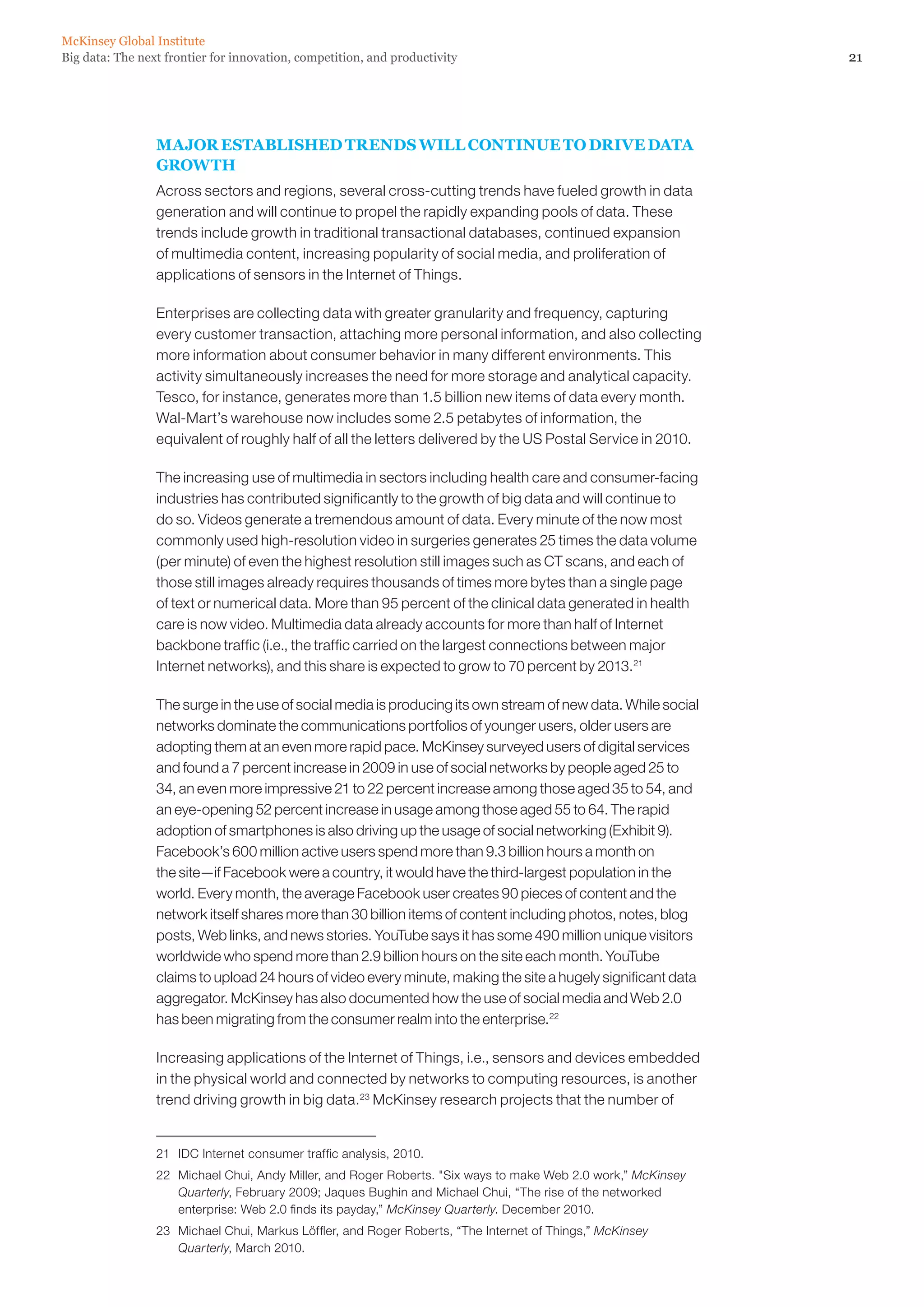
  • 48.
    38 Manufacturing offers a detailed look at a globally traded industry with often complex and widely distributed value chains and a large amount of data available. This domain therefore offers an examination at multiple points in the value chain, from bringing products to market and research and development (RD) to after-sales services. Personal location data is a nascent domain that cuts across industry sectors from telecom to media to transportation. The data generated are growing quickly, reflecting the burgeoning adoption of smartphones and other applications. This domain is a hotbed of innovation that could transform organizations and the lives of individuals, potentially creating a significant amount of surplus for consumers. Exhibit 12 The five sectors or domains we have chosen to study in depth make important contributions to the global economy Estimated global GDP of sectors in 2010 % of total GDP Nominal $ trillion Healthcare1 7 3.9 Public sector2 6 3.7 Retail 6 3.3 Manufacturing 18 10.1 Telecommunications3 2 1.2 Total 39 22.3 Total global GDP 2010 = $57.5 trillion 1 Includes health and social services, medical and measuring equipment, and pharmaceuticals. 2 Refers to public sector administration, defense, and compulsory social security (excludes education). 3 Since personal location data is a domain and not a sector, we’ve used telecom as a comparison for GDP. NOTE: Numbers may not sum due to rounding. SOURCE: Global Insight; McKinsey Global Institute analysis
  • 49.
    McKinsey Global Institute Bigdata: The next frontier for innovation, competition, and productivity 39 3a. Health care (United States) Reforming the US health care system to reduce the rate at which costs have been increasing while sustaining its current strengths is critical to the United States both as a society and as an economy. Health care, one of the largest sectors of the US economy, accounts for slightly more than 17 percent of GDP and employs an estimated 11 percent of the country’s workers. It is becoming clear that the historic rate of growth of US health care expenditures, increasing annually by nearly 5 percent in real terms over the last decade, is unsustainable and is a major contributor to the high national debt levels projected to develop over the next two decades. An aging US population and the emergence of new, more expensive treatments will amplify this trend. Thus far, health care has lagged behind other industries in improving operational performance and adopting technology-enabled process improvements. The magnitude of the problem and potentially long timelines for implementing change make it imperative that decisive measures aimed at increasing productivity begin in the near term to ease escalating cost pressures. It is possible to address these challenges by emulating and implementing best practices in health care, pioneered in the United States and in other countries. Doing so will often require the analysis of large datasets. MGI studied the health care sector in the United States, where we took an expansive view to include the provider, payor, and pharmaceutical and medical products (PMP) subsectors to understand how big data can help to improve the effectiveness and efficiency of health care as an entire system. Some of the actions that can help stem the rising costs of US health care while improving its quality don’t necessarily require big data. These include, for example, tackling major underlying issues such as the high incidence and costs of lifestyle and behavior-induced disease, minimizing any economic distortion between consumers and providers, and reducing the administrative complexity in payors.38 However, the use of large datasets underlies another set of levers that have the potential to play a major role in more effective and cost-saving care initiatives, the emergence of better products and services, and the creation of new business models in health care and its associated industries. But deploying big data in these areas would need to be accompanied by a range of enablers, some of which would require a substantial rethinking of the way health care is provided and funded. Our estimates of the potential value that big data can create in health care are therefore not predictions of what will happen but our view on the full economic potential, assuming that required IT and dataset investments, analytical capabilities, privacy protections, and appropriate economic incentives are put in place. With this caveat, we estimate that in about ten years, there is an opportunity to capture more than $300 billion annually in new value, with two-thirds of that in the form of reductions to national health care expenditure—about 8 percent of estimated health care spending at 2010 levels. US HEALTH CARE COSTS ARE OUTPACING ECONOMIC GROWTH The United States spends more per person on health care than any other nation in the world—without obvious evidence of better outcomes. Over the next decade, average annual health spending growth is expected to outpace average annual growth in 38 Paul D. Mango and Vivian E. Riefberg, “Three imperatives for improving US health care,” McKinsey Quarterly December 2008.
  • 50.
    40 GDP by almost 2 percentage points.39 Available evidence suggests that a substantial share of US spending on health care contributes little to better health outcomes. Multiple studies have found that the United States spends about 30 percent more on care than the average Organisation for Economic Co-operation and Development (OECD) country when adjusted for per capita GDP and relative wealth.40 Yet the United States still falls below OECD averages on such health care parameters as average life expectancy and infant mortality. The additional spending above OECD trends totals an estimated $750 billion a year out of a national health budget in 2007 of $2.24 trillion—that’s about $2,500 per person per year (Exhibit 13). Age, disease burden, and health outcomes cannot account for the significant difference. Exhibit 13 A comparison with OECD countries suggests that the total economic potential for efficiency improvements is about $750 billion Per capita health expenditure and per capita GDP, OECD countries, 2007 $ purchasing power parity (PPP) Per capita health expenditure 8,000 United States 7,000 ~$2,500 6,000 per capita 5,000 Canada Denmark Norway Belgium Switzerland 4,000 Germany Netherlands France Austria Ireland New Zealand 3,000 Greece Italy Sweden Iceland South Korea 2,000 Slovak Republic Israel Japan Slovenia Australia United Kingdom Hungary Spain Finland 1,000 Turkey Poland Estonia Czech Republic Mexico Chile 0 10,000 15,000 20,000 25,000 30,000 35,000 40,000 45,000 50,000 55,000 60,000 Per capita GDP SOURCE: Organisation for Economic Co-operation and Development (OECD) The current reimbursement system does not create incentives for doctors, hospitals, and other providers of health care—or even their patients—to optimize efficiency or control costs. As currently constructed, the system generally pays for procedures without regard to their effectiveness and necessity. Significantly slowing the growth of health care spending will require fundamental changes in today’s incentives. Examples of integrated care models in the United States and beyond demonstrate that, when incentives are aligned and the necessary enablers are in place, the impact of leveraging big data can be very significant (see Box 6, “Health care systems in the United States and beyond have shown early success in their use of big data”). 39 Centers for Medicare and Medicaid Services, National Health Expenditure Projections 2009–2019, September 2010. 40 These studies adjust for relative health using purchasing power parity. For more detail, see Accounting for the cost of US health care: A new look at why Americans spend more, McKinsey Global Institute, December 2008 (www.mckinsey.com/mgi); Chris L. Peterson and Rachel Burton, US health care spending: Comparison with other OECD countries, Congressional Research Service, September 2007; Mark Pearson, OECD Health Division, Written statement to Senate Special Committee on Aging, September 2009.
  • 51.
    McKinsey Global Institute Bigdata: The next frontier for innovation, competition, and productivity 41 Box 6. Health care systems in the United States and beyond have shown early success in their use of big data The fiscal pressures imposed by rising health care costs have motivated the creation of a promising range of pilot programs in the United States and beyond that use big data and its analytical and management levers to capture real medium- and long-term value. Examples of such innovations include: ƒƒ The Department of Veterans Affairs (VA) in the United States has successfully demonstrated several health care information technology (HIT) and remote patient monitoring programs. The VA health system generally outperforms the private sector in following recommended processes for patient care, adhering to clinical guidelines, and achieving greater rates of evidence-based drug therapy. These achievements are largely possible because of the VA’s performance-based accountability framework and disease-management practices enabled by electronic medical records (EMR) and HIT. ƒƒ The California-based integrated managed-care consortium Kaiser Permanente connected clinical and cost data early on, thus providing the crucial dataset that led to the discovery of Vioxx’s adverse drug effects and the subsequent withdrawal of the drug from the market.1 ƒƒ The National Institute for Health and Clinical Excellence, part of the United Kingdom’s National Health Service, has pioneered the use of large clinical datasets to investigate the clinical and cost effectiveness of new drugs and expensive existing treatments. The agency issues appropriate guidelines on such costs for the National Health Service and often negotiates prices and market-access conditions with PMP industries. ƒƒ The Italian Medicines Agency collects and analyzes clinical data on the experience of expensive new drugs as part of a national cost-effectiveness program. The agency can impose “conditional reimbursement” status on new drugs and can then reevaluate prices and market-access conditions in light of the results of its clinical data studies. 1 Merck was granted FDA approval to market Vioxx (rofecoxib) in May 1999. In the five years that elapsed before Merck withdrew Vioxx from the market, an estimated 80 million patients took the drug, making it a “blockbuster” with more than $2 billion per year in sales. Despite statistical evidence in a number of small-scale studies (analyzed later in a metastudy), it took more than five years until the cardiovascular risks of Vioxx were proven. In August 2004, a paper at an International Pharmacoepidemiology meeting in Bordeaux, France, reported the results of a study involving a large Kaiser Permanente database that compared the risk of adverse cardiovascular events for users of Vioxx against the risk for users of Pfizer’s Celebrex. The study concluded that more than 27,000 myocardial infarction (heart attack) and sudden cardiac deaths occurred between 1999 and 2003 that could have been avoided. Taking 25 milligrams per day or more of Vioxx resulted in more than three times the risk of acute heart attacks or sudden cardiac death compared with Celebrex use. On September 30, 2004, in what many observers called the largest drug recall in the history of medicine, Merck pulled Vioxx from pharmacy shelves.
  • 52.
    42 US HEALTH CARE HAS FOUR MAIN POOLS OF DATA The US health care system has four major pools of data within health care, each primarily held by a different constituency. Data are highly fragmented in this domain. The four pools are provider clinical data, payor activity (claims) and cost data, pharmaceutical and medical products RD data, and patient behavior and sentiment data (Exhibit 14). The amount of data that is available, collected, and analyzed varies widely within the sector. For instance, health providers usually have extensively digitized financial and administrative data, including accounting and basic patient information. In general, however, providers are still at an early stage in digitizing and aggregating clinical data covering such areas as the progress and outcomes of treatments. Depending on the care setting, we estimate that as much as 30 percent of clinical text/numerical data in the United States, including medical records, bills, and laboratory and surgery reports, is still not generated electronically. Even when clinical data are in digital form, they are usually held by an individual provider and rarely shared. Indeed, the majority of clinical data actually generated are in the form of video and monitor feeds, which are used in real time and not stored. Exhibit 14 Four distinct big data pools exist in the US health care domain today with little overlap in ownership and low integration Data pools Pharmaceutical RD data ▪ Owner: Pharmaceutical Clinical data companies, academia ▪ Owners: providers ▪ Example datasets: clinical ▪ Example datasets: electronic trials, high throughput medical records, medical images screening (HTS) libraries Integration of data pools required for major opportunities Patient behavior and sentiment data Activity (claims) and cost data ▪ Owners: various including consumer ▪ Owners: payors, providers and stakeholders outside health care ▪ Example datasets: utilization (e.g., retail, apparel) of care, cost estimates ▪ Example data sets: patient behaviors and preferences, retail purchase history, exercise data captured in running shoes SOURCE: McKinsey Global Institute analysis There is a strong political push in the United States to deploy electronic health records (EHR)—sometimes referred to as electronic medical records (EMR)—more widely in provider settings. The American Recovery and Reinvestment Act of 2009 included $20 billion in stimulus funding over five years to encourage the meaningful use of EHR by physicians and hospitals. Outcomes-based reimbursement plans could also encourage the deployment of EHR because they would require accurate and complete databases and analytical tools to measure outcomes. Payors, meanwhile, have been capturing activity (claims) and cost data digitally for many years. Nevertheless, the information is not generally in a form that payors can use for the kind of advanced analysis necessary to generate real insights because it is rarely standardized, often fragmented, or generated in legacy IT systems with incompatible formats.
  • 53.
    McKinsey Global Institute Bigdata: The next frontier for innovation, competition, and productivity 43 The PMP subsector is arguably the most advanced in the digitization and use of data in the health care sector. PMP captures RD data digitally and already analyzes them extensively. Additional opportunities could come from combining PMP data with other datasets such as genomics or proteomics data for personal medicine, or clinical datasets from providers to identify expanded applications and adverse effects. In addition to clinical, activity (claims) cost data, and pharmaceutical RD datasets, there is an emerging pool of data related to patient behavior (e.g., propensity to change lifestyle behavior) and sentiment (e.g., from social media) that is potentially valuable but is not held by the health care sector. Patient behavior and sentiment data could be used to influence adherence to treatment regimes, affect lifestyle factors, and influence a broad range of wellness activities. Many of the levers we identify in the next section involve the integration of multiple data pools. It will be imperative for organizations, and possibly policy makers, to figure out how to align economic incentives and overcome technology barriers to enable the sharing of data. US HEALTH CARE CAN TAP MULTIPLE BIG DATA LEVERS We have identified a set of 15 levers in five broad categories that have the potential to improve the efficiency and effectiveness of the health care sector by exploiting the tremendous amount of electronic information that is, and could become, available throughout the US health care sector. Where possible, we estimate the financial potential of deploying these levers in the form of cost savings, increased efficiencies, improved treatment effectiveness, and productivity enhancement. We have arrived at these estimates by referring to international and US best practices (see the appendix for more details). Assuming that the US health care system removes structural barriers and puts the right incentives in place for different stakeholders, we estimate that big data can help to unlock more than $300 billion a year in additional value throughout the sector. The amount that the sector will capture in reality will depend on the collective actions of health care organizations and policy makers in overcoming structural and other barriers. We focus on levers that require the analysis of large datasets that relate primarily to the development and provision of care, rather than all HIT levers such as automation in claims processing. Our estimates do not aim to capture the entirety of the value generated by HIT (e.g., we exclude value that does not fundamentally require the analysis of large datasets, such as the time saved by doctors and nurses in transcribing notes through the use of EMR or the efficiency savings and increased access to care through mobile health). To validate our findings, we have compared our estimates with those made by other researchers and found them to be comparable (see the appendix). We divide the levers into five broad categories: clinical operations, payment/pricing, RD, new business models, and public health. We now discuss each in turn: Clinical operations Within clinical operations are five big data levers that mainly affect the way providers, payors, and PMP provide clinical care. We estimate that, if fully employed, these five levers could reduce national health care expenditure by up to $165 billion a year from a base of $2.5 trillion in 2009.
  • 54.
    44 1. Comparative effectiveness research. Outcomes-based research determines which treatments will work best for specific patients (“optimal treatment pathways”) by analyzing comprehensive patient and outcome data to compare the effectiveness of various interventions. This research includes what is known as comparative effectiveness research (CER). Many studies have shown that wide variations exist in health care practices, outcomes, and costs across different providers, geographies, and patients. Critically analyzing large datasets that include patient characteristics and the cost and outcomes of treatments can help to identify the most clinically effective and cost-effective treatments to apply. If the health care system implements CER, there is potential to reduce incidences of overtreatment—i.e., interventions that do more harm than good—and undertreatment—cases in which a specific therapy should have been prescribed but was not. Both overtreatment and undertreatment result in worse patient outcomes and higher health care costs in the long run. Around the world, agencies such as NICE in the United Kingdom, the Institut für Qualität und Wirtschaftlichkeit im Gesundheitswesen (Institute for Quality and Efficiency in Health Care, or IQWIG) in Germany, the Common Drug Review in Canada, and Australia’s Pharmaceutical Benefits Scheme have begun CER programs with successful results. The United States took a first step in this direction through the American Recovery and Reinvestment Act of 2009. The law created the Federal Coordinating Council for Comparative Effectiveness Research, which, as its name implies, coordinates comparative effectiveness research across the federal government and makes recommendations for the $400 million allocated for CER. If this lever is to achieve systemwide scale in the United States, it needs to overcome some significant barriers. Comprehensive and consistent clinical and claims datasets need to be captured, integrated, and made available to researchers, and a number of potential issues need to be negotiated. For example, in the current rush to deploy EHR, a potential lack of standards and interoperability could make it difficult to combine datasets. Another concern is how to ensure patient privacy while still providing sufficiently detailed data to allow effective analyses. Having identified optimal treatment pathways, payors will need to be allowed to tie reimbursement decisions and the design of benefits to the results of this research. However, current US law prohibits the Centers for Medicare and Medicaid Services from using the cost/ benefit ratio for reimbursement decisions. Disseminating knowledge about the most effective treatments to medical professionals will require the introduction or upgrade of tools, including clinical decision support systems (see the next lever), so that physicians can receive recommendations of best practices at the point of actual decision making about treatments. 2. Clinical decision support systems. The second lever is deploying clinical decision support systems for enhancing the efficiency and quality of operations. These systems include computerized physician order-entry capabilities. The current generation of such systems analyzes physician entries and compares them against medical guidelines to alert for potential errors such as adverse drug reactions or events. By deploying these systems, providers can reduce adverse reactions and lower treatment error rates and liability claims, especially those arising from clinical mistakes. In one particularly powerful study conducted at a pediatric critical care unit in a major US metropolitan area, a clinical decision support system tool cut adverse drug reactions and events by 40 percent in just two months.41 41 Amy L. Potts, Frederick E. Barr, David F. Gregory, Lorianne Wright, and Neal R. Patel, “Computerized physician order entry and medication errors in a pediatric critical care unit,” Pediatrics 113(1), 2004: 59–63.
  • 55.
    McKinsey Global Institute Bigdata: The next frontier for innovation, competition, and productivity 45 In the future, big data systems such as these can become substantially more intelligent by including modules that use image analysis and recognition in databases of medical images (X-ray, CT, MRI) for prediagnosis or that automatically mine medical literature to create a medical expertise database capable of suggesting treatment options to physicians based on patients’ medical records. In addition, clinical decision support systems can enable a larger portion of work to flow to nurse practitioners and physician assistants by automating and facilitating the physician advisory role and thereby improving the efficiency of patient care. 3. Transparency about medical data. The third clinical big data lever is analyzing data on medical procedures and creating transparency around those data both to identify performance opportunities for medical professionals, processes, and institutions and to help patients shop for the care that offers the best value. Operational and performance datasets from provider settings can be analyzed to create process maps and dashboards enabling information transparency. The goal is to identify and analyze sources of variability and waste in clinical processes and then optimize processes. Mapping processes and physical flows as well as patient journeys within an organization can help to reduce delays in the system. Simply publishing cost, quality, and performance data, even without a tangible financial reward, often creates the competition that drives improvements in performance. The operational streamlining resulting from these analyses can produce reduced costs through lean processes, additional revenue potential from freed-up capacity, more efficient staffing that matches demand, improved quality of care, and better patient experiences. The Centers for Medicare and Medicaid Services is testing dashboards as part of an initiative to implement open government principles of transparency, public participation, and collaboration. In the same spirit, the Centers for Disease Control and Prevention has begun publishing health data in an interactive format and providing advanced features for manipulating its pretabulated data. Publishing quality and performance data can also help patients make more informed health care decisions compared with the situation today in which differences in cost and quality are largely opaque to them.42 Transparency about the data on cost and quality, along with appropriate reimbursement schemes (e.g., where patients’ out-of-pocket expenses are tied to the actual costs charged by the providers) will encourage patients to take a more value-conscious approach to consuming health care, which in turn will help make providers more competitive and ultimately improve the overall performance of the sector. 4. Remote patient monitoring. The fourth clinical big data lever is collecting data from remote patient monitoring for chronically ill patients and analyzing the resulting data to monitor adherence (determining if patients are actually doing what was prescribed) and to improve future drug and treatment options. An estimated 150 million patients in the United States in 2010 were chronically ill with diseases such as diabetes, congestive heart failure, and hypertension, and they accounted for more than 80 percent of health system costs that year. Remote patient monitoring systems can be highly useful for treating such patients. The systems include devices that monitor heart conditions, send information about blood-sugar levels, transmit feedback from caregivers, and even include “chip- on-a-pill” technology—pharmaceuticals that act as instruments to report when they are ingested by a patient—that feeds data in near real time to electronic 42 Cost differences can be quite substantial. For example, the cost of a colonoscopy can vary by a factor of six within the San Francisco area.
  • 56.
    46 medical record databases. Simply alerting a physician that a congestive heart failure patient is gaining weight because of water retention can prevent an emergency hospitalization. More generally, the use of data from remote monitoring systems can reduce patient in-hospital bed days, cut emergency department visits, improve the targeting of nursing home care and outpatient physician appointments, and reduce long-term health complications. 5. Advanced analytics applied to patient profiles. A fifth clinical operations big data lever is applying advanced analytics to patient profiles (e.g., segmentation and predictive modeling) to identify individuals who would benefit from proactive care or lifestyle changes. For instance, these approaches can help identify patients who are at high risk of developing a specific disease (e.g., diabetes) and would benefit from a preventive care program. These approaches can also enable the better selection of patients with a preexisting condition for inclusion in a disease-management program that best matches their needs. And, of course, patient data can provide an enhanced ability to measure the success of these programs, an exercise that poses a major challenge for many current preventive care programs. Payment/pricing The two levers in this category mainly involve improving health care payment and pricing, and they focus primarily on payors’ operations. Together, they have the potential to create $50 billion in value, half of which would result in cost savings to national health care expenditure. 1. Automated systems. The first lever is implementing automated systems (e.g., machine learning techniques such as neural networks) for fraud detection and checking the accuracy and consistency of payors’ claims. The US payor industry estimates that 2 to 4 percent of annual claims are fraudulent or unjustified; official estimates for Medicare and Medicaid range up to a 10 percent share. Savings can be achieved through a comprehensive and consistent claims database (e.g., the proposed all-payors claims database) and trained algorithms to process and check claims for accuracy and to detect cases with a high likelihood of fraud, defects, or inaccuracy either retroactively or in real time. When used in near real time, these automated systems can identify overpayments before payouts are made, recouping significant costs. 2. Health Economics and Outcomes Research and performance-based pricing plans. The second lever is utilizing Health Economics and Outcomes Research and performance-based pricing plans based on real-world patient outcomes data to arrive at fair economic compensation, from drug prices paid to pharmaceutical companies to reimbursements paid to providers by payors. In the case of drug pricing, pharmaceutical companies would share part of the therapeutic risk. For payors, a key benefit is that cost- and risk-sharing schemes for new drugs enable controls or a cap on a significant part of health care spending. At the same time, PMP companies could gain better market access in the presence of strong efforts to contain health care costs. PMP companies can also secure potentially higher revenue from more efficient drug use through innovative pricing schemes. Patients would obtain improved health outcomes with a value-based formulary and gain access to innovative drugs at reasonable costs. To achieve maximum value for the health care system, the United States would need to allow collective bargaining by payors.
  • 57.
    McKinsey Global Institute Bigdata: The next frontier for innovation, competition, and productivity 47 Several pharmaceutical pricing pilot programs based on Health Economics and Outcomes Research are in place, primarily in Europe. Novartis, for example, agreed with German health insurers to cover costs in excess of €315 million ($468 million) per year for Lucentis, its drug for treating age-related macular degeneration. Some payors are also measuring the costs and quality of providers and negotiating reimbursements based on the data. For example, payors may exclude providers whose costs to treat different diseases are out of line after adjusting for comorbidities (the presence of one or more diseases in addition to a primary disease). Alternatively, they may negotiate innovative pricing plans, such as outcome-based payments, if providers achieve specific quality and outcomes benchmarks. RD Five big data levers could improve RD productivity in the PMP subsector. Together, these levers could create more than $100 billion in value, about $25 billion of which could be in the form of lower national health care expenditure. 1. Predictive modeling. The first lever is the aggregation of research data so that PMP companies can perform predictive modeling for new drugs and determine the most efficient and cost-effective allocation of RD resources. This “rational drug design” means using simulations and modeling based on preclinical or early clinical datasets along the RD value chain to predict clinical outcomes as promptly as possible. The evaluation factors can include product safety, efficacy, potential side effects, and overall trial outcomes. This predictive modeling can reduce costs by suspending research and expensive clinical trials on suboptimal compounds earlier in the research cycle. The benefits of this lever for the PMP sector include lower RD costs and earlier revenue from a leaner, faster, and more targeted RD pipeline. The lever helps to bring drugs to market faster and produce more targeted compounds with a higher potential market and therapeutic success rate. Predictive modeling can shave 3 to 5 years off the approximately 13 years it can take to bring a new compound to market. 2. Statistical tools and algorithms to improve clinical trial design. Another lever is using statistical tools and algorithms to improve the design of clinical trials and the targeting of patient recruitment in the clinical phases of the RD process. This lever includes mining patient data to expedite clinical trials by assessing patient recruitment feasibility, recommending more effective protocol designs, and suggesting trial sites with large numbers of potentially eligible patients and strong track records. The techniques that can be employed include performing scenario simulations and modeling to optimize label size (the range of indications applicable to a given drug) to increase the probability of trial success rates. Algorithms can combine RD and trial data with commercial modeling and historic regulatory data to find the optimal trade-off between the size and characteristics of a targeted patient population for trials and the chances of regulatory approval of the new compound. Analyses can also improve the process of selecting investigators by targeting those with proven performance records. 3. Analyzing clinical trials data. A third RD-related lever is analyzing clinical trials data and patient records to identify additional indications and discover adverse effects. Drug repositioning, or marketing for additional indications, may be
  • 58.
    48 possible after the statistical analysis of large outcome datasets to detect signals of additional benefits. Analyzing the (near) real-time collection of adverse case reports enables pharmacovigilance, surfacing safety signals too rare to appear in a typical clinical trial or, in some cases, identifying events that were hinted at in the clinical trials but that did not have sufficient statistical power. These analytical programs can be particularly important in the current context in which annual drug withdrawals hit an all-time high in 2008 and the overall number of new drug approvals has been declining. Drug withdrawals are often very publicly damaging to a company. The 2004 removal of the painkiller Vioxx from the market resulted in around $7 billion in legal and claims costs for Merck and a 33 percent drop in shareholder value within just a few days. 4. Personalized medicine. Another promising big data innovation that could produce value in the RD arena is the analysis of emerging large datasets (e.g., genome data) to improve RD productivity and develop personalized medicine. The objective of this lever is to examine the relationships among genetic variation, predisposition for specific diseases, and specific drug responses and then to account for the genetic variability of individuals in the drug development process. Personalized medicine holds the promise of improving health care in three main ways: offering early detection and diagnosis before a patient develops disease symptoms; more effective therapies because patients with the same diagnosis can be segmented according to molecular signature matching (i.e., patients with the same disease often don’t respond in the same way to the same therapy, partly because of genetic variation); and the adjustment of drug dosages according to a patient’s molecular profile to minimize side effects and maximize response. Personalized medicine is in the early stages of development. Impressive initial successes have been reported, particularly in the early detection of breast cancer, in prenatal gene testing, and with dosage testing in the treatment of leukemia and colorectal cancers. We estimate that the potential for cost savings by reducing the prescription of drugs to which individual patients do not respond could be 30 to 70 percent of total cost in some cases. Likewise, earlier detection and treatment could significantly lower the burden of lung cancer on health systems, given that early-stage surgery costs are approximately half those of late-stage treatment. 5. Analyzing disease patterns. The fifth RD-related big data value creation lever is analyzing disease patterns and trends to model future demand and costs and make strategic RD investment decisions. This analysis can help PMP companies optimize the focus of their RD as well as the allocation of resources including equipment and staff. New business models The proliferation of digital health care data, from clinical to claims information, is creating business models that can complement, or compete with, existing ones and their levers. We highlight two potential new business models: 1. Aggregating and synthesizing patient clinical records and claims datasets. The first type of new business model is one that aggregates and analyzes patient records to provide data and services to third parties. Companies could build robust clinical datasets that would enable a number of adjacent businesses. These might include licensing and analyzing clinical outcomes data for payors and regulators to improve clinical decision making, leveraging patient databases
  • 59.
    McKinsey Global Institute Bigdata: The next frontier for innovation, competition, and productivity 49 to help PMP companies identify patients meeting certain criteria for inclusion in a clinical trial, or providing access to clinical databases for the discovery of biomarkers that help guide the selection of treatments. An adjacent market that is developing not only provides services based on patient clinical records but also integrates claims datasets to provide services to the PMP sector for RD and commercial modeling. Clinical and claims data and services markets are just beginning to develop and grow—the rate of their expansion will depend on how rapidly the health care industry implements electronic medical records and evidence-based medicine. 2. Online platforms and communities. Another potential new business model enabled by big data is that of online platforms and communities, which are already generating valuable data. Examples of this business model in practice include Web sites such as PatientsLikeMe.com, where individuals can share their experience as patients in the system; Sermo.com, a forum for physicians to share their medical insights; and Participatorymedicine.org, a Web site made available by a nonprofit organization that encourages patient activism. These online platforms could become a valuable source of data. For example, Sermo charges the PMP sector for access to its member physicians and information from their interactions on the site. Public health The use of big data can improve public health surveillance and response. By using a nationwide patient and treatment database, public health officials can ensure the rapid, coordinated detection of infectious diseases and a comprehensive outbreak surveillance and response through an Integrated Disease Surveillance and Response program. This lever offers numerous benefits, including a smaller number of claims and payouts, thanks to a timely public health response that would result in a lower incidence of infection. The United States would also be better prepared—in terms of laboratory capacity, for instance—for emerging diseases and outbreaks. There would also be a greater public awareness of the health risks related to infectious diseases, which, in turn, would lower the chance of infections thanks to accurate and timely public health advisories. Taken together, all these components would help to produce a better quality of life. BIG DATA CAN ENABLE MORE THAN $300 BILLION A YEAR IN VALUE CREATION IN US HEALTH CARE All the big-data-enabled levers that we have described can play a substantial part in overhauling the productivity of the US health care system, improving the quality of care and treatment, enhancing patients’ experience, boosting industry competitiveness, and creating a range of fresh business models and services. In total, we estimate that US health care could capture more than $300 billion in value every year, with two-thirds of that in the form of reductions to national health care expenditure of around 8 percent. Holding health care outcomes constant (a conservative assumption considering that many of the levers will improve health care quality, which is difficult to quantify), accounting for annual operating costs and assuming that the value potential of each big data lever grows linearly with health care expenditure, this would mean that the annual productivity of the US health care sector could grow by an additional 0.7 percent. This productivity boost assumes that the industry realizes all of the potential benefits from the use of big data over the next ten years (Exhibit 15).43 As we have said, the actual amount of value that the sector will 43 This calculation factors in the ongoing operating costs of EMR across the nation, estimated at around $20 billion a year, after initial deployment (estimated at up to $200 billion). See the appendix for our productivity calculation.
  • 60.
    50 capture will depend on the collective actions of health care organizations and policy makers in overcoming structural and other barriers. The benefits of these dramatic potential improvements would flow to patients, providers, payors, and the PMP sector. However, using these levers would also redistribute value among players throughout the industry as revenue and profits shift and new, imaginative leaders emerge. Exhibit 15 The estimated long-term value of identified levers is Direct reduction on national health care expenditure more than $300 billion, with potentially more than Unclear impact on national $200 billion savings on national health care spending health care expenditure Value potential from use of big data $ billion per year Lever examples Predictive modeling to determine allocation of RD RD 25 82 108 resources, clinical trial design, and personalized medicine Clinical Comparative effectiveness research (CER), clinical 165 165 decision support system, and dashboards for operations transparency into clinical data Accounting/ Advanced algorithms for fraud detection, performance- 27 47 pricing based drug pricing Public health 9 Public health surveillance and response systems New business Aggregation of patient records to provide datasets and 5 models insights; online platforms and communities Total gross 226 107 333 value potential1 1 Excluding initial IT investments (~$120 billion–$200 billion) and annual operating costs (~$20 billion per annum). SOURCE: Expert interviews; press and literature search; McKinsey Global Institute analysis Patients would see lower costs for better care and have broader, clearer access to a wider variety of health care information, making them more informed consumers of the medical system. Patients would be able to compare not only the prices of drugs, treatments, and physicians but also their relative effectiveness, enabling them to choose more effective, better-targeted medicines, many customized to their personal genetic and molecular makeup. Patients would also have access to a wider range of information on epidemics and other public health information crucial to their well-being. Providers, payors, and the PMP sector will experience a different set of benefits from deploying big data levers. They need to be alert to resulting value shifts and changing business models. Some levers should bring additional value to all stakeholders. For example, by preventing adverse drug events, clinical decision support systems should lead to fewer liability claims for payors, lower malpractice insurance rates for providers, and better outcomes for patients. However, in the case of other levers, one player might gain at the expense of another, a result that would ripple throughout the industry, creating winners and losers at the bottom line. In the case of the adoption of comparative effectiveness research, for instance, providers could see a reduction in their revenue for treatments that are found not to be optimally effective. Remote patient monitoring is another example. This lever will reduce errors and adverse treatment effects and will improve the quality of care and life for those with chronic illnesses. But it will do this by reducing the need for treatment at general hospitals and by cutting adverse drug events, eroding some traditional sources of revenue for hospitals and clinics.
  • 61.
    McKinsey Global Institute Bigdata: The next frontier for innovation, competition, and productivity 51 The potential for reduced revenue may prove to be an incentive for hospitals and clinics to look for ways to participate in the wave of new business models and opportunities that big data levers are helping to create. These organizations may, for instance, try to analyze and use patient databases to expand their preventive care offerings. Entirely new business models will, of course, emerge, too. For example, personal health records offered by Google Health and Microsoft Healthvault allow consumers to create personal health profiles and goals, track treatments and prescriptions, and monitor their experiences as patients. BIG DATA HAVE SIGNIFICANT IMPLICATIONS FOR HEALTH CARE EXECUTIVES AND POLICY MAKERS It is widely recognized that the health reimbursement plans used in the United States provide little incentive to identify waste, address known operational inefficiencies, or improve productivity. These plans are based on payments for activities, including diagnostic tests, drug prescriptions, physician visits, and procedures ordered, rather than proven health outcomes. They reward a high volume of activity rather than the quality, efficiency, or even necessity of that activity. Moving toward performance- and outcome-driven reimbursement models will help to align incentives that can help drive the adoption of these levers. Payors and their customers can drive such change, enabled by regulators. The US Department of Veterans Affairs and agencies in the United Kingdom, Italy, and Germany, among others, are working on programs that base payment on effectiveness and patient outcomes. Improving the quality and availability of information on comparisons of treatments, drugs, physicians, and hospitals will help shift this model. Some efforts already exist to rate hospitals and doctors and to create transparency about the cost of different services, and these initiatives are gaining some traction with the public and employers. But all of these results-oriented incentives will have to become embedded and widely accepted in US health care if the big data levers we have discussed are to become an integral part of the system and if their value is to be fully accessed. It is clear that appropriately aligned incentives can push stakeholders to embrace big data levers to improve performance. The pharmaceutical industry is an obvious example. The industry began mining and aggregating sales and prescription data because this lever helped companies improve their bottom line by more effectively targeting sales, managing sales force resources, and selecting prime areas for RD. At the same time, providers will have to invest significantly in deploying electronic medical record systems, which provide a foundation for doing comparative effectiveness research into treatments and drugs. Some estimates put that cost at $80,000 to $100,000 per bed.44 Although providers will benefit considerably from using such systems (e.g., time savings from pulling and maintaining paper charts), the primary savings will accrue to payors and patients from the identification of the most effective treatments and fewer adverse drug effects. Again, financial incentives would have to be realigned—perhaps through government intervention—before nationwide adoption of electronic medical records and health care information technology will happen. In addition to structural issues, health care executives will need to overcome challenges related to technology, data access, talent, and changing mind-sets and behaviors to capture value from big data. Technology requirements will vary widely among subsectors 44 Francois M. Laflamme, Wayne E. Pietraszek, and Nilesh V. Rajadhyax, “Reforming hospitals with IT investment,” McKinsey Quarterly, August 2010.
  • 62.
    52 and organizations. For instance, significant capital investments will frequently be required to modernize and standardize IT systems and make them compatible to optimize the value creation that can be gleaned from big data. To date, meaningful adoption of electronic medical records continues to run at around 20 percent; the availability of federal incentives could help to boost that rate.45 For many providers, putting the technology in place to generate and capture digital clinical data is the key first step. This will be a formidable challenge in itself because large-scale IT projects are notoriously difficult to execute.46 An equally important task is to ensure that interoperable standards are in place so that data generated at one provider can be accessed in a useful form by another. For more sophisticated PMP companies, the big data technology enhancements required may involve the provision of sufficient storage or the implementation of advanced analytics. For others, the technology challenges will include consolidating fragmented internal databases and making them consistent with one another in a format that will allow an integrated view of information to be available as needed. In many organizations, the internal accessibility and availability of various databases remains severely limited. The power of many of the big data levers we’ve described depends on access to data—and often at a scale beyond those that an individual organization generates. These levers may require combining disparate sets of data such as patient records and clinical claims data. Stakeholders in the industry do not often share existing datasets, because of legal constraints such as privacy laws, a lack of incentives, or incompatible IT systems or formats. The sensitive nature of health information, and the potential for discrimination based on it, makes security and privacy rights protection critical. Many countries have regulations such as HIPAA and HITECH, the US laws designed to protect the security and privacy of health records. As using big data becomes more important to the industry, policy makers may have to reevaluate these laws or intervene to ensure that access to data is available in a safe and secure way that also enables health care outcomes to be optimized. Finally, the difficulties in recruiting and retaining the right talent and forging the right mind-sets within institutions are among the most stubborn obstacles to capturing the value opportunities of big data. Leaders who understand what types of valuable insights can come from data and talent that can analyze large volumes of data are essential. The willingness of employees to use data-driven insights in their decision making is also critical. Capturing the cost savings of comparative effectiveness research, for example, will require physicians to prescribe the most cost-effective interventions according to guidelines derived from big data. But studies in many clinical areas show that physicians often resist, or simply do not comply with, such guidelines. Achieving such a shift will be difficult—but necessary. 45 National Center for Health Statistics, Centers for Disease Control and Prevention, “Electronic medical record/electronic health record use by office-based physicians,” December 2009; Ashish K. Jha et al., “Use of electronic health records in US hospitals,” New England Journal of Medicine 360(16), April 16, 2009:1628–38. 46 For more on the challenges of implementing IT successfully in health care providers and payors, see “Debunking the three leading misperceptions about health care IT,” Health International 2010, Number 10.
  • 63.
    McKinsey Global Institute Bigdata: The next frontier for innovation, competition, and productivity 53    The US health care sector faces an urgent imperative to achieve a radical improvement in its cost-effectiveness. Our research shows that a range of levers using big data can be a critical enabler in reducing cost while at least maintaining health care quality. However, the US health care industry will not achieve the significant value available from big data without radical changes in regulations and systemwide incentives. Achieving those changes will be difficult—but the potential prize is so great that health care executives and policy makers should not ignore these opportunities.
  • 64.
    54 3b. Public sector administration (European Union) Governments in many parts of the world are under increasing pressure to boost their productivity—in other words, do more with less. Particularly in the aftermath of the recent global recession, many governments are faced with having to continue to provide a high level of public services at a time of significant budgetary constraint as they seek to reduce large budget deficits and national debt levels built up when they spent public money heavily to stimulate growth. Beyond the pressures of reducing debt levels, many countries face medium- to long-term budgetary constraints caused by aging populations that will significantly increase demand for medical and social services. As recent MGI research has shown, the way that governments will need to cope with such constraints is through achieving a step change in their (often relatively low) productivity.47 While productivity in the public sector is not easy to measure, there is evidence that public sector productivity growth has fallen behind that of the private sector in many (or most) economies. Experimental estimates by the UK Office of National Statistics showed declining productivity in the public sector from 1995 to 2005, while MGI research showed positive productivity growth in the market sector.48 In large part, the deteriorating productivity performance of the UK public sector was the result of the government’s increasing employment.49 Can big data help the public sector raise its game on productivity? To attempt to answer this question, we studied the administrative activities of the public sector, with a focus on Europe (see Box 7, “How we studied public sector administration”). We found that big data levers, such as increasing transparency and applying advanced analytics, offer the public sector a powerful arsenal of strategies and techniques for boosting productivity and achieving higher levels of efficiency and effectiveness. Our research shows Europe’s public sector could potentially reduce the costs of administrative activities by 15 to 20 percent, creating the equivalent of €150 billion to €300 billion ($223 billion to $446 billion)—or even higher—in new value. This estimate includes both efficiency gains and a reduction in the gap between actual and potential collection of tax revenue. These levers could accelerate annual productivity growth by up to 0.5 percentage points over the next ten years. We believe that big data can play a similar role in other countries and regions, too. Other governments around the world face many of the same social and economic challenges, and the big data opportunities we discuss in this Europe-focused case study will apply elsewhere, particularly in other developed countries and regions. 47 See Martin N. Baily, Karen Croxson, Thomas Dohrmann, and Lenny Mendonca, The public sector productivity imperative, McKinsey Company, March 2011 (www.mckinsey.com/en/ Client_Service/Public_Sector/Latest_thinking/~/media/McKinsey/dotcom/client_service/ Public%20Sector/PDFS/Public%20Sector%20Productivity%20Imperative_March%202011. ashx); and Tony Danker, Thomas Dohrmann, Nancy Killefer, and Lenny Mendonca, “How can American government meet its productivity challenge?” McKinsey Quarterly, July 2006 (www. mckinseyquarterly.com). Also see MGI reports Beyond austerity: A path to economic growth and renewal in Europe, October 2010, and Growth and renewal in the United States: Retooling America’s economic engine, February 2011 (www.mckinsey.com/.mgi). 48 Note that market sector refers to the private sector plus that part of the public sector that sells goods or services for a fee. Also, it should be noted that public sector productivity figures are experimental, outcome-based (not adjusted for value), and divided by total inputs, while market sector productivity figures are based on value added and labor inputs. Experimental estimates are those made using cutting-edge, and therefore not proven, methodologies. 49 From austerity to prosperity: Seven priorities for the long term, McKinsey Global Institute, November 2010 (www.mckinsey.com/mgi).
  • 65.
    McKinsey Global Institute Bigdata: The next frontier for innovation, competition, and productivity 55 Box 7. How we studied public sector administration The public sector offers particular challenges because it is so tremendously diverse in its functions and budgets. We have focused on administration in two common types of government agencies, tax and labor, and then extended our analysis to other relevant parts of the government. Administrative work is arguably the foundation of many public sector functions and agencies, and many aspects of this type of work are common across agencies. Typically, administrative work features many “customer” interactions and generates a high volume of forms and/or payments to process. The work of tax and labor agencies is a classic example. The main activities of tax agencies include submissions processing, examinations, collections, and taxpayer services, all on a large scale. Labor agencies perform a variety of analytical functions, including examining markets, screening customers, and then distributing appropriate benefits and employment services. Other agencies, including transportation and immigration, have similar functions and responsibilities. Private sector activities including the processing of insurance claims also involve similar administrative tasks, and we can draw additional insights from what we know of these activities in the private sector. We began by conducting microanalyses of tax and labor agencies in which we identified and estimated the size of the potential value that big levers can create. We then extrapolated these findings to estimate the value potential of those levers in other similar departments. Some of the levers we discovered were specific to the tax and labor agencies, including levers aimed at reducing the tax gap or reducing fraudulent benefit payments. However, many efficiency levers such as performance dashboards and data integration and mashups are relevant for many other agencies, too (see appendix for more detail on our methodology). THE PUBLIC SECTOR FACES A SIGNIFICANT PERFORMANCE CHALLENGE Europe’s public sector accounts for almost half of GDP, including transfer payments that account for about 20 percent.50 Excluding transfer payments, about 10 to 30 percent of this share is attributable to administration.51 This high share of overall economic output puts considerable long-term strain on Europe’s budgetary and debt positions—over and above the impact of the recent global recession. Today, levels of public debt are already high, and previous MGI research demonstrates that the process of reducing debt after recessions is a lengthy one.52 Compounding the budgetary pressures faced by Europe’s government is the continent’s aging demographic. By 2025, close to 30 percent of the population in mature economies across the globe will be aged 60 or over, up from 20 percent in 2000. Social security, health, and pensions will all face increasing demand (Exhibit 16). 50 OECD statistical database. 51 Transfer payments redistribute income in the market system. Examples include welfare (financial aid), social security, and government subsidies for certain businesses (firms). 52 Debt and deleveraging: The global credit bubble and its economic consequences, McKinsey Global Institute, January 2010 (www.mckinsey.com/mgi).
  • 66.
    56 Exhibit 16 Aging populations will be a burden on government budgets 2007 Age-related government expenditure 2035 % of GDP Western Europe Eastern Europe (EU–15) (EU–10) 10.2 9.2 Pensions 12.0 9.6 6.9 4.7 Health care 7.9 5.5 1.3 0.3 Long-term care 1.9 0.5 18.4 14.2 Total 21.8 15.6 SOURCE: European Commission, Economic and budgetary for the EU-27 member states (2008–60) WHAT KINDS OF DATA DO PUBLIC SECTOR ADMINISTRATION GENERATE? Data generated in public sector administration are primarily textual or numerical. So, in comparison with sectors such as the provision of health care that generates substantial amounts of multimedia content (extensive electronic imaging, for instance, in addition to text), we find that public sector administration tends to generate a lower—but still substantial—volume of unique data as measured in bytes. However, in contrast to health care, the vast majority—up to 90 percent—of the data generated in public sector administration is created in digital form, partly as a result of e-government initiatives undertaken during the past 15 years. However, even in countries whose e-government programs are the most advanced, public sector agencies often do not make data available in an effective manner either across organizational silos or to citizens and businesses. Formatting and input protocols are often inconsistent. Instead of moving data electronically, it is not uncommon for an employee in one agency to receive a faxed copy or mailed CD of data from another agency, even though those data may be stored electronically. And there are some policy and/or legal restrictions that prevent data sharing. Lack of transparency into government performance data can also be a contributing factor to the productivity challenges mentioned previously. It is difficult to improve activities that aren’t measured, and the relative lack of transparency into public sector performance and productivity metrics is a contributing factor to the productivity gap described earlier. THE PUBLIC SECTOR CAN USE BIG DATA LEVERS IN EACH OF THE FIVE CATEGORIES WE HAVE IDENTIFIED The public sector in Europe and beyond has the opportunity to deploy big data levers in each of the five broad categories that emerge from our research across sectors. The levers that we discuss apply to tax and labor agencies, but we believe that their use can be just as relevant in other parts of the public sector.
  • 67.
    McKinsey Global Institute Bigdata: The next frontier for innovation, competition, and productivity 57 1. Creating transparency Both external stakeholders such as citizens and businesses and internal stakeholders such as government employees and agencies can improve their efficiency when data from large public sector databases are made more accessible. For example, government agencies regularly collect a large amount of data on individuals and businesses through various regulatory and other filings. Yet citizens and businesses frequently have to fill out forms for which some of the data have already been collected and stored. If agencies were to pre-fill forms for citizens and businesses from data already stored in government databases, this would save time for the submitters of forms as well as government agencies that would not have to re-input data. Pre-filling would also have the advantage of reducing errors and speeding up processing time. Taking this approach would, however, require policy and statutory barriers to sharing data to be overcome. The Swedish Tax Agency pre-fills forms for its citizens, including income data and the previous year’s taxes paid. The agency allows citizens to confirm or change that information using short message service (SMS) by cell phone or Internet. The potential time savings for taxpayers can be significant. In the United States, for instance, individual taxpayers spend an estimated 5 to 20 hours or more on tax filing activities. Pre-filling can also make substantial time savings for tax authorities. One tax authority was able to redeploy about 15 percent of staff assigned to the processing of submissions. Government employees and their respective agencies can also benefit from making data available across agencies and organizational silos. This can reduce search times between and within agencies, which can make up a significant portion of government employees’ time. One tax agency was able to redeploy 20 percent of its full-time employees by gaining online access to a housing transfer deed databases rather than collecting the data from another government agency on physical media (CDs) and manually searching through the data. Increasingly more governments (at all levels) are beginning to adopt “open data” principles in which they make more raw government databases available to the public. Data.gov.uk in the United Kingdom and the Aporta Web portal in Spain (www. proyectoaporta.es) are central Web sites that are examples of this trend, in which external stakeholders can access more and more large databases. Such efforts have unlocked a tremendous amount of innovation that combines data from multiple sources (e.g., “official” government information from law enforcement and public works with “unofficial” citizen-reported information from social media) to create services such as hyperlocal news that describes events specific to a city block. Other examples, including expectmore.gov and Dr. Foster Intelligence, which provides health care information to UK citizens, are designed to measure program performance directly (see item 5 in this section on new business models for further discussion of these possibilities). 2. Enabling experimentation to discover needs, expose variability, and improve performance One highly valuable contribution that big data can make is to uncover tremendous variability in performance within different parts of a government agency that are performing broadly similar functions—a variability that doesn’t show up at the aggregate level. Such information can be a very valuable opportunity for improving the performance of operating units within an agency. For example, performance dashboards that display operational and financial data allow an agency to measure and compare the performance of its different units and develop approaches to improve productivity. Observers tend to cite a lack of external competition as an explanation for the relatively low productivity in public sector administration, and this
  • 68.
    58 certainly plays a part. But even in a context of weak competitive pressure, the ability to expose variation in performance among different public sector units can create internal competition that drives performance higher. Even in the absence of tangible financial rewards for improving performance, managers in subpar units will often want to improve on that performance because they feel uncomfortable being shown publicly to be toward the bottom of the agency pile (although they may also work harder to boost performance because this might enhance their chances of promotion and more pay down the line).53 Best practice tax agencies use integrated monthly scorecards that measure revenue collected and that track customer satisfaction scores, staff engagement scores, and feedback from the public and agency heads. Elevating the bottom quartile in performance terms by one or two quartiles can be a large opportunity to improve efficiency. While private sector business units can vary in their performance by a factor of two, public sector units can vary by a factor of six.54 Agencies with counterparts in other countries can extend their comparisons of performance from internal to global benchmarks (Exhibit 17). Exhibit 17 Tax agencies in different countries vary in their performance levels Performance scores indexed to 100 Collections Submissions 100 Taxpayer service Examinations 90 80 70 60 Average performance 50 indexed to 40 50 30 20 10 0 0 1 2 3 4 5 6 7 8 9 10 11 12 13 Countries SOURCE: McKinsey tax benchmarking study (includes analysis of 13 countries: Australia, Belgium, Brazil, Canada, Chile, Denmark, France, Ireland, Norway, South Africa, Spain, Sweden, and the United States) Comparison engines can allow public sector administrators to measure and rank the performance of vendors and service providers. Procurement typically offers a large opportunity for cost savings for government as purchasing accounts on average for about one-third of public sector spending (excluding transfer payments). McKinsey’s experience of working on public sector projects suggests that government can, on average, generate savings of up to 30 percent from awarding contracts more effectively across a range of services and goods.55 53 Some managers in public sector do receive bonuses for strong performance. For more on using status rewards to motivate good performance, see Timothy Besley and Maitreesh Ghatak, “Status incentives,” American Economic Review 98(2), 2008: 206–11. 54 McKinsey conducted an in-depth benchmarking of 13 tax agencies globally in 2008 and 2009. For the findings, see Thomas Dohrmann and Gary Pinshaw, The road to improved compliance, McKinsey white paper, September 2009. 55 Percent as a basis of procurement cost; see Christian Husted and Nicolas Reinecke, “Improving public-sector purchasing,” McKinsey on Government, 2009.
  • 69.
    McKinsey Global Institute Bigdata: The next frontier for innovation, competition, and productivity 59 Citizens and external stakeholders can also use public sector data that expose variability in performance. In the United Kingdom, the government is making data on health care outcomes available so that citizens can make more informed decisions about providers. In similar fashion, making data available on educational outcomes at primary and secondary schools can allow parents to make more informed decisions about where to live or in which schools to place their children. In addition to arming consumers of such public services with the information they need to make effective choices, making these types of data openly available is likely to incentivize providers of such services to improve their performance. 3. Segmenting populations to customize actions Using segmentation to tailor services to individuals has long been an accepted practice in the private sector. However, the ethos of the public sector tends to be that governments should provide exactly the same services to all citizens. Our research shows that segmenting and tailoring government services to individuals and population cohorts can increase effectiveness, efficiency, and citizen satisfaction. For example, Bundesagentur für Arbeit (German Federal Labor Agency, or BA for short) analyzed its huge amount of historical data on its customers, including histories of unemployed workers, the interventions that it took, and outcomes including data on how long it took people to find a job. The idea was to develop a segmentation based on this analysis so that the agency could tailor its interventions for unemployed workers. This process, along with other initiatives applied over three years, allowed the agency to reduce its spending by €10 billion ($14.9 billion) annually at the same time as cutting the amount of time that unemployed workers took to find employment, and increasing the satisfaction among users of its services (see Box 8, “Germany’s federal labor agency has used big data to cut significant cost from its operations”). Similarly, best practice tax agencies are using big data to segment individual and business taxpayers, separating them into categories and classes for examination and collection activities. For example, these agencies can categorize taxpayers by geography, their compliance history, potential risk of default, collection difficulty, and, of course, income level and demographics. Using effective segmentation can help close the gap between actual and potential collections by up to 10 percent. At the same time, more targeted interactions can increase customer satisfaction by as much as 15 percent. 4. Replacing/supporting human decision making with automated algorithms Some of the more sophisticated applications of big data use automated algorithms to analyze large datasets in order to help make better decisions. These types of techniques can often be very effectively applied in compliance activities, for example, among public sector agencies that need to find anomalies in payments such as in tax collections or benefit payments from labor or social security departments. Sophisticated tax agencies apply automated algorithms that perform systematic, multilevel checks on tax returns and automatically flag returns that require further examination or auditing. This approach can improve collections considerably, reducing the tax gap by up to 10 percentage points. Similar methods can be used by other agencies to play an effective role in counterterrorism and child protection. Algorithms can crawl through big data from a variety of sources, identifying inconsistencies, errors, and fraud. For instance, rule-based algorithms can flag suspicious correlations such as a person receiving unemployment benefits while filing for a work-related accident. Using more sophisticated and well-tuned algorithmic techniques such as neural networks can reduce the probability of both false positives
  • 70.
    60 (selecting an item for further examination that does not have an issue) and false negatives (not selecting an item for further examination where there is an issue). After using automated analyses, BA reported a 20 percent reduction in erroneously paid benefits. Box 8. Germany’s federal labor agency has used big data to cut significant cost from its operations The Bundesagentur für Arbeit (German Federal Labor Agency, or BA for short), with a €54 billion annual budget and 120,000 full-time employees, has sharply improved its customer services and cut around €10 billion of costs in recent years by using big data strategies (Exhibit 18). BA finds jobs for the unemployed and provides a full range of counseling and support services through ten regional centers and 178 employment agencies. The agency built capabilities for producing and analyzing data that enabled a range of new programs and new approaches to existing programs. BA is now able to analyze outcomes data for its placement programs more accurately, spotting those programs that are relatively ineffective and improving or eliminating them. The agency has greatly refined its ability to define and evaluate the characteristics of its unemployed and partially employed customers. As a result, BA has developed a segmented approach that helps the agency offer more effective placement and counseling to more carefully targeted customer segments. Surveys of their customers show that they perceive and highly approve of the changes BA is making. Exhibit 18 Germany has achieved a significant reduction in its spending on active labor market policies without an increase in national unemployment Disposable budget for active labor market policies, 2003–10 € billion 13.5 10.3 4.4 4.5 4.3 3.3 3.3 3.6 2003 04 05 06 07 08 09 2010 Persons 4.4 4.4 4.9 4.5 3.8 3.3 3.4 3.2 unemployed Million SOURCE: Bundesagentur für Arbeit; McKinsey Global Institute analysis 5. Innovating new business models, products, and services with big data Big data from government can unlock innovation both inside and outside the public sector. Providing readily accessible big data tools and analytics can allow commercial, nonprofit, and individual third parties to create new value for the public sector in a variety of ways. These could include feedback on services, insight into better management practices, and suggestions for improving new and existing programs. Big data innovation can lead to experiments in public policy and public sector programs to improve government performance. In the United Kingdom, for instance, the nonprofit Open Knowledge
  • 71.
    McKinsey Global Institute Bigdata: The next frontier for innovation, competition, and productivity 61 Foundation used databases made available through the government’s open data initiative to develop wheredoesmymoneygo.org, a site that makes it easier for citizens to view and understand UK public spending through analysis and visualization of the data.56 The startup company BrightScope mined data from the US Department of Labor about 401(k) management fees paid by employers and discovered that small businesses were paying in excess of $4 billion more in management fees than bigger companies. Based on those data, and data from a few public sources such as the Securities and Exchange Commission and the US Census Bureau, BrightScope now provides an online tool to rate 401(k) plans quantitatively. In April 2011, a consortium of European open data organizations announced an “open data challenge,” a contest for designers, developers, researchers, and the general public to come up with ideas, applications, visualizations, and derived datasets based on datasets produced by European public bodies. The consortium made €20,000 in prize money available. This project was partly inspired by the District of Columbia’s Apps for Democracy contest, which attracted more than 40 successful applications worth at least $2 million to the DC municipal government at a total cost of $50,000. As in the other industry and business sectors we studied, significant value can be captured merely by making data available and transparent (and applying simple analytics). Potential gains increase sharply as stakeholders move to advanced analytics techniques such as applying complex algorithms and segmentation techniques. THE POTENTIAL BENEFITS OF BIG DATA IN PUBLIC SECTOR ADMINISTRATION Across Europe’s public sector, the big data levers we identified for administration can bring three main categories of quantifiable monetary value as long as the right policies and enablers are in place. These are cost savings from operational efficiency, a reduction in the cost of errors and fraud in benefit administration, and an increase in tax receipts by narrowing the tax gap. We estimate that the efficiency levers we have identified apply to 20 to 25 percent of operating budgets with potential savings of 15 to 20 percent. Reducing error and the cost of benefits received fraudulently is possible in an estimated 1 to 3 percent of transfer payments (note that this accounts for the portion of transfer payments that have nonnegligible amounts of error and fraud and the estimated percentage cost of error and fraud), saving up to 40 percent of the cost incurred from these sources.57 With respect to increasing tax receipts, we estimate the tax gap to be in the range of 5 to 10 percent of total European tax receipts and that up to 20 percent of that can be recouped. Altogether, the public sectors of Europe’s 23 largest governments could potentially create €150 billion to €300 billion—and potentially more—in new value annually over ten years. This implies boosting annual productivity growth rates in the public sector by about 0.5 percentage points above those expected, if current trends hold (Exhibit 19). 56 See Jason Baumgarten and Michael Chui, “E-government 2.0,” McKinsey Quarterly, July 2009 for a story about the Sunlight Foundation, an organization that created a similar site in the United States. 57 Based on studies done by governments, we estimate that fraud or error can affect approximately 55 percent of transfer payments and that this error and fraud can boost costs by up to 3 percent.
  • 72.
    62 Exhibit 19 Big data has the potential to create €150 billion to €300 billion or more in value across the OECD-Europe public sector Total base1 € billion  Addressable %  Reduction %  Total value € billion Operational Operating 4,000 20–25 15–20 120–200 efficiency expenditure savings Reduction in Transfer 2,500 1–32 30–40 7–30 fraud and payment error Tax revenue 5,400 5–103 10–20 25–110 Increase in tax collection 150–300+ 1 Base for operational efficiency savings is total government expenditure net of transfer payments; base for reduction in fraud is total government transfer payments; base for increase in tax collection is tax revenue. 2 Takes into account the percentage of transfer payment that can have fraud/error as well as the estimated cost of error and fraud. 3 In the case of tax collection, the percentage addressable refers to the percentage estimated tax gap. NOTE: Numbers may not sum due to rounding. SOURCE: International Monetary Fund; OECD; McKinsey Global Institute analysis In addition, big data can deliver a range of substantial nonmonetary gains in the public sector, including the improved allocation of funding into programs, higher-quality services, increased public sector accountability, a better-informed citizenry, and almost certainly enhanced public trust in government.58 After one of the EU labor agencies began segmenting its services, there was a documented increase in the quality of interaction between the agency’s customers and case managers. Citizens and business can spend less time and effort in their interactions with government agencies and receive services better targeted to their needs. Greater transparency of information creates improved accountability in public sector agencies and improved public trust. Dashboards and comparative engines offer citizens the means of measuring the effectiveness of programs and policies. One of the hidden benefits of making citizens’ own data available to them is that they are usually the most motivated to ensure that those records are accurate. So giving citizens the ability to correct erroneous personal information in agency databases electronically can improve the accuracy of government databases. All of the levers we have discussed can lead to more informed and better decisions by citizens, policy makers, and public sector executives. PUBLIC SECTOR LEADERS NEED TO ADDRESS A RANGE OF ISSUES TO USE BIG DATA EFFECTIVELY Public sector leaders who want to realize the value potential offered by big data need to address a number of internal and external issues. These include implementing appropriate technology, recruiting and training talented personnel, and managing change within their organizations. Just as important, government will need to use policy to support the capture of value from big data and the sharing of data across agencies. The first task is to establish a culture within the public sector in which decisions aimed at improving performance are made on the basis of data. Only when the government makes its performance goals and supporting data transparent will government agencies and the public engage more meaningfully in those objectives. When the 58 These improvements in the quality of government services provided were not included in the productivity calculation.
  • 73.
    McKinsey Global Institute Bigdata: The next frontier for innovation, competition, and productivity 63 government establishes institutions to review its accountability and productivity, citizens and public sector employees “get the message.” Fortunately, many of the data in the public sector administrative functions of developed countries are already in digital form, but agencies vary significantly in the sophistication with which they handle that digital information.59 Some agencies will still need to deal with issues such as inconsistent data formats and definitions, and problems associated with legacy systems. The ability to integrate different datasets will be critical to, for example, enabling tax agencies to pre-fill taxpayers’ forms and screen them automatically, and labor agencies to accurately integrate data on the unemployed so that they can target services more efficiently. Anecdotally, tax agencies in Europe and in other regions report difficulties in obtaining and using data from other agencies because of incompatible data formats. Recruiting and retaining analytical talent will be a critical issue for public sector agencies, just as it is in the private sector. Arguably the analytical talent gap will be even greater in the public sector, given its lackluster track record of competing for top talent, and it is vital that public sector leaders understand the need to tackle this shortfall. There will also be increasing demand for personnel who can effectively manage and adapt to change, and some governments will need to overcome a culture in which seniority reigns and blunts the impact of incentives for better performance. The public sector needs to change the attitude of employees toward data sharing and use, offering appropriate incentives and systems to ensure that the insights derived from big data actually drive the actions and decisions in organizations. The mind-set of employees can be as great a barrier to realizing value from big data as technological inadequacy. In the area of balancing privacy rights and data access, action across departments is likely to be helpful. New laws or regulations may be necessary to enable government agencies to access data from their counterparts in other parts of the system while protecting the security of that information and privacy of its subjects. Policy makers need to make decisions on privacy in conjunction with public opinion, informing citizens about the trade-offs between the privacy and security risks of sharing data and the benefits of sharing data.    The public sector in advanced economies is facing unprecedented pressures to improve productivity, and our analysis of public administration in Europe demonstrates that big data levers can make a significant contribution to this effort around the world. Using big data intelligently has the potential to generate significant value for the public sector as long as action is taken to overcome technological barriers, to recruit and retrain people with the appropriate skills, and to manage the changes needed within organizations to embrace and leverage big data. 59 This observation refers to the government administrative functions studied in this deep dive, which did not include education or government-run health care. For much of Europe, online delivery of public services has made steady progress. The most basic 20 eServices (including online tax returns and school enrollments) stood at an average availability of 82 percent across Europe in 2010. For more, see Digitizing public services in Europe: Putting ambition to action, European Commission, December 2010.
  • 74.
    64 3c. Retail (United States) In the US retail industry, the use of information technology and digital data has been instrumental in boosting the profitability of individual players and the productivity of the entire sector for decades. In the coming years, the continued adoption and development of big data levers have the potential to further increase sector-wide productivity by at least 0.5 percent a year through 2020. Among individual firms, these levers could increase operating margins by more than 60 percent for those pioneers that maximize their use of big data. Such a boost in profitability would be especially significant in a sector where margins are notoriously tight. This is also a rich domain in which to examine interactions between retailers and consumers. This is an area in which digital data are playing an increasing role as consumers search, research, compare, buy, and obtain support online, and the products sold by retailers increasingly generate their own digital data. Of course, the value that players in the retail sector and their customers will actually capture will depend critically on the actions of retailers to overcome barriers related to technology, talent, and organizational culture. This study focuses on the US retail sector, but we also draw on the best practices and experiences of companies around the world. The potential positive impact from the majority of the big data levers we describe would almost certainly be similar in other developed nations. We examined the application of big data in the majority of retail subsectors as described by the standard North American Industry Classification System (NAICS). Specifically, we include in our analysis those subsectors in which customers make small- to moderate-sized average individual purchases and those with a moderate to high frequency of interaction (see Box 9, “Which retail subsectors did we study?”). We do not include the private-label businesses of retailers. We cover suppliers of goods in our case study on manufacturing. Box 9. Which retail subsectors did we study? We looked at 10 of the 12 NAICS retail subsectors for our analysis: health and personal care; general merchandise; building materials and garden equipment; nonstore retailers; food and beverage; clothing and accessories; sporting goods, hobby, book, and music; electronics and appliances; miscellaneous; and furniture and home furnishings. We did not include motor vehicle and parts dealers or gas stations. The primary reason for excluding motor vehicle dealers was that the frequency of purchases of motor vehicles, often the second-most valuable item in a household after a home itself, is relatively rare, so the level of interactions with consumers is also at a different scale and frequency compared with other retail subsectors. We chose not to cover gas stations because the sale of a commodity (gasoline) makes it less comparable to other retail subsectors with far more variety in products and whose input costs are less dominated by a single volatile factor (oil prices). RETAIL IS AN IMPORTANT COMPONENT OF THE US ECONOMY, BUT PROFITABILITY IS UNDER INTENSE PRESSURE Retail makes up a sizable part of the US economy. In 2009, that share was an estimated 6 percent of the economy, down a percentage point from 2000. Industry forecasts point to only modest growth over the next five years as the sector steadily,
  • 75.
    McKinsey Global Institute Bigdata: The next frontier for innovation, competition, and productivity 65 but slowly, recovers from recession. Historical trends have demonstrated that there is a close relationship between growth in retail and that of developed market economies as a whole. As a matter of reference, the International Monetary Fund (IMF) is predicting annual US GDP growth of 2.7 percent through 2015. Retail’s share of overall consumer spending has been in decline, falling from 50 percent in 1990 to 42 percent in 2009. And the sector’s profitability is under intense pressure, squeezed both by suppliers, who have been capturing an increasing amount of surplus, and by customers, who are putting pressure on prices. For every $1.00 of operating profit on consumer goods in 2008, retailers collected approximately $0.31, down from $0.60 in 1999, while suppliers, packagers, and others below retail on the value chain received $0.69 (Exhibit 20). Exhibit 20 Downward pricing pressure on retailers from suppliers has squeezed retailers’ portion of the consumer profit pool Operating profit pool for consumer goods % 100 90 ▪ For every $1.00 of operating profit 80 Retailer today, retailers receive 70 approximately $0.31, 60 while consumer packaged goods 50 (CPG) receive $0.69 40 ▪ Further pricing pressures will erode 30 the $0.31 of CPG 20 operating profit that the retailer currently 10 controls 0 1998 99 2000 01 02 03 04 05 06 07 2008 SOURCE: Bernstein; McKinsey analysis A number of big data developments will put more downward pricing pressure on retailers. This squeeze will come from a variety of new technologies that give shoppers powerful pricing, promotional, and product information, frequently in real time. Applications such as RedLaser, for instance, let shoppers scan the bar code of an item in-store with their smartphones and obtain immediate price and product comparisons. In addition, the adoption of online and mobile commerce (more than 50 percent of retail sales will be online or influenced by online channels by 2014) could provide a huge increase in price transparency that will shift immense value to consumers (Exhibit 21). This trend is likely to erode margins for retailers that are competing solely on price. It is already clear that where shoppers have easy access to cross-retailer price comparisons, prices tend to be materially lower.60 60 There is a long history of academic literature on the relationship between advertising (online and offline) and prices that has covered products from eyeglasses to alcohol and services such as attorneys. See, for example, Lee Benham, “The effect of advertising on the price of eyeglasses,” Journal of Law and Economics 15(2), October 1972: 337–52.
  • 76.
    66 Exhibit 21 US online and Web-influenced retail sales are forecast to become more than half of all sales by 2013 $ billion 1,658 1,542 1,423 249 1,307 230 210 1,194 192 1,072 173 Online retail sales 155 1,312 1,409 1,115 1,213 Web-influenced 1,021 917 retail sales 2009 10 11 12 13 2014 % of total 42 46 48 50 51 53 US sales SOURCE: Forrester Research Web-influenced retail sales forecast, December 2009 INFORMATION TECHNOLOGY TRENDS OFFER SIGNIFICANT NEW OPPORTUNITIES TO CREATE VALUE IN RETAIL While big data linked to new technology does squeeze the industry in some ways, it also offers significant new opportunities for creating value. Sector retailers and their competitors are in a constant race to identify and implement those big data levers that will give them an edge in the market. The volume of data is growing inexorably as retailers not only record every customer transaction and operation but also keep track of emerging data sources such as radio-frequency identification (RFID) chips that track products, and online customer behavior and sentiment. In fact, US retail has been leveraging information technology for decades. Point-of- sale transactional data, primarily obtained from the use of bar codes, first appeared in the 1970s.61 Since the 1990s, many leading retailers have been using store-level and supply chain data to optimize distribution and logistics, sharpen merchandise planning and management, and upgrade store operations. In previous MGI research on the acceleration of productivity in general merchandise retail in the 1990s, we found that Wal-Mart directly and indirectly caused the bulk of the productivity acceleration through ongoing managerial innovation (e.g., big-box formats, everyday low price) that increased competitive intensity and drove the diffusion of managerial and technological best practices.62 Wal-Mart pioneered the expansion of an electronic data interchange system to connect its supply chain electronically. Wal- Mart also developed “Retail Link,” a tool that gives its suppliers a view of demand in its stores so that they know when stores should be restocked rather than waiting for an order from Wal-Mart. This “vendor-managed inventory” was a revolutionary concept when it was introduced in the late 1980s. Both of these initiatives improved the 61 A package of Wrigley’s chewing gum was the first grocery item scanned using Universal Product Code—in a Marsh Supermarket in Troy, Ohio, in 1974. 62 For more on drivers of productivity, in particular technology in the retail sector in the 1990s, see How IT enables productivity growth, McKinsey Global Institute, November 2002 (www. mckinsey.com/mgi).
  • 77.
    McKinsey Global Institute Bigdata: The next frontier for innovation, competition, and productivity 67 retailer’s capital and labor productivity and cost position. When other retailers moved in the 1990s to emulate what Wal-Mart had pioneered in order to remain competitive, productivity surged across the industry. Today, leading players are mining customer data to inform decisions they make about managing their supply chain to merchandising and pricing. Wal-Mart’s detailed and cost-efficient customer tracking gives the retailer the ability to mine petabytes of data on customer preferences and buying behavior, and thereby win important pricing and distribution concessions from consumer product goods companies. Retailers across the industry are becoming more sophisticated in slicing and dicing big data they collect from multiple sales channels, catalogs, stores, and online interactions. The widespread use of increasingly granular customer data can enable retailers to improve the effectiveness of their marketing and merchandising. Big data levers applied to operations and supply chains will continue to reduce costs and increasingly create new competitive advantages and strategies for growing retailers’ revenue. MGI HAS IDENTIFIED 16 BIG DATA LEVERS IN RETAIL We have identified 16 big data retail levers that retailers can employ along the value chain. These levers fall into in the five main categories of marketing, merchandising, operations, supply chain, and new business models (Exhibit 22). Exhibit 22 Big data retail levers can be grouped by function Function Big data lever Marketing ▪ Cross-selling ▪ Location based marketing ▪ In-store behavior analysis ▪ Customer micro-segmentation ▪ Sentiment analysis ▪ Enhancing the multichannel consumer experience Merchandising ▪ Assortment optimization ▪ Pricing optimization ▪ Placement and design optimization Operations ▪ Performance transparency ▪ Labor inputs optimization Supply chain ▪ Inventory management ▪ Distribution and logistics optimization ▪ Informing supplier negotiations New business models ▪ Price comparison services ▪ Web-based markets SOURCE: McKinsey Global Institute analysis Marketing 1. Cross-selling. State-of-the-art cross-selling uses all the data that can be known about a customer, including the customer’s demographics, purchase history, preferences, real-time locations, and other facts to increase the average purchase size. For example, Amazon.com employs collaborative filtering to generate “you might also want” prompts for each product bought or visited. At one point, Amazon reported that 30 percent of sales were due to its recommendation engine. Another example of this lever is using big data analyses to optimize in-store promotions that link complementary items and bundled products.
  • 78.
    68 2. Location-based marketing. Location-based marketing relies on the growing adoption of smartphones and other personal location data-enabled mobile devices. It targets consumers who are close to stores or already in them. For instance, as a consumer approaches an apparel store, that store may send a special offer on a sweater to the customer’s smartphone. The startup PlaceCast claims that more than 50 percent of its users have made a purchase as a result of such location-based ads. Nearly 50 percent of smartphone owners use or plan to use their phones for mobile shopping.63 3. In-store behavior analysis. Analyzing data on in-store behavior can help improve store layout, product mix, and shelf positioning. Recent innovations have enabled retailers to track customers’ shopping patterns (e.g., footpath and time spent in different parts of a store), drawing real-time location data from smartphone applications (e.g., Shopkick), shopping cart transponders, or passively monitoring the location of mobile phones within a retail environment. Some retailers use sophisticated image-analysis software connected to their video-surveillance cameras to track in-store traffic patterns and consumer behavior. 4. Customer micro-segmentation. The next marketing-related big data lever is customer micro-segmentation. Although this is a familiar idea in retail, big data has enabled tremendous innovation in recent years. The amount of data available for segmentation has exploded, and the increasing sophistication in analytic tools has enabled the division into ever more granular micro-segments—to the point at which some retailers can claim to be engaged in personalization, rather than simply segmentation. In addition to using traditional market-research data and data on historical purchases, retailers can now track and leverage data on the behavior of individual customers—including clickstream data from the Web. Retailers can now update this increasingly granular data in near real time to adjust to customer changes. Neiman Marcus, a high-end retailer, has developed both behavioral segmentation and a multi-tier membership reward program, and this combination has led to substantially more purchases of higher margin products from its most affluent, higher-margin customers. 5. Sentiment analysis. Sentiment analysis leverages the voluminous streams of data generated by consumers in the various forms of social media to help inform a variety of business decisions. For example, retailers can use sentiment analysis to gauge the real-time response to marketing campaigns and adjust course accordingly. The evolving field of social media data analysis plays a key role because consumers are relying increasingly on peer sentiment and recommendations to make purchasing decisions. A variety of tools has emerged for the real-time monitoring and response to Web-based consumer behavior and choices. 6. Enhancing the multichannel consumer experience. Enhancing the multichannel experience for consumers can be a powerful driver of sales, customer satisfaction, and loyalty. Retailers can use big data to integrate promotions and pricing for shoppers seamlessly, whether those consumers are online, in-store, or perusing a catalog. Williams-Sonoma, for example, has integrated customer databases with information on some 60 million households, tracking such things as their income, housing values, and number of children. Targeted e-mails based on this information obtain ten to 18 times the response rate of e-mails that are not targeted, and the company is able to create different versions of its catalogs attuned to the behavior and preferences of different groups of customers. 63 ABI research, Consumer Technology Barometer: Mobile, 2010.
  • 79.
    McKinsey Global Institute Bigdata: The next frontier for innovation, competition, and productivity 69 Merchandising 1. Assortment optimization. Deciding which products to carry in which stores based on local demographics, buyer perception, and other big data—so-called assortment optimization—can increase sales materially. One leading drug retailer, for example, used consumer research, market and competitive analysis, and detailed economic modeling to identify the causes of its flat and declining growth at the category level. It reduced its overall stock-keeping unit (SKU) count by 17 percent, shifted private-label brands from 10 percent of the product mix to 14 percent, and achieved a 3 percent earnings boost as well as a 2 percent increase in sales. 2. Price optimization. Retailers today can take advantage of the increasing granularity of data on pricing and sales and use higher levels of analytical horsepower to take pricing optimization to a new level. A variety of data sources can be used to assess and inform pricing decisions in near real time. Complex demand-elasticity models examine historical sales data to derive insights into pricing at the SKU level, including markdown pricing and scheduling. Retailers can use the resulting data to analyze promotion events and evaluate sources of sales lift and any underlying costs that these might entail. One food retailer examines pricing elasticity among its customers for different categories. Rural food consumers, for instance, see butter and rice as a higher buying priority and therefore these products are perhaps less price elastic than they would be for urban shoppers. Urban consumers, meanwhile, tend to rank cereals and candy higher among their priorities. 3. Placement and design optimization. Brick-and-mortar retailers can also gain substantially by optimizing the placement of goods and visual designs (e.g., end caps, shelves) by mining sales data at the SKU level—in essence, a more local version of the kinds of optimization that take advantage of foot-traffic data. Online retailers can adjust Web site placements based on data on page interaction such as scrolling, clicks, and mouse-overs. For instance, eBay has conducted thousands of experiments with different aspects of its Web site to determine optimal layout and other features from navigation to the size of its photos. Operations 1. Performance transparency. Retailers can now run daily analyses of performance that they can aggregate and report by store sales, SKU sales, and sales per employee. Today, these systems are moving ever closer to real time. Retailers can look at cashiers for accuracy and transactions per hour and at the quality of customer service based on the percentage of customer issues solved with a single call, customer complaints, and satisfaction surveys. Although the industry already widely uses performance reporting at a basic level, the trend toward much higher frequency, immediacy, and granular reporting allows managers to make concrete adjustments in their operations in a much more timely manner, i.e., there is still headroom to gain value using this lever. 2. Labor inputs optimization. Another operational lever that can create value through reducing costs while maintaining service levels is around the optimization of labor inputs, automated time and attendance tracking, and improved labor scheduling. This lever can create more accurate predictions of staffing needs, especially during peak periods, so that overcapacity can be avoided. Because store labor represents approximately 30 percent of the average retailer’s fixed costs, employing this lever is well worthwhile.
  • 80.
    70 Supply chain 1. Inventory management. With the additional detail offered by advanced analytics mining multiple datasets, big data can continue to improve retailers’ inventory management, Best-in-class inventory management provides full transparency at the SKU level, while bar code systems linked to automated replenishment processes reduce the incidents of running out of stock. Leading retailers are improving stock forecasting by combining multiple datasets such as sales histories, weather predictions, and seasonal sales cycles. Together, improved inventory management allows retailers to hold a lower level of stock because supplies are coupled much more tightly with demand signals, while reducing the number of sales lost because of merchandise stock-outs. 2. Distribution and logistics optimization. Leading retailers are also optimizing transportation by using GPS-enabled big data telematics (i.e., remote reporting of position, etc.) and route optimization to improve their fleet and distribution management. Transport analytics can improve productivity by optimizing fuel efficiency, preventive maintenance, driver behavior, and vehicle routing. 3. Informing supplier negotiations. In a big data world, leading retailers can analyze customer preferences and buying behavior to inform their negotiations with suppliers. They can use price and transaction data to focus negotiated concessions on key products, for instance. Using big data in this arena is a significant opportunity, given that the cost of goods sold makes up the largest portion of cost for a retailer. However, we should note that suppliers also recognize the importance of understanding customer preferences and are actively gaining access to, and analyzing, data on consumer behavior to uncover insights that strengthen their hand in negotiations with retailers. New business models The avalanche of data in the retail industry, coupled with other advances in business, is enabling the emergence of innovative business models. These models are the most intriguing and innovative—but also the most potentially threatening—to traditional retailers. Two new business models with the most traction today are price comparison services and Web-based markets. 1. Price comparison services. It is common today for third parties to offer real time or near-real-time pricing and related price transparency on products across multiple retailers. Consumers can instantly compare the price of a specific product at multiple retail outlets. Where these comparisons are possible, prices tend to be lower. Studies show that consumers are saving an average of 10 percent when they can shop using such services. Retailers need to carefully think about how to respond to such price comparison services. Those that can compete on price will want to ensure that they are the most visible on such services. Retailers that cannot compete on price will need to determine how to differentiate themselves from competitors in a price-transparent world, whether it is in the quality of the shopping experience, differentiated products, or the provision of other value-added services.
  • 81.
    McKinsey Global Institute Bigdata: The next frontier for innovation, competition, and productivity 71 2. Web-based markets. Web-based marketplaces, such as those provided by Amazon and eBay, provide searchable product listings from a large number of vendors. In addition to price transparency, they offer access to a vast number of niche retailers that otherwise do not have the marketing or sales horsepower to reach consumers. They also provide a tremendous amount of useful product information, including consumer-generated reviews that deliver further transparency to consumers. Since we have drawn from global best practices, the findings of this case study can be applied to other countries and regions—with some qualifications. Developed economies will find the levers we identified and resulting analyses to be directly applicable. But the potential opportunities could be even larger in geographies that have not yet begun to use big data as a growth engine. In regions such as Europe where labor laws are relatively more rigid, the labor resource optimization levers may yield less dramatic results. BIG DATA CAN DELIVER HIGHER MARGINS AND PRODUCTIVITY We have estimated the potential impact of each of the 16 big data levers we have described, using a combination of our own case studies, academic and industry research, and interviews with experts; for more on our methodology, see the appendix. While we estimate the total potential value that big data can enable, we do not predict what value the sector will actually capture because this largely depends on actions taken by retailers to overcome a number of barriers, including obstacles related to technology, talent, and culture, as well as external factors such as whether consumers are receptive to having their behavior data mined and the ability of suppliers to leverage some of the same levers in negotiations. Marketing levers can affect 10 to 30 percent of operating margin; merchandising levers can affect 10 to 40 percent; and supply chain levers can have a 5 to 35 percent impact (Exhibit 23). In contrast, price transparency levers will tend to cut prices and squeeze margins. The total potential impact of individual big data levers varies significantly across retail subsectors (Exhibit 24). Some subsectors will have already pulled big data levers more than others, partly explaining this variation.
  • 82.
    72 Exhibit 23 Different levers have varied impacts on the operating margins of firms Impact on operating margin % -30 -20 -10 0 10 20 30 40 50 Marketing Merchandising Operations Supply chain Price transparency SOURCE: Expert interviews; publicly available data; McKinsey case studies; McKinsey Global Institute analysis Exhibit 24 The big data value potential in retail varies Highest relevance in different subsectors Lowest relevance Elec- General Building Food Clothing Sporting, tronics Health and mer- material and and hobby, and Furniture personal chandis and Nonstore bev- acces- book, appli- and home care stores e stores garden retailers erage sories music ances furnishings Other Improved cross- selling Location-based marketing In-store behavior analysis Marketing Customer micro- segmentation Sentiment analysis Enhancing multichannel experience Assortment Merchandising optimization Pricing optimization Placement and design optimization Performance Operations transparency Labor inputs optimization Improved inventory management Supply chain Distribution and logistics optimization Informing supplier negotiations business1 Price New comparison services 1 Impact of Web-based markets is very difficult to quantify and this has not been included here. SOURCE: McKinsey Global Institute analysis
  • 83.
    McKinsey Global Institute Bigdata: The next frontier for innovation, competition, and productivity 73 While individual players can use big data levers to grow their top lines and operating margins, these gains will largely shift value within the industry rather than increasing its total size. Firms that are relatively better at deploying big data levers will experience significant gains at the expense of those that do not execute as well. The overall winners should be consumers, who will benefit from receiving goods better suited to their needs. We also estimated potential productivity gains at the industry level, opting to take a conservative approach to such estimates by applying only the effects of levers in operations and supply chains that reduce costs (see the appendix for detail on our methodology). If we look solely at efficiency, we estimate that big data levers have the potential to create an annual 0.5 percent acceleration in productivity through 2020. To put that in context, academic research has estimated that IT investments in the entire US economy, including retail, through the high-growth 1990s added 1 to 2 percent to the compound annual growth rate of US productivity.64 This estimate does not take into account the fact that the use of big data will be a boon to consumers through the economic surplus that they will capture and is therefore conservative. For instance, even if retail consumers do not spend more money overall, many of the marketing and merchandising levers we have described will improve their shopping experience. Consumers will find better products to match their needs (e.g., consumers that choose to opt-in to marketing programs that use big data to better target offers) and spend less time looking for those products at the right price (e.g., because they can obtain information about the availability of inventory before visiting a store, or use price comparison services). This should increase the real value added of the retail sector, even if estimating the value of this consumer surplus is difficult. We believe that the use of large datasets will continue to transform the face of retail. In recent decades, IT and data that was used to optimize supply chains helped create the category of big-box retailers that sell large volumes of a wide range of products at low prices. In recent years, online retailers such as Amazon, eBay, and Groupon are redefining what retail can mean. Instead of receiving information about goods and services from sales teams or advertisements, consumers find the information they need from their fellow shoppers and find what they want to buy via electronic marketplaces. THE INDUSTRY AND POLICY MAKERS NEED TO OVERCOME BARRIERS TO TAP THE FULL OPPORTUNITY OF BIG DATA If the retail industry is to realize the potential value from the use of big data, both the industry and government will have to deal with a number of important barriers. Policy makers will make choices about how to regulate the industry’s use of information about consumers—policy choices that will have profound implications for many other industries that, in common with retail, will draw increasingly pronounced concerns about privacy and security in the era of big data. It is certainly the case that consumer attitudes toward the use of their personal information, especially personal location data and electronic data generated by their use of the Internet, are changing rapidly. But many people remain uninformed about how, where, and to what extent this information is used in targeted advertising and other marketing strategies. 64 Stephen Oliner and Daniel Sichel, “Information technology and productivity: Where we are now and where we are going?”, Federal Reserve Bank of Atlanta Economic Review, 2002.
  • 84.
    74 Across the globe, we observe the emergence of different concepts of electronic privacy. Germany, for instance, has limited the use of the Street View function of Google maps. Depending on the jurisdiction and purpose, there are different definitions of personally identifiable information (PII)—what counts legally as information that identifies a person for a variety of purposes. Some definitions are more general than others, and large players would benefit from having a single country or industry standard. For their part, retail executives must manage and overcome multiple barriers to realize the full potential of big data. The first is the mind-set of employees and firms; many people still view IT as a back-office function and therefore as a large cost center rather than as an engine for business growth. In contrast, leading companies in their use of big data understand that their IT initiatives will be a crucial source of competitive advantage. These companies must make sure that business and IT leaders collaborate closely so that the use of big data underpins improvements in efficiency improvement and opportunities for creating value. Companies should also actively seek out and implement big-data-based innovations that will give them long- term competitive advantages. Another common obstacle for big data leaders is their legacy IT systems. Many of these systems were installed decades ago, well before today’s big data opportunities were considered or even possible. These legacy systems usually include multiple silos of information generated in incompatible standards and formats so that they cannot be readily integrated, accessed, and analyzed. Attempts to upgrade and integrate these systems can be so difficult and plagued with the potential for introducing new system bugs that one retail expert complained that such an effort was “much worse than starting from scratch.” Even deploying new IT-enabled systems can present tremendous challenges. The gap between the predicted scale of adoption of RFID systems and their actual deployment tells a cautionary tale. RFID held the promise of providing a source of supply chain data that could be exploited using big data techniques. In the early days, RFID reader reliability was far worse than originally expected, necessitating manual inputs to correct for reader errors. This destroyed the productivity gains expected from deploying this technology. Adoption slowed, RFID tags were in lower demand, and per-tag costs did not decline as quickly as anticipated, as economies of scale were muted. Higher tag prices hurt the business case for further RFID deployment, reinforcing a negative cycle in which the application of big data levers based on this technology has been delayed. Potentially as daunting for retail executives is the task of finding the talent that can execute big data levers. Globally, executives complain about the scarcity of high- quality candidates for these jobs, and many retailers do not have sufficient talent in-house. Moreover, existing analytical and technical talent tends to be managed inefficiently, isolated in particular departments, or scattered in different business units. People with the requisite skills are rarely directly involved in strategic decision making and have little impact beyond answering highly specific questions. Retailers with the foresight and intelligence to hire big data talent in sufficient numbers and then involve these hires in strategic decisions and planning will take the fullest advantage of value-creation opportunities at the expense of their less nimble competitors.
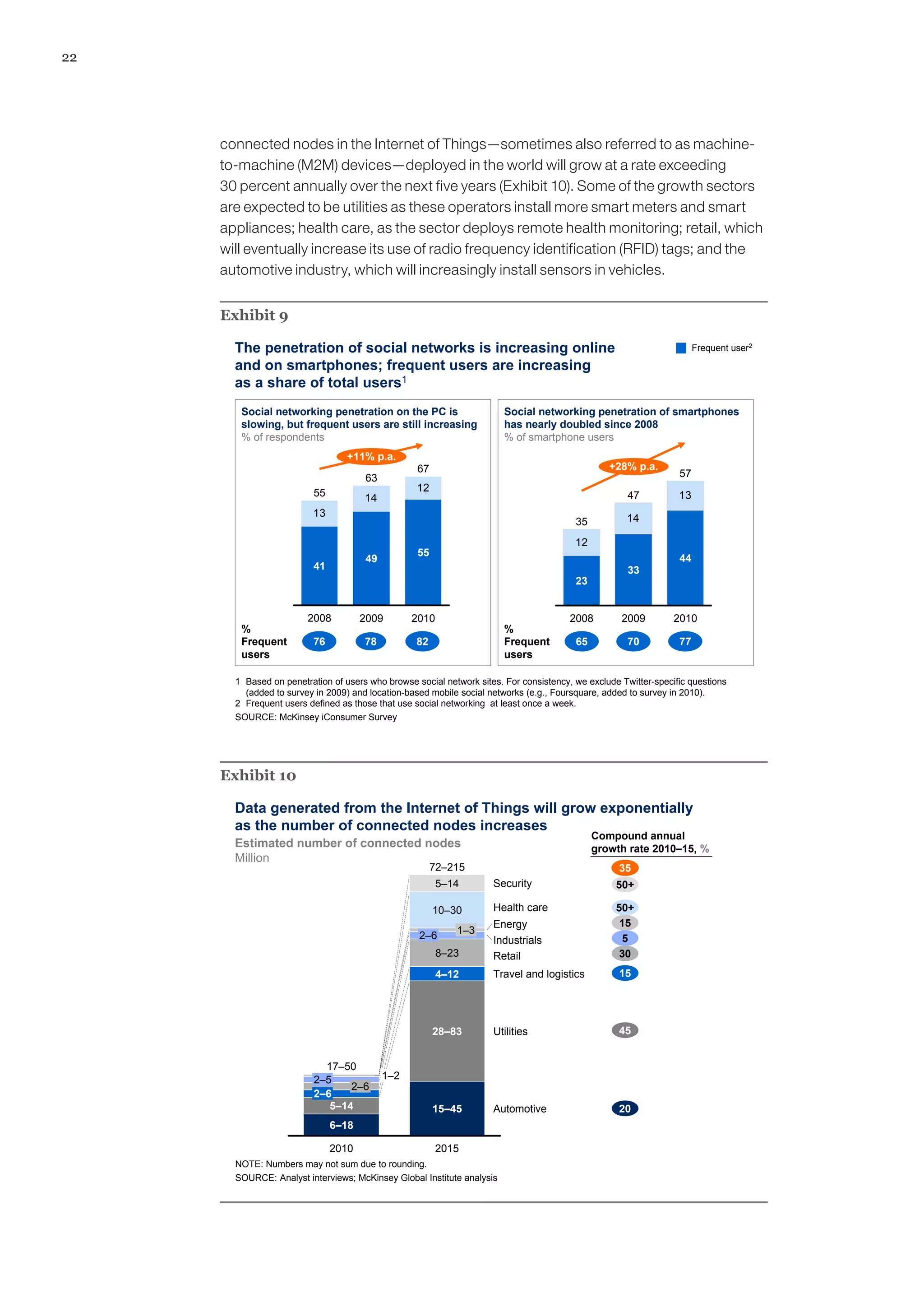
  • 85.
    McKinsey Global Institute Bigdata: The next frontier for innovation, competition, and productivity 75    In an environment in which retailers face significant pressures from slow GDP growth in conjunction with pricing pressures from suppliers upstream and consumers downstream, retailers need to compete fiercely to ensure their survival and relevance. While information technology and data have already delivered waves of impact, our research finds that there is significant headroom arising out of innovation that retailers can tap. Retailers that develop and exercise their big data muscles will boost their chances of outcompeting and winning at the expense of those who do not grasp this opportunity in the years ahead.
  • 86.
    76 3d. Manufacturing (global) The manufacturing sector was an early and intensive user of data to drive quality and efficiency, adopting information technology and automation to design, build, and distribute products since the dawn of the computer era. In the 1990s, manufacturing companies racked up impressive annual productivity gains because of both operational improvements that increased the efficiency of their manufacturing processes and improvements in the quality of products they manufactured. For example, advanced manufactured products such as computers became much more powerful. Manufacturers also optimized their global footprints by placing sites in, or outsourcing production to, low-cost regions. But despite such advances, manufacturing, arguably more than most other sectors, faces the challenge of generating significant productivity improvement in industries that have already become relatively efficient. We believe that big data can underpin another substantial wave of gains.65 These gains will come from improved efficiency in design and production, further improvements in product quality, and better meeting customer needs through more precisely targeted products and effective promotion and distribution. For example, big data can help manufacturers reduce product development time by 20 to 50 percent and eliminate defects prior to production through simulation and testing. Using real- time data, companies can also manage demand planning across extended enterprises and global supply chains, while reducing defects and rework within production plants. Overall, big data provides a means to achieve dramatic improvements in the management of the complex, global, extended value chains that are becoming prevalent in manufacturing and to meet customers’ needs in innovative and more precise ways, such as through collaborative product development based on customer data. We base these conclusions on an examination of multiple manufacturing subsectors encompassing both discrete and process manufacturing, from basic manufacturing subsectors such as consumer goods and food, to advanced manufacturing subsectors such as automotive and aerospace. We drew upon global best practice examples of the use of big data to identify seven levers of value creation, describe the range of potential impact, and the barriers that have to be overcome to capture that value.66 MANUFACTURING HAS HISTORICALLY BEEN A PRODUCTIVITY LEADER, AND BIG DATA CAN HELP EXTEND GAINS The manufacturing sector has been the backbone of many developed economies and remains an important driver of GDP and employment there. However, with the rise of production capacity and capability in China and other low-cost nations, manufacturing has become an increasingly global activity, featuring extended supply chains made possible by advances in information and communications technology. While globalization is not a recent phenomenon, the explosion in information and communication technology, along with reduced international freight costs and lower entry barriers to markets worldwide, has hugely accelerated the industrial 65 Manufacturing is a sector with multiple issues that advanced economies need to address, many of which do not involve big data. In this research, we focus on the role that big data can play. 66 Our analysis focuses primarily on the core production processes of a manufacturer—i.e., RD, supply chain, and manufacturing processes—and less on adjacent processes such as marketing and sales.
  • 87.
    McKinsey Global Institute Bigdata: The next frontier for innovation, competition, and productivity 77 development path and created increasingly complex webs of value chains spanning the world.67 Increasingly global and fragmented manufacturing value chains create new challenges that manufacturers must overcome to sustain productivity growth. In many cases, technological change and globalization have allowed countries to specialize in specific stages of the production process. As a result, manufacturers have assembled global production and supply chain networks to achieve cost advantages. For example, a typical global consumer electronics manufacturer has production facilities on almost every continent, weighing logistics costs against manufacturing costs to optimize the footprint of their facilities. Advanced manufacturers also often have a large number of suppliers, specialized in producing specific types of components where they have sustainable advantages both in cost and quality. It is typical for a large automobile original equipment manufacturer (OEM) assembly plant to be supplied by up to 4,000 outside vendors. To continue achieving high levels of productivity growth, manufacturers will need to leverage large datasets to drive efficiency across the extended enterprise and to design and market higher-quality products. The “raw material” is readily available; manufacturers already have a significant amount of digital data with which to work. Manufacturing stores more data than any other sector—close to 2 exabytes of new data stored in 2010. This sector generates data from a multitude of sources, from instrumented production machinery (process control), to supply chain management systems, to systems that monitor the performance of products that have already been sold (e.g., during a single cross-country flight, a Boeing 737 generates 240 terabytes of data). And the amount of data generated will continue to grow exponentially. The number of RFID tags sold globally is projected to rise from 12 million in 2011 to 209 billion in 2021. IT systems installed along the value chain to monitor the extended enterprise are creating additional stores of increasingly complex data, which currently tends to reside only in the IT system where it is generated. Manufacturers will also begin to combine data from different systems including, for example, computer-aided design, computer-aided engineering, computer-aided manufacturing, collaborative product development management, and digital manufacturing, and across organizational boundaries in, for instance, end-to-end supply chain data. MANUFACTURERS CAN USE BIG DATA ACROSS THE VALUE CHAIN Big data has the potential to enable seven performance improvement levers for manufacturers, affecting the entire value chain (Exhibit 25). In this section, we will discuss each of these in turn. Research and development and product design The use of big data offers further opportunities to accelerate product development, help designers home in on the most important and valuable features based on concrete customer inputs as well as designs that minimize production costs, and harness consumer insights to reduce development costs through approaches including open innovation. 67 While the transition to a post-industrial economy took about 200 years in the United Kingdom and about 130 years in Germany, South Korea took about 60 years. See Eberhard Abele, Tobias Meyer, Ulrich Näher, Gernot Strube, and Richard Sykes, eds., Global production: A handbook for strategy and implementation (Berlin: Springer, 2008).
  • 88.
    78 Exhibit 25 We have identified the following big data levers across the manufacturing value chain Supply- Market- After- RD and Produc- chain ing and sales design tion mgmt sales service 1 Build consistent interoperable, cross-functional RD and product design databases along supply chain to enable concurrent engineering, rapid experimentation and simulation, and co-creation 2 Aggregate customer data and make them widely available to improve service level, capture cross- and up-selling opportunities, and enable design-to-value 3 Source and share data through virtual collaboration sites (idea marketplaces to enable crowd sourcing) 4 Implement advanced demand forecasting and supply planning across suppliers and using external variables 5 Implement lean manufacturing and model production virtually (digital factory) to create process transparency, develop dashboards, and visualize bottlenecks 6 Implement sensor data-driven operations analytics to improve throughput and enable mass customization 7 Collect after-sales data from sensors and feed back in real time to trigger after-sales services and detect manufacturing or design flaws SOURCE: McKinsey Global Institute analysis 1. Product lifecycle management. Over decades, manufacturing companies have implemented IT systems to manage the product lifecycle including computer aided-design, engineering, manufacturing, and product development management tools, and digital manufacturing. However, the large datasets generated by these systems have tended to remain trapped within their respective systems. Manufacturers could capture a significant big data opportunity to create more value by instituting product lifecycle management (PLM) platforms that can integrate datasets from multiple systems to enable effective and consistent collaboration. For example, PLM could provide a platform for “co-creation,” e.g., bringing together internal and external inputs to create new products. This is particularly useful in fields such as aerospace where a new product might be assembled with hundreds of thousands of components supplied by hundreds of suppliers from around the world. In this context, having the OEM co-create designs with suppliers can be extraordinarily valuable. PLM platforms can also significantly enable experimentation at the design stage. Designers and manufacturing engineers can share data and quickly and cheaply create simulations to test different designs, the choice of parts and suppliers, and the associated manufacturing costs. This is especially useful because decisions made in the design stage typically drive 80 percent of manufacturing costs. Leading players in advanced industries are already embracing the collaborative use of data and controlled experimentation. Toyota, Fiat, and Nissan have all cut new-model development time by 30 to 50 percent; Toyota claims to have eliminated 80 percent of defects prior to building the first physical prototype.68 However, while the payoff for this opportunity is large, manufacturers will likely need to invest significantly upgrade their systems, which in many cases are decades old. In addition to the technical work of integrating datasets from 68 Note that in addition to reducing development time, manufacturers, as a result of using integrated PLM, are able to improve quality and reduce resources in order to develop more derivatives or product extensions.
  • 89.
    McKinsey Global Institute Bigdata: The next frontier for innovation, competition, and productivity 79 different IT systems, manufacturers will need to ensure that staff members from different functions (RD, production) and organizations (OEMs, suppliers) use these tools to collaborate. Today, a lack of collaboration across silos is closer to the norm. 2. Design to value. While obtaining customer input through market research has traditionally been a part of the product design process, many manufacturers have yet to systematically extract crucial insights from the increasing volume of customer data to refine existing designs and help develop specifications for new models and variants. Best-in-class manufacturers conduct conjoint analyses to determine how much customers are willing to pay for certain features and to understand which features are most important for success in the market.69 These companies supplement such efforts with additional quantitative customer insights mined from sources such as point-of-sales data and customer feedback. New sources of data that manufacturers are starting to mine include customer comments in social media and sensor data that describe actual product usage. However, gaining access to comprehensive data about customers in order to achieve holistic insights can be a significant barrier for manufacturers; distributors, retailers, and other players can be unwilling to share such data, considering them to be a competitive asset. Nevertheless, the size of the prize for successfully designing to value can be substantial, especially in subsectors with high product differentiation and changing customer preferences. For example, one manufacturer of telecom equipment used customer insights data to improve gross margin by 30 percent in 24 months, eliminating unnecessary costly features and adding those that had higher value to the customer and for which the customer was willing to pay a higher price. 3. Open innovation. To drive innovation and develop products that address emerging customer needs, manufacturers are relying increasingly on outside inputs through innovative channels. With the advent of Web 2.0, some manufacturers are inviting external stakeholders to submit ideas for innovations or even collaborate on product development via Web-based platforms. Consumer goods companies such as Kraft and Procter and Gamble invite ideas from their consumers as well as collaborate with external experts, including academics and industry researchers, to develop new products. In the early 2000s, PG faced a problem of rising RD costs but a declining payoff. In response, the company created the Connect and Develop open innovation program, one element of which was leveraging InnoCentive, a Web-based platform that invites experts to solve technical challenges that PG is facing. Today, half of new products have elements that originated outside the company, up from 15 percent in 2000. RD productivity at PG is up 60 percent, and RD as a share of revenue has fallen from 4.8 to 3.4 percent. But as successful as these open innovation initiatives can be, one key problem is how to extract, in an efficient way, the truly valuable ideas from the potentially large number of inputs these programs can generate. This is a task that big data techniques such as automated algorithms can help to solve. Open innovation through big data has been extended to advanced industries as well. BMW, for example, has created an “idea management system” to help evaluate ideas submitted through its “virtual innovation agency.” This has cut the 69 Conjoint analysis is a statistical technique that involves providing a controlled set of potential products and services to elicit end users’ preferences through which an implicit valuation of individual elements that make up the product or service can be determined.
  • 90.
    80 time taken to identify high-potential ideas by 50 percent and has also reduced the time it takes to make a decision about how feasible an idea is. The result has been that the company has incorporated two or three major ideas from its open innovation effort into its models every year. An additional benefit of these open innovation techniques is that they create more brand engagement from participants in these efforts, as well as a positive “halo” effect as these initiatives become more widely recognized. Supply chain Manufacturers, especially those producing fast-moving consumer goods, have significant additional opportunities to improve demand forecasting and supply chain planning. The volatility of demand has been a critical issue for manufacturers. Their retailing customers have pushed hard for increased flexibility and responsiveness from suppliers, given the diverging and ever-changing preferences of consumers. Other trends, such as the increasing use of promotions and tactical pricing, have only magnified volatility issues facing suppliers. Manufacturers can improve their demand forecasting and supply planning by the improved use of their own data. But as we’ve seen in other domains, far more value can be unlocked when companies are able to integrate data from other sources including data from retailers, such as promotion data (e.g., items, prices, sales), launch data (e.g., specific items to be listed/delisted, ramp-up/ramp-down plans), and inventory data (e.g., stock levels per warehouse, sales per store). By taking into account data from across the value chain (potentially through collaborative supply chain management and planning), manufacturers can smooth spiky order patterns. The benefits of doing so will ripple through the value chain, helping manufacturers to use cash more effectively and to deliver a higher level of service. Best-in-class manufacturers are also accelerating the frequency of planning cycles to synchronize them with production cycles. Indeed, some manufacturers are using near-real-time data to adjust production. Others are collaborating with retailers to shape demand at the store level with time-based discounts. Production Big data are driving additional efficiency in the production process with the application of simulation techniques to the already large volume of data that production generates. The increasing deployment of the “Internet of Things” is also allowing manufacturers to use real-time data from sensors to track parts, monitor machinery, and guide actual operations.70 1. Digital factory. Taking inputs from product development and historical production data (e.g., order data, machine performance), manufacturers can apply advanced computational methods to create a digital model of the entire manufacturing process. Such a “digital factory”—including all machinery, labor, and fixtures—can be used to design and simulate the most efficient production system, from layout to sequencing of steps, for a specific product. Leading automobile manufacturers have used this technique to optimize the production layout of new plants, particularly when there are myriad constraints such as space and utility distribution. A steel manufacturer used simulation to model its entire portfolio of factories and quickly test improvement levers; this led to an 70 “Internet of Things” refers to sensors and actuators within networks of physical objects. For more information, see Michael Chui, Markus Löffler, and Roger Roberts, “The Internet of Things,” McKinsey Quarterly, March 2010.
  • 91.
    McKinsey Global Institute Bigdata: The next frontier for innovation, competition, and productivity 81 improvement in delivery reliability of 20 to 30 percentage points. Case studies in automotive, aerospace and defense, and semiconductors show that these types of advanced simulations can reduce the number of production-drawing changes as well as the cost of tool design and construction.71 Plants designed with these techniques also have realized substantial reductions in assembly hours, cost savings, and even improved delivery reliability. 2. Sensor-driven operations. The proliferation of Internet of Things applications allows manufacturers to optimize operations by embedding real-time, highly granular data from networked sensors in the supply chain and production processes. These data allows ubiquitous process control and optimization to reduce waste and maximize yield or throughput. They even allow for innovations in manufacturing that have not been possible thus far, including nano manufacturing.72 Some of the best examples of using big data from sensor networks come from process manufacturing such as oil refining. For decades, the oil industry has used huge amounts of real-time data to develop ever more hard-to-reach deposits. Now, the industry has extended its use of big data to the production side to the automated, remotely monitored oil field. The benefit of this approach is that it cuts operations and maintenance costs that can account for 60 percent of wasted expenses. In the digital oil field, a single system captures data from well-head flow monitors, seismic sensors, and satellite telemetry systems. The data are transmitted to very large data farms and then relayed to a real-time operations center that monitors and adjusts parameters to optimize production and minimize downtime. Experience suggests that the digital oil field can cut operational costs by 10 to 25 percent even while potentially boosting production by 5 percent or more. Marketing and sales/after-sales support As we have described, manufacturing companies are using data from customer interactions not only to improve marketing and sales but also to inform product development decisions. Increasingly, it is economically feasible to embed sensors in products that can “phone home,” generating data about actual product usage and performance. Manufacturers can now obtain real-time input on emerging defects and adjust the production process immediately. RD operations can share these data for redesign and new product development. Many construction equipment manufacturers already embed sensors in their products, and this can provide granular real-time data about utilization and usage patterns, enabling these manufacturers to improve demand forecasts as well as their future product development. There are also many opportunities to leverage large datasets in the marketing, sales, and after-sales service activities. As we can observe in many sectors, opportunities range from the segmentation of customers to applying analytics in order to improve the effectiveness of sales forces. An increasingly important application for manufacturers is using sensor data from products once they are in use to improve service offerings. For example, analyzing the data reported by sensors embedded in complex products enables manufacturers of aircraft, elevators, and data-center servers to create proactive smart preventive maintenance service packages. A repair 71 See for example, U. Bracht and T. Masurat, “The Digital Factory between vision and reality,” Computers in Industry 56(4), May 2005. 72 An example is nano-scale printing in semiconductors.
  • 92.
    82 technician can be dispatched before the customer even realizes that a component is likely to fail. Other manufacturers have been able to transform the commercial relationship with customers from one in which they sell a product to one in which they sell a service. An example is jet engine manufacturers selling “power-by-the-hour.” BIG DATA IN AGGREGATE UNDERPINS SUBSTANTIAL PRODUCTIVITY POTENTIAL AND INNOVATION For manufacturers, opportunities enabled by big data can drive productivity gains both through improving efficiency and the quality of products (Exhibit 26).73 Efficiency gains arise across the value chain, from reducing unnecessary iterations in product development cycles to optimizing the assembly process. The real output value of products is increased by improving their quality and making products that better match customers’ needs. Exhibit 26 Big data levers can deliver value along the manufacturing value chain in terms of cost, revenue, and working capital Impact Working Subsector applicability Lever examples Cost Revenue capital ▪ Concurrent +20–50% PD2 costs -20-50% time High – Low complexity engineering/PLM1 to market RD and design ▪ Design-to-value +30% gross margin High – Low complexity ▪ Crowd sourcing -25% PD costs 2 B2C – B2B ▪ Demand forecasting/ +2–3% profit -3–7% FMCG3 – Capital goods Supply chain shaping and supply margin onetime management planning ▪ Sensor data-driven -10–25% Up to +7% revenue Capital intense – CPG3 operations analytics operating costs Production ▪ Digital Factory for -10–50% +2% revenue Capital intense – CPG3 lean manufacturing assembly costs ▪ Product sensor data -10–40% +10% annual Capital intense – CPG3 After-sales analysis for after- maintenance production services sales service costs 1 Product lifecycle management. 2 Product development. 3 Fast-moving consumer goods and consumer packaged goods. SOURCE: Expert interviews; press and literature search; McKinsey Global Institute analysis Beyond pushing productivity, big data enables innovative services and even new business models in manufacturing. Sensor data have made possible innovative after- sales services. For example, BMW’s ConnectedDrive offers drivers directions based on real-time traffic information, automatically calling for help when sensors indicate trouble, alerts drivers of maintenance needs based on the actual condition of the car, and feeds operation data directly to service centers. The ability to track the use of products at a micro-level has also made possible monetization models that are based not on the purchase of a product but on services priced by their usage, as we have described. The ability to exchange data across the extended enterprise has also enabled production to be unbundled radically into highly distributed networks. For example, Li and Fung, a supplier to apparel retailers, orchestrates a network of more than 7,500 suppliers, each of which focuses on delivering a very specific part of the supply chain. 73 Gains will likely show up in both labor productivity and resource productivity.
  • 93.
    McKinsey Global Institute Bigdata: The next frontier for innovation, competition, and productivity 83 Some of the most powerful impacts of big data apply across entire manufacturing ecosystems. As we have documented, big data plays a pivotal role in ensuring that these ecosystem webs function well and continue to evolve. Indeed, new data intermediaries or data businesses could begin to emerge. They could, for example, capitalize on the economic value of data that describes the flow of goods around the world. MANUFACTURERS MUST TACKLE ORGANIZATIONAL, CULTURAL, AND TALENT CHALLENGES TO MAXIMIZE THE BENEFITS OF BIG DATA Much of the value that big data can create in manufacturing requires the access and varied use of data from multiple sources across an extended enterprise. So to fulfill the potential for value creation in this sector will require manufacturing companies to invest in IT as well as to make organizational changes. The additional IT investment necessary may not be insignificant. Some of the big data levers that we have discussed, including updating a PLM platform that can link across various IT systems, will be costly. Nevertheless, the long-term payoff should outweigh the cost. Other investments will be required to develop interfaces and protocols to share data effectively across the extended enterprise. The standardization of interfaces will be critical and may require industry-wide partnerships to achieve. Strongly departmentalized companies, with multiple IT systems and overlapping and/or redundant data in different operations and divisions, are clearly at a disadvantage. To obtain the benefits of design-to-value, for instance, a company needs to have a free interchange of data among marketing and sales, RD, and production. So, in many organizations, achieving success will require strong leadership and a cultural shift to establish the mind-sets and behaviors to breech today’s silos. Many organizations will need to undertake organizational change programs to enforce the necessary shift—groups that have never shared their data will not start to do so simply because the IT systems are in place. Many of the levers also require access to data from different players in the value chain. To optimize production planning, data from various tiers of suppliers will be necessary. Demand planning will require customer data from retailers. To access such pools of data, manufacturers will need to be thoughtful about establishing the right value propositions and incentives. Many retailers, for instance, guard customer data as proprietary, but there have been instances of successful data sharing. A notable example is the vendor-managed inventory model between some large retailers and consumer packaged goods companies, pioneered on a significant scale by Wal-Mart, as we discussed in our retail case study. Manufacturing companies will also need to build the capabilities needed to manage big data. Despite the fact that the sector has been dealing with large datasets for two decades, the rising volume of data from new sources along the supply chain and from end markets requires a new level of storage and computing power and deep analytical expertise if manufacturers are to harvest relevant information and insights. There is a shortage of talent with the right experience for managing this level of complexity. Manufacturers will need not only to recruit new talent but also to remove organizational obstacles that today prevent such individuals from making maximum contributions. For example, we know of oil refineries that still rely on a manager with spreadsheets to plan equipment maintenance and upgrades—work that can be accomplished more effectively with algorithms using data collected directly from machinery.
  • 94.
    84 Finally, where big data applications touch consumers and other end users, there are privacy issues. One of the most promising ideas is using product sensor data to create finely targeted after-sales services or cross-selling. But wielding this lever will be possible only if consumers don’t object to suppliers monitoring how they use their products. Manufacturers must therefore address privacy concerns proactively, in collaboration with policy makers, and communicate with end users about choices and data transparency.    Manufacturers have tremendous potential to generate value from the use of large datasets, integrating data across the extended enterprise and applying advanced analytical techniques to raise their productivity both by increasing efficiency and improving the quality of their products. In emerging markets, manufacturers can begin to build competitive advantage that goes beyond their (thus far) relatively low labor costs. In developed markets, manufacturers can use big data to reduce costs and deliver greater innovation in products and services.
  • 95.
    McKinsey Global Institute Bigdata: The next frontier for innovation, competition, and productivity 85 3e. Personal location data (global) We are witnessing an explosion in the amount of information available about where people are in the world. Technologies such as GPS allow us to quickly locate a device as small as a mobile phone within a few dozen meters, and we are seeing personal location data being used to create a wave of new businesses and innovative business models that are touching the lives of people around the globe. This revolution will continue over the next decade and beyond with opportunities unfolding that we cannot even imagine. The quality, accessibility, and volume of personal location data will improve and expand, reaching into many business sectors and creating transformational financial opportunities well beyond those that we are witnessing today. Unlike the other domains that we have examined, new pools of personal location data are not confined to a single sector but rather cut across many industries, including telecom, retail, and media. This domain offers the potential for huge new value creation over the next ten years that we estimate at more than $100 billion in revenue to service providers and as much as $700 billion in value to consumer and business end users. Capturing this value will require the right enablers, including sufficient investment in technology, infrastructure, and personnel as well as appropriate government action. PERSONAL LOCATION DATA VOLUMES HAVE INCREASED RAPIDLY WITH GROWTH IN THE ADOPTION OF MOBILE PHONES In this analysis, we examined personal location data that pinpoint accurately—within a few city blocks—where a person (or a device) is in real time, usually expressed in digital code that maps an individual’s location on a grid stretched across the earth’s surface (see Box 10, “How did we define the scope of personal location data?”). An early source of personal location data was individuals’ credit and debit card payments, linked to personal identification data from cards swiped at point-of- sale (POS) terminals typically in fixed locations. A similar connection was possible using transactions made at automated teller machines. Globally in 2008, there were 90 billion to 100 billion such transactions off line linkable to POS devices. Law enforcement investigations regularly use such data to establish physical location. As the number of people using mobile phones has increased, the use of cell-tower signals to triangulate the location of such devices has become increasingly common. This technology has the potential to identify the location of the owners of almost 5 billion globally. The penetration of smartphones is increasing, too. In 2010, about 600 million devices were already in use, and their number is projected to grow at about 20 percent per year. Smartphones are enabled with GPS, a technology that triangulates location within about 15 meters using a constellation of orbiting satellites. Many smartphones also have Wi-Fi networking capability, an additional source of data to determine location. Services such as Skyhook have mapped the physical location of various Wi-Fi networks that broadcast their identity (service set identifier, or SSID) and therefore allow a mobile device to correlate the Wi-Fi networks it detects with a physical location. These smartphone technologies are making personal location data more accurate and far more readily available, particularly to developers of mobile device applications. In addition, new technologies are being developed that determine personal location within buildings where GPS signals are notoriously weak. Shopkick is a mobile phone application that allows merchants to track their customers from the moment they walk into a store by picking up inaudible sounds emitted by in-store devices on
  • 96.
    86 the mobile phone’s microphone. Another example of such innovation is UK-based company Path Intelligence, which can track foot traffic within malls or amusement parks by passively monitoring identification signals sent by individual mobile phones. Box 10. How did we define the scope of personal location data? For the purposes of this analysis, we include technologies that locate an individual within a few intersections (i.e., within a couple of city blocks in an urban setting and perhaps beyond those parameters in less densely populated areas) and increasingly with even finer precision. Today, there are three primary sources of these data: GPS chips in mobile devices such as phones and personal navigation systems; cell-tower triangulation data on mobile devices; and in-person card payment data linked to a POS terminal. We do not include data derived from Internet Protocol addresses because the margin of error varies widely according to whether the device to which the IP address is attached is mobile, and to the density and topology of the underlying IP network. In addition, our analysis leaves out data about the relative distances between locations without absolute coordinates, such as data derived from watches that track running distances and various motion sensors. We have also excluded location data about non-human objects such as packages being tracked as inventory,or shipping containers that have been tagged with GPS sensors. Tracking the location of objects can enable a tremendous amount of economic value. For example, the global location of high- value and/or perishable goods while in shipment, e.g., pharmaceuticals or high- tech components, is data of great value to both the suppliers and customers of these products. Some logistics companies are already offering the capability to provide these data to their customers, combining location with other data from sensors on-board the packages carrying these goods, e.g., the temperature or physical shocks they have endured while in transit. Some of the benefits of tracking the location of objects have already been evident in our research on retail and manufacturing. For this case study, we studied applications of location data about individuals in order to focus on a set of new and emerging applications, and to constrain our research to a manageable scope. A combination of navigation devices, cell-tower tracking, and smartphones accounts for the majority of personal location data today. Navigation devices are a major source of data volume because they update their locations so frequently. Cell towers generate a high volume of personal location data simply because there are so many cell phone users worldwide. And smartphones are a huge and fast-growing source of these data because the majority of users use applications that require their locations to be tracked. Our research estimates that the global pool of generated personal location data was at least 1 petabyte in 2009 and that this pool is growing by about 20 percent a year (Exhibit 27).74 (Note that we do not include the potential amount of data from cell- tower triangulation.)75 Explosive growth in the use of GPS-enabled smartphones is 74 A petabyte is the equivalent of about 20 million four-drawer filing cabinets full of text. 75 We did not include location data inferred from cell-tower triangulation because the locations are relatively imprecise. Including those data would have increased our estimate of the size of personal location data 400-fold, given that the nearest cell-tower signals are determined every seven seconds.
  • 97.
    McKinsey Global Institute Bigdata: The next frontier for innovation, competition, and productivity 87 the major driver of this expansion.76 Compared with other sectors, such as health care, that measure the size of total data in exabytes (1 exabyte is 1,000 times a PB), the total size of pure personal location data is relatively small because the amount of data required to capture a single location fix is only a few bytes while each image or video is sized in megabytes. However, the relatively small amount of data generated by the personal location domain suggests that this type of data potentially offer a much higher value per byte generated, as we will discuss. Exhibit 27 Overall personal location data total more than 1 petabyte per year globally Personal location data generated globally, 2009 Terabytes 1,000– 400–2,500 3,000+ 5–20 0 1–2 600 1– 2 1 1–5 1 20 Naviga- Naviga- People Location- Misc. Emergency Smart Geo- Shopper In-person Total tion tion apps track/ enabled location- call phone targeted tracking card devices on phones locator search based location1 opt-in ads payment services, tracking e.g., games 1 Modern emergency call services, such as North American Enhanced 911, report location when an emergency call is made. SOURCE: Press search; expert interviews; Strategy Analytics; McKinsey Global Institute analysis Asia is the leading region for the generation of personal location data simply because so many mobile phones are in use there. For instance, China has more mobile phones in use than in any other country at an estimated 800 million devices in 2010. India ranks second in this regard with more than 650 million mobile phones in use, dwarfing the North America in third place with its 300 million cell phones in 2010. Growth in the use of mobile telephony is set to grow rapidly in developing markets, particularly the use of advanced devices, is set to grow rapidly in developing markets.77 In China, for instance, we expect the number of basic phones to shrink at a rate of 13 percent per year between 2010 and 2015, but the use of devices with smart features to increase by an estimated 5 percent annually during this period, and that of advanced phones by a stunning 33 percent. We anticipate broadly similar trends to unfold in India (Exhibit 28). 76 Location data generated by smartphones and their applications are growing at double the average rate of growth for all location data (which also includes for example navigation devices) because of the rapid growth of smartphone adoption. 77 Yankee Group divides mobile phones into three categories: basic phones, smart features, and advanced operating system (OS). Advanced operating system (OS) maps most closely to the meaning of smartphones used in the media today. See Global mobile forecast, Yankee Group, December 2010.
  • 98.
    88 Exhibit 28 There is a significant number of mobile phone Basic users in emerging markets, and advanced phones Smart feature will drive growth Advanced operating system (OS) Mobile phone installed base, 2010 Compound annual growth rate Millions 2010–15, % Basic Smart feature Advanced China 209 524 67 800 -13 5 33 India 149 481 48 678 -3 10 31 Japan 61 49 110 -34 -4 7 Rest of Asia 198 533 83 813 -12 3 17 Europe 110 746 180 1,036 -12 -4 16 Middle East, 76 517 87 680 -23 3 22 North Africa Latin America 40 465 40 544 -19 1 21 North America 1 260 45 307 -54 -8 29 NOTE: Numbers may not sum due to rounding. SOURCE: Yankee Group; McKinsey Global Institute analysis THERE ARE THREE MAIN CATEGORIES OF APPLICATIONS USING PERSONAL LOCATION DATA We have identified three major categories of applications of personal location data. Location-based applications and services for individuals is a category that includes smart routing, automotive telematics, and mobile-phone based location services. The second category is the organizational use of individual personal location data that includes geo-targeted advertising, electronic toll collection, insurance pricing, and emergency response. Third is the macro-level use of aggregate location data that includes urban planning and retail business intelligence. In this section, we will describe several examples of each type of application. However, this is such a dynamic field with such a high degree of change and innovation that our examples should not be regarded as exhaustive. Location-based applications and services for individuals 1. Smart routing. Smart routing based on real-time traffic information is one of the most heavily used applications of personal location data.78 The more advanced navigation systems can receive information about traffic in real time, including accidents, scheduled roadwork, and congested areas. These systems are also capable of giving users up-to-date information on points of interest and impending weather conditions. Some of these devices can not only provide drivers with recommendations on which routes to take to avoid congestion but also report back information on location and movement to a central server, allowing congestion to be measured even more accurately. 78 We regard navigation using real-time traffic data as a big data application because it requires the analysis of a large pool of data about current traffic congestion. “Traditional” navigation systems that do not use real-time traffic data are still quite common and can provide considerable benefit. For example, a proprietary NAVTEQ research project conducted in Germany has shown that drivers using navigation devices drive shorter distances and spend less time driving (including improving fuel efficiency by 12 percent).
  • 99.
    McKinsey Global Institute Bigdata: The next frontier for innovation, competition, and productivity 89 As the penetration of smartphones increases, and free navigation applications are included in these devices, the use of smart routing is likely to grow. By 2020, more than 70 percent of mobile phones are expected to have GPS capability, up from 20 percent in 2010. In addition, the number of automobiles equipped with dashboard GPS devices will continue to grow. All told, we estimate the potential global value of smart routing in the form of time and fuel savings will be about $500 billion by 2020. This is the equivalent of saving drivers 20 billion hours on the road, or 10 to 15 hours every year for each traveler, and about $150 billion on fuel consumption. These savings translate into an estimated reduction in carbon dioxide emissions of 380 million tonnes, or more than 5 percent a year.79 These estimates assume adequate investment in the two main areas of developing digital maps and the availability of real-time traffic information. Digital map data are available today in most developed countries and are becoming increasingly commonplace in developing countries. For smart routing to be effective, these maps will have to be kept up to date, a particular challenge in emerging markets where road networks and infrastructure are constantly changing. Moreover, for the full capture of this potential value, growth in demand will be necessary to spur the required investment in technology infrastructure, including hardware and transmission towers that are necessary to enable access to real-time traffic information. 2. Automotive telematics. Over coming years, an increasing number of automobiles will be equipped with GPS and telematics (i.e., the ability to send and receive data) that can enable a range of personal safety and monitoring services. One example already on the market is General Motors’ OnStar service, which transmits real-time vehicle location and diagnostic information to a central monitoring site. Systems such as this—which are analogous to remote health monitoring in the health care system—can alert drivers to when they need repairs or software upgrades, or can locate vehicles during emergencies (e.g., when air bags have been deployed or a vehicle has been reported as stolen). 3. Mobile phone location-based services. There is also a fast-developing and broadening range of other location-based services (LBS) provided on mobile phones. These services include safety-related applications for tracking children and other family members, or finding friends. Examples already in place today include Foursquare (more than 8 million users as of April 2011) and Loopt (more than 5 million users in April 2011). Loopt, founded in 2006 in Mountain View, California, is a downloadable application for smartphones that allows users to share real-time location information, status messages, and geo-tagged photos with a community of friends. Detailed maps that are available on all major US networks and from several applications stores show where friends are, what they are doing, and how to meet up with them. Loopt generates revenue primarily through geo-targeted advertisements and promotions. There are also location-based mobile services that find points of interest and provide additional information on, for instance, the nearest dry cleaner or Chinese restaurant or the best locations from which to hail a cab in crowded cities. In future years, personal location data will enable mobile gaming such as scavenger hunts or military simulations based on the locations of players (Exhibit 29). 79 We use McKinsey’s proprietary model to arrive at this estimate of projected global emissions from road transportation in 2020.
  • 100.
    90 The revenue model for such mobile LBS applications will be a mix of free services and applications supported by advertising and other revenue, including sponsored links from restaurants, bars, and other points of interest. Some mobile applications will feature embedded advertising or require a onetime download fee or ongoing subscription. In combination, we estimate that the new value generated by such services could be $80 billion or more in 2020. Some of this value will accrue as revenue to mobile LBS service providers, but consumers using the services will obtain much of the total value generated if research into the consumer surplus generated by online services in general is a guide.80 Exhibit 29 Mobile location-based services (LBS) and applications have proliferated Revenue through the Mobile LBS applications continue to proliferate1 “Freemium” model People locating Revenue model for these mobile (e.g., safety family/ LBS applications will be a mix of child tracking, ▪ Free services/applications friend finder) supported by advertising revenue Location check-in/ – Sponsor links for mobile sharing on social location-enabled (e.g., community nearby point of interest) applications search – Advertising embedded in mobile applications City/regional guide, neighborhood ▪ Mobile apps requiring premiums for download or subscription service search – Onetime charge to download apps from mobile marketplaces Location-enabled – Recurring subscription fees entertainment, e.g., for services/content mobile gaming, geo- Geo-tagged – Add-on charges, e.g., photo purchase of virtual items in tagged photo/travel mobile games 1 Navigation and other applications for non-individual usage have been assessed separately and are not included here. SOURCE: Press search; McKinsey Global Institute analysis Organizational use of individual personal location data 1. Geo-targeted advertising. Geo-targeted mobile advertising is one of the most common ways organizations can create value from the use of personal location data. For example, consumers who choose to receive geo-targeted ads might have a personalized advertisement for a favorite store pop up on their smartphone when they are close to that store. Or a smartphone user meeting with friends at a bar or restaurant might receive a coupon offer for drinks or food from that establishment. This technology could direct users to the nearest ATM, provide location and time-based restaurant reviews, and offer a range of special offers for stores based on the smartphone user’s location or destination. This type of advertising was still in its infancy in 2010. However, new geo-targeted advertising businesses such as ShopAlerts report impressive sales and response results (see Box 11, “ShopAlerts: Geo-targeted mobile ads”). Compared with more traditional forms of advertising such as TV or print, geo-targeted campaigns appear to have higher relevance to the consumer at the moment when a purchase decision is likely to be made and therefore boost the potential for an actual sale. Advertisers certainly seem to believe this to be the case, and they are paying increased rates for this service compared with advertising without geo-targeting. 80 Consumers driving the digital uptake: The economic value of online advertising-based services for consumers, McKinsey Company for IAB Europe, September 2010.
  • 101.
    McKinsey Global Institute Bigdata: The next frontier for innovation, competition, and productivity 91 Box 11. ShopAlerts: Geo-targeted mobile ads ShopAlerts, developed by PlaceCast of San Francisco and New York, is a location-based “push SMS” product that companies including Starbucks, North Face, Sonic, REI, and American Eagle Outfitters are already using to drive traffic into their stores. Advertisers define a geographic boundary in which to send opted-in users a push SMS typically in the form of a promotion or advertisement to visit a particular store; in general, a user would receive no more than three such alerts a week. ShopAlerts claims 1 million users worldwide. In the United States, the company says it can locate more than 90 percent of the mobile phones in use nationwide. The company reports that 79 percent of consumers surveyed say that they are more likely to visit a store when they receive a relevant SMS; 65 percent of respondents said they made a purchase because of the message; and 73 percent said they would probably or definitely use the service in the future. 2. Electronic toll collection. Current electronic toll collections require specialized technology that incurs significant costs, but increasingly commonplace GPS-enabled mobile phones are likely to spur the development of a toll collection application that could reduce the overall costs of the system. As an illustration, a mobile phone could locate the vehicle and tollbooth, pay the toll, and charge it to the user’s phone bill, eliminating the need for separate transponder devices and additional bill payment accounts. 3. Insurance pricing. The combination of personal location data and vehicle telematics has the potential to offer insurers more accurate and detailed data on individual behavior—for example, how individual policyholders drive their automobiles. Such information would allow insurers to price risk based on actual behavior rather than on aggregate demographic factors. Some claim that behavior-based insurance could even reduce claims costs because individuals behave in a less risky way when they know they are being monitored. This effect needs to be proved, but what seems certain is that rapidly improving technologies based on personal location data have the potential to help insurers develop other services to encourage safer driving. For instance, insurers could begin offering real-time alerts on traffic and weather conditions (as we have seen in the case of smart routing), high-risk parking areas, and changing speed limits. 4. Emergency response. The increasing availability of personal location data, real-time traffic, and GPS telematics clearly offers scope for faster and more effective response times by law enforcement officers, firefighters, and ambulance personnel. These technologies enable emergency service dispatchers to identify quickly the location of a person reporting an emergency, ensure that personnel can respond as rapidly as possible (through smart routing), and monitor their own safety in often dangerous environments. Macro-level use of aggregate location data Two quite disparate areas of decision making that can benefit from the analysis of personal location data in aggregate are urban planning and retail business intelligence, which we highlight here. However, we are confident that many other applications and business models will emerge as these technologies improve and their use proliferates. 1. Urban planning. Urban planners can benefit significantly from the analysis of personal location data. Decisions that can be improved by analyzing such data
  • 102.
    92 include road and mass-transit construction, the mitigation of traffic congestion, and planning for high-density development. Urban transit and development planners will increasingly have access to a large amount of information about peak and off- peak traffic hotspots, volumes and patterns of transit use, and shopping trends, for instance—and in the process potentially cut congestion and the emission of pollutants. By drilling down into this wealth of data, urban planners will be more informed when they make decisions on anything from the placing and sequencing of traffic lights to the likely need for parking spaces. Singapore’s public transportation department is already using ten-year demand forecasts partly based on personal location data to plan transit needs. Traffic agencies in the Netherlands are predicting traffic and pedestrian congestion using personal location data from mobile phones. 2. Retail business intelligence. Retailers can use personal location data to understand shopping patterns, aggregating information on foot-traffic density and speed to generate detailed insights about where shoppers slow down and speed up in response to promotions and advertising, and then linking these patterns with data on product purchases, customer demographics, and historical buying patterns. Such granular intelligence can help to improve a range of business decisions from in-store layout to merchandising (see Box 12, “How does tracking shoppers’ movements work?”). Box 12. How does tracking shoppers’ movements work? Since GPS signals often do not penetrate indoors, retailers can use other electronic technologies to track shoppers as they move about within stores or shopping centers (Exhibit 30). These technologies include RFID tags on shopping carts, dedicated devices carried by customers, video cameras, and several innovative technologies leveraging mobile phones. Each of these techniques provides a different level of detail about location. RFID tags are cheap and accurate but often don’t reflect shoppers detailed movements. For example, a tag can be attached to a cart that is left in an aisle while the consumer moves about. Video recognition can be excellent for the management of traffic flow but difficult to use for following an individual’s behavior. Several technologies, including Shopkick and Path Intelligence (that we have already noted) are already on the market. Exhibit 30 How does location tracking work? Input Output RFID Tag + Mobile phones Video Shopper distribution Traffic flow Personal tracking SOURCE: Press and literature search
  • 103.
    McKinsey Global Institute Bigdata: The next frontier for innovation, competition, and productivity 93 3. Some new business models. As the availability of personal location data becomes more common and awareness of its value more widespread, other markets will develop for both aggregated and raw data. For example, Sense Networks is commercializing Macrosense, a machine-learning technology model that aggregates historical and real-time mobile phone location data to, for instance, identify the best street corners from which to hail a taxi (see Box 13, “Sense Networks: Analyzing aggregated location information”). As another example, the city of Boston has launched an application called Street Bump that takes advantage of personal location data to detect potholes. Street Bump uses technology already built into smartphones, including GPS and accelerometers, and notes the location of the car and the size of the potholes it crosses. The city has issued a public challenge to users to find the best methodology for mapping street conditions and making Street Bump as useful as possible. Box 13. Sense Networks: Analyzing aggregated location information Sense Networks, headquartered in New York City, was founded in 2003 by a team of computer scientists from the Massachusetts Institute of Technology and Columbia University. The company uses real-time and historical personal location data for predictive analytics. Sense Networks’ first application for consumers was CitySense, a tool designed to answer the question: “Where is everyone going right now?” CitySense shows the overall activity level of the city, hotspots, and places with unexpectedly high activity, all in real time. The tool then links to Yelp and Google to show what venues are operating at those locations. CabSense, another Sense Network application released in early 2010, offers users an aggregated map generated by analyzing tens of millions of data points that ranks street corners by the number of taxicabs picking up passengers every hour or every day of the week. THE VALUE CREATED BY PERSONAL LOCATION DATA IS SUBSTANTIAL AND GROWING Our detailed analysis of the major applications of personal location data today and in the near future finds that, in ten years’ time, these applications have the potential to create value of $100 billion or more for service providers alone. This additional value is likely to come primarily from sales of navigation hardware and revenue from LBS, mobile LBS premiums, and geo-targeted advertising.81 Entrepreneurs will develop many of these services and applications, given the fact that the application store model for mobile devices is already providing ready sales and marketing channels, greatly lowering the barriers to entry for innovative new players. The likely value that will accrue to providers will be dwarfed by the benefits that customers—both individuals and businesses—will enjoy because of proliferating location-based applications. We believe that by 2020, personal location applications will create as much as $700 billion in value for users (Exhibit 31). Of this, more than 70 percent will be the consumer surplus obtained from time and fuel saved by using GPS navigation systems (including those with real-time traffic information) and the use of mobile LBS applications (difference between willingness to pay and the cost 81 We have included navigation hardware sales because these devices are used exclusively for personal navigation applications. The number would be much larger if it included smartphone sales, which we exclude because smartphones are used for many purposes that do not require personal location data.
  • 104.
    94 of applications). The remaining 30 percent of the total accruing to customers will be additional value obtained by businesses that make use of location data-enabled levers such as marketers’ return on geo-targeted mobile advertising. Exhibit 31 The value of the major levers increases to more than $800 billion by 2020 $ billion per annum End Revenue accrued to Quantifiable monetary value user Lever service providers to end customers GPS navigation (including smart routing based on real-time traffic) 39 500 ▪ People tracking (social networking and safety) Individuals ▪ Location sharing on social community applications ▪ City/regional guide, neighborhood service search 27 44–57 ▪ Entertainment such as mobile gaming based on location Remote personal car safety/monitoring 5–10 (e.g., OnStar) Geo-targeted mobile advertising1 30–40 75–100 Automatic toll collection based on mobile phone Organizations location 2 4–10 Optimized urban transport infrastructure planning n/a 5 Retail business intelligence based on location- related customer behavior (e.g., optimizing store n/a n/a layouts based on a shopper’s movement pattern)2 Total 100–120 600–700 Value shift of $8 billion–15 billion 1 For sizing the value of geo-targeted mobile advertising, service providers are defined as those that sell advertising inventory, e.g., advertising platform providers; customers are defined as the marketers who purchase advertising inventory. 2 Individual retailer will gain top-line increase, which represents a value shift rather than value creation at macro-level. NOTE: Numbers may not sum due to rounding. SOURCE: McKinsey Global Institute analysis We believe that our estimates of the potential surplus that will accrue to customers are conservative because they do not include additional sources of utility such as improvements in user convenience, transparency, and entertainment. Personal location data-enabled services such as user ranking applications (e.g., Yelp) offer users all of these benefits. Unfamiliar travelers, for instance, can quickly find shops and eateries they might favor. Familiar residents can locate friends, the evening’s most popular nightspots, and the shortest driving route. Furthermore, our estimates size the potential impact of only a few applications; we expect innovative new uses of personal location data and business models to continue to emerge. Creativity and innovation will shift the value potential upward from our present estimates, and a long tail of specialized applications will combine to offer substantial total additional value. Individuals and organizations around the world will share in the potential value of personal location data—nowhere more dramatically than in emerging markets where the already very large number of mobile phones generating such data is increasing so rapidly.. A RANGE OF BARRIERS NEED TO BE OVERCOME TO REALIZE THE FULL VALUE OF PERSONAL LOCATION DATA The creation of much of the potential value enabled by personal location data will depend on resolving a range of technological and other business issues and ameliorating institutional and government barriers. Some of these issues and barriers are familiar; others less so; some are more intractable than others. The challenges
  • 105.
    McKinsey Global Institute Bigdata: The next frontier for innovation, competition, and productivity 95 that business and policy makers face include privacy and security concerns, technology investment and innovation, and managing organizational change. As the volume and accuracy of personal location data increases, so will concerns about privacy and security. Laws are generally unclear on which constituency— from mobile operators, platform owners, application developers, and handset manufacturers, to actual users—owns the right to collect, aggregate, disseminate, and use personal location data for commercial purposes. Many commercial enterprises that state they will protect the privacy of these data have been able to use them relatively freely. But there are calls from citizens who want to know that their privacy and the security of their personal location data are protected and who believe that opt-in/opt-out agreements are unclear. A framework that clearly describes the permissible and prohibited use of these data would be beneficial for all stakeholders. It seems inevitable that the technology related to personal location data will continue to improve as market demand intensifies and mobile devices become ubiquitous around the world. Our projections for the value that these data will create assume continuing technological innovation (e.g., Moore’s Law increasing the capabilities of semiconductors) and infrastructure investment (e.g., in upgraded cell phone base stations for higher bandwidth), and the widespread adoption of GPS-enabled mobile devices. Although current civil GPS accuracy appears to be adequate for many existing applications, other applications will require more fine-grained location data, such as inside buildings. And there will be technological challenges. For instance, operators of developing applications will have to be alert to the possibility of novel complications and errors. The Dutch government, collecting and analyzing highway congestion data based on the density of mobile phone positions, observed that a particular segment of highway had a curious congestion peak that appeared and disappeared abruptly every hour. It transpired that the highway was close to a commuter rail line with a train passing at peak times on the hour. All of these aspects of the evolving personal location data domain pose significant challenges for executives and policy makers. Business leaders should already be considering the potential benefits of leveraging these data, particularly in the areas of marketing and improving operational efficiencies, and building business cases around today’s perceptible opportunities. But they should also experiment with new business models to derive the maximum value. Executives should work in the common interest with public policy makers to craft effective privacy policies, the means to communicate them clearly to the public, and to enhance the security of information around personal location data. The private and public sectors can also collaborate on accelerating the development and adoption of infrastructure and devices that have the potential to generate additional useful personal location data. For policy makers, the first priority in this rapidly developing domain is to ensure that appropriate incentives for innovation are in place including developing an up-to-date framework for intellectual property rules and rights, funding RD in potential breakthrough areas, and ensuring that the infrastructure, including spectrum policies, is optimal.
  • 106.
    96    Applying personal location data has the potential to provide more than $800 billion in economic value to individual consumers and organizations over the next decade, in the process catalyzing the development of a wide range of innovative businesses across many sectors. Smart navigation applications alone may offer some $500 billion in value to global consumers in time and fuel saved by 2020. Geo-targeted advertising is emerging as a highly effective marketing vehicle that could represent more than 5 percent of total global advertising spending by 2020. Executives and policy makers need to work together to enable the growth of this data domain and unleash its full potential.
  • 107.
    McKinsey Global Institute Bigdata: The next frontier for innovation, competition, and productivity 97 4.  Key findings that apply across sectors The use of big data offers tremendous untapped potential for creating value. Organizations in many industry sectors and business functions can leverage big data to improve their allocation and coordination of human and physical resources, cut waste, increase transparency and accountability, and facilitate the discovery of new ideas and insights. In addition to the five domains we studied in depth, we also found many other examples in other domains, across geographies, of the tremendous potential to create value from the use of big data. In this chapter, we synthesize what we have learned from the five domains we studied in depth as well as our observations in other domains. BIG DATA CREATES VALUE IN SEVERAL WAYS We have identified five broadly applicable ways to leverage big data that offer transformational potential to create value, and have implications for how individual organizations will have to be designed, organized, and managed. Questions that these findings raise include: How will corporate marketing functions and activities need to evolve if large-scale experimentation is possible and how are business processes likely to change? How will companies value and leverage their assets (particularly data assets) and could their access to, and analysis of, data actually generate more value than, say, a brand? How might big data disrupt established business models? For example, some industry dynamics rest on the fact that there are information asymmetries—how would those dynamics change if transparency around data produced information symmetry instead? How will incumbents with legacy business models and infrastructures compete with newcomers that do not face such constraints? And what will the world look like when surplus starts shifting from suppliers to customers? 1. Creating transparency Making big data more easily accessible to relevant stakeholders in a timely way can create tremendous value. Indeed, this aspect of creating value is a prerequisite for all other levers and is the most immediate way for businesses and sectors that are today less advanced in embracing big data and its levers to capture that potential. In many cases, these opportunities exist where there is a misalignment of incentives for creating data transparency, such as lack of a performance imperative. For example, in the public sector, we discovered cases where departmental personnel were spending 20 percent of their time searching for information from other government departments using non-digital means (e.g., paper directories and calling people), and then obtaining that information by traveling to other locations and picking up data on physical media such as compact disks. Such wasted effort has been greatly reduced in organizations that have harnessed big data to digitize that information, make it available through networks, and deploy search tools to make relevant information easier to find. However, even in sectors that have embraced IT and big data and where there are considerable incentives for higher performance, we found room for increasing transparency and the sharing of big data. In manufacturing, many companies have used big data to improve performance in RD (e.g., complex simulations) or in the management
  • 108.
    98 of their supply chains. However, these applications often take advantage of only those data that are contained within a single functional group in a company. Integrating data from RD, engineering, and manufacturing units, potentially across several enterprises, can enable concurrent engineering techniques that can greatly reduce the waste caused from having to rework designs, and thus accelerate time to market. 2. Enabling experimentation to discover needs, expose variability, and improve performance The ability for organizations to instrument—to deploy technology that allows them to collect data—and sense the world is continually improving. More and more companies are digitizing and storing an increasing amount of highly detailed data about transactions. More and more sensors are being embedded in physical devices—from assembly-line equipment to automobiles to mobile phones—that measure processes, the use of end products, and human behavior. Individual consumers, too, are creating and sharing a tremendous amount of data through blogging, status updates, and posting photos and videos. Much of these data can now be collected in real or near real time. Having access to all of these data and in some cases being able to manipulate the conditions under which they are generated enable a very different way of making decisions that involves bringing more science into management—i.e., applying classic scientific methods to the practice of management.82 Specifically, managers now can use a scientific process of controlled experimentation that includes the formulation of specific hypotheses, designing and conducting experiments (including control and treatment groups) to test those hypotheses, and then rigorously analyzing the quantitative results before making a decision. Many companies make decisions in a highly ad hoc way—as some have put it, through “management by HiPPOs, the Highest Paid Person’s Opinions.”83 A data-driven organization makes decisions on the basis of the empirical results, and the benefits of such an approach toward data have been demonstrated by academic research.84 Leaders in many sectors are already beginning to use controlled experiments to make better decisions. For instance, the health care sector now conducts comparative effectiveness studies on population-wide clinical data to identify and understand the sources of variability in treatments and outcomes, identify treatment protocols that are most effective and efficient, and help decision makers to create guidelines designed to ensure that treatment decisions are based on the best science. Retailers, especially those that operate online but increasingly also those with physical stores, are adjusting prices and promotions in a bid to experiment with which combination best drives traffic and sales. It isn’t always possible (perhaps for ethical reasons or feasibility) to set up a controlled experiment to manipulate an independent variable. An alternative is seek out “natural experiments” to identify existing variability in performance metrics. Understanding the drivers of this naturally occurring variability can then be used to guide 82 Janaki Akella, Timo Kubach, Markus Löffler, and Uwe Schmid, Data-driven management: Bringing more science into management, McKinsey Technology Initiative Perspective, 2008. 83 The earliest reference we have to this acronym was by Google analytics evangelist Avinash Kaushik. See Seven steps to creating a data driven decision making culture, October 2006 (www.kaushik.net/avinash/2006/10/seven-steps-to-creating-a-data-driven-decision-making- culture.html). 84 Erik Brynjolfsson, Lorin M. Hitt, and Heekyung Hellen Kim, Strength in numbers: How does data-driven decisionmaking affect firm performance?, April 2011, available at SSRN (ssrn.com/ abstract=1819486).
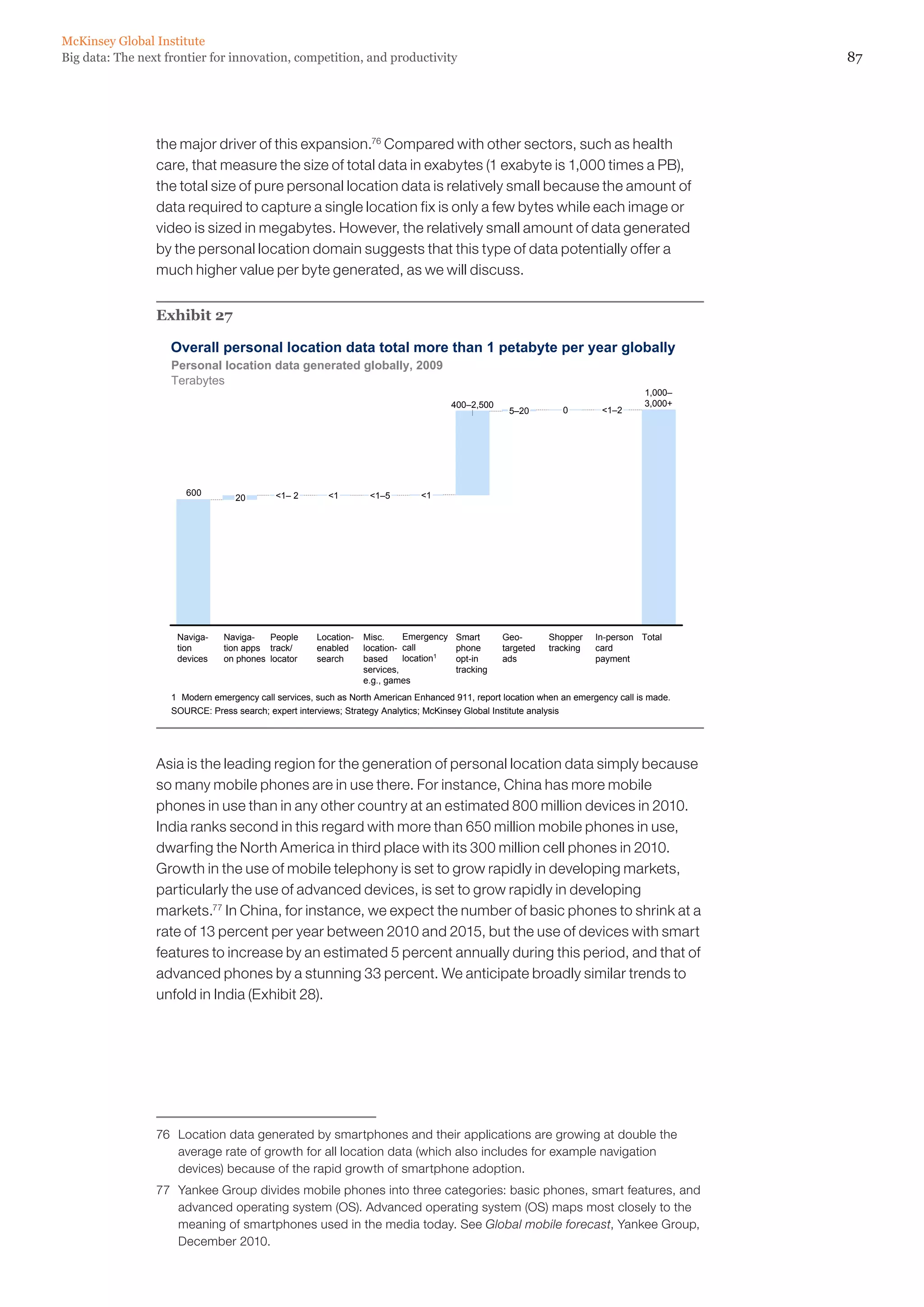
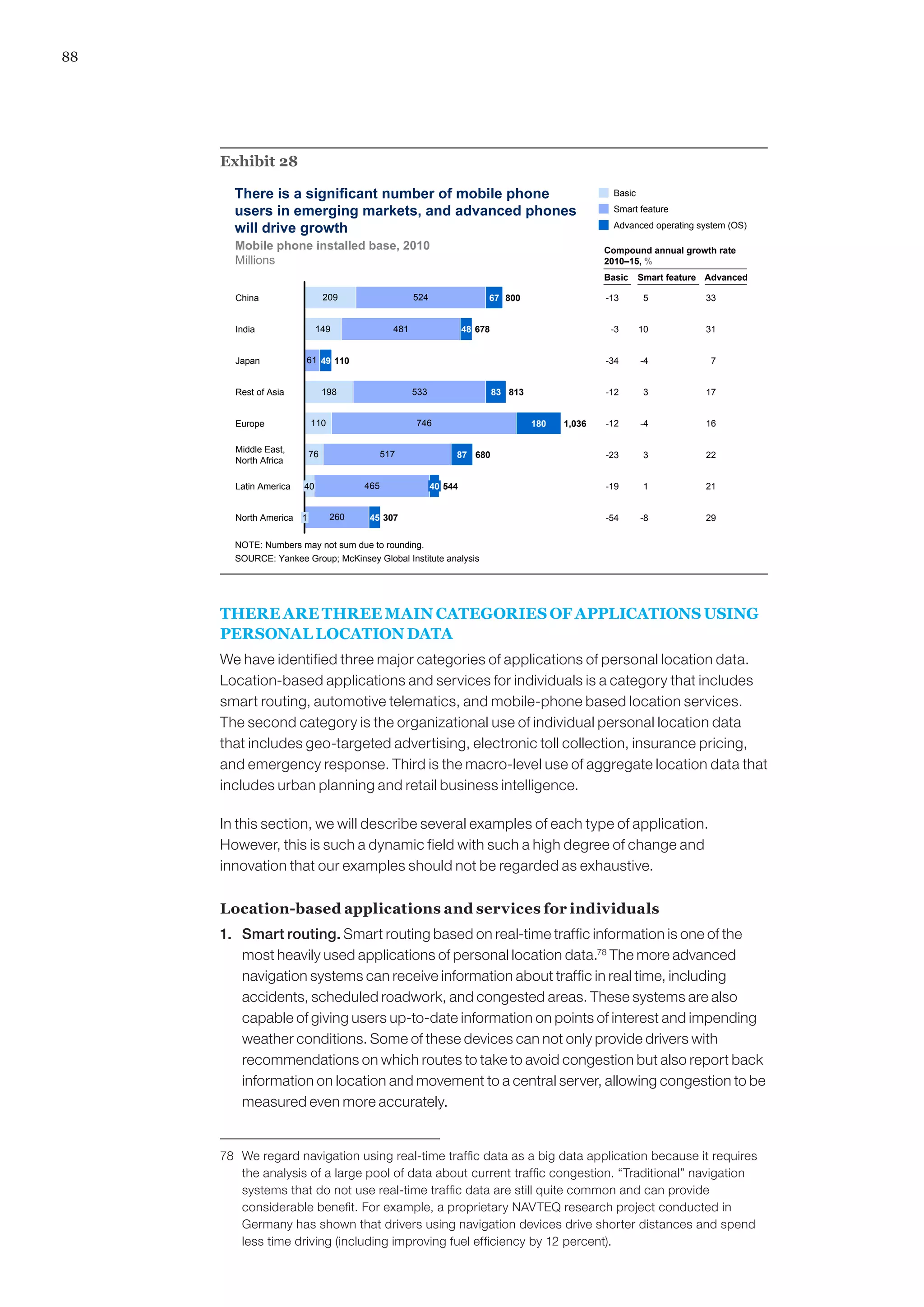
  • 109.
    McKinsey Global Institute Bigdata: The next frontier for innovation, competition, and productivity 99 management levers to improve that performance. In the public sector, we found large agencies that discovered huge variations in the productivity and accuracy of work at different sites performing nearly identical tasks. Simply making this information available across sites had the effect of spurring locations that were lagging to improve their performance significantly. No changes in compensation were promised; once people knew they were underperforming, their competitive nature kicked in and their observing best practices in the top-performing sites helped to transform their performance without monetary incentives. 3. Segmenting populations to customize actions Targeting services or marketing to meet individual needs is already familiar to consumer-facing companies. For them, the idea of segmenting and analyzing their customers through combinations of attributes such as demographics, customer purchase metrics, and shopping attitudes and behavior is firmly established. Companies such as insurance companies and credit card issuers that rely on risk judgments have also long used big data to segment customers. However, as technology improves, many companies have been able to segment and analyze in near real time. Even in the public sector that tends to treat all constituencies the same, using big data to segment is catching on. For instance, some public labor agencies have used big data to tailor job training services for different segments of job seekers, the aim being to ensure that the most efficient and effective interventions are applied to get different people back to work. Another example from the public sector is tax agencies that segment taxpayers by a range of factors including income, past delinquent rate, and credit history to identify returns that are most appropriate for further audits. 4. Replacing/supporting human decision making with automated algorithms Sophisticated analytics can substantially improve decision making, minimize risks, and unearth valuable insights that would otherwise remain hidden. Big data either provides the raw material needed to develop algorithms or for those algorithms to operate. Best practice tax agencies, for instance, use automated risk engines that use big data to flag candidates for further examination. Big data algorithms in retail can optimize decision processes, enabling the automatic fine tuning of inventories and pricing in response to real time in-store and online sales. Manufacturing companies can adjust production lines automatically to optimize efficiency, reduce waste, and avoid dangerous conditions. In some cases, companies will not necessarily automate decisions but facilitate them by analyzing datasets that are far larger than those data pools that are manageable for an individual using a spreadsheet. Some organizations are already making more effective decisions by analyzing entire datasets from customers and employees, or even from sensors embedded in products. Big-data-based analytics today include rule-based systems, statistical analyses, and machine-learning techniques such as neural networks. This is a fast-moving area, and new forms of data- based analytics are being developed all the time. (See chapter on “Big data techniques and technologies.”) 5. Innovating new business models, products and services Big data enables enterprises of all kinds to create new products and services, enhance existing ones, and invent entirely new business models. In health care, analyzing patient clinical and behavior data has created preventive care programs targeting the most appropriate groups of individuals. Castlight Health is a company that analyzes big data to make available to patients in large health plans data on health care pricing that they don’t normally see. Ingenix in the health care sector and
  • 110.
    100 Nielsen in retail specialize in the aggregation and analysis of various datasets for institutions. Also in retailing, real-time price comparison services give consumers price transparency to a degree never before enjoyed and generate significant surplus for them. Manufacturers are using data obtained from sensors embedded in products to create innovative after-sales service offerings such as proactive maintenance (preventive measures that take place before a failure occurs or is even noticed) and as the basis for the development of next generations of products. The emergence of real-time location data has created an entirely new suite of location- based mobile services from navigation applications to people tracking. WHILE THE USE OF BIG DATA WILL MATTER ACROSS SECTORS, SOME SECTORS ARE POISED FOR GREATER GAINS Using a value potential index that combines several quantitative metrics, we compared the historical productivity of sectors in the United States with the potential of these sectors to capture value from big data.85 We observed that patterns vary from sector to sector (Exhibit 32).86 Exhibit 32 Cluster A Cluster D Some sectors are positioned for greater gains from Cluster B Cluster E the use of big data Cluster C Historical productivity growth in the United States, 2000–08 Bubble sizes denote % relative sizes of GDP 24.0 23.5 23.0 22.5 Computer and electronic products Information 9.0 3.5 Administration, support, and Wholesale trade 3.0 waste management Manufacturing 2.5 Transportation and warehousing 2.0 Finance and insurance Professional services Real estate and rental 1.5 1.0 Utilities Health care providers 0.5 Retail trade Government 0 Accommodation and food Natural resources -0.5 Arts and entertainment -1.0 -1.5 Management of companies -2.0 Other services Educational services -2.5 -3.0 Construction -3.5 Low High Big data value potential index1 1 See appendix for detailed definitions and metrics used for value potential index. SOURCE: US Bureau of Labor Statistics; McKinsey Global Institute analysis Globally traded computer and electronic products and information sectors (Cluster A) are sectors that have already posted very strong productivity growth and are set to gain substantially from using big data. These sectors have access to huge pools of data (e.g., Internet companies collect vast amounts of online behavior data) and the pace of 85 We studied the United States because of the relative availability of relevant data, particularly around the numbers and sizes of individual firms. The applicability of these specific findings in other geographies will vary based on the similarities of individual sectors. 86 The value potential index consists of five metrics that are designed as proxies to indicate (1) the amount of data available for use and analysis; (2) variability in performance; (3) number of stakeholders (customers and suppliers) with which an organization deals on average; (4) transaction intensity; and (5) turbulence inherent in a sector. We believe that these are the characteristics that make a sector more or less likely to take advantage of the five transformative big data opportunities. See the appendix for further details.
  • 111.
    McKinsey Global Institute Bigdata: The next frontier for innovation, competition, and productivity 101 innovation is very high (e.g., rapid product introductions in consumer electronics). Even in the near term, we see significant scope to capture more value from big data. Two services sectors (Cluster B)—finance insurance and government—are positioned to benefit very strongly from big data as long as barriers to its use can be overcome. These sectors are both transaction- and customer-intensive, suggesting that they can increase their application of levers involving segmentation and automated algorithms. They both also have high degrees of variability in their performance, suggesting that they could use data and experimentation to improve performance. Several sectors (Cluster C) including construction, educational services, and arts and entertainment, have posted negative productivity growth, which probably indicates that these sectors face strong systemic barriers to increasing productivity. Nevertheless, if those barriers can be overcome, we think that big data can enable productivity increases even in these sectors. Examples of where potential exists include measuring variations in the performance of teachers in improving the academic achievement of students—teacher value added—that can be an effective tool for helping to increase productivity in education. Among the remaining sectors, globally traded sectors (mostly Cluster D) (e.g., manufacturing, wholesale trade) tend to have experienced higher historical productivity growth, while local services (mainly Cluster E) (e.g., retail, health care providers, accommodation and food) have achieved lower growth. Many of these sectors can derive significant value from big data, although doing so will depend on the extent to which barriers are overcome. Sectors that may have more moderate potential from the use of big data, such as construction and administrative services, tend not to have characteristics that could make exploiting big data opportunities more challenging than in other sectors.. They have less data than other sectors and fewer stakeholders, and are also less transaction-intensive. Our index indicates that of the sectors that we studied in detail, two—health care and manufacturing—appear to have only modest potential from the use of big data. This is because the index measures several criteria at the level of the individual firm (e.g., amount of data per firm as a proxy for number of customers per firm). In the United States, for instance, both of these industries are highly fragmented—they have many more firms or players than other sectors. Given that data are usually fragmented along firm or organizational boundaries, this implies that big data opportunities will be limited across these sectors. Nevertheless, even in these industries, large- scale players have the ability to aggregate enough data to derive significant value (see chapter 3a on health care for examples). Furthermore, it is possible, albeit usually more challenging, for many individual firms to pool, share, or trade data, sometimes through third parties, in order to capture value from big data (see, in particular, chapter 3d on manufacturing, where global distributed supply chains can be optimized by sharing big data). Consolidation in an industry can also bring about beneficial scale effects in the aggregation and analysis of data. While all sectors will have to overcome barriers to capture value from the use of big data, barriers are structurally higher for some than for others (Exhibit 33). For example, government may face higher hurdles because of challenges around data availability and data-driven mind-sets. Education faces similar challenges, along with a relative lack of investment in IT. Moreover, the competitive intensity in these sectors is relatively low compared with those sectors where market forces work more freely. In more market-driven sectors, the imperative to leverage data is strengthened by more direct links to economic value for the firms and users involved. Sectors such as
  • 112.
    102 finance insurance, manufacturing, and professional services may have relatively lower degrees of barriers to overcome for precisely the opposite reasons. Exhibit 33 A heat map shows the relative ease Top quintile 4th quintile (easiest to capture) of capturing the value potential 2nd quintile Bottom quintile (most difficult) to capture) across sectors 3rd quintile No data available Overall ease of Cate- capture Data-driven Data gories Sectors index1 Talent IT intensity mind-set availability Manufacturing Construction Natural resources Goods Computer and electronic products Real estate, rental, and leasing Wholesale trade Information Transportation and warehousing Retail trade Administrative, support, waste management, and remediation services Accommodation and food services Services Other services (except public administration) Arts, entertainment, and recreation Finance and Insurance Professional, scientific, and technical services Management of companies and enterprises Government and public Regulated Educational services Health care and social assistance Utilities 1 See appendix for detailed definitions and metrics used for each of the criteria. SOURCE: McKinsey Global Institute analysis BIG DATA OFFERS VERY LARGE POTENTIAL TO GENERATE VALUE GLOBALLY, BUT SOME GEOGRAPHIES COULD GAIN FIRST Our five case studies covered both developed and emerging economies and our findings suggest that the use of big data can drive significant value across geographies. We found very significant potential to create value in developed markets by applying big data levers in health care and retail. However, if we take the time savings for drivers achievable from using navigation tools in the personal location data domain, we find that 20 to 40 percent of the global potential is in emerging markets. Different economies and regions exhibit very different characteristics from the amount of data they generate to the maturity of their ICT infrastructure. This indicates that some geographies might be poised to capture value more quickly than others. Access to big data is a key prerequisite to capturing value. Today, North America and Europe account for the majority of new data stored (Exhibit 34). This suggests that, in the near term at least, much of the global potential to create value through the use of big data will be in the most developed economies. Although this may be true in aggregate, individual firms in emerging markets could enjoy access to big data that could enable them to capture significant value. In addition, organizations in developing markets could store and analyze their data in data centers located in developed markets.
  • 113.
    McKinsey Global Institute Bigdata: The next frontier for innovation, competition, and productivity 103 As long as the right conditions are in place, there is significant potential to leverage big data in developing economies. Consider the fact that Asia is already the leading region for the generation of personal location data simply because so many mobile phones are in use. More mobile phones—an estimated 800 million devices in 2010—are in use in China than in any other country (see Exhibit 28). Furthermore, although some emerging market organizations lag behind their counterparts in developed market in terms of IT assets, this could actually prove to be an advantage. Organizations in developing economies could leapfrog to the latest technology, by-passing the legacy systems with which many of their counterparts in advanced economies have to grapple. Exhibit 34 Amount of new data stored varies across geography New data stored1 by geography, 2010 Petabytes 3,500 2,000 North 250 Europe America China 400 Japan 200 50 Middle East and Africa India 50 300 Latin Rest of APAC America 1 New data stored defined as the amount of available storage used in a given year; see appendix for more on the definition and assumptions. SOURCE: IDC storage reports; McKinsey Global Institute analysis THERE WILL BE A SHORTAGE OF THE TALENT ORGANIZATIONS NEED TO TAKE ADVANTAGE OF BIG DATA A shortage of people with the skills necessary to take advantage of the insights that large datasets generate is one of the most important constraints on an organization’s ability to capture the potential from big data. Leading companies are already reporting challenges in hiring this type of talent. Google’s chief economist Hal Varian has been reported as saying that “the sexy job of the next ten years will be statisticians.”87 Our research identifies three key types of talent required to capture value from big data: deep analytical talent—people with technical skills in statistics and machine learning, for example, who are capable of analyzing large volumes of data to derive business insights; data-savvy managers and analysts who have the skills to be effective consumers of big data insights—i.e., capable of posing the right questions for analysis, interpreting and challenging the results, and making appropriate decisions; and supporting technology personnel who develop, implement, and maintain the hardware and software tools such as databases and analytic programs needed to make use of big data. We expect the supply of talent in all of these categories to be a significant constraint on the ability of organizations around the 87 Steve Lohr, “For today’s graduate, just one word: Statistics,” New York Times, August 5, 2009.
  • 114.
    104 world to capture value from big data, with the most acute needs in the first and second categories.88 Given the amount of data on talent readily available, we used the US labor market to test this hypothesis.89 The US labor market has historically had a high level of graduates with degrees in the so-called STEM fields: science, technology, engineering, and mathematics. However, in recent years, the supply of such graduates has been sluggish at a time when demand for them has been rising. For example, at the peak of the last US economic expansion, employment for mathematics-related occupations increased by almost 4 percent and their real wages increased 1 percent; at this time national employment increased by only 1.5 percent and real wages rose by only 0.6 percent.90 During this period, the number of advanced degrees conferred in math, statistics, and engineering declined by around 2 percent. In the future, the need for talent able to deal with big data will, in fact, be much more specific than simply STEM graduates. For this reason, we conducted a detailed analysis comparing potential demand for the first two categories of big data talent—deep analytical talent and data-savvy managers and analysts—with projected supply on current trends. In the case of deep analytical talent, we used US Bureau of Labor Statistics (BLS) data on current occupations to analyze the supply of talent in the US workforce. The data were from 2008, the latest year for which complete data are available. We used existing BLS models to project the supply of deep analytical talent in 2018, assuming current trends hold. We then used two separate analytical models to triangulate a perspective on the potential demand for deep analytical talent, assuming that companies across the economy fully adopt big data techniques by 2018. We based the first of these two models on an adaptation of the BLS model to account for varying degrees of growth in deep analytical talent based on the data intensity of different companies. We based the second model on the required numbers of deep analytic talent in different industries according to company size. We estimate that the supply in the United States of deep analytical talent in 2008 was around 150,000 positions. If we take into account current trends in new graduates with deep analytical training (e.g., people taking graduate courses in statistics or machine learning, a subspecialty of computer science, or students taking such courses designed for their last year of undergraduate education) and immigration, this total rises to about 300,000. However, in a big data world, we expect demand for deep analytical talent could reach 440,000 to 490,000 positions in 2018—that’s a talent gap in this category alone of 140,000 to 190,000 positions. In short, the United States will need an additional supply of this class of talent of 50 to 60 percent (Exhibit 35). Developing deep analytical skills requires an intrinsic aptitude in mathematics for starters, and then takes years of training. Addressing the talent shortage will not happen overnight, and the search for deep analytical talent that has already begun can only intensify. 88 We also did not prioritize the analysis of the supporting IT talent because other researchers have researched and debated this issue extensively. 89 In general, we found detailed occupational data on categories of knowledge workers to be relatively scarce outside the United States. See chapter on “Implications for policy makers” for a recommendation that more detailed data on these categories be collected. 90 Standard Occupational Classification (SOC) 15: Computer and mathematical occupations as defined by the US Bureau of Labor Statistics.
  • 115.
    McKinsey Global Institute Bigdata: The next frontier for innovation, competition, and productivity 105 Exhibit 35 The United States graduates the largest number of people with deep analytical training Number of graduates with deep analytical training in 20081 Total Thousand Graduates per 100 people United States 24.73 8.11 China 17.41 1.31 India 13.27 1.12 Russia 12.30 8.66 Brazil 10.09 5.32 Poland 8.78 23.03 United Kingdom 8.34 13.58 France 7.77 12.47 Romania 4.97 23.12 Italy 4.90 8.25 Japan 3.40 2.66 Germany 3.32 4.05 Turkey 1.84 2.64 Netherlands 1.25 7.58 Spain 1.23 2.71 Czech Republic 0.95 9.12 Bulgaria 0.92 12.15 Switzerland 0.76 9.93 Portugal 0.75 7.04 Belgium 0.71 6.66 Greece 0.66 5.97 Denmark 0.61 11.21 Slovakia 0.50 9.25 Norway 0.41 8.61 Lithuania 0.37 11.16 Austria 0.37 4.47 Sweden 0.29 3.16 Latvia 0.27 12.01 Hungary 0.21 2.06 Other2 0.55 4.86 1 These data count new graduates, i.e., a flow of deep analytical talent, which we define as people with advanced training in statistics and/or machine learning and who conduct data analysis. 2 Other includes Finland, Estonia, Croatia, Slovenia, Iceland, Cyprus, Macedonia, and Malta. SOURCE: Eurostat; Russia Statistics; Japan Ministry of Education; India Sat; NASSCOM Strategic Review 2005; China Statistical Yearbook; China Education News; IMF World Economic Outlook Database Although we conducted this analysis in the United States, we believe that the shortage of deep analytical talent will be a global phenomenon. There are significant variations, however, both in gross and per capita terms, in the number of graduates with these skills that different countries are producing. Countries with a higher per capita production of deep analytical talent could potentially be attractive sources of these skills for other geographies either through immigration or through companies offshoring to meet their needs (Exhibits 36 and 37). In the case of data-savvy managers and analysts in a big data world, the level of training and mathematical aptitude is much lower than that required for deep analytical talent. People in these roles simply need enough conceptual knowledge and quantitative skills to be able to frame and interpret analyses in an effective way. It is possible to develop such skills through a single course in statistics and experimental design. However, managers and analysts will be necessary in every sector. We applied a methodology similar to that used to analyze deep analytical talent to understand the potential gap between projected demand and supply. By 2018, in the United States, we estimate that 4 million positions will require these types of skills in a big data world. However, if we add together the number of people with these skills and new graduates who will enter the market (on current trends), we reach a total of only 2.5 million people in the United States in 2018. So there is a potential shortfall of 1.5 million data-savvy managers and analysts. This is not a gap likely to be filled simply by changing graduate requirements
  • 116.
    106 and waiting for people to graduate with enhanced skills or importing talent (although these could be important actions to take). Thus, retraining the existing workforce will be necessary. Exhibit 36 China could narrow the gap with the United States, today’s leading supplier of deep analytical talent Top ten in the supply of deep analytical talent Compound annual growth Thousand people rate, 2004–08, % 25 United States 3.9 20 China 10.4 15 India1 Russia 1.5 Brazil 6.2 10 Poland 12.8 United Kingdom 2.5 France2 -14.4 5 Romania 32.9 Italy 18.9 Japan -5.3 0 2004 05 06 07 08 1 India ranked third in 2008 with 13,270 people with deep analytical skills but India does not have a time series for these data. 2 For France, the compound annual growth rate is for 2005 and 2008 because of data availability. SOURCE: Eurostat; national statistical agencies; Japan Ministry of Education; India Sat; NASSCOM; China Statistical Yearbook; China Education News, April 2005; IMF World Economic Outlook; McKinsey Global Institute analysis Exhibit 37 Big data constituencies Individuals/organizations using data1 Providers of technology Big data activity/value chain Indirect beneficiaries Government regulators Government regulators Consume data and Generate data Aggregate data Analyze data derive value Individual data producers/ Individuals who aggregate Individuals who analyze Individual data users sources data data SME2 data producers/ SMEs2 that aggregate data SMEs2 that analyze data SME2 data users sources Large enterprise data Large enterprises that Large enterprises that Large enterprise data users producers/sources aggregate data analyze data Providers of technology to Third-party data Third-party analysis/service Indirect beneficiaries generate data (e.g., sensors, aggregators (e.g., price providers (e.g., price hardware) comparisons, Mint, Sense comparisons, Mint, LBS, ad Network) publishers, and intermediaries) Storage providers (including services) Software/service providers in business intelligence, search 1 Individuals/organizations generating, aggregating, analyzing, or consuming data. 2 Small and medium-sized enterprises. SOURCE: McKinsey Global Institute analysis
  • 117.
    McKinsey Global Institute Bigdata: The next frontier for innovation, competition, and productivity 107 SEVERAL ISSUES WILL HAVE TO BE ADDRESSED TO CAPTURE THE FULL POTENTIAL OF BIG DATA Data policies As an ever larger amount of data is digitized and travels across organizational boundaries, there are a set of policy issues that will become increasingly important, including, but not limited to, privacy, security, intellectual property, and even liability.91 More information than ever is known about individuals, including sensitive data such as health and financial records, and many citizens will demand that companies and their governments to protect their privacy. Personal data such as health and financial records are often those that can offer the most significant human benefits, such as helping to pinpoint the right medical treatment, or the most appropriate financial product. However, consumers also view these categories of data as being the most sensitive. Individuals, companies, and governments will need to be thoughtful about the trade-offs between privacy and utility. We are already seeing data security becoming a more pressing issue now that data are a key factor of production and a competitive asset. One study found that the number of compromised records increased by 30 percent each year between 2005 and 2009 in the United States.92 Another study found that security compromises cost more than $200 per record in detection, notification, and remediation efforts, as well as customers lost.93 Such security breaches affect a range of sectors including financial institutions, retail, hotels, and even national defense. Big data’s increasing economic importance also raises a number of legal issues, especially when coupled with the fact that data are fundamentally different from many other assets. Data can be copied perfectly and easily combined with other data, and the same piece of data can be used simultaneously by more than one person. So, intellectual property will become an even more important consideration for policy makers, who will set the rules that determine the legal rights associated with the ownership and use of data, and what constitutes “fair use” of data. Liability— such as who is responsible when an inaccurate piece of data leads to negative consequences—is another issue likely to come to the fore. Technology and techniques Today, legacy systems and incompatible standards and formats today often prevent the integration of data and the more sophisticated analytics that create value from big data. Organizations will need to deploy new technologies and techniques as they develop to overcome this barrier. Ultimately, making use of large digital datasets will require the assembly of a technology stack from storage and computing through analytical and visualization software applications. The specific technology requirements and priorities will vary based on the big data levers that are to be implemented and the data maturity of an institution, leading to very different levels of investment costs. Some companies lack the technology to capture data digitally in the first place (e.g., some smaller US health care provider practices) or to extract, transform, and load large datasets from other sources. Other organizations will need to supplement their existing storage or computing resources. Many will 91 Data privacy and security are important and pervasive concerns, which are being studied and debated at great length elsewhere, but have not been the major focus of the research in this report. 92 The leaking vault: Five years of data breaches, Digital Forensics Association, July 2010. 93 Fourth annual US cost of data breach study, Ponemon Institute, January 2009.
  • 118.
    108 need to implement advanced analytical and visualization software tools. In many cases, legacy systems and incompatible standards and formats will have to be taken into account. Examples include joining different data pools as we might see at financial services companies that want to combine online financial transaction data, the behavior of customers in branches, data from partners such as insurance companies, and retail purchase history. Also, many levers require a tremendous scale of data (e.g., merging patient records across multiple providers), which can put unique demands upon technology infrastructures. To provide a framework under which to develop and manage the many interlocking technology components necessary to successfully execute big data levers, each organization will need to craft and execute a robust enterprise data strategy. Organizational change and talent Organizational leaders need to understand that big data can unlock value—and how to use it to that effect. It is vital that organizations learn how to leverage big data if they don’t know how to already—because many of their rivals will certainly be using big data to carve out competitive advantage. As we have noted, many organizations neither have the skilled personnel they need to mine big data for insights nor the structures and incentives required to use big data to make more informed decisions and act on them. Access to data Access to data will need to broaden to capture the full potential for value creation. Increasingly, companies will need to acquire access to third-party data sources and integrate external information with their own, to capture the full potential of big data. In many cases, efficient markets are yet to be set up for trading or sharing data. For example, there are no efficient markets for the sharing of aggregate movement patterns derived from mobile phones—potentially valuable to retailers trying to understand consumer behavior. In other cases, incentives are misaligned so that stakeholders want to keep the information to themselves. In health care, for instance, providers will need to make a large big data investment to create, aggregate and analyze digital clinical data from medical records, which may reveal information that payors will use to their advantage in contract negotiations (e.g., payors direct patients away from providers with high cost but average performance). In order to fully capture the value that can be enabled by big data, the barriers to accessing data will have to be overcome. Industry structure The relative ease—of difficulty—of capturing value from big data will sometimes depend on the structure of a particular sector or industry. Sectors with a relative lack of competitive intensity and performance transparency and industries with highly concentrated profit pools are likely to be slow to fully leverage the benefits of big data. The public sector, for example, tends to have limited competitive pressure, which limits efficiency and productivity and puts a higher barrier up against the capture of value from using big data. US health care not only has a lack of transparency in terms of the cost and quality of treatment but also an industry structure in which payors gain from the use of clinical data (e.g., from fewer payouts for unnecessary treatment) but at the expense of the providers (e.g., fewer medical activities to charge for) from whom they would have to obtain those clinical data. As these examples suggest, organization leaders and policy makers need to consider how industry structures could evolve in a big data world if they are to determine how to optimize value creation in firms, sectors, and economies as a whole.
  • 119.
    McKinsey Global Institute Bigdata: The next frontier for innovation, competition, and productivity 109    Our research suggests that there is a range of ways that big data can create value that companies and organizations, including governments, can apply across sectors. But to do so with maximum effectiveness will require all these players to overcome a range of barriers and to address key issues that are of deep concern to the public, notably privacy and security. In the next two chapters, we will discuss what companies, organizations, and policy makers can do to ease the path toward the full capture of the value that big data can create.
  • 121.
    McKinsey Global Institute Bigdata: The next frontier for innovation, competition, and productivity 111 5.  Implications for organization leaders As big data and its levers become an increasingly valuable asset, their intelligent exploitation will be critical for enterprises to compete effectively. We already see organizations that understand and embrace the use of big data pulling ahead of their peers in tangible corporate performance measures. The use of big data will become a key basis of competition across sectors, so it is imperative that organizational leaders begin to incorporate big data into their business plans. While the particular opportunities to leverage big data to create value will differ by sectors, as we have demonstrated in our domain case studies, organization leaders can start identifying and assessing the opportunities along the five cross-cutting themes we have identified. In addition, there is a set of common enablers that each executive should address in order to unlock the power of big data. Organizations will not only need to ensure that they have sufficient skills in back-office analytics but also manage a transition toward the right managerial talent on the front line that will be capable of executing strategy based on the insights analysts mine from big data. 1. INVENTORY DATA ASSETS: PROPRIETARY, PUBLIC, AND PURCHASED With data becoming a key competitive asset, leaders must understand the assets that they hold or to which they could have access. Organizations should conduct an inventory of their own proprietary data, and also systematically catalog other data to which they could potentially gain access, including publicly available data (e.g., government data, other data that are released into the public domain), and data that can be purchased (e.g., from data aggregators or other players in a data value chain). Indeed, to enable transformative opportunities, companies will increasingly need to acquire access to third-party data sources, integrating such information with their own. In some cases, organizations will be able to purchase access to the data. In other cases, the sources of third-party data might not have considered sharing it. Organizations will need to thoughtfully consider and present a compelling value proposition for these third parties to share or sell data to them, or determine another set of incentives (e.g., regulatory action) to ensure data access. A set of technology challenges (e.g., standardizing data, implementing data feeds) will often have to be addressed to ensure consistent, reliable, and timely access to external data. For example, many companies have recently discovered the value of data from social media. Telecom companies have found that some information from social networks is useful in predicting customer churn. They discovered that customers who know others who have stopped using a certain telecom are more likely to do so themselves, so these likely-to-churn customers are then targeted for retention programs. Other consumer-facing companies have found that they can learn about customers’ attitudes, buying trends, and taste from sentiments expressed online, allowing them to make timely changes in their marketing, and going forward changes in their product planning.
  • 122.
    112 2. IDENTIFY POTENTIAL VALUE CREATION OPPORTUNITIES AND THREATS We have described five cross-cutting categories of value creation through leveraging big data that can be applied across every function. Organizations should begin a process of identifying and prioritizing these opportunities; business line and function leaders should kick off processes in their respective areas of responsibility. It is worthwhile noting that identifying opportunities and potential sources of valuable data (see previous section), especially external sources of data, will often be an iterative, rather than sequential, process. In order to validate these big data opportunities, leading organizations have often discovered that adopting a process of purposeful experimentation (a meta- application of the big data lever of experimentation) can be the most powerful path toward becoming an organization that fully leverages big data, rather that specifying a complete plan for the enterprise prior to doing any implementation. Selecting a few high-potential areas in which to experiment with big data, e.g., with digital marketing, and then rapidly scaling successes can be an effective way to begin the transformation. In our research, we find that creating substantial new value does not necessarily require jumping directly to complex analytical big data levers. In many cases, the levers focused primarily on making data available or applying basic analytics can create substantial value even before an organization adopts more advanced levers. We see this in health care, where creating transparency and applying basic levers can generate about 40 percent of the value creation potential alone. Indeed, we find that most organizations follow a journey that builds capabilities over time. Our research identified four levels of maturity or sophistication to categorize actions that can be taken. Most basic is digitizing and structuring the data, which is really the step before the use of big data. It consists of the steps that ensure the data are generated, structured, and organized in such a way that they can be used either directly by end users or for further analysis. These techniques include “scrubbing” the data to remove errors and ensure data quality, placing data into standard forms, and adding metadata that describe the data being collected. The second level of sophistication requires making the data available, e.g., through networks, which is aligned with the first of the five categories of big data levers discussed earlier. It can be a powerful driver of value in and of itself, and it can also be an important first step in integrating datasets to create more meaningful business insight. The third level of sophistication is applying basic analytics, which essentially covers a range of methodologies, such as basic data comparisons, and relatively standardized quantitative analyses, e.g., those that do not require customized analyses to be designed by people with deep analytical skills. The fourth and highest level is applying advanced analytics, such as the automated algorithms and real-time data analysis that often can create radical new business insight and models. They allow new levels of experimentation to develop optimal approaches to targeting customers and operations, and opening new big data opportunities with third parties. Leveraging big data at this level often requires the expertise of deep analytical talent. In addition to examining the potential based on the level of capabilities within an organization, leaders can also examine different opportunities through the lens of the types of data identified during the data inventory. There is likely to be a set of opportunities related to capturing value from the proprietary datasets that an organization already has, particularly through additional analyses. For
  • 123.
    McKinsey Global Institute Bigdata: The next frontier for innovation, competition, and productivity 113 example, a health care provider might discover that it can analyze a set of clinical outcomes data to better identify the sources of medical errors. A second category of opportunities comes from adding new sets of data that can be captured or acquired (public and purchased) to these analyses. These datasets will often involve nonstandard data types, because these are data that are not usually used within the organization. For instance, an insurance company might discover that adding remote sensing data (images from satellites) can help it to better assess real-estate property risks. A third set of opportunities comes from considering new business and business models that are built fundamentally on big data, and not necessarily based on the same kinds of analyses that support existing businesses. For example, a payments provider might find that it create a new business by selling consumer insights based on the data streams it generates (so-called exhaust data) while processing payments. Organizations should also watch for the potential disruptions big data can underpin. Within the context of the big data value chain (Exhibit 39), aggregation and analysis are becoming increasingly valuable so data generators are adding those capabilities to more fully realize potential value as well as to defend against new entrants focusing solely on aggregation and analysis. For example, a big data retailer such as Tesco plays along the entire value chain to realize fullest potential. It taps its loyalty program to collect customer purchase data, which it then analyzes to inform a variety of decisions, including the micro-segmentation of its customers to optimize product mix, pricing, and promotions. Another example of forward integration in the data value chain is large health care payors, some of whom are getting into the business of aggregating and analyzing clinical data with claims data, to provide data services to customers such as pharmaceutical companies. Again, moving into aggregation and analysis may be a defensive move to preempt new entrants. In some sectors, third-party data aggregators, which do not generate data themselves, provide value-added service on top of the aggregated data to benefit customers. In financial services, for instance, the online company Mint (acquired by Intuit), aggregates financial information about individuals and provides value-added services (e.g., financial planning tools), even though it does not generate financial data itself. Mint and others using this business model may pose a threat to traditional financial institutions by owning customer relationships through their more comprehensive view of a consumer’s entire financial position. Organizations should also watch for the emergence of cross-sector domains, such as personal location data, where innovations are happening very quickly. They often have highly fragmented data value chains, with many stakeholders playing different roles, all trying to figure out business models that will maximize their share of the profit pool. Indeed, the need for scale of data and IT infrastructure may become a critical driver toward consolidation, which can be both an opportunity and threat, in sectors where subscale players are abundant. The health care provider space is a good example where many relatively small physician practices remain. As they move into the digital age of electronic medical records and start trying to derive benefit from data, they may find it economical to merge with others to increase scale. Increased data access, facilitated by the cloud, may also disrupt business and operation models. Many examples of distributed co-creation involve collaboration with external partners and customers to perform many corporate functions, from RD (e.g., open source software development) to marketing (e.g., online advertising competition) and customer service (e.g., online customer support communities), that have traditionally been done internally by employees.
  • 124.
    114 Exhibit 38 MGI has compiled a heat map of Top quintile 4th quintile (highest potential) the value potential of using big data 2nd quintile Bottom quintile (lowest potential) across sectors 3rd quintile No data available Overall Customer value Amount Variabili- and Trans- Cate- potential of data ty in per- supplier action Turbu- gories Sectors index1 per firm formance intensity intensity lence Manufacturing Construction Natural resources Goods Computer and electronic products Real estate, rental, and leasing Wholesale trade Information Transportation and warehousing Retail trade Administrative, support, waste management, and remediation services Accommodation and food services Services Other services (except public administration) Arts, entertainment, and recreation Finance and Insurance Professional, scientific, and technical services Management of companies and enterprises Government and public Regulated Educational services Health care and social assistance Utilities 1 See appendix for detailed definitions and metrics used for each of the criteria. SOURCE: McKinsey Global Institute analysis 3. BUILD UP INTERNAL CAPABILITIES TO CREATE A DATA- DRIVEN ORGANIZATION Organizations will need to have the right people and processes to capture value from the use of big data. On people, MGI research indicates that the key sets of talent that will be in increasingly short supply are deep analytical talent to execute big data analyses; managers and analysts who know how to request and consume big data analyses; and supporting technology personnel to implement big data. We focus on the first two categories in this section and address the third in the following section on implementing an enterprise data strategy. Best practice big data companies have built sufficient scale in a core group of deep analytical talent, upon which the rest of their organization can draw. Given the potential competition for this talent, organizations must recruit deep analytical talent aggressively. This could include sourcing talent from other geographies or procuring some analytical services from vendors. One important point to note is that early hires are critical because they are the ones who build the teams. It is difficult to find people who are willing to hire their replacements, so hiring the most capable people early on is the best way to build a highly effective team. One financial services company respected for its use of data and experimentation, for instance, has identified a network of target institutions that are known for turning out superior deep analytical talent and that are in close proximity to headquarters. The company has developed a relationship with these institutions so it not only has a prominent presence during recruiting season, but also uses the institutions as ongoing training avenues, where the company sends deep analytical employees to get recharged and learn new techniques.
  • 125.
    McKinsey Global Institute Bigdata: The next frontier for innovation, competition, and productivity 115 Leaders will also need to figure out how to organize this cadre of deep analytical talent so that as they form an internal community or center of excellence, they are effectively connected to the rest of the organization and can collaborate well with business leaders. Furthermore, retaining and motivating this valuable cadre of talent will, in a way similar to the case of other high-level knowledge workers, require monetary and, more importantly, intrinsic incentives such as interesting problems to solve.94 But having a core set of deep analytical talent is not enough to transform an organization, especially if the key business leaders and analysts do not know how to take advantage of this big data capability. All of the business leaders in an organization will have to develop a baseline understanding of analytical techniques in order to become effective users of these types of analyses. Organizations can modify their recruiting criteria to take this requirement into account, but more importantly, they will need to develop training programs to increase the capabilities of their current management and analyst ranks. A basic statistics program or a series of classes in data analysis at a local college or university, for instance, could create a team of highly motivated managers and analysts that could begin this transformation. Capital One, the financial services firm, has created an internal training institute, Capital One University, which offers a professional program on testing and experiment design, for instance. With the right capabilities in place, organizations must align incentives, structures, and workflows so that employees at all levels leverage insights derived from big data. The UK retailer Tesco, for example, has developed a strong data-driven mind-set from top leadership to the front line. It has integrated customer intelligence into its operations at all levels from a variety of consumer-targeted big data strategies. At Famous Footwear, the shoe retailer, the executive team meets with the testing head every two weeks to discuss results and plan data gathering and evaluation programs. At Amazon.com, it is said that Jeff Bezos fired a group of Web designers who changed the company Web site without conducting experiments to determine the effects on customer behavior. At all of these companies, big data and its most powerful levers are an integral part of management dialogues and the organization’s culture. 4. DEVELOP ENTERPRISE INFORMATION STRATEGY TO IMPLEMENT TECHNOLOGY To prepare for a big data world, organizations should develop an integrated data strategy for the entire enterprise. Data models, architectures, and attributes of solutions need to be considered holistically. Taking customer data as an example, a common problem is for discrete business units, in silos, to develop their own data strategies without planning to share or aggregate data across the organization. As a result, organizations often discover that they do not even have a common definition of their customers and attributes that apply across lines of business. Even within the same business unit, such differences can occur. The lack of a customer-centric view severely limits the organization’s ability to use any of the powerful big data levers to create new value. An effective enterprise data strategy must include interoperable data models, transactional data architecture, integration architecture, analytical architecture, security and compliance, and frontline services. Many organizations will require additional investment in IT hardware, software, and services to capture, store, organize, and analyze large datasets. The level 94 Peter F. Drucker, Management challenges for the 21st century (New York, NY: Harper Business, 1999).
  • 126.
    116 of investment will vary considerably depending on a company’s current state of IT capability and maturity. IT leaders will need to assess and identify any gaps in the technology their enterprise has available for effectively capturing, storing, aggregating, communicating, and analyzing data. They will have to work with the organization’s business leaders to develop business cases for new investments and then prioritize that spending. Despite the need for a comprehensive enterprise data strategy, it can often be helpful to begin implementation on very targeted projects in order to learn what works and to begin developing capabilities (see our recommendation about experimentation in the section “Identify potential value creation opportunities” above). For example, Kaiser Permanente in California initially concentrated on one IT project exclusively for patients with long-term conditions by creating specific disease registries and panel management solutions, rather than an all-encompassing IT solution that addresses a range of problems. This led to much faster time to impact. 5. ADDRESS DATA POLICY ISSUES Addressing privacy and security issues will become paramount as more data increasingly travel across boundaries for various purposes. Privacy, in particular, not only requires attention to compliance with laws and regulations, but also is fundamental to an organization’s trust relationships with its customers, business partners, employees, and other stakeholders. Certainly, organizations will need policies that comply with privacy laws and any government privacy regulations. But in developing a privacy policy, organizations will need to thoughtfully consider what kind of legal agreements, and, more importantly, trust expectations, it wants to establish with its stakeholders. And it will need to communicate its policies clearly to its stakeholders, especially customers, as they become increasingly savvy and concerned about what is known about them and how that information can potentially be used. As part of the enterprise data strategy, organizations will need to clearly define and implement an enterprise risk strategy that includes all of their IT functions. This strategy must include a thorough risk assessment of the enterprise that assesses everything, from the likelihood of physical break-in, to the probability of hackers penetrating a mainframe, but perhaps most importantly, the risks of people with authorized access using that access for purposes that are counter to the organization’s goals. There is a range of IT solutions (e.g., VPNs, intranet firewalls, threat monitoring) that can help to manage data privacy and security risks. Organizational leaders will also have to wrestle with legal issues relating to their stance on intellectual property for data, how they will think about liability, etc. These are topics that clearly require specialized legal counsel, but with an approach that takes into account multiple considerations, including strategy, relationships with customers, partners and employees, and technology.    Competing and capturing value using big data will require leaders to address specific barriers across talent, technology, privacy and security, organizational culture, and incentives to access data. It is urgent that organization leaders start identifying or refining the role of big data in their business plans and start laying the enablers in place to realize value.
  • 127.
    McKinsey Global Institute Bigdata: The next frontier for innovation, competition, and productivity 117 6.  Implications for policy makers The value potential underpinned by the use of big data will not be realized unless government and policy makers, in addition to leaders of individual organizations, understand and respond to the range of barriers and enablers we have identified. Our research has demonstrated that big data is not only a powerful engine of competition and growth for individual companies, but that, in aggregate, it also can move the needle on productivity, innovation, and competitiveness for entire sectors and economies in both the developed and developing worlds. Forward-thinking policy makers will keep pace with the development of big data and find timely solutions to the barriers that today stand in the way of capturing its full value. Action may be required at both the national and international levels if policy makers are to help organizations make the most of the big data opportunity. Just as we are seeing early evidence of firms skilled at using big data pulling ahead of their competition, the use of big data could play a substantial role in country competitiveness. Policy makers must consider the choices they should make in order to help individual firms in their economies capture value out of using big data. The major areas where policy can play a role are building human capital (e.g., improving the supply of graduates knowledgeable about big data and easing immigration restrictions); aligning incentives to ensure access to data; addressing privacy and security concerns; establishing intellectual property frameworks; overcoming technological barriers to data; and promoting information and communication technology infrastructure. Government policy makers in many economies are already addressing, or at least discussing, these areas. This is a task that they must start to address with some urgency. Without appropriate rules, laws, guidelines, and incentives, the economies that are less progressive in these areas will risk being at a competitive disadvantage to those that appreciate the dynamics and value potential of big data. 1. BUILD HUMAN CAPITAL FOR BIG DATA Governments can act in a variety of ways to help increase the supply of talent necessary to leverage big data. First, governments can put in place education initiatives to increase the pipeline of graduates with the right skills. In the United States, for instance, there is a push at the federal, state, and local levels to support more science, technology, engineering, and mathematics (STEM) education. Most other OECD governments also recognize the need for more STEM graduateswho are historically underrepresented in those fields, including women. However, the needs for deep analytical talent are more specific even than this—more graduates with advanced training in statistics and machine learning (a subdiscipline of computer science) will be necessary. A second way for governments to increase the supply of talent is to reduce barriers to accessing these pools in other regions, i.e., through remote work or the immigration of skilled workers.
  • 128.
    118 The challenge of developing a large number of organizational leaders and analysts in business, government, and the social sectors who have basic understanding of analytical techniques is on a far larger scale. At a minimum, new knowledge workers already in the educational pipeline on their way into the workforce should be educated on these topics; a mandatory course in statistics/decision science, with a module on experimental design, should become part of the curriculum in fields such as business administration and other management disciplines. But waiting for a whole new generation of graduates will be insufficient. Government could create incentives to train existing managers and analysts in these techniques. We also discovered in our research that detailed national workforce data about knowledge workers, by occupational category and industry, was difficult to find outside of the United States (including roles requiring deep analytical skills, as well as management and analyst roles, amongst others). Several countries could provide very detailed data about manufacturing-related occupations (e.g., “precious metal forging”), but had very broad categories for knowledge workers (e.g., “bankers”). Based on the principle that “you can’t manage what you can’t measure,” policy makers in these countries could direct their labor statistics agencies to begin collecting more detailed data about employment in knowledge worker categories (ideally, in standard categories that would allow cross-country comparisons). This data would better inform their decisions about how to develop human capital, i.e., knowledge workers more generally, and for big data-related positions specifically. 2. ALIGN INCENTIVES TO PROMOTE DATA SHARING FOR THE GREATER GOOD One of the most important enablers of value creation from big data is combining data from multiple sources. But in many cases markets for data have not yet been developed, or there are market failures for the sharing or trading of data. Governments can play an important role in creating the conditions for the functioning of effective markets, including setting rules related to intellectual property, the arbitration of disputes, and so on. For example, the requirement to create health information exchanges in the US health care sector is designed to ensure that sanitized clinical data can be shared across providers so that the system can fully utilize data on the comparative effectiveness of treatments. Where there are market failures, such as a lack of self-interested incentives for a particular stakeholder group to make its data available, policy makers might have to apply the lever of regulation to ensure that data are shared. For example, there is tremendous reluctance to release data that expose errors (e.g., doctor or pilot mistakes) because of the reputational risk it poses for providers.95 But government has a clear interest in making sure that these data are shared because doing so is one of the key enablers for reducing systemwide risks from such mistakes. Mandating the collection and release of such data might become necessary. For example, governments might require public companies to provide financial data in standardized electronic form. In the wake of the recent global financial crisis, many governments already take the view that considerable improvement in the transparency of financial reporting is necessary to mitigate systemic risks to the financial system. 95 For example, airline pilots might not necessarily like the fact that cockpit voice and data recorders can reveal errors they make while flying, but release of data from these devices to safety agencies after an accident is mandatory in order to improve the safety of the overall system.
  • 129.
    McKinsey Global Institute Bigdata: The next frontier for innovation, competition, and productivity 119 In the public sector, where lack of competitive pressure limits efficiency and productivity, transparency can be a powerful tool. Openness and sharing of big data can be a critical lever and enabler of improved performance. Increasingly, policy makers require government agencies to intensify their measurement of activities and programs and then display that information in ways that are easily accessible to the public. This not only gives agencies tools for better management, but also it gives the public a way to hold the agencies accountable and gauge their performance in a quantifiable way. That public pressure can act as a significant incentive for agencies to improve performance, reduce costs, and boost productivity. 3. DEVELOP POLICIES THAT BALANCE THE INTERESTS OF COMPANIES WANTING TO CREATE VALUE FROM DATA AND CITIZENS WANTING TO PROTECT THEIR PRIVACY AND SECURITY Although tremendous value, including consumer surplus, can be unlocked through the use of big data, the fact remains that many citizens are suspicious about the use of highly personal information. Citizens will continue to want their privacy rights clearly articulated, and businesses need to be able to know—and be able to anticipate any changes in—what data they can and cannot use. In some cases, markets for personal information could develop, but in other cases, traditional market mechanisms might not suffice to develop practices that protect privacy and security. In the future, the effective design and enforcement of privacy laws will be critical not only for protecting customers, but also for providing assurance that the value of their consent to share data will far outweigh the potential risks. One challenge for policy makers will be to keep pace with big data developments, such as those involving fast- developing personal location data. Of course, governments, nonprofit organizations, and the private sector will need to develop education programs so the public can fully understand how much personal information is available, where and how it is used, and whether individuals are willing to allow this usage. Most developed countries already have agencies that are responsible for creating and enforcing guidelines and laws concerning commercial and individual data privacy in general. In the United States, the Federal Trade Commission, for instance, uses its Fair Information Practice Principles as a guideline for dealing with security and privacy issues. Along the same lines, the OECD has issued guidelines on the Protection of Privacy and Transborder Flows of Personal Data, while the European Union has its Data Protection Directive. All of these guidelines and laws contain similar elements of reporting and protection. Germany has a federal commissioner who actively monitors industry for data protection compliance. South Korea’s Data Protection Act is enforced by two separate government agencies. In parallel, businesses and governments will almost certainly want strong laws prohibiting hacking and other security invasions to protect their own operations as much as possible, and they will want effective enforcement of those laws. Protecting critical IT infrastructure is important both to ensure that organizations can access and use data securely, and to safeguard national security, as cyber attacks become increasingly sophisticated and bold. For instance, cyber attacks against portions of a country’s financial infrastructure (e.g., credit card processing facilities) can result in the release of sensitive personal information about millions of individuals and loss of trust in electronic markets.
  • 130.
    120 4. ESTABLISH EFFECTIVE INTELLECTUAL PROPERTY FRAMEWORKS TO ENSURE INNOVATION We will undoubtedly continue to see many innovations emerging along the data value chain in the age of big data. Innovative technology to better generate and capture data will emerge. Advances in storage and analytics will continue as organizations increasingly need to store ever greater amount of data, access and analyze them, sometimes in near real time. These innovations require an effective intellectual property system, which will both ensure incentives for creating valuable data and enable the effective sharing and integration of different pools of data. There will be increasing demand for more effective and efficient means of establishing intellectual property rights (e.g., copyright and patents) and adjudicating disputes. 5. ADDRESS TECHNOLOGY BARRIERS AND ACCELERATE RD IN TARGETED AREAS Policy makers can play a role in helping to overcome technology issues related to the use of big data, from facilitating the development of standards and guidelines regarding IT tools or data pools, to encouraging RD in critical areas where gaps exist today. Standards covering IT tools or certain types of data are critical so that data can be shared to create the necessary scale to enable the kind of analytics that create value. These standards can emerge from industry standard-setting bodies, but government can play an enabling role. For example, in the US health care arena, the Standards and Certification Criteria for Electronic Health Records (EHR) to be issued by the Office of the National Coordinator for Health Information Technology will identify the standards necessary for certification of EHR technologies so that medical professionals and hospitals are assured that the system they adopt can perform as required. Policy makers can also accelerate big data research. Government can directly sponsor basic research. For example, the U.S. National Science Foundation funds programs in both computer science and mathematics, while the EU has put in place the Research Framework Programme, designed to be the main instrument for coordinating and allocating research funding in science and technology areas in Europe. Governments can also consider how to deploy incentives, e.g., tax expenditures or other financial support, to help overcome technological barriers to leveraging big data. Sometimes, there is a mismatch between who must make a technology investment and who will receive the benefits of that investment. For instance, in US health care, providers are the primary investors in electronic medical record technology, but the benefits felt in the form of optimized health care go disproportionately to payors and patients. The American Recovery and Reinvestment Act of 2009 provided some $20 billion to health providers and their support sectors to invest in electronic record systems and health information exchanges to create the scale of clinical data needed for many of the health care big data levers to work.
  • 131.
    McKinsey Global Institute Bigdata: The next frontier for innovation, competition, and productivity 121 6. ENSURE INVESTMENTS IN UNDERLYING INFORMATION AND COMMUNICATION TECHNOLOGY INFRASTRUCTURE For organizations to leverage large datasets, basic infrastructure needs to be in place from electricity grids that power information technology to communication networks that enable data to travel. Judging from the approaches we observe in different countries, the spectrum of possible policy interventions to encourage infrastructure to be built and maintained can vary significantly. Many countries have created specific incentives and initiatives targeted at expanding infrastructure. For example, the US government has put in place a number of monetary incentives to encourage the build-out of broadband infrastructure (e.g., rural broadband project) and the implementation of electronic medical records. The US government has also proposed a far-reaching national wireless development program that involves a voluntary incentive auction to free up spectrum as well as wireless spectrum reallocation, with the goal of covering 98 percent of the country with 4G high-speed accessibility. Other governments also are taking action to foster competition in infrastructure markets to drive down costs to end customers and to broaden access. South Korea, for instance, is providing subsidies for broadband subscription by certain groups (e.g., low income) but, like Japan and some European countries, explicitly requires broadband providers that own the network to share the facilities at a fee. In the years ahead, policy makers should make infrastructure an explicit part of their approach to big data.    Policy makers can play a vital enabling role to ensure that organizations make the most of the potential of big data in the key areas of talent, RD, and infrastructure, as well as to foster innovation in this dynamic arena. Some of the policy action that they can, and should, take will involve practical nuts-and-bolts moves that take effort but are not controversial. The more complex task will be ensuring that legislation strike the right balance between freeing organizations to use data to the significant extent they need in order to capture its full potential, and assuaging fears among the public about compromising privacy and personal security. This is a balance that requires thoughtful consideration and one that policy makers should not shy away from addressing.
  • 133.
    McKinsey Global Institute Bigdata: The next frontier for innovation, competition, and productivity 123 Appendix Construction of indices on value potential and ease of capture From our analysis of big data in five domains, we reached a sense of what characteristics indicate higher or lower value potential from the use of big data to capture value from its use, as well as higher or lower barriers in realizing that value in different sectors. Using these insights, we created two indices: (1) an index on value potential, and (2) an index on the ease of capture. Each of these indices comprises multiple criteria which give us a relative sense of which sectors may be poised for greater gains and which sectors would face the toughest barriers. We do not claim that these indices give a full picture, but we believe that they give a good sense of both the potential value available and the ease or otherwise of its capture across sectors. VALUE POTENTIAL INDEX The five criteria we use in this index act as a proxy for how well a sector can benefit from one of the five transformative opportunities we have discussed in this report (Exhibit A1): 1. Amount of data per firm. The larger the amount of data per firm, the more it indicates that a firm is likely to be able to benefit from increasing transparency in terms of data. We used the storage available per firm as a proxy. We built upon our data mapping analysis to estimate the available data storage, in bytes, in 2009 in each sector in the United States. We then divided that by the number of firms with more than 1,000 employees (to avoid skewing the numbers by the large number of small businesses and individual proprietors). 2. Variability in performance. The higher the variability, the more it indicates a firm can benefit from the use of data and experimentation to expose variability and improve performance. We used the variability in EBITDA (earnings before interest tax depreciation and amortization) as a proxy. Within each sector, we took the EBITDA of major companies (with greater than $500 million in sales) from 2002 to 2007 and identified the 10th and 90th percentile EBITDA. The difference between the top and bottom performers became the variability we measured. 3. Customer and supplier intensity. The more customers and suppliers a firm has, the greater its potential to apply segmentation to tailor courses of action. We used the number of frontline employees (defined as those who interface with customers or suppliers) per firm as a proxy. We used data from the US Bureau of Labor Statistics to identify the number of frontline employees (major occupations include Standard Occupation Classification codes 41 such as sales clerks and agents, and 43 such as administrative workers) in the latest year available. We then divided by the number of firms with more than 1,000 employees 4. Transaction intensity. The higher the transaction intensity, the more likely the sector can benefit from the use of automated algorithms to augment or replace
  • 134.
    124 human decision making. We used the amount of processing power of an average firm in a sector as a proxy. To arrive at a relative sense of processing power, we used capital stock data for PCs and mainframes by sector from the US Bureau of Economic Analysis and divided by the number of firms with more than 1,000 employees in each sector. 5. Turbulence. Turbulence, or how frequently leaders and laggards in a sector change place, is a proxy for the amount of innovative disruptions to which a sector is susceptible. We hypothesize that the higher the turbulence, the greater the likelihood that a sector will benefit from the use of big data to innovate business models, products, and services. Within each sector, we calculated the turnover percentage—the number of new companies placed in the top 20 ranking in 2011 compared with 2006, divided by 20. Once we quantified each criterion (the proxy), we gave each sector a score of from one to five based on the quintile into which it falls into for each criterion. The overall value potential index is the average of the scores across the five criteria. Exhibit A1 MGI has compiled a heat map of Top quintile 4th quintile (highest potential) the value potential of using big data 2nd quintile Bottom quintile (lowest potential) across sectors 3rd quintile No data available Overall Customer value Amount Variabili- and Trans- Cate- potential of data ty in per- supplier action Turbu- gories Sectors index1 per firm formance intensity intensity lence Manufacturing Construction Natural resources Goods Computer and electronic products Real estate, rental, and leasing Wholesale trade Information Transportation and warehousing Retail trade Administrative, support, waste management, and remediation services Accommodation and food services Services Other services (except public administration) Arts, entertainment, and recreation Finance and Insurance Professional, scientific, and technical services Management of companies and enterprises Government and public Regulated Educational services Health care and social assistance Utilities 1 See appendix for detailed definitions and metrics used for each of the criteria. SOURCE: McKinsey Global Institute analysis EASE OF CAPTURE INDEX This index is made up of four criteria, each of which aligns with a key barrier to the use of big data that we have identified (Exhibit A2): 1. Talent. The more deep analytical talent a firm has, the better a position it is in to realize value from big data. We divided the number of deep analytical talent in 2008 by the number of firms with more than 1,000 employees in each sector.
  • 135.
    McKinsey Global Institute Bigdata: The next frontier for innovation, competition, and productivity 125 2. IT intensity. The more IT assets a sector has on average, the lower the technology barriers to be overcome. We calculated IT stock using data from the US Bureau of Economic Analysis and divided that total by the number of firms with more than 1,000 employees in each sector. 3. Data-driven mind-set. This indicates how receptive the organization is to using big data to create value. We leveraged the latest survey results conducted on IT strategy by McKinsey’s Business Technology Office, which asked leaders the degree to which their organizations make decisions based on experience and opinions or based on data. 4. Data availability. We use the relative number of databases related to each sector in a proprietary corpus of data as a proxy for how accessible data is in a sector. Again, once we quantified each criterion (the proxy), we gave each sector a score of one to five based on the quintile into which it falls for each criterion. The overall ease of capture index is the average of the scores across the four criteria. Exhibit A2 A heat map shows the relative ease Top quintile 4th quintile (easiest to capture) of capturing the value potential 2nd quintile Bottom quintile (most difficult) to capture) across sectors 3rd quintile No data available Overall ease of Cate- capture Data-driven Data gories Sectors index1 Talent IT intensity mind-set availability Manufacturing Construction Natural resources Goods Computer and electronic products Real estate, rental, and leasing Wholesale trade Information Transportation and warehousing Retail trade Administrative, support, waste management, and remediation services Accommodation and food services Services Other services (except public administration) Arts, entertainment, and recreation Finance and Insurance Professional, scientific, and technical services Management of companies and enterprises Government and public Regulated Educational services Health care and social assistance Utilities 1 See appendix for detailed definitions and metrics used for each of the criteria. SOURCE: McKinsey Global Institute analysis
  • 136.
    126 Data map methodology Several research groups have studied the amount of data that enterprises and individuals are generating, storing, and consuming in studies that have used various definitions and scopes (Exhibit A3). However, there are no insights available thus far about the variations among sectors. For this reason, we undertook a brief modeling exercise to estimate the amount of data generated and stored in different sectors, both on an aggregate basis and on a per firm basis. To estimate the amount of data generated and stored in aggregate, our model relies on four key inputs and assumptions: 1. Annual storage capacities shipped by sector. We used industry reports from IDC and Gartner that provide the total number of bytes shipped each year in external disks, including storage area networks (SAN), network attached storage (NAS), and direct attached storage (DAS). These data are available by sector and by selected geographies. 2. Average replacement cycle of storage. We used a McKinsey estimate for the average replacement cycle of storage. This allowed us to estimate the total available (cumulative) storage in a given year. 3. Utilization rate. We used a McKinsey estimate of the average percentage of storage utilized at a given point. This allowed us to estimate the amount of incremental data capacity used (also referred to as “new data stored” in our report) in a given year. 4. Duplication rate. For security and other reasons, every piece of data is often stored multiple times (e.g., for backup, recorded in different systems for a variety of uses). McKinsey specialists provided us with an average estimate that allowed us to estimate the amount of “unique” data generated and stored in a given year. We applied a similar approach to estimating the amount of data generated and stored by consumers. In this case, we included key devices that store content genuinely generated by users, namely solid-state disk and hard disk drives in PCs, notebooks, and certain electronics. We did not include consumer devices and storage components such as DVDs, CDs, and digital video recorders that predominantly contain content that users have not generated (e.g., generated by media companies). Our estimates are in line with results from previous research. Our estimate of 7.4 exabytes of new data stored is most comparable to the 25 exabytes of data storage capacity estimated by Hilbert and López for server and mainframe hard disks. We extended our analysis to a per firm level in the United States, where data on the number for firms are most readily available. We took the estimated available storage capacities, as well as new data stored, for different sectors in the United States, and divided by the number of firms (with more than 1,000 employees) in the corresponding sectors. Data on the number of firms came from the US Bureau of Labor Statistics and Dun Bradstreet. We chose to include only firms of at least medium size—i.e., those with more than 1,000 employees.
  • 137.
    McKinsey Global Institute Bigdata: The next frontier for innovation, competition, and productivity 127 Exhibit A3 How MGI’s estimate of the size of big data compares with previous external estimates What was measured Amount of data Year of estimate MGI storage-based ▪ New data stored in enterprise external ▪ 7.4 x 1018 bytes ▪ For 2010 disk storage in a year (includes replicas) approach ▪ New data stored by consumers in a year ▪ 6.8 x 1018 bytes IDC/EMC1 Digital ▪ Annual digital data captured (includes all ▪ ~800 x 1018 bytes ▪ For 2009 Universe generated, stored or not) ▪ Includes more than 60 types of devices ▪ Did not include information consumption by users through TV, video gaming1 UCSD ▪ Includes both digital and analog data for ▪ 3.6 x 1021 bytes (total ▪ For 2008 TV, radio, phone, print, computer, comp. consumption US only) games, movies, recorded music, etc. ▪ Measured data from consumption perspective2 Hilbert, López ▪ Capacities for specific technologies ▪ For 2007 – Server and mainframe hard disks ▪ 24.5 x 1018 bytes – Other hard disks ▪ 6.49 x 1018 bytes – Digital tape ▪ 32.5 x 1018 bytes – PC hard disk ▪ 123 x 1018 bytes ▪ Total digital storage capacity ▪ 276 x 1018 bytes 1 Includes chip cards, floppy disks, camera, video games, mobiles, memory cards, media players, CDs, DVDs, Blue Ray disks, PC and server hard disks. 2 Consumption is defined as the data each time used by the user. SOURCE: IDC white papers on Digital Universe, sponsored by EMC; Bohn and Short, How Much Information? 2009: Report on American Consumers, January 2010; Hilbert and López, “The world’s technological capacity to store, communicate, and compute information,” Science, February 2011; McKinsey Global Institute analysis Estimating value potential in health care (United States) In our analysis of big data in US health care, we focused on levers or initiatives where large datasets are a necessary precondition for creating value—but are often not sufficient by themselves to generate any value. We concede that, in most cases, the realization of value requires significant structural changes including legislative adjustments, new incentives, and reimbursement schemes, as well as overcoming barriers such as privacy concerns. We define long-term potential as value that can be captured in a ten-year period in a scenario that assumes sufficient structural changes are made. Some of the levers may overlap with other health care information technology initiatives and proposed health care reforms although we explicitly excluded value accruing from the pure implementation of IT. For example, we did not include the time doctors and nurses save from using electronic medical records and therefore being able to avoid handwriting charts and storing and retrieving charts on paper. At the same time, we included savings from reducing overtreatment (and undertreatment) in cases where analysis of clinical data contained in electronic medical records was able to determine optimal medical care. To estimate the value potential of each of the big-data-enabled levers that we have identified, we used a tailored approach based on key drivers. These drivers typically include (1) base numbers, such as the number of hospitals, patients, clinical trials, or cost per base number for which we tended to use the latest year figure available; and (2) the breakdown of impact between, for instance, cost reduction, and increase in time to market. In estimating the potential impact of big data, we used US and international case studies with reported impact numbers wherever possible. In the remaining few cases, we relied on expert interviews. We know that several factors need to come together to generate value; nevertheless, we have assigned the full value of the identified levers to big data because it is not possible to break down
  • 138.
    128 impact among contributing factors. We did, however, select case studies or expert estimates, on which we base the impact numbers, in a way that minimize any double counting of impact across the big data levers. We scaled impact numbers from individual case studies appropriately to ascertain the impact on a sector or system-wide level and then on national health care expenditure. We assumed some fundamental complementary transformations such as nationwide adoption rates of enabling technologies (e.g., about 90 percent adoption of hospital electronic medical records) and structural changes (e.g., potential provider consolidation or formation of accountable care organizations). Although our estimates of the potential value released by big data assume some fundamental complementary changes, our estimates remain within the range of estimates made by researchers in academia, think tanks, and government (Exhibit A4). To calculate the impact of big-data-enabled levers on productivity, we assumed that the majority of the quantifiable impact would be on reducing inputs. We held outputs constant—i.e., assuming the same level of health care quality. We know that this assumption will underestimate the impact as many of our big-data-enabled levers are likely to improve the quality of health by, for instance, ensuring that new drugs come to the market faster and patients receive optimal treatment. Focusing on quantifying the productivity impact from efficiency savings, we then added the total potential across levers, excluding those where savings may not have any impact on overall national health care spending. We then projected those total savings forward and divided that total by future projected health care spending. The annualized rate is our estimate of the productivity impact of big data in health care. Exhibit A4 CER and CDS were identified as key levers and can be valued based on different implementations and timelines Estimated annual lever impact, $ billion Comparative effectiveness research (CER) to evaluate drugs benefits, define optimal treatment pathway, and to use as a basis for reimbursement/coverage decisions CBO: Impact of increasing funding Commonwealth Fund, 2007: AHIP/PwC, 2009: Walker et al., Health Affairs, 2005: for CER over short term CER for insurance benefit design long term Level 4 HIEI implementation 0 80 1 37 46 77 20 79 NICE variability reduction applied to US outpatient, inpatient and drug expenditure, mid- 4 13 to long-term NICE variability reduction applied to drug costs, mid- to long-term Clinical decision support (CDS) system based on electronic medical records including computerized physician order entry (CPOE) to improve efficiency and quality and reduce duplication Johnston et al., J. Healthcare Information CBO: reduction of administrative overhead and Management, 2004: Reduction of ADEs, adverse events on federal budget, short-term better compliance with guidelines 0 80 3.4 7.5 44 17 31 Benchmarks on reduction in malpractice cases, ADEs, never events, reduced duplications of tests and procedures SOURCE: Congressional Budget Office; PwC Health Industries; Walker et al., “The value of health care information exchange and interoperability,” Health Affairs, 2005; Johnston, Pan, and Walker, “The value of CPOE in ambulatory settings,” Journal of Healthcare Information Management, 2004
  • 139.
    McKinsey Global Institute Bigdata: The next frontier for innovation, competition, and productivity 129 Estimating value potential in public sector administration (European Union) To size the value potential of big data levers in European public sector administration, we drew on government operational and budget data (at aggregate and at department levels) and McKinsey’s internal public sector expertise and took a micro- to-macro approach in our analysis. First, we identified big data levers and quantified their potential to create value by focusing on two specific agencies—tax and labor—that are prototypical examples of administrative functions. We estimated the potential impact by drawing on best practices found around the world. Next we extrapolated the impact of the identified levers to a country’s entire government by identifying other addressable subdepartments, and applying the potential improvement found in our agency-level analysis to the addressable portion, adjusted by relevance. Finally, we scaled up our estimates at the country level to all OECD economies in Europe. We found three categories of benefits from the use of big data in public sector administration: 1. Operational efficiency savings. We applied the percentage of potential operational cost savings to estimated addressable European OECD government expenditure (net of transfers). 2. Reduction of cost of fraud and errors. We applied the percentage of potential fraud reduction to estimated addressable European OECD government transfer payments by multiplying the percentage of transfer payments. The estimated addressable transfer payment took into account the percentage of transfer payment that has a non-negligible amount of fraud and error and the estimated percentage of the cost of fraud and errors. 3. Increase in tax revenue collection. We applied a percentage potential reduction in the tax gap to the estimated European OECD government tax gap. For the purposes of our analysis, we used the latest year of consistent government spending and taxation revenue data from the OECD. We then translated monetary potential into productivity estimates. We define productivity as the amount of output produced in relation to the level of inputs required to produce that output. Improved productivity comes from both reducing inputs (given a fixed level of output) and increasing the quality or quantity of output (given a fixed level of input). The productivity of the public sector is difficult to measure for two main reasons. First, many sectors don’t have quantifiable output (e.g., national security). Second, even in sectors where outputs are evident, measurement is of limited usefulness without an assessment of whether those outputs add value to citizens and how that value changes over time. From 1969 to 1994, the US Bureau of Labor Statistics experimented with productivity measures for key government functions but discontinued this effort because of budget cutbacks. In the United Kingdom, the Office of National Statistics responded to the Atkinson review in 2003 by establishing a Center for the Measurement of
  • 140.
    130 Government Activity that has begun to produce a productivity index for some parts of government. In the absence of established methodologies for measuring public sector productivity, we approximated quality-adjusted outputs using tax revenue and total inputs using total budget/spend. In our model, tax revenue was the only improved outcome, and we assumed that other outcomes such as the number of people put back to work were not affected. In our methodology, annual productivity growth is the sum of annualized percentage increase in tax revenue and the annualized percentage decrease in total government budget. While this is a rough methodology, we believe that our estimates are reasonable as they are within the same range of other comparable estimates (Exhibit A5). Exhibit A5 Productivity estimates: Public sector administration Annual productivity growth % “Micro to Tax agency 0.7 macro” analyses from deep dive Labor agency 0.3 Public sector administration 0.5 Comparisons US public sector efficiency 0.5 0.9 1.4 with other data potential1 points Adoption of IT/online services at Job Centre Plus2 1.2 IT contribution in private 1.7 sector3 1 Dohrmann and Mendoca, “Boosting government productivity,” McKinsey Quarterly. 2 P. Dunleavy, Innovating Out of a Recession, seminar, London School of Economics, London, June 2009. 3 Oliner and Sichel “Information Technology and Productivity: Where Are We Now and Where Are We Going,” Federal Reserve Bank of Atlanta Economic Review, 2002 SOURCE: McKinsey Global Institute analysis Estimating value potential in retail (United States) To arrive at estimates of the value created by big data for retail firms, which we then extended to estimate a total value estimate for the whole sector, we used a combination of client case studies, academic and industry research, and interviews with experts. Starting with our estimate of the potential value created at the level of individual firms, we used a model that depends on four key drivers (Exhibit A6). 1. Subsector cost structure archetypes, which gives us the various cost buckets as a percentage of sales. We used US Census Bureau data and McKinsey analysis. 2. Estimates of impact by individual levers, expressed as a percentage reduction on a cost bucket or percentage increase in volume or price (Exhibit A7). We used extensive interviews with McKinsey experts drawing on their client experience, as well as published case studies.
  • 141.
    McKinsey Global Institute Bigdata: The next frontier for innovation, competition, and productivity 131 Exhibit A6 Retail: Diagram of model showing the impact of levers Inputs Intermediate calculations Outputs Subsector cost Variable sensitivities % Revenue structure archetypes Subsector Lever Max lever % rev Max lever impact on % Op. margin impact assumptions output variables Subsector X Lever X % Cost savings Subsector lever Subsector relevance scores Lever Subsector Lever Subsector sales data $ Cost savings Subsector X Lever SOURCE: McKinsey Global Institute analysis Exhibit A7 The impact of levers on labor productivity Category Big data lever Productivity impact Improved cross-selling ~100% cancellation to first order Location based marketing ~100% cancellation to first order In-store behavior analysis ~100% cancellation to first order Marketing Sales: Assume all top-line levers Customer micro-segmentation ~100% cancellation to first order cancel out in the long run (e.g., enhanced marketing will not Sentiment analysis ~100% cancellation to first order create significant net sales at an Enhanced multi-channel exp. ~100% cancellation to first order industry level) Assortment optimization ~100% cancellation to first order Merchan- Pricing optimization ~100% cancellation to first order dising Placement optimization ~100% cancellation to first order Performance transparency Take employee hours reduction Employee hours: Some levers Operations will reduce employment hours Labor resource optimization Take employee hours reduction Improved inventory mgmt Take as cost savings Supply Operating margin: Levers will chain Distribution optimization Take as cost savings improve margins through lower Informing supplier negotiation Take as cost savings costs New bus.1 Price comparison services Price reduction leads to no impact Consumers may use their savings to purchase additional retail good/services or spend it in other industries 1 Impact of Web-based markets is difficult to quantify and we have excluded this from our calculations. SOURCE: McKinsey Global Institute analysis 3. Subsector level lever relevance heat map that tells us the relative relevance of a lever in a particular subsector. Levers have different potential for different subsectors either because they have different degrees of relevance or because subsectors will already be operating with varying degrees of big data maturity.
  • 142.
    132 4. Subsector sales that allow us to calculate not just the percentage impact on margins but in absolute dollars. We used a combination of estimates from the US Bureau of Economic Analysis, US Census Bureau, and Moody’s. Our firm-level analysis tells us the potential impact of an individual retailer that adopts the big data levers, relative to competitors that do not. To extend our firm-level analysis to the sector-wide level, we calculated potential productivity gains conservatively using those levers specific to operations and supply chains, for instance, that reduce costs. This is because we believe that any nominal sales increase gained by individual firms are unlikely to accrue to gains in total nominal sales across the whole of the retail sector, given that consumers’ total retail spending is primarily influenced by overall economic growth. We agree that this means that our estimate is likely to be conservative. Nevertheless, our estimates of a 1 to 2 percent productivity gain assuming all efficiency levers are pulled and a 0.5 to 1 percent excluding the impact of the sourcing lever (which assumes no net effect when suppliers are also pulling the same lever) are comparable to the range of IT impacts on the productivity of nonfarm sectors in general (Exhibit A8). Exhibit A8 Following this approach leads to significant labor productivity compound annual growth rates from the implementation of big data levers Big data labor productivity improvements in the US retail industry over next 10 years Compound annual growth rate, % All cost reduction Assumes all big data cost-reduction 1.0–2.0 levers levers become industry standard Assumes other industries also All cost levers adopt “big data” levers (i.e., the 0.5–1.0 except sourcing “sourcing” lever for retail is offset by the “pricing” lever for suppliers) Overall productivity improvement IT improvement 1.0–2.0 for from IT in the 90s for the whole from the 1990s economy was ~1–2 percent SOURCE: Jorgensen, Dale, Ho, and Stiroh, “A retrospective look at the US productivity growth resurgence,” Journal of Economic Perspectives, 2008; McKinsey Global Institute analysis
  • 143.
    McKinsey Global Institute Bigdata: The next frontier for innovation, competition, and productivity 133 Estimating value potential in personal location data (global) For this case study, we drew on McKinsey’s macroeconomic and industry expertise, external academic research, and market forecasts, as well as extensive findings in the available literature. By looking at the value chain of location-based applications, we examined both the amount of data generation and the potential to create value. We estimated the amount of personal location data generated in each category of application or source device and in different geographic regions using the installed base of devices, usage behavior, and the frequency with which data are generated. To assess the potential value that data can generate, we scrutinized the major applications of personal location data and estimated the economic value of each application to end users—individual consumers, enterprises, and government organizations. While we have sized each of the identified applications or levers, we know that our total value potential estimate will be conservative, given new applications or levers will emerge in the future that we cannot predict today. The underlying model and inputs used to measure economic value varied for each application. Take personal navigation applications as an illustration of our approach. We measured potential economic value through the metrics of time saved and reduced fuel consumption due to the use of classical navigation and “smart” traffic-enabled navigation. Inputs included the outcome of experiments in Western European cities, extrapolated globally based on rates of GPS adoption, driving behavior, and a congestion index calculated using the density of population and vehicles on available road infrastructure across all regions (Exhibit A9). Exhibit A9 We have introduced a regional congestion index based on city/area population density and vehicle density Input parameters Output indicator City/area population Regional congestion index density distribution Africa Oceania Canada Regional vehicle density (vehicle/motorway km) China 64 48 31 Western Europe 25 21 12 14 13 Eastern Europe US Western Eastern Japan China India Latin Rest of Europe Europe America Asia India Congestion level vs. 45 San Francisco Japan 40 population density Los Angeles Chicago 35 New York 30 Latin America 25 Cincinnati 20 Milwaukee 15 Rest of Asia 10 5 Wichita United States 0 0 100 200 300 400 500 600 700 800 900 1,000 SOURCE: Eurostat; US Census; www.world-gazetteer.com; World Bank; McKinsey Global Institute analysis
  • 144.
    134 Methodology for analyzing the supply and demand of analytical talent We focused primarily on analyzing the supply and demand projections of analytical talent in the United States because of the availability of labor and education data at a granular level. We did analyze the supply situation globally in selected geographies where education data are readily available. In this appendix, we will first explain the US analysis and then the global analysis. US analysis First, we analyzed the supply and demand gap for three types of big data talent in 2018: 1. Deep analytical talent—people with the advanced training in statistics and machine learning who can analyze large volumes of data to derive business insights. 2. Data-savvy managers and analysts who have the skills to be effective consumers of big data insights—i.e., to pose the right questions for analysis, interpret and challenge the results, and take appropriate decisions. 3. Supporting technology personnel who develop, implement, and maintain the hardware and software tools needed to make use of big data including databases and analytic programs (Exhibit A10). Exhibit A10 Big data talent is grouped into deep analytical, big data savvy, and supporting technology Deep analytical Big data savvy Supporting technology Definitions People who have advanced People who have basic People who service as training in statistics and/or knowledge of statistics database administrators and machine learning and and/or machine learning programmers conduct data analysis and define key questions data can answer Occupations1 ▪ Actuaries ▪ Business and functional ▪ Computer and information ▪ Mathematicians managers scientists ▪ Operations research ▪ Budget, credit and ▪ Computer programmers analysts financial analysts ▪ Computer software ▪ Statisticians ▪ Engineers engineers for applications ▪ Mathematical technicians ▪ Life scientists ▪ Computer software ▪ Mathematical scientists ▪ Market research analysts engineers for system ▪ Industrial engineers ▪ Survey researchers software ▪ Epidemiologist ▪ Industrial-organizational ▪ Computer system ▪ Economists psychologists analysts ▪ Sociologist ▪ Database administrators These occupations comprise 61 occupations in the SOC across 170 industries as defined by the North American Industry Classification System (NAICS) 1 Occupations are defined by the Standard Occupational Code (SOC) of the US Bureau of Labor Statistics and used as the proxy for types of talent in labor force. SOURCE: US Bureau of Labor Statistics; McKinsey Global Institute analysis In the following, we will describe our methodology to project the supply and demand for deep analytical talent, though we also applied a similar methodology to the other two categories. We estimated supply and demand for deep analytical talent separately. In both estimates, however, employment data from 2008, the latest year for which complete data were available for analysis, serve as the base. We assume that the labor market cleared in 2008 (i.e., 2008 employment data represent both the supply and demand of labor).
  • 145.
    McKinsey Global Institute Bigdata: The next frontier for innovation, competition, and productivity 135 We define people who have deep analytical talent as those with advanced training in statistics and/or machine learning. To estimate the 2008 base of this class of talent, we used US Bureau of Labor Statistics 2008 occupational employment data, making the assumption that occupation is an adequate representation of talent. Using the Standard Occupational Classification (SOC) system (SOC code is in parentheses), the occupations that we chose to represent deep analytical talent were actuaries (15-2011), mathematicians (15-2021), operational research analysts (15-2031), statisticians (15-2041), mathematical technicians (15-2091), mathematical scientists all other (15-2099), industrial engineers (17-2112), epidemiologists (19-1041), and economists (19-3011). For each of these occupational categories, we estimated the percentage of people that would have the requisite deep analytical skills. We estimated the supply of deep analytical talent in 2018 using the 2008 base plus university graduates with relevant skills, plus immigration, minus attrition. We define the skills that are relevant to deep analytical talent among graduates to be majors and degrees that are consistent with SOC occupations. Using detailed statistics about US university graduates, we chose estimated ratios of graduates with bachelor’s and master’s degrees and doctorates in the following majors that have the relevant deep analytical skills: computer and information sciences, mathematics and statistics, engineering, physical sciences and science technology, biological and biomedical sciences, social sciences, and business. We used two separate approaches to estimate the demand for deep analytical talent in 2018. The results of these two approaches are consistent. We based our first and more detailed approach on the current model used by the BLS. Demand for deep analytical talent in 2018 is driven by the growth of industries that employ these people and the share of this talent employed by these industries, estimated by the percentage of each occupation within a sector that are serving in a deep analytical capacity. To simplify our model, we define industries using the North American Industry Classification System and group them into low, medium, and high data intensity according to their data storage capital stock per firm with 1,000 or more employees. We take this approach because we assume that industry demand for deep analytical talent will differ significantly according to how much data an industry generates and stores. For example, finance, a high-data-intensity sector, is likely to have more growth in demand for deep analytical talent. In a world in which all big data levers are actively deployed by organizations across the economy, our first model assumes that all sectors will increase their demand for deep analytical talent at the fastest rate projected by BLS through 2018 in their respective group of industries according to data intensity. For example, in the high- data-intensity group, Internet services are projected to have the highest growth of deep analytical talent through 2018; thus we model other sectors in the high-data- intensity group to experience the same rate of growth as that of Internet services. The second model we used is a firm-based demand model, which assumes that demand for deep analytical talent is driven differentially according to three main industry groups: financial and insurance industries (FIG); online (Internet service providers, Web search portals, data processing and housing services); and all other industries. This assumption reflects our interviews with industry leaders that suggested that FIG and online industries will require significantly more deep analytical talent per firm than those in other industries. We estimate the number of people with these skills needed in each industry group based on the number of firms
  • 146.
    136 in each employment size class and the expected number of deep analytical talent required per firm (differs by employment size class). The numbers of firms by industry are estimated using the Statistics of US Business (SUSB), the US Census, and Dun Bradstreet. Global analysis We estimated the number of graduates with deep analytical talent in the United States internationally training in other countries using Euromonitor data on graduates by major by degree as well as data from local statistics offices where Euromonitor data are not available. We apply the ratios of US graduates to maintain consistency with the US estimate. Key data sources Data description Data sources Occupational employment US Bureau of Labor Statistics (BLS) Occupational employment projection US Bureau of Labor Statistics (BLS) Numbers of public and private firms by Statistics of US Businesses (SUSB) employment size Numbers of public firms with 1K+ Dun Bradstreet (DB) employees by industry Net capital stock by type US Bureau of Economic Analysis (BEA) Numbers of university graduates in the National Center for Education Statistics, United States IPEDS Data Center Numbers of university graduates globally Euromonitor
  • 147.
    McKinsey Global Institute Bigdata: The next frontier for innovation, competition, and productivity 137 Bibliography Abele, Eberhard, Tobias Meyer, Ulrich Näher, Gernot Strube, and Richard Sykes, eds., Global production: A handbook for strategy and implementation (Berlin: Springer, 2008). ABI research, Consumer technology barometer: Mobile, 2010. Agrawal, R., T. Imielinski, and A. Swami, “Mining association rules between sets of items in large databases,” SIGMOD Conference 1993: 207–216. Akella, Janaki, Timo Kubach, Markus Löffler, and Uwe Schmid, Data-driven management: Bringing more science into management, McKinsey Technology Initiative Perspective, 2008. America’s Health Insurance Plans, Technical Memo: Estimates of the potential reduction in health care costs from AHIP’s affordability proposals, June 2008. Ayes, Ian, Super crunchers: Why thinking-by-numbers is the new way to be smart (New York: Bantam Books, 2007). Baily, Martin N., Karen Croxson, Thomas Dohrmann, and Lenny Mendonca, The public sector productivity imperative, McKinsey Company, March 2011. Baker, Stephen, The numerati (New York: Houghton Mifflin, 2008). Barber, Michael, Alastair Levy, and Lenny Mendoca, Global trends affecting the public sector, McKinsey white paper, February 2008. Baumgarten, Jason, and Michael Chui, “E-government 2.0,” McKinsey Quarterly, July 2009. Benham, Lee, “The effect of advertising on the price of eyeglasses,” Journal of Law and Economics 15(2), October 1972: 337–352. Besley, Timothy, and Maitreesh Ghatak, “Status incentives,” American Economic Review 98(2), 2008: 206–211. Bohn, Roger, and James Short, How much information? 2009: Report on American consumers, University of California, San Diego, Global Information Industry Center, January 2010. Bohn, Roger, James Short, and Chaitanya Baru, How much information? 2010: Report on enterprise server information, University of California, San Diego, Global Information Industry Center, January 2011. Bollier, David, The promise and peril of big data, Aspen Institute, 2010. Bracht, U., and T. Masurat, “The Digital Factory between vision and reality,” Computers in Industry 56(4), May 2005.
  • 148.
    138 Briscoe, Bob, Andrew Odlyzko, and Benjamin Tilly, Metcalfe's law is wrong, IEEE Spectrum, July 2006. Brown, Robert G., and John M. Caddick, The factory is virtual...the savings are real, paper presented at RTO AVT symposium, 2003. Brynjolfsson, Erik, and Adam Saunders, Wired for innovation: How information technology is reshaping the economy (Cambridge, MA: MIT Press, 2009). Brynjolfsson, Erik, Lorin M. Hitt, and Heekyung Hellen Kim, Strength in numbers: How does data-driven decisionmaking affect firm performance?, April 22, 2011, available at SSRN (ssrn.com/abstract=1819486). Bughin, Jacques, and Michael Chui. “The rise of the networked enterprise: Web 2.0 finds its payday,” McKinsey Quarterly, December 2010. Bughin, Jacques, Michael Chui, and James Manyika. “Clouds, big data, and smart assets: Ten tech-enabled trends to watch,” McKinsey Quarterly, August 2010. Centers for Medicare and Medicaid Services, National Health Expenditure Projections 2009–2019, September 2010. Chui, Michael, Markus Löffler, and Roger Roberts, “The Internet of things,” McKinsey Quarterly, March 2010. Chui, Michael, Andy Miller, and Roger Roberts, “Six ways to make Web 2.0 work,” McKinsey Quarterly, February 2009. Congressional Budget Office, Budget Options Volume I: Health Care, December 2008. Cortes, Corinna, and Vladimir Vapnik, “Support-vector networks,” Machine Learning 20(3), September 1995. Danker, Tony, Thomas Dohrmann, Nancy Killefer, and Lenny Mendonca, “How can American government meet its productivity challenge?” McKinsey Quarterly, July 2006. Davenport, Thomas H., and Jeanne G. Harris, Analytics at work: Smarter decisions, better results (Cambridge, MA: Harvard Business Press, 2010). Davenport, Thomas H., and Jeanne G. Harris, Competing on analytics: The new science of winning (Cambridge, MA: Harvard Business Press, 2007). Davis, Jerel C., Laura Furstenthal, Amar A. Desai, Troy Norris, Saumya Sutaria, Edd Fleming, and Philip Ma, “The microeconomics of personalized medicine: Today's challenge and tomorrow’s promise,” Nature Reviews Drug Discovery 8, 279–286, April 2009. Dean, Jeffrey, and Sanjay Ghemawat, MapReduce: Simplified data processing on large clusters, Sixth Symposium on Operating System Design and Implementation, San Francisco, CA, December 2004. “Debunking the three leading misperceptions about health care IT,” Health International 2010, Number 10.
  • 149.
    McKinsey Global Institute Bigdata: The next frontier for innovation, competition, and productivity 139 (UK) Department of Health, Usage of cancer drugs approved by NICE—review by the National Cancer Director, September 2006. (US) Department of Health and Human Services, Health, United States, 2009: Special feature on medical technology, 2009. (US) Department of Health and Human Services, Health, United States, 2010: Special feature on death and dying, 2010. Digital Forensics Association, The leaking vault: Five years of data breaches, July 2010. Dohrmann, Thomas, and Lenny Mendonca, “Boosting government productivity,” McKinsey Quarterly, November 2004. Dohrmann, Thomas, and Gary Pinshaw, The road to improved compliance, McKinsey white paper, September 2009. Drucker, Peter F., Management challenges of the 21st century (New York: Harper Business, 1999). Dunleavy, P., Innovating out of a recession, seminar, London School of Economics, London, June 22, 2009. Eager eyes (eagereyes.org/). Eslami, Saied, Nicollette F. De Keizer, and Ameen Abu-Hanna, “The impact of computerized physician medication order entry in hospitalized patients: A systematic review,” International Journal of Medical Informatics, 2008. European Commission, Digitizing public services in Europe: Putting ambition into action, December 2010. European Commission, “The 2009 ageing report: Underlying assumptions and projection methodologies,” European Economy 7, 2008. Farrell, Diana, Martha Laboissiere, and Jaeson Rosenfeld, “Sizing the emerging global labor market,” McKinsey Quarterly, June 2005. Flowing data (flowingdata.com/). Gantz, John F., Christopher Chute, Alex Manfrediz, Stephen Minton, David Reinsel, Wolfgang Schlichting, and Anna Toncheva, “The diverse and expanding digital universe,” IDC white paper, sponsored by EMC, March 2008. Gantz, John F., and David Reinsel, “As the economy contracts, the digital universe expands,” IDC white paper, sponsored by EMC, May 2009. Gantz, John F., and David Reinsel, “The digital universe decade—Are you ready?” IDC iView, sponsored by EMC, May 2010. Gantz, John F., David Reinsel, Christopher Chute, Wolfgang Schlichting, John McArthur, Stephen Minton, Irida Xheneti, Anna Toncheva, and Alex Manfrediz, “The expanding digital universe,” IDC white paper, sponsored by EMC, March 2007.
  • 150.
    140 Ghemawat, Sanjay, Howard Gobioff, and Shun-Tak Leung, The Google file system, 19th ACM Symposium on Operating Systems Principles, Lake George, NY, October 2003. GigaOM on structure big data (gigaom.com/topic/structure-big-data). Gleick, James, The information: A history. A theory. A flood (New York: Pantheon Books, 2011). Goldfarb, Avi, and Catherine Tucker, Advertising bans and the substitutability of online and offline advertising, May 4, 2010, available at SSRN (ssrn.com/ abstract=1600221). Hajek, P., I. Havel, and M. Chytil, “The GUHA method of automatic hypotheses determination,” Computing 1(4), 1966; 293–308. Harding, J.A., M. Shahbaz, S. Srinivas, and A. Kusiak, “Data mining in manufacturing: A review,” Journal of Manufacturing Science and Engineering, 2006. Hilbert, Martin, and Priscila López, “The world’s technological capacity to store, communicate, and compute information,” Science, February 10, 2011. Hillestad, Richard, et al., “Can electronic medical record systems transform health care? Potential health benefits, savings, and costs,” Health Affairs, 2005. Howe, Jeff, “The rise of crowdsourcing,” Wired, Number 14.06, June 2006. Hubbard, Douglas W., How to measure anything: Finding the value of intangibles in business (New York: Wiley, 2010). Husted, Christian, and Nicolas Reinecke, “Improving public-sector purchasing,” McKinsey on Government, 2009. IBM, Collaborative User Experience Research group (www.research.ibm.com/visual/ projects/history_flow/gallery.htm). IBM, Many eyes, (www.958.ibm.com/software/data/cognos/manyeyes/). Information is beautiful (www.informationisbeautiful.net/). Jha Ashish, K., et al., “Use of electronic health records in US hospitals,” New England Journal of Medicine 360(16), April 16, 2009:1628–1638. Johnston, Douglas, Eric Pan, and Jan Walker, “The value of CPOE in ambulatory settings,” Journal of Healthcare Information Management, 2004. Jorgensen, Dale, Mun Ho, and Kevin Stiroh, “A retrospective look at the US productivity growth resurgence,” Journal of Economic Perspectives, 2008. Kaushal, Rainu, et al., “The costs of a national health information network,” Annals of Internal Medicine, 2005. Kaushik, Avinash, Seven steps to creating a data driven decision making culture, October 2006.
  • 151.
    McKinsey Global Institute Bigdata: The next frontier for innovation, competition, and productivity 141 Laflamme, Francois M., Wayne E. Pietraszek, and Nilesh V. Rajadhyax, “Reforming hospitals with IT investment,” McKinsey Quarterly, August 2010. Lohr, Steve, “For today’s graduate, just one word: Statistics,” New York Times, August 5, 2009. Lonti, Z., and M. Woods, Towards government at a glance: Identification of core data and issues related to public sector efficiency, OECD Working Papers on Public Governance, No. 7, OECD Publishing, doi:10.1787/245570167540. Lyman, Peter, and Hal Varian, How much information? 2003, School of Information Management and Systems, University of California at Berkeley, 2003. Magoulas, Roger, and Ben Lorica, “Big data: Technologies and techniques for large scale data,” Release 2.0, Number 11, February 2009. Mango, Paul D., and Vivian E. Riefberg, “Three imperatives for improving US health care,” McKinsey Quarterly, December 2008. McKinsey Company for IAB Europe, Consumers driving the digital uptake: The economic value of online advertising-based services for consumers, September 2010. McKinsey Global Institute, Accounting for the cost of US health care: A new look at why Americans spend more, December 2008. McKinsey Global Institute, Beyond austerity: A path to economic growth and renewal in Europe, October 2010. McKinsey Global Institute, Changing the fortunes of America's workforce: A human capital challenge, June 2009. McKinsey Global Institute, Debt and deleveraging: The global credit bubble and its economic consequences, January 2010. McKinsey Global Institute, From austerity to prosperity: Seven priorities for the long term, November 2010. McKinsey Global Institute, Growth and competitiveness in the United States: The role of its multinational companies, June 2010. McKinsey Global Institute, Growth and renewal in the United States: Retooling America’s economic engine, February 2011. McKinsey Global Institute, How IT enables productivity growth, October 2002. McKinsey Global Institute, US productivity growth, 1995–2000, October 2001. Mekhjian, Hagop S., et. al., “Immediate benefits realized following implementation of physician order entry at an academic medical center,” Journal of the American Medical Informatics Association, 9:529–539, 2002. Miller, George A., “The magical number seven, plus or minus two: Some limits on our capacity for processing information,” Psychological Review, Volume 63(2), March 1956: 81–97.
  • 152.
    142 MIT Senseable City Laboratory (senseable.mit.edu/). National Center for Health Statistics, Centers for Disease Control and Prevention, Electronic medical record/electronic health record use by office-based physicians, December 2009. Nature on big data (www.nature.com/news/specials/bigdata/index.html) OECD, Monitoring taxpayers’ compliance: A practical guide based on revenue body experience, June 2008. Oliner, Stephen, and Daniel Sichel, “Information technology and productivity: Where we are now and where we are going?”, Federal Reserve Bank of Atlanta Economic Review, 2002. O’Reilly Radar on data coverage and insight (radar.oreilly.com/data/). Pearson, Mark, OECD Health Division, Written statement to Senate Special Committee on Aging, September 2009. Peterson, Chris L., and Rachel Burton, US health care spending: Comparison with other OECD countries, Congressional Research Service, September 2007. Ponemon Institute, Fourth annual US cost of data breach study, January 2009. Potts, Amy L., Frederick E. Barr, David F. Gregory, Lorianne Wright, and Neal R. Patel, “Computerized physician order entry and medication errors in a pediatric critical care unit,” Pediatrics 113(1), 2004:59–63. PwC Health Industries, The price of excess: Identifying waste in healthcare spending, 2009. Shapiro, Carl, and Hal R. Varian, Information Rules: A strategic guide to the network economy (Cambridge, MA: Harvard Business Press, 1998). Schonlau, Matthias, “The clustergram: A graph for visualizing hierarchical and non- hierarchical cluster analyses,” The Stata Journal, 2002; 2 (4): 391–402. Simon, Herbert A., “Designing organizations for an information-rich world,” in Martin Greenberger, Computers, communication, and the public interest (Baltimore, MD: The Johns Hopkins Press, 1971). “A special report: Dealing with data,” Science, February 11, 2011. “A special report on managing information: Data, data everywhere,” The Economist, February 25, 2010. The Technium (www.kk.org/thetechnium/) Think Quarterly (thinkquarterly.co.uk/). Thomke, Stefan H., Experimentation matters: Unlocking the potential of new technologies for innovation (Cambridge, MA: Harvard Business Press, 2003). Varian, Hal. Computer mediated transactions, 2010 Ely Lecture at the American Economics Association meeting, Atlanta, Georgia.
  • 153.
    McKinsey Global Institute Bigdata: The next frontier for innovation, competition, and productivity 143 Viegas, Fernanda B., Martin Wattenberg, and Kushal Dave, Studying cooperation and conflict between authors with history flow visualizations, CHI2004 proceedings of the SIGCHI conference on human factors in computing systems, 2004. Walker, Jan, et al., “The value of health care information exchange and interoperability,” Health Affairs, 2005. Wikipedia (http://en.wikipedia.org/). Yankee Group, Global mobile forecast, December 2010.
  • 155.
    Relevant McKinsey GlobalInstitute publications August 2010 Clouds, big data, and smart assets: Ten tech-enabled business trends to watch Angus Greig Clouds, big data, and smart assets: Ten tech-enabled business trends to watch Advancing technologies and their swift adoption are upending traditional business models. Senior executives need to think strategically about how to prepare their organizations for the challenging new environment. Advancing technologies and their swift adoption are upending traditional business models. Senior executives need to think strategically about how to Jacques Bughin, Two-and-a-half years ago, we described eight information technologies are deployed are chang- Michael Chui, and technology-enabled business trends that were pro- ing too, as new developments such as virtualization James Manyika foundly reshaping strategy across a wide swath of and cloud computing reallocate technology costs industries.1 We showed how the combined effects and usage patterns while creating new ways for of emerging Internet technologies, increased com- individuals to consume goods and services and for puting power, and fast, pervasive digital communi- entrepreneurs and enterprises to dream up viable 1 James M. Manyika, Roger P. cations were spawning new ways to manage talent business models. The dizzying pace of change has prepare their organizations for the challenging new environment. Roberts, and Kara L. Sprague, and assets as well as new thinking about organiza- affected our original eight trends, which have con- “Eight business technology trends to watch,” tional structures. tinued to spread (though often at a more rapid pace mckinseyquarterly.com, than we anticipated), morph in unexpected ways, December 2007. 2Two of the original Since then, the technology landscape has contin- and grow in number to an even ten.2 eight trends merged to form a ued to evolve rapidly. Facebook, in just over two megatrend around distributed cocreation. We also identified short years, has quintupled in size to a network The rapidly shifting technology environment raises three additional trends that touches more than 500 million users. More serious questions for executives about how to help centered on the relationship between technology and than 4 billion people around the world now use their companies capitalize on the transforma- emerging markets, cell phones, and for 450 million of those people tion under way. Exploiting these trends typically environmental sustainability, and public goods. the Web is a fully mobile experience. The ways doesn’t fall to any one executive—and as change March 2010 The Internet of Things More objects are becoming embedded with sensors and gaining the ability to communicate. The resulting new information networks promise to create new business models, improve business processes, and reduce costs and risks. Artwork by Harry Campbell McKinsey Global Institute December 2008 Accounting for the cost of US health care: A new look at why Americans spend more Accounting for the cost of US health care: A new look at why Americans spend more The United States spends $650 billion more on health care than expected, even when adjusting for the economy’s relative wealth; MGI examines the underlying December 2008 trends and key drivers of these higher costs. MGI finds that outpatient care, which includes same-day hospital and physician office visits, is by far the largest and fastest-growing part of the US health system. The next largest contributors are the cost of drugs, and administration and insurance. October 2002 How IT enables productivity growth Looking at three sectors in detail—retail banking, retail trade, and semiconductors—MGI finds that while IT enabled productivity gains in each sector, its impact was complex and varied. IT applications that had a high impact on productivity shared three characteristics: They were tailored to sector-specific business processes and linked to performance levers; they were deployed in a sequence that allowed companies to leverage their previous IT investments effectively; and they evolved in conjunction with managerial innovation. October 2001 US Productivity Growth 1995-2000 US productivity growth 1995–2000: Understanding the contributions of Understanding the contribution of Information Technology relative to other factors information technology relative to other factors McKinsey Global Institute MGI’s study of US productivity growth aimed to determine the causes of the With assistance from our Advisory Committee B. Solow, chairman, B. Bosworth, T. Hall, J. Triplett Washington, DC sudden increase in the growth rate of labor productivity in the United States October 2001 This report is copyrighted by McKinsey Company, Inc.; no part of it may be circulated, quoted, or reproduced for distribution without prior written approval from McKinsey Company, Inc.. between 1995 and 2000. This increase was interpreted by key economists and policy makers as evidence of a “new economy,” where IT applications would lead to faster US economic growth. The report lays out the nature and importance of the role played by six key sectors in the acceleration of productivity growth and its causes, with a focus on the role of IT. www.mckinsey.com/mgi eBook versions of selected MGI reports are available on MGI’s Web site, on Amazon’s Kindle bookstore, and on Apple’s iBookstore. Download and listen to MGI podcasts on iTunes or at www.mckinsey.com/mgi/publications/
  • 156.
    McKinsey Global Institute June2011 Copyright © McKinsey Company www.mckinsey.com/mgi