© Christine Mankes 2014
Should the U.S. go to war with Mexico?
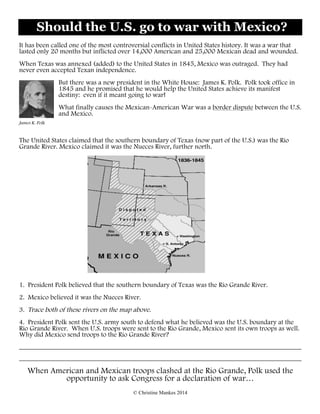
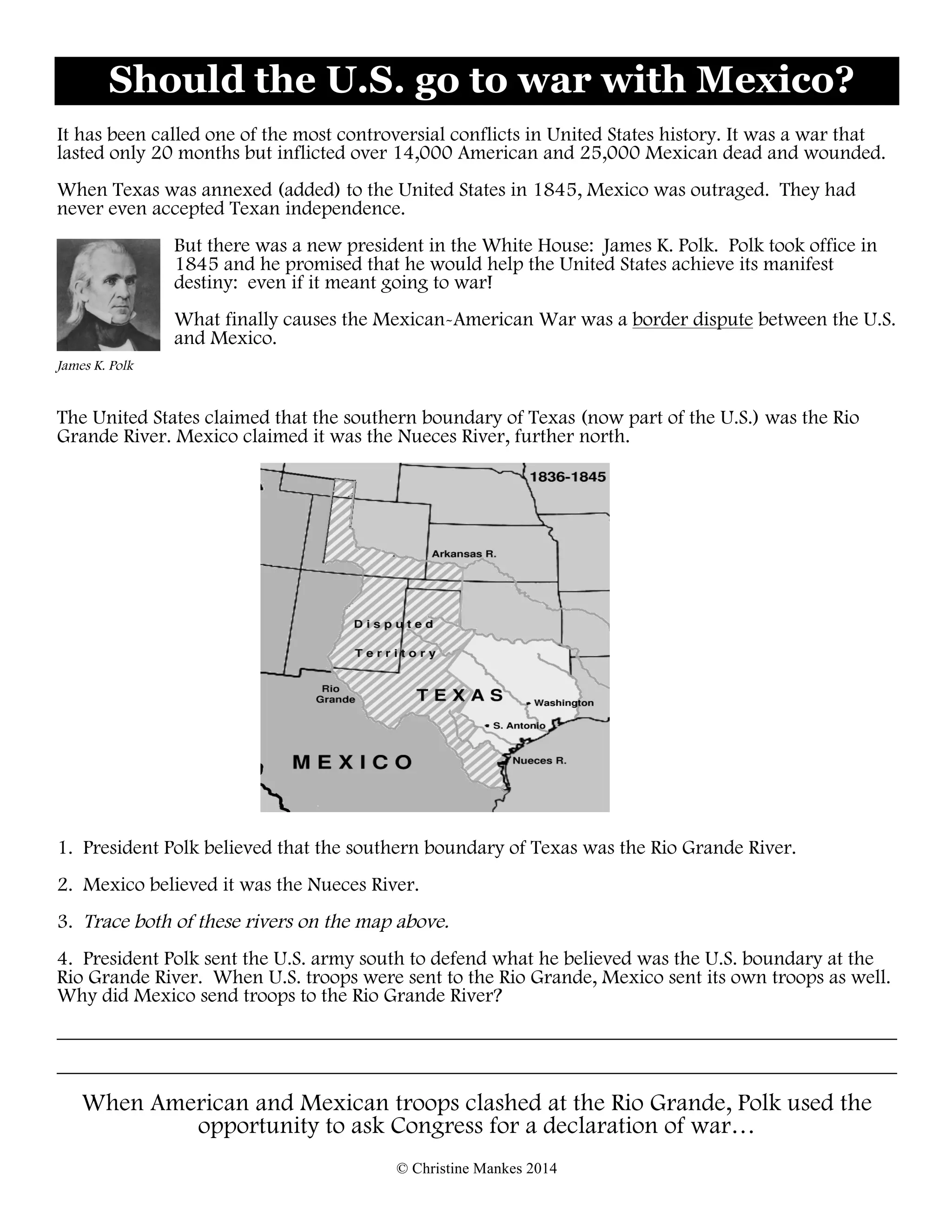
It has been called one of the most controversial conflicts in United States history. It was a war that
lasted only 20 months but inflicted over 14,000 American and 25,000 Mexican dead and wounded.
When Texas was annexed (added) to the United States in 1845, Mexico was outraged. They had
never even accepted Texan independence.
But there was a new president in the White House: James K. Polk. Polk took office in
1845 and he promised that he would help the United States achieve its manifest
destiny: even if it meant going to war!
What finally causes the Mexican-American War was a border dispute between the U.S.
and Mexico.
James K. Polk
The United States claimed that the southern boundary of Texas (now part of the U.S.) was the Rio
Grande River. Mexico claimed it was the Nueces River, further north.
1. President Polk believed that the southern boundary of Texas was the Rio Grande River.
2. Mexico believed it was the Nueces River.
3. Trace both of these rivers on the map above.
4. President Polk sent the U.S. army south to defend what he believed was the U.S. boundary at the
Rio Grande River. When U.S. troops were sent to the Rio Grande, Mexico sent its own troops as well.
Why did Mexico send troops to the Rio Grande River?
__________________________________________________________________________________________
__________________________________________________________________________________________
When American and Mexican troops clashed at the Rio Grande, Polk used the
opportunity to ask Congress for a declaration of war…
© Christine Mankes 2014
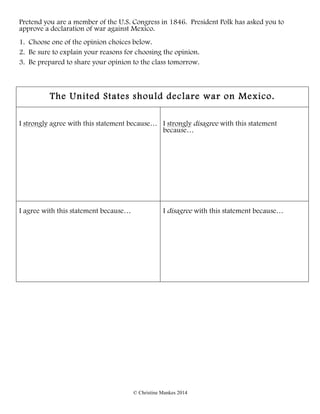
Pretend you are a member of the U.S. Congress in 1846. President Polk has asked you to
approve a declaration of war against Mexico.
1. Choose one of the opinion choices below.
2. Be sure to explain your reasons for choosing the opinion.
3. Be prepared to share your opinion to the class tomorrow.
The United States should declare war on Mexico.
I strongly agree with this statement because… I strongly disagree with this statement
because…
I agree with this statement because… I disagree with this statement because…
© Christine Mankes 2014
War with Mexico!
Some historians refer to the Mexican-American War as one of the most controversial conflicts in American
history. Read the opposing viewpoints below and answer the questions that follow.
DOCUMENT #1
In May 1846, President Polk spoke before a special meeting of Congress to ask for a declaration of war
against Mexico. Read an excerpt from his speech below.
The existing state of the relations between the United States and Mexico renders it proper that I should bring
the subject to the consideration of Congress.... The Mexican government. . . after a long continued series of
menaces, have at last invaded our territory, and shed the blood of our fellow-citizens on our own soil....
[Mexico] has proclaimed that hostilities have commenced, and that the two nations are now at war. As war
exists, and, notwithstanding all our efforts to avoid it, exists by the act of Mexico herself, we are called upon by
every consideration of duty and patriotism to vindicate with decision and honor, the rights, and the interests of
our country.... I invoke the prompt action of Congress to recognize the existence of war, and to place at the
disposition of the Executive the means of prosecuting the war with vigor, and thus hastening the restoration of
peace . .
In his war message to Congress, what is Polk’s argument for declaring war on Mexico? Cite text-based
evidence in your answer.
_________________________________________________________________________________________________
_________________________________________________________________________________________________
_________________________________________________________________________________________________
DOCUMENT #2
One of the members of the U.S. House of Representatives who voiced his opposition to the Mexican War was
Abraham Lincoln. He made a speech to Congress in opposition to the Mexican War. Read an excerpt from
his speech below.
. . . the President sent the army into the midst of a settlement of Mexican people who had never submitted, by
consent or by force, to the authority of Texas or of the United States, and ... thereby the first blood of the war
was shed. . . Let the President answer the [questions] I proposed, . . . Let him answer fully, fairly, and
candidly…And, if, so answering, he can show that the soil was ours where the first blood of war was shed—that
it was not within an inhabited country, or, if within such, that the inhabitants had submitted themselves to the
civil authority of Texas or of the United States, . . .—then I am with him . . . But if he can not or will not do this,
. . . then I shall be fully convinced of what I more than suspect already—that he is deeply conscious of being in
the wrong; that he feels the blood of this war…is crying to Heaven against him . . and trusting to escape scrutiny
by fixing the public gaze upon the exceeding brightness of military glory, that attractive rainbow that rises in
showers of blood—that serpent's eye that charms to destroy, ... he now finds himself he knows not where....
In his message to Congress, what is Lincoln’s argument agains the Mexican War? Cite text-based evidence in
your answer.
_________________________________________________________________________________________________
_________________________________________________________________________________________________
_________________________________________________________________________________________________
© Christine Mankes 2014
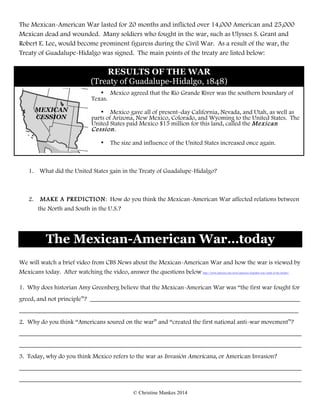
The Mexican-American War lasted for 20 months and inflicted over 14,000 American and 25,000
Mexican dead and wounded. Many soldiers who fought in the war, such as Ulysses S. Grant and
Robert E. Lee, would become prominent figuress during the Civil War. As a result of the war, the
Treaty of Guadalupe-Hidalgo was signed. The main points of the treaty are listed below:
RESULTS OF THE WAR
(Treaty of Guadalupe-Hidalgo, 1848)
• Mexico agreed that the Rio Grande River was the southern boundary of
Texas.
• Mexico gave all of present–day California, Nevada, and Utah, as well as
parts of Arizona, New Mexico, Colorado, and Wyoming to the United States. The
United States paid Mexico $15 million for this land, called the Mexican
Cession.
• The size and influence of the United States increased once again.
1. What did the United States gain in the Treaty of Guadalupe-Hidalgo?
2. MAKE A PREDICTION: How do you think the Mexican-American War affected relations between
the North and South in the U.S.?
The Mexican-American War…today
We will watch a brief video from CBS News about the Mexican-American War and how the war is viewed by
Mexicans today. After watching the video, answer the questions below. http://www.cbsnews.com/news/americas-forgotten-war-south-of-the-border/
1. Why does historian Amy Greenberg believe that the Mexican-American War was “the first war fought for
greed, and not principle”? ___________________________________________________________________
_________________________________________________________________________________________
2. Why do you think “Americans soured on the war” and “created the first national anti-war movement”?
__________________________________________________________________________________________
__________________________________________________________________________________________
3. Today, why do you think Mexico refers to the war as Invasión Americana, or American Invasion?
__________________________________________________________________________________________
__________________________________________________________________________________________
MEXICAN
CESSION

Mexican War HW

  • 1.
    © Christine Mankes2014 Should the U.S. go to war with Mexico? It has been called one of the most controversial conflicts in United States history. It was a war that lasted only 20 months but inflicted over 14,000 American and 25,000 Mexican dead and wounded. When Texas was annexed (added) to the United States in 1845, Mexico was outraged. They had never even accepted Texan independence. But there was a new president in the White House: James K. Polk. Polk took office in 1845 and he promised that he would help the United States achieve its manifest destiny: even if it meant going to war! What finally causes the Mexican-American War was a border dispute between the U.S. and Mexico. James K. Polk The United States claimed that the southern boundary of Texas (now part of the U.S.) was the Rio Grande River. Mexico claimed it was the Nueces River, further north. 1. President Polk believed that the southern boundary of Texas was the Rio Grande River. 2. Mexico believed it was the Nueces River. 3. Trace both of these rivers on the map above. 4. President Polk sent the U.S. army south to defend what he believed was the U.S. boundary at the Rio Grande River. When U.S. troops were sent to the Rio Grande, Mexico sent its own troops as well. Why did Mexico send troops to the Rio Grande River? __________________________________________________________________________________________ __________________________________________________________________________________________ When American and Mexican troops clashed at the Rio Grande, Polk used the opportunity to ask Congress for a declaration of war…
  • 2.
    © Christine Mankes2014 Pretend you are a member of the U.S. Congress in 1846. President Polk has asked you to approve a declaration of war against Mexico. 1. Choose one of the opinion choices below. 2. Be sure to explain your reasons for choosing the opinion. 3. Be prepared to share your opinion to the class tomorrow. The United States should declare war on Mexico. I strongly agree with this statement because… I strongly disagree with this statement because… I agree with this statement because… I disagree with this statement because…
  • 3.
    © Christine Mankes2014 War with Mexico! Some historians refer to the Mexican-American War as one of the most controversial conflicts in American history. Read the opposing viewpoints below and answer the questions that follow. DOCUMENT #1 In May 1846, President Polk spoke before a special meeting of Congress to ask for a declaration of war against Mexico. Read an excerpt from his speech below. The existing state of the relations between the United States and Mexico renders it proper that I should bring the subject to the consideration of Congress.... The Mexican government. . . after a long continued series of menaces, have at last invaded our territory, and shed the blood of our fellow-citizens on our own soil.... [Mexico] has proclaimed that hostilities have commenced, and that the two nations are now at war. As war exists, and, notwithstanding all our efforts to avoid it, exists by the act of Mexico herself, we are called upon by every consideration of duty and patriotism to vindicate with decision and honor, the rights, and the interests of our country.... I invoke the prompt action of Congress to recognize the existence of war, and to place at the disposition of the Executive the means of prosecuting the war with vigor, and thus hastening the restoration of peace . . In his war message to Congress, what is Polk’s argument for declaring war on Mexico? Cite text-based evidence in your answer. _________________________________________________________________________________________________ _________________________________________________________________________________________________ _________________________________________________________________________________________________ DOCUMENT #2 One of the members of the U.S. House of Representatives who voiced his opposition to the Mexican War was Abraham Lincoln. He made a speech to Congress in opposition to the Mexican War. Read an excerpt from his speech below. . . . the President sent the army into the midst of a settlement of Mexican people who had never submitted, by consent or by force, to the authority of Texas or of the United States, and ... thereby the first blood of the war was shed. . . Let the President answer the [questions] I proposed, . . . Let him answer fully, fairly, and candidly…And, if, so answering, he can show that the soil was ours where the first blood of war was shed—that it was not within an inhabited country, or, if within such, that the inhabitants had submitted themselves to the civil authority of Texas or of the United States, . . .—then I am with him . . . But if he can not or will not do this, . . . then I shall be fully convinced of what I more than suspect already—that he is deeply conscious of being in the wrong; that he feels the blood of this war…is crying to Heaven against him . . and trusting to escape scrutiny by fixing the public gaze upon the exceeding brightness of military glory, that attractive rainbow that rises in showers of blood—that serpent's eye that charms to destroy, ... he now finds himself he knows not where.... In his message to Congress, what is Lincoln’s argument agains the Mexican War? Cite text-based evidence in your answer. _________________________________________________________________________________________________ _________________________________________________________________________________________________ _________________________________________________________________________________________________
  • 4.
    © Christine Mankes2014 The Mexican-American War lasted for 20 months and inflicted over 14,000 American and 25,000 Mexican dead and wounded. Many soldiers who fought in the war, such as Ulysses S. Grant and Robert E. Lee, would become prominent figuress during the Civil War. As a result of the war, the Treaty of Guadalupe-Hidalgo was signed. The main points of the treaty are listed below: RESULTS OF THE WAR (Treaty of Guadalupe-Hidalgo, 1848) • Mexico agreed that the Rio Grande River was the southern boundary of Texas. • Mexico gave all of present–day California, Nevada, and Utah, as well as parts of Arizona, New Mexico, Colorado, and Wyoming to the United States. The United States paid Mexico $15 million for this land, called the Mexican Cession. • The size and influence of the United States increased once again. 1. What did the United States gain in the Treaty of Guadalupe-Hidalgo? 2. MAKE A PREDICTION: How do you think the Mexican-American War affected relations between the North and South in the U.S.? The Mexican-American War…today We will watch a brief video from CBS News about the Mexican-American War and how the war is viewed by Mexicans today. After watching the video, answer the questions below. http://www.cbsnews.com/news/americas-forgotten-war-south-of-the-border/ 1. Why does historian Amy Greenberg believe that the Mexican-American War was “the first war fought for greed, and not principle”? ___________________________________________________________________ _________________________________________________________________________________________ 2. Why do you think “Americans soured on the war” and “created the first national anti-war movement”? __________________________________________________________________________________________ __________________________________________________________________________________________ 3. Today, why do you think Mexico refers to the war as Invasión Americana, or American Invasion? __________________________________________________________________________________________ __________________________________________________________________________________________ MEXICAN CESSION