
Metric Driven Refactoring
Metrics
• The Bad
• The Good
• The Compromise
The Bad
• Often misleading
• Often misunderstood

• Lines of Code
• Number of Defects
• Turn time
The Good
• Can add objectivity to a
  subjective exercise
• Can help us focus on
  problem areas
• Can provide guidance at
  an early stage
The Compromise
• Metrics must be easily
  understood
• Metrics must provide
  actionable data
• Metric must be easy to
  calculate
What is Refactoring
• Small incremental
  changes
• Changes the internal
  structure
• Does not change the
  external behavior
Why Refactor
•   Improve maintainability
•   Improve performance
•   Improve legibility
•   Make code reusable
•   Pay off design deficit
Code Smells
• Indicate that something
  maybe wrong with code
• Smells point to the
  need to refactor
• Individual smells are
  often associated with
  specific refactors
Sample Code Smells
•   Long method
•   Feature Envy
•   Switch Statement Smell
•   Shot Gun Surgery
•   Large Class
•   Comments
Smelly Metrics
• Metrics that Help
  identify Code in need of
  Refactoring
• Metric provides discrete
  values that can be
  compared against
  guidelines
Instruction Count
• Number of IL
  Instructions in a
  Method
• More instructions =
  Longer Method
• More Instructions =
  Less Focused Method
• More Instructions =
  More Effort to Support
Cyclomatic Complexity
• Number of Logical Paths
  Through a Method
• Number of Test Cases
  Needed for Full
  Coverage
• Higher Complexity =
  More Difficult to
  Support
• Higher Complexity =
  More likely to Have
  Errors
Guidelines
• Guidelines – Not Hard
  and Fast Rules
• Exceptions Allowed but
  Must be Understood
• 200 Instructions per
  Method or Less
• Cyclomatic Complexity
  below 10
• Cyclomatic Complexity
  = 1 in a View
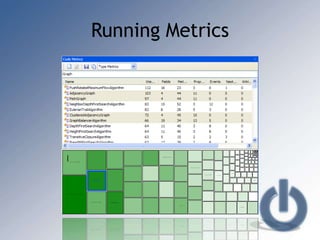
Running Metrics
Common Refactors
• Extract Method
• Replace Method with
  Method Object
• Decompose Conditional
Apply Some Refactors
New Best Practices
• Review Metrics Before
  and After Each Round of
  Code Changes
• “Do No Harm”
• Improve the Methods
  that You Touch
• Adhering to these
  Guidelines will Create
  Better Software
Where to Get More Information
• http://www.geekswithb
  logs.net/nharrison
• http://www.simple-
  talk.com/author/nick-
  harrison/
• http://www.refactoring.
  com/catalog/index.html
• http://www.red-
  gate.com/products/refl
  ector/index.htm

Metric driven refactoring

  • 1.
  • 2.
    Metrics • The Bad •The Good • The Compromise
  • 3.
    The Bad • Oftenmisleading • Often misunderstood • Lines of Code • Number of Defects • Turn time
  • 4.
    The Good • Canadd objectivity to a subjective exercise • Can help us focus on problem areas • Can provide guidance at an early stage
  • 5.
    The Compromise • Metricsmust be easily understood • Metrics must provide actionable data • Metric must be easy to calculate
  • 6.
    What is Refactoring •Small incremental changes • Changes the internal structure • Does not change the external behavior
  • 7.
    Why Refactor • Improve maintainability • Improve performance • Improve legibility • Make code reusable • Pay off design deficit
  • 8.
    Code Smells • Indicatethat something maybe wrong with code • Smells point to the need to refactor • Individual smells are often associated with specific refactors
  • 9.
    Sample Code Smells • Long method • Feature Envy • Switch Statement Smell • Shot Gun Surgery • Large Class • Comments
  • 10.
    Smelly Metrics • Metricsthat Help identify Code in need of Refactoring • Metric provides discrete values that can be compared against guidelines
  • 11.
    Instruction Count • Numberof IL Instructions in a Method • More instructions = Longer Method • More Instructions = Less Focused Method • More Instructions = More Effort to Support
  • 12.
    Cyclomatic Complexity • Numberof Logical Paths Through a Method • Number of Test Cases Needed for Full Coverage • Higher Complexity = More Difficult to Support • Higher Complexity = More likely to Have Errors
  • 13.
    Guidelines • Guidelines –Not Hard and Fast Rules • Exceptions Allowed but Must be Understood • 200 Instructions per Method or Less • Cyclomatic Complexity below 10 • Cyclomatic Complexity = 1 in a View
  • 14.
  • 15.
    Common Refactors • ExtractMethod • Replace Method with Method Object • Decompose Conditional
  • 16.
  • 17.
    New Best Practices •Review Metrics Before and After Each Round of Code Changes • “Do No Harm” • Improve the Methods that You Touch • Adhering to these Guidelines will Create Better Software
  • 18.
    Where to GetMore Information • http://www.geekswithb logs.net/nharrison • http://www.simple- talk.com/author/nick- harrison/ • http://www.refactoring. com/catalog/index.html • http://www.red- gate.com/products/refl ector/index.htm