Methods of
Patient
Assignment
OPTIMIZING CARE DELIVERY FOR BETTER OUTCOMES
Introduction

• Patient assignment is a critical
aspect of healthcare management.
• Patient assignment is the process of
assigning patient to the nurse to
ensure quality care.
The assignment is based on patient
need and nurse skill
Objectives
 • Understand various methods of
patient assignment.
• Analyze their benefits and
limitations.
• Explore how to select the right
method for different healthcare
settings.
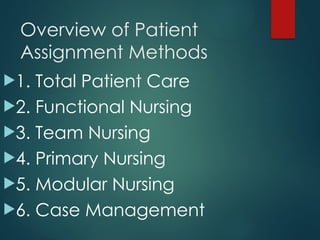
Overview of Patient
Assignment Methods
1. Total Patient Care
2. Functional Nursing
3. Team Nursing
4. Primary Nursing
5. Modular Nursing
6. Case Management
Total Patient Care
 • One nurse is responsible for all aspects of
care for a set of patients during their shift.
 It is a model where one nurse is
responsible for all the needs of patient
during shift.
 This includes personal hygiene , emotional
support
and medication.
Functional Nursing
• It is also known as
task nursing.
Care tasks are divided
among staff based on
their roles and skills.
Team Nursing
• A team led by an RN is responsible
for a group of patients.
In team nursing, a charge nurse
assigns patients to team of nurses
who work together to provide care.
The team consists of staff based of
need of patient and availability of
staff.
Primary Nursing
 • A primary nurse is accountable for a
patient's care plan from admission to
discharge.
 •It is a continuity care.
 It includes bed side care.
Modular Nursing
 • Patients are divided into modules, with
each module managed by a team.
 •It groups patients by location and assigns
them to a team of caregivers.
Case Management
 • A case manager coordinates
care for patients with complex
needs.
 •This method is also known as
case method or total patient
care.
Choosing the Right
Method
 • Consider patient acuity and complexity.
 •It involves planning , monitoring patient
health care.
 Choosing the patient assignment .
 Choosing the patient need.
Conclusion
 • Effective patient assignment enhances
care quality and staff satisfaction.
 • Different methods suit different settings
and scenarios.
 • Continuous evaluation and adaptation
are key.
Methods_of_Patient_Assignment.pptx mmmmmmm

Methods_of_Patient_Assignment.pptx mmmmmmm

  • 2.
  • 3.
    Introduction  • Patient assignmentis a critical aspect of healthcare management. • Patient assignment is the process of assigning patient to the nurse to ensure quality care. The assignment is based on patient need and nurse skill
  • 4.
    Objectives  • Understandvarious methods of patient assignment. • Analyze their benefits and limitations. • Explore how to select the right method for different healthcare settings.
  • 5.
    Overview of Patient AssignmentMethods 1. Total Patient Care 2. Functional Nursing 3. Team Nursing 4. Primary Nursing 5. Modular Nursing 6. Case Management
  • 6.
    Total Patient Care • One nurse is responsible for all aspects of care for a set of patients during their shift.  It is a model where one nurse is responsible for all the needs of patient during shift.  This includes personal hygiene , emotional support and medication.
  • 7.
    Functional Nursing • Itis also known as task nursing. Care tasks are divided among staff based on their roles and skills.
  • 8.
    Team Nursing • Ateam led by an RN is responsible for a group of patients. In team nursing, a charge nurse assigns patients to team of nurses who work together to provide care. The team consists of staff based of need of patient and availability of staff.
  • 9.
    Primary Nursing  •A primary nurse is accountable for a patient's care plan from admission to discharge.  •It is a continuity care.  It includes bed side care.
  • 10.
    Modular Nursing  •Patients are divided into modules, with each module managed by a team.  •It groups patients by location and assigns them to a team of caregivers.
  • 11.
    Case Management  •A case manager coordinates care for patients with complex needs.  •This method is also known as case method or total patient care.
  • 12.
    Choosing the Right Method • Consider patient acuity and complexity.  •It involves planning , monitoring patient health care.  Choosing the patient assignment .  Choosing the patient need.
  • 13.
    Conclusion  • Effectivepatient assignment enhances care quality and staff satisfaction.  • Different methods suit different settings and scenarios.  • Continuous evaluation and adaptation are key.