AIRCRAFT SYSTEM
AIRCRAFT SYSTEM
MAINTENANCE
MAINTENANCE
Mr.
Mr. M.Tozan
M.Tozan
KFUPM
KFUPM
Objectives
Become familiar with aircraft ground handling
procedures
Understand operation principles, components &
maintenance practices of aircraft systems
Provide you with basic knowledge of non
destructive inspection methods
Improve your understanding for analyzing,
developing and managing aircraft maintenance
programs
Course Outline
Aircraft Ground Handling
Aircraft Systems/avionics/engine
Corrosion and Aircraft Inspection
Methods
Aircraft Maintenance Planning &
Management
Aircraft Ground Handling
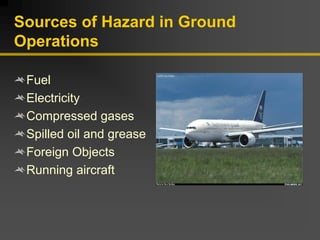
Sources of Hazard in Ground
Operations
Fuel
Electricity
Compressed gases
Spilled oil and grease
Foreign Objects
Running aircraft
Be careful around running aircraft
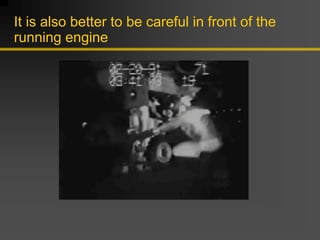
It is also better to be careful in front of the
running engine
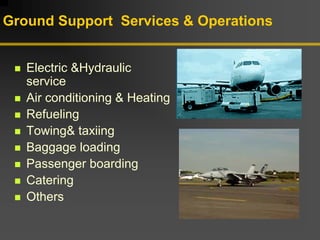
Ground Support Services & Operations
„ Electric &Hydraulic
service
„ Air conditioning & Heating
„ Refueling
„ Towing& taxiing
„ Baggage loading
„ Passenger boarding
„ Catering
„ Others
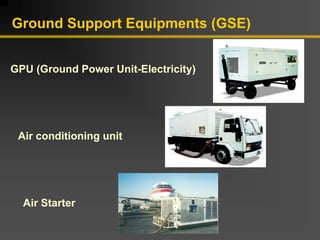
Ground Support Equipments (GSE)
GPU (Ground Power Unit-Electricity)
Air conditioning unit
Air Starter
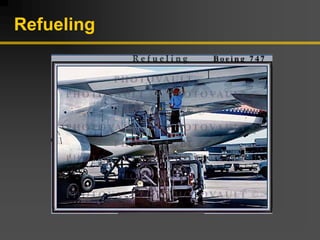
Refueling
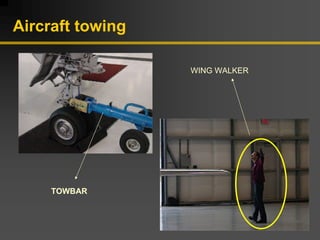
Aircraft towing
TOWBAR
WING WALKER
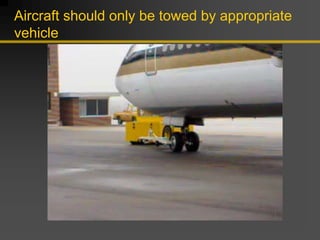
Aircraft should only be towed by appropriate
vehicle
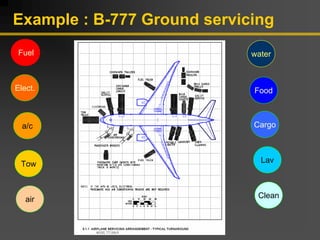
Example : B-777 Ground servicing
Fuel
Cargo
water
Clean
Food
Elect.
air
a/c
Tow Lav
Fuel
Food
Cargo
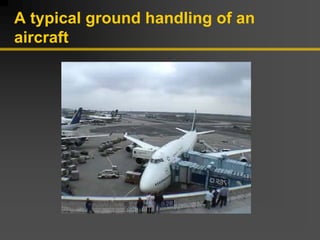
A typical ground handling of an
aircraft
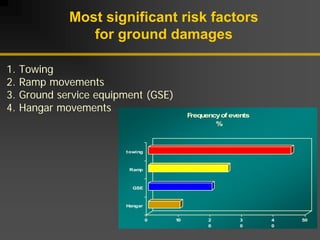
1. Towing
2. Ramp movements
3. Ground service equipment (GSE)
4. Hangar movements
0 10 2
0
3
0
4
0
50
Hangar
GSE
Ramp
towing
F
requencyof events
%
Most significant risk factors
for ground damages
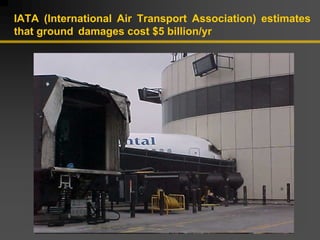
IATA (International Air Transport Association) estimates
that ground damages cost $5 billion/yr
AIRCRAFT SYSTEMS
AIRCRAFT SYSTEMS
AIRCRAFT SYSTEMS
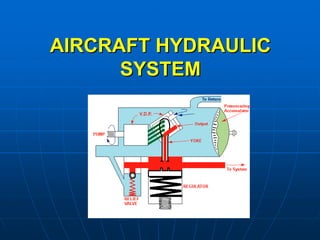
AIRCRAFT HYDRAULIC
AIRCRAFT HYDRAULIC
SYSTEM
SYSTEM
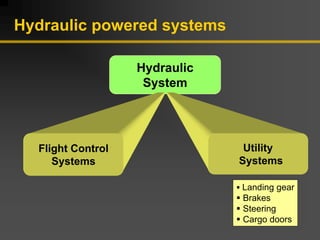
Hydraulic
System
Hydraulic powered systems
Utility
Systems
Flight Control
Systems
ƒ Landing gear
ƒ Brakes
ƒ Steering
ƒ Cargo doors
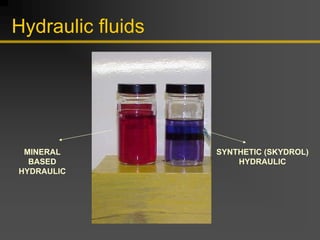
Hydraulic fluids
SYNTHETIC (SKYDROL)
HYDRAULIC
MINERAL
BASED
HYDRAULIC
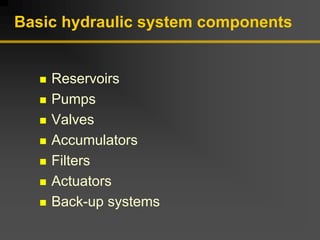
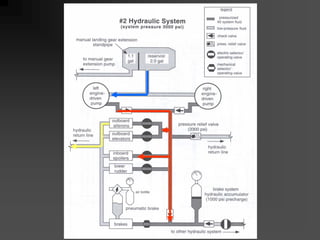
Basic hydraulic system components
„ Reservoirs
„ Pumps
„ Valves
„ Accumulators
„ Filters
„ Actuators
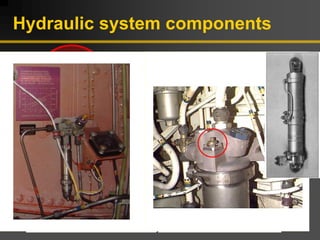
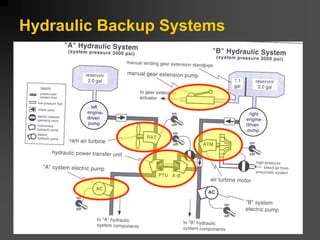
„ Back-up systems
Hydraulic system components
Hydraulic Backup Systems
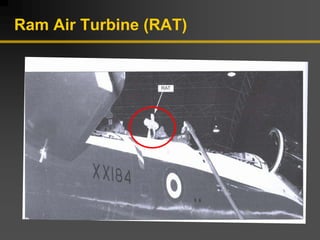
Ram Air Turbine (RAT)
Hydraulic system failures
There are two main causes of
hydraulic system failures:
„ Hydraulic fluid contamination
„ Hydraulic leakage
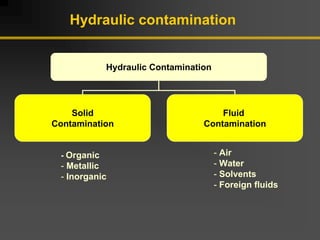
Hydraulic Contamination
Solid
Contamination
Fluid
Contamination
- Air
- Water
- Solvents
- Foreign fluids
Hydraulic contamination
- Organic
- Metallic
- Inorganic
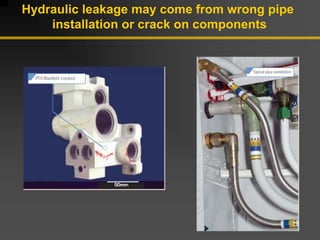
Hydraulic leakage may come from wrong pipe
installation or crack on components
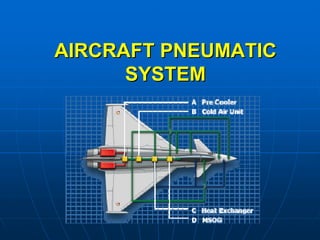
AIRCRAFT PNEUMATIC
AIRCRAFT PNEUMATIC
SYSTEM
SYSTEM
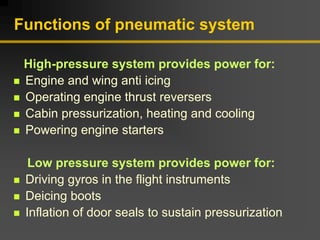
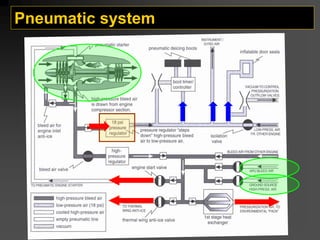
Functions of pneumatic system
High-pressure system provides power for:
„ Engine and wing anti icing
„ Operating engine thrust reversers
„ Cabin pressurization, heating and cooling
„ Powering engine starters
Low pressure system provides power for:
„ Driving gyros in the flight instruments
„ Deicing boots
„ Inflation of door seals to sustain pressurization
Pneumatic system
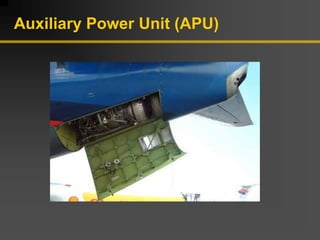
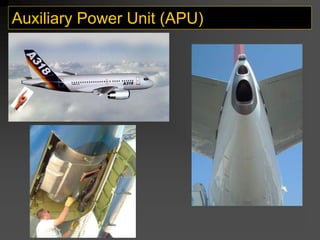
Auxiliary Power Unit (APU)
APU functions
„ Start engine
„ Power generators to provide auxiliary
electrical power
„ Power environmental systems such as
air conditioning
„ Provide power for crew functions such
as preflight and galley operations
Auxiliary Power Unit (APU)
AIRCRAFT FLIGHT CONTROL
SYSTEM
SYSTEM
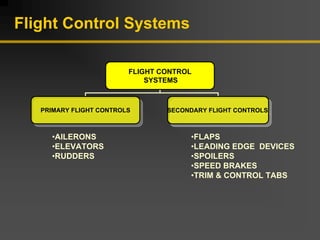
Flight Control Systems
FLIGHT CONTROL
SYSTEMS
SECONDARY FLIGHT CONTROLS
PRIMARY FLIGHT CONTROLS
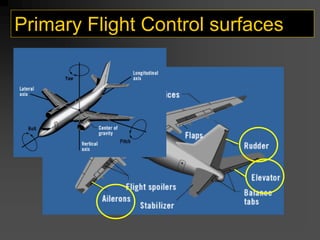
•AILERONS
•ELEVATORS
•RUDDERS
•FLAPS
•LEADING EDGE DEVICES
•SPOILERS
•SPEED BRAKES
•TRIM & CONTROL TABS
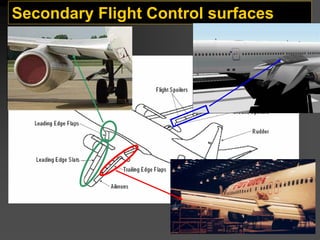
Primary Flight Control surfaces
Secondary Flight Control surfaces
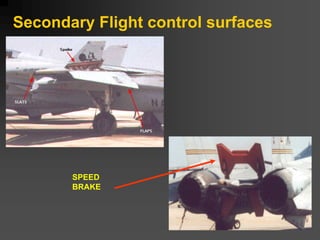
Secondary Flight control surfaces
SPEED
BRAKE
Aircraft flight control surfaces
C:Documents and
ettingsAdministrato
Types of control linkage systems
„ Mechanical command & mechanical
actuation
„ Mechanical command & hydraulic
actuation
„ Electric signal command & hydraulic
actuation (Fly by wire)
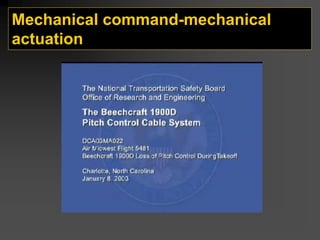
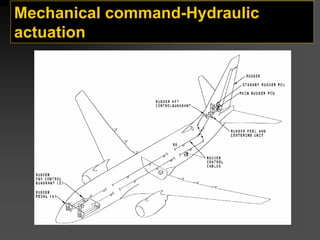
Mechanical command-mechanical
actuation
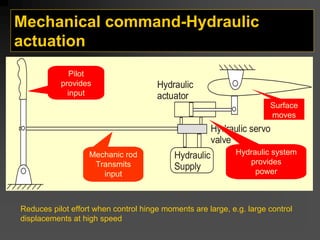
Mechanical command-Hydraulic
actuation
Hydraulic
Supply
Hydraulic servo
valve
Hydraulic
actuator
Reduces pilot effort when control hinge moments are large, e.g. large control
displacements at high speed
Pilot
provides
input
Mechanic rod
Transmits
input
Hydraulic system
provides
power
Surface
moves
Mechanical command-Hydraulic
actuation
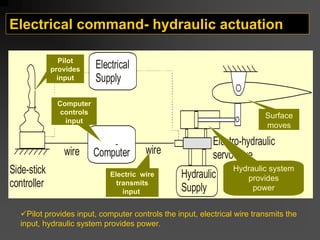
Electrical command- hydraulic actuation
Hydraulic
Supply
Analogue
Computer
Electrical
Supply
Electro-hydraulic
servovalve
Side-stick
controller
wire wire
9Pilot provides input, computer controls the input, electrical wire transmits the
input, hydraulic system provides power.
Pilot
provides
input
Computer
controls
input
Electric wire
transmits
input
Hydraulic system
provides
power
Surface
moves
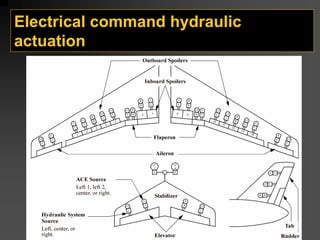
Electrical command hydraulic
actuation
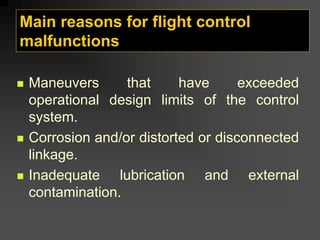
Main reasons for flight control
malfunctions
„ Maneuvers that have exceeded
operational design limits of the control
system.
„ Corrosion and/or distorted or disconnected
linkage.
„ Inadequate lubrication and external
contamination.
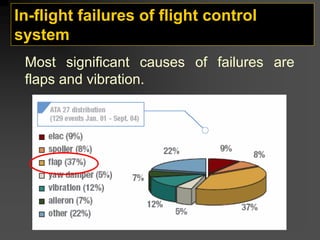
In-flight failures of flight control
system
Most significant causes of failures are
flaps and vibration.
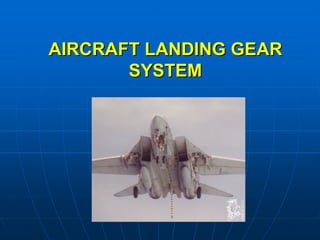
AIRCRAFT LANDING GEAR
SYSTEM
SYSTEM
Functions of landing gear system
„ Support the weight of the aircraft while it is
on the ground
„ Take off and land the aircraft safely
„ Absorb landing and taxiing shocks
„ Steer the aircraft
„ Stop the aircraft
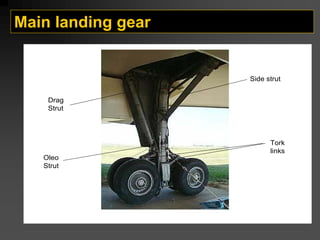
Main landing gear
Side strut
Tork
links
Drag
Strut
Oleo
Strut
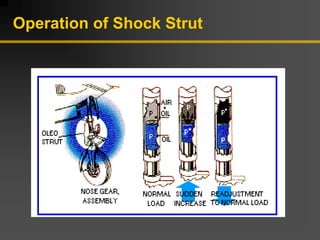
Operation of Shock Strut
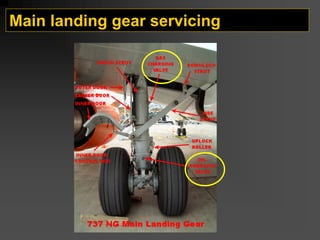
Main landing gear servicing
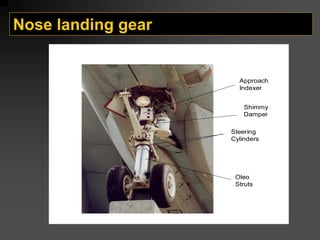
Nose landing gear
Approach
Indexer
Shimmy
Damper
Steering
Cylinders
Oleo
Struts
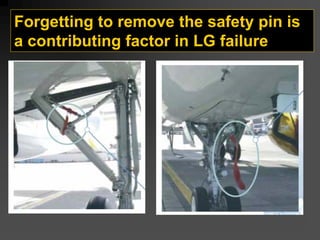
Forgetting to remove the safety pin is
a contributing factor in LG failure
AIRCRAFT FUEL SYSTEM
Aircraft Fuel System
Provides continuous flow of fuel to engine
in all flight conditions. Main components are:
„ Fuel tanks
„ Fuel Pumps and valves
„ Fuel Filters
„ Fuel heaters
„ Fuel instruments
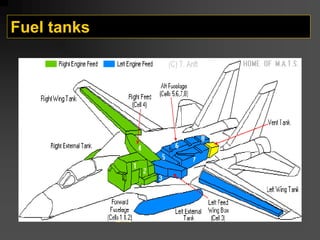
Fuel tanks
Centre
wing box
tank
Inboard and
outboard wing box
tanks
Tail plane torsion
box tanks
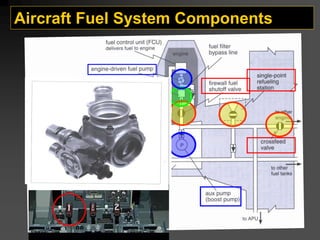
Aircraft Fuel System Components
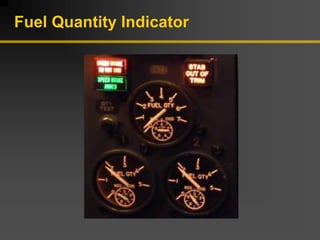
Fuel Quantity Indicator
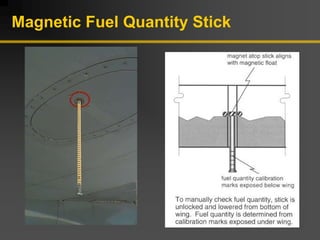
Magnetic Fuel Quantity Stick
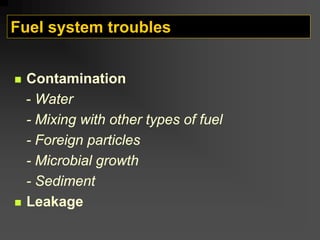
Fuel system troubles
„ Contamination
- Water
- Mixing with other types of fuel
- Foreign particles
- Microbial growth
- Sediment
„ Leakage
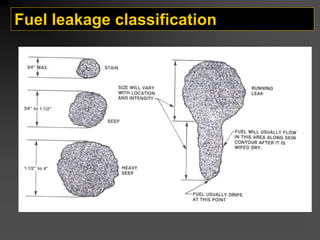
Fuel leakage classification
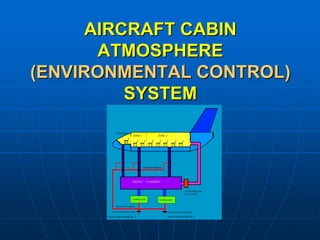
AIRCRAFT CABIN
AIRCRAFT CABIN
ATMOSPHERE
ATMOSPHERE
(ENVIRONMENTAL CONTROL)
SYSTEM
SYSTEM
Functions of cabin pressurization
system
„ Automatically maintain a maximum cabin
altitude of about 8 000' at the aircraft's
maximum designed cruising altitude
„ Prevent rapid changes of cabin altitude
regardless of rate of climb or descent
„ Reasonably fast fresh air exchange to
eliminate odors and remove stale air
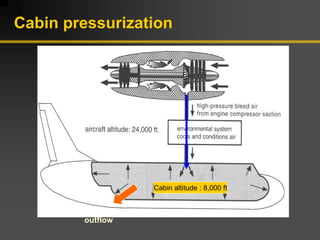
Cabin pressurization
Cabin altitude : 8,000 ft
outflow
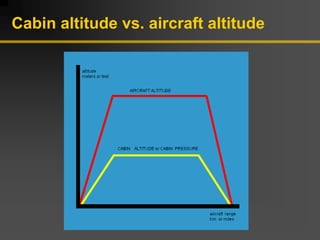
Cabin altitude vs. aircraft altitude
System components
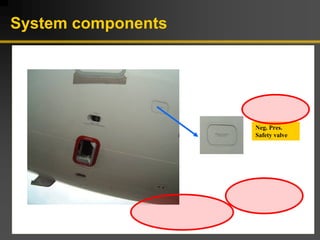
Outflow valve
Pos .Pres.
Safety valves
Neg. Pres.
Safety valve
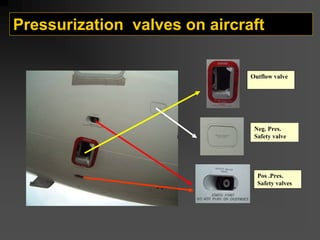
Pressurization valves on aircraft
Pos .Pres.
Safety valves
Outflow valve
Neg. Pres.
Safety valve
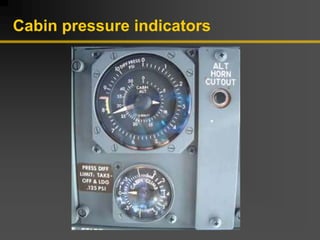
Cabin pressure indicators
Air conditioning system
„ Maintain a comfortable cabin temperature
throughout al conditions of flight
„ Control cabin humidity to assure passenger
comfort
„ Prevent window fogging
„ Provide cooling for avionics
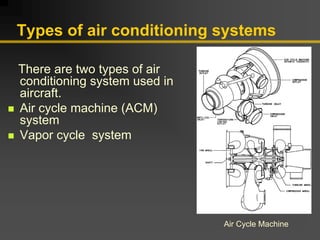
Types of air conditioning systems
There are two types of air
conditioning system used in
aircraft.
„ Air cycle machine (ACM)
system
„ Vapor cycle system
Air Cycle Machine
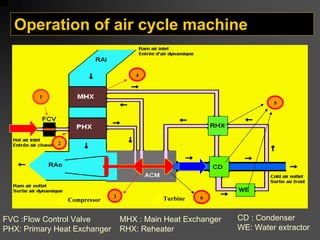
Operation of air cycle machine
1
3
4
5
6
Compressor Turbine
2
FVC :Flow Control Valve
PHX: Primary Heat Exchanger
MHX : Main Heat Exchanger
RHX: Reheater
CD : Condenser
WE: Water extractor
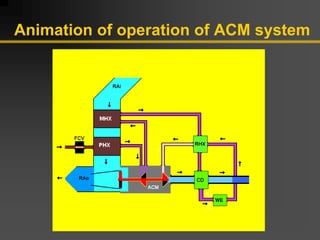
Animation of operation of ACM system
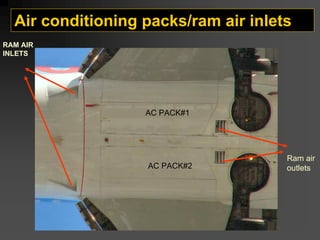
Air conditioning packs/ram air inlets
RAM AIR
INLETS
AC PACK#1
AC PACK#2
Ram air
outlets
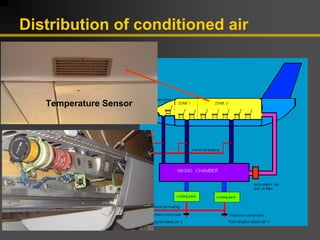
Distribution of conditioned air
Temperature Sensor
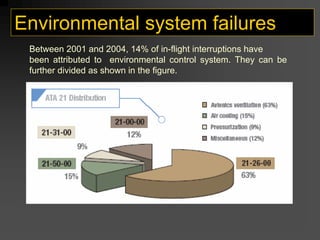
Environmental system failures
Between 2001 and 2004, 14% of in-flight interruptions have
been attributed to environmental control system. They can be
further divided as shown in the figure.
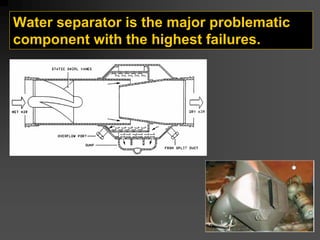
Water separator is the major problematic
component with the highest failures.
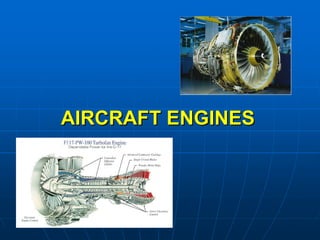
AIRCRAFT ENGINES
AIRCRAFT ENGINES
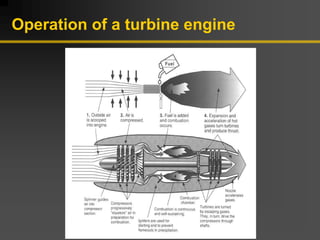
Operation of a turbine engine
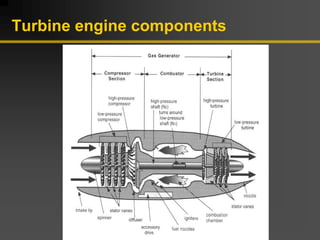
Turbine engine components
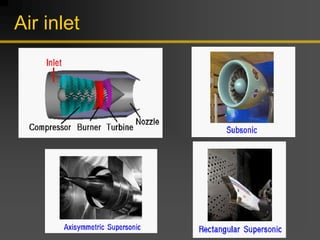
Air inlet
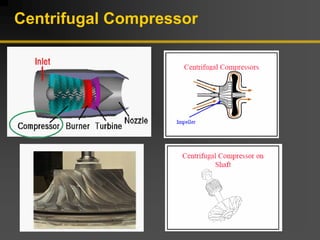
Centrifugal Compressor
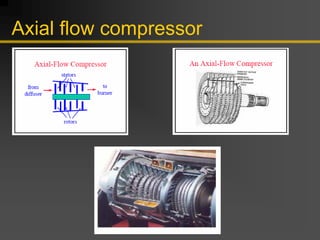
Axial flow compressor
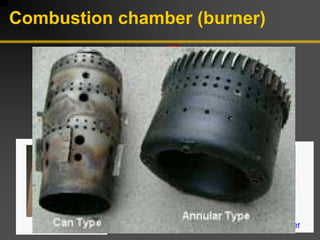
Combustion chamber (burner)
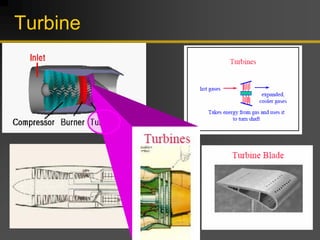
Turbine
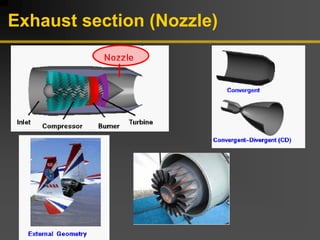
Exhaust section (Nozzle)
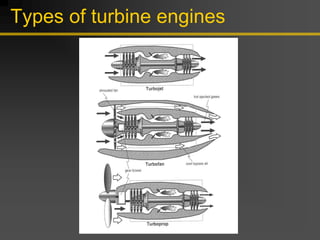
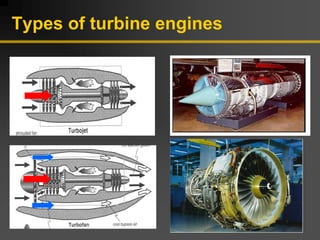
Types of turbine engines
Thrust reversers
„ Shorten the routine landing distance
„ Reduce the load on the brakes
„ Improve braking control on wet, snow-
covered or icy runways
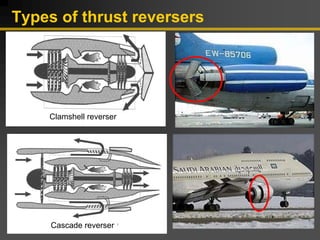
Types of thrust reversers
Clamshell reverser
Cascade reverser
Engine Malfunctions
„ Compressor Surge:
A compressor surge (sometimes called a
compressor stall) is the result of instability of the
air flow through compressor. It is recognized by a
loud bang similar to an explosion.
„ Flame out:
A flameout is a condition where the combustion
process within the burner has stopped.
ƒ Hot Start:
During engine start, due to fuel scheduling, strong
tail wind, etc. turbine temperature rises to relatively
high temperatures. This is known as a hot start.
Engine Malfunctions
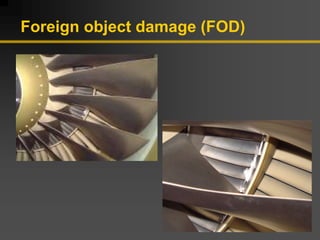
„ Foreign Object Damage:
Foreign Object Damage (FOD) is ingestion of
objects such as tire fragments, runway debris or
animals into the engine.
„ Engine Seizure:
Engine seizure describes a situation where the
engine rotors stop turning in flight, perhaps very
suddenly. The static and rotating parts lock up
against each other, bringing the rotor to a halt.
Engine failure causes
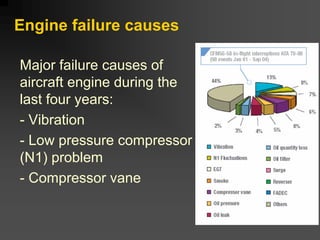
Major failure causes of
aircraft engine during the
last four years:
- Vibration
- Low pressure compressor
(N1) problem
- Compressor vane
Engine Maintenance
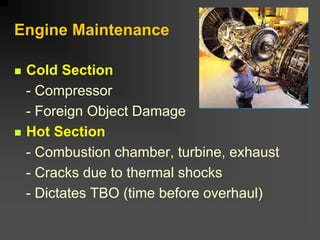
„ Cold Section
- Compressor
- Foreign Object Damage
„ Hot Section
- Combustion chamber, turbine, exhaust
- Cracks due to thermal shocks
- Dictates TBO (time before overhaul)
Foreign object damage (FOD)
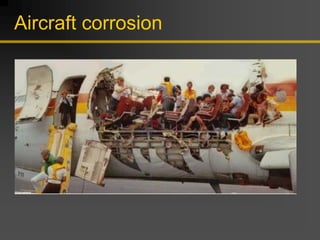
Aircraft corrosion
Most Common Types of Aircraft Corrosion
Pitting corrosion
Crevice corrosion
Intergranular corrosion
Exfoliation corrosion
Bimetalic corrosion
Stress cracking corrosion
Fretting corrosion
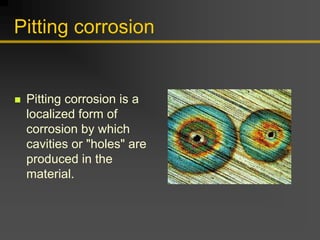
Pitting corrosion
„ Pitting corrosion is a
localized form of
corrosion by which
cavities or "holes" are
produced in the
material.
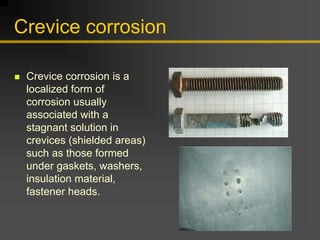
Crevice corrosion
„ Crevice corrosion is a
localized form of
corrosion usually
associated with a
stagnant solution in
crevices (shielded areas)
such as those formed
under gaskets, washers,
insulation material,
fastener heads.
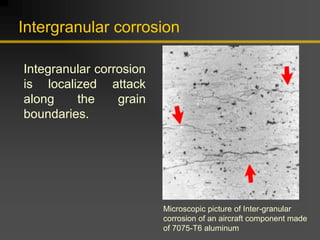
Intergranular corrosion
Integranular corrosion
is localized attack
along the grain
boundaries.
Microscopic picture of Inter-granular
corrosion of an aircraft component made
of 7075-T6 aluminum
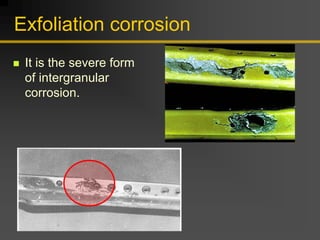
Exfoliation corrosion
„ It is the severe form
of intergranular
corrosion.
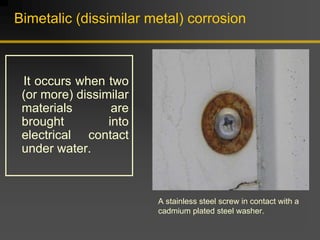
Bimetalic (dissimilar metal) corrosion
It occurs when two
(or more) dissimilar
materials are
brought into
electrical contact
under water.
A stainless steel screw in contact with a
cadmium plated steel washer.
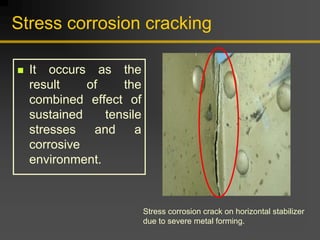
Stress corrosion cracking
„ It occurs as the
result of the
combined effect of
sustained tensile
stresses and a
corrosive
environment.
Stress corrosion crack on horizontal stabilizer
due to severe metal forming.
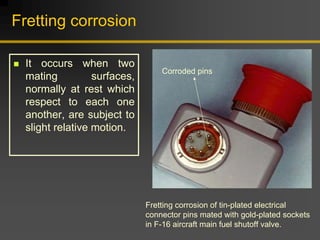
Fretting corrosion
„ It occurs when two
mating surfaces,
normally at rest which
respect to each one
another, are subject to
slight relative motion.
Corroded pins
Fretting corrosion of tin-plated electrical
connector pins mated with gold-plated sockets
in F-16 aircraft main fuel shutoff valve.
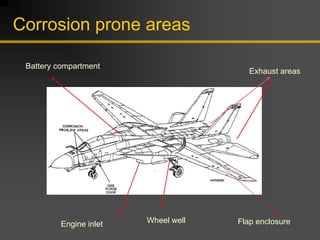
Corrosion prone areas
Exhaust areas
Battery compartment
Engine inlet Wheel well Flap enclosure
Avionic systems corrosion
Avionics are more prone to corrosion than
aircraft because;
„ Dissimilar metals are often in electrical
contact
„ Small amount of corrosion can make
equipment inoperative
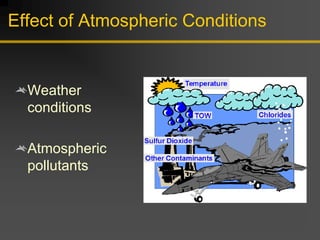
Effect of Atmospheric Conditions
Weather
conditions
Atmospheric
pollutants
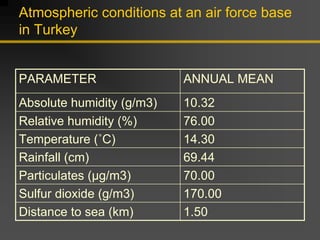
Atmospheric conditions at an air force base
in Turkey
ANNUAL MEAN
PARAMETER
10.32
Absolute humidity (g/m3)
76.00
Relative humidity (%)
14.30
Temperature (˚C)
69.44
Rainfall (cm)
70.00
Particulates (μg/m3)
170.00
Sulfur dioxide (g/m3)
1.50
Distance to sea (km)
Protective maintenance against aircraft
corrosion
Washing
Sealing / Application of inhibitors
Protective coating (metallic, organic)
Maintaining water drain valves and drain
holes for proper operation
Training and equipment
Corrosion
C:Documents and
ettingsAdministrato
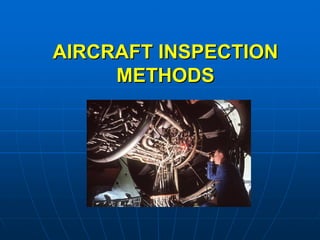
AIRCRAFT INSPECTION
AIRCRAFT INSPECTION
METHODS
METHODS
Non-destructive inspection (NDI)
methods
„ Penetrant inspection
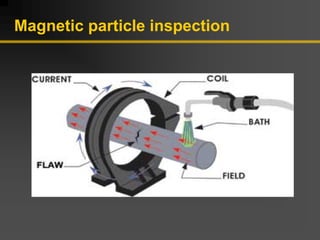
„ Magnetic particle inspection
„ Eddy current inspection
„ Radiography inspection
„ Ultrasonic inspection
„ Borescope inspection
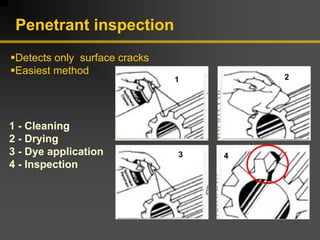
Penetrant inspection
1
1 - Cleaning
2 - Drying
3 - Dye application
4 - Inspection
2
3 4
ƒDetects only surface cracks
ƒEasiest method
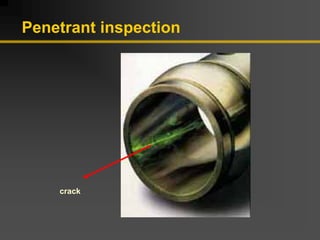
Penetrant inspection
crack
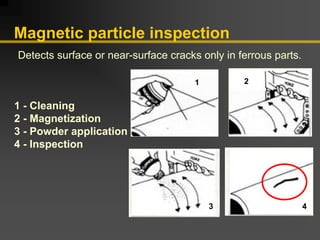
Magnetic particle inspection
1 2
4
1 - Cleaning
2 - Magnetization
3 - Powder application
4 - Inspection
3
Detects surface or near-surface cracks only in ferrous parts.
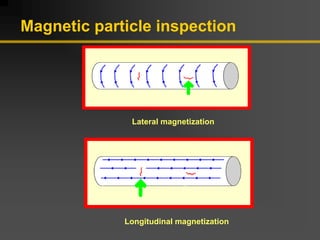
Magnetic particle inspection
Longitudinal magnetization
Lateral magnetization
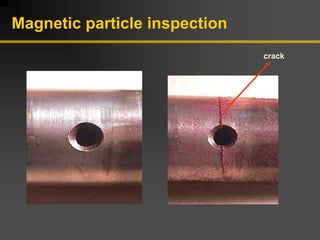
Magnetic particle inspection
crack
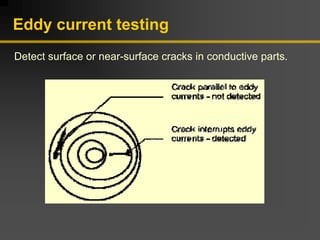
Eddy current testing
Detect surface or near-surface cracks in conductive parts.
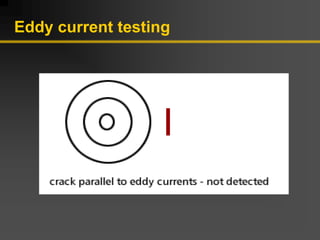
Eddy current testing
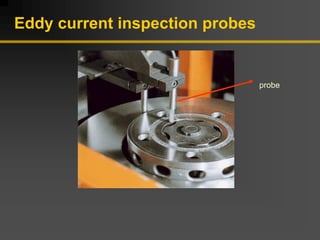
Eddy current inspection probes
probe
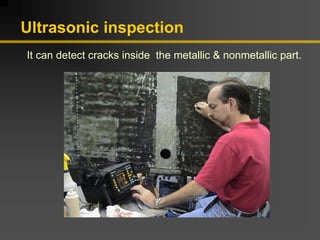
Ultrasonic inspection
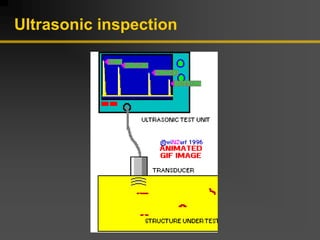
It can detect cracks inside the metallic & nonmetallic part.
Ultrasonic inspection
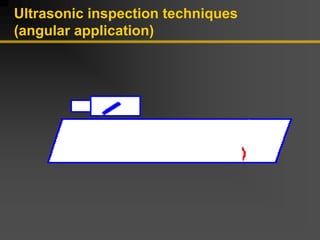
Ultrasonic inspection techniques
(angular application)
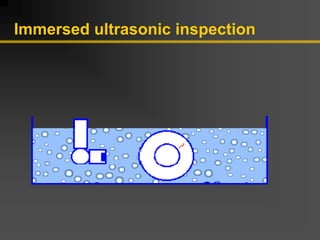
Immersed ultrasonic inspection
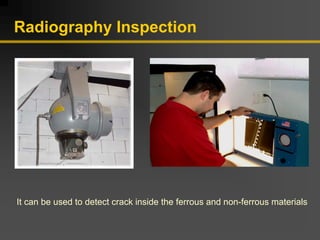
Radiography Inspection
It can be used to detect crack inside the ferrous and non-ferrous materials
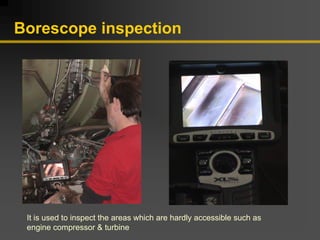
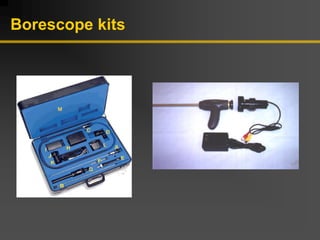
Borescope inspection
It is used to inspect the areas which are hardly accessible such as
engine compressor & turbine
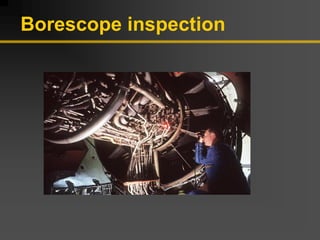
Borescope inspection
Borescope kits
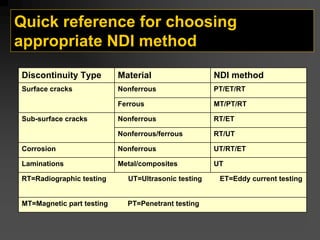
Quick reference for choosing
appropriate NDI method
NDI method
Material
Discontinuity Type
PT/ET/RT
Nonferrous
MT/PT/RT
Ferrous
RT/ET
Nonferrous
RT/UT
Nonferrous/ferrous
UT/RT/ET
Nonferrous
Corrosion
UT
Metal/composites
Laminations
RT=Radiographic testing UT=Ultrasonic testing ET=Eddy current testing
MT=Magnetic part testing PT=Penetrant testing
Sub-surface cracks
Surface cracks
AIRCRAFT MAINTENANCE
MANAGEMENT & PLANNING
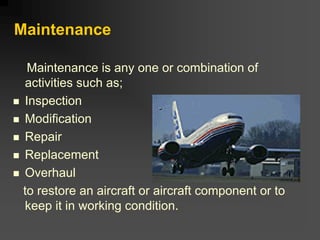
Maintenance
Maintenance is any one or combination of
activities such as;
„ Inspection
„ Modification
„ Repair
„ Replacement
„ Overhaul
to restore an aircraft or aircraft component or to
keep it in working condition.
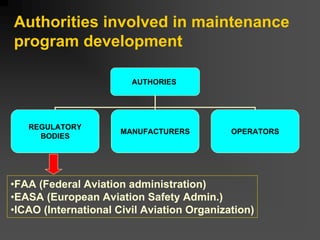
Authorities involved in maintenance
program development
AUTHORIES
REGULATORY
BODIES
MANUFACTURERS OPERATORS
•FAA (Federal Aviation administration)
•EASA (European Aviation Safety Admin.)
•ICAO (International Civil Aviation Organization)
Maintenance Regulations &
Documents
Maintenance Manuals
Service Bulletins
Federal Aviation Regulations (FAR)
Joint Aviation Requirements (JAR)
Airworthiness Directives
Advisory Circulars
Minimum Equipment List (MEL)
Technical orders
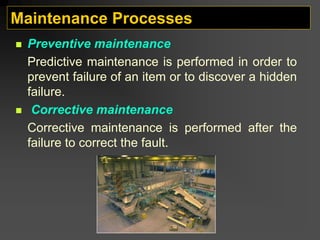
Maintenance Processes
„ Preventive maintenance
Predictive maintenance is performed in order to
prevent failure of an item or to discover a hidden
failure.
„ Corrective maintenance
Corrective maintenance is performed after the
failure to correct the fault.
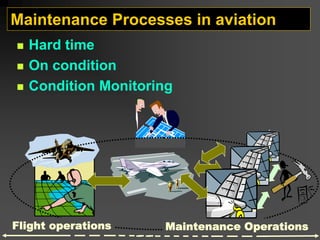
Maintenance Processes in aviation
„ Hard time
„ On condition
„ Condition Monitoring
Maintenance Operations
Flight operations
Hard-time Maintenance
¾ It is the oldest, primary preventive maintenance
process.
¾ It requires that an appliance or part be periodically
overhauled at certain intervals in accordance
with the carrier’s maintenance program, or it
should be removed from the service.
¾ As soon as the part age reaches predetermined
time (flight hour, cycle, or calendar time), it is
overhauled or replaced with a new component.
On-condition Maintenance
¾ This is a primary preventive maintenance
process.
¾ It requires that an appliance or part be
periodically inspected or checked against
some appropriate physical standards to
determine weather it can continue in service.
¾ The purpose is to use the part as long as
possible before it fails during normal
operation (in service operation)
Condition Monitoring
¾ This is a maintenance process for items that
have neither “hard time” or “on-condition”
maintenance as their primary maintenance
process.
¾ Condition monitoring is the maintenance
process for locating and resolving problem
areas through analytical study of malfunctions or
failures, not affecting safety of aircraft.
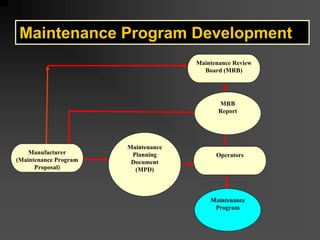
Maintenance Program Development
Maintenance
Planning
Document
(MPD)
MRB
Report
Maintenance
Program
Maintenance Review
Board (MRB)
Operators
Manufacturer
(Maintenance Program
Proposal)
Aircraft operator maintenance
program
An air carrier's maintenance program
should contain at least the following
information:
1) What (Item to be maintained)
2) When (time limit)
3) How (task)
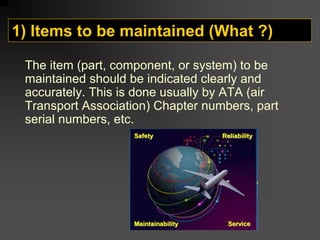
1) Items to be maintained (What ?)
The item (part, component, or system) to be
maintained should be indicated clearly and
accurately. This is done usually by ATA (air
Transport Association) Chapter numbers, part
serial numbers, etc.
2) Time Limit (When ?)
¾ The time limit is the maintenance interval
when you perform the maintenance task.
¾ There are three (3) units of measure used
to establish these limits. An item may have
no limits, one limit, or any combination of
these limits.
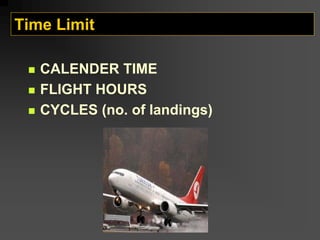
Time Limit
„ CALENDER TIME
„ FLIGHT HOURS
„ CYCLES (no. of landings)
3) Maintenance Tasks (How ?)
These include the maintenance services to
be done. The maintenance program consists
of three types of tasks:
„ Scheduled maintenance tasks
„ Unscheduled maintenance tasks
„ Specific maintenance requirements for
major components of aircraft (engine,
propeller, etc.)
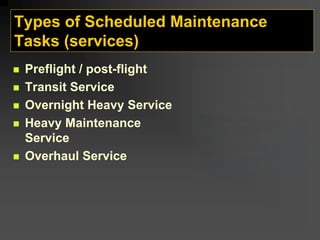
Types of Scheduled Maintenance
Tasks (services)
„ Preflight / post-flight
„ Transit Service
„ Overnight Heavy Service
„ Heavy Maintenance
Service
„ Overhaul Service
Maintenance tasks and letter checks
„ In maintenance program, the maintenance
tasks which are carried out at the same
time are grouped into maintenance
packages.
„ These maintenance packages are
indicated by "A", "B", "C" and "D"
checks. For this reason they are called
"letter checks".
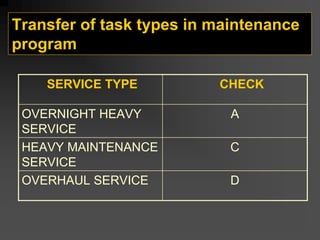
Transfer of task types in maintenance
program
CHECK
SERVICE TYPE
A
OVERNIGHT HEAVY
SERVICE
C
HEAVY MAINTENANCE
SERVICE
D
OVERHAUL SERVICE
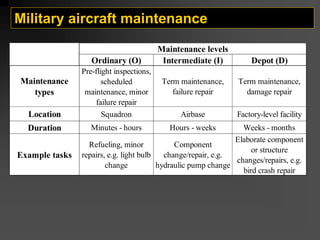
Military aircraft maintenance
Maintenance levels
Ordinary (O) Intermediate (I) Depot (D)
Maintenance
types
Pre-flight inspections,
scheduled
maintenance, minor
failure repair
Term maintenance,
failure repair
Term maintenance,
damage repair
Location Squadron Airbase Factory-level facility
Duration Minutes - hours Hours - weeks Weeks - months
Example tasks
Refueling, minor
repairs, e.g. light bulb
change
Component
change/repair, e.g.
hydraulic pump change
Elaborate component
or structure
changes/repairs, e.g.
bird crash repair
How to package the maintenance
tasks?
There are two questions that need to be
answered about the TIME LIMIT correctly:
1)What is the best time measurement unit
(Calendar day, flight hour or cycle)?
2)What is the optimum time limit for part
replacements or inspections?
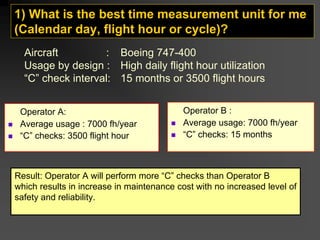
1) What is the best time measurement unit for me
(Calendar day, flight hour or cycle)?
Operator A:
„ Average usage : 7000 fh/year
„ “C” checks: 3500 flight hour
Operator B :
„ Average usage: 7000 fh/year
„ “C” checks: 15 months
Aircraft : Boeing 747-400
Usage by design : High daily flight hour utilization
“C” check interval: 15 months or 3500 flight hours
Result: Operator A will perform more “C” checks than Operator B
which results in increase in maintenance cost with no increased level of
safety and reliability.
2) What is the optimum time limit for part
scheduled replacements or inspections?
„ Scheduled tasks are to be performed at regular intervals.
„ Maintenance Planning Document (MPD) prepared by the
manufacturer is the main document that provides the
user with time intervals for various tasks.
„ However, these are recommended intervals by the
manufacturer. Each operator should customize these
recommended time intervals based upon its own
operating and environmental conditions, maintenance
capabilities.
„ To determine the optimal interval is a very difficult task
that has to be based on information about the failure rate
function.
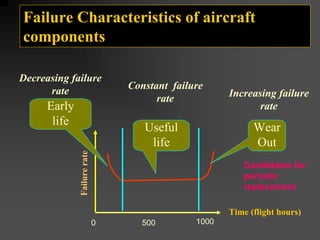
Operating life and failures of a
component
Operating life of a component may include
three periods from the failures point of view:
„ Early life period
„ Useful life period
„ Wear-out life period
Failure Characteristics of aircraft
components
Time (flight hours)
Failur
e
rate
Early
life
Useful
life
Wear
Out
Candidates for
periodic
replacement
Decreasing failure
rate Constant failure
rate Increasing failure
rate
1000
500
0
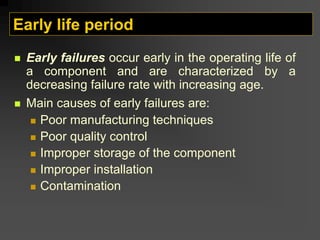
Early life period
„ Early failures occur early in the operating life of
a component and are characterized by a
decreasing failure rate with increasing age.
„ Main causes of early failures are:
„ Poor manufacturing techniques
„ Poor quality control
„ Improper storage of the component
„ Improper installation
„ Contamination
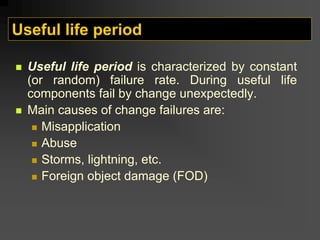
Useful life period
„ Useful life period is characterized by constant
(or random) failure rate. During useful life
components fail by change unexpectedly.
„ Main causes of change failures are:
„ Misapplication
„ Abuse
„ Storms, lightning, etc.
„ Foreign object damage (FOD)
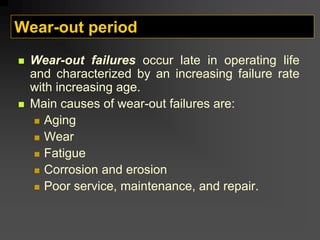
Wear-out period
„ Wear-out failures occur late in operating life
and characterized by an increasing failure rate
with increasing age.
„ Main causes of wear-out failures are:
„ Aging
„ Wear
„ Fatigue
„ Corrosion and erosion
„ Poor service, maintenance, and repair.
Case study
ESTIMATION OPTIMUM TIME OF REPLACEMENT
FOR AN AIRCRAFT COMPONENT
„ Manufacturer's maintenance document
recommends replacement of a spring in aircraft
APU fuel pump at an interval of 60 flight hours.
„ Although you are applying the manufacturer
recommendation, fuel pump often fails
unexpectedly and produce many unscheduled
maintenance tasks.
„ You are assigned to analyze and recommend
solution to this problem.
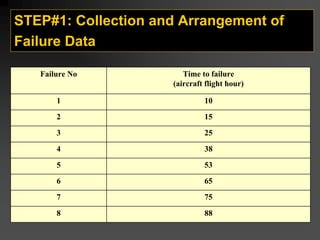
STEP#1: Collection and Arrangement of
Failure Data
Time to failure
(aircraft flight hour)
Failure No
10
1
15
2
25
3
38
4
53
5
65
6
75
7
88
8
STEP#2: Calculation of failure rate
Failure rate
Time
between
failures
∆t
Time
to
failure
(flight hour)
Failure Number
( i )
1 / [(5)(8+1-1)]=0.025
10
1
0.014
15
2
0.013
13
25
3
0.013
15
38
4
0.020
12
53
5
0.033
10
65
6
0.040
13
75
7
-
-
88
8
)
i
1
n
)(
t
(
1
FR
−
+
Δ
=
n= 8 (total number of failures)
15-10=5
25-15=10
?
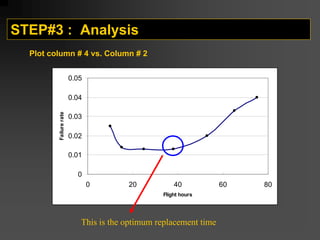
STEP#3 : Analysis
0
0.01
0.02
0.03
0.04
0.05
0 20 40 60 80
Flight hours
Failure
rate
This is the optimum replacement time
Plot column # 4 vs. Column # 2
CONTINUOUS AIRWORTHINESS
MAINTENANCE PROGRAM (CAMP)
„ A continuous airworthiness maintenance
program (CAMP) is the set of processes
certificate holders (operators) must use to
keep their aircraft in an airworthy
condition.
„ The FAA requires operators to establish
and maintain two separate, but equal,
functions within their CAMP :
- required maintenance actions
- required maintenance inspection
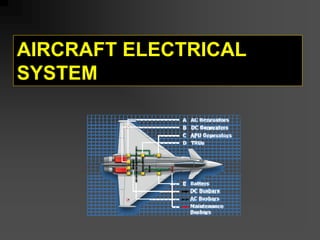
AIRCRAFT ELECTRICAL
SYSTEM
Electrical System
„ Electrical Power sources
„ Electrical Components
- Control devices
- Conversion devices
- Protection devices.
„ Power distribution systems and loads
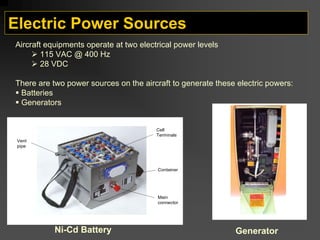
Electric Power Sources
Cell
Terminals
Container
Main
connector
Vent
pipe
Ni-Cd Battery Generator
Aircraft equipments operate at two electrical power levels
¾ 115 VAC @ 400 Hz
¾ 28 VDC
There are two power sources on the aircraft to generate these electric powers:
ƒ Batteries
ƒ Generators
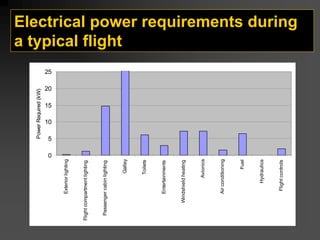
Electrical power requirements during
a typical flight
0
5
10
15
20
25
Exterior
lighting
Flight
compartment
lighting
Passenger
cabin
lighting
Galley
Toilets
Entertainments
Windshield
heating
Avionics
Air
conditioning
Fuel
Hydraulics
Flight
controls
Power
Required
(kW)
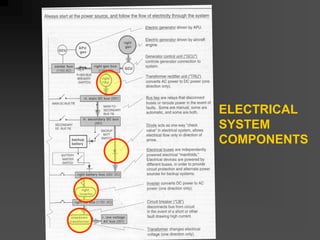
ELECTRICAL
SYSTEM
COMPONENTS
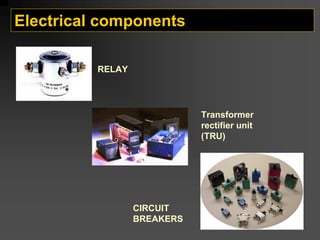
Electrical components
RELAY
Transformer
rectifier unit
(TRU)
CIRCUIT
BREAKERS
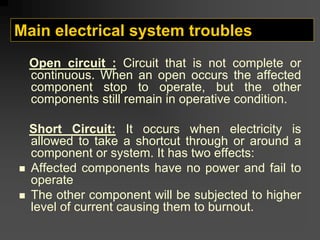
Main electrical system troubles
Open circuit : Circuit that is not complete or
continuous. When an open occurs the affected
component stop to operate, but the other
components still remain in operative condition.
Short Circuit: It occurs when electricity is
allowed to take a shortcut through or around a
component or system. It has two effects:
„ Affected components have no power and fail to
operate
„ The other component will be subjected to higher
level of current causing them to burnout.
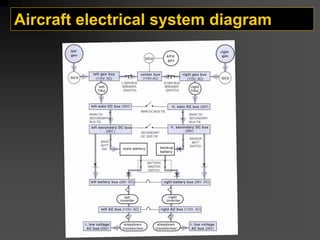
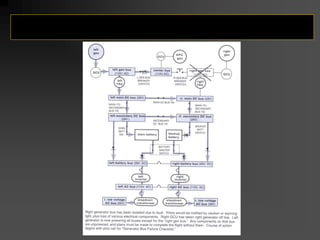
Aircraft electrical system diagram
Right generator bus fault
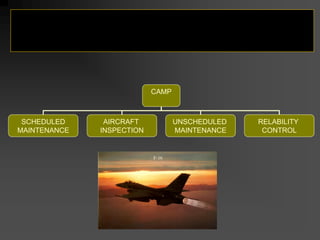
CONTINUOUS AIRWORTHINESS
MAINTENANCE PROGRAM (CAMP)
CAMP
SCHEDULED
MAINTENANCE
AIRCRAFT
INSPECTION
UNSCHEDULED
MAINTENANCE
RELABILITY
CONTROL

methods of maintenance.pdf

  • 1.
  • 2.
    Objectives Become familiar withaircraft ground handling procedures Understand operation principles, components & maintenance practices of aircraft systems Provide you with basic knowledge of non destructive inspection methods Improve your understanding for analyzing, developing and managing aircraft maintenance programs
  • 3.
    Course Outline Aircraft GroundHandling Aircraft Systems/avionics/engine Corrosion and Aircraft Inspection Methods Aircraft Maintenance Planning & Management
  • 4.
  • 5.
    Sources of Hazardin Ground Operations Fuel Electricity Compressed gases Spilled oil and grease Foreign Objects Running aircraft
  • 6.
    Be careful aroundrunning aircraft
  • 7.
    It is alsobetter to be careful in front of the running engine
  • 8.
    Ground Support Services& Operations „ Electric &Hydraulic service „ Air conditioning & Heating „ Refueling „ Towing& taxiing „ Baggage loading „ Passenger boarding „ Catering „ Others
  • 9.
    Ground Support Equipments(GSE) GPU (Ground Power Unit-Electricity) Air conditioning unit Air Starter
  • 10.
  • 11.
  • 12.
    Aircraft should onlybe towed by appropriate vehicle
  • 13.
    Example : B-777Ground servicing Fuel Cargo water Clean Food Elect. air a/c Tow Lav Fuel Food Cargo
  • 14.
    A typical groundhandling of an aircraft
  • 15.
    1. Towing 2. Rampmovements 3. Ground service equipment (GSE) 4. Hangar movements 0 10 2 0 3 0 4 0 50 Hangar GSE Ramp towing F requencyof events % Most significant risk factors for ground damages
  • 16.
    IATA (International AirTransport Association) estimates that ground damages cost $5 billion/yr
  • 17.
  • 18.
  • 19.
    Hydraulic System Hydraulic powered systems Utility Systems FlightControl Systems ƒ Landing gear ƒ Brakes ƒ Steering ƒ Cargo doors
  • 20.
  • 21.
    Basic hydraulic systemcomponents „ Reservoirs „ Pumps „ Valves „ Accumulators „ Filters „ Actuators „ Back-up systems
  • 22.
  • 24.
  • 25.
  • 26.
    Hydraulic system failures Thereare two main causes of hydraulic system failures: „ Hydraulic fluid contamination „ Hydraulic leakage
  • 27.
    Hydraulic Contamination Solid Contamination Fluid Contamination - Air -Water - Solvents - Foreign fluids Hydraulic contamination - Organic - Metallic - Inorganic
  • 28.
    Hydraulic leakage maycome from wrong pipe installation or crack on components
  • 29.
  • 30.
    Functions of pneumaticsystem High-pressure system provides power for: „ Engine and wing anti icing „ Operating engine thrust reversers „ Cabin pressurization, heating and cooling „ Powering engine starters Low pressure system provides power for: „ Driving gyros in the flight instruments „ Deicing boots „ Inflation of door seals to sustain pressurization
  • 31.
  • 32.
  • 33.
    APU functions „ Startengine „ Power generators to provide auxiliary electrical power „ Power environmental systems such as air conditioning „ Provide power for crew functions such as preflight and galley operations
  • 34.
  • 35.
    AIRCRAFT FLIGHT CONTROL AIRCRAFTFLIGHT CONTROL SYSTEM SYSTEM
  • 36.
    Flight Control Systems FLIGHTCONTROL SYSTEMS SECONDARY FLIGHT CONTROLS SECONDARY FLIGHT CONTROLS PRIMARY FLIGHT CONTROLS PRIMARY FLIGHT CONTROLS •AILERONS •ELEVATORS •RUDDERS •FLAPS •LEADING EDGE DEVICES •SPOILERS •SPEED BRAKES •TRIM & CONTROL TABS
  • 37.
  • 38.
  • 39.
    Secondary Flight controlsurfaces SPEED BRAKE
  • 40.
    Aircraft flight controlsurfaces C:Documents and ettingsAdministrato
  • 41.
    Types of controllinkage systems „ Mechanical command & mechanical actuation „ Mechanical command & hydraulic actuation „ Electric signal command & hydraulic actuation (Fly by wire)
  • 42.
  • 43.
    Mechanical command-Hydraulic actuation Hydraulic Supply Hydraulic servo valve Hydraulic actuator Reducespilot effort when control hinge moments are large, e.g. large control displacements at high speed Pilot provides input Mechanic rod Transmits input Hydraulic system provides power Surface moves
  • 44.
  • 45.
    Electrical command- hydraulicactuation Hydraulic Supply Analogue Computer Electrical Supply Electro-hydraulic servovalve Side-stick controller wire wire 9Pilot provides input, computer controls the input, electrical wire transmits the input, hydraulic system provides power. Pilot provides input Computer controls input Electric wire transmits input Hydraulic system provides power Surface moves
  • 46.
  • 47.
    Main reasons forflight control malfunctions „ Maneuvers that have exceeded operational design limits of the control system. „ Corrosion and/or distorted or disconnected linkage. „ Inadequate lubrication and external contamination.
  • 48.
    In-flight failures offlight control system Most significant causes of failures are flaps and vibration.
  • 49.
    AIRCRAFT LANDING GEAR AIRCRAFTLANDING GEAR SYSTEM SYSTEM
  • 50.
    Functions of landinggear system „ Support the weight of the aircraft while it is on the ground „ Take off and land the aircraft safely „ Absorb landing and taxiing shocks „ Steer the aircraft „ Stop the aircraft
  • 51.
    Main landing gear Sidestrut Tork links Drag Strut Oleo Strut
  • 52.
  • 53.
  • 54.
  • 55.
    Forgetting to removethe safety pin is a contributing factor in LG failure
  • 56.
  • 57.
    Aircraft Fuel System Providescontinuous flow of fuel to engine in all flight conditions. Main components are: „ Fuel tanks „ Fuel Pumps and valves „ Fuel Filters „ Fuel heaters „ Fuel instruments
  • 58.
    Fuel tanks Centre wing box tank Inboardand outboard wing box tanks Tail plane torsion box tanks
  • 59.
  • 60.
  • 61.
  • 62.
    Fuel system troubles „Contamination - Water - Mixing with other types of fuel - Foreign particles - Microbial growth - Sediment „ Leakage
  • 63.
  • 64.
    AIRCRAFT CABIN AIRCRAFT CABIN ATMOSPHERE ATMOSPHERE (ENVIRONMENTALCONTROL) (ENVIRONMENTAL CONTROL) SYSTEM SYSTEM
  • 65.
    Functions of cabinpressurization system „ Automatically maintain a maximum cabin altitude of about 8 000' at the aircraft's maximum designed cruising altitude „ Prevent rapid changes of cabin altitude regardless of rate of climb or descent „ Reasonably fast fresh air exchange to eliminate odors and remove stale air
  • 66.
  • 67.
    Cabin altitude vs.aircraft altitude
  • 68.
    System components Outflow valve Pos.Pres. Safety valves Neg. Pres. Safety valve
  • 69.
    Pressurization valves onaircraft Pos .Pres. Safety valves Outflow valve Neg. Pres. Safety valve
  • 70.
  • 71.
    Air conditioning system „Maintain a comfortable cabin temperature throughout al conditions of flight „ Control cabin humidity to assure passenger comfort „ Prevent window fogging „ Provide cooling for avionics
  • 72.
    Types of airconditioning systems There are two types of air conditioning system used in aircraft. „ Air cycle machine (ACM) system „ Vapor cycle system Air Cycle Machine
  • 73.
    Operation of aircycle machine 1 3 4 5 6 Compressor Turbine 2 FVC :Flow Control Valve PHX: Primary Heat Exchanger MHX : Main Heat Exchanger RHX: Reheater CD : Condenser WE: Water extractor
  • 74.
  • 75.
    Air conditioning packs/ramair inlets RAM AIR INLETS AC PACK#1 AC PACK#2 Ram air outlets
  • 76.
    Distribution of conditionedair Temperature Sensor
  • 77.
    Environmental system failures Between2001 and 2004, 14% of in-flight interruptions have been attributed to environmental control system. They can be further divided as shown in the figure.
  • 78.
    Water separator isthe major problematic component with the highest failures.
  • 79.
  • 80.
    Operation of aturbine engine
  • 81.
  • 82.
  • 83.
  • 84.
  • 85.
  • 86.
  • 87.
  • 88.
  • 89.
  • 90.
    Thrust reversers „ Shortenthe routine landing distance „ Reduce the load on the brakes „ Improve braking control on wet, snow- covered or icy runways
  • 91.
    Types of thrustreversers Clamshell reverser Cascade reverser
  • 92.
    Engine Malfunctions „ CompressorSurge: A compressor surge (sometimes called a compressor stall) is the result of instability of the air flow through compressor. It is recognized by a loud bang similar to an explosion. „ Flame out: A flameout is a condition where the combustion process within the burner has stopped. ƒ Hot Start: During engine start, due to fuel scheduling, strong tail wind, etc. turbine temperature rises to relatively high temperatures. This is known as a hot start.
  • 93.
    Engine Malfunctions „ ForeignObject Damage: Foreign Object Damage (FOD) is ingestion of objects such as tire fragments, runway debris or animals into the engine. „ Engine Seizure: Engine seizure describes a situation where the engine rotors stop turning in flight, perhaps very suddenly. The static and rotating parts lock up against each other, bringing the rotor to a halt.
  • 94.
    Engine failure causes Majorfailure causes of aircraft engine during the last four years: - Vibration - Low pressure compressor (N1) problem - Compressor vane
  • 95.
    Engine Maintenance „ ColdSection - Compressor - Foreign Object Damage „ Hot Section - Combustion chamber, turbine, exhaust - Cracks due to thermal shocks - Dictates TBO (time before overhaul)
  • 96.
  • 97.
  • 98.
    Most Common Typesof Aircraft Corrosion Pitting corrosion Crevice corrosion Intergranular corrosion Exfoliation corrosion Bimetalic corrosion Stress cracking corrosion Fretting corrosion
  • 99.
    Pitting corrosion „ Pittingcorrosion is a localized form of corrosion by which cavities or "holes" are produced in the material.
  • 100.
    Crevice corrosion „ Crevicecorrosion is a localized form of corrosion usually associated with a stagnant solution in crevices (shielded areas) such as those formed under gaskets, washers, insulation material, fastener heads.
  • 101.
    Intergranular corrosion Integranular corrosion islocalized attack along the grain boundaries. Microscopic picture of Inter-granular corrosion of an aircraft component made of 7075-T6 aluminum
  • 102.
    Exfoliation corrosion „ Itis the severe form of intergranular corrosion.
  • 103.
    Bimetalic (dissimilar metal)corrosion It occurs when two (or more) dissimilar materials are brought into electrical contact under water. A stainless steel screw in contact with a cadmium plated steel washer.
  • 104.
    Stress corrosion cracking „It occurs as the result of the combined effect of sustained tensile stresses and a corrosive environment. Stress corrosion crack on horizontal stabilizer due to severe metal forming.
  • 105.
    Fretting corrosion „ Itoccurs when two mating surfaces, normally at rest which respect to each one another, are subject to slight relative motion. Corroded pins Fretting corrosion of tin-plated electrical connector pins mated with gold-plated sockets in F-16 aircraft main fuel shutoff valve.
  • 106.
    Corrosion prone areas Exhaustareas Battery compartment Engine inlet Wheel well Flap enclosure
  • 107.
    Avionic systems corrosion Avionicsare more prone to corrosion than aircraft because; „ Dissimilar metals are often in electrical contact „ Small amount of corrosion can make equipment inoperative
  • 108.
    Effect of AtmosphericConditions Weather conditions Atmospheric pollutants
  • 109.
    Atmospheric conditions atan air force base in Turkey ANNUAL MEAN PARAMETER 10.32 Absolute humidity (g/m3) 76.00 Relative humidity (%) 14.30 Temperature (˚C) 69.44 Rainfall (cm) 70.00 Particulates (μg/m3) 170.00 Sulfur dioxide (g/m3) 1.50 Distance to sea (km)
  • 110.
    Protective maintenance againstaircraft corrosion Washing Sealing / Application of inhibitors Protective coating (metallic, organic) Maintaining water drain valves and drain holes for proper operation Training and equipment
  • 111.
  • 112.
  • 113.
    Non-destructive inspection (NDI) methods „Penetrant inspection „ Magnetic particle inspection „ Eddy current inspection „ Radiography inspection „ Ultrasonic inspection „ Borescope inspection
  • 114.
    Penetrant inspection 1 1 -Cleaning 2 - Drying 3 - Dye application 4 - Inspection 2 3 4 ƒDetects only surface cracks ƒEasiest method
  • 115.
  • 116.
    Magnetic particle inspection 12 4 1 - Cleaning 2 - Magnetization 3 - Powder application 4 - Inspection 3 Detects surface or near-surface cracks only in ferrous parts.
  • 117.
    Magnetic particle inspection Longitudinalmagnetization Lateral magnetization
  • 118.
  • 119.
  • 120.
    Eddy current testing Detectsurface or near-surface cracks in conductive parts.
  • 121.
  • 122.
  • 123.
    Ultrasonic inspection It candetect cracks inside the metallic & nonmetallic part.
  • 124.
  • 125.
  • 126.
  • 127.
    Radiography Inspection It canbe used to detect crack inside the ferrous and non-ferrous materials
  • 128.
    Borescope inspection It isused to inspect the areas which are hardly accessible such as engine compressor & turbine
  • 129.
  • 130.
  • 131.
    Quick reference forchoosing appropriate NDI method NDI method Material Discontinuity Type PT/ET/RT Nonferrous MT/PT/RT Ferrous RT/ET Nonferrous RT/UT Nonferrous/ferrous UT/RT/ET Nonferrous Corrosion UT Metal/composites Laminations RT=Radiographic testing UT=Ultrasonic testing ET=Eddy current testing MT=Magnetic part testing PT=Penetrant testing Sub-surface cracks Surface cracks
  • 132.
  • 133.
    Maintenance Maintenance is anyone or combination of activities such as; „ Inspection „ Modification „ Repair „ Replacement „ Overhaul to restore an aircraft or aircraft component or to keep it in working condition.
  • 134.
    Authorities involved inmaintenance program development AUTHORIES REGULATORY BODIES MANUFACTURERS OPERATORS •FAA (Federal Aviation administration) •EASA (European Aviation Safety Admin.) •ICAO (International Civil Aviation Organization)
  • 135.
    Maintenance Regulations & Documents MaintenanceManuals Service Bulletins Federal Aviation Regulations (FAR) Joint Aviation Requirements (JAR) Airworthiness Directives Advisory Circulars Minimum Equipment List (MEL) Technical orders
  • 136.
    Maintenance Processes „ Preventivemaintenance Predictive maintenance is performed in order to prevent failure of an item or to discover a hidden failure. „ Corrective maintenance Corrective maintenance is performed after the failure to correct the fault.
  • 137.
    Maintenance Processes inaviation „ Hard time „ On condition „ Condition Monitoring Maintenance Operations Flight operations
  • 138.
    Hard-time Maintenance ¾ Itis the oldest, primary preventive maintenance process. ¾ It requires that an appliance or part be periodically overhauled at certain intervals in accordance with the carrier’s maintenance program, or it should be removed from the service. ¾ As soon as the part age reaches predetermined time (flight hour, cycle, or calendar time), it is overhauled or replaced with a new component.
  • 139.
    On-condition Maintenance ¾ Thisis a primary preventive maintenance process. ¾ It requires that an appliance or part be periodically inspected or checked against some appropriate physical standards to determine weather it can continue in service. ¾ The purpose is to use the part as long as possible before it fails during normal operation (in service operation)
  • 140.
    Condition Monitoring ¾ Thisis a maintenance process for items that have neither “hard time” or “on-condition” maintenance as their primary maintenance process. ¾ Condition monitoring is the maintenance process for locating and resolving problem areas through analytical study of malfunctions or failures, not affecting safety of aircraft.
  • 141.
  • 142.
    Aircraft operator maintenance program Anair carrier's maintenance program should contain at least the following information: 1) What (Item to be maintained) 2) When (time limit) 3) How (task)
  • 143.
    1) Items tobe maintained (What ?) The item (part, component, or system) to be maintained should be indicated clearly and accurately. This is done usually by ATA (air Transport Association) Chapter numbers, part serial numbers, etc.
  • 144.
    2) Time Limit(When ?) ¾ The time limit is the maintenance interval when you perform the maintenance task. ¾ There are three (3) units of measure used to establish these limits. An item may have no limits, one limit, or any combination of these limits.
  • 145.
    Time Limit „ CALENDERTIME „ FLIGHT HOURS „ CYCLES (no. of landings)
  • 146.
    3) Maintenance Tasks(How ?) These include the maintenance services to be done. The maintenance program consists of three types of tasks: „ Scheduled maintenance tasks „ Unscheduled maintenance tasks „ Specific maintenance requirements for major components of aircraft (engine, propeller, etc.)
  • 147.
    Types of ScheduledMaintenance Tasks (services) „ Preflight / post-flight „ Transit Service „ Overnight Heavy Service „ Heavy Maintenance Service „ Overhaul Service
  • 148.
    Maintenance tasks andletter checks „ In maintenance program, the maintenance tasks which are carried out at the same time are grouped into maintenance packages. „ These maintenance packages are indicated by "A", "B", "C" and "D" checks. For this reason they are called "letter checks".
  • 149.
    Transfer of tasktypes in maintenance program CHECK SERVICE TYPE A OVERNIGHT HEAVY SERVICE C HEAVY MAINTENANCE SERVICE D OVERHAUL SERVICE
  • 150.
    Military aircraft maintenance Maintenancelevels Ordinary (O) Intermediate (I) Depot (D) Maintenance types Pre-flight inspections, scheduled maintenance, minor failure repair Term maintenance, failure repair Term maintenance, damage repair Location Squadron Airbase Factory-level facility Duration Minutes - hours Hours - weeks Weeks - months Example tasks Refueling, minor repairs, e.g. light bulb change Component change/repair, e.g. hydraulic pump change Elaborate component or structure changes/repairs, e.g. bird crash repair
  • 151.
    How to packagethe maintenance tasks? There are two questions that need to be answered about the TIME LIMIT correctly: 1)What is the best time measurement unit (Calendar day, flight hour or cycle)? 2)What is the optimum time limit for part replacements or inspections?
  • 152.
    1) What isthe best time measurement unit for me (Calendar day, flight hour or cycle)? Operator A: „ Average usage : 7000 fh/year „ “C” checks: 3500 flight hour Operator B : „ Average usage: 7000 fh/year „ “C” checks: 15 months Aircraft : Boeing 747-400 Usage by design : High daily flight hour utilization “C” check interval: 15 months or 3500 flight hours Result: Operator A will perform more “C” checks than Operator B which results in increase in maintenance cost with no increased level of safety and reliability.
  • 153.
    2) What isthe optimum time limit for part scheduled replacements or inspections? „ Scheduled tasks are to be performed at regular intervals. „ Maintenance Planning Document (MPD) prepared by the manufacturer is the main document that provides the user with time intervals for various tasks. „ However, these are recommended intervals by the manufacturer. Each operator should customize these recommended time intervals based upon its own operating and environmental conditions, maintenance capabilities. „ To determine the optimal interval is a very difficult task that has to be based on information about the failure rate function.
  • 154.
    Operating life andfailures of a component Operating life of a component may include three periods from the failures point of view: „ Early life period „ Useful life period „ Wear-out life period
  • 155.
    Failure Characteristics ofaircraft components Time (flight hours) Failur e rate Early life Useful life Wear Out Candidates for periodic replacement Decreasing failure rate Constant failure rate Increasing failure rate 1000 500 0
  • 156.
    Early life period „Early failures occur early in the operating life of a component and are characterized by a decreasing failure rate with increasing age. „ Main causes of early failures are: „ Poor manufacturing techniques „ Poor quality control „ Improper storage of the component „ Improper installation „ Contamination
  • 157.
    Useful life period „Useful life period is characterized by constant (or random) failure rate. During useful life components fail by change unexpectedly. „ Main causes of change failures are: „ Misapplication „ Abuse „ Storms, lightning, etc. „ Foreign object damage (FOD)
  • 158.
    Wear-out period „ Wear-outfailures occur late in operating life and characterized by an increasing failure rate with increasing age. „ Main causes of wear-out failures are: „ Aging „ Wear „ Fatigue „ Corrosion and erosion „ Poor service, maintenance, and repair.
  • 159.
    Case study ESTIMATION OPTIMUMTIME OF REPLACEMENT FOR AN AIRCRAFT COMPONENT „ Manufacturer's maintenance document recommends replacement of a spring in aircraft APU fuel pump at an interval of 60 flight hours. „ Although you are applying the manufacturer recommendation, fuel pump often fails unexpectedly and produce many unscheduled maintenance tasks. „ You are assigned to analyze and recommend solution to this problem.
  • 160.
    STEP#1: Collection andArrangement of Failure Data Time to failure (aircraft flight hour) Failure No 10 1 15 2 25 3 38 4 53 5 65 6 75 7 88 8
  • 161.
    STEP#2: Calculation offailure rate Failure rate Time between failures ∆t Time to failure (flight hour) Failure Number ( i ) 1 / [(5)(8+1-1)]=0.025 10 1 0.014 15 2 0.013 13 25 3 0.013 15 38 4 0.020 12 53 5 0.033 10 65 6 0.040 13 75 7 - - 88 8 ) i 1 n )( t ( 1 FR − + Δ = n= 8 (total number of failures) 15-10=5 25-15=10 ?
  • 162.
    STEP#3 : Analysis 0 0.01 0.02 0.03 0.04 0.05 020 40 60 80 Flight hours Failure rate This is the optimum replacement time Plot column # 4 vs. Column # 2
  • 163.
    CONTINUOUS AIRWORTHINESS MAINTENANCE PROGRAM(CAMP) „ A continuous airworthiness maintenance program (CAMP) is the set of processes certificate holders (operators) must use to keep their aircraft in an airworthy condition. „ The FAA requires operators to establish and maintain two separate, but equal, functions within their CAMP : - required maintenance actions - required maintenance inspection
  • 164.
  • 165.
    Electrical System „ ElectricalPower sources „ Electrical Components - Control devices - Conversion devices - Protection devices. „ Power distribution systems and loads
  • 166.
    Electric Power Sources Cell Terminals Container Main connector Vent pipe Ni-CdBattery Generator Aircraft equipments operate at two electrical power levels ¾ 115 VAC @ 400 Hz ¾ 28 VDC There are two power sources on the aircraft to generate these electric powers: ƒ Batteries ƒ Generators
  • 167.
    Electrical power requirementsduring a typical flight 0 5 10 15 20 25 Exterior lighting Flight compartment lighting Passenger cabin lighting Galley Toilets Entertainments Windshield heating Avionics Air conditioning Fuel Hydraulics Flight controls Power Required (kW)
  • 168.
  • 169.
  • 170.
    Main electrical systemtroubles Open circuit : Circuit that is not complete or continuous. When an open occurs the affected component stop to operate, but the other components still remain in operative condition. Short Circuit: It occurs when electricity is allowed to take a shortcut through or around a component or system. It has two effects: „ Affected components have no power and fail to operate „ The other component will be subjected to higher level of current causing them to burnout.
  • 171.
  • 172.
  • 173.
    CONTINUOUS AIRWORTHINESS MAINTENANCE PROGRAM(CAMP) CAMP SCHEDULED MAINTENANCE AIRCRAFT INSPECTION UNSCHEDULED MAINTENANCE RELABILITY CONTROL