Methods of IT Project Management 2nd Edition Jeffrey L. Brewer
Methods of IT Project Management 2nd Edition Jeffrey L. Brewer
Methods of IT Project Management 2nd Edition Jeffrey L. Brewer
Methods of IT Project Management 2nd Edition Jeffrey L. Brewer
Methods of IT Project Management 2nd Edition Jeffrey L. Brewer
1.
Methods of ITProject Management 2nd Edition
Jeffrey L. Brewer pdf download
https://ebookfinal.com/download/methods-of-it-project-
management-2nd-edition-jeffrey-l-brewer/
Explore and download more ebooks or textbooks
at ebookfinal.com
2.
We believe theseproducts will be a great fit for you. Click
the link to download now, or visit ebookfinal
to discover even more!
Project Management for It Related Projects Roger Ireland
https://ebookfinal.com/download/project-management-for-it-related-
projects-roger-ireland/
Syngress IT Security Project Management Handbook 1st
Edition Susan Snedaker
https://ebookfinal.com/download/syngress-it-security-project-
management-handbook-1st-edition-susan-snedaker/
Fundamentals of Technology Project Management 2nd Edition
Colleen Garton
https://ebookfinal.com/download/fundamentals-of-technology-project-
management-2nd-edition-colleen-garton/
The Handbook of Project Management A Practical Guide to
Effective Policies and Procedures 2nd Edition Trevor L
Young
https://ebookfinal.com/download/the-handbook-of-project-management-a-
practical-guide-to-effective-policies-and-procedures-2nd-edition-
trevor-l-young/
3.
Project Management ToolkitThe Basics for Project Success
2nd Edition Trish Melton
https://ebookfinal.com/download/project-management-toolkit-the-basics-
for-project-success-2nd-edition-trish-melton/
Organizational Project Management Maturity Model OPM3
Project Management Institute
https://ebookfinal.com/download/organizational-project-management-
maturity-model-opm3-project-management-institute/
The PMI Project Management Fact Book Second Edition
Project Management Institute
https://ebookfinal.com/download/the-pmi-project-management-fact-book-
second-edition-project-management-institute/
A Guide to the Project Management Body of Knowledge PMBOK
Guide Fourth Edition Project Management Institute
https://ebookfinal.com/download/a-guide-to-the-project-management-
body-of-knowledge-pmbok-guide-fourth-edition-project-management-
institute/
A Guide to the Project Management Body of Knowledge PMBOK
Guide Sixth Edition Project Management Institute
https://ebookfinal.com/download/a-guide-to-the-project-management-
body-of-knowledge-pmbok-guide-sixth-edition-project-management-
institute/
5.
Methods of ITProject Management 2nd Edition Jeffrey
L. Brewer Digital Instant Download
Author(s): Jeffrey L. Brewer, Kevin C. Dittman
ISBN(s): 9781557536631, 1557536635
Edition: 2
File Details: PDF, 19.80 MB
Year: 2013
Language: english
Dedication
To my wifeHeidi and children Jessica and David for their
love and understanding.
—Jeff
To my family with love.
—Kevin
11.
v
About the Authors
JeffreyL. Brewer
Jeffrey L. Brewer is an associate professor of
Computer & Information Technology (CIT) at
Purdue University. He received a B.S. degree
in Computer Technology in 1982 from Purdue
University and an M.S. degree in Management
Information Systems from the University of
Missouri, St. Louis in 1995. Professor Brewer’s
teaching and scholarly interests include sys-
tems analysis and design, computer-aided
software engineering (CASE), agile develop-
ment methodologies, IT project management,
and telecare/ telemedicine technology solu-
tions. Jeff obtained his PMP certification in
2002. Before returning to Purdue to teach, he
spent 19 years working in several different
industry environments, including specialty
retail, manufacturing, and medical association
management. He spent most of those 19 years
in a project manager role.
Kevin C. Dittman is an associate professor of
Computer Information Systems and Technol-
ogy at Purdue University. He received a B.S.
degreeinComputerSciencein1981fromPurdue
University and an M.S. in Management from
the Florida Institute of Technology in 1989.
Professor Dittman specializes in information
systems analysis and design, systems engi
neering, requirements engineering, quality
process improvement, and project manage-
ment. He co-authored the leading textbook
Systems Analysis and Design Methods, and he
has published several papers and journal ar-
ticles on use case modeling, IT quality, and
project management. Professor Dittman has
over 32 years of industrial and consulting
experience in the IT arena, with top corpora-
tions such as Catepillar, Cook Medical, and
Cummins Engine.
Kevin C. Dittman
13.
Brief Contents
About theAuthors v
Preface xix
Part 1 Project Management Overview 1
1. Introduction to Project Management 3
2. A Systems View and Systems Methodology 31
3. The Project Management Framework 55
Part 2 Project Initiation and Planning Methods 87
4. Project Selection and Initiation 89
5. Project Scope and Human Resources Planning 131
6. Project Time and Cost Planning 165
7. Project Quality, Communications, and Stakeholder Planning 215
8. Project Risk Management Planning 251
9. Project Procurement Planning 283
Part 3 Project Execution and Control Methods 311
10. Project Execution 313
11. Project Monitoring and Control, Part I 349
12. Project Monitoring and Control, Part II 379
Part 4 Project Closeout Methods and Advanced Topics 401
13. Project Closure 403
14. Advanced Topics in Project Management 421
Part 5 Appendixes 443
A. Microsoft Project Help Guide 445
B. Project Management Templates 507
C. Project Management Professional (PMP) Certification Help Guide 525
Glossary 535
Index 547
15.
ix
Contents
About the Authors v
Preface xix
Part 1 Project Management Overview 1
Chapter 1 Introduction to Project Management 3
The Project Management Chronicles 3
How to Use the Demonstration Case 7
Chapter Preview and Objectives 8
An Introduction to Project Management 8
The History of Project Management 10
Project Management Definitions 13
The Triple Constraint 15
The Need for Better Project Management 16
Profiles of Project Managers and the Profession 17
Where in the Organization Does a Project Manager Work? 19
Organizational Structures (Formal and Informal) 20
Chapter Review 25
Glossary 26
Review Questions 26
Problems and Exercises 27
Projects and Research 27
Minicases 28
Suggested Readings 29
Chapter 2 A Systems View and Systems Methodology 31
Chapter Preview and Objectives 32
The Systems Approach to Project Management 33
The Project Management Life Cycle 36
The Product Systems Development Life Cycle 38
The Waterfall Model 39
The Evolutionary Prototyping Model 39
The Spiral Model 41
Iterative and Incremental Model 41
The Scrum Model 44
16.
x Contents
The RUPModel 45
The XP Model 45
Integration of Project to Product Life Cycles 47
Chapter Review 50
Glossary 51
Review Questions 52
Problems and Exercises 52
Minicase 53
Suggested Readings 54
Chapter 3 The Project Management Framework 55
Chapter Preview and Objectives 56
A Framework for Project Management 56
The Process Groups 58
The Knowledge Areas 61
The Component Processes 61
Initiating Component Processes and Major Deliverables 64
Planning Component Processes and Major Deliverables 66
Execution Component Processes and Major Deliverables 73
Controlling Component Processes and Major Deliverables 76
Closing Component Processes and Major Deliverables 79
Framework Summary 83
Chapter Review 83
Glossary 84
Review Questions 84
Problems and Exercises 85
Projects and Research 85
Minicase 85
Suggested Readings 86
PART 2 Project Initiation and Planning Methods 87
Chapter 4 Project Selection and Initiation 89
Chapter Preview and Objectives 91
An Introduction to Project Selection and Initiation 91
Business Case 93
17.
Contents xi
Project ManagementConcepts: Project Selection and Initiation 94
Strategic Planning 94
Project Selection Models 96
Weighted Scoring Model 102
Additional Project Valuation Techniques 104
Stakeholder Analysis 108
Project Charter 111
Kickoff Meeting 114
Project Selection and the Initiation Process 115
How to Conduct the Project Initiation Process 116
Step 1: Preparing the Business Case 116
Step 2: Creating the Steering Committee 118
Step 3: Reviewing the Strategic Plan and the Current Situation 118
Step 4: Building the WSM 118
Step 5: Reviewing Resource Needs and Availability 119
Step 6: Selecting Projects 119
Step 7: Conducting a Stakeholder Analysis 120
Step 8: Creating the Project Charter 120
Step 9: Securing Sponsor Signatures on Charter 122
Step 10: Conducting the Kickoff Meeting 122
Chapter Review 122
Glossary 123
Review Questions 124
Problems and Exercises 124
Projects and Research 127
Minicases 127
Suggested Readings 129
Chapter 5 Project Scope and Human Resources Planning 131
Chapter Preview and Objectives 132
An Introduction to Scope and Human Resources Planning 132
Project Management Concepts: Scope Management Planning 134
Collecting Requirements 136
Work Breakdown Structure 137
WBS Structure 141
WBS Dictionary 142
18.
xii Contents
Project ManagementConcepts: Human Resources Planning 143
Human Resource Research 143
Authority, Influence, and Power 147
Human Resources Planning Deliverables 149
The Scope and Human Resources Planning Process 152
How to Conduct the Scope and Human Resources Planning Processes 152
Step 1: Create the Scope Management Plan 153
Step 2: Perform the Requirements Discovery and
Documentation Process 153
Step 3: Create the Scope Statement 154
Step 4: Create the WBS 155
Step 5: Create the Roles and Responsibilities
Matrix 156
Chapter Review 157
Glossary 158
Review Questions 159
Problems and Exercises 159
Projects and Research 160
Minicase 160
Suggested Readings 161
Chapter 6 Project Time and Cost Planning 165
Chapter Preview and Objectives 166
Project Management Concepts: Time Planning 167
Plan Schedule Management 168
Define Activities 168
Sequence Activities 169
Estimate Activity Resources 173
Estimate Activity Durations 175
Develop the Project Schedule 186
Project Management Concepts: Cost Planning 196
Estimate Costs 197
Determine Budget 198
The Time and Cost Management Planning Process 198
How to Conduct the Time and Cost Planning
Processes 200
Step 1: Perform Activity Decomposition 200
Step 2: Identify Activity Dependencies 200
19.
Contents xiii
Step 3:Perform Resource Assignments 200
Step 4: Generate Time Estimates 200
Step 5: Create Project Schedule 203
Step 6: Perform Resource Leveling 203
Step 7: Generate Cost Estimates 205
Step 8: Prepare Project Budget 206
Step 9: Obtain Sponsor Approval to Continue 206
Chapter Review 206
Glossary 207
Review Questions 207
Problems and Exercises 208
Projects and Research 211
Minicase 211
Suggested Readings 212
Chapter 7 Project Quality, Communications, and Stakeholder Planning 215
Chapter Preview and Objectives 216
Project Management Concepts: Quality Planning 216
Needed Definitions 220
History of and Key Contributions to Quality 220
Current Quality Initiatives and Standards 224
Process Improvement Maturity Models (CMMI and OPM3) 228
Plan Quality 231
The Quality Planning Process 234
How to Conduct the Quality Planning Processes 235
Quality Planning 235
Project Management Concepts: Communications Planning 240
The Communications Planning Process 242
Communications and Stakeholder Planning 242
Chapter Review 245
Glossary 246
Review Questions 246
Problems and Exercises 247
Projects and Research 247
Minicase 248
Suggested Readings 249
20.
xiv Contents
Chapter 8 Project Risk Management Planning 251
Chapter Preview and Objectives 253
An Introduction to Risk Management Planning 253
Project Management Concepts: Risk Management Planning 255
Identifying Risks 255
Performing Qualitative Risk Analysis 259
Performing Quantitative Risk Analysis 260
Planning Risk Responses 262
Risk Management Planning Process 263
How to Conduct the Risk Planning Processes 264
Step 1: Build the Risk Management Plan 264
Step 2: Perform Risk Identification 264
Step 3: Perform a Risk Assessment 264
Step 4: Complete the Risk Register 265
Step 5: Complete the Risk Management Plan 268
Chapter Review 276
Glossary 276
Review Questions 277
Problems and Exercises 277
Projects and Research 279
Minicase 279
Suggested Readings 280
Chapter 9 Project Procurement Planning 283
Chapter Preview and Objectives 284
An Introduction to Procurement Management Planning 285
Project Management Concepts: Procurement
Management Planning 286
Planning Procurements 286
Understanding Types of Contracts 287
Choosing the Correct Contract Type 289
Creating a Statement of Work (SOW) 291
Creating the Request for Proposal (RFP) and Request
for Quote (RFQ) 292
Developing the Procurement Management Plan 294
The Procurement Management Planning Process 294
21.
Contents xv
How toConduct the Procurement Planning Processes 295
Step 1: Review Existing Planning Artifacts 295
Step 2: Decide What Needs to Be Procured,
How, and When 295
Step 3: Develop the SOW 295
Step 4: Develop the Request for Quote (RFQ) 295
Step 5: Develop the Procurement Management Plan 306
Chapter Review 306
Glossary 307
Review Questions 307
Problems and Exercises 307
Projects and Research 308
Minicase 308
Suggested Readings 309
PART 3 Project Execution and Control Methods 311
Chapter 10 Project Execution 313
Chapter Preview and Objectives 315
An Introduction to Project Execution 315
Project Management Concepts: Project Execution 317
The Integration Management Knowledge Area 317
The Quality Management Knowledge Area 317
Human Resources Management Knowledge Area 318
Leadership 327
Negotiation 328
The Communications Management Knowledge Area 329
The Stakeholder Management Knowledge Area 329
The Procurement Management Knowledge Area 330
The Project Execution Process 332
How to Conduct the Project Execution Process 332
Process 1: Acquire the Project Team 333
Process 2: Develop the Project Team 334
Process 3: Manage the Project Team 334
Process 4: Conduct Procurement 335
Process 4: Quality Audit 336
Process 5: Distribute Information 336
22.
xvi Contents
Chapter Review 342
Glossary 343
Review Questions 343
Problems and Exercises 344
Projects and Research 345
Minicase 345
Suggested Readings 346
Chapter 11 Project Monitoring and Control, Part I 349
Chapter Preview and Objectives 350
An Introduction to Project Monitoring and Control, Part I 351
Project Management Concepts: Project Monitoring and Control 352
The Integration Management Knowledge Area 352
The Scope Management Knowledge Area 358
The Time Management Knowledge Area 359
The Cost Management Knowledge Area 361
The Project Monitoring and Control Process 366
How to Conduct the Monitoring and Control Process, Part I 367
Educate Stakeholders and Team Members 367
Steps 2 and 3: Define Frequency and Automate the
Collection of Status Information 367
Step 4: Distribute Management Project Status Reports 367
Step 5: Conduct the Integrated Change Control Process 371
Step 6: Final Delivery Approval 371
Chapter Review 372
Glossary 372
Review Questions 372
Problems and Exercises 373
Projects and Research 375
Minicase 375
Suggested Readings 376
Chapter 12 Project Monitoring and Control, Part II 379
Chapter Preview and Objectives 381
An Introduction to Project Monitoring and Control, Part II 381
Project Management Concepts: Project Monitoring
and Control 382
Quality Management: Controlling Quality 382
23.
Contents xvii
Communications andStakeholder Management:
Control Communications 387
Project Risk Management: Monitoring and Controlling Risks 387
Project Procurement Management: Control Procurements 388
The Project Monitoring and Control Process 390
How to Conduct the Monitoring and Control Process, Part II 390
Educate Stakeholders and Team Members 390
Steps 2 Through 6 392
Chapter Review 397
Glossary 397
Review Questions 397
Problems and Exercises 398
Projects and Research 399
Minicase 399
Suggested Readings 400
PART 4 Project Closeout Methods and Advanced Topics 401
Chapter 13 Project Closure 403
Chapter Preview and Objectives 404
An Introduction to Project Closure 404
Project Management Concepts: Closing a Project 406
Integration Management—Closing a Project or Phase 406
Procurement Management: Closing Procurements 410
Project Closure Process 411
How to Conduct the Closing Project Process 411
Step 1: Communicate Final Decisions and Start Working
Through the Closeout Checklist 414
Step 2: Update the Project Schedule for Remaining Work,
If Needed 414
Step 3: Obtain Final Approvals/Signatures 414
Step 4: Conduct Final Audits, If Needed 415
Step 5: Schedule and Hold a Final Lessons
Learned Workshop 416
Step 6: Reassign Any Remaining Personnel, If Needed 417
Step 7: Return Any Leased/Borrowed Resources, If Needed 417
Step 8: Publish Results 417
24.
Chapter Review 417
Glossary 418
ReviewQuestions 418
Problems and Exercises 418
Projects and Research 418
Minicase 419
Suggested Readings 420
Chapter 14 Advanced Topics in Project Management 421
Chapter Preview and Objectives 422
The Project Management Office 422
Outsourcing 425
Working in Virtual Teams 428
Project Management–Related Maturity Models 430
The Capability Maturity Model Integrated
(CMMI) 430
The Organizational Project Management Maturity Model (OPM3) 432
Project Management Ethics 434
Chapter Review 439
Glossary 439
Review Questions 440
Projects and Research 440
Suggested Readings 440
PART 5 Appendixes 443
Appendix A Microsoft Project Help Guide 445
Appendix B Project Management Templates 507
Appendix C
Project Management Professional (PMP) Certification Help Guide 525
Glossary 535
Index 547
xviii Contents
25.
xix
Preface
Information technology (IT)is relatively new as a discipline and relatively new to adopting
the concept that project managers need special training and play a unique, important, and
strategic role in an organization. Today, more than ever before, organizations are dependent
on the successful execution of projects to survive. The profitability of an organization is
affected by how successful its projects are and how well they are managed. Due to the size,
complexity, and number of IT projects today, organizations face ever-increasing challenges:
The United States spends $2.3 trillion on projects every year, or one-quarter its gross
domestic product, and the world as a whole spends nearly $10 trillion of its $40.7 gross
product on projects of all kinds.
Worldwide IT spending is expected to rise 3 percent to $3.8 trillion according to
Gartner Research. Fueling this spending is the move to the “Big 4” today: cloud, mobile,
social, and data analytics. This growth is broken down as follows:
• Computing Hardware— Growth (6.6%) Total Spending ($448 billion)
• Enterprise Software— Growth (6.9%) Total Spending ($301 billion)
• IT Services— Growth (4.8%) Total Spending ($905 billion)
• Telecom Equipment— Growth (8.3%) Total Spending ($408 billion)
• Telecom Services— Growth (2.3%) Total Spending ($3,786 billion)
Roger Session, CTO of Object Watch, reports that worldwide the annual cost of IT
failure is around $6.18 trillion (that’s over $500 billion per month). The culprit: increasing
IT complexity.
One key reason for the complexity of IT projects is that IT changes quickly, creating
a shortage of the required IT skill sets. As a result, organizations are forced to pay premi-
ums to acquire the needed talent through permanent hires, contracting, or outsourcing. In the
past, these resources were required to be onsite (at the organization’s office) to work on
the project team. Technology advances have enabled today’s IT employee to work from
home or work in another part of the country or even in separate countries without ever
needing to go to the office. Geographically dispersed project teams present unique chal-
lenges for the success of a project. For organizations to prosper today, they must embrace
project management principles to increase productivity and return on investment (ROI) in
order to create a competitive advantage locally and globally. The world, in many ways, has
become a much smaller place.
The Purpose of This Book
Throughout the United States and much of the rest of the industrialized world, project man-
agement practitioners have recognized the need to improve project management in order to
improve project success and have done so. Examples of initiatives include the
formation of
project management certification programs and training, project management offices and
mentoring programs in many corporations, the advent of university and
college courses
dedicated to project management, and, in December 2008, the development of “The Pro-
ject Management Manifesto in America” by 16 recognized project management experts.
An initiative has been directed at President Obama’s administration to promote better
the Jebel Noṣairiyyeh,and so to the great prison at Tripoli. They were clad, poor
wretches, in ragged cotton clothes and handcuffed together. As they trudged
along bravely through dust and mud, I proffered a word of sympathy, to which
they replied that they hoped God might prolong my life, but as for them it was
the will of their lord the Sultan that they should tramp in chains. One of the
Kurds interrupted with the explanation:
They are deserters from the Sultan's army: may God reward them according to
their deeds! Moreover, they are Ismailis from Selemiyyeh, and they worship a
strange god who lives in the land of Hind. And some say she is a woman, and for
that reason they worship her. And every year she sends an embassy to this
country to collect the money that is due to her, and even the poorest of the
Ismailis provide her with a few piastres. And yet they declare that they are
Muslims: who knows what they believe? Speak, oh Khuḍr, and tell us what you
believe.
The prisoner thus addressed replied doggedly:
We are Muslims; but the soldier's words had given me a clue which I was able
to follow up when the luckless pair crept close to my horse's side and whispered:
Lady, lady! have you journeyed to the land of Hind?
Yes, said I.
May God make it Yes upon you! Have you heard there of a great king called the
King Muḥammad?
Again I was able to reply in the affirmative, and even to add that I myself knew
him and had conversed with him, for their King Muḥammad was no other than
my fellow subject the Agha Khān, and the religion of the prisoners boasted a
respectable antiquity, having been founded by him whom we call the Old Man of
the Mountain. They were the humble representatives of the dreaded (and
probably maligned) sect of the Assassins.
Khuḍr caught my stirrup with his free hand and said eagerly:
Is he not a great king?
But I answered cautiously, for though the Agha Khān is something of a great king
in the modern sense, that is to say he is exceedingly wealthy, it would have been
difficult to explain to his disciples exactly what the polished, well-bred man of the
world was like whom I had last met at a London dinner party, and who had given
me the Marlborough Club as his address. Not that these things, if they could have
understood them, would have shocked them; the Agha Khān is a law unto
himself, and if he chose to indulge in far greater excesses than dinner parties his
actions would be sanctified by the mere fact that they were his. His father used
to give letters of introduction to the Angel Gabriel, in order to secure for his
28.
clients a goodplace in Paradise; the son, with his English education and his
familiarity with European thought, has refrained from exercising this privilege,
though he has not ceased to hold, in the opinion of his followers, the keys of
heaven. They show their belief in him in a substantial manner by subscribing, in
various parts of Asia and Africa, a handsome income that runs yearly into tens of
thousands.
COFFEE BY THE ROAD-SIDE
We rode for about an hour through gardens, meeting bands of low-caste Arabs
jogging into Ḥomṣ on their donkeys with milk and curds for the market, and then
we came to the plain beyond the Orontes, which is the home of these Arabs. The
plain had a familiar air; it was not dissimilar from the country in the Druze hills,
and like the Ḥaurān it was covered with black volcanic stones. It is a vast quarry
for the city of Ḥomṣ. All the stones that are used for building are brought from
beyond the river packed on donkeys. They are worth a metalīk in the town (now
a metalīk is a coin too small to possess a European counterpart), and a man with
a good team can earn up to ten piastres a day. In the Spring the only Arabs who
camp in the Wa'r Ḥomṣ, the Stony Plain of Ḥomṣ, are a despised race that caters
for the needs of the city, for, mark you, no Bedouin who respected himself would
earn a livelihood by selling curds or by any other means except battle; but in the
summer the big tribes such as the Ḥaseneh settle there for a few months, and
after the harvest certain of the 'Anazeh who feed their camels upon the stubble.
These great folk are much like salmon in a trout stream coming in from the open
sea and bullying the lesser fry. When we passed in March there was a good deal
of standing water in the plain, and grass and flowers grew between the stones;
29.
and as wejourneyed westward, over ground that rose gradually towards the hills,
we came into country that was like an exquisite garden of flowers. Pale blue
hyacinths lifted their clustered bells above the tufa blocks, irises and red
anemones and a yellow hawksweed and a beautiful purple hellebore dotted the
grass—all the bounties of the Syrian Spring were scattered on that day beneath
our happy feet. For the first five hours we followed the carriage road that leads
to Tripoli, passing the khān that marks the final stage before the town of Ḥomṣ,
and the boundary line between the vilayets of Damascus and of Beyrout; then we
turned to the right and entered a bridle-path that lay over a land of rolling grass,
partly cultivated and fuller of flowers than the edges of the road had been. The
anemones were of every shade of white and purple, small blue irises clustered by
the path and yellow crocuses by the banks of the stream. In the eyes of one who
had recently crossed southern Syria the grass was even more admirable than the
flowers. The highest summits of the Jebel Noṣairiyyeh are clad with a verdure
that no fertile slope in Samaria or Judæa, can boast. The path mounted a little
ridge and dropped down to a Kurdish village, half Arab tent and half mud-built
wall. The inhabitants must have been long in Syria, for they had forgotten their
own tongue and spoke nothing but Arabic, though, like the two zaptiehs, they
spoke with the clipped accent of the Kurd. Beyond the village a plain some three
miles wide, the Bḳei'a, stretched to the foot of the steep buttress of the
Noṣairiyyeh hills, and from the very top of the mountain frowned the great
crusader fortress towards which we were going. The sun shone on its turrets, but
a black storm was creeping up behind it; we could hear the thunder rumbling in
the hills, and jagged lightning shot through the clouds behind the castle. The
direct road across the Bḳei'a was impassable for horsemen, owing to the flooded
swamps, which were deep enough, said the villagers, to engulf a mule and its
load; we turned therefore reluctantly to the right, and edged round the foot of
the hills. Before we had gone far we met two riders sent out to welcome us by
the Ḳāimaḳām of Ḳal'at el Ḥuṣn, and as they joined us the storm broke and
enveloped us in sheets of rain. Splashing through the mud and drenched with
rain we reached the foot of the hills at five o'clock, and here I left my caravan to
follow the road, and with one of the Ḳāimaḳām's horsemen climbed by a steep
and narrow bridle-path straight up to the hill top. And so at sunset we came to
the Dark Tower and rode through a splendid Arab gateway into a vaulted corridor,
built over a winding stair. It was almost night within; a few loopholes let in the
grey dusk from outside and provided the veriest apology for daylight. At intervals
we passed doorways leading into cavernous blackness. The stone steps were
shallow and wide but much broken; the horses stumbled and clanked over them
as we rode up and up, turned corner after corner, and passed under gateway
after gateway until the last brought us out into the courtyard in the centre of the
keep. I felt as though I were riding with some knight of the Fairy Queen, and half
expected to see written over the arches: Be bold! Be bold! Be not too bold!
30.
But there wasno magician in the heart of the castle—nothing but a crowd of
villagers craning their necks to see us, and the Ḳāimaḳām, smiling and friendly,
announcing that he could not think of letting me pitch a camp on such a wet and
stormy night, and had prepared a lodging for me in the tower.
ḲAL'AT EL ḤUṢN
The Ḳāimaḳām of Ḳal'at el Ḥuṣn is a distinguished man of letters. His name is
'Abd ul Ḥamid Beg Rāfi'a Zādeh, and his family comes from Egypt, where many of
his cousins are still to be found. He lives in the topmost tower of the keep, where
he had made ready a guest chamber commodiously fitted with carpets and a
divan, a four-post bedstead and a mahogany wardrobe with looking-glass doors
of which the glass had been so splintered in the journey a camel back from
Tripoli that it was impossible to see the smallest corner of one's face in it. I was
wet through, but the obligations of good society had to be fulfilled, and they
demanded that we should sit down on the divan and exchange polite phrases
while I drank glasses of weak tea. My host was preoccupied and evidently
disinclined for animated conversation—for a good reason, as I subsequently
found—but on my replying to his first greeting he heaved a sigh of relief, and
exclaimed:
31.
Praise be toGod! your Excellency speaks Arabic. We had feared that we should
not be able to talk with you, and I had already invited a Syrian lady who knows
the English tongue to spend the evening for the purpose of interpreting.
ḲAL'AT EL ḤUṢN, INTERIOR OF THE CASTLE
We kept up a disjointed chat for an hour while the damp soaked more and more
completely through my coat and skirts and it was not until long after the mules
had arrived and their packs had been unloaded that the Ḳāimaḳām rose and took
his departure, saying that he would leave me to rest. We had, in fact, made a
long day's march; it had taken the muleteers eleven hours to reach Ḳal'at el
Ḥuṣn. I had barely had time to change my wet clothes before a discreet knocking
at the inner door announced the presence of the womenfolk. I opened at once
and admitted a maid servant, and the wife of the Ḳāimaḳām, and a genteel lady
who greeted me in English of the most florid kind. This last was the Sitt Ferīdeh,
the Christian wife of the Government land surveyor, who is also a Christian. She
had been educated at a missionary school in Tripoli, and I was not long left in
ignorance of the fact that she was an authoress, and that her greatest work was
the translation of the Last Days of Pompeii into Arabic. The Ḳāimaḳām's wife
was a young woman with apple cheeks, who would have been pretty if she had
not been inordinately fat. She was his second wife; he had married her only a
month or two before, on the death of his first, the mother of his children. She
was so shy that it was some time before she ventured to open her lips in my
32.
presence, but theSitt Ferīdeh carried off the situation with a gushing volubility,
both in English and in Arabic, and a cheerful air of emphasising by her correct
demeanour the fervour of her Christianity. She was a pleasant and intelligent
woman, and I enjoyed her company considerably more than that of my hostess.
The first word that the Khānum ventured to utter was, however, a welcome one,
for she asked when I would please to dine. I replied with enthusiasm, that no
hour could be too early for me, and we crossed a muddy courtyard and entered a
room in which a bountiful meal had been spread out. Here we were joined by an
ancient dame who was presented to me as a friend who has come to gaze upon
your Excellency, and we all sat down to the best of dinners eaten by one at least
of the party with the best of sauces. A thick soup and four enormous dishes of
meat and vegetables, topped by a rice pudding, composed the repast. When
dinner was over we returned to my room, a brazier full of charcoal was brought
in, together with hubble-bubbles for the ladies, and we settled ourselves to an
evening's talk. The old woman refused to sit on the divan, saying that she was
more accustomed to the floor, and disposed herself neatly as close as possible to
the brazier, holding out her wrinkled hands over the glowing coals. She was clad
in black, and her head was covered by a thick white linen cloth, which was bound
closely above her brow and enveloped her chin, giving her the air of some aged
prioress of a religious order. Outside the turret room the wind howled; the rain
beat against the single window, and the talk turned naturally to deeds of horror
and such whispered tales of murder and death as must have startled the
shadows in that dim room for many and many a century. A terrible domestic
tragedy had fallen upon the Ḳāimaḳām ten days before: his son had been shot by
a schoolfellow at Tripoli in some childish quarrel—the women seemed to think it
not unusual that a boy's sudden anger should have such consequences. The
Ḳāimaḳām had been summoned by telegraph he had ridden down the long
mountain road with fear clutching at his heart, only to find the boy dead, and his
sorrow had been almost more than he could bear. So said the Sitt Ferīdeh.
The ancient crone rocked herself over the brazier and muttered:
Murder is like the drinking of milk here! God! there is no other but Thou.
A fresh gust of wind swept round the tower, and the Christian woman took up the
tale.
This Khānum, said she, nodding her head towards the figure by the brazier,
knows also what it is to weep. Her son was but now murdered in the mountains
by a robber who slew him with his knife. They found his body lying stripped by
the path.
The mother bent anew over the charcoal, and the glow flushed her worn old
face.
33.
Murder is likethe spilling of water! she groaned. Oh Merciful!
It was late when the women left me. One of them offered to pass the night in my
room, but I refused politely and firmly.
WINDOWS OF THE BANQUET HALL
Next day I was wakened by thunder and by hailstones rattling against my
shutters. There was nothing for it but to spend another twenty-four hours under
the Ḳāimaḳām's roof and be thankful that we had a roof to spend them under. I
explored the castle from end to end, with immense satisfaction to the eternal
child that lives in the soul of all of us and takes more delight in the dungeons and
battlements of a fortress than in any other relic of antiquity. Ḳal'at el Ḥuṣn is so
large that half the population of the village is lodged in the vaulted substructures
of the keep, while the garrison occupies the upper towers. The walls of the keep
rise from a moat inside the first line of fortifications, the line through which we
had passed the night before by the vaulted gallery. The butcher of the castle
lodged by the gateway of the inner wall; every morning he killed a sheep on the
threshold, and those who went out stepped across a pool of blood as though
some barbaric sacrifice were performed daily at the gate. The keep contained a
34.
chapel, now convertedinto a mosque and a banquet hall with Gothic windows,
the tracery of which was blocked with stones to guard those who dwelt within
against the cold. The tower in which I was lodged farmed part of the highest of
the defences and rose above three stories of vaults. A narrow passage from it
along the top of the wall led into a great and splendid chamber, beyond which
was a round tower containing a circular room roofed by a fourfold vault, and
lighted by pointed windows with rosettes and mouldings round the arches. The
castle is the Kerak of the Knights of Crusader chronicles. It belonged to the
Hospitallers, and the Grand Master of the Order made it his residence. The
Egyptian Sultan Malek ed Dāher took it from them, restored it, and set his
exultant inscription over the main gate. It is one of the most perfect of the many
fortresses which bear witness to the strange jumble of noble ardour, fanaticism,
ambition and crime that combined to make the history of the Crusades—a page
whereon the Christian nations cannot look without a blush nor read without the
unwilling pity exacted by vain courage. For to die in a worthless cause is the last
extremity of defeat. Kerak is closely related to the military architecture of
southern France, yet it bears traces of an Oriental influence from which the great
Orders were not immune, though the Templars succumbed to it more completely
than the Hospitallers. Like the contemporary Arab fortresses the walls increased
in thickness towards the foot to form a sloping bastion of solid masonry which
protected them against the attacks of sappers, but the rounded towers with their
great projection from the line of the wall were wholly French in character. The
Crusaders are said to have found a castle on the hill top and taken it from the
Moslims, but I saw no traces of earlier work than theirs. Parts of the present
structure are later than their time, as, for instance, a big building by the inner
moat, on the walls of which were carved lions not unlike the Seljuk lion.
35.
ḲAL'AT EL ḤUṢN,
WALLSOF THE
INNER ENCEINTE
After lunch I waded down the muddy hill to the village and called on the Sitt
Ferīdeh and her husband. There were another pair of Christians present, the man
being the Sāḥib es Sandūḳ, which I take to be a kind of treasurer. The two men
talked of the condition of the Syrian poor. No one, said the land surveyor, died of
hunger, and he proceeded to draw up the yearly budget of the average peasant.
The poorest of the fellaḥīn may earn from 1000 to 1500 piastres a year (£7 to
£11), but he has no need of any money except to pay the capitation tax and to
buy himself a substitute for military service. Meat is an unknown luxury; a cask of
semen (rancid butter) costs 8s. or 10s. at most; it helps to make the burghul and
other grains palatable, and it lasts several months. If the grain and the semen
run low the peasant has only to go out into the mountains or into the open
country, which is no man's land, and gather edible leaves or grub up roots. He
builds his house with his own hands, there are no fittings or furniture in it, and
the ground on which it stands costs nothing. As for clothing, what does he need?
a couple of linen shirts, a woollen cloak every two or three years, and a cotton
kerchief for the head. The old and the sick are seldom left uncared for; their
families look after them if they have families, and if they are without relations
36.
they can alwaysmake a livelihood by begging, for no one in the East refuses to
give something when he is asked, though the poor can seldom give money. Few
of the fellaḥīn own land of their own; they work for hire on the estates of richer
men. The chief landowners round Ḳal'at el Ḥuṣn are the family of the
Dānadisheh, who come from Tripoli. Until quite recently the government did not
occupy the castle; it belongs to the family of the Zā'bieh, who have owned it for
two hundred years, and still live in some rooms on the outer wall. The Treasurer
broke in here and said that even the Moslem population hated the Ottoman
government, and would infinitely rather be ruled by a foreigner, what though he
were an infidel—preferably by the English, because the prosperity of Egypt had
made so deep an impression on Syrian minds.
That evening the Ḳāimaḳām sent me a message asking whether I would choose
to dine alone or whether I would honour him and his wife, and I begged to be
allowed to take the latter alternative. In spite of a desire, touchingly evident, to
be a good host, he was sad and silent during the earlier stages of the dinner,
until we hit upon a subject that drew him from the memory of his sorrow. The
mighty dead came out to help us with words upon their lips that have lifted the
failing hearts of generations of mankind. The Ḳāimaḳām was well acquainted with
Arabic literature; he knew the poets of the Ignorance by heart, and when he
found that I had a scanty knowledge of them and a great love for them he
quoted couplet after couplet. But his own tastes lay with more modern singers;
the tenth-century Mutanabbi was evidently one of his favourite authors. Some of
the old fire still smoulders in Mutanabbi's verse; it burnt again as the Ḳāimaḳām
recited the famous ode in which the poet puts from him the joys of youth:
Oft have I longed for age to still the tumult in my brain.
And why should I repine when my prayer is fulfilled?
We have renounced desire save for the spear-points,
Neither do we dally, except with them.
The most exalted seat in the world is the saddle of a swift horse,
And the best companion for all time is a book.
Your Excellency, concluded the Ḳāimaḳām, must surely hold that couplet in
esteem.
When we returned to the guest-chamber he asked whether he should not read
his latest poem, composed at the request of the students of the American College
at Beyrout (the most renowned institution of its kind in Syria) to commemorate
an anniversary they were about to celebrate. He produced first the students'
letter, which was couched in flattering terms, and then his sheets of manuscript,
37.
and declaimed hisverses with the fine emphasis of the Oriental reciter, pausing
from time to time to explain the full meaning of a metaphor or to give an
illustration to some difficult couplet. His subject was the praise of learning, but he
ended inconsequently with a fulsome panegyric on the Sultan, a passage of
which he was immensely proud. As far as I could judge it was not very great
poetry, but what of that? There is no solace in misfortune like authorship, and for
a short hour the Ḳāimaḳām forgot his grief and entered into regions where there
is neither death nor lamentation. I offered him sympathy and praise at suitable
points and could have laughed to find myself talking the same agreeable rubbish
in Arabic that we all talk so often in English. I might have been sitting in a
London drawing-room, instead of between the bare walls of a Crusader tower,
and the world is after all made of the one stuff throughout.
FELLAḤĪN ARABS
It was still raining on the following morning and I had dressed and breakfasted in
the lowest spirits when of a sudden some one waved a magic wand, the clouds
were cleared away, and we set off at half-past seven in exquisite sunshine. At the
bottom of the steep hill on which the castle stands there lies in an olive grove a
38.
Greek monastery. WhenI reached it I got off my horse and went in, as was
meet, to salute the Abbot, and, behold! he was an old acquaintance whom I had
met at the monastery of Ma'alūla five years earlier on my return from Palmyra.
There were great rejoicings at this fortunate coincidence, and much jam and
water and coffee were consumed in the celebration of it. The monastery has
been rebuilt, except for a crypt-like chapel, which they say is 1200 years old. The
vault is supported by two pairs of marble columns, broken off below the capital
and returned into the wall, a scheme more curious than attractive. The capitals
are in the form of lily heads of a Byzantine type. By the altar screen, a good
piece of modern wood carving, there are some very beautiful Persian tiles. In the
western wall of the monastery I was shown a door so narrow between the jambs
that it is scarcely possible to squeeze through them, impossible, said the monks,
for any one except he be pure of heart. I did not risk my reputation by
attempting to force the passage.
We rode on through shallow wooded valleys full of flowers; the fruit trees were
coming into blossom and the honeysuckle into leaf, and by a tiny graveyard
under some budding oaks we stopped to lunch. Before us lay the crucial point of
our day's march. We could see the keep of Ṣāfiṭa Castle on the opposite hill, but
there was a swollen river between, the bridge had been swept away, and report
said that the ford was impassable. When we reached the banks of the Abrash we
saw the river rushing down its wide channel, an unbroken body of swirling water
through which no loaded mule could pass. We rode near two hours down stream,
and were barely in time with the second bridge, the Jisr el Wād, which was in the
last stage of decrepitude, the middle arch just holding together. The hills on the
opposite bank were covered with a low scrub, out of which the lovely iris stylosa
lifted its blue petals, and the scene was further enlivened by a continuous
procession of white-robed Noṣairis making their way down to the bridge. I had a
Kurdish zaptieh with me, 'Abd ul Mejīd, who knew the mountains well, and all the
inhabitants of them. Though he was a Mohammedan he had no feeling against
the Noṣairis, whom he had always found to be a harmless folk, and every one
greeted him with a friendly salutation as we passed. He told me that the white-
robed companies were going to the funeral feast of a great sheikh much
renowned for piety, who had died a week ago. The feast on such occasions is
held two days after the funeral, and when the guests have eaten of the meats
each man according to his ability pays tribute to the family of the dead, the sums
varying from one lira upwards to five or six. To have a reputation for holiness in
the Jebel Noṣairiyyeh is as good as a life insurance with us.
Owing to our long circuit we did not reach Ṣāfiṭa till four. I refused the hospitality
of the Commandant, and pitched my tents on a ridge outside the village. The
keep which we had seen from afar is all that remains of the White Castle of the
Knights Templars. It stands on the top of the hill with the village clustered at its
39.
foot, and fromits summit are visible the Mediterranean and the northern parts of
the Phœnician coast. I saw a Phoenician coin among the antiquities offered me
for sale, and the small bronze figure of a Phœnician god—Ṣāfiṭa was probably an
inland stronghold of the merchant nation. The keep was a skilful architectural
surprise. It contained, not the vaulted hall or refectory that might have been
expected, but a great church which had thus occupied the very heart of the
fortress. A service was being held when we entered and all the people were at
their prayers in a red glow of sunset that came through the western doors. The
inhabitants of Ṣāfiṭa are most of them Christians, and many speak English with a
strong American accent picked up while they were making their small fortunes in
the States. Besides the accent, they had acquired a familiarity of address that did
not please me, and lost some of the good manners to which they had been born.
'Abd ul Mejīd, the smart non-commissioned officer, accompanied me through the
town, saved me from the clutches of the Americanised Christians, twirled his
fierce military moustaches at the little boys who thought to ran after us, and
followed their retreat with extracts from the finest vocabulary of objurgation that
I have been privileged to hear.
Late in the evening two visitors were announced, who turned out to be the Ẓābit
(Commandant) and another official sent by the Ḳāimaḳām of Drekish to welcome
me and bring me down to his village. We three rode off together in the early
morning with a couple of soldiers behind us, by a winding path through the hills,
and after two hours we came to a valley full of olive groves, with the village of
Drekish on the slopes above them. At the first clump of olive-trees we found
three worthies in frock coats and tarbushes waiting to receive us; they mounted
their horses when we approached and fell into the procession, which was further
swelled as we ascended the village street by other notables on horseback, till it
reached the sum total of thirteen. The Ḳāimaḳām met us at the door of his
house, frock-coated and ceremonious, and led me into his audience room where
we drank coffee. By this time the company consisted of some thirty persons of
importance. When the official reception was over my host took me into his
private house and introduced me to his wife, a charming Damascene lady, and
we had a short conversation, during which I made his better acquaintance. Riẓa
Beg el 'Ābid owes his present position to the fact that he is cousin to 'Izzet Pasha,
for there is not one of that great man's family but he is at least Ḳāmaiḳam. Riẓa
Beg might have climbed the official ladder unaided; he is a man of exceptionally
pleasant manners, amply endowed with the acute intelligence of the Syrian. The
family to which he and 'Izzet belong is of Arab origin. The members of it claim to
be descended from the noble tribe of the Muwāli, who were kin to Harūn er
Rashīd, and when you meet 'Izzet Pasha it is as well to congratulate him on his
relationship with that Khalif, though he knows, and he knows also that you know,
that the Muwāli repudiate his claims with scorn and count him among the
descendants of their slaves, as his name 'Ābid (slave), may show. Slaves or
40.
freemen, the membersof the 'Ābid house have climbed so cleverly that they have
set their feet upon the neck of Turkey, and will remain in that precarious position
until 'Izzet falls from favour. Riẓa Beg pulled a grave face when I alluded to his
high connection, and observed that power such as that enjoyed by his family was
a serious matter, and how gladly would he retire into a less prominent position
than that of Ḳāimaḳām! Who knew but that the Pasha too would not wish to
exchange the pleasures of Constantinople for a humbler and a safer sphere—a
supposition that I can readily believe to be well grounded, since 'Izzet, if rumour
speaks the truth, has got all that a man can reasonably expect from the years
during which he has enjoyed the royal condescension. I assured the Ḳāimaḳām
that I should make a point of paying my respects to the Pasha when I reached
Constantinople, a project that I ultimately carried out with such success that I
may now reckon myself, on 'Izzet's own authority, as one of those who will enjoy
his life-long friendship.
By this time lunch was ready, and the Khānum having retired, the other guests
were admitted to the number of four, the Ẓābit, the Ḳāḍi and two others. It was a
copious, an excellent and an entertaining meal. The conversation flowed merrily
round the table, prompted and encouraged by the Ḳāimaḳām, who handled one
subject after the other with the polished ease of a man of the world. As he talked
I had reason to observe once more how fine and subtle a tongue is modern
Syrian Arabic when used by a man of education. The Ḳāḍi's speech was
hampered by his having a reputation for learning to uphold, which obliged him to
confine himself to the dead language of the Ḳur'ān. As I took my leave the
Ḳāimaḳām explained that for that night I was still to be his guest. He had learnt,
said he, that I wished to camp at the ruined temple of Ḥuṣn es Suleimān, and
had despatched my caravan thither under the escort of a zaptieh, and sent up
servants and provisions, together with one of his cousins ta see to my
entertainment. I was to take the Ẓābit with me, and Rā'ib Effendi el Ḥelu,
another of the luncheon party, and he hoped that I should be satisfied. I thanked
him profusely for his kindness, and declared that I should have known his Arab
birth by his generous hospitality.
Our path mounted to the top of the Noṣairiyyeh hills and followed along the
crests, a rocky and beautiful track. The hills were extremely steep, and bare of all
but grass and flowers except that here and there, on the highest summits, there
was a group of big oaks with a white-domed Noṣairi mazār shining through their
bare boughs. The Noṣairis have neither mosque nor church, but on every
mountain top they build a shrine that marks a burial-ground. These high-throned
dead, though they have left the world of men, have not ceased from their good
offices, for they are the protectors of the trees rooted among their bones, trees
which, alone among their kind, are allowed to grow untouched.
41.
Ḥuṣn es Suleimānlies at the head of a valley high up in the mountains. A clear
spring breaks from under its walls and flows found a natural platform of green
turf, on which we pitched our tents. The hills rise in an amphitheatre behind the
temple, the valley drops below it, and the gods to whom it was dedicated enjoy
in solitude the ruined loveliness of their shrine. The walls round the temenos are
overgrown with ivy, and violets bloom in the crevices. Four doorways lead into
the court, in the centre of which stand the ruins of the temple, while a little to
the south of the cella are the foundations of an altar, bearing in fine Greek letters
a dedication that recounts how a centurion called Decimus of the Flavian (?)
Legion, with his two sons and his daughter, raised an altar of brass to the god of
Baitocaicē and placed it upon a platform of masonry in the year 444. The date is
of the Seleucid era and corresponds to A.D. 132. It is regrettable that Decimus
did not see fit to mention the name of the god, which remains undetermined in
all the inscriptions. The northern gateway is a triple door, lying opposite to a
second rectangular enclosure, which contains a small temple in antis at the
south-east corner, and the apse of a sanctuary in the northern wall. This last
sheltered perhaps the statue of the unknown god, for there are steps leading up
to it and the bases of columns on either side. As at Ba'albek, the Christians
sanctified the spot by the building of a church, which lay across the second
enclosure at right angles to the northern sanctuary. The masonry of the outer
walls of both courts is very massive, the stones being sometimes six or eight feet
long. The decoration is much more austere than that of Ba'albek, but certain
details so intimately recall the latter that I am tempted to conjecture that the
same architect may have been employed at both places, and that it was he who
cut on the under side of the architraves of Baitocaicē the eagles and cherubs that
he had used to adorn the architrave of the Temple of Jupiter. The peasants say
that there are deep vaults below both temple and court. The site must be well
worthy of careful excavation, though no additional knowledge will enhance the
beauty of the great shrine in the hills.
42.
THE TEMPLE ATḤUṢN ES SULEIMĀN
The Ḳāimaḳām had not fallen short of his word. Holocausts of sheep and hens
had been offered up for us, and after my friends and I had feasted, the soldiers
and the muleteers made merry in their turn. The camp fires blazed brightly in the
clear sharp mountain air, the sky was alive with stars, the brook gurgled over the
stones; and the rest was silence, for Kurt was lost. Somewhere among the hills
he had strayed away, and he was gone never to return. I mourned his loss, but
slept the more peacefully for it ever after.
43.
NORTH GATE, ḤUṢN
ESSULEIMĀN
All my friends and all the soldiers rode with us next day to the frontier of the
district of Drekish and there left us after having hounded a reluctant Noṣairi out
of his house at 'Ain esh Shems and bidden him help the zaptieh who
accompanied us to find the extraordinarily rocky path to Masyād. After they had
gone I summoned Mikhāil and asked him what he had thought of our day's
entertainment. He gave the Arabic equivalent for a sniff and said:
Doubtless your Excellency thinks that you were the guest of the Ḳāimaḳām. I
will tell you of whom you were the guest. You saw those fellahin of the
Noṣairiyyeh, the miserable ones, who sold you antīcas at the ruins this morning?
They were your hosts. Everything you had was taken from them without return.
They gathered the wood for the fires, the hens were theirs, the eggs were theirs,
the lambs were from their flocks, and when you refused to take more saying, 'I
have enough,' the soldiers seized yet another lamb and carried it off with them.
And the only payment the fellahin received were the metalīks you gave them for
their old money. But if you will listen to me, added Mikhāil inconsequently, you
shall travel through the land of Anatolia and never take a quarter of a mejīdeh
from your purse. From Ḳāimaḳām to Ḳāimaḳām you shall go, and everywhere
they shall offer you hospitality—that sort does not look for payment, they wish
your Excellency to say a good word for them when you come to Constantinople.
You shall sleep in their houses, and eat at their tables, as it was when I travelled
with Sacks. . . .
44.
THE CITY GATE,
MASYĀD
Butif I were to tell all that happened when Mikhāil travelled with Mark Sykes I
should never get to Masyād.
The day was rendered memorable by the exceptional difficulty of the paths and
by the beauty of the flowers. On the hill tops grew the alpine cyclamen, crocuses,
yellow, white and purple, and whole slopes of white primroses; lower down,
irises, narcissus, black and green orchids, purple orchis and the blue many-
petalled anemone in a boscage of myrtle. When we reached the foot of the
steepest slopes I sent the unfortunate Noṣairi home with a tip, which was a great
deal more than he expected to get out of an adventure that had begun with a
command from the soldiery. At three we reached Masyād and camped at the foot
of the castle.
45.
CAPITAL AT MASYĀD
NowMasyād was a disappointment. There is indeed a great castle, but, as far as
I could judge, it is of Arab workmanship, and the walls round the town are Arab
also. A Roman road from Ḥamāh passes through Masyād, and there must be
traces of Roman settlement in the town, but I saw none. I heard of a castle at
Abu Kbesh on the top of the hills, but it was said to be like Masyād, only smaller,
and I did not go up to it. The castle of Masyād has an outer wall and an inner
keep reached by a vaulted passage like that of Ḳal'at el Ḥuṣn. The old keep is
almost destroyed, and has been replaced by jerry-built halls and chambers
erected by the Ismailis some hundreds of years ago when they held the place, so
I was told by an old man called the Emir Muṣṭafa Milḥēm, who belonged to the
sect and served me as guide. He also said that his family had inhabited the castle
for seven or eight hundred years, but possibly he lied, though it is true that the
Ismailis have held it as long. Built into the outer gateways are certain capitals
and columns that must have been taken from Byzantine structures. There are
some old Arabic inscriptions inside the second gate which record the names of
the builders of that part of the fortifications, but they are much broken. I was
told afterwards that I ought to have visited a place called Deir es Sleb, where
there are two churches and a small castle. It is not marked in the map, and I
heard nothing of it until I had left it far behind. I saw bits of the rasīf, the Roman
road, as I travelled next day to Ḥamāh. At the bridge over the river Sarut, four
and a half hours from Masyād, there is a curious mound faced to the very top
46.
with a roughwall of huge stones. Mikhāil found a Roman coin in the furrows of
the field at the foot of it. From the river we had two and a half hours of tedious
travel that were much lightened by the presence of a charming old Turk, a
telegraph official, who joined us at the bridge and told me his story as we rode.
Effendim, the home of my family is near Sofia. Effendim, you know the place?
Māsha'llah, it is a pleasant land! Where I lived it was covered with trees, fruit
trees and pines in the mountains and rose gardens in the plain. Effendim, many
of us came here after the war with the Muscovite for the reason that we would
not dwell under any hand but that of the Sultan, and many returned again after
they had come. Effendim? for what cause? They would not live in a country
without trees; by God, they could not endure it. Thus conversing we reached
Ḥamāh.
CAPITAL AT MASYĀD
47.
A NA'OURA, ḤAMĀH
CHAPTERX
You do not see Ḥamāh until you are actually upon it—there is no other
preposition that describes the attitude of the new comer. The Orontes at this
point flows in a deep bed and the whole city lies hidden between the banks. The
monotonous plain of cornfields stretches before you without a break until you
reach a veritable entanglement of graveyards—the weekly All Souls' Day had
come round again when we arrived, and the cemeteries were crowded with the
living as well as with the dead. Suddenly the plain ceased beneath our feet, and
we stood on the edge of an escarpment, with the whole town spread out before
us, the Orontes set with gigantic Persian wheels, and beyond it the conical
mound on which stood the fortresses of Hamath and Epiphaneia and who knows
what besides, for the site is one of the oldest in the world. Two soldiers started
from the earth and set about to direct me to a camping ground, but I was tired
and cross, a state of mind that does sometimes occur on a journey, and the arid
spots between houses to which they took us seemed particularly distasteful. At
length the excellent Turk, who had not yet abandoned us, declared that he knew
the very place that would please me; he led us along the edge of the escarpment
to the extreme northern end of the city, and here showed us a grassy sward
which was as lovely a situation as could be desired. The Orontes issued from the
town below us amid gardens of flowering apricot trees, the golden evening light
lay behind the minarets, and a great Na'oura ground out a delicious song of the
river.
48.
Ḥamāh is thepresent terminus of the French railway,[9] and the seat of a
Muteserrif. The railway furnished me with a guide and companion in the shape of
a Syrian station-master, a consequential half-baked little man, who had been
educated in a missionary school and scorned to speak Arabic when he could
stutter in French. He announced that his name was Monsieur Kbēs and his
passion archæology, and, that he might the better prove himself to be in the van
of modern thought, he attributed every antiquity in Ḥamāh to the Hittites,
whether it were Byzantine capital or Arab enlaced decoration. With the Muteserrif
I came immediately into collision by reason of his insisting on providing me with
eight soldiers to guard my camp at night, a preposterous force, considering that
two had been ample in every country district. So numerous a guard would have
been an intolerable nuisance, for they would have talked all night and left the
camp no peace, and I sent six of them away, in spite of their protestations that
they must obey superior orders. They reconciled the Muteserrif's commands with
mine by spending the night in a ruined mosque a quarter of a mile away, where
they were able to enjoy excellent repose unbroken by a sense of responsibility.
THE ḲUBBEH IN THE
MOSQUE AT ḤAMĀH
For picturesqueness Ḥamāh is not to be outdone by any town in Syria. The broad
river with its water wheels is a constant element of beauty, the black and white
49.
striped towers ofthe mosques an exquisite architectural feature, the narrow,
partly vaulted streets are traps to hold unrivalled effects of sun and shadow, and
the bazaars are not as yet disfigured by the iron roofs that have done so much to
destroy the character of those at Damascus and at Ḥomṣ. The big mosque in the
centre of the town was once a Byzantine church. The doors and windows of the
earlier building are easily traceable in the walls of the mosque; the lower part of
the western minaret was probably the foundation of an older tower; the court is
full of Byzantine shafts and capitals, and the beautiful little Ḳubbeh is supported
by eight Corinthian columns. On one of these I noticed the Byzantine motive of
the blown acanthus. When they grew weary of setting the leaves in a
stereotyped uprightness, the stone-cutters laid them lightly round the capital, as
though the fronds had drifted in a swirl of wind, and the effect is wonderfully
graceful and fanciful. Kbēs and I climbed the citadel hill, and found the area on
the top to be enormous, but all the cut stones of the fortifications have been
removed and built into the town below. My impression is that the isolation of the
mound is not natural, but has been effected by cutting through the headland that
juts out into the valley, and so separating a part of it from the main ridge. If this
be so, it must have been a great work of antiquity, for the cutting is both wide
and deep.
The chief interest of the day at Ḥamāh was supplied by the inhabitants. Four
powerful Mohammadan families are reckoned as the aristocracy of the town, that
of 'Aẓam Zādeh, Teifūr, Killāni and Barāzi, of which last I had seen a member in
Damascus. The combined income of each family is probably about £6000 a year,
all derived from land and villages, there being little trade in Ḥamāh. Before the
Ottoman government was established as firmly as it is now, these four families
were the lords of Ḥamāh and the surrounding districts; they are still of
considerable weight in the administration of the town, and the officials of the
Sultan let them go pretty much their own way, which is often devious. An ancient
evil tale of the 'Aẓam Zādeh is often told, and not denied, so far as I could learn,
by the family. There was an 'Aẓam in past years who, like King Ahab, desired his
neighbour's vineyard, but the owner of it refused to sell. Thereupon the great
man laid a plot. He caused one of his slaves to be slaughtered and had him cut
into small pieces and buried, not too deep, in a corner of the coveted property,
and after waiting a suitable time he sent a message to the landlord saying, You
have frequently invited me to drink coffee with you in your garden; I will come.
Make ready. The man was gratified by this condescension and prepared a feast.
The day came and with it the 'Aẓam prince. The meal was spread under an
arbour, but when the guest saw it he declared that the spot selected did not suit
him, and led the way to the exact place where his slave had been buried. The
host protested, saying that it was a mean corner dose to the refuse heaps, but
the 'Aẓam replied that he was satisfied, and the entertainment began. Presently
the guest raised his head and said, I perceive a curious smell. My lord, said
50.
the host, itis from the refuse heaps. No, said the other, there is something
more; and summoning his servants he bade them dig in the ground whereon
they sat. The quartered body of the slave was revealed and recognised, and on
an accusation of murder the lord of the garden was seized and bound, and his
possessions taken from him by way of compensation.
THE TEKYAH KILLĀNIYYEH, ḤAMĀH
Nor, said Kbēs, have such summary methods of injustice ceased. Quite recently a
quantity of onions were stolen from a shop belonging to 'Abd ul Ḳādir el 'Aẓam in
the quarter immediately below my camp. The servants of 'Abd ul Ḳādir came to
the house of the sheikh of the quarter and demanded from him their master's
property, and since he knew nothing of the matter and could not indicate who
the thief might have been, they seized him and his son, wounding the son in the
hand with a bullet, dragged them to the river bank, stripped them, beat them
almost to death, and left them to get home as best they might. The incident was
known all over Hamāh, but the government took no steps to punish 'Abd ul Ḳādir.
I went to the house of Khālid Beg 'Aẓam, which is the most beautiful in the city,
as beautiful as the famous 'Aẓam house in Damascus. Khālid took me into rooms
every inch of which was covered with an endless variety of Persian patterns in
gesso duro and woodwork and mosaic. They opened upon a courtyard set round
51.
with an arcadeof the best Arab workmanship, with a fountain in the centre and
pots of flowering ranunculus and narcissus in the corners. The women of the
house of 'Aẓam have even a greater reputation than the sumptuous walls that
hold them; they are said to be the loveliest women in all Ḥamāh.
The Killāni I visited also in their charming house by the Orontes, the Tekyah
Killāniyyeh. It contains a mausoleum, where three of their ancestors are buried,
and rooms looking over the river, filled with the pleasant grumbling of a Persian
wheel. From thence I went to the Muteserrif, who is an old man bent almost
double, and acquainted with no tongue but Turkish. I was considerably relieved
to find that he bore no malice for my unruly conduct in the matter of the guard.
As we walked home to lunch we met an aged Afghan clad in white. Dervish
Effendi was his name. He stopped the station-master to inquire who I was, and
having learnt that I was English he approached me with a grin and a salute and
said in Persian, The English and the Afghans are close friends. He was in fact as
well-informed as the British public—possibly better informed—of the interchange
of visits and civilities between Kabul and Calcutta; and the moral of the episode
(which developed into a long and tiresome, but most cordial, visit from Dervish
Effendi) is that the report of what happens in the remotest corner of Asia is
known almost immediately to the furthest end, and that it is scarcely an
exaggeration to say that if an English regiment is cut up on the borders of
Afghanistan the English tourist will be mocked at in the streets of Damascus.
Islām is the bond that unites the western and central parts of the continent, as it
is the electric current by which the transmission of sentiment is effected, and its
potency is increased by the fact that there is little or no sense of territorial
nationality to counterbalance it. A Turk or a Persian does not think or speak of
my country in the way that an Englishman or a Frenchman thinks and speaks;
his patriotism is confined to the town of which he is a native, or at most to the
district in which that town lies. If you ask him to what nationality he belongs he
will reply: I am a man of Isfahān, or I am a man of Konia, as the case may
be, just as the Syrian will reply that he is a native of Damascus or Aleppo—I have
already indicated that Syria is merely a geographical term corresponding to no
national sentiment in the breasts of the inhabitants. Thus to one listening to the
talk of the bazaars, to the shopkeepers whose trade is intimately connected with
local conditions in districts very far removed from their own counters, to the
muleteers who carry so much more than their loads from city to city, all Asia
seems to be linked together by fine chains of relationship, and every detail of the
foreign policies of Europe, from China to where you please, to be weighed more
or less accurately in the balance of public opinion. It is not the part of wanderers
and hearers of gossip to draw conclusions. We can do no more than report, for
any that may care to listen, what falls from the lips of those who sit round our
camp fires, and who ride with us across deserts and mountains, for their words
are like straws on the flood of Asiatic politics, showing which way the stream is
52.
running. Personal experiencehas acquainted them with the stock in trade and
the vocabulary of statecraft. They are familiar with war and negotiation and
compromise, and with long nurtured and carefully concealed revenge. Whether
they are discussing the results of a blood feud or the consequences of an
international jealousy their appreciations are often just and their guesses near
the mark.
CAPITAL IN THE
MOSQUE, ḤAMĀH
For the moment, so far as my experience goes, the name of the English carries
more weight than it has done for some time past. I noticed a very distinct
difference between the general attitude towards us from that which I had
observed with pain five years before, during the worst moments of the Boer War.
The change of feeling is due, so far as I can judge from the conversations to
which I listened, not so much to our victory in South Africa as to Lord Cromer's
brilliant administration in Egypt, Lord Curzon's policy on the Persian Gulf, and the
alliance with the conquering Japanese.
When I had at last got rid of the Afghan and was sitting alone on the fringe of
grass that separated my tent from the city hundreds of feet below, a person of
importance drove up to pay his respects. He was the Mufti, Muḥammad Effendi.
He brought with him an intelligent man from Boṣrā el Ḥarīr, in the Ḥaurān, who
had travelled in Cyprus and had much to say (and little good to say) of our
administration there. The Mufti was a man of the same type as the Ḳāḍi of Ḥomṣ
and the Sheikh Nakshibendi—the sharp-eyed and sharp-witted Asiatic, whose
distinguished features are somewhat marred by an astuteness that amounts to
cunning. He established himself upon the best of the camp chairs, and remarked
with satisfaction:
53.
I asked: 'Canshe speak Arabic?' and when they answered 'Yes,' verily I ordered
my carriage and came.
His talk was of Yemen, whither he had been sent some years before to restore
peace after the last Arab revolt. He spoke of the three days' journey over torrid
desert from the coast, of the inland mountains covered with trees where there is
always rain summer and winter, of the enormous grapes that hang in the
vineyards, and the endless variety of fruits in the orchards, of the cities as big as
Damascus, walled with great fortifications of mud a thousand years old. The
Arabs, said he, were town dwellers not nomads, and they hated the Ottoman
government as it is hated in few places. When the armies of the Sultan went out
against them they were accustomed to flee into the mountains, where they could
hold out, thought the Mufti, for an indefinite number of years. But he was wrong;
a few months were enough to give victory to the Sultan's troops, what with
daring generalship and the power to endure desert marches, and the rebellion
failed, like many another, because the Arab tribes hate each other more
vindictively than they hate the Osmanli. But, after the fashion of repressed
rebellions in Turkey, it has already broken out again. The Mufti told me also that
in Ḥamāh wherever they dug they found ancient foundations, even below the
river level.
He was followed by my friend the Turkish telegraph clerk, who rejoiced to see me
so well encamped, and then by the Muteserrif, pursuing an anxious and tottering
course from his carriage through my tent ropes. The latter lent me his victoria
that I might visit the parts of the town that lie on the eastern banks of the
Orontes, and Kbēs and I drove off with two outriders quite exceptionally free
from rags. The eastern quarter, the Hāḍir it is called, is essentially the Bedouin
quarter; the city Arabic is replaced here by the rugged desert speech, and the
bazaars are filled with Arabs who come in to buy coffee and tobacco and striped
cloaks. It contains a beautiful little ruined mosque, said to be Seljuk, called El
Ḥayyāt, the mosque of Snakes, after the twisted columns of its windows. At the
northern end of the courtyard is a chamber which holds the marble sarcophagus
of Abu'l Fīda, Prince of Ḥamāh, the famous geographer. He died in 1331; his
tomb is carved with a fine inscription recording the date according to the era of
the Hejra.
54.
A CAPITAL, ḤAMĀH
Igave a dinner party that night to the station-master, the Syrian doctor, Sallūm,
and the Greek priest. We talked till late, a congenial if incongruous company.
Sallūm had received his training in the American College at Beyrout, from whence
come all the medical practitioners, great and small, who are scattered up and
down Syria. He was a Christian, though of a different brand from the priest, and
Kbēs represented yet another variety of doctrine. On the whole, said the priest,
there was little anti-Christian feeling in Ḥamāh, but there was also little respect
for his cloth; that very day as he walked through the town some Moslem women
had thrown pebbles at him from a house-top, shouting, Dog of a Christian
priest! Kbēs discussed the benefits conferred by the railway (a remarkably ill-
managed concern I fancy) and said that without doubt Ḥamāh had profited by it.
Prices had gone up in the last two years, meat that would otherwise have found
no market was now sent down to Damascus and Beyrout, and he himself who,
when he first came, had been able to buy a sheep for a franc, was now obliged
to pay ten.
The Muteserrif of Ḥamāh provided me with the best zaptieh that I was to have
on all my travels, Ḥājj Maḥmūd, a native of Ḥamāh. He was a tall broad-
shouldered man, who had been in the Sultan's own guard at Constantinople, and
had made the pilgrimage three times, once as a pilgrim and twice as a soldier of
the escort. He rode with me for ten days, and during that time told me more
tales than would fill a volume, couched in a fine picturesque speech of which he
was the master. He had travelled with a German archaeologist, and knew the
strange tastes of the Europeans in the matter of ruins and inscriptions.
At Ḳal'at el Mudīk I said to him: 'If you would look upon a stone with a horse
written upon it and his rider, by the Light of God! I can show it to you!' And he
55.
wondered much thereat,and rewarded me with money. By God and Muḥammad
the Prophet of God! you too, oh lady, shall gaze on it.
Now this exploit of Maḥmūd's was more remarkable than would appear at first
sight, for one of the great difficulties in searching for antiquities is that the
people in out-of-the-way places do not recognise a sculpture when they see it.
You are not surprised that they should fail to tell the difference between an
inscription and the natural cracks and weather markings of the stone; but it takes
you aback when you ask whether there are stones with portraits of men and
animals upon them, and your interlocutor replies: Wāllah! we do not know what
the picture of a man is like. Moreover, if you show him a bit of a relief with
figures well carved upon it, as often as not he will have no idea what the carving
represents.
Maḥmūd's most memorable travelling companion had been a Japanese who had
been sent by his government, I afterwards learnt, to study and report on the
methods of building employed in the eastern parts of the Roman empire—to such
researches the Japanese had leisure to apply themselves in the thick of the war.
Maḥmūd's curiosity had evidently been much excited by the little man, whose
fellows were snatching victory from the dreaded Russians.
All day he rode, and all night he wrote in his books. He eat nothing but a piece
of bread and he drank tea, and when there came a matter for refusal he said (for
he could talk neither Arabic nor Turkish), 'Noh! noh!' And that is French,
concluded Maḥmūd.
I remarked that it was not French but English, which gave Maḥmūd food for
thought, for he added presently:
We had never heard their name before the war, but by the Face of the Truth! the
English knew of them.
The Orontes makes a half circle between Ḥamāh and Ḳal'at es Seijar, and we cut
across the chord of the arc, riding over the same dull cultivated plain that I had
crossed on my way from Masyād. It was strewn with villages of mud-built,
beehive-shaped huts; they are to be met with on the plains all the way to Aleppo,
and are like no other villages save those that appear in the illustrations to Central
African travel books. As a man grows rich he adds another beehive and yet
another to his mansion, till he may have a dozen or more standing round a
courtyard, some inhabited by himself and his family, some by his cattle, one
forming his kitchen, and one his granary. We saw in the distance a village called
Al Ḥerdeh, which Maḥmūd said was Christian and used to belong entirely to the
Greek communion. The inhabitants lived happily together and prospered, until
they had the misfortune to be discovered by a missionary, who distributed tracts
and converted sortie sixty persons to the English Church, since when there has
56.
not been amoment's rest from brawling in Al Ḥerdeh. As we rode, Maḥmūd told
tales of the Ismailis and the Noṣairis. Of the former he said that the Agha Khān's
photograph was to be found in every house, but it is woman that they worship,
said he. Every female child born on the 27th of Rajab is set apart and held to be
an incarnation of the divinity. She is called the Rōẓah. She does not work, her
hair and nails are never cut, her family share in the respect that is accorded to
her, and every man in the village will wear a piece of her clothing or a hair from
her body folded in his turban. She is not permitted to marry.
But what, said I, if she desire to marry?
It would be impossible, replied Maḥmūd. No one would marry her, for is there
any man that can marry God?
The sect is known to have sacred books, but none have yet fallen into the hands
of European scholars. Maḥmūd had seen and read one of them—it was all in
praise of the Rōẓah, describing every part of her with eulogy. The Ismailis read
the Ḳur'ān also, said he. Other strange matters he related which, like Herodotus,
I do not see fit to repeat. The creed seems to spring from dim traditions of
Astarte worship, or from that oldest and most universal cult of all, the veneration
of the Mother Goddess; but the accusations of indecency that have been brought
against it are, I gather, unfounded.[10]
Of the Noṣairis Maḥmūd had much to tell, for he was we acquainted with the hills
in which they live, having been for many years employed in collecting the
capitation tax among the sect. They are infidels, said he, who do not read the
Ḳur'ān nor know the name of God. He related a curious tale which I will repeat
for what it is worth:
Oh lady, it happened in the winter that I was collecting the tax. Now in the
month of Kānūn el Awwal (December) the Noṣairis hold a great feast that occurs
at the same time as the Christian feast (Christmas), and the day before, when I
was riding with two others in the hills, there fell a quantity of snow so that we
could go no further, and we sought shelter at the first village in the house of the
Sheikh of the village. For there is always a Sheikh of the village, oh lady, and a
Sheikh of the Faith, and the people are divided into initiated and uninitiated. But
the women know nothing of the secrets of the religion, for by God! a woman
cannot keep a secret. The Sheikh greeted us with hospitality and lodged us, but
next morning when I woke there was no man to be seen in the house, nothing
but the women. And I cried: 'By God and Muḥammad the Prophet of God! what
hospitality is this? and are there no men to make the coffee but only women?'
And the women replied: 'We do not know what the men are doing, for they have
gone to the house of the Sheikh of the Faith, and we are not allowed to enter.'
Then I arose and went softly to the house and looked through the window, and,
by God! the initiated were sitting in the room, and in the centre was the Sheikh
57.
of the Faith,and before him a bowl filled with wine and an empty jug. And the
Sheikh put questions to the jug in a low tone, and by the Light of the Truth I
heard the jug make answer in a voice that said: 'Bl... bl...' And without doubt, oh
lady, this was magic. And while I looked, one raised his head and saw me. And
they came out of the house and seized hold of me and would have beaten me,
but I cried: 'Oh Sheikh! I am your guest!' So the Sheikh of the Faith came forth
and raised his hand, and on the instant all those that had hold of me released
me. And he fell at my feet and kissed my hands and the hem of my coat and
said: 'Oh Ḥājji! if you will not tell what you have seen I will give you ten mejides!'
And by the Prophet of God (upon him be peace!) I have never related it, oh lady,
until this day.
ḲAL'AT ES SEIJAR
After four hours' ride we came to Ḳal'at es Seijar. It stands on a long hog's back
broken in the middle by an artificial cutting and dropping by steep bluffs to the
Orontes, which runs here in a narrow bed between walls of rock. The castle walls
that crown the hill between the cutting and the river make a very splendid
appearance from below. There is a small village of beehive huts at the bottom of
the hill. The Seleucid town of Larissa must have lain on the grassy slopes to the
north, judging from the number of dressed stones that are scattered there. I
pitched my camp at the further end of the bridge in a grove of apricot trees,
snowy with flower and a-hum with bees. The grass was set thickly with
anemones and scarlet ranunculus. The castle is the property of Sheikh Aḥmed
Seijari and has been held by his family for three hundred years. He and his sons
live in a number of little modern houses, built out of old stones in the middle of
the fortifications. He owns a considerable amount of land and about one-third of
58.
the village, therest being unequally divided between the Killānis of Ḥamāh and
the Smātiyyeh Arabs, a semi-nomadic tribe that dwells in houses during the
winter. I had a letter of introduction to Sheikh Aḥmed from Muṣṭafa Barāzi, and,
though Maḥmūd was of opinion that I should not find him in the castle owing to
a long-drawn trouble between the Seijari family and the Smātiyyeh, we climbed
up to the gate and along a road that showed remains of aulting, like the entrance
to Ḳal'at el Ḥuṣn, and so over masses of ruin till we came to the modern village
where the Seijari sheikhs live. I inquired which was the house of Aḥmed, and was
directed to a big wooden door, most forbiddingly shut. I knocked and waited, and
Maḥmūd knocked yet louder and we waited again. At last a very beautiful woman
opened a shutter in the wall above and asked what we wanted. I said I had a
letter from Muṣṭafa to Aḥmed, and wished to see him. She replied:
He is away.
I said: I would salute his son.
You cannot see him, she returned. He is in prison at Ḥamāh, charged with
murder.
ḲAL'AT ES SEIJAR,
THE CUTTING
THROUGH
THE RIDGE
And so she closed the shutter, leaving me to wonder how good manners would
bid me act under these delicate conditions. At that moment a girl came to the
door and opened it a hand's breadth. I gave her the letter and my card written in
Arabic, murmured a few words of regret, and went away. Maḥmūd now tried to
explain the matter. It was one of those long stories that you hear in the East,
without beginning, without end, and without any indication as to which of the
59.
Welcome to ourwebsite – the ideal destination for book lovers and
knowledge seekers. With a mission to inspire endlessly, we offer a
vast collection of books, ranging from classic literary works to
specialized publications, self-development books, and children's
literature. Each book is a new journey of discovery, expanding
knowledge and enriching the soul of the reade
Our website is not just a platform for buying books, but a bridge
connecting readers to the timeless values of culture and wisdom. With
an elegant, user-friendly interface and an intelligent search system,
we are committed to providing a quick and convenient shopping
experience. Additionally, our special promotions and home delivery
services ensure that you save time and fully enjoy the joy of reading.
Let us accompany you on the journey of exploring knowledge and
personal growth!
ebookfinal.com










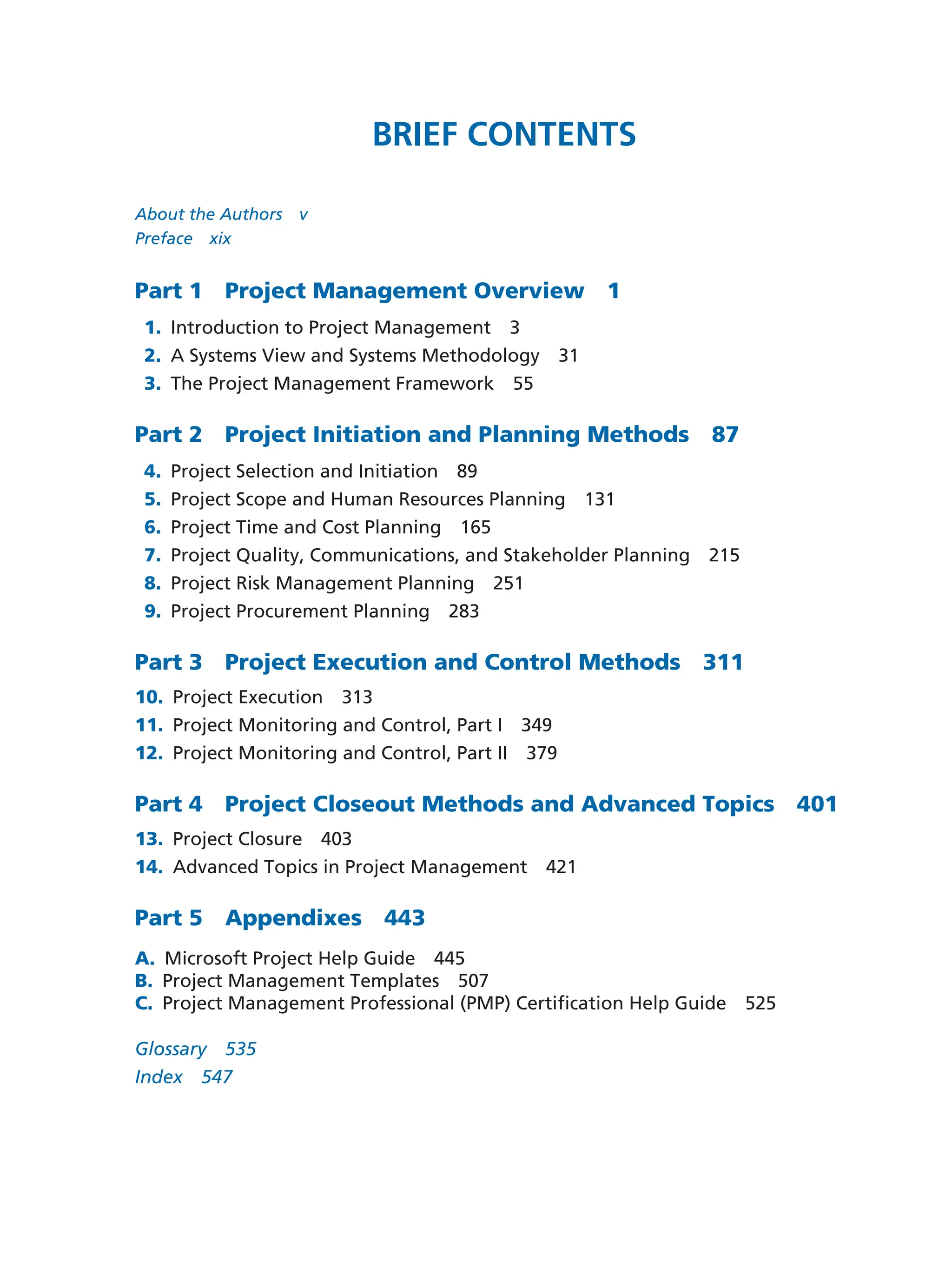

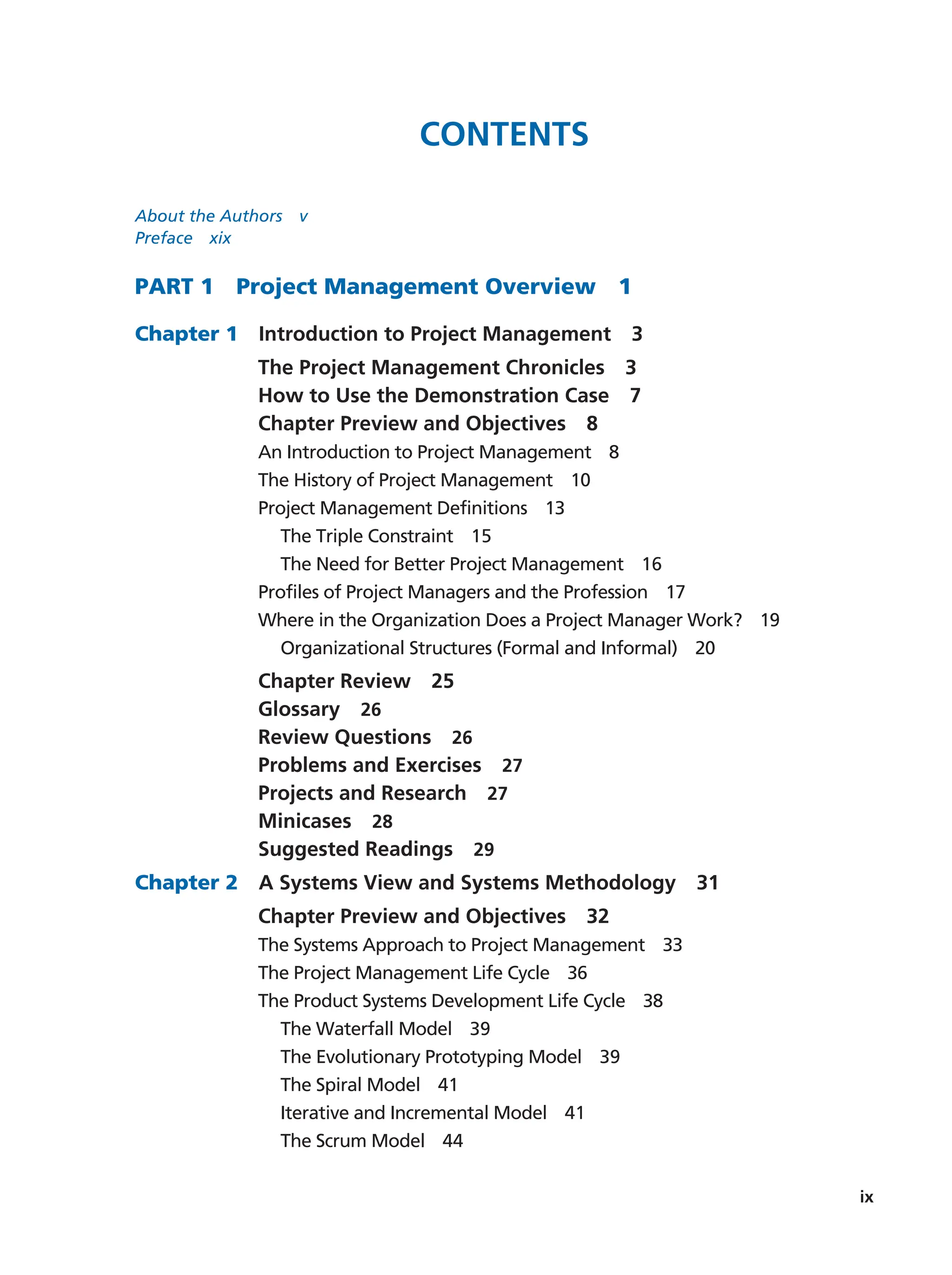
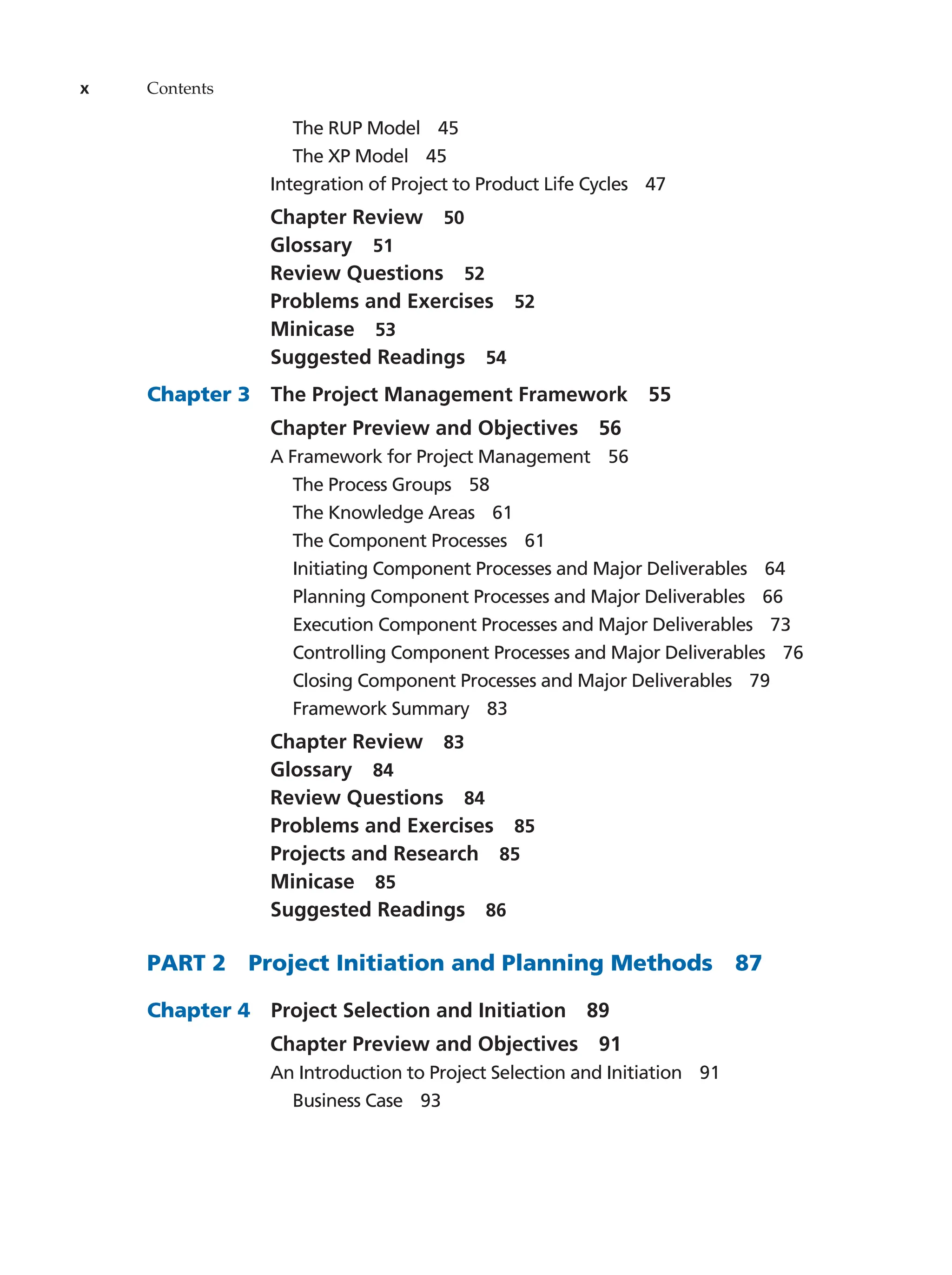
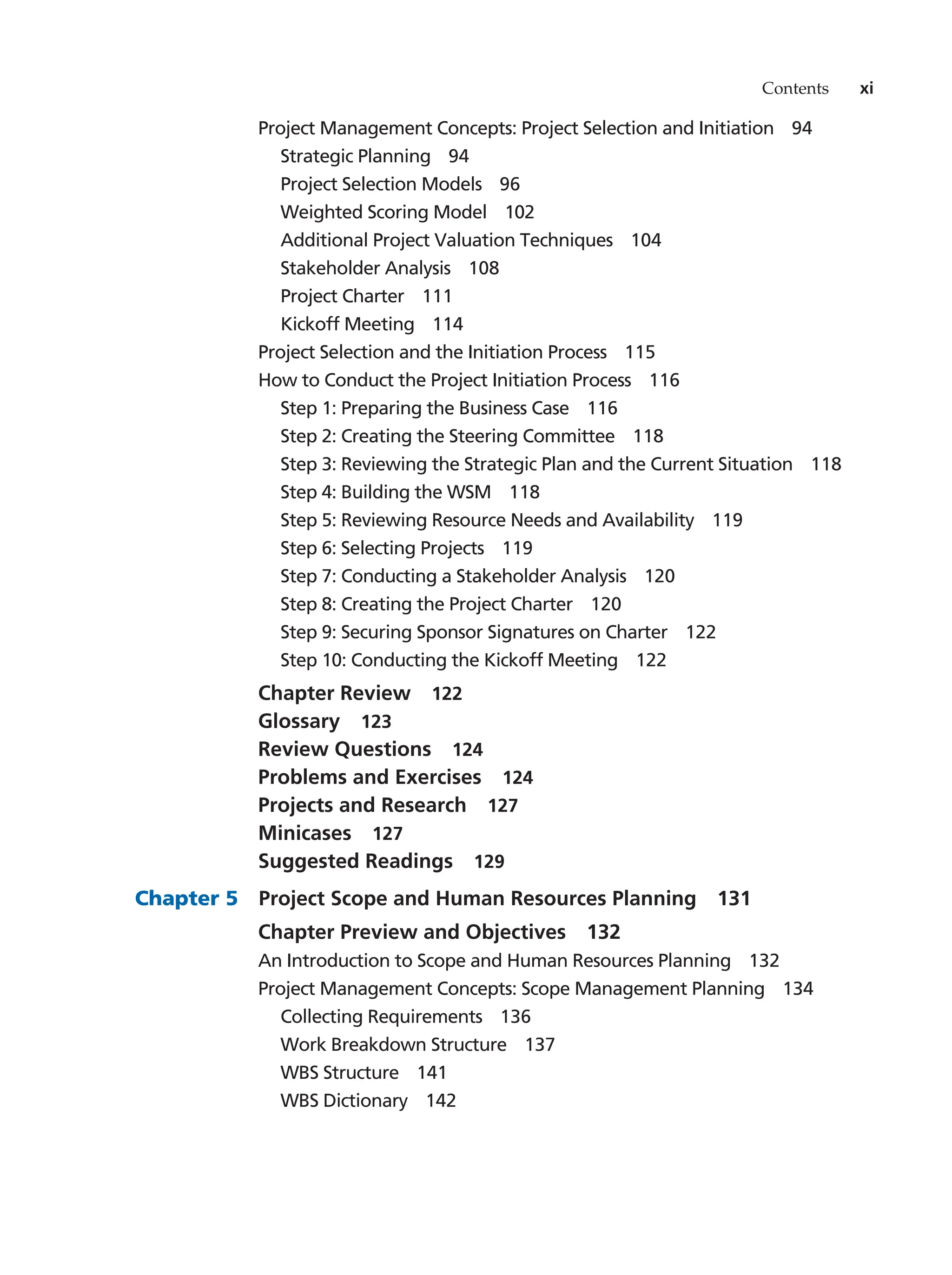
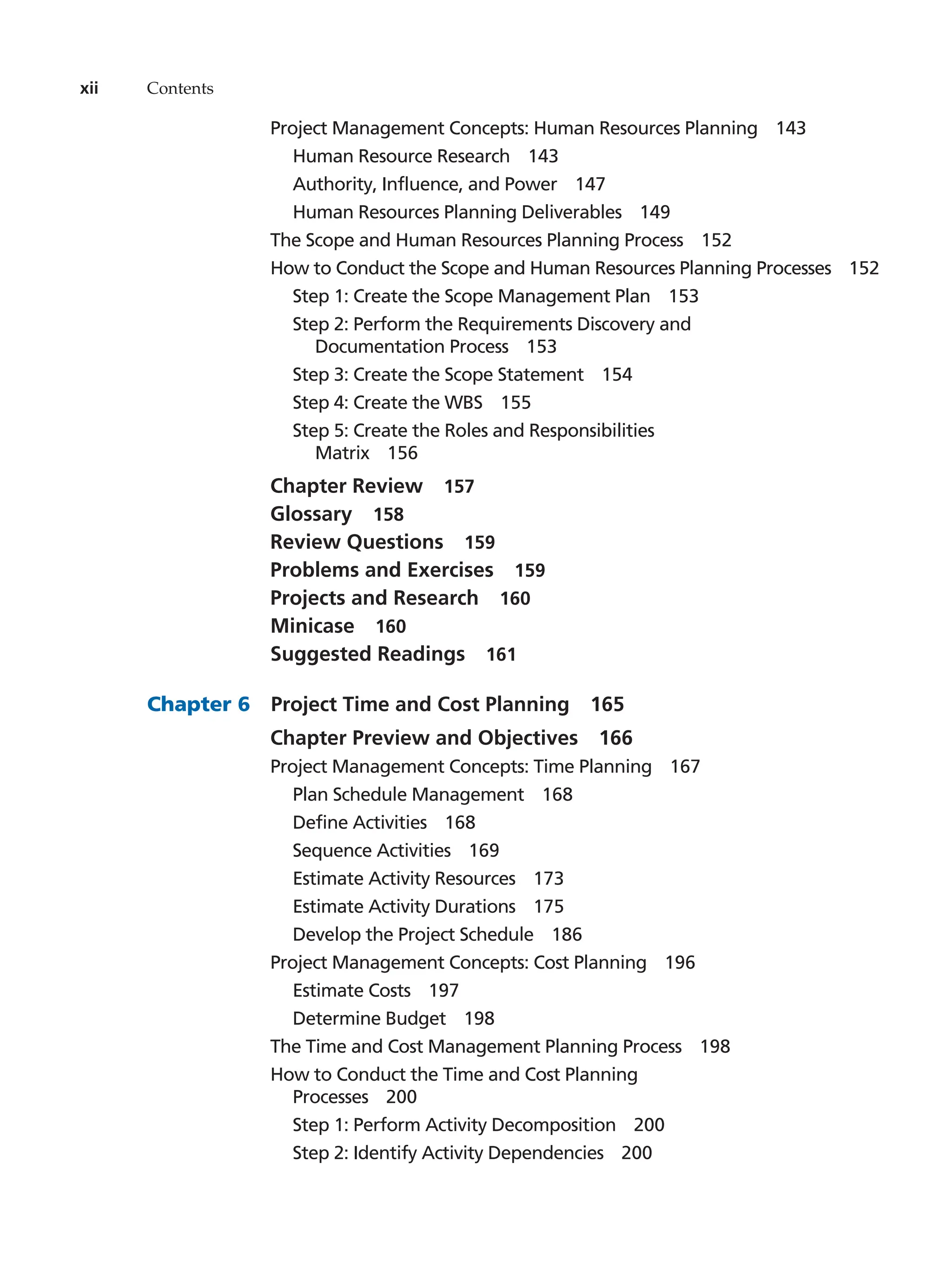
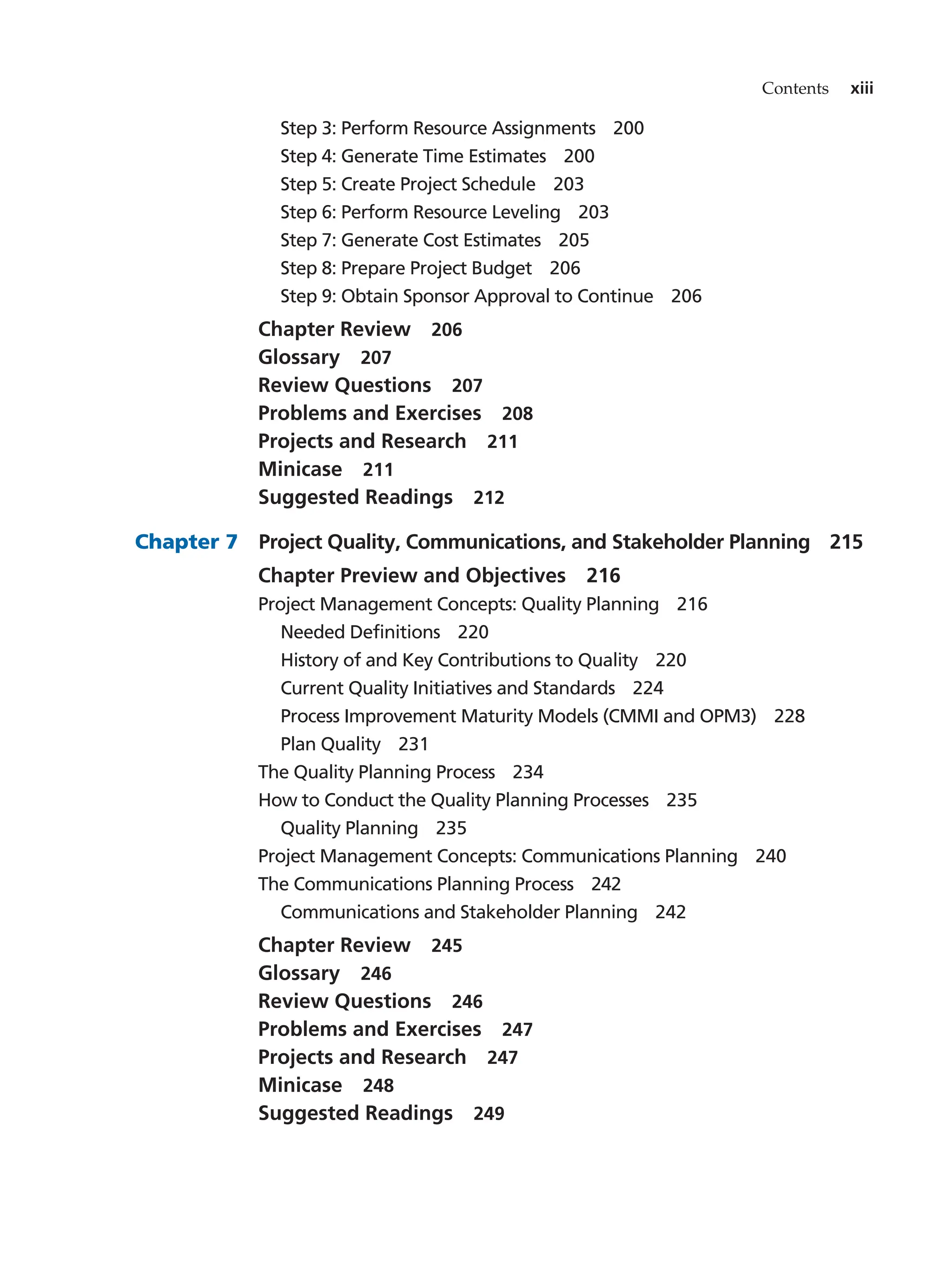
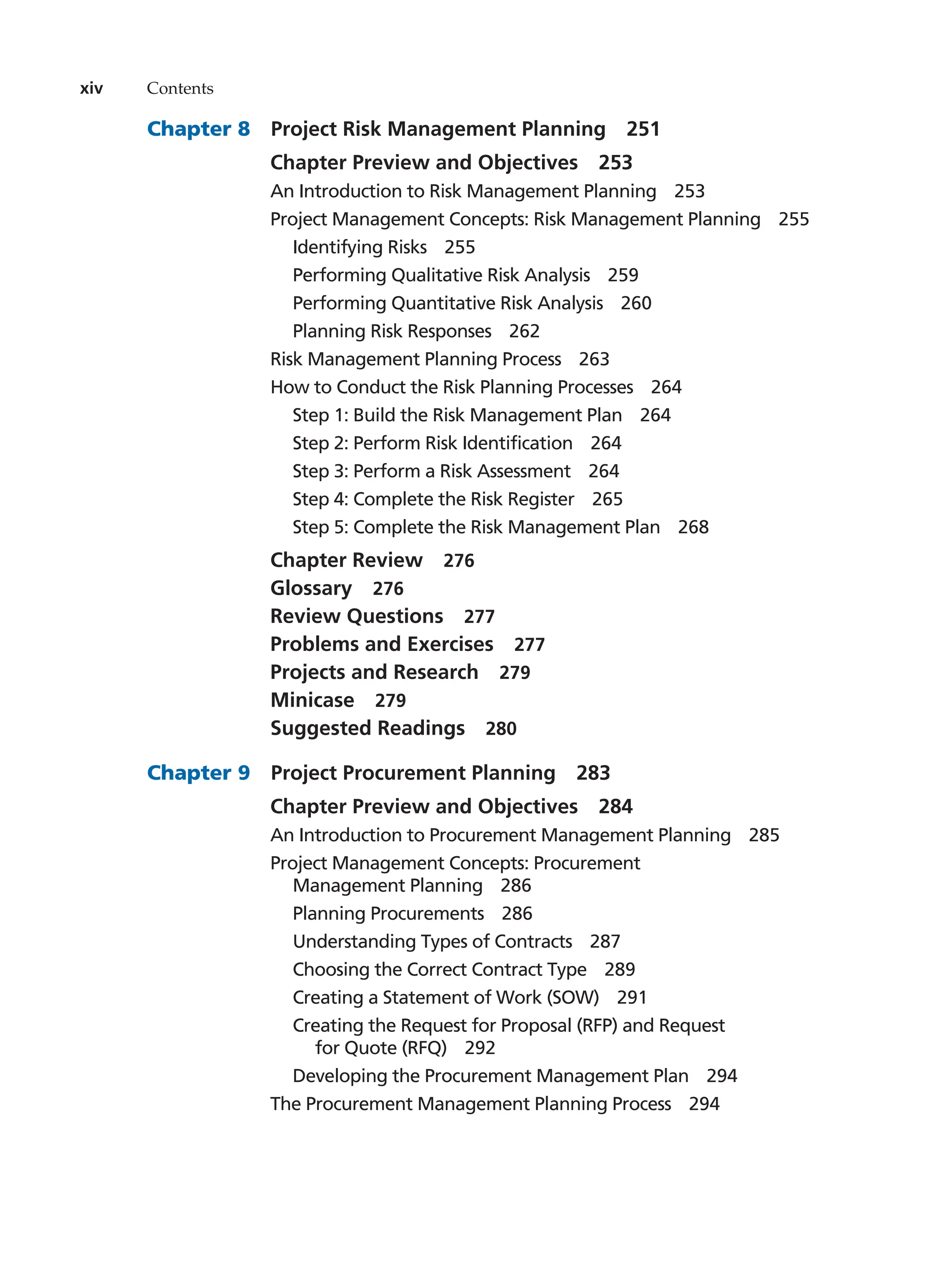
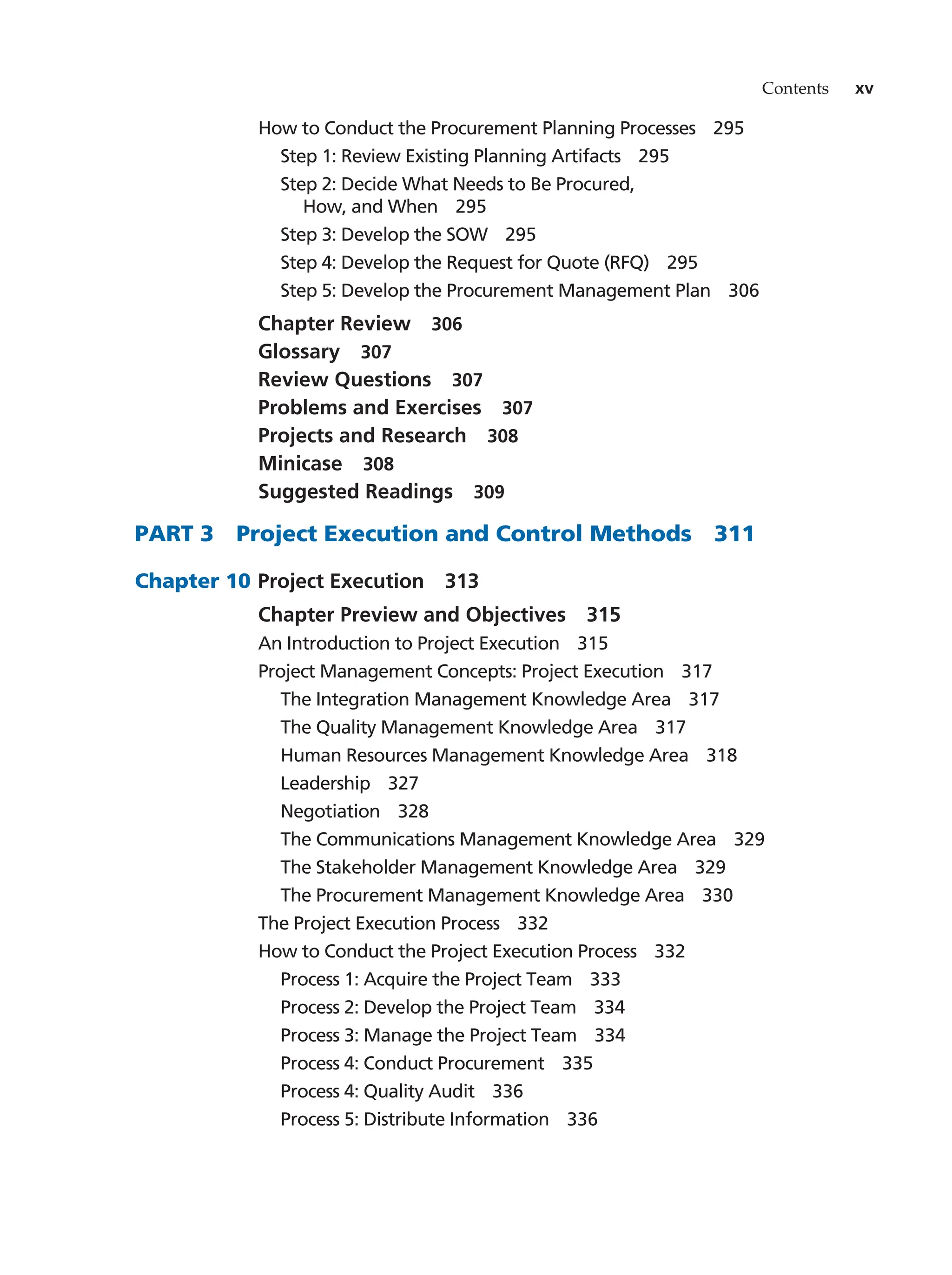
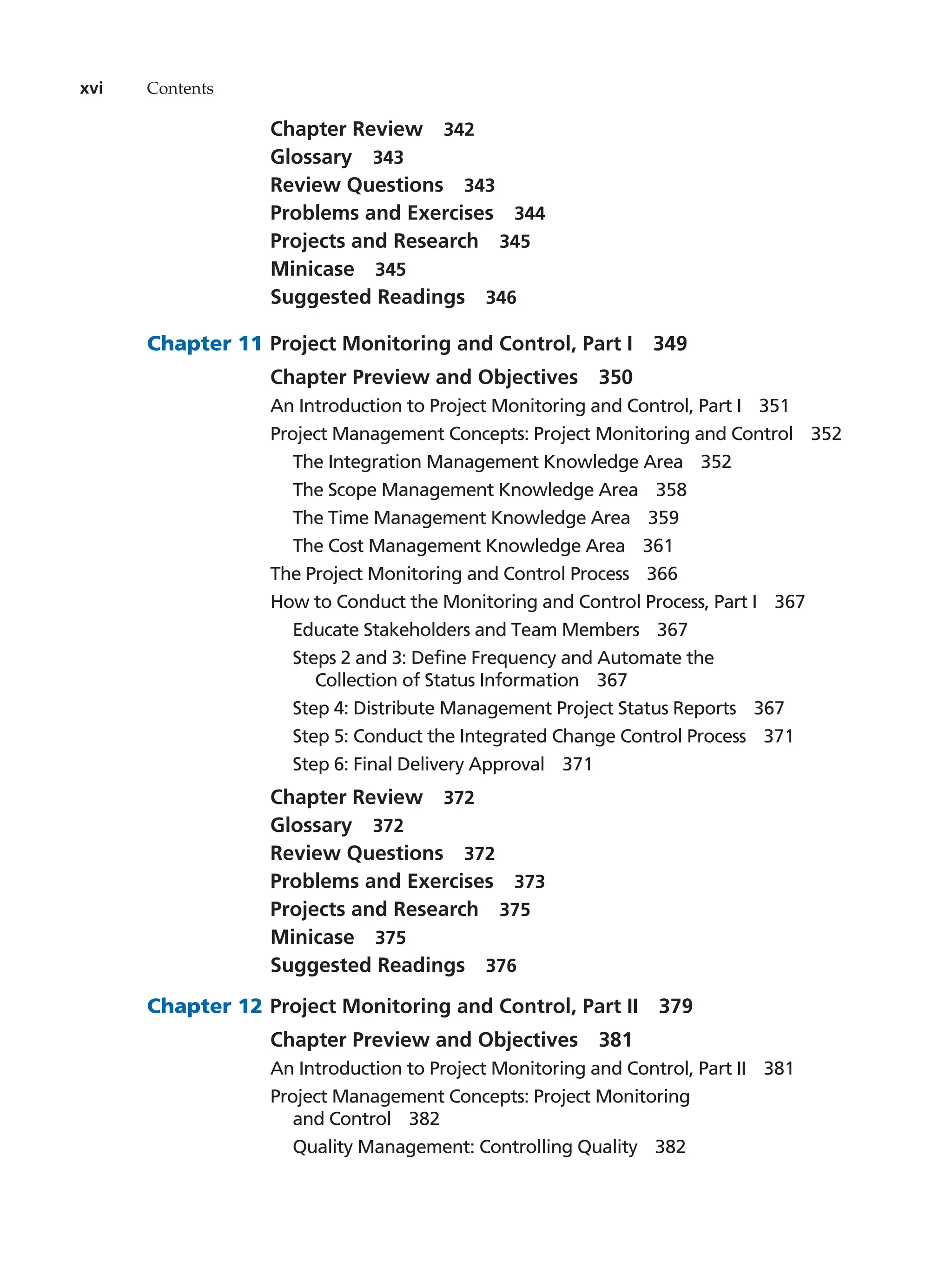
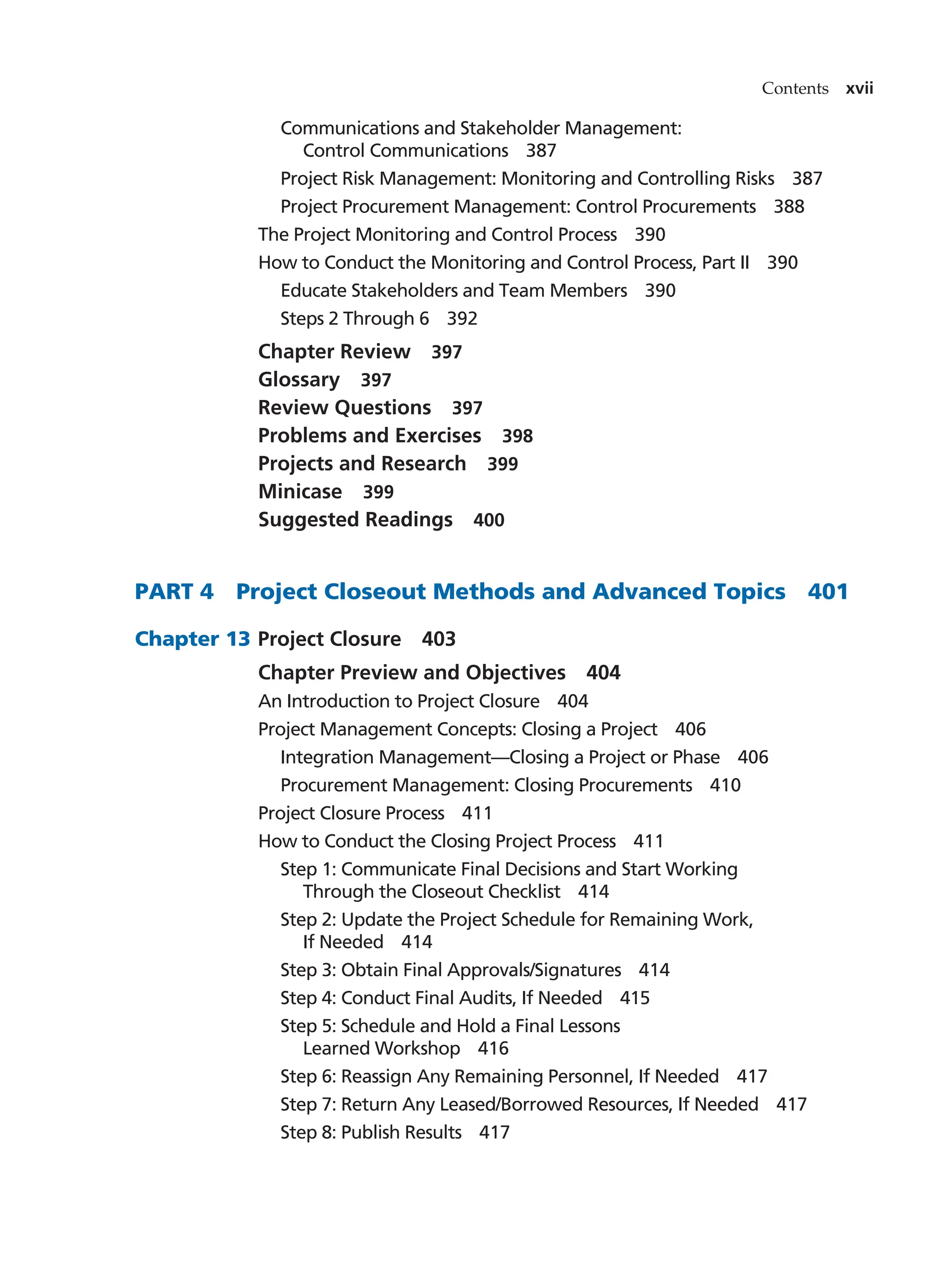
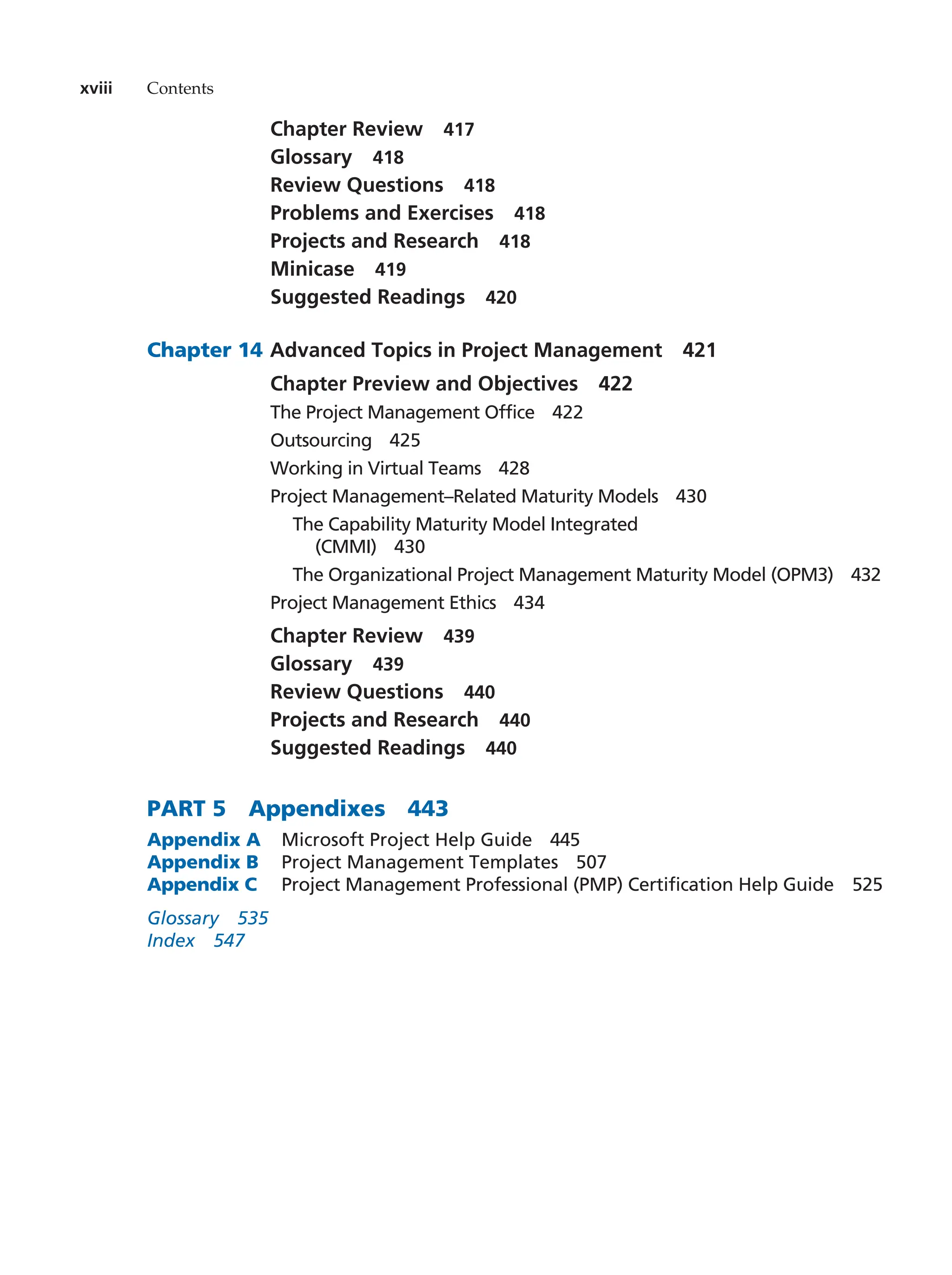



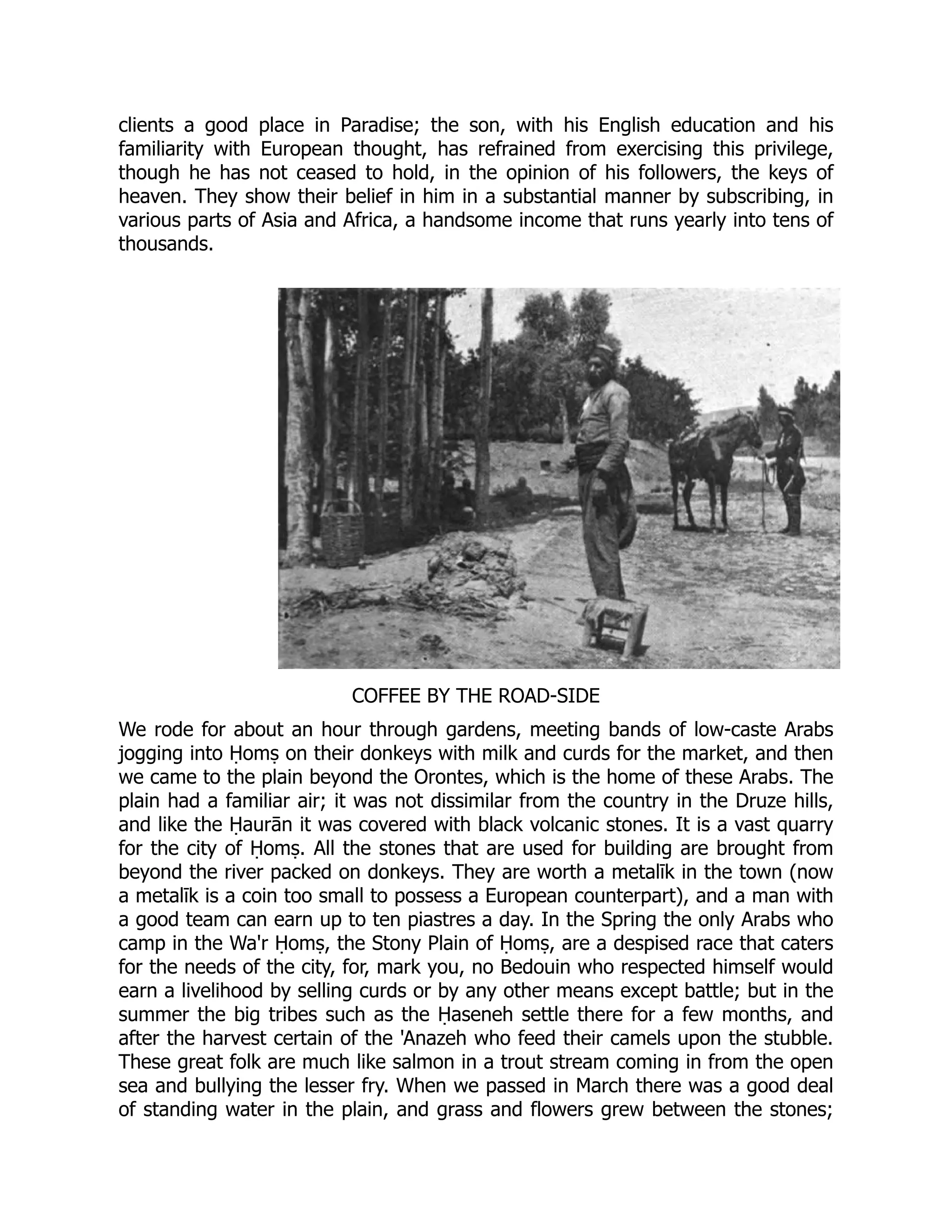
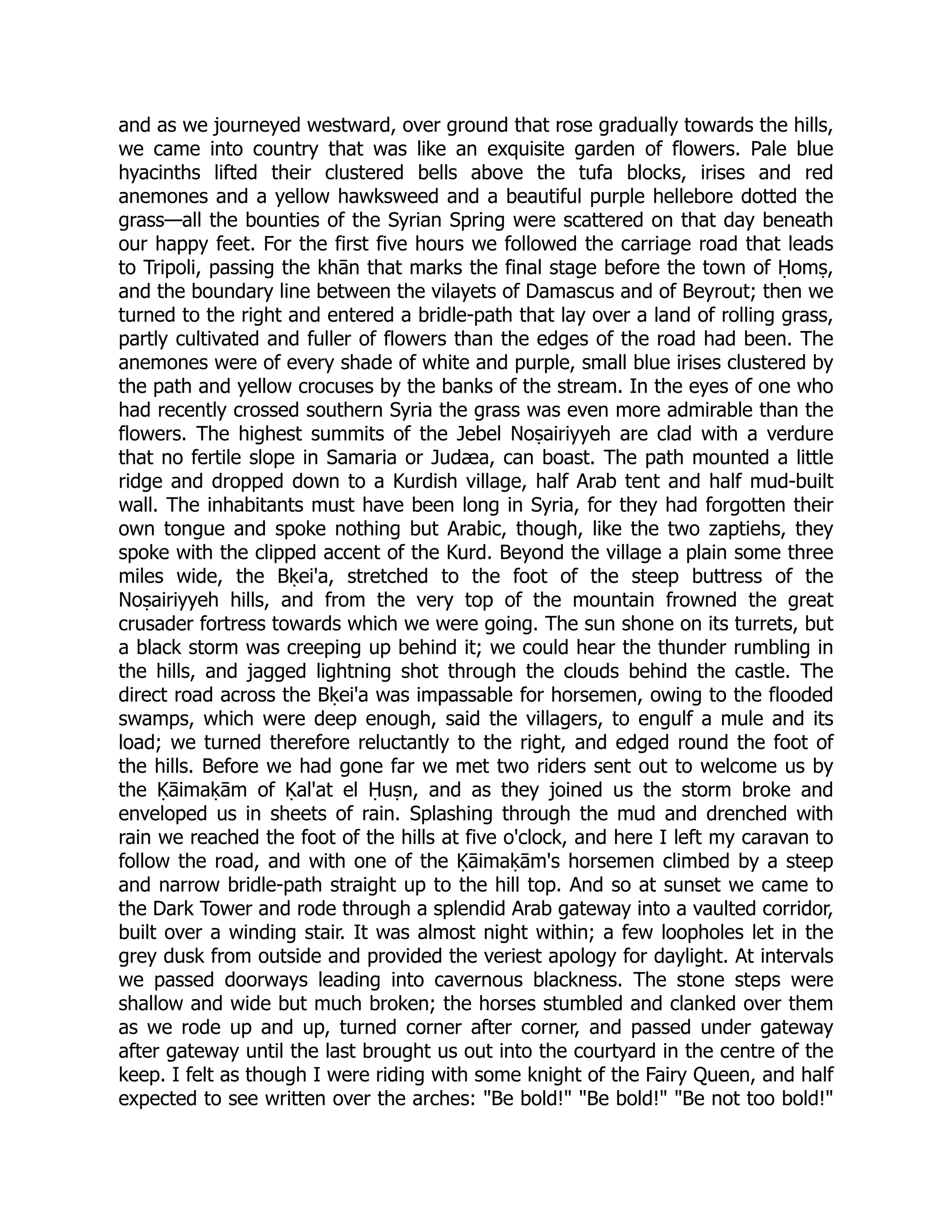
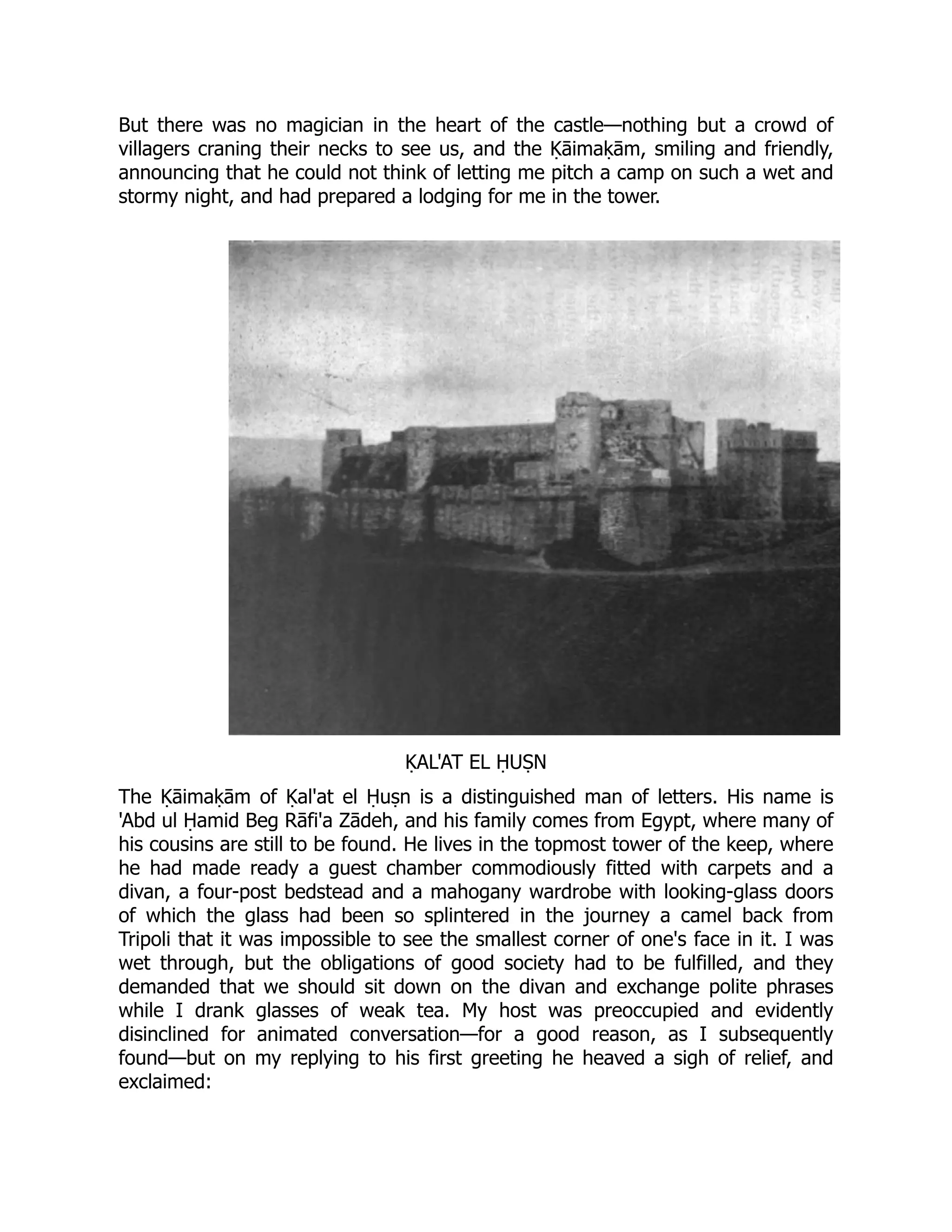
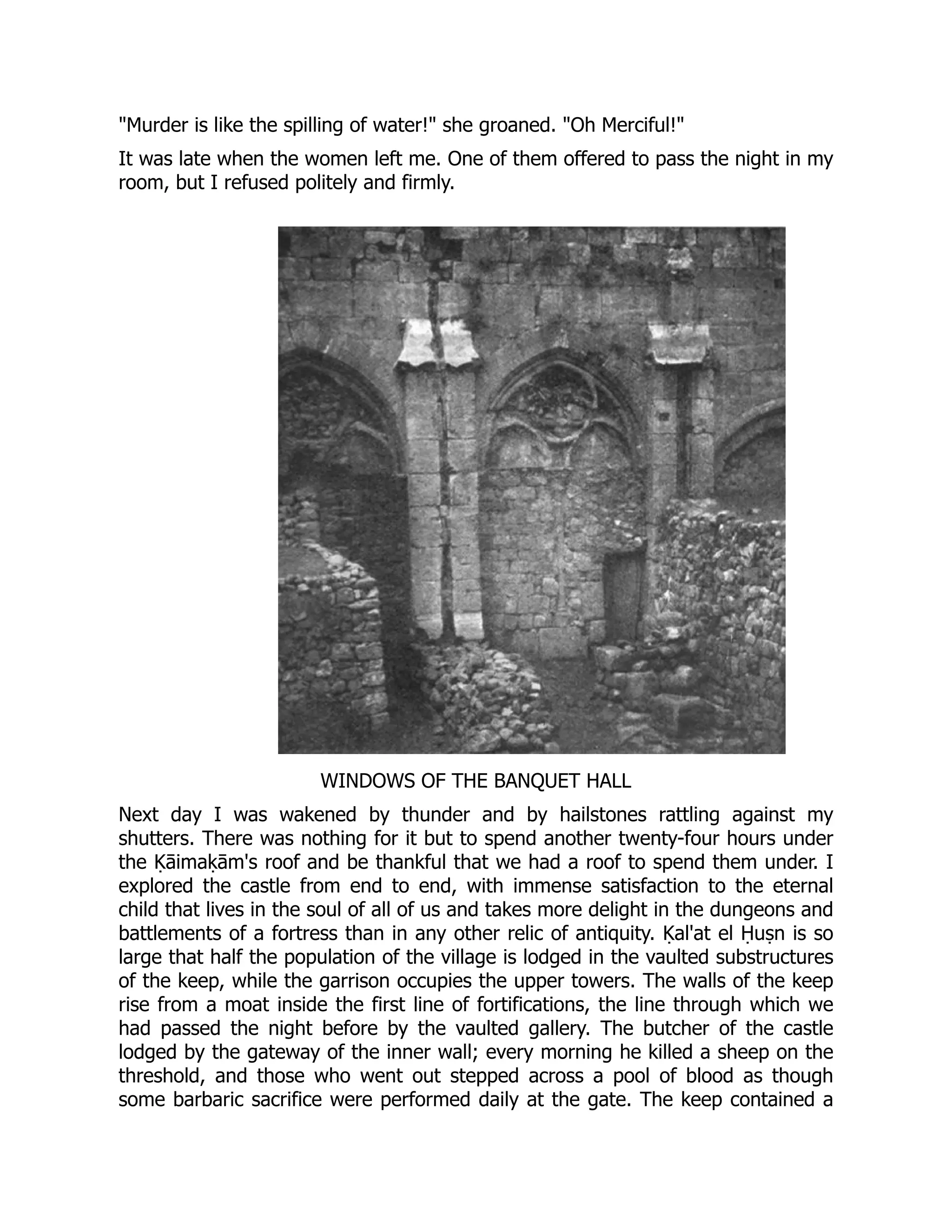
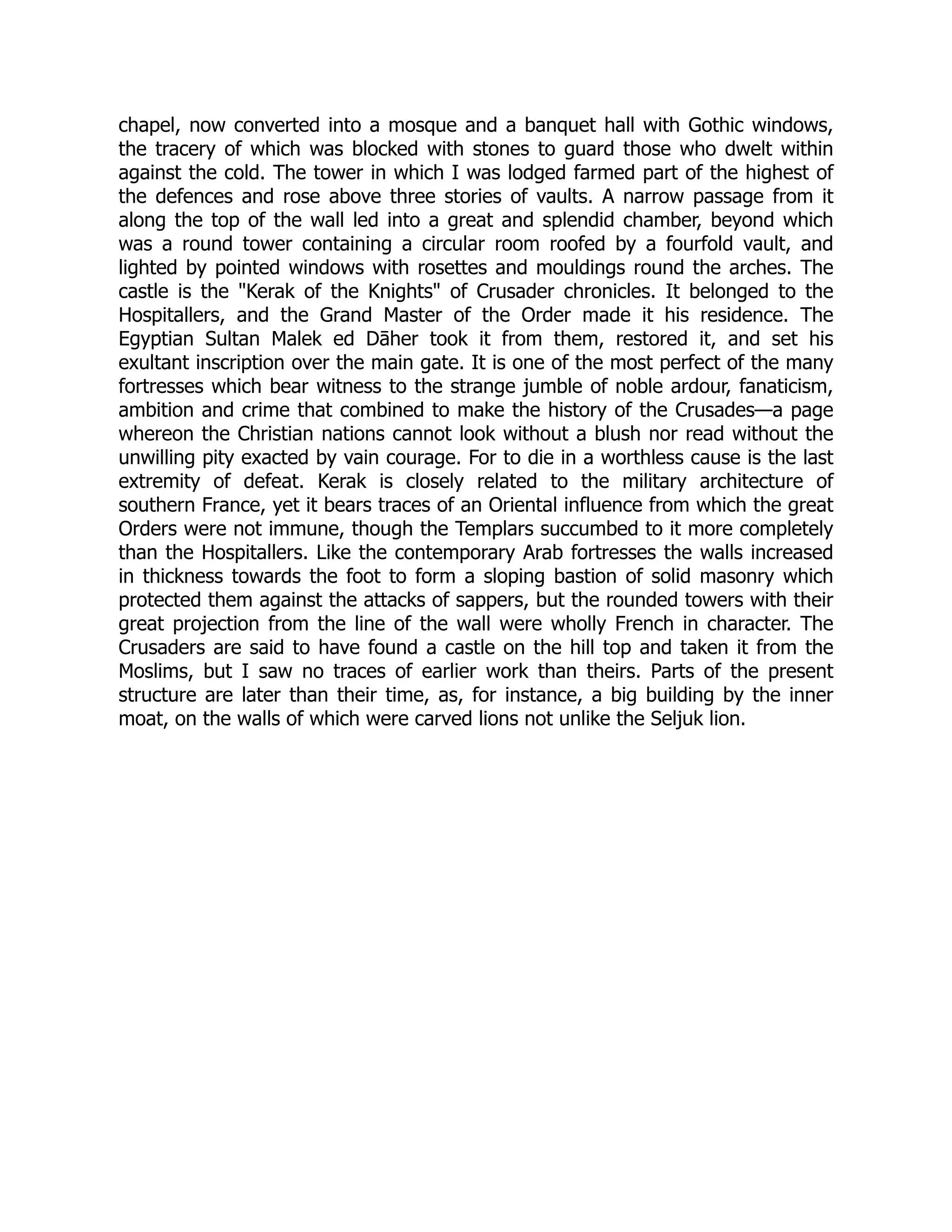
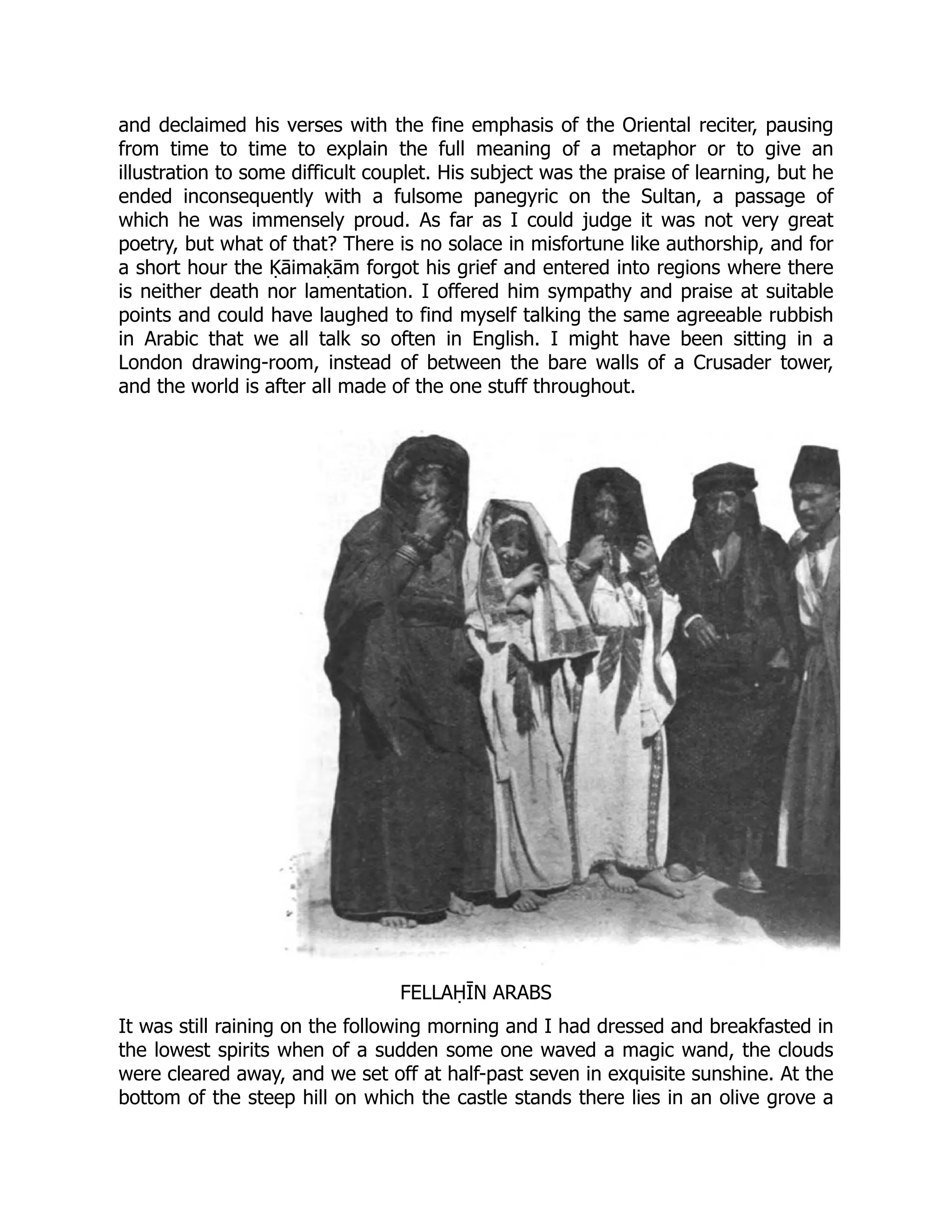
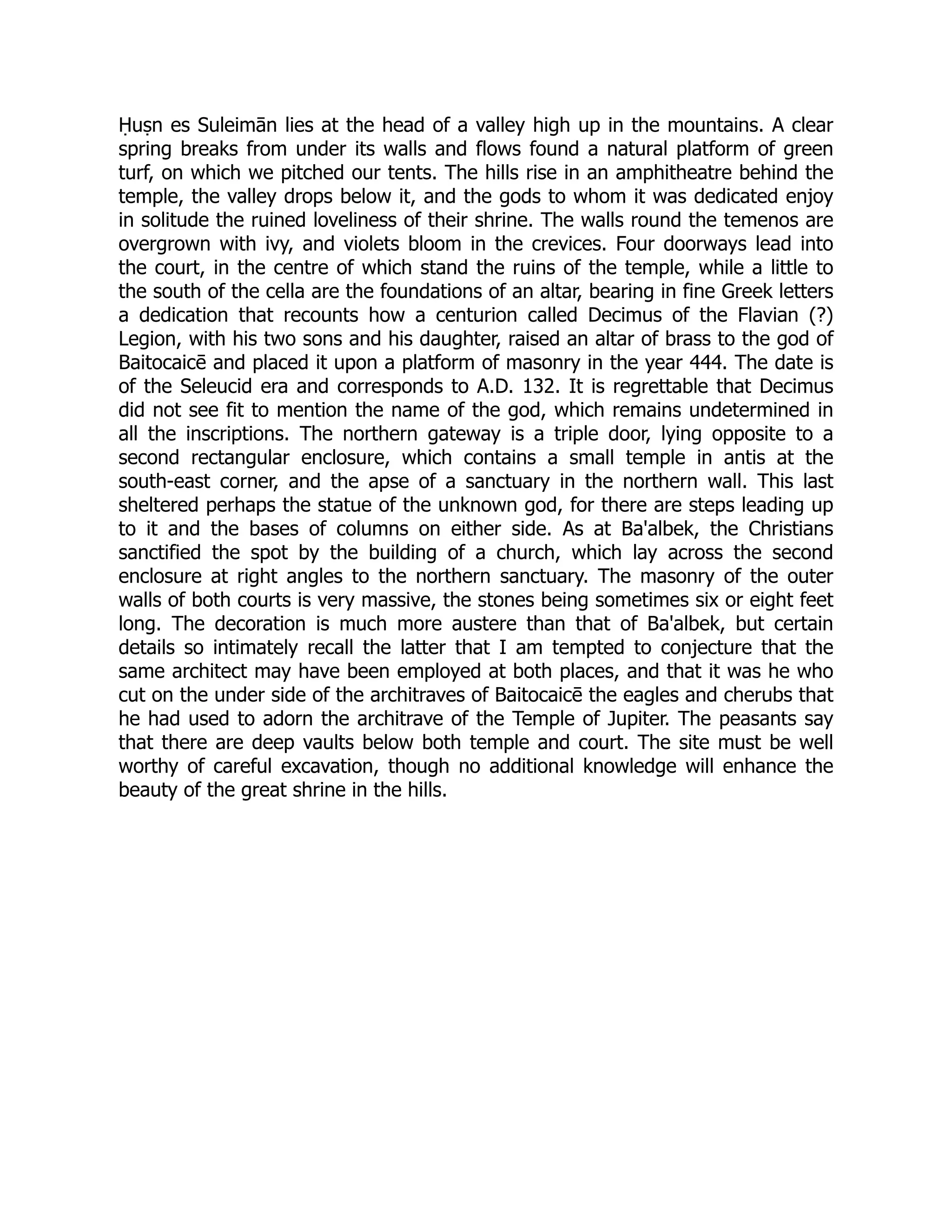
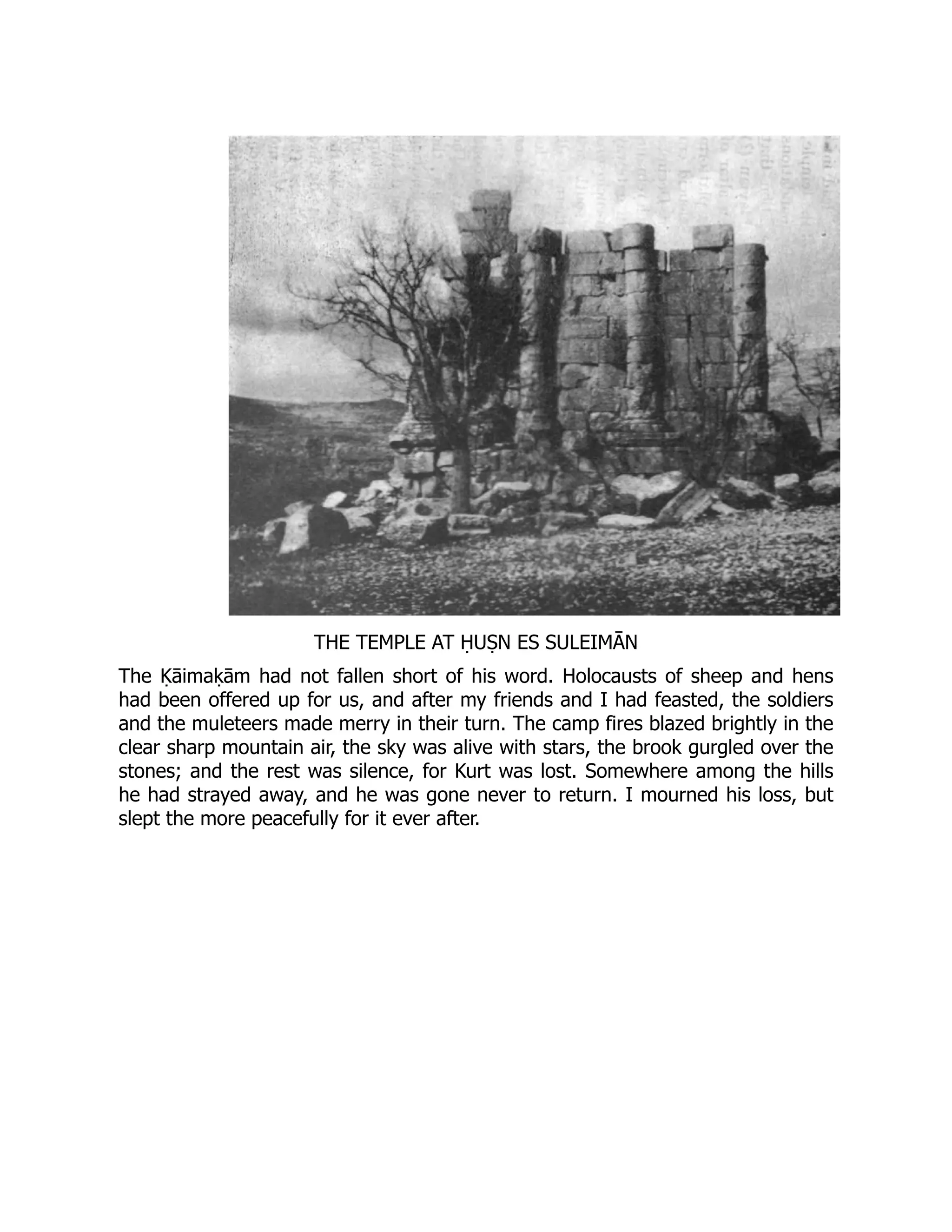
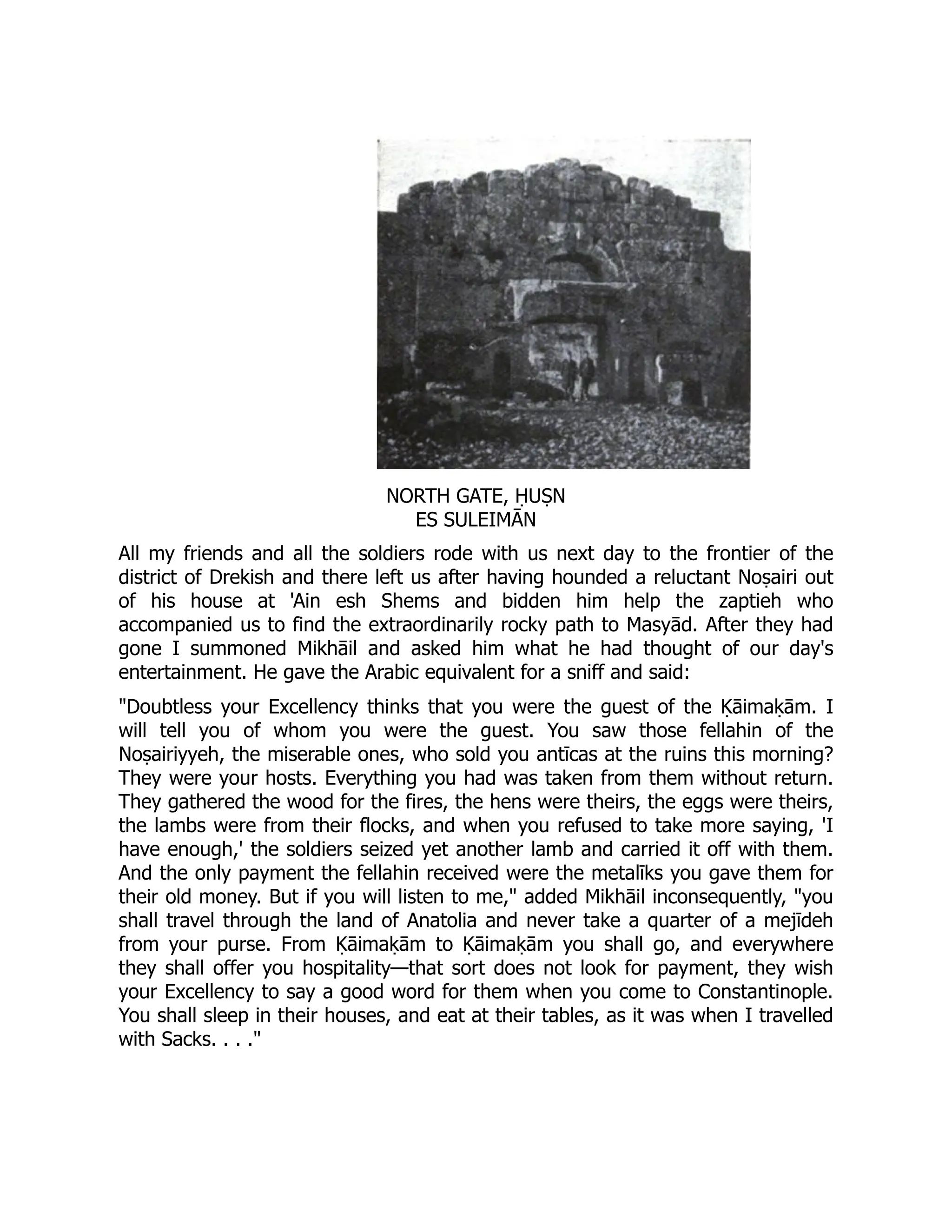
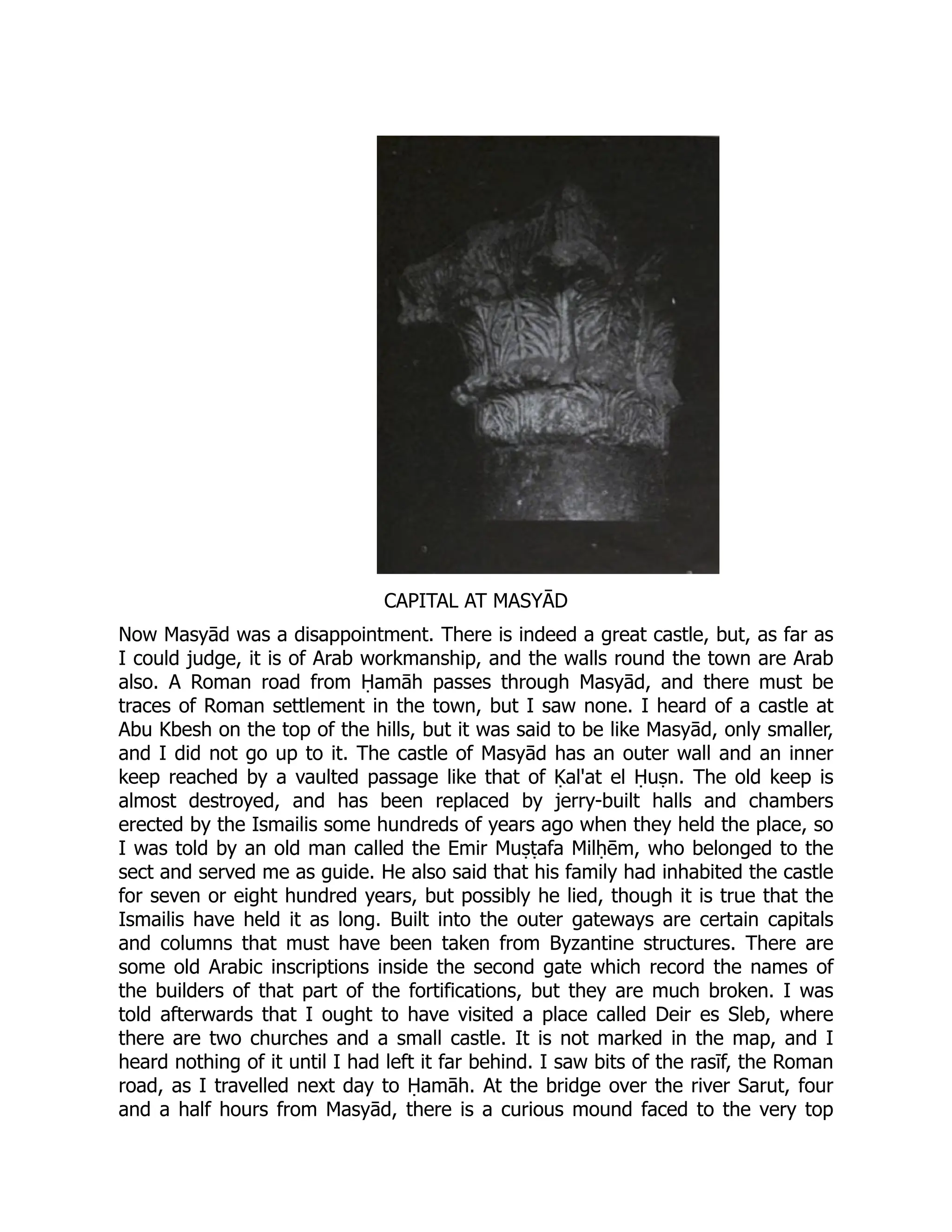
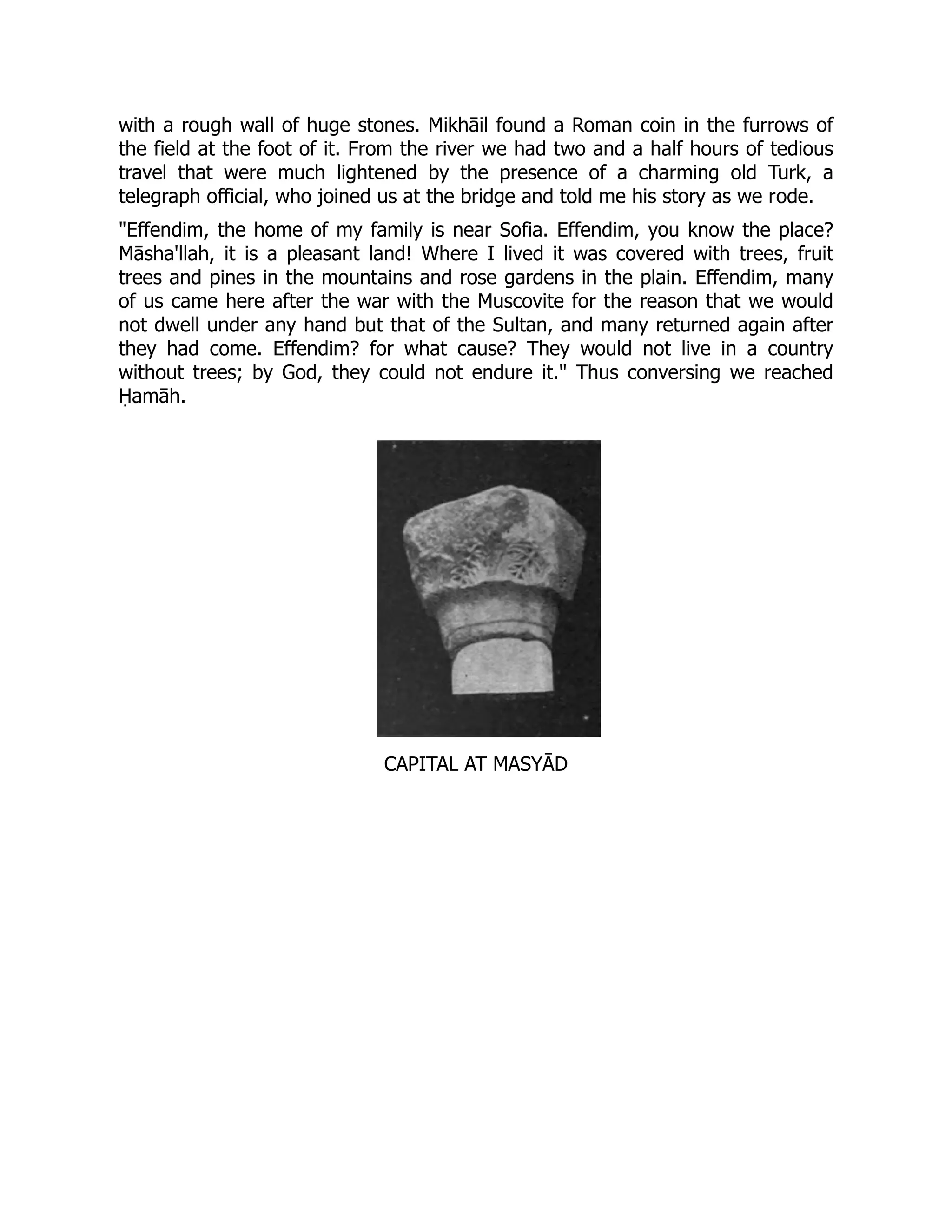
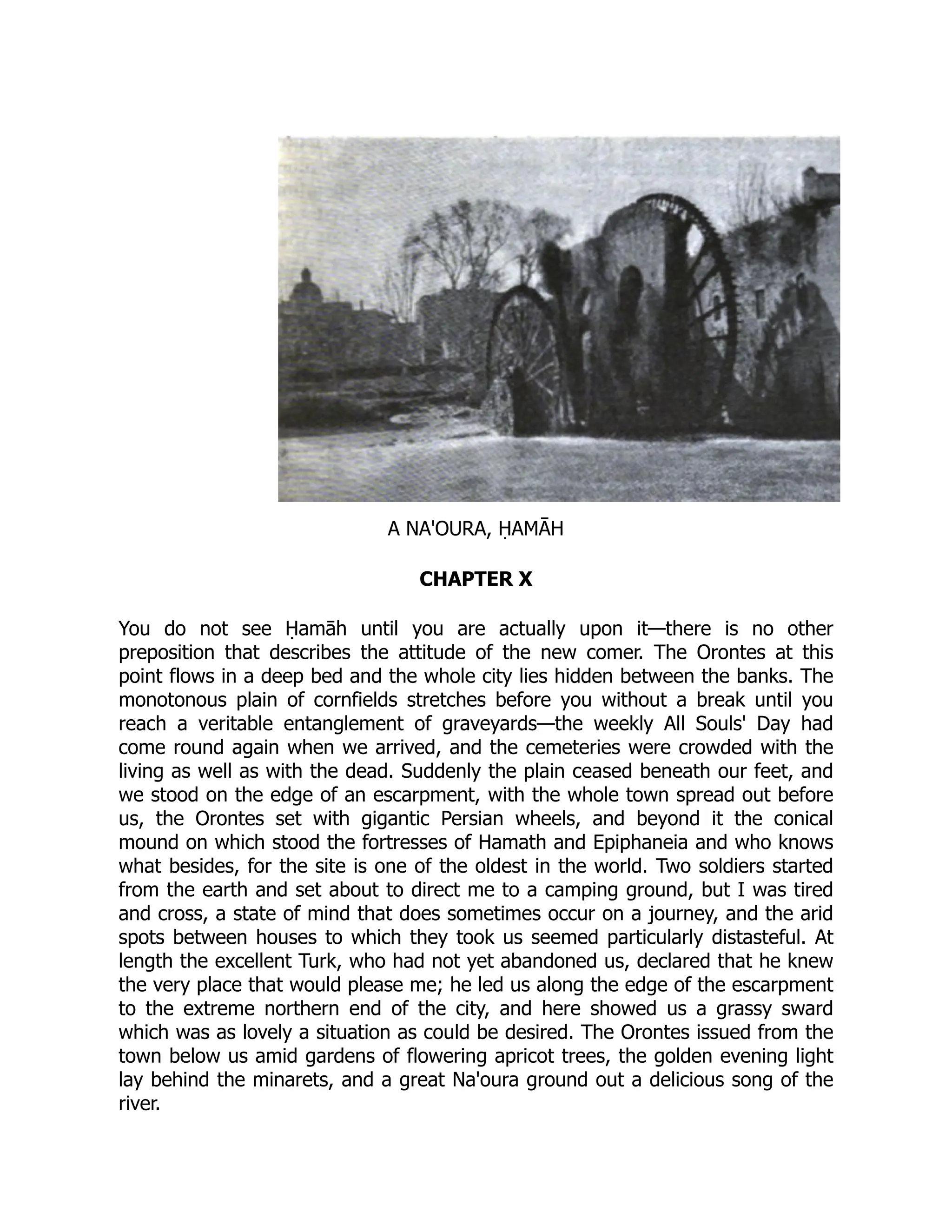
![Ḥamāh is the present terminus of the French railway,[9] and the seat of a
Muteserrif. The railway furnished me with a guide and companion in the shape of
a Syrian station-master, a consequential half-baked little man, who had been
educated in a missionary school and scorned to speak Arabic when he could
stutter in French. He announced that his name was Monsieur Kbēs and his
passion archæology, and, that he might the better prove himself to be in the van
of modern thought, he attributed every antiquity in Ḥamāh to the Hittites,
whether it were Byzantine capital or Arab enlaced decoration. With the Muteserrif
I came immediately into collision by reason of his insisting on providing me with
eight soldiers to guard my camp at night, a preposterous force, considering that
two had been ample in every country district. So numerous a guard would have
been an intolerable nuisance, for they would have talked all night and left the
camp no peace, and I sent six of them away, in spite of their protestations that
they must obey superior orders. They reconciled the Muteserrif's commands with
mine by spending the night in a ruined mosque a quarter of a mile away, where
they were able to enjoy excellent repose unbroken by a sense of responsibility.
THE ḲUBBEH IN THE
MOSQUE AT ḤAMĀH
For picturesqueness Ḥamāh is not to be outdone by any town in Syria. The broad
river with its water wheels is a constant element of beauty, the black and white](https://image.slidesharecdn.com/89039-250411080136-bde897df/75/Methods-of-IT-Project-Management-2nd-Edition-Jeffrey-L-Brewer-48-2048.jpg)
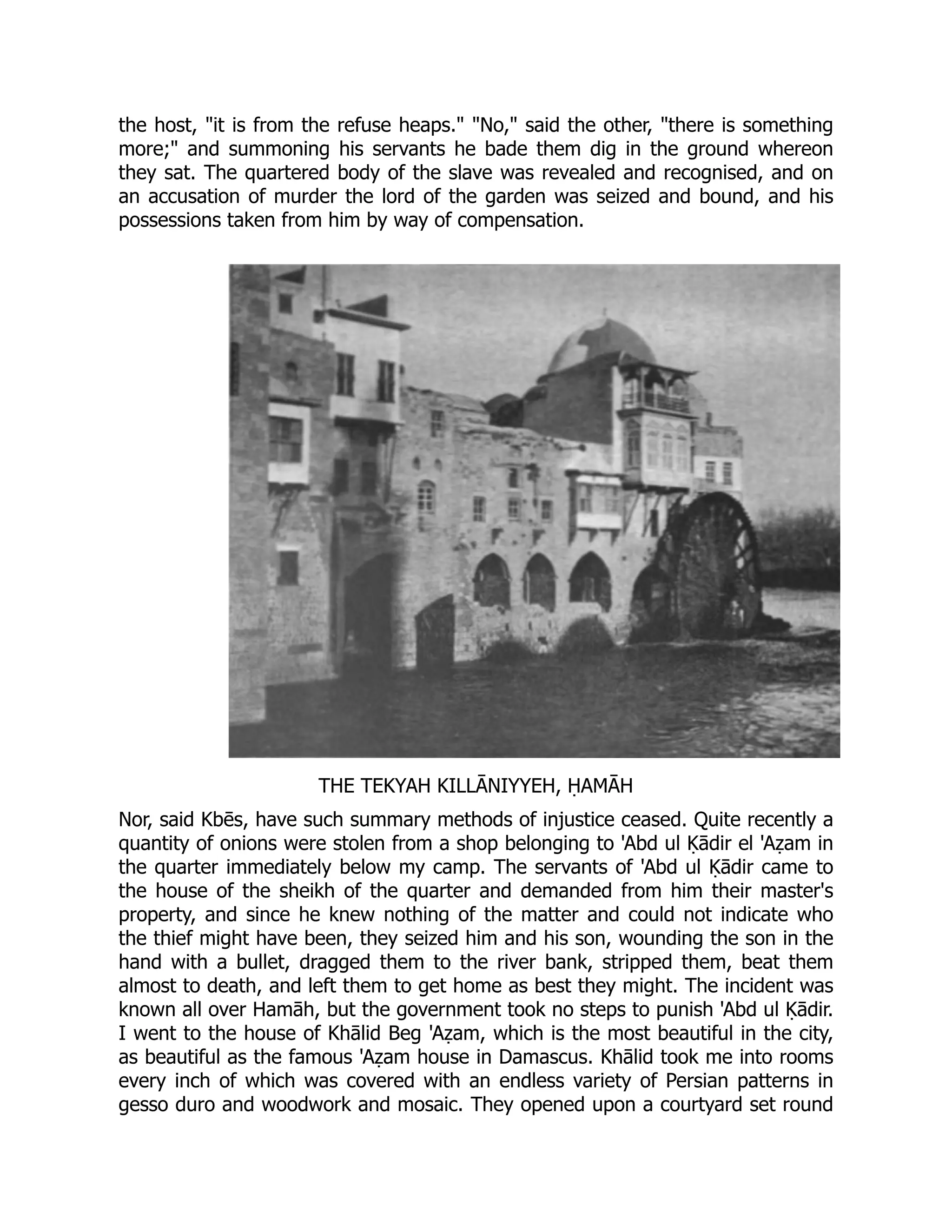
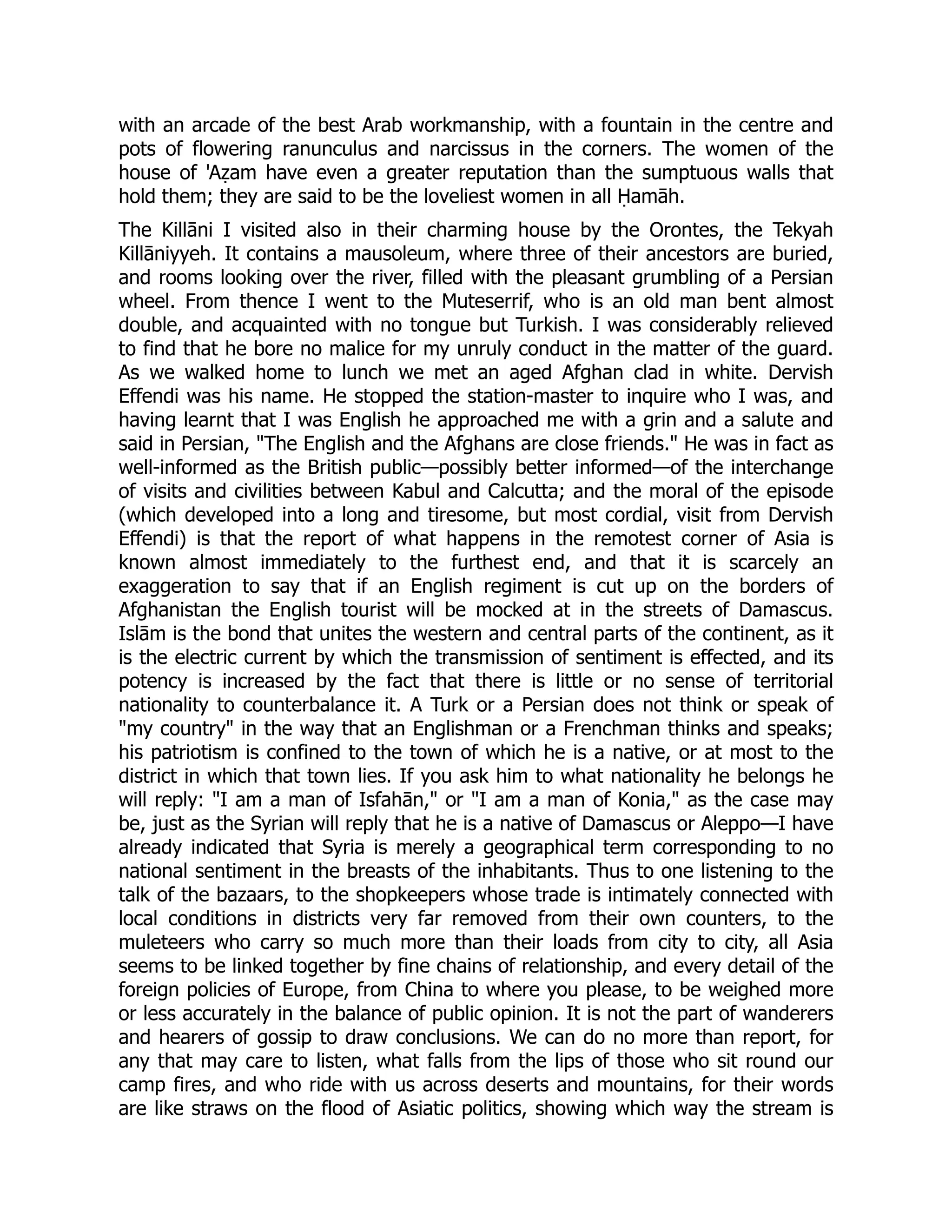
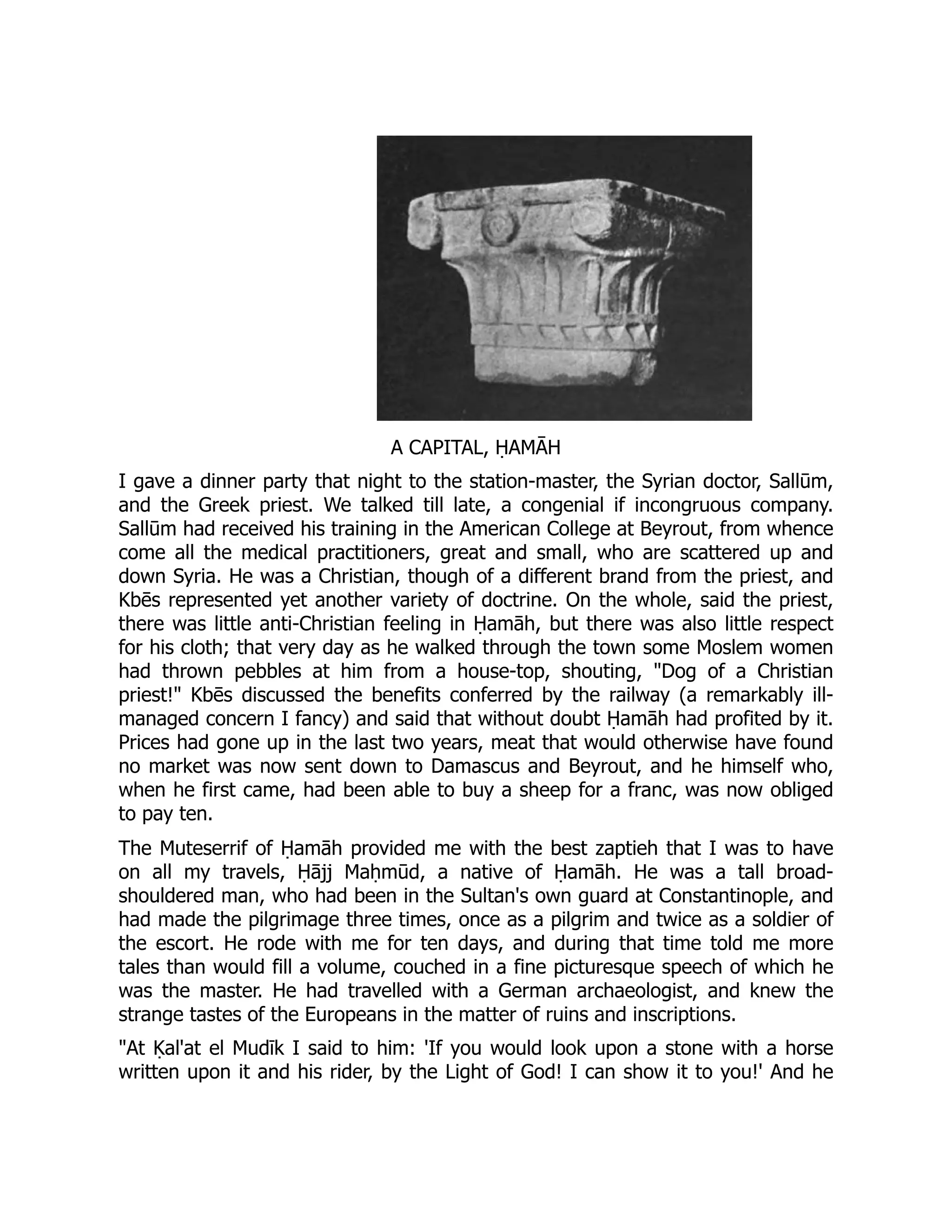
![not been a moment's rest from brawling in Al Ḥerdeh. As we rode, Maḥmūd told
tales of the Ismailis and the Noṣairis. Of the former he said that the Agha Khān's
photograph was to be found in every house, but it is woman that they worship,
said he. Every female child born on the 27th of Rajab is set apart and held to be
an incarnation of the divinity. She is called the Rōẓah. She does not work, her
hair and nails are never cut, her family share in the respect that is accorded to
her, and every man in the village will wear a piece of her clothing or a hair from
her body folded in his turban. She is not permitted to marry.
But what, said I, if she desire to marry?
It would be impossible, replied Maḥmūd. No one would marry her, for is there
any man that can marry God?
The sect is known to have sacred books, but none have yet fallen into the hands
of European scholars. Maḥmūd had seen and read one of them—it was all in
praise of the Rōẓah, describing every part of her with eulogy. The Ismailis read
the Ḳur'ān also, said he. Other strange matters he related which, like Herodotus,
I do not see fit to repeat. The creed seems to spring from dim traditions of
Astarte worship, or from that oldest and most universal cult of all, the veneration
of the Mother Goddess; but the accusations of indecency that have been brought
against it are, I gather, unfounded.[10]
Of the Noṣairis Maḥmūd had much to tell, for he was we acquainted with the hills
in which they live, having been for many years employed in collecting the
capitation tax among the sect. They are infidels, said he, who do not read the
Ḳur'ān nor know the name of God. He related a curious tale which I will repeat
for what it is worth:
Oh lady, it happened in the winter that I was collecting the tax. Now in the
month of Kānūn el Awwal (December) the Noṣairis hold a great feast that occurs
at the same time as the Christian feast (Christmas), and the day before, when I
was riding with two others in the hills, there fell a quantity of snow so that we
could go no further, and we sought shelter at the first village in the house of the
Sheikh of the village. For there is always a Sheikh of the village, oh lady, and a
Sheikh of the Faith, and the people are divided into initiated and uninitiated. But
the women know nothing of the secrets of the religion, for by God! a woman
cannot keep a secret. The Sheikh greeted us with hospitality and lodged us, but
next morning when I woke there was no man to be seen in the house, nothing
but the women. And I cried: 'By God and Muḥammad the Prophet of God! what
hospitality is this? and are there no men to make the coffee but only women?'
And the women replied: 'We do not know what the men are doing, for they have
gone to the house of the Sheikh of the Faith, and we are not allowed to enter.'
Then I arose and went softly to the house and looked through the window, and,
by God! the initiated were sitting in the room, and in the centre was the Sheikh](https://image.slidesharecdn.com/89039-250411080136-bde897df/75/Methods-of-IT-Project-Management-2nd-Edition-Jeffrey-L-Brewer-56-2048.jpg)