Visit https://ebookultra.com to download the full version and
explore more ebooks
Methods in Biomedical Informatics A Pragmatic
Approach 1st Edition Neil Sarkar (Eds.)
_____ Click the link below to download _____
https://ebookultra.com/download/methods-in-biomedical-
informatics-a-pragmatic-approach-1st-edition-neil-
sarkar-eds/
Explore and download more ebooks at ebookultra.com
Here are some suggested products you might be interested in.
Click the link to download
Modal Verbs in Marlowe and Shakespeare A Semantic
Pragmatic Approach 1st Edition Monika Skorasi■ska
https://ebookultra.com/download/modal-verbs-in-marlowe-and-
shakespeare-a-semantic-pragmatic-approach-1st-edition-monika-
skorasinska/
Computational Methods in Biomedical Research 1st Edition
Ravindra Khattree
https://ebookultra.com/download/computational-methods-in-biomedical-
research-1st-edition-ravindra-khattree/
Disease Surveillance A Public Health Informatics Approach
1st Edition Joseph S. Lombardo
https://ebookultra.com/download/disease-surveillance-a-public-health-
informatics-approach-1st-edition-joseph-s-lombardo/
Principles of Biomedical Informatics 2nd Edition Ashish
Verma And Anchal Singh (Eds.)
https://ebookultra.com/download/principles-of-biomedical-
informatics-2nd-edition-ashish-verma-and-anchal-singh-eds/
Computational Methods in Biomedical Research 1st Edition
Ravindra Khattree (Editor)
https://ebookultra.com/download/computational-methods-in-biomedical-
research-1st-edition-ravindra-khattree-editor/
Conversational Informatics An Engineering Approach 1st
Edition Toyoaki Nishida
https://ebookultra.com/download/conversational-informatics-an-
engineering-approach-1st-edition-toyoaki-nishida/
Electronics a systems approach Fourth ed Fourth Edition
Neil Storey
https://ebookultra.com/download/electronics-a-systems-approach-fourth-
ed-fourth-edition-neil-storey/
Ethics Research Methods and Standards in Biomedical
Engineering 1st Edition Monique Frize
https://ebookultra.com/download/ethics-research-methods-and-standards-
in-biomedical-engineering-1st-edition-monique-frize/
Biomedical Image Understanding Methods and Applications
1st Edition Joo-Hwee Lim
https://ebookultra.com/download/biomedical-image-understanding-
methods-and-applications-1st-edition-joo-hwee-lim/
Methods in Biomedical Informatics A Pragmatic
Approach 1st Edition Neil Sarkar (Eds.) Digital Instant

Download
Author(s): Neil Sarkar (Eds.)
ISBN(s): 9780124016781, 0124016782
Edition: 1
File Details: PDF, 15.30 MB
Year: 2014
Language: english
Methods in Biomedical
Informatics
A Pragmatic Approach
Methods in Biomedical
Informatics
A Pragmatic Approach
Indra Neil Sarkar
University of Vermont, Burlington, USA
Edited by
AMSTERDAM • BOSTON • HEIDELBERG • LONDON
NEW YORK • OXFORD • PARIS • SAN DIEGO
SAN FRANCISCO • SINGAPORE • SYDNEY • TOKYO
Academic Press is an lmprint of Elsevier
Academic Press is an imprint of Elsevier
32 Jamestown Road, London NW1 7BY, UK
225 Wyman Street, Waltham, MA 02451, USA
525 B Street, Suite 1800, San Diego, CA 92101-4495, USA
Copyright © 2014 Elsevier Inc. All rights reserved.
No part of this publication may be reproduced, stored in a retrieval system or transmitted in any form or by any means
electronic, mechanical, photocopying, recording or otherwise without the prior written permission of the publisher.
Permissions may be sought directly from Elsevier’s Science & Technology Rights Department in Oxford, UK: phone (+44) (0)
1865 843830; fax (+44) (0) 1865 853333; email: permissions@elsevier.com. Alternatively, visit the Science and Technology
Books website at www.elsevierdirect.com/rights for further information.
Notice
No responsibility is assumed by the publisher for any injury and/or damage to persons or property as a matter of products
liability, negligence or otherwise, or from any use or operation of any methods, products, instructions or ideas contained in the
material herein. Because of rapid advances in the medical sciences, in particular, independent verification of diagnoses and drug
dosages should be made.
British Library Cataloguing-in-Publication Data
A catalogue record for this book is available from the British Library
Library of Congress Cataloging-in-Publication Data
A catalog record for this book is available from the Library of Congress
ISBN: 978-0-12-401678-1
For information on all Academic Press publications
visit our website at elsevierdirect.com
Typeset by Scientific Publishing Services (P) Ltd., Chennai
www.sps.co.in
Printed and bound in United States of America
13 14 15 16 17 10 9 8 7 6 5 4 3 2 1
Contributors
Gil Alterovitz
Children’s Hospital Informatics Program at Harvard-MIT Division of Health
Science, Boston, MA, USA.
Center for Biomedical Informatics, Harvard Medical School, Boston, MA, USA.
Computer Science and Artificial Intelligence Laboratory, Department of Electrical
Engineering and Computer Science, MIT, Cambridge, MA, USA.
Riccardo Bellazzi
Dipartimento di Ingegneria Industriale e dell’Informazione, Università di Pavia,
Pavia, Italy.
Elizabeth S. Chen
Center for Clinical and Translational Science, University of Vermont, Burlington,
VT, USA
Department of Medicine, Division of General Internal Medicine, University of
Vermont, Burlington, VT, USA
Department of Computer Science, University of Vermont, Burlington, VT, USA
Hsun-Hsien Chang
Children’s Hospital Informatics Program at Harvard-MIT Division of Health
Science, Boston, MA, USA.
Kevin Bretonnel Cohen
Computational Bioscience Program, University of Colorado School of Medicine,
Department of Linguistics, University of Colorado at Boulder, USA.
Trevor Cohen
University of Texas School of Biomedical Informatics at Houston, Houston, TX, USA.
Joshua C. Denny
Department of Biomedical Informatics and Medicine, Vanderbilt University,
Nashville, TN, USA.
Matteo Gabetta
Dipartimento di Ingegneria Industriale e dell’Informazione, Università di Pavia,
Pavia, Italy.
Kathleen Gray
Health and Biomedical Informatics Centre, Melbourne Medical School, Faculty
of Medicine, Dentistry & Health Sciences and Department of Computing and
Information Systems, The University of Melbourne, Melbourne, VIC, Australia.
John H. Holmes
University of Pennsylvania, Philadelphia, PA, USA. xv
Contributors
xvi
Giorgio Leonardi
Dipartimento di Ingegneria Industriale e dell’Informazione, Università di Pavia,
Pavia, Italy.
Haiquan Li
Department of Medicine, University of Illinois at Chicago, Chicago, IL, USA.
Guillermo Lopez-Campos
Health and Biomedical Informatics Centre, Melbourne Medical School, Faculty of
Medicine, Dentistry & Health Sciences, The University of Melbourne, Melbourne,
VIC, Australia.
Yves A. Lussier
Department of Medicine, University of Illinois at Chicago, Chicago, IL, USA.
Department of Bioengineering, University of Illinois at Chicago, Chicago, IL,
USA.
Cancer Center, University of Illinois, Chicago, IL, USA.
Luis N. Marenco
Yale University School of Medicine, New Haven, CT, USA.
Fernando Martin-Sanchez
Health and Biomedical Informatics Centre, Melbourne Medical School, Faculty of
Medicine, Dentistry & Health Sciences, The University of Melbourne, Melbourne,
VIC, Australia.
Jason H. Moore
Dartmouth College Department of Genetics, Hanover, NH, USA.
Mark A. Musen
Stanford Center for Biomedical Informatics Research, Stanford University,
Stanford, CA, USA.
Prakash M. Nadkarni
Yale University School of Medicine, New Haven, CT, USA.
Indra Neil Sarkar
Center for Clinical and Translational Science, University of Vermont, Burlington,
VT, USA.
Ryan J. Urbanowicz
Dartmouth College Department of Genetics, Hanover, NH, USA.
Dominic Widdows
Microsoft Bing, Serendipity, Palo Alto, CA, USA.
Hua Xu
School of Biomedical Informatics, University of Texas Health Science Center at
Houston, Houston, TX, USA.
Methods in Biomedical Informatics.
© 2014 Elsevier Inc. All rights reserved.
http://dx.doi.org/10.1016/B978-0-12-401678-1.00001-4
1
Chapter
1.1 
BIOMEDICAL INFORMATICS AND ITS
APPLICATIONS
Biomedicine is a complex ecosystem of foundational and applied disciplines.
Generally, researchers and practitioners in biomedicine are specialized in a
particular area of emphasis that can be described as either: (1) “bench”—
aiming to understand the underpinning principles of dysfunction leading to
compromised health status; (2) “bedside”—aiming to develop preventative
approaches for the maintenance of normal health status or addressing abnor-
mal health status through clinical intervention and quantifying the effect on
individuals; or (3) “community”—aiming to quantify the effect of preventa-
tive measures or treatment regimens across defined population groups and
developing systematic approaches to promote effective practices. There has
been increased discussion in recent years about these areas of emphasis and
the need for strategies to promote synergies between them [1–3].
This book is focused on describing methodologies that underpin the disci-
pline of Biomedical Informatics, which is defined as a field “that studies and
pursues the effective uses of biomedical data, information, and knowledge
for scientific inquiry, problem solving and decision making, motivated by
efforts to improve human health [4].” Biomedical informatics has evolved
into a discipline that encompasses the bench, bedside, and community areas
of biomedicine and represents a synergy between foundational and applied
aspects of biomedical science [4]. The foundational aspects of biomedi-
cal informatics are derived from a wide array of fundamental disciplines,
1
CHAPTER OUTLINE
1.1 Biomedical Informatics and its Applications 1
1.2 The Scientific Method 4
1.3 Data, Information, Knowledge, and Wisdom 6
1.4 Overview of Chapters 9
1.5 Expectations and Challenge to the Reader 11
References 12
Introduction
Indra Neil Sarkar
Center for Clinical and Translational Science, University of Vermont, Burlington, VT, USA
2 CHAPTER 1 Introduction
including those from formal science (e.g., logic, mathematics, and statistics)
and basic science (e.g., physics, chemistry, biology, psychology, and eco-
nomics). Additional applied disciplines also contribute key foundational
elements to biomedical informatics (e.g., medical science, computer sci-
ence, engineering, and epidemiology).
From the foundational sciences that contribute to biomedical informatics,
methodologies are developed and applied to specific biomedical areas.
For example, biomedical informatics methods may be applied to spe-
cific domain areas, like: biology (termed “bioinformatics”), medicine and
nursing (termed “clinical informatics”), and public health (termed “pub-
lic health informatics”). In contemporary biomedical informatics par-
lance, “health informatics” is often used as an umbrella term for clinical
informatics and public health informatics. There are many other areas of
informatics that traverse domain boundaries (e.g., “imaging informatics”
involves the application of biomedical informatics approaches to areas that
span biological and clinical domains) or are aligned with particular spe-
cialties (e.g., “pathology informatics”). A comprehensive survey of bio-
medical informatics and its application areas can be found in Biomedical
Informatics: Computer Applications in Health Care (edited by Shortliffe
and Cimino) [5].
Biomedical informatics methods may also be applied to areas that focus on
the translation of innovations from one part of the biomedicine spectrum
to another [6]. In recent years, this area of emphasis has collectively been
referred to as “translational sciences.” Working alongside translational med-
icine, the translational sciences aim to enable greater synergy between basic
and applied sciences [7,8]. Within the context of biomedical informatics,
“translational informatics” is the use of informatics approaches to support
translational science and medicine [9]. Translational informatics is divided
into two major sub-specialties: (1) “translational bioinformatics”—which
is focused on the development of informatics approaches that facilitate the
translation of basic science findings into ones that may be utilized in clinical
contexts [10,11]; and (2) “clinical research informatics”—which is focused
on the development of informatics approaches for evaluating and gener-
alizing clinical innovations [12]. Translational bioinformatics and clinical
research informatics work in tandem to increase the likelihood of basic sci-
ence innovations being put into clinical practice and improving the health of
communities—thus directly addressing the translational bottlenecks, such
as those that are often seen at the transition of knowledge from bench to
bedside or bedside to community. Figure 1.1 provides a graphical overview
biomedical informatics and its sub-disciplines that span the full breath of
biomedicine.
3
1.1 BiomedicalInformaticsanditsApplications
The expansiveness of biomedical informatics in many ways requires a poly-
mathic approach to developing approaches for the betterment of health.
Formal training in biomedical informatics thus requires a unique combina-
tion of formal, basic, and applied science [4]. It therefore is not uncommon
for one to first attain formal, graduate-level scholarly or professional train-
ing in at least one area of science before embarking on additional training in
biomedical informatics. In addition to these cross-trained individuals, there
are also a growing number of formally trained biomedical informaticians
whose entire graduate-level education is done in biomedical informatics.
In most cases, biomedical informaticians choose at least one application
area of specialization (e.g., bioinformatics, clinical informatics, or public
health informatics). Regardless of the path to becoming a biomedical infor-
matician, the approaches used to address biomedical problems are built on a
common set of methodologies [4]. It must be noted that the highly special-
ized training required for success in biomedical informatics has resulted in a
significant shortage of biomedical informaticians across the entire spectrum
of biomedicine. To address this challenge, there are an increasingly grow-
ing number of formal training opportunities that strive to help provide the
biomedical enterprise with biomedical informaticians [13].
In contrast to multi- or inter-disciplinary disciplines, where foundational ele-
ments are respectively combined in additive or interactive ways, biomedical
informatics is a trans-disciplinary discipline, where foundational elements
are holistically combined in ways that result in the emergence of entirely
new concepts [14–16]. To this end, biomedical informatics is a unique dis-
cipline in that it brings together an array of diverse expertise and experi-
ence, but remains with the singular purpose to develop methods to improve
the process of health maintenance and treatment of deviations from normal
Bench Bedside
Bioinformatics Clinical Informatics
Community
Public Health Informatics
Biomedical Informatics
Health Informatics
Translational Bioinformatics Clinical Research Informatics
Translational
Sciences
Domain
Sciences
Translational Informatics
n FIGURE 1.1 Overview of Biomedical Informatics. Major application areas of biomedical informat-
ics are shown, aligned according to their general emphasis to develop solutions for bench, bedside, or
community stakeholders. The major application areas are also segregated according to their domain or
translational science centricity. Note that not all application areas are shown.
4 CHAPTER 1 Introduction
health. The development and use of these methodologies can be organized
according to the Scientific Method (described in Section 1.2), with the goal
of transforming biomedical data into information that leads to actionable
knowledge and therefore leading to wisdom (collectively referred to as the
DIKW framework, described in Section 1.3). This book provides an intro-
duction to a number of key methodologies used in biomedical informatics
that hone the Scientific Method in the context of the DIKW framework (an
overview of the chapters is provided in Section 1.4, along with expectations
in Section 1.5).
1.2 
THE SCIENTIFIC METHOD
Like all scientific disciplines, biomedical informatics is strongly grounded
in the Scientific Method. The Scientific Method can be traced back to
Artistotle, who introduced the principles of logic coming in two forms [17]:
(1) inductive—which makes postulations based on observation of universal
concepts; and (2) deductive—which makes postulations based on relation-
ships between already accepted universal concepts (called “syllogisms”). It
was not, however, until the Arab polymath al-Hasan ibn al-Haytham (often
referred to in the Western world as “Alhazen” or “Alhacen”) described the
principles of optics in a systematic manner that the contemporary Scientific
Method became a formally described process [18]. Ibn al-Haytham’s Book
of Optics was one of the main sources used by the Englishman Roger Bacon
(not to be confused with Francis Bacon, who described an alternative induc-
tive methodology referred to as the “Baconian Method,” which in many
ways rejected the hypothesis-driven Scientific Method [19]) to formally
describe the Scientific Method to the Western world [20].
The Scientific Method consists of five major activities: (1) Question for-
mulation; (2) Hypothesis Generation; (3) Prediction; (4) Testing; and (5)
Analysis. The first activity of question formulation aims to identify a query
of interest relative to a specific observation (e.g., “will this treatment regi-
men cure the patient of this illness?”). Question formulation can involve the
consultation of existing knowledge sources or other experts for determining
the validity of the question. Question formulation, in many ways, is the most
difficult step of the Scientific Method; however, it is also the most crucial
step because all the consequent steps are dependent on a well-formed ques-
tion. Once a question is developed, the next stage of the Scientific Method
strives to add focus by postulating a specific hypothesis (e.g., “this treatment
will treat the patient of their illness.”).
The generation of a hypothesis is often done in two parts, which together
make the hypothesis testable: (1) defining the null hypothesis (H0)—a con-
templation of the hypothesis in a statistical framework that presents the
5
1.2 TheScientificMethod
default conclusion (e.g., “this treatment regimen does not cure the patient
of their illness compared to a placebo.”); and (2) defining the alternative
hypothesis (H1)—a contemplation of the hypothesis in a statistical frame-
work that presents the desired outcome (e.g., “this treatment, when com-
pared to a placebo, cures the patient of their illness”). An important feature
of a well-formed hypothesis is that it is falsifiable. Falsifiability is defined as
the ability to identify potential solutions that could disprove a stated hypoth-
esis (e.g., “the patient is cured by a placebo.”). Thus, the testability of a
hypothesis is inherently a feature of its falsifiability [21].
After it is deemed that a hypothesis is testable, the next stage in the Scientific
Method is to propose some predictions that help determine the plausibility
of the hypothesis relative to alternatives, including coincidence (e.g., “this
treatment cures the patient of their illness compared to doing nothing”). The
predictions are then tested through the gathering of evidence, which support
or refute the hypothesis of interest (e.g., “for a sample of chosen patients
who have the same illness, measure the effect of the treatment versus a pla-
cebo versus nothing”). As noted earlier, an important feature of developed
tests is that they aim to address the falsifiability of the hypothesis.
The results of the tests are then analyzed to determine if the hypothesis was
indeed proved true (rejection of the null hypothesis and thus acceptance of
the alternative hypothesis). This is commonly done using a statistical com-
parison test such as one that can be derived from a confusion matrix [which
delineates verifiable (“true positive” and “true negative”) and unexpected
(“false positive” and “false negative”) results based on previous knowl-
edge]. Common comparison tests include the Pearson’s chi-square [22] and
Fisher’s exact test [23]. The final outcome of the analysis is a statement
relative to the original question (e.g., “yes, this treatment regimen will cure
patients of this illness.”).
The Scientific Method does not necessarily conclude at the completion
of the analysis step; the analysis of one hypothesis may lead to additional
questions that can consequently be examined through an additional itera-
tion of the Scientific Method. Indeed, the Scientific Method as classically
implemented can be perceived as an infinite process. Within the context of
biomedicine, a modern interpretation of the Scientific Method is often used,
termed the “hypothetico-deductive approach.” The hypothetico-deductive
approach is a cornerstone in clinical education and practice [24–26]: (1)
gather data about a patient; (2) develop questions that lead to hypotheses for
the patient’s state; (3) propose predictions based on the suggested hypotheses
that explain the patient’s state; and (4) test the hypotheses through attempts
at falsifying them to explain the patient’s state. It is important to once again
6 CHAPTER 1 Introduction
underscore that clinical inquiry into patient status is not a verification of a
particular condition; evidence to support a proposed set of hypotheses is
done through a series of falsification tests (in clinical parlance, these are
often termed “rule-in” or “rule-out” tests). As in many clinical scenarios, it
must be acknowledged that the absolute true diagnosis for a given patient
may not be known or even knowable (e.g., to determine whether a patient
actually has Alzheimer disease, the most definitive method of detection is a
neuropathological analysis done post-mortem [27]); however, the develop-
ment of hypotheses and tests to prove or refute them enables a clinician to
get closer to the true diagnosis.
1.3 
DATA, INFORMATION, KNOWLEDGE, AND
WISDOM
Data are composed of individual datum points that may originate from a
plethora of sources (it is for this reason that in scientific writing the term
“data” should be treated as a plural noun; the singular form is “datum”).
Simply put, data are the raw substrate that can be transformed through for-
mal science methods to acquire meaning. Data may come in many forms,
from any part of the biomedical spectrum. Data are the essential build-
ing blocks wherefrom the Scientific Method begins and may lead to the
gathering of additional data in the testing of hypotheses. In biomedicine,
data are generated from a wide range of sources—as artifacts of digital
systems (e.g., as might be generated from automated laboratory systems)
or as recorded events from human-human interactions (e.g., as might be
generated from a clinician-patient interview). Data are an essential com-
ponent of modern science, and can acquire different meanings depending
on their interpretation. These interpretations are dependent on the use of
appropriate formal science techniques—most often a combination of logic
and statistics.
It is important for one to be aware of the assumptions made in both the
logic (e.g., the definition of true versus false) and statistics (e.g., the data
distributed in a Gaussian manner). An additional layer of complexity is that
data can, and often do, suffer from unavoidable inconsistencies, which may
be an artifact of either the generation, collection, or interpretation of data.
Even with all these issues, data form the basis for all derived interpretations
and thus form the foundation for the biomedical sciences. It is the study
and improvement of formal science techniques that also form the basis of
biomedical informatics methods.
As data are transformed into information, which is the result of the appli-
cation of formal science techniques, hypotheses may be generated about
7
1.3 Data,Information,Knowledge,andWisdom
the meaning of the observed data that form the basis for basic science.
The basic sciences, which have a strong basis in the Scientific Method
(built around the generation, testing, and validation of hypotheses),
impart interpretations of data based on a specific domain focus. For
example, physics is focused on the interpretation of data to understand
the physical world in terms of matter and its motion; chemistry is focused
on analyzing data to understand the composition of matter; biology is
focused on understanding extinct and extant organisms; and economics
is focused on the understanding of data associated with goods or services
that form the basis for inter-personal relationships. The basic sciences
form the foundation for biomedicine, and provide the insights about the
underlying cause of dysfunction and its detection as well as provide the
tools for tracking treatment outcomes from both clinical and economical
perspectives.
As information about health is collected and analyzed, it can be coalesced
into reusable constructs (e.g., a particular treatment regimen that has been
shown to improve health). These constructs form the basis of knowledge,
which require a systematic understanding and use of data that have been
transformed into interpretable information. Knowledge can be used to guide
decisions or subsequent analyses—this type of knowledge is referred to as
“actionable knowledge [28].” Actionable knowledge is of the most utility in
biomedicine when data can be used in a way to guide clinical decisions in a
manner to positively affect patient health outcomes. The study and evalua-
tion of knowledge leads to wisdom, which promotes the development of best
practices and guidance for how to interpret future encounters with biomedi-
cal data.
The applied sciences provide the scaffolding to systematically transform
information from biomedical data into knowledge and retain it as wisdom
that can be used to guide disease diagnoses, treatment regimens, or out-
comes analyses. For example, medical science approaches can be used to
consistently interpret a laboratory result in combination with a collection of
signs and symptoms to determine the health status of a patient; engineering
approaches can be used to develop a process to provide consistent levels of
care to patients as they interact with the health care system; and epidemi-
ology approaches can be used to analyze the effect of vaccinations across
susceptible populations.
Data, information, knowledge, and wisdom and their relationships to each
other are collectively referred to as the Data-Information-Knowledge-
Wisdom (DIKW) framework, and the most common interpretations are cred-
ited to Ackoff [29, 30]. The DIKW framework (where data are transformed
8 CHAPTER 1 Introduction
into wisdom) can certainly be applied to each individual scientific disci-
pline; however, as noted earlier, what sets biomedical informatics apart from
other disciplines is that its scope is trans-disciplinary. The DIKW frame-
work can be applied in specific formal, basic, or applied science contexts;
however, in the context of biomedical informatics, the DIKW framework is
used to bridge formal, basic, and applied sciences toward a single purpose—
to improve the diagnosis, care, and treatment of illness. Furthermore, the
DIKW framework in biomedical informatics formalizes the implementa-
tion of the Scientific Method towards the discovery and implementation of
biomedical innovations. Like the Scientific Method, the DIKW framework
does not necessarily conclude at the establishment of wisdom; the wisdom
gained from one set of data can be used as data for a subsequent study. The
relationships between the sciences, the Scientific Method, and the DIKW
framework are graphically depicted in Figure 1.2.
The DIKW framework can be used to formally organize, study, and innovate
at different levels of inquiry. Put into the context of biomedicine, the DIKW
framework is an essential process that transverses the aforementioned major
areas of bench, bedside, and community. The results of transforming data
into wisdom in one area may very well lead to data for another area. Of
course, the boundaries between the suggested areas of biomedicine are not
always apparent. Recently, there has been a concerted effort in the biomedi-
cal research enterprise to acknowledge that much of biomedicine innovation
does suffer from a “siloed” approach that force the bench, bedside, and com-
munity researchers into disjointed endeavors [1–3].
From the earliest days of biomedical informatics, it was proposed that con-
cepts and approaches, such as those that could be implemented in computers,
could be used to better integrate the bench, bedside, and community areas
of research and practice [31–33]. Biomedical informaticians thus necessarily
Data Information Knowledge Wisdom
Scientific Method
Question
Formulation
Hypothesis
Generation
Prediction Testing Analysis
e.g., Mathematics, Logic,
 Statistics
Formal Sciences Basic Sciences
e.g., Physics, Chemistry,
Biology,  Economics
Applied Sciences
e.g. Medical Science, Engineering,
 Epidemiology
n FIGURE 1.2 DIKW Framework. The Data-Information-Knowledge-Wisdom (DIKW) framework is
depicted as a process that unifies the formal, basic, and applied sciences. The graphic also shows how
the major steps of the Scientific Method can be aligned with the transformation of data into wisdom.
9
1.4 OverviewofChapters
work together as teams of formal, basic, and applied scientists to develop solu-
tions that aim to address specific bench, bedside, or community challenges.
Whilst a given approach may be originally designed for one particular area,
biomedical informatics espouses that it may be generalized to another area.
The realization of the DIKW framework in the practice of biomedical infor-
matics is thus intertwined in a manner that suggests a holistic approach that
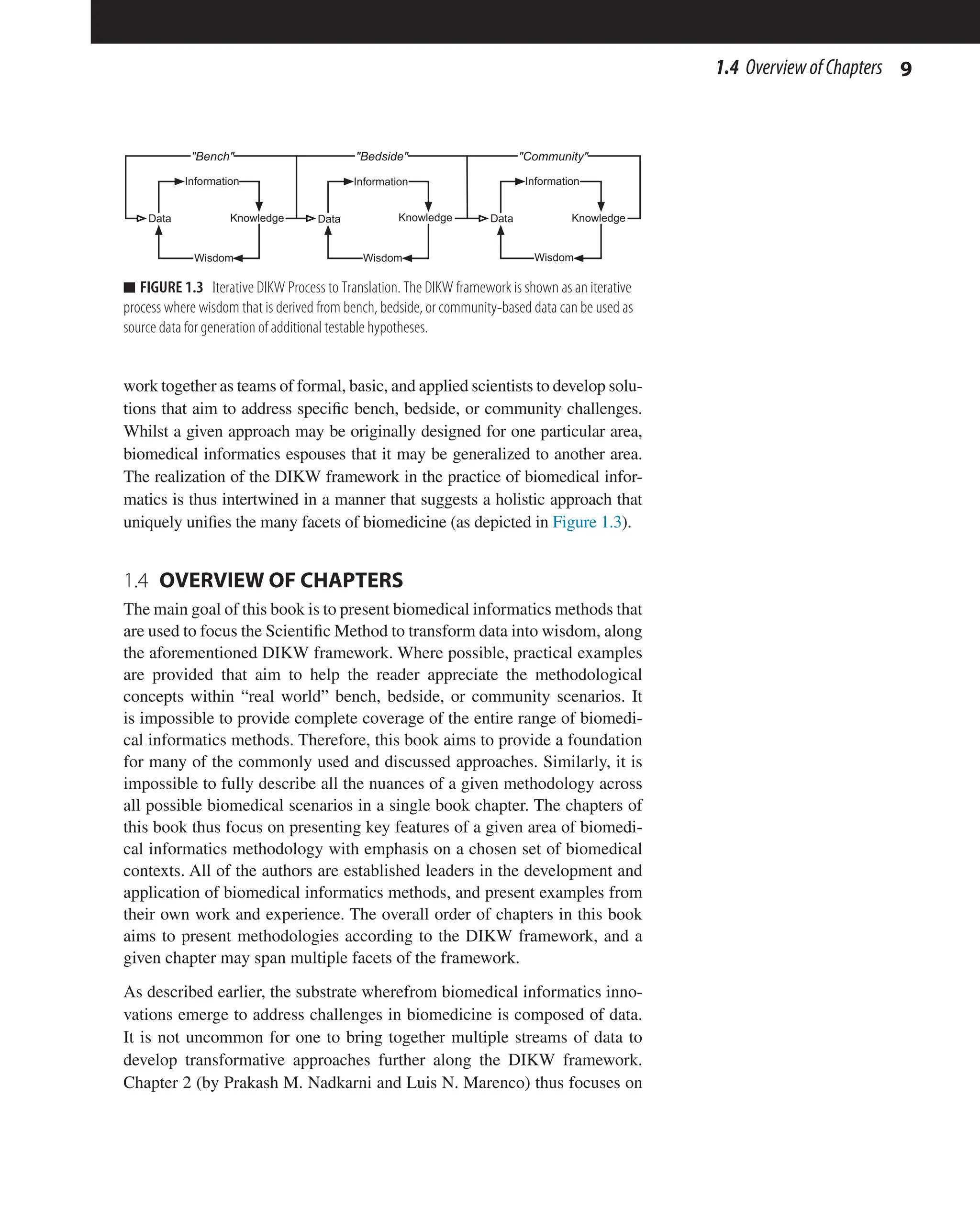
uniquely unifies the many facets of biomedicine (as depicted in Figure 1.3).
1.4 
OVERVIEW OF CHAPTERS
The main goal of this book is to present biomedical informatics methods that
are used to focus the Scientific Method to transform data into wisdom, along
the aforementioned DIKW framework. Where possible, practical examples
are provided that aim to help the reader appreciate the methodological
concepts within “real world” bench, bedside, or community scenarios. It
is impossible to provide complete coverage of the entire range of biomedi-
cal informatics methods. Therefore, this book aims to provide a foundation
for many of the commonly used and discussed approaches. Similarly, it is
impossible to fully describe all the nuances of a given methodology across
all possible biomedical scenarios in a single book chapter. The chapters of
this book thus focus on presenting key features of a given area of biomedi-
cal informatics methodology with emphasis on a chosen set of biomedical
contexts. All of the authors are established leaders in the development and
application of biomedical informatics methods, and present examples from
their own work and experience. The overall order of chapters in this book
aims to present methodologies according to the DIKW framework, and a
given chapter may span multiple facets of the framework.
As described earlier, the substrate wherefrom biomedical informatics inno-
vations emerge to address challenges in biomedicine is composed of data.
It is not uncommon for one to bring together multiple streams of data to
develop transformative approaches further along the DIKW framework.
Chapter 2 (by Prakash M. Nadkarni and Luis N. Marenco) thus focuses on
Data
Information
Knowledge
Wisdom
Data
Information
Knowledge
Wisdom
Data
Information
Knowledge
Wisdom
Bench Bedside Community
n FIGURE 1.3 Iterative DIKW Process to Translation. The DIKW framework is shown as an iterative
process where wisdom that is derived from bench, bedside, or community-based data can be used as
source data for generation of additional testable hypotheses.
10 CHAPTER 1 Introduction
the methodologies associated with data integration. Particular attention is
given to comparing competing approaches for integrating data from dispa-
rate sources, while accounting for political and resource realities. Chapter
3 (by Mark A. Musen) then shifts the attention to how one might represent
knowledge that can be attributed to gathered data. Within the context of the
DIKW framework, this chapter highlights important methodological con-
siderations and challenges with representing the meaning and preserving the
knowledge associated with data.As continual improvements are seen in data
generation technologies, such as next generation molecular sequencing,
there is an increased need to harness biomedical informatics methodologies
to identify potential testable hypotheses. To this end, Chapter 4 (by Yves A.
Lussier and Haiquan Li) explores the challenges with generating hypotheses
from heterogeneous data sets that span the spectrum of biomedicine.
It is essential to acknowledge that a significant volume of biomedical knowl-
edge is not readily searchable or available for computational analyses. The
next two chapters thus aim to introduce the reader to key methods associated
with retrieval of knowledge from traditionally text based sources. The first of
these, Chapter 5 (by Trevor Cohen and Dominic Widdows), presents contem-
porary biomedical informatics approaches that utilize geometric techniques
to explore or analyze multi-faceted biomedical knowledge. Chapter 6 (by
Kevin B. Cohen) provides an overview of natural language processing, which
continues to mature within the realm of biomedical informatics for extracting
potentially usable information from a range of sources across biomedicine.
As data are gathered from a plethora of sources and potentially represented
as knowledge that can be of utility for future use, one must consider how one
performs the transformation from data into information and knowledge such
that it might enter into the stage of wisdom. Chapter 7 (by John H. Holmes)
provides a foundational overview of data mining techniques, which are used
to realize the DIKW framework. The next two chapters then present specific
techniques that are used in biomedical informatics to impute information and
knowledge from biomedical data. Chapter 8 (by Hsun-Hsien Chang and Gil
Alterovitz) presents Bayesian methods that represent a major foundational
category of techniques used in biomedical informatics to impute knowl-
edge from biomedical data. Chapter 9 (by Ryan J. Urbanowicz and Jason H.
Moore) then introduces learning classifier systems, which are increasingly
becoming essential to decipher complex phenomena from potentially unde-
cipherable data that can be perceived as knowledge.
As biomedical informatics solutions are developed, largely through the har-
nessing of formal and basic science techniques, their biomedical utility can
only be realized through the implementation and contextualization through
11
1.5 ExpectationsandChallengetotheReader
applied science. The next set of chapters aim to provide examples of method-
ologies that harness the applied aspects of biomedical informatics. The first
of these chapters, Chapter 10 (by Riccardo Bellazzi, Matteo Gabetta, and
Giorgio Leonardi), describes fundamental engineering principles that are
germane to the design, development, and ultimate implementation of bio-
medical informatics innovations. Chapter 11 (by Fernando Martin-Sanchez,
Guillermo Lopez-Campos, and Kathleen Gray) follows by exploring the
biomedical informatics landscape associated with personalized medicine
and participatory health, which reflects a holistic biomedical revolution that
seamlessly integrates classical biomedical data with patient centered data to
result in a new cadre of biomedical knowledge. Chapter 12 (by Joshua C.
Denny and Hua Xu) then focuses on the development of personalized care
regimens that harness increasingly digitally available genomic and health
data that can be used to develop informed clinical decisions.
Chapter 13 provides a concluding perspective of biomedical informatics
and its continued relevance in the emerging “Big Data” era. The chapters
of the main book are followed by four mini-primers (Appendices A–D by
Elizabeth S. Chen) that aim to provide hands-on experience with basic
technical skills that are often used in the implementation of biomedical
informatics methods: Unix (Appendix A); Ruby (Appendix B); Databases
(Appendix C); and Web Services (Appendix D).
1.5 
EXPECTATIONS AND CHALLENGE TO THE READER
As with any multi-authored book, there will be varying styles in presenting
content. Each of the authors was charged with taking what are tradition-
ally complex and difficult concepts in biomedical informatics and present-
ing them in a manner that is accessible but still of utility in the context of
contemporary biomedicine. To this end, each chapter should be approached
with the aim to understand the principles of the concepts described within
the context of the examples from within a given chapter. The reader should
then aim to address three questions:
1. What are the key aspects of the methodological concepts described?
2. How can the methodological concepts be applied to my area of
interest (e.g., bioinformatics, clinical informatics, or public health
informatics)?
3. What are potential advantages/disadvantages of the methods presented?
The reader should then aim to identify additional peer-reviewed literature
(starting with other articles written by the chapter authors) that further
describes the methodological aspects of the techniques presented within a
given chapter.
12 CHAPTER 1 Introduction
For this book to be used as an effective educational instrument or as an intro-
duction to the broad range of methodologies that are used in biomedical infor-
matics, it must be used as a starting point and not as a comprehensive reference
for a given methodology. Many of the chapter authors have included references
that may be consulted for additional details. Whilst a book of this nature will
never be comprehensive (or even complete in topics covered), it is expected
that it will provide a foundation for the methodological principles of biomedi-
cal informatics that can be applied across the spectrum of biomedicine.
REFERENCES
[1] Keramaris NC, Kanakaris NK, Tzioupis C, Kontakis G, Giannoudis PV. Translational
research: from benchside to bedside. Injury 2008;39(6):643–50.
[2] Woolf SH. The meaning of translational research and why it matters. J Am Med
Assoc 2008;299(2):211–3.
[3] Westfall JM, Mold J, Fagnan L. Practice-based research–“Blue Highways” on the
NIH roadmap. J Am Med Assoc 2007;297(4):403–6.
[4] Kulikowski CA, Shortliffe EH, Currie LM, Elkin PL, Hunter LE, Johnson TR, et al.
AMIA board white paper: definition of biomedical informatics and specification of
core competencies for graduate education in the discipline. J Am Med Inform Assoc
2012;19(6):931–8.
[5] Shortliffe EH, Cimino JJ, editors. Biomedical informatics: computer applications in
health care and biomedicine. 4th ed. New York: Springer; 2013.
[6] Sarkar IN. Biomedical informatics and translational medicine. J Transl Med
2010;8:22. PubMed PMID: 20187952.
[7] Lean ME, Mann JI, Hoek JA, Elliot RM, Schofield G. Translational research. BMJ
2008;337:a863.
[8] Wehling M. Principles of translational science in medicine: from bench to bedside.
Cambridge, New York: Cambridge University Press; 2010. xxii, 382 p., 24 p. of
plates p.
[9] Payne PR, Embi PJ, Sen CK. Translational informatics: enabling high-throughput
research paradigms. Physiol Genomics 2009;39(3):131–40.
[10] Altman RB. Translational bioinformatics: linking the molecular world to the clinical
world. Clin Pharmacol Ther 2012;91(6):994–1000.
[11] Sarkar IN, Butte AJ, LussierYA, Tarczy-Hornoch P, Ohno-Machado L. Translational
bioinformatics: linking knowledge across biological and clinical realms. J Am Med
Inform Assoc 2011;18(4):354–7.
[12] Embi PJ, Payne PR. Clinical research informatics: challenges, opportunities and defi-
nition for an emerging domain. J Am Med Inform Assoc 2009;16(3):316–27.
[13] Shortliffe EH. The future of biomedical informatics: a perspective from academia.
Stud Health Technol Inform 2012;180:19–24.
[14] Choi BC, Pak AW. Multidisciplinarity, interdisciplinarity and transdisciplinarity
in health research, services, education and policy: 1. Definitions, objectives, and
evidence of effectiveness. Clin Invest Med. Medecine clinique et experimentale
2006;29(6):351–64.
[15] Choi BC, Pak AW. Multidisciplinarity, interdisciplinarity, and transdisciplinarity
in health research, services, education and policy: 2. Promotors, barriers, and
13
References
strategies of enhancement. Clin Invest Med. Medecine clinique et experimentale
2007;30(6):E224–32.
[16] Choi BC, Pak AW. Multidisciplinarity, interdisciplinarity, and transdisciplinarity in
health research, services, education and policy: 3. Discipline, inter-discipline dis-
tance, and selection of discipline. Clin Invest Med. Medecine clinique et experimen-
tale 2008;31(1):E41–8.
[17] Barnes J. The Cambridge companion to Aristotle. Cambridge, NewYork: Cambridge
University Press; 1995. xxv, p. 404.
[18] Omar SB. Ibn al-Haytham’s optics: a study of the origins of experimental science.
Minneapolis: Bibliotheca Islamica; 1977. p. 168.
[19] Bacon F, Jardine L, Silverthorne M. The new organon. Cambridge U.K., New York:
Cambridge University Press; 2000. xxxv, p. 252.
[20] Hackett J. Roger Bacon and the sciences: commemorative essays. Leiden, NewYork:
Brill; 1997. x, p. 439.
[21] Popper KR. The logic of scientific discovery. London, New York: Routledge; 1992.
p. 479.
[22] Pearson K. On the criterion that a given system of deviations from the probable in the
case of a correlated system of variables is such that it can be reasonably supposed to
have arisen from random sampling. Philos Mag Ser 5 1900;50(302):157–75.
[23] Fisher RA. On the interpretation of χ2
from contingency tables, and the calculation
of P. J Roy Stat Soc 1922;85(1):87–94.
[24] Barrows HS, Tamblyn RM. Problem-based learning: an approach to medical educa-
tion. New York: Springer Pub. Co.; 1980. xvii, p. 206.
[25] Mandin H, Jones A, Woloschuk W, Harasym P. Helping students learn to think
like experts when solving clinical problems. Acad Med: J Assoc Am Med Coll
1997;72(3):173–9.
[26] Connelly DP, Johnson PE. The medical problem solving process. Hum Pathol
1980;11(5):412–9.
[27] Beach TG, Monsell SE, Phillips LE, Kukull W. Accuracy of the clinical diagno-
sis of Alzheimer disease at National Institute on Aging Alzheimer Disease Centers,
2005–2010. J Neuropathol Exp Neurol 2012;71(4):266–73.
[28] Cao L. Domain driven data mining. New York, London: Springer; 2010. xvi, p. 248
[29] Ackoff RL. From data to wisdom. J Appl Syst Anal 1989;16:3–9.
[30] Rowley J. The wisdom hierarchy: representations of the DIKW hierarchy. J Inf Sci
2007;33(2):163–80.
[31] Ledley RS, Lusted LB. Reasoning foundations of medical diagnosis; symbolic
logic, probability, and value theory aid our understanding of how physicians reason.
Science 1959;130(3366):9–21.
[32] Lusted LB, Ledley RS. Mathematical models in medical diagnosis. J Med Educ
1960;35:214–22.
[33] Blois MS. Information holds medicine together. MD Comput: Comput Med Practice
1987;4(5):42–6.
http://dx.doi.org/10.1016/B978-0-12-401678-1.00002-6
Methods in Biomedical Informatics.
© 2014 Elsevier Inc. All rights reserved.
2.1 
OBJECTIVES OF INTEGRATION
The broad objective of integration is to be able to answer questions of com-
bined data that would be otherwise very difficult and/or tedious to address
if each individual data source had to be accessed separately or in sequence.
We can look at these goals in the context of Health information exchanges
(HIE) [1], which are data repositories created geographically related to a
15
Data Integration: An Overview
Prakash M. Nadkarniand Luis N. Marenco
Yale University School of Medicine, New Haven, CT, USA
2
Chapter
CHAPTER OUTLINE
2.1 Objectives of Integration 15
2.2 Integration Approaches: Overview 17
2.2.1 
Scope of this Chapter 18
2.3 Database Basics 19
2.3.1 SQL Dialects 20
2.3.2 
Design for High Performance 21
2.3.3 
Data Integration vs. Interoperation 21
2.4 Physical vs. Logical Integration: Pros and Cons 22
2.5 Prerequisite Subtasks 27
2.5.1 Determining Objectives 27
2.5.2 
Identifying Elements: Understanding the Data Sources 28
2.5.2.1 Identifying Redundancy and Inconsistency 29
2.5.2.2 Characterizing Heterogeneity: Modeling Conflicts 31
2.5.3 
Data Quality: Identifying and Fixing Errors 34
2.5.4 
Documenting Data Sources and Processes: Metadata 35
2.5.4.1 Ontologies 38
2.6 Data Transformation and Restructuring 39
2.7 Integration Efforts in Biomedical Research 41
2.8 Implementation Tips 42
2.8.1 
Query Tools: Caveats 42
2.8.2 
The Importance of Iterative Processes 43
2.9 Conclusion: Final Warnings 44
References 44
16 CHAPTER 2 Data Integration: An Overview
consortium of stakeholders (e.g., hospitals, insurance companies, and group
practices). HIEs, whose data can be accessed when needed by any autho-
rized stakeholder, are intended to maintain an up-to-date pool of essential
information on patients within the geographical region who are associated
with any stakeholder-caregiver.
The specific goals of data integration are to:
1. Be able to look at the “Big Picture”: Organizations that carry out
identical or highly similar operations at different geographical locations
need to be able to look at consolidated summaries of structurally
identical, pooled data to know how they are performing. In other
scenarios (e.g., research consortia), different sites that function
autonomously may be generating different kinds of primary data that
focus on a broad overall problem, or with the same sources (e.g., a
common pool of patients and biospecimens): here, being able to inspect
or analyze the pooled dataset can help answer research questions. With
HIEs, pooled data facilitate epidemiological and outcomes research.
2. Identify shared elements within different sources, which can then be used
as the basis of interoperation between systems that make use of individual
sources: An example of such an operational national effort is the National
Library of Medicine’s Unified Medical Language System (UMLS) [2].
The UMLS is primarily a compendium (“meta-thesaurus”) of individual
controlled vocabularies that have achieved the status of standards for
specific biomedical applications, or within certain biomedical areas.
Different areas overlap, and therefore many elements (here, biomedical
concepts) are shared across multiple vocabularies, often with different
names. The UMLS maintains a list of biomedical concepts, a list of
synonyms (terms) for each concept and their occurrence in individual
vocabularies, along with vocabulary-specific information such as the
alphanumeric codes assigned to individual concepts. In the context of
HIEs, identification of functionally similar elements across different
systems simplifies the task of updating the patient’s medical history in
that patient’s primary medical record when the patient has been treated
somewhere else within the HIE’s geographical area.
3. Eliminate duplicated effort and errors due to non-communicating
systems: Many businesses (including hospitals), which use software
from multiple vendors, are still notorious for maintaining multiple, often
non-synchronized or out-of-date copies of essential customer/patient
data, e.g., demographics, insurance, and vital parameters such as blood
group, allergies, current ailments, current medications. In emergency
cases where a patient is seen by a caregiver/institution different from the
usual caregiver (a problem that is particularly acute in the US, where the
17
2.2 IntegrationApproaches:Overview
healthcare system is fragmented), laboratory tests must sometimes be
repeated because data are unobtainable expeditiously from the original
source. The benefits in an HIE context are obvious: for patients in an
emergency situation being treated at a site other than the usual provider,
the new providers accessing HIE content can access the patient’s
medical history, and can focus on treating the present complaint rather
than losing precious time in gathering old information.
2.2 
INTEGRATION APPROACHES: OVERVIEW
Integration may be achieved using two broad strategies:
1. Physical Data Integration: Copies of the primary data are restructured
and moved to one or more data repositories. Depending on the scope
and volume of the data, this repository can either constitute a data
warehouse [3] or a data mart [4]. The differences between the two lie
primarily in scope, orientation, and purpose, and secondarily in the
choice of design and technology. Data warehouses have organization-
wide scope, are oriented toward business analysts or statisticians, and
store every possible type of data of interest across the organization.
Data marts have departmental-level scope, are typically end-user
oriented, and are special-purpose (e.g., they may be concerned only
with clinical data or only with administrative/financial data). The
significantly greater challenges of devising warehouses relate to the
difficulty of the implementation team’s being able to thoroughly
understand the greater diversity of the data that they must integrate.
Extraction, Transformation, and Load (ETL) is the process of
migrating data from their original source into a warehouse or mart.
This process can be extremely involved, as we now discuss. Note that
ETL is not a one-time task: because the original sources are regularly
updated during production operations, ETL must be performed at a
regular frequency to ensure that the physically integrated data in the
warehouse or marts are current. Historically, the ideal was to ensure
that the integrated data were not more than 24h out of date: the ETL
processes were run at night in batch mode, when the production
systems were mostly idle. Currently, many high-end DBMSs support
technologies that allow updates of the integrated data at frequencies
greater than nightly, or even in continuous, real-time mode.
In organizations that employ data integration, there is one warehouse
and multiple data marts: the contents of the marts are derived from the
warehouse through secondary transformation and load processes.
18 CHAPTER 2 Data Integration: An Overview
2. Virtual (or Logical) Data Integration: Data reside in a distributed
manner at their original sites. However, software that resides at a
central site communicates with the hardware that houses the distributed
data, via the Internet and using a specific query protocol. Users interact
with the sources only via the intermediary software, which is therefore
referred to as a mediator. The central site stores information that
describes the data at individual sites. Users of the system only interact
directly with the central site, which mediates their requests for data.
That is, the central site acts as an intermediary between users and the
distributed sites. In logical data integration, the analog of the data
warehouse/mart is data federation.
Theoretically, one could implement a federation of data warehouses.
Warehousing technology, however, is expensive enough (and expertise in
warehousing processes scarce enough) that it is best applied at a single cen-
tralized location. Data mart technology, by contrast, is cheap enough to be
deployed at multiple sites. In fact, data marts at multiple locations—e.g.,
departments within an organization—often act as end-user front-ends to a
central warehouse: this set up, however, still involves physical integration.
In either circumstance, integration focuses primarily on data query rather
than interactive data updates. In the federation scenario, where individual
sites are autonomous, updates by anyone other than the sites’ own users
would not even be permitted. In the physical-integration scenario, ware-
house technology is optimized for query, and not intended to support inter-
active transaction processing. Updates to the sources only occur during
fixing of errors discovered during the integration effort, an issue discussed
shortly.
2.2.1 
Scope of this Chapter
The field of integration is too vast to be covered in a single chapter. Entire
books cover various aspects of physical data integration (which is more
mature than logical integration): practically every single book where Ralph
Kimball shares authorship is worth reading, and Larry Greenfield’s Web
site, the Data Warehousing Information Center [5], is an invaluable resource
that this chapter’s authors used to commence learning about this field, and
continue to consult. (Bill Inmon is justifiably credited as the father of the
data warehouse. However, we find his post-1999 work far less useful than
those of Kimball, with whom he occasionally has very public disagree-
ments.) Reference books on logical integration are far fewer: they deal with
specific products (e.g., by IBM), or with scenarios (e.g., “semantic web”)
where implementation lags greatly behind theory.
19
2.3 DatabaseBasics
This chapter will therefore limit itself to provide an overview, with the
objective of enabling the reader to better utilize resources such as the above.
Specifically, this chapter will:
n Summarize and contrast approaches with respect to benefits and
drawbacks.
n Characterize the subtasks that underlie all integration efforts
irrespective of the approach.
n Summarize some efforts in biomedicine.
n Provide practical advice on integration.
While some overlap is unavoidable, we will focus on areas that are relatively
underemphasized (or not discussed at all) in book-length references, incor-
porating our own experience where appropriate.
In our exploration of integration approaches, we will make the reasonable
assumption that each data source (“database”) will utilize some form of
Database Management System (DBMS) to manage its content. The follow-
ing subsection (Database Basics), which provides a foundation required to
appreciate the rest of the chapter, can be skipped by those already familiar
with DBMS technology.
2.3 DATABASE BASICS
Relational databases (RDBs) [6], invented in 1970 by E.F. Codd, currently
form the basis of the most widely used DBMS technology. Here, the data-
base can be thought of as a set of interconnected tables: each table has col-
umns corresponding to fields and rows corresponding to records. A column
is defined in terms of its data type (the type of data it holds, e.g., text, inte-
gers, decimal numbers, dates) and constraints—conditions that dictate what
values are permitted in individual columns (or combinations of columns).
We will discuss constraints shortly in the next section.
An RDB is typically designed using a methodology called normalization
[7], which involves segregating the data to be represented across multiple
tables with minimal duplication of elements across tables. For example,
patients may be assigned a unique Patient ID (typically an auto-increment-
ing integer). A “Patient Demographics” table associates, with the Patient ID,
details such as the patient’s name, birth date, gender, current address, con-
tact information, etc. A separate “Visits” table records a patient’s (possibly
numerous) visits using only the Patient ID without duplicating the name,
gender, etc.: the latter data are looked up from the Patient Demographics
table. The Demographics and Visits tables are thus linked by the Patient ID
column. The link serves another purpose: maintaining referential integrity.
20 CHAPTER 2 Data Integration: An Overview
That is, in any row of the Visits table, the value of the “Patient ID” column
must match an actual patient in the Demographics table. Similarly, a user
working with the Demographics table is not permitted to accidentally delete
a patient who has at least one Visit record.
The term schema refers to the structure or blueprint of a database. For an
RDB, the schema comprises the definition of each table (primarily in terms
of its columns) and the links (also called relationships) between individ-
ual tables. An RDB schema is typically specified using Structured Query
Language (SQL), the lingua franca of RDB technology, which is used both
to define a database and to manipulate its contents (query and record addi-
tion, deletion, and change).
2.3.1 SQL Dialects
The term “lingua franca” is partially misleading: SQL actually refers to
a set of vendor-specific dialects based on a standard, whose differences
may be significant enough to impact an integration effort, especially a
data federation where different sites are likely to use different vendor
DBMSs. The International Standards Organization (ISO) SQL commit-
tee, which defines the standard, has a process that generally lags behind
business needs and development of commercial software: to a large extent
the process has played catch-up rather than having a direct influence on
commercial SQL development. The various commercial RDBMSs vary
in how they manage basic data types such as dates, and functions with
identical purpose (e.g., for basic math or string manipulation) may be
invoked differently. Further, Extensible Markup Language (XML) con-
tent, geographic data, formatted text of arbitrary size are handled in ven-
dor-specific ways.
Numerous third-party software vendors market tools that facilitate creating
software applications that translate a “vendor-neutral” SQL into vendor-spe-
cific SQL. This allows the creation of front-end tools (e.g., analytical soft-
ware or query interfaces) that can connect to a variety of database engines
without their power-users having to worry about which DBMS engine they
are connecting to. Among the “vendor-neutral” standards is Open Database
Connectivity (ODBC), originally promulgated by Microsoft but made freely
available, so that it has formed the basis of other standards, such as Java
Database Connectivity (JDBC). “Vendor-neutral” SQL does not support
manipulation of XML/formatted text/geographic data, and similarly, differ-
ent DBMSs vary widely with respect to the built-in analytical functions that
they support: for example, the standard statistical function, standard devia-
tion, is an intrinsic function in some SQL dialects but not others. In all these
circumstances, one still resorts to vendor-specific SQL: fortunately, ODBC
21
2.3 DatabaseBasics
allows software developers to designate “vendor-specific” code when this
capability is needed.
2.3.2 
Design for High Performance
Modern relational database technology achieves high performance using a
variety of technological approaches. Chief among these are:
n Indexes: These are data structures on disk that can dramatically
improve search performance. With an index, search operations on the
table associated with the index are proportional to the logarithm of the
record count or even better, thus greatly increasing speed of querying
for large volumes of data. Indexing normally involves a trade-off:
when data are interactively updated, with every addition or deletion
of a record, the indexes on those data must be updated, which takes
time, and therefore indexes are restricted only to those necessary
for interactive operations (e.g., index on last names or dates of birth
of patients). Most DBMSs employ “B-tree” indexes [8], which give
balanced performance with respect to query versus update.
n Caching: DBMSs will take advantage of RAM, which is used to store
portions of tables and indexes, as well as data previously requested.
n Query Optimization: The interpretation and execution of SQL
data-retrieval statements has been refined over three decades: DBMSs
will utilize information such as the presence of indexes, the availability
of RAM, and even pre-computed statistics on the distribution of data
within tables. Software developers can also inspect execution plans
(which are typically displayed graphically) and use this information
to identify bottlenecks and improve performance—e.g., by adding an
index.
2.3.3 
Data Integration vs. Interoperation
Data integration focuses primarily on query of the integrated data. The
related term systems integration involves getting separate software or hard-
ware systems to interoperate: e.g., propagating updates to one or more sys-
tems based on changes to another system [9]. It is possible to achieve data
integration without interoperation, and vice versa.
Interoperation involves two or more systems communicating using a
message-passing protocol, which may be ad hoc or based on some kind of
standard. It involves two aspects: data interchange and distributed computing.
n In data interchange, the protocol is used to transmit data for export/
import. For healthcare systems, the interchange standard is Health
22 CHAPTER 2 Data Integration: An Overview
Level 7 (HL7). Among the problems with the current official version
of HL7 (v 2.x) [10] are that it is somewhat underspecified, so that
each vendor’s flavor of HL7 differs somewhat, and exchanging data
between systems created by separate vendors is non-trivial. The
latest (non-official) version of HL7 (version 3) is not backward-
compatible with v 2.x, and complaints of excessive complexity [11]
have delayed its widespread acceptance. Another caveat is that HL7
interchange has sufficient overhead that if simpler means of exchange
are available, they should be used preferentially (the Epic Electronic
Health Record, for example, uses the medium of delimited text files
as a mechanism for exporting data [12]). In any case, such streams
are unsuited for the purpose of complex, ad hoc querying: their
contents are best parsed, restructured, and imported into RDBMSs for
that purpose.
n In distributed computing, two or more hardware units (which may be
geographically separated) are involved in the solving of a problem.
This configuration enables individual sites to contribute computing
resources that can be accessed remotely, though they may also support
data access. Here, the communication approach involves mechanisms
such as Web Services [13], which may be regarded as subroutines
executed remotely using Web-based technologies: data are passed to
the subroutine, and results returned. Web services may use one of two
approaches: the simple Representational State Transfer (REST) [14]
and the complex SOAP, which originally stood for Simple Object
Access Protocol, but now stands for nothing after it was discovered
through experience that SOAP is anything but simple [15]. REST is
more lightweight. The pros and cons of each approach are beyond the
scope of this chapter; a good, accessible overview is provided by Steve
Francia [16].
2.4 
PHYSICAL VS. LOGICAL INTEGRATION:
PROS AND CONS
A general rule of thumb is that physical integration is always preferable
to virtual integration/federation except when it is not feasible for non-
technical reasons (e.g., business or political). The following issues must be
considered:
n Query Performance and Technological Considerations: Integrated
data are ultimately intended to be queried. Users expect queries that
are run on a regularly scheduled basis to execute rapidly. Queries run
much faster when all data are hosted on a single machine, as opposed
23
2.4 Physicalvs.LogicalIntegration:ProsandCons
to having to deal with network (or Internet) latency inherent in having
a mediator query multiple, geographically separated sources and
moving intermediate results back and forth between locales in order to
combine, filter, and format the results for the end-user. While network
latency may also be an issue in querying a single, remotely located,
integrated data store, it is less so because the query results are much less
voluminous than the data that must be processed to yield the results.
Warehouses and data marts (marketed for the most part by
organizations that also sell RDBMSs) utilize performance-enhancing
technologies that take advantage of the read-only nature of the data
(end-users do not update data interactively). Such data can be more
extensively indexed, and certain types of indexes (hash-table based
indexes [17], join indexes, and bitmap indexes [18,19]) employed that
give significantly faster query performance than “B-tree” indexes, but
whose performance would be unacceptable for data that is interactively
updated frequently [20]. In addition, physical integration allows data to
be restructured to speed performance of common queries, a topic we
consider in Section 2.6, “Data restructuring.”
Another way to improve query performance is to pre-compute
data aggregates that form the basis of common data requests. For
example, one can compute several statistics related to hospital
care (such as median length of stay, total number of admissions in
different departments, etc.) just once, and store them for future use.
Most warehouse/mart vendors include “multi-dimensional database”
technology that computes such aggregates either automatically, based
on the data model, or with minimal developer intervention.
n The existence of “black-box” legacy systems or non-database
sources: One or more of the data sources to be integrated may be
poorly understood, decades-old “legacy” systems, whose original
programmers may have long since retired, and which were created
long-before modern DBMSs or modern communications protocols (or
the Internet) existed. Integrating such systems logically with the others
is impossible or prohibitively expensive: it is better to try to extract
data (from their outputs, if necessary: see screen-scraping, later) and
move it to a modern DBMS.
In addition, much of the data may reside in formats such as
spreadsheets or statistical packages: suitable for their intended purpose,
but not really intended to support multi-user queries. In this case, too,
logical integration is infeasible, and transformation of copies of such
data into DBMS structures is desirable.
24 CHAPTER 2 Data Integration: An Overview
n Query Translation vs. Data Translation: Integration of diverse data
sources requires creating a global data model that represents the
information that the integrated resource will store or provide access
to. As stated later, this is typically not the union of all the elements
in all data sources, but a subset of the union. Once the global data
model is defined, the correspondences (mappings) between elements
in individual sources and elements in the data model must then
be defined. Such correspondence may not be a one-to-one match
for reasons discussed in Section 2.5.2.2, and conversions (such as
mathematical transformation) may need to be performed.
We now contrast how logical integration and physical integration
work. In logical integration, a user issues a query against the global
data model. The mediator looks up mapping information to identify
which local sources contain the desired elements, and then translates
the global query into queries that are meaningful to each individual
source. (Thus, if a user asks for elements A, B, and C, but a particular
source contains only elements A and B, then the translated query for
that source will only ask for those elements.) The translated query
must also conform to the syntax of the local DBMS’s query language
or dialect of SQL. The translation process can be streamlined to some
extent by using database views (predefined queries, typically across
multiple tables). Such translation must, of course, be performed each
time a user issues a new query.
Physical integration, by contrast, is based on data translation. All the
integrated data are ultimately converted (mathematically transformed,
if needed) to the structures required by the global model (and into a
single DBMS). Restructuring is performed as a batch process—i.e.,
only once during data load. Therefore the expense of translation is
incurred only once, and issues of worrying about various SQL dialects
do not arise.
Further, once physical homogenization is achieved, queries against
a physically integrated system can be significantly more complex/
powerful, and implementation of query capability significantly simpler,
than for a federated system that may use different DBMSs at each site.
With logical integration, by contrast, while simple browsing interfaces
that show details of a single item of interest are feasible, sophisticated
analytic queries involving complex Boolean logic that return numerous
rows of data are rarely possible.
n Authority and Organizational Structure: Physical integration generally
mandates that the integration team should be able to access all of
25
2.4 Physicalvs.LogicalIntegration:ProsandCons
the data sources (both data definitions as well as samples) freely, so
as to understand each source and determine what can be integrated.
This is feasible when integration is being performed within a single
organization (assuming that divisional turf battles can be overridden
by senior management). Here, the information technology (IT) staff
responsible for the data-source sites report to the same authority as the
central team.
In the case of consortia of independent organizations that may be
competitors—this is also true for scientific efforts—it is politically
infeasible to expect an integration team, even one comprised of
members of every organization, to have this level of authority and
access: certain data, and even the existence of certain data elements,
may be considered proprietary. Also, lines of command are crossed:
the site IT staff is not answerable to the integration team, and without
their cooperation, integration will not happen. In this situation,
federation is the only option.
n Political issues arise in any integration effort (see the references
of Greenfield [21] and Demarest [22]), but are much worse in the
consortium context. Some sites may believe, rightly or wrongly, that
giving a remotely based integration team copies of their data might
somehow lower their “control” over their own data: they would
rather have end-users query their systems via a mediator. When
physical integration was mandated, the authors have witnessed, due
to individual sites’ fear of getting “scooped” by their competitors, the
deploying of passive-aggressive tactics to delay transmission of data
copies, including the use of obscure and hard-to-parse data formats that
require significant programming effort by the integration team.
Again, federation may be the only choice: political minefields exist
here as well. Funding authorities may have to employ a combination
of incentives and strong-arming to ensure progress. The paranoia
of certain investigators in at least one National Institutes of Health
research consortium, coupled with limited direct involvement of
NIH program staff, has doomed data integration efforts even before
they began: the least-common-denominator data that was agreed to
be shared was so rudimentary that it had little value to the broader
scientific community.
n Expertise: Expertise in integration is not widespread. Consequently,
in a federation scenario, where there were many more cooks (not all
of them fully qualified) involved in making the broth, it is easier for
things to go wrong: much more time must be spent in education and
training, and the site with the least skills can play a rate-determining
26 CHAPTER 2 Data Integration: An Overview
role. Also, if such expertise is unavailable and must be hired, it is less
expensive to hire a team that operates centrally than multiple teams for
each geographic site.
The too-many-cooks constraint, in our opinion, also reflects in the final
product: consortium-created logically integrated resources that aim
to provide access to heterogeneous data may be awkward to use and
less likely to reflect a unifying, consistent vision. The hurdles in trying
to arrive at, and impose such a vision (which may require significant
overhaul and cleanup of the individual sources to serve new purposes
for which they were not originally intended) are often insuperable, and
may result in “lipstick on a pig”: cosmetic changes that fail to achieve
the desired result.
Occasionally, one may implement a hybrid approach, involving aspects of
both strategies. Here, too, there are two possibilities.
n Primarily federated, but data fetched by the central site in response to
user requests may be stored for reuse (“cached”), so that a subsequent
request for the same data sends back the cached copy rather than
reaching out to the distributed sites. Caching is especially applicable
for subsets of the data that have low volatility, i.e., change infrequently.
In this case, one must record the time-stamps (date/times) of last
change to the source-data elements, and the time-stamps of last caching
for those elements on the server. Prior to execution of a query that asks
for the cached data, the time-stamps are compared to see if the source-
data time-stamps are more recent than the cached time-stamps. If so, it
is time for the source data to be “pulled” and cached again.
n Primarily physically integrated. However, data in the physical store is
refreshed (“pulled”) from multiple (possibly geographically separated)
primary sources in as unobtrusive a manner as possible (as far as the
owners of the remote systems are concerned). As above, time-stamps
are used at both ends (sources and repository) to determine when
to pull new data, and what rows of data to pull. Intra-organization
warehouses may also use pull strategies: the difference here is that
in a federation, primary sources are controlled independently, the
data owners’ IT teams need to specify to the “pull” software what
elements in their systems they are making “public”—only these will be
accessed, while all other elements will be “invisible.”
No matter which strategy is used, certain subtasks are essential. We discuss
the circumstances that determine feasibility, and the prerequisite subtasks,
shortly.
27
2.5 PrerequisiteSubtasks
2.5 PREREQUISITE SUBTASKS
The shared subtasks comprise the following:
1. Determining the objectives of the integration effort, in terms of specific
desirable end-results. This in turn determines the scope of the effort.
2. Identifying the data elements that, when integrated, will help meet the
objectives, and using these to define the “global” data model of the
integrated system. This requires acquiring an understanding of the data
sources. Among the activities to perform here are:
a. Characterizing the sources in terms of redundancy and
inconsistency of data elements.
b. Characterizing the heterogeneity and modeling conflicts among the
data sources.
3. Estimating data quality, and reducing data errors.
4. Creating detailed human- and machine-interpretable descriptions/
documentation of the data sources. As the integration effort proceeds,
documentation extends to the processes used to extract and transform
the data (for physical integration) and later, to the integrated end-result.
After prerequisites are completed, the integration process diverges depend-
ing on whether physical or logical integration is intended. In physical inte-
gration, the ETL process now commences. (ETL is too vast to do justice in a
single book chapter, so we will refer the reader to Kimball et al.’s excellent
text [23].) In logical integration, one defines correspondences (mappings)
between the global model and components of the local models are defined,
as discussed later, and the software that performs global-to-local query
translation is implemented, or purchased: with the commercial option, map-
pings must be defined using the vendor-provided framework. Describing the
nuts-and-bolts of logical integration is also beyond the scope of this chapter,
but see the freely available articles by Marenco et al. [24,25] for such detail.
We will explore subtask in turn.
2.5.1 Determining Objectives
Integration efforts are expensive. Even if infinite time and resources were
available, it would not be desirable to attempt to integrate every single item
of data that exists within an organization or consortium. Many data elements
will be used only by a particular division/department/laboratory for a variety
of internal purposes, and will have little utility beyond it: in a consortium,
some data may be considered proprietary and non-shareable by individual
sites. Determining specific (i.e., detailed) goals and deliverables will iden-
tify what kinds of data elements must be integrated: prioritizing these goals
determines the order in which integration-related tasks will be performed.
28 CHAPTER 2 Data Integration: An Overview
2.5.2 
Identifying Elements: Understanding
the Data Sources
Understanding data sources can be challenging, especially for legacy sys-
tems where the only documentation may comprise source code written in
an unfamiliar programming language. Further, for any given data source,
only some of the data elements that it records (or no elements at all) may be
relevant to integration objectives. Integrators must be prepared for the pos-
sibility of an unpleasant discovery: the data that would otherwise meet the
integration objectives may not actually be identifiable/ available, or be pres-
ent in a form that is unusable (e.g., it may lack the requisite level of detail).
Many integration efforts have resulted in modifications of source systems to
capture such information in future.
The steps in understanding data sources are the following:
n Identifying the purpose of every table in source systems. If the table
appears to be of interest to the integration effort, one identifies the
purpose of the columns in the table.
n Constraints or checks are rules that limit the permissible values in a col-
umn (or set of columns). They need to be determined by inspecting the
documentation and/or source code, from knowledge of the area (which
is often gleaned by interviewing users), and examination of the data.
Examination of data requires that data be extracted. Even for well-
understood source systems, this task may not be trivial. While modern
systems that rely on RDBMSs readily generate delimited text output,
we have encountered commercial “black-box” hospital-accounting
software that only generates 80-characters-per-line format (VT-52
terminal output that is spooled to disk), which must be “screen-scraped”
to extract the needed data from the copious admixed whitespace and
label content. Several third-party vendors provide graphical tools (e.g.,
Monarch™) that greatly simplify extraction from such output.
n Rules are a generalization of constraints: they have the general structure:
if (condition) then (perform actions) where both the condition and the
actions may be arbitrarily complex. Rules may be of two kinds: absolute
and heuristic. Absolute rules are like constraints: they should never be
violated. Heuristic rules embody judgment calls or “rules of thumb”:
they are probabilistic, though the probability may be stated on a crude
qualitative scale rather than as a precise number. The term “business
rules” applies to rules, implicit or explicit, that determine how processes
in business applications are conducted. The process by which they are
discovered is similar to that of constraints. It is important to note that rules
change over time, because of legislation, evolving goals, and so forth.
29
2.5 PrerequisiteSubtasks
Examples of constraints are:
n Data-type: E.g., dates should be valid, numeric fields should not
contain alphabetical characters and be in a standardized format like
YYYY-MM-DD.
n Range: Maximum and minimum permissible values. One may also
record maximum and minimum reasonable values, where out-of-range
values are possible but must be verified (e.g., human weight more than
900lbs).
n Enumerations: The values of a column must belong to a modest-sized
set of values: these values are typically (alpha-) numeric codes, each
of which corresponds to a textual description. Sometimes, these values
may represent ordering, so that the enumeration represents an ordinal
scale: for example, pain may be coded as 0 (Absent), 1 (Mild),
2 (Moderate), and 3 (Severe).
n Mandatory: A column’s value cannot be blank.
n Unique: For a given row in a table, the column’s value must be unique.
Thus, social security number and Patient ID must be unique for every
patient.
n Regular-expression [26]: The column contents must match a pattern.
For example, social security number must match the pattern nnn-nn-
nnnn (n=any digit).
n Multi-column: The sum of the individual components together must be
valid. For example, differential white blood cell count across multiple
columns must be equal to 100 (since they are all percentages). A
simpler example may be that the time-stamp of hospital admission
must be less than time-stamp of discharge. Multi-column constraints
can often be arbitrarily complex and must be specified using
programming code.
n Computed columns: Certain columns may be derived from others. For
example, for humans, Body-Mass Index is calculated by (weight in
kg)/(height in meters)2
.
2.5.2.1 Identifying Redundancy and Inconsistency
Exploration of the sources may reveal that the same information is recorded
redundantly in multiple sources: this is often seen in pre-relational sys-
tems, or in systems that have not been designed to interoperate with others.
Further, like multiple clocks in a house where each indicates a different
time, the sources may be inconsistent: when a patient’s contact informa-
tion changes, for example, only one source may be current: when insur-
ance information changes, only another source may be accurate. In such
cases, it is important to identify the workflow to determine which sources
30 CHAPTER 2 Data Integration: An Overview
are “authoritative” for which elements. In many cases, it is impossible to
know which source is the accurate one, because the work processes for data
update are haphazard.
A Master Patient Index (MPI) is a database application that facilitates
consistency-maintenance for essential patient information. It records every
patient’s most current information, assigning a unique Patient ID. Ideally,
all other software systems within the organization use this Patient ID, que-
rying the MPI to obtain current information, or posting updates to specific
MPI fields (such as current diagnoses or most recent hospital admissions)
as needed. One can also query the MPI using a combination of criteria
(name, date of birth, gender, contact info) to see whether a newly encoun-
tered patient is already in the system, so that a duplicate record for the same
patient is not accidentally created. (To allow for name-spelling errors and
changed contact info, the MPI software must support inexact or “probabi-
listic” matching.) In practice, many commercial black-box systems such as
described above may refuse to interoperate with MPIs, making some dupli-
cation unavoidable.
In scientific contexts, inconsistency has other aspects.
n While detectable by computer programs, inconsistency may be
resolvable only by domain expertise, not by integrators with primarily
software expertise. An example is the UMLS, where interconcept
relationships contradict each other across source vocabularies. The
National Library of Medicine has a hands-off policy on content
curation, merely tagging each fact with its source, so that you may
encounter something equivalent to: “according to vocabulary X,
sound travels faster than light.” Users who lack domain expertise may
have to rely on heuristics such as the authoritativeness of individual
vocabularies.
n In other cases, inconsistency is a consequence of experimental
uncertainty: the correct answer is not yet known, and all the results must
be preserved (and tagged with their original source), until such time that
the discrepancies can be resolved with further experiment. Examples of
this type of inconsistency were seen in genomic maps in the mid-1990s,
when yeast artificial chromosomes (YACs) were used as experimental
reagents to clone human DNA.YACs have a high incidence of
“chimerism”: the cloned DNA, which is supposed to correspond to
a single genomic region, may actually be a composite of DNA from
two or more genomic regions, leading to errors in interpretation if the
DNA is characterized or sequenced. The chimerism incidence was high
enough that the Human Genome Project ultimately abandoned them.
31
2.5 PrerequisiteSubtasks
2.5.2.2 Characterizing Heterogeneity: Modeling Conflicts
Even in cases where different sources do not contradict each other, they
may say the same thing about the same data differently, and they may state
slightly different things. Modeling conflicts pose an important challenge in
integration, and it must be identified rigorously. Won Kim’s classic 1991
article [27] provides a useful classification for the integration practitioner.
1. Storage-engine conflicts: While RDBMSs are widely used, they are
not universal, and a wide variety of non-relational data stores may be
encountered, especially in scientific data sets where performance is less
importance than convenience for analysis. Data may be stored in the
formats used by statistical and other analytic packages. Consequently,
the data structures encountered may not match the designs of relational
data stores.
Even when DBMS-type stores are used, the data organization may
violate the principles of “normalization” stated earlier. This violation
may be either deliberate, to fix significant performance problems—an
issue more likely to be encountered in the past than today, but still seen
with Electronic Health Record (EHR) systems that use non-relational
engines—or accidental—where the system’s developers did not fully
comprehend the consequences of the short-cuts that they took.
2. Naming conflicts across tables, columns, and relationships: Synonymy
occurs when the same concept is named differently in two sources—
thus laboratory procedures may be called LABS in one system and
LAB_PROCS in another. Homonymy occurs when the same phrase
is used to label related, but non-identical, or different concepts. For
example, one EHR may use PERSON to refer to end-users of the
system, and another to refer to patients. For payroll tables, a Salary
column in one table may be a Wage column in another.
Many biomedical databases, notably UMLS and the Systematized
Nomenclature of Medicine Clinical Terms (SNOMED CT) [28],
record associations between objects or concepts using triples of the
form object-1/relationship/object-2. For example, finger/is-part-of/
hand. Here, it is possible to record the same fact in a different way:
hand/has-component/finger. A common class of relationship is the
hierarchy, where one concept is more general or specific than another.
For example, atrial flutter is a kind of (i.e., more specific than) heart
rhythm disorder. The more general concept may also be called the
parent or ancestor, while the more specific concept may be called a
child or descendant. Most databases would differentiate between parent
and ancestor in that a parent is a specific type of ancestor: thus, heart
32 CHAPTER 2 Data Integration: An Overview
disease is a more remote ancestor of atrial fibrillation (e.g., a parent of
the parent or grandparent). However, we have seen databases where
“ancestor” is used as a synonym of “parent.”
Also note that in biomedicine, strict hierarchies rarely occur: that is,
a concept can be a “child” of more than one concept, so that, if we
visualized all concepts and their inter-connections in a diagram, we
would have a directed graph rather than a hierarchical tree. Thus, atrial
flutter is a child of both “disorders of the atrium of the heart” and
“heart disorders causing accelerated heart rate.”
The precise semantics of a table, column, or relationship must be
determined by inspecting both the documentation and the data, with
the help of domain experts. In any case, trying to find correspondences
between separate source schemas by relying on exact-name matches
(an approach actually advocated in some theoretical computer-
science papers) is extremely naïve. In real life, column names may
be quasi-gibberish, heavily abbreviated, and their names may follow
arbitrary conventions that are idiosyncratic to the system designer or
organization.
3. Structural Conflicts arise when the same concept or set of concepts is
represented using different modeling constructs in different databases.
For example, some EHRs may store all laboratory findings associated
with a patient in a giant table, while others may segregate clinical
chemistry, microbiology, immunology, etc., into separate tables.
4. Different levels of detail: Even when two sources are modeling the
same concept (e.g., olfactory receptors), the degree to which they do
so may vary markedly. In scientific databases, this is understandable
because different researchers are interested in different aspects of
a broad problem. Therefore, the number and nature of the columns
within a pair of tables serving the same broad purpose will differ. The
approaches used to unify such data—these are also used to deal with
structural conflicts, above—fall on a spectrum of two extremes:
a. Semantically identical, shared columns are moved to a common
table while separate source-specific tables record the information
that varies.
b. Entity-Attribute-Value (EAV) modeling [29]: In principle, multiple
tables that have numerous columns are converted to a single table
with fewer columns and many more rows. (This data transforma-
tion is an example of homogenization, discussed later in Section
2.6.) To illustrate this, consider a clinical chemistry table that
recorded a serum electrolyte panel, with the columns: Patient ID,
date-time of sample collection, serum sodium, serum potassium,
33
2.5 PrerequisiteSubtasks
serum bicarbonate, serum chloride, etc. Another table records
liver function tests, with the columns: Patient ID, date-time of
sample collection, alanine transaminase, aspartate transaminase,
conjugated bilirubin, etc. The unified table model would have the
columns: Patient ID, date-time of sample collection, laboratory
parameter name, value of parameter. The Patient ID plus sample-
collection date-time represent the “Entity”—the thing being
described. The laboratory parameter is the Attribute—an aspect of
the Entity. The “Value” column would refer to the value of the par-
ticular parameter. For a given patient, there would be as many rows
of data as there are tests performed for that patient. Note that for a
given row of data, the value is not interpretable in isolation—one
needs to inspect the corresponding Attribute.
The EAV design is seldom taught in undergraduate computer-science
courses, even though it is invariably used to record clinical data
within EHRs and clinical research information systems. It is a natural
fit for such data because the universe of clinical parameters (history
and clinical exam findings, laboratory tests, and investigations) is
enormous and constantly expanding, but only a relatively modest
proportion of these parameters will apply to a given patient. That
is, the attributes are sparse. A guide to the appropriate use of EAV
modeling is provided in Dinu and Nadkarni [30].
A modification of the EAV approach is used in the UMLS, which
needs to amalgamate around 150 source vocabularies, many of
which use schemas that reflect particular biomedical domains
(e.g., adverse drug reactions, clinical measurements). The UMLS
“Attributes” table records this information. The end-result has
pros and cons. The homogenized content is extremely useful
when one wants to perform queries across multiple vocabularies.
The drawback is that, as with sausage, the original components
become hard to identify: if you are intending to work with a single
vocabulary component, you may find it much simpler to work with
the original source, if you can access it.
An intermediate approach may also be used. For example, in
unified demographics tables, common information, such as
Name, Date of Birth, Gender, present Address, etc., are stored in
a common table, while database-specific variations, such as the
specific army tours served in (this needs to be recorded in the
Veterans Administration databases), are recorded in EAV form.
34 CHAPTER 2 Data Integration: An Overview
5. Different units and/or different precision for quantitative measurements:
Different units impact the recording of clinical and laboratory parameters.
The USA is among a few countries that use the British system for basic
measurements (weight and height): the same laboratory parameter
may be measured in mg/100ml or (milli-, nano-) mol/l. Distances on
chromosomal genetic maps are typically measured physically in base
pairs (kilo- or mega-bases), but if predisposition for inheritance is
considered, linkage distance (measured in centiMorgans) is used.
Even when the same unit is being used, the “normal” range for a
parameter may vary modestly with the laboratory where the assay is
performed—thus, a blood glucose value of 108mg/dl may be normal
for one lab, but slightly above normal for another. This is why the
normal range always needs to be reported.
6. Measures defined differently on minimally compatible or incompatible
scales: This is also a function of scientific objectives. Thus, smoking may
be recorded in cigarettes per day (current consumption) or in pack-years
(cumulative consumption). When pooling such data, such measures are
reduced to the least common denominator: all that one can say is that
someone has never smoked, been an ex-smoker, or is a current smoker.
This issue may also be encountered for subjective symptoms: these
may be recorded on an interval scale of 0–10, or on an ordinal scale.
2.5.3 
Data Quality: Identifying and Fixing Errors
Like death and taxes, the presence of data errors is inevitable. However, in
the typical transactional operations involved in the system’s daily use, many
errors may have little consequence: the people responsible for daily opera-
tions may notice an error, but, unless they can fix it expeditiously (e.g., when
interacting with a customer/patient to whom the error applies), may simply
ignore the erroneous value(s) in their decision making. It is only when one
tries to use the data as the basis for system-wide reporting does the impact
of errors become significant: errors in numerical values, for example, propa-
gate to aggregates such as sums or averages.
Data Profiling refers to the ascertaining of data quality through a mixture
of automated and manual processes. Extremely poor data quality may act
as a show-stopper: integration cannot occur unless errors are reduced to a
tolerable level.
One aspect of profiling is to check for constraint violation: the mere exis-
tence of constraints does not guarantee that existing data obeys them.
Constraints may have been added to already operational systems, but not
actually implemented, or implemented incorrectly. Especially with old data
in legacy systems, a kind of Murphy’s Law may prevail: any constraint that
35
2.5 PrerequisiteSubtasks
can be violated will be. Errors due to constraint violation are amenable to
detection and quantification by automated processes—once all constraints
have been specified. One can write fairly simple scripts for this purpose:
several third-party tools will even take a list of constraints specified in a
simple syntax and generate scripts.
Data that confirm to the constraints but are still erroneous (e.g., an incorrect
address) are much harder to identify, requiring manual processes that are
often prohibitively expensive. Therefore, rather than attempting to detect
and fix every possible error before starting the integration effort, it is more
feasible to estimate the proportion of erroneous records by manual check-
ing of random samples, and then try to judge their impact on the quality of
reports that would be run on the integrated data.
The presence of certain types of errors may indicate flawed processes or
operational systems: new errors will continue to arise until these are fixed.
A well-known retail pharmacy chain, prior to commencing an integration
effort, found that the common drug acetaminophen was entered into their
production systems with 20 different spellings (and 20 different unique
identifiers): poorly educated retail clerks who were creating inventory would
mistype it during data entry: when the drug name did not match, rather than
suggesting possible candidates with similar spellings, the inventory soft-
ware simply allowed them to create a new drug. Thus a feature originally
intended to prevent hold-ups in workflow (because new drugs are periodi-
cally introduced) became abused because it was incorrectly implemented.
Similar lax processes in medical workflows have resulted in the creation of
“uncontrolled vocabularies.”
Errors can be fixed at two locations: in the original source or in the inte-
grated system. The former is always desirable when possible, because they
are fixed once and for all: in cases where physical integration is employed.
Difficulties arise with poorly understood legacy systems: here, it may be
simpler to bulk-update their outputs (using programs that replace specific
incorrect or meaningless values with correct/feasible ones) during transfor-
mation, even if such updates must be performed every time. Knowledge
Management, discussed shortly, may prevent or mitigate such situations in
theory: as we shall see, there may be practical hurdles in implementation
that have nothing to do with technology.
2.5.4 
Documenting Data Sources and Processes:
Metadata
The insights and knowledge that have been laboriously acquired in the
previous steps can be easily lost unless they are documented: like skilled
IT staff everywhere, integration teams have higher-than-normal turnover.
36 CHAPTER 2 Data Integration: An Overview
Detailed documentation mitigates risk: it has the goal of making implicit
knowledge explicit.
The term metadata is used to describe information that describes data.
Such information is classified by Kimball [31] into two kinds: narrative-
text descriptions intended to be read by humans (descriptive metadata) and
more structured information intended to be utilized primarily by software
(technical or “process-related” metadata), though the latter may also be
human-browsable if presented through a well-designed graphical user
interface.
Examples of technical metadata are:
1. Structured documentation of each data source, the tables in each
source, the columns in each table, inter-table relationships, and the
permissible values of columns (enumerations). The structure (the
data dictionary) is typically in a form of a relational design: sources,
tables, columns (each succeeding element related many-to-one to the
previous). Enumerations are related many-to-many to columns because
the same enumeration may be used for more than one column. Data
dictionary information can be extracted from RDBMSs by a wide
variety of free and commercial query tools.
2. Constraints and rules, as described earlier. These are ideally specified
using the syntax of an interpreted language (e.g., VBScript, JavaScript,
Perl, or Ruby) that allows execution of syntactically correct text as
though it were code. There are also commercial “business rule engines”
[32,33] that facilitate both organized documentation as well as rule
execution (by interoperation with other systems): many large-scale
Enterprise Resource Planning (ERP) packages, such as SAP, incorporate
rule engines.
3. Especially in logical integration (but also in physical integration
efforts), metadata are used to record mappings between global and
local data elements at the level of tables, columns, enumerations, and
relationships. The paper by Marenco et al. [25] provides a detailed
description of metadata design for a federation.
In logical integration, metadata can exist at two levels. This is
necessary when the schemas of local sources change. To minimize
the challenge of manually coordinating every change with a remotely
based integration team, the maintainers of a local source may maintain
metadata that can be queried by the mediator software and used to
update the unified model (which is best stored centrally). Structured
documentation (point 1, above), for example, may be stored at each
source.
37
2.5 PrerequisiteSubtasks
Descriptive metadata are complementary to technical metadata: prose (e.g.,
descriptions about the purpose of particular tables or columns, or the ratio-
nale of a constraint or rule) can capture nuances in a way that structured
information cannot. One important descriptive-metadata component, which
is borrowed from the world of terminologies, is a Glossary. This comprises,
at the minimum, a table of Concepts related to the problem domain, and
a table of Synonyms (“terms”) for these concepts. These tables should be
related many-to-many, since the same term or phrase may sometimes refer
to more than one concept. This situation is extremely common in biomedi-
cine: the phrase “cold” may refer to rhinitis or to low temperature, for exam-
ple. The UMLS records such information, but it is by no means complete.
Every concept should be accompanied by a textual definition: in this con-
text, one UMLS weakness is that many of its source vocabularies lack such
definitions. The NIH-supported National Center for Biomedical Ontology is
another useful ontology/terminology aggregator: its content can be accessed
at http://bioportal.bioontology.org/.
Metadata are involved in all stages of an integration effort, including ongo-
ing operations. For example, during the transformation process, metadata
help to maintain a “breadcrumb trail” to record the exact steps involved.
This is important because transformation of data from the original source to
the final structure often involves numerous steps, which are often developed
through a trial-and-error process. Once a sequence of steps has been worked
out, it is desirable to document them, in detail so that one or more steps can
be safely altered if anything (e.g., source-data formats or business require-
ments) changes.
Production systems, too, must evolve to meet changing needs, and detailed
descriptions of the operational system facilitate change while minimizing
the risk of introducing bugs. Kimball et al. [31] describe the various catego-
ries of metadata in physical integration efforts—source system descriptions,
ETL processes, finished system, query tools—and point out that metadata
includes everything except the data.
Knowledge Management (KM) [34] refers to the employment of manage-
ment processes and technology to capture, organize, and distribute descrip-
tive metadata within an organization, including the insight and experience
of skilled personnel. At the most mundane level, KM involves discovery of
information from various individuals about how they function, and docu-
menting it as the basis for developing effective processes as well as reducing
the dependence on individual people should they leave or become unavail-
able. While KM has been somewhat blighted by hype and occasional spec-
tacular failures [35,36], its core principles are reasonable, and would apply
38 CHAPTER 2 Data Integration: An Overview
to data integration as well: an important technological component of KM is
ontologies, which are now discussed.
2.5.4.1 Ontologies
The term ontology [37] is gaining increasing prominence in computer sci-
ence and biomedicine, and we introduce it here because of its relation to
metadata. An “ontology” refers to a collection of metadata with both tech-
nical and descriptive components that tries to capture information about a
problem domain using a fairly standard conceptual design. (While ontology
researchers like to state that ontologies capture “knowledge,” we believe
that “information” is more accurate and less pretentious.)
Ontologies are used in the context of terminologies, where they deal with
descriptions of concepts in the domain, as well as in non-terminology con-
texts, where they describe “objects.” The term “object” is a more general
term than “concept”: it could refer to anything described by a row in a data-
base table, for example. We will therefore use the word “object” in this
section: you can mentally substitute “concept” when we are dealing with
terminology issues.
The conceptual design of ontologies includes the following components:
n Names and descriptions/definitions of Objects, Synonyms of objects,
and inter-object Relationships, both hierarchical and non-hierarchical.
n Object categories or Classes: Every object is a “member” of at least
one Class. Classes themselves may be organized into a quasi-hierarchy
(or directed graph), in that general/specific relationships may exist
between classes (e.g., the category “Serum Electrolyte Tests” is a
specific instance of “Clinical Chemistry Tests,” in turn a specific
instance of “Laboratory Tests”).
n Object Attributes (also called properties): These vary with the object/
concept class. Thus, for concepts belonging to the ancestral class
“Lab tests,” the properties of an individual laboratory test include the
substance that is being measured, the measurement method, the time of
measurement, measurement units, and the normal range.
n Executable components: Constraints, rules, and other forms of code.
n Any other (domain-specific) information appropriate to the ontology’s
purpose. For instance, Pardillo and Mazon [38] propose that an ontology
intended to support an integration effort should also record system
requirements, schema diagrams of existing systems, mappings, and so on.
The employment of ontology-based approaches does not dictate any particu-
lar technology. For example, Web Ontology Language (OWL) [39], an XML
dialect, has gained popularity for ontology content interchange: however,
39
2.6 DataTransformationandRestructuring
it is not recommended for native (i.e., internal) information representa-
tion, because it does not scale to the millions of concepts that exist in large
domains like biomedicine. Further, OWL does not address human-readable
components of metadata, where significant volumes of prose must be indexed
for rapid search, and non-textual components such as diagrams exist. Here,
alternative approaches (e.g., relational designs) are more appropriate.
Ontologies are useful, but in data integration efforts, they are not a panacea
or a replacement for sound management practices: their quality is deter-
mined by the usefulness of their contents rather than their design. One of
the circumstances where KM itself has failed is in organizations where
management has breached the social contract with employees through
practices such as arbitrary layoffs or bonuses to top management while the
rank-and-file is called upon to tighten their belts. In such organizations,
there may be little incentive for individual employees to volunteer infor-
mation that might result in new processes that might make the employees
redundant.
2.6 
DATA TRANSFORMATION AND RESTRUCTURING
Data transformation is necessary for physical integration. Minimal trans-
formation is required even in the highly exceptional situation of identical
schemas across all data sources. This may occur if multiple caregiver insti-
tutions coincidentally use the same version of the same EHR software, or
when resellers happen to deploy identical autonomously running systems at
each distribution/retail-sales site. Even here, at least one transformation is
usually required: adding a column in most tables that specifies the source
where a particular row of data originated.
The extent of transformation depends on the objective of transformation,
and how the integrated data will be queried or analyzed.
n The most well-known transformation, intended to greatly improve
query performance, is the “star schema,” popularized by the work
of Kimball. This design is so called because multiple “lookup” or
“dimension” tables are linked to a central “detail” or “fact” table
like the spokes of a star. Both the fact table and the lookup tables are
denormalized, that is, they deliberately violate E.F. Codd’s principles
of table normalization, and may combine information from multiple
tables. For example, in a star schema for hospital billing, the bill header
table (which records the patient being billed and details such as the
insurance provider, etc.) and the line items (which deal with individual
services) are merged into a single detail table. Similarly, a lookup table
such as medication details (if the service involved medication) may
40 CHAPTER 2 Data Integration: An Overview
merge multiple tables, such as generic component information, dosage
forms, batch and manufacturer details. (If the lookup table consists of
a cluster of tables that retains a normalized structure, this variation is
called a “snowflake” schema, because the main spokes of the star have
smaller branches, like the tips of a snowflake.)
Kimball [40] provides an excellent step-by-step guide to transformation:
one point that they emphasize is the recording of detail data at the most
atomic level feasible. (For the business aspects of healthcare, this would
imply recording individual transactions: at the clinical level, every
observation would be recorded.) The rationale behind this dictum is that
it is always possible to aggregate data into larger reporting units (e.g., at
the patient, or medication, or department levels), but it is not possible to
ask for detail if details were never recorded.
n It is important to note that the “star schema” is an optimization that
greatly speeds up certain common queries (at the cost of extra space),
but by no means all of them. Inmon [41] persuasively emphasizes that
it is not appropriate for all situations. He refers to two classes of users,
“explorers” and “farmers.” Farmers, who execute well-defined queries
on specific schedules, are best served by star schemas. However,
explorers, who correspond mostly to business analysts and statisticians,
have a rough idea of where they want to go, but the exact route is not
defined, and their goals may change frequently. Explorers are best
served by a normalized schema very similar to the ones used by the
operational systems.
n Homogenization: Homogenization is a transformation that is
performed when individual source systems deal with the same
broad objective, but have totally different and incompatible designs.
We have mentioned homogenization in the context of UMLS and
Entity-Attribute-Value modeling. The integrated structure that results
from the merged data has a simpler structure, so that differences
that are unimportant to the integration effort’s purpose are hidden.
Homogenization greatly simplifies the creation of browsing interfaces
to the integrated data, but does not necessarily simplify data query:
complex Boolean queries focused on attributes may be considerably
slower [42] as well as harder to formulate, as well as harder to focus
on the quirks of individual sources if this is necessary. Greenfield
[43] also points out that homogenization can occasionally be carried
too far in business contexts: to use his words, an organization selling
lines of dog food as well as auto tires might not be well served
by homogenizing if these two businesses use separate logical and
physical models and processes.
41
2.7 IntegrationEffortsinBiomedicalResearch
2.7 
INTEGRATION EFFORTS IN BIOMEDICAL
RESEARCH
Integration efforts in biomedical research follow the pattern of efforts else-
where. That is, intra-institutional efforts are primarily physical, while trans-
institutional efforts tend to be logical. The efforts are too numerous to list:
many have not survived after the initial funding period, and so we will men-
tion approaches that are, in our opinion, likely to have longevity.
Among HIEs, the most mature system, as well as the largest in terms of
the number of patients and stakeholders, is currently the Indiana Health
Information Exchange (http://www.ihie.com/). This effort initially began on
asmallerscalein1995withinthegreaterIndianapolisareaastheIndianapolis
Network for Patient Care and Research, as described by Overhage et al. [44]
and was subsequently scaled up to operate throughout the state. In regard
to the paramount importance of setting aside differences to work toward a
common goal, it is worth noting that political turf battles have sunk at least
one HIE effort, the California Regional Health Information Organization,
which ceased to operate in 2010 [45].
Data warehouses have been deployed at numerous organizations. One of
the first efforts to have a significant clinical focus was by the Intermountain
Health Care group [46]. The most well-known data mart design for clinical
research data (in part because of the open-source nature of its accompa-
nying toolset) is the Informatics for Integrating Biology and the Bedside
(i2b2) schema design that is becoming popular for clinical data warehouses
is the i2b2 model, originally designed by Shawn Murphy and colleagues
[47–49]. This combines aspects of Entity-Attribute-Value modeling with
the star-schema design. Describing its details is beyond the scope of this
chapter: the original reference is extremely accessible. Like all star-schema
designs, i2b2 represents an optimization—specifically, support for deter-
mining patient sample sizes based on arbitrary clinical criteria as part of
the clinical research proposal process. In many cases, such analyses may be
performed without requiring Institutional Review Board approval, because
they can be carried out without directly accessing personal health informa-
tion (PHI). In the i2b2 design, patients are identified by machine-generated
identifiers: the PHI is segregated securely from the clinical data to limit
access, while almost anyone is permitted to perform sample-size analyses,
which return only counts.
The field of neuroinformatics has several ongoing logical integration efforts.
The Biomedical Informatics Research Network (BIRN) has developed
open-source mediator software that facilitates connection to a variety of
data sources [50]: the success of deployments by groups beyond consortium
Another Random Scribd Document
with Unrelated Content
Luvut sulkumerkkien välissä heti teoksen nimen jälessä osoittavat
teoksen ilmestymisvuotta.
*** END OF THE PROJECT GUTENBERG EBOOK KESKINÄINEN
IHMISYYS ***
Updated editions will replace the previous one—the old editions will
be renamed.
Creating the works from print editions not protected by U.S.
copyright law means that no one owns a United States copyright in
these works, so the Foundation (and you!) can copy and distribute it
in the United States without permission and without paying
copyright royalties. Special rules, set forth in the General Terms of
Use part of this license, apply to copying and distributing Project
Gutenberg™ electronic works to protect the PROJECT GUTENBERG™
concept and trademark. Project Gutenberg is a registered trademark,
and may not be used if you charge for an eBook, except by following
the terms of the trademark license, including paying royalties for use
of the Project Gutenberg trademark. If you do not charge anything
for copies of this eBook, complying with the trademark license is
very easy. You may use this eBook for nearly any purpose such as
creation of derivative works, reports, performances and research.
Project Gutenberg eBooks may be modified and printed and given
away—you may do practically ANYTHING in the United States with
eBooks not protected by U.S. copyright law. Redistribution is subject
to the trademark license, especially commercial redistribution.
START: FULL LICENSE
THE FULL PROJECT GUTENBERG LICENSE
PLEASE READ THIS BEFORE YOU DISTRIBUTE OR USE THIS WORK
To protect the Project Gutenberg™ mission of promoting the free
distribution of electronic works, by using or distributing this work (or
any other work associated in any way with the phrase “Project
Gutenberg”), you agree to comply with all the terms of the Full
Project Gutenberg™ License available with this file or online at
www.gutenberg.org/license.
Section 1. General Terms of Use and
Redistributing Project Gutenberg™
electronic works
1.A. By reading or using any part of this Project Gutenberg™
electronic work, you indicate that you have read, understand, agree
to and accept all the terms of this license and intellectual property
(trademark/copyright) agreement. If you do not agree to abide by all
the terms of this agreement, you must cease using and return or
destroy all copies of Project Gutenberg™ electronic works in your
possession. If you paid a fee for obtaining a copy of or access to a
Project Gutenberg™ electronic work and you do not agree to be
bound by the terms of this agreement, you may obtain a refund
from the person or entity to whom you paid the fee as set forth in
paragraph 1.E.8.
1.B. “Project Gutenberg” is a registered trademark. It may only be
used on or associated in any way with an electronic work by people
who agree to be bound by the terms of this agreement. There are a
few things that you can do with most Project Gutenberg™ electronic
works even without complying with the full terms of this agreement.
See paragraph 1.C below. There are a lot of things you can do with
Project Gutenberg™ electronic works if you follow the terms of this
agreement and help preserve free future access to Project
Gutenberg™ electronic works. See paragraph 1.E below.
1.C. The Project Gutenberg Literary Archive Foundation (“the
Foundation” or PGLAF), owns a compilation copyright in the
collection of Project Gutenberg™ electronic works. Nearly all the
individual works in the collection are in the public domain in the
United States. If an individual work is unprotected by copyright law
in the United States and you are located in the United States, we do
not claim a right to prevent you from copying, distributing,
performing, displaying or creating derivative works based on the
work as long as all references to Project Gutenberg are removed. Of
course, we hope that you will support the Project Gutenberg™
mission of promoting free access to electronic works by freely
sharing Project Gutenberg™ works in compliance with the terms of
this agreement for keeping the Project Gutenberg™ name associated
with the work. You can easily comply with the terms of this
agreement by keeping this work in the same format with its attached
full Project Gutenberg™ License when you share it without charge
with others.
1.D. The copyright laws of the place where you are located also
govern what you can do with this work. Copyright laws in most
countries are in a constant state of change. If you are outside the
United States, check the laws of your country in addition to the
terms of this agreement before downloading, copying, displaying,
performing, distributing or creating derivative works based on this
work or any other Project Gutenberg™ work. The Foundation makes
no representations concerning the copyright status of any work in
any country other than the United States.
1.E. Unless you have removed all references to Project Gutenberg:
1.E.1. The following sentence, with active links to, or other
immediate access to, the full Project Gutenberg™ License must
appear prominently whenever any copy of a Project Gutenberg™
work (any work on which the phrase “Project Gutenberg” appears,
or with which the phrase “Project Gutenberg” is associated) is
accessed, displayed, performed, viewed, copied or distributed:
This eBook is for the use of anyone anywhere in the United
States and most other parts of the world at no cost and with
almost no restrictions whatsoever. You may copy it, give it away
or re-use it under the terms of the Project Gutenberg License
included with this eBook or online at www.gutenberg.org. If you
are not located in the United States, you will have to check the
laws of the country where you are located before using this
eBook.
1.E.2. If an individual Project Gutenberg™ electronic work is derived
from texts not protected by U.S. copyright law (does not contain a
notice indicating that it is posted with permission of the copyright
holder), the work can be copied and distributed to anyone in the
United States without paying any fees or charges. If you are
redistributing or providing access to a work with the phrase “Project
Gutenberg” associated with or appearing on the work, you must
comply either with the requirements of paragraphs 1.E.1 through
1.E.7 or obtain permission for the use of the work and the Project
Gutenberg™ trademark as set forth in paragraphs 1.E.8 or 1.E.9.
1.E.3. If an individual Project Gutenberg™ electronic work is posted
with the permission of the copyright holder, your use and distribution
must comply with both paragraphs 1.E.1 through 1.E.7 and any
additional terms imposed by the copyright holder. Additional terms
will be linked to the Project Gutenberg™ License for all works posted
with the permission of the copyright holder found at the beginning
of this work.
1.E.4. Do not unlink or detach or remove the full Project
Gutenberg™ License terms from this work, or any files containing a
part of this work or any other work associated with Project
Gutenberg™.
1.E.5. Do not copy, display, perform, distribute or redistribute this
electronic work, or any part of this electronic work, without
prominently displaying the sentence set forth in paragraph 1.E.1
with active links or immediate access to the full terms of the Project
Gutenberg™ License.
1.E.6. You may convert to and distribute this work in any binary,
compressed, marked up, nonproprietary or proprietary form,
including any word processing or hypertext form. However, if you
provide access to or distribute copies of a Project Gutenberg™ work
in a format other than “Plain Vanilla ASCII” or other format used in
the official version posted on the official Project Gutenberg™ website
(www.gutenberg.org), you must, at no additional cost, fee or
expense to the user, provide a copy, a means of exporting a copy, or
a means of obtaining a copy upon request, of the work in its original
“Plain Vanilla ASCII” or other form. Any alternate format must
include the full Project Gutenberg™ License as specified in
paragraph 1.E.1.
1.E.7. Do not charge a fee for access to, viewing, displaying,
performing, copying or distributing any Project Gutenberg™ works
unless you comply with paragraph 1.E.8 or 1.E.9.
1.E.8. You may charge a reasonable fee for copies of or providing
access to or distributing Project Gutenberg™ electronic works
provided that:
• You pay a royalty fee of 20% of the gross profits you derive
from the use of Project Gutenberg™ works calculated using the
method you already use to calculate your applicable taxes. The
fee is owed to the owner of the Project Gutenberg™ trademark,
but he has agreed to donate royalties under this paragraph to
the Project Gutenberg Literary Archive Foundation. Royalty
payments must be paid within 60 days following each date on
which you prepare (or are legally required to prepare) your
periodic tax returns. Royalty payments should be clearly marked
as such and sent to the Project Gutenberg Literary Archive
Foundation at the address specified in Section 4, “Information
about donations to the Project Gutenberg Literary Archive
Foundation.”
• You provide a full refund of any money paid by a user who
notifies you in writing (or by e-mail) within 30 days of receipt
that s/he does not agree to the terms of the full Project
Gutenberg™ License. You must require such a user to return or
destroy all copies of the works possessed in a physical medium
and discontinue all use of and all access to other copies of
Project Gutenberg™ works.
• You provide, in accordance with paragraph 1.F.3, a full refund of
any money paid for a work or a replacement copy, if a defect in
the electronic work is discovered and reported to you within 90
days of receipt of the work.
• You comply with all other terms of this agreement for free
distribution of Project Gutenberg™ works.
1.E.9. If you wish to charge a fee or distribute a Project Gutenberg™
electronic work or group of works on different terms than are set
forth in this agreement, you must obtain permission in writing from
the Project Gutenberg Literary Archive Foundation, the manager of
the Project Gutenberg™ trademark. Contact the Foundation as set
forth in Section 3 below.
1.F.
1.F.1. Project Gutenberg volunteers and employees expend
considerable effort to identify, do copyright research on, transcribe
and proofread works not protected by U.S. copyright law in creating
the Project Gutenberg™ collection. Despite these efforts, Project
Gutenberg™ electronic works, and the medium on which they may
be stored, may contain “Defects,” such as, but not limited to,
incomplete, inaccurate or corrupt data, transcription errors, a
copyright or other intellectual property infringement, a defective or
damaged disk or other medium, a computer virus, or computer
codes that damage or cannot be read by your equipment.
1.F.2. LIMITED WARRANTY, DISCLAIMER OF DAMAGES - Except for
the “Right of Replacement or Refund” described in paragraph 1.F.3,
the Project Gutenberg Literary Archive Foundation, the owner of the
Project Gutenberg™ trademark, and any other party distributing a
Project Gutenberg™ electronic work under this agreement, disclaim
all liability to you for damages, costs and expenses, including legal
fees. YOU AGREE THAT YOU HAVE NO REMEDIES FOR
NEGLIGENCE, STRICT LIABILITY, BREACH OF WARRANTY OR
BREACH OF CONTRACT EXCEPT THOSE PROVIDED IN PARAGRAPH
1.F.3. YOU AGREE THAT THE FOUNDATION, THE TRADEMARK
OWNER, AND ANY DISTRIBUTOR UNDER THIS AGREEMENT WILL
NOT BE LIABLE TO YOU FOR ACTUAL, DIRECT, INDIRECT,
CONSEQUENTIAL, PUNITIVE OR INCIDENTAL DAMAGES EVEN IF
YOU GIVE NOTICE OF THE POSSIBILITY OF SUCH DAMAGE.
1.F.3. LIMITED RIGHT OF REPLACEMENT OR REFUND - If you
discover a defect in this electronic work within 90 days of receiving
it, you can receive a refund of the money (if any) you paid for it by
sending a written explanation to the person you received the work
from. If you received the work on a physical medium, you must
return the medium with your written explanation. The person or
entity that provided you with the defective work may elect to provide
a replacement copy in lieu of a refund. If you received the work
electronically, the person or entity providing it to you may choose to
give you a second opportunity to receive the work electronically in
lieu of a refund. If the second copy is also defective, you may
demand a refund in writing without further opportunities to fix the
problem.
1.F.4. Except for the limited right of replacement or refund set forth
in paragraph 1.F.3, this work is provided to you ‘AS-IS’, WITH NO
OTHER WARRANTIES OF ANY KIND, EXPRESS OR IMPLIED,
INCLUDING BUT NOT LIMITED TO WARRANTIES OF
MERCHANTABILITY OR FITNESS FOR ANY PURPOSE.
1.F.5. Some states do not allow disclaimers of certain implied
warranties or the exclusion or limitation of certain types of damages.
If any disclaimer or limitation set forth in this agreement violates the
law of the state applicable to this agreement, the agreement shall be
interpreted to make the maximum disclaimer or limitation permitted
by the applicable state law. The invalidity or unenforceability of any
provision of this agreement shall not void the remaining provisions.
1.F.6. INDEMNITY - You agree to indemnify and hold the Foundation,
the trademark owner, any agent or employee of the Foundation,
anyone providing copies of Project Gutenberg™ electronic works in
accordance with this agreement, and any volunteers associated with
the production, promotion and distribution of Project Gutenberg™
electronic works, harmless from all liability, costs and expenses,
including legal fees, that arise directly or indirectly from any of the
following which you do or cause to occur: (a) distribution of this or
any Project Gutenberg™ work, (b) alteration, modification, or
additions or deletions to any Project Gutenberg™ work, and (c) any
Defect you cause.
Section 2. Information about the Mission
of Project Gutenberg™
Project Gutenberg™ is synonymous with the free distribution of
electronic works in formats readable by the widest variety of
computers including obsolete, old, middle-aged and new computers.
It exists because of the efforts of hundreds of volunteers and
donations from people in all walks of life.
Volunteers and financial support to provide volunteers with the
assistance they need are critical to reaching Project Gutenberg™’s
goals and ensuring that the Project Gutenberg™ collection will
remain freely available for generations to come. In 2001, the Project
Gutenberg Literary Archive Foundation was created to provide a
secure and permanent future for Project Gutenberg™ and future
generations. To learn more about the Project Gutenberg Literary
Archive Foundation and how your efforts and donations can help,
see Sections 3 and 4 and the Foundation information page at
www.gutenberg.org.
Section 3. Information about the Project
Gutenberg Literary Archive Foundation
The Project Gutenberg Literary Archive Foundation is a non-profit
501(c)(3) educational corporation organized under the laws of the
state of Mississippi and granted tax exempt status by the Internal
Revenue Service. The Foundation’s EIN or federal tax identification
number is 64-6221541. Contributions to the Project Gutenberg
Literary Archive Foundation are tax deductible to the full extent
permitted by U.S. federal laws and your state’s laws.
The Foundation’s business office is located at 809 North 1500 West,
Salt Lake City, UT 84116, (801) 596-1887. Email contact links and up
to date contact information can be found at the Foundation’s website
and official page at www.gutenberg.org/contact
Section 4. Information about Donations to
the Project Gutenberg Literary Archive
Foundation
Project Gutenberg™ depends upon and cannot survive without
widespread public support and donations to carry out its mission of
increasing the number of public domain and licensed works that can
be freely distributed in machine-readable form accessible by the
widest array of equipment including outdated equipment. Many
small donations ($1 to $5,000) are particularly important to
maintaining tax exempt status with the IRS.
The Foundation is committed to complying with the laws regulating
charities and charitable donations in all 50 states of the United
States. Compliance requirements are not uniform and it takes a
considerable effort, much paperwork and many fees to meet and
keep up with these requirements. We do not solicit donations in
locations where we have not received written confirmation of
compliance. To SEND DONATIONS or determine the status of
compliance for any particular state visit www.gutenberg.org/donate.
While we cannot and do not solicit contributions from states where
we have not met the solicitation requirements, we know of no
prohibition against accepting unsolicited donations from donors in
such states who approach us with offers to donate.
International donations are gratefully accepted, but we cannot make
any statements concerning tax treatment of donations received from
outside the United States. U.S. laws alone swamp our small staff.
Please check the Project Gutenberg web pages for current donation
methods and addresses. Donations are accepted in a number of
other ways including checks, online payments and credit card
donations. To donate, please visit: www.gutenberg.org/donate.
Section 5. General Information About
Project Gutenberg™ electronic works
Professor Michael S. Hart was the originator of the Project
Gutenberg™ concept of a library of electronic works that could be
freely shared with anyone. For forty years, he produced and
distributed Project Gutenberg™ eBooks with only a loose network of
volunteer support.
Project Gutenberg™ eBooks are often created from several printed
editions, all of which are confirmed as not protected by copyright in
the U.S. unless a copyright notice is included. Thus, we do not
necessarily keep eBooks in compliance with any particular paper
edition.
Most people start at our website which has the main PG search
facility: www.gutenberg.org.
This website includes information about Project Gutenberg™,
including how to make donations to the Project Gutenberg Literary
Archive Foundation, how to help produce our new eBooks, and how
to subscribe to our email newsletter to hear about new eBooks.
Welcome to our website – the ideal destination for book lovers and
knowledge seekers. With a mission to inspire endlessly, we offer a
vast collection of books, ranging from classic literary works to
specialized publications, self-development books, and children's
literature. Each book is a new journey of discovery, expanding
knowledge and enriching the soul of the reade
Our website is not just a platform for buying books, but a bridge
connecting readers to the timeless values of culture and wisdom. With
an elegant, user-friendly interface and an intelligent search system,
we are committed to providing a quick and convenient shopping
experience. Additionally, our special promotions and home delivery
services ensure that you save time and fully enjoy the joy of reading.
Let us accompany you on the journey of exploring knowledge and
personal growth!
ebookultra.com

Methods in Biomedical Informatics A Pragmatic Approach 1st Edition Neil Sarkar (Eds.)

  • 1.
    Visit https://ebookultra.com todownload the full version and explore more ebooks Methods in Biomedical Informatics A Pragmatic Approach 1st Edition Neil Sarkar (Eds.) _____ Click the link below to download _____ https://ebookultra.com/download/methods-in-biomedical- informatics-a-pragmatic-approach-1st-edition-neil- sarkar-eds/ Explore and download more ebooks at ebookultra.com

  • 2.
    Here are somesuggested products you might be interested in. Click the link to download Modal Verbs in Marlowe and Shakespeare A Semantic Pragmatic Approach 1st Edition Monika Skorasi■ska https://ebookultra.com/download/modal-verbs-in-marlowe-and- shakespeare-a-semantic-pragmatic-approach-1st-edition-monika- skorasinska/ Computational Methods in Biomedical Research 1st Edition Ravindra Khattree https://ebookultra.com/download/computational-methods-in-biomedical- research-1st-edition-ravindra-khattree/ Disease Surveillance A Public Health Informatics Approach 1st Edition Joseph S. Lombardo https://ebookultra.com/download/disease-surveillance-a-public-health- informatics-approach-1st-edition-joseph-s-lombardo/ Principles of Biomedical Informatics 2nd Edition Ashish Verma And Anchal Singh (Eds.) https://ebookultra.com/download/principles-of-biomedical- informatics-2nd-edition-ashish-verma-and-anchal-singh-eds/
  • 3.
    Computational Methods inBiomedical Research 1st Edition Ravindra Khattree (Editor) https://ebookultra.com/download/computational-methods-in-biomedical- research-1st-edition-ravindra-khattree-editor/ Conversational Informatics An Engineering Approach 1st Edition Toyoaki Nishida https://ebookultra.com/download/conversational-informatics-an- engineering-approach-1st-edition-toyoaki-nishida/ Electronics a systems approach Fourth ed Fourth Edition Neil Storey https://ebookultra.com/download/electronics-a-systems-approach-fourth- ed-fourth-edition-neil-storey/ Ethics Research Methods and Standards in Biomedical Engineering 1st Edition Monique Frize https://ebookultra.com/download/ethics-research-methods-and-standards- in-biomedical-engineering-1st-edition-monique-frize/ Biomedical Image Understanding Methods and Applications 1st Edition Joo-Hwee Lim https://ebookultra.com/download/biomedical-image-understanding- methods-and-applications-1st-edition-joo-hwee-lim/
  • 5.
    Methods in BiomedicalInformatics A Pragmatic Approach 1st Edition Neil Sarkar (Eds.) Digital Instant Download Author(s): Neil Sarkar (Eds.) ISBN(s): 9780124016781, 0124016782 Edition: 1 File Details: PDF, 15.30 MB Year: 2014 Language: english

  • 6.
  • 7.
    Methods in Biomedical Informatics APragmatic Approach Indra Neil Sarkar University of Vermont, Burlington, USA Edited by AMSTERDAM • BOSTON • HEIDELBERG • LONDON NEW YORK • OXFORD • PARIS • SAN DIEGO SAN FRANCISCO • SINGAPORE • SYDNEY • TOKYO Academic Press is an lmprint of Elsevier
  • 8.
    Academic Press isan imprint of Elsevier 32 Jamestown Road, London NW1 7BY, UK 225 Wyman Street, Waltham, MA 02451, USA 525 B Street, Suite 1800, San Diego, CA 92101-4495, USA Copyright © 2014 Elsevier Inc. All rights reserved. No part of this publication may be reproduced, stored in a retrieval system or transmitted in any form or by any means electronic, mechanical, photocopying, recording or otherwise without the prior written permission of the publisher. Permissions may be sought directly from Elsevier’s Science & Technology Rights Department in Oxford, UK: phone (+44) (0) 1865 843830; fax (+44) (0) 1865 853333; email: permissions@elsevier.com. Alternatively, visit the Science and Technology Books website at www.elsevierdirect.com/rights for further information. Notice No responsibility is assumed by the publisher for any injury and/or damage to persons or property as a matter of products liability, negligence or otherwise, or from any use or operation of any methods, products, instructions or ideas contained in the material herein. Because of rapid advances in the medical sciences, in particular, independent verification of diagnoses and drug dosages should be made. British Library Cataloguing-in-Publication Data A catalogue record for this book is available from the British Library Library of Congress Cataloging-in-Publication Data A catalog record for this book is available from the Library of Congress ISBN: 978-0-12-401678-1 For information on all Academic Press publications visit our website at elsevierdirect.com Typeset by Scientific Publishing Services (P) Ltd., Chennai www.sps.co.in Printed and bound in United States of America 13 14 15 16 17 10 9 8 7 6 5 4 3 2 1
  • 9.
    Contributors Gil Alterovitz Children’s HospitalInformatics Program at Harvard-MIT Division of Health Science, Boston, MA, USA. Center for Biomedical Informatics, Harvard Medical School, Boston, MA, USA. Computer Science and Artificial Intelligence Laboratory, Department of Electrical Engineering and Computer Science, MIT, Cambridge, MA, USA. Riccardo Bellazzi Dipartimento di Ingegneria Industriale e dell’Informazione, Università di Pavia, Pavia, Italy. Elizabeth S. Chen Center for Clinical and Translational Science, University of Vermont, Burlington, VT, USA Department of Medicine, Division of General Internal Medicine, University of Vermont, Burlington, VT, USA Department of Computer Science, University of Vermont, Burlington, VT, USA Hsun-Hsien Chang Children’s Hospital Informatics Program at Harvard-MIT Division of Health Science, Boston, MA, USA. Kevin Bretonnel Cohen Computational Bioscience Program, University of Colorado School of Medicine, Department of Linguistics, University of Colorado at Boulder, USA. Trevor Cohen University of Texas School of Biomedical Informatics at Houston, Houston, TX, USA. Joshua C. Denny Department of Biomedical Informatics and Medicine, Vanderbilt University, Nashville, TN, USA. Matteo Gabetta Dipartimento di Ingegneria Industriale e dell’Informazione, Università di Pavia, Pavia, Italy. Kathleen Gray Health and Biomedical Informatics Centre, Melbourne Medical School, Faculty of Medicine, Dentistry & Health Sciences and Department of Computing and Information Systems, The University of Melbourne, Melbourne, VIC, Australia. John H. Holmes University of Pennsylvania, Philadelphia, PA, USA. xv
  • 10.
    Contributors xvi Giorgio Leonardi Dipartimento diIngegneria Industriale e dell’Informazione, Università di Pavia, Pavia, Italy. Haiquan Li Department of Medicine, University of Illinois at Chicago, Chicago, IL, USA. Guillermo Lopez-Campos Health and Biomedical Informatics Centre, Melbourne Medical School, Faculty of Medicine, Dentistry & Health Sciences, The University of Melbourne, Melbourne, VIC, Australia. Yves A. Lussier Department of Medicine, University of Illinois at Chicago, Chicago, IL, USA. Department of Bioengineering, University of Illinois at Chicago, Chicago, IL, USA. Cancer Center, University of Illinois, Chicago, IL, USA. Luis N. Marenco Yale University School of Medicine, New Haven, CT, USA. Fernando Martin-Sanchez Health and Biomedical Informatics Centre, Melbourne Medical School, Faculty of Medicine, Dentistry & Health Sciences, The University of Melbourne, Melbourne, VIC, Australia. Jason H. Moore Dartmouth College Department of Genetics, Hanover, NH, USA. Mark A. Musen Stanford Center for Biomedical Informatics Research, Stanford University, Stanford, CA, USA. Prakash M. Nadkarni Yale University School of Medicine, New Haven, CT, USA. Indra Neil Sarkar Center for Clinical and Translational Science, University of Vermont, Burlington, VT, USA. Ryan J. Urbanowicz Dartmouth College Department of Genetics, Hanover, NH, USA. Dominic Widdows Microsoft Bing, Serendipity, Palo Alto, CA, USA. Hua Xu School of Biomedical Informatics, University of Texas Health Science Center at Houston, Houston, TX, USA.
  • 11.
    Methods in BiomedicalInformatics. © 2014 Elsevier Inc. All rights reserved. http://dx.doi.org/10.1016/B978-0-12-401678-1.00001-4 1 Chapter 1.1  BIOMEDICAL INFORMATICS AND ITS APPLICATIONS Biomedicine is a complex ecosystem of foundational and applied disciplines. Generally, researchers and practitioners in biomedicine are specialized in a particular area of emphasis that can be described as either: (1) “bench”— aiming to understand the underpinning principles of dysfunction leading to compromised health status; (2) “bedside”—aiming to develop preventative approaches for the maintenance of normal health status or addressing abnor- mal health status through clinical intervention and quantifying the effect on individuals; or (3) “community”—aiming to quantify the effect of preventa- tive measures or treatment regimens across defined population groups and developing systematic approaches to promote effective practices. There has been increased discussion in recent years about these areas of emphasis and the need for strategies to promote synergies between them [1–3]. This book is focused on describing methodologies that underpin the disci- pline of Biomedical Informatics, which is defined as a field “that studies and pursues the effective uses of biomedical data, information, and knowledge for scientific inquiry, problem solving and decision making, motivated by efforts to improve human health [4].” Biomedical informatics has evolved into a discipline that encompasses the bench, bedside, and community areas of biomedicine and represents a synergy between foundational and applied aspects of biomedical science [4]. The foundational aspects of biomedi- cal informatics are derived from a wide array of fundamental disciplines, 1 CHAPTER OUTLINE 1.1 Biomedical Informatics and its Applications 1 1.2 The Scientific Method 4 1.3 Data, Information, Knowledge, and Wisdom 6 1.4 Overview of Chapters 9 1.5 Expectations and Challenge to the Reader 11 References 12 Introduction Indra Neil Sarkar Center for Clinical and Translational Science, University of Vermont, Burlington, VT, USA
  • 12.
    2 CHAPTER 1Introduction including those from formal science (e.g., logic, mathematics, and statistics) and basic science (e.g., physics, chemistry, biology, psychology, and eco- nomics). Additional applied disciplines also contribute key foundational elements to biomedical informatics (e.g., medical science, computer sci- ence, engineering, and epidemiology). From the foundational sciences that contribute to biomedical informatics, methodologies are developed and applied to specific biomedical areas. For example, biomedical informatics methods may be applied to spe- cific domain areas, like: biology (termed “bioinformatics”), medicine and nursing (termed “clinical informatics”), and public health (termed “pub- lic health informatics”). In contemporary biomedical informatics par- lance, “health informatics” is often used as an umbrella term for clinical informatics and public health informatics. There are many other areas of informatics that traverse domain boundaries (e.g., “imaging informatics” involves the application of biomedical informatics approaches to areas that span biological and clinical domains) or are aligned with particular spe- cialties (e.g., “pathology informatics”). A comprehensive survey of bio- medical informatics and its application areas can be found in Biomedical Informatics: Computer Applications in Health Care (edited by Shortliffe and Cimino) [5]. Biomedical informatics methods may also be applied to areas that focus on the translation of innovations from one part of the biomedicine spectrum to another [6]. In recent years, this area of emphasis has collectively been referred to as “translational sciences.” Working alongside translational med- icine, the translational sciences aim to enable greater synergy between basic and applied sciences [7,8]. Within the context of biomedical informatics, “translational informatics” is the use of informatics approaches to support translational science and medicine [9]. Translational informatics is divided into two major sub-specialties: (1) “translational bioinformatics”—which is focused on the development of informatics approaches that facilitate the translation of basic science findings into ones that may be utilized in clinical contexts [10,11]; and (2) “clinical research informatics”—which is focused on the development of informatics approaches for evaluating and gener- alizing clinical innovations [12]. Translational bioinformatics and clinical research informatics work in tandem to increase the likelihood of basic sci- ence innovations being put into clinical practice and improving the health of communities—thus directly addressing the translational bottlenecks, such as those that are often seen at the transition of knowledge from bench to bedside or bedside to community. Figure 1.1 provides a graphical overview biomedical informatics and its sub-disciplines that span the full breath of biomedicine.
  • 13.
    3 1.1 BiomedicalInformaticsanditsApplications The expansivenessof biomedical informatics in many ways requires a poly- mathic approach to developing approaches for the betterment of health. Formal training in biomedical informatics thus requires a unique combina- tion of formal, basic, and applied science [4]. It therefore is not uncommon for one to first attain formal, graduate-level scholarly or professional train- ing in at least one area of science before embarking on additional training in biomedical informatics. In addition to these cross-trained individuals, there are also a growing number of formally trained biomedical informaticians whose entire graduate-level education is done in biomedical informatics. In most cases, biomedical informaticians choose at least one application area of specialization (e.g., bioinformatics, clinical informatics, or public health informatics). Regardless of the path to becoming a biomedical infor- matician, the approaches used to address biomedical problems are built on a common set of methodologies [4]. It must be noted that the highly special- ized training required for success in biomedical informatics has resulted in a significant shortage of biomedical informaticians across the entire spectrum of biomedicine. To address this challenge, there are an increasingly grow- ing number of formal training opportunities that strive to help provide the biomedical enterprise with biomedical informaticians [13]. In contrast to multi- or inter-disciplinary disciplines, where foundational ele- ments are respectively combined in additive or interactive ways, biomedical informatics is a trans-disciplinary discipline, where foundational elements are holistically combined in ways that result in the emergence of entirely new concepts [14–16]. To this end, biomedical informatics is a unique dis- cipline in that it brings together an array of diverse expertise and experi- ence, but remains with the singular purpose to develop methods to improve the process of health maintenance and treatment of deviations from normal Bench Bedside Bioinformatics Clinical Informatics Community Public Health Informatics Biomedical Informatics Health Informatics Translational Bioinformatics Clinical Research Informatics Translational Sciences Domain Sciences Translational Informatics n FIGURE 1.1 Overview of Biomedical Informatics. Major application areas of biomedical informat- ics are shown, aligned according to their general emphasis to develop solutions for bench, bedside, or community stakeholders. The major application areas are also segregated according to their domain or translational science centricity. Note that not all application areas are shown.
  • 14.
    4 CHAPTER 1Introduction health. The development and use of these methodologies can be organized according to the Scientific Method (described in Section 1.2), with the goal of transforming biomedical data into information that leads to actionable knowledge and therefore leading to wisdom (collectively referred to as the DIKW framework, described in Section 1.3). This book provides an intro- duction to a number of key methodologies used in biomedical informatics that hone the Scientific Method in the context of the DIKW framework (an overview of the chapters is provided in Section 1.4, along with expectations in Section 1.5). 1.2  THE SCIENTIFIC METHOD Like all scientific disciplines, biomedical informatics is strongly grounded in the Scientific Method. The Scientific Method can be traced back to Artistotle, who introduced the principles of logic coming in two forms [17]: (1) inductive—which makes postulations based on observation of universal concepts; and (2) deductive—which makes postulations based on relation- ships between already accepted universal concepts (called “syllogisms”). It was not, however, until the Arab polymath al-Hasan ibn al-Haytham (often referred to in the Western world as “Alhazen” or “Alhacen”) described the principles of optics in a systematic manner that the contemporary Scientific Method became a formally described process [18]. Ibn al-Haytham’s Book of Optics was one of the main sources used by the Englishman Roger Bacon (not to be confused with Francis Bacon, who described an alternative induc- tive methodology referred to as the “Baconian Method,” which in many ways rejected the hypothesis-driven Scientific Method [19]) to formally describe the Scientific Method to the Western world [20]. The Scientific Method consists of five major activities: (1) Question for- mulation; (2) Hypothesis Generation; (3) Prediction; (4) Testing; and (5) Analysis. The first activity of question formulation aims to identify a query of interest relative to a specific observation (e.g., “will this treatment regi- men cure the patient of this illness?”). Question formulation can involve the consultation of existing knowledge sources or other experts for determining the validity of the question. Question formulation, in many ways, is the most difficult step of the Scientific Method; however, it is also the most crucial step because all the consequent steps are dependent on a well-formed ques- tion. Once a question is developed, the next stage of the Scientific Method strives to add focus by postulating a specific hypothesis (e.g., “this treatment will treat the patient of their illness.”). The generation of a hypothesis is often done in two parts, which together make the hypothesis testable: (1) defining the null hypothesis (H0)—a con- templation of the hypothesis in a statistical framework that presents the
  • 15.
    5 1.2 TheScientificMethod default conclusion(e.g., “this treatment regimen does not cure the patient of their illness compared to a placebo.”); and (2) defining the alternative hypothesis (H1)—a contemplation of the hypothesis in a statistical frame- work that presents the desired outcome (e.g., “this treatment, when com- pared to a placebo, cures the patient of their illness”). An important feature of a well-formed hypothesis is that it is falsifiable. Falsifiability is defined as the ability to identify potential solutions that could disprove a stated hypoth- esis (e.g., “the patient is cured by a placebo.”). Thus, the testability of a hypothesis is inherently a feature of its falsifiability [21]. After it is deemed that a hypothesis is testable, the next stage in the Scientific Method is to propose some predictions that help determine the plausibility of the hypothesis relative to alternatives, including coincidence (e.g., “this treatment cures the patient of their illness compared to doing nothing”). The predictions are then tested through the gathering of evidence, which support or refute the hypothesis of interest (e.g., “for a sample of chosen patients who have the same illness, measure the effect of the treatment versus a pla- cebo versus nothing”). As noted earlier, an important feature of developed tests is that they aim to address the falsifiability of the hypothesis. The results of the tests are then analyzed to determine if the hypothesis was indeed proved true (rejection of the null hypothesis and thus acceptance of the alternative hypothesis). This is commonly done using a statistical com- parison test such as one that can be derived from a confusion matrix [which delineates verifiable (“true positive” and “true negative”) and unexpected (“false positive” and “false negative”) results based on previous knowl- edge]. Common comparison tests include the Pearson’s chi-square [22] and Fisher’s exact test [23]. The final outcome of the analysis is a statement relative to the original question (e.g., “yes, this treatment regimen will cure patients of this illness.”). The Scientific Method does not necessarily conclude at the completion of the analysis step; the analysis of one hypothesis may lead to additional questions that can consequently be examined through an additional itera- tion of the Scientific Method. Indeed, the Scientific Method as classically implemented can be perceived as an infinite process. Within the context of biomedicine, a modern interpretation of the Scientific Method is often used, termed the “hypothetico-deductive approach.” The hypothetico-deductive approach is a cornerstone in clinical education and practice [24–26]: (1) gather data about a patient; (2) develop questions that lead to hypotheses for the patient’s state; (3) propose predictions based on the suggested hypotheses that explain the patient’s state; and (4) test the hypotheses through attempts at falsifying them to explain the patient’s state. It is important to once again
  • 16.
    6 CHAPTER 1Introduction underscore that clinical inquiry into patient status is not a verification of a particular condition; evidence to support a proposed set of hypotheses is done through a series of falsification tests (in clinical parlance, these are often termed “rule-in” or “rule-out” tests). As in many clinical scenarios, it must be acknowledged that the absolute true diagnosis for a given patient may not be known or even knowable (e.g., to determine whether a patient actually has Alzheimer disease, the most definitive method of detection is a neuropathological analysis done post-mortem [27]); however, the develop- ment of hypotheses and tests to prove or refute them enables a clinician to get closer to the true diagnosis. 1.3  DATA, INFORMATION, KNOWLEDGE, AND WISDOM Data are composed of individual datum points that may originate from a plethora of sources (it is for this reason that in scientific writing the term “data” should be treated as a plural noun; the singular form is “datum”). Simply put, data are the raw substrate that can be transformed through for- mal science methods to acquire meaning. Data may come in many forms, from any part of the biomedical spectrum. Data are the essential build- ing blocks wherefrom the Scientific Method begins and may lead to the gathering of additional data in the testing of hypotheses. In biomedicine, data are generated from a wide range of sources—as artifacts of digital systems (e.g., as might be generated from automated laboratory systems) or as recorded events from human-human interactions (e.g., as might be generated from a clinician-patient interview). Data are an essential com- ponent of modern science, and can acquire different meanings depending on their interpretation. These interpretations are dependent on the use of appropriate formal science techniques—most often a combination of logic and statistics. It is important for one to be aware of the assumptions made in both the logic (e.g., the definition of true versus false) and statistics (e.g., the data distributed in a Gaussian manner). An additional layer of complexity is that data can, and often do, suffer from unavoidable inconsistencies, which may be an artifact of either the generation, collection, or interpretation of data. Even with all these issues, data form the basis for all derived interpretations and thus form the foundation for the biomedical sciences. It is the study and improvement of formal science techniques that also form the basis of biomedical informatics methods. As data are transformed into information, which is the result of the appli- cation of formal science techniques, hypotheses may be generated about
  • 17.
    7 1.3 Data,Information,Knowledge,andWisdom the meaningof the observed data that form the basis for basic science. The basic sciences, which have a strong basis in the Scientific Method (built around the generation, testing, and validation of hypotheses), impart interpretations of data based on a specific domain focus. For example, physics is focused on the interpretation of data to understand the physical world in terms of matter and its motion; chemistry is focused on analyzing data to understand the composition of matter; biology is focused on understanding extinct and extant organisms; and economics is focused on the understanding of data associated with goods or services that form the basis for inter-personal relationships. The basic sciences form the foundation for biomedicine, and provide the insights about the underlying cause of dysfunction and its detection as well as provide the tools for tracking treatment outcomes from both clinical and economical perspectives. As information about health is collected and analyzed, it can be coalesced into reusable constructs (e.g., a particular treatment regimen that has been shown to improve health). These constructs form the basis of knowledge, which require a systematic understanding and use of data that have been transformed into interpretable information. Knowledge can be used to guide decisions or subsequent analyses—this type of knowledge is referred to as “actionable knowledge [28].” Actionable knowledge is of the most utility in biomedicine when data can be used in a way to guide clinical decisions in a manner to positively affect patient health outcomes. The study and evalua- tion of knowledge leads to wisdom, which promotes the development of best practices and guidance for how to interpret future encounters with biomedi- cal data. The applied sciences provide the scaffolding to systematically transform information from biomedical data into knowledge and retain it as wisdom that can be used to guide disease diagnoses, treatment regimens, or out- comes analyses. For example, medical science approaches can be used to consistently interpret a laboratory result in combination with a collection of signs and symptoms to determine the health status of a patient; engineering approaches can be used to develop a process to provide consistent levels of care to patients as they interact with the health care system; and epidemi- ology approaches can be used to analyze the effect of vaccinations across susceptible populations. Data, information, knowledge, and wisdom and their relationships to each other are collectively referred to as the Data-Information-Knowledge- Wisdom (DIKW) framework, and the most common interpretations are cred- ited to Ackoff [29, 30]. The DIKW framework (where data are transformed
  • 18.
    8 CHAPTER 1Introduction into wisdom) can certainly be applied to each individual scientific disci- pline; however, as noted earlier, what sets biomedical informatics apart from other disciplines is that its scope is trans-disciplinary. The DIKW frame- work can be applied in specific formal, basic, or applied science contexts; however, in the context of biomedical informatics, the DIKW framework is used to bridge formal, basic, and applied sciences toward a single purpose— to improve the diagnosis, care, and treatment of illness. Furthermore, the DIKW framework in biomedical informatics formalizes the implementa- tion of the Scientific Method towards the discovery and implementation of biomedical innovations. Like the Scientific Method, the DIKW framework does not necessarily conclude at the establishment of wisdom; the wisdom gained from one set of data can be used as data for a subsequent study. The relationships between the sciences, the Scientific Method, and the DIKW framework are graphically depicted in Figure 1.2. The DIKW framework can be used to formally organize, study, and innovate at different levels of inquiry. Put into the context of biomedicine, the DIKW framework is an essential process that transverses the aforementioned major areas of bench, bedside, and community. The results of transforming data into wisdom in one area may very well lead to data for another area. Of course, the boundaries between the suggested areas of biomedicine are not always apparent. Recently, there has been a concerted effort in the biomedi- cal research enterprise to acknowledge that much of biomedicine innovation does suffer from a “siloed” approach that force the bench, bedside, and com- munity researchers into disjointed endeavors [1–3]. From the earliest days of biomedical informatics, it was proposed that con- cepts and approaches, such as those that could be implemented in computers, could be used to better integrate the bench, bedside, and community areas of research and practice [31–33]. Biomedical informaticians thus necessarily Data Information Knowledge Wisdom Scientific Method Question Formulation Hypothesis Generation Prediction Testing Analysis e.g., Mathematics, Logic, Statistics Formal Sciences Basic Sciences e.g., Physics, Chemistry, Biology, Economics Applied Sciences e.g. Medical Science, Engineering, Epidemiology n FIGURE 1.2 DIKW Framework. The Data-Information-Knowledge-Wisdom (DIKW) framework is depicted as a process that unifies the formal, basic, and applied sciences. The graphic also shows how the major steps of the Scientific Method can be aligned with the transformation of data into wisdom.
  • 19.
    9 1.4 OverviewofChapters work togetheras teams of formal, basic, and applied scientists to develop solu- tions that aim to address specific bench, bedside, or community challenges. Whilst a given approach may be originally designed for one particular area, biomedical informatics espouses that it may be generalized to another area. The realization of the DIKW framework in the practice of biomedical infor- matics is thus intertwined in a manner that suggests a holistic approach that uniquely unifies the many facets of biomedicine (as depicted in Figure 1.3). 1.4  OVERVIEW OF CHAPTERS The main goal of this book is to present biomedical informatics methods that are used to focus the Scientific Method to transform data into wisdom, along the aforementioned DIKW framework. Where possible, practical examples are provided that aim to help the reader appreciate the methodological concepts within “real world” bench, bedside, or community scenarios. It is impossible to provide complete coverage of the entire range of biomedi- cal informatics methods. Therefore, this book aims to provide a foundation for many of the commonly used and discussed approaches. Similarly, it is impossible to fully describe all the nuances of a given methodology across all possible biomedical scenarios in a single book chapter. The chapters of this book thus focus on presenting key features of a given area of biomedi- cal informatics methodology with emphasis on a chosen set of biomedical contexts. All of the authors are established leaders in the development and application of biomedical informatics methods, and present examples from their own work and experience. The overall order of chapters in this book aims to present methodologies according to the DIKW framework, and a given chapter may span multiple facets of the framework. As described earlier, the substrate wherefrom biomedical informatics inno- vations emerge to address challenges in biomedicine is composed of data. It is not uncommon for one to bring together multiple streams of data to develop transformative approaches further along the DIKW framework. Chapter 2 (by Prakash M. Nadkarni and Luis N. Marenco) thus focuses on Data Information Knowledge Wisdom Data Information Knowledge Wisdom Data Information Knowledge Wisdom Bench Bedside Community n FIGURE 1.3 Iterative DIKW Process to Translation. The DIKW framework is shown as an iterative process where wisdom that is derived from bench, bedside, or community-based data can be used as source data for generation of additional testable hypotheses.
  • 20.
    10 CHAPTER 1Introduction the methodologies associated with data integration. Particular attention is given to comparing competing approaches for integrating data from dispa- rate sources, while accounting for political and resource realities. Chapter 3 (by Mark A. Musen) then shifts the attention to how one might represent knowledge that can be attributed to gathered data. Within the context of the DIKW framework, this chapter highlights important methodological con- siderations and challenges with representing the meaning and preserving the knowledge associated with data.As continual improvements are seen in data generation technologies, such as next generation molecular sequencing, there is an increased need to harness biomedical informatics methodologies to identify potential testable hypotheses. To this end, Chapter 4 (by Yves A. Lussier and Haiquan Li) explores the challenges with generating hypotheses from heterogeneous data sets that span the spectrum of biomedicine. It is essential to acknowledge that a significant volume of biomedical knowl- edge is not readily searchable or available for computational analyses. The next two chapters thus aim to introduce the reader to key methods associated with retrieval of knowledge from traditionally text based sources. The first of these, Chapter 5 (by Trevor Cohen and Dominic Widdows), presents contem- porary biomedical informatics approaches that utilize geometric techniques to explore or analyze multi-faceted biomedical knowledge. Chapter 6 (by Kevin B. Cohen) provides an overview of natural language processing, which continues to mature within the realm of biomedical informatics for extracting potentially usable information from a range of sources across biomedicine. As data are gathered from a plethora of sources and potentially represented as knowledge that can be of utility for future use, one must consider how one performs the transformation from data into information and knowledge such that it might enter into the stage of wisdom. Chapter 7 (by John H. Holmes) provides a foundational overview of data mining techniques, which are used to realize the DIKW framework. The next two chapters then present specific techniques that are used in biomedical informatics to impute information and knowledge from biomedical data. Chapter 8 (by Hsun-Hsien Chang and Gil Alterovitz) presents Bayesian methods that represent a major foundational category of techniques used in biomedical informatics to impute knowl- edge from biomedical data. Chapter 9 (by Ryan J. Urbanowicz and Jason H. Moore) then introduces learning classifier systems, which are increasingly becoming essential to decipher complex phenomena from potentially unde- cipherable data that can be perceived as knowledge. As biomedical informatics solutions are developed, largely through the har- nessing of formal and basic science techniques, their biomedical utility can only be realized through the implementation and contextualization through
  • 21.
    11 1.5 ExpectationsandChallengetotheReader applied science.The next set of chapters aim to provide examples of method- ologies that harness the applied aspects of biomedical informatics. The first of these chapters, Chapter 10 (by Riccardo Bellazzi, Matteo Gabetta, and Giorgio Leonardi), describes fundamental engineering principles that are germane to the design, development, and ultimate implementation of bio- medical informatics innovations. Chapter 11 (by Fernando Martin-Sanchez, Guillermo Lopez-Campos, and Kathleen Gray) follows by exploring the biomedical informatics landscape associated with personalized medicine and participatory health, which reflects a holistic biomedical revolution that seamlessly integrates classical biomedical data with patient centered data to result in a new cadre of biomedical knowledge. Chapter 12 (by Joshua C. Denny and Hua Xu) then focuses on the development of personalized care regimens that harness increasingly digitally available genomic and health data that can be used to develop informed clinical decisions. Chapter 13 provides a concluding perspective of biomedical informatics and its continued relevance in the emerging “Big Data” era. The chapters of the main book are followed by four mini-primers (Appendices A–D by Elizabeth S. Chen) that aim to provide hands-on experience with basic technical skills that are often used in the implementation of biomedical informatics methods: Unix (Appendix A); Ruby (Appendix B); Databases (Appendix C); and Web Services (Appendix D). 1.5  EXPECTATIONS AND CHALLENGE TO THE READER As with any multi-authored book, there will be varying styles in presenting content. Each of the authors was charged with taking what are tradition- ally complex and difficult concepts in biomedical informatics and present- ing them in a manner that is accessible but still of utility in the context of contemporary biomedicine. To this end, each chapter should be approached with the aim to understand the principles of the concepts described within the context of the examples from within a given chapter. The reader should then aim to address three questions: 1. What are the key aspects of the methodological concepts described? 2. How can the methodological concepts be applied to my area of interest (e.g., bioinformatics, clinical informatics, or public health informatics)? 3. What are potential advantages/disadvantages of the methods presented? The reader should then aim to identify additional peer-reviewed literature (starting with other articles written by the chapter authors) that further describes the methodological aspects of the techniques presented within a given chapter.
  • 22.
    12 CHAPTER 1Introduction For this book to be used as an effective educational instrument or as an intro- duction to the broad range of methodologies that are used in biomedical infor- matics, it must be used as a starting point and not as a comprehensive reference for a given methodology. Many of the chapter authors have included references that may be consulted for additional details. Whilst a book of this nature will never be comprehensive (or even complete in topics covered), it is expected that it will provide a foundation for the methodological principles of biomedi- cal informatics that can be applied across the spectrum of biomedicine. REFERENCES [1] Keramaris NC, Kanakaris NK, Tzioupis C, Kontakis G, Giannoudis PV. Translational research: from benchside to bedside. Injury 2008;39(6):643–50. [2] Woolf SH. The meaning of translational research and why it matters. J Am Med Assoc 2008;299(2):211–3. [3] Westfall JM, Mold J, Fagnan L. Practice-based research–“Blue Highways” on the NIH roadmap. J Am Med Assoc 2007;297(4):403–6. [4] Kulikowski CA, Shortliffe EH, Currie LM, Elkin PL, Hunter LE, Johnson TR, et al. AMIA board white paper: definition of biomedical informatics and specification of core competencies for graduate education in the discipline. J Am Med Inform Assoc 2012;19(6):931–8. [5] Shortliffe EH, Cimino JJ, editors. Biomedical informatics: computer applications in health care and biomedicine. 4th ed. New York: Springer; 2013. [6] Sarkar IN. Biomedical informatics and translational medicine. J Transl Med 2010;8:22. PubMed PMID: 20187952. [7] Lean ME, Mann JI, Hoek JA, Elliot RM, Schofield G. Translational research. BMJ 2008;337:a863. [8] Wehling M. Principles of translational science in medicine: from bench to bedside. Cambridge, New York: Cambridge University Press; 2010. xxii, 382 p., 24 p. of plates p. [9] Payne PR, Embi PJ, Sen CK. Translational informatics: enabling high-throughput research paradigms. Physiol Genomics 2009;39(3):131–40. [10] Altman RB. Translational bioinformatics: linking the molecular world to the clinical world. Clin Pharmacol Ther 2012;91(6):994–1000. [11] Sarkar IN, Butte AJ, LussierYA, Tarczy-Hornoch P, Ohno-Machado L. Translational bioinformatics: linking knowledge across biological and clinical realms. J Am Med Inform Assoc 2011;18(4):354–7. [12] Embi PJ, Payne PR. Clinical research informatics: challenges, opportunities and defi- nition for an emerging domain. J Am Med Inform Assoc 2009;16(3):316–27. [13] Shortliffe EH. The future of biomedical informatics: a perspective from academia. Stud Health Technol Inform 2012;180:19–24. [14] Choi BC, Pak AW. Multidisciplinarity, interdisciplinarity and transdisciplinarity in health research, services, education and policy: 1. Definitions, objectives, and evidence of effectiveness. Clin Invest Med. Medecine clinique et experimentale 2006;29(6):351–64. [15] Choi BC, Pak AW. Multidisciplinarity, interdisciplinarity, and transdisciplinarity in health research, services, education and policy: 2. Promotors, barriers, and
  • 23.
    13 References strategies of enhancement.Clin Invest Med. Medecine clinique et experimentale 2007;30(6):E224–32. [16] Choi BC, Pak AW. Multidisciplinarity, interdisciplinarity, and transdisciplinarity in health research, services, education and policy: 3. Discipline, inter-discipline dis- tance, and selection of discipline. Clin Invest Med. Medecine clinique et experimen- tale 2008;31(1):E41–8. [17] Barnes J. The Cambridge companion to Aristotle. Cambridge, NewYork: Cambridge University Press; 1995. xxv, p. 404. [18] Omar SB. Ibn al-Haytham’s optics: a study of the origins of experimental science. Minneapolis: Bibliotheca Islamica; 1977. p. 168. [19] Bacon F, Jardine L, Silverthorne M. The new organon. Cambridge U.K., New York: Cambridge University Press; 2000. xxxv, p. 252. [20] Hackett J. Roger Bacon and the sciences: commemorative essays. Leiden, NewYork: Brill; 1997. x, p. 439. [21] Popper KR. The logic of scientific discovery. London, New York: Routledge; 1992. p. 479. [22] Pearson K. On the criterion that a given system of deviations from the probable in the case of a correlated system of variables is such that it can be reasonably supposed to have arisen from random sampling. Philos Mag Ser 5 1900;50(302):157–75. [23] Fisher RA. On the interpretation of χ2 from contingency tables, and the calculation of P. J Roy Stat Soc 1922;85(1):87–94. [24] Barrows HS, Tamblyn RM. Problem-based learning: an approach to medical educa- tion. New York: Springer Pub. Co.; 1980. xvii, p. 206. [25] Mandin H, Jones A, Woloschuk W, Harasym P. Helping students learn to think like experts when solving clinical problems. Acad Med: J Assoc Am Med Coll 1997;72(3):173–9. [26] Connelly DP, Johnson PE. The medical problem solving process. Hum Pathol 1980;11(5):412–9. [27] Beach TG, Monsell SE, Phillips LE, Kukull W. Accuracy of the clinical diagno- sis of Alzheimer disease at National Institute on Aging Alzheimer Disease Centers, 2005–2010. J Neuropathol Exp Neurol 2012;71(4):266–73. [28] Cao L. Domain driven data mining. New York, London: Springer; 2010. xvi, p. 248 [29] Ackoff RL. From data to wisdom. J Appl Syst Anal 1989;16:3–9. [30] Rowley J. The wisdom hierarchy: representations of the DIKW hierarchy. J Inf Sci 2007;33(2):163–80. [31] Ledley RS, Lusted LB. Reasoning foundations of medical diagnosis; symbolic logic, probability, and value theory aid our understanding of how physicians reason. Science 1959;130(3366):9–21. [32] Lusted LB, Ledley RS. Mathematical models in medical diagnosis. J Med Educ 1960;35:214–22. [33] Blois MS. Information holds medicine together. MD Comput: Comput Med Practice 1987;4(5):42–6.
  • 24.
    http://dx.doi.org/10.1016/B978-0-12-401678-1.00002-6 Methods in BiomedicalInformatics. © 2014 Elsevier Inc. All rights reserved. 2.1  OBJECTIVES OF INTEGRATION The broad objective of integration is to be able to answer questions of com- bined data that would be otherwise very difficult and/or tedious to address if each individual data source had to be accessed separately or in sequence. We can look at these goals in the context of Health information exchanges (HIE) [1], which are data repositories created geographically related to a 15 Data Integration: An Overview Prakash M. Nadkarniand Luis N. Marenco Yale University School of Medicine, New Haven, CT, USA 2 Chapter CHAPTER OUTLINE 2.1 Objectives of Integration 15 2.2 Integration Approaches: Overview 17 2.2.1  Scope of this Chapter 18 2.3 Database Basics 19 2.3.1 SQL Dialects 20 2.3.2  Design for High Performance 21 2.3.3  Data Integration vs. Interoperation 21 2.4 Physical vs. Logical Integration: Pros and Cons 22 2.5 Prerequisite Subtasks 27 2.5.1 Determining Objectives 27 2.5.2  Identifying Elements: Understanding the Data Sources 28 2.5.2.1 Identifying Redundancy and Inconsistency 29 2.5.2.2 Characterizing Heterogeneity: Modeling Conflicts 31 2.5.3  Data Quality: Identifying and Fixing Errors 34 2.5.4  Documenting Data Sources and Processes: Metadata 35 2.5.4.1 Ontologies 38 2.6 Data Transformation and Restructuring 39 2.7 Integration Efforts in Biomedical Research 41 2.8 Implementation Tips 42 2.8.1  Query Tools: Caveats 42 2.8.2  The Importance of Iterative Processes 43 2.9 Conclusion: Final Warnings 44 References 44
  • 25.
    16 CHAPTER 2Data Integration: An Overview consortium of stakeholders (e.g., hospitals, insurance companies, and group practices). HIEs, whose data can be accessed when needed by any autho- rized stakeholder, are intended to maintain an up-to-date pool of essential information on patients within the geographical region who are associated with any stakeholder-caregiver. The specific goals of data integration are to: 1. Be able to look at the “Big Picture”: Organizations that carry out identical or highly similar operations at different geographical locations need to be able to look at consolidated summaries of structurally identical, pooled data to know how they are performing. In other scenarios (e.g., research consortia), different sites that function autonomously may be generating different kinds of primary data that focus on a broad overall problem, or with the same sources (e.g., a common pool of patients and biospecimens): here, being able to inspect or analyze the pooled dataset can help answer research questions. With HIEs, pooled data facilitate epidemiological and outcomes research. 2. Identify shared elements within different sources, which can then be used as the basis of interoperation between systems that make use of individual sources: An example of such an operational national effort is the National Library of Medicine’s Unified Medical Language System (UMLS) [2]. The UMLS is primarily a compendium (“meta-thesaurus”) of individual controlled vocabularies that have achieved the status of standards for specific biomedical applications, or within certain biomedical areas. Different areas overlap, and therefore many elements (here, biomedical concepts) are shared across multiple vocabularies, often with different names. The UMLS maintains a list of biomedical concepts, a list of synonyms (terms) for each concept and their occurrence in individual vocabularies, along with vocabulary-specific information such as the alphanumeric codes assigned to individual concepts. In the context of HIEs, identification of functionally similar elements across different systems simplifies the task of updating the patient’s medical history in that patient’s primary medical record when the patient has been treated somewhere else within the HIE’s geographical area. 3. Eliminate duplicated effort and errors due to non-communicating systems: Many businesses (including hospitals), which use software from multiple vendors, are still notorious for maintaining multiple, often non-synchronized or out-of-date copies of essential customer/patient data, e.g., demographics, insurance, and vital parameters such as blood group, allergies, current ailments, current medications. In emergency cases where a patient is seen by a caregiver/institution different from the usual caregiver (a problem that is particularly acute in the US, where the
  • 26.
    17 2.2 IntegrationApproaches:Overview healthcare systemis fragmented), laboratory tests must sometimes be repeated because data are unobtainable expeditiously from the original source. The benefits in an HIE context are obvious: for patients in an emergency situation being treated at a site other than the usual provider, the new providers accessing HIE content can access the patient’s medical history, and can focus on treating the present complaint rather than losing precious time in gathering old information. 2.2  INTEGRATION APPROACHES: OVERVIEW Integration may be achieved using two broad strategies: 1. Physical Data Integration: Copies of the primary data are restructured and moved to one or more data repositories. Depending on the scope and volume of the data, this repository can either constitute a data warehouse [3] or a data mart [4]. The differences between the two lie primarily in scope, orientation, and purpose, and secondarily in the choice of design and technology. Data warehouses have organization- wide scope, are oriented toward business analysts or statisticians, and store every possible type of data of interest across the organization. Data marts have departmental-level scope, are typically end-user oriented, and are special-purpose (e.g., they may be concerned only with clinical data or only with administrative/financial data). The significantly greater challenges of devising warehouses relate to the difficulty of the implementation team’s being able to thoroughly understand the greater diversity of the data that they must integrate. Extraction, Transformation, and Load (ETL) is the process of migrating data from their original source into a warehouse or mart. This process can be extremely involved, as we now discuss. Note that ETL is not a one-time task: because the original sources are regularly updated during production operations, ETL must be performed at a regular frequency to ensure that the physically integrated data in the warehouse or marts are current. Historically, the ideal was to ensure that the integrated data were not more than 24h out of date: the ETL processes were run at night in batch mode, when the production systems were mostly idle. Currently, many high-end DBMSs support technologies that allow updates of the integrated data at frequencies greater than nightly, or even in continuous, real-time mode. In organizations that employ data integration, there is one warehouse and multiple data marts: the contents of the marts are derived from the warehouse through secondary transformation and load processes.
  • 27.
    18 CHAPTER 2Data Integration: An Overview 2. Virtual (or Logical) Data Integration: Data reside in a distributed manner at their original sites. However, software that resides at a central site communicates with the hardware that houses the distributed data, via the Internet and using a specific query protocol. Users interact with the sources only via the intermediary software, which is therefore referred to as a mediator. The central site stores information that describes the data at individual sites. Users of the system only interact directly with the central site, which mediates their requests for data. That is, the central site acts as an intermediary between users and the distributed sites. In logical data integration, the analog of the data warehouse/mart is data federation. Theoretically, one could implement a federation of data warehouses. Warehousing technology, however, is expensive enough (and expertise in warehousing processes scarce enough) that it is best applied at a single cen- tralized location. Data mart technology, by contrast, is cheap enough to be deployed at multiple sites. In fact, data marts at multiple locations—e.g., departments within an organization—often act as end-user front-ends to a central warehouse: this set up, however, still involves physical integration. In either circumstance, integration focuses primarily on data query rather than interactive data updates. In the federation scenario, where individual sites are autonomous, updates by anyone other than the sites’ own users would not even be permitted. In the physical-integration scenario, ware- house technology is optimized for query, and not intended to support inter- active transaction processing. Updates to the sources only occur during fixing of errors discovered during the integration effort, an issue discussed shortly. 2.2.1  Scope of this Chapter The field of integration is too vast to be covered in a single chapter. Entire books cover various aspects of physical data integration (which is more mature than logical integration): practically every single book where Ralph Kimball shares authorship is worth reading, and Larry Greenfield’s Web site, the Data Warehousing Information Center [5], is an invaluable resource that this chapter’s authors used to commence learning about this field, and continue to consult. (Bill Inmon is justifiably credited as the father of the data warehouse. However, we find his post-1999 work far less useful than those of Kimball, with whom he occasionally has very public disagree- ments.) Reference books on logical integration are far fewer: they deal with specific products (e.g., by IBM), or with scenarios (e.g., “semantic web”) where implementation lags greatly behind theory.
  • 28.
    19 2.3 DatabaseBasics This chapterwill therefore limit itself to provide an overview, with the objective of enabling the reader to better utilize resources such as the above. Specifically, this chapter will: n Summarize and contrast approaches with respect to benefits and drawbacks. n Characterize the subtasks that underlie all integration efforts irrespective of the approach. n Summarize some efforts in biomedicine. n Provide practical advice on integration. While some overlap is unavoidable, we will focus on areas that are relatively underemphasized (or not discussed at all) in book-length references, incor- porating our own experience where appropriate. In our exploration of integration approaches, we will make the reasonable assumption that each data source (“database”) will utilize some form of Database Management System (DBMS) to manage its content. The follow- ing subsection (Database Basics), which provides a foundation required to appreciate the rest of the chapter, can be skipped by those already familiar with DBMS technology. 2.3 DATABASE BASICS Relational databases (RDBs) [6], invented in 1970 by E.F. Codd, currently form the basis of the most widely used DBMS technology. Here, the data- base can be thought of as a set of interconnected tables: each table has col- umns corresponding to fields and rows corresponding to records. A column is defined in terms of its data type (the type of data it holds, e.g., text, inte- gers, decimal numbers, dates) and constraints—conditions that dictate what values are permitted in individual columns (or combinations of columns). We will discuss constraints shortly in the next section. An RDB is typically designed using a methodology called normalization [7], which involves segregating the data to be represented across multiple tables with minimal duplication of elements across tables. For example, patients may be assigned a unique Patient ID (typically an auto-increment- ing integer). A “Patient Demographics” table associates, with the Patient ID, details such as the patient’s name, birth date, gender, current address, con- tact information, etc. A separate “Visits” table records a patient’s (possibly numerous) visits using only the Patient ID without duplicating the name, gender, etc.: the latter data are looked up from the Patient Demographics table. The Demographics and Visits tables are thus linked by the Patient ID column. The link serves another purpose: maintaining referential integrity.
  • 29.
    20 CHAPTER 2Data Integration: An Overview That is, in any row of the Visits table, the value of the “Patient ID” column must match an actual patient in the Demographics table. Similarly, a user working with the Demographics table is not permitted to accidentally delete a patient who has at least one Visit record. The term schema refers to the structure or blueprint of a database. For an RDB, the schema comprises the definition of each table (primarily in terms of its columns) and the links (also called relationships) between individ- ual tables. An RDB schema is typically specified using Structured Query Language (SQL), the lingua franca of RDB technology, which is used both to define a database and to manipulate its contents (query and record addi- tion, deletion, and change). 2.3.1 SQL Dialects The term “lingua franca” is partially misleading: SQL actually refers to a set of vendor-specific dialects based on a standard, whose differences may be significant enough to impact an integration effort, especially a data federation where different sites are likely to use different vendor DBMSs. The International Standards Organization (ISO) SQL commit- tee, which defines the standard, has a process that generally lags behind business needs and development of commercial software: to a large extent the process has played catch-up rather than having a direct influence on commercial SQL development. The various commercial RDBMSs vary in how they manage basic data types such as dates, and functions with identical purpose (e.g., for basic math or string manipulation) may be invoked differently. Further, Extensible Markup Language (XML) con- tent, geographic data, formatted text of arbitrary size are handled in ven- dor-specific ways. Numerous third-party software vendors market tools that facilitate creating software applications that translate a “vendor-neutral” SQL into vendor-spe- cific SQL. This allows the creation of front-end tools (e.g., analytical soft- ware or query interfaces) that can connect to a variety of database engines without their power-users having to worry about which DBMS engine they are connecting to. Among the “vendor-neutral” standards is Open Database Connectivity (ODBC), originally promulgated by Microsoft but made freely available, so that it has formed the basis of other standards, such as Java Database Connectivity (JDBC). “Vendor-neutral” SQL does not support manipulation of XML/formatted text/geographic data, and similarly, differ- ent DBMSs vary widely with respect to the built-in analytical functions that they support: for example, the standard statistical function, standard devia- tion, is an intrinsic function in some SQL dialects but not others. In all these circumstances, one still resorts to vendor-specific SQL: fortunately, ODBC
  • 30.
    21 2.3 DatabaseBasics allows softwaredevelopers to designate “vendor-specific” code when this capability is needed. 2.3.2  Design for High Performance Modern relational database technology achieves high performance using a variety of technological approaches. Chief among these are: n Indexes: These are data structures on disk that can dramatically improve search performance. With an index, search operations on the table associated with the index are proportional to the logarithm of the record count or even better, thus greatly increasing speed of querying for large volumes of data. Indexing normally involves a trade-off: when data are interactively updated, with every addition or deletion of a record, the indexes on those data must be updated, which takes time, and therefore indexes are restricted only to those necessary for interactive operations (e.g., index on last names or dates of birth of patients). Most DBMSs employ “B-tree” indexes [8], which give balanced performance with respect to query versus update. n Caching: DBMSs will take advantage of RAM, which is used to store portions of tables and indexes, as well as data previously requested. n Query Optimization: The interpretation and execution of SQL data-retrieval statements has been refined over three decades: DBMSs will utilize information such as the presence of indexes, the availability of RAM, and even pre-computed statistics on the distribution of data within tables. Software developers can also inspect execution plans (which are typically displayed graphically) and use this information to identify bottlenecks and improve performance—e.g., by adding an index. 2.3.3  Data Integration vs. Interoperation Data integration focuses primarily on query of the integrated data. The related term systems integration involves getting separate software or hard- ware systems to interoperate: e.g., propagating updates to one or more sys- tems based on changes to another system [9]. It is possible to achieve data integration without interoperation, and vice versa. Interoperation involves two or more systems communicating using a message-passing protocol, which may be ad hoc or based on some kind of standard. It involves two aspects: data interchange and distributed computing. n In data interchange, the protocol is used to transmit data for export/ import. For healthcare systems, the interchange standard is Health
  • 31.
    22 CHAPTER 2Data Integration: An Overview Level 7 (HL7). Among the problems with the current official version of HL7 (v 2.x) [10] are that it is somewhat underspecified, so that each vendor’s flavor of HL7 differs somewhat, and exchanging data between systems created by separate vendors is non-trivial. The latest (non-official) version of HL7 (version 3) is not backward- compatible with v 2.x, and complaints of excessive complexity [11] have delayed its widespread acceptance. Another caveat is that HL7 interchange has sufficient overhead that if simpler means of exchange are available, they should be used preferentially (the Epic Electronic Health Record, for example, uses the medium of delimited text files as a mechanism for exporting data [12]). In any case, such streams are unsuited for the purpose of complex, ad hoc querying: their contents are best parsed, restructured, and imported into RDBMSs for that purpose. n In distributed computing, two or more hardware units (which may be geographically separated) are involved in the solving of a problem. This configuration enables individual sites to contribute computing resources that can be accessed remotely, though they may also support data access. Here, the communication approach involves mechanisms such as Web Services [13], which may be regarded as subroutines executed remotely using Web-based technologies: data are passed to the subroutine, and results returned. Web services may use one of two approaches: the simple Representational State Transfer (REST) [14] and the complex SOAP, which originally stood for Simple Object Access Protocol, but now stands for nothing after it was discovered through experience that SOAP is anything but simple [15]. REST is more lightweight. The pros and cons of each approach are beyond the scope of this chapter; a good, accessible overview is provided by Steve Francia [16]. 2.4  PHYSICAL VS. LOGICAL INTEGRATION: PROS AND CONS A general rule of thumb is that physical integration is always preferable to virtual integration/federation except when it is not feasible for non- technical reasons (e.g., business or political). The following issues must be considered: n Query Performance and Technological Considerations: Integrated data are ultimately intended to be queried. Users expect queries that are run on a regularly scheduled basis to execute rapidly. Queries run much faster when all data are hosted on a single machine, as opposed
  • 32.
    23 2.4 Physicalvs.LogicalIntegration:ProsandCons to havingto deal with network (or Internet) latency inherent in having a mediator query multiple, geographically separated sources and moving intermediate results back and forth between locales in order to combine, filter, and format the results for the end-user. While network latency may also be an issue in querying a single, remotely located, integrated data store, it is less so because the query results are much less voluminous than the data that must be processed to yield the results. Warehouses and data marts (marketed for the most part by organizations that also sell RDBMSs) utilize performance-enhancing technologies that take advantage of the read-only nature of the data (end-users do not update data interactively). Such data can be more extensively indexed, and certain types of indexes (hash-table based indexes [17], join indexes, and bitmap indexes [18,19]) employed that give significantly faster query performance than “B-tree” indexes, but whose performance would be unacceptable for data that is interactively updated frequently [20]. In addition, physical integration allows data to be restructured to speed performance of common queries, a topic we consider in Section 2.6, “Data restructuring.” Another way to improve query performance is to pre-compute data aggregates that form the basis of common data requests. For example, one can compute several statistics related to hospital care (such as median length of stay, total number of admissions in different departments, etc.) just once, and store them for future use. Most warehouse/mart vendors include “multi-dimensional database” technology that computes such aggregates either automatically, based on the data model, or with minimal developer intervention. n The existence of “black-box” legacy systems or non-database sources: One or more of the data sources to be integrated may be poorly understood, decades-old “legacy” systems, whose original programmers may have long since retired, and which were created long-before modern DBMSs or modern communications protocols (or the Internet) existed. Integrating such systems logically with the others is impossible or prohibitively expensive: it is better to try to extract data (from their outputs, if necessary: see screen-scraping, later) and move it to a modern DBMS. In addition, much of the data may reside in formats such as spreadsheets or statistical packages: suitable for their intended purpose, but not really intended to support multi-user queries. In this case, too, logical integration is infeasible, and transformation of copies of such data into DBMS structures is desirable.
  • 33.
    24 CHAPTER 2Data Integration: An Overview n Query Translation vs. Data Translation: Integration of diverse data sources requires creating a global data model that represents the information that the integrated resource will store or provide access to. As stated later, this is typically not the union of all the elements in all data sources, but a subset of the union. Once the global data model is defined, the correspondences (mappings) between elements in individual sources and elements in the data model must then be defined. Such correspondence may not be a one-to-one match for reasons discussed in Section 2.5.2.2, and conversions (such as mathematical transformation) may need to be performed. We now contrast how logical integration and physical integration work. In logical integration, a user issues a query against the global data model. The mediator looks up mapping information to identify which local sources contain the desired elements, and then translates the global query into queries that are meaningful to each individual source. (Thus, if a user asks for elements A, B, and C, but a particular source contains only elements A and B, then the translated query for that source will only ask for those elements.) The translated query must also conform to the syntax of the local DBMS’s query language or dialect of SQL. The translation process can be streamlined to some extent by using database views (predefined queries, typically across multiple tables). Such translation must, of course, be performed each time a user issues a new query. Physical integration, by contrast, is based on data translation. All the integrated data are ultimately converted (mathematically transformed, if needed) to the structures required by the global model (and into a single DBMS). Restructuring is performed as a batch process—i.e., only once during data load. Therefore the expense of translation is incurred only once, and issues of worrying about various SQL dialects do not arise. Further, once physical homogenization is achieved, queries against a physically integrated system can be significantly more complex/ powerful, and implementation of query capability significantly simpler, than for a federated system that may use different DBMSs at each site. With logical integration, by contrast, while simple browsing interfaces that show details of a single item of interest are feasible, sophisticated analytic queries involving complex Boolean logic that return numerous rows of data are rarely possible. n Authority and Organizational Structure: Physical integration generally mandates that the integration team should be able to access all of
  • 34.
    25 2.4 Physicalvs.LogicalIntegration:ProsandCons the datasources (both data definitions as well as samples) freely, so as to understand each source and determine what can be integrated. This is feasible when integration is being performed within a single organization (assuming that divisional turf battles can be overridden by senior management). Here, the information technology (IT) staff responsible for the data-source sites report to the same authority as the central team. In the case of consortia of independent organizations that may be competitors—this is also true for scientific efforts—it is politically infeasible to expect an integration team, even one comprised of members of every organization, to have this level of authority and access: certain data, and even the existence of certain data elements, may be considered proprietary. Also, lines of command are crossed: the site IT staff is not answerable to the integration team, and without their cooperation, integration will not happen. In this situation, federation is the only option. n Political issues arise in any integration effort (see the references of Greenfield [21] and Demarest [22]), but are much worse in the consortium context. Some sites may believe, rightly or wrongly, that giving a remotely based integration team copies of their data might somehow lower their “control” over their own data: they would rather have end-users query their systems via a mediator. When physical integration was mandated, the authors have witnessed, due to individual sites’ fear of getting “scooped” by their competitors, the deploying of passive-aggressive tactics to delay transmission of data copies, including the use of obscure and hard-to-parse data formats that require significant programming effort by the integration team. Again, federation may be the only choice: political minefields exist here as well. Funding authorities may have to employ a combination of incentives and strong-arming to ensure progress. The paranoia of certain investigators in at least one National Institutes of Health research consortium, coupled with limited direct involvement of NIH program staff, has doomed data integration efforts even before they began: the least-common-denominator data that was agreed to be shared was so rudimentary that it had little value to the broader scientific community. n Expertise: Expertise in integration is not widespread. Consequently, in a federation scenario, where there were many more cooks (not all of them fully qualified) involved in making the broth, it is easier for things to go wrong: much more time must be spent in education and training, and the site with the least skills can play a rate-determining
  • 35.
    26 CHAPTER 2Data Integration: An Overview role. Also, if such expertise is unavailable and must be hired, it is less expensive to hire a team that operates centrally than multiple teams for each geographic site. The too-many-cooks constraint, in our opinion, also reflects in the final product: consortium-created logically integrated resources that aim to provide access to heterogeneous data may be awkward to use and less likely to reflect a unifying, consistent vision. The hurdles in trying to arrive at, and impose such a vision (which may require significant overhaul and cleanup of the individual sources to serve new purposes for which they were not originally intended) are often insuperable, and may result in “lipstick on a pig”: cosmetic changes that fail to achieve the desired result. Occasionally, one may implement a hybrid approach, involving aspects of both strategies. Here, too, there are two possibilities. n Primarily federated, but data fetched by the central site in response to user requests may be stored for reuse (“cached”), so that a subsequent request for the same data sends back the cached copy rather than reaching out to the distributed sites. Caching is especially applicable for subsets of the data that have low volatility, i.e., change infrequently. In this case, one must record the time-stamps (date/times) of last change to the source-data elements, and the time-stamps of last caching for those elements on the server. Prior to execution of a query that asks for the cached data, the time-stamps are compared to see if the source- data time-stamps are more recent than the cached time-stamps. If so, it is time for the source data to be “pulled” and cached again. n Primarily physically integrated. However, data in the physical store is refreshed (“pulled”) from multiple (possibly geographically separated) primary sources in as unobtrusive a manner as possible (as far as the owners of the remote systems are concerned). As above, time-stamps are used at both ends (sources and repository) to determine when to pull new data, and what rows of data to pull. Intra-organization warehouses may also use pull strategies: the difference here is that in a federation, primary sources are controlled independently, the data owners’ IT teams need to specify to the “pull” software what elements in their systems they are making “public”—only these will be accessed, while all other elements will be “invisible.” No matter which strategy is used, certain subtasks are essential. We discuss the circumstances that determine feasibility, and the prerequisite subtasks, shortly.
  • 36.
    27 2.5 PrerequisiteSubtasks 2.5 PREREQUISITE SUBTASKS Theshared subtasks comprise the following: 1. Determining the objectives of the integration effort, in terms of specific desirable end-results. This in turn determines the scope of the effort. 2. Identifying the data elements that, when integrated, will help meet the objectives, and using these to define the “global” data model of the integrated system. This requires acquiring an understanding of the data sources. Among the activities to perform here are: a. Characterizing the sources in terms of redundancy and inconsistency of data elements. b. Characterizing the heterogeneity and modeling conflicts among the data sources. 3. Estimating data quality, and reducing data errors. 4. Creating detailed human- and machine-interpretable descriptions/ documentation of the data sources. As the integration effort proceeds, documentation extends to the processes used to extract and transform the data (for physical integration) and later, to the integrated end-result. After prerequisites are completed, the integration process diverges depend- ing on whether physical or logical integration is intended. In physical inte- gration, the ETL process now commences. (ETL is too vast to do justice in a single book chapter, so we will refer the reader to Kimball et al.’s excellent text [23].) In logical integration, one defines correspondences (mappings) between the global model and components of the local models are defined, as discussed later, and the software that performs global-to-local query translation is implemented, or purchased: with the commercial option, map- pings must be defined using the vendor-provided framework. Describing the nuts-and-bolts of logical integration is also beyond the scope of this chapter, but see the freely available articles by Marenco et al. [24,25] for such detail. We will explore subtask in turn. 2.5.1 Determining Objectives Integration efforts are expensive. Even if infinite time and resources were available, it would not be desirable to attempt to integrate every single item of data that exists within an organization or consortium. Many data elements will be used only by a particular division/department/laboratory for a variety of internal purposes, and will have little utility beyond it: in a consortium, some data may be considered proprietary and non-shareable by individual sites. Determining specific (i.e., detailed) goals and deliverables will iden- tify what kinds of data elements must be integrated: prioritizing these goals determines the order in which integration-related tasks will be performed.
  • 37.
    28 CHAPTER 2Data Integration: An Overview 2.5.2  Identifying Elements: Understanding the Data Sources Understanding data sources can be challenging, especially for legacy sys- tems where the only documentation may comprise source code written in an unfamiliar programming language. Further, for any given data source, only some of the data elements that it records (or no elements at all) may be relevant to integration objectives. Integrators must be prepared for the pos- sibility of an unpleasant discovery: the data that would otherwise meet the integration objectives may not actually be identifiable/ available, or be pres- ent in a form that is unusable (e.g., it may lack the requisite level of detail). Many integration efforts have resulted in modifications of source systems to capture such information in future. The steps in understanding data sources are the following: n Identifying the purpose of every table in source systems. If the table appears to be of interest to the integration effort, one identifies the purpose of the columns in the table. n Constraints or checks are rules that limit the permissible values in a col- umn (or set of columns). They need to be determined by inspecting the documentation and/or source code, from knowledge of the area (which is often gleaned by interviewing users), and examination of the data. Examination of data requires that data be extracted. Even for well- understood source systems, this task may not be trivial. While modern systems that rely on RDBMSs readily generate delimited text output, we have encountered commercial “black-box” hospital-accounting software that only generates 80-characters-per-line format (VT-52 terminal output that is spooled to disk), which must be “screen-scraped” to extract the needed data from the copious admixed whitespace and label content. Several third-party vendors provide graphical tools (e.g., Monarch™) that greatly simplify extraction from such output. n Rules are a generalization of constraints: they have the general structure: if (condition) then (perform actions) where both the condition and the actions may be arbitrarily complex. Rules may be of two kinds: absolute and heuristic. Absolute rules are like constraints: they should never be violated. Heuristic rules embody judgment calls or “rules of thumb”: they are probabilistic, though the probability may be stated on a crude qualitative scale rather than as a precise number. The term “business rules” applies to rules, implicit or explicit, that determine how processes in business applications are conducted. The process by which they are discovered is similar to that of constraints. It is important to note that rules change over time, because of legislation, evolving goals, and so forth.
  • 38.
    29 2.5 PrerequisiteSubtasks Examples ofconstraints are: n Data-type: E.g., dates should be valid, numeric fields should not contain alphabetical characters and be in a standardized format like YYYY-MM-DD. n Range: Maximum and minimum permissible values. One may also record maximum and minimum reasonable values, where out-of-range values are possible but must be verified (e.g., human weight more than 900lbs). n Enumerations: The values of a column must belong to a modest-sized set of values: these values are typically (alpha-) numeric codes, each of which corresponds to a textual description. Sometimes, these values may represent ordering, so that the enumeration represents an ordinal scale: for example, pain may be coded as 0 (Absent), 1 (Mild), 2 (Moderate), and 3 (Severe). n Mandatory: A column’s value cannot be blank. n Unique: For a given row in a table, the column’s value must be unique. Thus, social security number and Patient ID must be unique for every patient. n Regular-expression [26]: The column contents must match a pattern. For example, social security number must match the pattern nnn-nn- nnnn (n=any digit). n Multi-column: The sum of the individual components together must be valid. For example, differential white blood cell count across multiple columns must be equal to 100 (since they are all percentages). A simpler example may be that the time-stamp of hospital admission must be less than time-stamp of discharge. Multi-column constraints can often be arbitrarily complex and must be specified using programming code. n Computed columns: Certain columns may be derived from others. For example, for humans, Body-Mass Index is calculated by (weight in kg)/(height in meters)2 . 2.5.2.1 Identifying Redundancy and Inconsistency Exploration of the sources may reveal that the same information is recorded redundantly in multiple sources: this is often seen in pre-relational sys- tems, or in systems that have not been designed to interoperate with others. Further, like multiple clocks in a house where each indicates a different time, the sources may be inconsistent: when a patient’s contact informa- tion changes, for example, only one source may be current: when insur- ance information changes, only another source may be accurate. In such cases, it is important to identify the workflow to determine which sources
  • 39.
    30 CHAPTER 2Data Integration: An Overview are “authoritative” for which elements. In many cases, it is impossible to know which source is the accurate one, because the work processes for data update are haphazard. A Master Patient Index (MPI) is a database application that facilitates consistency-maintenance for essential patient information. It records every patient’s most current information, assigning a unique Patient ID. Ideally, all other software systems within the organization use this Patient ID, que- rying the MPI to obtain current information, or posting updates to specific MPI fields (such as current diagnoses or most recent hospital admissions) as needed. One can also query the MPI using a combination of criteria (name, date of birth, gender, contact info) to see whether a newly encoun- tered patient is already in the system, so that a duplicate record for the same patient is not accidentally created. (To allow for name-spelling errors and changed contact info, the MPI software must support inexact or “probabi- listic” matching.) In practice, many commercial black-box systems such as described above may refuse to interoperate with MPIs, making some dupli- cation unavoidable. In scientific contexts, inconsistency has other aspects. n While detectable by computer programs, inconsistency may be resolvable only by domain expertise, not by integrators with primarily software expertise. An example is the UMLS, where interconcept relationships contradict each other across source vocabularies. The National Library of Medicine has a hands-off policy on content curation, merely tagging each fact with its source, so that you may encounter something equivalent to: “according to vocabulary X, sound travels faster than light.” Users who lack domain expertise may have to rely on heuristics such as the authoritativeness of individual vocabularies. n In other cases, inconsistency is a consequence of experimental uncertainty: the correct answer is not yet known, and all the results must be preserved (and tagged with their original source), until such time that the discrepancies can be resolved with further experiment. Examples of this type of inconsistency were seen in genomic maps in the mid-1990s, when yeast artificial chromosomes (YACs) were used as experimental reagents to clone human DNA.YACs have a high incidence of “chimerism”: the cloned DNA, which is supposed to correspond to a single genomic region, may actually be a composite of DNA from two or more genomic regions, leading to errors in interpretation if the DNA is characterized or sequenced. The chimerism incidence was high enough that the Human Genome Project ultimately abandoned them.
  • 40.
    31 2.5 PrerequisiteSubtasks 2.5.2.2 Characterizing Heterogeneity:Modeling Conflicts Even in cases where different sources do not contradict each other, they may say the same thing about the same data differently, and they may state slightly different things. Modeling conflicts pose an important challenge in integration, and it must be identified rigorously. Won Kim’s classic 1991 article [27] provides a useful classification for the integration practitioner. 1. Storage-engine conflicts: While RDBMSs are widely used, they are not universal, and a wide variety of non-relational data stores may be encountered, especially in scientific data sets where performance is less importance than convenience for analysis. Data may be stored in the formats used by statistical and other analytic packages. Consequently, the data structures encountered may not match the designs of relational data stores. Even when DBMS-type stores are used, the data organization may violate the principles of “normalization” stated earlier. This violation may be either deliberate, to fix significant performance problems—an issue more likely to be encountered in the past than today, but still seen with Electronic Health Record (EHR) systems that use non-relational engines—or accidental—where the system’s developers did not fully comprehend the consequences of the short-cuts that they took. 2. Naming conflicts across tables, columns, and relationships: Synonymy occurs when the same concept is named differently in two sources— thus laboratory procedures may be called LABS in one system and LAB_PROCS in another. Homonymy occurs when the same phrase is used to label related, but non-identical, or different concepts. For example, one EHR may use PERSON to refer to end-users of the system, and another to refer to patients. For payroll tables, a Salary column in one table may be a Wage column in another. Many biomedical databases, notably UMLS and the Systematized Nomenclature of Medicine Clinical Terms (SNOMED CT) [28], record associations between objects or concepts using triples of the form object-1/relationship/object-2. For example, finger/is-part-of/ hand. Here, it is possible to record the same fact in a different way: hand/has-component/finger. A common class of relationship is the hierarchy, where one concept is more general or specific than another. For example, atrial flutter is a kind of (i.e., more specific than) heart rhythm disorder. The more general concept may also be called the parent or ancestor, while the more specific concept may be called a child or descendant. Most databases would differentiate between parent and ancestor in that a parent is a specific type of ancestor: thus, heart
  • 41.
    32 CHAPTER 2Data Integration: An Overview disease is a more remote ancestor of atrial fibrillation (e.g., a parent of the parent or grandparent). However, we have seen databases where “ancestor” is used as a synonym of “parent.” Also note that in biomedicine, strict hierarchies rarely occur: that is, a concept can be a “child” of more than one concept, so that, if we visualized all concepts and their inter-connections in a diagram, we would have a directed graph rather than a hierarchical tree. Thus, atrial flutter is a child of both “disorders of the atrium of the heart” and “heart disorders causing accelerated heart rate.” The precise semantics of a table, column, or relationship must be determined by inspecting both the documentation and the data, with the help of domain experts. In any case, trying to find correspondences between separate source schemas by relying on exact-name matches (an approach actually advocated in some theoretical computer- science papers) is extremely naïve. In real life, column names may be quasi-gibberish, heavily abbreviated, and their names may follow arbitrary conventions that are idiosyncratic to the system designer or organization. 3. Structural Conflicts arise when the same concept or set of concepts is represented using different modeling constructs in different databases. For example, some EHRs may store all laboratory findings associated with a patient in a giant table, while others may segregate clinical chemistry, microbiology, immunology, etc., into separate tables. 4. Different levels of detail: Even when two sources are modeling the same concept (e.g., olfactory receptors), the degree to which they do so may vary markedly. In scientific databases, this is understandable because different researchers are interested in different aspects of a broad problem. Therefore, the number and nature of the columns within a pair of tables serving the same broad purpose will differ. The approaches used to unify such data—these are also used to deal with structural conflicts, above—fall on a spectrum of two extremes: a. Semantically identical, shared columns are moved to a common table while separate source-specific tables record the information that varies. b. Entity-Attribute-Value (EAV) modeling [29]: In principle, multiple tables that have numerous columns are converted to a single table with fewer columns and many more rows. (This data transforma- tion is an example of homogenization, discussed later in Section 2.6.) To illustrate this, consider a clinical chemistry table that recorded a serum electrolyte panel, with the columns: Patient ID, date-time of sample collection, serum sodium, serum potassium,
  • 42.
    33 2.5 PrerequisiteSubtasks serum bicarbonate,serum chloride, etc. Another table records liver function tests, with the columns: Patient ID, date-time of sample collection, alanine transaminase, aspartate transaminase, conjugated bilirubin, etc. The unified table model would have the columns: Patient ID, date-time of sample collection, laboratory parameter name, value of parameter. The Patient ID plus sample- collection date-time represent the “Entity”—the thing being described. The laboratory parameter is the Attribute—an aspect of the Entity. The “Value” column would refer to the value of the par- ticular parameter. For a given patient, there would be as many rows of data as there are tests performed for that patient. Note that for a given row of data, the value is not interpretable in isolation—one needs to inspect the corresponding Attribute. The EAV design is seldom taught in undergraduate computer-science courses, even though it is invariably used to record clinical data within EHRs and clinical research information systems. It is a natural fit for such data because the universe of clinical parameters (history and clinical exam findings, laboratory tests, and investigations) is enormous and constantly expanding, but only a relatively modest proportion of these parameters will apply to a given patient. That is, the attributes are sparse. A guide to the appropriate use of EAV modeling is provided in Dinu and Nadkarni [30]. A modification of the EAV approach is used in the UMLS, which needs to amalgamate around 150 source vocabularies, many of which use schemas that reflect particular biomedical domains (e.g., adverse drug reactions, clinical measurements). The UMLS “Attributes” table records this information. The end-result has pros and cons. The homogenized content is extremely useful when one wants to perform queries across multiple vocabularies. The drawback is that, as with sausage, the original components become hard to identify: if you are intending to work with a single vocabulary component, you may find it much simpler to work with the original source, if you can access it. An intermediate approach may also be used. For example, in unified demographics tables, common information, such as Name, Date of Birth, Gender, present Address, etc., are stored in a common table, while database-specific variations, such as the specific army tours served in (this needs to be recorded in the Veterans Administration databases), are recorded in EAV form.
  • 43.
    34 CHAPTER 2Data Integration: An Overview 5. Different units and/or different precision for quantitative measurements: Different units impact the recording of clinical and laboratory parameters. The USA is among a few countries that use the British system for basic measurements (weight and height): the same laboratory parameter may be measured in mg/100ml or (milli-, nano-) mol/l. Distances on chromosomal genetic maps are typically measured physically in base pairs (kilo- or mega-bases), but if predisposition for inheritance is considered, linkage distance (measured in centiMorgans) is used. Even when the same unit is being used, the “normal” range for a parameter may vary modestly with the laboratory where the assay is performed—thus, a blood glucose value of 108mg/dl may be normal for one lab, but slightly above normal for another. This is why the normal range always needs to be reported. 6. Measures defined differently on minimally compatible or incompatible scales: This is also a function of scientific objectives. Thus, smoking may be recorded in cigarettes per day (current consumption) or in pack-years (cumulative consumption). When pooling such data, such measures are reduced to the least common denominator: all that one can say is that someone has never smoked, been an ex-smoker, or is a current smoker. This issue may also be encountered for subjective symptoms: these may be recorded on an interval scale of 0–10, or on an ordinal scale. 2.5.3  Data Quality: Identifying and Fixing Errors Like death and taxes, the presence of data errors is inevitable. However, in the typical transactional operations involved in the system’s daily use, many errors may have little consequence: the people responsible for daily opera- tions may notice an error, but, unless they can fix it expeditiously (e.g., when interacting with a customer/patient to whom the error applies), may simply ignore the erroneous value(s) in their decision making. It is only when one tries to use the data as the basis for system-wide reporting does the impact of errors become significant: errors in numerical values, for example, propa- gate to aggregates such as sums or averages. Data Profiling refers to the ascertaining of data quality through a mixture of automated and manual processes. Extremely poor data quality may act as a show-stopper: integration cannot occur unless errors are reduced to a tolerable level. One aspect of profiling is to check for constraint violation: the mere exis- tence of constraints does not guarantee that existing data obeys them. Constraints may have been added to already operational systems, but not actually implemented, or implemented incorrectly. Especially with old data in legacy systems, a kind of Murphy’s Law may prevail: any constraint that
  • 44.
    35 2.5 PrerequisiteSubtasks can beviolated will be. Errors due to constraint violation are amenable to detection and quantification by automated processes—once all constraints have been specified. One can write fairly simple scripts for this purpose: several third-party tools will even take a list of constraints specified in a simple syntax and generate scripts. Data that confirm to the constraints but are still erroneous (e.g., an incorrect address) are much harder to identify, requiring manual processes that are often prohibitively expensive. Therefore, rather than attempting to detect and fix every possible error before starting the integration effort, it is more feasible to estimate the proportion of erroneous records by manual check- ing of random samples, and then try to judge their impact on the quality of reports that would be run on the integrated data. The presence of certain types of errors may indicate flawed processes or operational systems: new errors will continue to arise until these are fixed. A well-known retail pharmacy chain, prior to commencing an integration effort, found that the common drug acetaminophen was entered into their production systems with 20 different spellings (and 20 different unique identifiers): poorly educated retail clerks who were creating inventory would mistype it during data entry: when the drug name did not match, rather than suggesting possible candidates with similar spellings, the inventory soft- ware simply allowed them to create a new drug. Thus a feature originally intended to prevent hold-ups in workflow (because new drugs are periodi- cally introduced) became abused because it was incorrectly implemented. Similar lax processes in medical workflows have resulted in the creation of “uncontrolled vocabularies.” Errors can be fixed at two locations: in the original source or in the inte- grated system. The former is always desirable when possible, because they are fixed once and for all: in cases where physical integration is employed. Difficulties arise with poorly understood legacy systems: here, it may be simpler to bulk-update their outputs (using programs that replace specific incorrect or meaningless values with correct/feasible ones) during transfor- mation, even if such updates must be performed every time. Knowledge Management, discussed shortly, may prevent or mitigate such situations in theory: as we shall see, there may be practical hurdles in implementation that have nothing to do with technology. 2.5.4  Documenting Data Sources and Processes: Metadata The insights and knowledge that have been laboriously acquired in the previous steps can be easily lost unless they are documented: like skilled IT staff everywhere, integration teams have higher-than-normal turnover.
  • 45.
    36 CHAPTER 2Data Integration: An Overview Detailed documentation mitigates risk: it has the goal of making implicit knowledge explicit. The term metadata is used to describe information that describes data. Such information is classified by Kimball [31] into two kinds: narrative- text descriptions intended to be read by humans (descriptive metadata) and more structured information intended to be utilized primarily by software (technical or “process-related” metadata), though the latter may also be human-browsable if presented through a well-designed graphical user interface. Examples of technical metadata are: 1. Structured documentation of each data source, the tables in each source, the columns in each table, inter-table relationships, and the permissible values of columns (enumerations). The structure (the data dictionary) is typically in a form of a relational design: sources, tables, columns (each succeeding element related many-to-one to the previous). Enumerations are related many-to-many to columns because the same enumeration may be used for more than one column. Data dictionary information can be extracted from RDBMSs by a wide variety of free and commercial query tools. 2. Constraints and rules, as described earlier. These are ideally specified using the syntax of an interpreted language (e.g., VBScript, JavaScript, Perl, or Ruby) that allows execution of syntactically correct text as though it were code. There are also commercial “business rule engines” [32,33] that facilitate both organized documentation as well as rule execution (by interoperation with other systems): many large-scale Enterprise Resource Planning (ERP) packages, such as SAP, incorporate rule engines. 3. Especially in logical integration (but also in physical integration efforts), metadata are used to record mappings between global and local data elements at the level of tables, columns, enumerations, and relationships. The paper by Marenco et al. [25] provides a detailed description of metadata design for a federation. In logical integration, metadata can exist at two levels. This is necessary when the schemas of local sources change. To minimize the challenge of manually coordinating every change with a remotely based integration team, the maintainers of a local source may maintain metadata that can be queried by the mediator software and used to update the unified model (which is best stored centrally). Structured documentation (point 1, above), for example, may be stored at each source.
  • 46.
    37 2.5 PrerequisiteSubtasks Descriptive metadataare complementary to technical metadata: prose (e.g., descriptions about the purpose of particular tables or columns, or the ratio- nale of a constraint or rule) can capture nuances in a way that structured information cannot. One important descriptive-metadata component, which is borrowed from the world of terminologies, is a Glossary. This comprises, at the minimum, a table of Concepts related to the problem domain, and a table of Synonyms (“terms”) for these concepts. These tables should be related many-to-many, since the same term or phrase may sometimes refer to more than one concept. This situation is extremely common in biomedi- cine: the phrase “cold” may refer to rhinitis or to low temperature, for exam- ple. The UMLS records such information, but it is by no means complete. Every concept should be accompanied by a textual definition: in this con- text, one UMLS weakness is that many of its source vocabularies lack such definitions. The NIH-supported National Center for Biomedical Ontology is another useful ontology/terminology aggregator: its content can be accessed at http://bioportal.bioontology.org/. Metadata are involved in all stages of an integration effort, including ongo- ing operations. For example, during the transformation process, metadata help to maintain a “breadcrumb trail” to record the exact steps involved. This is important because transformation of data from the original source to the final structure often involves numerous steps, which are often developed through a trial-and-error process. Once a sequence of steps has been worked out, it is desirable to document them, in detail so that one or more steps can be safely altered if anything (e.g., source-data formats or business require- ments) changes. Production systems, too, must evolve to meet changing needs, and detailed descriptions of the operational system facilitate change while minimizing the risk of introducing bugs. Kimball et al. [31] describe the various catego- ries of metadata in physical integration efforts—source system descriptions, ETL processes, finished system, query tools—and point out that metadata includes everything except the data. Knowledge Management (KM) [34] refers to the employment of manage- ment processes and technology to capture, organize, and distribute descrip- tive metadata within an organization, including the insight and experience of skilled personnel. At the most mundane level, KM involves discovery of information from various individuals about how they function, and docu- menting it as the basis for developing effective processes as well as reducing the dependence on individual people should they leave or become unavail- able. While KM has been somewhat blighted by hype and occasional spec- tacular failures [35,36], its core principles are reasonable, and would apply
  • 47.
    38 CHAPTER 2Data Integration: An Overview to data integration as well: an important technological component of KM is ontologies, which are now discussed. 2.5.4.1 Ontologies The term ontology [37] is gaining increasing prominence in computer sci- ence and biomedicine, and we introduce it here because of its relation to metadata. An “ontology” refers to a collection of metadata with both tech- nical and descriptive components that tries to capture information about a problem domain using a fairly standard conceptual design. (While ontology researchers like to state that ontologies capture “knowledge,” we believe that “information” is more accurate and less pretentious.) Ontologies are used in the context of terminologies, where they deal with descriptions of concepts in the domain, as well as in non-terminology con- texts, where they describe “objects.” The term “object” is a more general term than “concept”: it could refer to anything described by a row in a data- base table, for example. We will therefore use the word “object” in this section: you can mentally substitute “concept” when we are dealing with terminology issues. The conceptual design of ontologies includes the following components: n Names and descriptions/definitions of Objects, Synonyms of objects, and inter-object Relationships, both hierarchical and non-hierarchical. n Object categories or Classes: Every object is a “member” of at least one Class. Classes themselves may be organized into a quasi-hierarchy (or directed graph), in that general/specific relationships may exist between classes (e.g., the category “Serum Electrolyte Tests” is a specific instance of “Clinical Chemistry Tests,” in turn a specific instance of “Laboratory Tests”). n Object Attributes (also called properties): These vary with the object/ concept class. Thus, for concepts belonging to the ancestral class “Lab tests,” the properties of an individual laboratory test include the substance that is being measured, the measurement method, the time of measurement, measurement units, and the normal range. n Executable components: Constraints, rules, and other forms of code. n Any other (domain-specific) information appropriate to the ontology’s purpose. For instance, Pardillo and Mazon [38] propose that an ontology intended to support an integration effort should also record system requirements, schema diagrams of existing systems, mappings, and so on. The employment of ontology-based approaches does not dictate any particu- lar technology. For example, Web Ontology Language (OWL) [39], an XML dialect, has gained popularity for ontology content interchange: however,
  • 48.
    39 2.6 DataTransformationandRestructuring it isnot recommended for native (i.e., internal) information representa- tion, because it does not scale to the millions of concepts that exist in large domains like biomedicine. Further, OWL does not address human-readable components of metadata, where significant volumes of prose must be indexed for rapid search, and non-textual components such as diagrams exist. Here, alternative approaches (e.g., relational designs) are more appropriate. Ontologies are useful, but in data integration efforts, they are not a panacea or a replacement for sound management practices: their quality is deter- mined by the usefulness of their contents rather than their design. One of the circumstances where KM itself has failed is in organizations where management has breached the social contract with employees through practices such as arbitrary layoffs or bonuses to top management while the rank-and-file is called upon to tighten their belts. In such organizations, there may be little incentive for individual employees to volunteer infor- mation that might result in new processes that might make the employees redundant. 2.6  DATA TRANSFORMATION AND RESTRUCTURING Data transformation is necessary for physical integration. Minimal trans- formation is required even in the highly exceptional situation of identical schemas across all data sources. This may occur if multiple caregiver insti- tutions coincidentally use the same version of the same EHR software, or when resellers happen to deploy identical autonomously running systems at each distribution/retail-sales site. Even here, at least one transformation is usually required: adding a column in most tables that specifies the source where a particular row of data originated. The extent of transformation depends on the objective of transformation, and how the integrated data will be queried or analyzed. n The most well-known transformation, intended to greatly improve query performance, is the “star schema,” popularized by the work of Kimball. This design is so called because multiple “lookup” or “dimension” tables are linked to a central “detail” or “fact” table like the spokes of a star. Both the fact table and the lookup tables are denormalized, that is, they deliberately violate E.F. Codd’s principles of table normalization, and may combine information from multiple tables. For example, in a star schema for hospital billing, the bill header table (which records the patient being billed and details such as the insurance provider, etc.) and the line items (which deal with individual services) are merged into a single detail table. Similarly, a lookup table such as medication details (if the service involved medication) may
  • 49.
    40 CHAPTER 2Data Integration: An Overview merge multiple tables, such as generic component information, dosage forms, batch and manufacturer details. (If the lookup table consists of a cluster of tables that retains a normalized structure, this variation is called a “snowflake” schema, because the main spokes of the star have smaller branches, like the tips of a snowflake.) Kimball [40] provides an excellent step-by-step guide to transformation: one point that they emphasize is the recording of detail data at the most atomic level feasible. (For the business aspects of healthcare, this would imply recording individual transactions: at the clinical level, every observation would be recorded.) The rationale behind this dictum is that it is always possible to aggregate data into larger reporting units (e.g., at the patient, or medication, or department levels), but it is not possible to ask for detail if details were never recorded. n It is important to note that the “star schema” is an optimization that greatly speeds up certain common queries (at the cost of extra space), but by no means all of them. Inmon [41] persuasively emphasizes that it is not appropriate for all situations. He refers to two classes of users, “explorers” and “farmers.” Farmers, who execute well-defined queries on specific schedules, are best served by star schemas. However, explorers, who correspond mostly to business analysts and statisticians, have a rough idea of where they want to go, but the exact route is not defined, and their goals may change frequently. Explorers are best served by a normalized schema very similar to the ones used by the operational systems. n Homogenization: Homogenization is a transformation that is performed when individual source systems deal with the same broad objective, but have totally different and incompatible designs. We have mentioned homogenization in the context of UMLS and Entity-Attribute-Value modeling. The integrated structure that results from the merged data has a simpler structure, so that differences that are unimportant to the integration effort’s purpose are hidden. Homogenization greatly simplifies the creation of browsing interfaces to the integrated data, but does not necessarily simplify data query: complex Boolean queries focused on attributes may be considerably slower [42] as well as harder to formulate, as well as harder to focus on the quirks of individual sources if this is necessary. Greenfield [43] also points out that homogenization can occasionally be carried too far in business contexts: to use his words, an organization selling lines of dog food as well as auto tires might not be well served by homogenizing if these two businesses use separate logical and physical models and processes.
  • 50.
    41 2.7 IntegrationEffortsinBiomedicalResearch 2.7  INTEGRATION EFFORTSIN BIOMEDICAL RESEARCH Integration efforts in biomedical research follow the pattern of efforts else- where. That is, intra-institutional efforts are primarily physical, while trans- institutional efforts tend to be logical. The efforts are too numerous to list: many have not survived after the initial funding period, and so we will men- tion approaches that are, in our opinion, likely to have longevity. Among HIEs, the most mature system, as well as the largest in terms of the number of patients and stakeholders, is currently the Indiana Health Information Exchange (http://www.ihie.com/). This effort initially began on asmallerscalein1995withinthegreaterIndianapolisareaastheIndianapolis Network for Patient Care and Research, as described by Overhage et al. [44] and was subsequently scaled up to operate throughout the state. In regard to the paramount importance of setting aside differences to work toward a common goal, it is worth noting that political turf battles have sunk at least one HIE effort, the California Regional Health Information Organization, which ceased to operate in 2010 [45]. Data warehouses have been deployed at numerous organizations. One of the first efforts to have a significant clinical focus was by the Intermountain Health Care group [46]. The most well-known data mart design for clinical research data (in part because of the open-source nature of its accompa- nying toolset) is the Informatics for Integrating Biology and the Bedside (i2b2) schema design that is becoming popular for clinical data warehouses is the i2b2 model, originally designed by Shawn Murphy and colleagues [47–49]. This combines aspects of Entity-Attribute-Value modeling with the star-schema design. Describing its details is beyond the scope of this chapter: the original reference is extremely accessible. Like all star-schema designs, i2b2 represents an optimization—specifically, support for deter- mining patient sample sizes based on arbitrary clinical criteria as part of the clinical research proposal process. In many cases, such analyses may be performed without requiring Institutional Review Board approval, because they can be carried out without directly accessing personal health informa- tion (PHI). In the i2b2 design, patients are identified by machine-generated identifiers: the PHI is segregated securely from the clinical data to limit access, while almost anyone is permitted to perform sample-size analyses, which return only counts. The field of neuroinformatics has several ongoing logical integration efforts. The Biomedical Informatics Research Network (BIRN) has developed open-source mediator software that facilitates connection to a variety of data sources [50]: the success of deployments by groups beyond consortium
  • 51.
    Another Random ScribdDocument with Unrelated Content
  • 52.
    Luvut sulkumerkkien välissäheti teoksen nimen jälessä osoittavat teoksen ilmestymisvuotta.
  • 53.
    *** END OFTHE PROJECT GUTENBERG EBOOK KESKINÄINEN IHMISYYS *** Updated editions will replace the previous one—the old editions will be renamed. Creating the works from print editions not protected by U.S. copyright law means that no one owns a United States copyright in these works, so the Foundation (and you!) can copy and distribute it in the United States without permission and without paying copyright royalties. Special rules, set forth in the General Terms of Use part of this license, apply to copying and distributing Project Gutenberg™ electronic works to protect the PROJECT GUTENBERG™ concept and trademark. Project Gutenberg is a registered trademark, and may not be used if you charge for an eBook, except by following the terms of the trademark license, including paying royalties for use of the Project Gutenberg trademark. If you do not charge anything for copies of this eBook, complying with the trademark license is very easy. You may use this eBook for nearly any purpose such as creation of derivative works, reports, performances and research. Project Gutenberg eBooks may be modified and printed and given away—you may do practically ANYTHING in the United States with eBooks not protected by U.S. copyright law. Redistribution is subject to the trademark license, especially commercial redistribution. START: FULL LICENSE
  • 54.
    THE FULL PROJECTGUTENBERG LICENSE
  • 55.
    PLEASE READ THISBEFORE YOU DISTRIBUTE OR USE THIS WORK To protect the Project Gutenberg™ mission of promoting the free distribution of electronic works, by using or distributing this work (or any other work associated in any way with the phrase “Project Gutenberg”), you agree to comply with all the terms of the Full Project Gutenberg™ License available with this file or online at www.gutenberg.org/license. Section 1. General Terms of Use and Redistributing Project Gutenberg™ electronic works 1.A. By reading or using any part of this Project Gutenberg™ electronic work, you indicate that you have read, understand, agree to and accept all the terms of this license and intellectual property (trademark/copyright) agreement. If you do not agree to abide by all the terms of this agreement, you must cease using and return or destroy all copies of Project Gutenberg™ electronic works in your possession. If you paid a fee for obtaining a copy of or access to a Project Gutenberg™ electronic work and you do not agree to be bound by the terms of this agreement, you may obtain a refund from the person or entity to whom you paid the fee as set forth in paragraph 1.E.8. 1.B. “Project Gutenberg” is a registered trademark. It may only be used on or associated in any way with an electronic work by people who agree to be bound by the terms of this agreement. There are a few things that you can do with most Project Gutenberg™ electronic works even without complying with the full terms of this agreement. See paragraph 1.C below. There are a lot of things you can do with Project Gutenberg™ electronic works if you follow the terms of this agreement and help preserve free future access to Project Gutenberg™ electronic works. See paragraph 1.E below.
  • 56.
    1.C. The ProjectGutenberg Literary Archive Foundation (“the Foundation” or PGLAF), owns a compilation copyright in the collection of Project Gutenberg™ electronic works. Nearly all the individual works in the collection are in the public domain in the United States. If an individual work is unprotected by copyright law in the United States and you are located in the United States, we do not claim a right to prevent you from copying, distributing, performing, displaying or creating derivative works based on the work as long as all references to Project Gutenberg are removed. Of course, we hope that you will support the Project Gutenberg™ mission of promoting free access to electronic works by freely sharing Project Gutenberg™ works in compliance with the terms of this agreement for keeping the Project Gutenberg™ name associated with the work. You can easily comply with the terms of this agreement by keeping this work in the same format with its attached full Project Gutenberg™ License when you share it without charge with others. 1.D. The copyright laws of the place where you are located also govern what you can do with this work. Copyright laws in most countries are in a constant state of change. If you are outside the United States, check the laws of your country in addition to the terms of this agreement before downloading, copying, displaying, performing, distributing or creating derivative works based on this work or any other Project Gutenberg™ work. The Foundation makes no representations concerning the copyright status of any work in any country other than the United States. 1.E. Unless you have removed all references to Project Gutenberg: 1.E.1. The following sentence, with active links to, or other immediate access to, the full Project Gutenberg™ License must appear prominently whenever any copy of a Project Gutenberg™ work (any work on which the phrase “Project Gutenberg” appears, or with which the phrase “Project Gutenberg” is associated) is accessed, displayed, performed, viewed, copied or distributed:
  • 57.
    This eBook isfor the use of anyone anywhere in the United States and most other parts of the world at no cost and with almost no restrictions whatsoever. You may copy it, give it away or re-use it under the terms of the Project Gutenberg License included with this eBook or online at www.gutenberg.org. If you are not located in the United States, you will have to check the laws of the country where you are located before using this eBook. 1.E.2. If an individual Project Gutenberg™ electronic work is derived from texts not protected by U.S. copyright law (does not contain a notice indicating that it is posted with permission of the copyright holder), the work can be copied and distributed to anyone in the United States without paying any fees or charges. If you are redistributing or providing access to a work with the phrase “Project Gutenberg” associated with or appearing on the work, you must comply either with the requirements of paragraphs 1.E.1 through 1.E.7 or obtain permission for the use of the work and the Project Gutenberg™ trademark as set forth in paragraphs 1.E.8 or 1.E.9. 1.E.3. If an individual Project Gutenberg™ electronic work is posted with the permission of the copyright holder, your use and distribution must comply with both paragraphs 1.E.1 through 1.E.7 and any additional terms imposed by the copyright holder. Additional terms will be linked to the Project Gutenberg™ License for all works posted with the permission of the copyright holder found at the beginning of this work. 1.E.4. Do not unlink or detach or remove the full Project Gutenberg™ License terms from this work, or any files containing a part of this work or any other work associated with Project Gutenberg™. 1.E.5. Do not copy, display, perform, distribute or redistribute this electronic work, or any part of this electronic work, without prominently displaying the sentence set forth in paragraph 1.E.1
  • 58.
    with active linksor immediate access to the full terms of the Project Gutenberg™ License. 1.E.6. You may convert to and distribute this work in any binary, compressed, marked up, nonproprietary or proprietary form, including any word processing or hypertext form. However, if you provide access to or distribute copies of a Project Gutenberg™ work in a format other than “Plain Vanilla ASCII” or other format used in the official version posted on the official Project Gutenberg™ website (www.gutenberg.org), you must, at no additional cost, fee or expense to the user, provide a copy, a means of exporting a copy, or a means of obtaining a copy upon request, of the work in its original “Plain Vanilla ASCII” or other form. Any alternate format must include the full Project Gutenberg™ License as specified in paragraph 1.E.1. 1.E.7. Do not charge a fee for access to, viewing, displaying, performing, copying or distributing any Project Gutenberg™ works unless you comply with paragraph 1.E.8 or 1.E.9. 1.E.8. You may charge a reasonable fee for copies of or providing access to or distributing Project Gutenberg™ electronic works provided that: • You pay a royalty fee of 20% of the gross profits you derive from the use of Project Gutenberg™ works calculated using the method you already use to calculate your applicable taxes. The fee is owed to the owner of the Project Gutenberg™ trademark, but he has agreed to donate royalties under this paragraph to the Project Gutenberg Literary Archive Foundation. Royalty payments must be paid within 60 days following each date on which you prepare (or are legally required to prepare) your periodic tax returns. Royalty payments should be clearly marked as such and sent to the Project Gutenberg Literary Archive Foundation at the address specified in Section 4, “Information
  • 59.
    about donations tothe Project Gutenberg Literary Archive Foundation.” • You provide a full refund of any money paid by a user who notifies you in writing (or by e-mail) within 30 days of receipt that s/he does not agree to the terms of the full Project Gutenberg™ License. You must require such a user to return or destroy all copies of the works possessed in a physical medium and discontinue all use of and all access to other copies of Project Gutenberg™ works. • You provide, in accordance with paragraph 1.F.3, a full refund of any money paid for a work or a replacement copy, if a defect in the electronic work is discovered and reported to you within 90 days of receipt of the work. • You comply with all other terms of this agreement for free distribution of Project Gutenberg™ works. 1.E.9. If you wish to charge a fee or distribute a Project Gutenberg™ electronic work or group of works on different terms than are set forth in this agreement, you must obtain permission in writing from the Project Gutenberg Literary Archive Foundation, the manager of the Project Gutenberg™ trademark. Contact the Foundation as set forth in Section 3 below. 1.F. 1.F.1. Project Gutenberg volunteers and employees expend considerable effort to identify, do copyright research on, transcribe and proofread works not protected by U.S. copyright law in creating the Project Gutenberg™ collection. Despite these efforts, Project Gutenberg™ electronic works, and the medium on which they may be stored, may contain “Defects,” such as, but not limited to, incomplete, inaccurate or corrupt data, transcription errors, a copyright or other intellectual property infringement, a defective or
  • 60.
    damaged disk orother medium, a computer virus, or computer codes that damage or cannot be read by your equipment. 1.F.2. LIMITED WARRANTY, DISCLAIMER OF DAMAGES - Except for the “Right of Replacement or Refund” described in paragraph 1.F.3, the Project Gutenberg Literary Archive Foundation, the owner of the Project Gutenberg™ trademark, and any other party distributing a Project Gutenberg™ electronic work under this agreement, disclaim all liability to you for damages, costs and expenses, including legal fees. YOU AGREE THAT YOU HAVE NO REMEDIES FOR NEGLIGENCE, STRICT LIABILITY, BREACH OF WARRANTY OR BREACH OF CONTRACT EXCEPT THOSE PROVIDED IN PARAGRAPH 1.F.3. YOU AGREE THAT THE FOUNDATION, THE TRADEMARK OWNER, AND ANY DISTRIBUTOR UNDER THIS AGREEMENT WILL NOT BE LIABLE TO YOU FOR ACTUAL, DIRECT, INDIRECT, CONSEQUENTIAL, PUNITIVE OR INCIDENTAL DAMAGES EVEN IF YOU GIVE NOTICE OF THE POSSIBILITY OF SUCH DAMAGE. 1.F.3. LIMITED RIGHT OF REPLACEMENT OR REFUND - If you discover a defect in this electronic work within 90 days of receiving it, you can receive a refund of the money (if any) you paid for it by sending a written explanation to the person you received the work from. If you received the work on a physical medium, you must return the medium with your written explanation. The person or entity that provided you with the defective work may elect to provide a replacement copy in lieu of a refund. If you received the work electronically, the person or entity providing it to you may choose to give you a second opportunity to receive the work electronically in lieu of a refund. If the second copy is also defective, you may demand a refund in writing without further opportunities to fix the problem. 1.F.4. Except for the limited right of replacement or refund set forth in paragraph 1.F.3, this work is provided to you ‘AS-IS’, WITH NO OTHER WARRANTIES OF ANY KIND, EXPRESS OR IMPLIED,
  • 61.
    INCLUDING BUT NOTLIMITED TO WARRANTIES OF MERCHANTABILITY OR FITNESS FOR ANY PURPOSE. 1.F.5. Some states do not allow disclaimers of certain implied warranties or the exclusion or limitation of certain types of damages. If any disclaimer or limitation set forth in this agreement violates the law of the state applicable to this agreement, the agreement shall be interpreted to make the maximum disclaimer or limitation permitted by the applicable state law. The invalidity or unenforceability of any provision of this agreement shall not void the remaining provisions. 1.F.6. INDEMNITY - You agree to indemnify and hold the Foundation, the trademark owner, any agent or employee of the Foundation, anyone providing copies of Project Gutenberg™ electronic works in accordance with this agreement, and any volunteers associated with the production, promotion and distribution of Project Gutenberg™ electronic works, harmless from all liability, costs and expenses, including legal fees, that arise directly or indirectly from any of the following which you do or cause to occur: (a) distribution of this or any Project Gutenberg™ work, (b) alteration, modification, or additions or deletions to any Project Gutenberg™ work, and (c) any Defect you cause. Section 2. Information about the Mission of Project Gutenberg™ Project Gutenberg™ is synonymous with the free distribution of electronic works in formats readable by the widest variety of computers including obsolete, old, middle-aged and new computers. It exists because of the efforts of hundreds of volunteers and donations from people in all walks of life. Volunteers and financial support to provide volunteers with the assistance they need are critical to reaching Project Gutenberg™’s goals and ensuring that the Project Gutenberg™ collection will
  • 62.
    remain freely availablefor generations to come. In 2001, the Project Gutenberg Literary Archive Foundation was created to provide a secure and permanent future for Project Gutenberg™ and future generations. To learn more about the Project Gutenberg Literary Archive Foundation and how your efforts and donations can help, see Sections 3 and 4 and the Foundation information page at www.gutenberg.org. Section 3. Information about the Project Gutenberg Literary Archive Foundation The Project Gutenberg Literary Archive Foundation is a non-profit 501(c)(3) educational corporation organized under the laws of the state of Mississippi and granted tax exempt status by the Internal Revenue Service. The Foundation’s EIN or federal tax identification number is 64-6221541. Contributions to the Project Gutenberg Literary Archive Foundation are tax deductible to the full extent permitted by U.S. federal laws and your state’s laws. The Foundation’s business office is located at 809 North 1500 West, Salt Lake City, UT 84116, (801) 596-1887. Email contact links and up to date contact information can be found at the Foundation’s website and official page at www.gutenberg.org/contact Section 4. Information about Donations to the Project Gutenberg Literary Archive Foundation Project Gutenberg™ depends upon and cannot survive without widespread public support and donations to carry out its mission of increasing the number of public domain and licensed works that can be freely distributed in machine-readable form accessible by the widest array of equipment including outdated equipment. Many
  • 63.
    small donations ($1to $5,000) are particularly important to maintaining tax exempt status with the IRS. The Foundation is committed to complying with the laws regulating charities and charitable donations in all 50 states of the United States. Compliance requirements are not uniform and it takes a considerable effort, much paperwork and many fees to meet and keep up with these requirements. We do not solicit donations in locations where we have not received written confirmation of compliance. To SEND DONATIONS or determine the status of compliance for any particular state visit www.gutenberg.org/donate. While we cannot and do not solicit contributions from states where we have not met the solicitation requirements, we know of no prohibition against accepting unsolicited donations from donors in such states who approach us with offers to donate. International donations are gratefully accepted, but we cannot make any statements concerning tax treatment of donations received from outside the United States. U.S. laws alone swamp our small staff. Please check the Project Gutenberg web pages for current donation methods and addresses. Donations are accepted in a number of other ways including checks, online payments and credit card donations. To donate, please visit: www.gutenberg.org/donate. Section 5. General Information About Project Gutenberg™ electronic works Professor Michael S. Hart was the originator of the Project Gutenberg™ concept of a library of electronic works that could be freely shared with anyone. For forty years, he produced and distributed Project Gutenberg™ eBooks with only a loose network of volunteer support.
  • 64.
    Project Gutenberg™ eBooksare often created from several printed editions, all of which are confirmed as not protected by copyright in the U.S. unless a copyright notice is included. Thus, we do not necessarily keep eBooks in compliance with any particular paper edition. Most people start at our website which has the main PG search facility: www.gutenberg.org. This website includes information about Project Gutenberg™, including how to make donations to the Project Gutenberg Literary Archive Foundation, how to help produce our new eBooks, and how to subscribe to our email newsletter to hear about new eBooks.
  • 65.
    Welcome to ourwebsite – the ideal destination for book lovers and knowledge seekers. With a mission to inspire endlessly, we offer a vast collection of books, ranging from classic literary works to specialized publications, self-development books, and children's literature. Each book is a new journey of discovery, expanding knowledge and enriching the soul of the reade Our website is not just a platform for buying books, but a bridge connecting readers to the timeless values of culture and wisdom. With an elegant, user-friendly interface and an intelligent search system, we are committed to providing a quick and convenient shopping experience. Additionally, our special promotions and home delivery services ensure that you save time and fully enjoy the joy of reading. Let us accompany you on the journey of exploring knowledge and personal growth! ebookultra.com