Metamorphic
Rocks
New Rock from
Old
New rocks from
old
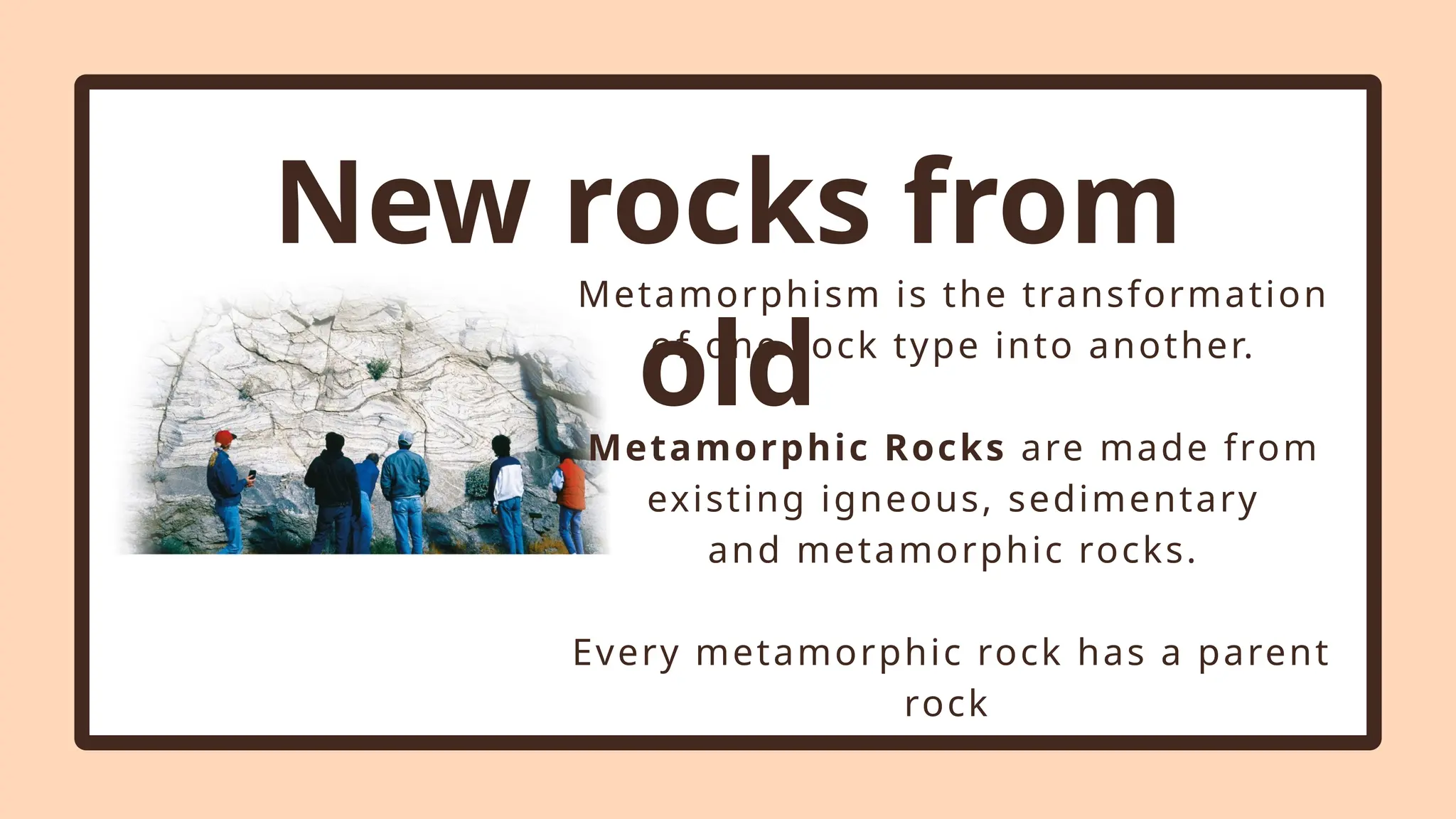
Metamorphism is the transformation
of one rock type into another.
Metamorphic Rocks are made from
existing igneous, sedimentary
and metamorphic rocks.
Every metamorphic rock has a parent
rock
Metamorphism
metamorphism is the process that leads to
changes in mineralogy texture and
sometimes chemical composition.
Increase in Temperature and Pressure
Metamorphism
Increase in Temperature and Pressure
The rock responds to the increase in temperature
and pressure by changing until it reaches a state
of equilibrium.
This happens a few kilometers below the surface into the
mantle
Metamorphism
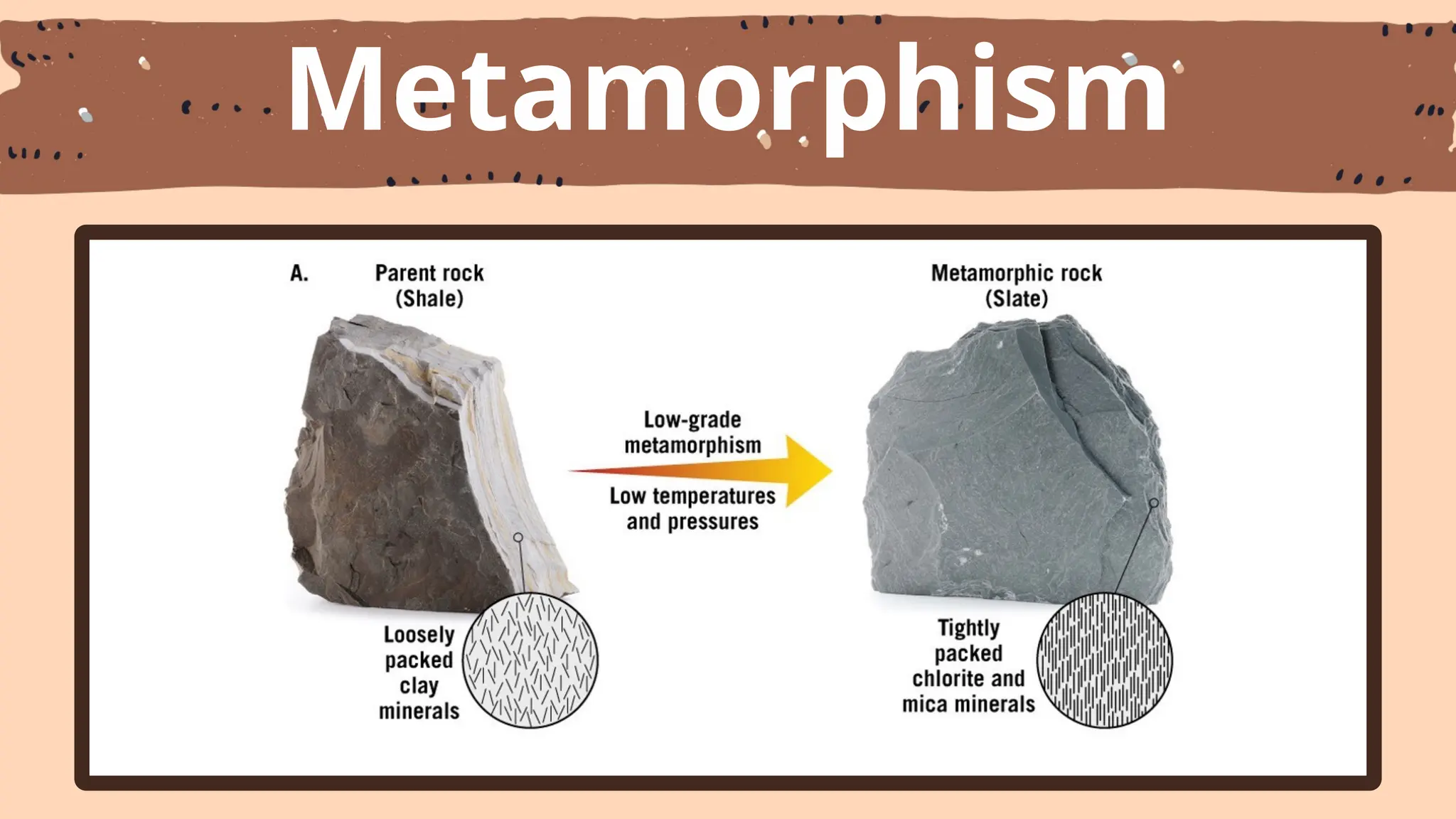
progress incrementally, slight (low-grade) to
substantial changes (high-grade)
low-grade example shale to slate
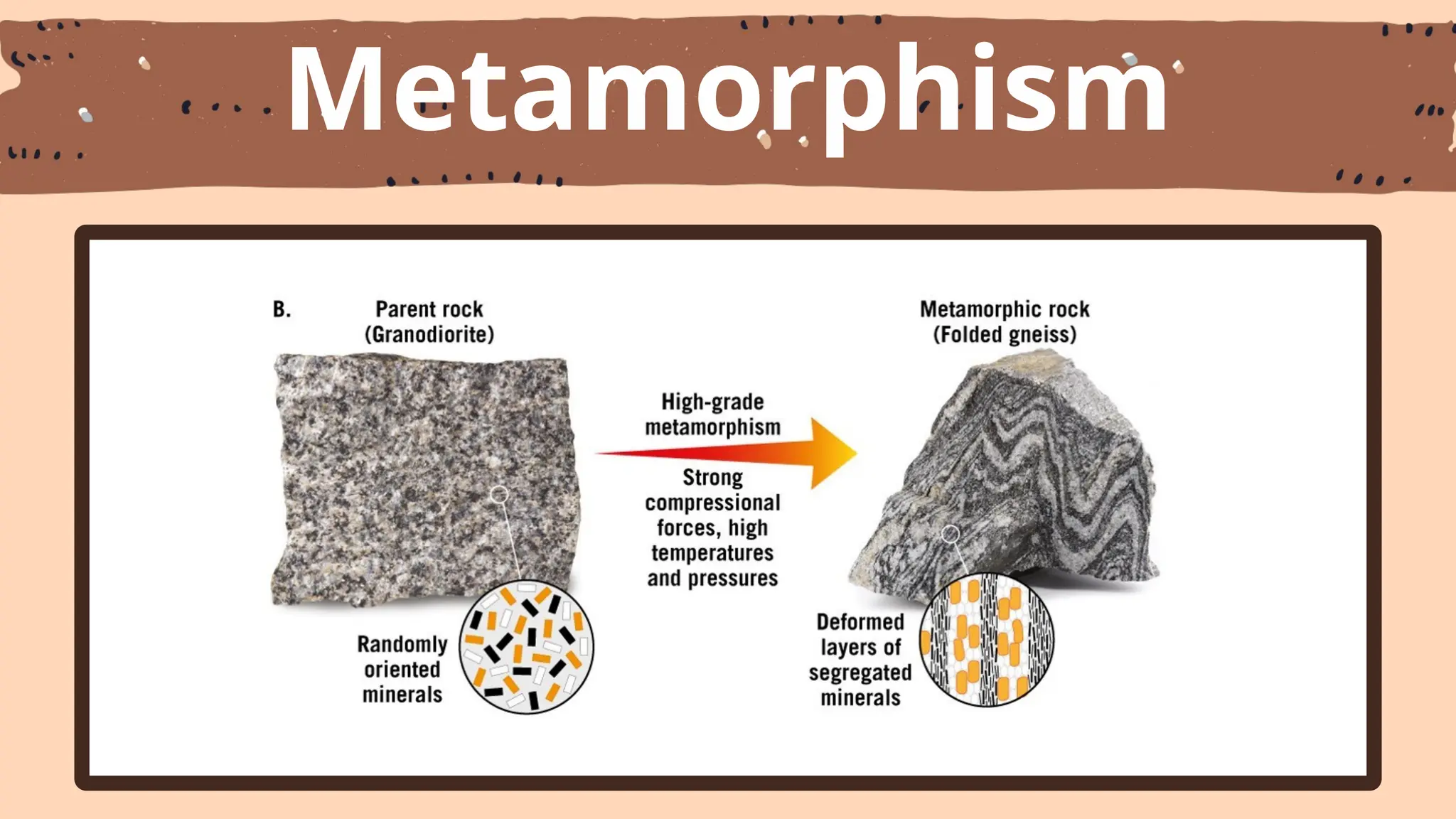
high-grade can be so complete a change that the
parent rock cannot be identified.
Metamorphism
Metamorphism
Metamorphism
The rocks remain a solid
If temperature are high enough to cause melting
it has become an igneous rock.
Metamorphism
2 Settings
• Contact Metamorphism-rock is intruded by
magma and this causes the adjacent rock to
change.
• Regional Metamorphism-mountain building,
large amounts of rock experience high
pressure and temperatures. Large scale
deformation.
Metamorphism
Metamorphic rocks are present on every
continent.
They are the mountains crystalline core.
They can be heavily intruded by igneous rocks.
What drives
Metamorphism
Agents of Metamorphism
• Heat
• confining pressure
• differential stress
• chemically active fluids
What drives
Metamorphism
Heat (Thermal Energy)
Most important factor.
It triggers chemical reactions that result in
recrystallization and formation of new minerals.
2 Sources of heat
• Intrusion of Magma (bakes the adjacent
rocks)
What drives
Metamorphism
Heat (Thermal Energy)
• gradual increase in temperature as rocks are
buried
About 5 miles deep temperature are about 200 C,
clay minerals are unstable and recrystallize to
minerals stable at that temperature, like muscovite
or chlorite. Quartz and feldpar are still stable at this
temperature.
What drives
Metamorphism
Confining Pressure and
Differential Stress
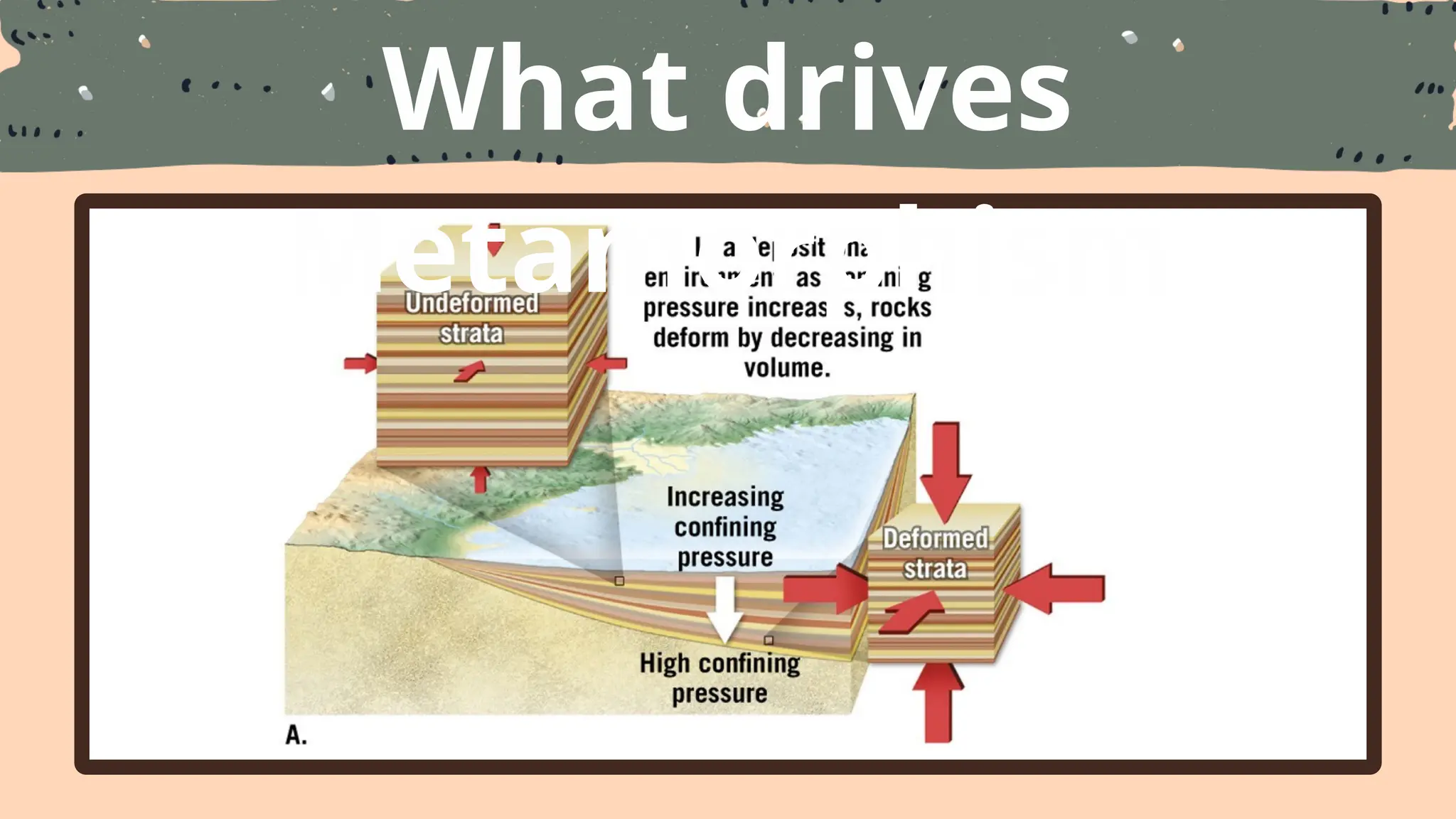
Pressure increases with depth as thickness of
overlying rock increases
Confining Pressure the forces are equal in all
directions. This causes space between mineral
grains to close (increases density). Minerals can
recrystallize into a more compact form
What drives
Metamorphism
What drives
Metamorphism
What drives
Metamorphism
Confining Pressure and
Differential Stress
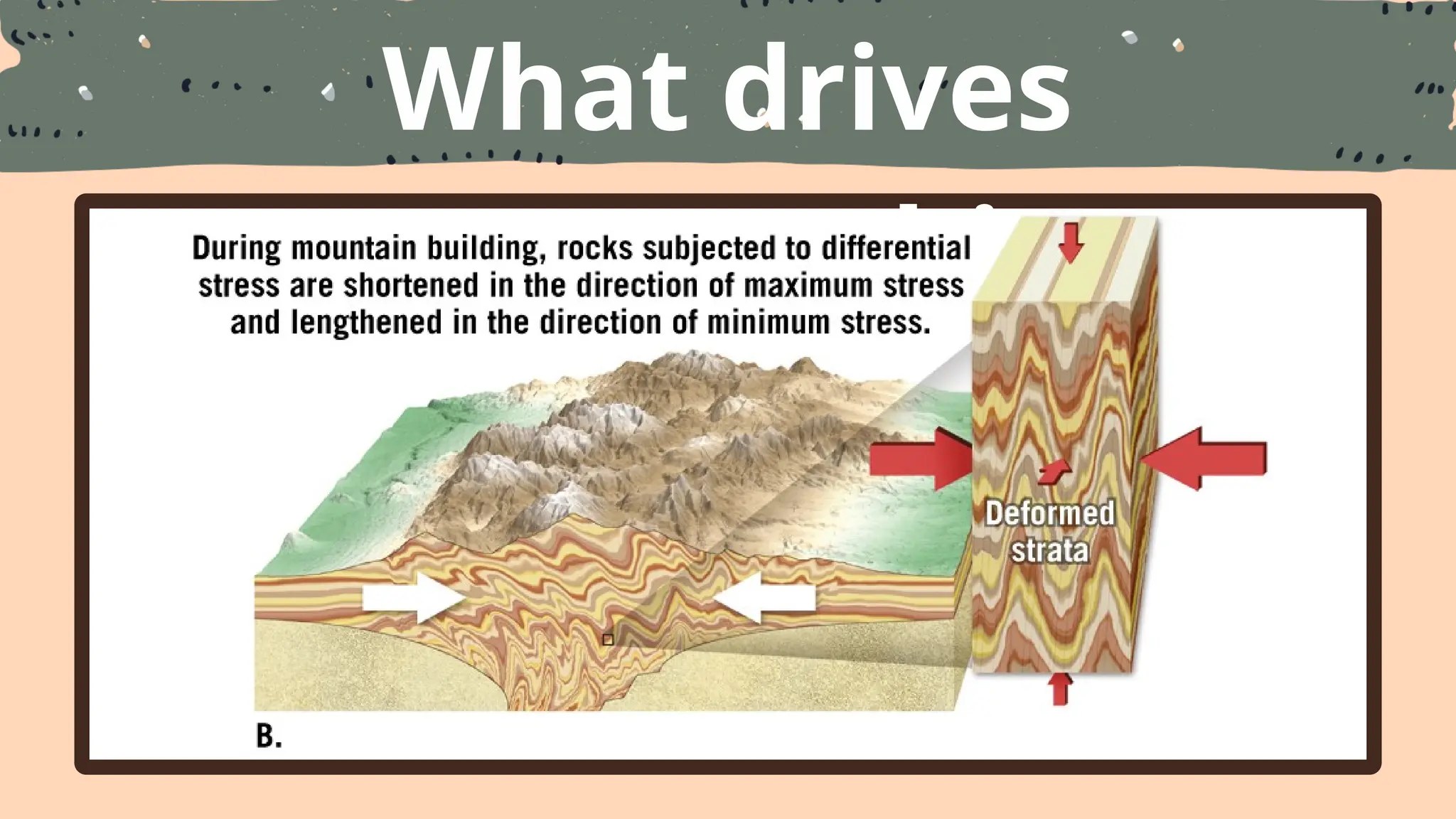
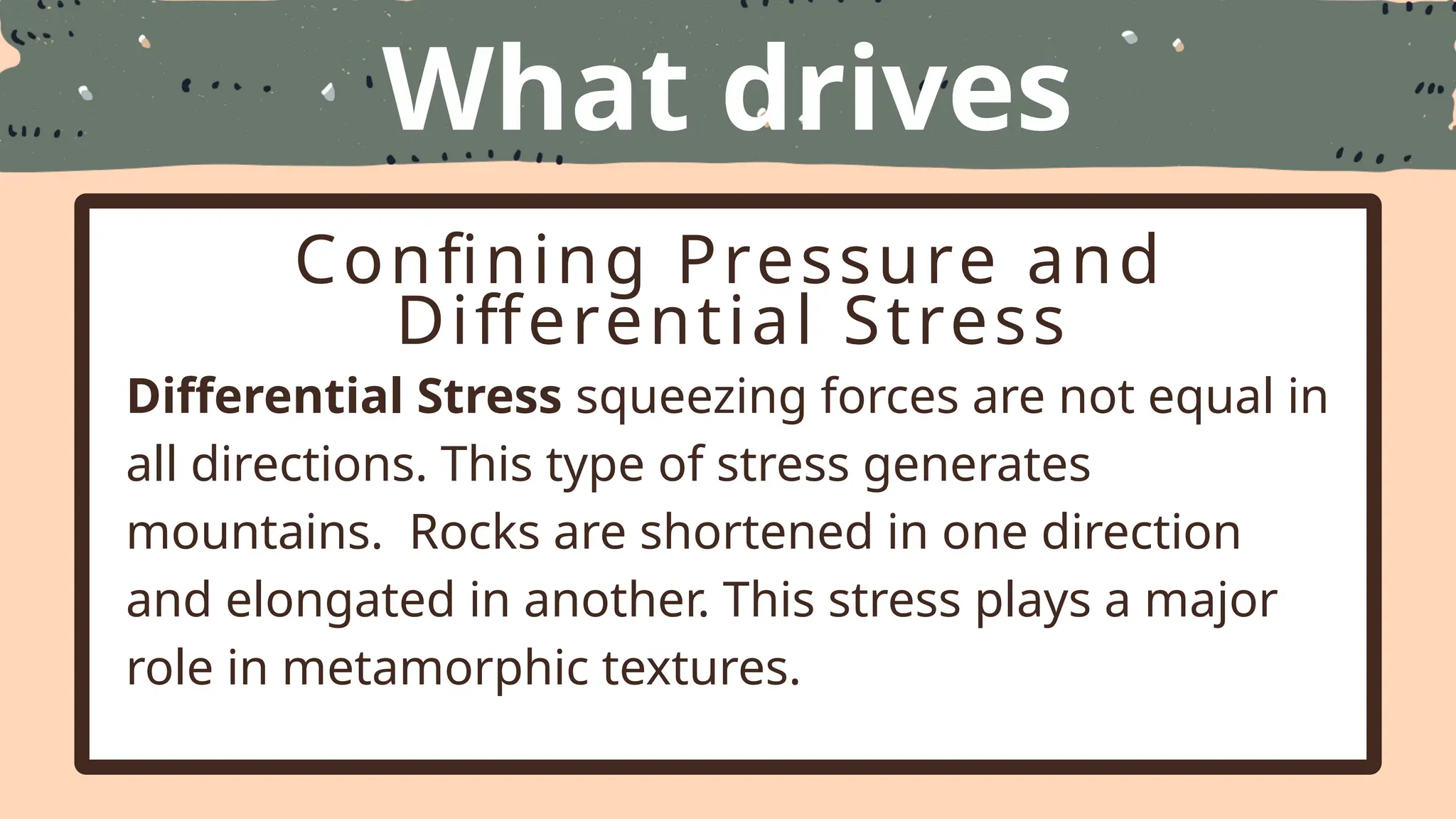
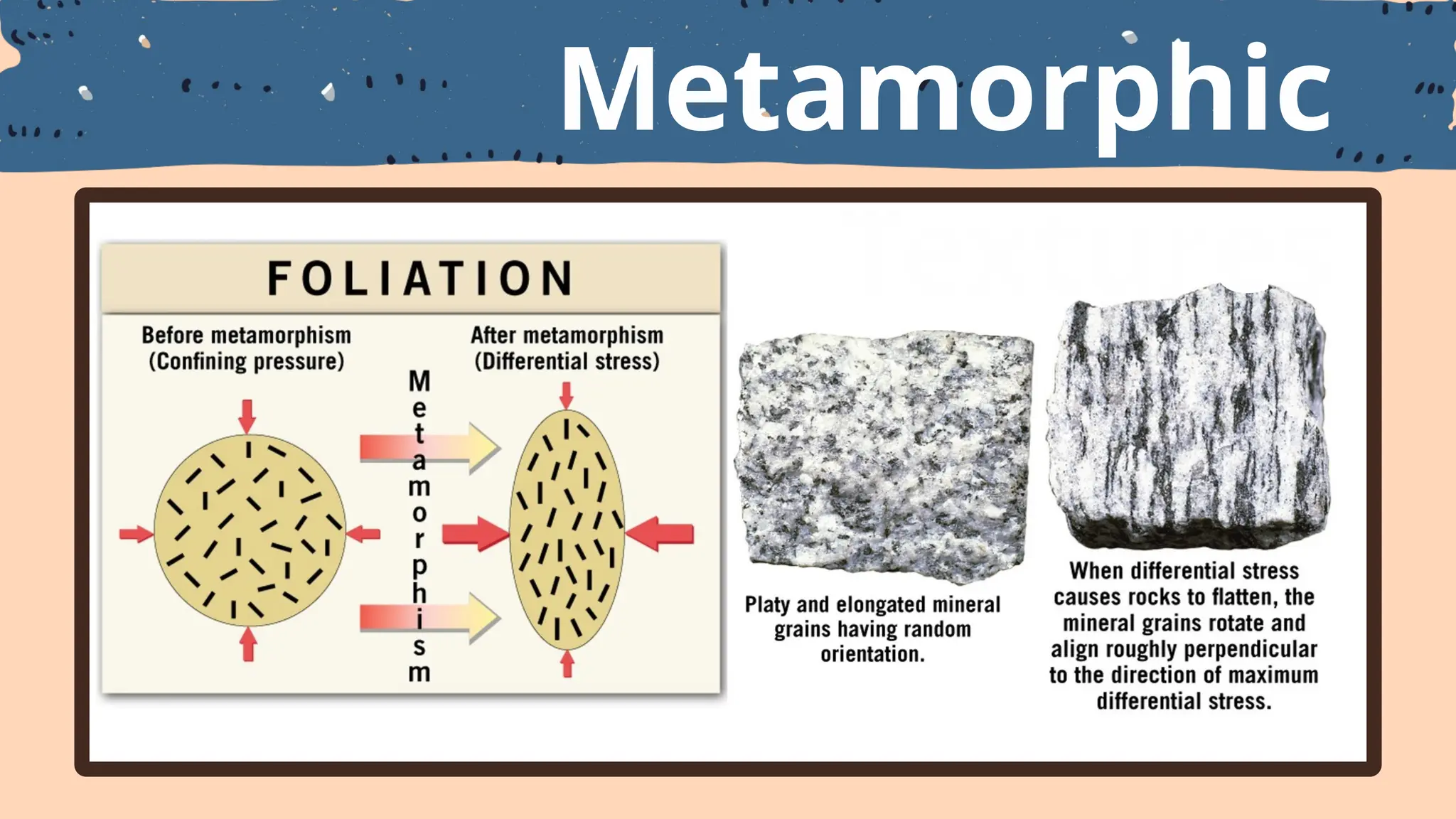
Differential Stress squeezing forces are not equal in
all directions. This type of stress generates
mountains. Rocks are shortened in one direction
and elongated in another. This stress plays a major
role in metamorphic textures.
What drives
Metamorphism
Chemically Active Fluids
Ion-rich fluids (mostly water and volatiles) surround
mineral grains and act as catalysts for
recrystallization by enhancing ion migration.
Hotter fluids=more reactive
Two types of metamorphism from Chemically active
fluids.
What drives
Metamorphism
Chemically Active Fluids
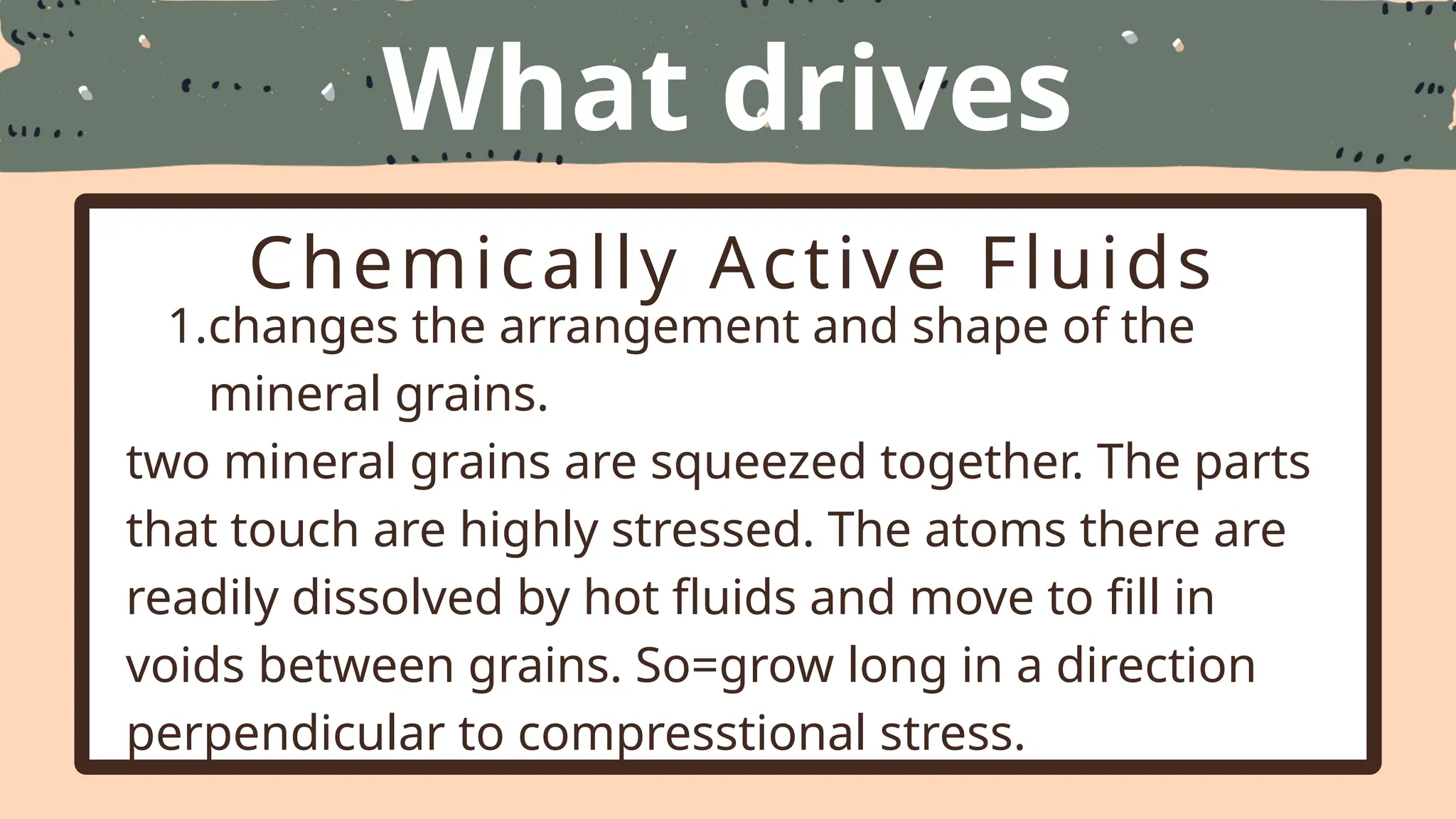
1.changes the arrangement and shape of the
mineral grains.
two mineral grains are squeezed together. The parts
that touch are highly stressed. The atoms there are
readily dissolved by hot fluids and move to fill in
voids between grains. So=grow long in a direction
perpendicular to compresstional stress.
What drives
Metamorphism
Chemically Active Fluids
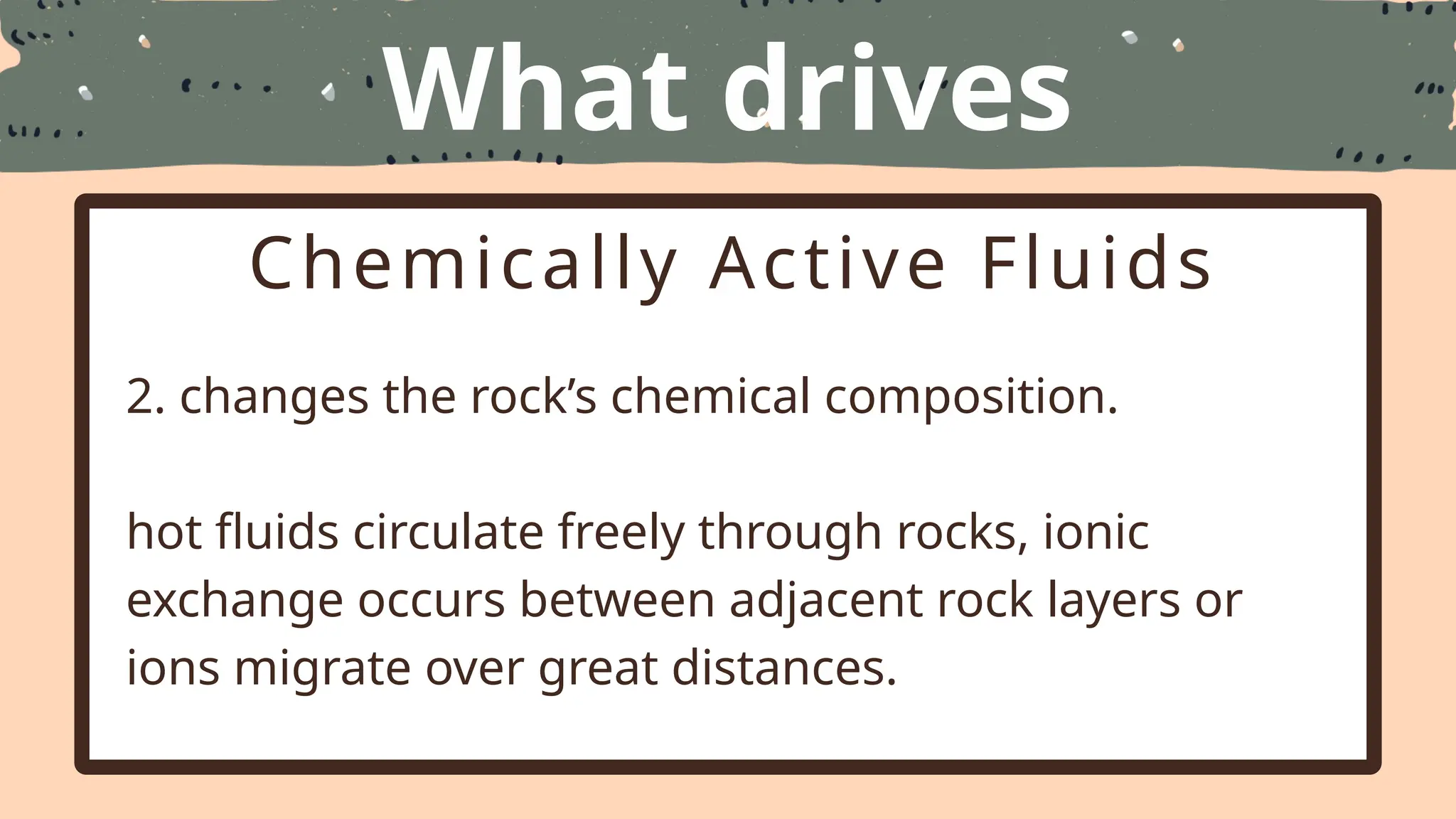
2. changes the rock’s chemical composition.
hot fluids circulate freely through rocks, ionic
exchange occurs between adjacent rock layers or
ions migrate over great distances.
Metamorphic
Textures
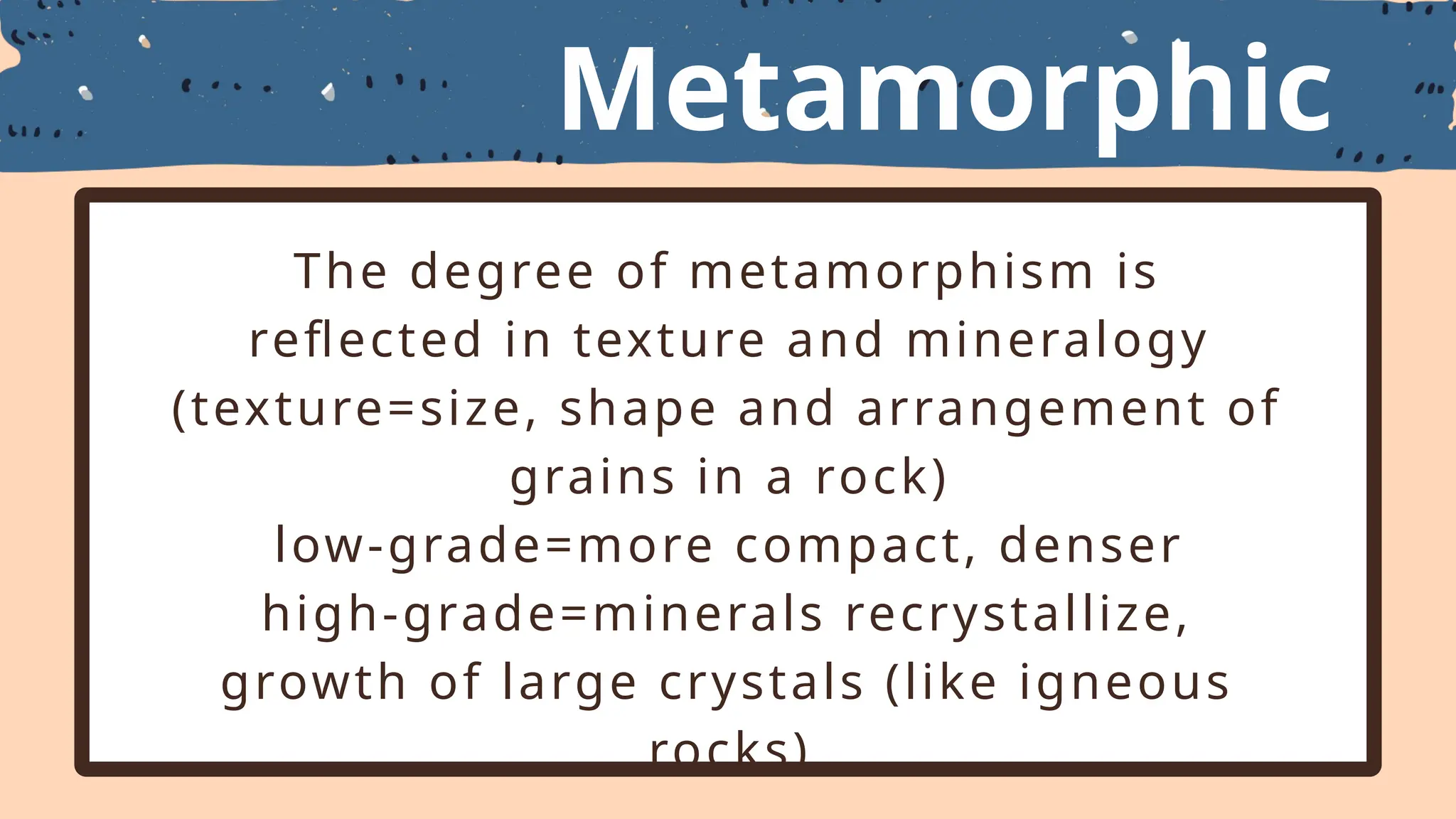
The degree of metamorphism is
reflected in texture and mineralogy
(texture=size, shape and arrangement of
grains in a rock)
low-grade=more compact, denser
high-grade=minerals recrystallize,
growth of large crystals (like igneous
rocks)
Metamorphic
Textures
Metamorphic
Textures
Foliation is nearly flat arrangement of
minerals. Arrange nearly parallel
Fundamental characteristics of
regional metamorphism
Metamorphic
Textures
Types of foliation:
platy foliation-parallel alignment of
platy minerals (mica) or flattening of
pebbles
compositional banding-dark and light
minerals separate, creating a layered
appearance.
rock cleavage-easily split into tabular
slabs (not the same as mineral cleavage)
Metamorphic
Textures
Nonfoliated Texture
deformation is minimal and parent rocks
are composed of minerals with simple
chemical formulas (quartz, calcite).
Interlocking crystals
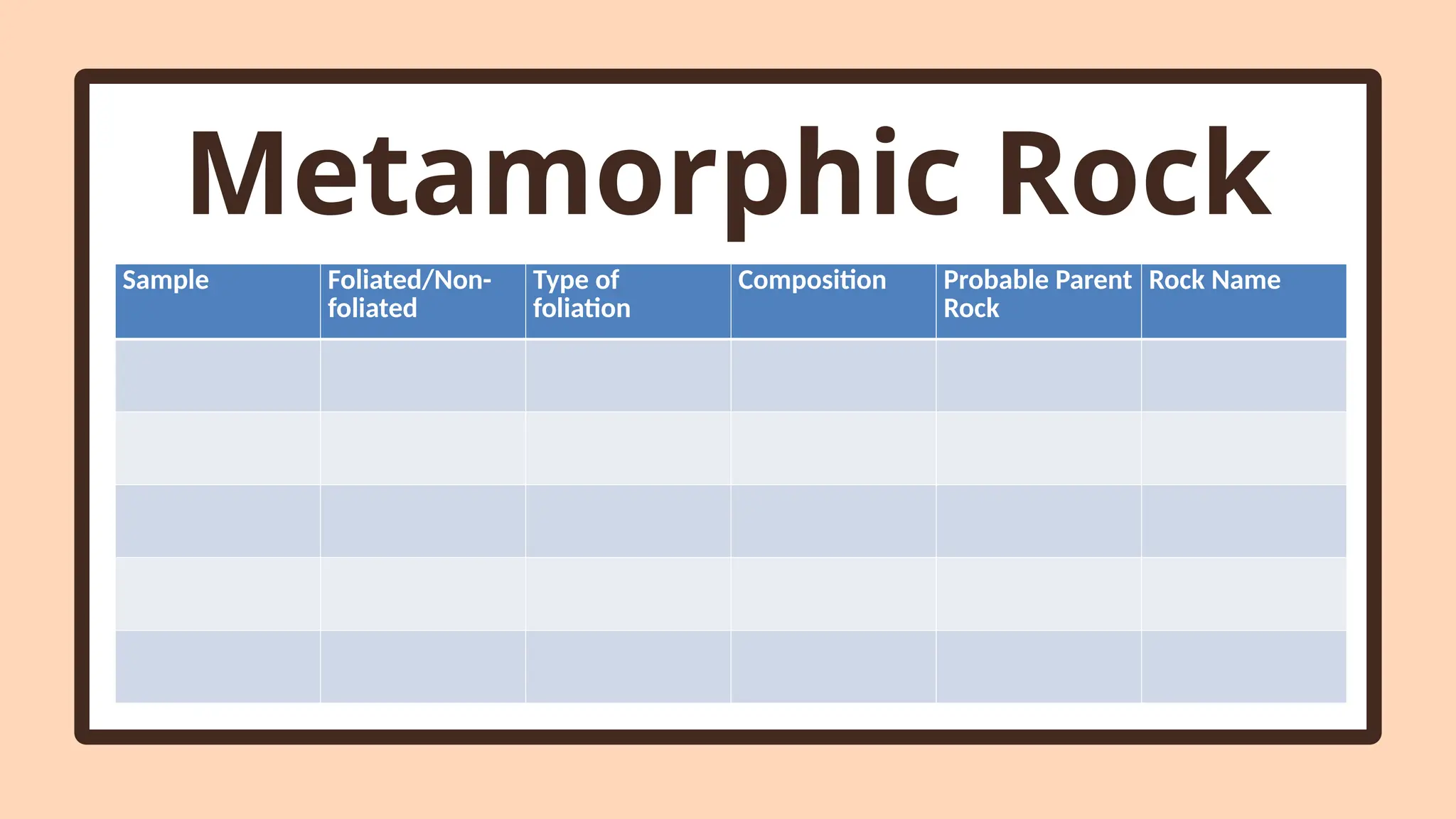
Metamorphic Rock
ID
Sample Foliated/Non-
foliated
Type of
foliation
Composition Probable Parent
Rock
Rock Name
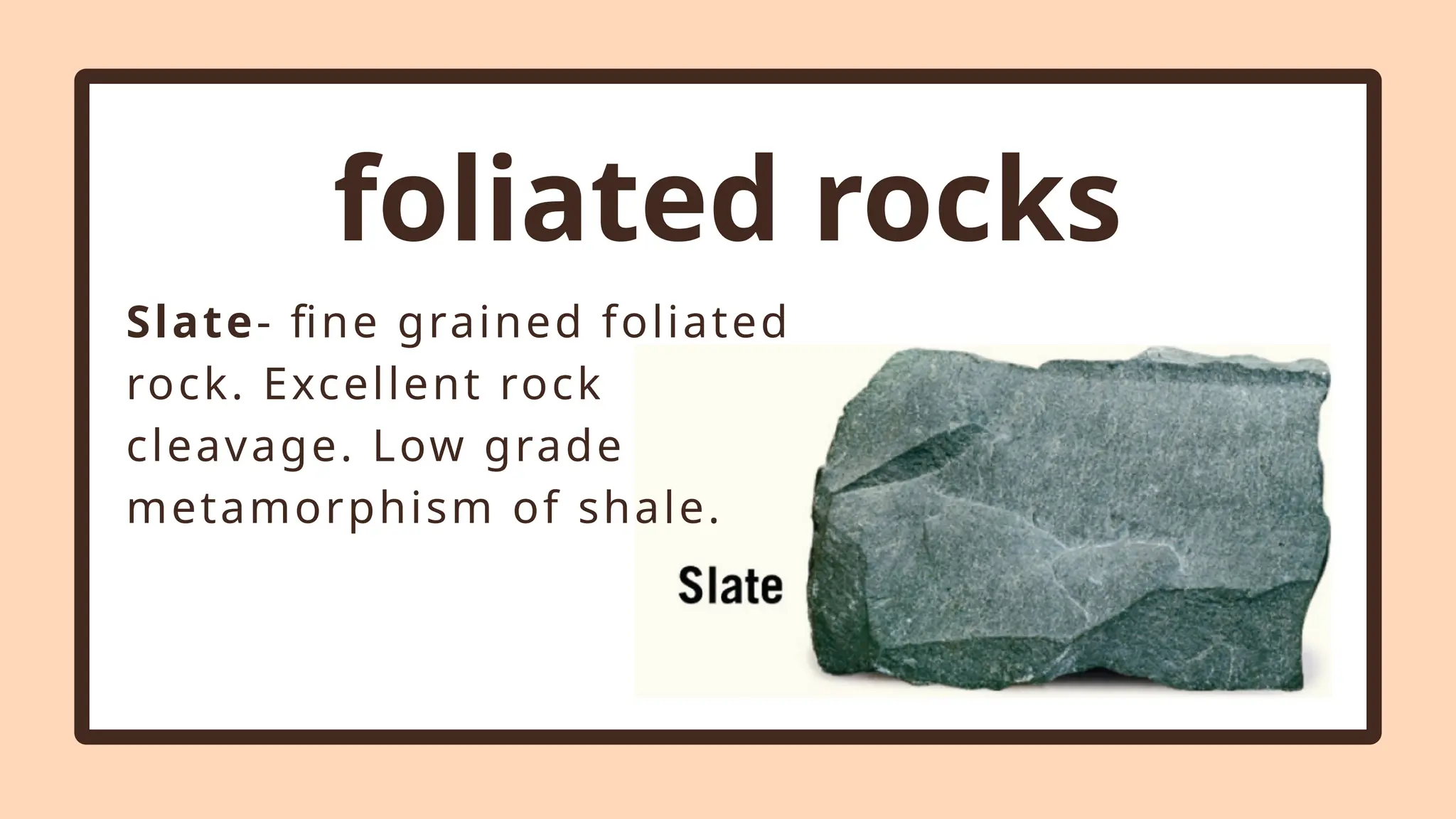
foliated rocks
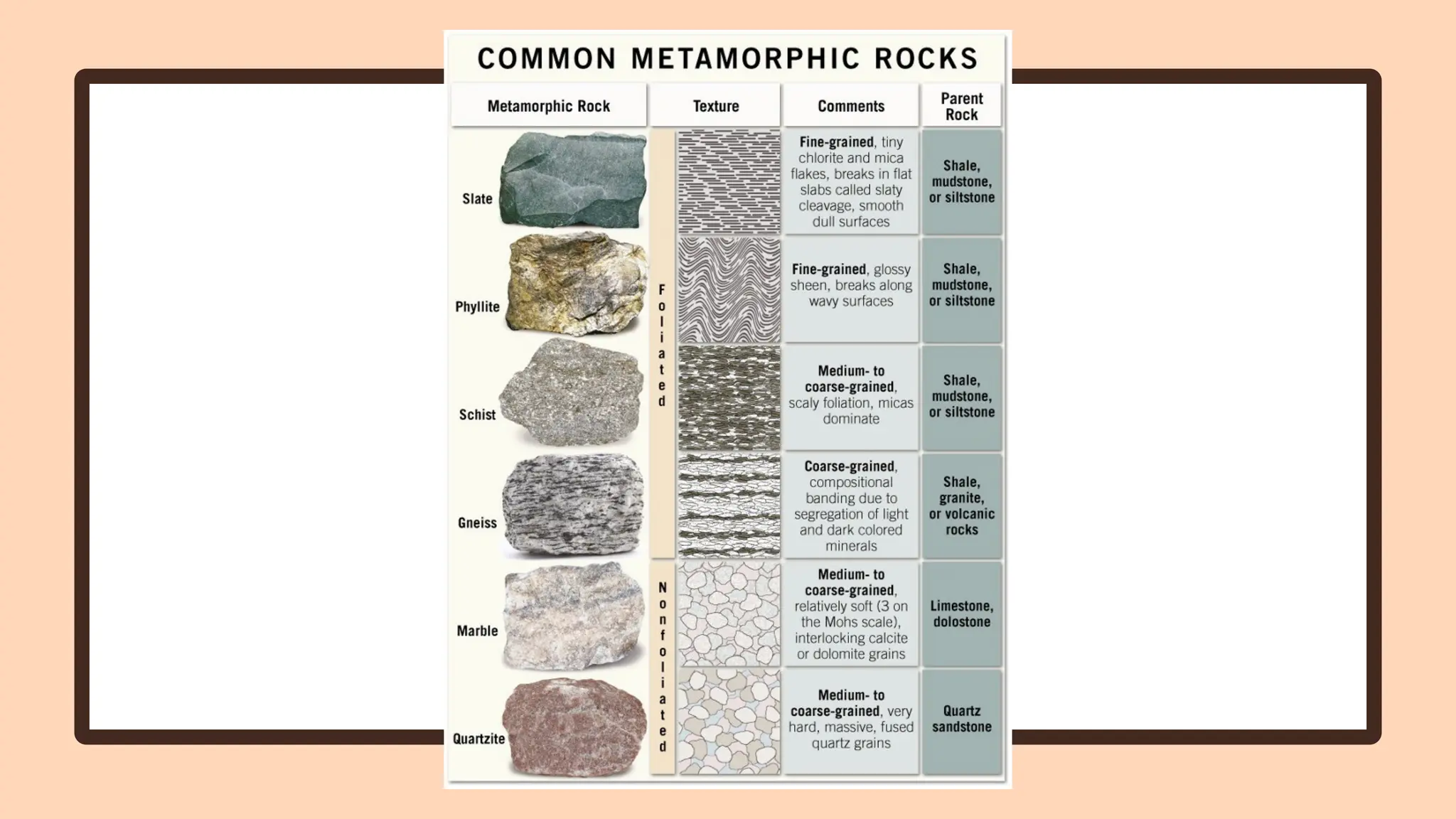
Slate- fine grained foliated
rock. Excellent rock
cleavage. Low grade
metamorphism of shale.
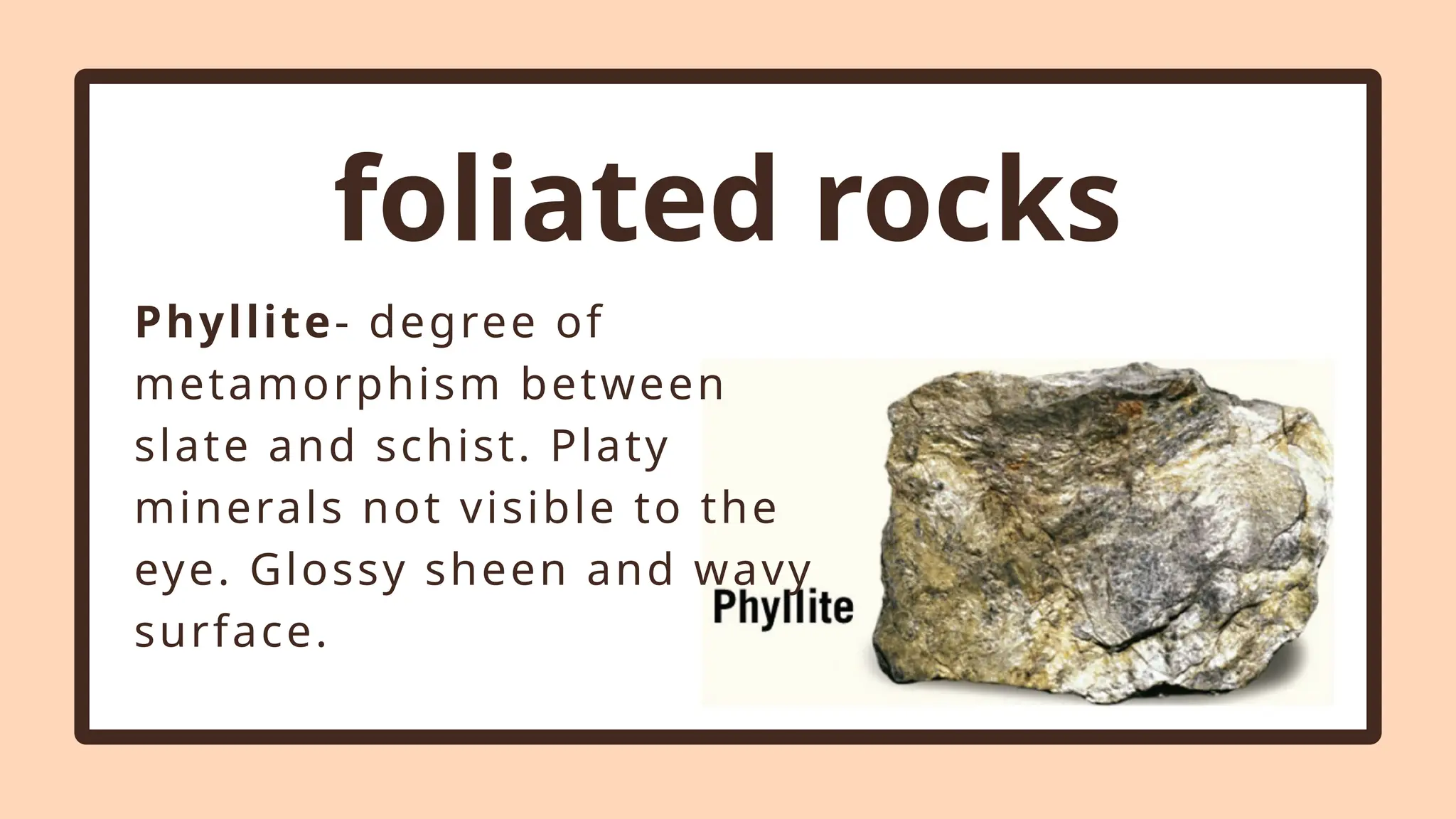
foliated rocks
Phyllite- degree of
metamorphism between
slate and schist. Platy
minerals not visible to the
eye. Glossy sheen and wavy
surface.
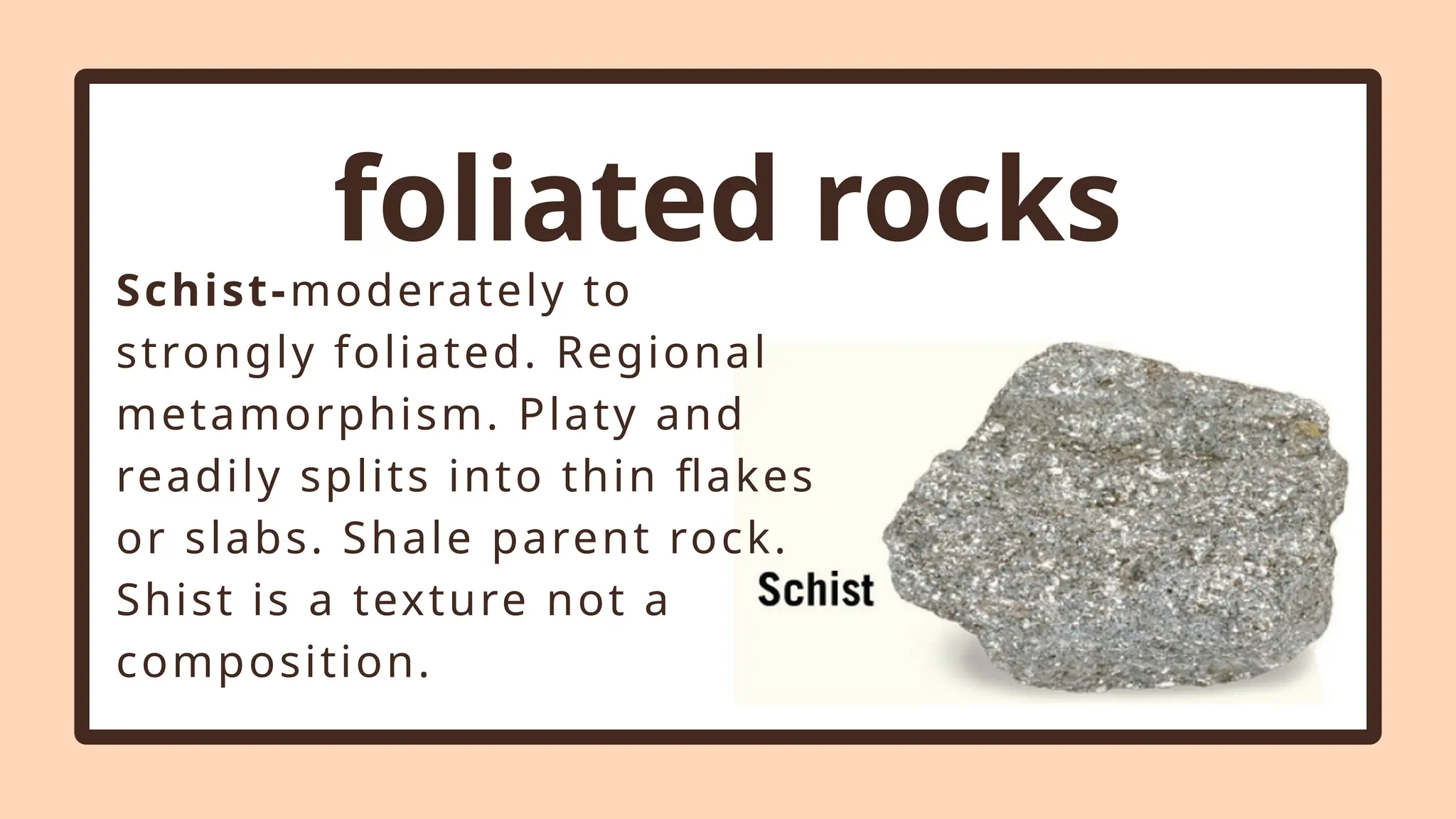
foliated rocks
Schist-moderately to
strongly foliated. Regional
metamorphism. Platy and
readily splits into thin flakes
or slabs. Shale parent rock.
Shist is a texture not a
composition.
foliated rocks
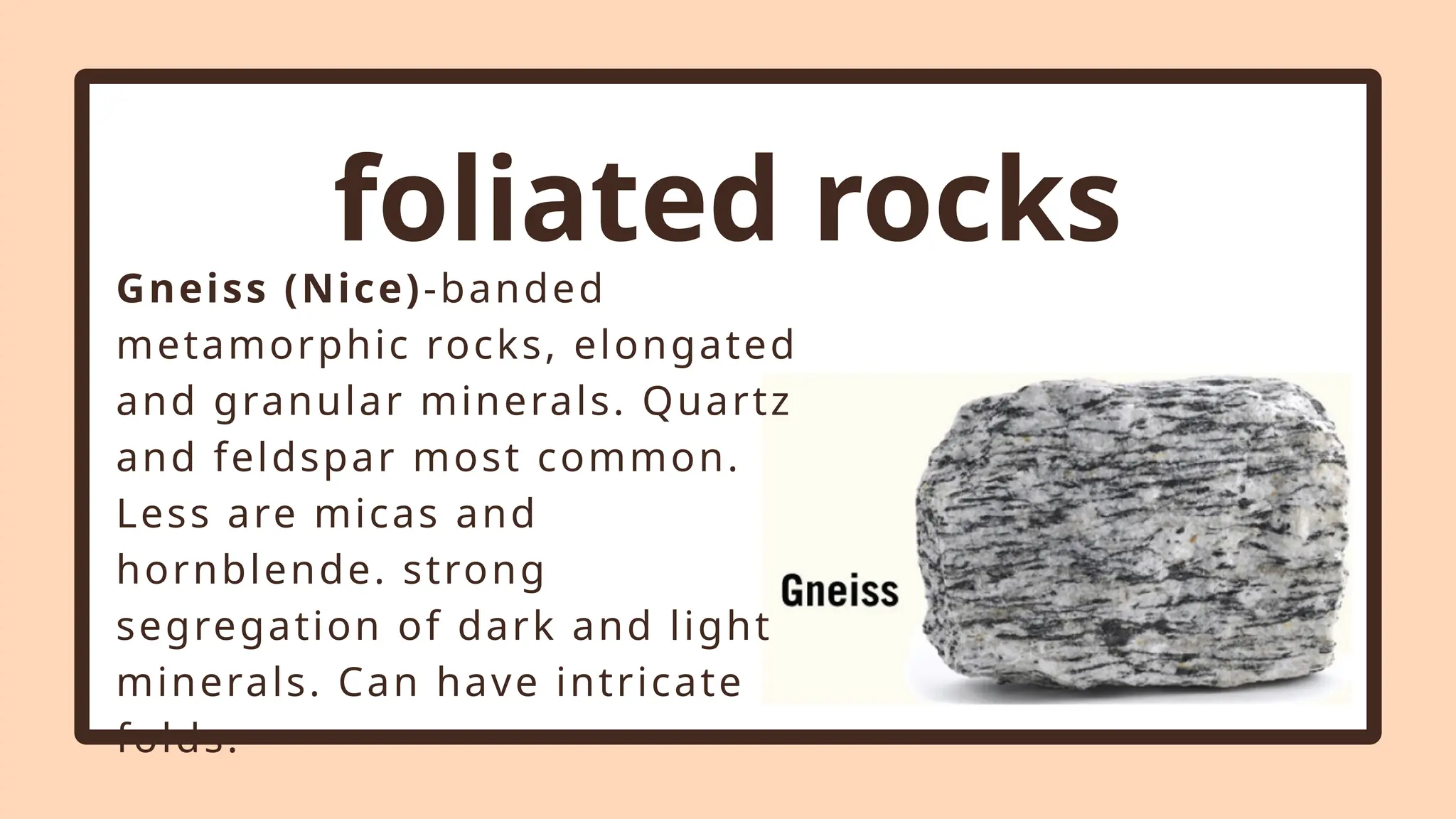
Gneiss (Nice)-banded
metamorphic rocks, elongated
and granular minerals. Quartz
and feldspar most common.
Less are micas and
hornblende. strong
segregation of dark and light
minerals. Can have intricate
folds.
Nonfoliated rocks
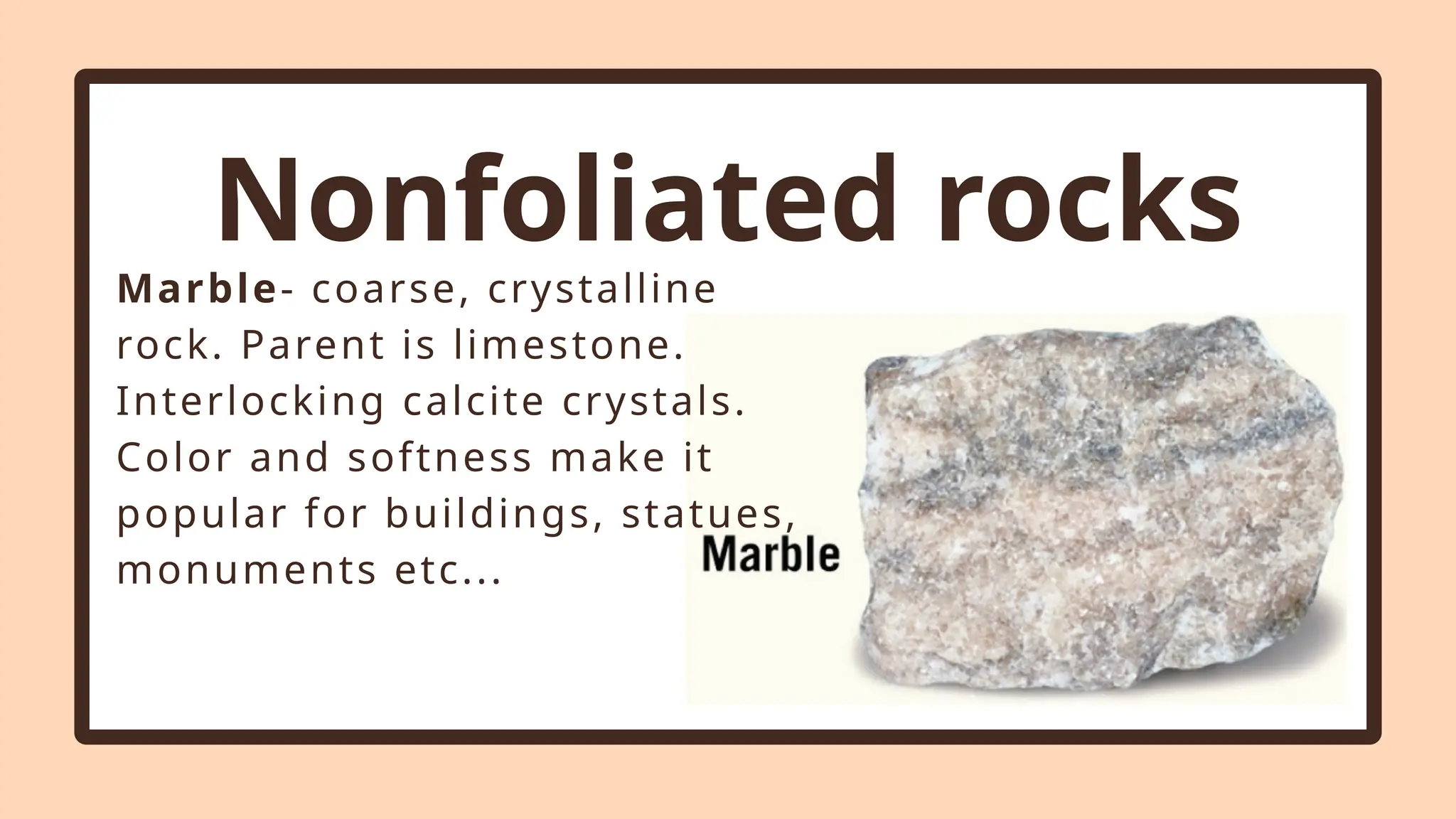
Marble- coarse, crystalline
rock. Parent is limestone.
Interlocking calcite crystals.
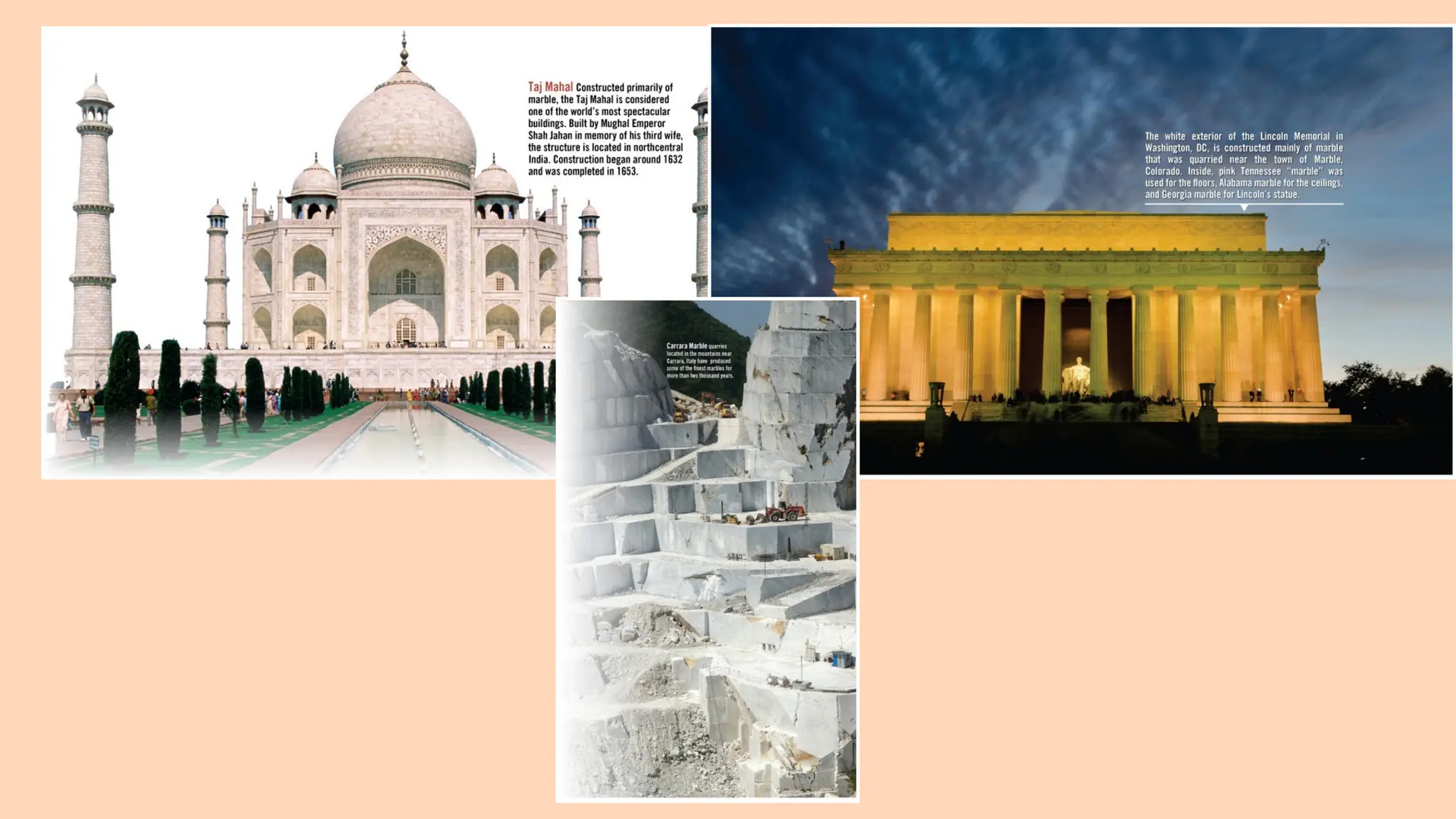
Color and softness make it
popular for buildings, statues,
monuments etc...
Nonfoliated rocks
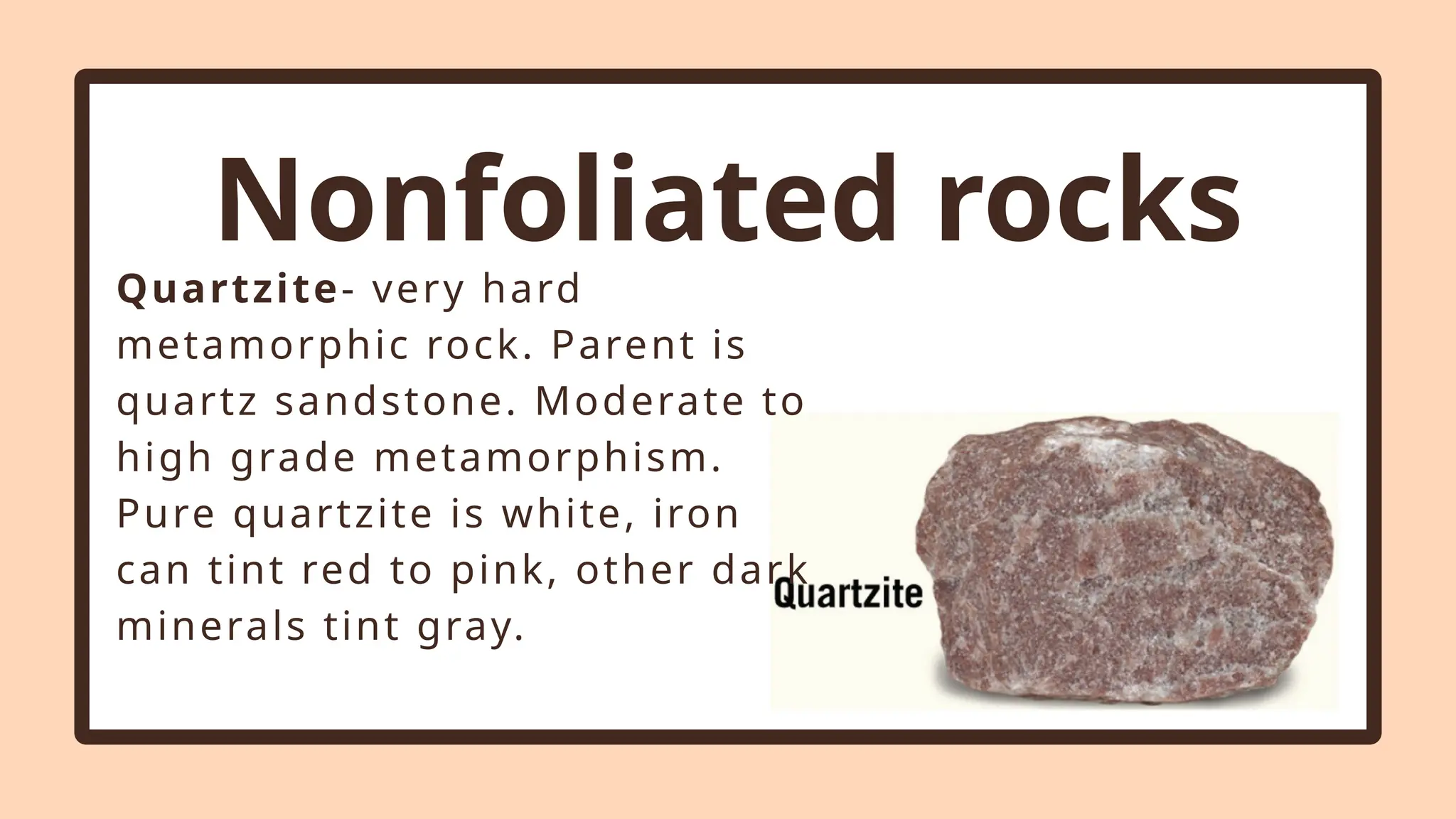
Quartzite- very hard
metamorphic rock. Parent is
quartz sandstone. Moderate to
high grade metamorphism.
Pure quartzite is white, iron
can tint red to pink, other dark
minerals tint gray.
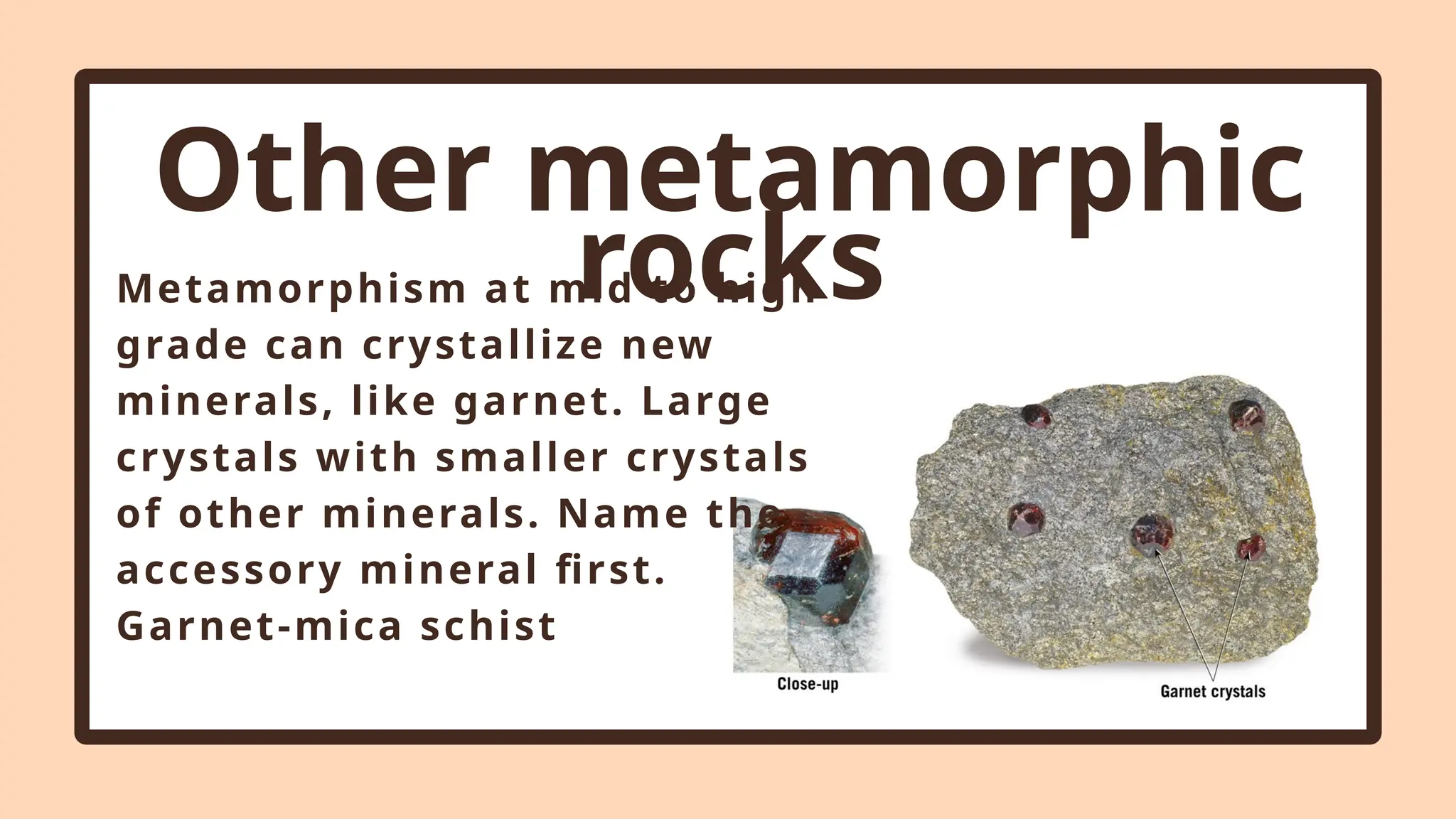
Other metamorphic
rocks
Metamorphism at mid to high
grade can crystallize new
minerals, like garnet. Large
crystals with smaller crystals
of other minerals. Name the
accessory mineral first.
Garnet-mica schist

Metamorphic Rocks all about it so you know

  • 1.
  • 2.
    New rocks from old Metamorphismis the transformation of one rock type into another. Metamorphic Rocks are made from existing igneous, sedimentary and metamorphic rocks. Every metamorphic rock has a parent rock
  • 3.
    Metamorphism metamorphism is theprocess that leads to changes in mineralogy texture and sometimes chemical composition. Increase in Temperature and Pressure
  • 4.
    Metamorphism Increase in Temperatureand Pressure The rock responds to the increase in temperature and pressure by changing until it reaches a state of equilibrium. This happens a few kilometers below the surface into the mantle
  • 5.
    Metamorphism progress incrementally, slight(low-grade) to substantial changes (high-grade) low-grade example shale to slate high-grade can be so complete a change that the parent rock cannot be identified.
  • 6.
  • 7.
  • 8.
    Metamorphism The rocks remaina solid If temperature are high enough to cause melting it has become an igneous rock.
  • 9.
    Metamorphism 2 Settings • ContactMetamorphism-rock is intruded by magma and this causes the adjacent rock to change. • Regional Metamorphism-mountain building, large amounts of rock experience high pressure and temperatures. Large scale deformation.
  • 10.
    Metamorphism Metamorphic rocks arepresent on every continent. They are the mountains crystalline core. They can be heavily intruded by igneous rocks.
  • 11.
    What drives Metamorphism Agents ofMetamorphism • Heat • confining pressure • differential stress • chemically active fluids
  • 12.
    What drives Metamorphism Heat (ThermalEnergy) Most important factor. It triggers chemical reactions that result in recrystallization and formation of new minerals. 2 Sources of heat • Intrusion of Magma (bakes the adjacent rocks)
  • 13.
    What drives Metamorphism Heat (ThermalEnergy) • gradual increase in temperature as rocks are buried About 5 miles deep temperature are about 200 C, clay minerals are unstable and recrystallize to minerals stable at that temperature, like muscovite or chlorite. Quartz and feldpar are still stable at this temperature.
  • 14.
    What drives Metamorphism Confining Pressureand Differential Stress Pressure increases with depth as thickness of overlying rock increases Confining Pressure the forces are equal in all directions. This causes space between mineral grains to close (increases density). Minerals can recrystallize into a more compact form
  • 15.
  • 16.
  • 17.
    What drives Metamorphism Confining Pressureand Differential Stress Differential Stress squeezing forces are not equal in all directions. This type of stress generates mountains. Rocks are shortened in one direction and elongated in another. This stress plays a major role in metamorphic textures.
  • 18.
    What drives Metamorphism Chemically ActiveFluids Ion-rich fluids (mostly water and volatiles) surround mineral grains and act as catalysts for recrystallization by enhancing ion migration. Hotter fluids=more reactive Two types of metamorphism from Chemically active fluids.
  • 19.
    What drives Metamorphism Chemically ActiveFluids 1.changes the arrangement and shape of the mineral grains. two mineral grains are squeezed together. The parts that touch are highly stressed. The atoms there are readily dissolved by hot fluids and move to fill in voids between grains. So=grow long in a direction perpendicular to compresstional stress.
  • 20.
    What drives Metamorphism Chemically ActiveFluids 2. changes the rock’s chemical composition. hot fluids circulate freely through rocks, ionic exchange occurs between adjacent rock layers or ions migrate over great distances.
  • 21.
    Metamorphic Textures The degree ofmetamorphism is reflected in texture and mineralogy (texture=size, shape and arrangement of grains in a rock) low-grade=more compact, denser high-grade=minerals recrystallize, growth of large crystals (like igneous rocks)
  • 22.
  • 23.
    Metamorphic Textures Foliation is nearlyflat arrangement of minerals. Arrange nearly parallel Fundamental characteristics of regional metamorphism
  • 24.
    Metamorphic Textures Types of foliation: platyfoliation-parallel alignment of platy minerals (mica) or flattening of pebbles compositional banding-dark and light minerals separate, creating a layered appearance. rock cleavage-easily split into tabular slabs (not the same as mineral cleavage)
  • 25.
    Metamorphic Textures Nonfoliated Texture deformation isminimal and parent rocks are composed of minerals with simple chemical formulas (quartz, calcite). Interlocking crystals
  • 27.
    Metamorphic Rock ID Sample Foliated/Non- foliated Typeof foliation Composition Probable Parent Rock Rock Name
  • 28.
    foliated rocks Slate- finegrained foliated rock. Excellent rock cleavage. Low grade metamorphism of shale.
  • 29.
    foliated rocks Phyllite- degreeof metamorphism between slate and schist. Platy minerals not visible to the eye. Glossy sheen and wavy surface.
  • 30.
    foliated rocks Schist-moderately to stronglyfoliated. Regional metamorphism. Platy and readily splits into thin flakes or slabs. Shale parent rock. Shist is a texture not a composition.
  • 31.
    foliated rocks Gneiss (Nice)-banded metamorphicrocks, elongated and granular minerals. Quartz and feldspar most common. Less are micas and hornblende. strong segregation of dark and light minerals. Can have intricate folds.
  • 32.
    Nonfoliated rocks Marble- coarse,crystalline rock. Parent is limestone. Interlocking calcite crystals. Color and softness make it popular for buildings, statues, monuments etc...
  • 34.
    Nonfoliated rocks Quartzite- veryhard metamorphic rock. Parent is quartz sandstone. Moderate to high grade metamorphism. Pure quartzite is white, iron can tint red to pink, other dark minerals tint gray.
  • 35.
    Other metamorphic rocks Metamorphism atmid to high grade can crystallize new minerals, like garnet. Large crystals with smaller crystals of other minerals. Name the accessory mineral first. Garnet-mica schist

Editor's Notes

  • #5 Shale to slate is low grade. The differences are minimal and can be difficult to tell in a hand sample. parent features-bedding, vesicles, fossils are obliterated
  • #6 Shale to slate is low grade. The differences are minimal and can be difficult to tell in a hand sample. parent features-bedding, vesicles, fossils are obliterated
  • #7 Shale to slate is low grade. The differences are minimal and can be difficult to tell in a hand sample. parent features-bedding, vesicles, fossils are obliterated
  • #8 They might be a semi-solid, being able to fold and move.
  • #11 1 or all 4 The degree of metamorphism and contribution of each agent varies.
  • #12 1 or all 4 The degree of metamorphism and contribution of each agent varies.
  • #13 chlorite metamorphism of Fe and Mg
  • #17 Low temperatures (surface) rocks are brittle. Heavy boot-smashing crystal, Grains are pulverized smaller and smaller High temp-high pressure-rocks are ductile-flow and not break. Heavy boot-crushing a soda can-grains flatten and elongate
  • #18 Volatiles-material readily change to gas at surface conditions. Catalyst-substance that speeds up chemical reaction.
  • #19 The minerals are dissolving and recrystallizing, to grow long in one direction.
  • #22 Nearly flat arrangement of mineral grains or structural features. Compressional stresses shorten rock units, minerals develop parallel or nearly alignments.
  • #25 Limestone to marble
  • #33 Greek/roman statues