


published by
Media & Entertainment
Services Alliance
M E S A
E
AND
MJOURNALMedia & Entertainment
SPECIAL ISSUE • WINTER 2014-15 • $25
Strategies. Solutions.
Bringing Creativity to Content Workflows
Increasing Collaboration and Savings with Cloud
Delivering Personalization that Consumers Crave
Built with data, it begins at content’s inception and
stretches to infinity–from the cloud to consumers and back again
The New Digital Supply Chain
MarkLogic is the proven platform for Big Data
applications, and is designed to reduce risk,
optimize operations, create new value from data,
manage compliance, and improve IT economics.
Do your ideas
MOVE YOUor does data integretion
PARALYZE YOU?
Hello, we’re your
Enterprise NoSQL
database
solution.
Say hello to the new generation.
POWERFUL & SECURE | AGILE & FLEXIBLE | ENTERPRISE-READY | TRUSTED
www.marklogic.com . +1 877 992 8885 . sales@marklogic.com
M&EJOURNAL  3
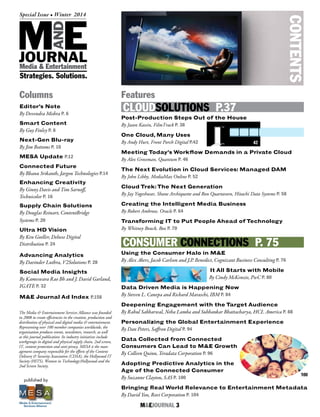
CONTENTS
Special Issue • Winter 2014
published by
Media & Entertainment
Services Alliance
M E S A
EAND
MJOURNALMedia & Entertainment
Strategies. Solutions.
Features
Post-Production Steps Out of the House
By Jason Kassin, FilmTrack P. 38
One Cloud, Many Uses
By Andy Hurt, Front Porch Digital P.42
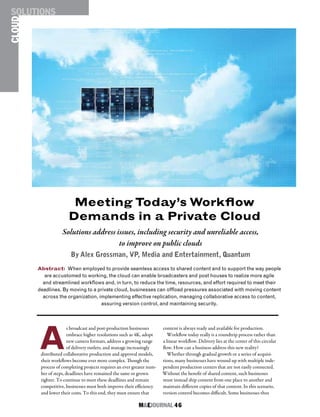
Meeting Today’s Workflow Demands in a Private Cloud
By Alex Grossman, Quantum P. 46
The Next Evolution in Cloud Services: Managed DAM
By John Libby, MediaMax Online P. 52
Cloud Trek: The Next Generation
By Jay Yogeshwar, Shane Archiquette and Ron Quartararo, Hitachi Data Systems P. 58
Creating the Intelligent Media Business
By Robert Ambrose, Oracle P. 64
Transforming IT to Put People Ahead of Technology
By Whitney Bouck, Box P. 70
Using the Consumer Halo in M&E
By Alex Akers, Jacob Carlson and J.P. Benedict, Cognizant Business Consulting P. 76
It All Starts with Mobile
By Cindy McKenzie, PwC P. 80
Data Driven Media is Happening Now
By Steven L. Canepa and Richard Maraschi, IBM P. 84
Deepening Engagement with the Target Audience
By Rahul Sabharwal, Neha Lamba and Subhankar Bhattacharya, HCL America P. 88
Personalizing the Global Entertainment Experience
By Dan Peters, Saffron Digital P. 94
Data Collected from Connected
Consumers Can Lead to M&E Growth
By Colleen Quinn, Teradata Corporation P. 96
Adopting Predictive Analytics in the
Age of the Connected Consumer
By Suzanne Clayton, SAS P. 100
Bringing Real World Relevance to Entertainment Metadata
By David Yon, Rovi Corporation P. 104
Columns
Editor’s Note
By Devendra Mishra P. 6
Smart Content
By Guy Finley P. 8
Next-Gen Blu-ray
By Jim Bottoms P. 10
MESA Update P.12
Connected Future
By Bhanu Srikanth, Jargon Technologies P.14
Enhancing Creativity
By Ginny Davis and Tim Sarnoff,
Technicolor P. 16
Supply Chain Solutions
By Douglas Reinart, ContentBridge
Systems P. 20
Ultra HD Vision
By Ken Goeller, Deluxe Digital
Distribution P. 24
Advancing Analytics
By Davinder Luthra, V2Solutions P. 28
Social Media Insights
By Kameswara Rao Bh and J. David Garland,
IGATE P. 32
M&E Journal Ad Index P.158
CLOUDSOLUTIONS P.37
CONSUMER CONNECTIONS P. 75
The Media & Entertainment Services Alliance was founded
in 2008 to create efficiencies in the creation, production and
distribution of physical and digital media & entertainment.
Representing over 100 member companies worldwide, the
organization produces events, newsletters, research, as well
as this journal publication. Its industry initiatives include
workgroups in digital and physical supply chain, 2nd screen,
IT, content protection and anti-piracy. MESA is the man-
agement company responsible for the efforts of the Content
Delivery & Security Association (CDSA), the Hollywood IT
Society (HITS), Women in Technology:Hollywood and the
2nd Screen Society.
42
80
100
M&EJOURNAL  4
TABLEOF
CONTENTS
Building the Next-Generation Media Analytics Platform
By Steve Poehlein and Jeff Caldwell, HP Enterprise Services P. 107
That’s a Wrap
By Tyler Wiebe, Scanavo P. 110
The Renaissance of Linear TV is Coming
By Ian Wheal, Adstream P. 112
Streaming Video Requires Strong, Invisible Security
By Andy Nobbs, Civolution P. 116
Know Your Attack Surface – Be Resilient
By Chris Morales and Kari Grubin, NSS Labs P. 118
Reimagining Participations Accounting
By J. Kent Bracken, Capgemini P. 120
Third Party Q.C. Needed Now More Than Ever
By Ramón Bretón, 3rdi QC P. 124
Evolution Not Extinction: How to Successfully
Navigate Digital Distribution
By Harris Morris, T3 Media P. 127
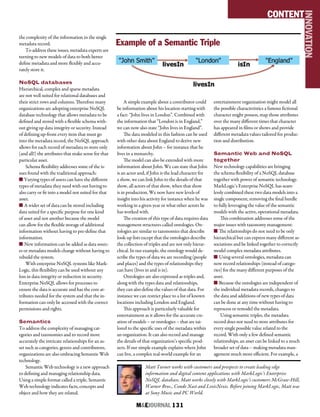
Mining New Metadata Gold with Semantics
By Matt Turner, MarkLogic Corporation P. 130
Driving Digital Profits and Reducing Risk
By Mike Sid, Mediamorph P. 133
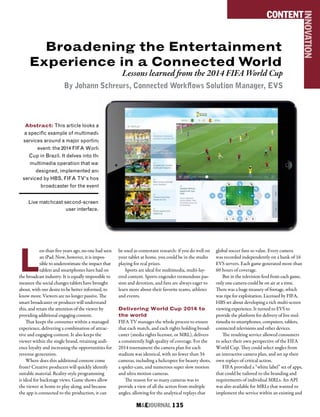
Broadening the Entertainment Experience in
a Connected World
By Johann Schreurs, EVS P. 135
Content is King
By Von Johnson, MCF Media Solutions P. 138
How to Boost Digital Media Revenues
By Charles Tigges, hybris Software / SAP P. 141
The New Entertainment Bundle—A Victory for Consumers
By Steven Herrera, Zaszou, LLC P. 143
Unleash the Power of Privacy to Protect Your Content
By David Melnick, Weblife Balance P. 146
Bringing Order to Digital Identifiers
By Richard Kroon, Entertainment Identifier Registry (EIDR) P. 148
Content-as-a-Service Enables Entertainment Everywhere
By Steven Chester, Akamai P. 162
Using MDM for Mastering Title Data in the New Digital World
By Ninad Raikar, Riversand Technologies P. 153
A New Age of Innovation for the Entertainment Industry
By Charles Matheson, OpenText P. 155
The Personalization of Business Management Systems
By Greg Dolan, Xytech P. 157
CONTENTINNOVATION P. 115
120
127
146
M&EJOURNAL  6
Editorial Director of the M&E Journal and Chief
Strategist for MESA, Devendra Mishra is recognized
as an eminent thinker and practitioner of supply
chain management. An adjunct Professor of Decision
Sciences at Pepperdine University, he has previously
served as President/COO of such companies as
LIVE Entertainment, VCL-Carolco, Lieberman
Entertainment, and Technicolor Worldwide Media.
EDITOR’SNOTE
Personalizing and Globalizing the
Entertainment Experience:
Hollywood’s Work In Progress
By Devendra Mishra, Chief Strategist, MESA, Founder & Executive Director, HITS
Furthermore, numerous technology
companies, mainly small and mid-sized, have
begun to provide hardware and software
links and layers to help build Hollywood’s
digital supply chain, which is consumer-cen-
tric. Others are emerging to provide unique
services for data analytics, digital marketing,
apps for smartphones and cloud comput-
ing, to name a few. “Old order changeth,
yielding place for new” is beginning to ring
true as monolithic systems for enterprise
management are replaced by SAS and nimble
solutions. As a matter of fact, the technology
choices are so varied that the emergence of a
purchasing officer for technology is becom-
ing prevalent in a few studios.
The traditional world of entertainment,
born out of Hollywood more than a cen-
tury ago, has grown domestically to include
direct to consumer company behemoths
like Google, Apple, Amazon, Netflix and
Facebook. The M&E industry is riding the
coattails of the new information economy in
terms of distribution. Leichtman Research
Group notes that “47 percent of U.S. house-
holds currently subscribe to Netflix, Hulu
Plus, Amazon Prime or a combination of
these services, while 49 percent have at least
one Internet-connected TV (up from 24
percent four years ago).”
Today, Hollywood benefits from the new
customer having instant access to “near com-
plete market information” at his or her finger-
tips, anytime, anywhere. Social media compa-
nies, like Facebook and Twitter, have tapped
into a deeply rooted instinct for humans to
collaborate with and improve on the work of
others. The multiplicative networking effect,
first enunciated by Bob Metcalf, has produced
a peer-to-peer sharing reality that is being
harnessed by producers of entertainment.
The content may get parsed out for
consumption on small screens with multi-
tasking consumers having shorter attentions
Hollywood is confronting the
digital revolution, where
personalization of content is
truly empowering.
T
he pace of Hollywood’s transforma-
tion to exploit the potential riches
of the digital world has gained
significant momentum in the last three
years. As the Internet has become the mode
of universal distribution of content and
the smartphone the lightning rod for the
consumer, studios are extending the user
experience like never before. The promise of
overcoming the digital pennies with dollars
appears to be less elusive with the growing
service offerings in the smartphone-driven
marketplace globally.
Considerable help is coming from un-
precedented sources as well. For example,
Alibaba could give Hollywood studios a new
pipeline into China. Alibaba, whose IPO
raised $25 billion, is a jack-of-all-trades in
China. In addition to its enormous e-com-
merce businesses, the company has interests
in banking, maps, cloud computing, online
payments, music streaming, and TV and
film production. The growth of smartphones
in China and India, where craving for Hol-
lywood is insatiable, augurs well with an
expanding connected world.
spans. In addition, the window between film
release and availability of digital content may
experience a significant compression.
Hollywood is aggressively confronting
the digital revolution, where personalization
of content is truly empowering. The first
step in embracing disruptive technologies
is to structurally change the organization
and slough off outdated legacy systems.
Alignment of film and home entertainment
businesses of the studios is ongoing while
TV networks are expanding their global busi-
ness. Management information systems and
technology platforms are being integrated to
support the new structure and to exploit the
value of content over its life cycle as well over
the life cycle of the customer in all channels
available. The domestic operations are being
consolidated with international, allowing
greater monetization of intellectual property.
In order to maximize realization of riches in
content, executives from international mar-
kets are running domestic home entertain-
ment divisions of some studios as well.
Finally, innovation in the entertain-
ment industry is being spurred by one of the
findings of Larry Downes and Paul Nunes
presented in their book, “Big Bang Disrup-
tion—Strategy in the Age of Devastating
Innovation.” The declining cost of innova-
tion, the declining cost of information, and
the declining cost of experimentation, have
shortened and skewed the life cycle of indus-
try change and Hollywood is taking advan-
tage of it. n
M&EJOURNAL  8
Guy Finley is Executive Director of MESA and the
2nd
Screen Society.
FUTUREPROOF
What is Smart Content?
(And why should you care?)
By Guy Finley, Executive Director, MESA
W
hat is Smart Con-
tent? (And why
should you care?)
This was the open-
ing comment I posed to a recent
assembly of studio executives in
Hollywood who, quite honestly,
stared at me blankly in response. The conversa-
tion started to pick up momentum, however,
when I talked about how we (MESA and its
membership) have been involved in the en-
tertainment/data conversation for quite some
time and how:
1) Discussions have taken place in a variety of
business units within the studios and hand-off
points to vendors in the evolving entertain-
ment supply chain.
2) The advancement of metadata is a slow
but steady process that seems to have gotten
its biggest boost at the distribution end of the
supply chain but needs to move further up-
stream to production, or even idea inception.
3) Other parties beyond IT, supply chain and
security need to get involved in the conversa-
tion. Production software/tools, marketing,
change management and business process
leaders all need to get involved.
4) Once you’ve got everyone’s attention,
there is the statement that appeals to every
corporate CFO, “We can use metadata to
eliminate waste, inefficiencies and run a
smarter, more profitable business.”
This dialog was the catalyst and we arrived at
a name for it all: Smart Content.
Smart Content is a new term that applies to
what we used to call the “digital” supply chain
and how machines/data/artificial intelligence
will impact business processes moving for-
ward....how data, metadata and identifiers are
being embedded…how tracking and recogni-
tion software are being written and coded…how
Publisher
Martin Porter
marty@MESAlliance.org
Editorial Director
Devendra Mishra
devendra@MESAlliance.org
Editor (M&E Journal)
Guy Finley
guy@MESAlliance.org
Managing Editor (M&E Journal)
Marcy Magiera
marcy@MESAlliance.org
Online Editors (M&E Daily)
Paul Sweeting
paul@MESAlliance.org
Jeff Hyatt
jhyatt@MESAlliance.org
Senior Writer
Chris Tribbey
chris@MESAlliance.org
Creative Director
Heidi Antman
faboographics@gmail.com
Director Of Sales
Garrett Randall
garrett@MESAlliance.org
Production Manager
Don Hurley
don@MESAlliance.org
Technical Director
Stanley Felix
stan@MESAlliance.org
SIG LEADERS
MESA Europe
Jim Bottoms
jim@MESAeurope.org
Smart Content Council
Mary Yurkovic
mary@MESAlliance.org
2nd Screen Society
Alan Wolk
alan@MESAlliance.org
CDSA
Bryan Ellenburg
bellenburg@CDSAonline.org
E
AND
MJOURNALMedia & Entertainment
Strategies. Solutions.
For more information visit: MESAlliance.org
storage and archives are using new
tools to become auto-recognized,
logged and classified...and how our
industry will utilize and store the
tremendous amount of user feed-
back, once our media & entertain-
ment products have been delivered
into the consumer’s devices/living rooms/
ecosystems.
In essence, Smart Content is enabling a
brave new era for companies that are now
able to leverage new content intelligence tools
to streamline their productions and supply
chains, while gaining unprecedented market-
ing data and analytics about how their con-
tent is being consumed.
The cultivation of Smart Content needs
to span the content lifecycle from beginning
to end or, as I prefer to say it, from “inception
to infinity” because we don’t know what’s
coming next down the distribution pipeline.
(Movies for iWatch anyone?)
Though we can no longer identify the end
of the supply chain (infinity), we at least know
where it begins (inception). Smart Content
workflows need to begin at the earliest phase.
Silos are eroding in today’s advanced digital
workflows – and increased collaboration and
access is breaking down traditional barriers
between business units. Nowhere is this more
evident than in distribution. In the ‘good
old days’ we only had to (physically) get the
films into movie theaters and through home
entertainment distribution…and now we have
online video, which is growing the complexity
of the process in scope and breadth:
n Where and when is the content being
made available?
n Where and when is it being watched?
n How are we are going to generate the most
money on these assets?
n How are we going to grow consumer reach
on all platforms?
published by
Media & Entertainment
Services Alliance
M E S A
@MESAlliance
M&EJOURNAL  9
n When do you start archiving the data?
Most importantly, what do you keep? And
what information do you need to collect
around that archive so you can search across
and access?
We are on this precipice of change and
Smart Content can help lead the way. Smart
Content will not only enable efficiencies
throughout the creation process but will also
give marketers the instant feedback loop they
need to make critical (and costly) marketing
decisions. If consumer feedback is a sidecar
that will ride along with the Smart Content
on a continual basis, just think of the way we
can continue to monetize that content, on
a global scale, over decades of changing con-
sumer preferences and buying patterns.
Smart Content makes our assets future-
proof.
It all sounds easy, right? Not quite. For
Smart Content to transform our businesses,
it will take clear direction and investment
from the top. The C-suite execs will need to
see Smart Content as integral to their overall
business and content strategies and also be
willing to invest in technologies and systems
that may not generate immediate ROI. They
will demand a singular strategy throughout
the organization – especially as the creative
and business processes become increasingly
dispersed geographically – and throughout
our circles of business partnerships.
Smart Content will demand a smarter busi-
ness organization, which will recognize its long-
term benefits and instill the responsibility for
generating both user- and machine-generated
metadata every step of the way. At a time of
streamlining systems and downsizing organiza-
tions this becomes an even bigger task—one
that may take many years to accomplish, but
one that is well worth the effort and wait.
Let’s all get smarter about creating Smart
Content. Let’s celebrate even the smallest
achievements and developments. We’re not
going to get there overnight (especially not in
this turbulent business climate) but we can’t
give up. The future of our entertainment in-
dustry depends on it. n
FUTUREPROOF
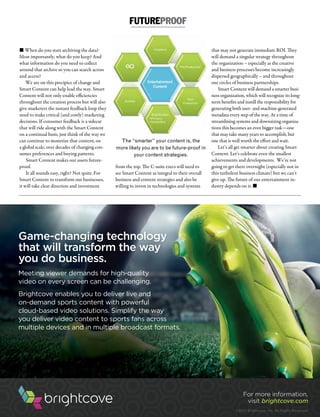
The “smarter” your content is, the
more likely you are to be future-proof in
your content strategies.
Game-changing technology
that will transform the way
you do business.
Meeting viewer demands for high-quality
video on every screen can be challenging.
Brightcove enables you to deliver live and
on-demand sports content with powerful
cloud-based video solutions. Simplify the way
you deliver video content to sports fans across
multiple devices and in multiple broadcast formats.
For more information,
visit brightcove.com
©2014 Brightcove, Inc. All Rights Reserved.
M&EJOURNAL  10
Jim Bottoms has been closely involved in the home entertainment sector for more than three decades,
helping companies around the globe to develop strategies aimed at creating a successful product launch and
driving consumer adoption. As Executive Director of MESA Europe he is an industry advocate working
with member organizations whose range of business activities span the entertainment supply chain.
DISCJOCKEY
Next-Generation Blu-ray:
Let’s Get it Right
The investment cost for the new equip-
ment was high and initial yields were low.
With very few exceptions, it was virtually
impossible to justify the cost and with rep-
lication prices falling almost before the first
disc rolled off the line it didn’t get easier. I
lost count of the number of times I had con-
versations with even established pressers who
said that the numbers simply didn’t work.
We didn’t bring along the independent
content companies. Particularly in Europe,
the small guys helped create the business. But
for a number of reasons (lack of investment
from the independent replicators, minimum
order quantities, AACS not being in Europe
or small company friendly) they mainly sat
out the early days of BD, and many are still
not fully engaged.
The consumer education point is one that
is increasingly being heard when it comes to
new technologies, and quite right too. The
days of studios having big enough budgets
to create generic TV campaigns are largely
a thing of the past. Meanwhile, the studios
blame the retailers, the retailers blame the
content community and the hardware manu-
facturers, and while this is going on, little is
really being done to talk to the consumer.
OK, enough of analyzing the problems.
This only really helps if we commit to the
Gerry Rafferty ethos and determine that we
are going to get it right this time.
So, if Ultra HD BD is to be a success,
what can we do to right the mistakes above?
We need a format (and very soon).
This time last year we all thought that we
might even see something for Christmas
Anyone with a vested interest
in making UHD happen has
a role to play.
W
hen Gerry Rafferty sang “If you
get it wrong, you’ll get it right
next time,” could he have been re-
ferring to the home entertainment industry?
Let’s start with the premise that we got
it wrong on Blu-ray, at least so far. (I for one
still believe it is not too late and more can be
done to drive demand, but let’s come back to
that another time.)
What exactly did we get wrong? Where
do I start?
We didn’t educate the consumer. In the
main, they still do not know what cable to use
to get the full benefit. They are still confused
over whether it plays DVDs. Some don’t even
know that it is a high definition disc.
We didn’t fully support the format.
Why, once prices started to come down did
hardware manufacturers continue to make
and sell DVD players? As BD players can also
play DVD, why not expand the ownership by
just offering the backwards compatible de-
vice? It tends to be what other sectors do.
We made the investment in BD repli-
cating almost impossible to justify. This is
perhaps a more controversial point but is highly
relevant if we, as an industry, are serious about
trying to establish an Ultra HD disc. (The fault
here lies with no one group or organization, but
it is important that we look at the issues.)
2014. As we approach the holiday season, I
think we should be saying that if we do not
have something in the shops by Christmas
2015, maybe we should pull the plug now.
We need a genuine all-party buy-in
to telling the consumer what UHD is.
So broadcasters, TV manufactures, content
distributors and anyone else involved needs
to make it clear that next-generation-quality
content is accessible across every single de-
livery platform. But let’s also broaden the
net. Anyone with a vested interest in mak-
ing UHD happen, whether you make packs,
discs, raw materials or movies, has a role to
play.
We need a commitment to making it
work for everybody. That means sharing
the risk of the investment in equipment and
sharing the output from those investment
dollars or euros across the content com-
munity. Whether those manufacturing lines
are in Mexico, Indiana or Alabama does not
matter. What is important is that there is a
manufacturing investment. No single repli-
cator will be in a position to drive this alone
and investment from multiple manufactur-
ers is just not going to happen.
In short, the industry wants and needs
this, and the only way that UHD BD is go-
ing to happen is if we start collaborating now
and have a clear and concerted cross-industry
commitment to making it work.
If not, let’s abandon plans for a new disc
now, promote upscaling players and get be-
hind making more of the existing BD format.
I think this is a very real alternative.
I would love to get your views. n
The road to a standard is long and winding – but is worth the effort
By Jim Bottoms, Executive Director, MESA Europe
The Global Standard
Contract and Rights Management Software
For more info or to schedule a demo: +1 877.992.9466 | sales@filmtrack.com
M&EJOURNAL  12
Media & Entertainment
Services Alliance
M E S A
COMMUNITYUPDATE
S
ince you are reading this M&E
Journal, undoubtedly you know
who we are. The Media & En-
tertainment Services Alliance
(MESA) reaches you either electronically
(email, social) or in person (at nearly 34 annual
events) year-round in the U.S. and Europe. But
you might not realize that MESA is really an
alliance of several well-known special interest
groups (SIGs) and professional communities
that activate their own series of targeted in-
dustry events and information initiatives that
include:
n Hollywood IT Society (HITS),
including HITS Broadcast
n Women in Technology: Hollywood
(WiTH)
n 2nd Screen Society (S3)
n Content Delivery & Security
Association (CDSA)
n Entertainment Supply Chain
Academy (ESCA)
n Smart Content Council (SCC)
Over the past year, as the industry continued
to transform and our association expanded,
we noticed something happening. There was
increasing overlap between the participants in
our various SIGs/communities. We first saw it
develop between the IT execs in HITS and their
interest in content protection, which led them
to CDSA. Meanwhile, WiTH was a direct out-
growth of HITS, which itself was an outgrowth
of our work with IT executives in the early
period of ESCA and the digital supply chain.
This year we created the Smart Content Council
which has increasing interaction with the IT and
supply chain groups, while there is a growing
conversation between them and the 2nd Screen
Society as social and multiscreen strategies are
integrating into the production workflow. In
short, we’ve really become one association with
several distinct constituencies—all of whom
benefit from an increasingly diverse but equally
open and interactive membership.
For this reason, we have made a significant
change in our membership policy moving for-
ward: If you are an Advisory Board member of
MESA, you’re part of them all.
This will provide an ever-broadening dialog
One MESA
What’s going on with our many special interest groups?
about how entertainment is going to trans-
form itself and its business model in a digital
world.
What’s going on with the
many faces of MESA?
Here’s a quick rundown:
Hollywood IT is making its
mark worldwide. Our HITS
Europe launch in London was
(dare we say?) a hit. HITS
Broadcast is in the process of building its
first board of Content Advisors and recently
launched its inaugural NYC summit at CCW
in cooperation with NAB.
A group of women execu-
tives in IT have formed the
nucleus of an expanding assembly of female
technology and entertainment executives in
Hollywood. Two luncheon meetings have
each drawn 100+ women (and men, too) talk-
ing openly about professional development
and career issues.
A new board of Content
Advisors is being formed by
our new Society chairman,
Alan Wolk. In between three core industry
events (CES, NAB, IBC) S3 will be concen-
trating on smaller, executive focus groups that
are each targeted at a key segment of the value
chain.
The Board of Directors
for this non-profit security
group is reevaluating its structure with the
intent to expand membership throughout the
entire M&E business—movies, television, games
and software. Stay tuned for details in 2015.
We recently launched
the Smart Content
Council under the direc-
tion of Mary Yurkovic. The council will
be opening up work exchanges between
the various industry segments to facilitate
a broader, more open dialog about the
integration of data, metadata and content
as it moves throughout the entertainment
media supply chain.
Ultimately it is your support and active
participation in MESA that has made all
of this possible. We welcome your input as
MESA and its membership continue to drive
the transformation of the entertainment
industry. Please stay in touch with any one of
our segment leaders. HITS: Devendra Mishra,
devendra@MESAlliance.org S3: Alan Wolk,
alan@MESAlliance.org CDSA: Bryan El-
lenburg, bellenburg@CDSAonline.org SCC:
Mary Yurkovic, mary@MESAlliance.org
Our sister organization,
MESA Europe (based in
London), drives SIGs in
line with the above, focus-
ing primarily on European issues, initia-
tives and local events. If you’re interested
in learning more, please contact Jim Bot-
toms, jim@MESAeurope.org.
And, if you’ve got news that you want
to share with the MESA community, stay
in touch with our writers and editors for
the M&E Daily, 2nd Screen 2 Day, CDSA
Security News, Smart Content News and
HITS List:
Chris Tribbey, chris@MESAlliance.org
Jeff Hyatt, jhyatt@MESAlliance.org
Paul Sweeting, paul@MESAlliance.org
Don’t hesitate to stay in touch with the
MESA team who runs it all:
Don Hurley, our director of operations,
don@MESAlliance.org
Garrett Randall, our director of member
services, garrett@MESAlliance.org
Guy Finley, our executive director,
guy@MESAlliance.org
We look forward to working with you in
2015 and beyond! n
women in technology | hollywood
WıTH
smart
content
council
www.asperasoft.com
moving the world’s data at maximum speed
M&EJOURNAL  14
T
he Internet of Things (IoT) is the network of real-world objects
(“Things”) accessed through the Internet. A Thing in IoT has a unique
identifier and contains embedded technology, which is able to transmit
data over the Internet without any human intervention. A Thing can
be any natural or man-made object. A typical IoT device would have sensors for its
specific purpose. Some examples of IoT devices are pacemakers that transmit data
to the hospital, animals injected with biosensors to track migratory patterns, street
cameras that send emergency alerts upon detecting accidents, aircraft transponders
that transmit GPS location at all times, and energy/water monitors for a smarter,
more-efficient city. An IoT device can not only sense but can actually “do” things.
For instance, a smoke-alarm that detects smoke in an area can automatically activate
a sprinkler system in that area; security monitors, when detecting a breach, could
automatically secure exit areas without any manual operation. Experts agree that the
impact of IoT is going to be much wider than the impact of the Internet itself across
all aspects of our life.
At the heart of this concept lies the fact that any and every object can be unique-
ly identified. Although this may sound implausible, it has already been achieved
thanks to Internet Protocol version 6 (IPv6). An address or identifier in the Inter-
net is referred to as an “IP address.” Every device on the Internet is assigned an IP
address for identification and location definition.
With IPv6, there is no risk of exhaustion of IP addresses.
Yet, the adoption of IPv6 has been slow. According to Google, only 4 percent of
Abstract: IoT is going to
be a transformative experience
for consumers as well as
businesses. For us in media
and entertainment, it will create
new ecosystems, markets
and business models. The
shrinking gap between content-
creators and consumers will
lead to an enhancement of
consumer satisfaction. This,
in turn, will lead to more
consumption.
The Role of IoT in the Future of M&E
IoT has been most visible in common household appliances, but it has the ability to bring
together content publishers and consumers in an unprecedented way
By Bhanu Srikanth, CEO & Co-Founder, Jargon Technologies
CONNECTEDFUTURE
M&EJOURNAL  15
As CEO of Jargon, Bhanu Srikanth is responsible for overall corporate and
technology strategy, account management and business development. Before starting
Jargon, she was part of the core R&D team that developed and evolved the Blu-ray
format and was involved in various aspects of Blu-ray technology. She spearheaded
PHL’s Blu-ray authoring group during the startup phase of Blu-ray production.
the users accessing their services have IPv6
addresses as of June 2014. It is imperative
that IPv6 gets adopted globally for IoT to
evolve. The transition from IPv4 to IPv6 is
expected to be gradual as all hardware and
software get updated.
In specific reference to the Media & En-
tertainment industry, IoT could solve the
many challenges our industry faces today.
IoT will change how content is distributed,
marketed and consumed. Content providers
want to provide flexibility to the consumers
to view their content across various channels
such as theaters, Blu-ray, digital streaming
and download. And yet, they want to protect
the rights to their content. Standards such as
UltraViolet have emerged to meet these two,
often conflicting, requirements. But to keep
up with the constantly-changing ecosystem is
going to be an expensive proposition for such
standards. From a consumer perspective, the
current digital rights management practices
do not provide a user-friendly experience.
Multiple user actions such as registrations
and validations are mandated to exercise the
right to one’s content, which makes it cum-
bersome. IoT could simplify digital rights
management due to the uniquely identifiable
IoT devices and make it easier to trace any
rights violation to the root.
IoT could bring together content pub-
lishers and consumers in an unprecedented
way. Content publishers could define the ac-
cess rights for a consumer right at the Point
of Sale/Service (POS) without depending on
third-party human interaction.
Imagine going to watch a movie in the
theater, where a POS IoT device, say the
ticket scanner, could register your purchase
and after some time, push the content for
you to watch again on your IoT-enabled
device, which could be your television or
tablet or phone or desktop. Publishers could
instantly reward consumers for going to the
theater in a number of ways, like giving them
a discount to purchase a digital or a physi-
cal copy, or allowing them stream similar
content on their IoT device. Consumers
could be rewarded with exclusive behind-
the-scenes footage for purchasing a ticket.
Similarly, consumers purchasing a Blu-ray
disc could be rewarded with an instant digi-
tal copy on their IoT devices or a streaming
subscription for similar content without
needing to register devices and enter codes.
Adding layers to social
media and interactivity
We can also expect IoT to lend a new dimen-
sion to social media and social experiences. A
virtual movie-hall where people from across
the world are watching the same movie and
interacting with one another is no longer
limited due to technical barriers and lack of
inter-operable technologies. Although such
experiences are possible today, it requires
costly planning and execution. Imagine stu-
dios creating ad-hoc virtual movie theaters
and inviting fans or the press to catch an ex-
clusive look at an upcoming blockbuster.
IoT could take interactivity to new
heights. Consumers could rate the movie,
request information on location or participate
in a lottery to win movie-related gear during
or after the theatrical experience. Second-
screen could evolve into a web of meaningful
interactions with consumers’ IoT devices.
Content can have metadata to trigger a web of
contextual experience on other IoT devices.
For example, imagine you are watch-
ing a movie when your favorite actor ap-
pears on screen. Knowing your preference,
your phone could ask to pose for a picture
with him/her, then send the picture to
your smart-frame in your living room or/
and across the world to your friends’ living
rooms. When you are watching a soda com-
mercial, your IoT TV could alert you to the
fact that your refrigerator is about to run out
of soda and offer to place orders for you at
your nearest or favorite store.
The enormous impact of IoT is going to
be on targeted marketing. IoT-enabled de-
vices are going to transmit copious amounts
of data, tons of useful information on con-
sumer spending and preferences. No longer
will content publishers need to rely on tra-
ditional methods of surveys and gathering
ratings. They will have real data at hand. If
these data are mined properly, it could lead
to streamlining of distribution and market-
ing content, as well as the evolution of new
business models.
IoT is going to be a transformative expe-
rience for consumers as well as businesses.
For us in media and entertainment, it will
create new ecosystems, markets and business
models. The shrinking gap between content
creators and consumers will lead to an en-
hancement of consumer satisfaction. This,
in turn, will lead to more consumption.
Privacy and security
The biggest hurdle for IoT adoption is go-
ing to be concerns over privacy and secu-
rity. The American Civil Liberties Union
(ACLU) has already expressed concerns
over the intrusive nature of IoT. In a recent
survey of 2,000 consumers published online
by Acquity Group, 80 percent of the respon-
dents expressed that they were concerned
about security, but half of them said they are
willing to share certain personal informa-
tion with third-party retailers if provided
compensation. Even if consumers willingly
share certain information, securing the big
data is going to be a daunting task. There is
also concern of security at the national and
international levels, where criminals could
gain control to a network of IoT devices to
cause harm.
Can the current IT security systems
evolve to meet the demands of IoT? Or is
there a silver bullet waiting to be discov-
ered? Only time will tell. n
IoT could simplify digital rights management due to the
uniquely identifiable IoT devices and make it easier to trace
any rights violation to the root.
M&EJOURNAL  16
T
he media and entertainment sector has
made tremendous strides in harnessing
new digital technologies to transform the
way people consume film, television and
music – to name but a few artistic forms of expres-
sion.
But of these three art forms, it could be argued
that only music has also used new technological
capabilities to reinvent the eco-system that makes
up that industry’s value chain. The rise – and ac-
ceptance – of online music venues (such as iTunes)
has not only left an indelible mark on how music is
produced; it has altered how music is developed, dis-
tributed, delivered and consumed.
Television and film have been more deliberative
in figuring out how new cloud technologies can
alter the chain of activities that connect the content
development process to the delivery of increasingly
immersive augmented experiences demanded by to-
day’s customers. Some of the most interesting areas
of activity in the distribution of moving pictures in-
volve over-the-top (OTT) players like Netfilx, Vudu,
and more recently, MGO. These players are harness-
ing cloud computing principles to fundamentally
alter the relationship that consumers have with the
content in which they are interested.
Where we see an immense opportunity to have
cloud computing creatively disrupt – and improve
– the entertainment industry is in “up-stream” early
stages of the content creation process.
Abstract: In this article, we explore the role that cloud technology-
enabled business strategies can play in:
n Fundamentally altering the nature of collaboration in creating content
n Moving away from a delivery model that has traditionally depended on
serial (step-by-step) processes toward new strategies that embrace
parallel collaboration (in which multiple steps can be executed at once)
n Transforming the economics of media and entertainment experiences
The Potential of the Cloud to Disrupt
and Improve Content Creation
ENHANCINGCREATIVITY
Digital film and TV productions demand new business processes that
support multi-disciplinary collaboration in real time
By Ginny Davis, CIO, and Tim Sarnoff, President, Production Services, Technicolor
Time, tradition and barriers to
transformation
Technology has always had an immense impact on
the culture and business practices of every industry.
What is interesting to observe, however, is how
entrenched culture can become, even when the
technological realities around us change. Tradi-
tion, after all, offers a seal of approval on “tried and
true” behaviors that are difficult to displace. It is
why people and institutions can be so reluctant to
change.
In the media and entertainment sector, the na-
ture of chemical and magnetic tape-based technol-
ogy led to serial, step-by-step processes for content
creation that defined – and even enshrined – the
relationships that make up the media and entertain-
ment value-chain. As one step in the process was
completed, the next link in the chain took over in
a linear trajectory that ended with the screening,
debut and release of a production to a consumer
audience.
Every year the technology associated with this
traditional process got better, further codifying the
underlying principles and value-chain relationships.
But making things better often meant introducing
nuances and complexities that necessarily extended
the number of links – and hence the length of the
value chain.
However, the digitization of film has introduced
dramatic disruption to both the creative process
and consumer expectations. Scenes, for instance,
need to be more realistic even as the stunts are
more fantastic. In just a few years, we can see how
rapidly digital image enhancement technologies
have altered the visual experience by comparing
Peter Jackson’s The Lord of the Rings: The Fellow-
ship of the Ring, in 2001 to his 2013 installment of
The Hobbit: The Desolation of Smaug.
The visual difference is palpable. But even more
M&EJOURNAL  17
impressive is what has had to occur behind
the scenes to create these new immersive
augmented entertainment experiences.
Parallel processes,
collaboration and the cloud
The entertainment industry is rapidly – even
if reluctantly – coming to the conclusion
that the complexities associated with today’s
digital productions cannot be supported by
traditional (linear/serial) business processes.
The number of interdependent variables as-
sociated with telling compelling stories has
exploded beyond the ability to place all pro-
cesses on a single critical track.
The digital revolution in content cre-
ation has created demand for new business
processes that support multi-organizational,
multi-disciplinary collaboration in “real
time.” The industry has evolved to a point
where multiple activities must move forward
in a simultaneous and parallel fashion.
And this where the principles of cloud
computing come into play.
For years, industry has struggled with
how to create common platforms and shared
resources that facilitate collaboration, but
which also provide the security and risk man-
agement capabilities that are associated with
closed proprietary, private systems. What
cloud computing has introduced is a new
way to think of the underlying infrastruc-
tures that must be interconnected and inte-
grated to produce and distribute cinematic
and television programing.
An integrated approach to infrastructure
virtualization, application program interfac-
es (APIs), data management, as well as strong
identity management (IM) and role-based
access control (RBAC), are just a few of the
central tenets and organizing principles for
cloud computing.
These principles abstract the applications
– the functional purpose of a piece of software
– from the underlying infrastructure. Virtu-
alization, for instance, allows organizations
to optimize the utilization of processors. But
the same technology also makes it possible
to place several virtual machines on a single
server so that multiple activities – and user
disciplines – can share the same resource.
The sharing concept is critical if we are to
engage in parallel collaborative processes and
minimize the number of file copies (scenes
for instance) that exist across the multiple
systems used by the community that comes
together to produce a motion picture.
Why is this important?
When multiple copies of files are flying
around in different systems that are not inte-
grated, it creates a version control challenge
that can paralyze the production process.
The abstraction of applications from the
underlying infrastructure makes it possible
to create logical segregation of activities
based on policies that can be automated,
monitored and enforced on the same com-
puting resources.
Along the same lines, APIs are important
because they allow different systems to be
adapted and integrated to support multiple
functions – such as sound editing, visual
special effects or colorization – on a com-
mon platform.
From a security, compliance and man-
agement perspective, IM and RBAC allow
executives to validate and authenticate who
is using cloud resources while also restricting
user behaviors and access to files and pro-
cesses based on defined and prescribed roles
and responsibilities.
This cloud architecture can (and should)
be analyzed and audited by third parties to
M&EJOURNAL  18
Ginny Davis leads key strategic partnerships and manages the applications, networks, data centers and IT services used
by Technicolor employees, customers, and suppliers across more than 30 countries and 200-plus sites. She is responsible
for defining and implementing new technologies to continuously improve our productivity for both internal and external
customers.
Tim Sarnoff oversees the company’s key activities including visual effects, post-production, digital cinema, and
animation & games. Prior to joining Technicolor Mr. Sarnoff was President of Sony Pictures Imageworks for 12 years,
and previously created Warner Digital Studios as a division of Warner Bros., and shepherded the start-up and growth of
Warner Bros. Animation.
ensure that the performance, controls and
security characteristics meet the highest
standards of compliance with the shared
priorities and policies of the community that
uses the cloud to streamline the production
process.
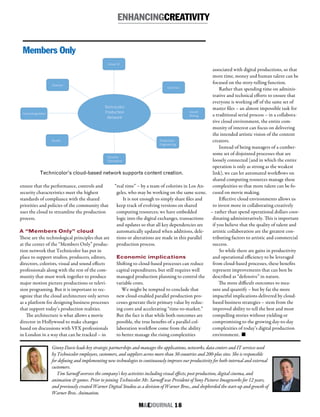
A “Members Only” cloud
These are the technological principles that are
at the center of the “Members Only” produc-
tion network that Technicolor has put in
place to support studios, producers, editors,
directors, colorists, visual and sound effects
professionals along with the rest of the com-
munity that must work together to produce
major motion picture productions or televi-
sion programing. But it is important to rec-
ognize that the cloud architecture only serves
as a platform for designing business processes
that support today’s production realities.
The architecture is what allows a movie
director in Hollywood to make changes
based on discussions with VFX professionals
in London in a way that can be tracked – in
“real time” – by a team of colorists in Los An-
geles, who may be working on the same scene.
It is not enough to simply share files and
keep track of evolving versions on shared
computing resources; we have embedded
logic into the digital exchanges, transactions
and updates so that all key dependencies are
automatically updated when additions, dele-
tions or alterations are made in this parallel
production process.
Economic implications
Shifting to cloud-based processes can reduce
capital expenditures, but still requires well
managed production planning to control the
variable costs.
We might be tempted to conclude that
new cloud-enabled parallel production pro-
cesses generate their primary value by reduc-
ing costs and accelerating “time-to-market.”
But the fact is that while both outcomes are
possible, the true benefits of a parallel col-
laboration workflow come from the ability
to better manage the rising complexities
associated with digital productions, so that
more time, money and human talent can be
focused on the story-telling function.
Rather than spending time on adminis-
trative and technical efforts to ensure that
everyone is working off of the same set of
master files – an almost impossible task for
a traditional serial process – in a collabora-
tive cloud environment, the entire com-
munity of interest can focus on delivering
the intended artistic vision of the content
creators.
Instead of being managers of a cumber-
some set of disjointed processes that are
loosely connected (and in which the entire
operation is only as strong as the weakest
link), we can let automated workflows on
shared computing resources manage these
complexities so that more talent can be fo-
cused on movie making.
Effective cloud environments allows us
to invest more in collaborating creatively
– rather than spend operational dollars coor-
dinating administratively. This is important
if you believe that the quality of talent and
artistic collaboration are the greatest con-
tributing factors to artistic and commercial
success.
So while there are gains in productivity
and operational efficiency to be leveraged
from cloud-based processes, these benefits
represent improvements that can best be
described as “defensive” in nature.
The more difficult outcomes to mea-
sure and quantify – but by far the more
impactful implications delivered by cloud-
based business strategies – stem from the
improved ability to tell the best and most
compelling stories without yielding or
compromising to the growing day-to-day
complexities of today’s digital production
environment. n
Technicolor’s cloud-based network supports content creation.
ENHANCINGCREATIVITY
Members Only
Are you
unlocking new
growth through
the power
of digital?
© 2014 PricewaterhouseCoopers LLP, a Delaware limited liability partnership. All rights reserved. PwC refers to the United States member firm,
and may sometimes refer to the PwC network. Each member firm is a separate legal entity. Please see www.pwc.com/structure for further details.
As the power of digital has exploded, so have customers’
expectations. Companies that can effectively engage
digital customers while reinventing their business models
will be the ones that find a competitive advantage. PwC
understands the complex issues facing top advertisers, as
well as leading media and entertainment companies, and
is ready to work with you to harness the power of digital
media. That’s why PwC is hosting a panel discussion on
the progress and future of TV everywhere, to help you
gain critical insight into the forces unlocking new growth
in media and advertising.
Visit www.pwc.com/us/em
M&EJOURNAL  20
SUPPLYCHAINSOLUTIONS
M
any of us are attracted to supply
chain work not so much for the
daily grind, but for the poten-
tial to refine and improve. It is
the engineer or the architect in us that can’t
help but think of better ways to connect sup-
ply with demand. We aren’t satisfied with the
status quo.
If you are a participant in the digital con-
tent supply chain, you must be acutely aware
of the brimming inefficiencies that exist. We
are talking about wrangling media assets of all
formats, directing the movements of very large
files, and executing complex transformations
to increasingly stringent retailer requirements.
Very unlike most supply chains.
What we are experiencing is the following:
n video, audio, and data elements scattered
across disconnected repositories;
n assets unnecessarily re-generated;
n masters handled and transformed over and
over again;
n derivative assets proliferating;
n re-work and redundant QC steps;
Transforming the Digital Supply
Chain for Efficiency
Abstract: A discussion directed at
those involved in the digital content
supply chain, covering the effects an
inefficient supply chain is having on
the industry, some of the common
proposals to improve, and one vision for
how transformation may be shaped.
The best possible path is through automation and cloud IaaS
By Douglas Reinart, Chief Operating Officer, ContentBridge Systems
n product configurations for one output
(e.g., Blu-ray) not available, or overlooked, for
other windows;
n sales teams committing titles and delivery
time frames that are simply not supportable
by operations due to missing or unavailable
elements;
n numerous retailer-specific delivery require-
ments;
n and sales associates having to become closet
experts in digital media technologies.
Regardless of whether the retailer or the
content owner covers digital supply chain
processing costs, inefficiencies make content
more expensive to acquire. Other problems
also arise. A less agile and responsive supply
chain leads to poor fulfillment performance
and missed sales opportunities. Technical
complexity impairs connections between sales
and operations, further limiting a content
owner’s ability to capitalize on opportunities.
Retailers find it more difficult to discover and
transact content.
Because today’s supply chain limits vis-
M&EJOURNAL  21
SUPPLYCHAINSOLUTIONS
ibility and discovery, retailers are driven to a
greater reliance on aggregators, middlemen,
and other “filtering mechanisms” to weed out
content and squeeze their funnels. The added
cost of an inefficient digital supply chain also
means that retailers have less to spend on the
content itself.
Getting to this point
Not too long ago, we lived in an analog enter-
tainment world. Back then, we went to the-
aters to watch the projection of 35mm film
and tuned in to any of four or five broadcast
television channels (counting UHF) in our
homes. Film and broadcast TV maintained
entirely self-contained distribution infrastruc-
tures rigidly defined by standards. Content
owners had well-defined deliverables and in
many cases owned the distribution chain.
Things didn’t change much with cable
television, although various tape formats did
begin to multiply. Even VHS and the advent
of home entertainment represented just an-
other self-contained, consistent, and entirely
standards-driven distribution.
It wasn’t long before digital technology
crept into distribution, but the major stu-
dios managed to keep the genie bottled for
a while longer. Digital Cinema Initiatives,
LLC (DCI) paved the way for digital cinema,
while collaborations between studios and the
consumer electronics industry yielded DVD
and Blu-ray specifications that drove lucrative
businesses.
Once all title assets are available, the
physical media supply chain for DVD and
BD progresses down a consistent path from
authoring to emulation/QC, disc mastering,
replication, packaging, pick/pack, and deliv-
ery – all controlled by major content owners,
right down to the retail shelves where they are
displayed.
Studios kept their eyes on the packaged
media prize. Meanwhile, in DVD’s shadow,
the digital supply chain germinated without
studio coordination or standards.
Today’s digital supply chain quickly
diverges from the content owner’s control,
roughly where compression and authoring
begins in the DVD and Blu-ray world. Digital
retailers now control the path that intersects
the consumer, and they define what flavors
and variants get created after the mastering
step. The largest and most influential of them
used this control to push upstream, aggres-
sively dictating the format of deliverables to
suit their consumer delivery infrastructures.
The studios left a vacuum and the digital
retailers filled it. Compounding the issue for
everyone is a multitude of device form fac-
tors and technology “ecosystems” adopted by
consumers.
Proposed improvement paths
If you have attended a digital media-themed
conference within the past eighteen months,
you can attest that we are not exactly lacking
for proposals to improve the digital content
supply chain. Let’s take a closer look at some
of the proposed paths.
Do Nothing
The digital supply chain has evolved, warts
and all, to where at least it is functional. May-
be we are too far down the path for significant
changes to be worthwhile. Perhaps major in-
vestments have already been made on internal
processes, systems, and partners to help deal
with the complexity. Slow movers chained to
sunk investments will start to lose out.
Standards
Leading entertainment industry groups like
DEG, EMA, MESA, and SMPTE have spon-
sored efforts to define digital supply chain
standards. Much of the focus has been on
metadata, but work has encompassed mezza-
nine files formats, image artwork, closed cap-
tioning, subtitling, and avails. Some retailers
have expressed their desire to receive mezza-
nine-level packages from content owners that
adhere to Interoperable Master Format (IMF)
specifications.
Clearly, standards are an important piece
in the digital distribution puzzle. However,
experience suggests that we can’t solely rely
on this path. We see how quickly standards
efforts can devolve into yet another metadata
schema or file type proposal. Some retailers
believe they can push through a de facto stan-
dard.
No content provider wants a digital retailer
to dictate supply chain terms more than they
already do. And how likely is it that digital
retailers – committed to differentiating experi-
ences for their consumers – will be comfort-
able settling for a “one size fits all” package
from content owners? Still, there may be time
to forge some standards, building off the good
work done to date. It might help matters if a
DCI-like entity was empowered to implement
digital distribution standards, but that too
would require broad consensus. A role may
exist for a coordinating group focused not
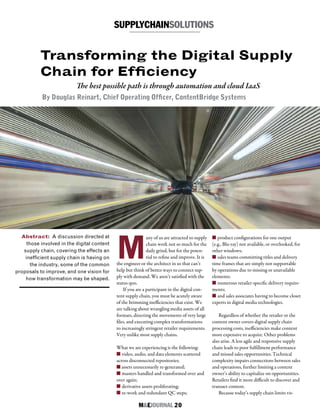
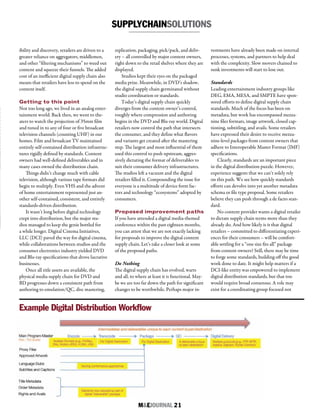
Example Digital Distribution Workflow
M&EJOURNAL  22
Douglas Reinart prior to ContentBridge was VP Global Studios at Technicolor.
He also served as EVP Worldwide Operations for Paramount Pictures Home
Entertainment and Partner at PRTM Management Consultants, now part of
PriceWaterhouseCoopers.
on specific standards, but on something a bit
broader (more on that below).
Retail savior
Lately, there has been talk that a major digital
retailer may be willing to step forward and take
over the entire digital supply chain on behalf
of the industry. After all, a retailer of sufficient
size and scale already receives content from the
vast majority of owners and aggregators. They
could process deliveries to other destinations
just as third party services providers do today.
The largest have seemingly limitless resources
at their disposal to step into the breach. In fact,
it might all be offered free to content owners.
Except that it won’t be free. In my studio
home entertainment days, we evaluated and
rejected offers from retailers to “offload” some
of our supply chain burden. Those proposals
didn’t go anywhere because they would have
put us in awkward positions with our other
customers. What is being proposed now for
the digital supply chain would be the equiva-
lent of awarding the studio’s entire DVD and
Blu-ray fulfillment to a single big box retailer.
Central servicing entity
If trusting a single retailer to assume control of
the digital supply chain is not the way, perhaps
a large media service provider could act as a
consolidated intermediary. This is a fantasy
to which post houses and other media service
providers are still clinging. Understandably,
content companies are unlikely to put all their
eggs in one third-party service provider basket.
Other variants include a dedicated servicing
entity that is jointly owned by multiple studios,
or an industry consortium. Both the Digital
Cinema Distribution Coalition (DCDC) and
the Digital Entertainment Content Ecosystem
(DECE) are good examples of entertainment
distribution consortia. DCDC addresses the
satellite delivery of digital cinema packages to
theaters, while DECE, of course, begat its digi-
tal locker service familiar to us as UltraViolet.
Whether a third-party provider, joint
studio entity, or industry consortium, a cen-
tralized servicing group doesn’t automatically
eliminate inefficiency from the supply chain.
Individually, they concentrate the effort and
may be able to push through standards con-
vergence. They also introduce another inter-
mediary into an already crowded supply chain
full of middlemen.
Technology to rationalize distribution
We are witnessing the rapid evolution of
distributed processing and storage solutions
across nearly every industry. It is not hard
to envision the realization of entire sup-
ply chains in the cloud – particularly those
charged with processing and moving digital
goods.
Automation capable of processing video,
audio, artwork, and associated metadata
into packages accepted by any digital retailer
would transform the supply chain without
requiring adoption of monolithic standards
or establishing new middlemen.
Taken further, an interoperable “ecosys-
tem” of digital supply chain services could
leverage the ever-improving economies of the
cloud. In this model, content owners would
be free to choose how and where their asset
libraries exist (although Total Cost of Infra-
structure (TCOI) advantages will likely drive
content owners to maintain a ‘service-ready’
library with one or more Infrastructure as
a Service (IaaS) providers). Content own-
ers would only need to provide the path to
uniquely identified assets. The supply chain,
in the form of cloud services, would be deliv-
ered to the content.
The Crystal Ball
I believe that the true and inevitable path to
transforming today’s digital content supply
chain is through automation and cloud IaaS.
The technologies already exist to bring an
interoperable ecosystem of supply chain ser-
vices to reality. Automation can take over the
supply chain process from the point where a
content owner has high quality conformed
assets. This includes dynamic localization
(swapping alternate language audio tracks,
subtitles, and even scene replacements or dub
card inserts). Automation in the ‘front-end’
asset conform stage (specifically, the master-
ing and QC steps) will take a bit longer to
address. Still, much of the effort to create
diverse retail deliverables can be (and is) auto-
mated today.
Standards can help accelerate this vision
by limiting the variations in deliverables for
which automation would have to solve. In-
teroperability of solutions presents its own
challenge. Standards can help the technical
component, while joint industry initiatives
can help address the business challenge by
encouraging studios, service providers, and
retailers to work toward a common vision.
Automating the fulfillment process then
opens up possibilities to rethink content
search, discovery, and transacting between
content owners and retailers. Think for a mo-
ment about a “common virtual VOD engine”
powered by competing but interoperable
cloud services. Content owners decide what
to make available to whom, under what terms
and where they keep their assets stored and
protected. Retailers decide what they wish
to transact and specify how they want to
receive the content. Cloud services take care
of the rest. Such an approach could allow for
fine grain control of access rights and greatly
reduce the need for aggregation. Selling and
distribution frictions would be eliminated.
More content, including independent works,
would find their way to retailers looking to
differentiate their platforms. The whole pie
grows.
Who owns such an engine (or if it needs
an owner at all) and how it all operates will
have to wait for another installment. The
good news is that there are real opportuni-
ties—and now the technologies—to trans-
form the digital content supply chain in
dramatic and meaningful ways. After all, isn’t
that why we chose to be supply chain profes-
sionals in the first place? n
The added cost of an inefficient digital supply chain means
that retailers have less to spend on the content itself.
SUPPLYCHAINSOLUTIONS
Change is an integral part of both the technology and M&E industries.Today’s enterprises must be ready
to respond to new opportunities, new challenges, and new technologies with increasing speed and
agility, often with IT resources already stretched beyond capacity.That’s where we come in.
Founded in 2000 and headquartered in Los Angeles, Zaszou is a leading IT consultancy that offers the
expertise, experience, and proficiency to turn technology challenges into business opportunities —
quickly, cost-effectively, and most importantly, successfully. Our team’s proven track record extends over
twenty-five years in media and entertainment serving businesses from strategy through execution.
Zaszou IT Consulting
zaszou.com
Agile Responsive Flexible
SoYou Can BeToo
M&EJOURNAL  24
I
ndustry consensus is that 4K will be
the next generation television technol-
ogy that will capture the consumers’
imagination. With this consensus, pro-
duction, processing, workflow, and delivery
mechanisms must be re-defined for mass scale
as subscribers embrace the potential of this
exciting new viewing experience. Now is the
time for service providers to investigate the
necessary steps to prepare and ramp commen-
surate with the pace of the market and posi-
tion themselves as leading providers of very
high-quality content.
Fundamentally, it should be understood
that there will be variations in the quality of
4K formatted titles. This is based on nuances
having to do with parameters used in the
preparation of content from sources that are
either 4K native shot and mastered produc-
4K UHD: Delivering on the
QoE Promise
Files will need to undergo rigorous testing and quality analysis to
realize the format’s potential
By Ken Goeller, Vice President, Solutions Engineering,
Deluxe Digital Distribution (D3)
Abstract: “Good enough” will no
longer be accepted as “good enough”
given that the critical differentiator
and fundamental driver behind 4K is
unprecedented and superior quality
over today’s HD content. The goal
here is to discuss the broad range of
considerations that must be addressed
to ensure 4K content and services are
delivered at a Quality of Experience
(QoE) commensurate with market
expectations.
tion, or in the conversion, restoration, and
re-mastering from film or HD. Furthermore,
to ensure that the playback experience is opti-
mized on target devices, 4K files will need to
undergo rigorous testing and quality analysis
of resolution, color gamut, bit depth, frame
rate, compression, and decoding algorithms.
All 4K is not created equal
For content that is not 4K-native shot and
produced, various modes of conversions from
HD and film to 4K will impact the quality of
content. These include:
n Upscaling: In its most basic form, up-
scaling does little more than quadruple the
number of pixels. However, there are some
versions of the upscaling process that attempt
to augment the quality through algorithmic
processes and add information by “guessing”
ULTRAVISION
M&EJOURNAL  25
Ken Goeller oversees Engineering Solutions for D3’s Cloud-based
multiscreen content processing solutions, which encode and package any
title, in any format and deliver high quality device-optimized video assets to
any OTT and MVPD back-office platform. He has 20 years of technology
development experience in film, video, audio and file-based systems.
what a rendering with deeper color depth and
contrast would look like. While upscaling may
offer a fast track to library building, operators
will have to decide whether upscaling meth-
ods will meet the higher quality expectations
that subscribers expect and demand.
n Restoration scanning: One approach
involves scanning each frame individually to
create a sequence of uncompressed discreet
image files processed with various restoration
imaging applications, including applications
that bring the 4K color palette into play. An
alternative approach involves continuous
scanning, basically an enhancement of the old
Telecine restoration process, which scans the
frames as the film runs through the scanner.
Either way, the processing procedure also
repairs defects in old films such as scratches
and removes dust and other materials, leaving
a pristine, very large master file which must
then be compressed for storage.
n CGI: A more expensive and comprehensive
conversion method in which computer gener-
ated imaging is used to recreate the film digi-
tally in 4K. This process involves re-rendering
once 2K images in 4K.
While film converted and encoded digi-
tally for display on today’s HDTV sets has
not posed much of a problem, use of High
Efficiency Video Coding (HEVC) and the
higher resolution 4K UHD TVs will capture
graininess with greater clarity and make it far
more apparent to viewers. To what extent
this intensification of graininess needs to be
remedied through filtering or other additional
processing in the conversion process is an-
other issue that content owners will have to
address prior to releasing content.
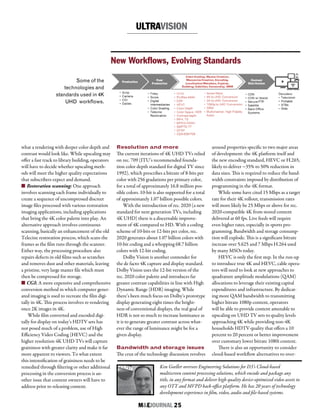
Some of the
technologies and
standards used in 4K
UHD workflows.
New Workflows, Evolving Standards
Resolution and more
The current iterations of 4K UHD TVs relied
on rec. 709 (ITU’s recommended founda-
tion color depth standard for digital TV since
1992), which prescribes a bitrate of 8-bits per
color with 256 gradations per primary color,
for a total of approximately 16.8 million pos-
sible colors. 10-bit is also supported for a total
of approximately 1.07 billion possible colors.
With the introduction of rec. 2020 (a new
standard for next generation TVs, including
4K UHD) there is a discernable improve-
ment of 4K compared to HD. With a coding
scheme of 10-bits or 12-bits per color, rec.
2020 generates about 1.07 billion colors with
10-bit coding and a whopping 68.7 billion
colors with 12-bit coding.
Dolby Vision is another contender for
the de facto 4K capture and display standard.
Dolby Vision uses the 12-bit version of the
rec. 2020 color palette and introduces far
greater contrast capabilities in line with High
Dynamic Range (HDR) imaging. While
there’s been much focus on Dolby’s prototype
display generating eight times the bright-
ness of conventional displays, the real goal of
HDR is not so much to increase luminance as
it is to generate greater contrast across what-
ever the range of luminance might be for a
given display.
Bandwidth and storage issues
The crux of the technology discussion revolves
around properties specific to two major areas
of development: the 4K platform itself and
the new encoding standard, HEVC or H.265,
likely to deliver ~35% to 50% reduction in
data sizes. This is required to reduce the band-
width constraints imposed by distribution of
programming in the 4K format.
While some have cited 15 Mbps as a target
rate for their 4K rollout, transmission rates
will more likely be 25 Mbps or above for rec.
2020-compatible 4K from stored content
delivered at 60 fps. Live feeds will require
even higher rates, especially in sports pro-
gramming. Bandwidth and storage consump-
tion will explode. This is a significant bitrate
increase over 5.625 and 7 Mbps H.264 used
by many MSOs today.
HEVC is only the first step. In the run-up
to introduce true 4K and HEVC, cable opera-
tors will need to look at new approaches to
quadrature amplitude modulations (QAM)
allocations to leverage their existing capital
expenditures and infrastructure. By dedicat-
ing more QAM bandwidth to transmitting
higher bitrate 1080p content, operators
will be able to provide content amenable to
upscaling on UHD TV sets to quality levels
approaching 4K while providing non-4K
households HDTV quality that offers a 10
percent to 20 percent or better improvement
over customary lower bitrate 1080i content.
There is also an opportunity to consider
cloud-based workflow alternatives to over-
ULTRAVISION
M&EJOURNAL  26
come cost-related and business issues to more
effectively address an emerging 4K market
and scale commensurate with the demand,
rather than taxing existing video on demand
(VOD) infrastructures.
Workflow impact to
support 4k
On the surface it may appear that 4K has the
same back office compression workflow as an
operators’ existing MPEG-2/H.264 work-
flows, and that all a cable operator has to do
to get going with 4K is to add new encoders
to an existing workflow. If only it were that
simple. Compressing 4K requires another
level of infrastructure beyond traditional
HD workflows currently deployed.
With 4 times more pixels than HD,
higher color depth and simply the ability
to display much more detail, 4K workflows
require significantly more storage and higher
bandwidth networks necessary to support
higher quality source materials in the 4K
HEVC compression workflow.
As previously discussed, quality in and
quality out (QIQO) is very applicable to this
new format. Taking advantage of UHD’s
visual quality potential means higher bit rate
[>180 Mbps 4:2:2] source materials in a new
4K workflow process. Post production labs
like Deluxe Entertainment are using enor-
mous 2 Gbps masters to achieve the highest
quality HEVC encodes. And when the title
is required to be more affordable, 180 Mbps
ProRes mezzanines are used as source. Typical
legacy 15 Mbps and 30 Mbps HD back office
workflows are simply inadequate.
Adding to the infrastructure cost prob-
lem, the standards, workflow tools and
consumer electronics are still evolving and
maturing; and this is expected to occur for
several years. New equipment and software
used in compression and multiplexing are
becoming obsolete overnight, as significant
improvements are being made both to com-
pression run times and to output quality.
Further complicating the situation is 4K’s
evolving standard. New, better consumer
electronics with new features are being in-
troduced. The biggest feature improvement,
HDR, is on the horizon. HDR, seen in dem-
onstration televisions at 2014 trade shows, is
likely to become the single most important
feature for 4K quality. While it may be a few
years off, it will likely arrive before any cur-
rent 4K workflow can be fully amortized;
presenting operators with the problem of
when to invest in a 4K workflow.
All of the above leads to a conundrum for
service providers: Do you lay-out the capital
now for new 4K workflows and run the risk
of infrastructure obsolescence? Or should
you wait for standards to converge and tools
to stabilize and run the risk of losing market
share to other competitors? It also raises the
natural question of whether service providers
should apply traditional approaches to amass-
ing 4K content in the same manner in which
they built in-house VOD libraries.
Leveraging the cloud
It’s not if but when the volume of 4K con-
tent for on-demand access will grow, even-
tually reaching the quantities common to
today’s HDTV-based VOD systems. Most
4K content will initially be delivered from
storage in an on-demand mode. It will take
a considerable amount of time for an end-
to-end HEVC/4K ecosystem capable of
supporting live 4K programming to emerge
(beyond sporting events). As such, the infra-
structure and storage burden alone will be
immense, adding to the already significant
costs being incurred with the expansion of
today’s on-demand service into the multi-
screen domain.
Integrating cloud-based solutions into the
existing workflow can facilitate the migra-
tion to 4K and provide the flexibility to scale
content and services offerings at the pace
commensurate with the market. Roll-out of
4K services will depend on a number of fac-
tors that will span content availability, televi-
sion distribution technologies, and workflow
and infrastructure-related investments and
advancements. As such, service providers
need the ability to scale capacity to meet
short-term needs and incorporate business
continuity over the longer term.
Outsourcing to the cloud mitigates the
risk of investing in nascent technologies that
are likely to be obsolete when the market
reaches mass scale and maturation. Beyond
cutting costs, the opportunity to rely on best
practices developed by experts in content
management, processing and storing 4K con-
tent for access in the cloud will help service
providers sort through the complex issues
that go into establishing benchmarks for
delivering a superior 4K experience to their
customers.
Cloud-based companies addressing is-
sues to create, store, and distribute 4K files
include Deluxe Digital Distribution (D3).
Through decades of managing master source
files for Hollywood studios, Deluxe has de-
veloped the critical knowhow to create de-
vice-ready 4K files based on the latest proven
specifications and investments in advanced
technology.
As a cloud service, D3 can operate as an
extension of the service providers’ back office
workflow operation and function in what is
essentially a shared cost model across many
operators—reducing risk and maximizing
growth opportunity. n
With 4 times more pixels than HD, higher color depth and simply the
ability to display much more detail, 4K workflows require significantly
more storage and higher bandwidth networks necessary to support
higher quality source materials in the 4K HEVC compression workflow.
ULTRAVISION
WEST10E N T E R T A I N M E N T
M&EJOURNAL  28
E
lectronic-Sell-Through (EST) has crossed the
billion-dollar sales threshold, a watershed that
signals the pronounced importance of EST as
a model for digital commerce and bodes well
for its continued expansion. With this, however, intel-
lectual property creators, owners and distributors face
ongoing pressure to ensure global digital products are
released on time, in the correct format/version, and with
all necessary platform/country-specific requirements ac-
curately in place. Specific marketplace dynamics related
to day-and-date releases, platform specific releases, and
exclusive releases only add to these challenges.
Additionally, EST sales are now occurring at a rate
that gives us a window into the digital consumer’s hab-
its and overall industry trends across a wide variety of
criteria and geographies. Although there is valuable data
to be culled, M&E organizations have been slow to put
platforms in place to accurately monitor and collect the
wider slew of data now available in a systematic manner
given that priorities to date have largely been focused on
operational aspects.
Given also that some aspects of EST purchasing are
similar to impulse buying, it is crucial that titles available
for purchase have all supporting metadata in place for
discoverability and selection from day-one. Said another
way, no one can afford to miss initial early windows for
monetization. A service such as V2’s Digital Store Check
service can act as a funnel in which wide ranging opera-
tional inputs (avails, metadata, schedules) and an assess-
ment of actual levels of asset availability are combined to
provide meaningful verification, reporting & analytics
across countries / platforms / assets.
Seeing the trends in EST
To inform our perspective as this paper was assembled,
V2Solutions conducted a detailed study of more than
Analyzing Digital Sales can
Bring Hidden Insights to Light
Study shows were EST is now and hints at what the future may hold
By Dr. Davinder Luthra, VP Business Development, New Media Industries, V2Solutions
Abstract: Electronic Sell-Through
is about more than just delivering
a product for sale—with the right
information service in place, it’s an
instant data-harvester capable of
providing deeper consumer insights,
enriching business partner interactions
and spurring sales across entire
catalogs. At the most basic level, titles
are released on time, across every
region with proper local configuration.
Beyond that, the true difference-maker
is an ability to track reporting by various
metrics and to gain near real-time
insight into trends across diverse
geographies and consumer groups,
giving business groups, partners, and
retailers the ability to respond instantly.
V2Solutions reveals the data hidden
within EST performance and suggests
what it means for the industry.
ADVANCINGANALYTICS
M&EJOURNAL  29
Dr. Davinder Luthra is a senior executive in M&E outsourcing, shared services
and large scale process transformation. He previously held executive positions with
a leading strategy consulting firm, a global IT and business process service provider
specializing in transformation for high tech and media organizations and as CTO
for the largest eCommerce fulfillment platform in South East Asia.
1,200 digital releases across numerous plat-
forms, including Amazon, Google Play,
Apple iTunes, Sony PlayStation, and Xbox.
The study gathered information from various
geographies as well, including the U.S., U.K.,
France, Italy, Germany, and Spain.
The results of this study are represented
visually in a series of graphics that each dem-
onstrates key data points.
Insight: U.S. and iTunes are important, but
their dominance is shrinking (Figure 1).
n Among digital platforms, iTunes captures
the overall lion’s share of 36 percent of all re-
leases. The next three platforms each had an
approximately even share, ranging from 16 to
19 percent for Google, Sony PlayStation, and
Xbox, with 12 percent left for Amazon.
n Within France and Germany, iTunes
uniquely captures more than half (53 percent
and 52 percent, respectively) of total selec-
tion.
n Overall, the US appears to be the most
democratized territory—no platform con-
tributes lower than 16 percent of overall se-
lection. At the opposite end of that spectrum
is France, showing the highest dominance of
iTunes.
Insight: Differences in the international
land-grab reach amongst studios and dis-
tribution partners creates opportunities to
solidify leads for early entrants and revenue
growth for late adopters (Figure 2).
n Of the major studios that played a princi-
pally recognized role in distribution of titles
for EST, the majority of titles were distrib-
uted to the U.S. (40 percent), followed by
the U.K. (19 percent), France and Germany
(both at 12 percent), and Spain and Italy (a
combined total of 19 percent).
n Release slates for Lionsgate and Warner
Bros appeared to be the most skewed towards
U.S. distribution, with those from Disney
and Sony Pictures the least.
n A disproportionately higher amount of
Disney titles were available in France (vs.
other territories it directly distributed to). Of
all the major studios, 20th Century Fox and
Universal appeared to have the most evenly
balanced and proportioned distribution slate
relative to the markets surveyed.
Insight: Two equilibriums can be seen for
normalized HD pricing around $12 and
$19.50, creating unique opportunities for
“value pricing” below those points or “pre-
mium pricing” above those points (Figure 3).
n Pricing variations between countries, plat-
forms, and studios are pronounced. From a
platform perspective, the widest variation in
pricing is seen within iTunes, with a median
price of $13.65, and corresponding upper
and lower quartile price tiers of $18.60 and
$8.88, respectively. Google Play represents
the platform with the narrowest overall
spread of prices, where only $2.05 separates
upper and lower quartiles.
n Spain and Italy show the greatest pricing
consistency across all countries and digital
platforms. In those two countries, only a
$4.80 difference in median prices was seen
across all platforms.
n Among major studios, Disney commands
the highest median price ($20.46) across all
titles it has distributed. Lionsgate, mean-
while, commanded the lowest median price
across their titles, at $13.99.
Perspectives on the Future
These insights tell us where EST is now,
revealing trends and attitudes among con-
sumers and the distributors and studios that
serve them. But they also suggest strongly
ADVANCINGANALYTICS
Platform and Studio Distribution By Country
Fig.1 (left): Although the US remains the world’s primary distribution market, international positioning is increasingly
significant to the industry. All signs point to increasing democratization of title selection amongst competing platforms—
this means a level playing field will soon be the norm. Fig. 2 (right): Internationally, the majority of titles still see
distribution through independent entities with a particular studio sometimes being noted as one of the distribution parties
– variation from an international breadth of the footprint and also in territory preference is seen.
M&EJOURNAL  30
what we can expect in the future. Though
still in its growth stage, EST will eventually
become a dominant revenue model for the
industry—and one that consumers will be
extremely receptive to across various geog-
raphies. With success in US and European
markets, we can expect this trend to continue
throughout the world, with platforms, dis-
tributors and studios racing to reach far-flung
markets and capitalize on their catalogs’ ap-
peal.
We know that to effectively do this,
localization efforts must be accurate and
comprehensive. The more foreign the locale,
however, the more of a challenge this can be.
Russian rating systems and cultural mores in
terms of movies are much different than those
in China or Indonesia. Solving these types of
problems, more prevalent in today’s delivery
models for Global EST-based commerce, can
take attention away from the kind of rich
intelligence gathering that serves a broader
strategic set of needs.
Is it important to know that almost no
titles available in Germany are priced below
$6? Or that certain digital platform/studio
titles account for nearly half of all global
titles priced above $24? The obvious an-
swer is yes. This is insight into competitor
and consumer behavior that can give you
an advantage as you plan and execute your
business strategy. Collecting these kinds
of actionable insights can help you craft
release schedules and coordinate marketing
efforts. But those plans are useless without
a way to bring them to fruition. Using a
Digital Store Check type of platform allows
you to execute those plans accurately, across
any markets on the planet, and then follow
their progress and adjust instantly.
A layer of competitive intelligence and
verification feeds back to create actionable
insights for knowledge workers and opera-
tional teams handling drive set-up and asset
delivery.
A verification and intelligence gathering
system, such as Digital Store Check, is an
essential tactical tool to handle challenges
inherent to Digital EST-based commerce,
including release day readiness, business
partner interactions, sales performance and
promotion, competitive positioning and
direct promotion of assets.
There is no denying that EST will be a
part of the industry for many years to come.
Many studio and distribution profession-
als are anticipating EST to be the leading
revenue stream for home viewing of titles
across the globe. Yet globally, we are still in
the early stages of growth for this delivery
medium, and opportunities exist to leverage
today’s data to enable major impacts moving
forward.
The information V2Solutions has
shared here represents just a sampling of
what can be achieved by careful usage of
a strong service platform such as Digital
Store Check. This kind of platform is fast
becoming an essential ingredient in the
race to penetrate new markets quickly and
gain a competitive advantage. Present and
future EST strategy is certain to rely on
the capabilities offered by this type of plat-
form—the capabilities of which are only
going to grow as the market does. n
Fig 3: From a pure price perspective,
variation and fluidity can be seen
across the entire product spectrum.
(Pricing was normalized to USD and
adjusted for cost-of-living factors
between international countries.)
ADVANCINGANALYTICS
Distribution of Titles by Normalized HD Price and Platform
A verification and intelligence gathering system, such as Digital Store Check,
is an essential tactical tool to handle challenges inherent to Digital EST-based
commerce, including release day readiness, business partner interactions,
sales performance and promotion, competitive positioning and direct
promotion of assets.
• Broadcast to broadband to publishing – secure and protect your
intellectual property assets
• Rapidly transform and deploy media content to meet evolving
digital requirements
• Streamline content product workflows via seamless integration
with desktop tools
• Take advantage of industry-leading rich media search and
vendor-neutral storage archive management solutions
www.opentext.com/omnichannelcommerce
Digital Asset Management is a key part of the
OpenText Customer Experience Management
(CEM) Suite, which offers customers integrated
solutions across the content management spec-
trum, ranging from archiving and document
management through to social workplace collab-
oration, business process management, and web
content management.
Manage Your Media
with OpenText
OpenText Media Management and Media Management On Demand
M&EJOURNAL  32
Abstract: With the advent of social media, the experience of
watching television has become much more interactive. Social data
analytics can provide useful insights about the ways of enhancing
viewer interaction, by identifying the right mechanisms and
right channels to engage viewers. As the use of both second
screens and social media continues to grow, the field of Social
Media Analytics can be expected to become more and more
important. Analyzing and acting on these insights can lead to
more profitable projects.
SOCIALSIGHTS
(Left and above)These graphs depict contestants on a vocal competition
show and the network of viewers commenting about them in social media,
over four consecutive weeks.
U
nderstanding consumer sentiment has long been
the Holy Grail for both advertisers and content
providers. As the business shifts from being
content-centric to consumer-centric, this need be-
comes even more critical. The ability to quickly adapt content
to conform to consumer tastes, change ads for greater effective-
ness, and optimize expensive promo campaigns is now required
to be competitive.
In the past, information was limited to what could be in-
ferred from polls and surveys. While helpful, small sample sizes
and long turnaround times limited their accuracy and useful-
ness. The explosion in popularity of smartphones, tablets and
social media has created a new phenomenon called the “second
screen” in the context of TV viewing. A second screen is a sec-
ond electronic device used by television viewers before, during,
or after they are actively watching programming. (The term also
applies to screens other than television sets for viewing content,
but that’s not the context we are using here.)
Second screen applications are making television more
interactive, and increasing engagement, viral influence, and
ultimately, viewership. They also provide an ideal platform for
presenting targeted advertising as well as creating advertising
In Social Media,
Context Counts
New metrics demonstrate
how accurately
social media conversations
reflect viewer sentiment
By Kameswara Rao Bh,
Principal Architect,
Digital Group,
and J. David Garland,
Associate VP of Consulting,
Media & Entertainment, IGATE
M&EJOURNAL  33
Kameswara Rao Bh has worked in the development and assessment of architectures for large scale applications. He
is currently working in the Digital Intelligence team where his focus areas are social analytics and content analytics.
His area of expertise includes analyzing unstructured text using different statistical and natural language processing
techniques to extract useful information and insights.
At IGATE, J. David Garland focuses on thought leadership, leading consulting engagements, and business
development. He has a broad range of experience in M&E from systems architecture to senior management in music,
television and radio.
tie-ins with the content. As we saw with vote-
fortheworst.com, social media applications can
cut two ways and must be carefully managed.
Votefortheworst.com was an attempt at
“making sure that America stops taking Amer-
ican Idol and other singing reality shows seri-
ously,” according to creator Dave Della Terza.
This was attempted through encouraging view-
ers to vote for a contestant they deemed the
least talented, and was a source of controversy
for nine years.
During August 2013, Nielsen conducted
a study on the relationship between Twitter
activity and TV viewership that found that
a two-way causal relationship exists between
Twitter activity and TV viewership. In ana-
lyzing over 200 primetime program episodes
using time series analysis, Nielsen found a sta-
tistically significant causal influence between
tweets and tune-ins. That the relationship was
two-way means that increased ratings also re-
sulted in more tweets.
Nielsen’s study substantiates the impact
of social media, specifically Twitter in this
case, on TV viewing from a quantitative per-
spective—the volume of social conversations
and TV viewership. A causal relationship
between tweets and tune-ins is certainly in-
teresting, and knowing the volume of social
media interactions can provide a useful tool
for marketing. But to get actionable informa-
tion from social media, a deeper analysis is
necessary. What we really need is a qualitative
view to expose the consumer thinking and
sentiment behind the posts. IGATE recently
conducted a study to explore whether signifi-
cant indications of consumer sentiment can
be gleaned from social media traffic.
Measuring consumer
sentiment
The objective of the IGATE study was to un-
derstand how accurately social media conver-
sations reflect viewer sentiment, and whether
they could be used to derive insights about
the programs being discussed. The study was
conducted using an in-house developed plat-
form called Social Insight, which aggregates
public social data from various social media
sites like Facebook, Twitter, and LinkedIn,
and analyzes traffic using various statistical
and Natural Language Processing (NLP)
techniques from the growing field of Social
Media Analytics (SMA).
For the study, we chose a popular Ameri-
can reality show that features vocalists com-
peting to be the last person standing at the
end of the season. The artists are eliminated
in weekly rounds based on the viewer voting.
We collected social feeds from the Facebook
and Twitter pages of this show, classified
them by artist, and measured the social
media sentiment for each artist. Several
NLP techniques such as synonym matching,
fuzzy matching, and Part of Speech (POS)
tagging were used to classify the feeds, thus
increasing the accuracy of the analysis. These
techniques allow words to be interpreted in
context. For example, the word will can be a
name, a verb or a noun depending on the
context.
The sentiment data for each
artist (number of positive and
negative posts) was calculat-
ed for the first four weeks
of episodes and compared
against the actual results
(the elimination or
selection of each art-
ist). This data was used
to develop a statistical
model to predict the
performance of an
artist based on the sen-
timent from the social
feeds. Logistic regression
was used for creating the
model. We applied this
model for the subsequent
weeks to predict the results. For
each episode, social media data was
taken in a time window of four days before
the episode, up to one hour before the voting
started for that episode. Sentiment metrics
obtained from this data for each artist were
used to predict the elimination or selection
of the artist. We were able to predict the
results with an overall accuracy of about 90%
through this analysis.
The graphs (Figs. 1 and 2) depict the re-
sults for one of the weeks, against social den-
sity (total volume of feeds) and social senti-
ment (calculated using logistic regression) for
each artist. The points marked red denote the
artists who were eliminated in that week.
As can be observed from the graphs, the
volume of conversations does not correlate well
with the results. Competitor 7 received a higher
volume of posts (Fig. 1), but was eliminated.
Probabilities from logistic regression (calcu-
lated using positive and negative sentiment)
correlate well with the results. The artists with
lowest probabilities end up being the eliminated
candidates. Interestingly, the long-odds ratios
SOCIALSIGHTS
M&EJOURNAL  34
SOCIALSIGHTS
from the logistic regression model indicated that
negative sentiment had approximately four times
more impact than positive sentiment in deter-
mining the end results.
Another interesting observation was that,
as the show progressed, more viewers became
segregated into distinct groups around artists,
and clear winners emerged.
Analytics for competitive edge
The applications of consumer sentiment
analysis using social media data are virtually
endless. In advertising, it can be used to gauge
the effectiveness of individual spots or entire
campaigns. In addition, it can be used to mea-
sure the efficiency of different distribution
channels (TV, mobile, web, etc.), day parts,
and programming.
For television and film, knowing consumer
sentiment around content is of enormous val-
ue. The idea of being able to measure consumer
sentiment before committing to expensive
projects is greatly appealing. Additionally, the
near-real time nature of the results can lead to
viewer-driven plot programming.
As with advertising applications, television
and film both spend heavily on promotional
campaigns and trailers, often without having
a solid idea of their effectiveness. Social Media
Analytics can be used to measure the impact
of both campaigns and individual trailers,
provided the study is set up properly, by using
the near real time nature of the information to
rapidly tailor advertising to consumer senti-
ment.
Conclusion
This study substantiates two important points
with respect to the Second Screen phenom-
enon.
1. Social conversations about a TV show (es-
pecially while the show is being aired) not only
reflect the volume of actual viewership, but
also, to a measurable extent, reflect the con-
sumer sentiment about the show.
2. Social Media Analytics techniques can be
used to extract actionable information from
social conversations.
As the IGATE study indicates, social
media conversations can be mined to derive
useful business information. Insights into
consumer sentiment concerning the content
of programming, casting decisions, charac-
ters, and plot twists can be gleaned from the
conversations. Social data can provide in-
sights on consumer concerns about the tim-
ing of the shows, as well as for comparative
analysis of shows on the same or competitor
channels. Network analysis of social data
provides information on social influencers
who can be potential advocates. n
Social Density vs. Results (Fig. 1)
Social Sentiment vs. Results (Fig. 2)
In Figures 1 and 2, the red points
denote the artists eliminated in that
week.The volume of conversations
(Fig. 1) does not correlate well with
the results, but the sentiment of
social media conversations (Fig. 2)
does.
Media Services
• Live and VOD media delivery at scale
• Highly available encoding and streaming
• Support for Flash, iOS, Android, HTML5,
and Xbox
• DRM support
• Rich content monetization
• Broad ecosystem of fully integrated partners
No more integrating multiple technologies
and products. With Azure Media Services,
you can build end-to-end media workflows
and reduce the costs associated with
integrating multiple products and providers.
Choose services from either Microsoft or its
partners that are integrated and
ready-to-use.
Premium video workflows in the cloud
Integrated end-to-end media workflow
Azure
Azure.com/media
Delivering your brand
message worldwide
through multiple
channels across
multiple markets in a
single solution.
Locations Argentina | Australia | Austria | Belgium | Brazil | China & Hong Kong | Czech Republic | Denmark | France | Germany
Greece | Hungary | India | Ireland | Italy | Luxembourg | Malaysia | Netherlands | New Zealand | Norway | Singapore | South Africa
Spain | Sweden | Switzerland | Thailand | Turkey | UAE | Ukraine | United Kingdom | United States | Vietnam
www.adstream.com
connecteD asset management anD Delivery
M&EJOURNAL  37
CLOUDSOLUTIONS
The potential of “the cloud” touches every
segment of M&E: IT, finance, analytics,
media services, digital asset management,
production, post-production, manufacturing,
distribution, marketing, and more. It prom-
ises more agile and streamlined workflows,
increased collaboration, cost efficiency, and
less time, resources and effort required to do
business. The seven articles in this section
shed light on how far M&E organizations are
–or could be—pushing the cloud.
“For M&E companies, it’s no longer a question of why,
or even when, they would migrate to cloud platforms.
They are already there.”
– Hitachi Data Systems, Page 58
Post-Production...................... 38
Beyond Disaster Recovery.... 42
Improving Workflows............. 46
Managed DAM........................ 52
Enabling Mobility.................... 58
Creating Business Agility...... 64
Transforming IT...................... 70
▼
M&EJOURNAL  37
M&EJOURNAL  38
CLOUDSOLUTIONS
I
t is a widely accepted fact that the media
management and quality control (QC)
roles of the post-house, along with key
staff positions such as the digital imaging
technician (DIT), remain exceptionally im-
portant in the modern film industry. Current
trends in the industry have reduced the need
for a traditional post house as it was once un-
derstood, however.
One of the most outwardly visible signs of
Hollywood’s conversion from film to digital
is the successive closure of the town’s once
great film processing labs. In May, the Deluxe
Hollywood Lab, which was built on the Fox
Hollywood film lot in 1919, finally closed
its doors. Technicolor has shuttered both its
Glendale lab and its iconic boxy black building
on the Universal lot (now a cutting-edge NBC
Universal media center).
Abstract: As the Media and
Entertainment industry continues its rapid
digital transformation, even the word
post-house, which implies a physical
structure, has become something of a
misnomer. A new generation of SaaS-
based companies are entering the post-
production space offering cloud-based,
end-to-end platforms for production,
post-production, distribution and delivery
with very limited physical infrastructures.
The challenges and opportunities facing
post houses are significant as studios and
filmmakers seek out more collaborative,
connected, cost effective and scalable
platforms to manage their content.
Post-Production Steps
Out of the House
This past year, the Academy of Motion
Picture Arts and Sciences offered the ultimate
posthumous tribute to the film-processing
business when it presented an honorary Oscar
to the men and women who operated the labs,
with Chris Nolan giving a stirring eulogy for
their “more than a century of service to the
motion picture business.”
The changing value of bricks
and mortar
These lab closings have helped spark an
intense debate over the direction of post-
production in the digital age. One of the key
questions is whether a centralized bricks-and-
mortar post facility still makes sense at a time
when so many film companies are turning to a
cloud-based post-production model, in which
work is globally dispersed and subcontracted
to a wider range of companies.
On the one hand, you have giants of the
business like Technicolor, Deluxe and Mod-
ernVideoFilm, which have made significant
investments in physical infrastructure. All of
these major players are transforming them-
selves and adding new digital services and
cloud-based offerings to meet the changing
needs of their clients. On the other hand, you
have companies like Hulu Post and platforms
like Amazon Web Services and the Google
Cloud Platform, which allow for a virtual
workflow and don’t necessarily require a phys-
ical infrastructure. Both sides are searching for
a business model adaptable to an industry that
requires ever more streamlined and connected
solutions to manage the digital production
and post-production value chain.
I’ve worked on the creative, production and
technology sides of the film industry for more
than two decades and have seen countless busi-
ness models come and go. When we stared Film-
Track more than 14 years ago, the relationship
between content creators and post-houses had
been largely unchanged for decades. Film com-
panies would simply hand over their materials to
a single post-house with instructions for distri-
In the era of cloud computing, the role of post houses is evolving–
‘Finishing house,’ anyone?
By Jason Kassin, Co-founder & CEO, FilmTrack
M&EJOURNAL  40
bution and delivery, and the post-house would
handle the entire back-end servicing.
Today FilmTrack manages the content
and data for close to 200 companies and
works with some of the leading post-houses to
define what the next-generation post-house
will look like. I’ve seen the complexities of
this process through our employees’ involve-
ment in organizations like the Hollywood
Post Alliance, EIDR and SMPTE. The forces
driving these changes to the post-production
landscape are manifold: vast improvements
in technology and processing power; huge
increases in digital and file-based content that
is cheap to produce; and the vast amounts of
data and metadata that must now be cataloged
and stored for every film and television series.
The growing sophistication of the digital
camera has probably been one of the major
game changers. Many of the processes and
tools that production and post-production
technicians required are now managed by the
camera itself. Just a cursory look at the latest
developments in camera technology showcase
how, in the not too distant future, all the cap-
ture, transcodes, sync, watermarking, version-
ing, color space conversions can, and will, be
managed by the camera itself.
The evidence is right before our eyes:
Studios and filmmakers are now thinking in
terms of end-to-end solutions for their artistic
and business workflow – from ingestion to
vault/storage, transformation, QC, delivery
and commerce. More and more they’re rely-
ing on cloud-based platforms that have the
potential to provide content owners, distribu-
tors and their customers with a safe, secure
and sophisticated model for the long-term
life-cycle management of their content. In
conjunction, the rate card for services found
within the traditional post house are changing
as functions like encoding and transcoding
can be done with out-of-the-box software.
Effects complexity to grow
However, when you look at final color cor-
rection, visual effects and sound mixing, these
processes are more complex than ever, and no
less time consuming than 10 years ago. Ac-
cording to Bob Pfannkuch, an industry pio-
neer who founded Rank Video Services, now
a division of Deluxe: “The post house of the
future may be called a ‘finishing house’ not a
‘post house.’ It will be known for taking con-
tent that is 90 percent done and finishing it.”
Such changes have fueled consolidation
among the industry’s bigger players, with
traditional rivals like Technicolor and Deluxe
working together to offer complementary
services. This evolution has also created oppor-
tunities for new SaaS-based companies that
provide a whole new level of flexibility and
collaboration to meet evolving industry needs.
These changes are also fundamentally
transforming the way in which studios do
business with post-houses. As James Staten,
a VP at Forrester Research who blogs about
cloud computing and next-generation busi-
ness intelligence, points out: “Disney’s Fro-
zen required 50,000 CPU cores crunching
simultaneously to process its 3D effects and
meet its opening date. The next Frozen, shot
in 4K, will up the effects complexity 10-12x,
according to visual effects experts.” Staten also
observes that, “on-premise workflow systems
are hitting the limits both in ability to on-
board and manage a federation of identities
and support the collective editing of the grow-
ing video files. As such, nearly all the major
workflow tools makers now offer SaaS-based
workflow systems that are either used purely
in the cloud or in a hybrid mode with some
workflows on premise and others delivered
from the cloud.”
Access is everything
This is forcing industry professionals and
technologists to start thinking in terms of file
access rather than file transfers. Right now the
major emphasis is on how fast you can you
transfer files, speed and bandwidth. But we
want to get to a place where we’re giving ac-
cess to files, not transferring files around. On a
consumer level, we’re already doing this with
music, pictures and email that are stored in
the cloud and accessed with different devices.
We’re going to get there on the B2B level too:
eventually the file will exist in one place in the
cloud. That will bring cost savings and reduce
concerns about asynchronicity since everyone
will be working on the same thing.
These changes cut across the whole
production, post-production and distribu-
tion cycle. Dailies captured on set are now
routinely managed through virtual platforms
that can be run for directors and producers in
far-flung locations and allow for transcoding
and color correction on premise. The dailies
business has quickly morphed into another
role managed by the DIT and others.
Furthermore, the management and delivery
of global marketing assets has been radically
transformed by the advent of cloud-based
DAM services. In other words, a lot of things
that used to be done with hardware processing
are now being done with software updates and
SaaS solutions. However, creative services for
quality films with extensive digital effects will
still be performed by the post house.
Pfannkuch points out that “regardless of
whether you have a big centralized lab or a re-
mote worker utilizing the cloud, the common
and necessary thing for a post-production
house is to tie information together—the ne-
cessity to keep track of who’s doing what and
where everything is.” In other words, whether
you have a big lab or a small facility leveraging
cloud storage, you need a data infrastructure
to enable collaboration.
That’s been a core mission for FilmTrack,
as we team with partners across the industry
to help them collaborate and connect the
dots across the entire life cycle of their IP. At
FilmTrack, we understand there is no one-
size fits all solution. That’s why we’ve made
all metadata fields user-definable and configu-
rable allowing clients to develop standards
that fit with their unique business needs.
As we consider the future of post-produc-
tion, one thing is clear: the business of con-
tent is expanding not shrinking. Emerging
distribution platforms like Netflix, Hulu and
Amazon are fueling this transformation, as is
the rapid proliferation of devices on which
content is being viewed—from iPhones to
Androids, smart TVs, HD sets, 4K sets—all
of which have different constraints. Simulta-
neously, the consumer is becoming more and
more demanding – expecting more person-
alization and interactive options. The critical
question is whether cities like Los Angeles, or
even the U.S. itself, will continue to serve as
the hub for post-production. n
As CEO of FilmTrack, Jason Kassin oversees the company’s day-to-day
operations, strategic direction and delivery of business solutions to some of the
world’s leading media and entertainment companies. He is a leading expert in
the development of rights and content management solutions for the global IP
supply chain.
CLOUDSOLUTIONS
Good ideas need to
be shared securely.
Securely send, share and sync your work
from anywhere, anytime.
Try it today at
Hightail.com/enterprise
M&EJOURNAL  42
P
rivate-cloud solutions offer more than disaster recovery,
which is what people often think of when they consider
cloud implementations. Disaster recovery is certainly an
important use case, but a private cloud can do so much
more. Once the content is in the cloud, a private cloud can be config-
ured to accommodate a variety of workflows, in many cases automat-
ing repetitive processes while scaling massively.
CSM as a foundation
The ideal private-cloud for any M&E organization starts with a
content storage management (CSM) system, which automatically
retrieves broadcast-quality content from any storage infrastructure
— disk, datatape library (with the aid of a robot), optical archive,
etc. — and delivers it to an edit station, a playout device, or wherever
else it might be needed. CSM systems were invented for media com-
panies. Unlike IT-based storage systems, which are designed to handle
documents, numerical data, and the like, CSM systems are primed for
the big-data requirements of video files, with built-in “video-aware”
characteristics such as file-based quality assurance, timecode-based
partial restore, and in-path content transcoding. CSM systems are also
designed to automatically handle difficulties arising from file compat-
ibilities, essence types, wrappers, etc., in a highly active media-storage
environment. These and other advanced features allow media organi-
zations not only to store limitless amounts of high-resolution video
assets, but to share those assets seamlessly throughout their organiza-
tions.
In short, CSM systems help content owners cope with what would
otherwise be an overwhelming volume of content, to address the
Abstract: While public cloud solutions continue to gain traction, leveraging purpose-built private cloud
services focused on Service Level Agreement (SLA) criteria is often a more practical, cost-effective plan of attack
for M&E organizations. When these organizations look beyond disaster recovery workflows and specifically
address the overall media lifecycle, the full potential of a private cloud is revealed. Indeed, purpose-built,
private cloud solutions have helped content owners and media organizations around the world benefit
from the cloud while ensuring protection, accessibility, and unmatched security for
their most valuable assets.
One Cloud,
Many Uses
Leveraging private clouds built for M&E
CLOUDSOLUTIONS
By Andy Hurt, Senior VP, Global Product Management and
Marketing, Front Porch Digital
foundation
disaster
recovery
editing
business
continuity
storage
publishing
economic
benefits
With Threat Modeling, we can tell you which
exploits will bypass your layers of security, and
which of those exploits are currently being used
in crimeware kits. Further, our analysts can
run what-if scenarios modeling new security
technologies to maximize effectiveness.
Your mission is to protect your digital assets.
Our job is to remove doubt from the equation.
FIND YOUR
WEAKEST LINK...
BEFORE
SOMEONE
ELSE DOES.
©2013 NSS Labs, Inc. All Rights Reserved.
NSSLABS.COM
NSSLABS
WE MAKE SECURITY A SCIENCE
M&EJOURNAL  44
CLOUDSOLUTIONS
Andy Hurt has more than 13 years of experience leading product development,
management, strategy, and operations in multiple global technology
organizations. He previously worked at Level (3) Communications, First Data
and DISH Network. He is certified as a New Product Development Professional
from the Product Development and Management Association.
video-specific complexity of that content, and
to facilitate smooth integration with video
operations.
Deploying CSM in the cloud yields a fea-
ture-rich system built for media, without the
infrastructure investment and overhead costs
that can be a barrier for many organizations,
but with all the advantages of the cloud’s un-
limited storage space and computing power.
Active-archive cloud solutions exist as a
counterpoint to the public-cloud scenario. They
offer cost-effective big-data storage and media-
centric features in a pay-per-use, “CSM as a
Service” package. They are also built to meet all
SLAs, however stringent, that an organization
defines. Creating a purpose-built private cloud
with these cloud-based CSM services lets media
organizations overcome financial barriers and
address the challenges associated with cloud-
based video management. With CSM in place
in a private cloud, that cloud can become far
more than a storage center.
Disaster recovery
Disaster recovery (DR) is perhaps the most
obvious use for a private cloud. In one imple-
mentation, a well-known global entertainment
conglomerate uses a massive CSM-based pri-
vate cloud as the backup and DR archive for
its entire organization. As depicted in Figure
1, the private cloud, located in another part of
the country, is configured to ingest archived
content from the company’s West Coast op-
erations to an off-site datacenter.
Business continuity
Unlike a DR implementation, where the restore
function happens reactively, this private cloud
is configured to be an active archive, where
content is simultaneously and continuously be-
ing ingested and restored every day. The same
conglomerate that uses a private cloud for DR
also built 14 separate private clouds for some of
its distribution networks. This implementation
takes a proactive approach to disaster by ingest-
ing a continuous 14-day playout scheduling, with
elements of the programming coming from two
separate locations on the West Coast into one
datacenter in a third location. From there, the
private cloud continuously restores that content
to a redundant playout center on the East Coast.
If ever there is an event that affects the primary
playout center on the West Coast, the East
Coast center can — with virtually the flip of a
switch — ensure that playout on the 14 channels
continues uninterrupted.
Editing
A private cloud can also be configured for ac-
tive use, such as in editing and postproduction
workflows. In this way, the cloud becomes a
universal, collaborative workspace that is espe-
cially useful for multisite organizations.
Split storage
In countries where laws require that a subset
of the data cannot leave the country, compa-
nies can split the data as appropriate, storing
some in a private cloud within the country,
while sending content intended for more
long-term storage and archiving to a private
cloud within a datacenter in another country.
Publishing
In another scenario, a sports team built a
private cloud to connect directly to its on-
premises archive. It also created an iPad app
to be used internally, so that coaches can
share video clips with players. Selected clips
are sent from the local archive to the cloud,
and from there, a cloud-based distribution
workflow publishes the video to the app. This
example illustrates how, once content reaches
the cloud, it can be repurposed and published
to any platform.
Economic benefits
No matter how it is used, a purpose-built
private cloud using CSM as a service has its
economic benefits. As discussed, cloud-based
CSM solutions were created with video in
mind, so they provide video-centric service
for a fraction of the cost of a traditional cloud
service. Building cloud-based workflows that
take advantage of the video-aware features of
CSM can not only alleviate budget-intensive
local equipment and processes, but automate
parts of the workflow to make them more
efficient. In addition to DR and business
continuity, the cloud can also handle other
mission-critical but expensive services such as
technology refresh and migration to new tape
technologies, thus eliminating significant capi-
tal expenditures. n
A private cloud can implement
disaster recovery workflow on a
massive scale.
Everything you need
in one place
OTT TV – we design it, build it and support it
Saffron Digital’s MainStage platform has everything you need to launch a premium multi-platform
video service in as little as 90 days. With content preparation, a content management system,
storefront services, applications and a secure player all in one place, it’s your OTT toolkit.
For further information:
+44 207 404 6333
enquiries@saffrondigital.com
www.saffrondigital.com
M&EJOURNAL  46
A
s broadcast and post-production businesses
embrace higher resolutions such as 4K, adopt
new camera formats, address a growing range
of delivery outlets, and manage increasingly
distributed collaborative production and approval models,
their workflows become ever more complex. Though the
process of completing projects requires an ever greater num-
ber of steps, deadlines have remained the same or grown
tighter. To continue to meet these deadlines and remain
competitive, businesses must both improve their efficiency
and lower their costs. To this end, they must ensure that
content is always ready and available for production.
Workflow today really is a roundtrip process rather than
a linear workflow. Delivery lies at the center of this circular
flow. How can a business address this new reality?
Whether through gradual growth or a series of acquisi-
tions, many businesses have wound up with multiple inde-
pendent production centers that are not easily connected.
Without the benefit of shared content, such businesses
must instead ship content from one place to another and
maintain different copies of that content. In this scenario,
version control becomes difficult. Some businesses thus
Abstract: When employed to provide seamless access to shared content and to support the way people
are accustomed to working, the cloud can enable broadcasters and post houses to realize more agile
and streamlined workflows and, in turn, to reduce the time, resources, and effort required to meet their
deadlines. By moving to a private cloud, businesses can offload pressures associated with moving content
across the organization, implementing effective replication, managing collaborative access to content,
assuring version control, and maintaining security.
Solutions address issues, including security and unreliable access,
to improve on public clouds
By Alex Grossman, VP, Media and Entertainment, Quantum
Meeting Today’s Workflow
Demands in a Private Cloud
CLOUDSOLUTIONS
CLOUD
From concept to consumer.
We are media.
Sony DADC’s industry-leading creative technology and commerce solutions
power every aspect of digital media consumption — so our customers can
engage consumers around the world and realize every market opportunity.
newmedia.sonydadc.com
M&EJOURNAL  48
choose to constrain hiring and continued
employment to local talent, who can work on
the same local store of content. In a highly
competitive marketplace, this is not an ideal
approach.
The cloud offers a much better solution.
Cloud storage enables a location-independent
storage methodology that gives multiple peo-
ple or facilities easy and secure remote access
to content and other digital assets.
Considering the cloud for
media workflow
The cloud did not come into being to support
media workflow. Though various vendors have
built pieces of workflow solutions in the cloud,
most of these solutions deal only with the two
fundamental components of the cloud: storage
and compute power.
The storage component is what most
people think of when they think about the
cloud. It is Google Drive, iCloud, or any num-
ber of cloud-based backup and shared storage
devices intended for personal use. And indeed,
applications such as static data backup or pho-
to sharing are ideal uses of the “public cloud,”
which provides convenient and inexpensive
storage but lacks the service level agreements
(SLAs) or guaranteed access demanded by
professional media applications.
The compute component often is associ-
ated with software as a service (SaaS), such
as CRM or accounting programs that offer
software functionality via the cloud, but more
media-centric processes such as transcoding
fall into this category as well. In some cases,
public cloud offerings give customers individ-
ual clouds for compute and storage, and even
different clouds for different types of storage,
such as nearline and long-term. However, this
does not equate to true end-to-end workflow.
Thus, businesses seeking to realize the
benefits of working in the cloud instead must
surrender the efficiencies they have gained
within their existing workflows and spend
their resources on stringing storage and com-
pute resources together, coordinating the
movement of content from cloud to cloud,
and establishing the necessary quality assur-
ance checks across these transfers. With these
concerns come serious issues of content access
and security.
Control over security often ends once
content has moved to cloud infrastructure
managed by an independent third party.
Shared environments typical of public cloud
infrastructures place one company’s content
next to that of another company, rather than
on separate hardware, even separate spinning
disks, and thus raise questions of who has
access to content. In this scenario, the reliabil-
ity and consistency of content access are also
dependent on the decisions of the third party
managing the cloud.
Hardware, software, and even system
design can make a difference in service level
uptime. In some cases, the infrastructure
initially deployed cannot keep up with
bandwidth and capacity demands of a grow-
ing number of users. All of these issues can
undermine the promise of public-cloud-based
media workflow.
Tailoring the private cloud
Private-cloud solutions address many of
the issues, such as security and unreliable
access, that make public-cloud solutions a
poor choice for professional media storage
and processing. However, most of today’s
private cloud offerings are designed to pro-
vide global access to media in simple storage
repositories. The major shortcoming of
these repositories, whether situated locally
or in remote datacenters, is that they don’t
provide integrated storage and compute
resources, along with the applications fun-
damental to the media workflow.
Fortunately, a new approach to building
workflow in the cloud offers broadcasters and
post facilities a better solution: the best of the
cloud along with the benefits of familiar and
proven media applications and workflows.
Rather than simply move storage and
compute resources to the cloud, private-cloud
solutions tailored to media applications are
taking existing workflow and applications and
moving them to the cloud. With the benefit
of a quality API development structure and
a rich technology partner ecosystem, both of
which are key enablers of true cloud-based
media workflow, a solution can ensure that if
the media workflow is effective locally, then it
will be effective in the cloud. This reliance on
well-established applications, linked by proven
coding, is critical to reliable and efficient op-
erations now, and it will become even more
important as workflows become increasingly
automated.
Freeing users from compromise, this model
not only allows businesses to retain the way
they work and the applications they use, but
also makes this work location-independent
without the need for external gateways, trans-
lations, or other quality control procedures.
The most common model for leveraging a
private-cloud solution typically includes one
primary production facility and one or more
secondary production facilities, all with work-
flow storage collaboration. These facilities all
are connected to one another via the Internet
(by WAN-accelerated transfer or a similar
mechanism), as well as to a data center hosted
workflow that provides much more than just
storage or compute resources.
Through this model, users can ingest con-
tent locally in any facility and push that con-
tent up to the cloud-based data center, where
it becomes available to all other independent
facilities. Once the content is in the cloud, it
A new approach to building workflow in the
cloud offers broadcasters and post facilities
a better solution: the best of the cloud along
with the benefits of familiar and proven
media applications and workflows.
CLOUDSOLUTIONS
The Next Level of Innovation
408-550-2340 | WWW.V2SOLUTIONS.COM | INFO@V2SOLUTIONS.COM
Global sales are essential to your growth.
For more than a decade, V2Solutions
has made international growth possible
via precise localization capabilities
across all international markets. From
metadata translation to artwork and
brand, and even navigating complex
country-specific ratings systems,
our depth of experience is second
to none. Put us to work for you today.
There’s a world of
consumers eager to
become your customers.
We make your content
easier to discover and
more attractive to buy,
no matter the region.
CAN YOU COLLECT?
M&EJOURNAL  50
Alex Grossman is responsible for driving Quantum’s go-to-market strategy and
activities in this key vertical. He joined the company in January 2013, following
senior positions at Active Storage, Apple and MicroNet Technology. He has
contributed to several patents associated with media management and storage
technology, and he led the team that developed the first FireWire®-based storage area
network.
system or on tape. A strong model for disas-
ter recovery and business continuance, this
approach uses replication to ensure content
will be available to the users under virtually
any circumstance.
Other businesses have adopted a model
in which they use a private cloud hosted
locally within their own data centers or ma-
chine rooms, with the substantial bandwidth
required to support production operations.
This approach is popular with those business-
es that are growing but not sure if they want
to outsource the cloud-based workflow or
maintain their own. While this in-house ap-
proach may address security concerns, it does
require a significant amount of bandwidth to
support access by all users, local and remote.
Building the cloud-based
workflow
Because new private-cloud-based workflows
are compatible with leading production ap-
plications, businesses often can migrate their
existing workflows to the cloud seamlessly.
Popular and widely deployed software suites
enable users from one facility to the next to
view, edit, and finish content across the In-
ternet and do it without making proxy copies.
In this instance, a rendering engine sends
content across as it is acquired, effectively
making for a smooth user experience.
Advanced transcoding and streaming
engines ensure that content is moved with
the speed necessary for real-time produc-
tion workflows, and automation of ingest
and delivery processes serves to keep the
workflow just as simple as in a local produc-
tion model. Underpinning this complete
production automation system is the engine
that manages the full inventory of assets and
content. Going well beyond the role of a me-
dia asset management (MAM) system, a true
workflow automation system automates the
workflow from end to end, keeping content
and assets in sync no matter where they are
stored. Thus, as soon as content is ingested
to cloud, it becomes visible and accessible to
users across all connected facilities, which
effectively become a single collaborative pro-
duction environment.
Content creation and delivery have
evolved into a complicated process for a host
of different reasons, ranging from technical
advances to new media consumption trends.
What hasn’t changed is the need to provide
quality content on deadline while keeping
costs low. Cloud-based media workflow of-
fers broadcasters and post houses a way to
achieve all of these objectives. n
Data Center Hosted Object Storage for Production and Delivery
CLOUDSOLUTIONS
never need be moved again. The data center
supports production automation in the cloud,
supplying remote users with the ability to
transcode, edit, and deliver content. All of the
functionality required for product is there in
the cloud, and the data center provides much
more affordable access to higher connectivity
than could be realized by any individual facility.
While the central value proposition of this
model is that it allows users to lower their costs,
it also offers a number of other key benefits.
Because it is private, each business can maintain
control over access while outsourcing hosting
and maintenance, as well as the expense of de-
ploying large primary storage, secondary nearline
storage, and archive storage systems across all
sites. If the solution boasts interoperability with
leading production technologies and applica-
tions, and a few now do, then users can continue
working with the tools they know in the way
they’re most comfortable. Businesses thus can
eliminate not only capex equipment in each
facility, but also the migration time and security
concerns associated with those systems.
Alternative deployment models
In some cases, the broadcaster or post business
will employ a private-cloud-based remote data
center to support a more efficient, flexible,
and cost-effective workflow but still maintain
a primary production facility with a large
store of online content. This affords users the
opportunity to replicate and spread content
across the primary production facility and the
cloud-based data center, with versioning typi-
cally managed by an asset manager controlling
where the content resides and keeping it in a
single repository. Because content and assets
should be maintained in multiple locations for
security, content may be backed up on “forever”
storage in the form of an object-based storage
M&EJOURNAL  52
CLOUDSOLUTIONS
D
oes this sound familiar? A time
critical digital asset like an im-
age, ad or video needs to be
quickly created and delivered.
The process requires many steps for review,
approval, edits, final approval, mastering,
distribution, reporting and inventory manage-
ment. Marketing, sales, executives and even
finance are awaiting the success of the asset. In
the case of most companies, this process gets
repeated frequently in many time zones, ter-
ritories, languages and variations along with
timing and security requirements. Technol-
ogy and personnel are clearly the linchpins
to the successful workflow that can and will
occur at any time.
Enter, the “cloud.” Cloud is a marvelous
marketing term to rebrand “off-premise”
business functions enabled by Internet con-
nectivity. Thankfully, the cloud is much more
than hype as evidenced by the considerable
business improvements, cost efficiencies and
seemingly endless entrepreneurial creativity
exploding from the Internet. This realized de-
livery on the cloud promise fuels the contin-
ued adoption and expansion of cloud-based
technology, services and staffing.
Traditional cloud hosted data center
services have provided reliable and scalable
computing platforms for storage, servers,
bandwidth, hosting, streaming and applica-
tion services with cost-effective precision.
Companies benefit from reducing headcount
and avoiding the pitfalls of constant technol-
ogy refreshes.
A 2013 study by Gartner demonstrates
acceleration in cloud adoption, predicting
that global spending on public cloud services
will grow at a compounded annual growth
rate (CAGR) of 17.7 percent from 2011 to
2016. The Infrastructure-as-a-Service segment
leads with the fastest predicted growth of 41.3
percent through 2016.
Outsourcing and staffing have evolved
into a cloud delivery system as well by leverag-
ing the Internet and software tools residing
“on-premises” or “off-premises” to effectively
manage a wide range of company functions,
such as finance, accounting, information tech-
nology, procurement, legal, human resources
and marketing operations. Just like cloud
computing, the trend is increasing in adop-
tion and acceleration, with the entertainment,
media and publishing industries expecting to
increase outsourcing by 80 percent, according
to HfS Research. Furthermore, cloud staffing
is becoming an established staffing model as
entrepreneurial staffing firms are rebranding
themselves for business functions provided by
virtual staff located off premise.
Digital Asset Management (DAM), like
every other software category, has clearly
Abstract: The trend in off-premise, or
“cloud,” solutions for effective business
technology and personnel improvements
is showing up in many areas within
organizations. Entertainment and media
companies are leading the way in many
aspects of technology, outsourcing
and media services. A developing trend
leverages off-premise digital asset media
solutions that include cloud components
for media services, DAM software,
storage, infrastructure and now of late,
DAM managers and librarians.
The Next Evolution in Cloud
Services: Managed
Outsourcing provides a cost-effective means for companies to focus
on their core competencies
By John Libby, President, MediaMax Online
www.securityevaluators.com
know thy enemy
we do.
M&EJOURNAL  54
adopted cloud offerings with traditional “on-
premises” software vendors offering hosted
options. In addition, new DAM cloud offer-
ings continue to provide media solutions for
enterprise DAM, encoding, media services,
workflow, project collaboration and file shar-
ing. DAM related cloud service segments are
predicted to grow, according to Gartner, at
an annual rate of 25.9 percent for enterprise
content management and 36.4 percent for
storage through 2016. With the continued
adoption and acceleration of cloud comput-
ing, cloud staffing, cloud media services and
cloud DAM, it seems logical that enterprise
media management would benefit from the
convergence of these trends.
Outsourcing provides a means for compa-
nies to focus on their core competencies and
business competitiveness. Leveraging their
assets and content is a core competency but
the technical workflow can be left to cloud
sourcing options. More and more companies
are accepting the practice of trusting asset
management and librarian functions to cost-
effective experts.
Expanding managed DAM in
the cloud
As a developing area, cloud sourcing options
for managing an enterprise or departmental
DAM can be found in relatively limited
vendor offerings such as post-production or
library service companies. Post-production
companies have long coupled together end-
to-end media services to accommodate media
workflow and now include options for DAM
with its management and maintenance. Post-
production companies have facilitated the
monetization of content libraries with the
creation, on-going management and support
of DAM driven sites for the likes of Johnny
Carson’s television episodes and Paul Mc-
Cartney’s music library. Post companies
have created specialized business units to
manage client media workflow and DAM
management, such as DVS InteleStream for
the distribution of marketing and public-
ity materials for film, television and music.
LAC Group uniquely provides Library as a
Service (LAAS). There are an array of DAM,
archiving, research, preservation, curation,
library outsourcing services and experts in
DAM platforms such as North Plains, Open-
Text, Xytech, etc.
Per Robert Corrao of LAC Group, op-
tions for the digitization and management of
your assets include:
1. Outsourcing the recovery of archives, assets
lost in a crisis, including storage repository
recovery and expansion. The digitization and
organization of specific assets for a specific
project.
2. Outsourcing the cataloging, meta-tagging,
and organization of your digital and physical
assets, followed by training of your internal
information management staff for the on-
going administration of your library from
in-house.
3. Outsourcing the digitization of your as-
sets and retaining a contracted digital asset
managers as part of your IT team for the
on-going administration of your asset library.
4. Adding an experienced digital asset man-
ager to compliment your in-house employees
for the digitization and/or permanent admin-
istration of your library.
Cloud hosted and managed DAM reliably
handles the technology burdens of support,
training, performance, storage, business conti-
nuity, capacity planning, technology refreshes
and application development. Business unit
leaders prefer to focus on their core business
practices and not engage IT in continuing
projects to upgrade on-premises software
systems and related infrastructure. Technical
and end-user training concerns are mini-
mized as the managed DAM vendor typically
runs the system and facilitates training for
only client oversight, as needed. A managed
DAM adoption clearly alleviates many tech-
nology burdens but clients also benefit from
continued software enhancements released
into a platform. As managed DAM clients
essentially partner with their provider, their
collective ideas materialize into software fea-
tures and even industry improvements.
Cost savings
The New York Times in 2009 reported a
predicted tripling in the need for DAM pro-
fessionals this decade. Companies that imple-
ment DAM certainly know the cost dynamics
of staffing the operation, which often comes as
Public Cloud Services by Segment, 2010-2016
CLOUDSOLUTIONS
John Libby, President of MediaMax Online and MESA Board Member, is
a 25 year veteran of entertainment technology and marketing. MediaMax
Online specializes in hosted media management, monitoring solutions, media
analysis and software development such as EPK.TV, MMD.TV, PSAmedia.
org and Daily Buzz.
S E R V I N G T H E P E O P L E O F Q A
F A I L U R E I S N O T A N O P T I O N
Localization QA • Functionality • User acceptance • Rights redemption • Interoperability • Compatibility •
Master QC • File QC • Streaming • Download • CFF • Website/portal testing •
App testing • Mobile/tablet testing
www.testroniclabs.com
jason.gish@testroniclabs.com
For that Super Hero Service
Call +1(818) 845 3223
DVD & BLU-RAYLOCALIZATION QA ULTRAVIOLET MASTER QC
Film & TV
Testronic_Film&TV_Heroes_A42.indd 1 26/09/2014 13:26
M&EJOURNAL  56
a surprise. Experts like Jeff Lawrence at Celer-
ity and industry implementation guides like
North Plain’s “The 13 Cost Areas for a Digital
Asset Management System” routinely cite
the overlooked cost areas of DAM manager,
business support and technical support. Most
traditional DAM or cloud DAM implemen-
tations will require the hiring of additional
staff to support and maintain the new DAM
system. According to the DAM Foundation’s
salary survey, the mean reported salary for
Digital Asset Managers is $82,198.
DAM software makers have used Total Cost
of Ownership (TCO) models to demonstrate
organizational value in software solutions. Re-
cent studies performed by Gistics with Open-
Text on outsourced or cloud-based DAM ser-
vices solutions show a remarkable improvement
on TCO for an enterprise size implementation
with 5,000 global consumers. Three-year opera-
tions costs with startup were approximately 71
percent lower for an outsourced DAM ($1.57
million versus an internal deployment DAM
($5.34 million). The cost reductions come from
typical areas like avoiding hardware purchases
and internal implementation staffing. (How-
ever, an outsourced DAM three-year imple-
mentationcoststillincludes52percentinternal
staffing for library services and end-user train-
ing for a monthly cost of nearly $23,000.)
The Gistics’ study, although obviously just
a hypothetical case, does certainly highlight
the internal staffing costs that cannot be
overlooked with a company DAM opera-
tion. A managed DAM cost improvement
would be expected given the nature of the
pay-as-you-go model and leveraged resources
of a cloud based provider across many cli-
ents. A managed DAM avoids the direct and
indirect costs of traditional staffing, such as
turnover, hiring, training, management and
budgetary headcount. Most importantly, a
professional service resource, like a managed
DAM, provides the accountability and per-
formance demanded by leading companies.
…and what happened to the time critical
digital asset? With the managed DAM solu-
tion, the finished time critical asset example
is handed off to a managed DAM vendor’s
client representative, who shepherds the asset,
variations, communications, ingestion, tag-
ging, delivery, archiving and reporting while
the client focuses on the ultimate promotion
and success of their business. The managed
DAM provides the end-to-end service that’s
reliable, timely and works in partnership with
a client’s common goals. n
Cloud is a marvelous marketing term to rebrand
“off-premise” business functions enabled by Internet
CLOUDSOLUTIONS
ENGAGE YOUR AUDIENCE.
BOOST REVENUES.
MEDIA AND ENTERTAINMENT E-COMMERCE SOLUTIONS
Movie producers, broadcasters, game developers, and other digital media companies need better ways to monetize their
audience relationships, maintain continuous engagement, elevate loyalty, and increase customer lifetime value. hybris can
help you maximize your revenues from digital goods by monetizing the consumer experience across all channels with real-
time, contextual, consistent, and relevant engagement, tailored to ever-changing customer demands.
Learn more at www.hybris.com/en/industry-solutions
M&EJOURNAL  58
W
hile media and entertainment companies have
been considered slow to adopt the cloud, they
are now beginning to embrace the cloud for a
variety of business and media workflow appli-
cations. We must differentiate, however, the use of the cloud
for media workflow versus business processes. The former is
the more daunting challenge given the need for those systems
to be media aware, frame accurate, low latency and secure. At
the same time, they must support more than five nines of reli-
ability and integrate with disparate systems.
As M&E organizations move toward cloud adoption for
media workflows, they must look at how to stack sometimes-
Abstract: For media and entertainment companies, it’s no longer a question of why, or even when, they
should migrate to cloud platforms; they are already there. The question now is how to move from an a la
carte menu of individual functions [archive, transcode, render, media asset management (MAM), and so
forth] to an integrated workflow-orchestration model. In an increasingly mobile, global environment, how
far can media and entertainment organizations push the cloud? Besides the known challenges of security,
latency and workflow integration, how will the cloud address the growing need for mobility? Where will we
draw (or redraw) the lines between private and public environments?
This article explores the next-generation media cloud and how it uses virtualization and mobility to
transform the landscape for M&E workflow and analytics.
Tomorrow’s cloud will provide for integration and “stacking” of workflows and processes,
enabling greater mobility of content and workforce
By Dr. Jay Yogeshwar, Director, Media, Broadcast and Entertainment,
Dr. Shane Archiquette, CTO, and
Ron Quartararo, Director, Business Development, Communications, Media and
Entertainment, Hitachi Data Systems
Cloud Trek: The Next Generation
CLOUDSOLUTIONS
Get to Know Your Audience with Analytics
The world of Media & Entertainment is evolving.
Multiple screens, mobile viewing, and the ability to harness social media
have changed the way audiences are connecting to your content and brand.
The smartest companies are using analytics to get personal. From content
creation through distribution, they are tapping into analytics to optimize their
businesses and engage their audiences.
When You Know More, You Can Do More.
Teradata.com/media-entertainment
Teradata and the Teradata logo are registered trademarks of Teradata Corporation and/or its affiliates in the U.S. and worldwide. Teradata
continually improves products as new technologies and components become available. Teradata, therefore, reserves the right to change
specifications without prior notice. All features, functions, and operations described herein may not be marketed in all parts of the world. Consult
your Teradata representative or Teradata.com for more information.
What would you do if you knew?™
M&EJOURNAL  60
disparate (multivendor) processes to achieve
seamless integration from one application
to the next, and the ability to orchestrate
these workflows remotely. More sophisti-
cated hybrid on-site and cloud workflow
systems will be required to automate the
flow of content, metadata and instructions
from an application on-premise to another
in private cloud A to yet another in public
cloud B. Such systems are needed to take
advantage of particular technical infrastruc-
ture advantages or cost differentiators.
Yet, in the trek to the next-generation
cloud, it may not be necessary to move
content at all. Envision an environment in
which content enters a private or hybrid
cloud – and never has to leave. Even distri-
bution can be handled via a pretranscoded
(or master) copy of the file sent via a WAN
accelerator or content distribution network
(CDN). And so the highest resolution dis-
tribution content copy ever required could
be stored in the cloud, and only accessed
and repurposed when needed, then distrib-
uted outside the cloud in whatever format is
requested.
So what will it take to achieve the next-
generation of cloud for M&E? We believe it
will consist of three advances:
n Integrated and automated workflow
orchestration – combining business process
and media workflows in the cloud.
n Cloud mobility – seamless cloud-to-
cloud migration and cloud virtualization.
n Workforce mobility – for both consum-
ers and media engineering professionals.
The integration of these three advances
into a next-gen media cloud will power the
future of content creation, management,
distribution and monetization. The geo-
graphic, technological and financial barriers
will be significantly lowered to allow media
professionals to focus on their core compe-
tency: storytelling. Content will continue
to reign supreme. The new, less-imposing
environment will attract even more talent
to create compelling content, a benefit to
consumers and industry, alike.
Automated and integrated
workflow orchestration
As media engineering professionals no
longer want to be saddled to one vendor,
the next-generation cloud must support
the easy integration of disparate workflow
applications (and vendors). And, it must
automate the process for initiating and con-
trolling those workflows.
Integration will be achieved by one
of several means. The work being done
through European Broadcasting Union
(EBU) and Advanced Media Workflow As-
sociation (AMWA) around Framework for
Interoperability of Media Solutions (FIMS)
will likely provide one answer. FIMS will
enable an enterprise service bus (ESB) to
communicate between disparate applica-
tions, linking different applications through
a custom adapter that each vendor would
develop, and then linking them to the bus.
Any two vendor applications that have
written adapters will then be able to com-
municate, and thus pass instructions from
one to another.
Entertainment Technology Center’s
(ETC) Production in the Cloud effort
seeks to identify the technology barriers
and enablers to create a multidimensional
framework via six different work streams
to create the capability of a cloud-based
workflow for media production and post-
production. Most of the inhibitors to media
cloud adoption by companies are latency
and integrated workflow with cloud-based
resources. ETC seeks to identify how far
these areas can be utilized with an industry-
standardized workflow set of models.
A second method of enabling integration,
short of hard-coded APIs, is via Open Stack.
Now highly regarded in the IT world, Open
Stack has several key enabling technologies,
such as Swift and Cinder, that can provide
integrated dynamic media workflows in the
future.
Ensuring integration of diverse function-
ality is but the first half of the challenge. The
second half is the need to automate the order-
ing and initiation of those functions from a
unified control application, that is, workflow
orchestration. Service oriented architecture
(SOA) and service orchestration are key to
creating new applications, accomplished sim-
ply by invoking new orchestrations. This ap-
proach is very different from the old ways of
developing new code and by new API integra-
tions. With service orchestration, messages
are exchanged in the enterprise application
domain. The central message engine used in
connection with service orchestration is the
ESB, while the enterprise application inte-
gration (EAI) layer enables data integration
via ESB. Several commercial products have
successfully taken these concepts to market,
including the Sony Media Backbone and
the Dalet Galaxy. Such architectures are not
limited to on-premises workflows and may be
logically extended to the cloud.
Cloud mobility
While the cloud uses virtualization within its
domain, we will also need mobility between
cloud providers to truly reap both the tech-
nological and economic benefits. For example,
one might select Amazon S3 for archiving,
but decide for economic reasons Microsoft
Azure would be more cost-effective for trans-
coding. From the M&E end-user perspective,
the next-gen cloud will need to treat these as
seamless interactions through an abstraction
layer that enables content to move unencum-
bered from one location to the other and
back.
Some of this migration may not be nec-
essary, as more cloud providers will adopt
“cloud virtualization.” Cloud virtualization
will utilize all the elements of a software-
defined network (SDN) and hardware (server,
storage, networking) virtualization in a
CLOUDSOLUTIONS
Dr. Jay Yogeshwar is a leading technology expert and
business executive with more than 20 years’ experience
as a research scientist, entrepreneur and as a Fortune
500 global business leader in the field of Media and
Entertainment. He has created advanced media
solutions that leverage the best of technology, software,
systems and services packaged for the Communications
and Media markets.
Dr. Shane Archiquette has been with HDS for six years. He has been in
the CME industries for 17 years and actively participates in
technology advancement solutions for Telecom and Media.
Ron Quartararo has spent more than 20 years in
the M&E industry in senior level
management roles in strategic planning,
operations, sales, marketing, and business
development. Quartararo has been
published in The New York Times, Broadcasting &
Cable, Broadcast Engineering and other publications.
M&EJOURNAL  62
cloud-based infrastructure. Such cloud virtual-
ization would ease workflow orchestration by
letting the user simply select the application
and predefine the infrastructure requirements
as if this were an on-premises implementation.
Further, cloud virtualization would allow users
to not be locked to a particular cloud imple-
mentation and provide greater cloud choice to
balance both capital expenditure (capex) and
operating expenses (opex).
An object store at the cloud core, with resi-
dent metadata and policies, can help maintain
full control of data management. The addi-
tional ability to encrypt and replicate content
moving out of the object store and migrating
to an external cloud will ensure data privacy
and data availability. This is the essence of
cloud mobility: the tightly integrated control
and management of content wherever it is
accessed. Cloud mobility allows for access
of content across multiple devices, locations,
applications and storage resources, while pro-
viding flexibility with data center governance,
protection and efficiency.
Workforce mobility
Consumers are not the only ones who demand
mobile access to content. Producers, motion
picture and television executives, editors, news
directors, writers and broadcast executives are
also demanding mobile access. Whether for
collaboration, review and approval, editing or
monitoring, M&E engineering and business
executives need access to content and meta-
data anytime, anywhere.
Assets need to be accessible from any loca-
tion at any time. Cloud-based drop-box ser-
vices are one way to handle content migration
without clogging IT networks. One example is
Hitachi Content Platform (HCP), a multiten-
ant cloud-based repository designed for private
cloud implementation. Hitachi Content Plat-
form Anywhere (HCP Anywhere), a software
layer above HCP, is a secure, smart, sync-and-
share collaboration solution that enables easy
access to stored media files from any mobile
device. In addition, the platform is object-
based, enabling access to valuable metadata at
the same time.
Workforce mobility is this transformative
trend that has created new opportunities for
media professionals. A key challenge to its
successful implementation is the tightly inte-
grated control and management of content
wherever it is accessed. The ubiquitous infor-
mation access and sharing of content when
and where they are needed considerably speed
the business process. An optimal implementa-
tion will help mobilize media across devices,
locations and cloud services, while helping
the content owner maintain full visibility and
control over the data and associated business
processes.
Object storage and the value
of metadata
Cloud-based object storage enables access
to metadata independent of the application.
In most instances, metadata about a specific
piece of content is trapped within a propri-
etary DAM, MAM or policies and measures
(PAM) database. Object storage (using appro-
priate means of metadata extraction) can en-
able the metadata to be stored with the media
file in as a virtual object.
This approach solves multiple problems.
The first is its potential to enable centralized
asset management within a multi-silo-orient-
ed organization without the need for a whole-
sale “rip and replace” and without the need
to standardize on one MAM system. Since
media management professionals look upon
MAM/DAM/PAM systems with somewhat
of a religious fervor, this solution would bode
well for those who might consider trampling
on one broadcast or production unit’s prefer-
ence. A search engine embedded within some
of these object storage repositories (such
as HCP, for example) would then enable
any tenant (given the appropriate rights) to
search on any asset. And it would do so at any
time, at any location, and on any device. A
MAM-independent object store can greatly
help with metadata standardization across
multiple parts of a media organization it can
also help with conforming to industry stan-
dards such as Entertainment Identity Regis-
try (EIDR) that is for standardizing metadata
across the heterogeneous media workflow.
The second is the ability of object storage
to unlock the value of the metadata for ap-
plications other than asset management. For
example, let’s consider a “big data” analytics
project in which we want to “marry” media
asset metadata with in-house audience met-
rics. In this project, we also want to correlate
these metrics to third-party psychographic
data to develop behavioral profiles associ-
ated with media asset preferences. Achieving
this would require access to certain pieces of
metadata, which may otherwise only exist
with the MAM database.
Such behavioral profiles would impact
marketing and promotional campaigns, social
media engagement, programming decisions,
investments in new films, and so forth. It may
even impact new business models as new dis-
tribution channels continue to emerge.
Conclusion
Today’s media cloud has progressed consid-
erably over the past five years, both from a
workflow perspective (from simple trans-
coding to more complex broadcast and post
production processes), and from a business
process perspective (leveraging the cloud to
optimize the monetization of content). To-
morrow’s cloud will build on today’s success-
es, and provide for integration and “stacking”
of workflows and processes. It will enable
greater mobility of content and workforce,
and extend virtualization to new levels. n
Workforce mobility is this transformative trend that has created
new opportunities for media professionals. A key challenge to its
successful implementation is the tightly integrated control and
management of content wherever it is accessed.
CLOUDSOLUTIONS
M&EJOURNAL  64
and entertainment businesses. Our industry
has its own ‘Ubers’ like Netflix, Spotify and
BuzzFeed, and more will spring up without
warning. The success of incumbent players
depends on their ability to meet the needs
of audiences with compelling consumer-
centered experiences, while ensuring that
they can update their business models and
respond instantly when a disruptive new
service appears.
Creating business agility
No media business can be agile, flexible and
T
he digital economy is fun-
damentally changing the
expectations of consumers and
shaking up the way many long-
established organizations do business. That
was brought home to me on June 11 when
I came close to missing a flight home from a
business trip to Madrid, Spain, thanks to a
24-hour strike by taxi drivers, who were pro-
testing against Uber, the car service app.
The speed with which Uber arrived on
the scene and unsettled the centuries-old
transport industry acts as a warning to media
Robert Ambrose is the Media and Entertainment Industry Director at Oracle.
He works with global broadcasting, publishing, advertising and online gaming
companies, creating technology and business solutions that underpin successful and
sustainable digital business models. He has extensive international experience,
working directly with media companies in Europe, the Middle East, Africa, Asia
and North America.
Creating the Intelligent Media Business
An increasing number of media and entertainment businesses are anchoring financial
and analytics platforms in the cloud
By Robert Ambrose, Media and Entertainment Industry Director, Oracle
Abstract: The old divisions between
‘back office’ and ‘front office’ are fast
disappearing, along with the divisions
between ‘the business’ and ‘technology’.
CFOs are building finance operations
that enable agility and business model
innovation to support new types of
transactions with customers, and fend
off the threat of new digital competitors.
And by enabling the entire business to
understand each consumer as an individual,
analytics are moving from operational
and financial reporting to become the
fundamental bedrock for an intelligent
media business.
CLOUDSOLUTIONS
If Code HaloTM
thinking
can turn a bracelet into
a health-conscious
social network, imagine
what it can do for your
business.
Buy the Book
http://cogniz.at/CHBook
M&EJOURNAL  66
CLOUDSOLUTIONS
ready to innovate without the right founda-
tion. Media CFOs are charged with delivering
a finance function that underpins the launch
of new charging models and digital revenue
streams, while also improving the efficiency
of business operations. This may include a
single, streamlined order-to-cash process cov-
ering all parts of the business: traditional and
digital, B2B and direct-to-consumer, sales and
subscriptions, products and bundles. It must
also unite multiple lines of business, operating
units and international divisions to provide a
single, efficient view of the enterprise, while
crossing numerous legacy systems.
Traditional enterprise resource planning
(ERP) projects are major investments in time
and resources – with a lifespan of more than
a decade. Many ERP systems claiming me-
dia credentials are rooted in the traditional
physical media world. With more ‘Ubers’ just
around the corner, there is a real risk that a
“new” finance system is out of date before it
is fully implemented – and an even greater
likelihood that an existing platform is long
overdue for an update.
Financial management in
the cloud
The answer for an increasing number of me-
dia and entertainment companies is found
in the cloud. Moving to a software-as-a-
service (SaaS) finance system such as Oracle
Financials Cloud accelerates the deployment
of new finance and revenue management
capabilities, and greatly simplifies the man-
agement of the platform – for example,
eliminating the need to manage complex
upgrades. New business enablers – like ex-
penses submitted via a simple smartphone
app, or the ability to handle tax for complex
digital product bundles in international
markets – can be added in a snap.
The cloud approach is vital for the new
generation of digital media start-ups. Curse
Inc. provides online video gaming news and
content, targeting a specific audience of video
gamers. For Finance VP Brandon Byrne, a
benefit of a cloud-based finance solution is
the ability to support rapid expansion in new
markets: “We have tremendous growth, not
just financially but also with our digital media
properties. We’re running in a bunch of dif-
ferent countries, a bunch of different states –
we have a lot of compliance issues, regulatory
issues in other areas.
“The other thing that makes it great is
that the upgrades are really someone else’s
problem and not mine. In the past when you
would do these types of things it would break
all of your customization. Now we just hand
this off to people who are much better at it
than we are and we can go about our daily
business.”
Finance leaders are increasingly focused
on ensuring that the finance function can
proactively support the growth of digital busi-
ness. Current cloud-based finance platforms
provide modern user interfaces, social collab-
oration and simple reporting tools that make
it much easier to unlock the value of data to
drive business strategy.
Finance and operational staff have long
worked with business intelligence, reporting
and enterprise planning tools – providing
management insights into the business across
different brands, content products and deliv-
ery channels. Cloud-based finance platforms
make this type of reporting much simpler –
enabling any user to work with management
dashboards and instantly drill down into the
underlying data.
Unlocking value with
customer analytics
Finance leaders are also supporting a revolu-
tion in reporting and analytics. Such tools
have previously been used exclusively to track
the historical performance of the business,
looking backwards to see ‘what happened.’
Now an analytics capability underpins future
growth as all parts of the business, particularly
A 360º Consumer View
Big data technology is evolving from being the domain of data scientists to tools
that enable business users to understand each consumer as individual, and
drive personalized advertising, marketing and content.
M&EJOURNAL  68
By taking a customer-centered view, valuable data from across the business is
captured and automatically builds a highly detailed individual profile of each
individual consumer. This core data then drives marketing, advertising, content,
customer service and business operations.
How Data Drives Operations
marketing and advertising, demand the ability
to understand and target individual consum-
ers – their interests, value, and demographic
segments. Analytics now become forward
looking, predicting behavior and uncovering
‘why it happens.’
Many media companies are now hiring
heads of customer analytics and building
teams of data scientists. They are unlocking
the value in the data collected from every in-
teraction with a consumer: content clicks, ad
consumption, subscription transactions, social
media comments to name just a few.
With digital advertising rapidly shifting to
an automated programmatic model with in-
ventory traded by real-time bidding, the data
that media companies have about their users
becomes immensely valuable. That same data
can also drive increased customer acquisition
and retention through more relevant, person-
alized content-based marketing. And it can
help make consumers’ experiences far more
engaging by building personalized content
products.
When Netflix famously spent more than
$100 million on two seasons of House of
Cards without so much as a pilot episode,
the power of data analysis became clear. Net-
flix is able to understand its consumers in a
way far more sophisticated than ‘traditional’
media companies have been able to do. De-
spite the big investment in content, Netflix
barely had to spend a cent on marketing the
series. Data analysis allows precisely the right
users to be targeted with marketing messages
and recommendations.
From business intelligence to
media intelligence
The good news is that building highly-detailed
customer insights has become much easier
and is now readily available to all media and
entertainment businesses, no longer requiring
a huge investment in expensive technology or
specialist people. Dedicated big data hardware
appliances like Oracle Big Data Appliance
make for simpler, quicker and lower-cost
deployment. New software platforms, like
Oracle Media Intelligence, automate the pro-
cess of turning millions of raw customer in-
teractions into usable data that can drive real
marketing and advertising campaigns.
Media businesses can unlock even greater
value by merging their proprietary, granular
‘first-party’ data, gathered from their audience
interactions, with a vast amount of additional
consumer data held in a cloud data manage-
ment platform (DMP). This combination of
in-house big data and cloud DMP provides the
richest possible view of each consumer – in-
cluding those who are anonymous or unregis-
tered – while maximizing the CPMs that can
be realized for digital advertising inventory.
This is a field where CFOs, CMOs, CIOs
and heads of content and advertising can all
gain huge advantage from a common platform
delivering a single, highly detailed view of each
audience member.
This approach is already delivering results
for European media house De Persgroep,
based in Belgium. The company is at the
cutting edge of using Oracle’s big data tech-
nology and customer analytics to understand
and engage customers across its fast-growing
digital platforms, as well as traditional print,
TV and radio. De Persgroep’s CIO Luc Ver-
bist leads the project, working with the CEO
and heads of each line of business.
“We want to create a superb user interac-
tion. In order to so, we need to have a lot of
information about our customers, in detail.
Which channels they are using, what devic-
es, what time of the day they’re using them,
what are they reading. In order to do all of
that we need to collect data – a lot of data –
about our customers,” Verbist explains.
De Persgroep is now able to run con-
sistent marketing campaigns and customer
service interactions built around the needs
of each customer – across print, digital and
broadcast. Before, each line of business was
operating in individual silos, sometimes
leading to confused and contradictory mes-
sages presented to customers – and missing
opportunities to acquire and retain print
and digital subscribers. The same data is
also creating new advertising opportunities
– such as location-based ads to users of De
Persgroep’s mobile apps.
Finance leaders are also spearheading the
adoption of analytics to support the entire
business, building on their traditional ex-
pertise in operational reporting, BI and data
warehousing. Curse’s Byrne has analytics as
a high priority on the ‘to do’ list. “We have
some big plans to ultimately look at a data
warehousing solution that will help us to
manage our traffic and non-financial data in
the future,” he says.
Media and entertainment industry CFOs
see the full picture and potential of their
business across current silos and operating
divisions. They are therefore particularly
well placed to help drive their businesses to
become adaptive, intelligent, and customer-
focused organizations. n
CLOUDSOLUTIONS
PREPARE
DISPLAY
DELIVER
• One format, any device
• Cloud encoding
• VOD, Live, Linear
• Feed syndication
• Scalability
• Optimized edge
• Security
• User Experience
• High quality
• Reliability
• Advanced advertising
Content Experience
FROM CONTENTTO EXPERIENCE
VERIZON DIGITAL MEDIA SERVICES
The Internet has changed the way we watch and consume content. It is a shift as deep and
profound as the move from radio to television, from black and white to full color, from antenna
to cable, and from broadcast TV to the Internet.
We power that shift.
©2014 Verizon Digital Media Services Let’s turn your content into an experience! vdmssales@verizon.com | 1-877-334-3236 | verizondigitalmedia.com
SCALE
The largest, most
reliable content
delivery network
REACh
Media processing
that reaches all
platforms with
one streaming format
MonETIzATIon
Advanced advertising
capabilities to
effectively reach
consumers
SECuRITy
Reliable and safe
software, processes,
and practices
QuALITy
The highest quality
user experience
ouR nEXT GEnERATIon PLATFoRM
Next generation means simplification. It means taking
your digital content and turning it into instantly
gratifying experiences.
M&EJOURNAL  70
CLOUDSOLUTIONS
T
oday’s business world is character-
ized by disruption. Rapid technol-
ogy changes have gone beyond
simply changing the pace of business
and are disrupting entire business models and
industries. Look at what the Internet did to
retail bookstores, or connectivity to the home
thermostat. Social media has created radical
transparency into business operations and
customer experiences.
Businesses are also changing from within
as the behaviors and habits of the workforce
shift. A new generation of workers chooses
not to have a landline telephone at home, own
desktop computers or read printed magazines,
preferring instead to use tablets and laptops.
Increasingly, they bring these expectations for
social collaboration and connectivity to work
with them.
Abstract: The concept of
user-centric IT has emerged as the way
IT professionals should be thinking about
technology purchases and priorities,
and resulted from ongoing discussions
between industry and technology leaders
including author Geoffrey Moore; CEOs
from Box, GoodData, Jive, Marketo, Okta,
Skyhigh Networks, Zendesk and others;
and CIOS who are ahead on the curve of
cloud adoption and IT transformation.
This article summarizes what it means
to approach IT planning from a user-
centric perspective, and provides some
guidelines for how to get there.
Transforming IT to Put People
Ahead of Technology
Every business is on the front lines of
these changes, but nobody is closer to this
than IT. Most IT departments and cultures
originated in a world where technology was
a scarce resource, provisioned and controlled
by the business from the inside out. Yet today,
cloud computing and mobile devices are mov-
ing essential computing workloads and data
outside the enterprise data center. IT isn’t the
only one buying technology –IT leaders are
recognizing and adapting to this reality. The
time has come for IT to enable users with the
tools that work the way they prefer…and yet
still meet a company’s standards for security
and oversight.
Current IT models aren’t
sustainable
There is a real challenge for IT organizations
that have built architectures on the premise
that technology is a scarce, expensive resource
centrally purchased and managed for a select
few. This challenge is compounded by the
complexities from having many different on-
premise systems and applications that are ag-
ing and are therefore expensive, many of them
underused by employees. Most of those legacy
applications were built before the era of mo-
bile computing and were designed to be used
only within the company’s network.
As user expectations changed, mobile be-
came a regular work tool, and as business pro-
cesses naturally became more cross-company,
employees began exploring new business tools
that they could easily procure themselves, and
that work more like the tools and apps they
use in their personal lives. This has created a
wide gap between the old systems governed
by IT for corporate protection and the new
systems adopted by employees to which IT
has no visibility. Understandably, IT orga-
nizations want and need visibility into and
control over enterprise data. Data privacy and
security regulations often require it. Yet cloud
adoption is growing rapidly, and evidence
The benefits of a user-centric IT environment and how to create one
By Whitney Bouck, SVP Global Marketing & GM Enterprise, Box
Improving IT in Media & EntertainmentImproving IT in Media & Entertainment
• Help spread the good news about
the program
• Stimulate diversity in the workforce
• Hire our certified graduates
• Help retain jobs in the U.S.
• Invest in their futures and yours
On our way to create 5,000 new technology
careers for minority women
Step IT Up America, a UST Global national program,
trains and employs inner-city minority women with
technological skills to launch successful IT careers.
The differentiator is we guarantee job placement once
they successfully complete the program. Our
immediate commitment is to certify 1,000 women in 10
of the nation’s largest cities. The program has
successfully launched in Atlanta, Chicago, Detroit,
Los Angeles, Philadelphia and New York.
BE A PART OF THIS REVOLUTION
www.UST-Global.com
M&EJOURNAL  72
tells us that people are using cloud services and
personal devices for work, with or without the
blessing of corporate IT.
The guiding principles behind
user-centric IT
The time has come for IT to take a differ-
ent approach to planning and procurement.
Great IT organizations will become enablers
of user productivity, seeking out those tools
that enable employees to work the way they
want while maintaining the security, visibility
and control that companies require to protect
business information. And those that find and
adopt those kinds of technology will also reap
the benefits of cost savings, better adoption
of purchased technology, greater agility to
change as business needs evolve, and reduced
dependency on hardware. IT needs to put the
user at the center of IT decision-making with
employee productivity and access to informa-
tion as the key objective…not technology for
technology’s sake. User-centric IT must be-
come the way IT selects and procures software.
Better yet, IT organizations have the per-
fect heat map of where to start. User adoption
of cloud and mobile technologies is a great
indicator of what those employees need in or-
der to be most productive. Using that insight
to prioritize where to begin adopting tools and
applications that users love and IT trusts is a
solid start.
The group that first defined user-centric IT
came up with 5 guiding principles to help oth-
ers on their journey to IT transformation and
user-centric IT. Those principles are:
1. User-centric IT serves the business by
empowering people.
2. User-centric IT adapts to the way peo-
ple work, not the other way around.
3. People, information and knowledge
must connect in real time.
4. Mobility is a work-style preference, not
a device.
5. Security should be inherent and trans-
parent to the user experience.
IT’s evolving role
The IT organization is as critical to this user-
centric model of IT as it is to the legacy model.
In fact, with increasing adoption of mobile
technology and cross-company collaboration,
visibility and security are more important
than ever. Just as security models and applica-
tion selection need to evolve to accommodate
emerging technology, IT skills and meth-
odologies also need to evolve. Some of these
strategies and needs include:
n Stronger business relationships: User-
centric IT starts with an understanding of the
business users and their needs. IT should be
a key player in every new business initiative
from its inception.
n New skills and knowledge: IT teams also
need a deep understanding of business data
structures and how data flows between apps
and users. IT practitioners need to be lifelong
learners, ready to evaluate a constant flow of
new technology possibilities and opportuni-
ties.
n Refocused objectives: Old-school IT or-
ganizations focus on managing servers and
infrastructure with the intent of driving cost
efficiency and minimizing downtime. User-
centric IT teams focus on enabling the busi-
ness, measuring their effectiveness in terms of
user productivity, time-to-market and busi-
ness agility in addition to cost.
n Flexible tools and technologies: In a cloud-
enabled world, IT identifies, curates, provi-
sions and integrates the right tools and tech-
nologies to enable user-centric computing. In
an environment with many interlocking sys-
tems, open standards and interoperability will
be critical parts of the overall architecture.
n A new way to evaluate technology priori-
ties: There is now a map for thinking about
how to think about and prioritize technolo-
gies in a user-centric environment. This map
begins with those technologies users touch
first, and how those interact with other com-
ponents within the larger IT landscape. Dif-
ferent from a traditional ‘IT stack’, this guide
looks differently at the interaction points of
various systems and applications, all with the
user as the ultimate center.
Next steps
The forces of the information economy –social,
mobile, analytics and cloud – are pointing busi-
nesses towards a user-centric approach to IT.
Depending on the current IT organization, put-
ting the business users at the center may seem
almost radical. There’s no way to do a ‘forklift
upgrade’ to user-centric IT infrastructure, and
no single technology blueprint to deploy. That’s
exactly the point—the actual solutions vary with
business user needs. IT leaders have a key deci-
sion to make: either embrace a new model of IT
or risk becoming irrelevant. n
Whitney Bouck drives all marketing, branding, and customer acquisition
for the business worldwide, and founded the enterprise business for Box,
establishing the strategy engaging with and servicing the largest businesses in
the world. Prior to joining Box, Bouck spent 15 years with Documentum and
then EMC (via acquisition).
CLOUDSOLUTIONS
This map for prioritizing technologies in a user-centric environment places the
user at the center of all activity.
Organizing Around User-Centric IT
Ci helps streamline your workflow, reduce turnaround times, and save on production
costs by providing instant access to content in a secure, shared online environment.
Collaborate with team members anywhere in the world, in real-time. Frame specific
commenting and annotation help you get the feedback you need. When you’re done,
send large, high-resolution files for distribution using the latest security technologies.
Ci what the buzz is about at sonymcs.com.
Your all-in-one media production workspace.
Perfect! Look forward to
seeing an assembly cut Friday!
I got a notificaton that he’s
downloading them right now.
Can you send today’s shots
over to my assistant editor?
The power of prediction.
Analytics
SAS and all other SAS Institute Inc. product or service names are registered trademarks or trademarks of SAS Institute Inc. in the USA and other countries. ® indicates USA registration. Other brand and product names are trademarks of their respective companies. © 2014 SAS Institute Inc.All rights reserved. S133021US.1014
Nearly 90% of the world’s data didn’t even exist two years
ago. If you’re still using the same technology from back then
to analyze it, your systems can’t keep up.
With the right technology partner, the next steps don’t have
to be daunting.We can help you make sense of all the hot
buzzwords like in-memory processing, data visualization,
cloud computing, machine learning and the Internet of
Things; modernize your infrastructure; and create an analytics
culture that will set you apart from your competitors.
Visit us
sas.com/businessanalytics
M&EJOURNAL  75
CONSUMERCONNECTIONS
In the era of digital entertainment, M&E com-
panies are developing direct relationships with
consumers that simply were not possible be-
fore. These connections create unprecedented
opportunities for M&E companies to create
tailored entertainment experiences and deliver
customized marketing messages. Consumers,
in turn, have more power than ever to demand
the entertainment they want, delivered conve-
niently and flexibly to a range of devices. It’s a
new era of registered viewers, second screen,
social listening, Big Data, and analytics. The
14 articles in this section focus on how to make
the most of these new consumer connections.
“Today, consumers are savvier than ever and demand content that
is not only far from ‘one-size-fits-all,’ but personalized. These cus-
tomers are known as the ‘connected consumer,’ and they are now
the ones shaping your brand.”
—Teradata, Page 96
Using Consumer Halos......................... 76
Mobile Personalization........................ 80
Data Driven Media................................ 84
Knowing Your Audience....................... 88
Delivering Targeted Content.............. 94
Understanding Behavioral Analytics.... 96
Predicting Content Performance.... 100
Tailored Navigation............................ 104
Content-Analytics Convergence...... 107
Improving Digital Gifting.................... 110
Soliciting Instant Feedback............... 112
▼
M&EJOURNAL  75
M&EJOURNAL  76
B
ig Data. That’s the term we hear so much in
today’s consumer economy, describing the
sheer volume of data accessible to compa-
nies. Social media, mobile devices, and cloud-
based storage have propelled big data from an idealistic
concept into what we know today. Year after year, human
consumption of data grows at an ever accelerating rate.
An IDC white paper published in 2010 estimated
that in 2009, 800,000 petabytes (0.8 zetabytes) of data
were generated. By 2020, the amount of data in the digital
universe will grow to 35,000 zetabytes, IDC estimated, a
figure that was inconceivable to most people a decade ago.
While information has been accumulating for a long time,
the rate of growth has exploded as computers and digital
devices—especially connected devices—have become ubiq-
uitous. Where in the late 1990s or early 2000s a household
might have had one family computer, now individual
family members have a personal computer, a smartphone,
tablet, smart watch, and are even wearing smart glasses.
Today’s consumer is über-connected. News, business, and
social communication are constant, so the portability and
“always on” notion of our devices are deemed a necessity to
those consumers. Everything we touch now has the ability
to collect data about us.
As the consumer has been busy trying to keep up with
the rapid pace of media by using more devices, granting
access to online profiles, and linking everything together,
he is leaving behind a trail of digital breadcrumbs. We call
this trail a “Code Halo”. The Code Halo has the potential
to reveal significant amounts of useful information about a
particular consumer’s preferences, habits, and inclinations.
Code Halos help avoid misdirected messaging and poorly
focused channels, while optimizing marketing programs
and creating highly specific, highly granular messaging
that hits the target market with precision. Better yet, when
properly implemented, a Code Halos program will con-
tinue to sift through data, find correlations, gather insights,
and strengthen continuously over time. As assumptions
Abstract: Today’s consumers are increasingly interweaving their
physical worlds with their virtual lives (and vice versa). The websites
they visit, devices they use, and social networks they build online
all create ‘Code Halos,’ or digital profiles about their interests,
persona and tendencies. This creates massive opportunities for
entertainment companies not only to create tailored entertainment
experiences, but also to deliver them more precisely and efficiently
than ever before. In this article, Cognizant will share how one studio
is starting to realize the benefits of the consumer halo, by combining
data sets and generating new insights in their CRM program through
a pilot analytics project.
Using the Consumer Halo in
Media and Entertainment
As people increase their use of digital media, they create complex trails of information
that smart marketers can mine to refine messaging and increase profits
By Alex Akers, Senior Associate, Jacob Carlson, Consulting Manager, and J.P. Benedict,
Managing Consultant, Cognizant Business Consulting
CONSUMER
CONNECTIONS
M&EJOURNAL  77
CONSUMER
CONNECTIONS
are confirmed or re-evaluated, the results will
become ever smarter and more valuable to the
company.
Impact on the marketplace
Code Halos utilizes a concept called The Cross-
roads—a point in time where growth of tradi-
tional industry leaders is challenged, outpaced
even, by growth among competitors leveraging
data-driven analytics to their advantage. This
concept is particularly evident in the media and
entertainment industry, where companies like
Netflix, Google, Amazon and Hulu are already
differentiating themselves in the theatrical,
broadcast, publishing, and information services
segments.
Netflix initially gained popularity by bringing
movies to the consumer in a more convenient
fashion. However, it has blossomed into an
entertainment juggernaut by being meticulous
about metadata, and combining that data with
customers’ viewing habits. It invests significantly
in continuing to hone an algorithm that delivers
more relevant and personalized programming to
its customers.
Amazon’s early selling points were similar
to Netflix in that its customers could purchase
books and other consumer goods conveniently
and inexpensively. However, for years it has
also been tracking and collecting data on its
customers, mining it to drive consumer pur-
chases through compelling recommendations.
Furthermore, it used this competency as leverage
in driving contract and pricing negotiations with
publishers and content providers.
Google has a well-documented history of
data collection. While this has, from time to
time, attracted controversy among competitors
(remember Microsoft’s ‘Scroogled’ campaign?),
Google has successfully grown its email product
to hundreds of millions of active users by creat-
ing a personalized experience for its customers.
Hulu uses data as a differentiator to deliver
personalized advertising to its customers. De-
spite a smaller (but growing) user base when
compared to the major television networks,
Hulu’s ability to collect data about viewer activ-
ity and preferences allows it to target precisely
which viewers will receive which message
The compelling commonality between all
of these examples is that these companies are
relatively young when compared to their indus-
try rivals. Amazon (1994), Netflix (1997) and
Google (1998) seem like industry veterans be-
ing founded in the 1990s while Hulu was only
founded in 2007. If a startup can demonstrate
this type of success with data, one can be opti-
mistic about the opportunities an established,
historically successful company has to do the
same—and to win at The Crossroads. It just
doesn’t happen without thought and planning.
In order to be successful, a Code Halos initiative
must be deliberate and methodical, and receive
full support from the highest level within the
organization.
Case study: consumer insights
at a major studio
A significant advance in the big data revolution
is just how rapidly companies are beginning to
adopt aspects of the Code Halos concept. Over
the past 18 months, Cognizant has been actively
shaping how its clients manage the influx of
consumer information—including a wide array
of new vendors and tools—as well the challenges
of aligning new and existing business models
with “consumerized” data. A recent project at a
major Hollywood studio tasked Cognizant with
providing an in-depth segmentation study of
the studio’s digital customer, including strategic
recommendations on segment utilization, visu-
alizations of the psychographic breakout, and
profitable audience engagement tactics. Some
key business questions included:
n How are customers consuming content?
n How can we measure engagement across
brands, devices, countries, etc.?
Value is derived from combining data from different sources, including
Web traffic, e-commerce and video.
Capturing Data About Dan
Alex Akers has led and executed engagements at two
of the six major motion picture studios in Southern
California. A self-proclaimed wearer of many
hats, he primarily focuses in the areas of digital
media and technology, marketing analytics, process
analysis, and customer experience.
Jacob Carlson was a producer in the animation industry for five years
before obtaining his MBA at USC’s Marshall School of Business,
where he also graduated with a Business of Entertainment
certificate from the School of Cinematic Arts.
J.P. Benedict has worked in technology business
process consulting since 2009 and specializes in Agile
software development, analytics, and digital security. He has an
MBA from the University of Arizona.
M&EJOURNAL  78
Analyzing data from multiple sources can enable the creation of more targeted
marketing messages.
CONSUMERCONNECTIONS
n What are the most profitable consumer
behaviors?
n How do we drive our audiences in high
ROI directions?
n Who are our customers and what do they
care about?
This studio is in the early stages of develop-
ing a comprehensive digital fingerprint for
its customers, mining its data warehouse for
insights into behaviors and patterns. Various
customer data points are captured through
many different sources, including web traffic,
video playback, e-commerce, CRM response
data, sweepstakes and newsletter signups
(to name a few). Individually, each of these
sources can tell a story about the studio’s
customers. However, the real value is derived
from combining this data together and map-
ping as much as possible to individual users.
This mapping process is where Code Halos
becomes a reality. When the studio is able to
take a step back and analyze a multitude of
reports generated from this layering of data
sources, executives and business units are able
to make strategic decisions with increasingly
sophisticated information.
This customer profiling allows the studio
to be more targeted with marketing, more
focused with recommendations, and truly
understand the interests and preferences of
its customers. The resulting shift in marketing
spend should also increase the revenue associated
with more relevant targeted products and smarter
up-selling to the customer. The studio will also be
able to improve the customer experience by send-
ing more targeted communication on a cadence
that fits each customer profile. For highly engaged
customers, they may get more emails with detailed
messaging for specific campaigns. For less-engaged
customers, they may only get occasional sale mes-
saging for mass campaigns to entice action.
Assigning customer value
In addition to marketing, Code Halos is giving
this studio insight into how much its customers
are worth. We are currently working to create a
segmentation model based on predefined business
rules around the data the studio currently holds.
This segmentation process will value different
activities and data touchpoints as a way to align
customers into relevant groups. These groups
will give the business an idea of who its custom-
ers are, how many are associated with different
characteristics, and what their average value to the
studio looks like. These values will help the studio
make decisions for marketing and even content
creation.
The overall (total) value of each customer can
be estimated using statistical and predictive analy-
sis with all of their known data points. Rather
than a simplistic linear extrapolation, we are map-
Building a Better Customer Profile
ping data points, activities and patterns into
a predictive model that projects future value
more realistically. For example, a new customer
that clicks through on emails at a high rate, sub-
scribes to one of the studio’s digital products,
and attends a convention featuring a studio
franchise may have a small actual dollar value in
isolation. With our predictive model however,
we are able to contextualize these character-
istics and provide a better look at how much
this person will actually be worth to the studio
in the long run. Here, a series of discrete data
points, otherwise compartmentalized in unre-
lated line-of-business silos, have been smartly
aligned to identify high potential consumers for
further targeting. The result is greater than the
arithmetic sum of the parts. Code Halos is the
magic glue.
Summary
The best part about a Code Halos initiative is
that both sides win. The customer receives a
better, more personalized experience with more
relevant and interesting marketing communica-
tions. The studio benefits from more efficient,
targeted marketing campaigns that drive oppor-
tunities for additional revenue.
The bottom line is that Big Data is here
to stay. The pipeline of information flowing
from all of our devices isn’t going to slow
down any time soon – it’s only going to con-
tinue to grow. Companies are best advised
to get in early and claim the competitive ad-
vantage while industry peers are still trying to
hone their strategy around data and analytics.
The timing is right. Code Halo programs
are still in their infancy at most of the major
brands in entertainment. They aren’t simple
to implement. In fact, they require significant
thought and coordination to truly succeed.
However, when implemented properly, Code
Halos can be used to optimize marketing
campaigns, increase profitability (through
better revenue and cost savings), and create
better entertainment experiences for custom-
ers. In turn, these new consumer experiences
will create important new revenue streams
for those companies able to harness the
power of Code Halos. n
Media Distribution...Cloudsourced.
With a virtual staff in the cloud, your DAM capabilities become limitless. MMD.TV provides
comprehensive cloudsource management for your digital media and distribution workflow
with the power to prepare, organize, store and distribute all your digital media assets and
projects.
Let MMD.TV customize a portal to fit the needs of your business, with Dedicated Workflow
Specialists available to help every step of the way. Contact us today!
Delivery &
Communication
Post Services Asset
Management
24/7 Workflow
Specialists
IT & Security
From the company who brought you
M&EJOURNAL  80
It All Starts with Mobile
Today’s consumers demand a holistic entertainment experience beginning with
mobile and assigning specific expectations to each screen
By Cindy McKenzie, Managing Director, Entertainment, Media and Communications, PwC
H
istorically, consumers watched
feature films in a movie theater
and television at home. Then,
DVDs became available for
home viewing. Over the last few decades, the
business model for media and entertainment
companies was fairly consistent: Build it and
they will come.
Not anymore.
Entertainment choices for consumers
are now ubiquitous as Internet penetration
converges with the exponential growth of
mobile devices. As the number of connected
mobile devices on the planet edges past the
number of human beings, entertainment and
media companies are well positioned to gain
an even larger share of the consumer’s time
by providing enhanced viewing experiences.
It’s what consumers have come to expect:
a multi-view experience with content tailored
to each device, enhanced by value-added
content and experiences. They can see the big
game on the large-screen TV, for example,
complemented by player stats, or other scores,
or social-media interaction on a tablet or
smartphone. In fact, research from PwC’s
Consumer Intelligence Series has found that
more than 50 percent of viewers interact with
a second screen while watching TV.
Each time consumers access content in
the way that best suits them, companies have
the opportunity to uncover a rich trove of
data on customer habits, preferences, and
selections: a two-way feedback loop with
the potential to engender lifelong loyalty. By
analyzing this data, they can tailor content
creation and distribution for our contempo-
rary multi-view environment, one with an
insatiable appetite for original content.
Key drivers of change
According to the Consumer Electronics As-
sociation’s Video Content Discovery and
Purchasing Trends, the primary devices
Abstract: At work, at home, and on
the go, today’s consumers can access
information and entertainment on their
device of choice. But they are no longer
interested in the mere replication of
content and services in their various
contexts and environments. Now they
want even more: enhanced, personalized
entertainment experiences across every
environment and context relevant to
them. This provides a wealth of new
opportunities for entertainment and
media companies. Companies that
offer tailored content, delivery, and
multi-view experiences to meet these
expectations can extend their relevance
with consumers and increase their share
of the consumer’s lifetime value.
PROTECTION
CONSUMERCONNECTIONS
P O W E R I N G A C C U R A T E P R O D U C T I N F O R M A T I O N
Visionary Company in
Gartner’s Magic Quadrant
Rated as
“Top MDM Vendor”
by the MDM Institute
Rated as
“Hot Vendor”
by Ventana Research
Learn more at riversand.com
Strategic » Responsive » Intelligent
Centralize, Connect & Control IP Content
Integrate Global Systems to Achieve a Golden Record
Industry Leading Software and Services:
» Product Information Management
» Master Data Management
» Multi-Channel Retailing
M&EJOURNAL  82
for watching streaming or downloaded video
content are: laptops — 52 percent; desktop
PCs — 44 percent;, and HDTVs — 40 per-
cent. A third of consumers view video content
on smartphones (32 percent) and tablets (31
percent).
This sea change in the way consumers view
content has resulted from the interplay of sev-
eral factors:
n Increased high-speed broadband penetration.
n Increased mobile-device penetration with a
vast array of choices.
n Increased online viewing.
n The rise of the “Internet of Things,” with
almost seven times as many connected devices as
people on the planet projected by 2020, accord-
ing to research from Cisco.
n Wearables such as networked fitness moni-
tors.
n Explosive global growth in app downloads.
n Cloud technology.
n Continuous connection between brand and
consumer as more and more content creators
engage customers in a direct two-way relation-
ship rather than communicate via distributors.
A new business mindset
The rapid pace of sweeping digital change
industrywide demands a new business mind-
set that goes far beyond technology, not just
quicker, but also more targeted, experimental,
experiential, inclusive, and collaborative.
The abundance of mobile-device choices
for consumers compounds the complexity of
content creation and delivery for entertain-
ment and media companies. Gone are the days
when content could be device-agnostic; today,
consumers want a personalized entertainment
experience specific to each device they own.
To satisfy their preferences, the narrative of
a program should extend beyond the original
platform to provide richer, multi-dimensional
viewing experiences for the audience — online,
in social media, and via mobile devices. This
opportunity to customize the entertainment
experience adds additional value to consumers
through multi-view experiences while making
advertising and promotional opportunities
more relevant and interesting.
Customer engagement
through personalization
The new business mindset also compels the
transition from digital innovation to relation-
ship innovation as the differentiator. With
digital products and platforms now in place,
companies can innovate on data insights and
analytics to drive personalization and deeper
two-way relationships.
Delivering a holistic entertainment experi-
ence to consumers requires getting to know
them as individuals — while they simultane-
ously get to know you. This type of two-way
engagement requires not just the right tech-
nology but also the right mindset and talent
for relationship innovation. When all these
elements unite around the consumer, the re-
sult is relevance — which brings the company
that delivers it a disproportionate share of
that individual’s lifetime value.
Highest value: superfans
High individual lifetime value is turbo-
charged and best represented by “superfans” —
those consumers that love particular content
or brands and share their enthusiasm with
others. Superfans are arbiters of taste, provid-
ing a test market and advertising your content
for you among their peers. These “inspired
evangelists” — as one company refers to
them — represent the ultimate achievement
in relevance.
Offer them a premium — or so-called
“inside-the-ropes” — experience, such as access
to pre-release or exclusive content, or partici-
pation in product development, and they will
reward you with their loyalty. Time and again,
they also share their enthusiasm with others.
With their voracious appetites for ever-more
entertainment, superfans are the perfect audi-
ence for multi-view experiences that offer con-
tinual value-added content and experiences.
Partnering is critical
Operational and infrastructure implications
are inevitable in the ever-widening quest for
relevance. In this new world, partnering is
critical to growth and agility. Large media
companies are buying niche players to com-
plement their offerings by entering new mar-
kets, gaining consumer data, and adding new
products. Pure technology plays are partner-
ing with entertainment behemoths to create
new content. And distributors are upending
old ways of doing business by creating wildly
successful original content based on con-
sumer preferences. Over the long term, this
intensifying battle for the consumer will see
formerly separate value chains coalesce into
a fluid, multi-directional matrix around the
customer, triggering large-scale cross-industry
reshaping and collaboration.
The role of technology
Today’s digital environment calls for creating
and embedding a technology-enabled business
mindset enterprisewide to nurture relation-
ship innovation. Here’s how to get started:
n Implement systems to capture data and
perform analytics to experiment with innova-
tion, measure effectiveness, uncover consumer
preferences, and test monetization models
such as micro-transactions. When one com-
pany noticed an uptick in online streaming
versus DVDs, the analytics it implemented
helped determine what percentage of stream-
ing revenues represented a new audience ver-
sus those making the transition from physical
to digital.
n Consolidate to enterprise-wide content
management solutions with human-centric
collaboration workflows to improve coor-
dination across brands and channels while
speeding up content and delivery across mul-
tiple formats, devices, and locations.
n Engender loyalty by opening a two-way
channel of communication with your cus-
tomers to engage them with personalized
multi-view experiences that extend the main
viewing experience. Superfans responded in
droves, for example, when a studio invited
them to exclusive early screenings of a new
movie at more than 600 theaters nationwide.
n Streamline distribution with a consolidat-
ed end-to-end digital distribution system that
monitors and disseminates the various formats,
devices, and locations required in every situa-
tion. The key to success in this new multi-view
reality is nurturing an innovative two-way
relationship with customers, acting on the
knowledge gleaned from that relationship, and
building the right competencies to listen, ana-
lyze and act with precision and speed. n
Cindy McKenzie’s area of focus is technology strategies and solutions that improve
companies’ customer engagement, business intelligence, information management, rights
management, third-party payments, and operational effectiveness. Prior to joining PwC,
Cindy worked for Fox Entertainment Group and Sony Pictures Entertainment. She was
honored in 2012 as one of Computerworld’s Premier 100 IT Leaders.
PROTECTION
CONSUMERCONNECTIONS
Speed video content, deliver media workflows today
and be prepared for
TOMORROW.
© Hitachi Data Systems Corporation 2014. All rights reserved. HITACHI is a trademark or registered trademark of Hitachi, Ltd. Innovate With Information is a trademark or registered trademark of Hitachi
Data Systems Corporation. All other trademarks, service marks, and company names are properties of their respective owners.
Radically improve the economics and efficiency of your media operations.
• Trade capex for opex in a variable-cost pricing model.
• Empower your media workflows in the cloud.
• Create collaborative, secure workflows in public or private cloud environments.
• Ingest, edit, transcode, catalog, archive your content remotely.
For more information on the media cloud, see our article in this issue, Cloud Trek:
The Next Generation.
community.HDS.com www.HDS.com
M&EJOURNAL  84
T
he transition from audience demographics to
consumer microsegments is underway. For years,
technology promised that soon -- very soon -- we’d
be able to use data about what people watch and
discuss to determine not just what types of media to suggest
to viewers, but also what to create for them. It seemed like
tech nirvana, always just out of reach. Until now, that is.
New enablers such as cloud, social media, mobile and digi-
tal distribution platforms are providing access to more data
than we’ve ever had before. Driven in part by people tapping
out 98,000 tweets, 700,000 Google searches, and 168 million
emails every 60 seconds, the amount of data being created
is growing at a 40 percent compound annual rate. The new
challenge is how to turn all that data into insights and value.
Advances in analytics are propelling media companies
forward, and evolving the focus from the idea of serving audi-
ences to the notion of shaping offers that engage individuals.
Analytics enable the discovery of actionable insights regard-
ing consumers and the ability to create audience profiles.
They create a greater understanding and optimization of how
distribution windows impact content and advertising values.
They dish up real insights regarding customer content pref-
erences, and they allow us to instantly tailor offers, services
and ads. And, they’re giving us predicative ability to forecast
Abstract: In the past two years, pioneering studios, distributors and platform providers across the industry
started successfully using data and analytics to create and market shows and films. This is part of the
fundamental shift within the media and entertainment industry to a consumer-centric approach that values the
individual. Analytics is at the heart of this change. Big data combines structured and unstructured information
– both static and real-time data -- that can be accessed, aggregated, integrated and interrogated.
PROTECTION
CONSUMERCONNECTIONS
Data Driven Media
is Happening Now
Companies are moving beyond basic
demographics to begin to understand
audience interests and preferences
By Steven L. Canepa, General Manager,
and Richard Maraschi, Solutions Leader,
Big Data & Advanced Analytics, IBM
Global Media & Entertainment Industry
M&EJOURNAL  85
PROTECTION
CONSUMER
CONNECTIONS
Steven L. Canepa is responsible for the P&L of a market-leading global organization serving the entertainment, online,
games, advertising, broadcast, cable, publishing, satellite, sports, music, search and social marketplace. Under his leadership,
the division has grown into one of the largest providers of solutions, services and technology to the M&E industry.
Richard Maraschi leads IBM’s global strategy and solution development efforts for big data and advanced analytics in the
M & E industry, advising clients and internal IBM teams on how to apply IBM’s big data and advanced analytics portfolio.
He has also held executive management roles at Ascent Media Group (A Liberty Media Company), Yahoo, Hewlett-
Packard Digital Entertainment and Sony Corp.
demand as well as adding new attributes and
putting them in context. Now we can discern
the influencers in an audience, adjacent micro
segments and key determinant attributes.
Creating a complete portrait
Consider a project a leading telco is doing to
leverage its “connection” points. The compa-
ny is using advanced analytics tools to develop
a 360 degree portrait of its subscribers, pair-
ing socio-metric attributes with movement
and location information and then matching
viewers to advertising programming. To
accomplish this, the telco collects, with ap-
propriate permissions, set-top box data about
the shows its viewers like and the ads they’re
watching. Since it’s also a wireless provider, it
has the ability to track mobile data including
the sites and apps its customer use, where they
go, and how long they spend in certain places.
It can pair this information with social media
data to create nuanced profiles.
A profile might highlight that a specific
customer watches soccer on VOD, likes to
tweet when Barcelona plays a match, attends
five soccer games a year, doesn’t miss an epi-
sode of the TV show “Muscle Car,” researches
specialty auto cars online, and goes to a local
Dick’s Sporting Goods store three times a
month.
This begins to address the historic issue
media companies have faced regarding a lack
of information about their audiences. In the
past, media firms had to rely on general prox-
ies for discrete data: focus groups, box office
exit polling, and other panel based market
research. By combining a broad variety of
sources — including social media, CRM,
third-party consumer data, and direct digital
interactions — companies are moving beyond
basic demographics to begin to understand
psychographics including audience interests
and preferences.
The potential of social media
Social media provides a powerful new data
source for the entertainment industry. Com-
panies can distill the interests of different peo-
ple on social media. For example, it’s possible
to analyze hundreds of millions of tweets to
identify tens of millions of folks who mention
a show or movie and then link to other sub-
jects or attributes. Each of these insights helps
to create fields of interests for individuals that
can be pieced together to build social profiles.
We can link and de-duplicate entity
matching to third-party data from data service
companies and the CRM applications under-
lying a media company’s content or ecom-
merce site or streaming video apps. Using
advanced analytics modeling techniques, mi-
crosegments can be built that power targeted
promotion of shows and movies through mar-
keting and special offers, ads and services, and
improve customer retention and service.
With engagement and churn analytics,
media and entertainment companies are
beginning to apply predictive knowledge to
their relationships with customers. By being
able to measure viewers’ engagement levels as
they ebb and flow, benchmark that data based
on past behavior, and pair the information
with predictive analytics, cable and content
companies can anticipate when and how to
best reach out to specific customers -- before
they’re on the way out the door.
The opportunity for one-on-
one relationships
For content creators, this capability is par-
ticularly promising. With the proliferation
of digital applications that let content com-
panies reach out to viewers on second screens,
content companies have a new opportunity
to have one-on-one relationships with con-
sumers. By crafting programs that collect
data and measure engagement they can un-
derstand who is watching their shows, who
the passionate fans are, and who is starting to
lose interest. Then media companies can offer
promotions or suggest other shows that the
viewer might like, keeping them engaged on
the network. And, importantly, determine
consumers’ likelihood to buy, like, or watch.
Here’s an example of how this can work.
IBM consultants and researchers analyzed
social media data about upcoming theatri-
cal releases using our big data platform. Our
goal was to monitor unreleased movies being
marketed during the Super Bowl season and
The Way Forward
The focus of analytics is evolving from serving audiences to shaping offers that
engage individuals.
to track the real time activity on Twitter as
the movie ads were aired leading up to the
game. The platform pulled together more
than a billion tweets and more than five mil-
lion blog and forum posts, which we whittled
down to 3.5 million relevant messages. Then,
during the Super Bowl, we tracked the senti-
ment and the intent to see the film while
the trailers aired and compared the results
to other movies in real time. This allowed us
to evaluate the interest and reactions across
different segments, including gender, affinity
groups, and geography. These insights high-
lighted which specific messages prompted
interest (and which didn’t) and pinpointed
influential segments that the studio could
further target.
With forecasting and optimization ana-
lytics, media players can use historic data in
combination with real-time market signals to
predict how an app, movie, TV pilot, or an-
other offering will likely perform. With this
knowledge they can pro-actively adjust mar-
keting or promotional efforts. Using these
approaches, we are working on use-cases that
predict box office demand eight or 10 weeks
before a movie comes out – so that the studio
can appropriately adjust marketing spend,
allocate spending on different channels, and
determine which segments within those
channels to spend more marketing dollars on.
Another powerful opportunity is the
selling of archive, or long tail, content. It’s
a truism that there’s an audience for almost
every bit of content that entertainment
companies produce. The real task lies in
identifying and defining these audiences
as well as the financial costs of catering to
them. Upcoming movies or cultural events
could create markets for leveraging the huge
vaults of content the entertainment indus-
try creates. But first, media players need to
understand whether clearing the rights and
digitizing titles makes sense financially. By
deploying lookalike content modeling, com-
panies gain the intelligence they need about
how to leverage their content assets.
This new world will require business do-
main experts who know the important ques-
tions to be asked of data. In addition, data sci-
entists will be required to identify and extract
insights from different data sources. Finally,
application developers will build the tools that
can be integrated into various business process-
es. It is these interdisciplinary teams that will
need to work together to build insights around
a media company’s audience.
The bottom line is that a consumer-centric
approach in media and entertainment is
on the rise. The approach will be cognitive,
focused on consumers as individuals, and
dedicated to better predicting results. Agile
workflows and analytics that inform the abil-
ity to sense and respond will create seamless
multichannel experiences. Ultimately, it is
inevitable that those who embrace this “next-
generation data architecture” will secure bet-
ter margins and gain enhanced profitability
by better knowing their audience. n
PROTECTION
CONSUMERCONNECTIONS
M&EJOURNAL  88
T
he next great challenge for media companies is to transition away
from “creative hunches” and “promotional excess” and to transform
into truly data-driven businesses. This will require a significant
investment of time and resources in order to create a new core-
competency around data. Then, having nurtured this new expertise, firms must
develop a relentless focus on audience intimacy – that is, understanding indi-
viduals’ interest, behavior, motivation and influence.
Television Networks are facing two large problems today. On one hand,
the television advertising market is facing increasing competition for ad dol-
lars from the digital video market as evident from the widely reported poten-
tial decline in the TV upfront market in 2014. On the other hand, its own
digital business is plagued with the problem of having scanty customer data
that can be effectively packaged and sold to advertisers to either compensate or
complement the TV advertising model.
From the perspective of an advertiser, all that matters is an effective target-
ed advertisement strategy which can be measured and monetized; the medium
is only a means to carry the message. “Follow the consumer” is the real mantra.
Nearly 40 percent annualized growth, according to eMarketer, in the digital
video ad market is making it increasingly clear that a higher level of account-
Deepening Engagement With
the Target Audience
How TV networks can turn digital browsers into registered users and reap ad rewards
By Rahul Sabharwal, Solutions Lead, Neha Lamba, Sales Director, and
Subhankar Bhattacharya, Practice Head, HCL America (Media & Entertainment)
Abstract: Over the years, TV
networks have enhanced their digital
content and experience significantly.
Yet, it is barely enough to drive a
customer to register, interact and
socialize on a network’s digital
channel. As a result, TV networks
rely on broad geographic and
demographic data points. This paper
will discuss some of the strategies
that a TV network can adopt to let
customers identify themselves in
their digital platforms, which can
significantly enhance the digital ad
value proposition of the networks.
CONSUMERCONNECTIONS
Cloud solutions for the Media
& Entertainment industry
Amazon Web Services (AWS) provides secure, on-demand, highly-
scalable capabilities to create, store, process, and deliver media.
Discover how AWS has already helped organizations like Lionsgate,
Netflix, and PBS produce and deliver content faster, easier, and at
low cost.
Learn more at aws.amazon.com/digital-media
AWS adheres to the MPAA’s established security best practices for protected media and content.
M&EJOURNAL  90
PROTECTION
CONSUMERCONNECTIONS
ability and consistency of digital data is going
to drive the advertisers to digital video at a
very rapid rate.
If we look at the competitive landscape for
digital, players such as Google and Yahoo have
deep consumer behavior data; Facebook and
Twitter have deep individual customer data;
and carriers such as AT&T and Comcast have
petabytes of set-top box data. In contrast, a
TV network’s revenue model still in most part
is based on third party data.
Readers of this article might recall the re-
cent strategy of BBC to make BBC3 a digital-
only channel. The young demographic of the
BBC3 network, coupled with low TV ratings,
prompted BBC to make that move. By allow-
ing higher social interaction through small but
significant features like tagging and comment-
ing on this digital-only channel, BBC is engag-
ing this audience for a longer duration and
in the process is generating deeper customer
data that can potentially be leveraged not only
for other digital channels, but also for the TV
audience. It is conceivable that certain con-
tent genres, which are better served through
digital channels, could be served up through
digital only and at that point customers could
be persuaded to register themselves to interact
with the content.
While a digital-only channel could be a
potential strategy by networks for specific
content and audience group, a bigger and
wider strategy is needed to acquire and iden-
tify audiences across content genres.
Knowing your audience
We would like to look at the lifecycle of
identifying a digital audience in terms of their
journey from “in-flight” to “registration”, each
offering unique opportunities to know and
act. “In-flight” the audience makes multiple
interactions with a network’s digital prop-
erty – browsing through a variety of content,
watching free video content, etc. IP-based
tracking coupled with in-session optimization
offers opportunities to identify and know
some traits about your digital audience. With-
in limits of persistence, some of it can also
be used cross-sessions and to varying degrees
cross-brand. While some of this ‘knowledge’
about your customer can be monetized, un-
locking full monetization potential warrants
making the customer undertake that journey
from “in-flight” to registration on a network’s
digital property. A registered user’s first-party
activity owned by the network, together with
several mechanisms to mix-and-match this
with third-party customer data offers net-
works the opportunity to command ad dollars
once again.
Making the journey happen
Broadly, seven key incentives could persuade
a customer to register on a network’s digital
property.
Some of these, such as access to exclusive
information, may apply to a specific genre
of content such as news; some others such as
social interaction may apply to genres such
as reality shows. Potentially more than one
incentive could apply to one or more demo-
graphics. The important consideration would
be to identify what kind of incentive could
be applicable to a specific demography at a
certain time.
These drivers by themselves only go so far
in persuading a customer to register. The real
effectiveness of this strategy is realized by de-
livering content tapping into one or more of
these drivers at select opportunities of height-
ened demand, related to events.
Each event will have its own impact-po-
Rahul Sabharwal leads HCL’s digital marketing
solutions team for HCL’s Consumer Services Business
(Media & Entertainment, Retail, CPG, and
Telecom). He has more than ten years of consulting,
design, development and pre-sales experience. He has
consulted with clients in the areas of mobility, digital
marketing, Web, digital solutions and emerging technologies.
Neha Lamba manages key client relationships within HCL’s Media &
Entertainment Practice. Prior to joining HCL, she worked in traffic
scheduling and ad sales within News Corp.’s STAR TV Network
and in management consulting at Booz & Co. Lamba
has a Master’s degree in Business Administration from
New York University’s Stern School of
Business.
Subhankar Bhattacharya has more than
19 years of experience in the Media & Entertainment
sector across filmed entertainment, television
networks, music, publishing, advertising and sports.
Prior to joining HCL, he worked as a Principal
Consultant to the Media Practice for Infosys Technologies Ltd
More than one of seven key incentives could apply to one or more demographics.
Key Incentives for Registration
WORKING WITH MORE THAN 80%
OF THE WORLD’S MEDIA COMPANIES
MORE THAN 500 CUSTOMERS
WORLDWIDE
EMMY®
AWARD WINNING
SOLUTIONS
MORE THAN 700 GLOBAL
INSTALLATIONS
POWERING WORKFLOWS IN MORE
THAN 80 COUNTRIES
M&EJOURNAL  92
tential timeframe within which it needs to be
utilized. Outside it – nobody knows, or nobody
cares!
For example, access to exclusive information
about a celebrity could be extremely valuable
while some event, either positive or negative
has happened related to the celebrity. Similarly,
participation as a strategy could be adopted
by a news network during a heated election
campaign where the voters could potentially
interact with candidates in a live forum.
Need for a broad approach
Networks know the value customer identifica-
tion brings to bargaining power during ad sales.
Despite this, customer identification as an
integrated strategy has not been adopted by TV
networks. While many prime planned events,
such as the Christmas and New Year holidays,
are sought after and tapped to varying degrees,
an integrated approach at holistically being
prepared for numerous event opportunities
which unfold throughout the year has not been
factored into a network’s strategy.
Events need not necessarily be wide-scaled,
publicly anticipated, planned external oc-
currences. Both external (ex: global sporting,
elections) and network specific (ex: new show
season) events open up massive opportuni-
ties to tap into the consumer psyche. Events
could also very well be unplanned, spontane-
ous. Readiness to deliver the right content
aligned to consumer drivers at these moments
of opportunity is essential to guide a customer
through their journey to ‘registration’.
The answer: an integrated
platform across networks
Readiness to roll-out this event-driven
customer acquisition strategy warrants an
integrated platform with a suite of solutions
enabling content rollout mapping to key cus-
tomer drivers. Solution readiness is the key to
ensuring the ‘impact-potential timeframe’ of
events is utilized to its fullest. The solution
framework will potentially have a many-ma-
ny mapping between solutions and drivers;
the key is to optimize investments against
right-drivers, and bring in re-usability as
much as possible.
To make the most use of the suggested
solution framework, it is essential to have a
coordinated effort between networks. Just
like linear channels, digital channels today
also work in isolation with regard to their
customer acquisition and identification strat-
egies. The result is high cost and effort; repeat
investments in similar solutions and deploy-
ments; and repeat effort in acquisition and
re-acquisition.
A common solution framework, sitting
on top of an integrated digital backbone,
could help multiple networks optimize their
technology investments and help rollout solu-
tions tapping into event opportunities with a
shorter time-to-market. For example, a single
companion app rolled-out and managed
within a common solution framework could
be used by three networks for delivering
‘participative’ content across news, sports and
food networks.
A unified digital strategy that works in
conjunction with the business units could
significantly amplify “know your customer”
efforts, with significant downstream dollar
impact. What are needed are political will
and a new way to do business. n
There will be many matches between content and key customer drivers.
Platform Integration
CONSUMERCONNECTIONS
Guiding you through
complex business change
with reliability and velocity.
Get informed at www.optimityadvisors.com
New York, NY | Washington, DC | Los Angeles, CA | London, UK | Brussels, Belgium
M&EJOURNAL  94
T
he barriers and borders around
content consumption are dropping.
With users being increasingly able to
share the viewing experience within
social networks there is now a great demand for
TV programming to be made available across
borders much sooner.
As the next generation of TV evolves we are
seeing greater links between major social media,
recommendation services and analytical en-
gines; all of which combine to enable consum-
ers to give and receive recommendations from
their network wherever they are in the world.
OTT services like Netflix are already re-
sponding to this. Its original series House of
Cards is a perfect example. Netflix famously
chose to commission two seasons of House of
Cards for $100 million without ever seeing
a pilot. It based the decision on a meticulous
analysis of the viewing habits of its 44 million
subscribers worldwide by running the data on
a number of factors: the actors, director David
Abstract: As consumers share their
passions for entertainment they create
an immediate, global demand for
content. This has led to the opening
up of new markets and new audiences
that help content owners and providers
generate diversified revenue streams.
However, consumers are also
demanding TV services that not only
provide instant access to the best
global content, but also which deliver
locally relevant and personalized
content based on their specific
passions and interests as well.
Fincher and the type of cinematography he
creates, its subscribers’ reaction to the original
(British) House of Cards released in 1990, and
whether the online audience tends to enjoy
political drama.
Additionally, locally produced content
such as Nordic-noir thrillers and dramas like
The Killing and Borgen have opened up new
international audiences through word-of-
mouth shared by fans across the world.
Consumers are also changing their viewing
habits in favour of “TV Everywhere.” They are
no longer tied to viewing content on a broad-
caster’s schedule, and limited by access to the
TV. They want content whenever and wher-
ever they are. They want the ability to “binge”
watch, and access their favourite content even
while traveling overseas.
In November 2013, Saffron Digital
worked with ITV - the UK’s largest com-
mercial television network – to launch ITV
Essentials, an international subscription VOD
service which gives ex-pats and holidaymakers
the opportunity to watch a selection of ITV’s
most popular programmes while abroad.
In an evolving and highly competitive
digital market, ITV Essentials is a way for
ITV to respond to the challenges of new con-
nected technologies, changing patterns of
user behaviour and new market entrants. The
overall intention of ITV Essentials is to take
a cost-effective approach to creating a new
subscription focused (non-advertising based)
revenue stream.
Online video platforms like Saffron Digi-
tal’s MainStage are enabling studios, content
owners and broadcasters like ITV to generate
revenue from fans and audiences across the
globe. It enables them to quickly and cost-ef-
fectively launch or add premium channels that
can deploy and evolve new business models
and markets for their content.
These end-to-end platforms also give pro-
viders the tools to support multiple languages,
Personalizing the Global
Entertainment Experience
Key developments within OTT will come from providing unique, personalized
content mixes for users around the world
By Dan Peters, SVP Product Management, Saffron Digital
CONSUMERCONNECTIONS
M&EJOURNAL  95
Dan Peters joined Saffron Digital following a successful career in product
management for some of the biggest names in the digital space, including Yahoo!
and Monster.co.uk. At Saffron, Dan is tasked with driving the company’s
product strategy and roadmap to ensure its platform and services continue to
lead the market and serve its customer needs in the secure delivery of premium
multi-platform content.
subtitles, currencies and territory rights and
launch to new markets as and when the con-
tent rights are signed and audiences demand it.
Localizing the experience
However, content creators need to be careful
about striking the right balance of keeping
cultural preferences in mind while ensuring
programming that can cross international and
cultural boundaries.
Historically companies have approached
new markets on a country by country basis,
localizing content per territory. The real gain
comes in doing this once and keeping the
content in a central place for use across many
outlets and countries. By taking content, apply-
ing multiple languages, audio or subtitles, then
choosing the optimum combination from a
central repository saves repeating the process
many times. Service Providers can additionally
manage and restrict how content is accessed
geographically, whilst cloud deployment en-
sures high availability, performance and the
ability to scale effortlessly and cost-effectively
with the peaks and troughs of global demand.
It’s getting personal
Personal relevance is also proving to be an
important part of a successful multi-screen
strategy. One of the challenges of having hun-
dreds of items of content available on demand
at any time is finding content that is relevant
for you at the time you wish to watch it. For
example, people tend to watch different types
of programming in the morning or during their
commute than they do when at home in the
evening.
When consumers are not bound to a linear
TV schedule the world of content and viewing
options they have is a lot larger. They need new
mechanisms for content discovery that make it
easier to find the content they want to watch.
This makes personalisation key in helping us-
ers discover content that is of interest to them.
Service providers need to utilize search, recom-
mendations and social features that track what
consumers have watched and suggest similar
content.
One of the biggest advantages of OTT over
traditional TV broadcasting is that you have ac-
cess to so much more data and insight on which
to base these discovery mechanisms and there-
fore you have much more information with
which to offer users a personalised experience.
We have been working with Japanese telco
KDDI to personalise its Video Pass subscrip-
tion service for the past two years, focusing our
data tracking and analytics on time-sensitive
content recommendations. One example is
delivering users personalized content during
the unique peak travel time scenarios in To-
kyo. We found episodic TV content to be a
perfect short-form fit to consume during their
commute, and so surfaced and promoted this
type of TV content when we saw users choos-
ing and downloading content prior to their
daily travel times.
However, one of the risks of any in-market
personalization or recommendation service
is that users end up in a ‘filter bubble’. They
are only suggested content based on previous
viewing habits, which are skewed due to the
availability and type of content they consum-
ing digitally via a single service. This can mean
users are only recommended content they
probably already aware of, rather than led to
discover new content which may be less obvi-
ous but which they will like.
When choosing an OTT platform pro-
vider it is important to ensure that it can blend
both algorithmic and human-based curation
in order to deliver a content mix that is both
personally relevant but also highlights new and
interesting content as it emerges.
Taking it a step further
We are also seeing the emergence of “Superfan”
OTT channels that are connecting celebrities
to their fan bases with direct to consumer TV
channels. Is this the ultimate personalization?
Individual consumers choosing to subscribe
to services that have exclusive access to the
exact programming they demand? We re-
cently launched the Paula Deen Network, a
multi-platform service which features a mix
of cooking and lifestyle shows, with exclusive
value-added content and community engage-
ment across smartphones, tablets and web. Its
appeal has been very evident.
Superfan TV disintermediates the tradi-
tional TV networks and enables talent and
content owners to generate significant reve-
nues by engaging their fans directly. Superfans
typically represent up to 25 percent of a star’s
fan base and by going direct to consumer with
a premium subscription service there is po-
tential to generate a monthly fee from each of
these fans, whilst providing them with content
they care about.
Is this the future? With the advent of
direct to consumer OTT services powered
by specific celebrities or brands like the Paula
Deen Network does this herald a shift in new
content packaging and consumption models?
Are consumers willing to pay a-la-carte for
specific access to content they are passionate
about or will the cost advantages of the bun-
dling provided by Pay-TV operators re-assert
itself within the OTT space? Ultimately, key
developments within OTT are likely to come
from providing more unique, personalized
content mixes for each individual user – no
matter where they are in the world. n
CONSUMER
CONNECTIONS
The Paula Deen Network is an example of a multi-platform service for superfans.
M&EJOURNAL  96
Data Collected from
Connected Consumers Can
Lead to M&E Growth
How one packaged goods company used behavioral analytics to
deepen its consumer relationships
By Colleen Quinn, Director of Marketing, Media & Entertainment,
Teradata Corporation
Abstract: The traditional M&E
consumption model has gone the way of the
VHS—going… going… gone. Today, consumers
are savvier than ever and demand content that
is not only far from “one-size-fits-all,” but
personalized. These customers are known as
the “connected consumer,” and they are now the
ones shaping your brand.
CONSUMERCONNECTIONS
M
ass marketing is slowly taking second stage for enter-
tainment marketers, as consumers move away from
single screen entertainment into the second screen or
multi-screen experience. The average customer doesn’t
just consume a piece of content, but they interact with the brand on
social media, watch reviews on their tablet, and make recommenda-
tions of their own. This highly engaged customer represents a large
portion of the U.S. market, with 37 percent of U.S. consumers own-
ing a trio of tablets, smartphones, and laptops, according to Deloitte’s
2014 Digital Democracy Survey. This number, which is up 42% from
last year, will represent a majority by 2015.
The future-state of multiplatform video is here. Introducing AnyVUTM
Cloud – enabling any service provider and content owner to launch new
services and unlock new revenue opportunities. Learn more atVubiquity.com
VUB002 NCTA Dailies Print Ad Dana 8.25x10.75_Outline.indd 1 10/8/14 3:35 PM
M&EJOURNAL  98
The company needed to elevate its digital strategy. The key
was the ability to bring together integrated data, analytics and
big data discovery tools to create individual marketing strategies
for specific customer personas.
Knowing the connected
consumer
Brand meaning and value is no longer dictated
by the marketer. Rather, the connected con-
sumer defines the meaning and value of the
brand and content. Therefore, the smartest
content creators are those that really tap into
these connections, establishing and reinforcing
these relationships with consumers. It’s a new
model for entertainment – going direct-to-
consumer – but one that is fueling industry
growth, and meeting audience demands.
In order to create these meaningful and
personalized connections, businesses in Media
& Entertainment and beyond need to leverage
the information they should already be collect-
ing: customer data. This data is the customer’s
digital footprint, leaving behind key informa-
tion for the company: audience viewing and
purchase history, browsing patterns, product
and service preferences, and more. This data
can create the foundation for this customer’s
relationship with the company, and, when
managed properly, will shape all future inter-
actions. Incredibly, few M&E companies are
utilizing this trove of data in ways that can opti-
mize audience experience.
Gathered from multiple sources including
player logs, Web logs, browsing and purchase
history, and social media interactions, this data
is used to gain insight into the preferences of
each member of the audience. The term for the
insights gleaned from this data is behavioral
analytics, and they can help a company to shape
its brand messaging to better serve its audience.
By catering the message and recommendations
for each member of your audience, M&E com-
panies can personalize experiences across every
channel.
With a commitment to engaging in relevant
individual interactions, content creators and
distributors can increase audience response and
receptiveness to content, marketing, and en-
tertainment experiences – and drive fan loyalty.
This is now the most effective way to influence
engagement and purchase behavior.
Lessons learned in data-driven
marketing
In times of industry flux, it’s helpful to take a
lesson from different industries that have navi-
gated similar shifts. M&E finds a counterpart in
Consumer Packaged Goods (CPG).
Using the familiar mass marketing channels
also traditionally embraced by M&E, marketing
used to be easy for large CPG companies. With
a captive audience, it was simple to build “one-
size-fits-all” advertising campaigns that were
consumed wholly without the input of custom-
ers. This one-sided communication model only
benefitted the company, leaving the customer
fairly voiceless in the process and generally dis-
connected from the brand.
Now, consumers are empowered. Mobile
device usage continues to grow, making this
the largest marketing opportunity in the indus-
try. In fact, Gartner projects that worldwide
combined shipments of devices (PCs, tablets,
ultramobiles, and mobile phones) will reach
2.5 billion units in 2014, a 7.6 percent increase
from 2013.
Armed with this information, one CPG
company began to analyze its customers and
made some key discoveries. It found that its
target audience was more engaged than ever
with their favorite brands. However, the com-
pany also realized that it was missing individual
consumer data, like transactional information
and web logs, for these customer interactions.
Without this data, it would be unable to offer
a personalized customer experience through its
marketing campaigns. Thus, this led to a real-
ization that the company needed to elevate its
digital strategy.
The key was the ability to bring together
integrated data, analytics and big data discovery
tools to create individual marketing strategies
for specific customer personas. The result was
an integrated consumer insight platform that
enables a 360-degree view of the consumer as
they interact with each brand over many chan-
nels. With this data driven marketing strategy,
the company was able to gather data and in-
sights on how customers interact with brands,
rate products, interact with other consumers,
and track purchase behaviors. By then utilizing
this information, it could craft specific messag-
ing to consumers that would bring them great-
er value. By leveraging behavioral analytics, the
CPG company could use that insight to hone
personalized marketing techniques to trigger a
sale, suggest new products, and build stronger
loyalty across other company brands.
The results were impressive—driving sig-
nificant improvements across a number of key
marketing KPIS: increases in email marketing
effectiveness, reduced operating and capital
costs achieved through a single CRM platform,
and reduction of redundant creative develop-
ment spending. However, it is the brand trust
that has been cemented through this new data
driven marketing strategy that has brought
the most value. This evolution gives the CPG
company the ability to deeply interact with and
influence its customer in a way that has never
been experienced in the consumer product
industry.
This is not unlike the M&E industry, where
companies are seeing unprecedented interac-
Colleen Quinn has more than 10 years of expertise in digital media management and
technology and more than 15 years in M& E, having transitioned to digital media from
a successful career writing and producing award-winning television programs for TLC,
Fox and Sony. She also worked at Ascent Media and served as principal and partner
with SoftArt Management Consulting.
CONSUMERCONNECTIONS
M&EJOURNAL  99
CONSUMER
CONNECTIONS
tion and engagement with consumers. At this
CPG company, the digital strategy went from
mass marketing on a large, anonymous scale
to establishing strong, well-nurtured customer
relationships. As consumers move away from
the single-screen experience, it is important to
move right along with them.
What do diapers and DVDs
have in common?
If you think about the experience of this CPG
company, it shifted its approach to focus on
its consumer—from one model where retail-
ers owned the consumer relationships, to a
new model that allowed the CPG company to
directly engage in the lives of the its consumers.
And, that shift to direct-to-consumer market-
ing unleashed huge financial and emotional
results.
Diapers and DVDs need to share that
same cultural shift. M&E consumers are no
longer confined by the television programming
schedule. They aren’t even confined to their
television screen anymore. Today’s connected
consumer engages with content from anywhere
at any time. Commercials are often skipped
or muted, and cable subscriptions and movie
purchases are being swapped for on-demand
services and free online content. In fact, it
was concluded that U.S. consumer interest
in streaming content nearly doubled, soaring
from 17 percent in 2012 to 32 percent in 2013,
according to Deloitte’s Digital Democracy
Survey.
Like CPG, the M&E industry is the throes
of transition. Though the avenues for con-
necting may have changed, they are still open
for traffic, and it is important to leverage those
opportunities. Using the digital fingerprints of
your customers, behavioral analytics, in combi-
nation with integrated marketing, enables you
to understand and act on audience preferences.
Data-driven dollars
Imagine having the ability to know every mem-
ber of your audience on a personal level, on
their terms. Gaining insight into their content
preferences, being able to predict future behav-
iors, and having knowledge of their preferred
channels will not only give you better infor-
mation on those individual customers, but on
other people like them. As more data begins
to accumulate, the insights flow back through
the entire content supply chain, from creation
through consumption.
As illustrated by the real-world CPG
Company example, the process for engaging
this new breed of customer is not a quick
fix. The process requires a dedicated team
to commit to a new data driven marketing
strategy with a fresh perspective. Letting go
of old, commonplace marketing adages can
be a challenge, but by allowing your data to
speak for itself and dictate marketing deci-
sions, you can change your brand identity
and gain greater accessibility to your target
audience.
With the integration of behavioral analyt-
ics and detailed audience data into your mar-
keting strategy, you get to know your audi-
ences in ways the box office or retail channel
never allowed. n
M&EJOURNAL  100
I
n the mere five years since the first iPad appeared, con-
nected devices have transformed the entertainment world.
With the number of mobile, connected devices today
surpassing the number of humans on Earth, the time is
now for media and entertainment companies to capitalize on the
consumer data pouring in from the Web, email, social media and
other digital sources. But where to begin?
Media and entertainment companies curious about technol-
ogy buzzwords are naturally wondering: What resources do we
need for predictive analytics? How much data is “big data”?
Should Hadoop be part of our information strategy? Where
should we focus first? How do we bridge organizational data
silos? How can we be more data-driven? And can data make our
supply chain more efficient?
We are talking about information modernization. It begins
with assessing your business information and analytics matu-
rity – your people, processes, data, technology and culture. The
process of conducting this assessment is called business analytics
modernization assessment. It typically takes a few days to com-
plete.
Media and entertainment companies run the gamut on in-
Abstract: Content consumption has changed
drastically with wide adoption of smartphones
and tablets. To thrive in this new digital era, media
companies must collect and combine consumer data
from the Web, email, social media and other digital
sources to understand who is consuming what, when,
where and how — and then apply predictive analytics to
gain insights about their business
not previously possible.
But how? The path forward starts with assessing
where you are today, establishing where you want to
go, and determining how much of your data is big data,
then focusing on the low-hanging fruit that is ripe for
analytics. This includes data-driven marketing, social
media to predict and assess content performance, and
supply chain demand planning and optimization.
CONSUMERCONNECTIONS
Adopting Predictive Analytics in
the Age of the Connected Consumer
M&E companies can use big data to market to consumers, predict content
performance and refine the supply chain.
By Suzanne Clayton, Senior Product Marketing Manager for Communications,
Media and Entertainment, SAS
M&EJOURNAL  101
Since Suzanne Clayton’s start at SAS in 1997, she has been bringing emerging
and innovative solutions to the Communications, Media, Entertainment, Travel
and Hospitality industries. Suzanne’s achievements at SAS include bringing
the SAS® Patron Value Optimization to the gaming, sports and hospitality
industries. Additionally, she was a key driver in bringing to market SAS Revenue
Management Price Optimization Analytics.
formation and analytical maturity. They range
from using Excel for analysis to pockets of
predictive analytics, typically in marketing, to a
centralized BI and analytics team and strategy.
Even the least analytics-savvy business analyst
can become a data scientist. By using in-mem-
ory data visualization tools and Excel-based
analytic add-ins available via a Web browser,
anyone can access analytics in an easy-to-use
environment.
After you have assessed your readiness,
you’ll want to determine what area(s) of your
business you want to tackle. What will drive
the greatest bang for your investment buck?
Depending on what you’re looking at – pre-
dicting and improving content performance,
widening content distribution, enabling more
personalized packaging or beefing up analysis
on pipeline capital expenditures – your analyt-
ics focus will vary.
Media conglomerates covering the broad
spectrum of entertainment lines of business
may want to consider an industry best practice
we are seeing across multiple industries: the
analytics center of excellence (ACOE). An
ACOE creates economies of scale and helps
organizations apply knowledge across multiple
business units. It also seeks to connect dispa-
rate pockets of analytics, improving overall
results. If the ACOE is too broad to begin
with, then zero in on one area and grow your
analytics footprint over time.
Whichever approach you choose, it is criti-
cal to clearly define your objectives and strate-
gies. These can include measuring where, when
and how consumers are engaging with content;
using social media as a leading indicator of
content performance or to boost box office
revenue; accurately forecasting box office sales
and subsequent distribution for new releases;
increasing audience insights to support pro-
gramming decisions and ad sales negotiations;
and more effectively pricing content in various
distribution formats, including DVDs, Blu-
ray Discs, electronic sell-through, video-on-
demand and over the top.
Data visualization and predictive analytics
can support the above and more. Understand-
ing content consumption patterns helps
uncover previously unknown insights about
the connected consumer. We have gone from
broad audiences on linear TV and big movie
screens to individual content consumption
on smartphones and tablets. This leaves me
wondering if the iWatch or Google Glass
will become the next consumption device of
choice. Or is it something we haven’t even
thought of?
Harnessing big data
analytics
Big data analytics makes it possible to com-
bine cross-platform data about consumers
from many sources. For example, we can
integrate audience measurement systems like
Nielsen and Rentrak with social media data
and digital consumer data from the Web. Big
data analytics lets you dig down to base/trans-
action-level data – structured and unstruc-
tured – and analyze it all with no sampling.
The benefits? You can miss important
insights when limited to analyzing samples or
information aggregated in data warehouses.
These deeper insights will improve the con-
nected consumer experience, which in turn
increases content consumption.
To take full advantage of big data, some
companies are moving to a Hadoop-based
platform such as Cloudera or Hortonworks.
Apache Hadoop, per Wikipedia, “is an open-
source software framework for storage and
large-scale processing of data sets on clusters of
community hardware.”
The best way I can explain Hadoop is the
M&M analogy. Say you have quadrillions of
M&Ms stored in trillions of jars with all the
colors mixed together. If someone asked you
how many blue M&Ms you had in all your
jars or how many blue and red M&Ms would
likely be consumed together, and why, it could
take days or months to solve. You’d have to
pour out all the M&Ms, separate the colors,
and count. With Hadoop, you can count the
blue M&Ms in seconds without removing
them from their respective jars. And by com-
bining predictive analytics with Hadoop, you
could answer the blue-and-red M&M ques-
tions very quickly as well.
Hadoop can co-exist with any type of exist-
ing data warehouse or legacy system, so this is
not a rip-out-and-replace prospect. This big
data analytics environment exists primarily
so companies can quickly perform forecasting
and find correlations on very large data sets,
for example. One can only imagine the hidden
gems that could emerge from, say, combining
Gain Insights from All Your Data
CONSUMER
CONNECTIONS
M&EJOURNAL  102
Fandango ticket purchasing data with social
media data to uncover correlations between
purchasing behavior and box office perfor-
mance.
Let’s look at some specific examples of
how media and entertainment companies
can apply predictive analytics to solve specific
problems.
Data-driven marketing to the
connected consumer
The connected consumer is generating pet-
abytes of data that are growing every day. Like-
wise, media and entertainment companies are
discovering new ways to engage with the con-
nected consumer. In order to maximize your
company’s marketing impact, the best way
forward is to synchronize marketing processes
based on a comprehensive understanding of
the connected consumer.
Remember, connected consumers are a
diverse group in terms of culture, race, age and
sex. Analytics can increase your understand-
ing of how connected consumer diversity
affects consumption behavior. You can use
this knowledge to create more personalized
marketing communications.
The casino industry is an interesting and
informative example. Like media and enter-
tainment, it focuses on providing a superior
entertainment experience.
About 10 years ago, casinos started mod-
ernizing their marketing. Why?
Over time, casinos had grown too much to
be able to personally greet every patron who
walked through the door, as they had in early
years. But mass marketing campaigns, such
as parking a flashy new car at the front door
to draw guests in, weren’t working anymore.
They had to do something to counter the
fierce competition and proliferation of gam-
ing establishments.
Some marketing analytics best practices
that casinos developed could transfer seam-
lessly to media and entertainment:
n Building a 360-degree view of the consum-
er by gathering data from all sources including
loyalty programs, social media, Web interac-
tions and POS data.
n Performing intelligent customer segmenta-
tions, so when interacting with these custom-
ers in the venue or on their website, they can
engage in relevant, real-time communications.
n Improving campaign management by more
effectively measuring campaign performance
and attribution.
While the first two points will tell you how
to attract and keep the consumer, the last is
not one to miss. It will tell you what is working
to attract the consumer and what marketing
activities and channels have the most impact.
Using social media to
predict performance
Social media data is by nature big data, and
as such touches on everything previously
discussed in terms of managing and collect-
ing data. However, there are a few additional
points to consider here. Since social media
data is coming straight from the connected
consumer’s brain, this information is not only
a leading indicator of overall content perfor-
mance, it provides an inexpensive basis for
broad marketing.
Text analytics tools can help you assess
content sentiment and analyze what is being
said. It is also possible to go a step further,
analyzing social media data to determine how
consumers actually “feel” about content. Such
information can be invaluable when decid-
ing how to proceed with TV content before
ratings are aggregated, or to evaluate how
audiences are receiving your ad campaign in
advance of a new movie release. But social
media content is enormous and needs be ana-
lyzed as quickly as possible. So when choosing
a tool, you need to consider the horsepower
behind it.
Supply chain demand
planning and optimization
Predictive analytics can be a player both in the
Understanding content consumption patterns helps uncover previously
unknown insights about the connected consumer.
physical production of Blu-ray Discs and
DVDs and optimizing the digital distribu-
tion network. Many manufacturing and
consumer packaged goods (CPG) companies
are modernizing in this area today. Even
those with existing supply chain manage-
ment systems are upgrading to a more
predictive, demand-driven planning and
optimization platform.
One of the keys to a more efficient
content supply chain is more accurate
forecasts on new releases. These need to
incorporate as much relevant data as pos-
sible, including social media data. “Looka-
like” modeling using a data mining tool is
an effective way to determine which previ-
ously released movies are most similar to a
new release, in order to better forecast box
office performance.
Equally important is a collaborative
environment or workbench where all areas
affecting content performance and distri-
bution – e.g., sales, marketing, finance and
distribution – work together to produce a
more precise, consensus statistical forecast.
Another analytical tool, operations
research (OR), can enable companies to
optimize resources in the digital and physi-
cal supply chain based on demand forecasts
and various business constraints. OR au-
tomates this process, so business analysts
aren’t spending countless hours manipulat-
ing data. The time savings alone make this
a fruitful endeavor.
What’s it all mean?
The world has changed. We are now in the
midst of the digital age. We are no longer
dealing with uniform audiences or distri-
bution channels. Data about your con-
sumers, about your films and TV shows,
about your physical and digital content
consumption, about your distribution
channels, is growing every day. Adopting
predictive analytics in the new age of the
connected consumer is the way forward. n
CONSUMERCONNECTIONS
Stop guessing and start putting your data to work.
Only Adobe Marketing Cloud gives you everything you
need to measure your impact and get even better results.
adobe.com/marketing
M&EJOURNAL  104
Bringing Real World Relevance
to Entertainment Metadata
Five ways a knowledge graph can help build out a more
personalized entertainment experience
By David Yon, VP, Data Solutions, Rovi Corporation
Abstract: Entertainment fans enjoy,
yet also struggle with, the explosion
of entertainment content now
available to them. To help them find
the content they’re most interested
in more quickly, the entertainment
navigation experience moving forward
will be tailored to the needs and tastes
of the individual viewer.
T
he last decade has seen some of
the most profound changes in
home entertainment since the
advent of the television itself: The
shift from linear to on-demand content, the
launch of “TV Everywhere” on mobile devices,
and the birth of UltraViolet, to name a few.
While it is hard to know exactly how entertain-
ment will be consumed as we head into the
next ten years and beyond, what is as crystal
clear as the hi-def flat screen TV in the family
room is that the future will be personalized
This move to personalization has a strong
ally in standardized metadata, the descriptive,
image-rich entertainment programming in-
formation that is used to describe and identify
content. Metadata includes things such as title,
actors, box art, running time, rating, and even
tags such as “mood” of the content. To date,
metadata has enabled the digital supply chain
to uniquely identify any piece of content as
well as the multiple assets associated with it,
such as box office data, release and air dates,
credits, images and descriptors like genre or
themes. Digital technology, new formats and
player devices have caused the number of
unique products for a movie or TV produc-
tion to grow exponentially, making metadata
even more critical. Content creators, producers
and distributors are integrating third-party,
standardized metadata into work flows from
production analysis to rights and window man-
agement, increasing efficiencies and streamlin-
ing processes.
As the industry looks to meet consumer
demand for a more engaging entertainment
experience and find new ways to monetize its
offerings, there exists a need for a highly sophis-
ticated data model to help advance personaliza-
tion — a graph or “knowledge graph” that is
able to bring real-world relevance to entertain-
ment. Rovi’s knowledge graph is designed to
take metadata another step forward and into
the dynamic realm. Because the world is con-
stantly changing, our graph indexes movies, TV
shows, celebrities, brands, concepts, popularity
and locations against more than 100,000 differ-
ent data sources, and it knows which ones are
trending in the news or on social media at any
given time.
The knowledge graph model can substan-
tially enhance the consumer entertainment
experience while also providing new opportu-
nities for members of the ecosystem to differ-
CONSUMERCONNECTIONS
M&EJOURNAL  105
David Yon and his team focus on developing comprehensive programs that provide core
technologies and solutions to power enhanced discovery and personalized experiences
around digital entertainment content (TV, movie, music, books and games). Prior to
joining Rovi, David was focused on building innovative digital content products including
mobile music platforms and premium services for the wireless and music industries.
CONSUMER
CONNECTIONS
entiate their services, add value to the supply
chain and create competitive advantages. Im-
portantly, this model can be used to provide
real-time relevance, helping content creators
and distributors identify what’s trending in
entertainment and its relationship with real-
world concepts and interests.
But how can a knowledge graph contrib-
ute to a more personalized way for consumers
to enjoy their entertainment?
1. A knowledge graph can take into account
context and deliver based on relevance.
We believe in bringing together recom-
mended entertainment that exists at the
intersection of content, context and the
consumer. Context is incredibly important
because it means having an understanding of
what’s relevant in terms of time, location and
popularity. For example, consumer TV view-
ing habits in the morning are probably very
different than those during prime time.
Our own knowledge graph has the ability
to understand what is happening in the world
at any moment and incorporate this into
predictive results to anticipate what the user
is likely to want to find. The model is able
to identify the importance and popularity of
people and entertainment, the relationships
between them and how that changes over
time.
A majority of recommendation systems
are not able to pick up on trends quickly just
by looking at their own usage data. Take for
instance, the World Cup. Systems that relied
just on collaborative filtering were unlikely to
discern in real-time that the World Cup was
trending in countries where typically soccer
might not be popular. The end result is that
by not integrating real-world trends into the
model, a significant sporting event such as
the World Cup might not impact search and
recommendations results when it should be
front and center for consideration.
By applying a range of contextual rel-
evance filters that take into consideration
the time of day, day of week and location, the
entertainment experience can become more
personal.
2. A knowledge graph can not only help
improve search and recommendations rele-
vance but also increase speed and accuracy.
In a recent survey conducted by Rovi of
554 respondents in the U.S., 22.6 percent
said that they spent 30 minutes or more a
day looking for TV content. The endless
amount of content that has become available
from multiple sources across various screens
and platforms has made the process of find-
ing and discovering entertainment content
very cumbersome and tedious. Consumers
are looking for fast ways to connect with the
entertainment that they love.
In order to streamline the process, search
and recommendations need to provide not
only relevant results but also accurate ones
based on standardized, quality data and pro-
vide them quickly.
When combined with robust user pro-
files, the knowledge graph can ensure that
consumers get personalized recommenda-
tions based on their behavior, habits and
interests as well as preferences. By taking
into account these elements, the system can
provide optimal suggestions and highly ac-
curate results, helping drive a seamless user
experience.
3. A knowledge graph can help power
state-of-the-art conversational interfaces
to enable the user to discover entertain-
ment content more easily.
According to an online survey conducted
by Veveo (a Rovi subsidiary) in 2013, 60 per-
cent of participants felt that voice command
and conversational interface systems would
significantly improve the way they search for
TV content. However, we believe that the
technology must be smart enough to follow
natural conversations and perceive differ-
ences in meaning.
Language can be ambiguous but by pro-
viding contextual intelligence such as entity
recognition, user intent recognition and
context recognition, this can make it possible
for consumers to have a free-flowing conver-
sation that is designed to drive voice-enabled
search and recommendations that go beyond
the basic voice-command features used by
some entertainment services today.
Our own platform allows consumers to
ask questions and have a back-and-forth dia-
log to find the content that interests them,
switching topics and using pronouns during
follow-up requests, in much the same way
they would interact with another individual.
Not only does this mimic our everyday con-
versation styles, but is how users typically
browse for programming, often not knowing
exactly what they want to watch, or mean-
dering through options. For example, it is
possible to search for the following via Rovi’s
service, “What’s the film where Tom Hanks
works for FedEx?” (Cast Away).
4. A knowledge graph can integrate social
media interactions and serve as a foun-
dation to foster meaningful interactions
between consumers and the content they
care most about.
Metadata has moved into new use cases,
serving as a foundation to foster meaningful
interactions between consumers and the con-
tent and brands that they care most about.
Metadata is also the key to making the con-
nections between people, the conversations
that are taking place on a movie or TV show
or celebrity, and can help organize the social
conversations and surface the information
that people really want.
Using a knowledge graph, companies in
the ecosystem can create real-time oppor-
tunities for conversation and community
amongst their followers and loyal viewers. A
knowledge graph can identify what’s trending
in entertainment and what consumers are
talking about, helping members of the eco-
system identify the latest social buzz and use
that information for various applications to
benefit their businesses and brands.
Social networks can synch consumers
with their friends’ and family’s favorite TV
shows, movies and programs. Rovi’s service
can enable a user to receive recommendations
for content based on the celebrity, actor or
artist he or she follows on Twitter. By inte-
grating the people a user follows on Twitter
M&EJOURNAL  106
PROTECTION
into his or her profile, the user will get rec-
ommendations for content in which his or
her Twitter favorites appear.
5. A knowledge graph combined with
predictive analytics can bring more tai-
lored and addressable advertising as well
as refine the personalization experience.
Predictive analytics can provide strategic
intelligence about what people watch, when
and where that can help companies target spe-
cific audiences for advertising, media buying
and other content provider promotions. Pre-
dictive analytics harnesses advanced data col-
lection – from smartphone and tablet viewing
data to market segmentation, socioeconomic
statistics and online usage patterns – to il-
lustrate a more comprehensive user profile.
These enhanced viewer snapshots can help
discern the likelihood of where a highly spe-
cialized demographic of viewers will be amidst
the ever-expanding broadcast landscape.
Predictive analytics will play a key role
in the future of ad targeting, and when
combined with elements of a knowledge
graph to showcase the connections between
entertainment and real-world concepts, can
help drive an optimal entertainment discov-
ery experience with increasingly intelligent
search and recommendations capabilities.
Trending metadata and
the digital supply chain
For content creators and distributors, the
dynamic popularity and trending metadata
provided by a knowledge graph can provide
the basis for tracking in real-time the very
latest entertainment buzz and determin-
ing which films, actors and even movie
soundtracks are most popular as well as how
all these entities relate to each other. This
can be helpful to studio creative and distri-
bution teams as well as marketers in their
quest to remain ahead of the competition.
With insight into what is trending, the stu-
dio can inform retailers what to feature on
digital storefronts.
For entertainment marketers, this dy-
namic metadata can help, for example, with
promotions and publicity of a given movie
or program. By providing insight, market-
ers can research and use this information
to develop advertising and other campaigns
informed by what’s trending in entertain-
ment as well as establish connections
between shows, programs and people. In
addition, using this trending information,
companies can create real-time opportunities
for conversation and community amongst
their followers and loyal viewers especially as
it pertains to social media interaction.
As personalization continues to offer the
promise of entertainment that is tailored to
the needs and wants of the user, a dynamic
metadata layer such as a knowledge graph
will be critical in powering advanced dis-
covery. By using a sophisticated model that
provides an understanding of entertainment
as it relates to time, location and popularity,
the digital supply chain can use this technol-
ogy to drive the industry forward while also
advancing the consumer experience. It’s a
win-win for all. n
CONSUMERCONNECTIONS
M&EJOURNAL  107
Abstract: In today’s rapidly evolving content landscape,
M&E companies are working hard to understand how
end-user consumption of content is changing. Media
organizations have adopted new techniques such as social
listening to discover the likes, dislikes, and the overall
conversational themes of their consumers and industry
competitors. But they’ve just begun to scratch the surface
in using advanced Big Data capabilities to provide insights
and near real-time analytics to help accelerate decision
processes and outcomes.
Building the Next-Generation Media
Analytics Platform
How the worlds of analytics and content converge to bring about advanced
consumer media experiences
By Steve Poehlein, Director, Media and Entertainment Solutions, Communications,
Media & Entertainment, and Jeff Caldwell, Managing Director, EMCIE Industry Consulting,
HP Enterprise Services
CONSUMER
CONNECTIONS
T
hat the traditional business model of the TV industry is being
changed due to a disruptive intermediation by digital media
is not new information. In the past decade we have seen a
rapid proliferation of smart screens among consumers and
research shows that mobile phones and tablets are fast replacing desktops
and PCs at home as the secondary device for content consumption. By
2015 the global shipment of tablets is expected to take over that of desk-
tops and portable PCs with the inflection point arriving even sooner in
some markets like the U.S. and UK.
The key to coupling rich analytics into content production is in facili-
tating the integration of these insights into production and operational
processes. This approach will allow media organizations to optimize their
production lifecycles, better direct franchise management activities, pro-
vide improved value to their various partners (such as sponsors, advertisers,
and licensees) and, ultimately, to their end users or consumers.
The results will be competitive advantages that allow media organiza-
tions to better align with changing market demands and more accurately
“hit the mark” with entertainment experiences that drive repeat revenues
and an increase in brand-loyal fans. This gives many M&E companies a
level of direct consumer engagement that they’ve never experienced before.
M&EJOURNAL  107
M&EJOURNAL  108
CONSUMERCONNECTIONS
We’ve seen our clients increase customer
acquisition and retention by leveraging cus-
tomer interaction data captured from CRM
across digital, social, and mobile, along with
third-party data. This has enabled campaign
optimization, customer and marketing en-
gagement, and personalized delivery of dy-
namically generated content as well as person-
alized advertisements and promotions.
Approaches that focus on transforming the
landscape of media companies through analyt-
ics, rather than just adding another audience
research tool, help implement an underlying
intelligent platform that integrates media
analytics with content production. From the
ingest of traditional forms of media, including
broadcast, as well as other unstructured data
through its storage, classification, routing, for-
matting, and final consumption, the platform
enables and optimizes content production.
HP calls this a media analytics platform.
Media analytics platforms
bring it all together
Over the coming years, media analytics plat-
forms will bring together the media “content”
worlds and the consumer “context” worlds
to change the definition of what a media en-
terprise is and how it relates to its audiences.
Consumers will increasingly play the role of
innovator/designer/producer/advertiser with
the enterprise playing the role of aggregator/
enabler/content provider/distributor.
These intelligent platforms leverage analyt-
ics, especially social media analytics, to enable
market intelligence to optimize and automate
strategic content distribution and accelerate
the creative/editorial process. This provides
important benefits for both consumers and
M&E enterprises: more relevant, personalized
content and monetization agility.
Personalized delivery
People’s expectations for the entertainment
experience they should receive have changed
enormously in just a few years. They are no
longer passive consumers of packaged pro-
gramming delivered through a fixed set of
venues. Rather, online video sharing, one-click
download offerings, and social media have cre-
ated demand for personalized content.
By coupling analytics with content pro-
duction, content providers can deliver a more
real-time and personalized interaction to
consumers. Personalized delivery ensures that
consumers will start getting the content they
want when they want it and how they want it.
For the enterprise, a stronger customer
engagement leads to a stronger affinity align-
ment. In addition, M&E companies can en-
gage new markets by enabling the distribution
of content that will best align to their respec-
tive market segmentation.
And engagement doesn’t stop after the
content is delivered. A media analytics platform
provides the capability to enrich engagement
with consumers through the analysis of the full
lifecycle. It helps keep the conversation going.
Personalization is a critical brand attribute
to attract and retain new audiences who ex-
pect to receive a better experience. A strong
integration between analytics and production
enables seamless, interactive, multichannel
engagement with audiences. This supports the
broader concept of franchise management,
which provides new opportunities for moneti-
zation across many channels.
Analytics-informed content
M&E content is not static. It lives and
breathes. Advanced analytics enable you to
both forecast market demand and—working
with better understandings of consumption
patterns and advances in machine-to-machine
(M2M) communications—automate content
management. This supports the franchise
across many channels and ongoing customer
engagements.
So rather than launching another broad-
brush campaign to push a new media proper-
ty, you can now access consumer profiles and
more effectively customize the entertainment
offering on the fly. And you can do this across
multiple channels to maximize revenue.
Monetization agility
Media analytics platforms provide new op-
portunities for driving revenue from both
new and legacy content to optimize media
assets and improve monetization. You can
also leverage ancillary content, such as be-
hind-the-scenes or cut footage, that you may
not be monetizing today. Remember that
every member of your audience is on their
own unique journey. So you have to place the
right content in front of the right consumer
at the right moment to ensure that you’re
getting the full payback from your content
development.
These intelligent platforms also have the
capability to optimize premium pricing dynam-
ically rather than relying on a fixed and out-of-
date pricing structure. By better understanding
what consumers are willing to pay for content,
you can generate new revenues faster.
Only the marriage of rich digital media
content and Big Data analytics provides you
with the capabilities you need to fully mone-
tize content along the consumer’s journey and
achieve business revenue goals in M&E orga-
nizations. Further, media analytics platforms
help complete the transformation of M&E
companies from B2B property producers to
B2C experience companies that maximize
direct consumer engagement.
Fitting new analytics into an
existing portfolio
The new capabilities provided by analytics-
enabled content systems are groundbreaking
in how they can enrich M&E content to
provide an exciting audience experience. And
rather than requiring you to discard what you
already have and start over, a media analytics
platform integrates with your existing work-
flow and applications to leverage and extend
your current investment.
The key is to take a holistic view of your
content processes and the real-time desires
of your audience and then think strategically
about how analytics-driven transformation
can bring them together. n
As the Media and Entertainment Solutions practice lead for HP Enterprise Services, Steve Poehlein leads the Center
of Excellence to provide strategy and solutions, as well as the development of service offerings to support the creation,
management, and distribution of content for the media and entertainment industry.
Jeff Caldwell has more than 25 years of experience in business and technology leadership positions and has held
Partner and CIO level executive positions for worldwide consulting firms, IT advisory organizations, and Global
Fortune 100 companies. He is a frequent speaker on technology innovation and improvement.
310.258.9444
5711 W Slauson Ave. Suite 226
Culver City CA 90230 www.3rdiqc.com
Home Entertainment Quality Assurance
Everyone expects a high level of
quality in their user experience.
Over 25 years’ experience ensuring
the consumer enjoyment of your
creative content, regardless of delivery
format... regardless of the end user.
M&EJOURNAL  110
That’s a Wrap
Abstract: The trend of online shopping shows no signs of slowing down as
consumers continue to buy digital media and eGift cards at a rapid pace. As
more and more digital media retailers add eGifting to their services, the need to
differentiate themselves from competitors grows.
One way retailers can stand out is to deliver digital content in an interactive way
and provide virtual packaging for unique gift delivery experiences.
Digital “packaging” can enhance the online gifting experience
By Tyson Wiebe, International Marketing Manager—North America, Scanavo
T
he growth in digital media sales is well docu-
mented. In video games, DFC Intelligence
forecasts that by 2018 over 75 percent of
game software revenue is expected to be deliv-
ered via online models such as digital distribution, subscrip-
tions and virtual item sales. In home entertainment, digital
purchases surged 47 percent in 2013 to top $1 billion, and
another 37 percent in the first half of 2014, according to
DEG: The Digital Entertainment Group. And with the
increase of eReaders hitting the market, PwC has predicted
that eBooks will reach $8.2 billion in sales by 2017, surpass-
ing printed book sales.
Overall, U.S. online retail sales are expected to rise
at a strong compound annual growth rate of 9.5 percent
between 2013 and 2018, yielding about $414 billion and
representing 11 percent of all U.S. retail sales by 2018, ac-
cording to Forrester Research.
While demand remains greater for physical gift cards
than digital gift cards, digital card purchases continue to
rise year over year. According to Gift Tango, digital gift
CONSUMERCONNECTIONS
M&EJOURNAL  111
cards are ordered as a last minute gift option,
while physical cards are ordered in advance.
During the 2011 holiday season, 34 percent of
gift card sales were digital and 66 percent were
physical.
As online shopping and digital media each
continue to grow in popularity, it’s inevitable
that consumers will seek out new ways to gift
digital media and to replicate the physical gift
giving experience with digital goods.
The opportunity to deliver a digital game
with recipient experience is not currently avail-
able on present game platforms such as Xbox
One and PlayStation. ITunes does allow its
customers to gift digital content to a recipient,
however there is no experience other than the
recipient receiving a simple notification of the
media gifted. This experience is similar to re-
ceiving a CD or movie without a card, wrapped
box or experience. Nevertheless, the fact that
Apple has created a gifting system suggests it
sees an opportunity for digital gifting. Amazon
has created something similar to Apple. The
buyer of digital content can gift this content to
a desired recipient, however the digital gift is
visible when received and the experience gener-
ated is from the digital gift itself and not the
experience of revealing the gift.
Retailers will have to establish creative
ways to enhance the online shopping experi-
ence while enhancing delivery of digital me-
dia, music, digital movies and downloadable
eGift cards. Otherwise, price becomes the only
differentiating factor for the consumer. If an
online shopping experience is provided, a
consumer is incentivized to pay more for digi-
tal media or those enhancements that create a
good recipient experience.
Virtual paper and ribbon
Companies can differentiate themselves
through the relatively new, but growing, con-
cept of virtual packaging. Virtual packaging
provides the consumer with an opportunity
to creatively enhance delivery of digital media
and provide a unique experience to the recipi-
ent. The recipient opens the digital gift and
has the same reveal experience as though the
gift was physical. The content is unknown
to the recipient until the digital gift is un-
wrapped and opened virtually.
If a consumer is considering purchasing
an album and choosing a retailer, the buyer
may be more inclined to shop at the online
store that provides opportunities to creatively
gift the album to the recipient. The packaging
experience then creates an opportunity for
the retailer to acquire a long time customer.
Companies entering the virtual packaging
space include Cashstar, Sony and Scanavo.
These companies provide creative shopping
experiences to consumers or sell software to
online retailers.
Cashstar has created a system called Tactile
Unwrapping. These new capabilities make digi-
tal gifting even more personalized and engag-
ing by replicating the gift unwrapping experi-
ence in the digital medium. The module can be
configured to allow consumers to select wrap-
ping paper, add a hand-written message, and
virtually wrap the gift. Tactile Unwrapping has
been used in conjunction with Cashstar eGift-
ing systems. Sony, meanwhile, has developed
eWrap, which also provides the recipient with
a digital gift opening experience.
Virtual Packaging is a company owned by
Scanavo, the world leader in media packaging.
Scanavo’s Virtual Packaging Digital Delivery
System can be added on to an ecommerce sys-
tem and can deliver most digital content forms.
The consumer is provided with the option of
using the system to digitally wrap the digital gift.
The recipient has the experience of unwrapping
the digital gift. Small, medium, and large enter-
prise without an online store can use the system
to send digital content to staff or contacts. The
company uses the emails in the database to send
a digital gift with the click of a mouse. This cre-
ates a more efficient and streamlined employee
gift delivering system.
As with any technology, continual en-
hancements are needed in order to provide a
more innovative experience. Simulating phys-
ical unwrapping is only part of a much greater
future experience. Adding other layers for the
user to experience such as puzzles, personal
images, and voice are only part of what makes
virtual packaging so exciting.
Online sales of digital media will continue
to grow and more users will shop online and
companies will need to creatively distribute
digital products in order to remain competi-
tive. Companies such as Cashstar, Sony, and
Scanavo are delivering innovative systems
for companies to enhance delivery of digital
content. n
Tyson Wiebe is an award-winning producer of commercials and films and has
spent most of his career working with media companies in various forums. He
is currently involved with business development to explore new markets and
opportunities for the packaging leader Scanavo.
Virtual packaging provides the consumer with an opportunity
to creatively enhance delivery of digital media and provide a
unique experience to the recipient.
CONSUMER
CONNECTIONS
M&EJOURNAL  112
F
or more than a decade, linear TV has largely been left
behind by its digital counterparts. Today’s digital toolkit
allows CMOs to measure engagement with their con-
tent in real-time and then react to that feedback again
in real-time. Both of these elements — measurement and the ability
to react rapidly— are critical. But so far, only half of this puzzle has
started to be solved for linear TV: the data side.
There is a very narrow window of time for reacting to feedback.
If data from your audience tells you something, you only have a very
brief moment in time to change something before your chance to
re-engage and increase effectiveness is lost. To do this in a linear TV
world requires a platform that not only pulls in data but delivers
actionable insight and then makes it easy to rapidly execute on that
insight and get it back out to your audience before they’ve moved on.
Right now, that exists in digital but not for linear TV. That moment
is coming, the renaissance of linear TV is nearly upon us.
The Renaissance of Linear TV
is Coming
The addition of second screen apps and social listening can provide almost
instant feedback for advertisers
By Ian Wheal, Global Strategy Director, Adstream
Abstract: The digital revolution is driving a
renaissance in the medium it once threatened to
destroy, linear TV. Factors driving this resurgence
include global cross-media delivery of content;
second screen platforms and social listing metrics;
real-time analytics and effectiveness measures;
and creative platforms to enable TV changes and
clearance. Just knowing how a TV ad performed is no
longer enough. Brands now want to make changes in
real-time with the aim to drive greater engagement at
the next ad break. This is fast becoming a reality, and
not just in the U.S. market but on global platforms.
CONSUMERCONNECTIONS
M&EJOURNAL  113
Super Bowl XLVIII: NielsenTwitterTV
Ratings Post-Game Report
Leveraging the enemy to
become more powerful
The “death of linear TV” has been cried since
YouTube launched back in 2005. This cry
has since been revived in more recent times as
online video streaming services such as Netflix
and Hulu have started to gain traction with
people keen to indulge in on-demand “binge”
sessions of the latest TV series. While the
emergence of digital on-demand viewing is
real, important and here to stay, linear TV is
definitely not dead or dying.
Linear TV not only continues to attract huge
numbers of eyeballs, but also huge amounts of
social engagement in real-time. In February of
this year, at least 56 million Americans decided
not to scroll through thousands of queued up
movies in their Netflix account or watch some-
thing they’d recorded earlier on their DVR. In-
stead, they tuned into at least one of three live
programs on ad-supported US television — the
return of The Walking Dead on AMC, the
Olympics on NBC and a Beatles special on
CBS. Those eyeballs are ripe to engage with
brands through compelling content. An in-
teresting data point from Super Bowl XLVIII
wasn’t just about the record breaking 108.4
million people who tuned into the live televi-
sion event, it was that the top tweeted hashtag
was from an advertisement. The hashtag #ES-
URANCESAVE30 was tweeted 1.8 million
times by 1.2 million unique authors, exceeding
even the #SUPERBOWL hashtag by 400,000,
according to Nielsen Social.
Data only solves part of the
puzzle
Data is key, but it’s still not everything. Linear
TV itself has not traditionally been known for
its ability to generate accurate and timely data
that agencies and brands can act on quickly.
To do that, adjacent technologies, such as sec-
ond screens and social listening, have had to be
developed.
Audience viewing figures are still the key
metric generated directly from the linear TV
channel itself. However, this metric is still
trapped in the past. In the United Kingdom,
audience viewer numbers are generated from
collecting television data from just over 5,000
households. Specialist research companies
commissioned by the British Audience Re-
search Board (BARB) then scale that sample’s
data to estimate Britain’s viewership across a
population of more than 26 million people.
It also takes a week to compile before it is
released. By that time, live audiences have
moved on and CMOs are still left wondering
whether their campaigns were effective or not.
The emergence of second screen apps and
social listening over the past 5 years has begun
to change the game for advertising campaigns
on linear TV. Suddenly, a brand manager can
log into Hootsuite or one of tens of other so-
cial engagement platforms and “listen” in real-
time to conversations about their campaigns.
When an ad is shown on a television station
in Los Angeles the marketer can immediately
gather feedback from its audience about what
they think, feel and if they are taking action.
Maybe the audience thinks the ad is funny,
maybe it’s too sad, or maybe it’s just plain
confusing? Combine this with second screen
activation and running a digital campaign
in conjunction with broadcast cannot only
boost the engagement of the digital but start
to give brands direct feedback.
This combination of second screen, social
listening and many other digital data sources
is now providing useful engagement data back
to marketers as it is happening. That is a huge,
huge step for linear TV but it begs the next
big question… now what?
Reacting in real-time in a
linear world
Now it is time to close the loop: It is possible
for brands to change and resubmit creative
in real, or close to real, time. By connecting
the data feedback to a global creative asset
management system that can also assist with
clearance and delivery of TV spots across
the globe, adjusting linear TV creative is no
longer a pipe dream. There is no doubt that
the first creative adjustment based on a data
feedback loop will be small changes such as
pack, end tags (price points), and calls to ac-
CONSUMER
CONNECTIONS
Ian Wheal leads the product strategy, marketing, and corporate partnerships
at Adstream, where he works with some of the world’s leading brands, agencies
and studios in developing innovative solutions for the marketing ecosystem. He
started his career at the global management consulting firm AT Kearney, and
founded West Point Media, a UK and German outdoor advertising company.
M&EJOURNAL  114
tion; however this alone is a big step forward
in a increasingly competitive world.
Let us imagine that you’ve just found out
through social listening that your latest TV
ad for your new product is causing confusion
amongst your key audience… but mainly in
Australia. They’re saying things like “I don’t
get what this product actually does” or their
next hashtag is #dontknowwhyanyonewould-
wantthis. Luckily it’s 2014 and you are gath-
ering this feedback as your audience is view-
ing your ads, not four weeks later via a lack of
sales or a customer focus group that just took
you a week to organize.
Okay, now let’s assume that you’ve pin-
pointed the problem down to something
relatively simple to adjust: the end tag. But to
change this is not as simple as quickly updat-
ing some text.
You’ve now got to:
1. Coordinate multiple teams that may be sit-
ting across different regions of the world;
2. Find the right master files, but just the ones
that were used in Australia;
3. Work with your copywriter to write new
copy;
4. Get this copy approved by multiple stake-
holders;
5. Have your production guys update the Aus-
tralian ad;
6. Get the updated ad approved again by mul-
tiple stakeholders;
7. Send the updated ad to your delivery partner
for quality control checking and standard ver-
sioning;
8. Have your delivery partner securely send
your 1GB file back to local Australian TV sta-
tions in the right format so they can seamlessly
queue it up for your next slot.
That’s a lot of things that need to happen
within a very short period of time for you to
be able to increase the effectiveness of your
live TV campaign.
How long does that process take you
today? Imagine it taking minutes, not weeks.
That is the future of linear TV and it’s almost
here.
The future delivered now
In order to solve this huge challenge, we
need to bring together a number of criti-
cal elements to into a loop that is rapid,
seamless and easy.
First, you need a global digital platform
for creative collaboration and asset manage-
ment.
Second, you need to digitally connect this
global platform to all the linear television sta-
tions and other destination points around the
world that you need.
Third, you need to track the play out
of TV ads against media plans, and then
link this to digital campaigns, search data,
social listening, point of sale and other data
points.
Fourth, you need to measure real-time
feedback from your audience about your
linear TV campaigns and deliver clear, action-
able insight to decision makers within your
teams so they know how to react.
Fifth, you need to rapidly speed up and
loop this process so that you can continually
drive greater effectiveness for your campaigns
in real-time.
Finally, one company will not solve this
entirely; it will require global platforms and
collaboration as well as true integration that
results in the sum of the parts is much greater
than the parts themselves. n
CONSUMERCONNECTIONS
Your search is over.
Visit us to learn more or to explore
career opportunities.
www.avalonconsult.com
Your metadata-driven
supply chain needs assets.
Avalon delivers.
ENABLING TECHNOLOGIES
NoSQL, Semantics, and Big Data technologies make it possible to
connect users to assets in new and innovative ways. By serving
up more relevant and interesting content, you’ll drive greater
engagement.
TRANSFORM YOUR DIGITAL SUPPLY CHAIN
Multichannel distribution is driven by metadata. With the right
systems to manage the assets and metadata, you’ll deliver
higher-quality content in less time.
BIG DATA, METADATA, ADVANCED ANALYTICS
Avalon has technological expertise and strategic vision. We deliver
solutions to harvest, analyze and visualize data that tells you
what people are watching, on what devices, times, regions,
demographics and social media channels. That’s powerful.
Learn more at avalonconsult.com/DigitalAssetManagement
M&EJOURNAL  115
CONTENTINNOVATION
Innovation in content creation, production
and distribution is growing apace with the new
digital outlets for that content. This creativity
touches every point along the digital supply
chain, seeking to improve workflows, content
protection, security, resilience and user experi-
ence, while reducing costs, boosting revenue,
deepening consumer engagement and ensuring
the highest quality playback of content on any
device. This section holds 17 takes on innova-
tion in the M&E ecosystem.
M&EJOURNAL  115
“M&E workflows are increasingly complex and revenue is derived
from increasing numbers of lower-value transactions. Anything that
can reduce costs, increase supply chain velocity, or put organizations
in a position to respond quickly to new threats and opportunities
is worthy of consideration.”
—Entertainment Identifier Registry (EIDR), Page 148
Invisible Security............................ 116
Know Your Vulnerabilities............ 118
Participations Management....... 120
The Case for QC.............................. 124
Supply Chain Enhancement........ 127
New Metadata Models.................. 130
Supply Chain Efficiency................ 133
Building Connected Experiences.... 135
TV Programming Trends............... 138
Monetization Model: Games........ 141
Impact of Unbundling................... 143
Privacy Protection.......................... 146
Digital Identifiers........................... 148
Advanced Data Infrastructure.... 152
Integrating Digital Workflows..... 154
Holistic Business Systems............ 156
Entertainment Everywhere.......... 162
▼
M&EJOURNAL  116
Abstract: Consumer demand
for digital video content is accelerating
faster than distributors can
figure out how to most effectively
get that content to them. In
this competitive marketplace,
differentiation between legitimate
online video distributors will come
down to not only content offering,
but also ease-of-access in the user
experience. Video security must strive
to disappear completely from the user
experience, while still providing the
protection that copyright holders and
distributors require.
T
echnology futurists claim the best kind of tech is the type that seems to
disappear completely from the user experience, leaving only the content
in view. Jack Dorsey, in describing to Charlie Rose his aspirations for the
user experiences of both Twitter and Square, in 2011 stated that his fore-
most goal was to have the technology simply fade away. He pointed to Apple’s game-
changing tablet as an example: “When you’re using the iPad, the iPad disappears—it
goes away,” explained Dorsey. “You’re reading a book. You’re viewing a website, you’re
touching a website. The technology goes away.”
Two years later, following the rollout of Apple’s completely reimagined iOS 7, the
Apple head of design himself, Jony Ive, explained his vision for security on the new
iPhone 5S: “[The new Touch ID feature makes] something as important as security so
effortless, so simple. We believe that technology is at its very best—at its most empow-
ering—when it simply disappears.”
This so-called “disappearing” technology is especially critical in the consumer mar-
ket, where masses of non-technical users are armed with personal computing devices
that allow for the consumption of infinite digital goods, services, and entertainment.
Powered by now-ubiquitous touchscreen devices, consumer app experiences are increas-
ingly evolving into those in which the user can simply manipulate on-screen content
Streaming Video Requires
Strong, Invisible Security
Post-consumption technologies like watermarking can do the job
By Andy Nobbs, Chief Marketing Officer, Civolution
CONTENTINNOVATION
M&EJOURNAL  117
CONTENT
INNOVATION
Nobbs leads Civolution’s marketing and communication activities, after having
dedicated most of his time for over the past four years to sales. Prior to Civolution,
he was President at Teletrax, the world’s first global broadcast intelligence service.
Nobbs was formerly Content Director at IPC Media, and also worked in executive
positions for ITV and EMAP.
by way of natural, physical gestures, with little
thought as to the powerful hardware and
software that hums along in the background—
where it should be—making it all possible.
Many categories of consumer technology have
made great strides toward adapting this style of
user experience, from payment services and e-
commerce to social media and daily to-do lists.
Digital video distribution can benefit
greatly from this “disappearing technology”
approach as it strives to grow customer sat-
isfaction and loyalty. With piracy becoming
easier every day, it is this loyalty that will be
a key asset in protecting a subscriber base.
Streaming video has much to innovate in this
regard as today’s streaming video security is
not yet seamless—not yet “invisible.”
Streaming video consumption and distri-
bution has tossed coders, technologists, pirates,
content owners and distributors into the same
ring. The disruptive nature of the Internet
has always been due to the level playing field
it creates—one that equips companies large
and small, located around the block or around
the globe, with the same potential for service
and innovation. The case for streaming video
is no different, with technological break-
throughs driving the mass adoption of stream-
ing video—be that video UGC, premium,
legal or pirated. Namely, these technological
advancements include near universal access
to broadband at speeds that can support high-
definition streaming video; advances in video
compression technology; and, ironically, le-
gitimate content distributors wading into the
online distribution space themselves, which
provides illegal content distributors with HD-
quality digital copies of content straight to
their hard drives.
Delivery speeds skyrocket
The pace of this disruptive innovation has been
staggering. In the early 2000s, the U.S. Federal
Communications Commission defined “broad-
band” as 200 kilobits per second. Today, that
definition has changed to include the range up
to 30 megabits per second, and speeds up to
100 megabits per second are widely available
(not to mention a certain Fortune 100 compa-
ny, also affiliated with a streaming video portal,
is now rolling out gigabit internet in select U.S.
cities). This high-speed video delivery pipeline is
open to all—legitimate or illegal—and its reach
is moving beyond what even fixed-line carriers
offer, as public Wi-Fi and cellular LTE begin
to provide bandwidth capable of HD-quality
speeds to mobile devices. The same democ-
ratization of technology holds true for video
compression specifically: whereas a decade ago
MPEG-2 could offer standard definition video
requiring six-megabit-per-second connections,
MPEG-4 now enables the distribution of high
definition video at comparable speeds—and
the next generation of compression technology,
High Efficiency Video Coding H.265, will cut
this in half.
With skyrocketing bandwidth and more
powerful compression flooding the space,
consumers are quickly taking these innovations
for granted, and the immediate gratification
of longstanding video hosting sites like You-
Tube have trained them to expect HD-quality
streams on demand and on any device they
happen to have in hand at the time. This means
that consumers expect the experience around
“premium” video content—once segregated to
the television set and cable box exclusively—to
be as equality intuitive, immediate, and fric-
tionless as the other applications on their con-
nected personal devices.
Reducing security friction
Further, whereby premium distributors often
compete by way of exclusive content, illegal
video distributors aggregate the best content
offerings regardless of copyright and provide
versions often digitally equivalent to the legal
distributor. In fact, all things being equal, when
both legitimate and illegal online video dis-
tributors have access to the same distribution
technology, speed, and consumer reach, differ-
entiation on delivery quality all but evaporates,
and the differentiating factor between them
becomes one, quite simply, of user experience.
That brings us back to streaming video
security, currently one of the most friction-
inducing factors in the legitimate streaming
video experience. If we are to follow the afore-
mentioned advice of tech pioneers such as
Dorsey and Ive, we as an industry must work
toward less obtrusive video security solutions.
One way to achieve this end is to intro-
duce “post-consumption” streaming video
security—a technique that can be achieved
through content watermarking and active
monitoring. This type of security does its
job in the background, rather than the fore-
ground, and gets out of the way of consumers
doing what they—and we—want them to do
in the first place: consume. The music indus-
try learned this lesson with significant grow-
ing pains, having debuted digital downloads
with DRM protection before realizing that
level of front-and-center security caused more
harm to legitimate consumption than it saved
in deterring piracy.
Post-consumption video security can iden-
tify illegal broadcasts and drop the security
roadblocks only where they should be: direct-
ly in front of those few bad players that, up
to this point, have created the need for such
intrusive pre-consumption security across the
board. Not only is this type of security less
invasive to legitimate users, but it enables a
number of additional benefits for distributors
by way of consumption analytics. Even the
tracking of illegal consumption can offer up
new opportunities, as demand for pirated ver-
sions of content can validate entry into new
territories—a tactic mainstream heavyweights
such as Netflix have already integrated into
their international licensing strategies.
Enabled by rapid innovation in broadband
and cellular data speeds, and more efficient
video compression technologies, consumer
demand for digital video content—be it pay-
TV content, feature films, or live sports—is
accelerating. The differentiation between
legitimate online video distributors will come
down to not only content offering, but also
ease-of-access in the user experience. To be
successful in this new paradigm, video security
must take a page from the tech pioneers, and
strive to disappear completely from the user
experience, while still providing the protec-
tion that copyright holders and distributors
require. n
M&EJOURNAL  118
Know Your Attack Surface:
Be Resilient
Cyber resilience looks to reduce the impact of attacks and provide
the ability to keep operating
By Chris Morales, Practice Manager, Architecture and Infrastructure,
and Kari Grubin, Sales Director Western Region, NSS Labs
Abstract: The entertainment supply
chain is under continuous attack. Not
only are the resources associated with
content creation and distribution being
targeted by those looking to exfiltrate
intellectual property, we should assume
a breach has already occurred. That’s
right – the enemy is already inside.
At this point, organizations must
identify where attacks can occur, how
information can leave the entertainment
supply chain, and how the impact of
these attacks can be reduced. This is
cyber resilience.
CONTENTINNOVATION
W
hen it comes to storytelling,
Hollywood loves hackers.
The hacking subculture is
cloaked in a mystique that
insinuates a dark underworld of evildoers
fighting against the better good. With a few
keystrokes, the übersmart hackers crack the
most daunting of encryption algorithms;
with a few more, they transfer the digital
contents of a bank somewhere in Eastern
Europe; and then with a few final clicks, they
shut down the energy grid for a daring escape.
It makes for great movies.
Back in the real world, the media and
entertainment industry is protecting its assets
against far less glamorous enemies: organized
crime, easy-to-access malware tools, and
social engineering – and these methods of
attack are on the rise.
For better or for worse, the industry re-
sponse to cyber attacks is technology-driven.
Information security best practices dictate
a defense-in-depth strategy with the core
focus on network perimeter detection and
prevention. In the M&E space, securing
physical content from piracy has always been
a priority. This model followed the premise
of controlling and centralizing content
within the entertainment supply chain, and
digital content has been secured in the same
way. Today, however, content creation has
become decentralized, and information
security professionals must respond to this
change. Now, studios have 24/7 access to
tools, partners, and distributors, and this
mandates the need for closed networks to
connect to exposed networks. The entertain-
ment supply chain attack surface, which is
the potential entrance point for any attack,
has evolved from a single computer terminal
inside a secure facility to thousands of points
of entry. Any laptop, smartphone, tablet, or
outside vendor connection can be exploited.
If a large enterprise such as Target can suffer
a breach that occurs as a result of the com-
promise of its HVAC network, M&E com-
panies must recognize that breaches could
M&EJOURNAL  119
come from any source, not only those most
commonly associated with breaches.
Enterprise architecture and systems engi-
neering must be based on the assumption that
systems or components have been compromised
(or contain undiscovered vulnerabilities that
could lead to undetected compromises), and
that missions and business functions must con-
tinue to operate in the presence of compromise.
Defining the attack surface
The challenge facing information security is to
understand the size of the entertainment sup-
ply chain attack surface. This surface comprises
the systems, applications, and users with access
that are exposed to outward-facing attacks.
Information security teams must be aware
of where attacks may occur across the entire
surface.
The attack surface starts with the user.
Social engineering is the most common means
of attack. Information security teams must
cooperate with business units to understand
user needs. For devices on which users spend
lengthy periods of time, methods for restricting
use of enterprise data should be transparent to
the user. Approaches such as mandating com-
plex passwords for the entire device are giving
way to more user-friendly approaches such as
transparently encrypting enterprise data, add-
ing authentication for enterprise access only,
and single sign-on. By understanding how busi-
ness units use new technology, the information
security team learns how these changes impact
the attack surface. As information security
approaches the business, they must provide
tools that appeal to all levels of risk tolerance
while keeping in mind the needs of users. Ad-
ditionally, ensuring that users are aware of the
exposure created by poor user practices helps
to eliminate these practices.
Systems and applications can affect the at-
tack surface of the entertainment supply chain.
The standard method for achieving awareness
of exposure to attacks is through penetration
testing. But while penetration testing is valu-
able, it provides only a snapshot of the attack
surface at a given moment in time – it will
not show a system’s risk as it relates to new
and emerging threats in real time. The attack
surface is dynamic. The success of a penetra-
tion test is also limited to a tester’s ability
to perform testing within the allotted time.
Real-time attack anticipation occurs when the
known attack surface is correlated with current
threats to reveal the gaps in a security stack, i.e.,
where there is no protection.
The security health of content creation
tools can affect the attack surface of the en-
tertainment supply chain. The more a vendor
understands how its security health affects an
organization’s security posture, the more the
organization can reduce its known attack sur-
face. Secure software may utilize compensating
controls to reduce the attack surface. However,
the size of the vendor must be a consideration;
if the vendor is small and has a limited budget,
it is not reasonable to require security measures
more appropriate for a Fortune 500 company.
Operating under attack
Cyber resilience provides the framework for
a new architecture that is appropriate for the
entertainment supply chain. Where the goal of
cyberprevention has been to reduce the prob-
ability of an attack against the organization,
cyber resilience looks to reduce the impact of
these attacks and provides the ability to oper-
ate in the face of persistent attacks. Resil-
ience enables the government to continue to
provide services to the public, and industry
to continue to serve employees and custom-
ers while repelling cyberattacks.
The key goals of this approach are:
n Anticipate. Assume the breach has oc-
curred and focus on preparedness. Ask
yourself key questions such as: What are the
attacks that are being used by threat actors
today? Which of these are effective against
the business applications deployed in my
network? And which of these are capable of
bypassing my defenses?
n Withstand. How can I function in an
infected environment without the business
failing? How does my organization continue
to function without having to suspend criti-
cal services to remediate the problem? Pre-
pare to operate at 60% capacity, which will
reduce – but not eliminate – services.
n Recover. Reconstitute and rearchitect the
network for a restoration or continuation
of critical services. Remove the infected por-
tion of the network and assign new resources
to replace it.
n Evolve and adapt. Learn why the attack
was successful while it is underway, and then
redesign the architecture to withstand simi-
lar attacks.
A cyber resilience program still consid-
ers detection and prevention techniques,
but it also assumes that a breach is likely.
This stance emphasizes anticipation, agil-
ity, and adaptation. Not every attack can be
prevented. But with a successful cyber resil-
ience program, damage can be mitigated or
avoided altogether. n
Kari Grubin is Chair of Women in Post for the Hollywood Post Alliance. Prior to joining NSS Labs, the world’s
leading information security research and advisory company, she was VP of Post and Restoration for Deluxe Digital
Media, a subsidiary of Deluxe Entertainment Services Group.
Chris Morales, has more than 17 years of IT and information security experience. His areas of research include mobile
security, data security, vulnerability management, malware detection and host protection. Previously, Chris was
Senior Analyst, Enterprise Security at 451 Research, and Technical Partner Manager at Accuvant.
CONTENT
INNOVATION
The entertainment supply chain attack surface has
evolved from a single computer terminal inside a secure
facility to thousands of points of entry.
M&EJOURNAL  120
Reimagining
Participations Management
How content companies can address constrained profitability, increasing
complexity, and litigation in the participations space
By J. Kent Bracken, Director-BPO, Media & Entertainment, Capgemini
CONTENTINNOVATION
M&EJOURNAL  120
Abstract: Changing
market dynamics are guiding
M&E companies to optimize
their global participations
processes in order to boost
revenue, reduce cost, and
improve the dialog with talent
in an increasingly competitive
creative marketplace. M&E
companies can and should
expect more from their
participations function.
T
he pace of change in today’s digital
business world means one thing:
nothing is sacred. In all things
you must be forward-thinking,
innovative, and open to change. In the digital
universe, we see innovation everywhere. From
3D printers to bio-fabrication, innovation and
change rule. If you’re not convinced, talk to
the management of companies left behind like
Eastman Kodak, Blockbuster, and Motorola.
Until recently, many media and entertain-
ment companies have been slow to embrace
innovation in the participations space. Ex-
isting manual processes, tribal knowledge,
home-grown tools, and limited reporting have
reigned. Now, broad changes in the industry
and the competitive landscape show that in-
novation in participations management is
needed and can yield improvements in com-
petitive posture, lower cost, reduce risk and
improve the dialog with talent.
“Participations is one of the last analogue
process areas in a global media and entertain-
ment industry that has otherwise adopted
digital-based processes,” Charles Sutherland,
EVP Research for HfS Research recently com-
mented. “Simplifying and digitizing the pro-
cessing of participations will not only reduce
costs significantly for M&E companies but
will create new opportunities to capture ana-
lytic insights on the commercial possibilities
of content, products and services.”
Industry trends suggest there are three
M&EJOURNAL  121
J. Kent Bracken is the vertical markets development lead for the Media and
Entertainment team under Capgemini’s BPO practice. His experience includes top
corporations Accenture, HP, Thomson Reuters, and Computer Sciences Corp and more
than eight years of international consulting work in Milan, Geneva, Buenos Aires and
Johannesburg.
major drivers impacting participations: head-
winds in revenue and cost; increasing com-
plexity; and litigation.
1. Revenue and cost challenges
At the Hollywood HITS Digital Marketing
and Analytics Summit last year, Professor Jon-
athan Taplin noted in his keynote address that
as electronic downloads continue to replace
hard media sales, many companies are suffer-
ing from lower incremental revenue and profit
in home entertainment. Taplin also noted the
increase in general production and market-
ing costs. His broad thesis was that sweeping
changes in the industry must be addressed
by content companies in order to prevail in a
disrupted ecosystem.
The Motion Picture Association of Amer-
ica reported in the 2013 release of Theatrical
Market Statistics that U.S. box office revenue
rose less than 1 percent from 2012 to 2013.
Meanwhile, marketing costs are surging, creat-
ing a drag on profitability.
As content providers shift their business
models to meet consumer demands for qual-
ity content with flexible viewing alternatives,
traditional studio revenue has taken on a new
form. New technologies and new channels
are redirecting revenue in the industry as con-
sumers spend more to access content online
through companies like Netflix or Amazon,
which in turn both push for better pricing
from content owners and invest in their own
content creation. We also expect these new
content creators to consume a visible piece of
the new market pie as their capacity emerges.
Revenue can also be impacted by a shrink-
ing theatrical release window and related new
pricing models.
While US revenue growth is slowing,
the international market is expanding and
content creators face growing costs in inter-
national overhead, marketing costs, and new
systems and processes, all of which must be
rationalized. As part of a larger plan to stream-
line and improve the overall finance and ac-
counting function, the participations function
can harvest substantial savings and increased
capability.
2. Complexity
The digital shift has enabled content com-
panies to take advantage of new delivery
channels, new international markets, and new
acquisitions and partnerships. However, as
sources of revenue react to changing demand
and expanding markets, the resulting volume
and complexity are taxing existing capabili-
ties in systems, reporting and integration for
participations. Studios are also acquiring new
content companies with unique capabilities
in the over-the-top (OTT) space, accelerating
the need to integrate systems and tools in or-
der to rationalize operating costs. Production
and financing partners are increasingly present
on deals and they expect greater transparency.
In general, deal complexity has increased for
all parties, including participants.
3. Litigation
The discussion of profit participations often
invokes stories of disagreements with talent
and resulting litigation, sometimes focused
on the lack of transparency in how profits
are defined. This litigation touches popular
titles like Smallville, Walking Dead, Dora the
Explorer, and Butterfly Effect, along with doz-
ens of others. The costs go beyond lawyers
and settlements. Support staff, research and
analysis, accounting and other costs must also
be factored in. Litigation can also damage the
reputation of content companies, impact-
ing their ability to attract top talent. And to
remind us of materiality, Charles G Harder
wrote in his book “Entertainment Litigation”
that the estate of J.R.R. Tolkien had recently
settled for “over $100 million with New Line
Cinema over 7.5 percent of gross receipts
from The Lord of the Rings Trilogy.” That’s
real money.
No business strategist likes to see increas-
ing competition, downward pressure on rev-
enue and rising costs, without an innovative
plan to maximize the use of technology and
people to counter those expanding threats.
Tom Torlone, US Leader of Shared Ser-
vices and Outsourcing at Price Waterhouse
Coopers, notes: “The pain is real. Administer-
ing entertainment payment structures is labor-
intensive, expensive and fraught with legal
liabilities. Our clients are eager to find an end-
to-end solution that relieves the administrative
burden of these processes, from contract ad-
ministration to payment processing, allowing
them to focus on higher-value activities. The
challenge is that providers are hesitant to in-
vest in these capabilities when there is limited
market potential (i.e. established and emerging
In 1980, the average cost of marketing a
studio movie was $4.3 million, according
to MPAA, which translates to $12.4
million in today’s dollars. The average
cost to market a medium-size film in 2014
has been estimated at more than $40
million, a 225 percent increase.
CONTENT
INNOVATION
The Average Cost of Marketing a Studio Movie in the U.S.
M&EJOURNAL  122
studios). If a provider can figure out a cost-
effective alternative, they can corner a market
that’s desperate for a quality solution.”
In order to be more competitive, maximize
revenue and control cost, content creators can
tune their participations and participations
audit strategies by embracing innovation.
Re-engineering participations
By embracing best-practice process improve-
ment, implementing new reporting and ana-
lytics, and leveraging new platforms and sys-
tems integration, content companies can low-
er total cost, identify and target new revenue,
zero in on profitable deal metrics, and ensure
systems and infrastructure are optimized.
1. Process improvement
In the participations space, in-house processes
have rarely come under external scrutiny until
recently. Internal processes evolved, but the
will to upgrade, optimize and integrate was
limited. Now we are well into the digital revo-
lution, and it’s clear the ground has shifted.
Internal processes must be upgraded to indus-
try best practice, then mapped, and rolled out
to all users to standardize and harmonize the
function, end-to-end. Consistency in process
delivery leads to reduced errors, improved
cycle time, improved collaboration and re-
duced overhead through efficiency. Rollout
of best-practice process in participations will
also highlight inconsistencies in approach
and understanding previously not on the
radar. Poorly framed work-steps, skill-to-job
mismatches, misunderstandings in account-
ing treatment, incorrect use of the chart of
accounts and incorrect application of tools all
surface during the best-practice process evalu-
ation and rollout.
For many companies, this requires a full
transformation of their finance operations.
Driving transformation in a secure, measured
way is not an easy task, which is why a number
of the leading studios have partnered with
business process outsourcing (BPO) providers
who have operating models based on industry
best practices which can easily be applied. Early
adopters are already seeing the impact on top-
line growth and improved working capital.
2. Reporting and analytics
In today’s world of digital solutions we have
grown cavalier about the availability of data.
It’s everywhere. Big data, micro-transaction
data, unstructured data, summarized data. But
what about useful and actionable data?
In the participations space, reporting and
analytics have been difficult to master because
the results come from multiple systems, tools,
people and processes, and entertainment
companies have not always made the invest-
ment necessary to place critical decision sup-
port data at their fingertips. Now, focused
reporting and predictive analytics are needed
to guide companies to improved results.
Examples include analytics that identify the
most profitable deal structures for winning
pictures, predictive reporting forecasting
participations liability in any given quarter or
year, or updated and automated ‘ultimates’
based on current sales data. Reporting and
analytics need to move beyond the basics and
establish the new objective of providing useful
and actionable data which executives can use
to increase revenue and control cost.
3. Systems integration
Content companies today often operate on
a host of unique systems and infrastructures.
As disruption becomes the norm and the
industry re-aligns, forward-thinking com-
panies with rationalized and well-integrated
systems will have a competitive advantage as
others trail in committing the effort, capital
and thought leadership to fully integrate their
legacy participations, accounting systems and
processes. Excel models, Visual Basic, and
tribal lore will give way to integrated systems,
optimized processes and labor efficiency.
The road map to success
Market dynamics are guiding content com-
panies to rethink strategies to enhance profit
to include the participations management
function. To tackle the task more effectively,
M&E companies have come to rely on and
expect more from BPO providers, who have
noted that streamlining processes, optimiz-
ing labor and improving the availability of
statement support documentation will reduce
cost. Automating audits and audit documen-
tation will reduce liability and better support
the dialog with talent. Leveraging enhanced
predictive analytics will place valuable data
at the hands of executives who can guide the
company to increased profitability.
Follow these steps
1. Identify best practice processes across
the enterprise in order to harvest savings by
streamlining work, winnowing out inefficient
work steps, and optimizing the labor model.
2. Implement actionable analytics and
reporting with the goal of synthesizing infor-
mation that will highlight opportunities that
guide the enterprise to success, through im-
proved revenue realization and reduced costs.
3. Establish workflow automation in the
statement and audit functions to improve
tracking and analyzing human productivity,
while improving predictive analytics for bet-
ter forecast participation liability and audit
exposure.
4. Build automated audit processes that
improve leadership access to the completion
status and possible exposure on any audit.
5. Improve the talent experience in partici-
pations by improving the timeliness of state-
ments and access to statement data.
Following this roadmap, content compa-
nies can address the constrained profitability,
increasing complexity, and litigation in the
participations space by embracing innovation
to address each challenge. The dialog with
talent will improve as support data for calcula-
tions is improved, and details on audit status
move online.
More importantly, modernizing participa-
tions will help companies position themselves
for success with flexible and optimized solu-
tions that can respond quickly to market
shifts, moving disruption from a negative to a
positive force for profit and growth. n
CONTENTINNOVATION
Driving transformation in a secure, measured way is not an easy task,
which is why a number of the leading studios have partnered with
business process outsourcing (BPO) providers who have operating
models based on industry best practices.
Medialogiq is the premier choice among the world’s leading media and entertainment
companies. We specialize in providing scalable services for acquisitions, program tracking,
sales, marketing and contract administration to maximize your return on investment.
• Enterprise Solutions
• Secure Real-Time Access
• Robust Features
• Intuitive & User-Friendly
• Scalable & Customizable
• Competitively Priced
Our Web-Based Systems Include:
MediaRights:
ITVR:
Rights Licensing & Management
Multi-Country Audience Analytics
To learn more, contact us to schedule a demo:
+1 818.761.2221 • info@medialogiq.com • medialogiq.com
The Intelligence Behind Rights Management & Audience Analytics
THE SEARCH IS OVER.
M&EJOURNAL  124
Abstract: As the home
entertainment landscape evolves
and increases in complexity, one
area of a project’s budget that is
often reduced is third party QC. As
more analysis shifts to the facilities
tasked with content production, the
content’s value and content owner’s
reputation can be jeopardized when
the same party helping create the
work reviews it. In contrast, by not
having a stake in content production,
third party QC companies are free to
focus on the consumer experience,
which amplifies the end user’s
enjoyment and ultimately contributes
to more consumption.
Third Party Quality Control
Needed Now More Than Ever
The proliferation of home entertainment formats and platforms increases
the need for objective examination by human eyes
By Ramón Bretón, Chief Technology Officer, 3rdi QC
W
e all remember the good old days: the 2000s
when DVD sales were skyrocketing. Consum-
ers weren’t just upgrading their home video
collections from VHS to DVD, they also
were amassing an even greater collections of discs, spurred on
by the vastly improved quality and bonus features previously
unavailable on VHS. The novelty and convenience of DVD (no
rewinding!) also contributed to the public’s rapid embrace of the
format. Unlike LaserDisc, DVD resonated with film buffs and
the average consumer alike.
Each year from 1998 to 2004 saw a remarkable increase in
U.S. consumer spending on DVD rental and sell-through, while
the peak years of 2004 through 2009 saw total spending on DVD
and Blu-ray reach between $15 billion and $20 billion each year,
according to Rentrak and DEG: The Digital Entertainment
Group data.
Ensuring the promise of perfect quality
A large part of the allure and sales pitch of DVD was its “perfect”
quality and special features. Errors such as digital hits in the vid-
eo, misspellings on menu pages, out of sync audio and incorrect
subtitles all caused discs to be re-pressed with replacement discs
issued to consumers. These gaffes, which were frequently and
embarrassingly detailed in online home entertainment forums,
not only ate into the studios’ profits, but threatened the reputa-
tion of the format as a whole.
DVDs released internationally increased the risk of consumer
complaints with translated menus, audios, and subtitles, all of
which could – and unfortunately, sometimes did – contain
errors.
In order to ensure that the viewer’s experience would live up
to the “perfect quality” promise of the DVD format, as well as to
protect the reputation of the content owners, during those days
of tremendous profits, using a third party quality control (QC)
company for every major studio release was the norm.
Employing the services of third party QC companies is attrac-
tive for several reasons. Firstly, a company whose sole focus is QC
seeks out and hires specialists who demonstrate an aptitude for
proofreading, problem solving and attention to detail, while also
having the imagination needed to identify potential problems
CONTENTINNOVATION
M&EJOURNAL  125
To address the demands of today’s varied home entertainment landscape,
many studios look to automated QC as a cost-effective way to fill the gap.
Ramón Bretón has been with 3rdi QC, a pioneering company in the field
of quality assurance for the home entertainment industry, for 12 years.
Previously, he spent 10 years in the music business as an audio mastering
engineer, giving him over 20 years’ experience contributing to quality
entertainment for the consumer.
that are not defined in any specification docu-
ment. To serve the international needs of their
clients, third party QC companies assemble
a team of language experts who also possess
these skills. Secondly, a company positioned
outside of the process of content creation
encourages a truly focused evaluation. Finally,
independent operators are less likely to work
under the assumption that the tasks of pro-
gramming the assets or translating the material
was done correctly.
In the days of skyrocketing physical disc
sales, the typical workflow consisted of the
content production partners completing their
own internal QC before third party evaluation
occurred. Their motivation, in addition to de-
livering a quality product for their clients, was
to find and correct any errors internally rather
than allow them to be revealed on the sub-
sequent third party QC report, which could
reflect poorly on those creating the content.
The resulting DVD, in going through testing
by two separate entities, had a much greater
chance of being error-free once in the hands of
the consumer.
Declining revenue
As physical disc sales began to decline at the
beginning of this decade, naturally content
owners looked for ways to maximize profits.
One of the first areas often deemed redundant
was the double evaluation by the content pro-
duction facilities as well as by third party QC
companies. As a result, in recent years many
catalog and lower profile releases have been
evaluated strictly by the post-production fa-
cilities creating the discs, reserving the skills of
third party QC companies primarily for new
releases and important re-releases.
To be clear, the intent of the content pro-
duction facilities is the same as that of third
party QC companies: to deliver a quality
product that is error-free and will not generate
negative consumer feedback. Both understand
the value of their clients’ reputations while
striving to uphold their own reputation for
quality work. Nonetheless, third party QC
companies have some distinct advantages over
in-house evaluation.
At any given time, most large post-produc-
tion facilities undertake multiple assignments
for numerous clients. They are commissioned
not only to create content for home enter-
tainment distribution, but also to prepare
material for theatrical and broadcast release
as well. Quality control is only one of many
components in the vast toolbox of large
post houses. By contrast, third party QC
companies specialize in one thing only: the
evaluation of home entertainment products,
without the distraction of any other post-
production work. They are hired by the con-
tent owners with the singular expectation of
identifying issues that may lead to consumer
frustration.
Another potential pitfall for in-house
QC is that of assumption. It is natural for an
employee of the same company creating the
work to assume that the work completed by
their comrades is sound. This assumption,
no matter how subconscious, may play a role
in the amount of focus applied to the task
of evaluating the product. A third party QC
technician, on the other hand, has no alle-
giance to the content creators and is free to
focus solely on the end user experience.
The shifting landscape
A contributing factor to the monumental
sales of DVDs was the lack of other avenues
for the consumption of home entertainment.
Today’s consumer has many more choices
for spending their time and their money,
given the rise of over-the-top streaming
services such as Netflix, Hulu, and Amazon
Instant Video; the proliferation of tablets
and media-capable smartphones; and the
explosion of Internet video sharing sites such
as YouTube.
As studios move into new avenues of
home entertainment distribution, the profit
margins are unknown. The prudent course of
action is to keep budgets as low as possible.
To this end, third party QC often falls by the
wayside, while the company responsible for
creating the content is tasked with protec-
tion against those errors that may lead to
consumer frustration.
It is precisely the proliferation of home
entertainment choices available to today’s
consumer that makes third party QC even
more crucial, however. Instead of one or two
formats, each film or television show must
now be readied for a variety of distribution
outlets. In addition to coming to grips with
this increased output per project, post-
production facilities must also contend with
compressed timelines, to meet the strict win-
dowing deadlines required in today’s short-
attention-span market.
To address the demands of today’s varied
home entertainment landscape, many studios
look to automated QC as a cost-effective way
to fill the gap. With all that these software-
based systems can accomplish, they are a
welcome tool when preparing content for
market. However, human interaction is still
needed, not only to verify the issues flagged
by the application, but also to uncover the
myriad errors currently beyond the scope of
discovery by automated systems. Creative
intent may be confused with unwanted
glitches, for example. Or, the software can
report if closed captions are present, but has
a hard time verifying the lip sync of each
caption and authenticating the accuracy of
the captions themselves. A perfect scenario
involves automated QC as a complement to,
not as a replacement for, human QC.
Something altogether new to today’s
home entertainment landscape is the extent
to which the digital supply chain depends
on metadata. When it comes to today’s file-
based delivery systems, accurate metadata
can be as important as the content itself.
Cataloging, searchability, contract compli-
ance, revenue protection, release windows,
new business opportunities, and consumer
discovery are a mere handful of the areas
impacted by metadata. Third party QC
companies, whose expertise lies in proofread-
CONTENT
INNOVATION
M&EJOURNAL  126
ing, verification, and paying attention to the
smallest detail, are befitting the task of ensur-
ing that a project’s metadata is accurate and
robust.
Important then and now
Regardless of how complicated or unique new
home entertainment offerings may be, they
have one thing in common: the user experi-
ence must be frustration-free. Whether DVD
or Blu-ray disc, an Ultra HD episode of an
SVOD (Subscription Video On Demand)
service’s original series, a companion app to
a network TV show, or an UltraViolet EST
(Electronic Sell-Through) movie watched on
an iPad, the content owner’s reputation is on
the line every time a consumer interacts with
the content. Since their focus has always been
on the consumer experience, not on creating
the content itself, third party QC companies
are well suited to the task of protecting the
content owners’ investment, regardless of the
delivery medium.
Consumer spending on digital formats
is on the rise. DEG’s Mid-Year 2014 Home
Entertainment Report indicates 37 percent
growth in EST and 26 percent growth in
SVOD in the first half of 2014 compared
to the same period in 2013. As new home
entertainment profit avenues prove reliable,
a natural course of action is a return to rou-
tinely employing the services of third party
QC companies.
A comprehensive QC evaluation not only
protects, but enhances a project in many ways.
In addition to helping ensure that the releas-
ing studio’s legal obligations are met by verify-
ing the presence of warnings and disclaimers,
as well as confirming that the proper availabil-
ity dates are encoded in the metadata, a good
evaluation can also help audiences connect
with the material. When potentially distract-
ing issues such as video and audio glitches are
flagged in QC reports early in the production
process, they can be removed in a cost-effec-
tive or even cost-neutral manner, ensuring a
smooth, error-free viewing experience.
Current home entertainment offerings
may be more varied, but the promise to the
consumer remains the same as in the glory
days of DVD: to provide a pleasurable ex-
perience in exchange for their hard-earned
dollar. When consumers feel they are get-
ting good value for their money and are
happy with their purchases – both physical
and digital – they are more inclined to keep
spending, to keep connecting with the films
and television programs they love. The goal
of this business, after all, is to provide that
connection. n
Human interaction is still needed to uncover the myriad errors
currently beyond the scope of discovery by automated systems.
CONTENTINNOVATION
DISCOVER TOMORROW’S
TELEVISION
www.ixonos.com/tv
M&EJOURNAL  127
Evolution Not Extinction:
How to Successfully Navigate
Digital Disruption
Companies can streamline operations, speed time-to-market
and take control of their bottom lines
By Harris Morris, CEO, T3Media
Abstract: The new content
ecosystem requires a radical
rethinking of the entire digital media
supply chain – one which allows
content owners to maximize the
value of every piece of content in
their libraries, while enabling them
to focus on their core creative
capabilities and cater to the needs
of today’s consumers. Content
creators and distributors need to
establish a digital supply chain that
allows them to protect their legacy
businesses, while also positioning
themselves for those innovations
still to come.
CONTENT
INNOVATION
A
n age-old adage reminds us that
hindsight is 20/20. As M&E
companies struggle to make
sense of dramatic shifts in how
they create, manage, distribute and monetize
content, there is one question most haven’t
been able to answer: what can we learn from
the mistakes of other industries interrupted
by massive digital disruption, and how can we
avoid those mistakes in our own?
As a result of massive technology innova-
tion—namely, the Internet—the way con-
sumers access and listen to music was disrupt-
ed overnight. In the decade that spanned 1999
to 2009, the music industry’s revenues were
cut in half, according to the Recording Indus-
try Association of America. It was a stunning
free fall that resulted in the loss of more than
$6 billion dollars in annual revenue.
It took the music industry nearly five years
to wake up to the crisis confronting it. By
2010, digital revenues had increased by 1,000
percent; but digital growth from almost noth-
ing to something came too late. The industry
had lost control of its consumers—and left
innovators to take control of the market.
Basic economics would seek to explain the
massive revenue losses as a function of dimin-
ishing demand. In fact, the opposite is true:
there has been an explosion of (legitimate)
choice, flexibility and access to music for con-
sumers. Demand isn’t the issue.
Third time’s the charm
We’d be wrong to think the music industry’s
cautionary tale is an aberration. That same
level of disruption soon upended publish-
ing. For newspapers, the recession started
in 2005—a full six years after the virtual
collapse of the traditional music industry—
and the bottom fell out even more quickly.
Within five years of reaching its revenue
peak in 2005, the newspaper industry lost 55
percent of its advertising revenue.
It was clear that executives still had much
to learn from the painful lessons of their
peers.
As they say, the third time is the charm.
Since its peak of $22 billion in 2004, the
M&EJOURNAL  128
U.S. home entertainment market has lost near-
ly 20 percent in annual revenue, seeing double-
digit percentage revenue losses in some years.
The unexpected shift has squeezed the bottom
line of every content creator, and thrust con-
tent economics further into the spotlight.
Digital red ink
The explosion of new distribution channels—
and the complexity associated with managing
and fulfilling into those channels—is no sur-
prise to anyone with a grasp on today’s content
ecosystem. But even with awareness of content
supply chain challenges, few companies are tak-
ing control of their content and their consum-
ers in ways that optimize user experience, and
the bottom line.
Few content creators and distributors have
content volumes that warrant the infrastruc-
ture scale, resource expertise and operations
needed to exist in the new ecosystem. Yet,
often, content owners try to bring these capa-
bilities in-house.
The result? Inefficient operations, bloated
infrastructure (that becomes obsolete quickly)
and quality that suffers due to ever-changing
specifications, packaging requirements and
SLAs. It’s no wonder that many organizations
still question if digital revenues will ever really
offset traditional losses. That scenario is hard to
imagine when digital operations are in the red.
Economics for new audiences
Upside-down digital businesses don’t have
to be par for the course. Content owners and
distributors need to embrace a new math to
streamline their operations, speed time-to-
market and take control of their bottom lines.
Here’s how:
n Minimize opex and capex: Many compa-
nies make massive investments in hardware,
software and resources without having content
demands to justify those investments. Profit
margins, which are already under pressure from
the relatively small size of digital deals, suffer
even more when opex and capex costs grow.
And, these aren’t one-time investments.
More content created and fulfilled over time
requires increased storage with more sophis-
ticated management capabilities. Software
and hardware upgrades consume time and re-
sources, and introduce risk into already fraught
processes.
Even content owners with large volumes
are at dangerous disadvantages. In today’s eco-
system, content format specifications, packag-
ing requirements, discovery demands and local-
ization processes require continual evolution
of workflows and technology, not to mention
professional expertise. With every new partner,
channel or technology improvement, there is
often a new and unique workflow requirement.
iTunes takes delivery via Aspera. Cable
VOD needs metadata in accordance with
CableLabs specifications. Nielsen’s watermark
is catching-on for multi-channel measurement.
Encryption. Logos. Forensic Watermarks. The
list is endless.
Content owners need to boost the produc-
tivity and profitability of their digital business-
es by minimizing opex and capex investments.
By leveraging the depth and breadth of agile
service providers, content owners unburden
themselves from having to adapt to ever-chang-
ing end-to-end content requirements. And,
they can do so at disruptively low cost.
n Monetize content: There’s no question
that today’s array of channels, platforms and
distribution partners creates massive com-
plexity for digital workflows. But, it also cre-
ates huge opportunities to monetize and ex-
ploit every second of content in your library.
You can’t monetize what you don’t know
you have. Comprehensive library manage-
ment capabilities allow companies to catalog
their content, exposing assets securely to the
people who need access to them. Content
portals enable access-controlled rights to
search, browse and fulfill content. This ease
of search and visibility is essential to sales and
licensing teams driving time-sensitive deals.
Worse than your own impaired content
visibility, imagine the impact on your poten-
tial licensees and consumers. With a central-
ized, secure and managed archive, you can
make decisions about how, when and where
to expose content externally to potential
buyers. This increases your content reach for
monetization through licensee self-service–
which fuels more revenue, faster.
More than ever, successful digital asset
management also depends on the ability
to capture, create and distribute rich, flex-
ible metadata. Technical and descriptive
metadata is the fingerprint of your content,
allowing buyers to evaluate the content
you bring to market and ultimately driving
downstream discovery for audiences. When
thinking through a successful digital strat-
egy, metadata schema definition and enrich-
ment are essential.
Today’s metadata is dynamic and liv-
ing. Schemas change. Licensing partners
have unique requirements for descriptive
metadata and the formats in which that in-
formation is delivered. Being able to capture
and transform the metadata you have—with
tools that tightly integrate into overall
digital workflow—streamlines operations,
reduces cost and creates visibility.
Harris Morris’ digital media and enterprise software solutions experience spans
media and entertainment, education and technology-enabled consumer industries.
Previous roles include CEO of the Broadcast Communications Division of Harris
Corporation, Chief Strategy Officer of Thomson Learning and a Partner at Bain &
Company.
Even with awareness of content supply chain challenges, few
companies are taking control of their content and their consumers
in ways that optimize user experience, and the bottom line.
CONTENTINNOVATION
Continued on Page 161
Formore information, please contact
info@fuiszmedia.com
@fuiszmedia
fuiszmedia.com
THE NEW
DIMENSION IN VIDEO
STORYTELLING
Fuisz Media
gives viewers the
power to engage
directly with the
products, people,
and scenes in
any video - ads,
branded content,
feature length,
and more.
INTERACTIVITY
M&EJOURNAL  130
Mining Metadata Gold
with Semantics
Experts are turning to new models to better define metadata and to
store it more flexibly and accurately
By Matt Turner, Chief Technology Officer, Media and Publishing,
MarkLogic Corporation
Abstract: The value of metadata
continues to grow in today’s digital
marketplaces and maximizing this
value impacts nearly every part of
entertainment and media organizations.
Metadata is also becoming more
complex, covering not just the asset
information but now including product
and title data, contributor and topics,
and details on usage and consumption.
With the rise of new technologies
tailored to handle the intricacy of
today’s information, new approaches
are available to manage metadata.
Enterprise NoSQL databases and
Semantic technology can make a wider
set of data available to users and reduce
the complexity and cost of delivering
this valuable resource.
CONTENTINNOVATION
W
ith the rise in the value of
metadata and its direct
impact on the new digital
business, metadata is becom-
ing a critical asset for product creation and
distribution. This is driving the need for more
accurate and flexible metadata. To address this
need, organizations need to look beyond the
traditional tools and technologies for manag-
ing metadata and embrace new approaches,
including NoSQL databases and semantic
technologies to create, manage and deliver
more accurate and complete metadata.
Traditional metadata
Traditional metadata management processes
define, up-front, the metadata required for the
organization, using tools that range from Excel
spreadsheets to taxonomy and ontology man-
agement tools. These tools all define a fixed set
of attributes for the metadata, typically in the
rows and columns of a relational database.
This process means creating a row for ev-
ery possible type of metadata including dates,
contributors, asset information and catego-
ries. This can become rapidly complex due to
the need to define in advance all the possible
permutations of the metadata. Problems may
include defining a single model across mul-
tiple types of assets, selecting attributes that
cover specific uses and adopting new informa-
tion as data and purposes change.
In addition to the items of metadata,
expressed as the columns in the model, the
values of the columns also need to be man-
aged. Many of the items of metadata are man-
aged in lists called controlled vocabularies or
look-up tables. Taxonomy tools are used to
create and manage these lists and the selection
of these items gives the metadata context for
a given purpose. The typical taxonomy ap-
proach is to manage categories in a hierarchy
with the distinct levels all having distinct sub-
levels of choices.
Categories and taxonomies are also tai-
lored to specific business purposes. Internal
processes have different needs than external
distribution processes, for example. The meta-
data may have either many similar categories
or generic categories that do not have the
specificity required for each distinct business
process. This can cause additional data pro-
cessing or clean up as different systems use the
metadata.
These approaches also require that all the
items of metadata including categories be
explicitly associated with the metadata record.
If an asset is associated with several categories,
all of those categories must be associated with
the asset directly in the metadata record. This
can lead to metadata models that have hun-
dreds of attributes to explicitly capture all of
M&EJOURNAL  131
the complexity of the information in the single
metadata record.
To address these issues, metadata experts are
turning to new models of data to both better
define metadata and more flexibly and accu-
rately store it.
NoSQL databases
Hierarchical, complex and sparse metadata
are not well suited for relational databases and
their strict rows and columns. Therefore many
organizations are adopting enterprise NoSQL
database technology that allows metadata to be
defined and stored with a flexible schema with-
out giving up data integrity or security. Instead
of defining up-front every item that must go
into the metadata record, the NoSQL approach
allows for each record of metadata to store only
(and all!) the attributes that make sense for that
particular asset.
Schema flexibility addresses some of the is-
sues found with the traditional approach:
n Varying types of assets can have the different
types of metadata they need with out having to
also carry or fit into a model not suited for that
asset.
n A wider set of data can be stored including
data suited for a specific purpose for one kind
of asset and not another because the model
can allow for the flexible storage of additional
information without having to pre-define that
information.
n New information can be added as data sourc-
es or metadata models change without having to
rebuild the system.
With enterprise NoSQL systems like Mark-
Logic, this flexibility can be used without any
loss in data integrity or reduction in security.
Enterprise NoSQL allows for processes to
ensure the data is accurate and has the core at-
tributes needed for the system and that the in-
formation can only be accessed with the correct
permissions and rights.
Semantics
To address the complexity of managing cat-
egories and taxonomies and to record more
accurately the intricate relationships for an as-
set such as categories, genres and contributors,
organizations are also embracing Semantic Web
technology.
Semantic Web technology is a new approach
to defining and managing relationship data.
Using a simple format called a triple, Semantic
Web technology indicates facts, concepts and
object and how they are related.
A simple example about a contributor could
be information about his location starting with
a fact: “John lives in London”. Combined with
the information that “London is in England,”
we can now also state “John lives in England”.
The data modeled in this fashion can be used
with other data about England to derive new
information about John – for instance that he
lives in a monarchy.
The model can also be extended with more
information about John. We can state that John
is an actor and, if John is the lead character for
a show, we can link John to the details of that
show, all actors of that show, when that show
is in production. We now have new levels of
insight into his activity for instance when he was
working in a given year or what other actors he
has worked with.
The creation of this type of data requires data
management structures called ontologies. On-
tologies are similar to taxonomies that describe
look-up lists except that the ontologies describe
the collection of triples and are not only hierar-
chical. In our example, the ontology would de-
scribe the types of data we are recording (people
and places) and the types of relationships they
can have (lives in and is in).
Ontologies are also expressed as triples and,
along with the types data and relationships,
they can also define the values of that data. For
instance we can restrict place to a list of known
locations including London and England.
This approach is particularly valuable for
entertainment as it allows for the accurate cre-
ation of models – or ontologies – that are tai-
lored to the specific uses of the metadata within
an organization. It can also record and manage
the details of that organization’s specific prod-
ucts. If our simple example explains where John
can live, a complex real-world example for an
entertainment organization might model all
the possible characteristics a famous fictional
character might possess, map those attributes
over the many different times that character
has appeared in films or shows and provide
different metadata values tailored for produc-
tion and distribution.
Semantic Web and NoSQL
together
New technology capabilities are bringing
the schema flexibility of a NoSQL database
together with power of semantic technology.
MarkLogic’s Enterprise NoSQL has seam-
lessly combined these two data models into a
single component, removing the final hurdle
to fully leveraging the value of the semantic
models with the active, operational metadata.
This combination addresses some of the
major issues with taxonomy management:
n The relationships do not need to be only
hierarchical but can express many different as-
sociations and be linked together to correctly
model complex metadata attributes.
n Using several ontologies, metadata can
now record relationships (instead of catego-
ries) for the many different purposes of the
asset.
n Because the ontologies are independent of
the individual metadata records, changes to
the data and additions of new types of data
can be done at any time without having to
reprocess or remodel the metadata.
Using semantic triples, the metadata
record does not need to store attributes for
every single possible value related to the
record. With only a few defined semantic
relationships, an asset can be linked to a much
broader set of data -- making metadata man-
agement much more efficient. For example, a
Matt Turner works with customers and prospects to create leading edge
information and digital content applications with MarkLogic’s Enterprise
NoSQL database. Matt works closely with MarkLogic’s customers McGraw-Hill,
Warner Bros., Conde Nast and LexisNexis. Before joining MarkLogic, Matt was
at Sony Music and PC World.
CONTENT
INNOVATION
Example of a Semantic Triple
M&EJOURNAL  132
metadata record using our fictional character,
the asset only needs to be associated with the
specific title where the character appears. All
the other data about the character, for instance
where and when they lived, what genres and
categories they fit into, would all be automati-
cally available to that record with that one item
of metadata.
With this model, the metadata can now
provide accurate and complete information to
a much wider range of audiences, the processes
for maintaining the metadata are much more
efficient and the metadata will be a much more
valuable asset to the organization.
Dynamic delivery
In preparation for the hosting of the London
Olympics in 2012, BBC Sport adopted a Se-
mantic Web approach to not only the manage-
ment of the metadata of the assets it would be
delivering on its web pages, but also the delivery
of the experience to the end users.
The BBC Sport team developed sports
ontologies that contained the categories of
events and sports and the key players and or-
ganizations in each sport. Individual articles
and information about the teams and athletes
were tagged with just the links to the ontology,
greatly reducing the amount of editorial work
CONTENTINNOVATION
and streamlining the content creation process.
The live video feeds, sport scores and sched-
ules were also tagged to the ontology with
automated feeds updating the information.
This data was used to create the public
website (bbc.sport.co.uk) that, for the Olym-
pics alone, featured over 10,000 pages. All of
this content was dynamically generated from
the ontologies and the articles, video feeds,
scores and schedules and was constantly up-
dated as results and scores were tallied. The
resulting user experience broke many records
in the UK with, at times, more people watch-
ing and interacting with the events via the site
than over traditional broadcast.
Conclusion
As metadata becomes even more important to
the delivery of digital products for media and
entertainment organizations, leveraging new
approaches to address the many challenges
with traditional tools is becoming critically
important.
Semantic Web technology combined
with Enterprise NoSQL allows metadata to
address more information, including data for
multiple purposes with more flexibility in the
management of the data while maintaining
the data integrity and security. n
Melding Data Models
NoSQL Metadata record (l.) with semantic triples (r.) associated to an ontology.
M&EJOURNAL  133
Driving Digital Profits
and Reducing Risk
The need to improve digital supply chain efficiency
Mike Side, CEO and Co-Founder, Mediamorph
Abstract: The burgeoning digital marketplace brings with it a continually
growing supply of current and library content, but it also disrupts content
creation. In order to capitalize on the digital opportunity, the digital video supply
chain must operate as efficiently as possible across the entire ecosystem, for
both suppliers and distributors.
CONTENT
INNOVATION
A
s busy, on-the-go film, television
and sports viewers, we’ve never
had it so good. Streaming and
downloading digital video in
HD is ubiquitous, so we can watch the major-
ity of programs on demand whenever we want
to. New services with apps for our laptops,
tablets and phones mean we can watch just
as easily when travelling as we can at home.
Many of us are more likely to be watching TV
streamed through a games console, smart TV
app or set-top boxes than we are to be watching
a live broadcast.
New entrants are producing original shows,
unbound from the traditional studio and
network system. Subscribers get to watch and
green light pilots. Producers, networks and
video operators are building new funding mod-
els based on exclusive digital windows across
their respective customers.
This golden age for consumers of digital
content has been complex and difficult to
achieve for the studios – but they have been
rewarded as digital revenues continue to grow
as a significant percentage of their businesses.
According to figures published by DEG: The
Digital Entertainment Group, U. S. con-
sumer spending on digital consumption
(EST, VOD and subscription streaming)
has continued to grow heartily; for the first
half of 2014, spending on digital totaled $3.6
billion in the U.S., up nearly 17 percent from
the roughly $3.1 billion spent in first half of
2013.
As the market expands, satellite, cable and
IPTV operators must provide high quality
and differentiated services to grow their cus-
tomer base. Competing next to them, stand-
alone OTT providers have to be able to scale
rapidly in order to survive and thrive.
One thing is clear: in order to capitalize
on this opportunity, the digital video supply
chain must operate as efficiently as possible
across the entire ecosystem, for both suppli-
ers and distributors. This means addressing
the inherent challenges of digital video dis-
tribution.
Deals between studios, networks and vid-
eo operators are changing rapidly as digital
business models evolve. For studios, there are
the difficulties of tracking and understand-
ing sales behavior across increasing volumes
of platforms, devices, and formats. This is
on top of the challenge of managing content
rights, metadata and asset delivery to a grow-
ing content partner base.
For video service operators and digital
retailers, increasing content volumes and the
associated data complexities increase the risk
around remaining compliant to windows and
rights restrictions imposed by content own-
ers. Additionally, editorial and programming
decisions are impacted by the operational
concern of processing larger data volumes to
M&EJOURNAL  134
understand what titles are available when and
where. Finally, the increase data volumes lead
to challenges in revenue management, with
the accuracy and timeliness of suppler pay-
ments made more difficult.
The need for standards
One major difficulty across the industry is
the lack of standardization in the way digital
content, rights and data is shared. Data is
exchanged using varying file types and for-
mats; Microsoft Excel is widely used, but each
company has unique templates, field names,
rights data models, territory identifiers, etc.
These factors are also in constant flux, with
report formats, identifiers and data fields
changing over time. For partners, it means
they continually need to make changes to
their back-end systems.
The industry is attempting to address
these challenges, with companies and industry
groups working towards new standards. They
are also engaging in collaborative projects to
improve sharing of industry data and refining
digital supply chain processes.
The Entertainment Identifier Registry
(EIDR) is one such standard, where content
owners who are EIDR members register titles
and receive a unique identifier used when
sharing data about their content. The En-
tertainment Merchants Association (EMA)
has developed a metadata standard for digital
audiovisual content, an XML framework de-
signed to support the transfer of information
about titles from content owners to digital
retailers. Similarly, the Asset Distribution In-
terface (ADI) is an XML metadata standard
developed by CableLabs.
While the emergence of standards is
undoubtedly beneficial for the industry,
until they are much more widely adopted by
content providers and digital retailers they
alleviate, but do not remove, the problems of
managing multiple data sources and formats.
Another cross-industry collaborative
project is the Digital Entertainment Group’s
Digital Data Tracker, the goals of which are to
allow more sharing of industry data between
members, to better understand content perfor-
mance and purchase behavior. The end result
from the Digital Data Tracker should ulti-
mately be better decisions and higher revenues
for both studios and the sales channels.
Even for a company gaining benefits from
implementing standards and engaging in data-
sharing projects, back-office systems and busi-
ness processes must be flexible enough to adapt
to the rapidly changing times. Legacy applica-
tions, which weren’t designed for digital, force
inefficient workarounds. In many cases, large
cross industry ERP systems are not well suited
to manage the fast pace of change that has
occurred in Media and Entertainment. And
while improving processes and technologies
are important, the majority of these projects
are internal only. There needs to be much more
focus placed on solutions that improve col-
laboration between content owners and video
service operators.
Data and asset management
One key area of focus needs to be at the start of
the digital distribution chain, specifically in how
content owners tell video service operators what
content is available to them. Rights manage-
ment systems can adequately capture contract
details agreed to when entering into a new deal,
but there is a continual flow of new information
about title availability, exclusions and license
periods that are being sent out by content pro-
viders. This data sent throughout the lifecycle
of an agreement is not addressed by traditional
rights management systems. Availability and
license period updates, known as “avails”, come
via emails, attachments, or links to content
management systems, and video operators and
retailers face a huge volume of data that needs
to be managed. That management includes
identifying avails relevant to their deals, match-
ing them to contracts in a rights management
system, and making licensing selections. From
there, downstream content management sys-
tems and delivery platforms need to be notified
that a title is available or needs to be taken
down.
Manual management of this data is ex-
tremely time-consuming. When businesses
lack visibility of content rights and availabil-
ity, there are risks of content underutilization
or breach of contract.
The bottom line is that if content goes
up too early, too late, or in the wrong place,
everyone loses. Automating the flow of data
from content providers to their digital part-
ners gives greater clarity into and control
over content availability. Eliminating manual
effort frees up time for operations and pro-
gramming teams to concentrate on schedul-
ing and package creation, content reporting
and analysis. That in turn helps companies
spot trends and informs better programming
and title selection decisions.
Implementing systems that provide
control and drive efficiencies in these cross-
industry processes allows video operators and
retailers to rapidly scale the number of con-
tent providers and amount content. Scaling,
in an automated manner, means opportuni-
ties to not only drive up digital revenues, but
also reduce overall risk. n
Mike Sid has helped leading entertainment companies build their digital
entertainment systems and businesses. His experience in digital entertainment
ranges from leading the media and entertainment vertical for a major Web
integrator and building the infrastructure for digital entertainment at Sony
Music to establishing a semantic web start up as the leader in its space.
CONTENTINNOVATION
For studios, there are the difficulties of tracking and understanding
sales behavior across increasing volumes of platforms, devices, and
formats. This is on top of the challenge of managing content rights,
metadata and asset delivery to a growing content partner base.
M&EJOURNAL  135
Broadening the Entertainment
Experience in a Connected World
Lessons learned from the 2014 FIFA World Cup
By Johann Schreurs, Connected Workflows Solution Manager, EVS
Abstract: This article looks at
a specific example of multimedia
services around a major sporting
event: the 2014 FIFA World
Cup in Brazil. It delves into the
multimedia operation that was
designed, implemented and
serviced by HBS, FIFA TV’s host
broadcaster for the event.
CONTENT
INNOVATION
L
ess than five years ago, no one had seen
an iPad. Now, however, it is impos-
sible to underestimate the impact that
tablets and smartphones have had on
the broadcast industry. It is equally impossible to
measure the social changes tablets have brought
about, with our desire to be better informed, to
know more. Viewers are no longer passive. The
smart broadcaster or producer will understand
this, and retain the attention of the viewer by
providing additional engaging content.
That keeps the consumer within a managed
experience, delivering a combination of attrac-
tive and engaging content. It also keeps the
viewer within the single brand, retaining audi-
ence loyalty and increasing the opportunities for
revenue generation.
Where does this additional content come
from? Creative producers will quickly identify
suitable material. Reality-style programming
is ideal for backstage views. Game shows allow
the viewer at home to play along, and because
the app is connected to the production, it can
be used as contestant research: if you do well on
your tablet at home, you could be in the studio
playing for real prizes.
Sports are ideal for multimedia, multi-lay-
ered content. Sports engender tremendous pas-
sion and devotion, and fans are always eager to
learn more about their favorite teams, athletes
and events.
Delivering World Cup 2014 to
the world
FIFA TV manages the whole process to ensure
that each match, and each rights holding broad-
caster (media rights licensee, or MRL), delivers
a consistently high quality of coverage. For the
2014 tournament the camera plan for each
stadium was identical, with no fewer than 34
cameras, including a helicopter for beauty shots,
a spider-cam, and numerous super slow motion
and ultra motion cameras.
The reason for so many cameras was to
provide a view of all the action from multiple
angles, allowing for the analytical replays that
global soccer fans so value. Every camera
was recorded independently on a bank of 16
EVS servers. Each game generated more than
60 hours of coverage.
But in the television feed from each game,
only one camera could be on air at a time.
There was a huge treasury of footage, which
was ripe for exploitation. Licensed by FIFA,
HBS set about developing a rich multi-screen
viewing experience. It turned to EVS to
provide the platform for delivery of live mul-
timedia to smartphones, computers, tablets,
connected televisions and other devices.
The resulting service allowed consumers
to select their own perspective of the FIFA
World Cup. They could select angles from
an interactive camera plan, and set up their
own replays of critical action.
FIFA provided a “white label” set of apps,
that could be tailored to the branding and
requirements of individual MRLs. An API
was also available for MRLs that wanted to
implement the service within an existing and
Live matchcast second-screen
user interface.
M&EJOURNAL  136
familiar online environment. So the solution
provided both the back end content produc-
tion and front end – user interfaces – so MRLs
could serve their viewing audience with mini-
mal additional effort or cost.
The service
The user applications developed for MRLs
included applications for iOS and Android,
in phone and tablet versions. It also included
an online user interface, which again could be
customized by the MRL.
To support these user facilities, the back
end had to support multiple live match ver-
sions; dedicated mobile and multimedia feeds;
additional video on demand clips; multi-angle
content; in-match clips; multi-media and text
messages; interactive data access; and data visu-
alization.
The great advantage is that all this content
was already available in the International
Broadcast Centre (IBC) or at the match venue.
What was required was a means of managing
it all, and providing the processing necessary
to create the different formats. For the 2014
World Cup, EVS’ C-Cast connected content
platform was the managing system, combining
live production infrastructure with a flexible
central cloud-based platform.
Live streaming - matchcast
The “matchcast” was a combination of the
main match coverage – as broadcast – with
embedded data, delivered via a live stream or
as a file for catch-up viewing. Using this struc-
ture, the system was able to deliver six camera
angles during live streaming, and as many as 24
angles for on-demand content.
The six live streams included:
n the main match coverage
n coverage focused on team A
n coverage focused on team B
n coverage focused on the star player in team A
n coverage focused on the star player in team B
n the “tactical” channel, including interviews
and specialist comment.
Users of the catch-up service could view
most of the stadium cameras. When the app
was loaded, an interactive camera plan was pre-
sented on screen, making it easy for the user to
choose the preferred view, and to switch views
to follow specific pieces of action.
The technical challenge was to process the
high-quality HD video from the servers into
the right formats, codecs and wrappers for
mobile and online delivery. Over the course of
the 64-game tournament, close to 4,000 hours
of video content would need to be processed
to deliver the best possible quality on whatever
platform consumers chose to watch.
Traditional, hardware-based video pro-
cessing would not have been a practical solu-
tion, because the load was very peaky: during
and immediately after matches the demand
for encoding was massive. For this reason,
EVS chose a cloud solution from Elemental
to perform the encoding. This ensured the
system was able to reliably deliver high quality
content within reasonable timeframes.
During live matches, the six live feeds
came via EVS XT3 servers and were automat-
ically processed by C-Cast agent contribution
encoders and sent as 10Mb/s streams over
fiber to the IBC in Rio. From there, they were
sent over fiber to Amazon Web Services in
Dublin, Ireland, where C-Cast cloud produc-
tion was hosted.
To provide resilience in the feed to the
cloud platform, the signal was fragmented
into two-second packets. This provided the
most efficient use of the available network, as
well as making it practical to retransmit lost
packets.
Elemental cloud encoding then generated
a bouquet of 10 different bitrate versions,
which provided all the required delivery and
adaptive bitrate versions. These were distrib-
uted to the MRLs that had elected to take the
multimedia service via a global CDN.
The Elemental encoding also referenced
additional information, and added links to
extra dedicated content such as interviews,
highlights and archive clips.
Multi-angle content
Drawing on the huge amount of content
available at each match – from 34 cameras
and slow-motion replays – the best angles, as
well as unseen actions, were selected by dedi-
cated operators in the IBC, who had access to
all the content transferred from the venues.
Selected and approved clips were transferred
as 10Mb/s clips into a dedicated storage area,
Johann Schreurs joined EVS in 2011.His focus is to create new products that will
enable consumer interactivity. Previously, he worked at Procter & Gamble in the
Global Data Client team. He managed global SAP projects implementations. In
2001, he founded Globule Bleu, a communication agency highly specialized in all
Internet activities.
CONTENTINNOVATION
Multiscreen Content in Motion
Content flow for the The 2014 FIFA World Cup Project, which was designed,
implemented and serviced by HBS, host broadcaster of the event.
part of the FIFA Max (media asset exchange
server) network.
These clips were then transferred, using
Aspera over fiber, from Rio to the Amazon
S3 storage facility in Dublin for processing.
These feeds were processed in the cloud using
BrightCove Zencoder, again to produce the
10 different bitrate formats for final delivery.
Using this platform, the first clips were
available within about three minutes of an
event taking place, and at least three angles
were provided at that time. More assets built
up later.
Users saw these scenes appear on the
timeline of their devices. Using the interac-
tive camera plan, they were able to select the
angles to review the action. Ambient audio
from the stadium was added to each clip to
maintain the excitement.
External analytics, provided by Oris, were
imported into C-Cast Central to be displayed
on all devices, again providing another way
for consumers to engage with the action.
The same platform also provided the path
for other, non-match content. These packages
included interviews with players, stadium
tours and other interest reportage, and high-
lights shows.
This additional video on demand content
was edited in the IBC, delivered to Bright-
Cove Zencoder in the Amazon cloud, and on
to the CDN for global distribution.
Record-breaking viewership
and engagement
According to content delivery network
provider Akamai, more data was streamed
from the 2014 World Cup than any other
event in history. During the Argentina versus
Netherlands match, online demand was such
that the peak streaming rate was 6.9 terabytes
a second.
Overall, more than 10 million apps were
downloaded, and as many as three million
users a day chose to enrich their experience
through the app. Over the course of the tour-
nament, more than 24 million unique users
watched tens of millions of hours of content
through the multimedia solutions.
The technology is here for billions of
people worldwide to have access to near-live,
original and personalized action from a range
of live events, satisfying viewers’ thirst for
innovative, immediate and targeted content.
All that is required now is for producers and
broadcasters to grasp the creative opportu-
nities and to develop continuing revenue
models (think real-time advertising). Ours is
a new media reality that has moved far away
from a single screen. n
CONTENT
INNOVATION
Using this platform, the first clips were available within about three
minutes of an event taking place, and at least three angles were
provided at that time. More assets built up later.
M&EJOURNAL  138
Abstract: Evolutionary changes are affecting the style of programming and TV content. These
changes are driven by both cultural and technological shifts and are both broad and profound. This
article analyzes key shifts in the areas of the rise of new TV networks and production, the emergence of
reality TV, the revival of the big-budget production and the influence of online content on TV.
 I
t’s doubtful that Bill Gates knew how explosively and
profoundly true this statement would prove to be. If
it weren’t true, then Roku wouldn’t have 700 content
channels (adding an average of one per day), ESPN
wouldn’t garner the heftiest household sub-fees in all of U.S.
cable (estimated at $5/sub), American Idol wouldn’t be locally
formatted in 42 countries, and You Tube’s Annoying Orange
wouldn’t have hit a billion views last January. Incidentally, the
latter spawned a video game, a series on Cartoon Network, a
range of toys and a clothing line in the span of four years.
An exhaustive review of the broad and profound changes af-
fecting media would be more ambitious than this article strives
to address. However, several key trends are worthy of focus:
the rise of new TV networks and production, the emergence
of reality TV, the revival of the big-budget production and the
influence of online content on TV.
New TV networks and growth
New niche networks continue to capture an increasingly frag-
mented audience. News Corp. recently announced the launch
of a third FX-branded channel, for example. FX will continue
to cater to 18- to 49-year-old viewers as FXM is expanding its’
core movie service to include original programming designed
to capture adults 25 to 54. The new network, FXX, will target
adults 18 to 34. FX president John Landgraf recently men-
tioned plans to achieve original programming parity with ABC,
NBC, FOX and CBS over the next few years.
Not all niche networks are successful, however, and News
Corp. has made its share of blunders. Recent reboots include
the former Speed network becoming Fox Sports 1; Fox Soccer
becoming the new FXX network in September 2013; and Fox
Reality becoming National Geographic Wild late last year.
There are other new channels popping up that have en-
demic advertisers, which are specific to the topic. An example
is O’Neill surf equipment tied to Xtreme sports. These adver-
tisers can afford to get involved because of the low cost of entry
and the efficiency of the ad spend to reach a very targeted audi-
ence. These new networks are very vertical and deeply engaged
with their target audience.
TV programming today vs. 5 years ago
The chart reveals the top ten prime-time program types on
the broadcast networks from 2001 to 2011. Note this analysis
does not include programming outside the top ten programs,
Content is King
An analysis of key trends affecting change in TV programming
By Von Johnson, CEO, MCF Media Solutions
INNOVATIONCONTENT
“The key for CBS and for all the major media companies (is)
continue to produce A-quality premiere content, and you will
get paid. You’ll get paid differently than you do today, but
you’ll always get paid. Content wins.”
–Bill Gates, from
“Content is King,” 1996
M&EJOURNAL  139
Von Johnson is a C-level executive with experience in distribution, technical services
and project management at Universal Television Distribution, The Walt Disney
Studios, Disney Channel, Walt Disney Imagineering, Turner Entertainment Co.
and DIVA Systems (a video-on-demand technology pioneer in Menlo Park, CA).
Mr. Johnson is co-founder of White Ash Broadcasting, Inc., licensee for central
California’s NPR affiliate, KVPR-FM, Valley Public Radio.
nor does it consider cable networks or plat-
forms. Taking that handicap into consider-
ation, the chart is useful to sense a number of
interesting trends.
n Reality television has consistently captured
the largest percentage of the audience watch-
ing the top 10 broadcast programs since 2003.
n Eight percent of the top ten programs in
prime time 2003 were sporting events, growing
to 19.4 percent in 2010 and beyond.
n The audience for scripted drama peaked at
43 percent during 2005-2006 and dropped to
21.6 percent by 2010. Still, scripted drama is
a consistent presence in broadcast television’s
top 10, and since Nielsen did not include cable
or OTT networks in the analysis, they may
have missed an insightful migration statistic.
n Sitcoms are in short supply among the
broadcast top ten. Again, audiences may be
getting their laughs elsewhere. Big Bang Theory,
and Two and a Half Men are notable excep-
tions.
The next chart demonstrates the reliability
of traditional broadcast networks to reach a
large audience. Note that the most popular
cable-based network is ESPN.
Re-emergence of branded
series and mini-series
More than 30 U.S. broadcast and cable net-
works are commissioning original scripted
programming. Expensive story-driven televi-
sion production is attractive because it mirrors
feature film tent poles, attracts advertisers,
attracts international broadcasters, creates
subscriber ‘stickiness’ and places the net-
works in a space traditionally reserved for
pay television.
Mini series like The Bible and The Vikings
are perfect for cable budgets because they are
essentially document-dramas with very little
dialog, rich production values, international
scope and stories driven through narration.
Netflix entered the arena with a $100
million investment in House Of Cards with
Kevin Spacey, a non-commercial serial
that’s squarely aimed at the $8 per month
streaming subscriber who may be attracted
to an alternative to HBO. Commercial
cable network AMC hit grand slams with
Walking Dead and Mad Men, products that
ultimately land on Netflix or Amazon as
non-commercial versions.
The traditional networks are looking
at mini-series as a way to mitigate live TV
events and sports and shore up a slightly
eroding reality base. “A lot has changed in
the media landscape, and the notion of creat-
ing an event that is on for a shorter period of
time that really demands attention is excit-
ing,” Fox Senior VP-Event Series Shana C.
Waterman said in The Hollywood Reporter on
May 3, 2013.
Moreover, studios continue to lean
towards big budget, franchise tent pole the-
atrical releases and away from adult dramas
in the $50-100 million range in an effort to
mitigate risk. This creates an opportunity
for producers to close that gap on television.
“With the kind of movies being made right
now, there are a lot of people who have adult
drama stories that are harder to get made,”
said Gina Balian of FX, in the same THR
story. “Television has become a really attrac-
tive place.”
Some of the new programming is al-
ready underway, including an adaptation
of Joel and Ethan Coen’s Fargo; Grand
Hotel from Sam Mendes, about a fictional
CONTENT
INNOVATION
Shifting TV Reality
A look at the primetime audience and
top genres over the past decade.
M&EJOURNAL  140
terrorist plot in Paris; Sutton from Alexan-
der Payne and Michael de Luca, about the
infamous U.S. bank robber Willie Sutton;
Mad Dogs from Shawn Ryan, a black com-
edy originally seen on British television;
and Mayflower from Paul Giamatti and
Gil Netter, about the Puritan expedition
to the New World.
Even Amazon is producing 14 pilot pro-
grams through its new Amazon Studios divi-
sion and letting viewers help decide which
programs get the final green light. “We
think there is an opportunity to reinvent the
process of developing original films and TV
shows by getting lots of feedback and input
from our customers much earlier in the de-
velopment process,” Bill Carr, Amazon’s VP
of Music and Video said in a March, 2013
issue of Businessweek.
Online content moving to TV
Popular content that started as a videogame
is also making its way to TV screens and vice
versa.
Case in point is SyFy Network’s $40 mil-
lion dollar series Defiance that bowed day
and date with a $60 million dollar MMO
(Massively Multiplayer Online game ) that
features the same characters and environ-
ments from the series and takes the story
in different directions. The success of one
doesn’t necessarily guarantee success for the
other.
On the other hand, Content Media’s
Halo 4: Forward Unto Dawn began as a
short form series on YouTube’s Machinima
network. The series was so successful
online that the distributor packaged the
episodes and sold them as a feature in DVD,
subscriber-based TV and video-on-demand
markets.
“This is a slightly new model. Halo 4 is
one of the first properties that we’ve taken
out that first aired on a YouTube-funded
channel,” Jonathan Ford, Content Media’s
Executive VP of Television and Digital, said
in Variety in April, 2013. “This show, which
is driven by a strong brand, has helped
prove that there is an economic model for
entertainment beyond the traditional TV
windows.”
Amazon Studios division head and for-
mer Disney executive Roy Price agrees, tell-
ing Associated Press in April, 2013, “Why
follow the guru method when you don’t
have to anymore? The audience is out there,
and the audience is interested. We might as
well make them a partner in the process.’’ n
INNOVATIONCONTENT
Expensive story-driven television production is attractive because it
mirrors feature film tent poles, attracts advertisers, attracts
international broadcasters, creates subscriber ‘stickiness’ and places
the networks in a space traditionally reserved for pay television.
M&EJOURNAL  141
A
ll entertainment producers
should be aware of the critical
importance of leveraging modern
technologies and digital com-
merce platforms that support the testing of new
monetization strategies, not through time-con-
suming and expensive IT initiatives, but with
business tools that empower digital marketers
to make informed decisions, and keep offerings
real-time and tailored to ever-changing cus-
tomer demands.
Questions to be answered:
n Can the freemium game model be translated
into a customer acquisition tool for other
digital entertainment distributors? What can
be learned from game developers and publish-
ers about lowering the entry hurdle for digital
purchases?
n How can the media industry benefit from
the learning around targeted in-game and real-
time promotions? Can digital video and televi-
sion producers follow similar approaches to
acquire and retain long-term audience?
n Game publishers are pushing the boundaries
of traditional customer loyalty programs with
highly granular digital reward systems. How
How to Boost Digital Media
Revenues
Successful strategies and techniques used by the video game industry
By Charles Tigges, Regional Director for Media, Entertainment, Software,
and Online Services, hybris Software / SAP
Abstract: As early entrants
into digital entertainment, video
game publishers have accumulated
nearly 40 years of lessons learned,
avoidable mistakes made, and relevant
experiences they can share with newer
digital entertainment developers.
This article suggests innovative
monetization strategies originally
developed for the games business,
and ideas that other media distribution
and entertainment players can adapt to
their unique segments.
can other media players test such models in
their own businesses?
Trials and freemiums
Free trials, freemiums, and subsidized content
have subtle yet important differences, and each
can be fine-tuned by entertainment produc-
ers to optimize audience acquisition. Game
publishers encourage buyers with a seamless
transition between free play and pay-to-play.
In the course of play, an added feature or a
game-enhancing tool (a sword or upgraded
weapon) can be easily purchased with a single
click, offered in a contextual way, such as when
a multiplayer battle is about to begin.
Free trials usually have a limited period of
CONTENT
INNOVATION
use, typically seven days or thirty days, after
which a payment must be made to continue.
The freemium strategy relies on in-app pur-
chases and other paid premium options. Free
versions of multiplayer games are distributed as
a starting point in a game and, at some point,
players naturally and organically reach a seam-
less barrier that leads them to spend money.
Monetization has been built into the product
starting from its design. There may be other
forms of monetization along the way, plus a
requirement to view a video commercial or
static advertisement.
With a freemium, limited use is free,
perhaps subsidized by ads, with an enhanced
version of the content available for a charge.
The advantage of freemiums over free trials is
that freemiums provide a seamless conversion
from free to paid versions, while free trials
are sometimes a little more labor intensive to
convert, and may require the customer to make
additional software, game, or media downloads.
By hybris estimates, as much as 85 percent
of the revenue being booked by mobile game
distributors is derived from the trial and
freemium markets with upselling and in-app
purchases. A few years ago, most games were
pay-to-play, but today most mobile games are
distributed as freemiums, monetizing as an
in-app purchase – and this is where the greatest
growth is taking place. Even the video game
console companies are making immediate
upsell offers to their customers for additional
characters, upgraded cars in race games, and
expanded pay-to-play options together with
their boxed games, like the recently launched
Watchdogs by Ubisoft.
For television and films, techniques adapted
from gaming can be easily added to the com-
merce strategy. Perhaps the pilot or first few
episodes of a TV series are free, in order to en-
gage viewers and promote viral social sharing.
At an appropriate point, when audience inter-
est is piqued, an upsell offer is made – addi-
M&EJOURNAL  142
CONTENTINNOVATION
tional episodes or chances to preview a new
release, before it is available to the general
public. This concept not only helps increase
viewer numbers, but also initiates a direct
relationship between content producers and
end-consumers, becoming a revenue stream
for repeat purchases.
Other video premiums might include
digital assets layered on top of a broadcast
show, extra celebrity content, or directors’
cuts and additional scenes. With IP-based
video and IPTV, there could be an upsell
offer from a single screen format to a multi-
screen promotion that allows users to view
a program on a tablet or smartphone. When
popular theme music and sound tracks are a
part of the mix, added revenues are possible
via online music downloads through plat-
forms like iTunes.
Real-time and targeted
promotions
Digital technology enables producers to
offer real-time and targeted promotions, as
game companies have been doing for years.
One example of this is Machine Zone’s
Game of War, a multiplayer strategy and
fighting game. At specific points during
play, there are tailored purchase oppor-
tunities. The time required for a player to
build a civilization and assemble an army
can be shortened by buying virtual gold or
game performance “boosts.” Users can pur-
chase shields and immunity from attacks,
and teleports from one “city” to another,
to achieve a strategic advantage. Target
offers are made to specific user profiles,
or when a specific situation exists during
the game. Two or three different packages
may be offered at any time, with conver-
sions producing welcomed profits for game
developers.
For motion picture and television
producers, similar opportunities include
promotions targeted to specific profiles,
such that frequent movie watchers are of-
fered a premium movie package, or sporting
enthusiasts receive special offers for bundled
sports packages. This is more difficult in a
traditional broadcast environment but, with
IP-based video and IPTV, individual viewer
profiles can be identified and targeted with
relevant promotions or dynamic inserts of
contextual video advertisements and direct
offers for click-through purchases.
Comcast Cable has already started mov-
ing into this area by inserting targeted,
dynamic ads into its Xfinity brand of on-
demand programming to TV set top boxes,
computers, tablets and smartphones, driving
the monetization of more content to more
devices and consumer touchpoints.
Broadcasters, too, have been looking for
new revenue opportunities and alternatives
to traditional ads. One new option made
possible by modern commerce platforms
is for television production companies to
create metadata in parallel with content
development to identify products, cloth-
ing, beverages, vehicles, and other items
depicted within the program. These items
could be purchased by viewers as they watch
an episode. With a state-of-the-art product
catalog management system, this oppor-
tunity instantly becomes reality for both
physical and digital products.
Cross promotions could produce im-
mediate conversions in travel or food
shows. When a viewer sees a desirable
hotel, restaurant, theme park, or airline
in a show, they could click to make a res-
ervation or purchase a ticket in real time.
Commodities such as beverages, foods,
tech gadgets, and books could also be
ordered instantly for home delivery, or
pickup from a nearby store.
Anything viewed in a streamed movie
could be purchased instantly, provided the
product information is encoded in the meta-
data, and the viewer is linked electronically
into a purchase account. hybris has devel-
oped a demo used in its software labs that
shows a tablet displaying contextual product
information and commerce functionality for
specific products appearing on TV, sensed
through an encoded audio signal.
By leveraging the mature world of multi-
channel and omni-commerce used by nearly
every large retailer and major manufacturer
today, digital entertainment producers can
create new revenue streams that generate rev-
enue limited only by the geography of their
content distribution and the pocket books of
their audience.
Omni-commerce opens the door to any
touchpoint, including smartphones, tablets,
digital wearables, and kiosks in shopping
malls, hotels, transportation hubs, and theme
parks. The potential audience scope and
reach of entertainment developers has never
extended as far and wide as they do today.
Digital reward systems
In gaming, when players log in every day of
the week, their digital reward value, known
as “VIP Value” grows exponentially over
time. People are incentivized to come back
and, if they miss a day, they may lose some of
their status or be required to purchase addi-
tional downloadable content.
The potential of this strategy in other en-
tertainment sectors is an inverted example of
the free trial period. As a person visits a mov-
ie or TV show site regularly, he or she may be
awarded a loyalty bonus, digital reward value
points, or some other special status.
Other revenue-enhancing possibilities for
entertainment companies exist within loyalty
programs, when they deploy tailored web-
sites integrated with an e-commerce engine
that senses user “likes” and preferences across
social properties.
Those who came before
By learning from the experiences of some
of the more seasoned game developers, and
adopting modern omni-commerce technolo-
gies, entertainment producers can leapfrog
more rapidly into creating and implementing
mature and effective digital monetization
models. Another good strategic step is to
partner with a best-of-breed commerce plat-
form developer who enables digital media
companies to optimize cross-selling and up-
selling opportunities that can be gained from
direct relationships between producers and
consumer audiences. n
Charles Tigges is a Regional Director for Media, Entertainment, Software, and
Online Services at hybris Software, an SAP Company. He previously worked as
a production executive in TV broadcasting, games, and digital services with the
BBC and BSkyB, and he holds a masters’ degree in media and communications
from the University of St. Gallen in Switzerland.
M&EJOURNAL  143
The New Entertainment
Bundle—A Victory for Consumers
Cable and satellite face the biggest threat of substitution from Internet TV
By Steven Herrera, Consultant at Zaszou, LLC
Abstract: Consumers are not
satisfied with cable/satellite TV
because it forces them to pay high
prices for large bundles of channels
they never watch. Subscription video-
on-demand (SVOD) services such
as Netflix have become mainstream,
but have shifted their focus to original
content. Meanwhile, TVs connected
to over-the-top (OTT) devices, such
as those offered by Roku, allow
access to a proliferation of genre-
specific streaming services and the
creation of custom bundles. What will
the new distribution models look like?
How will cable and satellite evolve?
How will new revenue be generated?
What will it all mean to consumers?
CONTENT
INNOVATION
T
he home entertainment industry
has been rapidly evolving as long-
standing business models—such
as cable and satellite television
subscriptions, and commercial advertising to
mass-audiences—have recently been disrupted
by the widespread adoption of Internet video-
on-demand (VOD). Changes in technology
have caused changes in audience consumption
habits. Consumers are increasingly streaming
video content from the Internet, not only to
computers, but to Internet-enabled TVs and
mobile devices. Although linear cable TV and
DVRs remain popular with Baby Boomers and
Generation Xers, younger generations of “cord
cutters” and “cord nevers” increasingly rely
on online video for all of their entertainment
needs.
In general, consumers are not satisfied with
the service offered by cable/satellite providers.
They are forced to purchase large bundles of
channels they never watch; service blackouts
occur when broadcasters and cable/satellite
providers fail to reach deals; and prices increase
with no corresponding increase in value. Con-
tent bundling even came under fire from leg-
islators last summer when Senators John Mc-
Cain and Richard Blumenthal co-sponsored
the Television Consumer Freedom Act of
2013 to force providers to offer channels on an
à la carte basis.
Meanwhile, over-the-top (OTT) consumer
electronic devices such as the Roku 3 and Ap-
ple TV enable access to numerous streaming
services on an à la carte basis. Genre-specific
streaming services available through these
OTT devices are growing and have managed
to attract sizeable audiences. Consumers are
starting to demand the ability to build their
own custom bundles of genre-based channels
relevant to their interests. There is a perfect
storm brewing to cause new distribution
models to take shape.
Creative forces unleashed
The shift to streaming video is forcing con-
tent providers such as film and television
studios to revisit their licensing opportuni-
ties. They are considering whether to license
film and television content to Internet
streaming services in addition to, or instead
of, traditional cable operators. The issue, of
course, is revenue generation and cannibal-
ization of their own owned and operated
distribution channels. Right now, content
providers still earn a major source of their
income from cable and satellite distribu-
tors—by a wide margin.
However, in negotiations between con-
M&EJOURNAL  144
tent providers and cable companies, the tides
are turning in favor of the Internet streaming
services. As contracts come up for renewal,
cable companies looking to reduce their pro-
gramming costs are giving up the digital rights
to content. Content providers are recognizing
the value of selling these rights directly into
the VOD marketplace. This bodes well for
the burgeoning streaming services, which are
looking to expand their inventory of rights.
Although Internet streaming services such
as Netflix are often looked at as competitors
to traditional television networks, the two are
actually interdependent: TV networks need to
sell streaming rights to VOD services to gener-
ate income, and the streaming services need
popular content to attract subscribers. The film
and television studios could even develop new
TV series specifically for video streaming ser-
vices. The streaming market serves as an outlet
for more niche programming, which would
otherwise be passed on by the major networks.
In the long run, film and TV content providers
are carrier-agnostic.
Broadcast television is here
to stay
Over-the-air broadcast television seems to be
here to stay, even as cable and OTT televi-
sion evolves. Broadcast TV still maintains its
dominance for sports and special events, such
as the Academy Awards, the Super Bowl, and
Monday Night Football. Over-the-air television
is a public service, an important communica-
tion system for emergency situations, and a
viewing experience that is deeply ingrained in
consumers.
How will cable and satellite
evolve?
Cable and satellite providers face the biggest
threat of substitution from Internet TV. We
have seen cable providers explore ways to co-
exist with Internet streaming to mitigate the
risk of cord cutting. For example, Time War-
ner Cable made its entire lineup of channels
available through an app on the Roku box as
a convenience for cable subscribers. We’ve
also seen the opposite cross-over between
streaming services and cable boxes when
Netflix struck a deal to build an app into the
set-top boxes of three cable operators: Atlan-
tic Broadband, Grande Communications,
and RCN Telecom Services. Most of the
companies that provide cable TV also provide
Internet service.
In the long run, the major cable providers
could go in several directions. They could:
n Counter Internet streaming services by
offering their own à la carte business model,
or smaller groupings of channels in “skinny
bundles.”
n Become Internet-only providers.
n Focus on their core strength of providing
coverage of live events such as sports and con-
certs, allowing all other content to exist on
Internet TV.
Aggregators refocus
The mainstream subscription VOD services
such as Netflix, Amazon, and Hulu have shift-
ed their focus to the development of original
programs.
As more of the premium film and TV con-
tent providers introduce their own streaming
channels, content aggregators like Netflix,
Amazon, and Hulu will be threatened.
Steven Herrera is a consultant with Zaszou, LLC. A former systems engineer
for Raytheon, he has also held market research positions at Spotlight Pictures
and Anchor Bay Entertainment. He has done graduate work in the area of
entertainment business.
CONTENTINNOVATION
The Current Broadcast/Cable/Internet TV Ecosystem
Consumers navigate an increasingly complex web of services to access
programming and pricing that appeals to them.
M&EJOURNAL  145
These aggregators could go in several di-
rections. They could:
n Continue to produce unique content to
differentiate themselves from each other.
n Give up content licensed from the major
studios altogether, becoming standalone
streaming channels offering their own brand
of entertainment.
n Subdivide themselves into genre-based
streaming services to suit the diverse needs
of viewers—there are those who like House
of Cards but don’t like Hemlock Grove, for
example.
ISPs upgrade the plumbing
Internet service providers, which may or
may not also provide cable service, probably
will not be adversely affected by the shift to
Internet TV. As more and more consumers
look to OTT services for their video needs,
and as Netflix moves to higher resolution 4K
streaming, there will be increased data traffic
on the network. Internet service providers
may have to upgrade the network infra-
structure in order to meet the demand for
bandwidth and higher quality. However, the
cost of these upgrades may not be passed on
to consumers, as we have seen Netflix absorb
this cost by paying Comcast for this work.
OTT device makers see a
new beginning for TV
The OTT streaming function as it exists
today as an external add-on to the television
is an interim solution. The key to future suc-
cess will be for device manufacturers such
as Roku to integrate their operating systems
into new televisions. Just as Windows and
Mac are the platforms for computers and
iOS and Android are the platforms for mo-
bile, we may soon see consolidation in Inter-
net TV platforms. Roku already has partner-
ships with TV manufacturers Hisense and
TCL to integrate the Roku functionality
right into the television.
Streaming media devices may soon com-
pletely replace the traditional Time Warner
Cable box or AT&T U-verse receiver, as
more premium VOD streaming services
emerge, and existing TV networks—such as
those offering live sports and news—migrate
to Internet delivery. Consumers have thus
far enjoyed commercial-free content through
subscription streaming services and devices,
but ads may slowly creep in.
Advertisers reach targeted
audiences
Advertisers are attracted to media that can
reach large audiences, and they pay for adver-
tising based on CPM rates, or cost per thou-
sand impressions. The larger the reach, the
more advertisers pay. Marketers are starting
to take notice of the potential of Internet-
enabled televisions, but most media buyers
still don’t know how to purchase video ads for
smart TVs or TVs connected to a streaming
device such as a Roku box.
Internet TV is in its infancy, but as audi-
ences grow, advertisers will start to catch on,
and Internet TV will generate dual-revenue
streams—subscriber fees and advertising
fees—just like the traditional cable business
model. Internet TV will then be a viable
platform for more premium content such as
live sports from ESPN and cutting-edge series
from HBO.
Video streaming also gives advertisers the
ability to target ads to individual households.
This allows advertisers to spend their budgets
more efficiently, eliminating the waste of ad-
vertising to mass audiences as with traditional
television.
Consumers are in the driver’s
seat
OTT streaming devices such as the Roku 3,
Apple TV, and Amazon Fire TV—which
have all reached consensus pricing around
$99—allow the user to stream content from
the Internet to the living room television.
These OTT devices are a one-time purchase,
so consumers can avoid paying the leasing fees
associated with a cable box. And they provide
an improved user experience. Content can be
easily discovered with the Roku 3 thanks to a
search function that can be controlled with an
iOS or Android mobile device, and the Ama-
zon Fire TV even has voice recognition.
Consumers can create their own cus-
tom bundles of streaming services to suit
their tastes. The Roku box offers over 1,200
streaming channels, some of which are genre-
specific and have managed to attract sizable
audiences. Today, consumers are using these
genre-specific channels as complements to
mainstream VOD services such as Netflix.
Full reliance on streaming video services
does have drawbacks. There is the lack of ac-
cess to live sports and a time lag for access to
newer season TV series. Also, consumers love
“linear” television— it’s so easy to just push
the Power button and Channel Up or Down
to stumble across something familiar and
comforting to watch. Technology giants such
as Google, Apple, and Amazon may soon sim-
plify Internet TV so that consumers can enjoy
watching TV in “lean back” mode—having
the right content pushed to them at the end
of a long work day—just as with linear televi-
sion.
The future of television
unfolds
TV of the future is a customizable experi-
ence, and there are an endless number of
possible scenarios that could play out in the
next three to five years. OTT video stream-
ing is one alternative to the cable bundle
that has gained traction with consumers, but
broadcast and cable stakeholders must keep
up with new trends in consumption patterns
and technology. The entertainment industry
has historically been slow to react to technol-
ogy changes, often taking the wait-and-see
approach. Content providers will be wary of
creating premium content unless they feel
confident of seeing big money. Advertisers
won’t spend on a new medium until there are
big audiences. But, there won’t be big audi-
ences unless there is great content. And the
new medium is different as it allows better
targeting for advertisers. The tides are turning
in favor of the consumer and the future of TV
is taking shape as more and more stakeholders
shift to streaming to address the diverse needs
of consumers. n
CONTENT
INNOVATION
Consumers are starting to demand the ability to build their own
custom bundles of genre-based channels relevant to their interests.
M&EJOURNAL  146
Unleash the Power of Privacy to
Protect Your Content
Real content security threats lie within the cycle of production and distribution
By David Melnick, Founder and CEO, Weblife Balance
Abstract: As we complete our
transformation from an industrial to
an information society, we find our
personal privacy increasingly appearing
in the crosshairs. Content has become
the currency of this era, and personal
privacy unlocks bthe vault. No matter
how much people complain, most of
us are willing to sacrifice our personal
privacy in the name of content,
consumerism and convenience. Those
companies that are willing to advocate
for individual privacy will catapult their
businesses into a category-killing
leadership position.
CONTENTINNOVATION
A
n age-old adage reminds us that
hindsight is 20/20. As M&E
companies struggle to make
sense of dramatic shifts in how
they create, manage, distribute and monetize
content, there is one question most haven’t
been able to answer: what can we learn from
the mistakes of other industries interrupted
by massive digital disruption, and how can we
avoid those mistakes in our own?
Driving changes to privacy today are techno-
logical evolutions such as the migration of most
of our content to the cloud, our constantly teth-
ered state to our device(s) and the explosion of
social media, enticing us to live our professional
and personal lives out online. The resulting
“always-on” and “always-available” ethos that
has emerged, coupled with the increasing avail-
ability of our personal identifying information
(PII) online has forced us to begin re-examining
the importance of privacy in our lives.
These changes become increasingly chal-
lenging for organizations, as individuals’ per-
sonal online activity occurs in the workplace
or they interact with organizational assets.
This employee personal use of the Internet
exposes organizations to privacy obligations,
cyber threats, and Web use liability. Privacy
and security of the workplace network is under
increasing distress due to several developing
trends.
n Cyber threats are up. Increased experience
and training of hackers, both individuals, and
state-sponsored, leads to record number of
malware incidents causing data breaches, cyber
theft and intellectual property losses.2
n 90 percent of fully undetected malware is
now delivered via Web-browsing3
n Web use liability losses are up as compa-
nies are unwilling to enforce strong accept-
able use policies.
n Additionally, inappropriate Web use (e.g.,
cyber loafing, gambling, or accessing pornog-
raphy) increases employer liability and costs
U.S. businesses $178 billion in lost produc-
tivity annually.
n Above it all, CIOs have less control of
their corporate networks than ever due to
“consumerization” trends which prioritize
employee preferences for communications
technology access and usage, to the detri-
ment of the control and security of the cor-
porate network.
As lawmakers play catch up with the
technological shifts taking place that
threaten personal privacy, a groundswell of
public awareness is rising that has profound
economic, political, civil liberty and secu-
rity implications. The right to privacy in
all spheres of life is pretty solidly protected
in Europe, which is leading the way with a
revamp of the Data Protection Directive
to accommodate modern technology and
globalization. But one year after the Edward
Snowden revelations about government
spying, the U.S. is still struggling to define
the scope of personal privacy protection and
has only stood up budding, fragile legisla-
tion such as the USA Freedom Act. Thank-
fully, the proposed “Consumer Privacy Bill
of Rights” and the recent Supreme Court
decision in Riley vs. California foreshadow
broader privacy legislation, which may well
bleed over into the workplace.
M&EJOURNAL  147
Meanwhile, evidence abounds that while
consumers pay lip service to caring about pro-
tecting their online privacy, they are willing to
sign away their rights in the name of consumer-
ism and convenience. In fact, the 2014 EMC
Privacy Index surveyed 15,000 people in 15
countries to produce a ranking of nations based
on consumer perceptions and attitudes about
data privacy, and their willingness to trade pri-
vacy for greater convenience and benefits online.
In the U.S., 56 percent of respondents (51 per-
cent globally) indicated they are willing to trade
their online privacy for convenience. The Index
revealed that privacy is a complex issue, with
consumers indicating they want the benefits
of technology without having to sacrifice any
of their privacy. They expect the government,
the companies they do business with and the
vendors they buy from to take responsibility for
protecting their privacy.
This is nowhere more evident than in the
entertainment industry. As part of its digital
makeover, executives are working feverishly
to distribute digital content efficiently and
economically. They are having to adapt to
this new reality in order to meet consumer
demands for unfettered, convenient access to
the content they love. These dramatic changes
are also forcing industry executives to deal with
unprecedented technological and policy issues
that go well beyond the traditional scope of the
business, including cyber security, individual
privacy, content piracy, and illegal distribution.
While they’re experimenting with ways to
monetize content distribution in the informa-
tion era, it’s essential that entertainment ex-
ecutives acknowledge that cyber threats pose a
strategic risk to their content and therefore the
lifeline of their business.
Addressing content protection
Content is the currency upon which entertain-
ment companies build their business, and
protecting that content is essential to growing
the bottom line. But as most understand, the
real threats lie within the lifecycle of production
and distribution, not with the consumer. The
contractors and employees, so critical to devel-
oping the content also accidentally, and in some
cases even intentionally, cause content loss.
For example, according to a Symantec and
the Ponemon Institute white paper titled
“What’s Yours Is Mine – How Employees
Are Putting Your Intellectual Property at
Risk”, employees are moving IP outside the
company in all directions. Over half of 3,317
respondents admitted to emailing business
documents from their workplace to their per-
sonal email accounts, and 41 percent said they
do it at least once a week. Forty-one percent
also said they download IP to their personally-
owned tablets or smartphones, leaving confi-
dential information even more vulnerable as it
leaves corporate-owned devices. In addition,
over half of respondents do not believe that
using competitive data taken from a previous
employer is a crime.
Some content protection strategies in the
development and distribution process advocate
shutting down all access to the Internet for em-
ployees and contractors, but that approach just
stifles the creative need to access the Internet
to develop the content. The reality is that em-
ployees and contractors both need to access the
content and also access the public Internet that
simultaneously gives rise to our growing cyber
threats. We need an approach that accepts and
manages the risk of that new reality.
The next generation content protection
strategies will need to segment the personal,
high-risk Internet use that individuals ex-
pect from the content development- and
distribution-related activities they are perform-
ing every day. Providing a personal portal for
employees to use for personal Web use is one
way to protect your network and information
assets from any dangerous online activity em-
ployees may engage in.
The future of privacy in
entertainment
A decade from now, the global privacy land-
scape will look dramatically different, and it
will continue to shape the way the entertain-
ment industry interacts with individuals.
Computing technologies will increasingly
be integrated into our private person, giv-
ing people more intuitive, inherent ways to
access content 24-7, whether at work or at
home, putting increasing pressure on execu-
tives to find innovative ways to develop and
deliver that content securely. Meanwhile,
content storage and distribution services will
occur exclusively in the cloud.
From a legal standpoint, laws will evolve to
interpret the Fourth Amendment as pro-
viding individuals a right to privacy, even
in the workplace, as an inalienable right. In
parallel, consumers will begin to appreciate
the privacy rights they are forfeiting and
become less willing to compromise them.
As the natural consequences of sharing
personal information online become more
commonplace, individuals will stop pawn-
ing responsibility for their personal privacy
off on others and will become proactive and
engaged in protecting it fiercely as contrac-
tors and employees.
Thankfully, entertainment executives do
NOT have to choose between the security
of their content or their contactors and
employees’ privacy. Those that want to be
successful should take a leadership role in
the privacy debate and develop a long-term
content protection strategy that makes pri-
vacy protection a core competency and a set
of practices that actually enhance content
protection, benefiting the business and the
creative individuals that the business relies
upon to thrive. n
David Melnick has almost 25 years’ experience in technology and security. He has
worked extensively with both U.S. and global companies advising them on setting
strategy, developing risk-based priorities, and operationalizing effective governance
of highly sensitive and regulated data. Melnick has authored several books,
including PDA Security: Incorporating Handhelds into your Enterprise.
CONTENT
INNOVATION
Next generation content protection strategies will need to
segment the personal, high-risk Internet use that individuals expect
from the content development and distribution-related
activities they are performing every day.
M&EJOURNAL  148
Bringing Order to
Digital Identifiers
The case for streamlining with EIDR
By Richard Kroon, Director of Engineering,
Entertainment IDentifier Registry (EIDR)
Abstract: M&E workflows are
increasingly complex and revenue is
derived from increasing numbers of
lower-value transactions. Anything
that can reduce costs, increase supply
chain velocity, or put organizations in
a position to respond quickly to new
threats and opportunities is worthy of
consideration. Common use of EIDR as
a globally unique, persistent identifier
will accrue multiple benefits throughout
the media & entertainment ecosystem at
multiple points within every
product supply chain.
CONTENTINNOVATION
D
uring the Studio Era, there was
no need for the sort of durable,
globally unique audiovisual
works identification provided
by EIDR. At that time, vertically integrated
monopolies exercised complete control over
production, distribution, and exhibition and
there were no ancillary markets. Then came
television, the break-up of the Hollywood stu-
dios, the rise of independents, home video, and
the Internet. Now it is impossible to imagine
an audiovisual work that does not pass through
multiple hands and that is not viewed in mul-
tiple media and innumerable places over a long
span of time. Whenever two or more parties
must communicate about a common work or
cooperate on a single project, they must first
find common ground.
Traditionally, companies communicated
by exchanging descriptive metadata along with
any contract, asset, or transaction and then
relied on manual labor to match everything
together. Sadly, communicating parties do not
always agree on what these descriptive data
are or how they are structured – even titles
may differ, especially when abbreviated to
fit within arbitrary space limitations. Thus,
record matching has been a long-standing
challenge and remains an ongoing expense.
The process can be improved significantly
if the two parties agree on a single identifier
for each project or asset. However, this is
a point-to-point solution and the number
of identifiers expands geometrically with
the number of parties involved. Worse yet,
since title management and other workflow
support systems are not particularly flexible,
there is often no place to record these point-
to-point identifiers in each party’s workflow
support systems, so they reside off to the
side, requiring manual effort to re-link them
at every touch point.
Providers of niche solutions – aggregated
metadata, digital distribution, television
guides, performance results, etc. – often
provide their own identifiers, requiring their
customers to track these external identi-
fiers in addition to their internal identifiers
and all the point-to-point identifiers they
developed with their close partners. In most
companies, there is no one place where all of
these identifiers are stored, leading to a com-
plex structure of inter- and dis-connected
Towers of Babel with occasional isolated
silos of common understanding. So now,
instead of just manually matching different
bits of metadata in the hopes of keeping
product flowing through the supply chain,
people are also called upon to match and
manage different identifiers that facilitate
brief spurts of automation within a prod-
uct’s years-long lifecycle. This works, after
a fashion, so long as margins remain high
and transactional volumes remain steady.
M&EJOURNAL  149
However, market fragmentation, the disinte-
gration of discrete release windows, and the
myriad options encompassed within digital
delivery mean that the status quo cannot be
maintained.
The promise of alternate IDs
The universal adoption of EIDR will help solve
these communication and matching problems.
Companies will continue to use internal iden-
tifiers for their own purposes, but EIDR will
be the lingua franca that facilitates all multi-
party transactions. Until that glorious day,
real-world transactions will remain dependent
on some indeterminate number of identifiers,
generated by different parties for various pur-
poses.
For example, in an eight-party ecosystem,
there could be up to 28 different point-to-
point identifiers per asset. One hopes that the
party generating the point-to-point identifier
would already have that ID stored in their in-
ternal systems, but everyone else will certainly
have to match the external IDs to their inter-
nal systems. That means there would be 21
different ID matching efforts across the eight
parties for each asset. If each party used EIDR
as their external identifier, there would only
be eight ID matches necessary – a system-wide
savings of at least 13 matching efforts per asset.
(Recall that the same asset ID may need to be
matched multiple times if it is not tracked in
all of the necessary internal systems.)
The labor savings of moving from meta-
data-based matching to ID-based matching is
significantly greater than even this, since meta-
data-based matching does not lend itself well
to automation and must be repeated every time
there is an interaction between the parties,
which could be a dozen or more times per asset
per distribution partner in a digital distribu-
tion workflow. (See the Winter 2013-14 M&E
Journal for a case study showing the labor sav-
ings of moving from manual matching at each
touch point in a two-party digital distribution
workflow to an EIDR ID-enabled process.)
The next best thing to using an EIDR ID
for all multi-party communications is using
the EIDR alternate identifier repository (con-
taining studio internal IDs, IMDb IDs, BFI
IDs, ISANs, Rotten Tomatoes IDs, Netflix
IDs, etc.) to facilitate the translation from an
ID one party possesses to a different ID that
another party requires. In a simple example,
where Party A has an EIDR ID but would
like to communicate with Party B who does
not (say, a distributor wishing to purchase
enhanced descriptive information from a meta-
data aggregator), Party A may be able to use
EIDR to find Party B’s proprietary identifier
and avoid the need for manual matching or the
tracking of yet another point-to-point ID. In
a more complex example, neither party has yet
mapped their internal systems to EIDR, but
may find that they each possess IDs associated
with the same EIDR record, allowing EIDR to
act as the translator between them.
It’s the data, stupid
To paraphrase James Carville c. 1992, as far as
the business side of the media & entertainment
industry is concerned, “It’s the (meta)data,
stupid.” Every business transaction requires an
exchange of data. This could be data about an
item offered for sale to consumers, television
guide data, performance data, etc. In some
cases, the data document and facilitate the
transaction, as with B-to-B sales. In other cases,
the data are the focus of the transaction, as
when one buys enhanced descriptive metada-
ta or audience ratings information. However
they arrive and for whatever reason they were
generated, the receiving party cannot make
use of the provided data until they are tied
to the receiver’s internal records. The fastest,
cheapest, and most reliable method for doing
this is via a globally unique, shared ID, such
as EIDR. The next best solution is by translat-
ing the IDs each party already possesses via
a common point of reference--namely, the
EIDR alternate identifier repository.
Proper identification via a shared identi-
fier or alternate ID translation can deliver
significant cost savings and can help make
an organization sufficiently nimble to take
advantage of new revenue opportunities as
they present themselves. These alternate IDs
come from a variety of sources. Vendors often
store a studio’s internal ID when prepping a
deliverable, making that a possible pivot point
for future transactions. Data aggregators and
digital retailers, such as IMDb, Baseline, and
Amazon, often publish their IDs along with
their data, making the IDs a valuable tool for
multi-party identification exchange. Local
acquisitions may arrive with a potpourri of
Richard W. Kroon is an award-winning videographer and has held senior
positions with the MPAA, Technicolor, and MovieLabs. He is a Certified Project
Management Professional (PMP) and PRINCE2 Registered Practitioner.
He holds a BS in Computer Science, an MBA, and an MA in Media and
Communications Psychology.
CONTENT
INNOVATION
Metadata Enrichment
for Content Discovery
Comments	
  
from	
  Friends	
  
Cri.c	
  
Reviews	
  
Guide	
  
Metadata	
  
VOD	
  
Metadata	
  
Time-­‐Indexed	
  
Metadata	
  
Cast	
  Bios	
  &	
  
Filmography	
  
EIDR	
  
Metadata Enrichment for Content Discovery
Each EIDR record can carry an unlimited number of matched
alternate identifiers.
M&EJOURNAL  150
identifiers, making it difficult to link them
with other corporate records.
It is also possible to use the EIDR
registration hierarchy to move from one
identified asset to a related asset elsewhere
in the tree – such as from a transcode
to the abstract work or from one edit to
another. In these cases, the assets do not
technically share a common ID in any
reference system, but are still associated
with one another via unambiguous links
in the EIDR registry.
For example, before greenlighting a
theatrical motion picture project, one
studio will review competitive data
showing the past performance of similar
works. The collected data cover theatri-
cal performance, cable TV, broadcast
TV, VOD (pay-per-view, subscription
based, Internet-delivered), electronic sell
through, physical media sales, etc. across
multiple markets worldwide. No one data
provider covers all of these channels in all
of these territories, so the studio must col-
lect and aggregate data from more than 25
different sources – per title – to develop
a complete picture of the competitive
landscape. Only then can an informed
business decision be made.
In another example, there is a studio
that does not have room to store an ex-
tensive list of third party IDs in its master
title system. Instead, it has a hyperlink to
each title’s record in the EIDR Web UI.
By clicking on that link, the studio’s users
suddenly have access to hyperlinks to a
variety of Internet-searchable data sources
including BFI, IMDb, ISAN, Rotten
Tomatoes, and IVA, and retailers such as
Amazon and Netflix. They can also access
pre-matched internal IDs to obtain data
from commercial aggregators including
Baseline, Red Bee, Veronica Publishing,
and West 10. The studio’s staff can use
these resources to verify how their works
are being presented to the public and to
augment their descriptive offers in B-to-B
or B-to-C avails.
Another studio regularly engages in
joint ventures for foreign distribution
of their produced content. They provide
descriptive and business metadata to their
JV partner, who must then incorporate the
affected works into their internal master title
system – or match them to existing records
if they are already there from a prior deal.
When the JV partner returns performance
data to the originating studio, they must be
re-mapped into the recipients’ data systems.
These data exchanges cannot be automated
as they stand. If both of the JV partners had
EIDR IDs for all of their titles, this process
could run lights-out. Failing that, they could
use EIDR to transform separately known IDs
into an exchangeable ID. It is not as conve-
nient as using an EIDR ID directly, but it is
still an improvement over repeated manual
title matching.
Having the ability to translate one ID into
another as an intermediate stage helps orga-
nizations reap immediate benefits while they
work towards full EIDR integration. Other
areas of potential cost savings or revenue en-
hancement include:
n Elimination of organizational
redundancies
n Procurement consolidation
n Easier satisfaction of compliance
requirements
n Increased supply chain velocity
n The ability to quickly explore new revenue
opportunities
n Improvements in the consumer second
screen experience
n Collecting money you are already owed
n Paying what you owe with less effort and
greater accuracy
World harmony through
shared identification
Every business transaction is driven by data,
and every set of data is linked by some com-
mon point of reference. If we still lived in the
1940s at the pinnacle of the Studio System,
the status quo would serve just fine. But
we do not, and it does not. Workflows are
increasingly complex and revenue is derived
from increasing numbers of lower-value
transactions. Anything that can reduce costs,
increase supply chain velocity, or put orga-
nizations in a position to respond quickly
to new threats and opportunities is worthy
of consideration. Something that can do all
three, is not a commercial advantage, it is a
CONTENTINNOVATION
Amazon ASIN
Baseline
BBC
BFI
BUFVC
Canal+
Disney Studio ID
Fox Studio ID
Gifford
IMDb
ISAN
ITV
IVA (Video Detective)
Flixster (Rotten Tomatoes)
NBCUniversal Studio ID
Netflix
Red Bee
Sony Studio ID
TheCinemaSource
Veronica Publishing
Warner Bros. Studio ID
West10
survival necessity. Common use of EIDR
as a globally unique, persistent identifier
will accrue multiple benefits throughout
the media & entertainment ecosystem at
multiple points within every product supply
chain. Until that day, the EIDR alternate
ID repository can be used to break down the
Towers of Babel that have grown up around
point-to-point and proprietary identifiers,
allowing organizations to realize these future
benefits today. n
Alternate IDs in the EIDR Registry
www.MESAlliance.org
Media & Entertainment
Services Alliance
M E S A
MESA would like to thank its members for supporting our year-round efforts to advance
the creation, production and distribution of entertainment content. Through this support
our media, events and industry initiatives are made possible.
n 1K Studios n 5th Kind n 3rd i QC n Adobe n AdStream n Akamai n AllDigital n Amazon Web Services
n Apex CoVantage n Applicaster n Aspera n AudioEye n Avalon Consulting n Box n Boxfish n Brightcove
n BuddyTV n Capgemini n Cast & Crew Entertainment Services n CenturyLink Technology Solutions n Cinram Group
n Citadel Information Group n Civolution n Cognizant n ContentBridge Systems n Creative Future
n Deluxe n DirecTV n DISH Network n Dolby n Ease Entertainment Services n EIDR n Electronic Arts n EMC Isilon
n Empress MAM n Equinix n EVS Broadcast Solutions n ExciteM n Filmtrack n Fotokem n Front Porch Digital n Fuisz
n HCL America n Hitachi Data Systems n Huawei n HP n Hightail n Hybris Software n IBM n iGate Technologies
n Independent Security Evaluators n Information Builders n Infosys n iPowow n Ixonos n Jargon Technologies
n Level 3 Communications n L&T Infotech n Los Angeles Duplication & Broadcasting n MarkLogic
n MCF Technology Solutions n Mediamorph n MediaMax Online n M-Go n Microgen n Microsoft n Microsoft Azure
n Net Power & Light n Nextelligence n NSS Labs n OneScreen n OpenText n Oracle n Piksel
n Prosum Technology Services n Proxyvision n PwC n Qlik n Quantum n Riversand Technologies n Rovi
n Saffron Digital n Samsung n SAS n Scanavo n Signiant n Sohonet n Sony DADC n Sony Media Cloud Services
n T3 Media n Technicolor n Teradata n Testronic n TiVO n TOK.tv n Tomorrowish n TwoVee n UST Global
n V2 Solutions n Verizon Digital Media Services n Visiware n Vubiquity n Watchwith n Weblife Balance
n Xytech n Yidio n YuMe n Zaszou
Become a member by contacting: Guy Finley, Executive Director, [ 917 ) 513-5963, Guy@MESAlliance.org
Thanks to our Members
M&EJOURNAL  152
By Ninad Raikar, Director Strategic Solution Alliances, Riversand Technologies
Abstract: As the media and entertainment industry goes through disruptive changes with the dynamic
digital supply chain, managing data effectively and building a next generation data driven technology
infrastructure is critical to success.
CONTENTINNOVATION
I
n today’s new digital world, media and entertain-
ment companies are continually changing their
operating models to create a better digital experi-
ence for consumers. Content is being accessed
by consumers across multiple channels and devices. By
2018, two-thirds of the revenue growth in the media
industry will be through digital sources. For industry
players to adapt to the disruptive invasion of the digital
supply chain, they must first manage their data. They
will have to transform themselves to be truly data-driv-
en. This will involve investing in people, processes and
taking their technology infrastructure to the next level.
According to PwC’s Global Entertainment and
Media Outlook, by 2018 two-thirds of revenue growth
from consumers and advertising will be digital. That
means that of the $241 billion growth in total US
media consumer and advertising revenue from 2013 to
2018, $157 billion will come from digital sources. Two
of the best-performing consumer subsegments use a
model where consumers pay for around-the-clock ac-
cess: digital music streaming, where revenue will grow
“Data! Data! Data! I can’t make bricks
without clay!”
– Sir Arthur Conan Doyle (Sherlock Holmes)
Using MDM for Mastering
Data in the New Digital World
M&EJOURNAL  153
at a 13.4 percent CAGR, and electronic home
video OTT/streaming, set to rise at a 28.1 per-
cent CAGR. The success for media and enter-
tainment companies over the next five years
will be based on how well they adapt to the
digital environment and how effectively they
can monetize the digital consumer.
Fragmentation of
information
Digital media is causing a disruption to con-
ventional means of publishing, distribution,
and consumption of content. Fragmentation
of titles, edits, movies, and other IP related
information across the digital supply chain can
cause inefficient processes and duplication of
information. Lack of a single source of truth
and golden record for title information will
make it increasingly difficult for companies
to enforce copyright and IP protection across
multiple channels.
It has been nearly 75 years since the studios
have had to deal with technology changing
their platform and distribution channels. Now,
consumers are expecting products at the click
of a button. It is important for organizations to
create, manage, market and distribute content
at extremely fast speeds compared to tradi-
tional cycles.
As distribution channels keep expanding,
consumers are getting more information savvy.
There is an increasing need to store more and
more information around title data – not only
the basic title information, but information
specific to the consuming channels as well as
metadata for the titles. Information is also
critical to gain an accurate view of the activi-
ties and performance of a title across multiple
channels.
How would mastering title
information help?
Managing title data across the digital supply
chain and facilitation of the information flow
is imperative to success. Master Data Manage-
ment (MDM) tools and technologies help
companies with streamlining their title data,
creating a single source of truth across multiple
channels and managing consistent and trusted
data across the enterprise.
To have a truly successful MDM imple-
mentation, it is important to ensure that not
only that the right tool is selected, but also
that the processes and infrastructure neces-
sary to support the MDM tool are in place.
Organizations typically take a step-by-step
approach to their MDM initiatives. This can
help organizations to socialize the changes in
process required by MDM in a gradual fashion
to achieve maximum effectiveness.
Consolidation
The first step is to consolidate the data across
multiple systems and create a single source
of truth with a golden record. This will help
streamline the process of collection and dis-
tribution of data, creating a quick win for
the MDM initiative. The selected MDM
software should have robust data modeling,
workflow and integration capabilities. Identi-
fying duplicates, merging data across sources
and measuring data quality related function-
alities in the tool can be very helpful through
this phase.
Governance
Once data is consolidated into a single
MDM system, organizations can start build-
ing advanced governance, analytics and
decision making on top of their master data.
Enterprise-wide information performance
indicators can be built to ensure accurate and
complete data. This will help build better
analytics and decision making processes. The
MDM software used should have strong data
quality management, governance and report-
ing functionality to best support this phase.
Build intelligence
To be truly data-driven, organizations should
be able to create insights and build intel-
ligence to depict a model and predict future
offerings. Title data can be connected to con-
sumer, social and other channel data to create
a 360 degree view. This will help organiza-
tions achieve a complete view of their title
information and derive insights into consum-
er behavior. The MDM software should not
only be able to manage title information, but
also be able to manage the relationships with
consumer and channel based data.
In the end, organizations that can effi-
ciently manage their master data and harness
the intelligence gained from easy-access to
consistent, accurate information will certain-
ly thrive during the dynamic digital era. n
Ninad Raikar is responsible for managing strategic solutions for the Media and
Entertainment industry at Riversand. Prior to this role he was also involved
in developing Riversand product strategy and product management. His past
experience involves working as an Architect for Accenture and Tata Consulting
Services.
CONTENT
INNOVATION
Benefits of MDM
M&EJOURNAL  154
A New Age of Innovation for the
Entertainment Industry
A complete digital media supply chain will help control
production costs and spur innovation
By Charles Matheson, Industry Strategist Media & Entertainment, OpenText
Abstract: Media companies are at the
forefront of the digital transformation.
Information technology has been a critical
tool in realizing this transformation, but
all of this effort has created a parallel IT
organization within media companies
separate and distinct from the business IT
unit. The imperative for media companies
today is integration of their existing
production workflows with their enterprise
business systems to create a true digital
media supply chain.
M
edia and entertainment companies are
dealing with transformational changes in
how they manage and distribute digital
assets. The business is changing its produc-
tion workflows and distribution systems to accommodate
digital files and create new products. All are looking to
understand and leverage new technological innovations
like 4K Ultra HD workflows, social media forecasting,
physical and digital bridged platforms, and UltraViolet. At
the same time, new models for content localization, cloud-
based storage and production solutions, and omni-channel
distribution are disrupting established digital media work-
flows. In this digital age of entertainment, companies are
now looking ahead for better ways to sell and serve their
customers. In the word cloud above are some of the basic
components they will need to drive innovation in the com-
ing years.
No DAM can contain it
Every media company needs a Digital Asset Management
system to keep track of its digital files, establish workflows
and, through automation, control the time it takes to cre-
ate content. Every large media enterprise will have several
DAM platforms spread across multiple departments and
it’s not uncommon for some departments to have sev-
eral DAM systems, each for a specific task in the overall
production workflow. An enterprise class DAM system
can simplify this complexity by aggregating content and
establishing a standard interface, but the realities of digi-
tal production create a real life situation where no single
DAM system can hold all the content being created—and
more digital media is being created every day. More im-
portantly, DAM systems as a rule are not integrated with
real time pricing, rights or customer data so the creation,
management and distribution of media projects takes place
without this critical information.
Orchestrate the process
Every production system or platform has a workflow en-
gine specific to the tasks the system is designed to perform,
and capabilities contained within a software platform can
be impressive. Media workflows require something more
universal, however. Over the years the enterprise services
bus (ESB) has been assigned the “traffic cop” task of linking
together different production systems and managing the
order in which jobs are assigned and managed. But the ESB
needs a lot of help. Business process management (BPM)
acts as a conductor for the assemblage of software tools and
CONTENTINNOVATION
M&EJOURNAL  155
CONTENT
INNOVATION
platforms that form the total production envi-
ronment – including back office business sys-
tems. Using BPM software, a true end-to-end
workflow can be created and executed linking
diverse production platforms and leveraging
the embedded workflows contained in those
systems. If the BPM software is well designed
it will take into account both mapped out,
straight-through processes and case- or proj-
ect-specific processes, as both types of business
process occur in media production workflows.
Federate content repositories
Though DAM systems are essential to digital
media management, they are only part of the
content story in a fully realized digital media
supply chain. Along with multiple DAM
systems, all enterprises will have a number
of other content systems for holding related
documents and contracts that should be inte-
grated into the whole. In addition, many “cre-
ative professionals” will simply ignore DAM
systems and store content on file servers or
personal hard drives until the artwork is fin-
ished. Aggregating this digital content, even if
only in a virtual manner, and linking together
related media is important to making the digi-
tal media supply chain function properly. If a
producer or creative lead doesn’t know what
digital assets exist, or where they are stored, or
if the latest version is available, the entire pro-
duction process gets bogged down in repeated
searches and validation procedures. Having
a platform that can search, access and move
content from multiple DAM systems/content
repositories—including SharePoint servers,
file servers and hard drives—is essential to
making the digital media supply chain work.
Manage tiered storage
Storage requirements at media companies
have grown at an astonishing rate as file sizes
of digital media increase. How to manage
the mountain of data that is now the daily
creation of a media enterprise is top of mind
for almost all CTOs who write the checks
for storage infrastructure. Media companies
need to implement a multi-tiered storage
infrastructure that allows digital files to be
stored on fast disk, object storage and archival
tape, but the management of that storage in-
frastructure should be done through enterprise
software. Files sizes are so large that they need
to be stored on tape and moved to fast disk for
editing, color correction, quality control, etc. A
media management system needs to give users
insight on file location, transfer time and play-
out speed. The disconnect between the digital
workflow, metadata and actual “real life” file
that makes the product is an often overlooked
reality of vendors promising to manage meta-
data disconnected from the actual data. The best
DAM platforms manage metadata and proxies
but also extend seamlessly into the vast pool of
storage to manage the master file itself.
Leverage the power
of the cloud
The cloud is probably the most appropriately
named IT term since the days of “client/server”
and the amorphous, opaque and stratospheric
qualities of the name make it malleable, mysteri-
ous and distant, but let’s bring it down to earth.
Outsourcing IT infrastructure can be cost effec-
tive as long as the production IT group has con-
trol and is not locked in to a proprietary platform
that they can never leave. Since most media com-
panies already have a substantial investment in
enterprise software, finding a cloud provider that
can integrate with and leverage that investment is
preferable to starting from scratch. Many CFOs
like the capex vs. opex financial rational for cloud
deployment, but in the digital media supply chain
a more strategic assessment needs to be employed
when deciding what the cloud can and cannot
do. A hybrid cloud environment that mirrors, or
at least integrates with, the on-premises systems
that make up the current digital media supply
chain will save time and money over the long run
and give administrators direct control over cloud-
based applications.
Distribute to all your customers
The traditional forms of content distribution
are being displaced or superseded by the net-
worked world and new mediums for con-
sumption of content. Some media segments
have felt the sting of this new paradigm
sooner and more dramatically than others,
but the rate of change is accelerating and all
media companies will be forced to change
or loose market share. Distribution of nu-
merous file types over multiple networks
to an unknown universe of display devices
is a daunting business requirement and
uncharted territory for media firms that,
for most of their history, had tight control
over content format and distribution. There
is no way to meet this challenge by “throw-
ing more people at it” – the only way to
effectively distribute content to business
associates, retailers or direct to consumers is
through software automation.
Manage your creative
community
The creative process for making media is a
social process requiring the participation of
numerous collaborators. The digital media
supply chain should exploit the power of
social networking technology to bring teams
together, both inside and outside the organi-
zation. An integrated social media platform
can provide instruction and quick answers
to common problems with the numerous
systems that make up the digital media supply
chain. Properly implemented, the social media
platform will allow for media companies to
acquire new content from creator/consumers
outside the traditional production process. It
also allows media companies to get real time
feedback from vendors, partners and custom-
ers in a controlled environment.
For the future, a complete digital media
supply chain from inception of a project
through creation, management, distribu-
tion and transaction will help to not only
control production costs, but to also spur
innovation. n
Charles Matheson has more than 25 years of experience working for and with
companies in the M&E industry. For 10 years he was a digital media specialist
for IBM. He also created the digital media strategy for EMC Corp’s Cloud
Infrastructure Group. He has developed innovative IT solutions for The New
York Times, ABC Television Network, Ogilvy & Mather, Pearson PLC, The
Walt Disney Company and Warner Bros.
M&EJOURNAL  156
The Personalization of Business
Management Systems for Today’s
Global Enterprise
Modern facility management systems must be organic
extensions of your production platform
By Greg Dolan, COO, Xytech
Abstract: In a global marketplace
where content creators and distributors
are increasingly challenged to produce
a wide variety of formats, business and
content management processes are
more important than ever. While many
companies focus on the individual
pieces of the content creation and
distribution cycles, very little attention
is paid to the business systems
driving them. Today, a successful
company needs to effectively merge the
business management process with the
automation process to create a holistic
management and operational strategy
for the entire enterprise.
CONTENTINNOVATION
H
istorically, facility management
solutions were monolithic sys-
tems unable to meld easily with
the needs of individual users,
adapt to a global marketplace or modify core
workflows on an as needed basis. They focused
on a legacy business model filled with appoint-
ment-based schedules and permanent staff
management. Linear approaches to automated
billing rates, the lack of interface to other sys-
tems in the enterprise, and the inability to cre-
ate an integrated network of all participants in
the supply chain left these dated systems unable
to cope with today’s challenges and completely
inappropriate as platforms for change.
Beware the buggy whip
Essentially, those traditional systems equate
to well-intentioned buggy whips in the space
age. The introduction of ad hoc management
practices, the velocity of metadata, and the
downward pressure placed on pricing have
made redundant data entry and inefficient
workflows more than an inconvenience. They
are a potential death knell for a business of
any size.
Not all that long ago, a media business
could thrive while making employees bend
to the will of their IT systems, and the idea
of servicing a worldwide clientele was pa-
tently absurd. Then the global explosion of
formats and distribution channels set the
previous paradigm on its ear. In many cases,
however, business systems have continued
to just chug along; blissfully unaware of the
radically different market conditions their
users confronted.
Businesses can little afford the inefficien-
cies inherent in these legacy systems. Facility
management systems must be organic exten-
sions of the production platform, and they
must conform to the global marketplace,
as well as to the personalized needs of indi-
vidual users.
M&EJOURNAL  157
The dawn of the open system
I’ve been to dozens of technical conferences
over the years, and I’m always surprised to
find order management left out of any seri-
ous discussion of overall automation. At
the end of the day, somebody has to request
the content being consumed, do they not?
Doesn’t it make sense to begin the automa-
tion process with the actual order? You’d
be amazed at the error rate introduced by
human mistakes in the translation process
of order to workflow. I believe the reason
for this omission isn’t a lack of understand-
ing, but rather exhaustion brought on by
watching traditional business systems try to
operate in the current world with yesterday’s
technology. With so many other challenges
to address, wading into the quagmire of
management software no doubt seemed a
poor use of valuable time.
Now with (semi-)solid interface proto-
cols and componentized design, new facility
management systems are on the market and
well positioned to meet today’s challenges
without impeding the ability to adapt to
rapid change. There are several keys to a
modern system.
First is personalization. The functions
of a system at large, as well as an individual
user, are now easily tailored to need. This
is made possible by system design based
around a development platform where
the interfaces are modifiable extensions
of the platform itself. A successful system
will easily create separate user interfaces
for administrative staff, operational crews,
management and file management. These
interfaces can be modified without going
back to the vendor and can now walk a user
through the process outlined by manage-
ment in a logical and elegant manner, as op-
posed to training staff how to work around
a system’s shortcomings.
Secondly, interfaces to all systems in
a company’s workflow are even more im-
portant. To achieve seamless integration,
APIs cannot be bolted on to legacy systems.
Systems must have a componentized archi-
tecture and use automated workflows to
trigger data movement and transformation
functions. For instance, a vendor may use
an internal workflow engine as part of its
core offering. In this case, triggering events
are created and launch workflows populated
with data payloads through a translation phase,
where data is converted to the target format.
By using this model, integrations are not sin-
gularities but ongoing, configurable features of
a platform.
Thirdly, internationalization is a key com-
ponent of a modern Facility Management Sys-
tem. Multilingual and multi-currency features
are great starts. Federation of schedules, master
data, asset repositories, orders information and
purchase order information is key to today’s
business world.
The true path of data is no longer inside a
system or even across a platform. Data paths
now flow amongst systems. A purchase order
in one system can set up a work order in an-
other. The movement of an asset in one storage
system is now radiated to multiple business
systems. This structure allows the supply chain
to evolve from something a manufacturer runs
to a matrix of systems all participants in the
ecosystem leverage. To do this successfully,
taxonomy maps, multilingual user interfaces
and on the fly currency conversion are re-
quired.
Conclusion
With ever shrinking margins and the con-
tinuing commoditization of technology, a
strong production platform is mandatory to
manage the sheer velocity of content. Tight-
er budgets demand that businesses wring effi-
ciencies out of every system at their disposal,
and the days of looking at a facility manage-
ment system as simply the “house calculator”
are long gone. While systems traditionally
played a key role in converting operational
details into General Ledger Transactions,
their mandate has greatly expanded.
Hopefully our article armed you with
the right questions to consider as you evalu-
ate whether you have a buggy whip in your
hand or if you’re hitching a ride with Henry
Ford. n
Greg Dolan directs Xytech’s operational, sales and marketing organizations
worldwide. He joined Xytech after a decade at another firm, where he successfully
introduced a suite of software products for the media services, broadcast, and video
transmission industries. He has held other senior positions; including CIO of New
York Media Group and Manager of Budget Systems for Sedgwick James.
Three Keys to a Modern Facility Management System
CONTENT
INNOVATION
M&EJOURNAL  158
Company Website Page
ADINDEX
Company Website Page
3rd i QC......................................www.3rdiqc.com...........................109
5th Kind......................................www.5thkind.com...........................61
Adobe.........................................www.adobe.com...........................103
AdStream....................................www.adstream.com.........................36
Akamai.......................................www.akamai.com.................Back Cover
Amazon Web Services...................www.aws.amazon.com....................89
Apex CoVantage...........................www.apexcovantage.com...............160
Aspera........................................www.aspera.com.............................13
AudioEye.....................................www.audioeye.com.........................63
Avalon Consulting.........................www.avalonconsult.com.................114
Brightcove...................................www.brightcove.com..........................9
Capgemini...................................www.capgemini.com........................56
Cognizant....................................www.cognizant.com.........................65
EIDR...........................................www.eidr.org..................................27
FilmTrack....................................www.filmtrack.com..........................11
Fortium.......................................www.fortiumtech.com....................106
Front Porch Digital........................www.fpdigital.com...........................91
Fuisz..........................................www.fuiszmedia.com.....................129
HCL............................................www.hcltech.com............................67
Hightail.......................................www.hightail.com............................41
Hitachi Data Systems....................www.hds.com.................................83
HP..............................................www.hp.com....................................5
Hybris Software............................www.hybris.com..............................57
IGATE..........................................www.igate.com...............................39
Independent Security Evaluators......www.securityevaluators.com.............53
Ixonos........................................www.ixonos.com...........................126
L&T Infotech................................www.lntinfotech.com......................137
MarkLogic...................................www.marklogic.com...........................2
MCF Technology Solutions.............www.mcftech.com.........................132
Medialogiq..................................www.medialogiq.com.....................123
MediaMax Online.........................www.mediamaxonline.com...............79
Mediamorph................................www.mediamorph.com.....................87
Microsoft Azure............................www.azure.microsoft.com.................35
NSS Labs....................................www.nsslabs.com............................43
OpenText....................................www.opentext.com..........................31
Optimity Advisors..........................www.optimityadvisors.com................93
Oracle.........................................www.oracle.com............................163
PricewaterhouseCoopers................www.pwc.com................................19
Riversand Technologies..................www.riversand.com..........................81
Saffron Digital..............................www.saffrondigital.com....................45
SAS............................................www.sas.com.................................74
Signiant......................................www.signiant.com.............................7
Sony DADC..................................www.sonydadc.com.........................47
Sony Media Cloud Services............www.sonymcs.com..........................73
Teradata......................................www.teradata.com..........................59
Testronic.....................................www.testroniclabs.com.....................55
TOK.tv........................................www.tok.tv...................................140
UST Global..................................www.ust-global.com.........................71
V2 Solutions................................www.v2solutions.com......................49
Verizon Digital Media Services........www.verizondigitalmedia.com...........69
Vubiquity.....................................www.vubiquity.com.........................97
Watchwith...................................www.watchwith.com........................86
Weblife Balance...........................www.weblifebalance.com.................51
Xytech........................................www.xytechsystems.com..................99
Zaszou........................................www.zaszou.com............................23
Media & Entertainment
Services Alliance
M E S A
We Bring Media & Entertainment Tech
Professionals Together All Year Long
www.MESAlliance.org
Proud to represent those companies
charged with advancing the efficient
creation, production and distribution of both physical
and digital entertainment media.
www.mesalliance.org
Content Delivery & Security Association
For more information contact: Guy Finley, Executive Director [ 917 ) 513-5963 Guy@MESAlliance.org
January
February
March
April
May
June
July
August
September
October
November
December Forecast:Hollwood 2016
MESA AB Dinner/Holiday Party
Los Angeles, CA
Content Protection Summit US
Los Angeles, CA
2015 Event Calendar
2nd Screen Sunday @NAB
Las Vegas, NV
MESA Europe Reception @NAB
Las Vegas, NV, USA
ESCA Digital WiTH Breakfast
Los Angeles, CA
MESA Executive Retreat Content Protection Briefing
New York, NY
Content Protection Briefing
Paris, France
LiveTV L.A.
Los Angeles, CA
2nd Screen Summit: Sports
@CE WEEK
New York, NY
HITS Europe
London, UK
MESA Reception @AdWeek
New York, NY
2nd Screen Summit @CES 2015
Las Vegas, NV
Smart Content Summit
WiTH Luncheon
Los Angeles, CA
Supply Chain Information Technology Content Security Second Screen	 MESA Europe
Metadata Madness
Los Angeles, CA
New York, NY
Metadata Workshop
Brussels, Belgium
Content Protection Briefing
Los Angeles, CA
Smart Content Summit Europe
London, UK
Take the DAM(n) Tour @NAB
Las Vegas, NV
MESA Member Party @NAB
Las Vegas, NV
HITS Breakfast New York, NY
WiTH Luncheon Los Angeles, CA
ESCA Digital Europe London, UK
2nd Screen Summit @IBC
Amsterdam, The Netherlands
HITS: Data, Marketing & Analytics
Los Angeles, CA
L.A.msterdam Party @IBC Amsterdam, The Netherlands
HITS: Broadcast @CCW
New York, NY
Content Protection Summit EU
London, UK
Data & Analytics Workshop
London, UK
Hollywood IT Summit
Los Angeles, CA
Content Protection Briefing
Berlin, Germany
H O L LY W O O D
HITS
S O C I E T Y
hollywoodITsociety.com
CDSAonline.org
smart
content
MESAlliance.org/smartcontent
women in technology | hollywood
WıTH
MESAlliance.org/WiTH
2ndscreensociety.com
MESAeurope.org
Media & Entertainment
Services Alliance
M E S A
EUROPE
S O C I E T Y
ND
2 SCREEN
CONTENTINNOVATION
together, keeping it on time and on budget.
Plus, any misstep that causes a poor user ex-
perience is sure to cause a crisis in consumer
confidence and allegiance.
A handful of start-ups and new entrants
are seizing upon the opportunity, as are
other content delivery networks, infrastruc-
ture providers and a variety of businesses that
are experts in content creation and rights
ownership. Many are finding that even after
the capital investment, content acquisition
and preparation, managing the entire process
is overwhelming its technical and staffing
capabilities.
The power of two
Building a platform that had the ability to
give providers a path to consumer satisfac-
tion and bottom-line profitability became
possible when Vubiquity and Akamai agreed
to leverage their strengths.
Akamai operates the world’s largest content
delivery network and is a market leader in de-
livery of multiplatform IP Video. The compa-
ny boasts a highly distributed global platform
with 150,000 servers deployed on more than
1,200 networks in 92 countries.
Vubiquity is the leading provider of multi-
platform video services. The company works
with content owners, multichannel video
programming distributors (MVPD) and over-
the-top providers (OTT) in over 37 countries,
offering a broad set of modular services that
include a deep library of licensed content,
set-top box delivery, a digital storefront, and
direct-to-subscriber streaming, electronic sell-
through (EST) as well as other next-generation
video services.
The two have combined experience,
strength and infrastructure to create Content-
as-a-Service (CaaS), a powerful, scalable and
cost-effective first generation platform that
enables Entertainment Everywhere on a lead-
ing edge content delivery network without
licensing or preparation headaches. CaaS
resolves three of the industry’s biggest bottle-
necks — content, technical and infrastructure.
On the technical side, Vubiquity has the
expertise to prepare the 20 or so different file
versions of each title needed that are needed
to play on today’s devices, and are constantly
tracking evolutions in technology to be ready
for the devices of tomorrow.
Akamai’s cloud-based platform is
scalable and optimized to provide a high
quality, seamless viewing experience for
customers. The company’s hybrid-elastic
model gives carriers the ability to utilize
Akamai solutions as needed, rather than
Studies show that the majority of people watch most of their video
content on a television. There is still a real opportunity for providers
to leverage that demand into a real revenue-generating supply.
Continued from page 162
You’re sitting on a goldmine of content, and Apex can help you leverage it. We work with some
of the world’s leading media companies to enhance audio, photos and video with rich metadata,
making it more searchable and more easily monetized. Call us. We’ll show you how we can turn
your content into digital gold.
Learn more about Apex’s Media Solutions.
Call 703.709.3000 or email media@ApexCoVantage.com
Apex turns media content
into digital gold.
M&EJOURNAL  161
Steven Chester is responsible for setting the strategic direction of Akamai’s
digital media distribution solutions and services for the premium content
industry. He works closely with major studios such as 20th Century Fox,
Paramount, Disney, and Sony Pictures, as well as distribution outlets like
Netflix and Best Buy to develop solutions that benefit the entire digital
distribution workflow.
buying for peak and not using that potential
364 days of the year.
CaaS in action: VOD
Let’s say a Tier 2 carrier in Latin America
wants to give its customers the ability to catch-
up with their favorite shows by watching full
episodes online, but lacks both the content and
platforms to deliver.
The carrier’s first step is to either li-
cense the content (or purchase licensing
services) from Vubiquity. From there, Vu-
biquity transcodes, packages, and edits the
content before transferring it to Akamai’s
network for storage and delivery. Finally,
the carrier works with Akamai to find the
right delivery platform — a Licensed Con-
tent Delivery Network (LCDN), a Man-
aged Content Delivery Network (MCDN)
or within the Cloud Platform.
The Carrier is able to offer an additional
service without having to invest millions of
dollars in new infrastructure or stress over
technical complications.
CaaS in Action: TVOD
In another example, let’s look at a Tier 1 carrier
in Germany that wants to launch a TVOD
OTT service so its subscribers can watch full-
length movies on any device for a set price.
While the carrier has a licensing relation-
ship and has access to the required rights, it
needs a solution for content preparation,
storefront, app development, DRM, storage
and delivery.
So, the Carrier works with Vubiquity
to ingest, transcode, package and edit con-
tent. DRM Key Management can also be
CONTENT
INNOVATION
purchased through Vubiquity or through
another vendor. That content is stored and
delivered via Akamai. A preferred third
party vendor, alá Saffron or CSG, is rec-
ommended for app development. Akamai
would store and deliver the content from
the LCDN, MCDN or within the Cloud
Platform, depending on the services pur-
chased by Carrier. Here, the carrier is able to
open a new revenue stream without the head-
aches of content preparation and delivery.
The future is now
The introduction of Content-as-a-Service
gives cable operators, who for years have
been limited to regional customers, access
to the same pool of potential customers as
OTT services. Indeed, CaaS offers the ability
to acquire content with consortium prices,
universal processing, and preparation so
that content is ready to play on every device,
cloud-based storage and a delivery network
that spans the globe.
So, CaaS enables cable operators the ability to
satisfy their customers today while building
for a profitable future. n
n Maximize speed-to-market: Today’s con-
nected consumer demands access to content
on any platform, any time. Distribution
windows have collapsed, creating demand to
push content into more markets, more chan-
nels and more platforms faster than ever.
Release paces continue to accelerate,
with some content bypassing traditional
windowing altogether. This means that
all content versions need to be prepared,
packaged and delivered faster than ever
before. These impacts flow upstream.
Promos, trailers and spots are under more
deadline pressure, especially for interna-
tional territories where in-country local-
ization is needed.
Digital supply chain delays create lags
bringing content to market. These lags are
catastrophic—wasting marketing dollars,
frustrating licensees, and ultimately, slic-
ing into revenue with lost sales. Content
creators need capabilities that allow them
to exceed the pace of change and streamline
operations without sacrificing quality.
Simplicity sets the stage
Today’s digital content landscape continues
to broaden. With that growth and uptake,
technology and process demands also grow.
To be successful, content owners need to
navigate increasingly complex workflows with
simplicity.
Creative companies can’t afford to get
bogged down in technical and operational
processes that distract from their core business
focus: to make and monetize content.
So, what do you need to think about to
ensure your business doesn’t go the way of the
Compact Disc? Here are some key questions
to consider:
n Am I leaving money on the table? To-
day’s content ecosystem offers more oppor-
tunities than ever to turn content inventory
into licensing revenue. Do I have the right
capabilities to capture, catalog and share the
content I own with the people who want to
buy it?
n Are my digital operations distracting me
from what’s most important? Keeping up
with the acceleration of digital technolo-
gies, processes and workflows demands
massive investment in infrastructure and
people. Technology becomes outdated.
Specialized skills are scarce. Am I investing
too much time and money building out a
digital supply chain that creates excess cost
and confusion?
n Do my consumers get the content they
want when they want it? Collapsing re-
lease windows apply pressure across the
entire supply chain. Faster paces, unfamil-
iar requirements, and new technologies
increase mistakes and compromise quality.
Are my people, processes and technology
agile enough to keep pace with today’s
demands, and anticipate tomorrow’s in-
novations?
It’s time to take a lesson from other
industries that have gone through similar
cycles of digital disruption. Today’s digital
economy isn’t a short-lived innovation, it’s
an essential change in the way audiences
engage with you and your media. Luckily
for M&E companies, the third time is the
charm. n
T3MEDIA Continued from Page 128
M&EJOURNAL  162
T
he conversations around the water coolers in pay
TV providers’ headquarters have become hubs of
concerned whispers. Because, even as the amount of
available award-winning content swells, consumers
are leaving in droves. In fact, Bloomberg reported in March
that subscriptions to pay television services declined in 2013,
for the first time ever.
Those consumers — as well as a new generation of view-
ers who are not signing up for traditional cable service — are
flocking to online video services thanks to the greater avail-
ability of broadband services. Netflix, just one of those services,
recently announced it has reached 50 million paid subscribers.
The trend is not slowing down, either, since of the 745 mil-
lion homes with broadband service 64.6 percent will use it to
watch online video and television at least some of the time.
Meanwhile, studies show that the majority of people still
watch most of their video content on a television in their home.
So, there is still a real opportunity for providers to leverage that
demand into a real revenue-generating supply.
But, the barriers to launch a new Entertainment Everywhere
service are plentiful and daunting. First, licensing content can
cost anywhere from 50 to 70 percent of revenue. Second, device,
DRM and format fragmentations means operators must cre-
ate, store and distribute up to 20 versions of each title, which
increases transcoding and storage costs. Then there is the capital
investment it takes to build out virtual storefronts, an e-com-
merce backend and DRM systems.
Add to that the less obvious challenges of finding and manag-
ing the extensive number of vendors it takes to bring the service
Content-as-a-Service Enables
Entertainment Everywhere
New platform can remove barriers to content,
technology and infrastructuret
By Steven Chester,
VP of Global Media,
Akamai
Abstract: Content-as-a-Service (CaaS) is the first generation platform that answers consumer demand for
Entertainment Everywhere made possible by a unique industry partnership between Vubiquity and Akamai.
This third-party solution enables carriers, retailers and online retailers (distributors or providers) to offer
consumers access to the entertainment they want to watch on a leading edge content delivery network without
content, licensing, preparation or storage headaches. The CaaS infrastructure is a cost effective solution that
ensures the highest quality playback on any device.
CONTENTINNOVATION
Continued on page 160
Copyright © 2014, Oracle and/or its affiliates. All rights reserved.
•	 All of the entertainment companies in the
Global 500 run Oracle applications
•	 12 of the top 15 U.S. media companies run
Oracle applications
•	 3 of the 4 major U.S. television networks
run Oracle applications
For more information visit oracle.com/goto/media
Or call 1.800.ORACLE1.
#1 Business Software
M&EJournal	ContentInnovationnCloudSolutionsnConsumerConnections	Winter2014-15Volume6Number1

MESA_M&E_Journal_Winter_2014-15

  • 1.
    published by Media &Entertainment Services Alliance M E S A E AND MJOURNALMedia & Entertainment SPECIAL ISSUE • WINTER 2014-15 • $25 Strategies. Solutions. Bringing Creativity to Content Workflows Increasing Collaboration and Savings with Cloud Delivering Personalization that Consumers Crave Built with data, it begins at content’s inception and stretches to infinity–from the cloud to consumers and back again The New Digital Supply Chain
  • 2.
    MarkLogic is theproven platform for Big Data applications, and is designed to reduce risk, optimize operations, create new value from data, manage compliance, and improve IT economics. Do your ideas MOVE YOUor does data integretion PARALYZE YOU? Hello, we’re your Enterprise NoSQL database solution. Say hello to the new generation. POWERFUL & SECURE | AGILE & FLEXIBLE | ENTERPRISE-READY | TRUSTED www.marklogic.com . +1 877 992 8885 . sales@marklogic.com
  • 3.
    M&EJOURNAL  3 CONTENTS Special Issue •Winter 2014 published by Media & Entertainment Services Alliance M E S A EAND MJOURNALMedia & Entertainment Strategies. Solutions. Features Post-Production Steps Out of the House By Jason Kassin, FilmTrack P. 38 One Cloud, Many Uses By Andy Hurt, Front Porch Digital P.42 Meeting Today’s Workflow Demands in a Private Cloud By Alex Grossman, Quantum P. 46 The Next Evolution in Cloud Services: Managed DAM By John Libby, MediaMax Online P. 52 Cloud Trek: The Next Generation By Jay Yogeshwar, Shane Archiquette and Ron Quartararo, Hitachi Data Systems P. 58 Creating the Intelligent Media Business By Robert Ambrose, Oracle P. 64 Transforming IT to Put People Ahead of Technology By Whitney Bouck, Box P. 70 Using the Consumer Halo in M&E By Alex Akers, Jacob Carlson and J.P. Benedict, Cognizant Business Consulting P. 76 It All Starts with Mobile By Cindy McKenzie, PwC P. 80 Data Driven Media is Happening Now By Steven L. Canepa and Richard Maraschi, IBM P. 84 Deepening Engagement with the Target Audience By Rahul Sabharwal, Neha Lamba and Subhankar Bhattacharya, HCL America P. 88 Personalizing the Global Entertainment Experience By Dan Peters, Saffron Digital P. 94 Data Collected from Connected Consumers Can Lead to M&E Growth By Colleen Quinn, Teradata Corporation P. 96 Adopting Predictive Analytics in the Age of the Connected Consumer By Suzanne Clayton, SAS P. 100 Bringing Real World Relevance to Entertainment Metadata By David Yon, Rovi Corporation P. 104 Columns Editor’s Note By Devendra Mishra P. 6 Smart Content By Guy Finley P. 8 Next-Gen Blu-ray By Jim Bottoms P. 10 MESA Update P.12 Connected Future By Bhanu Srikanth, Jargon Technologies P.14 Enhancing Creativity By Ginny Davis and Tim Sarnoff, Technicolor P. 16 Supply Chain Solutions By Douglas Reinart, ContentBridge Systems P. 20 Ultra HD Vision By Ken Goeller, Deluxe Digital Distribution P. 24 Advancing Analytics By Davinder Luthra, V2Solutions P. 28 Social Media Insights By Kameswara Rao Bh and J. David Garland, IGATE P. 32 M&E Journal Ad Index P.158 CLOUDSOLUTIONS P.37 CONSUMER CONNECTIONS P. 75 The Media & Entertainment Services Alliance was founded in 2008 to create efficiencies in the creation, production and distribution of physical and digital media & entertainment. Representing over 100 member companies worldwide, the organization produces events, newsletters, research, as well as this journal publication. Its industry initiatives include workgroups in digital and physical supply chain, 2nd screen, IT, content protection and anti-piracy. MESA is the man- agement company responsible for the efforts of the Content Delivery & Security Association (CDSA), the Hollywood IT Society (HITS), Women in Technology:Hollywood and the 2nd Screen Society. 42 80 100
  • 4.
    M&EJOURNAL  4 TABLEOF CONTENTS Building the Next-GenerationMedia Analytics Platform By Steve Poehlein and Jeff Caldwell, HP Enterprise Services P. 107 That’s a Wrap By Tyler Wiebe, Scanavo P. 110 The Renaissance of Linear TV is Coming By Ian Wheal, Adstream P. 112 Streaming Video Requires Strong, Invisible Security By Andy Nobbs, Civolution P. 116 Know Your Attack Surface – Be Resilient By Chris Morales and Kari Grubin, NSS Labs P. 118 Reimagining Participations Accounting By J. Kent Bracken, Capgemini P. 120 Third Party Q.C. Needed Now More Than Ever By Ramón Bretón, 3rdi QC P. 124 Evolution Not Extinction: How to Successfully Navigate Digital Distribution By Harris Morris, T3 Media P. 127 Mining New Metadata Gold with Semantics By Matt Turner, MarkLogic Corporation P. 130 Driving Digital Profits and Reducing Risk By Mike Sid, Mediamorph P. 133 Broadening the Entertainment Experience in a Connected World By Johann Schreurs, EVS P. 135 Content is King By Von Johnson, MCF Media Solutions P. 138 How to Boost Digital Media Revenues By Charles Tigges, hybris Software / SAP P. 141 The New Entertainment Bundle—A Victory for Consumers By Steven Herrera, Zaszou, LLC P. 143 Unleash the Power of Privacy to Protect Your Content By David Melnick, Weblife Balance P. 146 Bringing Order to Digital Identifiers By Richard Kroon, Entertainment Identifier Registry (EIDR) P. 148 Content-as-a-Service Enables Entertainment Everywhere By Steven Chester, Akamai P. 162 Using MDM for Mastering Title Data in the New Digital World By Ninad Raikar, Riversand Technologies P. 153 A New Age of Innovation for the Entertainment Industry By Charles Matheson, OpenText P. 155 The Personalization of Business Management Systems By Greg Dolan, Xytech P. 157 CONTENTINNOVATION P. 115 120 127 146
  • 6.
    M&EJOURNAL  6 Editorial Director ofthe M&E Journal and Chief Strategist for MESA, Devendra Mishra is recognized as an eminent thinker and practitioner of supply chain management. An adjunct Professor of Decision Sciences at Pepperdine University, he has previously served as President/COO of such companies as LIVE Entertainment, VCL-Carolco, Lieberman Entertainment, and Technicolor Worldwide Media. EDITOR’SNOTE Personalizing and Globalizing the Entertainment Experience: Hollywood’s Work In Progress By Devendra Mishra, Chief Strategist, MESA, Founder & Executive Director, HITS Furthermore, numerous technology companies, mainly small and mid-sized, have begun to provide hardware and software links and layers to help build Hollywood’s digital supply chain, which is consumer-cen- tric. Others are emerging to provide unique services for data analytics, digital marketing, apps for smartphones and cloud comput- ing, to name a few. “Old order changeth, yielding place for new” is beginning to ring true as monolithic systems for enterprise management are replaced by SAS and nimble solutions. As a matter of fact, the technology choices are so varied that the emergence of a purchasing officer for technology is becom- ing prevalent in a few studios. The traditional world of entertainment, born out of Hollywood more than a cen- tury ago, has grown domestically to include direct to consumer company behemoths like Google, Apple, Amazon, Netflix and Facebook. The M&E industry is riding the coattails of the new information economy in terms of distribution. Leichtman Research Group notes that “47 percent of U.S. house- holds currently subscribe to Netflix, Hulu Plus, Amazon Prime or a combination of these services, while 49 percent have at least one Internet-connected TV (up from 24 percent four years ago).” Today, Hollywood benefits from the new customer having instant access to “near com- plete market information” at his or her finger- tips, anytime, anywhere. Social media compa- nies, like Facebook and Twitter, have tapped into a deeply rooted instinct for humans to collaborate with and improve on the work of others. The multiplicative networking effect, first enunciated by Bob Metcalf, has produced a peer-to-peer sharing reality that is being harnessed by producers of entertainment. The content may get parsed out for consumption on small screens with multi- tasking consumers having shorter attentions Hollywood is confronting the digital revolution, where personalization of content is truly empowering. T he pace of Hollywood’s transforma- tion to exploit the potential riches of the digital world has gained significant momentum in the last three years. As the Internet has become the mode of universal distribution of content and the smartphone the lightning rod for the consumer, studios are extending the user experience like never before. The promise of overcoming the digital pennies with dollars appears to be less elusive with the growing service offerings in the smartphone-driven marketplace globally. Considerable help is coming from un- precedented sources as well. For example, Alibaba could give Hollywood studios a new pipeline into China. Alibaba, whose IPO raised $25 billion, is a jack-of-all-trades in China. In addition to its enormous e-com- merce businesses, the company has interests in banking, maps, cloud computing, online payments, music streaming, and TV and film production. The growth of smartphones in China and India, where craving for Hol- lywood is insatiable, augurs well with an expanding connected world. spans. In addition, the window between film release and availability of digital content may experience a significant compression. Hollywood is aggressively confronting the digital revolution, where personalization of content is truly empowering. The first step in embracing disruptive technologies is to structurally change the organization and slough off outdated legacy systems. Alignment of film and home entertainment businesses of the studios is ongoing while TV networks are expanding their global busi- ness. Management information systems and technology platforms are being integrated to support the new structure and to exploit the value of content over its life cycle as well over the life cycle of the customer in all channels available. The domestic operations are being consolidated with international, allowing greater monetization of intellectual property. In order to maximize realization of riches in content, executives from international mar- kets are running domestic home entertain- ment divisions of some studios as well. Finally, innovation in the entertain- ment industry is being spurred by one of the findings of Larry Downes and Paul Nunes presented in their book, “Big Bang Disrup- tion—Strategy in the Age of Devastating Innovation.” The declining cost of innova- tion, the declining cost of information, and the declining cost of experimentation, have shortened and skewed the life cycle of indus- try change and Hollywood is taking advan- tage of it. n
  • 8.
    M&EJOURNAL  8 Guy Finley isExecutive Director of MESA and the 2nd Screen Society. FUTUREPROOF What is Smart Content? (And why should you care?) By Guy Finley, Executive Director, MESA W hat is Smart Con- tent? (And why should you care?) This was the open- ing comment I posed to a recent assembly of studio executives in Hollywood who, quite honestly, stared at me blankly in response. The conversa- tion started to pick up momentum, however, when I talked about how we (MESA and its membership) have been involved in the en- tertainment/data conversation for quite some time and how: 1) Discussions have taken place in a variety of business units within the studios and hand-off points to vendors in the evolving entertain- ment supply chain. 2) The advancement of metadata is a slow but steady process that seems to have gotten its biggest boost at the distribution end of the supply chain but needs to move further up- stream to production, or even idea inception. 3) Other parties beyond IT, supply chain and security need to get involved in the conversa- tion. Production software/tools, marketing, change management and business process leaders all need to get involved. 4) Once you’ve got everyone’s attention, there is the statement that appeals to every corporate CFO, “We can use metadata to eliminate waste, inefficiencies and run a smarter, more profitable business.” This dialog was the catalyst and we arrived at a name for it all: Smart Content. Smart Content is a new term that applies to what we used to call the “digital” supply chain and how machines/data/artificial intelligence will impact business processes moving for- ward....how data, metadata and identifiers are being embedded…how tracking and recogni- tion software are being written and coded…how Publisher Martin Porter marty@MESAlliance.org Editorial Director Devendra Mishra devendra@MESAlliance.org Editor (M&E Journal) Guy Finley guy@MESAlliance.org Managing Editor (M&E Journal) Marcy Magiera marcy@MESAlliance.org Online Editors (M&E Daily) Paul Sweeting paul@MESAlliance.org Jeff Hyatt jhyatt@MESAlliance.org Senior Writer Chris Tribbey chris@MESAlliance.org Creative Director Heidi Antman faboographics@gmail.com Director Of Sales Garrett Randall garrett@MESAlliance.org Production Manager Don Hurley don@MESAlliance.org Technical Director Stanley Felix stan@MESAlliance.org SIG LEADERS MESA Europe Jim Bottoms jim@MESAeurope.org Smart Content Council Mary Yurkovic mary@MESAlliance.org 2nd Screen Society Alan Wolk alan@MESAlliance.org CDSA Bryan Ellenburg bellenburg@CDSAonline.org E AND MJOURNALMedia & Entertainment Strategies. Solutions. For more information visit: MESAlliance.org storage and archives are using new tools to become auto-recognized, logged and classified...and how our industry will utilize and store the tremendous amount of user feed- back, once our media & entertain- ment products have been delivered into the consumer’s devices/living rooms/ ecosystems. In essence, Smart Content is enabling a brave new era for companies that are now able to leverage new content intelligence tools to streamline their productions and supply chains, while gaining unprecedented market- ing data and analytics about how their con- tent is being consumed. The cultivation of Smart Content needs to span the content lifecycle from beginning to end or, as I prefer to say it, from “inception to infinity” because we don’t know what’s coming next down the distribution pipeline. (Movies for iWatch anyone?) Though we can no longer identify the end of the supply chain (infinity), we at least know where it begins (inception). Smart Content workflows need to begin at the earliest phase. Silos are eroding in today’s advanced digital workflows – and increased collaboration and access is breaking down traditional barriers between business units. Nowhere is this more evident than in distribution. In the ‘good old days’ we only had to (physically) get the films into movie theaters and through home entertainment distribution…and now we have online video, which is growing the complexity of the process in scope and breadth: n Where and when is the content being made available? n Where and when is it being watched? n How are we are going to generate the most money on these assets? n How are we going to grow consumer reach on all platforms? published by Media & Entertainment Services Alliance M E S A @MESAlliance
  • 9.
    M&EJOURNAL  9 n When doyou start archiving the data? Most importantly, what do you keep? And what information do you need to collect around that archive so you can search across and access? We are on this precipice of change and Smart Content can help lead the way. Smart Content will not only enable efficiencies throughout the creation process but will also give marketers the instant feedback loop they need to make critical (and costly) marketing decisions. If consumer feedback is a sidecar that will ride along with the Smart Content on a continual basis, just think of the way we can continue to monetize that content, on a global scale, over decades of changing con- sumer preferences and buying patterns. Smart Content makes our assets future- proof. It all sounds easy, right? Not quite. For Smart Content to transform our businesses, it will take clear direction and investment from the top. The C-suite execs will need to see Smart Content as integral to their overall business and content strategies and also be willing to invest in technologies and systems that may not generate immediate ROI. They will demand a singular strategy throughout the organization – especially as the creative and business processes become increasingly dispersed geographically – and throughout our circles of business partnerships. Smart Content will demand a smarter busi- ness organization, which will recognize its long- term benefits and instill the responsibility for generating both user- and machine-generated metadata every step of the way. At a time of streamlining systems and downsizing organiza- tions this becomes an even bigger task—one that may take many years to accomplish, but one that is well worth the effort and wait. Let’s all get smarter about creating Smart Content. Let’s celebrate even the smallest achievements and developments. We’re not going to get there overnight (especially not in this turbulent business climate) but we can’t give up. The future of our entertainment in- dustry depends on it. n FUTUREPROOF The “smarter” your content is, the more likely you are to be future-proof in your content strategies. Game-changing technology that will transform the way you do business. Meeting viewer demands for high-quality video on every screen can be challenging. Brightcove enables you to deliver live and on-demand sports content with powerful cloud-based video solutions. Simplify the way you deliver video content to sports fans across multiple devices and in multiple broadcast formats. For more information, visit brightcove.com ©2014 Brightcove, Inc. All Rights Reserved.
  • 10.
    M&EJOURNAL  10 Jim Bottoms hasbeen closely involved in the home entertainment sector for more than three decades, helping companies around the globe to develop strategies aimed at creating a successful product launch and driving consumer adoption. As Executive Director of MESA Europe he is an industry advocate working with member organizations whose range of business activities span the entertainment supply chain. DISCJOCKEY Next-Generation Blu-ray: Let’s Get it Right The investment cost for the new equip- ment was high and initial yields were low. With very few exceptions, it was virtually impossible to justify the cost and with rep- lication prices falling almost before the first disc rolled off the line it didn’t get easier. I lost count of the number of times I had con- versations with even established pressers who said that the numbers simply didn’t work. We didn’t bring along the independent content companies. Particularly in Europe, the small guys helped create the business. But for a number of reasons (lack of investment from the independent replicators, minimum order quantities, AACS not being in Europe or small company friendly) they mainly sat out the early days of BD, and many are still not fully engaged. The consumer education point is one that is increasingly being heard when it comes to new technologies, and quite right too. The days of studios having big enough budgets to create generic TV campaigns are largely a thing of the past. Meanwhile, the studios blame the retailers, the retailers blame the content community and the hardware manu- facturers, and while this is going on, little is really being done to talk to the consumer. OK, enough of analyzing the problems. This only really helps if we commit to the Gerry Rafferty ethos and determine that we are going to get it right this time. So, if Ultra HD BD is to be a success, what can we do to right the mistakes above? We need a format (and very soon). This time last year we all thought that we might even see something for Christmas Anyone with a vested interest in making UHD happen has a role to play. W hen Gerry Rafferty sang “If you get it wrong, you’ll get it right next time,” could he have been re- ferring to the home entertainment industry? Let’s start with the premise that we got it wrong on Blu-ray, at least so far. (I for one still believe it is not too late and more can be done to drive demand, but let’s come back to that another time.) What exactly did we get wrong? Where do I start? We didn’t educate the consumer. In the main, they still do not know what cable to use to get the full benefit. They are still confused over whether it plays DVDs. Some don’t even know that it is a high definition disc. We didn’t fully support the format. Why, once prices started to come down did hardware manufacturers continue to make and sell DVD players? As BD players can also play DVD, why not expand the ownership by just offering the backwards compatible de- vice? It tends to be what other sectors do. We made the investment in BD repli- cating almost impossible to justify. This is perhaps a more controversial point but is highly relevant if we, as an industry, are serious about trying to establish an Ultra HD disc. (The fault here lies with no one group or organization, but it is important that we look at the issues.) 2014. As we approach the holiday season, I think we should be saying that if we do not have something in the shops by Christmas 2015, maybe we should pull the plug now. We need a genuine all-party buy-in to telling the consumer what UHD is. So broadcasters, TV manufactures, content distributors and anyone else involved needs to make it clear that next-generation-quality content is accessible across every single de- livery platform. But let’s also broaden the net. Anyone with a vested interest in mak- ing UHD happen, whether you make packs, discs, raw materials or movies, has a role to play. We need a commitment to making it work for everybody. That means sharing the risk of the investment in equipment and sharing the output from those investment dollars or euros across the content com- munity. Whether those manufacturing lines are in Mexico, Indiana or Alabama does not matter. What is important is that there is a manufacturing investment. No single repli- cator will be in a position to drive this alone and investment from multiple manufactur- ers is just not going to happen. In short, the industry wants and needs this, and the only way that UHD BD is go- ing to happen is if we start collaborating now and have a clear and concerted cross-industry commitment to making it work. If not, let’s abandon plans for a new disc now, promote upscaling players and get be- hind making more of the existing BD format. I think this is a very real alternative. I would love to get your views. n The road to a standard is long and winding – but is worth the effort By Jim Bottoms, Executive Director, MESA Europe
  • 11.
    The Global Standard Contractand Rights Management Software For more info or to schedule a demo: +1 877.992.9466 | sales@filmtrack.com
  • 12.
    M&EJOURNAL  12 Media & Entertainment ServicesAlliance M E S A COMMUNITYUPDATE S ince you are reading this M&E Journal, undoubtedly you know who we are. The Media & En- tertainment Services Alliance (MESA) reaches you either electronically (email, social) or in person (at nearly 34 annual events) year-round in the U.S. and Europe. But you might not realize that MESA is really an alliance of several well-known special interest groups (SIGs) and professional communities that activate their own series of targeted in- dustry events and information initiatives that include: n Hollywood IT Society (HITS), including HITS Broadcast n Women in Technology: Hollywood (WiTH) n 2nd Screen Society (S3) n Content Delivery & Security Association (CDSA) n Entertainment Supply Chain Academy (ESCA) n Smart Content Council (SCC) Over the past year, as the industry continued to transform and our association expanded, we noticed something happening. There was increasing overlap between the participants in our various SIGs/communities. We first saw it develop between the IT execs in HITS and their interest in content protection, which led them to CDSA. Meanwhile, WiTH was a direct out- growth of HITS, which itself was an outgrowth of our work with IT executives in the early period of ESCA and the digital supply chain. This year we created the Smart Content Council which has increasing interaction with the IT and supply chain groups, while there is a growing conversation between them and the 2nd Screen Society as social and multiscreen strategies are integrating into the production workflow. In short, we’ve really become one association with several distinct constituencies—all of whom benefit from an increasingly diverse but equally open and interactive membership. For this reason, we have made a significant change in our membership policy moving for- ward: If you are an Advisory Board member of MESA, you’re part of them all. This will provide an ever-broadening dialog One MESA What’s going on with our many special interest groups? about how entertainment is going to trans- form itself and its business model in a digital world. What’s going on with the many faces of MESA? Here’s a quick rundown: Hollywood IT is making its mark worldwide. Our HITS Europe launch in London was (dare we say?) a hit. HITS Broadcast is in the process of building its first board of Content Advisors and recently launched its inaugural NYC summit at CCW in cooperation with NAB. A group of women execu- tives in IT have formed the nucleus of an expanding assembly of female technology and entertainment executives in Hollywood. Two luncheon meetings have each drawn 100+ women (and men, too) talk- ing openly about professional development and career issues. A new board of Content Advisors is being formed by our new Society chairman, Alan Wolk. In between three core industry events (CES, NAB, IBC) S3 will be concen- trating on smaller, executive focus groups that are each targeted at a key segment of the value chain. The Board of Directors for this non-profit security group is reevaluating its structure with the intent to expand membership throughout the entire M&E business—movies, television, games and software. Stay tuned for details in 2015. We recently launched the Smart Content Council under the direc- tion of Mary Yurkovic. The council will be opening up work exchanges between the various industry segments to facilitate a broader, more open dialog about the integration of data, metadata and content as it moves throughout the entertainment media supply chain. Ultimately it is your support and active participation in MESA that has made all of this possible. We welcome your input as MESA and its membership continue to drive the transformation of the entertainment industry. Please stay in touch with any one of our segment leaders. HITS: Devendra Mishra, devendra@MESAlliance.org S3: Alan Wolk, alan@MESAlliance.org CDSA: Bryan El- lenburg, bellenburg@CDSAonline.org SCC: Mary Yurkovic, mary@MESAlliance.org Our sister organization, MESA Europe (based in London), drives SIGs in line with the above, focus- ing primarily on European issues, initia- tives and local events. If you’re interested in learning more, please contact Jim Bot- toms, jim@MESAeurope.org. And, if you’ve got news that you want to share with the MESA community, stay in touch with our writers and editors for the M&E Daily, 2nd Screen 2 Day, CDSA Security News, Smart Content News and HITS List: Chris Tribbey, chris@MESAlliance.org Jeff Hyatt, jhyatt@MESAlliance.org Paul Sweeting, paul@MESAlliance.org Don’t hesitate to stay in touch with the MESA team who runs it all: Don Hurley, our director of operations, don@MESAlliance.org Garrett Randall, our director of member services, garrett@MESAlliance.org Guy Finley, our executive director, guy@MESAlliance.org We look forward to working with you in 2015 and beyond! n women in technology | hollywood WıTH smart content council
  • 13.
  • 14.
    M&EJOURNAL  14 T he Internet ofThings (IoT) is the network of real-world objects (“Things”) accessed through the Internet. A Thing in IoT has a unique identifier and contains embedded technology, which is able to transmit data over the Internet without any human intervention. A Thing can be any natural or man-made object. A typical IoT device would have sensors for its specific purpose. Some examples of IoT devices are pacemakers that transmit data to the hospital, animals injected with biosensors to track migratory patterns, street cameras that send emergency alerts upon detecting accidents, aircraft transponders that transmit GPS location at all times, and energy/water monitors for a smarter, more-efficient city. An IoT device can not only sense but can actually “do” things. For instance, a smoke-alarm that detects smoke in an area can automatically activate a sprinkler system in that area; security monitors, when detecting a breach, could automatically secure exit areas without any manual operation. Experts agree that the impact of IoT is going to be much wider than the impact of the Internet itself across all aspects of our life. At the heart of this concept lies the fact that any and every object can be unique- ly identified. Although this may sound implausible, it has already been achieved thanks to Internet Protocol version 6 (IPv6). An address or identifier in the Inter- net is referred to as an “IP address.” Every device on the Internet is assigned an IP address for identification and location definition. With IPv6, there is no risk of exhaustion of IP addresses. Yet, the adoption of IPv6 has been slow. According to Google, only 4 percent of Abstract: IoT is going to be a transformative experience for consumers as well as businesses. For us in media and entertainment, it will create new ecosystems, markets and business models. The shrinking gap between content- creators and consumers will lead to an enhancement of consumer satisfaction. This, in turn, will lead to more consumption. The Role of IoT in the Future of M&E IoT has been most visible in common household appliances, but it has the ability to bring together content publishers and consumers in an unprecedented way By Bhanu Srikanth, CEO & Co-Founder, Jargon Technologies CONNECTEDFUTURE
  • 15.
    M&EJOURNAL  15 As CEO ofJargon, Bhanu Srikanth is responsible for overall corporate and technology strategy, account management and business development. Before starting Jargon, she was part of the core R&D team that developed and evolved the Blu-ray format and was involved in various aspects of Blu-ray technology. She spearheaded PHL’s Blu-ray authoring group during the startup phase of Blu-ray production. the users accessing their services have IPv6 addresses as of June 2014. It is imperative that IPv6 gets adopted globally for IoT to evolve. The transition from IPv4 to IPv6 is expected to be gradual as all hardware and software get updated. In specific reference to the Media & En- tertainment industry, IoT could solve the many challenges our industry faces today. IoT will change how content is distributed, marketed and consumed. Content providers want to provide flexibility to the consumers to view their content across various channels such as theaters, Blu-ray, digital streaming and download. And yet, they want to protect the rights to their content. Standards such as UltraViolet have emerged to meet these two, often conflicting, requirements. But to keep up with the constantly-changing ecosystem is going to be an expensive proposition for such standards. From a consumer perspective, the current digital rights management practices do not provide a user-friendly experience. Multiple user actions such as registrations and validations are mandated to exercise the right to one’s content, which makes it cum- bersome. IoT could simplify digital rights management due to the uniquely identifiable IoT devices and make it easier to trace any rights violation to the root. IoT could bring together content pub- lishers and consumers in an unprecedented way. Content publishers could define the ac- cess rights for a consumer right at the Point of Sale/Service (POS) without depending on third-party human interaction. Imagine going to watch a movie in the theater, where a POS IoT device, say the ticket scanner, could register your purchase and after some time, push the content for you to watch again on your IoT-enabled device, which could be your television or tablet or phone or desktop. Publishers could instantly reward consumers for going to the theater in a number of ways, like giving them a discount to purchase a digital or a physi- cal copy, or allowing them stream similar content on their IoT device. Consumers could be rewarded with exclusive behind- the-scenes footage for purchasing a ticket. Similarly, consumers purchasing a Blu-ray disc could be rewarded with an instant digi- tal copy on their IoT devices or a streaming subscription for similar content without needing to register devices and enter codes. Adding layers to social media and interactivity We can also expect IoT to lend a new dimen- sion to social media and social experiences. A virtual movie-hall where people from across the world are watching the same movie and interacting with one another is no longer limited due to technical barriers and lack of inter-operable technologies. Although such experiences are possible today, it requires costly planning and execution. Imagine stu- dios creating ad-hoc virtual movie theaters and inviting fans or the press to catch an ex- clusive look at an upcoming blockbuster. IoT could take interactivity to new heights. Consumers could rate the movie, request information on location or participate in a lottery to win movie-related gear during or after the theatrical experience. Second- screen could evolve into a web of meaningful interactions with consumers’ IoT devices. Content can have metadata to trigger a web of contextual experience on other IoT devices. For example, imagine you are watch- ing a movie when your favorite actor ap- pears on screen. Knowing your preference, your phone could ask to pose for a picture with him/her, then send the picture to your smart-frame in your living room or/ and across the world to your friends’ living rooms. When you are watching a soda com- mercial, your IoT TV could alert you to the fact that your refrigerator is about to run out of soda and offer to place orders for you at your nearest or favorite store. The enormous impact of IoT is going to be on targeted marketing. IoT-enabled de- vices are going to transmit copious amounts of data, tons of useful information on con- sumer spending and preferences. No longer will content publishers need to rely on tra- ditional methods of surveys and gathering ratings. They will have real data at hand. If these data are mined properly, it could lead to streamlining of distribution and market- ing content, as well as the evolution of new business models. IoT is going to be a transformative expe- rience for consumers as well as businesses. For us in media and entertainment, it will create new ecosystems, markets and business models. The shrinking gap between content creators and consumers will lead to an en- hancement of consumer satisfaction. This, in turn, will lead to more consumption. Privacy and security The biggest hurdle for IoT adoption is go- ing to be concerns over privacy and secu- rity. The American Civil Liberties Union (ACLU) has already expressed concerns over the intrusive nature of IoT. In a recent survey of 2,000 consumers published online by Acquity Group, 80 percent of the respon- dents expressed that they were concerned about security, but half of them said they are willing to share certain personal informa- tion with third-party retailers if provided compensation. Even if consumers willingly share certain information, securing the big data is going to be a daunting task. There is also concern of security at the national and international levels, where criminals could gain control to a network of IoT devices to cause harm. Can the current IT security systems evolve to meet the demands of IoT? Or is there a silver bullet waiting to be discov- ered? Only time will tell. n IoT could simplify digital rights management due to the uniquely identifiable IoT devices and make it easier to trace any rights violation to the root.
  • 16.
    M&EJOURNAL  16 T he media andentertainment sector has made tremendous strides in harnessing new digital technologies to transform the way people consume film, television and music – to name but a few artistic forms of expres- sion. But of these three art forms, it could be argued that only music has also used new technological capabilities to reinvent the eco-system that makes up that industry’s value chain. The rise – and ac- ceptance – of online music venues (such as iTunes) has not only left an indelible mark on how music is produced; it has altered how music is developed, dis- tributed, delivered and consumed. Television and film have been more deliberative in figuring out how new cloud technologies can alter the chain of activities that connect the content development process to the delivery of increasingly immersive augmented experiences demanded by to- day’s customers. Some of the most interesting areas of activity in the distribution of moving pictures in- volve over-the-top (OTT) players like Netfilx, Vudu, and more recently, MGO. These players are harness- ing cloud computing principles to fundamentally alter the relationship that consumers have with the content in which they are interested. Where we see an immense opportunity to have cloud computing creatively disrupt – and improve – the entertainment industry is in “up-stream” early stages of the content creation process. Abstract: In this article, we explore the role that cloud technology- enabled business strategies can play in: n Fundamentally altering the nature of collaboration in creating content n Moving away from a delivery model that has traditionally depended on serial (step-by-step) processes toward new strategies that embrace parallel collaboration (in which multiple steps can be executed at once) n Transforming the economics of media and entertainment experiences The Potential of the Cloud to Disrupt and Improve Content Creation ENHANCINGCREATIVITY Digital film and TV productions demand new business processes that support multi-disciplinary collaboration in real time By Ginny Davis, CIO, and Tim Sarnoff, President, Production Services, Technicolor Time, tradition and barriers to transformation Technology has always had an immense impact on the culture and business practices of every industry. What is interesting to observe, however, is how entrenched culture can become, even when the technological realities around us change. Tradi- tion, after all, offers a seal of approval on “tried and true” behaviors that are difficult to displace. It is why people and institutions can be so reluctant to change. In the media and entertainment sector, the na- ture of chemical and magnetic tape-based technol- ogy led to serial, step-by-step processes for content creation that defined – and even enshrined – the relationships that make up the media and entertain- ment value-chain. As one step in the process was completed, the next link in the chain took over in a linear trajectory that ended with the screening, debut and release of a production to a consumer audience. Every year the technology associated with this traditional process got better, further codifying the underlying principles and value-chain relationships. But making things better often meant introducing nuances and complexities that necessarily extended the number of links – and hence the length of the value chain. However, the digitization of film has introduced dramatic disruption to both the creative process and consumer expectations. Scenes, for instance, need to be more realistic even as the stunts are more fantastic. In just a few years, we can see how rapidly digital image enhancement technologies have altered the visual experience by comparing Peter Jackson’s The Lord of the Rings: The Fellow- ship of the Ring, in 2001 to his 2013 installment of The Hobbit: The Desolation of Smaug. The visual difference is palpable. But even more
  • 17.
    M&EJOURNAL  17 impressive is whathas had to occur behind the scenes to create these new immersive augmented entertainment experiences. Parallel processes, collaboration and the cloud The entertainment industry is rapidly – even if reluctantly – coming to the conclusion that the complexities associated with today’s digital productions cannot be supported by traditional (linear/serial) business processes. The number of interdependent variables as- sociated with telling compelling stories has exploded beyond the ability to place all pro- cesses on a single critical track. The digital revolution in content cre- ation has created demand for new business processes that support multi-organizational, multi-disciplinary collaboration in “real time.” The industry has evolved to a point where multiple activities must move forward in a simultaneous and parallel fashion. And this where the principles of cloud computing come into play. For years, industry has struggled with how to create common platforms and shared resources that facilitate collaboration, but which also provide the security and risk man- agement capabilities that are associated with closed proprietary, private systems. What cloud computing has introduced is a new way to think of the underlying infrastruc- tures that must be interconnected and inte- grated to produce and distribute cinematic and television programing. An integrated approach to infrastructure virtualization, application program interfac- es (APIs), data management, as well as strong identity management (IM) and role-based access control (RBAC), are just a few of the central tenets and organizing principles for cloud computing. These principles abstract the applications – the functional purpose of a piece of software – from the underlying infrastructure. Virtu- alization, for instance, allows organizations to optimize the utilization of processors. But the same technology also makes it possible to place several virtual machines on a single server so that multiple activities – and user disciplines – can share the same resource. The sharing concept is critical if we are to engage in parallel collaborative processes and minimize the number of file copies (scenes for instance) that exist across the multiple systems used by the community that comes together to produce a motion picture. Why is this important? When multiple copies of files are flying around in different systems that are not inte- grated, it creates a version control challenge that can paralyze the production process. The abstraction of applications from the underlying infrastructure makes it possible to create logical segregation of activities based on policies that can be automated, monitored and enforced on the same com- puting resources. Along the same lines, APIs are important because they allow different systems to be adapted and integrated to support multiple functions – such as sound editing, visual special effects or colorization – on a com- mon platform. From a security, compliance and man- agement perspective, IM and RBAC allow executives to validate and authenticate who is using cloud resources while also restricting user behaviors and access to files and pro- cesses based on defined and prescribed roles and responsibilities. This cloud architecture can (and should) be analyzed and audited by third parties to
  • 18.
    M&EJOURNAL  18 Ginny Davis leadskey strategic partnerships and manages the applications, networks, data centers and IT services used by Technicolor employees, customers, and suppliers across more than 30 countries and 200-plus sites. She is responsible for defining and implementing new technologies to continuously improve our productivity for both internal and external customers. Tim Sarnoff oversees the company’s key activities including visual effects, post-production, digital cinema, and animation & games. Prior to joining Technicolor Mr. Sarnoff was President of Sony Pictures Imageworks for 12 years, and previously created Warner Digital Studios as a division of Warner Bros., and shepherded the start-up and growth of Warner Bros. Animation. ensure that the performance, controls and security characteristics meet the highest standards of compliance with the shared priorities and policies of the community that uses the cloud to streamline the production process. A “Members Only” cloud These are the technological principles that are at the center of the “Members Only” produc- tion network that Technicolor has put in place to support studios, producers, editors, directors, colorists, visual and sound effects professionals along with the rest of the com- munity that must work together to produce major motion picture productions or televi- sion programing. But it is important to rec- ognize that the cloud architecture only serves as a platform for designing business processes that support today’s production realities. The architecture is what allows a movie director in Hollywood to make changes based on discussions with VFX professionals in London in a way that can be tracked – in “real time” – by a team of colorists in Los An- geles, who may be working on the same scene. It is not enough to simply share files and keep track of evolving versions on shared computing resources; we have embedded logic into the digital exchanges, transactions and updates so that all key dependencies are automatically updated when additions, dele- tions or alterations are made in this parallel production process. Economic implications Shifting to cloud-based processes can reduce capital expenditures, but still requires well managed production planning to control the variable costs. We might be tempted to conclude that new cloud-enabled parallel production pro- cesses generate their primary value by reduc- ing costs and accelerating “time-to-market.” But the fact is that while both outcomes are possible, the true benefits of a parallel col- laboration workflow come from the ability to better manage the rising complexities associated with digital productions, so that more time, money and human talent can be focused on the story-telling function. Rather than spending time on adminis- trative and technical efforts to ensure that everyone is working off of the same set of master files – an almost impossible task for a traditional serial process – in a collabora- tive cloud environment, the entire com- munity of interest can focus on delivering the intended artistic vision of the content creators. Instead of being managers of a cumber- some set of disjointed processes that are loosely connected (and in which the entire operation is only as strong as the weakest link), we can let automated workflows on shared computing resources manage these complexities so that more talent can be fo- cused on movie making. Effective cloud environments allows us to invest more in collaborating creatively – rather than spend operational dollars coor- dinating administratively. This is important if you believe that the quality of talent and artistic collaboration are the greatest con- tributing factors to artistic and commercial success. So while there are gains in productivity and operational efficiency to be leveraged from cloud-based processes, these benefits represent improvements that can best be described as “defensive” in nature. The more difficult outcomes to mea- sure and quantify – but by far the more impactful implications delivered by cloud- based business strategies – stem from the improved ability to tell the best and most compelling stories without yielding or compromising to the growing day-to-day complexities of today’s digital production environment. n Technicolor’s cloud-based network supports content creation. ENHANCINGCREATIVITY Members Only
  • 19.
    Are you unlocking new growth through the power of digital? ©2014 PricewaterhouseCoopers LLP, a Delaware limited liability partnership. All rights reserved. PwC refers to the United States member firm, and may sometimes refer to the PwC network. Each member firm is a separate legal entity. Please see www.pwc.com/structure for further details. As the power of digital has exploded, so have customers’ expectations. Companies that can effectively engage digital customers while reinventing their business models will be the ones that find a competitive advantage. PwC understands the complex issues facing top advertisers, as well as leading media and entertainment companies, and is ready to work with you to harness the power of digital media. That’s why PwC is hosting a panel discussion on the progress and future of TV everywhere, to help you gain critical insight into the forces unlocking new growth in media and advertising. Visit www.pwc.com/us/em
  • 20.
    M&EJOURNAL  20 SUPPLYCHAINSOLUTIONS M any of usare attracted to supply chain work not so much for the daily grind, but for the poten- tial to refine and improve. It is the engineer or the architect in us that can’t help but think of better ways to connect sup- ply with demand. We aren’t satisfied with the status quo. If you are a participant in the digital con- tent supply chain, you must be acutely aware of the brimming inefficiencies that exist. We are talking about wrangling media assets of all formats, directing the movements of very large files, and executing complex transformations to increasingly stringent retailer requirements. Very unlike most supply chains. What we are experiencing is the following: n video, audio, and data elements scattered across disconnected repositories; n assets unnecessarily re-generated; n masters handled and transformed over and over again; n derivative assets proliferating; n re-work and redundant QC steps; Transforming the Digital Supply Chain for Efficiency Abstract: A discussion directed at those involved in the digital content supply chain, covering the effects an inefficient supply chain is having on the industry, some of the common proposals to improve, and one vision for how transformation may be shaped. The best possible path is through automation and cloud IaaS By Douglas Reinart, Chief Operating Officer, ContentBridge Systems n product configurations for one output (e.g., Blu-ray) not available, or overlooked, for other windows; n sales teams committing titles and delivery time frames that are simply not supportable by operations due to missing or unavailable elements; n numerous retailer-specific delivery require- ments; n and sales associates having to become closet experts in digital media technologies. Regardless of whether the retailer or the content owner covers digital supply chain processing costs, inefficiencies make content more expensive to acquire. Other problems also arise. A less agile and responsive supply chain leads to poor fulfillment performance and missed sales opportunities. Technical complexity impairs connections between sales and operations, further limiting a content owner’s ability to capitalize on opportunities. Retailers find it more difficult to discover and transact content. Because today’s supply chain limits vis-
  • 21.
    M&EJOURNAL  21 SUPPLYCHAINSOLUTIONS ibility and discovery,retailers are driven to a greater reliance on aggregators, middlemen, and other “filtering mechanisms” to weed out content and squeeze their funnels. The added cost of an inefficient digital supply chain also means that retailers have less to spend on the content itself. Getting to this point Not too long ago, we lived in an analog enter- tainment world. Back then, we went to the- aters to watch the projection of 35mm film and tuned in to any of four or five broadcast television channels (counting UHF) in our homes. Film and broadcast TV maintained entirely self-contained distribution infrastruc- tures rigidly defined by standards. Content owners had well-defined deliverables and in many cases owned the distribution chain. Things didn’t change much with cable television, although various tape formats did begin to multiply. Even VHS and the advent of home entertainment represented just an- other self-contained, consistent, and entirely standards-driven distribution. It wasn’t long before digital technology crept into distribution, but the major stu- dios managed to keep the genie bottled for a while longer. Digital Cinema Initiatives, LLC (DCI) paved the way for digital cinema, while collaborations between studios and the consumer electronics industry yielded DVD and Blu-ray specifications that drove lucrative businesses. Once all title assets are available, the physical media supply chain for DVD and BD progresses down a consistent path from authoring to emulation/QC, disc mastering, replication, packaging, pick/pack, and deliv- ery – all controlled by major content owners, right down to the retail shelves where they are displayed. Studios kept their eyes on the packaged media prize. Meanwhile, in DVD’s shadow, the digital supply chain germinated without studio coordination or standards. Today’s digital supply chain quickly diverges from the content owner’s control, roughly where compression and authoring begins in the DVD and Blu-ray world. Digital retailers now control the path that intersects the consumer, and they define what flavors and variants get created after the mastering step. The largest and most influential of them used this control to push upstream, aggres- sively dictating the format of deliverables to suit their consumer delivery infrastructures. The studios left a vacuum and the digital retailers filled it. Compounding the issue for everyone is a multitude of device form fac- tors and technology “ecosystems” adopted by consumers. Proposed improvement paths If you have attended a digital media-themed conference within the past eighteen months, you can attest that we are not exactly lacking for proposals to improve the digital content supply chain. Let’s take a closer look at some of the proposed paths. Do Nothing The digital supply chain has evolved, warts and all, to where at least it is functional. May- be we are too far down the path for significant changes to be worthwhile. Perhaps major in- vestments have already been made on internal processes, systems, and partners to help deal with the complexity. Slow movers chained to sunk investments will start to lose out. Standards Leading entertainment industry groups like DEG, EMA, MESA, and SMPTE have spon- sored efforts to define digital supply chain standards. Much of the focus has been on metadata, but work has encompassed mezza- nine files formats, image artwork, closed cap- tioning, subtitling, and avails. Some retailers have expressed their desire to receive mezza- nine-level packages from content owners that adhere to Interoperable Master Format (IMF) specifications. Clearly, standards are an important piece in the digital distribution puzzle. However, experience suggests that we can’t solely rely on this path. We see how quickly standards efforts can devolve into yet another metadata schema or file type proposal. Some retailers believe they can push through a de facto stan- dard. No content provider wants a digital retailer to dictate supply chain terms more than they already do. And how likely is it that digital retailers – committed to differentiating experi- ences for their consumers – will be comfort- able settling for a “one size fits all” package from content owners? Still, there may be time to forge some standards, building off the good work done to date. It might help matters if a DCI-like entity was empowered to implement digital distribution standards, but that too would require broad consensus. A role may exist for a coordinating group focused not Example Digital Distribution Workflow
  • 22.
    M&EJOURNAL  22 Douglas Reinart priorto ContentBridge was VP Global Studios at Technicolor. He also served as EVP Worldwide Operations for Paramount Pictures Home Entertainment and Partner at PRTM Management Consultants, now part of PriceWaterhouseCoopers. on specific standards, but on something a bit broader (more on that below). Retail savior Lately, there has been talk that a major digital retailer may be willing to step forward and take over the entire digital supply chain on behalf of the industry. After all, a retailer of sufficient size and scale already receives content from the vast majority of owners and aggregators. They could process deliveries to other destinations just as third party services providers do today. The largest have seemingly limitless resources at their disposal to step into the breach. In fact, it might all be offered free to content owners. Except that it won’t be free. In my studio home entertainment days, we evaluated and rejected offers from retailers to “offload” some of our supply chain burden. Those proposals didn’t go anywhere because they would have put us in awkward positions with our other customers. What is being proposed now for the digital supply chain would be the equiva- lent of awarding the studio’s entire DVD and Blu-ray fulfillment to a single big box retailer. Central servicing entity If trusting a single retailer to assume control of the digital supply chain is not the way, perhaps a large media service provider could act as a consolidated intermediary. This is a fantasy to which post houses and other media service providers are still clinging. Understandably, content companies are unlikely to put all their eggs in one third-party service provider basket. Other variants include a dedicated servicing entity that is jointly owned by multiple studios, or an industry consortium. Both the Digital Cinema Distribution Coalition (DCDC) and the Digital Entertainment Content Ecosystem (DECE) are good examples of entertainment distribution consortia. DCDC addresses the satellite delivery of digital cinema packages to theaters, while DECE, of course, begat its digi- tal locker service familiar to us as UltraViolet. Whether a third-party provider, joint studio entity, or industry consortium, a cen- tralized servicing group doesn’t automatically eliminate inefficiency from the supply chain. Individually, they concentrate the effort and may be able to push through standards con- vergence. They also introduce another inter- mediary into an already crowded supply chain full of middlemen. Technology to rationalize distribution We are witnessing the rapid evolution of distributed processing and storage solutions across nearly every industry. It is not hard to envision the realization of entire sup- ply chains in the cloud – particularly those charged with processing and moving digital goods. Automation capable of processing video, audio, artwork, and associated metadata into packages accepted by any digital retailer would transform the supply chain without requiring adoption of monolithic standards or establishing new middlemen. Taken further, an interoperable “ecosys- tem” of digital supply chain services could leverage the ever-improving economies of the cloud. In this model, content owners would be free to choose how and where their asset libraries exist (although Total Cost of Infra- structure (TCOI) advantages will likely drive content owners to maintain a ‘service-ready’ library with one or more Infrastructure as a Service (IaaS) providers). Content own- ers would only need to provide the path to uniquely identified assets. The supply chain, in the form of cloud services, would be deliv- ered to the content. The Crystal Ball I believe that the true and inevitable path to transforming today’s digital content supply chain is through automation and cloud IaaS. The technologies already exist to bring an interoperable ecosystem of supply chain ser- vices to reality. Automation can take over the supply chain process from the point where a content owner has high quality conformed assets. This includes dynamic localization (swapping alternate language audio tracks, subtitles, and even scene replacements or dub card inserts). Automation in the ‘front-end’ asset conform stage (specifically, the master- ing and QC steps) will take a bit longer to address. Still, much of the effort to create diverse retail deliverables can be (and is) auto- mated today. Standards can help accelerate this vision by limiting the variations in deliverables for which automation would have to solve. In- teroperability of solutions presents its own challenge. Standards can help the technical component, while joint industry initiatives can help address the business challenge by encouraging studios, service providers, and retailers to work toward a common vision. Automating the fulfillment process then opens up possibilities to rethink content search, discovery, and transacting between content owners and retailers. Think for a mo- ment about a “common virtual VOD engine” powered by competing but interoperable cloud services. Content owners decide what to make available to whom, under what terms and where they keep their assets stored and protected. Retailers decide what they wish to transact and specify how they want to receive the content. Cloud services take care of the rest. Such an approach could allow for fine grain control of access rights and greatly reduce the need for aggregation. Selling and distribution frictions would be eliminated. More content, including independent works, would find their way to retailers looking to differentiate their platforms. The whole pie grows. Who owns such an engine (or if it needs an owner at all) and how it all operates will have to wait for another installment. The good news is that there are real opportuni- ties—and now the technologies—to trans- form the digital content supply chain in dramatic and meaningful ways. After all, isn’t that why we chose to be supply chain profes- sionals in the first place? n The added cost of an inefficient digital supply chain means that retailers have less to spend on the content itself. SUPPLYCHAINSOLUTIONS
  • 23.
    Change is anintegral part of both the technology and M&E industries.Today’s enterprises must be ready to respond to new opportunities, new challenges, and new technologies with increasing speed and agility, often with IT resources already stretched beyond capacity.That’s where we come in. Founded in 2000 and headquartered in Los Angeles, Zaszou is a leading IT consultancy that offers the expertise, experience, and proficiency to turn technology challenges into business opportunities — quickly, cost-effectively, and most importantly, successfully. Our team’s proven track record extends over twenty-five years in media and entertainment serving businesses from strategy through execution. Zaszou IT Consulting zaszou.com Agile Responsive Flexible SoYou Can BeToo
  • 24.
    M&EJOURNAL  24 I ndustry consensus isthat 4K will be the next generation television technol- ogy that will capture the consumers’ imagination. With this consensus, pro- duction, processing, workflow, and delivery mechanisms must be re-defined for mass scale as subscribers embrace the potential of this exciting new viewing experience. Now is the time for service providers to investigate the necessary steps to prepare and ramp commen- surate with the pace of the market and posi- tion themselves as leading providers of very high-quality content. Fundamentally, it should be understood that there will be variations in the quality of 4K formatted titles. This is based on nuances having to do with parameters used in the preparation of content from sources that are either 4K native shot and mastered produc- 4K UHD: Delivering on the QoE Promise Files will need to undergo rigorous testing and quality analysis to realize the format’s potential By Ken Goeller, Vice President, Solutions Engineering, Deluxe Digital Distribution (D3) Abstract: “Good enough” will no longer be accepted as “good enough” given that the critical differentiator and fundamental driver behind 4K is unprecedented and superior quality over today’s HD content. The goal here is to discuss the broad range of considerations that must be addressed to ensure 4K content and services are delivered at a Quality of Experience (QoE) commensurate with market expectations. tion, or in the conversion, restoration, and re-mastering from film or HD. Furthermore, to ensure that the playback experience is opti- mized on target devices, 4K files will need to undergo rigorous testing and quality analysis of resolution, color gamut, bit depth, frame rate, compression, and decoding algorithms. All 4K is not created equal For content that is not 4K-native shot and produced, various modes of conversions from HD and film to 4K will impact the quality of content. These include: n Upscaling: In its most basic form, up- scaling does little more than quadruple the number of pixels. However, there are some versions of the upscaling process that attempt to augment the quality through algorithmic processes and add information by “guessing” ULTRAVISION
  • 25.
    M&EJOURNAL  25 Ken Goeller overseesEngineering Solutions for D3’s Cloud-based multiscreen content processing solutions, which encode and package any title, in any format and deliver high quality device-optimized video assets to any OTT and MVPD back-office platform. He has 20 years of technology development experience in film, video, audio and file-based systems. what a rendering with deeper color depth and contrast would look like. While upscaling may offer a fast track to library building, operators will have to decide whether upscaling meth- ods will meet the higher quality expectations that subscribers expect and demand. n Restoration scanning: One approach involves scanning each frame individually to create a sequence of uncompressed discreet image files processed with various restoration imaging applications, including applications that bring the 4K color palette into play. An alternative approach involves continuous scanning, basically an enhancement of the old Telecine restoration process, which scans the frames as the film runs through the scanner. Either way, the processing procedure also repairs defects in old films such as scratches and removes dust and other materials, leaving a pristine, very large master file which must then be compressed for storage. n CGI: A more expensive and comprehensive conversion method in which computer gener- ated imaging is used to recreate the film digi- tally in 4K. This process involves re-rendering once 2K images in 4K. While film converted and encoded digi- tally for display on today’s HDTV sets has not posed much of a problem, use of High Efficiency Video Coding (HEVC) and the higher resolution 4K UHD TVs will capture graininess with greater clarity and make it far more apparent to viewers. To what extent this intensification of graininess needs to be remedied through filtering or other additional processing in the conversion process is an- other issue that content owners will have to address prior to releasing content. Some of the technologies and standards used in 4K UHD workflows. New Workflows, Evolving Standards Resolution and more The current iterations of 4K UHD TVs relied on rec. 709 (ITU’s recommended founda- tion color depth standard for digital TV since 1992), which prescribes a bitrate of 8-bits per color with 256 gradations per primary color, for a total of approximately 16.8 million pos- sible colors. 10-bit is also supported for a total of approximately 1.07 billion possible colors. With the introduction of rec. 2020 (a new standard for next generation TVs, including 4K UHD) there is a discernable improve- ment of 4K compared to HD. With a coding scheme of 10-bits or 12-bits per color, rec. 2020 generates about 1.07 billion colors with 10-bit coding and a whopping 68.7 billion colors with 12-bit coding. Dolby Vision is another contender for the de facto 4K capture and display standard. Dolby Vision uses the 12-bit version of the rec. 2020 color palette and introduces far greater contrast capabilities in line with High Dynamic Range (HDR) imaging. While there’s been much focus on Dolby’s prototype display generating eight times the bright- ness of conventional displays, the real goal of HDR is not so much to increase luminance as it is to generate greater contrast across what- ever the range of luminance might be for a given display. Bandwidth and storage issues The crux of the technology discussion revolves around properties specific to two major areas of development: the 4K platform itself and the new encoding standard, HEVC or H.265, likely to deliver ~35% to 50% reduction in data sizes. This is required to reduce the band- width constraints imposed by distribution of programming in the 4K format. While some have cited 15 Mbps as a target rate for their 4K rollout, transmission rates will more likely be 25 Mbps or above for rec. 2020-compatible 4K from stored content delivered at 60 fps. Live feeds will require even higher rates, especially in sports pro- gramming. Bandwidth and storage consump- tion will explode. This is a significant bitrate increase over 5.625 and 7 Mbps H.264 used by many MSOs today. HEVC is only the first step. In the run-up to introduce true 4K and HEVC, cable opera- tors will need to look at new approaches to quadrature amplitude modulations (QAM) allocations to leverage their existing capital expenditures and infrastructure. By dedicat- ing more QAM bandwidth to transmitting higher bitrate 1080p content, operators will be able to provide content amenable to upscaling on UHD TV sets to quality levels approaching 4K while providing non-4K households HDTV quality that offers a 10 percent to 20 percent or better improvement over customary lower bitrate 1080i content. There is also an opportunity to consider cloud-based workflow alternatives to over- ULTRAVISION
  • 26.
    M&EJOURNAL  26 come cost-related andbusiness issues to more effectively address an emerging 4K market and scale commensurate with the demand, rather than taxing existing video on demand (VOD) infrastructures. Workflow impact to support 4k On the surface it may appear that 4K has the same back office compression workflow as an operators’ existing MPEG-2/H.264 work- flows, and that all a cable operator has to do to get going with 4K is to add new encoders to an existing workflow. If only it were that simple. Compressing 4K requires another level of infrastructure beyond traditional HD workflows currently deployed. With 4 times more pixels than HD, higher color depth and simply the ability to display much more detail, 4K workflows require significantly more storage and higher bandwidth networks necessary to support higher quality source materials in the 4K HEVC compression workflow. As previously discussed, quality in and quality out (QIQO) is very applicable to this new format. Taking advantage of UHD’s visual quality potential means higher bit rate [>180 Mbps 4:2:2] source materials in a new 4K workflow process. Post production labs like Deluxe Entertainment are using enor- mous 2 Gbps masters to achieve the highest quality HEVC encodes. And when the title is required to be more affordable, 180 Mbps ProRes mezzanines are used as source. Typical legacy 15 Mbps and 30 Mbps HD back office workflows are simply inadequate. Adding to the infrastructure cost prob- lem, the standards, workflow tools and consumer electronics are still evolving and maturing; and this is expected to occur for several years. New equipment and software used in compression and multiplexing are becoming obsolete overnight, as significant improvements are being made both to com- pression run times and to output quality. Further complicating the situation is 4K’s evolving standard. New, better consumer electronics with new features are being in- troduced. The biggest feature improvement, HDR, is on the horizon. HDR, seen in dem- onstration televisions at 2014 trade shows, is likely to become the single most important feature for 4K quality. While it may be a few years off, it will likely arrive before any cur- rent 4K workflow can be fully amortized; presenting operators with the problem of when to invest in a 4K workflow. All of the above leads to a conundrum for service providers: Do you lay-out the capital now for new 4K workflows and run the risk of infrastructure obsolescence? Or should you wait for standards to converge and tools to stabilize and run the risk of losing market share to other competitors? It also raises the natural question of whether service providers should apply traditional approaches to amass- ing 4K content in the same manner in which they built in-house VOD libraries. Leveraging the cloud It’s not if but when the volume of 4K con- tent for on-demand access will grow, even- tually reaching the quantities common to today’s HDTV-based VOD systems. Most 4K content will initially be delivered from storage in an on-demand mode. It will take a considerable amount of time for an end- to-end HEVC/4K ecosystem capable of supporting live 4K programming to emerge (beyond sporting events). As such, the infra- structure and storage burden alone will be immense, adding to the already significant costs being incurred with the expansion of today’s on-demand service into the multi- screen domain. Integrating cloud-based solutions into the existing workflow can facilitate the migra- tion to 4K and provide the flexibility to scale content and services offerings at the pace commensurate with the market. Roll-out of 4K services will depend on a number of fac- tors that will span content availability, televi- sion distribution technologies, and workflow and infrastructure-related investments and advancements. As such, service providers need the ability to scale capacity to meet short-term needs and incorporate business continuity over the longer term. Outsourcing to the cloud mitigates the risk of investing in nascent technologies that are likely to be obsolete when the market reaches mass scale and maturation. Beyond cutting costs, the opportunity to rely on best practices developed by experts in content management, processing and storing 4K con- tent for access in the cloud will help service providers sort through the complex issues that go into establishing benchmarks for delivering a superior 4K experience to their customers. Cloud-based companies addressing is- sues to create, store, and distribute 4K files include Deluxe Digital Distribution (D3). Through decades of managing master source files for Hollywood studios, Deluxe has de- veloped the critical knowhow to create de- vice-ready 4K files based on the latest proven specifications and investments in advanced technology. As a cloud service, D3 can operate as an extension of the service providers’ back office workflow operation and function in what is essentially a shared cost model across many operators—reducing risk and maximizing growth opportunity. n With 4 times more pixels than HD, higher color depth and simply the ability to display much more detail, 4K workflows require significantly more storage and higher bandwidth networks necessary to support higher quality source materials in the 4K HEVC compression workflow. ULTRAVISION
  • 27.
    WEST10E N TE R T A I N M E N T
  • 28.
    M&EJOURNAL  28 E lectronic-Sell-Through (EST) hascrossed the billion-dollar sales threshold, a watershed that signals the pronounced importance of EST as a model for digital commerce and bodes well for its continued expansion. With this, however, intel- lectual property creators, owners and distributors face ongoing pressure to ensure global digital products are released on time, in the correct format/version, and with all necessary platform/country-specific requirements ac- curately in place. Specific marketplace dynamics related to day-and-date releases, platform specific releases, and exclusive releases only add to these challenges. Additionally, EST sales are now occurring at a rate that gives us a window into the digital consumer’s hab- its and overall industry trends across a wide variety of criteria and geographies. Although there is valuable data to be culled, M&E organizations have been slow to put platforms in place to accurately monitor and collect the wider slew of data now available in a systematic manner given that priorities to date have largely been focused on operational aspects. Given also that some aspects of EST purchasing are similar to impulse buying, it is crucial that titles available for purchase have all supporting metadata in place for discoverability and selection from day-one. Said another way, no one can afford to miss initial early windows for monetization. A service such as V2’s Digital Store Check service can act as a funnel in which wide ranging opera- tional inputs (avails, metadata, schedules) and an assess- ment of actual levels of asset availability are combined to provide meaningful verification, reporting & analytics across countries / platforms / assets. Seeing the trends in EST To inform our perspective as this paper was assembled, V2Solutions conducted a detailed study of more than Analyzing Digital Sales can Bring Hidden Insights to Light Study shows were EST is now and hints at what the future may hold By Dr. Davinder Luthra, VP Business Development, New Media Industries, V2Solutions Abstract: Electronic Sell-Through is about more than just delivering a product for sale—with the right information service in place, it’s an instant data-harvester capable of providing deeper consumer insights, enriching business partner interactions and spurring sales across entire catalogs. At the most basic level, titles are released on time, across every region with proper local configuration. Beyond that, the true difference-maker is an ability to track reporting by various metrics and to gain near real-time insight into trends across diverse geographies and consumer groups, giving business groups, partners, and retailers the ability to respond instantly. V2Solutions reveals the data hidden within EST performance and suggests what it means for the industry. ADVANCINGANALYTICS
  • 29.
    M&EJOURNAL  29 Dr. Davinder Luthrais a senior executive in M&E outsourcing, shared services and large scale process transformation. He previously held executive positions with a leading strategy consulting firm, a global IT and business process service provider specializing in transformation for high tech and media organizations and as CTO for the largest eCommerce fulfillment platform in South East Asia. 1,200 digital releases across numerous plat- forms, including Amazon, Google Play, Apple iTunes, Sony PlayStation, and Xbox. The study gathered information from various geographies as well, including the U.S., U.K., France, Italy, Germany, and Spain. The results of this study are represented visually in a series of graphics that each dem- onstrates key data points. Insight: U.S. and iTunes are important, but their dominance is shrinking (Figure 1). n Among digital platforms, iTunes captures the overall lion’s share of 36 percent of all re- leases. The next three platforms each had an approximately even share, ranging from 16 to 19 percent for Google, Sony PlayStation, and Xbox, with 12 percent left for Amazon. n Within France and Germany, iTunes uniquely captures more than half (53 percent and 52 percent, respectively) of total selec- tion. n Overall, the US appears to be the most democratized territory—no platform con- tributes lower than 16 percent of overall se- lection. At the opposite end of that spectrum is France, showing the highest dominance of iTunes. Insight: Differences in the international land-grab reach amongst studios and dis- tribution partners creates opportunities to solidify leads for early entrants and revenue growth for late adopters (Figure 2). n Of the major studios that played a princi- pally recognized role in distribution of titles for EST, the majority of titles were distrib- uted to the U.S. (40 percent), followed by the U.K. (19 percent), France and Germany (both at 12 percent), and Spain and Italy (a combined total of 19 percent). n Release slates for Lionsgate and Warner Bros appeared to be the most skewed towards U.S. distribution, with those from Disney and Sony Pictures the least. n A disproportionately higher amount of Disney titles were available in France (vs. other territories it directly distributed to). Of all the major studios, 20th Century Fox and Universal appeared to have the most evenly balanced and proportioned distribution slate relative to the markets surveyed. Insight: Two equilibriums can be seen for normalized HD pricing around $12 and $19.50, creating unique opportunities for “value pricing” below those points or “pre- mium pricing” above those points (Figure 3). n Pricing variations between countries, plat- forms, and studios are pronounced. From a platform perspective, the widest variation in pricing is seen within iTunes, with a median price of $13.65, and corresponding upper and lower quartile price tiers of $18.60 and $8.88, respectively. Google Play represents the platform with the narrowest overall spread of prices, where only $2.05 separates upper and lower quartiles. n Spain and Italy show the greatest pricing consistency across all countries and digital platforms. In those two countries, only a $4.80 difference in median prices was seen across all platforms. n Among major studios, Disney commands the highest median price ($20.46) across all titles it has distributed. Lionsgate, mean- while, commanded the lowest median price across their titles, at $13.99. Perspectives on the Future These insights tell us where EST is now, revealing trends and attitudes among con- sumers and the distributors and studios that serve them. But they also suggest strongly ADVANCINGANALYTICS Platform and Studio Distribution By Country Fig.1 (left): Although the US remains the world’s primary distribution market, international positioning is increasingly significant to the industry. All signs point to increasing democratization of title selection amongst competing platforms— this means a level playing field will soon be the norm. Fig. 2 (right): Internationally, the majority of titles still see distribution through independent entities with a particular studio sometimes being noted as one of the distribution parties – variation from an international breadth of the footprint and also in territory preference is seen.
  • 30.
    M&EJOURNAL  30 what we canexpect in the future. Though still in its growth stage, EST will eventually become a dominant revenue model for the industry—and one that consumers will be extremely receptive to across various geog- raphies. With success in US and European markets, we can expect this trend to continue throughout the world, with platforms, dis- tributors and studios racing to reach far-flung markets and capitalize on their catalogs’ ap- peal. We know that to effectively do this, localization efforts must be accurate and comprehensive. The more foreign the locale, however, the more of a challenge this can be. Russian rating systems and cultural mores in terms of movies are much different than those in China or Indonesia. Solving these types of problems, more prevalent in today’s delivery models for Global EST-based commerce, can take attention away from the kind of rich intelligence gathering that serves a broader strategic set of needs. Is it important to know that almost no titles available in Germany are priced below $6? Or that certain digital platform/studio titles account for nearly half of all global titles priced above $24? The obvious an- swer is yes. This is insight into competitor and consumer behavior that can give you an advantage as you plan and execute your business strategy. Collecting these kinds of actionable insights can help you craft release schedules and coordinate marketing efforts. But those plans are useless without a way to bring them to fruition. Using a Digital Store Check type of platform allows you to execute those plans accurately, across any markets on the planet, and then follow their progress and adjust instantly. A layer of competitive intelligence and verification feeds back to create actionable insights for knowledge workers and opera- tional teams handling drive set-up and asset delivery. A verification and intelligence gathering system, such as Digital Store Check, is an essential tactical tool to handle challenges inherent to Digital EST-based commerce, including release day readiness, business partner interactions, sales performance and promotion, competitive positioning and direct promotion of assets. There is no denying that EST will be a part of the industry for many years to come. Many studio and distribution profession- als are anticipating EST to be the leading revenue stream for home viewing of titles across the globe. Yet globally, we are still in the early stages of growth for this delivery medium, and opportunities exist to leverage today’s data to enable major impacts moving forward. The information V2Solutions has shared here represents just a sampling of what can be achieved by careful usage of a strong service platform such as Digital Store Check. This kind of platform is fast becoming an essential ingredient in the race to penetrate new markets quickly and gain a competitive advantage. Present and future EST strategy is certain to rely on the capabilities offered by this type of plat- form—the capabilities of which are only going to grow as the market does. n Fig 3: From a pure price perspective, variation and fluidity can be seen across the entire product spectrum. (Pricing was normalized to USD and adjusted for cost-of-living factors between international countries.) ADVANCINGANALYTICS Distribution of Titles by Normalized HD Price and Platform A verification and intelligence gathering system, such as Digital Store Check, is an essential tactical tool to handle challenges inherent to Digital EST-based commerce, including release day readiness, business partner interactions, sales performance and promotion, competitive positioning and direct promotion of assets.
  • 31.
    • Broadcast tobroadband to publishing – secure and protect your intellectual property assets • Rapidly transform and deploy media content to meet evolving digital requirements • Streamline content product workflows via seamless integration with desktop tools • Take advantage of industry-leading rich media search and vendor-neutral storage archive management solutions www.opentext.com/omnichannelcommerce Digital Asset Management is a key part of the OpenText Customer Experience Management (CEM) Suite, which offers customers integrated solutions across the content management spec- trum, ranging from archiving and document management through to social workplace collab- oration, business process management, and web content management. Manage Your Media with OpenText OpenText Media Management and Media Management On Demand
  • 32.
    M&EJOURNAL  32 Abstract: With theadvent of social media, the experience of watching television has become much more interactive. Social data analytics can provide useful insights about the ways of enhancing viewer interaction, by identifying the right mechanisms and right channels to engage viewers. As the use of both second screens and social media continues to grow, the field of Social Media Analytics can be expected to become more and more important. Analyzing and acting on these insights can lead to more profitable projects. SOCIALSIGHTS (Left and above)These graphs depict contestants on a vocal competition show and the network of viewers commenting about them in social media, over four consecutive weeks. U nderstanding consumer sentiment has long been the Holy Grail for both advertisers and content providers. As the business shifts from being content-centric to consumer-centric, this need be- comes even more critical. The ability to quickly adapt content to conform to consumer tastes, change ads for greater effective- ness, and optimize expensive promo campaigns is now required to be competitive. In the past, information was limited to what could be in- ferred from polls and surveys. While helpful, small sample sizes and long turnaround times limited their accuracy and useful- ness. The explosion in popularity of smartphones, tablets and social media has created a new phenomenon called the “second screen” in the context of TV viewing. A second screen is a sec- ond electronic device used by television viewers before, during, or after they are actively watching programming. (The term also applies to screens other than television sets for viewing content, but that’s not the context we are using here.) Second screen applications are making television more interactive, and increasing engagement, viral influence, and ultimately, viewership. They also provide an ideal platform for presenting targeted advertising as well as creating advertising In Social Media, Context Counts New metrics demonstrate how accurately social media conversations reflect viewer sentiment By Kameswara Rao Bh, Principal Architect, Digital Group, and J. David Garland, Associate VP of Consulting, Media & Entertainment, IGATE
  • 33.
    M&EJOURNAL  33 Kameswara Rao Bhhas worked in the development and assessment of architectures for large scale applications. He is currently working in the Digital Intelligence team where his focus areas are social analytics and content analytics. His area of expertise includes analyzing unstructured text using different statistical and natural language processing techniques to extract useful information and insights. At IGATE, J. David Garland focuses on thought leadership, leading consulting engagements, and business development. He has a broad range of experience in M&E from systems architecture to senior management in music, television and radio. tie-ins with the content. As we saw with vote- fortheworst.com, social media applications can cut two ways and must be carefully managed. Votefortheworst.com was an attempt at “making sure that America stops taking Amer- ican Idol and other singing reality shows seri- ously,” according to creator Dave Della Terza. This was attempted through encouraging view- ers to vote for a contestant they deemed the least talented, and was a source of controversy for nine years. During August 2013, Nielsen conducted a study on the relationship between Twitter activity and TV viewership that found that a two-way causal relationship exists between Twitter activity and TV viewership. In ana- lyzing over 200 primetime program episodes using time series analysis, Nielsen found a sta- tistically significant causal influence between tweets and tune-ins. That the relationship was two-way means that increased ratings also re- sulted in more tweets. Nielsen’s study substantiates the impact of social media, specifically Twitter in this case, on TV viewing from a quantitative per- spective—the volume of social conversations and TV viewership. A causal relationship between tweets and tune-ins is certainly in- teresting, and knowing the volume of social media interactions can provide a useful tool for marketing. But to get actionable informa- tion from social media, a deeper analysis is necessary. What we really need is a qualitative view to expose the consumer thinking and sentiment behind the posts. IGATE recently conducted a study to explore whether signifi- cant indications of consumer sentiment can be gleaned from social media traffic. Measuring consumer sentiment The objective of the IGATE study was to un- derstand how accurately social media conver- sations reflect viewer sentiment, and whether they could be used to derive insights about the programs being discussed. The study was conducted using an in-house developed plat- form called Social Insight, which aggregates public social data from various social media sites like Facebook, Twitter, and LinkedIn, and analyzes traffic using various statistical and Natural Language Processing (NLP) techniques from the growing field of Social Media Analytics (SMA). For the study, we chose a popular Ameri- can reality show that features vocalists com- peting to be the last person standing at the end of the season. The artists are eliminated in weekly rounds based on the viewer voting. We collected social feeds from the Facebook and Twitter pages of this show, classified them by artist, and measured the social media sentiment for each artist. Several NLP techniques such as synonym matching, fuzzy matching, and Part of Speech (POS) tagging were used to classify the feeds, thus increasing the accuracy of the analysis. These techniques allow words to be interpreted in context. For example, the word will can be a name, a verb or a noun depending on the context. The sentiment data for each artist (number of positive and negative posts) was calculat- ed for the first four weeks of episodes and compared against the actual results (the elimination or selection of each art- ist). This data was used to develop a statistical model to predict the performance of an artist based on the sen- timent from the social feeds. Logistic regression was used for creating the model. We applied this model for the subsequent weeks to predict the results. For each episode, social media data was taken in a time window of four days before the episode, up to one hour before the voting started for that episode. Sentiment metrics obtained from this data for each artist were used to predict the elimination or selection of the artist. We were able to predict the results with an overall accuracy of about 90% through this analysis. The graphs (Figs. 1 and 2) depict the re- sults for one of the weeks, against social den- sity (total volume of feeds) and social senti- ment (calculated using logistic regression) for each artist. The points marked red denote the artists who were eliminated in that week. As can be observed from the graphs, the volume of conversations does not correlate well with the results. Competitor 7 received a higher volume of posts (Fig. 1), but was eliminated. Probabilities from logistic regression (calcu- lated using positive and negative sentiment) correlate well with the results. The artists with lowest probabilities end up being the eliminated candidates. Interestingly, the long-odds ratios SOCIALSIGHTS
  • 34.
    M&EJOURNAL  34 SOCIALSIGHTS from the logisticregression model indicated that negative sentiment had approximately four times more impact than positive sentiment in deter- mining the end results. Another interesting observation was that, as the show progressed, more viewers became segregated into distinct groups around artists, and clear winners emerged. Analytics for competitive edge The applications of consumer sentiment analysis using social media data are virtually endless. In advertising, it can be used to gauge the effectiveness of individual spots or entire campaigns. In addition, it can be used to mea- sure the efficiency of different distribution channels (TV, mobile, web, etc.), day parts, and programming. For television and film, knowing consumer sentiment around content is of enormous val- ue. The idea of being able to measure consumer sentiment before committing to expensive projects is greatly appealing. Additionally, the near-real time nature of the results can lead to viewer-driven plot programming. As with advertising applications, television and film both spend heavily on promotional campaigns and trailers, often without having a solid idea of their effectiveness. Social Media Analytics can be used to measure the impact of both campaigns and individual trailers, provided the study is set up properly, by using the near real time nature of the information to rapidly tailor advertising to consumer senti- ment. Conclusion This study substantiates two important points with respect to the Second Screen phenom- enon. 1. Social conversations about a TV show (es- pecially while the show is being aired) not only reflect the volume of actual viewership, but also, to a measurable extent, reflect the con- sumer sentiment about the show. 2. Social Media Analytics techniques can be used to extract actionable information from social conversations. As the IGATE study indicates, social media conversations can be mined to derive useful business information. Insights into consumer sentiment concerning the content of programming, casting decisions, charac- ters, and plot twists can be gleaned from the conversations. Social data can provide in- sights on consumer concerns about the tim- ing of the shows, as well as for comparative analysis of shows on the same or competitor channels. Network analysis of social data provides information on social influencers who can be potential advocates. n Social Density vs. Results (Fig. 1) Social Sentiment vs. Results (Fig. 2) In Figures 1 and 2, the red points denote the artists eliminated in that week.The volume of conversations (Fig. 1) does not correlate well with the results, but the sentiment of social media conversations (Fig. 2) does.
  • 35.
    Media Services • Liveand VOD media delivery at scale • Highly available encoding and streaming • Support for Flash, iOS, Android, HTML5, and Xbox • DRM support • Rich content monetization • Broad ecosystem of fully integrated partners No more integrating multiple technologies and products. With Azure Media Services, you can build end-to-end media workflows and reduce the costs associated with integrating multiple products and providers. Choose services from either Microsoft or its partners that are integrated and ready-to-use. Premium video workflows in the cloud Integrated end-to-end media workflow Azure Azure.com/media
  • 36.
    Delivering your brand messageworldwide through multiple channels across multiple markets in a single solution. Locations Argentina | Australia | Austria | Belgium | Brazil | China & Hong Kong | Czech Republic | Denmark | France | Germany Greece | Hungary | India | Ireland | Italy | Luxembourg | Malaysia | Netherlands | New Zealand | Norway | Singapore | South Africa Spain | Sweden | Switzerland | Thailand | Turkey | UAE | Ukraine | United Kingdom | United States | Vietnam www.adstream.com connecteD asset management anD Delivery
  • 37.
    M&EJOURNAL  37 CLOUDSOLUTIONS The potential of“the cloud” touches every segment of M&E: IT, finance, analytics, media services, digital asset management, production, post-production, manufacturing, distribution, marketing, and more. It prom- ises more agile and streamlined workflows, increased collaboration, cost efficiency, and less time, resources and effort required to do business. The seven articles in this section shed light on how far M&E organizations are –or could be—pushing the cloud. “For M&E companies, it’s no longer a question of why, or even when, they would migrate to cloud platforms. They are already there.” – Hitachi Data Systems, Page 58 Post-Production...................... 38 Beyond Disaster Recovery.... 42 Improving Workflows............. 46 Managed DAM........................ 52 Enabling Mobility.................... 58 Creating Business Agility...... 64 Transforming IT...................... 70 ▼ M&EJOURNAL  37
  • 38.
    M&EJOURNAL  38 CLOUDSOLUTIONS I t is awidely accepted fact that the media management and quality control (QC) roles of the post-house, along with key staff positions such as the digital imaging technician (DIT), remain exceptionally im- portant in the modern film industry. Current trends in the industry have reduced the need for a traditional post house as it was once un- derstood, however. One of the most outwardly visible signs of Hollywood’s conversion from film to digital is the successive closure of the town’s once great film processing labs. In May, the Deluxe Hollywood Lab, which was built on the Fox Hollywood film lot in 1919, finally closed its doors. Technicolor has shuttered both its Glendale lab and its iconic boxy black building on the Universal lot (now a cutting-edge NBC Universal media center). Abstract: As the Media and Entertainment industry continues its rapid digital transformation, even the word post-house, which implies a physical structure, has become something of a misnomer. A new generation of SaaS- based companies are entering the post- production space offering cloud-based, end-to-end platforms for production, post-production, distribution and delivery with very limited physical infrastructures. The challenges and opportunities facing post houses are significant as studios and filmmakers seek out more collaborative, connected, cost effective and scalable platforms to manage their content. Post-Production Steps Out of the House This past year, the Academy of Motion Picture Arts and Sciences offered the ultimate posthumous tribute to the film-processing business when it presented an honorary Oscar to the men and women who operated the labs, with Chris Nolan giving a stirring eulogy for their “more than a century of service to the motion picture business.” The changing value of bricks and mortar These lab closings have helped spark an intense debate over the direction of post- production in the digital age. One of the key questions is whether a centralized bricks-and- mortar post facility still makes sense at a time when so many film companies are turning to a cloud-based post-production model, in which work is globally dispersed and subcontracted to a wider range of companies. On the one hand, you have giants of the business like Technicolor, Deluxe and Mod- ernVideoFilm, which have made significant investments in physical infrastructure. All of these major players are transforming them- selves and adding new digital services and cloud-based offerings to meet the changing needs of their clients. On the other hand, you have companies like Hulu Post and platforms like Amazon Web Services and the Google Cloud Platform, which allow for a virtual workflow and don’t necessarily require a phys- ical infrastructure. Both sides are searching for a business model adaptable to an industry that requires ever more streamlined and connected solutions to manage the digital production and post-production value chain. I’ve worked on the creative, production and technology sides of the film industry for more than two decades and have seen countless busi- ness models come and go. When we stared Film- Track more than 14 years ago, the relationship between content creators and post-houses had been largely unchanged for decades. Film com- panies would simply hand over their materials to a single post-house with instructions for distri- In the era of cloud computing, the role of post houses is evolving– ‘Finishing house,’ anyone? By Jason Kassin, Co-founder & CEO, FilmTrack
  • 40.
    M&EJOURNAL  40 bution and delivery,and the post-house would handle the entire back-end servicing. Today FilmTrack manages the content and data for close to 200 companies and works with some of the leading post-houses to define what the next-generation post-house will look like. I’ve seen the complexities of this process through our employees’ involve- ment in organizations like the Hollywood Post Alliance, EIDR and SMPTE. The forces driving these changes to the post-production landscape are manifold: vast improvements in technology and processing power; huge increases in digital and file-based content that is cheap to produce; and the vast amounts of data and metadata that must now be cataloged and stored for every film and television series. The growing sophistication of the digital camera has probably been one of the major game changers. Many of the processes and tools that production and post-production technicians required are now managed by the camera itself. Just a cursory look at the latest developments in camera technology showcase how, in the not too distant future, all the cap- ture, transcodes, sync, watermarking, version- ing, color space conversions can, and will, be managed by the camera itself. The evidence is right before our eyes: Studios and filmmakers are now thinking in terms of end-to-end solutions for their artistic and business workflow – from ingestion to vault/storage, transformation, QC, delivery and commerce. More and more they’re rely- ing on cloud-based platforms that have the potential to provide content owners, distribu- tors and their customers with a safe, secure and sophisticated model for the long-term life-cycle management of their content. In conjunction, the rate card for services found within the traditional post house are changing as functions like encoding and transcoding can be done with out-of-the-box software. Effects complexity to grow However, when you look at final color cor- rection, visual effects and sound mixing, these processes are more complex than ever, and no less time consuming than 10 years ago. Ac- cording to Bob Pfannkuch, an industry pio- neer who founded Rank Video Services, now a division of Deluxe: “The post house of the future may be called a ‘finishing house’ not a ‘post house.’ It will be known for taking con- tent that is 90 percent done and finishing it.” Such changes have fueled consolidation among the industry’s bigger players, with traditional rivals like Technicolor and Deluxe working together to offer complementary services. This evolution has also created oppor- tunities for new SaaS-based companies that provide a whole new level of flexibility and collaboration to meet evolving industry needs. These changes are also fundamentally transforming the way in which studios do business with post-houses. As James Staten, a VP at Forrester Research who blogs about cloud computing and next-generation busi- ness intelligence, points out: “Disney’s Fro- zen required 50,000 CPU cores crunching simultaneously to process its 3D effects and meet its opening date. The next Frozen, shot in 4K, will up the effects complexity 10-12x, according to visual effects experts.” Staten also observes that, “on-premise workflow systems are hitting the limits both in ability to on- board and manage a federation of identities and support the collective editing of the grow- ing video files. As such, nearly all the major workflow tools makers now offer SaaS-based workflow systems that are either used purely in the cloud or in a hybrid mode with some workflows on premise and others delivered from the cloud.” Access is everything This is forcing industry professionals and technologists to start thinking in terms of file access rather than file transfers. Right now the major emphasis is on how fast you can you transfer files, speed and bandwidth. But we want to get to a place where we’re giving ac- cess to files, not transferring files around. On a consumer level, we’re already doing this with music, pictures and email that are stored in the cloud and accessed with different devices. We’re going to get there on the B2B level too: eventually the file will exist in one place in the cloud. That will bring cost savings and reduce concerns about asynchronicity since everyone will be working on the same thing. These changes cut across the whole production, post-production and distribu- tion cycle. Dailies captured on set are now routinely managed through virtual platforms that can be run for directors and producers in far-flung locations and allow for transcoding and color correction on premise. The dailies business has quickly morphed into another role managed by the DIT and others. Furthermore, the management and delivery of global marketing assets has been radically transformed by the advent of cloud-based DAM services. In other words, a lot of things that used to be done with hardware processing are now being done with software updates and SaaS solutions. However, creative services for quality films with extensive digital effects will still be performed by the post house. Pfannkuch points out that “regardless of whether you have a big centralized lab or a re- mote worker utilizing the cloud, the common and necessary thing for a post-production house is to tie information together—the ne- cessity to keep track of who’s doing what and where everything is.” In other words, whether you have a big lab or a small facility leveraging cloud storage, you need a data infrastructure to enable collaboration. That’s been a core mission for FilmTrack, as we team with partners across the industry to help them collaborate and connect the dots across the entire life cycle of their IP. At FilmTrack, we understand there is no one- size fits all solution. That’s why we’ve made all metadata fields user-definable and configu- rable allowing clients to develop standards that fit with their unique business needs. As we consider the future of post-produc- tion, one thing is clear: the business of con- tent is expanding not shrinking. Emerging distribution platforms like Netflix, Hulu and Amazon are fueling this transformation, as is the rapid proliferation of devices on which content is being viewed—from iPhones to Androids, smart TVs, HD sets, 4K sets—all of which have different constraints. Simulta- neously, the consumer is becoming more and more demanding – expecting more person- alization and interactive options. The critical question is whether cities like Los Angeles, or even the U.S. itself, will continue to serve as the hub for post-production. n As CEO of FilmTrack, Jason Kassin oversees the company’s day-to-day operations, strategic direction and delivery of business solutions to some of the world’s leading media and entertainment companies. He is a leading expert in the development of rights and content management solutions for the global IP supply chain. CLOUDSOLUTIONS
  • 41.
    Good ideas needto be shared securely. Securely send, share and sync your work from anywhere, anytime. Try it today at Hightail.com/enterprise
  • 42.
    M&EJOURNAL  42 P rivate-cloud solutions offermore than disaster recovery, which is what people often think of when they consider cloud implementations. Disaster recovery is certainly an important use case, but a private cloud can do so much more. Once the content is in the cloud, a private cloud can be config- ured to accommodate a variety of workflows, in many cases automat- ing repetitive processes while scaling massively. CSM as a foundation The ideal private-cloud for any M&E organization starts with a content storage management (CSM) system, which automatically retrieves broadcast-quality content from any storage infrastructure — disk, datatape library (with the aid of a robot), optical archive, etc. — and delivers it to an edit station, a playout device, or wherever else it might be needed. CSM systems were invented for media com- panies. Unlike IT-based storage systems, which are designed to handle documents, numerical data, and the like, CSM systems are primed for the big-data requirements of video files, with built-in “video-aware” characteristics such as file-based quality assurance, timecode-based partial restore, and in-path content transcoding. CSM systems are also designed to automatically handle difficulties arising from file compat- ibilities, essence types, wrappers, etc., in a highly active media-storage environment. These and other advanced features allow media organi- zations not only to store limitless amounts of high-resolution video assets, but to share those assets seamlessly throughout their organiza- tions. In short, CSM systems help content owners cope with what would otherwise be an overwhelming volume of content, to address the Abstract: While public cloud solutions continue to gain traction, leveraging purpose-built private cloud services focused on Service Level Agreement (SLA) criteria is often a more practical, cost-effective plan of attack for M&E organizations. When these organizations look beyond disaster recovery workflows and specifically address the overall media lifecycle, the full potential of a private cloud is revealed. Indeed, purpose-built, private cloud solutions have helped content owners and media organizations around the world benefit from the cloud while ensuring protection, accessibility, and unmatched security for their most valuable assets. One Cloud, Many Uses Leveraging private clouds built for M&E CLOUDSOLUTIONS By Andy Hurt, Senior VP, Global Product Management and Marketing, Front Porch Digital foundation disaster recovery editing business continuity storage publishing economic benefits
  • 43.
    With Threat Modeling,we can tell you which exploits will bypass your layers of security, and which of those exploits are currently being used in crimeware kits. Further, our analysts can run what-if scenarios modeling new security technologies to maximize effectiveness. Your mission is to protect your digital assets. Our job is to remove doubt from the equation. FIND YOUR WEAKEST LINK... BEFORE SOMEONE ELSE DOES. ©2013 NSS Labs, Inc. All Rights Reserved. NSSLABS.COM NSSLABS WE MAKE SECURITY A SCIENCE
  • 44.
    M&EJOURNAL  44 CLOUDSOLUTIONS Andy Hurt hasmore than 13 years of experience leading product development, management, strategy, and operations in multiple global technology organizations. He previously worked at Level (3) Communications, First Data and DISH Network. He is certified as a New Product Development Professional from the Product Development and Management Association. video-specific complexity of that content, and to facilitate smooth integration with video operations. Deploying CSM in the cloud yields a fea- ture-rich system built for media, without the infrastructure investment and overhead costs that can be a barrier for many organizations, but with all the advantages of the cloud’s un- limited storage space and computing power. Active-archive cloud solutions exist as a counterpoint to the public-cloud scenario. They offer cost-effective big-data storage and media- centric features in a pay-per-use, “CSM as a Service” package. They are also built to meet all SLAs, however stringent, that an organization defines. Creating a purpose-built private cloud with these cloud-based CSM services lets media organizations overcome financial barriers and address the challenges associated with cloud- based video management. With CSM in place in a private cloud, that cloud can become far more than a storage center. Disaster recovery Disaster recovery (DR) is perhaps the most obvious use for a private cloud. In one imple- mentation, a well-known global entertainment conglomerate uses a massive CSM-based pri- vate cloud as the backup and DR archive for its entire organization. As depicted in Figure 1, the private cloud, located in another part of the country, is configured to ingest archived content from the company’s West Coast op- erations to an off-site datacenter. Business continuity Unlike a DR implementation, where the restore function happens reactively, this private cloud is configured to be an active archive, where content is simultaneously and continuously be- ing ingested and restored every day. The same conglomerate that uses a private cloud for DR also built 14 separate private clouds for some of its distribution networks. This implementation takes a proactive approach to disaster by ingest- ing a continuous 14-day playout scheduling, with elements of the programming coming from two separate locations on the West Coast into one datacenter in a third location. From there, the private cloud continuously restores that content to a redundant playout center on the East Coast. If ever there is an event that affects the primary playout center on the West Coast, the East Coast center can — with virtually the flip of a switch — ensure that playout on the 14 channels continues uninterrupted. Editing A private cloud can also be configured for ac- tive use, such as in editing and postproduction workflows. In this way, the cloud becomes a universal, collaborative workspace that is espe- cially useful for multisite organizations. Split storage In countries where laws require that a subset of the data cannot leave the country, compa- nies can split the data as appropriate, storing some in a private cloud within the country, while sending content intended for more long-term storage and archiving to a private cloud within a datacenter in another country. Publishing In another scenario, a sports team built a private cloud to connect directly to its on- premises archive. It also created an iPad app to be used internally, so that coaches can share video clips with players. Selected clips are sent from the local archive to the cloud, and from there, a cloud-based distribution workflow publishes the video to the app. This example illustrates how, once content reaches the cloud, it can be repurposed and published to any platform. Economic benefits No matter how it is used, a purpose-built private cloud using CSM as a service has its economic benefits. As discussed, cloud-based CSM solutions were created with video in mind, so they provide video-centric service for a fraction of the cost of a traditional cloud service. Building cloud-based workflows that take advantage of the video-aware features of CSM can not only alleviate budget-intensive local equipment and processes, but automate parts of the workflow to make them more efficient. In addition to DR and business continuity, the cloud can also handle other mission-critical but expensive services such as technology refresh and migration to new tape technologies, thus eliminating significant capi- tal expenditures. n A private cloud can implement disaster recovery workflow on a massive scale.
  • 45.
    Everything you need inone place OTT TV – we design it, build it and support it Saffron Digital’s MainStage platform has everything you need to launch a premium multi-platform video service in as little as 90 days. With content preparation, a content management system, storefront services, applications and a secure player all in one place, it’s your OTT toolkit. For further information: +44 207 404 6333 enquiries@saffrondigital.com www.saffrondigital.com
  • 46.
    M&EJOURNAL  46 A s broadcast andpost-production businesses embrace higher resolutions such as 4K, adopt new camera formats, address a growing range of delivery outlets, and manage increasingly distributed collaborative production and approval models, their workflows become ever more complex. Though the process of completing projects requires an ever greater num- ber of steps, deadlines have remained the same or grown tighter. To continue to meet these deadlines and remain competitive, businesses must both improve their efficiency and lower their costs. To this end, they must ensure that content is always ready and available for production. Workflow today really is a roundtrip process rather than a linear workflow. Delivery lies at the center of this circular flow. How can a business address this new reality? Whether through gradual growth or a series of acquisi- tions, many businesses have wound up with multiple inde- pendent production centers that are not easily connected. Without the benefit of shared content, such businesses must instead ship content from one place to another and maintain different copies of that content. In this scenario, version control becomes difficult. Some businesses thus Abstract: When employed to provide seamless access to shared content and to support the way people are accustomed to working, the cloud can enable broadcasters and post houses to realize more agile and streamlined workflows and, in turn, to reduce the time, resources, and effort required to meet their deadlines. By moving to a private cloud, businesses can offload pressures associated with moving content across the organization, implementing effective replication, managing collaborative access to content, assuring version control, and maintaining security. Solutions address issues, including security and unreliable access, to improve on public clouds By Alex Grossman, VP, Media and Entertainment, Quantum Meeting Today’s Workflow Demands in a Private Cloud CLOUDSOLUTIONS
  • 47.
    CLOUD From concept toconsumer. We are media. Sony DADC’s industry-leading creative technology and commerce solutions power every aspect of digital media consumption — so our customers can engage consumers around the world and realize every market opportunity. newmedia.sonydadc.com
  • 48.
    M&EJOURNAL  48 choose to constrainhiring and continued employment to local talent, who can work on the same local store of content. In a highly competitive marketplace, this is not an ideal approach. The cloud offers a much better solution. Cloud storage enables a location-independent storage methodology that gives multiple peo- ple or facilities easy and secure remote access to content and other digital assets. Considering the cloud for media workflow The cloud did not come into being to support media workflow. Though various vendors have built pieces of workflow solutions in the cloud, most of these solutions deal only with the two fundamental components of the cloud: storage and compute power. The storage component is what most people think of when they think about the cloud. It is Google Drive, iCloud, or any num- ber of cloud-based backup and shared storage devices intended for personal use. And indeed, applications such as static data backup or pho- to sharing are ideal uses of the “public cloud,” which provides convenient and inexpensive storage but lacks the service level agreements (SLAs) or guaranteed access demanded by professional media applications. The compute component often is associ- ated with software as a service (SaaS), such as CRM or accounting programs that offer software functionality via the cloud, but more media-centric processes such as transcoding fall into this category as well. In some cases, public cloud offerings give customers individ- ual clouds for compute and storage, and even different clouds for different types of storage, such as nearline and long-term. However, this does not equate to true end-to-end workflow. Thus, businesses seeking to realize the benefits of working in the cloud instead must surrender the efficiencies they have gained within their existing workflows and spend their resources on stringing storage and com- pute resources together, coordinating the movement of content from cloud to cloud, and establishing the necessary quality assur- ance checks across these transfers. With these concerns come serious issues of content access and security. Control over security often ends once content has moved to cloud infrastructure managed by an independent third party. Shared environments typical of public cloud infrastructures place one company’s content next to that of another company, rather than on separate hardware, even separate spinning disks, and thus raise questions of who has access to content. In this scenario, the reliabil- ity and consistency of content access are also dependent on the decisions of the third party managing the cloud. Hardware, software, and even system design can make a difference in service level uptime. In some cases, the infrastructure initially deployed cannot keep up with bandwidth and capacity demands of a grow- ing number of users. All of these issues can undermine the promise of public-cloud-based media workflow. Tailoring the private cloud Private-cloud solutions address many of the issues, such as security and unreliable access, that make public-cloud solutions a poor choice for professional media storage and processing. However, most of today’s private cloud offerings are designed to pro- vide global access to media in simple storage repositories. The major shortcoming of these repositories, whether situated locally or in remote datacenters, is that they don’t provide integrated storage and compute resources, along with the applications fun- damental to the media workflow. Fortunately, a new approach to building workflow in the cloud offers broadcasters and post facilities a better solution: the best of the cloud along with the benefits of familiar and proven media applications and workflows. Rather than simply move storage and compute resources to the cloud, private-cloud solutions tailored to media applications are taking existing workflow and applications and moving them to the cloud. With the benefit of a quality API development structure and a rich technology partner ecosystem, both of which are key enablers of true cloud-based media workflow, a solution can ensure that if the media workflow is effective locally, then it will be effective in the cloud. This reliance on well-established applications, linked by proven coding, is critical to reliable and efficient op- erations now, and it will become even more important as workflows become increasingly automated. Freeing users from compromise, this model not only allows businesses to retain the way they work and the applications they use, but also makes this work location-independent without the need for external gateways, trans- lations, or other quality control procedures. The most common model for leveraging a private-cloud solution typically includes one primary production facility and one or more secondary production facilities, all with work- flow storage collaboration. These facilities all are connected to one another via the Internet (by WAN-accelerated transfer or a similar mechanism), as well as to a data center hosted workflow that provides much more than just storage or compute resources. Through this model, users can ingest con- tent locally in any facility and push that con- tent up to the cloud-based data center, where it becomes available to all other independent facilities. Once the content is in the cloud, it A new approach to building workflow in the cloud offers broadcasters and post facilities a better solution: the best of the cloud along with the benefits of familiar and proven media applications and workflows. CLOUDSOLUTIONS
  • 49.
    The Next Levelof Innovation 408-550-2340 | WWW.V2SOLUTIONS.COM | INFO@V2SOLUTIONS.COM Global sales are essential to your growth. For more than a decade, V2Solutions has made international growth possible via precise localization capabilities across all international markets. From metadata translation to artwork and brand, and even navigating complex country-specific ratings systems, our depth of experience is second to none. Put us to work for you today. There’s a world of consumers eager to become your customers. We make your content easier to discover and more attractive to buy, no matter the region. CAN YOU COLLECT?
  • 50.
    M&EJOURNAL  50 Alex Grossman isresponsible for driving Quantum’s go-to-market strategy and activities in this key vertical. He joined the company in January 2013, following senior positions at Active Storage, Apple and MicroNet Technology. He has contributed to several patents associated with media management and storage technology, and he led the team that developed the first FireWire®-based storage area network. system or on tape. A strong model for disas- ter recovery and business continuance, this approach uses replication to ensure content will be available to the users under virtually any circumstance. Other businesses have adopted a model in which they use a private cloud hosted locally within their own data centers or ma- chine rooms, with the substantial bandwidth required to support production operations. This approach is popular with those business- es that are growing but not sure if they want to outsource the cloud-based workflow or maintain their own. While this in-house ap- proach may address security concerns, it does require a significant amount of bandwidth to support access by all users, local and remote. Building the cloud-based workflow Because new private-cloud-based workflows are compatible with leading production ap- plications, businesses often can migrate their existing workflows to the cloud seamlessly. Popular and widely deployed software suites enable users from one facility to the next to view, edit, and finish content across the In- ternet and do it without making proxy copies. In this instance, a rendering engine sends content across as it is acquired, effectively making for a smooth user experience. Advanced transcoding and streaming engines ensure that content is moved with the speed necessary for real-time produc- tion workflows, and automation of ingest and delivery processes serves to keep the workflow just as simple as in a local produc- tion model. Underpinning this complete production automation system is the engine that manages the full inventory of assets and content. Going well beyond the role of a me- dia asset management (MAM) system, a true workflow automation system automates the workflow from end to end, keeping content and assets in sync no matter where they are stored. Thus, as soon as content is ingested to cloud, it becomes visible and accessible to users across all connected facilities, which effectively become a single collaborative pro- duction environment. Content creation and delivery have evolved into a complicated process for a host of different reasons, ranging from technical advances to new media consumption trends. What hasn’t changed is the need to provide quality content on deadline while keeping costs low. Cloud-based media workflow of- fers broadcasters and post houses a way to achieve all of these objectives. n Data Center Hosted Object Storage for Production and Delivery CLOUDSOLUTIONS never need be moved again. The data center supports production automation in the cloud, supplying remote users with the ability to transcode, edit, and deliver content. All of the functionality required for product is there in the cloud, and the data center provides much more affordable access to higher connectivity than could be realized by any individual facility. While the central value proposition of this model is that it allows users to lower their costs, it also offers a number of other key benefits. Because it is private, each business can maintain control over access while outsourcing hosting and maintenance, as well as the expense of de- ploying large primary storage, secondary nearline storage, and archive storage systems across all sites. If the solution boasts interoperability with leading production technologies and applica- tions, and a few now do, then users can continue working with the tools they know in the way they’re most comfortable. Businesses thus can eliminate not only capex equipment in each facility, but also the migration time and security concerns associated with those systems. Alternative deployment models In some cases, the broadcaster or post business will employ a private-cloud-based remote data center to support a more efficient, flexible, and cost-effective workflow but still maintain a primary production facility with a large store of online content. This affords users the opportunity to replicate and spread content across the primary production facility and the cloud-based data center, with versioning typi- cally managed by an asset manager controlling where the content resides and keeping it in a single repository. Because content and assets should be maintained in multiple locations for security, content may be backed up on “forever” storage in the form of an object-based storage
  • 52.
    M&EJOURNAL  52 CLOUDSOLUTIONS D oes this soundfamiliar? A time critical digital asset like an im- age, ad or video needs to be quickly created and delivered. The process requires many steps for review, approval, edits, final approval, mastering, distribution, reporting and inventory manage- ment. Marketing, sales, executives and even finance are awaiting the success of the asset. In the case of most companies, this process gets repeated frequently in many time zones, ter- ritories, languages and variations along with timing and security requirements. Technol- ogy and personnel are clearly the linchpins to the successful workflow that can and will occur at any time. Enter, the “cloud.” Cloud is a marvelous marketing term to rebrand “off-premise” business functions enabled by Internet con- nectivity. Thankfully, the cloud is much more than hype as evidenced by the considerable business improvements, cost efficiencies and seemingly endless entrepreneurial creativity exploding from the Internet. This realized de- livery on the cloud promise fuels the contin- ued adoption and expansion of cloud-based technology, services and staffing. Traditional cloud hosted data center services have provided reliable and scalable computing platforms for storage, servers, bandwidth, hosting, streaming and applica- tion services with cost-effective precision. Companies benefit from reducing headcount and avoiding the pitfalls of constant technol- ogy refreshes. A 2013 study by Gartner demonstrates acceleration in cloud adoption, predicting that global spending on public cloud services will grow at a compounded annual growth rate (CAGR) of 17.7 percent from 2011 to 2016. The Infrastructure-as-a-Service segment leads with the fastest predicted growth of 41.3 percent through 2016. Outsourcing and staffing have evolved into a cloud delivery system as well by leverag- ing the Internet and software tools residing “on-premises” or “off-premises” to effectively manage a wide range of company functions, such as finance, accounting, information tech- nology, procurement, legal, human resources and marketing operations. Just like cloud computing, the trend is increasing in adop- tion and acceleration, with the entertainment, media and publishing industries expecting to increase outsourcing by 80 percent, according to HfS Research. Furthermore, cloud staffing is becoming an established staffing model as entrepreneurial staffing firms are rebranding themselves for business functions provided by virtual staff located off premise. Digital Asset Management (DAM), like every other software category, has clearly Abstract: The trend in off-premise, or “cloud,” solutions for effective business technology and personnel improvements is showing up in many areas within organizations. Entertainment and media companies are leading the way in many aspects of technology, outsourcing and media services. A developing trend leverages off-premise digital asset media solutions that include cloud components for media services, DAM software, storage, infrastructure and now of late, DAM managers and librarians. The Next Evolution in Cloud Services: Managed Outsourcing provides a cost-effective means for companies to focus on their core competencies By John Libby, President, MediaMax Online
  • 53.
  • 54.
    M&EJOURNAL  54 adopted cloud offeringswith traditional “on- premises” software vendors offering hosted options. In addition, new DAM cloud offer- ings continue to provide media solutions for enterprise DAM, encoding, media services, workflow, project collaboration and file shar- ing. DAM related cloud service segments are predicted to grow, according to Gartner, at an annual rate of 25.9 percent for enterprise content management and 36.4 percent for storage through 2016. With the continued adoption and acceleration of cloud comput- ing, cloud staffing, cloud media services and cloud DAM, it seems logical that enterprise media management would benefit from the convergence of these trends. Outsourcing provides a means for compa- nies to focus on their core competencies and business competitiveness. Leveraging their assets and content is a core competency but the technical workflow can be left to cloud sourcing options. More and more companies are accepting the practice of trusting asset management and librarian functions to cost- effective experts. Expanding managed DAM in the cloud As a developing area, cloud sourcing options for managing an enterprise or departmental DAM can be found in relatively limited vendor offerings such as post-production or library service companies. Post-production companies have long coupled together end- to-end media services to accommodate media workflow and now include options for DAM with its management and maintenance. Post- production companies have facilitated the monetization of content libraries with the creation, on-going management and support of DAM driven sites for the likes of Johnny Carson’s television episodes and Paul Mc- Cartney’s music library. Post companies have created specialized business units to manage client media workflow and DAM management, such as DVS InteleStream for the distribution of marketing and public- ity materials for film, television and music. LAC Group uniquely provides Library as a Service (LAAS). There are an array of DAM, archiving, research, preservation, curation, library outsourcing services and experts in DAM platforms such as North Plains, Open- Text, Xytech, etc. Per Robert Corrao of LAC Group, op- tions for the digitization and management of your assets include: 1. Outsourcing the recovery of archives, assets lost in a crisis, including storage repository recovery and expansion. The digitization and organization of specific assets for a specific project. 2. Outsourcing the cataloging, meta-tagging, and organization of your digital and physical assets, followed by training of your internal information management staff for the on- going administration of your library from in-house. 3. Outsourcing the digitization of your as- sets and retaining a contracted digital asset managers as part of your IT team for the on-going administration of your asset library. 4. Adding an experienced digital asset man- ager to compliment your in-house employees for the digitization and/or permanent admin- istration of your library. Cloud hosted and managed DAM reliably handles the technology burdens of support, training, performance, storage, business conti- nuity, capacity planning, technology refreshes and application development. Business unit leaders prefer to focus on their core business practices and not engage IT in continuing projects to upgrade on-premises software systems and related infrastructure. Technical and end-user training concerns are mini- mized as the managed DAM vendor typically runs the system and facilitates training for only client oversight, as needed. A managed DAM adoption clearly alleviates many tech- nology burdens but clients also benefit from continued software enhancements released into a platform. As managed DAM clients essentially partner with their provider, their collective ideas materialize into software fea- tures and even industry improvements. Cost savings The New York Times in 2009 reported a predicted tripling in the need for DAM pro- fessionals this decade. Companies that imple- ment DAM certainly know the cost dynamics of staffing the operation, which often comes as Public Cloud Services by Segment, 2010-2016 CLOUDSOLUTIONS John Libby, President of MediaMax Online and MESA Board Member, is a 25 year veteran of entertainment technology and marketing. MediaMax Online specializes in hosted media management, monitoring solutions, media analysis and software development such as EPK.TV, MMD.TV, PSAmedia. org and Daily Buzz.
  • 55.
    S E RV I N G T H E P E O P L E O F Q A F A I L U R E I S N O T A N O P T I O N Localization QA • Functionality • User acceptance • Rights redemption • Interoperability • Compatibility • Master QC • File QC • Streaming • Download • CFF • Website/portal testing • App testing • Mobile/tablet testing www.testroniclabs.com jason.gish@testroniclabs.com For that Super Hero Service Call +1(818) 845 3223 DVD & BLU-RAYLOCALIZATION QA ULTRAVIOLET MASTER QC Film & TV Testronic_Film&TV_Heroes_A42.indd 1 26/09/2014 13:26
  • 56.
    M&EJOURNAL  56 a surprise. Expertslike Jeff Lawrence at Celer- ity and industry implementation guides like North Plain’s “The 13 Cost Areas for a Digital Asset Management System” routinely cite the overlooked cost areas of DAM manager, business support and technical support. Most traditional DAM or cloud DAM implemen- tations will require the hiring of additional staff to support and maintain the new DAM system. According to the DAM Foundation’s salary survey, the mean reported salary for Digital Asset Managers is $82,198. DAM software makers have used Total Cost of Ownership (TCO) models to demonstrate organizational value in software solutions. Re- cent studies performed by Gistics with Open- Text on outsourced or cloud-based DAM ser- vices solutions show a remarkable improvement on TCO for an enterprise size implementation with 5,000 global consumers. Three-year opera- tions costs with startup were approximately 71 percent lower for an outsourced DAM ($1.57 million versus an internal deployment DAM ($5.34 million). The cost reductions come from typical areas like avoiding hardware purchases and internal implementation staffing. (How- ever, an outsourced DAM three-year imple- mentationcoststillincludes52percentinternal staffing for library services and end-user train- ing for a monthly cost of nearly $23,000.) The Gistics’ study, although obviously just a hypothetical case, does certainly highlight the internal staffing costs that cannot be overlooked with a company DAM opera- tion. A managed DAM cost improvement would be expected given the nature of the pay-as-you-go model and leveraged resources of a cloud based provider across many cli- ents. A managed DAM avoids the direct and indirect costs of traditional staffing, such as turnover, hiring, training, management and budgetary headcount. Most importantly, a professional service resource, like a managed DAM, provides the accountability and per- formance demanded by leading companies. …and what happened to the time critical digital asset? With the managed DAM solu- tion, the finished time critical asset example is handed off to a managed DAM vendor’s client representative, who shepherds the asset, variations, communications, ingestion, tag- ging, delivery, archiving and reporting while the client focuses on the ultimate promotion and success of their business. The managed DAM provides the end-to-end service that’s reliable, timely and works in partnership with a client’s common goals. n Cloud is a marvelous marketing term to rebrand “off-premise” business functions enabled by Internet CLOUDSOLUTIONS
  • 57.
    ENGAGE YOUR AUDIENCE. BOOSTREVENUES. MEDIA AND ENTERTAINMENT E-COMMERCE SOLUTIONS Movie producers, broadcasters, game developers, and other digital media companies need better ways to monetize their audience relationships, maintain continuous engagement, elevate loyalty, and increase customer lifetime value. hybris can help you maximize your revenues from digital goods by monetizing the consumer experience across all channels with real- time, contextual, consistent, and relevant engagement, tailored to ever-changing customer demands. Learn more at www.hybris.com/en/industry-solutions
  • 58.
    M&EJOURNAL  58 W hile media andentertainment companies have been considered slow to adopt the cloud, they are now beginning to embrace the cloud for a variety of business and media workflow appli- cations. We must differentiate, however, the use of the cloud for media workflow versus business processes. The former is the more daunting challenge given the need for those systems to be media aware, frame accurate, low latency and secure. At the same time, they must support more than five nines of reli- ability and integrate with disparate systems. As M&E organizations move toward cloud adoption for media workflows, they must look at how to stack sometimes- Abstract: For media and entertainment companies, it’s no longer a question of why, or even when, they should migrate to cloud platforms; they are already there. The question now is how to move from an a la carte menu of individual functions [archive, transcode, render, media asset management (MAM), and so forth] to an integrated workflow-orchestration model. In an increasingly mobile, global environment, how far can media and entertainment organizations push the cloud? Besides the known challenges of security, latency and workflow integration, how will the cloud address the growing need for mobility? Where will we draw (or redraw) the lines between private and public environments? This article explores the next-generation media cloud and how it uses virtualization and mobility to transform the landscape for M&E workflow and analytics. Tomorrow’s cloud will provide for integration and “stacking” of workflows and processes, enabling greater mobility of content and workforce By Dr. Jay Yogeshwar, Director, Media, Broadcast and Entertainment, Dr. Shane Archiquette, CTO, and Ron Quartararo, Director, Business Development, Communications, Media and Entertainment, Hitachi Data Systems Cloud Trek: The Next Generation CLOUDSOLUTIONS
  • 59.
    Get to KnowYour Audience with Analytics The world of Media & Entertainment is evolving. Multiple screens, mobile viewing, and the ability to harness social media have changed the way audiences are connecting to your content and brand. The smartest companies are using analytics to get personal. From content creation through distribution, they are tapping into analytics to optimize their businesses and engage their audiences. When You Know More, You Can Do More. Teradata.com/media-entertainment Teradata and the Teradata logo are registered trademarks of Teradata Corporation and/or its affiliates in the U.S. and worldwide. Teradata continually improves products as new technologies and components become available. Teradata, therefore, reserves the right to change specifications without prior notice. All features, functions, and operations described herein may not be marketed in all parts of the world. Consult your Teradata representative or Teradata.com for more information. What would you do if you knew?™
  • 60.
    M&EJOURNAL  60 disparate (multivendor) processesto achieve seamless integration from one application to the next, and the ability to orchestrate these workflows remotely. More sophisti- cated hybrid on-site and cloud workflow systems will be required to automate the flow of content, metadata and instructions from an application on-premise to another in private cloud A to yet another in public cloud B. Such systems are needed to take advantage of particular technical infrastruc- ture advantages or cost differentiators. Yet, in the trek to the next-generation cloud, it may not be necessary to move content at all. Envision an environment in which content enters a private or hybrid cloud – and never has to leave. Even distri- bution can be handled via a pretranscoded (or master) copy of the file sent via a WAN accelerator or content distribution network (CDN). And so the highest resolution dis- tribution content copy ever required could be stored in the cloud, and only accessed and repurposed when needed, then distrib- uted outside the cloud in whatever format is requested. So what will it take to achieve the next- generation of cloud for M&E? We believe it will consist of three advances: n Integrated and automated workflow orchestration – combining business process and media workflows in the cloud. n Cloud mobility – seamless cloud-to- cloud migration and cloud virtualization. n Workforce mobility – for both consum- ers and media engineering professionals. The integration of these three advances into a next-gen media cloud will power the future of content creation, management, distribution and monetization. The geo- graphic, technological and financial barriers will be significantly lowered to allow media professionals to focus on their core compe- tency: storytelling. Content will continue to reign supreme. The new, less-imposing environment will attract even more talent to create compelling content, a benefit to consumers and industry, alike. Automated and integrated workflow orchestration As media engineering professionals no longer want to be saddled to one vendor, the next-generation cloud must support the easy integration of disparate workflow applications (and vendors). And, it must automate the process for initiating and con- trolling those workflows. Integration will be achieved by one of several means. The work being done through European Broadcasting Union (EBU) and Advanced Media Workflow As- sociation (AMWA) around Framework for Interoperability of Media Solutions (FIMS) will likely provide one answer. FIMS will enable an enterprise service bus (ESB) to communicate between disparate applica- tions, linking different applications through a custom adapter that each vendor would develop, and then linking them to the bus. Any two vendor applications that have written adapters will then be able to com- municate, and thus pass instructions from one to another. Entertainment Technology Center’s (ETC) Production in the Cloud effort seeks to identify the technology barriers and enablers to create a multidimensional framework via six different work streams to create the capability of a cloud-based workflow for media production and post- production. Most of the inhibitors to media cloud adoption by companies are latency and integrated workflow with cloud-based resources. ETC seeks to identify how far these areas can be utilized with an industry- standardized workflow set of models. A second method of enabling integration, short of hard-coded APIs, is via Open Stack. Now highly regarded in the IT world, Open Stack has several key enabling technologies, such as Swift and Cinder, that can provide integrated dynamic media workflows in the future. Ensuring integration of diverse function- ality is but the first half of the challenge. The second half is the need to automate the order- ing and initiation of those functions from a unified control application, that is, workflow orchestration. Service oriented architecture (SOA) and service orchestration are key to creating new applications, accomplished sim- ply by invoking new orchestrations. This ap- proach is very different from the old ways of developing new code and by new API integra- tions. With service orchestration, messages are exchanged in the enterprise application domain. The central message engine used in connection with service orchestration is the ESB, while the enterprise application inte- gration (EAI) layer enables data integration via ESB. Several commercial products have successfully taken these concepts to market, including the Sony Media Backbone and the Dalet Galaxy. Such architectures are not limited to on-premises workflows and may be logically extended to the cloud. Cloud mobility While the cloud uses virtualization within its domain, we will also need mobility between cloud providers to truly reap both the tech- nological and economic benefits. For example, one might select Amazon S3 for archiving, but decide for economic reasons Microsoft Azure would be more cost-effective for trans- coding. From the M&E end-user perspective, the next-gen cloud will need to treat these as seamless interactions through an abstraction layer that enables content to move unencum- bered from one location to the other and back. Some of this migration may not be nec- essary, as more cloud providers will adopt “cloud virtualization.” Cloud virtualization will utilize all the elements of a software- defined network (SDN) and hardware (server, storage, networking) virtualization in a CLOUDSOLUTIONS Dr. Jay Yogeshwar is a leading technology expert and business executive with more than 20 years’ experience as a research scientist, entrepreneur and as a Fortune 500 global business leader in the field of Media and Entertainment. He has created advanced media solutions that leverage the best of technology, software, systems and services packaged for the Communications and Media markets. Dr. Shane Archiquette has been with HDS for six years. He has been in the CME industries for 17 years and actively participates in technology advancement solutions for Telecom and Media. Ron Quartararo has spent more than 20 years in the M&E industry in senior level management roles in strategic planning, operations, sales, marketing, and business development. Quartararo has been published in The New York Times, Broadcasting & Cable, Broadcast Engineering and other publications.
  • 62.
    M&EJOURNAL  62 cloud-based infrastructure. Suchcloud virtual- ization would ease workflow orchestration by letting the user simply select the application and predefine the infrastructure requirements as if this were an on-premises implementation. Further, cloud virtualization would allow users to not be locked to a particular cloud imple- mentation and provide greater cloud choice to balance both capital expenditure (capex) and operating expenses (opex). An object store at the cloud core, with resi- dent metadata and policies, can help maintain full control of data management. The addi- tional ability to encrypt and replicate content moving out of the object store and migrating to an external cloud will ensure data privacy and data availability. This is the essence of cloud mobility: the tightly integrated control and management of content wherever it is accessed. Cloud mobility allows for access of content across multiple devices, locations, applications and storage resources, while pro- viding flexibility with data center governance, protection and efficiency. Workforce mobility Consumers are not the only ones who demand mobile access to content. Producers, motion picture and television executives, editors, news directors, writers and broadcast executives are also demanding mobile access. Whether for collaboration, review and approval, editing or monitoring, M&E engineering and business executives need access to content and meta- data anytime, anywhere. Assets need to be accessible from any loca- tion at any time. Cloud-based drop-box ser- vices are one way to handle content migration without clogging IT networks. One example is Hitachi Content Platform (HCP), a multiten- ant cloud-based repository designed for private cloud implementation. Hitachi Content Plat- form Anywhere (HCP Anywhere), a software layer above HCP, is a secure, smart, sync-and- share collaboration solution that enables easy access to stored media files from any mobile device. In addition, the platform is object- based, enabling access to valuable metadata at the same time. Workforce mobility is this transformative trend that has created new opportunities for media professionals. A key challenge to its successful implementation is the tightly inte- grated control and management of content wherever it is accessed. The ubiquitous infor- mation access and sharing of content when and where they are needed considerably speed the business process. An optimal implementa- tion will help mobilize media across devices, locations and cloud services, while helping the content owner maintain full visibility and control over the data and associated business processes. Object storage and the value of metadata Cloud-based object storage enables access to metadata independent of the application. In most instances, metadata about a specific piece of content is trapped within a propri- etary DAM, MAM or policies and measures (PAM) database. Object storage (using appro- priate means of metadata extraction) can en- able the metadata to be stored with the media file in as a virtual object. This approach solves multiple problems. The first is its potential to enable centralized asset management within a multi-silo-orient- ed organization without the need for a whole- sale “rip and replace” and without the need to standardize on one MAM system. Since media management professionals look upon MAM/DAM/PAM systems with somewhat of a religious fervor, this solution would bode well for those who might consider trampling on one broadcast or production unit’s prefer- ence. A search engine embedded within some of these object storage repositories (such as HCP, for example) would then enable any tenant (given the appropriate rights) to search on any asset. And it would do so at any time, at any location, and on any device. A MAM-independent object store can greatly help with metadata standardization across multiple parts of a media organization it can also help with conforming to industry stan- dards such as Entertainment Identity Regis- try (EIDR) that is for standardizing metadata across the heterogeneous media workflow. The second is the ability of object storage to unlock the value of the metadata for ap- plications other than asset management. For example, let’s consider a “big data” analytics project in which we want to “marry” media asset metadata with in-house audience met- rics. In this project, we also want to correlate these metrics to third-party psychographic data to develop behavioral profiles associ- ated with media asset preferences. Achieving this would require access to certain pieces of metadata, which may otherwise only exist with the MAM database. Such behavioral profiles would impact marketing and promotional campaigns, social media engagement, programming decisions, investments in new films, and so forth. It may even impact new business models as new dis- tribution channels continue to emerge. Conclusion Today’s media cloud has progressed consid- erably over the past five years, both from a workflow perspective (from simple trans- coding to more complex broadcast and post production processes), and from a business process perspective (leveraging the cloud to optimize the monetization of content). To- morrow’s cloud will build on today’s success- es, and provide for integration and “stacking” of workflows and processes. It will enable greater mobility of content and workforce, and extend virtualization to new levels. n Workforce mobility is this transformative trend that has created new opportunities for media professionals. A key challenge to its successful implementation is the tightly integrated control and management of content wherever it is accessed. CLOUDSOLUTIONS
  • 64.
    M&EJOURNAL  64 and entertainment businesses.Our industry has its own ‘Ubers’ like Netflix, Spotify and BuzzFeed, and more will spring up without warning. The success of incumbent players depends on their ability to meet the needs of audiences with compelling consumer- centered experiences, while ensuring that they can update their business models and respond instantly when a disruptive new service appears. Creating business agility No media business can be agile, flexible and T he digital economy is fun- damentally changing the expectations of consumers and shaking up the way many long- established organizations do business. That was brought home to me on June 11 when I came close to missing a flight home from a business trip to Madrid, Spain, thanks to a 24-hour strike by taxi drivers, who were pro- testing against Uber, the car service app. The speed with which Uber arrived on the scene and unsettled the centuries-old transport industry acts as a warning to media Robert Ambrose is the Media and Entertainment Industry Director at Oracle. He works with global broadcasting, publishing, advertising and online gaming companies, creating technology and business solutions that underpin successful and sustainable digital business models. He has extensive international experience, working directly with media companies in Europe, the Middle East, Africa, Asia and North America. Creating the Intelligent Media Business An increasing number of media and entertainment businesses are anchoring financial and analytics platforms in the cloud By Robert Ambrose, Media and Entertainment Industry Director, Oracle Abstract: The old divisions between ‘back office’ and ‘front office’ are fast disappearing, along with the divisions between ‘the business’ and ‘technology’. CFOs are building finance operations that enable agility and business model innovation to support new types of transactions with customers, and fend off the threat of new digital competitors. And by enabling the entire business to understand each consumer as an individual, analytics are moving from operational and financial reporting to become the fundamental bedrock for an intelligent media business. CLOUDSOLUTIONS
  • 65.
    If Code HaloTM thinking canturn a bracelet into a health-conscious social network, imagine what it can do for your business. Buy the Book http://cogniz.at/CHBook
  • 66.
    M&EJOURNAL  66 CLOUDSOLUTIONS ready to innovatewithout the right founda- tion. Media CFOs are charged with delivering a finance function that underpins the launch of new charging models and digital revenue streams, while also improving the efficiency of business operations. This may include a single, streamlined order-to-cash process cov- ering all parts of the business: traditional and digital, B2B and direct-to-consumer, sales and subscriptions, products and bundles. It must also unite multiple lines of business, operating units and international divisions to provide a single, efficient view of the enterprise, while crossing numerous legacy systems. Traditional enterprise resource planning (ERP) projects are major investments in time and resources – with a lifespan of more than a decade. Many ERP systems claiming me- dia credentials are rooted in the traditional physical media world. With more ‘Ubers’ just around the corner, there is a real risk that a “new” finance system is out of date before it is fully implemented – and an even greater likelihood that an existing platform is long overdue for an update. Financial management in the cloud The answer for an increasing number of me- dia and entertainment companies is found in the cloud. Moving to a software-as-a- service (SaaS) finance system such as Oracle Financials Cloud accelerates the deployment of new finance and revenue management capabilities, and greatly simplifies the man- agement of the platform – for example, eliminating the need to manage complex upgrades. New business enablers – like ex- penses submitted via a simple smartphone app, or the ability to handle tax for complex digital product bundles in international markets – can be added in a snap. The cloud approach is vital for the new generation of digital media start-ups. Curse Inc. provides online video gaming news and content, targeting a specific audience of video gamers. For Finance VP Brandon Byrne, a benefit of a cloud-based finance solution is the ability to support rapid expansion in new markets: “We have tremendous growth, not just financially but also with our digital media properties. We’re running in a bunch of dif- ferent countries, a bunch of different states – we have a lot of compliance issues, regulatory issues in other areas. “The other thing that makes it great is that the upgrades are really someone else’s problem and not mine. In the past when you would do these types of things it would break all of your customization. Now we just hand this off to people who are much better at it than we are and we can go about our daily business.” Finance leaders are increasingly focused on ensuring that the finance function can proactively support the growth of digital busi- ness. Current cloud-based finance platforms provide modern user interfaces, social collab- oration and simple reporting tools that make it much easier to unlock the value of data to drive business strategy. Finance and operational staff have long worked with business intelligence, reporting and enterprise planning tools – providing management insights into the business across different brands, content products and deliv- ery channels. Cloud-based finance platforms make this type of reporting much simpler – enabling any user to work with management dashboards and instantly drill down into the underlying data. Unlocking value with customer analytics Finance leaders are also supporting a revolu- tion in reporting and analytics. Such tools have previously been used exclusively to track the historical performance of the business, looking backwards to see ‘what happened.’ Now an analytics capability underpins future growth as all parts of the business, particularly A 360º Consumer View Big data technology is evolving from being the domain of data scientists to tools that enable business users to understand each consumer as individual, and drive personalized advertising, marketing and content.
  • 68.
    M&EJOURNAL  68 By taking acustomer-centered view, valuable data from across the business is captured and automatically builds a highly detailed individual profile of each individual consumer. This core data then drives marketing, advertising, content, customer service and business operations. How Data Drives Operations marketing and advertising, demand the ability to understand and target individual consum- ers – their interests, value, and demographic segments. Analytics now become forward looking, predicting behavior and uncovering ‘why it happens.’ Many media companies are now hiring heads of customer analytics and building teams of data scientists. They are unlocking the value in the data collected from every in- teraction with a consumer: content clicks, ad consumption, subscription transactions, social media comments to name just a few. With digital advertising rapidly shifting to an automated programmatic model with in- ventory traded by real-time bidding, the data that media companies have about their users becomes immensely valuable. That same data can also drive increased customer acquisition and retention through more relevant, person- alized content-based marketing. And it can help make consumers’ experiences far more engaging by building personalized content products. When Netflix famously spent more than $100 million on two seasons of House of Cards without so much as a pilot episode, the power of data analysis became clear. Net- flix is able to understand its consumers in a way far more sophisticated than ‘traditional’ media companies have been able to do. De- spite the big investment in content, Netflix barely had to spend a cent on marketing the series. Data analysis allows precisely the right users to be targeted with marketing messages and recommendations. From business intelligence to media intelligence The good news is that building highly-detailed customer insights has become much easier and is now readily available to all media and entertainment businesses, no longer requiring a huge investment in expensive technology or specialist people. Dedicated big data hardware appliances like Oracle Big Data Appliance make for simpler, quicker and lower-cost deployment. New software platforms, like Oracle Media Intelligence, automate the pro- cess of turning millions of raw customer in- teractions into usable data that can drive real marketing and advertising campaigns. Media businesses can unlock even greater value by merging their proprietary, granular ‘first-party’ data, gathered from their audience interactions, with a vast amount of additional consumer data held in a cloud data manage- ment platform (DMP). This combination of in-house big data and cloud DMP provides the richest possible view of each consumer – in- cluding those who are anonymous or unregis- tered – while maximizing the CPMs that can be realized for digital advertising inventory. This is a field where CFOs, CMOs, CIOs and heads of content and advertising can all gain huge advantage from a common platform delivering a single, highly detailed view of each audience member. This approach is already delivering results for European media house De Persgroep, based in Belgium. The company is at the cutting edge of using Oracle’s big data tech- nology and customer analytics to understand and engage customers across its fast-growing digital platforms, as well as traditional print, TV and radio. De Persgroep’s CIO Luc Ver- bist leads the project, working with the CEO and heads of each line of business. “We want to create a superb user interac- tion. In order to so, we need to have a lot of information about our customers, in detail. Which channels they are using, what devic- es, what time of the day they’re using them, what are they reading. In order to do all of that we need to collect data – a lot of data – about our customers,” Verbist explains. De Persgroep is now able to run con- sistent marketing campaigns and customer service interactions built around the needs of each customer – across print, digital and broadcast. Before, each line of business was operating in individual silos, sometimes leading to confused and contradictory mes- sages presented to customers – and missing opportunities to acquire and retain print and digital subscribers. The same data is also creating new advertising opportunities – such as location-based ads to users of De Persgroep’s mobile apps. Finance leaders are also spearheading the adoption of analytics to support the entire business, building on their traditional ex- pertise in operational reporting, BI and data warehousing. Curse’s Byrne has analytics as a high priority on the ‘to do’ list. “We have some big plans to ultimately look at a data warehousing solution that will help us to manage our traffic and non-financial data in the future,” he says. Media and entertainment industry CFOs see the full picture and potential of their business across current silos and operating divisions. They are therefore particularly well placed to help drive their businesses to become adaptive, intelligent, and customer- focused organizations. n CLOUDSOLUTIONS
  • 69.
    PREPARE DISPLAY DELIVER • One format,any device • Cloud encoding • VOD, Live, Linear • Feed syndication • Scalability • Optimized edge • Security • User Experience • High quality • Reliability • Advanced advertising Content Experience FROM CONTENTTO EXPERIENCE VERIZON DIGITAL MEDIA SERVICES The Internet has changed the way we watch and consume content. It is a shift as deep and profound as the move from radio to television, from black and white to full color, from antenna to cable, and from broadcast TV to the Internet. We power that shift. ©2014 Verizon Digital Media Services Let’s turn your content into an experience! vdmssales@verizon.com | 1-877-334-3236 | verizondigitalmedia.com SCALE The largest, most reliable content delivery network REACh Media processing that reaches all platforms with one streaming format MonETIzATIon Advanced advertising capabilities to effectively reach consumers SECuRITy Reliable and safe software, processes, and practices QuALITy The highest quality user experience ouR nEXT GEnERATIon PLATFoRM Next generation means simplification. It means taking your digital content and turning it into instantly gratifying experiences.
  • 70.
    M&EJOURNAL  70 CLOUDSOLUTIONS T oday’s business worldis character- ized by disruption. Rapid technol- ogy changes have gone beyond simply changing the pace of business and are disrupting entire business models and industries. Look at what the Internet did to retail bookstores, or connectivity to the home thermostat. Social media has created radical transparency into business operations and customer experiences. Businesses are also changing from within as the behaviors and habits of the workforce shift. A new generation of workers chooses not to have a landline telephone at home, own desktop computers or read printed magazines, preferring instead to use tablets and laptops. Increasingly, they bring these expectations for social collaboration and connectivity to work with them. Abstract: The concept of user-centric IT has emerged as the way IT professionals should be thinking about technology purchases and priorities, and resulted from ongoing discussions between industry and technology leaders including author Geoffrey Moore; CEOs from Box, GoodData, Jive, Marketo, Okta, Skyhigh Networks, Zendesk and others; and CIOS who are ahead on the curve of cloud adoption and IT transformation. This article summarizes what it means to approach IT planning from a user- centric perspective, and provides some guidelines for how to get there. Transforming IT to Put People Ahead of Technology Every business is on the front lines of these changes, but nobody is closer to this than IT. Most IT departments and cultures originated in a world where technology was a scarce resource, provisioned and controlled by the business from the inside out. Yet today, cloud computing and mobile devices are mov- ing essential computing workloads and data outside the enterprise data center. IT isn’t the only one buying technology –IT leaders are recognizing and adapting to this reality. The time has come for IT to enable users with the tools that work the way they prefer…and yet still meet a company’s standards for security and oversight. Current IT models aren’t sustainable There is a real challenge for IT organizations that have built architectures on the premise that technology is a scarce, expensive resource centrally purchased and managed for a select few. This challenge is compounded by the complexities from having many different on- premise systems and applications that are ag- ing and are therefore expensive, many of them underused by employees. Most of those legacy applications were built before the era of mo- bile computing and were designed to be used only within the company’s network. As user expectations changed, mobile be- came a regular work tool, and as business pro- cesses naturally became more cross-company, employees began exploring new business tools that they could easily procure themselves, and that work more like the tools and apps they use in their personal lives. This has created a wide gap between the old systems governed by IT for corporate protection and the new systems adopted by employees to which IT has no visibility. Understandably, IT orga- nizations want and need visibility into and control over enterprise data. Data privacy and security regulations often require it. Yet cloud adoption is growing rapidly, and evidence The benefits of a user-centric IT environment and how to create one By Whitney Bouck, SVP Global Marketing & GM Enterprise, Box
  • 71.
    Improving IT inMedia & EntertainmentImproving IT in Media & Entertainment • Help spread the good news about the program • Stimulate diversity in the workforce • Hire our certified graduates • Help retain jobs in the U.S. • Invest in their futures and yours On our way to create 5,000 new technology careers for minority women Step IT Up America, a UST Global national program, trains and employs inner-city minority women with technological skills to launch successful IT careers. The differentiator is we guarantee job placement once they successfully complete the program. Our immediate commitment is to certify 1,000 women in 10 of the nation’s largest cities. The program has successfully launched in Atlanta, Chicago, Detroit, Los Angeles, Philadelphia and New York. BE A PART OF THIS REVOLUTION www.UST-Global.com
  • 72.
    M&EJOURNAL  72 tells us thatpeople are using cloud services and personal devices for work, with or without the blessing of corporate IT. The guiding principles behind user-centric IT The time has come for IT to take a differ- ent approach to planning and procurement. Great IT organizations will become enablers of user productivity, seeking out those tools that enable employees to work the way they want while maintaining the security, visibility and control that companies require to protect business information. And those that find and adopt those kinds of technology will also reap the benefits of cost savings, better adoption of purchased technology, greater agility to change as business needs evolve, and reduced dependency on hardware. IT needs to put the user at the center of IT decision-making with employee productivity and access to informa- tion as the key objective…not technology for technology’s sake. User-centric IT must be- come the way IT selects and procures software. Better yet, IT organizations have the per- fect heat map of where to start. User adoption of cloud and mobile technologies is a great indicator of what those employees need in or- der to be most productive. Using that insight to prioritize where to begin adopting tools and applications that users love and IT trusts is a solid start. The group that first defined user-centric IT came up with 5 guiding principles to help oth- ers on their journey to IT transformation and user-centric IT. Those principles are: 1. User-centric IT serves the business by empowering people. 2. User-centric IT adapts to the way peo- ple work, not the other way around. 3. People, information and knowledge must connect in real time. 4. Mobility is a work-style preference, not a device. 5. Security should be inherent and trans- parent to the user experience. IT’s evolving role The IT organization is as critical to this user- centric model of IT as it is to the legacy model. In fact, with increasing adoption of mobile technology and cross-company collaboration, visibility and security are more important than ever. Just as security models and applica- tion selection need to evolve to accommodate emerging technology, IT skills and meth- odologies also need to evolve. Some of these strategies and needs include: n Stronger business relationships: User- centric IT starts with an understanding of the business users and their needs. IT should be a key player in every new business initiative from its inception. n New skills and knowledge: IT teams also need a deep understanding of business data structures and how data flows between apps and users. IT practitioners need to be lifelong learners, ready to evaluate a constant flow of new technology possibilities and opportuni- ties. n Refocused objectives: Old-school IT or- ganizations focus on managing servers and infrastructure with the intent of driving cost efficiency and minimizing downtime. User- centric IT teams focus on enabling the busi- ness, measuring their effectiveness in terms of user productivity, time-to-market and busi- ness agility in addition to cost. n Flexible tools and technologies: In a cloud- enabled world, IT identifies, curates, provi- sions and integrates the right tools and tech- nologies to enable user-centric computing. In an environment with many interlocking sys- tems, open standards and interoperability will be critical parts of the overall architecture. n A new way to evaluate technology priori- ties: There is now a map for thinking about how to think about and prioritize technolo- gies in a user-centric environment. This map begins with those technologies users touch first, and how those interact with other com- ponents within the larger IT landscape. Dif- ferent from a traditional ‘IT stack’, this guide looks differently at the interaction points of various systems and applications, all with the user as the ultimate center. Next steps The forces of the information economy –social, mobile, analytics and cloud – are pointing busi- nesses towards a user-centric approach to IT. Depending on the current IT organization, put- ting the business users at the center may seem almost radical. There’s no way to do a ‘forklift upgrade’ to user-centric IT infrastructure, and no single technology blueprint to deploy. That’s exactly the point—the actual solutions vary with business user needs. IT leaders have a key deci- sion to make: either embrace a new model of IT or risk becoming irrelevant. n Whitney Bouck drives all marketing, branding, and customer acquisition for the business worldwide, and founded the enterprise business for Box, establishing the strategy engaging with and servicing the largest businesses in the world. Prior to joining Box, Bouck spent 15 years with Documentum and then EMC (via acquisition). CLOUDSOLUTIONS This map for prioritizing technologies in a user-centric environment places the user at the center of all activity. Organizing Around User-Centric IT
  • 73.
    Ci helps streamlineyour workflow, reduce turnaround times, and save on production costs by providing instant access to content in a secure, shared online environment. Collaborate with team members anywhere in the world, in real-time. Frame specific commenting and annotation help you get the feedback you need. When you’re done, send large, high-resolution files for distribution using the latest security technologies. Ci what the buzz is about at sonymcs.com. Your all-in-one media production workspace. Perfect! Look forward to seeing an assembly cut Friday! I got a notificaton that he’s downloading them right now. Can you send today’s shots over to my assistant editor?
  • 74.
    The power ofprediction. Analytics SAS and all other SAS Institute Inc. product or service names are registered trademarks or trademarks of SAS Institute Inc. in the USA and other countries. ® indicates USA registration. Other brand and product names are trademarks of their respective companies. © 2014 SAS Institute Inc.All rights reserved. S133021US.1014 Nearly 90% of the world’s data didn’t even exist two years ago. If you’re still using the same technology from back then to analyze it, your systems can’t keep up. With the right technology partner, the next steps don’t have to be daunting.We can help you make sense of all the hot buzzwords like in-memory processing, data visualization, cloud computing, machine learning and the Internet of Things; modernize your infrastructure; and create an analytics culture that will set you apart from your competitors. Visit us sas.com/businessanalytics
  • 75.
    M&EJOURNAL  75 CONSUMERCONNECTIONS In the eraof digital entertainment, M&E com- panies are developing direct relationships with consumers that simply were not possible be- fore. These connections create unprecedented opportunities for M&E companies to create tailored entertainment experiences and deliver customized marketing messages. Consumers, in turn, have more power than ever to demand the entertainment they want, delivered conve- niently and flexibly to a range of devices. It’s a new era of registered viewers, second screen, social listening, Big Data, and analytics. The 14 articles in this section focus on how to make the most of these new consumer connections. “Today, consumers are savvier than ever and demand content that is not only far from ‘one-size-fits-all,’ but personalized. These cus- tomers are known as the ‘connected consumer,’ and they are now the ones shaping your brand.” —Teradata, Page 96 Using Consumer Halos......................... 76 Mobile Personalization........................ 80 Data Driven Media................................ 84 Knowing Your Audience....................... 88 Delivering Targeted Content.............. 94 Understanding Behavioral Analytics.... 96 Predicting Content Performance.... 100 Tailored Navigation............................ 104 Content-Analytics Convergence...... 107 Improving Digital Gifting.................... 110 Soliciting Instant Feedback............... 112 ▼ M&EJOURNAL  75
  • 76.
    M&EJOURNAL  76 B ig Data. That’sthe term we hear so much in today’s consumer economy, describing the sheer volume of data accessible to compa- nies. Social media, mobile devices, and cloud- based storage have propelled big data from an idealistic concept into what we know today. Year after year, human consumption of data grows at an ever accelerating rate. An IDC white paper published in 2010 estimated that in 2009, 800,000 petabytes (0.8 zetabytes) of data were generated. By 2020, the amount of data in the digital universe will grow to 35,000 zetabytes, IDC estimated, a figure that was inconceivable to most people a decade ago. While information has been accumulating for a long time, the rate of growth has exploded as computers and digital devices—especially connected devices—have become ubiq- uitous. Where in the late 1990s or early 2000s a household might have had one family computer, now individual family members have a personal computer, a smartphone, tablet, smart watch, and are even wearing smart glasses. Today’s consumer is über-connected. News, business, and social communication are constant, so the portability and “always on” notion of our devices are deemed a necessity to those consumers. Everything we touch now has the ability to collect data about us. As the consumer has been busy trying to keep up with the rapid pace of media by using more devices, granting access to online profiles, and linking everything together, he is leaving behind a trail of digital breadcrumbs. We call this trail a “Code Halo”. The Code Halo has the potential to reveal significant amounts of useful information about a particular consumer’s preferences, habits, and inclinations. Code Halos help avoid misdirected messaging and poorly focused channels, while optimizing marketing programs and creating highly specific, highly granular messaging that hits the target market with precision. Better yet, when properly implemented, a Code Halos program will con- tinue to sift through data, find correlations, gather insights, and strengthen continuously over time. As assumptions Abstract: Today’s consumers are increasingly interweaving their physical worlds with their virtual lives (and vice versa). The websites they visit, devices they use, and social networks they build online all create ‘Code Halos,’ or digital profiles about their interests, persona and tendencies. This creates massive opportunities for entertainment companies not only to create tailored entertainment experiences, but also to deliver them more precisely and efficiently than ever before. In this article, Cognizant will share how one studio is starting to realize the benefits of the consumer halo, by combining data sets and generating new insights in their CRM program through a pilot analytics project. Using the Consumer Halo in Media and Entertainment As people increase their use of digital media, they create complex trails of information that smart marketers can mine to refine messaging and increase profits By Alex Akers, Senior Associate, Jacob Carlson, Consulting Manager, and J.P. Benedict, Managing Consultant, Cognizant Business Consulting CONSUMER CONNECTIONS
  • 77.
    M&EJOURNAL  77 CONSUMER CONNECTIONS are confirmed orre-evaluated, the results will become ever smarter and more valuable to the company. Impact on the marketplace Code Halos utilizes a concept called The Cross- roads—a point in time where growth of tradi- tional industry leaders is challenged, outpaced even, by growth among competitors leveraging data-driven analytics to their advantage. This concept is particularly evident in the media and entertainment industry, where companies like Netflix, Google, Amazon and Hulu are already differentiating themselves in the theatrical, broadcast, publishing, and information services segments. Netflix initially gained popularity by bringing movies to the consumer in a more convenient fashion. However, it has blossomed into an entertainment juggernaut by being meticulous about metadata, and combining that data with customers’ viewing habits. It invests significantly in continuing to hone an algorithm that delivers more relevant and personalized programming to its customers. Amazon’s early selling points were similar to Netflix in that its customers could purchase books and other consumer goods conveniently and inexpensively. However, for years it has also been tracking and collecting data on its customers, mining it to drive consumer pur- chases through compelling recommendations. Furthermore, it used this competency as leverage in driving contract and pricing negotiations with publishers and content providers. Google has a well-documented history of data collection. While this has, from time to time, attracted controversy among competitors (remember Microsoft’s ‘Scroogled’ campaign?), Google has successfully grown its email product to hundreds of millions of active users by creat- ing a personalized experience for its customers. Hulu uses data as a differentiator to deliver personalized advertising to its customers. De- spite a smaller (but growing) user base when compared to the major television networks, Hulu’s ability to collect data about viewer activ- ity and preferences allows it to target precisely which viewers will receive which message The compelling commonality between all of these examples is that these companies are relatively young when compared to their indus- try rivals. Amazon (1994), Netflix (1997) and Google (1998) seem like industry veterans be- ing founded in the 1990s while Hulu was only founded in 2007. If a startup can demonstrate this type of success with data, one can be opti- mistic about the opportunities an established, historically successful company has to do the same—and to win at The Crossroads. It just doesn’t happen without thought and planning. In order to be successful, a Code Halos initiative must be deliberate and methodical, and receive full support from the highest level within the organization. Case study: consumer insights at a major studio A significant advance in the big data revolution is just how rapidly companies are beginning to adopt aspects of the Code Halos concept. Over the past 18 months, Cognizant has been actively shaping how its clients manage the influx of consumer information—including a wide array of new vendors and tools—as well the challenges of aligning new and existing business models with “consumerized” data. A recent project at a major Hollywood studio tasked Cognizant with providing an in-depth segmentation study of the studio’s digital customer, including strategic recommendations on segment utilization, visu- alizations of the psychographic breakout, and profitable audience engagement tactics. Some key business questions included: n How are customers consuming content? n How can we measure engagement across brands, devices, countries, etc.? Value is derived from combining data from different sources, including Web traffic, e-commerce and video. Capturing Data About Dan Alex Akers has led and executed engagements at two of the six major motion picture studios in Southern California. A self-proclaimed wearer of many hats, he primarily focuses in the areas of digital media and technology, marketing analytics, process analysis, and customer experience. Jacob Carlson was a producer in the animation industry for five years before obtaining his MBA at USC’s Marshall School of Business, where he also graduated with a Business of Entertainment certificate from the School of Cinematic Arts. J.P. Benedict has worked in technology business process consulting since 2009 and specializes in Agile software development, analytics, and digital security. He has an MBA from the University of Arizona.
  • 78.
    M&EJOURNAL  78 Analyzing data frommultiple sources can enable the creation of more targeted marketing messages. CONSUMERCONNECTIONS n What are the most profitable consumer behaviors? n How do we drive our audiences in high ROI directions? n Who are our customers and what do they care about? This studio is in the early stages of develop- ing a comprehensive digital fingerprint for its customers, mining its data warehouse for insights into behaviors and patterns. Various customer data points are captured through many different sources, including web traffic, video playback, e-commerce, CRM response data, sweepstakes and newsletter signups (to name a few). Individually, each of these sources can tell a story about the studio’s customers. However, the real value is derived from combining this data together and map- ping as much as possible to individual users. This mapping process is where Code Halos becomes a reality. When the studio is able to take a step back and analyze a multitude of reports generated from this layering of data sources, executives and business units are able to make strategic decisions with increasingly sophisticated information. This customer profiling allows the studio to be more targeted with marketing, more focused with recommendations, and truly understand the interests and preferences of its customers. The resulting shift in marketing spend should also increase the revenue associated with more relevant targeted products and smarter up-selling to the customer. The studio will also be able to improve the customer experience by send- ing more targeted communication on a cadence that fits each customer profile. For highly engaged customers, they may get more emails with detailed messaging for specific campaigns. For less-engaged customers, they may only get occasional sale mes- saging for mass campaigns to entice action. Assigning customer value In addition to marketing, Code Halos is giving this studio insight into how much its customers are worth. We are currently working to create a segmentation model based on predefined business rules around the data the studio currently holds. This segmentation process will value different activities and data touchpoints as a way to align customers into relevant groups. These groups will give the business an idea of who its custom- ers are, how many are associated with different characteristics, and what their average value to the studio looks like. These values will help the studio make decisions for marketing and even content creation. The overall (total) value of each customer can be estimated using statistical and predictive analy- sis with all of their known data points. Rather than a simplistic linear extrapolation, we are map- Building a Better Customer Profile ping data points, activities and patterns into a predictive model that projects future value more realistically. For example, a new customer that clicks through on emails at a high rate, sub- scribes to one of the studio’s digital products, and attends a convention featuring a studio franchise may have a small actual dollar value in isolation. With our predictive model however, we are able to contextualize these character- istics and provide a better look at how much this person will actually be worth to the studio in the long run. Here, a series of discrete data points, otherwise compartmentalized in unre- lated line-of-business silos, have been smartly aligned to identify high potential consumers for further targeting. The result is greater than the arithmetic sum of the parts. Code Halos is the magic glue. Summary The best part about a Code Halos initiative is that both sides win. The customer receives a better, more personalized experience with more relevant and interesting marketing communica- tions. The studio benefits from more efficient, targeted marketing campaigns that drive oppor- tunities for additional revenue. The bottom line is that Big Data is here to stay. The pipeline of information flowing from all of our devices isn’t going to slow down any time soon – it’s only going to con- tinue to grow. Companies are best advised to get in early and claim the competitive ad- vantage while industry peers are still trying to hone their strategy around data and analytics. The timing is right. Code Halo programs are still in their infancy at most of the major brands in entertainment. They aren’t simple to implement. In fact, they require significant thought and coordination to truly succeed. However, when implemented properly, Code Halos can be used to optimize marketing campaigns, increase profitability (through better revenue and cost savings), and create better entertainment experiences for custom- ers. In turn, these new consumer experiences will create important new revenue streams for those companies able to harness the power of Code Halos. n
  • 79.
    Media Distribution...Cloudsourced. With avirtual staff in the cloud, your DAM capabilities become limitless. MMD.TV provides comprehensive cloudsource management for your digital media and distribution workflow with the power to prepare, organize, store and distribute all your digital media assets and projects. Let MMD.TV customize a portal to fit the needs of your business, with Dedicated Workflow Specialists available to help every step of the way. Contact us today! Delivery & Communication Post Services Asset Management 24/7 Workflow Specialists IT & Security From the company who brought you
  • 80.
    M&EJOURNAL  80 It All Startswith Mobile Today’s consumers demand a holistic entertainment experience beginning with mobile and assigning specific expectations to each screen By Cindy McKenzie, Managing Director, Entertainment, Media and Communications, PwC H istorically, consumers watched feature films in a movie theater and television at home. Then, DVDs became available for home viewing. Over the last few decades, the business model for media and entertainment companies was fairly consistent: Build it and they will come. Not anymore. Entertainment choices for consumers are now ubiquitous as Internet penetration converges with the exponential growth of mobile devices. As the number of connected mobile devices on the planet edges past the number of human beings, entertainment and media companies are well positioned to gain an even larger share of the consumer’s time by providing enhanced viewing experiences. It’s what consumers have come to expect: a multi-view experience with content tailored to each device, enhanced by value-added content and experiences. They can see the big game on the large-screen TV, for example, complemented by player stats, or other scores, or social-media interaction on a tablet or smartphone. In fact, research from PwC’s Consumer Intelligence Series has found that more than 50 percent of viewers interact with a second screen while watching TV. Each time consumers access content in the way that best suits them, companies have the opportunity to uncover a rich trove of data on customer habits, preferences, and selections: a two-way feedback loop with the potential to engender lifelong loyalty. By analyzing this data, they can tailor content creation and distribution for our contempo- rary multi-view environment, one with an insatiable appetite for original content. Key drivers of change According to the Consumer Electronics As- sociation’s Video Content Discovery and Purchasing Trends, the primary devices Abstract: At work, at home, and on the go, today’s consumers can access information and entertainment on their device of choice. But they are no longer interested in the mere replication of content and services in their various contexts and environments. Now they want even more: enhanced, personalized entertainment experiences across every environment and context relevant to them. This provides a wealth of new opportunities for entertainment and media companies. Companies that offer tailored content, delivery, and multi-view experiences to meet these expectations can extend their relevance with consumers and increase their share of the consumer’s lifetime value. PROTECTION CONSUMERCONNECTIONS
  • 81.
    P O WE R I N G A C C U R A T E P R O D U C T I N F O R M A T I O N Visionary Company in Gartner’s Magic Quadrant Rated as “Top MDM Vendor” by the MDM Institute Rated as “Hot Vendor” by Ventana Research Learn more at riversand.com Strategic » Responsive » Intelligent Centralize, Connect & Control IP Content Integrate Global Systems to Achieve a Golden Record Industry Leading Software and Services: » Product Information Management » Master Data Management » Multi-Channel Retailing
  • 82.
    M&EJOURNAL  82 for watching streamingor downloaded video content are: laptops — 52 percent; desktop PCs — 44 percent;, and HDTVs — 40 per- cent. A third of consumers view video content on smartphones (32 percent) and tablets (31 percent). This sea change in the way consumers view content has resulted from the interplay of sev- eral factors: n Increased high-speed broadband penetration. n Increased mobile-device penetration with a vast array of choices. n Increased online viewing. n The rise of the “Internet of Things,” with almost seven times as many connected devices as people on the planet projected by 2020, accord- ing to research from Cisco. n Wearables such as networked fitness moni- tors. n Explosive global growth in app downloads. n Cloud technology. n Continuous connection between brand and consumer as more and more content creators engage customers in a direct two-way relation- ship rather than communicate via distributors. A new business mindset The rapid pace of sweeping digital change industrywide demands a new business mind- set that goes far beyond technology, not just quicker, but also more targeted, experimental, experiential, inclusive, and collaborative. The abundance of mobile-device choices for consumers compounds the complexity of content creation and delivery for entertain- ment and media companies. Gone are the days when content could be device-agnostic; today, consumers want a personalized entertainment experience specific to each device they own. To satisfy their preferences, the narrative of a program should extend beyond the original platform to provide richer, multi-dimensional viewing experiences for the audience — online, in social media, and via mobile devices. This opportunity to customize the entertainment experience adds additional value to consumers through multi-view experiences while making advertising and promotional opportunities more relevant and interesting. Customer engagement through personalization The new business mindset also compels the transition from digital innovation to relation- ship innovation as the differentiator. With digital products and platforms now in place, companies can innovate on data insights and analytics to drive personalization and deeper two-way relationships. Delivering a holistic entertainment experi- ence to consumers requires getting to know them as individuals — while they simultane- ously get to know you. This type of two-way engagement requires not just the right tech- nology but also the right mindset and talent for relationship innovation. When all these elements unite around the consumer, the re- sult is relevance — which brings the company that delivers it a disproportionate share of that individual’s lifetime value. Highest value: superfans High individual lifetime value is turbo- charged and best represented by “superfans” — those consumers that love particular content or brands and share their enthusiasm with others. Superfans are arbiters of taste, provid- ing a test market and advertising your content for you among their peers. These “inspired evangelists” — as one company refers to them — represent the ultimate achievement in relevance. Offer them a premium — or so-called “inside-the-ropes” — experience, such as access to pre-release or exclusive content, or partici- pation in product development, and they will reward you with their loyalty. Time and again, they also share their enthusiasm with others. With their voracious appetites for ever-more entertainment, superfans are the perfect audi- ence for multi-view experiences that offer con- tinual value-added content and experiences. Partnering is critical Operational and infrastructure implications are inevitable in the ever-widening quest for relevance. In this new world, partnering is critical to growth and agility. Large media companies are buying niche players to com- plement their offerings by entering new mar- kets, gaining consumer data, and adding new products. Pure technology plays are partner- ing with entertainment behemoths to create new content. And distributors are upending old ways of doing business by creating wildly successful original content based on con- sumer preferences. Over the long term, this intensifying battle for the consumer will see formerly separate value chains coalesce into a fluid, multi-directional matrix around the customer, triggering large-scale cross-industry reshaping and collaboration. The role of technology Today’s digital environment calls for creating and embedding a technology-enabled business mindset enterprisewide to nurture relation- ship innovation. Here’s how to get started: n Implement systems to capture data and perform analytics to experiment with innova- tion, measure effectiveness, uncover consumer preferences, and test monetization models such as micro-transactions. When one com- pany noticed an uptick in online streaming versus DVDs, the analytics it implemented helped determine what percentage of stream- ing revenues represented a new audience ver- sus those making the transition from physical to digital. n Consolidate to enterprise-wide content management solutions with human-centric collaboration workflows to improve coor- dination across brands and channels while speeding up content and delivery across mul- tiple formats, devices, and locations. n Engender loyalty by opening a two-way channel of communication with your cus- tomers to engage them with personalized multi-view experiences that extend the main viewing experience. Superfans responded in droves, for example, when a studio invited them to exclusive early screenings of a new movie at more than 600 theaters nationwide. n Streamline distribution with a consolidat- ed end-to-end digital distribution system that monitors and disseminates the various formats, devices, and locations required in every situa- tion. The key to success in this new multi-view reality is nurturing an innovative two-way relationship with customers, acting on the knowledge gleaned from that relationship, and building the right competencies to listen, ana- lyze and act with precision and speed. n Cindy McKenzie’s area of focus is technology strategies and solutions that improve companies’ customer engagement, business intelligence, information management, rights management, third-party payments, and operational effectiveness. Prior to joining PwC, Cindy worked for Fox Entertainment Group and Sony Pictures Entertainment. She was honored in 2012 as one of Computerworld’s Premier 100 IT Leaders. PROTECTION CONSUMERCONNECTIONS
  • 83.
    Speed video content,deliver media workflows today and be prepared for TOMORROW. © Hitachi Data Systems Corporation 2014. All rights reserved. HITACHI is a trademark or registered trademark of Hitachi, Ltd. Innovate With Information is a trademark or registered trademark of Hitachi Data Systems Corporation. All other trademarks, service marks, and company names are properties of their respective owners. Radically improve the economics and efficiency of your media operations. • Trade capex for opex in a variable-cost pricing model. • Empower your media workflows in the cloud. • Create collaborative, secure workflows in public or private cloud environments. • Ingest, edit, transcode, catalog, archive your content remotely. For more information on the media cloud, see our article in this issue, Cloud Trek: The Next Generation. community.HDS.com www.HDS.com
  • 84.
    M&EJOURNAL  84 T he transition fromaudience demographics to consumer microsegments is underway. For years, technology promised that soon -- very soon -- we’d be able to use data about what people watch and discuss to determine not just what types of media to suggest to viewers, but also what to create for them. It seemed like tech nirvana, always just out of reach. Until now, that is. New enablers such as cloud, social media, mobile and digi- tal distribution platforms are providing access to more data than we’ve ever had before. Driven in part by people tapping out 98,000 tweets, 700,000 Google searches, and 168 million emails every 60 seconds, the amount of data being created is growing at a 40 percent compound annual rate. The new challenge is how to turn all that data into insights and value. Advances in analytics are propelling media companies forward, and evolving the focus from the idea of serving audi- ences to the notion of shaping offers that engage individuals. Analytics enable the discovery of actionable insights regard- ing consumers and the ability to create audience profiles. They create a greater understanding and optimization of how distribution windows impact content and advertising values. They dish up real insights regarding customer content pref- erences, and they allow us to instantly tailor offers, services and ads. And, they’re giving us predicative ability to forecast Abstract: In the past two years, pioneering studios, distributors and platform providers across the industry started successfully using data and analytics to create and market shows and films. This is part of the fundamental shift within the media and entertainment industry to a consumer-centric approach that values the individual. Analytics is at the heart of this change. Big data combines structured and unstructured information – both static and real-time data -- that can be accessed, aggregated, integrated and interrogated. PROTECTION CONSUMERCONNECTIONS Data Driven Media is Happening Now Companies are moving beyond basic demographics to begin to understand audience interests and preferences By Steven L. Canepa, General Manager, and Richard Maraschi, Solutions Leader, Big Data & Advanced Analytics, IBM Global Media & Entertainment Industry
  • 85.
    M&EJOURNAL  85 PROTECTION CONSUMER CONNECTIONS Steven L. Canepais responsible for the P&L of a market-leading global organization serving the entertainment, online, games, advertising, broadcast, cable, publishing, satellite, sports, music, search and social marketplace. Under his leadership, the division has grown into one of the largest providers of solutions, services and technology to the M&E industry. Richard Maraschi leads IBM’s global strategy and solution development efforts for big data and advanced analytics in the M & E industry, advising clients and internal IBM teams on how to apply IBM’s big data and advanced analytics portfolio. He has also held executive management roles at Ascent Media Group (A Liberty Media Company), Yahoo, Hewlett- Packard Digital Entertainment and Sony Corp. demand as well as adding new attributes and putting them in context. Now we can discern the influencers in an audience, adjacent micro segments and key determinant attributes. Creating a complete portrait Consider a project a leading telco is doing to leverage its “connection” points. The compa- ny is using advanced analytics tools to develop a 360 degree portrait of its subscribers, pair- ing socio-metric attributes with movement and location information and then matching viewers to advertising programming. To accomplish this, the telco collects, with ap- propriate permissions, set-top box data about the shows its viewers like and the ads they’re watching. Since it’s also a wireless provider, it has the ability to track mobile data including the sites and apps its customer use, where they go, and how long they spend in certain places. It can pair this information with social media data to create nuanced profiles. A profile might highlight that a specific customer watches soccer on VOD, likes to tweet when Barcelona plays a match, attends five soccer games a year, doesn’t miss an epi- sode of the TV show “Muscle Car,” researches specialty auto cars online, and goes to a local Dick’s Sporting Goods store three times a month. This begins to address the historic issue media companies have faced regarding a lack of information about their audiences. In the past, media firms had to rely on general prox- ies for discrete data: focus groups, box office exit polling, and other panel based market research. By combining a broad variety of sources — including social media, CRM, third-party consumer data, and direct digital interactions — companies are moving beyond basic demographics to begin to understand psychographics including audience interests and preferences. The potential of social media Social media provides a powerful new data source for the entertainment industry. Com- panies can distill the interests of different peo- ple on social media. For example, it’s possible to analyze hundreds of millions of tweets to identify tens of millions of folks who mention a show or movie and then link to other sub- jects or attributes. Each of these insights helps to create fields of interests for individuals that can be pieced together to build social profiles. We can link and de-duplicate entity matching to third-party data from data service companies and the CRM applications under- lying a media company’s content or ecom- merce site or streaming video apps. Using advanced analytics modeling techniques, mi- crosegments can be built that power targeted promotion of shows and movies through mar- keting and special offers, ads and services, and improve customer retention and service. With engagement and churn analytics, media and entertainment companies are beginning to apply predictive knowledge to their relationships with customers. By being able to measure viewers’ engagement levels as they ebb and flow, benchmark that data based on past behavior, and pair the information with predictive analytics, cable and content companies can anticipate when and how to best reach out to specific customers -- before they’re on the way out the door. The opportunity for one-on- one relationships For content creators, this capability is par- ticularly promising. With the proliferation of digital applications that let content com- panies reach out to viewers on second screens, content companies have a new opportunity to have one-on-one relationships with con- sumers. By crafting programs that collect data and measure engagement they can un- derstand who is watching their shows, who the passionate fans are, and who is starting to lose interest. Then media companies can offer promotions or suggest other shows that the viewer might like, keeping them engaged on the network. And, importantly, determine consumers’ likelihood to buy, like, or watch. Here’s an example of how this can work. IBM consultants and researchers analyzed social media data about upcoming theatri- cal releases using our big data platform. Our goal was to monitor unreleased movies being marketed during the Super Bowl season and The Way Forward The focus of analytics is evolving from serving audiences to shaping offers that engage individuals.
  • 86.
    to track thereal time activity on Twitter as the movie ads were aired leading up to the game. The platform pulled together more than a billion tweets and more than five mil- lion blog and forum posts, which we whittled down to 3.5 million relevant messages. Then, during the Super Bowl, we tracked the senti- ment and the intent to see the film while the trailers aired and compared the results to other movies in real time. This allowed us to evaluate the interest and reactions across different segments, including gender, affinity groups, and geography. These insights high- lighted which specific messages prompted interest (and which didn’t) and pinpointed influential segments that the studio could further target. With forecasting and optimization ana- lytics, media players can use historic data in combination with real-time market signals to predict how an app, movie, TV pilot, or an- other offering will likely perform. With this knowledge they can pro-actively adjust mar- keting or promotional efforts. Using these approaches, we are working on use-cases that predict box office demand eight or 10 weeks before a movie comes out – so that the studio can appropriately adjust marketing spend, allocate spending on different channels, and determine which segments within those channels to spend more marketing dollars on. Another powerful opportunity is the selling of archive, or long tail, content. It’s a truism that there’s an audience for almost every bit of content that entertainment companies produce. The real task lies in identifying and defining these audiences as well as the financial costs of catering to them. Upcoming movies or cultural events could create markets for leveraging the huge vaults of content the entertainment indus- try creates. But first, media players need to understand whether clearing the rights and digitizing titles makes sense financially. By deploying lookalike content modeling, com- panies gain the intelligence they need about how to leverage their content assets. This new world will require business do- main experts who know the important ques- tions to be asked of data. In addition, data sci- entists will be required to identify and extract insights from different data sources. Finally, application developers will build the tools that can be integrated into various business process- es. It is these interdisciplinary teams that will need to work together to build insights around a media company’s audience. The bottom line is that a consumer-centric approach in media and entertainment is on the rise. The approach will be cognitive, focused on consumers as individuals, and dedicated to better predicting results. Agile workflows and analytics that inform the abil- ity to sense and respond will create seamless multichannel experiences. Ultimately, it is inevitable that those who embrace this “next- generation data architecture” will secure bet- ter margins and gain enhanced profitability by better knowing their audience. n PROTECTION CONSUMERCONNECTIONS
  • 88.
    M&EJOURNAL  88 T he next greatchallenge for media companies is to transition away from “creative hunches” and “promotional excess” and to transform into truly data-driven businesses. This will require a significant investment of time and resources in order to create a new core- competency around data. Then, having nurtured this new expertise, firms must develop a relentless focus on audience intimacy – that is, understanding indi- viduals’ interest, behavior, motivation and influence. Television Networks are facing two large problems today. On one hand, the television advertising market is facing increasing competition for ad dol- lars from the digital video market as evident from the widely reported poten- tial decline in the TV upfront market in 2014. On the other hand, its own digital business is plagued with the problem of having scanty customer data that can be effectively packaged and sold to advertisers to either compensate or complement the TV advertising model. From the perspective of an advertiser, all that matters is an effective target- ed advertisement strategy which can be measured and monetized; the medium is only a means to carry the message. “Follow the consumer” is the real mantra. Nearly 40 percent annualized growth, according to eMarketer, in the digital video ad market is making it increasingly clear that a higher level of account- Deepening Engagement With the Target Audience How TV networks can turn digital browsers into registered users and reap ad rewards By Rahul Sabharwal, Solutions Lead, Neha Lamba, Sales Director, and Subhankar Bhattacharya, Practice Head, HCL America (Media & Entertainment) Abstract: Over the years, TV networks have enhanced their digital content and experience significantly. Yet, it is barely enough to drive a customer to register, interact and socialize on a network’s digital channel. As a result, TV networks rely on broad geographic and demographic data points. This paper will discuss some of the strategies that a TV network can adopt to let customers identify themselves in their digital platforms, which can significantly enhance the digital ad value proposition of the networks. CONSUMERCONNECTIONS
  • 89.
    Cloud solutions forthe Media & Entertainment industry Amazon Web Services (AWS) provides secure, on-demand, highly- scalable capabilities to create, store, process, and deliver media. Discover how AWS has already helped organizations like Lionsgate, Netflix, and PBS produce and deliver content faster, easier, and at low cost. Learn more at aws.amazon.com/digital-media AWS adheres to the MPAA’s established security best practices for protected media and content.
  • 90.
    M&EJOURNAL  90 PROTECTION CONSUMERCONNECTIONS ability and consistencyof digital data is going to drive the advertisers to digital video at a very rapid rate. If we look at the competitive landscape for digital, players such as Google and Yahoo have deep consumer behavior data; Facebook and Twitter have deep individual customer data; and carriers such as AT&T and Comcast have petabytes of set-top box data. In contrast, a TV network’s revenue model still in most part is based on third party data. Readers of this article might recall the re- cent strategy of BBC to make BBC3 a digital- only channel. The young demographic of the BBC3 network, coupled with low TV ratings, prompted BBC to make that move. By allow- ing higher social interaction through small but significant features like tagging and comment- ing on this digital-only channel, BBC is engag- ing this audience for a longer duration and in the process is generating deeper customer data that can potentially be leveraged not only for other digital channels, but also for the TV audience. It is conceivable that certain con- tent genres, which are better served through digital channels, could be served up through digital only and at that point customers could be persuaded to register themselves to interact with the content. While a digital-only channel could be a potential strategy by networks for specific content and audience group, a bigger and wider strategy is needed to acquire and iden- tify audiences across content genres. Knowing your audience We would like to look at the lifecycle of identifying a digital audience in terms of their journey from “in-flight” to “registration”, each offering unique opportunities to know and act. “In-flight” the audience makes multiple interactions with a network’s digital prop- erty – browsing through a variety of content, watching free video content, etc. IP-based tracking coupled with in-session optimization offers opportunities to identify and know some traits about your digital audience. With- in limits of persistence, some of it can also be used cross-sessions and to varying degrees cross-brand. While some of this ‘knowledge’ about your customer can be monetized, un- locking full monetization potential warrants making the customer undertake that journey from “in-flight” to registration on a network’s digital property. A registered user’s first-party activity owned by the network, together with several mechanisms to mix-and-match this with third-party customer data offers net- works the opportunity to command ad dollars once again. Making the journey happen Broadly, seven key incentives could persuade a customer to register on a network’s digital property. Some of these, such as access to exclusive information, may apply to a specific genre of content such as news; some others such as social interaction may apply to genres such as reality shows. Potentially more than one incentive could apply to one or more demo- graphics. The important consideration would be to identify what kind of incentive could be applicable to a specific demography at a certain time. These drivers by themselves only go so far in persuading a customer to register. The real effectiveness of this strategy is realized by de- livering content tapping into one or more of these drivers at select opportunities of height- ened demand, related to events. Each event will have its own impact-po- Rahul Sabharwal leads HCL’s digital marketing solutions team for HCL’s Consumer Services Business (Media & Entertainment, Retail, CPG, and Telecom). He has more than ten years of consulting, design, development and pre-sales experience. He has consulted with clients in the areas of mobility, digital marketing, Web, digital solutions and emerging technologies. Neha Lamba manages key client relationships within HCL’s Media & Entertainment Practice. Prior to joining HCL, she worked in traffic scheduling and ad sales within News Corp.’s STAR TV Network and in management consulting at Booz & Co. Lamba has a Master’s degree in Business Administration from New York University’s Stern School of Business. Subhankar Bhattacharya has more than 19 years of experience in the Media & Entertainment sector across filmed entertainment, television networks, music, publishing, advertising and sports. Prior to joining HCL, he worked as a Principal Consultant to the Media Practice for Infosys Technologies Ltd More than one of seven key incentives could apply to one or more demographics. Key Incentives for Registration
  • 91.
    WORKING WITH MORETHAN 80% OF THE WORLD’S MEDIA COMPANIES MORE THAN 500 CUSTOMERS WORLDWIDE EMMY® AWARD WINNING SOLUTIONS MORE THAN 700 GLOBAL INSTALLATIONS POWERING WORKFLOWS IN MORE THAN 80 COUNTRIES
  • 92.
    M&EJOURNAL  92 tential timeframe withinwhich it needs to be utilized. Outside it – nobody knows, or nobody cares! For example, access to exclusive information about a celebrity could be extremely valuable while some event, either positive or negative has happened related to the celebrity. Similarly, participation as a strategy could be adopted by a news network during a heated election campaign where the voters could potentially interact with candidates in a live forum. Need for a broad approach Networks know the value customer identifica- tion brings to bargaining power during ad sales. Despite this, customer identification as an integrated strategy has not been adopted by TV networks. While many prime planned events, such as the Christmas and New Year holidays, are sought after and tapped to varying degrees, an integrated approach at holistically being prepared for numerous event opportunities which unfold throughout the year has not been factored into a network’s strategy. Events need not necessarily be wide-scaled, publicly anticipated, planned external oc- currences. Both external (ex: global sporting, elections) and network specific (ex: new show season) events open up massive opportuni- ties to tap into the consumer psyche. Events could also very well be unplanned, spontane- ous. Readiness to deliver the right content aligned to consumer drivers at these moments of opportunity is essential to guide a customer through their journey to ‘registration’. The answer: an integrated platform across networks Readiness to roll-out this event-driven customer acquisition strategy warrants an integrated platform with a suite of solutions enabling content rollout mapping to key cus- tomer drivers. Solution readiness is the key to ensuring the ‘impact-potential timeframe’ of events is utilized to its fullest. The solution framework will potentially have a many-ma- ny mapping between solutions and drivers; the key is to optimize investments against right-drivers, and bring in re-usability as much as possible. To make the most use of the suggested solution framework, it is essential to have a coordinated effort between networks. Just like linear channels, digital channels today also work in isolation with regard to their customer acquisition and identification strat- egies. The result is high cost and effort; repeat investments in similar solutions and deploy- ments; and repeat effort in acquisition and re-acquisition. A common solution framework, sitting on top of an integrated digital backbone, could help multiple networks optimize their technology investments and help rollout solu- tions tapping into event opportunities with a shorter time-to-market. For example, a single companion app rolled-out and managed within a common solution framework could be used by three networks for delivering ‘participative’ content across news, sports and food networks. A unified digital strategy that works in conjunction with the business units could significantly amplify “know your customer” efforts, with significant downstream dollar impact. What are needed are political will and a new way to do business. n There will be many matches between content and key customer drivers. Platform Integration CONSUMERCONNECTIONS
  • 93.
    Guiding you through complexbusiness change with reliability and velocity. Get informed at www.optimityadvisors.com New York, NY | Washington, DC | Los Angeles, CA | London, UK | Brussels, Belgium
  • 94.
    M&EJOURNAL  94 T he barriers andborders around content consumption are dropping. With users being increasingly able to share the viewing experience within social networks there is now a great demand for TV programming to be made available across borders much sooner. As the next generation of TV evolves we are seeing greater links between major social media, recommendation services and analytical en- gines; all of which combine to enable consum- ers to give and receive recommendations from their network wherever they are in the world. OTT services like Netflix are already re- sponding to this. Its original series House of Cards is a perfect example. Netflix famously chose to commission two seasons of House of Cards for $100 million without ever seeing a pilot. It based the decision on a meticulous analysis of the viewing habits of its 44 million subscribers worldwide by running the data on a number of factors: the actors, director David Abstract: As consumers share their passions for entertainment they create an immediate, global demand for content. This has led to the opening up of new markets and new audiences that help content owners and providers generate diversified revenue streams. However, consumers are also demanding TV services that not only provide instant access to the best global content, but also which deliver locally relevant and personalized content based on their specific passions and interests as well. Fincher and the type of cinematography he creates, its subscribers’ reaction to the original (British) House of Cards released in 1990, and whether the online audience tends to enjoy political drama. Additionally, locally produced content such as Nordic-noir thrillers and dramas like The Killing and Borgen have opened up new international audiences through word-of- mouth shared by fans across the world. Consumers are also changing their viewing habits in favour of “TV Everywhere.” They are no longer tied to viewing content on a broad- caster’s schedule, and limited by access to the TV. They want content whenever and wher- ever they are. They want the ability to “binge” watch, and access their favourite content even while traveling overseas. In November 2013, Saffron Digital worked with ITV - the UK’s largest com- mercial television network – to launch ITV Essentials, an international subscription VOD service which gives ex-pats and holidaymakers the opportunity to watch a selection of ITV’s most popular programmes while abroad. In an evolving and highly competitive digital market, ITV Essentials is a way for ITV to respond to the challenges of new con- nected technologies, changing patterns of user behaviour and new market entrants. The overall intention of ITV Essentials is to take a cost-effective approach to creating a new subscription focused (non-advertising based) revenue stream. Online video platforms like Saffron Digi- tal’s MainStage are enabling studios, content owners and broadcasters like ITV to generate revenue from fans and audiences across the globe. It enables them to quickly and cost-ef- fectively launch or add premium channels that can deploy and evolve new business models and markets for their content. These end-to-end platforms also give pro- viders the tools to support multiple languages, Personalizing the Global Entertainment Experience Key developments within OTT will come from providing unique, personalized content mixes for users around the world By Dan Peters, SVP Product Management, Saffron Digital CONSUMERCONNECTIONS
  • 95.
    M&EJOURNAL  95 Dan Peters joinedSaffron Digital following a successful career in product management for some of the biggest names in the digital space, including Yahoo! and Monster.co.uk. At Saffron, Dan is tasked with driving the company’s product strategy and roadmap to ensure its platform and services continue to lead the market and serve its customer needs in the secure delivery of premium multi-platform content. subtitles, currencies and territory rights and launch to new markets as and when the con- tent rights are signed and audiences demand it. Localizing the experience However, content creators need to be careful about striking the right balance of keeping cultural preferences in mind while ensuring programming that can cross international and cultural boundaries. Historically companies have approached new markets on a country by country basis, localizing content per territory. The real gain comes in doing this once and keeping the content in a central place for use across many outlets and countries. By taking content, apply- ing multiple languages, audio or subtitles, then choosing the optimum combination from a central repository saves repeating the process many times. Service Providers can additionally manage and restrict how content is accessed geographically, whilst cloud deployment en- sures high availability, performance and the ability to scale effortlessly and cost-effectively with the peaks and troughs of global demand. It’s getting personal Personal relevance is also proving to be an important part of a successful multi-screen strategy. One of the challenges of having hun- dreds of items of content available on demand at any time is finding content that is relevant for you at the time you wish to watch it. For example, people tend to watch different types of programming in the morning or during their commute than they do when at home in the evening. When consumers are not bound to a linear TV schedule the world of content and viewing options they have is a lot larger. They need new mechanisms for content discovery that make it easier to find the content they want to watch. This makes personalisation key in helping us- ers discover content that is of interest to them. Service providers need to utilize search, recom- mendations and social features that track what consumers have watched and suggest similar content. One of the biggest advantages of OTT over traditional TV broadcasting is that you have ac- cess to so much more data and insight on which to base these discovery mechanisms and there- fore you have much more information with which to offer users a personalised experience. We have been working with Japanese telco KDDI to personalise its Video Pass subscrip- tion service for the past two years, focusing our data tracking and analytics on time-sensitive content recommendations. One example is delivering users personalized content during the unique peak travel time scenarios in To- kyo. We found episodic TV content to be a perfect short-form fit to consume during their commute, and so surfaced and promoted this type of TV content when we saw users choos- ing and downloading content prior to their daily travel times. However, one of the risks of any in-market personalization or recommendation service is that users end up in a ‘filter bubble’. They are only suggested content based on previous viewing habits, which are skewed due to the availability and type of content they consum- ing digitally via a single service. This can mean users are only recommended content they probably already aware of, rather than led to discover new content which may be less obvi- ous but which they will like. When choosing an OTT platform pro- vider it is important to ensure that it can blend both algorithmic and human-based curation in order to deliver a content mix that is both personally relevant but also highlights new and interesting content as it emerges. Taking it a step further We are also seeing the emergence of “Superfan” OTT channels that are connecting celebrities to their fan bases with direct to consumer TV channels. Is this the ultimate personalization? Individual consumers choosing to subscribe to services that have exclusive access to the exact programming they demand? We re- cently launched the Paula Deen Network, a multi-platform service which features a mix of cooking and lifestyle shows, with exclusive value-added content and community engage- ment across smartphones, tablets and web. Its appeal has been very evident. Superfan TV disintermediates the tradi- tional TV networks and enables talent and content owners to generate significant reve- nues by engaging their fans directly. Superfans typically represent up to 25 percent of a star’s fan base and by going direct to consumer with a premium subscription service there is po- tential to generate a monthly fee from each of these fans, whilst providing them with content they care about. Is this the future? With the advent of direct to consumer OTT services powered by specific celebrities or brands like the Paula Deen Network does this herald a shift in new content packaging and consumption models? Are consumers willing to pay a-la-carte for specific access to content they are passionate about or will the cost advantages of the bun- dling provided by Pay-TV operators re-assert itself within the OTT space? Ultimately, key developments within OTT are likely to come from providing more unique, personalized content mixes for each individual user – no matter where they are in the world. n CONSUMER CONNECTIONS The Paula Deen Network is an example of a multi-platform service for superfans.
  • 96.
    M&EJOURNAL  96 Data Collected from ConnectedConsumers Can Lead to M&E Growth How one packaged goods company used behavioral analytics to deepen its consumer relationships By Colleen Quinn, Director of Marketing, Media & Entertainment, Teradata Corporation Abstract: The traditional M&E consumption model has gone the way of the VHS—going… going… gone. Today, consumers are savvier than ever and demand content that is not only far from “one-size-fits-all,” but personalized. These customers are known as the “connected consumer,” and they are now the ones shaping your brand. CONSUMERCONNECTIONS M ass marketing is slowly taking second stage for enter- tainment marketers, as consumers move away from single screen entertainment into the second screen or multi-screen experience. The average customer doesn’t just consume a piece of content, but they interact with the brand on social media, watch reviews on their tablet, and make recommenda- tions of their own. This highly engaged customer represents a large portion of the U.S. market, with 37 percent of U.S. consumers own- ing a trio of tablets, smartphones, and laptops, according to Deloitte’s 2014 Digital Democracy Survey. This number, which is up 42% from last year, will represent a majority by 2015.
  • 97.
    The future-state ofmultiplatform video is here. Introducing AnyVUTM Cloud – enabling any service provider and content owner to launch new services and unlock new revenue opportunities. Learn more atVubiquity.com VUB002 NCTA Dailies Print Ad Dana 8.25x10.75_Outline.indd 1 10/8/14 3:35 PM
  • 98.
    M&EJOURNAL  98 The company neededto elevate its digital strategy. The key was the ability to bring together integrated data, analytics and big data discovery tools to create individual marketing strategies for specific customer personas. Knowing the connected consumer Brand meaning and value is no longer dictated by the marketer. Rather, the connected con- sumer defines the meaning and value of the brand and content. Therefore, the smartest content creators are those that really tap into these connections, establishing and reinforcing these relationships with consumers. It’s a new model for entertainment – going direct-to- consumer – but one that is fueling industry growth, and meeting audience demands. In order to create these meaningful and personalized connections, businesses in Media & Entertainment and beyond need to leverage the information they should already be collect- ing: customer data. This data is the customer’s digital footprint, leaving behind key informa- tion for the company: audience viewing and purchase history, browsing patterns, product and service preferences, and more. This data can create the foundation for this customer’s relationship with the company, and, when managed properly, will shape all future inter- actions. Incredibly, few M&E companies are utilizing this trove of data in ways that can opti- mize audience experience. Gathered from multiple sources including player logs, Web logs, browsing and purchase history, and social media interactions, this data is used to gain insight into the preferences of each member of the audience. The term for the insights gleaned from this data is behavioral analytics, and they can help a company to shape its brand messaging to better serve its audience. By catering the message and recommendations for each member of your audience, M&E com- panies can personalize experiences across every channel. With a commitment to engaging in relevant individual interactions, content creators and distributors can increase audience response and receptiveness to content, marketing, and en- tertainment experiences – and drive fan loyalty. This is now the most effective way to influence engagement and purchase behavior. Lessons learned in data-driven marketing In times of industry flux, it’s helpful to take a lesson from different industries that have navi- gated similar shifts. M&E finds a counterpart in Consumer Packaged Goods (CPG). Using the familiar mass marketing channels also traditionally embraced by M&E, marketing used to be easy for large CPG companies. With a captive audience, it was simple to build “one- size-fits-all” advertising campaigns that were consumed wholly without the input of custom- ers. This one-sided communication model only benefitted the company, leaving the customer fairly voiceless in the process and generally dis- connected from the brand. Now, consumers are empowered. Mobile device usage continues to grow, making this the largest marketing opportunity in the indus- try. In fact, Gartner projects that worldwide combined shipments of devices (PCs, tablets, ultramobiles, and mobile phones) will reach 2.5 billion units in 2014, a 7.6 percent increase from 2013. Armed with this information, one CPG company began to analyze its customers and made some key discoveries. It found that its target audience was more engaged than ever with their favorite brands. However, the com- pany also realized that it was missing individual consumer data, like transactional information and web logs, for these customer interactions. Without this data, it would be unable to offer a personalized customer experience through its marketing campaigns. Thus, this led to a real- ization that the company needed to elevate its digital strategy. The key was the ability to bring together integrated data, analytics and big data discovery tools to create individual marketing strategies for specific customer personas. The result was an integrated consumer insight platform that enables a 360-degree view of the consumer as they interact with each brand over many chan- nels. With this data driven marketing strategy, the company was able to gather data and in- sights on how customers interact with brands, rate products, interact with other consumers, and track purchase behaviors. By then utilizing this information, it could craft specific messag- ing to consumers that would bring them great- er value. By leveraging behavioral analytics, the CPG company could use that insight to hone personalized marketing techniques to trigger a sale, suggest new products, and build stronger loyalty across other company brands. The results were impressive—driving sig- nificant improvements across a number of key marketing KPIS: increases in email marketing effectiveness, reduced operating and capital costs achieved through a single CRM platform, and reduction of redundant creative develop- ment spending. However, it is the brand trust that has been cemented through this new data driven marketing strategy that has brought the most value. This evolution gives the CPG company the ability to deeply interact with and influence its customer in a way that has never been experienced in the consumer product industry. This is not unlike the M&E industry, where companies are seeing unprecedented interac- Colleen Quinn has more than 10 years of expertise in digital media management and technology and more than 15 years in M& E, having transitioned to digital media from a successful career writing and producing award-winning television programs for TLC, Fox and Sony. She also worked at Ascent Media and served as principal and partner with SoftArt Management Consulting. CONSUMERCONNECTIONS
  • 99.
    M&EJOURNAL  99 CONSUMER CONNECTIONS tion and engagementwith consumers. At this CPG company, the digital strategy went from mass marketing on a large, anonymous scale to establishing strong, well-nurtured customer relationships. As consumers move away from the single-screen experience, it is important to move right along with them. What do diapers and DVDs have in common? If you think about the experience of this CPG company, it shifted its approach to focus on its consumer—from one model where retail- ers owned the consumer relationships, to a new model that allowed the CPG company to directly engage in the lives of the its consumers. And, that shift to direct-to-consumer market- ing unleashed huge financial and emotional results. Diapers and DVDs need to share that same cultural shift. M&E consumers are no longer confined by the television programming schedule. They aren’t even confined to their television screen anymore. Today’s connected consumer engages with content from anywhere at any time. Commercials are often skipped or muted, and cable subscriptions and movie purchases are being swapped for on-demand services and free online content. In fact, it was concluded that U.S. consumer interest in streaming content nearly doubled, soaring from 17 percent in 2012 to 32 percent in 2013, according to Deloitte’s Digital Democracy Survey. Like CPG, the M&E industry is the throes of transition. Though the avenues for con- necting may have changed, they are still open for traffic, and it is important to leverage those opportunities. Using the digital fingerprints of your customers, behavioral analytics, in combi- nation with integrated marketing, enables you to understand and act on audience preferences. Data-driven dollars Imagine having the ability to know every mem- ber of your audience on a personal level, on their terms. Gaining insight into their content preferences, being able to predict future behav- iors, and having knowledge of their preferred channels will not only give you better infor- mation on those individual customers, but on other people like them. As more data begins to accumulate, the insights flow back through the entire content supply chain, from creation through consumption. As illustrated by the real-world CPG Company example, the process for engaging this new breed of customer is not a quick fix. The process requires a dedicated team to commit to a new data driven marketing strategy with a fresh perspective. Letting go of old, commonplace marketing adages can be a challenge, but by allowing your data to speak for itself and dictate marketing deci- sions, you can change your brand identity and gain greater accessibility to your target audience. With the integration of behavioral analyt- ics and detailed audience data into your mar- keting strategy, you get to know your audi- ences in ways the box office or retail channel never allowed. n
  • 100.
    M&EJOURNAL  100 I n the merefive years since the first iPad appeared, con- nected devices have transformed the entertainment world. With the number of mobile, connected devices today surpassing the number of humans on Earth, the time is now for media and entertainment companies to capitalize on the consumer data pouring in from the Web, email, social media and other digital sources. But where to begin? Media and entertainment companies curious about technol- ogy buzzwords are naturally wondering: What resources do we need for predictive analytics? How much data is “big data”? Should Hadoop be part of our information strategy? Where should we focus first? How do we bridge organizational data silos? How can we be more data-driven? And can data make our supply chain more efficient? We are talking about information modernization. It begins with assessing your business information and analytics matu- rity – your people, processes, data, technology and culture. The process of conducting this assessment is called business analytics modernization assessment. It typically takes a few days to com- plete. Media and entertainment companies run the gamut on in- Abstract: Content consumption has changed drastically with wide adoption of smartphones and tablets. To thrive in this new digital era, media companies must collect and combine consumer data from the Web, email, social media and other digital sources to understand who is consuming what, when, where and how — and then apply predictive analytics to gain insights about their business not previously possible. But how? The path forward starts with assessing where you are today, establishing where you want to go, and determining how much of your data is big data, then focusing on the low-hanging fruit that is ripe for analytics. This includes data-driven marketing, social media to predict and assess content performance, and supply chain demand planning and optimization. CONSUMERCONNECTIONS Adopting Predictive Analytics in the Age of the Connected Consumer M&E companies can use big data to market to consumers, predict content performance and refine the supply chain. By Suzanne Clayton, Senior Product Marketing Manager for Communications, Media and Entertainment, SAS
  • 101.
    M&EJOURNAL  101 Since Suzanne Clayton’sstart at SAS in 1997, she has been bringing emerging and innovative solutions to the Communications, Media, Entertainment, Travel and Hospitality industries. Suzanne’s achievements at SAS include bringing the SAS® Patron Value Optimization to the gaming, sports and hospitality industries. Additionally, she was a key driver in bringing to market SAS Revenue Management Price Optimization Analytics. formation and analytical maturity. They range from using Excel for analysis to pockets of predictive analytics, typically in marketing, to a centralized BI and analytics team and strategy. Even the least analytics-savvy business analyst can become a data scientist. By using in-mem- ory data visualization tools and Excel-based analytic add-ins available via a Web browser, anyone can access analytics in an easy-to-use environment. After you have assessed your readiness, you’ll want to determine what area(s) of your business you want to tackle. What will drive the greatest bang for your investment buck? Depending on what you’re looking at – pre- dicting and improving content performance, widening content distribution, enabling more personalized packaging or beefing up analysis on pipeline capital expenditures – your analyt- ics focus will vary. Media conglomerates covering the broad spectrum of entertainment lines of business may want to consider an industry best practice we are seeing across multiple industries: the analytics center of excellence (ACOE). An ACOE creates economies of scale and helps organizations apply knowledge across multiple business units. It also seeks to connect dispa- rate pockets of analytics, improving overall results. If the ACOE is too broad to begin with, then zero in on one area and grow your analytics footprint over time. Whichever approach you choose, it is criti- cal to clearly define your objectives and strate- gies. These can include measuring where, when and how consumers are engaging with content; using social media as a leading indicator of content performance or to boost box office revenue; accurately forecasting box office sales and subsequent distribution for new releases; increasing audience insights to support pro- gramming decisions and ad sales negotiations; and more effectively pricing content in various distribution formats, including DVDs, Blu- ray Discs, electronic sell-through, video-on- demand and over the top. Data visualization and predictive analytics can support the above and more. Understand- ing content consumption patterns helps uncover previously unknown insights about the connected consumer. We have gone from broad audiences on linear TV and big movie screens to individual content consumption on smartphones and tablets. This leaves me wondering if the iWatch or Google Glass will become the next consumption device of choice. Or is it something we haven’t even thought of? Harnessing big data analytics Big data analytics makes it possible to com- bine cross-platform data about consumers from many sources. For example, we can integrate audience measurement systems like Nielsen and Rentrak with social media data and digital consumer data from the Web. Big data analytics lets you dig down to base/trans- action-level data – structured and unstruc- tured – and analyze it all with no sampling. The benefits? You can miss important insights when limited to analyzing samples or information aggregated in data warehouses. These deeper insights will improve the con- nected consumer experience, which in turn increases content consumption. To take full advantage of big data, some companies are moving to a Hadoop-based platform such as Cloudera or Hortonworks. Apache Hadoop, per Wikipedia, “is an open- source software framework for storage and large-scale processing of data sets on clusters of community hardware.” The best way I can explain Hadoop is the M&M analogy. Say you have quadrillions of M&Ms stored in trillions of jars with all the colors mixed together. If someone asked you how many blue M&Ms you had in all your jars or how many blue and red M&Ms would likely be consumed together, and why, it could take days or months to solve. You’d have to pour out all the M&Ms, separate the colors, and count. With Hadoop, you can count the blue M&Ms in seconds without removing them from their respective jars. And by com- bining predictive analytics with Hadoop, you could answer the blue-and-red M&M ques- tions very quickly as well. Hadoop can co-exist with any type of exist- ing data warehouse or legacy system, so this is not a rip-out-and-replace prospect. This big data analytics environment exists primarily so companies can quickly perform forecasting and find correlations on very large data sets, for example. One can only imagine the hidden gems that could emerge from, say, combining Gain Insights from All Your Data CONSUMER CONNECTIONS
  • 102.
    M&EJOURNAL  102 Fandango ticket purchasingdata with social media data to uncover correlations between purchasing behavior and box office perfor- mance. Let’s look at some specific examples of how media and entertainment companies can apply predictive analytics to solve specific problems. Data-driven marketing to the connected consumer The connected consumer is generating pet- abytes of data that are growing every day. Like- wise, media and entertainment companies are discovering new ways to engage with the con- nected consumer. In order to maximize your company’s marketing impact, the best way forward is to synchronize marketing processes based on a comprehensive understanding of the connected consumer. Remember, connected consumers are a diverse group in terms of culture, race, age and sex. Analytics can increase your understand- ing of how connected consumer diversity affects consumption behavior. You can use this knowledge to create more personalized marketing communications. The casino industry is an interesting and informative example. Like media and enter- tainment, it focuses on providing a superior entertainment experience. About 10 years ago, casinos started mod- ernizing their marketing. Why? Over time, casinos had grown too much to be able to personally greet every patron who walked through the door, as they had in early years. But mass marketing campaigns, such as parking a flashy new car at the front door to draw guests in, weren’t working anymore. They had to do something to counter the fierce competition and proliferation of gam- ing establishments. Some marketing analytics best practices that casinos developed could transfer seam- lessly to media and entertainment: n Building a 360-degree view of the consum- er by gathering data from all sources including loyalty programs, social media, Web interac- tions and POS data. n Performing intelligent customer segmenta- tions, so when interacting with these custom- ers in the venue or on their website, they can engage in relevant, real-time communications. n Improving campaign management by more effectively measuring campaign performance and attribution. While the first two points will tell you how to attract and keep the consumer, the last is not one to miss. It will tell you what is working to attract the consumer and what marketing activities and channels have the most impact. Using social media to predict performance Social media data is by nature big data, and as such touches on everything previously discussed in terms of managing and collect- ing data. However, there are a few additional points to consider here. Since social media data is coming straight from the connected consumer’s brain, this information is not only a leading indicator of overall content perfor- mance, it provides an inexpensive basis for broad marketing. Text analytics tools can help you assess content sentiment and analyze what is being said. It is also possible to go a step further, analyzing social media data to determine how consumers actually “feel” about content. Such information can be invaluable when decid- ing how to proceed with TV content before ratings are aggregated, or to evaluate how audiences are receiving your ad campaign in advance of a new movie release. But social media content is enormous and needs be ana- lyzed as quickly as possible. So when choosing a tool, you need to consider the horsepower behind it. Supply chain demand planning and optimization Predictive analytics can be a player both in the Understanding content consumption patterns helps uncover previously unknown insights about the connected consumer. physical production of Blu-ray Discs and DVDs and optimizing the digital distribu- tion network. Many manufacturing and consumer packaged goods (CPG) companies are modernizing in this area today. Even those with existing supply chain manage- ment systems are upgrading to a more predictive, demand-driven planning and optimization platform. One of the keys to a more efficient content supply chain is more accurate forecasts on new releases. These need to incorporate as much relevant data as pos- sible, including social media data. “Looka- like” modeling using a data mining tool is an effective way to determine which previ- ously released movies are most similar to a new release, in order to better forecast box office performance. Equally important is a collaborative environment or workbench where all areas affecting content performance and distri- bution – e.g., sales, marketing, finance and distribution – work together to produce a more precise, consensus statistical forecast. Another analytical tool, operations research (OR), can enable companies to optimize resources in the digital and physi- cal supply chain based on demand forecasts and various business constraints. OR au- tomates this process, so business analysts aren’t spending countless hours manipulat- ing data. The time savings alone make this a fruitful endeavor. What’s it all mean? The world has changed. We are now in the midst of the digital age. We are no longer dealing with uniform audiences or distri- bution channels. Data about your con- sumers, about your films and TV shows, about your physical and digital content consumption, about your distribution channels, is growing every day. Adopting predictive analytics in the new age of the connected consumer is the way forward. n CONSUMERCONNECTIONS
  • 103.
    Stop guessing andstart putting your data to work. Only Adobe Marketing Cloud gives you everything you need to measure your impact and get even better results. adobe.com/marketing
  • 104.
    M&EJOURNAL  104 Bringing Real WorldRelevance to Entertainment Metadata Five ways a knowledge graph can help build out a more personalized entertainment experience By David Yon, VP, Data Solutions, Rovi Corporation Abstract: Entertainment fans enjoy, yet also struggle with, the explosion of entertainment content now available to them. To help them find the content they’re most interested in more quickly, the entertainment navigation experience moving forward will be tailored to the needs and tastes of the individual viewer. T he last decade has seen some of the most profound changes in home entertainment since the advent of the television itself: The shift from linear to on-demand content, the launch of “TV Everywhere” on mobile devices, and the birth of UltraViolet, to name a few. While it is hard to know exactly how entertain- ment will be consumed as we head into the next ten years and beyond, what is as crystal clear as the hi-def flat screen TV in the family room is that the future will be personalized This move to personalization has a strong ally in standardized metadata, the descriptive, image-rich entertainment programming in- formation that is used to describe and identify content. Metadata includes things such as title, actors, box art, running time, rating, and even tags such as “mood” of the content. To date, metadata has enabled the digital supply chain to uniquely identify any piece of content as well as the multiple assets associated with it, such as box office data, release and air dates, credits, images and descriptors like genre or themes. Digital technology, new formats and player devices have caused the number of unique products for a movie or TV produc- tion to grow exponentially, making metadata even more critical. Content creators, producers and distributors are integrating third-party, standardized metadata into work flows from production analysis to rights and window man- agement, increasing efficiencies and streamlin- ing processes. As the industry looks to meet consumer demand for a more engaging entertainment experience and find new ways to monetize its offerings, there exists a need for a highly sophis- ticated data model to help advance personaliza- tion — a graph or “knowledge graph” that is able to bring real-world relevance to entertain- ment. Rovi’s knowledge graph is designed to take metadata another step forward and into the dynamic realm. Because the world is con- stantly changing, our graph indexes movies, TV shows, celebrities, brands, concepts, popularity and locations against more than 100,000 differ- ent data sources, and it knows which ones are trending in the news or on social media at any given time. The knowledge graph model can substan- tially enhance the consumer entertainment experience while also providing new opportu- nities for members of the ecosystem to differ- CONSUMERCONNECTIONS
  • 105.
    M&EJOURNAL  105 David Yon andhis team focus on developing comprehensive programs that provide core technologies and solutions to power enhanced discovery and personalized experiences around digital entertainment content (TV, movie, music, books and games). Prior to joining Rovi, David was focused on building innovative digital content products including mobile music platforms and premium services for the wireless and music industries. CONSUMER CONNECTIONS entiate their services, add value to the supply chain and create competitive advantages. Im- portantly, this model can be used to provide real-time relevance, helping content creators and distributors identify what’s trending in entertainment and its relationship with real- world concepts and interests. But how can a knowledge graph contrib- ute to a more personalized way for consumers to enjoy their entertainment? 1. A knowledge graph can take into account context and deliver based on relevance. We believe in bringing together recom- mended entertainment that exists at the intersection of content, context and the consumer. Context is incredibly important because it means having an understanding of what’s relevant in terms of time, location and popularity. For example, consumer TV view- ing habits in the morning are probably very different than those during prime time. Our own knowledge graph has the ability to understand what is happening in the world at any moment and incorporate this into predictive results to anticipate what the user is likely to want to find. The model is able to identify the importance and popularity of people and entertainment, the relationships between them and how that changes over time. A majority of recommendation systems are not able to pick up on trends quickly just by looking at their own usage data. Take for instance, the World Cup. Systems that relied just on collaborative filtering were unlikely to discern in real-time that the World Cup was trending in countries where typically soccer might not be popular. The end result is that by not integrating real-world trends into the model, a significant sporting event such as the World Cup might not impact search and recommendations results when it should be front and center for consideration. By applying a range of contextual rel- evance filters that take into consideration the time of day, day of week and location, the entertainment experience can become more personal. 2. A knowledge graph can not only help improve search and recommendations rele- vance but also increase speed and accuracy. In a recent survey conducted by Rovi of 554 respondents in the U.S., 22.6 percent said that they spent 30 minutes or more a day looking for TV content. The endless amount of content that has become available from multiple sources across various screens and platforms has made the process of find- ing and discovering entertainment content very cumbersome and tedious. Consumers are looking for fast ways to connect with the entertainment that they love. In order to streamline the process, search and recommendations need to provide not only relevant results but also accurate ones based on standardized, quality data and pro- vide them quickly. When combined with robust user pro- files, the knowledge graph can ensure that consumers get personalized recommenda- tions based on their behavior, habits and interests as well as preferences. By taking into account these elements, the system can provide optimal suggestions and highly ac- curate results, helping drive a seamless user experience. 3. A knowledge graph can help power state-of-the-art conversational interfaces to enable the user to discover entertain- ment content more easily. According to an online survey conducted by Veveo (a Rovi subsidiary) in 2013, 60 per- cent of participants felt that voice command and conversational interface systems would significantly improve the way they search for TV content. However, we believe that the technology must be smart enough to follow natural conversations and perceive differ- ences in meaning. Language can be ambiguous but by pro- viding contextual intelligence such as entity recognition, user intent recognition and context recognition, this can make it possible for consumers to have a free-flowing conver- sation that is designed to drive voice-enabled search and recommendations that go beyond the basic voice-command features used by some entertainment services today. Our own platform allows consumers to ask questions and have a back-and-forth dia- log to find the content that interests them, switching topics and using pronouns during follow-up requests, in much the same way they would interact with another individual. Not only does this mimic our everyday con- versation styles, but is how users typically browse for programming, often not knowing exactly what they want to watch, or mean- dering through options. For example, it is possible to search for the following via Rovi’s service, “What’s the film where Tom Hanks works for FedEx?” (Cast Away). 4. A knowledge graph can integrate social media interactions and serve as a foun- dation to foster meaningful interactions between consumers and the content they care most about. Metadata has moved into new use cases, serving as a foundation to foster meaningful interactions between consumers and the con- tent and brands that they care most about. Metadata is also the key to making the con- nections between people, the conversations that are taking place on a movie or TV show or celebrity, and can help organize the social conversations and surface the information that people really want. Using a knowledge graph, companies in the ecosystem can create real-time oppor- tunities for conversation and community amongst their followers and loyal viewers. A knowledge graph can identify what’s trending in entertainment and what consumers are talking about, helping members of the eco- system identify the latest social buzz and use that information for various applications to benefit their businesses and brands. Social networks can synch consumers with their friends’ and family’s favorite TV shows, movies and programs. Rovi’s service can enable a user to receive recommendations for content based on the celebrity, actor or artist he or she follows on Twitter. By inte- grating the people a user follows on Twitter
  • 106.
    M&EJOURNAL  106 PROTECTION into his orher profile, the user will get rec- ommendations for content in which his or her Twitter favorites appear. 5. A knowledge graph combined with predictive analytics can bring more tai- lored and addressable advertising as well as refine the personalization experience. Predictive analytics can provide strategic intelligence about what people watch, when and where that can help companies target spe- cific audiences for advertising, media buying and other content provider promotions. Pre- dictive analytics harnesses advanced data col- lection – from smartphone and tablet viewing data to market segmentation, socioeconomic statistics and online usage patterns – to il- lustrate a more comprehensive user profile. These enhanced viewer snapshots can help discern the likelihood of where a highly spe- cialized demographic of viewers will be amidst the ever-expanding broadcast landscape. Predictive analytics will play a key role in the future of ad targeting, and when combined with elements of a knowledge graph to showcase the connections between entertainment and real-world concepts, can help drive an optimal entertainment discov- ery experience with increasingly intelligent search and recommendations capabilities. Trending metadata and the digital supply chain For content creators and distributors, the dynamic popularity and trending metadata provided by a knowledge graph can provide the basis for tracking in real-time the very latest entertainment buzz and determin- ing which films, actors and even movie soundtracks are most popular as well as how all these entities relate to each other. This can be helpful to studio creative and distri- bution teams as well as marketers in their quest to remain ahead of the competition. With insight into what is trending, the stu- dio can inform retailers what to feature on digital storefronts. For entertainment marketers, this dy- namic metadata can help, for example, with promotions and publicity of a given movie or program. By providing insight, market- ers can research and use this information to develop advertising and other campaigns informed by what’s trending in entertain- ment as well as establish connections between shows, programs and people. In addition, using this trending information, companies can create real-time opportunities for conversation and community amongst their followers and loyal viewers especially as it pertains to social media interaction. As personalization continues to offer the promise of entertainment that is tailored to the needs and wants of the user, a dynamic metadata layer such as a knowledge graph will be critical in powering advanced dis- covery. By using a sophisticated model that provides an understanding of entertainment as it relates to time, location and popularity, the digital supply chain can use this technol- ogy to drive the industry forward while also advancing the consumer experience. It’s a win-win for all. n CONSUMERCONNECTIONS
  • 107.
    M&EJOURNAL  107 Abstract: In today’srapidly evolving content landscape, M&E companies are working hard to understand how end-user consumption of content is changing. Media organizations have adopted new techniques such as social listening to discover the likes, dislikes, and the overall conversational themes of their consumers and industry competitors. But they’ve just begun to scratch the surface in using advanced Big Data capabilities to provide insights and near real-time analytics to help accelerate decision processes and outcomes. Building the Next-Generation Media Analytics Platform How the worlds of analytics and content converge to bring about advanced consumer media experiences By Steve Poehlein, Director, Media and Entertainment Solutions, Communications, Media & Entertainment, and Jeff Caldwell, Managing Director, EMCIE Industry Consulting, HP Enterprise Services CONSUMER CONNECTIONS T hat the traditional business model of the TV industry is being changed due to a disruptive intermediation by digital media is not new information. In the past decade we have seen a rapid proliferation of smart screens among consumers and research shows that mobile phones and tablets are fast replacing desktops and PCs at home as the secondary device for content consumption. By 2015 the global shipment of tablets is expected to take over that of desk- tops and portable PCs with the inflection point arriving even sooner in some markets like the U.S. and UK. The key to coupling rich analytics into content production is in facili- tating the integration of these insights into production and operational processes. This approach will allow media organizations to optimize their production lifecycles, better direct franchise management activities, pro- vide improved value to their various partners (such as sponsors, advertisers, and licensees) and, ultimately, to their end users or consumers. The results will be competitive advantages that allow media organiza- tions to better align with changing market demands and more accurately “hit the mark” with entertainment experiences that drive repeat revenues and an increase in brand-loyal fans. This gives many M&E companies a level of direct consumer engagement that they’ve never experienced before. M&EJOURNAL  107
  • 108.
    M&EJOURNAL  108 CONSUMERCONNECTIONS We’ve seen ourclients increase customer acquisition and retention by leveraging cus- tomer interaction data captured from CRM across digital, social, and mobile, along with third-party data. This has enabled campaign optimization, customer and marketing en- gagement, and personalized delivery of dy- namically generated content as well as person- alized advertisements and promotions. Approaches that focus on transforming the landscape of media companies through analyt- ics, rather than just adding another audience research tool, help implement an underlying intelligent platform that integrates media analytics with content production. From the ingest of traditional forms of media, including broadcast, as well as other unstructured data through its storage, classification, routing, for- matting, and final consumption, the platform enables and optimizes content production. HP calls this a media analytics platform. Media analytics platforms bring it all together Over the coming years, media analytics plat- forms will bring together the media “content” worlds and the consumer “context” worlds to change the definition of what a media en- terprise is and how it relates to its audiences. Consumers will increasingly play the role of innovator/designer/producer/advertiser with the enterprise playing the role of aggregator/ enabler/content provider/distributor. These intelligent platforms leverage analyt- ics, especially social media analytics, to enable market intelligence to optimize and automate strategic content distribution and accelerate the creative/editorial process. This provides important benefits for both consumers and M&E enterprises: more relevant, personalized content and monetization agility. Personalized delivery People’s expectations for the entertainment experience they should receive have changed enormously in just a few years. They are no longer passive consumers of packaged pro- gramming delivered through a fixed set of venues. Rather, online video sharing, one-click download offerings, and social media have cre- ated demand for personalized content. By coupling analytics with content pro- duction, content providers can deliver a more real-time and personalized interaction to consumers. Personalized delivery ensures that consumers will start getting the content they want when they want it and how they want it. For the enterprise, a stronger customer engagement leads to a stronger affinity align- ment. In addition, M&E companies can en- gage new markets by enabling the distribution of content that will best align to their respec- tive market segmentation. And engagement doesn’t stop after the content is delivered. A media analytics platform provides the capability to enrich engagement with consumers through the analysis of the full lifecycle. It helps keep the conversation going. Personalization is a critical brand attribute to attract and retain new audiences who ex- pect to receive a better experience. A strong integration between analytics and production enables seamless, interactive, multichannel engagement with audiences. This supports the broader concept of franchise management, which provides new opportunities for moneti- zation across many channels. Analytics-informed content M&E content is not static. It lives and breathes. Advanced analytics enable you to both forecast market demand and—working with better understandings of consumption patterns and advances in machine-to-machine (M2M) communications—automate content management. This supports the franchise across many channels and ongoing customer engagements. So rather than launching another broad- brush campaign to push a new media proper- ty, you can now access consumer profiles and more effectively customize the entertainment offering on the fly. And you can do this across multiple channels to maximize revenue. Monetization agility Media analytics platforms provide new op- portunities for driving revenue from both new and legacy content to optimize media assets and improve monetization. You can also leverage ancillary content, such as be- hind-the-scenes or cut footage, that you may not be monetizing today. Remember that every member of your audience is on their own unique journey. So you have to place the right content in front of the right consumer at the right moment to ensure that you’re getting the full payback from your content development. These intelligent platforms also have the capability to optimize premium pricing dynam- ically rather than relying on a fixed and out-of- date pricing structure. By better understanding what consumers are willing to pay for content, you can generate new revenues faster. Only the marriage of rich digital media content and Big Data analytics provides you with the capabilities you need to fully mone- tize content along the consumer’s journey and achieve business revenue goals in M&E orga- nizations. Further, media analytics platforms help complete the transformation of M&E companies from B2B property producers to B2C experience companies that maximize direct consumer engagement. Fitting new analytics into an existing portfolio The new capabilities provided by analytics- enabled content systems are groundbreaking in how they can enrich M&E content to provide an exciting audience experience. And rather than requiring you to discard what you already have and start over, a media analytics platform integrates with your existing work- flow and applications to leverage and extend your current investment. The key is to take a holistic view of your content processes and the real-time desires of your audience and then think strategically about how analytics-driven transformation can bring them together. n As the Media and Entertainment Solutions practice lead for HP Enterprise Services, Steve Poehlein leads the Center of Excellence to provide strategy and solutions, as well as the development of service offerings to support the creation, management, and distribution of content for the media and entertainment industry. Jeff Caldwell has more than 25 years of experience in business and technology leadership positions and has held Partner and CIO level executive positions for worldwide consulting firms, IT advisory organizations, and Global Fortune 100 companies. He is a frequent speaker on technology innovation and improvement.
  • 109.
    310.258.9444 5711 W SlausonAve. Suite 226 Culver City CA 90230 www.3rdiqc.com Home Entertainment Quality Assurance Everyone expects a high level of quality in their user experience. Over 25 years’ experience ensuring the consumer enjoyment of your creative content, regardless of delivery format... regardless of the end user.
  • 110.
    M&EJOURNAL  110 That’s a Wrap Abstract:The trend of online shopping shows no signs of slowing down as consumers continue to buy digital media and eGift cards at a rapid pace. As more and more digital media retailers add eGifting to their services, the need to differentiate themselves from competitors grows. One way retailers can stand out is to deliver digital content in an interactive way and provide virtual packaging for unique gift delivery experiences. Digital “packaging” can enhance the online gifting experience By Tyson Wiebe, International Marketing Manager—North America, Scanavo T he growth in digital media sales is well docu- mented. In video games, DFC Intelligence forecasts that by 2018 over 75 percent of game software revenue is expected to be deliv- ered via online models such as digital distribution, subscrip- tions and virtual item sales. In home entertainment, digital purchases surged 47 percent in 2013 to top $1 billion, and another 37 percent in the first half of 2014, according to DEG: The Digital Entertainment Group. And with the increase of eReaders hitting the market, PwC has predicted that eBooks will reach $8.2 billion in sales by 2017, surpass- ing printed book sales. Overall, U.S. online retail sales are expected to rise at a strong compound annual growth rate of 9.5 percent between 2013 and 2018, yielding about $414 billion and representing 11 percent of all U.S. retail sales by 2018, ac- cording to Forrester Research. While demand remains greater for physical gift cards than digital gift cards, digital card purchases continue to rise year over year. According to Gift Tango, digital gift CONSUMERCONNECTIONS
  • 111.
    M&EJOURNAL  111 cards are orderedas a last minute gift option, while physical cards are ordered in advance. During the 2011 holiday season, 34 percent of gift card sales were digital and 66 percent were physical. As online shopping and digital media each continue to grow in popularity, it’s inevitable that consumers will seek out new ways to gift digital media and to replicate the physical gift giving experience with digital goods. The opportunity to deliver a digital game with recipient experience is not currently avail- able on present game platforms such as Xbox One and PlayStation. ITunes does allow its customers to gift digital content to a recipient, however there is no experience other than the recipient receiving a simple notification of the media gifted. This experience is similar to re- ceiving a CD or movie without a card, wrapped box or experience. Nevertheless, the fact that Apple has created a gifting system suggests it sees an opportunity for digital gifting. Amazon has created something similar to Apple. The buyer of digital content can gift this content to a desired recipient, however the digital gift is visible when received and the experience gener- ated is from the digital gift itself and not the experience of revealing the gift. Retailers will have to establish creative ways to enhance the online shopping experi- ence while enhancing delivery of digital me- dia, music, digital movies and downloadable eGift cards. Otherwise, price becomes the only differentiating factor for the consumer. If an online shopping experience is provided, a consumer is incentivized to pay more for digi- tal media or those enhancements that create a good recipient experience. Virtual paper and ribbon Companies can differentiate themselves through the relatively new, but growing, con- cept of virtual packaging. Virtual packaging provides the consumer with an opportunity to creatively enhance delivery of digital media and provide a unique experience to the recipi- ent. The recipient opens the digital gift and has the same reveal experience as though the gift was physical. The content is unknown to the recipient until the digital gift is un- wrapped and opened virtually. If a consumer is considering purchasing an album and choosing a retailer, the buyer may be more inclined to shop at the online store that provides opportunities to creatively gift the album to the recipient. The packaging experience then creates an opportunity for the retailer to acquire a long time customer. Companies entering the virtual packaging space include Cashstar, Sony and Scanavo. These companies provide creative shopping experiences to consumers or sell software to online retailers. Cashstar has created a system called Tactile Unwrapping. These new capabilities make digi- tal gifting even more personalized and engag- ing by replicating the gift unwrapping experi- ence in the digital medium. The module can be configured to allow consumers to select wrap- ping paper, add a hand-written message, and virtually wrap the gift. Tactile Unwrapping has been used in conjunction with Cashstar eGift- ing systems. Sony, meanwhile, has developed eWrap, which also provides the recipient with a digital gift opening experience. Virtual Packaging is a company owned by Scanavo, the world leader in media packaging. Scanavo’s Virtual Packaging Digital Delivery System can be added on to an ecommerce sys- tem and can deliver most digital content forms. The consumer is provided with the option of using the system to digitally wrap the digital gift. The recipient has the experience of unwrapping the digital gift. Small, medium, and large enter- prise without an online store can use the system to send digital content to staff or contacts. The company uses the emails in the database to send a digital gift with the click of a mouse. This cre- ates a more efficient and streamlined employee gift delivering system. As with any technology, continual en- hancements are needed in order to provide a more innovative experience. Simulating phys- ical unwrapping is only part of a much greater future experience. Adding other layers for the user to experience such as puzzles, personal images, and voice are only part of what makes virtual packaging so exciting. Online sales of digital media will continue to grow and more users will shop online and companies will need to creatively distribute digital products in order to remain competi- tive. Companies such as Cashstar, Sony, and Scanavo are delivering innovative systems for companies to enhance delivery of digital content. n Tyson Wiebe is an award-winning producer of commercials and films and has spent most of his career working with media companies in various forums. He is currently involved with business development to explore new markets and opportunities for the packaging leader Scanavo. Virtual packaging provides the consumer with an opportunity to creatively enhance delivery of digital media and provide a unique experience to the recipient. CONSUMER CONNECTIONS
  • 112.
    M&EJOURNAL  112 F or more thana decade, linear TV has largely been left behind by its digital counterparts. Today’s digital toolkit allows CMOs to measure engagement with their con- tent in real-time and then react to that feedback again in real-time. Both of these elements — measurement and the ability to react rapidly— are critical. But so far, only half of this puzzle has started to be solved for linear TV: the data side. There is a very narrow window of time for reacting to feedback. If data from your audience tells you something, you only have a very brief moment in time to change something before your chance to re-engage and increase effectiveness is lost. To do this in a linear TV world requires a platform that not only pulls in data but delivers actionable insight and then makes it easy to rapidly execute on that insight and get it back out to your audience before they’ve moved on. Right now, that exists in digital but not for linear TV. That moment is coming, the renaissance of linear TV is nearly upon us. The Renaissance of Linear TV is Coming The addition of second screen apps and social listening can provide almost instant feedback for advertisers By Ian Wheal, Global Strategy Director, Adstream Abstract: The digital revolution is driving a renaissance in the medium it once threatened to destroy, linear TV. Factors driving this resurgence include global cross-media delivery of content; second screen platforms and social listing metrics; real-time analytics and effectiveness measures; and creative platforms to enable TV changes and clearance. Just knowing how a TV ad performed is no longer enough. Brands now want to make changes in real-time with the aim to drive greater engagement at the next ad break. This is fast becoming a reality, and not just in the U.S. market but on global platforms. CONSUMERCONNECTIONS
  • 113.
    M&EJOURNAL  113 Super Bowl XLVIII:NielsenTwitterTV Ratings Post-Game Report Leveraging the enemy to become more powerful The “death of linear TV” has been cried since YouTube launched back in 2005. This cry has since been revived in more recent times as online video streaming services such as Netflix and Hulu have started to gain traction with people keen to indulge in on-demand “binge” sessions of the latest TV series. While the emergence of digital on-demand viewing is real, important and here to stay, linear TV is definitely not dead or dying. Linear TV not only continues to attract huge numbers of eyeballs, but also huge amounts of social engagement in real-time. In February of this year, at least 56 million Americans decided not to scroll through thousands of queued up movies in their Netflix account or watch some- thing they’d recorded earlier on their DVR. In- stead, they tuned into at least one of three live programs on ad-supported US television — the return of The Walking Dead on AMC, the Olympics on NBC and a Beatles special on CBS. Those eyeballs are ripe to engage with brands through compelling content. An in- teresting data point from Super Bowl XLVIII wasn’t just about the record breaking 108.4 million people who tuned into the live televi- sion event, it was that the top tweeted hashtag was from an advertisement. The hashtag #ES- URANCESAVE30 was tweeted 1.8 million times by 1.2 million unique authors, exceeding even the #SUPERBOWL hashtag by 400,000, according to Nielsen Social. Data only solves part of the puzzle Data is key, but it’s still not everything. Linear TV itself has not traditionally been known for its ability to generate accurate and timely data that agencies and brands can act on quickly. To do that, adjacent technologies, such as sec- ond screens and social listening, have had to be developed. Audience viewing figures are still the key metric generated directly from the linear TV channel itself. However, this metric is still trapped in the past. In the United Kingdom, audience viewer numbers are generated from collecting television data from just over 5,000 households. Specialist research companies commissioned by the British Audience Re- search Board (BARB) then scale that sample’s data to estimate Britain’s viewership across a population of more than 26 million people. It also takes a week to compile before it is released. By that time, live audiences have moved on and CMOs are still left wondering whether their campaigns were effective or not. The emergence of second screen apps and social listening over the past 5 years has begun to change the game for advertising campaigns on linear TV. Suddenly, a brand manager can log into Hootsuite or one of tens of other so- cial engagement platforms and “listen” in real- time to conversations about their campaigns. When an ad is shown on a television station in Los Angeles the marketer can immediately gather feedback from its audience about what they think, feel and if they are taking action. Maybe the audience thinks the ad is funny, maybe it’s too sad, or maybe it’s just plain confusing? Combine this with second screen activation and running a digital campaign in conjunction with broadcast cannot only boost the engagement of the digital but start to give brands direct feedback. This combination of second screen, social listening and many other digital data sources is now providing useful engagement data back to marketers as it is happening. That is a huge, huge step for linear TV but it begs the next big question… now what? Reacting in real-time in a linear world Now it is time to close the loop: It is possible for brands to change and resubmit creative in real, or close to real, time. By connecting the data feedback to a global creative asset management system that can also assist with clearance and delivery of TV spots across the globe, adjusting linear TV creative is no longer a pipe dream. There is no doubt that the first creative adjustment based on a data feedback loop will be small changes such as pack, end tags (price points), and calls to ac- CONSUMER CONNECTIONS Ian Wheal leads the product strategy, marketing, and corporate partnerships at Adstream, where he works with some of the world’s leading brands, agencies and studios in developing innovative solutions for the marketing ecosystem. He started his career at the global management consulting firm AT Kearney, and founded West Point Media, a UK and German outdoor advertising company.
  • 114.
    M&EJOURNAL  114 tion; however thisalone is a big step forward in a increasingly competitive world. Let us imagine that you’ve just found out through social listening that your latest TV ad for your new product is causing confusion amongst your key audience… but mainly in Australia. They’re saying things like “I don’t get what this product actually does” or their next hashtag is #dontknowwhyanyonewould- wantthis. Luckily it’s 2014 and you are gath- ering this feedback as your audience is view- ing your ads, not four weeks later via a lack of sales or a customer focus group that just took you a week to organize. Okay, now let’s assume that you’ve pin- pointed the problem down to something relatively simple to adjust: the end tag. But to change this is not as simple as quickly updat- ing some text. You’ve now got to: 1. Coordinate multiple teams that may be sit- ting across different regions of the world; 2. Find the right master files, but just the ones that were used in Australia; 3. Work with your copywriter to write new copy; 4. Get this copy approved by multiple stake- holders; 5. Have your production guys update the Aus- tralian ad; 6. Get the updated ad approved again by mul- tiple stakeholders; 7. Send the updated ad to your delivery partner for quality control checking and standard ver- sioning; 8. Have your delivery partner securely send your 1GB file back to local Australian TV sta- tions in the right format so they can seamlessly queue it up for your next slot. That’s a lot of things that need to happen within a very short period of time for you to be able to increase the effectiveness of your live TV campaign. How long does that process take you today? Imagine it taking minutes, not weeks. That is the future of linear TV and it’s almost here. The future delivered now In order to solve this huge challenge, we need to bring together a number of criti- cal elements to into a loop that is rapid, seamless and easy. First, you need a global digital platform for creative collaboration and asset manage- ment. Second, you need to digitally connect this global platform to all the linear television sta- tions and other destination points around the world that you need. Third, you need to track the play out of TV ads against media plans, and then link this to digital campaigns, search data, social listening, point of sale and other data points. Fourth, you need to measure real-time feedback from your audience about your linear TV campaigns and deliver clear, action- able insight to decision makers within your teams so they know how to react. Fifth, you need to rapidly speed up and loop this process so that you can continually drive greater effectiveness for your campaigns in real-time. Finally, one company will not solve this entirely; it will require global platforms and collaboration as well as true integration that results in the sum of the parts is much greater than the parts themselves. n CONSUMERCONNECTIONS Your search is over. Visit us to learn more or to explore career opportunities. www.avalonconsult.com Your metadata-driven supply chain needs assets. Avalon delivers. ENABLING TECHNOLOGIES NoSQL, Semantics, and Big Data technologies make it possible to connect users to assets in new and innovative ways. By serving up more relevant and interesting content, you’ll drive greater engagement. TRANSFORM YOUR DIGITAL SUPPLY CHAIN Multichannel distribution is driven by metadata. With the right systems to manage the assets and metadata, you’ll deliver higher-quality content in less time. BIG DATA, METADATA, ADVANCED ANALYTICS Avalon has technological expertise and strategic vision. We deliver solutions to harvest, analyze and visualize data that tells you what people are watching, on what devices, times, regions, demographics and social media channels. That’s powerful. Learn more at avalonconsult.com/DigitalAssetManagement
  • 115.
    M&EJOURNAL  115 CONTENTINNOVATION Innovation in contentcreation, production and distribution is growing apace with the new digital outlets for that content. This creativity touches every point along the digital supply chain, seeking to improve workflows, content protection, security, resilience and user experi- ence, while reducing costs, boosting revenue, deepening consumer engagement and ensuring the highest quality playback of content on any device. This section holds 17 takes on innova- tion in the M&E ecosystem. M&EJOURNAL  115 “M&E workflows are increasingly complex and revenue is derived from increasing numbers of lower-value transactions. Anything that can reduce costs, increase supply chain velocity, or put organizations in a position to respond quickly to new threats and opportunities is worthy of consideration.” —Entertainment Identifier Registry (EIDR), Page 148 Invisible Security............................ 116 Know Your Vulnerabilities............ 118 Participations Management....... 120 The Case for QC.............................. 124 Supply Chain Enhancement........ 127 New Metadata Models.................. 130 Supply Chain Efficiency................ 133 Building Connected Experiences.... 135 TV Programming Trends............... 138 Monetization Model: Games........ 141 Impact of Unbundling................... 143 Privacy Protection.......................... 146 Digital Identifiers........................... 148 Advanced Data Infrastructure.... 152 Integrating Digital Workflows..... 154 Holistic Business Systems............ 156 Entertainment Everywhere.......... 162 ▼
  • 116.
    M&EJOURNAL  116 Abstract: Consumer demand fordigital video content is accelerating faster than distributors can figure out how to most effectively get that content to them. In this competitive marketplace, differentiation between legitimate online video distributors will come down to not only content offering, but also ease-of-access in the user experience. Video security must strive to disappear completely from the user experience, while still providing the protection that copyright holders and distributors require. T echnology futurists claim the best kind of tech is the type that seems to disappear completely from the user experience, leaving only the content in view. Jack Dorsey, in describing to Charlie Rose his aspirations for the user experiences of both Twitter and Square, in 2011 stated that his fore- most goal was to have the technology simply fade away. He pointed to Apple’s game- changing tablet as an example: “When you’re using the iPad, the iPad disappears—it goes away,” explained Dorsey. “You’re reading a book. You’re viewing a website, you’re touching a website. The technology goes away.” Two years later, following the rollout of Apple’s completely reimagined iOS 7, the Apple head of design himself, Jony Ive, explained his vision for security on the new iPhone 5S: “[The new Touch ID feature makes] something as important as security so effortless, so simple. We believe that technology is at its very best—at its most empow- ering—when it simply disappears.” This so-called “disappearing” technology is especially critical in the consumer mar- ket, where masses of non-technical users are armed with personal computing devices that allow for the consumption of infinite digital goods, services, and entertainment. Powered by now-ubiquitous touchscreen devices, consumer app experiences are increas- ingly evolving into those in which the user can simply manipulate on-screen content Streaming Video Requires Strong, Invisible Security Post-consumption technologies like watermarking can do the job By Andy Nobbs, Chief Marketing Officer, Civolution CONTENTINNOVATION
  • 117.
    M&EJOURNAL  117 CONTENT INNOVATION Nobbs leads Civolution’smarketing and communication activities, after having dedicated most of his time for over the past four years to sales. Prior to Civolution, he was President at Teletrax, the world’s first global broadcast intelligence service. Nobbs was formerly Content Director at IPC Media, and also worked in executive positions for ITV and EMAP. by way of natural, physical gestures, with little thought as to the powerful hardware and software that hums along in the background— where it should be—making it all possible. Many categories of consumer technology have made great strides toward adapting this style of user experience, from payment services and e- commerce to social media and daily to-do lists. Digital video distribution can benefit greatly from this “disappearing technology” approach as it strives to grow customer sat- isfaction and loyalty. With piracy becoming easier every day, it is this loyalty that will be a key asset in protecting a subscriber base. Streaming video has much to innovate in this regard as today’s streaming video security is not yet seamless—not yet “invisible.” Streaming video consumption and distri- bution has tossed coders, technologists, pirates, content owners and distributors into the same ring. The disruptive nature of the Internet has always been due to the level playing field it creates—one that equips companies large and small, located around the block or around the globe, with the same potential for service and innovation. The case for streaming video is no different, with technological break- throughs driving the mass adoption of stream- ing video—be that video UGC, premium, legal or pirated. Namely, these technological advancements include near universal access to broadband at speeds that can support high- definition streaming video; advances in video compression technology; and, ironically, le- gitimate content distributors wading into the online distribution space themselves, which provides illegal content distributors with HD- quality digital copies of content straight to their hard drives. Delivery speeds skyrocket The pace of this disruptive innovation has been staggering. In the early 2000s, the U.S. Federal Communications Commission defined “broad- band” as 200 kilobits per second. Today, that definition has changed to include the range up to 30 megabits per second, and speeds up to 100 megabits per second are widely available (not to mention a certain Fortune 100 compa- ny, also affiliated with a streaming video portal, is now rolling out gigabit internet in select U.S. cities). This high-speed video delivery pipeline is open to all—legitimate or illegal—and its reach is moving beyond what even fixed-line carriers offer, as public Wi-Fi and cellular LTE begin to provide bandwidth capable of HD-quality speeds to mobile devices. The same democ- ratization of technology holds true for video compression specifically: whereas a decade ago MPEG-2 could offer standard definition video requiring six-megabit-per-second connections, MPEG-4 now enables the distribution of high definition video at comparable speeds—and the next generation of compression technology, High Efficiency Video Coding H.265, will cut this in half. With skyrocketing bandwidth and more powerful compression flooding the space, consumers are quickly taking these innovations for granted, and the immediate gratification of longstanding video hosting sites like You- Tube have trained them to expect HD-quality streams on demand and on any device they happen to have in hand at the time. This means that consumers expect the experience around “premium” video content—once segregated to the television set and cable box exclusively—to be as equality intuitive, immediate, and fric- tionless as the other applications on their con- nected personal devices. Reducing security friction Further, whereby premium distributors often compete by way of exclusive content, illegal video distributors aggregate the best content offerings regardless of copyright and provide versions often digitally equivalent to the legal distributor. In fact, all things being equal, when both legitimate and illegal online video dis- tributors have access to the same distribution technology, speed, and consumer reach, differ- entiation on delivery quality all but evaporates, and the differentiating factor between them becomes one, quite simply, of user experience. That brings us back to streaming video security, currently one of the most friction- inducing factors in the legitimate streaming video experience. If we are to follow the afore- mentioned advice of tech pioneers such as Dorsey and Ive, we as an industry must work toward less obtrusive video security solutions. One way to achieve this end is to intro- duce “post-consumption” streaming video security—a technique that can be achieved through content watermarking and active monitoring. This type of security does its job in the background, rather than the fore- ground, and gets out of the way of consumers doing what they—and we—want them to do in the first place: consume. The music indus- try learned this lesson with significant grow- ing pains, having debuted digital downloads with DRM protection before realizing that level of front-and-center security caused more harm to legitimate consumption than it saved in deterring piracy. Post-consumption video security can iden- tify illegal broadcasts and drop the security roadblocks only where they should be: direct- ly in front of those few bad players that, up to this point, have created the need for such intrusive pre-consumption security across the board. Not only is this type of security less invasive to legitimate users, but it enables a number of additional benefits for distributors by way of consumption analytics. Even the tracking of illegal consumption can offer up new opportunities, as demand for pirated ver- sions of content can validate entry into new territories—a tactic mainstream heavyweights such as Netflix have already integrated into their international licensing strategies. Enabled by rapid innovation in broadband and cellular data speeds, and more efficient video compression technologies, consumer demand for digital video content—be it pay- TV content, feature films, or live sports—is accelerating. The differentiation between legitimate online video distributors will come down to not only content offering, but also ease-of-access in the user experience. To be successful in this new paradigm, video security must take a page from the tech pioneers, and strive to disappear completely from the user experience, while still providing the protec- tion that copyright holders and distributors require. n
  • 118.
    M&EJOURNAL  118 Know Your AttackSurface: Be Resilient Cyber resilience looks to reduce the impact of attacks and provide the ability to keep operating By Chris Morales, Practice Manager, Architecture and Infrastructure, and Kari Grubin, Sales Director Western Region, NSS Labs Abstract: The entertainment supply chain is under continuous attack. Not only are the resources associated with content creation and distribution being targeted by those looking to exfiltrate intellectual property, we should assume a breach has already occurred. That’s right – the enemy is already inside. At this point, organizations must identify where attacks can occur, how information can leave the entertainment supply chain, and how the impact of these attacks can be reduced. This is cyber resilience. CONTENTINNOVATION W hen it comes to storytelling, Hollywood loves hackers. The hacking subculture is cloaked in a mystique that insinuates a dark underworld of evildoers fighting against the better good. With a few keystrokes, the übersmart hackers crack the most daunting of encryption algorithms; with a few more, they transfer the digital contents of a bank somewhere in Eastern Europe; and then with a few final clicks, they shut down the energy grid for a daring escape. It makes for great movies. Back in the real world, the media and entertainment industry is protecting its assets against far less glamorous enemies: organized crime, easy-to-access malware tools, and social engineering – and these methods of attack are on the rise. For better or for worse, the industry re- sponse to cyber attacks is technology-driven. Information security best practices dictate a defense-in-depth strategy with the core focus on network perimeter detection and prevention. In the M&E space, securing physical content from piracy has always been a priority. This model followed the premise of controlling and centralizing content within the entertainment supply chain, and digital content has been secured in the same way. Today, however, content creation has become decentralized, and information security professionals must respond to this change. Now, studios have 24/7 access to tools, partners, and distributors, and this mandates the need for closed networks to connect to exposed networks. The entertain- ment supply chain attack surface, which is the potential entrance point for any attack, has evolved from a single computer terminal inside a secure facility to thousands of points of entry. Any laptop, smartphone, tablet, or outside vendor connection can be exploited. If a large enterprise such as Target can suffer a breach that occurs as a result of the com- promise of its HVAC network, M&E com- panies must recognize that breaches could
  • 119.
    M&EJOURNAL  119 come from anysource, not only those most commonly associated with breaches. Enterprise architecture and systems engi- neering must be based on the assumption that systems or components have been compromised (or contain undiscovered vulnerabilities that could lead to undetected compromises), and that missions and business functions must con- tinue to operate in the presence of compromise. Defining the attack surface The challenge facing information security is to understand the size of the entertainment sup- ply chain attack surface. This surface comprises the systems, applications, and users with access that are exposed to outward-facing attacks. Information security teams must be aware of where attacks may occur across the entire surface. The attack surface starts with the user. Social engineering is the most common means of attack. Information security teams must cooperate with business units to understand user needs. For devices on which users spend lengthy periods of time, methods for restricting use of enterprise data should be transparent to the user. Approaches such as mandating com- plex passwords for the entire device are giving way to more user-friendly approaches such as transparently encrypting enterprise data, add- ing authentication for enterprise access only, and single sign-on. By understanding how busi- ness units use new technology, the information security team learns how these changes impact the attack surface. As information security approaches the business, they must provide tools that appeal to all levels of risk tolerance while keeping in mind the needs of users. Ad- ditionally, ensuring that users are aware of the exposure created by poor user practices helps to eliminate these practices. Systems and applications can affect the at- tack surface of the entertainment supply chain. The standard method for achieving awareness of exposure to attacks is through penetration testing. But while penetration testing is valu- able, it provides only a snapshot of the attack surface at a given moment in time – it will not show a system’s risk as it relates to new and emerging threats in real time. The attack surface is dynamic. The success of a penetra- tion test is also limited to a tester’s ability to perform testing within the allotted time. Real-time attack anticipation occurs when the known attack surface is correlated with current threats to reveal the gaps in a security stack, i.e., where there is no protection. The security health of content creation tools can affect the attack surface of the en- tertainment supply chain. The more a vendor understands how its security health affects an organization’s security posture, the more the organization can reduce its known attack sur- face. Secure software may utilize compensating controls to reduce the attack surface. However, the size of the vendor must be a consideration; if the vendor is small and has a limited budget, it is not reasonable to require security measures more appropriate for a Fortune 500 company. Operating under attack Cyber resilience provides the framework for a new architecture that is appropriate for the entertainment supply chain. Where the goal of cyberprevention has been to reduce the prob- ability of an attack against the organization, cyber resilience looks to reduce the impact of these attacks and provides the ability to oper- ate in the face of persistent attacks. Resil- ience enables the government to continue to provide services to the public, and industry to continue to serve employees and custom- ers while repelling cyberattacks. The key goals of this approach are: n Anticipate. Assume the breach has oc- curred and focus on preparedness. Ask yourself key questions such as: What are the attacks that are being used by threat actors today? Which of these are effective against the business applications deployed in my network? And which of these are capable of bypassing my defenses? n Withstand. How can I function in an infected environment without the business failing? How does my organization continue to function without having to suspend criti- cal services to remediate the problem? Pre- pare to operate at 60% capacity, which will reduce – but not eliminate – services. n Recover. Reconstitute and rearchitect the network for a restoration or continuation of critical services. Remove the infected por- tion of the network and assign new resources to replace it. n Evolve and adapt. Learn why the attack was successful while it is underway, and then redesign the architecture to withstand simi- lar attacks. A cyber resilience program still consid- ers detection and prevention techniques, but it also assumes that a breach is likely. This stance emphasizes anticipation, agil- ity, and adaptation. Not every attack can be prevented. But with a successful cyber resil- ience program, damage can be mitigated or avoided altogether. n Kari Grubin is Chair of Women in Post for the Hollywood Post Alliance. Prior to joining NSS Labs, the world’s leading information security research and advisory company, she was VP of Post and Restoration for Deluxe Digital Media, a subsidiary of Deluxe Entertainment Services Group. Chris Morales, has more than 17 years of IT and information security experience. His areas of research include mobile security, data security, vulnerability management, malware detection and host protection. Previously, Chris was Senior Analyst, Enterprise Security at 451 Research, and Technical Partner Manager at Accuvant. CONTENT INNOVATION The entertainment supply chain attack surface has evolved from a single computer terminal inside a secure facility to thousands of points of entry.
  • 120.
    M&EJOURNAL  120 Reimagining Participations Management How contentcompanies can address constrained profitability, increasing complexity, and litigation in the participations space By J. Kent Bracken, Director-BPO, Media & Entertainment, Capgemini CONTENTINNOVATION M&EJOURNAL  120 Abstract: Changing market dynamics are guiding M&E companies to optimize their global participations processes in order to boost revenue, reduce cost, and improve the dialog with talent in an increasingly competitive creative marketplace. M&E companies can and should expect more from their participations function. T he pace of change in today’s digital business world means one thing: nothing is sacred. In all things you must be forward-thinking, innovative, and open to change. In the digital universe, we see innovation everywhere. From 3D printers to bio-fabrication, innovation and change rule. If you’re not convinced, talk to the management of companies left behind like Eastman Kodak, Blockbuster, and Motorola. Until recently, many media and entertain- ment companies have been slow to embrace innovation in the participations space. Ex- isting manual processes, tribal knowledge, home-grown tools, and limited reporting have reigned. Now, broad changes in the industry and the competitive landscape show that in- novation in participations management is needed and can yield improvements in com- petitive posture, lower cost, reduce risk and improve the dialog with talent. “Participations is one of the last analogue process areas in a global media and entertain- ment industry that has otherwise adopted digital-based processes,” Charles Sutherland, EVP Research for HfS Research recently com- mented. “Simplifying and digitizing the pro- cessing of participations will not only reduce costs significantly for M&E companies but will create new opportunities to capture ana- lytic insights on the commercial possibilities of content, products and services.” Industry trends suggest there are three
  • 121.
    M&EJOURNAL  121 J. Kent Brackenis the vertical markets development lead for the Media and Entertainment team under Capgemini’s BPO practice. His experience includes top corporations Accenture, HP, Thomson Reuters, and Computer Sciences Corp and more than eight years of international consulting work in Milan, Geneva, Buenos Aires and Johannesburg. major drivers impacting participations: head- winds in revenue and cost; increasing com- plexity; and litigation. 1. Revenue and cost challenges At the Hollywood HITS Digital Marketing and Analytics Summit last year, Professor Jon- athan Taplin noted in his keynote address that as electronic downloads continue to replace hard media sales, many companies are suffer- ing from lower incremental revenue and profit in home entertainment. Taplin also noted the increase in general production and market- ing costs. His broad thesis was that sweeping changes in the industry must be addressed by content companies in order to prevail in a disrupted ecosystem. The Motion Picture Association of Amer- ica reported in the 2013 release of Theatrical Market Statistics that U.S. box office revenue rose less than 1 percent from 2012 to 2013. Meanwhile, marketing costs are surging, creat- ing a drag on profitability. As content providers shift their business models to meet consumer demands for qual- ity content with flexible viewing alternatives, traditional studio revenue has taken on a new form. New technologies and new channels are redirecting revenue in the industry as con- sumers spend more to access content online through companies like Netflix or Amazon, which in turn both push for better pricing from content owners and invest in their own content creation. We also expect these new content creators to consume a visible piece of the new market pie as their capacity emerges. Revenue can also be impacted by a shrink- ing theatrical release window and related new pricing models. While US revenue growth is slowing, the international market is expanding and content creators face growing costs in inter- national overhead, marketing costs, and new systems and processes, all of which must be rationalized. As part of a larger plan to stream- line and improve the overall finance and ac- counting function, the participations function can harvest substantial savings and increased capability. 2. Complexity The digital shift has enabled content com- panies to take advantage of new delivery channels, new international markets, and new acquisitions and partnerships. However, as sources of revenue react to changing demand and expanding markets, the resulting volume and complexity are taxing existing capabili- ties in systems, reporting and integration for participations. Studios are also acquiring new content companies with unique capabilities in the over-the-top (OTT) space, accelerating the need to integrate systems and tools in or- der to rationalize operating costs. Production and financing partners are increasingly present on deals and they expect greater transparency. In general, deal complexity has increased for all parties, including participants. 3. Litigation The discussion of profit participations often invokes stories of disagreements with talent and resulting litigation, sometimes focused on the lack of transparency in how profits are defined. This litigation touches popular titles like Smallville, Walking Dead, Dora the Explorer, and Butterfly Effect, along with doz- ens of others. The costs go beyond lawyers and settlements. Support staff, research and analysis, accounting and other costs must also be factored in. Litigation can also damage the reputation of content companies, impact- ing their ability to attract top talent. And to remind us of materiality, Charles G Harder wrote in his book “Entertainment Litigation” that the estate of J.R.R. Tolkien had recently settled for “over $100 million with New Line Cinema over 7.5 percent of gross receipts from The Lord of the Rings Trilogy.” That’s real money. No business strategist likes to see increas- ing competition, downward pressure on rev- enue and rising costs, without an innovative plan to maximize the use of technology and people to counter those expanding threats. Tom Torlone, US Leader of Shared Ser- vices and Outsourcing at Price Waterhouse Coopers, notes: “The pain is real. Administer- ing entertainment payment structures is labor- intensive, expensive and fraught with legal liabilities. Our clients are eager to find an end- to-end solution that relieves the administrative burden of these processes, from contract ad- ministration to payment processing, allowing them to focus on higher-value activities. The challenge is that providers are hesitant to in- vest in these capabilities when there is limited market potential (i.e. established and emerging In 1980, the average cost of marketing a studio movie was $4.3 million, according to MPAA, which translates to $12.4 million in today’s dollars. The average cost to market a medium-size film in 2014 has been estimated at more than $40 million, a 225 percent increase. CONTENT INNOVATION The Average Cost of Marketing a Studio Movie in the U.S.
  • 122.
    M&EJOURNAL  122 studios). If aprovider can figure out a cost- effective alternative, they can corner a market that’s desperate for a quality solution.” In order to be more competitive, maximize revenue and control cost, content creators can tune their participations and participations audit strategies by embracing innovation. Re-engineering participations By embracing best-practice process improve- ment, implementing new reporting and ana- lytics, and leveraging new platforms and sys- tems integration, content companies can low- er total cost, identify and target new revenue, zero in on profitable deal metrics, and ensure systems and infrastructure are optimized. 1. Process improvement In the participations space, in-house processes have rarely come under external scrutiny until recently. Internal processes evolved, but the will to upgrade, optimize and integrate was limited. Now we are well into the digital revo- lution, and it’s clear the ground has shifted. Internal processes must be upgraded to indus- try best practice, then mapped, and rolled out to all users to standardize and harmonize the function, end-to-end. Consistency in process delivery leads to reduced errors, improved cycle time, improved collaboration and re- duced overhead through efficiency. Rollout of best-practice process in participations will also highlight inconsistencies in approach and understanding previously not on the radar. Poorly framed work-steps, skill-to-job mismatches, misunderstandings in account- ing treatment, incorrect use of the chart of accounts and incorrect application of tools all surface during the best-practice process evalu- ation and rollout. For many companies, this requires a full transformation of their finance operations. Driving transformation in a secure, measured way is not an easy task, which is why a number of the leading studios have partnered with business process outsourcing (BPO) providers who have operating models based on industry best practices which can easily be applied. Early adopters are already seeing the impact on top- line growth and improved working capital. 2. Reporting and analytics In today’s world of digital solutions we have grown cavalier about the availability of data. It’s everywhere. Big data, micro-transaction data, unstructured data, summarized data. But what about useful and actionable data? In the participations space, reporting and analytics have been difficult to master because the results come from multiple systems, tools, people and processes, and entertainment companies have not always made the invest- ment necessary to place critical decision sup- port data at their fingertips. Now, focused reporting and predictive analytics are needed to guide companies to improved results. Examples include analytics that identify the most profitable deal structures for winning pictures, predictive reporting forecasting participations liability in any given quarter or year, or updated and automated ‘ultimates’ based on current sales data. Reporting and analytics need to move beyond the basics and establish the new objective of providing useful and actionable data which executives can use to increase revenue and control cost. 3. Systems integration Content companies today often operate on a host of unique systems and infrastructures. As disruption becomes the norm and the industry re-aligns, forward-thinking com- panies with rationalized and well-integrated systems will have a competitive advantage as others trail in committing the effort, capital and thought leadership to fully integrate their legacy participations, accounting systems and processes. Excel models, Visual Basic, and tribal lore will give way to integrated systems, optimized processes and labor efficiency. The road map to success Market dynamics are guiding content com- panies to rethink strategies to enhance profit to include the participations management function. To tackle the task more effectively, M&E companies have come to rely on and expect more from BPO providers, who have noted that streamlining processes, optimiz- ing labor and improving the availability of statement support documentation will reduce cost. Automating audits and audit documen- tation will reduce liability and better support the dialog with talent. Leveraging enhanced predictive analytics will place valuable data at the hands of executives who can guide the company to increased profitability. Follow these steps 1. Identify best practice processes across the enterprise in order to harvest savings by streamlining work, winnowing out inefficient work steps, and optimizing the labor model. 2. Implement actionable analytics and reporting with the goal of synthesizing infor- mation that will highlight opportunities that guide the enterprise to success, through im- proved revenue realization and reduced costs. 3. Establish workflow automation in the statement and audit functions to improve tracking and analyzing human productivity, while improving predictive analytics for bet- ter forecast participation liability and audit exposure. 4. Build automated audit processes that improve leadership access to the completion status and possible exposure on any audit. 5. Improve the talent experience in partici- pations by improving the timeliness of state- ments and access to statement data. Following this roadmap, content compa- nies can address the constrained profitability, increasing complexity, and litigation in the participations space by embracing innovation to address each challenge. The dialog with talent will improve as support data for calcula- tions is improved, and details on audit status move online. More importantly, modernizing participa- tions will help companies position themselves for success with flexible and optimized solu- tions that can respond quickly to market shifts, moving disruption from a negative to a positive force for profit and growth. n CONTENTINNOVATION Driving transformation in a secure, measured way is not an easy task, which is why a number of the leading studios have partnered with business process outsourcing (BPO) providers who have operating models based on industry best practices.
  • 123.
    Medialogiq is thepremier choice among the world’s leading media and entertainment companies. We specialize in providing scalable services for acquisitions, program tracking, sales, marketing and contract administration to maximize your return on investment. • Enterprise Solutions • Secure Real-Time Access • Robust Features • Intuitive & User-Friendly • Scalable & Customizable • Competitively Priced Our Web-Based Systems Include: MediaRights: ITVR: Rights Licensing & Management Multi-Country Audience Analytics To learn more, contact us to schedule a demo: +1 818.761.2221 • info@medialogiq.com • medialogiq.com The Intelligence Behind Rights Management & Audience Analytics THE SEARCH IS OVER.
  • 124.
    M&EJOURNAL  124 Abstract: As thehome entertainment landscape evolves and increases in complexity, one area of a project’s budget that is often reduced is third party QC. As more analysis shifts to the facilities tasked with content production, the content’s value and content owner’s reputation can be jeopardized when the same party helping create the work reviews it. In contrast, by not having a stake in content production, third party QC companies are free to focus on the consumer experience, which amplifies the end user’s enjoyment and ultimately contributes to more consumption. Third Party Quality Control Needed Now More Than Ever The proliferation of home entertainment formats and platforms increases the need for objective examination by human eyes By Ramón Bretón, Chief Technology Officer, 3rdi QC W e all remember the good old days: the 2000s when DVD sales were skyrocketing. Consum- ers weren’t just upgrading their home video collections from VHS to DVD, they also were amassing an even greater collections of discs, spurred on by the vastly improved quality and bonus features previously unavailable on VHS. The novelty and convenience of DVD (no rewinding!) also contributed to the public’s rapid embrace of the format. Unlike LaserDisc, DVD resonated with film buffs and the average consumer alike. Each year from 1998 to 2004 saw a remarkable increase in U.S. consumer spending on DVD rental and sell-through, while the peak years of 2004 through 2009 saw total spending on DVD and Blu-ray reach between $15 billion and $20 billion each year, according to Rentrak and DEG: The Digital Entertainment Group data. Ensuring the promise of perfect quality A large part of the allure and sales pitch of DVD was its “perfect” quality and special features. Errors such as digital hits in the vid- eo, misspellings on menu pages, out of sync audio and incorrect subtitles all caused discs to be re-pressed with replacement discs issued to consumers. These gaffes, which were frequently and embarrassingly detailed in online home entertainment forums, not only ate into the studios’ profits, but threatened the reputa- tion of the format as a whole. DVDs released internationally increased the risk of consumer complaints with translated menus, audios, and subtitles, all of which could – and unfortunately, sometimes did – contain errors. In order to ensure that the viewer’s experience would live up to the “perfect quality” promise of the DVD format, as well as to protect the reputation of the content owners, during those days of tremendous profits, using a third party quality control (QC) company for every major studio release was the norm. Employing the services of third party QC companies is attrac- tive for several reasons. Firstly, a company whose sole focus is QC seeks out and hires specialists who demonstrate an aptitude for proofreading, problem solving and attention to detail, while also having the imagination needed to identify potential problems CONTENTINNOVATION
  • 125.
    M&EJOURNAL  125 To address thedemands of today’s varied home entertainment landscape, many studios look to automated QC as a cost-effective way to fill the gap. Ramón Bretón has been with 3rdi QC, a pioneering company in the field of quality assurance for the home entertainment industry, for 12 years. Previously, he spent 10 years in the music business as an audio mastering engineer, giving him over 20 years’ experience contributing to quality entertainment for the consumer. that are not defined in any specification docu- ment. To serve the international needs of their clients, third party QC companies assemble a team of language experts who also possess these skills. Secondly, a company positioned outside of the process of content creation encourages a truly focused evaluation. Finally, independent operators are less likely to work under the assumption that the tasks of pro- gramming the assets or translating the material was done correctly. In the days of skyrocketing physical disc sales, the typical workflow consisted of the content production partners completing their own internal QC before third party evaluation occurred. Their motivation, in addition to de- livering a quality product for their clients, was to find and correct any errors internally rather than allow them to be revealed on the sub- sequent third party QC report, which could reflect poorly on those creating the content. The resulting DVD, in going through testing by two separate entities, had a much greater chance of being error-free once in the hands of the consumer. Declining revenue As physical disc sales began to decline at the beginning of this decade, naturally content owners looked for ways to maximize profits. One of the first areas often deemed redundant was the double evaluation by the content pro- duction facilities as well as by third party QC companies. As a result, in recent years many catalog and lower profile releases have been evaluated strictly by the post-production fa- cilities creating the discs, reserving the skills of third party QC companies primarily for new releases and important re-releases. To be clear, the intent of the content pro- duction facilities is the same as that of third party QC companies: to deliver a quality product that is error-free and will not generate negative consumer feedback. Both understand the value of their clients’ reputations while striving to uphold their own reputation for quality work. Nonetheless, third party QC companies have some distinct advantages over in-house evaluation. At any given time, most large post-produc- tion facilities undertake multiple assignments for numerous clients. They are commissioned not only to create content for home enter- tainment distribution, but also to prepare material for theatrical and broadcast release as well. Quality control is only one of many components in the vast toolbox of large post houses. By contrast, third party QC companies specialize in one thing only: the evaluation of home entertainment products, without the distraction of any other post- production work. They are hired by the con- tent owners with the singular expectation of identifying issues that may lead to consumer frustration. Another potential pitfall for in-house QC is that of assumption. It is natural for an employee of the same company creating the work to assume that the work completed by their comrades is sound. This assumption, no matter how subconscious, may play a role in the amount of focus applied to the task of evaluating the product. A third party QC technician, on the other hand, has no alle- giance to the content creators and is free to focus solely on the end user experience. The shifting landscape A contributing factor to the monumental sales of DVDs was the lack of other avenues for the consumption of home entertainment. Today’s consumer has many more choices for spending their time and their money, given the rise of over-the-top streaming services such as Netflix, Hulu, and Amazon Instant Video; the proliferation of tablets and media-capable smartphones; and the explosion of Internet video sharing sites such as YouTube. As studios move into new avenues of home entertainment distribution, the profit margins are unknown. The prudent course of action is to keep budgets as low as possible. To this end, third party QC often falls by the wayside, while the company responsible for creating the content is tasked with protec- tion against those errors that may lead to consumer frustration. It is precisely the proliferation of home entertainment choices available to today’s consumer that makes third party QC even more crucial, however. Instead of one or two formats, each film or television show must now be readied for a variety of distribution outlets. In addition to coming to grips with this increased output per project, post- production facilities must also contend with compressed timelines, to meet the strict win- dowing deadlines required in today’s short- attention-span market. To address the demands of today’s varied home entertainment landscape, many studios look to automated QC as a cost-effective way to fill the gap. With all that these software- based systems can accomplish, they are a welcome tool when preparing content for market. However, human interaction is still needed, not only to verify the issues flagged by the application, but also to uncover the myriad errors currently beyond the scope of discovery by automated systems. Creative intent may be confused with unwanted glitches, for example. Or, the software can report if closed captions are present, but has a hard time verifying the lip sync of each caption and authenticating the accuracy of the captions themselves. A perfect scenario involves automated QC as a complement to, not as a replacement for, human QC. Something altogether new to today’s home entertainment landscape is the extent to which the digital supply chain depends on metadata. When it comes to today’s file- based delivery systems, accurate metadata can be as important as the content itself. Cataloging, searchability, contract compli- ance, revenue protection, release windows, new business opportunities, and consumer discovery are a mere handful of the areas impacted by metadata. Third party QC companies, whose expertise lies in proofread- CONTENT INNOVATION
  • 126.
    M&EJOURNAL  126 ing, verification, andpaying attention to the smallest detail, are befitting the task of ensur- ing that a project’s metadata is accurate and robust. Important then and now Regardless of how complicated or unique new home entertainment offerings may be, they have one thing in common: the user experi- ence must be frustration-free. Whether DVD or Blu-ray disc, an Ultra HD episode of an SVOD (Subscription Video On Demand) service’s original series, a companion app to a network TV show, or an UltraViolet EST (Electronic Sell-Through) movie watched on an iPad, the content owner’s reputation is on the line every time a consumer interacts with the content. Since their focus has always been on the consumer experience, not on creating the content itself, third party QC companies are well suited to the task of protecting the content owners’ investment, regardless of the delivery medium. Consumer spending on digital formats is on the rise. DEG’s Mid-Year 2014 Home Entertainment Report indicates 37 percent growth in EST and 26 percent growth in SVOD in the first half of 2014 compared to the same period in 2013. As new home entertainment profit avenues prove reliable, a natural course of action is a return to rou- tinely employing the services of third party QC companies. A comprehensive QC evaluation not only protects, but enhances a project in many ways. In addition to helping ensure that the releas- ing studio’s legal obligations are met by verify- ing the presence of warnings and disclaimers, as well as confirming that the proper availabil- ity dates are encoded in the metadata, a good evaluation can also help audiences connect with the material. When potentially distract- ing issues such as video and audio glitches are flagged in QC reports early in the production process, they can be removed in a cost-effec- tive or even cost-neutral manner, ensuring a smooth, error-free viewing experience. Current home entertainment offerings may be more varied, but the promise to the consumer remains the same as in the glory days of DVD: to provide a pleasurable ex- perience in exchange for their hard-earned dollar. When consumers feel they are get- ting good value for their money and are happy with their purchases – both physical and digital – they are more inclined to keep spending, to keep connecting with the films and television programs they love. The goal of this business, after all, is to provide that connection. n Human interaction is still needed to uncover the myriad errors currently beyond the scope of discovery by automated systems. CONTENTINNOVATION DISCOVER TOMORROW’S TELEVISION www.ixonos.com/tv
  • 127.
    M&EJOURNAL  127 Evolution Not Extinction: Howto Successfully Navigate Digital Disruption Companies can streamline operations, speed time-to-market and take control of their bottom lines By Harris Morris, CEO, T3Media Abstract: The new content ecosystem requires a radical rethinking of the entire digital media supply chain – one which allows content owners to maximize the value of every piece of content in their libraries, while enabling them to focus on their core creative capabilities and cater to the needs of today’s consumers. Content creators and distributors need to establish a digital supply chain that allows them to protect their legacy businesses, while also positioning themselves for those innovations still to come. CONTENT INNOVATION A n age-old adage reminds us that hindsight is 20/20. As M&E companies struggle to make sense of dramatic shifts in how they create, manage, distribute and monetize content, there is one question most haven’t been able to answer: what can we learn from the mistakes of other industries interrupted by massive digital disruption, and how can we avoid those mistakes in our own? As a result of massive technology innova- tion—namely, the Internet—the way con- sumers access and listen to music was disrupt- ed overnight. In the decade that spanned 1999 to 2009, the music industry’s revenues were cut in half, according to the Recording Indus- try Association of America. It was a stunning free fall that resulted in the loss of more than $6 billion dollars in annual revenue. It took the music industry nearly five years to wake up to the crisis confronting it. By 2010, digital revenues had increased by 1,000 percent; but digital growth from almost noth- ing to something came too late. The industry had lost control of its consumers—and left innovators to take control of the market. Basic economics would seek to explain the massive revenue losses as a function of dimin- ishing demand. In fact, the opposite is true: there has been an explosion of (legitimate) choice, flexibility and access to music for con- sumers. Demand isn’t the issue. Third time’s the charm We’d be wrong to think the music industry’s cautionary tale is an aberration. That same level of disruption soon upended publish- ing. For newspapers, the recession started in 2005—a full six years after the virtual collapse of the traditional music industry— and the bottom fell out even more quickly. Within five years of reaching its revenue peak in 2005, the newspaper industry lost 55 percent of its advertising revenue. It was clear that executives still had much to learn from the painful lessons of their peers. As they say, the third time is the charm. Since its peak of $22 billion in 2004, the
  • 128.
    M&EJOURNAL  128 U.S. home entertainmentmarket has lost near- ly 20 percent in annual revenue, seeing double- digit percentage revenue losses in some years. The unexpected shift has squeezed the bottom line of every content creator, and thrust con- tent economics further into the spotlight. Digital red ink The explosion of new distribution channels— and the complexity associated with managing and fulfilling into those channels—is no sur- prise to anyone with a grasp on today’s content ecosystem. But even with awareness of content supply chain challenges, few companies are tak- ing control of their content and their consum- ers in ways that optimize user experience, and the bottom line. Few content creators and distributors have content volumes that warrant the infrastruc- ture scale, resource expertise and operations needed to exist in the new ecosystem. Yet, often, content owners try to bring these capa- bilities in-house. The result? Inefficient operations, bloated infrastructure (that becomes obsolete quickly) and quality that suffers due to ever-changing specifications, packaging requirements and SLAs. It’s no wonder that many organizations still question if digital revenues will ever really offset traditional losses. That scenario is hard to imagine when digital operations are in the red. Economics for new audiences Upside-down digital businesses don’t have to be par for the course. Content owners and distributors need to embrace a new math to streamline their operations, speed time-to- market and take control of their bottom lines. Here’s how: n Minimize opex and capex: Many compa- nies make massive investments in hardware, software and resources without having content demands to justify those investments. Profit margins, which are already under pressure from the relatively small size of digital deals, suffer even more when opex and capex costs grow. And, these aren’t one-time investments. More content created and fulfilled over time requires increased storage with more sophis- ticated management capabilities. Software and hardware upgrades consume time and re- sources, and introduce risk into already fraught processes. Even content owners with large volumes are at dangerous disadvantages. In today’s eco- system, content format specifications, packag- ing requirements, discovery demands and local- ization processes require continual evolution of workflows and technology, not to mention professional expertise. With every new partner, channel or technology improvement, there is often a new and unique workflow requirement. iTunes takes delivery via Aspera. Cable VOD needs metadata in accordance with CableLabs specifications. Nielsen’s watermark is catching-on for multi-channel measurement. Encryption. Logos. Forensic Watermarks. The list is endless. Content owners need to boost the produc- tivity and profitability of their digital business- es by minimizing opex and capex investments. By leveraging the depth and breadth of agile service providers, content owners unburden themselves from having to adapt to ever-chang- ing end-to-end content requirements. And, they can do so at disruptively low cost. n Monetize content: There’s no question that today’s array of channels, platforms and distribution partners creates massive com- plexity for digital workflows. But, it also cre- ates huge opportunities to monetize and ex- ploit every second of content in your library. You can’t monetize what you don’t know you have. Comprehensive library manage- ment capabilities allow companies to catalog their content, exposing assets securely to the people who need access to them. Content portals enable access-controlled rights to search, browse and fulfill content. This ease of search and visibility is essential to sales and licensing teams driving time-sensitive deals. Worse than your own impaired content visibility, imagine the impact on your poten- tial licensees and consumers. With a central- ized, secure and managed archive, you can make decisions about how, when and where to expose content externally to potential buyers. This increases your content reach for monetization through licensee self-service– which fuels more revenue, faster. More than ever, successful digital asset management also depends on the ability to capture, create and distribute rich, flex- ible metadata. Technical and descriptive metadata is the fingerprint of your content, allowing buyers to evaluate the content you bring to market and ultimately driving downstream discovery for audiences. When thinking through a successful digital strat- egy, metadata schema definition and enrich- ment are essential. Today’s metadata is dynamic and liv- ing. Schemas change. Licensing partners have unique requirements for descriptive metadata and the formats in which that in- formation is delivered. Being able to capture and transform the metadata you have—with tools that tightly integrate into overall digital workflow—streamlines operations, reduces cost and creates visibility. Harris Morris’ digital media and enterprise software solutions experience spans media and entertainment, education and technology-enabled consumer industries. Previous roles include CEO of the Broadcast Communications Division of Harris Corporation, Chief Strategy Officer of Thomson Learning and a Partner at Bain & Company. Even with awareness of content supply chain challenges, few companies are taking control of their content and their consumers in ways that optimize user experience, and the bottom line. CONTENTINNOVATION Continued on Page 161
  • 129.
    Formore information, pleasecontact info@fuiszmedia.com @fuiszmedia fuiszmedia.com THE NEW DIMENSION IN VIDEO STORYTELLING Fuisz Media gives viewers the power to engage directly with the products, people, and scenes in any video - ads, branded content, feature length, and more. INTERACTIVITY
  • 130.
    M&EJOURNAL  130 Mining Metadata Gold withSemantics Experts are turning to new models to better define metadata and to store it more flexibly and accurately By Matt Turner, Chief Technology Officer, Media and Publishing, MarkLogic Corporation Abstract: The value of metadata continues to grow in today’s digital marketplaces and maximizing this value impacts nearly every part of entertainment and media organizations. Metadata is also becoming more complex, covering not just the asset information but now including product and title data, contributor and topics, and details on usage and consumption. With the rise of new technologies tailored to handle the intricacy of today’s information, new approaches are available to manage metadata. Enterprise NoSQL databases and Semantic technology can make a wider set of data available to users and reduce the complexity and cost of delivering this valuable resource. CONTENTINNOVATION W ith the rise in the value of metadata and its direct impact on the new digital business, metadata is becom- ing a critical asset for product creation and distribution. This is driving the need for more accurate and flexible metadata. To address this need, organizations need to look beyond the traditional tools and technologies for manag- ing metadata and embrace new approaches, including NoSQL databases and semantic technologies to create, manage and deliver more accurate and complete metadata. Traditional metadata Traditional metadata management processes define, up-front, the metadata required for the organization, using tools that range from Excel spreadsheets to taxonomy and ontology man- agement tools. These tools all define a fixed set of attributes for the metadata, typically in the rows and columns of a relational database. This process means creating a row for ev- ery possible type of metadata including dates, contributors, asset information and catego- ries. This can become rapidly complex due to the need to define in advance all the possible permutations of the metadata. Problems may include defining a single model across mul- tiple types of assets, selecting attributes that cover specific uses and adopting new informa- tion as data and purposes change. In addition to the items of metadata, expressed as the columns in the model, the values of the columns also need to be man- aged. Many of the items of metadata are man- aged in lists called controlled vocabularies or look-up tables. Taxonomy tools are used to create and manage these lists and the selection of these items gives the metadata context for a given purpose. The typical taxonomy ap- proach is to manage categories in a hierarchy with the distinct levels all having distinct sub- levels of choices. Categories and taxonomies are also tai- lored to specific business purposes. Internal processes have different needs than external distribution processes, for example. The meta- data may have either many similar categories or generic categories that do not have the specificity required for each distinct business process. This can cause additional data pro- cessing or clean up as different systems use the metadata. These approaches also require that all the items of metadata including categories be explicitly associated with the metadata record. If an asset is associated with several categories, all of those categories must be associated with the asset directly in the metadata record. This can lead to metadata models that have hun- dreds of attributes to explicitly capture all of
  • 131.
    M&EJOURNAL  131 the complexity ofthe information in the single metadata record. To address these issues, metadata experts are turning to new models of data to both better define metadata and more flexibly and accu- rately store it. NoSQL databases Hierarchical, complex and sparse metadata are not well suited for relational databases and their strict rows and columns. Therefore many organizations are adopting enterprise NoSQL database technology that allows metadata to be defined and stored with a flexible schema with- out giving up data integrity or security. Instead of defining up-front every item that must go into the metadata record, the NoSQL approach allows for each record of metadata to store only (and all!) the attributes that make sense for that particular asset. Schema flexibility addresses some of the is- sues found with the traditional approach: n Varying types of assets can have the different types of metadata they need with out having to also carry or fit into a model not suited for that asset. n A wider set of data can be stored including data suited for a specific purpose for one kind of asset and not another because the model can allow for the flexible storage of additional information without having to pre-define that information. n New information can be added as data sourc- es or metadata models change without having to rebuild the system. With enterprise NoSQL systems like Mark- Logic, this flexibility can be used without any loss in data integrity or reduction in security. Enterprise NoSQL allows for processes to ensure the data is accurate and has the core at- tributes needed for the system and that the in- formation can only be accessed with the correct permissions and rights. Semantics To address the complexity of managing cat- egories and taxonomies and to record more accurately the intricate relationships for an as- set such as categories, genres and contributors, organizations are also embracing Semantic Web technology. Semantic Web technology is a new approach to defining and managing relationship data. Using a simple format called a triple, Semantic Web technology indicates facts, concepts and object and how they are related. A simple example about a contributor could be information about his location starting with a fact: “John lives in London”. Combined with the information that “London is in England,” we can now also state “John lives in England”. The data modeled in this fashion can be used with other data about England to derive new information about John – for instance that he lives in a monarchy. The model can also be extended with more information about John. We can state that John is an actor and, if John is the lead character for a show, we can link John to the details of that show, all actors of that show, when that show is in production. We now have new levels of insight into his activity for instance when he was working in a given year or what other actors he has worked with. The creation of this type of data requires data management structures called ontologies. On- tologies are similar to taxonomies that describe look-up lists except that the ontologies describe the collection of triples and are not only hierar- chical. In our example, the ontology would de- scribe the types of data we are recording (people and places) and the types of relationships they can have (lives in and is in). Ontologies are also expressed as triples and, along with the types data and relationships, they can also define the values of that data. For instance we can restrict place to a list of known locations including London and England. This approach is particularly valuable for entertainment as it allows for the accurate cre- ation of models – or ontologies – that are tai- lored to the specific uses of the metadata within an organization. It can also record and manage the details of that organization’s specific prod- ucts. If our simple example explains where John can live, a complex real-world example for an entertainment organization might model all the possible characteristics a famous fictional character might possess, map those attributes over the many different times that character has appeared in films or shows and provide different metadata values tailored for produc- tion and distribution. Semantic Web and NoSQL together New technology capabilities are bringing the schema flexibility of a NoSQL database together with power of semantic technology. MarkLogic’s Enterprise NoSQL has seam- lessly combined these two data models into a single component, removing the final hurdle to fully leveraging the value of the semantic models with the active, operational metadata. This combination addresses some of the major issues with taxonomy management: n The relationships do not need to be only hierarchical but can express many different as- sociations and be linked together to correctly model complex metadata attributes. n Using several ontologies, metadata can now record relationships (instead of catego- ries) for the many different purposes of the asset. n Because the ontologies are independent of the individual metadata records, changes to the data and additions of new types of data can be done at any time without having to reprocess or remodel the metadata. Using semantic triples, the metadata record does not need to store attributes for every single possible value related to the record. With only a few defined semantic relationships, an asset can be linked to a much broader set of data -- making metadata man- agement much more efficient. For example, a Matt Turner works with customers and prospects to create leading edge information and digital content applications with MarkLogic’s Enterprise NoSQL database. Matt works closely with MarkLogic’s customers McGraw-Hill, Warner Bros., Conde Nast and LexisNexis. Before joining MarkLogic, Matt was at Sony Music and PC World. CONTENT INNOVATION Example of a Semantic Triple
  • 132.
    M&EJOURNAL  132 metadata record usingour fictional character, the asset only needs to be associated with the specific title where the character appears. All the other data about the character, for instance where and when they lived, what genres and categories they fit into, would all be automati- cally available to that record with that one item of metadata. With this model, the metadata can now provide accurate and complete information to a much wider range of audiences, the processes for maintaining the metadata are much more efficient and the metadata will be a much more valuable asset to the organization. Dynamic delivery In preparation for the hosting of the London Olympics in 2012, BBC Sport adopted a Se- mantic Web approach to not only the manage- ment of the metadata of the assets it would be delivering on its web pages, but also the delivery of the experience to the end users. The BBC Sport team developed sports ontologies that contained the categories of events and sports and the key players and or- ganizations in each sport. Individual articles and information about the teams and athletes were tagged with just the links to the ontology, greatly reducing the amount of editorial work CONTENTINNOVATION and streamlining the content creation process. The live video feeds, sport scores and sched- ules were also tagged to the ontology with automated feeds updating the information. This data was used to create the public website (bbc.sport.co.uk) that, for the Olym- pics alone, featured over 10,000 pages. All of this content was dynamically generated from the ontologies and the articles, video feeds, scores and schedules and was constantly up- dated as results and scores were tallied. The resulting user experience broke many records in the UK with, at times, more people watch- ing and interacting with the events via the site than over traditional broadcast. Conclusion As metadata becomes even more important to the delivery of digital products for media and entertainment organizations, leveraging new approaches to address the many challenges with traditional tools is becoming critically important. Semantic Web technology combined with Enterprise NoSQL allows metadata to address more information, including data for multiple purposes with more flexibility in the management of the data while maintaining the data integrity and security. n Melding Data Models NoSQL Metadata record (l.) with semantic triples (r.) associated to an ontology.
  • 133.
    M&EJOURNAL  133 Driving Digital Profits andReducing Risk The need to improve digital supply chain efficiency Mike Side, CEO and Co-Founder, Mediamorph Abstract: The burgeoning digital marketplace brings with it a continually growing supply of current and library content, but it also disrupts content creation. In order to capitalize on the digital opportunity, the digital video supply chain must operate as efficiently as possible across the entire ecosystem, for both suppliers and distributors. CONTENT INNOVATION A s busy, on-the-go film, television and sports viewers, we’ve never had it so good. Streaming and downloading digital video in HD is ubiquitous, so we can watch the major- ity of programs on demand whenever we want to. New services with apps for our laptops, tablets and phones mean we can watch just as easily when travelling as we can at home. Many of us are more likely to be watching TV streamed through a games console, smart TV app or set-top boxes than we are to be watching a live broadcast. New entrants are producing original shows, unbound from the traditional studio and network system. Subscribers get to watch and green light pilots. Producers, networks and video operators are building new funding mod- els based on exclusive digital windows across their respective customers. This golden age for consumers of digital content has been complex and difficult to achieve for the studios – but they have been rewarded as digital revenues continue to grow as a significant percentage of their businesses. According to figures published by DEG: The Digital Entertainment Group, U. S. con- sumer spending on digital consumption (EST, VOD and subscription streaming) has continued to grow heartily; for the first half of 2014, spending on digital totaled $3.6 billion in the U.S., up nearly 17 percent from the roughly $3.1 billion spent in first half of 2013. As the market expands, satellite, cable and IPTV operators must provide high quality and differentiated services to grow their cus- tomer base. Competing next to them, stand- alone OTT providers have to be able to scale rapidly in order to survive and thrive. One thing is clear: in order to capitalize on this opportunity, the digital video supply chain must operate as efficiently as possible across the entire ecosystem, for both suppli- ers and distributors. This means addressing the inherent challenges of digital video dis- tribution. Deals between studios, networks and vid- eo operators are changing rapidly as digital business models evolve. For studios, there are the difficulties of tracking and understand- ing sales behavior across increasing volumes of platforms, devices, and formats. This is on top of the challenge of managing content rights, metadata and asset delivery to a grow- ing content partner base. For video service operators and digital retailers, increasing content volumes and the associated data complexities increase the risk around remaining compliant to windows and rights restrictions imposed by content own- ers. Additionally, editorial and programming decisions are impacted by the operational concern of processing larger data volumes to
  • 134.
    M&EJOURNAL  134 understand what titlesare available when and where. Finally, the increase data volumes lead to challenges in revenue management, with the accuracy and timeliness of suppler pay- ments made more difficult. The need for standards One major difficulty across the industry is the lack of standardization in the way digital content, rights and data is shared. Data is exchanged using varying file types and for- mats; Microsoft Excel is widely used, but each company has unique templates, field names, rights data models, territory identifiers, etc. These factors are also in constant flux, with report formats, identifiers and data fields changing over time. For partners, it means they continually need to make changes to their back-end systems. The industry is attempting to address these challenges, with companies and industry groups working towards new standards. They are also engaging in collaborative projects to improve sharing of industry data and refining digital supply chain processes. The Entertainment Identifier Registry (EIDR) is one such standard, where content owners who are EIDR members register titles and receive a unique identifier used when sharing data about their content. The En- tertainment Merchants Association (EMA) has developed a metadata standard for digital audiovisual content, an XML framework de- signed to support the transfer of information about titles from content owners to digital retailers. Similarly, the Asset Distribution In- terface (ADI) is an XML metadata standard developed by CableLabs. While the emergence of standards is undoubtedly beneficial for the industry, until they are much more widely adopted by content providers and digital retailers they alleviate, but do not remove, the problems of managing multiple data sources and formats. Another cross-industry collaborative project is the Digital Entertainment Group’s Digital Data Tracker, the goals of which are to allow more sharing of industry data between members, to better understand content perfor- mance and purchase behavior. The end result from the Digital Data Tracker should ulti- mately be better decisions and higher revenues for both studios and the sales channels. Even for a company gaining benefits from implementing standards and engaging in data- sharing projects, back-office systems and busi- ness processes must be flexible enough to adapt to the rapidly changing times. Legacy applica- tions, which weren’t designed for digital, force inefficient workarounds. In many cases, large cross industry ERP systems are not well suited to manage the fast pace of change that has occurred in Media and Entertainment. And while improving processes and technologies are important, the majority of these projects are internal only. There needs to be much more focus placed on solutions that improve col- laboration between content owners and video service operators. Data and asset management One key area of focus needs to be at the start of the digital distribution chain, specifically in how content owners tell video service operators what content is available to them. Rights manage- ment systems can adequately capture contract details agreed to when entering into a new deal, but there is a continual flow of new information about title availability, exclusions and license periods that are being sent out by content pro- viders. This data sent throughout the lifecycle of an agreement is not addressed by traditional rights management systems. Availability and license period updates, known as “avails”, come via emails, attachments, or links to content management systems, and video operators and retailers face a huge volume of data that needs to be managed. That management includes identifying avails relevant to their deals, match- ing them to contracts in a rights management system, and making licensing selections. From there, downstream content management sys- tems and delivery platforms need to be notified that a title is available or needs to be taken down. Manual management of this data is ex- tremely time-consuming. When businesses lack visibility of content rights and availabil- ity, there are risks of content underutilization or breach of contract. The bottom line is that if content goes up too early, too late, or in the wrong place, everyone loses. Automating the flow of data from content providers to their digital part- ners gives greater clarity into and control over content availability. Eliminating manual effort frees up time for operations and pro- gramming teams to concentrate on schedul- ing and package creation, content reporting and analysis. That in turn helps companies spot trends and informs better programming and title selection decisions. Implementing systems that provide control and drive efficiencies in these cross- industry processes allows video operators and retailers to rapidly scale the number of con- tent providers and amount content. Scaling, in an automated manner, means opportuni- ties to not only drive up digital revenues, but also reduce overall risk. n Mike Sid has helped leading entertainment companies build their digital entertainment systems and businesses. His experience in digital entertainment ranges from leading the media and entertainment vertical for a major Web integrator and building the infrastructure for digital entertainment at Sony Music to establishing a semantic web start up as the leader in its space. CONTENTINNOVATION For studios, there are the difficulties of tracking and understanding sales behavior across increasing volumes of platforms, devices, and formats. This is on top of the challenge of managing content rights, metadata and asset delivery to a growing content partner base.
  • 135.
    M&EJOURNAL  135 Broadening the Entertainment Experiencein a Connected World Lessons learned from the 2014 FIFA World Cup By Johann Schreurs, Connected Workflows Solution Manager, EVS Abstract: This article looks at a specific example of multimedia services around a major sporting event: the 2014 FIFA World Cup in Brazil. It delves into the multimedia operation that was designed, implemented and serviced by HBS, FIFA TV’s host broadcaster for the event. CONTENT INNOVATION L ess than five years ago, no one had seen an iPad. Now, however, it is impos- sible to underestimate the impact that tablets and smartphones have had on the broadcast industry. It is equally impossible to measure the social changes tablets have brought about, with our desire to be better informed, to know more. Viewers are no longer passive. The smart broadcaster or producer will understand this, and retain the attention of the viewer by providing additional engaging content. That keeps the consumer within a managed experience, delivering a combination of attrac- tive and engaging content. It also keeps the viewer within the single brand, retaining audi- ence loyalty and increasing the opportunities for revenue generation. Where does this additional content come from? Creative producers will quickly identify suitable material. Reality-style programming is ideal for backstage views. Game shows allow the viewer at home to play along, and because the app is connected to the production, it can be used as contestant research: if you do well on your tablet at home, you could be in the studio playing for real prizes. Sports are ideal for multimedia, multi-lay- ered content. Sports engender tremendous pas- sion and devotion, and fans are always eager to learn more about their favorite teams, athletes and events. Delivering World Cup 2014 to the world FIFA TV manages the whole process to ensure that each match, and each rights holding broad- caster (media rights licensee, or MRL), delivers a consistently high quality of coverage. For the 2014 tournament the camera plan for each stadium was identical, with no fewer than 34 cameras, including a helicopter for beauty shots, a spider-cam, and numerous super slow motion and ultra motion cameras. The reason for so many cameras was to provide a view of all the action from multiple angles, allowing for the analytical replays that global soccer fans so value. Every camera was recorded independently on a bank of 16 EVS servers. Each game generated more than 60 hours of coverage. But in the television feed from each game, only one camera could be on air at a time. There was a huge treasury of footage, which was ripe for exploitation. Licensed by FIFA, HBS set about developing a rich multi-screen viewing experience. It turned to EVS to provide the platform for delivery of live mul- timedia to smartphones, computers, tablets, connected televisions and other devices. The resulting service allowed consumers to select their own perspective of the FIFA World Cup. They could select angles from an interactive camera plan, and set up their own replays of critical action. FIFA provided a “white label” set of apps, that could be tailored to the branding and requirements of individual MRLs. An API was also available for MRLs that wanted to implement the service within an existing and Live matchcast second-screen user interface.
  • 136.
    M&EJOURNAL  136 familiar online environment.So the solution provided both the back end content produc- tion and front end – user interfaces – so MRLs could serve their viewing audience with mini- mal additional effort or cost. The service The user applications developed for MRLs included applications for iOS and Android, in phone and tablet versions. It also included an online user interface, which again could be customized by the MRL. To support these user facilities, the back end had to support multiple live match ver- sions; dedicated mobile and multimedia feeds; additional video on demand clips; multi-angle content; in-match clips; multi-media and text messages; interactive data access; and data visu- alization. The great advantage is that all this content was already available in the International Broadcast Centre (IBC) or at the match venue. What was required was a means of managing it all, and providing the processing necessary to create the different formats. For the 2014 World Cup, EVS’ C-Cast connected content platform was the managing system, combining live production infrastructure with a flexible central cloud-based platform. Live streaming - matchcast The “matchcast” was a combination of the main match coverage – as broadcast – with embedded data, delivered via a live stream or as a file for catch-up viewing. Using this struc- ture, the system was able to deliver six camera angles during live streaming, and as many as 24 angles for on-demand content. The six live streams included: n the main match coverage n coverage focused on team A n coverage focused on team B n coverage focused on the star player in team A n coverage focused on the star player in team B n the “tactical” channel, including interviews and specialist comment. Users of the catch-up service could view most of the stadium cameras. When the app was loaded, an interactive camera plan was pre- sented on screen, making it easy for the user to choose the preferred view, and to switch views to follow specific pieces of action. The technical challenge was to process the high-quality HD video from the servers into the right formats, codecs and wrappers for mobile and online delivery. Over the course of the 64-game tournament, close to 4,000 hours of video content would need to be processed to deliver the best possible quality on whatever platform consumers chose to watch. Traditional, hardware-based video pro- cessing would not have been a practical solu- tion, because the load was very peaky: during and immediately after matches the demand for encoding was massive. For this reason, EVS chose a cloud solution from Elemental to perform the encoding. This ensured the system was able to reliably deliver high quality content within reasonable timeframes. During live matches, the six live feeds came via EVS XT3 servers and were automat- ically processed by C-Cast agent contribution encoders and sent as 10Mb/s streams over fiber to the IBC in Rio. From there, they were sent over fiber to Amazon Web Services in Dublin, Ireland, where C-Cast cloud produc- tion was hosted. To provide resilience in the feed to the cloud platform, the signal was fragmented into two-second packets. This provided the most efficient use of the available network, as well as making it practical to retransmit lost packets. Elemental cloud encoding then generated a bouquet of 10 different bitrate versions, which provided all the required delivery and adaptive bitrate versions. These were distrib- uted to the MRLs that had elected to take the multimedia service via a global CDN. The Elemental encoding also referenced additional information, and added links to extra dedicated content such as interviews, highlights and archive clips. Multi-angle content Drawing on the huge amount of content available at each match – from 34 cameras and slow-motion replays – the best angles, as well as unseen actions, were selected by dedi- cated operators in the IBC, who had access to all the content transferred from the venues. Selected and approved clips were transferred as 10Mb/s clips into a dedicated storage area, Johann Schreurs joined EVS in 2011.His focus is to create new products that will enable consumer interactivity. Previously, he worked at Procter & Gamble in the Global Data Client team. He managed global SAP projects implementations. In 2001, he founded Globule Bleu, a communication agency highly specialized in all Internet activities. CONTENTINNOVATION Multiscreen Content in Motion Content flow for the The 2014 FIFA World Cup Project, which was designed, implemented and serviced by HBS, host broadcaster of the event.
  • 137.
    part of theFIFA Max (media asset exchange server) network. These clips were then transferred, using Aspera over fiber, from Rio to the Amazon S3 storage facility in Dublin for processing. These feeds were processed in the cloud using BrightCove Zencoder, again to produce the 10 different bitrate formats for final delivery. Using this platform, the first clips were available within about three minutes of an event taking place, and at least three angles were provided at that time. More assets built up later. Users saw these scenes appear on the timeline of their devices. Using the interac- tive camera plan, they were able to select the angles to review the action. Ambient audio from the stadium was added to each clip to maintain the excitement. External analytics, provided by Oris, were imported into C-Cast Central to be displayed on all devices, again providing another way for consumers to engage with the action. The same platform also provided the path for other, non-match content. These packages included interviews with players, stadium tours and other interest reportage, and high- lights shows. This additional video on demand content was edited in the IBC, delivered to Bright- Cove Zencoder in the Amazon cloud, and on to the CDN for global distribution. Record-breaking viewership and engagement According to content delivery network provider Akamai, more data was streamed from the 2014 World Cup than any other event in history. During the Argentina versus Netherlands match, online demand was such that the peak streaming rate was 6.9 terabytes a second. Overall, more than 10 million apps were downloaded, and as many as three million users a day chose to enrich their experience through the app. Over the course of the tour- nament, more than 24 million unique users watched tens of millions of hours of content through the multimedia solutions. The technology is here for billions of people worldwide to have access to near-live, original and personalized action from a range of live events, satisfying viewers’ thirst for innovative, immediate and targeted content. All that is required now is for producers and broadcasters to grasp the creative opportu- nities and to develop continuing revenue models (think real-time advertising). Ours is a new media reality that has moved far away from a single screen. n CONTENT INNOVATION Using this platform, the first clips were available within about three minutes of an event taking place, and at least three angles were provided at that time. More assets built up later.
  • 138.
    M&EJOURNAL  138 Abstract: Evolutionary changesare affecting the style of programming and TV content. These changes are driven by both cultural and technological shifts and are both broad and profound. This article analyzes key shifts in the areas of the rise of new TV networks and production, the emergence of reality TV, the revival of the big-budget production and the influence of online content on TV.  I t’s doubtful that Bill Gates knew how explosively and profoundly true this statement would prove to be. If it weren’t true, then Roku wouldn’t have 700 content channels (adding an average of one per day), ESPN wouldn’t garner the heftiest household sub-fees in all of U.S. cable (estimated at $5/sub), American Idol wouldn’t be locally formatted in 42 countries, and You Tube’s Annoying Orange wouldn’t have hit a billion views last January. Incidentally, the latter spawned a video game, a series on Cartoon Network, a range of toys and a clothing line in the span of four years. An exhaustive review of the broad and profound changes af- fecting media would be more ambitious than this article strives to address. However, several key trends are worthy of focus: the rise of new TV networks and production, the emergence of reality TV, the revival of the big-budget production and the influence of online content on TV. New TV networks and growth New niche networks continue to capture an increasingly frag- mented audience. News Corp. recently announced the launch of a third FX-branded channel, for example. FX will continue to cater to 18- to 49-year-old viewers as FXM is expanding its’ core movie service to include original programming designed to capture adults 25 to 54. The new network, FXX, will target adults 18 to 34. FX president John Landgraf recently men- tioned plans to achieve original programming parity with ABC, NBC, FOX and CBS over the next few years. Not all niche networks are successful, however, and News Corp. has made its share of blunders. Recent reboots include the former Speed network becoming Fox Sports 1; Fox Soccer becoming the new FXX network in September 2013; and Fox Reality becoming National Geographic Wild late last year. There are other new channels popping up that have en- demic advertisers, which are specific to the topic. An example is O’Neill surf equipment tied to Xtreme sports. These adver- tisers can afford to get involved because of the low cost of entry and the efficiency of the ad spend to reach a very targeted audi- ence. These new networks are very vertical and deeply engaged with their target audience. TV programming today vs. 5 years ago The chart reveals the top ten prime-time program types on the broadcast networks from 2001 to 2011. Note this analysis does not include programming outside the top ten programs, Content is King An analysis of key trends affecting change in TV programming By Von Johnson, CEO, MCF Media Solutions INNOVATIONCONTENT “The key for CBS and for all the major media companies (is) continue to produce A-quality premiere content, and you will get paid. You’ll get paid differently than you do today, but you’ll always get paid. Content wins.” –Bill Gates, from “Content is King,” 1996
  • 139.
    M&EJOURNAL  139 Von Johnson isa C-level executive with experience in distribution, technical services and project management at Universal Television Distribution, The Walt Disney Studios, Disney Channel, Walt Disney Imagineering, Turner Entertainment Co. and DIVA Systems (a video-on-demand technology pioneer in Menlo Park, CA). Mr. Johnson is co-founder of White Ash Broadcasting, Inc., licensee for central California’s NPR affiliate, KVPR-FM, Valley Public Radio. nor does it consider cable networks or plat- forms. Taking that handicap into consider- ation, the chart is useful to sense a number of interesting trends. n Reality television has consistently captured the largest percentage of the audience watch- ing the top 10 broadcast programs since 2003. n Eight percent of the top ten programs in prime time 2003 were sporting events, growing to 19.4 percent in 2010 and beyond. n The audience for scripted drama peaked at 43 percent during 2005-2006 and dropped to 21.6 percent by 2010. Still, scripted drama is a consistent presence in broadcast television’s top 10, and since Nielsen did not include cable or OTT networks in the analysis, they may have missed an insightful migration statistic. n Sitcoms are in short supply among the broadcast top ten. Again, audiences may be getting their laughs elsewhere. Big Bang Theory, and Two and a Half Men are notable excep- tions. The next chart demonstrates the reliability of traditional broadcast networks to reach a large audience. Note that the most popular cable-based network is ESPN. Re-emergence of branded series and mini-series More than 30 U.S. broadcast and cable net- works are commissioning original scripted programming. Expensive story-driven televi- sion production is attractive because it mirrors feature film tent poles, attracts advertisers, attracts international broadcasters, creates subscriber ‘stickiness’ and places the net- works in a space traditionally reserved for pay television. Mini series like The Bible and The Vikings are perfect for cable budgets because they are essentially document-dramas with very little dialog, rich production values, international scope and stories driven through narration. Netflix entered the arena with a $100 million investment in House Of Cards with Kevin Spacey, a non-commercial serial that’s squarely aimed at the $8 per month streaming subscriber who may be attracted to an alternative to HBO. Commercial cable network AMC hit grand slams with Walking Dead and Mad Men, products that ultimately land on Netflix or Amazon as non-commercial versions. The traditional networks are looking at mini-series as a way to mitigate live TV events and sports and shore up a slightly eroding reality base. “A lot has changed in the media landscape, and the notion of creat- ing an event that is on for a shorter period of time that really demands attention is excit- ing,” Fox Senior VP-Event Series Shana C. Waterman said in The Hollywood Reporter on May 3, 2013. Moreover, studios continue to lean towards big budget, franchise tent pole the- atrical releases and away from adult dramas in the $50-100 million range in an effort to mitigate risk. This creates an opportunity for producers to close that gap on television. “With the kind of movies being made right now, there are a lot of people who have adult drama stories that are harder to get made,” said Gina Balian of FX, in the same THR story. “Television has become a really attrac- tive place.” Some of the new programming is al- ready underway, including an adaptation of Joel and Ethan Coen’s Fargo; Grand Hotel from Sam Mendes, about a fictional CONTENT INNOVATION Shifting TV Reality A look at the primetime audience and top genres over the past decade.
  • 140.
    M&EJOURNAL  140 terrorist plot inParis; Sutton from Alexan- der Payne and Michael de Luca, about the infamous U.S. bank robber Willie Sutton; Mad Dogs from Shawn Ryan, a black com- edy originally seen on British television; and Mayflower from Paul Giamatti and Gil Netter, about the Puritan expedition to the New World. Even Amazon is producing 14 pilot pro- grams through its new Amazon Studios divi- sion and letting viewers help decide which programs get the final green light. “We think there is an opportunity to reinvent the process of developing original films and TV shows by getting lots of feedback and input from our customers much earlier in the de- velopment process,” Bill Carr, Amazon’s VP of Music and Video said in a March, 2013 issue of Businessweek. Online content moving to TV Popular content that started as a videogame is also making its way to TV screens and vice versa. Case in point is SyFy Network’s $40 mil- lion dollar series Defiance that bowed day and date with a $60 million dollar MMO (Massively Multiplayer Online game ) that features the same characters and environ- ments from the series and takes the story in different directions. The success of one doesn’t necessarily guarantee success for the other. On the other hand, Content Media’s Halo 4: Forward Unto Dawn began as a short form series on YouTube’s Machinima network. The series was so successful online that the distributor packaged the episodes and sold them as a feature in DVD, subscriber-based TV and video-on-demand markets. “This is a slightly new model. Halo 4 is one of the first properties that we’ve taken out that first aired on a YouTube-funded channel,” Jonathan Ford, Content Media’s Executive VP of Television and Digital, said in Variety in April, 2013. “This show, which is driven by a strong brand, has helped prove that there is an economic model for entertainment beyond the traditional TV windows.” Amazon Studios division head and for- mer Disney executive Roy Price agrees, tell- ing Associated Press in April, 2013, “Why follow the guru method when you don’t have to anymore? The audience is out there, and the audience is interested. We might as well make them a partner in the process.’’ n INNOVATIONCONTENT Expensive story-driven television production is attractive because it mirrors feature film tent poles, attracts advertisers, attracts international broadcasters, creates subscriber ‘stickiness’ and places the networks in a space traditionally reserved for pay television.
  • 141.
    M&EJOURNAL  141 A ll entertainment producers shouldbe aware of the critical importance of leveraging modern technologies and digital com- merce platforms that support the testing of new monetization strategies, not through time-con- suming and expensive IT initiatives, but with business tools that empower digital marketers to make informed decisions, and keep offerings real-time and tailored to ever-changing cus- tomer demands. Questions to be answered: n Can the freemium game model be translated into a customer acquisition tool for other digital entertainment distributors? What can be learned from game developers and publish- ers about lowering the entry hurdle for digital purchases? n How can the media industry benefit from the learning around targeted in-game and real- time promotions? Can digital video and televi- sion producers follow similar approaches to acquire and retain long-term audience? n Game publishers are pushing the boundaries of traditional customer loyalty programs with highly granular digital reward systems. How How to Boost Digital Media Revenues Successful strategies and techniques used by the video game industry By Charles Tigges, Regional Director for Media, Entertainment, Software, and Online Services, hybris Software / SAP Abstract: As early entrants into digital entertainment, video game publishers have accumulated nearly 40 years of lessons learned, avoidable mistakes made, and relevant experiences they can share with newer digital entertainment developers. This article suggests innovative monetization strategies originally developed for the games business, and ideas that other media distribution and entertainment players can adapt to their unique segments. can other media players test such models in their own businesses? Trials and freemiums Free trials, freemiums, and subsidized content have subtle yet important differences, and each can be fine-tuned by entertainment produc- ers to optimize audience acquisition. Game publishers encourage buyers with a seamless transition between free play and pay-to-play. In the course of play, an added feature or a game-enhancing tool (a sword or upgraded weapon) can be easily purchased with a single click, offered in a contextual way, such as when a multiplayer battle is about to begin. Free trials usually have a limited period of CONTENT INNOVATION use, typically seven days or thirty days, after which a payment must be made to continue. The freemium strategy relies on in-app pur- chases and other paid premium options. Free versions of multiplayer games are distributed as a starting point in a game and, at some point, players naturally and organically reach a seam- less barrier that leads them to spend money. Monetization has been built into the product starting from its design. There may be other forms of monetization along the way, plus a requirement to view a video commercial or static advertisement. With a freemium, limited use is free, perhaps subsidized by ads, with an enhanced version of the content available for a charge. The advantage of freemiums over free trials is that freemiums provide a seamless conversion from free to paid versions, while free trials are sometimes a little more labor intensive to convert, and may require the customer to make additional software, game, or media downloads. By hybris estimates, as much as 85 percent of the revenue being booked by mobile game distributors is derived from the trial and freemium markets with upselling and in-app purchases. A few years ago, most games were pay-to-play, but today most mobile games are distributed as freemiums, monetizing as an in-app purchase – and this is where the greatest growth is taking place. Even the video game console companies are making immediate upsell offers to their customers for additional characters, upgraded cars in race games, and expanded pay-to-play options together with their boxed games, like the recently launched Watchdogs by Ubisoft. For television and films, techniques adapted from gaming can be easily added to the com- merce strategy. Perhaps the pilot or first few episodes of a TV series are free, in order to en- gage viewers and promote viral social sharing. At an appropriate point, when audience inter- est is piqued, an upsell offer is made – addi-
  • 142.
    M&EJOURNAL  142 CONTENTINNOVATION tional episodes orchances to preview a new release, before it is available to the general public. This concept not only helps increase viewer numbers, but also initiates a direct relationship between content producers and end-consumers, becoming a revenue stream for repeat purchases. Other video premiums might include digital assets layered on top of a broadcast show, extra celebrity content, or directors’ cuts and additional scenes. With IP-based video and IPTV, there could be an upsell offer from a single screen format to a multi- screen promotion that allows users to view a program on a tablet or smartphone. When popular theme music and sound tracks are a part of the mix, added revenues are possible via online music downloads through plat- forms like iTunes. Real-time and targeted promotions Digital technology enables producers to offer real-time and targeted promotions, as game companies have been doing for years. One example of this is Machine Zone’s Game of War, a multiplayer strategy and fighting game. At specific points during play, there are tailored purchase oppor- tunities. The time required for a player to build a civilization and assemble an army can be shortened by buying virtual gold or game performance “boosts.” Users can pur- chase shields and immunity from attacks, and teleports from one “city” to another, to achieve a strategic advantage. Target offers are made to specific user profiles, or when a specific situation exists during the game. Two or three different packages may be offered at any time, with conver- sions producing welcomed profits for game developers. For motion picture and television producers, similar opportunities include promotions targeted to specific profiles, such that frequent movie watchers are of- fered a premium movie package, or sporting enthusiasts receive special offers for bundled sports packages. This is more difficult in a traditional broadcast environment but, with IP-based video and IPTV, individual viewer profiles can be identified and targeted with relevant promotions or dynamic inserts of contextual video advertisements and direct offers for click-through purchases. Comcast Cable has already started mov- ing into this area by inserting targeted, dynamic ads into its Xfinity brand of on- demand programming to TV set top boxes, computers, tablets and smartphones, driving the monetization of more content to more devices and consumer touchpoints. Broadcasters, too, have been looking for new revenue opportunities and alternatives to traditional ads. One new option made possible by modern commerce platforms is for television production companies to create metadata in parallel with content development to identify products, cloth- ing, beverages, vehicles, and other items depicted within the program. These items could be purchased by viewers as they watch an episode. With a state-of-the-art product catalog management system, this oppor- tunity instantly becomes reality for both physical and digital products. Cross promotions could produce im- mediate conversions in travel or food shows. When a viewer sees a desirable hotel, restaurant, theme park, or airline in a show, they could click to make a res- ervation or purchase a ticket in real time. Commodities such as beverages, foods, tech gadgets, and books could also be ordered instantly for home delivery, or pickup from a nearby store. Anything viewed in a streamed movie could be purchased instantly, provided the product information is encoded in the meta- data, and the viewer is linked electronically into a purchase account. hybris has devel- oped a demo used in its software labs that shows a tablet displaying contextual product information and commerce functionality for specific products appearing on TV, sensed through an encoded audio signal. By leveraging the mature world of multi- channel and omni-commerce used by nearly every large retailer and major manufacturer today, digital entertainment producers can create new revenue streams that generate rev- enue limited only by the geography of their content distribution and the pocket books of their audience. Omni-commerce opens the door to any touchpoint, including smartphones, tablets, digital wearables, and kiosks in shopping malls, hotels, transportation hubs, and theme parks. The potential audience scope and reach of entertainment developers has never extended as far and wide as they do today. Digital reward systems In gaming, when players log in every day of the week, their digital reward value, known as “VIP Value” grows exponentially over time. People are incentivized to come back and, if they miss a day, they may lose some of their status or be required to purchase addi- tional downloadable content. The potential of this strategy in other en- tertainment sectors is an inverted example of the free trial period. As a person visits a mov- ie or TV show site regularly, he or she may be awarded a loyalty bonus, digital reward value points, or some other special status. Other revenue-enhancing possibilities for entertainment companies exist within loyalty programs, when they deploy tailored web- sites integrated with an e-commerce engine that senses user “likes” and preferences across social properties. Those who came before By learning from the experiences of some of the more seasoned game developers, and adopting modern omni-commerce technolo- gies, entertainment producers can leapfrog more rapidly into creating and implementing mature and effective digital monetization models. Another good strategic step is to partner with a best-of-breed commerce plat- form developer who enables digital media companies to optimize cross-selling and up- selling opportunities that can be gained from direct relationships between producers and consumer audiences. n Charles Tigges is a Regional Director for Media, Entertainment, Software, and Online Services at hybris Software, an SAP Company. He previously worked as a production executive in TV broadcasting, games, and digital services with the BBC and BSkyB, and he holds a masters’ degree in media and communications from the University of St. Gallen in Switzerland.
  • 143.
    M&EJOURNAL  143 The New Entertainment Bundle—AVictory for Consumers Cable and satellite face the biggest threat of substitution from Internet TV By Steven Herrera, Consultant at Zaszou, LLC Abstract: Consumers are not satisfied with cable/satellite TV because it forces them to pay high prices for large bundles of channels they never watch. Subscription video- on-demand (SVOD) services such as Netflix have become mainstream, but have shifted their focus to original content. Meanwhile, TVs connected to over-the-top (OTT) devices, such as those offered by Roku, allow access to a proliferation of genre- specific streaming services and the creation of custom bundles. What will the new distribution models look like? How will cable and satellite evolve? How will new revenue be generated? What will it all mean to consumers? CONTENT INNOVATION T he home entertainment industry has been rapidly evolving as long- standing business models—such as cable and satellite television subscriptions, and commercial advertising to mass-audiences—have recently been disrupted by the widespread adoption of Internet video- on-demand (VOD). Changes in technology have caused changes in audience consumption habits. Consumers are increasingly streaming video content from the Internet, not only to computers, but to Internet-enabled TVs and mobile devices. Although linear cable TV and DVRs remain popular with Baby Boomers and Generation Xers, younger generations of “cord cutters” and “cord nevers” increasingly rely on online video for all of their entertainment needs. In general, consumers are not satisfied with the service offered by cable/satellite providers. They are forced to purchase large bundles of channels they never watch; service blackouts occur when broadcasters and cable/satellite providers fail to reach deals; and prices increase with no corresponding increase in value. Con- tent bundling even came under fire from leg- islators last summer when Senators John Mc- Cain and Richard Blumenthal co-sponsored the Television Consumer Freedom Act of 2013 to force providers to offer channels on an à la carte basis. Meanwhile, over-the-top (OTT) consumer electronic devices such as the Roku 3 and Ap- ple TV enable access to numerous streaming services on an à la carte basis. Genre-specific streaming services available through these OTT devices are growing and have managed to attract sizeable audiences. Consumers are starting to demand the ability to build their own custom bundles of genre-based channels relevant to their interests. There is a perfect storm brewing to cause new distribution models to take shape. Creative forces unleashed The shift to streaming video is forcing con- tent providers such as film and television studios to revisit their licensing opportuni- ties. They are considering whether to license film and television content to Internet streaming services in addition to, or instead of, traditional cable operators. The issue, of course, is revenue generation and cannibal- ization of their own owned and operated distribution channels. Right now, content providers still earn a major source of their income from cable and satellite distribu- tors—by a wide margin. However, in negotiations between con-
  • 144.
    M&EJOURNAL  144 tent providers andcable companies, the tides are turning in favor of the Internet streaming services. As contracts come up for renewal, cable companies looking to reduce their pro- gramming costs are giving up the digital rights to content. Content providers are recognizing the value of selling these rights directly into the VOD marketplace. This bodes well for the burgeoning streaming services, which are looking to expand their inventory of rights. Although Internet streaming services such as Netflix are often looked at as competitors to traditional television networks, the two are actually interdependent: TV networks need to sell streaming rights to VOD services to gener- ate income, and the streaming services need popular content to attract subscribers. The film and television studios could even develop new TV series specifically for video streaming ser- vices. The streaming market serves as an outlet for more niche programming, which would otherwise be passed on by the major networks. In the long run, film and TV content providers are carrier-agnostic. Broadcast television is here to stay Over-the-air broadcast television seems to be here to stay, even as cable and OTT televi- sion evolves. Broadcast TV still maintains its dominance for sports and special events, such as the Academy Awards, the Super Bowl, and Monday Night Football. Over-the-air television is a public service, an important communica- tion system for emergency situations, and a viewing experience that is deeply ingrained in consumers. How will cable and satellite evolve? Cable and satellite providers face the biggest threat of substitution from Internet TV. We have seen cable providers explore ways to co- exist with Internet streaming to mitigate the risk of cord cutting. For example, Time War- ner Cable made its entire lineup of channels available through an app on the Roku box as a convenience for cable subscribers. We’ve also seen the opposite cross-over between streaming services and cable boxes when Netflix struck a deal to build an app into the set-top boxes of three cable operators: Atlan- tic Broadband, Grande Communications, and RCN Telecom Services. Most of the companies that provide cable TV also provide Internet service. In the long run, the major cable providers could go in several directions. They could: n Counter Internet streaming services by offering their own à la carte business model, or smaller groupings of channels in “skinny bundles.” n Become Internet-only providers. n Focus on their core strength of providing coverage of live events such as sports and con- certs, allowing all other content to exist on Internet TV. Aggregators refocus The mainstream subscription VOD services such as Netflix, Amazon, and Hulu have shift- ed their focus to the development of original programs. As more of the premium film and TV con- tent providers introduce their own streaming channels, content aggregators like Netflix, Amazon, and Hulu will be threatened. Steven Herrera is a consultant with Zaszou, LLC. A former systems engineer for Raytheon, he has also held market research positions at Spotlight Pictures and Anchor Bay Entertainment. He has done graduate work in the area of entertainment business. CONTENTINNOVATION The Current Broadcast/Cable/Internet TV Ecosystem Consumers navigate an increasingly complex web of services to access programming and pricing that appeals to them.
  • 145.
    M&EJOURNAL  145 These aggregators couldgo in several di- rections. They could: n Continue to produce unique content to differentiate themselves from each other. n Give up content licensed from the major studios altogether, becoming standalone streaming channels offering their own brand of entertainment. n Subdivide themselves into genre-based streaming services to suit the diverse needs of viewers—there are those who like House of Cards but don’t like Hemlock Grove, for example. ISPs upgrade the plumbing Internet service providers, which may or may not also provide cable service, probably will not be adversely affected by the shift to Internet TV. As more and more consumers look to OTT services for their video needs, and as Netflix moves to higher resolution 4K streaming, there will be increased data traffic on the network. Internet service providers may have to upgrade the network infra- structure in order to meet the demand for bandwidth and higher quality. However, the cost of these upgrades may not be passed on to consumers, as we have seen Netflix absorb this cost by paying Comcast for this work. OTT device makers see a new beginning for TV The OTT streaming function as it exists today as an external add-on to the television is an interim solution. The key to future suc- cess will be for device manufacturers such as Roku to integrate their operating systems into new televisions. Just as Windows and Mac are the platforms for computers and iOS and Android are the platforms for mo- bile, we may soon see consolidation in Inter- net TV platforms. Roku already has partner- ships with TV manufacturers Hisense and TCL to integrate the Roku functionality right into the television. Streaming media devices may soon com- pletely replace the traditional Time Warner Cable box or AT&T U-verse receiver, as more premium VOD streaming services emerge, and existing TV networks—such as those offering live sports and news—migrate to Internet delivery. Consumers have thus far enjoyed commercial-free content through subscription streaming services and devices, but ads may slowly creep in. Advertisers reach targeted audiences Advertisers are attracted to media that can reach large audiences, and they pay for adver- tising based on CPM rates, or cost per thou- sand impressions. The larger the reach, the more advertisers pay. Marketers are starting to take notice of the potential of Internet- enabled televisions, but most media buyers still don’t know how to purchase video ads for smart TVs or TVs connected to a streaming device such as a Roku box. Internet TV is in its infancy, but as audi- ences grow, advertisers will start to catch on, and Internet TV will generate dual-revenue streams—subscriber fees and advertising fees—just like the traditional cable business model. Internet TV will then be a viable platform for more premium content such as live sports from ESPN and cutting-edge series from HBO. Video streaming also gives advertisers the ability to target ads to individual households. This allows advertisers to spend their budgets more efficiently, eliminating the waste of ad- vertising to mass audiences as with traditional television. Consumers are in the driver’s seat OTT streaming devices such as the Roku 3, Apple TV, and Amazon Fire TV—which have all reached consensus pricing around $99—allow the user to stream content from the Internet to the living room television. These OTT devices are a one-time purchase, so consumers can avoid paying the leasing fees associated with a cable box. And they provide an improved user experience. Content can be easily discovered with the Roku 3 thanks to a search function that can be controlled with an iOS or Android mobile device, and the Ama- zon Fire TV even has voice recognition. Consumers can create their own cus- tom bundles of streaming services to suit their tastes. The Roku box offers over 1,200 streaming channels, some of which are genre- specific and have managed to attract sizable audiences. Today, consumers are using these genre-specific channels as complements to mainstream VOD services such as Netflix. Full reliance on streaming video services does have drawbacks. There is the lack of ac- cess to live sports and a time lag for access to newer season TV series. Also, consumers love “linear” television— it’s so easy to just push the Power button and Channel Up or Down to stumble across something familiar and comforting to watch. Technology giants such as Google, Apple, and Amazon may soon sim- plify Internet TV so that consumers can enjoy watching TV in “lean back” mode—having the right content pushed to them at the end of a long work day—just as with linear televi- sion. The future of television unfolds TV of the future is a customizable experi- ence, and there are an endless number of possible scenarios that could play out in the next three to five years. OTT video stream- ing is one alternative to the cable bundle that has gained traction with consumers, but broadcast and cable stakeholders must keep up with new trends in consumption patterns and technology. The entertainment industry has historically been slow to react to technol- ogy changes, often taking the wait-and-see approach. Content providers will be wary of creating premium content unless they feel confident of seeing big money. Advertisers won’t spend on a new medium until there are big audiences. But, there won’t be big audi- ences unless there is great content. And the new medium is different as it allows better targeting for advertisers. The tides are turning in favor of the consumer and the future of TV is taking shape as more and more stakeholders shift to streaming to address the diverse needs of consumers. n CONTENT INNOVATION Consumers are starting to demand the ability to build their own custom bundles of genre-based channels relevant to their interests.
  • 146.
    M&EJOURNAL  146 Unleash the Powerof Privacy to Protect Your Content Real content security threats lie within the cycle of production and distribution By David Melnick, Founder and CEO, Weblife Balance Abstract: As we complete our transformation from an industrial to an information society, we find our personal privacy increasingly appearing in the crosshairs. Content has become the currency of this era, and personal privacy unlocks bthe vault. No matter how much people complain, most of us are willing to sacrifice our personal privacy in the name of content, consumerism and convenience. Those companies that are willing to advocate for individual privacy will catapult their businesses into a category-killing leadership position. CONTENTINNOVATION A n age-old adage reminds us that hindsight is 20/20. As M&E companies struggle to make sense of dramatic shifts in how they create, manage, distribute and monetize content, there is one question most haven’t been able to answer: what can we learn from the mistakes of other industries interrupted by massive digital disruption, and how can we avoid those mistakes in our own? Driving changes to privacy today are techno- logical evolutions such as the migration of most of our content to the cloud, our constantly teth- ered state to our device(s) and the explosion of social media, enticing us to live our professional and personal lives out online. The resulting “always-on” and “always-available” ethos that has emerged, coupled with the increasing avail- ability of our personal identifying information (PII) online has forced us to begin re-examining the importance of privacy in our lives. These changes become increasingly chal- lenging for organizations, as individuals’ per- sonal online activity occurs in the workplace or they interact with organizational assets. This employee personal use of the Internet exposes organizations to privacy obligations, cyber threats, and Web use liability. Privacy and security of the workplace network is under increasing distress due to several developing trends. n Cyber threats are up. Increased experience and training of hackers, both individuals, and state-sponsored, leads to record number of malware incidents causing data breaches, cyber theft and intellectual property losses.2 n 90 percent of fully undetected malware is now delivered via Web-browsing3 n Web use liability losses are up as compa- nies are unwilling to enforce strong accept- able use policies. n Additionally, inappropriate Web use (e.g., cyber loafing, gambling, or accessing pornog- raphy) increases employer liability and costs U.S. businesses $178 billion in lost produc- tivity annually. n Above it all, CIOs have less control of their corporate networks than ever due to “consumerization” trends which prioritize employee preferences for communications technology access and usage, to the detri- ment of the control and security of the cor- porate network. As lawmakers play catch up with the technological shifts taking place that threaten personal privacy, a groundswell of public awareness is rising that has profound economic, political, civil liberty and secu- rity implications. The right to privacy in all spheres of life is pretty solidly protected in Europe, which is leading the way with a revamp of the Data Protection Directive to accommodate modern technology and globalization. But one year after the Edward Snowden revelations about government spying, the U.S. is still struggling to define the scope of personal privacy protection and has only stood up budding, fragile legisla- tion such as the USA Freedom Act. Thank- fully, the proposed “Consumer Privacy Bill of Rights” and the recent Supreme Court decision in Riley vs. California foreshadow broader privacy legislation, which may well bleed over into the workplace.
  • 147.
    M&EJOURNAL  147 Meanwhile, evidence aboundsthat while consumers pay lip service to caring about pro- tecting their online privacy, they are willing to sign away their rights in the name of consumer- ism and convenience. In fact, the 2014 EMC Privacy Index surveyed 15,000 people in 15 countries to produce a ranking of nations based on consumer perceptions and attitudes about data privacy, and their willingness to trade pri- vacy for greater convenience and benefits online. In the U.S., 56 percent of respondents (51 per- cent globally) indicated they are willing to trade their online privacy for convenience. The Index revealed that privacy is a complex issue, with consumers indicating they want the benefits of technology without having to sacrifice any of their privacy. They expect the government, the companies they do business with and the vendors they buy from to take responsibility for protecting their privacy. This is nowhere more evident than in the entertainment industry. As part of its digital makeover, executives are working feverishly to distribute digital content efficiently and economically. They are having to adapt to this new reality in order to meet consumer demands for unfettered, convenient access to the content they love. These dramatic changes are also forcing industry executives to deal with unprecedented technological and policy issues that go well beyond the traditional scope of the business, including cyber security, individual privacy, content piracy, and illegal distribution. While they’re experimenting with ways to monetize content distribution in the informa- tion era, it’s essential that entertainment ex- ecutives acknowledge that cyber threats pose a strategic risk to their content and therefore the lifeline of their business. Addressing content protection Content is the currency upon which entertain- ment companies build their business, and protecting that content is essential to growing the bottom line. But as most understand, the real threats lie within the lifecycle of production and distribution, not with the consumer. The contractors and employees, so critical to devel- oping the content also accidentally, and in some cases even intentionally, cause content loss. For example, according to a Symantec and the Ponemon Institute white paper titled “What’s Yours Is Mine – How Employees Are Putting Your Intellectual Property at Risk”, employees are moving IP outside the company in all directions. Over half of 3,317 respondents admitted to emailing business documents from their workplace to their per- sonal email accounts, and 41 percent said they do it at least once a week. Forty-one percent also said they download IP to their personally- owned tablets or smartphones, leaving confi- dential information even more vulnerable as it leaves corporate-owned devices. In addition, over half of respondents do not believe that using competitive data taken from a previous employer is a crime. Some content protection strategies in the development and distribution process advocate shutting down all access to the Internet for em- ployees and contractors, but that approach just stifles the creative need to access the Internet to develop the content. The reality is that em- ployees and contractors both need to access the content and also access the public Internet that simultaneously gives rise to our growing cyber threats. We need an approach that accepts and manages the risk of that new reality. The next generation content protection strategies will need to segment the personal, high-risk Internet use that individuals ex- pect from the content development- and distribution-related activities they are perform- ing every day. Providing a personal portal for employees to use for personal Web use is one way to protect your network and information assets from any dangerous online activity em- ployees may engage in. The future of privacy in entertainment A decade from now, the global privacy land- scape will look dramatically different, and it will continue to shape the way the entertain- ment industry interacts with individuals. Computing technologies will increasingly be integrated into our private person, giv- ing people more intuitive, inherent ways to access content 24-7, whether at work or at home, putting increasing pressure on execu- tives to find innovative ways to develop and deliver that content securely. Meanwhile, content storage and distribution services will occur exclusively in the cloud. From a legal standpoint, laws will evolve to interpret the Fourth Amendment as pro- viding individuals a right to privacy, even in the workplace, as an inalienable right. In parallel, consumers will begin to appreciate the privacy rights they are forfeiting and become less willing to compromise them. As the natural consequences of sharing personal information online become more commonplace, individuals will stop pawn- ing responsibility for their personal privacy off on others and will become proactive and engaged in protecting it fiercely as contrac- tors and employees. Thankfully, entertainment executives do NOT have to choose between the security of their content or their contactors and employees’ privacy. Those that want to be successful should take a leadership role in the privacy debate and develop a long-term content protection strategy that makes pri- vacy protection a core competency and a set of practices that actually enhance content protection, benefiting the business and the creative individuals that the business relies upon to thrive. n David Melnick has almost 25 years’ experience in technology and security. He has worked extensively with both U.S. and global companies advising them on setting strategy, developing risk-based priorities, and operationalizing effective governance of highly sensitive and regulated data. Melnick has authored several books, including PDA Security: Incorporating Handhelds into your Enterprise. CONTENT INNOVATION Next generation content protection strategies will need to segment the personal, high-risk Internet use that individuals expect from the content development and distribution-related activities they are performing every day.
  • 148.
    M&EJOURNAL  148 Bringing Order to DigitalIdentifiers The case for streamlining with EIDR By Richard Kroon, Director of Engineering, Entertainment IDentifier Registry (EIDR) Abstract: M&E workflows are increasingly complex and revenue is derived from increasing numbers of lower-value transactions. Anything that can reduce costs, increase supply chain velocity, or put organizations in a position to respond quickly to new threats and opportunities is worthy of consideration. Common use of EIDR as a globally unique, persistent identifier will accrue multiple benefits throughout the media & entertainment ecosystem at multiple points within every product supply chain. CONTENTINNOVATION D uring the Studio Era, there was no need for the sort of durable, globally unique audiovisual works identification provided by EIDR. At that time, vertically integrated monopolies exercised complete control over production, distribution, and exhibition and there were no ancillary markets. Then came television, the break-up of the Hollywood stu- dios, the rise of independents, home video, and the Internet. Now it is impossible to imagine an audiovisual work that does not pass through multiple hands and that is not viewed in mul- tiple media and innumerable places over a long span of time. Whenever two or more parties must communicate about a common work or cooperate on a single project, they must first find common ground. Traditionally, companies communicated by exchanging descriptive metadata along with any contract, asset, or transaction and then relied on manual labor to match everything together. Sadly, communicating parties do not always agree on what these descriptive data are or how they are structured – even titles may differ, especially when abbreviated to fit within arbitrary space limitations. Thus, record matching has been a long-standing challenge and remains an ongoing expense. The process can be improved significantly if the two parties agree on a single identifier for each project or asset. However, this is a point-to-point solution and the number of identifiers expands geometrically with the number of parties involved. Worse yet, since title management and other workflow support systems are not particularly flexible, there is often no place to record these point- to-point identifiers in each party’s workflow support systems, so they reside off to the side, requiring manual effort to re-link them at every touch point. Providers of niche solutions – aggregated metadata, digital distribution, television guides, performance results, etc. – often provide their own identifiers, requiring their customers to track these external identi- fiers in addition to their internal identifiers and all the point-to-point identifiers they developed with their close partners. In most companies, there is no one place where all of these identifiers are stored, leading to a com- plex structure of inter- and dis-connected Towers of Babel with occasional isolated silos of common understanding. So now, instead of just manually matching different bits of metadata in the hopes of keeping product flowing through the supply chain, people are also called upon to match and manage different identifiers that facilitate brief spurts of automation within a prod- uct’s years-long lifecycle. This works, after a fashion, so long as margins remain high and transactional volumes remain steady.
  • 149.
    M&EJOURNAL  149 However, market fragmentation,the disinte- gration of discrete release windows, and the myriad options encompassed within digital delivery mean that the status quo cannot be maintained. The promise of alternate IDs The universal adoption of EIDR will help solve these communication and matching problems. Companies will continue to use internal iden- tifiers for their own purposes, but EIDR will be the lingua franca that facilitates all multi- party transactions. Until that glorious day, real-world transactions will remain dependent on some indeterminate number of identifiers, generated by different parties for various pur- poses. For example, in an eight-party ecosystem, there could be up to 28 different point-to- point identifiers per asset. One hopes that the party generating the point-to-point identifier would already have that ID stored in their in- ternal systems, but everyone else will certainly have to match the external IDs to their inter- nal systems. That means there would be 21 different ID matching efforts across the eight parties for each asset. If each party used EIDR as their external identifier, there would only be eight ID matches necessary – a system-wide savings of at least 13 matching efforts per asset. (Recall that the same asset ID may need to be matched multiple times if it is not tracked in all of the necessary internal systems.) The labor savings of moving from meta- data-based matching to ID-based matching is significantly greater than even this, since meta- data-based matching does not lend itself well to automation and must be repeated every time there is an interaction between the parties, which could be a dozen or more times per asset per distribution partner in a digital distribu- tion workflow. (See the Winter 2013-14 M&E Journal for a case study showing the labor sav- ings of moving from manual matching at each touch point in a two-party digital distribution workflow to an EIDR ID-enabled process.) The next best thing to using an EIDR ID for all multi-party communications is using the EIDR alternate identifier repository (con- taining studio internal IDs, IMDb IDs, BFI IDs, ISANs, Rotten Tomatoes IDs, Netflix IDs, etc.) to facilitate the translation from an ID one party possesses to a different ID that another party requires. In a simple example, where Party A has an EIDR ID but would like to communicate with Party B who does not (say, a distributor wishing to purchase enhanced descriptive information from a meta- data aggregator), Party A may be able to use EIDR to find Party B’s proprietary identifier and avoid the need for manual matching or the tracking of yet another point-to-point ID. In a more complex example, neither party has yet mapped their internal systems to EIDR, but may find that they each possess IDs associated with the same EIDR record, allowing EIDR to act as the translator between them. It’s the data, stupid To paraphrase James Carville c. 1992, as far as the business side of the media & entertainment industry is concerned, “It’s the (meta)data, stupid.” Every business transaction requires an exchange of data. This could be data about an item offered for sale to consumers, television guide data, performance data, etc. In some cases, the data document and facilitate the transaction, as with B-to-B sales. In other cases, the data are the focus of the transaction, as when one buys enhanced descriptive metada- ta or audience ratings information. However they arrive and for whatever reason they were generated, the receiving party cannot make use of the provided data until they are tied to the receiver’s internal records. The fastest, cheapest, and most reliable method for doing this is via a globally unique, shared ID, such as EIDR. The next best solution is by translat- ing the IDs each party already possesses via a common point of reference--namely, the EIDR alternate identifier repository. Proper identification via a shared identi- fier or alternate ID translation can deliver significant cost savings and can help make an organization sufficiently nimble to take advantage of new revenue opportunities as they present themselves. These alternate IDs come from a variety of sources. Vendors often store a studio’s internal ID when prepping a deliverable, making that a possible pivot point for future transactions. Data aggregators and digital retailers, such as IMDb, Baseline, and Amazon, often publish their IDs along with their data, making the IDs a valuable tool for multi-party identification exchange. Local acquisitions may arrive with a potpourri of Richard W. Kroon is an award-winning videographer and has held senior positions with the MPAA, Technicolor, and MovieLabs. He is a Certified Project Management Professional (PMP) and PRINCE2 Registered Practitioner. He holds a BS in Computer Science, an MBA, and an MA in Media and Communications Psychology. CONTENT INNOVATION Metadata Enrichment for Content Discovery Comments   from  Friends   Cri.c   Reviews   Guide   Metadata   VOD   Metadata   Time-­‐Indexed   Metadata   Cast  Bios  &   Filmography   EIDR   Metadata Enrichment for Content Discovery Each EIDR record can carry an unlimited number of matched alternate identifiers.
  • 150.
    M&EJOURNAL  150 identifiers, making itdifficult to link them with other corporate records. It is also possible to use the EIDR registration hierarchy to move from one identified asset to a related asset elsewhere in the tree – such as from a transcode to the abstract work or from one edit to another. In these cases, the assets do not technically share a common ID in any reference system, but are still associated with one another via unambiguous links in the EIDR registry. For example, before greenlighting a theatrical motion picture project, one studio will review competitive data showing the past performance of similar works. The collected data cover theatri- cal performance, cable TV, broadcast TV, VOD (pay-per-view, subscription based, Internet-delivered), electronic sell through, physical media sales, etc. across multiple markets worldwide. No one data provider covers all of these channels in all of these territories, so the studio must col- lect and aggregate data from more than 25 different sources – per title – to develop a complete picture of the competitive landscape. Only then can an informed business decision be made. In another example, there is a studio that does not have room to store an ex- tensive list of third party IDs in its master title system. Instead, it has a hyperlink to each title’s record in the EIDR Web UI. By clicking on that link, the studio’s users suddenly have access to hyperlinks to a variety of Internet-searchable data sources including BFI, IMDb, ISAN, Rotten Tomatoes, and IVA, and retailers such as Amazon and Netflix. They can also access pre-matched internal IDs to obtain data from commercial aggregators including Baseline, Red Bee, Veronica Publishing, and West 10. The studio’s staff can use these resources to verify how their works are being presented to the public and to augment their descriptive offers in B-to-B or B-to-C avails. Another studio regularly engages in joint ventures for foreign distribution of their produced content. They provide descriptive and business metadata to their JV partner, who must then incorporate the affected works into their internal master title system – or match them to existing records if they are already there from a prior deal. When the JV partner returns performance data to the originating studio, they must be re-mapped into the recipients’ data systems. These data exchanges cannot be automated as they stand. If both of the JV partners had EIDR IDs for all of their titles, this process could run lights-out. Failing that, they could use EIDR to transform separately known IDs into an exchangeable ID. It is not as conve- nient as using an EIDR ID directly, but it is still an improvement over repeated manual title matching. Having the ability to translate one ID into another as an intermediate stage helps orga- nizations reap immediate benefits while they work towards full EIDR integration. Other areas of potential cost savings or revenue en- hancement include: n Elimination of organizational redundancies n Procurement consolidation n Easier satisfaction of compliance requirements n Increased supply chain velocity n The ability to quickly explore new revenue opportunities n Improvements in the consumer second screen experience n Collecting money you are already owed n Paying what you owe with less effort and greater accuracy World harmony through shared identification Every business transaction is driven by data, and every set of data is linked by some com- mon point of reference. If we still lived in the 1940s at the pinnacle of the Studio System, the status quo would serve just fine. But we do not, and it does not. Workflows are increasingly complex and revenue is derived from increasing numbers of lower-value transactions. Anything that can reduce costs, increase supply chain velocity, or put orga- nizations in a position to respond quickly to new threats and opportunities is worthy of consideration. Something that can do all three, is not a commercial advantage, it is a CONTENTINNOVATION Amazon ASIN Baseline BBC BFI BUFVC Canal+ Disney Studio ID Fox Studio ID Gifford IMDb ISAN ITV IVA (Video Detective) Flixster (Rotten Tomatoes) NBCUniversal Studio ID Netflix Red Bee Sony Studio ID TheCinemaSource Veronica Publishing Warner Bros. Studio ID West10 survival necessity. Common use of EIDR as a globally unique, persistent identifier will accrue multiple benefits throughout the media & entertainment ecosystem at multiple points within every product supply chain. Until that day, the EIDR alternate ID repository can be used to break down the Towers of Babel that have grown up around point-to-point and proprietary identifiers, allowing organizations to realize these future benefits today. n Alternate IDs in the EIDR Registry
  • 151.
    www.MESAlliance.org Media & Entertainment ServicesAlliance M E S A MESA would like to thank its members for supporting our year-round efforts to advance the creation, production and distribution of entertainment content. Through this support our media, events and industry initiatives are made possible. n 1K Studios n 5th Kind n 3rd i QC n Adobe n AdStream n Akamai n AllDigital n Amazon Web Services n Apex CoVantage n Applicaster n Aspera n AudioEye n Avalon Consulting n Box n Boxfish n Brightcove n BuddyTV n Capgemini n Cast & Crew Entertainment Services n CenturyLink Technology Solutions n Cinram Group n Citadel Information Group n Civolution n Cognizant n ContentBridge Systems n Creative Future n Deluxe n DirecTV n DISH Network n Dolby n Ease Entertainment Services n EIDR n Electronic Arts n EMC Isilon n Empress MAM n Equinix n EVS Broadcast Solutions n ExciteM n Filmtrack n Fotokem n Front Porch Digital n Fuisz n HCL America n Hitachi Data Systems n Huawei n HP n Hightail n Hybris Software n IBM n iGate Technologies n Independent Security Evaluators n Information Builders n Infosys n iPowow n Ixonos n Jargon Technologies n Level 3 Communications n L&T Infotech n Los Angeles Duplication & Broadcasting n MarkLogic n MCF Technology Solutions n Mediamorph n MediaMax Online n M-Go n Microgen n Microsoft n Microsoft Azure n Net Power & Light n Nextelligence n NSS Labs n OneScreen n OpenText n Oracle n Piksel n Prosum Technology Services n Proxyvision n PwC n Qlik n Quantum n Riversand Technologies n Rovi n Saffron Digital n Samsung n SAS n Scanavo n Signiant n Sohonet n Sony DADC n Sony Media Cloud Services n T3 Media n Technicolor n Teradata n Testronic n TiVO n TOK.tv n Tomorrowish n TwoVee n UST Global n V2 Solutions n Verizon Digital Media Services n Visiware n Vubiquity n Watchwith n Weblife Balance n Xytech n Yidio n YuMe n Zaszou Become a member by contacting: Guy Finley, Executive Director, [ 917 ) 513-5963, Guy@MESAlliance.org Thanks to our Members
  • 152.
    M&EJOURNAL  152 By Ninad Raikar,Director Strategic Solution Alliances, Riversand Technologies Abstract: As the media and entertainment industry goes through disruptive changes with the dynamic digital supply chain, managing data effectively and building a next generation data driven technology infrastructure is critical to success. CONTENTINNOVATION I n today’s new digital world, media and entertain- ment companies are continually changing their operating models to create a better digital experi- ence for consumers. Content is being accessed by consumers across multiple channels and devices. By 2018, two-thirds of the revenue growth in the media industry will be through digital sources. For industry players to adapt to the disruptive invasion of the digital supply chain, they must first manage their data. They will have to transform themselves to be truly data-driv- en. This will involve investing in people, processes and taking their technology infrastructure to the next level. According to PwC’s Global Entertainment and Media Outlook, by 2018 two-thirds of revenue growth from consumers and advertising will be digital. That means that of the $241 billion growth in total US media consumer and advertising revenue from 2013 to 2018, $157 billion will come from digital sources. Two of the best-performing consumer subsegments use a model where consumers pay for around-the-clock ac- cess: digital music streaming, where revenue will grow “Data! Data! Data! I can’t make bricks without clay!” – Sir Arthur Conan Doyle (Sherlock Holmes) Using MDM for Mastering Data in the New Digital World
  • 153.
    M&EJOURNAL  153 at a 13.4percent CAGR, and electronic home video OTT/streaming, set to rise at a 28.1 per- cent CAGR. The success for media and enter- tainment companies over the next five years will be based on how well they adapt to the digital environment and how effectively they can monetize the digital consumer. Fragmentation of information Digital media is causing a disruption to con- ventional means of publishing, distribution, and consumption of content. Fragmentation of titles, edits, movies, and other IP related information across the digital supply chain can cause inefficient processes and duplication of information. Lack of a single source of truth and golden record for title information will make it increasingly difficult for companies to enforce copyright and IP protection across multiple channels. It has been nearly 75 years since the studios have had to deal with technology changing their platform and distribution channels. Now, consumers are expecting products at the click of a button. It is important for organizations to create, manage, market and distribute content at extremely fast speeds compared to tradi- tional cycles. As distribution channels keep expanding, consumers are getting more information savvy. There is an increasing need to store more and more information around title data – not only the basic title information, but information specific to the consuming channels as well as metadata for the titles. Information is also critical to gain an accurate view of the activi- ties and performance of a title across multiple channels. How would mastering title information help? Managing title data across the digital supply chain and facilitation of the information flow is imperative to success. Master Data Manage- ment (MDM) tools and technologies help companies with streamlining their title data, creating a single source of truth across multiple channels and managing consistent and trusted data across the enterprise. To have a truly successful MDM imple- mentation, it is important to ensure that not only that the right tool is selected, but also that the processes and infrastructure neces- sary to support the MDM tool are in place. Organizations typically take a step-by-step approach to their MDM initiatives. This can help organizations to socialize the changes in process required by MDM in a gradual fashion to achieve maximum effectiveness. Consolidation The first step is to consolidate the data across multiple systems and create a single source of truth with a golden record. This will help streamline the process of collection and dis- tribution of data, creating a quick win for the MDM initiative. The selected MDM software should have robust data modeling, workflow and integration capabilities. Identi- fying duplicates, merging data across sources and measuring data quality related function- alities in the tool can be very helpful through this phase. Governance Once data is consolidated into a single MDM system, organizations can start build- ing advanced governance, analytics and decision making on top of their master data. Enterprise-wide information performance indicators can be built to ensure accurate and complete data. This will help build better analytics and decision making processes. The MDM software used should have strong data quality management, governance and report- ing functionality to best support this phase. Build intelligence To be truly data-driven, organizations should be able to create insights and build intel- ligence to depict a model and predict future offerings. Title data can be connected to con- sumer, social and other channel data to create a 360 degree view. This will help organiza- tions achieve a complete view of their title information and derive insights into consum- er behavior. The MDM software should not only be able to manage title information, but also be able to manage the relationships with consumer and channel based data. In the end, organizations that can effi- ciently manage their master data and harness the intelligence gained from easy-access to consistent, accurate information will certain- ly thrive during the dynamic digital era. n Ninad Raikar is responsible for managing strategic solutions for the Media and Entertainment industry at Riversand. Prior to this role he was also involved in developing Riversand product strategy and product management. His past experience involves working as an Architect for Accenture and Tata Consulting Services. CONTENT INNOVATION Benefits of MDM
  • 154.
    M&EJOURNAL  154 A New Ageof Innovation for the Entertainment Industry A complete digital media supply chain will help control production costs and spur innovation By Charles Matheson, Industry Strategist Media & Entertainment, OpenText Abstract: Media companies are at the forefront of the digital transformation. Information technology has been a critical tool in realizing this transformation, but all of this effort has created a parallel IT organization within media companies separate and distinct from the business IT unit. The imperative for media companies today is integration of their existing production workflows with their enterprise business systems to create a true digital media supply chain. M edia and entertainment companies are dealing with transformational changes in how they manage and distribute digital assets. The business is changing its produc- tion workflows and distribution systems to accommodate digital files and create new products. All are looking to understand and leverage new technological innovations like 4K Ultra HD workflows, social media forecasting, physical and digital bridged platforms, and UltraViolet. At the same time, new models for content localization, cloud- based storage and production solutions, and omni-channel distribution are disrupting established digital media work- flows. In this digital age of entertainment, companies are now looking ahead for better ways to sell and serve their customers. In the word cloud above are some of the basic components they will need to drive innovation in the com- ing years. No DAM can contain it Every media company needs a Digital Asset Management system to keep track of its digital files, establish workflows and, through automation, control the time it takes to cre- ate content. Every large media enterprise will have several DAM platforms spread across multiple departments and it’s not uncommon for some departments to have sev- eral DAM systems, each for a specific task in the overall production workflow. An enterprise class DAM system can simplify this complexity by aggregating content and establishing a standard interface, but the realities of digi- tal production create a real life situation where no single DAM system can hold all the content being created—and more digital media is being created every day. More im- portantly, DAM systems as a rule are not integrated with real time pricing, rights or customer data so the creation, management and distribution of media projects takes place without this critical information. Orchestrate the process Every production system or platform has a workflow en- gine specific to the tasks the system is designed to perform, and capabilities contained within a software platform can be impressive. Media workflows require something more universal, however. Over the years the enterprise services bus (ESB) has been assigned the “traffic cop” task of linking together different production systems and managing the order in which jobs are assigned and managed. But the ESB needs a lot of help. Business process management (BPM) acts as a conductor for the assemblage of software tools and CONTENTINNOVATION
  • 155.
    M&EJOURNAL  155 CONTENT INNOVATION platforms that formthe total production envi- ronment – including back office business sys- tems. Using BPM software, a true end-to-end workflow can be created and executed linking diverse production platforms and leveraging the embedded workflows contained in those systems. If the BPM software is well designed it will take into account both mapped out, straight-through processes and case- or proj- ect-specific processes, as both types of business process occur in media production workflows. Federate content repositories Though DAM systems are essential to digital media management, they are only part of the content story in a fully realized digital media supply chain. Along with multiple DAM systems, all enterprises will have a number of other content systems for holding related documents and contracts that should be inte- grated into the whole. In addition, many “cre- ative professionals” will simply ignore DAM systems and store content on file servers or personal hard drives until the artwork is fin- ished. Aggregating this digital content, even if only in a virtual manner, and linking together related media is important to making the digi- tal media supply chain function properly. If a producer or creative lead doesn’t know what digital assets exist, or where they are stored, or if the latest version is available, the entire pro- duction process gets bogged down in repeated searches and validation procedures. Having a platform that can search, access and move content from multiple DAM systems/content repositories—including SharePoint servers, file servers and hard drives—is essential to making the digital media supply chain work. Manage tiered storage Storage requirements at media companies have grown at an astonishing rate as file sizes of digital media increase. How to manage the mountain of data that is now the daily creation of a media enterprise is top of mind for almost all CTOs who write the checks for storage infrastructure. Media companies need to implement a multi-tiered storage infrastructure that allows digital files to be stored on fast disk, object storage and archival tape, but the management of that storage in- frastructure should be done through enterprise software. Files sizes are so large that they need to be stored on tape and moved to fast disk for editing, color correction, quality control, etc. A media management system needs to give users insight on file location, transfer time and play- out speed. The disconnect between the digital workflow, metadata and actual “real life” file that makes the product is an often overlooked reality of vendors promising to manage meta- data disconnected from the actual data. The best DAM platforms manage metadata and proxies but also extend seamlessly into the vast pool of storage to manage the master file itself. Leverage the power of the cloud The cloud is probably the most appropriately named IT term since the days of “client/server” and the amorphous, opaque and stratospheric qualities of the name make it malleable, mysteri- ous and distant, but let’s bring it down to earth. Outsourcing IT infrastructure can be cost effec- tive as long as the production IT group has con- trol and is not locked in to a proprietary platform that they can never leave. Since most media com- panies already have a substantial investment in enterprise software, finding a cloud provider that can integrate with and leverage that investment is preferable to starting from scratch. Many CFOs like the capex vs. opex financial rational for cloud deployment, but in the digital media supply chain a more strategic assessment needs to be employed when deciding what the cloud can and cannot do. A hybrid cloud environment that mirrors, or at least integrates with, the on-premises systems that make up the current digital media supply chain will save time and money over the long run and give administrators direct control over cloud- based applications. Distribute to all your customers The traditional forms of content distribution are being displaced or superseded by the net- worked world and new mediums for con- sumption of content. Some media segments have felt the sting of this new paradigm sooner and more dramatically than others, but the rate of change is accelerating and all media companies will be forced to change or loose market share. Distribution of nu- merous file types over multiple networks to an unknown universe of display devices is a daunting business requirement and uncharted territory for media firms that, for most of their history, had tight control over content format and distribution. There is no way to meet this challenge by “throw- ing more people at it” – the only way to effectively distribute content to business associates, retailers or direct to consumers is through software automation. Manage your creative community The creative process for making media is a social process requiring the participation of numerous collaborators. The digital media supply chain should exploit the power of social networking technology to bring teams together, both inside and outside the organi- zation. An integrated social media platform can provide instruction and quick answers to common problems with the numerous systems that make up the digital media supply chain. Properly implemented, the social media platform will allow for media companies to acquire new content from creator/consumers outside the traditional production process. It also allows media companies to get real time feedback from vendors, partners and custom- ers in a controlled environment. For the future, a complete digital media supply chain from inception of a project through creation, management, distribu- tion and transaction will help to not only control production costs, but to also spur innovation. n Charles Matheson has more than 25 years of experience working for and with companies in the M&E industry. For 10 years he was a digital media specialist for IBM. He also created the digital media strategy for EMC Corp’s Cloud Infrastructure Group. He has developed innovative IT solutions for The New York Times, ABC Television Network, Ogilvy & Mather, Pearson PLC, The Walt Disney Company and Warner Bros.
  • 156.
    M&EJOURNAL  156 The Personalization ofBusiness Management Systems for Today’s Global Enterprise Modern facility management systems must be organic extensions of your production platform By Greg Dolan, COO, Xytech Abstract: In a global marketplace where content creators and distributors are increasingly challenged to produce a wide variety of formats, business and content management processes are more important than ever. While many companies focus on the individual pieces of the content creation and distribution cycles, very little attention is paid to the business systems driving them. Today, a successful company needs to effectively merge the business management process with the automation process to create a holistic management and operational strategy for the entire enterprise. CONTENTINNOVATION H istorically, facility management solutions were monolithic sys- tems unable to meld easily with the needs of individual users, adapt to a global marketplace or modify core workflows on an as needed basis. They focused on a legacy business model filled with appoint- ment-based schedules and permanent staff management. Linear approaches to automated billing rates, the lack of interface to other sys- tems in the enterprise, and the inability to cre- ate an integrated network of all participants in the supply chain left these dated systems unable to cope with today’s challenges and completely inappropriate as platforms for change. Beware the buggy whip Essentially, those traditional systems equate to well-intentioned buggy whips in the space age. The introduction of ad hoc management practices, the velocity of metadata, and the downward pressure placed on pricing have made redundant data entry and inefficient workflows more than an inconvenience. They are a potential death knell for a business of any size. Not all that long ago, a media business could thrive while making employees bend to the will of their IT systems, and the idea of servicing a worldwide clientele was pa- tently absurd. Then the global explosion of formats and distribution channels set the previous paradigm on its ear. In many cases, however, business systems have continued to just chug along; blissfully unaware of the radically different market conditions their users confronted. Businesses can little afford the inefficien- cies inherent in these legacy systems. Facility management systems must be organic exten- sions of the production platform, and they must conform to the global marketplace, as well as to the personalized needs of indi- vidual users.
  • 157.
    M&EJOURNAL  157 The dawn ofthe open system I’ve been to dozens of technical conferences over the years, and I’m always surprised to find order management left out of any seri- ous discussion of overall automation. At the end of the day, somebody has to request the content being consumed, do they not? Doesn’t it make sense to begin the automa- tion process with the actual order? You’d be amazed at the error rate introduced by human mistakes in the translation process of order to workflow. I believe the reason for this omission isn’t a lack of understand- ing, but rather exhaustion brought on by watching traditional business systems try to operate in the current world with yesterday’s technology. With so many other challenges to address, wading into the quagmire of management software no doubt seemed a poor use of valuable time. Now with (semi-)solid interface proto- cols and componentized design, new facility management systems are on the market and well positioned to meet today’s challenges without impeding the ability to adapt to rapid change. There are several keys to a modern system. First is personalization. The functions of a system at large, as well as an individual user, are now easily tailored to need. This is made possible by system design based around a development platform where the interfaces are modifiable extensions of the platform itself. A successful system will easily create separate user interfaces for administrative staff, operational crews, management and file management. These interfaces can be modified without going back to the vendor and can now walk a user through the process outlined by manage- ment in a logical and elegant manner, as op- posed to training staff how to work around a system’s shortcomings. Secondly, interfaces to all systems in a company’s workflow are even more im- portant. To achieve seamless integration, APIs cannot be bolted on to legacy systems. Systems must have a componentized archi- tecture and use automated workflows to trigger data movement and transformation functions. For instance, a vendor may use an internal workflow engine as part of its core offering. In this case, triggering events are created and launch workflows populated with data payloads through a translation phase, where data is converted to the target format. By using this model, integrations are not sin- gularities but ongoing, configurable features of a platform. Thirdly, internationalization is a key com- ponent of a modern Facility Management Sys- tem. Multilingual and multi-currency features are great starts. Federation of schedules, master data, asset repositories, orders information and purchase order information is key to today’s business world. The true path of data is no longer inside a system or even across a platform. Data paths now flow amongst systems. A purchase order in one system can set up a work order in an- other. The movement of an asset in one storage system is now radiated to multiple business systems. This structure allows the supply chain to evolve from something a manufacturer runs to a matrix of systems all participants in the ecosystem leverage. To do this successfully, taxonomy maps, multilingual user interfaces and on the fly currency conversion are re- quired. Conclusion With ever shrinking margins and the con- tinuing commoditization of technology, a strong production platform is mandatory to manage the sheer velocity of content. Tight- er budgets demand that businesses wring effi- ciencies out of every system at their disposal, and the days of looking at a facility manage- ment system as simply the “house calculator” are long gone. While systems traditionally played a key role in converting operational details into General Ledger Transactions, their mandate has greatly expanded. Hopefully our article armed you with the right questions to consider as you evalu- ate whether you have a buggy whip in your hand or if you’re hitching a ride with Henry Ford. n Greg Dolan directs Xytech’s operational, sales and marketing organizations worldwide. He joined Xytech after a decade at another firm, where he successfully introduced a suite of software products for the media services, broadcast, and video transmission industries. He has held other senior positions; including CIO of New York Media Group and Manager of Budget Systems for Sedgwick James. Three Keys to a Modern Facility Management System CONTENT INNOVATION
  • 158.
    M&EJOURNAL  158 Company Website Page ADINDEX CompanyWebsite Page 3rd i QC......................................www.3rdiqc.com...........................109 5th Kind......................................www.5thkind.com...........................61 Adobe.........................................www.adobe.com...........................103 AdStream....................................www.adstream.com.........................36 Akamai.......................................www.akamai.com.................Back Cover Amazon Web Services...................www.aws.amazon.com....................89 Apex CoVantage...........................www.apexcovantage.com...............160 Aspera........................................www.aspera.com.............................13 AudioEye.....................................www.audioeye.com.........................63 Avalon Consulting.........................www.avalonconsult.com.................114 Brightcove...................................www.brightcove.com..........................9 Capgemini...................................www.capgemini.com........................56 Cognizant....................................www.cognizant.com.........................65 EIDR...........................................www.eidr.org..................................27 FilmTrack....................................www.filmtrack.com..........................11 Fortium.......................................www.fortiumtech.com....................106 Front Porch Digital........................www.fpdigital.com...........................91 Fuisz..........................................www.fuiszmedia.com.....................129 HCL............................................www.hcltech.com............................67 Hightail.......................................www.hightail.com............................41 Hitachi Data Systems....................www.hds.com.................................83 HP..............................................www.hp.com....................................5 Hybris Software............................www.hybris.com..............................57 IGATE..........................................www.igate.com...............................39 Independent Security Evaluators......www.securityevaluators.com.............53 Ixonos........................................www.ixonos.com...........................126 L&T Infotech................................www.lntinfotech.com......................137 MarkLogic...................................www.marklogic.com...........................2 MCF Technology Solutions.............www.mcftech.com.........................132 Medialogiq..................................www.medialogiq.com.....................123 MediaMax Online.........................www.mediamaxonline.com...............79 Mediamorph................................www.mediamorph.com.....................87 Microsoft Azure............................www.azure.microsoft.com.................35 NSS Labs....................................www.nsslabs.com............................43 OpenText....................................www.opentext.com..........................31 Optimity Advisors..........................www.optimityadvisors.com................93 Oracle.........................................www.oracle.com............................163 PricewaterhouseCoopers................www.pwc.com................................19 Riversand Technologies..................www.riversand.com..........................81 Saffron Digital..............................www.saffrondigital.com....................45 SAS............................................www.sas.com.................................74 Signiant......................................www.signiant.com.............................7 Sony DADC..................................www.sonydadc.com.........................47 Sony Media Cloud Services............www.sonymcs.com..........................73 Teradata......................................www.teradata.com..........................59 Testronic.....................................www.testroniclabs.com.....................55 TOK.tv........................................www.tok.tv...................................140 UST Global..................................www.ust-global.com.........................71 V2 Solutions................................www.v2solutions.com......................49 Verizon Digital Media Services........www.verizondigitalmedia.com...........69 Vubiquity.....................................www.vubiquity.com.........................97 Watchwith...................................www.watchwith.com........................86 Weblife Balance...........................www.weblifebalance.com.................51 Xytech........................................www.xytechsystems.com..................99 Zaszou........................................www.zaszou.com............................23
  • 159.
    Media & Entertainment ServicesAlliance M E S A We Bring Media & Entertainment Tech Professionals Together All Year Long www.MESAlliance.org Proud to represent those companies charged with advancing the efficient creation, production and distribution of both physical and digital entertainment media. www.mesalliance.org Content Delivery & Security Association For more information contact: Guy Finley, Executive Director [ 917 ) 513-5963 Guy@MESAlliance.org January February March April May June July August September October November December Forecast:Hollwood 2016 MESA AB Dinner/Holiday Party Los Angeles, CA Content Protection Summit US Los Angeles, CA 2015 Event Calendar 2nd Screen Sunday @NAB Las Vegas, NV MESA Europe Reception @NAB Las Vegas, NV, USA ESCA Digital WiTH Breakfast Los Angeles, CA MESA Executive Retreat Content Protection Briefing New York, NY Content Protection Briefing Paris, France LiveTV L.A. Los Angeles, CA 2nd Screen Summit: Sports @CE WEEK New York, NY HITS Europe London, UK MESA Reception @AdWeek New York, NY 2nd Screen Summit @CES 2015 Las Vegas, NV Smart Content Summit WiTH Luncheon Los Angeles, CA Supply Chain Information Technology Content Security Second Screen MESA Europe Metadata Madness Los Angeles, CA New York, NY Metadata Workshop Brussels, Belgium Content Protection Briefing Los Angeles, CA Smart Content Summit Europe London, UK Take the DAM(n) Tour @NAB Las Vegas, NV MESA Member Party @NAB Las Vegas, NV HITS Breakfast New York, NY WiTH Luncheon Los Angeles, CA ESCA Digital Europe London, UK 2nd Screen Summit @IBC Amsterdam, The Netherlands HITS: Data, Marketing & Analytics Los Angeles, CA L.A.msterdam Party @IBC Amsterdam, The Netherlands HITS: Broadcast @CCW New York, NY Content Protection Summit EU London, UK Data & Analytics Workshop London, UK Hollywood IT Summit Los Angeles, CA Content Protection Briefing Berlin, Germany H O L LY W O O D HITS S O C I E T Y hollywoodITsociety.com CDSAonline.org smart content MESAlliance.org/smartcontent women in technology | hollywood WıTH MESAlliance.org/WiTH 2ndscreensociety.com MESAeurope.org Media & Entertainment Services Alliance M E S A EUROPE S O C I E T Y ND 2 SCREEN
  • 160.
    CONTENTINNOVATION together, keeping iton time and on budget. Plus, any misstep that causes a poor user ex- perience is sure to cause a crisis in consumer confidence and allegiance. A handful of start-ups and new entrants are seizing upon the opportunity, as are other content delivery networks, infrastruc- ture providers and a variety of businesses that are experts in content creation and rights ownership. Many are finding that even after the capital investment, content acquisition and preparation, managing the entire process is overwhelming its technical and staffing capabilities. The power of two Building a platform that had the ability to give providers a path to consumer satisfac- tion and bottom-line profitability became possible when Vubiquity and Akamai agreed to leverage their strengths. Akamai operates the world’s largest content delivery network and is a market leader in de- livery of multiplatform IP Video. The compa- ny boasts a highly distributed global platform with 150,000 servers deployed on more than 1,200 networks in 92 countries. Vubiquity is the leading provider of multi- platform video services. The company works with content owners, multichannel video programming distributors (MVPD) and over- the-top providers (OTT) in over 37 countries, offering a broad set of modular services that include a deep library of licensed content, set-top box delivery, a digital storefront, and direct-to-subscriber streaming, electronic sell- through (EST) as well as other next-generation video services. The two have combined experience, strength and infrastructure to create Content- as-a-Service (CaaS), a powerful, scalable and cost-effective first generation platform that enables Entertainment Everywhere on a lead- ing edge content delivery network without licensing or preparation headaches. CaaS resolves three of the industry’s biggest bottle- necks — content, technical and infrastructure. On the technical side, Vubiquity has the expertise to prepare the 20 or so different file versions of each title needed that are needed to play on today’s devices, and are constantly tracking evolutions in technology to be ready for the devices of tomorrow. Akamai’s cloud-based platform is scalable and optimized to provide a high quality, seamless viewing experience for customers. The company’s hybrid-elastic model gives carriers the ability to utilize Akamai solutions as needed, rather than Studies show that the majority of people watch most of their video content on a television. There is still a real opportunity for providers to leverage that demand into a real revenue-generating supply. Continued from page 162 You’re sitting on a goldmine of content, and Apex can help you leverage it. We work with some of the world’s leading media companies to enhance audio, photos and video with rich metadata, making it more searchable and more easily monetized. Call us. We’ll show you how we can turn your content into digital gold. Learn more about Apex’s Media Solutions. Call 703.709.3000 or email media@ApexCoVantage.com Apex turns media content into digital gold.
  • 161.
    M&EJOURNAL  161 Steven Chester isresponsible for setting the strategic direction of Akamai’s digital media distribution solutions and services for the premium content industry. He works closely with major studios such as 20th Century Fox, Paramount, Disney, and Sony Pictures, as well as distribution outlets like Netflix and Best Buy to develop solutions that benefit the entire digital distribution workflow. buying for peak and not using that potential 364 days of the year. CaaS in action: VOD Let’s say a Tier 2 carrier in Latin America wants to give its customers the ability to catch- up with their favorite shows by watching full episodes online, but lacks both the content and platforms to deliver. The carrier’s first step is to either li- cense the content (or purchase licensing services) from Vubiquity. From there, Vu- biquity transcodes, packages, and edits the content before transferring it to Akamai’s network for storage and delivery. Finally, the carrier works with Akamai to find the right delivery platform — a Licensed Con- tent Delivery Network (LCDN), a Man- aged Content Delivery Network (MCDN) or within the Cloud Platform. The Carrier is able to offer an additional service without having to invest millions of dollars in new infrastructure or stress over technical complications. CaaS in Action: TVOD In another example, let’s look at a Tier 1 carrier in Germany that wants to launch a TVOD OTT service so its subscribers can watch full- length movies on any device for a set price. While the carrier has a licensing relation- ship and has access to the required rights, it needs a solution for content preparation, storefront, app development, DRM, storage and delivery. So, the Carrier works with Vubiquity to ingest, transcode, package and edit con- tent. DRM Key Management can also be CONTENT INNOVATION purchased through Vubiquity or through another vendor. That content is stored and delivered via Akamai. A preferred third party vendor, alá Saffron or CSG, is rec- ommended for app development. Akamai would store and deliver the content from the LCDN, MCDN or within the Cloud Platform, depending on the services pur- chased by Carrier. Here, the carrier is able to open a new revenue stream without the head- aches of content preparation and delivery. The future is now The introduction of Content-as-a-Service gives cable operators, who for years have been limited to regional customers, access to the same pool of potential customers as OTT services. Indeed, CaaS offers the ability to acquire content with consortium prices, universal processing, and preparation so that content is ready to play on every device, cloud-based storage and a delivery network that spans the globe. So, CaaS enables cable operators the ability to satisfy their customers today while building for a profitable future. n n Maximize speed-to-market: Today’s con- nected consumer demands access to content on any platform, any time. Distribution windows have collapsed, creating demand to push content into more markets, more chan- nels and more platforms faster than ever. Release paces continue to accelerate, with some content bypassing traditional windowing altogether. This means that all content versions need to be prepared, packaged and delivered faster than ever before. These impacts flow upstream. Promos, trailers and spots are under more deadline pressure, especially for interna- tional territories where in-country local- ization is needed. Digital supply chain delays create lags bringing content to market. These lags are catastrophic—wasting marketing dollars, frustrating licensees, and ultimately, slic- ing into revenue with lost sales. Content creators need capabilities that allow them to exceed the pace of change and streamline operations without sacrificing quality. Simplicity sets the stage Today’s digital content landscape continues to broaden. With that growth and uptake, technology and process demands also grow. To be successful, content owners need to navigate increasingly complex workflows with simplicity. Creative companies can’t afford to get bogged down in technical and operational processes that distract from their core business focus: to make and monetize content. So, what do you need to think about to ensure your business doesn’t go the way of the Compact Disc? Here are some key questions to consider: n Am I leaving money on the table? To- day’s content ecosystem offers more oppor- tunities than ever to turn content inventory into licensing revenue. Do I have the right capabilities to capture, catalog and share the content I own with the people who want to buy it? n Are my digital operations distracting me from what’s most important? Keeping up with the acceleration of digital technolo- gies, processes and workflows demands massive investment in infrastructure and people. Technology becomes outdated. Specialized skills are scarce. Am I investing too much time and money building out a digital supply chain that creates excess cost and confusion? n Do my consumers get the content they want when they want it? Collapsing re- lease windows apply pressure across the entire supply chain. Faster paces, unfamil- iar requirements, and new technologies increase mistakes and compromise quality. Are my people, processes and technology agile enough to keep pace with today’s demands, and anticipate tomorrow’s in- novations? It’s time to take a lesson from other industries that have gone through similar cycles of digital disruption. Today’s digital economy isn’t a short-lived innovation, it’s an essential change in the way audiences engage with you and your media. Luckily for M&E companies, the third time is the charm. n T3MEDIA Continued from Page 128
  • 162.
    M&EJOURNAL  162 T he conversations aroundthe water coolers in pay TV providers’ headquarters have become hubs of concerned whispers. Because, even as the amount of available award-winning content swells, consumers are leaving in droves. In fact, Bloomberg reported in March that subscriptions to pay television services declined in 2013, for the first time ever. Those consumers — as well as a new generation of view- ers who are not signing up for traditional cable service — are flocking to online video services thanks to the greater avail- ability of broadband services. Netflix, just one of those services, recently announced it has reached 50 million paid subscribers. The trend is not slowing down, either, since of the 745 mil- lion homes with broadband service 64.6 percent will use it to watch online video and television at least some of the time. Meanwhile, studies show that the majority of people still watch most of their video content on a television in their home. So, there is still a real opportunity for providers to leverage that demand into a real revenue-generating supply. But, the barriers to launch a new Entertainment Everywhere service are plentiful and daunting. First, licensing content can cost anywhere from 50 to 70 percent of revenue. Second, device, DRM and format fragmentations means operators must cre- ate, store and distribute up to 20 versions of each title, which increases transcoding and storage costs. Then there is the capital investment it takes to build out virtual storefronts, an e-com- merce backend and DRM systems. Add to that the less obvious challenges of finding and manag- ing the extensive number of vendors it takes to bring the service Content-as-a-Service Enables Entertainment Everywhere New platform can remove barriers to content, technology and infrastructuret By Steven Chester, VP of Global Media, Akamai Abstract: Content-as-a-Service (CaaS) is the first generation platform that answers consumer demand for Entertainment Everywhere made possible by a unique industry partnership between Vubiquity and Akamai. This third-party solution enables carriers, retailers and online retailers (distributors or providers) to offer consumers access to the entertainment they want to watch on a leading edge content delivery network without content, licensing, preparation or storage headaches. The CaaS infrastructure is a cost effective solution that ensures the highest quality playback on any device. CONTENTINNOVATION Continued on page 160
  • 163.
    Copyright © 2014,Oracle and/or its affiliates. All rights reserved. • All of the entertainment companies in the Global 500 run Oracle applications • 12 of the top 15 U.S. media companies run Oracle applications • 3 of the 4 major U.S. television networks run Oracle applications For more information visit oracle.com/goto/media Or call 1.800.ORACLE1. #1 Business Software
  • 166.