SLIDE 1
Profitable Adaptive Trading Systems
MESA SOFTWARE
P.O. Box 1801
Goleta, CA 93116
voice (800) 633-6372
fax (805) 969-1358
e-mail john@mesasoftware.com
home page www.mesasoftware.com
www.mesa-systems.com
SLIDE 2
Risk Statement
There is no guarantee that technical analysis
will result in profits or that it will not result in
losses. Past performance is not a guarantee
of future results. All investments and trades
carry risk and all trading decisions of an
individual remain the responsibility of that
individual. The use of any concepts
presented does not constitute trading advice
in any way.
SLIDE 3
Agenda
 Philosophical Background Justifying Market Cycles
 Measuring Cycles
 Cycle Characteristics
 MESA2000 Indicator Demonstration
 Write an Adaptive Trend Mode Trading System in
TradeStation2000i
 Write an Adaptive Cycle Mode Trading System in
TradeStation2000i
SLIDE 4
Philosophical Background
 Both randomness and short term cycles can
arise from the solution to the random walk
problem
 Solution is the “Diffusion Equation” for Trend
Modes
 Solution is the “Telegraphers Equation” for
Cycle Modes
SLIDE 5
The Market is Similar to a
Meandering River
 Both follow the path of least resistance
 Rivers attempt to keep a constant water slope -
maintains the conservation of energy.
 Conservation of Energy produces the path of least
resistance
• Paths of uniform resistance look like pieces of
sinewaves
 Market Forces (greed, fear, profit, loss, etc.) are
similar to physical forces, producing paths of
uniform resistance.
 Think about how the masses ask the question:
Will the market change?
OR
Will the trend continue?
SLIDE 6
Cycle Measurement
 Cycle Finders
 FFT (Fast Fourier Transform)
 MESA (Maximum Entropy Spectral Analysis)
SLIDE 7
Cycle Finders
 Basically count the number of bars between
successive lowest lows or successive highest
highs.
 Ehrlich cycle finder is a pantograph that
enables cycle count on paper charts
 All software toolboxes have cycle finders
 Disadvantages:
• Depend on a long term correlation - therefore assume the
cycle is continuously present
• Even the shortest measurement is discrete and cannot
adjust for changing cycles
SLIDE 8
FFT
 Constraints:
• Data is a representative sample of an infinitely long wave
• Data must be stationary over the sample time span
• Must have an integer number of cycles in the time span
 Assume a 64 day time span
• Longest cycle is 64 days
• Next longest is 64/2 = 32 days
• Next longest is 64/3 = 21.3 days
• Next longest is 64/4 = 16 days
 Result is poor resolution - gaps between measured
cycles
SLIDE 9
SPECTRUM AMPLITUDE
SLIDE 10
Fourier Transform Resolution
of a 24 Bar Cycle
SLIDE 11
Fourier Transform Resolution
for Mar 96 T-Bonds
SLIDE 12
FFT (Continued)
 Paradox:
• The only way to increase resolution is to increase the
data length
• Increased data length makes realization of the
stationarity constraint highly unlikely
– 256 data points are required to realize a 1 bar
resolution for a 16 bar cycle (right where we want to
work). This would require the 16 day cycle to be
present and consistent for an entire year!
 Conclusion: FFT measurements are not
suitable for market analysis!
SLIDE 13
MESA Cycle Measurement
 Feedback optimally adjusts filter so the filter
output is the same as the data waveform
• Pattern matching in the time domain
• No intrinsic resolution limitation or frequency distortions
White
Noise
Adaptive
Filter
Waveform
Comparitor
Feedback
SLIDE 14
MESA Spectral Resolution of
a 24 Bar Cycle
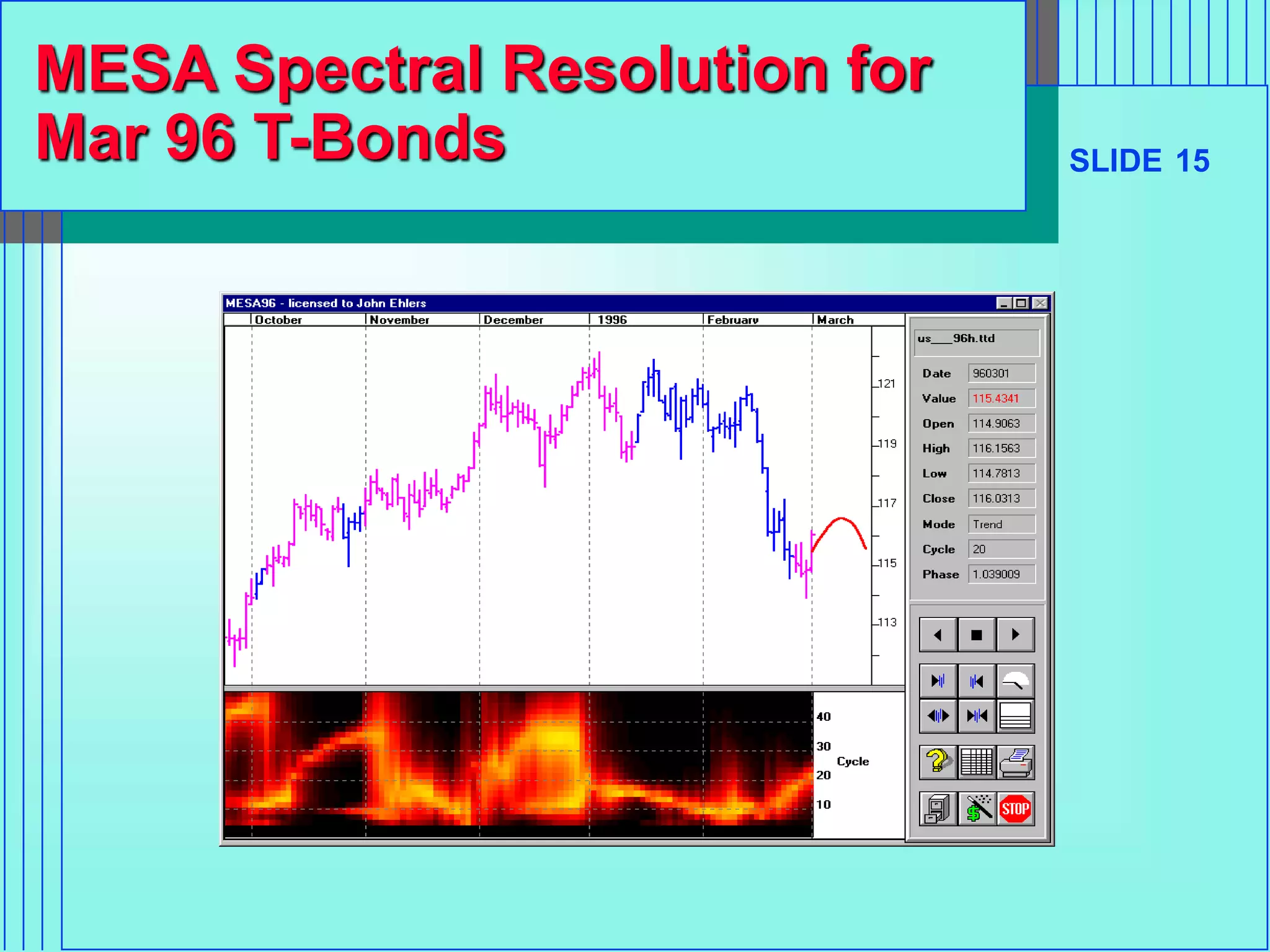
SLIDE 15
MESA Spectral Resolution for
Mar 96 T-Bonds
SLIDE 16
Sinewaves
 A sinewave can be generated by connecting a pen to
the arrow and pulling a piece of paper
 Phase angles increase uniformly
 Cycle mode exists when the rate change of phase is
near the theoretical rate change of phase of the
measured cycle
0
360
SLIDE 17
Phase Advance Produces
a Leading Indicator Oscillator
 Conventional Sinewave
 Crossover Trading Signals using phase lead
to anticipate cyclic turning points
 Phase does not change in a trend - this
oscillator does not give false whipsaws
SLIDE 18
Moving Averages
 A Simple Average over the dominant cycle period
eliminates the cycle component
• There are exactly as many points above the midpoint as below it.
 A moving average can be created by connecting
successive simple averages together
 An adaptive moving average is an “Instantaneous
Trendline”
• The dominant cycle has been completely removed, leaving only
the trend (and other cycle component residuals)
 The Instantaneous Trendline lags the real price by a
a half dominant cycle
SLIDE 19
SMA and EMA Relationships
 EMA constant is usually related to the length of an SMA
• “Filter Price Data”, J.K. Hutson, TASAC Vol. 2, page 102
• The equation is  = 2 / (Length +1)
 An EMA can never remove the Dominant Cycle
Component
SLIDE 20
Application to Trading
 Use a trend follower when the market is in a trend mode
 Use an oscillator when the market is in a cycle mode
 Determine the mode of the market
 Implement a trading system for each mode
APPROACH
STRATEGY
SLIDE 21
Applying Theory to Software
 MESA is the best way to
measure cycles
 Phase is an important
parameter
 Phase lead anticipates
cycle turning points
 Cycle is constant rate
change of phase
 Moving Averages can
remove the cycle
component
 Dominant Cycle provides the
means to develop adaptive
trading systems
 Measured Phase isolates
location within the cycle
 Sinewave Indicator provides
clear crossover signals
 Trend Mode signaled by failure
of constant rate change
 Dominant Cycle Moving
Averages indicate trend
direction
THEORY EASY TO USE
SLIDE 22
A Useful Code Fragment
(Enables Excel Manipulation of Equity Curves)
If Date>Date[1] then
Print(File(“c:tsgrowthtest.txt”),date,”,”,
netprofit + positionprofit(0));
 Prints an ASCII file called TEST.TXT
 The file is your day-by-day equity curve
 Located in the C:TSGROWTH directory. You
must have previously created this directory
 You can call this file and manipulate the data
with Excel
SLIDE 23
Adaptive System Design
Strategy
Identify Trend Modes and Cycle Modes using rate change of phase
Tactics
Trade the Moving Averages when in the Trend Mode
Trade the Sinewave Indicator when then the Cycle Mode
Live MESA2000 Demonstration
Live Writing of Adaptive Systems
Trend Following System
Cycle Mode System
SLIDE 24
TREND MODE SYSTEM
(Requires MESA DLLs)
{**************************************************************
MESA Trend System - Instantaneous Trendline
Copyright (c) 1999 MESA Software
***************************************************************}
inputs: Price(Close),
Window(1),
Registry(9413938);
vars: dc(0),
maa(0),
ph(0),
TrndSig(0),
ITrend(0),
alpha1(.07),
alpha2(.4);
SLIDE 25
TREND MODE SYSTEM
(Continued)
defineDllFunc: "c:mesadllmesa99.dll",int,"INIT",int;
defineDllFunc: "c:mesadllmesa99.dll",int,"DomCycle",int, float, long, float, lpfloat;
defineDllFunc: "c:mesadllmesa99.dll",int,"MATRIX",long;
defineDllFunc: "c:mesadllmesa99.dll",int,"FindPhase", float, lpfloat;
defineDllFunc: "c:mesadllmesa99.dll",int,"FindMA",float, float, lpfloat, lpfloat;
Matrix(blocknumber);
if currentbar = 1 then begin
init(1);
end;
DomCycle(Window, price, Blocknumber, Registry, &dc);
FindPhase(Price, &ph);
FindMA(price, dc, &TrndSig, &ITrend);
if currentbar <= 51 then begin
TrndSig = price;
ITrend = price;
end;
SLIDE 26
TREND MODE SYSTEM
(Concluded)
If CurrentBar > 51 then begin
if TrndSig crosses over ITrend or TrndSig crosses under ITrend then begin
if checkalert then alert = true;
end;
value1 = alpha1*ITrend + (1 - alpha1)*value1[1];
value2 = alpha2*value1 + (1 - alpha2)*value2[1];
If value1 Crosses Over value2 then buy;
If value1 Crosses Under value2 then sell;
end;
SLIDE 27
TREND MODE SYSTEM RESULTS
(Japanese Yen 1976-1998)
SLIDE 28
CYCLE MODE SYSTEM
(Requires MESA DLLs)
{*************************************************************************
MESA Sinewave System - SineWave Indicator
Copyright (c) 1999 MESA Software
**************************************************************************}
inputs: Price(Close),
Window(1),
Registry(9413938);
vars: dc(0),
ph(0),
LeadSine(0),
Sinewave(0);
defineDllFunc: "c:mesadllmesa99.dll",int,"INIT",int;
defineDllFunc: "c:mesadllmesa99.dll",int,"DomCycle",int, float, long, float, lpfloat;
defineDllFunc: "c:mesadllmesa99.dll",int,"MATRIX",long;
defineDllFunc: "c:mesadllmesa99.dll",int,"FindPhase", float, lpfloat;
defineDllFunc: "c:mesadllmesa99.dll",int,"FindSine",lpfloat, lpfloat;
SLIDE 29
CYCLE MODE SYSTEM
(Concluded)
Matrix(blocknumber);
if currentbar = 1 then begin
init(1);
end;
DomCycle(Window, price, Blocknumber, Registry, &dc);
if currentbar > 1 then begin
FindPhase(Price, &ph);
FindSine(&Sinewave, &LeadSine);
end;
if LeadSine crosses over Sinewave or LeadSine crosses under Sinewave then begin
if checkalert then alert = true;
end;
If LeadSine Crosses Over SineWave then Buy;
If LeadSine Crosses Under SineWave then Sell;
If MarketPosition = -1 and Close > EntryPrice then buy;
If MarketPosition = 1 and PositionProfit <0 and BarsSinceEntry > 3 then ExitLong;
SLIDE 30
CYCLE MODE SYSTEM RESULTS
(S&P500 for 1998)
SLIDE 31
And In Conclusion . . . . .
I know you believe you understood
what you think I said, but I am not
sure you realize that what you
heard is not what I meant.

__MESA presentation,Profitable Adaptive Trading Systems.ppt

  • 1.
    SLIDE 1 Profitable AdaptiveTrading Systems MESA SOFTWARE P.O. Box 1801 Goleta, CA 93116 voice (800) 633-6372 fax (805) 969-1358 e-mail john@mesasoftware.com home page www.mesasoftware.com www.mesa-systems.com
  • 2.
    SLIDE 2 Risk Statement Thereis no guarantee that technical analysis will result in profits or that it will not result in losses. Past performance is not a guarantee of future results. All investments and trades carry risk and all trading decisions of an individual remain the responsibility of that individual. The use of any concepts presented does not constitute trading advice in any way.
  • 3.
    SLIDE 3 Agenda  PhilosophicalBackground Justifying Market Cycles  Measuring Cycles  Cycle Characteristics  MESA2000 Indicator Demonstration  Write an Adaptive Trend Mode Trading System in TradeStation2000i  Write an Adaptive Cycle Mode Trading System in TradeStation2000i
  • 4.
    SLIDE 4 Philosophical Background Both randomness and short term cycles can arise from the solution to the random walk problem  Solution is the “Diffusion Equation” for Trend Modes  Solution is the “Telegraphers Equation” for Cycle Modes
  • 5.
    SLIDE 5 The Marketis Similar to a Meandering River  Both follow the path of least resistance  Rivers attempt to keep a constant water slope - maintains the conservation of energy.  Conservation of Energy produces the path of least resistance • Paths of uniform resistance look like pieces of sinewaves  Market Forces (greed, fear, profit, loss, etc.) are similar to physical forces, producing paths of uniform resistance.  Think about how the masses ask the question: Will the market change? OR Will the trend continue?
  • 6.
    SLIDE 6 Cycle Measurement Cycle Finders  FFT (Fast Fourier Transform)  MESA (Maximum Entropy Spectral Analysis)
  • 7.
    SLIDE 7 Cycle Finders Basically count the number of bars between successive lowest lows or successive highest highs.  Ehrlich cycle finder is a pantograph that enables cycle count on paper charts  All software toolboxes have cycle finders  Disadvantages: • Depend on a long term correlation - therefore assume the cycle is continuously present • Even the shortest measurement is discrete and cannot adjust for changing cycles
  • 8.
    SLIDE 8 FFT  Constraints: •Data is a representative sample of an infinitely long wave • Data must be stationary over the sample time span • Must have an integer number of cycles in the time span  Assume a 64 day time span • Longest cycle is 64 days • Next longest is 64/2 = 32 days • Next longest is 64/3 = 21.3 days • Next longest is 64/4 = 16 days  Result is poor resolution - gaps between measured cycles
  • 9.
  • 10.
    SLIDE 10 Fourier TransformResolution of a 24 Bar Cycle
  • 11.
    SLIDE 11 Fourier TransformResolution for Mar 96 T-Bonds
  • 12.
    SLIDE 12 FFT (Continued) Paradox: • The only way to increase resolution is to increase the data length • Increased data length makes realization of the stationarity constraint highly unlikely – 256 data points are required to realize a 1 bar resolution for a 16 bar cycle (right where we want to work). This would require the 16 day cycle to be present and consistent for an entire year!  Conclusion: FFT measurements are not suitable for market analysis!
  • 13.
    SLIDE 13 MESA CycleMeasurement  Feedback optimally adjusts filter so the filter output is the same as the data waveform • Pattern matching in the time domain • No intrinsic resolution limitation or frequency distortions White Noise Adaptive Filter Waveform Comparitor Feedback
  • 14.
    SLIDE 14 MESA SpectralResolution of a 24 Bar Cycle
  • 15.
    SLIDE 15 MESA SpectralResolution for Mar 96 T-Bonds
  • 16.
    SLIDE 16 Sinewaves  Asinewave can be generated by connecting a pen to the arrow and pulling a piece of paper  Phase angles increase uniformly  Cycle mode exists when the rate change of phase is near the theoretical rate change of phase of the measured cycle 0 360
  • 17.
    SLIDE 17 Phase AdvanceProduces a Leading Indicator Oscillator  Conventional Sinewave  Crossover Trading Signals using phase lead to anticipate cyclic turning points  Phase does not change in a trend - this oscillator does not give false whipsaws
  • 18.
    SLIDE 18 Moving Averages A Simple Average over the dominant cycle period eliminates the cycle component • There are exactly as many points above the midpoint as below it.  A moving average can be created by connecting successive simple averages together  An adaptive moving average is an “Instantaneous Trendline” • The dominant cycle has been completely removed, leaving only the trend (and other cycle component residuals)  The Instantaneous Trendline lags the real price by a a half dominant cycle
  • 19.
    SLIDE 19 SMA andEMA Relationships  EMA constant is usually related to the length of an SMA • “Filter Price Data”, J.K. Hutson, TASAC Vol. 2, page 102 • The equation is  = 2 / (Length +1)  An EMA can never remove the Dominant Cycle Component
  • 20.
    SLIDE 20 Application toTrading  Use a trend follower when the market is in a trend mode  Use an oscillator when the market is in a cycle mode  Determine the mode of the market  Implement a trading system for each mode APPROACH STRATEGY
  • 21.
    SLIDE 21 Applying Theoryto Software  MESA is the best way to measure cycles  Phase is an important parameter  Phase lead anticipates cycle turning points  Cycle is constant rate change of phase  Moving Averages can remove the cycle component  Dominant Cycle provides the means to develop adaptive trading systems  Measured Phase isolates location within the cycle  Sinewave Indicator provides clear crossover signals  Trend Mode signaled by failure of constant rate change  Dominant Cycle Moving Averages indicate trend direction THEORY EASY TO USE
  • 22.
    SLIDE 22 A UsefulCode Fragment (Enables Excel Manipulation of Equity Curves) If Date>Date[1] then Print(File(“c:tsgrowthtest.txt”),date,”,”, netprofit + positionprofit(0));  Prints an ASCII file called TEST.TXT  The file is your day-by-day equity curve  Located in the C:TSGROWTH directory. You must have previously created this directory  You can call this file and manipulate the data with Excel
  • 23.
    SLIDE 23 Adaptive SystemDesign Strategy Identify Trend Modes and Cycle Modes using rate change of phase Tactics Trade the Moving Averages when in the Trend Mode Trade the Sinewave Indicator when then the Cycle Mode Live MESA2000 Demonstration Live Writing of Adaptive Systems Trend Following System Cycle Mode System
  • 24.
    SLIDE 24 TREND MODESYSTEM (Requires MESA DLLs) {************************************************************** MESA Trend System - Instantaneous Trendline Copyright (c) 1999 MESA Software ***************************************************************} inputs: Price(Close), Window(1), Registry(9413938); vars: dc(0), maa(0), ph(0), TrndSig(0), ITrend(0), alpha1(.07), alpha2(.4);
  • 25.
    SLIDE 25 TREND MODESYSTEM (Continued) defineDllFunc: "c:mesadllmesa99.dll",int,"INIT",int; defineDllFunc: "c:mesadllmesa99.dll",int,"DomCycle",int, float, long, float, lpfloat; defineDllFunc: "c:mesadllmesa99.dll",int,"MATRIX",long; defineDllFunc: "c:mesadllmesa99.dll",int,"FindPhase", float, lpfloat; defineDllFunc: "c:mesadllmesa99.dll",int,"FindMA",float, float, lpfloat, lpfloat; Matrix(blocknumber); if currentbar = 1 then begin init(1); end; DomCycle(Window, price, Blocknumber, Registry, &dc); FindPhase(Price, &ph); FindMA(price, dc, &TrndSig, &ITrend); if currentbar <= 51 then begin TrndSig = price; ITrend = price; end;
  • 26.
    SLIDE 26 TREND MODESYSTEM (Concluded) If CurrentBar > 51 then begin if TrndSig crosses over ITrend or TrndSig crosses under ITrend then begin if checkalert then alert = true; end; value1 = alpha1*ITrend + (1 - alpha1)*value1[1]; value2 = alpha2*value1 + (1 - alpha2)*value2[1]; If value1 Crosses Over value2 then buy; If value1 Crosses Under value2 then sell; end;
  • 27.
    SLIDE 27 TREND MODESYSTEM RESULTS (Japanese Yen 1976-1998)
  • 28.
    SLIDE 28 CYCLE MODESYSTEM (Requires MESA DLLs) {************************************************************************* MESA Sinewave System - SineWave Indicator Copyright (c) 1999 MESA Software **************************************************************************} inputs: Price(Close), Window(1), Registry(9413938); vars: dc(0), ph(0), LeadSine(0), Sinewave(0); defineDllFunc: "c:mesadllmesa99.dll",int,"INIT",int; defineDllFunc: "c:mesadllmesa99.dll",int,"DomCycle",int, float, long, float, lpfloat; defineDllFunc: "c:mesadllmesa99.dll",int,"MATRIX",long; defineDllFunc: "c:mesadllmesa99.dll",int,"FindPhase", float, lpfloat; defineDllFunc: "c:mesadllmesa99.dll",int,"FindSine",lpfloat, lpfloat;
  • 29.
    SLIDE 29 CYCLE MODESYSTEM (Concluded) Matrix(blocknumber); if currentbar = 1 then begin init(1); end; DomCycle(Window, price, Blocknumber, Registry, &dc); if currentbar > 1 then begin FindPhase(Price, &ph); FindSine(&Sinewave, &LeadSine); end; if LeadSine crosses over Sinewave or LeadSine crosses under Sinewave then begin if checkalert then alert = true; end; If LeadSine Crosses Over SineWave then Buy; If LeadSine Crosses Under SineWave then Sell; If MarketPosition = -1 and Close > EntryPrice then buy; If MarketPosition = 1 and PositionProfit <0 and BarsSinceEntry > 3 then ExitLong;
  • 30.
    SLIDE 30 CYCLE MODESYSTEM RESULTS (S&P500 for 1998)
  • 31.
    SLIDE 31 And InConclusion . . . . . I know you believe you understood what you think I said, but I am not sure you realize that what you heard is not what I meant.