MergeSort
Source: Gibbs & Tamassia
2
MergeSort
 MergeSort is a divide and conquer method of
sorting
3
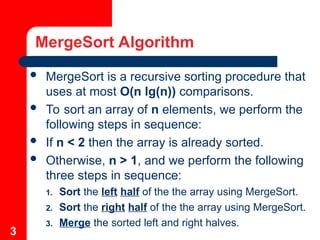
MergeSort Algorithm
 MergeSort is a recursive sorting procedure that
uses at most O(n lg(n)) comparisons.
 To sort an array of n elements, we perform the
following steps in sequence:
 If n < 2 then the array is already sorted.
 Otherwise, n > 1, and we perform the following
three steps in sequence:
1. Sort the left half of the the array using MergeSort.
2. Sort the right half of the the array using MergeSort.
3. Merge the sorted left and right halves.
4
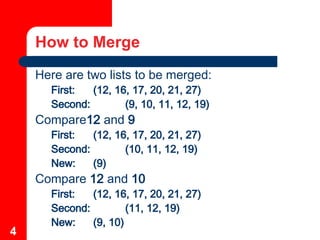
How to Merge
Here are two lists to be merged:
First: (12, 16, 17, 20, 21, 27)
Second: (9, 10, 11, 12, 19)
Compare12 and 9
First: (12, 16, 17, 20, 21, 27)
Second: (10, 11, 12, 19)
New: (9)
Compare 12 and 10
First: (12, 16, 17, 20, 21, 27)
Second: (11, 12, 19)
New: (9, 10)
5
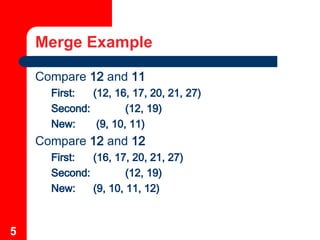
Merge Example
Compare 12 and 11
First: (12, 16, 17, 20, 21, 27)
Second: (12, 19)
New: (9, 10, 11)
Compare 12 and 12
First: (16, 17, 20, 21, 27)
Second: (12, 19)
New: (9, 10, 11, 12)
6
Merge Example
Compare 16 and 12
First: (16, 17, 20, 21, 27)
Second: (19)
New: (9, 10, 11, 12, 12)
Compare 16 and 19
First: (17, 20, 21, 27)
Second: (19)
New: (9, 10, 11, 12, 12, 16)
7
Merge Example
Compare 17 and 19
First: (20, 21, 27)
Second: (19)
New: (9, 10, 11, 12, 12, 16, 17)
Compare 20 and 19
First: (20, 21, 27)
Second: ( )
New: (9, 10, 11, 12, 12, 16, 17, 19)
8
Merge Example
Checkout 20 and empty list
First: ( )
Second: ( )
New: (9, 10, 11, 12, 12, 16, 17, 19, 20, 21, 27)
9
MergeSort
Original 24 13 26 1 12 27 38 15
Divide in 2 24 13 26 1 12 27 38 15
Divide in 4 24 13 26 1 12 27 38 15
Divide in 8 24 13 26 1 12 27 38 15
Merge 2 13 24 1 26 12 27 15 38
Merge 4 1 13 24 26 12 15 27 38
Merge 8 1 12 13 15 24 26 27 38
10
Merge-Sort Tree
 An execution of merge-sort is depicted by a binary tree
– each node represents a recursive call of merge-sort and stores
 unsorted sequence before the execution and its partition
 sorted sequence at the end of the execution
– the root is the initial call
– the leaves are calls on subsequences of size 0 or 1
7 2  9 4  2 4 7 9
7  2  2 7 9  4  4 9
7  7 2  2 9  9 4  4
11
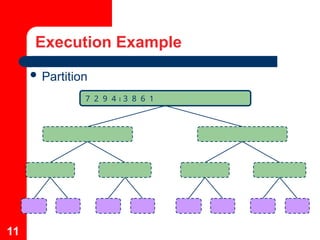
Execution Example
 Partition
7 2 9 4  3 8 6 1
12
Execution Example (cont.)
 Recursive call, partition
7 2  9 4
7 2 9 4  3 8 6 1
13
Execution Example (cont.)
 Recursive call, partition
7 2  9 4
7  2
7 2 9 4  3 8 6 1
14
Execution Example (cont.)
 Recursive call, base case
7 2  9 4
7  2
7  7
7 2 9 4  3 8 6 1
15
Execution Example (cont.)
 Recursive call, base case
7 2  9 4
7  2
7  7 2  2
7 2 9 4  3 8 6 1
16
Execution Example (cont.)
 Merge
7 2  9 4
7  2  2 7
7  7 2  2
7 2 9 4  3 8 6 1
17
Execution Example (cont.)
 Recursive call, …, base case, merge
7 2  9 4
7  2  2 7 9 4  4 9
7  7 2  2
7 2 9 4  3 8 6 1
9  9 4  4
18
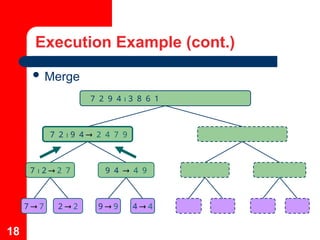
Execution Example (cont.)
 Merge
7 2  9 4  2 4 7 9
7  2  2 7 9 4  4 9
7  7 2  2 9  9 4  4
7 2 9 4  3 8 6 1
19
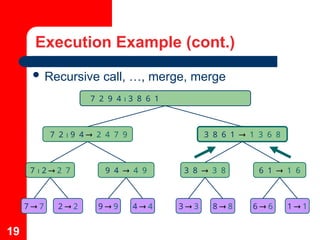
Execution Example (cont.)
 Recursive call, …, merge, merge
7 2  9 4  2 4 7 9 3 8 6 1  1 3 6 8
7  2  2 7 9 4  4 9 3 8  3 8 6 1  1 6
7  7 2  2 9  9 4  4 3  3 8  8 6  6 1  1
7 2 9 4  3 8 6 1
20
Execution Example (cont.)
 Merge
7 2  9 4  2 4 7 9 3 8 6 1  1 3 6 8
7  2  2 7 9 4  4 9 3 8  3 8 6 1  1 6
7  7 2  2 9  9 4  4 3  3 8  8 6  6 1  1
7 2 9 4  3 8 6 1  1 2 3 4 6 7 8 9
21
Complexity of MergeSort
Pass
Number
Number of
merges
Merge list
length
# of comps /
moves per
merge
1 2k-1
or n/2 1 or n/2k
 21
2 2k-2
or n/4 2 or n/2k-1
 22
3 2k-3
or n/8 4 or n/2k-2
 23
. . . .
. . . .
. . . .
k – 1 21
or n/2k-1
2k-2
or n/4  2k-1
k 20
or n/2k
2k-1
or n/2  2k
k = log n
22
Multiplying the number of merges by the maximum
number of comparisons per merge, we get:
(2k-1
)21
= 2k
(2k-2
)22
= 2k



(21
)2k-1
= 2k
(20
)2k
= 2k
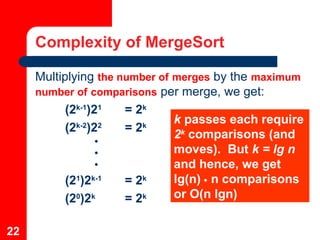
Complexity of MergeSort
k passes each require
2k
comparisons (and
moves). But k = lg n
and hence, we get
lg(n)  n comparisons
or O(n lgn)

mergesort_data_structure_algorithm-102-fa08.ppt

  • 1.
  • 2.
    2 MergeSort  MergeSort isa divide and conquer method of sorting
  • 3.
    3 MergeSort Algorithm  MergeSortis a recursive sorting procedure that uses at most O(n lg(n)) comparisons.  To sort an array of n elements, we perform the following steps in sequence:  If n < 2 then the array is already sorted.  Otherwise, n > 1, and we perform the following three steps in sequence: 1. Sort the left half of the the array using MergeSort. 2. Sort the right half of the the array using MergeSort. 3. Merge the sorted left and right halves.
  • 4.
    4 How to Merge Hereare two lists to be merged: First: (12, 16, 17, 20, 21, 27) Second: (9, 10, 11, 12, 19) Compare12 and 9 First: (12, 16, 17, 20, 21, 27) Second: (10, 11, 12, 19) New: (9) Compare 12 and 10 First: (12, 16, 17, 20, 21, 27) Second: (11, 12, 19) New: (9, 10)
  • 5.
    5 Merge Example Compare 12and 11 First: (12, 16, 17, 20, 21, 27) Second: (12, 19) New: (9, 10, 11) Compare 12 and 12 First: (16, 17, 20, 21, 27) Second: (12, 19) New: (9, 10, 11, 12)
  • 6.
    6 Merge Example Compare 16and 12 First: (16, 17, 20, 21, 27) Second: (19) New: (9, 10, 11, 12, 12) Compare 16 and 19 First: (17, 20, 21, 27) Second: (19) New: (9, 10, 11, 12, 12, 16)
  • 7.
    7 Merge Example Compare 17and 19 First: (20, 21, 27) Second: (19) New: (9, 10, 11, 12, 12, 16, 17) Compare 20 and 19 First: (20, 21, 27) Second: ( ) New: (9, 10, 11, 12, 12, 16, 17, 19)
  • 8.
    8 Merge Example Checkout 20and empty list First: ( ) Second: ( ) New: (9, 10, 11, 12, 12, 16, 17, 19, 20, 21, 27)
  • 9.
    9 MergeSort Original 24 1326 1 12 27 38 15 Divide in 2 24 13 26 1 12 27 38 15 Divide in 4 24 13 26 1 12 27 38 15 Divide in 8 24 13 26 1 12 27 38 15 Merge 2 13 24 1 26 12 27 15 38 Merge 4 1 13 24 26 12 15 27 38 Merge 8 1 12 13 15 24 26 27 38
  • 10.
    10 Merge-Sort Tree  Anexecution of merge-sort is depicted by a binary tree – each node represents a recursive call of merge-sort and stores  unsorted sequence before the execution and its partition  sorted sequence at the end of the execution – the root is the initial call – the leaves are calls on subsequences of size 0 or 1 7 2  9 4  2 4 7 9 7  2  2 7 9  4  4 9 7  7 2  2 9  9 4  4
  • 11.
  • 12.
    12 Execution Example (cont.) Recursive call, partition 7 2  9 4 7 2 9 4  3 8 6 1
  • 13.
    13 Execution Example (cont.) Recursive call, partition 7 2  9 4 7  2 7 2 9 4  3 8 6 1
  • 14.
    14 Execution Example (cont.) Recursive call, base case 7 2  9 4 7  2 7  7 7 2 9 4  3 8 6 1
  • 15.
    15 Execution Example (cont.) Recursive call, base case 7 2  9 4 7  2 7  7 2  2 7 2 9 4  3 8 6 1
  • 16.
    16 Execution Example (cont.) Merge 7 2  9 4 7  2  2 7 7  7 2  2 7 2 9 4  3 8 6 1
  • 17.
    17 Execution Example (cont.) Recursive call, …, base case, merge 7 2  9 4 7  2  2 7 9 4  4 9 7  7 2  2 7 2 9 4  3 8 6 1 9  9 4  4
  • 18.
    18 Execution Example (cont.) Merge 7 2  9 4  2 4 7 9 7  2  2 7 9 4  4 9 7  7 2  2 9  9 4  4 7 2 9 4  3 8 6 1
  • 19.
    19 Execution Example (cont.) Recursive call, …, merge, merge 7 2  9 4  2 4 7 9 3 8 6 1  1 3 6 8 7  2  2 7 9 4  4 9 3 8  3 8 6 1  1 6 7  7 2  2 9  9 4  4 3  3 8  8 6  6 1  1 7 2 9 4  3 8 6 1
  • 20.
    20 Execution Example (cont.) Merge 7 2  9 4  2 4 7 9 3 8 6 1  1 3 6 8 7  2  2 7 9 4  4 9 3 8  3 8 6 1  1 6 7  7 2  2 9  9 4  4 3  3 8  8 6  6 1  1 7 2 9 4  3 8 6 1  1 2 3 4 6 7 8 9
  • 21.
    21 Complexity of MergeSort Pass Number Numberof merges Merge list length # of comps / moves per merge 1 2k-1 or n/2 1 or n/2k  21 2 2k-2 or n/4 2 or n/2k-1  22 3 2k-3 or n/8 4 or n/2k-2  23 . . . . . . . . . . . . k – 1 21 or n/2k-1 2k-2 or n/4  2k-1 k 20 or n/2k 2k-1 or n/2  2k k = log n
  • 22.
    22 Multiplying the numberof merges by the maximum number of comparisons per merge, we get: (2k-1 )21 = 2k (2k-2 )22 = 2k    (21 )2k-1 = 2k (20 )2k = 2k Complexity of MergeSort k passes each require 2k comparisons (and moves). But k = lg n and hence, we get lg(n)  n comparisons or O(n lgn)