Mergers
A merger is a
transaction that results
in the transfer of
ownership and control
of a corporation.
3 Types of Mergers
Economists distinguish between three
types of mergers:
1. Horizontal
2. Vertical
3. Conglomerate
Horizontal mergers
A horizontal merger results in the consolidation of
firms that are direct rivals—that is, sell substitutable
products within overlapping geographic markets.
Examples: Boeing-McDonnell Douglas; Staples-Office
Depot(unconsummated); Chase Manhattan-Chemical Bank;
Southern Pacific RR-Sante Fe RR; Pabst-Blatz; LTV-
Republic Steel; Konishiroku Photo-Minolta.
Vertical Mergers
The merger of firms that have actual or
potential buyer-seller relationships
Examples: Time Warner-TBS; Disney-ABC Capitol
Cities; Cleveland Cliffs Iron-Detroit Steel; Brown Shoe-
Kinney, Ford-Bendix.
Conglomerate mergers
Consolidated firms may sell related products,
share marketing and distribution channels and
perhaps production processes; or they may be
wholly unrelated.
•Product extension conglomerate mergers involve firms that
sell non-competing products use related marketing channels
of production processes.
Examples: Cardinal Healthcare-Allegiance; AOL-Time
Warner; Phillip Morris-Kraft; Citicorp-Travelers Insurance;
Pepsico-Pizza Hut; Proctor & Gamble-Clorox.
•Market extension conglomerate mergers join together firms
that sell competing products in separate geographic markets.
Examples: Scripps Howard Publishing—Knoxville News
Sentinel; Time Warner-TCI; Morrison Supermarkets-
Safeway;SBC Communications-Pacific Telesis
•A pure conglomerate merger unites firms that have no
obvious relationship of any kind.
Examples:BankCorp of America-Hughes Electronics ;R.J.
Reynolds-Burmah Oil & Gas; AT&T-Hartford Insurance
Anticompetitive Effects of Mergers
Issue: When and how are mergers welfare-reducing (that is, result
in a post-merger decrease in TS ?
•Horizontal mergers eliminate sellers and hence reshape market
structure. Recall that the structuralists believe that market structure
is the primary determinant of market performance.
•Mergers may result in market foreclosure. For example, the
Justice Department feared that Microsoft's proposed acquisition of
Intuit would result in a foreclosure of the market for personal
finance software.
• Mergers may diminish potential competition. For example, the
acquisition of Clorox by Proctor & Gamble eliminated P&G as a
prime potential entrant in the market for household bleach.
Horizontal mergers have a direct
impact on seller concentration (as
measured by the concentration
ratio or the Herfindahl index).
Hence the potential to diminished
competition is clear to see.
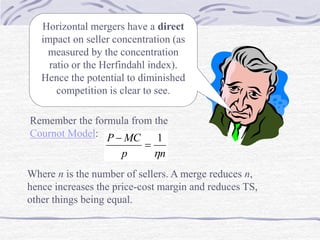
Remember the formula from the
Cournot Model:
np
MCP

1


Where n is the number of sellers. A merge reduces n,
hence increases the price-cost margin and reduces TS,
other things being equal.
The Williamson contribution 1
1Oliver Williamson. “Economies as an Antitrust Defense: The
Welfare Tradeoffs,” American Economic Review, March 1968.
It would seem at first blush that horizontal mergers
would invariably be welfare-reducing. However, if the
consolidation of direct rivals leads to greater cost
efficiency, then a horizontal merger could (in theory at
least) be welfare-enhancing.
Welfare trade-offs of a horizontal merger
Oliver Williamson contends that
a horizontal merger can be
welfare-enhancing, even if
the post-merger market
structure is monopolistic. Why? Because
the merger may result in greater
technical/cost efficiency.
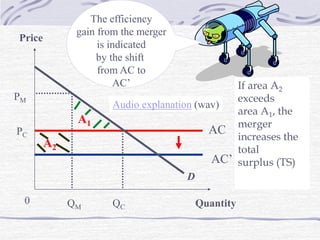
QC
Price
Quantity0
A1
A2
D
QM
PM
PC
AC’
AC
The efficiency
gain from the merger
is indicated
by the shift
from AC to
AC’ If area A2
exceeds
area A1, the
merger
increases the
total
surplus (TS)
Audio explanation (wav)
Measuring the Welfare Tradeoffs
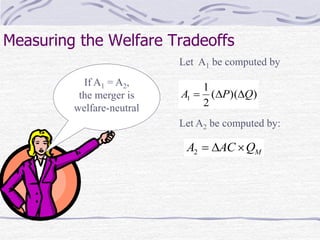
Let A1 be computed by
))((
2
1
1 QPA 
Let A2 be computed by:
MQACA 2
If A1 = A2,
the merger is
welfare-neutral
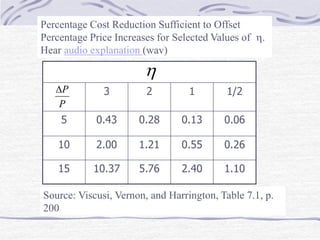
3 2 1 1/2
5 0.43 0.28 0.13 0.06
10 2.00 1.21 0.55 0.26
15 10.37 5.76 2.40 1.10

P
P
Percentage Cost Reduction Sufficient to Offset
Percentage Price Increases for Selected Values of .
Hear audio explanation (wav)
Source: Viscusi, Vernon, and Harrington, Table 7.1, p.
200
Vertical and conglomerate mergers do
not affect market structure (e.g., seller
concentration) directly. As you will
discover subsequently, these types of
mergers mergers can nevertheless have
anticompetitive consequences.
Back to Lesson 6

Mergers and acquisitions

  • 1.
    Mergers A merger isa transaction that results in the transfer of ownership and control of a corporation.
  • 2.
    3 Types ofMergers Economists distinguish between three types of mergers: 1. Horizontal 2. Vertical 3. Conglomerate
  • 3.
    Horizontal mergers A horizontalmerger results in the consolidation of firms that are direct rivals—that is, sell substitutable products within overlapping geographic markets. Examples: Boeing-McDonnell Douglas; Staples-Office Depot(unconsummated); Chase Manhattan-Chemical Bank; Southern Pacific RR-Sante Fe RR; Pabst-Blatz; LTV- Republic Steel; Konishiroku Photo-Minolta.
  • 4.
    Vertical Mergers The mergerof firms that have actual or potential buyer-seller relationships Examples: Time Warner-TBS; Disney-ABC Capitol Cities; Cleveland Cliffs Iron-Detroit Steel; Brown Shoe- Kinney, Ford-Bendix.
  • 5.
    Conglomerate mergers Consolidated firmsmay sell related products, share marketing and distribution channels and perhaps production processes; or they may be wholly unrelated. •Product extension conglomerate mergers involve firms that sell non-competing products use related marketing channels of production processes. Examples: Cardinal Healthcare-Allegiance; AOL-Time Warner; Phillip Morris-Kraft; Citicorp-Travelers Insurance; Pepsico-Pizza Hut; Proctor & Gamble-Clorox.
  • 6.
    •Market extension conglomeratemergers join together firms that sell competing products in separate geographic markets. Examples: Scripps Howard Publishing—Knoxville News Sentinel; Time Warner-TCI; Morrison Supermarkets- Safeway;SBC Communications-Pacific Telesis •A pure conglomerate merger unites firms that have no obvious relationship of any kind. Examples:BankCorp of America-Hughes Electronics ;R.J. Reynolds-Burmah Oil & Gas; AT&T-Hartford Insurance
  • 7.
    Anticompetitive Effects ofMergers Issue: When and how are mergers welfare-reducing (that is, result in a post-merger decrease in TS ? •Horizontal mergers eliminate sellers and hence reshape market structure. Recall that the structuralists believe that market structure is the primary determinant of market performance. •Mergers may result in market foreclosure. For example, the Justice Department feared that Microsoft's proposed acquisition of Intuit would result in a foreclosure of the market for personal finance software. • Mergers may diminish potential competition. For example, the acquisition of Clorox by Proctor & Gamble eliminated P&G as a prime potential entrant in the market for household bleach.
  • 8.
    Horizontal mergers havea direct impact on seller concentration (as measured by the concentration ratio or the Herfindahl index). Hence the potential to diminished competition is clear to see. Remember the formula from the Cournot Model: np MCP  1   Where n is the number of sellers. A merge reduces n, hence increases the price-cost margin and reduces TS, other things being equal.
  • 9.
    The Williamson contribution1 1Oliver Williamson. “Economies as an Antitrust Defense: The Welfare Tradeoffs,” American Economic Review, March 1968. It would seem at first blush that horizontal mergers would invariably be welfare-reducing. However, if the consolidation of direct rivals leads to greater cost efficiency, then a horizontal merger could (in theory at least) be welfare-enhancing.
  • 10.
    Welfare trade-offs ofa horizontal merger Oliver Williamson contends that a horizontal merger can be welfare-enhancing, even if the post-merger market structure is monopolistic. Why? Because the merger may result in greater technical/cost efficiency.
  • 11.
    QC Price Quantity0 A1 A2 D QM PM PC AC’ AC The efficiency gain fromthe merger is indicated by the shift from AC to AC’ If area A2 exceeds area A1, the merger increases the total surplus (TS) Audio explanation (wav)
  • 12.
    Measuring the WelfareTradeoffs Let A1 be computed by ))(( 2 1 1 QPA  Let A2 be computed by: MQACA 2 If A1 = A2, the merger is welfare-neutral
  • 13.
    3 2 11/2 5 0.43 0.28 0.13 0.06 10 2.00 1.21 0.55 0.26 15 10.37 5.76 2.40 1.10  P P Percentage Cost Reduction Sufficient to Offset Percentage Price Increases for Selected Values of . Hear audio explanation (wav) Source: Viscusi, Vernon, and Harrington, Table 7.1, p. 200
  • 14.
    Vertical and conglomeratemergers do not affect market structure (e.g., seller concentration) directly. As you will discover subsequently, these types of mergers mergers can nevertheless have anticompetitive consequences. Back to Lesson 6