MER: a Minimal Named‐Entity 
Recognition Tagger 
and Annotation Server
Francisco M. Couto, Luis F. Campos, and Andre Lamurias
LaSIGE, Faculdade de Ciências, Universidade de Lisboa, Portugal
BioCreative V.5 Workshop , April 26‐27, 2017
Why Minimal?
• TIPS (Technical interoperability and performance of annotation servers)
– it’s cool, we have to participate somehow 
• But we have limited computational resources
• Idea: Go Minimal
– Minimize the number of tools and steps to 
perform Named‐Entity Recognition (NER)
What is Minimal?
• Flexibility
– Simple input
• Autonomy 
– minimal set of components and software 
dependencies
• Efficiency
– Low execution time
How Minimal?
• Only requires a lexicon as input 
– a text file
• Only two components: 
1. process the lexicon (offline)
2. produce the annotations (on‐the‐fly)
• GNU Bash shell script
– Using high performance grep and awk tools
– Portability:  any Unix‐like operating system
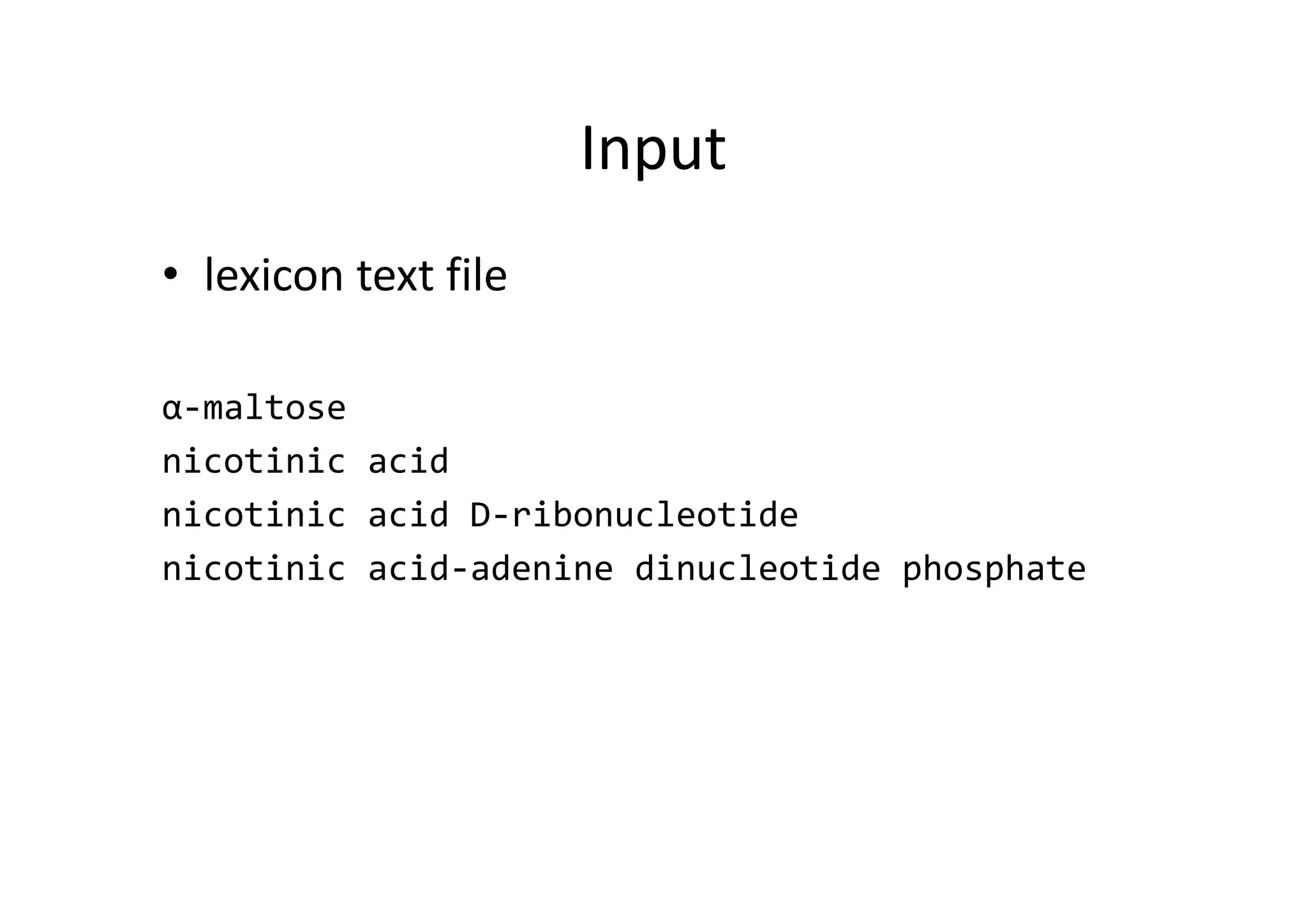
Input
• lexicon text file
α‐maltose
nicotinic acid
nicotinic acid D‐ribonucleotide
nicotinic acid‐adenine dinucleotide phosphate
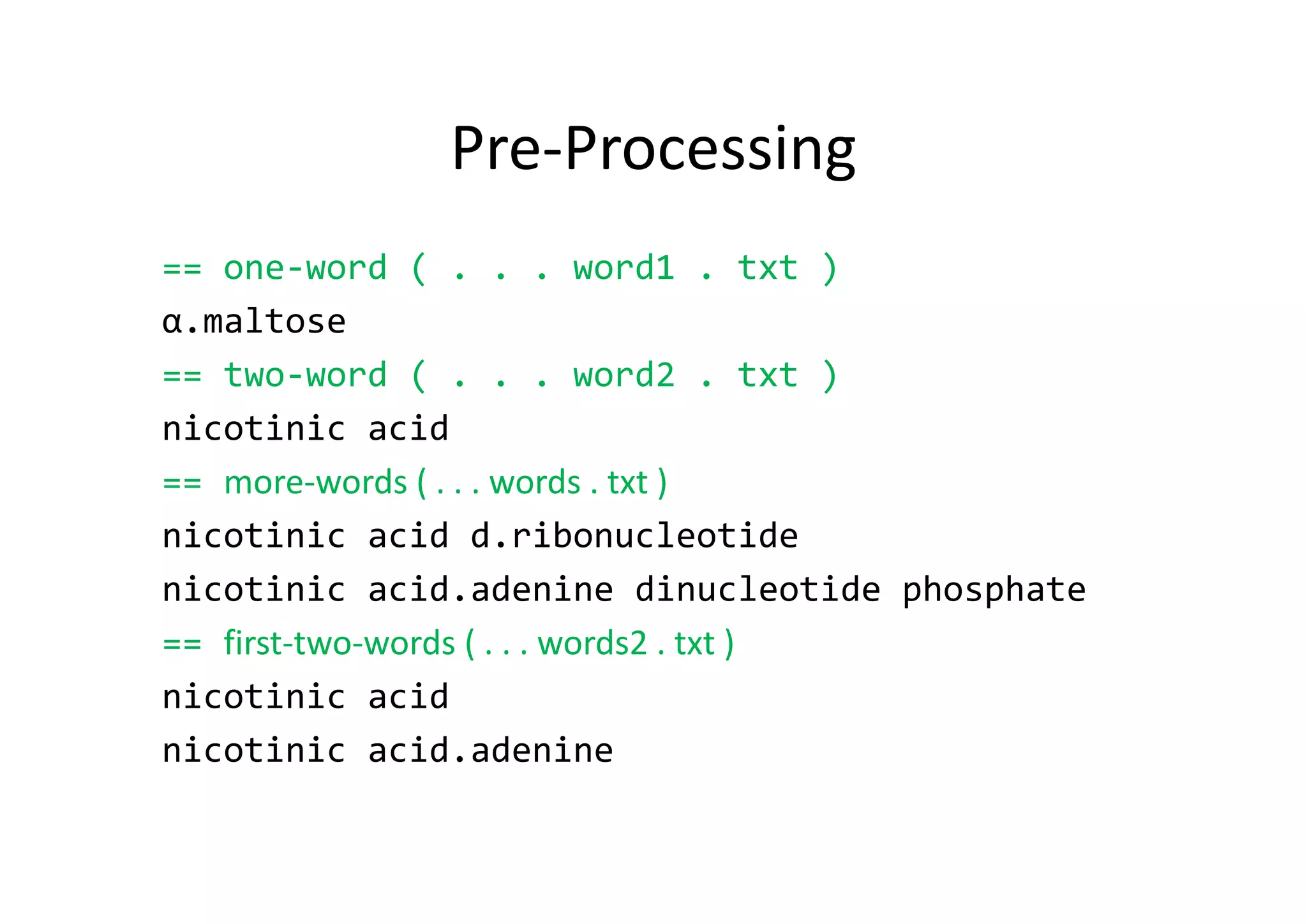
Pre‐Processing
== one‐word ( . . . word1 . txt ) 
α.maltose
== two‐word ( . . . word2 . txt )
nicotinic acid
== more‐words ( . . . words . txt )
nicotinic acid d.ribonucleotide
nicotinic acid.adenine dinucleotide phosphate
== first‐two‐words ( . . . words2 . txt )
nicotinic acid
nicotinic acid.adenine
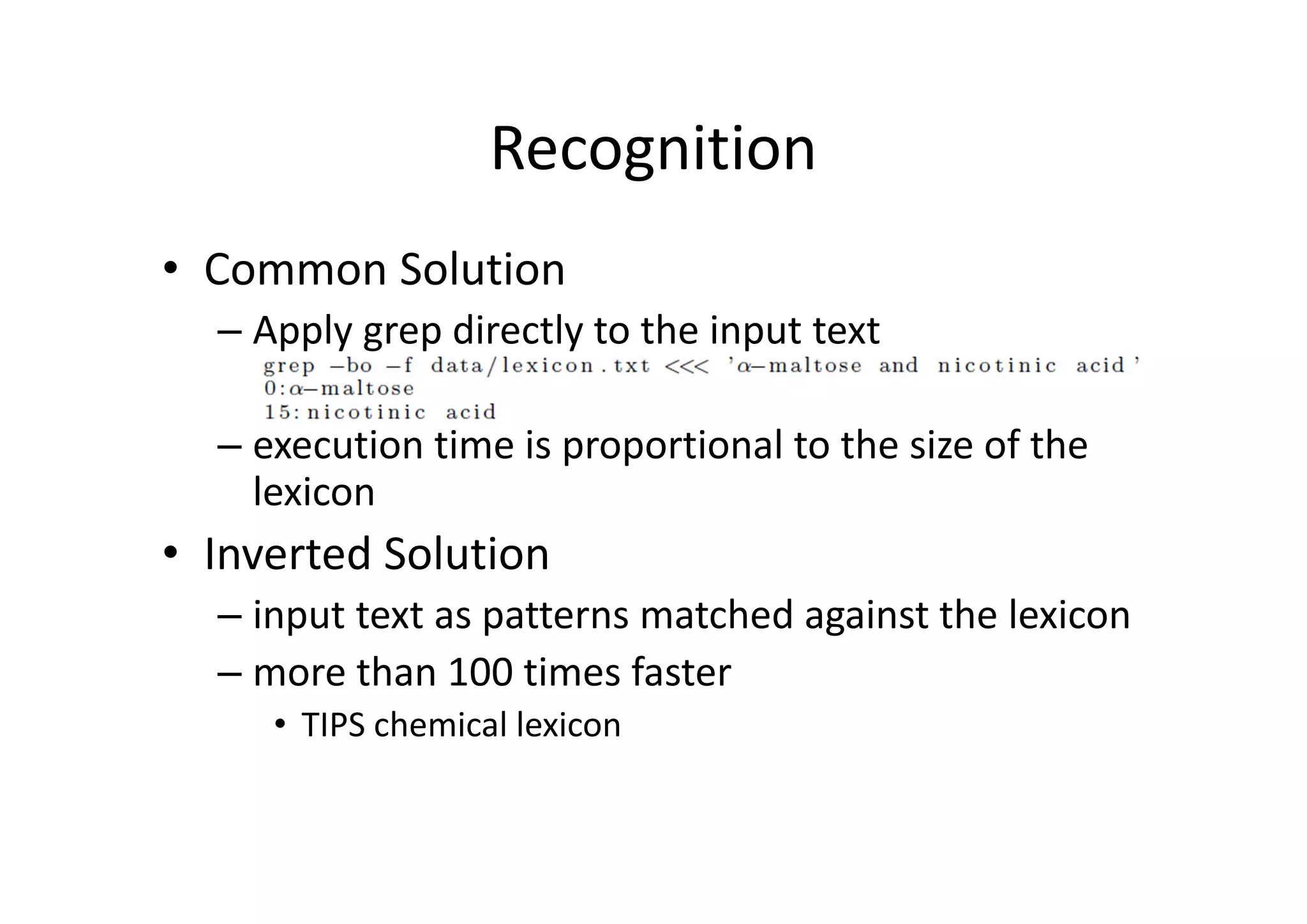
Recognition
• Common Solution
– Apply grep directly to the input text
– execution time is proportional to the size of the 
lexicon
• Inverted Solution
– input text as patterns matched against the lexicon
– more than 100 times faster
• TIPS chemical lexicon
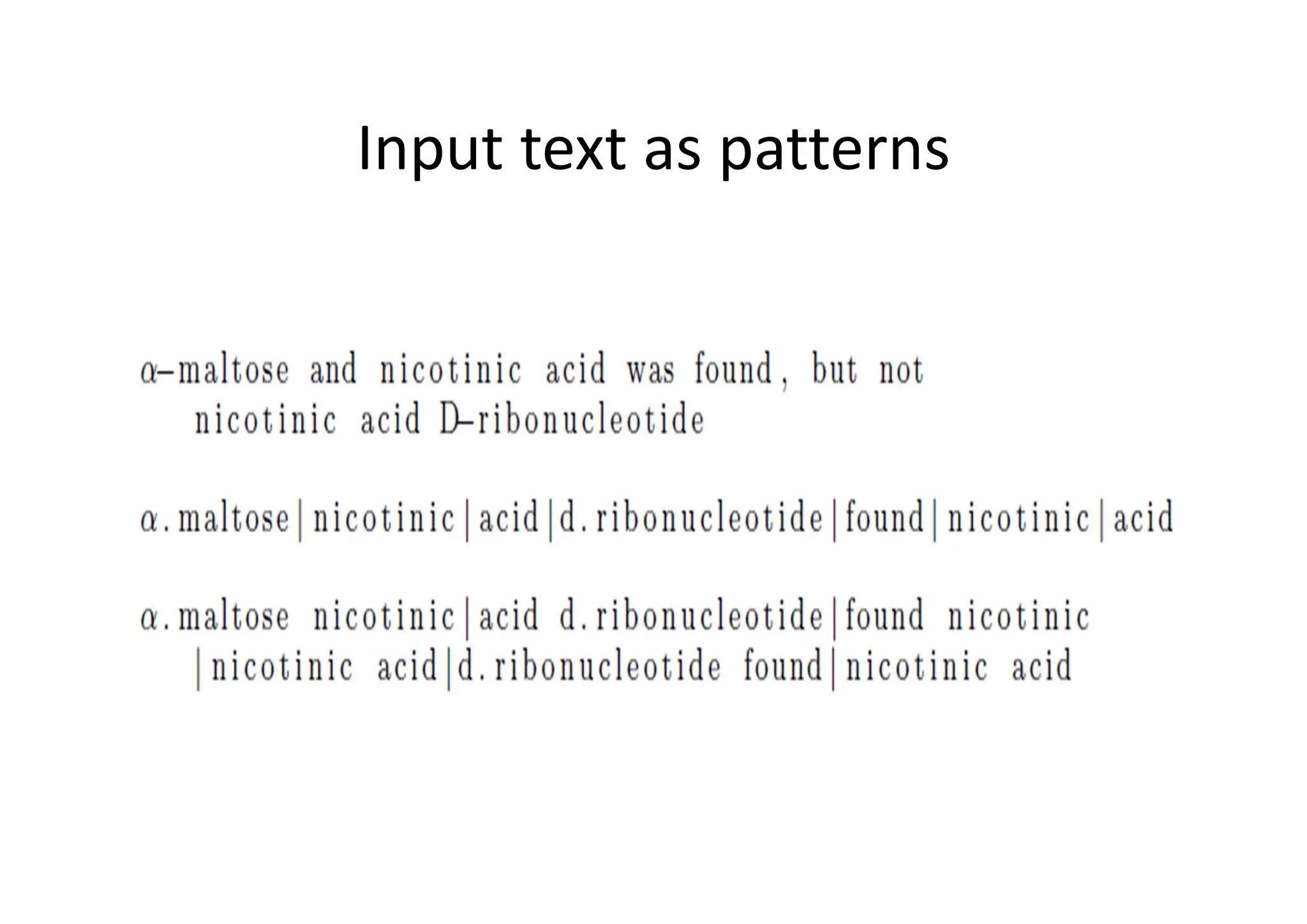
Input text as patterns
Output
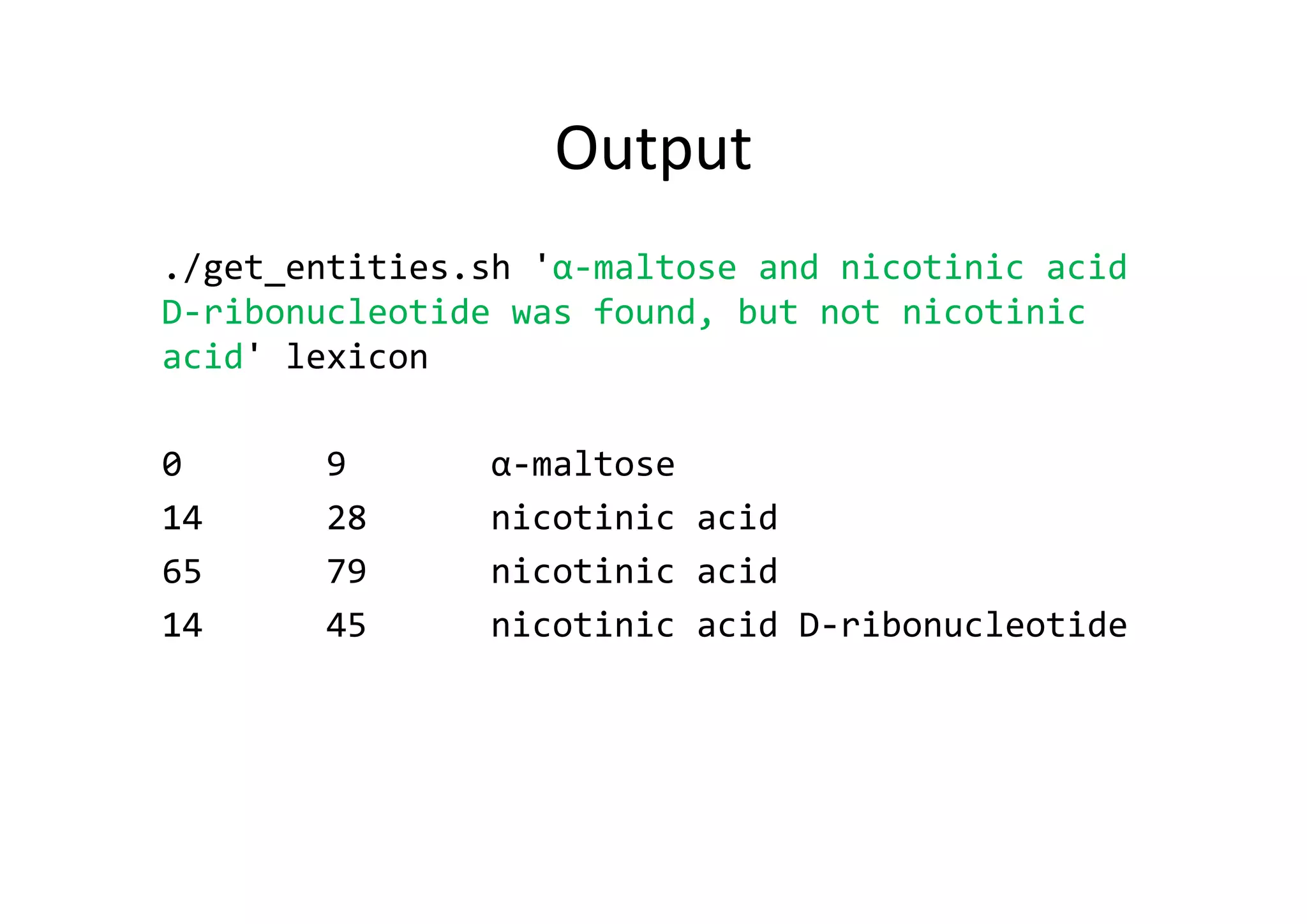
./get_entities.sh 'α‐maltose and nicotinic acid 
D‐ribonucleotide was found, but not nicotinic 
acid' lexicon
0       9       α‐maltose
14      28      nicotinic acid
65      79      nicotinic acid
14      45      nicotinic acid D‐ribonucleotide
ANNOTATION SERVER
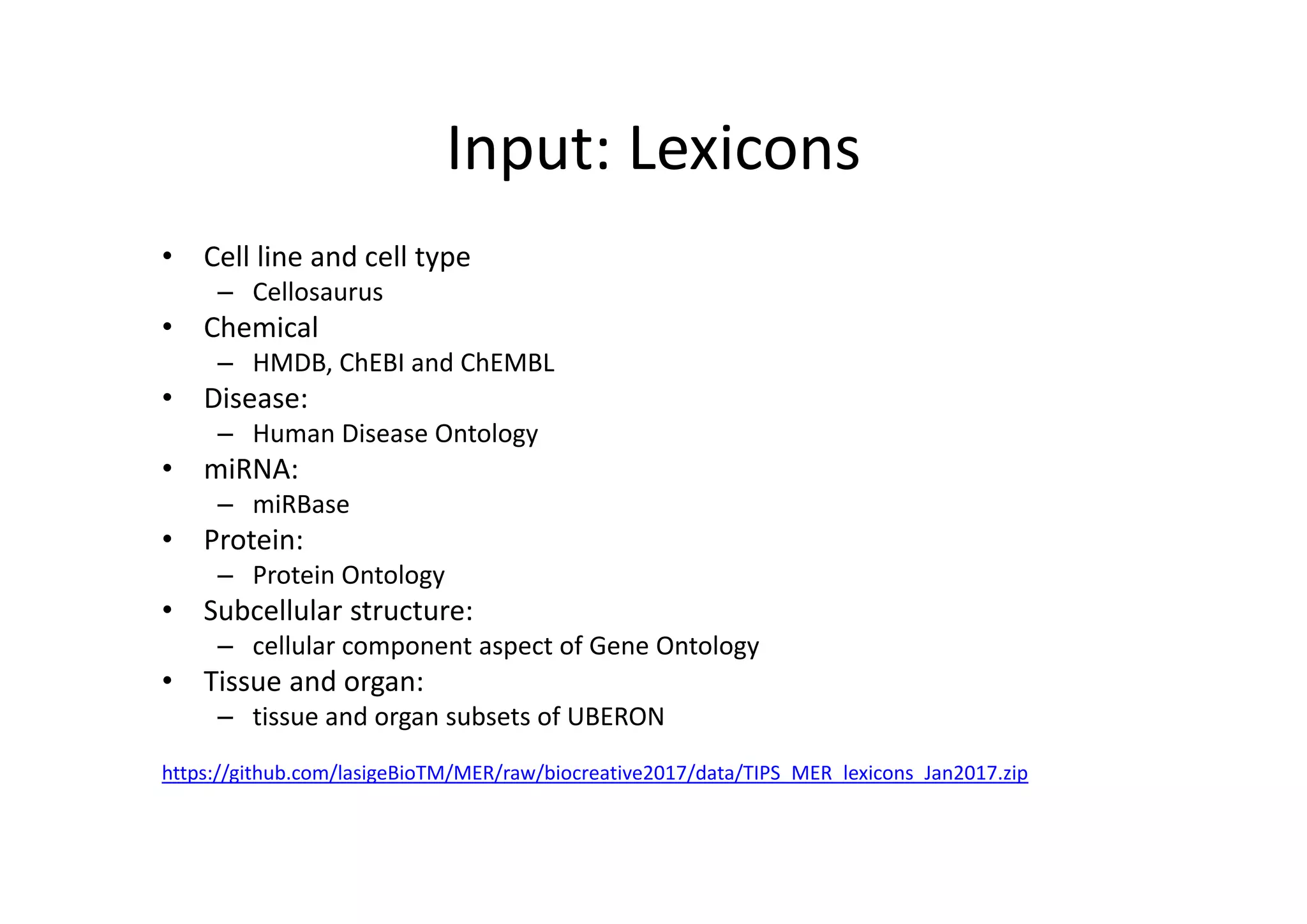
Input: Lexicons
• Cell line and cell type
– Cellosaurus
• Chemical
– HMDB, ChEBI and ChEMBL
• Disease: 
– Human Disease Ontology
• miRNA: 
– miRBase
• Protein: 
– Protein Ontology
• Subcellular structure: 
– cellular component aspect of Gene Ontology
• Tissue and organ: 
– tissue and organ subsets of UBERON
https://github.com/lasigeBioTM/MER/raw/biocreative2017/data/TIPS_MER_lexicons_Jan2017.zip
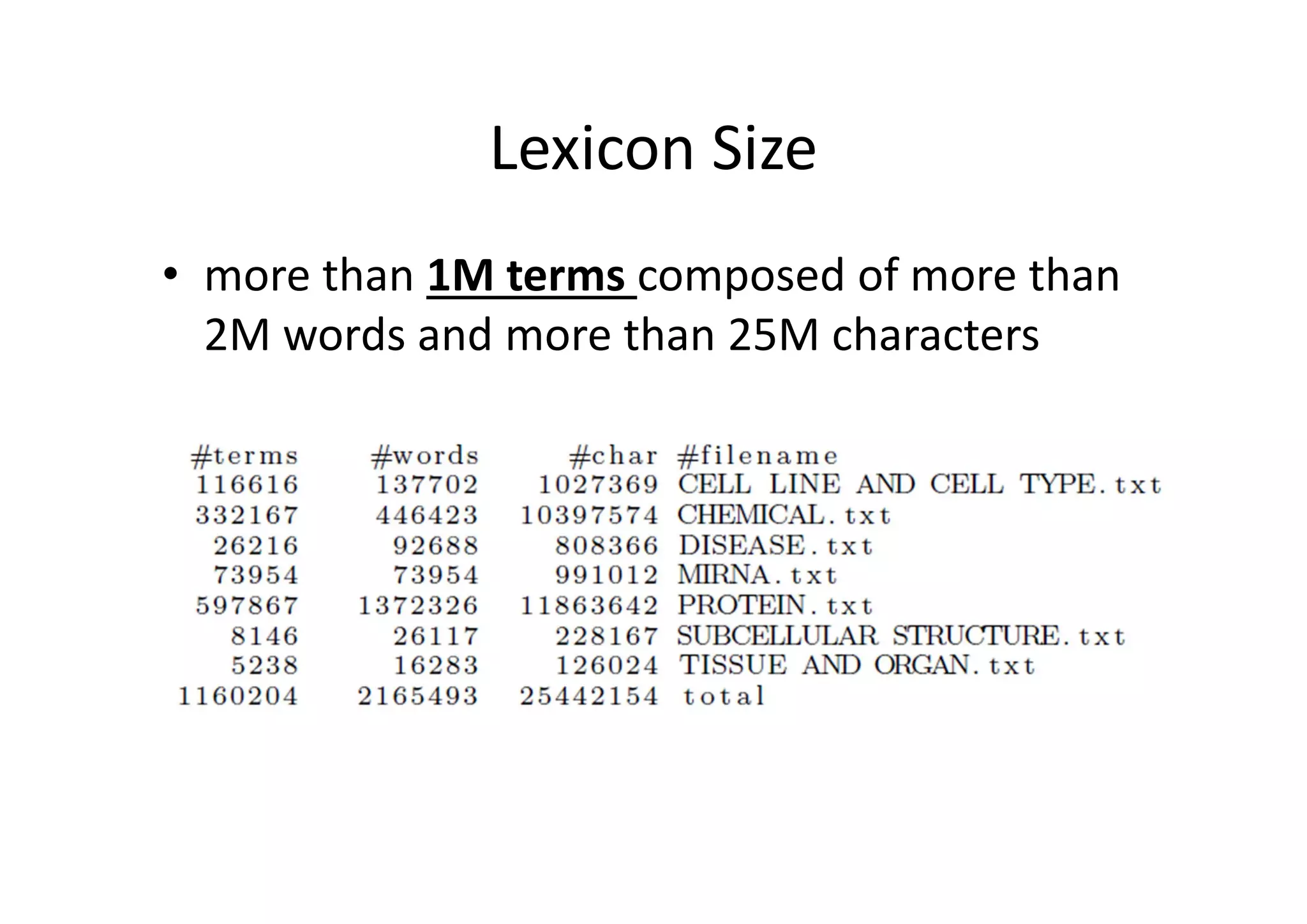
Lexicon Size
• more than 1M terms composed of more than 
2M words and more than 25M characters
Input: text
• jq
– a command‐line JSON processor 
– to parse the requests
• cURL
– to  download each document
• Parsers
– PubMed, Patents, PMC
https://github.com/lasigeBioTM/MER/tree/biocreative2017/external_services
• NO CACHE
Output
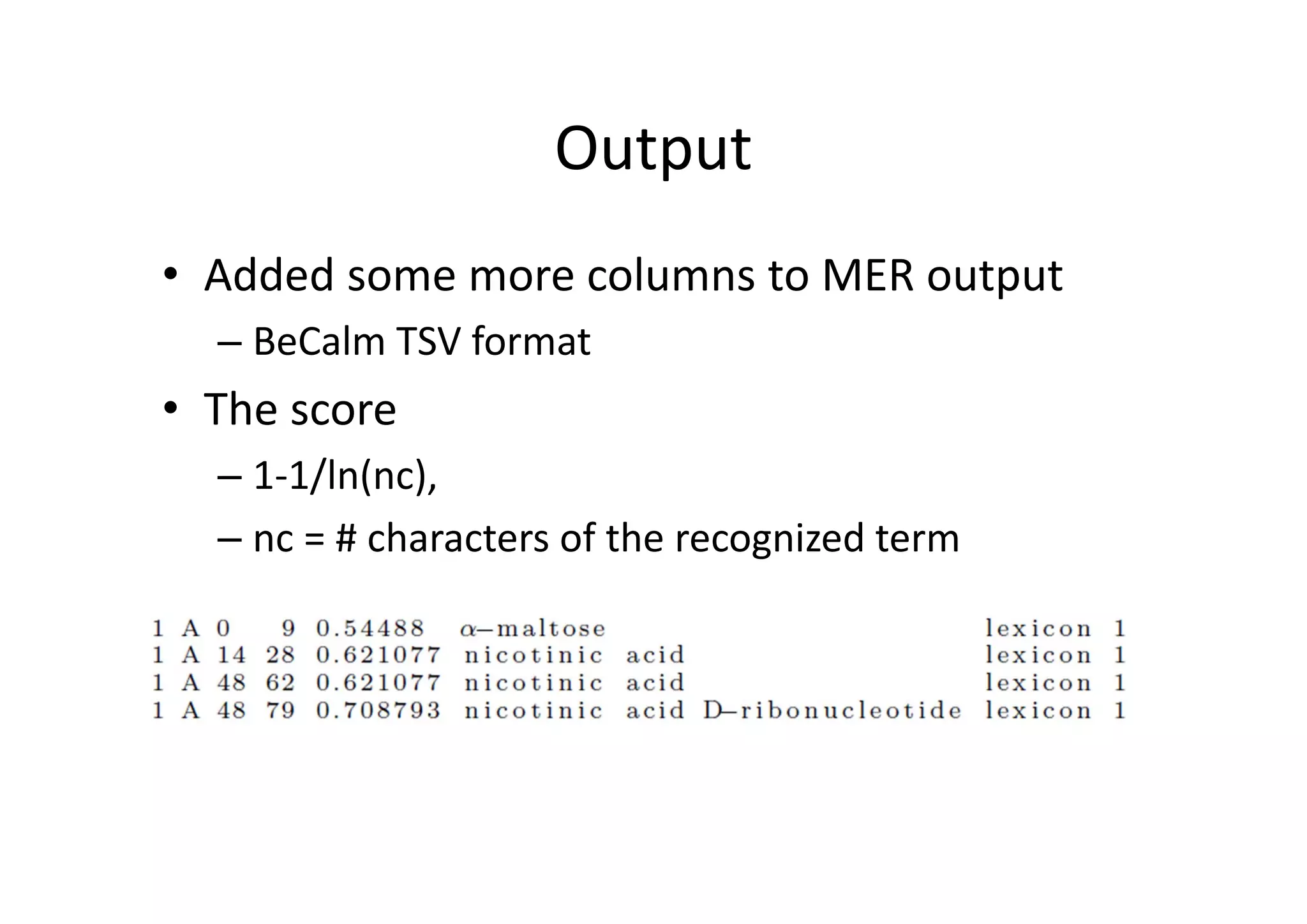
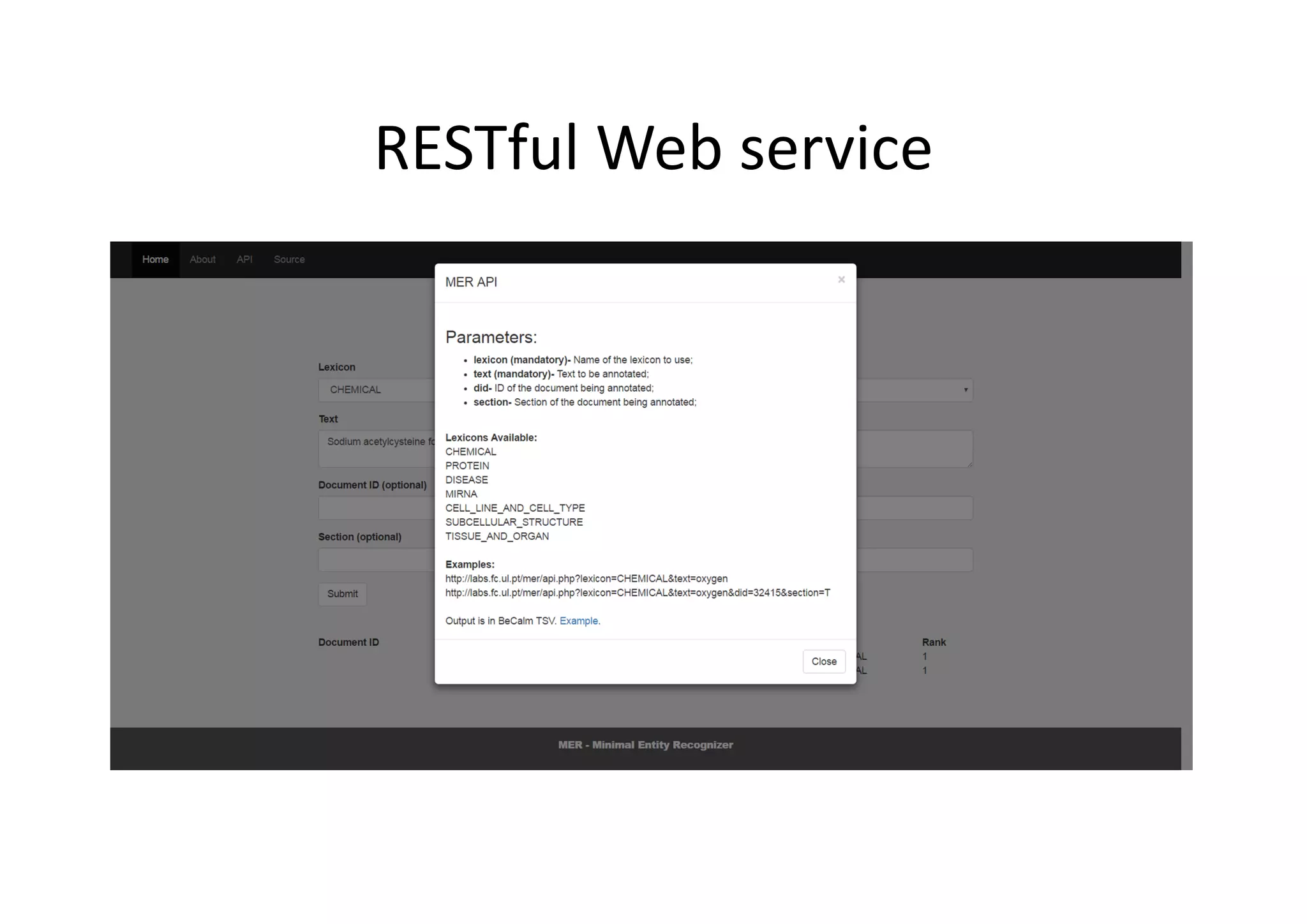
• Added some more columns to MER output
– BeCalm TSV format
• The score 
– 1‐1/ln(nc), 
– nc = # characters of the recognized term
Infrastructure
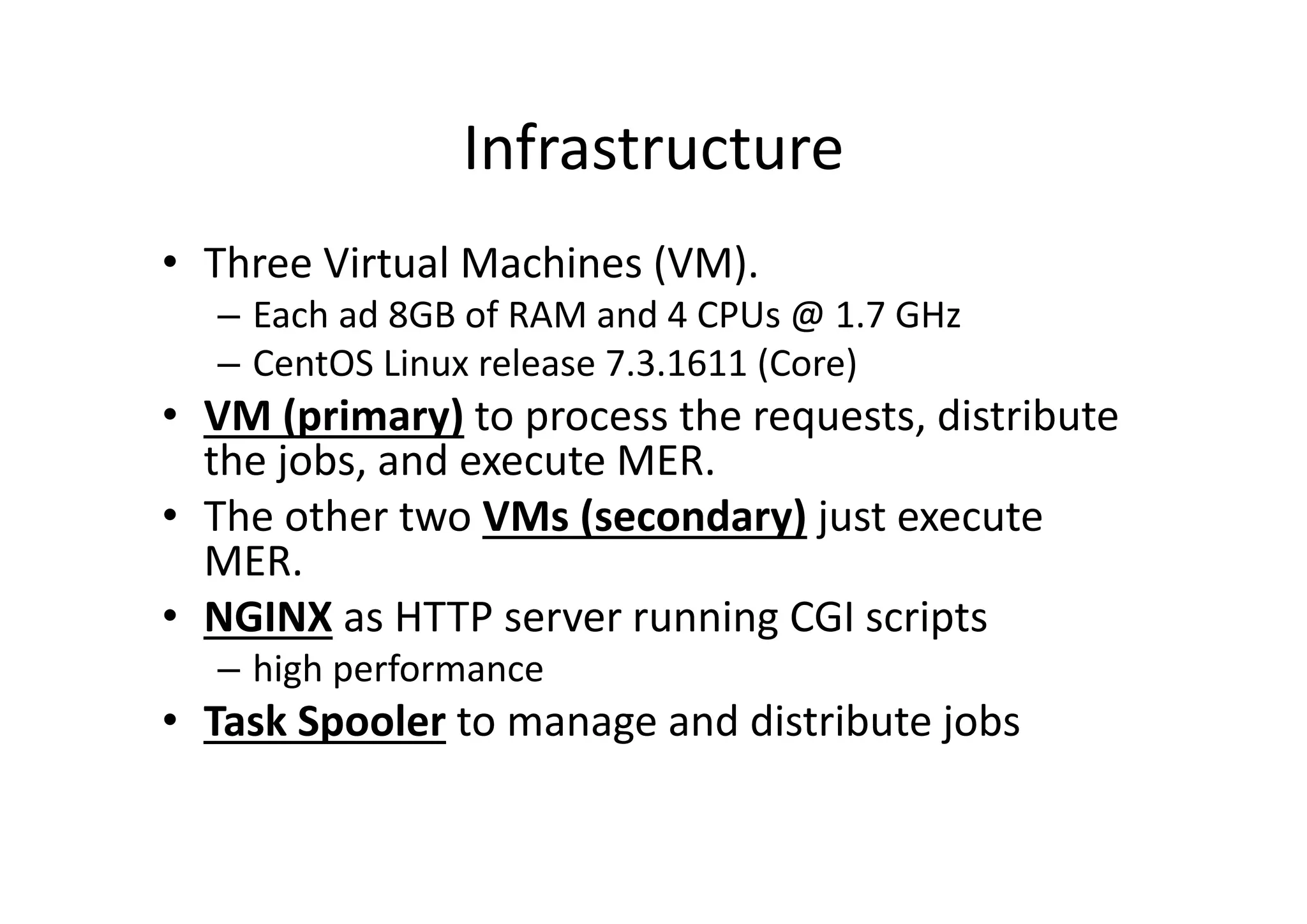
• Three Virtual Machines (VM). 
– Each ad 8GB of RAM and 4 CPUs @ 1.7 GHz
– CentOS Linux release 7.3.1611 (Core)
• VM (primary) to process the requests, distribute 
the jobs, and execute MER.
• The other two VMs (secondary) just execute 
MER. 
• NGINX as HTTP server running CGI scripts 
– high performance
• Task Spooler to manage and distribute jobs
Results
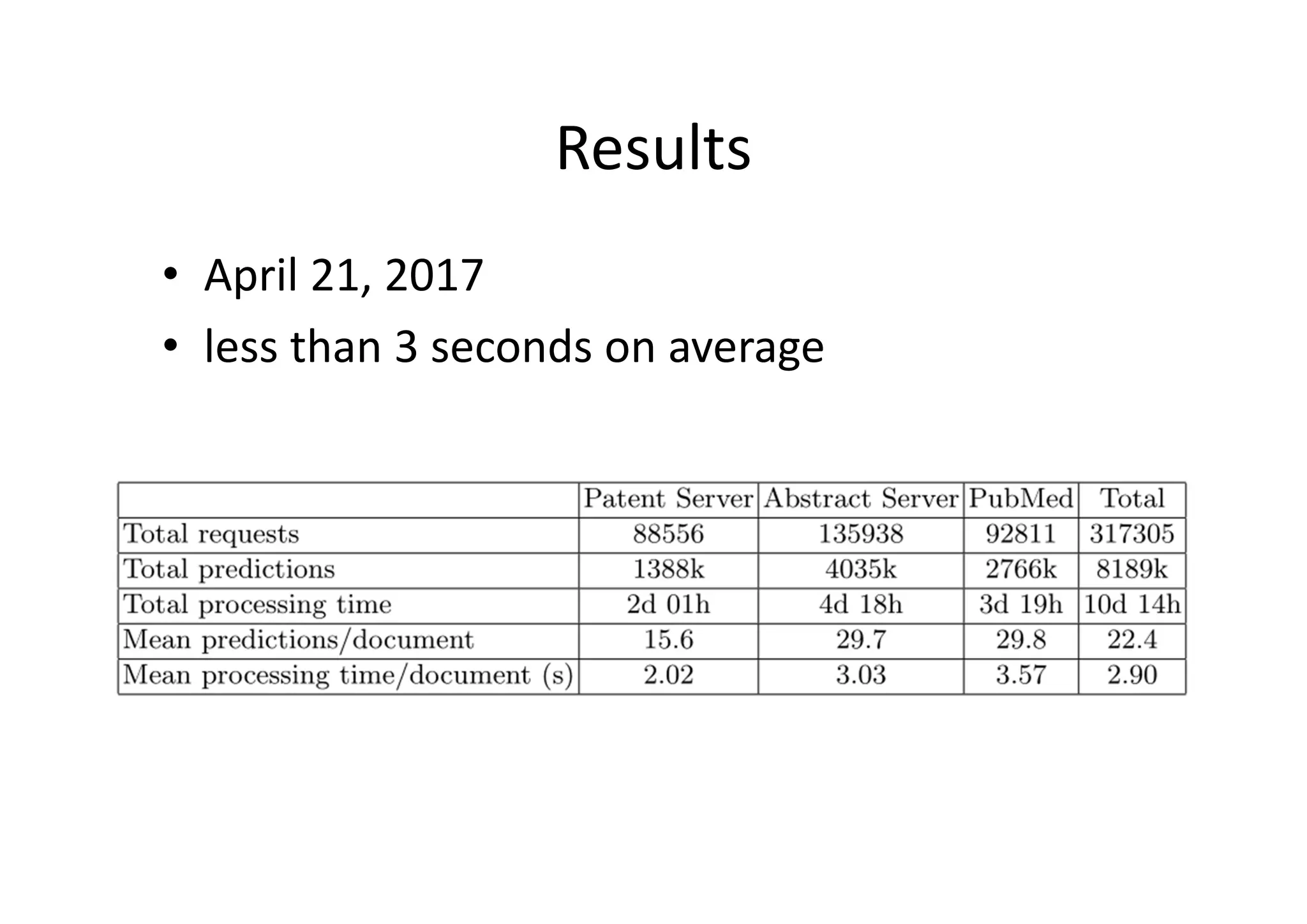
• April 21, 2017
• less than 3 seconds on average
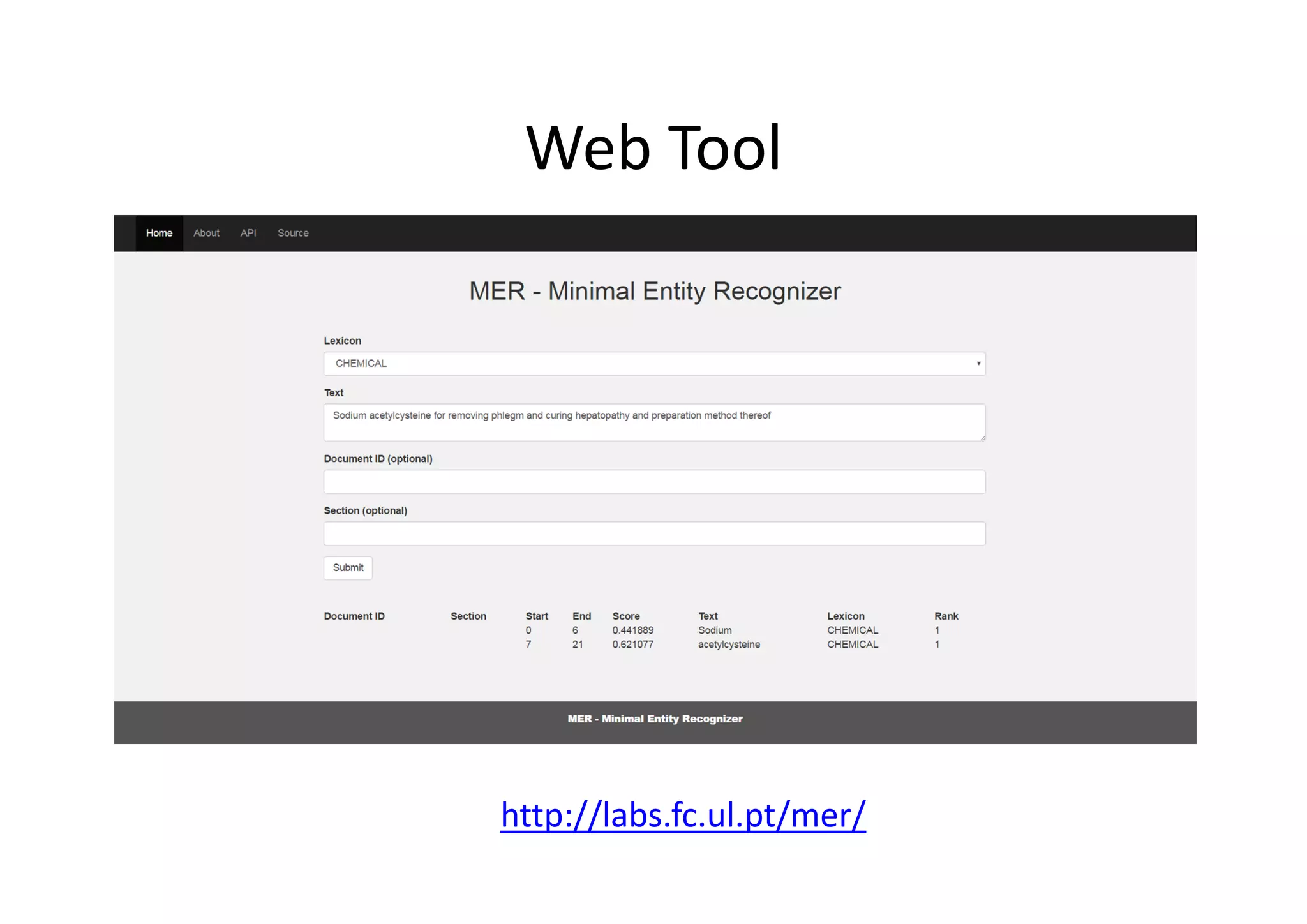
Web Tool
http://labs.fc.ul.pt/mer/
RESTful Web service
Conclusions
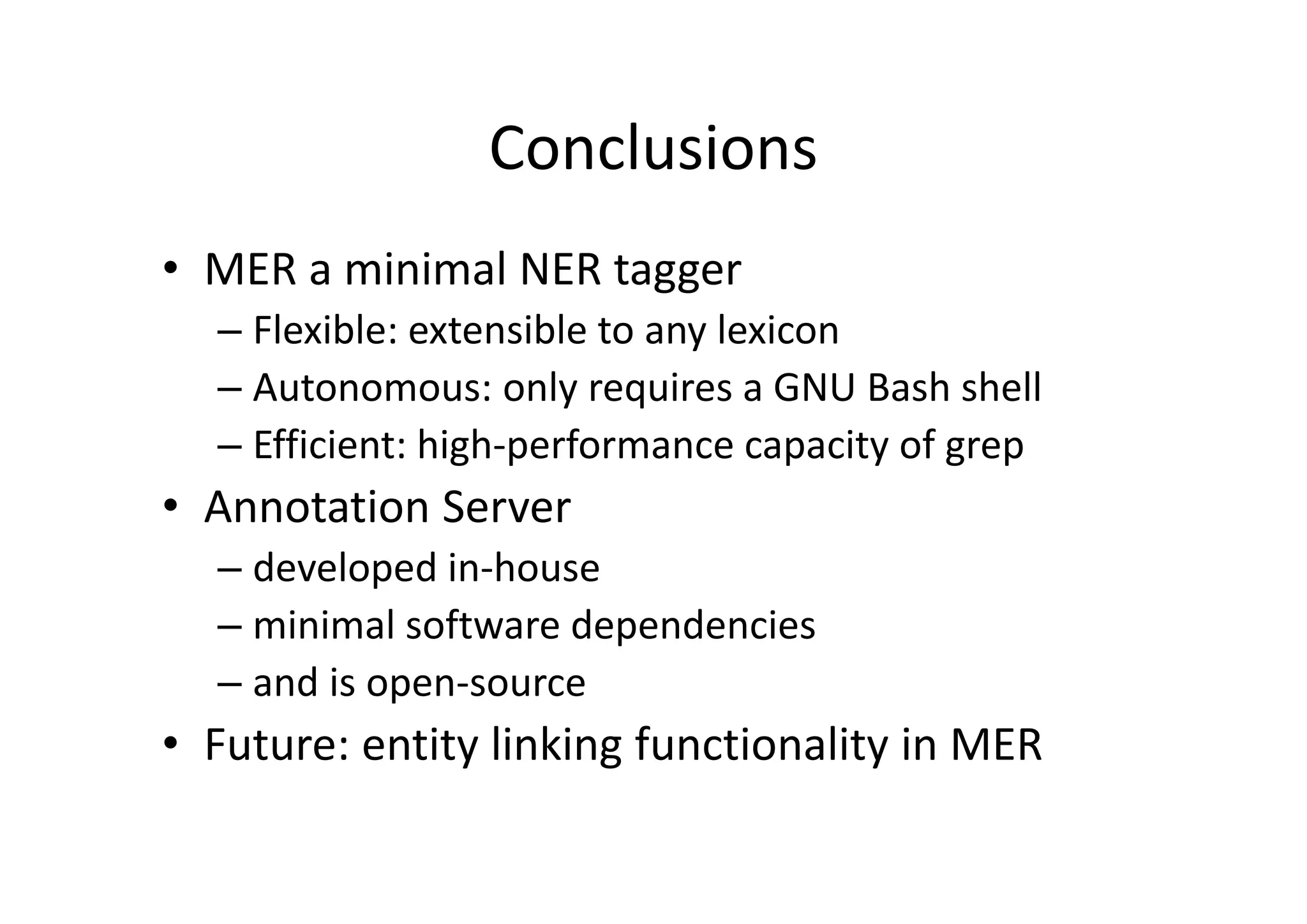
• MER a minimal NER tagger
– Flexible: extensible to any lexicon
– Autonomous: only requires a GNU Bash shell
– Efficient: high‐performance capacity of grep
• Annotation Server 
– developed in‐house 
– minimal software dependencies 
– and is open‐source
• Future: entity linking functionality in MER
Acknowledgments
• Portuguese National Distributed Computing 
Infrastructure (http://www.incd.pt)
• Links
– https://github.com/lasigeBioTM/MER
– http://labs.fc.ul.pt/mer/

MER: a Minimal Named-Entity Recognition Tagger and Annotation Server