Group Mentoring: Pilot with Professional Immigrant NetworksMentorpalooza Marketplace PresentationFarah Alizadehahi, JVS TorontoRacquel Sevilla, TRIECAugust 18, 2011
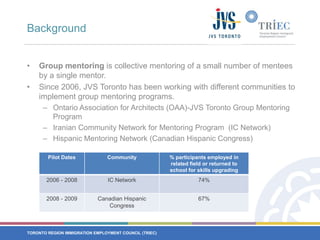
BackgroundGroup mentoring is collective mentoring of a small number of mentees by a single mentor. Since 2006, JVS Toronto has been working with different communities to implement group mentoring programs.Ontario Association for Architects (OAA)-JVS Toronto Group Mentoring ProgramIranian Community Network for Mentoring Program  (IC Network) Hispanic Mentoring Network (Canadian Hispanic Congress)
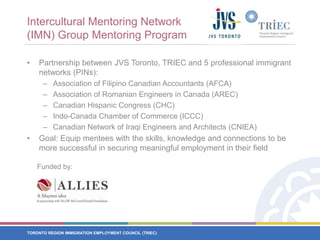
Intercultural Mentoring Network (IMN) Group Mentoring ProgramPartnership between JVS Toronto, TRIEC and 5 professional immigrant networks (PINs):Association of Filipino Canadian Accountants (AFCA)Association of Romanian Engineers in Canada (AREC)Canadian Hispanic Congress (CHC)Indo-Canada Chamber of Commerce (ICCC)Canadian Network of Iraqi Engineers and Architects (CNIEA)Goal: Equip mentees with the skills, knowledge and connections to be more successful in securing meaningful employment in their fieldFunded by:
Intercultural Mentoring Network (IMN) Group Mentoring ProgramModel: 1 mentor + 4-6 mentees from the same community and profession, 5 mentoring sessions over a 4 month period What’s newTrain PINs to run the program themselvesEach PIN will hire a coordinator for the programProgram modifications include train-the-trainer sessions and program document templatesSustainability training Facilitate interaction between PINsCross-cultural eventsSteering Committee with PINs representatives to assist in the planning, implementation and monitoring of the program
IMN Objectives & RationaleProvides a unique support to skilled immigrant mentees seeking meaningful employmentMentors understand how academic credentials and training from home countries differ and will be able to address cultural differences in a sensitive mannerMentors can more easily identify with the obstacles faced by menteesIncreases bonding social capital within groupsMentoring creates a community of people sharing the same background, education and work experience that share information and learn from each otherMentoring helps build capacity, leadership and engagement within communities
IMN Objectives & RationaleIncreases bridging social capital between groupsThrough the cross-cultural interaction, mentors, mentees and their communities will expand networks across cultures, develop relationships, and share learningBuilds leadership, organizational and program delivery capacity of the PINsLess time is spent on recruitment of mentors Maximizes the benefits with limited volunteer resources Networks will be equipped to run their own program
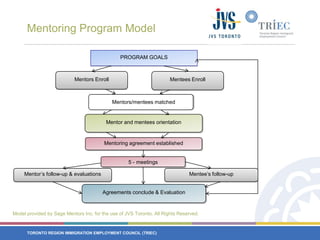
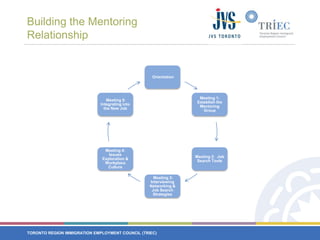
Mentoring Program ModelPROGRAM GOALSMentors EnrollMentees EnrollMentors/mentees matched Mentor and mentees orientationMentoring agreement established5 - meetingsMentor’s follow-up & evaluationsMentee’s follow-upAgreements conclude & Evaluation Model provided by Sage Mentors Inc. for the use of JVS Toronto. All Rights Reserved.
Building the Mentoring Relationship
Coach & Mentoring ResourcesMentoring Coach’s RoleFacilitate matchSupport mentor and menteesTroubleshoot and problem solveClarify the communications protocols between parties involvedProvide guidance; available to answer questionsReceive and provide feedback regarding relationship, program etc., Provide information and referrals to other resources/programs Provide guidance when expectations are not being met, boundaries are perceived to have been crossed, or testedFollow up the mentor and mentees after each group meeting for evaluation/feedback
Coach & Mentoring ResourcesProgram ResourcesMentor/Mentee Resource KitsMentor/Mentee Orientation SessionsForms (Evaluation, Agreement, etc.)
Some Factors for SuccessGroup size – 4 to 6 mentees in each mentoring groupMatching – homogeneous groups (examples to consider: professional backgrounds, career objectives, length of time in Canada, job-readiness of mentees)Training – e.g. job readiness, mentee expectations, building mentoring relationships, roles and responsibilities, group dynamicsUse of Resources – full utilization of available resources including the mentoring coach
Thank you!

Group Mentoring: TRIEC and JVS Toronto at Mentorpalooza, August 18, 2011

  • 1.
    Group Mentoring: Pilotwith Professional Immigrant NetworksMentorpalooza Marketplace PresentationFarah Alizadehahi, JVS TorontoRacquel Sevilla, TRIECAugust 18, 2011
  • 2.
    BackgroundGroup mentoring iscollective mentoring of a small number of mentees by a single mentor. Since 2006, JVS Toronto has been working with different communities to implement group mentoring programs.Ontario Association for Architects (OAA)-JVS Toronto Group Mentoring ProgramIranian Community Network for Mentoring Program (IC Network) Hispanic Mentoring Network (Canadian Hispanic Congress)
  • 3.
    Intercultural Mentoring Network(IMN) Group Mentoring ProgramPartnership between JVS Toronto, TRIEC and 5 professional immigrant networks (PINs):Association of Filipino Canadian Accountants (AFCA)Association of Romanian Engineers in Canada (AREC)Canadian Hispanic Congress (CHC)Indo-Canada Chamber of Commerce (ICCC)Canadian Network of Iraqi Engineers and Architects (CNIEA)Goal: Equip mentees with the skills, knowledge and connections to be more successful in securing meaningful employment in their fieldFunded by:
  • 4.
    Intercultural Mentoring Network(IMN) Group Mentoring ProgramModel: 1 mentor + 4-6 mentees from the same community and profession, 5 mentoring sessions over a 4 month period What’s newTrain PINs to run the program themselvesEach PIN will hire a coordinator for the programProgram modifications include train-the-trainer sessions and program document templatesSustainability training Facilitate interaction between PINsCross-cultural eventsSteering Committee with PINs representatives to assist in the planning, implementation and monitoring of the program
  • 5.
    IMN Objectives &RationaleProvides a unique support to skilled immigrant mentees seeking meaningful employmentMentors understand how academic credentials and training from home countries differ and will be able to address cultural differences in a sensitive mannerMentors can more easily identify with the obstacles faced by menteesIncreases bonding social capital within groupsMentoring creates a community of people sharing the same background, education and work experience that share information and learn from each otherMentoring helps build capacity, leadership and engagement within communities
  • 6.
    IMN Objectives &RationaleIncreases bridging social capital between groupsThrough the cross-cultural interaction, mentors, mentees and their communities will expand networks across cultures, develop relationships, and share learningBuilds leadership, organizational and program delivery capacity of the PINsLess time is spent on recruitment of mentors Maximizes the benefits with limited volunteer resources Networks will be equipped to run their own program
  • 7.
    Mentoring Program ModelPROGRAMGOALSMentors EnrollMentees EnrollMentors/mentees matched Mentor and mentees orientationMentoring agreement established5 - meetingsMentor’s follow-up & evaluationsMentee’s follow-upAgreements conclude & Evaluation Model provided by Sage Mentors Inc. for the use of JVS Toronto. All Rights Reserved.
  • 8.
  • 9.
    Coach & MentoringResourcesMentoring Coach’s RoleFacilitate matchSupport mentor and menteesTroubleshoot and problem solveClarify the communications protocols between parties involvedProvide guidance; available to answer questionsReceive and provide feedback regarding relationship, program etc., Provide information and referrals to other resources/programs Provide guidance when expectations are not being met, boundaries are perceived to have been crossed, or testedFollow up the mentor and mentees after each group meeting for evaluation/feedback
  • 10.
    Coach & MentoringResourcesProgram ResourcesMentor/Mentee Resource KitsMentor/Mentee Orientation SessionsForms (Evaluation, Agreement, etc.)
  • 11.
    Some Factors forSuccessGroup size – 4 to 6 mentees in each mentoring groupMatching – homogeneous groups (examples to consider: professional backgrounds, career objectives, length of time in Canada, job-readiness of mentees)Training – e.g. job readiness, mentee expectations, building mentoring relationships, roles and responsibilities, group dynamicsUse of Resources – full utilization of available resources including the mentoring coach
  • 12.

Editor's Notes

  • #3 OAA program – profession-specific; geared towards assisting mentees through the licensing processIC Network and CHC programs were geared towards helping mentees work towards employment  point to the results
  • #4 Meanwhile, TRIEC had started working collaboratively with PINs (networks by and for skilled immigrants  employment).Since 2010, we’ve been building a network of networks to help build PINs’ capacity to connect their members to employment – by learning from each other, developing partnerships with each other and other stakeholders and strengthening their leadership skills.Group mentoring – successful program that we could build on and extend to the PINs. Put the word out and 5 groups came forward to put in a joint proposal.Got funding from ALLIES.