PMI and the Project Manager
What is PMI? Global Not-for-Profit Professional Association   Founded by working project managers Members in 171 countries Global Standards  11 standards provide a common framework and language for projects across industries and regions Credentials  5 widely recognized credentials Based on both knowledge and work experience Educational Activities Continuing education for credential maintenance  Accreditation of academic PM programs Registered Education Providers (REPs)
Advancing the Profession Research Career Development Ethics and Sustainability PMI Educational Foundation Advocacy and Outreach
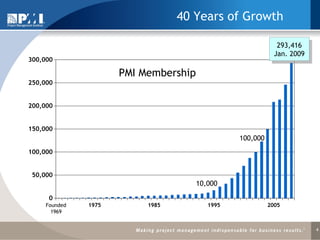
40 Years of Growth 293,416 Jan. 2009 10,000 100,000 Founded 1969 PMI Membership
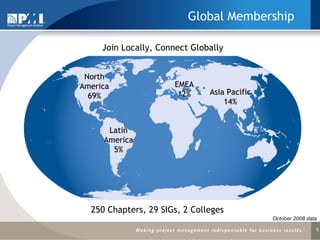
Global Membership October 2008 data 250 Chapters, 29 SIGs, 2 Colleges Join Locally, Connect Globally North America 69% Latin America 5% Asia Pacific 14% EMEA 12%
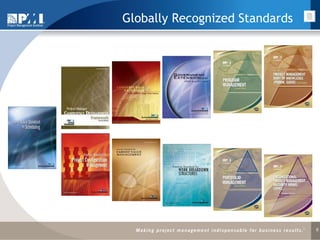
Globally Recognized Standards
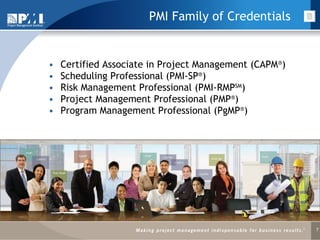
Certified Associate in Project Management (CAPM ® ) Scheduling Professional (PMI-SP ® ) Risk Management Professional (PMI-RMP SM ) Project Management Professional (PMP ® ) Program Management Professional (PgMP ® ) PMI Family of Credentials
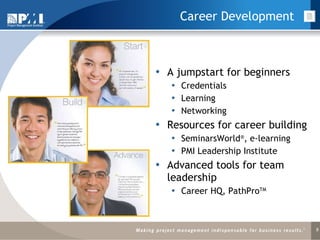
Career Development A jumpstart for beginners Credentials  Learning Networking Resources for career building SeminarsWorld ® , e-learning PMI Leadership Institute Advanced tools for team leadership Career HQ, PathPro TM
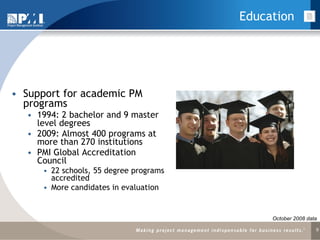
Education Support for academic PM programs 1994: 2 bachelor and 9 master level degrees 2009: Almost 400 programs at more than 270 institutions PMI Global Accreditation Council 22 schools, 55 degree programs accredited More candidates in evaluation October 2008 data
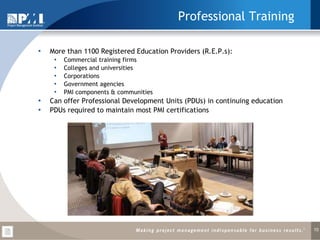
Professional Training More than 1100   Registered Education Providers (R.E.P.s): Commercial training firms Colleges and universities Corporations Government agencies PMI components & communities Can offer Professional Development Units (PDUs) in continuing education PDUs required to maintain most PMI certifications
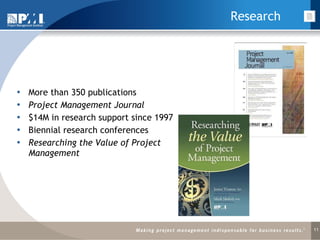
Research More than 350 publications Project Management Journal $14M in research support since 1997 Biennial research conferences Researching the Value of Project Management
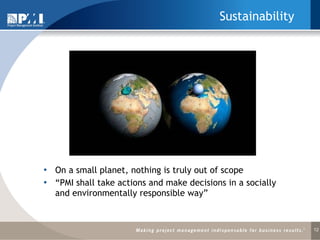
Sustainability On a small planet, nothing is truly out of scope “ PMI shall take actions and make decisions in a socially and environmentally responsible way”
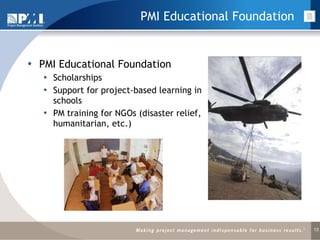
PMI Educational Foundation PMI Educational Foundation Scholarships Support for project-based learning in schools PM training for NGOs (disaster relief, humanitarian, etc.)
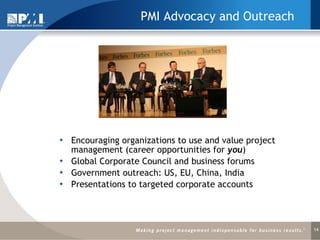
PMI Advocacy and Outreach Encouraging organizations to use and value project management (career opportunities for  you )   Global Corporate Council and business forums Government outreach: US, EU, China, India Presentations to targeted corporate accounts
Global Demand for Project Management $ 12 trillion per year  spent on fixed capital projects worldwide – 20% of global economy Trillions more in projects for IT, new product and service development, entertainment/IP, NGOs More than 20 million practitioners of project management Yet trillions at risk due to shortage of  trained  practitioners
Thank You www.pmi.org Questions?

Pmi And The Project Manager

  • 1.
    PMI and theProject Manager
  • 2.
    What is PMI?Global Not-for-Profit Professional Association Founded by working project managers Members in 171 countries Global Standards 11 standards provide a common framework and language for projects across industries and regions Credentials 5 widely recognized credentials Based on both knowledge and work experience Educational Activities Continuing education for credential maintenance Accreditation of academic PM programs Registered Education Providers (REPs)
  • 3.
    Advancing the ProfessionResearch Career Development Ethics and Sustainability PMI Educational Foundation Advocacy and Outreach
  • 4.
    40 Years ofGrowth 293,416 Jan. 2009 10,000 100,000 Founded 1969 PMI Membership
  • 5.
    Global Membership October2008 data 250 Chapters, 29 SIGs, 2 Colleges Join Locally, Connect Globally North America 69% Latin America 5% Asia Pacific 14% EMEA 12%
  • 6.
  • 7.
    Certified Associate inProject Management (CAPM ® ) Scheduling Professional (PMI-SP ® ) Risk Management Professional (PMI-RMP SM ) Project Management Professional (PMP ® ) Program Management Professional (PgMP ® ) PMI Family of Credentials
  • 8.
    Career Development Ajumpstart for beginners Credentials Learning Networking Resources for career building SeminarsWorld ® , e-learning PMI Leadership Institute Advanced tools for team leadership Career HQ, PathPro TM
  • 9.
    Education Support foracademic PM programs 1994: 2 bachelor and 9 master level degrees 2009: Almost 400 programs at more than 270 institutions PMI Global Accreditation Council 22 schools, 55 degree programs accredited More candidates in evaluation October 2008 data
  • 10.
    Professional Training Morethan 1100 Registered Education Providers (R.E.P.s): Commercial training firms Colleges and universities Corporations Government agencies PMI components & communities Can offer Professional Development Units (PDUs) in continuing education PDUs required to maintain most PMI certifications
  • 11.
    Research More than350 publications Project Management Journal $14M in research support since 1997 Biennial research conferences Researching the Value of Project Management
  • 12.
    Sustainability On asmall planet, nothing is truly out of scope “ PMI shall take actions and make decisions in a socially and environmentally responsible way”
  • 13.
    PMI Educational FoundationPMI Educational Foundation Scholarships Support for project-based learning in schools PM training for NGOs (disaster relief, humanitarian, etc.)
  • 14.
    PMI Advocacy andOutreach Encouraging organizations to use and value project management (career opportunities for you ) Global Corporate Council and business forums Government outreach: US, EU, China, India Presentations to targeted corporate accounts
  • 15.
    Global Demand forProject Management $ 12 trillion per year spent on fixed capital projects worldwide – 20% of global economy Trillions more in projects for IT, new product and service development, entertainment/IP, NGOs More than 20 million practitioners of project management Yet trillions at risk due to shortage of trained practitioners
  • 16.

Editor's Notes

  • #3 PMI was founded in 1969 by five working project managers who understood that project management is a discipline with principles, practices and lessons of its own -– not a subset of “management in general” that any manager can pick up along the way. They understood the value of sharing experience and discussing recurring project challenges. Their foresight is proven by PMI’s growth to nearly 500,000 members and credential holders around the world. Business, government and other organizations increasingly recognize that project management is vital to successful outcomes. Higher career earnings for credential holders are testimony to the value of PMI’s efforts. The professional and practice standards developed and updated by PMI volunteers around the world represent a growing body of knowledge that can be applied to projects in many industries and nations. PMI’s credentials are reliable indicators that those earning them are accomplished project team members and leaders, who sharpen their skills with continuing education. As project management programs develop in more and more schools of business, engineering, computer science, and other fields, PMI works with universities to ensure high standards of professional education. It also registers more than 1100 education providers, including corporate training & development organizations and PMI components, that meet rigorous standards for instruction in project management.
  • #4 Since its founding, PMI has invested more than $14 million in academic research to expand its knowledge base. It continues to do so on a scale unmatched by any other association in the field. The results of that research, along with the practical insights of on-the-job experience, are shared at global, regional, national and local meetings, as well as through a research journal, other publications – and, increasingly, online. That knowledge sharing is an important benefit of PMI membership. Participation in local chapters and in virtual communities organized around special interests can provide a big boost to your career. Along with the knowledge sharing, there are frequent networking opportunities that help you find the right opportunities. PMI’s Board of Directors and its executives are committed to make ethics and sustainability (environmental, economic, and social) part of the fabric of project management training and practice. The PMI Educational Foundation supports project-based education, awards scholarships, and provides training to humanitarian and disaster-relief organizations. To complement all these activities, PMI continues to expand and deepen its founding insight ─ that project management has become a profession in its own right, delivering important economic and social value ─ in communications targeted at organizations and key decision-makers around the world. [if appropriate] As well as project managers and potential members such as yourselves!
  • #5 That’s the top-line summary. Now let’s go into a little more detail. Project management has a long history in construction, civil engineering, and other naturally project-oriented fields that typically bring together new teams for each contract. But as this chart of PMI membership suggests, something changed in the 1990s. Both the rate of growth and the variety of organizations taking an active interest in project management “took off.” Information technology and the spread of Internet use certainly played a part in that. Hundreds of thousands of IT projects brought organizations online, and management of software development projects brought many new practitioners -– and PMI members. More broadly, the pace of change -– in globalization and the sharper competition it brought, in faster product development cycles, in teams and business partners spread across continents and time zones – meant that organizations were doing more new projects with more new teams every year. That made the common framework embodied in PMI’s standards even more valuable. All together, these factors have brought more and more project managers to PMI membership and crtedentials.
  • #6 Hundreds of thousands of people participate in activities of the 250 local PMI chapters around the world. In addition to those geographic communities, there have long been “virtual communities”: specific interest groups or SIGs organized around topics, and the Colleges of Scheduling and Risk Management. In the Virtual Communities Project (VCP,) PMI is enhancing these components with a shared Web infrastructure to support more active knowledge exchange and networking. In 2008 nearly 8000 people attended our four Global Congresses, in Sydney, Malta, São Paulo, and Denver. They took advantage of those meetings as educational and networking opportunities. Sponsors and exhibitors responded with record levels of participation. In 2007, PMI opened a service center in New Delhi, to serve more than 13,000 members in India, like those we operate for membership support in the United States, Brussels and Singapore. In 2008 business development office opened in Mumbai and Bangalore, India, joining those already operating in Washington, DC, Brussels and Beijing. In 2009 another will open in Australia.
  • #7 The eleven current PMI standards have been developed by experienced practitioners ─ professionals who volunteer their time to capture the knowledge accumulated in thousands of projects around the world. Each standard is regularly updated. The “foundation” standard, A Guide to the Project Management Body of Knowledge or PMBOK® Guide , has more than two million copies in circulation. All PMI members receive a complimentary digital copy. A Guide to the Project Management Body of Knowledge (PMBOK® Guide) — Fourth Edition ( 12/08 ) Construction Extension to the PMBOK® Guide ─ Third Edition   Government Extension to the PMBOK® Guide ─ Third Edition      Practice Standard for Earned Value Management  Practice Standard for Project Configuration Management  Practice Standard for Scheduling  Practice Standard for Work Breakdown Structures — Second Edition   The Standard for Program Management   ─ Second Edition (12/08) Project Manager Competency Development Framework  ─ Second Edition      Organizational Project Management Maturity Model (OPM3®)   ─ Second Edition (12/08)   The Standard for Portfolio Management ─ Second Edition (12/08) http://www.pmi.org/AboutUs/Pages/Standards.aspx
  • #8 Certified Associate in Project Management (CAPM ® ) – 6,200 as of October 2008. Scheduling Professional (PMI-SP ® ) – introduced spring 2008, 92 credentialed and 300+ in pipeline as of 1 Oct 2008 Risk Management Professional (PMI-RMP SM ) – introduced Sept. 2008 These three credentials are aimed primarily at the starting segment of practitioners (see next slide) Project Management Professional (PMP ® ) -- recognized and transferable worldwide – 307,000 as of October 2008 This credential is held by most of those building their careers Program Management Professional (PgMP ® ) – introduced in 2007; 149 as of October 2008 This credential is aimed at advanced practitioners responsible for building and managing multiple teams http://www.pmi.org/AboutUs/Pages/Credentials.aspx
  • #9 One of the most valuable benefits of PMI membership is knowledge sharing at every stage of a project manager’s career. If you’re starting out: 27% of PMI members have spent fewer than 5 years in the field. Their interests are in basic information, networking and career paths. If that describes you, try the online Basic Knowledge Assessment. Familiarize yourself with PMI’s credentials and their requirements, and plan a course of preparation through self-study or with an R.E.P. Check out the journal articles and research papers at the Virtual Library, and the books and study aids available at PMI marketplace. And most of all, take advantage of the many networking opportunities, from chapter meetings to virtual communities online to the Global Congresses. If you’re building your career: 63% of members have 5 to 19 years in the field, and are more likely to hold the PMP credential. They have a clear idea of their strengths and interests: many of them make use of the multi-day courses offered through SeminarsWorld®, or online versions at eSeminarsWorld SM . PMPs are the backbone of volunteer activity in components.. Volunteer leaders can take part in the PMI Leadership institute. If you’ve advanced to program or portfolio management (or lead a team of project managers), you may be among the 10% of members with 20 or more years’ experience. They use PMI membership and credentials to identify candidates for high-performing project teams, posting opportunities at PMI Career Headquarters. Some have earned the PgMP credential as recognition of their expertise. And they’re positioned as champions of project management in their organizations. For example, they’re often the pioneers in using PathPro TM , an interactive career planning tool that helps organizations recruit, retain, assess and promote their brightest stars. http://www.pmi.org/CareerDevelopment/Pages/Default.aspx
  • #10 Many independent studies have shown a growing gap between the need for skilled project managers and the projected supply. To keep this vital “pipeline” filled, PMI has always encouraged the academic community to embrace project management as a discipline. In 1994, PMI was able to identify only a handful of project management programs — primarily in construction management. By 2008, the number had grown to almost 400 degree programs at 277 institutions worldwide. They are found in schools of business management, engineering, architecture and information technology. In 2001 PMI established the Global Accreditation Council in 2001 to review and recognize the qualifications of degree programs. Accredited institutions: http://www.pmi.org/CareerDevelopment/Pages/Degree-Directory.aspx
  • #11 An R.E.P. is an organization approved by PMI® to issue Professional Development Units (PDUs) for its training courses. Courses offered by R.E.P.s, PMI components — chapters, SIGs, colleges — and PMI are pre-approved for Contact Hours in fulfillment of certification eligibility requirements, as well as PDUs to fulfill Continuing Certification Requirements (CCR) . The R.E.P. program is designed to enhance the professional development of PMI's members, those credentialed through PMI and others in the project management profession. Over the years, the R.E.P. program has been revised and improved to ensure those that have earned R.E.P. status are capable of providing effective training. All R.E.P.s are reviewed every three years. Find an R.E.P. at: http://www.pmi.org/CareerDevelopment/Pages/Find-a-Registered-Education-Provider.aspx
  • #12 PMI’s commitment to research began with the first issue of the peer-reviewed Project Management Journal in 1970. Over the years, PMI has published hundreds of books and monographs. PMI is the only project management organization with a dedicated research program. Formed in 1997, the program is the acknowledged leader in support of global PM research, knowledge creation and the application of research to practice. It currently supports 15 to 20 research projects per year, drawing on a worldwide virtual community of hundreds of scholars and practitioners. http://www.pmi.org/AboutUs/Pages/Research.aspx The most prominent recent publication was Researching the Value of Project Management , the result of a three-year, $2.5 million study enlisting 48 researchers around the globe to conduct extensive case studies and interviews at more than 60 corporations, government agencies and other organizations. The project yielded quantifiable proof that project management delivers real value – in better integrated operations, in organizational learning, and in communications. It keeps projects aligned with organizational strategy, and executes that strategy more effectively. http://www.pmi.org/BusinessSolutions/Pages/Researching-Value-of-Project-Management-Study.aspx
  • #13 This image shows the relative volume of all the earth’s water on the left, and all its air on the right. We can see vividly how thin the “film” of the earth’s living environment is. Projects affect the world -- environmentally, financially, socially – on a larger scale every year. Questions of sustainability can no longer be dismissed as “out of scope.” PMI is determined to be part of the solution to the broadest global challenges. Its Board of Directors has added a new strategic principle [text above] to PMI’s charter, and is working to make sustainability central to the practice as well as the principles of our profession.
  • #14 The PMI Educational Foundation is the philanthropic arm of PMI, dedicated to improving global society through project management knowledge and skills. Its goals include: A better prepared workforce for the future, helping bridge the project management talent gap by funding more and greater-value academic scholarships, awards and other support for the study of project management and related fields. A better prepared society for future success, implementing and expanding project-based learning programs in primary and secondary schools and community-based organizations around the world.  A better prepared response in future times of need, providing project management training to front-line disaster relief personnel and improving the project management maturity of humanitarian and other non-governmental organizations so that they may use their limited resources more efficiently and effectively. http://www.pmi.org/pmief/
  • #15 One part of PMI’s activity that is rarely visible to members -- but crucial in expanding the scope for their careers – is its advocacy and outreach to organizations. This effort prepares the ground for still wider acceptance of project management in business, government, and non-profit organizations. And that means more opportunities for you as a project manager. 28 respected organizations (among them Bank of America, Boeing, the US Dept. of Energy, Huawei Technologies, Nokia, and Siemens), are members of PMI’s Global Corporate Council, participating in a two-way flow of information and experience. PMI executives and members of its Board of Directors take part in business forums around the world. At a recent Forbes conference, editor Rich Karlgaard said of PMI: “If you don’t know PMI, find out what they do. The practice of project management will be the activity that makes or breaks many global companies in this economic environment.” PMI also reaches out to government agencies from Washington, DC to Brussels to Beijing, spreading the message of project management as a strategic competency in achieving public goals. And it targets executives at large and medium-sized corporations on six continents, showing them the value of project management in achieving their organizations’ results.
  • #16 The scope for that outreach keeps growing. In 2008, Global Insight estimated that roughly $12 trillion is spent annually on “gross fixed capital formation”: building construction, land improvements, plant, machinery, and equipment purchases, and the construction of roads, railways, and the like. Triillions more are spent on IT software and services, on new product development, and on new business processes. Even in the current economic downturn, projects are a fifth of gross global product – and economic stimulus efforts in many countries will generate countless new projects. A recent study by the Anderson Economic Group estimated that in just 11 countries, more than $4.5 trillion is at risk through 2016 because of a shortage of trained project managers. By some estimates, 20 million people manage projects as part or all of their jobs. The overwhelming majority have no formal training or certification of any kind… so there’s plenty of room for trained and credentialed project mangers, today and in the future..
  • #17 I hope this talk has made it clear that PMI’s efforts are also of great value to those of you who have chosen – or may choose – to build a career in project management. I urge you to find out more, to become a PMI member if you are not already, and to take an active part in this global community. Thank you. All contents © 2009, Project Management Institute, Inc. “PMI”, the PMI logo, “Making project management indispensable for business results”, “PMBOK”, “CAPM”, “PMP”, “PgMP”, “Program Management Professional (PgMP)” and “PMI Scheduling Professional (PMI-SP)” are registered marks; “PMI Risk Management Professional (PMI-RMP)” is a service mark of Project Management Institute, Inc.