Mental Health :
Challenges & Solution
By- Dr. Shailendra Pratap Singh
Content
• Introduction
• Challenges in Mental Health
• National level initiatives
Mental Health
• Mental health is the balanced development of
individual’s personality & emotional attitudes
which enables him to live harmoniously with
his fellow men.
In 1947, India had 10 000 psychiatric
beds for a population of over 300
million, compared to the UK,
which, with one-tenth the population of
India, had over 150 000
psychiatric beds!
• The major development was in 1975, when a
new initiative to integrate mental health with
general health services, also referred to as the
community psychiatry initiative, was adopted
to develop mental health services.
• The National Mental Health Programme
(NMHP) was formulated in 1982
• During the past 3 decades, there have been a
large number of other community initiatives
to address a wide variety of mental health
needs of the community through programmes
on suicide prevention, care of the elderly,
substance use and disaster mental healthcare,
and by setting up of daycare centres, half-way
homes, longstay homes and rehabilitation
facilities
Challenges for mental healthcare in India
• 1. Large ‘unmet need’ for mental healthcare in
the community
• 2.Poor understanding of psychological
distress as requiring medical intervention in
the general population
• 3. Limited acceptance of modern medical care
for mental disorders among the general
population
• 4. Limitations in the availability of mental
health services (professionals and facilities) in
the public health services
• 5.Poor utilization of available services by the ill
population and their families
• 6. Problems in recovery and reintegration of
persons with mental illnesses
• 7. Lack of institutionalized mechanisms for
organization of mental healthcare
1.A large ‘unmet need’ for mental
healthcare in the community
• Though the prevalence rates of depression
are higher than those of psychoses, the rates
of treatment are far lower, pointing to limited
awareness in the community.
• The rates of treatment were lower in rural
compared with urban areas (61.7% v.
47.5%),and higher in the higher income
quartiles.
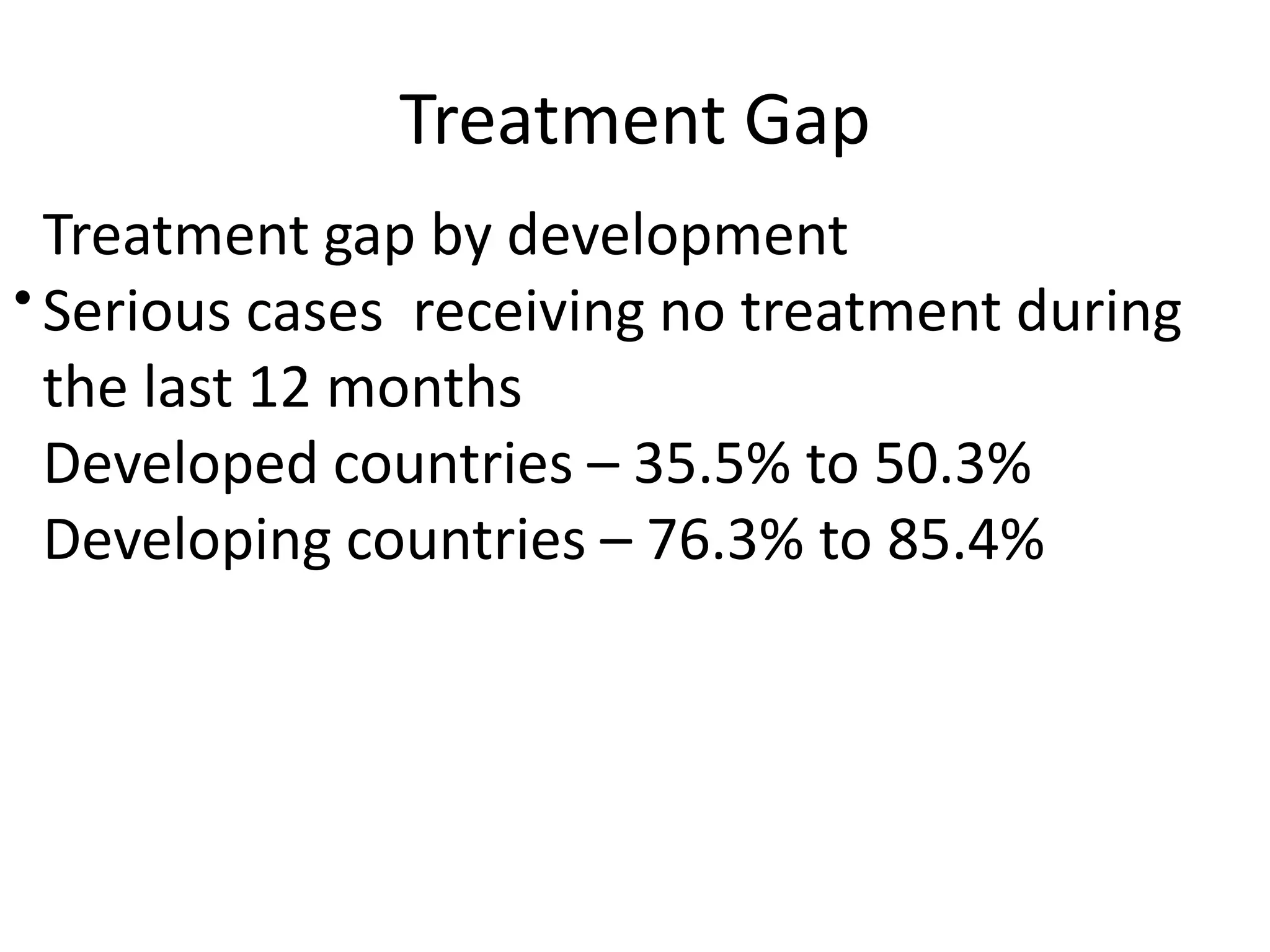
Treatment Gap
•
Treatment gap by development
Serious cases receiving no treatment during
the last 12 months
Developed countries – 35.5% to 50.3%
Developing countries – 76.3% to 85.4%
2.‘Psychological distress’ requires medical intervention:
Lack of awareness and stigma
• There are two aspects to the current lack of
knowledge of the population about mental
health.
• First are the existing beliefs and practices.
• Second, stigma is an important barrier to
mental healthcare.
• It used face-to-face interviews with 732
participants. Negative discrimination was
experienced
• By 47% of the participants in making or keeping
friends,
• By 43% from family members,
• By 29% in finding a job, by 29% in keeping a job,
• By 27% in intimate or sexual relationships.
• Positive discrimination was rare
• Anticipated discrimination affected -
• 64% in the matter of applying for work, and in
training or education,
• 55% while looking for a close relationship;
• 72% felt the need to conceal their diagnosis.
• Over a third of the participants anticipated
discrimination when seeking jobs and close
personal relationships, even when no
discrimination was experienced.
3.Problems due to multiplicity of healthcare
systems and existing beliefs
• India is home to a pluralistic approach to all
types of healthcare. Not only are there other
systems of healthcare other than modern
medicine such as Ayurveda, Unani,
Naturopathy and Homoeopathy, but also
people approach religious places for help,
especially in case of mental illness.
• There is a need for professionals of all systems of
care to initiate a dialogue and communicate the
relative suitability and effectiveness of different
approaches to care in different aspects of mental
health (prevention, promotion and treatment).
• There is no need for each of them to be equally
suitable and effective in all areas.
• There is also a great need for linkage of services
according to a need-based approach.
4.Availability of mental health services
(professionals and facilities)
Limitations and problems
•
The availability of mental health infrastructure (psychiatric
beds) in India is mainly limited to large-size custodial
institutions, which provide services to a limited population.
• These institutions are a great source of stigma.
• Two reviews of mental hospitals were undertaken in 1998
and 2008 to identify the lacunae in these institutions and the
changes that occurred over a decade.
• Overall ratio of cots:patient is 1:1.4 indicating that
floor beds are a common occurrence in many
hospitals
• In hospitals at Varanasi, Indore, Murshidabad and
Ahmedabad patients are expected to urinate and
defecate into an open drain in public view
• Many hospitals have problems with running water
• Storage facilities are also poor in 70% of hospitals
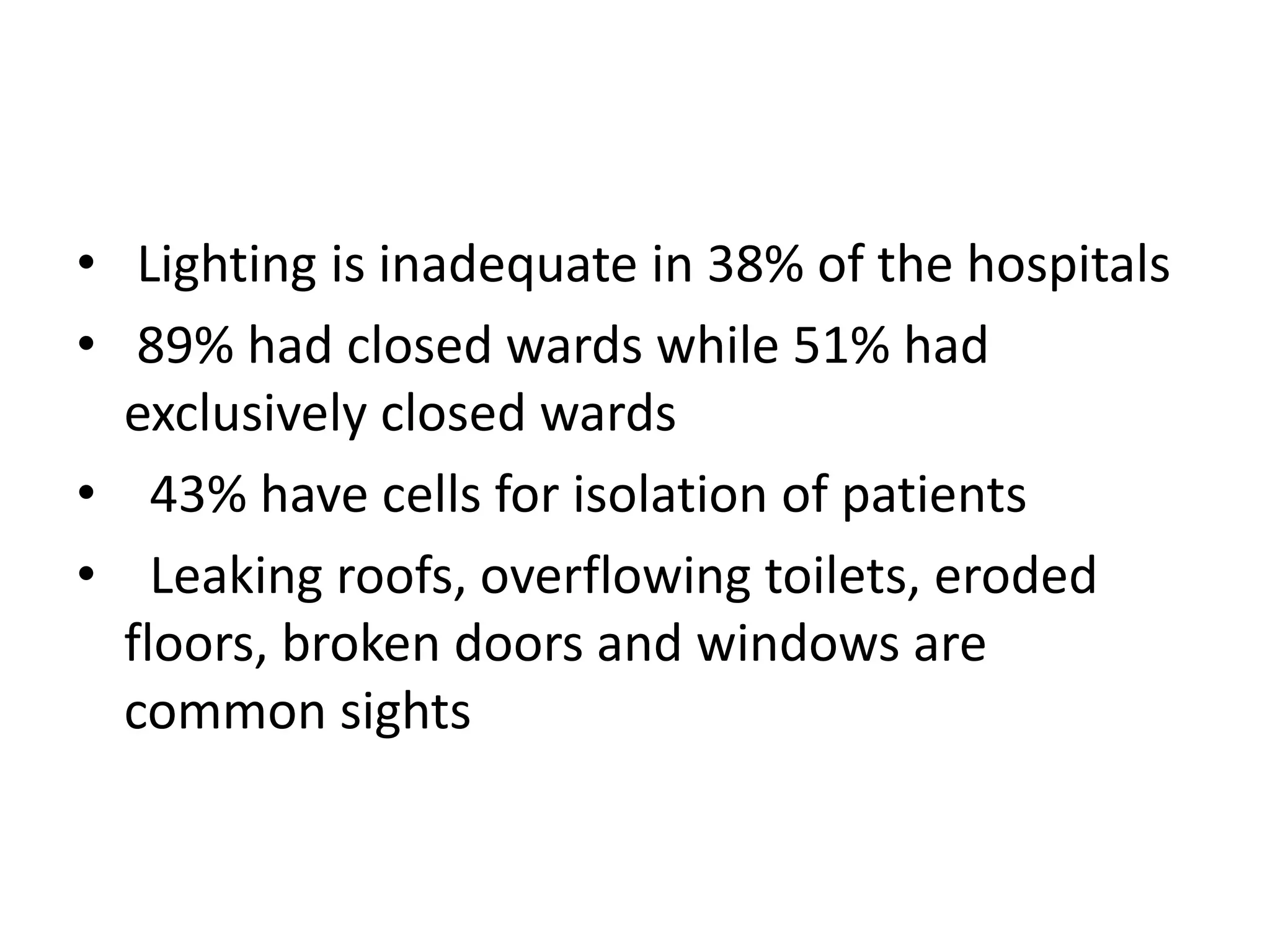
• Lighting is inadequate in 38% of the hospitals
• 89% had closed wards while 51% had
exclusively closed wards
• 43% have cells for isolation of patients
• Leaking roofs, overflowing toilets, eroded
floors, broken doors and windows are
common sights
• Privacy for patients was present in less than
half the hospitals
• Seclusion rooms were present in 76% of
hospitals and used in majority of these
hospitals
• Only 14% of the staff felt that their hospital
inpatient facility was adequate
• In most hospitals case file recording was
extremely inadequate
• Less than half the hospitals have clinical
psychologists and psychiatric social workers
• Trained psychiatric nurses were present in
less than 25% of the hospitals
• Even routine blood and urine tests were not
available in more than 20% of hospitals
• 81% of the hospital incharges reported that
their staff position was inadequate
5.Difficulties in utilization of available
services by the mentally ill
The practical problems faced by people with mental
illness interested in continuing regular long-term care
include:
• The long distance they have to travel to treatment
facilities,
• The lack of a caregiver to accompany them,
• Frequent non-availability of medicines at treatment
centres,
• Changing professional team members,
• Lack of availability of rehabilitation services for those
who have recovered and difficulty of getting welfare
benefits.
6.Need for multifaceted intervention
for long-standing illness
• Medicines can be adequate for the treatment of
acute episodes.
• However, for the large majority of patients with
long-standing illness, there is a need for a
multifaceted intervention that involves the family,
community and voluntary organizations and is
aimed at rehabilitation and reintegration.
• Since all these cannot be organized by public
health services, there is a need for specific
programmes to support families and voluntary
organizations
7.Limited technical capacity
• The technical capacity of the public mental
health system of the states is limited, and the
capacity and competence to monitor the
mental health programme inadequate.
• The current efforts are Fragmented,
uncoordinated and sporadic.
NATIONAL RESPONSES TO MENTAL HEALTH
CHALLENGES
• During the past 6 decades, there have been a wide
range of initiatives in mental healthcare.
• These range from humanizing mental hospitals,
moving the place of care from mental hospitals to
general hospital psychiatry units,
• The formulation of the NMHP, adoption of the District
Mental Health Programme (DMHP) approach to
integrate mental health with general healthcare,
• Setting up of community treatment facilities, provision
of support to families, the use of traditional systems of
care, legislative revision, and public education and
research to support the above initiatives (Table III).
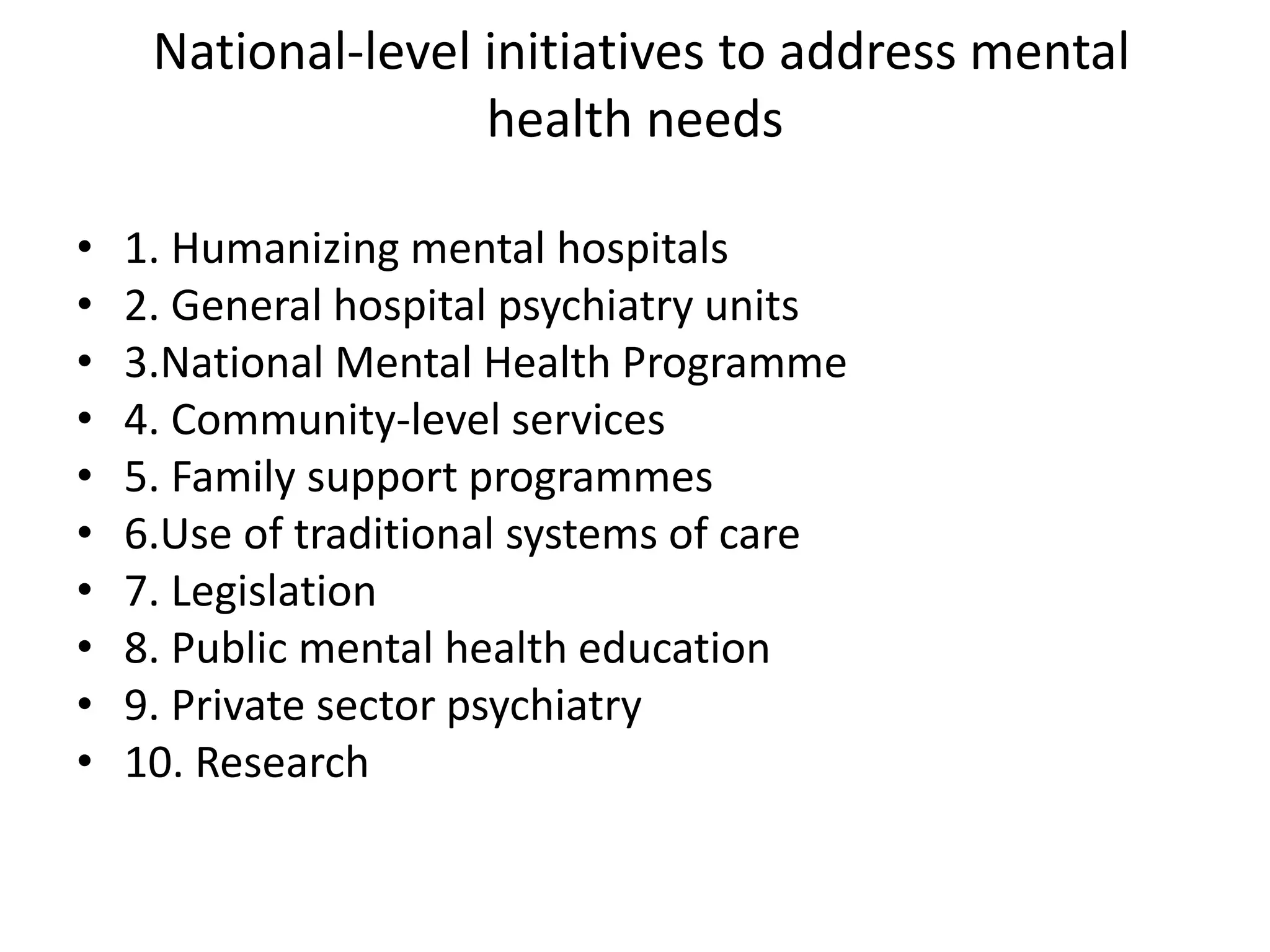
National-level initiatives to address mental
health needs
• 1. Humanizing mental hospitals
• 2. General hospital psychiatry units
• 3.National Mental Health Programme
• 4. Community-level services
• 5. Family support programmes
• 6.Use of traditional systems of care
• 7. Legislation
• 8. Public mental health education
• 9. Private sector psychiatry
• 10. Research
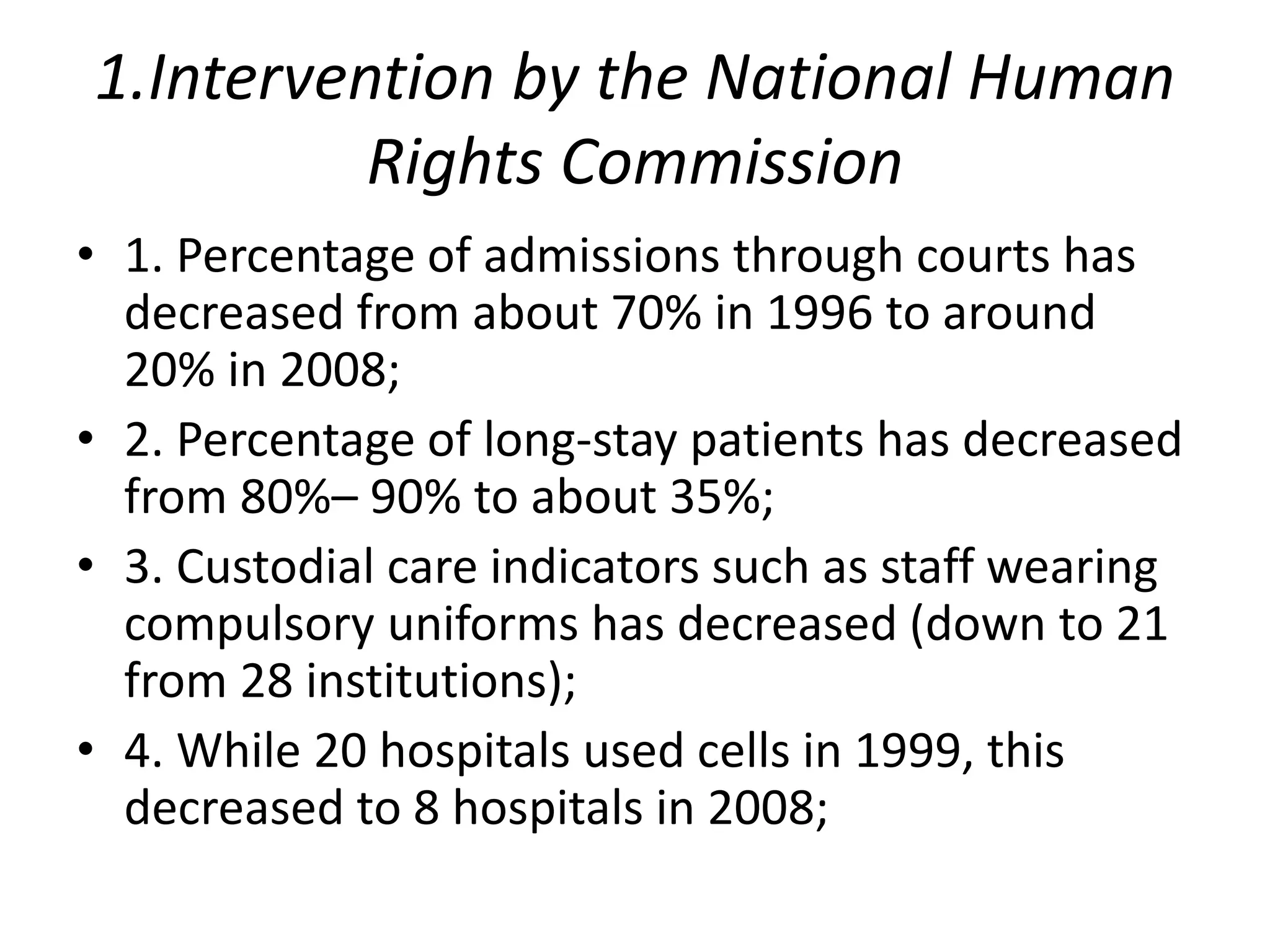
1.Intervention by the National Human
Rights Commission
• 1. Percentage of admissions through courts has
decreased from about 70% in 1996 to around
20% in 2008;
• 2. Percentage of long-stay patients has decreased
from 80%– 90% to about 35%;
• 3. Custodial care indicators such as staff wearing
compulsory uniforms has decreased (down to 21
from 28 institutions);
• 4. While 20 hospitals used cells in 1999, this
decreased to 8 hospitals in 2008;
• 5. Recreation facilities have increased and were
present in 29 compared to 8 in 1999;
• 6. Rehabilitation facilities have increased from 10
to 23 institutions;
• 7. The budget has doubled in 9 institutions, 2–4
times in 13, 4–8 times in 4 and more than 8 times
in 3 institutions; and
• 8. Use of electroconvulsive therapy (ECT) has
reduced and use of modified type ECT has
increased from 9 to 27 institutions
2.GENERAL HOSPITAL PSYCHIATRY
UNITS (GHPUS)
• At present, most medical college hospitals and
major hospitals have psychiatry units.
• This has had twin advantages, namely, the
services come closer to the population and
services can be provided in a non stigmatizing
manner.
• It is also important that in India these units
have become centres of research and
manpower development.
3.NATIONAL MENTAL HEALTH
PROGRAMME
• The objectives of the NMHP were:
• (i) To ensure the availability and accessibility
of minimum mental healthcare for all,
particularly to the most vulnerable and
underprivileged sections of the population, in
the foreseeable future;
• (ii) To encourage the application of mental
health knowledge in general healthcare and in
social development;
• (iii) to promote community participation in
the development of mental health services
and to stimulate efforts towards self-help in
the community.
NMHP strategies
• Integration of mental health with primary
health care through the NMHP
• Provision of tertiary care institution for
treatment of mental diorder
• Eradicating stigmatization of mentally ill
patients and protecting their rights through
regulatory institutions like the CMHA & SMHA.
DMHP components
• Training programmes of all workers in the
mental health team at the identified nodal
institute in the state
• Public education in mental health to increase
awareness and to reduce stigma
• For early detection and treatment , OPD and
indoor services are provided
• Providing valuable data and experience at the
level of community to the state and centre for
future planning, improvement in service and
research.
• The most important progress has been in the
area of development of models for the
integration of mental health with primary
healthcare, in the form of the district mental
health programme.
• The DMHP, developed during 1984–90, was
extended initially to 4 states, then to 25
districts in 20 states during 1995–2002 and
over 125 districts in the next 7 years.
Five strategies of NMHP in the Tenth
Five-Year Plan
• 1. Redesigning the DMHP around a nodal
institution, which in most instances will be the
zonal medical college.
• 2. Strengthening medical colleges with a view
to develop psychiatric manpower, improve
psychiatric treatment facilities at the
secondary level, and promote the
development of general hospital psychiatry in
order to reduce and eventually eliminate to a
large extent the need for large mental
hospitals with a large proportion of long-stay
patients.
• 3. Streamlining and modernizing mental
hospitals to transform them from the present
mainly custodial mode to tertiary care centres
of excellence with a dynamic social orientation
for providing leadership to research and
development in the field of community
mental health
• 4. Strengthening central and state mental
health authorities in order that they may
effectively fulfil their role of monitoring
ongoing mental health programmes,
determining priorities at the central/state
level and promoting inter-sectoral
collaboration and linkages with other national
programmes.
• 5. Carrying out research and training aimed at
building up an extensive database of
epidemiological information related to mental
disorders and their course/outcome; research
and training on therapeutic needs of the
community, and on the development of better
and more cost-effective intervention models.
• Promotion of inter-sectoral research and
providing the necessary inputs/conceptual
framework for health and policy planning
Focused information, education and
communication (IEC) activities, formulated with
the active collaboration of professional agencies
such as the Indian Institute of Mass
Communication and directed towards enhancing
public awareness and eradicating the
stigma/discrimination related to mental illness.
Mental health in the Eleventh Five-Year
Plan (2007–2013)
• The areas identified for support consist of the
following:
• • Manpower development, in the form of the
establishment of centres of excellence in the
field of mental health (`338.121 crore), will be
undertaken.
• Centres of excellence in the field of mental
health will be established by upgrading and
strengthening identified existing mental
health hospitals/ institutes for addressing the
acute manpower gap and provision of state-
of-the-art mental healthcare facilities in the
long run.
• These institutes will focus on the production
of quality manpower in mental health.
• A scheme is envisaged for the development of
manpower in mental health (`69.80 crore).
Support would be provided for setting
up/strengthening 30 units of psychiatry, 30
departments of clinical psychology, 30
departments of psychiatric social work and 30
departments of psychiatric nursing, with
support of up to `51 lakh to `1 crore per
postgraduate department.
• Spill-over activities of the 10th Plan will be
completed.
• These include upgradation of the psychiatric
wings of government medical colleges/general
hospitals and modernization of government
mental hospitals (`58.030 crore). Up to `50
lakh will be provided per college.
• It is planned to modernize state-run mental
hospitals.
• A grant of up to `3 crore per mental hospital
would be provided.
• The implementation of the existing DMHPs
will be continued as per existing norms (`6.9
crore).
• There are plans to integrate the NMHP with
the National Rural Health Mission (NRHM).
DMHP at the national level
• At the national level, the DMHP is in operation in
127 districts.
• The DMHP has the following objectives:
• 1. To provide sustainable basic mental health
services to the community and to integrate these
services with other health services
• 2. Early detection and treatment of patients
within the community itself
• 3. To see that patients and their relatives do not
have to travel long distances to go to hospitals or
nursing homes in the cities
• 4. To take pressure off the mental hospitals
• 5. To reduce the stigma attached to mental
illness by promoting a change of attitude and
through public education
• 6. To treat and rehabilitate mental patients
discharged from mental hospitals within the
community.
DMHP- Critics
• Limited development of the DMHP in its
operational aspects by the central agency
• Limited capacity for implementation at the
state level
• Lack of coordination between the DMHP team
and the medical college where the team is
located
• Inadequate technical support from
professionals
• Lack of emphasis on creating awareness in the
community
• Lack of mental health indicators
• Lack of monitoring
HUMAN RESOURCE DEVELOPMENT
• The other major development is the growth in
human resources.
• The Eleventh Five-Year Plan specifically
addresses this need by funding the setting up
of centres of excellence, as mentioned earlier.
• Another lacuna is the very limited training in
psychiatry for undergraduate medical
students.
4.COMMUNITY-LEVEL MENTAL HEALTH
SERVICES
• Two activities are required to address the
needs of the community.
• First, systematic studies are needed to
evaluate the community intervention
initiatives for mental health.
• The second is the setting up of community-
level facilities, largely by voluntary
organizations.
• Another important development over the past 27
years is the availability of a wide variety of
community care alternatives, essentially from the
voluntary sector.
• These initiatives have included the establishment
of day care centres, half-way homes,long-stay
homes and centres for suicide prevention, and
also address care of the elderly, disaster mental
healthcare, and school and college mental health
programmes.
• The availability of a wide variety of both medical
and nonmedical care models is another
development in the past 2 decades.
• Specifically, the growing role of non-
governmental organizations (NGOs) which
provide services for suicide prevention, disaster
care and school health programmes, in which
non-specialists and volunteers play an important
role, has tremendous importance for India as
NGOs can bridge the gap of human resources.
5.FAMILY SUPPORT
• During the 1970s and 1980s, efforts were
madeto understand the functioning of families
with an ill person and their needs.
• During the past decade, families have been
playing a more active role, with the formation
of self-help groups, and professionals have
been agreeing to work with families in
partnership.
6.TRADITIONAL SYSTEMS OF CARE FOR
MENTAL HEALTH
• Indian psychiatrists have examined and
utilized the traditional healthcare systems for
the care of mental disorders, using Yoga and
Ayurveda, Indian philosophy and traditional
healers.
• There is a resurgence of academic interest in
the effects of different types of yogic practices
and the mental health relevance of the
Bhagavad Gita.
• This was followed by a comparison of standard
treatment with yoga in psychoneuroses, anxiety,
drug addiction and psychogenic headache.
• All this leads one to conclude that there will be
further examination of spirituality, in general, and
the impact of yoga and meditation, in particular,
in the coming years, using a wide variety of
physiological and psychological tools.
7.LEGISLATION
• Some of the changes mentioned above have
been supported by legislation for mental
healthcare, namely, the Narcotic Drugs and
Psychotropic Substances (NDPS) Act 1985, the
MHA 1987 and Persons with Disability Act 1995.
• The Persons with Disability Act 1995 is important
because for the first time, mental illness has been
included as one of the disabilities.
MENTAL HEALTH ACT
• It as an act to consolidate and to amend the
law relating to treatment & care of mentally ill
person, to make better provision with respect
to their property & affairs & for matters
connected their with.
WHY MENTAL HEALTH LEGISLATION ?
• Protecting the rights & dignity of persons with mental
disorders.
• Developing accessible & effective mental health services.
• Providing legal framework to integrate M.H.S. into community
& to overcome stigma, discrimination, & exclusion of mentally
ill persons.
• Creates enforceable standards for high quality medical care,
protects the right of mentally ill persons.
WHY A SEPARATE LAW FOR MENTAL
HEALTH ?
• Different nature of mental illness in comparison to physical
illness.
• Mental illness not only affect the patient but the family &
society as well.
• Mental illness may be characterized by loss of insight &
impaired judgment in the patients.
• Fundamental rights of M.I.P. can be violated b/c of the
characteristics of the psychiatric disorders.
8.PSYCHIATRY IN THE PRIVATE SECTOR
• One of the striking features of Indian
psychiatry has been the growth of psychiatry
in the private sector.
• This development has taken services to
smaller towns and talukas.
9.RESEARCH
• The ICMR, New Delhi, gave a big push to
mental health research in the 1980s.
• This research has not only brought to light the
importance of understanding mental disorders
such as schizophrenia in the cultural context,
but has also shown the feasibility of
developing models involving schools, primary
healthcare and general practitioners, as well
as working with families.
REVIEW OF THE PROGRESS
• These have largely been in response to a specific
need during a specific time period.
• For example, in the 1950s, the lack of human
resources in mental hospitals was addressed by
involving families in the care giving programmes.
• In the 1960s, the availability of drugs for the
treatment of mental disorders resulted in mental
illnesses being treated alongside other illness
with the setting up of psychiatric units in general
hospitals.
• During the 1970s, the growth of public sector
health services and the influence of the Alma
Ata declaration guided the development of
community mental health programmes and
the formulation of the NMHP in 1982. During
the 1980s and 1990s, the need for non-mental
hospital facilities for rehabilitation resulted in
the establishment of community care facilities
in different parts of India, mainly by voluntary
organizations.
LACUNAE
• The NMHP has been criticized for the
following reasons:
• (i) It has a top-down approach;
• (ii) It is not based on the cultural aspects of
the country;
• (iii) It is not effective,
• (iv) It is driven by WHO policies;
• (v) It does not involve community leaders.
• The provision of community-level, decentralized
services should be given primacy in mental health
programmes.
• The DMHP has to be at the centre of the mental health
programme.
• The current ‘extension clinic’ approach has to be
replaced with true integration of mental healthcare
with primary healthcare personnel (similar to that in
the case of tuberculosis, leprosy, etc.).
• There is an urgent need to develop specific indicators
to monitor the DMHP.
• The DMHP will have to be the flagship
programme of the NMHP because
• (i) At present, a large proportion of the mentally
ill are without care and have poor awareness of
mental disorders, especially in rural areas;
• (ii) A large proportion are already seeking help
from the existing primary healthcare facilities;
• (iii) Most people in rural areas will not travel long
distances to seek help;
• (iv) Those seeking help will not continue to take
help unless it is available close to their place of
residence;
• (v) Limited specialist manpower limits the reach
of specialist services;
• (vi) It is possible for health personnel to provide
essential mental healthcare;
• (vii) When care is provided patients can
recover/function better, with a better quality of
life, and the burden on the family and society is
reduced.
References
• K. Park : Textbook of Preventive and Social
Medicine
• mhpolicy.files.wordpress.com/.../mental-
health-initiatives-in-india-1947-2010.pdf
• en.wikipedia.org/wiki/Mental_Health_Act -
• www.nimhans.kar.nic.in/dmhp/default.htm
• www.nihfw.org/.../DocumentationServices/N
ationalHealthProgramme/NATIONALMENTAL
HEALTHPROGRAMME
• Ministry of Health and Family Welfare,
Government of India. Annual Report to the
People on Health. New Delhi:Ministry of
Health and Family Welfare, Government of
India; September 2010.
THANK YOU

Mental health challenges & solution

  • 1.
    Mental Health : Challenges& Solution By- Dr. Shailendra Pratap Singh
  • 2.
    Content • Introduction • Challengesin Mental Health • National level initiatives
  • 3.
    Mental Health • Mentalhealth is the balanced development of individual’s personality & emotional attitudes which enables him to live harmoniously with his fellow men.
  • 4.
    In 1947, Indiahad 10 000 psychiatric beds for a population of over 300 million, compared to the UK, which, with one-tenth the population of India, had over 150 000 psychiatric beds!
  • 5.
    • The majordevelopment was in 1975, when a new initiative to integrate mental health with general health services, also referred to as the community psychiatry initiative, was adopted to develop mental health services. • The National Mental Health Programme (NMHP) was formulated in 1982
  • 6.
    • During thepast 3 decades, there have been a large number of other community initiatives to address a wide variety of mental health needs of the community through programmes on suicide prevention, care of the elderly, substance use and disaster mental healthcare, and by setting up of daycare centres, half-way homes, longstay homes and rehabilitation facilities
  • 7.
    Challenges for mentalhealthcare in India • 1. Large ‘unmet need’ for mental healthcare in the community • 2.Poor understanding of psychological distress as requiring medical intervention in the general population
  • 8.
    • 3. Limitedacceptance of modern medical care for mental disorders among the general population • 4. Limitations in the availability of mental health services (professionals and facilities) in the public health services
  • 9.
    • 5.Poor utilizationof available services by the ill population and their families • 6. Problems in recovery and reintegration of persons with mental illnesses • 7. Lack of institutionalized mechanisms for organization of mental healthcare
  • 10.
    1.A large ‘unmetneed’ for mental healthcare in the community • Though the prevalence rates of depression are higher than those of psychoses, the rates of treatment are far lower, pointing to limited awareness in the community. • The rates of treatment were lower in rural compared with urban areas (61.7% v. 47.5%),and higher in the higher income quartiles.
  • 12.
    Treatment Gap • Treatment gapby development Serious cases receiving no treatment during the last 12 months Developed countries – 35.5% to 50.3% Developing countries – 76.3% to 85.4%
  • 13.
    2.‘Psychological distress’ requiresmedical intervention: Lack of awareness and stigma • There are two aspects to the current lack of knowledge of the population about mental health. • First are the existing beliefs and practices. • Second, stigma is an important barrier to mental healthcare.
  • 14.
    • It usedface-to-face interviews with 732 participants. Negative discrimination was experienced • By 47% of the participants in making or keeping friends, • By 43% from family members, • By 29% in finding a job, by 29% in keeping a job, • By 27% in intimate or sexual relationships. • Positive discrimination was rare
  • 15.
    • Anticipated discriminationaffected - • 64% in the matter of applying for work, and in training or education, • 55% while looking for a close relationship; • 72% felt the need to conceal their diagnosis. • Over a third of the participants anticipated discrimination when seeking jobs and close personal relationships, even when no discrimination was experienced.
  • 16.
    3.Problems due tomultiplicity of healthcare systems and existing beliefs • India is home to a pluralistic approach to all types of healthcare. Not only are there other systems of healthcare other than modern medicine such as Ayurveda, Unani, Naturopathy and Homoeopathy, but also people approach religious places for help, especially in case of mental illness.
  • 17.
    • There isa need for professionals of all systems of care to initiate a dialogue and communicate the relative suitability and effectiveness of different approaches to care in different aspects of mental health (prevention, promotion and treatment). • There is no need for each of them to be equally suitable and effective in all areas. • There is also a great need for linkage of services according to a need-based approach.
  • 18.
    4.Availability of mentalhealth services (professionals and facilities) Limitations and problems • The availability of mental health infrastructure (psychiatric beds) in India is mainly limited to large-size custodial institutions, which provide services to a limited population. • These institutions are a great source of stigma. • Two reviews of mental hospitals were undertaken in 1998 and 2008 to identify the lacunae in these institutions and the changes that occurred over a decade.
  • 19.
    • Overall ratioof cots:patient is 1:1.4 indicating that floor beds are a common occurrence in many hospitals • In hospitals at Varanasi, Indore, Murshidabad and Ahmedabad patients are expected to urinate and defecate into an open drain in public view • Many hospitals have problems with running water • Storage facilities are also poor in 70% of hospitals
  • 20.
    • Lighting isinadequate in 38% of the hospitals • 89% had closed wards while 51% had exclusively closed wards • 43% have cells for isolation of patients • Leaking roofs, overflowing toilets, eroded floors, broken doors and windows are common sights
  • 21.
    • Privacy forpatients was present in less than half the hospitals • Seclusion rooms were present in 76% of hospitals and used in majority of these hospitals • Only 14% of the staff felt that their hospital inpatient facility was adequate • In most hospitals case file recording was extremely inadequate
  • 22.
    • Less thanhalf the hospitals have clinical psychologists and psychiatric social workers • Trained psychiatric nurses were present in less than 25% of the hospitals • Even routine blood and urine tests were not available in more than 20% of hospitals • 81% of the hospital incharges reported that their staff position was inadequate
  • 23.
    5.Difficulties in utilizationof available services by the mentally ill The practical problems faced by people with mental illness interested in continuing regular long-term care include: • The long distance they have to travel to treatment facilities, • The lack of a caregiver to accompany them, • Frequent non-availability of medicines at treatment centres, • Changing professional team members, • Lack of availability of rehabilitation services for those who have recovered and difficulty of getting welfare benefits.
  • 24.
    6.Need for multifacetedintervention for long-standing illness • Medicines can be adequate for the treatment of acute episodes. • However, for the large majority of patients with long-standing illness, there is a need for a multifaceted intervention that involves the family, community and voluntary organizations and is aimed at rehabilitation and reintegration. • Since all these cannot be organized by public health services, there is a need for specific programmes to support families and voluntary organizations
  • 25.
    7.Limited technical capacity •The technical capacity of the public mental health system of the states is limited, and the capacity and competence to monitor the mental health programme inadequate. • The current efforts are Fragmented, uncoordinated and sporadic.
  • 26.
    NATIONAL RESPONSES TOMENTAL HEALTH CHALLENGES • During the past 6 decades, there have been a wide range of initiatives in mental healthcare. • These range from humanizing mental hospitals, moving the place of care from mental hospitals to general hospital psychiatry units, • The formulation of the NMHP, adoption of the District Mental Health Programme (DMHP) approach to integrate mental health with general healthcare, • Setting up of community treatment facilities, provision of support to families, the use of traditional systems of care, legislative revision, and public education and research to support the above initiatives (Table III).
  • 27.
    National-level initiatives toaddress mental health needs • 1. Humanizing mental hospitals • 2. General hospital psychiatry units • 3.National Mental Health Programme • 4. Community-level services • 5. Family support programmes • 6.Use of traditional systems of care • 7. Legislation • 8. Public mental health education • 9. Private sector psychiatry • 10. Research
  • 28.
    1.Intervention by theNational Human Rights Commission • 1. Percentage of admissions through courts has decreased from about 70% in 1996 to around 20% in 2008; • 2. Percentage of long-stay patients has decreased from 80%– 90% to about 35%; • 3. Custodial care indicators such as staff wearing compulsory uniforms has decreased (down to 21 from 28 institutions); • 4. While 20 hospitals used cells in 1999, this decreased to 8 hospitals in 2008;
  • 29.
    • 5. Recreationfacilities have increased and were present in 29 compared to 8 in 1999; • 6. Rehabilitation facilities have increased from 10 to 23 institutions; • 7. The budget has doubled in 9 institutions, 2–4 times in 13, 4–8 times in 4 and more than 8 times in 3 institutions; and • 8. Use of electroconvulsive therapy (ECT) has reduced and use of modified type ECT has increased from 9 to 27 institutions
  • 30.
    2.GENERAL HOSPITAL PSYCHIATRY UNITS(GHPUS) • At present, most medical college hospitals and major hospitals have psychiatry units. • This has had twin advantages, namely, the services come closer to the population and services can be provided in a non stigmatizing manner. • It is also important that in India these units have become centres of research and manpower development.
  • 31.
    3.NATIONAL MENTAL HEALTH PROGRAMME •The objectives of the NMHP were: • (i) To ensure the availability and accessibility of minimum mental healthcare for all, particularly to the most vulnerable and underprivileged sections of the population, in the foreseeable future;
  • 32.
    • (ii) Toencourage the application of mental health knowledge in general healthcare and in social development;
  • 33.
    • (iii) topromote community participation in the development of mental health services and to stimulate efforts towards self-help in the community.
  • 34.
    NMHP strategies • Integrationof mental health with primary health care through the NMHP • Provision of tertiary care institution for treatment of mental diorder • Eradicating stigmatization of mentally ill patients and protecting their rights through regulatory institutions like the CMHA & SMHA.
  • 35.
    DMHP components • Trainingprogrammes of all workers in the mental health team at the identified nodal institute in the state • Public education in mental health to increase awareness and to reduce stigma
  • 36.
    • For earlydetection and treatment , OPD and indoor services are provided • Providing valuable data and experience at the level of community to the state and centre for future planning, improvement in service and research.
  • 37.
    • The mostimportant progress has been in the area of development of models for the integration of mental health with primary healthcare, in the form of the district mental health programme. • The DMHP, developed during 1984–90, was extended initially to 4 states, then to 25 districts in 20 states during 1995–2002 and over 125 districts in the next 7 years.
  • 38.
    Five strategies ofNMHP in the Tenth Five-Year Plan • 1. Redesigning the DMHP around a nodal institution, which in most instances will be the zonal medical college.
  • 39.
    • 2. Strengtheningmedical colleges with a view to develop psychiatric manpower, improve psychiatric treatment facilities at the secondary level, and promote the development of general hospital psychiatry in order to reduce and eventually eliminate to a large extent the need for large mental hospitals with a large proportion of long-stay patients.
  • 40.
    • 3. Streamliningand modernizing mental hospitals to transform them from the present mainly custodial mode to tertiary care centres of excellence with a dynamic social orientation for providing leadership to research and development in the field of community mental health
  • 41.
    • 4. Strengtheningcentral and state mental health authorities in order that they may effectively fulfil their role of monitoring ongoing mental health programmes, determining priorities at the central/state level and promoting inter-sectoral collaboration and linkages with other national programmes.
  • 42.
    • 5. Carryingout research and training aimed at building up an extensive database of epidemiological information related to mental disorders and their course/outcome; research and training on therapeutic needs of the community, and on the development of better and more cost-effective intervention models.
  • 43.
    • Promotion ofinter-sectoral research and providing the necessary inputs/conceptual framework for health and policy planning Focused information, education and communication (IEC) activities, formulated with the active collaboration of professional agencies such as the Indian Institute of Mass Communication and directed towards enhancing public awareness and eradicating the stigma/discrimination related to mental illness.
  • 44.
    Mental health inthe Eleventh Five-Year Plan (2007–2013) • The areas identified for support consist of the following: • • Manpower development, in the form of the establishment of centres of excellence in the field of mental health (`338.121 crore), will be undertaken.
  • 45.
    • Centres ofexcellence in the field of mental health will be established by upgrading and strengthening identified existing mental health hospitals/ institutes for addressing the acute manpower gap and provision of state- of-the-art mental healthcare facilities in the long run. • These institutes will focus on the production of quality manpower in mental health.
  • 46.
    • A schemeis envisaged for the development of manpower in mental health (`69.80 crore). Support would be provided for setting up/strengthening 30 units of psychiatry, 30 departments of clinical psychology, 30 departments of psychiatric social work and 30 departments of psychiatric nursing, with support of up to `51 lakh to `1 crore per postgraduate department.
  • 47.
    • Spill-over activitiesof the 10th Plan will be completed. • These include upgradation of the psychiatric wings of government medical colleges/general hospitals and modernization of government mental hospitals (`58.030 crore). Up to `50 lakh will be provided per college.
  • 48.
    • It isplanned to modernize state-run mental hospitals. • A grant of up to `3 crore per mental hospital would be provided. • The implementation of the existing DMHPs will be continued as per existing norms (`6.9 crore). • There are plans to integrate the NMHP with the National Rural Health Mission (NRHM).
  • 49.
    DMHP at thenational level • At the national level, the DMHP is in operation in 127 districts. • The DMHP has the following objectives: • 1. To provide sustainable basic mental health services to the community and to integrate these services with other health services • 2. Early detection and treatment of patients within the community itself • 3. To see that patients and their relatives do not have to travel long distances to go to hospitals or nursing homes in the cities
  • 50.
    • 4. Totake pressure off the mental hospitals • 5. To reduce the stigma attached to mental illness by promoting a change of attitude and through public education • 6. To treat and rehabilitate mental patients discharged from mental hospitals within the community.
  • 51.
    DMHP- Critics • Limiteddevelopment of the DMHP in its operational aspects by the central agency • Limited capacity for implementation at the state level • Lack of coordination between the DMHP team and the medical college where the team is located
  • 52.
    • Inadequate technicalsupport from professionals • Lack of emphasis on creating awareness in the community • Lack of mental health indicators • Lack of monitoring
  • 53.
    HUMAN RESOURCE DEVELOPMENT •The other major development is the growth in human resources. • The Eleventh Five-Year Plan specifically addresses this need by funding the setting up of centres of excellence, as mentioned earlier. • Another lacuna is the very limited training in psychiatry for undergraduate medical students.
  • 54.
    4.COMMUNITY-LEVEL MENTAL HEALTH SERVICES •Two activities are required to address the needs of the community. • First, systematic studies are needed to evaluate the community intervention initiatives for mental health. • The second is the setting up of community- level facilities, largely by voluntary organizations.
  • 55.
    • Another importantdevelopment over the past 27 years is the availability of a wide variety of community care alternatives, essentially from the voluntary sector. • These initiatives have included the establishment of day care centres, half-way homes,long-stay homes and centres for suicide prevention, and also address care of the elderly, disaster mental healthcare, and school and college mental health programmes.
  • 56.
    • The availabilityof a wide variety of both medical and nonmedical care models is another development in the past 2 decades. • Specifically, the growing role of non- governmental organizations (NGOs) which provide services for suicide prevention, disaster care and school health programmes, in which non-specialists and volunteers play an important role, has tremendous importance for India as NGOs can bridge the gap of human resources.
  • 57.
    5.FAMILY SUPPORT • Duringthe 1970s and 1980s, efforts were madeto understand the functioning of families with an ill person and their needs. • During the past decade, families have been playing a more active role, with the formation of self-help groups, and professionals have been agreeing to work with families in partnership.
  • 58.
    6.TRADITIONAL SYSTEMS OFCARE FOR MENTAL HEALTH • Indian psychiatrists have examined and utilized the traditional healthcare systems for the care of mental disorders, using Yoga and Ayurveda, Indian philosophy and traditional healers. • There is a resurgence of academic interest in the effects of different types of yogic practices and the mental health relevance of the Bhagavad Gita.
  • 59.
    • This wasfollowed by a comparison of standard treatment with yoga in psychoneuroses, anxiety, drug addiction and psychogenic headache. • All this leads one to conclude that there will be further examination of spirituality, in general, and the impact of yoga and meditation, in particular, in the coming years, using a wide variety of physiological and psychological tools.
  • 60.
    7.LEGISLATION • Some ofthe changes mentioned above have been supported by legislation for mental healthcare, namely, the Narcotic Drugs and Psychotropic Substances (NDPS) Act 1985, the MHA 1987 and Persons with Disability Act 1995. • The Persons with Disability Act 1995 is important because for the first time, mental illness has been included as one of the disabilities.
  • 61.
    MENTAL HEALTH ACT •It as an act to consolidate and to amend the law relating to treatment & care of mentally ill person, to make better provision with respect to their property & affairs & for matters connected their with.
  • 62.
    WHY MENTAL HEALTHLEGISLATION ? • Protecting the rights & dignity of persons with mental disorders. • Developing accessible & effective mental health services. • Providing legal framework to integrate M.H.S. into community & to overcome stigma, discrimination, & exclusion of mentally ill persons. • Creates enforceable standards for high quality medical care, protects the right of mentally ill persons.
  • 63.
    WHY A SEPARATELAW FOR MENTAL HEALTH ? • Different nature of mental illness in comparison to physical illness. • Mental illness not only affect the patient but the family & society as well. • Mental illness may be characterized by loss of insight & impaired judgment in the patients. • Fundamental rights of M.I.P. can be violated b/c of the characteristics of the psychiatric disorders.
  • 64.
    8.PSYCHIATRY IN THEPRIVATE SECTOR • One of the striking features of Indian psychiatry has been the growth of psychiatry in the private sector. • This development has taken services to smaller towns and talukas.
  • 65.
    9.RESEARCH • The ICMR,New Delhi, gave a big push to mental health research in the 1980s. • This research has not only brought to light the importance of understanding mental disorders such as schizophrenia in the cultural context, but has also shown the feasibility of developing models involving schools, primary healthcare and general practitioners, as well as working with families.
  • 66.
    REVIEW OF THEPROGRESS • These have largely been in response to a specific need during a specific time period. • For example, in the 1950s, the lack of human resources in mental hospitals was addressed by involving families in the care giving programmes. • In the 1960s, the availability of drugs for the treatment of mental disorders resulted in mental illnesses being treated alongside other illness with the setting up of psychiatric units in general hospitals.
  • 67.
    • During the1970s, the growth of public sector health services and the influence of the Alma Ata declaration guided the development of community mental health programmes and the formulation of the NMHP in 1982. During the 1980s and 1990s, the need for non-mental hospital facilities for rehabilitation resulted in the establishment of community care facilities in different parts of India, mainly by voluntary organizations.
  • 68.
    LACUNAE • The NMHPhas been criticized for the following reasons: • (i) It has a top-down approach; • (ii) It is not based on the cultural aspects of the country; • (iii) It is not effective, • (iv) It is driven by WHO policies; • (v) It does not involve community leaders.
  • 69.
    • The provisionof community-level, decentralized services should be given primacy in mental health programmes. • The DMHP has to be at the centre of the mental health programme. • The current ‘extension clinic’ approach has to be replaced with true integration of mental healthcare with primary healthcare personnel (similar to that in the case of tuberculosis, leprosy, etc.). • There is an urgent need to develop specific indicators to monitor the DMHP.
  • 70.
    • The DMHPwill have to be the flagship programme of the NMHP because • (i) At present, a large proportion of the mentally ill are without care and have poor awareness of mental disorders, especially in rural areas; • (ii) A large proportion are already seeking help from the existing primary healthcare facilities; • (iii) Most people in rural areas will not travel long distances to seek help;
  • 71.
    • (iv) Thoseseeking help will not continue to take help unless it is available close to their place of residence; • (v) Limited specialist manpower limits the reach of specialist services; • (vi) It is possible for health personnel to provide essential mental healthcare; • (vii) When care is provided patients can recover/function better, with a better quality of life, and the burden on the family and society is reduced.
  • 72.
    References • K. Park: Textbook of Preventive and Social Medicine • mhpolicy.files.wordpress.com/.../mental- health-initiatives-in-india-1947-2010.pdf • en.wikipedia.org/wiki/Mental_Health_Act - • www.nimhans.kar.nic.in/dmhp/default.htm
  • 73.
    • www.nihfw.org/.../DocumentationServices/N ationalHealthProgramme/NATIONALMENTAL HEALTHPROGRAMME • Ministryof Health and Family Welfare, Government of India. Annual Report to the People on Health. New Delhi:Ministry of Health and Family Welfare, Government of India; September 2010.
  • 74.