Overview of equality and
health inequality issues
and dementia
Jo Moriarty
Social Care Workforce Research Unit
„By 2015 every person with
dementia will be able to say‟
„I get the treatment and
support which are best for my
dementia and my life‟
„I know what I can do to help
myself and who else can help
me. My community is working to
help me to live well with
dementia‟
„I wanted to take part in
research and was able to do so‟
7 May 2014Equality and health inequality issues in dementia
2
“
”
There are parts of the country where
it takes six months to get a dementia
diagnosis, which is absolutely
scandalous. I want to get to a
situation where the average across
the whole country is no more than
six weeks
Jeremy Hunt, interview in The Telegraph, 27 February 2014
Government plans to improve
regional variations in screening
7 May 2014Equality and health inequality issues in dementia
3
Where does this leave us?
• Prime Minister‟s Dementia Challenge
recognises variations in access to good
dementia support
• Focus on regional variations in screening but
we need more „hard‟ evidence on other
aspects
• Findings presented here will be familiar but
offer a framework for discussions throughout
the day
7 May 2014Equality and health inequality issues in dementia
4
• Rationalised existing legislation
• Some new provisions
• Nine „protected characteristics‟
• age
• disability
• gender reassignment
• marriage and civil partnership*
• pregnancy and maternity*
• race
• religion or belief
• sex
• sexual orientation
7 May 2014Equality and health inequality issues in dementia
5Equality Act 2010
Age
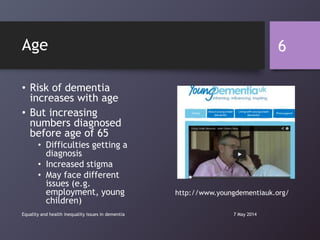
• Risk of dementia
increases with age
• But increasing
numbers diagnosed
before age of 65
• Difficulties getting a
diagnosis
• Increased stigma
• May face different
issues (e.g.
employment, young
children)
7 May 2014Equality and health inequality issues in dementia
6
http://www.youngdementiauk.org/
Disability
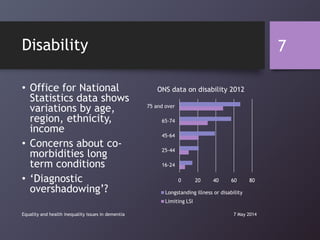
• Office for National
Statistics data shows
variations by age,
region, ethnicity,
income
• Concerns about co-
morbidities long
term conditions
• „Diagnostic
overshadowing‟?
0 20 40 60 80
16-24
25-44
45-64
65-74
75 and over
ONS data on disability 2012
Longstanding illness or disability
Limiting LSI
7 May 2014Equality and health inequality issues in dementia
7
Dementia and learning disability
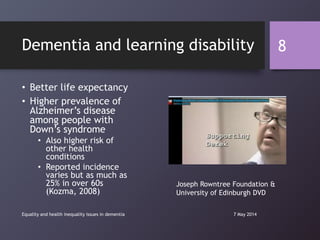
• Better life expectancy
• Higher prevalence of
Alzheimer‟s disease
among people with
Down‟s syndrome
• Also higher risk of
other health
conditions
• Reported incidence
varies but as much as
25% in over 60s
(Kozma, 2008)
7 May 2014Equality and health inequality issues in dementia
8
Joseph Rowntree Foundation &
University of Edinburgh DVD
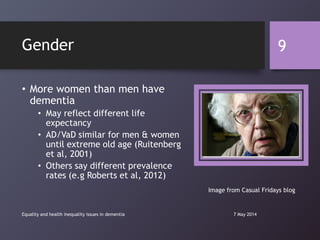
Gender
• More women than men have
dementia
• May reflect different life
expectancy
• AD/VaD similar for men & women
until extreme old age (Ruitenberg
et al, 2001)
• Others say different prevalence
rates (e.g Roberts et al, 2012)
7 May 2014Equality and health inequality issues in dementia
9
Image from Casual Fridays blog
Sharpest differences in care
homes?
• More women than men
live in care homes
• Women tend to marry
men older than them
and to live longer
• Poverty rates worse
among „single‟ women
households
• About 80% social care
workforce are women
7 May 2014Equality and health inequality issues in dementia
10
Image Scottish Parliament website
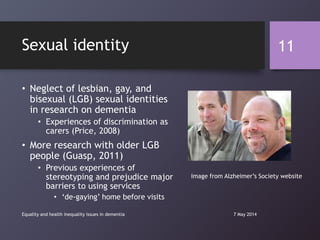
Sexual identity
• Neglect of lesbian, gay, and
bisexual (LGB) sexual identities
in research on dementia
• Experiences of discrimination as
carers (Price, 2008)
• More research with older LGB
people (Guasp, 2011)
• Previous experiences of
stereotyping and prejudice major
barriers to using services
• „de-gaying‟ home before visits
Equality and health inequality issues in dementia
11
Image from Alzheimer‟s Society website
7 May 2014
Possible inequalities
• Barriers to using health and care
services
• Higher proportions of older LGB
people living alone (Guasp, 2011)
• Higher proportions of older LGB
people living in poverty
(Uhrig, 2013)
• US research shows effects on social
support mixed
7 May 2014Equality and health inequality issues in dementia
12
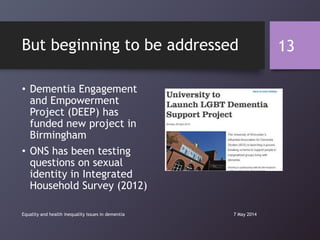
But beginning to be addressed
• Dementia Engagement
and Empowerment
Project (DEEP) has
funded new project in
Birmingham
• ONS has been testing
questions on sexual
identity in Integrated
Household Survey (2012)
7 May 2014Equality and health inequality issues in dementia
13
Gender identity
• Reminder that gender identity and sexual
identity not the same
• „Binary‟ gender distinctions do not reflect
many people‟s perceptions of self
• We don‟t routinely ask whether people self
identify as transgender/intersex/or other
identity
• Can surmise there is population of older
people who transitioned in 1970s but no data
7 May 2014Equality and health inequality issues in dementia
14
Marginalised
• Differing views as to
advantages/disadvantages of LGBT
grouping
• Evidence base extremely small for
everything, let alone dementia
• Research with transgender people
suggests that many people have had
experience of discrimination which
influences „help seeking behaviour‟ in
old age
7 May 2014Equality and health inequality issues in dementia
15
Some US research
• Conference paper using data from
International MetLife Survey on Preparation for
Aging in Trans-Identified Populations
(McFadden et al, undated)
• Older transgender adults (aged 60 and over)
very concerned about developing dementia
• Concerned about intimate care
• Concerned they will be treated in ways not
congruent with gender identity
7 May 2014Equality and health inequality issues in dementia
16
Ethnicity
• Present later to services when
dementia is more severe
(Mukadam et al, 2011)
• Knowledge about dementia
appears to be less (Seabrooke &
Milne, 2009)
• Stigma may be greater
(LaFontaine, 2007)
• Carers may experience particular
difficulties (Bowes &
Wilkinson, 2003)
7 May 2014Equality and health inequality issues in dementia
17
Image from 2009 Dementia Strategy
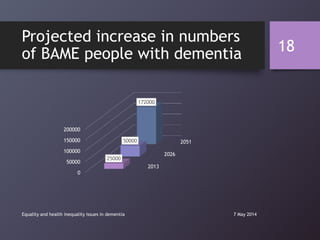
Projected increase in numbers
of BAME people with dementia
2013
2026
2051
0
50000
100000
150000
200000
25000
50000
172000
7 May 2014Equality and health inequality issues in dementia
18
Religion
• In some instances may be more appropriate to
look at ethno-religious groupings (Hills et
al, 2010)
• But generally reported in terms of ethnicity
• Risks of stereotyping
• In 2001 Census Chinese people were the ethnic
group most likely to say they had no religious
affiliation
7 May 2014Equality and health inequality issues in dementia
19
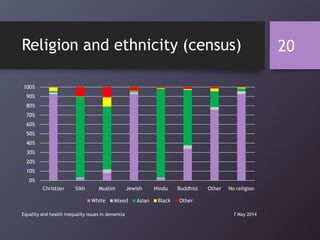
Religion and ethnicity (census)
0%
10%
20%
30%
40%
50%
60%
70%
80%
90%
100%
Christian Sikh Muslim Jewish Hindu Buddhist Other No religion
White Mixed Asian Black Other
7 May 2014Equality and health inequality issues in dementia
20
Socio-economic status
• Research in this area is mainly from the US
• Suggests there are risk factors related to
socio-economic status
• Education as a „protective‟ factor?
• Poorer physical and mental health throughout the
life course?
7 May 2014Equality and health inequality issues in dementia
21
Conclusions
• We have multiple identities so important not
to look just at one aspect of ourselves
• Very limited data looking at interactions
between different protected characteristics
• Review for Age UK (Moriarty &
Manthorpe, 2012) showed data on many
characteristics is not collected or not reported
• Considering these factors is an essential step
in delivering more person centred dementia
care
7 May 2014Equality and health inequality issues in dementia
22
Acknowledgements and disclaimer
The Social Care Workforce Research Unit receives funding from the Department of
Health Policy Research Programme. The views expressed here are those of the
authors and not the Department of Health
7 May 2014Equality and health inequality issues in dementia
23

Equalities and inequalities in dementia

  • 1.
    Overview of equalityand health inequality issues and dementia Jo Moriarty Social Care Workforce Research Unit
  • 2.
    „By 2015 everyperson with dementia will be able to say‟ „I get the treatment and support which are best for my dementia and my life‟ „I know what I can do to help myself and who else can help me. My community is working to help me to live well with dementia‟ „I wanted to take part in research and was able to do so‟ 7 May 2014Equality and health inequality issues in dementia 2
  • 3.
    “ ” There are partsof the country where it takes six months to get a dementia diagnosis, which is absolutely scandalous. I want to get to a situation where the average across the whole country is no more than six weeks Jeremy Hunt, interview in The Telegraph, 27 February 2014 Government plans to improve regional variations in screening 7 May 2014Equality and health inequality issues in dementia 3
  • 4.
    Where does thisleave us? • Prime Minister‟s Dementia Challenge recognises variations in access to good dementia support • Focus on regional variations in screening but we need more „hard‟ evidence on other aspects • Findings presented here will be familiar but offer a framework for discussions throughout the day 7 May 2014Equality and health inequality issues in dementia 4
  • 5.
    • Rationalised existinglegislation • Some new provisions • Nine „protected characteristics‟ • age • disability • gender reassignment • marriage and civil partnership* • pregnancy and maternity* • race • religion or belief • sex • sexual orientation 7 May 2014Equality and health inequality issues in dementia 5Equality Act 2010
  • 6.
    Age • Risk ofdementia increases with age • But increasing numbers diagnosed before age of 65 • Difficulties getting a diagnosis • Increased stigma • May face different issues (e.g. employment, young children) 7 May 2014Equality and health inequality issues in dementia 6 http://www.youngdementiauk.org/
  • 7.
    Disability • Office forNational Statistics data shows variations by age, region, ethnicity, income • Concerns about co- morbidities long term conditions • „Diagnostic overshadowing‟? 0 20 40 60 80 16-24 25-44 45-64 65-74 75 and over ONS data on disability 2012 Longstanding illness or disability Limiting LSI 7 May 2014Equality and health inequality issues in dementia 7
  • 8.
    Dementia and learningdisability • Better life expectancy • Higher prevalence of Alzheimer‟s disease among people with Down‟s syndrome • Also higher risk of other health conditions • Reported incidence varies but as much as 25% in over 60s (Kozma, 2008) 7 May 2014Equality and health inequality issues in dementia 8 Joseph Rowntree Foundation & University of Edinburgh DVD
  • 9.
    Gender • More womenthan men have dementia • May reflect different life expectancy • AD/VaD similar for men & women until extreme old age (Ruitenberg et al, 2001) • Others say different prevalence rates (e.g Roberts et al, 2012) 7 May 2014Equality and health inequality issues in dementia 9 Image from Casual Fridays blog
  • 10.
    Sharpest differences incare homes? • More women than men live in care homes • Women tend to marry men older than them and to live longer • Poverty rates worse among „single‟ women households • About 80% social care workforce are women 7 May 2014Equality and health inequality issues in dementia 10 Image Scottish Parliament website
  • 11.
    Sexual identity • Neglectof lesbian, gay, and bisexual (LGB) sexual identities in research on dementia • Experiences of discrimination as carers (Price, 2008) • More research with older LGB people (Guasp, 2011) • Previous experiences of stereotyping and prejudice major barriers to using services • „de-gaying‟ home before visits Equality and health inequality issues in dementia 11 Image from Alzheimer‟s Society website 7 May 2014
  • 12.
    Possible inequalities • Barriersto using health and care services • Higher proportions of older LGB people living alone (Guasp, 2011) • Higher proportions of older LGB people living in poverty (Uhrig, 2013) • US research shows effects on social support mixed 7 May 2014Equality and health inequality issues in dementia 12
  • 13.
    But beginning tobe addressed • Dementia Engagement and Empowerment Project (DEEP) has funded new project in Birmingham • ONS has been testing questions on sexual identity in Integrated Household Survey (2012) 7 May 2014Equality and health inequality issues in dementia 13
  • 14.
    Gender identity • Reminderthat gender identity and sexual identity not the same • „Binary‟ gender distinctions do not reflect many people‟s perceptions of self • We don‟t routinely ask whether people self identify as transgender/intersex/or other identity • Can surmise there is population of older people who transitioned in 1970s but no data 7 May 2014Equality and health inequality issues in dementia 14
  • 15.
    Marginalised • Differing viewsas to advantages/disadvantages of LGBT grouping • Evidence base extremely small for everything, let alone dementia • Research with transgender people suggests that many people have had experience of discrimination which influences „help seeking behaviour‟ in old age 7 May 2014Equality and health inequality issues in dementia 15
  • 16.
    Some US research •Conference paper using data from International MetLife Survey on Preparation for Aging in Trans-Identified Populations (McFadden et al, undated) • Older transgender adults (aged 60 and over) very concerned about developing dementia • Concerned about intimate care • Concerned they will be treated in ways not congruent with gender identity 7 May 2014Equality and health inequality issues in dementia 16
  • 17.
    Ethnicity • Present laterto services when dementia is more severe (Mukadam et al, 2011) • Knowledge about dementia appears to be less (Seabrooke & Milne, 2009) • Stigma may be greater (LaFontaine, 2007) • Carers may experience particular difficulties (Bowes & Wilkinson, 2003) 7 May 2014Equality and health inequality issues in dementia 17 Image from 2009 Dementia Strategy
  • 18.
    Projected increase innumbers of BAME people with dementia 2013 2026 2051 0 50000 100000 150000 200000 25000 50000 172000 7 May 2014Equality and health inequality issues in dementia 18
  • 19.
    Religion • In someinstances may be more appropriate to look at ethno-religious groupings (Hills et al, 2010) • But generally reported in terms of ethnicity • Risks of stereotyping • In 2001 Census Chinese people were the ethnic group most likely to say they had no religious affiliation 7 May 2014Equality and health inequality issues in dementia 19
  • 20.
    Religion and ethnicity(census) 0% 10% 20% 30% 40% 50% 60% 70% 80% 90% 100% Christian Sikh Muslim Jewish Hindu Buddhist Other No religion White Mixed Asian Black Other 7 May 2014Equality and health inequality issues in dementia 20
  • 21.
    Socio-economic status • Researchin this area is mainly from the US • Suggests there are risk factors related to socio-economic status • Education as a „protective‟ factor? • Poorer physical and mental health throughout the life course? 7 May 2014Equality and health inequality issues in dementia 21
  • 22.
    Conclusions • We havemultiple identities so important not to look just at one aspect of ourselves • Very limited data looking at interactions between different protected characteristics • Review for Age UK (Moriarty & Manthorpe, 2012) showed data on many characteristics is not collected or not reported • Considering these factors is an essential step in delivering more person centred dementia care 7 May 2014Equality and health inequality issues in dementia 22
  • 23.
    Acknowledgements and disclaimer TheSocial Care Workforce Research Unit receives funding from the Department of Health Policy Research Programme. The views expressed here are those of the authors and not the Department of Health 7 May 2014Equality and health inequality issues in dementia 23

Editor's Notes

  • #4 Number of people diagnosed with dementia compared with projected numbers of people with dementia
  • #6 Excluding marriage and civil partnership/pregnancy and maternity provisions because they mainly relate to employment law
  • #7 Between working age adult and older people’s mental health services
  • #8 ‘diagnostic overshadowing’ was first used in 1982 to refer to the tendency for clinicians to attribute symptoms or behaviours of a person with learning disability to their underlying cognitive deficits and hence to under-diagnose the presence of co-morbid psychopathology
  • #20 Don’t forget to go back