www.migration-crisis.com/libya
Libyan Crisis
One Month into IOM’s response
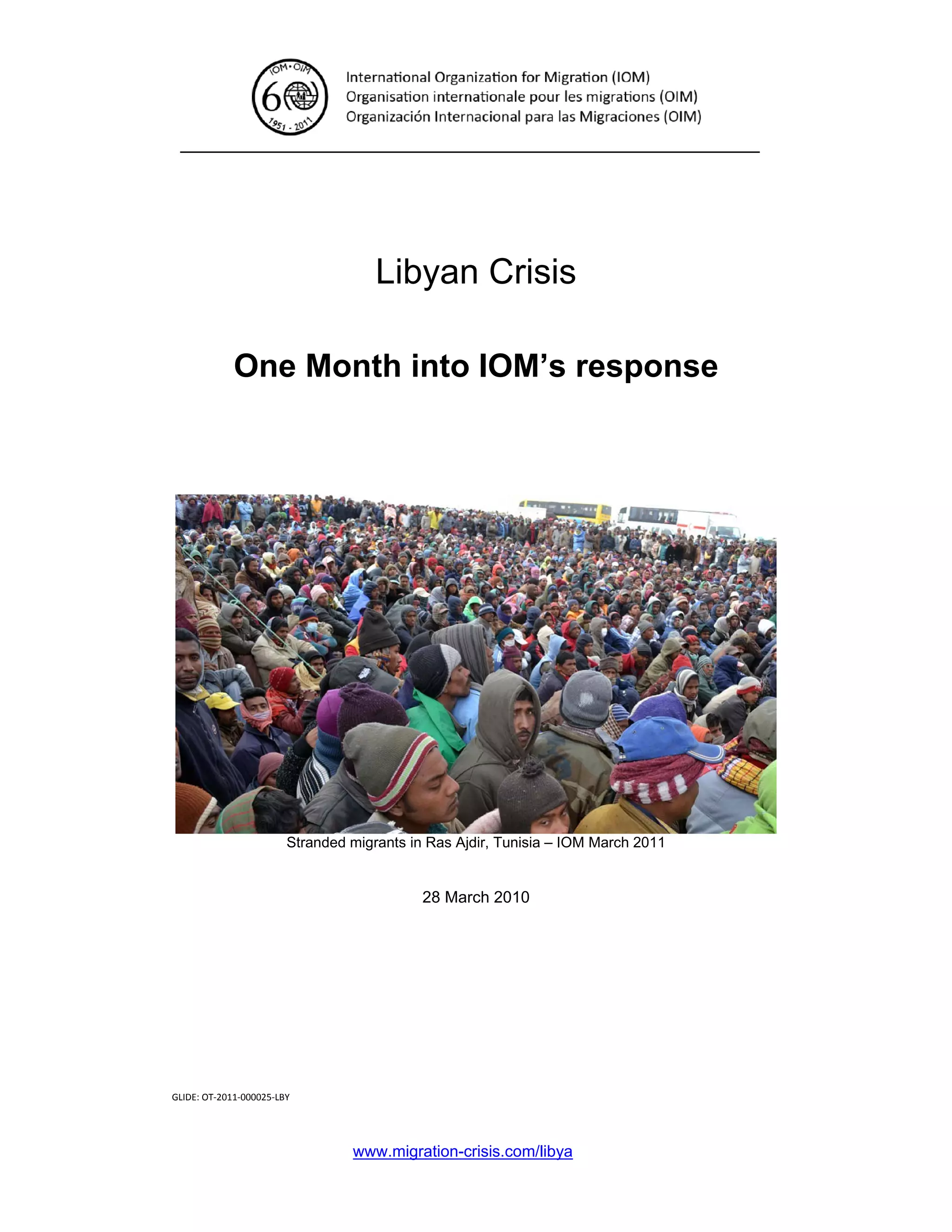
Stranded migrants in Ras Ajdir, Tunisia – IOM March 2011
28 March 2010
GLIDE: OT‐2011‐000025‐LBY
Libyan Crisis – One Month into IOM’s Response
2
HIGHLIGHTS
The Libyan Migration Crisis started one month ago with the first large scale cross-
border movements - mainly of migrant workers - to Egypt and Tunisia and later on to
Algeria, Niger, Chad and Sudan. In total, over 380,000 migrants have fled the
country. This figure includes more than 210,000 third country nationals - making it
one of the largest migration crises since the 1st
Gulf War in 1990 that had led to the
evacuation of 250,000 persons.
In response, IOM was immediately operational on the ground with its first chartered
planes taking off on 28 February from Djerba, Tunisia: five to Cairo, Egypt, and one
to Bamako, Mali, bringing 1,068 stranded migrants back home. As of 28 March, IOM
has assisted the safe return of more than 78,957 persons.
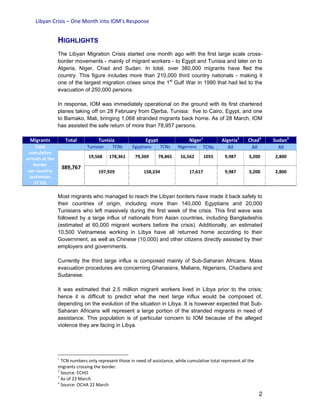
Migrants Total Tunisia Egypt Niger1
Algeria2
Chad3
Sudan4
Tunisian TCNs Egyptians TCNs Nigeriens TCNs All All All
19,568 178,361 79,369 78,865 16,562 1055 9,987 3,200 2,800
Total
cumulative
arrivals at the
border
per country
(estimates
27.03)
389,767
197,929 158,234 17,617 9,987 3,200 2,800
Most migrants who managed to reach the Libyan borders have made it back safely to
their countries of origin, including more than 140,000 Egyptians and 20,000
Tunisians who left massively during the first week of the crisis. This first wave was
followed by a large influx of nationals from Asian countries, including Bangladeshis
(estimated at 60,000 migrant workers before the crisis). Additionally, an estimated
10,500 Vietnamese working in Libya have all returned home according to their
Government, as well as Chinese (10,000) and other citizens directly assisted by their
employers and governments.
Currently the third large influx is composed mainly of Sub-Saharan Africans. Mass
evacuation procedures are concerning Ghanaians, Malians, Nigerians, Chadians and
Sudanese.
It was estimated that 2.5 million migrant workers lived in Libya prior to the crisis;
hence it is difficult to predict what the next large influx would be composed of,
depending on the evolution of the situation in Libya. It is however expected that Sub-
Saharan Africans will represent a large portion of the stranded migrants in need of
assistance. This population is of particular concern to IOM because of the alleged
violence they are facing in Libya.
1
TCN numbers only represent those in need of assistance, while cumulative total represent all the
migrants crossing the border.
2
Source: ECHO
3
As of 23 March
4
Source: OCHA 22 March
Libyan Crisis – One Month into IOM’s Response
3
As often in migration crisis, the less vulnerable have been the first to flee. Current
caseloads are more complex, requiring additional or specific humanitarian and return
assistance for:
o Families with pregnant women and children;
o Migrants who have sustained injuries and/or have pre-existing medical
conditions requiring access to health care and medical escort services
before returning home;
o Persons who need special psychosocial support, or mental health
referral;
o Migrants who are unable to self-assist having lost all their assets;
o Migrants unwilling to go home as they have no economic opportunities
and waiting to go back;
o Nationals from countries where they cannot return.
Migrant flows
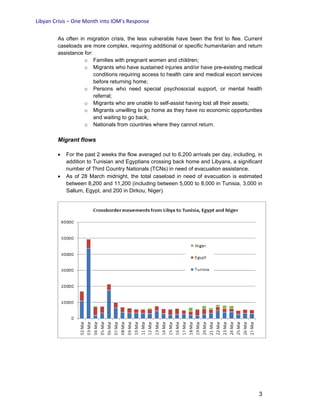
• For the past 2 weeks the flow averaged out to 6,200 arrivals per day, including, in
addition to Tunisian and Egyptians crossing back home and Libyans, a significant
number of Third Country Nationals (TCNs) in need of evacuation assistance.
• As of 28 March midnight, the total caseload in need of evacuation is estimated
between 8,200 and 11,200 (including between 5,000 to 8,000 in Tunisia, 3,000 in
Sallum, Egypt, and 200 in Dirkou, Niger).
Libyan Crisis – One Month into IOM’s Response
4
Trends
• In Tunisia: While Sub-Saharan Africans continue to represent the largest
caseload of migrants for whom evacuation is needed, the 1,000 remaining
Bangladeshis citizens in Choucha camp are waiting for more flights to return
home. As of 25 March, IOM already assisted the repatriation of 20,098
Bangladeshis nationals.
• In Egypt: While the number of Egyptians returning home is decreasing, the flow of
Libyans has been steadily increasing to reach 32,679. So far they have not
requested assistance or international protection. On the other hand, TCNs flow
remains constant and average 500 persons per day over the past five days.
• In Algeria: Statistics shows that the influx to Algerian border decreased from 400
a day to 150 a day. The composition of the migrants’ flow, mainly Egyptians and
Asians during earliest weeks, has changed now to more Libyans and Sub-
Saharan Africans. According to ECHO monitoring 10,679 persons left Libya to the
Algerian border. 70% are TCNs, 16% Libyans, and 9 % Algerians.
• In Niger: A total of 17,617 persons (mostly Nigeriens) have made their way
through the desert to Dirkou – the first main settlement after the border. IOM and
local authorities are now bracing large number of arrivals, clearly overwhelming
the local capacities.
• In Chad: More than 5,100 persons have crossed the border to Chad, mainly
Chadian nationals. While insignificant at the beginning of the crisis, in the past
week, movements have increased and prompted the Government to ask for an
assessment to start providing humanitarian and return assistance.
Operational Highlights
• Since the beginning of the crisis, IOM has received official request from 32
countries to assist their stranded nationals
5
• Despite security concerns, IOM remains active in Libya. It has supported the
evacuation of 2,309 stranded migrants from Benghazi and is negotiating the
possibility to operate from airports and seaports– in particular Tripoli, to evacuate
mainly Sub-Saharan Africans stranded there, given their particular vulnerability.
• Since the beginning of the emergency, IOM has been working closely with the
authorities in Egypt, Tunisia, Niger and now in Algeria, Chad and Sudan, relevant
Embassies and Consulates on the ground, relevant authorities in countries of
destination, UN Agencies, the Red Crescent Societies in Libya, Egypt and
Tunisia, Islamic Relief and other local NGOs to provide humanitarian and return
assistance.
• The Libya evacuation programme has now become a truly global endeavour with
IOM offices in over sixteen countries working together to ensure the programme
operates swiftly, efficiently and humanely. IOM offices are involved at multiple
5
Bangladesh, Benin, Bosnia and Herzegovina, Burkina Faso, Cameroon, Chad, Côte
D’Ivoire, Egypt, Gambia, Ghana, Guinea, Guinea-Bissau, Kenya, Lebanon, Liberia, Mali,
Mauritania, Morocco, Nepal, Netherlands, Niger, Nigeria, Philippines, Senegal, Serbia, Sierra
Leone, Sri Lanka, Sudan, Swaziland, Togo, Vietnam and Zimbabwe.
Libyan Crisis – One Month into IOM’s Response
5
points of departure, at points of transit, and also at a number of receiving
locations, thereby helping to ensure a smooth operation.
• To sustain the repatriation of thousand of stranded migrants, IOM has received
the support of UNHCR, through a joint Humanitarian Evacuation Cell (HEC). The
HEC has also coordinated air assets from numerous partners, including inter alia
the UK, Bangladesh, Sweden, Sudan, Qatar, Belgium, Italy, Malta, Spain, US,
and France.
• Associated operation services
performed by IOM in Algeria, Egypt,
Niger, and Tunisia include: 24/7
border team to receive migrants;
shelter, food, medical assistance,
mental health and psychosocial
support; ground transport to camps
and departure points; registration; pre-
departure health checks and medical
escorts services, liaison with
authorities, consular representatives;
travel bookings, procurement of land,
sea and air assets; and reception in
countries of destination.
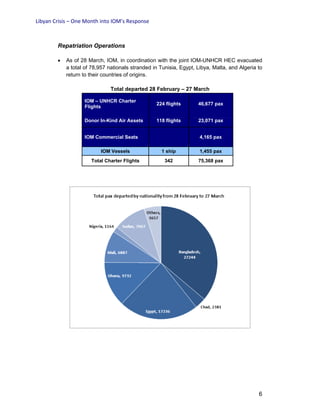
Breakdown of departure by service provider coordinated by the HEC
0
1000
2000
3000
4000
5000
6000
2
8
‐
F
e
b
1
‐
M
a
r
2
‐
M
a
r
3
‐
M
a
r
4
‐
M
a
r
5
‐
M
a
r
6
‐
M
a
r
7
‐
M
a
r
8
‐
M
a
r
9
‐
M
a
r
1
0
‐
M
a
r
1
1
‐
M
a
r
1
2
‐
M
a
r
1
3
‐
M
a
r
1
4
‐
M
a
r
1
5
‐
M
a
r
1
6
‐
M
a
r
1
7
‐
M
a
r
1
8
‐
M
a
r
1
9
‐
M
a
r
2
0
‐
M
a
r
2
1
‐
M
a
r
2
2
‐
M
a
r
2
3
‐
M
a
r
2
4
‐
M
a
r
2
5
‐
M
a
r
2
6
‐
M
a
r
2
7
‐
M
a
r
Donor In‐KIND
IOM ‐ Ship
IOM ‐ Commercial flights
IOM ‐ UNHCR Charter flights
Total departures by providers
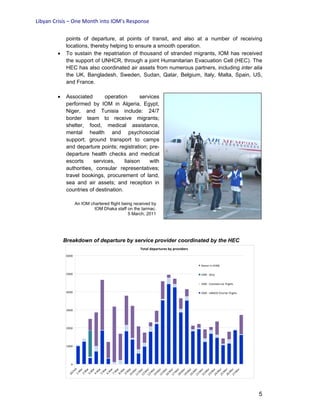
An IOM chartered flight being received by
IOM Dhaka staff on the tarmac.
5 March, 2011
Libyan Crisis – One Month into IOM’s Response
6
Repatriation Operations
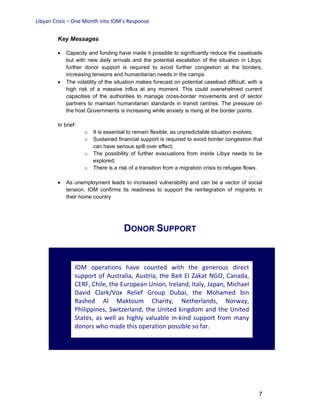
• As of 28 March, IOM, in coordination with the joint IOM-UNHCR HEC evacuated
a total of 78,957 nationals stranded in Tunisia, Egypt, Libya, Malta, and Algeria to
return to their countries of origins.
Total departed 28 February – 27 March
IOM – UNHCR Charter
Flights
224 flights 46,677 pax
Donor In-Kind Air Assets 118 flights 23,071 pax
IOM Commercial Seats 4,165 pax
IOM Vessels 1 ship 1,455 pax
Total Charter Flights 342 75,368 pax
Libyan Crisis – One Month into IOM’s Response
7
Key Messages
• Capacity and funding have made it possible to significantly reduce the caseloads
but with new daily arrivals and the potential escalation of the situation in Libya,
further donor support is required to avoid further congestion at the borders,
increasing tensions and humanitarian needs in the camps.
• The volatility of the situation makes forecast on potential caseload difficult, with a
high risk of a massive influx at any moment. This could overwhelmed current
capacities of the authorities to manage cross-border movements and of sector
partners to maintain humanitarian standards in transit centres. The pressure on
the host Governments is increasing while anxiety is rising at the border points.
In brief:
o It is essential to remain flexible, as unpredictable situation evolves;
o Sustained financial support is required to avoid border congestion that
can have serious spill over effect;
o The possibility of further evacuations from inside Libya needs to be
explored;
o There is a risk of a transition from a migration crisis to refugee flows.
• As unemployment leads to increased vulnerability and can be a vector of social
tension, IOM confirms its readiness to support the reintegration of migrants in
their home country
DONOR SUPPORT
IOM operations have counted with the generous direct
support of Australia, Austria, the Bait El Zakat NGO, Canada,
CERF, Chile, the European Union, Ireland, Italy, Japan, Michael
David Clark/Vox Relief Group Dubai, the Mohamed bin
Rashed Al Maktoum Charity, Netherlands, Norway,
Philippines, Switzerland, the United kingdom and the United
States, as well as highly valuable in‐kind support from many
donors who made this operation possible so far.
Libyan Crisis – One Month into IOM’s Response
8
IOM COUNTRY OPERATIONS
LIBYA
• Before the crisis, Libya was estimated to host 2.5 million migrants including:
o 1 million Egyptians
o 80,000 Pakistanis
o 59,000 Sudanese
o 63,000 Bangladeshis
o 26,000 Filipinos
o 10,500 Vietnamese
o 2,000 Nepalese
o A large population of Sub-Saharan Africans, mainly from Niger, Chad,
Mali, Nigeria, and Ghana.
• As of 27 March, 383,858 migrants have fled violence in Libya,6
with thousands
more waiting to cross these borders or stranded at sea and air ports. A potentially
large population stranded in Libya could make its way to the border if the situation
continues to deteriorate.
• Despite the difficult situation, evacuation of stranded migrants from Benghazi has
resumed (to date, 2,309 people have been assisted by road to Sallum - in the
majority of cases under escort of the Libyan Red Crescent - and by sea to
Alexandria).
• IOM is negotiating the possibility to operate from airports – in particular Tripoli, to
evacuate mainly Sub-Saharan Africans stranded there.
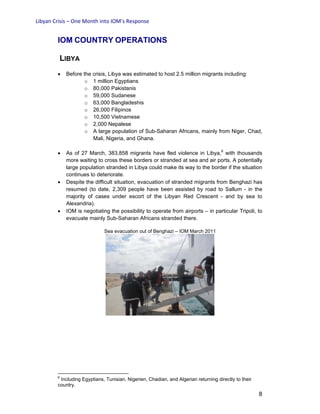
Sea evacuation out of Benghazi – IOM March 2011
6
Including Egyptians, Tunisian, Nigerien, Chadian, and Algerian returning directly to their
country.
Libyan Crisis – One Month into IOM’s Response
9
TUNISIA
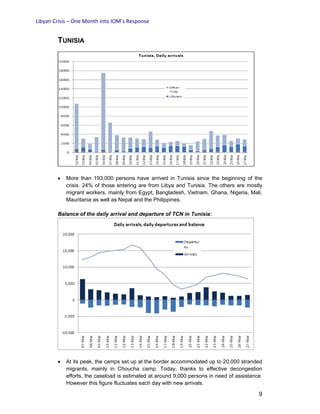
• More than 193,000 persons have arrived in Tunisia since the beginning of the
crisis. 24% of those entering are from Libya and Tunisia. The others are mostly
migrant workers, mainly from Egypt, Bangladesh, Vietnam, Ghana, Nigeria, Mali,
Mauritania as well as Nepal and the Philippines.
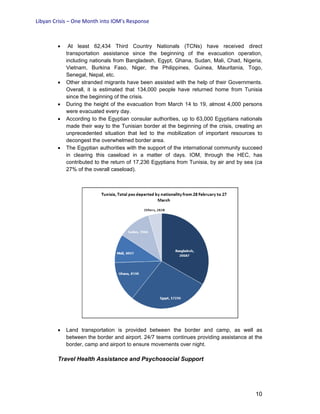
Balance of the daily arrival and departure of TCN in Tunisia:
• At its peak, the camps set up at the border accommodated up to 20,000 stranded
migrants, mainly in Choucha camp. Today, thanks to effective decongestion
efforts, the caseload is estimated at around 9,000 persons in need of assistance.
However this figure fluctuates each day with new arrivals.
Libyan Crisis – One Month into IOM’s Response
10
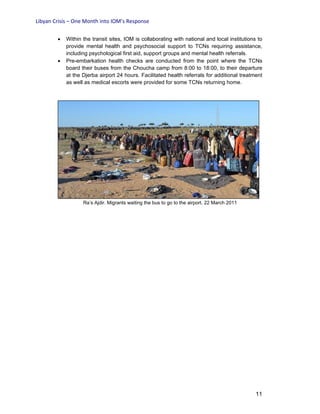
• At least 62,434 Third Country Nationals (TCNs) have received direct
transportation assistance since the beginning of the evacuation operation,
including nationals from Bangladesh, Egypt, Ghana, Sudan, Mali, Chad, Nigeria,
Vietnam, Burkina Faso, Niger, the Philippines, Guinea, Mauritania, Togo,
Senegal, Nepal, etc.
• Other stranded migrants have been assisted with the help of their Governments.
Overall, it is estimated that 134,000 people have returned home from Tunisia
since the beginning of the crisis.
• During the height of the evacuation from March 14 to 19, almost 4,000 persons
were evacuated every day.
• According to the Egyptian consular authorities, up to 63,000 Egyptians nationals
made their way to the Tunisian border at the beginning of the crisis, creating an
unprecedented situation that led to the mobilization of important resources to
decongest the overwhelmed border area.
• The Egyptian authorities with the support of the international community succeed
in clearing this caseload in a matter of days. IOM, through the HEC, has
contributed to the return of 17,236 Egyptians from Tunisia, by air and by sea (ca
27% of the overall caseload).
• Land transportation is provided between the border and camp, as well as
between the border and airport. 24/7 teams continues providing assistance at the
border, camp and airport to ensure movements over night.
Travel Health Assistance and Psychosocial Support
Libyan Crisis – One Month into IOM’s Response
11
• Within the transit sites, IOM is collaborating with national and local institutions to
provide mental health and psychosocial support to TCNs requiring assistance,
including psychological first aid, support groups and mental health referrals.
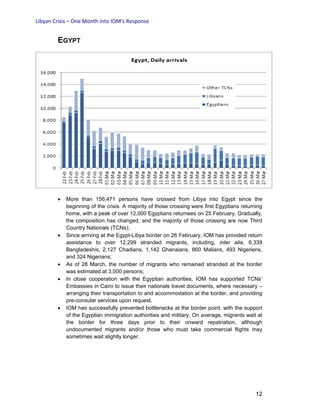
• Pre-embarkation health checks are conducted from the point where the TCNs
board their buses from the Choucha camp from 8:00 to 18:00, to their departure
at the Djerba airport 24 hours. Facilitated health referrals for additional treatment
as well as medical escorts were provided for some TCNs returning home.
Ra’s Ajdir. Migrants waiting the bus to go to the airport. 22 March 2011
Libyan Crisis – One Month into IOM’s Response
12
EGYPT
• More than 156,471 persons have crossed from Libya into Egypt since the
beginning of the crisis. A majority of those crossing were first Egyptians returning
home, with a peak of over 12,000 Egyptians returnees on 25 February. Gradually,
the composition has changed, and the majority of those crossing are now Third
Country Nationals (TCNs);
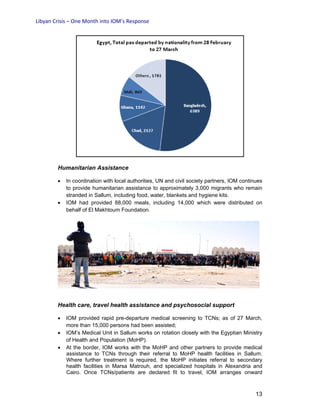
• Since arriving at the Egypt-Libya border on 26 February, IOM has provided return
assistance to over 12,299 stranded migrants, including, inter alia, 6,339
Bangladeshis, 2,127 Chadians, 1,142 Ghanaians, 860 Malians, 493 Nigeriens,
and 324 Nigerians;
• As of 28 March, the number of migrants who remained stranded at the border
was estimated at 3,000 persons;
• In close cooperation with the Egyptian authorities, IOM has supported TCNs’
Embassies in Cairo to issue their nationals travel documents, where necessary –
arranging their transportation to and accommodation at the border, and providing
pre-consular services upon request.
• IOM has successfully prevented bottlenecks at the border point, with the support
of the Egyptian immigration authorities and military. On average, migrants wait at
the border for three days prior to their onward repatriation, although
undocumented migrants and/or those who must take commercial flights may
sometimes wait slightly longer.
Libyan Crisis – One Month into IOM’s Response
13
Humanitarian Assistance
• In coordination with local authorities, UN and civil society partners, IOM continues
to provide humanitarian assistance to approximately 3,000 migrants who remain
stranded in Sallum, including food, water, blankets and hygiene kits.
• IOM had provided 88,000 meals, including 14,000 which were distributed on
behalf of El Makhtoum Foundation.
Health care, travel health assistance and psychosocial support
• IOM provided rapid pre-departure medical screening to TCNs; as of 27 March,
more than 15,000 persons had been assisted;
• IOM’s Medical Unit in Sallum works on rotation closely with the Egyptian Ministry
of Health and Population (MoHP).
• At the border, IOM works with the MoHP and other partners to provide medical
assistance to TCNs through their referral to MoHP health facilities in Sallum.
Where further treatment is required, the MoHP initiates referral to secondary
health facilities in Marsa Matrouh, and specialized hospitals in Alexandria and
Cairo. Once TCNs/patients are declared fit to travel, IOM arranges onward
Libyan Crisis – One Month into IOM’s Response
14
transportation to their home countries, as well as medical escorts, where
necessary.
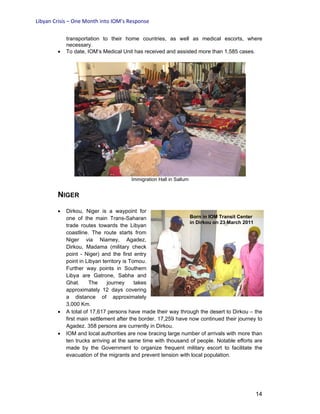
• To date, IOM’s Medical Unit has received and assisted more than 1,585 cases.
Immigration Hall in Sallum
NIGER
• Dirkou, Niger is a waypoint for
one of the main Trans-Saharan
trade routes towards the Libyan
coastline. The route starts from
Niger via Niamey, Agadez,
Dirkou, Madama (military check
point - Niger) and the first entry
point in Libyan territory is Tomou.
Further way points in Southern
Libya are Gatrone, Sabha and
Ghat. The journey takes
approximately 12 days covering
a distance of approximately
3,000 Km.
• A total of 17,617 persons have made their way through the desert to Dirkou – the
first main settlement after the border. 17,259 have now continued their journey to
Agadez. 358 persons are currently in Dirkou.
• IOM and local authorities are now bracing large number of arrivals with more than
ten trucks arriving at the same time with thousand of people. Notable efforts are
made by the Government to organize frequent military escort to facilitate the
evacuation of the migrants and prevent tension with local population.
Born in IOM Transit Center
in Dirkou on 23 March 2011
Libyan Crisis – One Month into IOM’s Response
15
• In its transit center in Dirkou, IOM is registering stranded migrants in need of
assistance, providing humanitarian assistance, including medical assistance.
• WFP has provided to IOM a food contribution for 2,500 people to help alleviate
the pressure on local populations and ease distribution to populations in need.
• The International Relief and Development (IRD) has offered 1,250 hygienic kits to
be distributed to migrants in transit to Niamey.
• Upon their arrival in Agadez, onward transportation to Niamey and travel
arrangement to the country of origin will be organized for stranded migrants.
• The flow continues to increase with 20 trucks between Madama and Dirkou that
are expected to arrive in 1-2 days; and with more than 50 trucks reportedly
between Gatrone and Madama en route to Dirkou. Further, it was reported that
around 50, 000 people (including Nigeriens and TCNs) were stranded in Sabha
with no means of transport.
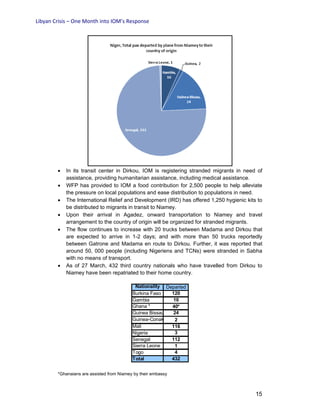
• As of 27 March, 432 third country nationals who have travelled from Dirkou to
Niamey have been repatriated to their home country.
Nationality Departed
Burkina Faso 120
Gambia 10
Ghana * 40*
Guinea Bissau 24
Guinea-Conak 2
Mali 116
Nigeria 3
Senegal 112
Sierra Leone 1
Togo 4
Total 432
*Ghanaians are assisted from Niamey by their embassy
Libyan Crisis – One Month into IOM’s Response
16
ALGERIA
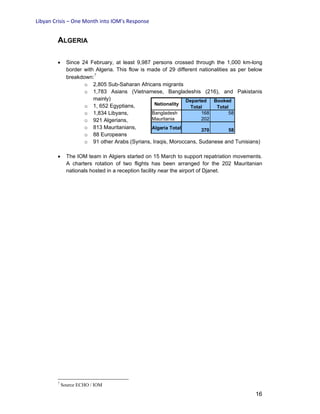
• Since 24 February, at least 9,987 persons crossed through the 1,000 km-long
border with Algeria. This flow is made of 29 different nationalities as per below
breakdown:
7
o 2,805 Sub-Saharan Africans migrants
o 1,783 Asians (Vietnamese, Bangladeshis (216), and Pakistanis
mainly)
o 1, 652 Egyptians,
o 1,834 Libyans,
o 921 Algerians,
o 813 Mauritanians,
o 88 Europeans
o 91 other Arabs (Syrians, Iraqis, Moroccans, Sudanese and Tunisians)
• The IOM team in Algiers started on 15 March to support repatriation movements.
A charters rotation of two flights has been arranged for the 202 Mauritanian
nationals hosted in a reception facility near the airport of Djanet.
7
Source ECHO / IOM
Nationality
Departed
Total
Booked
Total
Bangladesh 168 58
Mauritania 202
Algeria Total 370 58
Libyan Crisis – One Month into IOM’s Response
17
HIGHLIGHTS ON IOM SUPPORT IN COUNTRIES OF ORIGIN
BANGLADESH
• As of 27 March, IOM Dhaka has provided airport assistance to 27,244 evacuated
Bangladeshi migrants that have returned through IOM facilitated channels in a
total of 113 flights (16 commercial and 97 chartered including 8 BIMAN flights).
• Bangladesh has to date diverted 8 Biman flights (2 to Egypt and 6 to Tunisia) for
the repatriation of a total of 2,353 Bangladesh nationals.
• During the period of 28 February to 18 March, at the height of the evacuation
operation of Bangladesh nationals, IOM Dhaka staff was present at the airport 24
hours on 3 rotations to assist returning migrants. IOM Dhaka’s efforts have
contributed to manage arrivals of 1,000 migrants at a time at the peak of the
operations.
• IOM has worked closely with the Bangladeshi Red Crescent Society as well as
the Ministry of Health. IOM medical staff has also been present at the airport and
providing necessary medical assistance to any injured and/or sick returnees.
• The Government continues to provide 1,000 Taka (approx. USD 14) per returning
migrant from Libya for their onward journey and a free bus service is provided to
take them from the airport to the main inter-district bus and train stations.
Recently, BRAC, a large Bangladeshi NGO, has also come forth to offer their
support to the returning migrant workers affected by the Libya crisis and has just
begun to contribute to the food being distributed to the migrants.
• IOM Dhaka has also deployed four staff, including a medical doctor, to Djerba to
assist in the humanitarian and evacuation operation, particularly to support the
Bangladeshi caseload in Djerba.
• IOM’s efforts in the provision of humanitarian and evacuation assistance to
Bangladesh nationals have been appreciated by the Government of Bangladesh.
During a parliamentary session on 15 March 2011, the Foreign Minister, H.E. Dr.
Dipu Moni in her statement repeatedly highlighted the rapid and comprehensive
support being provided by IOM to Bangladeshi nationals in Tunisia, Egypt and
Algeria but also at in Dhaka.
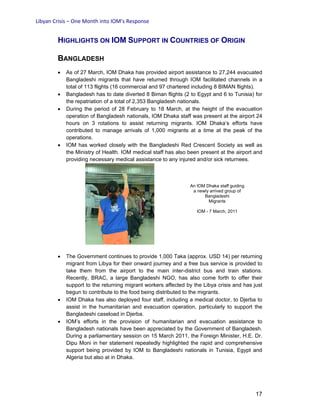
An IOM Dhaka staff guiding
a newly arrived group of
Bangladeshi
Migrants
IOM - 7 March, 2011
Libyan Crisis – One Month into IOM’s Response
18
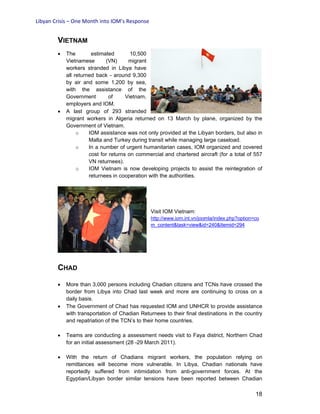
VIETNAM
• The estimated 10,500
Vietnamese (VN) migrant
workers stranded in Libya have
all returned back - around 9,300
by air and some 1,200 by sea,
with the assistance of the
Government of Vietnam,
employers and IOM.
• A last group of 293 stranded
migrant workers in Algeria returned on 13 March by plane, organized by the
Government of Vietnam.
o IOM assistance was not only provided at the Libyan borders, but also in
Malta and Turkey during transit while managing large caseload.
o In a number of urgent humanitarian cases, IOM organized and covered
cost for returns on commercial and chartered aircraft (for a total of 557
VN returnees).
o IOM Vietnam is now developing projects to assist the reintegration of
returnees in cooperation with the authorities.
Visit IOM Vietnam:
http://www.iom.int.vn/joomla/index.php?option=co
m_content&task=view&id=240&Itemid=294
CHAD
• More than 3,000 persons including Chadian citizens and TCNs have crossed the
border from Libya into Chad last week and more are continuing to cross on a
daily basis.
• The Government of Chad has requested IOM and UNHCR to provide assistance
with transportation of Chadian Returnees to their final destinations in the country
and repatriation of the TCN’s to their home countries.
• Teams are conducting a assessment needs visit to Faya district, Northern Chad
for an initial assessment (28 -29 March 2011).
• With the return of Chadians migrant workers, the population relying on
remittances will become more vulnerable. In Libya, Chadian nationals have
reportedly suffered from intimidation from anti-government forces. At the
Egyptian/Libyan border similar tensions have been reported between Chadian
Libyan Crisis – One Month into IOM’s Response
19
and Libyan nationals who allegedly assimilate them to pro-government
mercenaries. In order to avoid tensions, the Egyptian Army separated the
Chadians in different areas of the compound.
• Repatriation operations for Chadians nationals fleeing Libya are going on. As of
27 March 2,381 Chadian nationals have been returned home through the HEC.
While most Chadians were able continued their journey to their homes, some are
still hosted in a community centre in N’Djamena.
GHANA
• As of 27 March, 15,983 Ghanaians have
returned home from Libya, Egypt,
Tunisia and Niger to Ghana on 75 flights
(17 commercial and 58 charter flights).
• Below is the breakdown of returning
Ghanaians:
o 1,655 from Egypt
o 7,901 from Tunisia
o 6,355 from Tripoli8
()
o 54 from Niger
o 18 from Ethiopia
• The majority of returnees are single
males between the ages of 20 and 35 and from the Brong Ahafo Region of
Ghana (major emigration area). Less than 250 persons of the total figure are
women and children. Although returning Ghanaians are very happy to be back,
they are affected by the situation encountered in Libya (life-threatening violence)
and because of the friends and compatriots they were forced to leave behind.
8
Government of Ghana arranged all the flights from Tripoli to complement the efforts of IOM/UNHCR
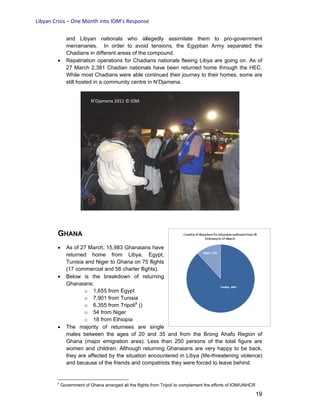
N’Djamena 2011 © IOM
Libyan Crisis – One Month into IOM’s Response
20
• The Government of Ghana has been extremely supportive and grateful for the
assistance provided by IOM which was acknowledged in every speech made by
the Ministers.
• Extensive support and assistance to the returnees has been provided as follows:
o Welcome Reception with the Ministry of
Foreign Affairs and Ministry of
Information to welcome each group of
returnees,
o Onward transportation in Ghana with the
National Disaster Management
Organization (NADMO). NADMO also
provided health services and an
ambulance on site.
o MTN communication provided SIM
cards.
• As most of the Ghanaians left Ghana in
search of economic opportunities, there is a
need to address the root causes of
migration through reintegration assistance
(income-generating/community development
initiatives) and psycho-social support. IOM is also gathering basic data, in
coordination with Ghana Immigration Service (GIS).
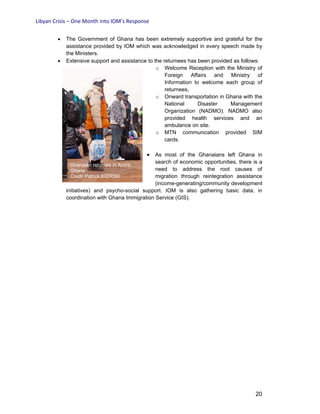
Ghanaian returnee in Accra,
Ghana
Credit Patrick KIERSKI

MENA One Month Report IOM

  • 1.
    www.migration-crisis.com/libya Libyan Crisis One Monthinto IOM’s response Stranded migrants in Ras Ajdir, Tunisia – IOM March 2011 28 March 2010 GLIDE: OT‐2011‐000025‐LBY
  • 2.
    Libyan Crisis –One Month into IOM’s Response 2 HIGHLIGHTS The Libyan Migration Crisis started one month ago with the first large scale cross- border movements - mainly of migrant workers - to Egypt and Tunisia and later on to Algeria, Niger, Chad and Sudan. In total, over 380,000 migrants have fled the country. This figure includes more than 210,000 third country nationals - making it one of the largest migration crises since the 1st Gulf War in 1990 that had led to the evacuation of 250,000 persons. In response, IOM was immediately operational on the ground with its first chartered planes taking off on 28 February from Djerba, Tunisia: five to Cairo, Egypt, and one to Bamako, Mali, bringing 1,068 stranded migrants back home. As of 28 March, IOM has assisted the safe return of more than 78,957 persons. Migrants Total Tunisia Egypt Niger1 Algeria2 Chad3 Sudan4 Tunisian TCNs Egyptians TCNs Nigeriens TCNs All All All 19,568 178,361 79,369 78,865 16,562 1055 9,987 3,200 2,800 Total cumulative arrivals at the border per country (estimates 27.03) 389,767 197,929 158,234 17,617 9,987 3,200 2,800 Most migrants who managed to reach the Libyan borders have made it back safely to their countries of origin, including more than 140,000 Egyptians and 20,000 Tunisians who left massively during the first week of the crisis. This first wave was followed by a large influx of nationals from Asian countries, including Bangladeshis (estimated at 60,000 migrant workers before the crisis). Additionally, an estimated 10,500 Vietnamese working in Libya have all returned home according to their Government, as well as Chinese (10,000) and other citizens directly assisted by their employers and governments. Currently the third large influx is composed mainly of Sub-Saharan Africans. Mass evacuation procedures are concerning Ghanaians, Malians, Nigerians, Chadians and Sudanese. It was estimated that 2.5 million migrant workers lived in Libya prior to the crisis; hence it is difficult to predict what the next large influx would be composed of, depending on the evolution of the situation in Libya. It is however expected that Sub- Saharan Africans will represent a large portion of the stranded migrants in need of assistance. This population is of particular concern to IOM because of the alleged violence they are facing in Libya. 1 TCN numbers only represent those in need of assistance, while cumulative total represent all the migrants crossing the border. 2 Source: ECHO 3 As of 23 March 4 Source: OCHA 22 March
  • 3.
    Libyan Crisis –One Month into IOM’s Response 3 As often in migration crisis, the less vulnerable have been the first to flee. Current caseloads are more complex, requiring additional or specific humanitarian and return assistance for: o Families with pregnant women and children; o Migrants who have sustained injuries and/or have pre-existing medical conditions requiring access to health care and medical escort services before returning home; o Persons who need special psychosocial support, or mental health referral; o Migrants who are unable to self-assist having lost all their assets; o Migrants unwilling to go home as they have no economic opportunities and waiting to go back; o Nationals from countries where they cannot return. Migrant flows • For the past 2 weeks the flow averaged out to 6,200 arrivals per day, including, in addition to Tunisian and Egyptians crossing back home and Libyans, a significant number of Third Country Nationals (TCNs) in need of evacuation assistance. • As of 28 March midnight, the total caseload in need of evacuation is estimated between 8,200 and 11,200 (including between 5,000 to 8,000 in Tunisia, 3,000 in Sallum, Egypt, and 200 in Dirkou, Niger).
  • 4.
    Libyan Crisis –One Month into IOM’s Response 4 Trends • In Tunisia: While Sub-Saharan Africans continue to represent the largest caseload of migrants for whom evacuation is needed, the 1,000 remaining Bangladeshis citizens in Choucha camp are waiting for more flights to return home. As of 25 March, IOM already assisted the repatriation of 20,098 Bangladeshis nationals. • In Egypt: While the number of Egyptians returning home is decreasing, the flow of Libyans has been steadily increasing to reach 32,679. So far they have not requested assistance or international protection. On the other hand, TCNs flow remains constant and average 500 persons per day over the past five days. • In Algeria: Statistics shows that the influx to Algerian border decreased from 400 a day to 150 a day. The composition of the migrants’ flow, mainly Egyptians and Asians during earliest weeks, has changed now to more Libyans and Sub- Saharan Africans. According to ECHO monitoring 10,679 persons left Libya to the Algerian border. 70% are TCNs, 16% Libyans, and 9 % Algerians. • In Niger: A total of 17,617 persons (mostly Nigeriens) have made their way through the desert to Dirkou – the first main settlement after the border. IOM and local authorities are now bracing large number of arrivals, clearly overwhelming the local capacities. • In Chad: More than 5,100 persons have crossed the border to Chad, mainly Chadian nationals. While insignificant at the beginning of the crisis, in the past week, movements have increased and prompted the Government to ask for an assessment to start providing humanitarian and return assistance. Operational Highlights • Since the beginning of the crisis, IOM has received official request from 32 countries to assist their stranded nationals 5 • Despite security concerns, IOM remains active in Libya. It has supported the evacuation of 2,309 stranded migrants from Benghazi and is negotiating the possibility to operate from airports and seaports– in particular Tripoli, to evacuate mainly Sub-Saharan Africans stranded there, given their particular vulnerability. • Since the beginning of the emergency, IOM has been working closely with the authorities in Egypt, Tunisia, Niger and now in Algeria, Chad and Sudan, relevant Embassies and Consulates on the ground, relevant authorities in countries of destination, UN Agencies, the Red Crescent Societies in Libya, Egypt and Tunisia, Islamic Relief and other local NGOs to provide humanitarian and return assistance. • The Libya evacuation programme has now become a truly global endeavour with IOM offices in over sixteen countries working together to ensure the programme operates swiftly, efficiently and humanely. IOM offices are involved at multiple 5 Bangladesh, Benin, Bosnia and Herzegovina, Burkina Faso, Cameroon, Chad, Côte D’Ivoire, Egypt, Gambia, Ghana, Guinea, Guinea-Bissau, Kenya, Lebanon, Liberia, Mali, Mauritania, Morocco, Nepal, Netherlands, Niger, Nigeria, Philippines, Senegal, Serbia, Sierra Leone, Sri Lanka, Sudan, Swaziland, Togo, Vietnam and Zimbabwe.
  • 5.
    Libyan Crisis –One Month into IOM’s Response 5 points of departure, at points of transit, and also at a number of receiving locations, thereby helping to ensure a smooth operation. • To sustain the repatriation of thousand of stranded migrants, IOM has received the support of UNHCR, through a joint Humanitarian Evacuation Cell (HEC). The HEC has also coordinated air assets from numerous partners, including inter alia the UK, Bangladesh, Sweden, Sudan, Qatar, Belgium, Italy, Malta, Spain, US, and France. • Associated operation services performed by IOM in Algeria, Egypt, Niger, and Tunisia include: 24/7 border team to receive migrants; shelter, food, medical assistance, mental health and psychosocial support; ground transport to camps and departure points; registration; pre- departure health checks and medical escorts services, liaison with authorities, consular representatives; travel bookings, procurement of land, sea and air assets; and reception in countries of destination. Breakdown of departure by service provider coordinated by the HEC 0 1000 2000 3000 4000 5000 6000 2 8 ‐ F e b 1 ‐ M a r 2 ‐ M a r 3 ‐ M a r 4 ‐ M a r 5 ‐ M a r 6 ‐ M a r 7 ‐ M a r 8 ‐ M a r 9 ‐ M a r 1 0 ‐ M a r 1 1 ‐ M a r 1 2 ‐ M a r 1 3 ‐ M a r 1 4 ‐ M a r 1 5 ‐ M a r 1 6 ‐ M a r 1 7 ‐ M a r 1 8 ‐ M a r 1 9 ‐ M a r 2 0 ‐ M a r 2 1 ‐ M a r 2 2 ‐ M a r 2 3 ‐ M a r 2 4 ‐ M a r 2 5 ‐ M a r 2 6 ‐ M a r 2 7 ‐ M a r Donor In‐KIND IOM ‐ Ship IOM ‐ Commercial flights IOM ‐ UNHCR Charter flights Total departures by providers An IOM chartered flight being received by IOM Dhaka staff on the tarmac. 5 March, 2011
  • 6.
    Libyan Crisis –One Month into IOM’s Response 6 Repatriation Operations • As of 28 March, IOM, in coordination with the joint IOM-UNHCR HEC evacuated a total of 78,957 nationals stranded in Tunisia, Egypt, Libya, Malta, and Algeria to return to their countries of origins. Total departed 28 February – 27 March IOM – UNHCR Charter Flights 224 flights 46,677 pax Donor In-Kind Air Assets 118 flights 23,071 pax IOM Commercial Seats 4,165 pax IOM Vessels 1 ship 1,455 pax Total Charter Flights 342 75,368 pax
  • 7.
    Libyan Crisis –One Month into IOM’s Response 7 Key Messages • Capacity and funding have made it possible to significantly reduce the caseloads but with new daily arrivals and the potential escalation of the situation in Libya, further donor support is required to avoid further congestion at the borders, increasing tensions and humanitarian needs in the camps. • The volatility of the situation makes forecast on potential caseload difficult, with a high risk of a massive influx at any moment. This could overwhelmed current capacities of the authorities to manage cross-border movements and of sector partners to maintain humanitarian standards in transit centres. The pressure on the host Governments is increasing while anxiety is rising at the border points. In brief: o It is essential to remain flexible, as unpredictable situation evolves; o Sustained financial support is required to avoid border congestion that can have serious spill over effect; o The possibility of further evacuations from inside Libya needs to be explored; o There is a risk of a transition from a migration crisis to refugee flows. • As unemployment leads to increased vulnerability and can be a vector of social tension, IOM confirms its readiness to support the reintegration of migrants in their home country DONOR SUPPORT IOM operations have counted with the generous direct support of Australia, Austria, the Bait El Zakat NGO, Canada, CERF, Chile, the European Union, Ireland, Italy, Japan, Michael David Clark/Vox Relief Group Dubai, the Mohamed bin Rashed Al Maktoum Charity, Netherlands, Norway, Philippines, Switzerland, the United kingdom and the United States, as well as highly valuable in‐kind support from many donors who made this operation possible so far.
  • 8.
    Libyan Crisis –One Month into IOM’s Response 8 IOM COUNTRY OPERATIONS LIBYA • Before the crisis, Libya was estimated to host 2.5 million migrants including: o 1 million Egyptians o 80,000 Pakistanis o 59,000 Sudanese o 63,000 Bangladeshis o 26,000 Filipinos o 10,500 Vietnamese o 2,000 Nepalese o A large population of Sub-Saharan Africans, mainly from Niger, Chad, Mali, Nigeria, and Ghana. • As of 27 March, 383,858 migrants have fled violence in Libya,6 with thousands more waiting to cross these borders or stranded at sea and air ports. A potentially large population stranded in Libya could make its way to the border if the situation continues to deteriorate. • Despite the difficult situation, evacuation of stranded migrants from Benghazi has resumed (to date, 2,309 people have been assisted by road to Sallum - in the majority of cases under escort of the Libyan Red Crescent - and by sea to Alexandria). • IOM is negotiating the possibility to operate from airports – in particular Tripoli, to evacuate mainly Sub-Saharan Africans stranded there. Sea evacuation out of Benghazi – IOM March 2011 6 Including Egyptians, Tunisian, Nigerien, Chadian, and Algerian returning directly to their country.
  • 9.
    Libyan Crisis –One Month into IOM’s Response 9 TUNISIA • More than 193,000 persons have arrived in Tunisia since the beginning of the crisis. 24% of those entering are from Libya and Tunisia. The others are mostly migrant workers, mainly from Egypt, Bangladesh, Vietnam, Ghana, Nigeria, Mali, Mauritania as well as Nepal and the Philippines. Balance of the daily arrival and departure of TCN in Tunisia: • At its peak, the camps set up at the border accommodated up to 20,000 stranded migrants, mainly in Choucha camp. Today, thanks to effective decongestion efforts, the caseload is estimated at around 9,000 persons in need of assistance. However this figure fluctuates each day with new arrivals.
  • 10.
    Libyan Crisis –One Month into IOM’s Response 10 • At least 62,434 Third Country Nationals (TCNs) have received direct transportation assistance since the beginning of the evacuation operation, including nationals from Bangladesh, Egypt, Ghana, Sudan, Mali, Chad, Nigeria, Vietnam, Burkina Faso, Niger, the Philippines, Guinea, Mauritania, Togo, Senegal, Nepal, etc. • Other stranded migrants have been assisted with the help of their Governments. Overall, it is estimated that 134,000 people have returned home from Tunisia since the beginning of the crisis. • During the height of the evacuation from March 14 to 19, almost 4,000 persons were evacuated every day. • According to the Egyptian consular authorities, up to 63,000 Egyptians nationals made their way to the Tunisian border at the beginning of the crisis, creating an unprecedented situation that led to the mobilization of important resources to decongest the overwhelmed border area. • The Egyptian authorities with the support of the international community succeed in clearing this caseload in a matter of days. IOM, through the HEC, has contributed to the return of 17,236 Egyptians from Tunisia, by air and by sea (ca 27% of the overall caseload). • Land transportation is provided between the border and camp, as well as between the border and airport. 24/7 teams continues providing assistance at the border, camp and airport to ensure movements over night. Travel Health Assistance and Psychosocial Support
  • 11.
    Libyan Crisis –One Month into IOM’s Response 11 • Within the transit sites, IOM is collaborating with national and local institutions to provide mental health and psychosocial support to TCNs requiring assistance, including psychological first aid, support groups and mental health referrals. • Pre-embarkation health checks are conducted from the point where the TCNs board their buses from the Choucha camp from 8:00 to 18:00, to their departure at the Djerba airport 24 hours. Facilitated health referrals for additional treatment as well as medical escorts were provided for some TCNs returning home. Ra’s Ajdir. Migrants waiting the bus to go to the airport. 22 March 2011
  • 12.
    Libyan Crisis –One Month into IOM’s Response 12 EGYPT • More than 156,471 persons have crossed from Libya into Egypt since the beginning of the crisis. A majority of those crossing were first Egyptians returning home, with a peak of over 12,000 Egyptians returnees on 25 February. Gradually, the composition has changed, and the majority of those crossing are now Third Country Nationals (TCNs); • Since arriving at the Egypt-Libya border on 26 February, IOM has provided return assistance to over 12,299 stranded migrants, including, inter alia, 6,339 Bangladeshis, 2,127 Chadians, 1,142 Ghanaians, 860 Malians, 493 Nigeriens, and 324 Nigerians; • As of 28 March, the number of migrants who remained stranded at the border was estimated at 3,000 persons; • In close cooperation with the Egyptian authorities, IOM has supported TCNs’ Embassies in Cairo to issue their nationals travel documents, where necessary – arranging their transportation to and accommodation at the border, and providing pre-consular services upon request. • IOM has successfully prevented bottlenecks at the border point, with the support of the Egyptian immigration authorities and military. On average, migrants wait at the border for three days prior to their onward repatriation, although undocumented migrants and/or those who must take commercial flights may sometimes wait slightly longer.
  • 13.
    Libyan Crisis –One Month into IOM’s Response 13 Humanitarian Assistance • In coordination with local authorities, UN and civil society partners, IOM continues to provide humanitarian assistance to approximately 3,000 migrants who remain stranded in Sallum, including food, water, blankets and hygiene kits. • IOM had provided 88,000 meals, including 14,000 which were distributed on behalf of El Makhtoum Foundation. Health care, travel health assistance and psychosocial support • IOM provided rapid pre-departure medical screening to TCNs; as of 27 March, more than 15,000 persons had been assisted; • IOM’s Medical Unit in Sallum works on rotation closely with the Egyptian Ministry of Health and Population (MoHP). • At the border, IOM works with the MoHP and other partners to provide medical assistance to TCNs through their referral to MoHP health facilities in Sallum. Where further treatment is required, the MoHP initiates referral to secondary health facilities in Marsa Matrouh, and specialized hospitals in Alexandria and Cairo. Once TCNs/patients are declared fit to travel, IOM arranges onward
  • 14.
    Libyan Crisis –One Month into IOM’s Response 14 transportation to their home countries, as well as medical escorts, where necessary. • To date, IOM’s Medical Unit has received and assisted more than 1,585 cases. Immigration Hall in Sallum NIGER • Dirkou, Niger is a waypoint for one of the main Trans-Saharan trade routes towards the Libyan coastline. The route starts from Niger via Niamey, Agadez, Dirkou, Madama (military check point - Niger) and the first entry point in Libyan territory is Tomou. Further way points in Southern Libya are Gatrone, Sabha and Ghat. The journey takes approximately 12 days covering a distance of approximately 3,000 Km. • A total of 17,617 persons have made their way through the desert to Dirkou – the first main settlement after the border. 17,259 have now continued their journey to Agadez. 358 persons are currently in Dirkou. • IOM and local authorities are now bracing large number of arrivals with more than ten trucks arriving at the same time with thousand of people. Notable efforts are made by the Government to organize frequent military escort to facilitate the evacuation of the migrants and prevent tension with local population. Born in IOM Transit Center in Dirkou on 23 March 2011
  • 15.
    Libyan Crisis –One Month into IOM’s Response 15 • In its transit center in Dirkou, IOM is registering stranded migrants in need of assistance, providing humanitarian assistance, including medical assistance. • WFP has provided to IOM a food contribution for 2,500 people to help alleviate the pressure on local populations and ease distribution to populations in need. • The International Relief and Development (IRD) has offered 1,250 hygienic kits to be distributed to migrants in transit to Niamey. • Upon their arrival in Agadez, onward transportation to Niamey and travel arrangement to the country of origin will be organized for stranded migrants. • The flow continues to increase with 20 trucks between Madama and Dirkou that are expected to arrive in 1-2 days; and with more than 50 trucks reportedly between Gatrone and Madama en route to Dirkou. Further, it was reported that around 50, 000 people (including Nigeriens and TCNs) were stranded in Sabha with no means of transport. • As of 27 March, 432 third country nationals who have travelled from Dirkou to Niamey have been repatriated to their home country. Nationality Departed Burkina Faso 120 Gambia 10 Ghana * 40* Guinea Bissau 24 Guinea-Conak 2 Mali 116 Nigeria 3 Senegal 112 Sierra Leone 1 Togo 4 Total 432 *Ghanaians are assisted from Niamey by their embassy
  • 16.
    Libyan Crisis –One Month into IOM’s Response 16 ALGERIA • Since 24 February, at least 9,987 persons crossed through the 1,000 km-long border with Algeria. This flow is made of 29 different nationalities as per below breakdown: 7 o 2,805 Sub-Saharan Africans migrants o 1,783 Asians (Vietnamese, Bangladeshis (216), and Pakistanis mainly) o 1, 652 Egyptians, o 1,834 Libyans, o 921 Algerians, o 813 Mauritanians, o 88 Europeans o 91 other Arabs (Syrians, Iraqis, Moroccans, Sudanese and Tunisians) • The IOM team in Algiers started on 15 March to support repatriation movements. A charters rotation of two flights has been arranged for the 202 Mauritanian nationals hosted in a reception facility near the airport of Djanet. 7 Source ECHO / IOM Nationality Departed Total Booked Total Bangladesh 168 58 Mauritania 202 Algeria Total 370 58
  • 17.
    Libyan Crisis –One Month into IOM’s Response 17 HIGHLIGHTS ON IOM SUPPORT IN COUNTRIES OF ORIGIN BANGLADESH • As of 27 March, IOM Dhaka has provided airport assistance to 27,244 evacuated Bangladeshi migrants that have returned through IOM facilitated channels in a total of 113 flights (16 commercial and 97 chartered including 8 BIMAN flights). • Bangladesh has to date diverted 8 Biman flights (2 to Egypt and 6 to Tunisia) for the repatriation of a total of 2,353 Bangladesh nationals. • During the period of 28 February to 18 March, at the height of the evacuation operation of Bangladesh nationals, IOM Dhaka staff was present at the airport 24 hours on 3 rotations to assist returning migrants. IOM Dhaka’s efforts have contributed to manage arrivals of 1,000 migrants at a time at the peak of the operations. • IOM has worked closely with the Bangladeshi Red Crescent Society as well as the Ministry of Health. IOM medical staff has also been present at the airport and providing necessary medical assistance to any injured and/or sick returnees. • The Government continues to provide 1,000 Taka (approx. USD 14) per returning migrant from Libya for their onward journey and a free bus service is provided to take them from the airport to the main inter-district bus and train stations. Recently, BRAC, a large Bangladeshi NGO, has also come forth to offer their support to the returning migrant workers affected by the Libya crisis and has just begun to contribute to the food being distributed to the migrants. • IOM Dhaka has also deployed four staff, including a medical doctor, to Djerba to assist in the humanitarian and evacuation operation, particularly to support the Bangladeshi caseload in Djerba. • IOM’s efforts in the provision of humanitarian and evacuation assistance to Bangladesh nationals have been appreciated by the Government of Bangladesh. During a parliamentary session on 15 March 2011, the Foreign Minister, H.E. Dr. Dipu Moni in her statement repeatedly highlighted the rapid and comprehensive support being provided by IOM to Bangladeshi nationals in Tunisia, Egypt and Algeria but also at in Dhaka. An IOM Dhaka staff guiding a newly arrived group of Bangladeshi Migrants IOM - 7 March, 2011
  • 18.
    Libyan Crisis –One Month into IOM’s Response 18 VIETNAM • The estimated 10,500 Vietnamese (VN) migrant workers stranded in Libya have all returned back - around 9,300 by air and some 1,200 by sea, with the assistance of the Government of Vietnam, employers and IOM. • A last group of 293 stranded migrant workers in Algeria returned on 13 March by plane, organized by the Government of Vietnam. o IOM assistance was not only provided at the Libyan borders, but also in Malta and Turkey during transit while managing large caseload. o In a number of urgent humanitarian cases, IOM organized and covered cost for returns on commercial and chartered aircraft (for a total of 557 VN returnees). o IOM Vietnam is now developing projects to assist the reintegration of returnees in cooperation with the authorities. Visit IOM Vietnam: http://www.iom.int.vn/joomla/index.php?option=co m_content&task=view&id=240&Itemid=294 CHAD • More than 3,000 persons including Chadian citizens and TCNs have crossed the border from Libya into Chad last week and more are continuing to cross on a daily basis. • The Government of Chad has requested IOM and UNHCR to provide assistance with transportation of Chadian Returnees to their final destinations in the country and repatriation of the TCN’s to their home countries. • Teams are conducting a assessment needs visit to Faya district, Northern Chad for an initial assessment (28 -29 March 2011). • With the return of Chadians migrant workers, the population relying on remittances will become more vulnerable. In Libya, Chadian nationals have reportedly suffered from intimidation from anti-government forces. At the Egyptian/Libyan border similar tensions have been reported between Chadian
  • 19.
    Libyan Crisis –One Month into IOM’s Response 19 and Libyan nationals who allegedly assimilate them to pro-government mercenaries. In order to avoid tensions, the Egyptian Army separated the Chadians in different areas of the compound. • Repatriation operations for Chadians nationals fleeing Libya are going on. As of 27 March 2,381 Chadian nationals have been returned home through the HEC. While most Chadians were able continued their journey to their homes, some are still hosted in a community centre in N’Djamena. GHANA • As of 27 March, 15,983 Ghanaians have returned home from Libya, Egypt, Tunisia and Niger to Ghana on 75 flights (17 commercial and 58 charter flights). • Below is the breakdown of returning Ghanaians: o 1,655 from Egypt o 7,901 from Tunisia o 6,355 from Tripoli8 () o 54 from Niger o 18 from Ethiopia • The majority of returnees are single males between the ages of 20 and 35 and from the Brong Ahafo Region of Ghana (major emigration area). Less than 250 persons of the total figure are women and children. Although returning Ghanaians are very happy to be back, they are affected by the situation encountered in Libya (life-threatening violence) and because of the friends and compatriots they were forced to leave behind. 8 Government of Ghana arranged all the flights from Tripoli to complement the efforts of IOM/UNHCR N’Djamena 2011 © IOM
  • 20.
    Libyan Crisis –One Month into IOM’s Response 20 • The Government of Ghana has been extremely supportive and grateful for the assistance provided by IOM which was acknowledged in every speech made by the Ministers. • Extensive support and assistance to the returnees has been provided as follows: o Welcome Reception with the Ministry of Foreign Affairs and Ministry of Information to welcome each group of returnees, o Onward transportation in Ghana with the National Disaster Management Organization (NADMO). NADMO also provided health services and an ambulance on site. o MTN communication provided SIM cards. • As most of the Ghanaians left Ghana in search of economic opportunities, there is a need to address the root causes of migration through reintegration assistance (income-generating/community development initiatives) and psycho-social support. IOM is also gathering basic data, in coordination with Ghana Immigration Service (GIS). Ghanaian returnee in Accra, Ghana Credit Patrick KIERSKI