MEMORY
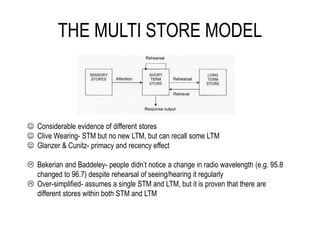
THE MULTI STORE MODEL
 Considerable evidence of different stores
 Clive Wearing- STM but no new LTM, but can recall some LTM
 Glanzer & Cunitz- primacy and recency effect
 Bekerian and Baddeley- people didn’t notice a change in radio wavelength (e.g. 95.8
changed to 96.7) despite rehearsal of seeing/hearing it regularly
 Over-simplified- assumes a single STM and LTM, but it is proven that there are
different stores within both STM and LTM
SHORT TERM MEMORY
• Capacity
– Baddeley- 5 words; set of one-syllable words and set of multi-syllable words
– Whatever can be articulated in 2 seconds, more short words recalled than long
words
– Miller 1956- people have a digit span of 7+/- 2
• Duration
– Peterson & Peterson 1959- shown trigrams then asked to count backwards to
prevent rehearsal
– 80% of trigrams were recalled after 3 seconds, but less than 10% after 18
seconds
• Encoding
– Baddeley 1966- participants in four groups; acoustically similar, acoustically
dissimilar, semantically similar, semantically dissimilar
– 55% of acoustically similar words recalled, 75% of acoustically dissimilar words
recalled
– Semantics did not affect the results that much
LONG TERM MEMORY
• Capacity- potentially unlimited
• Duration
– Bahrick 1975- 392 graduates shown yearbook photos after 47 years
– One group recalled names from memory (recall) and other matched
names to faces (recognition)
– Recall group had less than 20% accuracy
– Recognition group had 60% accuracy
• Encoding
– Baddeley 1966- participants in four groups; acoustically similar,
acoustically dissimilar, semantically similar, semantically dissimilar
– After 20 minutes they were given another task before recalling words
– 55% accuracy for semantically similar words, and 85% accuracy for
semantically dissimilar words
– Acoustics did not affect the results that much
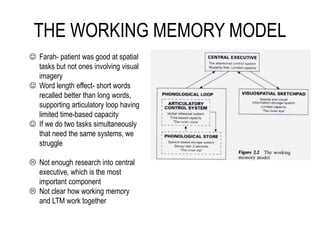
THE WORKING MEMORY MODEL
 Farah- patient was good at spatial
tasks but not ones involving visual
imagery
 Word length effect- short words
recalled better than long words,
supporting articulatory loop having
limited time-based capacity
 If we do two tasks simultaneously
that need the same systems, we
struggle
 Not enough research into central
executive, which is the most
important component
 Not clear how working memory
and LTM work together
ANXIETY & EYE WITNESS TESTIMONY
• Effect- narrows focus of attention so recall is better, but too much
anxiety can have negative effects on EWT
• Research
– Christianson & Hubinette- 110 bank robbery witnesses
– Victims of the crime had more accurate recall and bystanders had less
accurate recall
– Loftus 1979- participants heard a discussion in a nearby room
– Condition 1- man enters with a pen and grease on hands
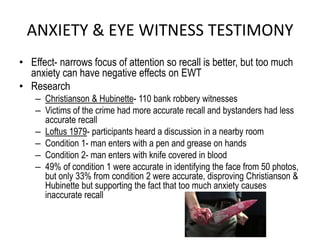
– Condition 2- man enters with knife covered in blood
– 49% of condition 1 were accurate in identifying the face from 50 photos,
but only 33% from condition 2 were accurate, disproving Christianson &
Hubinette but supporting the fact that too much anxiety causes
inaccurate recall
SCHEMAS & EYE WITNESS TESTIMONY
• Effect
– Low schema expectancy = ignored
– False information remembered (high schema expectancy)
• Research
– Brewer & Treyens 1981- 30 people wait in office for 35
seconds
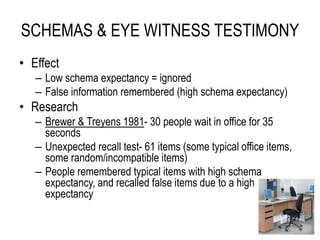
– Unexpected recall test- 61 items (some typical office items,
some random/incompatible items)
– People remembered typical items with high schema
expectancy, and recalled false items due to a high
expectancy
AGE & EYE WITNESS TESTIMONY
• Effect- children are inferior to adults because they
lack schemas, have inferior capability, and memory
capacity increases with age
• Research
– Ceci & Bruck 1993
– Leading questions confuse children
– Preschool children provide relevant eye witness
testimony
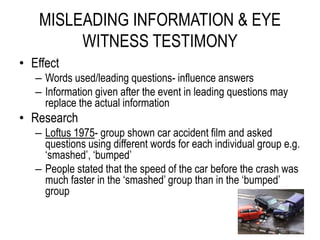
MISLEADING INFORMATION & EYE
WITNESS TESTIMONY
• Effect
– Words used/leading questions- influence answers
– Information given after the event in leading questions may
replace the actual information
• Research
– Loftus 1975- group shown car accident film and asked
questions using different words for each individual group e.g.
‘smashed’, ‘bumped’
– People stated that the speed of the car before the crash was
much faster in the ‘smashed’ group than in the ‘bumped’
group
THE COGNITIVE INTERVIEW
• Context reinstatement- does not involve revisiting the
scene of the crime, but to recall wider scenes; the
weather, your thoughts/feelings, preceding events
• Report everything- recall every detail, even if the
relevance is questionable
• Recall from changed perspective- attempt to describe
the incident from the perspective of someone else at
the scene
• Recall in reverse order- report incident in reverse order
MEMORY IMPROVEMENT
• The role of attention
– Ericsson & Chase- person who could memorise up to 80 things (2 year
practice- 1 hour a day) proves that rehearsal and attention improve
memory (multi-store)
• Elaborative rehearsal
– Craik & Watkins
– Maintenance rehearsal; repeat information, only stays in STM for a few
seconds
– Elaborate; needed to transfer to LTM, link to previous knowledge, easier
to recall because there are several paths to reach it
• Encoding
– Tulving & Osler- two weakly linked words; recall vs. recognition
– Recognition- greater overlap with the information originally encoded
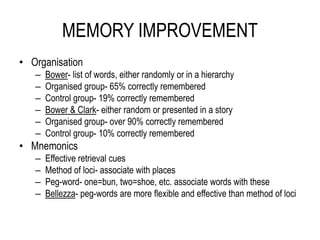
MEMORY IMPROVEMENT
• Organisation
– Bower- list of words, either randomly or in a hierarchy
– Organised group- 65% correctly remembered
– Control group- 19% correctly remembered
– Bower & Clark- either random or presented in a story
– Organised group- over 90% correctly remembered
– Control group- 10% correctly remembered
• Mnemonics
– Effective retrieval cues
– Method of loci- associate with places
– Peg-word- one=bun, two=shoe, etc. associate words with these
– Bellezza- peg-words are more flexible and effective than method of loci

Memory

  • 1.
  • 2.
    THE MULTI STOREMODEL  Considerable evidence of different stores  Clive Wearing- STM but no new LTM, but can recall some LTM  Glanzer & Cunitz- primacy and recency effect  Bekerian and Baddeley- people didn’t notice a change in radio wavelength (e.g. 95.8 changed to 96.7) despite rehearsal of seeing/hearing it regularly  Over-simplified- assumes a single STM and LTM, but it is proven that there are different stores within both STM and LTM
  • 3.
    SHORT TERM MEMORY •Capacity – Baddeley- 5 words; set of one-syllable words and set of multi-syllable words – Whatever can be articulated in 2 seconds, more short words recalled than long words – Miller 1956- people have a digit span of 7+/- 2 • Duration – Peterson & Peterson 1959- shown trigrams then asked to count backwards to prevent rehearsal – 80% of trigrams were recalled after 3 seconds, but less than 10% after 18 seconds • Encoding – Baddeley 1966- participants in four groups; acoustically similar, acoustically dissimilar, semantically similar, semantically dissimilar – 55% of acoustically similar words recalled, 75% of acoustically dissimilar words recalled – Semantics did not affect the results that much
  • 4.
    LONG TERM MEMORY •Capacity- potentially unlimited • Duration – Bahrick 1975- 392 graduates shown yearbook photos after 47 years – One group recalled names from memory (recall) and other matched names to faces (recognition) – Recall group had less than 20% accuracy – Recognition group had 60% accuracy • Encoding – Baddeley 1966- participants in four groups; acoustically similar, acoustically dissimilar, semantically similar, semantically dissimilar – After 20 minutes they were given another task before recalling words – 55% accuracy for semantically similar words, and 85% accuracy for semantically dissimilar words – Acoustics did not affect the results that much
  • 5.
    THE WORKING MEMORYMODEL  Farah- patient was good at spatial tasks but not ones involving visual imagery  Word length effect- short words recalled better than long words, supporting articulatory loop having limited time-based capacity  If we do two tasks simultaneously that need the same systems, we struggle  Not enough research into central executive, which is the most important component  Not clear how working memory and LTM work together
  • 6.
    ANXIETY & EYEWITNESS TESTIMONY • Effect- narrows focus of attention so recall is better, but too much anxiety can have negative effects on EWT • Research – Christianson & Hubinette- 110 bank robbery witnesses – Victims of the crime had more accurate recall and bystanders had less accurate recall – Loftus 1979- participants heard a discussion in a nearby room – Condition 1- man enters with a pen and grease on hands – Condition 2- man enters with knife covered in blood – 49% of condition 1 were accurate in identifying the face from 50 photos, but only 33% from condition 2 were accurate, disproving Christianson & Hubinette but supporting the fact that too much anxiety causes inaccurate recall
  • 7.
    SCHEMAS & EYEWITNESS TESTIMONY • Effect – Low schema expectancy = ignored – False information remembered (high schema expectancy) • Research – Brewer & Treyens 1981- 30 people wait in office for 35 seconds – Unexpected recall test- 61 items (some typical office items, some random/incompatible items) – People remembered typical items with high schema expectancy, and recalled false items due to a high expectancy
  • 8.
    AGE & EYEWITNESS TESTIMONY • Effect- children are inferior to adults because they lack schemas, have inferior capability, and memory capacity increases with age • Research – Ceci & Bruck 1993 – Leading questions confuse children – Preschool children provide relevant eye witness testimony
  • 9.
    MISLEADING INFORMATION &EYE WITNESS TESTIMONY • Effect – Words used/leading questions- influence answers – Information given after the event in leading questions may replace the actual information • Research – Loftus 1975- group shown car accident film and asked questions using different words for each individual group e.g. ‘smashed’, ‘bumped’ – People stated that the speed of the car before the crash was much faster in the ‘smashed’ group than in the ‘bumped’ group
  • 10.
    THE COGNITIVE INTERVIEW •Context reinstatement- does not involve revisiting the scene of the crime, but to recall wider scenes; the weather, your thoughts/feelings, preceding events • Report everything- recall every detail, even if the relevance is questionable • Recall from changed perspective- attempt to describe the incident from the perspective of someone else at the scene • Recall in reverse order- report incident in reverse order
  • 11.
    MEMORY IMPROVEMENT • Therole of attention – Ericsson & Chase- person who could memorise up to 80 things (2 year practice- 1 hour a day) proves that rehearsal and attention improve memory (multi-store) • Elaborative rehearsal – Craik & Watkins – Maintenance rehearsal; repeat information, only stays in STM for a few seconds – Elaborate; needed to transfer to LTM, link to previous knowledge, easier to recall because there are several paths to reach it • Encoding – Tulving & Osler- two weakly linked words; recall vs. recognition – Recognition- greater overlap with the information originally encoded
  • 12.
    MEMORY IMPROVEMENT • Organisation –Bower- list of words, either randomly or in a hierarchy – Organised group- 65% correctly remembered – Control group- 19% correctly remembered – Bower & Clark- either random or presented in a story – Organised group- over 90% correctly remembered – Control group- 10% correctly remembered • Mnemonics – Effective retrieval cues – Method of loci- associate with places – Peg-word- one=bun, two=shoe, etc. associate words with these – Bellezza- peg-words are more flexible and effective than method of loci