The Dark Knight opening analysis
Code and
Conventions
Findings Textual Evidence
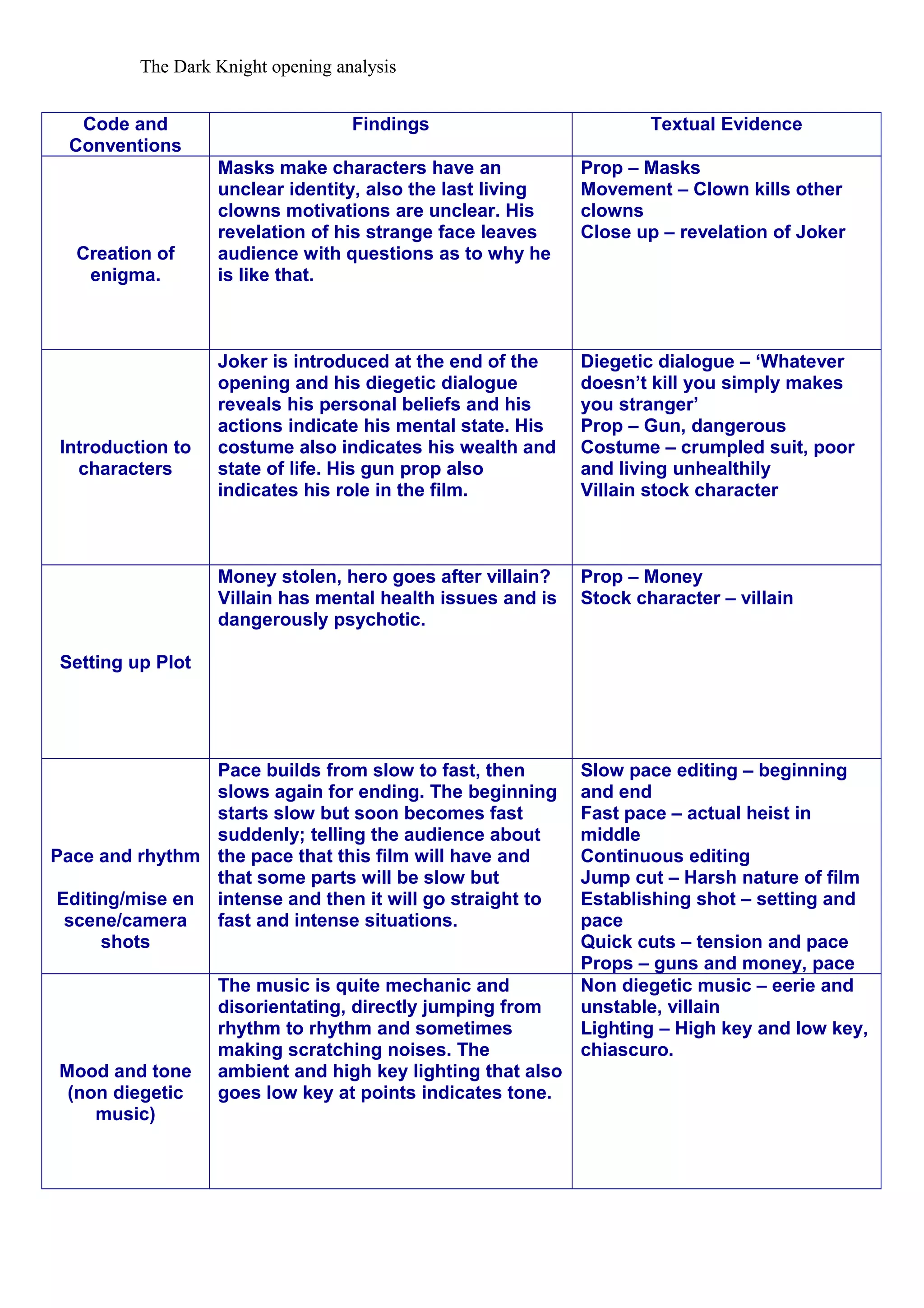
Creation of
enigma.
Masks make characters have an
unclear identity, also the last living
clowns motivations are unclear. His
revelation of his strange face leaves
audience with questions as to why he
is like that.
Prop – Masks
Movement – Clown kills other
clowns
Close up – revelation of Joker
Introduction to
characters
Joker is introduced at the end of the
opening and his diegetic dialogue
reveals his personal beliefs and his
actions indicate his mental state. His
costume also indicates his wealth and
state of life. His gun prop also
indicates his role in the film.
Diegetic dialogue – ‘Whatever
doesn’t kill you simply makes
you stranger’
Prop – Gun, dangerous
Costume – crumpled suit, poor
and living unhealthily
Villain stock character
Setting up Plot
Money stolen, hero goes after villain?
Villain has mental health issues and is
dangerously psychotic.
Prop – Money
Stock character – villain
Pace and rhythm
Editing/mise en
scene/camera
shots
Pace builds from slow to fast, then
slows again for ending. The beginning
starts slow but soon becomes fast
suddenly; telling the audience about
the pace that this film will have and
that some parts will be slow but
intense and then it will go straight to
fast and intense situations.
Slow pace editing – beginning
and end
Fast pace – actual heist in
middle
Continuous editing
Jump cut – Harsh nature of film
Establishing shot – setting and
pace
Quick cuts – tension and pace
Props – guns and money, pace
Mood and tone
(non diegetic
music)
The music is quite mechanic and
disorientating, directly jumping from
rhythm to rhythm and sometimes
making scratching noises. The
ambient and high key lighting that also
goes low key at points indicates tone.
Non diegetic music – eerie and
unstable, villain
Lighting – High key and low key,
chiascuro.
The Dark Knight opening analysis

Code and conventions opening dark knight (1)

  • 1.
    The Dark Knightopening analysis Code and Conventions Findings Textual Evidence Creation of enigma. Masks make characters have an unclear identity, also the last living clowns motivations are unclear. His revelation of his strange face leaves audience with questions as to why he is like that. Prop – Masks Movement – Clown kills other clowns Close up – revelation of Joker Introduction to characters Joker is introduced at the end of the opening and his diegetic dialogue reveals his personal beliefs and his actions indicate his mental state. His costume also indicates his wealth and state of life. His gun prop also indicates his role in the film. Diegetic dialogue – ‘Whatever doesn’t kill you simply makes you stranger’ Prop – Gun, dangerous Costume – crumpled suit, poor and living unhealthily Villain stock character Setting up Plot Money stolen, hero goes after villain? Villain has mental health issues and is dangerously psychotic. Prop – Money Stock character – villain Pace and rhythm Editing/mise en scene/camera shots Pace builds from slow to fast, then slows again for ending. The beginning starts slow but soon becomes fast suddenly; telling the audience about the pace that this film will have and that some parts will be slow but intense and then it will go straight to fast and intense situations. Slow pace editing – beginning and end Fast pace – actual heist in middle Continuous editing Jump cut – Harsh nature of film Establishing shot – setting and pace Quick cuts – tension and pace Props – guns and money, pace Mood and tone (non diegetic music) The music is quite mechanic and disorientating, directly jumping from rhythm to rhythm and sometimes making scratching noises. The ambient and high key lighting that also goes low key at points indicates tone. Non diegetic music – eerie and unstable, villain Lighting – High key and low key, chiascuro.
  • 2.
    The Dark Knightopening analysis