 Introduction-Geeta
 History-Ling
 Rules-Prasanna
 Dressing Fashion-Terry
 Past Glories-Harsh
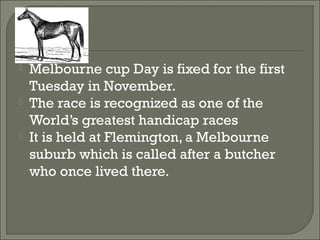
 Melbourne cup Day is fixed for the first
Tuesday in November.
 The race is recognized as one of the
World’s greatest handicap races
 It is held at Flemington, a Melbourne
suburb which is called after a butcher
who once lived there.
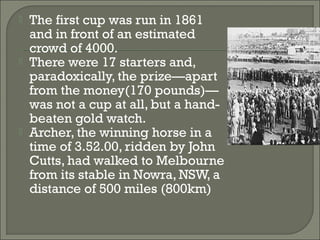
 The first cup was run in 1861
and in front of an estimated
crowd of 4000.
 There were 17 starters and,
paradoxically, the prize—apart
from the money(170 pounds)—
was not a cup at all, but a hand-
beaten gold watch.
 Archer, the winning horse in a
time of 3.52.00, ridden by John
Cutts, had walked to Melbourne
from its stable in Nowra, NSW, a
distance of 500 miles (800km)
 “Fashions on the field” is a major focus of
the day, with substantial prizes awarded
for the best dressed man and woman.
 Raceday fashion has occasionally drawn
almost as much attention as the race
itself, the miniskirt received worldwide
publicity when model Jean Shrimpton
wore one on Derby Day during
Melbourne Cup week in 1965.
 In the melbourne metropolitan area, the
race day has been gazetted public
holiday since 1877.
 It is commonly billed as The race that
stops a nation, but it is more accurately
The race that stops two nations, as many
people in New Zealand, as well as
Australia, pause to watch race.
 Handicap contest
 A quality handicap for horses < 3 yrs
 Weight 49Kg
 Headwear is must
 Orange skin not pretty
 Garden party not dace party
Cornflower, the symbol of Derby Day,Melbourne
Cup Carniva
American writer Mark Twain said of a visit
to the Melbourne Cup in 1895:
Nowhere in the world have I encountered a
festival of people that has such a
magnificent appeal to the whole nation.
The Cup astonishes me.
 History
Started in 1861 in front of 4000 people
Day renowned by lawn parties, shooting
galleries
 Arrival of Carbine
1890’s, Carbine – one of the greatest race
horses
Owned by Donald Wallace – Partner of mining
company
1903 – Lord Cardigan would stamp authority as
a great stayer of Melbourne Cup.
 Phar lap became household name
 In 1924 and by 1930 Phar Lap Ensconced in race
Nominated as the best horse in the world
 1931 – the on course totalisator emerged in cup
 1940’s – Arrival of Jockeys Billy cook & Darby
Munro as well as amazing riding performance
 New dawn in cup History
1950 – Jim Cummings would win the Melbourne
Cup
1965 – Cup showed $62,000 in price money
Partnership – Jim Cummings & Higgins
 1970’s – New Zealanders continued to
dominate
 1972 – Metric system introduced & first time
cup was run on 3200 meters
 First Million dollar cup
1985 – Prince & princesses from Wales showed
1st
million dollar cup
Brought new youngsters to come in
 1993 – turning point in the cup
First time cup reached new heights
Attendance continued to rise up to 1,21,015
Melbourne cup version 1

Melbourne cup version 1

  • 1.
     Introduction-Geeta  History-Ling Rules-Prasanna  Dressing Fashion-Terry  Past Glories-Harsh
  • 4.
     Melbourne cupDay is fixed for the first Tuesday in November.  The race is recognized as one of the World’s greatest handicap races  It is held at Flemington, a Melbourne suburb which is called after a butcher who once lived there.
  • 5.
     The firstcup was run in 1861 and in front of an estimated crowd of 4000.  There were 17 starters and, paradoxically, the prize—apart from the money(170 pounds)— was not a cup at all, but a hand- beaten gold watch.  Archer, the winning horse in a time of 3.52.00, ridden by John Cutts, had walked to Melbourne from its stable in Nowra, NSW, a distance of 500 miles (800km)
  • 6.
     “Fashions onthe field” is a major focus of the day, with substantial prizes awarded for the best dressed man and woman.  Raceday fashion has occasionally drawn almost as much attention as the race itself, the miniskirt received worldwide publicity when model Jean Shrimpton wore one on Derby Day during Melbourne Cup week in 1965.
  • 7.
     In themelbourne metropolitan area, the race day has been gazetted public holiday since 1877.  It is commonly billed as The race that stops a nation, but it is more accurately The race that stops two nations, as many people in New Zealand, as well as Australia, pause to watch race.
  • 10.
     Handicap contest A quality handicap for horses < 3 yrs  Weight 49Kg
  • 12.
     Headwear ismust  Orange skin not pretty  Garden party not dace party
  • 15.
    Cornflower, the symbolof Derby Day,Melbourne Cup Carniva
  • 18.
    American writer MarkTwain said of a visit to the Melbourne Cup in 1895: Nowhere in the world have I encountered a festival of people that has such a magnificent appeal to the whole nation. The Cup astonishes me.
  • 20.
     History Started in1861 in front of 4000 people Day renowned by lawn parties, shooting galleries  Arrival of Carbine 1890’s, Carbine – one of the greatest race horses Owned by Donald Wallace – Partner of mining company 1903 – Lord Cardigan would stamp authority as a great stayer of Melbourne Cup.
  • 21.
     Phar lapbecame household name  In 1924 and by 1930 Phar Lap Ensconced in race Nominated as the best horse in the world  1931 – the on course totalisator emerged in cup  1940’s – Arrival of Jockeys Billy cook & Darby Munro as well as amazing riding performance  New dawn in cup History 1950 – Jim Cummings would win the Melbourne Cup 1965 – Cup showed $62,000 in price money Partnership – Jim Cummings & Higgins
  • 22.
     1970’s –New Zealanders continued to dominate  1972 – Metric system introduced & first time cup was run on 3200 meters  First Million dollar cup 1985 – Prince & princesses from Wales showed 1st million dollar cup Brought new youngsters to come in  1993 – turning point in the cup First time cup reached new heights Attendance continued to rise up to 1,21,015