Having	
  your	
  Cake	
  and	
  Ea1ng	
  it	
  
Too	
  –	
  Leveraging	
  RWS	
  with	
  
Phase	
  1	
  Studies	
  
Brock Heinz
Spaulding Clinical
March 19, 2013
About me and Spaulding Clinical Research
•  Brock Heinz - Engineering / Innovation; successfully demoted;
introduced to Medidata in 2009; Technology Partner
•  Established in 2007 with a team of experts from pharmaceutical,
CRO, clinical practice, and the medical device industries with over
150 years of combined experience; Located in West Bend, WI – 30
miles north of Milwaukee
•  Highly integrated and automated phase I clinical pharmacology
research unit; 155 beds – 96 telemetry
•  Data Management, Biostatistics and Medical Writing Services
•  Full Service Core ECG Lab
•  Medical Device Manufacturer
2	
  
Phase 1 trials at Spaulding Clinical
•  EDC true to the acronym: truly using electronic means for
data capture; not just electronic storage
•  Barcode-driven data collection – right subject each time
•  Integration of ECG, vitals, labs
•  Rapid data lock is the rule, not the exception
•  Data cleaning is a dirty term
•  Sponsors always have real time access to study data
•  Basic philosophy I’ve helped instill – let computers do what
computers are good at, thus maximizing the human touch
•  Computers consistently do the right thing at the right time
•  Humans work well with humans – keep the peace with
subjects
•  Reducing variability is good science
3	
  
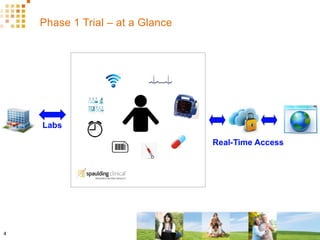
Phase 1 Trial – at a Glance
4	
  
What’s the Cake?
•  The cake in this context is a paperless and and automated
Phase 1 study seamlessly integrated with the sponsor’s EDC
system of choice – Rave
Who’s Cake is it?
•  Sponsors who have a desire to maintain study data
throughout the lifecycle of a compound in Rave
5	
  
How can one have their cake and eat it too?
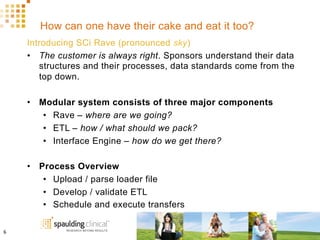
Introducing SCi Rave (pronounced sky)
•  The customer is always right. Sponsors understand their data
structures and their processes, data standards come from the
top down.
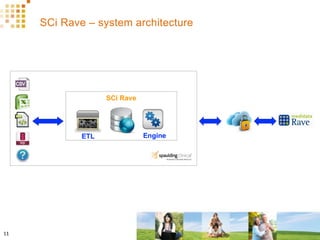
•  Modular system consists of three major components
•  Rave – where are we going?
•  ETL – how / what should we pack?
•  Interface Engine – how do we get there?
•  Process Overview
•  Upload / parse loader file
•  Develop / validate ETL
•  Schedule and execute transfers
6	
  
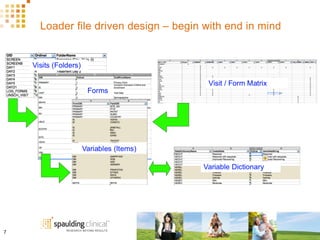
Loader file driven design – begin with end in mind
7	
  
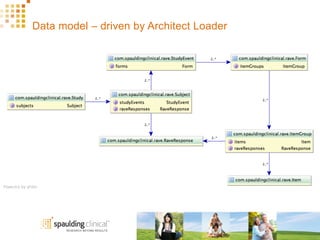
Data model – driven by Architect Loader
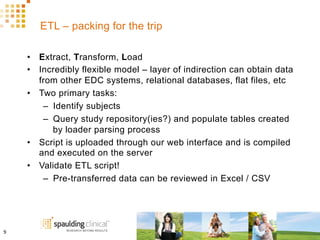
ETL – packing for the trip
•  Extract, Transform, Load
•  Incredibly flexible model – layer of indirection can obtain data
from other EDC systems, relational databases, flat files, etc
•  Two primary tasks:
–  Identify subjects
–  Query study repository(ies?) and populate tables created
by loader parsing process
•  Script is uploaded through our web interface and is compiled
and executed on the server
•  Validate ETL script!
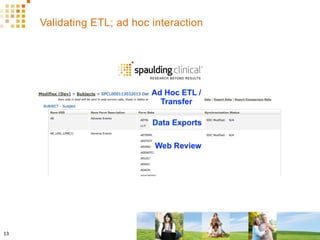
–  Pre-transferred data can be reviewed in Excel / CSV
9	
  
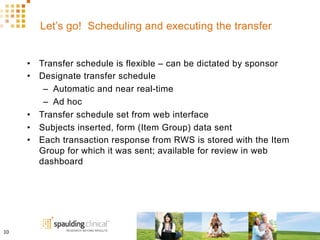
Let’s go! Scheduling and executing the transfer
•  Transfer schedule is flexible – can be dictated by sponsor
•  Designate transfer schedule
–  Automatic and near real-time
–  Ad hoc
•  Transfer schedule set from web interface
•  Subjects inserted, form (Item Group) data sent
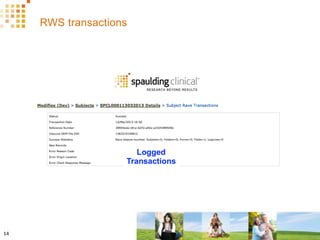
•  Each transaction response from RWS is stored with the Item
Group for which it was sent; available for review in web
dashboard
10	
  
SCi Rave – system architecture
11	
  
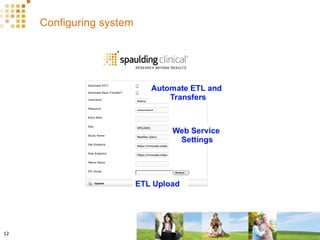
Configuring system
12	
  
Validating ETL; ad hoc interaction
13	
  
RWS transactions
14	
  
Memories of a recent trip
•  3 studies conducted in rapid succession
•  3,926 Folders
•  18,803 Forms
•  54,039 Item Groups (includes log lines)
•  322,685 Items
•  1,460,485 characters of time-point data
•  78,796 HTTPS Requests to RWS
•  0 CRFs manually transcribed from the Spaulding Clinical system
into Rave
15	
  
Final thoughts
I’ve been around web services for a while – this is well done:
ODM, interoperable protocols, intuitive response messages,
documentation, user group, etc. As leaders in EDC Medidata is
refreshingly different than EMR vendors.
What’s next?
•  I think we’ll seen see an evolution of drug development
process. There will be disruption as there is a push towards
personalized medicine. Tighter iterations, richer data.
•  Big Data – sensors; distributed telemetry; integrated data
repositories. Mobile integration.
•  Empower innovators – RWS gives us the highway needed.
•  Device level integration - today
16	
  
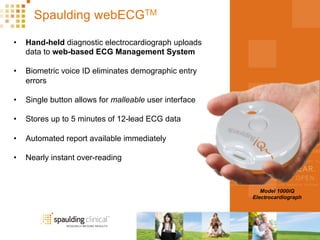
Spaulding webECGTM
•  Hand-held diagnostic electrocardiograph uploads
data to web-based ECG Management System
•  Biometric voice ID eliminates demographic entry
errors
•  Single button allows for malleable user interface
•  Stores up to 5 minutes of 12-lead ECG data
•  Automated report available immediately
•  Nearly instant over-reading
Model 1000iQ
Electrocardiograph
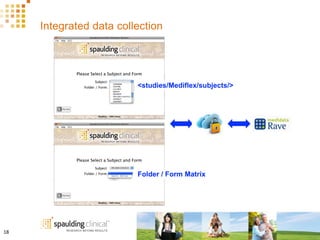
Integrated data collection
18	
  
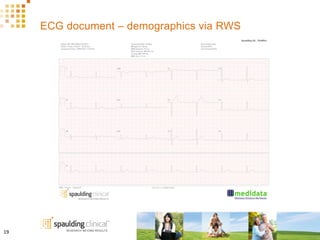
ECG document – demographics via RWS
19	
  
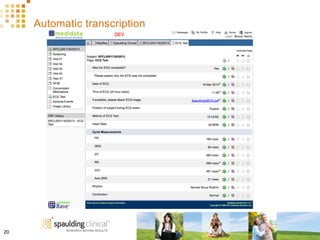
Automatic transcription
20	
  
21	
  
Thank you!

Medidata AMUG Meeting / Presentation 2013

  • 1.
    Having  your  Cake  and  Ea1ng  it   Too  –  Leveraging  RWS  with   Phase  1  Studies   Brock Heinz Spaulding Clinical March 19, 2013
  • 2.
    About me andSpaulding Clinical Research •  Brock Heinz - Engineering / Innovation; successfully demoted; introduced to Medidata in 2009; Technology Partner •  Established in 2007 with a team of experts from pharmaceutical, CRO, clinical practice, and the medical device industries with over 150 years of combined experience; Located in West Bend, WI – 30 miles north of Milwaukee •  Highly integrated and automated phase I clinical pharmacology research unit; 155 beds – 96 telemetry •  Data Management, Biostatistics and Medical Writing Services •  Full Service Core ECG Lab •  Medical Device Manufacturer 2  
  • 3.
    Phase 1 trialsat Spaulding Clinical •  EDC true to the acronym: truly using electronic means for data capture; not just electronic storage •  Barcode-driven data collection – right subject each time •  Integration of ECG, vitals, labs •  Rapid data lock is the rule, not the exception •  Data cleaning is a dirty term •  Sponsors always have real time access to study data •  Basic philosophy I’ve helped instill – let computers do what computers are good at, thus maximizing the human touch •  Computers consistently do the right thing at the right time •  Humans work well with humans – keep the peace with subjects •  Reducing variability is good science 3  
  • 4.
    Phase 1 Trial– at a Glance 4  
  • 5.
    What’s the Cake? • The cake in this context is a paperless and and automated Phase 1 study seamlessly integrated with the sponsor’s EDC system of choice – Rave Who’s Cake is it? •  Sponsors who have a desire to maintain study data throughout the lifecycle of a compound in Rave 5  
  • 6.
    How can onehave their cake and eat it too? Introducing SCi Rave (pronounced sky) •  The customer is always right. Sponsors understand their data structures and their processes, data standards come from the top down. •  Modular system consists of three major components •  Rave – where are we going? •  ETL – how / what should we pack? •  Interface Engine – how do we get there? •  Process Overview •  Upload / parse loader file •  Develop / validate ETL •  Schedule and execute transfers 6  
  • 7.
    Loader file drivendesign – begin with end in mind 7  
  • 8.
    Data model –driven by Architect Loader
  • 9.
    ETL – packingfor the trip •  Extract, Transform, Load •  Incredibly flexible model – layer of indirection can obtain data from other EDC systems, relational databases, flat files, etc •  Two primary tasks: –  Identify subjects –  Query study repository(ies?) and populate tables created by loader parsing process •  Script is uploaded through our web interface and is compiled and executed on the server •  Validate ETL script! –  Pre-transferred data can be reviewed in Excel / CSV 9  
  • 10.
    Let’s go! Schedulingand executing the transfer •  Transfer schedule is flexible – can be dictated by sponsor •  Designate transfer schedule –  Automatic and near real-time –  Ad hoc •  Transfer schedule set from web interface •  Subjects inserted, form (Item Group) data sent •  Each transaction response from RWS is stored with the Item Group for which it was sent; available for review in web dashboard 10  
  • 11.
    SCi Rave –system architecture 11  
  • 12.
  • 13.
    Validating ETL; adhoc interaction 13  
  • 14.
  • 15.
    Memories of arecent trip •  3 studies conducted in rapid succession •  3,926 Folders •  18,803 Forms •  54,039 Item Groups (includes log lines) •  322,685 Items •  1,460,485 characters of time-point data •  78,796 HTTPS Requests to RWS •  0 CRFs manually transcribed from the Spaulding Clinical system into Rave 15  
  • 16.
    Final thoughts I’ve beenaround web services for a while – this is well done: ODM, interoperable protocols, intuitive response messages, documentation, user group, etc. As leaders in EDC Medidata is refreshingly different than EMR vendors. What’s next? •  I think we’ll seen see an evolution of drug development process. There will be disruption as there is a push towards personalized medicine. Tighter iterations, richer data. •  Big Data – sensors; distributed telemetry; integrated data repositories. Mobile integration. •  Empower innovators – RWS gives us the highway needed. •  Device level integration - today 16  
  • 17.
    Spaulding webECGTM •  Hand-helddiagnostic electrocardiograph uploads data to web-based ECG Management System •  Biometric voice ID eliminates demographic entry errors •  Single button allows for malleable user interface •  Stores up to 5 minutes of 12-lead ECG data •  Automated report available immediately •  Nearly instant over-reading Model 1000iQ Electrocardiograph
  • 18.
  • 19.
    ECG document –demographics via RWS 19  
  • 20.
  • 21.