Local Mental Health Authority
Medicaid Match Social Services Appropriations
Sub-Committee Legislative Report
September 2015
Prepared by: Utah Association of Counties
Adam Trupp - Executive Director
Commissioner Kerry Gibson – President Elect
BEHAVIORAL HEALTH
HISTORY
•  By 1996-1997, most local county local authorities were operating in the
capitated Medicaid system rather than the previous fee-for-service
system, assuming risk of cost/need fluctuation for those within their
scope of responsibility.
•  This allowed for many of the centers to use services and programs to
better manage those clients with high inpatient costs which required a
high degree of care and by moving to a risk-based tract, centers did
experience inpatient savings. These inpatient savings were intended to
then help fund those clients that did not have funding, often those
clients without children or families without insurance but with providers
with too high an income.
•  In 2003, it was decided that retained savings were against Medicaid
rule and rates were cut to correct any possible savings. Since 1996,
the number of residents eligible for Medicaid has increased dramatically
and inflation has risen, with very little increase in State dollars.
COUNTY RESPONSIBILITY
•  UBHC and UAC have been asked to respond to how counties will
provide their own matching funds in the future. Within State Code,
local authorities are required to, “provide funding equal to at least
20% of the state funds that it receives to fund services described in
the plan.” (17-43-201)
•  The counties have chosen to use State dollars along with the
required county 20% match to draw down Federal Medicaid dollars.
By counties using these state and local dollars to draw down federal
funds, they have been able to support the behavioral health system
as a whole.
•  Medicaid is a State responsibility and behavioral health providers
contract to be the providers. Effective January 13, 2014, the Mental
Health Parity and Addiction Equity Act moves mental health and
substance use disorder services from the “Optional” category to those
required in Medicaid.
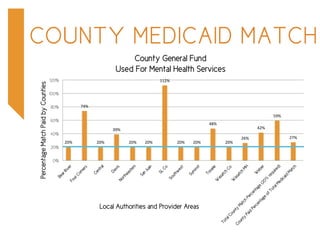
COUNTY MEDICAID MATCH
20%	
  
74%	
  
20%	
  
39%	
  
20%	
   20%	
  
112%	
  
20%	
   20%	
  
48%	
  
20%	
  
26%	
  
42%	
  
59%	
  
27%	
  
0%
20%
40%
60%
80%
100%
120%
PercentageMatchPaidbyCounties
County General Fund
Used For Mental Health Services
Local Authorities and Provider Areas
-­‐20%
-­‐10%
0%
10%
20%
30%
40%
2010 2011 2012 2013
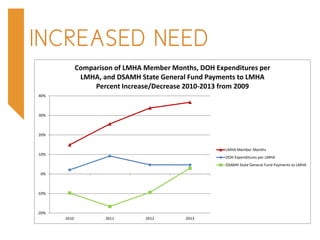
Comparison	
  of	
  LMHA	
  Member	
  Months,	
  DOH	
  Expenditures	
  per	
  
LMHA,	
  and	
  DSAMH	
  State	
  General	
  Fund	
  Payments	
  to	
  LMHA
Percent	
  Increase/Decrease	
  2010-­‐2013	
  from	
  2009
LMHA	
  Member	
  Months
DOH	
  Expenditures	
  per	
  LMHA
DSAMH	
  State	
  General	
  Fund	
  Payments	
  to	
  LMHA
INCREASED NEED
UAC LEGISLATIVE NEED
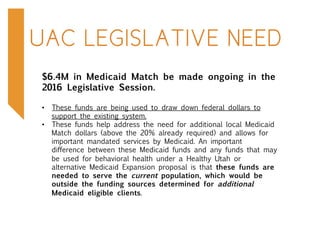
$6.4M in Medicaid Match be made ongoing in the
2016 Legislative Session.
•  These funds are being used to draw down federal dollars to
support the existing system.
•  These funds help address the need for additional local Medicaid
Match dollars (above the 20% already required) and allows for
important mandated services by Medicaid. An important
difference between these Medicaid funds and any funds that may
be used for behavioral health under a Healthy Utah or
alternative Medicaid Expansion proposal is that these funds are
needed to serve the current population, which would be
outside the funding sources determined for additional
Medicaid eligible clients.
CURRENT VS. FUTURE
MEDICAID
M E D I C A I D
E X P A N S I O N
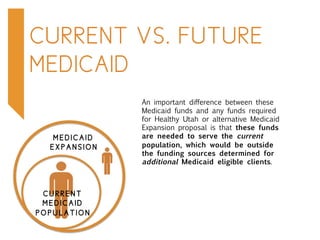
An important difference between these
Medicaid funds and any funds required
for Healthy Utah or alternative Medicaid
Expansion proposal is that these funds
are needed to serve the current
population, which would be outside
the funding sources determined for
additional Medicaid eligible clients.
C U R R E N T
M E D I C A I D
P O P U L A T I O N
QUESTIONS?

Medicaid Match Social Services Appropriations

  • 1.
    Local Mental HealthAuthority Medicaid Match Social Services Appropriations Sub-Committee Legislative Report September 2015 Prepared by: Utah Association of Counties Adam Trupp - Executive Director Commissioner Kerry Gibson – President Elect
  • 2.
    BEHAVIORAL HEALTH HISTORY •  By1996-1997, most local county local authorities were operating in the capitated Medicaid system rather than the previous fee-for-service system, assuming risk of cost/need fluctuation for those within their scope of responsibility. •  This allowed for many of the centers to use services and programs to better manage those clients with high inpatient costs which required a high degree of care and by moving to a risk-based tract, centers did experience inpatient savings. These inpatient savings were intended to then help fund those clients that did not have funding, often those clients without children or families without insurance but with providers with too high an income. •  In 2003, it was decided that retained savings were against Medicaid rule and rates were cut to correct any possible savings. Since 1996, the number of residents eligible for Medicaid has increased dramatically and inflation has risen, with very little increase in State dollars.
  • 3.
    COUNTY RESPONSIBILITY •  UBHCand UAC have been asked to respond to how counties will provide their own matching funds in the future. Within State Code, local authorities are required to, “provide funding equal to at least 20% of the state funds that it receives to fund services described in the plan.” (17-43-201) •  The counties have chosen to use State dollars along with the required county 20% match to draw down Federal Medicaid dollars. By counties using these state and local dollars to draw down federal funds, they have been able to support the behavioral health system as a whole. •  Medicaid is a State responsibility and behavioral health providers contract to be the providers. Effective January 13, 2014, the Mental Health Parity and Addiction Equity Act moves mental health and substance use disorder services from the “Optional” category to those required in Medicaid.
  • 4.
    COUNTY MEDICAID MATCH 20%   74%   20%   39%   20%   20%   112%   20%   20%   48%   20%   26%   42%   59%   27%   0% 20% 40% 60% 80% 100% 120% PercentageMatchPaidbyCounties County General Fund Used For Mental Health Services Local Authorities and Provider Areas
  • 5.
    -­‐20% -­‐10% 0% 10% 20% 30% 40% 2010 2011 20122013 Comparison  of  LMHA  Member  Months,  DOH  Expenditures  per   LMHA,  and  DSAMH  State  General  Fund  Payments  to  LMHA Percent  Increase/Decrease  2010-­‐2013  from  2009 LMHA  Member  Months DOH  Expenditures  per  LMHA DSAMH  State  General  Fund  Payments  to  LMHA INCREASED NEED
  • 6.
    UAC LEGISLATIVE NEED $6.4Min Medicaid Match be made ongoing in the 2016 Legislative Session. •  These funds are being used to draw down federal dollars to support the existing system. •  These funds help address the need for additional local Medicaid Match dollars (above the 20% already required) and allows for important mandated services by Medicaid. An important difference between these Medicaid funds and any funds that may be used for behavioral health under a Healthy Utah or alternative Medicaid Expansion proposal is that these funds are needed to serve the current population, which would be outside the funding sources determined for additional Medicaid eligible clients.
  • 7.
    CURRENT VS. FUTURE MEDICAID ME D I C A I D E X P A N S I O N An important difference between these Medicaid funds and any funds required for Healthy Utah or alternative Medicaid Expansion proposal is that these funds are needed to serve the current population, which would be outside the funding sources determined for additional Medicaid eligible clients. C U R R E N T M E D I C A I D P O P U L A T I O N
  • 8.