Media, Information, and
Technology Literacy
Rex Curriculum Resource WWW.REX.COM.PH
Media, Information, and Technology Literacy
Communication goes beyond the usual two-way exchange between two people because of media
and technology. When one is watching a commercial on a television, an individual who created the
message is neither physically present nor expected to respond to any feedback, yet there is
communication. The message of a commercial is to convert viewers as consumers of the product being
advertised.
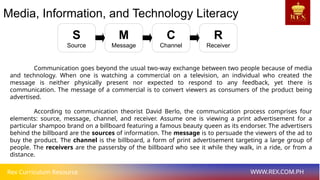
According to communication theorist David Berlo, the communication process comprises four
elements: source, message, channel, and receiver. Assume one is viewing a print advertisement for a
particular shampoo brand on a billboard featuring a famous beauty queen as its endorser. The advertisers
behind the billboard are the sources of information. The message is to persuade the viewers of the ad to
buy the product. The channel is the billboard, a form of print advertisement targeting a large group of
people. The receivers are the passersby of the billboard who see it while they walk, in a ride, or from a
distance.
S
Source
M
Message
C
Channel
R
Receiver
Rex Curriculum Resource WWW.REX.COM.PH
Media, Information, and Technology Literacy
Another communication model is proposed by Wilber Schramm which emphasizes the encoding
and decoding processes. Encoding is when you send a message , and decoding is when you receive a
message. After receiving the message, according to Schramm, the receiver is expected to provide
feedback. Feedback is the response of the receiver based on how he/she decodes the message.
Information, Communication, and Media
Information, in general, pertains to any source of knowledge and data that can be collected
from people, institutions, environment, research, and events. All processes involving media and
communication revolve around the use of and access to different types of information, whether it is oral
or written, historical or current, and primary or secondary. What brings people to understanding is
through communication of information.
Merriam-Webster defines communication as “a process by which we exchanged information
between individuals through a common system of symbols, signs, or behavior.” When a person watches a
commercial on television, this media consumption is also a communication process. The viewer serves as
the receiver of information; he/she is being persuaded to buy the product advertised. The channel of
communication is the television. The audio and visual aesthetics of the commercial are the language
advertisers used to build a media message.
Rex Curriculum Resource WWW.REX.COM.PH
Media, Information, and Technology Literacy
Media “designates physical means used to communicate such as paper, broadcast, film, and
digital transmission” (UNESCO). This includes books, journals, newspapers, radio, television, blogs, social
media platforms, and podcasts, among others. Information consists of facts, figures, data, ideas, news,
content, or simply, media messages. For example, if one is watching an evening news program, the
television is the media, while the news presented by the reporter is the information. Another example is
if one is reading a journal article from a library, the media is the printed material, and the information is
the content of the material.
Media, Information, and Technology Literacy
Media and information literacy (MIL) “refers to the essential competencies (knowledge, skills,
and attitudes) that allow citizens to engage with content providers effectively and develop critical thinking
and lifelong learning skills for socializing and becoming active citizens” (UNESCO).
Literacy is more than just a person’s ability to read and write. There are many types of literacies
essential for the digital age, such as media literacy, information literacy, and technology (digital) literacy.
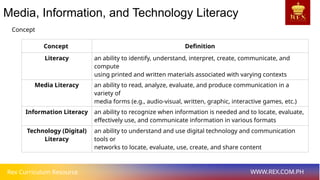
On the next page is a table that best defines each concept by UNESCO.
Rex Curriculum Resource WWW.REX.COM.PH
Media, Information, and Technology Literacy
Concept
Concept Definition
Literacy an ability to identify, understand, interpret, create, communicate, and
compute
using printed and written materials associated with varying contexts
Media Literacy an ability to read, analyze, evaluate, and produce communication in a
variety of
media forms (e.g., audio-visual, written, graphic, interactive games, etc.)
Information Literacy an ability to recognize when information is needed and to locate, evaluate,
effectively use, and communicate information in various formats
Technology (Digital)
Literacy
an ability to understand and use digital technology and communication
tools or
networks to locate, evaluate, use, create, and share content
Rex Curriculum Resource WWW.REX.COM.PH
Media, Information, and Technology Literacy
Media and Information Literate Individual
To become a media and information literate individual, one must fact-check content sourced from a
variety of media forms and sources to verify its credibility. If a person fails to verify the content, he/she
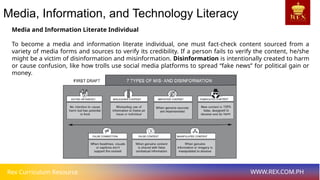
might be a victim of disinformation and misinformation. Disinformation is intentionally created to harm
or cause confusion, like how trolls use social media platforms to spread “fake news” for political gain or
money.
Rex Curriculum Resource WWW.REX.COM.PH
Media, Information, and Technology Literacy
Misinformation refers to misleading information shared without the intention of creating harm.
A case of misinformation occurs when someone makes an honest mistake about wrong information such
as inaccurate dates, names, translations, or captions. Usually, when news outlets made an error in
reporting, they issue an erratum to correct the information. Refer to the infographic by First Draft of the
seven mis- and disinformation.
Responsible Use and Production of Media and Information
A responsible user should not post anything that contains false news or issue. You should verify
the source of news you post or share. You must know how to use media righteously to avoid harming
other people by criticizing them and think about the social consequences of things you are posting or
sharing online. This is important in creating your digital citizenship.
Digital citizenship refers to your positive engagement in the online world. When dealing with
fellow users, be respectful and mindful of the words you say.
Digital footprint refers to your “unique set of traceable digital activities, actions, contributions,
and communications manifested on the Internet or on digital devices” (UNESCO). Your “digital identity” is
constructed from one’s digital footprints.
Rex Curriculum Resource WWW.REX.COM.PH
Media, Information, and Technology Literacy
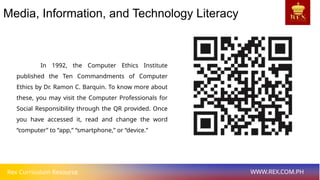
In 1992, the Computer Ethics Institute
published the Ten Commandments of Computer
Ethics by Dr. Ramon C. Barquin. To know more about
these, you may visit the Computer Professionals for
Social Responsibility through the QR provided. Once
you have accessed it, read and change the word
“computer” to “app,” “smartphone,” or “device.”
Rex Curriculum Resource WWW.REX.COM.PH
Media, Information, and Technology Literacy
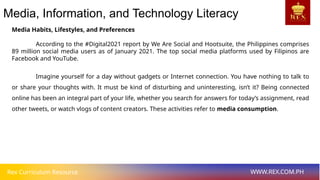
Media Habits, Lifestyles, and Preferences
According to the #Digital2021 report by We Are Social and Hootsuite, the Philippines comprises
89 million social media users as of January 2021. The top social media platforms used by Filipinos are
Facebook and YouTube.
Imagine yourself for a day without gadgets or Internet connection. You have nothing to talk to
or share your thoughts with. It must be kind of disturbing and uninteresting, isn’t it? Being connected
online has been an integral part of your life, whether you search for answers for today’s assignment, read
other tweets, or watch vlogs of content creators. These activities refer to media consumption.
Rex Curriculum Resource WWW.REX.COM.PH
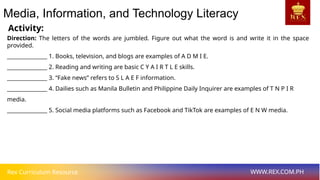
Activity:
Media, Information, and Technology Literacy
Direction: The letters of the words are jumbled. Figure out what the word is and write it in the space
provided.
_______________ 1. Books, television, and blogs are examples of A D M I E.
_______________ 2. Reading and writing are basic C Y A I R T L E skills.
_______________ 3. “Fake news” refers to S L A E F information.
_______________ 4. Dailies such as Manila Bulletin and Philippine Daily Inquirer are examples of T N P I R
media.
_______________ 5. Social media platforms such as Facebook and TikTok are examples of E N W media.
Rex Curriculum Resource WWW.REX.COM.PH
Media, Information, and Technology Literacy
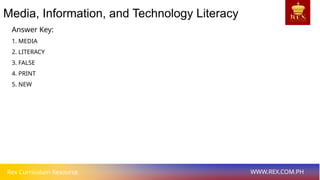
Answer Key:
1. MEDIA
2. LITERACY
3. FALSE
4. PRINT
5. NEW
Media,+Information,+and+Technology+Literacy.pptx

Media,+Information,+and+Technology+Literacy.pptx

  • 1.
  • 2.
    Rex Curriculum ResourceWWW.REX.COM.PH Media, Information, and Technology Literacy Communication goes beyond the usual two-way exchange between two people because of media and technology. When one is watching a commercial on a television, an individual who created the message is neither physically present nor expected to respond to any feedback, yet there is communication. The message of a commercial is to convert viewers as consumers of the product being advertised. According to communication theorist David Berlo, the communication process comprises four elements: source, message, channel, and receiver. Assume one is viewing a print advertisement for a particular shampoo brand on a billboard featuring a famous beauty queen as its endorser. The advertisers behind the billboard are the sources of information. The message is to persuade the viewers of the ad to buy the product. The channel is the billboard, a form of print advertisement targeting a large group of people. The receivers are the passersby of the billboard who see it while they walk, in a ride, or from a distance. S Source M Message C Channel R Receiver
  • 3.
    Rex Curriculum ResourceWWW.REX.COM.PH Media, Information, and Technology Literacy Another communication model is proposed by Wilber Schramm which emphasizes the encoding and decoding processes. Encoding is when you send a message , and decoding is when you receive a message. After receiving the message, according to Schramm, the receiver is expected to provide feedback. Feedback is the response of the receiver based on how he/she decodes the message. Information, Communication, and Media Information, in general, pertains to any source of knowledge and data that can be collected from people, institutions, environment, research, and events. All processes involving media and communication revolve around the use of and access to different types of information, whether it is oral or written, historical or current, and primary or secondary. What brings people to understanding is through communication of information. Merriam-Webster defines communication as “a process by which we exchanged information between individuals through a common system of symbols, signs, or behavior.” When a person watches a commercial on television, this media consumption is also a communication process. The viewer serves as the receiver of information; he/she is being persuaded to buy the product advertised. The channel of communication is the television. The audio and visual aesthetics of the commercial are the language advertisers used to build a media message.
  • 4.
    Rex Curriculum ResourceWWW.REX.COM.PH Media, Information, and Technology Literacy Media “designates physical means used to communicate such as paper, broadcast, film, and digital transmission” (UNESCO). This includes books, journals, newspapers, radio, television, blogs, social media platforms, and podcasts, among others. Information consists of facts, figures, data, ideas, news, content, or simply, media messages. For example, if one is watching an evening news program, the television is the media, while the news presented by the reporter is the information. Another example is if one is reading a journal article from a library, the media is the printed material, and the information is the content of the material. Media, Information, and Technology Literacy Media and information literacy (MIL) “refers to the essential competencies (knowledge, skills, and attitudes) that allow citizens to engage with content providers effectively and develop critical thinking and lifelong learning skills for socializing and becoming active citizens” (UNESCO). Literacy is more than just a person’s ability to read and write. There are many types of literacies essential for the digital age, such as media literacy, information literacy, and technology (digital) literacy. On the next page is a table that best defines each concept by UNESCO.
  • 5.
    Rex Curriculum ResourceWWW.REX.COM.PH Media, Information, and Technology Literacy Concept Concept Definition Literacy an ability to identify, understand, interpret, create, communicate, and compute using printed and written materials associated with varying contexts Media Literacy an ability to read, analyze, evaluate, and produce communication in a variety of media forms (e.g., audio-visual, written, graphic, interactive games, etc.) Information Literacy an ability to recognize when information is needed and to locate, evaluate, effectively use, and communicate information in various formats Technology (Digital) Literacy an ability to understand and use digital technology and communication tools or networks to locate, evaluate, use, create, and share content
  • 6.
    Rex Curriculum ResourceWWW.REX.COM.PH Media, Information, and Technology Literacy Media and Information Literate Individual To become a media and information literate individual, one must fact-check content sourced from a variety of media forms and sources to verify its credibility. If a person fails to verify the content, he/she might be a victim of disinformation and misinformation. Disinformation is intentionally created to harm or cause confusion, like how trolls use social media platforms to spread “fake news” for political gain or money.
  • 7.
    Rex Curriculum ResourceWWW.REX.COM.PH Media, Information, and Technology Literacy Misinformation refers to misleading information shared without the intention of creating harm. A case of misinformation occurs when someone makes an honest mistake about wrong information such as inaccurate dates, names, translations, or captions. Usually, when news outlets made an error in reporting, they issue an erratum to correct the information. Refer to the infographic by First Draft of the seven mis- and disinformation. Responsible Use and Production of Media and Information A responsible user should not post anything that contains false news or issue. You should verify the source of news you post or share. You must know how to use media righteously to avoid harming other people by criticizing them and think about the social consequences of things you are posting or sharing online. This is important in creating your digital citizenship. Digital citizenship refers to your positive engagement in the online world. When dealing with fellow users, be respectful and mindful of the words you say. Digital footprint refers to your “unique set of traceable digital activities, actions, contributions, and communications manifested on the Internet or on digital devices” (UNESCO). Your “digital identity” is constructed from one’s digital footprints.
  • 8.
    Rex Curriculum ResourceWWW.REX.COM.PH Media, Information, and Technology Literacy In 1992, the Computer Ethics Institute published the Ten Commandments of Computer Ethics by Dr. Ramon C. Barquin. To know more about these, you may visit the Computer Professionals for Social Responsibility through the QR provided. Once you have accessed it, read and change the word “computer” to “app,” “smartphone,” or “device.”
  • 9.
    Rex Curriculum ResourceWWW.REX.COM.PH Media, Information, and Technology Literacy Media Habits, Lifestyles, and Preferences According to the #Digital2021 report by We Are Social and Hootsuite, the Philippines comprises 89 million social media users as of January 2021. The top social media platforms used by Filipinos are Facebook and YouTube. Imagine yourself for a day without gadgets or Internet connection. You have nothing to talk to or share your thoughts with. It must be kind of disturbing and uninteresting, isn’t it? Being connected online has been an integral part of your life, whether you search for answers for today’s assignment, read other tweets, or watch vlogs of content creators. These activities refer to media consumption.
  • 10.
    Rex Curriculum ResourceWWW.REX.COM.PH Activity: Media, Information, and Technology Literacy Direction: The letters of the words are jumbled. Figure out what the word is and write it in the space provided. _______________ 1. Books, television, and blogs are examples of A D M I E. _______________ 2. Reading and writing are basic C Y A I R T L E skills. _______________ 3. “Fake news” refers to S L A E F information. _______________ 4. Dailies such as Manila Bulletin and Philippine Daily Inquirer are examples of T N P I R media. _______________ 5. Social media platforms such as Facebook and TikTok are examples of E N W media.
  • 11.
    Rex Curriculum ResourceWWW.REX.COM.PH Media, Information, and Technology Literacy Answer Key: 1. MEDIA 2. LITERACY 3. FALSE 4. PRINT 5. NEW