Media and
Information
Literacy
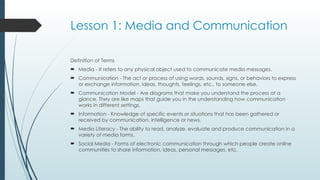
Lesson 1: Media and Communication
Definition of Terms
 Media - It refers to any physical object used to communicate media messages.
 Communication - The act or process of using words, sounds, signs, or behaviors to express
or exchange information, ideas, thoughts, feelings, etc., to someone else.
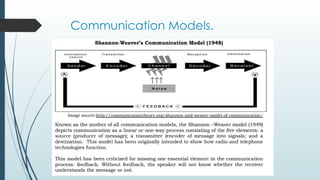
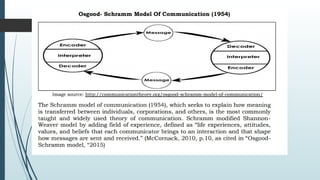
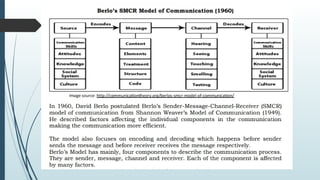
 Communication Model - Are diagrams that make you understand the process at a
glance. They are like maps that guide you in the understanding how communication
works in different settings.
 Information - Knowledge of specific events or situations that has been gathered or
received by communication, intelligence or news.
 Media Literacy - The ability to read, analyze, evaluate and produce communication in a
variety of media forms.
 Social Media - Forms of electronic communication through which people create online
communities to share information, ideas, personal messages, etc.
Lesson 1 Media and Communication
Media and other information providers play a
central role in information and communication
processes. Nowadays, media become the
common outlet of self- expression and creativity.
The connection between technological
advances and people’s connectivity created a
huge impact to the lives of today’s generation.
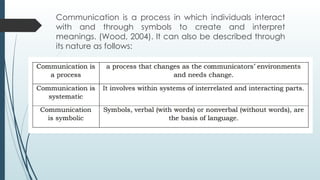
Communication is a process in which individuals interact
with and through symbols to create and interpret
meanings. (Wood, 2004). It can also be described through
its nature as follows:
COMMUNICATION AND MEDIA
 Communication refers to the process of conveying or
sharing information. Since then, it is often described as a
natural ability of an individual to socialize with others. In
the 21st century world, communication has become
“more social” due to the emergence of technology.
 Media are defined as sources of credible and current
information created through an editorial process
determined by journalistic values.
Variety of Non-media Information
Providers
 Libraries
 Museums
 Archives
 Internet information providers
 Other information organizations
 Citizens who produce their own content.
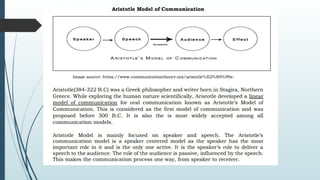
Communication Models.
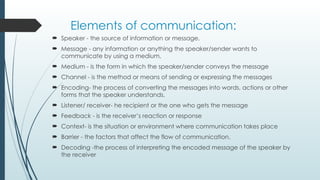
Elements of communication:
 Speaker - the source of information or message.
 Message - any information or anything the speaker/sender wants to
communicate by using a medium.
 Medium - is the form in which the speaker/sender conveys the message
 Channel - is the method or means of sending or expressing the messages
 Encoding- the process of converting the messages into words, actions or other
forms that the speaker understands.
 Listener/ receiver- he recipient or the one who gets the message
 Feedback - is the receiver’s reaction or response
 Context- is the situation or environment where communication takes place
 Barrier - the factors that affect the flow of communication.
 Decoding -the process of interpreting the encoded message of the speaker by
the receiver
Media and Information Literacy recognizes
the primary role of information and media in
our everyday lives. It lies at the core of
freedom of expression and information -
since it empowers citizens to understand the
functions of media and other information
providers, to critically evaluate their
content, and to make informed decisions as
users and producer of information and
media content.
So how communication is affected by media and
information? Let us take a look on the multiple roles of
media in the society.
1. act as channels of information and knowledge through which citizens communicate with
each other and make informed decisions,
2. facilitate informed debates between diverse social actors,
3. provide us with much of what we learn about the world beyond our immediate
experience,
4. are means by which a society learns about itself and builds a sense of community,
5. function as a watchdog of government in all its forms, promoting transparency in public life
and public scrutiny of those with power through exposing corruption, maladministration
and corporate wrong-doing,
6. are essential facilitators of democratic processes and one of the guarantors of free and fair
elections,
7. are a vehicle for cultural expression and cultural cohesion within and between nations, and
8. function as an advocate and social actor in its own right while respecting pluralistic values.
Lesson 2: Introduction to
Media and Information
Literacy
Definition of Terms
 Information Literacy
Refers to the abilities to recognize when information is needed and to locate, evaluate, effectively use, and
communicate information in its various formats.
 Literacy
The ability to identify, understand, interpret, create, communicate and compute, using printed and written
materials associated with varying contexts. Literacy involves a continuum of learning, wherein individuals are
able to achieve their goals, develop their knowledge and potential, and participate fully in their community
and wider society.
 Media and Information Literacy
MIL stands for media and information literacy, and refers to the essential competencies and skills that allow
citizens to engage with media and other information providers effectively and develop critical thinking and
life-long learning skills to socialize and become active citizens.
 Media Literacy
The ability to decode, analyze, evaluate and produce communication in a variety of forms.
 Technology (Digital) Literacy
The ability to use digital technology, communication tools or networks to locate, evaluate, use and create
information. It also refers to the ability to understand and use information in multiple formats from a wide range
of sources when it is presented via computers and to a person’s ability to perform tasks effectively in a digital
environment. Digital literacy includes the ability to read and interpret media, to reproduce data and images
through digital manipulation, and to evaluate and apply new knowledge gained from digital environments.
Lesson 2: Responsible use
of Media and Information
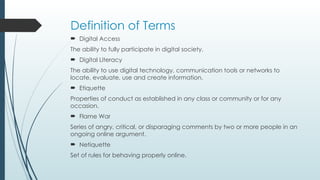
Definition of Terms
 Digital Access
The ability to fully participate in digital society.
 Digital Literacy
The ability to use digital technology, communication tools or networks to
locate, evaluate, use and create information.
 Etiquette
Properties of conduct as established in any class or community or for any
occasion.
 Flame War
Series of angry, critical, or disparaging comments by two or more people in an
ongoing online argument.
 Netiquette
Set of rules for behaving properly online.
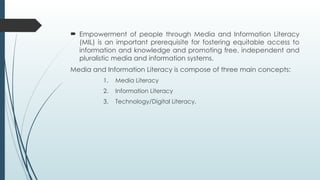
 Empowerment of people through Media and Information Literacy
(MIL) is an important prerequisite for fostering equitable access to
information and knowledge and promoting free, independent and
pluralistic media and information systems.
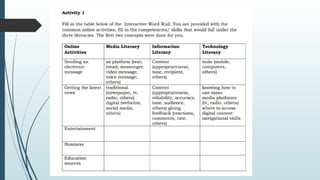
Media and Information Literacy is compose of three main concepts:
1. Media Literacy
2. Information Literacy
3. Technology/Digital Literacy.
We defined Digital Literacy/Technology Literacy as the
ability of an individual, either working independently or
with others, to responsibly, appropriately, and effectively
use technological tools.
With the growing trend in the use of technology, cases of
unethical use are also surging up. With this concern, ethical
use of media and information should be given great
emphasis through inculcating Digital citizenship
 Digital access - refers to the ability to fully participate in
digital society. This includes access to tools and
technologies, such as the internet and computers, that
allow for full participation.
 Digital Citizenship - Having full access to technology
requires continuously developing norms of appropriate,
responsible, and empowered technology use.
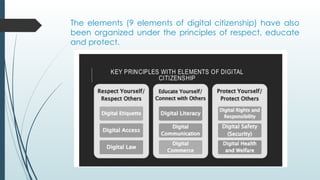
The elements (9 elements of digital citizenship) have also
been organized under the principles of respect, educate
and protect.
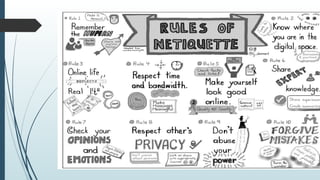
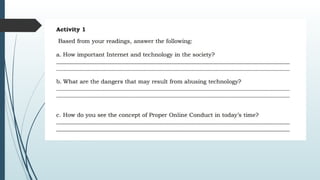
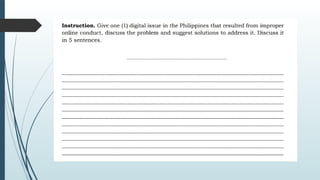
Netiquette as set of rules about the proper
and polite way to communicate with other
people when using the internet. Common
issues in the digital world such as bashing
and online bullying occur due to improper
conduct online.
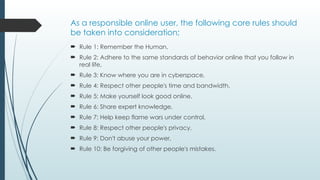
As a responsible online user, the following core rules should
be taken into consideration;
 Rule 1: Remember the Human,
 Rule 2: Adhere to the same standards of behavior online that you follow in
real life,
 Rule 3: Know where you are in cyberspace,
 Rule 4: Respect other people's time and bandwidth,
 Rule 5: Make yourself look good online,
 Rule 6: Share expert knowledge,
 Rule 7: Help keep flame wars under control,
 Rule 8: Respect other people's privacy,
 Rule 9: Don't abuse your power,
 Rule 10: Be forgiving of other people's mistakes.
Leson 3: Evolution of
Traditional to New Media
Definition of Terms
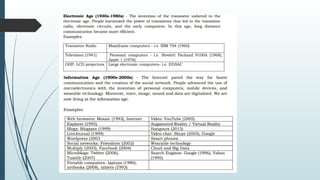
 Electronic Age
Began when electronic equipment including computers came into use.
 Industrial Age
People used the power of steam, developed machine tools, established iron production, and
manufactured various products.
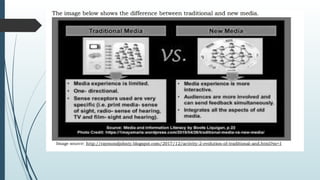
 New Media
Refers to content organized and distributed on digital platforms.
 New (Information) Age
An idea that the current age is characterized by creating a knowledge-based society surrounded by
a high-tech computerization. It is also known as the Computer Age, Digital Age, or New Media Age
 Traditional Media
Refers to the traditional means of communication and expression that have existed since before the
advent of the Internet.
 Pre- Industrial Age
Time before there were machines and tools to help perform tasks.
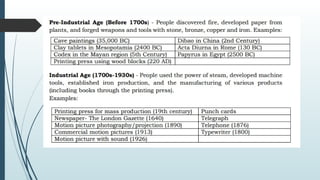
EVOLUTION OF MEDIA
 Social media changed us. People ways of living is a
reflection of a boundless limitation of media from
prehistoric age down to the digital age. Media evolution
can be described through four ages.
Module 4: Types of Media
(Print, Broadcast, New
Media)
Definition of Terms
 Broadcast Media
Refer to media such as radio and television that reach target audiences using
airwaves as the transmission medium.
 Print Media
Consist of paper and ink, reproduced in a printing process that is traditionally
mechanical.
 Media Convergence
Refers to the ability to transform different kinds media into digital code, which
is then accessible by a range of devices, from the personal computer to the
mobile phone, thus creating a digital communication environment.
 New Media
Refers to content organized and distributed on digital platforms.
 Traditional Media
Refers to the traditional means of communication and expression that have
existed since before the advent of the Internet.
 Information Literacy is defined as the ability to recognize when information
is needed and to locate, evaluate, effectively use and communicate
information in its various formats.
The following are the Seven (7) Stages/Elements Of Information Literacy:
1. Identifying/recognizing information needs
2. Determining sources of information
3. Citing or searching for information
4. Analyzing and evaluating the quality of information
5. Organizing, storing or archiving information
6. Using information in an ethical, efficient, and effective way
7. Creating and communicating new knowledge
TYPES OF MEDIA
 Print Media is consist of paper and ink, reproduced in a printing process that
is traditionally mechanical.
- The first hundred years was the time when the print industry tried to
comprehend the new situation and shaped itself into a regular and formal
sector but from the start of the 19th century, print media in most countries
started specializing in certain areas. Since business in the form of
advertisements in the print was also flourishing, the media enjoyed a great
deal of financial comfort and provided jobs to tens of thousands of people
across the globe.
Print Media three distinct categories:
1. Newspapers. It took about 150 years from the invention of printing press in the
middle of 15th century that the world witnessed first regular publication which
could be defined as a newspaper.
- the World Association of Newspapers held "Relation", as the first newspaper
published in France in 1605.
Here is a brief account of some popular papers:
 1621 ---- In London, the newspaper Courante is published.
 1631 ---- The Gazette, the first French newspaper, is founded.
 1639 ---- First American colonial printing press.
 1645 ---- World's oldest newspaper still in circulation,
 1690 ---- Public Occurrences is the first newspaper published in America when it
appears in Boston.
 1844 ---- Telegraph is invented.
 Alfred Harmsworth (later Lord North cliffe) develops the first tabloid newspaper,
the Daily Mirror,in London.
Contents General-interest newspapers are usually journals of current
news. Those can include :Political events, Crime, Business, Culture,
Sports, Opinions (either editorials, columns, or political cartoons)
Newspapers use photographs to illustrate stories; they use editorial
cartoonists, usually to illustrate writing that is opinion, rather than news.
Some specific features a newspaper may include are: weather news
and forecasts an advice column, critical reviews of movies, plays,
restaurants, etc.
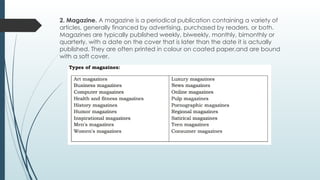
2. Magazine. A magazine is a periodical publication containing a variety of
articles, generally financed by advertising, purchased by readers, or both.
Magazines are typically published weekly, biweekly, monthly, bimonthly or
quarterly, with a date on the cover that is later than the date it is actually
published. They are often printed in colour on coated paper,and are bound
with a soft cover.
All magazines have some elements in common, even if they are a
listings magazine or a simple advertising vehicle. The main features of
content in magazines mainly consist of the cover page features,
reviews, problem pages, interviews, advertisements, competitions and
some form of gossip.
The main features of presentation of magazines are the cover pages,
the layout and the design photographs and illustrations use of colour,
an insight of the actual magazine and visual narrative.
3. Book. Is a collection of paper, parchment or other material with a
piece of text written on them, bound together along one edge,
usually within covers. Each side of a sheet is called a page and a
single sheet within a book may be called a leaf. A book is also a
literary work or a main division of such a work Books became part of
the mass media after the printing process was invented.
- Their topics are varied and their value could be judged from the fact
that most libraries in the world are due to books rather than other
published material. When writing systems were invented in ancient
civilizations, nearly everything that could be written upon--stone, clay,
tree bark, metal sheets--was used for writing.
 Broadcast media refer to media such as radio and television that reach target
audiences using airwaves as the transmission medium.
Types of Broadcast:
1. Television. The principal source of information and entertainment for people
exposed to mass media. It is believed to be the most authoritative, influential,
exciting medium for reaching very large audience. It combines visual images,
sound, motion and colour to achieve viewer’s empathy.
2. Radio. Is a premier mass medium for users and advertisers. It has a wide spread
reach and delivers the ad message to a large number of people across the
length and breadth of a country. Commercial broadcasting is undertaken in
major cities even rural areas. It is one of the personal medium and offers
selectivity, cost efficiency and flexibility advantages over other media.
 New media are content-organized and distributed in digital platforms (e.g.
Social media). Another concept that arises with accessing information is the
transformation of various media into a digital code known as media
convergence.
Type of New Media:
1. Internet. A worldwide medium that provides means of exchanging
information through a series of interconnected computers. It involves use of
world wide web to showcase a website or e-commerce portal to the world.
It provides a sophisticated graphic user interface to users and is accessible
to anyone with a computer and broadband connection.With the existence
of various media platforms, information becomes readily accessible to
everyone.
2. Media convergence is the co-existence of traditional and new media; the
coexistence of print media, broadcast media, the Internet, mobile phones,
a well as others, allowing media content to flow across various platforms
creating a digital communication environment.
2nd
Grading
Lesson 5: Opportunities and
Challenges in Media and
Information
 Media provide us with a variety of information however, harmful online
effects are also rampant. Activities such as pornography, defamation,
infringement, bullying, identity theft, profile manipulation, and all others are
some of the harmful acts that can affect a peaceful living.
 Positive and negative impacts are both products of media and
information.
POWER OF MEDIA TO AFFECT CHANGE
March 2016, TCC Group published an article by Charles Gaspar, entitled “How
media Affects Social Change” which reports the following:
“Media and more importantly its ability to reach the public and provide
commentary has been present ever since the existence of a town crier. The
tradition of oration has evolved to broadsheet, books, radio, television, and
now to the digital age.”
In April 2016, the World Economic Forum published an article titled 6 ways
social media is changing the world that discussed six observations and
predictions for the way social media is changing the world from experts from
the Global Agenda Council.
1. Across industries, social media is going from a “nice to have” to an essential
component of any business strategy.
2. Social media platforms may be the banks of the future.
3. Social media is shaking up healthcare and public health.
4. Social media is changing how we govern and are governed.
5. Social media is helping us better respond to disaster.
6. Social media is helping us tackle some of the world’s biggest challenges,
from human rights violations to climate change.
Another article from TECH MAISH.com by Bilal Ahmad updated in March 2016
published an article titled “10 Advantages and Disadvantages of Social Media
for Society” enumerated the following:
Advantages:
Connectivity
Educate
Help
Information and updates
Promotion
Noble cause
Awareness
Helps Gov’t and agencies fight crime
Improves business reputation
Helps in building communities
Disadvantages:
Cyberbullying
Hacking
Addiction
Fraud and Scams
Security Issues
Ruin Reputation
Cheating and Relationship
Issues Health Issues
Social Media causes death
Glamorizes Drugs and Alcohol
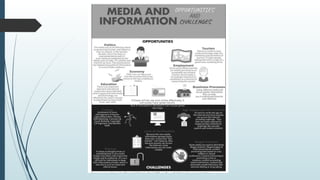
OPPORTUNITY. It is a set of situations that makes it possible to do something.
1. Economy
Economic actors need accurate and timely information to allocate resources
efficiently, investors and other groups increasing value and demand a governance
monitoring role from the media.
Media improves the efficiency of the economy by providing actors more and better
information with which make decisions and improving stability.
2. Education
In Sites Using Video As we know from the recent ubiquity of online digital video, the
video has become a compelling tool for educational representation. students use it
in their projects: teachers and pre-service teachers use it to study pedagogy; and
researchers use it for capturing and examining how learning happens, as they unfold.
OPPORTUNITY
3. Social
In today's world, media becomes as essential as our daily needs. Media of
today is playing an outstanding role in creating and shaping of public opinion
and strengthening of society. Media is the sword arm of democracy. Media
acts as watchdog to protect public interest against malpractice and create
public awareness.
4. Political
The political landscape has changed quite a bit in the last couple of decades.
The internet has played a large role in this transformation. Social media, in
particular, is now a serious factor in political campaigns and in the way people
think about issues.
5. News Around the Clock
While you can access news on many websites at any hour, most people spend
more time on sites such as Facebook and Twitter than they do on serious news
or political websites. This means that you get all of the latest trending news
stories and opinions shared by your friends whenever you log on.
6. The Impact of Polls
Polls results have a big influence on elections. This is true even if they are flawed.
A poll can be a self-fulfilling prophecy. For example, if people think one
candidate is far ahead in the race, they might conclude there’s no point in
voting for the underdog. When people are posting the latest poll results on
social media throughout the day, there’s a great deal of pressure on
candidates to pull ahead of their opponents.
7. Direct Interaction With Politicians
One of the positive effects that social media has on politics is the opportunity for
voters to interact more easily with candidates and elected officials. With
modern technology, it’s now possible to attend virtual events where you can
participate in live streaming events and interact with politicians and candidates.
8. Demographics and Targeting
Targeting is used throughout the advertising industry to make sure that ads and
messages reach the right audience. Politicians do this as well. In the age of
social media, politicians and people running for office are able to target their
campaigns.
CHALLENGES
CHALLENGES. It is something new and difficult which requires great effort and
determination.
1. Illegal Content
It’s any type of content that could be damaging to young people, including:real or
simulated violence sexually explicit content illegal images of child sexual abuse content
promoting hate based on race, religion or sexual preference content instructing or
promoting crime or violence content promoting violent extremism content that
advocates unsafe behavior like extreme dieting or drug taking the use of a computer as
an instrument to further illegal ends.
2. Cybercrime
Criminal activity or a crime that involves the Internet, a computer system or a computer
technology.
3. Copyright
Infringement It is the use of works protected by copyright law without
permission, infringing certain exclusive rights granted to the copyright holder,
such as the right to reproduce, distribute, display or perform the protected
work, or to make derivative works.
4. Identity Theft
It is the deliberate use of someone else's identity, usually as a method to gain a
financial advantage or obtain credit and other benefits in the other person's
name, and perhaps to the other person's disadvantage or loss.
POWER
'Media power' means here the concentration of symbolic power in media institutions,
particularly those of television, radio and the press (the common-sense definition of 'the
media'), although the long-term impact of new media on media power is considered.
1. Business Strategy
It’s a trend that is already spreading to businesses beyond the newsroom, whether it be
because of digital marketing or new customer service communication channels.
2. Banks of the Future
Social media is transforming banking relationships in very significant ways, from
improving customer service to allowing users to send money to others via online
platforms.
3. Health Care & Public Health
Social media has been responsible for relevant changes in both personal and
community health, especially by making it easier for large numbers of people to rapidly
share information.
Lesson 6: Current and Future
Trends in Media and
Information
Massive Open Online Course
- Media as one of the fastest means in educating
people continue to flourish and innovate. An
online course that offers open access via the
Internet for free or at a low cost. With the
continuous growth of media, modernization is
anywhere, learning becomes more accessible.
MOOC respects certain technical specifications and four
characteristics:
1. Using web formats
2. Collaborative learning
3. Assessing knowledge
4. Time limits
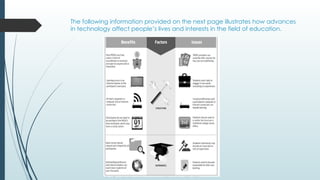
The following information provided on the next page illustrates how advances
in technology affect people’s lives and interests in the field of education.
Massive Open Online Content and its Implications
- Massive Open Online Content (MOOC) is defined by Educause as a model for
delivering learning content online to any person who wants to take a course,
with no limit on attendance. It can be characterized by the following:
a. A revolutionary approach to education that veers away from the physical to the
virtual.
b. A kind of learning that happens online, breaking the norm of traditional schools or
universities for higher education.
c. Utilizes information technologies like analytics to help instructors gauge their
student’s learning.
d. Emphasis on connectedness.
The Implications
1. By taking learning into virtual space, attendance is no longer a determining
factor in one’s education. This makes MOOC learning a popular alternative
for those whose life situations make them unable to attend regular schools.
2. Managing MOOC is relatively cheaper than running educational institutions.
By taking out the experiences of Universities – which are passed down to
students in exorbitant fees- MOOC addresses the high cost of education.
3. Analytic provides information about the learning process of students.
Through the use of data collected through analytic, MOOC provides a means
to improve learning.
4. Since it focuses on connectedness as part of the learning process, MOOC
allows education to take place on a global scale. Connecting learners and
instructors all over the world to one another to maximize education.
 Wearable technology is seen to be the up and coming technology of the future.
Wearable technologies today are smart watches. These watches are worn as a
typical wristwatch but do more than just tell time. Modern smart watches perform
the same functions as smart phones.
 Smart watches as a wearable are developed for convenience, but its inability to
function as an independent gadget puts it at a distinct disadvantage.
 Fitness tracker. It is derived from smart watches in form and physical design but
serves health applications. Fitness trackers aim to promote health and wellness
among its enthusiasts, unfortunately, issues in their accuracy have been raised in
several reviews.
 Virtual Reality (VR) wearable technology is gradually growing in popularity
among enthusiasts. Oculus, a high-end VR headsets intended for entertainment
has been released to the public on March 28, 2016. This wearable technology
takes users to computer generated worlds and let them experience it as if they
were actually there.
 The Concept of 3D Environment 3D or three dimensional in its literal sense refers
to anything that has width, height, and depth. The physical world is an example
of a 3D environment. The concept of 3D environment is explored to mimic the
physical world in media.
- Another notable development is 3D printing. This technology brings digital data
and design to the physical world literally. The concept of 3D bio-printing or 2D
printing, using human materials like tissue ad bones to create organs or body parts
that can be theoretically translated to an actual human body aims to solve that.
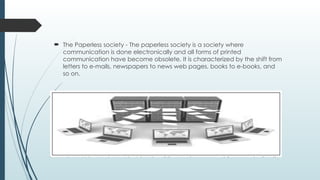
 The Paperless society - The paperless society is a society where
communication is done electronically and all forms of printed
communication have become obsolete. It is characterized by the shift from
letters to e-mails, newspapers to news web pages, books to e-books, and
so on.
 Ubiquitous learning is common in the age of information. Since the
information in the digital age can be accessed by anyone, at any given
time and place, ubiquitous or an ever-present type learning of learning is
possible.
Lesson 7: Text Media and
Information
Text - refers to a simple and flexible format of presenting information or
conveying ideas whether hand-written, printed, or displayed on-
screen.
Two (2) Different Source
 Formal text-based are created and distributed by established
institutions and go through a rigorous process of editing or
evaluation.
 Informal text-based on the other hand, come from personal
opinions or views on different issues.
Text media - are publications that disseminate information through media products such
as newspapers, flyers, books, magazines, tarpaulins, advertisements, television, banners,
websites, and posters. Furthermore, design elements and principles in text media are
effective means of conveying a message.
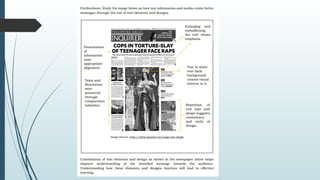
Design Principles And Elements
 Emphasis refers to the importance or value given to a part of the text-based content.
 Appropriateness refers to how fitting or suitable the text is used for a specific
audience, purpose, or event.
 Proximity refers to how near or how far are the text elements from each other.
 Alignment refers to how the text is positioned on the page. This can be left, right,
center or justified.
 Organization refers to a conscious effort to organize the different text elements on a
page.
 Repetition concerns consistency of elements and the unity of the entire design.
 Contrast creates visual interest to text elements. Contrast is achieved when two
elements are different from each other.
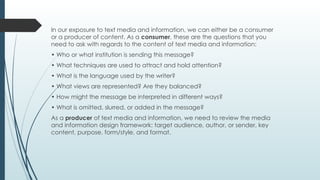
In our exposure to text media and information, we can either be a consumer
or a producer of content. As a consumer, these are the questions that you
need to ask with regards to the content of text media and information:
• Who or what institution is sending this message?
• What techniques are used to attract and hold attention?
• What is the language used by the writer?
• What views are represented? Are they balanced?
• How might the message be interpreted in different ways?
• What is omitted, slurred, or added in the message?
As a producer of text media and information, we need to review the media
and information design framework: target audience, author, or sender, key
content, purpose, form/style, and format.
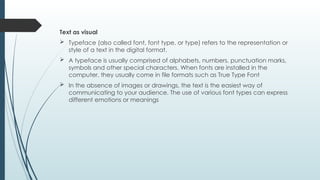
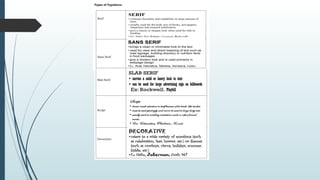
Text as visual
 Typeface (also called font, font type, or type) refers to the representation or
style of a text in the digital format.
 A typeface is usually comprised of alphabets, numbers, punctuation marks,
symbols and other special characters. When fonts are installed in the
computer, they usually come in file formats such as True Type Font
 In the absence of images or drawings, the text is the easiest way of
communicating to your audience. The use of various font types can express
different emotions or meanings
Lesson 8: Visual
Information and Media
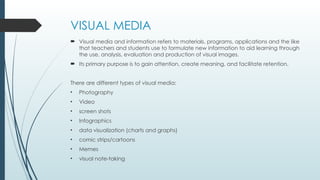
VISUAL MEDIA
 Visual media and information refers to materials, programs, applications and the like
that teachers and students use to formulate new information to aid learning through
the use, analysis, evaluation and production of visual images.
 Its primary purpose is to gain attention, create meaning, and facilitate retention.
There are different types of visual media:
• Photography
• Video
• screen shots
• Infographics
• data visualization (charts and graphs)
• comic strips/cartoons
• Memes
• visual note-taking
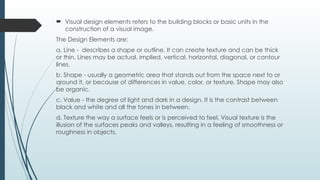
 Visual design elements refers to the building blocks or basic units in the
construction of a visual image.
The Design Elements are:
a. Line - describes a shape or outline. It can create texture and can be thick
or thin. Lines may be actual, implied, vertical, horizontal, diagonal, or contour
lines.
b. Shape - usually a geometric area that stands out from the space next to or
around it, or because of differences in value, color, or texture. Shape may also
be organic.
c. Value - the degree of light and dark in a design. It is the contrast between
black and white and all the tones in between.
d. Texture the way a surface feels or is perceived to feel. Visual texture is the
illusion of the surfaces peaks and valleys, resulting in a feeling of smoothness or
roughness in objects.
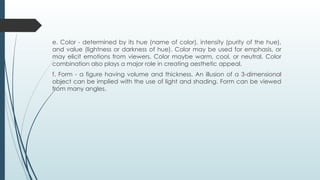
e. Color - determined by its hue (name of color), intensity (purity of the hue),
and value (lightness or darkness of hue). Color may be used for emphasis, or
may elicit emotions from viewers. Color maybe warm, cool, or neutral. Color
combination also plays a major role in creating aesthetic appeal.
f. Form - a figure having volume and thickness. An illusion of a 3-dimensional
object can be implied with the use of light and shading. Form can be viewed
from many angles.
Visual Design Principles are:
 Consistency of margins, typeface, type style, and colors is necessary, especially in slide
presentations or documents that are more than one page.
 Center of interest an area that first attracts attention in a composition. This area is more
important when compared to the other objects or elements in a composition. This can be
by contrast of values, more colors, and placement in the format.
 Balance a feeling of visual equality in shape, form, value, color, etc. Balance can be
symmetrical and evenly balanced, or asymmetrical and unevenly balanced. Objects,
values, colors, textures, shapes, forms, etc. can be used in creating balance in a
composition.
 Harmony brings together a composition with similar units. Contrast offers some change in
value creating a visual discord in a composition.
 Contrast shows the difference between shapes and can be used as a background to
bring objects out and forward in a design. It can also be used to create an area of
emphasis
 Directional Movement a visual flow through the composition. It can be the suggestion of
motion in a design as you move from object to object by way of placement and position.
 Rhythm a movement in which some elements recur regularly. Like a dance, it will have a
flow of objects that will seem to be like the beat of music. Perspective created through the
arrangement of objects in two dimensional space to look like they appear in real life.
 Perspective is a learned meaning of the relationship between different objects seen in
space.
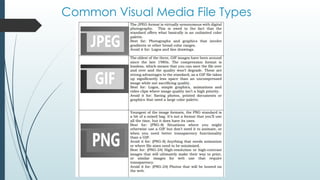
Common Visual Media File Types

Media and Information Literacy Presentation.pptx

  • 1.
  • 2.
    Lesson 1: Mediaand Communication Definition of Terms  Media - It refers to any physical object used to communicate media messages.  Communication - The act or process of using words, sounds, signs, or behaviors to express or exchange information, ideas, thoughts, feelings, etc., to someone else.  Communication Model - Are diagrams that make you understand the process at a glance. They are like maps that guide you in the understanding how communication works in different settings.  Information - Knowledge of specific events or situations that has been gathered or received by communication, intelligence or news.  Media Literacy - The ability to read, analyze, evaluate and produce communication in a variety of media forms.  Social Media - Forms of electronic communication through which people create online communities to share information, ideas, personal messages, etc.
  • 3.
    Lesson 1 Mediaand Communication Media and other information providers play a central role in information and communication processes. Nowadays, media become the common outlet of self- expression and creativity. The connection between technological advances and people’s connectivity created a huge impact to the lives of today’s generation.
  • 4.
    Communication is aprocess in which individuals interact with and through symbols to create and interpret meanings. (Wood, 2004). It can also be described through its nature as follows:
  • 5.
    COMMUNICATION AND MEDIA Communication refers to the process of conveying or sharing information. Since then, it is often described as a natural ability of an individual to socialize with others. In the 21st century world, communication has become “more social” due to the emergence of technology.  Media are defined as sources of credible and current information created through an editorial process determined by journalistic values.
  • 6.
    Variety of Non-mediaInformation Providers  Libraries  Museums  Archives  Internet information providers  Other information organizations  Citizens who produce their own content.
  • 7.
  • 11.
    Elements of communication: Speaker - the source of information or message.  Message - any information or anything the speaker/sender wants to communicate by using a medium.  Medium - is the form in which the speaker/sender conveys the message  Channel - is the method or means of sending or expressing the messages  Encoding- the process of converting the messages into words, actions or other forms that the speaker understands.  Listener/ receiver- he recipient or the one who gets the message  Feedback - is the receiver’s reaction or response  Context- is the situation or environment where communication takes place  Barrier - the factors that affect the flow of communication.  Decoding -the process of interpreting the encoded message of the speaker by the receiver
  • 12.
    Media and InformationLiteracy recognizes the primary role of information and media in our everyday lives. It lies at the core of freedom of expression and information - since it empowers citizens to understand the functions of media and other information providers, to critically evaluate their content, and to make informed decisions as users and producer of information and media content.
  • 13.
    So how communicationis affected by media and information? Let us take a look on the multiple roles of media in the society. 1. act as channels of information and knowledge through which citizens communicate with each other and make informed decisions, 2. facilitate informed debates between diverse social actors, 3. provide us with much of what we learn about the world beyond our immediate experience, 4. are means by which a society learns about itself and builds a sense of community, 5. function as a watchdog of government in all its forms, promoting transparency in public life and public scrutiny of those with power through exposing corruption, maladministration and corporate wrong-doing, 6. are essential facilitators of democratic processes and one of the guarantors of free and fair elections, 7. are a vehicle for cultural expression and cultural cohesion within and between nations, and 8. function as an advocate and social actor in its own right while respecting pluralistic values.
  • 15.
    Lesson 2: Introductionto Media and Information Literacy
  • 16.
    Definition of Terms Information Literacy Refers to the abilities to recognize when information is needed and to locate, evaluate, effectively use, and communicate information in its various formats.  Literacy The ability to identify, understand, interpret, create, communicate and compute, using printed and written materials associated with varying contexts. Literacy involves a continuum of learning, wherein individuals are able to achieve their goals, develop their knowledge and potential, and participate fully in their community and wider society.  Media and Information Literacy MIL stands for media and information literacy, and refers to the essential competencies and skills that allow citizens to engage with media and other information providers effectively and develop critical thinking and life-long learning skills to socialize and become active citizens.  Media Literacy The ability to decode, analyze, evaluate and produce communication in a variety of forms.  Technology (Digital) Literacy The ability to use digital technology, communication tools or networks to locate, evaluate, use and create information. It also refers to the ability to understand and use information in multiple formats from a wide range of sources when it is presented via computers and to a person’s ability to perform tasks effectively in a digital environment. Digital literacy includes the ability to read and interpret media, to reproduce data and images through digital manipulation, and to evaluate and apply new knowledge gained from digital environments.
  • 19.
    Lesson 2: Responsibleuse of Media and Information
  • 20.
    Definition of Terms Digital Access The ability to fully participate in digital society.  Digital Literacy The ability to use digital technology, communication tools or networks to locate, evaluate, use and create information.  Etiquette Properties of conduct as established in any class or community or for any occasion.  Flame War Series of angry, critical, or disparaging comments by two or more people in an ongoing online argument.  Netiquette Set of rules for behaving properly online.
  • 21.
     Empowerment ofpeople through Media and Information Literacy (MIL) is an important prerequisite for fostering equitable access to information and knowledge and promoting free, independent and pluralistic media and information systems. Media and Information Literacy is compose of three main concepts: 1. Media Literacy 2. Information Literacy 3. Technology/Digital Literacy.
  • 22.
    We defined DigitalLiteracy/Technology Literacy as the ability of an individual, either working independently or with others, to responsibly, appropriately, and effectively use technological tools. With the growing trend in the use of technology, cases of unethical use are also surging up. With this concern, ethical use of media and information should be given great emphasis through inculcating Digital citizenship
  • 23.
     Digital access- refers to the ability to fully participate in digital society. This includes access to tools and technologies, such as the internet and computers, that allow for full participation.  Digital Citizenship - Having full access to technology requires continuously developing norms of appropriate, responsible, and empowered technology use.
  • 24.
    The elements (9elements of digital citizenship) have also been organized under the principles of respect, educate and protect.
  • 25.
    Netiquette as setof rules about the proper and polite way to communicate with other people when using the internet. Common issues in the digital world such as bashing and online bullying occur due to improper conduct online.
  • 27.
    As a responsibleonline user, the following core rules should be taken into consideration;  Rule 1: Remember the Human,  Rule 2: Adhere to the same standards of behavior online that you follow in real life,  Rule 3: Know where you are in cyberspace,  Rule 4: Respect other people's time and bandwidth,  Rule 5: Make yourself look good online,  Rule 6: Share expert knowledge,  Rule 7: Help keep flame wars under control,  Rule 8: Respect other people's privacy,  Rule 9: Don't abuse your power,  Rule 10: Be forgiving of other people's mistakes.
  • 30.
    Leson 3: Evolutionof Traditional to New Media
  • 31.
    Definition of Terms Electronic Age Began when electronic equipment including computers came into use.  Industrial Age People used the power of steam, developed machine tools, established iron production, and manufactured various products.  New Media Refers to content organized and distributed on digital platforms.  New (Information) Age An idea that the current age is characterized by creating a knowledge-based society surrounded by a high-tech computerization. It is also known as the Computer Age, Digital Age, or New Media Age  Traditional Media Refers to the traditional means of communication and expression that have existed since before the advent of the Internet.  Pre- Industrial Age Time before there were machines and tools to help perform tasks.
  • 33.
    EVOLUTION OF MEDIA Social media changed us. People ways of living is a reflection of a boundless limitation of media from prehistoric age down to the digital age. Media evolution can be described through four ages.
  • 38.
    Module 4: Typesof Media (Print, Broadcast, New Media)
  • 39.
    Definition of Terms Broadcast Media Refer to media such as radio and television that reach target audiences using airwaves as the transmission medium.  Print Media Consist of paper and ink, reproduced in a printing process that is traditionally mechanical.  Media Convergence Refers to the ability to transform different kinds media into digital code, which is then accessible by a range of devices, from the personal computer to the mobile phone, thus creating a digital communication environment.  New Media Refers to content organized and distributed on digital platforms.  Traditional Media Refers to the traditional means of communication and expression that have existed since before the advent of the Internet.
  • 40.
     Information Literacyis defined as the ability to recognize when information is needed and to locate, evaluate, effectively use and communicate information in its various formats. The following are the Seven (7) Stages/Elements Of Information Literacy: 1. Identifying/recognizing information needs 2. Determining sources of information 3. Citing or searching for information 4. Analyzing and evaluating the quality of information 5. Organizing, storing or archiving information 6. Using information in an ethical, efficient, and effective way 7. Creating and communicating new knowledge
  • 41.
    TYPES OF MEDIA Print Media is consist of paper and ink, reproduced in a printing process that is traditionally mechanical. - The first hundred years was the time when the print industry tried to comprehend the new situation and shaped itself into a regular and formal sector but from the start of the 19th century, print media in most countries started specializing in certain areas. Since business in the form of advertisements in the print was also flourishing, the media enjoyed a great deal of financial comfort and provided jobs to tens of thousands of people across the globe.
  • 42.
    Print Media threedistinct categories: 1. Newspapers. It took about 150 years from the invention of printing press in the middle of 15th century that the world witnessed first regular publication which could be defined as a newspaper. - the World Association of Newspapers held "Relation", as the first newspaper published in France in 1605. Here is a brief account of some popular papers:  1621 ---- In London, the newspaper Courante is published.  1631 ---- The Gazette, the first French newspaper, is founded.  1639 ---- First American colonial printing press.  1645 ---- World's oldest newspaper still in circulation,  1690 ---- Public Occurrences is the first newspaper published in America when it appears in Boston.  1844 ---- Telegraph is invented.  Alfred Harmsworth (later Lord North cliffe) develops the first tabloid newspaper, the Daily Mirror,in London.
  • 43.
    Contents General-interest newspapersare usually journals of current news. Those can include :Political events, Crime, Business, Culture, Sports, Opinions (either editorials, columns, or political cartoons) Newspapers use photographs to illustrate stories; they use editorial cartoonists, usually to illustrate writing that is opinion, rather than news. Some specific features a newspaper may include are: weather news and forecasts an advice column, critical reviews of movies, plays, restaurants, etc.
  • 44.
    2. Magazine. Amagazine is a periodical publication containing a variety of articles, generally financed by advertising, purchased by readers, or both. Magazines are typically published weekly, biweekly, monthly, bimonthly or quarterly, with a date on the cover that is later than the date it is actually published. They are often printed in colour on coated paper,and are bound with a soft cover.
  • 45.
    All magazines havesome elements in common, even if they are a listings magazine or a simple advertising vehicle. The main features of content in magazines mainly consist of the cover page features, reviews, problem pages, interviews, advertisements, competitions and some form of gossip. The main features of presentation of magazines are the cover pages, the layout and the design photographs and illustrations use of colour, an insight of the actual magazine and visual narrative.
  • 46.
    3. Book. Isa collection of paper, parchment or other material with a piece of text written on them, bound together along one edge, usually within covers. Each side of a sheet is called a page and a single sheet within a book may be called a leaf. A book is also a literary work or a main division of such a work Books became part of the mass media after the printing process was invented. - Their topics are varied and their value could be judged from the fact that most libraries in the world are due to books rather than other published material. When writing systems were invented in ancient civilizations, nearly everything that could be written upon--stone, clay, tree bark, metal sheets--was used for writing.
  • 47.
     Broadcast mediarefer to media such as radio and television that reach target audiences using airwaves as the transmission medium. Types of Broadcast: 1. Television. The principal source of information and entertainment for people exposed to mass media. It is believed to be the most authoritative, influential, exciting medium for reaching very large audience. It combines visual images, sound, motion and colour to achieve viewer’s empathy. 2. Radio. Is a premier mass medium for users and advertisers. It has a wide spread reach and delivers the ad message to a large number of people across the length and breadth of a country. Commercial broadcasting is undertaken in major cities even rural areas. It is one of the personal medium and offers selectivity, cost efficiency and flexibility advantages over other media.
  • 48.
     New mediaare content-organized and distributed in digital platforms (e.g. Social media). Another concept that arises with accessing information is the transformation of various media into a digital code known as media convergence. Type of New Media: 1. Internet. A worldwide medium that provides means of exchanging information through a series of interconnected computers. It involves use of world wide web to showcase a website or e-commerce portal to the world. It provides a sophisticated graphic user interface to users and is accessible to anyone with a computer and broadband connection.With the existence of various media platforms, information becomes readily accessible to everyone. 2. Media convergence is the co-existence of traditional and new media; the coexistence of print media, broadcast media, the Internet, mobile phones, a well as others, allowing media content to flow across various platforms creating a digital communication environment.
  • 49.
  • 50.
    Lesson 5: Opportunitiesand Challenges in Media and Information
  • 52.
     Media provideus with a variety of information however, harmful online effects are also rampant. Activities such as pornography, defamation, infringement, bullying, identity theft, profile manipulation, and all others are some of the harmful acts that can affect a peaceful living.  Positive and negative impacts are both products of media and information.
  • 53.
    POWER OF MEDIATO AFFECT CHANGE March 2016, TCC Group published an article by Charles Gaspar, entitled “How media Affects Social Change” which reports the following: “Media and more importantly its ability to reach the public and provide commentary has been present ever since the existence of a town crier. The tradition of oration has evolved to broadsheet, books, radio, television, and now to the digital age.”
  • 54.
    In April 2016,the World Economic Forum published an article titled 6 ways social media is changing the world that discussed six observations and predictions for the way social media is changing the world from experts from the Global Agenda Council. 1. Across industries, social media is going from a “nice to have” to an essential component of any business strategy. 2. Social media platforms may be the banks of the future. 3. Social media is shaking up healthcare and public health. 4. Social media is changing how we govern and are governed. 5. Social media is helping us better respond to disaster. 6. Social media is helping us tackle some of the world’s biggest challenges, from human rights violations to climate change.
  • 55.
    Another article fromTECH MAISH.com by Bilal Ahmad updated in March 2016 published an article titled “10 Advantages and Disadvantages of Social Media for Society” enumerated the following: Advantages: Connectivity Educate Help Information and updates Promotion Noble cause Awareness Helps Gov’t and agencies fight crime Improves business reputation Helps in building communities Disadvantages: Cyberbullying Hacking Addiction Fraud and Scams Security Issues Ruin Reputation Cheating and Relationship Issues Health Issues Social Media causes death Glamorizes Drugs and Alcohol
  • 57.
    OPPORTUNITY. It isa set of situations that makes it possible to do something. 1. Economy Economic actors need accurate and timely information to allocate resources efficiently, investors and other groups increasing value and demand a governance monitoring role from the media. Media improves the efficiency of the economy by providing actors more and better information with which make decisions and improving stability. 2. Education In Sites Using Video As we know from the recent ubiquity of online digital video, the video has become a compelling tool for educational representation. students use it in their projects: teachers and pre-service teachers use it to study pedagogy; and researchers use it for capturing and examining how learning happens, as they unfold. OPPORTUNITY
  • 58.
    3. Social In today'sworld, media becomes as essential as our daily needs. Media of today is playing an outstanding role in creating and shaping of public opinion and strengthening of society. Media is the sword arm of democracy. Media acts as watchdog to protect public interest against malpractice and create public awareness. 4. Political The political landscape has changed quite a bit in the last couple of decades. The internet has played a large role in this transformation. Social media, in particular, is now a serious factor in political campaigns and in the way people think about issues. 5. News Around the Clock While you can access news on many websites at any hour, most people spend more time on sites such as Facebook and Twitter than they do on serious news or political websites. This means that you get all of the latest trending news stories and opinions shared by your friends whenever you log on.
  • 59.
    6. The Impactof Polls Polls results have a big influence on elections. This is true even if they are flawed. A poll can be a self-fulfilling prophecy. For example, if people think one candidate is far ahead in the race, they might conclude there’s no point in voting for the underdog. When people are posting the latest poll results on social media throughout the day, there’s a great deal of pressure on candidates to pull ahead of their opponents. 7. Direct Interaction With Politicians One of the positive effects that social media has on politics is the opportunity for voters to interact more easily with candidates and elected officials. With modern technology, it’s now possible to attend virtual events where you can participate in live streaming events and interact with politicians and candidates. 8. Demographics and Targeting Targeting is used throughout the advertising industry to make sure that ads and messages reach the right audience. Politicians do this as well. In the age of social media, politicians and people running for office are able to target their campaigns.
  • 60.
    CHALLENGES CHALLENGES. It issomething new and difficult which requires great effort and determination. 1. Illegal Content It’s any type of content that could be damaging to young people, including:real or simulated violence sexually explicit content illegal images of child sexual abuse content promoting hate based on race, religion or sexual preference content instructing or promoting crime or violence content promoting violent extremism content that advocates unsafe behavior like extreme dieting or drug taking the use of a computer as an instrument to further illegal ends. 2. Cybercrime Criminal activity or a crime that involves the Internet, a computer system or a computer technology.
  • 61.
    3. Copyright Infringement Itis the use of works protected by copyright law without permission, infringing certain exclusive rights granted to the copyright holder, such as the right to reproduce, distribute, display or perform the protected work, or to make derivative works. 4. Identity Theft It is the deliberate use of someone else's identity, usually as a method to gain a financial advantage or obtain credit and other benefits in the other person's name, and perhaps to the other person's disadvantage or loss.
  • 62.
    POWER 'Media power' meanshere the concentration of symbolic power in media institutions, particularly those of television, radio and the press (the common-sense definition of 'the media'), although the long-term impact of new media on media power is considered. 1. Business Strategy It’s a trend that is already spreading to businesses beyond the newsroom, whether it be because of digital marketing or new customer service communication channels. 2. Banks of the Future Social media is transforming banking relationships in very significant ways, from improving customer service to allowing users to send money to others via online platforms. 3. Health Care & Public Health Social media has been responsible for relevant changes in both personal and community health, especially by making it easier for large numbers of people to rapidly share information.
  • 63.
    Lesson 6: Currentand Future Trends in Media and Information
  • 64.
    Massive Open OnlineCourse - Media as one of the fastest means in educating people continue to flourish and innovate. An online course that offers open access via the Internet for free or at a low cost. With the continuous growth of media, modernization is anywhere, learning becomes more accessible.
  • 65.
    MOOC respects certaintechnical specifications and four characteristics: 1. Using web formats 2. Collaborative learning 3. Assessing knowledge 4. Time limits
  • 66.
    The following informationprovided on the next page illustrates how advances in technology affect people’s lives and interests in the field of education.
  • 67.
    Massive Open OnlineContent and its Implications - Massive Open Online Content (MOOC) is defined by Educause as a model for delivering learning content online to any person who wants to take a course, with no limit on attendance. It can be characterized by the following: a. A revolutionary approach to education that veers away from the physical to the virtual. b. A kind of learning that happens online, breaking the norm of traditional schools or universities for higher education. c. Utilizes information technologies like analytics to help instructors gauge their student’s learning. d. Emphasis on connectedness.
  • 68.
    The Implications 1. Bytaking learning into virtual space, attendance is no longer a determining factor in one’s education. This makes MOOC learning a popular alternative for those whose life situations make them unable to attend regular schools. 2. Managing MOOC is relatively cheaper than running educational institutions. By taking out the experiences of Universities – which are passed down to students in exorbitant fees- MOOC addresses the high cost of education. 3. Analytic provides information about the learning process of students. Through the use of data collected through analytic, MOOC provides a means to improve learning. 4. Since it focuses on connectedness as part of the learning process, MOOC allows education to take place on a global scale. Connecting learners and instructors all over the world to one another to maximize education.
  • 69.
     Wearable technologyis seen to be the up and coming technology of the future. Wearable technologies today are smart watches. These watches are worn as a typical wristwatch but do more than just tell time. Modern smart watches perform the same functions as smart phones.  Smart watches as a wearable are developed for convenience, but its inability to function as an independent gadget puts it at a distinct disadvantage.  Fitness tracker. It is derived from smart watches in form and physical design but serves health applications. Fitness trackers aim to promote health and wellness among its enthusiasts, unfortunately, issues in their accuracy have been raised in several reviews.
  • 70.
     Virtual Reality(VR) wearable technology is gradually growing in popularity among enthusiasts. Oculus, a high-end VR headsets intended for entertainment has been released to the public on March 28, 2016. This wearable technology takes users to computer generated worlds and let them experience it as if they were actually there.  The Concept of 3D Environment 3D or three dimensional in its literal sense refers to anything that has width, height, and depth. The physical world is an example of a 3D environment. The concept of 3D environment is explored to mimic the physical world in media. - Another notable development is 3D printing. This technology brings digital data and design to the physical world literally. The concept of 3D bio-printing or 2D printing, using human materials like tissue ad bones to create organs or body parts that can be theoretically translated to an actual human body aims to solve that.
  • 71.
     The Paperlesssociety - The paperless society is a society where communication is done electronically and all forms of printed communication have become obsolete. It is characterized by the shift from letters to e-mails, newspapers to news web pages, books to e-books, and so on.
  • 72.
     Ubiquitous learningis common in the age of information. Since the information in the digital age can be accessed by anyone, at any given time and place, ubiquitous or an ever-present type learning of learning is possible.
  • 73.
    Lesson 7: TextMedia and Information
  • 74.
    Text - refersto a simple and flexible format of presenting information or conveying ideas whether hand-written, printed, or displayed on- screen. Two (2) Different Source  Formal text-based are created and distributed by established institutions and go through a rigorous process of editing or evaluation.  Informal text-based on the other hand, come from personal opinions or views on different issues.
  • 75.
    Text media -are publications that disseminate information through media products such as newspapers, flyers, books, magazines, tarpaulins, advertisements, television, banners, websites, and posters. Furthermore, design elements and principles in text media are effective means of conveying a message. Design Principles And Elements  Emphasis refers to the importance or value given to a part of the text-based content.  Appropriateness refers to how fitting or suitable the text is used for a specific audience, purpose, or event.  Proximity refers to how near or how far are the text elements from each other.  Alignment refers to how the text is positioned on the page. This can be left, right, center or justified.  Organization refers to a conscious effort to organize the different text elements on a page.  Repetition concerns consistency of elements and the unity of the entire design.  Contrast creates visual interest to text elements. Contrast is achieved when two elements are different from each other.
  • 76.
    In our exposureto text media and information, we can either be a consumer or a producer of content. As a consumer, these are the questions that you need to ask with regards to the content of text media and information: • Who or what institution is sending this message? • What techniques are used to attract and hold attention? • What is the language used by the writer? • What views are represented? Are they balanced? • How might the message be interpreted in different ways? • What is omitted, slurred, or added in the message? As a producer of text media and information, we need to review the media and information design framework: target audience, author, or sender, key content, purpose, form/style, and format.
  • 77.
    Text as visual Typeface (also called font, font type, or type) refers to the representation or style of a text in the digital format.  A typeface is usually comprised of alphabets, numbers, punctuation marks, symbols and other special characters. When fonts are installed in the computer, they usually come in file formats such as True Type Font  In the absence of images or drawings, the text is the easiest way of communicating to your audience. The use of various font types can express different emotions or meanings
  • 80.
  • 81.
    VISUAL MEDIA  Visualmedia and information refers to materials, programs, applications and the like that teachers and students use to formulate new information to aid learning through the use, analysis, evaluation and production of visual images.  Its primary purpose is to gain attention, create meaning, and facilitate retention. There are different types of visual media: • Photography • Video • screen shots • Infographics • data visualization (charts and graphs) • comic strips/cartoons • Memes • visual note-taking
  • 82.
     Visual designelements refers to the building blocks or basic units in the construction of a visual image. The Design Elements are: a. Line - describes a shape or outline. It can create texture and can be thick or thin. Lines may be actual, implied, vertical, horizontal, diagonal, or contour lines. b. Shape - usually a geometric area that stands out from the space next to or around it, or because of differences in value, color, or texture. Shape may also be organic. c. Value - the degree of light and dark in a design. It is the contrast between black and white and all the tones in between. d. Texture the way a surface feels or is perceived to feel. Visual texture is the illusion of the surfaces peaks and valleys, resulting in a feeling of smoothness or roughness in objects.
  • 83.
    e. Color -determined by its hue (name of color), intensity (purity of the hue), and value (lightness or darkness of hue). Color may be used for emphasis, or may elicit emotions from viewers. Color maybe warm, cool, or neutral. Color combination also plays a major role in creating aesthetic appeal. f. Form - a figure having volume and thickness. An illusion of a 3-dimensional object can be implied with the use of light and shading. Form can be viewed from many angles.
  • 84.
    Visual Design Principlesare:  Consistency of margins, typeface, type style, and colors is necessary, especially in slide presentations or documents that are more than one page.  Center of interest an area that first attracts attention in a composition. This area is more important when compared to the other objects or elements in a composition. This can be by contrast of values, more colors, and placement in the format.  Balance a feeling of visual equality in shape, form, value, color, etc. Balance can be symmetrical and evenly balanced, or asymmetrical and unevenly balanced. Objects, values, colors, textures, shapes, forms, etc. can be used in creating balance in a composition.  Harmony brings together a composition with similar units. Contrast offers some change in value creating a visual discord in a composition.  Contrast shows the difference between shapes and can be used as a background to bring objects out and forward in a design. It can also be used to create an area of emphasis  Directional Movement a visual flow through the composition. It can be the suggestion of motion in a design as you move from object to object by way of placement and position.  Rhythm a movement in which some elements recur regularly. Like a dance, it will have a flow of objects that will seem to be like the beat of music. Perspective created through the arrangement of objects in two dimensional space to look like they appear in real life.  Perspective is a learned meaning of the relationship between different objects seen in space.
  • 85.