Value Chain
Supply Chain
Supply Chain
•Reduces costs and maximizes
customer satisfaction by providing
the right product at the right price
at right time at the right place.
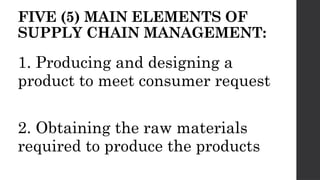
FIVE (5) MAIN ELEMENTS OF
SUPPLY CHAIN MANAGEMENT:
1. Producing and designing a
product to meet consumer request
2. Obtaining the raw materials
required to produce the products
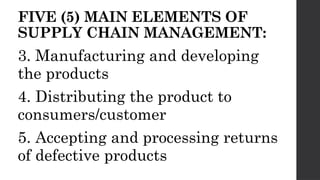
FIVE (5) MAIN ELEMENTS OF
SUPPLY CHAIN MANAGEMENT:
3. Manufacturing and developing
the products
4. Distributing the product to
consumers/customer
5. Accepting and processing returns
of defective products
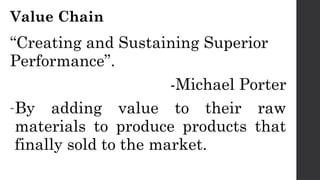
Value Chain
“Creating and Sustaining Superior
Performance”.
-Michael Porter
-By adding value to their raw
materials to produce products that
finally sold to the market.
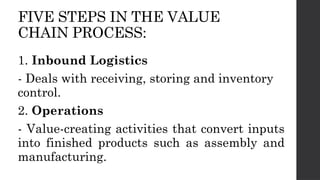
FIVE STEPS IN THE VALUE
CHAIN PROCESS:
1. Inbound Logistics
- Deals with receiving, storing and inventory
control.
2. Operations
- Value-creating activities that convert inputs
into finished products such as assembly and
manufacturing.
FIVE STEPS IN THE VALUE
CHAIN PROCESS:
3. Outbound Logistics
-Activities concerned with the collection,
storage, and distribution of finished product or
service to customers.
4. Marketing and Sales
- Involve activities that associated among the
general consumers or buyers to purchase a
product.
FIVE STEPS IN THE VALUE
CHAIN PROCESS:
5. Service
- Activities that maintain and
enhance the value of the product,
such as customer care and
warranty package.
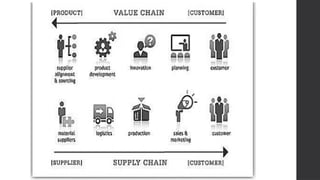
Both supply and value chains need
transportation and storage and end
with the consumer receiving their
goods/service. Both have similar goal
that is to satisfy the customers with
your products while operating efficiently
and effectively, in order to give the
business a better bottom line but take
somewhat different tracks to get there.
Entrep12 Value Chain-and-Supply chain.pptx

Entrep12 Value Chain-and-Supply chain.pptx

  • 1.
  • 4.
    Supply Chain •Reduces costsand maximizes customer satisfaction by providing the right product at the right price at right time at the right place.
  • 5.
    FIVE (5) MAINELEMENTS OF SUPPLY CHAIN MANAGEMENT: 1. Producing and designing a product to meet consumer request 2. Obtaining the raw materials required to produce the products
  • 6.
    FIVE (5) MAINELEMENTS OF SUPPLY CHAIN MANAGEMENT: 3. Manufacturing and developing the products 4. Distributing the product to consumers/customer 5. Accepting and processing returns of defective products
  • 7.
    Value Chain “Creating andSustaining Superior Performance”. -Michael Porter -By adding value to their raw materials to produce products that finally sold to the market.
  • 8.
    FIVE STEPS INTHE VALUE CHAIN PROCESS: 1. Inbound Logistics - Deals with receiving, storing and inventory control. 2. Operations - Value-creating activities that convert inputs into finished products such as assembly and manufacturing.
  • 9.
    FIVE STEPS INTHE VALUE CHAIN PROCESS: 3. Outbound Logistics -Activities concerned with the collection, storage, and distribution of finished product or service to customers. 4. Marketing and Sales - Involve activities that associated among the general consumers or buyers to purchase a product.
  • 10.
    FIVE STEPS INTHE VALUE CHAIN PROCESS: 5. Service - Activities that maintain and enhance the value of the product, such as customer care and warranty package.
  • 11.
    Both supply andvalue chains need transportation and storage and end with the consumer receiving their goods/service. Both have similar goal that is to satisfy the customers with your products while operating efficiently and effectively, in order to give the business a better bottom line but take somewhat different tracks to get there.