HYPERTENSION
Dr Lamya Abd Alkarem
MRCP(UK) Member Of Royal
Colleges Of Physicians
London, Glasgow & Edinburgh
Introduction
● Hypertension is a major risk factor for stroke and MI.
● It is usually asymptomatic
● Regular screening (eg 3-yrly) is a vital primary care task.
● It causes ~50% of all vascular deaths (8≈106/yr).
● Most preventable deaths are in areas without universal screening
Why ?
● Hypertension is a common disease encountered in
dental setting.
● Its wide spreading, terrible consequences, and life-
long treatment require an attentive approach by
dentists.
● Hypertension management in dental office includes
disease recognition and correct measurement,
knowledge of its treatment and oral adverse effects,
and risk assessment for dental treatment.
● Dentist role in screening undiagnosed and
undertreated hypertension is very important since
this may lead to improved monitoring and treatment.
Definition
● Blood pressure has a skewed normal distribution
within the population, and risk is continuously
related to blood pressure, so it is impossible to
define ‘hypertension’.
● Therefore, the practical definition of hypertension is
'the level of blood pressure at which the benefits of
treatment outweigh the costs and hazards'.
● Assess BP over a period of time (don’t rely on a
single reading).
● The ‘observation’ period depends on the BP and the
presence of other risk factors or end-organ damage.
Definition
● Blood pressure is necessary to perfuse the organs
of the body with blood, so is vital to the sustainment
of life.
● The normal blood pressure (BP) is 120 mmHg
systolic and 80 mmHg diastolic.
● Hypertension describes the state of chronically
raised blood pressure
● commonly defined as a BP in excess of 140/90
mmHg;
● about 20% of the population are, by this measure,
hypertensive.
Whom to treat
● All with BP ≥160/100mmHg (sustained(
● For those ≥140/90, the decision depends on the risk of coronary
events, presence of diabetes or end-organ damage.
● The recent HYVET study(The Hypertension in the Very Elderly Trial )
showed that there is even substantial benefit in treating the over-80s
● The category of prehypertension, which is defined
as SBP of 120 to 139mmHg and DBP of 80 to
89mmHg .
● Patients with prehypertension are at increased
risk of developing hypertension, those with blood
pressure values 130–139/80–89mmHg have a
two times greater risk of developing hypertension
than those with lower values
● Hypertension is a highly prevalent cardiovascular
disease, which affects over 1 billion people
worldwide
● Although more than 70% of hypertensive patients are aware of the disease,
❖ only 23–49% are treated,
❖ and fewer (20%) achieving control .
● Hypertension prevalence varies by age, race,
education
● Overall the prevalence of hypertension appears to
be around 30–45% of the general population, with a
steep increase with ageing
● A permanent high blood pressure (BP) affects
blood vessels in the kidneys, heart, and brain
● increasing the incidence of renal and cardiac coronary heart disease and
stroke.
● Hypertension was called the “silent killer” because it often affects target
organs (kidney, heart, brain, eyes) before the appearance of clinical
symptoms
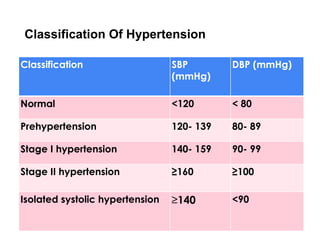
Classification Of Hypertension
Classification SBP
(mmHg)
DBP (mmHg)
Normal <120 < 80
Prehypertension 120- 139 80- 89
Stage I hypertension 140- 159 90- 99
Stage II hypertension ≥160 ≥100
Isolated systolic hypertension ≥140 <90
Classification
1- Isolated systolic hypertension (ISH)
● The most common form of hypertension in
the UK—affects >50% of the over-60s,
● Results from stiffening of the large arteries
(arteriosclerosis).
● It is not benign: doubles risk of MI, triples risk
of CVA.
● Treatment reduces this excess risk and is as, if
not more, effective than treating moderate
hypertension in middle-aged patients.
Classification
2- Malignant’ or accelerated phase hypertension:
● Refers to a rapid rise in BP leading to vascular
damage (pathological hallmark is fibrinoid
necrosis).
● Usually there is severe hypertension (eg systolic
>200, diastolic>130mmHg) + bilateral retinal
haemorrhages and exudates;
● papilloedema may or may not be present.
● Symptoms are common, eg headache ―
Classification
3- Essential hypertension (primary, cause unknown).
● ~95% of cases.
4- Secondary hypertension ~5% of cases.
Essential hypertension
● Three important causes of primary hypertension are :
1. salt/volume overload
2. activation of the reninangiotensin aldosterone system (RAAS)
3. Activation of the sympathetic nervous system
1- Salt/volume overload
● Salt (sodium chloride) overload/volume overload is
one of the common causes of hypertension.
● Essential hypertension has been associated with
high sodium intake in a variety of scientific models,
clinical studies and trials
● it is certified that decreasing the sodium intake
ameliorates this effect [40, 41].
● High sodium intake
❖ increases blood pressure by expanding
intravascular volume
❖ may have direct neurohormonal effects on the
cardiovascular system
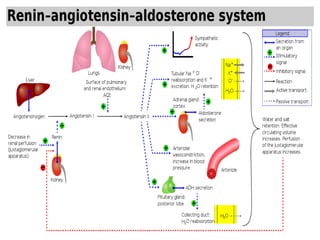
2- The “Renin Angiotensin Aldosterone System”
(RAAS)
● (RAAS) hormonal axis also contributes to
hypertension in many patients
● Renin, a hormone synthesized and released by
the kidney in response to intravascular volume
depletion and hyperkalemia,
● It promotes the conversion of angiotensinogen
(produced by the liver) to angiotensin I
● Angiotensin I converted to angiotensin II by the
angiotensin-converting enzyme (ACE) in the lung
the RAAS system
● One mechanism of increasing blood pressure by angiotensin II is
❖ increasing renal sodium reabsorption,
❖ producing vasoconstriction
❖ and activating the sympathetic nervous system
the RAAS system
● Another mechanism is Angiotensin II also
increases the production and secretion of
aldosterone from the adrenal cortex, and
● Aldosterone increases renal sodium
reabsorption
● Thus, the RAAS system increases blood
pressure through increasing renal sodium
reabsorption (which leads to intravascular
volume expansion) and vasoconstriction.
Essential (Primary) hypertension
3- Activation of the sympathetic nervous system (SNS)
● It contributes to the development, maintenance, and progression of
hypertension
Secondary Hypertension
● Hypertension with an organic cause, well established the following:
i. Renal
ii. Cardiac
iii. Endocrine
iv. Neurological
v. Others
Secondary Hypertension
(i) renal: (parenchyma or renal vascular)
❖ chronic pyelonephritis
❖ acute and chronic glomerulonephritis
❖ polycystic kidney disease,
❖ renal vascular stenosis or renal infarction,
❖ other severe kidney disease (arteriolar nephrosclerosis), renin-secreting
tumors
Renal causes
❖ Renal artery stenosis
● is a narrowing of one or more of the renal arteries
● leads to reduced blood flow to the affected kidney
and hypertension.
● A renal bruit may be heard over the affected kidney.
❖ Polycystic kidney disease
● is a group of genetic diseases characterized by
bilateral cystic enlargement of the kidneys.
● It presents with hypertension, chronic renal failure or
abdominal masses.
Renal causes
❖ Chronic renal failure
● Chronic renal failure, particularly
glomerulonephritis,
● is characterized by hypertension, due to impaired
glomerular filtration.
ii-Cardiac causes
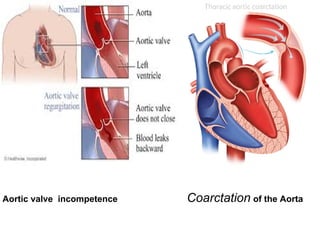
❖ Coarctation of the aorta
● is a congenital narrowing in the aorta, most
commonly just distal to the origin of the left
subclavian artery.
● Blood pressure is raised proximal to the
narrowing, but may be normal or low distal to the
narrowing.
● Associated features include
● weak femoral pulses, radiofemoral delay and a
systolic murmur heard loudest over the site of the
coarctation.
Aortic valve incompetence Coarctation of the Aorta
Cardiac
❖ Aortic incompetence
● Clinical features such as an early diastolic murmur heard best in the
aortic area
● wide pulse pressure
● heart failure, may be seen.
Secondary Hypertension
(iii) endocrine:
● oral contraceptives
● adrenal hyperfunction
❖ Cushing’s syndrome,
❖ primary aldosteronism,
❖ congenital or hereditary adrenogenital syndrome
● pheochromocytoma, myxedema, acromegaly, thyroid and parathyroid
hyper function
Endocrine causes
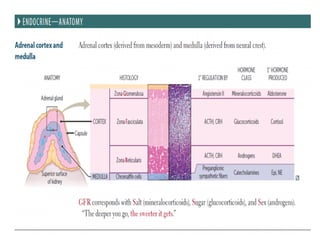
❖ Cushing’s syndrome
● Cushing’s syndrome results from the overproduction of
glucocorticoids (mainly cortisol) by the adrenal cortex
● stimulated either by a pituitary adenoma, an adrenal
adenoma, or ectopic ACTH (adrenocorticotrophic
hormone) secretion from a tumour.
● Excess glucocorticoids may produce
❖ hypertension,
❖ centripetal fat distribution,
❖ moon facies,
❖ hirsutism, acne and proximal muscle wasting.
Endocrine causes
❖ Conn’s syndrome
● Conn’s syndrome results from the overproduction of
mineralocorticoids (mainly aldosterone) by the adrenal cortex,
● normally caused by an adrenal adenoma.
● Excess aldosterone leads to sodium and water retention via its effect
on the kidney, which causes hypertension
Endocrine causes
❖ Phaeochromocytoma
● Phaeochromocytoma is a neoplasm of the adrenal medulla,
● which leads to the overproduction of catecholamines.
● Patients often experience paroxysmal palpitations and anxiety.
Endocrine causes
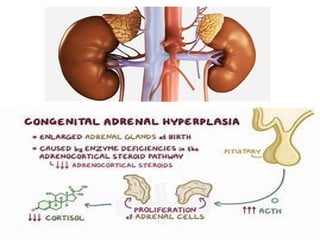
● Congenital adrenal hyperplasia (CAH)
● It is a group of autosomal recessive disorders characterized by impaired
cortisol synthesis.
● It results from the deficiency of one of the five enzymes required for the
synthesis of cortisol in the adrenal cortex leading to hypertension via
excess formation of the mineralocorticoid 11-deoxycorticosterone.
Secondary Hypertension
(iv) neurological:
● psychogenic “diencephalic syndrome,”
● polyneuritis
● (acute porphyria, lead poisoning),
● increased intracranial pressure;
Secondary Hypertension
(v) others:
● Increased intravascular volume (transfusion excessive polycythemia vera)
● Polyarteritis
● Hypercalcemia
● Drugs (corticosteroids, cyclosporine)
● Sleep apnea
● Pregnancy toxemia,
● Acute intermittent porphyria.

MED 6 Hypertension .pdf

  • 1.
    HYPERTENSION Dr Lamya AbdAlkarem MRCP(UK) Member Of Royal Colleges Of Physicians London, Glasgow & Edinburgh
  • 2.
    Introduction ● Hypertension isa major risk factor for stroke and MI. ● It is usually asymptomatic ● Regular screening (eg 3-yrly) is a vital primary care task. ● It causes ~50% of all vascular deaths (8≈106/yr). ● Most preventable deaths are in areas without universal screening
  • 3.
    Why ? ● Hypertensionis a common disease encountered in dental setting. ● Its wide spreading, terrible consequences, and life- long treatment require an attentive approach by dentists. ● Hypertension management in dental office includes disease recognition and correct measurement, knowledge of its treatment and oral adverse effects, and risk assessment for dental treatment. ● Dentist role in screening undiagnosed and undertreated hypertension is very important since this may lead to improved monitoring and treatment.
  • 4.
    Definition ● Blood pressurehas a skewed normal distribution within the population, and risk is continuously related to blood pressure, so it is impossible to define ‘hypertension’. ● Therefore, the practical definition of hypertension is 'the level of blood pressure at which the benefits of treatment outweigh the costs and hazards'. ● Assess BP over a period of time (don’t rely on a single reading). ● The ‘observation’ period depends on the BP and the presence of other risk factors or end-organ damage.
  • 5.
    Definition ● Blood pressureis necessary to perfuse the organs of the body with blood, so is vital to the sustainment of life. ● The normal blood pressure (BP) is 120 mmHg systolic and 80 mmHg diastolic. ● Hypertension describes the state of chronically raised blood pressure ● commonly defined as a BP in excess of 140/90 mmHg; ● about 20% of the population are, by this measure, hypertensive.
  • 6.
    Whom to treat ●All with BP ≥160/100mmHg (sustained( ● For those ≥140/90, the decision depends on the risk of coronary events, presence of diabetes or end-organ damage. ● The recent HYVET study(The Hypertension in the Very Elderly Trial ) showed that there is even substantial benefit in treating the over-80s
  • 7.
    ● The categoryof prehypertension, which is defined as SBP of 120 to 139mmHg and DBP of 80 to 89mmHg . ● Patients with prehypertension are at increased risk of developing hypertension, those with blood pressure values 130–139/80–89mmHg have a two times greater risk of developing hypertension than those with lower values ● Hypertension is a highly prevalent cardiovascular disease, which affects over 1 billion people worldwide
  • 8.
    ● Although morethan 70% of hypertensive patients are aware of the disease, ❖ only 23–49% are treated, ❖ and fewer (20%) achieving control . ● Hypertension prevalence varies by age, race, education ● Overall the prevalence of hypertension appears to be around 30–45% of the general population, with a steep increase with ageing ● A permanent high blood pressure (BP) affects blood vessels in the kidneys, heart, and brain
  • 9.
    ● increasing theincidence of renal and cardiac coronary heart disease and stroke. ● Hypertension was called the “silent killer” because it often affects target organs (kidney, heart, brain, eyes) before the appearance of clinical symptoms
  • 10.
    Classification Of Hypertension ClassificationSBP (mmHg) DBP (mmHg) Normal <120 < 80 Prehypertension 120- 139 80- 89 Stage I hypertension 140- 159 90- 99 Stage II hypertension ≥160 ≥100 Isolated systolic hypertension ≥140 <90
  • 11.
    Classification 1- Isolated systolichypertension (ISH) ● The most common form of hypertension in the UK—affects >50% of the over-60s, ● Results from stiffening of the large arteries (arteriosclerosis). ● It is not benign: doubles risk of MI, triples risk of CVA. ● Treatment reduces this excess risk and is as, if not more, effective than treating moderate hypertension in middle-aged patients.
  • 12.
    Classification 2- Malignant’ oraccelerated phase hypertension: ● Refers to a rapid rise in BP leading to vascular damage (pathological hallmark is fibrinoid necrosis). ● Usually there is severe hypertension (eg systolic >200, diastolic>130mmHg) + bilateral retinal haemorrhages and exudates; ● papilloedema may or may not be present. ● Symptoms are common, eg headache ―
  • 13.
    Classification 3- Essential hypertension(primary, cause unknown). ● ~95% of cases. 4- Secondary hypertension ~5% of cases.
  • 14.
    Essential hypertension ● Threeimportant causes of primary hypertension are : 1. salt/volume overload 2. activation of the reninangiotensin aldosterone system (RAAS) 3. Activation of the sympathetic nervous system
  • 15.
    1- Salt/volume overload ●Salt (sodium chloride) overload/volume overload is one of the common causes of hypertension. ● Essential hypertension has been associated with high sodium intake in a variety of scientific models, clinical studies and trials ● it is certified that decreasing the sodium intake ameliorates this effect [40, 41]. ● High sodium intake ❖ increases blood pressure by expanding intravascular volume ❖ may have direct neurohormonal effects on the cardiovascular system
  • 16.
    2- The “ReninAngiotensin Aldosterone System” (RAAS) ● (RAAS) hormonal axis also contributes to hypertension in many patients ● Renin, a hormone synthesized and released by the kidney in response to intravascular volume depletion and hyperkalemia, ● It promotes the conversion of angiotensinogen (produced by the liver) to angiotensin I ● Angiotensin I converted to angiotensin II by the angiotensin-converting enzyme (ACE) in the lung
  • 17.
    the RAAS system ●One mechanism of increasing blood pressure by angiotensin II is ❖ increasing renal sodium reabsorption, ❖ producing vasoconstriction ❖ and activating the sympathetic nervous system
  • 18.
    the RAAS system ●Another mechanism is Angiotensin II also increases the production and secretion of aldosterone from the adrenal cortex, and ● Aldosterone increases renal sodium reabsorption ● Thus, the RAAS system increases blood pressure through increasing renal sodium reabsorption (which leads to intravascular volume expansion) and vasoconstriction.
  • 20.
    Essential (Primary) hypertension 3-Activation of the sympathetic nervous system (SNS) ● It contributes to the development, maintenance, and progression of hypertension
  • 21.
    Secondary Hypertension ● Hypertensionwith an organic cause, well established the following: i. Renal ii. Cardiac iii. Endocrine iv. Neurological v. Others
  • 22.
    Secondary Hypertension (i) renal:(parenchyma or renal vascular) ❖ chronic pyelonephritis ❖ acute and chronic glomerulonephritis ❖ polycystic kidney disease, ❖ renal vascular stenosis or renal infarction, ❖ other severe kidney disease (arteriolar nephrosclerosis), renin-secreting tumors
  • 23.
    Renal causes ❖ Renalartery stenosis ● is a narrowing of one or more of the renal arteries ● leads to reduced blood flow to the affected kidney and hypertension. ● A renal bruit may be heard over the affected kidney. ❖ Polycystic kidney disease ● is a group of genetic diseases characterized by bilateral cystic enlargement of the kidneys. ● It presents with hypertension, chronic renal failure or abdominal masses.
  • 24.
    Renal causes ❖ Chronicrenal failure ● Chronic renal failure, particularly glomerulonephritis, ● is characterized by hypertension, due to impaired glomerular filtration.
  • 25.
    ii-Cardiac causes ❖ Coarctationof the aorta ● is a congenital narrowing in the aorta, most commonly just distal to the origin of the left subclavian artery. ● Blood pressure is raised proximal to the narrowing, but may be normal or low distal to the narrowing. ● Associated features include ● weak femoral pulses, radiofemoral delay and a systolic murmur heard loudest over the site of the coarctation.
  • 26.
    Aortic valve incompetenceCoarctation of the Aorta
  • 27.
    Cardiac ❖ Aortic incompetence ●Clinical features such as an early diastolic murmur heard best in the aortic area ● wide pulse pressure ● heart failure, may be seen.
  • 28.
    Secondary Hypertension (iii) endocrine: ●oral contraceptives ● adrenal hyperfunction ❖ Cushing’s syndrome, ❖ primary aldosteronism, ❖ congenital or hereditary adrenogenital syndrome ● pheochromocytoma, myxedema, acromegaly, thyroid and parathyroid hyper function
  • 29.
    Endocrine causes ❖ Cushing’ssyndrome ● Cushing’s syndrome results from the overproduction of glucocorticoids (mainly cortisol) by the adrenal cortex ● stimulated either by a pituitary adenoma, an adrenal adenoma, or ectopic ACTH (adrenocorticotrophic hormone) secretion from a tumour. ● Excess glucocorticoids may produce ❖ hypertension, ❖ centripetal fat distribution, ❖ moon facies, ❖ hirsutism, acne and proximal muscle wasting.
  • 30.
    Endocrine causes ❖ Conn’ssyndrome ● Conn’s syndrome results from the overproduction of mineralocorticoids (mainly aldosterone) by the adrenal cortex, ● normally caused by an adrenal adenoma. ● Excess aldosterone leads to sodium and water retention via its effect on the kidney, which causes hypertension
  • 31.
    Endocrine causes ❖ Phaeochromocytoma ●Phaeochromocytoma is a neoplasm of the adrenal medulla, ● which leads to the overproduction of catecholamines. ● Patients often experience paroxysmal palpitations and anxiety.
  • 32.
    Endocrine causes ● Congenitaladrenal hyperplasia (CAH) ● It is a group of autosomal recessive disorders characterized by impaired cortisol synthesis. ● It results from the deficiency of one of the five enzymes required for the synthesis of cortisol in the adrenal cortex leading to hypertension via excess formation of the mineralocorticoid 11-deoxycorticosterone.
  • 35.
    Secondary Hypertension (iv) neurological: ●psychogenic “diencephalic syndrome,” ● polyneuritis ● (acute porphyria, lead poisoning), ● increased intracranial pressure;
  • 36.
    Secondary Hypertension (v) others: ●Increased intravascular volume (transfusion excessive polycythemia vera) ● Polyarteritis ● Hypercalcemia ● Drugs (corticosteroids, cyclosporine) ● Sleep apnea ● Pregnancy toxemia, ● Acute intermittent porphyria.