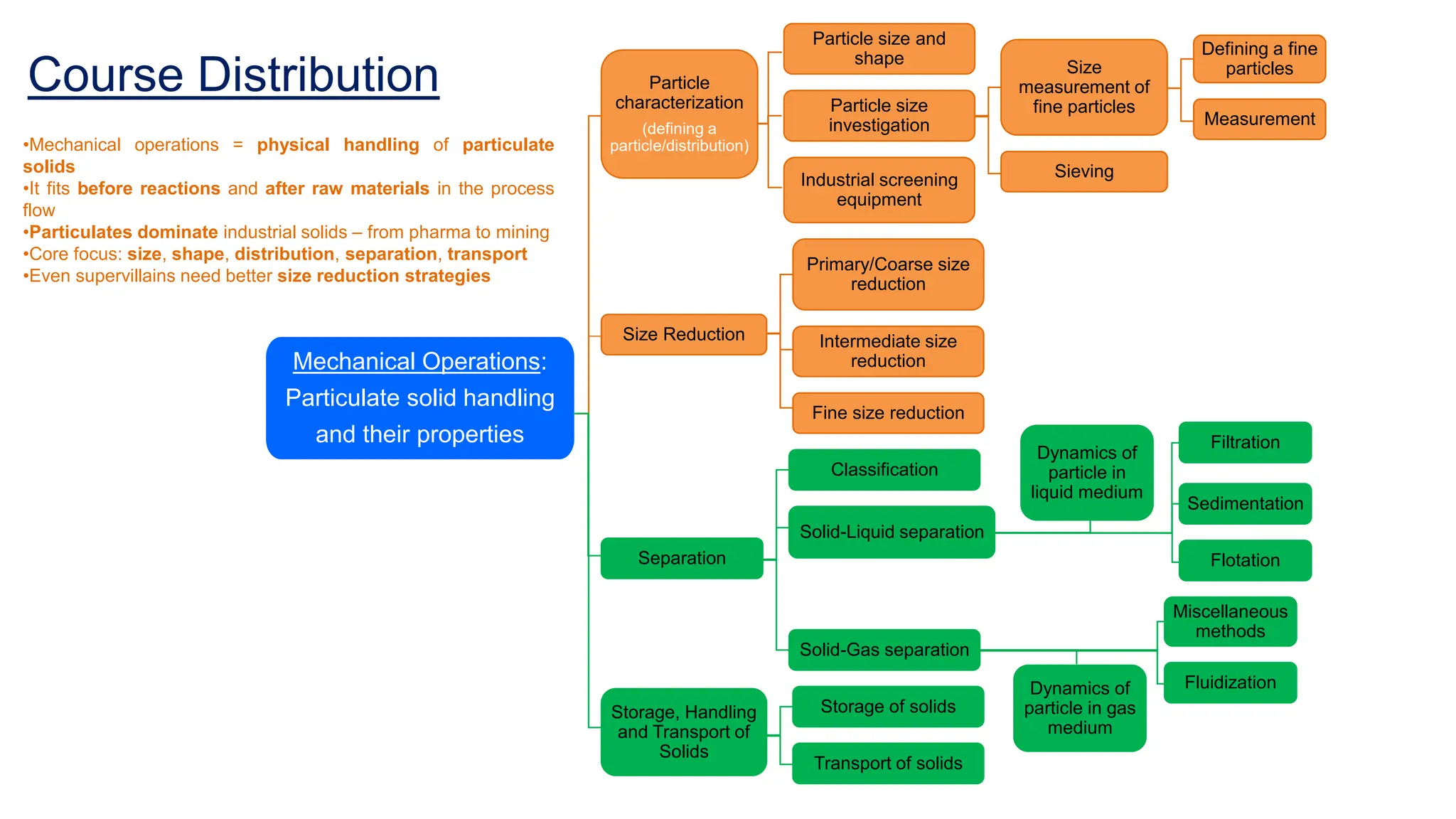
Mechanical Operations:
Particulate solidhandling
and their properties
Particle
characterization
(defining a
particle/distribution)
Particle size and
shape
Particle size
investigation
Size
measurement of
fine particles
Defining a fine
particles
Measurement
Sieving
Industrial screening
equipment
Size Reduction
Primary/Coarse size
reduction
Intermediate size
reduction
Fine size reduction
Separation
Classification
Solid-Liquid separation
Sedimentation
Flotation
Dynamics of
particle in
liquid medium
Solid-Gas separation
Miscellaneous
methods
Fluidization
Dynamics of
particle in gas
medium
Storage, Handling
and Transport of
Solids
Storage of solids
Transport of solids
Course Distribution
Filtration
•Mechanical operations = physical handling of particulate
solids
•It fits before reactions and after raw materials in the process
flow
•Particulates dominate industrial solids – from pharma to mining
•Core focus: size, shape, distribution, separation, transport
•Even supervillains need better size reduction strategies
5
Welcome to theupside down!!!
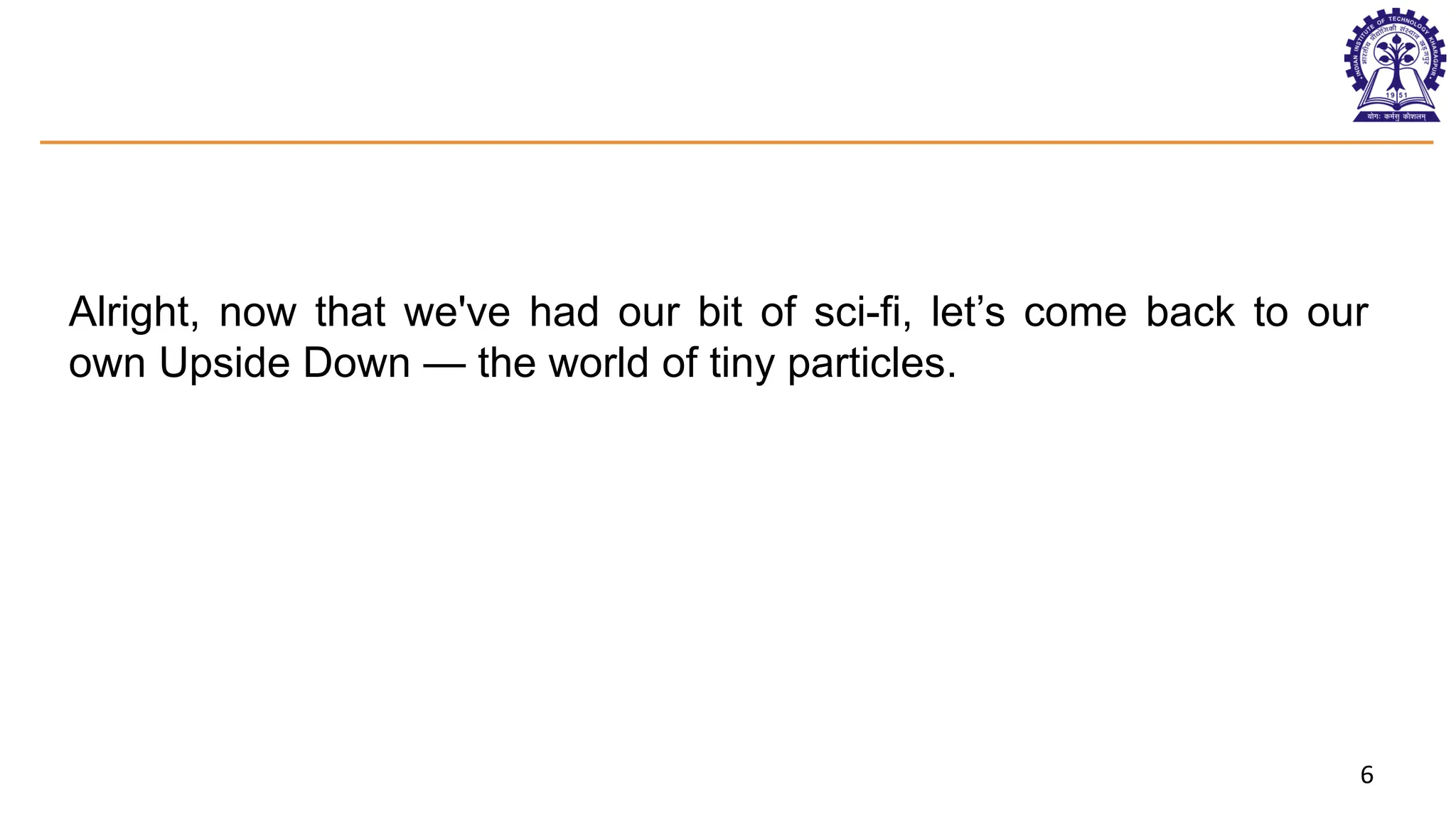
In Stranger Things, the Upside
Down looks like our world —
but with strange twists.
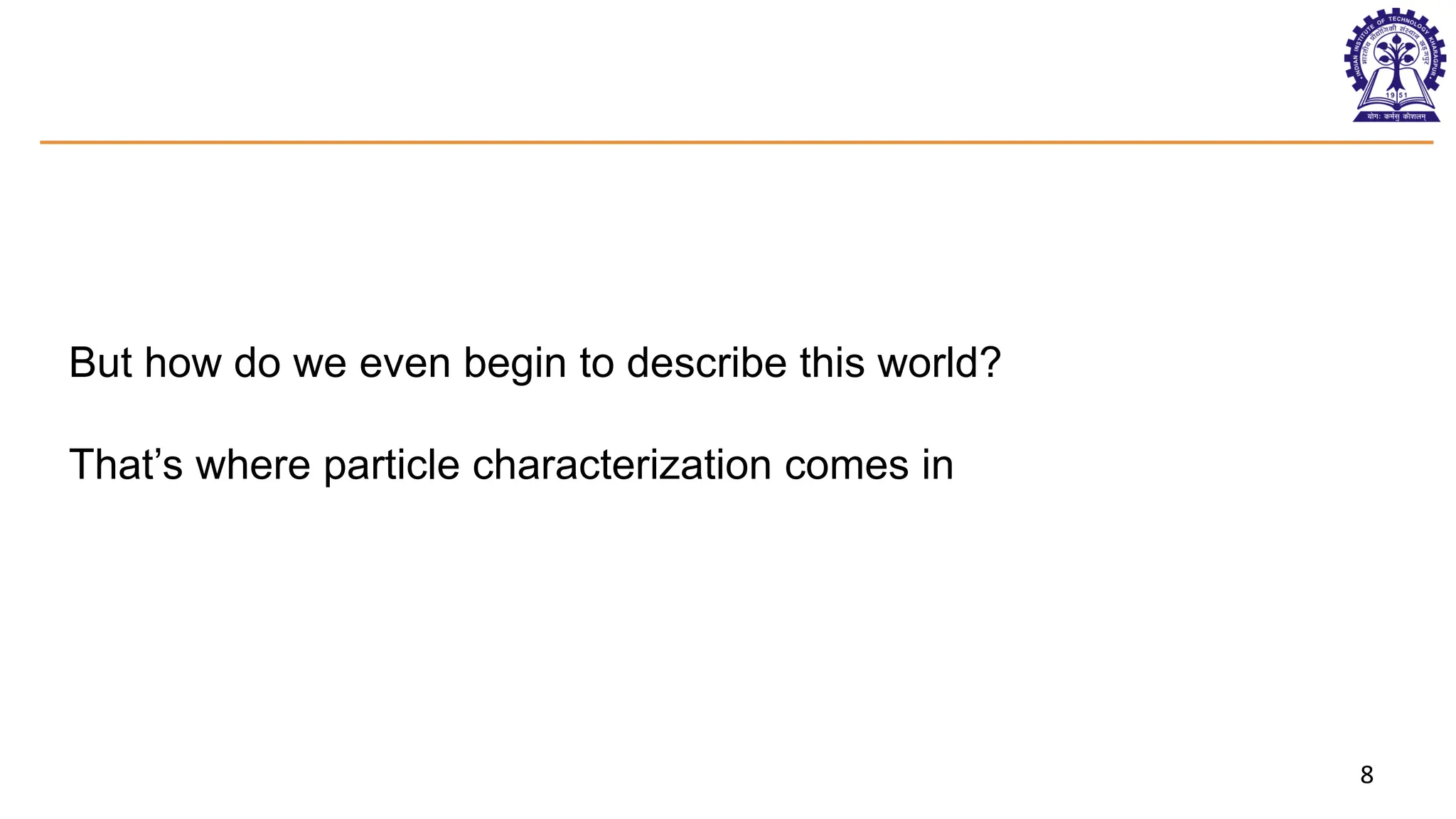
In the same way, two powders
may look alike to the naked eye
— but their particles could be
totally different in shape or size.
And that difference decides
how they flow, mix, react, or
stick to your lab coat.”
“Characterising particles is like
peeking into the Upside Down
— we need to see the invisible
traits that control how they
behave
6.
6
Alright, now thatwe've had our bit of sci-fi, let’s come back to our
own Upside Down — the world of tiny particles.
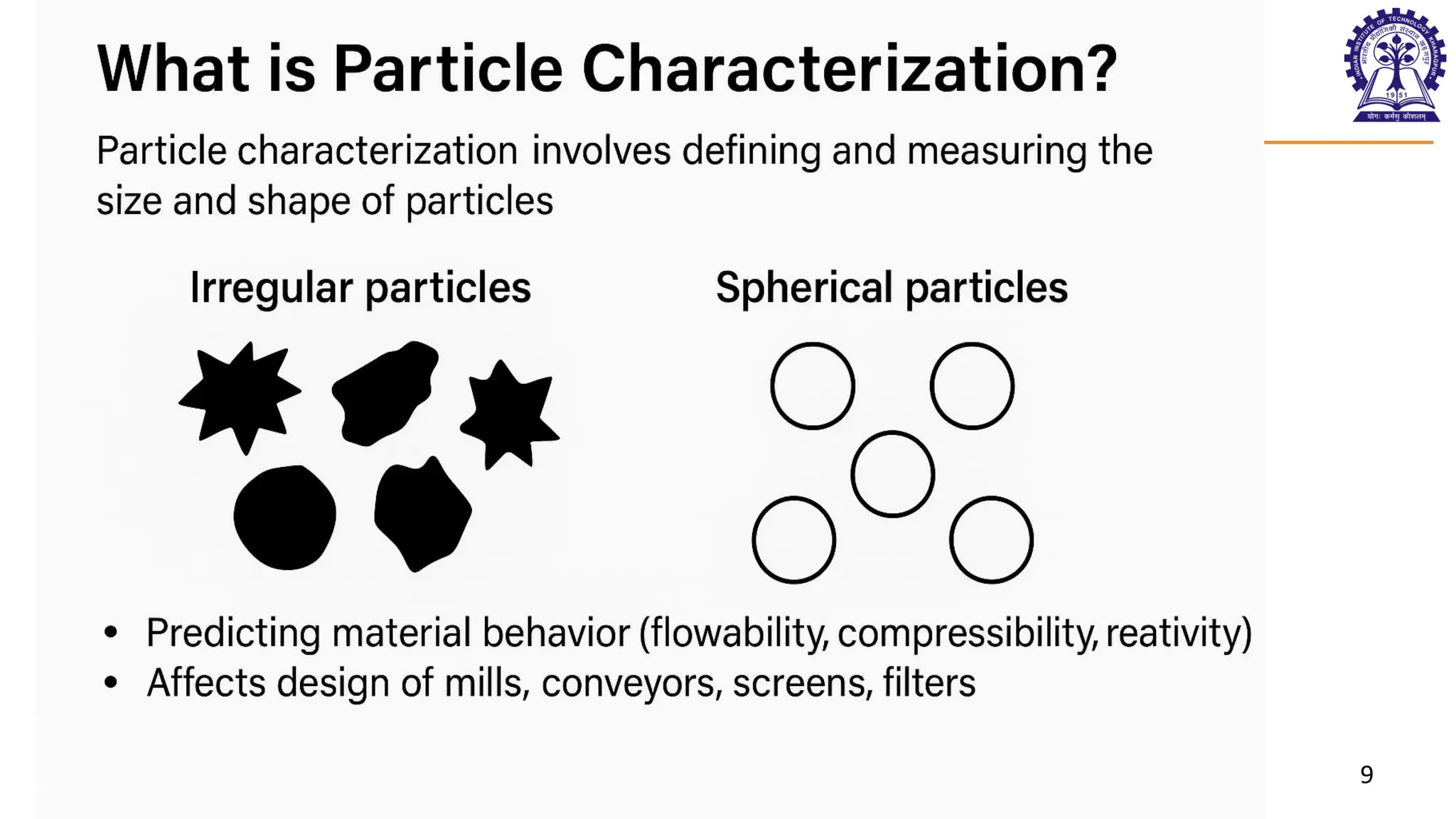
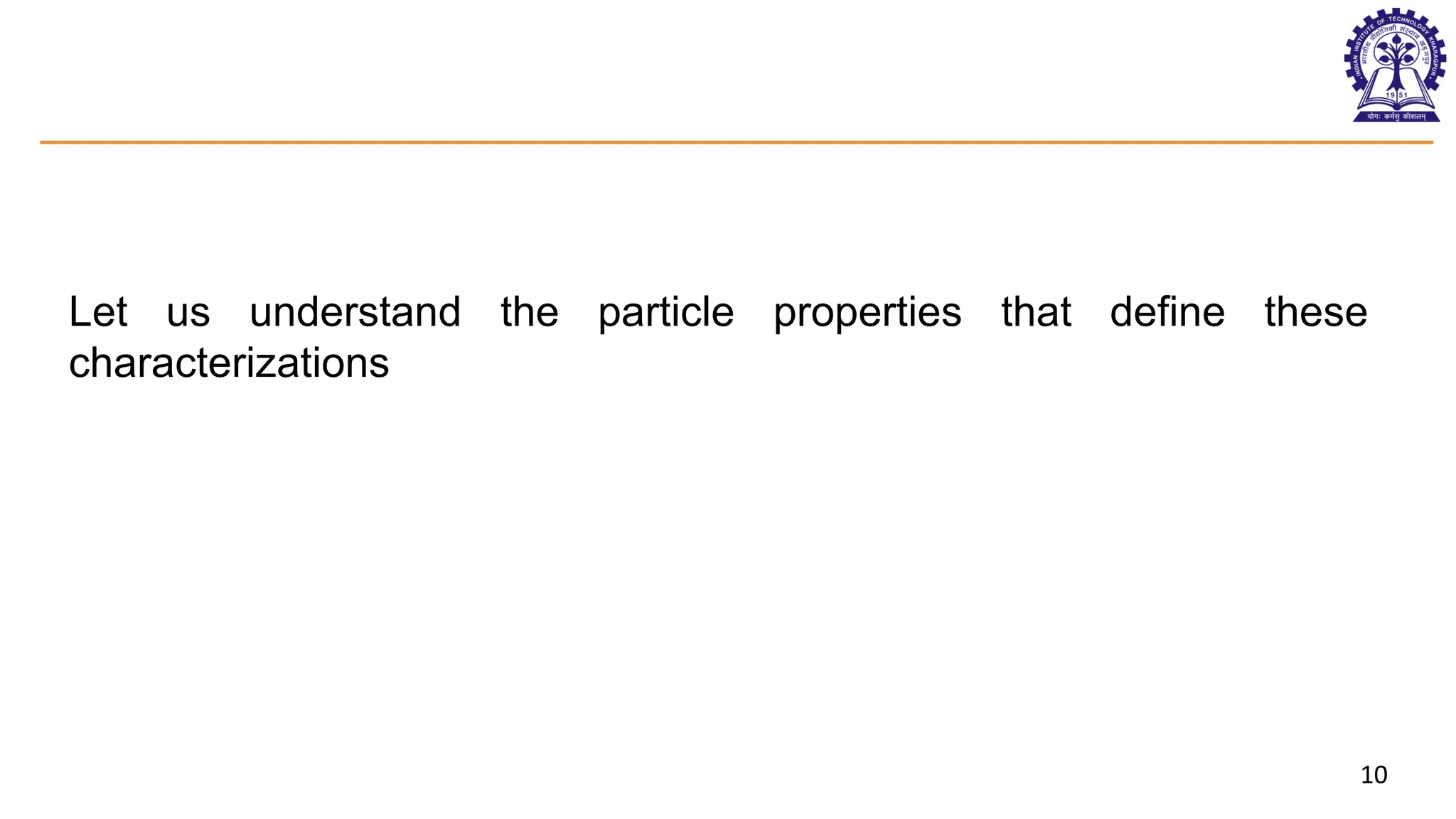
Particles vs Bulk!
11
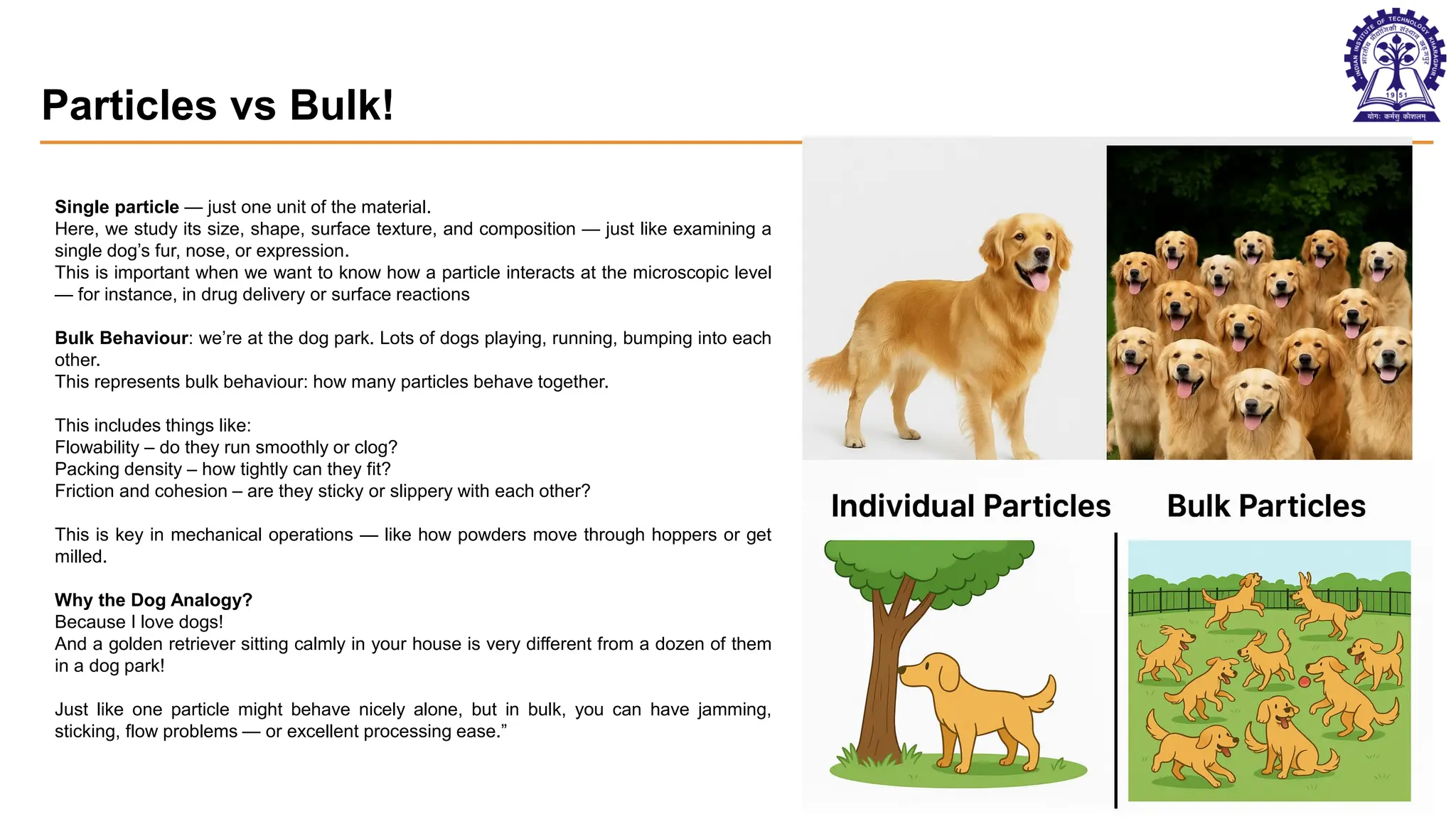
Singleparticle — just one unit of the material.
Here, we study its size, shape, surface texture, and composition — just like examining a
single dog’s fur, nose, or expression.
This is important when we want to know how a particle interacts at the microscopic level
— for instance, in drug delivery or surface reactions
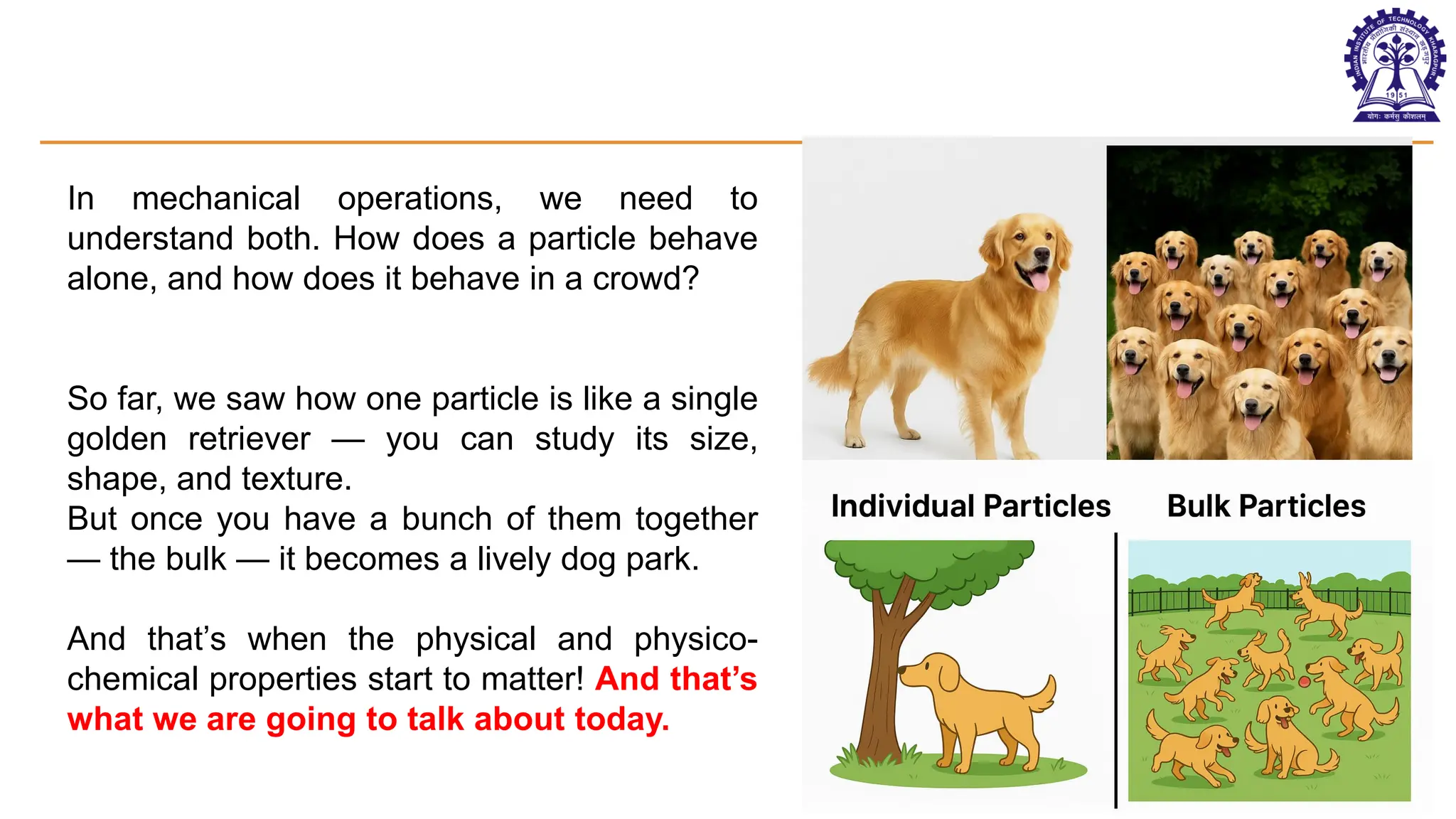
Bulk Behaviour: we’re at the dog park. Lots of dogs playing, running, bumping into each
other.
This represents bulk behaviour: how many particles behave together.
This includes things like:
Flowability – do they run smoothly or clog?
Packing density – how tightly can they fit?
Friction and cohesion – are they sticky or slippery with each other?
This is key in mechanical operations — like how powders move through hoppers or get
milled.
Why the Dog Analogy?
Because I love dogs!
And a golden retriever sitting calmly in your house is very different from a dozen of them
in a dog park!
Just like one particle might behave nicely alone, but in bulk, you can have jamming,
sticking, flow problems — or excellent processing ease.”
12.
12
In mechanical operations,we need to
understand both. How does a particle behave
alone, and how does it behave in a crowd?
So far, we saw how one particle is like a single
golden retriever — you can study its size,
shape, and texture.
But once you have a bunch of them together
— the bulk — it becomes a lively dog park.
And that’s when the physical and physico-
chemical properties start to matter! And that’s
what we are going to talk about today.
13.
Particle Properties
1. Physical
●Hardness, Softness
● Tenacity, Brittleness, Friability
● Structure, Fracture
● Friction
● Aggregation, Stickiness
● Colour, lustre (shine/gloss)
● Electro-conductivity
● Magnetic susceptibility
2. Physico-Chemical
● Surface Properties- Adhesion, Contact angle
● Change in magnetic properties by heat
● Change in properties on adding depressants, activators
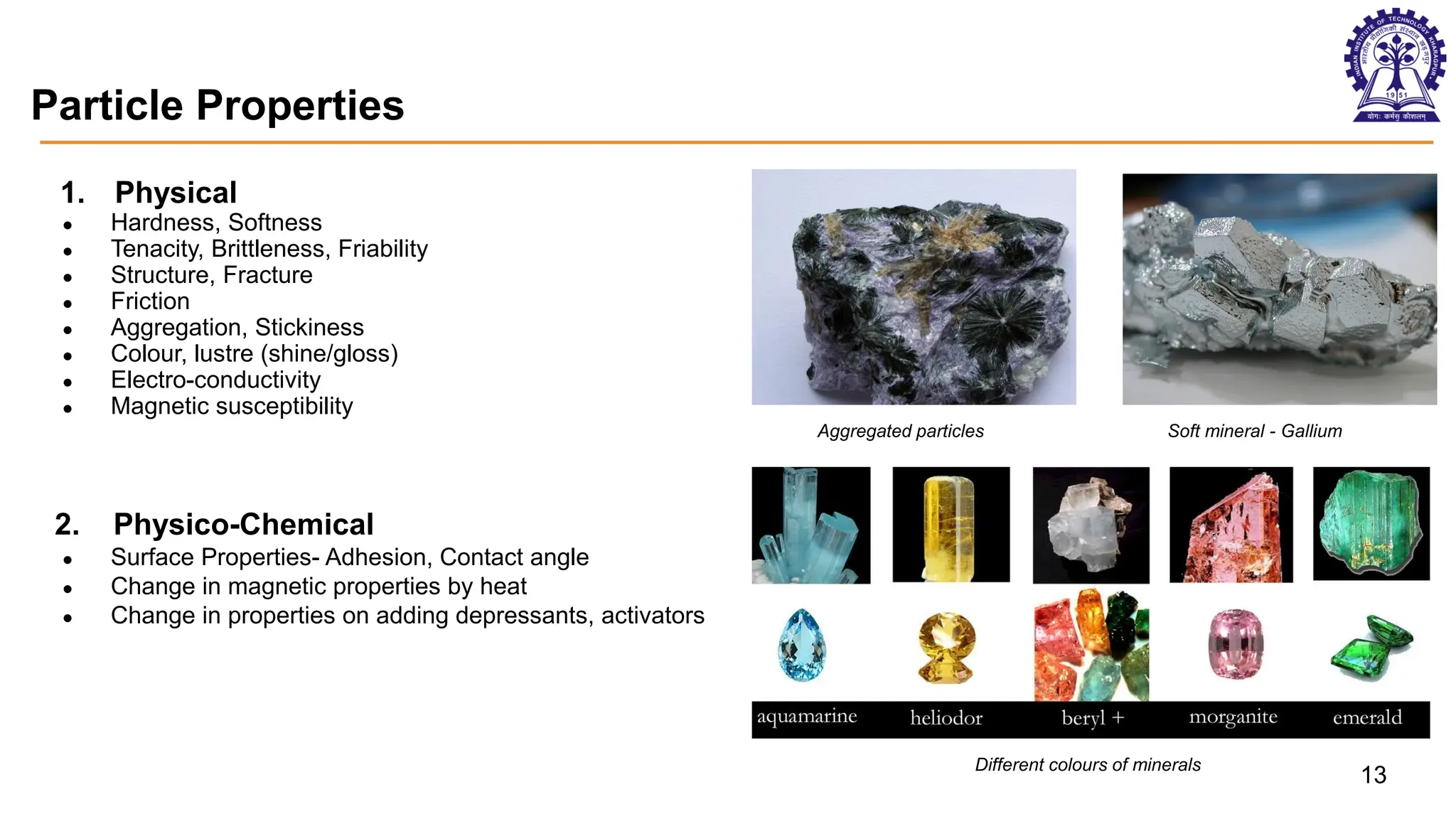
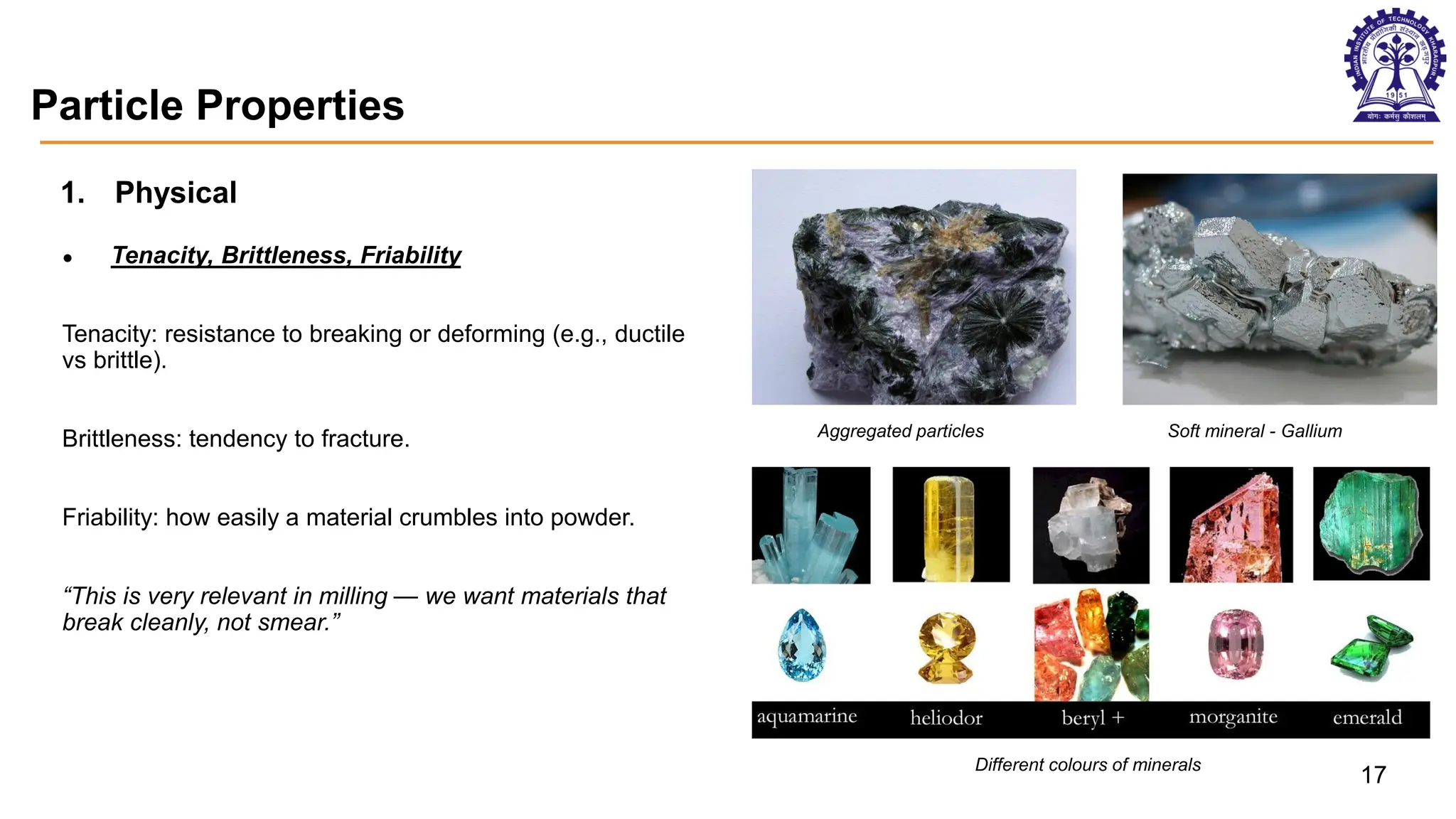
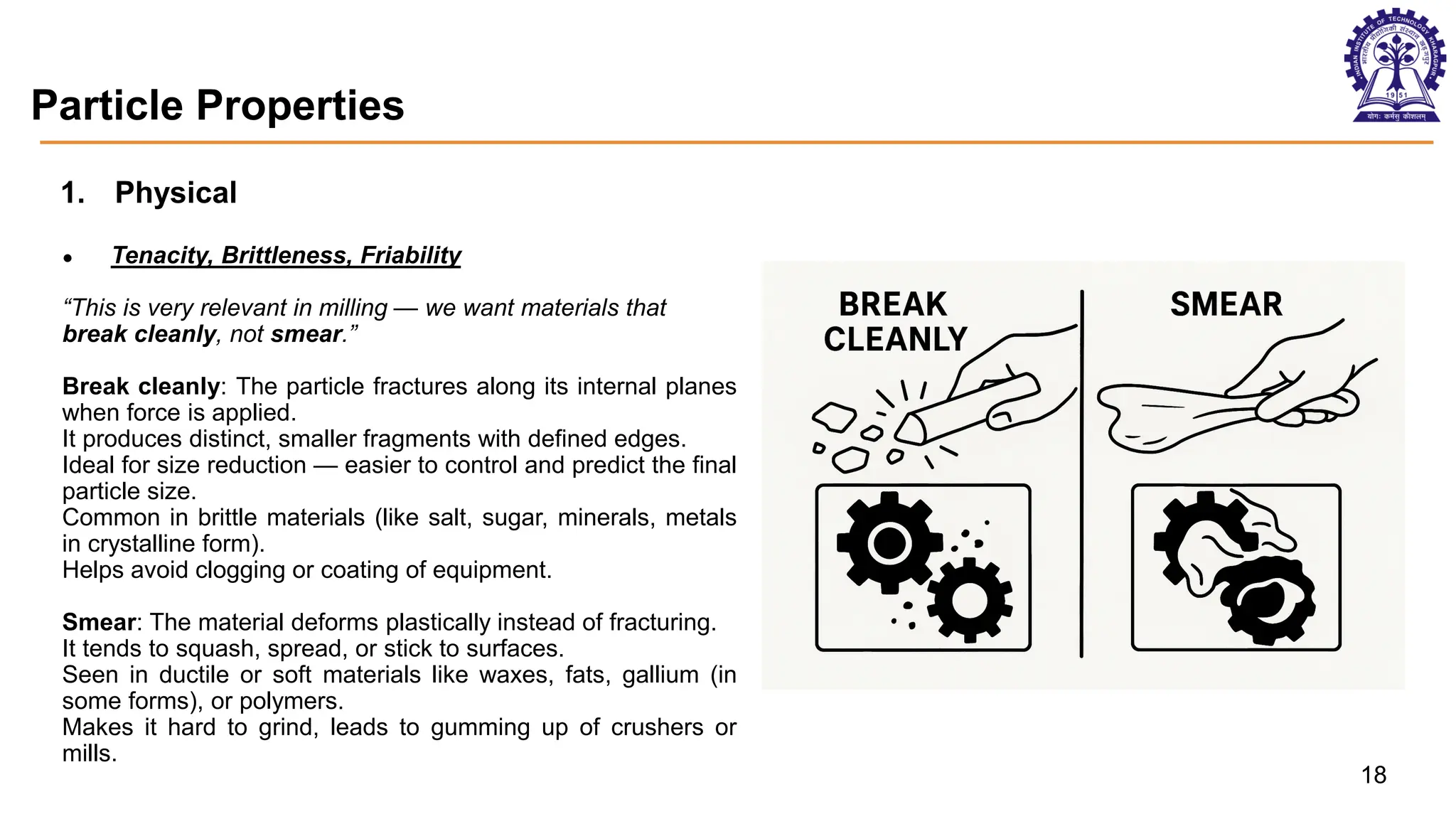
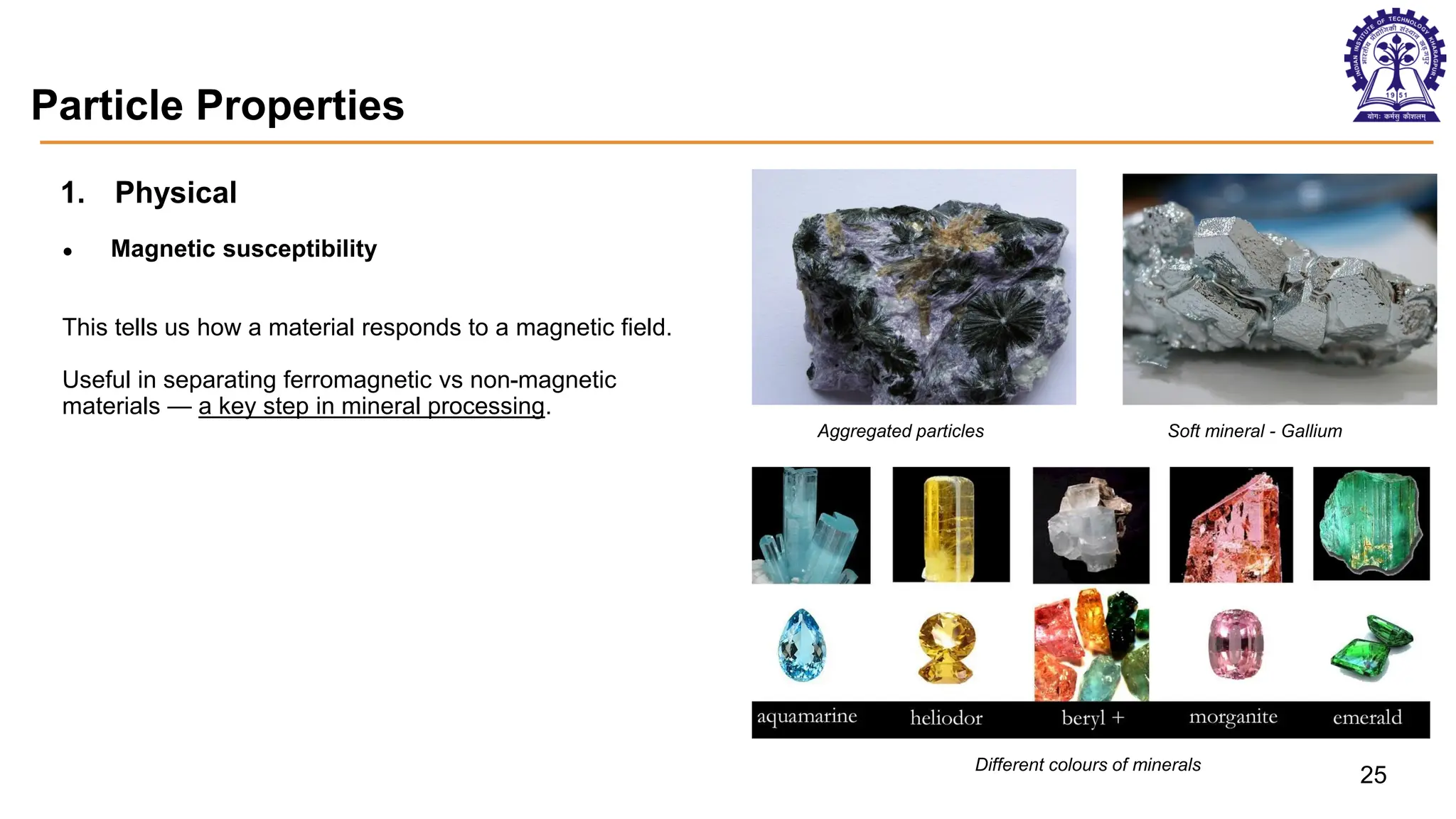
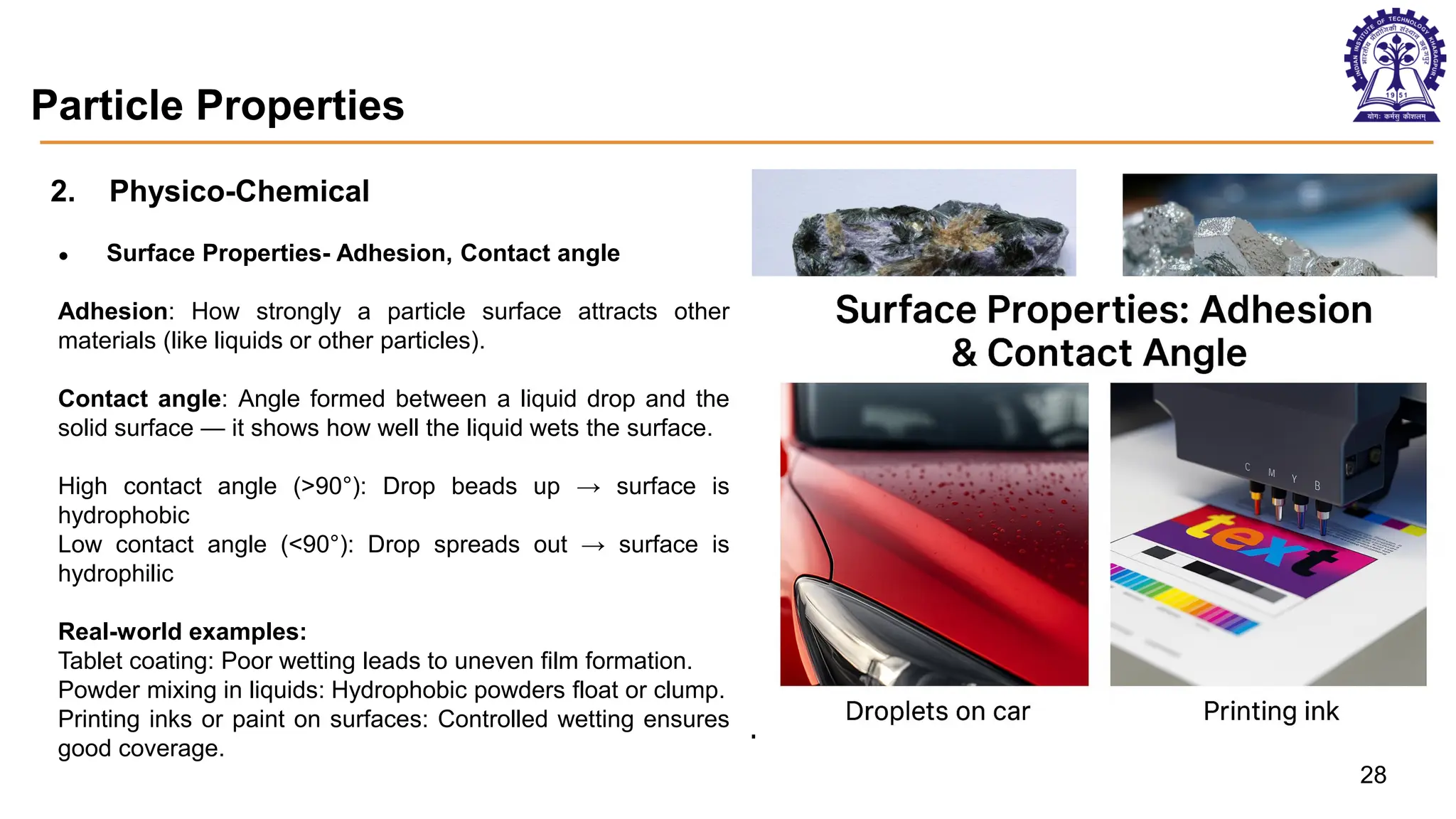
Aggregated particles Soft mineral - Gallium
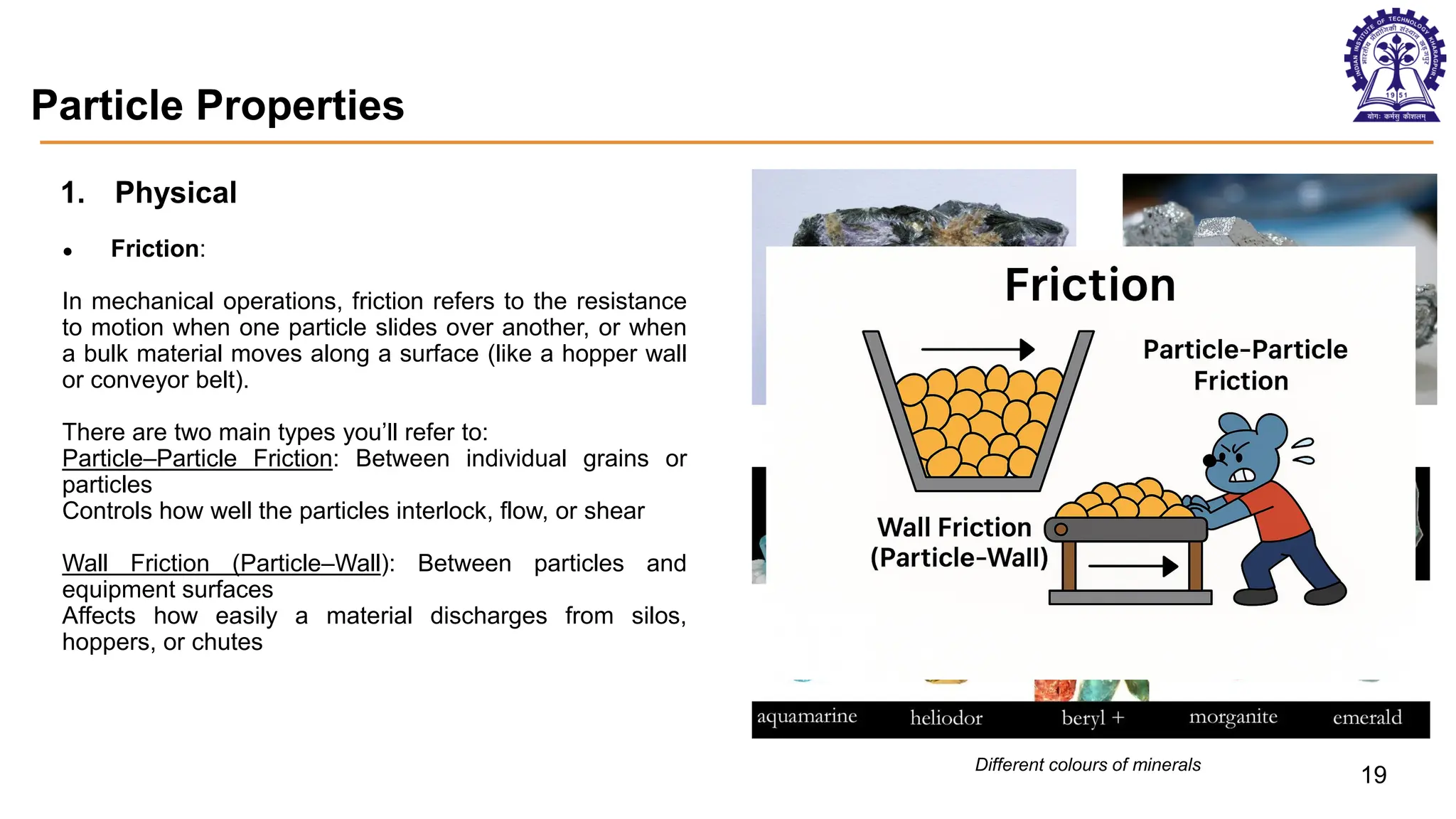
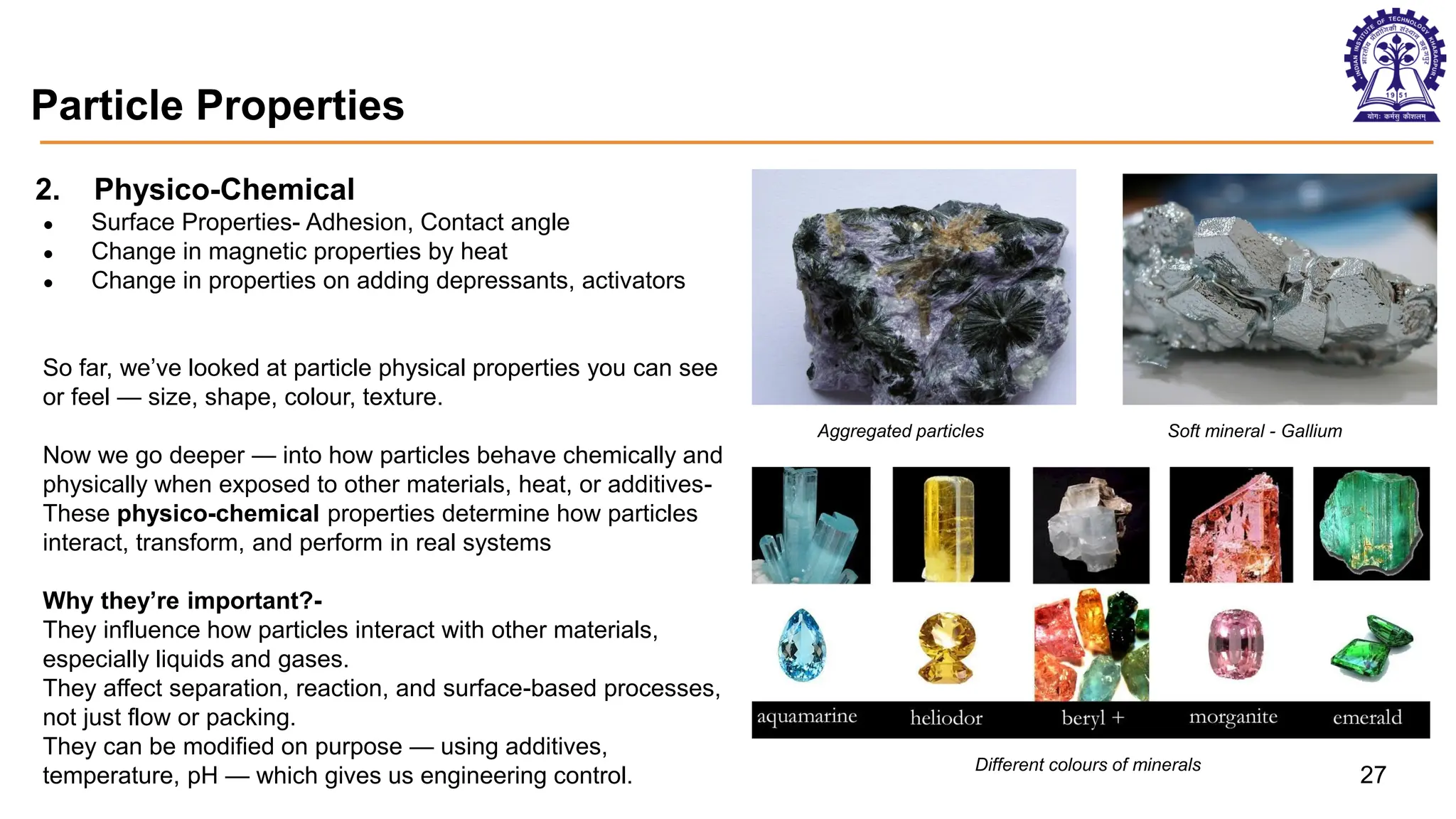
Different colours of minerals
13
14.
Particle Properties
1. Physical
●Hardness, Softness
Hardness tells us how resistant a particle is to scratching
or indentation.
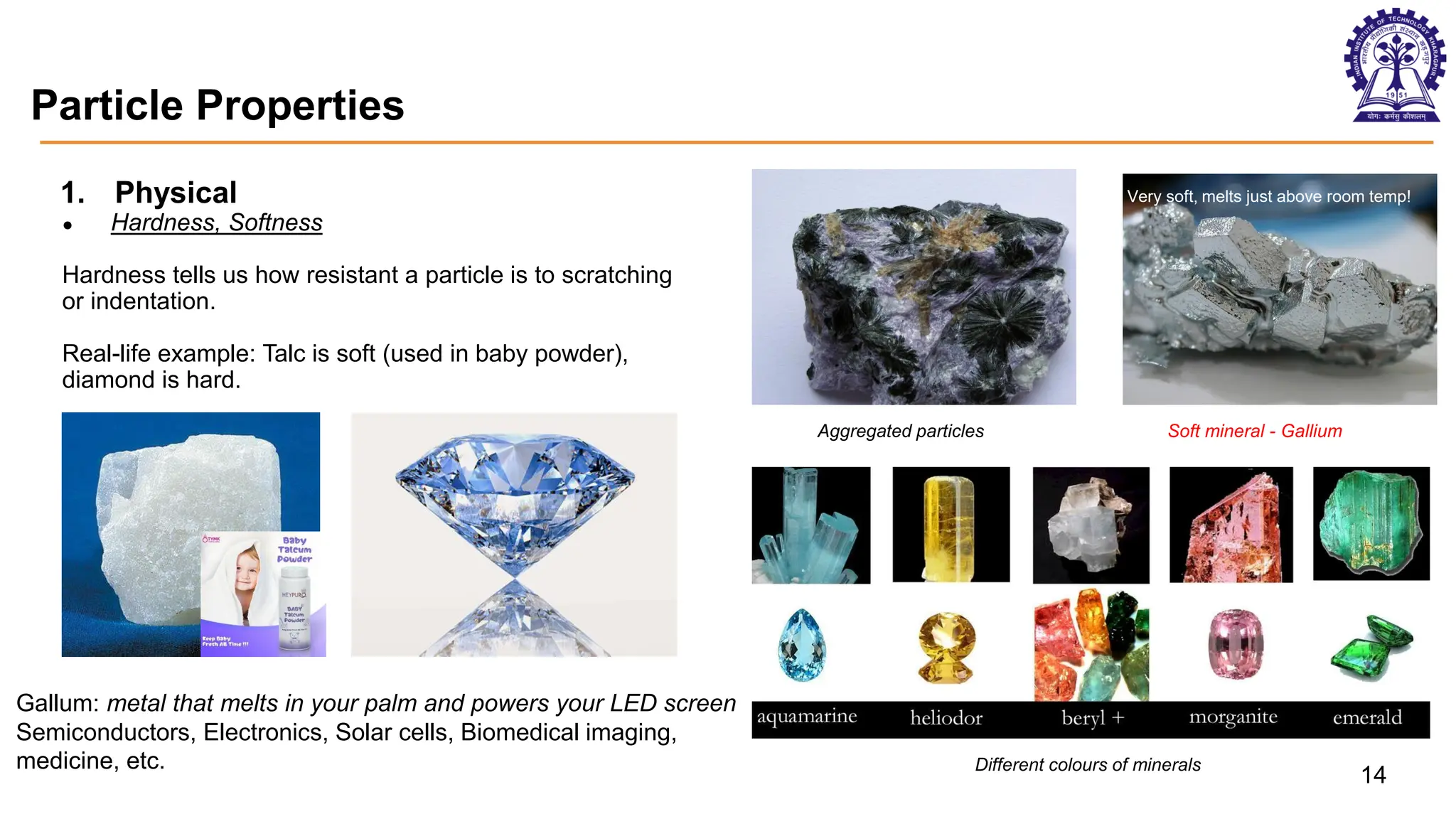
Real-life example: Talc is soft (used in baby powder),
diamond is hard.
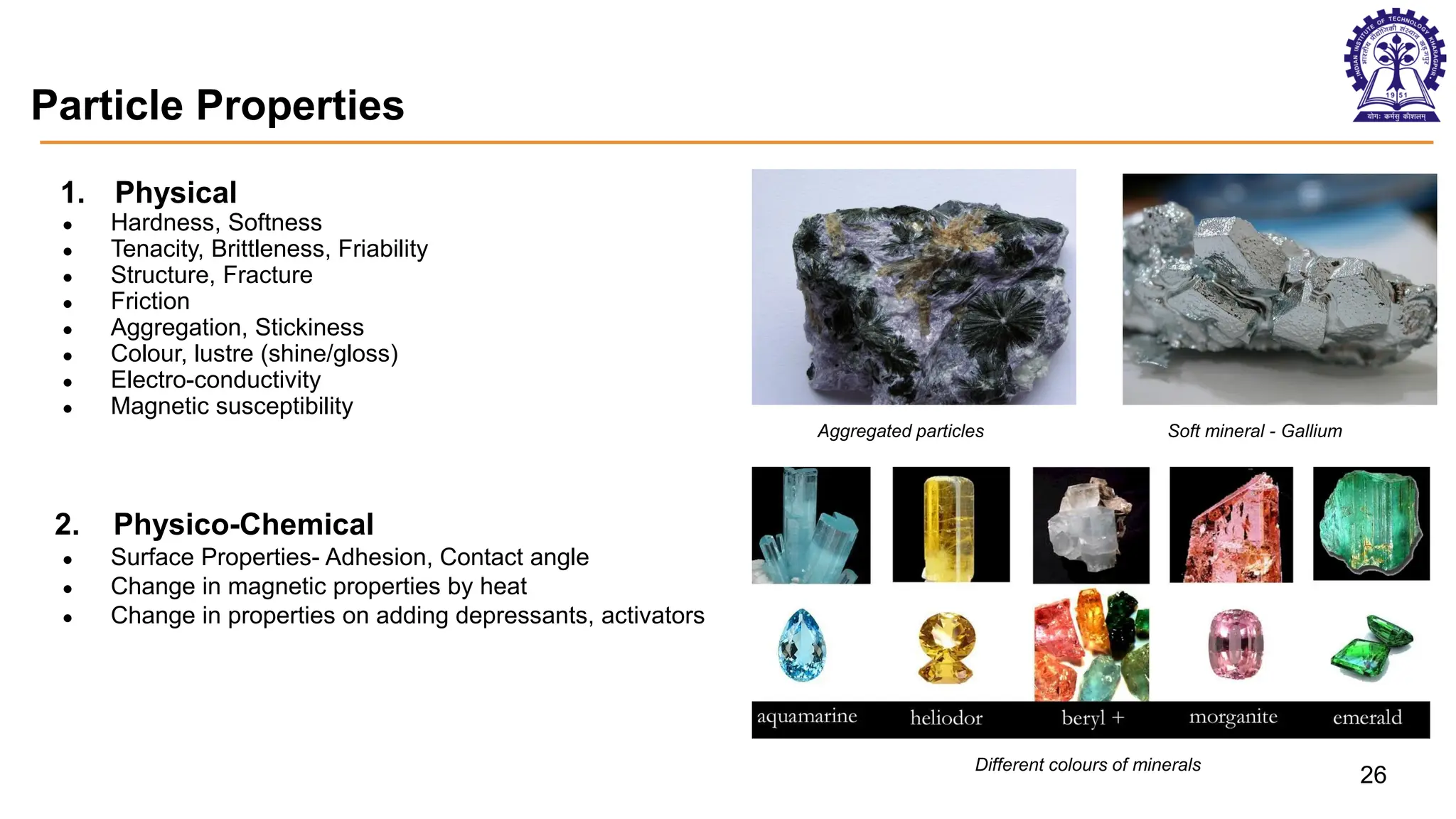
Aggregated particles Soft mineral - Gallium
Different colours of minerals
14
Very soft, melts just above room temp!
Gallum: metal that melts in your palm and powers your LED screen
Semiconductors, Electronics, Solar cells, Biomedical imaging,
medicine, etc.
15.
Particle Properties
Aggregated particlesSoft mineral - Gallium
15
1. Physical
● Structure, Fracture
Some materials fracture cleanly; others shatter
irregularly.
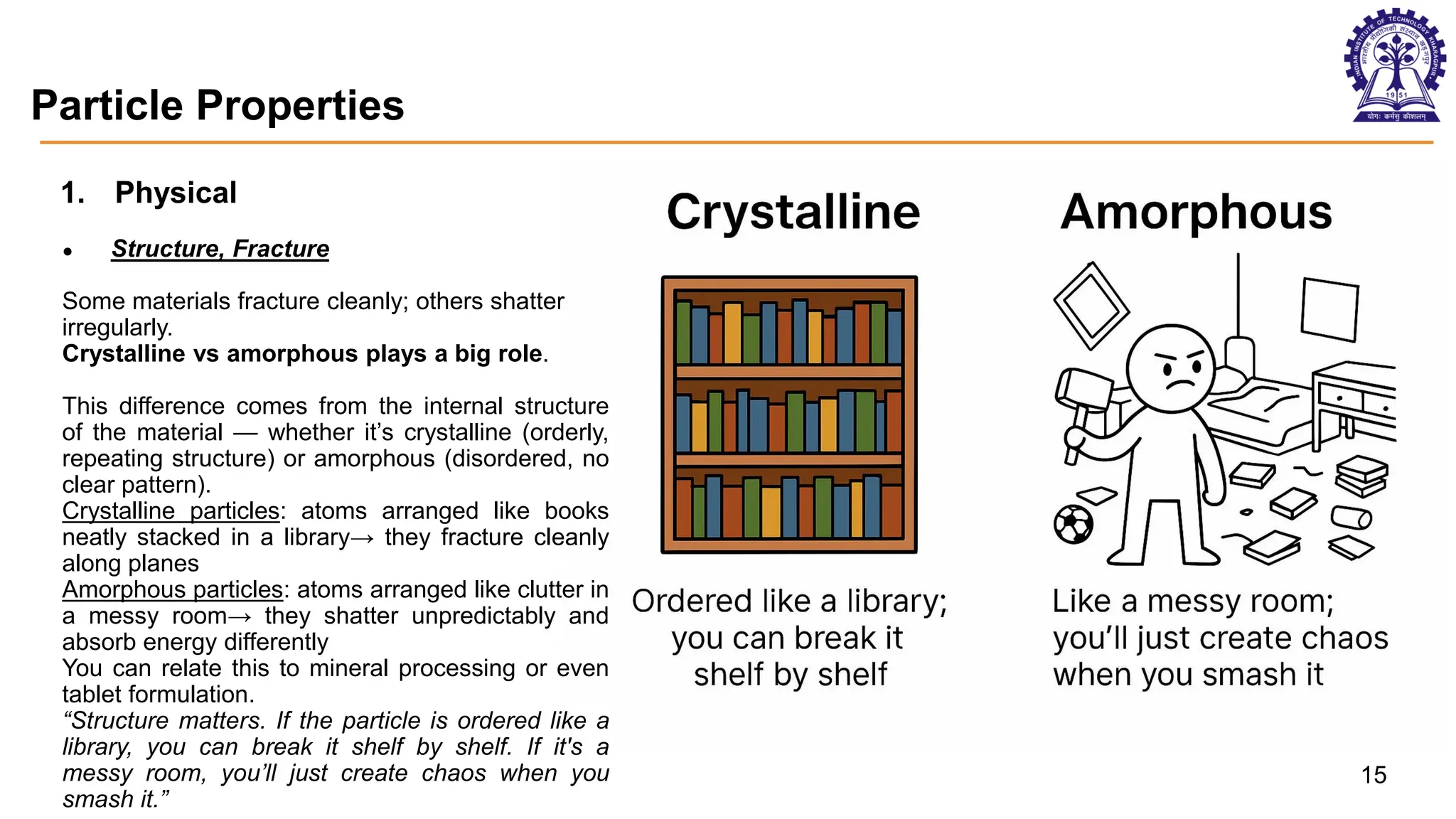
Crystalline vs amorphous plays a big role.
This difference comes from the internal structure
of the material — whether it’s crystalline (orderly,
repeating structure) or amorphous (disordered, no
clear pattern).
Crystalline particles: atoms arranged like books
neatly stacked in a library→ they fracture cleanly
along planes
Amorphous particles: atoms arranged like clutter in
a messy room→ they shatter unpredictably and
absorb energy differently
You can relate this to mineral processing or even
tablet formulation.
“Structure matters. If the particle is ordered like a
library, you can break it shelf by shelf. If it's a
messy room, you’ll just create chaos when you
smash it.”
16.
Particle Properties
Aggregated particlesSoft mineral - Gallium
16
1. Physical
● Structure, Fracture
Some materials fracture cleanly; others shatter
irregularly.
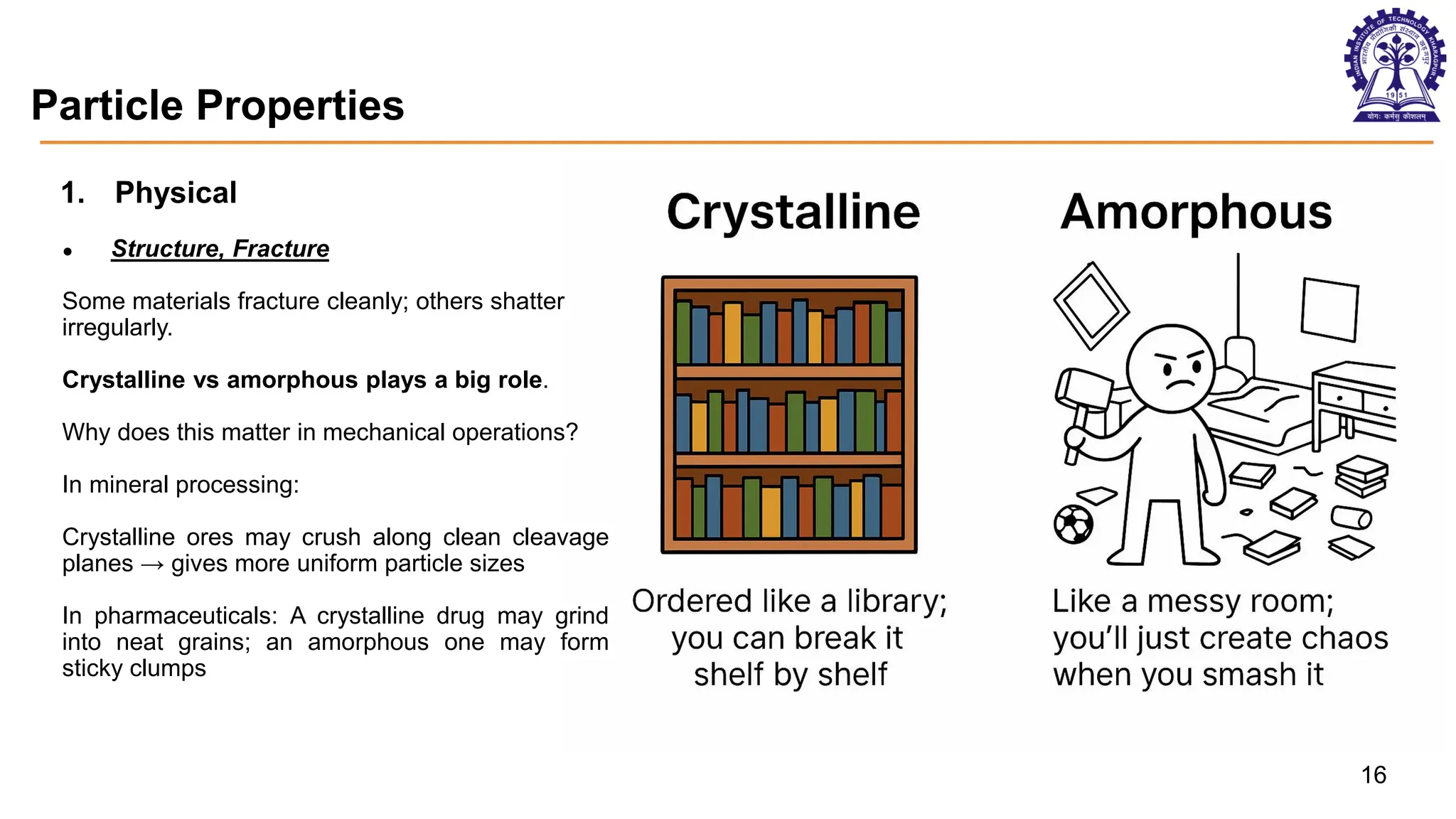
Crystalline vs amorphous plays a big role.
Why does this matter in mechanical operations?
In mineral processing:
Crystalline ores may crush along clean cleavage
planes → gives more uniform particle sizes
In pharmaceuticals: A crystalline drug may grind
into neat grains; an amorphous one may form
sticky clumps
17.
Particle Properties
1. Physical
●Tenacity, Brittleness, Friability
Tenacity: resistance to breaking or deforming (e.g., ductile
vs brittle).
Brittleness: tendency to fracture.
Friability: how easily a material crumbles into powder.
“This is very relevant in milling — we want materials that
break cleanly, not smear.”
Aggregated particles Soft mineral - Gallium
Different colours of minerals
17
18.
Particle Properties
1. Physical
●Tenacity, Brittleness, Friability
“This is very relevant in milling — we want materials that
break cleanly, not smear.”
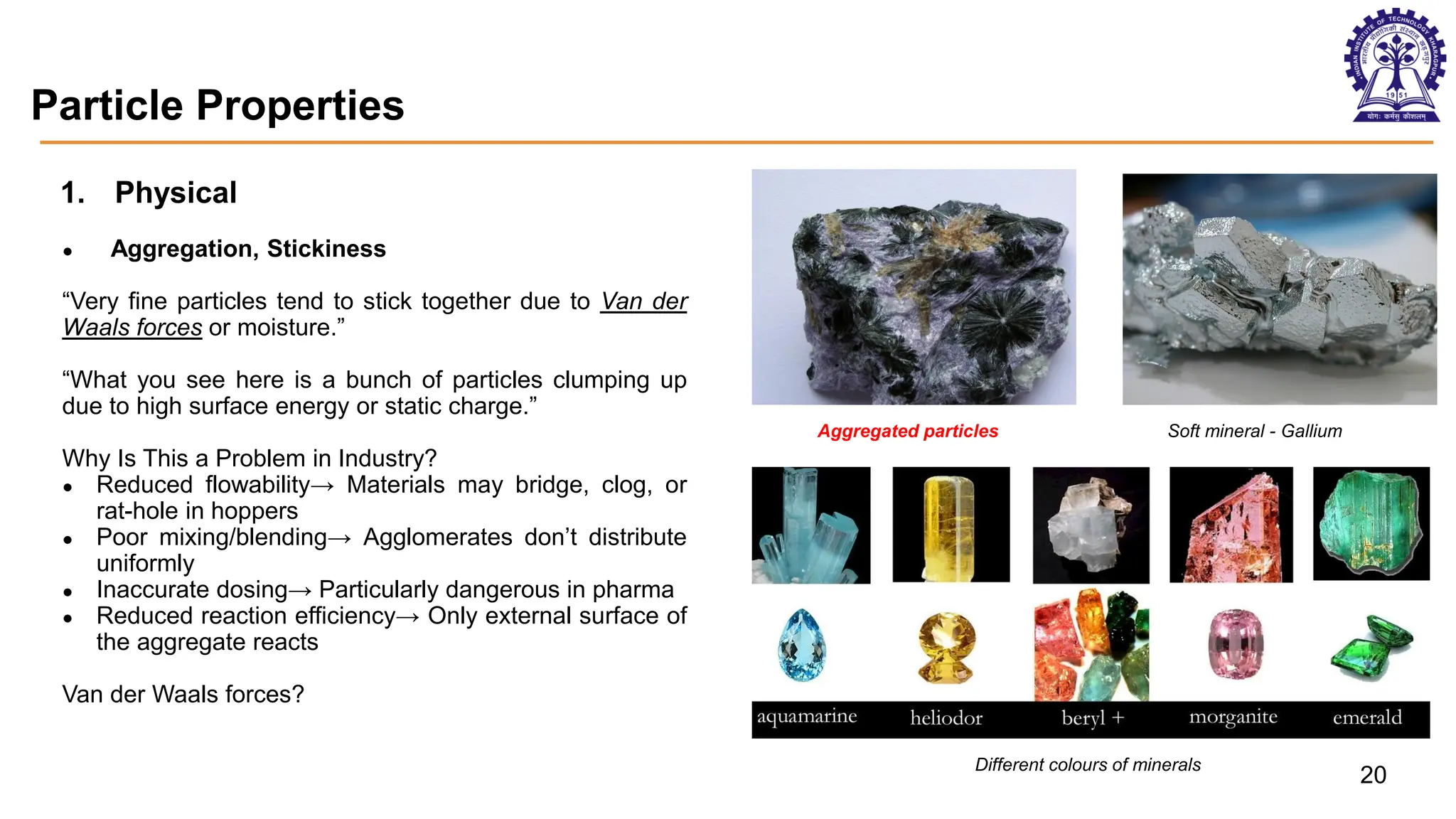
Break cleanly: The particle fractures along its internal planes
when force is applied.
It produces distinct, smaller fragments with defined edges.
Ideal for size reduction — easier to control and predict the final
particle size.
Common in brittle materials (like salt, sugar, minerals, metals
in crystalline form).
Helps avoid clogging or coating of equipment.
Smear: The material deforms plastically instead of fracturing.
It tends to squash, spread, or stick to surfaces.
Seen in ductile or soft materials like waxes, fats, gallium (in
some forms), or polymers.
Makes it hard to grind, leads to gumming up of crushers or
mills.
18
19.
Particle Properties
1. Physical
●Friction:
In mechanical operations, friction refers to the resistance
to motion when one particle slides over another, or when
a bulk material moves along a surface (like a hopper wall
or conveyor belt).
There are two main types you’ll refer to:
Particle–Particle Friction: Between individual grains or
particles
Controls how well the particles interlock, flow, or shear
Wall Friction (Particle–Wall): Between particles and
equipment surfaces
Affects how easily a material discharges from silos,
hoppers, or chutes
Aggregated particles Soft mineral - Gallium
Different colours of minerals
19
20.
Particle Properties
1. Physical
●Aggregation, Stickiness
“Very fine particles tend to stick together due to Van der
Waals forces or moisture.”
“What you see here is a bunch of particles clumping up
due to high surface energy or static charge.”
Why Is This a Problem in Industry?
● Reduced flowability→ Materials may bridge, clog, or
rat-hole in hoppers
● Poor mixing/blending→ Agglomerates don’t distribute
uniformly
● Inaccurate dosing→ Particularly dangerous in pharma
● Reduced reaction efficiency→ Only external surface of
the aggregate reacts
Van der Waals forces?
Aggregated particles Soft mineral - Gallium
Different colours of minerals
20
21.
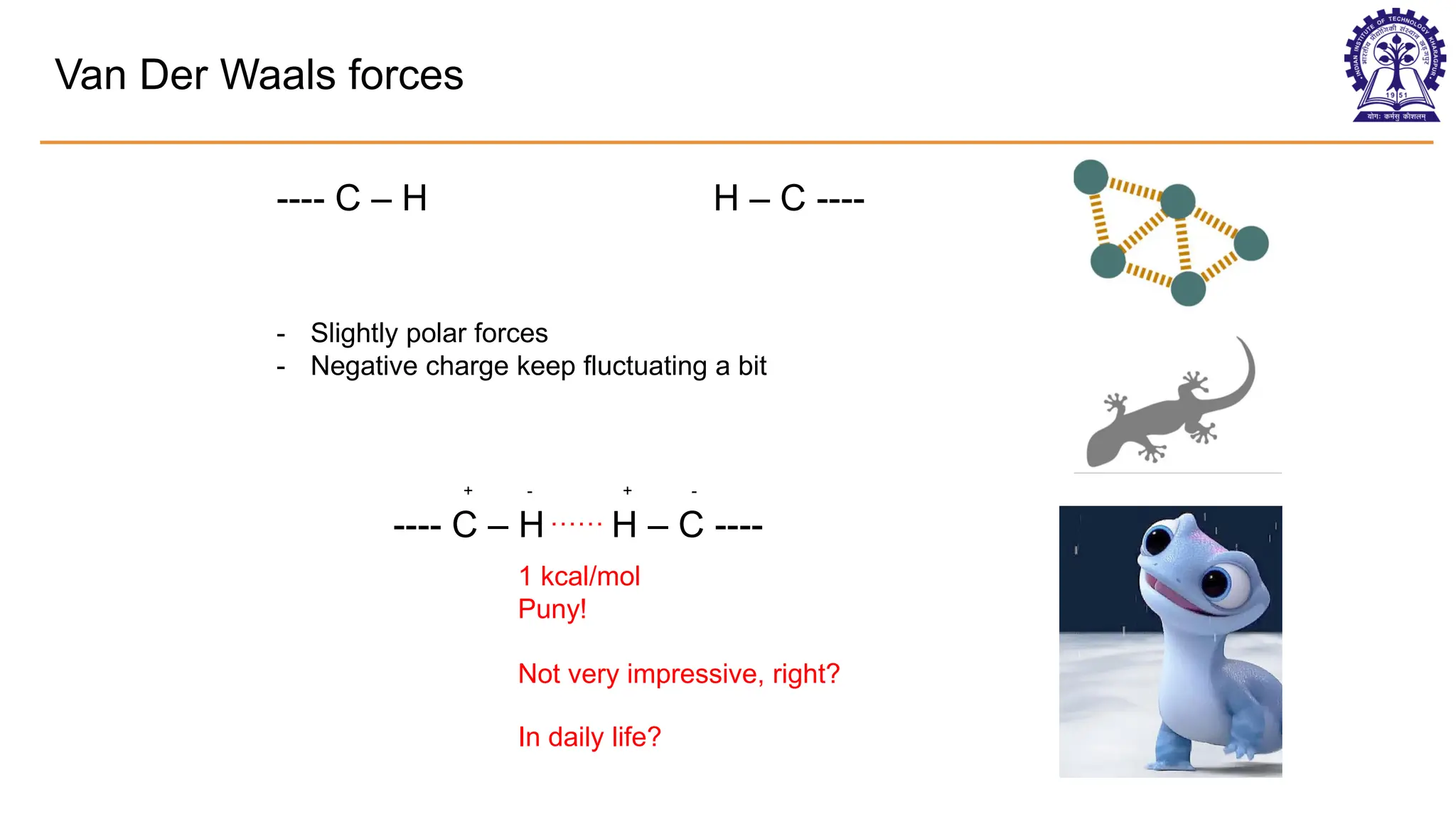
Van Der Waalsforces
---- C – H H – C ----
---- C – H H – C ----
- Slightly polar forces
- Negative charge keep fluctuating a bit
+ - + -
……
1 kcal/mol
Puny!
Not very impressive, right?
In daily life?
22.
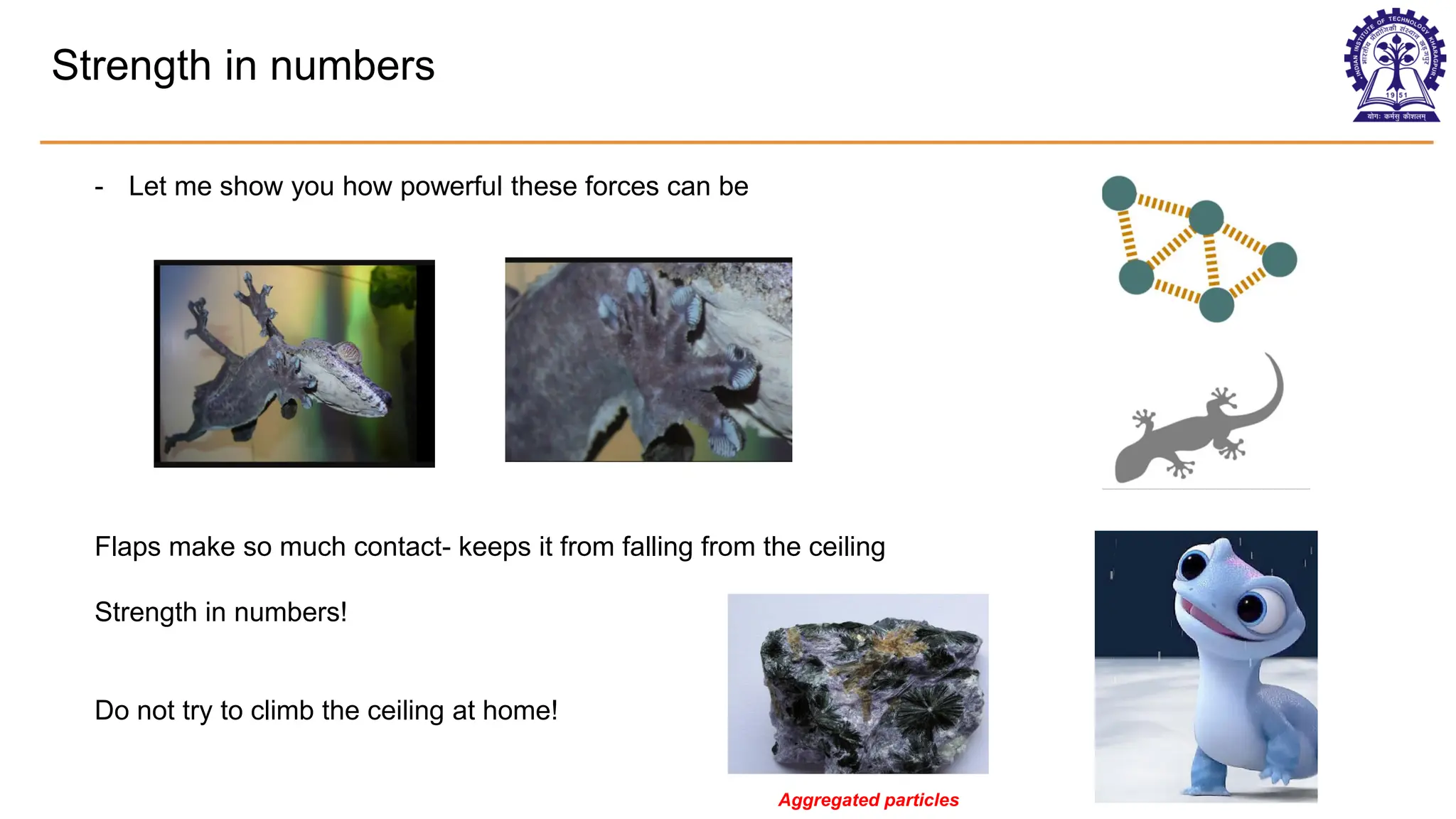
Strength in numbers
-Let me show you how powerful these forces can be
Flaps make so much contact- keeps it from falling from the ceiling
Strength in numbers!
Do not try to climb the ceiling at home!
Aggregated particles
23.
Particle Properties
1. Physical
●Colour, lustre (shine/gloss)
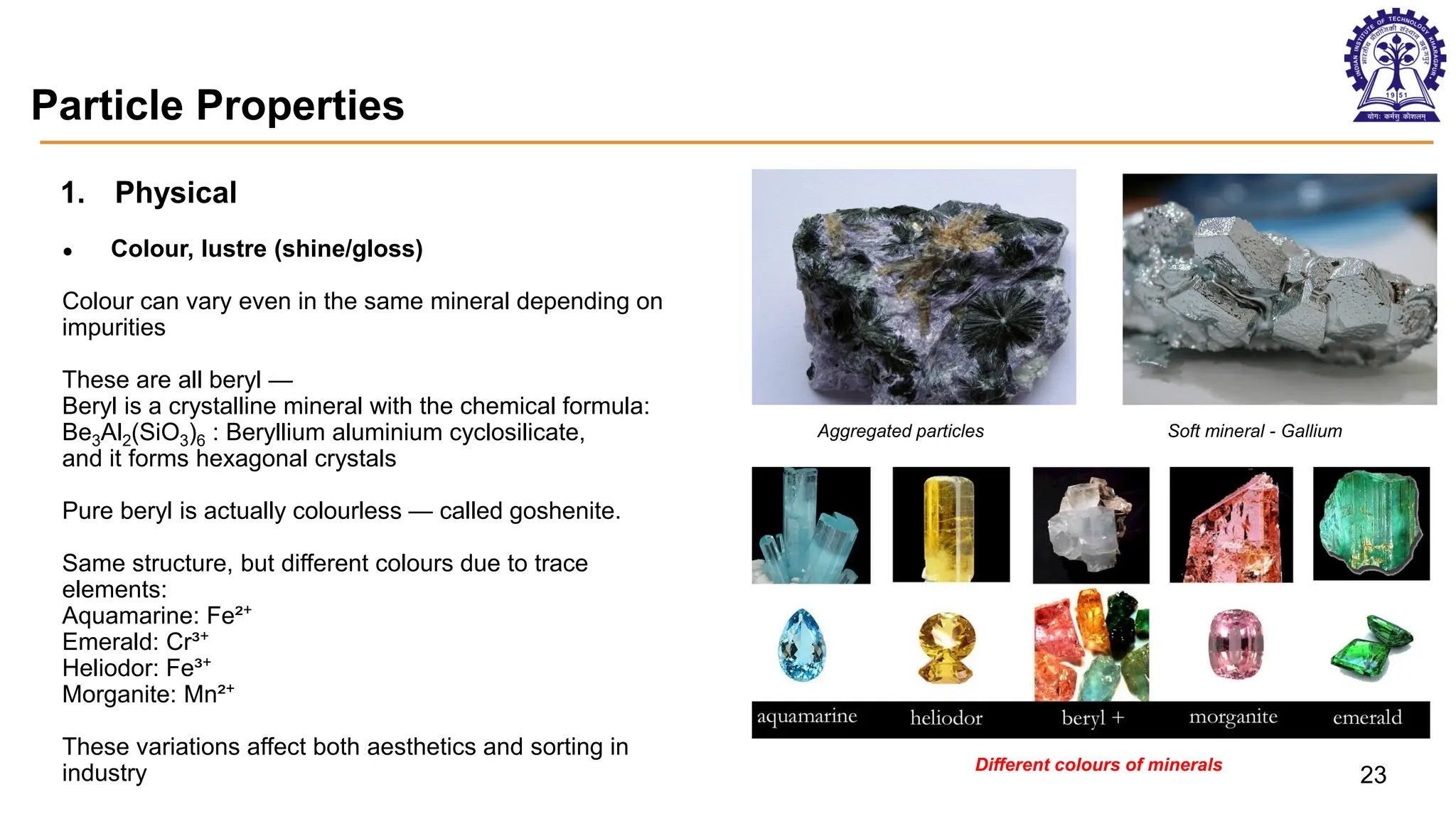
Colour can vary even in the same mineral depending on
impurities
These are all beryl —
Beryl is a crystalline mineral with the chemical formula:
Be3Al2(SiO3)6 : Beryllium aluminium cyclosilicate,
and it forms hexagonal crystals
Pure beryl is actually colourless — called goshenite.
Same structure, but different colours due to trace
elements:
Aquamarine: Fe²⁺
Emerald: Cr³⁺
Heliodor: Fe³⁺
Morganite: Mn²⁺
These variations affect both aesthetics and sorting in
industry
Aggregated particles Soft mineral - Gallium
Different colours of minerals
23
24.
Particle Properties
1. Physical
●Electro-conductivity
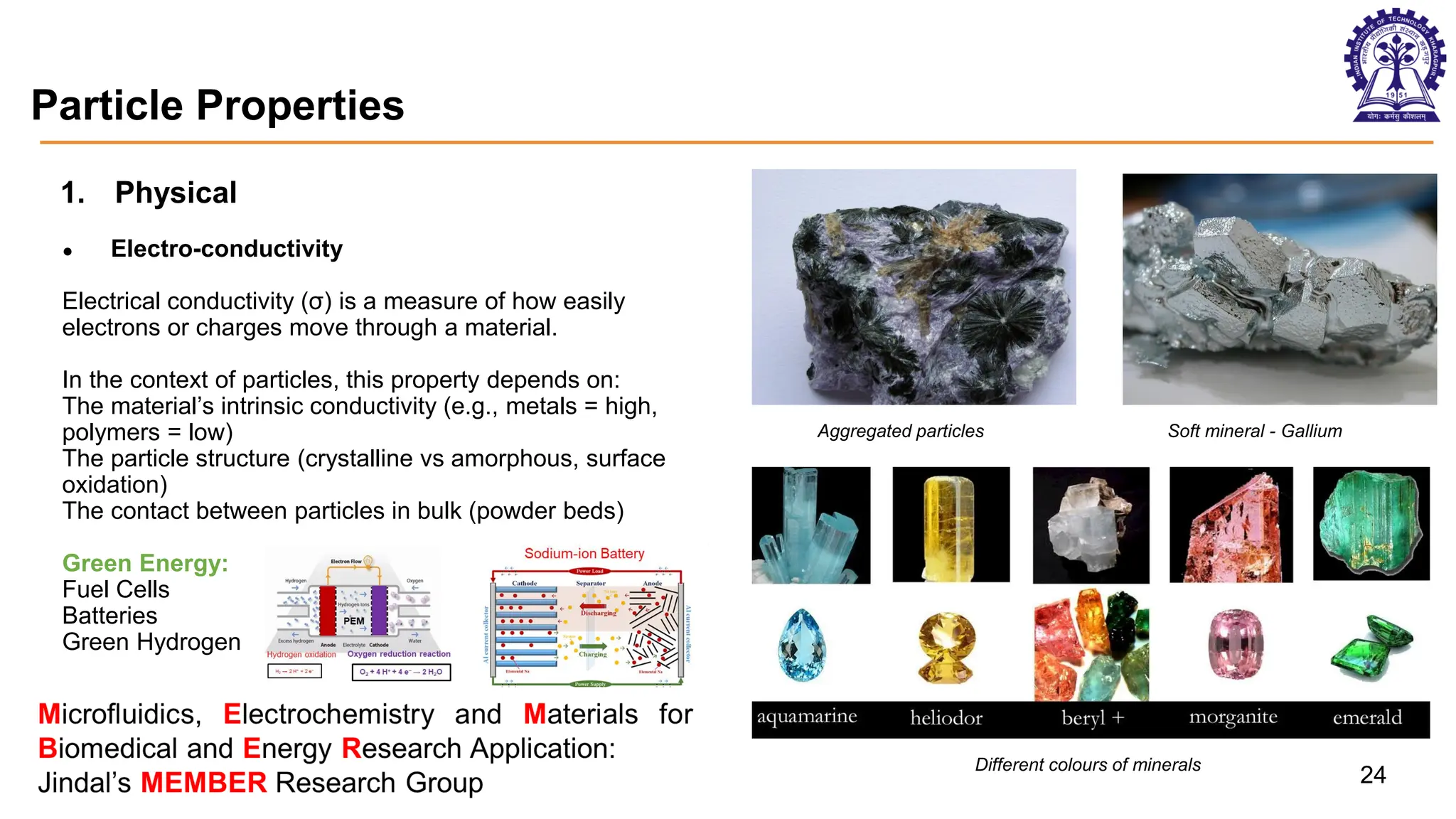
Electrical conductivity (σ) is a measure of how easily
electrons or charges move through a material.
In the context of particles, this property depends on:
The material’s intrinsic conductivity (e.g., metals = high,
polymers = low)
The particle structure (crystalline vs amorphous, surface
oxidation)
The contact between particles in bulk (powder beds)
Green Energy:
Fuel Cells
Batteries
Green Hydrogen
Aggregated particles Soft mineral - Gallium
Different colours of minerals
24
25.
Particle Properties
1. Physical
●Magnetic susceptibility
This tells us how a material responds to a magnetic field.
Useful in separating ferromagnetic vs non-magnetic
materials — a key step in mineral processing.
Aggregated particles Soft mineral - Gallium
Different colours of minerals
25
26.
Particle Properties
1. Physical
●Hardness, Softness
● Tenacity, Brittleness, Friability
● Structure, Fracture
● Friction
● Aggregation, Stickiness
● Colour, lustre (shine/gloss)
● Electro-conductivity
● Magnetic susceptibility
2. Physico-Chemical
● Surface Properties- Adhesion, Contact angle
● Change in magnetic properties by heat
● Change in properties on adding depressants, activators
Aggregated particles Soft mineral - Gallium
Different colours of minerals
26
27.
Particle Properties
2. Physico-Chemical
●Surface Properties- Adhesion, Contact angle
● Change in magnetic properties by heat
● Change in properties on adding depressants, activators
So far, we’ve looked at particle physical properties you can see
or feel — size, shape, colour, texture.
Now we go deeper — into how particles behave chemically and
physically when exposed to other materials, heat, or additives-
These physico-chemical properties determine how particles
interact, transform, and perform in real systems
Why they’re important?-
They influence how particles interact with other materials,
especially liquids and gases.
They affect separation, reaction, and surface-based processes,
not just flow or packing.
They can be modified on purpose — using additives,
temperature, pH — which gives us engineering control.
Aggregated particles Soft mineral - Gallium
Different colours of minerals
27
28.
Particle Properties
2. Physico-Chemical
●Surface Properties- Adhesion, Contact angle
Adhesion: How strongly a particle surface attracts other
materials (like liquids or other particles).
Contact angle: Angle formed between a liquid drop and the
solid surface — it shows how well the liquid wets the surface.
High contact angle (>90°): Drop beads up → surface is
hydrophobic
Low contact angle (<90°): Drop spreads out → surface is
hydrophilic
Real-world examples:
Tablet coating: Poor wetting leads to uneven film formation.
Powder mixing in liquids: Hydrophobic powders float or clump.
Printing inks or paint on surfaces: Controlled wetting ensures
good coverage.
Aggregated particles Soft mineral - Gallium
28
29.
Particle Properties
2. Physico-Chemical
●Change in magnetic properties by heat
Some materials are ferromagnetic at room temperature (strongly
attracted to magnets).
As temperature increases, thermal agitation disrupts magnetic
ordering.
At a specific temperature — called the Curie temperature (Tc)
— the material becomes paramagnetic (weak, disordered
magnetism).
Industrial Example:
Magnetite (Fe₃O₄): magnetic below ~570°C, non-magnetic
above.
In mineral separation: You may use magnetic separation to
extract magnetite — but it won’t work if the ore is too hot.
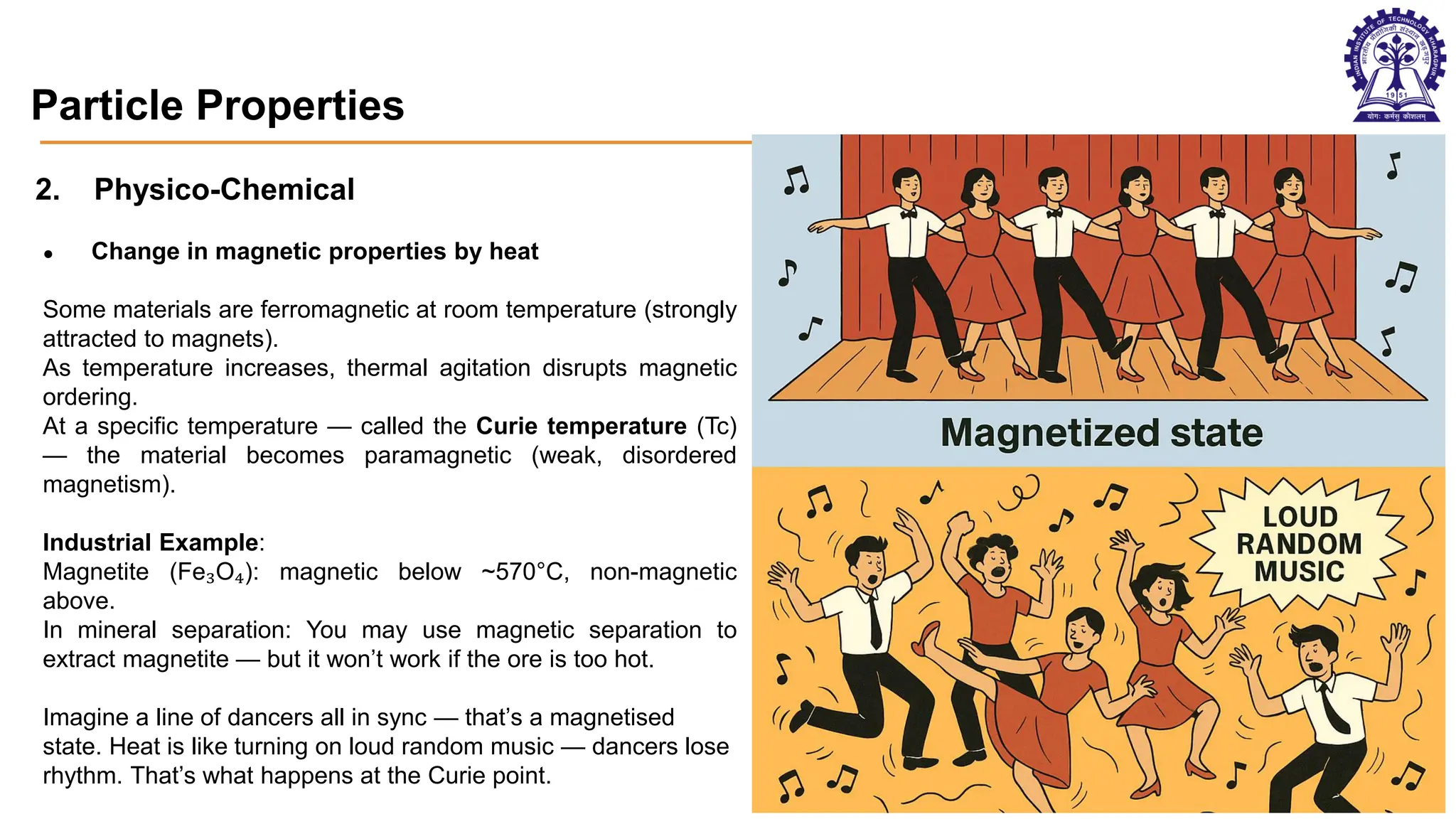
Imagine a line of dancers all in sync — that’s a magnetised
state. Heat is like turning on loud random music — dancers lose
rhythm. That’s what happens at the Curie point.
Aggregated particles Soft mineral - Gallium
Different colours of minerals
29
30.
Particle Properties
2. Physico-Chemical
●Change in properties on adding depressants, activators
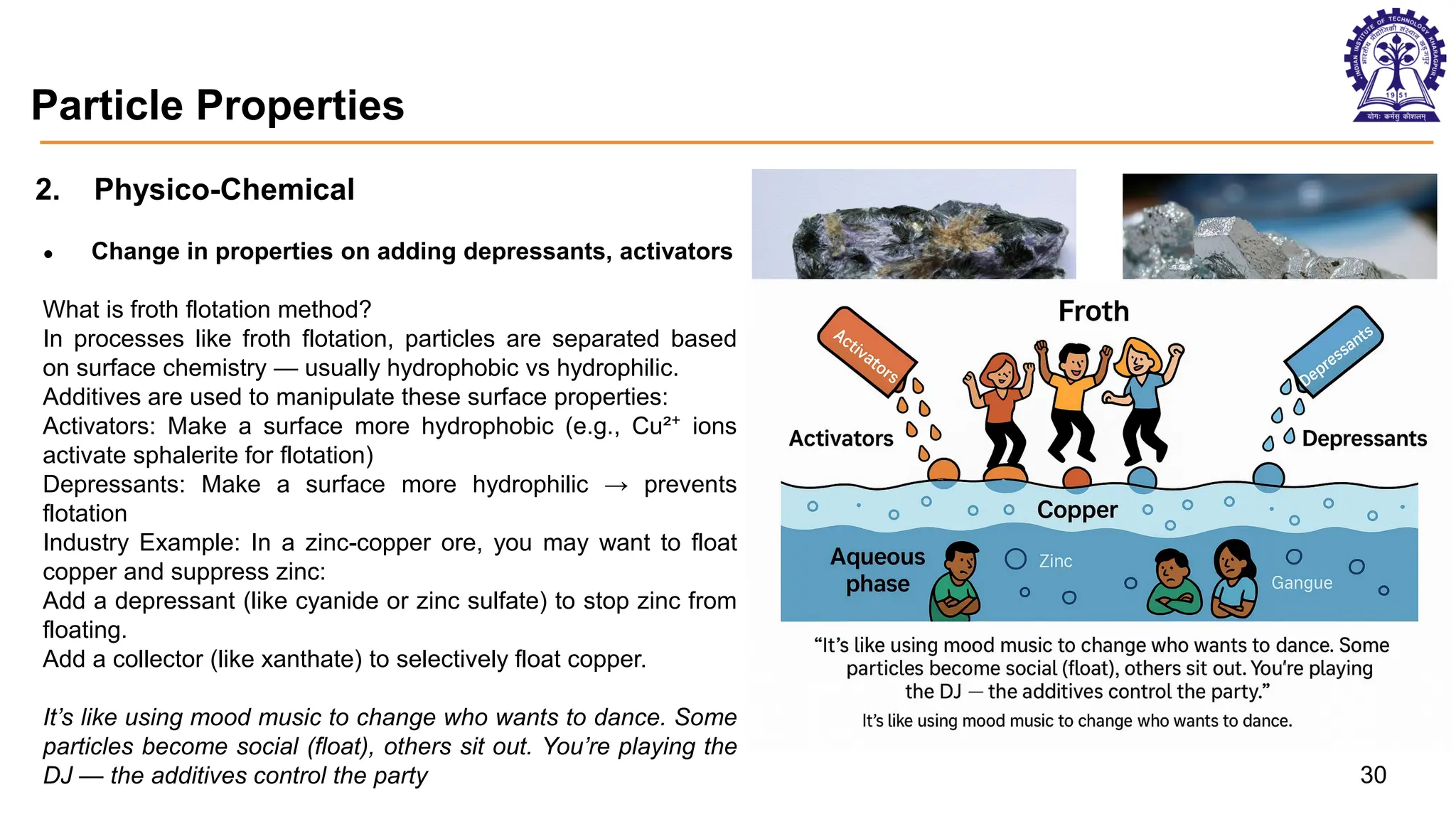
What is froth flotation method?
In processes like froth flotation, particles are separated based
on surface chemistry — usually hydrophobic vs hydrophilic.
Additives are used to manipulate these surface properties:
Activators: Make a surface more hydrophobic (e.g., Cu²⁺ ions
activate sphalerite for flotation)
Depressants: Make a surface more hydrophilic → prevents
flotation
Industry Example: In a zinc-copper ore, you may want to float
copper and suppress zinc:
Add a depressant (like cyanide or zinc sulfate) to stop zinc from
floating.
Add a collector (like xanthate) to selectively float copper.
It’s like using mood music to change who wants to dance. Some
particles become social (float), others sit out. You’re playing the
DJ — the additives control the party
Aggregated particles Soft mineral - Gallium
30
31.
31
Physico-chemical properties arehow particles interact with the world
— whether they attract water, change with heat, or respond to
chemicals.
They give us control knobs to separate, activate, suppress, or
enhance — and that’s where real process engineering begins.